



Abstract
Background/Context:
This article is drawn from a doctoral research study that involved co-research between as adult trans academic and their child, a nonbinary 11-year-old. It mounts an epistemic challenge to education that assumes children to be cis, and either boys or girls. GIaNT children (Gender Independent, and Nonbinary, Trans) are often talked about but seldom directly engaged about their wants and desires in education, but my study addresses this problem and centers their agency.
Purpose/Research Question/Focus of Study:
The purpose of the study was to generate knowledge and insight into how 2SLGBTQ children, and children from 2SLGBTQ families, envision education spaces and programs that meet their needs. It also investigates the potentiality and significance of a parent-and-child researcher team to engage caregivers and children in co-imagining liberatory education spaces as 2SLGBTQ cultural spaces.
Participants:
Participants were 17 children (ages 4–12 years) and 12 adults from 11 households; the focus in this article is on the 12 children who identified their gender as other than cis.
Research Design:
A qualitative, arts-based participatory research methodology was employed. While the parent-child research team of a trans adult and a nonbinary 11-year-old conducted semi-structured interviews with both children and parents, the focus in this article is on the former. Participants were also invited to draw their ideal learning space. Interviews were video recorded, transcribed, and coded.
Findings/Results:
GIaNT children in this study desired learning spaces that are ready for them, that affirm their self-assigned genders, and that understand that people define their own genders. They wanted to be believed as who they said they were. They wanted safe access to bathrooms and schools to be communities, not just places of learning, and they recognized that learning happens outside of school. They desired an end to gender policing in schools, and in online learning, participants wanted schools that were safe and celebratory of all their identities and of all their peers. They wanted schools that are antiracist and decolonizing, that practice universal access, that teach queer and trans history and culture, and that provide meals and transportation.
Conclusions/Recommendations:
The study highlighted the creative potentialities of GIaNT children to provide generative insights into gender-affirming school spaces. It advocates for children to be engaged in processes of creating their own learning experiences. GIaNT children called for schools to be more equitable, antiracist, and decolonizing, committed to practicing universal access, teaching queer and trans history and culture, and providing meals and transportation.
Introduction: The Ideal “Place to Learn”
Current public conversations about trans children are exceptionally polarized and dire. On one side, the conversation is haunted by the specter of suicide, where adults are told that supporting trans young people is an essential suicide intervention. On the other, the conversation is profoundly transphobic, where transness is positioned as harm to children, and it is claimed that aggressive pro-trans groups or perhaps pedophiles push children into trans identities. This side, claiming that this is abuse, slanders parents who believe and support their trans children. 1 Both of these conversations are deeply damaging. The first one is a partial story—yes, living in transphobic environments is harmful, and yes, supporting and affirming trans people is suicide prevention. The most important thing a family or school can do is to believe someone and support them (Ryan, 2009). The problem with this narrative is not that it is wrong, but that it focuses on the harm done to trans people—not on the actual lives and experiences of trans people. It connects trans identities and death, when, for many of us, trans identities are in fact life-affirming. We are more than the harm done to us. We need not just life, but joy, and gender euphoria, and trans exuberance. The second narrative is transphobic hate-fiction designed to cut trans people off from the support of trans communities and deny our existence altogether. It is a narrative that discounts and disbelieves trans children, both as children, considering them incompetent because they are children and, as a result, immature, and as trans people, who are incompetent as a result of their trans identities (Steele & Nicholson, 2020). It assumes that children lack the experience to make significant life decisions because they are minors, and it employs the transphobic trope that trans people are duplicitous and/or mentally ill, and that either would make them incompetent to make significant life decisions. The logic of this is that there is no way to be a competent trans person.
My research and writing are a refusal to participate in either of these narratives. As a trans adult who has worked in schools for almost two decades supporting GIaNT (Gender Independent, and Nonbinary, Trans)
2
children and youth, I am sick of damage-centered research and dialogue (Tuck, 2009; Tuck & Yang, 2014). Sick of people talking about us and not listening to us. Sick of research that wants to document our pain and the harm done to us, but not our joy, our moments of gender euphoria, our embodied knowledge, our desires for possible futures. Pearce (2020) pointed out that this transphobia is the context in which we conduct our studies. Therefore, as part of the fight for trans liberation and equality within academia, we need methodological approaches to research—incorporating rationales, methods, and ethics—which take problems such as the high prevalence of suicide within trans communities into account. (p. 808)
Yes, and! While we ourselves work within climates of transphobia, we need methodologies that make room for trans desires and knowledges. Methodologies that anticipate and recognize trans children in families where their identities are valued and celebrated.
In this article, I draw on my doctoral study, which involved myself, an adult trans person, and Safran, an 11-year-old nonbinary child as co-researchers. Safran is my child. When my original project became impossible because of closures to prevent the spread of COVID, they offered to be my co-researcher. They had been a research participant before and wanted to try being a researcher—they also wanted to connect with other GIaNT children. I said yes to co-research with Safran because I wanted to center the voices, opinions, experiences, and desires of GIaNT children in all aspects of my research. I wanted to be unsettled as an adult, to have to wrestle with my own adultism, to “radically listen to children” (Steele & Nicholson, 2020). Undertaking co-research meant relinquishing control as a researcher and allowing greater room for the desires of GIaNT children to be expressed, and not just my expectations of their desires. Working as a parent-child research team required careful navigation of roles and ethics and has been a rich and productive experience for us both. I recruited families with children between the ages of 3 and 12, either 2SLGBTQ children, or children with 2SLGBTQ parents. I intentionally recruited families I would describe as culturally queer and/or culturally trans, where individuals are seen as the experts on their sexual orientation and gender identity and where children’s shifting understandings of who they are welcomed and supported by their adults.
In keeping with a methodology of listening to children, I begin with the words and image of one of our participants, Unicorn. 3 I want to unsettle the practices of academic writing always being about adult interpretation, and begin with deeply engaging with what one of our participants shared. In my research, I used “listening to children” as a methodology to deeply attend to children, to their words and body language, to looking at their images, to imagining with them. Rather than looking at Unicorn’s illustration and thinking about the cost of construction, or trying to assess its practicality, I invite readers to look as I did—look deeply, pause, look for Unicorn’s meanings. Imagine with them, paying attention to what is important to them (Carini, 2001). This is not a schematic drawing, or an architect’s plan; this is a nonbinary child’s generous response to the prompt to draw an ideal learning space. Even that prompt is already listening to children. I began by asking children to draw ideal schools, and children told me, very clearly, that schools might not be the best places for them to learn, and that if I wanted to hear about the best places for them to learn, I needed to ask a more expansive question. Unicorn drew and described a school, but one that looks radically different from schools I have worked in, and those differences are productive. Here is Unicorn’s ideal learning space:
An ideal school, drawn by Unicorn (age 11).
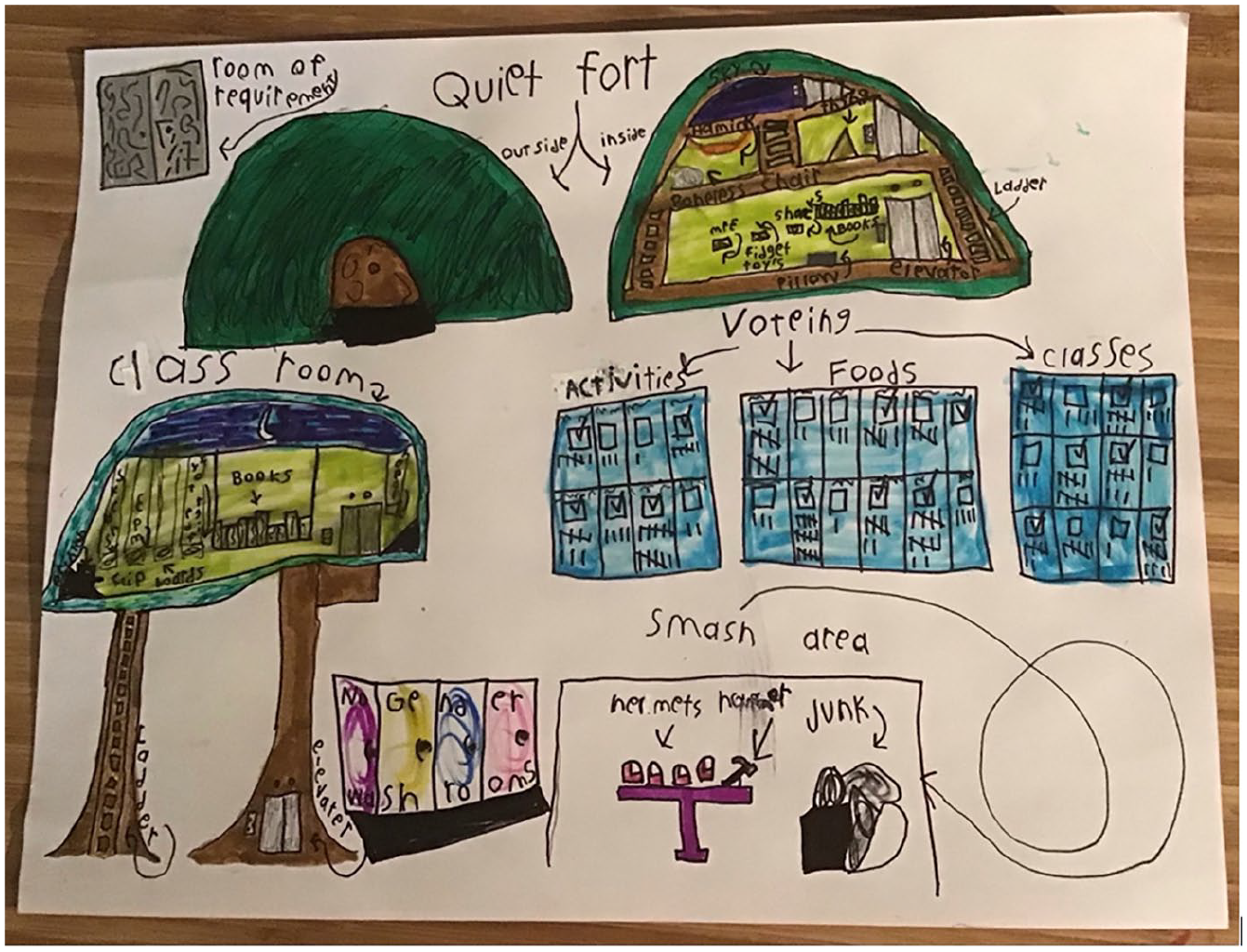
Unicorn described their school before they drew it, while they were drawing, and after. This conversation spanned about 15 minutes (with gaps of silent drawing). I got the feeling that Unicorn had been waiting to be asked to redesign a school for a very long time:
There should be free lunch. And if you need, like, dinner or breakfast, also that at school. Whenever you’re hungry, you should be able to eat something. And the kids would vote each week on what they would like to have as the menu.
Well, they’d vote for the menu for the week. And then at the end of that week, or like maybe on Thursday, they would then vote for the menu again. Also, Wednesday should be a weekend day. . .
Um, I just realized something. The schools should have the bathrooms as a room of requirement.
Yeah?
Unicorn: Like, the bathroom you needed, it would be that bathroom.
Huh. I love that framing.
Unicorn: Yeah, that’s . . . yeah. That’s good. That’s how it should work. Though, also that would include magic.
Mm-hm.
Unicorn: Then again, if you had that power, you could, like, there could be a lot of things more in schools. Oh, yeah, schools should also be designed by kids, and they should all have secret passageways.
Um, I think sometimes schools don’t have secret passageways because they’re afraid that kids might hurt other kids if there were a secret passageway. Does that feel like a risk to you?
No. Because there would be, I don’t know, there would be a thing to stop that in a secret passageway. If you tried to harm someone in a secret passageway, you’d, uh, freeze. And it would alert the teachers via a thing. I don’t know. Yeah.
There would need to be ramps, elevators, um, things to accommodate kids if they needed a different style of learning for that kid, or harder or easier or something. Yeah. And the reading fort would, like, have stars on the ceiling that could look like the night sky.
Look! I drew elevators.
Ha! Because it’s an accessible reading fort!
Unicorn: Yes! The elevators are also quiet.
Ahhh . . . meeting my great desire for quiet elevators.
Yeah. They don’t ding. And the doors don’t make noise when they open. Also, there’s free music players you can use in the reading fort.
It’s actually a huge reading fort.
Well, there’s a lower section . . . it’s all wood. It’s an all-wood design.
Mmhm.
So there’s like moss and wood and cushions. There’s also a, um, chair with no bones. A boneless chair.
A beanbag chair?
Unicorn: Yeah. A beanbag chair. I like my drawing! Maybe this is the quiet fort.
Is the reading fort inside another building? Or is it like its own building?
Unicorn: Well, it’s got one entrance outside, and one entrance inside.
So you can enter the school through the reading fort?
Unicorn: Yes. It’s like . . . it’s its own room in the school. And so this is what the outside of the room looks like. . .
Mmhm.
And then you enter, and then you’re in here . . . but you can also leave through the other entrance, and it will put you outside of the school. So, you see it as a room in the school, and if you look outside of the school, you see it as a room outside of the school.
Unicorn: Also, now that I look at this, I have to imagine how big the school is?
Yeah?
Basically, it looks like Castle Loma, 4 maybe, like a castle.
I mean, I said imagine what it was like if it was ideal for you. I did not say, like, keep it within budget. So, that’s fine.
Well, schools should really have a bigger budget. I blame our government. Okay. I’ve done my reading fort. Or my quiet fort. Do you want to see?
Um, so there’s elevators for accessibility. And it has ladders, if you want to climb the ladder. And it’s got many places to read your book. So, it’s got a night sky floor up here. Everything else is moss. And there’s the absolutely very quiet elevator. You can lean back on this thing. Here’s a hammock. There’s more hammocks, but I didn’t have room. Here’s a beanbag chair. Here’s the MP3 shelf.
Got it.
And here’s a pillow.
Unicorn shares a great deal here. I would encourage you to go back to their initial drawing and see ways that their description and drawing come together. I would invite you to consider “what if” schools could be like this. Unicorn is one of the 12 GIaNT children whose desires for school I discuss in this article; while each child’s drawing and description were deeply idiosyncratic, there were common themes of accessibility, care for others, community, and equity of access. There was also a common theme of a desire for gender facilitative and gender affirming schools. This article explores those specific themes and thinks with the children, imagining trans cultural schools.
From Trans Cultural Families Into Gender Normative Schools
Mainstream education expects that children will be one of two binary identities, that children will be cis boys or cis girls—seldom are other children anticipated. The gender binary is both the explicit and implicit curriculum of public schools. Explicitly, it is taught in health and human development. Implicitly, it is it taught through numerous ways: the built environment (boys’ and girls’ entrances, sex-segregated bathrooms and change rooms); regular reminders to children how important it is that they be a boy or a girl, and nothing in between (greeting students as “boys and girls,” registration systems, report cards populated with “he” and “she,” separate teams for boys and girls, pink- and blue-coded wall charts); different expectations for student behavior, student achievement, and athletic prowess; sex-specific activity prompts and requirements that students line up, sit, or engage in other activities in boy-girl-boy-girl fashion; sex-specific dress codes; and many other ways.
When children fail to conform to expected gendered behaviors, the implicit teaching becomes explicit. Part of Indigenous children’s experiences in residential schools, from 1883 to 1996, was the enforced requirement to comply with white Eurocentric gender binary norms (Driskill, 2010). They were explicitly taught to conform to Western Eurocentric notions of boy or girl, with different uniforms, dormitories, hairstyles, and physical labor falsely labeled as “trades training,” but more appropriately understood as gendered servitude. We punished those that failed to conform. One of the ways to strip people of their cultural epistemology is to strip them of their understanding of gender roles and to force them to comply with different ones. It was and is a gendered violence.
Our schools remain deeply invested in teaching children that there are two, and only two, essential ways of being: boy and girl. Through listening to the experiences of trans youth, A. Travers (2018) recognized that “the experiences of trans kids also throw into sharp relief the extensive labour that the people in their environments engage in to impose and naturalize cisgender binary categorization” (loc. 101). Despite the ongoing project of teaching the gender binary, an exponentially increasing number of children are behaving or identifying outside of their prescribed roles (Ehrensaft, 2014). The younger the demographic, the greater the percentage of people who do not find themselves in a binary gendered world (Flores et al., 2016). Students whose gender identities are other than prescribed by cis-hetero-patriarchy frequently experience bullying and harassment from students, teachers, and institutions (Baum et al., 2013; Taylor et al., 2015; Yau & Archer, 2017). Nonbinary students experience erasure (Namaste, 2000). To transition is to violate a cis organizing principle of education.
Ontario “addresses” inequalities through a human rights model rather than working toward universal access. A human rights model is itself a barrier to access—a student must first know it exists (often without any information from the school) and then be in a position to explicitly request and advocate for individual accommodations. The more a child has learned that authority is dangerous, and the more ways they are additionally marginalized by the system, the more challenging this is to access. Because the ability to make a complaint requires time as well as trips to Toronto if there is a negotiation or tribunal convened, and may require legal representation, class and parental support also impact who is able to access human rights accommodations (Spade, 2015). Although there are no age requirements on the protections around gender identity or gender expression, according to the Ontario Human Rights Commission, schools often act as if they need parental permission to provide a child access to their rights.
In the back-and-forth between children’s desires and a system that is most responsive to adult desires, I looked for a tool that would give education systems a frame that necessitated schools’ and educators’ paying attention to the desires of GIaNTs. This article considers what would become possible if we applied the medical affirming model of care in education. Affirming care has become the standard in medical settings, and it is one that requires adults to listen to children, to affirm their self-knowledge of who they are, and to support them in living in their self-identified gender. Beginning with a belief in the agency and self-knowledge of children is radically different from beginning with the assumption that all children are cis boys or cis girls (and always, boys first). I then demonstrate my own commitment to children and to an affirming model of care by listening to my child participants, believing them, and bringing forward their gendered desires for education.
What Education Could Learn From Medicine—The Affirming Model of Care
In Ontario, education and medicine are similar systems. Both are funded by the people via the government, officially “for the public good,” are staffed by university-educated professionals and have significant impact on individuals. While education continues to rely on human rights accommodations, medicine has embraced an affirming model of trans care. The affirming model recognizes individuals as the experts on their own lives and directs those around the individual to support and validate the individual’s understanding of their own gender. Simply put, the affirming model is about believing that children know who they are. To me, this model is in keeping with children’s rights, and a respect for the agency of children. In health care, as the affirming model has been widely adopted, trans and gender independent children experience significantly improved outcomes. By widely, I mean that the following all have policy statements that endorse the affirming model of care: American Academy of Child and Adolescent Psychiatry (2012), American Academy of Family Physicians (2009), American Academy of Nursing (2016), American Academy of Pediatrics (2018), American College of Obstetricians and Gynecologists (2011), American Medical Association (2008), American Psychiatric Association (2012), World Medical Association (2015), and World Professional Association for Transgender Health (2016). In Canada, similar statements have been expressed by the Canadian Medical Association (2014) and the Canadian Psychological Association (2010).
Support and affirmation at school are immensely significant to the well-being of children—second only to affirmation at home in terms of its positive and protective impact on trans and nonbinary youth (T. Clark et al., 2014; Gill & Frazer 2016; GLSEN and Harris Interactive, 2012; Russell et al., 2012; Saewyc et al., 2017; Taylor & Peter, 2011). And yet, schools often fail to provide the needed support and affirmation. This failure attends to what trans and nonbinary children told me and drew for me. It is their own vision of what affirming education might be like, and sometimes their own descriptions of what it is like when they are failed.
I am cautious about borrowing a model from medicine, noting how medicine has long been used to define, control, and physically constrain those deemed undesirable, including trans and nonbinary people. However, there are powerful parallels between education and medicine, and the affirming model is a definite break from attempts to define, control, and constrain those in the system (Keo-Meier & Ehrensaft, 2018). It both provides a framework for educators to think about gender diversity, and demands that they pay attention to the needs of GIaNT children. In light of what participants told me, the affirming model of care offers a frame that schools could use to provide a basis of support for GIaNT children. Susan Lytle (2008), for example, has considered the ways in which physicians work for the betterment of their patients, and what educators might learn from them: I have also become a patient of Elihu Goren, a sensitive and knowledgeable doctor who intently looks at and listens to me, who continually considers and orchestrates the resources he has to offer me, acting on the assumption that together we will negotiate an approach to my getting better. He does not perform the role of expert, fixing me, but rather takes the stance of a learner, instructed by his attention to the data and to the specific parameters and contours of my situation. (p. 374)
Lytle is making the point that educators need to also intently look at and listen to children, to see ourselves as learners, and to support children toward better. “Better” is deliberate language—in my experience as an educator, if we ask people to create perfect environments, they often fail to start—perfect feels like an impossible standard to attain. When I encourage people to do better, to start with what changes they are able to make now, they do. Lytle is describing how a physician or teacher could become a learner, pay attention as a learner, and engage their expertise toward bettering the situation for their patient. Educators can do similar, in both theoretical and practical ways, by orienting themselves as learners, willing to learn from and with their students and work for better.
Dr. Joey Bonifacio, a Toronto physician who founded the adolescent gender clinic at The Hospital for Sick Children and sees younger children and their families through St. Michael’s Hospital, champions the affirming model. Bonifacio and Rosenthal (2015) described the gender-affirmative model’s fundamental tenets:
Gender variations are not disorders;
Gender presentations are diverse and varied across cultures and, therefore, require our cultural sensitivity;
To the best of the authors’ knowledge at present, gender involves an interweaving of biology, development and socialization, and culture and context, with all of these factors influencing an individual’s gender self;
Gender may be fluid and is often not binary, both at a particular time and [it may change] within an individual across time; and
If there are mental health or behavioral concerns, it more often stems from negative cultural reactions (e.g., transphobia) rather than from within the child. (p. 1004)
Others describe it similarly (American Psychological Association, 2015; Ehrensaft, 2011, 2012, 2014; Hidalgo et al., 2013). Rainbow Health Ontario provides an overview of existing literature on the affirming model, stating that it requires:
Providers being aware of their own understanding and biases, particularly in relation to gender, internalized transphobia and cissexism;
Creating an open safe space to explore the full range of gender identities and expressions without repercussions;
An informed consent model regarding medical transitioning;
Acceptance and inclusion of people who do not identify as either or only masculine or feminine, and fostering acceptance for any and all gender identities, expressions and embodiments;
Working with caregivers and families to help them accept and celebrate any and all gender identity and sexuality outcomes for the child;
Working with caregivers to develop advocacy skills to ensure their child has support in all environments (at school, in the community, in the family);
Clinicians taking on the role of advocates for the child at times when needed in other systems (school, healthcare, etc.);
Understanding that anxiety and depression is a normal response to living in a transphobic world/community/system/family;
Working with caregivers and families in order to strengthen relationship bonds to better meet the needs of their child/youth; and
Working to build resilience by connecting clients to other gender-diverse children and youth. (Gillis et al., 2019, p. 23)
Inherent in the definition of affirmation is the understanding that the individual is the expert on and determines their own identity and that the parents’ and clinicians’ roles are to empathetically support the child’s assertion of their identity. For prepubertal children, gender-affirming care often includes supporting a social transition (Spack et al., 2012). This frequently includes a child changing their name, pronouns, clothing, hairstyle, what sex-segregated facilities they use, and other outward expressions of gender. The affirming model insists that it is important that a child feel valued, seen, and believed in the present. Additionally, children should be able to play with toys and read books that interest them, regardless of sex/gender.
Young trans people who receive affirming care experience more positive mental health and reduced risk of suicide (R. Travers et al., 2012; Veale et al., 2015), as opposed to trans youth who do not receive such care. A Canadian study found that trans youth with supportive adults in their lives were 4 times more likely to report good or excellent mental health (Veale et al., 2015). Olson et al. (2016) compared a community-based national sample of trans children (aged 3–12 years) who were supported in their identities during childhood to a set of 49 siblings as well as a group of 73 typically developing children, matched on age and gender identity (i.e., transgender girls with cisgender girls). The group of children who were allowed to socially transition (e.g., change in pronouns used to describe the child, as well as his or her name, and, typically, hair length and clothing) experienced rates of depression that were similar to those in the sibling and control group.
Schools fail GIaNT kids
Transphobia, gender policing, and harassment from both students and teachers based on gender identity or gender expression are prevalent in schools (Baum et al., 2013; Peter et al., 2021; Taylor & Peter, 2011; Yau & Archer, 2017). Those who step outside the gender binary have negative experiences with peers and teachers, including sexual violence (Yau & Archer, 2017), rejection by other students (Baum et al., 2013; T. Smith & Leaper, 2006; Taylor & Peter, 2011), transphobic language from teachers (Baum et al., 2013; Taylor & Peter, 2011), higher rates of property theft than their cis peers (Yau & Archer, 2017), lower senses of belonging in school (Yau & Archer, 2017), and poorer educational outcomes (GLSEN & Harris Interactive, 2012). To avoid transphobia, trans and nonbinary young people often skip school (Taylor & Peter, 2011; Taylor et al., 2015; Yau & Archer, 2017). Living in transphobic and cissexist environments is a significant cause of physical and emotional stress for trans, nonbinary, and gender-nonconforming individuals—even cisgender heterosexual young people report experiencing stress and distress from these behaviors (Taylor & Peter, 2011; Taylor et al., 2015). Veale et al. (2017) specifically analyzed the experiences of Canadian trans youth for signs of minority stress and found that transphobia was emotionally, physically, and academically harmful, while the creation of affirming home and school environments was protective.
GLSEN’s Playgrounds and Prejudice report (2012), currently the only elementary research, found that students in Grades 3–6 who did not conform to traditional gender norms were far more likely than others to report being called names, made fun of, and bullied “at least sometimes” at school (56% vs. 33%). Students who did not conform to traditional gender norms were also twice as likely as conforming students to report that other students had spread mean rumors or lies about them (43% vs. 20%), and 3 times more likely to report that other students had used the Internet to call them names, make fun of them, or post mean things about them (7% vs. 2%). Further, students who did not conform to traditional gender norms were less likely than other students to feel very safe at school (42% vs. 61%) and were more likely than others to agree that they sometimes did not want to go to school because they felt unsafe or afraid there (35% vs. 15%).
Why Attend to the Desires of GIaNT Children?
Current writing about trans and nonbinary children tends to come in three forms: trans adults reflecting back on their childhoods, parents of these children advocating for what they think is best for their children, or medical practitioners espousing what they think the best course of action is. The voices of children are markedly absent from this conversation; if children are to be seen and heard as research collaborators and researchers in their own right, adults engaged in collaborative practice must be willing to reverse conventional roles and become invisible and/or mute when the time comes for the “experts” to step on stage. (Yardley, 2011, p. 202)
The rest of this article is about GIaNT children sharing their visions of better—sometimes their versions of better have been shaped by less-than-acceptable situations they have experienced, but they shared those too as “teachable moments.” I am sharing participants’ insights and desires, inspired by the idea that collective problem solving and accessing students’ creative power makes education a practice of freedom (hooks, 1994). I hope readers consider how they can bring gender freedom to people they learn with. In Ontario, we are required by law to ensure that schools do not discriminate on the basis of gender identity and gender expression. Children’s experiences indicate that reality does not meet the requirement of the law, they are impatient for better, and they are willing to help teach us what better might look like.
Methodology and Research Design
My experience in schools had long taught me that in order to care for children, we need to see them as fully their own humans, with their own rights. A children’s rights model requires that we see children as agents, capable, possessing of knowledge and experience, and entitled to have a say in all things that impact them. Lots of research is conducted on children, but my goal is to conduct research that includes children and their ideas at all levels. In the words of Justice for Children and Youth, 5 we need to recognize that “children are independent rights holders” and not extensions or dependents of the adults who care for them. This informed how Safran and I researched together. It led to the innovation of us drawing visual field notes so we could equally discuss what we had seen and heard. It demanded a child assent process, interviewing children first (so they did not feel obligated to participate in research that their parents had already invested time in) and in practicing attentive listening. I began with the assumption that children have capacity (Lundy, 2007). I sought to redistribute power between myself and my coresearcher (Pascal and Bertram, 2009), and then build in processes that gave power to our participants. For me as a researcher, giving up control meant embracing uncertainty, recognizing that embracing uncertainty was in keeping both with research that centers children (Chesworth, 2018) and with employing a queer and trans theoretical lens that is committed to putting the voices and accounts of queer and trans youth at the center of research (Namaste, 2000; Stryker, 2006). Embracing uncertainty freed me from trying to control what was happening and allowed me to focus on understanding what was happening.
Thus, I employed practitioner research frames that were informed by my reading of practitioner researchers such as Cynthia Ballenger (2009), Gerald Campano (2006), and Vivian Paley (1990, 2009), who offered me models of researchers engaged with their co-researchers/participants with deep respect. Practitioner research names me as a learner; it values, and demands, my curiosity and careful attention to the things that at first do not make sense to me. It encourages a cyclical practice of observation, questioning, reflection, further questioning, engaging. It also engages students in this process, it encourages conversation, play and exploration of questions; it honors the words and the work of learners. In short, it offered me a model of working toward understanding, building complex understandings of learners’ lives, including my own, our historical contexts, our emotional reality, and more. It demanded that I situate myself in their context and let them show me. Through embracing such a practitioner research methodology, I was able to engage in what Campano (2006) referred to as “pedagogy of listening” (p. 18), or what Ballenger (2009) identified as a commitment to a belief that “children are always making sense” (p. 33), and a willingness to both locate confusion in the researcher and to work to understand the sense the child is making. It is a tradition that builds on Vivian Paley’s practice of careful documentation of children and starting from the premise that there is always more to learn from children.
In the design of my project, it also felt important to consider not just my ethical responsibilities as a researcher, but my ethical responsibilities as a community member (someone who is queer and trans and part of informal networks of care with my participants) and as a parent with responsibilities to care for my co-researcher. As a parent, I believe that part of my responsibilities include creating environments where my children can thrive; this research and my commitment to the voices and agency of children contribute to that. A significant part of my work as a researcher was working to address our power imbalance as a research team. To that end, we reviewed questions together and made changes. We both interviewed child and adult participants. We kept visual field notes rather than written ones so that we could both access them with the same ease. Safran chose the name they are identified by here—they have read, or had read to them, any part of this work before it goes out in the world. Researching together meant confronting my own adultism and giving up control of what might happen. In confronting my adultism, I paid attention to my own frustrations, my own sense of when things were out of my control, and I looked for meaning, or what was of value to Safran in those moments. The moments I found most frustrating were often the most productive, and where I did some of my most significant learning. Since completing the research, when we have been asked to do guest talks about the work, my commitment is to always ask Safran if they would like to speak too, and if they want to, we negotiate around their schedule. We try to share compensation equitably rather than equally; after a recent invited talk to a graduate seminar, they got the gift certificate to a local art supply store, and I got to add it to my resume—both of us getting something we consider to be of value. This is ongoing work, but I believe that ethical work and consent need to always be ongoing, and active, not a single point at the beginning of a project.
Employing Queer and Trans Theory as a Methodological Resource
In this article, you are being invited to read through a trans lens. You are being invited to listen to trans children, to make space for their desires, and not to flatten them. GIaNT children are not participants in my research on behalf of other people. In centering trans lives and trans desires, I am seeking to “theorize transsexual and transgender experience on its own terms” (Rubin, 1998, p. 279) rather than as a means to critiquing heteronormative understandings of gender. In this research, it is essential that trans identities, understandings, and lives be articulated by trans people living them. I am a trans adult with a nonbinary child co-researcher, researching the desires of GIaNT children, and my work is deeply committed to centering trans people and trans epistemologies. The field of trans studies was built on the demand that trans people be able to speak for themselves and that trans lives be valued (Stryker, 1994)—my work is deeply within that frame.
Queer and trans theoretical frameworks further informed my understanding of a trans affirmative approach to conducting research and generating knowledge that is by and for queer and trans children and communities. Queer theory guided me in challenging the overwhelming heterosexism of our culture, as a repudiation of a “normal” in terms of family configuration. It allows for an attending to the ways that hetero normativity shapes the Eurocentric cultures and its settler colonies (Morgensen, 2012). It challenges the idea that sex is always and only about reproduction, it values pleasure and playfulness, it casts aside an obligation that we all must desire reproduction and parenting with an “opposite sex” partner. Britzman (1995), for example, conceptualized queering as both a hermeneutic and pedagogical practice that refuses normal practices and practices of normalcy, one that begins with an ethical concern for one’s own reading practices, one that is interested in exploring what one cannot bear to know, one interested in the imagining of a sociality unhinged from the dominant conceptual order. (p. 165)
Hence, employing a queer theoretical lens challenged me to step outside the existing normative limits for conducting research and feel unrestrained in working collaboratively with queer and trans children in generating knowledge that serves them and speaks to their interests. It helped me not look for “normal,” but instead look for productive possibilities outside of normal. I needed this when, in my early interviews, I had participants who refused to redesign schools and preferred instead to design ideal learning spaces. For some, school is not queer enough, and perhaps is beyond queering. In this respect, I embrace a notion of queerness as it is conceptualized by Muñoz (2009) as “not yet here”: Queerness is an ideality. Put another way, we are not yet queer, but we can feel it as the warm illumination of a horizon imbued with potentiality. We have never been queer, yet queerness exists for us as an ideality that can be distilled from the past and used to imagine a future. The future is queerness’s domain. (p. 1)
I do not think I understand this as he intended, but for me, it contains the notion that we are all always becoming, that we are all, in all moments, ripe with potentiality and a commitment to enable queerer and transer futures for others. For me, invoking queer theory within the context of my research was informed by my reading of Muñoz’s queer utopian possibilities with respect to looking for ways we are becoming, ways we are always in process and changing through engaging in research about our lives in schools. In this sense, queering was a tool to disrupt the present reality and to consider a different possible future we can desire with respect to conceiving of schools as queer and trans affirming spaces for GIaNTs.
However, I also needed something other than queer theory to allow me to fully engage with the agency and subjectivity of my trans and gender-diverse participants. As is so often true, I am rejecting the binary and engaging a theoretical both/and. I needed theory that is both queer and trans, drawing from both and not limited by either—a nonbinary engagement of queer and trans theory, if you will. Trans studies also afforded me with a theoretical frame that centers trans and gender-diverse people and is informed by Stryker (2006), who wrote about the ethical and political commitment of a trans affirmative approach to generating knowledge about trans people: Transgender Studies considers the experience of the speaking subject, who claims constantive knowledge of the referent topic, to be a proper—indeed essential—component of the analysis of transgender phenomena; experiential knowledge is as legitimate as other, supposedly more “objective” forms of knowledge, and is in fact necessary for understanding the political dynamics of the situation being analyzed. This is not the same as claiming that subjective knowledge of “being transgender” is somehow more valuable than knowledge of transgender phenomena gained from a position of exteriority, but is rather an assertion that voice in dialog should have the privilege of masking the particularities and specificities of its own speaking position, through which it may claim a false universality or authority. (p. 12)
GIaNT children and their trans and gender-diverse parents were conceived not as participants in my research on behalf of other people, but rather as a means by which to create conditions and spaces for their voices to be asserted “in dialog” with me as a trans researcher. As such, a trans studies approach met my need to “theorize transsexual and transgender experience on its own terms” (Rubin, 1998, p. 279), rather than as a means to critiquing heteronormative and cisnormative understandings of gender. Rubin’s (1998) concern, for example, is that “feminist and queer studies have dismissed or coopted transsexualism before transsexuals have scarcely had a chance to speak in our own names” (p. 272). Radi (2019) built on Susan Stryker’s field-defining work, and noted the significance of creating an opportunity for the privileged and powerful kinds of knowledge production that take place in the academy (about trans topics or any other area that involves people) to be not just objectifying knowledge, what we might call “knowledge of,” but also “knowledge with.” (p. 48)
In conducting this research, it was essential that trans identities, understandings, and lives be articulated by the trans people living them. Trans theory gave room for me to center trans people as agents in our own rights. It allowed me to see all gender as socially constructed and specific to a cultural place and time, and thus malleable, while also not forgetting what Rubin (1998) referred to as trans “bodily ontology”—bodily knowing and awareness as “the means by which the world comes into being for us” (p. 268). Gill-Peterson (2018), for example, pays attention to the subjectivity and agency of actual trans children, making a compelling argument that trans children have existed, and have been involved in actively shaping our understandings of the livability of transness, since before the rise of the gender clinic. Her work centers the embodied agency and activism of trans people of color, attending to the actual words and desires of trans children. She pushes back on a sanitized, whitewashed adult history of access, self-identification, and medicalization. The trans theory I am committed to building as a researcher is unapologetically concerned with trans people for our own sake and committed to believing in children and their agency.
Recruitment and Data Collection
Our participants for the study were 12 adults and 17 children from 11 households. I recruited parents and caregivers of 2sLGBTQ children (aged 3–12 years), and parents and caregivers who are 2SLGBTQ through my existing social networks. I directly invited adults who met the criteria who are Black, Indigenous, and people of color. Adults were then sent the consent package, and I often had a phone call or video call to discuss the research. Safran and I met with the children and went through the child assent script and encouraged children to ask us questions. Both children and adults needed to separately clearly indicate that they wanted to participate for us to proceed.
Between October 2020 and January 2021, Safran and I conducted semi-structured interviews and drew with both adult and child participants. We invited them to draw their ideal schools or learning environments, and we created our own drawings as both a form of visual field notes and as part of a validation process. This article comes out of that larger project and focuses on the desires of GIaNT children raised by trans and/or nonbinary adults. Our choice was to explore what might be possible when children are loved, supported, resourced, and believed.
At the time of my research, my participants included three children who identified as trans, four who identified as nonbinary, two whose fashion sense is outside of what is expected for cis boys, one who identified as “everygender,” one who identified as “not a boy or a girl,” and one who was raised with gender autonomy. These specific differences of identity are important to the children, but in the context of mainstream education, they are all gender outsiders. In the mainstream frame, all 12 are outside conventional gender expectations. One more child participant has come out as trans since being interviewed and has been included here. While he did not share his trans status at the time of our interview, we did have extensive conversation about bathrooms and the importance of all-gender bathrooms, and including him in this article feels respectful to his current identity.
All interviews were conducted over Zoom at a time that was convenient for participants. All interviews were recorded, and later transcribed and coded. Safran and I drew during the interviews as a way of creating visual field notes. We invited all participants to draw their ideal learning space, and participants shared their images and described them to us. We showed them our drawings of what we had imagined their ideal learning space would look like based on what they had said as a way of member checking. Transcripts of the interviews were sent to adult participants for member checking, and most adults read the transcripts out to their children. Several sent back small adjustments (like the name of a stuffed toy) or additional information. Two child participants asked for a copy of their video, which they watched with a parent. I used 33 thematic codes (Saldaña, 2013) in my child data, and 28 thematic codes in my adult data, with 11 codes common to both sets. The different codes spoke to the different topics that children and adults shared—both talked about “Animals,” “Bathrooms,” “COVID,” “Mother’s Day,” and “Indigenous Content,” but only children talked about “Child Agency,” “Discipline and Control,” “Mutual Support,” and “Start Time,” and only adults talked about “Disempowering Parents,” “Other People’s Parents,” “Parental Gender,” and “Talking About Sexual Orientation With Children.”
The Role of Drawing in This Research
In all of our interviews, we asked participants to draw their version of an ideal school. Initially I was inspired by the Mosaic approach (A. Clark & Moss, 2011) and thinking about multiple ways that young children might express themselves and make meaning. Further, I was inspired by Lynda Barry (2018), who refers to our hands as “the original digital devices” and encourages adults and children to draw as a way to get in touch with their creativity. She talks about “the image world,” a place of creativity that we can all access if we allow the knowledge that is in our body to lead, rather than the thoughts of our mind. She talks about how the “top of the mind” knows things that can be expressed through drawing that we may not be able to access in other ways. In these ways, drawing was a methodology, a way of engaging different parts of our participants brains and thinking.
Analysis
I did not set out in this work to establish overall demands for ways to make schools places of gender possibility. I set out to create a method to engage children in research processes about their own learning places, however, there were several clear and consistent demands that GIaNT children shared. The consistency of these demands makes them worth sharing—not as a replacement for engaging children in research about their own schools, but as important starting work that might begin to create a safer school that would make further desires and demands possible. The demands that children shared addressed their needs for safe and appropriate bathrooms, possibilities for gender exploration, and an end to gender policing. Regarding bathrooms, children demanded that they be clean and accessible to people of any gender, that students have free access to them, and that students be able to use them privately (their calls for floor-to-ceiling doors are to create private spaces).To create possibilities for gender exploration, they need adults and others in schools to have a level of gender literacy and to apply the gender affirming model of care whereby an individual is able to define their own gender. They also shared that having supply teachers they did not know and who were not familiar with an affirming model of care was a source of both anxiety and direct harm. Finally, they called for an end to gender policing in schools and online learning. After each section of analysis, I have put their demands for schools in clear, accessible language. These are what GIaNT children are telling us they need to thrive.
What GIaNT Children Desire
GIaNT children desire appropriate all-gender bathrooms
Bathrooms in Blaze’s (age 6) school.
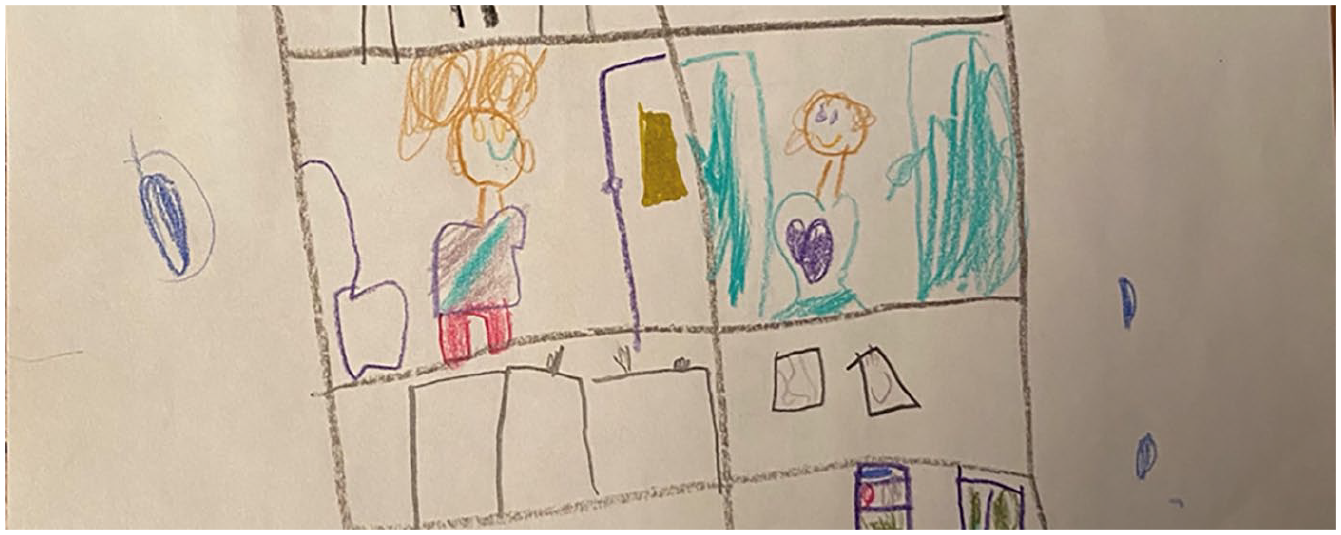
Blaze (age 6) on bathrooms: I’m going to draw inside the school, and so, a boy’s wearing a dress. A girl’s wearing pants and a t-shirt. And they’re both going [smiles] . . . and the boy’s going in the girls’ washroom. And the girl’s going in the boys’ washroom.”
The requirements for a bathroom stall door, as laid out by Scales (age 7).
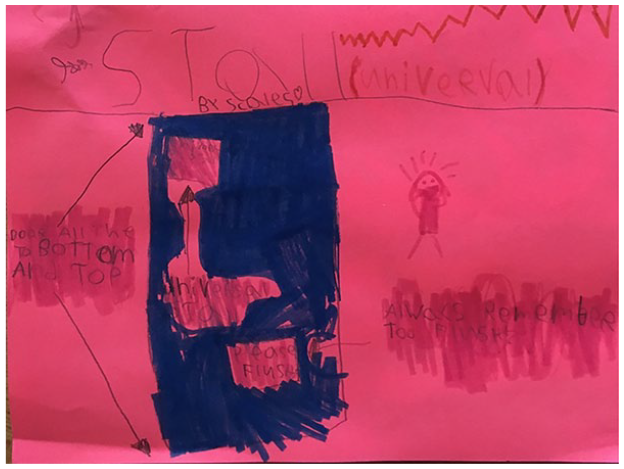
Scales, (age 7) on bathrooms: It says, “Stall.” “Door all the way to the bottom,” and there’s arrows pointing to the top and the bottom. And the other sign that says “Universal Stall.” And then it says, there’s an arrow saying, “Universal Stall.” And then there’s like a sign that says, “Please flush.” And there’s an arrow pointing to it that says, “Always remember to flush!”
Unicorn’s (age 11) no-gender washrooms.
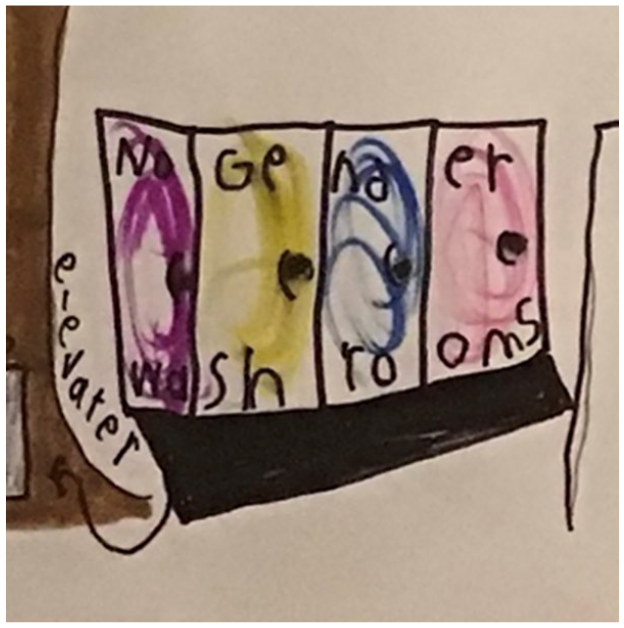
Unicorn (age 11) on bathrooms: The schools should have the bathrooms as a room of requirement. Like, the bathroom you needed, it would be that bathroom. Yeah, that’s . . . yeah. That’s good. That’s how it should work. Though, also that would include magic.
Bathrooms and change rooms are often challenging locations for GIaNT children. Almost all children drew bathrooms in their drawings—not because we asked about them, but because they had ideas about how to make them safer/better/more welcoming. Blaze, who had often experienced barriers accessing bathrooms, focused on bathrooms as accessible places of happiness. For Scales, the focus was on universal access, privacy, and not having to encounter someone else’s poop. Unicorn’s desire was for a space that met the user’s need, with an acknowledgment that different users would have different needs.
My own work in schools has sometimes included searching schools for single-stall bathrooms and consulting on how to make existing gendered bathrooms into all-gender bathrooms. Bathrooms are challenging spaces for trans people in general, and the risk of violence is often real. Children we spoke with identified bathrooms as locations of difficulty and possibility. Blaze (6) expressed frustration with teachers taking on the role of bathroom gatekeeper: Today a teacher, she said I can’t go in the girls’ washroom . . . I mean, the boys’ washroom because I was wearing a dress, but I already knew that because lots of people say that. So I was, uh, I think my feelings were hurt today because I wanted to go to the boys’, but teacher said no! And I’m glad it was just a supply teacher, so then then I could have a more gooder teacher that said I can go in the boys’. . . . They’re just bathrooms. They’re not boy bathrooms, and they’re not girl bathrooms! That’s what I hate about school.
Blaze, who identifies as nonbinary, is used to being able to use whichever bathroom is available and was frustrated when the supply teacher (sometimes referred to as a substitute teacher) insisted that bathroom access was dependent on clothing. An affirming model would put the significance on how Blaze identifies, not what Blaze is wearing, acknowledging that Blaze is a nonbinary person wearing a dress who is refusing the cis nature of girls’ and boys’ bathrooms, and allowing them access to the space that feels most affirming at any individual moment.
Space Boy (age 11) experienced a different kind of institutional failure. Space Boy’s school said it would put in all-gender bathrooms (something that almost all children said was ideal) but did not follow through on that commitment. Space Boy experienced this as a betrayal:
I feel every gender . . . it’s a bit nerve wracking, though, about the bathrooms. ‘Cause there’s boys and girls, mainly, and like our new school was going to put in, like, um, a, like, it was going to put in like non, like, everybody, like a universal bathroom, but then they didn’t.
Children shared not just their difficult experiences of bathrooms in schools; they also shared their vision of what would be better. Stegosaurus advocated for bathrooms that were all-gender and physically accessible:
Make sure the toilets didn’t have a gender on them, so anyone can use any toilets. Make sure it is accessible for someone who has special needs. If someone has a wheelchair, there is ramps.
Unicorn and others were concerned about privacy; many children described being concerned about stall doors and walls that could be looked under or over.
Yeah. Also, the fact that there’s a space between the floor and the door, and the floor and the ceiling in, like, stalls.
So, the stalls. . .
Floor to ceiling, yeah. Like, yeah. I think it should be one-stall bathrooms, or like floor-to-ceiling bathrooms, all gender.
Their last comment on bathrooms moves into magical thinking. I cannot tell if it is a statement full of whimsy, or if it feels like appropriate bathrooms are as impossible as a “room of requirement.” There is also something poignant about a trans kid referencing known transphobe J. K. Rowling’s books as a way to describe being able to access the bathrooms they need:
Um, I just realized something. The schools should have the bathrooms as “a room of requirement.”
Yeah?
Like, the bathroom you needed, it would be that bathroom.
Blaze, Scales, Reese, and Unicorn all included bathrooms in their drawn images of ideal schools. Strikingly, in all four images, the bathrooms are private spaces with floor-to-ceiling doors. In Blaze’s image, there is a child in each bathroom, wearing clothing they feel good in, and a giant grin. In Reese’s, there are three bathrooms, one for girls, one for boys, one for nonbinary people. Scales addresses a number of concerns. Her bathrooms are labeled as universal bathrooms, the doors are labeled floor to ceiling, and several signs remind people to flush (apparently this is a problem at her school). For Unicorn, there are four doors entering into private stalls, all bright colors and saying “no gender washrooms” in large letters. I have worked with adults in many schools who find the idea of universal or all-gender washrooms challenging, while their students do not. I have also worked with a middle school that successfully converted a multi-stall bathroom to being all-genders. For our GIaNT participants, there is a simple fix to a significant problem.
The affirming model of care would require us to believe children, to recognize them as the experts on their own genders. Applying it here, we would see an obvious need for bathrooms for people who do cannot access “boys’” and “girls’” facilities.
Schools need to have clean, all gender bathrooms, with doors and stalls that go floor to ceiling, and that are beautiful.
GIaNT children desire room (literal and figurative) for gender explorations
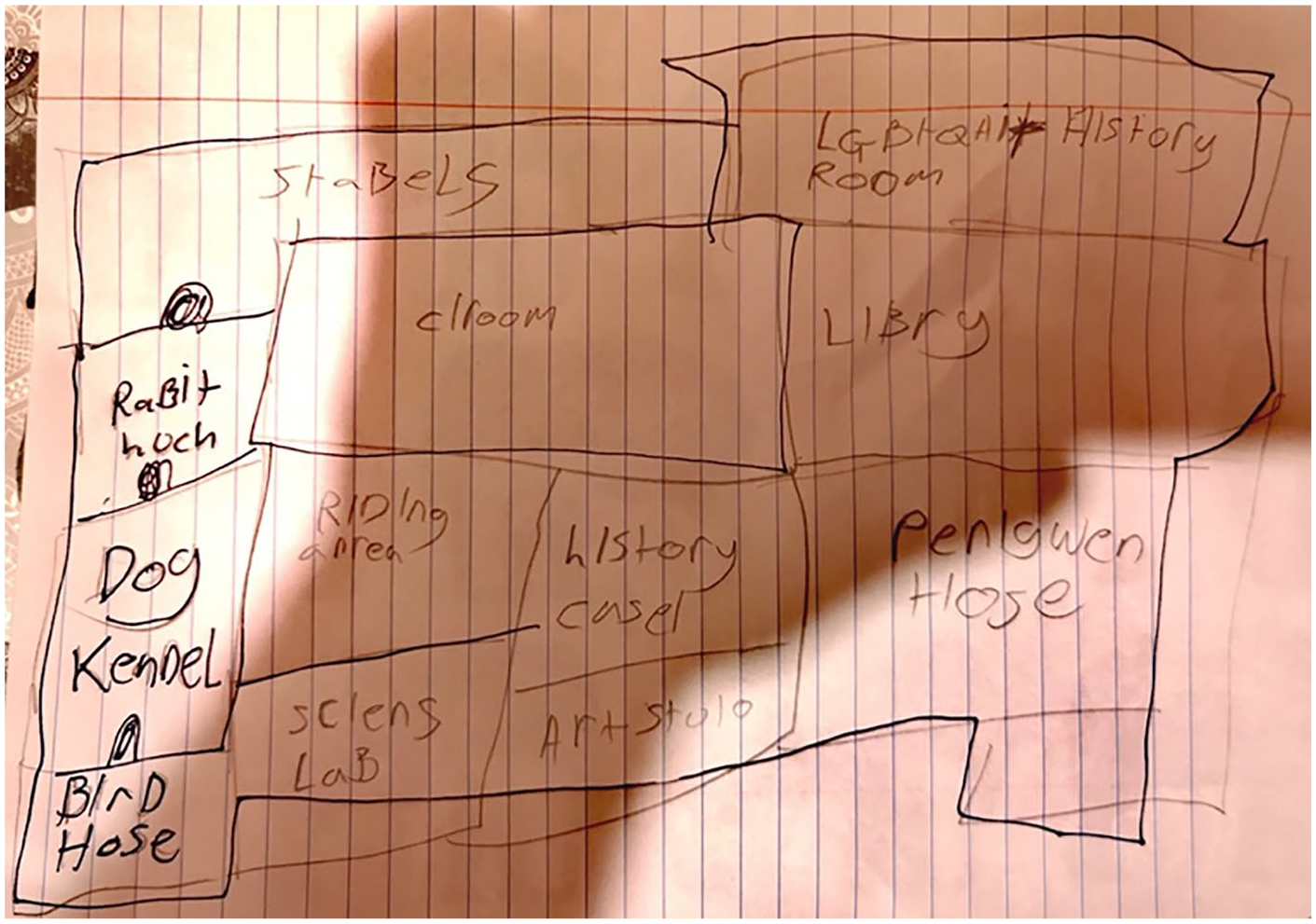
Stegosaurus (age 12) drew a floor plan of their ideal school and gave us a tour of their diagram: “It says stables, LGBTQAI+ history room, library, penguin room, history class, art studio, science lab, riding arena, dog kennel, bird house, rabbit hutch, stables, classroom!” Stegosaurus and others wanted the buildings to clearly encode that gender identity and gender expression were legitimate areas of study. They included Pride flags and positive spaces stickers, they listed it as a formal class on lists of courses, and they drew literal classrooms. GIaNT children want access to history, mythology, and examples from many cultures of identities and roles outside the gender binary. Steele and Nicholson (2020) described how most trans and gender-expansive (TGE) children in the United States and Canada experience testimonial injustice—quite literally that they are both deprived of access to words and stories about themselves and simultaneously disbelieved when they describe themselves. Building on Miranda Fricker’s concept of epistemic injustice, Steele and Nicholson (2020) wrote, without language to describe a specific experience, shared cultural narratives cannot be written, collective understandings cannot be formed, empathy for the experience cannot be culturally built, and the experiences cannot be fully interpreted and understood even by those who have them. (p. 4)
The children did not use the academic language because they have not had access to it, but their images and interviews were full of desire for greater access to knowledge about themselves and others like them. In addition to knowledge, the children desired the freedom to explore gender identity and gender expression and to be respected in their self-identified genders. In honoring their desires, I have made the same choice as researcher A. Travers (2018), who wrote, In describing my participants, I honor their self-definitions. I do so for two reasons: first, because of the way sex markers have been imposed on the kids in my study and how hard they, and often their parents, have had to work to resist this imposed marker; and second, because information about assigned sex satisfies a cis-sexist need to “know” who everyone “really is.” In many ways, I think it is valuable to exclude this information entirely. The social disruption I am advocating for in this book can therefore be more fully experienced in the reading. (A. Travers, 2018, loc 193)
I am very interested in having the children who participated in my research feel good about how I write about them. I am very interested in modeling that this information is private and does not need to be shared. It’s meant that as I was writing, I checked back in with people about their pseudonyms (or code names, as I called them in conversations with the children). One child participant asked me to change their pseudonym from a feminine one to a less feminine one. Two others asked me to change their pronouns. One parent shared that their understanding of their gender had changed. This exploration, this willingness to try on a gender or pronoun and then change, is a strength and to me a real positive. It mirrors a scientific method, where one has a hypothesis and tries it out, records the results, and then makes changes. It mirrors effective learning, where we learn from our past and where mistakes are not failures, but attempts that inform our later success. With that in mind, I need to add that all research is a snapshot. This is what participants shared with me, in our conversations. It is not a statement of who they will become or even who they might already be by the time you read this. People keep changing. This is exciting and a sign of growth—a feature, not a failure. Change is about adaptation, exploration, and integration of new knowledge, not a repudiation of what we were before.
Children desired the ability to define themselves. All the children I interviewed were clearly told by parents that they had that freedom at home, but that was not always their experience at school. Blaze and Unicorn had both had difficult interactions with supply teachers who were stuck in the gender binary:
Even some of the regular teachers, Blaze was somewhat appalled when they’d call the class, “Girls and Boys.”
Yeah?
Oh my god! When I tell that teacher, like a thousand times, she just ignores me. “Boys and girls! Boys and girls!”
I’ve also had to say that to some supply teachers. And I would agree; it’s very annoying.
From a separate interview:
Yeah, I hate it when a supply comes in. I don’t like an irregular supply, like a supply that shows up once and then never again, because they don’t know you. It feels like they just invade, come in, leave everyone with a yucky feeling, be like super gendered blah-blah, don’t listen to the school rules—I’m just going to do what I am used to, and then leave with everyone feeling terrible.
Both Blaze and Unicorn saw themselves as standing up for themselves and other nonbinary kids. Both felt like this was a particularly significant problem with supply teachers. Again, operating within an affirming model of care would prevent the harms that Blaze and Unicorn described; adults would know that they cannot read a person’s gender, but must ask it.
Children need teachers to not assume a child’s gender, and not assume what a child would like based on their gender.
GIaNT children desire “regular supply teachers,” not “gender outsiders”
Children told us that there are two kinds of supply teachers and that they vastly prefer a supply teacher who is often in the school, is familiar with the rules, and becomes part of the school community. Unicorn earlier used the phrase “irregular supply” to indicate a supply teacher who is not familiar with the school and is disruptive in a way that a supply teacher who is part of the school community is not. Reese suggested that supply teachers also might benefit from having regular schools that they were connected to and with which they could build relationships.
“Yeah! Like I think we should have a literal supply teacher working there, like working there, more than one, so if the teacher has to take time off, the supply teacher does not have to drive across town to get there.”
Children recommend that supply teachers be connected to a small number of schools, able to build familiarity with the rules and with teachers and students so they are part of the community and not an interruption.
What Children Desire to Stop
Stop gender policing!
Rainbow Pegasus experienced gender policing from other children. Had teachers interrupted this, it would have made her experience of coming out as trans at school easier. When her family told the school that she was a girl, staff were immediately supportive. This pattern was reflected in the research of M. Smith and Payne’s (2016), who found that teachers were invested in protecting individual students who had shared with them that they were trans, but even after specific training about challenging the gender binary and cissexism, educators did not take on the work of disrupting cissexism or the gender binary. This kind of failure means that children who are in the process of coming out to themselves or questioning their gender are subject to experiences like this, as shared with us by Rainbow Pegasus’s mum, Pegasus Mum:
I went on a whole campaign to actually convince her that she knew trans people, she just didn’t know were trans. And that trans people are real, and a thing, because she came home from kindergarten, telling me I was wrong. And that was just before she realized. And that was while she was going through her own questioning and everything. She came home and said, “Mom, you’re wrong. Boys can’t have a vulva. Girls can’t have a penis.” So, I got that right from kinder.
The experiences of Blaze, Unicorn, and Rainbow Pegasus all point to the importance of teachers challenging the gender binary and cissexist assumptions, regardless of whether they know there are trans or nonbinary children in the room. They point out that teachers, both full-time teachers and supply teachers, need instruction on how to do this, and support in doing so. In M. Smith and Payne’s (2016) research, even when provided with specific training, elementary teachers were willing to make accommodations for individual trans students, but they avoided the broader work of challenging the systems. Their research makes clear that this can not just be the responsibility of individual teachers—it needs to be an expectation of educations systems and undertaken by all adults who work in schools.
Children demand that teachers stop engaging in gender policing.
Children demand that adults proactively make room for gender diversity.
Children demand that school adults stop other children and other parents from gender policing.
Stop gender policing in online learning!
It’s not just about what happens in physical classrooms; online learning can also feel rigidly gendered and full of binary gendered stereotypes. Silent was attending class online at the time of our interview and shared:
I am not a girl or a boy either, I’m like both, but I prefer girl pronouns. . . . No, girl is just my identity at school.
Online learning platforms may not allow students to change their name or to add their pronouns to their name, meaning that the system itself either misgenders students or fails to offer them room to assert their own gender identity. Educators also need to be watchful of this and use their power to make online learning safer for trans kids:
I think for teachers, before they start telling us, “he and her” they should just ask the younger person
Oh, yeah.
Like, ask the kids what pronouns to use?
Yeah.
Yeah, like ask the kids what pronoun they would want, not just start calling them whatever pronoun.
Children require the ability to change their own names and pronouns in online learning platforms.
Children require that the class list not include gender markers.
Children demand to be recognized as the experts of their own identities.
Stop Mother’s Day and other heterosexisms!
It was clear that gendered events had a significant negative effect on the GIaNT children, and they wanted them to stop. Mother’s Day, and the assumption that all children had mothers as their primary caregivers, was particularly challenging for some of the children. Reese (10), a child with two dads, described the emotional impact of being directed to make a Mother’s Day card this way: I am pretty sure that my second or third grade teacher was always, was always: “Mothers – mothers – mothers” like on Mother’s Day she was always like “Everyone, time to make cards for your mothers!” And I was always like” ::puts hand over face and sinks:: . . . Of course when she was like “well here, why don’t you make one for your dad” I was like “thank you!” – and still I was so bummed out.
Flamingo, a trans dad and the sole parent of Stegosaurus (11), described a similar experience but from a parent’s perspective: I had a teacher, who said they were supportive “We’re cool with you being a trans father, we’re all fine,” and then, Stegosaurus would come home and say, “I had to make a Mother’s Day card as that’s what the craft was today, it’s Mother’s Day.” And no amount of saying “I don’t actually have one of those” was enough to stem the tide of pink.
Aparent, a nonbinary parent married to a woman, found that the school’s observance of Mother’s Day left her daughter questioning Aparent’s identity: In past years, we’ve also had some troubles about Mother’s Day and Father’s Day. So, in kindergarten, do you remember when you asked, “Mommy, are you my mother?” And I said, “You have two mothers.” And you said, “But I can only make one craft!”
For Ladybug, it was distressing to have to pick one of her two mothers to honor. She said she would have rather been issued two crafts if they had to do it at school. She did not find it any better when on Father’s Day, she was encouraged to make a gift for her “other mother.” Hearing experiences like these, it feels like Mother’s Day is like Christmas—a day that many people have a strong emotional attachment to, that they are welcome to celebrate at home with their families but that can do harm when forced on all children in a public school. Even when these events did not specifically exclude a child’s family, children saw these events as reinforcing the importance of cis, binary gender identities, and the message that family roles are dependent on these cis, binary gender identities. They saw celebrating a more inclusive day, such as Family Day or celebrating love on Valentine’s Day, as better options.
The children’s direction to schools would be to stop observing Mother’s Day, Father’s Day, and other heterocentric celebrations at school.
Conclusion: Affirming Care as a Possibility Model for Schools
All the children’s demands can be understood to be part of an affirming model of care. The children we spoke with are confident in who they are—confident enough to speak up and challenge teachers who think otherwise. Their surety about who they are made it easier for them to dismiss adults who tried to deny them, as Sparkle Glitter Rocks Dragon said, because “I guess they just don’t know about gender.” That said, instead of relying on children to challenge their discriminatory gender practices, schools could adopt an affirming model of care and do the work to anticipate GIaNT children and build safety for them. This is work that all schools need to be doing. Believing in children, and in children’s understandings of who they are, should be central to learning and education. Repeatedly, children told us that they wanted to be asked their names, their pronouns, and what bathrooms they should use, rather than being told. They called on education to be collaborative and to allow them room to share their knowledge and to be listened to.
Recognizing the knowledge of students, seeing them as co-creators, and paying careful attention to them and their needs is useful in many ways. It is a holistic practice that requires educators to learn about a child’s whole experience, their community, and their history. It is a set of behaviors and practices that are even more needed now, with the challenges of COVID, and they are always effective ways to build engaged and caring school communities. The affirming model of care begins with trusting a person’s self-knowledge and allows a child to define themselves. Shifting clinical care for trans children from one of all-knowing medical practitioners in white coats who control access, to an affirming model in which children’s self-knowledge is centered has been the result of decades of work and advocacy. Trans children have always been co-creators within medical care—whether or not they have been recognized as such (Gill-Peterson, 2018). Similarly, children have always been cocreators, although often unrecognized, in education. Adopting the affirming model in education would mean a significant change to our education model, toward one that centers the needs and desires of children. It is a change we must make.
Footnotes
Declaration of Conflicting Interests
The author declared no potential conflicts of interest with respect to the research, authorship, and/or publication of this article.
Funding
The author disclosed receipt of the following financial support for the research, authorship, and/or publication of this article: The author received Doctoral Completion Awards from the University of Toronto in 2020 and 2021, which supported this research.