




Abstract
Since the Good Friday Agreement of 1998, over 2 billion Euros have been poured into Northern Ireland for peacebuilding. This article presents the hopes and experiences of workers in CSOs funded by either or both funds, development officers, and civil servants employed by the funders. They confirm that peacebuilding and reconciliation projects funded by the European Union (EU) Peace and Reconciliation Fund and the International Fund for Ireland (IFI) have positively contributed to the peace process in Northern Ireland. Civil Society Organizational (CSO) projects support peacebuilding, reconciliation, and greater cooperation between the Protestant and Catholic communities. This study explored the perceptions of 120 respondents working with these funders. They indicated that designated peacebuilding funding promotes bridging, needs to be balanced, and is important to building the peace dividend and that local knowledge, practices, and skillsets should be built into the funding process. The politics of post-Brexit Northern Ireland means that understanding how to best fund peacebuilding and reconciliation is critical. At time of writing, tensions have risen.
Keywords
Between 1987 and 2017, designated peacebuilding funding programs have disbursed over two billion Euro in economic assistance to build the peace dividend and transform conflict while Northern Ireland transitions from a protracted conflict to a cold peace. This is a significant figure for a population of approximately 1.8 million. We hope and assume that these programs have had a positive impact, but contrary to prevailing belief, external funding agencies and their liberal models may have negative outcomes on a peace dividend.
While funding to civil society organizations (CSOs) is assumed as essential for building peace for conflict transformation in regions experiencing sectarian ethnic conflict such as Northern Ireland and the Border Counties of the Republic of Ireland, there is little empirical evidence as to how peacebuilding funding, designed by bureaucrats and political officials, effects change according to those most involved in receiving the funding. The literature illustrates that CSOs are ideal intermediaries to build peace on the ground (Creary and Byrne 2014). There is ongoing tension between the needs of CSOs to do their work, and the onerous accountability, reporting, and conditions of the funding criteria (Buchanan 2014; Cochrane and Dunn 2002). Despite the critical nature of funding to CSOs to work to build long-term peace it seems plausible that ill-designed funding may exacerbate sectarian conflict, or at best, build only a superficial peace (Karari et al. 2013).
In this article, we outline key hypothesis of good peacebuilding funding drawn from the literature. We also collected data by speaking directly with peacebuilders working on the front lines in Northern Ireland. These participants work in the voluntary sector in Northern Ireland and the Border Counties of the Republic of Ireland and their organization received economic aid for peacebuilding. They provide their experiences and perceptions of the future in terms of their hopes and dreams about where peacebuilding and funding need to proceed. This is valuable evidence from the interviewees who work on the ground attempting to build peace in Northern Ireland and the Border Counties. In summary, we outline hypotheses related to the role of funding in peacebuilding derived from the literature and evaluate the merit of these propositions against the data collected. The article outlines a brief discussion of economic aid and peacebuilding in Northern Ireland that is followed by a consideration of the qualitative methodology and method, presentation of the data, and discussion and conclusions. A key conclusion is that CSO funded projects are building cross community relationships by tackling sectarianism.
Economic Aid and Peacebuilding in Northern Ireland
To resolve ethnopolitical conflicts like the one in Northern Ireland domestic and international countries, including supranational institutions like the European Union (EU), provide funding to build the peace dividend. The rationale is that funding can address economic deprivation and inequality, thereby alleviating the underlying social and economic causes of violence (Mac Ginty 2011). This funding goes by many names such as “foreign aid,” “humanitarian aid,” “economic aid,” yet these labels are often vague and may include funding for goals other than peacebuilding (i.e. trade). As highlighted in our introduction, between 1987–2019, international funding programs disbursed over 2 billion Euro to build peace in Northern Ireland and the Border Counties of the Republic of Ireland (Skarlato et al. 2016).
Economic aid experts highlight important yet under-examined influences upon both intra and interethnic relations in divided societies (Esman 1997; Paris 2004). The efficacy of attaching aid to peace through a peace dividend incentive is still poorly understood (Mac Ginty 2013). Economic aid aims to support peacebuilding in countries emerging from protracted conflict by addressing economic deprivation and inequality, and thereby alleviating the underlying social and economic causes of violence (Buchanan 2014). Because the economic policies that have exacerbated class, ethnic, gender, and religious cleavages are identified as significant causes of violent civil wars, understanding their remedies in the form of economic aid may be critical to post-accord peacebuilding (Mac Ginty 2013). It is important to critically interrogate the role of economic aid provided to CSOs that are building the peace dividend in Northern Ireland to determine what works in terms of the delivery and distribution of the aid, and to measure the contribution of the funded projects to peacebuilding and reconciliation.
In Northern Ireland, the Catholic community, as represented by the Catholic Nationalist Republican (CNR), wishes to leave the United Kingdom (UK) and join a united Ireland: The Protestant Unionist Loyalist (PUL) majority wish to remain part of the UK (Bew 2009). Policies that produce economic deprivation, particularly for the CNR community, have long been seen as one of the key grievances in the Northern Irish context (Legg 2020). Economic hardship is deeply tied to views of the polity and ethnoreligious identity in this conflict. In 1968, Northern Ireland’s streets were flooded with protesters demanding equal access to employment, housing, and voting for Catholics (Arthur 2000). Today, 50+ years later, the unemployment rate for the CNR community is 8.8%, which is higher than the national average of 7.5%, and higher than the Protestant unemployment rate of 5.7% (Haverty 2019). CNR working-class neighbourhoods in Derry and Belfast have an even higher unemployment rate of 11% (Haverty 2019). Economic deprivation is now identified as a key cause of this conflict (Legg 2020). CSOs worked successfully throughout the Troubles on building local economic development as well as nurturing cross community relationships, long before the advent of external funding (Cochrane and Dunn 2002).
European Union Peace Funding to Northern Ireland to Build Peace.
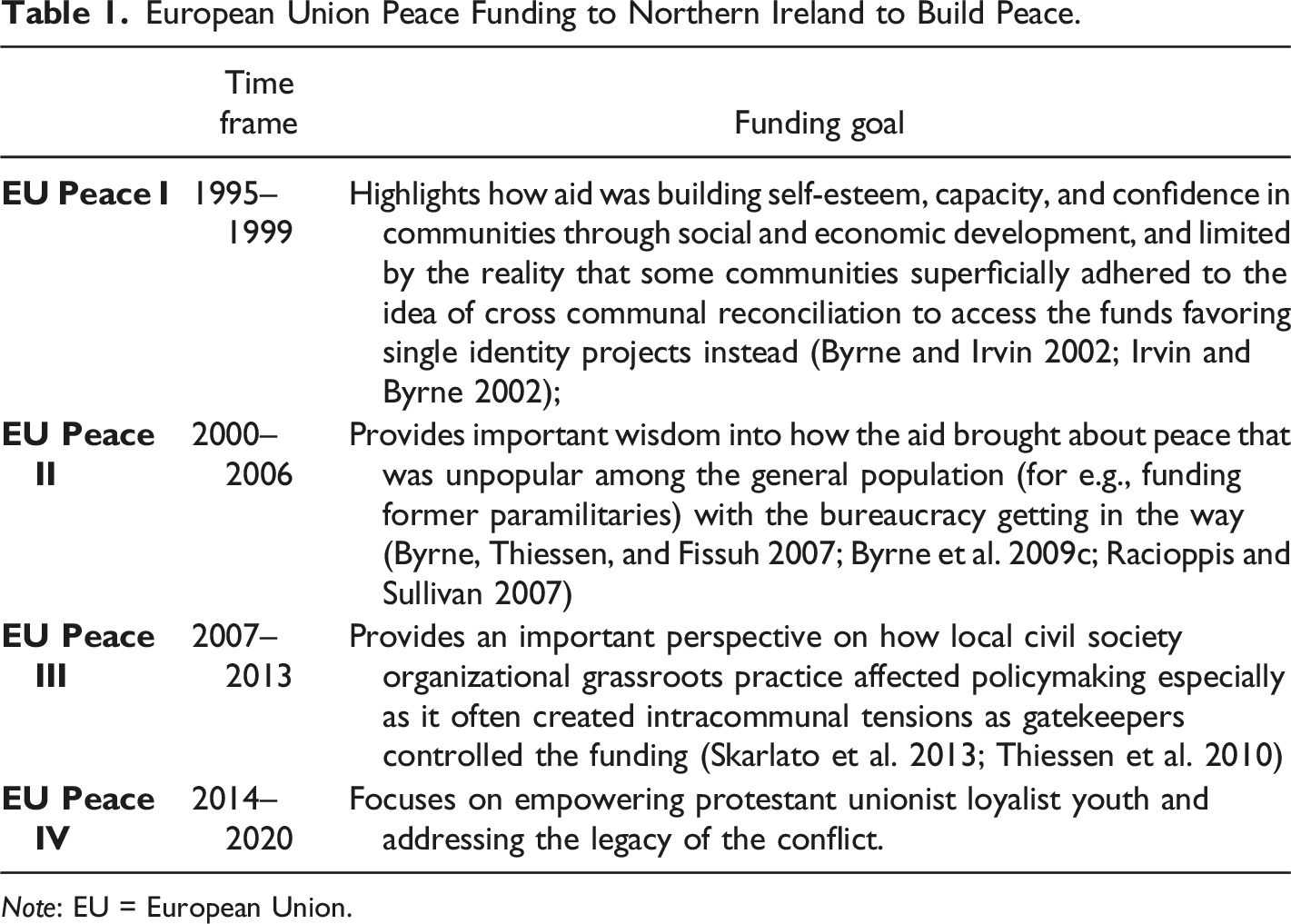
Note: EU = European Union.
A range of funding instruments exist to fund CSOs (Reimer and Schmitz 2021; Unwin 2004). The literature outlines three characteristics of what an effective peacebuilding funding model to CSOs should look like. First, designated peacebuilding funding must promote cross-community engagement to soften ethnic conflict and provide front line CSOs the opportunity to have groups interact, speak, and learn with each other (Byrne et al. 2009b). In practice, this requires that recipient CSOs do not disempower marginalized groups or promote intergroup tension along sectarian lines (Mac Ginty 2008; Creary and Byrne 2014), a practice that requires monitoring or measuring.
Second, effective funding models should provide a diverse array of funding instruments to provide stability to CSOs over the long-term (Levasseur and Frankel 2017). The contract funding instrument is popular amongst funders, but is not sustainable, and requires pre-specified deliverables and short timelines (Eakin and Graham 2009; Elson 2016; Phillips 2011; Phillips and Levasseur 2004). The impacts of contract funding are negative over the long run on CSOs: delayed funding, significant reporting to the funder, stifled innovation, and mission-drift. CSO staff spend more time applying and negotiating contracts than working on peacebuilding (Creary and Byrne, 2014; Mukhtar, Dean, Wilson, Ghassemi, and Wilson 2016; Phillips and Levasseur 2004; Phillips 2011). Last, effective funding requires relevant formative and summative reporting congruent to the amount of funding (Phillips and Levasseur 2004; Levasseur and Frankel 2017) in order to balance the need of funders for accountability and reporting while not hindering or inhibiting the work.
While research has identified the required characteristics, which aspect or mix of funding model (domestic, supranational, international) constitutes effective and supportive funding remains undetermined, especially in Northern Ireland. For our purposes we test three hypotheses related to peacebuilding funding against our data. Peacebuilding funding must 1. Promote cross-cultural engagement amongst different ethnopolitical groups; 2. Employ diverse funding instruments rather than just contractual funding; and 3. Require reporting that does not overwhelm the CSO.
The peaceful theoretical nature of liberal democracy fuels a universalistic underlying precept that violent ethnopolitical conflicts and civil wars can be transformed based on democratization, economic development, and social engineering (Ryan 2007). This, in effect, means there is a one-size-fits-all peacebuilding funding process promoted by states and international institutions advancing Western liberal values (individualism, autonomy, civil, and human rights) (Mac Ginty 2008; Richmond 2014). However, evidence suggests that liberal peacebuilding as it funds CSOs, may encourage local compliance rather than real commitment to sustained peace because external actors possess the authority to grant or deny local CSOs access to economic resources (Donais 2012). Harvey’s (1997) report on the European Union’s Peace 1 Program suggested a need for more rigour in devising appropriate indicators and measures to monitor the Program’s effectiveness (p. 84), which has been largely ignored. Within this paradigm, the funding processes demand a form of peacebuilding that creates a mediocre peace and renewed conflict due to the lack of local support and legitimacy (Mac Ginty 2011; Richmond 2011).
Previous research into designated peacebuilding funding provided to Northern Ireland shows concerning results. The British government’s aid essentially funded a war economy for a large security apparatus controlled by the PUL community (Fay, Morrissey, and Smyth 1999; Hyde and Byrne 2015). Through this and other policies, ethnopolitical conflict in Northern Ireland escalated from 1969-to-1996 (period of The Troubles). Similarly, the EU granted $1 billion to Northern Ireland for peacebuilding, but consolidated identity-based criteria within its funding process and rather than improve relationships, intensified conflict between both communities (Byrne and Irvin 2002; Byrne et al. 2010).
The British government has been accused of trying to control the flow of funds to influence the direction of local CSOs. The organizations must seek ways to cost share resources and secure reciprocal funding from other agencies, thereby deferring peacebuilding (Fissuh et al. 2012). In contrast, the devolved Special EU Program Body (SEUPB), one of six cross-Border bodies established by the British and Irish governments in 1999, and Intermediary Funding Bodies (IFBs) have wielded significant influence in the implementation of the EU Peace and Reconciliation Fund (Buchanan 2014). In this way, the need for measured impact and targeted research regarding how peacebuilding is funded and why, is underscored.
Northern Ireland’s deeply sectarian society jaundices perceptions of peacebuilding funding (Byrne 2001; Byrne et al. 2009a). For example, respondents in one study from both sides of the conflict perceived the Peace 3 Fund’s administrative structure as rigid in its efforts to enforce professionalism, resulting in an overly bureaucratic application process. However, the same respondents also noted that in contrast, the IFI offered processes that could be more realistically applied locally with less interference in peacebuilding (Hyde and Byrne 2015). Interviewees also remarked that despite the nature of economic and infrastructural development by the IFI, it was more responsive to local needs, yet reconciliation and peacebuilding were perceived to be under the less responsive aegis of the EU Peace 3 Fund (Hyde and Byrne 2015). The study also learned that funders and the British, Irish, and Northern Irish governments tend to support CSOs that are congruent with their policies while invalidating others (Hyde and Byrne 2015). Another study found that some people in CSOs think the impact of cross community peacebuilding and reconciliation projects is trivial and impractical (Byrne, et al. 2010). Ordinary citizens, and not just local elites and international actors, shape and inform the peacebuilding processes in Northern Ireland through everyday practices and peace politics (Marijan 2017).
The EU Peace and Reconciliation Fund and the IFI allocate funds based on group identification, scratching the deep sectarian roots of the conflict (Fissuh et al. 2012). Funders are most interested in projects around issues of intercommunal relationships. Communities, however, consider economic development issues essential to tackling the root causes of the conflict (Hancock 2017).
It is therefore important to understand the real impact and effectiveness of designated peacebuilding funding, and how it affects the peacebuilding process locally in a deeply sectarian society. The study outlined here interviewed people in Northern Ireland associated with CSOs in order to increase our understandings of how peacebuilding funding relates to their hopes and dreams for the future. Important lessons can then be learned for other funders within the EU such as Bosnia-Herzegovina, Kosovo, the Basque country, Cyprus, and other international conflicts such as Sri Lanka and South Sudan. Like Northern Ireland, all of these are trying to emerge from a recent violent past. This is significant because the international community is using designated peacebuilding funding as a credible tool to build peace in societies transitioning out of violent conflict.
Methdology
A qualitative methodology explored societal perceptions of the politics and practice of designated peacebuilding funding in an intentionally unbiased sample of respondents. We empirically assessed respondents’ attitudes about the efficacy of designated peacebuilding funding and progress in transforming the conflict. We undertook a comparative analysis of the activities of a variety of CSOs that have received designated peacebuilding funding to identify those approaches that most effectively promote a shared future.
The first author interviewed 120 individuals that included CSOs members in Northern Ireland and the Border Counties of the Republic of Ireland in receipt of designated peacebuilding funding from the EU Peace 3 Fund, operating a range of projects connected to economic development, intercommunity relations, reconciliation, and peacebuilding. He also interviewed senior civil servants, who design and administer designated peacebuilding funding, and development officers who translate the funding rules and requirements for the CSOs working for the EU Peace III Fund and/or the IFI. Although the interviews took place in 2010, the findings remain relevant as outlined below.
The interviews took place in Derry city, and the Border Counties of Armagh, Cavan, Derry, Donegal, Fermanagh, Leitrim, Louth, Monaghan, and Tyrone. Semi-structured open-ended interviews in the respondent’s workplace settings lasted between 60-to-120 minutes to allow for differences of understanding to emerge and to allow for new ideas to be raised. The interviews elicited experiences and perceptions of the impact of economic aid in building the peace dividend in Northern Ireland. The respondents were posed ten open-ended questions to ascertain their experiences about the effect of the external aid on CSO peacebuilding and reconciliation efforts. The interviews were transcribed, coded, and analyzed. All interviewees signed the research ethics protocol consenting to their participation in the research. Pseudonyms are used to protect the anonymity of each participant. We analysed all the interviews inductively to elicit themes; creating a coding framework to organize the data. Eighty male and forty female respondents were interviewed in the Border Counties and Derry, indicating that men are overrepresented in the peacebuilding industry in Northern Ireland.
Data
Below are evidence and ideas from respondents about peace funding and peacebuilding within Northern Ireland and the Border Counties of the Republic of Ireland, situated in their work on the ground.
Border Area
Peacebuilding funding requires the promotion of cross-cultural engagement. A CSO leader reported that the funding has supported cross community projects, and opened new spaces for people from both communities to have opportunities to work together and to get to know each other and thereby build peace ELIZABETH: I would hope that peace would not just be a visionary thing but that it would be established for all time in Ireland. Ireland is big enough for us all to live together in peace and harmony, and what we need to do is get more understanding of each other and speak to each other, not let things flair up. But to have the conversations and to have the contacts that when something is starting to go wrong or off the rails a bit - that we can go to the office and say, “this is happening in our community can we talk about this, or what, have you any influence, can you do something about this?” As a minority we need the help and the uplift of the wider Catholic community. We can’t do it all on our own, that’s for sure.
There are many new people coming from other countries to live in the Border Area and to become part of what is happening on the island, and they need to feel safe, secure, and integrated into the community. Elizabeth notes above that both the PUL and CNR traditions need to reach out to each other and have good relations so that when a problem arises people can connect with each other and prevent conflict from escalating. Peacebuilding, and the funding that underpins peacebuilding, must respond quickly to bring both sides together in a short amount of time to prevent things from festering, according to Elizabeth.
Another CSO leader, Niall, echoes Elizabeth’s words and highlights that his worst fear is a bomb that kills soldiers, police officers or ordinary citizens. Several terrorist incidents in rapid succession in politically charged areas would reopen the many wounds across communities. In this sense, Niall’s comments reflect the need for peacebuilding funding to nurture cross-community engagement and be flexible enough to move quickly in response to local events. In another sense, Niall’s comments are also centred on the idea that long-term funding must be diverse. He feels that people are potentially at the dawn of a very new constructive relationship developing on the island. A new Ireland is emerging politically, socially, culturally, and economically that is stable and normal. This means that the Border region must also be brought up to an economic level that is equal to adjoining jurisdictions in terms of social and economic benefits. The reality is that there are fewer employment opportunities in the Border corridor so to prevent youth from joining para-military groups, peacebuilding funding must use other tools than just contracts to build the economy.
Niall recognized a need to create a training centre on the Border. This educates young people in social economic analysis and delivery while contributing back to the community on a significant voluntary basis for 6 months to a year. A key concern is a return to violence led by individuals who do not want peace swaying people to support new paramilitary organizations. He explained it as follows: NIALL: So, how do we unleash the power even with the social innovation in terms of peace and create that community, and really come at it in a multidisciplinary way really to see the excitement in it? I think there’s too many people hanging on the victimhood and keeping people in victimhood perpetuating something again….
There is also concern for a growing breakdown in Irish society, North and South, that is accelerating at a rapid pace in some parts of Limerick, Dublin, and Belfast. The breakdown has happened over the past 40 years and has accelerated more intensely over the last 10 years.
A CSO leader reported that the suspicion and the mistrust may never go away, and people grow up with it and pass it on intergenerationally. As Fionnuala notes below, the need to ensure long-term peacebuilding funding is essential to combat this intergenerational component of fear with more flexible funding tools, not just the contracts that typify funding: FIONNUALA: We have to learn from each other. A lot of it is ignorance. But we do need to remove some of the barriers particularly from the institutions. I think we’d be much further back in our progress than we are now without intervention. Intervention did need to come and surely at the beginning it was a bit loose maybe and a bit too flexible in terms of what money was being spent on. But some kind of a balance now - if it could be found - between that risk, to allow groups to undertake that risk, but at the same time not to bind us with all the Peace 3 legalization and bureaucracy that’s there.
CSOs are trying to build something into their Peace III planning so that if something happens that needs urgent attention, they can respond quickly. Unfortunately, Peace III funding does not move rapidly, which adds to the challenges.
Brendan, another CSO leader, articulated that the dissidents are controlling the young people in the estates by offering them responsibility and protection if they carry out certain activities on behalf of the paramilitaries. BRENDAN: And the fear would be that even if you take the EU and the IFI and all the money out of it, that that type of violent stuff will really hit home again. And I don’t think it will ever get as bad as that. But I think that the level of the violence and how big it can get, I think can be really bad. I don’t have a dreamy hope but just that we all can work for the common good because I mean it is issues that bring us all together - it’s not politics, it’s our health, education and so on. Those are the big issues that we should be working towards and as a local government and as Stormont - that should be enough; it should bring people together without this division of, I’m a Catholic or a Protestant or whatever.
Brendan echoes Niall’s comments that funding must be designed to prevent young citizens from joining paramilitary groups by building the local economy. IFI and EU Peace funding have assisted CSOs in creating employment opportunities in the Border region. CSOs have developed a very robust set of financial policies and procedures, in part as a result of the intense administrative demands of EU peacebuilding funding. The dissidents are controlling the situation by creating tension and fear, yet not enough for local people to resist. There is a perception that politicians are not standing up to speak out against the dissidents and their targeting of the youth.
There is concern that if the peace process breaks down and violence returns to the streets, the involvement of a new generation could make the violence much worse than ever it was before. A CSO leader noted that the media portrayed Belfast as the racist capital of Europe. For example, Newtownbutler, Co. Fermanagh had its cash machine stolen, and several roadside bombs were defused by the army. Sectarian lines also mean that newcomers will not be welcome. Sectarian or racist extremists have threatened newcomers’ lives, so the peacebuilding CSOs are seeking to engage in a meaningful way with newcomers and youth to build understanding.
Yet other people are hopeful in the day to day. They talk of people from Aughdrumsee, Roslea, Newtownbutler, and Magheraveely in Co. Fermanagh gathering across the Border in Clones, Co. Monaghan on Saturdays to shop and to socialize, and interact with each other, as Eleanor explains below. ELEANOR: I would actually like to see integrated education, integrated youth clubs, not just in the locality, where the young people are coming together. I would like to see those newcomers welcomed as well too. I would hate to see what has been happening in Northern Ireland continuing…So, my hopes for the future are that it would be an integrated and peaceful society.
This CSO leader reported that peacebuilding is something that must be worked on everyday and mainstreamed in the Border region. ELEANOR: My best wishes and hopes for the future from a community development perspective and from a schools and youth club’s perspective is integration.
These comments from front-line peacebuilders like Eleanor, Niall and Brendan affirm the need for peacebuilding funding to promote cross-community relationships.
Another CSO leader reported that a lot of young people are really struggling to find employment. Northern Ireland’s persistent poverty is double that of the rest of Britain with 43,000 children living in extreme poverty in 2010 (HSC 2022). CSOs are working on a voluntary basis to make a difference in social inclusion. Social economy initiatives are being put in place to try to help young people find gainful employment through education, training, and mentoring and support, and introducing them to work. RUAIRI: Well that we could generate the type of campaigning group that we would create the momentum where people would identify common interest as distinct from sectarian interest, which would take us out of the predicament we’re currently in. We’ve a new game to play for. Ruairi also identified populism as a concern. RUAIRI: There is a realistic possibility that North of the Border economic recession and the traumatization that the Protestant working class have experienced because of deindustrialization will allow the populists and the demigods to come out and say, “you are in this position because the others have got equality and civil rights and it’s a zero-sum game. They’ve taken this all away from you.”
Populism is on the rise and coupled with economic recession, has witnessed the emergence of alt right nationalist politics in Hungary, Italy, Poland, the US, France, and Britain, a concern for CSOs in Northern Ireland. As more working class PUL people lose their jobs in Northern Ireland, populist Unionist politicians use the bigotry and sectarianism of the past to scapegoat the CNR community as doing better in all segments of society. In Northern Ireland, “370,000 people live in poverty, around one in five of the population - made up of 110,000 children, 220,000 working-age adults and 40,000 pensioners” (JRF 2018).This would have the effect of escalating conflict and any use of violence would mark a return of the Troubles.
Derry
A CSO leader from Derry noted that the recession led to large scale unemployment that would impact young people. Youth poverty continues to be a serious issue with 22% living in relative poverty in Northern Ireland (NISRA 2022). People in the community voluntary sector are paid and can always find a way to survive and create work for themselves. However, the recession led to a reduction in service provision that could lead to neighbourhoods beginning to decline economically and socially. There is a risk of violence erupting again because sectarianism increases the risk of a return to violence. That would be a tragedy explained by Sorcha below. SORCHA: Ex-combatants are whole heartily behind the peace process. I remember one of them telling me the reason that he gives up his struggle and joined the peace process and became part of an ex-combatant organization to help bring about the peace, was that he looked at his teenage son and he saw the potential for him to go down the road that he went down. So, he got involved in the peace process…[to] expose the young people to all of this and we are all in it together working with ex-combatants, working with community leaders, working with educators, colleges of further and higher education, the youth service together. The commission that looks at paramilitary activity reported that this has increased while sectarian attacks are on the rise…. We hope that there is a greater understanding that we cannot go back, and you cannot fight a guerrilla war or have urban violence with the support of community. You can’t do it.
Recalling the words of Brendan and Niall from the Border County, we hear Sorcha’s comments reflect their concerns in Derry, the second largest city in Northern Ireland, that building peace is complex and funding is needed to rebuild economies. Current inflation estimates of 67% could see Northern Irish households hit with extreme poverty (Campbell 2022). The peacebuilding work of CSOs over time will ensure that dissident behaviours will cease and fissile out because there is no future in it. Instead, there will be more appeal for a more equal society with elected representatives, a devolved government, and a devolved justice and policing service.
Another CSO leader articulated that having the opportunity to grow up in a mixed area was a great learning curve because he had friends from different religions. There are many living in Derry that are very positive about the future and the peacebuilding work that is going on in the city. The peacebuilding work that emphasizes integration of citizens from different factions (i.e. elementary schools where both Catholic and Protestant children learn together) should continue so that funding will remain for those CSOs. According to Landow and McBride (2021), “Fewer than 10% of students in Northern Ireland attend religiously integrated schools, or those not primarily associated with a single faith.” Joshua reported that both communities need to own their behavior in allowing sectarianism to creep into cross community relations. This is what he had to say on the issue. JOSHUA: I would really like the government and others to be a bit more proactive in how they deal with difference, and I think there is a denial on both sides of the major traditions about this. You know I think with the Unionists there is a broad sense of denial because they don’t want to accept any sense of complicity in having structured a state that operated in a certain way that might have led people to behave in a certain way, so they don’t want to accept any of that. And I think on the Republican side there is a reluctance to accept that actually as much as the fight might have been with the British the impact of the fight was that it divided people and that that’s not like a liberal fluffy community relations analysis actually, it’s true.
Certain elements are invested in the continuance of a divided society. There are too many people with too much history and too much bigotry still linked into this political system.
He articulated that having the opportunity to grow up in a mixed area was a great learning curve because he had friends from different religions. If the opportunity to mix with other people were all taken away they would start to become very suspicious of each other and that would lead to incidents of conflict and would risk taking the society back into the old days. JOSHUA: But that has been people’s lived experience and you know I live in certain communities and there is a deep fear and anxiety, and I don’t know if people really realize the depth of anxiety and fear that they created in one another.
Traditionally, the PUL community has kept a low profile, not engaging with the police or with the CNR community. This is now beginning to change as Protestants have more confidence due in part to working with Catholics on joint community building projects supported through IFI or EU Peace funding. People need to feel safe, secure, and integrated into the community so that when a problem arises, they can connect with each other and prevent conflict from escalating.
Another CSO leader noted that in the current climate the dissident threat is allowed to manifest while Republican Sinn Fein claims such threats are under control. There is a perception and fear that political leadership is not effective nor interested in working collectively locally for the benefit of all. PUL politicians are not engaging with Loyalist dissidents. LIAM: One of my goals is to desegregate Northern Ireland so I continue to work at that, so I guess I think it’s possible. There are all sorts of gangsters and stuff but as that political issue it’s gone. On the Nationalist side people give an awful lot of leeway to Sinn Fein in the peace process because Sinn Fein kept saying they wanted to take the guns out of politics and people said ok.
The young generation is a very positive base from which to build the future. The sectarian mindset that drives the conflict was manufactured around patronage, privilege, and preserving their own strategic reasons for keeping the conflict going. He also said that there is something important about the CSOs getting people to reengage, because there is a value in the civic voice, and getting people to realize that they can influence political decision-making.
A CSO leader highlighted that if unemployment skyrocketed then people would protest and go marching in the streets looking for jobs and housing so that the society would become violent again. There is a sense that poor people feel that there is no peace dividend working for them as they have no jobs. In keeping with Sorcha’s comments earlier related to economic growth to help with the peace dividend, Ailin’s note here clearly details the need for funding to benefit the most vulnerable: AILIN: I think that the best hope is we have the economic development and that everybody gets an equal chance of getting a proper job eventually. I mean young people want to get a job. They want to get married. They want to get a house. If they have all those things politics is easily coped with. But what happens in politics is that if you don’t have a house, if you don’t have a job? You blame somebody and in Northern Ireland the label is sectarian. If you are Catholic, you’ll blame the Protestants and the Protestants blame the Catholics.
People need employment and job creation to pay people a living wage so the dignity of having a job is very important to people. IFI and EU Peace funding built local capacity and employment addressing poverty as CSOs worked diligently to ensure that their cross community work reduced sectarian conflict and prevented Northern Ireland from falling over the abyss back into intercommunal violence. The resources from both funds did provide employment opportunities building up a local skillset and knowledge of the peace industry. However, the British subvention to Northern Ireland (approximately £15 billion annually) certainly dwarfs the aid from IFI and the EU Peace Fund.
A CSO leader reported that there must be a priority and a sustained effort by both governments and the funders to keep the peacebuilding initiatives going until their work is done. Ashley’s comment here speaks directly to funding over the long term. The education system must be radically overhauled because segregated and separated education continues to create division, as well as a mythology and fear of the other. ASHLEY: I think that the worries and fears would be that history repeats itself and we don’t pay attention to what is there and can be seen….In terms of what could be there, that the fact of it is we put in structures and we learn from the past, we put in structures in government, we put in structures right across the board where there is an opportunity for everybody’s wish to be heard and everybody is given the opportunity to speak.
There is intergeneration change. Peacebuilders need to get as much information as they can from everyone to change narratives so that local people can learn and heal from the past. A conflict transformation process would ensure that this complicated knowledge would not simply be buried.
Discussion and Conclusions
Northern Ireland is an excellent example of the effects of designated peacebuilding funding on conflict transformation, and this article has added the voices of those working immediately and most closely with such funding. Donor agencies and governments who allocate designated peacebuilding funding need empirical evidence to guide their decisions. This is especially important in the relationship between designated peacebuilding funding and its results on a divided society with a history of protracted violence.
To what extent is peacebuilding funding working in Northern Ireland? The voices of CSOs reveal the need for funding that promotes bridging. The words of Ruairi summarize this well: “we would create the momentum where people would identify common interest as distinct from sectarian interest.” We learned that funding that reinforces sectarianism (i.e., funding that supports single identity CSO projects or sectarian education where Catholic children attend Catholic school) is harmful. Peace requires funding that provides opportunities for both sides, Catholic and Protestant, to meet, discuss, and learn from each other. When face-to-face, both sides can begin to humanize the other and start to see themselves in each other. CSOs are trying to build trust, reciprocity, and bridge sectarian divides, but they can only succeed if funding permits that to occur and does not distract them with bureaucratic demands. Instead, much of the funding available to CSOs is an unsatisfactory one-size-fits-all. It is no surprise that Elizabeth (“As a minority, we need the help and the uplift of the wider Catholic community”) and Niall (“we do need to bring everybody on board”) and other CSO leaders spoke against the popular model. Their voices, wisdom, and practical knowledge are subordinated to the professionalization of peacebuilding (Stanton and Kelly 2015). The current funding is at odds with what peacebuilders are saying.
Another key theme to emerge from the data is the need for balanced funding. As Fionnuala states: “But some kind of a balance now if it could be found between that risk to allow groups to undertake that risk but at the same time not to bind us with all the Peace 3 legalization and bureaucracy that’s there.” Her words remind us that peacebuilding always encounters risk and sometimes events occur quickly that undermine peacebuilding. The need to move quickly in response to such events is critical, yet peacebuilding funding is deeply mired in bureaucratization, so funding moves slowly. This jeopardizes the ability of CSOs to respond quickly to events that may destabilize peace. To be sure, there is a need for accountability, but this must be balanced with peacebuilding. Funders need to provide funding based on earned autonomy so that CSOs with a strong track record should not be subject to the same accountability procedures as another CSO receiving funding for the first time. This emphasis on earned autonomy and recognizing that some activities carry lower risk could revitalize how funding works in Northern Ireland and better support CSOs and, in turn, the peace process.
Key stakeholders want effective peacebuilding organizations. They reported on the connections among funders and how that contributed to or detracted from building the peace dividend. They shared their hopes and dreams and their fears, which may be transferable beyond Northern Ireland’s Border to other post-peace accord societies. Co-creating new knowledge through a collaborative, diverse, evidenced based, and interdisciplinary approach builds the capacity of stakeholders and policymakers to provide and transfer their best practices and functional recommendations to other societies emerging and transitioning out of a violent past (Khan and Byrne 2016). Our data supports the three hypotheses found within the funding literature whereby peacebuilding funding must promote cross-community integration, promote use of diverse funding instruments beyond contracts, and utilize proportional reporting requirements.
Consequently, exploring the impact of designated peacebuilding funding in Northern Ireland and the Border Counties of the Republic of Ireland in the context of many other ethnopolitical conflicts is valuable. Creating a thorough understanding of the impacts and experiences of designated peacebuilding funding also provides an historical perspective to guide external and internal policymaking.
The 1998 Belfast or Good Friday Agreement ushered in a devolved powersharing government, an Assembly and Executive in Stormont as well as provisions to decommission paramilitary weapons; demilitarize security; address human rights, prisoner status, and policing; and recognize a majority consent to change Northern Ireland’s constitutional position within the UK (White, 2013). Unemployment, disillusionment with the DUP, the flag controversary, attraction to new paramilitary groups, and the entrenchment of sectarianism resulted in misperceptions following the GFA from especially PUL youth with regards to perceived gains made by the CNR community as the settler-indigenous dichotomy has hardened both ethnopolitical identities making compromise difficult (Guelke, 2014). Despite the large number of peacebuilding dollars sent to Northern Ireland, the resulting frosty liminal peace has faced ongoing challenges over culture and identity politics, full inclusion of marginalized communities, addressing the past, dealing with new paramilitary groups, the Border poll, Covid-19, and the fallout from Brexit among others. These have escalated sectarian tensions. More research is required to explore how are these issues impacting relations between the EU, the UK, and Republic of Ireland, and between and within the PUL and CNR communities? What is the role of third parties like the U.S. in deescalating conflict? What sorts of peacebuilding practices (like economic aid) are needed to enhance multiple relationships and prevent a return to political violence?
Brexit has certainly added another layer of uncertainty to any discussions of funding for conflict transformation. Murphy (2021) carefully notes that the results of the UK Referendum indicate that Northern Ireland voted in favour of staying in the EU. The concern with Brexit is the potential re-introduction of a hard border between Northern Ireland and Ireland. Under the EU, the border became quite soft and allowed for the free movement of goods, services, money and people (Landow and McBride, 2021). How Northern Irish peacebuilders view the future is significant as we witness the current fallout from Brexit and the Northern Ireland protocol. Post Brexit, the British and Irish governments, the EU, and the Northern Ireland Executive’s PEACE PLUS (2021-2027) program will contribute a total of €1billion to support local grassroots peacebuilding in Northern Ireland and the Border Area. In addition, the Irish government’s Shared Ireland fund is delivering €500 million in support of its Shared Island program (2021–2025) to nurture North-South cooperation on the island.
Young Loyalists resist the hard border in the Irish Sea (Hayward and Murphy 2018; Harvey 2020; McEwen and Murphy 2021). The flying of the flags and the Loyalist parades controversy also escalated conflict among Loyalists - especially the youth, who see themselves as under siege and embroiled in a culture war with the EU and the British and Irish governments. They perceive their cultural practices increasingly threatened and Northern Ireland’s position within the UK is further eroding because of the protocol (Bryan 2015; Goldie and Murphy 2015; Guelke 2014). April 2021 saw significant violence in Belfast (Landow and McBride, 2021). In addition, the 2017 collapse of Stormont’s power-sharing executive left Northern Ireland in a political vacuum until its restoration in 2020 (Heenan and Birrell 2018; Heenan and Birrell 2021; Murphy 2021).
In terms of funding, Northern Ireland will continue to receive EU funding under the Peace Plus program until 2027 while the UK government also develops funding opportunities for Northern Ireland (Campbell 2021). As the EU funding dissipates and the UK funding ramps up, more research will be needed to assess whether UK government funding reflects the needs, hopes and dreams of peacebuilding on the front lines. Only time will tell if these current conflicts spiral out of control and threaten the fragile peace process, pushing Northern Ireland over the abyss into a renewed phase of violent conflict, or if the spillover from the funded CSO peacebuilding projects have stimulated local grassroots peacebuilding work to firmly take root. More research is needed to assess the impact of Brexit on peacebuilding in NI in the next few years. On the surface there are funds available to peacebuilding, but the precise impact of Brexit needs time and research.
Footnotes
Declaration of Conflicting Interests
The author(s) declared no potential conflicts of interest with respect to the research, authorship, and/or publication of this article.
Funding
The author(s) received no financial support for the research, authorship, and/or publication of this article.