




Abstract
Erich Fromm (1900–1980) was a Marxist psychoanalyst, philosopher, and socialist humanist. This article asks: How can Fromm’s critical theory of communication be used and updated to provide a critical perspective in the age of digital and communicative capitalism? In order to provide an answer, this article discusses elements from Fromm’s work that allow us to better understand the human communication process. The focus is on communication (the second section), ideology (the third section), and technology (the fourth section). Fromm’s approach can inform a critical theory of communication in multiple respects: His notion of the social character allows to underpin such a theory with foundations from critical psychology. Fromm’s distinction between the authoritarian and the humanistic character can be used for discerning among authoritarian and humanistic communication. Fromm’s work can also inform ideology critique: the ideology of having shapes life, thought, language, and social action in capitalism. In capitalism, technology (including computing) is fetishized and the logic of quantification shapes social relations. Fromm’s quest for humanist technology and participatory computing can inform contemporary debates about digital capitalism and its alternatives.
Personal Reflexive Statement
In the early 1990s, I was pupil living in Austria, where the far-right was relatively success in elections by steering resentments against migrant workers. In 1991, the leader of the Freedom Party of Austria (FPÖ) Jörg Haider claimed, “In the Third Reich they made proper employment policies, which your government in Vienna doesn’t bring about”. I became convinced that authoritarianism remains a big danger in contemporary societies. Reading Marx and the Frankfurt School, I realized how authoritarianism is related to capitalism, class, and domination. Later, I became a scholar in the field of media and communication studies with a special interest in social research and critical theory. In contemporary societies, we see a rise of authoritarian capitalism and new forms of nationalism. New demagogues use social media and the Internet for communicating authoritarianism. It seems to me that socialist humanism is the political counterperspective that we need today in order to struggle against authoritarianism. Erich Fromm is of particular importance in this respect because he was a leading socialist humanist theorist and activist. One of my interests is to recover, revisit, and further develop critical, Marxist–humanist approaches in order to shed light on how authoritarian communication and authoritarian society operate today and how socialist humanist alternatives can look like today. Reading and interpreting Erich Fromm and other socialist humanists (such as Theodor W. Adorno, Günther Anders, Ernst Bloch, Angela Davis, Raya Dunayevskaya, Lucien Goldmann, David Harvey, C. L. R. James, Georg Lukács, Henri Lefebvre, Rosa Luxemburg, Herbert Marcuse, Franz Neumann, M.N. Roy, Jean-Paul Sartre, E. P. Thompson, Raymond Williams) today can inform our critical understanding of capitalism today and struggles for a democratic, socialist, humanist society.
Introduction
Erich Fromm (1900–1980) was a Marxist psychoanalyst, philosopher, and socialist humanist. 1 In the years from 1930 until 1939, he worked for the Institute for Social Research. Together with other institute members such as Max Horkheimer, he emigrated to the United States in 1934 after Hitler had come to power in Germany. He also worked at Bennington College, the New School for Social Research, the National Autonomous University of Mexico, Michigan State University, and NYU. Among his most well-known and most cited and read books are Escape From Freedom, Sane Society, The Art of Loving, Man for Himself, To Have or To Be?, and The Anatomy of Human Destructiveness.
Fromm’s work combined a humanist approach with the quest for socialism. Fromm’s humanism stresses the need to realize all humans’ potentials so that a good life for all is realized (Fromm 1965b:207). Socialism is the realization of humanism. “Marxism is humanism” (Fromm 1965b:207). In contrast to other forms of humanism, socialist humanism does not believe that the realization of the potentials of humans and society can be achieved by education alone. It stresses that socialism and democracy require the individuals’ collective control and management of the economy, the political system, and society (Fromm 1965a), so that “the full development of the individual” is “the condition for the full development of society, and vice versa” (Fromm 1965a:viii).
Given Fromm’s socialist humanist approach, it is evident that the human being and social relations are key concerns of his works. Communication is the process through which humans produce and reproduce sociality, social relations, social structures, groups, social systems, organizations, institutions, and society (Fuchs 2020a). Theories that focus on the human subject, such as the one by Fromm, are suited as starting points for a critical theory of communication. This article asks: How can Fromm’s critical theory of communication be used and updated to provide a critical perspective in the age of digital and communicative capitalism?
In order to provide an answer, this article discusses elements from Fromm’s work that allow us to better understand the human communication process. The focus is on communication (the second section), ideology (the third section), and technology (the fourth section). These three dimensions are connected: Communication is a general social process. Ideology is a particular form of communication that aims at creating reified consciousness. Technology is a means that humans use for achieving certain goals. In class societies, technology takes on an instrumental character and therefore acts as means of domination and exploitation. Information and communication technologies (such as the computer) are particular types of technologies that organize the production, distribution, and consumption of information. Fromm was particularly interested in the role of the computer in society (see Technology section). The focus of this article on communication, ideology, and technology is not accidental but is justified by the circumstance that these three categories are crucial for a critical theory of communication. Each of the three main sections in this article consists of two subsections: The first subsection presents Fromm’s main arguments on the theme addressed in the section. The second subsection updates Fromm’s arguments and presents the present author’s critical theory-approach.
Communication
Erich Fromm on Communication
One of the starting points of Fromm’s works are the questions: What is the human being? and What is the human being’s essence? The human being is “life aware of itself” (Fromm 1964:117). The human being is “a producing animal, capable of transforming the materials which he finds at hand, using his reason and imagination” (Fromm [1947] 2003:61). The human being “must produce in order to live” (p. 61). Fromm ([1947] 2003:28) argues that human beings differ from animals because they have self-awareness, reason, and imagination (Fromm [1947] 2003:28; see also Fromm [1973] 1997, chapter 10). These features enable them to reason morally, anticipate alternatives and consequences of action, and to dream. Dreams are “a common language of all humanity” (Fromm [1973] 1997:308; see also Fromm 1951). Reason and imagination among other things enable that they can “denote objects and acts by symbols” (Fromm [1947] 2003:28). The implication of the social use and production of symbols is that the human being is a language-using, communicating being. Fromm ([1947] 2003) argues that the human being’s productive orientation implies “a mode of relatedness in all realms of human experience. It covers mental, emotional, and sensory responses to others, to oneself, and to things. Productiveness is man’s ability to use his powers and to realize the potentialities inherent in him” (p. 61).
The relatedness of human existence implies that humans are cooperating beings: One important element is the fact that men can not live without some sort of co-operation with others. […] Each person experiences this need for the help of others very drastically as a child. On account of the factual inability of the human child to take care of itself with regard to all-important functions, communication with others is a matter of life and death for the child. The possibility of being left alone is necessarily the most serious threat to the child’s whole existence. (Fromm [1941] 1969:35-36).
Fromm (1965b) argues that the social character mediates between the economy and culture. The social character is “the matrix of the character structure common to a group” (Fromm 1965b:210; see also Fromm [1941] 1969:304-27, [1956] 2002:76-81). The social character is the totality of the common psychological features of a particular social group. It is shaped by society’s institutions such as political economy, the economic structure (the class structure in a class society), the education system, religion, literature, customs, and the ways parents raise their children (Fromm 1965b:211, [1956] 2002:78-79).
Fromm (1965b:212) argues that “the social character is the intermediary between the socio-economic structure and the ideas and ideals prevalent in a society.” He visualizes this relationship as shown in Figure 1.
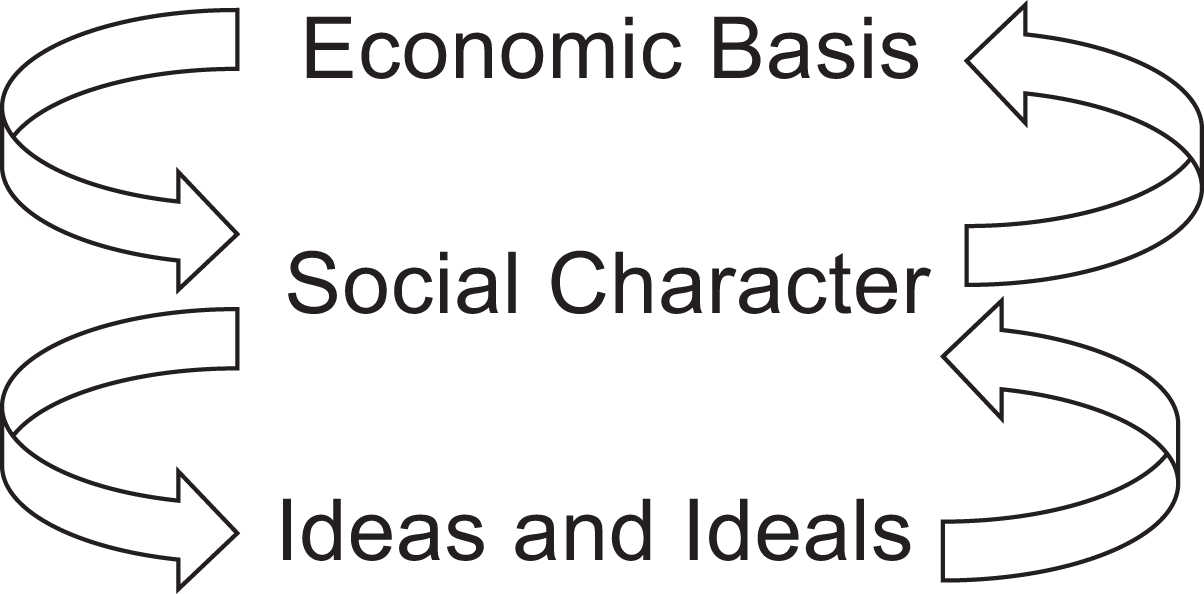
Erich Fromm’s conceptualization of the relationship between the economy and ideas. Source: Adapted from Fromm (1965b:212).
Fromm sees the relationship between “base” and “superstructure” as one where there is mutual interaction between levels. In 1970, Fromm wrote that the “ideological superstructure” is not a “reflex-like consequence of the socioeconomic structure” and that in the concept of the social character, the connection between the economic basis and the superstructure is understood in their interaction. The practice of life, as it results from the socioeconomic structure, produces a certain social character which, in turn, produces the superstructure, which in turn reinforces the social character. The social character, in this view, is the intermediary between basic economic structure and superstructure. (Fromm and Macoby 1970, 18 [footnote 24])
For Fromm, humanism is the opposition of authoritarianism. As a consequence, he distinguishes between authoritarian and humanistic character, authoritarian and humanistic ethics, and authoritarian and humanistic conscience (Fromm [1947] 2003). This distinction can also be formulated as the one between “those who love death and those who love life, between the necrophilous and the biophilous” (Fromm 1964:38). In contrast to Freud, who assumes that both the death instinct (Thanatos) and the life instinct (Eros) are part of human nature, Fromm (1964:48-51) argues that only the life instinct is part of human nature, whereas necrophilia/the death instinct is psychopathological. Necrophilia is an intensification of sadism that takes on new qualities (Fromm [1973] 1997:463). In authoritarianism, “an authority states what is good for man and lays down the laws and norms of conduct,” whereas in humanism, the human being is “both the norm giver and the subject of the norms” (Fromm [1947] 2003:6). For Fromm ([1973] 1997), Hitler was an extreme example of the necrophilic character that loves “to destroy for the sake of destruction” and “to tear apart living structures” (p. 441). Individuals, whom socialization in capitalist society and authoritarian structures has turned into severely necrophilous persons, “become the executioners, terrorists, torturers; without them no terror system could be set up” (p. 489).
Fromm differs in his interpretation of Freud’s death instinct from other theorists in Marxist psychoanalysis. For Lacan (1991:171, 326), the death instinct is part of the unconscious and the symbolic order. Marcuse ([1956] 1998:83) argues that life “is the fusion of Eros and death instinct.” In capitalism and class society, the death instinct gains “ascendency over the life instincts” and results in the externalization of aggression in the form of violence (p. 83). Whereas Lacan and Marcuse see the death instinct as a fundamental human drive, Fromm considers it as a social psychopathology. Marcuse ([1956] 1998:272) criticizes Fromm, Karen Horney, and William Reich for the “revisionist rejection of the death instinct.” Fromm (1955) answered to Marcuse that changes are needed to Freud’s theory from a Marxist theory perspective in order to avoid “human nihilism” (p. 349). The discussion shows that Marxist theories have interpreted Freud in different ways.
Fromm ([1947] 2003:42-43) argues that socialization (the way humans relate to other humans) and assimilation/acquisition (the way humans acquire things) are two fundamental aspects of human life. Assimilation is not a well-suited term because it sounds like humans do not actively and creatively change the world but merely adapt to it. The way humans acquire goods does not stand outside of social relations, which is why the separation of acquisition from socialization is problematic. But one could say that socialization as the one dimension of Fromm’s analysis refers to the way humans organize their social relations, whereas the other dimension is about a particular type of social relation, namely, the way that humans organize their economic relations. Fromm discerns two basic ways humans based on their social character structure organize the world: the nonproductive (authoritarian) and the productive (humanistic) orientation. Fromm ([1947] 2003:82, 84-86) argues that reception, exploitation, hoarding, marketing, masochism, sadism, destruction, and indifference are the characteristics of the authoritarian orientation and the authoritarian character structure that he also characterizes as nonproductive orientation.
In the realm of socialization, the loving, reasoning social character type is opposed to the masochistic, sadistic, destructive, and indifferent social character types. In the realm of economic socialization, the working character type, who creates something, is opposed to the receiving, exploiting, hoarding, and marketing character types (Fromm [1947] 2003:82).
Humanism is oriented on love to oneself, love to others, and love as principle of society. The humanist organization of communication(s) therefore implies the communication of love: Love is possible only if two persons communicate with each other from the center of their existence, hence if each one of them experiences himself from the center of his existence. Only in this “central experience” is human reality, only here is aliveness, only here is the basis for love. Love, experienced thus, is a constant challenge; it is not a resting place, but a moving, growing, working together; even whether there is harmony or conflict, joy or sadness, is secondary to the fundamental fact that two people experience themselves from the essence of their existence, that they are one with each other by being one with themselves, rather than by fleeing from themselves. There is only one proof for the presence of love: the depth of the relationship, and the aliveness and strength in each person concerned; this is the fruit by which love is recognized. (Fromm 1956:103)
An Update of Erich Fromm’s Concept of Communication
What Fromm writes implies that social production is the essence of humans. Through production, humans create relations, relations to nature, relations to other humans, and relations to themselves. The implication is that the human being is a natural, social, cooperating, and self-conscious being and that these characteristics are only possible through relations that humans produce in society. Also, communication is a process of social production, in which humans try to understand interpretations of the world by others and to share their understandings with others. The goal of communication is to understand how other humans understand the world. It is the understanding of understanding. Just like communication is productive, also production is communicative: In order to produce socially, that is, in a cooperative manner, humans need to coordinate their work. For doing so, they use language in order to create, share, and interpret symbols and meanings with the purpose of coproducing entities that satisfy certain human needs.
Fromm ([1947] 2003) speaks of a dialectic of feelings and actions. Also, the communication process is based on a dialectic of the body and the mind: In the communication process, thoughts produced in the human brain are externalized through speech created with the help by the combination of activities of the tongue, the lips, the teeth, the palate, the alveolar ridge, the uvula, and the glottis and bodily movements (the use of bodily gestures, our hands that write and type, and the movement of our eyes that look at others in certain manners). The externalization of thought through communication changes the social environment, which in turn acts as system, in which other humans communicate so that individuals internalize signals that evoke further thoughts. Communication is a process of internalization and externalization of information in a social environment.
Fromm (1965b:214) mentions that 20th-century capitalism advanced the social character of the “homo consumens,” who is socialized by capitalist culture and advertising to consume commodities. Culture in the 21st-century is still a capitalist consumer culture. What has changed is that consumers are as prosumers (producing consumers) more actively asked and required to take part in the production of the commodities they consume. They self-assemble their furniture or create content, data, and metadata on Facebook that is commodified in order to present targeted about to the users that want them to buy commodities. On commercial social media, human subjectivity creates a data commodity that enables that the same subjects are targeted with ads as consumers of commodities (Fuchs 2017b).
In a socialist society, consumption does not stop, but commodity consumption and commodity culture cease to exist. There is still individual consumption of goods in a socialist society, but there is also a strong stress on social consumption of public goods and services and on public events taking place, for example, in “schools, libraries, theaters, parks, hospitals, public transportation, etc.” (Fromm 1965b:216). Fromm does not reduce culture, ideology, and the psyche to the economy but sees an interactive relationship between the economy and culture that is mediated by the social character. The social character is a mediating structure.
Williams (1977) acknowledges the dialectical character of such interactive approaches but argues that approaches that speak of a mediation between the base and the superstructure are “not materialist enough” (p. 97). They assume the existence of “separate and pre-existent areas or order of reality, between which the mediating process occurs” (p. 99). In Williams’s cultural materialism, the economy operates in culture, ideology, consciousness, and politics and the noneconomic spheres also have emergent qualities that go beyond the economy. The economic and noneconomic are at the same time identical and different.
Williams’s criticism applies to Fromm’s model. The basic problem of how Fromm conceptualizes the relationship of the economy and ideas (see Figure 1) is that he sees ideas and therefore also the communication of ideas merely as a superstructure, so that the economy and ideas are left separate although he connects them via mutual shaping processes. The phenomena of knowledge work that has become so prevalent in the 21st century and the role of the computer (an intellectual technology) as a key productive force show that ideas operate within the economy and are not a superstructure. Information and communication operate as part of the means of production both in the form of information technology and human knowledge. Furthermore, the relations of production are organized via human communication.
The economy is the realm, where humans produce use-values that satisfy human needs. Culture is the realm, where humans make meaning of the world. That there is a dialectic of the economy and culture does not simply mean that these spheres interact, but rather that they are simultaneously identical and nonidentical. Figure 2 shows the present author’s model of how the economy and culture are related and the role of the social character.
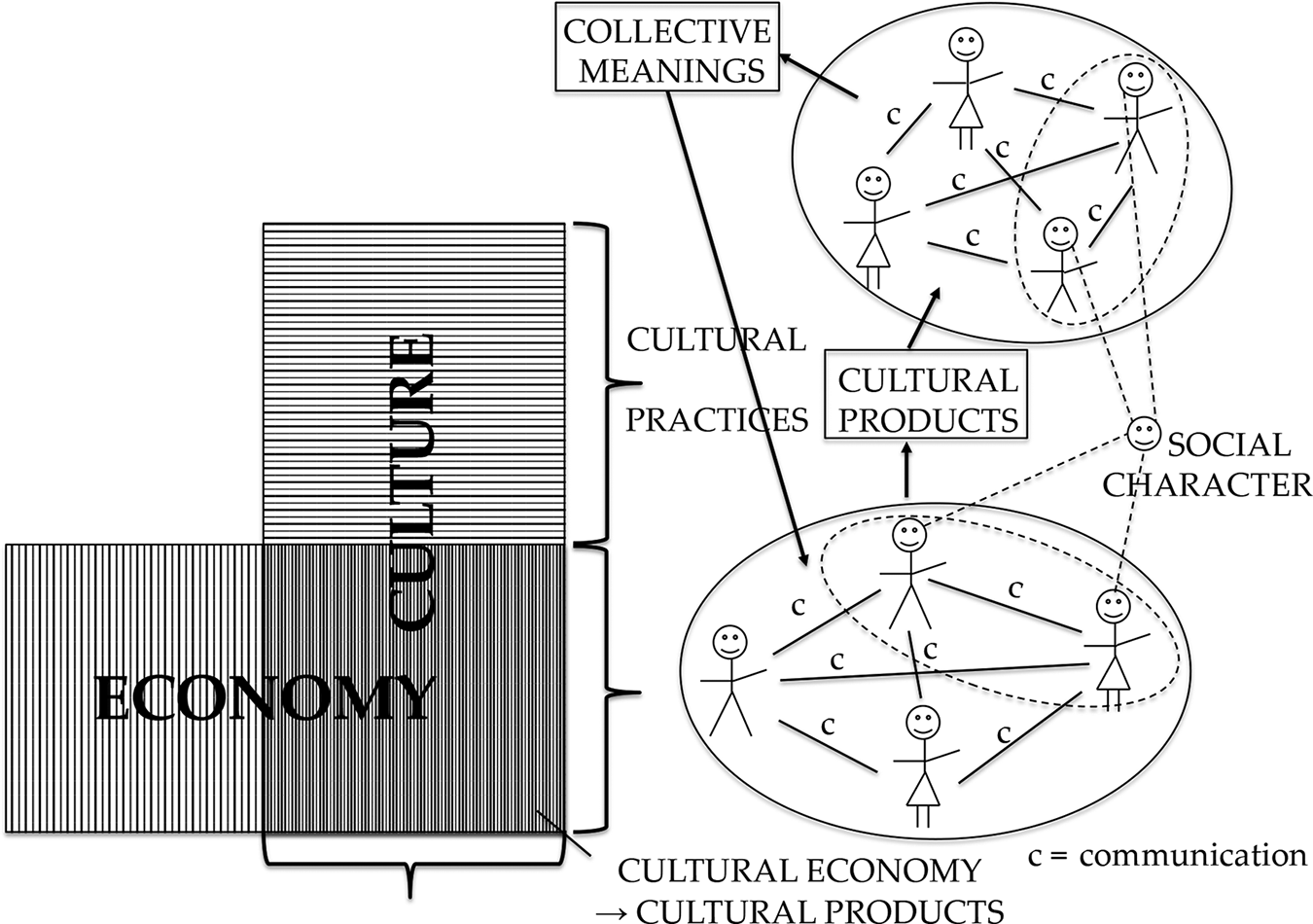
The relationship of the economy and culture.
Figure 2 visualizes the present author’s model of the dialectical relationship of the economy and culture and the role of communication and the social character in society. There is an economy inside and outside of culture and a culture inside and outside of the economy. The overlap of both is the cultural economy, the realm of society where mental workers create cultural products. These cultural products (e.g., a newspaper, a movie, a computer game) enter as inputs into noneconomic social practices, including cultural practices. In cultural practices, humans cocreate collective meanings of the world. Communication is the process through which social relations between humans are organized. Communication is therefore not the superstructural exchange of ideas. Rather, it takes place in all realms of society because all human activity is social and relational. Cultural products are an objectification of ideas. Collective meanings are the result of the communication of ideas about cultural products in the cultural system. Ideas operate in all realms of society, including the cultural economy and the cultural system. Collective meanings (such as an ideology, a worldview, a philosophy, and a religion) influence other realms of society, including the economy and the cultural economy.
In each social system, certain social groups, who share certain social characteristics, operate. So, for example, in the capitalist economy workers form a social group, whose members share the social characteristic that they have to sell their labor-power in order to survive. What Fromm terms the social character is a group and psychological type whose members share certain psychological dispositions. The social character operates in several social systems at once. For Fromm, the authoritarian and the humanistic character are the two main types of the social character. Certain social groups have by definition a certain social character. But social groups and social characters are not the same. Different character types can be found in one and the same social group. So, for example, there are authoritarian workers and nonauthoritarian workers. Dominative groups, however, are to a certain degree always authoritarian in character. For example, only individuals who have been socialized in capitalist society in such a manner that they have a desire to control and exploit others become managers or capitalists in a for-profit-corporation.
The social character mediates between the levels of the individual psyche and society. Humans through communication in various social systems form a particular social character, a character structure peculiar for a certain group in society. Through communication, the social character and social structures are formed and reproduced. The social character and social structures mediated through communication in the social relations that humans enter condition, that is, enable and constrain individual thought and action.
Based on the distinction between the humanist affirmation of life and the authoritarian affirmation of death, Fromm ([1973] 1997) distinguishes between life-affirmative societies and destructive societies as two types of society (as well as nondestructive-aggressive societies as a third kind). The present author characterizes these two societies also as socialism and fascism. The human being is an individual being, but at the same time also a species being. That the human is a species means that the human is a social and societal being. The individual can only live and realize their possibilities truly and to a full extent if all humans can live and realize their possibilities truly and fully. Humanism therefore implies not just the good life of the individual but the good life of all. Authoritarianism means that a particular individual, class, or group coercively wants to enforce and enforces its will in society against others and considers its will as absolute and considers its will as absolute. The individual, particularistic will becomes the will of society. Conversely, a state of existence where there are only unrelated individual wills results in an order of egoists, in which there is no sharing and no commonality. Such a state lacks relatedness. Both authoritarianism and individualism lack the dialectic of society and the individual that is at the heart of humanism.
Table 1 shows the present author’s overview of different social characters that are based on the basic distinction between the authoritarian and the humanistic character. The typology presented in Table 1 is based on the present author’s distinction between the economic, the political, and the cultural dimension of society (Fuchs 2008). All three realms are realms of production and teleological positing (Fuchs 2016): Production in the economy creates use-values that satisfy human needs. Production in the political system creates collectively binding decisions in society. Cultural production results in collective meanings of the world).
The Authoritarian and the Humanistic Character in the Economy, Politics, and Culture.
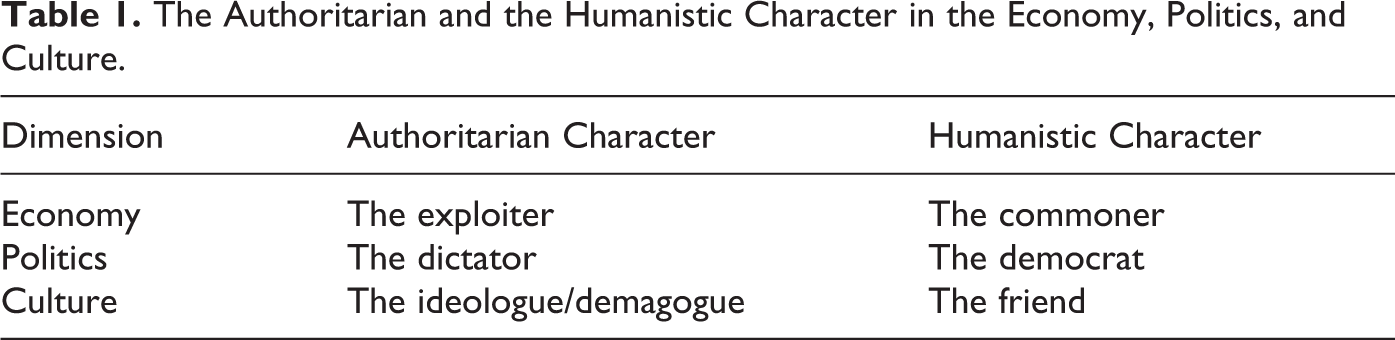
Whereas the exploiter uses, instrumentalizes, and exploits others, the commoner advances the common good that benefits all and is controlled by all. Whereas the dictator coercively and with violence imposes his political will on others, the democrat deliberates with others in order to take collective political decisions. Whereas the ideologue tries to manipulate others, the friend helps others.
The capitalist economy is an authoritarian system of production, circulation, and consumption, in which capital, the market, and the commodity form economic authorities. The mode of having is one of the capitalism’s guiding principles. In a political dictatorship, a political leader is the authority who shapes the political system. The mode of having also shapes dictatorships: Politics is all about having and accumulating political power. The authoritarian capitalist economy can be accompanied by an authoritarian political system, but this does not necessarily have to be the case. The capitalist economy is both compatible with dictatorship and liberal democracy. Generally speaking, authoritarianism means the undemocratic use of power and repression (the repressive power of the market, the state, or ideology) in order to enforce the logic of having by turning humans into instruments that serve the interests of the powerful.
Generalizing Fromm’s analysis, we can say that the (ideal type) authoritarian character is destructive, exploitative, and competitive in economic relations and aggressive and hateful in social relations in general, whereas the humanistic character is creative in economic relations and loving and cooperating in social relations in general. Based on Fromm, Table 2 presents the present author’s distinction of social character types. Whereas productiveness means the capacity to realize human potentials and the potentials of humanity and society, authoritarianism and the mode of having are unproductive because they are based on the principle “I take what I need” from others (Fromm [1947] 2003:59). Exploitation is therefore the most fundamental aspect of the mode of having and authoritarianism. Those advancing the logic of exploitation do “not expect to receive things from others as gifts, but to take them away from others by force or cunning” (Fromm [1947] 2003:46). Exploitation’s logic is a mode of economic appropriation that can permeate of realms of being, including economic production, love, affects, and also the world of knowledge, where exploiters “will tend not to produce ideas but to steal them” (Fromm [1947] 2003:47). Based on these foundations, the present author draws a distinction between authoritarian and humanistic communication. In the realm of information, we can discern among authoritarian and humanistic knowledge and communication (see Table 3).
The Present Author’s Variation of Fromm’s General Distinction of Social Character Types.
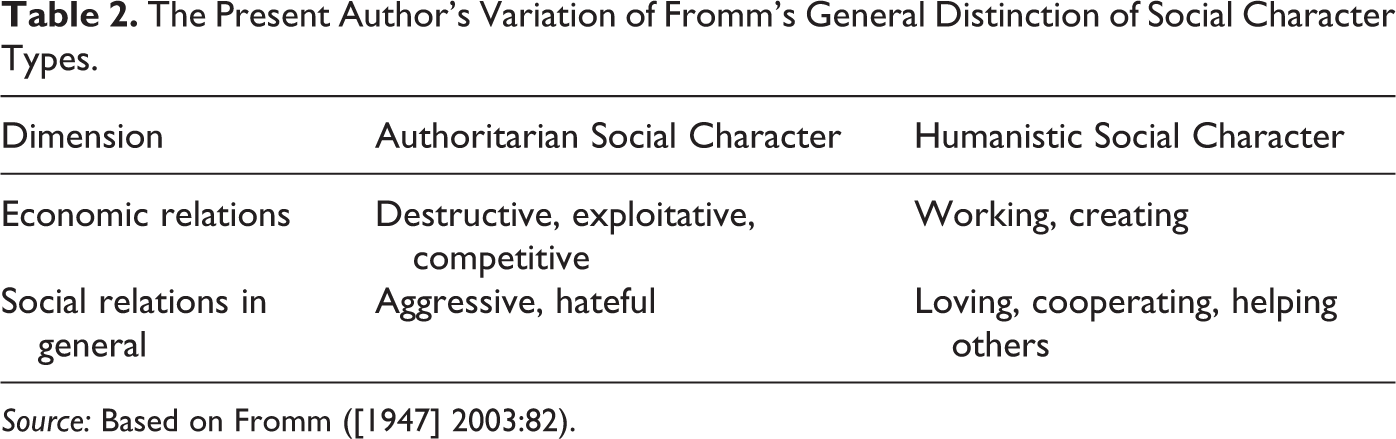
Source: Based on Fromm ([1947] 2003:82).
The Present Author’s Authoritarian and Humanistic Forms of Information and Communication.
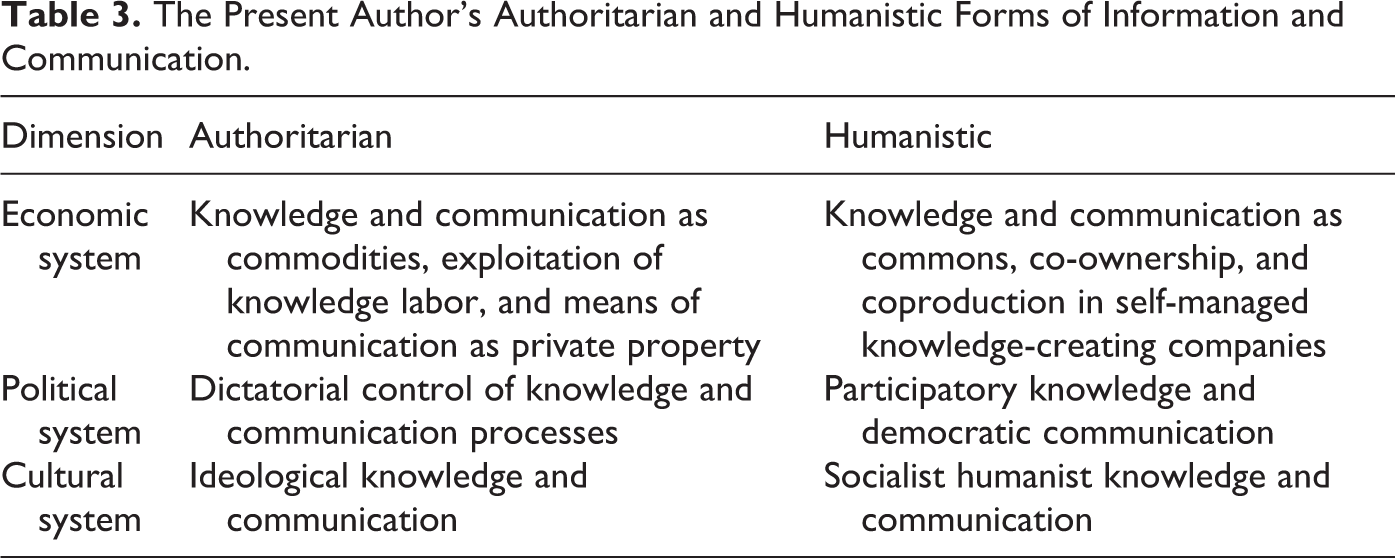
In the authoritarian economic organization of information, communication and knowledge production operate within class relations. As a consequence, a dominant, property-owning class controls the means of communication as private property and exploits knowledge and communication workers who produce knowledge and organize forms of communication. In capitalism, this organization of knowledge is a system, in which communication and knowledge are commodities that yield profit and are embedded into a system of capital accumulation. In the humanistic economic organization of information, society’s means of communication are owned collectively as a common good. Knowledge products are gifts and common goods and not commodities. The companies, in which public knowledge is produced, are self-managed cooperatives.
Fromm ([1961] 2008:45) argues that in knowledge capitalism, alienation reaches deeply into the human mind because “symbol manipulators” have to sell “personality qualities” such as their smiles and opinions. All work requires the utilization of the human being’s dialectic of body and mind. However, there are types of work that are more based on the human being’s exertion of physical energy than on the exertion of the brain and have a physical output. And there are types of work that are more based on the human being’s exertion of the brain than of physical energy and produce information or social relations. Therefore, the distinction between physical and mental work makes sense.
The authoritarian political organization of knowledge and communication implies that an individual or group acts as an authority that with the help of the state monopoly of the means of violence controls the means of public communication and the knowledge that is thereby produced and communicated. For example, in Nazi Germany, broadcasting was politically controlled by the state. All regional radio companies were unified in one company, the state-controlled Reichs-Rundfunks-Gesellschaft (RRG, Reich Broadcasting Corporation). The Reichsrundfunkkammer (Reich Chamber of Broadcasting) registered all individuals working in the media industry and aligned the media system with Nazi ideology (“Gleichschaltung”). The RRG operated a total of 20 aligned radio stations and 1 television station (Deutscher Fernseh-Rundfunk). In authoritarian political communication, humans are unable to listen to themselves (Fromm [1947] 2003:120). “We listen to every voice and to everybody but not to ourselves. We are constantly exposed to the noise of opinions and ideas hammering at us from everywhere: motion pictures, newspapers, radio, idle chatter” (p. 121). In authoritarian communication, humans have to listen or listen especially to a leader, which can be an individual, a group, a system, or an ideology. Citizens are expected to follow the leader’s orders. The problem of not listening to themselves is that humans do not trust and know themselves and cannot be alone with themselves (p. 121).
The humanistic political organization of information implies that the production of public knowledge and communication is democratically governed, so that citizens and workers are represented in the decision-making structures of media organizations. Voice is not centrally controlled by a dictatorship. Rather, everyday citizens have a public voice and are represented in publicly disseminated information. “To be able to listen to oneself is a prerequisite for the ability to listen to others” (Fromm [1947] 2003:79). In a humanist organization of political communication, humans listen to themselves and to each other. They engage with each other. While the having persons rely on what they have, the being persons rely on the fact that they are, that they are alive and that something new will be born if only they have the courage to let go and to respond. They come fully alive in the conversation, because they do not stifle themselves by anxious concern with what they have. Their own aliveness is infectious and often helps the other person to transcend his or her egocentricity. Thus the conversation ceases to be an exchange of commodities (information, knowledge, status) and becomes a dialogue in which it does not matter anymore who is right. The duelists begin to dance together, and they part not with triumph or sorrow-which are equally sterile-but with joy. (Fromm [1976] 2008:29)
In the authoritarian organization of knowledge and communication, information and information producers are treated as things. The focus is on accumulating information or the accumulation of money, hegemony, and power with the help of information. So, for example, in authoritarian, having-oriented learning knowledge is treated as a thing that is learned by heart, which is policed by authoritarian teachers in the form of exams and marks. “Students are supposed to learn so many things that they have hardly time and energy left to think” (Fromm [1947] 2003:56). Based on these general foundations of theorizing communication, we can next have a look at how Fromm’s approach allows to address ideology as a peculiar form of communication in class societies.
Ideology
Erich Fromm on Ideology
Ideology is not an individual or collective idea, but a communication process through which classes and groups try to convince others to defend and favor certain structures of exploitation and domination. Fromm (1965b:217) argues that ideology is a kind of social unconscious that operates behind the back of individuals. Ideology prevents “thoughts from […] becoming conscious,” it represses “dangerous awareness” (p. 218) that could threaten exploitation and domination. Ideology is a “social filter” (p. 218) that covers up the true status of society. Ideology operates in “a) language, b) logic, and c) social taboos” (p. 218). It is “socially produced and shared fiction” (p. 218).
Fromm ([1970] 2010:72) argues that insofar “as he is not an animal, man has an interest in being related to and conscious of reality, to touch the earth with his feet.” “As long as he is only sheep […] This reality is essentially nothing but the fiction built up by his society for more convenient manipulation of men and things” (p. 72). The development of a sane society requires that the social contradictions and irrationalities which throughout most of man’s history have forced upon him a “false consciousness”—in order to justify domination and submission respectively disappear or at least are reduced to such a degree that the apology for the existent social order does not paralyze man’s capacity for critical thought. (p. 73)
Fromm ([1947] 2003:101) argues that since the 18th and 19th century when capitalism consolidated itself, “the concept of the self was narrowed down increasingly.” As a consequence, the ideology “I am what I have” (Fromm [1947] 2003:102, [1976] 2008:63, 91) became the dominant mindset and principle of society. It implies possessive individualism (“I am what I possess”) and accumulation, “the wish to have much, to have more, to have most” (Fromm [1976] 2008:91). In 1961, Fromm ([1961] 2008) edited an English translation of Marx’s Economic and Philosophic Manuscripts that was accompanied by an introduction and analysis written by Fromm. Fromm ([1961] 2008:30) argues that it was Marx who first stressed the “difference between the sense of having and the sense of being” as fundamental aspect of capitalism. So, for example, Marx (1844:309) writes that in capitalism, all “passions and all activity must […] be submerged in avarice” (p. 309) and that “the sense of having” (p. 300) that is the “sense of possessing” (p. 299) replaces “all physical and mental senses” (p. 300). The mode of having is “a control-property-power orientation” (Fromm [1973] 1997:293).
Fromm ([1976] 2008) opposes the mode of having to the mode of being. Whereas the first is the characteristic of capitalism and class society, the second is the characteristic of socialist humanism. In the having mode of existence my relationship to the world is one of possessing and owning, one in which I want to make everybody and everything, including myself, my property. […] In the being mode of existence, we must identify two forms of being. One is in contrast to having […] and means aliveness and authentic relatedness to the world. The other form of being is in contrast to appearing and refers to the true nature, the true reality, of a person or a thing in contrast to deceptive appearances as exemplified in the etymology of being. (Fromm [1976] 2008:21)
Fromm argues that the capitalist focus on having, that is, its possessive individualism, instead of being has resulted in the growing use of nouns and the decreasing use of verbs in Western languages in the past few centuries. A noun is the proper denotation for a thing. I can say that I have things: for instance that I have a table, a house, a book, a car. The proper denotation for an activity, a process, is a verb: for instance I am, I love, I desire, I hate, etc. Yet ever more frequently an activity is expressed in terms of having; that is, a noun is used instead of a verb. But to express an activity by to have in connection with a noun is an erroneous use of language, because processes and activities cannot be possessed; they can only be experienced. (Fromm [1976] 2008:17). Among the many forms of alienation, the most frequent one is alienation in language. If I express a feeling with a word, let us say, if I say “I love you”, the word is meant to be an indication of the reality which exists within myself, the power of my loving. The word ‘love’ is meant to be a symbol of the fact love, but as soon as it is spoken it tends to assume a life of its own, it becomes a reality. I am under the illusion that the saying of the word is the equivalent of the experience, and soon I say the word and feel nothing, except the thought of love which the word expresses. The alienation of language shows the whole complexity of alienation. Language is one of the most precious human achievements; to avoid alienation by not speaking would be foolish—yet one must be always aware of the danger of the spoken word, that it threatens to substitute itself for the living experience. The same holds true for all other achievements of man; ideas, art, any kind of man-made objects. They are man’s creations; they are valuable aids for life, yet each one of them is also a trap, a temptation to confuse life with things, experience with artifacts, feeling with surrender and submission. (Fromm [1961] 2008:38). does not appeal to reason but to emotion; like any other kind of hypnoid suggestion, it tries to impress its objects emotionally and then make them submit intellectually. This type of advertising impresses the customer by all sorts of means: by repetition of the same formula again and again; by the influence of an authoritative image, like that of a society lady or of a famous boxer, who smokes a certain brand of cigarette; by attracting the customer and at the same time weakening his critical abilities by the sex appeal of a pretty girl; by terrorizing him with the threat of “b.o.” or “halitosis”; or yet again by stimulating daydreams about a sudden change in one’s whole course of life brought about by buying a certain shirt or soap. All these methods are essentially irrational; they have nothing to do with the qualities of the merchandise, and they smother and kill the critical capacities of the customer like an opiate or out right hypnosis. (Fromm [1941] 1969:149).
An Update of Erich Fromm’s Concept of Ideology
Given Fromm’s stress on false consciousness, there are clear parallels to Georg Lukács’s approach (Fuchs 2020b). False consciousness is consciousness that “by-passes the essence of the evolution of society and fails to pinpoint it and express it adequately” (Lukács 1971:50). False consciousness misses the “objective possibility” of consciousness, the “thoughts and feelings which men would have in a particular situation if they were able to assess both it and the interests arising from it in their impact on immediate action and on the whole structure of society” (Lukács 1971:51). For Lukács, ideology aims at reifying consciousness, which means that it tries to turn humans’ thoughts into things that can be controlled like things. Reified consciousness thinks in terms of “the abstract, quantitative mode of calculability” that in capitalism is the logic of capital accumulation and the commodity so that the reified individual “does not event attempt to transcend” class and domination (Lukács 1971:93). Reified consciousness sees the qualities of society as “things-in-themselves in a mythologised” form (Lukács 1971:192). Fromm ([1970] 2010:96) implicitly also refers to Lukács’s notion of reified consciousness when he writes that “reified man experiences little of life and instead follows principles which have been programmed for him by the machine.” Fromm’s ([1961] 2008:59) appreciation of Lukács becomes evident when he writes that Lukács “was the first one to revive Marx’s humanism.”
Like Lukács, Fromm shows that ideology is a communication process that aims at creating false consciousness. An example of how the mode of having as ideology shapes modern language and communication is the emergence of the English word “technology” in the 18th and 19th century. Although the word stems from the Greek techne that indicates an art or craft of doing system, the modern meaning of technology is “a system of […] means and methods” (Williams 1983:315), that is, machines. The understanding of technology as machinery has emerged with the industrial revolution and the emergence of machines as capitalist means of production that are used in order to increase labor’s productivity or what Marx ([1867] 1976:chapters 12 and 15) terms relative surplus-value production. Fromm argues that in technological society, the logic of machines has also affected the way dominant groups treat dominated groups. Instrumental reason reduces humans to the status of machines and wants them to act like automatic machines: Today we can meet a person who acts and feels like an automaton; we find that he never experiences anything which is really his; that he experiences himself entirely as the person he thinks he is supposed to be; that smiles have replaced laughter, meaningless chatter replaced communicative speech and dulled despair has taken the place of genuine sadness. (Fromm [1947] 2003:167)
In other works, Fromm ([1956] 2002:180) agrees with the present author that propaganda is not limited to politics and that advertising is product propaganda: “If a highly advertised brand of toothpaste is used by the majority of people because of some fantastic claims it makes in its propaganda, nobody with any sense would say that the people have “made a decision” in favor of the toothpaste.”
The discussion shows that Fromm advanced a critical notion of ideology that can inform a critical theory of communication. In the next section, we will have a look at Fromm’s notion of technology.
Technology
Erich Fromm on Technology
In the previous section, we already discussed the role of technology in capitalist society. The dominance of instrumental reason in capitalist society has brought about the reversal of means and ends: There is an “overemphasis on ends” (Fromm [1947] 2003:146). “We have the most wonderful instruments and means man has ever had, but we do not stop and ask what they are for” (Fromm [1947] 2003:146).
Technology is often uncritically accepted, affirmed, and not questioned. It is treated as a fetish (technological fetishism). Fromm (1964:59) argues that there is an “affinity between the necrophilous contempt for life and the admiration for speed and all that is mechanical.” The admiration of machines, technology as means of domination, and technological fetishism are based on the fascist principle “[l]ong live death” (Fromm [1973] 1997:33; see also 454-62). Technological fetishists love machines and commodities, that is, dead labor, instead of having an interest in what is alive. “A new concept of the sacred and unquestionable is arising: that of calculability, probability, factuality” (Fromm [1970] 2010:61). The idea that social relations and human behavior should be calculated aims at the control of the behavior of workers, citizens, and consumers in order to advance the accumulation of capital, political power, and status.
Fromm ([1970] 2010) argues that the present technological society is grounded on the principles “that something ought to be done because it is technically possible to do it” (p. 43) and the principle of “maximal efficiency and output” (p. 43). The first principle is based on the naive technological-optimistic and technodeterministic assumption that technology must have positive impacts. The second principle advances the logic of accumulation, the “constant increase of quantity” (p. 46) that disregards “the question of quality, or what all this increase in quantity is good for” (p. 46).
Fromm ([1970] 2010:53-64) is critical of the idea that computers that are like humans (including having feelings and thought) and act like humans. For Fromm, the idea that robots can be built that are like humans is the expression of a society ruled by instrumental reason, in which dominant forces want to make humans “act like robots” (p. 54). Fromm argues that humans have a capacity for freedom, which means that they are “faced with alternatives” that entail a risk of failure” and “insecurity” (p. 69). In order to exert control, dominant groups search for certainty in an uncertain, complex world, which has resulted in the “blind belief” (p. 58) in the efficacy of the computer. The computer has become a technological fetish, “a substitute for God” (p. 61). The belief that computers take value-free, unbiased decisions is erroneous because the construction and programming of computers “itself is based in built-in and often unconscious values” (p. 63).
Fromm is not opposed to technology but critical of its instrumental shaping and use. He argues for a humanized technology that “stimulates and furthers the growth and aliveness of man rather than cripples it” so that machines and computers become “part in a life-oriented social system” (Fromm [1970] 2010:103). Such a “new radical humanism” aims at “the growth of man with all his potentialities, the affirmation of life in all its forms against death and mechanization and alienation” (p. 142).
Alternative use of computers—controlled by humans, quality instead of quantity
Fromm ([1970] 2010) argues for the use of alternative technology in the context of an alternative design of society, a participatory democracy that uses “participatory face-to-face groups” (p. 121) that involve processes of “information exchange, debate, and decision-making” (p. 112). In the economy, the system Fromm envisions takes on the form of self-managed companies. The “socialization of the means of production might be a necessary, but does not constitute a sufficient condition to achieve humanization” (p. 156). Participatory democracy requires collective ownership of the means of production as one of its conditions but must also be a political and cultural process of change. In the political system, Fromm has local grassroots town hall meetings in mind that are federated into a society-wide parliament. In the realm of culture, Fromm talks about the transition from spectator art to active art, an “active, participant culture” (p. 119), which also includes critical pedagogy and the participation of students and learners in the administration of universities and other educational organizations and (pp. 120-21) and a stronger focus on public consumption of common goods instead of individual consumption of commodities. Fromm argues for the introduction of a basic income guarantee as material foundation of participatory democracy (pp. 130-31).
Fromm (1960, [1970] 2010) argues for computer-supported town meetings of citizens organized in work places and local communities, where key political matters are debated. These meeting are via computer technology organized as networks of “hundreds of thousands of small face-to-face-groups” who together form “a new type of Lower House” (Fromm 1960:26). A precondition is that “the democratic process is transformed into one in which well-informed and responsible citizens express their will, not automatized mass-men” (Fromm 1960:26). Consequently, also the town meetings can only work properly if the members are “well informed” (Fromm [1970] 2010:118). Fromm ([1970] 2010:118) is well aware of the dangers of plebiscites and opinion polls and therefore argues that electronic democracy is “fundamentally different of a plebiscite or an opinion poll” because the meetings “would be based on information and debate their decisions” and their political influence would grow together with political education.
Fromm (1968:20) speaks of the “problem of communication”: Because of communication technologies, there are ever more potentials for communication, but true communication between humans has become more difficult. The causes of this development include the structure of the mass media, individualism, bourgeois culture, instrumentalism, dependency, the fear of war, and so on. Fromm (1968:20) asks: “Do the words communion and community still make any sense? […] Social, psychological, and economic factors are many times combined to make communication in depth an impossible attempt.”
An Update of Erich Fromm’s Concept of Technology
Fromm’s analysis of the technological logic parallels Horkheimer and Adorno’s (2002:4) notion of instrumental reason that they consider characteristic for the dialectic of the Enlightenment: “Bourgeois society […] makes dissimilar things comparable by reducing them to abstract quantities. For the Enlightenment, anything which cannot be resolved into numbers, and ultimately into one, is illusion.”
Capitalist society fetishizes quantification: Its goal is the accumulation of capital and power, for which it needs to quantify and control the quantity of investments, labor-time, commodities, profits, political power, consumption, experience, consciousness the human being, and life.
A contemporary critique of big data and the capitalist Internet can build on Fromm’s notion of technological fetishism. Big data is an example of how in contemporary capitalism, computer technology and its logic of calculation are fetishized. Big data is often defined as a massive increase of three Vs, namely, the volume, variety, and velocity of data (Kitchin 2014:68). Big data studies is a fast growing field of research (see Kitchin 2014; Mayer-Schönberger and Cukier 2013, Mosco 2014). It deals with how big data transforms society, the environment, culture, the economy, and the political system. Whereas for uncritical accounts, big data is the consequence of Moore’s Law that says that computing power doubles every 18 months (Mayer-Schönberger and Cukier’s 2013:8), more critical explanations stress that big data stands in the context of political and economic surveillance and targeted advertising-based capital accumulation models (Fuchs 2017a, 2017b, 2018c).
Big data has the logic of quantification and accumulation already in its name (“big”). The effect of data becoming so voluminous, variegated, and fast that humans can no longer oversee it is that in big data applications and big data analytics, the human being is often pronounced as being dead. It is argued that computers and artificial intelligence are doing the job on their own independent of humans. If such scenarios become reality, then the problem is that computers cannot have ethics because what is good and evil cannot be calculated and quantified. The effect is that moral irresponsibility or relativism might be built into digital machines. In the realm of big data analytics, the fetishism of quantification has resulted in a neglect of the study of how humans experience, assess, and morally judge data (Fuchs 2017a).
Given the instrumental logic underlying big data, it is no wonder that conservative policy visions uncritically embrace, reify, and fetishize big data. So, for example, a UK government policy paper outlining the UK’s Industrial Strategy in the realm of artificial intelligence, argues: “In the same way that Gutenberg’s press ushered in a new era of growth, data-driven technologies such as AI will underpin our future prosperity. […] Creating an economy that harnesses artificial intelligence (AI) and big data is one of the great opportunities of our age” (HM Government 2018:3, 8). Big data and AI are presented as revolutionary and as only having positive effects in society (“future prosperity,” “great opportunities”). Potential negative effects of the use of big data in a capitalist society such as the creation of a totalitarian surveillance society by data-based surveillance (dataveillance) or the increase of unemployment and precarious life by data-driven automation are not mentioned. New computing technologies are blindly trusted based on the logic that Fromm criticizes, namely, the assumption that what is technologically possible must be realized and must have positive effects in society.
Fromm anticipated discussions about digital democracy. Whereas digital democracy in general means the practicing of democracy with the help of computers (Hacker and van Dijk 2000:1), one has to distinguish between different uses of computers in politics. The danger of digital plebiscites is real in digital society. In a public sphere that is dominated by a culture of fake news, ideological scapegoating and high-speed, superficial, sensationalist tabloid news, and point-and-click digital politics, in which citizen users take society-wide decisions via their screens, can easily be used for passing laws that violate human rights and humanism. Furthermore, if authoritarian demagogues select the topics and define the questions asked in plebiscites, political decisions are prone to manipulation. For example, if a refugee is suspected of having committed a murder, an online plebiscite that builds on an anti-refugee campaign that ideologically exploits this case could result in a law that legislates the deportation or internment of all refugees.
What we need today is a combination of deliberative and participatory democracy (Fuchs 2018b). Deliberative democracy focuses on the direct political communication of citizens. In deliberative digital democracy, citizens only partly discuss politics online. They also come together for face-to-face debates that might by supported but not substituted by online communication. Participatory digital democracy focuses on the extension of democracy beyond the realm of elections and the political system. It stresses the importance of economic democracy and cultural democracy, which means that questions of the collective control of resources, activity time, and spaces and institutions play a role in enabling democracy. So, for example, the reduction of standard working hours without wage cuts or the introduction of a guaranteed basic income can give people more time for practicing democracy. The collective ownership of digital communication platforms and their operation on a not-for-profit basis (public service Internet platforms, civil society Internet platforms) is a good foundation for creating citizen participation in democracy.
The rise of ever more digital communications (communication technologies such as the mobile phone and “social media”) takes place in a political-economic context that results in less and less sustained communication. In the age of online fake news and Donald Trump, the political world is deeply polarized between right-wing authoritarians on the one side and humanists on the other side. We live in an age of authoritarian capitalism, where right-wing demagogues such as Donald Trump, Boris Johnson, Nigel Farage, Marine Le Pen, Viktor Orbán, Vladimir Putin, Marine Le Pen, Narendra Modi, H. C. Strache, Recep Erdoğan, Geert Wilders, and so on make use of social media for spreading nationalist and authoritarian ideology (see Fuchs 2018a, 2019; Woolley and Howard 2019). The capitalist digital media’s structures foster political communication and information that is brief, superficial, personalized, individualistic, anonymous, prone to harassment, tabloidized, and transmitted at high speed (Fuchs 2018a:chapter 7). Contemporary political online communication is dominated by authoritarian ideology, fake news, filter bubbles, algorithmic politics, and high-speed online communication that does not leave space and time for real discussion (see Farkas and Schou 2019; Fuchs 2018a, 2019; McNair 2018; Pariser 2011). As a consequence, some authors have talked about the emergence of anti–social media in the age of authoritarian capitalism (Fuchs 2018d; Mair, Clark, and Fowler 2018; Vaidhyanathan 2018). The Cambridge Analytica-scandal was the characteristic of these developments.
Fromm ([1970] 2010:115-16) argues for a different, democratic kind of communication that includes direct encounter (“true communication”): While there will always be fanatics and more or less sick as well as stupid people who cannot participate in this kind of debate, an atmosphere can be created which, without any force, eliminates the effectiveness of such individuals within the group. It is essential for the possibility of a dialogue that each member of the group not only try to be less defensive and more open, but also that he try to understand what the other person means to say rather than the actual formulation he gives to his thought.”
Club 2.0 is the concept of Club 2 updated for the age of digital and social media (Fuchs 2017c). Club 2.0 operates based on a video platform that is not owned by corporations such as Google (YouTube), Amazon, or Netflix, but by a public service broadcaster such as the BBC. Club 2.0 is an example of a public service Internet platform (Fuchs 2018e). Club 2.0 includes forms of digital participation via online discussions, socially produced videos submitted by users, a selection of videos generated by user groups that feed into the television debate, and nonanonymous online discussion. The online debate is decelerated by a limitation of the number of active users, the definition of a minimum length of discussion contributions that are submitted as text or video, and the limitation of the number of contributions a single user can make. Club 2.0 is an attempt to slow down and decommodify political communication in order to save democracy in the age of fake online news, filter bubbles, and digital authoritarianism. Figure 3 visualizes how Club 2.0 works.
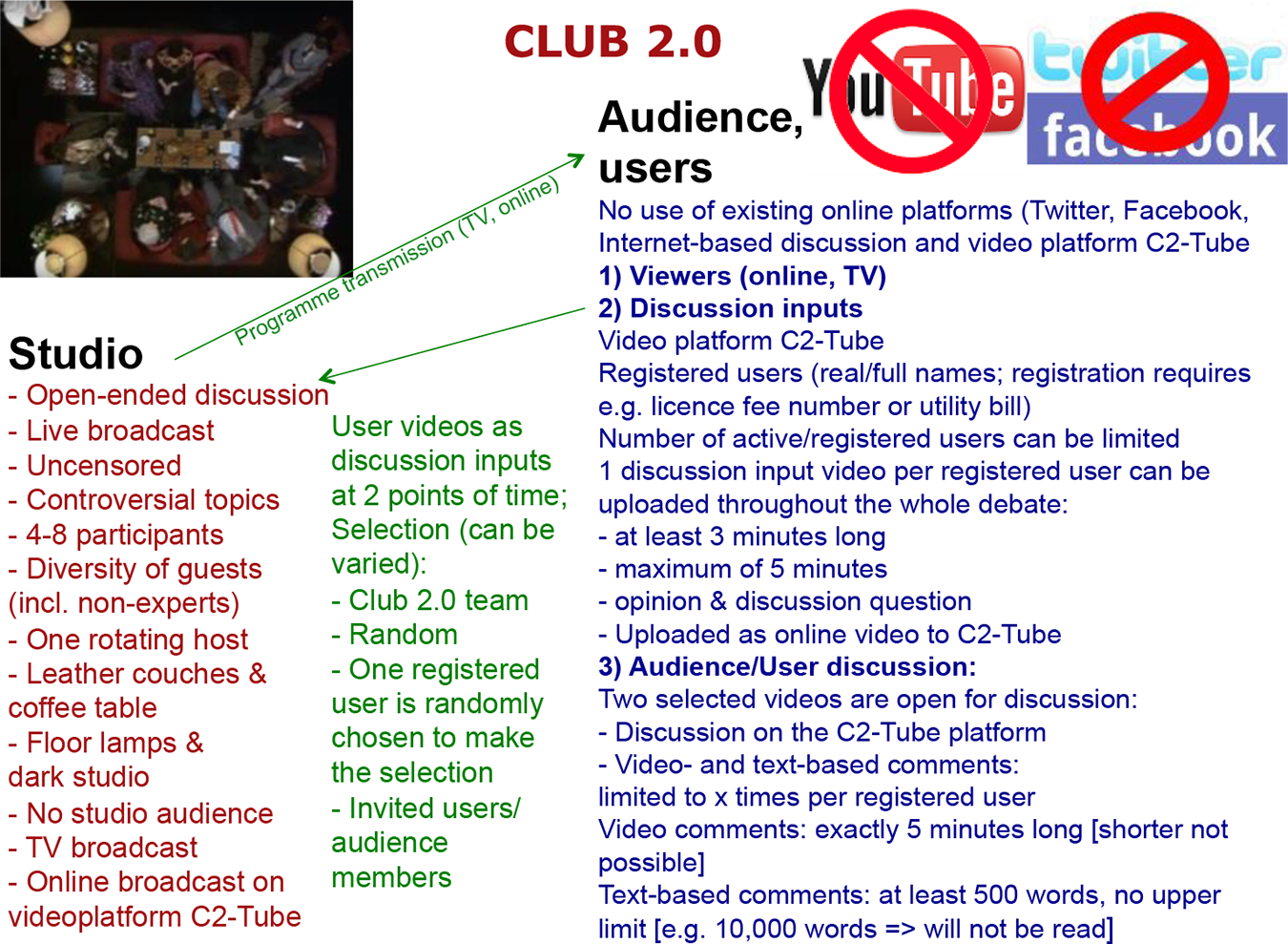
Club 2.0.
Conclusion
A critical theory of communication can draw on several insights that we can gain from a reading and interpretation of Erich Fromm’s works: The human being: The human being is a natural, social, cooperating, and self-conscious being. Social production is the essence of humans. Humans produce socially and communicate productively. The social character and communication: Fromm’s notion of the social character is a concept that mediates between the levels of the individual psyche and society. Humans through communication in various social systems form a particular social character, a character structure peculiar for a certain group in society. Through communication, the social character and social structures are formed and reproduced. The social character and social structures mediated through communication in the social relations that humans enter condition, that is, enable and constrain individual thought and action. The authoritarian and the humanistic character: Fromm’s basic distinction between the authoritarian and the humanistic character allows to analyze antagonisms in dominative societies: the contradiction between the exploiter and the commoner in the class-structured economy, the antagonism between the dictator and the democrat in the political system, and the antagonism between the ideologue and the friend in the cultural system. Authoritarian and humanistic communication: Based on Fromm’s approach, one can draw a distinction between authoritarian and humanistic knowledge and communication. In the economy, this distinction expresses itself as knowledge commodities and private means of communication as private property on the one side and knowledge and communication commons on the other side. In the political system, we find dictatorial control of communication on the one side and participatory, democratic communications on the other side. And in the realm of culture, we can discern between ideological communication on the one side and socialist humanist communication on the other side. Ideology: For Fromm, ideology is a form of communication that operates as a social unconscious and filter that prevents certain knowledge about the world to become apparent. It covers up the true status of society. Fromm shares Lukács’s critical notion of ideology as the attempt to create false, reified consciousness. The ideology of having: Fromm argues that a particular ideology, namely, the ideology of having, dominates capitalist society. It is based on the logic of property and accumulation and the principle “I am what I have.” In capitalist societies, the ideology of having expresses itself is the logic of the accumulation of capital, power, and status. The ideology of having has negatively impacted on realms like language, communication, consumption, advertising, and political propaganda. Capitalist technology: In capitalism, technology is fetishized and the logic of quantification shapes social relations. Technological fetishism includes the uncritical acceptance of technology as it is the assumption that everything that is technologically possible should be realized and will have positive effects on society. Alternative technology: Fromm is not opposed to technology but critical of its instrumental shaping and use. He argues for the humanization of technology, which includes participatory democracy and the mediation of participation by computer technology. Participatory computing: Fromm’s work on technology reminds us that the authoritarian and capitalist design and shaping of computing poses threats to democracy and human well-being. In contrast, the humanistic shaping and design of computer technology and society have the potential to advance participatory democracy.
Taken together, these results show that reading Erich Fromm today can inspire insights for the critical understanding of communication, ideology, technology, and computing. Fromm reminds us that we need to be aware of and should challenge authoritarian communication and authoritarian communication systems. Socialist humanism is the alternative to authoritarianism. The political quest is to create humanist technologies, humanist communication, and a democratic–socialist society today.
Footnotes
Declaration of Conflicting Interests
The author(s) declared no potential conflicts of interest with respect to the research, authorship, and/or publication of this article.
Funding
The author(s) received no financial support for the research, authorship, and/or publication of this article.