




Abstract
This article presents an original needs-based partial theory of human injustice and shows its relationship to existing theories of human need and human liberation. The theory is based on an original typology of three social structural sources of human injustice, a partial theorization of the mechanisms of human injustice, and a needs-based theorization of the nature of human injustice, as experienced by individuals. This article makes a sociological contribution to normative social theory by clarifying the relationship of human injustice to human needs, human rights, and human liberation. The theory contends that human injustice is produced when oppression, mechanistic dehumanization, and exploitation create systematic inequality in opportunities to address human needs, leading to wrongful need deprivation and the resulting serious harm. In one longer sentence, this needs-based theory of the sources, mechanisms, and nature of human injustice contends that three distinct social systemic sources—oppression, mechanistic dehumanization, and exploitation—produce unique and/or overlapping social mechanisms, which create systematic inequality in opportunities to address universal human needs in culturally specific ways, thus producing the nature of the human injustice theorized here: wrongfully unmet needs and serious harm.
Personal Reflexive Statement
I have devoted my life to understanding and changing the world around me, while trying to be of some help along the way. I have done this as a social activist since entering the University of Michigan in 1966; as a social worker since earning two degrees in New York City in the 1970s; as a sociologist since entering Michigan’s doctoral program in social work and sociology in 1991; and as a social work educator since 2003. For changing the world, my primary activism has involved alternative journalism; Chile solidarity; peace and nuclear disarmament; radicals in the professions work; consistent membership on the organized left; trade unionism (work for five union-based programs, organizing a social agency, and election to two faculty union positions); and work on affirmative action, police/community relations and campus/community bias incidents. For understanding the world, other than my dissertation on the social system of real property, I have worked since 1991 in two areas: theories of oppression, dehumanization, and exploitation and theories of human need. This needs-based theory of human injustice integrates these two areas of previous work and seeks to improve my ability to theorize about, engage with, and change the world around me.
Introduction
This article presents a needs-based partial theory of human justice, focused on three levels of analysis. First, at the macro social system level, I have created a typology of three systemic sources of human injustice: oppression, exploitation, and mechanistic dehumanization. Second, at the level of social mechanisms, I supply a partial theorization of how these three unjust social systems produce systematic inequality in the opportunities people and communities must have to obtain culturally specific satisfiers of universal human needs. Third, at the individual level, I provide a needs-based theorization of the nature of human injustice as individually experienced, with a focus on wrongfully unmet needs and how they can lead to serious harm.
To state the theory in one sentence: This needs-based theory of the systemic sources, social mechanisms, and nature of human injustice contends that three distinct social systemic sources—oppression, mechanistic dehumanization, and exploitation—produce unique and/or overlapping social mechanisms which create systematic inequality in opportunities to address universal human needs in culturally specific ways, leading to the nature of the human injustice theorized here: wrongfully unmet needs and the resulting serious harm.
Levels of Analysis and Preliminary Definitions
Starting at the level of analysis of social systemic sources of human injustice, oppression in its many forms is conceptualized as a social group-based phenomenon that is distinct from exploitation (Cudd 2006). I define exploitation in a way that is applicable across economic systems, with the commonality being unequal advantages exercised within the context of structured economic exchanges. For instance, Hahnel (2006) contended that unjust outcomes are produced by transactions between parties who have unequal access to capital, which for the present purposes is broadly conceived to consider a wide variety of forms of capital, such as finance capital, social capital, cultural capital, and so forth.
At a similar social structural level of analysis, the third social systemic source of human injustice is mechanistic dehumanization (Bauman 2000; Haslam 2013; Kronfeldner 2016; Ritzer 2019). The typology presented in the third section of this article sees mechanistic dehumanization as conceptually distinct from oppression and exploitation. Mechanistic dehumanization is the systemic subjection of human beings to standardized impersonal processes that ignore our fundamentally human characteristics and treat us as nonhuman and/or nonliving objects of manipulation and control (Haslam 2006). Mechanistic dehumanization involves a range of specific mechanisms, such as objectification, desensitization, denial of our need to connect with the natural environment, and so forth. It also involves other aspects of the dehumanizing consequences of the human creation of Weber’s shell as hard as steel—a new translation of the iron cage (Baehr 2001; Merton 1936; Weber, Baehr, and Wells 2002)—and of what Marx (1981) referred to as “the objective transformation of the activity of man and of its results into an independent force, dominating him and inimical to him” (p. 176).
Moving to the level of analysis of social mechanisms, unique and overlapping social mechanisms associated with each of the three unjust social mechanisms produce systematic inequality in the opportunities people and communities must have to access culturally specific need satisfiers of universal human needs. These include satisfiers of the intermediate needs discussed in the literature review below—from food and water to significant primary relationships and safe birth control and childbearing—that human beings must have access to if we are to meet our basic human needs for health and autonomy and our basic psychological needs for autonomy, relatedness, and competence.
These universal needs are spelled out by two well-established and compatible theories: a philosophically constructed theory of human need (THN; Doyal and Gough 1991; Gough 2017) and a post-Maslowian humanistic psychological theory: self-determination theory (SDT; Deci and Ryan 1980; Ryan and Deci 2017). Figure 1 illustrates the compatibility of these two theories, which this article refers to as THN and SDT. Such abbreviations are commonly adopted (Deci and Ryan 2000; Dover 2016b; Gough 2015).
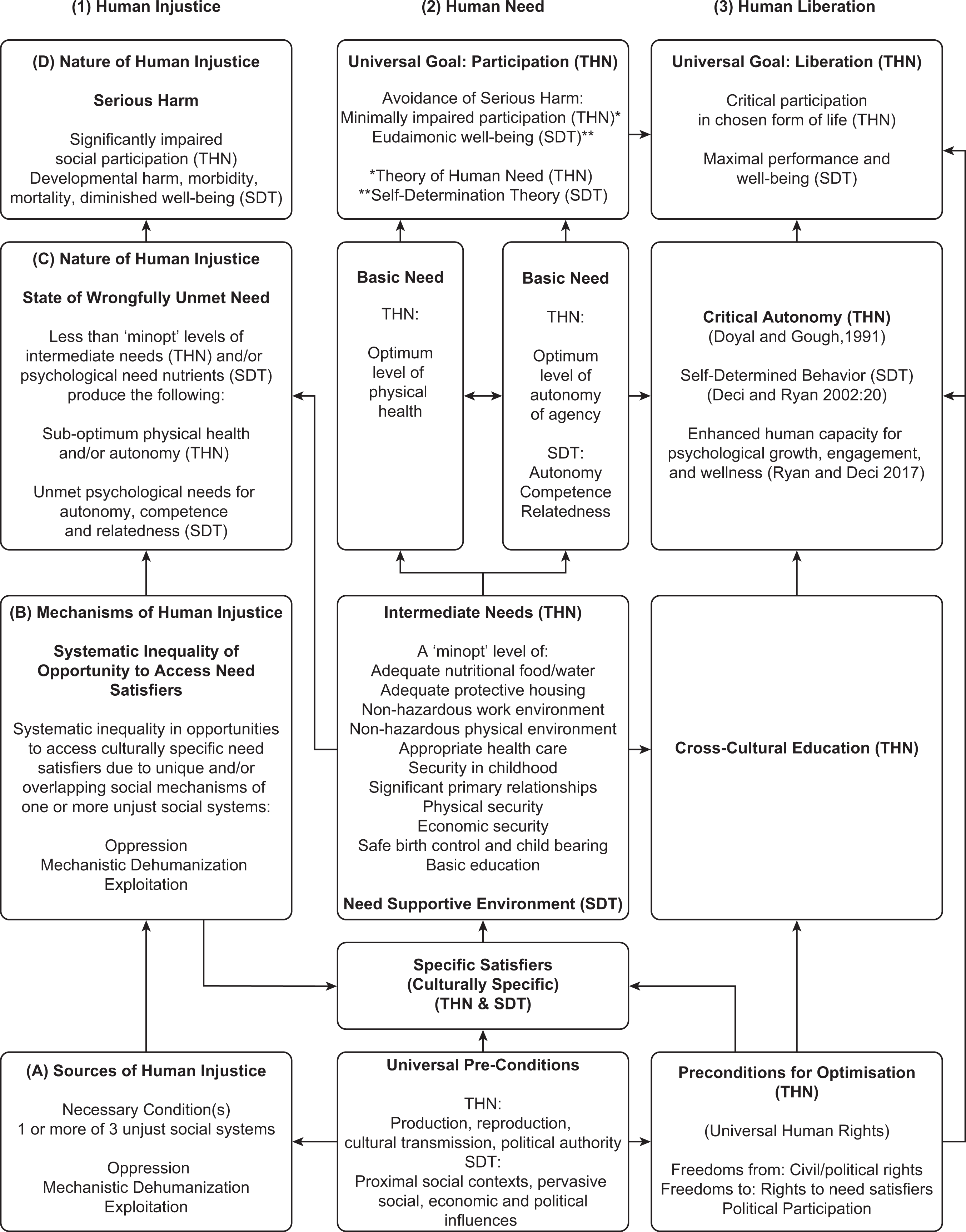
Theories of human injustice, human need, and human liberation.
Human universal goals of social participation, eudaimonic well-being, and avoidance of serious harm cannot be realized without achieving an optimum level of human and psychological need satisfaction. Accordingly, at the individual level, I define the nature of human injustice as a state of wrongfully unmet human needs. Absent social or individual intervention, this produces significantly impaired social participation and serious harm.
Presentation as a Partial Theory
By design, this is a partial theory. I focus only on human injustice as defined here, not on social injustice more broadly. For example, I do not include individual failures to prevent injustice (Shklar 1990). This partial theory cannot specify the myriad unique and/or simultaneously operating social submechanisms which are part and parcel of the central mechanism outlined in the theory sentence, namely systematic inequality in opportunities to address universal human needs in culturally specific ways. Also, some components of the theory are based upon stated assumptions stemming from existing theories of human need. McCarthy and Zald (1977) referred to their work on resource mobilization as a partial theory for similar reasons. Likewise, Maslow (1948) referred to the theory of human motivation as a partial theory. This should not hold back the process of theory construction. After all, Hedström and Swedberg (1998) suggested the value of a preliminary account of how relevant social mechanisms work.
Organization of This Article
This paper has several sections: (1) this introduction; (2) a literature review, which outlines the current nature of theories of human need and their relevance for sociology, including an explanation of Figure 1, columns 2 and 3 on human need and human liberation, respectively; (3) presentation of a typology of exploitation, oppression, and mechanistic dehumanization; (4) explanation of each component of the above theory sentence, preceded by an explanation of column 1 of Figure 1 on human injustice; and (5) conclusions regarding implications of this theory for social theory, social research, and social activism.
Relevance to Humanistic Sociology
The specific type of normative social theory to which this article contributes is needs-based social theory (Brock 2009; Floyd 2011; Noonan 2006; Reader 2006, 2011; Reader and Brock 2004). Others have contended that a theory of social justice requires a concept of human need (Brock 1996; Wiggins 1998). I use such a needs-based approach to present a three-part continuum from human injustice, to basic human need satisfaction to human liberation.
This three-element discursive alternative to the more abstract distinction between social injustice and social justice is amenable to empirical research, since the degree of human need satisfaction is an objective and observable aspect of the human condition. This theory and continuum can contribute to a post–Cold War moral system that addresses human need, human vulnerability, and human interdependence (Friesen 2014). Such a system should enforce human rights and make sustainable human need satisfaction our global social justice goal (Brock 2011, 2018; Friesen 2014; Gough 2017; Miller 2012b).
True, theory alone will not do the trick, without popular struggles, social movement building and the challenging of basic cultural—and, I would contend, theoretical—precepts (Dolgon 2018). If a new post–Cold War social contract is to be achieved, we must theorize and struggle on behalf of human needs and the needs of all sentient beings in the Anthropocene (Gabardi 2017). We must engage in theoretical and social criticism of abnormal and unnecessary social suffering (Renault 2017). I present this theory in that spirit and from the below standpoint.
Author’s Standpoint
This work grew out of two separate lines of inquiry over the last 25 years. At the macro level, one concerned THN and its implications for social theory and social policy. At the micro level, the other began with classroom exercises about the experience of the moment of oppression.
With respect to theories of human need, in the debates among progressive activists after the fall of what Kennedy (1991) called communist-governed forms of state socialism, I opposed taking a defeatist position towards addressing human needs (Dover 1992, Dover 1993a). I published a book review (Dover 1993b) of Doyal and Gough’s (1991) A Theory of Human Need. That book won the Deutscher Memorial Prize and the Gunnar Myrdal Prize in 1992. I advocated for the first-time inclusion of the concept of human need in the social work Code of Ethics (National Association of Social Workers 1996). I contended that “knowledge of theories of human need and social justice” be required for social work education’s accreditation standards (Council on Social Work Education 2015). I also contributed to the first two entries on human need in the Encyclopedia of Social Work (Dover 2016b; Dover and Joseph 2008). I later applied theory of need to a public sociology that called for a needs-based progressive pragmatist approach to key social policy issues such as school funding and youth unemployment (Dover 2014, 2017).
The second line of inquiry began with classroom oppression-awareness exercises at several universities, beginning in 1990. This led to the publication of a compendium of words and affective phrases describing the feelings and emotions experienced at the moment of acts of oppression, dehumanization, and exploitation (Dover 2008). That typology was strengthened by the study of organizational, institutional, and class analysis, for a preliminary examination in sociology (Dover 1996).
Formal theory construction began when I realized the relationship of the two lines of work. This took place following conference presentations on both topics (Dover 2009a, 2009b, 2009c) and completion of a retrospective analysis of the craft of theorizing used in my dissertation (Dover 2003, 2010b).
Craft of Theorizing Used
Swedberg’s (2010, 2012, 2014a, 2014b) work on the craft of theorizing influenced theory construction. First, I asked what Kimeldorf (1998) referred to as an originating question: “What are the social structural causes of social injustice?” I then posed what Kimeldorf called a specifying question: “Is it possible that oppression, mechanistic dehumanization and exploitation are the three sources of social injustice?” This was followed by what Tilly (1990) referred to as subsidiary questions, for example: How are these three social systems related to each other? Is there a fourth such system? How might their social mechanisms produce unmet need? What is the nature of wrongfully unmet need? The present theory responds to such questions.
As part of the craft of theorizing, I used class theory, defined as theory developed in the classroom. This included guessing—in class—the second and third elements of the typology of unjust social systems: exploitation and dehumanization. First, a student in our oppression exercise said they had never experienced oppression and, therefore, could not take part in the exercise. I asked, have you ever had a lousy minimum wage job? The student said yes and was able to talk about unjust moments from that experience of exploitation. After a couple of years, a student contended that they never been oppressed or exploited. I asked: has a bureaucracy ever treated you like a number? The student answered yes and gave an example. Ensuing discussion added dehumanization to the typology of systems that can produce powerful moments of the experience of injustice. The nature of the exercise and the resulting compendium were later published (Dover 2008). At this example shows, guessing and class discussion are part of the craft of theorizing (Peirce 1929, cited in Swedberg [2014a]).
Other craft elements employed included reducing the theory to one sentence, parsing the sentence into its component parts, presenting the theory via explanation of each of the parts of that sentence, and—after returning from the aforementioned conference at the University of Bath in 2009—waking up one morning having dreamed column 1 of Figure 1. According to Swedberg (2014a), dreams can help fuel the sociological imagination which is exercised in the craft of theorizing.
Literature Review: Human Need and Humanistic Sociology
This section discusses the importance of theories of human need, discusses some of their key conceptual problems, presents a synthesis of the key concepts of THN and SDT, and explains columns 2 and 3 of Figure 1.
Importance of Theory of Human Need for Humanistic Sociology
Despite considerable sociological attention to human rights in recent years (Cole 2012; Sklair 2009; Somers and Roberts 2008), Wolbring, Keuschnigg, and Negele (2013) pointed out there has been little formal theoretical attention to human need in sociology. This is despite Sayer’s (1997, 2011) recognition that an objectivist foundation to human well-being is implicit in classical and recent social theory.
Early on, Lynd (1939) stressed the importance of asking questions that have “relevance to persisting human need” (p. 226). Etzioni (1968) contended that improvements in human needs theory might correct for Wrong’s (1961) concern about oversocialized conceptions of humankind. Lenski (2005) suggested moving beyond Maslow to develop modern theories of human similarities and differences. Estes (2008) contended that human needs are objective, universal, and transcultural, and endorsed Doyal and Gough’s (1991) theory of human need.
More recently, Friesen (2014) suggested that societal moral systems, codified as human rights, are an example of the conceptual evolution of humanity. Friesen (2014:21) further proposed to “move the dialogue from a descriptive analysis of what a society is to what it should be” and to develop “a theory of society based on democratic human need fulfillment.” Furthermore, Sayer (2007:241) called for a “needs-based conception of social being,” which recognizes that people are “…capable of flourishing or suffering.”
However, despite explicit calls for humanistic sociology to attend to questions of human need (DuBois and Wright 2002, Goodwin 2003, Parsons 1971), no previous article in this journal has utilized formal theories of human need nor presented a needs-based theory of injustice. With one notable exception (House and Mortimer 1990), the sociological literature has not responded to Etzioni’s (1996) emphasis on the contradiction between social structures which produce false needs and the role of human autonomy in addressing true needs.
This has been the case for several reasons. First, McCarthyism had a deleterious influence on American intellectual life (Dover 2016b). For example, during the McCarthy period, the plates of the book Common Human Needs were destroyed by the federal government, following Congressional criticism of its prescriptions for human well-being (Posner 1995; Towle 1944, 1945). Second, Gough (2017:39-41) stressed the role of four competing theories: preference satisfaction theory, happiness and subjective well-being theory, relational well-being theory and its roots in cultural relativism, and the human capabilities approach. Third, what McCumber (2016) called the triumph of Cold War philosophy deemphasized normative concerns and stressed positivist epistemology. In other words (Antonio 1981:331), “Western social science, based on the Kantian division of fact and value, is supposed to describe ‘what is’ without making value judgements.”
Fourth, Cold War ideological conflict stunted full recognition of the centrality of human needs and human rights. By the 1970s, Moyn (2018) has noted, Cold War assumptions had undermined the 1940s era recognition that civil and political rights were fundamentally linked with economic and social rights. As the end of the Cold War approached, Moyn (2018:212) saw an increased “visibility of human rights ideals,” accompanied by a declining emphasis on national social welfare commitments. Seen retrospectively, many of the civil rights and social welfare policy advances during the Cold War were achieved due both to mass mobilizations and to corporate liberal elite consent motivated by the value of such policies in the Cold War ideological struggle (Dover 1998; Dudziak 2000). Following the Cold War, the earlier reliance on advocacy for human rights as a “morally pure form of activism” (Moyn 2018:212) became ascendant.
This led to the widespread post–Cold War use of human rights discourse to advance social justice causes, but also to a reduction in the extent of explicit human needs advocacy, which Moyn (2018) noted had been widely employed as part of the basic needs approach to social development in the 1970s. Following the Cold War, postmodernist and poststructuralist thinking recognized that human needs might be universal from a theoretical standpoint, but also contended they were ultimately “historical, normative, and political in nature” (Hamilton 2013:56). Human rights were increasingly seen as universal, while human needs were seen as socially constructed, culturally relative, and rooted in Eurocentric master narratives (Ife 2001, 2007; Jani and Reisch 2011).
This was despite some recognition that the opposite is true: Human rights are universal only to the extent that they are adopted and enforced, but human needs are rooted in the human condition. For instance, Wronka (2017:Preface) recognized: “Technically, human rights do not exist. However, human needs do, and human rights make up the legal mandate to fulfill human need.” Optimally, human needs, human rights, and social justice should be discussed with reference to each other, rather than singly. A typology of human injustice, human need, and human liberation can inform a needs-based approach to such a discourse.
There is now promise for sociology to return its attention to normative social science (Gorski 2016; Prasad 2016; Steward 2016) and to evolve a critical social science which would “explicitly and systematically analyze and critique the relationship between normative and descriptive claims” (Gorski 2017:442). Social scientists have recently been encouraged to listen to our “cousins in moral and political philosophy” (Gorski 2013:553). Sayer (2009:782) said that normative approaches should include “…some conception of well-being and ill-being.”
Such theory can address fundamental sociological concerns. For instance, take the question of inequality or social stratification. Dean and Platt (2016:343) pointed out that Sen (1992) asked an important question: Inequality of what? Sen’s focus and that of Nussbaum (2011) have been on inequality of capabilities. I stress inequality of opportunities to address needs. The advantages of needs theory are shown in a chapter which favorably compared needs theory to capabilities theory (Gough 2014), published in a book edited by Comim and Nussbaum (2014).
Likewise, Rawls (1971:36) asked an important question about social structure: What does a just social structure look like? Finally, Renault (2017:175) asked, “But what kind of standard can we appeal to when we demand that social suffering be one of the topics of public discussion and political confrontation?” The present article suggests three related questions: (1) What does an unjust structure of society look like? The typology of oppression, mechanistic dehumanization, and exploitation includes three necessary but not sufficient conditions for human injustice. (2) What does a partial account of its social mechanisms suggest? This article suggests that the overriding social mechanism is the creation of systematic inequality of opportunities to access need satisfiers. (3) How can we conceptualize the nature of the human injustice produced? This article suggests that wrongfully unmet needs, if not addressed, produce serious harm and significantly impaired social participation.
Theories of Human Need: Literature Reviews
First, I will briefly discuss several overviews of needs theory. Dean (2010) discussed theories of need within the context of social policy and social theory. Dean analyzed Marx’s account of human need, as have others at book length (Fraser 1998; Heller 1976; Soper 1981; Springborg 1981). Dean also distinguished between humanistic, economistic, paternalistic, and moralistic accounts of needs and stressed the centrality of needs concepts for understanding forms of social exclusion. The present article stresses inequality of opportunities to address needs as an example of social exclusion.
A recent volume on sustainable social development (Holden, Linnerud, and Banister 2018) included accounts of the capability theory of Sen (2009) and Nussbaum (2000), Max-Neef’s (1992) account of human scale development, Rawl’s (1999) concept of primary goods, and Maslow’s (1943) hierarchy of needs. The authors compared the theories of Doyal and Gough and of Max-Neef and showed they both viewed human needs as universal and objective, although satisfied in culturally specific manners. Like Gough (2017), both theories stress the importance of need theory in planning for the sustainability of human need satisfaction for future generations.
Brock (2018:1) began by noting the many ways of “interpreting the advice to distribute ‘to each according to his needs.’” Brock’s reference is of course to the phrase “from each according to his abilities, to each according to his needs” (Marx 1978:531). Brock reviewed classical and modern philosophical treatment of the concept of human need. For instance, Brock (2018:14) described the contention of Frankfurt (1998) that there are “two necessary conditions for a need’s deserving moral importance: a need is morally important if harm typically results when the need is not met and that harm is outside the person’s voluntary control.” Brock also explained the view of Wiggins ([1987] 1998) regarding the moral importance of the serious harm which can arise when factors beyond a person’s control prevent vital needs that are entrenched—inflexible and not substitutable—from being met.
Brock (2018:15) pointed out that Doyal and Gough (1991) theorized human need satisfaction as requiring “universalizable preconditions that enable non-impaired participation…” Earlier, Brock’s (2009) Global Justice: A Cosmopolitican Account pointed out that Doyal and Gough stressed the importance of social (not just physical) functioning, as well as the value of cross-cultural comparison of how people function individually and in social groups to address their morally important needs.
A book-length summary of SDT and related research is now available (Ryan and Deci 2017), as is a chapter-length explanation of THN, in a monograph applying needs theory to global climate change (Gough 2017). The present author has also published two annotated bibliographies (Dover 2010a, 2016a) and two encyclopedic overviews of human need theory (Dover and Joseph 2008; Dover 2016b).
Theories of Human Need: Conceptual Issues
Nevertheless, there have been a number of conceptual problems that should be discussed here (Laudan 1977; Tucker 1994). The first concerns the importance of distinguishing between needs and wants. This distinction was addressed in the first presentation of THN (Doyal and Gough 1984, 1986). In the Cambridge Journal of Economics, Gough (2015) later showed that the emphasis of economic theory on wants (preferences) over needs has produced social policies that neither advance human well-being nor address how climate change threatens basic need satisfaction for future generations. Other reasons for distinguishing between needs and wants have also been discussed (Frankfurt 1998; Gasper 2004; Gough and Thomas 1994; Macpherson 1977; Miller 2012a; Noonan 2006).
Another conceptual problem is whether to confine contemporary needs theory to theories of basic survival needs. Theories of human need have been concerned with the thin needs associated with basic need satisfaction and the thick needs associated with human flourishing (Dean 2010, Dean 2013, Fraser 1989b, Taylor 2011. As recently noted (Noonan 2014), the concept of human need can be used for a contemporary critique of capitalism and for understanding the requirements of human flourishing.
Also, how should we understand the question of serious harm? Lack of access to needs satisfiers, unless addressed by social interventions, will produce serious harm (Provence and Lipton 1963; Waldfogel 2006). Rawl’s (1971) original position, which proposed a veil of ignorance about the nature of the rights required for the avoidance of harm, was used by Doyal and Gough (1991) to theorize the nature of basic human needs. Wiggins ([1987] 1998) concluded that it is possible to identify objective, noncircumstantial conditions which are necessary in order to avoid serious harm. Miller (2012b) discussed Doyal and Gough’s (1991) use of the centrality of serious harm and indicated their approaches were not contrary to a more developed account of serious harm. However, not all serious harm is a result of human injustice. As Mikkola (2016:151) noted: “Not all harms that we suffer are wrongs.” This theory only concerns serious harm that is resultant from wrongfully unmet needs stemming from the structures and mechanisms of human injustice.
The most vexing conceptual problem has concerned whether human needs are universal or culturally specific. This is not a simple question, but the study of human universals is an important question for anthropology and other disciplines (Brown 1991, 2004). Proponents of human universals may face criticism they are “imposing some kind of repressive universalism” (Sayer 2009:776), or are advocating for a dictatorship over needs (Fehér, Heller, and Márkus 1983). Gough (1994), however, convincingly dismissed concern that the proper application of needs theory would involve any kind of paternalistic dictatorship over needs, an issue also discussed by Reader and Brock (2004).
Both THN and SDT theorize that human needs are universal but addressed in culturally specific manners. As for the contention that universal needs can be identified, Noonan (2012) distinguished between objective organic life requirements and more comprehensive conceptualizations of need and made the convincing claim that both can be defended as universal. Dean (2010) argued that universal conceptions of need are required in order to explain our relational selves and our need to meaningfully participate in human society. Ife (2013) recognized that grassroots discourse rooted in the assertion of universal human rights and informed by the universal human need theory of Doyal and Gough (1991) can contribute to struggles against neoliberal globalization.
Accordingly, a theoretical assumption made by this theory of human injustice is—as Doyal and Gough (1991:28) contended—human needs “are the same now as they will be in the future—everywhere and for everyone.” As Maya Angelou (1994: 224-225) put it, “I note the obvious differences, between each sort and type, but we are more alike, my friends, than we are unalike. We are more alike, my friends, than we are unalike.”
THN and SDT
According to a theory of human need (Doyal and Gough 1991) and to self-determination theory (Ryan and Deci 2017), the individual human need of all human beings is to achieve an optimum level of health and an optimum exercise of autonomy of agency. Autonomy, as broadly defined in THN, requires satisfying the psychological needs for autonomy, competence, and relatedness theorized by SDT. Minimally optimal satisfaction of health and autonomy needs (THN) and satisfied basic psychological needs (SDT) are necessary to (1) achieve an implicit universal goal of survival and avoidance of serious harm and (2) achieve explicit universal goals of engaging in minimally impaired social participation (THN) and eudaimonic well-being (SDT).
According to these theories, there is no hierarchy between physical and psychological needs. Both are essential for achieving universal human goals related to participation and well-being. However, human liberation demands other societal preconditions such as enhanced levels of critical autonomy and self-determined behavior.
Figure 1 illustrates the above synthesis of THN and SDT, in columns 2 and 3. Ian Gough, coauthor of THN, and Richard Ryan, coauthor of SDT, have confirmed the accuracy of the juxtapositions of their theories presented in columns 2 and 3 of Figure 1 (private communications, 2016 and 2018). Columns 2 and 3 portray the structure of THN in a way that is theoretically identical to earlier work (Doyal and Gough 1991:170, figure 8.2, used with permission). We will begin with the bottom of the chart, at the social system level, and move up to the sociocultural and individual-level requirements and characteristics of basic human need satisfaction and human liberation.
Figure 1 and the above several paragraphs are the first effort to graphically portray and conceptually combine the relationship of THN and SDT. The above paragraph draws entirely on earlier formulations of THN and SDT, except for the distinction between implicit and explicit goals. Needs theory rests on the implicit theoretical assumption that avoidance of serious harm is a universally desirable outcome, irrespective of anomalous observations to the contrary, such as those mortals who seek to defy the concept of cumulative risk (Laudan 1994, 1997). But there are also explicit universal goals related to social participation which are characteristic of human beings. Both the implicit and explicit aspects of the universalizable goals defined by THN and SDT are inextricably bound up with each other as part of the avoidance of serious harm and the pursuit of human liberation.
In the bottom box of column 2 of Figure 1, at the social system level, THN posits four universal societal preconditions for achieving basic needs: systems of production, reproduction, cultural transmission, and political authority. SDT stresses how proximal social contexts and pervasive social, economic, and political influences are the foundation for the culturally specific mix of satisfiers of basic needs. For SDT, these differentiate between need supportive (or less supportive) environments. For THN, theoretical and empirical support exists for a variety of specific intermediate needs. Optimally, meeting basic human and psychological needs is not possible without a minimally optimal level of intermediate need satisfaction.
The bottom of column 3 outlines THN’s preconditions for optimization of need satisfaction and for human liberation. This includes a set of human rights with some mechanism for enforcement. There I have placed the phrase universal human rights in parentheses because that term was not in the original THN theory chart. That chart referred to a set of negative and positive rights (Doyal and Gough 1991:170). In a minor semantic revision to the original theory, Gough (2017) recently referred to negative and positive rights as freedoms from and freedoms to, respectively. These include political participation and other political rights, as well as civil rights and a guarantee of the right to needs satisfiers.
Theoretically, these rights outlined in column 3 are preconditions for human liberation. As outlined in column 2, a more limited set of universal preconditions allow meeting basic human needs. The present theory builds on columns 2 and 3 by suggesting that unjust social systems can produce systematic inequality in access to satisfiers of intermediate needs. This reinforces the centrality of the human rights outlined in column 3, since systems of human rights can constrain contemporaneously coexisting systems of human injustice.
Notably, according to THN, as we move up from the bottom of column 3, human liberation requires cross-cultural education, broadly conceived to mean not only formal education but the entire range of what sociologists used to refer to as race and culture contacts (Frazier 1957). Clearly, to achieve critical participation in one’s chosen form of life (human liberation as theorized by THN, see column 1 at top), one must have knowledge of alternative ways of life. Additionally, human liberation demands a higher level of autonomy—critical autonomy, according to THN—as well as enhanced human capacity, such as a higher level of competence, relatedness, and autonomy, according to SDT.
A Typology of Three Sources of Human Injustice
Social theory aimed at understanding more than one unjust social system—and what it is about each system that contributes to injustice—has a long pedigree. Marx ([1867] 1967:Vol. 1, 301) famously asserted, “Labour cannot emancipate itself in the white skin where in the black it is branded.” Capitalism and Slavery (Williams 1944) and Caste, Class, & Race: A Study in Social Dynamics (Cox 1948) discussed the respective roles of exploitation and oppression in human slavery. Debate continues today about the relative roles of two systems—capitalism and racism/racial formations—in enforcing social inequality (Bonilla-Silva 2014; Coates 2011; Omi and Winant 2015).
Such work begged two important counterfactual questions. First, would ending one unjust social system be possible without ending the other? Second, would ending one system accelerate the unjust role of the other? Such questions fueled the dual systems theory debate (Sargent 1981), which concerned the respective roles of class exploitation and oppression—especially patriarchy—in producing injustice (Fraser 1989b; Young 1981, 1990, 1997). The present typology differentiates not two but three social systemic sources of human injustice: exploitation, oppression, and mechanistic dehumanization.
Theoretical Assumptions
This typology agrees that the sources of injustice are neither unitary nor fully mutually exclusive in operation (Collins 2015; Collins and Bilge 2016). However, at the social system level of analysis, this theory sees them as conceptually distinct sources of human injustice. At the level of analysis of social mechanisms, this theory sees them as working in various combinations and instances, both jointly and singly, to produce systematic inequality.
I have theorized human injustice at three levels, using the same concept: human injustice. It is not tautological to define the nature of human injustice as a product of the sources and mechanisms of human injustice. This is because the causal path from unjust social structures to wrongfully unmet individual needs involves distinct levels of analysis. This is a theory of human injustice at the individual level and of its social structural sources.
This typology also makes assumptions about relevant change agent questions. For instance, who, in any society, is at the helm of the systems of production, reproduction, cultural transmission, and political authority theorized by THN to be universal preconditions? Who sets up and enforces the systems of human rights needed for human liberation? Who controls systems of oppression, mechanistic dehumanization, and exploitation? Such moments of the agential exercise of power represent an undetermined combination of heteronomy and autonomy: They are both constrained and self-determined.
At this stage of theory articulation, this partial theory cannot narrate such moments of the exercise of power or name specific human agents. However, consistent with the weakly version of the microfoundations thesis (Little 1991), this can conceivably be done with further research. In one step toward this, I discuss further below the role of change agents in primary, secondary, and tertiary prevention of human injustice.
That theorization of prevention shows this is not a deterministic theory. A deterministic theory posits that given a certain condition, a particular outcome will always be observed (Friesen 2014). The present theory sees the three unjust social systems as necessary conditions, not as sufficient conditions. Figure 1 illustrates a causal path from the societal to the mechanistic to the individual levels of human injustice. This theory contends this happens when there are no successful social interventions to disrupt that process.
In other words, the theorized causal path does not predetermine a particular outcome, at any level. People, communities, and entire societies may exercise their autonomy by enforcing human rights at each stage of the production of human injustice. In this sense, there are both vertical and horizontal elements of the theory. There is tension between unjust social systems in column 1 and the human rights in column 3. Universal human rights can laterally influence the extent to which culturally specific satisfiers of intermediate needs (THN) have enabled creation of a needs-supportive environment (SDT).
For instance, please see the arrow from preconditions for optimization at the bottom of column 3 to specific satisfiers in column 2 and from box B in column 1 of Figure 1 to the same specific satisfiers. In other words, within any culturally specific historical conjuncture, there are struggles and debates over needs (Fraser 1989a, 1989b). Such struggles can defend our ability to achieve the minimally optimal level of intermediate human need satisfaction shown in column 2, mobilize against the human injustice illustrated in column 1, and strive for the human liberation outlined in column 3.
Human injustice, even with the continued existence of systems of oppression, mechanistic dehumanization, and exploitation, is not inevitable. We are capable of undergoing what is known as a moral paradigmatic shift (Friesen 2014), which would enable us to influence the nature of the moral system under which we live and to defy the seemingly deterministic outcomes of a particular material infrastructure, the control of which can be contested. As Reynolds (1963:186) noted, “oppression produces the resistance which will in the end overthrow it.”
Exploitation
This theory needs a conceptualization of exploitation that is applicable across economic systems. This typology draws on the work of Hahnel (2006) and Tilly (1998). Like Cudd’s (2006) theory of oppression, they are applicable universally across different economic systems. Hahnel (2006) contended that exploitation involves transactions between unequal parties that produce unjust outcomes. Hahnel noted that employment under capitalism leads to alienation and injustice. However, Hahnel also pointed out that in any hypothetical economy characterized by capital and labor markets, even free economic exchanges can worsen injustice, given unequal advantages to those with a capital advantage. The implication of that theory is that exploitation is not necessarily directly coercive.
This dovetails with the observation of Cudd (2006) that exploitation is not inherently coercive. In most historical instances, it may very well have been. But from a theoretical perspective, it need not be. Nevertheless, small disadvantages, even in free exchanges, are significant. They can become cumulative in their impact (Blau and Duncan 1967; W. E. B. DuBois 1973). Hahnel recognized that unjust outcomes can take place in any economy where markets in labor, commodities, or credit exist. Those with less capital in an economic exchange experience disadvantage, and this can lead to unjust outcomes.
Tilly (1998) developed a theory of inequality that posited mechanisms of group domination as well as economic extraction. For Tilly, powerful, connected people and organizations engage in exploitation by deploying resources from which they draw significantly increased returns. They coordinate the efforts of outsiders, whom they exclude from the full value added by those efforts. Exploitation involves the coordinated efforts of power holders, who deploy and command resources to control the returns from those resources, engage in categorical exclusion, and skew the distribution of returns in a way not consistent with effort. As with Hahnel’s theory, Tilly’s work helps explain how exploitation can produce systematic inequality across economic systems.
Taken together, as applied and adapted here, these two approaches to understanding exploitation enable us to understand exploitation in a way that is conceptually distinct from the theories of oppression and mechanistic dehumanization used in this typology. Furthermore, this approach to exploitation is applicable across various economic systems and historical periods.
Oppression
In a book-length univocal philosophical theory of oppression, Cudd (2006) addressed the risk of reducing all forms of oppression to a single type of oppression. Another well-known risk is violating the principle of not constructing hierarchies of oppression (Collins 1993). Accordingly, the present theory does not privilege oppression, mechanistic dehumanization, or exploitation. Also, this article does not try to distinguish among or discuss the various forms of oppression themselves (ableism, ageism, heterosexism, racism, sexism, to acknowledge just a few alphabetically). Nor does it imply these three sources of human injustice cannot work jointly at the level of specific social mechanisms or social formations. For instance, exploitation combined with oppression produces superexploitation (Nielsen and Ware 1997; Omi and Winant 1994).
Cudd (2006) cited other theories of oppression (J. Harvey 1999; Wertheimer 1987; Young 1990) and discussed theories that directly informed the model (Clatterbaugh 1996; Frye 1983). These included one that suggested the value of relying on the concept of social group as a core element of the theory (Gilbert 1989). Cudd identified four necessary and sufficient conditions for social group oppression: (1) a harm condition linked to identifiable institutionalized practices, (2) institutionally and perpetually applied harm to a social group that exists independently of the presence of the harm condition, (3) a privilege condition requiring the existence of a social group which benefits from the identified institutional practice, and (4) a coercion condition involving demonstrated use of coercion as part of the identified harm.
Cudd discussed direct and indirect forms of both material and psychological oppression. Cudd devoted an extensive philosophical analysis to determining that coercion is not an inherent element of exploitation and workplace participation under either capitalism or socialism. On this basis, Cudd distinguished oppression from class exploitation and, in doing so, supplied an important foundation for the present typology.
Cudd’s (2006) conceptualization of degradation and humiliation was compatible with the social group-based theory of animalistic dehumanization of Haslam (2006, 2013).
Mechanistic Dehumanization
Haslam (2006) defined animalistic dehumanization as taking place when one social group persistently treats another social group as not having the same uniquely human attributes. However, Haslam’s theorization of mechanistic dehumanization was not social group-based. Just as Cudd’s (2006) distinction between oppression and exploitation identified the first two legs of the stool of this theory, Haslam’s (2006) and Kronfelder’s (2016) approaches to dehumanization support the third leg.
Haslam delineated two types of dehumanization, one of which (mechanistic dehumanization) is here deemed conceptually distinct from both oppression and exploitation (Haslam 2006; Haslam and Loughnan 2014). Whereas animalistic dehumanization and oppression treat distinct social groups as subhuman, mechanistic dehumanization involves the treatment of others as nonhuman or even as nonliving, and as not having the core features of human nature.
However, caution must go with the use of the phrase human nature. Kronfeldner (2018:2) stressed: “As a vernacular concept, talk about ‘human nature’ leads to ethically unjustified dehumanization of people that are considered as being not fully human….” According to Haslam (2006), mechanistic dehumanization involved viewing groups or individuals as automata. For Haslam, mechanistic dehumanization can exist independent of two aspects of social group–based oppression: the implicit disdain of one social group for another and the explicit engagement in social group–based conflict.
The empirical extent to which mechanistic dehumanization is not a feature of intergroup relations is an empirical question. Haslam’s (2006) social psychological account was partially rooted in accounts of noninstitutionalized interpersonal relations. Since those relations may not be systematic, that part of Haslam’s theory is not relevant to the present theory. Only institutionalized expressions of mechanistic dehumanization are part of this typology.
As used here, mechanistic dehumanization need not be rooted in any particular social group status on the part of either those exercising or receiving the dehumanizing practices involved. Mechanistic dehumanization involves the application to people of processes of “standardization, instrumental efficiency, impersonal technique, causal determinism, and enforced passivity” (Haslam 2006:260). For Haslam (2006:262), mechanistic dehumanization “involves the objectifying denial of essentially human attributes to people toward whom the person feels psychologically distant and socially unrelated.”
Haslam and Loughnan (2014:401) made clear that the process of dehumanization is both a “striking violation of our belief in a common humanity” and an abandonment of our “enlightenment assumption that we are all essentially one and the same.” Haslam (2006) used a trichotomy of humans, animals, and machines to show how dehumanization implicitly and explicitly undermines our human essence. Thus, for Haslam, dehumanization was both a process and an outcome.
Freire (1970), however, saw dehumanization only as a by-product of oppression, which was seen as more fundamental. Treating dehumanization as an outcome of oppression—as was also done by Mikkola (2016)—stresses the dehumanized nature of the person who has experienced injustice. Mikkola’s thick conceptualization of dehumanization does not undermine the present theorization of human injustice. Seeing people who have experienced injustice as dehumanized is a powerful recognition because it cries out for rehumanization (Rediehs 2014). But it is important to recognize that there is a systemic process of mechanistic dehumanization, oppression, and exploitation that produces that dehumanized state. This theory of human injustice suggests that the nature of human injustice is a state of wrongfully unmet needs that without intervention will produce serious harm and significantly impaired social participation.
As used here, mechanistic dehumanization is a social system of theoretical importance. Kronfeldner (2016) drew on Haslam’s theory of dehumanization and its distinction between mechanistic dehumanization (treating people as nonhuman or as nonliving) and animalistic dehumanization (treating social groups as less than human). Kronfeldner (2016:4) showed how dehumanization classifies people in inclusive or exclusive ways with respect to various views of human nature, including being fully human or being “‘not human’ or ‘less human.’”
Kronfeldner (2016:3) said that dehumanization involved three things: implicit processes such as the holding of beliefs toward an out-group, a resulting prejudice toward the out-group, and a set of explicit behavioral consequences at the individual, organizational, and societal levels. Kronfeldner’s theory incorporated group-based theory of oppression into the theorization of dehumanization. In that respect, it was not conceptually distinct from oppression for the purposes of this typology. However, Haslam’s (2006) recognition that dehumanization produces injustice is consistent with this theory of human injustice.
Continued progress in the theorization of dehumanization is underway (Bain, Vaes, and Leyens 2013). This will further identify specific mechanisms including a spectrum of objectification (Rector 2014). Work has already been done on desensitization, namely our progressively less sensitive emotional response to the pain and suffering of others (Grossman 2009; Grossman and DeGaetano 2014). Dehumanization may also involve denaturization—the systematic and enforced separation of humanity from the natural environment.
Already, Szasz (1970) has shown how medicalization, criminalization, and other dehumanizing approaches to social problems are used by the therapeutic state (Gambrill 2014). Patients as well as workers are dehumanized within some human service organizations (Rader 2008). Montagu and Matson (1983) connected dehumanization to large-scale social processes such as industrialization, compulsive obedience, mechanized behavior, and the effects of the scientific revolution. For one historical example relevant to mechanistic dehumanization, Ku¨hl (2016) examined the organizational imperatives of supervisors within German organizations that carried out the holocaust.
In another example, Ritzer (2019:6) noted that so irrational is the supposedly rationalized nature of McDonaldization, that it produces inefficiency in the name of efficiency, a feigned friendliness that ultimately represents falsity in human relations, pervasive disenchantment, and risks to the human need for a safe and healthy work and physical environment. This dehumanizes both workers and customers. According to Dolgon (2018:58), Ritzer’s theory demonstrated how the irrational nature of what appears to be rationality ends up denying our basic humanity.
Bauman (1991) discussed how dehumanizing organizational processes were characteristic of the holocaust, Hiroshima and the Gulag and are still relevant today (p. 144): “The organization’s answer to the autonomy of moral behaviour is the heteronomy of instrumental and procedural rationalities,” with heteronomy seen as an individual level state devoid of moral autonomy. In such a diminished agentic state (Bauman 1991:162), “…the actor is fully tuned to the situation as defined and monitored by the superior authority….”
In Modernity and the Holocaust, Bauman (2000:103) further specified: “Dehumanization is inextricably related to the most essential, rationalizing tendency of modern bureaucracy.” From soldiers to corporate officials to human service personnel, Bauman (2000) suggested that bureaucratic goals and their attendant routines produce an ethical indifference to the moral demands of human beings. Dehumanization treats human as objects devoid of any claim to justice. The systematic study of mechanistic dehumanization can contribute to our epistemological effort at denaturalization—the process of recognizing that the world is not the way it is because it is natural for it to be this way. This can lead to an antinecessitarian critique of society (Unger 1987), by which is meant understanding what Bauman called (2000) “the gap between the necessary and the real.”
A full historical account or the presentation of detailed examples is beyond the scope of this article. But there is reason to believe that mechanistic dehumanization has long been a characteristic feature of developed civilizations. Seen dialectically, just as modern technologies such as the computer and the machine have had both liberating and dehumanizing characteristics, the abacus served the pharaohs well. The branding and tattooing of slaves has been well established in antiquity and has been traced to the origin of the concept of stigma (Jones 1987). More recently, according to Herf (1984), modern technological dehumanization has produced both reactionary critiques—including those used to justify totalitarian dictatorship under the Nazi regime—and Marxist analysis, such as the view of Bukharin that technology can become an autonomous social force (Lukács 1972).
Summary
Before going ahead, I must ask: Is there a fourth such system? Over nearly a decade of careful consideration and extensive consultation, I have been unable to identify a fourth systemic source of human injustice that meets three requirements: (1) it is conceptualized at a similar level of abstraction, (2) it is not significantly similar to oppression, mechanistic dehumanization, or exploitation, and (3) it is not merely a social mechanism stemming from these three social systems. Systematic poverty (Bak and Larsen 2015) does not qualify, since being in poverty is one case of wrongfully unmet needs. One such candidate—social inequality—is a social process that stems from human injustice, not a fourth unjust social system.
A Needs-Based Partial Theory of Human Injustice
In this section, I parse the theory sentence into numbered parts. Following an explanation of column 1 of Figure 1, I discuss each of the key italicized concepts of the theory sentence:
This (1) needs-based theory of the systemic sources, social mechanisms, and nature of (2) human injustice contends that (3) three distinct social systemic sources––oppression, mechanistic dehumanization, and exploitation––produce (4) unique and/or overlapping social mechanisms, which (5) create systematic inequality in opportunities to address (6) universal human needs in culturally specific ways, leading to (7) the nature of the human injustice theorized here: (8) wrongfully unmet needs and the (9) resulting serious harm.
Explanation of Column 1 of Figure 1
Figure 1 illustrates the needs-based theory of human injustice and a typology of human injustice, basic human need satisfaction, and human liberation. Column 1 has four sections: (A) the sources of social injustice, (B) the mechanisms of human injustice, (C) the first part of the nature of human injustice, a state of resultant wrongfully unmet needs, and (D) the other aspect of the nature of human injustice: serious harm and significantly impaired social participation.
Box A illustrates the existence of one or more necessary (but not sufficient) conditions for human injustice, namely a system of oppression, exploitation, or mechanistic dehumanization. Box B of column 1 shows how oppression, mechanistic dehumanization, and exploitation can singly or jointly produce systematic inequality in opportunities to access culturally specific need satisfiers due to unique and/or overlapping social mechanisms of one or more of these unjust social systems. Box C illustrates how a combination of the direct effects of systematically unequal opportunities and the effect of that inequality on the adequacy of intermediate need satisfaction can produce a state of wrongfully unmet need.
To constitute human injustice, wrongfully unmet needs (column 1, box C) must be resultant from the sources and mechanisms of human injustice. Only then are they wrongfully unmet needs, as opposed to needs which are unmet for any number of reasons. Determining which specific mix of levels of various intermediate need satisfaction and which specific degree of systematic inequality of access to the available need satisfiers produce what specific degree of wrongfully unmet needs is an empirical question, not a theoretical question. Also, as discussed in more detail below, preventive social interventions, rooted in human rights enforcement, can prevent the advent of wrongfully unmet needs, meet them once unmet, or reverse their harmful effect.
Deci and Ryan (2002) theorized that when basic psychological needs for autonomy, competency, and relatedness are not met, there is not only psychological harm such as anxiety and depression but heightened morbidity and mortality (Williams 2002). Ryan and Deci (2017) recently concluded that a critical question for psychology is what set of internal or external conditions allow human flourishing and prevent serious harm, such as ill health and failure to thrive. Doyal and Gough (1991) said suboptimal levels of physical health and/or suboptimal levels of autonomy of agency produce unmet need. SDT stressed unmet psychological needs. The concept of role stress (Doyal and Gough 1991) is consistent with lack of autonomy and is an element of wrongfully unmet need.
At the individual level of analysis, further portrayed in box D, such a state leads to a strong likelihood of serious harm. Doyal and Gough (1991) saw unmet need as leading to mental illness, cognitive deprivation, and role stress, all of which can impair participation. This is consistent with the role of restricted opportunities in directly producing restricted participation (Doyal and Gough 1991:171-87). Fraser (2009) has also stressed that institutionalized barriers to participation are central to injustice. As illustrated in box D, column 1, human injustice involves significantly impaired social participation, as opposed to minimally impaired social participation, which column 2 shows is enabled by basic needs satisfaction.
In the next section, I explain the sources of human injustice, the mechanisms of human injustice, and the nature of human injustice. Subsections 1–3 concern the sources of human injustice, 4–7 the mechanisms of human injustice, and 8 and 9 the nature of human injustice. The numbers and italicized words are from the parsed theory sentence introduced earlier and are part of the craft of theorizing employed here.
The Sources of Human Injustice
(1) Needs-based theory: Giving primacy of place to human needs is important for understanding human injustice. Doyal and Gough (1991) and others have recognized that theories of social justice need more than an implicit conception of human need; they require a clear theory of need (Reader 2005; Wiggins 1998, [1987] 1998, 2005). O’Neill’s (1998) deontological needs-based approach—which explored the relationship between human needs and human rights—also suggested the value of considering human moral obligations to meet the needs of others. Reader and Brock (2004:263) concluded that “needs must be central” and called for a needs-based approach. Noonan (2006) also contended that needs-based concepts are central to moral philosophy and ethics and to a needs-based reconceptualization of democracy.
Reader (2007) later developed a needs-based theory of ethical practice, which was designed to normatively inform social policies directed to the reality that humans are vulnerable beings who universally experience states of unmet (occurrent) need. Reader (2007) reasoned that such states should respond to the moral demand to address those needs which are dispositional (unavoidable, essential), given our status as human and living beings who strive to both avoid harm and to flourish. In a final publication, Reader (2011:594) contended, “We developed the concept of need…to distinguish within our communities the demanding from the undemanding, the serious from the less serious, the necessary from the unnecessary.”
Brock (2009) developed a needs-based cosmopolitan theory of global social justice, using modified Rawlsian thought experiment methods—supported by empirical results from experimental psychology—to arrive at an understanding of the preferred and compromise forms of consensus concerning a range of social interventions, which were seen as ensuring the minimum tolerable set of income and other social protections and entitlements. Brock (2013) later clarified the logical structure of coherent statements of need. These included an agent, an end-state goal, and instrumental requirements. Brock concluded that fundamental human existence needs have a normative force which justifies placing defensible claims on others. The present article conceptualizes injustice in a way which gives a stronger moral and political force to objections to wrongfully unmet needs.
(2) Human injustice: Using a needs-based approach to human injustice enhances the theory’s normative significance and differentiates the theory within the larger body of theory of social injustice. This article is the first formal theoretical use of the concept human injustice. Shklar (1990) used the concept once, without defining it in relation to injustice generally. Brooks (1999) used the concept to attribute to human beings a litany of examples of injustice, seen in terms of violations of human rights. The concept has also been employed in work on human environmental domination of nature (Wenz 1996).
No earlier theory has bridged human injustice, human need, human rights, and human liberation. However, previous theory has differentiated human needs, human rights, and human liberation (Dean 2015; Doyal and Gough 1991; Gil 2004; Ife 2013; Noonan 2006; Young 1990), human needs and social injustice (Dorling 2010; Gil 1998a; Seidler 1986; Shklar 1990), and human needs and inequality (Temkin 1993; Tilly 1998).
(3) Three distinct social systemic sources: This discussion is brief, given the typology presented above. Since this is not a deterministic theory, the social forces produced by the social systems of human injustice do not function in isolation from the existing universal preconditions outlined in column 2 or the systems of human rights outlined in column 3. There is, in a sense, a competitive relationship between unjust social systems that constrain opportunities for need satisfaction and systems of human rights that enable such opportunities. To believe otherwise would not only be deterministic but would be defeatist. And the people united will never be defeated (Rzewski [1975] 1990).
The Mechanisms of Human Injustice
(4) Unique and/or overlapping social mechanisms: Elster (2007) noted that in order to explain social behavior in nondeterministic ways, we rely upon the explication of plausible social mechanisms. By a social mechanism, Elster (2007) meant a demonstrable causal chain of sorts, at a lower level of abstraction than a general law. Hedström and Swedberg (1998) and Stinchcombe (1991) discussed the value of posing an abstract higher level theory, in this case a typology of social systems, and then identifying associated social mechanisms and tracing their impact on more observable outcome phenomena, in this case systematic inequality and unmet needs experienced by individual human beings. Progress in social science, Hedström and Swedberg (1998) contended, often involves such efforts to identify mechanisms (M) which generate an outcome (O). In this theory, M consists of the unique and overlapping (but only partially theorized) mechanisms, while O stands for the systematic inequality in opportunities discussed next.
(5) Systematic inequality in opportunities: Doyal and Gough (1991) stressed that what is central for needs theory is inequality of opportunity to address human need, not the mere existence of unequal or suboptimal levels of human need satisfaction. The present theory emphasizes that unequal outcomes in levels of need satisfaction are not necessarily unjust, absent systematically unequal opportunities. Mere inequality in access to opportunities to address needs is not necessarily unjust either. Only systematically generated inequality—rooted in one of the three theorized unjust social systems—leads to human injustice as defined here.
Doyal and Gough (1991:171) posited a direct role for restricted opportunities, independent of lack of autonomy of agency, in producing unmet need. Logically, such unjust barriers may prevent the exercise of autonomy. Doyal and Gough (1991) parsed restricted opportunities into role deprivation and role stress. Role deprivation is relevant to systematic inequality of opportunity. Role stress is relevant to the state of wrongfully unmet need discussed further below.
(6) Universal human needs in culturally specific ways: THN and SDT both view human needs as universal, but as met in culturally specific manners. Ryan and Sapp (2007) noted that both theories posit an objective basis for needs, and that those needs are universal across cultures, although addressed differently. Maslow (1943) long ago recognized that human needs are both universal and addressed in culturally specific ways. As Sayer (1997) has noted, the concern should not be whether theories of sameness should be attempted, but whether they are well reasoned and can be empirically supported. This theory of human injustice contends that we must engage in systematic analysis of within-social-group and between-social-group similarities and differences about the sources, mechanisms, and nature of human injustice.
The Nature of Human Injustice
(7) Nature of human injustice: Human injustice involves a state of wrongfully unmet need that leads to serious harm and significantly impaired social participation. This individual level of human injustice must be resultant from the role of oppression, mechanistic dehumanization, and exploitation in producing systematic inequality of opportunities to address human needs, and not from nonsystemic acts of individual injustice. Other theories have also contended that denial of access to the means to satisfy human need is at the core of injustice (Gil 1998b, 2004; Noonan 2006; Olson 2007), but this has not been formally theorized. The following sections on wrongfully unmet needs and serious harm further discuss two aspects of the nature of human injustice.
(8) Wrongfully unmet needs: Wrongfully unmet human needs at the individual level are a key element of the nature of human injustice. The three systemic sources of human injustice are unjust, according to my typology. Wrongfully unmet needs are wrongful because they result from the sources and mechanisms of human injustice as theorized, and for no other reason relevant to this theory. More substantively, however, they are wrongfully unmet because they are unmet due to systematically unequal opportunities for need satisfaction (Noonan 2004, 2006).
The resulting need deprivation is therefore wrongful. Support for such an approach to wrongfully unmet needs can be found in the work of Shklar (1990), who was concerned that the use of theories of distributive justice often resulted in lack of specificity about what was distributed and how that was or was not wrongful. Similarly, Temkin (1993) saw inequality as a subset of the more general topics of justice and fairness and viewed injustice as more than naturally or randomly occurring unfairness. In such a case, the unmet needs would be wrongfully unmet. Wiggins ([1987] 1998) explained that the avoidance of serious harm requires certain identifiable necessary conditions which are not circumstantial. This would not include need deprivation which takes place due to nonsystemic unfair acts, natural disasters, or other reasons which are not inherently unjust (Shklar 1990). Noonan (2004, 2006) contended that social theory has underemphasized need deprivation. The present theory concurs and states that wrongfully unmet needs are one aspect of the nature of human injustice.
(9) Serious harm: Without preventive action being taken, need deprivation produces serious harm (Doyal and Gough 1991; Noonan 2012; Thomson 2005; Wiggins [1987] 1998). It is theoretically valuable to link wrongfully unmet human need to serious harm. Miller (2012b) stressed the centrality of serious harm. Wiggins ([1987] 1998:43) reasoned it this way: A need is something that one absolutely must have instrumental access to in order to avoid being harmed, and therefore “it is pro tanto unjust if, among vital interests actually affected by such [social] interventions, the greater strictly vital need of anyone is sacrificed in the name of the lesser interests of however many others.” Likewise, McMurtry (1998) criticized classical and contemporary economics and proposed a concept of need associated with the deprivation of conditions that reduce human organic capability. For McMurtry (1998:164), “N is a need if and only if, and to the extent that, deprivation of N always leads to a reduction of organic capability,” by which was meant “the agent’s organic abilities to move, think and feel.”
Conclusions
This theory of human injustice has implications for social theory, social research, and social activism.
Implications for Social Theory
The most importance implication of this theory is to recognize the moral and political responsibility to end the sources of human injustice and to prevent the progression of its harmful effects. Short of ending oppression, exploitation, and mechanistic dehumanization, which would by the tenets of this theory end human injustice, prevention of the effects of injustice can still take place. However, prevention of the effects of human injustice would not end human injustice, for reasons I explain next. In doing so, I draw on a new vocabulary of prevention which visualized primary prevention as upstream, secondary prevention as midstream, and tertiary prevention as downstream (Gough 2013).
Even if efforts to enforce human rights and other forms of “upstream” primary prevention efforts have prevented oppression, mechanistic dehumanization, and exploitation from producing systemic inequality in opportunities to address human need, human injustice would still exist. Even if “midstream” (secondary prevention) efforts have compensated for wrongfully unmet needs and prevented serious harm, human injustice would exist. Even if “downstream” (tertiary prevention) efforts have reversed the impact of serious harm and restored at least minimally impaired social participation, human injustice would still exist. Understanding these three key intervention points for preventing the progression of human injustice is important theoretically, empirically, and politically. But so is understanding that even the best designed system of prevention at various levels would not mean there was no human injustice.
This is because until humankind has achieved human liberation, human injustice will exist. It is important to understand that even if some combination of preventive social policies and collective resistance have succeeded in guaranteeing basic human need satisfaction, this does not ensure human liberation. Human liberation requires what the THN refers to as “critical autonomy” (Doyal and Gough 1991) and what SDT (Deci and Ryan 2002:20) refers to as “self-determined behavior.”
This would hardly be a normative and humanistic theory of human injustice if there was not a vision for human liberation. Whether it would be possible to achieve human liberation without ending all forms of oppression, exploitation, and mechanistic dehumanization is a counterfactual of the future which this theory cannot address. Whether some degree of human liberation could exist following a combination of preventive social interventions and robust human rights enforcement—despite the continued existence of one or more social systems of injustice—is an empirical question. This theory is valuable due to how it enables asking such questions. In doing so, this theory contributes to normative social theory and to sociological theory.
Implications for Social Research
Empirical research based on this theory might ask several questions. At the individual level—and among individuals, groups, communities, and social groups—how is human injustice experienced? Is it experienced via everyday acts of oppression, mechanistic dehumanization, and exploitation, such as microaggressions and macroaggressions (Dover 2016c)? How systematically unequal are opportunities to access satisfiers of human need? What is the mix of various kinds of wrongfully unmet needs? What is the specific nature of the serious harm?
This theory provides a framework for addressing important social questions with research implications. For instance, can humanity survive and flourish in a sustainable manner (O’Neill et al. 2018)? If so, what kinds of social structure can address human needs in a manner sustainable across generations, given global climate change (Gough 2015, 2017)? These are not new questions.
Here, a competing theses approach is valuable (Platt 1964). On the one hand, Gough (2000) earlier expressed hope that well-designed welfare states might conceivably address basic human needs within the context of a well-regulated contemporary capitalism. On the other hand, Lynd (1939:220) suggested that capitalism “probably cannot be made to operate, to assure the amounts of general welfare to which the present stage of our technological skills and intelligence entitle us.” Noonan (2006) concluded that an expansively considered state of human need satisfaction cannot be met without fundamentally challenging property rights. Katz-Fishman, Scott, and Destine (2016) contended that given projections for a growing population of dispossessed people—a new precariate class excluded by job-eliminating technologies from the means to meet human needs—not only short-term demands on the state but fundamentally revolutionary change will be required in order to address human need. Efforts to determine the preponderance of evidence for these competing theses must “resist the premature closing-off of the world from further practical action or reflection” and entertain theories that are contrary to orthodoxy (D. L. Harvey 1990:5).
There is also a need for class, organizational, and institutional analyses of the nature of mechanistic dehumanization at the systemic, mechanistic, and individual levels. Can class analysis show how “machinery put to wrong use” can transform people into “a part of a detail machine” (Marx [1867] 1967:Vol. 1, 422)? Does the statement, “The instrument of labor strikes down the labourer,” require further empirical examination (Marx [1867] 1967:Vol. 1, 432)? Can organizational analysis of our society of large organizations (Perrow 2002) shed light on possibly unanticipated and dehumanizing consequences of bureaucracy and other organizational practices (Baehr 2001; Merton 1936; Weber et al. 2002)? At the level of social mechanisms, have exploitation and oppression not only produced systematic inequality in addressing our material needs, but also undermined the intimacy, identity, and dignity needs which characterize our species (Paige 1993)?
Wrongfully unmet needs are an objective consequence of human injustice. This demands research over the life course of individuals, within and between social groups, across entire populations, and among societies via historical comparative research. Similarly, research can study progress toward human liberation by evaluating the extent of need satisfaction within and between societies which vary in their social structural arrangements. Such research can show the conditions necessary for overcoming barriers to human flourishing and liberation.
Implications for Social Activism
Just as the dual-systems theory debate involved fundamental questions for a praxis that could inform social activism, this theory’s identification of three unjust social systems has such implications. Young (1997:8) criticized Fraser for positing the “existence of two ‘systems’ of oppression—namely capitalism and patriarchy.” Fraser proposed analyses of both the domestic sphere and the state sphere, and suggested both have a structural and an interpretive dimension (Fraser 1989b:141-42, fn. 34). Fraser (1989b:139, fn. 7) contended, “There are not, in fact, two distinct systems but, rather, two thoroughly interfused dimensions of a single social formation.” Fraser defended the value for praxis of such an analysis. Young (1997:149) replied that Fraser’s approach would hinder “coalitions of resistance to dominant economic and political forces.” However, according to the ultimate logic of both approaches, although multiple sources of injustice might work as a single integrated system, the origins and operations of social injustice involve more than one social system of injustice.
Collins (2015:4) recognized that two or more “structural forms of power” can coexist and eschewed single-axis thinking (Cho, Crenshaw, and McCall 2013). This suggests that there is value for praxis in how the present approach to human injustice has distinguished among three systemic sources of human injustice.
There is historical support for the value of such an approach. As Charno noted in Neoliberal Apartheid (Clarno 2017), the leadership of the South African struggle adopted a two-stage theory which distinguished between apartheid—a system of oppression as theorized here—and capitalism—a system of exploitation. Charno (2017) named “racial capitalism” as an analytical perspective which might have informed a strategy to confront apartheid and capitalism simultaneously. The tripartite coalition alliance—the African National Congress, the South African Communist Party, and the Congress of South African Trade Unions—made a strategic decision to focus on ending apartheid and to postpone efforts to end capitalist exploitation (Maharaj et al. 2014; O’Malley 2007).
Influencing this collective decision was theoretical attention to three sources of injustice: the oppression which apartheid represented, South African monopoly capitalism, and the persistence of both capitalist and socialist economic alienation (Slovo 1990). Slovo (1990) presented a three-system analysis and a three-stage strategy. First, there would be a national democratic revolution designed to end apartheid, set up electoral democracy, and institute constitutionally prescribed human rights. Next, there would be a global struggle for democratic socialism that could eventually end economic exploitation. Only in a third stage would communism bring with it the elimination of all forms of alienation. In South Africa, at an important historical point, a three-system analysis of the barriers to human liberation was of tactical and strategic importance to struggles against social injustice.
As we forge a praxis that can inform struggles against social injustice today and tomorrow, it is important to recognize that economic exploitation and group-based oppression are not the only sources of human injustice. Mechanistic dehumanization is also an important source of human injustice, and it can also produce the impetus for significant social change. For instance, Ritzer (2019:201) noted that dehumanization can produce mass resistance, since “being locked in such a cage is apt to be infuriating to most people.” As Paige (1993:12) stressed, injustice related to the denial of basic human needs can produce “movements of resistance that can lead to fundamental changes in capitalism.” As Renault (2017) has noted, in Spain Podemos has made the political critique of social suffering the foundation of its movement.
Theories of human injustice, human need, and human liberation can fuel social struggles that are both normatively linked to recognized moral consensus and are progressively pragmatic (Unger 2005, 2007, 2009). Furthermore, needs-based social theory such as this partial theory of human injustice can help “focus attention on the vexed dynamics of difference and the solidarities of sameness in the context of antidiscrimination and social movement politics” (Cho et al. 2013:788). One example of that was the widespread appearance of the slogan “Human Needs, Not Corporate Greed” during the Occupy Movement in the United States in Fall 2011.
Final Conclusions
This needs-based partial theory of human injustice draws on theories of human need that stress absolute biological (existence) needs, welfare needs (basic needs of the kind required for avoidance of serious harm), and those perfectionist needs required to flourish (McLeod 2014). I have argued that it is unjust to allow systematic inequality in opportunities to address each of these forms of human need: to survive, to avoid serious harm, and to flourish.
People do not live by bread alone. For the human liberation we value, we need to be able to dance and to daven, as well as to toil for our daily bread. As Rose Schneiderman said in 1912 (Eisenstein 1983:32), “The worker must have bread, but she must have roses, too.” Such struggles for human liberation are rooted in our most fundamental needs and our fondest desires. Our struggle is to eventually end oppression, mechanistic dehumanization, and exploitation. In the meantime, to survive, we must enforce human rights than can constrain human injustice. But we must never forget our goal of human liberation.
To build such a world demands the elimination of systems of oppression, mechanistic dehumanization, and exploitation. This needs-based partial theory of human injustice contributes to a normative social science about what it is that we are fighting against and what it is that we are striving for. It does so by stressing the primacy of needs for our analysis of human injustice and for our vision of human liberation. Needs-based theory of human injustice can help ensure that we root our theory, research, and activism in the everyday reality of the human condition. This can help ensure we are not beholden to ideologies and theologies that do not prioritize preventing human injustice, meeting human needs, and striving for human liberation.
Footnotes
Acknowledgments
I am grateful to my students at Fordham University, the University of Michigan, Central Michigan University, and Cleveland State University, who contributed to the compendium which inspired the theory’s typology. I am also grateful to Ian Gough, Shane Brady, Richard John Smith, Otrude Moyo, Chris Mallett, Larry Foster, Stephen McLeod, Alexander Korolev, Richard Ryan, Ryan Watkins, Jeff Noonan, David Gil, Miyoung Yoon, Alex Gitterman, Hartley Dean, Anders Herlitz, Maria Kronfeldner, Martine Evans, Moses Senkosi, Bruce Friesen, Thomas Schramme, and Christina Dineen, who commented on earlier versions.
Declaration of Conflicting Interests
The author(s) declared no potential conflicts of interest with respect to the research, authorship, and/or publication of this article.
Funding
The author(s) received no financial support for the research, authorship, and/or publication of this article.
