




Abstract
Despite achieving substantial contract gains, including significant wage increases, the 2023 pattern agreement reached between Unifor—Canada’s largest private sector union—and Detroit Three automakers was met with mixed reactions from union members, with particularly low support from skilled trades and more senior members. This study reveals how intra-union dynamics were shaped by shifting socioeconomic conditions, comparisons with the United Auto Workers, differences between production and skilled trades members, generational tensions, and leadership conflicts intertwined with strike dynamics. These factors influenced bargaining expectations and union strategy. The findings suggest that intra-union tensions weakened member solidarity and support for the historically strong pattern agreement, highlighting the complex interplay between external pressures and internal union dynamics in collective bargaining.
Introduction
According to pundits, the 3-year deal Unifor negotiated with Ford Motor Company to establish a pattern agreement in 2023 talks with the Detroit Three automakers should have been cause for celebration (Kennedy 2023a). After years of defensive concession bargaining, Unifor, Canada’s largest private sector union, managed to win significant improvements to terms and conditions of work for members, including base hourly wage increases of nearly 20% for production and 25% for skilled trades members over the life of the contract; general wage increases of 10% in year 1, 2% in year 2 and 3% in year 3 of the contract; reactivation of a cost of living allowance (COLA); a reduced wage progression for new hires from 8 to 4 years; and pension improvements (for a detailed breakdown see Unifor 2023a).
Despite these unprecedented gains, the pattern agreement reached by Unifor received a lukewarm reception from the union’s membership. Members at Ford Canada voted just 54% in favor of ratification in September 2023, with the skilled trades portion of the membership rejecting the deal. While the pattern agreement secured 80.5% support from Unifor members at General Motors, at Stellantis the overall result was just 60% in favor. The juxtaposition of strong contract advances and relatively weak support from members through ratification votes stands out as one of the most notable takeaways from an incredibly contentious round of bargaining.
How do we make sense of this result? Why were Unifor members so lukewarm about a historically strong contract? We can only make sense of this disconnect by looking under the hood to reveal the union’s underlying intra-union tensions. By considering the dynamics of the 2023 auto talks between Unifor and the Detroit Three from an intra-union perspective, this article reveals how external pressures combined with internal tensions shaped the bargaining dynamic in ways that increased member expectations, undermined labor solidarity, and produced relatively weak support for a historically strong pattern agreement.
Our analysis of intra-union tensions is guided by an integrated theoretical approach that draws from various traditions, including industrial relations, organization theory, and management theory, but reinterprets them through the lens of critical institutionalism (Pilon 2021). This framework reveals how broader social relations, especially power inequalities, both shape and are shaped by institutions. In this way, critical institutionalism adopts an actor-centered approach, challenging reductionist views of institutions as passive reflections of social structures. It also challenges the functionalist interpretations that infer institutional purposes solely from their outcomes, arguing instead for an analysis that focuses on the intentions of the actors involved, the actions they take, and their achievements in the context of the prevailing power dynamics. A critical institutionalist framework understands union structures and practices as continuously shaped by the interactions between economic conditions, organizational processes, and evolving member expectations. While bargaining structures reflect institutional norms, they are also sites of contestation, where internal divisions such as generational and occupational tensions can become magnified (Hyman 1975). Union processes, like pattern bargaining, therefore not only mediate between external pressures and member demands, but may also reproduce internal conflicts.
Our analysis of Unifor is informed by labor scholar Stephanie Ross’s (2007) capacious concept of social unionism as a fraught relation between different dimensions of unionism rather than a homogenous ideal type. We explain how these contested relations can result in intra-union tensions using what could be described as labor theorist Richard Hyman’s (1975) critical industrial relations theory. We also interpret Unifor’s reliance on a traditional sequential pattern bargaining strategy in terms of Murray et al.’s (2010) work on “referential unionisms,” which argues that union leaders often make decisions based on previously internalized choices and institutional habits that serve as strategic reference points. Finally, our evaluation of Unifor’s strategy draws from Fantasia’s (1989) theory of “cultures of solidarity,” which analyzes collective action not only in terms of the outcomes achieved, but the extent to which they were pursued through practices that build workers’ capacities for collective action.
We contend that four main factors shaped the bargaining dynamic in the 2023 round of auto bargaining. First, the prevailing socioeconomic context, especially low unemployment and high inflation, combined to raise workers’ expectations while inspiring a greater militancy to meet them. Second, comparisons between Unifor and the United Auto Workers (UAW) over the substantive content of the pattern agreement reached by Unifor stirred opposition to the deal from within Unifor’s membership because of the bold, if yet unrealized, demands of U.S. autoworkers. Third, tensions emerged between the production and skilled trades components of Unifor’s membership, with the latter group demonstrating stronger resistance to the content of the pattern agreement. Relatedly, senior members of the union were far less likely than newer hires to support the content of Unifor’s pattern agreement. Finally, lingering leadership tensions from the previous year’s election race for Unifor national president manifested themselves in interesting ways, especially in bargaining with Stellantis. In effect, internal divisions became intertwined with strike dynamics in ways that shifted power internally so that members’ expectations better conformed with the leadership’s approach to bargaining. We turn first to situating the 2023 round of auto talks in the proper socioeconomic context.
The Socioeconomic Context
Workers do not exist in a vacuum. Their actions and expectations are shaped by what is happening around them. In their study of autoworker contract ratifications in the early 1980s, management scholars Cappelli and Sterling (1988) found that UAW members who were more vulnerable to layoff were more likely to support ratification of tentative agreements. Moreover, they found that a negative labor relations climate at the level of the workplace produced a greater likelihood of contract rejections.
In the case of 2023 auto talks, a tighter than usual labor market gave workers confidence. In Ontario, the heart of Canada’s auto sector, the unemployment rate fell to 5.7% in 2022, marking its lowest level since the turn of the century. Furthermore, higher than usual levels of inflation and a mounting cost-of-living crisis coming out of the pandemic were raising workers’ expectations. As labor scholar Barry Eidlin explained, “if you’re negotiating 15% wage increases, but inflation has eroded 10% of your wages over the past three years, you know, you’re starting in a hole and you’ve got to dig yourself out” (Ensing 2023). Indeed, these economic trends fostered a widespread sense of heightened union militancy, as evidenced by a growing wave of tentative agreement rejections. For example in July 2023, British Columbia port workers represented by the International Longshore and Warehouse Union rejected a tentative agreement that included a compounded wage increase of nearly 20% over 4 years. That same month, Unifor members at Metro grocery stores and the St. Lawrence Seaway both rejected deals before hitting the picket lines. They joined Unifor members at Windsor Salt who also rejected a tentative agreement in July 2023 and continued their months-long strike. Given that contract rejections are uncommon at Unifor, and in the Canadian labor movement more generally, this swell of militancy in pursuit of improved terms and conditions of work became newsworthy (Saba 2023). By the end of the year, Canada had experienced the highest number of annual work stoppages since 1985 (StatCan 2024).
Not only did a tight labor market and inflationary pressures help bolster the unions’ bargaining power, but the Detroit Three were posting healthy profits and had invested billions to retool many of their plants in Southern Ontario and the United States, thanks in part to a variety of government-sponsored green subsidies designed to encourage the sale of electric vehicles (EV) and the use of domestic parts and materials throughout the auto sector (Mai 2023; Noble and Fifelski 2023). Moreover, because the sector was expected to undergo an EV revolution, individual automakers were looking for stability and labor peace in order to protect and grow their share of the expanding EV market (Lawrence 2023). This dynamic further bolstered union power in the auto sector.
External Pressures and Intra-Union Tensions
Given the economic context, the conditions were ripe for both Unifor and its American counterpart, the UAW, to change course on decades of concessionary bargaining and make significant gains at the bargaining table in 2023 auto talks (Kennedy 2023b; Savage 2023).
For the first time since 2008, Unifor and the UAW were entering negotiations with the Detroit Three at the same time. Given the alignment of contract expirations in the context of a highly integrated North American auto sector, labor geographer Steven Tufts (2023) argued that the time was ripe for a coordinated labor strategy at a continental level. The two unions, however, adopted competing strategic approaches. While inter-union tensions between the UAW and Unifor are not the focus of this article, how Unifor members perceived those tensions and strategic differences very much informed intra-union tensions in Canada. While Unifor’s leadership met with the UAW leadership in advance of bargaining, Unifor announced shortly thereafter that it would not be strategically coordinating with the UAW, insisting that the union was “charting its own course in Auto Talks 2023” and later defended that decision in a YouTube video (Unifor 2023b, 2023c). It would not take long, however, for the evolving bargaining dynamics in the United States to spill over into Canada (Table 1).
Key Bargaining Events.
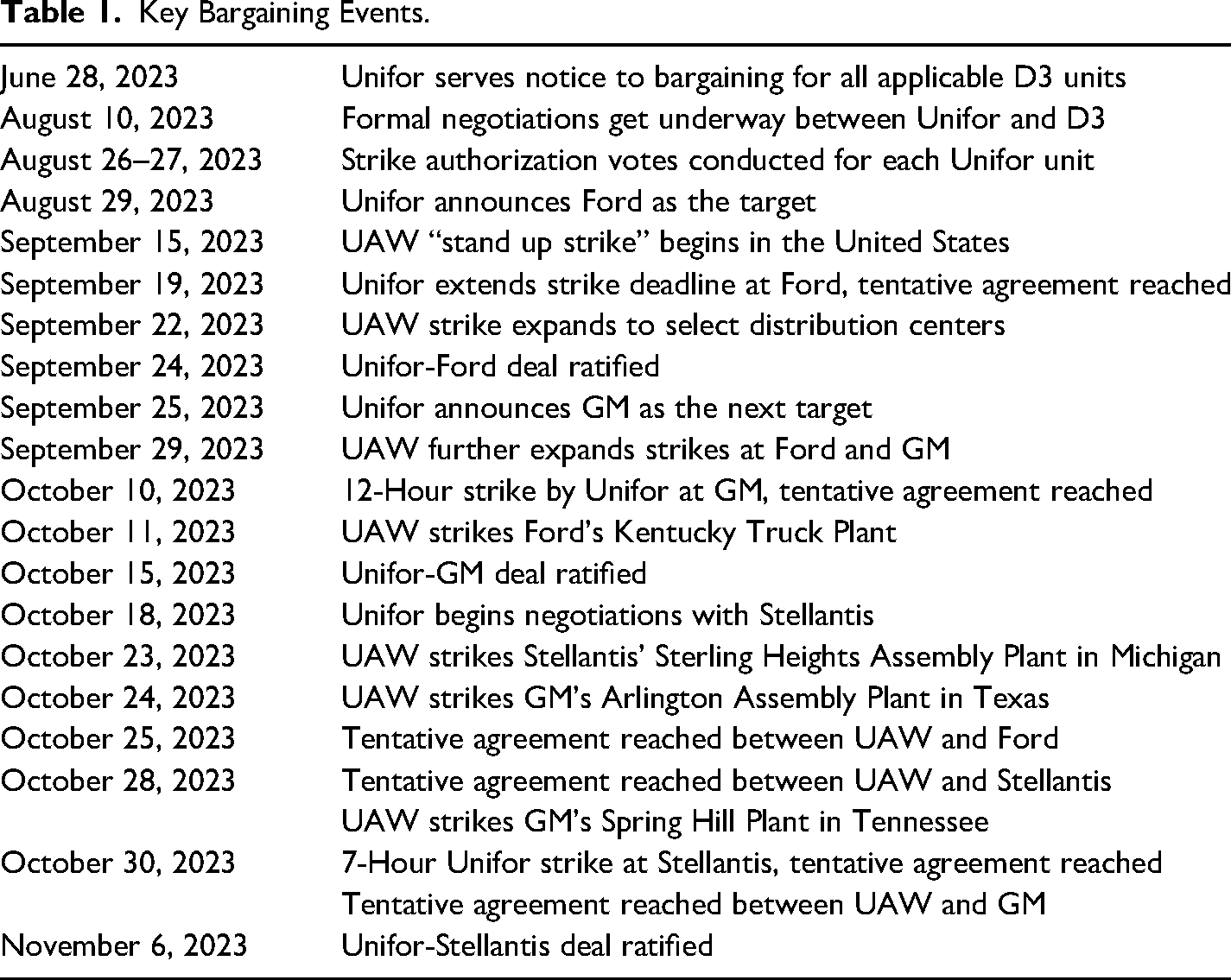
While every union comes to the bargaining table with a combination of carrots and sticks, Unifor President Lana Payne appeared initially much less likely to use the stick than UAW President Shawn Fain in negotiations with the Detroit Three. Payne decided to pursue sequential pattern bargaining, the approach to collective bargaining traditionally used by North American autoworker unions.
Essentially, the union targets one automaker, usually on the basis of its profitability and alignment with the union’s objectives, to set a precedent. Once the union concludes a deal with the target, it uses that agreement as a pattern for negotiations with the other Detroit Three automakers. In effect, employers are pressured to meet the pattern established in negotiations with the target or risk strike action. The strategy helps to guarantee uniform labor standards across the Detroit Three by preventing employers from undercutting one another by offering inferior compensation packages (Holmes 2004, 2022).
However, pattern bargaining is about more than taking wages out of competition. Through pattern bargaining, the union’s leadership also tries to prevent animosities from developing between locals by securing essentially the same deal across the board. Or, in Budd’s words, the pattern works “by treating everyone equally, or by giving the impression everyone is treated equally” (Budd 1995, 49). In this way, pattern bargaining helps to ensure internal political stability for the union leadership. On August 29, 2023, Payne announced that Ford would become the union’s target for pattern bargaining, citing the company’s healthy financial position, its strategic investments, and history of positive labor relations (Kennedy 2023c; Unifor 2023d).
In contrast, Fain made good on his promise that he would be more aggressive and more adversarial at the bargaining table by simultaneously targeting all three members of the Detroit Three and by quickly threatening strike action. In September 2023, the UAW launched an unprecedented escalating and simultaneous pattern bargaining strategy called “stand up strikes” which selectively targeted Ford, Stellantis, and General Motors depending on which employer was lagging behind in conceding to the union’s bargaining demands. Sporting an “eat the rich” t-shirt, Fain framed the UAW strike as a war between the working class and the billionaire class (Domonoske 2023). Describing himself as “subtle as a hammer,” Fain did not shy away from using class-based rhetoric to mobilize UAW members and working-class communities to support his union’s struggle (Domonoske 2023). He unapologetically declared that “Billionaires in my opinion don’t have a right to exist” in an interview with the New York Times, and judging by the public’s overwhelming support for the UAW’s ambitious bargaining demands, Fain’s militant message resonated far beyond the ranks of the union’s membership (Navigator Research 2023; Streitfield 2023). There was no equivalent campaign in Canada, aside from regular, yet general, bargaining updates that struck a decidedly less militant tone.
Drawing on organizational theory, management scholar David Walsh (1994) argues that relationships within and between labor organizations are mediated and influenced by various forms of interdependence that work to bind them closer together or pull them further apart based on the changing nature of those interdependencies, be they economic or organizational. In the case of the automotive sector, Canadian autoworkers have largely defined their union in opposition to the historically less militant and more concession-prone UAW (Gindin 1995). Canadian autoworkers were historically more willing to fight back, more likely to embrace a class-based discourse, and more willing to advance an explicitly political approach to collective bargaining (Gindin 1995; Holmes and Rusonik 1991; Ross and Savage 2024). In fact, divergent responses by autoworkers in Canada and the United States to the hostile economic and political climate of the 1970s and 1980s eventually led to the breakaway of the Canadian section of the UAW to create the CAW union in 1985 (Yates 1990). The CAW would later merge with the Communications, Energy and Paperworkers Union to form Unifor in 2013 (Wilson 2019). In its early years, the CAW distinguished itself from the UAW by forging a strong reputation for delivering strong contracts, embracing a clear social unionist orientation, and articulating its priorities in more overtly class terms (Eaton and Verma 2006).
This history reinforced a social unionist/business unionist analytical frame for understanding autoworker unions in Canada and the United States, respectively. Typically, business unions are described as such because they mirror the hierarchical structure of the businesses to which they are attached (Waterman 1999). Business unions tend to narrowly focus on the economic and sectional interests of their own members. Conversely, social unions have greater concern for broader social issues and attempt to connect the interests of their own more active memberships to those of the broader working class (Kumar and Murray 2006).
As Ross (2007) argues, however, unions are rarely, if ever, representative of ideal types. Rather, they exist as complicated hybrids. A union can be analyzed in terms of how broadly it frames its interests, how expansive is its repertoire of activities, and how democratic are its internal organizational structures. Since each of these dimensions can tend toward social unionism or business unionism to different degrees, the labels can be misleading. Unions are shaped and transformed by the concrete social relations, political-economic context, legal regimes, and conflicts they both reflect and reproduce. They are also in a constant state of flux, influenced by agency and structure, often in complicated and unexpected ways. For example, the unexpected election of insurgent left-wing challenger Shawn Fain to the UAW presidency in March 2023 sent shockwaves through the labor movement, with some observers arguing that the change in leadership signaled “the end of business unionism at the United Auto Workers” (Roskill 2023). Suddenly, for the first time in history, Canadian autoworkers appeared to be outflanked on the left by the UAW. The UAW’s strategic repositioning in advance of 2023 auto talks proved disorienting for Unifor’s leadership because it made Canadian autoworkers look less militant in comparison. After all, Canadian autoworker history was largely defined in opposition to the UAW’s traditional “business unionism.” Now that the UAW was being led by an unabashed leftist “mixing Bible verses with class-struggle rhetoric,” Unifor’s identity vis-à-vis the UAW was being challenged in unprecedented ways (Carter 2024).
Jim Stanford (2023a), Unifor’s former chief economist and policy director, appeared to initially downplay the influence of the UAW’s bargaining strategy and demands on autoworkers in Canada, insisting that direct comparisons were unhelpful because the UAW had much more ground to make up (see also Kennedy 2023d). Nevertheless, Unifor’s auto council chair and Ford master bargaining committee chair John D’Agnolo readily admitted to Automotive News Canada that the militancy and ambitious bargaining demands of Shawn Fain and UAW were absolutely having an impact in Detroit Three plants in Canada. “D’Agnolo said the hardline rhetoric from UAW President Shawn Fain—he first sought a wage increase as high as 46 per cent—has inflated the expectations of the Canadian workforce,” wrote Greg Layson (2023). “[Unifor members] are looking at what the UAW was looking for, but they weren’t looking at the comparables,” explained D’Agnolo, who complained that Unifor members were not accounting for the fact that Canadian autoworkers were starting from a higher wage floor. “I think if they looked at that that way, they would have said something different, but they didn’t compare,” he said in relation to the weak ratification result at Ford (Layson 2023). Stephanie Ross concurred, arguing “even though the context of U.S. autoworkers is very different, their ambition and more militant approach has affected Canadian autoworkers’ sense of what they could or should be doing” (Rubin 2023).
Unifor’s strategy can be understood in terms of Murray et al.’s (2010) concept of “referential unionism.” Their animating question is why, in new conditions, unions adopt old strategies. For our purposes, we use this concept to diagnose path dependency with a more nuanced account of intra-union dynamics. Despite an economic environment that was more conducive to making gains, as reflected in more ambitious demands than the last several rounds of bargaining, the union nonetheless relied on its longstanding strategy of traditional sequential pattern bargaining. By contrast, the UAW’s “stand up strikes” adapted to the new conditions, not only in the ambitiousness of the demands, but in the way they were pursued. This more “iterative” and simultaneous pattern bargaining strategy was referential only in the sense that it referred back to another innovative strategy, the UAW’s “sit down strikes” of the 1930s (King 2023; Lichtenstein 2024).
In their earlier respective studies, management scholars Simcha Ronen (1986) and Frederick Hills (1980) found that intra-union and inter-union contract comparisons were key factors in explaining job satisfaction. Specifically, they found that such comparisons influenced member attitudes toward wage settlements. Similarly, industrial relations scholar William Simkin’s (1968, 528) study of tentative agreement rejections found that the number one reason cited for voting down a deal was the “effects of other agreements reached elsewhere.” Thus, it should come as little surprise that ambitious UAW contract demands in the face of persistently high inflation and a cost-of-living crisis played an important role in explaining the weak ratification vote result at Ford in Canada, even if the UAW contract had not yet been achieved south of the border.
Occupational Tensions
Hyman (1975) argues that union structures are not monolithic, but are the product of ongoing negotiation between conflicting forces. On the one hand, there is a drive toward “breadth, unity and solidarity” within unions, while on the other we also see a fragmentation of interests based on parochialism or exclusion (p. 41). One such source of fragmentation can be occupational differences. This is particularly true of industrial unions, which, rejecting the exclusiveness and sectionalism of craft unions, contain broad memberships with greater variations in forms of work and degrees of skill.
Beyond comparisons with the UAW, intra-union tensions related to occupation were clearly evident in the ratification vote results for Unifor’s tentative agreement with Ford. The deal was reached on September 19, 2023 after the union extended its strike deadline by 24 hours. Overall, Ford workers endorsed the deal through an online vote with just 54% voting in favor. Members were only given a day or so to review the unanimously recommended tentative agreement before the online ratification meeting which featured a presentation of the deal and an opportunity to ask questions, but without much space for deliberation. Thus, there was no real opportunity to develop a formal campaign to reject the contract. Rather, opposition developed organically and appeared to take the leadership by surprise. Notably, skilled trades members in Windsor and Oakville both narrowly voted down the deal, reigniting longstanding intra-union tensions related to occupational category. Their opposition appeared to be rooted in disappointment over the agreement’s pension provisions (Layson 2023). While Unifor succeeded in converting the defined-contribution pension plan into a more stable defined-benefit plan, pension entitlements would not be linked to inflation (Bickis 2023a).
Intra-union tension between skilled trades members and production workers were clear based on the separate ratification vote results. The skilled trades “problem” in autoworker unions is not new (Budd 1995, 46). Indeed, in the case of UAW, the often-fractious relationship between these groups has sometimes led to calls or attempts by skilled trades members to break away (MacDonald 1963). This is precisely the dynamic that led founding CAW president Bob White to sign a 1988 letter that committed the union to blocking ratification of a tentative agreement if rejected by the skilled trades component of the union over a trades-specific issue (Atkins 2023). When the CAW merged with the CEP in 2013, the new union’s founding convention voted to enshrine a National Skilled Trades Council in Unifor’s constitution to formalize that group’s institutional voice. Moreover, the chair of the Council plays double duty as the representative for Skilled Trades on Unifor’s National Executive Board (Unifor Skilled Trades Council 2023). The special status afforded to skilled trades members helps to ensure the group’s priorities and issues are always front and center.
Skilled trades members are better compensated than their production coworkers and face a number of unique issues, like work ownership, tool allowances, and trades-specific apprenticeships. They are also significantly outnumbered by production workers. In an effort to address concerns from skilled trades members about the union’s ability to defend and advance their unique interests within the context of a larger production-dominated bargaining unit, Unifor’s constitution mandates that skilled trades members can weigh in “on matters which relate exclusively to the skilled trades” in separate ratification votes if requested (Unifor 2022). This constitutional provision was based on the aforementioned 1988 CAW letter (Layson 2023). Some members publicly interpreted this constitutional provision as establishing a veto of sorts and publicly challenged the legitimacy of ratification of the Ford deal on that basis—a position that Payne strongly rebuked in a statement to the media (Ensing 2023). “Any reference in the union’s constitution to separate ratification by skilled trades members is intended to be limited and does not override statutory requirements for a single ratification vote by all members in the bargaining unit,” Payne said (Layson 2023). “There is no right by which skilled trades members can block a ratification by the whole bargaining unit,” she added.
In an effort to contain the blowback from the ratification vote result, Payne released a public letter to skilled trades at Ford committing to meet with members to “review issues of concern” and indicating that the National Executive Board would be meeting to ensure that any longstanding internal agreements related to the ratification voting rights of skilled trades members would be brought “into compliance with current Ontario labour law while ensuring that it protects its important purpose to provide Skilled Trades members with a process to address issues specific to the skilled trades” (Unifor 2023e). However, Payne also asserted in the media that the internal debate concerning the rights of skilled trades members “does not change the overall ratification results or alter the status of the agreements in effect” (Layson 2023). In other words, the pattern agreement reached at Ford would go forward despite strong opposition from skilled trades members.
The closeness of the ratification vote was a giant wake-up call for the union’s leadership and posed a political problem for Payne. Weak support for ratification at Ford not only cast doubt on whether workers at GM and Stellantis would support the deal, but also likely made the executives at GM and Stellantis question whether Unifor’s leadership could deliver the union’s membership. Workers at the Detroit Three had ratified much worse contracts by much larger margins in the past—a clear signal that Unifor members’ expectations had dramatically risen given the shifting socioeconomic context. The ambitious strike demands of the UAW south of the border only poured fuel on the fire in Canadian plants where workers were clearly divided over the pattern agreement. The angry battle cry on the shop floor among those who had rejected the tentative agreement became “more Fain, less Payne,” prompting the union’s leadership to reorient its communications strategy (personal communication with the authors). In an effort to reverse the narrative that the pattern agreement fell short, the union began promoting the benefits of the pattern agreement through an education and social media campaign that focused on the role of pattern bargaining in preserving and consolidating union gains, and the tangible advances the union had secured at the bargaining table (see Unifor 2023f).
Generational Tensions
Another source of potential fragmentation and contestation within unions is generational divisions between members (Hyman 1975). This can be particularly pronounced when unions have formalized such divisions by conceding two-tier contracts, in which newer hires have qualitatively different contracts from their more senior coworkers (Corman, Duffy and Pupo-Barkans 2018). In addition to occupational tensions, the ratification vote at Ford exposed a generational schism, with workers near retirement age more likely to oppose the tentative agreement based on concerns over the level of pension improvement. According to Automotive News Canada’s Greg Layson (2023), “D’Agnolo [the Ford master committee bargaining chair] said ‘most’ of the skilled trades workers he represents can retire ‘within the next few years, so pension was their priority.’” Members echoed this view in media interviews. “Way back in 2008, right, we gave up everything. We gave up pension money, we gave up wages, we gave up benefits. Just to save the Ford Motor Company from going bankrupt,” Ford Oakville worker Norman Little told the CBC (Ensing 2023). “But now, with the situation, we need something. We really need some money, some benefits back,” he added. Little was referring to the inflationary pressures driving a cost-of-living crisis. Given this context, business professor Marvin Ryder framed the tentative agreement as “playing catch up” (Ensing 2023).
This generational dynamic played out differently across the Detroit Three. GM, for example, featured a younger workforce demographic because it had reopened its Oshawa plant in 2021, requiring the company to make new hires. The younger generation of autoworkers had not experienced the belt-tightening from earlier rounds of bargaining. Thus, the concerns of their coworkers closer to retirement age did not resonate in the same way. Lower seniority workers who, according to David Kennedy (2023e) of Automotive News Canada, represented 3,100 of the 4,300 workers at GM in Canada, would also benefit from the pattern agreement’s reduction in wage progression from 8 to 4 years. At GM, “most are quite low in seniority, so they’re on that grow-in tier. If the Ford pattern is established there, they’re going to benefit from it quite significantly,” argued labor scholar Stephanie Ross (Kennedy 2023e).
While there is little question that the pattern agreement helped to narrow the generational gap that had developed over a decade as a result of tiering, it also inflamed intra-union tensions. Kennedy (2023f) described the dynamic as follows: Complaints from longtime workers about lackluster improvements to pensions and wages were legion. Those who were grumbling conveniently overlooked that they took home as much as 54 per cent more per hour than a new hire working the line next to them. This blowback—amplified by lofty demands from the UAW south of the border—came to a head at Ford Canada, where just 54 per cent of Unifor members voted to ratify the new contract in September. It’s no coincidence that 88 per cent of the Ford membership was already at the top of the pay scale.
Consider that while the tentative agreement guaranteed the starting rate for production workers would increase by 28% by the end of the contract (jumping from $24.26 per hour to $31.16), the starting rate was actually $28.82 back in 2007 (or over $40 per hour when accounting for inflation) (Bickis 2023a). “They’re getting big increases only because of how badly they’ve been treated over the last 10 or 15 years,” explained Unifor retiree Tony Leah, who bemoaned the fact that the union conceded that pension entitlements need not be linked to inflation (Bickis 2023a). The new $800 annual healthcare allowance for retirees also fell far short of addressing the pensions concerns of members in Leah’s view.
In contrast, Stanford described the pattern agreement as a “game changer” for the next generation of autoworker, pointing to a higher wage floor, significant increases in pay, and accelerated progression to the full pay level (Canadian Press 2023a). After a brief, 12-hour strike, Unifor members at GM appeared to agree. In contrast to the weak ratification vote at Ford, workers at GM voted 80.5% in favor of the pattern agreement (with 83.9% of production members in favor and 55.9% of skilled trades members). While the younger workforce demographic at GM likely helped contribute to this outcome, the union leadership’s concerted campaign to contextualize and promote the union’s bargaining gains and protect the integrity of the pattern agreement also appeared to help contain opposition to the deal.
The kinds of internal divisions described above are not entirely surprising. Industrial relations scholars McKersie, Perry and Walton (1965) argue that a key source of intra-union conflict is differences in the rank order of bargaining priorities. In their study of the UAW’s 2019 round of bargaining with GM, labor relations scholars Lima Aranzaes et al. (2024) highlight the complex interplay between solidarity and self-interest in strike and ratification votes, especially as they relate to differences between temporary and full-time permanent members of the bargaining unit. They correctly note that “unions face very heterogeneous constituencies with often-conflicting bargaining demands” (p. 92). While the findings of Lima Aranzaes et al. are not easily generalized given the different bargaining contexts, they do suggest that “union strategies are linked to members’ expressions and acts of solidarity” (p. 93). Such strategies, however, can never be divorced from the external economic pressures that shape collective bargaining outcomes. This dynamic helps explain how raised expectations from some quarters of the membership cast doubt on the leadership’s claim that the pattern agreement was worthy of support.
Leadership Tensions and Strike Dynamics
While the substantive content of Unifor’s pattern agreement was clearly a source of intra-union tension, McKersie, Perry, and Walton (1965) argue that the other key source of internal union conflict relates to the expectation that leaders will pursue bargaining tactics that align with members’ normative expectations. This latter category of intra-union tension also emerged in 2023 auto talks, manifested through leadership tensions intertwined with strike dynamics designed to ease internal divisions related to members’ raised expectations.
After the near defeat of the tentative agreement at Ford, Unifor’s leadership stepped up its militancy in response to members’ elevated expectations. The use of a strike to secure the pattern agreement at GM exemplified this dynamic. Strikes can significantly alter internal union power dynamics, and vice versa (Ghilarducci 1988). If there is a sense that the decision to withdraw one’s labor helped to produce a better deal at the bargaining table, a worker is more likely to stand by the agreement that was secured as a result of that strike action. Indeed, as labor scholar Rick Fantasia (1989) argues, strikes, as a particularly intense form of collective activity, can dramatically change the collective consciousness of the people participating in them. Recall there was no strike at Ford and the tentative agreement was barely approved in the shadow of the UAW’s struggle south of the border that gave the impression—rightly or wrongly—that Unifor could and should have fought for more. At GM, however, the intra-union dynamic was altered by Unifor’s strike. Not only did the strike give the leadership the opportunity to frame the brief labor action as key to securing the pattern agreement, but it also channeled member anger at the employer rather than the union (Kennedy 2023g).
It is difficult to evaluate what additional demands were gained by striking Canadian autoworkers, because Unifor’s bargaining updates, including those immediately preceding strikes, were much more opaque than the UAW’s updates about what demands remained unresolved. While the strike undoubtedly nudged Ford toward the pattern agreement, it served a dual purpose—namely to consolidate member support for the already existing gains, by creating a sense that a battle had been necessary to achieve them. In other words, the strike may have been about addressing intra-union conflict as much as it was about conflict with the employer.
Despite the membership’s relatively strong endorsement of the pattern agreement at GM, the biggest test facing Lana Payne was still to come as she faced an internal crisis of unity going into bargaining with Stellantis. For context, key players in the 2023 auto negotiations had worked against Payne in her bid to become Unifor’s National President in 2022. In fact, Dave Cassidy, chair of Unifor’s Skilled Trades Council, and then-president of Local 444 in Windsor, representing thousands of autoworkers, ran against Payne. His populist campaign took aim at the track record of the union’s elected officers (which included Payne). While Cassidy finished in third place, his repeated insistence during the leadership campaign that the union put the “membership first” seemingly spilled over into auto talks in ways that will be described shortly (Cassidy 2023).
Payne’s chief opponent in the leadership race, however, was Scott Doherty, an assistant to former Unifor President Jerry Dias. John D’Agnolo, a key player in the auto sector, officially endorsed Doherty, explaining that “the President of Unifor needs to be an experienced negotiator, especially as we face Detroit 3 bargaining in 2023” (Doherty 2022a). Payne was a longtime staff member, but did not have the same level of collective bargaining experience, and had never bargained a contract in the auto sector. Shane Wark, a key staff figure in auto talks and a former Chairperson of the Ford Essex Engine Plant in Windsor, also endorsed Doherty and joined D’Agnolo in sharply criticizing Payne’s candidacy at the National Executive Board (Doherty 2022b; Ross and Savage 2024). Local 222, representing autoworkers in Oshawa, also backed Doherty (Doherty 2022c). This dynamic gave the impression, rightly or wrongly, that Payne was swimming with sharks, surrounded by people who just months earlier were working against her and openly questioning her judgement and capacity as a negotiator.
While there is no public evidence that D’Agnolo or Wark’s support for Doherty contributed to friction in auto talks, tensions between Payne and Cassidy—who enjoyed a power base among Stellantis workers—were more pronounced. Like Ford, Stellantis’ workforce skews older than that at GM, so the reservations about the pattern agreement at Ford were likely to re-emerge at Stellantis. More importantly, the iconoclast Cassidy made clear that he was determined to do better than the pattern agreement for his members. After the lukewarm ratification vote at Ford, Cassidy publicly echoed the concerns expressed by skilled trades members who complained that the pattern agreement fell short in terms of pension gains and failed to secure a profit-sharing agreement. The latter issue had not been part of the union’s bargaining mandate, but was a priority for some workers at Stellantis (Waddell 2023a). “On the overall package, when you move numbers around, we’ll see what that looks like. But, you know, our members were very clear to us … that they weren’t happy with the deal that was presented…” Cassidy told the media (CBC News 2023a). “We need to make some moves … And we’re going to do that,” he added.
Cassidy’s open criticism of the deal at Ford could not easily be dismissed by Payne and the union’s master bargaining committee. After all, Cassidy sat on Unifor’s National Executive Board as the skilled trades representative and served as president of one of the largest locals in the country. In other words, he had an organized power base in the union. “If you talk to Dave Cassidy, if you listen to the labour experts, Windsor holds the biggest bargaining power or biggest chunk of voters when it comes to within the union and they can sink any agreement,” said Greg Layson of the Automotive News Canada in an interview with CBC News (2023a).
For years, CAW and Unifor had contended with the Detroit Three’s attempts to break with pattern bargaining. In 2023, however, it looked like the greatest threat to the pattern was coming from within the union. Historically, the union used pattern bargaining to ensure the Detroit Three could not pit workers against one another as part of a race to the bottom. Pattern bargaining has also helped preserve relatively higher wages in the sector and maintain internal equity between the locals. Thus, calls from within the union to break with the pattern were controversial, though not unprecedented (CBC News 2023a; Holmes 2022). While some workers wanted to take advantage of a perceived opportunity to secure more from Stellantis, others understood it would be a recipe for disunity and resentment over the long term. Cassidy clearly saw the pattern agreement as a floor rather than a ceiling. In reality, however, it serves as both, a floor below which the employer cannot go, but also a ceiling beyond which other members in the union cannot go either. Politically, the public push by Cassidy and elements of Local 444 to break the pattern put Payne between a rock and a hard place. If she refused to break the pattern, she would risk having members at Stellantis vote down a tentative agreement. However, if she agreed to break the pattern to satisfy Cassidy and his members at Stellantis, she would make a hero out of her chief political opponent inside the union and risk stirring up anger and resentment among Unifor members at Ford and GM. She’d also send a clear signal to the Detroit Three that the pattern is up for debate in future rounds. The UAW’s continued strikes south of the border complicated the dynamic even further, making for an intriguing, unpredictable, and high stakes round of bargaining at Stellantis.
In the end, Payne would not concede on the importance of preserving the pattern. In a video targeted to workers at Stellantis, Payne described pattern bargaining as “the ultimate act of solidarity,” adding that “it works and it has worked for decades” (Unifor 2023g). The message to members was clearly designed to counteract efforts from elements within the union looking to break the pattern. Cassidy’s resistance to the pattern certainly made for an odd dynamic given the union’s disciplined culture and highly centralized structure. Cassidy, however, had built a reputation as an iconoclast and a populist who could not be easily co-opted (Ross and Savage 2024). “This isn’t about me, Dave Cassidy. This isn’t about Lana Payne. This union is way bigger than any one person,” Cassidy told the Canadian Press (2023b). “We need to be putting our nose to the grind, listening to our members, and making sure that we come back with the deal that our members want,” he added.
Payne was unimpressed with Cassidy’s posturing in the media, telling the Windsor Star: “It’s a bit disappointing, because he (Cassidy) was part of the unanimous endorsement of the pattern deal by the local presidents. It’s disappointing to hear this” (Waddell 2023a). Payne was thus fighting a battle on two fronts. On one side, she had to convince Stellantis to match the pattern and on the other convince Cassidy to settle for the pattern. “You’ve watched Lana Payne really come out and send the message that pattern bargaining is the way to go. But you have workers in Windsor who don’t believe that…” said Greg Layson (CBC News 2023a). Once the rift spilled into public view, however, Cassidy appeared to pull back just as the UAW reached a tentative agreement with Stellantis on October 28, 2023. How the contract settlements in the United States were received by Cassidy is unclear, but they appeared to take the wind out of his sails. After whipping up the Local 444 membership, the anticipated intra-union showdown in bargaining with Stellantis never really materialized. Cassidy backed down and the pattern agreement was secured on October 30, 2023 after a brief strike that lasted just 7 hours (Kennedy 2023h). Cassidy reportedly announced that he was “very happy” to bring the deal forward for ratification (CBC News 2023b).
Cassidy’s initial criticisms of the deal and posturing to break the pattern drove members’ expectations higher at Stellantis. Dialing down those expectations once Cassidy endorsed the deal proved challenging. The Master Production and Maintenance Agreement at Stellantis was ratified with just 60% support overall (60% production and 60.3% skilled trades) even though these workers had the benefit of knowing the contents of the UAW’s agreement. In short, while the UAW settlements appeared to temper Cassidy, many of his members remained unsatisfied with the pattern agreement negotiated by Unifor. Reflecting on the ratification meeting, 7-year production worker Haley Rounding, who strongly supported the deal, told the Windsor Star that “it got mixed reviews … Multiple people felt there wasn’t a lot of improvement in the pension plan and things for retirees. Some wanted the cost-of-living allowance added right away, not at the end of the quarter,” she explained (Waddell 2023b). The generational divide appeared to be a real factor at Stellantis, with people like 28-year veteran electrician Phil Poli explaining that while the deal would be life-changing for younger workers, he had to vote no to ratification. “Our No. 1 priority was pensions and I felt it fell short in making pension improvements and indexing pensions for existing pensioners. I couldn’t look at myself in the mirror feasting on a 25-per-cent raise with a clear conscience knowing that, so I couldn’t say yes,” he explained (Waddell 2023b).
Strategic Implications
A central component of Unifor’s approach to 2023 auto negotiations was its use of traditional sequential pattern bargaining. Union leadership can reinforce this strategy by casting it in social unionist terms, namely, as equality between the locals. As economists Reynolds and Taft (1956, 175) argue, “departure from the principle of equality requires justification, while conformity to it does not.” But the strategy also tends to reinforce the position of the national leadership, particularly in a centralized and disciplined union. As Budd (1995, 48) argues in his study of the UAW, “wage standardization and pattern-following settlements curtail the ability of local leaders to increase their political stature by attacking the competency of national leaders by criticizing contract settlements.” This is why Cassidy’s criticisms of the deal put Payne in such an awkward position. Payne wanted to maintain the pattern agreement, in part, because if Stellantis workers departed from the pattern and won more, it gives evidence that more could have been achieved at GM and Ford with a more ambitious strategy. This could foster resentment, not only between locals, but against Payne’s leadership and strategy. As we have noted, however, in the past, the Detroit Three have challenged pattern bargaining, deeming it against their interests. Payne could plausibly argue for maintaining the pattern agreement this round in order to protect the strategy for future rounds as well.
Whether another set of strategic choices could have allayed intra-union tensions and produced an even better bargaining outcome for Canadian autoworkers is an open question. “Had Unifor channeled member expectations and energy and deployed a bargaining and strike preparation strategy that looked more like the UAW, there could very well have been even more positives to celebrate in the recent Ford and GM deals,” argued labor studies scholar Adam D.K. King (2023). The general consensus among experts was that both the UAW and Unifor had secured impressive gains, but most observers gave the edge to the UAW, pointing to advances for temporary workers and the 3-year wage-progression grid secured south of the border (Kennedy 2023i). Barry Eidlin argued that the difference was between “a really good contract and a life-changing contract” (Kennedy 2023i).
As important as the outcomes, however, are the ways they are pursued. Payne engaged in a kind of referential unionism (see Murray et al. 2010), casting Unifor’s traditional pattern bargaining in the social unionist frame of solidarity within and between locals. Nevertheless, the strategy, including the brief strikes at Ford and Stellantis, seemed ineffective in fostering what Fantasia (1989) describes as “cultures of solidarity”—environments where workers, breaking from routine, engage in collective action that strengthens their capacities for mutual support and power (p. 19). Unifor’s relatively top-down approach offered limited information on bargaining progress and gave Ford workers little time to review and discuss the contract that would set the standard for other locals.
By contrast, the UAW was very transparent about its bargaining demands and how negotiations were proceeding. When we analyze the union according to the various dimensions of social unionism (see Ross 2007), the UAW expanded its repertoires of action with the “stand up strikes,” a strategy that demands transparency because the union selectively strikes those employers proving most intransigent in bargaining on particular issues. Furthermore, the UAW broadened how it frames its interests. The union communicated the strategy and bargaining progress not only to its own members, but to the wider public, encouraging other workers to demand more in their own workplaces (Ross 2023). Alongside Fain’s class struggle rhetoric, this consolidated widespread public support for the strikes. Finally, the UAW fostered more participatory internal organizational structures, because members were more active in the strategy and the strikes in ways that developed their collective power.
We must note, however, that the UAW, despite its different bargaining strategy, did not depart from broader trends in low ratification votes. Across the Detroit Three, 64% of members voted in favor of ratification (UAW 2023). Nevertheless, workers’ high expectations were matched by an ambitious strategy that did build cultures of solidarity. As Eidlin argues (Kennedy 2023i), unlike Unifor’s round of bargaining, the UAW’s strike strategy proved “transformative”—not just in quantifiable contract terms—but intangibly as a collective action that built the union’s capacity and reputation. His prediction that the UAW would see a “huge momentum bump” in organizing proved prescient as the union achieved a historic breakthrough by winning a certification drive at a Volkswagen AG plant in Chattanooga, Tennessee in April 2024.
In the end, there is no question that Unifor’s (2023) pattern agreement with the Detroit Three secured significant improvements to wages and working conditions for Canadian autoworkers. Paradoxically, the pattern agreement came under incredible strain from many members unhappy with the deal. Making sense of this requires looking under the hood at the intra-union tensions. This allows us to move beyond descriptions of collective bargaining outcomes to provide explanations for how these tensions interact with structural factors to shape unions’ internal dynamics.
While the political-economic context always shapes the contours of collective bargaining, Unifor’s intra-union war of words revealed an additional layer of reasons that contributed to the lukewarm contract ratifications. Divisions based on length of service and occupation conspired with persistently high inflation, a cost-of-living crisis, and the renewed militancy of the UAW to drive up members’ expectations. Moreover, lingering leadership tensions pitted key players in Unifor against one another. In fact, in some ways, Dave Cassidy and the skilled trades component of the union posed greater obstacles to ratification of the pattern agreement than the Detroit Three. In the end, however, the political and economic imperatives of pattern bargaining prevailed, thanks in part to a pair of strikes that helped rewrite the narrative and secure greater support for the agreement. Nevertheless, intra-union tensions clearly weakened member solidarity and support for what was widely regarded as a historically strong pattern agreement.
Footnotes
Acknowledgements
The authors would like to thank Barry Eidlin and Stephanie Ross for reviewing an earlier draft of the article.
Declaration of Conflicting Interests
The authors declared no potential conflicts of interest with respect to the research, authorship, and/or publication of this article.
Funding
The authors received no financial support for the research, authorship, and/or publication of this article.
