



Abstract
This article contributes to the study of union renewal. It considers the case of Service Employees International Union (SEIU) Local 32BJ which has grown significantly during a period when the overall labor movement has declined. Local 32BJ's organizing success is explored focusing on the trigger tactic, an overlooked component of SEIU's Justice for Janitors campaigns. Trigger mechanisms take the competitive pressures companies face seriously, recognizing that unionization has costs, and that increased costs are a problem for an individual firm if its competitors are non-union. The trigger tactic binds companies in a given market together to ensure that the bulk of employers go union at once, or not all. This tactic knits together the material interests of workers in different companies and appears to reduce employer opposition to unions. Given its success, SEIU's whole union organizing with a trigger mechanism may offer a potential model for renewal for unions organizing in similar industries.
“There are some fundamentals which the employer should know by this time but which many persistently forget…The enemy of labor is capital; the enemy of capital is labor and other capital.” – Black Diamond, A Coal Industry Publication, 1910, quoted by John Bowman
During a period when union membership in the United States has continued its precipitous decline, Service Employees International Union (SEIU) Local 32BJ has been growing steadily, more than quadrupling in size since 1999. While the innovative strategies and tactics used by SEIU's Justice for Janitors (JforJ) explain important aspects of this increase (Howley 1990; Waldinger et al. 1996; Fisk, Mitchell and Erickson 2000; Hurd, Milkman and Turner 2003; Erikson et al. 2004; Fantasia and Voss 2004; Savage 2006; Milkman 2006; Albright 2008; Loomis 2018; Kamin-Patterson 2022), the role of trigger mechanisms in contributing to such growth has not been adequately considered. Triggers are a tactic that help facilitate unionization by binding employers in a given labor market together via an agreement that ensures that the bulk of employers will go union at once, or not all. The trigger takes the competitive pressures that capitalists face seriously, recognizing that unionization has costs, and that increased costs are a problem for an individual firm if its competitors are non-union. While triggers are sometimes mentioned in passing as a tactic utilized in JforJ campaigns, they have not been the focus of research (Needleman 1993; Feinstein 2006; Lerner 2007; Sachs 2007; Lerner, Hurst and Adler 2008; Olney and Wilson 2015; McAlevey 2016; Gomez 2018).
In this article, I argue that the SEIU Local 32BJ's growth cannot be fully understood without reference to the trigger tactic. I consider the evolution of the trigger and describe the way 32BJ incorporated the tactic into a campaign to organize over 5,000 janitors in New Jersey and subsequent campaigns to unionize tens of thousands of additional workers in other occupations. I contend that the use of the trigger to organize both workers and capitalists is a neglected, but crucial part of SEIU's successful strategy for organizing low-wage workers.
Growth Amidst Decline
After reaching its post-war peak of 35 percent in 1945, union density in the United States has steadily declined and currently stands at 10.3 percent (Goldfield 1987; BLS 2021). Among private sector workers, the drop has been even more precipitous, with a mere 6.1 percent of workers now belonging to unions (BLS 2021). Reversing this decline took center stage when John Sweeney was elected to lead the AFL-CIO in 1995. Sweeney called on national unions to spend 30 percent of their budgets on organizing, but given the decentralized structure of the AFL-CIO, which Samuel Gompers once quipped made the organization like a “rope of sand,” it was difficult to get national unions to commit to this goal (Mandel 1963; Hurd 2004).
While most national unions balked at such spending, SEIU was one of the few that followed through, committing more than 30 percent of its budget to organizing, and requiring locals to devote 20 percent (Voss and Sherman 2000; Savage 2006). This resulted in an increase in organizing activity, unionization victories, and a growth in membership (Fiorito and Jarley 2010; Fiorito and Jarley 2012). SEIU's new members work in a range of occupations from home care and adjunct faculty, to security officers and airports (Delp and Quan 2002; Mareschal 2006; Bloomberg 2020; Schlaerth 2022; Greenhouse 2020).
The latter occupations have been among those organized by SEIU Local 32BJ, the union's third largest local with jurisdiction from Massachusetts to Florida. Since 1999, in the wake of being trusteed by the international, 32BJ has made organizing a core part of its mission (Turner 2014; Englestein 2023). It has allocated between 20 and 30 percent of its budget to organizing, which amounted to approximately $15 million in 2021. This spending helped build its research and organizing capacity, allowed the development of extensive organizer training programs for rank and file workers, and enabled the organizing department to grow from a handful in 2000 to over 100 organizers today (Hill and Eimer 2022).
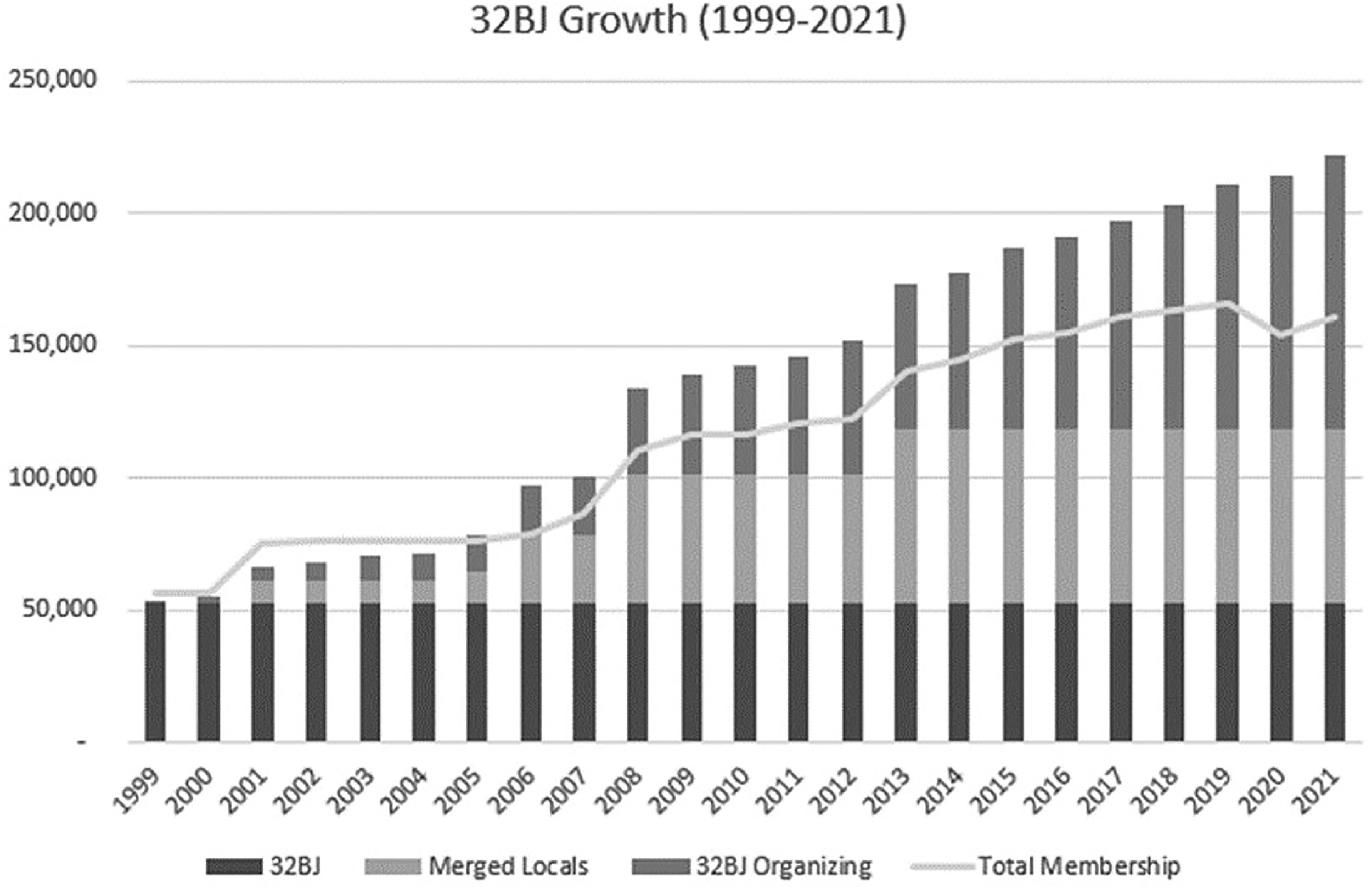
Local 32BJ's commitment to organizing has led to union growth during a period when the overall labor movement continued its decades long decline. Figure 1 depicts 32BJ membership trends since 1999. The different shades of gray distinguish between the 65,600 members gained through mergers with other locals (light gray), and the 103,268 added through new organizing (medium gray). During this period, nearly two-thirds of the increase in membership were newly organized workers 1 (Hill and Eimer 2022).
SEIU 32BJ membership growth.
Almost all of the newly organized workers are people of color, many are immigrants, and in many cases they are in previously unorganized sectors of the economy such as security and subcontracted airport services.
SEIU's Organizing Strategy
SEIU's JforJ campaigns differ from traditional organizing drives. In most cases, SEIU shuns National Labor Relations Board (NLRB) elections in favor of comprehensive campaigns that combine research, rank and file organizing, community alliances, and creative tactics that seek to force firms to grant voluntary union recognition (Howley 1990; Waldinger et al. 1996; Fisk, Mitchell and Erickson 2000; Hurd, Milkman and Turner 2003; Erikson et al. 2004; Fantasia and Voss 2004; Milkman 2006; Albright 2008; Loomis 2018; Kamin-Patterson 2022). Because of the structure of the cleaning services industry, which is defined by fierce competition between cleaning companies seeking contracts with building owners, these campaigns expand the scope of organizing to focus on all firms in a given labor market as well as the corporations that own the buildings (Lerner, Hurst and Adler 2008; Kamin-Patterson 2022). Such a strategy requires a multi-prong approach with both a vertical and horizontal component.
The vertical focus involves workers organizing to demand union recognition from cleaning companies, while also pressuring building owners to hire unionized firms. The focus on owners is necessary because a contractor who recognizes the union and “pays above the going rate will be underbid by one who does not,” and building owners will simply dismiss or “flip” a unionized contractor for a non-union one (Howley 1990, 65; Kamin-Patterson 2022).
In an effort to constrain the power of owners to flip contractors, SEIU complements its vertical push with a horizontal focus that seeks to organize workers in all companies in a given region. This whole market strategy aims to generate sufficient pressure to force firms in a geographically defined labor market into a multi-employer agreement that sets the standards for the entire industry.
2
As Lydia Savage explains, SEIU: …recognizes that work-site specific or employer specific organizing is not feasible for occupations in which only a small percentage of workers in an occupation are employed at any work site or by any one employer…[because] unionized firms will quickly become noncompetitive and lose contracts unless all of the employers in a geographic area abide by the same wage and benefit standard. By organizing all workers and negotiating with employers across a local labor market, unionized firms remain competitive (Savage 1998, 237).
SEIU's Organizing Tactics: The Trigger
Organizing workers and contractors in a given market is not easy, and in her unpublished dissertation, Kyoung-Hee Yu reports that SEIU's legal department began to develop tactics to facilitate such organizing in the 1980s (Yu 2008, 51). Yu references a 1986 memo from the SEIU legal department that instructed organizers to “negotiate employers’ neutrality prior to organizing the workers” (Yu 2008, 51). These agreements asked employers not to oppose unionization, to agree to card check, and to allow access to workers. Yu reports that neutrality agreements became the centerpiece in all JforJ campaigns as SEIU sought to force “employers representing the majority of a defined market to sign a neutrality agreement” (Yu 2008, 51). She goes on to note that getting companies to sign neutrality agreements was made “difficult due to a collective action problem among employers: employers worried that other employers would defect from signing, resulting in individual losses for those who signed” (Yu 2008, 51).
The collective action problem faced by firms is in many ways a classic one (Olson 1971; Elster 1989; Oliver 1993). As long as neutrality and card check increased the likelihood of unionization and higher costs, contractors faced the very real threat that the building owner might simply replace them with a lower cost non-union competitor. Consequently, every individual cleaning contractor had an economically rational reason to avoid agreeing to remain neutral and accept card check. To do otherwise was to risk being a “sucker” who unilaterally agreed to terms that others would defect from (Elster 1989). What SEIU needed was a way to solve the contractors’ collective action problem and ensure group cooperation
To address this situation, the SEIU legal department developed an institutional mechanism in the form of the trigger. As Yu describes it: the new concept involved bargaining simultaneously with all employers who together hold a majority of a defined market (typically 55–60%). Only once the union has the commitment of all such employers the neutrality agreements signed with each of the employers are “triggered” and go into effect (Yu 2008, 51)
Over time, the trigger went beyond neutrality and card check to include a more “general understandings about future negotiations if recognition rights [were] established” (Feinstein 2006, 343). By broadening its scope, the trigger addressed employer's fears regarding the costs of unionization. As Stephen Lerner, an architect of the JforJ campaign explained, “After a contractor agreed to go union, SEIU would not raise wages until a majority of its competitors also went union, ensuring no contractor was put at a competitive disadvantage” (Lerner, Hurst and Adler 2008, 250).
By taking the competitive pressures that contractors face seriously, and linking the fate of companies in a given labor market together to ensure that no firm will be undercut by non-union competition, the trigger makes unionization more palatable to employers. Regardless of how a given contractor feels about unions, they at least know that union wages and benefits will be borne by the industry as a whole, or not all. This appears to reduce employer opposition to unions, which research has demonstrated is a major impediment to unionization (Bronfenbrenner 1994; Bronfenbrenner 2009).
Though Lerner has described the trigger as a “crucial” part of the success of JforJ campaigns (Lerner 2007; Lerner, Hurst and Adler 2008), it is usually not mentioned at all in the literature, and when it is discussed, it does not garner more than a few sentences. Sachs and Feinstein, both writing about labor law and union renewal, briefly described the trigger in general and its role in organizing janitors in Houston (Sachs 2007; Feinstein 2006). McAlevey, in a larger work on union organizing, indicates that she is skeptical of the trigger's ability to deliver real wage gains and argues that “little real power is built by this version of mobilizing” (McAlevey 2016, 33). Needleman offered a more positive assessment noting that a trigger was part of the well-known JforJ campaign organized by Local 399 in Los Angeles, and suggesting that it provided a “positive incentive for workers to commit time and energy to bring their brothers and sisters into the union” (Needleman 1993, 363). Jono Shaffer, a key JforJ organizer, echoed that sentiment, arguing that the trigger created a clear understanding for the union members as to their relationship to the nonunion industry. It was their job to get market share up if they wanted to improve their working conditions. It was an honest understanding of the market. It demonstrated to the employers, the contractors, that this wasn’t an irrational undertaking, but rather a very thought-through and thorough one (Gomez 2018, 15). A key to the membership mobilization was “market triggers” that Local 399 inserted into its collectively bargained agreements. The triggers provided for automatic increases in wages and benefits if the janitors union succeeded in organizing 50 percent or more of the commercial buildings in mutually agreed upon geographic areas. Thus, when rank and file union janitors marched for “justice for the unorganized janitors” it meant marching to increase their own wages and benefits and to gain a more secure future (Olney and Wilson 2015, 3).
Methods
My exploration of the trigger mechanism relies on various data sources. I have provided labor education classes for 32BJ's Organizing Department since 2002. These classes occurred throughout the year as part of the formal training provided to workers on Organizing Brigades, and as trainings developed for organizing staff. These classes allowed me to witness and at times participate in organizing campaigns in cleaning services, security and airports. They also brought me into contact with 32BJ leadership, staff organizers, and union members, which afforded me opportunities to informally discuss campaigns with a broad range of people. As questions emerged about strategy and tactics, and as I became interested in the role and function of the trigger, longer conversations were held with union leadership and staff organizers to try and discern how the tactic worked.
To deepen the understanding gleaned from conversations, I conducted semi-structured interviews with key actors involved in the New Jersey organizing campaign. I began with the former 32BJ Organizing Director and used snowball sampling to interview the New Jersey Organizing Coordinator, a Lead Organizer, and the District Organizing Coordinator in the Philadelphia suburbs and South Jersey campaigns. More recently, to further learn about the trigger mechanism and the way it has subsequently been used by 32BJ, I conducted semi-structured interviews with the current 32BJ Organizing Director, a Deputy Director of Organizing, a Deputy Director of the Airport Division, and a current Deputy Organizer.
An interview guide was utilized to structure these interviews. Questions probed the use of the trigger tactic in New Jersey and subsequent campaigns. Interviews were digitally recorded and transcribed by a transcription service. Interview texts were analyzed to reconstruct the events and timeline of the New Jersey campaign and to identify common themes regarding the role and function of the trigger tactic.
For insights into how employers felt about the trigger and multi-employer contracts, I relied on secondary sources such as newspaper articles and written testimonies.
Though limited to “insiders” who regularly utilize the trigger tactic, and to artifacts providing the perspectives of a limited number of employers, it is my hope that this work will deepen understanding of a tactic that is regularly deployed by SEIU.
Whole Market Organizing with a Trigger: Janitors in New Jersey
In 2000, 32BJ made the decision to organize janitors in New York City's suburbs. The union targeted the counties adjacent to the city where the number of commercial office buildings had increased dramatically as suburban office parks were erected along the region's many interstate highways. One of the campaigns targeted northern New Jersey, the third largest commercial office market in the country, where the union had a collective bargaining agreement representing less than 1,000 workers and union density in commercial office buildings of more than 100,000 square feet stood at less than 10 percent (Friedlaender 2005). 4 Though just a short train ride away from Manhattan, where unionized janitors earned $16.50 an hour with benefits, janitors in New Jersey labored at part-time jobs at or near the minimum wage of $5.15 with no benefits. Seeing both a low-wage threat to the standards in New York City, as well as an opportunity to organize new workers, 32BJ crafted a whole market strategy that used a trigger mechanism (Brown 2007).
The reason for the whole market approach was explained by Lenore Friedlaender, the Organizing Director of Local 32BJ at the time. She noted that there are two approaches to organizing a market: Building by building. Try to get the company to recognize the union in every building. Maybe you line up contractors, try to get a provisional agreement until you get every single building organized or every single company organized…Our view was that was too slow a process. If every building took a year to organize, to fight to win 50 units, then you have a market that's like New Jersey, that has 500 buildings, it's going to take you 500 years to organize the market. We didn’t want to wait 500 years (Friedlaender 2005).
As previously discussed, organizing a single employer means little if that employer cannot raise standards out of fear of being replaced. As Friedlaender put it: …having a union for us is not just handling a grievance, but it's about how are we going to make a difference? How are we going to raise wages and benefits? How is the union actually going to do something? So we looked at, in order to do that... you have to dominate the market, you have to represent everybody, otherwise there will be some other company that will be able to do it for cheaper, and that company will get the contract to clean the building (Friedlaender 2005)
To address the question of time horizons and actually developing the power to raise standards, 32BJ crafted a whole market strategy that could organize janitors in North Jersey.
Local 32BJ's strategy had two phases. In phase one, 32BJ began to sign up workers. Staff organizers worked alongside members of the Organizing Brigade, which consisted of 32BJ rank and file members from New York City where the contract permits workers to take leave from their employers so they can work as organizers for a series of 3-month periods (Hill and Eimer 2022). Organizers did house calls, site visits, and held meetings where workers signed cards and pledged publicly to organize. Delegations of workers in each building circulated petitions listing grievances and indicating union support, and delivered these petitions to building management and owners. The public activity geared towards the owner led some contractors to engage in unlawful anti-union activity such as threats, firing, and surveillance. These actions provided the basis for the union to file unfair labor practice (ULP) charges, which would later allow workers to engage in ULP strikes that provided protection against permanent replacement.
Whole Market Organizing with a Trigger: Contractors
Having demonstrated its strength on the ground, the union entered phase two and reached out to contractors and owners in North Jersey in an effort to start a conversation about the union's proposals to raise standards in the industry. Friedlaender recalled that “contractors in North Jersey were invited to meet with workers and 32BJ organizers to discuss what the market could bear and what the union was about” (Friedlaender 2005). Kevin Brown, the New Jersey Organizing Coordinator at the time, noted that the union made calls and had individual meetings with contractors to get them to come to a larger meeting (Brown 2007). Twenty-two contractors representing approximately one-half of the contractors in North Jersey attended the meeting, along with 100 workers from these companies.
According to Larry Engelstein, 32BJ's General Counsel at the time, during this meeting the union “renegotiated the existing contract to include a county-based trigger mechanism (with some zones based on municipal boundaries) and economic terms to apply upon recognition” (Engelstein 2023, 6). The different zones were created because different sub-markets could support different economic standards based on variation within rental rates and vacancies. For instance, the Hudson waterfront, known as New Jersey's “gold coast,” could bear higher standards than other areas in North Jersey. In the end, the North Jersey was broken into three zones that consisted of the city of Newark, the Hudson waterfront and the rest of New Jersey north of interstate I-95.
The trigger mechanisms specified that no company would have to raise wages or increase benefits until “at least 55% of the class A and class B commercial office space in a county is cleaned by signatory contractors” (SEIU NJCA 2001). Local 32BJ would demonstrate that the threshold had been achieved by providing data showing that 55 percent of the square footage was cleaned by companies that were signatories to the trigger. Following that, the union would present cards from a majority of workers at individual buildings triggering union recognition and the new contract. Once triggered, the union committed to defend the new standards by targeting its resources at non-union contractors that continued to operate outside of the agreement, as well as owners who might seek to replace union firms with non-union firms.
Once the markets were defined and the trigger mechanisms were agreed to, 21 of the 22 firms who attended the meeting agreed to the terms. It was not surprising that the first firms to sign the New Jersey contract were all signatories to the initial NJ contract and/or 32BJ's New York City contract. These firms operated successfully with unionized workers, and they knew that failure to accept the union would mean a fight in New Jersey and possible work disruptions in New York City where their more profitable and valuable accounts were held.
Based on the location of the 21 signatory firms, 32BJ decided to focus on triggering Zone 1 in Hudson County first, since the union only needed one additional contractor to reach 55 percent. Brown noted that it was also where the “workers were strongest” and where there was a “union ethos” among the owners and in the community (Brown 2007). The hold out firm quickly found itself the focus of 32BJ's attention. Literature was developed suggesting that the company was now “standing between” all the “janitors in Hudson County and the American Dream.” Given the logic of the trigger, this claim was not an exaggeration, and it meant that the company had to not just fight its own employees, but workers from across the market who would not see the benefits of unionism until the trigger threshold was reached. Newly organized workers from contractors that had signed the trigger possessed a very real economic interest in building a movement that could pressure the defecting firm and its clients. By knitting together the interests of a broad swath of workers across the zone, the trigger provided a material basis for solidarity that helped build worker power to beat the company that would not cooperate, and to reach the trigger.
Whole Market Organizing with a Trigger: Owners
Although US labor law requires that all contracts and formal agreements be between the union and the cleaning contractors, it is essential that the owners accept and buy into the trigger mechanism, since much of the power in the industry rests with the building owners (Howley 1990; Savage 1998; Fisk, Mitchell and Erickson 2000; Fantasia and Voss 2004). If the owners are not on board, they generally need less than 1-month notice to replace contractors who have agreed to accept the union and the trigger mechanism. Given the power of the building owners, the union's campaign in New Jersey, which was in the first instance focused on contractors, had to also educate, persuade, and pressure the owners to hire a contractor that had agreed to the trigger.
The first step in moving owners was to meet with them one-on-one. These meetings emphasized the way the trigger would move the whole market at once so that no owner would be forced to bear additional costs that were not being paid by other owners. Brown suggested that for the owners that the union had long-standing relationships with in New York City or elsewhere, there was less concern about unionization. As he put it: A lot of the people who run operations here for the big owners were members of 32BJ in New York City at one point in their lives. And so, because the union is such an institution in the industry, it has people who understand what we are and what we're about and they understand how they can live with us basically as a necessary evil (Brown 2007).
Owners who replaced contractors that agreed to the trigger, or who continued a relationship with a contractor that would not sign, became the focus of union pressure. To move these owners, the union tried to make its fight with contractors (rallies, leaflets, pickets, strikes, etc.) as disruptive to the owner and tenants as legally possible. The union also engaged in comprehensive campaigning against the contractor, the owner and sometimes the tenants, who owners most care about. When targeting the owner, the unions framed its fight in terms of responsibility by pushing the idea that owners who used contractors that were resisting their employees right to unionize tended to behave irresponsibly toward their shareholders, their tenants and the communities that they wanted to develop in. Owners that continued to choose non-union contractors faced a fight with the union on some or all of these fronts.
To take but one example, when an owner terminated relations with a signatory to the trigger, SEIU embarked on a comprehensive campaign challenging two of the owners pending development projects, charging that the company used irresponsible contractors and behaved irresponsibly toward the environment. SEIU built community coalitions that lobbied local zoning boards to block development. Eventually a settlement was reached where the owner allowed the non-union contractor to sign the trigger agreement and agreed to make certain changes to the development project that addressed the community's concerns. As the union continuously demonstrated its ability to bring hold out owners into the fold, more and more owners accepted the trigger.
When the whole market strategy was combined with aggressive SEIU organizing and the trigger mechanism, the result was a steady march through New Jersey. The carrot that the whole market would go union at once or not at all, along with the stick of a costly fight with workers if they chose not to agree to the trigger, led most contractors and owners to accept the union. Within 8 months of initiating the campaign in North Jersey, Zone 1 had been triggered and a contract had been negotiated. By early 2004, the union had triggered all the economic zones in its jurisdiction in North Jersey, and union membership climbed from around 1,000 to over 6,000, lifting union density in the industry to around 75 percent. Within 3 years collective bargaining agreements raised wages throughout the region from at or near the minimum wage of $5.15 to a minimum of $9.75, and full-time workers received healthcare for the first time. In Newark and on the Hudson waterfront wages were as high as $11.75 and $10.75, respectively, and work in buildings over 400,000 square feet was converted from part time to full time.
Union Recognition and a Leveling Playing Field
The behavior of the contractors when presented with the trigger mechanism in North Jersey is worth reflecting on. Aside from the small number of holdout companies that used traditional anti-union tactics such as firings, surveillance, and threats, most agreed to the trigger and then stood aside to see if it was reached. Organizers reported a reduction in employer opposition that they believe was rooted in the way SEIU's strategy changes the way employers thought about unionism. Brown noted that the strategy leveled “operating costs of employers” and suggested that firms recognized it was possible for them to “grow their businesses and compete while still being union” (Brown 2007). The CEO of Tri-Maintenance Contractors, one of the larger firms in Zone 1 echoed this idea and, “praised the agreement and its trigger mechanism,” telling the New York Times, “Once you have a majority signed on, everyone is on the same playing field, and everyone can work together. Once you get this going, everyone else will come into this program” (Greenhouse 2001). By leveling the playing field, SEIU's trigger mechanism has the short-term effect of facilitating union recognition.
In the long term, the level playing field brings industrywide agreements that change the way the industry operates. By taking wages, hours and working conditions out of competition, such agreements alter the terms of competition in the industry. As Friedlaender noted: …the competitive bidding process that is used typically to depress wages is essentially used to protect the contractor from the building owners. The building owners all know what the wage rate is…and the companies that are successful have the best cleaning service. So people that are successful will grow and people who aren’t successful, the natural market forces will throw out. (Friedlaender 2005).
In fact, contractors have testified that they recognize this and appreciate it. In various legislative forums companies note how 32BJ contracts protect the industry from ruinous competition. In testimony submitted to the Westchester Board of Legislators in 2002, the President of Kencal Maintenance Corporation stated: The contract cleaning industry is a highly competitive one. Contracts are generally awarded to the lowest bidder. Thirty day cancellation clauses are standard practice in the industry, meaning that I can be cancelled with just 30 day notice. The only way that most cleaning contractors can compete is if there is a level playing field for all of us. The competitive bidding process creates pressure to pay minimum wage without benefits … (Hirschberg 2002).
In testimony before the New York City Council, the New York City Regional Manager of Laro Service Systems argued that employers benefit from 32BJ agreements that raise standards. He noted: From a management standpoint, we prefer to provide better wages and provide health insurance for our employees. We have much higher absenteeism rates and turnover rates for employees without health insurance or employees who make $6 or $7 an hour. We have higher productivity rates from better paid cleaners. Our training and overhead costs are less when we have long term stable employees…We want to be able to provide high quality cleaners and we need to be able to pay decent wages and benefits to do this” (Thaler 2000).
Such ruinous competition leads to low wages and meager benefits that make it hard for companies to maintain a steady workforce and provide quality service, but a company that raises standards on its own will simply be replaced. Trigger agreements and the industrywide contracts that they lead to solve problems for capitalists that they cannot solve themselves, allowing contractors to arrive at a business model that they cannot achieve on their own. While the logic of the competitive market prevents any one firm from paying higher wages, and anti-trust laws prevent firms from agreeing to collectively pay higher wages, the trigger and industrywide contracts solve this problem. Union organizers are aware of this. Kevin Brown noted that “the union is the only legal monopoly that exists” (Brown 2007), and by organizing the whole market it “levels operating costs of employers” (Brown 2007). By doing so it makes it possible for firms to continue to grow their businesses while being union, especially since the union market ultimately becomes the largest market (Brown 2007).
Triggers and Other Campaigns
Since the organizing victories in New Jersey, 32BJ has incorporated a trigger mechanism into campaigns to organize cleaning service markets in other parts of its East Coast jurisdiction. In 2006, a trigger was part of a 1-year campaign to organize 2,000 janitors in the suburbs of Philadelphia and 1,000 in South Jersey and Wilmington, Delaware. In northern Virginia, where non-union contractors in a right to work state posed a threat to the union standards in Washington DC, 32BJ's campaign used a trigger mechanism to organize over 5,000 janitors. Most recently, in 2021 the trigger was crucial for organizing over 2,000 janitors in Miami, which is in another right to work state.
Beyond cleaning services, 32BJ has used the trigger in new and largely unorganized sectors of the economy such as security (Engelstein 2023). Organizing in this industry is particularly difficult because Section 9B-3 of the National Labor Relations Act precludes unions that represent non-security officers from petitioning the NLRB for union recognition elections. While the law prohibits NLRB elections, it does not prevent unions from representing security officers if the employer voluntarily recognizes them. Given the need for voluntary recognition, and a competitive market which is very similar to that faced by cleaning contractors, getting security companies to sign on to market trigger agreements was central to these campaigns. By 2022, 32BJ had used the trigger strategy to organize security officers in almost all major markets where it represents janitors including Boston, New York City, New Jersey, Philadelphia, Baltimore and DC. At this point, over 38,000 security officers have been organized.
Discussion
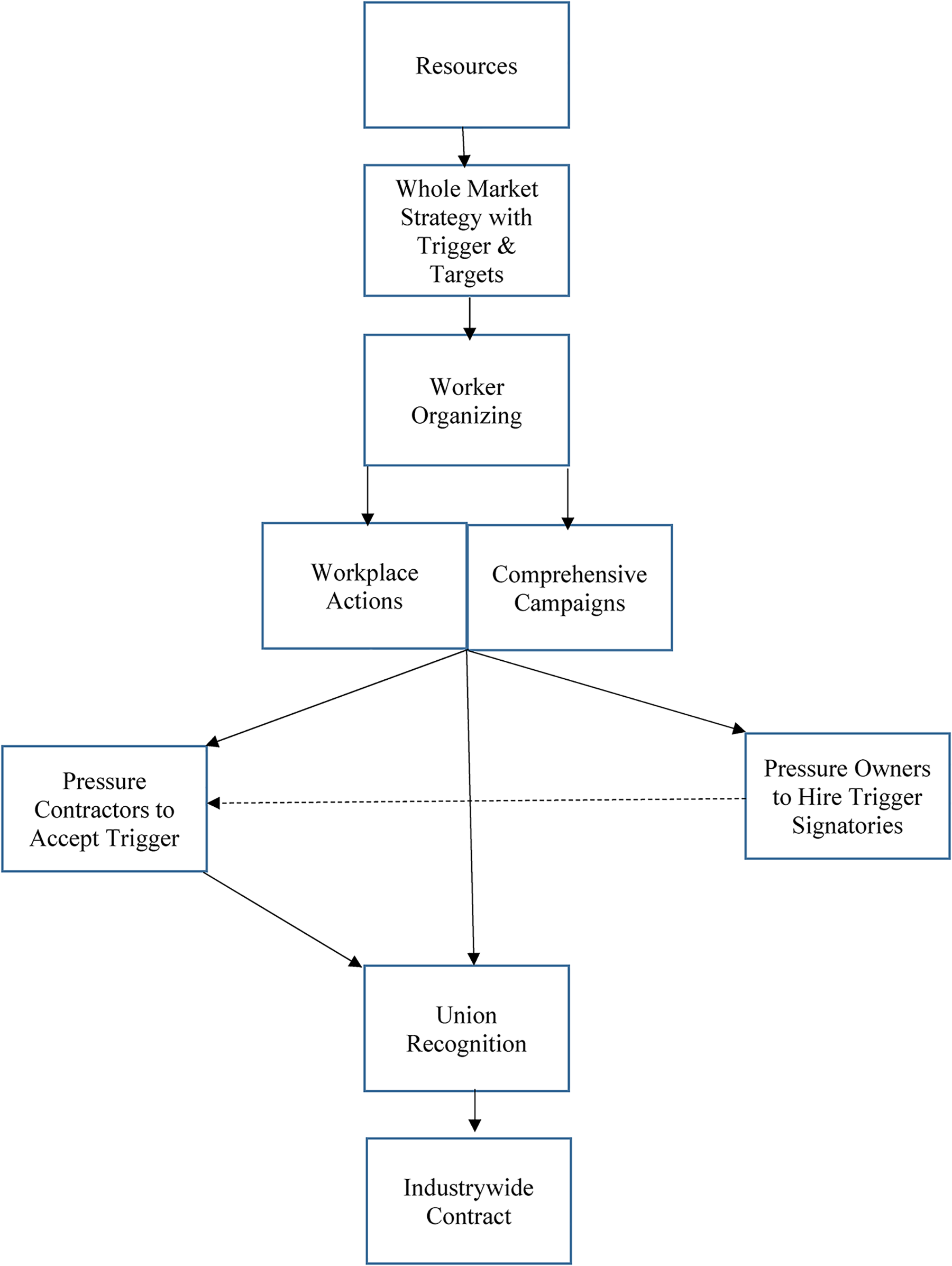
Like many SEIU locals, 32BJ has made a serious and sustained commitment to organizing, relying heavily on a whole market strategy that utilizes the trigger mechanism. Their approach begins with research to identify industries and regional markets that can be organized using this method (see Figure 2).
SEIU 32BJ whole market strategy with a trigger mechanism. SEIU=Service Employees International Union.
Once a target market has been identified, 32BJ mobilizes both staff organizers and Organizing Brigades to do the grass roots work needed to build rank and file committees at the job site. This organizing provides the basis for workplace actions and comprehensive campaigns that create what SEIU leaders describe as “compression” points or levels that can force contractors to have conversations about neutrality agreements and union recognition via card check (Englestein 2023; Hill 2023). Rob Hill, the current Organizing Director of 32BJ, reports that in those discussions contractors typically express their fear that union recognition will lead owners to replace them, and that concern “opens the door to the discussion about a trigger” which will not require them to bargain “economics that will put them at a competitive disadvantage” (Hill 2023). In exchange for agreeing to neutrality, card check and the trigger, the union pledges labor peace, which allows contractors to operate without workplace disruptions while organizing continues at their firm and others in the market.
Trading labor peace at a firm for neutrality, card check and a trigger agreement is a strategic choice that 32 BJ leaders believe is worth it, and they see the pieces as interconnected. As Hill describes it: …you need workers willing to fight for the union and fight for improving their conditions, to create the conditions to get to a discussion with the company about triggering. But once you've got to that and have got a trigger agreement that includes the card check, it's easier to have that discussion with workers when the company's saying through that agreement that they’re going to be neutral (Hill 2023)
Contractors and owners that have relationships with 32BJ in other markets, or that have been through a fight with the union, are typically the first to agree to the trigger. Contractors or owners that will not agree to the trigger become the focus of campaigns to force them into the fold. Regardless of whether firms sign on early without a fight, or later after enduring or witnessing a fight, they do so knowing that union wages and benefits will be borne by the industry as a whole, thereby ensuring that no company will be at a competitive disadvantage when bidding for work. Whether contractors come to see the new standards as a positive thing that helps improve the industry as a whole, or begrudgingly learn to live with 32BJ, firms know unionization will not put them out of business. For owners, the new standards “simply become the cost of doing business in that market” since the low wage alternatives have been removed (Hill 2022 B).
Local 32BJ's strategy fusing rank and file tactics and the trigger has led to union recognition for tens of thousands of workers. Moreover, in the current context in which union recognition often does not result in a contract (Bronfenbrenner 2022), this approach has brought industry wide contracts that provide real economic gains for workers. Hill suggests that: …most of the markets where we started out, where these jobs were minimum wage and below minimum wage, workers have substantially raised wages. They have healthcare. In some cases they have pensions or 401ks. We've managed to full time the work where it was predominantly part-time. So from the perspective of workers, it's fundamentally changed their lives (Hill 2022 B).
Conclusion
SEIU 32BJ's success in the midst of failure is not due solely to the militant comprehensive campaigns pioneered by JforJ. The whole market strategy and the trigger mechanism are also key ingredients to their success. By recognizing that “the enemy of capital is labor and other capital,” the trigger mechanism changes the economic calculation of employers and reduces their opposition to union recognition since they know that the bulk of the market will go union together, or not at all. This strategy provides a way to raise standards while simultaneously protecting the economic interests of companies, improving the lives of workers, and building the labor movement.
SEIU Local 32BJ leadership views the trigger mechanism as an essential part of its repertoire of tactics. As Hill states about 32BJ's current approach: Every time we look at a new sector, industry, or market to organize, we try to address how companies that agree to the union might be put at a competitive disadvantage. This is particularly important in a subcontracted market where any company agreeing to improve wages and conditions will just be replaced by a nonunion company. One of the first things we do is try to see if there is a trigger formula that will allow us to organize the whole market quickly (Hill 2022 A)
Whether being attentive to the economic concerns of contractors is a positive or a negative feature of the trigger is a matter of debate. Most analysts of JforJ campaigns that mention the trigger speak positively of its role in building worker power and winning union recognition (Needleman 1993; Feinstein 2006; Lerner 2007; Sachs 2007; Lerner, Hurst and Adler 2008; Olney and Wilson 2015; Gomez 2018; Hill and Eimer 2022; Englestein 2023). McAlevey is skeptical, suggesting that this approach only wins small wage increases and does not build worker power. 6 With regard to wage increases, the New Jersey campaign highlighted above-raised wages between 89% and 128%, a significant boost by any measure. Over time it also brought healthcare and pensions (Hill and Eimer 2022). The question of power is more difficult to empirically assess, since there is no agreement about what constitutes power, let alone how to measure it. A Marxist might object that Local 32BJ's approach does little to reduce the extraction of surplus value, since it accepts and takes seriously the profit-making imperatives that firms face. Others might worry that workers are being asked to tamp down militancy in one firm in the short run in order to achieve broader gains in the larger market in the long run. For better or for worse, 32BJ's primary goal in the labor market is to improve wages and working conditions via collective bargaining, and insofar as that is their goal the campaigns that incorporate the trigger appear to be making a major contribution.
There are admittedly several limitations to this research and a number of questions that might be explored in the future. As for shortcomings, this work provides an account of the trigger based only on interviews with union organizers who think it is a valuable tactic given the success of campaigns. There may be others involved in these drives that have alternative perspectives. Similarly, my claims about the way employers think about the trigger and whole market organizing are limited to newspaper reports and legislative testimony. It may be that these artifacts are not representative of the general opinion of employers. There are also questions as to whether 32 BJ's campaigns would have been successful without the use of trigger agreements. Future research might compare similar campaigns that use the trigger to those that do not. It might also try to empirically assess organizers reports that the trigger mechanism reduces employer opposition.
Finally, in 2008 Yu reported that other service sector unions were very interested in the trigger tactic, “heralding” it as “a major breakthrough idea in the labor movement,” and inviting “SEIU lawyers to give talks on it” (Yu 2008, 52). Fifteen years later, there are few examples of other unions using the trigger. 7 Explaining the failure of the tactic to spread is something that might be explored in future work. Yu speculated that diffusion of the trigger would “not only depend on the power of the idea but on a variety of factors including the structure of the industry and the level of power that the respective unions have amassed with employers” (Yu 2008, 52). It may be that other unions simply don’t have the power to enact trigger agreements, or it might be that the structure of the industries that SEIU targets are unique. McAlevey believes that industry structure is key, suggesting that the concessions costs for employers are low in cleaning services, making it easier for firms to agree to triggers, and making it hard to export the JforJ model to other industries (McAlevey 2015, 436; McAlevey 2016, 33). Future research could examine the economics of the industries in which the trigger has been used. 8 This might help identify other sectors where it might be of use.
Footnotes
Declaration of Conflicting Interests
The author declared no potential conflicts of interest with respect to the research, authorship, and/or publication of this article.
Funding
The author received no financial support for the research, authorship, and/or publication of this article.