




Abstract
Labor struggle and workers’ collective agency are central concerns of labor studies researchers. Such an appreciation seems particularly apposite given contemporary debates around the future of work. As Schulze-Cleven and Vachon (2021) note, much future of work debate has been inscribed by technological and market fundamentalism. The actions and experiences of workers are often absent from a narrative that instead tends to focus on predicting the extent of technology-driven job destruction or state policies that help workers navigate a future of profound industrial transformation. Against this, Schulze–Cleven and Vachon's edited volume stands as an important corrective, offering an analytical approach that revalues labor within a human-centered future of work that extends beyond a purely technological focus to also incorporate environmental change and social reproduction. This symposium contribution builds on Schulze–Cleven and Vachon's analytical approach to focus on labor struggles internationally in the platform economy.
For Schulze-Cleven (2021), core features of a labor studies approach include putting the experiences of working people and how they look to defend and advance their interests through collective action at the center of analysis. While platform work still accounts for a small proportion of total employment, platforms are often seen to be key drivers of capitalist restructuring predicated on more insecure and precarious jobs. Platform work is typically characterized by dubious forms of self-employment, set against historical ideals of a standard employment contract, whereby tasks are highly fissured, dependent on the vicissitudes of algorithmic management, and where “workers” are denied basic social protections (Forde et al. 2017). Such a context is seemingly inhospitable to collective action and trade union organization. Yet, labor unrest by platform workers is an important and growing international phenomenon.
The specific focus is on platform workers in the food delivery sector, a sector where a number of high-profile labor actions have been documented (Cant 2019; Woodcock 2021), though little is known about the broader scale or motivations of labor unrest and the actors involved. Informed conceptually by Silver's (2003) power resources approach, we consider global labor unrest among food delivery workers, drawing on a dataset of more than 500 labor protest events. Central to our argument is the value of the concept of associational power to any understanding of evolving patterns of labor unrest. It is only through such associational power that platform workers will be able to build a future of work based on more human-centered and democratic concerns.
The Return of Associational Power
Derived from Wright (2000) and Silver (2003), the power resources approach distinguishes between structural and associational power. Structural power concerns how workers can leverage their situation within wider economic processes and covers “workplace bargaining power” (workers’ centrality to the process of production) and “marketplace bargaining power” (related to labor market supply and demand). Associational power derives from workers’ collective organization, such as through trade unions. In other words, structural power is about where workers are in the labor market, whereas associational power is about what workers do to organize, represent themselves, and further their interests.
The distinction between structural and associational power has practical significance for those interested in building (and rebuilding) effective union organization. In the context of declining union membership and influence, the attractions of a framework for understanding what capacities unions might mobilize to rebuild are obvious. Labor studies researchers have extended Silver's initial framework to identify additional sources of workers’ power, such as institutional and societal power (Bank Muñoz 2017; Von Holdt and Webster 2008; Schmalz, Ludwig and Webster 2018). Institutional power – the outcome of struggles based on structural power and associational power – refers to legal codes or institutional frameworks of collective bargaining or workplace representation. Societal power refers to the latitudes for action arising from viable cooperation contexts with other social groups and organizations, and society's supports for trade union demands. For Vandaele (2018, 10), since platform workers’ institutional power is “almost non-existent, (…) they need to rely on other resources for raising their voice and attaining bargaining power.” Platform workers’ potential to form coalitions with other actors or to exercise discursive power may therefore offer a more effective means of action: building associational power is central.
Platform workers’ unrest is an area of labor studies where an implicit focus on associational power has been resurgent. Studies have sought to understand the factors that contribute to increasing associational power in the platform economy (Anwar and Graham 2019; Cant 2019; Chesta, Zamponi and Caciagli 2019; Ford and Honan 2019; Minter 2017; Tassinari and Maccarrone 2020). An initial categorization of the associational power of platform workers has been offered by Vandaele (2018), which assumes that grassroots unions and self-organizing workers mainly pursue a logic of membership trying to mobilize and organize workers (thus increasing associational power), while more mainstream unions pursue a logic of influence trying to apply institutional power. Different actors thus pursue highly tailored kinds of organizing activity depending on circumstances.
We apply a broad concept of associational power to explore the significant and sustained wave of labor unrest and worker activism in global platform work. We explore three questions. First, how extensive is platform labor unrest and are there comparative patterns of action? Second, what actors are responsible for the organization of platform labor unrest? Third, what are the motivations for, and forms of, platform labor and to what extent is this associated with certain forms of associational power?
Methods and Data
We draw on a unique global dataset of platform labor unrest in the food delivery sector. Labor unrest was understood to include various activities used by workers to advance their interests, including, strikes, public demonstrations, logoffs, and legal action. At the time of analysis, there were six global food delivery brands: Uber Eats, Just Eat, Deliveroo, Foodora, Zomato, and Glovo. Where relevant, the largest regional companies were included (Europe is dominated by global players only): Jumia Foods, Mr D. Food, Pedidosya, Rappi, Doordash, Delivery Club, Yandex.Eda, Foodpanda, Talabat, Carriage, Meituan, Ele.Me., and Talabat. In total, these 19 food delivery companies operated in 95 countries around the world.
For each company, we searched electronic news archives for reports on protest events, utilizing two sources: China Labor Bulletin (specifically for China) and the GDELT project. GDELT monitors worldwide news reports, with real-time translation in over 100 languages and a news search interface. We targeted our search using relevant keywords that captured labor unrest and context-sensitive keywords. We identified, 527 incidents of labor unrest in 36 countries for the period of 1 January 2017 to 20 May 2020, covering 38 percent of the countries in which the food-delivery platforms were active. Information included the date and location of protest; type of action (allows insight into power resources); number of participants; action duration; labor actors (insight into formation of associational power); and motives.
The Extent of Labor Unrest in Food Delivery
Platform labor unrest was evident across the world. Most incidents occurred across Europe (51%), followed by Asia (25%) and South America (17%). Fewer cases were drawn from North America and Australia and none from Africa. Nationally, the highest number of incidents occurred in China (20%), the UK (13%), Spain (12%), and Argentina (11%). Labor unrest was disproportionately associated with five companies, with Deliveroo accounting for 29 percent of all protests globally, albeit mainly across Europe. Protests against Meituan accounted for a little over one in ten events (11%) and were exclusive to China. The remaining three companies included Glovo (8%), Uber Eats (7%), and Ele.Me (6.6%).
Protests were short and involved relatively few participants. Eight in ten involved less than 100 workers, six in ten less than 50 and very few more than 1,000 (3%). Most events (85%) lasted less than 24 hours. Many protests crossed multiple companies and locations, suggesting platform workers were developing the capacity to wage concerted campaigns and build solidarity.
Building Associational Power in the Food Delivery Sector
Evidence suggests platform workers were building associational power through collective action; societal and institutional sources of power were less apparent. Associational power mainly stemmed from workers’ direct action, with informal groups of workers involved in most events (85%). Mainstream trade unions (28%) or grassroots unions (27%) were involved in over half of cases, though rarely together. There was also evidence of workers’ collectives (15%), where workers sought to advance more coordinated actions around a clear collective identity.
There were notable regional differences in associational power (Figure 1). Informal groups of workers were the main labor actors in Asia and South America, involved in 98 percent and 89 percent of protests respectively. Informal groups of workers were less prominent – though still ubiquitous – in Europe (83%), and much less involved in North America (47%) and Australia (33%). Mainstream trade unions were the dominant actor in Australia (69%), relatively active in Europe (37%), and less involved (27%) in South America. They were not particularly prevalent in North America (17%), and virtually absent in Asia (1%). Grassroots unions were most apparent in South America (42%) and Europe (33%), less likely in Asia (10%) and absent in North America and Australia. Workers’ collectives were most common in Europe (25%) and least evident in South America (10%) and Australia (6%). They were absent in North America and Asia.
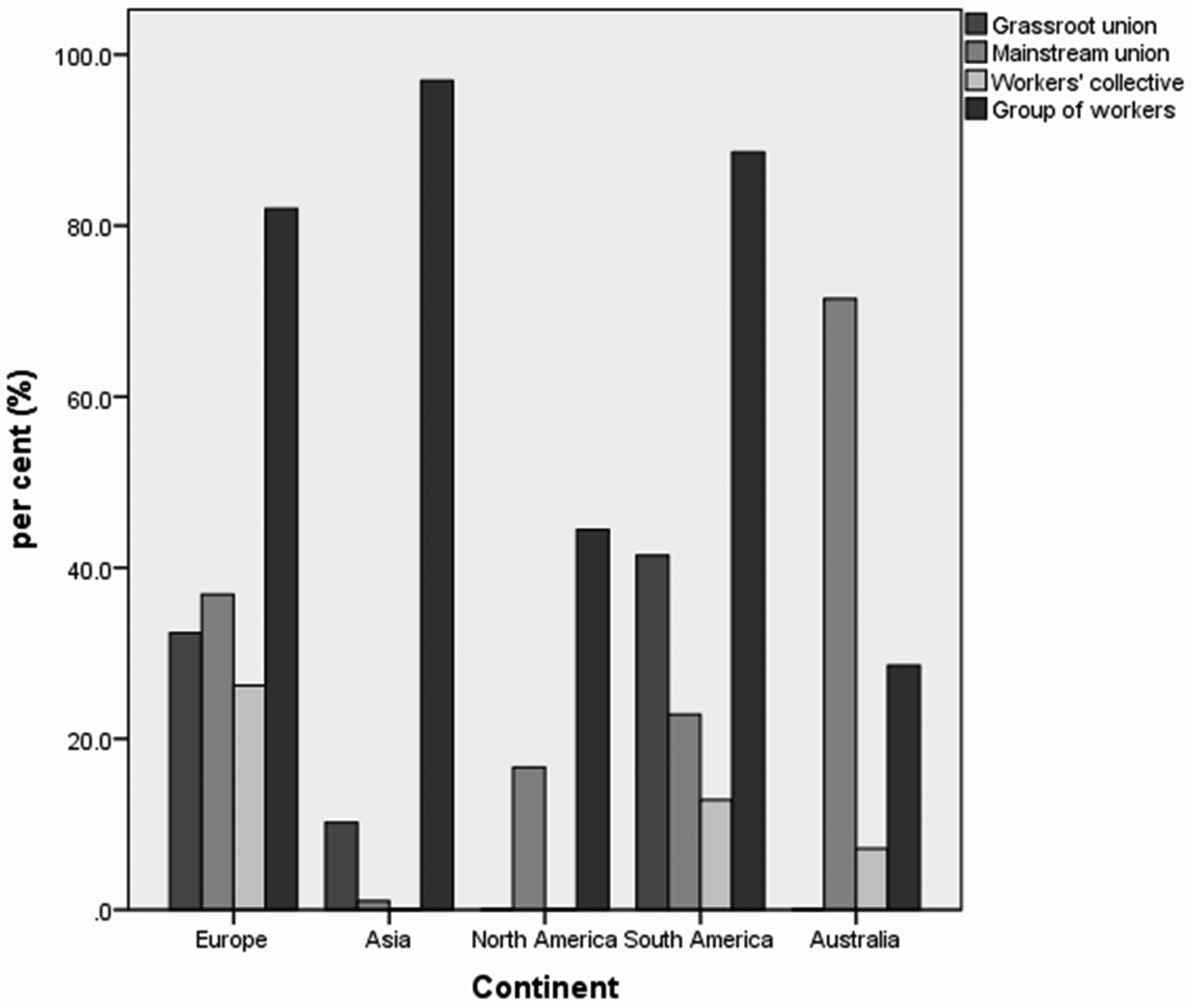
Types of associational power by continent. Source: Authors’ own data.
Table 1 shows collaboration between actors. The most frequent constellation was informal groups of workers, representing the sole actor in three out of ten protests. Mainstream unions (7%) or grassroots unions (5%) were rarely the sole actor. Most protests involved some collaboration between labor actors, typically involving informal groups of workers supported by either mainstream (15%) or grassroots (15%) unions. Informal groups of workers collaborated with workers’ collectives in far fewer cases (7%), with a very small proportion of labor actions involving collaborations between all labor actors (6%).
Labor Actors and Collaborations.
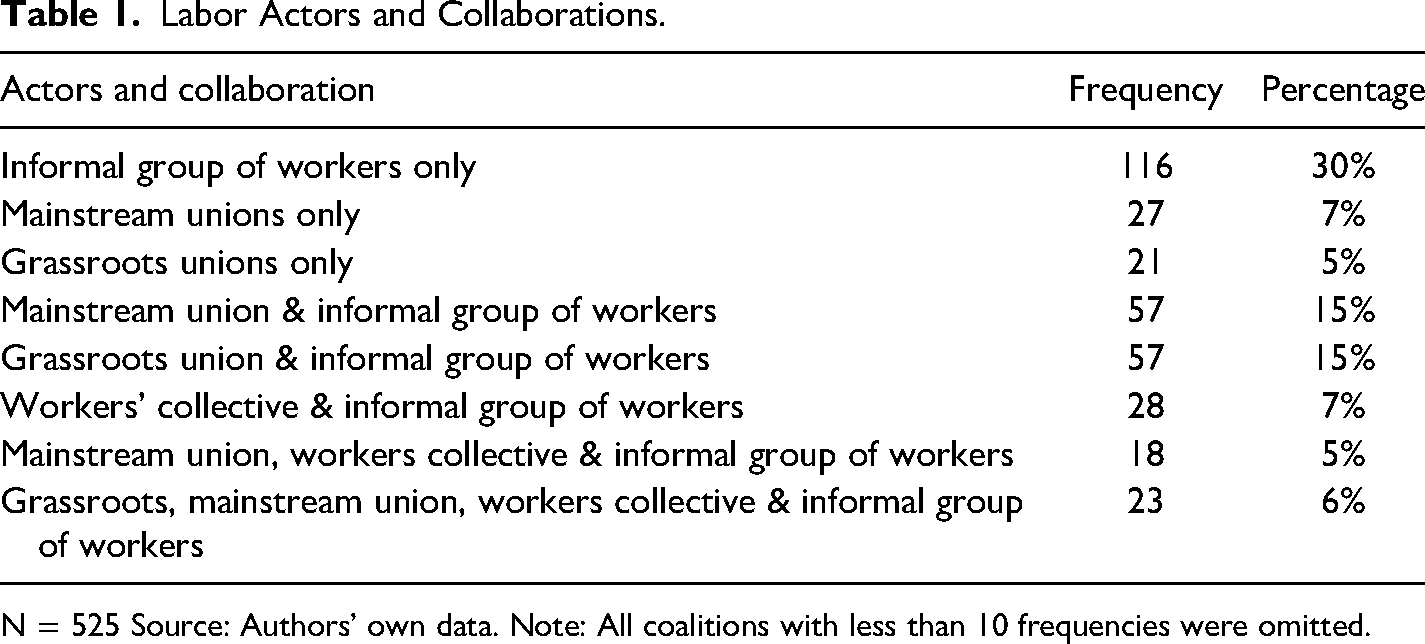
N = 525 Source: Authors’ own data. Note: All coalitions with less than 10 frequencies were omitted.
Regionally, collaborations between mainstream unions (15%) and grassroots unions (15%) and informal groups of workers were equally common. Such collaboration also took place in South America, though collaboration with grassroots unions (20%) was twice as likely as with mainstream unions (10%). In the US (16%) and Australia (24%), informal groups of workers only collaborated with mainstream unions. Collaboration was less likely in Asia and tended to be between informal groups of workers and grassroots unions (6%). Collaboration between informal groups of workers and workers’ collectives was uncommon but most apparent in Europe (10%).
The evidence reveals, then, a strong role for the self-organization of platform workers. It was the workers who took direct action, in what may be seen as a logic of membership. However, trade unions offered support in around half of protests. While mainstream unions have been reluctant to organize outsiders such as platform workers, and face considerable representational challenges, their role was far from absent. Indeed, they were just as likely to support workers’ collective actions as grassroots unions. There were, however, just three cases in our dataset of direct collaboration between grassroots and mainstream unions. This raises the question of whether mainstream and grassroots unions have different motives and goals when supporting platform workers.
Motivation for and Type of Labor Protests
Protests typically focused on distributive concerns (Table 2). Despite the oft-cited novelty of platform work, the platform workers’ concerns were rather traditional. A little under two-thirds (63%) of labor protests were motivated by action regarding pay. Disputes around employment status, an issue often highlighted as central to gig employment, accounted for around a fifth of cases (22%). Next were disputes over working conditions (20%) and health and safety (17%). There was little evidence of protests related to deactivation (7%) or demands for union representation (4%).
Grievances Prompting Labor Unrest by Labor Actors (%).
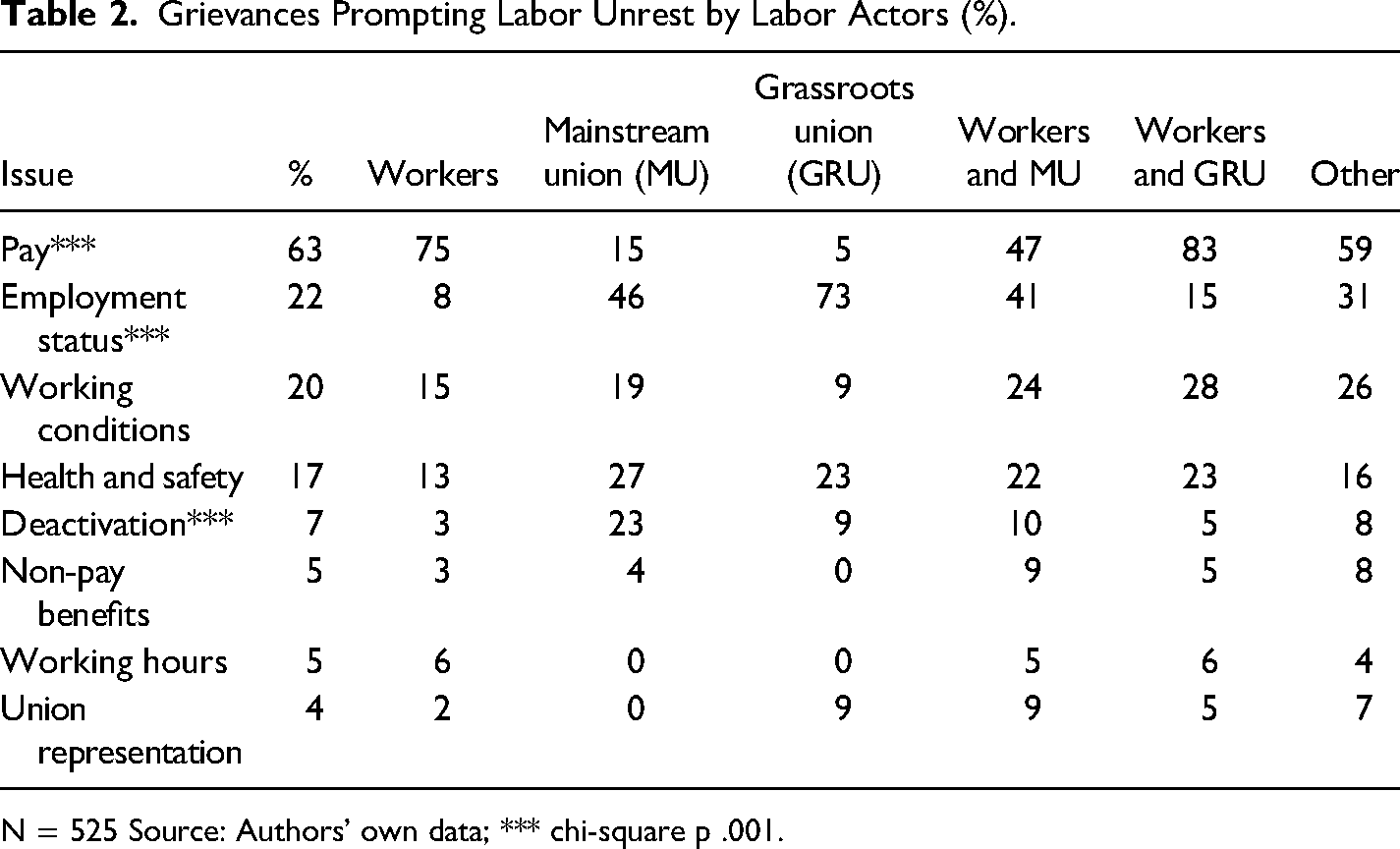
N = 525 Source: Authors’ own data; *** chi-square p .001.
Disputes concerning pay were high in all regions of the world, though were second in prevalence to issues related to employment status in the US (58%) and health and safety (53%) in South America. For the US, the absence of wider employment rights coupled with a widespread propensity for litigation, meant that struggles over employment status were the defining feature of platform labor unrest. In South America, in contrast, health and safety as a motivator of labor unrest had become more pressing in response to the COVID-19 pandemic, as workers focused their struggles on the insufficient protective equipment provided by leading platform companies.
The motivations for labor unrest varied by labor actors (Table 2). Protests over pay were driven mainly by informal groups of workers (75%), though they were also supported by coalitions with mainstream unions (47%) and even more extensively with grassroots unions (83%). Labor unrest related to employment status was primarily driven by grassroots unions (73%) and less so by mainstream unions (46%) or informal groups of workers supported by mainstream unions (41%). Except for deactivation, none of the other motivators for labor unrest were significantly associated with certain labor actors. Platform protests opposed to deactivation were most likely to be associated with the sole involvement of mainstream unions (23%).
Types of Action
The most frequent types of labor unrest (see Figure 2) were strikes and logoffs (40%), followed by demonstrations (34%), legal action (17%), and formalization (4%, comprised of 2% through institution-building and 2% capacity-building). Strikes and logoffs were most frequent in Asia (65%), were quite prevalent in Europe (39%), though occurred less frequently in South America (26%), North America (5%), and Australia. Demonstrations were most prevalent in South America (54%). Legal action predominated in North America (63%) and Australia (59%), related to the weak associational power of workers in the former and a tradition of legal arbitration in the latter.
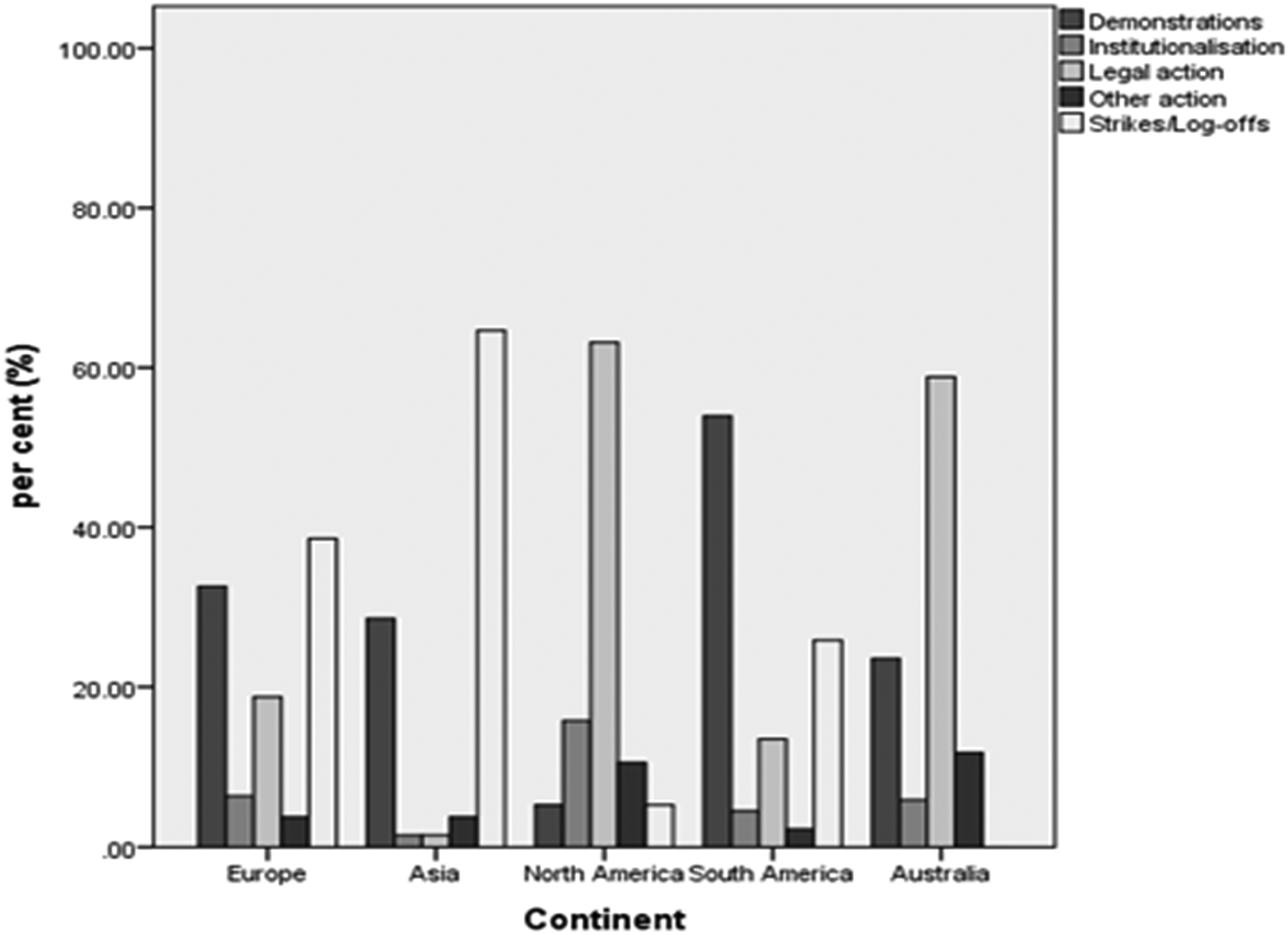
Type of action by region. Source: Authors’ own data.
There was an association between the type of action and kind of labor actor. Informal groups of workers were associated with strikes and logoffs (61%) and demonstrations (32%), reflective of the short duration of protests. Both mainstream (55%) and grassroots unions (40%) supported demonstrations by informal groups of workers, though grassroots unions (51%) were more likely to support workers’ strike actions and logoffs. There were no instances of mainstream or grassroots unions acting as the sole agent of labor unrest through demonstrations or strikes and logoffs. The main action of both types of unions was legal action, with over three quarters (77%) of mainstream unions’ action focused on legal action and 68 percent for grassroots unions. Unions also focused actions on institutionalization, with grassroots unions (18%) slightly more active in this space than mainstream unions (15%).
Conclusion
Schulze-Cleven and Vachon (2021) offer a labor studies approach that is committed to a more human-centered and democratic future of work. This stands as a powerful corrective to more technologically determined and market focused narratives. Such an approach is rooted in interdisciplinary inquiry that puts center stage the experiences of workers and their collective struggles and has widespread application in understanding contemporary challenges not only around technological disruptions, but climate change and social reproduction. With a focus on food delivery workers, this symposium contribution has sketched out the usefulness of this approach in two ways. First, it has extended the analysis empirically beyond the US. Second, it has considered the role of labor actors, including trade unions, beyond more institutionalized workplace settings, to consider those working in the platform economy.
We offer some initial insights into how food delivery workers are struggling to improve their working lives. Despite the seemingly inhospitable conditions of the gig economy, we find significant levels of labor unrest across all regions of the world. Such actions symbolize rising associational power among platform workers. Associational power varied by region, though was mostly led by informal groups of workers. Nonetheless, trade unions were involved in almost half of all protests. Mainstream unions were most evident in Europe, the US and Australia, while grassroots union activity was more prevalent in Asia and South America. There was some evidence of workers’ collectives, but their role was minimal in a more global sense. Both mainstream and grassroots unions were supporting informal groups of workers in logics of membership, and both were pursuing logics of influence in terms of legal action and institutionalization, though the use of institutional power sources was limited overall. Regionally, reliance on the law was concentrated in the US and Australia, where mainstream union action predominated.
Overall, the dominant issue motivating labor unrest was pay and the most common forms of labor unrest were strikes, logoffs, and demonstrations – what Silver (2003) refers to as Marx-type unrest. This reflects a classic interest of labor studies scholars in exploitation at work and conflicts over the level of compensation for labor. Pay, of course, is also a core and enduring concern for trade unions and suggests a basis for organizing and representing the interests of platform workers in the future.
Following Schulze-Cleven and Vachon's approach (2021), the findings suggest that whatever the future of work looks like, it will be shaped by the collective actions of workers themselves. A future of work that is human-centered and more democratic will need to be built on the struggles of workers in different sectors, industrial contexts, and locations. The task for students of labor studies is not only to understand the terrain and power of such struggles but to offer valuable empirical and theoretical insights that assist labor actors in their struggles.
Footnotes
Declaration of Conflicting Interests
The author(s) declared no potential conflicts of interest with respect to the research, authorship, and/or publication of this article.
Funding
The author(s) disclosed receipt of the following financial support for the research, authorship, and/or publication of this article: This work was supported by the UK Economic and Social Research Council, as part of the Digital Futures at Work Research Centre (Digit - grant number: ES/S012532/1) and the International Labour Organisation (ILO). Funding is gratefully acknowledged.