




Abstract
This paper examines how Sustainable Development Goals (SDGs) impact regional governance, institutional design, social inclusiveness, and environmental protection. Focusing on six European regions, the study addresses the gap in research at the regional level, as most studies concentrate on national and municipal contexts. Semi-structured interviews reveal that while SDGs have not significantly expanded regional governments’ policy responsibilities, they have influenced budget restructuring and strategic priorities. Institutional changes include new sustainability initiatives and enhanced cross-departmental collaboration. Social inclusiveness and awareness have improved through better data management, targeted policies, and increased communication. Environmental protection emerges as a key area for regional sustainability, with initiatives like green procurement and green bonds gaining traction. Although the SDGs’ impact on regional governance is mainly technical, strategic alignment suggests their potential as a replicable sustainability framework. Future research should explore regions without institutional SDG support to better understand their transformative potential.
Keywords
Introduction
This paper studies the impact of local implementation of the Sustainable Development Goals (SDGs) on regional governance: by surveying representatives from a group of European regional administrations, it explores how the introduction of the SDGs may have affected vertical and horizontal governance balances and the distribution of competences, tasks, and resources within regional governments. This work contributes to a growing body of research which explores how global policy frameworks are internalized within multilevel governance systems. It draws on the analytical toolkits of institutional change, administrative adaptation, and policy integration theory in public administration (Allen, Malekpour, and Mintrom 2023; Guarini, Mori, and Zuffada 2022), exploring not just sub-national agency in the implementation of overarching frameworks such as the SDGs, but also how more structural effects of such frameworks on the functioning and self-organization of public administrations can be assessed and operationalized.
The 2030 Agenda and the SDGs—a global, comprehensive policy framework that commits UN member states to address peace and prosperity, health and education, economic growth and inequality, climate change and territorial sustainability—were established in 2015 within the intergovernmental framework of the United Nations (UN). However, it was not long before local governments and policy-makers started contributing significantly to the implementation of the Agenda through locally-based action. In recent years, the role of local governments in monitoring the implementation of the 17 SDGs and their 169 targets at the local level has been object of extensive research (Bilsky, Moreno, and Fernández Tortosa 2021; Jones and Comfort 2020; Martínez 2022 among others). Since the earliest stages of the 2030 Agenda, it has been argued that the achievement of the Agenda’s ambitious objectives would be impossible without the systematic inclusion of local government in the implementation of the 2030 Agenda (Bardot et al. 2018; Cities Alliance et al. 2015). For scholars of public administration and regional governance, SDG localization has served as a lens to observe how administrative systems can respond to exogenous policy pressure—revealing broader dynamics of institutional adaptation, vertical coordination, and the reframing of public values and discourse.
There has been, however, significantly less focus on the role that regional governments play in the localization of the SDGs, if any, and how the fulfillment of the 2030 Agenda may be accelerated while also impacting the regional level. At least in the European context, the regional level’s ability to implement the SDGs as drivers of policy innovation has been part of the political and institutional debate (Committee of the Regions 2019, 2020, 2; Markkula and Rouillon 2023). But what impact has the SDG framework had on how regional governments work, plan, and strategize? This has been a significant research gap which evidence from the work carried out by regional governments on SDG implementation and local sustainability policy can contribute to filling.
Since the earliest stages of the 2030 Agenda, monitoring tools like Voluntary Local Reviews (VLRs) have provided significant information and data (both qualitative and quantitative) about how the process of SDG localization has unfolded, both at the subnational level in general (Narang Suri, Miraglia, and Ferrannini 2021) and the regional level in particular (European Commission et al. 2023)—especially in a context, like Europe, in which such second-tier governance institutions have historically been active.
VLRs and other monitoring frameworks have also been a tool for increased institutional cooperation between local governments and the global community—with several organizations supporting the development of VLRs via guidelines and training, capacity-building, mutual learning, and standardized monitoring methods and tools (Huynh 2021; OECD 2020; Siragusa et al. 2022; UCLG and UN-Habitat 2020; UNDESA 2020; UNECE 2021; UN-ESCAP 2020; UN-Habitat and UCLG 2021). Monitoring, however, provides valuable information on local governments as agents: implementation indicators and repositories of local policy initiatives to implement the SDGs shed light on the “performance” of local governments, but provide no insight on how these local governments may have changed their policy process because they had to adapt to the SDGs.
Rather than evaluating performance outcomes, this paper explores how the SDGs have operated as a vector of organizational change—in line with theories of institutional isomorphism and adaptive governance. It contributes to a fledgling literature seeking to evaluate the SDGs not only as a planning tool, but also as a catalyst of administrative and institutional transformation. In fact, it attempts to invert the currently dominant perspective and analyze regional governments on the “receiving” side of the SDGs: rather than looking at regional governments’ performance as implementers, it looks at the impact that SDG localization may have on specific institutional and governance dimensions—institutional governance, design, inclusiveness, and ecology—at the regional level in Europe.
In 2022 and 2023, the European Commission’s Joint Research Centre involved 10 regional governments in the Regions2030 project, providing support to SDG implementation monitoring and a platform for mutual learning and capacity-building. 1 This paper surveys a group of six regions involved in the project to obtain first-hand information and a qualitative appraisal of the impact of SDG localization on these regions’ governance structure and policy strategy. Section “From Performance to Impact: The SDGs and Regional Governments” locates this work in the larger literature on regional policy and an impact-oriented approach to SDG implementation. Section “An Analysis of Current SDG Impact at Regional Level” analyses the interviews conducted with regional representatives and the information they shared on SDG impact at the regional level. Section “Conclusions” draws a set of conclusions to guide further impact-oriented analysis of SDG localization—especially in diverse socio-economic and geographic contexts and conditions.
From Performance to Impact: The SDGs and Regional Governments
Regional Governments in the European Context: A NUTS-2 Polity?
The concept of “regional” government has not been univocal. In international relations, the “rapid transformation and rescaling of state spaces” have put subnational governments back into the focus of the analysis of political phenomena (Jones and Paasi 2013, 1). In international organization studies, globalization and the emergence of effective multilateral governance impacted the identification of relevant policy actors (Hettne 1999): regions are often defined as communities of shared traits, common issues, and consistent policy responses—in a way increasingly less tied to geography than it is to history or socio-economic convergence. In the context of the European Union, moreover, interregional cooperation has broadened the formal concept of region from a more administrative understanding to an expanded space for cooperation on shared issues via common resources and socio-political closeness. 2
This paper adopts a more technical approach: it uses “region” to identify the territorial units that are labeled as the second level in the European Union’s Nomenclature of Territorial Units for Statistics (Nomenclature des unités territoriales statistiques), 3 or NUTS-2—that is, the level that includes Germany’s Länder, Italy’s regioni or France’s régions, Spain’s comunidades autónomas, or Greece’s περιφέρειες.
This choice has several methodological implications. NUTS-2 identifies territorial units which are common to 22 out of 27 EU member states, making any inferences apt for comparison and replication. In the case of the EU, NUTS-2 has also been the most active sub-national level above the municipal one within the localization movement and a driver of SDG monitoring efforts at the local level. 4
A Shift From SDG Performance to SDG Impact: Supporting Literature
Since a first informal SDG monitoring document was issued in 2016 by the Valencian Community’s Generalitat—a NUTS-2 regional government—in Spain (Directorate General for Cooperation and Solidarity and UNDP-Art Initiative 2016), VLRs have provided first-hand information on the initiatives that local governments have undertaken to integrate the SDGs into their daily decision-making, while also offering them “new opportunities of validation and legitimation while increasing the accountability and transparency of the process” (UN-Habitat and UCLG 2021, 43). The concept of localization itself—“the process of defining, implementing and monitoring strategies at the local level for achieving global, national, and sub-national sustainable development goals and targets” (UCLG 2019, 21)—puts emphasis on implementation. Accordingly, significant parts of recent literature on regional approaches to the SDGs have focused on what can be defined as the “performance” aspect of localization: how well regional governments have implemented the Goals and how high they score when monitoring implementation in a quantifiable way (Bardot et al. 2018; Committee of the Regions 2020; European Commission et al. 2023; Gea Aranoa 2021; GTF and UCLG 2023; Lella, Oses-Eraso, and Stamos 2024; Nakhle et al. 2024). These studies have generally found that, while many European regions have begun aligning planning documents and policy strategies with the SDGs, actual monitoring and indicator-based reporting remains uneven. Regions with higher administrative capacity and political commitment—often supported by or consistent with national or EU-level frameworks—tend to perform better in both strategic alignment and data availability. Nevertheless, gaps persist, especially in indicators consistency across regions and integration of social and ecological dimensions into budgeting and evaluation systems.
However, the performance lens only show a part of the larger picture. This paper draws on theoretical approaches in public administration and organizational studies that examine how exogenous frameworks—such as the SDGs—are internalized by institutions (March and Olsen 1998; Meyer and Rowan 1977). Concepts like institutional isomorphism, adaptive governance, and soft-law compliance mechanisms can be a valuable toolkit to interpret how regional administrations reorganize structures, adapt workflows, and engage in cross-sector collaboration in response to external policy stimuli (Domorenok, Graziano, and Polverari 2021; Sager and Gofen 2022). In this view, not only do the SDGs function as strategic goals, but also as boundary objects that prompt internal change. As a soft-law instrument, the SDGs prompt administrative adaptation through symbolic alignment, coordination mandates, and cross-departmental procedural shifts—themes well established in multilevel governance research and organizational theory (Biermann et al. 2023; Bilsky, Moreno, and Fernández Tortosa 2021; Lodge and Wegrich 2012; Meuleman 2023).
This paper, however, approaches SDG localization at the regional level from a different perspective—to what extent having assimilated the SDGs into regional policy-making has affected regional governance—and locates itself in a growing body of academic literature that “reverts” this approach to focus on the impact of SDG implementation (Biermann et al. 2022; Birner, Bornemann, and Biermann 2024).
This impact-oriented reading of the SDGs also resonates with recent meta-analyses in sustainability governance literature. Some authors focused on the ability of the SDGs to have “any political impact within national and global governance to address pressing challenges such as poverty eradication, social justice and environmental protection.” To do so, their analysis centers on “five dimensions . . . derived from the core ambitions expressed” in the 2030 Agenda (Biermann et al. 2022, 795): global governance, domestic politics, policy and institutional coherence, governance inclusiveness, and ecological integrity. Works in this strand of research have so far argued that “overall . . . there is only limited evidence of transformative impact” of SDG implementation on policy-making and governance, especially at the national level (Biermann et al. 2022, 798). Most studies focusing on the national level have concluded that while SDGs have been useful as rhetorical or symbolic tools—often reinforcing pre-existing agendas—their influence on actual institutional transformation has been modest (Barbier and Burgess 2021; Sachs et al. 2019). Political commitment, institutional inertia, and the voluntary nature of the framework were identified as key constraints (Segone 2020). By shifting the focus to the regional level, this paper explores whether greater proximity to implementation challenges, local policy-making, and citizen needs might allow SDGs to have more tangible influence on governance structures and practices—especially in areas such as institutional design and cross-departmental collaboration.
An impact-driven analytical framework can be easily replicated at the regional level: considering the growing contribution of sub-national levels to the implementation of the Goals, it can be valuable to learn whether the SDGs have been able, in turn, to innovate, alter, or influence the way the regional level works, and to what extent. This paper aims, in particular, to test more qualitative methodologies that adopt storytelling and policy discourse as reliable sources of first-hand appraisals of SDG impact on the functioning of local administrations. Literature and analysis in this field are still evolving and “despite the growing number of researchers who study the 2030 Agenda and the SDGs, we still lack data” (Biermann et al. 2022, 799). Defining and streamlining methods to access the wealth of information that comes from the first-hand experience of policy-makers, stakeholders, and other policy agents at various tiers of governance can help researchers reach the critical mass of information, data, and verifiable knowledge that can consolidate this research framework and systematically improve the reliability and replicability of SDG analysis as a new strand of administrative studies.
Methodology
When analyzing SDG impact at the national level, leading literature has built on a “meta-analysis of the scientific literature on the political impact of the SDGs” (Biermann et al. 2022, 798), which was primarily identified via keyword-based bibliometric searches. This approach carried methodological “limitations” that affected how objectively the “causality for the impacts of the SDGs” could be reliably observed in the review’s extensive sample (Biermann et al. 2022, 799).
This paper, in turn, favors a more qualitative approach: it surveys representatives from the administrations of a group of regions—selected among those who had actively collaborated with the JRC for the Regions2030 project—via semi-structured interviews to collect first-hand information on effects and impact that the respondents perceive as causally linked to the implementation of the SDGs at the regional level. The interviews were framed as a research-oriented continuation of the work the regions had carried out alongside the JRC, all participants were contacted to be included in this research on a voluntary basis. Selected regions are the following: North Aegean (Greece); Apulia, Piedmont (Italy); Centro (Portugal); Nord Vest (Romania); and Navarre (Spain). Other regions declined an invitation to participate. With a fewer number of regions, contacts to schedule an interview were ultimately unsuccessful.
All interviewees were shared the script a few days before their scheduled interview. In two cases, interviewees shared written replies beforehand: this was a possibility designed to overcome potential language issues with English being the common working language for the interviews. In both these cases, as the interviews were carried out, the interviewees referred extensively to the information they had already provided in written form, using these as a support to their oral answers. The interview’s main script is available as shared to regional representatives in Appendix 1.
Interviews were built around four key analytical categories adapted from the “dimensions” analyzed in the national impact literature at the core of this argument (Biermann et al. 2022, 795):
regional governance (including institutional mandates and resource allocation)
regional institutional design (including innovation, creation, and policy-making)
regional inclusiveness (including awareness and equality)
regional ecology (including environmental protection and climate neutrality)
Interviewed regions share specific characteristics:
All regions have contributed to the Regions2030 project between 2022 and 2023.
Since all interviewed representatives had been involved in the Regions2030 project and in cooperation with the JRC, it is assumed they all were familiar with the SDG framework and have access to institutional information as regards the SDGs in their region.
All regions have collaborated in SDG localization monitoring activities in the framework of the Regions2030 activities. 5
Because of their specific history with SDG localization at the regional level, all surveyed representatives have processed their experience with the Goals in different ways. Methodologically, this paper argues that the diversity of SDG impact at the regional level requires a more qualitative approach to more flexibly operationalize the discourse and storytelling through which regional governments are interpreting their SDG localization processes. This paper argues that more discursive and storytelling-based methods can be effective in studying causal nexuses between SDG implementation and regional policy and governance, and they can be replicated more extensively to map and understand the effectiveness of the 2030 Agenda as a driver of sustainability and equality.
To improve comparability across the analysis’ policy dimensions, it attempts at normalizing the information collected via interviews through a three-way traffic-light visualization: two degrees of positive impact (issue addressed and significant impact mentioned; issue addressed with some impact), neutral impact (issue not addressed), and two degrees of negative impact (issue addressed with no significant impact; issue addressed with regression after SDGs). The scores were attributed according to frequency of mention and depth of detail by the interviewees when addressing questions explicitly related to the issue categories adopted in the study. Interview data was coded mostly via an inductive approach—for example, explicit mentions of themes, issues, processes, and actions consistent with the analytical framework outlined in the interviews—occasionally supported by more deductive analysis to overcome potential inconsistencies due to language barriers and/or administrative traditions rooted in specific contexts (Braun and Clarke 2012).
An Analysis of Current SDG Impact at Regional Level
This section analyses available data and explores the impact of SDGs on regional policy-making in Europe according to four key categories: (a) regional governance; (b) regional institutional design; (c) regional inclusiveness; and (d) regional ecology.
Impact on Regional Governance: Mandates and Resource Allocation
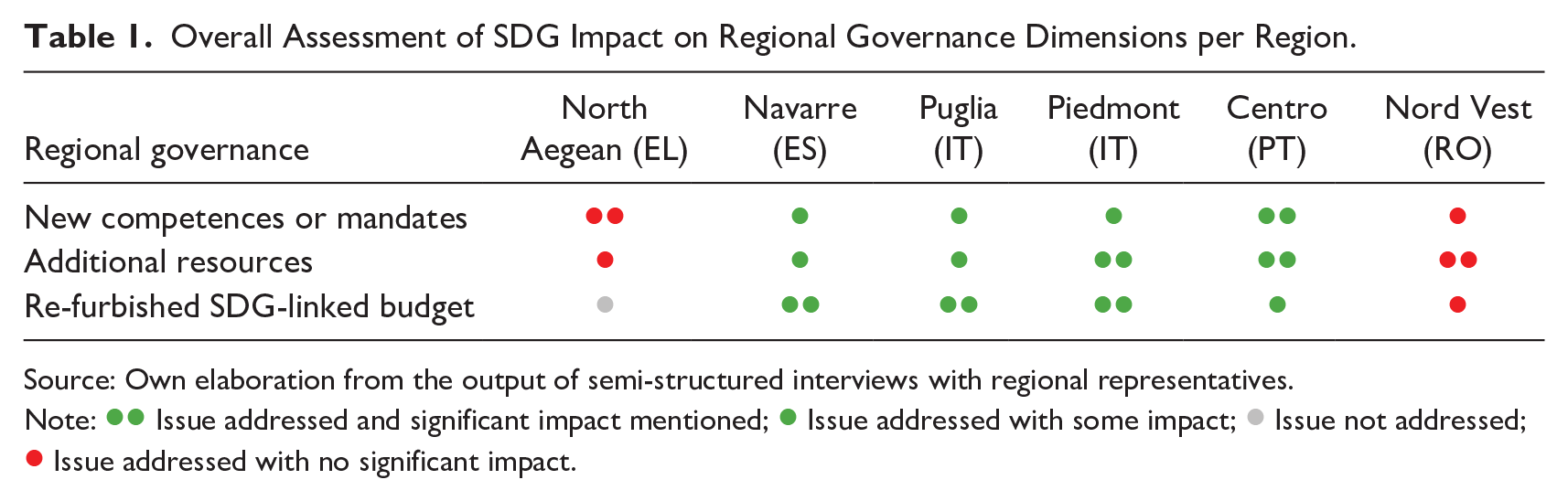
This dimension explores the impact SDGs have had on the organization of regional governance—for example, whether the introduction or the implementation of the Goals have affected the competences with which regional administration have been tasked; new responsibilities have been introduced at the regional level because of the requirement to achieve the SDGs; or new (financial, technical, or human) resources have been allocated to the regional level or their budget re-organized for them to actively contribute to the implementation of the SDGs (Table 1).
Overall Assessment of SDG Impact on Regional Governance Dimensions per Region.
Source: Own elaboration from the output of semi-structured interviews with regional representatives.
Note: 


New Competences or Mandates
Regional administrations involved in this research have generally perceived no noticeable structural governance impact—such as the expansion or upgrade of regional competences and mandates—in a way able to mark a shift in administrative organization before and after the integration of the SDGs at the regional level. Only the Commission for Regional Coordination and Development (Comissão de Coordenação e Desenvolvimento Regional do Centro, CCDRC) of the Portuguese region of Centro 6 has seen its mandates expand significantly since 2024 to streamline the region’s process of SDG localization. Culture, education, conservation, agriculture, and fisheries are now formally part of CCDRC competences. Centro representatives highlighted in their interview that these developments have also been consistent with an “expected improvement in coordination” and “joint work on resource allocation” among various departments within the administration.
Other regions involved in the study report little or no impact of the SDGs on regional governance, either horizontally or vertically. Regions such as Puglia or Piedmont mentioned more cosmetic or secondary impact—for example, additional SDG competences or responsibilities being assigned to those departments or office that were already in charge of conceptually proximate policy fields, such as environmental and/or social sustainability departments. In the North Aegean region in Greece every newly-elected governor’s office develops, at the beginning of the mandate, its own five-year operation plan: this has led to a structural lack of long-term planning that has inevitably affected the ability of the 2030 Agenda to trickle down into the institutional organization of the region. 7 On the other hand, exposure to collaborative frameworks in which North Aegean participated—such as the Regions2030 project—has led to a bigger focus on sustainability and green and circular economy as new guiding criteria for policy planning.
In Romania, the regional tier lacks administrative or political mandates, 8 limiting the ability to implement the SDGs as well as their impact on regional activities. The representative from Nord Vest reported that counties and municipalities have been more active than regions in developing statistical methodologies, indicators, and monitoring tools to assess local SDG impact. Municipalities have also engaged more in vertical relations with the national government and have been more frequently included in national monitoring efforts. While Romanian regions recognize the relevance of SDGs for the regional level, a lack of resources is hindering systematic monitoring efforts such as VLRs. Although national SDG directives have guided regional technical and management plans, it is too early to assess the SDGs’ indirect impact on regional work.
Additional Resources and Re-furbished SD-linked Budgets
Within the group surveyed for this paper, changes in regional budgeting have been the most visible impact of SDG integration in regional governance. Navarre has directly adapted its regional budget’s categories and structure to the SDGs, so that expenditures can more clearly be linked to specific targets. 9 Piedmont has begun a similar process. It plans to overhaul the budgeting structure completely in the next few years, deriving budget categories directly from the SDGs. 10 Since 2019, budget planning in Puglia has been directly linked to the 12 indicators identified by Italy’s Equal and Sustainable Welfare (BES, Benessere Equo e Sostenibile) platform: 11 the BES indicators were originally designed within Italy’s 2030 strategy to provide public governance at all levels with new transversal and diverse metrics for budget and policy planning—less depending on macroeconomic indicators such as GDP and more consistent with societal complexity.
Some interviewees have also mentioned that SDGs have impacted regional budgets also in terms of additional or dedicated funds they receive to implement localization policies. Piedmont subscribed “specific agreements” with the national Ministry for the Environment in 2018, 2019, and 2024, which have guaranteed additional funding for the process leading to the new regional sustainable development strategy—even though specific actions, like the establishment of a Laboratory for Sustainable Development, regarded as a “pivotal development towards the sustainability of policies,” have been funded “by both regional and ministerial resources.” Centro’s CCDRC is also the management authority “for the funds it received from the European Cohesion Fund” and has collaborated with various departments to align their spending powers with “specific criteria . . . to help regional administration align its initiatives” to the targets outlined by the SDGs.
Other regions underscore that SDG localization has had no effect on the amount or type of resources available at the regional level. North Aegean reports no change in ordinary budgeting or funds made available by the national level for SDG localization. Because of the lack of a regional level as an operative tier of governance, Romanian regions have not been assigned any dedicated resources for SDG integration.
Impact on Regional Institutional Design: Innovation, Creation, and De-siloing
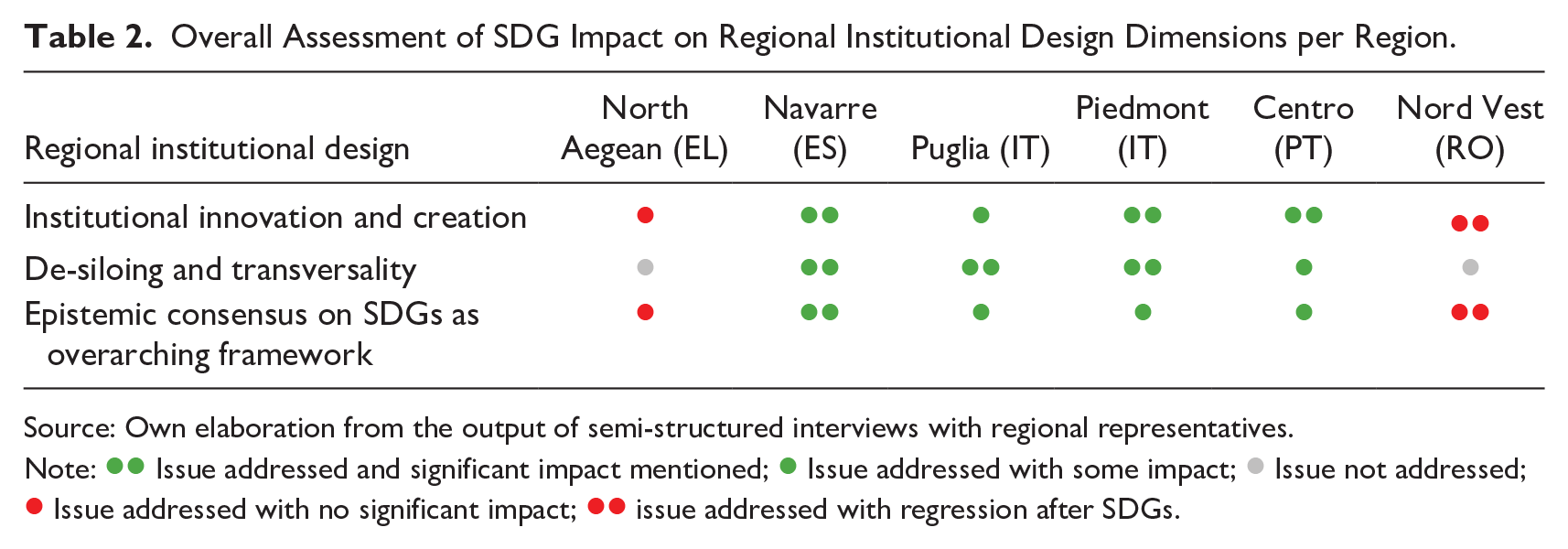
The SDGs’ ability to elicit institutional innovation—new strategies, new policy frameworks, but also new posts, departments, or units—to manage implementation has been one of the more tangible impacts of the Goals on the functioning of regional administrations in Europe. This was visible in the way regions have adapted strategic planning and de-siloed regional institutional design with a focus on decision-making efficiency and administrative optimization (Table 2).
Overall Assessment of SDG Impact on Regional Institutional Design Dimensions per Region.
Source: Own elaboration from the output of semi-structured interviews with regional representatives.
Note: Issue addressed and significant impact mentioned; Issue addressed with some impact;  Issue not addressed; Issue addressed with no significant impact;
  issue addressed with regression after SDGs.
Institutional Innovation and Creation
Piedmont has been working on a Regional Strategy for Sustainable Development (RSSD) since 2022. The RSSD is expected to be the first regional document to link regional policy action to the SDGs and the region’s first formal commitment to integrate the SDGs within the region’s administrative process. The RSSD aims to consolidate policy coherence between Piedmont’s policy planning and Italy’s national sustainable development strategy—with a long-term ambition to make this consistency trickle down to the provincial and municipal levels too.
Puglia, another Italian region, has developed a regional sustainable development strategy since 2019, with direct links to the national strategic framework for the 2030 Agenda: interviewees report that Puglia’s work was initially coordinated directly with Italy’s Ministry for Environment. Supported by national financial aid, regions followed national directives and guidelines to maximize policy coherence in SDG implementation across all levels.
Navarre representatives highlighted how the impact of global policy frameworks can become path-dependent—that is, build on the legacy of previous commitments to streamline compliance with newer ones. Navarre built on previous work on the UN’s Agenda21 action plan 12 to engage more actively with the Local2030 network, 13 and established a Territorial Planning Unit to coordinate localization efforts with Navarrese municipalities—consistent with Navarre’s contribution to the Covenant of Mayors. 14
Ultimately, as for the regional administrations surveyed for this paper, SDG implementation seems to have prompted increased vertical policy coherence and integration between sub-national and national governance tiers. A sort of “variable-geometry approach” seems to be also emerging among some regional governments, which are strategically focusing on sector-specific parts of the 2030 Agenda as politically closer or more relevant to their territorial needs.
De-siloing and Transversality as an Epistemic Framework for the SDG
The design of new sustainable development strategies at the regional level has implied—in several cases—the establishment of new units, offices, or departments within regional administration tasked with setting up these strategies and giving policy continuity to SDG localization plans.
In certain cases, institutional innovation has been noticeable. Navarre’s regional government established a new Directorate General for Public Policy Planning, Coordination, Innovation, and Monitoring within the Presidency office to oversee SDG implementation and integrate the 2030 Agenda into regional policy. In March 2022, the Presidency created an Interdepartmental Commission on Climate Change and Energy Transition, 15 including representatives from each regional directorate and a Social Council of community stakeholders to foster a more holistic and SDG-aligned approach to regional policy-making. Puglia established a department to follow up on its new regional sustainable development strategy. It is coordinated by the Environment unit and includes representatives from 10 departments in topic-driven working groups. In 2015, Piedmont created a Green Economy Unit—integrated into the Environment Directorate-General—as catalyst of SDG policy integration and adaptation. Since 2022, the unit has overseen the RSSD, 16 also via an Inter-Directorate Working Group with representatives from Health, Environment, and Transportation.
Institutional innovation and creation have usually brought along new venues and platforms in which transversal, cross-cutting, and cross-departmental bodies are allowed to work together on SDG-aligned policy from the onset (e.g., Piedmont’s voluntary, flexible, and informal cross-department working groups on specific 2030 Agenda-related issues) down to the actual implementation of policy initiatives (e.g., Puglia’s Gender Agenda in line with the targets of SDG 5). Information collected in the interviews seems to confirm that the opportunity to “de-silo” the workflow—that is, breaking barriers and obstacles to internal cooperation by creating more spaces and (in)formal collaboration venues and being exposed to other units’ priorities and methods—has been one of the more tangible impacts of regional localization of the Goals. This finding is consistent with a recurring topic in literature on SDG-driven “synergies among sectoral policies to overcome silos and fragmentation, because of their interconnected and indivisible nature” (OECD 2020, 9; UCLG and UN-Habitat 2020).
Interviews also highlight that the concept of the SDGs as catalysts of institutional de-siloing is acknowledged in most public administrations involved in the Regions2030 project. Even in the contexts that have reported the least tangible impact of localization on regional governance, exposure to the SDGs has led to some degree of institutional de-siloing or, at least, a more transversal approach to policy-making: representatives of Greece’s North Aegean region mentioned that, even if the SDGs have had no direct impact on institutional organization or innovation in the region, exposure to the SDGs and the participation in networking activities such as the Regions2030 project have increased internal awareness on more collaborative work on SDG-related policy. Representatives report increased departmental collaboration and a tendency to approach regional strategic planning more transversally, with each unit’s agenda cross-fertilizing the priorities of other departments. Awareness of the SDGs’ transversality as a gateway to an open and diverse approach to business-as-usual regional administrative work was also highlighted in the interview with Romania’s Nord Vest. The ability of well-integrated SDGs to overcome bottlenecks and administrative obstacles in favor of a more open and streamlined policy approach seems to have established in the involved regions a growing epistemic consensus on the SDGs’ inevitability as a key framework—one that re-interprets regional policy priorities so that outcomes, initiatives, and decisions are made more consistently across various governance tiers and in a way which resonates with a leading global vision.
Impact on Regional Inclusiveness
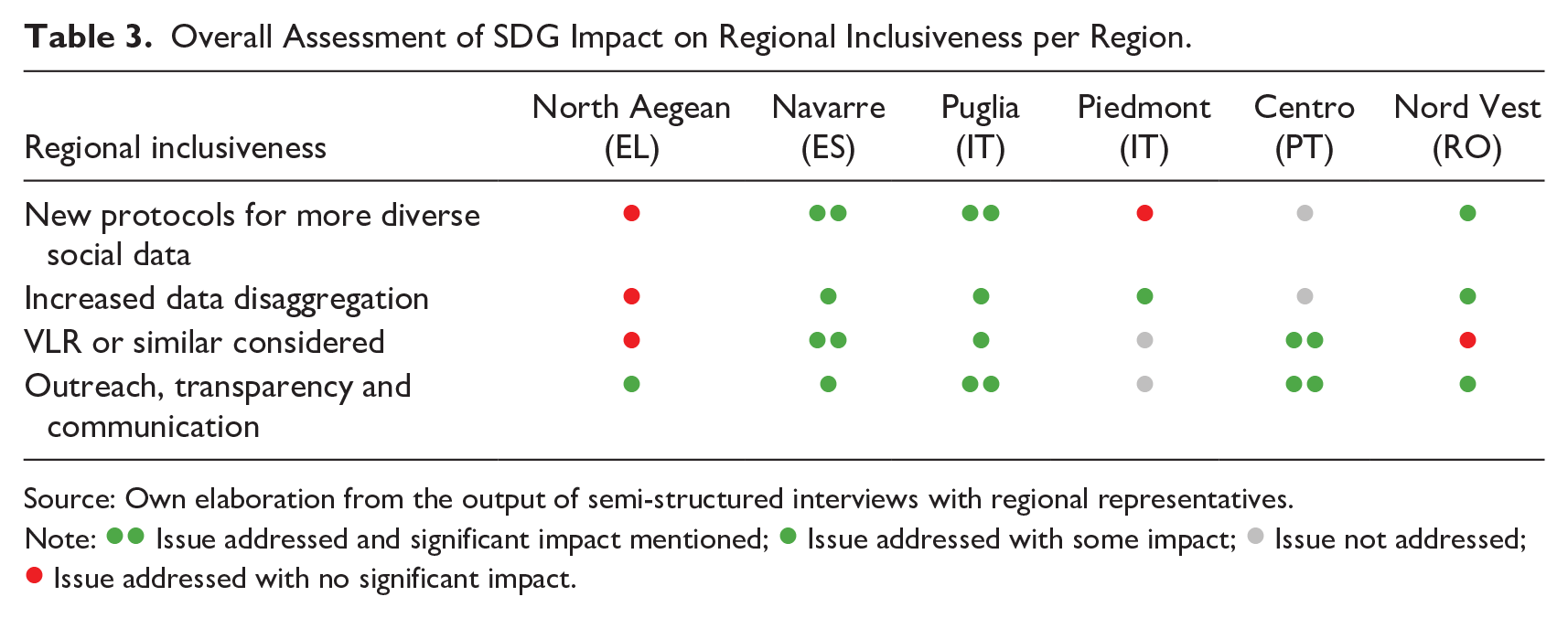
This variable was introduced in the seminal study on national SDG impact (Biermann et al. 2022) to address the impact of inclusiveness-driven SDGs such as SDG 5 on gender equality or SDG 10 on reduced inequalities on national governance. This type of policy competences, however, is usually beyond the scope of regional administrations. The task of tracking advancement on social inclusion or a region’s ability to pursue the principle of “leaving no one behind” is often hindered by regional governments’ reduced powers and resources in this field. Accordingly, on this specific policy dimension interviews stressed the following points (Table 3):
Overall Assessment of SDG Impact on Regional Inclusiveness per Region.
Source: Own elaboration from the output of semi-structured interviews with regional representatives.
Note:
Issue not addressed;
(a) most regional representatives saw a link between the improvement of regional SDG monitoring capacity and the ability to refine the social and inclusiveness dimensions of their strategic planning;
(b) access to more effective information on their communities drove regions to expand their outreach, co-ownership, and social leadership.
New Data Protocols and Increased Data Disaggregation
In their interview, Puglia’s representatives highlighted that the region began integrating the Sustainable Development Goals (SDGs) into its overall policy strategy in 2019. Some of these goals served as catalysts for improved policy intervention on politically relevant topics. In 2020, the region issued its first Gender Agenda, built on the principles and targets of SDG 5. This agenda also addressed other SDG-relevant issues such as welfare, economic equality, and decent work from a gender-aware perspective. The interviewees mentioned that this element of transversality had trickled down from the work on integrating the 2030 Agenda into Puglia’s policy-making. It has been a driving force behind the cross-sector working groups that the region established to improve decision-making.
Work on SDG implementation monitoring helped regional governments enhance their ability to collect, manage, and interpret local data. In their interview, Navarre’s representatives referred to the region’s work with the collective of disabled persons: better data disaggregation raised concerns about the region’s ability to adequately engage with this group and integrate their needs into regional policy decisions. Thanks to the additional information provided by SDG-consistent data and indicators, Navarre was able to tailor policy more closely to the group’s requests, while simultaneously incentivizing participation and policy co-ownership. The interviewees explained that the regional administration began to see that quality indicators, better data management, and policy monitoring could become a lever for improved policy-making across many sectors. As more departments acknowledge that quality data can lead to more efficient policy, they are using the SDGs or their targets more frequently to initiate or support new policy action.
On the other hand, North Aegean’s representatives underscored that while the benefits of new transversal approaches to locally-sourced data are evident, the impulse that SDG implementation can give to more inclusive local policy is not immediately replicable in all regions. North Aegean emphasized that, despite unprecedented exposure to the 2030 Agenda, even policy principles such as leaving no one behind were still internal debate as a viable policy fit with the strategies and priorities of a geographically dispersed archipelago border region. North Aegean—which in 2022 still had the lowest per-capita GDP of all Greek regions, the second-lowest in continental EU at 41% of EU average (Eurostat 2024)—faces severe issues of migration and border security and a history of social fabric tensions, inequality, and economic reliance on affordable tourism. The interviewees pointed out that these principles risk being “lost in translation”: when taken from their global status down to the regional level, the SDGs’ terminology and methods are still perceived as extraneous.
Finally, representatives from Piedmont—a region with a long-standing tradition of policy integration with the 2030 Agenda—emphasized that the region still lacks local instruments such as indicators or guidelines for data management. As a result, inclusiveness policies at the regional level have been dependent on national directives, data, and statistics. So far, the region has introduced national strategies and tools via regional decrees. Most available data still revolves around economic metrics, and there is a lack of instruments to adequately address social complexity and diversity at the regional level.
Outreach, Transparency and Communication at the Regional Level: VLRs and Other Tools
Monitoring SDG implementation at the local level has also been an incentive for regional governments to produce more transparent and publicly accessible information for residents and communities. Some of the regions surveyed for this paper had either completed (Navarre) or planned to carry out (Centro) a VLR at the regional level. North Aegean stressed, on the other hand, that a lack of available financial resources was hindering their region’s capacity to undertake a full monitoring process—as other issues and policy priorities are perceived as more pressing when competing for scarce or unstable funding.
Most regions found that SDG indicators and targets were increasing the amount of information they could obtain and manage about their territory’s cultural and socio-economic status and advancement. This has allowed regional administrations to carry out better engagement and participation initiatives in their communities, with relevant impact of SDG localization on awareness-raising activities, communication, and education.
Centro raised awareness via “dissemination and appropriation of public knowledge on the SDGs” within the regional administration through capacity-building events and training, fostering ownership of the SDG implementation process. The region also worked with education programs in schools on daily SDG-aligned behaviors—school assemblies and gaming activities included “to several concrete proposals on how each person, through everyday actions, can contribute to the implementation of the SDGs and a more sustainable lifestyle”—and supported inter-municipal institutions by providing technical support and a venue for early horizontal cooperation. A key local surveying tool, the Centro of Portugal Barometre, a recurring study “that includes a set of 25 key indicators,” was also updated to align with the SDGs. Puglia reported a similar impact on internal awareness after training civil servants on SDG priority alignment and “overcoming the idea that sustainability is only linked to the environment.” It also promoted regional Guidelines on Sustainability Education for schools, universities, the private sector, and other stakeholders. Navarre worked to focus local communication campaigns—including, among various tools, a touring theatrical show on sustainability—especially on youth.
Interviews highlight how feedback from these initiatives may help improve regional capacities for monitoring and data collection. Collaboration with local university institutions has been key for internal training within North Aegean’s administration and outreach among the local community. Puglia’s representatives point out, however, that “increased awareness does not always translate into better capacities” because of structural lack of statistical resources and knowledge within the administration: current guidelines and toolkits may struggle to encompass the spectrum of SDG impact more transversally. Work on European projects such as Regions2030 has supported regional capacity on localization, but most progress is so recent that it is difficult to measure any impact on how knowledge and information are helping regional governments adapt policies to the SDGs’ diversity.
Nord Vest’s representative mentioned that—as it had happened with other global or supranational frameworks before—the SDGs are at risk of being perceived as additional top-down restrictions imposed by non-legitimate or non-transparent processes, thus discouraging local participation. A lack of “effective transposition, monitoring, and sanctions” hinders regional awareness and implementation. Similar experiences at the region’s level with EU regulations on green energy and environmental protection reinforce this view across regional administration. According to the interviewee, while early results from training, awareness-raising, and collaboration with educational institutions are emerging, the SDGs’ impact on local policy scope remains minimal.
Impact on Regional Ecology
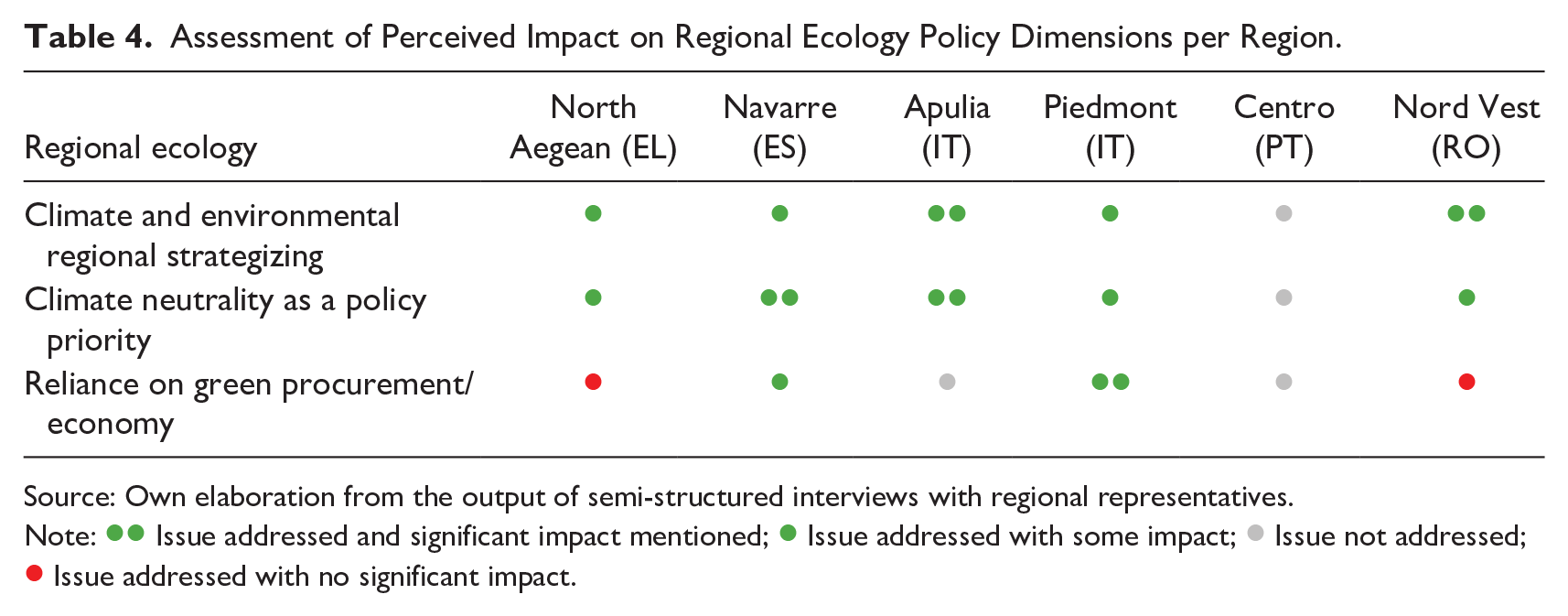
Several of the surveyed regions mentioned that one of the impacts of SDG integration in local policy was the progressive “diversification” of sustainable development policy from the earlier focus on the environmental dimension—especially through increased awareness of social, economic, and cultural aspects. 17 The ecological dimension, however, has remained crucial in regions’ approach to the 2030 Agenda, especially as local and regional governments now “play a key role in the implementation of policies and interventions” that seek “socially and environmentally just cities and territories” (GTF and UCLG 2023, 8; Hoppe and Miedema 2020; Table 4).
Assessment of Perceived Impact on Regional Ecology Policy Dimensions per Region.
Source: Own elaboration from the output of semi-structured interviews with regional representatives.
Note:
Issue not addressed;
Climate and environmental regional strategizing: neutrality as a policy priorityIn their interviews, regional representatives emphasized the importance of climate-aware, neutrality-driven local strategies for policy adaptation. In Puglia, ecological and environmental protection have been crucial due to the significant impact of Taranto’s steel mill complex on local health, environment, quality of life, and socio-economic fabric (Greco 2023; Greco and Chiarello 2016). This legacy has positioned Puglia as a “vanguard of multi-dimensional approaches” to environmental sustainability, although this impact extends beyond regional competences. Puglia’s climate change adaptation strategy builds on the very diverse social impact it is having on the region, the environment, “natural and human resilience, health, job availability . . . and the geographical availability of adequate social responses and empowering initiatives.” The region aims to enhance vertical integration and leverage municipal participation in the Covenant of Mayors to improve dialogue with the regional administration and consolidate stabler financial resources. 18
Environmental issues have been especially sensitive for North Aegean. The archipelago has long held strict environmental regulations, consistent with an established discourse in the region on the impact of ecology measures on tourism, the hospitality industry, and “the region’s reputation” in the country and abroad. Regional representatives highlight that even within the region’s awareness-raising activities on sustainable development, energy and maritime policy were among the issues that raised the most concerns and elicited participation from most stakeholders—including the private sector, youths, and academic partners.
In Romania’s Nord Vest, despite weak institutional support for regional initiatives, the administration is developing a local strategy focused on “energy efficiency, sustainable mobility, and cleaner energy transition.” National recovery and resilience funds have provided local authorities additional resources to implement these plans. Nord Vest’s interviewee noted that advertising environmental protection and climate mitigation policies as market or funding opportunities has been more effective than promoting them as a value-driven process consistent with European and global standards. Linking these opportunities to the SDGs might in fact have hindered the effectiveness of the policy plan, that is, a sort of negative impact for the SDGs on local policy.
Navarre’s regional sustainable development strategy puts the focus on the environmental dimension, as three of the strategy’s six core priorities address climate change, green economy, and energy transition. In 2020, Piedmont’s government approved a set of formal guidelines for the establishment of the first Regional Strategy on Climate Change (RSCC).
19
As explained by the region’s representatives, the current draft already: [. . .] includes instructions on how to meet the climate goals (towards which the EU budget requires to earmark 30% of the total investments) and steer regional activities towards green and sustainable investments contributing to the Green Deal and in line with the Do No Significant Harm principle.
Reliance on Green Procurement as Economic Lever for Sustainability Policy
Besides budget adaptations, tools like green procurement and fiscal incentives have been an affordable and easily available level for local (and regional) governments to achieve tangible results consistent with the requirements of SDG targets.
Green procurement guidelines and practices in Italy are still defined at the national level. Piedmont has “delivered specific training for regional staff, focusing on the procedures and the obligations to comply with”—a process which has been technically complex but also largely supported throughout the regional administration. A similar structure has affected implementation in North Aegean, as green procurement at the regional level has been “less effective” in the application of the roadmaps developed by the central government.
In Navarre, green procurement has been mandatory for years, incorporating social and environmental clauses in tenders and contracts. The region has effectively used regional Sustainability Bonds to fund sustainable development, environmental protection, and a greener economy through local and international lenders. 20 In contrast, the representative from Nord Vest noted that, in their region, green procurement and sustainability-related funds have primarily served as financial levers for market competitiveness and fiscal benefits. While other regions adopt these initiatives as consistent with the values of the 2030 Agenda and the SDGs, stakeholders in Nord Vest have approached them more as market opportunities and potential regulatory loopholes.
Conclusions
Policy discourse on the SDGs and their implementation at the regional level can be a valuable indicator of the impact that the Goals have had on how certain regional administrations are working, strategizing, and defining their policy priorities. This paper explores this impact on four key dimensions of regional government and agency: regional governance; regional institutional design; regional inclusiveness; and regional ecology. It analyses the contents of interviews with representatives from a group of six regional governments that had collaborated in the European Commission’s Joint Research Centre’s Regions2030 project, providing first-hand information and insight on the impact that SDG adaptation had on these selected dimensions of policy action and strategy at the regional level.
Interviews highlighted that the impact of SDG introduction at the regional level has been more visible in non-structural adaptation via cross-departmental working groups, re-branded budget organization, and the re-framing of existing competences via SDG-compatible terminology, rather than through a more profound transformation of administrative processes, hierarchies, or budget and resource distribution.
Most interviewees acknowledge that SDGs have impacted regional institutional design by incentivizing work on local sustainability policies—especially in the form of better local-national coordination and internal de-siloing, with more transversal and cross-sector units within regional government. Interviewees report that SDG introduction has streamlined data collection and management capacities at the regional level, with positive impact on the ability to tailor regional action to specific policy agendas, such as gender equality and social inclusiveness. For the most part, however, interviews highlight that environmental policy and climate change adaptation and mitigation are still the key lever for regional governments to engage with sustainability policy in general and the SDG framework in particular. Many of the surveyed regional contexts show higher policy coherence between climate-driven SDGs and pre-existing sustainability framework at the regional level.
The key takeaway of this paper is that the impact of the SDGs on policy design and institutional governance at the regional level appears to be still technical and politically instrumental. Elements of shared strategic alignment, however, point to the emergence of the SDGs as a common paradigm for a transversal approach to sustainability—at least in a group such as the one that participated in the interviews, that is, a group of regional governments familiar with the SDGs and with a track-record of collaboration, exchange, and proactiveness at a more international level.
Affordable and politically neutral measures such as budget re-structuring and awareness-driven mobilization have been popular and effective even beyond regional differences or disparities. Only a few regions from the sample (Puglia, Navarre, and Centro) have more openly framed the SDGs as a strategic opportunity to enhance regional agency, a source of empowerment for institutional innovation, and a window of opportunity for centralization of competences and resources at the regional level. Other regions have emphasized the impact of the SDGs as a source of policy coherence that is streamlining political and financial relationships with the national level or increasing regional leadership as a supra-municipal tier. SDG impact seems to be still deeply linked to available (economic and technical) resources and to the degree of autonomy that a region is granted within its governance system. Guidance and institutional support by global institutions has been a catalyst of participation. Qualitative evidence suggests that, in the European context, growing mobilization of regional governments via EU-wide initiatives and funds is going to be crucial to make the SDGs more impactful on policy and commitment.
Findings also show that there is significant potential for additional research on the topic of SDG impact on the functioning and design of regional governance. Discursive approaches work reliably to collect first-hand information and an insider appreciation from the individuals involved in the regional policy process, but:
(a) a larger N of interviewees would be essential to broaden the spectrum of the analysis and more confidently infer conclusions about the SDGs’ impact on regional governance;
(b) a population less familiar or involved with the SDG adaptation and implementation frameworks should also be involved, to assess whether the SDGs are able to have an impact even when regional institutions have a lesser commitment to the SDGs and the 2030 Agenda as a global policy paradigm.
Footnotes
Appendix 1
Data Availability Statement
Data sharing not applicable to this article as no datasets were generated or analyzed during the current study.
Declaration of Conflicting Interests
The author(s) declared no potential conflicts of interest with respect to the research, authorship, and/or publication of this article.
Funding
The author(s) received no financial support for the research, authorship, and/or publication of this article.
