




Abstract
Over the past decade the partisan divide over environmental issues has widened significantly. Although attitudes toward climate change and other environmental policy issues have become highly polarized, it is possible that personal geography may moderate partisan attitudes. This study considers whether residing in coastal Virginia influences attitudes on environmental issues among Virginians. To test this question, we survey Virginia registered voters on a range of coastal environmental issues and consider whether place of residence has an effect on these attitudes when accounting for other factors including partisanship. We find a significant relationship between place of residence and a wide range of environmental issue attitudes, though the impact of partisanship is moderated in only limited cases. This research builds on the policy process literature concerning individual proximity to policy problems, place-attachment, and the relationship between partisanship and state environmental policy attitudes.
Introduction
According to the well-known phrase (usually attributed to former Speaker of the House Tip O’Neill), “all politics is local.” But when it comes to environmental issues, studies have found that public opinion in the United States has become both partisan and national, particularly since the early 1990s (Guber 2013; Kim and Urpelainen 2018; McCright, Xiao, and Dunlap 2014). Recent survey data from the Pew Research Center shows fairly wide gaps between Republicans and Democrats concerning whether the government is doing enough to protect waterways, address climate change, and preserve natural spaces (Pew Research Center 2018). In addition, there is a long line of literature demonstrating that partisanship is a strong predictor of individual opinions about the environment (Daniels et al. 2012; Kim and Urpelainen 2018; Konisky, Milyo, and Richardson 2008; Van Boven, Ehret, and Sherman 2018), and that those opinions may also affect environmental policy decisions by elected officials (Bromley-Trujillo and Poe 2020; Fowler 2016; Johnson, Brace, and Arceneaux 2005).
Despite these fairly large partisan differences, the literature provides some evidence that proximity to policy problems can alter risk perceptions and concern over environmental issues (Adeola 2000; Bickerstaff and Walker 2001; Brody, Highfield, and Alston 2004; Marshall et al. 2007). More specifically, individuals who reside in areas experiencing negative impacts from environmental hazards (or who perceive this risk) may be less likely to exhibit politically polarized attitudes and more likely to evince concern for the environment. This association with place, risk perception, and environmental attitudes may also relate to the concept of place attachment, which is broadly defined as a psychological bond with place that can occur where someone lives or locations that individuals have visited (Brown, Perkins, and Brown 2003; Devine-Wright 2013; Feitelson 1991).
Literature on the role of place, environmental risk and attitudes yields mixed results with some providing evidence that proximity to environmental externalities influences attitudes and risk perception (e.g., Adeola 2000; Bergquist and Warshaw 2019; Johnson, Brace, and Arceneaux 2005; Marshall et al. 2007) while others find no such evidence (e.g., Boudet et al. 2014; Javeline, Kijewski-Correa, and Chester 2019; Spence et al. 2011). As such, we proceed with an empirical test of two open research questions to which the current literature provides mixed results. First, does place exert an independent effect on environmental attitudes? Second, does place moderate partisan attitudes about environmental issues?
We test these research questions using a survey of Virginia registered voters over a set of environmental issues that have a particular place-based component associated with living in close proximity to the Atlantic coast or Chesapeake Bay, including (1) rising sea levels, (2) fracking in coastal areas, (3) the health of the Chesapeake Bay, and (4) offshore drilling. The commonwealth of Virginia is an ideal test case because of its varied geography, where some residents of the state are far more likely to experience environmental effects associated with coastal environmental issues while others are much less likely. For instance, individuals living in cities or counties adjacent to the Atlantic Ocean and/or around the Chesapeake Bay are beginning to see increased flooding and other effects of sea-level rise, while localities outside of these areas are further removed from these considerations.
We proceed as follows: after discussing the evolution of partisan effects on environmental attitudes in the United States and the potential influence of proximity, place attachment, and risk perception to those attitudes, we present results from an original survey of Virginia registered voters. We find that partisanship has significant and independent effects across attitudes on both the importance of environmental issues and environmental policy preferences associated with coastally relevant issues. Personal geography demonstrates an independent effect on a portion of the environmental issues considered here. Further, residing in coastal Virginia only moderates Republican partisanship on the importance of sea level rise and attitudes on coastal fracking. These findings suggest that the characteristics of policy issues, such as issue salience, may also be relevant to the relationship between place and environmental att-itudes.
Environmental Attitudes in the United States
Historical examinations of environmental attitudes and policy indicate that these issues can be bipartisan; in fact, a great deal of major national environmental legislation was passed by Re-publican presidents, such as Richard Nixon (Ruckelshaus 1985). Despite this, there has been a growing divergence between partisans over the last two decades with Democrats and Republicans moving apart on support for environmental policies and concern over environmental issues (Fowler and Kettler 2021; Guber 2013; Kim and Urpelainen 2018; McCright, Xiao, and Dunlap 2014). In general, Democrats and independents show stronger concern for the environment than Republicans (Daniels et al. 2012; Dunlap and McCright 2008; Howe et al. 2015). Moreover, a large number of recent studies on environmental public opinion in the U.S. find that partisanship is the strongest predictor of attitudes, perhaps driven by elite cues (Guber 2013; McCright, Xiao, and Dunlap 2014; Hamilton and Saito 2015; Bernauer and McGrath 2016; Kim and Urpelainen 2018; Van Boven, Ehret, and Sherman 2018).
On the issue of climate change, partisan divergence is particularly high. In a 1997 Gallup poll, 52% of self-identified Democrats and 48% of self-identified Republicans indicated that they believed the effects of climate change had already begun; by 2015, the partisan gap had increased to 75% of Democrats and only 34% of Republicans. More recent surveys suggest that polarization on this issue remains high with 40% of conservative Republicans indicating that global warming is happening compared to 97% of liberal Democrats. Moreover, 23% of conservative Republicans said they were personally worried about global warming compared to 90% of liberal Democrats (Ballew et al. 2019).
There are also wide gaps between Democrats and Republicans on whether or not climate change is caused by humans and whether climate change will pose a threat to individual livelihoods in their lifetimes (Dunlap, McCright, and Yarosh 2016). Across multiple questions posed, Democrats tend to be more concerned with and supportive of action to address climate change (Ballew et al. 2019; Howe et al. 2015). Ehret, Sparks, and Sherman (2017) note that this phenomenon is largely driven by elite cues: political elites on the left and right have diverged significantly on environmental attitudes. While the Democratic Party coalition incorporates environmental interest groups and activists, the Republican Party includes groups that are generally anti-regulatory (Grossmann and Dom-inguez 2009).
Place, Environmental Conditions, and Risk Perception
Though partisanship is a strong predictor of individual attitudes about the environment, these beliefs may be influenced by factors associated with place attachment, perceived risks of environmental hazards, direct experience with negative environmental conditions, and potential economic benefits from related industries (Devine-Wright 2013; Johnson, Brace, and Arceneaux 2005; Visschers and Siegrist 2013).
Scholars across several disciplines including psychology, geography, and environmental psychology find a role for place attachment in association with pro-environmental behaviors (Scan-nell and Gifford 2010), perceptions of environmental risk (Marshall et al. 2007), and support or opposition to environmental projects such as the siting of wind farms and other renewable energy projects (Devine-Wright 2005, 2009).
For purposes of this study, place attachment can play out in a multitude of ways. First, climate change and other coastal environmental maladies that have salient and clear local implications may make individuals wary of the potential changes to their valued community, leading to increased importance placed on the issue and higher support for mitigation and adaptation policies. This argument can be connected theoretically to several lines of research. For example, Hess, Malilay, and Parkinson (2008) argue that climate change effects are often place-specific. Moreover, Twi-gger-Ross and Uzzell (1996) indicate that individuals can perceive threats to their place identity, when place attachment is high. In this case, climate change or other coastal environmental problems can threaten place identity, causing emotional responses akin to trauma (Fullilove 1996). Further, Spence and Pidgeon (2010) find that framing climate impacts as spatially local can raise concern over climate change. Still, place attachment can also result in opposition to renewable energy projects that threaten the character of a community (Devine-Wright 2005); however, if these projects fit within community values and are framed as such, individuals may be more supportive (Devine-Wright 2009).
A related concept that has place-based connotations is risk perception, which is commonly defined as expectations about the likelihood of an adverse event (O’Connor, Bard, and Fisher 1999). Risk perceptions are often affected by direct exposure to adverse environmental conditions (e.g., Lujala, Lein, and Rød 2015) or the belief that these conditions may occur. Place attachment and risk perception can be heavily intertwined as strong place attachment may make individuals particularly wary of risk, which may provoke an emotional response.
Risk perception is also heavily influenced by proximity to potential hazards. In some instances, being proximate to certain conditions impacts awareness of policy issues that translate to increased understanding of risk. Adeola (2000) finds that environmental attitudes are shaped by proximity to landfills on the National Priority List. Similarly, Bickerstaff and Walker (2001) find that individuals living near polluting industries tend to be more aware of air pollution and thus associate a higher level of risk with those industries. Johnson, Brace, and Arceneaux (2005) show that higher levels of water pollution where individuals reside increases support for environmental protection. Moreover, Brody, Highfield, and Alston (2004) find that individuals that live in closer proximity to water bodies have higher risk perceptions associated with water quality. On the issue of climate change, some scholars find a relationship between exposure to negative externalities associated with climate change and environmental attitudes. More specifically, scholars find greater risk perceptions when individuals live proximate to the coast or experience natural disasters commonly associated with climate change (Bergquist and Warshaw 2019; Brody et al. 2008; Spence et al. 2011).
Another important aspect of both place attachment and risk perception is issue salience, which refers to the level of importance and concern given to a policy issue (Bromley-Trujillo and Poe 2020; Wlezien 2005). In some instances, place may increase the desire to address environmental issues by raising the salience of environmental hazards or risk, and by provoking an emotional response related to avoiding significant environmental harm to a community that individuals have strong attachments to (Adeola 2000; Inglehart 1995; Johnson, Brace, and Arceneaux 2005; Twigger-Ross and Uzzell 1996). Still, some environmental issues are more readily observable than others, and/or are more heavily discussed by the media and political elites, which produces variation in salience. This suggests that place-based considerations may be more relevant for high-salience issues.
Despite the potential for a relationship between personal geography and attitudes, a considerable portion of the literature finds mixed results for the impact of geographic location and environmental conditions on environmental attitudes. Brody, Peck, and Highfield (2004) find that living in poor air quality areas in Houston and Dallas has no impact on perceptions of air quality risk. Spence et al. (2011) find no effect for proximity to the coast or experience with hurricanes on climate risk perceptions. Javeline and Kijewski-Correa (2019) and Javeline, Kijewski-Correa, and Chester 2019) find little to no evidence that knowledge of climate change’s effects, or proximity to predicted water impacts of climate change affect homeowners’ intentions to reduce their vulnerability. Relatedly, Konisky, Hughes, and Kaylor (2016), find that direct experience with climate effects only shifts attitudes temporarily. In addition, place attachment may not always be a local phenomenon. Research suggests that individuals also have place attachments to larger regions, countries and continents (Laczko 2005). Massey (2005) and Devine-Wright (2013) point out that individuals can have a global attachment that raises the concern of climate change. As such, local considerations may play a smaller role in attitudes.
In relation to fracking, Boudet et al. (2014) find no regional effects on fracking attitudes; however, the authors note that a more nuanced examination of geographic location may find different results. Other surveys show some evidence that a plurality of people living in areas where fracking occurs are supportive of its practice, likely due to perceived or real economic benefits (Rabe and Borick 2011). Relatedly, occupational identity may play a role; Marshall et al. (2007) argue that fears associated with occupational loss associated with a particular industry can shape attitudes. National surveys indicate some regional differences across the nation, with individuals in the Northeast and West being generally less supportive of fracking (Pew Research Center 2014; Vedlitz 2012); however, these differences may have little to do with place and more to do with partisanship and ideology. Given the mixed nature of these findings, further study is warranted.
The literature on place attachment, environmental risk perceptions, and partisanship leads us to competing hypotheses. On the one hand we might expect people living in coastal adjacent areas to show greater concern over sea level rise and other coastal environmental issues. The potential impacts of sea level rise for coastal residents include stronger storms, increased flooding, and increased damage from wind, all of which are easily observable (Javeline, Dolsak, and Prakash 2019). Living in close geographic proximity to a potential environmental hazard is likely to raise perceptions of risk and may influence policy attitudes. Moreover, if individuals have high place attachment, concern over changes to their community due to environmental hazards may also shift attitudes (Devine-Wright 2013). These arguments suggest that environmental attitudes should vary when comparing Virginians that live in close proximity to the coast to those who do not, due to the potential for high levels of perceived risk and the potential for an emotional response associated with place attachment.
On the other hand, it may be that people take their cues from partisan elites, which may nullify any place-based considerations. This is the argument of the ideological-consistency model (Ehret, Sparks, and Sherman 2017; Van Boven, Ehret, and Sherman 2018). For example, residents of Tangier Island, Virginia, who vote overwhelmingly Republi-can, disagree that man-made climate change is to blame for the rising Chesapeake Bay, which threatens to overwhelm the small community in the next 50 years (Portnoy 2017). In such a case, there would be no differences by place on the environmental attitudes of partisans, even if they are of local interest. As such, the expectation would be that residing in a city proximate to the coast would have no impact on pro-environmental attitudes, particularly for Republicans who, on average, espouse less environmental concern (Dunlap, McCright, and Yarosh 2016). Our research design allows us to test these competing expectations.
Data and Methods
We test our research questions with public opinion data collected on 815 Virginia registered voters, fielded Jan. 20th–Feb. 12, 2017. Int-erviews were conducted by trained callers at the Wason Center for Civic Leadership at Christopher Newport University using random digit dialing of landlines and cell phones. The response rate for the survey was 18%. The margin of error for the survey is +/− 3.7%, which accounts for the survey’s design effect of 1.2. The data are weighted by region, age, race and sex, to reflect the population of Virginia’s registered voters. Parameters for the survey weights come from the U.S. Census and the American Community Survey. Mean age for the sample is 55.8 (SD = 15.97), and the sample is 53% women and 12% Black. The median education level is a bachelor’s degree, and median household income is $75,000–$99,999. The sample is 44% Democrat, 41% Republican, and 15% independent.
Our dependent variables fall into two general categories associated with issue importance and policy preferences. More specifically, respondents are asked about the importance of rising sea levels, coastal fracking, off-shore drilling, and the health of the Chesapeake Bay taken from the following survey question: “I’m going to describe several environmental issues facing Virginia and would like to know how important you think each one is. For each issue, please tell me whether you think it is. . . . .”
1. Very important
2. Somewhat important
3. Not too important
4. Not important at all
A. Health of the Chesapeake Bay
B. Sea level rise
C. Fracking for natural gas in coastal areas
D. Offshore oil and gas drilling
Measures of issue importance were recorded on a 4-point scale and coded such that 0 indicates the issue is “not important at all” and 3 indicates the issue is “very important.”
Our policy preference dependent variables are associated with banning off-shore drilling, prioritizing the health of the Chesapeake Bay, and allowing coastal fracking, and are taken from the following question: “I’m going to mention some specific policies that may affect the environmental health of Virginia, and for each one please tell me if you strongly support, somewhat support, somewhat oppose, or strongly oppose the policy.”
A. Placing a priority on the cleanup of the Chesapeake Bay and its associated rivers and streams
B. A ban on offshore oil and gas drilling
C. Allow fracking for natural gas in the coastal region of Virginia
Measures of policy support were also recorded on a 4-point scale and coded such that 0 indicates “strongly oppose” and 3 indicates “strongly support.”
Our dependent variables aim to capture both importance and policy preferences given that the two are likely linked, but not identical. The potential exists for respondents to believe an issue is important, yet not support specific policy proposals to address it. Findings in the literature show divergent reactions when comparing concern to policy support across a range of environmental issue areas (McCright et al. 2016). One potential reason for this variance relates to trust in government. For instance, while individuals may show concern over a policy issue, they may distrust the governments’ ability to carry those policies out (Faccioli et al. 2020; Fairbrother 2017; Konisky 2018). In addition, individuals may be supportive of policies to address an issue, but not find the issue particularly important at a given time.
In addition to the broad categorization of our dependent variables, we also aim to capture a range of environmental issues that are associated with the coast, given the potential for nuance based on issue salience, level of issue polarization, direct observability and experience, and associated risk perceptions. Rising sea levels is of direct local concern and is already being experienced by residents that are coastally adjacent. Coastal fracking 1 and offshore drilling are not currently done in Virginia so involve future assessments that relate to place-based considerations around environmental impacts and jobs. The health of the Chesapeake Bay is a long-standing concern of coastal Virginians, though many of the effects are relatively less observable than the other policies we include. Moreover, concerns over the Chesapeake Bay tend to be less polarized.
Our primary independent variables of interest capture the key aspects of our research questions associated with personal geography and partisan and ideological leanings. More specifically, we include a dichotomous variable for whether respondents live in a coastal adjacent county or city (coded 1 if yes and 0 if no). This includes those living in localities along the Chesapeake Bay, or the Eastern Shore and the Hampton Roads region of Virginia, which is adjacent to the Atlantic Ocean, Chesapeake Bay, and/or the James and York Rivers that feed into the Bay. Hampton Roads includes the cities of Norfolk, Virginia Beach, Newport News, Hampton, Chesapeake, Portsmouth, Poquoson and Williamsburg, and the counties of York, Isle of Wight and James City County. These localities all reside along major rivers, bays, or oceanfront that are likely to have direct experiences with coastal environmental maladies.
Partisanship is central to our research question and is captured in two dummy variables—identification with the Republican Party, coded 1 if yes and 0 if no, and identification as an independent, which is coded the same way. Democrats are the baseline category, which allows for easy comparison with Republicans. We also include a measure of conservatism, coded on a 6-point ascending scale.
We include several demographic control variables used in previous research on environmental attitudes including age (measured in years), income (captured with a 6-point ascending scale), education (captured on a 5-point ascending scale), gender (coded 1 if the respondent identifies as a woman and 0 otherwise), ethnicity (coded 1 if Hispanic and 0 otherwise), and race (coded 1 if the respondent identified as Black and 0 otherwise).
Prior research on environmental attitudes most commonly finds that younger individuals show greater levels of environmental concern (Jones and Dunlap 1992; McCright et al. 2016). Despite this, findings on the relationship between age and support for specific environmental policies varies, with some studies showing a positive relationship and others showing no relationship (McCright et al. 2016).
Studies on gender and environmental attitudes are fairly consistent; women, on average, show more concern over environmental issues than men, consistent with gender socialization theory. This theory argues that women are typically socialized to be more empathetic and nurturing, which is reflected in their environmental concern (McCright et al. 2016; Xiao and McCright 2012). Given the predominant findings just described, we anticipate a negative association between age and the importance of various environmental policy issues, indicating that as age increases, the level of importance over environmental issues decreases. Given the coding of gender, this association should also be negative (female is the comparison category), with women showing greater environmental concern and support for environmental policies than men.
Scholarly evidence is decidedly mixed on the effects of race, ethnicity, education, and income on environmental attitudes. Studies find differential effects depending on the environmental issue under consideration, and/or whether the question refers to concern, environmental spending, environmental policy, or environmental behaviors (Borick and Lachapelle 2022; Daniels et al. 2012). In addition, there is some evidence that education has differential impacts on Republicans and Democrats when it comes to concern over climate change; education has a positive relationship with concern for Democrats, but not for Republicans in some studies (Hamilton 2011). As such, we believe these variables are important to include as controls, though we are agnostic in our expectations.
We rely on linear models fit with OLS to test our hypotheses, and we do so due to their simplicity, ease of interpretation, and robustness to misspecification (Angrist and Pischke 2009, 94–107). We also demonstrate that our results are consistent if we instead use ordered logit models fit with maximum likelihood estimation (see Appendix 1).
Descriptive Findings
Consistent with past research, descriptive statistics from our survey data reveal sharp partisan divisions between Republicans and De-mocrats in Virginia on several of these environmental issues. However, it should be noted that on many environmental issues Republicans demonstrate majority support. For instance there is robust agreement between partisans on the importance of cleaning up the Chesapeake Bay. Nevertheless, as shown in Figure 1, Democrats are more likely to see environmental issues as important and are more supportive of laws aimed at protecting the environment. Independents fall between Democrats and Republicans on both issue importance and policy support across these issues. While it is quite clear that partisanship shares a relationship with these attitudes, questions still remain about whether personal geography also plays an important role and whether it moderates the relationship between partisanship and environmental attitudes.
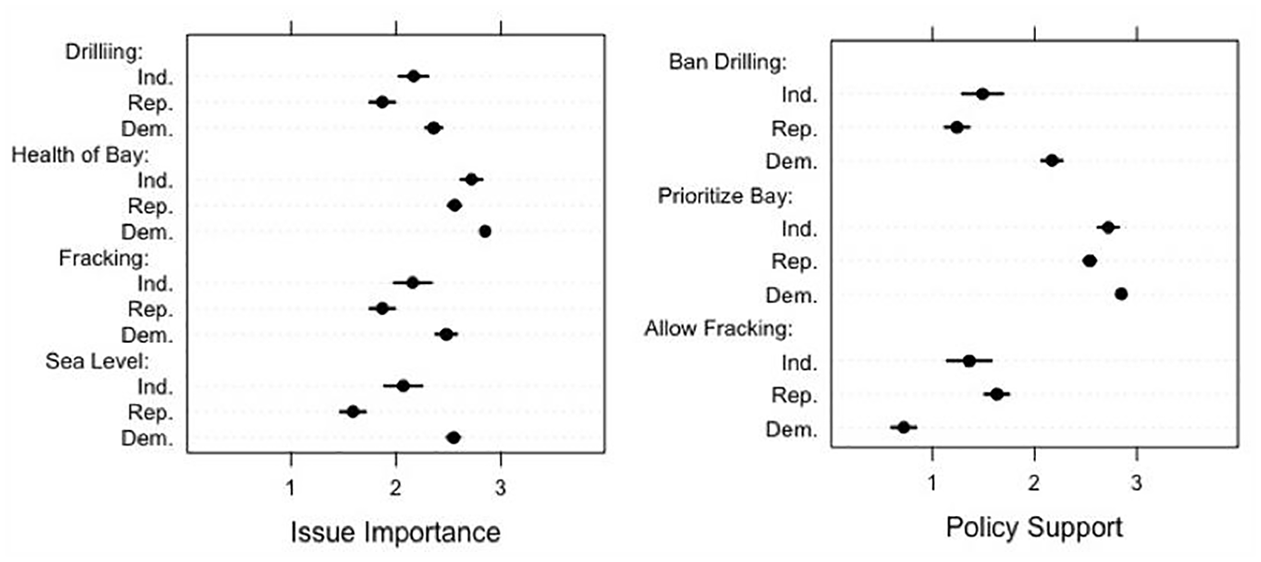
Partisan differences in issue importance and policy support.
Results
To what extent are Virginians’ environmental attitudes driven by partisanship, and does personal geography play a role? Results of the models in which issue importance is the dependent variable are reported in Table 1. 2 First, one of four coefficients on the coastal variable registers as significant, indicating that on the issue of sea level rise, living in proximity to the coast raises the importance of that issue for individuals. Additionally, Republicans attribute less importance than Democrats to all four issues while independents attribute less importance than Democrats to rising sea levels. Conservatism also shares a significant relationship with all four dependent variables such that more conservative respondents tend to attribute less importance to these issues. Finally, gender has a consistent relationship with all four dependent variables, such that women, on average, attribute more importance to these environmental issues. Results of an ordered logit model, which serve as a robustness check, are reported in Appendix 1 (Table A1). Substantive conclusions do not change.
Regression Results (Importance of Issue).
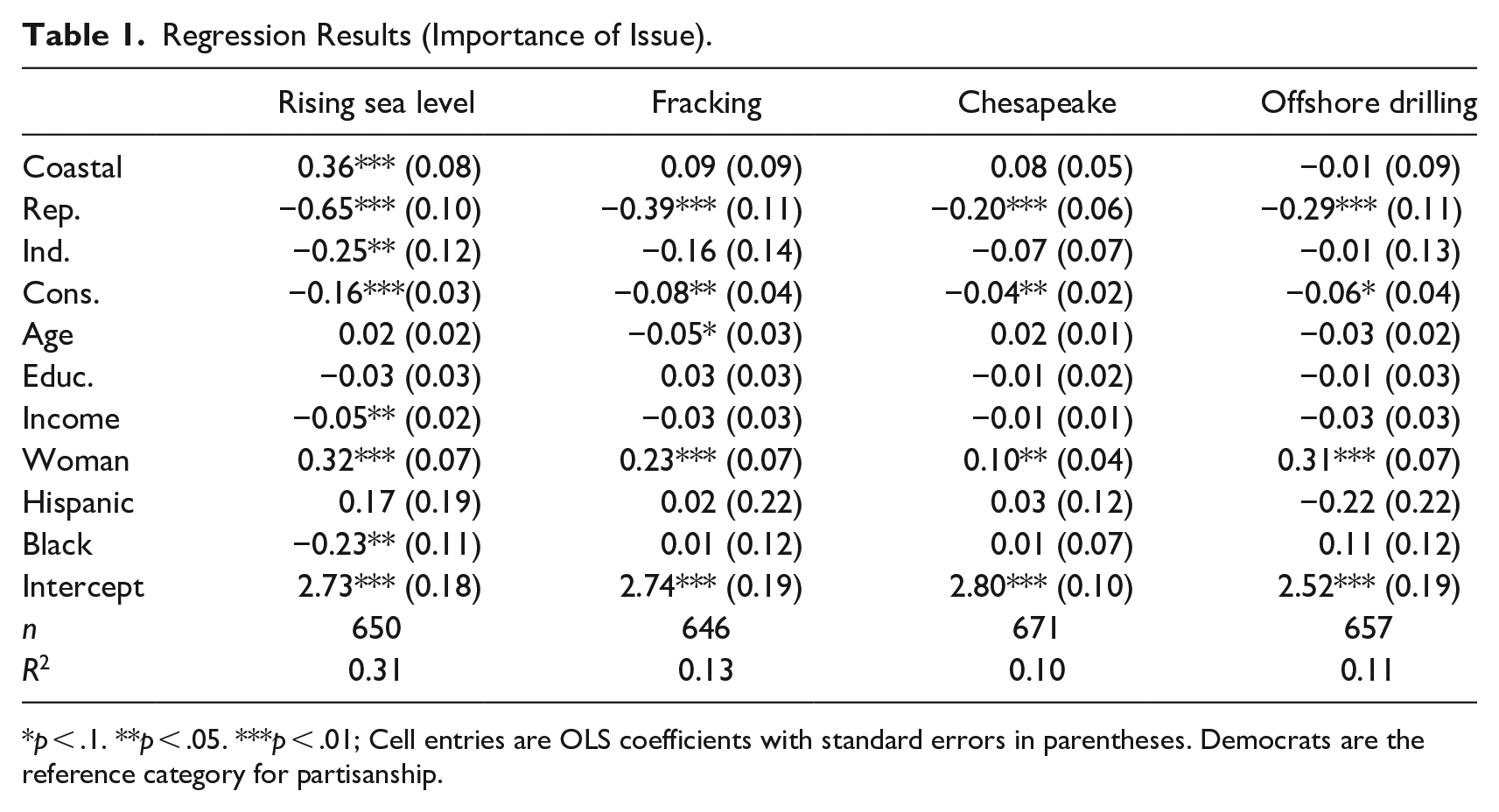
p < .1. **p < .05. ***p < .01; Cell entries are OLS coefficients with standard errors in parentheses. Democrats are the reference category for partisanship.
The results of the policy support models are reported in Table 2. The results suggest that residents in coastal areas evaluate some policies differently than others, even when controlling for partisanship and other factors. More specifically, in two of three models (where dependent variables are prioritizing the health of the Chesapeake Bay and banning off-shore drilling), regression coefficients are significant and positive, indicating that coastal residents have more pro-environmental preferences on these issues than individuals in other parts of the state. Identification as Republican and independent also play important roles in these models, with Republicans (in all three models) and independents (in two of three models) demonstrating more conservative policy preferences than Democrats. Conservatism is again an important factor—in all three models; increased conservatism is associated with more conservative or anti-regulatory policy preferences. Finally, gender again plays an important role—in two of three models (prioritizing the Chesapeake and banning off-shore drilling) women have more environmentally friendly policy preferences than men. We again fit an ordered logit model as a robustness check (see Table A2). Substantive conclusions do not change.
Regression Results (Policy Support).
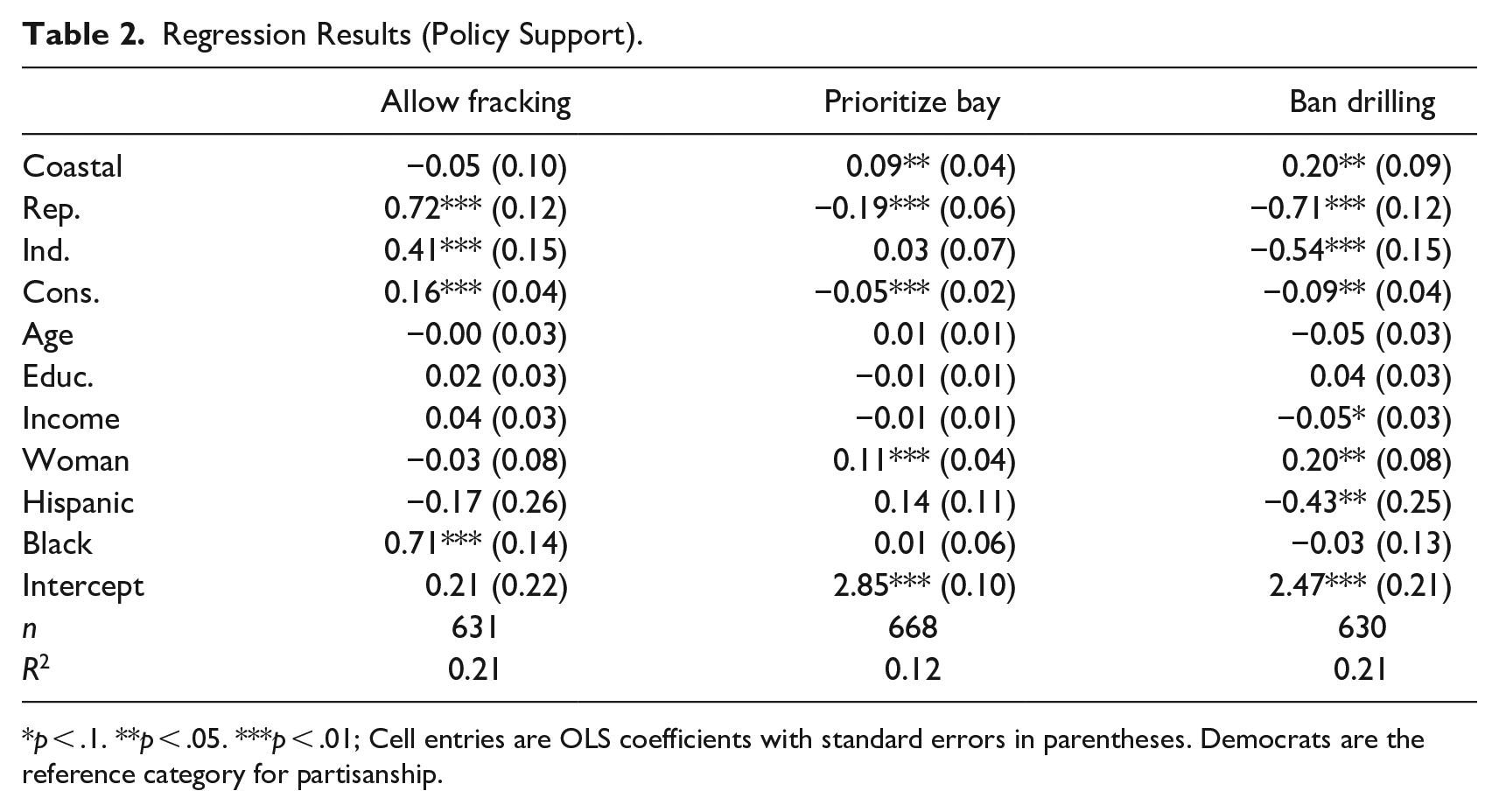
p < .1. **p < .05. ***p < .01; Cell entries are OLS coefficients with standard errors in parentheses. Democrats are the reference category for partisanship.
Next, we consider whether personal geography moderates partisans’ environmental attitudes by looking at the interactions between Republican, Democrat and independent identification and coastal personal geography. The results are presented in Table 3 (and marginal effects plots are shown in Figure 2). Here one finding stands out: coastal Republicans place significantly more importance on the issue of rising sea levels than non-coastal Republicans, though there is no difference for the fracking, Chesapeake Bay and offshore drilling dependent variables (Table A3 shows results of an ordered logit model, which is used as a robustness check –substantive conclusions do not change). Personal geography does not moderate the relationship between identification as an independent, or Democrat for issue importance across all three issues. 3
Regression Results, with Interactions (Importance of Issue).
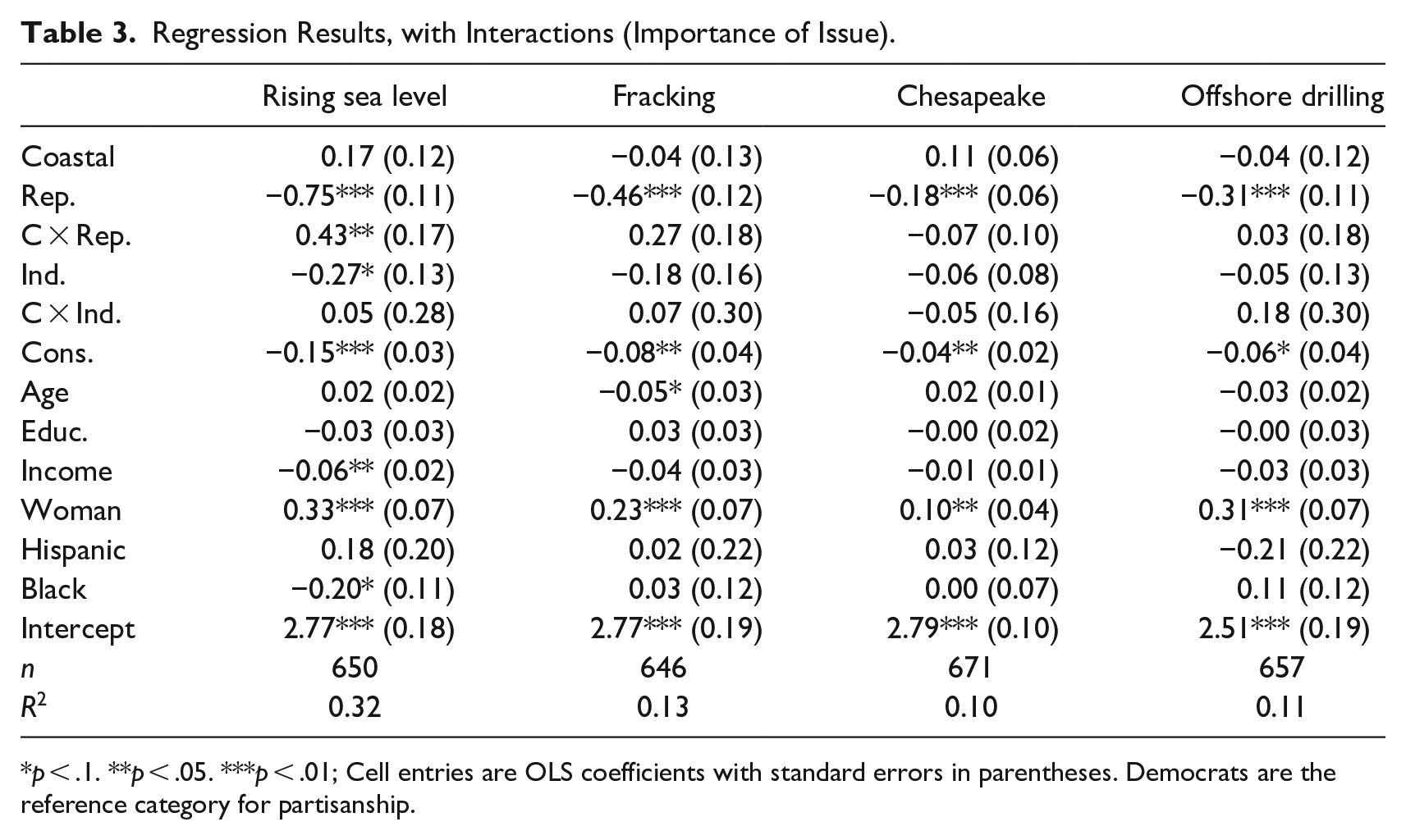
p < .1. **p < .05. ***p < .01; Cell entries are OLS coefficients with standard errors in parentheses. Democrats are the reference category for partisanship.
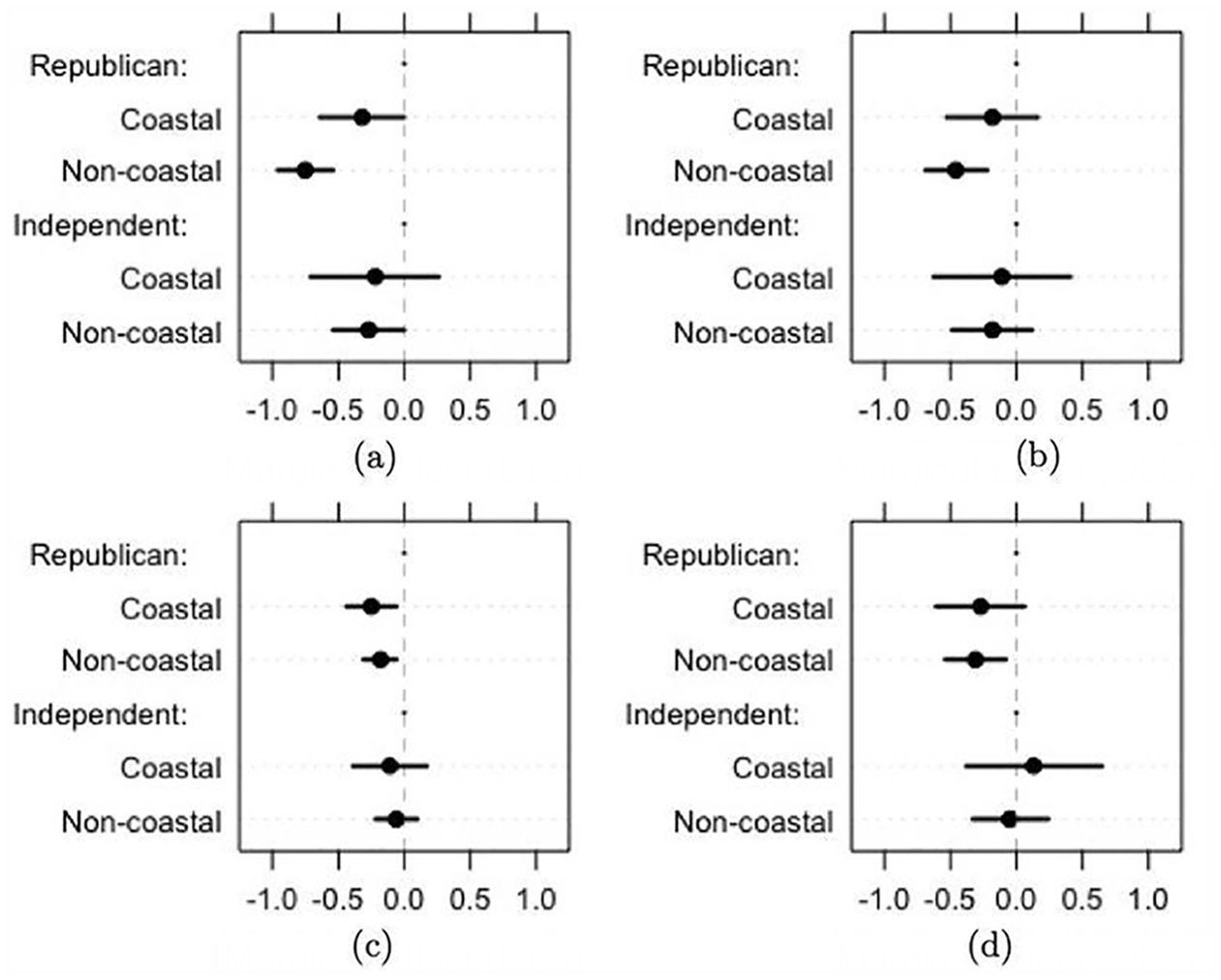
Marginal effects of party, conditioned on coastal (Y = Issue Importance). (a) Sea-level Rise. (b) Fracking. (c) Health of Bay. (d) Off-shore Drilling.
Examining the attitudes of coastal Republicans on policy support, we find a moderating effect of place on support for coastal fracking: non-coastal Republicans and coastal Republicans are sharply divided (coefficients are shown in Table 4, and marginal effects are plotted in Figure 3). Again, there is little difference between non-coastal and coastal Republicans when it comes to support for prioritizing the Chesapeake Bay and banning offshore drilling. The same pattern emerges in independents as well—non-coastal independents are more supportive of fracking in coastal areas than coastal independents. There is no difference bet-ween coastal and non-coastal Democrats, as indicated by the coastal coefficients. Results of the or-dered logit model, which serves as a robustness check are reported in Table A4. Again, substantive conclusions do not change.
Regression Results, with Interactions (Policy Support).
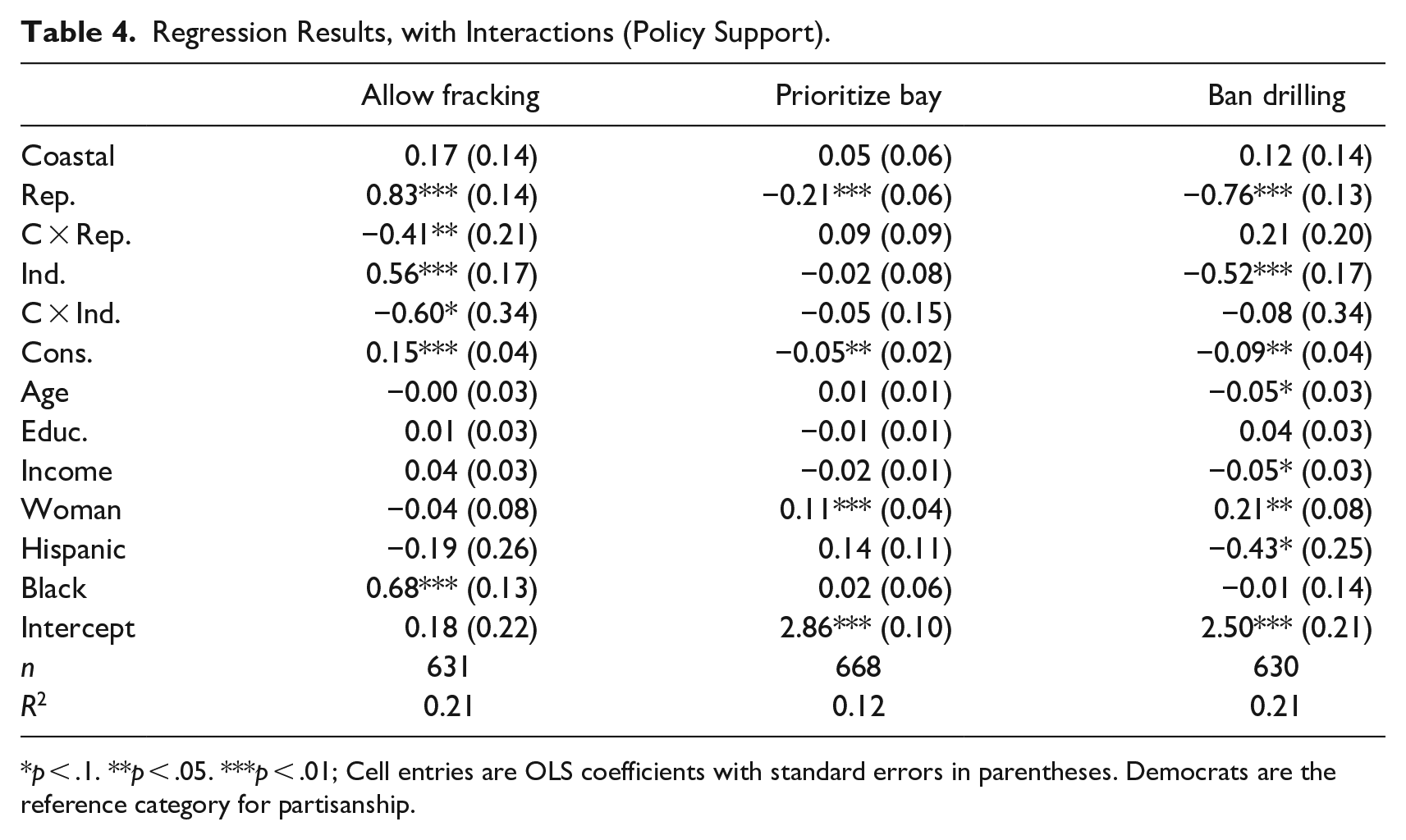
p < .1. **p < .05. ***p < .01; Cell entries are OLS coefficients with standard errors in parentheses. Democrats are the reference category for partisanship.
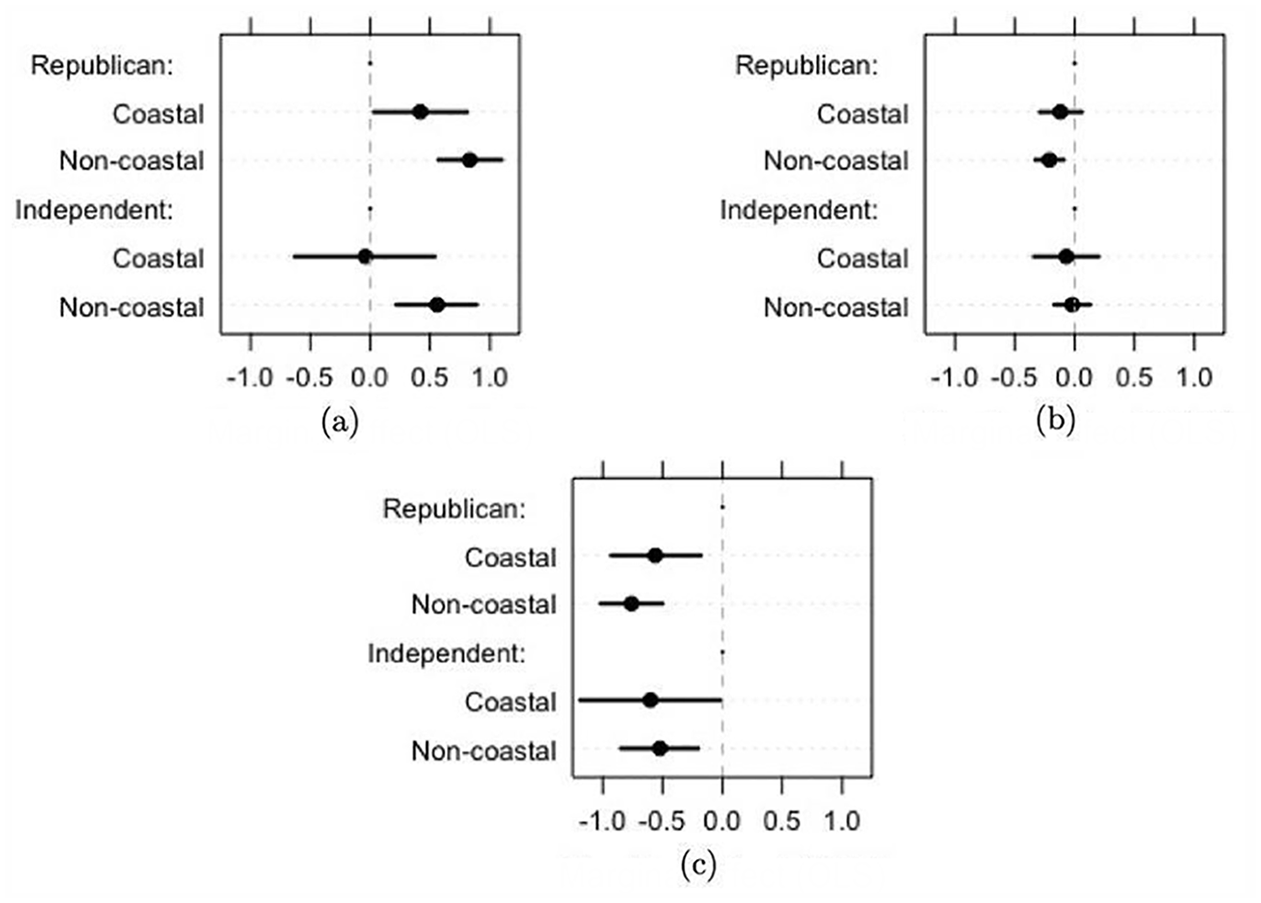
Marginal effects of party, conditioned on coastal (Y = Policy Support). (a) Fracking. (b) Health of Bay. (c) Off-shore Drilling.
Discussion and Conclusion
The central questions in this manuscript consider whether personal geography plays a role independent of partisanship in public opinion toward environmental issues and whether place moderates partisan environmental attitudes with an emphasis on coastal environmental issues. We began by examining competing hypotheses; one branch of the literature on place attachment and environmental risk would suggest people in coastal areas would show greater concern over sea level rise and other environmental issues that affect the coast. This is due to the potential for higher risk perceptions associated with proximity to environmental hazards and in response to place attachment, which could promote a protective emotional response (Adeola 2000; Bergquist and Warshaw 2019; Brody et al. 2008; Marshall et al. 2007). Another would suggest that place-based considerations may have little relationship with attitudes (e.g. Brody, Peck, and Highfield 2004), or be nullified by cues from partisan elites and that partisanship would influence environmental attitudes far more (Ehret, Sparks, and Sherman 2017).
Our data show that while partisanship and ideology play important roles in shaping environmental attitudes nearly across the board, personal geography has an independent and significant effect for some issues. Our analysis finds that residents of coastal Virginia do demonstrate more concern over rising sea levels than residents of other regions of the state. More specifically, the dummy variable flagging whether or not respondents lived in counties or cities on or adjacent to the coast has a significant relationship with three of seven dependent variables including the importance of rising sea levels, prioritizing cleanup of the Chesapeake Bay, and support for a ban on offshore drilling. All coefficients are directionally consistent with the expectation that place has an effect on attitudes that demonstrates higher levels of importance for environmental issues and more environmentally friendly policy preferences for those that live adjacent to the coast. Still, the variance in statistical significance for place on environmental attitudes suggests that a place-based influence is limited to specific issues.
When looking at the potential for a moderating effect on partisanship, we find mixed results. While Virginia Republicans as a whole attribute less importance to issues of rising sea levels there is a significant difference between coastal Re-publicans and those living away from the coast, where coastal Republicans attribute more importance. This would suggest that personal geography can outweigh partisanship in some instances. It is important to note, however, that we only find this moderating effect for Republicans on concern over sea level rise and attitudes toward coastal fracking policy. In both cases, coastal Republicans show greater concern and support for environmentally friendly measures than their non-coastal counterparts.
These results provide modest support for the argument that proximity to environmental hazards yields greater environmental concern and support for environmental policies (e.g., Adeola 2000; Johnson, Brace, and Arceneaux 2005). On the other hand, partisanship maintains a strong hold on most of the environmental attitudes we consider here, which aligns with an extensive literature linking partisanship to a wide range of environmental attitudes (e.g., Daniels et al. 2012; Kim and Urpelainen 2018).
The differential effects we find for both direct place-based effects and a moderating effect may be the result of differences in issue salience, issue polarization, levels of place attachment, or risk perceptions across the dependent variables in this study. Sea level rise is a frequent topic covered by the media (Rick, Boykoff, and Pielke 2011) and direct experience with hazards associated with this issue are likely among coastal Virginia residents. In recent years, Virginia, and coastal states more broadly, have dealt with considerable flooding issues related to sea level rise that have likely raised the salience of this issue in particular, and present potential disruptions to place attachment that can produce an emotional response.
The moderating effect of coastal residency on Republicans may also relate to the relative salience of fracking. Experience with negative externalities associated with fracking are often quite visible and heavily discussed by political elites, interest groups, and the media (Mazur 2016). As such, the hazards associated with sea level rise and coastal fracking are less abstract and more visible than the other issues explored in this study. Future research should explore the potential effect of issue salience more directly to validate this interpretation.
In addition, there is reason to suspect that movement on the importance of the Chesapeake Bay and policy preferences around prioritizing cleanup of the Bay are less likely due to a ceiling effect. The vast majority of respondents across the board indicate that this issue is important to them and should be prioritized, suggesting that the Chesapeake Bay is a valence issue in Virginia. As such, there is limited ability to shift views on this issue in relation to place-based considerations.
We also show very consistent evidence of a gender gap in environmental attitudes that accords with prior research (McCright et al. 2016; Xiao and McCright 2012). Women place significantly more importance on all four coastal environmental issues than do men, while also being more supportive of the pro-environmental stance in two of the three (prioritizing the Chesapeake Bay and a ban on offshore oil drilling) policies examined here.
Still, there are limitations to the current study associated with our place-based measure and associated with identifying the causal mechanisms at play in our findings. We use a fairly broad measure of place, which offers a more conservative test of its influence. It is possible that a more fine-grained measure would show stronger effects. In addition, future research should focus on additional tests of the relationship between personal geography, partisanship, and environmental attitudes by also considering direct experience with environmental hazards rather than our broad characterization of proximity to environmental risk. Moreover, additional work could include survey questions related to individual-level place-attachment to determine whether a clear association exists between those attachments and environmental policy support or opposition. Despite these limitations, there are a number of important implications to consider from these findings as state and local governments pursue environmental policies. When trying to garner support for environmental policy, it may be advantageous to make place-based appeals for highly-salient issues, such as sea-level rise. On issues that are less salient, efforts to raise awareness of those issues and link negative externalities to local interest may also increase public support, though the outcome is less assured.
Footnotes
Appendix 1: Alternative Model Specification
Models in the main text were estimated with OLS. An alternative model specification is to treat the dependent variables as ordinal, and estimate the models with maximum likelihood. We estimate a series of ordered logit models as a robustness check.
Data Availability Statement

Declaration of Conflicting Interests
The authors declared no potential conflicts of interest with respect to the research, authorship, and/or publication of this article.
Funding
The authors received no financial support for the research, authorship, and/or publication of this article.