




Abstract
This article investigates how smart specialisation strategies (S3) in the Swedish regions are evolving to align with the European Green Deal (EGD) and its transformative ambitions for sustainable development. Drawing on a content analysis of 14 S3 strategies from seven regions across two EU programme periods (2014–2020 and 2021–2027), the study explores the integration of EGD focus areas and cross-sectoral transformative goals. The analysis reveals that, while energy, industry, and food systems are commonly addressed, the extent and manner of integration vary significantly across regions, reflecting differences in industrial structures, governance capacities, and regional trajectories. Although traditional innovation approaches focusing on technological development remain dominant, there are emerging signs of mission-oriented and systemic ambitions, such as circular economy models and bioeconomy transitions. However, the inclusion of broader societal actors and values, which is central to transformative innovation policy, remains limited. The article concludes that, while S3 strategies in Sweden show incremental steps towards transformative change, substantial challenges remain if smart specialisation is to fully serve as a governance tool for societal transformation. These findings underscore the need for stronger regional governance capacities, cross-sectoral collaboration, and alternative pathway thinking to meet the ambitions of the EGD.
Introduction and Background
The debate on the need for societal transformation and the strategies to achieve it has evolved through policy and research alongside international agreements for sustainable development. The green transformation to fulfil Agenda 2030 and the Paris agreement limiting the global warming to 1.5° Celsius points to the urgency of moving fast. The idea is that transformation should lead to a more radical shift towards climate neutrality and create stronger resistance to the threats that climate change entails (e.g., Few et al. 2017). Societal transformation has been described as “a deep and sustained, nonlinear systemic change, generally involving cultural, political, technological, economic, social and/or environmental processes” (Linnér and Wibeck 2020, 222). This includes a fundamental transformation of businesses and business models towards a more sustainable path (Kruse and Wedemeier 2023a, 2023b).
The debate on societal transformation has also been high up on the agenda within the European Union (EU), setting up goals for rapid and radical changes to meet social and ecological challenges, for which the European Green Deal (EGD) is important.
For this aspect, the EGD, launched in December 2019, represents a major framework stating ambitious goals for the rapid and profound transformation of society (Schunz 2022): The European Green Deal…is a new growth strategy that aims to transform the EU into a fair and prosperous society, with a modern, resource-efficient and competitive economy, where there are no net emissions of greenhouse gases in 2050 and where economic growth is decoupled from resource use. (EC 2019, 2)
The EGD also portrays the EU’s commitment to the UN’s 2030 Agenda: The Green Deal is an integral part of this Commission’s strategy to implement the United Nation’s 2030 Agenda and the sustainable development goals. (EC 2019, 3)
The EGD is setting up an overall strategic direction of policy (Miedzinski et al. 2022) and aims to push policy and planning at all political levels, including national, regional, and local levels to meet the stated goals and the EU’s commitment to tackle climate- and environment-related challenges (e.g., Nakicenovic et al. 2021). In that way the EGD serves as a conceptual roadmap towards climate neutrality calling for place-based actions from European regions. It is argued that the EGD has moved environmental issues from the status of being “add-on” to become main focus of EU policy (Schunz 2022). The EGD also explicitly emphasise the role of research and innovation policy for such a transformation (Kruse and Wedemeier 2023a, 2023b).
Through this paper it is discussed how the EGD can be seen to align with a new generation of innovation policy (e.g., Schot and Steinmueller 2018) that can be conceived within the framework of transformative innovation policy requiring the inclusion of a variety of resources, knowledge, and actors and to widen the traditional focus of innovation policy beyond technological development in firms and industries (Ghosh et al. 2025). Such policy pays attention to the directionality and quality of innovation to address grand challenges (Hassink et al. 2022), such as climate change, ageing societies, health, digitalisation, and growing social and territorial inequalities (e.g., Isaksen et al. 2022; Kruse and Wedemeier 2023a, 2023b). Societal transformation is conceived to emerge from co-evolutionary interactions that include a variety of sectors, including food, energy, and transport. Hence, they cannot be treated as separate sectors but must also include a systemic and radical change in the current political, socio-economic, and cultural aspects of our societies (Brand and Wissen 2017; Pachoud et al. 2022). To achieve systemic change, in the demand for societal transformations, new values, practices, demands and user needs, scientific knowledge, and regulatory frameworks are necessary (e.g., Feola 2015; Geels et al. 2008; Rip and Kemp 1998).
Transformative innovation policy includes a more qualitative approach to innovation. This includes a debate on shifting roles and collaborations towards transformative change (e.g., Martin et al. 2023) and is described to have four directionalities: “being democratic, elevating decolonial sensibilities, enhancing holistic well-being, and navigating desired futures” (Ghosh et al. 2025, 595). For example, the EU innovations missions represent an illustrative example of transformative innovation policy (Ghosh et al. 2025). In this context, Mazzucato’s report for the European Commission (EC) (Mazzucato 2018) on mission-oriented policy has played an important role in the debate about what such innovation policy is. Mazzucato states that mission-oriented innovation policy needs to recognise the establishment of missions to address existing societal challenges by setting clear targets (Mazzucato 2018). Importantly, a growing scholarly debate about regional policy and the role of regional governments to such transformation processes has developed over recent years within the field of sustainability transitions and transformative innovation policy (see e.g., Martin et al. 2023; Bugge et al. 2022; Hassink et al. 2022; Trippl et al. 2020, 2021; Wanzenböck and Frenken 2020; Grillitsch and Hansen 2019; Mattes et al. 2015; Coenen et al. 2015; Coenen et al. 2012). This means positioning climate and ecological crises at the core of regional innovation policy and embracing a wider range of societal challenges, such as growing regional economic inequalities, ageing populations and health (e.g., Chlebna et al. 2023, 2024; Grillitsch et al. 2023) or post-development debates (Traill and Cumbers 2025) as a necessary part of regional innovation policy and of regional development paths.
On the regional level Smart specialisation (S3) is a policy framework that has been described as the most ambitious regional innovation programme ever launched in the EU (Morgan 2017). Over time, it has gained a powerful role in determining the direction of regional innovation policy in Europe (e.g., Giustolisi et al. 2023; Meyer 2022) and beyond (e.g., Kruse and Wedemeier 2021; Veldhuizen and Coenen 2022). The emphasis of EGD on the role of research and innovation for a green transformation (Kruse and Wedemeier 2023a, 2023b) makes the work with smart specialisation relevant and in focus for this paper (Miedzinski et al. 2022). As such S3 targets the regional level through the development of so-called Research and Innovation Strategies for Smart Specialisation (S3 strategies) and is implemented through regional governance and is often recognised as representing a regional innovation system within which regional government has important functions. These functions are associated with its roles of representing the regional community, managing regional resources, representing the regional territorial level within the multi-level political system, and dealing with change (Corvers 2019).
Hence, the aim of the article is to analyse the ways in which S3 strategies have been adapted to serve as a sustainability-oriented transformative innovation policy as defined through the EGD. This means to explore the ways in which the overall transformative discourse of EGD is adopted for policy programs, that S3 strategies represents. In this way this paper addresses aspects of the identified gap between transformative discourse of the EGD and its implementation into regional innovation policy (Domorenok and Gatti 2025; Enberg and Ståhl 2025). However, as the paper is limited to the study of policy documents this means that our results primarily discuss the strategic and tactical levels for policy and refrains from investigating the more operational work.
The paper draws on a study on seven Swedish regions and how their work with smart specialisation has shifted from the previous EU programme period (2014–2020) to the current one (2021–2027). More specifically, two questions have directed the analysis of these regional strategies. Firstly, to what extent can focus areas of the EGD be identified in the strategies? Secondly, to what extent can the cross-sectoral transformative ambitions promoted in the EGD be identified in the strategies?
In the following section, we will give the background to the governance of smart specialisation, followed by a section on smart specialisation and transformative innovation policy. Thereafter, we present the methods and cases that have been analysed. This is followed by a results section and a concluding section.
Governance Through Smart Specialisation
Smart specialisation was suggested through an expert group “Knowledge for Growth” inaugurated in 2005 by the European Commission. It has been an integrated part of the European regional cohesion programmes from 2011, continuing with the initiation of the S3 platform in 2013 for the then upcoming programme period (2014–2020) (e.g., Esparza-Masana 2022). One of the keys to S3 policy is the alignment between a place-based approach and the implementation of the EU’s cohesion policy, meaning that “[r]egional policy [should focus] on the application of innovation at local level and being aimed at the promotion of a specific (and unique) knowledge base in each region (smart specialization)” (Barca 2009, 132). This means that a place-based approach needs to build on local knowledge, embracing local and community values and place specificities, i.e. social, cultural, and institutional characteristics (Barca et al. 2012). At the same time, it should be open to external influences. In contrast to cluster theory, smart specialisation is not about preserving existing structures but should instead focus on the processes and transformation of current economic structures (Foray 2018).
Because the implementation of S3 directs public research and innovation investments for the economic development of regions through S3 strategies (EC 2017; Miedzinski et al. 2021), the S3 approach reinforces the expectations and governance of the political sector. This means that regional governments are expected to take the initiative for S3 and to be active partners in developing and implementing innovation efforts supporting regional development and economic growth (Morgan and Marques 2019). These functions also mean that regional governments become the target policy actor for implementing the EU’s cohesion policy, with expectations that they will take a leading role in driving the governance process for implementing S3 strategies. This places high demands on the capacities of regional governments to take initiatives and to manage regional governance processes (Corvers 2019; Kristensen et al. 2023, citing Lepore and Spigarelli 2018). We argue that the capacity of regional governance to drive societal transformation is dependent upon “strategic, integrative, adaptive and innovative action” and “the development of long-term thinking, visions and goals” (Kern 2023, 122). This also includes the capacity to integrate transformative and qualitative ambitions into S3 strategies to tackle current ecological and societal challenges (Kruse and Wedemeier 2023a, 2023b).
For the process of smart specialisation, policy actors are expected to play various roles. These involve: (1) facilitating the Entrepreneurial Discovery Process (EDP), which refers to a shared process management that demands dynamic interaction between policymakers, public authorities, and the private sector (Gianelle et al. 2020; Kristensen et al. 2023); (2) “to deploy all sorts of policy instruments to support the exploration of the new area of opportunities and provide the specific public goods that are needed (training, basic research, and services)”; and (3) coordination “to assist the formation of networks and partnerships” (Foray 2018, 826).
The EDP especially highlights the importance of engaging various actors from business, government, research and civil society to commonly set the priorities of a given regional territory towards a transformation of the regional economy and a motivation to innovate and create change (Aranguren et al. 2019). This means that the EDP with the aim to optimize the usage of limited resources for certain or key priority areas of specialisation of the regions is of key importance (Meszkowski and Kardas 2015).
Hence, S3 is dependent upon regional governance capacities to achieve defined goals. However, this does not mean that it is solely the outcome of the regional context, such as available resources or local and regional conditions; it also depends on wider national contexts and governance structures. Here, we define governance as the institutions and processes that direct interactions between diverse actors representing many different interests, forms of power, and scales (Healey 2007). This definition highlights the challenges imbued in governance to establish a shared understanding of eligible goals, which is a fundamental aspect of governance initiatives. In this context, it is the regional governments that are the anchor organisations driving the governance process for smart specialisation and thus leveraging transformation towards sustainable development. At the same time, other actors – such as firms, research institutions, local governments (e.g., municipalities), and associations – also play an important role in the implementation of and work with S3 strategies. The capacities required for this type of governance largely resemble the transition governance capacities often discussed for cities, such as the capacity to integrate different policy fields, create long-term visions and directionality, or reflexively monitor processes of change (e.g., Weber and Rohracher 2012; Wolfram 2016), which will be further discussed in the next section.
Smart Specialisation as a Transformative Innovation Policy?
The proliferating scholarly debate on smart specialisation has attracted critique in relation to its various definitions and its implementation (Foray et al. 2011; Iacobucci and Guzzini 2016). The overall critique of current innovation policy – arguing that it does not deal sufficiently with societal challenges such as climate change and growing social and territorial inequalities but principally promotes technological development and innovations to support economic growth and competitiveness (e.g., Mazzucato 2018; Wanzenböck and Frenken 2020; Isaksen et al. 2022) – also concerns S3. Within the EU, several policy papers have been published on the shift from S3 to S4, meaning that smart specialisation should shift towards “Sustainable” Smart Specialisation in line with the EDG and the SDGs, with the addition of a fourth S for “sustainability” (e.g., Miedzinski et al. 2022; Nakicenovic et al. 2021). In connection with this, the recent direction of smart specialisation states an expectation that smart specialisation strategies should be integrated with sustainability goals (McCann and Soete 2020; Veldhuizen 2020) and transformative innovation policy (Ghosh et al. 2025), to tackle current societal and environmental challenges (Madsen 2022; Schot and Steinmueller 2018).
Nevertheless, the varying regional geographical contexts and conditions between and within regions impacts upon the regional governance capacity to establish and lead configurations of actors and institutions towards transformative change and to support transformation processes (Weber and Rohracher 2012). This means that regional governments have different preconditions for becoming anchor organisations to develop and lead their regions towards transformative smart specialisation strategies. These preconditions and capacities are also reflected in the literature on sustainability transitions and transformative innovation, where transformative governance requires the capacities for experimentation, envisioning pathways to alternative futures, and new types of transformative leadership (Wolfram 2016; Wolfram et al. 2019). Borrás et al. (2024) build on these approaches to develop a conceptual framework for the transformative capacity of public-sector organisations in sustainability transitions which emphasises the interplay between the different roles, resources, and abilities of public actors to enact change, but also the co-evolution of such capacities along pathways of transformative change. A helpful distinction is provided by Trippl et al. (2021), who distinguish between RIS reorientation and RIS transformation. The first of these builds on the idea that already existing Regional Innovation Systems (RISs) can be mobilised to develop new solutions to regional problems and needs. This means that it is possible for transformative changes to occur through path dependency where existing regional industries and regional sociotechnical systems can build upon already existing assets, actors, and institutions to create change (Isaksen et al. 2022). RIS transformation strategies emphasise disruption and the strategic creation of new RIS elements. This spans the inclusion of new actors and actor groups and breaking with former development paths to create new ways of thinking (Isaksen et al. 2022; Trippl et al. 2021). The literature also emphasises the importance of inter-regional learning (e.g., Chlebna et al. 2023), considering RISs not as self-sufficient, but rather as entities that operate within a larger framework of national and global economic, policy, and knowledge contexts (e.g., Asheim et al. 2011; Chlebna et al. 2024).
In this context, the EGD provides a guiding policy framework (e.g., Grillitsch et al. 2023; Hassink et al. 2022). Thus, scholars claim that S3 policies need to align better with the new directionality set by the EGD towards sustainability i.e., that S3 also needs to support societal transformation towards sustainability (Laranja et al. 2022; McCann and Soete 2020). Overall, this illustrates several challenges if S3 is to become a governance process driving transformative change because many issues regarding S3 are still unresolved for the current programme period (2021–27) (Kristensen et al. 2023). For example, Miedzinski et al. (2021) argue that such a shift towards the inclusion of the SDGs in S3 requires a reorientation of S3 away from its specific focus on economic growth and competitiveness. Instead, it needs to begin with the most urgent local sustainability challenges within that specific geographical context. Secondly, there needs to be a widening of innovation processes to focus on more than just technological innovations (Miedzinski et al. 2021) or the growth of new markets and new employment (Staffas et al. 2013). As part of this, regional industrial transformations should not merely be understood as the modernisation of traditional sectors like mining, steel or textiles, but should also include a general advance towards new industrial systems, in broader terms (Foray 2017). Additionally, such a shift towards smart specialisation becoming a transformative strategy also means that it should embrace new sectors outside the more traditional manufacturing industries, including services and healthcare, and new forms of innovation in services and organisational and user-driven innovations (Meyer 2022; Nählinder 2012). In addition, ambitions to generate transformative policy through the integration of the EGD into S3 also require qualitative changes, such as a shift in norms and values at a broader societal level.
Kruse and Wedemeier (2023a, 2023b) argues that for S3 to integrate a mission-oriented approach new governance approaches are required to steer such a large process. This includes the involvement of new and larger stakeholder groups. In contrast to traditional RISs, which have mainly been dominated by triple-helix collaborations, i.e. cooperation between universities, government, and industry (Etzkowitz and Leydesdorff 2000; Leydesdorff and Etzkowitz 1996; Westlund 2006), more recent approaches to S3 for transformative change have recommended the inclusion of a fourth helix constituting a range of actors, e.g., innovation users, consumers, non-governmental organisations (NGOs), citizens, and workers in regional innovation processes (Foray et al. 2012). This directs strategies for place-based interventions and highlights the need to include civil society in developing platforms for the quadruple helix (Grundel and Dahlström 2016) and thus transforming the strategies for regional entrepreneurial discovery processes. The EDP captures perspectives from private, public, academic, and civil society actors to mobilise regional stakeholders (Kristensen et al. 2023), which together are expected to push place-based regional development. However, this has also proven difficult and challenging because it requires engagement from a wide range of actors and the inclusion of the fourth helix for S3 processes has so far remained limited (Grundel and Dahlström 2016).
The widening of stakeholders also includes closer interactions between governing institutions such as the EC and the member states giving the states a more prominent role in the creation of markets and mission targets (Kruse and Wedemeier 2023a, 2023b). This means that S3 needs to be aligned with integrated approaches to sustainable development, focusing on ecological and social aspects as also in line with the Europe 2020 strategy in the previous programme period, which had the aim of being smart, sustainable, and inclusive (Dahl Fitjar et al. 2019). There are even arguments that the general principles for smart specialisation are insufficient to achieve transformative impacts. From the point of departure that EGD aligns with a transformative innovation approach this means to embrace “a broad understanding of innovation as a multi-actor, multi-activity, and multimodal political process addressing uncertainties and contestations” (Ghosh et al. 2025, 597) including a challenge-oriented transformative mission approach. The governance process grounded in the principles of EDP has been found to be insufficient for what is called “alternative pathway thinking” to influence systemic transformation (Reid et al. 2023). System innovation needs new types of innovative actors and new types of knowledge. Innovation that can influence systemic transformation needs to involve institutions and organisations that deal with key systems for societies such as transport, housing, waste, and energy systems.
Cases and Research Design
The aim of this paper is to analyse the extent to which S3 strategies are developing towards a sustainability-oriented transformative innovation policy at the regional level. In Sweden, these strategies are developed by regional governments, often in close collaboration with industries and firms as well as research organisations in the regions, i.e. in triple-helix formations. However, the implementation occurs mainly by working in close partnership with firms, industries, and research organisations and by supporting the regional innovation system.
Within the empirical context of this article, the capacity of regional governments– needs to be understood in terms of their position within the multi-level governance system in Sweden. The regions in Sweden have formal mandate for regional development, but not for land-use planning. Sweden represents a unitary state with extensive decentralisation to local government, i.e., the municipalities. Therefore, the Swedish governance system is often described as an hourglass with a strong state and strong local authorities. The municipalities have a monopoly over land-use planning, meaning that they are entitled to decide about development within the municipal borders (Persson 2013). Hence, Swedish regions are often discussed as weak in terms of their policy scope with impacts on their governance capacity for regional development. Sweden is divided into 21 counties being the political territories of 21 regional governments. These counties represent quite different geographical structures among which the northern counties are sparsely populated and have small population compared to the other counties in southern parts of the country. The EU division into eight NUTS2 regions in Sweden, being the key regional planning level in EU, does not correspond to any government level in Sweden, although they are important collaboration contexts for the regions when implementing their regional development policy. Rather, the political territories of the regional governments, being responsible for working with smart specialisation, correspond to the EU’s division into NUTS3 regions.
Regional population, workforce and presence of HEI. (1) Name of universities and their UNI-rank position (Top Universities in Sweden | 2024 University rankings visited 21 Nov 2024)
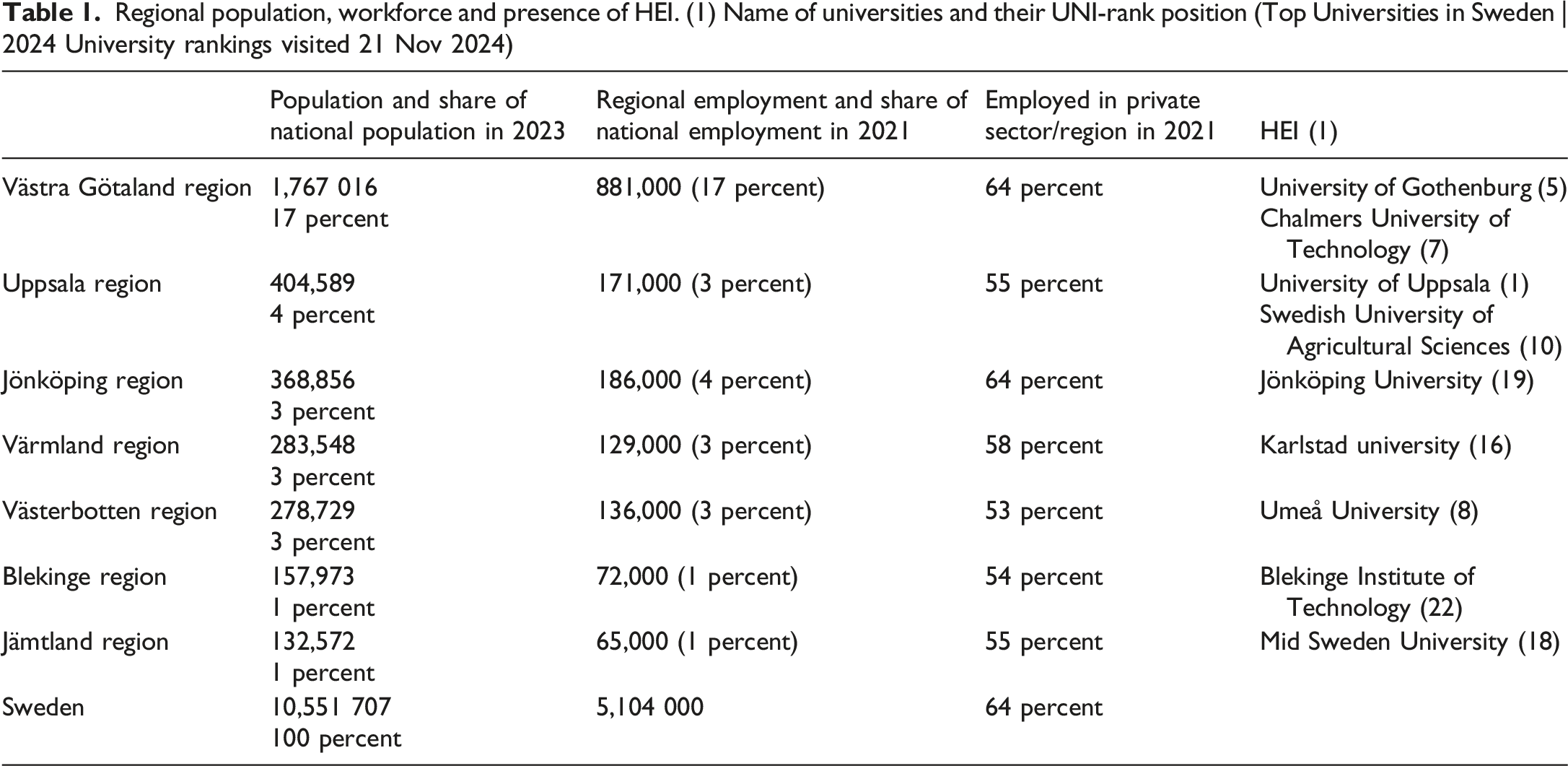
Table 1 presents an overview of information about regional labour markets and the regional presence of HEIs in the selected regions. These factors are included to reflect the structure of triple-helix constellations, which is fundamental to the general idea of how collaborations between the public sector, HEIs, and the private sector drive regional innovation systems. Both the presence of strong HEIs and a larger proportion of private-sector employment can be assumed to impact upon the S3 strategies. According to a national ranking, the universities in Uppsala, Göteborg, and Umeå hold strong positions. Compared to the other regions, Västra Götaland and Jönköping have a large proportion of private-sector employment.
To enable us to identify whether there has been a shift in relation to the ways in which smart specialisation is used as a viable strategy for transformation, we have analysed S3 strategies for the seven regions that were adopted in both the previous programme period (2011–20) and the current one (2020–27). A total of 14 S3 strategies. This approach helped us to capture recent impacts of the EGD in the regional implementation of the EU’s cohesion policy through smart specialisation and to explore regional variations.
Content Analysis
The method used for analysing the S3 strategies has been content analysis combining a “word-count” strategy with a more qualitative interpretation of the S3 strategies. Due to variations in the length and structure of these strategies, as well as the qualitative dimensions of the research questions, quantitative and qualitative interpretations needed to be combined. The way in which we have defined transformative approaches for the following discussion is based on how the EGD highlights particular focus areas and cross-sectoral transformative strategies, but also how the regions themselves interpret and identify their work with missions in the strategies. Two questions directed the analysis of the strategies. Firstly, to what extent can focus areas of the EGD be identified in the strategies? Secondly, to what extent can cross-sectoral transformative ambitions promoted in the EGD be identified in the strategies?
To answer the first question above, about the ways in which smart specialisation strategies integrate the focus area of the EGD (EC 2019), we identified eight focus areas, listed below. These are based on the sub-headings of specific sections in the EGD. • Supplying clean, affordable, and secure • Mobilising • From “Farm to Fork”: designing a fair, healthy, and environmentally friendly • Increasing the EU’s • Accelerating the shift to sustainable and smart • Preserving and restoring • A •
In relation to the identified focus areas in the EGD, we compared and used the keywords marked in bold text above to analyse the S3 strategies. In addition to the focus areas in the EGD, we also focused on the role of the identified specialisations (areas of strength) in the regions and their cross-sectoral goals. To answer the second question, we identified keywords that point towards transformative ambitions in the regions. These keywords were also identified in the literature review and can be seen as key within transformative innovation policy. However, as we have only analysed policy documents, we cannot discuss whether there is an actual change in practice or whether the S3 strategies are truly transformative. As such transformative innovation policy highlights more qualitative aspects of innovation including aspects such as opening up for experimentation and testing; envisioning pathways to alternative futures; new types of transformative leadership (Wolfram 2016; Wolfram et al. 2019); new and different roles and collaborations in quadruple helix constellations; mission-orientation and systemic approaches including a change of norms and values and a stronger integration of sustainability.
In the next section, we present the results of our analysis about how smart specialisation strategies for a selection of regions in Sweden align with the top-down expectations set out in the EGD with the aim of transforming society.
The Alignment of S3 Strategies With the EGD
This section moves to our empirically based exploration of how the S3 strategies for the regions under study here aligns with the aims of the EGD and the approach of transformative innovation policy. The first section discusses how the overall themes in the EGD such as energy, industry and food systems are systematically integrated in the S3 strategies in the regions under study. The second part discusses the ways the regional S3 strategies have integrated more cross-sectoral and qualitative approaches such as the circular economy, equity and equality aspects and the broadening of actors in as well the EDP and more generally in regional innovation processes.
Thematic Approach - Energy, Industry, and Food Systems
Part of the work of regional governments with smart specialisation is to collaborate with other actors in the regions to set out the regional specialisations that are central in each of the regions. This is also in line with the S3 platform, which seeks to identify regional strengths through the entrepreneurial discovery process. In the S3 strategies, this is described as having taken place in broad collaboration between academia, firms and industries, the public sector, and civil society, even though there is no clear link between the actual implementation of the strategies and such broad collaboration.
Following the themes laid out in the EGD, we found that a majority of the S3 strategies can be directly linked to the three focus areas of energy, industry, and food systems. Additionally, focus area mobility is seen to be a concern in several of the strategies. However, although the regions under study have similar specialisations and cross-sectoral goals, the ways in which they are described and addressed in the S3 strategies differ. This can be interpreted as signalling the effects of variations across the regions on their regional social and industrial structures and trajectories and on how they have organised the process to define their strategies (Tödtling and Trippl 2005; Barca et al. 2012; Breul 2023). This is also illustrated through the ways in which the regions approach transformation within the theme of energy. In Uppsala, the approach to strategies within energy is addressed through bold ambitions to take on a climate leadership role in Europe through research and science-based innovation processes. The local universities are important anchor organisations for this. In contrast, alignments with the model for industrial symbiosis positions industry at the centre of interventions within the energy sector in Västra Götaland. Here, the region has linked energy closely to the food industry and the development of biobased materials. In Värmland, energy is instead embedded within a mission-oriented approach combining various energy sources but specifically focusing on solar energy.
Moving to the focus area of industry, this area is strongly represented in some of the regions, coinciding with high proportions of the regional workforce being employed in the private sector (i.e. Västra Götaland, Jönköping, and Värmland). In line with previous studies (e.g., Martin et al. 2023; Paulsson 2019), the analysed S3 strategies show that the varying profiles of the regional industrial branches are still strongly steered towards the development of already existing industries in relation to robust clusters in the regions, and this becomes part of the definition of regional specialisations. In Västra Götaland, the regional presence of an advanced engineering industry, including the car industry, has an impact on the high ambitions explained in the strategy about electrification in the car industry, the development of the internet of things, and AI. In Värmland, which has a long history of a strong forest industry, this has steered the S3 strategy and made a forest-based bioeconomy one of the top regional priorities. In Region Västerbotten, the forest, mining, and mineral industries are of primary importance. In Jönköping, the regional presence of low-tech industry is aligned with ambitions to strengthen wooden house production. This specialisation also stresses the development of e-commerce and logistics. However, the ambitions for future industrial development in the S3 strategies also include visions for diversification. This is illustrated, for example, by high ambitions to develop the gaming industry in Värmland. This is a relatively new industry in general, and especially in the context of this region.
The ambition to develop regional food systems was allocated a similar level of attention as energy and industrial development in the strategies. This is somewhat surprising, given that food production is a relatively small industry in Sweden. However, in recent times, this sector has received growing attention, encouraged by sustainable development models (like the EGD) in combination with an increasing awareness of the role of food production for food security. In the strategies investigated for this paper, the one for Jämtland, which is the smallest region (population wise), placed particular emphasis on the importance of their regional food system. The expansion of food production in the region is seen as important for regional economic development, but also for achieving the goals laid out in Agenda 2030. It is explained that the food sector in Jämtland integrates regional identity, cultural traditions, and resources from nature and makes an important contribution to the regional tourist industry. The development of the regional food system is thus a strategy for attracting visitors as well as new residents to the region.
There are interesting contrasts between the regions in how they have integrated smart mobility and transport into their strategies. Diverging examples include ambitions in Uppsala to develop future mobility systems through automation, electrification, and a service approach. In Jönköping, the ambition to become a key logistical centre relates to the theme of transport. In addition to these quite technical-innovation and industry-developing strategies, the social perspective of mobility is also represented. In Värmland, the social perspective is brought in by highlighting the importance of children’s access to mobility services. It is reasonable to assume that the geographical context of the comparatively remote region of Jämtland plays an important role in its aim to develop electric airplanes. In contrast to many former S3 strategies, the integration of mobility into the newer strategies illustrates the clear connection between the EGD, the EU’s cohesion policy and smart specialisation. It can also be seen as an indication of how S3 strategies are being broadened from merely being an approach that overlaps with already existing industrial specialisations, towards more transformative ambitions by moving into other areas. At the same time, the focus areas within the EGD for restoring ecosystems and biodiversity, zero pollution, and energy-efficient buildings are rarely mentioned in the strategies.
Cross-Sectoral and Transformative Approaches
We now move on to the next step of our analysis, which is an assessment of the ways in which the investigated smart specialisation strategies can be seen to be transformative in terms of cross-sectoral and systemic change and more qualitative aspects such as changes in societal norms, values, and practices.
In comparison to the previous programme period, the present strategies have a stronger focus on “smart” and “sustainable” industries. Here, sustainability is often defined in relation to reducing the environmental impacts of production through circularity and circular business models, although this was often also the case during the previous programme period. Although the three areas of the EGD and the S3 strategies focusing on energy, industry, and food systems align in important ways with industrial sectors that are already strong in the regions, it should be noted that these focus areas are also motivated by more transformative ambitions, especially when focusing on food systems. Additionally, the ways in which the theme for climate ambitions is integrated into the S3 strategies is more cross-sectoral, in that it is integrated across several specialisations of the strategies. This is particularly evident in how climate ambitions are integrated into the specialisations targeting energy and industry. For example, the ways in which strategies to implement a circular economy are integrated into the S3 strategies can be seen as signalling more transformative ambitions. The EGD refers to a circular-economy action plan, which shows how the idea of circular systems has become an important guideline for transformative visions. This is also visible within the strategies investigated in the regions under study. In Västra Götaland, the model for a circular economy is used as an approach for industrial symbiosis. In Uppsala, the circular economy is seen as an integrated part of the focus areas of energy, industry, and food systems. However, and even though the circular economy can be seen as a cross-sectoral and overarching goal or an important dimension of sustainability within the strategies, it is often closely connected to specific industrial sectors, such as energy production in Uppsala or fish farming in Västra Götaland. Also, in Jönköping and Västra Götaland, the circular economy is seen as a vision for business development and for transforming relations between producers and consumers. This means that the circular economy primarily targets industry actors and new technical and organisational solutions, rather than a more wide-ranging societal change in norms, values, and practices. In Värmland and Västerbotten, the transformation to a forest-based bioeconomy is one of the regional specialisations focusing on a broader societal transformation based on renewable materials instead of fossil fuels. Thus, the goal is a significant societal transformation, but at the same time it refers to the increasing use of forest materials in such a transformation.
Also, more systemic innovations are included in the S3 strategies, as in relation to the circular economy and a bioeconomy as mentioned above. In comparison to earlier S3 strategies, the current ones address grand societal challenges to a greater extent, and some bring in the concept of “missions”. For example, Region Blekinge has taken a different approach and emphasize a mission-oriented approach, through “designing missions”, aiming for the region to become a “demo-region” and prioritise “test capacities” as two of its four regional specialisations. This is expressed in the regional S3 strategy: Missions are a goal-oriented way of working in which society’s greatest challenges are placed at the centre of innovation and change. In Blekinge, missions are designed and implemented to mobilize resources and knowledge from both the public and private sectors to address challenges related to, for example, climate, social sustainability, and technological development (Region Blekinge 2025). […] Missions differ from Blekinge’s other two specialisation areas in that they constitute a methodology. Work within this specialisation will therefore partly consist of the continuous development of the method, but primarily of its thematic application within the framework of a regional testbed. The thematic application of missions should primarily focus on healthy oceans, climate adaptation, and climate-neutral and smart cities. (Region Blekinge 2021, 6).
In a similar manner, in the S3 strategy of Värmland the mission driven approach is used as a tool for working with broader challenges in society where it is mentioned that “a process will be developed to design missions in Värmland that are grounded in region-specific challenges and, as far as possible, aligned with the European Commission’s priority missions (Region Värmland 2021, 35). Broader societal challenges such as climate and a public health crisis, urbanisation and shrinking rural areas are pointed out a long with social injustices and shortcomings in gender equality and equity and are to be addressed through a mission driven approach.
Overall, we have established that the S3 strategies target elements of values and practices for transformative change in different ways. This includes recognising social aspects and the role of civil society as important aspects in some of the regions. In Värmland, we identified social aspects such as gender equality and equity as pointed out as two important driving factors for regional development and growth. The strategy also highlights the importance of civil society and social innovations. Västra Götaland focuses on crosscutting interventions to target social inclusion and highlights social entrepreneurship. Consumption is rarely mentioned in the strategies, and where it is, as in for example Västra Götaland, it appears in general background descriptions about regional and local challenges and conditions, rather than targeting changed consumption patterns.
Summing up our analysis of the adoption of transformative approaches to smart specialisation strategies, the innovative ambitions are still strongly supportive of more traditional approaches to product innovations and technological development to promote growth, new markets, and new employment. On the other hand, more systemic innovations are also included, as in relation to the circular economy and a bioeconomy. In comparison to earlier S3 strategies, the current ones address grand societal challenges to a greater extent and bring in the concept of “missions”.
In all strategies, HEIs and industry are involved as key partners for promoting new innovations. Variations in the presence of such partners in the respective regions is an important explanation for the differences between specialisations and how the different focus areas in the EGD are targeted. However, the development and integration of S3 strategies are also about policy and regional governance structures and the trajectories of informal institutions and different social values.
Conclusion
In this article, we set out to analyse whether smart specialisation is moving towards alignment with aims of the EGD and the approach for transformative innovation policy. Our empirical study covers S3 strategies in seven regions of Sweden. Our point of departure was the launch of the EGD because it has been seen to represent a movement towards the inclusion of environmental issues and sustainable development “centre-stage” for EU policy (Schunz 2022). For this empirical study, the approach taken by the EGD has served as the reference model for a transformative and approach to smart specialisation seen as main interventions for regional policy.
A shift towards transformative innovation policy is expected to widen the policy agenda and bring in a broader understanding of societal goals (Haddad et al. 2022) and systemic qualitative change. In contrast to earlier assessments of S3 strategies, which found them to be lacking directionality towards sustainability, our empirical analysis of the seven regions under study signals a reorientation of the pathway (Trippl et al. 2021) of S3 strategies, through which sustainability and other more qualitative aspects of transformative innovation policy are increasingly being included.
The investigated strategies from the Swedish regions provide evidence of small steps being taken towards what are here defined as transformative pathways. We have found examples of experimenting with and testing new specialisations in their S3 strategies, as in the example of Värmland focusing on the gaming industry. This is, however, more an example of regional diversification than of transformative innovation policy. There has been an openness to bringing in new specialisations and sectors such as energy, mobility, and food to broaden the regional scope of smart specialisation as in line with the EGD. It is, however, clear that the regional governance work with smart specialisation still mainly targets technological development and innovations in already existing branches in the regions and has only included new sectors part of the EGD to a limited extent (Pachoud et al. 2022).
To some extent, the results presented in this paper can be interpreted as confirming the statement that challenges remain for S3 within the programme period 2021–27 if it is to become a governance process in order to drive transformative change (Kristensen et al. 2023). This conclusion is based on the strong focus on established industrial specialisations and economic activities in the regions. This result was to be expected given the path dependency of such strategies and considering the conceptual framework for innovation as well as regional industrial development trajectories. The legacy of S3 from models for regional competitiveness and growth, and its adherence to a science- and technology-focused understanding of innovation is evident (Benner 2020). Ambitions to generate transformative innovation policy through the integration of the EGD into S3 requires qualitative changes, such as a shift in norms and values at a broader societal level interlinked with transforming the collaborative processes for smart specialisation.
Nevertheless, various continuous incremental changes deserve to be appreciated because this may lead to thresholds being passed and, in aggregate, cause transformations (Feola 2015). Taking this approach, the ways in which the investigated strategies recognise the importance of factors such as social inclusion and social innovations can lay the foundations for more inclusive transformative processes.
In all, the results motivate a call for a stronger emphasis on transformative ambitions for the disruption of existing pathways (Isaksen et al. 2022) if we are to consider the strategies truly transformative (Hassink et al. 2022). In summary, a transformative oriented innovation policy would require a process that is more systemic, along with greater cross-sectoral governance g and much more of an “alternative pathway thinking” would be needed to generate systemic transformation (Reid et al. 2023). More emphasis on such systemic innovation needs new types of innovation actors and new types of knowledge, as well as institutional change in key societal systems such as transport, housing, waste, and energy systems. While smart specialisation strategies do not (yet) live up to these principles, we can certainly see a significant overlap of smart specialisation strategies and sustainability-oriented transformative innovation policies in the Swedish regions.
The empirical illustrations of smart specialisation strategies in Sweden indicate that the tradition of smart specialisation focusing on collaboration with industry remains important, while we can also find examples of broadening out the perspective to align with a more transformative approach. Whether this represents coordinated democratic processes or a more unruly process remains to be seen (Grillitsch et al. 2023) and, in light of the ambitions of the EGD to include the wider society, this becomes an important question for research to explore. At the same time, the visions related to smart specialisation are still rather sector-specific and need to be combined with a broader set of transformative changes aligning with a mission-oriented approach to development.
The comparative approach of this article and the results relating to variations across regions, contributes with a mapping of smart specialisation strategies and can hopefully serve as a point of departure for empirical work on agency and how it influences the ways in which regional innovations policy integrates transformative ambitions. This would require a focus on how regional governments invite a variety of stakeholders, set the agenda for dialogues, harness knowledge about transformative strategies applied through other regions across the EU, and mobilise development resources through various national and EU funding schemes. This would contribute to key understandings about the governance process driving S3, including knowledge about how regional governments manage to negotiate their roles within the multi-level political system and balance the expectations of the EGD with placed-based capabilities and motivations to act.
Footnotes

Funding
The authors received no financial support for the research, authorship, and/or publication of this article.
Declaration of Conflicting Interests
The authors declared no potential conflicts of interest with respect to the research, authorship, and/or publication of this article.