



Abstract
Despite persisting ethnonational conflict in Israel and Palestine, professionals in the information technology (IT) sector keep working together. They engage in professional cooperation by jointly developing software while embedded in societal narratives that cast the other as the enemy. We ask how individuals give meaning to their work when cooperating with their societal adversaries in such a context. Drawing on a qualitative case study that combines interviews, observations, and documents, we find that individuals use two main tactics to cope with the conflict context: depoliticizing and politicizing cooperation. We specify these individual-level tactics and show when they are used: depoliticizing in situations “at work” and politicizing in situations “about work.” We also show that these tactics are at times misplaced and hinder cooperation. Additionally, we find that physical and social interference can disrupt cooperation and thus set guardrails for it. Abstracting from our findings, we theorize a model that explains how individuals engage in what we term conflict-situated cooperation. We offer two main contributions to management research: We introduce the concept of conflict-situated cooperation to capture the distinct nature of professional cooperation in the context of ethnonational conflict, and we explain how individuals use and situate (de)politicizing coping tactics to give meaning to their professional cooperation.
Introduction
Ethnonational conflict in Israel and Palestine has persisted for decades (Connor, 1993; Rouhana & Bar-Tal, 1998), and the latest escalations of violence since 2023 have intensified the situation again. Yet professionals in the information technology (IT) sector keep working together. Due to limited opportunities in Palestine, 1 and high demand for talent in Israel, a large proportion of the seven to eight thousand Palestinian IT professionals—mainly from the West Bank but also from Gaza—are engaged in projects outsourced from Israeli-located multinationals. This creates a situation where Israelis and Palestinians work together to develop software (The Portland Trust, 2022).
Israeli and Palestinian IT professionals thus engage in cooperation despite serious complications. In their societies, the “other” is generally treated as the “enemy” (Rouhana & Bar-Tal, 1998), and support for a two-state solution has considerably decreased over the years (Djerejian, Muasher, & Brown, 2018). 2 Recurring outbreaks of violence in Israel and Palestine have further tested the resilience of established relations. Prompted by our data, here we adopt the concept of cooperation defined as the “attitudes, behaviors, and outcomes related to the implementation of a common goal” (Castañer & Oliveira, 2020: 984) because it captures the professional relations between members of mixed IT development teams who implement the goal of providing software solutions together.
In contrast to related notions of collaboration, which involves voluntarily helping other parties with their private goals beyond the shared goal (e.g., common in cross-sector partnerships) (Castañer & Oliveira, 2020), and exploitation, which involves perceptions of unfair rewards relative to contributions or intentional harm and (threatened) abuse (Crane, 2013; Livne-Ofer, Coyle-Shapiro, & Pearce, 2019), our data shows the experiences and perceptions of individuals who see clear benefits of working together and express having chosen to do so. The shared IT work, thus, represents a form of professional cooperation between members of adversarial societal groups. 3 Surprisingly, while visible in various conflict-societies, including in South Africa right after apartheid officially ended (Seremani, Farias, & Clegg, 2022), in Northern Ireland during the Troubles (Hayward & Magennis, 2014), and in Bosnia after the war (Stefansson, 2010), such cooperation represents a relatively under-investigated phenomenon.
However, studying cooperation under ethnonational conflict is important from a theoretical point of view, because while cooperation between adversaries is not a new phenomenon, and could be partially explained by general macroeconomic conditions, what remains underexamined is a microlevel understanding of how individuals deal with such cooperation while being embedded in extremely hostile circumstances (see also Lumineau & Keller, 2025). Prior work remains incomplete because of its prevalent focus on relatively peaceful settings, such as cooperation between different professions (O’Mahony & Bechky, 2008) or actors adopting distinct frames (Grimm & Reinecke, 2024). Contexts of ethnonational conflict (Connor, 1993; Rouhana & Bar-Tal, 1998), such as Yemen, Azerbaijan-Armenia, Russia-Ukraine, and Israel-Palestine, however, are characterized by societal tensions and violence that also impact individuals at work (Stefansson, 2010; Weber, Shantz, Kistruck, & Lount Jr., 2025). In those societies, “many of the constructive forces and connections that are inherent to any relational or community system become taxed, obstructed, or destroyed” (Gray, Coleman, & Putnam, 2007: 1417), and existential threats and the perpetuation of conflict become integrated in collective identities (Kelman, 1999; Oren, Bar-Tal, & David, 2004).
While some management scholars have started examining ethnonational conflict at a macro level (Arikan, Arikan, & Shenkar, 2020; Bahaee & Pisani, 2009; Liu, Eden, & Li, 2024), our theoretical understanding of cooperation remains limited due to an insufficient engagement with conflict contexts and a lack of understanding of how individuals deal with them. In our case, while macroeconomic conditions clearly shaped an environment in which professional cooperation became valuable, individuals are nevertheless strongly embedded within the context of conflict and revealed their ways of coping to stay engaged in cooperation. Accordingly, and in line with an interpretivist approach to knowledge creation (Burrell & Morgan, 1979; Habermas, 1971), our aim is to better understand how individuals give meaning to cooperation rather than explaining the conditions that make them join or leave. Hence, our research question asks: How do individuals give meaning to their work when cooperating with their societal adversaries in contexts of ethnonational conflict?
Our qualitative case study is primarily based on data collection between 2019 and 2021. The informants—active across the Israeli-Palestinian IT sector in various firms and positions—show two main coping tactics that allow them to engage in cooperation despite a hostile environment: depoliticizing and politicizing cooperation. We find that depoliticizing occurs in situations “at work” by giving primacy to business language, singling out business-oriented goals, and ignoring conflict experience. In contrast, politicizing occurs in situations where individuals communicate “about work” by giving primacy to political language, interlinking business and political goals, and integrating conflict experience. Our data also suggest that misplaced application of these tactics, such as too much politicizing in “at work” situations, may inhibit rather than facilitate cooperation. While we find both tactics to be instrumental for individual-level coping, we identified two constraining guardrails emerging from the informants’ context: physical and social interference. On these grounds, we develop a theoretical model that illustrates how individuals experience and construct what we call “conflict-situated cooperation,” a form of professional cooperation between members of adversarial societal groups, embedded in and shaped by the realities of ongoing ethnonational conflict.
We contribute to the literature on shared work and cooperation between adversaries in two ways. First, we introduce the concept of conflict-situated cooperation to capture the theoretically distinct nature of cooperation under ethnonational conflict. While individuals see value in working together and choose to cooperate, their work rests on a different rationale and is constrained as they experience more difficulties compared to cooperation in peaceful settings typically documented (Castañer & Oliveira, 2020; Grimm & Reinecke, 2024; O’Mahony & Bechky, 2008; Salvato, Reuer, & Battigalli, 2017). Second, we explain how individuals cope with the expectation of avoiding the enemy in order to engage in cooperation. Compared to prior work on coping in conflict contexts (Fewer, Ma, & Coraiola, 2025; Sadeh & Zilber, 2019; Seremani et al., 2022; Wiedemann, Pina e Cunha, & Clegg, 2021), we detail the ways in which individuals themselves give meaning to cooperation with the antagonistic other, depending on the perceived situation being “at work” or “about work.” Together, our contributions also have implications for organizational scholarship on societal polarization and distrust.
Theoretical Background
Prior research has provided insight into how actors with distinct professional interests can work together (Salvato et al., 2017). For example, different occupations (O’Mahony & Bechky, 2008), opposing groups in organizational change (Truelove & Kellogg, 2016), and teams in global work (Hinds, Liu, & Lyon, 2011; Metiu, 2006) may engage in cooperation despite experienced contestation (Hardy & Phillips, 1998). Scholars have also shown how trust (Malhotra & Lumineau, 2011; Schilke & Cook, 2013; Schilke & Lumineau, 2025), communication (Grimm & Reinecke, 2024; Gümüsay, Smets, & Morris, 2020), and power asymmetry (Gray, Purdy, & Ansari, 2022; Nicholls & Huybrechts, 2016) determine cooperation trajectories.
Yet, we still know little about how cooperation works in contexts of ethnonational conflict. Tensions between different professions, geographically distributed teams, or groups during organizational change can be fundamentally different from tensions between groups feeling existentially threatened (Kelman, 1999; Rouhana & Bar-Tal, 1998). While macrolevel studies on cooperation in relation to ethnonational conflict examined interorganizational relations (Arikan et al., 2020; Ertug, Cuypers, Dow, & Edman, 2024), firm variety (Klüppel, Pierce, & Snyder, 2018; Liu et al., 2024), and consumer behavior (Bahaee & Pisani, 2009), it remains puzzling how individuals cope with ethnonational conflict when engaging in cooperation with the adversarial other.
How Ethnonational Conflict Complicates Cooperation
Ethnonational conflict is understood as conflict over the survival of people who feel ancestrally related (Connor, 1993). Prominent examples, next to Israelis and Palestinians, include Brits and Irish in Northern Ireland during the Troubles; Hutu and Tutsi during the genocide in Rwanda; Blacks and Whites in apartheid South Africa; and Serbs, Bosniaks, and Croats in the Bosnian War. While ethnonationalism is socially constructed in the sense that members “share an intuitive conviction of the group’s separate origin and evolution” (Connor, 1993: 382), belonging is felt as kinship and as unchangeable. Ethnonational conflicts share various characteristics, including totality (concerning existential and basic needs, covering political and social life), protractedness (spanning generations causing collective memories of hostility), centrality (conflict occupies public debate), violence (war, terrorism, destruction, casualties, and displacement are common), and perception of irreconcilability (no room for concessions and integrative solutions) (Rouhana & Bar-Tal, 1998). Further, through collective memories and personal experiences of threat, conflict becomes central to individuals’ identities, which makes resolution particularly hard (Kelman, 1999; Oren et al., 2004).
Due to structural narratives that dehumanize the enemy and due to ongoing acts of violence, any type of interaction is obstructed (Gray et al., 2007), group survival is seen as zero-sum (Rouhana & Bar-Tal, 1998), and individuals may experience guilt and social exclusion when interacting with the enemy (Verwoerd, Little, & Hamber, 2025). Distrust and antagonism remain for decades (Arikan et al., 2020; Oren et al., 2004) affecting people’s interpretations of historical facts (Nyhan & Zeitzoff, 2018) and shaping emotional reactions triggered by work or contextual events (Sadeh & Zilber, 2019; Weber et al., 2025). Yet, studies also indicate that people from opposing groups in ethnonational conflict may need to cooperate in business to create livelihoods (Stefansson, 2010) and that professional education may reduce the harmful effect of national animosity on corporate deals (Arikan et al., 2020).
In sum, ethnonational conflict complicates professional cooperation due to the perceived threat of group survival, structural narratives, and common distrust and animosity—dynamics that are particularly salient in the case of Israel-Palestine (Djerejian et al., 2018; Kelman, 1999; Oren et al., 2004; Rouhana & Bar-Tal, 1998).
Individuals Coping with Conflict
While ethnonational conflict prevents and complicates cooperation, there are some notable cases indicating how individuals might cope with social norms and expectations of refraining from interacting with an antagonistic other. For example, analyzing the Christmas truce in World War I, Wiedemann et al. (2021) revealed how individuals incrementally improvised toward a temporary new situation to alleviate some of their common suffering. Seremani et al. (2022) showed how, after apartheid ended in South Africa, the incoming government and the armed forces found passage points in negotiations, enabling a truth and reconciliation process. Relatedly, Fewer et al. (2025) documented how scientists from the United States and the Soviet Union during the Cold War escaped strong government surveillance and ideological divides by developing personal relations outside official work structures and spaces, which allowed trust to be formed up to the point of changing their terms of exchange.
Delving deeper into ways of sociopsychological coping, research has shown additional important insights. For instance, emotion regulation is associated with support for conflict or conciliatory policies (Halperin, Porat, Tamir, & Gross, 2013), and such regulation is key in maintaining cooperation between societal adversaries within organizations but may be much harder for the underprivileged than dominant groups (Sadeh & Zilber, 2019). Working in conflict contexts can also produce cognitive dissonance, which individuals have shown to cope with in a number of ways (with varying outcomes)—for example, reclaiming familiarity and agency through acts of creation alongside avoiding, self-distancing, and time-bracketing among army medics (de Rond & Lok, 2016), deliberately silencing emotional distress in public and private settings while using journaling for self-expression among NGO medics (Rauch & Ansari, 2025), or embracing boredom while adapting moral values and idealized futures versus renouncing boredom while clinging to moral values and idealized futures among UN peacekeeping staff (Rauch, 2025). More directly addressing cooperation in contexts of ethnonational conflict, Verwoerd et al. (2025) illustrated how individuals in peacebuilding dialogues coped by distinguishing between knowing and accepting their enemy’s narrative and by countering critiques on interactions by pointing to patriotism.
Other research, from more peaceful organizational settings, has shown that individuals with a so-called paradox mindset feel more comfortable with tensions, contributing to their job performance and innovation, which helps them work under resource constraints (Miron-Spektor, Ingram, Keller, Smith, & Lewis, 2018). Scholars have also shown how individuals come to understand general work situations through social interactions, bodily experiences, and in different atmospheres in the workplace (Knight, Lok, Jarzabkowski, & Wenzel, 2025). Thus, coping with work tensions can be influenced by a wide variety of factors.
In sum, prior literature shows that ethnonational conflict complicates cooperation because it hinders and prevents interactions through societal narratives of the other as the dehumanized enemy (Rouhana & Bar-Tal, 1998), and because of conflict dynamics that become part of identity (Kelman, 1999; Oren et al., 2004; Verwoerd et al., 2025). We also know how organizations respond to ethnonational conflict by providing behavioral or emotional guidance (Sadeh & Zilber, 2019; Weber et al., 2025) and how individuals have structured cooperation with the perceived enemy in settings like science (Fewer et al., 2025), political negotiation (Seremani et al., 2022), dialogues (Verwoerd et al., 2025), and in warfare (Wiedemann et al., 2021). However, despite these valuable studies, our understanding of cooperation remains theoretically underdeveloped because we still lack in-depth insight into how individuals give meaning to professional cooperation to counter societal narratives that project the other as the enemy during violent ethnonational conflict. In our case of Israeli-Palestinian IT cooperation, where professionals portrayed their work in various ways, we thus focused on how individuals give meaning to cooperation in the context of ethnonational conflict.
Methods
Research Context
We collected our empirical data primarily between 2019 and 2021. While this period was by no means “calm”—given the 2021 violence in Jerusalem around the Al-Aqsa Compound and Sheikh Jarrah neighborhood, the Gaza war, the West Bank arrests and demonstrations, and mass violence in Israel as well as frequent stabbings, shootings, and destruction of property in both Israel and the West Bank—it was arguably a different context compared to what we are witnessing at the time of writing.
Sociopolitical dimension
Historical analyses of ethnonational conflict in Israel-Palestine (a geographical map is shown in Figure 1) provide multiple angles to the origins of the ongoing war (see Rouhana & Bar-Tal, 1998; Oren, 2002; Said, 1992 [1979], 2000).

A Map* of Israel-Palestine from Dec. 2023
Without aiming to be exhaustive, several major conflict events included the British Mandate of Palestine and the Balfour Declaration (1917); the creation of the state of Israel (1948), which was accompanied by mass violence commemorated as the War of Independence in Israel and as the Nakba in Palestine; the Second Intifada (2000); the disengagement from Gaza (2005) and the imposition of a siege (2007); the 2021 May Crisis (during data collection); and, more recently, the October 7 terror attacks, as well as mass violence widely described as genocide against Palestinians. Next to major violence, and despite peacebuilding efforts, “a sovereign Palestinian state remained out of reach while Israel’s settler colonial project had significantly expanded” (Tartir, Dana, & Seidel, 2021: 2).
The way our informants experience their sociopolitical context is that both Israelis and Palestinians are embedded in a fractured political landscape where different views circulate of how their bilateral relations ought to be (Hermann, 2005). Generally, support for a two-state solution has decreased, from 72% for both Israelis and Palestinians by the end of 2002 (Program on International Policy Attitudes [PIPA], 2002) to 33% (Israeli Jews) and 34% (Palestinians) by the end of 2022 (Palestinian Center for Policy and Survey Research [PCPSR], 2023). Further, as the PCPSR study (2023) shows, trust measures have been at their lowest since they started monitoring in 2016. Low trust and widespread distrust are in line with how Rouhana and Bar-Tal (1998) explain both sides’ cultivated perceptions of being the exclusive victims.
Another commonality between the two societies is the dominant narrative of “state-building,” encompassing issues such as sovereignty and self-determination (Frisch & Sandler, 2004). Whereas Israeli nationalism is anchored in Jewish ethnicity, Zionism, and global persecution, including but not limited to the Holocaust, Palestinian nationalism reflects their sense of indigenousness, colonial oppression, including the Nakba, and apartheid (Rouhana & Bar-Tal, 1998). Additionally, ethnonationalism on both sides becomes actively intertwined with religion. These sociopolitical narratives are actively perpetuated by governments and media, solidifying views of the other and on the future of conflict.
Individuals on both sides of the 759 km-long Separation Barrier (consisting of concrete, metal, and barbed wire) not only hold different national narratives but also experience violence differently. Israeli IT professionals experience terrorist attacks and bombardments during which they seek shelter in safe rooms, and Jewish-Israeli citizens are required to serve in the army. Palestinian IT professionals, in contrast, experience occupation, restriction of movement by military checkpoints, forced house evictions, land confiscations, settler attacks, bombardments on Gaza, and waves of arrests throughout the West Bank and Jerusalem.
Economic dimension
Within this sociopolitical context, multinational technology firms have started outsourcing work from their Israeli locations to Palestinian technology companies since the early 2010s. Typically, a selection process focused on several of the biggest technology firms in the West Bank. Those not receiving the work were recommended to other multinationals based on their area of expertise. By the time of our fieldwork, all Palestinian tech firms that were engaged in these pilots, including one IT firm in Gaza, were working for roughly ten years with at least one global multinational, and most worked with several multinationals. Before outsourcing, Palestinian tech firms—much smaller by then—were mostly working on domestic projects or selling Israeli technology in Palestine.
Partly because of the impulse received by outsourcing, the Palestinian IT sector grew in its contribution to GDP from about 1% and $105 M in 2012 (The Portland Trust, 2013) to an estimated 5–7% and $543.5 M in 2019 (The Portland Trust, 2022). Also, employment in the Palestinian IT sector grew from about 1,500 jobs in 2012 to an estimated 7,500 to 8,700 in 2020 (The Portland Trust, 2013, 2022). Growth predictions estimated 20,000 possible total jobs in 2030 worth $960 M (The Portland Trust, 2013).
Several major differences exist between the Israeli and Palestinian IT industries. Israel’s tech sector generated around $60B in 2020, versus $31.5 M in Palestine, while software developer salaries ranged between $53,000 and $91,000 in Israel versus $10,800 and $36,000 in Palestine ($12,700–$43,700 in Jordan, $8,000–$15,000 in India) (The Portland Trust, 2022). Unemployment in Israel was 4.1% with youth unemployment at 6.2% by June 2019 (Countryeconomy, 2019; Globes, 2019), while in Palestine, unemployment was 26% and youth unemployment 41.7% by June 2019 (The Portland Trust, 2019). Finally, a major infrastructural difference shows that Israel has had access to 3G since 2004 and currently has 5G, while the West Bank had to wait until 2018 for 3G, and in Gaza, only 2G is permitted.
Nevertheless, the Palestinian IT industry forms an attractive outsourcing destination for Israeli-located firms. While Israel faces a shortage of workers in IT-related fields, Palestine continues to provide a steady stream of roughly 1,500 students annually in IT-related studies, while 30% of those graduates are unable to find relevant jobs (The Portland Trust, 2021). As a result, “Israeli demand for IT and R&D outsourcing does indeed constitute a large proportion of Palestinian outsourcing contracts given its doorstep availability, and so accounts for the employment of many Palestinian tech professionals” (The Portland Trust, 2022: 6).
The existence and growth of shared IT work can be interpreted in multiple ways, including as perpetuating and intensifying colonial injustice through domination and erasure of Palestinians (Kesar & Goldstein, 2025; Tarvainen & Challand, 2024) and as (micro) movements of countering total dependence and a refusal to give up national aspirations (McGahern, Iriqat, & Al-Haj, 2024; Tarvainen & Challand, 2024; The Portland Trust, 2022).
However, while we see value in such perspectives, here we follow the views of our informants working in the IT industry who described working professionally together rather than being exploited, although they are embedded within strong political and economic asymmetry. In particular, we noted Palestinian informants expressing mixed signals, saying they have little alternatives besides working with Israelis, while also engaging in cooperation purposefully, stating their work as much more equal than in other sectors such as agriculture and construction, and highlighting that undergraduates are being hired even before they graduate, not to mention the above-average pay they receive in the IT sector. We also noticed how different companies have multiple international clients beyond those located in Israel, although everyone found it hard to find such clients. Importantly, while our Palestinian informants shared their deep concerns about Israeli restrictions limiting the economy more generally, they also pointed toward the Palestinian leadership and public sector, and all foregrounded the resilience and determination of IT professionals under these circumstances. Therefore, while acknowledging political and economic asymmetry, we interpret these dimensions in line with our informants as relatively fixed, at least in their daily lives, and thus focused on how individuals give their own meaning to cooperation.
Workplace dimension
Zooming in on how the IT cooperation is structured, several aspects need to be mentioned. First, the outsourcing model adopted by the firms in our sample is one of team augmentation, meaning that the Palestinian software engineers are integrated (remotely) in the development teams at Israeli-located multinationals instead of more traditional outsourcing where the service provider works more autonomously. Due to the augmentation, individuals from both sides feel included and treated equally regarding their tasks. However, salaries and benefits are determined by their separate employers, as are their career opportunities. According to our informants, Israeli regulations make it extremely difficult for multinationals to hire Palestinians directly (while still working remotely), and very costly to open a new legal entity (an official multinational location) in Palestine, which is why the augmentation outsourcing model has become the standard practice.
Second, the work is performed with digital tools, including an online project management environment and daily video calls, combined with occasional in-person meetings at the Israeli offices (varying between bimonthly and weekly, depending on the specific project needs). Palestinian workers need a special visa to travel to Israel, which is arranged by the multinational during the hiring process. The work is typically organized in a scrum framework, where general targets are broken down into milestones with specific “sprints.” A scrum-master is responsible for the timely delivery of each agreed step, and in our case, they came from the Israeli and the Palestinian side. The type of work ranged from customer support to software testing and verification to complete design and development, including all software life cycles, and for various industries, including semiconductors, telecommunications, e-commerce, healthcare, transport, and aero-engineering. Informants explained that technology for military purposes was strictly monitored by the state of Israel and not trusted to Palestinians, while Palestinians specifically expressed that anything related to the military was an important “red line” for them.
Third, regarding hierarchy, team leads were Israeli, who were responsible for technical decisions related to the product. The teams eventually report to an R&D director, who were mostly Israeli Jews, but for one multinational, this was a Palestinian citizen of Israel. At all the multinationals in our study, top managers, including the VPs and CEOs, were located at the firms’ headquarters either in the United States or Europe, while one scale-up was located in Israel and had its top management composed of Israeli Jews. Most often, junior professionals would have a university degree (Israelis from Israeli universities and Palestinians from Palestinian universities) and a few years of experience, while seniors typically had more years of experience and a master’s degree or MBA (from a university in Europe or the US). Among the Israeli managers and Palestinian CEOs, it was common to see that they had built their careers in Silicon Valley and came back to Israel-Palestine either because they hoped to experience a two-state solution by the end of the 1990s or because of family reasons.
Finally, professionals in human resources, business development, and general management are part of Israeli-Palestinian IT cooperation, dealing with acquisitions, contracting, onboarding, and strategy development. Therefore, our data involves interviews with a range of IT professionals across positions. Further, Israeli-Palestinian business organizations and NGOs help promote and facilitate IT cooperation—for example, through shared events, practical trainings and internships, and networking. Thus, these organizations together form the Israeli-Palestinian IT sector. While organizational structures and mandates also provide important insights into why we observe cooperation (like macroeconomic conditions), we remained curious as to how individuals navigate cooperation in such a context.
Authors’ positionality
The three authors (European, male, varying age) have no familial, political, or other affiliations with either Israel or Palestine. We purposefully maintained this outsider role, and we noticed it helped, for instance, with the data collection by the first author. Informants were often happily surprised with someone coming to see their reality, as they regularly expressed with phrases like “now you see the real picture” or “thank you for letting me speak” (all data was conducted in English, as is the work of informants; the first author has no knowledge of Hebrew or Arabic). Being an outsider also provided practical privileges such as travel, compared to most informants. Yet, observing and hearing about suffering, either from particular events or from the structural context of violence, caused frustration and the feeling of powerlessness. We aimed to translate the experiences of our informants following the standards of scholarly writing and to avoid judgment while trying to understand informants’ realities. Thus, as outsiders, our curiosity about how things work led to data collection and analysis in the context of a phenomenon we deeply cared about (see also Fisher, Mayer, & Morris, 2021; Lumineau, Kong, & Dries, 2025).
Data Collection
Our data includes interviews, observations during a 32-day field visit to Israel and Palestine, and documents (see Table 1). The first author collected data in two waves, one between February and June 2019, including field work, and another between May and August 2021, including interviews via video calls (follow-up messages were exchanged after violence escalated in 2023). A purposeful sampling approach was used (Corbin & Strauss, 2014), and caution was taken regarding our and the informants’ safety. We included IT professionals of six multinationals and one scale-up in Israel, and six tech firms in Palestine that were involved in shared projects. We also included informants from five organizations that facilitated connections between Israeli and Palestinian IT professionals, including one nonprofit business organization, one advocacy group, three NGOs, and one consultancy company. Together, these were seen as the major actors engaged in IT cooperation according to our informants (further information is withheld to assure anonymity). To better understand the sensitivity around Israeli-Palestinian cooperation, we included several informants who were explicitly critical of IT cooperation. Finally, we could not identify individuals who were engaged in cooperation but left due to ideological reasons; hence, our sample should be approached accordingly.
Overview of Data Sources

Interviews
The first author conducted 65 interviews in total, including 48 formal semistructured interviews with 46 informants (60 hours), which were recorded and transcribed where possible, and 17 informal unstructured interviews with 23 informants (13 hours), which were not recorded but helped to contextualize and compare narratives. Of the 48 formal interviews, one was a group interview with five informants, and four interviews were with two informants each. Names have been replaced by pseudonyms to ensure anonymity. Of our informants, 43 were professionally working at various levels in the IT sector (including as CEOs, regional managers, heads of engineering departments, team leaders, software engineers, and human resource managers), whereas three were active in other sectors (art, tourism, academia) and provided critical perspectives on IT cooperation (see supplemental appendix online).
The formal interviews lasted 75 minutes on average (min. 15 minutes, max. 4 hours 2 minutes) and were conducted on-site in 2019 and via video calls in 2021 (because of COVID-19 travel restrictions). During five interviews, detailed notes were taken because informants preferred not to be recorded or because of too much background noise. As we studied a sensitive topic, we checked the interview questions beforehand with experts who were acquainted with the context. Interviews were structured as follows: personal background, working relationships in the projects, social perceptions of Israeli-Palestinian cooperation, and sociopolitical and economic implications of the cross-border cooperation. We asked open questions to avoid steering informants in their answers, as we were interested in their vocabulary. We also used several techniques to limit potential harm to participants and increase the usefulness of the data. For example, our intentions were made transparent, and confidentiality was ensured.
Observations
During field work, the first author observed the general sociopolitical context in public places and company sites as well as informants’ homes, which helped to better understand the perceived reality of our informants. General observations included: the Separation Barrier, Palestinian Land Day while being in Israel, the parliamentary elections in Israel, construction work by Palestinians in and around the author’s accommodation in Israel, ID checks while being with Palestinians at checkpoints in Palestine, demonstrations in Palestine, and political banners on both sides. IT sector-specific activities included participation in a four-hour management training session held in Ramallah with Israelis and Palestinians, two joint company lunches, a visit to “The Library” in Tel Aviv, which is a government-supported location for start-ups, and a visit to the newly built Techno Park in the West Bank, which brings together start-ups, incubators, and accelerators.
Documents
We gathered news articles and company documents on IT cooperation specifically, and Israeli-Palestinian relations generally, to better understand the context. We collected documents about IT cooperation in February 2019, which included company reports (used to approach individuals for interviews), practitioners’ articles (Forbes, Foreign Policy), news articles (New York Times, Guardian, BBC, Times of Israel), and NGO reports. Further, between April and May 2019 and between May and August 2021, outlets featuring news about general Israeli-Palestinian interactions (Times of Israel, Haaretz, Jerusalem Post, Middle East Eye, Al Jazeera, and Wafa) were screened daily. Here, we selected items about wider societal tensions. In total, we used 494 documents to corroborate findings from interviews and observations.
Data Analysis
Our process of analyzing and collecting data was iterative and included going back and forth between our interpretations and extant literature, following common standards in qualitative organizational research (Timmermans & Tavory, 2012). While we experimented with various theoretical anchors during this process (Fisher et al., 2021), our procedure can, in retrospect, be explained in the three steps we describe next. To structure data visually, we used the Gioia method (Gioia, Corley, & Hamilton, 2013). To mirror our interpretations, the interviewer verified emerging findings with informants throughout the process. Any difference in interpretation between the coauthors was discussed until consensus was reached. Findings are marked with qualifiers IL (Israel) and PS (Palestine) for clarity.
Step 1: Understanding the context of ethnonational conflict
From a practical viewpoint, we wanted to understand how Israeli and Palestinian IT professionals engage in cooperation in a context where we as outsiders would not expect to see it. As a first step, we critically examined whether our assumption about conflict hindering IT cooperation represented informants’ experiences. Additionally, we sought a better understanding of how informants viewed ethnonational conflict by probing them during interviews to further explain the general conflict dynamics they experience and by reading articles and watching documentaries for more contextual awareness. We found that IT professionals indeed felt hindered in their work (and social life more broadly) by their sociopolitical context and dominant narrative.
According to our informants, Israeli society typically associates Palestinians with danger and terrorism. Statements such as “Israel is in constant fear of Palestinians” (Ori/IL 2019) were commonly heard. This fear also manifested physically, for instance, in travel restrictions based on ID status (e.g., Palestinians in Israel, Gaza, West Bank, and East Jerusalem face different regulations), and the Separation Barrier in the West Bank (see Figure 2). As observed during the field work, when entering roads leading to the West Bank, frequent one-by-two-meter signs state: “This Road Leads to Area ‘A’ Under the Palestinian Authority. The Entrance for Israeli Citizens is Forbidden, Dangerous to Your Lives and Is Against the Israeli Law” (Figure 3). Further, entering area “A” requires passing through heavily guarded security checkpoints (Figure 4) and the signing of legal waivers for Israelis. Informants also reminded us that “each boy or girl of 18 has to serve in the army, not your choice, it’s part of our laws” (Moshe/IL 2019), meaning that “everybody served in the army” (Daniel/IL 2019). Consequently, informants also expressed experiencing a “psychological wall” (Sara/IL 2019) where Palestinians are considered terrorists to be avoided, or as one informant put it, “The majority would say, I’d rather not deal with those guys” (Daniel/IL 2019).

The Separation Barrier Inside the West Bank (author’s photo)

Israeli Road Sign Before Entering Palestine (photo by informant, with permission)

Border Checkpoint Qalandia with One Informant on the Left (author’s photo)
In Palestinian society, Israelis are commonly seen as occupiers. Due to the separation, Palestinians would generally only interact with Israelis as soldiers at checkpoints or roadblocks and as settlers. While political leaders advocate different means toward an end to occupation (e.g., armed or nonviolent resistance), the norm across the Palestinian territories is that the occupation should stop and that Israel should be held accountable for its wrongdoings against the Palestinian people. The general feeling, therefore, is that if you are working for an Israeli project they would like you to boycott Israel and cut all ties. Israel is the occupier. If you work, or buy from them, you are supporting the occupation. People consider this treason, you shouldn’t collaborate or do anything that could strengthen them. (Karim/PS 2019)
This general feeling of boycotting the occupier is also physically present in the form of countless street banners and graffiti, as observed during fieldwork (Figure 5). Further, informants experienced negative comments personally. We noticed comments across informants, such as “If someone will see I work with Israelis, they will say ‘traitor!’” (Ahmed/PS 2019). Thus, Israelis are seen as occupiers and Palestinians are expected to boycott them. While individual perceptions vary, informants strongly voiced these as the dominant narratives.

Palestinian Graffiti Calling to Boycott Israel (author’s photo)
In sum, we observed that, broadly speaking, the societal ethnonational narrative in Israel associates Palestinians with terrorists to be avoided, while the societal ethnonational narrative in Palestine associates Israelis with occupiers to be boycotted. Within this context, we explored further how IT professionals construct their own meaning of IT cooperation.
Step 2: Identifying coping tactics
Paying closer attention to how informants construct their own meaning of IT cooperation, we identified two patterns: depoliticizing and politicizing. These patterns surfaced along three elements: the use of language, goals, and conflict experience. When depoliticizing cooperation, informants mentioned “clients,” “team members,” and “multinationals,” coded as giving primacy to business language. Additionally, informants would focus explicitly on goals such as “grow firms and make money,” “innovate faster,” and contribute to a “stronger IT sector,” coded as singling out business-oriented goals. Finally, we noticed how informants stressed to “not let politics interfere” and “be professional” in dealing with the other, which we coded as muting conflict experience. Illustrative quotes are presented in Table 2. Together, these ways form the coping tactic of depoliticizing because work is made nonpolitical despite being in an ethnonational conflict context.
Representative Data

However, equally important to our informants was their belief in contributing to society through IT cooperation. They mentioned things such as “changing demography,” “Israelis and Palestinians as neighbors,” and “social impact,” which we coded as giving primacy to political language. Informants would also focus on goals such as a better “international reputation” or “building positive ties between the two peoples,” which we coded as interlinking business and political goals. Finally, we noticed how references to conflict experience were often made to express “suffering as motivation,” highlighting a continued need for IT cooperation, which we coded as integrating conflict experience (representative quotes are shown in Table 2). Together, these ways form the coping tactic of politicizing cooperation because informants consider their work to be made political and directly relatable to the conflict context.
Importantly, we interpreted depoliticizing and politicizing as coping tactics conjunctively and actively deployed by individuals because both sides showed both tactics. With “actively,” we mean that individuals would guide their own thoughts and behavior. Take, for instance, Mila’s quote under giving primacy to political language (politicizing), where she mentioned, “It’s money. It’s not only that . . . if they succeed, we succeed,” or Ori’s quote under integrating conflict experience where he mentioned, “This is something that drives me from day one” (Table 2). Similarly with depoliticizing, informants actively guide their behavior, as can be seen for instance in the quote from Omar on giving primacy to business language where he expressed, “Once they are a client, they get the same professional experience,” or in Malik’s quote on ignoring conflict experience where he expressed, “We avoid all these kinds of communications” (Table 2). Individuals, thus, use politicizing and depoliticizing as coping tactics to give meaning to their shared work, countering societal narratives that discourage cooperation.
Next, we started comparing the situations in which individuals would use either depoliticizing or politicizing. Here, we found that the difference lies in informants’ perception of the situation being “at work,” which included actionable tasks and timely project delivery, versus the situation being “about work,” which included deeper reflection on the meaning of cross-border work within the conflict context and explanations of the work’s underlying purpose. Informants depoliticized cooperation when they acted “at work” and politicized it when they acted “about work.” In turn, we refer to “situated depoliticizing” and “situated politicizing” as aggregate dimensions.
Step 3: Identifying constraining guardrails
Given our research setting, we paid close attention to the volatility of the context. In addition to coping mechanisms, our data provided insights into how the conflict environment could become particularly challenging, potentially disrupting cooperation. As observed during the war in 2021, when the offices of a Palestinian IT company in Gaza were bombed, cooperation stopped simply because it became impossible to continue (even though they would later pick up work again). Further, Israelis described how they had to take shelter during incoming missiles, and Palestinians explained how they experienced more difficulties with commuting, or were simply unable to, due to the emergency situation at checkpoints. Yet, we also found examples of how our informants would meet in person during times of less violence, despite the overall challenging infrastructure of conflict (e.g., at a gas station that both sides could access). Thus, physical infrastructure, including offices, roads, and connectivity, appeared as an important contextual condition for cooperation.
Further, informants described instances of work being halted or work being made difficult due to social interference. The most immediate example here included a Palestinian strike in 2021 in response to the bombardments on Gaza. Further, some mentioned how supporters of the Boycott Divest and Sanction (BDS) movement wrote articles about Israeli-located multinationals being engaged with Palestinian technology companies, which was received with anger and frustration. Others mentioned that “antinormalization” complicated a large investment that would kickstart cooperation for a multinational. Finally, informants highlighted an incident during fieldwork in 2019, where a job fair at a Palestinian university was obstructed by students who strongly opposed relations with Israeli-located firms. We describe these examples in more detail in the findings. Overall, we interpret these data as physical infrastructure and social interference setting the boundaries for cooperation because they likely fluctuate depending on violence intensity. Hence, we refer to these themes as “constraining guardrails” at the level of aggregate dimensions. The data structure is visualized in Figure 6.

Data Structure
Findings
Our findings are structured in three parts. First, we present how individuals in Israeli-Palestinian IT cooperation simultaneously and purposefully deploy depoliticizing and politicizing as coping tactics to give meaning to their work in the challenging context of ethnonational conflict. Second, we identify guardrails that constrain and potentially disrupt IT cooperation. Remarkably, Israeli and Palestinian IT professionals attempted to keep cooperation alive even amid extreme violence, such as during 2023–2025. The following messages that we received from some informants are illustrative: [Work] still continues, but there are issues here and there, it will take time to recover from the situation. (Ori/IL, 2023) Work is going on but not normal. All current business leads were stopped. We are just trying to keep what we have. (Rashid/PS, 2023)
Thus, they express hope to continue their work until they are forcefully prevented. With our findings, we demonstrate how individuals give meaning to their work in a context of ethnonational conflict. Finally, we present a model that synthesizes these findings.
Giving Meaning to Cooperation Through Situated Depoliticizing and Politicizing
Israeli and Palestinian IT professionals mobilized two types of seemingly antagonistic coping tactics: depoliticizing and politicizing their work. As our data suggests, both tactics collectively helped to give meaning to their work but were used in different situations.
How Israeli and Palestinian IT professionals depoliticize in situations at work
Depoliticizing projected cooperation as a pure business project with associated goals and was devoid of any political intentions in relation to broader ethnonational conflict. It was mobilized through three elements: giving primacy to business language, singling out business-oriented goals, and muting the conflict context. Depoliticizing was primarily used “at work”—that is, in perceived work situations focused on actionable tasks and project delivery.
Giving primacy to business language
Informants typically described their work as “technical,” in “multinationals,” for “international clients,” or “end-customers.” While language of software development and actual code is inherent to the profession, informants mentioned that using business language was also a deliberate choice. For instance, we commonly heard: The first meeting . . ., discussion was purely business, only technical, this was one of the main elements that made it possible. . . . If it’s only business, technical work, there are no negative feelings. (Rashid/PS, 2019)
The technical or business language was considered an important element facilitating professional engagement among Palestinians because it did not trigger negative feelings and tensions during interactions with the other side. Through language, informants portrayed their work as following market forces, thus not reflecting any political aims. This was considered important because of potential negative reactions from other Palestinians about the normalization of the context. Israeli managers deliberately chose business language too. For instance, we heard: I talk about the company because everything we do, and we keep saying that, it’s always in the context of the company. It’s nothing political, all business. This is to help people swallow things that outside the office they would never imagine doing. (Yaron/IL, 2019)
Thus, for Israeli informants, it was also important to give primacy to business language to avoid tensions when working with Palestinians. The observation that both sides repeatedly stressed that the work occurs in “multinational” companies further underscores the deliberate use of language as mixed teams were common.
Singling out business-oriented goals
A second element of depoliticizing was singling out business-oriented goals. Informants described focusing on tangible business goals while being at work. Palestinians often expressed things like, “to leave politics aside and to look objectively at services” (Yasin/PS, 2019) and to “improve the [IT] ecosystem” (Samir/PS, 2019). Other commonly mentioned goals were: “to grow the team, to get the needed experience to work with international companies” (Rashid/PS, 2019) and “creating those new types of jobs in the local market” (Malik/PS, 2019).
Israelis also singled out business-oriented goals. For instance, we heard: “There is only one goal in this company, make money. And maybe once we triple, I’ll start talking about legacy, impact and other things” (David\IL, 2021), and “we are a business, we are not in the business of making peace, we are in the business of making business” (Yaron/IL, 2019). These goals reflect internal motivations but are also shared with colleagues from the same side. Additionally, some explained how they convinced top management to start outsourcing: When I talk to my manager in Seattle, I show him the numbers and tell him, look I can get a great deal here, I have professional engineers who are doing a good job and they cost me about a third of what it would cost me to employ an Israeli. Ezra/IL, 2019
While not observed in direct interaction, our data does suggest that business goals and language were also used to address potential criticism on IT cooperation. For instance, Israeli managers highlighted how they convinced other Israelis that the Palestinians were delivering great work and could be trusted, whereas Palestinians highlighted how the international experience and jobs created were important for them when addressing critics. Thus, for both sides, singling out business goals was important. We also noticed that informants mentioned several actions related to their business goals: Israeli managers started challenging Palestinian engineers with increasingly more complex development tasks as opposed to the “typical” outsourcing tasks, while Palestinian managers described how they decided to stay in Palestine due to the satisfaction of building an R&D economy with increasing job opportunities. Thus, business goals became focal at work and helped position professional cooperation as a naturally fitting practice to achieve those goals.
Muting conflict experience
Depoliticizing was also mobilized by muting conflict experience in daily conversations at work with colleagues from the other side. Across Palestinian informants it was common to hear something along the lines of the following: We treat every customer professionally, we don’t try to get personal and of course, working with Israeli and with any other clients, you don’t talk politics, you don’t talk religion, you don’t talk anything that is sensitive. (Omar/PS, 2019)
Similarly, from Israeli informants, we typically heard: “We have a lot of Muslim and Christian people that we deal with, but political opinions are off topic” (Daniel/IL, 2019). This related both to virtual and to in-person meetings. Especially in-person meetings were seen as valuable: We want to see them frequently to have person to person interaction, this is very valuable. That’s why we like this type of outsourcing. . . . . Nobody talks about politics here, everybody is simply avoiding it, that’s still very sensitive. (Yaron/IL, 2019)
Muting conflict experience by simply avoiding anything sensitive at work seemed normal to our informants. However, when violence in their societies escalated, muting required more effort. This became clear in May 2021, when the interviewer described it at the time as: There was the storming of the Al-Aqsa mosque by the Israeli military, demonstrations, the Sheikh Jarrah situation, rockets from Gaza, Israeli army retaliating. In different places in Israel, there are mobs now, of Palestinian people and also of Jewish people, just killing citizens. Over 1500 rockets from Gaza to Israel fired, and at the moment, around 80 Palestinians are dead, and seven or eight Israelis. (Memo 14 May 2021)
These events created emotional tensions at the workplace, too. We heard, for example, how social media posts sparked outrage, or how one CEO in the US received an open letter asking to close the Israeli R&D center, and everything occurred while work still continued. Palestinian informants were still strictly muting conflict experience, or as one HR manager put it: Both sides are stressed out even though the Palestinians are suffering the most. But we share with employees that we cannot share our political insights or opinions with them. We are here at [company] to do our work and nothing else. . . . . To separate between your work environment and your personal life, political life, religious life, will help you to keep moving forward. (Fatima/PS, 2021)
Among our Israeli informants, however, we observed room for discussing conflict events more openly. Not representative for all, but still illustrative for some, a manager explained: I’m actually more worried about the tension between Jews and Arabs in Israel right now. Yesterday we had the first meeting. A Jewish lady from Lod, she was crying because of what she went through with Arabs next door, screaming kill all the Jews, and she thought she was going to die. . . . . People from Haifa, hearing under the house yelling, kill the Arabs. They were frightened for their lives. (Eitan/IL, 2021)
This indicates that strong emotions were certainly experienced but only talked about in rare moments. Although informants would have different political views (as we noticed during interviews) and experienced enormous stress during moments of violence, at work they would still generally mute the conflict context and focus on business goals or, in the case of informants in Israel, allow discussions of violence experiences but aiming to get back to work thereafter.
Situated depoliticizing
While depoliticizing allowed both sides to engage in cooperation despite the detrimental circumstances, both Israelis and Palestinians carefully considered when they would use this tactic, which was dependent on their setting (“where am I talking”) and audience (“to whom am I talking”). Depoliticizing was used mainly in situations perceived as “at work,” such as when talking to colleagues and managers about tasks and convincing top management to expand outsourcing work. Table 3 summarizes these situations.
Situations of Depoliticizing

Despite experiencing strong emotions as a result of contextual developments, as highlighted by Fatima and Eitan in their previously mentioned quotes, depoliticizing made informants mostly focus on the business case for cooperation. To illustrate, the following portrays a typical situation: The fear now in Palestine is an annexation of the West Bank, not only Jerusalem. . . . We usually shy away from talking about politics. For a Palestinian company to provide services to multinational companies in Israel, we ought to have a champion within that company that believes that this relationship can work. (Hassan/PS, 2019)
Here, a collective fear is not spoken about at work because a “champion” on the other side is needed to believe in the relationship. Meanwhile, from the Israeli side, resistance to working together was overcome by focusing on technical problems: Some Israelis were resistant, but after they met the Palestinian engineers, everything is gone. It’s an engineer and an engineer working on a whiteboard. And this is the beauty of it. I mean the big elephant is in the room, are we trying to make peace? No, we are engineers, we are trying to solve an engineering problem together. Once the elephant is not in the room, it’s easy, then people see one another as people. (Yaron/IL, 2019)
This “elephant in the room” is the question of whether they are trying to make peace, which is very sensitive as it contradicts the dominant societal narratives on both sides. A way they counter it is to say we are solving engineering and business problems. In other words, informants are depoliticizing to construct a business-oriented meaning of cooperation.
Too much depoliticizing, however, was considered misplaced. For example, informants stressed the importance of politicizing cooperation too because otherwise Israeli-Palestinian IT cooperation would probably not be realized. A Palestinian software engineer expressed: “Why would multinationals hire Palestinians if they can also go to India? I can hire ten Indians for the same price, and they will figure it out” (Amir/PS, 2019). An Israeli director explained: To start outsourcing to any location is a hassle. If you pile on top of that, that there’s no history of outsourcing, and all you see on tv is conflict, you don’t get the interest like now I’m going to give my time and budget to try out some project in a war zone. The people who really went out of the way to look for projects to outsource were the Israeli engineering leaders who really wanted to contribute to this, both from a business perspective but also from a value-based perspective. (Yosef/IL, 2019)
Thus, some politicizing is necessary among the engineering leaders to motivate themselves to participate in outsourcing projects. In other words, depoliticizing alone would likely not be as effective in running the projects compared to depoliticizing and politicizing jointly. Next to not being enough, depoliticizing was also met with strong opposition at times.
In some situations, expectations about avoiding the other were just too strong, either preventing professionals from engaging in IT cooperation, or making them not speak about it. For instance, both Israeli and Palestinian managers dealt with job rejections: A minority of our employees have asked to not work with Palestinians because they have strong political views or because they have some history. One person in my group, a big portion of his family was killed in a suicide attack. It’s still an open wound for him, so he’d rather not bring Palestinians in his workplace. (Ezra/IL, 2019) I have people when I am telling them, I have a job and it requires that you go and visit Israel, they say, my family will not allow it, and that’s it. And some of them will even be rejected by the Israeli security screening. And not everybody is doing outsourcing with Israelis, some only work with the US. (Malik/PS, 2019)
This also demonstrates that there is a form of self-selection in engaging in IT cooperation. Further, individuals sometimes purposefully remain silent about their work when they are with family who are strongly against any such interactions, and when being approached by the media. For example, a senior Palestinian software engineer explained: I was proud of my work with them, but after negative reactions of my bigger family, I kept my mouth shut. My direct family, my parents and siblings, they support me, but that’s not the case with all family members. They would say for example that I ruined the honor of the family by collaborating with the occupier. (Amir/PS, 2019)
Another senior engineer mentioned to be very cautious about speaking, in particular to the media: “I don’t talk to anybody, no journalists, nobody, because you never know where they will use it for” (Ahmed/PS, 2019). Others were more open to speaking about work in front of family and friends, or even the media (e.g., Times of Israel, “50:50 startups,” 2020).
In sum, depoliticizing was typically used to stay away from politics and emotions in situations that individuals perceived as “at work” and included audiences of colleagues or managers from the other side as well as the firm’s top management and oneself, while some rejected cooperation entirely and others refused to speak of work in front of media or highly critical family members.
How Israeli and Palestinian IT professionals politicize situations about work
IT professionals from both sides mobilized politicizing as a coping tactic, too. They did so by giving primacy to political language, interlinking business and political goals, and integrating conflict experience. Politicizing was primarily used in situations perceived as being “about work”—for instance, when explaining the cross-border nature of the work, which could happen either at the office or outside, and in deeper reflections on the purpose of their work.
Giving primacy to political language
In contrast to the business language, which was about clients and services, informants also talked about their work as an opportunity to do good for their society at large and from a political viewpoint. As a senior Israeli manager recalled, “That we would do something collaborative, and peace-seeking made the Israeli engineering leaders more passionate than anybody outside of Israel [in the multinational]” (Yosef/IL, 2019). Others expressed how the outsourcing may “eventually bring peace,” as they argued that “terrorists are usually people that have nothing to lose, so if they earn enough money, if they live good, they don’t become terrorists” (Ori/IL, 2019).
Palestinians also described their work in political terms. Related to demography, many said that finding work in IT enabled them to stay at home as opposed to finding work abroad and linked this to a constant fear that is being “replaced by settlers, because they want to change the demography of people” (Mohammed/PS, 2019). Thus, their work is also considered an important contribution to not accelerate displacement. Further, Palestinians often referred passionately to the viability of a Palestinian state. Many expressed something along the lines of, “The aspiration is always for self-determination, for independence and for creating a viable state” (Jamal/PS, 2019), which, we heard, was also shared by managers to colleagues. Many argued that mutual dependence through IT work would be better than only depending on Israel.
Hence, while both sides have different objectives, they adopt political language to motivate themselves to cooperate. Such language is also used, for instance, to encourage others: I’ve been on different panels to talk about this and get more people to do it. It makes perfect sense, we have the big budgets. If all these bright minds are spending their time building software as opposed to dealing with the political dead end. . . . It’s funny, compared to the other guys who were very left-leaning I am a centrist [Likud], but even I think building economic ties is the best way to advance them and us. (David/IL, 2021)
Thus, when talking about work more broadly, individuals used explicit political language to motivate themselves and others, reflecting a much more politically-oriented meaning of cooperation, as opposed to the business-oriented meaning we observed with depoliticizing.
Interlinking business and political goals
A second element of politicizing was interlinking political and business goals. Israelis and Palestinians both pointed to their international reputation and would say that by further strengthening their high-tech sector, other states were more likely to support them. Israelis described that their innovations have contributed to global technological advancement, and in return, other states have protected Israel. Palestinians explained that by showing compatibility with the global economy, they expect other states to start noticing and become more supportive of their struggle for independence. Goals of software development, thus, become interlinked with goals of securing political support for the state.
Further, key to most Palestinian informants was also to break with the pattern of being completely dependent on Israel, something mentioned in media articles as the “captive market” (e.g., articles in The Guardian, 2009; Wafa, 2016). Palestinians generally expressed, “What we’re doing with high-tech is providing a small reversal to the benefit of the Palestinians, because rather than just buying from Israel, now we are providing services to the Israeli market” (Jamal/PS, 2019). In contrast, for Israeli informants, underlying goals were mostly about increasing security in Israel, something ingrained in society as observed from the media mentioning “threats in various arenas,” “the Hamas threat,” or “the Iranian threat on a number of fronts” (e.g., articles in JPost, 2020; Times of Israel, 2020). In turn, informants reasoned, “If they [Palestinians] are happy, then there is quiet” (Talia/IL, 2019).
Additionally, both sides explained how they see IT cooperation as contributing to improving views from the other side. As a Palestinian CEO mentioned, “The last thing I want to happen is for them to be called to go fight in the Gaza war, but I’m sure that their ideas about Palestinians will be improved after working with us” (Hassan/PS, 2019). He, like others, stated that Israelis and Palestinians eventually need to build relationships based on “human values,” and that they can build the image of each other as software engineers instead of soldiers or terrorists. Israelis had similar explanations and expressed the hope that their work contributes to a better future: My oldest daughter is now in the army and my other two are not there yet, and they will live in Israel, and I want them to live in a peaceful country where we don’t keep fighting with our neighbors all the time. I am a high-tech manager, and this is my very small contribution to making our neighborhood more peaceful, I hope. (Ezra/IL, 2019)
Thus, political goals reflect internal motivations and reflections about support for the state, about dependence on the other side, and about how the other side will see oneself.
Integrating conflict experience
Informants actively referred to experiences of conflict when politicizing their work. They would, for instance, point to the physical reminders of conflict, such as the Separation Barrier or the settlements, and integrate that into their explanations of IT cooperation. Many senior professionals on both sides stressed that the generations growing up now “only have negative friction points, and the high-tech can help” (Yonatan/IL, 2019).
Israeli informants often referred to a specific event or previous time when explaining their continued motivation for cooperation. One manager, for example, mentioned how his best friend was killed by a missile from Hezbollah, but, as he explained, “To tell you the truth, I’m not scared, the most important thing is to solve the situation with our neighbors, so let’s make sure that we’re all getting a better life” (Amos/IL, 2019). Another manager spoke of President Peres (having a picture in his office) and explained how governments could set the example for better bilateral relations. In a way to continue the more peaceful sentiment from the period of the Oslo Accords, he mentioned: “This Palestine project was a combination of both business motivation and also something that I thought was important to do” (Itai/IL, 2019).
Others referred more to the general context of conflict when explaining their engagement in cooperation. For instance, an Israeli software engineer explained: To me, one of the main considerations was actually political. Probably the Palestinians wouldn’t like it but I told them, this is Zionism for me. This kind of civilian economic collaboration has a good potential because computer scientists who work hard, make good money, they are not gonna become suicide bombers. Probably. (Chaim/IL, 2021)
Thus, Israeli informants repeatedly use the security of Israel and themselves to construct a counter-narrative in favor of IT cooperation rather than portraying the work as dangerous.
Palestinian informants highlighted their strong desire for independence and an end to occupation. This was shared widely and best illustrated by the following: Please stop the occupation and the control of our land! We need to design a parallel economy that is not as dependent on Israel and on international aid, we need to create a sustainable economy in which we can use our own talent. (Hakeem/PS, 2019) Double wrong doesn’t make it right! We cannot just kick all Jews to Europe. Let us just live together. . . . If someone sees I work with Israelis, they will say “traitor!” But I am not! I want a free democratic state, like them. But we need jobs and the knowledge and experience. (Ahmed/PS, 2019)
In other words, Palestinian informants construct a counter-narrative where IT cooperation is necessary in creating a sustainable economy for their state. Both sides, thus, refer to the conflict context when expressing their continued internal motivations for cooperation, and share the hope that through work, they contribute to a better political future.
Situated politicizing
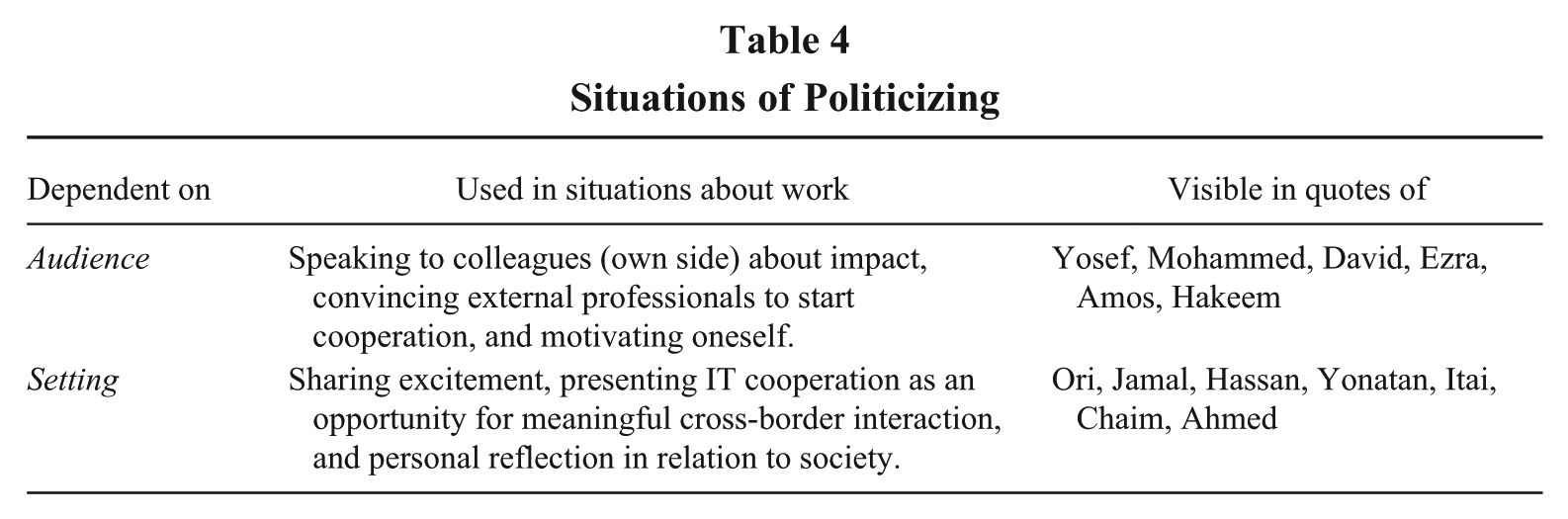
Politicizing was primarily used when communicating “about work,” in situations where individuals reflected on the cross-border nature of work and how they keep engaged, and when promoting cooperation to others. Politicizing helped individuals give a politically-oriented meaning to cooperation, where work was seen as complementary to their societal ideals of increasing safety in Israel and independence in Palestine. Situations in which informants showed politicizing as coping tactics are summarized in Table 4.
Situations of Politicizing
Yet, politicizing was also considered misplaced in certain situations. A general sense of awkwardness and frustration was experienced when politicizing in dealing with the media and when having introductory business meetings. Finding the right political tone matters, and three articles from a popular outlet demonstrated how individuals wanted their own versions of politicizing, which also reveals differences between Israeli and Palestinian politicizing. In the articles, the author, having family in Israel and adopting language where Israel was mentioned as the “Jewish State” rather than the “State of Israel,” and where “Palestinian Citizens of Israel” were consistently referred to as “Arabs,” described several IT cooperation projects. Palestinians were mostly agitated about being portrayed as sharing such discourse, and about the title, which they saw as supporting the idea of economic peace, a term associated with economic progress as an alternative to a political solution (often met with expressions like “Palestine is not for sale”). Featured in one of the articles, Palestinians reacted with statements like: “We see that this took advantage and turned something that is non-political into a political statement,” and “We are a tech startup, not some political party,” indicating that they did not agree with the politicizing done by the author in their names.
More generally, informants mentioned disagreements about whether to seek media attention to showcase their work. Resulting frustrations could even hinder engagement as we heard: This causes problems to many Israelis too, as they are offended when Palestinians don’t want to share in the media that they are cooperating together. I even heard that sometimes people refrained from doing business with Palestinians because they felt offended. (Ori/IL, 2019)
Also, when having business meetings, politicizing could cause tensions. The previously shown quote of Chaim, an Israeli software engineer who explained to Palestinians how IT cooperation represents Zionism for him during their first meeting, reveals that the Palestinians probably wouldn’t like it, which is in line with our data indicating the importance of depoliticizing to make business meetings with the other side work. Additionally, tension between cooperation partners was experienced when pitching to other multinationals: I had a lot of arguments with my Palestinian friends. We would go to [multinationals] for instance. I would tell, “They’re Israelis, but they come to look at you professionally.” But they would fall into things like, “We got stuck in the checkpoint, it took us a long time, and the treatment we are getting from Israelis is inhumane.” So, it made the Israelis feel bad, but then they started saying, “Ok, but can you deliver?” (Shira/IL, 2019)
Thus, politicizing was not appreciated and caused discomfort when communication was about capabilities. Asked about how they dealt with such situations, the manager explained that it took a few years for her to learn to live with it and for her Palestinian counterparts not to politicize too much during such meetings. Nevertheless, politicizing to the other side could thus cause tensions, and depoliticizing was needed to get the conversation going again.
In contrast, carefully situated politicizing was shown best in the following news article: We’ve weathered through criticism, we went through military conflicts and operations, and along the way it was clear to us that the joint professional work comes first. The daily positive interactions between Palestinian and Israeli teams have repeatedly demonstrated the immense potential inherent in a respectful discourse between people and the ability to put aside opinions and perceptions and unite together in one common goal. (Article [Times of Israel], 2020)
The Israeli CEO argued that professional work was their joint goal and that by putting aside differences, they could weather the challenges of being in a conflict context. Then, politicizing was used to promote IT cooperation with other multinationals, which is visible in the article too: “In his Facebook post, [CEO] called on other Israeli and international companies to employ Palestinian workers. “In these days when polarization, hatred, nationalism and violence were taking up more and more space in our country, in our regions and our world, let us find the power to see the good, the right, the humane, the innovative, the conciliatory and the tolerant which exist in both sides and in every one of us,” he wrote. (Article [Times of Israel], 2020)
Simultaneously, the chairman of the board of the involved Palestinian tech firm was also using situated politicizing, as shown in the firm’s press release, by highlighting dignity: Today, the giant company [multinational], and tomorrow many international companies will operate from Palestine, with Palestinian employees and expertise par excellence, all of this means creating tens of thousands of job opportunities, which will ensure that our young men and women live in dignity. (Article [Palestinian Tech1], 2021)
In sum, politicizing and depoliticizing are not simply about physically being in the workplace or in private, but about how individuals fluidly interpret situations, where “at work” involves attention to technical tasks, project delivery, and expanding outsourcing, mostly during interactions with colleagues from the other side and top management, whereas “about work” involves attention to the meaning of cooperation in society during interactions with colleagues from the same side, encouraging others to also engage, and in moments of personal reflection. Further, the anecdotes reveal how informants carefully situated politicizing and depoliticizing, anticipating their audiences’ expectations in “at work” and “about work” settings. Depoliticizing and politicizing are, thus, individual-level coping tactics that individuals use to give both a business-oriented and politically-oriented meaning to cooperation, respectively.
Constraining Guardrails: When Cooperation Is Disrupted
Thus far, our findings reveal how IT professionals use different coping tactics to give meaning to cooperation. However, we found that a conducive context is required to do so, formed by two guardrails that can disrupt cooperation: physical and social interference.
How physical interference impacts cooperation
Even during extreme violence like in 2021, which included missile exchanges with Gaza but also mass arrests in the West Bank, closed checkpoints, violent riots across Israel, and uncertainty about more armed groups joining the war, professionals kept working together unless critical infrastructure was destroyed.
One of the main tech companies in Gaza, for example, was bombed. Its CEO, who earlier agreed to setting up an interview, wrote, “Till now we are safe but the situation is very, very bad, let’s try next week, thank you” (Waleed/PS, 2021). We later heard that the offices and data servers were completely destroyed. Palestinians in the West Bank, while not receiving bombardments but experiencing military lockdown, mentioned feeling devastated and described their emotional experiences as “depressive,” “stressed,” or “very scared” while seeing regular news updates. For Israelis, this was a period of taking shelter repeatedly and of trying to reach their Palestinian colleagues. One informant explained how taking shelter was “surreal” because while Israelis could often reach shelters, she lost contact with colleagues in Gaza: “I only see the sent sign.” (Shira/IL, 2021). In addition to Gaza, the large-scale violence within Israel “deeply worried” many informants. It also made them wonder how they could get back to work again, as they were generally confused with everything that happened in their societies.
Yet, while violence caused enormous damage to people’s lives and to critical infrastructure, individuals showed a strong willingness to keep working as much as possible. A senior manager from the West Bank stressed this in relation to Gaza: Right after the war ended, some were replacing whatever is damaged and getting back to businesses. Some were looking for places to start working again. Others were staying at home trying to do their business. (Mariam/PS, 2021)
This also signals the high motivation to keep working together even in the midst of mass destruction and potential emotions about the wider conflict and violence. Apart from the extreme violence in 2021 and in 2023–2025, informants stressed how the digital nature of IT allowed them to mostly circumvent the practical manifestations of war: Since 1967 we never had [in the West Bank] an electricity cut, or telephone and internet cut, due to the political situation. And this is what you need for such an industry. Even if you are not allowed to come to our offices, you can still work from home or coffee place or whatever. (Omar/PS, 2019)
Finally, informants also creatively maneuvered within the war-torn physical infrastructure. For instance, the first meetings between Israeli and Palestinian IT managers were organized at a mutually accessible gas station near a checkpoint, as illustrated by the following: There was a closure in the West Bank. No Israelis could come in and no Palestinians could go out. We grew concerned we had come for nothing. A soldier . . . pointed out a gas station about 500 meters away. Both Israelis and Palestinians could go there without a permit. So we met there. (Article [Medium], 2016)
Even during the height of bombardments in Gaza in the years 2023–2025, IT professionals would construct solar-paneled electricity systems amidst the rubble to work. Thus, individuals try to find workarounds but are forcefully stopped when critical physical infrastructure gets destroyed, and they have to deal with traumatic experiences of such destruction.
How social interference impacts cooperation
Informants further mentioned forms of social interference with their work that were mostly induced by external parties but sometimes also occurred on their own initiative. For instance, at one moment, Palestinian IT professionals took part in a strike that halted the work for one day, as an informant explained: We went to the streets. The offices were closed yesterday, we all went to strike. The clients were informed that their employees will not work for a day. (Fatima/PS, 2021)
Informants stressed that nothing would affect their work commitments, but that they felt the need to make a statement against Israel’s policy regarding Palestinians and Gaza in particular.
Social interference also came from others. For example, professional relations were cut between European organizations and Israeli-located multinationals due to public debate about the Boycott-Divestment and Sanctions (BDS) movement, which led to uncertainty about the continuation of the contracts with some Palestinian partners: BDS posted a few times a boycott and some European organizations cancelled projects. I understand the idea behind it, but you cannot just boycott. I posted a letter. In Palestine we have 300 families that are living from [multinational]. You want to boycott these people? The idea is OK, but BDS misses the facts here in Palestine. (Fadi/PS, 2021)
There was also an incident at a job fair during fieldwork where a group of students from one of the universities in the West Bank started discussing antinormalization with IT professionals presenting there. The IT professionals decided to leave the university’s campus, as job interviews were made impossible. Since then, Palestinian firms started organizing “open days” (Fatima/PS, 2021) at their facilities. The reactions from informants on both sides to BDS are that it holds political arguments and ideals that do not apply to “economic work” and the “reality inside Israel and Palestine” (depoliticizing), or that it is not the way to achieve the vision of achieving a safe Israel alongside an independent Palestine (politicizing).
Thus, informants manage tensions between their hostile societal narratives and how they perceive their work by positioning IT cooperation as helpful either in a depoliticized or a politicized way. However, both physical and social interference need to be considered manageable for cooperation to continue. Importantly, IT cooperation has weathered these complications and keeps continuing even after the 2023–2025 escalations of violence.
Toward a Model of Conflict-Situated Cooperation
Our findings show how individuals give meaning to their work when cooperating during ethnonational conflict, which we consolidate into a theoretical model of “conflict-situated cooperation” (see Figure 7). The model visualizes how individuals construct such cooperation through situated depoliticizing at work and situated politicizing about work within the space bounded by physical and social interference, which we explain in more detail next.

A Model of Conflict-Situated Cooperation
Being embedded in the context of ethnonational conflict (as depicted by the rectangle surrounding the figure), the model conceptualizes how professionals cope through depoliticizing and politicizing (depicted as individuals’ coping tactics). It shows that in situations individuals perceive as being “at work,” which include more actionable and immediate tasks and project delivery, they are more likely to attempt to depoliticize cooperation. In contrast, in situations individuals perceive as being “about work,” which include broader and more reflective consideration and explanation of the work’s underlying purpose, they are more likely to attempt to politicize cooperation. Collectively, (de)politicizing enables individuals to construct meaning for professional cooperation across situations in the context of ethnonational conflict.
While the boundaries between “at work” and “about work” situations are fluid and depend on individual perception, both tactics can be misplaced and could, in consequence, invoke resistance. This is likely to occur when too much depoliticizing is used in situations “about work,” and when too much politicizing is used in situations “at work.” In the model, the potential (mis)placement of tactics is shown through an outer circle representing the perceived settings and an inner circle representing individuals’ coping tactics, where “situated depoliticizing” and “situated politicizing” are enabling, while too much depoliticizing about work and politicizing at work are “misplaced” and are thus inhibiting cooperation.
Further, the context imposes constraints related to physical and social interference which may disrupt cooperation. As ethnonational conflict is constantly evolving, physical infrastructure may become more or less challenging, and social resistance to any civilian cross-border interaction may grow or shrink. We, thus, show physical and social interference as guardrails, as they provide space in which professional cooperation takes place.
In sum, our model demonstrates how individuals engage in conflict-situated cooperation by simultaneously yet carefully depoliticizing and politicizing their work within the space bounded by social and physical interference while being embedded in ethnonational conflict.
Discussion
While shared work between societal adversaries has been a phenomenon of interest for some time (e.g., Arikan & Shenkar, 2013; Fewer et al., 2025; Hayward & Magennis, 2014; Stefansson, 2010; Weber et al., 2025), the question of how individuals manage cooperation (Castañer & Oliveira, 2020: 984) despite the inhibiting nature of ethnonational conflict (Gray et al., 2007; Rouhana & Bar-Tal, 1998) remains underexamined. Our qualitative case study addresses this limitation and advances our understanding of how professionals give meaning to their work when cooperating in the context of ethnonational conflict. In brief, we find that Israeli and Palestinian IT professionals cope with the challenging context of hostile societal narratives by depoliticizing in situations “at work”—mainly during interactions in everyday work tasks—and politicizing in situations “about work”—when referring to the broader meaning and purpose of their cooperation—to justify their engagement to themselves and others. Thus, both ways position their work as something valuable to themselves and their environment. Doing so, and within the space bounded by the contextual guardrails of physical and social interference, they collectively construct what we term “conflict-situated cooperation.” Conflict-situated cooperation, thus, denotes a way of professional cooperation between members of adversarial societal groups that are embedded in and shaped by the realities of ongoing ethnonational conflict. It thus captures the phenomenon where individuals continue working together toward shared goals even though their broader societal context frames the other as an enemy and imposes strong political, social, and emotional tensions. Our work offers two theoretical contributions to the literature.
The Distinct Nature of Cooperation in Contexts of Ethnonational Conflict
Our first contribution lies in theorizing the additional challenges to cooperation posed by ethnonational conflict (Connor, 1993; Rouhana & Bar-Tal, 1998), a context that has become increasingly salient globally in recent years and thus warrants more attention by management scholars (Lumineau & Keller, 2025). Extant literature documenting mostly peaceful contexts (Salvato et al., 2017) generally assumes that cooperation is enabled or hindered because of governance practices (Truelove & Kellogg, 2016), organizational purpose and goals (Gümüsay et al., 2020), individual motivations and status (Metiu, 2006), and partnership trajectories (Gray et al., 2022; Hardy & Phillips, 1998). “Conflict-situated cooperation,” in contrast, reveals that in contexts of ethnonational conflict, individuals feel threatened in their existential survival, which produces general projections of the other as the enemy to be avoided or boycotted. This can manifest in different ways, including physical reminders of conflict such as the wall, the checkpoints, and the graffiti we observed, but also through direct experiences from the military as well as communication with family and friends, and from daily news updates, which all further enact societal narratives of the other as the enemy. Importantly, the evolving context constrains and potentially disrupts cooperation via physical and social interference, even if individuals carefully employ situated depoliticizing or politicizing. While individuals try to find practical workarounds, these efforts eventually reach their limits.
Our concept of “conflict-situated cooperation” thus captures the distinct experience of cooperation during ethnonational conflict. It helps us understand how individuals perceive cooperation and allows an in-depth analysis of how individuals cope with seeing the other side as the enemy, yet engage in professional cooperation. As such, conflict-situated cooperation specifies the perceptions of individuals compared to literature examining more macro- and firm-level effects such as how ethnonational conflict impacts cross-border deals (Arikan & Shenkar, 2013; Arikan et al., 2020; Dai, Eden, & Beamish, 2017) or firm variety (Klüppel et al., 2018). It also allows for exploring how individuals embedded in political and economic asymmetries engage in cooperation from an interpretivist angle, foregrounding informants’ perspectives.
Together, this helps enrich our understanding of how business is performed in conflict settings (Lumineau & Keller, 2025) and goes beyond examining “national differences” in global cooperation (Hinds et al., 2011) because we started to delve into how individuals may allow for cooperation to occur despite the challenges they face and next to macroeconomic contextual conditions. This is important as it demonstrates that professional cooperative work is possible even during ethnonational conflict, but not without challenges for individuals.
How Individuals Mobilize and Situate Coping Tactics to Engage in Cooperation in Conflict Contexts
Our second contribution further specifies how individuals cope with ethnonational conflict to engage in cooperation. The tactics of depoliticizing and politicizing enable individuals to justify cooperation to themselves and others in situations “at work” and “about work.” While these could be seen as contradictory, they serve different purposes in different situations, while both position cooperation as something valuable rather than a major threat. In direct business situations, depoliticizing portrays cooperation as a pure business endeavor, eliciting thoughts on contributions to innovation, service delivery, and career growth, whereas in situations less directly related to immediate business tasks, politicizing portrays cooperation as a positive force for societal well-being, eliciting thoughts on the general influence of constructive relations and the role of an innovation economy in gaining international political support. Understanding situated (de)politicizing is therefore theoretically relevant in two ways.
First, it offers a more granular understanding of how individuals can actively cope to engage in cooperation by deliberately adapting language, focusing on different sets of goals, and muting or integrating conflict experience. Through (de)politicizing, individuals give their own meaning to cooperation and see it as something valuable. Detailing these coping tactics goes beyond what others have documented thus far. For example, escaping “supervised space” to develop personal relations in extra-organizational social settings was key in the case of Fewer et al. (2025), whereas our findings describe tactics used within the officially agreed work structure, and within ongoing violent conflict. Our case is also less about “reluctantly accommodating” as demonstrated by Seremani et al. (2022) and is not specifically focused on emotion regulation (Halperin et al., 2013; Sadeh & Zilber, 2019). What we found, instead, can be seen as active coping tactics, more in line with what de Rond and Lok (2016) and Verwoerd et al. (2025) discovered, because individuals would guide their behavior to engage with the work they considered challenging due to their environment. Yet, in contrast to these studies, we show how individuals in business can actively cope with conflict to engage in structural cooperation.
We contribute by explaining how individuals, as opposed to organizations (Sadeh & Zilber, 2019; Weber et al., 2025), and in the context of structural business cooperation as opposed to more issue-based cooperation (Seremani et al., 2022; Wiedemann et al., 2021) or humanitarian work (de Rond & Lok, 2016; Rauch, 2025; Verwoerd et al., 2025), can engage in working with the perceived existential enemy. Such insights are relevant given ethnonational conflict globally while potential jobs or some types of work may bridge between conflict lines, such as local construction work after the war in Bosnia (Stefansson, 2010), cooperative agriculture between perpetrators and victims of genocide in Rwanda (Sentama, 2020), or work in mixed corporate boards in Sri Lanka (Nazliben, Renneboog, & Uduwalage, 2024). Thus, our findings are theoretically important because prior research indicated that conflict complicates cooperation, while explanations of cooperation remain limited to insights on interorganizational relations (Arikan et al., 2020), refusing orders (Wiedemann et al., 2021), emotion regulation (Sadeh & Zilber, 2019), and interpersonal trust (Fewer et al., 2025). Our study advances these debates by exploring how individuals actively give meaning to working together. Thus, we contribute to a better understanding of how individuals allow cooperation to occur in conflict contexts.
Second, we advance management research on conflict contexts by highlighting how individuals situate their coping tactics. Prior work has underemphasized how individuals may act differently in various situations. However, individuals can use seemingly antagonistic coping tactics, as in our case. While prior studies have revealed how individuals are triggered to act according to ethnonationalism during national celebrations, which caused temporary cooperation breakdown (Sadeh & Zilber, 2019), and how individuals can move between strongly protected spaces and informal social spaces (Fewer et al., 2025), they reveal less about how individuals deliberately shift between coping tactics. Our study expands prior work by focusing on the situatedness of coping during cooperation as we highlight the importance of perceived “at work” and “about work” situations. Situated (de)politicizing preempts potential discomfort and negative reactions, yet, if not carefully situated, it hinders cooperation. Individuals need to actively switch to the tactic that enables both sides to engage in cooperation. This helps understand coping with conflict as a fluid and situational exercise rather than a deterministic outcome based on macro-level economic and institutional factors (such as demand and supply of talent), or rendered impossible due to internalized dehumanizing narratives.
Shifting between rationales has also been observed in bridging religion and business (Gümüsay et al., 2020), in explaining so-called dirty work (Ashforth, Kreiner, Clark, & Fugate, 2007), and managing tensions like performing under resource constraints (Miron-Spektor et al., 2018). However, what we show is how individuals perceive their work in relation to their conflict context more broadly. Contributing to one’s society as an ethnonational group is therefore much more central than in prior literature. As such, we have further analyzed “political-motivational interests” to cooperate (Wiedemann et al., 2021), however, not temporarily (e.g., by refusing orders) but instead by casting the continuation of cooperation as valuable for one’s society despite conflict. Thus, we contribute to the nascent research on coping in conflict contexts by showing how individuals mobilize depoliticizing and politicizing tactics in different situations, which sometimes also caused resistance but overall shaped the meaning of cooperation as something valuable for both sides. Situated (de)politicizing, thus, helps broaden our current understanding of how individuals engage in cooperation during ongoing ethnonational conflict.
Portable Insights to Scholarship on Polarization, Distrust, and Other Conflict Contexts
Our theoretical contributions also have implications for research that seeks to provide a better understanding of how people work together in increasingly polarized societies. Our analysis emerged from a rather “extreme” context characterized by oftentimes violent ethnonational conflict, which was valuable to tease out theoretical properties of cooperation that might have been less salient in more peaceful settings. Yet, many societies seem to grapple with polarization. In some cases, tensions have led to actual violence over the past years, including the storming of the Capitol in the United States and of multiple government buildings in Brazil. Levels of distrust and feelings of hostility among societal groups on moral issues also pose important challenges to cooperation (e.g., Pratt, Hedden, & Khan, 2025). Additionally, in international business, nationalist sentiment lowers the willingness to work with foreigners and increases distrust (Ertug et al., 2024). However, people may need to continue working together across these divides. In those contexts, the tactics of (de)politicizing in “at work” and “about work” situations might be effective ways to enable such cooperation.
As such, our model extends scholarship on how individuals can work together under general distrust. While literature has indicated how individuals can become personally acquainted and can transfer trust from the individual to more macro levels (Schilke & Cook, 2013), or that individuals can keep working together because perceived actorhood of the other’s organization is either low (working with trustable individuals only) or high (working with trustable organizations regardless of the involved individuals) (Schilke & Lumineau, 2025), we demonstrated that individuals embedded in societal distrust mobilize (de)politicizing tactics to portray cooperation as valuable to their society. Still, we found that the general narratives of the other being the enemy to be avoided exist despite individuals’ coping tactics, corresponding to a coexistence view on trust and distrust (Kostis, Bengtsson, & Näsholm, 2022).
Applications of our findings to other practical contexts are up to further empirical scrutiny. Yet, they might include that (de)politicizing tactics could potentially create new pathways for expanding professional cooperation in contexts such as Bosnia, where small-scale village work had benefited from traditions of hospitality (Stefansson, 2010); they could offer more leeway to survivors and perpetrators of the Rwandan genocide when working in agriculture, compared to witnessing and perhaps expecting deep friendships (Sentama, 2020); and they could bring additional value to the often pragmatic considerations of including various ethnicities (e.g., to access consumer segments) in Sri Lankan organizations (Nazliben et al., 2024). Although predicting outcomes remains difficult, the continued resilience of the Israeli-Palestinian IT industry despite ongoing conflict suggests that situated (de)politicizing can generally enable individuals to engage in cooperation at scale. In other words, opportunities for further research emerge with regard to examining how, when, and with what effects actors in those contexts would resort to the tactics we have identified.
Boundary Conditions, Limitations, & Future Research
Our study has several boundary conditions and limitations. First, given our data, we sought to explain how individuals give meaning to working together rather than how cooperation is initiated or dissolved, or how organizations formally structure cooperation.
Second, we have examined a context where ethnonationality is perceived as “given” and general tensions run high, including physical and social interference. Our model may therefore apply less to other types of conflict where divisions are less clear and where tensions are lower, or to potential future situations where political leaders make cooperation much harder. In such cases, (de)politicizing may not be as relevant to cooperation as in our case.
Third, the economic context provided clear incentives for cooperation on both sides. We do not underestimate these conditions, which are not fixed but relatively given for our informants. While high demand for IT talent in Israel and oversupply of IT talent relative to jobs in Palestine are important explanations for why we are observing cooperation, they are not enough to fully understand how individuals cope with their context. Nevertheless, incentives may be different in other cases and in other types of work (e.g., less knowledge-intensive).
Fourth, we have interpreted our data as conflict-situated cooperation because the experiences of our informants come closest to what prior management research has defined as “cooperation” rather than, for instance, exploitation (Crane, 2013; Livne-Ofer et al., 2019). Still, the asymmetries in the political and economic context of Israel-Palestine but also in software development in a global economy, undoubtedly shape dependencies. We focused on what we observed as most central in the data, which does not reject potential alternative analyses. While power struggles could also be an explanation for how individuals engage in cooperation (Dübgen, 2012; Toivonen & Seremani, 2021), we did not find power dynamics to be the central puzzle but rather how individuals coped with their societal narrative of avoiding the enemy by (de)politicizing to engage in cooperation.
Further, from a philosophy of science perspective, we have adopted an interpretive approach (Burrell & Morgan, 1979), which helped us better understand informants’ perceptions and experiences. Our findings have thus been developed from an epistemological angle of understanding rather than predicting or breaking social structures. Such perspectives are certainly suited for follow-up work with data that allow for such examinations. In this study, our main knowledge interest was what Habermas (1971) described as “practical-hermeneutic,” which aims at seeing through the eyes of informants to create mutual understanding. Future work could employ different epistemological positions and build on our findings by exploring causal relations between tactics used and cooperation success, or investigating dynamics between societal and workplace power relations.
In addition to these boundary conditions, we note several limitations, each of which offers opportunities for future research. First, although our study shows events unfolding in real-time and is conducted over two periods, it is limited in processual insights. Future research should examine how coping tactics may evolve over time and how this happens alongside the evolution of ethnonational conflict. Additionally, future work can explore how individuals’ framing of cooperation may feed back to the general narratives of the other being the enemy.
Second, while our data shows emotions to illustrate the experiences of our informants, emotions were (somewhat counterintuitively) less central to the coping tactics we found for engaging in cooperation. This can be due to our data (no direct observations of work and little time to build relations in the field) or the norms and expectations that come with the corporate context of firms (compared to other types of work documented in case studies on conflict contexts), yet we observed that informants found it normal to ignore emotions or to “take things at the human level.” Our findings thus resonate more with collectively silencing sensitive issues, which seems natural to those involved and has been documented in other contexts of violent conflict, too (e.g., Stefansson, 2010). Future work could, therefore, detail how emotions influence the coping tactics we observed, including expressions in social and online settings.
Third, the role of digital technology should be explored further. The importance of digital technology surfaced in our data as enabling work while facing physical restrictions. Yet, our data suggested the role of digital technology to be less pronounced than, for example, the impact that physical and social interference have on cooperation. Thus, while our data is limited in theorizing the role of digital technology, we nevertheless consider it important to further explore how individuals use technology to overcome challenges of cooperation and how it could also amplify tensions (e.g., Ali-Saleh Darawshy, Lev, & Weiss-Dagan, 2025).
Concluding Remarks
Our study helps develop a more granular and nuanced understanding of cooperation among societal adversaries, because unlike what extant management research accounts for, ethnonational conflict is—unfortunately—widespread and impacting many work settings around the world. We are hopeful that next to advancing our theoretical understanding of ethnonational conflict in management research it also helps enable practical cooperation despite conflict.
Supplemental Material
sj-docx-1-jom-10.1177_01492063261443476 – Supplemental material for Conflict-Situated Cooperation: How Israeli and Palestinian IT Professionals Give Meaning to Cooperating Under Ethnonational Conflict
Supplemental material, sj-docx-1-jom-10.1177_01492063261443476 for Conflict-Situated Cooperation: How Israeli and Palestinian IT Professionals Give Meaning to Cooperating Under Ethnonational Conflict by Pieter de Wit, Christopher Wickert and Ali Aslan Gümüşay in Journal of Management
Footnotes
Acknowledgements
We like to thank our informants for their hospitality and reflections that formed the basis of this study. We also thank Sara Soderstrom, Shahzad Ansari, Santi Furnari, Zahira Jaser, Johanna Mair, Martin Kilduff, and members of the OTREG reading group, as well as participants of the Academy of Management Symposium on Organizing and Strategizing in the Face of War, for their valuable comments on earlier versions of the paper. Finally, we thank our editor Fabrice Lumineau and our anonymous reviewers who helped us improve our work in the review process.
Supplemental material for this article is available with the manuscript on the JOM website.

Notes
References
Supplementary Material
Please find the following supplemental material available below.
For Open Access articles published under a Creative Commons License, all supplemental material carries the same license as the article it is associated with.
For non-Open Access articles published, all supplemental material carries a non-exclusive license, and permission requests for re-use of supplemental material or any part of supplemental material shall be sent directly to the copyright owner as specified in the copyright notice associated with the article.
