



Abstract
The proliferation of generative AI models fundamentally alters organizational capabilities, enabling novel value creation while challenging incumbent governance frameworks. Employing a phenomenon-driven approach, this study integrates and extends property rights theory (PRT) and stakeholder resource-based theory (SRBT) to address governance challenges posed by generative AI. By leveraging system dynamics modeling, we conceptualize the dynamic interplay among stakeholder claims, institutional arrangements, and value appropriation outcomes, highlighting how feedback loops, delays, and accumulations shape these interactions. Our analysis reveals two insights: First, stable equilibrium states in stakeholder claims and property rights arrangements may not invariably lead to equitable outcomes, due to stakeholder power disparities and attribution ambiguity associated with generative AI. Second, framing the evolution of generative AI models as organizational resources from the complementary perspectives of PRT and SRBT reveals distinct resource features largely unexamined in the strategy literature. Hence, we introduce the concept of “wicked resources,” characterizing generative AI models by their inherent attribution ambiguity and emergent unpredictability. Building on prior research on resource complexity and uncertainty in the strategy literature, wicked resources are marked by the difficulty firms face in delineating and enforcing control within shifting sociopolitical contexts. This paper makes three key contributions: addressing the dynamic, multi-stakeholder nature of generative AI governance; introducing wicked resources as a novel resource category in strategy and management literatures; and identifying theoretical gaps, advocating for a dynamic, systemic approach to property rights and stakeholder bargaining.
Keywords
Introduction
The widespread adoption of digital technologies enables organizations to utilize, recombine, and control resources beyond their traditional boundaries, unlocking novel pathways for value creation. However, these developments may challenge existing institutional frameworks, which often fail to adequately address control rights and value attribution in this digitally mediated landscape. As a result, the negative externalities arising from this inadequacy can give rise to opposition from affected stakeholders, exemplified by grassroots resistance to Airbnb in cities such as Barcelona (Ricart et al., 2020), bringing these emerging dynamics to the attention of scholars and practitioners alike.
Generative AI models similarly spark controversy due to the attribution ambiguity inherent in their outputs and the unpredictability of their broader societal implications. Such ambiguity can generate negative externalities, fueling disputes among stakeholders over property rights, as illustrated by lawsuits against AI companies from artists and content creators (Dhameliya, 2024). Additionally, the unpredictable societal consequences of generative AI, including issues related to employment, privacy, and misinformation, exacerbate governance challenges by intensifying stakeholder conflicts. On the flip side, companies building and deploying generative AI models face increased uncertainty, as ambiguous attribution of contributions and unpredictable impacts can trigger stakeholder claims or shifts in property rights regimes.
The purpose of this paper is to employ a phenomenon-driven approach (Lumineau et al., 2025) to integrate and extend existing theoretical frameworks—particularly property rights theory (PRT) and stakeholder resource-based theory (SRBT)—to analyze the governance challenges arising from generative AI. Specifically, we develop a conceptual model that leverages system dynamics modeling (Sterman, 2000) to formalize the dynamic interactions among stakeholder claims, evolving property rights regimes, and value appropriation outcomes. In doing so, we explicitly model how feedback loops, delays, and accumulations shape the evolution of governance arrangements and stakeholder dynamics. This parallel theoretical analysis examines how stakeholder claims and property rights regimes may stabilize into distinct equilibrium states within the context of generative AI models.
Our conceptual model yields two main implications for research and practice. First, reaching an equilibrium in stakeholder claims and property rights regimes does not necessarily imply an equitable outcome. The technical properties of generative AI models, insufficient bargaining power of disadvantaged stakeholders, and inadequate institutional support may result in an inequitable equilibrium even within stable property rights regimes. Second, the unique characteristics of generative AI models call for a new conceptualization as organizational resources, given their dynamic implications from the perspective of the theories we integrate to frame the phenomenon in this study.
Based on these findings, we propose a new conceptualization of generative AI models as “wicked resources,” characterized primarily by two dimensions: attribution ambiguity and emergent unpredictability. While these dimensions individually resonate with existing discussions on resource complexity and uncertainty in the strategy literature (e.g., knowledge-based assets [Grant, 1996], technological discontinuities [Tushman & Anderson, 1986]), their manifestation in generative AI contexts necessitates distinct theoretical attention. Specifically, the generative nature and far-reaching societal implications of AI models intensify attribution ambiguity and emergent unpredictability to a degree that challenges conventional frameworks of property rights, thereby calling for a comprehensive theoretical integration and extension.
On the flip side, wicked resources imply transaction costs for organizations that build and utilize them, given the inability to fully delineate and enforce clear boundaries of control. Therefore, addressing this novel resource context requires dynamically capturing how stakeholder claims and property rights arrangements may evolve over time, offering valuable insights into the governance complexities associated with generative AI models. We approach this challenge through the dynamics of resource governance, understood as the institutional and organizational arrangements through which access, control, and value appropriation over resources are structured and enforced (Foss & Foss, 2022; Mahoney et al., 2009). In this sense, resource governance includes both formal and informal mechanisms that regulate how multiple actors contribute to and benefit from a resource.
The contributions of this study to management scholarship are threefold. First, by applying established theories to illuminate the challenges posed by generative AI models, we address a timely, real-world phenomenon, thereby responding directly to recent calls for phenomenon-based research (Fisher et al., 2021; Lumineau et al., 2025). By modeling the emergence of distinct governance regimes, we provide the conceptual basis for intervention measures aimed at promoting equitable value distribution. Second, we introduce the concept of wicked resources, characterized by attribution ambiguity and emergent unpredictability, and argue that this novel resource category transcends generative AI, encompassing a broad spectrum of resources whose societal implications remain underexplored in current strategy literature. Third, by employing the PRT lens in a parallel analysis, we identify critical gaps in the theory and highlight the necessity of incorporating a dynamic perspective, thereby advancing recent contributions such as those by Bucheli et al. (2023).
The rest of the paper is structured as follows. First, we examine the properties of generative AI models, illustrating how their capacity for novel output creation shapes governance challenges. Next, we present our theoretical background, highlighting insights from PRT and SRBT relevant to the generative AI phenomenon. We then develop our conceptual model, integrating these theoretical lenses into a system dynamics approach to understanding how property rights and stakeholder claims evolve over time. Subsequently, we discuss the model’s implications, focusing on the notion of wicked resources and how these insights can inform both theory and practice. Finally, we conclude with a discussion of the study’s broader implications, limitations, and directions for future research.
Generative AI Models: Architecture and Pertinence
Generative AI (henceforth GenAI) models represent some of the most technically sophisticated digital resources currently available (OpenAI, 2024). Their architectures are grounded in a self-attention mechanism that allows these models to identify, process, and generate patterns across vast volumes of data with remarkable contextual understanding (Vaswani et al., 2017). This capacity stems from networks containing billions of parameters, commonly referred to as “weights,” which the models adjust iteratively over extensive training cycles.
GenAI models rely on a training paradigm in which neural networks learn linguistic and representational patterns from large, diverse corpora (OpenAI, 2024). During this training, the models’ billions of parameters capture correlations across input data, enabling advanced capabilities such as language understanding, code generation, and complex problem-solving. Yet this iterative parameter adjustment process remains opaque: Outputs cannot be directly linked to specific data points or contributions from various external sources, as the patterns emerge from the model’s analysis of countless overlapping examples (Oh & Schuler, 2023). This opacity makes it nearly impossible to disentangle how specific training inputs shape particular outputs, thereby complicating attribution and creating significant challenges for governance (Taeihagh, 2025). Unlike open-source software or licensed datasets, where modularity and provenance allow attribution of discrete contributions, the nonlinear interactions of billions of parameters in GenAI models obscure the marginal value of specific inputs (Dhanore, 2025). Even when data volumes are traceable, disentangling causal influence remains indeterminate, which limits the applicability of conventional attribution mechanisms.
The difficulty of attribution is magnified by the far-reaching implications of GenAI as a general-purpose technology. Its applicability across domains not only enhances productivity but also fundamentally transforms innovation processes across diverse application areas (Cockburn et al., 2019). Such technologies go beyond incremental improvements within specific fields by enabling systemic innovation across sectors, thus creating vertical and horizontal externalities that influence economic structures, employment patterns, and societal dynamics (Einhoff & Paunov, 2025). Therefore, the question of attribution extends beyond data inputs to the equitable distribution of costs and benefits, problematizing compensation and governance arrangements.
Resource Inputs and Contributing Stakeholders
The development of GenAI models requires five fundamental categories of resource inputs: training data, intellectual capital, financial capital, computational infrastructure, and natural resources. As summarized in Table 1, each category involves distinct stakeholder groups as main contributors.
Stakeholder Contributions as Resource Inputs
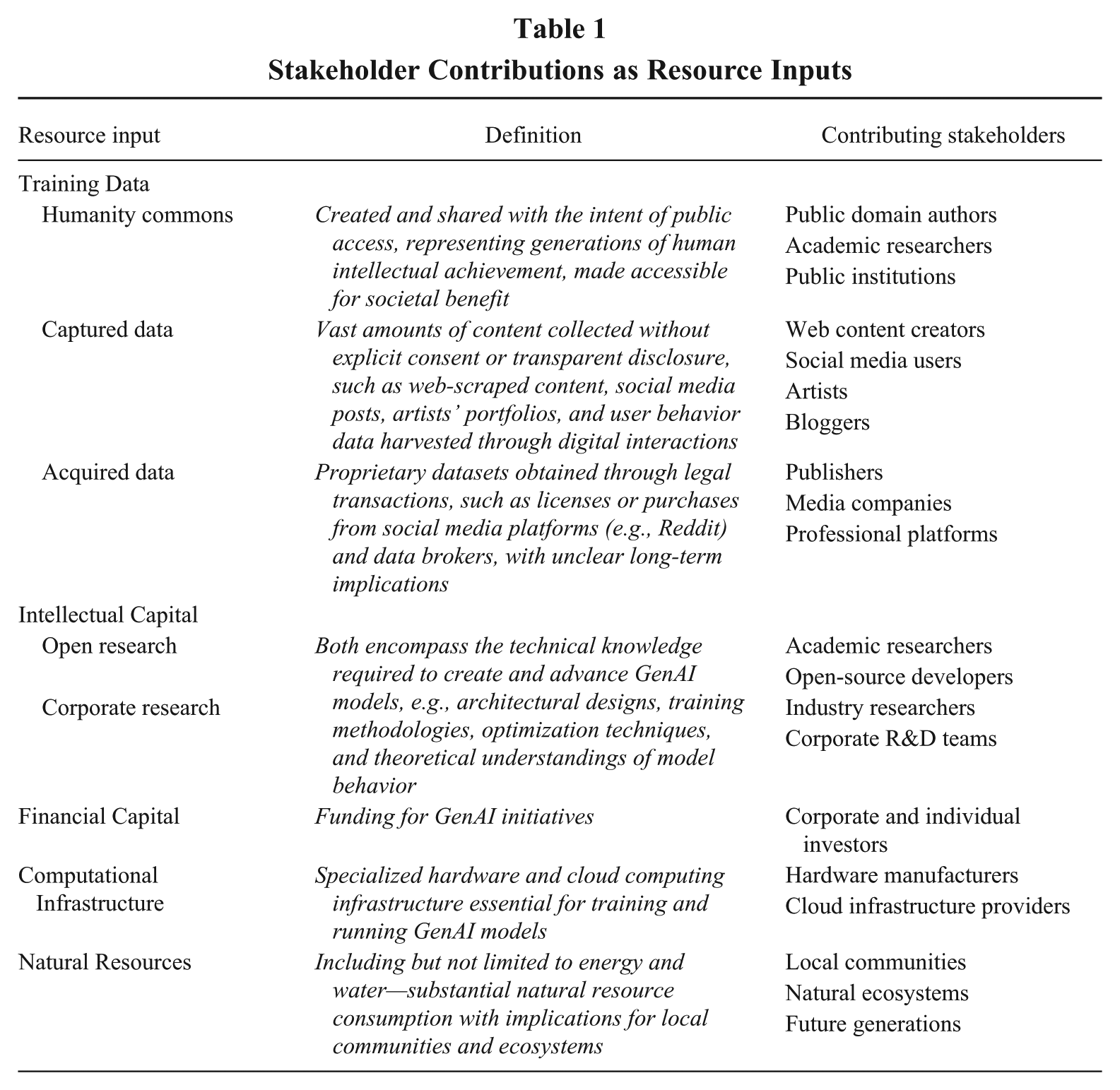
Training data comprises three key categories: the humanity commons, captured data, and acquired data. The humanity commons represents generations of intellectual achievement, including public domain literature, academic research, and public repositories created for collective benefit. Yet these shared resource inputs are repurposed at unprecedented scale into private AI capabilities (Taeihagh, 2025). Captured data, on the other hand, encompasses massive amounts of content (e.g., web-scraped materials, social media posts, and user behavior) collected without explicit consent, exemplified by Common Crawl’s petabyte-scale archives of digital expression (Common Crawl, 2024; Zuboff, 2019). Finally, acquired data refers to proprietary datasets obtained through licenses or purchases, forming a growing market where content owners sell access for AI training, as in Reddit’s deal with OpenAI, which raises unresolved questions about long-term effects on creators (Samuelson, 2023).
Intellectual capital encompasses the technical knowledge required to create and advance GenAI models, including architectural designs, training methodologies, optimization techniques, and theoretical understandings of model behavior. It exhibits complexity through its dual nature in open and corporate research. Academic researchers and open-source developers contribute fundamental innovations based on motivations such as recognition and the advancement of knowledge (von Hippel & von Krogh, 2003). In contrast, corporate R&D teams operate under different incentive structures, often focusing on proprietary advancements that remain inaccessible to the broader community (Chesbrough, 2003).
Financial and computational resource inputs, while more conventionally structured, create their complexities through unprecedented scale and concentration. Venture capital investors, technology companies, and individual investors provide substantial funding to AI initiatives, as evidenced by OpenAI’s recent $6.6 billion raise (Hu, 2024). These figures reflect not only the direct costs of AI development but also the need to secure long-term access to computational infrastructure and top talent. Computational resource inputs, including specialized hardware and cloud computing capacity, are essential for training and running GenAI models. The scale of computational requirements for these models has triggered an unprecedented demand for specialized chips (Shilov, 2024). This intensity has implications not just for hardware supply chains but also for energy consumption (Gordon, 2024). The resulting carbon footprint can be substantial, especially for models retrained or fine-tuned repeatedly. Equally important is water usage in cooling large data centers, which affects local ecosystems (Verma & Tan, 2024).
GenAI models combine opaque architectures, vast data inputs, and energy-intensive computation, posing governance challenges for equity and sustainability. Society broadly contributes critical resource inputs, particularly in the form of public domain knowledge, but remains highly vulnerable to the direct and indirect societal impacts of AI. The interplay among technological complexity, diverse stakeholder contributions, and significant societal implications highlights the necessity for a dynamic conceptualization to address the emergent properties of institutional and societal interactions.
The next section provides theoretical scaffolding on which the conceptual model will be built.
Theoretical Background
Property Rights Theory
Property rights theory is gaining traction in management studies, offering complementary insights to extant research in the field. Property rights are defined as “the rights to use, to earn income from, and to transfer or exchange the assets and resources” (Kim & Mahoney, 2005; Libecap, 1989). Rooted in the field of economics, PRT conceptualizes property rights as de facto control rights that are held over assets (Foss & Foss, 2022), while these rights can be enforced through “etiquette, social custom, ostracism, and formal legally enacted laws supported by the states’ power of violence or punishment” (Alchian, 1965). Therefore, the PRT conceptualization of property rights differs from the normative approach in legal studies in that (a) it adopts a de facto understanding of the concept, and (b) the conditions that enforce this de facto control are considered in a broader sense, encompassing factors beyond legal frameworks (Kim & Mahoney, 2005).
PRT offers an alternative lens for understanding resources by considering the property right as the unit of analysis, viewing resources exchanged in transactions as bundles of such rights (Coase, 1960; Foss & Foss, 2022). In other words, resources have a multi-attribute nature, and these attributes (i.e., property rights) refer to the array of services and functionalities that can be provided by an asset (Barzel, 1997). These property right bundles can be partitioned in various ways, with each attribute representing a (potential) income stream (Foss & Foss, 2005).
However, the ideal partitioning and exchange of property right bundles are contingent upon the assumption that each property right is clearly defined and enforced, implying zero transaction costs (Coase, 1960; Demsetz, 1967). Transaction costs, as defined by Williamson (1985), are the costs of conducting economic exchanges, which include both ex ante costs (e.g., drafting, negotiating, and safeguarding agreements) and ex post costs (e.g., monitoring, enforcing, and adapting contracts). These costs arise due to human factors like bounded rationality (i.e., limited cognitive capabilities) and opportunism (i.e., self-interest seeking with guile), as well as transaction-specific characteristics such as asset specificity, uncertainty, and frequency. Therefore, firms may incur transaction costs in exercising their property rights, such as search, bargaining, and monitoring costs when contracting for the exchange of rights (Coase, 1960), cost of information and measurement for specific resource attributes (Barzel, 1982), and costs associated with protecting property rights from capture in the absence of adequate legal and institutional frameworks to enforce and defend these rights (Barzel, 1997; North, 1990).
Institutional frameworks, consisting of formal rules (e.g., laws and regulations) and informal constraints (e.g., norms, conventions, and codes of conduct), play a pivotal role in the delineation, allocation, and enforcement of property rights (North, 1990, 2005). By shaping the “rules of the game,” these frameworks directly influence the transaction costs associated with exercising property rights over resources. Strong institutional frameworks, characterized by clear rules and effective enforcement mechanisms, can reduce transaction costs by providing a stable and predictable environment for economic activities (North, 1990; Williamson, 1975). Specifically, well-defined property rights, coupled with robust legal systems, increase economic efficiency, as parties can engage in transactions with greater certainty and lower risk of capture. Conversely, weak or underdeveloped institutional frameworks can increase transaction costs and impede the efficient utilization of resources (Acemoglu & Johnson, 2005). In domains with inadequate institutional arrangements, parties may face higher costs associated with negotiating, monitoring, and enforcing agreements, and the risk of expropriation or capture of property rights.
Furthermore, institutional frameworks can influence the distribution of property rights and the associated costs and benefits among stakeholders (Barzel, 1997; Demsetz, 1967). Regulations and policies may grant certain parties preferential access to resources or impose constraints on the exercise of property rights (Libecap, 1989; Ostrom, 1990). Recent studies, such as Bucheli et al. (2023), pay attention to how institutional frameworks can, in fact, be shaped by stakeholders in line with their property right claims. The authors argue that incumbent institutional frameworks are the products of the political struggles among preceding actors, which can be “challenged or replaced” (Bucheli et al., 2023: 315). Parties such as firms may alter institutional frameworks in their favor and thereby minimize transaction costs. On the other hand, non-firm actors with sufficient lobbying power may also influence these institutions if a property rights regime is perceived as illegitimate. These illegitimacy claims would in turn become a source of transaction cost for the opposing party (i.e., firm), as resources are now more difficult to control, given a weakened property rights regime due to the opposition from other stakeholders. As such, institutional environments remain in flux to sustain the legitimacy of a property rights regime.
Stakeholder Resource-Based Theory
While Bucheli et al. (2023) focus on the macro-level institutional frameworks within which firms and non-firm actors operate, a complementary view at the firm level enriches this conversation by viewing stakeholders as suppliers of resource inputs to firms rather than as external actors. Stoelhorst (2023) proposes stakeholder resource-based theory, which conceptualizes a company as a governance structure: a legal entity that does not exclusively represent any single stakeholder. All stakeholders, including management and shareholders, are resource input suppliers to this governance structure.
According to SRBT, stakeholders engage in bargaining with one another to appropriate the value created by the company. This bargaining occurs not only through normal market mechanisms (i.e., competitive bargaining) but also through pure bargaining. In pure bargaining, the outcome depends on their relative bargaining power based on the persuasive resources each stakeholder can leverage, such as informal institutions, shared norms, and ethical standards. This process allows stakeholders to influence the distribution of value in ways that go beyond the forces of supply and demand, often shaped by the governance structure of the firm and the sociopolitical context in which it operates. However, stakeholders may encounter friction in their efforts if institutional frameworks that enforce the corporation as a governance structure do not adequately account for all norms. Consequently, all stakeholders, including shareholders, share the returns through these processes.
This conceptualization relates closely to the team production view of the firm (Alchian & Demsetz, 1972), particularly as articulated in the PRT tradition. Alchian and Demsetz’s original team production theory highlights issues of monitoring and distributing residual claims due to team production (Alchian & Demsetz, 1972). Likewise, SRBT highlights bargaining dynamics among stakeholders, influencing how value is distributed based on their resource inputs and bargaining leverage, resonating with Kim and Mahoney’s (2005) view of property rights as outcomes of bargaining processes shaped by resource inputs and contextual factors. On the other hand, SRBT explicitly differentiates competitive bargaining (market-based mechanisms) from pure bargaining, where the outcome is influenced by broader persuasive resources as mentioned previously. This expands upon traditional PRT and team production theory, which typically emphasizes incentive alignment and residual control rights but does not extensively incorporate persuasive and sociopolitical mechanisms. Furthermore, SRBT aligns with Bucheli et al. (2023) by explicitly highlighting the institutional and sociopolitical context as shaping stakeholder bargaining power and property rights enforcement. While traditional team production theory within PRT does address governance and ownership allocation, SRBT places greater emphasis on external institutional frictions, highlighting inadequate institutional frameworks as specific sources of transaction costs (friction).
Although Stoelhorst (2023) treats institutional frameworks as exogenous to pure bargaining efforts, these frameworks are, in fact, products of preceding political struggles (Bucheli et al., 2023), as previously noted. Therefore, pure bargaining may go as far as altering the macro-level (i.e., institutional) arrangements. On the other hand, these efforts may also lead to micro-level arrangements such as stakeholder value propositions (SVPs; Carrasco-Farré et al., 2022). A stakeholder value proposition refers to the explicit commitments a firm makes about how it creates or shares value with specific stakeholder groups, thereby extending the traditional notion of a customer value proposition to a broader set of actors in the ecosystem. As Carrasco-Farré et al. (2022) suggest, the design and delivery of SVPs are often dynamic, requiring firms to continuously adapt to evolving stakeholder needs or to balance negative externalities. In some cases, SVPs can lead to more equitable outcomes, especially when firms are willing to engage in mutual adjustments. This dynamic stakeholder engagement at the micro-level can help prevent resistance and mitigate emerging tensions associated with inadequate institutional frameworks.
Building on the theoretical background so far, firms introduce these micro-level arrangements to alleviate the transaction costs associated with a shifting (informal) institutional context due to credible stakeholder claims. Firms such as digital platforms that operate on the resource inputs of diverse stakeholder groups may need such arrangements to retain control over their resources. In this case, the PRT lens is useful for identifying the fundamental problem of control for firms. On the other hand, in addressing this problem for the contexts where property rights over resources cannot be perfectly specified or enforced, and stakeholder contributions and harms cannot be neatly attributed or compensated, the stakeholder-centered design principles suggested by micro-level arrangements offer a complementary focus. Rather than reassigning or attributing formal property rights over resources, they seek to mitigate transaction costs by emphasizing firm-level governance mechanisms that build legitimacy and credible commitments through continuous adaptation. Therefore, these arrangements are best explained when firms are viewed as governance structures, with stakeholders as providers of resource inputs and as actors that engage in pure bargaining for their claims.
When credible commitments become routinized and widely accepted, it is reasonable to argue that they may be interpreted as de facto rights of the corresponding stakeholder group, stabilizing pure bargaining efforts through relational norms rather than formal legal arrangements. This interpretation expands on Barzel’s (1997) and Foss and Foss’s (2005) view of property rights as entitlements to control and derive income from specific resource attributes, regardless of whether such rights are legally codified. From this perspective, micro-level arrangements such as stakeholder value propositions can be understood as de facto claim and/or control rights when institutionalized, as they stabilize expectations of control and value appropriation among stakeholder groups through relational rather than formal enforcement mechanisms.
The latest contributions to the PRT literature, complementary views of SRBT, and an implicit dynamic view emerging in multiple related research streams highlight the need to encapsulate the evolving mechanisms around complex resources such as generative AI models.
Conceptual Model
In this section, we develop a conceptual model that captures the dynamic mechanisms through which stakeholders navigate value creation and appropriation within the context of GenAI models. Our dynamic model makes three key advances. First, it moves beyond static conceptualizations of property rights by incorporating feedback loops that reveal how stakeholder actions and institutional responses coevolve over time. Second, it explicitly connects resource creation with stakeholder bargaining, showing how these interconnected mechanisms shape both value creation and distribution. Third, it reveals how different equilibrium states in property rights regimes may emerge from these dynamics, with important implications for both economic efficiency and equity.
We begin by introducing system dynamics as our methodological foundation, explaining how this approach helps capture the complex interdependencies that characterize GenAI models in a phenomenon-driven inquiry. Subsequently, we develop our model in two stages. First, building on the earlier integration and extension of PRT and SRBT, we construct a basic feedback structure with two causal loops to visualize our basic framework. Second, we apply these causal loops (i.e., the resource creation loop and the stakeholder bargaining loop) to the case of GenAI models, illustrating how each mechanism operates in practice by drawing on publicly available descriptive evidence, such as company statements, industry reports, and news coverage. Taken together, the two loops form a comprehensive model that formalizes how institutional and firm-level responses may emerge from stakeholder interactions.
Methodology
To capture the dynamic complexity involved in the governance of our focal resource (GenAI models), we employ system dynamics (SD) as our methodological foundation. Our study is grounded in a phenomenon-based approach that prioritizes the understanding of real-world dynamics as the central source of insight. Rather than deriving propositions deductively from existing theory, this orientation begins with a puzzling phenomenon and uses theoretical lenses as scaffolding to make sense of its underlying mechanisms (Lumineau et al., 2025). Accordingly, our purpose is to develop mid-range explanations that clarify how and why the phenomenon unfolds in context, generating insights that can later inform or extend theoretical understanding.
System dynamics modeling aligns naturally with this purpose, as it provides a formal means to represent and reason about evolving causal structures. By design, SD captures the feedback loops, accumulations, and delays that drive system behavior (Sterman, 2000). These features enable us to depict how stakeholder claims, property rights regimes, and value appropriation outcomes coevolve in the context of GenAI. In contrast to methods that rely on linear or static associations, SD captures the recursive and path-dependent nature of these interrelations. Thus, it offers both an analytical and a visual language for exploring how patterns of value creation and distribution emerge and stabilize around GenAI models.
The methodological fit between phenomenon-based inquiry and system dynamics stems from their shared commitment to explaining complexity through structure. Both approaches seek parsimony not by simplifying the phenomenon but by representing it through a coherent architecture of feedback that reveals how outcomes are endogenously generated. SD thereby operationalizes the logic of phenomenon-based theorizing: it translates rich, contextual understanding into a transparent causal model capable of generating both theoretical and practical insight. This alignment enables us to extend PRT and SRBT dynamically, revealing how stakeholder bargaining, property rights, and institutional evolution interact to shape value creation and appropriation outcomes.
In SD, three fundamental elements capture these dynamics. First, causal loops reveal how changes in one variable cascade through the system to either reinforce or balance the initial change. Reinforcing loops amplify these changes, potentially creating virtuous or vicious cycles, while balancing loops act to stabilize the system. Second, stock-and-flow diagrams track how resources accumulate and deplete over time, with stocks representing the state of the system at any point and flows capturing the rates of change. Third, delays (denoted with “//”) refer to the time lags between actions and their effects. GenAI models require modeling the behavior of complex social systems through these instruments, demonstrated as follows.
Basic Feedback Structure
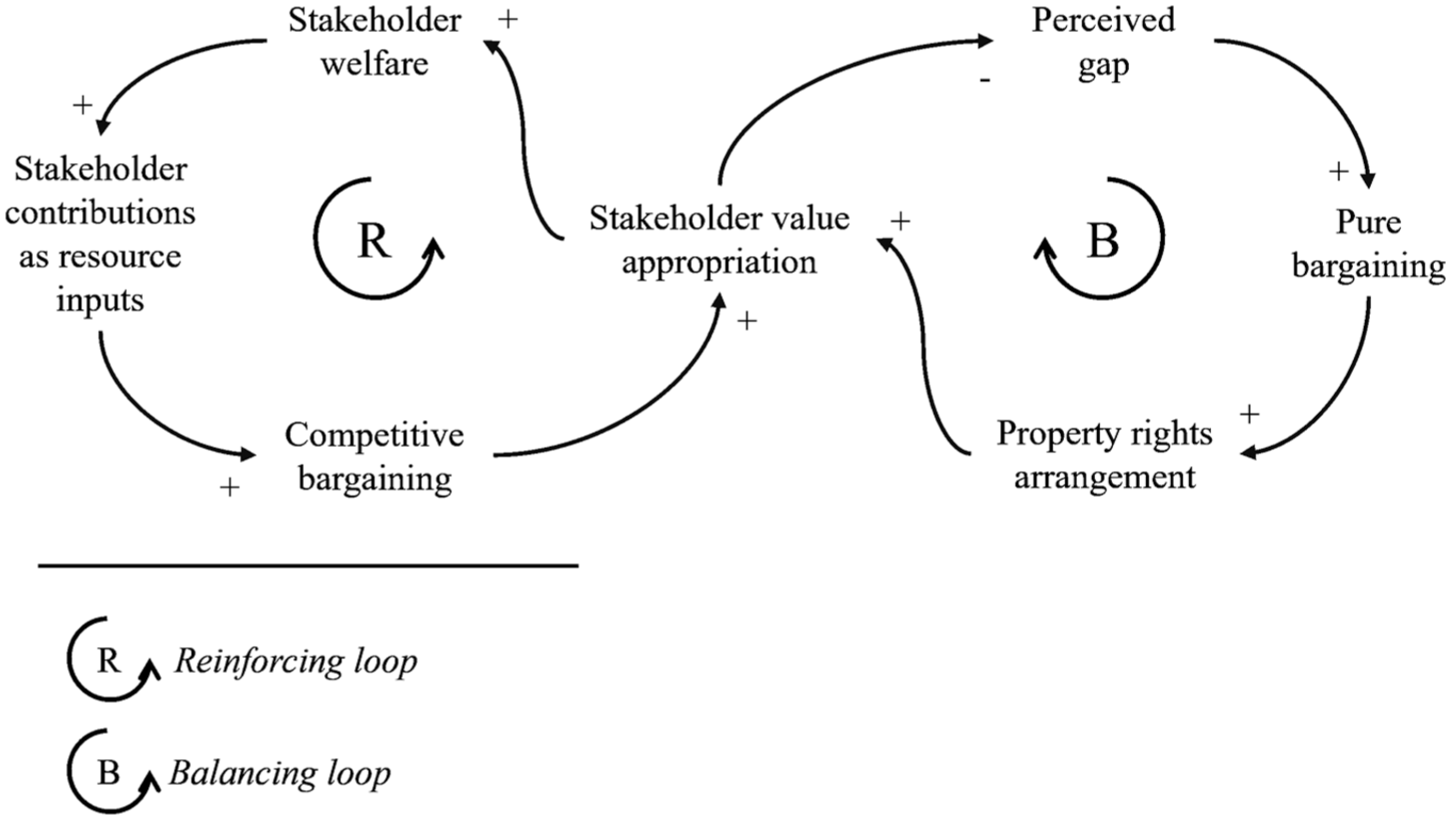
To model the causal loops of resource creation and stakeholder bargaining, we begin with two basic loops illustrated in Figure 1. The reinforcing loop on the left presents a virtuous cycle of stakeholder contributions to value-creation efforts based on their level of welfare. These contributions lead to a share of value appropriated by the focal stakeholder through competitive bargaining, which in turn improves their welfare, and the cycle repeats itself.
Basic Feedback Structure
On the right, the gap perceived by the stakeholder between their expected gains and their realized share of value leads to pure bargaining. In other words, when the stakeholder cannot appropriate value commensurate with their perception of equity, they engage in efforts to bridge the discrepancy between expectations and reality. These bargaining efforts in turn may alter the property rights regime in their favor (Bucheli et al., 2023), thereby increasing the appropriated value and bridging the perceived gap. At this point, the property rights regime is viewed in a broader sense that stems from institutional, contractual, and organizational arrangements that define and enforce these rights (Foss & Foss, 2022).
It is important to note, however, that the positive relationships among these variables represent directional influence rather than assured outcomes in this parsimonious representation. Stakeholder efforts to renegotiate or reshape institutional arrangements do not necessarily succeed, which will be unpacked further as the model becomes more detailed. On another note, unlike the reinforcing loop on the left, the stakeholder bargaining loop is balancing in nature, given the negative (–) relationship between stakeholder value share and perceived gap, diminishing the need for pure bargaining in each completed cycle.
While we present these loops separately for clarity, they operate simultaneously in practice, creating complex interactions that shape how property rights regimes evolve over time. We now develop each loop in greater detail for the case of GenAI models to reflect how these mechanisms would manifest in practice.
Resource Creation Loop
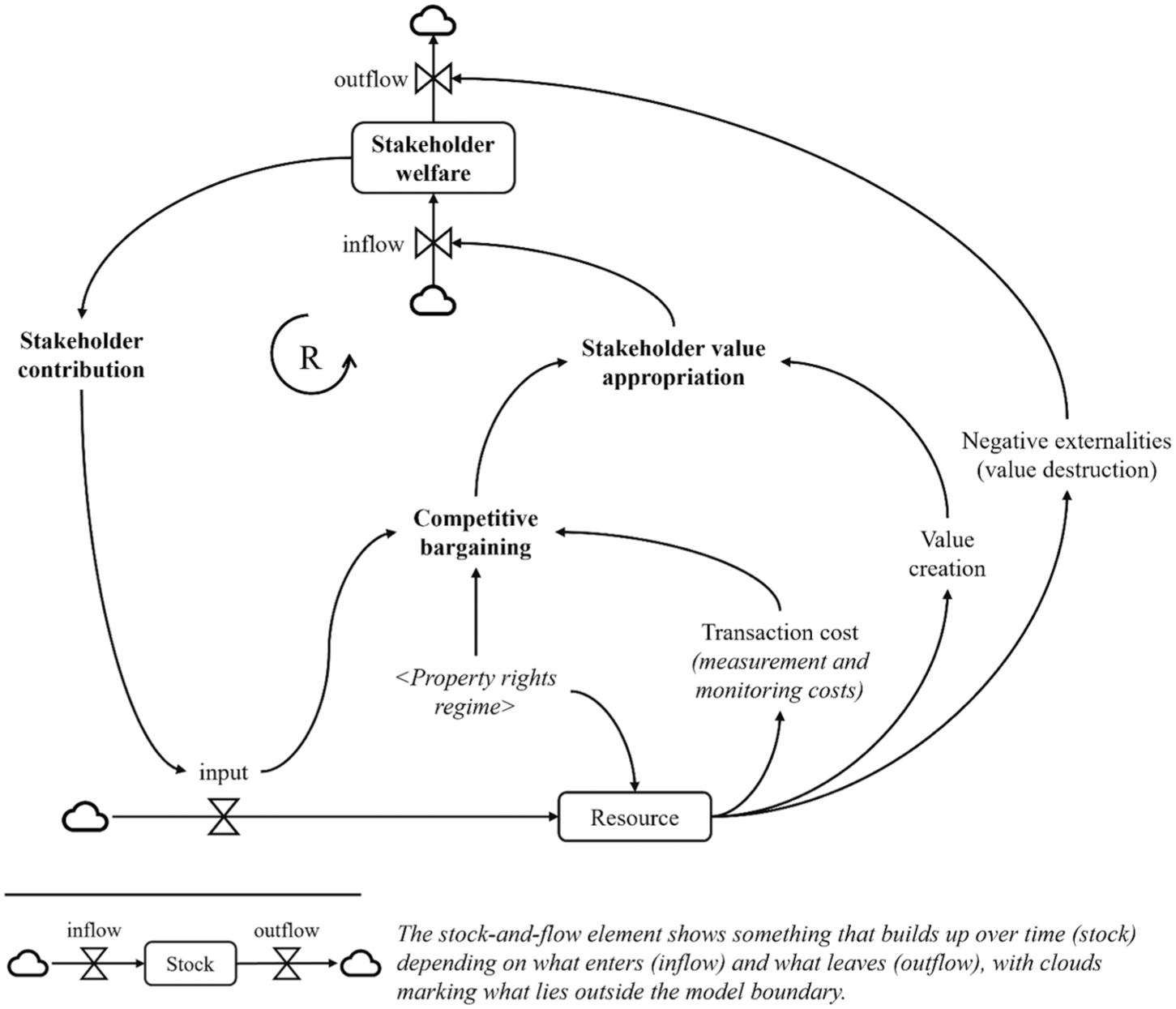
Building upon the basic reinforcing loop introduced in Figure 1, we now expand our model to capture the complex dynamics of value creation and appropriation in GenAI models. While the basic loop showed how stakeholder welfare enables resource input contributions that lead to value appropriation through competitive bargaining, our expanded model (see Figure 2) for the investigation of this causal loop introduces four critical elements that fundamentally alter it: (1) the accumulation of stakeholder resource inputs within GenAI models (the Resource), (2) transaction costs in measuring and monitoring these inputs, (3) value creation and negative externality outcomes associated with these resources, and (4) the property rights regime as an exogenous factor. We illustrate how these elements interact in the resource creation loop in Figure 2.
Resource Creation Loop
Stakeholder contributions as resource inputs
At the core of our expanded model is a stock-and-flow structure that captures the accumulation of stakeholder resource inputs over time. The development of GenAI models illustrates these dynamics through five fundamental categories of resource inputs mentioned earlier: training data, intellectual capital, financial capital, computational infrastructure, and natural resources. As shown in Table 1, each category involves distinct stakeholder groups.
These resource input categories are highly interdependent, amplifying each other’s effectiveness. Moreover, the generative nature of GenAI models introduces an additional layer of complexity, as outputs can be emergent and unpredictable. This raises fundamental challenges for assessing and attributing the stakeholder contributions, which we examine next.
Transaction costs in measurement and monitoring
The interdependent nature of resource inputs and the generative nature of outputs in these resources generate substantial transaction costs associated with the measurement and monitoring of specific inputs (Barzel, 1982; Williamson, 1985), which our model explicitly incorporates as a source of friction in competitive bargaining for the contributing stakeholders. The measurement problem stems not merely from complicated interactions but from fundamental ambiguity in attributing value to specific inputs when their contributions become technologically inseparable and their effects emerge through complex, nonlinear interactions.
As discussed earlier, neural networks with billions of parameters process vast datasets in ways that make attribution fundamentally ambiguous rather than just complicated, reflecting the black-box nature of GenAI models. When valuable outputs are generated, these emerge from patterns synthesized across countless training examples through probabilistic processes that resist decomposition into discrete contributions. This is not merely a technical limitation but one that reflects the nature of these resources that transcend traditional frameworks for measurement.
These measurement and monitoring challenges directly impact competitive bargaining (Crook et al., 2013) by creating information asymmetries that advantage certain stakeholders over others. Resource input providers whose contributions can be quantified through conventional metrics (e.g., computing infrastructure suppliers measuring processing time or energy consumption) gain natural advantages in value appropriation negotiations. In contrast, stakeholders whose inputs manifest through complex interdependencies, like creators of data used for model training or authors of open-access research, face severe challenges in demonstrating the value of their contributions (Taeihagh, 2025). This asymmetry introduces systematic biases that distort the subsequent bargaining processes: a dynamic we explore next.
Value appropriation, negative externalities, and stakeholder welfare
The value created by products based on GenAI models (e.g., enhanced customer service, advanced scientific tools, and transformative industry applications) translates into value appropriation for stakeholders in proportion to their (competitive) bargaining power. This appropriated value improves stakeholder welfare by providing direct financial gains, expanding market share, or creating exclusive opportunities for collaboration. Firms that can negotiate favorable terms for data, computation, or intellectual capital achieve substantial advantages, resulting in increased compensation for key contributors, enhanced access to cutting-edge technology, and heightened demand for their unique capabilities. Consequently, high-bargaining-power stakeholders see their welfare increase through increased income, influence, and competitive market positioning.
Conversely, stakeholders who lack bargaining power under the current property rights regime (an exogenous factor in the resource creation loop) do not enjoy these welfare improvements. When assumed to have no influence over property rights regimes, these stakeholders struggle to secure fair compensation or sustained access to critical resources, limiting their ability to benefit from the value created by GenAI models. This limited access and control prevents weaker stakeholders from capturing the broader welfare benefits that AI development can offer, consolidating value and influence in the hands of a few well-resourced actors (Samuelson, 2023; Zuboff, 2019).
Beyond the value appropriation disparities mentioned previously, the expansion of GenAI models as a general-purpose technology introduces a range of societal-institutional externalities for certain stakeholders. The widespread deployment of GenAI models across industries leads to labor displacement, weakened creative rights, and diminished stakeholder participation as persistent consequences of this diffusion (Cockburn et al., 2019; Oh & Schuler, 2023; Taeihagh, 2025). Consequently, broader societal groups that contribute, often inadvertently, to the creation of GenAI models capture limited value yet absorb a disproportionate share of the associated externalities, reinforcing welfare asymmetries (i.e., lower inflows to and higher outflows from the welfare stock illustrated in Figure 2).
The property rights regime as an exogenous factor
The property rights regime establishes the overarching institutional logic that governs how value distribution mechanisms operate in the context of GenAI models. It defines the enforceable boundaries of access, control, and entitlement, determining the institutional conditions under which bargaining processes unfold (Foss & Foss, 2022; North, 1990). Within the resource creation loop, this variable is modeled as an exogenous factor that constrains how stakeholders can appropriate value from their contributions. When the existing configuration of rules and enforcement mechanisms privileges particular forms of ownership or control, the property rights regime functions as the structural filter through which value appropriation patterns and welfare asymmetries are reproduced across development cycles of GenAI models.
Besides constraining how value is distributed, property rights regimes and their complementary norms also shape how resource inputs are factored into the creation of GenAI models. Illustrated with the causal relationship between the variable property rights regime and the stock resource, firms interpret these norms and enact them through design and development decisions. In doing so, the technical trajectories of GenAI models reflect prevailing norms and societal expectations as much as technological feasibility (Grodal et al., 2023; Orlikowski, 1992). For instance, differences between firms such as OpenAI and Anthropic in how they operationalize principles of safety, openness, and model access illustrate how similar governance norms can yield distinct technical and organizational implementations (Time, 2024). These interpretations define what forms of data, labor, and intellectual capital are considered legitimate inputs and how they may be combined in practice. Developers and firms thus operate within a bounded institutional space that channels innovation toward paths consistent with established ownership and accountability norms (Orlikowski, 1992). Yet within those boundaries, they exercise discretion, drawing on professional ethics, technical conventions, or common-sense understandings of fairness to fill regulatory gaps and preempt reputational or legal risks. As a result, features such as data-filtering protocols, bias audits, or usage disclosures often emerge from actors’ situated interpretations of the prevailing regime (Gritsenko & Wood, 2022; Grodal et al., 2023).
In the resource creation loop, therefore, the property rights regime exogenously shapes both how value is distributed and how resource inputs are incorporated in the design and development of GenAI models. Yet this exogeneity assumption is introduced for simplicity within the resource creation loop to illustrate how reinforcing mechanisms generate and sustain welfare disparities. As these asymmetries accumulate and disadvantaged stakeholders become increasingly aware of distributional imbalances, the regime itself turns into a focal point of contestation. In the stakeholder bargaining loop that follows, we relax this assumption and model the property rights regime as an endogenous variable: one that can be challenged, renegotiated, and reshaped through stakeholder actions and institutional responses.
Stakeholder Bargaining Loop
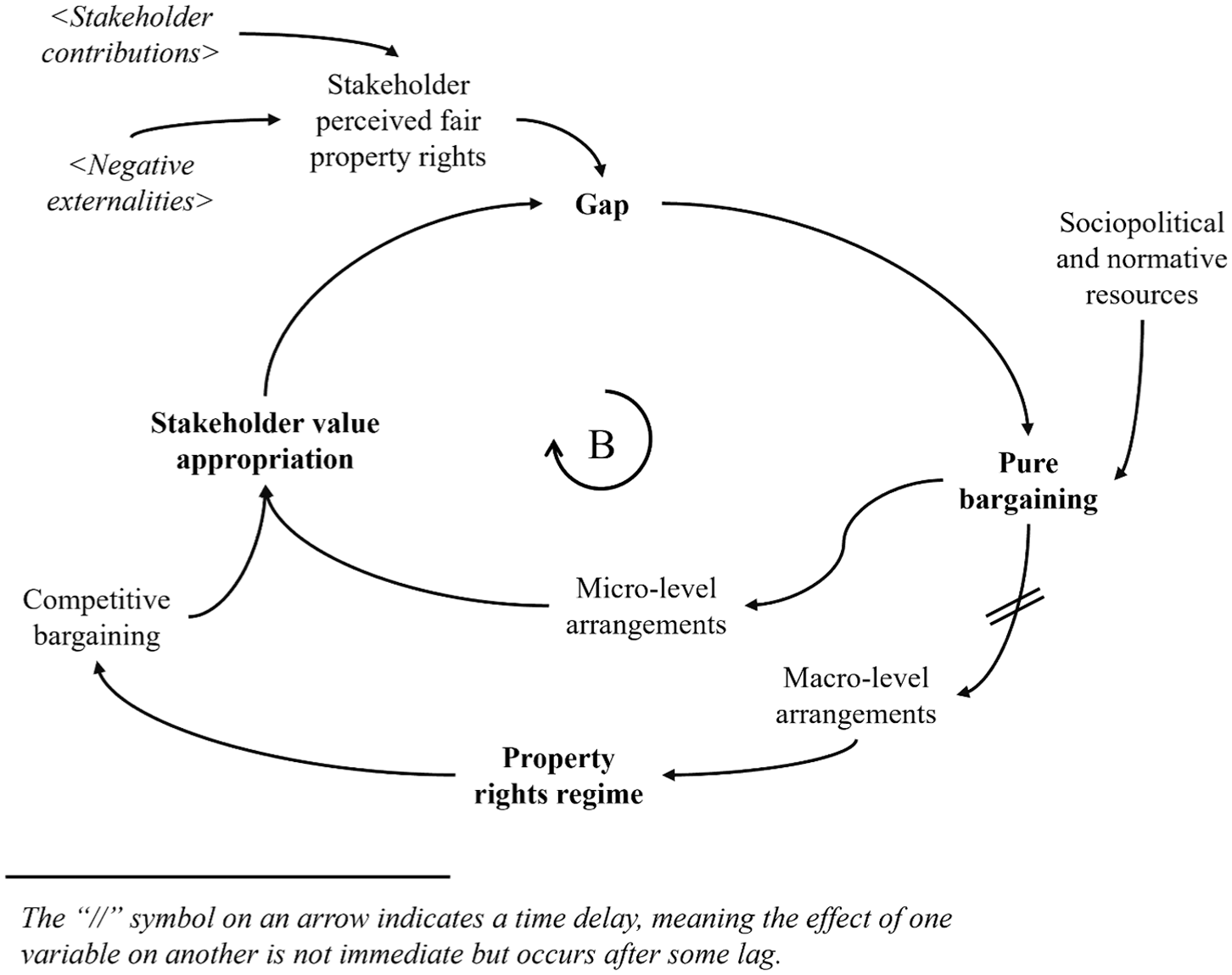
Having established how stakeholder contributions interact with resource creation and value appropriation in the case of GenAI models, we now examine how stakeholders engage in pure bargaining to address perceived value gaps. Our analysis of this balancing loop examines four key elements: (1) the formation of perceived value gaps between stakeholders’ expected and realized value appropriation; (2) the dynamics of pure bargaining, including bargaining power and mechanisms through which stakeholders pursue their claims; (3) macro-level arrangements that emerge through institutional evolution; and (4) micro-level arrangements that organizations develop to manage stakeholder relationships (see Figure 3).
Stakeholder Bargaining Loop
Value gap formation
The stakeholder bargaining loop originates in the perceived discrepancy between appropriated and expected value shares. This perception is shaped by stakeholders’ assessments of distributive fairness, in which stakeholders evaluate the proportion of value they receive relative to their contributions (Colquitt, 2001). The gap between value appropriation and expected share widens as stakeholders become increasingly aware of both their resource contributions and any negative externalities they experience from resource utilization.
Crucially, this awareness may develop unevenly and often with significant temporal delays in the context of GenAI models. The complex, ambiguous nature of these resources means stakeholders may initially fail to recognize either the full scope of their contributions or the extent of negative externalities affecting them. However, once this awareness emerges, it fundamentally reshapes their expectations of fair value distribution. When these revised expectations significantly exceed their current value appropriation, stakeholders experience fairness violation (Barclay et al., 2017), triggering efforts to address this perceived inequity.
Pure bargaining
Stakeholder realizations about value gaps do not automatically translate into redistribution. Whether gaps are addressed hinges on pure bargaining through nonmarket contests over the rules of the game in which actors deploy persuasive resources, normative claims, and sociopolitical pressure to reshape property rights and governance (Lawrence & Suddaby, 2006; Stoelhorst, 2023).
Historically, disruptive technologies have triggered such contests. The music industry’s confrontation with peer-to-peer file sharing (e.g., Napster) precipitated prolonged legal and institutional struggles that ultimately paved the way for streaming as the prevailing business model (Aguiar & Waldfogel, 2018). Among digital platforms, ride-hailing firms leveraged technical and capital advantages (Rosenblat & Stark, 2016) to classify drivers as nonemployees, provoking nonmarket bargaining via litigation, regulation, and mobilization (Tassinari & Maccarrone, 2020). However, litigation and regulation have produced mixed outcomes, as courts in different jurisdictions have reached conflicting conclusions about how to classify the drivers.
In GenAI, the contest begins on a materially unequal field. Concentration of compute, data, and capital among a small set of platform owners structurally tilts bargaining power (Benkler, 2016; Hillman et al., 2009; Pfeffer & Salancik, 1978). Contemporary foundation models are trained on web-scale corpora (e.g., Dolma by AI2; Soldaini et al., 2024) and run on cloud oligopolies (AWS, Azure, Google Cloud), concentrating bargaining power in a few platform owners (Maslej et al., 2025). Diffuse creators face classic free-rider and coordination problems (Schradie, 2018). Recent lawsuits by authors and news organizations allege uncompensated use of books and news, including claims about “Books3”/pirated libraries (Knibbs, 2025; Reisner, 2023), highlighting attempts by creators and media organizations to restore equity.
Powerful actors also exercise agenda-setting that narrows the scope of what is bargained (Lukes, 2005). The architecture of platforms (e.g., interfaces, defaults, content policies) regulates behavior by design (i.e., algorithmic governance), often preempting dissent (Lessig, 1999; Yeung, 2018). Framing GenAI governance solely around safety and innovation can marginalize core issues of property rights and value distribution, consistent with emerging evidence that powerful firms increasingly shape AI policy agendas to protect their own interests (Wei et al., 2024). Relatedly, firms’ broadly framed ethics principles without binding commitments risk ethics washing, a pattern documented in previous studies (Hagendorff, 2020; Jobin et al., 2019).
Finally, the legitimacy of stakeholder claims is contested within a narrative field often shaped by incumbents, normalizing disproportionate value appropriation as the natural return to risk and innovation (Lukes, 2005; Suchman, 1995). When scraping the public internet is framed as a prerequisite for progress, objections are recast as anti-innovation, leading to the crystallization of perceived gaps among disadvantaged stakeholders. In short, pure bargaining around GenAI models is not a negotiation among equals but a political contest fought on structural, institutional, and ideational terrain that systematically advantages incumbents.
Macro-level arrangements
Macro-level arrangements represent institutional frameworks and policies designed to govern resource creation and value distribution at the societal scale (North, 1990). In our model, these arrangements initially serve as exogenous constraints in the resource creation loop, shaping how stakeholders can participate in and benefit from resource development. However, they become endogenous variables in the stakeholder bargaining loop as stakeholders engage in bargaining action to reshape these frameworks. This enhances the value appropriated by the stakeholder, thereby closing the loop and narrowing the gap. This dual role reflects North’s (1990) insight that institutions both constrain current behavior and evolve through collective action.
We observe these arrangements operating through regulatory and normative mechanisms (Scott, 2013). The regulatory dimension manifests through formal rules and enforcement systems that directly shape property rights allocation. The European Union’s Artificial Intelligence Act exemplifies this approach in AI governance. Adopted in March 2024, the Act establishes comprehensive frameworks for managing AI’s societal impacts, particularly focusing on high-risk applications in critical sectors (European Commission, 2024). Its treatment of general-purpose AI models is especially significant for property rights, requiring transparency about training data sources and establishing clear liability frameworks for AI-generated content. These requirements attempt to modify traditional intellectual property rights concepts to address the inherent complexity of GenAI models.
The normative dimension emerges through broader societal responses to perceived inequities in value distribution, particularly when existing property rights frameworks prove inadequate for managing new technological capabilities. Proposals for universal basic income (UBI) as a response to AI-driven labor market disruption is an illustrative example of such normative change. These proposals recognize that traditional employment-based mechanisms for value distribution may become insufficient as GenAI capabilities expand.
The growing support for UBI experiments across Europe (Swift, 2018), with promising pilots in Norway, Finland, and Ireland (Kelly, 2023), reflects increasing awareness that macro-level arrangements must evolve to ensure broader stakeholder participation in AI-generated value. Universal basic compute (UBC) proposal represents an innovative extension of this approach, specifically targeting access to AI computational resources rather than financial compensation (Jindal, 2024). Both UBI and UBC proposals aim to address the gap that drives stakeholder bargaining by creating institutional mechanisms for value distribution that are perceived to be fair before acute conflicts emerge.
These arrangements shape competitive bargaining conditions by establishing baseline rules for value appropriation. When successful bargaining efforts lead to amended property rights regimes, they shift these conditions in favor of previously disadvantaged stakeholders, potentially enhancing their ability to appropriate value. However, such institutional changes often face significant delays due to inertia and adjustment periods required for large-scale shifts in property rights (Sterman, 2000). We capture this reality in our model through the delay indicated between pure bargaining and macro-level arrangements.
Micro-level arrangements
Micro-level arrangements represent organizational strategies and business model adaptations designed to manage stakeholder relationships and value distribution at the firm level. These arrangements emerge as firms attempt to reduce transaction costs (Williamson, 1985) and build relational capital with stakeholders (Dyer & Singh, 1998) in contexts where macro-level frameworks prove insufficient or are slow to evolve. In our model, these arrangements serve as strategic responses to address the frictions that arise from pure bargaining. When faced with stakeholder resistance or potential value disputes, firms can proactively or reactively implement specific policies and practices (Mahoney & Qian, 2013).
Microsoft’s Copyright Commitment for AI-generated content exemplifies such micro-level arrangements. By assuming legal liability for copyright infringement claims related to their AI services, Microsoft effectively internalizes the transaction costs associated with contested property rights that would otherwise fall on users of Copilot and Azure OpenAI services (Smith & Nowbar, 2023). This arrangement serves multiple strategic purposes: It reduces users’ perceived risks, facilitates service adoption rates, and potentially preempts more aggressive stakeholder bargaining from content creators by leveraging the legal capabilities of a multitrillion-dollar company. The company essentially creates a solution to address the transaction costs while macro-level frameworks are still evolving.
Another illustrative example is the freemium business model adopted by major GenAI companies. By providing limited free access to their services while maintaining premium tiers, companies such as OpenAI and Anthropic implement value propositions and value creation mechanisms that balance multiple stakeholder interests. As Shi et al. (2019) demonstrate, it is optimal for firms to offer free low-end products “if the high-end product provided larger utility gain from an expansion of the firm’s user base” (p. 150), a dynamic particularly relevant for GenAI-related services where increased usage generates valuable training data. This arrangement thus serves dual purposes: mitigating criticism about access barriers while creating network effects that enhance the service’s value proposition.
However, micro-level arrangements face inherent limitations: Their effectiveness depends on firm-specific resources and capabilities, making them difficult to replicate across organizations (Barney, 1991). Moreover, these arrangements often require continuous adjustment as stakeholder expectations and competitive dynamics evolve (Teece et al., 1997). While they offer more immediate and flexible solutions than macro-level frameworks, their sustainability depends on maintaining alignment among firm capabilities, stakeholder needs, and competitive pressures.
The Integrated Model
Combining the two loops in Figures 2 and 3 would provide our full conceptualization of the complex dynamics between resource creation and institutional evolution in the GenAI context. This integration captures how stakeholder contributions and value appropriation (reinforcing loop) interact with bargaining processes that reshape property rights arrangements (balancing loop). The interconnection of these loops explains why property rights regimes evolve over time: Value creation generates certain patterns of appropriation, which triggers stakeholder responses aimed at reshaping the institutional environment. These institutional changes, in turn, influence future resource creation dynamics, as summarized in the basic feedback structure (see Figure 1).
In the next section, we discuss the implications of our conceptual model.
Model Implications: Wicked Resources
As demonstrated in the preceding analysis, GenAI models represent a category of organizational resources that traditional frameworks struggle to fully address. Inspired by Rittel and Webber’s (1973) seminal notion of wicked problems, we introduce the term resource wickedness to capture resources over which firms cannot establish complete control due to shifting sociopolitical contexts and inadequate governance frameworks. Wicked resources exhibit two defining properties: attribution ambiguity and emergent unpredictability. While the difficulty in clearly attributing value to specific stakeholder contributions (attribution ambiguity) and the inability to anticipate a resource’s evolving capabilities or societal impacts (emergent unpredictability) have each been recognized in prior management scholarship (e.g., Grant, 1996; Jacobides et al., 2006; Tushman & Anderson, 1986), their concurrent and extreme manifestation in resources such as GenAI models constitutes an anomaly. Such anomalies highlight phenomena inadequately explained by existing theories, thus offering rich opportunities for theoretical advancement (Fisher et al., 2021; Kuhn, 1962).
Attribution Ambiguity
Attribution ambiguity refers to the extent to which the contributions of individual resource inputs or stakeholders to the overall value creation process can be clearly identified, measured, and attributed. At one end of the spectrum are discrete, modular production processes (e.g., traditional manufacturing) where each contribution is clearly defined and measurable, allowing stakeholders to straightforwardly agree on value appropriation. By contrast, GenAI models produce novel and often unpredictable outputs that emerge from interwoven inputs as discussed previously. This ambiguity stems from the intangible, embedded, and collective nature of these resources, where dynamic interdependencies complicate the measurement and attribution of distinct contributions. This creates challenges for value appropriation and property rights allocation within incumbent governance frameworks.
Attribution ambiguity builds on prior insights into the challenges of assigning value to collectively produced, tacit, or interdependent resources. Grant (1996) identified knowledge as a resource whose tacit and systemic nature complicates attribution and appropriation, while Coff (1999) and Lippman and Rumelt (2003) showed how embeddedness and causal ambiguity hinder precise attribution and governance. Yet, whereas earlier studies emphasize ambiguity arising from the intangible or collective nature of resource inputs, the rise of GenAI models amplifies these challenges through the novel, emergent outputs produced by generative algorithms. This pushes attribution ambiguity to an unprecedented level, fundamentally complicating effective governance and the delineation of ownership and control.
Emergent Unpredictability
Emergent unpredictability refers to the extent to which a resource’s evolving capabilities and resulting impacts cannot be anticipated within established cognitive, institutional, and governance frameworks. Unlike conventional resources whose applications and outcomes are known and stable, resources characterized by emergent unpredictability continually generate novel capabilities that reshape their own nature, uses, and societal consequences in fundamentally unforeseen ways. This construct captures not only technological or market uncertainties but particularly emphasizes evolving implications for institutional structures and property rights regimes, highlighting ongoing challenges for resource governance.
Emergent unpredictability builds on prior research examining the unforeseen consequences of major technological shifts. Tushman and Anderson (1986) introduced the notion of technological discontinuities to describe how breakthroughs disrupt competitive dynamics and industry structures, while Bresnahan and Trajtenberg (1995) emphasized the transformative and cross-sectoral nature of general-purpose technologies. Relatedly, the ideas of “competence-destroying innovations” (Henderson & Clark, 1990), “disruptive innovations” (Christensen, 1997), and Schumpeter’s (1950) “creative destruction” all capture the uncertainty and disequilibrium that accompany profound innovation-induced change.
Emergent unpredictability extends these foundational perspectives by emphasizing how such uncertainty now transcends industries and markets to reshape societal, institutional, and political domains. Rather than focusing solely on technology adoption or competitive disruption, it emphasizes the system-altering evolution of resource capabilities that existing governance frameworks struggle to accommodate. This view highlights the growing need for dynamic and adaptive property rights regimes and institutional mechanisms capable of evolving with resources (e.g., GenAI models) that transform economic, social, and regulatory landscapes.
The inability to establish complete control, therefore, stems directly from the heightened attribution ambiguity and emergent unpredictability inherent in wicked resources. When only one of these dimensions is high, institutional and contractual mechanisms can still reestablish order. For example, knowledge resources may entail high attribution ambiguity but low unpredictability, enabling stabilization through intellectual property or licensing regimes; digital platforms such as Uber or Airbnb arguably display high unpredictability but low attribution ambiguity, allowing adaptive coordination through ecosystem arrangements and stakeholder value propositions. However, when both dimensions are simultaneously high, no actor can consistently delineate or enforce rights of ownership, use, or benefit.
When both attribution ambiguity and emergent unpredictability are present at high levels, the allocative foundations of PRT encounter their conceptual and practical limits. PRT presumes that value appropriation problems can be mitigated through the delineation and enforcement of claim and control rights over identifiable assets (Barzel, 1997; Foss & Foss, 2022). Yet, in the case of wicked resources, neither the attributes of the resource nor the contributions of stakeholders remain sufficiently stable or separable for such allocation to be meaningful. The recursive, coevolving nature of these resources renders both ownership boundaries and entitlement structures fluid and indeterminate, undermining the very assumptions upon which PRT’s allocative logic rests. Consequently, while PRT can diagnose where appropriation vulnerabilities arise, it cannot prescribe effective governance solutions under such conditions. Wicked resources, therefore, represent a theoretical boundary condition for PRT, illustrating that value creation and distribution cannot always be resolved through the ex ante allocation of property rights.
Closing the Balancing Loop Around Wicked Resources
In the absence of stable property rights, governance around wicked resources must rely on performative rather than purely allocative mechanisms. The focus thereby shifts away from allocating property rights at the level of the resource itself toward designing adaptive arrangements at the business model level, where value creation and appropriation can be continuously renegotiated. Rather than attempting to establish definitive ownership or control, organizations should seek to address the pure bargaining efforts by enacting and revising the relational structures through which stakeholders interact and cocreate value as the resource evolves. Business models thus become the primary sites of performative governance: they provide the flexible architecture for aligning interdependent interests, internalizing externalities, and maintaining cooperation despite the indeterminacy of ownership. Mechanisms such as stakeholder value propositions exemplify this process by coordinating value creation and distribution through contextual and relational alignment rather than through formal entitlements. In this sense, performative arrangements represent a dynamic and recursive response to resource wickedness. In other words, stability and legitimacy emerge not from static ownership but from the continual rebalancing of roles, claims, and expectations within the evolving business model.
Over time, the adaptive and relational arrangements forged through these performative practices can lay the groundwork for more stable institutionalization. As organizations iteratively adjust their business models to accommodate stakeholder feedback and mitigate externalities, certain patterns of interaction, value exchange, and accountability may become routinized and collectively endorsed. These validated business model adjustments could effectively codify emerging norms of cooperation, transforming provisional relational arrangements into recognizable property rights configurations. In this way, property rights can reenter the system not as ex ante allocations but as ex post institutionalizations of collectively negotiated outcomes.
The stabilization of these arrangements, whether through contracts, regulatory frameworks, or shared standards, anchors the gains achieved by stakeholders during earlier performative stages, converting transient governance successes into enduring institutional structures. Thus, while wicked resources initially escape the reach of allocative governance, the cumulative effects of performative adaptation at the business model level may eventually enable new, more contextually grounded forms of property rights to emerge.
In the context of wicked resources, the pursuit of economic efficiency cannot be separated from the challenge of equitable value distribution. Because wicked resources continually evolve and involve deeply interdependent stakeholder contributions, efficiency in their governance depends not merely on maximizing aggregate output but on maintaining legitimacy and sustained participation across stakeholder groups. A performative approach at the business model level enables such adaptive efficiency by allowing firms to iteratively rebalance value creation and appropriation in response to shifting stakeholder expectations and emergent externalities. When these balancing mechanisms function effectively, they prevent the concentration of benefits in the hands of dominant actors and reduce the likelihood of “exclusive equilibria,” where short-term efficiency masks long-term fragility and social backlash. Conversely, by institutionalizing fairness and mutual gains through validated business model adjustments, organizations can move toward “inclusive equilibria,” where efficiency and equity reinforce each other over time. In this way, governance around wicked resources becomes a continuous search for dynamic efficiency: one grounded not in static optimization but in the sustained alignment of evolving contributions, claims, and societal welfare outcomes.
Discussion and Conclusions
Contributions to Property Rights Theory
Building on the theoretical contributions detailed previously, our model extends property rights theory by reconfiguring where and how its boundaries are drawn under conditions of resource wickedness. When attribution ambiguity and emergent unpredictability prevent the delineation of ownership and control at the resource level, we relocate the coordination problem to the business model level, where property-like claims are negotiated. In this view, business models operate as proximal arenas of provisional rights allocation, orchestrating access, control, and benefit flows among interdependent actors in the absence of enforceable property rights. Through this recursive process, governance precedes ownership: As stakeholder arrangements stabilize and gain legitimacy, they crystallize into institutional norms and, eventually, formalized legal frameworks. PRT thereby regains relevance ex post, when collectively validated business model arrangements feed into codified property rights regimes. This interpretation introduces both a temporal shift (from ex ante assignment to ex post institutionalization) and an analytical shift (from resource to business model level), expanding the reach of PRT into contexts characterized by institutional indeterminacy and evolving legitimacy.
In addition to these contributions, we also extend PRT’s ontological foundations by reframing property rights not only as entitlements over discrete resource attributes or income streams but as claims over value propositions extracted from resources. Under conditions of resource wickedness, the relevant unit of analysis is no longer the resource itself but the value propositions that emerge through its ongoing enactment in socio-technical systems. Stakeholders appropriate value not by owning assets, but by shaping and participating in the evolving configurations that generate and deliver these propositions. Consequently, property rights become performative instruments of value orchestration, linking control, access, and benefit claims to the dynamic business model rather than to static resource endowments.
Contributions to Stakeholder Resource-Based Theory
In line with these extensions to PRT, our model likewise advances stakeholder resource-based theory by addressing how stakeholder coordination unfolds under conditions where property rights are indeterminate. While SRBT offers a powerful account of how value is cocreated and appropriated among interdependent stakeholders, it does not make institutional change and attribution problems the central objects of analysis. As a result, it leaves under-theorized how institutions themselves may evolve endogenously or how to address cases where the ex ante specification of who contributes what (and who deserves what share of value) is not possible.
Our model adapts SRBT to this context by introducing a dynamic view of pure bargaining. Rather than treating value appropriation as a one-time bargaining outcome within a given governance framework, we depict it as part of a feedback loop in which pure bargaining can reshape institutional arrangements and business models, thereby altering subsequent value appropriation outcomes. In doing so, we show how SRBT can be extended to address sociopolitical contexts in which governance conditions are fluid and stakeholder claims evolve over time.
Practical Implications
Managers operating in domains shaped by generative AI should view governance not as a one-time design problem but as a continuous process of learning and adaptation. These systems generate hidden transaction costs in measurement and monitoring, which, if ignored, can escalate into regulatory or reputational crises. Firms should treat stakeholder claims and controversies as diagnostic feedback rather than threats, using them to detect structural imbalances in value creation and distribution. By engaging early with affected groups, investing in traceability tools, and revising relational commitments as the technology evolves, managers can proactively internalize these costs and sustain cooperation within their ecosystems.
Furthermore, governing wicked resources effectively requires coordinated action across levels. Firms should complement firm-specific business model adaptations with participation in policy initiatives to align emerging norms and standards. For instance, in line with the freemium business model employed by most GenAI firms, a limited or basic functionality of every GenAI model offered to the market should remain freely accessible to all users, with this principle formally embedded in regulatory frameworks. Such arrangements can help ensure inclusive access while maintaining incentives for innovation, balancing societal benefit and commercial viability. Over time, these iterative adjustments can generate templates for industry-wide governance and inform future policymaking. By documenting and sharing these evolving practices, organizations can contribute to the gradual institutionalization of fairer and more adaptive regimes that balance efficiency, equity, and legitimacy.
Limitations and Future Research Directions
While the system dynamics model developed in this study is conceptual in nature, its value lies in its parsimony and integrative capacity rather than in predictive precision. The model serves as a theorizing device that clarifies the causal logic underlying stakeholder interactions, property rights evolution, and value distribution dynamics. Future work could complement this formal theorizing with empirical analyses that trace how the feedback structures identified here manifest in practice. Although the model does not lend itself to quantitative calibration, each loop variable (e.g., stakeholder contributions, transaction costs, or welfare) provides an observable anchor for empirical exploration.
Moreover, the model simplifies the interactions between firm-level adaptation and institutional change. Future work could examine this relationship through process research to illuminate how performative arrangements become institutionalized over time. Furthermore, we do not explicitly depict some potentially iterative mechanisms, such as how ex post traceability of stakeholder contributions can shape competitive bargaining and, in turn, may lead to more equitable arrangements under the existing property rights regime. In our model, this mechanism can be inferred from the link between measurement and monitoring costs and competitive bargaining; modeling it as another feedback loop would add complexity beyond the scope of this paper.
At the same time, the conceptual model abstracts from within-firm heterogeneity and individual-level behavioral processes that shape how actors interpret, negotiate, and respond to evolving governance conditions. Future work could address these microfoundations by integrating behavioral strategy perspectives that capture the cognitive and affective dimensions of stakeholder bargaining. In this regard, micro-level experiments or simulations offer a promising avenue to isolate specific submechanisms (e.g., fairness perceptions under varying degrees of attribution ambiguity) and to explore how these perceptions influence cooperation, legitimacy, and adaptation within performative arrangements.
Third, the wicked resource construct developed in this study represents an early formalization of a broader theoretical space rather than a definitive categorization. Generative AI is treated as an archetypal instance in which both attribution ambiguity and emergent unpredictability reach extreme levels, exposing the limits of existing governance frameworks. Yet, these dimensions should be understood as continuous rather than binary variables: resources may exhibit varying degrees and combinations of ambiguity and unpredictability, resulting in diverse governance challenges. Future research could extend this framework by exploring contexts of partial wickedness, where one dimension dominates the other, or by mapping how different levels of resource wickedness shape organizational and institutional responses. Applying this conceptual lens to other phenomena (e.g., climate technologies, rare earth materials, or digital platforms) would enable a comparative understanding of how resource wickedness unfolds across domains and how its degree influences the evolution of property rights and stakeholder governance.
Beyond conceptual elaboration, future research could also pursue the operationalization of resource wickedness by translating its two constitutive dimensions into measurable constructs. Attribution ambiguity may be captured through behavioral credit-allocation tasks (Crocker et al., 1991; Major et al., 2002), in which participants are asked to distribute credit or responsibility among multiple contributors within a simulated project or decision scenario. Dispersion or instability in these allocations over repeated trials would indicate higher levels of perceived ambiguity, revealing the extent to which observers fail to converge on a stable causal attribution structure. Emergent unpredictability, in turn, can be explored using fuzzy cognitive mapping techniques (Gray et al., 2014; Özesmi & Özesmi, 2004), which model how individuals or groups represent causal relations among system elements. By comparing the stability and convergence of such maps across time or across stakeholder groups, researchers can gauge the degree to which cognitive representations of a resource system remain volatile or diverge as an indicator of unpredictability. These methods could provide theoretically valid and empirically tractable approaches for examining how actors perceive and navigate wicked resources.
As wicked resources become central to value creation, the need for sensemaking through theoretical frameworks and practical governance solutions will only grow more pressing. We hope this work stimulates new theoretical development while providing guidance for all stakeholders navigating these challenges.
Footnotes
Acknowledgements
The authors would like to thank the associate editor, the two anonymous reviewers, and the participants of the Paper Development Workshop titled “A World Where You Own Nothing? Demystifying Property Rights Theory”, held at the 2024 Academy of Management Annual Meeting, for their valuable feedback and insightful comments on an earlier version of this manuscript.
