




Abstract
Orchestrators shape ecosystem development by aligning diverse participants while advancing their own competitive agendas. This alignment becomes fragile when a new entrant offers an alternative value proposition that appeals to ecosystem participants but threatens an orchestrator’s position. Whereas prior research highlights the success of new entrants, less is known about how an orchestrator defends its competitive interests and position while addressing expectations of cooperation from ecosystem participants, which we call the “orchestrator’s dilemma.” We investigate these dynamics through a longitudinal study of Ericsson’s responses as Intel attempted to promote WiMAX as an alternative to LTE, Ericsson’s fourth-generation mobile technology. Our analysis shows how Ericsson recombined its substantive resource commitments and signaling tactics to develop three distinct strategic responses—avoiding competition, covert competition, and overt competition—as ecosystem support for the new entrant’s value proposition changed over time. We show how an orchestrator can defend its position against disruptive entrants by decoupling signaling tactics from substantive resource commitments to influence ecosystem dynamics. We contribute by theorizing these dynamic strategic responses as a way to overcome the orchestrator’s dilemma and by highlighting the social aspects of ecosystem alignment and its fragility.
Keywords
Introduction
Recent research has shown that sustaining ecosystems requires more than technical coordination or structural design; it also requires fostering social interactions rooted in shared expectations, mutual recognition, and collectively accepted roles (Garud, Kumaraswamy, Roberts, & Xu, 2022; Thomas & Ritala, 2022). Orchestrators play a key role in enabling interaction and fostering alignment among diverse participants while pursuing their own strategic agendas (Daymond, Knight, Rumyantseva, & Maguire, 2023; Nambisan & Sawhney, 2011). Orchestrating firms define roles, set governance rules, and coordinate cooperation to achieve collective goals (Altman, Nagle, & Tushman, 2022; Cozzolino & Rothaermel, 2018), thereby aligning participants’ contributions. Once an ecosystem is well established, alignment stabilizes, and an orchestrator’s position becomes taken for granted (Harima, Harima, & Freiling, 2024; Thomas & Ritala, 2022).
However, ecosystem alignment is fragile. This fragility becomes apparent when a competitive new entrant offers a compelling value proposition, thereby reducing an orchestrator’s bargaining power vis-à-vis ecosystem participants (Cozzolino, Verona, & Rothaermel, 2018; Shi, Liang, & Ansari, 2024). This can shift both expectations and interdependencies among ecosystem participants in favor of the new entrant, thereby undermining the orchestrator’s position (Khanagha, Ansari, Paroutis, & Oviedo, 2022). Although scholars have extensively examined the dilemmas faced by new entrants as they attempt to disrupt incumbents (Ansari, Garud, & Kumaraswamy, 2016; Garud et al., 2022; Snihur, Thomas, & Burgelman, 2018), they have directed less attention to the dilemmas faced by orchestrators in responding to competitive new entrants (Reischauer, Engelmann, Gawer, & Hoffmann, 2024). On the one hand, an orchestrator’s lack of cooperation with a promising new entrant may appear to be narrowly self-serving, and violating ecosystem expectations of collective alignment could undermine the orchestrator’s position (Thomas & Ritala, 2022). On the other hand, cooperating with a new entrant may stretch an orchestrator’s resources, enhance the entrant’s credibility, and signal wavering commitment to its own value proposition (Khanagha et al., 2022; Schilling, 1998). This dilemma raises the question: How can orchestrators balance cooperation and competition with a new entrant to safeguard their own interests while sustaining alignment with ecosystem expectations?
To address this question, we conducted a longitudinal analysis of how Ericsson responded to Intel’s attempt to introduce WiMAX as an alternative 4G wireless technology between 2001 and 2011. At the time, Ericsson, a leading firm in mobile infrastructure, had orchestrated the mobile telecommunications ecosystem for 3G technologies and was developing LTE as the next-generation telecom technology. As Intel mobilized support around WiMAX, Ericsson had to navigate ecosystem participants’ increasing expectations to cooperate while protecting its interest in advancing its own solution (LTE). Based on our in-depth analysis of Ericsson’s response to WiMAX’s competitive entry in the mobile telecommunications ecosystem, we develop a framework that theorizes how an orchestrator navigates cooperation–competition tensions triggered by a new entrant as ecosystem support for the new entrant’s value proposition fluctuates. We articulate how an orchestrator strategically responds through three different strategies that combine substantive resource commitments and signaling tactics, defined as actions that influence perceptions about actors’ value-added (Brandenburger & Nalebuff, 1995). Our insights shed light on the flexibility that signaling tactics afford orchestrators, revealing that signaling tactics are not only dynamic, but also political (as they can be used to control information and maintain power), and at times deceptive (as they are used to disguise true intentions). These observations and theoretical insights offer a novel understanding of the triggers and consequences of an orchestrator’s different strategic responses to competitive entry and shifting ecosystem support.
We advance research on ecosystem strategies in three main areas: coopetition in ecosystems, orchestration strategies, and the social aspects of ecosystem alignment. First, we extend research on coopetitive strategies in ecosystems by showing how orchestrators manage cooperation and competition through signaling tactics. While research on coopetition, particularly in ecosystems (Hannah & Eisenhardt, 2018; Riquelme-Medina, Stevenson, Barrales-Molina, & Llorens-Montes, 2022), tends to emphasize the influence of substantive resource commitments, we articulate how orchestrators use signaling tactics, which are less costly and more malleable than substantive resource commitments, to manage perceptions and accommodate shifting and conflicting expectations.
Second, we extend research on ecosystem orchestration (Autio, 2022; Harima et al., 2024) by showing how orchestrators defend their position in the face of competitive threats. Prior work has primarily examined how orchestrators shape emerging ecosystems (Garud, Jain, & Kumaraswamy, 2002; Nambisan & Sawhney, 2011), or how they govern stable ones to foster cooperation and value creation (Altman et al., 2022; Gawer & Cusumano, 2014). By explaining how orchestrators sustain their competitive interests in the face of new entrants’ threats, we highlight the defensive strategies that play a critical role in explaining why new entrants may fail to disrupt existing ecosystems.
Lastly, we extend emerging research on the social underpinnings of ecosystems, which foregrounds the importance of mutual expectations, norms, and shared understandings (Paavola, Gawer, & Hänninen, 2024). This literature has primarily focused on either collective efforts that drive ecosystem emergence (Thomas & Ritala, 2022) or how new entrants gain acceptance (Garud et al., 2022), often assuming that orchestrators in established ecosystems benefit from strong alignment and support. In contrast, our study reveals the fragility of alignment and the need for ongoing maintenance, as shifting expectations continually reshape both the ecosystem’s structure and the orchestrator’s position within it.
Theoretical Background
Ecosystems and the Role of Orchestrators
Ecosystems are broadly understood as constellations of interdependent and complementary organizations that share information, coordinate activities, and transfer resources and capabilities to fulfill a particular value proposition (Adner, 2017; Altman et al., 2022). Orchestrator firms, typically central actors who design ecosystem structures, define participation rules, and facilitate cooperation (Jacobides, Cennamo, & Gawer, 2018; Stonig, Schmid, & Müller-Stewens, 2022), play a critical role in shaping an ecosystem’s progression. To enable the realization of the ecosystem’s value proposition while safeguarding their own competitive positions, orchestrators seek to align heterogeneous actors and coordinate value creation without relying on formal authority (Adner, 2017). Alignment refers to the degree of mutual agreement among members regarding their positions, roles, and flows, and is crucial for enabling coordinated action, reducing uncertainty, and allowing systemic innovation to unfold (Paavola et al., 2024).
Social perspectives on ecosystems emphasize that such alignment is not given, but emerges through collective legitimation processes as actors jointly construct shared meanings, demonstrate viability through concrete actions, and develop a collective identity that binds the ecosystem together (Randhawa, Vanhaverbeke, & Ritala, 2024; Thomas & Ritala, 2022). Alignment challenges persist well beyond the formation stage, resurfacing as ecosystems evolve in response to technological change, competition, or governance pressures; rather than discrete obstacles to be overcome, they are part of an ongoing process that lies at the heart of ecosystem evolution (Kashanizadeh, Khanagha, Alexiou, & Volberda, 2024; Paavola et al., 2024). Ultimately, alignment hinges not only on technical coordination, but also on social challenges and collective evaluations that shape how actors interpret value creation, recognize interdependencies, and enact their roles within the ecosystem (Paavola et al., 2024; Randhawa et al., 2024; Springer, Randhawa, Jovanovic, Ritala, & Piller, 2025; Thomas & Ritala, 2022).
Orchestrators coordinate and align relationships, activities, and joint value creation through substantive resource commitments, such as investing in enabling assets, subsidizing participants, establishing technical standards, and promoting interoperability (Altman et al., 2022; Jacobides et al., 2018). These efforts are intended to stabilize cooperation and foster coordinated innovation (Autio, 2022; Linde, Sjödin, Parida, & Wincent, 2021). They also leverage tactics such as framing to influence the ecosystem’s trajectory, expectations, and strategic directions (Reischauer, Engelmann, & Hoffmann, 2025; Thomas & Snihur, 2025). Such symbolic tactics help orchestrators safeguard their role as legitimate and trustworthy, motivate voluntary alignment, and build collective commitment without relying on hierarchy (Khanagha et al., 2022). Through these tactics, orchestrators also shape the broader institutional and regulatory environment to support the viability and legitimacy of ecosystems over time (Giudici, Reinmoeller, & Ravasi, 2018).
Orchestration efforts matter both for ecosystem emergence and ongoing maintenance. During emergence, orchestration shapes initial patterns of cooperation among actors, including among potential competitors (Dattée, Alexy, & Autio, 2018). Once an ecosystem is established, an orchestrator manages its ongoing evolution, for example, by adjusting governance structures or modifying the technical core of the platform to accommodate new actors or respond to shifting demands (Tiwana, 2013). In doing so, an orchestrator also seeks to strengthen its own competitive position by strengthening its value proposition and embedding itself in multiple engagements and initiatives within the ecosystem (Khanagha, Ramezan Zadeh, Mihalache, & Volberda, 2018; Wareham, Fox, & Cano Giner, 2014). Central to these efforts is the need to maintain alignment as the foundation for sustaining influence over time (Adner, 2017; Kapoor & Lee, 2013).
Competitive New Entrants and the Orchestrator’s Dilemma
The alignment between orchestrators and ecosystem participants is disrupted when competitive new entrants introduce alternative value propositions that threaten orchestrators’ positions (Ozalp, Cennamo, & Gawer, 2018). Prior research has predominantly focused on the success of such entrants (Ozalp, Ozcan, Dinckol, Zachariadis, & Gawer, 2022). Examples include studies of how Salesforce disrupted the CRM ecosystem (Snihur et al., 2018); how TiVo challenged central actors in the television sector (Ansari et al., 2016); and how Uber redefined urban transportation (Garud et al., 2022). In these accounts, orchestrators’ responses are less focal than how entrants succeeded. In the few studies focused on orchestrators’ strategies, scholars have emphasized technical and performative strategies, such as extending their value propositions or withdrawing from contested domains (Adner & Kapoor, 2016; Adner & Snow, 2010). As a result, the social aspects of orchestrators’ responses and the challenges they encounter in navigating diverse and changing expectations remain less understood (Thomas & Ritala, 2022).
A key challenge for orchestrators is sustaining alignment with ecosystem participants and their expectations (Paavola et al., 2024), especially when participants may benefit from a rival entrant and shift their support toward it. As ecosystem participants begin to converge in their assessments of an entrant’s desirability and appropriateness (Randhawa et al., 2024), implicit expectations emerge that others should also support (Ranganathan, Ghosh, & Rosenkopf, 2018)—or at least not resist—the new entrant. Orchestrators must remain responsive to these expectations, because overt resistance is likely to be interpreted as acting against the ecosystem’s collective interest (Thomas & Ritala, 2022). Expectations for cooperation toward shared goals constrain and complicate how orchestrators justify and implement defensive strategies (Khanagha et al., 2022). Misaligned perceptions of cooperation (and competition) between collaborators can lead to unmet expectations and unsuccessful partnerships, turning previous collaborators into competitors (Thatchenkery & Piezunka, 2024). In such contexts, cooperation becomes a socially imposed expectation (Aldrich, Ruef, & Lippmann, 2020). Thus, resisting a competitive new entrant has the potential to erode an orchestrator’s legitimacy and weaken its central position within the ecosystem (Thomas & Autio, 2020).
However, cooperation can be both costly and risky for an orchestrator. Showing support strengthens the new entrant’s position not only by enhancing its performance (Eisenmann, Parker, & Van Alstyne, 2006), but also by accelerating its legitimation across the ecosystem (Bitektine & Haack, 2015). Furthermore, cooperation signals may erode confidence in the orchestrator’s own value proposition and diminish its influence (Schilling, 1998). In addition, providing substantive support could stretch the orchestrator’s resource capacity (Dhanaraj & Parkhe, 2006; Williamson & De Meyer, 2012). Under these conditions, the decision to cooperate or compete becomes a dilemma for orchestrators.
The Use of Signaling Tactics to Manage Coopetitive Tensions
The importance of tactics used to manage perceptions of cooperation is underscored by both foundational (Brandenburger & Nalebuff, 1995) and recent (Thatchenkery & Piezunka, 2024) studies of coopetition. Such tactics are critical in ecosystems, where stakeholder judgments are shaped not only by outcomes, but also by how firms communicate their intentions and roles (Hukal, Henfridsson, Shaikh, & Parker, 2020; Snihur et al., 2018). Recent studies highlight the importance of symbolic actions by orchestrators, such as public framing of strategy, discursive positioning, and visible commitments aimed at shaping shared expectations (Dattée et al., 2018; Khanagha et al., 2022; Snihur et al., 2018). Although not always labeled as signaling, these actions align with the definition of signaling as deliberate efforts to shape others’ perceptions (Connelly, Certo, Ireland, & Reutzel, 2011).
Research on signaling has established that firms use signals to shape perceptions under uncertainty (see Connelly et al., 2011, for a review). Moreover, whereas classical signaling theory has emphasized the use of costly, credible signals that reliably convey information about a firm’s attributes (Spence, 2002), a growing body of strategy research has emphasized the strategic use of decoupled signaling tactics, which range from deliberately misleading to exaggerated or ambiguous signals (Crilly, Zollo, & Hansen, 2012; Gaspar, Methasani, & Schweitzer, 2019; Gunia, 2019; Hahn & Reimsbach, 2021; Ross, Anderson, & Weitz, 1997). These studies show that firms employ signaling tactics to influence perceptions and to obscure true competitive intentions. For example, exaggerated claims of compatibility, vaporware, and premature announcements create an illusion of alignment with ecosystem actors, while allowing firms to hedge their bets (Bayus, Jain, & Rao, 2001; Schilling, 1998, 2003). Such tactics, which some have labeled “institutional hypnosis” (Deng, Liesch, & Wang, 2021), enable firms to convey alignment and maintain partnerships (Hawn & Ioannou, 2016) while covertly advancing their technological goals. Microsoft’s $14 billion investment in OpenAI is a recent example of such a tactic, as the company maintains a public partnership with OpenAI while quietly developing its own AI models to compete in the emergent ecosystem (TechCrunch, 2024). 1 This tactic is reminiscent of Microsoft’s earlier move with the DirectX software, where the company temporarily endorsed the OpenGL cross-platform software before pivoting to its proprietary DirectX technology, thereby advancing its own competitive interests (Upton & Duntemann, 2016).
While these tactics can be effective, they also carry risks, including reputational damage and loss of trust among ecosystem partners (Hawn & Ioannou, 2016). Despite the widespread use of signaling tactics (Connelly et al., 2011; Steigenberger & Wilhelm, 2018), we know relatively little about when and how orchestrators use such tactics, particularly when faced with the dilemma of defending their own competitive interests while addressing expectations of cooperation from ecosystem participants.
Methodology
The research context for our study is Ericsson’s response to the introduction of WiMAX as a contender for the 4G mobile communications standard, which unfolded between 2001 and 2011. The rivalry between Ericsson and WiMAX is an appropriate context for addressing our research question, as it involves strong interdependencies in the mobile telecommunications ecosystem and showcases patterns of cooperation and competition beyond resource commitments by orchestrator firms, including political maneuvers and the use of identifiable signaling. Technology rivalries in this sector are observable and span several years, attracting considerable attention from analysts and other actors, providing archival information about firm strategies and broader ecosystem challenges as the basis of our study. These events took place within the mobile communication ecosystem, which included mobile technology providers such as Ericsson, Nokia, Alcatel-Lucent, Qualcomm, and Intel, as well as network equipment manufacturers like Huawei and Cisco. These firms are strongly dependent on mobile service providers (mobile operators) such as AT&T, Verizon, Vodafone, Deutsche Telekom, and China Mobile, whose adoption decisions shape the success or failure of competing standards (Teece, 2018). In 2001, Intel used its WiMAX technology to challenge the primacy of LTE, a cellular technology in which the orchestrator—Ericsson—held a leading position. Figure 1 presents a schematic representation of the 4G ecosystem during our study period.
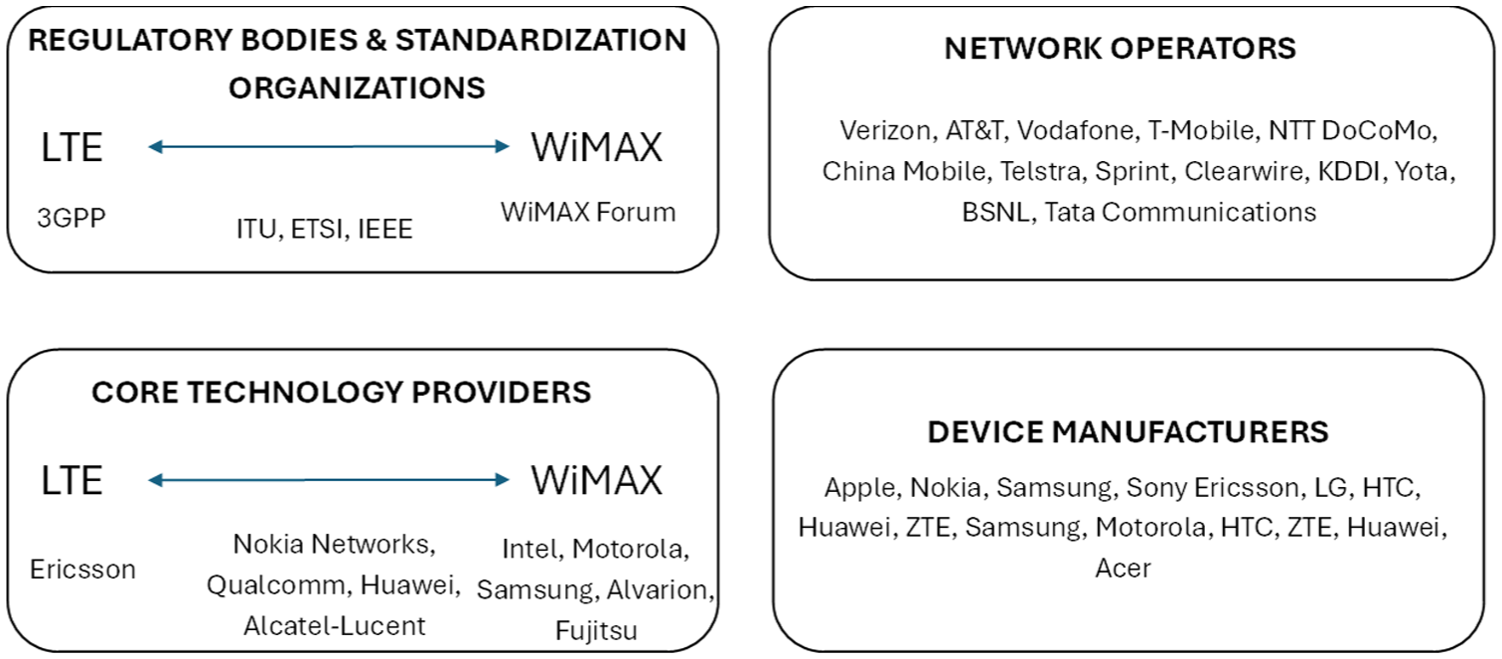
4G Ecosystem During the Rivalry Between WiMAX and LTE
To capture the dynamic nature of the phenomenon of interest, we conducted a longitudinal case study of Ericsson’s response to the rival WiMAX technology. Following guidelines for historical event analysis (Langley, 1999; Pentland, 1999; Van de Ven & Poole, 2005), we focused on understanding how and why “discrete events and states” evolve (Elsbach & Sutton, 1992). Our inquiry started with the intriguing observation that Ericsson avoided, joined, and then left the WiMAX ecosystem, despite heavy investments by Intel and other large technology companies in a solution that ultimately failed to remain relevant. To inquire about this historical case, we gathered data from three sources, summarized in Table 1: (a) archival materials, such as Ericsson’s internal and external presentations and communications, collected during the field study; (b) analyst reports and media coverage of WiMAX and LTE at the time, obtained from two databases (i.e., Factiva and NexisUni); and (c) 36 interviews conducted in three phases that clarified our emerging theoretical insights. Between 2016 and 2020, we conducted 16 interviews with Ericsson managers and Intel representatives to gain an initial understanding of the dynamics in the mobile ecosystem. Between 2020 and 2022, we conducted an additional 16 focused interviews, including six with current and former Ericsson employees, two with representatives of Nokia and two with representatives of Alcatel-Lucent (Ericsson’s key rivals), and six with executives from service providers. In 2024, we conducted four additional interviews to refine the framework: three with former Ericsson managers and one with a former senior manager at Intel. These interviews lasted between 30 and 90 minutes. All interviews were recorded and transcribed, and the transcripts were shared with respondents for verification and confirmation.
Overview of Data Sources
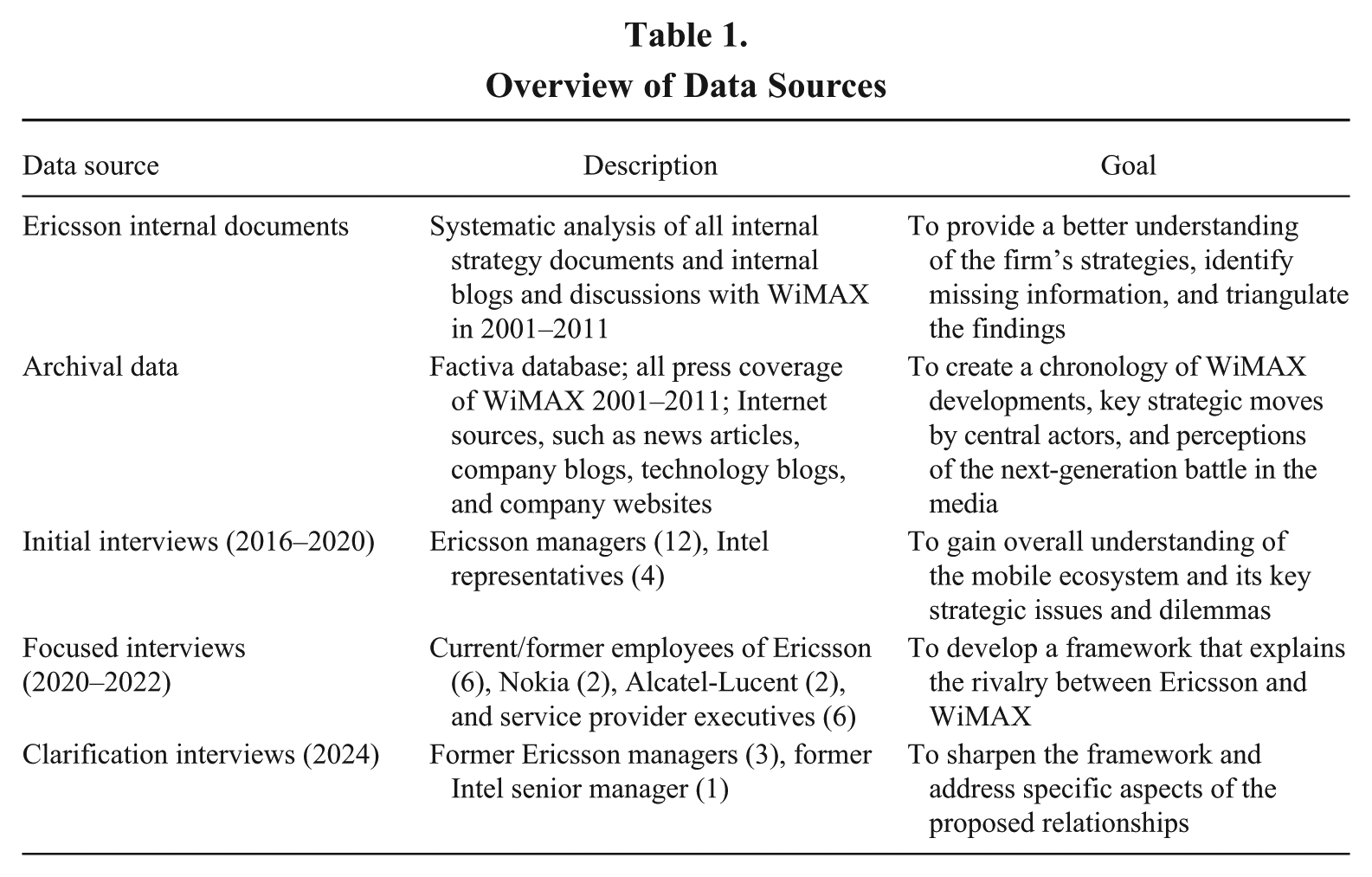
Secondary data sources, particularly Ericsson’s historical and archival documents, provided detailed information about the firm’s strategies related to the WiMAX technology, including historical information about specific events tied to the observed changes in its approach. Secondary external data comprising 1,497 media articles were retrieved from Factiva and NexisUni databases. Quarterly earnings calls during the observation period of the rivalry, along with quarterly Technology Business Research (TBR) reports (a specialized industry analysis) of Ericsson and its WiMAX strategies provided critical information for triangulating inferences based on interviews and internal data from Ericsson’s archives.
Based on these data, we examined Ericsson’s activities between 2001 and 2011 in response to the introduction of WiMAX as a potential contender for becoming the next generation 4G mobile technology standard. Our data analysis began with thematic coding to make sense of the data from multiple sources and create a case chronology (Rindova & Kotha, 2001), including a timeline of key decisions by Ericsson and changes in those decisions, as well as various milestones for WiMAX and LTE (Figure 2). We used temporal bracketing (Langley, 1999) and identified and investigated important actions and intermediate phases that are central to understanding firm and industry level changes (Rindova & Kotha, 2001). Following Gehman, Trevino, and Garud (2013), we constructed a visual map (Langley, 1999) to represent multiple groups of stakeholders and events. We divided the horizontal axis of the graph into five bands representing actions by Ericsson, its competitors, mobile service providers, Intel, and regulators and plotted the events and actions from our database (see Figure 2), highlighting interactions between WiMAX proponents, stakeholders, mobile operators, and Ericsson’s strategies. These interactions delineated three distinct phases during which Ericsson deployed tailored strategic responses to changes in ecosystem support for the WiMAX solution.
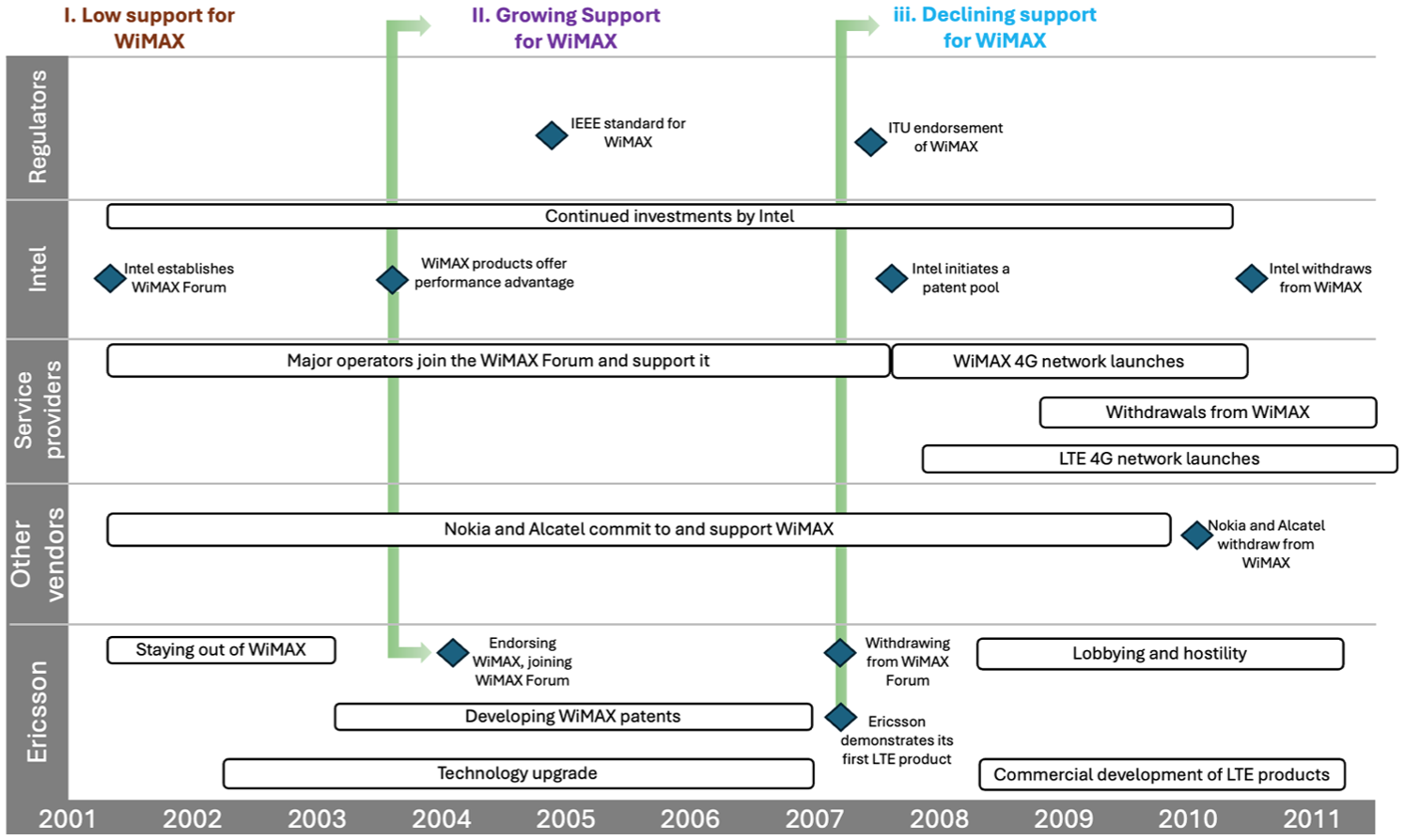
Chronology of Key Events, 2001-2010
To analyze Ericsson’s strategies, we began with open coding, identifying specific actions, statements, and activities. This process integrated observations of industry events with our analysis of statements from informants and industry analysts. Our initial coding captured informants’ language and archival text (e.g., “accelerating LTE development internally,” “cautious openness toward WiMAX,” “disengaging publicly from WiMAX activities”), preserving empirical richness. We then iteratively grouped these codes into broader, theoretically meaningful second-order categories. For instance, various forms of minimal engagement coalesced into the category “cooperative signaling.” As the analysis progressed, some codes were merged due to conceptual overlaps, while others were dropped due to a lack of consistent empirical support or theoretical coherence.
Following best practices in qualitative research (Langley, 1999; Rindova & Kotha, 2001), we employed axial coding to examine the relationships among emergent categories. This iterative approach allowed us to move fluidly between data and theory, refining our conceptual categories and ensuring theoretical rigor (Rindova, Dalpiaz, & Ravasi, 2011). To strengthen our theoretical interpretations, we engaged with literature on ecosystem strategies (e.g., Adner, 2017; Hannah & Eisenhardt, 2018) and coopetition in standards battles (e.g., Gnyawali & Park, 2011; Ranganathan et al., 2018). Iterating back and forth between empirical observations and theoretical insights enabled us to distill clear patterns in Ericsson’s strategic actions. As we proceeded with our coding, we observed gaps between Ericsson’s public communications and symbolic actions, such as joining consortia, and its internal resource commitments described in strategy documents and stakeholder interviews. These observations led us to systematically compare communications and resource commitments across periods, and to relate the shifts in Ericsson’s strategic responses to changes in ecosystem support based on participants’ perceptions about the relative performance of the two competing technologies.
To assess the relative performance of WiMAX and LTE, we coded relevant text in analysts’ reports (e.g., “better performance,” “higher speed,” “having an edge”) and triangulated with comparative data. To assess ecosystem support, we combined field observations with interview data. For instance, we coded analysts’ and ecosystem participants’ descriptions of WiMAX as “promising” or “part of their strategies” as reflecting growing ecosystem support. Conversely, we coded subsequent descriptions of WiMAX as “not realistic” or “too costly” relative to LTE as reflecting declining ecosystem support. We tracked industry shifts by monitoring announcements of investments, endorsements, partnership terminations, and withdrawals to capture changes in ecosystem support for the new entrant. By mapping the identified phenomena, we identified shifts in ecosystem support as triggers of Ericsson’s different strategic responses. The resulting data structure, derived from our coding process, is presented in Figure 3; additional illustrative evidence for the constructs is provided in the Online Appendix.
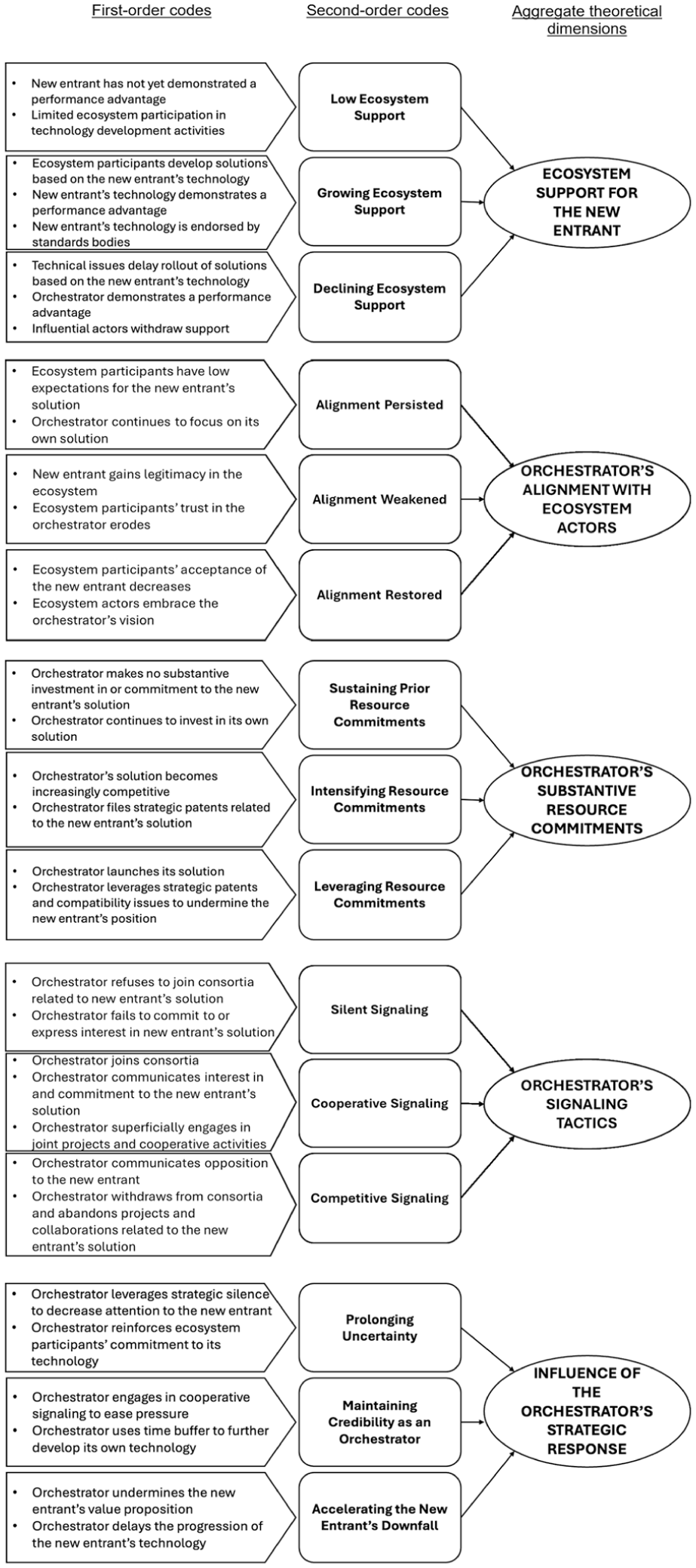
Data Structure: First-Order Codes, Second-Order Codes, and Aggregate Theoretical Dimensions
Findings
Our analysis reveals how Ericsson deployed three distinct strategic responses as ecosystem support for WiMAX changed over time. 2 Table 2 provides details on key events, including triggers of the observed shifts in Ericsson’s strategic responses (indicated by an asterisk). Our findings illustrate how an orchestrator in an established ecosystem adjusts its resource commitments and signaling tactics to navigate coopetitive tensions introduced by a new entrant. Figure 4 links the distinct strategic responses in three phases to (a) ecosystem support for the entrant (top row), i.e., the extent to which ecosystem participants invested in and endorsed its value proposition; (b) alignment between the orchestrator and participants (direct arrows); (c) the orchestrator’s strategic response, decomposed into substantive resource commitments and signaling tactics (middle row); and (d) the influence of the orchestrator’s strategic response on the ecosystem (curved arrows).
Timeline of Key Events
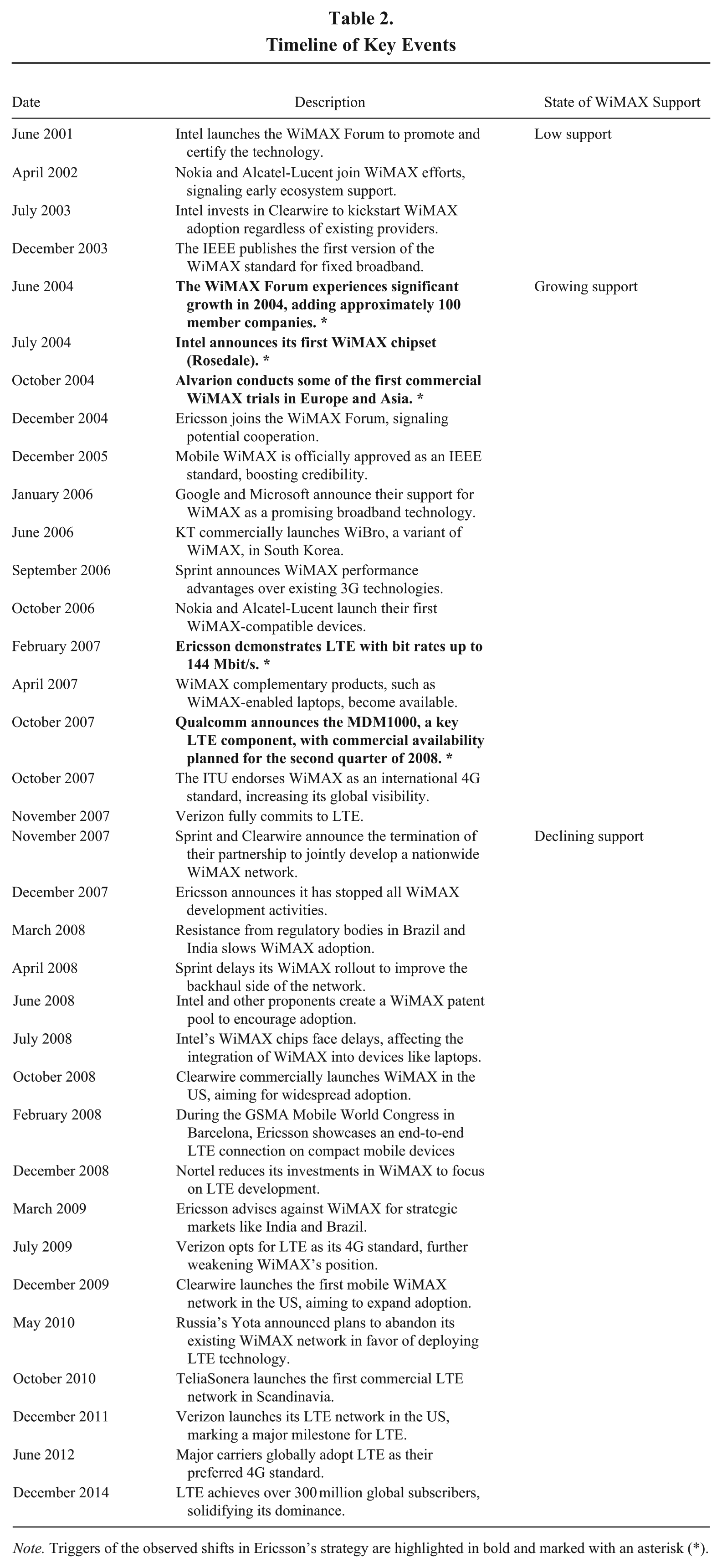
Note. Triggers of the observed shifts in Ericsson’s strategy are highlighted in bold and marked with an asterisk (*).
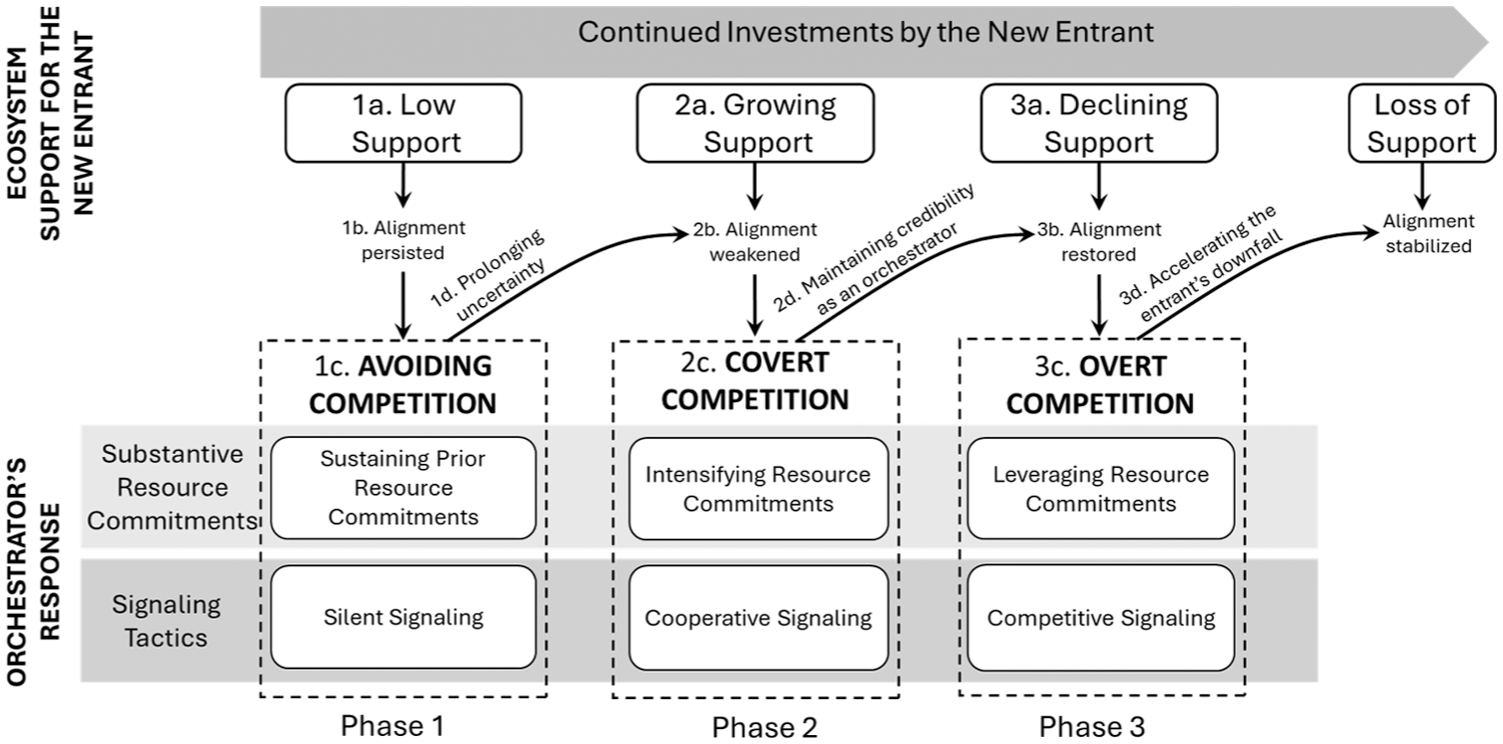
A Conceptual Framework of Strategic Responses to the Orchestrator’s Dilemma
Phase 1: Avoiding Competition (2001-2004)
Low support for the new entrant (1a)
Intel invested heavily and secured some backing for WiMAX in the early 2000s. However, ecosystem actors were slow to make credible investments and explicit endorsements, as “the WiMAX market was still very nascent, leading to great uncertainty in forecasting” (Burgelman, LaBrecquet, & Schifrin, 2010). These uncertainties included regulatory issues, unknown real-world performance of the technology, and market and pricing variables. The WiMAX Forum was established in 2001, but most members did not join until late 2003. Media coverage of WiMAX and related technology development activities in the ecosystem were scant (see the online Appendix for details).
Alignment persisted (1b)
We operationalize alignment as the degree to which ecosystem participants evaluate orchestrators’ strategies as appropriate and collectively beneficial. During this phase, mobile operators did not expect Ericsson to incorporate WiMAX into its solutions. A technical manager from a mobile operator recalled those early years: “WiMAX was initially an interesting topic for study, but due to its development stage, it was rarely being discussed as a potential contender to cellular technologies among commercial or technical managers” (Interview, 2018). Ericsson’s continued investment in its own solutions was expected and welcome, as it aligned with collective benefits. A commercial manager from an operator shared: “We had just started to invest more on [cellular] 3G technologies, hoping that we can recover the investments in the next few years. It was not reasonable to think of radical alternatives [i.e., WiMAX]” (Interview, 2018).
Industry experts shared the lack of enthusiasm and remained skeptical about the new entrant’s prospects, suggesting that “it would take at least five years for WiMAX’s ambitious goals to be realized” (EE Times, 2002). Ericsson’s direct competitors, Nokia and Alcatel-Lucent, however, saw an opportunity to challenge Ericsson’s dominance, prompting them to publicly express support for WiMAX and initiate related development activities. Ericsson remained silent.
Ericsson’s strategic response: Avoiding competition (1c)
Unlike its competitors, Ericsson neither joined the WiMAX Forum nor committed resources to it, and issued no public statements for or against it. Sustaining its prior resource commitments, Ericsson made no notable changes to its patterns of investment and development activities either, and it adhered to its original timeline for achieving key LTE milestones as stated: “The Olympics in 2012—that is when we will have 4G. . . . The aim for 4G speed is 100Mbps” (CTO, Reuters, October 2001). Our analysis of internal documents and interviews with Ericsson managers revealed no development projects related to WiMAX.
By choosing not to acknowledge or engage with the new entrant, Ericsson adopted a signaling tactic we refer to as silent signaling. This captures situations in which a powerful actor communicates its stance not through overt opposition but by deliberately withholding endorsement and support, thereby curbing expectations about the new entrant’s viability (Gomulya, Jin, Lee, & Pollock, 2019). Instead of opposing WiMAX, Ericsson promoted the advantages of its existing 3G technology and its future LTE technologies. Despite growing support for WiMAX by 2004, Ericsson’s marketing director stated only that they were “studying” the technology but “not doing anything active to put an offering in the market” (Light Reading, October 2004). Its tactics did not escape notice, and Ericsson was publicly called out as the only major vendor not to have signed up for the WiMAX Forum (EE Times, March 2007). A former senior strategy manager explained the logic of silent signaling as follows: “[Staying out of WiMAX] was a conscious decision. Joining WiMAX Forum was not without risk. Ericsson is so large that endorsing a standard can make it fly” (Interview, 2024). By sustaining its prior resource commitments and engaging in silent signaling—neither supporting nor opposing WiMAX, Ericsson responded to its competitive entry through a strategy we term avoiding competition. In doing so, it took a surprising approach, as orchestrators are expected to provide early leadership to guide an ecosystem, and set direction in times of change (Adner, 2021; Gawer & Cusumano, 2014). Proactive and timely action is further considered critical for managing interdependencies and preventing competing architectures from gaining ground (Dhanaraj & Parkhe, 2006). Instead, we observe that Ericsson chose to avoid competitive engagement with the new entrant. In doing so, it leveraged silence strategically, making the absence of expected communication a meaningful signal to observers (Pfarrer, Pollock & Rindova, 2010).
Influence of Ericsson’s strategic response: Prolonging uncertainty (1d)
Ericsson’s strategic response prolonged uncertainty about WiMAX’s prospects. A former senior manager in charge of 4G projects at Ericsson at the time elaborated: “Early on, we didn’t want to give too much attention to this new idea [WiMAX] initiated by Intel . . . we shouldn’t really give too much too early because, potentially, this could actually kill our goose” (Interview, 2024). This observation aligns with prior research showing that signaling tactics are symbolic strategies that often have disproportionate influence on how new solutions are initially perceived (Cole & Chandler, 2019). The choice to avoid competition despite internal beliefs about WiMAX’s potential advantages enabled Ericsson to undermine confidence in WiMAX in its early stages. An analyst’s report reflected these perceptions, stating that “leading firms like Ericsson” believe that “WiMAX is unlikely to become a serious contender for cellular technologies” (Light Reading, November 2003).
Phase 2: Covert Competition (End of 2004-2007)
Growing support for the new entrant (2a)
Ericsson’s strategy delayed support for WiMAX, but did not prevent its emergence, as WiMAX continued to attract credible technology investments and explicit endorsements from a broad range of ecosystem actors. Mobile operators and complementors invested in WiMAX technologies, which demonstrated performance advantages relative to LTE, such as speeds “up to four times faster than [current] wireless 3G networks” (AP, 2006; see the Online Appendix). This significant relative advantage accelerated uptake, and local and international endorsements proliferated. Important milestones included recognition of WiMAX by the IEEE, and later by the United Nations’ International Telecommunication Union (ITU), which legitimated it as a 4G alternative. More companies joined the WiMAX Forum, as noted by its membership director: “When I took over in mid-January [2004], the forum had 50 members. Now it has 185 fully paid members and 37 waiting” (DNS Business and Industry, December 2004). An industry report captured these changing perceptions: “The din around WiMAX is steadily growing” (Wi-Fi Net News, 2006).
Weakened Alignment (and pressures for change) (2b)
In light of the growing support for WiMAX, Ericsson’s strategy appeared to be no longer appropriate or beneficial for the collective, decreasing its alignment with ecosystem actors. perceptions of weakened alignment surfaced in customer interactions and inquiries. The CEO of a major mobile operator shared that at the time, WiMAX was seen as providing “the highest performance to mobile users” while offering “additional capacity” to enhance network operator efficiency (Interview, 2022). The competition avoidance strategy Ericson had adopted in Phase 1 began to draw criticism, and the company was seen as falling behind on both technology development and ecosystem engagement. A technical manager at a mobile operator remarked: “There was a point that Ericsson no longer appeared as our prime contact point for the next generation mobile technologies, as they did not seem to have in-depth technical knowledge or any product roadmap for WiMAX” (Interview, 2018). The CEO of a mobile provider explicitly described Ericsson’s position as problematic, noting that “When a company with the profile and market share of Ericsson refrains from investing in a technology, it increases our future risks due to having to rely on other vendors” (Interview, 2018).
These observations reveal a picture of ecosystem dynamics that differs from prior research, which tends to assume that central actors sustain alignment through proactive leadership and resource mobilization (Iansiti & Levien, 2004; Rietveld & Schilling, 2025). Our analysis of the second phase clarifies that such alignment is not necessarily self-reinforcing, and can become unsettled, requiring dynamic shifts in the orchestrator’s strategy.
Ericsson’s strategic response: Covert competition (2c)
The increased ecosystem support for WiMAX triggered a change in strategy at Ericsson. In response to criticism and pressure from the ecosystem, Ericsson adopted a new strategy which we term covert competition. Covert competition involved intensified substantive resource commitments in its existing technologies, and the use of deceptive cooperative signaling tactics.
On the resource commitments front, intensified investments enabled Ericsson to upgrade its interim solutions and accelerate the development of its next generation technology, LTE. In 2005, Ericsson’s CTO announced a goal to significantly reduce development times by 2008, a target the company met ahead of schedule (Ericsson history blog, accessed 2025). Analysts highlighted the rapid progress: HSDPA [an interim solution] will achieve 14Mbps by this year or next. If that sounds impressive, he expects the speed to double to 28Mbps by 2008. And there is more to come. “Ericsson targets that HSDPA speeds will be able to reach as high as 42Mbps by 2009,” he adds. (NetValue, July 2006)
In accelerating development cycles and introducing next-generation offerings earlier than expected, Ericsson departed from the conventional wisdom of firms delaying the introduction of next-generation solutions until they have fully captured value from existing ones (Abernathy & Utterback, 1978; Jiang, Qu, & Jain, 2019). The accelerated development enabled it to strengthen its competitive position relative to WiMAX.
An informant from Nokia highlighted the singularity of Ericsson’s strategy: “All the other companies except for Ericsson were investing. Even new players came to the market, like Samsung, like NEC. They started having products based on WiMAX. So, you had a solution from Nokia, from Motorola, from Huawei” (Interview, 2018). This lack of substantive investments also surprised industry analysts at the time: To date, Alcatel Inc., Fujitsu Network Communications, Motorola Inc., Nortel and Samsung Electronics Co. Ltd. are among the tier-one vendors that have launched mobile WiMAX portfolios. Missing from the lineup is L.M. Ericsson. The behemoth Swedish supplier has shied away from investing funds into researching and developing mobile WiMAX technology. (RCR Wireless News, October 2006)
Indeed, it is reasonable to expect a multi-technology incumbent like Ericsson to have both the ability and the motivation to engage with WiMAX, especially given its growing industry-wide momentum. However, such motivation can be dampened when managerial attention and resources are tied to competing technological trajectories (Eggers & Kaul, 2018). Thus, Ericsson’s non-investment could be seen less as a lack of foresight, and more as a balancing act between competing motivations. We observe that Ericsson chose to prioritize the economic logic of strengthening its own technologies, as explained by its head of radio network research: Ericsson could certainly have contributed to the development of WiMAX. But however we looked at this issue, we ran up against the question of where the profit was. . . . We would have split our resources so that our main path would have developed more slowly. And the volumes for our main product would have been lower so we would have lost the economies of scale. (Ericsson history blog, 2018)
Our analysis further revealed that Ericsson’s contingency plan was to enter the market through acquisition if WiMAX gained traction. A former strategy manager told us: “There was another piece of strategy at the time focused on partnerships. I even remember some WiMAX-related slides on the ‘route through M&A’ instead of joining these forums and then intercepting somewhere when it actually gained traction” (Interview, 2024).
The second component of Ericsson’s covert competition strategy was a change in signaling tactics to what we call cooperative signaling. Notably, in December 2004, it publicly endorsed WiMAX and joined the WiMAX Forum. Ericsson’s Vice President made the following statement about the decision: “Ericsson is a strong believer in open standards. WiMAX ensures interoperability of the open IEEE 802.16 standard for broadband wireless access” (Light Reading, December 2004). A spokesperson for Ericsson elaborated: “Now the time is ripe. We notice an increased demand from our operator customers, and then we want to be involved. We will develop WiMAX products. But we cannot specify a time yet” (NyTeknik.se, December 2004).
Despite a lack of substantive resource commitments, Ericsson undertook symbolic, low-investment activities that gave the appearance of engaging with WiMAX. An informant from Alcatel-Lucent shared: “Ericsson made a deal with a company [Airspan] that made WiMAX equipment, and then just sold that equipment with an Ericsson label on it to its customers.” Ericsson also announced intentions to develop its own WiMAX products, but as of 2006, the expected products remained at the “product definition” stage with no specific launch dates (Internal documents). Thus, although Ericsson increased patenting activity related to WiMAX (Online Appendix, see Strategic Patenting on Rival Technology and Patent Numbers), no product development followed. While Ericsson’s actions could be seen as hedging against the possibility that WiMAX could win, we did not find evidence to support this interpretation. Instead, these moves created the impression of substantive engagement while allowing Ericsson to avoid resource commitments that could have strengthened the rival standard. Its cooperative signaling therefore was deceptive in nature, as symbolic activities were presented as genuine investment and aligned with ecosystem narratives of support, enabling Ericsson to satisfy external expectations without altering its substantive resource commitments. Consistent with our conceptualization of these as deceptive signaling tactics, Ericsson’s then-CTO stated: “We probably never really got behind WiMAX . . . we never really decided to start” (Ericsson history blog, accessed in 2022).
Thus, in the second phase, Ericsson adopted a covert competition strategy, which involved intensifying prior resource commitments in its own technologies while engaging in cooperative signaling to express public support for WiMAX without making substantive investments in it. Whereas prior research has noted the use of deceptive tactics in competitive settings (Steigenberger, 2025; Steigenberger & Wilhelm, 2018), our analysis of the second phase reveals that the role of deceptive signaling tactics as a part of an orchestrator’s strategy is to align with ecosystem expectations while continuing to promote its competing technology.
Influence of Ericsson’s strategic response: Maintaining credibility as an orchestrator (2d)
By symbolically joining the WiMAX Forum, Ericsson eliminated concerns in the ecosystem as to whether WiMAX could become a widespread technology standard in the mobile sector. Although Ericsson did not provide substantive support for WiMAX development, its cooperative signaling tactics created an appearance of consensus about the technology, reducing skepticism about its prospects. Analysts and the media perceived Ericsson’s signals as support for WiMAX, describing the company as “a supporter,” the “latest recruit,” and “active in WiMAX projects” (Barron’s, July 2005). Proponents of WiMAX celebrated Ericsson’s decision to join the WiMAX Forum, pointing to “2005 as a seminal year in the development of broadband wireless solutions based on the WiMAX specification” (EDN.com, December 2004).
With growing attention focused on WiMAX, and having addressed ecosystem participants’ expectations for cooperation, Ericsson assuaged customers’ concerns about non-cooperation. This symbolic concession bought Ericsson time to concentrate on its competitive technology alternative, LTE. Between 2004 and 2007, this focus was reflected mainly in internal development activities and investments rather than in product launches. The rollout and expansion of interim solutions played a critical role in shaping ecosystem participants’ perceptions. HSDPA, one such interim solution, progressed from initial test calls in the United States in late 2005 to deployment across 59 commercial networks by September 2006 (Ericsson press release, September 2006). These efforts sustained ecosystem investments in cellular solutions and undercut WiMAX’s claim of superior speed relative to upgraded 3G networks, which set the stage for declining support in Phase 3.
The use of signaling tactics as a deceptive device to divert stakeholder attention is well documented in the CSR and non-market strategy literature. Findings show that firms engage in symbolic actions to satisfy stakeholder expectations while pursuing other priorities (Fiss & Zajac, 2006; Marquis & Qian, 2014). However, temporal effects of these actions have received less attention. Our analysis of the second phase shows that in dynamic ecosystems, where support can shift quickly, the time-buying effect of decoupled signaling tactics can significantly shape rivalries. By signaling cooperation, orchestrators preserve critical relations and deflect scrutiny, gaining time to develop their own technologies further. Such tactics temporarily assuage concerns and avoid repercussions by portraying cooperation while withholding substantive resource commitments and buying time to develop a competitive alternative.
Phase 3: Overt Competition (2007-2010)
Declining support for WiMAX (3a)
The third phase was marked by withdrawals of investments in WiMAX and retractions of prior endorsements by ecosystem participants. Ecosystem support for WiMAX declined along with assessments of its value proposition. First, technical delays and implementation shortcomings resulted in failed WiMAX projects, undermining confidence in its reliability (EDN.com, 2007). Second, regulatory resistance in key markets such as Brazil and India by telecom regulators who delayed or opposed the adoption of WiMAX due to a lack of alignment with existing telecom policies (Telecoms.com, March 2009) worsened its standing. Third, LTE achieved critical milestones ahead of schedule. For example, in February 2007, Ericsson demonstrated data rates up to 144 Mbps, showcasing LTE’s competitive superiority (Fierce Wireless, February 2007).
Alignment restored (3b)
The combination of these developments made Ericsson’s efforts once more seen as appropriate and collectively beneficial for ecosystem participants. Ericsson’s customers started to doubt WiMAX’s potential. As a CTO of a mobile operator explained, operators faced a choice between “a promising, but still unproven and uneconomic new technology on the one hand, and a slower, but more reliable and future-proof technology on the other” (Interview, CTO of mobile operator, 2018). A Nokia interviewee captured this pivotal shift as follows: The feeling was: Why should I invest in WiMAX when LTE is starting right now? That was the question in, for example, 2009. You hear that the first trials of LTE are starting now . . . so why should I invest and make a rollout while the next technology is going to be out? (Interview, 2017)
Ericsson’s competitive response aligned with ecosystem participants’ growing skepticism about WiMAX and its relevance, thereby reducing the necessity and effectiveness of covert competition while symbolically supporting WiMAX. This triggered a shift in Ericsson’s strategy to align its signaling tactics with its substantive resource commitments.
Ericsson’s strategic response: Overt competition (3c)
In response to declining ecosystem support for WiMAX, Ericsson counter-attacked by leveraging its substantive resource commitments. First, its intensified substantive resource commitments in Phase 2 enabled it to launch solutions that were successful in head-to-head performance comparisons against WiMAX. It reported achieving extraordinary data transmission speeds in a laboratory setting (e.g., 154 Mbps) and promised to deliver 200 Mbps the following year (Telecoms.com, 2008).
Second, Ericsson refused to support the interoperability of WiMAX with existing networks (Fierce-network, August 2009), severely impeding WiMAX’s rollout. Third, it leveraged its WiMAX patents to undermine Intel’s royalty-free value proposition by withholding its own patents from the royalty-free patent pool (Internal strategy documents). Fourth, Ericsson lobbied to slow down the WiMAX rollout in strategic markets. For example, it advised Indian operators that WiMAX was unsuitable for India and attempted to stall WiMAX in Brazil. An executive director of Neotec, an organization representing Brazil’s licensed operators, stated: “The lobbying of Ericsson and Qualcomm is strong, and they are doing everything they can in order to postpone any WiMAX deployment” (Telecoms.com, June 2009).
In terms of signaling tactics, Ericsson shifted from cooperative to competitive signaling, making its competitive intentions known. On March 26, 2007, it publicly announced that it had stopped all WiMAX-related development (The Register, March 2007). Although, in reality, development activities had never begun. Ericsson also left the WiMAX Forum and began to criticize WiMAX’s technological quality and value proposition. According to an industry report, Ericsson employees attended WiMAX events to oppose the technology: “When all WiMAX fans this week gathered in Chicago, Ericsson was there, but not to give its support. Instead, the task was to explain why Turbo-3G and other upcoming technologies are better” (Industry analyst, IDG Sweden, July 2007).
Ericsson’s competitive signaling was also a deliberate tactic to curtail WiMAX’s efforts to gain further traction. An internal document titled “How to Push Back WiMAX” delineated what employees should tell customers to sway the perceptions against WiMAX and counter its value proposition. In an interview for the Ericsson history blog (accessed in 2022), Ericsson’s then-CEO explained the company’s strategy in Phase 3 and the withdrawal from WiMAX as follows: Up to a point, an issue like this [WiMAX] is also a political one. Could we have decided on a somewhat simpler investment in WiMAX so that we could at least make our voice heard? We try to move forward as cautiously as we can. We do not want to end up arguing with our customers. But at the same time, leadership involves making choices.
This statement illustrates Ericsson’s reassertion of its orchestrator role as it engaged in overt competition with WiMAX and sought to realign customers who had incorporated the rival technology into their strategies in preceding years.
Influence of Ericsson’s strategic response: Accelerating WiMAX’s downfall (3d)
Ericsson’s overt competition accelerated WiMAX’s failure. The narrative about WiMAX gradually changed, with declining enthusiasm among ecosystem participants. The media framed Ericsson’s withdrawal as “deal[ing a] blow to unified 4G dream” through “a calculated political gesture, designed to sway the climate of opinion against WiMAX and stack the odds in favor of a 4G where Ericsson’s chosen systems are in the lead” (The Register, March 2007). The implications of these efforts were sensed by the proponents of WiMAX, as indicated by a WiMAX Forum board member: “Many of the claims made [by Ericsson] on behalf of LTE are ‘scare tactics’ deployed by people with vested interests who say that mobile operators should not stray from the 3GPP path” (Telecoms.com, October 2008). Despite continued investments by Intel and other proponents, key US-based mobile operators abandoned WiMAX, and Alcatel-Lucent and Nokia ended their technology development activities shortly after Ericsson’s announcement, marking a complete loss of support for the new entrant.
Theoretical Framework: Strategic Responses to the Orchestrator’s Dilemma
Research on ecosystems has recognized the critical role orchestrators play in leading ecosystem emergence and evolution (Adner, 2021; Autio, 2022). Findings also show that competitive new entrants alter ecosystem relations and interdependencies that orchestrators have shaped (Ansari et al., 2016; Cozzolino et al., 2018). Our framework clarifies that responding to such competitive entries presents the orchestrator with a dilemma, and articulates how an orchestrator can combine substantive resource commitments with signaling tactics to respond dynamically to changing ecosystem support while defending its central position.
Our framework offers novel theoretical insights regarding (a) the dynamic nature of ecosystem support for competitive entrants and implications for alignment between an orchestrator and ecosystem participants; (b) different strategies that an orchestrator could use to respond to competitive entrants and influence ecosystem support by combining substantive resource commitments and signaling tactics in different ways; and (c) the influence of an orchestrator’s strategic responses on ecosystem dynamics.
Shifting ecosystem support for a competitive entrant (represented in the upper part of Figure 4) is the key mechanism that triggers changes in an orchestrator’s strategies. These shifts in ecosystem support reflect both the new entrant’s investment in promoting its value proposition and enlisting supporters, and the interaction with the orchestrator’s strategic responses.
Initially, due to technical and market uncertainties (Moeen, 2017; Moeen, Agarwal, & Shah, 2020), a new entrant receives limited support from ecosystem participants (1a), who remain aligned with the orchestrator. Because alignment is maintained (1b), the orchestrator experiences little pressure to cooperate with the new entrant and can respond to the new entrant by avoiding competition (1c). This strategy involves sustaining prior resource commitments and engaging in silent signaling. Withholding articulation of either a cooperative or competitive stance leverages strategic silence (Carlos & Lewis, 2018), which provides cues to skeptical participants that the new entrant is not yet worthy of attention. Because stakeholders interpret the actions of key actors as signals (Basdeo, Smith, Grimm, Rindova, & Derfus, 2006), an orchestrator’s avoidance of competition prolongs uncertainty (1d) and delays the accumulation of support for the new entrant. The applicability of this tactic is time-bound and corresponds to the initially limited strength of ecosystem support for the new entrant.
However, as the new entrant continues to make investments, ecosystem support for the new entrant can grow (2a), thereby weakening alignment (2b) between the orchestrator and ecosystem participants, who increasingly come to view cooperation with the new entrant as desirable and appropriate. As consensus builds about expected roles and behaviors, dissenting actors experience pressure to align (Bitektine & Haack, 2015). The orchestrator thus feels compelled to express support for the new entrant’s alternative, even at the risk of tipping the ecosystem in favor of the new entrant. Although precarious, this situation still affords the orchestrator opportunities to prevail because (a) ecosystem support is unstable, as the new entrant’s value proposition has not yet achieved the scale and widespread adoption necessary to become institutionalized; (b) market uncertainty remains with regard to the relative advantages of the new entrant’s value proposition, which is evolving; and (c) existing relationships favor the orchestrator (Hill & Rothaermel, 2003), provided that it can offer a satisfactory alternative.
During this phase, an orchestrator shifts its strategic response by engaging in covert competition (2c). Adopting a deceptive political approach to manage the perceptions of ecosystem participants, the orchestrator engages in cooperative signaling by symbolically endorsing a new entrant’s initiatives while intensifying resource commitments to internally developed solutions. This approach parallels what has been described as “institutional hypnosis,” in which symbolic actions lull stakeholders into perceiving alignment and legitimacy despite underlying divergence (Deng et al., 2021). Creating this temporary perception of alignment reduces the risk of alienating key actors, thereby maintaining its credibility as an orchestrator who is responsive to ecosystem interests. This realignment buys time for the orchestrator to develop its own technology and related value proposition (2d). Importantly, this strategy is also time-bound based on the extent of ecosystem support. Its application is most relevant when the orchestrator faces mounting pressure to comply with expectations of cooperation and ends when support for the new entrant begins to fracture.
If an orchestrator is able to develop a superior value proposition before a new entrant’s solution is widely adopted, ecosystem support for the new entrant can decline (3a), thereby restoring the orchestrator’s alignment with ecosystem participants (3b). During this phase, concealing competitive intentions no longer offers an advantage, as the orchestrator would forfeit the opportunity to actively draw ecosystem support away from the new entrant. At this point, the orchestrator shifts its strategic response by engaging in overt competition (3c). By leveraging its substantive resource commitments and engaging in competitive signaling, the orchestrator consolidates ecosystem support around its value proposition, thereby accelerating the new entrant’s downfall (3d). Ultimately, this strategy may position the orchestrator to outperform the new entrant.
An orchestrator’s need to defend its competitive interests and position, while addressing expectations of cooperation from ecosystem participants, poses a seemingly intractable dilemma requiring a sophisticated strategy that balances the two. Our framework articulates how orchestrators combine substantive resource commitments and signaling tactics in different ways to both respond to and shape ecosystem support over time.
Discussion
Ericsson’s response to WiMAX exemplifies a common scenario in evolving ecosystems: A new entrant introduces a compelling value proposition that attracts participants and destabilizes the orchestrator’s alignment with them. The orchestrator prioritizes safeguarding its position while recognizing the risks of becoming misaligned with customers, suppliers, and complementors. Our in-depth investigation of the case enabled us to analyze “the orchestrator’s dilemma,” i.e., the dual challenge of responding to pressures to cooperate with a new entrant while pursuing one’s own competitive interests. We have theorized the use of signaling tactics and their decoupling from substantive resource commitments to foreground the importance of symbolic actions to manage the orchestrator’s dilemma. Our framework articulates how an orchestrator can delay the formation of ecosystem support, use superficial cooperative signals to buy time to improve its own value proposition relative to the new entrant, and ultimately accelerate the entrant’s downfall. These ideas advance ecosystem research in three main areas: coopetition in ecosystems, orchestrators’ strategic responses to new entrants, and social dynamics in changing ecosystems.
Managing Coopetitive Tensions Through Signaling Tactics
We extend the understanding of coopetitive strategies in ecosystems by foregrounding the importance of managing perceptions of cooperation and competition through signaling tactics. Prior research on this topic has largely focused on substantive resource commitments (Hannah & Eisenhardt, 2018), assuming that firms cooperate and compete solely based on their economic interests. This emphasis has overlooked the role of social expectations of cooperation. Our research highlights that ecosystem participants expect orchestrators to support competitive new entrants, even if doing so undermines their own interests. Our theorization shows that, rather than giving in to such expectations, orchestrators manage perceptions through signaling tactics, actions that have been overlooked in research on coopetition in ecosystems.
A critical aspect of our theorization of orchestrators’ tactics is the deceptive use of signaling, in which cooperation is selectively and narrowly deployed as a decoy rather than reflecting the orchestrator’s genuine intentions. Our findings show that rather than oscillating between genuine competition and cooperation over time (Gnyawali & Park, 2011), orchestrators can adapt their signaling tactics, without changing their substantive resource commitments, using signaling tactics to deceive instead of to inform. These ideas extend coopetition research by theorizing how coopetition can also be enacted as a political, yet arguably legitimate business strategy (Steigenberger & Wilhelm, 2018). Our theorization further specifies the time-bound nature of signaling tactics: Initially, remaining disengaged and silent poses less risk than conveying insincere support, whereas later the orchestrator benefits more by fully aligning its signals with its competitive intentions. These observations and insights contextualize and extend the understanding of signaling tactics.
Orchestrators’ Strategic Responses to New Entrants
Our study also contributes to the literature on orchestration strategies, which has largely focused on two areas of inquiry: how orchestrators coordinate established ecosystems (Adner & Kapoor, 2016; Dhanaraj & Parkhe, 2006), and how new entrants succeed in either displacing them or forcing strategic retreat (Ansari et al., 2016; Cozzolino et al., 2018; Snihur et al., 2018). Whereas recent work has examined the role of orchestrators in addressing disruptive entrants in regulated ecosystems (Cozzolino & Geiger, 2024) and in encouraging innovation among participants to counter those entrants (Reischauer et al., 2025), these studies focus on mobilizing ecosystem participants to embrace change. In contrast, we theorize how orchestrators can thwart change by resisting and undermining a rival’s advance.
Our framework brings further clarity and nuance to the understanding of orchestrators’ strategies to counter new competition. Prior research has emphasized that when facing competing technologies, firms make choices in line with their competitive interests (Eggers, Grajek, & Kretschmer, 2020). Our research confirms the importance of such choices, but also reveals the complexity of communicating and enacting them within the ecosystem. This contrasts with a long-standing line of research on competitive interactions that emphasizes early credible signals as a key entry-deterrence mechanism for establishing a firm’s reputation as a tough competitor (Milgrom & Roberts, 1982). Departing from this view, our framework highlights how orchestrators can dynamically deploy deceptive tactics to buy time and leverage ecosystem participants’ preferences for continuity and certainty, thereby undermining a rival’s advancement over time. Such defensive orchestration strategies preserve orchestrators’ vested interests and bargaining power, even at the cost of ecosystem-wide benefits, representing a novel theorization of the repertoire available to orchestrators facing new competitive threats.
Managing Social Issues in Changing Ecosystems
Lastly, we contribute to the social view of ecosystems (Garud et al., 2022; Randhawa et al., 2024; Thomas & Ritala, 2022) by showing that alignment is fragile and politically constructed. Mainstream ecosystem research, grounded in the economics of interdependencies and industry architecture (Adner, 2017; Jacobides et al., 2018), views expectations as reflections of objective economic conditions, including coordination with complementarities and interdependencies. In contrast, our research underscores how expectations are socially constructed and politically shaped by new entrants’ efforts and orchestrators’ responses, and how ecosystem trajectories hinge not only on technical merit but also on symbolic actions that shape expectations. This offers new insights about how heterogeneity in ecosystems can be managed through signaling tactics. Unlike substantive commitments, which are inflexible and costly, signaling tactics are malleable and less costly, and can be tailored to the expectations of ecosystem participants. Greater attention to social aspects enables us to explain why and how ecosystem pressures drive orchestrators to pursue unexpected strategies, such as remaining deliberately noncommittal about a rival solution or signaling support for one they never intend to adopt.
Finally, our research underscores the critical period between the emergence of broad consensus around a change and its implementation, especially when prominent actors continue to dissent. Whereas prior research has emphasized the importance of achieving ecosystem-wide consensus (Nickerson & Muehlen, 2006; Simcoe, 2012), our analysis highlights the gap between the emergence of consensus and eventual outcomes of rivalries in ecosystems. We have shown how dissenting orchestrators may temporarily withhold opposition while developing competitive resources, only to mount counterattacks and undercut ecosystem support even after it appears to be solidified.
Practical Implications
For managers, our findings highlight the importance of mastering signaling strategies to tactically navigate coopetition. Signaling tactics enable managers to align with ecosystem expectations, delay rivals’ progress, and consolidate competitive advantages without compromising long-term strategic goals. For example, firms can leverage symbolic compliance or selective endorsements to maintain trust with ecosystem participants while covertly pursuing competitive goals (Makadok, 2011). New competitive entrants may need to recognize the potential for such practices to challenge their entry into an ecosystem, and policymakers should consider how such practices may limit opportunities for ecosystem entry and innovation.
Boundary Conditions, Limitations, and Future Research
We have focused on a single ecosystem and a specific competitive entry in it. Whereas we have theoretically generalized our observations by comparing and contrasting our findings with prior research, we recognize that specific aspects of our context point to relevant boundary conditions and opportunities for future research.
First, Ericsson’s long history and strong reputation for technology leadership may have given it an unusually strong position as an orchestrator at the start of this rivalry, thereby affording it choices that other orchestrators may not have. Orchestrators with weaker reputations and ecosystem relationships may be unable to respond by avoiding competition at the outset. Instead, they may need to mount a vigorous competitive response to deter entry and signal to ecosystem participants and other stakeholders that they are not ignoring a competitive threat. Furthermore, orchestrators may need to resort to covert competition when the new entrant has a strong reputation and ability to mobilize ecosystem support for its entry. Facing a relatively weak new entrant, orchestrators may engage in overt competition outright to discredit the new entrant’s attempt. Future research on how differences in orchestrators’ and new entrants’ initial technological and social resources (e.g., reputation and relationships) may affect the dynamics of competitive entry into an ecosystem would be valuable.
Second, adoption speed and the degree of lock-in critically affect the nature of an orchestrator’s ecosystem challenges and the effectiveness of the signaling tactics we theorized. In our case study, significant infrastructural interdependencies limited the new entrant’s ability to quickly roll out the technology. In ecosystems where participants have lower switching costs, this process may be accelerated, giving the orchestrator little opportunity to use signaling before launching a competitive response. Future research should give close attention to the interaction between adoption speed and strategic response speed in understanding how competitive battles between orchestrators and new entrants play out. Furthermore, our study foregrounds the differences between overt and covert competition, pointing to the value of future research focused on examining the conditions under which orchestrators benefit from these forms of competition.
Third, orchestrators may choose genuine cooperation over covert competition. In the television ecosystem, orchestrators accommodated successful entrants by integrating their value propositions (Ansari et al., 2016). In the transportation ecosystem, orchestrators absorbed rivals through hybrid strategies, as when taxi companies integrated Uber’s app in locations without Uber drivers (Thelen, 2018). These scenarios suggest that competing alternatives are not always mutually exclusive and that developing new hybrid value propositions is an important path forward for orchestrators facing competitive entry. Without adaptation, orchestrators may be displaced, as in the case of Salesforce’s SaaS model, which pushed Siebel Systems out of the ecosystem and forced other participants like Oracle and SAP to reconfigure their solutions (Snihur et al., 2018). In future work, researchers should investigate the conditions under which orchestrators benefit from adaptive approaches versus deterrence. Future research on orchestrators’ dynamic capabilities for adaptation and “envelopment”-type strategies that blend competition and genuine cooperation is likely to surface important insights.
Fourth, we have theorized the temporal aspects of orchestrators’ response strategies as closely intertwined with shifting ecosystem support. The time-bound nature of the strategies we observed merits further research, as we do not know when prolonged competition avoidance could backfire and weaken an orchestrator’s influence over an ecosystem, especially if an entrant’s solution proves to be superior. Likewise, if an orchestrator delays shifting from covert to overt competition, a new entrant could leverage the apparent consensus and lack of opposition to accelerate adoption through short-term tactics (e.g., pricing tactics studied in research on competitive wars; Slade, 1990), leading to the orchestrator’s displacement. Lastly, even when mergers, acquisitions, or other fallback strategies appear effective, late commitment and visible contestation during earlier phases of competition can erode the incumbent’s reputation and legitimacy. Therefore, the timing and duration of strategic responses are important factors that merit future research attention.
Finally, whereas we focused on orchestrators’ response strategies, which have received less attention than new entrants’ strategies, future research on the broader social dynamics of ecosystems during competitive entry is needed. We have theorized how orchestrators use signaling tactics to respond to and influence the ebbs and flows of ecosystem support; because this support is both causally ambiguous and socially complex, future research on how it can be influenced is critical. Building on the notion of shaping through persuasion as a form of interactive agency (Pontikes & Rindova, 2020; Putra, Khanagha, Pandza, & Suarez, 2025), researchers could explore how sequencing such tactics contributes to the formation of expectations, and how earlier coopetitive moves may enable later ones. Examining the types of symbolic actions used in signaling also would be valuable, as our understanding of these tactics remains limited compared to the study of credible signals. Finally, studying signaling tactics across different cultural and regulatory contexts could reveal new dimensions of coopetition and innovation in ecosystems (Li et al., 2019).
Conclusion
This study redefines how we understand orchestrators’ coopetition strategies in ecosystems, revealing that they do not simply balance or sequence competition and cooperation in terms of resource commitments, but strategically manage perceptions to maintain their positions in changing ecosystems. Through signaling tactics, orchestrators can address conflicting competitive interests and pressures to cooperate. This insight highlights the power of symbolic actions in shaping ecosystem trajectories where rivalries are won not solely on merit, but through strategic perception management. Orchestrators leverage signaling tactics to deter attention, buy themselves time, build legitimacy, influence stakeholders, and undermine rivals without diverting their resources. By extending the social view of ecosystem orchestration, this study provides a foundation for future research on coopetition and orchestrators’ response strategies.
Supplemental Material
sj-docx-1-jom-10.1177_01492063251395674 – Supplemental material for The Orchestrator’s Dilemma: How Ericsson Strategically Recombined Resource Commitments and Signaling Tactics to Outmaneuver WiMAX
Supplemental material, sj-docx-1-jom-10.1177_01492063251395674 for The Orchestrator’s Dilemma: How Ericsson Strategically Recombined Resource Commitments and Signaling Tactics to Outmaneuver WiMAX by Saeed Khanagha, Shahzad (Shaz) Ansari, Violina Rindova and Hakan Ozalp in Journal of Management
Supplemental Material
sj-docx-2-jom-10.1177_01492063251395674 – Supplemental material for The Orchestrator’s Dilemma: How Ericsson Strategically Recombined Resource Commitments and Signaling Tactics to Outmaneuver WiMAX
Supplemental material, sj-docx-2-jom-10.1177_01492063251395674 for The Orchestrator’s Dilemma: How Ericsson Strategically Recombined Resource Commitments and Signaling Tactics to Outmaneuver WiMAX by Saeed Khanagha, Shahzad (Shaz) Ansari, Violina Rindova and Hakan Ozalp in Journal of Management
Footnotes

References
Supplementary Material
Please find the following supplemental material available below.
For Open Access articles published under a Creative Commons License, all supplemental material carries the same license as the article it is associated with.
For non-Open Access articles published, all supplemental material carries a non-exclusive license, and permission requests for re-use of supplemental material or any part of supplemental material shall be sent directly to the copyright owner as specified in the copyright notice associated with the article.
