




Abstract
Foreigners are often subject to stereotyping and discrimination, challenges typically associated with negative outcomes in the literature. In contrast, this study explores the potential benefits of such experiences for expatriates. Using an abductive approach, informed by self-categorization theory and impression management theory, we draw on interviews with 102 German expatriates in China, Korea, and Japan to examine 1) the stereotyping and resulting preferential discrimination expatriates experience abroad and 2) how expatriates strategically utilize stereotypes to their advantage. Our findings reveal that both positive and negative stereotypes can lead to preferential discrimination. Expatriates may benefit from immediate trust, privileged access to decision-makers, and what is often referred to as a “foreigner bonus.” Rather than passively accepting stereotyping, expatriates actively leveraged it through three strategies—trustworthy actor, powerful messenger, cultural clueless foreigner—to gain individual and organizational benefits. These strategic performances were often encouraged by local colleagues and superiors. By uncovering how expatriates engage in stereotypical behavior to enhance outcomes, this study reframes foreignness as a valuable asset that can be performed situationally and relationally. This perspective offers valuable managerial implications and advances theoretical understanding of cross-cultural interactions.
Keywords
Introduction
Are Americans arrogant, Germans direct, and the Japanese shy? Such stereotypes of foreigners often fuel negative discrimination, with significant consequences for those who are stereotyped. Stereotypes refer to the generalized beliefs about characteristics of members of a particular group, often oversimplifying complex human attributes (Hilton & von Hippel, 1996). In cross-cultural interactions, differences are accentuated. This increases the salience of foreignness, which makes international work environments particularly prone to stereotype-driven discrimination (Bonache, Langinier, & Zárraga-Oberty, 2016, Tian, Xu, & Yiu, 2024).
While much of the discrimination research focuses on marginalized groups, not all out-groups are marginalized. In global business, expatriates from developed countries are frequently placed in high-status roles, yet remain subject to stereotyping. For expatriates, such stereotypes can shape their experience, influencing their adjustment and psychological well-being (Bonache et al., 2016). Resulting stress and anxiety levels (Silbiger & Pines, 2013) can lead to lower performance (Grand, 2017) and, particularly for marginalized expatriate groups, higher turnover (Tekeste & Brewster, 2024). From an international business perspective, these challenges align with what is known as the liability of foreignness, wherein foreign status is associated with disadvantages and higher costs (Benischke, Rietveld, & Slangen, 2023; Fang, Samnani, Novicevic, & Bing, 2013).
In contrast to the dominant focus on mitigating challenges in cross-cultural contexts, recent scholarship has called for a more balanced view, suggesting that concentrating solely on negative aspects may limit our understanding of the full scope of such interactions (Stahl & Tung, 2015; Stahl, Tung, Kostova, & Zellmer-Bruhn, 2016). Accordingly, recent research has begun to conceptualize foreignness as both a potential liability but also an asset (Edman, 2016; Lu, Ma, & Xie, 2021; Taussig, 2017). Yet, much of such research continues to focus on the reduction of foreign liabilities portraying factors such as global perspective (Tian et al., 2024), cultural intelligence (Stoermer, Davies, & Froese, 2021), or adaptability (Lu et al., 2021) as compensatory assets, rather than examining how foreignness itself might be perceived as valuable. Similar to how country of origin stereotypes can positively bias consumer attitudes toward products (Oduro, De Nisco, & Petruzzellis, 2024), favorable stereotypes might benefit expatriates, in particular from developed countries. Anecdotal accounts from expatriate communities describe experiences of favorable treatment. This prompted us to explore the understudied phenomenon of preferential discrimination. Through exploratory interviews with German expatriates in Northeast Asia, we identified not only incidents of stereotype-based preferential discrimination but also surprising accounts of expatriates’ strategic engagement in stereotypical behavior to turn their foreignness into an asset.
Adopting an abductive approach, integrating self-categorization theory, impression management theory, and interview data from 102 German expatriates in Northeast Asia, our study contributes in two key ways: First, by delving into the positive aspects of foreignness for the case of expatriate stereotyping and discrimination, we enrich the broader literature on discrimination, particularly advancing self-categorization theory (Turner, Hogg, Oakes, Reicher, & Wetherell, 1987). While prior research has traditionally emphasized exclusionary consequences of out-group categorization, our findings reveal how expatriates may also benefit from it. Positive stereotyping and associated preferential discrimination are relatively underexplored phenomena. By approaching this real-world topic, we follow the call for more phenomenon-based research (Doh, 2015). Our research directs attention to out-group preferences and contributes to a generally more holistic view on preferential discrimination and associated dynamics.
Second, our study adds to impression management theory (Goffman, 1959; Tedeschi, 2013) by showing how expatriates strategically engage with stereotypes to turn their foreignness into a valuable asset. Despite sparse research on country differences in impression management, often comparing preferences in the United States to those in other countries (Kurman, 2001; Long, Baer, Colquitt, Outlaw, & Dhensa, 2015), there is a notable gap in understanding how impression management unfolds within cross-cultural contexts and, more specifically, the influence of stereotypes on these strategies. While stereotypes are generally assumed to be constructed by the majority group (in our case host country nationals [HCNs]), our paper identifies ways in which the minority, i.e., expatriates, are actively appropriating and promoting stereotypes for their own benefit. This perspective sheds light on cross-cultural impression management as a practice that is shaped in relation to others’ expectations and shared organizational goals.
Literature Review
In this section, we clarify the concept of preferential discrimination and outline the two theoretical perspectives that guided our understanding. We first drew on self-categorization theory (Turner et al., 1987) to explore how group-based perceptions contribute to stereotyping and may lead to discrimination. As we engaged more deeply with our data, we began observing patterns of strategic behavior. This led us to turn to impression management theory (Goffman, 1959) to better understand how expatriates engage with stereotyping to leverage the preferential discrimination it creates.
Preferential Discrimination
While social categorization can carry positive connotations, the dominant focus in the literature is on negative categorization and its adverse impacts (Liu, Liu, Wang, & Zhang, 2021). The scarce research on preferential discrimination tends to adopt a pessimistic approach, emphasizing its limitations rather than its potential. This is evident in the common association of “preferential” or “positive discrimination” with “affirmative action,” which aims to promote equity by increasing the minority representation. In business literature, such policies have drawn attention to tokenism (Chang, Milkman, Chugh, & Akinola, 2019), which refers to preferential hiring based on visible traits, such as skin color (Watkins, Simmons, & Umphress, 2019), ethnicity (Minefee, Rabelo, Stewart, & Young, 2018), or sex (Jain, Ahern, & Van Buren, 2022), rather than merit. This raises concerns about effectiveness and the risk of fostering negative employee attitudes (Leslie, 2019).
In contrast to its association with policies, our paper shifts the focus to preferential discrimination as a naturally occurring phenomenon rooted in stereotypes and group membership. Previous studies in this area have primarily emphasized how positive stereotypes can lead to preferential discrimination toward one’s own group, resulting in self-serving bias (Liu et al., 2021) and intergroup bias (Ashburn-Nardo, Voils, & Montheith, 2001). Notably, such biases are associated with simultaneous negative stereotyping and unfair treatment of minorities. Consequently, the overarching objective of most studies has been to reduce these implicit and often unconscious biases (Devine, 2001).
Although extensive research exists on how stereotypes can contribute to negative bias and discrimination, far less is known about when stereotypes foster positive bias toward out-groups. Much of the research in this domain primarily focuses on hiring situations. For instance, studies have revealed that certain positively evaluated attributes (e.g., attractiveness) can lead to a positive rating of unrelated attributes (e.g., competence) and an overall favorable evaluation of the rated individual, a phenomenon known as the “halo effect” (Ng, Wang, Hsu, & Su, 2020). Thus, stereotypes about a single trait can extend into broader group-based categorizations and favoritism.
In intergroup contexts, research indicates that self-interest can even override in-group favoritism, leading individuals to prefer an (favorably stereotyped) outsider over someone from their own group if it increases their personal benefit (Turner, Brown, & Tajfel, 1979). To better understand how group categorization leads to stereotyping that translates into preferential out-group discrimination, we draw on self-categorization theory (Turner & Reynolds, 2012; Turner et al., 1987).
Self-Categorization Theory
Self-categorization theory explains how group affiliation and intergroup contexts can guide perceptions and lead to stereotyping, and how salient group distinctions underlie both negative and positive discrimination. Individuals categorize themselves and others into social in- and out-groups to simplify interpersonal information and navigate complex social environments (Turner & Reynolds, 2012; Turner et al., 198). Often, in-group members are exposed to similar and limited information about a certain foreign out-group, leading to depersonalization and group-based generalizations. When most in-group members share such generalized beliefs about the out-group, stereotypes emerge, and all individuals of the out-group are expected to have certain characteristics in common (Hilton & von Hippel, 1996).
In that respect, stereotypes serve as cognitively efficient tools for interpreting others based on group membership. Generally, stereotypes are not unidimensional and cannot be classified as purely positive or negative (Cuddy et al., 2002). However, in-groups typically highlight the negative traits of foreign entities to strengthen their own image (Chen, Brockner, & Katz, 1998), leading to a worldview of “us vs. them” (Michailova, Fee, & DeNisi, 2023).
Yet, under certain conditions, members of out-groups can be perceived as having special and superior abilities and skills (Lee, Pitesa, Thau, & Pillutla, 2015). For instance, a study revealed that in the USA, Asian-looking people are likely to be perceived as more competent in quantitative work tasks than white people (Berdahl & Min, 2012). Similarly, foreign cultures can be recognized as attractive when their practices align with in-group values (Li, Brodbeck, Shenkar, Ponzi, & Fisch, 2017). While this suggests that similarity fosters positive evaluation, paradoxically, strong cultural distance between home and host country has also been associated with greater support of expatriates from countries with a generally positive country image (Olsen & Martins, 2009).
While the underlying reasons for these patterns remain insufficiently understood, these observations point toward a nuanced interplay between stereotyping, perception, and motivational self-interest. In clearly demarcated cross-cultural contexts, positive stereotypes tied to nationality or ethnicity may enhance perceived competence and influence how expatriates are perceived and treated. Addressing the call for continued research on positive stereotyping in the social sciences (Pittinsky, Shih, & Trahan, 2005), we seek to shed light on how stereotypes can lead to preferential discrimination of expatriates. This leads to our first research question:
RQ1: To what extent do expatriates experience preferential discrimination?
As we conducted our initial interviews, we noticed that expatriates were not merely passive recipients of preferential discrimination. Many described moments, where, rather than resisting categorization, they actively reinforced stereotypes, to sustain and even amplify the preferential discrimination associated with them. This surprising observation intrigued us to shift our focus, leading to our second research question:
RQ2: How do expatriates take advantage of stereotypes and preferential discrimination?
Impression Management Theory
To interpret these patterns of strategic behavior, we turned to the identity-performance literature, specifically impression management theory (Goffman, 1959; Tedeschi, 2013), during our data analysis process. Impression management theory suggests that individuals actively engage in strategies to influence how they are perceived by others (Goffman, 1959; Tedeschi & Rosenfeld, 1981). Although impression management has been extensively studied in Western contexts, particularly concerning performance evaluations and job interviews (Roulin, Bangerter, & Levashina, 2015), impression management in cross-cultural settings remains underexplored. The sparse literature on cross-cultural impression management suggests that cultural differences may lead to misinterpretations (Klotz, He, Yam, Bolino, Wei, & Houston, 2018); thus, expatriates would usually adapt to host culture norms in order to create favorable impressions (Mendenhall & Wiley, 1994). In contrast, our early observations in the data suggested that expatriates strategically leaned into certain stereotypes, often deviating from host culture norms. This led us to explore how expatriates engage in successful impression management not by blending in but by amplifying their foreignness.
Methods
Our study employed an abductive, qualitative logic of inquiry, beginning with a broad exploration of how expatriates perceive and respond to preferential discrimination. We systematically developed themes from the data and iteratively compared the emerging findings with existing literature (Braun & Clarke, 2006), allowing us to interpret the data reflexively and refine our understanding over time. While the data itself offered contextual richness, we engaged with the literature early on to frame our understanding of the phenomenon theoretically (Bansal & Corley, 2012). Acknowledging our own interpretative role in meaning-making, we engaged in abductive reasoning, i.e., we iterated between the data and theory to generate possible explanations for the observed phenomenon (Timmermans & Tavory, 2012). This approach moves beyond a reductionist, static view, allowing us to explore the subjective experiences of expatriates through reflexive interpretation (Braun & Clarke, 2021).
Participants and Study Context
Following Stake’s (1995) logic of purposeful sampling, we focused on German expatriates in China, Japan, and Korea. Anecdotal accounts suggest that Western expatriates in Northeast Asia are often perceived as desirable, high-status individuals, yet may simultaneously encounter subtle forms of exclusion (Froese, 2010). This positioning made German expatriates a compelling group for exploring the phenomenon of preferential discrimination. The selected host countries align with the Confucian Asian cluster, which is in stark contrast with the Germanic Europe cluster (Hofstede Insights, 2021). Particularly, Confucian cultures tend toward a sharper group distinction (Yum, 1988), and tight social norms with low tolerance for deviance (Gelfand, Nishii, & Raver, 2006). In such settings, where values diverge, identity cues become more salient (Ravlin, 2000), increasing the prevalence of stereotypes and thus enabling our exploration of preferential discrimination. While sharing Confucian features, China, Korea, and Japan vary economically, representing an emerging economy, a newly industrialized country, and a post-industrial economy, respectively (Froese, 2013). All countries are large economies, representing the world’s second (China), fourth (Japan), and fourteenth largest economies (Korea), making them important trading partners for Germany (The World Bank, 2024).
While focusing on one nationality of expatriates who are subject to the same national stereotypes, we deliberately included different types of expatriates to capture a broad range of experiences. This included self-initiated expatriates (SIEs), those who find employment abroad on their own, and organizational expatriates (OEs), those who are dispatched by the organization (e.g., Froese & Peltokorpi, 2013). We also sampled expatriates across functions (e.g., marketing and sales, finance and controlling, and engineering) and hierarchical levels. To ensure that participants had sufficient exposure to the local environment and could provide comprehensive experiences, we targeted those who had spent at least six months in the host country at the time of the interviews.
Data Collection
To stay open to participants’ perspectives and allow a more natural course of conversation, we used semi-structured interviews (Weiss, 1994), which we adjusted during the course of data collection and interpretation. For example, as we were interested in workplace experiences of stereotype-driven preferential discrimination, we initially asked about stereotyping in general, both positive and negative. As this often steered the conversation toward personal anecdotes of social discrimination, unrelated to the work context we aimed to explore, we revised our guide to begin with questions about preferential discrimination in professional settings, and then probed for underlying stereotypes. This helped us maintain focus on the phenomenon while still allowing our participants to express critical or ambivalent perspectives.
As our research evolved, we remained responsive to emerging insights during the continuous process of data collection. In the initial phase, we noticed that participants not only shared incidents of experiencing preferential discrimination but also described engaging in tactics aimed at influencing perceptions to leverage stereotypes and secure preferential discrimination. For example, when asked about experiences with national stereotypes, one participant elaborated further on strategic communication: Nationality plays a big role for the Chinese . . . stereotypes are immediately present. . . . You have to use that playfully—and I really believe you have to . . . The question is whether you have to use it deliberately. I can say that in the team, I would sometimes think to myself: “I need to act German now.” (E2, China)
In response, we decided to refine our research focus and added a new research question:
RQ2: How do expatriates take advantage of stereotypes and preferential discrimination?
We adapted our interview guide accordingly (see appendix), allowing us to delve deeper into expatriates’ deliberate utilization of stereotypes.
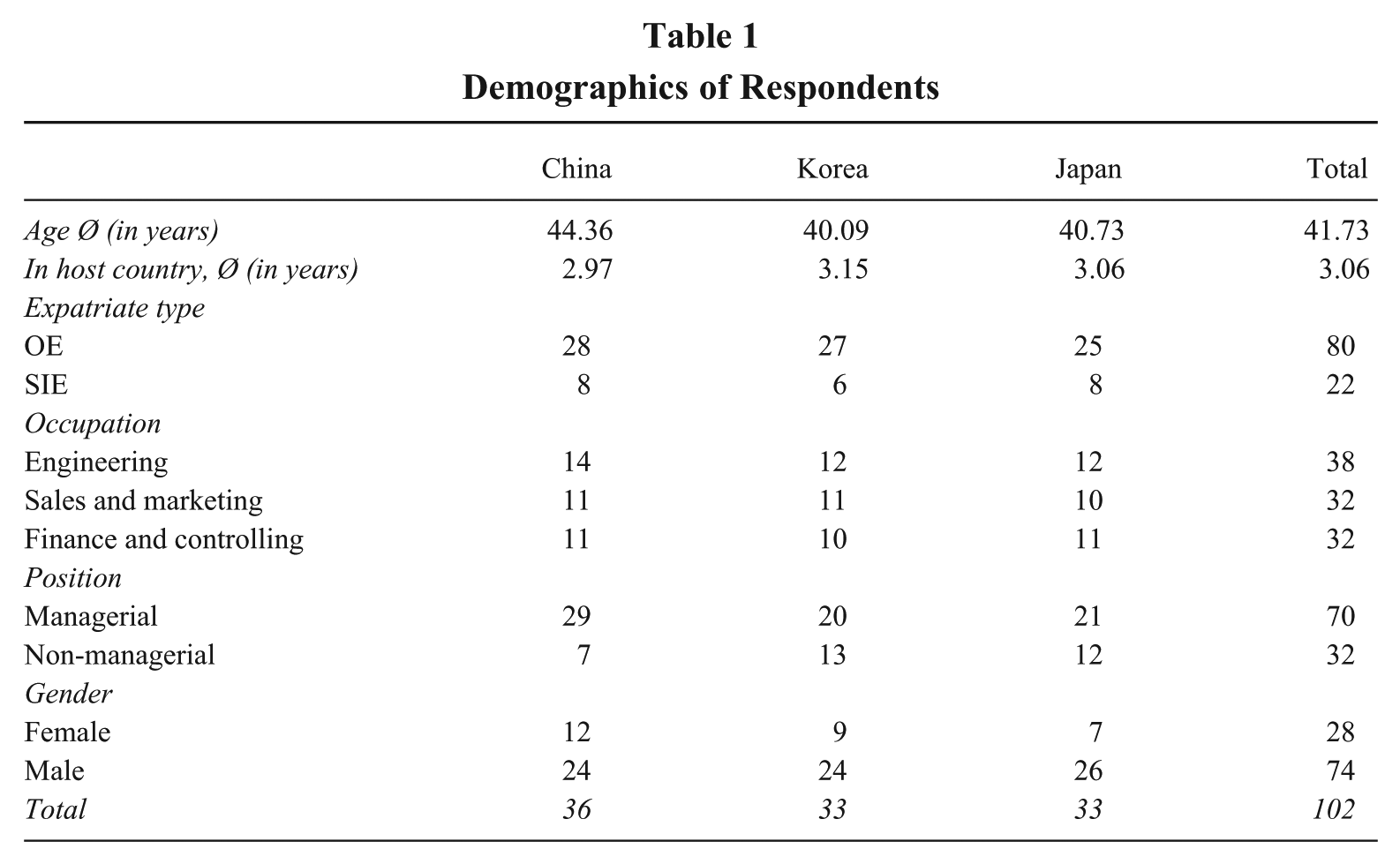
To facilitate a nuanced expression and enable participants to articulate their experiences in their native language, we conducted the interviews in German. We used LinkedIn, Facebook groups, Reddit, personal contacts, and snowballing to contact expatriates in the three countries. Altogether, we interviewed 102 German expatriates in China (n = 36), Korea (n = 33), and Japan (n = 33) (see Table 1 for demographic overview). We conducted a relatively large number of interview data to identify patterns of similarities and differences based on different expatriate types and host-country contexts, reaching beyond individual experiences (Shkedi, 2004). Each interview was transcribed and anonymized to ensure confidentiality and anonymity. A final dataset, totaling 485,677 words across 1,124 transcribed pages, provided our source of data analysis.
Demographics of Respondents
Data Analysis
To compare our participants’ experiences with stereotype-driven discrimination and explore their strategies in detail, we employed a thematic analysis (Braun & Clarke, 2006). All relevant quotes and descriptions of remarkable incidents were coded and grouped into descriptive codes grounded in participants’ experiences. We analyzed the data iteratively, moving back and forth between code, context, and the patterns we identified across interviews.
Identifying preferential discrimination and underlying stereotypes
We coded the phenomena of stereotyping and preferential discrimination in tandem, as we approached these concepts as inherently interconnected and found that meaningful analysis required examining them in relation to one another. This logic follows the abductive idea that social meaning lies in the context (Timmermans & Tavory, 2012), and self-categorization theory, where stereotypes accentuate group distinction (Turner & Reynolds, 2012; Turner et al., 1987).
While we began by open coding all references to stereotyping and preferential discrimination (Strauss & Corbin, 1998), we later on narrowed our focus to those stereotypes that were directly linked to preferential discrimination in expatriates’ workplaces. For example, we excluded stereotypes with no direct relevance to preferential discrimination, such as the notion that Germans drink a lot of beer.
To strengthen interpretative alignment with the data, a team of independent coders individually coded the first ten interviews using an open coding approach (Strauss & Corbin, 1998). Afterward, the coders compared their codes and discussed differences in labeling to ensure shared understanding and clarity of our codes. When excerpts were assigned different descriptive codes that reflected the same underlying concept, the team worked toward consensus on shared first-order categories. For example, in early rounds of coding, recurring labels like “assumption of cultural naivety” and “culturally clueless” were consolidated into the shared first-order category “cultural ignorance.”
Throughout our data analysis process, we moved between new insights and our categories, continuously reviewing the coding structure. Overlapping codes were consolidated into compact, yet conceptually distinct themes. For example, many participants described receiving special treatment involving leniency or exemption from local norms. One participant explained: One advantage is that people do not expect me to know Korean customs. . . . When I do something wrong that is culturally unacceptable for Koreans, such as not having table manners in a business meeting or ignoring social hierarchies, while Koreans would not be forgiven, customers know that I cannot know all of these things. (E41, Korea)
In our coding process, this excerpt and related segments were labeled both as “lenient treatment” as well as “cultural ignorance.” Through successive rounds of grouping similar descriptions and comparing them within and across interviews, we identified and consolidated different types of preferential discrimination into broader themes, each underpinned by various layers of stereotype attribution. The abovementioned segment was ultimately categorized under the theme “foreigner bonus,” capturing one of the three overarching types of preferential discrimination resulting from our analysis.
Identifying strategies for leveraging stereotypes
As we noted that expatriates not only passively enjoyed preferential discrimination but also actively engaged with stereotypes to secure or enhance resulting benefits, we expanded our exploration to these behaviors (Strauss & Corbin, 1994). We continued with open coding, and as with our analysis of stereotyping and preferential discrimination, we consolidated similar descriptions into broader categories.
In line with Pentland’s (1999) view of narratives as structured forms of explanation rather than isolated accounts, we treated participants’ descriptions not as separate instances of stereotyping, preferential discrimination, and strategy, but as interconnected elements within a broader interpretative frame. Across interviews, we found a common structure: Participants described experiencing preferential discrimination, recognizing the underlying stereotypes, and eventually learning to leverage such situations strategically. Although this sequence did not necessarily unfold in a chronological fashion within the interview structure, it appeared as a shared structure of sense-making. This approach allowed us to follow how expatriates themselves linked these elements, rather than imposing a fixed analytical separation.
As we refined our codes into themes, we noticed recurring patterns in participants’ accounts that closely aligned with impression management tactics outlined by Jones and Pittman (1982). For example, behaviors aimed at showcasing competence, trustworthiness, or naivety through stereotypes reflected self-promotion, exemplification, or supplication. Such connections were revealed inductively through comparison across interviews and were later strengthened through engagement with the literature. Thus, we used the theory not as a coding template but as a tool to better interpret the logic of expatriates’ strategies.
As our understanding evolved, we reread and recoded excerpts further. For instance, stereotypes described as negative (e.g., complaints about German directness) were reread in light of later parts of the same interview and others, which revealed that these traits led to preferential discrimination and were being leveraged strategically. This “defamiliarization through re-reading” (Timmermans & Tavory, 2012) allowed us to recognize that what first appeared as generally unfavorable stereotypes could, in fact, lead to preferential discrimination and be repurposed for impression management. It also helped us clarify the relationship between RQ1 and RQ2. While interconnected, they reflect different aspects of expatriates’ experiences: being on the receiving end of stereotype-based preferential discrimination, and actively leveraging it.
Findings
We present the findings of our analysis in three sections. First, we present the stereotypes expatriates encountered. Second, we show how these perceptions translate into preferential discrimination. Third, we outline how expatriates strategically took advantage of these dynamics.
Stereotypes
Table 2 provides an overview of the identified stereotypes, which we grouped into the following three categories: national, job-specific, and cross-cultural stereotypes.
Expatriate Stereotypes
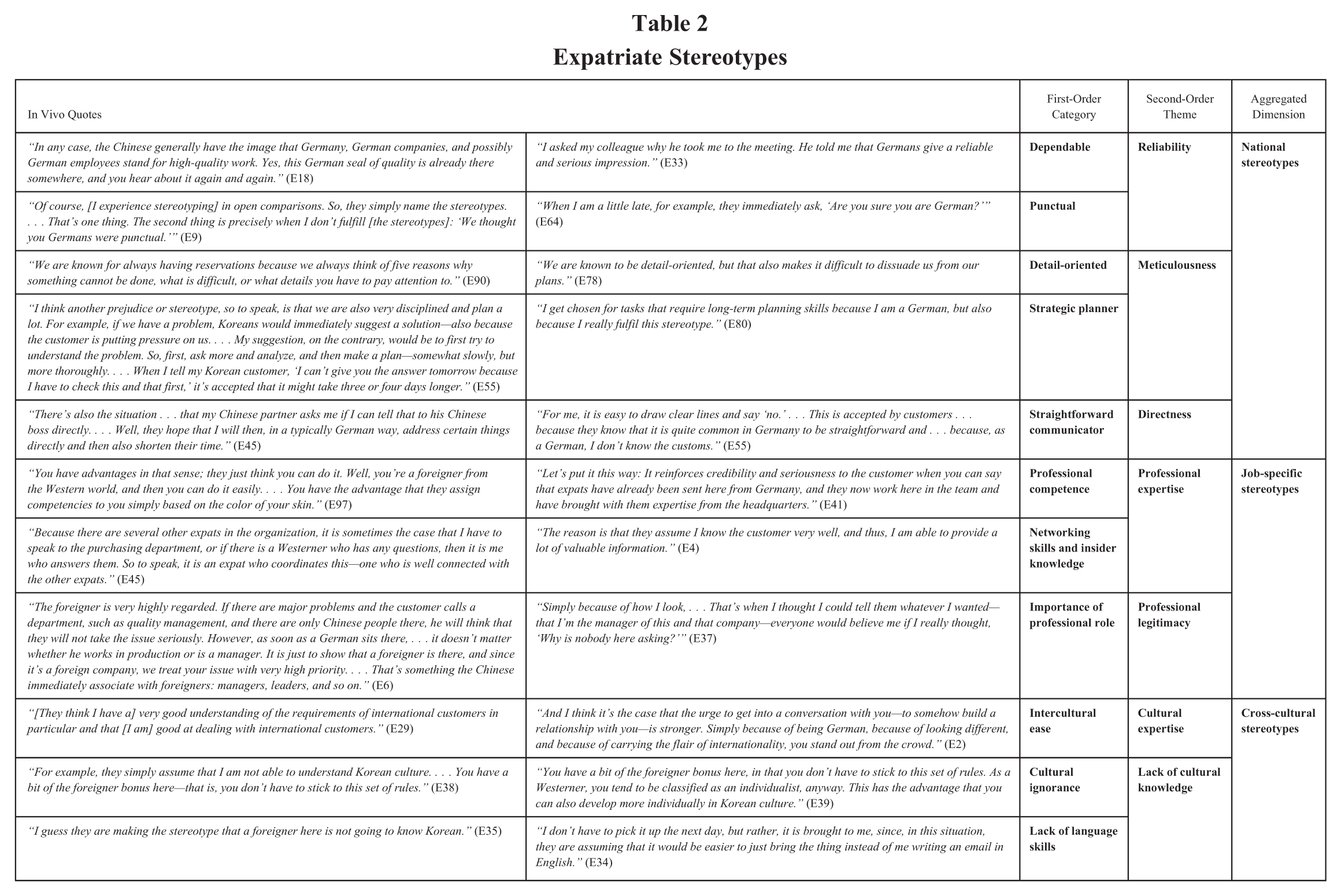
Many of our participants recalled being seen as embodying German national stereotypes such as dependability, punctuality, detail-orientation, strategic planning, and straightforwardness. As one expatriate explained: “People say Germans are organized and natural planners. When we Germans organize something, they automatically assume that it will work out, more or less” (E88, Japan). While these perceptions were mostly positive, others carried some ambivalence. Several expatriates noted that a strong focus on detail and structure could be seen as inflexible, and that direct communication styles clashed with local norms of indirectness.
Expatriates also described job-specific stereotypes. Western foreigners, in particular, were often presumed to possess exceptional professional expertise, pertaining not only to professional competence but, especially for OEs, superior networking skills and insider knowledge linked to HQ. They also described presumed professional legitimacy, regardless of their actual role: “They take care of you because they think you must be important—otherwise you would not be in China” (E6, China).
Finally, expatriates reflected on cross-cultural stereotypes. They explained how their visible foreignness triggered two contrasting assumptions: Some expatriates found that being visibly foreign marked them as culturally expert and adept at moving across cultures with relative ease. Yet, at the same time, most expatriates reported being assumed to lack local language skills and a deep understanding of local culture, such as workplace customs. As one interviewee recounted: “I was working on a project with a new superior, and at some point, he asked my Korean colleagues to stay late to keep working but didn’t say anything to me. I went home, and only found out the next day. When I confronted him, he said: ‘Oh I didn’t know I could treat you like a Korean’” (E7, Korea).
Resulting Preferential Discrimination
Across interviews, expatriates described various forms of preferential discrimination based on different combinations of the outlined stereotypes. We grouped these experiences into three main themes: immediate trust, easy access to decision-makers, and foreigner bonus (see Figure 1).
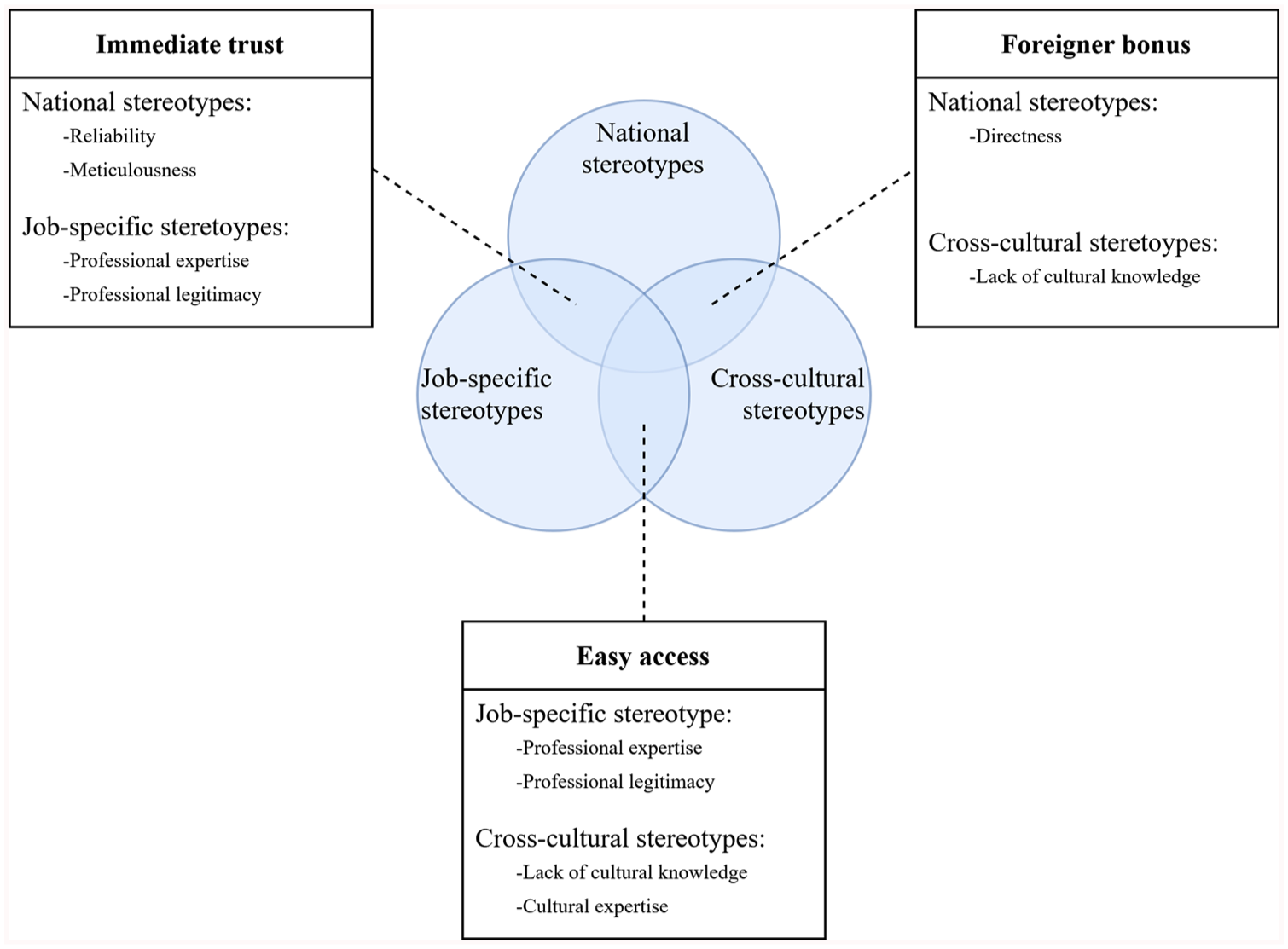
Stereotypes and the Resulting Preferential Discrimination
Immediate trust
A common form of preferential discrimination expatriates described was being met with high levels of trust from the outset, well before they could demonstrate their abilities. This trust was grounded in national (being reliable and meticulous) and job-specific stereotypes (professional expertise and legitimacy). It was particularly prominent in technical roles: “There is a lot of respect for the German engineering title. . . . Competence was simply assumed. . . . That’s how you are received” (E6, China). Yet, similar assumptions applied across fields. As one sales professional observed, “There is an advantage: ‘There is a German involved—I think they can manage it.’ Therefore, it helps with closing a deal” (E22, China).
Both SIEs and OEs described experiencing immediate trust, but the sources and intensity varied. OEs often referenced their embeddedness in HQs, which amplified these assumptions, adding a layer of perceived organizational legitimacy: “From the beginning, they trusted that I have insider knowledge” (E11, Korea). SIEs framed these dynamics more explicitly in terms of national stereotyping. “My boss said that I was now his ace . . . just because I am from Germany” (E52, Korea). While she acknowledged the credibility this gave her, she was also critical of the assumptions placed on her: “That’s obviously not true.”
So, the trust set in expatriates sometimes seemed disproportionate to their formal roles or actual expertise: “I did not really have expertise in that area . . . I did not have much prior experience, and I certainly wasn’t sent to do the task because of it” (E59, China). While some described the resulting pressure of meeting inflated expectations, many described this trust as an autonomy-granting privilege: “You had the freedom to do things, without anyone questioning you” (E6, China).
These findings indicate that trust was extended not on the basis of demonstrated ability, but rather on presumed traits associated with national or organizational group membership. This aligns with self-categorization theory, which emphasizes how social categorization can influence interpersonal expectations and treatment (Turner & Reynolds, 2012). In this context, country-of-origin effects appear to function as cues for competence and credibility, reflecting research by Olsen and Martins (2009), which shows that country image can shape perceptions of expatriates’ effectiveness.
Foreigner bonus
Expatriates frequently described experiencing leniency and exemption from local norms. They traced this leniency to cross-cultural stereotypes, particularly assumptions about limited language skills and cultural ignorance, and national traits (which positioned them as trusted outsiders), but also to ambivalent traits such as directness.
One expatriate in Korea described how her German boss’s blunt communication style visibly clashed with local norms, causing her second-hand discomfort: “Even I found the directness difficult to handle” (E97, Korea). However, later in the interview, she positively pointed out how her own similar behavior was usually excused as part of being a foreigner. She elaborated:
Even when you act in a way that wouldn’t be okay in Germany, the Koreans will say, “Ah, it’s a foreigner—in Germany, they just behave like a bull in a china shop. We have to understand that.” So, you really do get a lot of advantages.
Cultural ignorance was often seen as an understandable trait of foreigners, which not only reduced expectations to conform to host culture norms but also afforded expatriates greater freedom of behavior. Several expatriates reported being exempt from the obligation to fully embrace local work practices, like mandatory overtime or after-work events. The same stereotypes that excused cultural missteps also prompted local colleagues to offer additional assistance, especially in tasks requiring local or language knowledge, such as filling out forms and navigating everyday bureaucracy.
Both SIEs and OEs described benefiting from the foreigner bonus. Most explicitly linked this treatment to stereotypes triggered by their foreignness: “As a foreigner, you just get more leeway” (E70, China). Some OEs, however, emphasized that their formal role reinforced this treatment: “Of course I do not have to go to the dinners if I don’t want to. But that’s more due to my role than my foreigner status” (E100, China).
While out-group favoritism is usually linked to positive stereotypes, our findings suggest that even negative stereotypes can result in positive differentiation. This suggests that foreignness carries a deep form of symbolic value that not only triggers trust but grants a license for deviation. This challenges foreignness as a liability (Fang et al., 2013) and positions foreignness as a potential asset (Benischke et al., 2023) for individual benefit.
Easy access to decision-makers
Expatriates often described being granted access to higher-level decision-makers that their local colleagues could not approach. They traced this advantage to familiar stereotypes: cross-cultural assumptions of both cultural ignorance, which loosened strict hierarchical norms, and cultural expertise, which made them desirable contributors: “I was really brought right up to the table—it was like, ‘tell us something.’ . . . Being a foreigner was kind of a showcase thing” (E101, China).
This way, casual encounters could open doors that were out of reach for HCNs. As one expatriate in Japan recalled, “It is not okay at all [for Japanese] to talk to a higher-level manager. You have to adhere to very clear hierarchical structures . . . a mortal sin if you skip that.” He further noted that certain presumptions of cultural ignorance and expertise gave him access unavailable to local colleagues: I don’t only have access to people at my level according to my normal status, but also significantly higher. . . . My assessment is that there are two main reasons. One reason is that I am expected to know the customer very well and therefore contribute a lot of valuable information. The other reason is that the gaijin [foreigner] simply does not know Japanese customs and traditions. “We cannot expect him to know these things.” So I have a bit of a free pass. (E84, Japan)
Among OEs in particular, assumptions linked to their organizational roles further reinforced this access. However, this access did not necessarily foster deeper social bonds. Some expatriates noted that while the advantages were clear, the same distinctiveness that facilitated trust, leniency, and access simultaneously reinforced their outsider status. As one noted, “You are never really one of them” (E52, Korea).
This adds nuance to out-group preference. While out-group members may be favored for certain traits that are perceived as functionally valuable (Lee et al., 2015), our findings show how, although these dynamics granted expatriates access to decision-makers, they did not blur group boundaries but rather reinforce distinctiveness.
Summary of Preferential Discrimination
Preferential discrimination (immediate trust, easy access to decision makers, or the foreigner bonus) did not occur in isolation; rather, they were layered and mutually reinforcing. Access facilitated trust, trust afforded leniency, and leniency enabled further access, creating a recursive dynamic in which preferential discrimination became both a product and a catalyst of stereotype-based differentiation. While these patterns were observed across host countries, expatriates reported that stereotypes were expressed more openly and with greater intensity in China and Korea. As a result, the intensity of preferential discrimination also appeared more pronounced in these countries than in Japan. Nevertheless, various forms of such treatment were present across all settings. These experiences set the stage for a shift: from being passively categorized through stereotypes to actively engaging with them. In the next section, we examine how expatriates recognized these dynamics and began to strategically perform their assigned identities.
Impression Management of Expatriates
While some expatriates portrayed themselves as rather passive beneficiaries of preferential discrimination, most reflected on how they actively leveraged and reinforced stereotypical expectations to their advantage. Although expatriates held diverse roles and different seniority levels, these factors did not appear to meaningfully shape the strategies they described. Instead, impression management appeared largely situational and context-driven, cutting across function and hierarchy. As one put it: “I am a foreigner and I don’t want nor need to hide that . . . I need people who also have a certain interest in me as a German” (64, Korea). Others showed similar tactical awareness: “I always deliberately use it. . . . You can make the impossible possible” (E98, Japan).
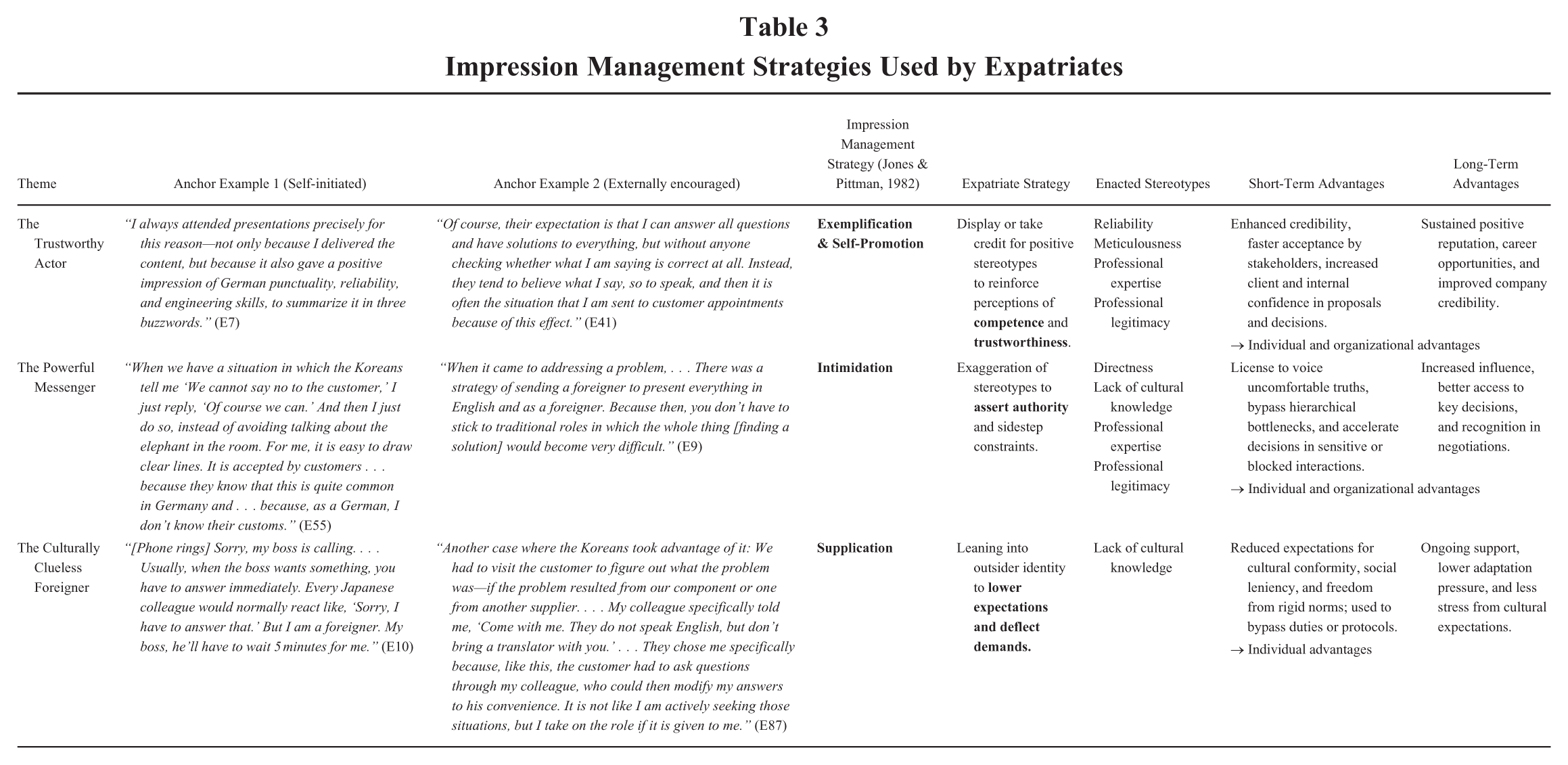
Such accounts suggest that expatriates perceived visibility of foreignness as a resource. This aligns with literature that positions visibility to an audience as a central precondition for identity performance (Klein, Spears, & Reicher, 2007) and offers a useful lens for exploring cross-cultural impression management. We identified three recurring strategies through which expatriates enacted stereotypical impressions to capitalize on context-specific advantages: the trustworthy actor, the powerful messenger, and the culturally clueless foreigner (see Table 3). Although often overlapping and mutually reinforcing in practice, for analytical clarity, we present them separately.
Impression Management Strategies Used by Expatriates
The trustworthy actor
We found that expatriates reinforced the immediate trust extended to them by subtly leaning into positive national (e.g., reliability and punctuality) and job-specific stereotypes (e.g., responsible and meticulous expert) to symbolically enhance their professional credibility. We refer to this as the trustworthy actor strategy.
Several expatriates described enacting stereotypical traits subtly, without overt performances. As one SIE from Korea explained: “I am actually a chaotic person . . . but my desk is super tidy because Germans are supposed to be tidy. I behave like a German, because that’s what’s expected” (E64, Korea). While such subtle strategic alignment with expected stereotypes was aimed at maintaining trust, our expatriates also described deliberately making their foreignness visible to signal competence and international credibility. By taking on external-facing roles (such as client meetings, presentations, or photo opportunities), expatriates actively positioned themselves as symbols of global expertise. Such performances were rarely described as fully self-initiated and often reinforced or even staged by HCNs. One expatriate noted: “I am always called by the boss when there are photo opportunities . . . we said, here we go again. We are international” (E64, Korea).
Such slightly ironic reflections suggest a shared awareness of foreignness as a mutual resource. The same expatriate added:
Even with big presentations, you mainly find foreigners at the podium. . . . Somehow, we are trusted. We carry this stamp: “They know about the industry.” . . . And when we quote a price, it is often the case that a much more expensive price . . . is accepted, simply because we are a German company.
While expatriates in China and Korea often described overt, placative, and pragmatic performances of the trustworthy actor, more subtle expressions of this role were prevalent in Japan. In Japan, several expatriates noted cultural similarities with Germany, suggesting that overt performances of the trustworthy actor were often unnecessary: “There are many similarities between Japan and Germany, which is why they are very close, I would say. That’s also why they grant each other a high leap of faith” (E10, Japan). The trustworthy actor was more often described in terms of upholding expected standards than leveraging differences.
Across contexts, expatriates demonstrated a clear awareness of the symbolic utility of their foreignness. Both OEs and SIEs enacted the strategy, but with a subtle difference in framing. OEs often described the trustworthy actor as an expected function of their HQ-ties: “Representation of the company . . . of course, when you’re from the HQ . . . it just makes sense” (E9, Japan). SIEs more clearly framed the trustworthy actor as a strategic choice: “I always tell them: Use me as the foreigner” (E98, Japan). Thus, while the strategic performances were consistent, the interpretation slightly varied depending on institutional embeddedness.
The trustworthy actor resonates with the impression management strategies “exemplification,” where behavior is aimed at projecting integrity and trustworthiness, and symbolic “self-promotion,” where behavior is aimed at projecting competence (Jones & Pittman, 1982). However, here the strategy relied mostly on preassigned reputation they reinforced through strategic presence, rather than theatrical projections of assertive excellence. Nonetheless, expatriates not only passively embodied externally imposed labels but also actively mobilized symbolic capital tied to their foreignness. This also resonates with the distinction between personal and social identity in self-categorization theory (Turner et al., 1987), as expatriates strategically aligned with stereotypical group-defining traits in socially salient situations while internally holding on to their personal identity. Thus, in cross-cultural contexts, where group distinction and social salience are central, stereotypes appear to play an important role in impression management.
The culturally clueless foreigner
In contrast to the trustworthy actor, who aimed to convey competence, the culturally clueless foreigner strategy deliberately performed stereotypes of lack of cultural knowledge (cultural ignorance and lack of language) to enhance the benefits of the foreigner bonus, to lower expectations, bypass norms, or deflect obligations.
Many expatriates reported strategic forms of avoidance in low-stakes situations. These were often the first examples that came to mind when participants reflected on how they leveraged stereotypical expectations. Several spoke of “playing dumb,” or “pretending not to understand” to delegate small tasks, such as paperwork or contacting IT. Others described using their presumed cluelessness to gain freedom from rigid work norms, for example, leaving early, skipping company events, or not partaking in weekend work. Yet the culturally clueless foreigner strategy was not only used as a passive tool of avoidance. Expatriates also described more proactive uses to challenge norms and gain direct influence. For example, one OE described how presumed language limitations were strategically used to control and steer client interactions: For example, when we go to a client, I speak Korean, but they only see my face and think I do not speak any Korean at all. So then, internal communications happen in front of us in Korean—like about the price, or whether the scope of the project is okay. I can then translate it into German for my boss, without them knowing that I understand what they are saying. (E64, Korea)
This example suggests a blurred line between ignorance and agency, where the performance of incompetence becomes a subtle tool of control. While some examples of this strategy emphasized subtle avoidance, others were more assertive forms of rule-bending. For example, one SIE recounted how she and a German colleague routinely stretched social norms: The Koreans can do the same if they want. . . . It’s not that we ask to be treated differently, but if they don’t say anything. . . . I know they just let us get away with it because we are foreigners. (E38, Korea)
These patterns suggest a shared awareness of the double standards between expatriates and locals, and how the social leeway was strategically embraced. While SIEs more often described such assertive forms as self-directed performances, OEs tended to portray them as reinforced by local colleagues.
The cultural context subtly influenced the specific ways in which the strategy was implemented. In China, expatriates often described the culturally clueless foreigner as a pragmatic default that did not require much strategic effort. In Korea, social structures were described to be very hierarchical, and many expatriates explained that foreignness placed them beyond local structures, freeing them from social rules. As a result, the strategy was generally used more boldly and unapologetically: “I mean, the thing is, if you are always pigeonholed, at some point you’ll pull the foreigner card. That’s just the way it is (laughter)” (E35, Korea). In Japan, expatriates often stressed a concern for social harmony and indicated a sense of balance: “But the Japanese have to at least get the impression that you are making an effort” (E48, Japan). This suggests that while in high-context cultures strategic ignorance had to be more carefully performed, foreignness could overall excuse deviation.
The culturally clueless foreigner strategy aligns with what Jones and Pittman (1982) refer to as “supplication,” a form of impression management in which individuals intentionally present themselves as less competent or informed to avoid demand or gain support. Our findings suggest that this impression was not always rooted in deference; rather, foreignness was strategically leveraged to bend local expectations without direct confrontation. These patterns suggest that credibility and cluelessness can coexist when performed carefully.
The powerful messenger
In contrast to the culturally clueless foreigner, who strategically downplayed expectations to deflect pressure, the powerful messenger used cultural and national stereotypes as a symbolic license for authority. By drawing on perceptions of cultural directness and the lenience experienced through the stereotype of “lack of cultural knowledge,” expatriates positioned themselves as outsiders who could confront others. Presumed “professional legitimacy” and “professional expertise” were described to passively support the authoritative image of the powerful messenger, as this strategy aligned with expectations typically associated with high-status experts.
The strategy enabled them to ignore hierarchies, directly address delicate issues, and thus speed up processes and decision-making without triggering interpersonal conflict. Expatriates explained that their assertiveness was tolerated (and even expected) because it was interpreted as culturally grounded rather than personally offensive: I usually don’t have customer contact, but there are cases . . . in Japan, in which the customer is regarded as a king—no, even higher. To tell him certain things directly is really, really difficult for the Japanese. Therefore, it is significantly easier when a German is part of the meeting and addresses things very directly. It reduces some of the subservience from the supplier to the customer because the customer knows very well that this is a foreigner; he does not really know how the culture works here. . . . He can ask questions more directly or critique things that a Japanese colleague cannot. (E89, Japan)
This shows how potential breaches of etiquette were transformed into neutralized cultural missteps. The same expatriate emphasized the strategic intent behind his behavior: “I have often resorted to these means, for example, for decision making that would otherwise not be possible.”
The strategy was not just self-serving; Especially OEs often described being pushed into this role by local colleagues: “Sometimes it was even Korean colleagues who pushed us forward, because as a foreigner, I was [making air-quotes] allowed to say more uncomfortable things” (E55, Korea). SIEs more frequently described deliberately claiming this role, recognizing the symbolic power of not adapting: “You can stay the German person. Trying desperately to internalize the local culture. . . that just backfires.” He illustrated: “I just come and say I have the following issues here, here, and there. I need a decision. Bam! There it is. . . . and my bosses told me to keep doing it” (E59, China).
Across countries, expatriates described the powerful messenger as a way to bypass bottlenecks or interpersonal tension. In China, expatriates described using the strategy both upward and across peer or subordinate interactions. As one expatriate explained: “In China, everything is so indirect” (E6, China), pointing to communication norms that often led to vague responses or incomplete follow-through by German standards. This made the strategy an opportunistic tool for cutting through ambiguity and “getting things done” the German way. In Korea and Japan, it was more frequently described as a tool to address sensitive issues, up- and outward, where local norms led to face loss or constrained open criticism. In Japan, the strategy was often framed as an effective walkaround for maintaining social harmony: If there is even the slightest inkling that this question could somehow embarrass the other person, they will never ask it. And at that point, of course, we are able to step in as Europeans, somewhat dosed, but relatively easily. (E48, Japan)
These patterns suggest that the powerful messenger role was slightly adapted to local communication logics, but consistently grounded in being “outside” the cultural system.
The powerful messenger aligns with the impression management strategy of intimidation (Jones & Pittman, 1982), where individuals project authority to influence others. Both OEs and SIEs reported the effectiveness of the strategy, suggesting that here the impression was grounded in exceptionality rather than dominance by formal HQ status. Expatriates were seen as “outside” the system, making it harder for locals to push back.
Although the three strategies were not always clearly distinguished in expatriates’ narratives, we observed some patterns in how they were described. While mentioned to a similar extent across our dataset, the culturally clueless foreigner was frequently described in relation to informal, everyday situations. Some accounts of high-stakes (co-)performances were also shared, though they often blended into the powerful messenger strategy. The trustworthy actor was most often framed as a co-constructed role in highly visible situations, and rarely initiated without external reinforcement. Taken together, these patterns suggest that expatriates drew flexibly on impression management strategies depending on situational demands and external cues, rather than relying on a dominant strategy or fixed roles.
Discussion
While much of prior literature associates stereotyping with negative discrimination and exclusion (Bonache et al., 2016; Goldman, Gutek, Stein, & Lewis, 2006; Hogg, 2020; Liu et al., 2021), our interviews with German expatriates in Northeast Asia highlight a different side: Expatriates described preferential discrimination (immediate trust, greater leniency, and informal access) that seemed to stem from widely held stereotypes about their foreignness. While some stereotypes were distinctively positive, such as reliability and competence, others, such as directness or cultural ignorance, were viewed more negatively, though they nonetheless offered strategic advantages. Our findings revealed that expatriates did not passively accept these dynamics. Instead, they often described deliberately reinforcing or performing stereotypical traits to gain additional credibility, lower expectations, or enhance influence. At times, these behaviors were encouraged by HCNs when they aligned with shared goals. What began as externally imposed perceptions became a resource expatriates learned to navigate. Some expatriates framed these behaviors as intuitive or aligned with their personality or organizational role, while others described them more explicitly as strategic performances. In the following, we discuss how these findings contribute to a more nuanced understanding of foreignness as a strategic asset, showing how stereotypes can enable constructive agency through impression management, and how self-stereotyping may serve as a purposeful tool in cross-cultural interactions.
Theoretical Implications
Our study shifts the focus from the conventional framing of foreignness as a liability towards its strategic potential as an asset (Lu et al., 2021; Taussig, 2017). Rather than looking at foreignness as a static label that has to be overcome, our findings show how it can function as a symbolic resource. By exploring how stereotyping and preferential discrimination shape these dynamics, we extend self-categorization theory and impression management theory in the following ways.
First, we extend self-categorization theory (Turner & Reynolds, 2012; Turner et al., 1987) by reframing stereotype-based categorization not solely as a constraint to be resisted, but as a symbolic resource that expatriates can pragmatically align with. Where prior work has traditionally emphasized stereotypical categorization as reinforcing in-group advantage and out-group exclusion (Goldman et al., 2006; Hogg, 2020), our findings show that expatriates not only accepted but benefited from such labels. Specifically, expatriates were often granted assumed competence before any actual output, sometimes to an extent that their mere presence signaled credibility and competence. These findings indicate that through stereotypes, foreignness becomes a carrier for symbolic legitimacy. Prato, Ertug, Castellucci, and Zou (2024) conceptualized such symbolic advantage, where status is legitimized by the embodiment of cherished values, rather than demonstrated competence, as “iconic status.”
Even SIEs, despite lacking structural power, reported experiencing such instances of “iconic status.” This challenges structuralist explanations that would attribute expatriate privilege solely to positional status (Barry & Watson, 1996; Mohan, Paunova, & Lee, 2024) and suggests that stereotypes can generate influence independently of institutional backing. Our findings illustrate how foreignness served as a visual cue, enhancing credibility when it aligned with culturally anchored expectations. This echoes the country-of-origin effect in marketing, where visible cues trigger assumptions of product quality (Magnusson, Westjohn, & Sirianni, 2019). In case of expatriates, stereotypes not only signal competence but also reinforce the symbolic value of foreignness itself, creating a self-reinforcing feedback loop. This suggests that foreignness may not be a fixed social category but a context-sensitive resource that can be strategically performed and adapted to situational demands. Its value is not simply imposed, but actively constructed through social interaction, highlighting identity as something that can be purposefully mobilized, rather than just passively experienced. Surprisingly, this was true not only for positive stereotypes. Our findings show that even ambivalent or negative stereotypical behavior that diverges from host norms, led to advantages, which challenges the prevalent notion that failure to adapt to the host-country culture inevitably leads to adverse consequences, such as negative discrimination and expatriate failure (Caligiuri, Phillips, Lazarova, Tarique, & Burgi, 2001; Hogg, 2020). While symbolic legitimacy helps explain why even ambivalent stereotypes can lead to advantages, the strategic utility of foreignness offers further explanations for why they can facilitate cross-cultural impression management, leading to our second contribution.
Second, we contribute to impression management theory (Goffman, 1959; Tedeschi, 2013) by reframing it from an individualistic self-enhancement strategy to a relational strategy. The literature stresses that cross-cultural impression management often fails due to cultural misinterpretation (Klotz et al., 2018) and, therefore, emphasizes that it must align with local cultural norms to be successful (Bolino, Long, & Turnley, 2016; Herrmann & Werbel, 2007). Our findings suggest the opposite: Expatriates not only reported that culturally contrasting strategies were effective, but attempts to mimic host-country behavior were ineffective and “backfired.” In contrast, stereotype-congruent behaviors were perceived as trustworthy, even when they were misaligned with local norms. Similarly, a recent study by Augustin, Pudelko, and Kirkman (2024) on linguistic fluency found that openly acknowledging one’s outsider limitations can increase perceived authenticity and foster trust. This might explain why, in our study, not inherently good but strategically useful stereotypes did not undermine legitimacy but enhanced it. Locals not only encouraged but at times co-performed stereotypical, useful impressions. Thus, stereotype-congruent impression management can be a form of relational agency, where foreignness becomes a collaborative resource. In such situations, not despite but because of cultural contrast to local norms, foreignness offered trust without proof, cultural cover, and communicative clarity. This suggests that expatriates might not be evaluated according to local behavioral norms but rather according to descriptive norms, and thus shared expectations about how foreigners should typically behave (Triana, Song, Um, & Huang, 2024). Behaviors that align with these expectations, even if they are strategically performed, are more likely to be seen as authentic.
While stereotype enactment might have been perceived as authentic by HCNs, expatriates occasionally acknowledged that such behavior did not always match their personalities. This recalls Goffman’s (1959) notion of the cynical performer, who knowingly enacts roles without genuine belief. However, there is a key distinction. Expatriates in our study rarely expressed moral dissonance; instead, they framed their behavior as functional. Foreignness operated as a symbolic resource that was situationally performed across countries, functions, and ranks, allowing even those without formal authority to influence local dynamics through the strategic enactment of externally assigned identities. Within these performances, stereotypes seem to offer a mutually understood script that might reduce potential cultural misinterpretations (Klotz et al., 2018) and enable successful cross-cultural impression management without requiring formal power. Expatriates align with the symbolic expectations embedded in their foreignness to navigate and sometimes exploit status dynamics. This reframes foreignness as a strategic asset rather than a static liability that should be hidden or minimized.
Practical Implications
Our research offers practical implications for both MNEs and expatriates by highlighting how stereotypes and preferential discrimination can be used strategically rather than simply avoided. First, for expatriates, strategic stereotype-based impression management may offer a tool for bridging gaps and power imbalances and supporting positive interactions with HCNs. Rather than resisting stereotypes, expatriates may use them strategically, not only to enhance their reputation but to act as an effective conflict mediator. Further, such strategies may not only help them navigate cross-cultural dynamics situationally, but also contribute to their long-term adjustment and career opportunities. Our findings show that for expatriates, the ability to navigate stereotypes translates into negotiation skills and conflict resolution. If used strategically, their foreignness positions them as an invaluable asset for the organization. To support expatriates’ ability to turn their outsider status into professional opportunities, we propose expanding pre-assignment training. In addition to standard topics, such as cultural flexibility, task orientation, people orientation, and ethnocentrism (Shaffer, Harrison, Gregersen, Black, & Ferzandi, 2006), expatriates might benefit from recognizing stereotype-based preferential discrimination. This might help them make informed decisions on how they want to present themselves.
MNEs that send expatriates aiming to enhance their negotiation strategies (Cuypers, Ertug, Cantwell, Zaheer, & Kilduff, 2020) might benefit from strategically deploying expatriates who are skilled in stereotype-based impression management. Therefore, we suggest revising selection criteria. Rather than focusing solely on factors that minimize the liability of foreignness (Lu et al., 2021; Stoermer et al., 2021), MNEs might consider selecting for qualities like an awareness for stereotypes and the ability to adapt their self-presentation. In summary, our findings demonstrate that through stereotype-based impression management, foreignness can indeed be an asset.
Limitations and Future Research Directions
The limitations of our study highlight potential areas for future research. First, responding to the call for more qualitative research on the positive aspects of cross-cultural dynamics (Stahl & Tung, 2015), we explored expatriates’ perceptions and experiences with preferential discrimination through a qualitative study using open-ended interview questions. Future research could build on our findings by testing the broader applicability and generalizability through quantitative studies and experiments.
Second, our study focused specifically on German expatriates in Asia. This enabled the specific exploration of the phenomenon of preferential discrimination, as expatriates from highly developed economies may enjoy high status and positive stereotypes in Asian countries (Mohan et al., 2024). The stereotypes toward expatriates from or in low-status countries may differ. While we found relatively consistent patterns across three investigated Asian countries with different economic development levels, we encourage future research to validate and extend our study in different country contexts and with different expatriate groups.
Third, our study focused on the experiences of expatriates. Although we drew on self-categorization theory to explain the observed patterns, we can only infer the motivations of HCNs in engaging in preferential discrimination. As expatriates reported instances of HCNs’ co-performances, incorporating the perspectives of HCNs would provide valuable additional depth. Future research could explore how HCNs perceive and respond to expatriates, and what drives their behaviors.
Conclusion
This study contributes to the discourse on foreignness as an asset by revealing how expatriates strategically leverage preferential discrimination. Our findings suggest that the advantages stemming from preferential discrimination can outweigh the simultaneous exclusion expatriates face as cultural outsiders, highlighting the dual nature of foreignness. Expatriates “play the game” not just to survive, but to advance, leveraging their perceived difference in ways that benefit both themselves and the organization. In summary, our research emphasizes expatriates’ active role in conforming to stereotypes to strategically leverage foreignness for strategic success. This nuanced perspective deepens our understanding of the expatriation experience and offers practical insights for expatriates and MNEs seeking to navigate cultural dynamics more effectively.
