




Abstract
Cronyism promotes the exchange of favors among connected parties based on relationships rather than merit, granting them undue advantages in securing opportunities and resources. This study examines the impact of cronyism on the quantity and quality of entrepreneurship. The analysis of data from 98 countries over 8 years (482 country-year observations) indicates that cronyism is negatively associated with the quantity of productive entrepreneurship, and positively associated with the prevalence of unproductive entrepreneurship. Furthermore, the results reveal that cronyism diminishes the quality of entrepreneurship productivity across countries. Interestingly, the findings suggest that a stronger rule of law exacerbates the detrimental effects of cronyism on entrepreneurship productivity. These results extend our understanding of cronyism as a crucial yet understudied informal institution with major implications for management and entrepreneurship.
Keywords
Entrepreneurship is widely heralded as a key driver of economic growth and societal prosperity (Audretsch, Keilbach, & Lehmann, 2006; Phelps, 2013). However, entrepreneurship’s impact on society depends on how effectively institutions channel resources toward innovation and social value creation (Baumol, 1996; Webb, Khoury, & Hitt, 2020). Cronyism, an informal institution that prioritizes resource allocation based on connections rather than qualifications, shapes both the quantity and quality of entrepreneurship (Khatri, Tsang, & Begley, 2006; Soleimanof, 2016). Nonetheless, scholarly understanding of the link between cronyism and entrepreneurship across different contexts remains limited (Klein, Holmes, Foss, Terjesen, & Pepe, 2022). This knowledge is particularly significant because cronyism has historically existed to varying degrees across all societies, influencing their ability to respond to societal needs and promote overall well-being (Chalmers, 2022; Foss, Klein, & Murtinu, 2022).
Cronyism refers to informal norms and shared understandings that grant preferential treatment based on relationships rather than merit, fostering exchanges of favors among connected parties—even at the expense of more qualified individuals (Khatri et al., 2006). It includes practices such as nepotism, awarding contracts based on connections, and appointing associates to key positions. While the scope and acceptability of cronyism vary across contexts, it can have both positive and negative implications for societal development and well-being (Klein et al., 2022). Many countries, although using different terms—such as wasta in Jordan and blat in Russia (Aidis, Estrin, & Mickiewicz, 2008; Loewe, Blume, & Speer, 2008)—have promoted cronyism as a pragmatic approach to development, recognizing its capacity to efficiently allocate resources toward achieving certain goals (Aligica & Tarko, 2014; Holcombe, 2013). Cronyism can also support resource acquisition and capability building within organizations (Yu, De Klerk, & Hess, 2023). For example, in new ventures, affiliation-based hiring—drawing on founders’ prior ties—can enhance team integration and improve performance outcomes (Rocha & Brymer, 2024).
Despite its potential benefits, cronyism is often criticized as unethical or unfair because it undermines merit-based decision-making and competition. Thus, cronyism is widely viewed as an obstacle to sustainable development and long-term societal prosperity (Foss et al., 2022; Klein, Holmes, Foss, Terjesen, & Pepe, 2024). We posit that this relationship is largely due to the adverse effects of cronyism on the quantity and quality of entrepreneurship across societies. Entrepreneurship quantity refers to the sheer abundance of diverse entrepreneurial activities, whereas entrepreneurship quality reflects the relative innovativeness and growth potential of those activities (Audretsch, Belitski, Chowdhury, & Desai, 2024). For quantity of entrepreneurship, we distinguish between productive entrepreneurship (PE), which involves launching new ventures and developing innovations that create social value and generate wealth, and unproductive entrepreneurship (UE), which includes rent-seeking and mundane business activities that prioritize private gains, deplete resources, and redistribute wealth with questionable societal value (Baumol, 1996; Sobel, 2008). For quality of entrepreneurship, we assess entrepreneurship productivity—the extent that entrepreneurship facilitates the efficient and effective allocation of resources through innovation (Webb et al., 2020). Entrepreneurship productivity reflects society’s tradeoff between PE and UE, directing resources towards PE and away from UE (Chowdhury, Audretsch, & Belitski, 2019; Fredström, Peltonen, & Wincent, 2021).
While this study focuses on cronyism’s relationship with entrepreneurship, we recognize the importance of examining informal institutions like cronyism alongside formal institutions—written rules and laws (Eesley, Eberhart, Skousen, & Cheng, 2018). Increasingly, research highlights how the interplay of diverse institutions can create conflicting rules of the game (Fredström et al., 2021). Whereas the rule of law represents formal institutions that regulate behaviors and protect rights based on impartial and known standards, cronyism grants people the discretion to act upon personal preferences and interests. Thus, we study whether the rule of law—defined as restrictions on the arbitrary exercise of power for the protection of civic and economic liberties (Mickiewicz, Stephan, & Shami, 2021)—can provide institutional safeguards against the adverse effects of cronyism.
Our analysis of 98 countries spanning 2010 to 2017 (482 country-year observations) reveals cronyism’s relationship to both the quantity and quality of entrepreneurship. Specifically, cronyism is negatively related to the quantity of PE but positively related to the quantity of UE across countries. Results also show that cronyism is related to reduced entrepreneurship productivity quality. Interestingly, and contrary to our expectations, we find a stronger rule of law exacerbates the negative relationship of cronyism to entrepreneurship quality.
This study offers two major contributions. First, it clarifies the complex institutional foundations shaping cronyism’s impact on entrepreneurship at the societal level. By examining the impacts of cronyism on both the quantity and the quality of entrepreneurship, our study moves beyond popular press and anecdotal accounts of this relationship towards rigorous empirical evidence (Rubin, 2016). Our conceptualization and operationalization of the cronyism construct provide a foundation for future scholarship to deepen our understanding of this understudied, yet prevalent, informal institution (Foss et al., 2022; Soleimanof, 2016). Such knowledge is critical for disentangling the effects of cronyism from other phenomena (e.g., corruption) and for advancing theories to accommodate its nuances (Klein et al., 2022).
This study also contributes to management research by exploring the boundary conditions of the link between cronyism and entrepreneurship, highlighting the moderating role of the rule of law. Scholars have long advocated for the establishment of the rule of law as a fundamental pillar for societal development (Haggard, MacIntyre, & Tiede, 2008; Haggard & Tiede, 2011). Our research, however, reveals that cronyism exerts its most detrimental effects on entrepreneurship in contexts with strong rule of law; this suggests formal institutional development may not always lead to expected outcomes if not accompanied by concurrent informal institutional adjustments. This finding underscores the importance of better understanding the institutional complexities that enable certain types of entrepreneurial activities over others (Davidsson, 2015).
Research Background
Cronyism as a Form of Informal Institution
Institutions explain significant cross-country variations in entrepreneurship (Terjesen, Hessels, & Li, 2016). While prior research has explored the influence of both formal institutions (e.g., bankruptcy laws; Lee, Yamakawa, Peng, & Barney, 2011) and informal ones (e.g., cultural values; Hayton, George, & Zahra, 2002), studying informal institutions poses unique challenges, including measurement difficulties and theoretical complexities (Bruton, Ahlstrom, & Li, 2010; Helmke & Levitsky, 2004). Nonetheless, examining informal institutions remains essential because they are often more pervasive and influential than formal institutions (Eesley et al., 2018). Further, informal institutions evolve over time through social interactions, forming the basis of social trust and shared understandings that underpin economic activities and transactions (Helmke & Levitsky, 2004).
Cronyism is an informal institution that legitimizes favoritism among connected parties, including ties through family, political affiliation, or group membership (Khatri et al., 2006). Scholars have repeatedly highlighted the dual impact of cronyism on organizations and society (e.g., Klein et al., 2022; Yu et al., 2023). On the one hand, cronyism can instigate economic growth and development because of its function as an efficient and pragmatic option for getting things done, particularly when formal institutions are weak or underdeveloped (Bellow, 2004; Tikkanen, 2016). On the other hand, cronyism can lead to various negative or malevolent outcomes, including low job satisfaction, unfair compensation, and economic decline (Arasli & Tumer, 2008; Oxelheim & Clarkson, 2015; Rajan & Zingales, 2004).
In contexts where cronyism is a dominant informal institution, individuals often perceive favoritism in professional settings as rational, efficient, and customary. In its baser forms, cronyism manifests in securing favorable business conditions, such as obtaining loans, deferring tax payments, bypassing queues for essential licenses, and expediting banking procedures (e.g., Aidis et al., 2008; Tonoyan, Strohmeyer, Habib, & Perlitz, 2010). Other common examples of cronyism reference “the good old boys’ club” or “the golden circle,” where preferential treatment is given to members of the in-group (Prendergast & Topel, 1996; Turhan, 2014). Cronyism can also be seen in lobbying, contributions to political campaigns, and the revolving door phenomenon between government agencies and the industries they oversee (Acemoğlu, Johnson, Kermani, Kwak, & Mitton, 2016; Rubin, 2016).
Cronyism is related to, but distinct from, corruption. Corruption refers to exchange relationships in which public power is abused for private ends (Macrae, 1982; Payne, Moore, Bell, & Zachary, 2013). Hence, cronyism—particularly in the form of public favoritism—may be considered a form of corruption (Klein et al., 2022; Li, 2009). However, cronyism may not always be corrupt or illegal, and the difference may depend on a society’s culture and legal system (Wei, 2001). For example, while favoritism toward a family member by a government official is typically viewed as corrupt in most Western cultures, it is frequently seen as acceptable or even expected in many Eastern cultures. Moreover, it is often difficult to prove cronyism because the parties involved can justify their exchange of favors for reasons (e.g., public interest or consumer protection) other than their ties (Jones & Stout, 2015; Smith & Sutter, 2012). Finally, cronyism takes place between two connected parties, often without explicit, immediate expectations for reciprocation. In contrast, corruption does not inherently involve parties within a network, and it often unfolds as a transaction wherein the parties anticipate explicit and more immediate returns.
Forms of Entrepreneurship in Society
Entrepreneurship manifests in various forms (Baumol, 1996). PE involves business initiatives focused on developing new offerings, innovating business models, commercializing new technologies, and launching potentially high-growth ventures that generate value and wealth for both entrepreneurs and society. In contrast, UE includes activities such as rent-seeking, tax evasion, regulatory arbitrage, and lawsuit abuse, which occur through the manipulation of political and legal systems to transfer wealth to participants at society’s expense—often in creative ways and without explicit legal violations (Sobel, 2008). UE can also manifest as localized business activities that primarily serve as a means of survival for entrepreneurs, operating inefficiently and imposing various negative externalities such as environmental degradation, labor exploitation, and public health risks (Matos & Hall, 2020; Sautet, 2013). Because UE disregards societal value creation for personal gain, a higher prevalence of UE detracts from societal well-being, whereas greater quantity of PE contributes to development and societal prosperity (Phelps, 2013). UE misallocates and depletes resources through inefficient, exploitative mechanisms that only benefit selected groups, while PE fosters innovative resource combination, enabling higher output levels with existing inputs (Coyne, Sobel, & Dove, 2010).
While the quantity of PE and UE are important and distinct societal outcomes (Audretsch et al., 2024; Guzman & Stern, 2020), these forms are interdependent as shifts and investments in one form can shape and constrain the other (Urbano, Aparicio, Muñoz-Mora, & Martinez-Moya, 2025). Entrepreneurship productivity reflects the quality of entrepreneurship—that is, the relative balance of PE to UE—and captures the efficiency and effectiveness of resource allocation toward innovation and value creation in society (Sobel, 2008; Webb et al., 2020). The quality of entrepreneurship provides deeper insight into the institutional foundations of the entrepreneurial landscape and the mechanisms that drive societal prosperity (Fredstrom et al., 2021). High entrepreneurship productivity characterizes societies where resources are primarily directed toward innovation and structural transformation rather than unproductive activities (Chowdhury et al., 2019).
Research Model
Drawing on the entrepreneurial action framework (McMullen & Shepherd, 2006), the following sections develop a research model and associated hypotheses that explore the relationship between cronyism and PE, UE, and entrepreneurship productivity. Fundamentally, we argue that cronyism shapes uncertainties about the feasibility and desirability of entrepreneurial activities, where uncertainties determine whether entrepreneurship appears viable and whether its potential value outweighs opportunity costs (Levie & Autio, 2011). Thus, we argue that cronyism decreases PE, increases UE, and undermines entrepreneurship productivity. Additionally, we explore whether the rule of law moderates these effects.
Cronyism and Productive Entrepreneurship
The average level of cronyism (hereafter cronyism) affects the feasibility of PE by limiting access to conditions that enable innovation. The recognition of opportunities for innovation depends on individual knowledge and cognitive capacities that are largely shaped by experiences and institutional contexts (Baker, Gedajlovic, & Lubatkin, 2005). Cronyism restricts participation in economic activities by requiring personal connections, stratifying a society’s labor force so that pathways to innovative opportunities are shaped by networks rather than merit (Webb et al., 2020). As a result, in societies with high cronyism, ties to public officials or influential professionals are essential for discovering and acting upon opportunities for PE (Aidis et al., 2008). In addition, cronyism restricts access to private resources (e.g., partnerships, funding) necessary for PE by fostering expectations—and even obligations—to remain loyal to existing networks (Yu et al., 2023). It also constrains access to public resources (e.g., permits, grants) critical for PE when connections with officials are absent or inadequate (Murphy, Shleifer, & Vishny, 1993).
Cronyism also undermines the desirability of PE by making it excessively risky and unfair to act entrepreneurially. When connected actors receive preferential treatment, such as regulatory exemptions, unconnected ones face heightened risks of expropriation and failure (Aidis et al., 2008; Rubin, 2016). In such environments, connections become critical for business survival, and ventures lacking proper ties are more likely to fail (Aidis & Adachi, 2007). As a result, social ties become essential for pursuing entrepreneurial careers, as they provide access to favors that bolster confidence in the viability of investing in PE (Román, Congregado, & Millán, 2013). Moreover, in environments where connected entities receive unfair advantages—creating high entry barriers and elevated risks of failure—trust in the fair reward of societal value creation erodes, and the opportunity costs of allocating resources to PE intensify (Eesley & Lee, 2023). Consequently, the motivation to engage in PE weakens, as perceptions of distributive justice decline because individuals increasingly believe that success is dictated by connections rather than merit (Collins, McMullen, & Reutzel, 2016). Indeed, high cronyism can even compromise the ability of educational systems to cultivate the desires and skills required for PE in society (Coco & Lagravinese, 2014). In sum, when PE is undervalued and perceived as unfair, motivation to prepare for and engage in such endeavors diminishes (Alesina & Angeletos, 2005). Formally, we state,
Hypothesis 1 (H1): There is a negative relationship between cronyism and PE between countries, such that countries with higher average levels of cronyism have a lower quantity of PE.
Cronyism and Unproductive Entrepreneurship
Cronyism enhances the feasibility of UE by enabling new ways of securing economic rents—that is, excess returns or advantages obtained beyond those achievable through market competition. By facilitating preferential access to opportunities and resources (e.g., government contracts and financial bailouts), cronyism decreases the costs and risks associated with UE. This includes reducing the likelihood of sanctions for rent-seeking, as cronies can often conceal their exchanges or justify them on grounds beyond ties (Jones & Stout, 2015; Smith & Sutter, 2012). As cronyism intensifies, connected actors frequently gain economic advantages, compelling others to resort to political and legal maneuvering to remain competitive. Thus, UE becomes not only a primary means of gaining benefits but also a necessary safeguard against competitors engaging in similar practices (Holcombe, 2013). Over time, cronyism leads to the entrenchment of rent-seeking as a standard business practice, making UE increasingly viable as it shifts from a socially sanctioned exception to a routine occurrence.
When progress depends on securing favors from connections rather than creating societal value, UE becomes more desirable (Holcombe, 2013). Resources are increasingly allocated to cultivating connections that enable rent seeking when those prove to be effective for business success (Rajan & Zingales, 2004). Thus, cronyism shifts economic incentives toward nonmarket strategies and network maintenance, as political and legal rent-seeking offers greater and more certain short-term benefits than market activities (Rudy & Johnson, 2016; Xu, Zhou, & Du, 2019). This effect is particularly pronounced in societies where governments are predatory (e.g., Russia) or where bureaucratic processes are complex and opaque (e.g., China) as cronyism provides businesses with protection and efficient channels for managing government relationships (Du & Mickiewicz, 2016). More broadly, cronyism legitimizes lobbying and cartel activities, desensitizes individuals to unfairness, and normalizes the pursuit of personal gain at the expense of others, thereby shaping a society’s culture and ethical standards in ways that increase individual tendencies toward UE (Smith & Sutter, 2012).
Cronyism also biases access to employment opportunities, pushing many individuals to resort to mundane self-employment as a means of survival (Matos & Hall, 2020; Sautet, 2013). It reinforces informal governance mechanisms—such as informal lending, contract enforcement, hiring, resource sharing, and communal property rights—within communities and localities (Mair, Marti, & Ventresca, 2012; Webb et al., 2020). These mechanisms support the expansion of informal economic activity, enabling UE to thrive outside the formal economy by allowing individuals to avoid the full costs of operating a formal business, including taxes and regulatory compliance (Hassan & Schneider, 2016; Webb, Tihanyi, Ireland, & Sirmon, 2009). Operating labor-intensive, undifferentiated, and inefficient ventures at local levels is more feasible when individuals can rely on their connections for support and assistance in navigating the informal governance mechanisms (Fredström et al., 2021; Sautet, 2013). Moreover, when faced with poverty as the primary alternative, people tend to avoid the risk of high-growth ventures and, instead, prioritize immediate needs, opting for low-risk businesses that offer predictable short-term returns (Hulme & Shepherd, 2003; Morris, Soleimanof, & Tucker, 2023). Thus, individuals gravitate toward UE due to its low opportunity cost, accessibility, minimal resource requirements, and the assurance offered by a prevalence of cronyism. Tying these arguments together, we formally state,
Hypothesis 2 (H2): There is a positive relationship between cronyism and UE between countries, such that countries with higher average levels of cronyism have a higher quantity of UE.
Cronyism and Entrepreneurship Productivity
Cronyism influences entrepreneurship productivity by shaping who enters entrepreneurship and the goals they pursue, as well as by structuring the rewards for entrepreneurial activities. First, cronyism prioritizes connections over societal contribution as the key determinant of success. When societal value creation is not linked to value appropriation, individuals with the aspiration and capability to create value through innovation are discouraged from pursuing entrepreneurial careers and tend to exit entrepreneurship. Instead, those focused on self- and in-group interests exploit cronyism to enter entrepreneurship primarily for personal gain, often at the expense of broader societal welfare (Aidis et al., 2008). Thus, cronyism shapes the profiles of individuals who become entrepreneurs and the primary goals they seek in their ventures. Second, cronyism distorts incentives for innovation. As a result, individuals who might otherwise allocate resources to innovation shift their focus toward unproductive activities where returns are perceived as higher and more predictable because of cronyism (Eesley & Lee, 2023; Sorgner & Wyrwich, 2022). This promotes a short-term, opportunistic approach to entrepreneurship, undermining a collective commitment to long-term growth through innovation.
By shaping entrepreneurial goals and incentives, cronyism distorts the balance and the trade-off between PE and UE, reinforcing a vicious cycle of rent-seeking and stagnation while weakening the self-reinforcing cycle of innovation and growth (Acemoğlu & Robinson, 2012). While allocating resources to innovation reduces reliance on unproductive activities and facilitates further investment in innovation (Chang, Chrisman, & Kellermanns, 2011), cronyism redirects resources toward rent-seeking, making future investments in innovation increasingly difficult as unproductive practices become entrenched. This creates a business environment where firms focus on wealth redistribution or subsistence activities, lacking the incentives and capacity for innovation. In societies with a deep-rooted cronyism, politicians and entrepreneurs become mutually dependent, working together to maintain the status quo (Holcombe, 2013; Klein et al., 2022). Politicians grant unfair advantages in exchange for entrepreneurs’ political support, disregarding the broader societal costs (Enderwick, 2005). This “mutual hostage” condition concentrates resources within a privileged elite that resists all but the most incremental innovations (Fogel, 2006; Morck & Yeung, 2004). Therefore, we state,
Hypothesis 3 (H3): There is a negative relationship between cronyism and entrepreneurship productivity between countries, such that countries with higher average levels of cronyism have a lower quality of entrepreneurship productivity.
The Moderating Role of the Rule of Law
Cronyism has the capacity to enable groups, organizations, and communities to manage uncertainties and achieve collective goals (Dieleman & Sachs, 2008). However, societies also recognize the drawbacks of cronyism and tend to institute formal safeguards, such as laws and regulations, to mitigate the negatives and facilitate broader transactions and cooperation (Aidis et al., 2008). The rule of law curtails arbitrary power, ensuring the impartial enforcement of legal standards to regulate behaviors and protect rights, thereby safeguarding human liberties (Kim & Li, 2014). The rule of law is expected to promote economic growth and development by securing property rights, enforcing contracts, checking government overreach, limiting corruption, and ensuring personal security (Haggard & Tiede, 2011; Haggard et al., 2008). By creating consistent and impartial behavioral boundaries and reward systems (Kaufmann, Kraay, & Mastruzzi, 2010), the rule of law fundamentally contrasts with cronyism, which grants discretionary power based on personal judgment, in-groups, and connections. Nonetheless, cronyism and the rule of law coexist to varying degrees in societies, shaping actions and interactions concurrently.
The confluence of the rule of law and cronyism on productive entrepreneurship
Impartial enforcement of society-wide guidelines (i.e., the rule of law) grants people access to greater opportunities and resources based upon individual capabilities (Estrin, Mickiewicz, & Stephan, 2013). The rule of law enables participation in economic activities that provide avenues for engagement in PE, even without connections (Acemoğlu & Robinson, 2016). It also enhances access to the private and public resources required for PE (Agostino, Nifo, Trivieri, & Vecchione, 2020; Goltz, Buche, & Pathak, 2015). In societies where the rule of law promises unbiased contract enforcement and dispute resolution, individuals can (a) expand the scope of their search for quality resources beyond personal connections, (b) leverage their capabilities to form partnerships with previously unconnected but qualified parties, and (c) manage those partnerships with minimal concern about opportunism (Rus & Iglič, 2005). Likewise, the rule of law can make public requirements for PE, such as licenses, patents, and government support, accessible to individuals based on their merit (Murphy et al., 1993). Thus, the rule of law alleviates many concerns regarding the feasibility of PE, especially for those facing disadvantages due to the barriers imposed by cronyism.
A stronger rule of law can also mitigate the adverse effects of cronyism on the desirability of PE by protecting property rights against expropriation (Haggard & Tiede, 2011). In societies where cronyism is high, institutional arrangements are often perceived as biased, unfair, and arbitrary. This perception leads to a sense of alienation from the social structure, causing norms to appear less instrumental in helping individuals achieve personal goals, especially when they lack connections (Collins et al., 2016). Such distrust in institutional functionality discourages resource allocation to inherently high-risk PE (Aidis et al., 2008). However, the rule of law can alleviate this lack of trust by instilling confidence in the capacity and commitment of formal institutions to enforce trade rules and protect rights impartially and reliably (Anokhin & Schulze, 2009). In essence, the rule of law can enhance formal institutional trust by enabling impartial contract enforcement and unbiased property rights protection (Haggard et al., 2008). This increased trust adds more predictability to the business environment and can alleviate concerns about investing in PE (Eesley & Lee, 2023), despite the challenges imposed by cronyism. Therefore, we posit,
Hypothesis 4 (H4): The rule of law moderates the negative relationship between cronyism and PE between countries, such that higher average levels of rule of law reduce the extent to which cronyism lowers the quantity of PE.
The confluence of the rule of law and cronyism on unproductive entrepreneurship
The rule of law mitigates the effects of cronyism on UE by reducing the reliability, value, and range of benefits that can be obtained through connections (Acemoğlu et al., 2016). The rule of law establishes legal frameworks and enforcement mechanisms that render the exchange of favors less advantageous across both private (e.g., corporate lobbying regulations, anti-corruption compliance) and public (e.g., procurement procedures, campaign finance laws) sectors. As a result, in societies with a strong rule of law, connected actors cannot rely solely on connections and favor-seeking, as those yield lower and less certain returns (Singh & Zammit, 2006; Tahoun, 2014). The rule of law fosters competitive markets where firms must consider building sustainable business capabilities rather than only leveraging ties for short-term gains. By ensuring fair market entry and protections for new ventures, the rule of law enables firms to compete and succeed based on innovation and efficiency rather than just favor-seeking (Klapper, Laeven, & Rajan, 2006). Consequently, businesses must redirect their focus from political and legal rent-seeking to enhancing competitive capabilities for long-term viability (Baumol, 2004). In the absence of such competitive pressures, firms benefiting from cronyism can survive without enhancing efficiency, leading to “X-inefficiencies” (Leibenstein, 1966) and the sustaining of industries with little incentive for innovation (Lenway, Morck, & Yeung, 1996).
The rule of law can also weaken cronyism’s support for mundane business activities by restricting informal coordinative mechanisms. By limiting the scope of the informal economy and enforcing legal frameworks, the rule of law reduces the efficiency and effectiveness of cronyism-based governance, thereby constraining its ability to facilitate UE (Fredström et al., 2021; Sautet, 2013). For instance, cronyism becomes less advantageous in resolving conflicts or protecting rights through networks, when the rule of law is strong (Sutter, Webb, Kistruck, & Bailey, 2013). The rule of law can also increase the costs associated with UE within the formal economy, reducing the benefits of cronyism for UE (Dabla-Norris, Gradstein, & Inchauste, 2008). For example, compliance with taxes and regulations becomes more onerous, constituting additional burdens for UE, even when ties can provide some assistance in these areas (Webb et al., 2020). Additionally, the rule of law fosters a merit-based distribution of opportunities and resources in society, creating fairer employment pathways and offering greater protection against professional barriers imposed by cronyism. Thus, in societies with a strong rule of law, fewer individuals are hindered by cronyistic barriers to entrepreneurship or employment, reducing reliance on UE for survival (Fredström et al., 2021; Morris, Soleimanof, Calle, & Tucker, 2025). In short, the rule of law diminishes the necessity and appeal of UE, amid cronyism, by making alternative career paths more accessible. Hence, we state,
Hypothesis 5 (H5): The rule of law moderates the positive relationship between cronyism and UE between countries, such that higher average levels of rule of law reduce the extent to which cronyism increases the quantity of UE.
The confluence of the rule of law and cronyism on entrepreneurship productivity
Entrepreneurial goals and incentives are shaped by the interplay of various institutions, and resource allocation decisions reflect the complexity of these interactions (Greenwood, Raynard, Kodeih, Micelotta, & Lounsbury, 2011). Cronyism, as a persistent informal institution, fosters self-interest and weakens incentives for innovation, redirecting resources toward lower-quality entrepreneurial activities. However, the rule of law can establish fairer and more predictable decision-making mechanisms, enabling individuals to pursue personal gain while also contributing to societal value through innovation. When individuals trust that the institutional environment supports them, they are more willing and able to invest in innovative and growth-oriented pursuits (Eesley & Lee, 2023). Thus, the rule of law can transform entrepreneurial goals and incentives, enabling the redirection of societal resources towards innovation, even in the presence of cronyism.
The impartial and predictable formal mechanisms established by the rule of law stand in contrast with biased and arbitrary informal mechanisms enabled by cronyism, shaping competition based on merit in society and offering all a pathway towards entrepreneurial success. The entrepreneurial landscape can direct resources towards innovation when the rule of law protects the rights and benefits of those pursuing innovative career paths, regardless of their connections. While some may still derive limited benefits from cronyism within their networks, the societal benefits of the rule of law are likely broader and more significant. In essence, the overarching advantages of a strong rule of law may offset the localized benefits of cronyism, which promotes a more productive entrepreneurial landscape. Therefore, we posit,
Hypothesis 6 (H6): The rule of law moderates the negative relationship between cronyism and entrepreneurship productivity between countries, such that higher average levels of rule of law reduce the extent to which cronyism undermines the quality of entrepreneurship productivity.
Methodology
Data and Measures
Following prior research (e.g., Stenholm, Acs, & Wuebker, 2013), we relied on theoretical definitions of each construct and data from five major sources to determine appropriate measures: (1) the Global Competitiveness Index (GCI) reported by the World Economic Forum; (2) the World Governance Indicators (WGI) developed by the World Bank; (3) the Global Entrepreneurship Monitor (GEM) report; (4) the Gallup World Poll (GWP); and (5) the World Intellectual Property Organization (WIPO). The initial sample included 229 countries. To minimize potential distortions from the 2008 global financial crisis and its immediate aftermath, which may have disproportionately affected entrepreneurial activity, we began the sample in 2010. The period ends in 2017, the final year for which the GCI 3.0 (2005–2017) provides consistent data for our main independent variable. The resulting dataset is an unbalanced panel of 98 countries, comprising 482 country-year observations from 2010 to 2017.
Entrepreneurship
We adopted two sets of measures to capture the quantity and quality of entrepreneurship. To measure PE quantity, we first relied on the GEM’s (improvement-driven) opportunity-motivated entrepreneurship (PE1) measure, which captures the percentage of the adult population engaged in early-stage entrepreneurship to enhance independence, freedom, or personal income (McMullen, Bagby, & Palich, 2008). Second, we adopted Chowdhury and colleagues’ (2019) PE measure, which applies the Borda Count Index to normalize and equally weigh multiple proxies for PE (Sobel, 2008). This measure (PE2) includes: (a) the total (resident plus nonresident) patent applications based on WIPO data; (b) the percentage of the adult population involved in total entrepreneurial activity (TEA) to introduce a new product to the market using GEM data; and (c) the percentage of the adult population involved in TEA with aspirations to create at least six jobs over the next 5 years using GEM data.
To measure UE quantity, we used the GEM’s necessity-motivated entrepreneurship (UE1) measure, which captures the percentage of adults engaged in early-stage entrepreneurship due to economic constraints and a lack of alternatives (McMullen et al., 2008). Second, we adopted Chowdhury and colleagues’ (2019) UE measure, which also applies the Borda Count Index methodology (Sobel, 2008). This measure (UE2) includes: (a) averages of the unethical behavior of firms using GCI data; (b) the extent that crime imposes costs on firms using GCI data; and (c) the GEM’s necessity-motivated entrepreneurship measure.
To assess entrepreneurship productivity (i.e., entrepreneurship quality), we adopted the relative prevalence of PE to UE within a country as our primary measure (Baumol, 1996; Webb et al., 2020). Given the contrast between the innovation-driven nature of opportunity-motivated entrepreneurship and the survival-driven focus of necessity-motivated entrepreneurship, the PE1 to UE1 ratio (EP1) serves as a key metric for evaluating entrepreneurship productivity across countries (Fredström et al., 2021). As a second measure, we adopted Chowdhury and colleagues’ (2019) net entrepreneurial productivity (EP2) measure, which captures the difference between UE and PE prevalence to assess how a country’s institutions support innovation and transformation while mitigating rent-seeking and inefficient business activities (Webb et al., 2020). EP2 is calculated as the difference between UE2 and PE2 scores for each country and year (Sobel, 2008).
Cronyism and the rule of law
For cronyism and the rule of law, we employed a sorting task technique to assess content validity (Hill, Kern, & White, 2014a; Hinkin, 1995). Specifically, we leveraged personal contacts to recruit 30 scholars (professors from over 25 business schools), 20 PhD students (with at least 1 year of experience in a business PhD program), and 20 undergraduate senior students (majoring in business and management) to serve as expert raters. This selection aligns with prior research suggesting the sorting task requires general knowledge and intellectual ability rather than specific work experience (Hambrick & Abrahamson, 1995; Hinkin, 1998). Definitions of the constructs were provided to the raters—via email or in person—and each was asked if the measure accurately reflected the definition (Hill, White, & Wallace, 2014b). We calculated the raw agreement rates among participants across the samples and used an 85% agreement rate as the threshold for content validity (Hill et al., 2014a).
Measuring cronyism generally presents a challenge because the intentions and behaviors of those involved are not easily discernible. Indeed, people often mask or deny their engagement in cronyism, even when their actions are legal (Jones & Stout, 2015; Klein et al., 2022). At the country level, proxies previously used include the concentration of country assets, neglect of consumer needs in business contexts, stock-market event analysis to determine the effects of political connections on stock prices, the structure of industries in state capitals, and campaign contributions by political action committees (e.g., Acemoğlu et al., 2016; Smith & Sutter, 2012). However, these proxies represent the outcomes of cronyism in specific contexts rather than the level of cronyism across societies. For example, depending upon the history and institutional safeguards in a country, the concentration of country assets in the hands of elites may not represent comparable levels of cronyism across countries (Morck, Wolfenzon, & Yeung, 2005).
Given these considerations, we used individual perceptions of cronyism prevalence as a proxy for measuring cronyism in a country. A perceptual measure of cronyism is appropriate because perceptions affect judgments and behaviors. As noted by Smith and Sutter (2012), “just the perception of cronyism can inhibit business formation [and] distort the allocation of entrepreneurial talent” (p. 25). Similarly, Illoong (2006) noted that it is the perceived favoritism that reduces employee motivations for innovation and effective contributions to an organization (Turhan, 2014). To measure cronyism, we selected two indicators from the GCI, capturing its prevalence in both the public and private sectors.
The first indicator assesses perceived favoritism in the public sector by asking a nationally representative sample of executives: “In your country, to what extent do government officials show favoritism to well-connected firms and individuals when deciding upon policies and contracts?” (1 = do not show favoritism at all; 7 = show favoritism to a great extent). The second indicator captures cronyism in the private sector by asking respondents: “In your country, who holds senior management positions?” (1 = mostly professional managers chosen for merit and qualifications; 7 = usually relatives or friends without regard to merit). The agreement rates in the subject matter expert survey were 97.2% and 85.8%, respectively, indicating strong consensus that these measures align with the definition of cronyism. We conducted a principal component analysis to form a composite index for cronyism at the country-year level. We chose the first principal component of these two measures (PC1public = 0.71, PC1private = 0.71, eigenvalue = 1.72, explaining 85.92% of the variability) to construct a measure of cronyism. Specifically, the measure was obtained by multiplying the value of each country-year variable by its respective component score, then summing the two values.
For the rule of law, we adopted the rule of law index from the WGI, which captures the extent of confidence and adherence to the rules of society particularly involving contract enforcement, property rights, legal systems, and crime (e.g., Kim & Li, 2014; Levie & Autio, 2011). In the subject matter expert survey, 87.2% of the participants agreed this indicator appropriately measures the variability of the rule of law.
Control variables
We included several control variables in our models to account for national differences relevant to entrepreneurship. From the World Bank, we used per capita GDP, annual inflation rate change, and total tax rate on business profits to account for the effects of economic development and stability. From the GCI, we included composite measures of infrastructure quality (e.g., transport systems, utilities, telecommunications) and market size (domestic and international). To control for human capital, we incorporated GCI’s Health and Primary Education index (reflecting disease burden, infant mortality, life expectancy, and primary education quality) and the Quality of Higher Education index (capturing the quality of the education system, STEM and management training, and internet access in schools).
We also included corruption in the models to account for its similarities to cronyism. We adopted the perception of corruption measure from the GWP, which captures both public and private sectors and corresponds with our measure of cronyism. The measure is calculated as the average of binary responses to two questions: (1) Is corruption widespread throughout the government? and (2) Is corruption widespread within businesses? Further, to account for the public trust in the executive branch of governments during certain years, which is different from the overall rule of law in society, we adopted the measure of confidence in national government from the GWP. Finally, following best practices (cf., Long, 1997), we controlled for the GEM’s TEA in models predicting PE1, UE1, and EP1.
Analytical Method
Panel data can be analyzed using fixed effects to model within-unit relationships or random effects to model between-unit relationships. Although a fixed-effects model removes any endogeneity associated with heterogeneity across units, this model would also remove systematic between-unit variance (Certo, Withers, & Semadeni, 2017). However, a random-effects model returns both within- and between-country estimates of the relationship between a predictor and an outcome by using the “between-within method” (Sjölander, Lichtenstein, Larsson, & Pawitan, 2013); this is also referred to as the “hybrid” approach (Allison, 2005; Bliese, Schepker, Essman, & Ployhart, 2020; Certo et al., 2017). The between-within method uses a random-effects model that, like other fixed-effects methods, controls the endogeneity associated with unobserved heterogeneity across units and over time. The between-within method includes the variable’s de-meaned value (i.e., country-average centered value calculated by subtracting the observed value from the country-average) to parameterize within-country effects and the country average of an independent variable to parameterize between-country effects. As such, this method can recover the unbiased parameter estimates and standard errors from a fixed-effect model while also modeling between-country variance.
In our case, the between-within method uses a random-effects model that includes a random intercept for country, fixed effects for year, and both the de-meaned (i.e., country-average centered) and country-level average of cronyism and rule-of-law as predictors. Although a significant Hausman test is usually interpreted as suggesting the specification of a fixed effect, it can also indicate that a model should account for between-unit (e.g., between-country) variation (Certo et al., 2017). The Hausman test based on a model with the observed values for cronyism was significant (χ2 = 15.26, p = 0.033). Following the procedure suggested by Bliese et al. (2020), with models that included both a country-average centered and a country-level average of cronyism and rule-of-law, the Hausman test failed to reject the null hypothesis that there are systematic differences between our random-effects model and a fixed-effects model (χ2 = 0.16, p = 0.693); this supports our specification of a between-within random-effects model.
We utilized two sets of seemingly unrelated regression (SUR) to account for correlated errors between our dependent variables using generalized SEM with robust standard errors in Stata (Version 18; Greene, 2007). Each set of SUR models includes correlated error terms between three dependent variables to simultaneously estimate the effects of independent variables. Specifically, we tested one set of models to test hypotheses for PE1, UE1, and EP1, and another set of models to test hypotheses for PE2, UE2, and EP2.
Results
Table 1 presents the descriptive statistics and correlations of the study’s variables. We preceded the name of each hypothesized independent variable with average to represent its country-average value (i.e., between-country effects) and deviation to represent its country-average centered value (i.e., within-country effects). In support of our use of the between-within approach, we found that the unconditional intraclass correlation coefficients (ICCs) indicate that 64.4%, 80.0%, and 82.1% of the variance in PE1, UE1, and EP1, is attributable to between-country variation. In addition, 72.9%, 83.0%, and 84.4% of the variance in PE2, UE2, and EP2 is attributable to between-country variation.
Descriptive Statistics and Correlations
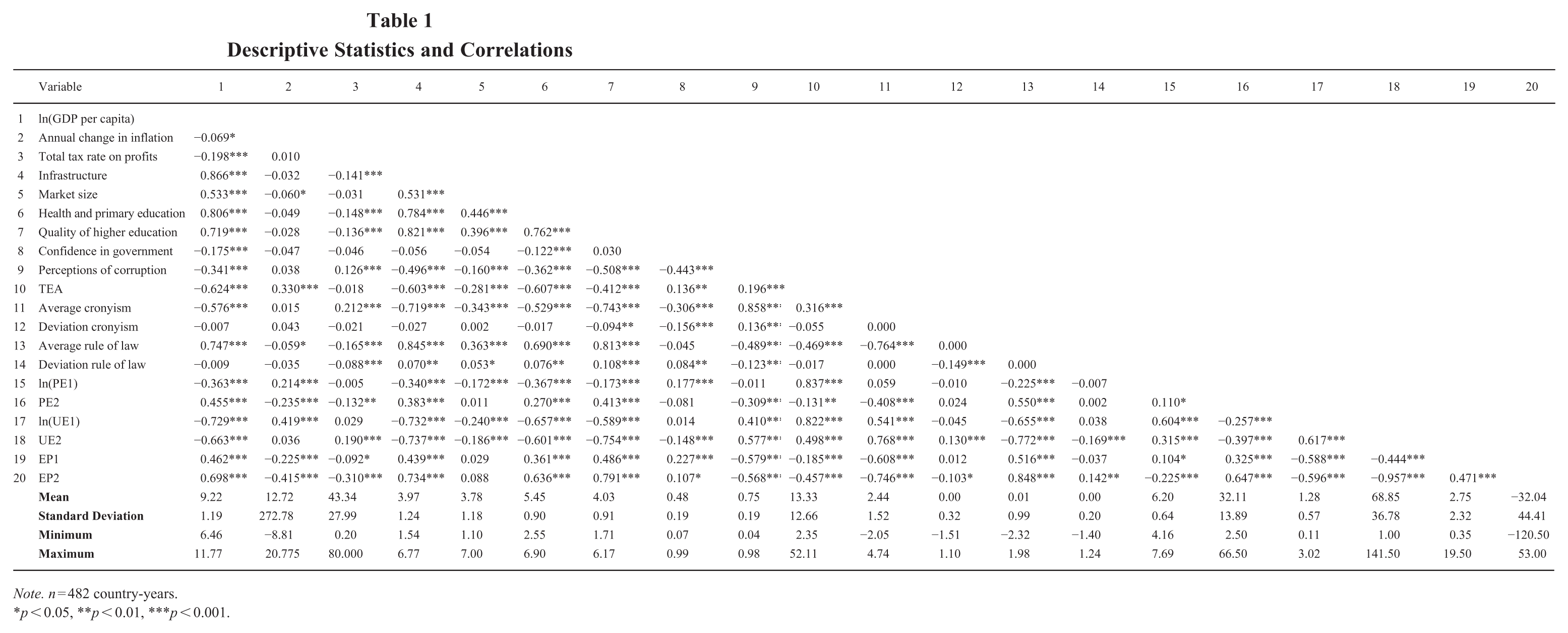
Note. n = 482 country-years.
p < 0.05, **p < 0.01, ***p < 0.001.
Table 2 reports the results of our first set of SUR models to test hypotheses for PE1, UE1, and EP1. Model 1 includes control variables and fixed effects for time. Model 2 from Table 2 reports the results of our analysis for the first three hypotheses. Results indicate between-country cronyism is negatively related to PE1 (β = −0.130, p < 0.001), positively related to UE1 (β = 0.090, p < 0.05), and negatively related to EP1 (β = −0.950, p < 0.001), providing strong support for H1, H2, and H3. Specifically, the results indicate a one-unit increase in cronyism is associated with a decrease of almost one standard deviation (e−0.13 = 0.879) in PE1, an increase of about 1.5 standard deviations (e0.09 = 1.096) in UE1, and a decrease of about one-third of a standard deviation in EP1.
Seemingly Unrelated Regression Results for PE1, UE1, and EP1
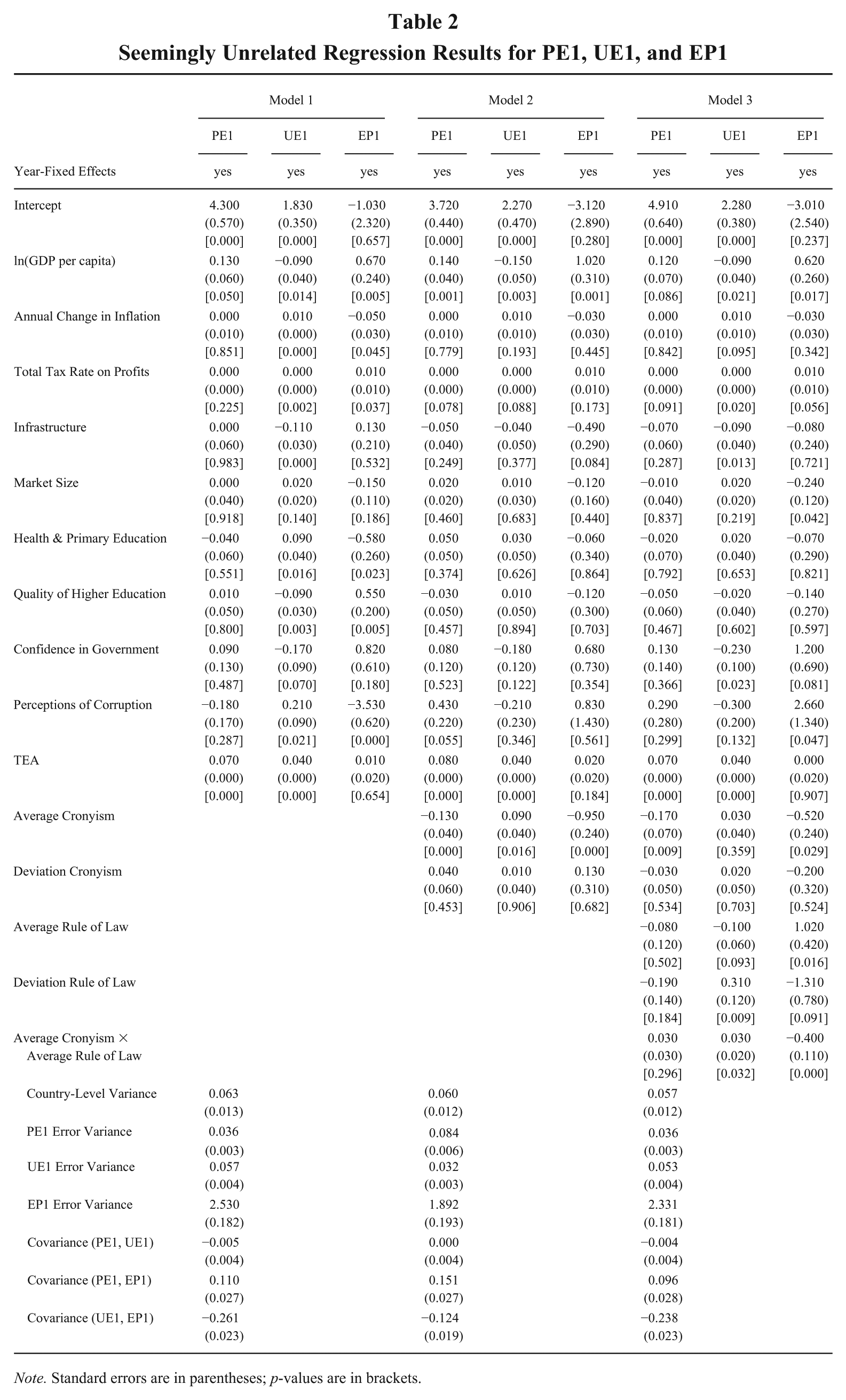
Note. Standard errors are in parentheses; p-values are in brackets.
We repeated our analyses using the alternative measures of PE2, UE2, and EP2 to test H1, H2, and H3. The results, which are reported in Model 2 of Table 3, show a similar pattern of signs and significances as our first set of SUR models. Specifically, our results indicate that cronyism is negatively related to PE2 (β = −4.600, p < 0.01), positively related to UE2 (β = 16.480, p < 0.001), and negatively related to EP2 (β = −21.130, p < 0.001). Specifically, the results indicate that a one-unit increase in cronyism is associated with a decrease of approximately 54% of a standard deviation in PE2, an increase of approximately 14% of a standard deviation in UE2, and a decrease of approximately 65% of a standard deviation in EP2. In sum, we find strong support for H1, H2, and H3 across both measurement models.
Seemingly Unrelated Regression Results for PE2, UE2, and EP2
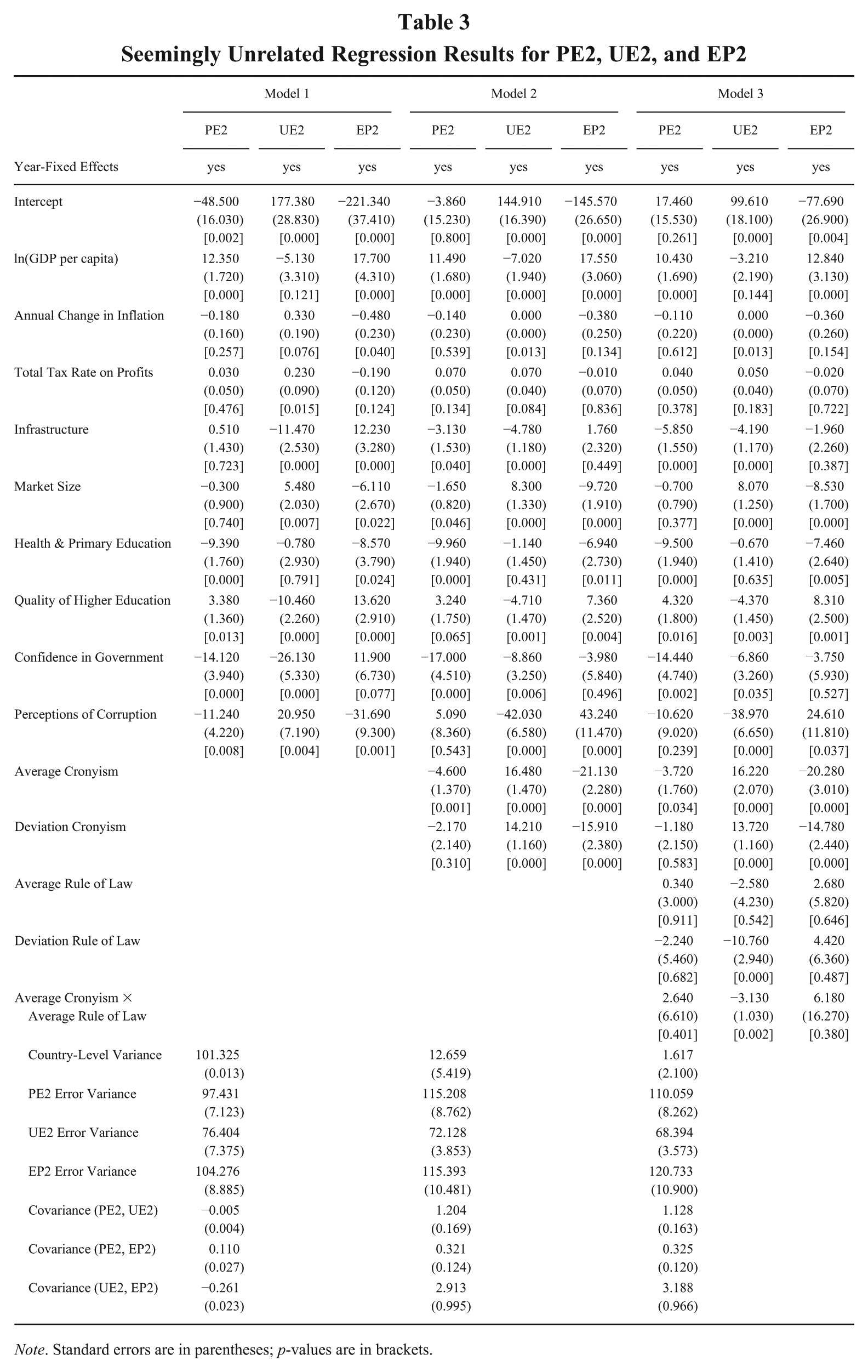
Note. Standard errors are in parentheses; p-values are in brackets.
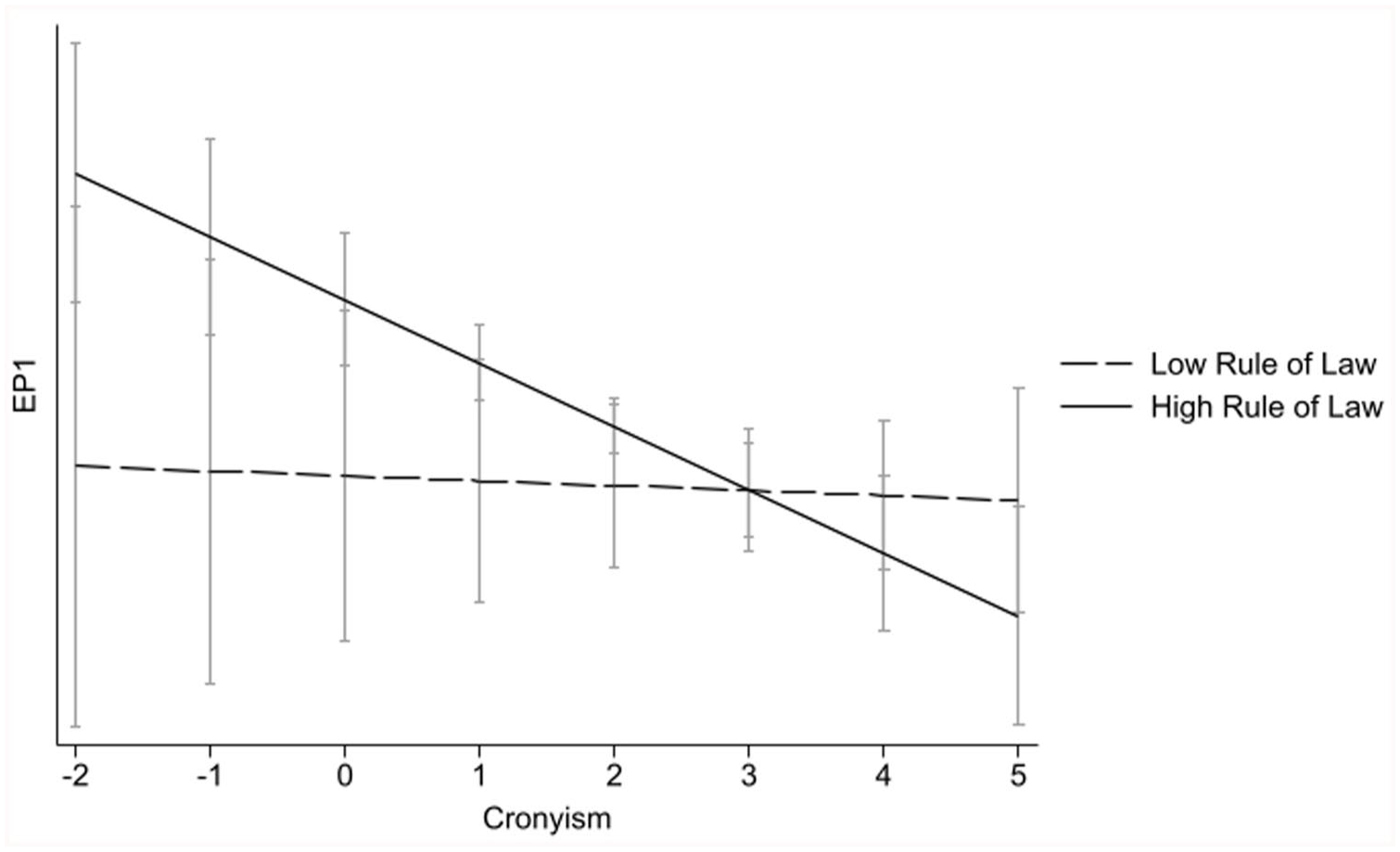
Model 3 from Table 2 reports the results of the moderating effect of the rule of law on the relationship between cronyism and PE1 (H4), UE1 (H5), and EP1 (H6). Model 3 introduces an interaction term (average cronyism * average rule of law) and controls for the direct effect of between-country (average) and within-country (deviation) rule of law. Because the rule of law is not a significant moderator of the cronyism to PE1 relationship, we failed to find support for H4. Further, and contrary to our expectations presented in H5 and H6, the rule of law positively moderates the link between cronyism and UE1 (β = 0.030, p < 0.05) and negatively moderates the relationship between cronyism and EP1 (β = −0.400, p < 0.001).
We graphed the significant interactions to further probe these effects. Figures 1a and 1b depict the relationship that cronyism has with UE1 and EP1 at low (−1 SD) and high (+1 SD) levels of rule of law. As shown in Figure 1a, the relationship between cronyism and UE1 is more positive at high levels of rule of law. In contrast, Figure 1b shows that the relationship between cronyism and EP1 is more negative at higher levels of rule of law. In addition, we performed slope tests to corroborate these interaction effects; results are supportive and reported in the Online Appendix.
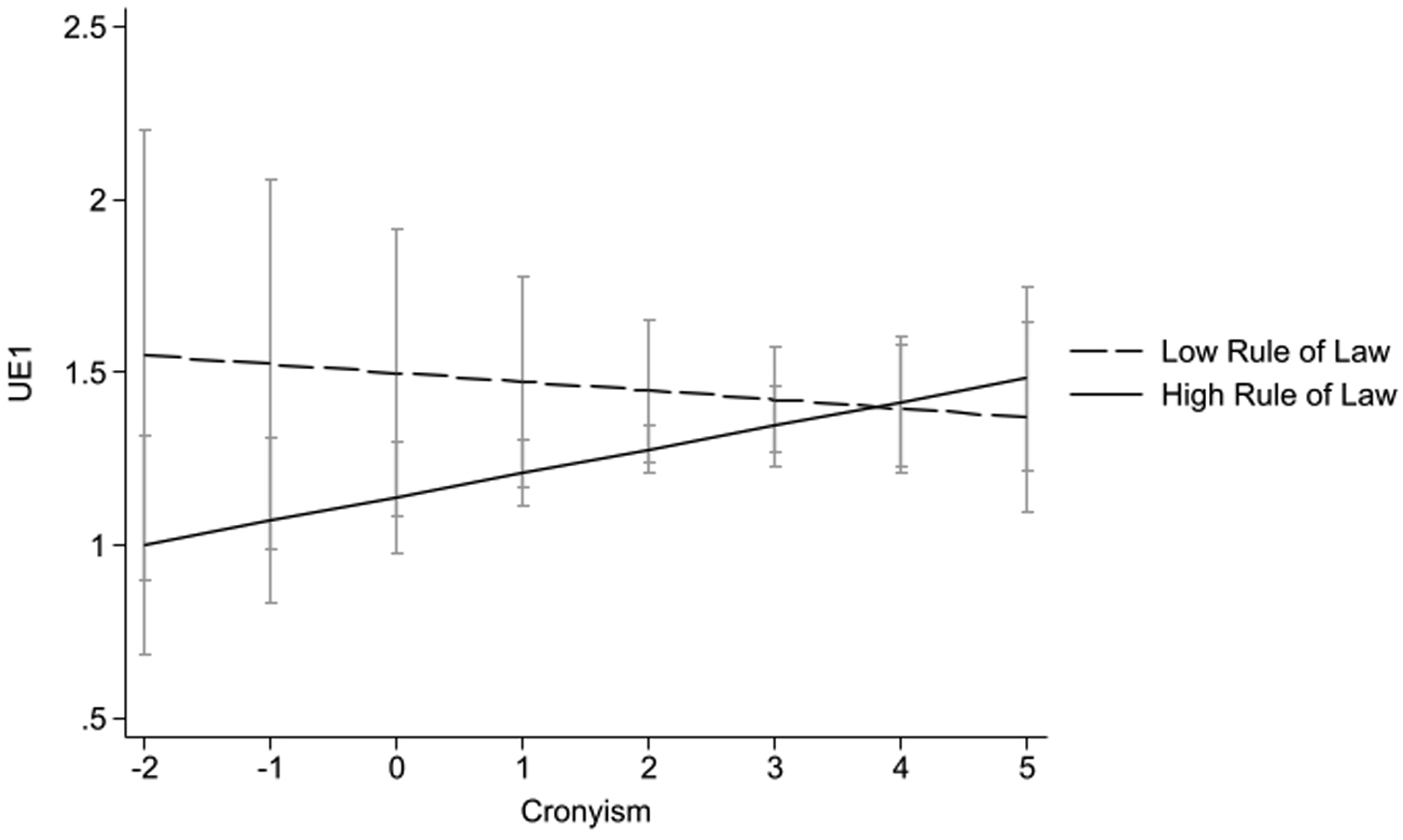
Interaction of Cronyism and Rule of Law on UE1
Interaction of Cronyism and Rule of Law on EP1
Interaction of Cronyism and Rule of Law on UE2
To further explore the significant interaction results for EP1, we tested models using four countries representing high and low levels of cronyism and rule of law combinations: Sweden (low cronyism = −1.64, high rule of law = 1.93), Saudi Arabia (low cronyism = 0.87, low rule of law = 0.08), Portugal (high cronyism = 3.04, high rule of law = 1.13), and Russia (high cronyism = 3.51, low rule of law = −0.85). For EP1, we found lower levels for Portugal (estimate = 1.36) and Russia (estimate = 1.66), slightly higher levels for Saudi Arabia (estimate = 2.76), and much higher for Sweden (estimate = 7.24). Sweden’s EP1 was significantly larger than the other countries (p < 0.001).
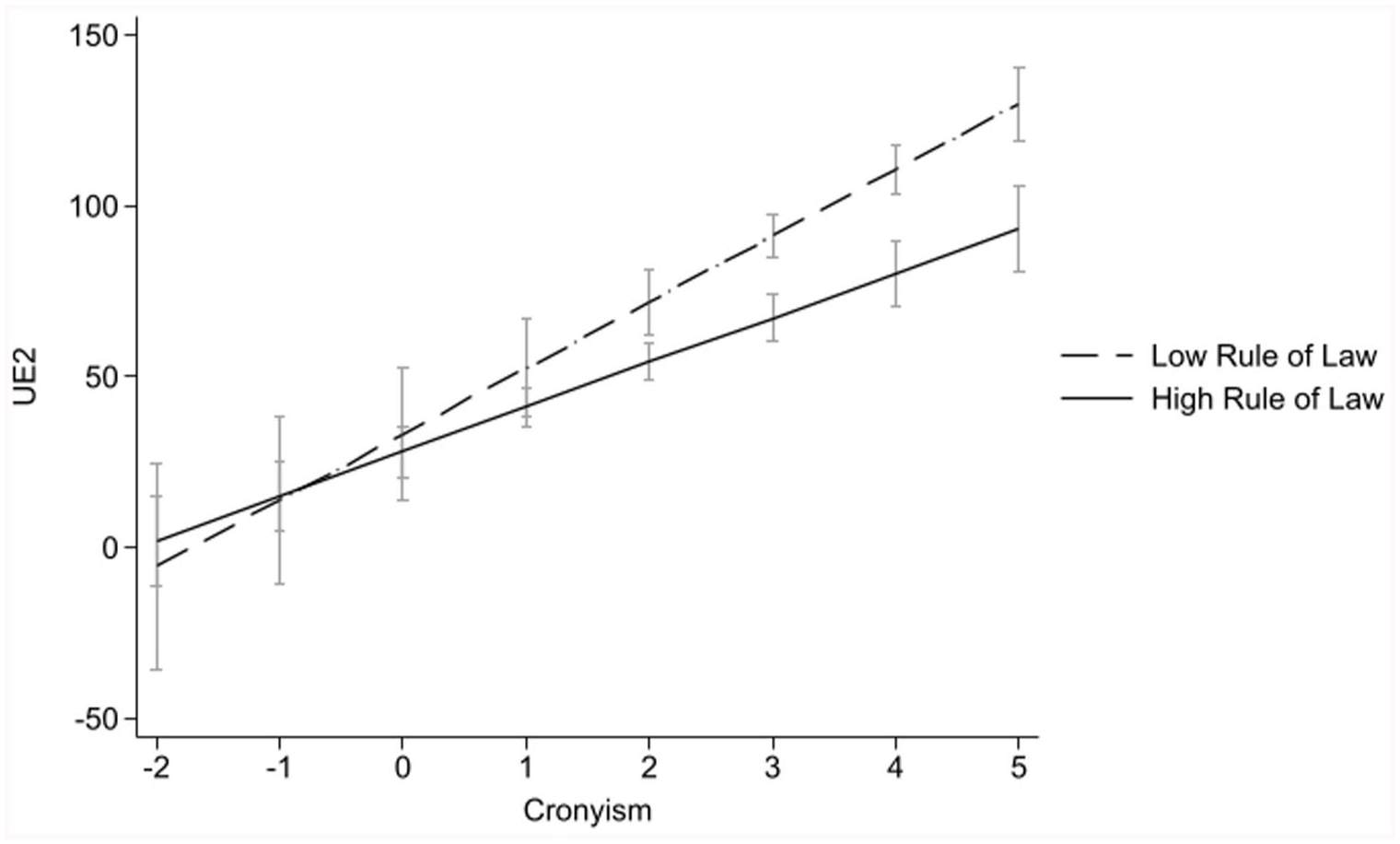
Results from our second set of SUR models that tested the moderating effect of the rule of law on PE2, UE2, and EP2 are reported in Model 3 of Table 3. Our analysis shows that the rule of law is not a significant moderator of the cronyism to PE2 and cronyism to EP2 relationships, failing to support H4 and H6. However, the results indicate that the rule of law negatively moderates the positive relationship between cronyism and UE2 (β = −3.130, p < 0.01), providing support for H5. This effect is graphed in Figure 1c, with slope tests in the Online Appendix indicating its statistical significance.
Robustness Tests
We conducted additional robustness analyses to verify our results. Multicollinearity was assessed using variance inflation factors (VIFs), which ranged from 1.07 to 1.87—well below conventional thresholds (Judge, Hill, Griffiths, Lutkepohl, & Lee, 1982). Because Type I errors may arise even when VIFs are low (Kalnins, 2018; Kalnins & Praitis Hill, 2025), we implemented supplemental diagnostics (see the Online Appendix), which indicate that multicollinearity is unlikely to drive the findings. We also evaluated robustness to omitted-variable bias (bias-corrected estimates) and to endogeneity (impact-threshold-of-a-confounding-variable [ITCV] analyses via konfound). Across these checks, we find no evidence that omitted variables or endogeneity account for the results; detailed methods and full tables are presented in the Online Appendix.
Discussion
Cronyism—the shared understandings, values, and norms that promote favoritism based on connections—can facilitate cooperation among members of social groups and promote the collective good (Khatri et al., 2006). Although cronyism varies across countries in terms of strength and type, the success of certain collectives (e.g., families, communities) can, arguably, be partially attributed to its effects (Dieleman & Sachs, 2008; Morck & Yeung, 2004). However, despite the positives associated with cronyism, public criticism has increased over the past few decades due to cronyism’s linkages to key social, political, and economic failings, such as income inequality and economic underdevelopment (Foss et al., 2022; Klein et al., 2022).
Along with the growth of scholarly interest in cronyism, which is mostly critical, there is also a general lack of empirical research on the topic. This has perhaps exacerbated confusion and misunderstanding about the nature, origins, and effects of cronyism in society. Herein, we address this gap, at the country level of analysis, by examining (a) whether cronyism affects the quantity of various forms of entrepreneurship (i.e., PE and UE), (b) whether cronyism affects the quality (i.e., productivity) of entrepreneurship, and (c) whether the rule of law moderates the effects of cronyism on entrepreneurship. We explain that cronyism influences the feasibility and desirability of both PE and UE, leading to fewer resources being allocated to PE and more to UE. Additionally, we posit that cronyism diminishes entrepreneurship productivity by shaping entrepreneurial goals and incentives across countries. Furthermore, we proposed that a stronger rule of law will provide safeguards against the adverse effects of cronyism on entrepreneurship.
Our analysis of data from 98 countries over 8 years provides strong support for our direct hypotheses, showing that cronyism is negatively associated with PE quantity, positively associated with UE quantity, and negatively associated with entrepreneurship productivity (i.e., entrepreneurship quality) across countries. While we do not find evidence supporting the hypothesized moderating effects of the rule of law on the cronyism to PE link, our results regarding the rule of law’s moderating role in the cronyism to UE relationship are mixed and depend on the measures used. Additionally, and most interestingly, our results indicate that the rule of law moderates the direct effect of cronyism on entrepreneurship productivity in the opposite direction of our hypothesis; in countries with a stronger rule of law, the negative impact of cronyism on entrepreneurship productivity is stronger. These findings confirm that cronyism generally undermines entrepreneurship productivity while also revealing the complex and counterintuitive interplay between cronyism and the rule of law.
We offer two broad contributions, supported by specific insights on cronyism and entrepreneurship. First, we extend the understanding of how informal institutions serve as key external enablers for entrepreneurship (Davidsson, 2015). We highlight the role of cronyism—a major form of informal institution based on human desires to favor close contacts—by linking it to the quantity of PE and UE, as well as entrepreneurship productivity across countries. Our study offers additional empirical support for Baumol’s (1996) model of entrepreneurship, which suggests institutions shape the reward system in society, thereby affecting resource allocation across different forms of entrepreneurship (Sobel, 2008; Sorgner & Wyrwich, 2022).
Baumol (1996) and subsequent literature have primarily focused on the role of formal institutions that are more amenable to change and can more immediately shift the allocation of resources between PE and UE (Sobel, 2008). In contrast, we highlight cronyism as a deeply embedded informal institution that shapes not only institutional reward structures but also entrepreneurial goals, ultimately influencing the prevalence of PE and UE in society (Acs & Lappi, 2021; Eesley & Lee, 2023). Unlike Baumol (1996), who held the supply of entrepreneurial resources and talents constant to emphasize their allocation, we posit that institutional contexts fundamentally shape who becomes an entrepreneur and what goals they pursue. We show that entrenched informal institutions like cronyism contribute to societal culture and moral frameworks that, over time, shape attitudes toward entrepreneurship, influence entrepreneurial goals and expectations, and affect the overall productivity of entrepreneurship.
While Baumol (1996) posits that policy adjustments can redirect entrepreneurship without requiring deep cultural change, we contend that long-term shifts in informal institutions are essential for sustaining entrepreneurship productivity, which is necessary for the long-term development and prosperity of societies (Phelps, 2013). Our study explains why, despite possible short-term benefits, cronyism is not conducive to sustainable development in the long run. Scholars have noted that cronyism has been leveraged as a “second-best” and pragmatic way to promote initial economic progress in underdeveloped countries (Holcombe, 2013; Klein et al., 2022). However, countries that adopt this approach to cronyism will likely fall into a vicious, self-perpetuating cycle of underdevelopment, where cronyism breeds more cronyism and leads to ever-increasing concentrations of societal resources in the hands of elites who, in turn, resist innovations that might endanger their positions of power. Our study underscores the key role of norms and values upheld by people in the establishment and the persistence of extractive institutions that can lead nations to fail (Acemoğlu & Robinson, 2012).
As a second broad contribution, this study extends prior knowledge of how institutional complexities—boundaries, interactions, or contradictions—may shape behaviors and outcomes (Greenwood et al., 2011). Institutional contradictions arise when institutions that originate from, and are supported by, different centers (e.g., state, market, family, community, or religion) provide conflicting or incompatible prescriptions (Pache & Santos, 2010). In such situations, people are forced to prioritize goals and strategize how to comply with some institutions while simultaneously risking being sanctioned by others (Bertels & Lawrence, 2016). Our study provides empirical support for the theoretical claim that informal institutions, which are long-held and difficult to change, are dominant over formal institutions (Eesley et al., 2018; Helmke & Levitsky, 2004). As such, individuals and organizations will likely prioritize tacit informal conventions over formal institutions that are in conflict because informal institutions are deeply embedded in social relationships and have more intimate or local monitoring and enforcement mechanisms (Eesley & Lee, 2023; Eesley et al., 2018).
Generally, our study demonstrates the importance of taking a multidimensional institutional perspective, where different interactions or configurations of formal and informal institutions may produce different outcomes. Such a heightened perspective, which recognizes that “human behavior is shaped jointly by the constraints, incentives, and resources provided by formal and informal institutions,” can help explain how similar regulatory or legal forces may work well in one country but not in another (Stephan, Uhlaner, & Stride, 2015, p. 309). Thus, countries that strive to develop formal institutions by importing laws and regulations from other countries must consider the interactions and configurations of those institutions—formal and informal—to avoid unintended consequences and wasted resources (Haggard & Tiede, 2011; Haggard et al., 2008).
More specific to the institutions studied herein, this study extends our understanding of how cronyism and the rule of law interact to influence entrepreneurship productivity across countries. Table 4 summarizes this effect, which is in line with Helmke and Levitsky’s (2004) typology of interactions between informal and formal institutions. When the rule of law is low or weak, societies lack the formal institutional mechanisms required for entrepreneurship productivity, and are characterized by informal or communal economic activities (Webb et al., 2009). In such societies, low cronyism can compensate for underdeveloped formal institutions and help societies govern their limited-scope business activities through informal mechanisms (Mair et al., 2012; Webb et al., 2020). Furthermore, when the rule of law is high, low cronyism may fill in gaps and simply “lubricate” the system to achieve more favorable outcomes (Helmke & Levitsky, 2004). Low cronyism can often help with resolving inefficiencies introduced to business contexts by unnecessary, ineffective, or obsolete regulations that are resistant to change (Rubin, 2016). Similarly, low cronyism may foster the development of new technologies in emerging industries by helping firms get around overly strict legal barriers or addressing contingencies not anticipated in the current law (Roland, 2008). Thus, low cronyism can complement the high rule of law to promote entrepreneurship productivity.
Confluence of Cronyism and the Rule of Law on Entrepreneurship Productivity
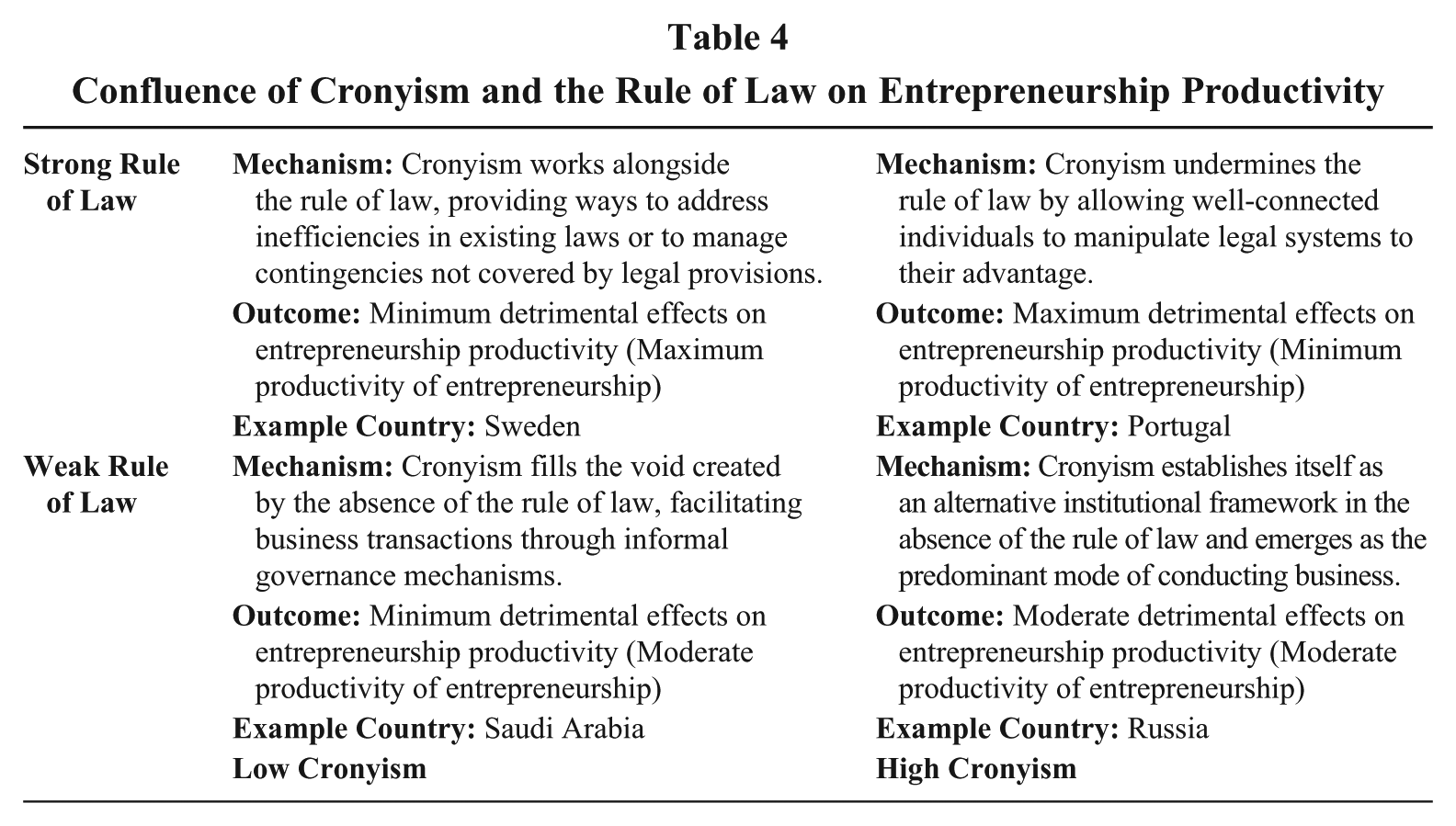
In contrast, when the rule of law is low, high cronyism competes with ineffective formal institutions and provides an alternative informal institutional apparatus that enables powerful, well-connected groups to accumulate resources and opportunities for themselves at the cost of others (Fogel, 2006; Morck et al., 2005). These cronies tend to dominate the economy, protect the status quo, and resist innovations that could threaten their power (Dieleman & Sachs, 2008; Holcombe, 2013). Yet, the negative effect of cronyism on entrepreneurship productivity is most damaging when the rule of law is high. Interestingly, and in contrast with our initial theorizing, our results suggest that a high rule of law not only fails to safeguard against high cronyism but also appears to exacerbate the negative effects of cronyism on entrepreneurship productivity.
There could be various reasons for this counterintuitive finding, but, drawing from our theoretical underpinnings, we suggest one possible explanation: Cronyism can accommodate privileged parties to avoid, or work around, formal institutions without technically violating them (Helmke & Levitsky, 2004). In other words, cronyism allows connected and powerful parties to abuse the authority of formal institutions to their own benefit, often preventing innovations that might challenge established positions or power. This type of context is commonly labeled “crony capitalism” (Aligica & Tarko, 2014; Holcombe, 2013). In crony capitalism, the informal institution of cronyism provides work-around mechanisms through which connected parties endeavor to alter the purpose and function of capitalistic institutions (e.g., competitive market and minimal state; Foss et al., 2022; Klein et al., 2022). Although capitalistic institutions strive to promote entrepreneurship productivity, cronyism enables certain parties to bend formal institutions to create barriers for PE and divert resources toward UE. As argued by Klein et al. (2024), “the potential for cronyism might arise endogenously from even the most basic regulations that are commonplace in the industrialized world” (p. 110).
In crony capitalism, where some can benefit from preferential treatments and secure rents through their connections (Blau, Brough, & Thomas, 2013; Johnson & Mitton, 2003), it becomes more critical for all to leverage connections for rent-seeking (Holcombe, 2013). Those who cannot benefit from cronyism lose trust in the effectiveness of institutions and attempt to compensate for their lack of connections by engaging in unproductive behaviors. In other words, cronyism normalizes not only the rent-seeking of the parties involved but also the rent-seeking and harmful behaviors of those who attempt to compensate for their lack of connections through other, often nefarious, means. Many who refuse to participate in such activities lose any chance for PE or securing employment; this pushes them toward UE for survival (Soleimanof, Bagherian, & Feyzbakhsh, 2024). Thus, a key reason for our contrary finding is the opportunity cost of societal resources in crony capitalism. Under a high rule of law, these resources should be used for PE, but instead are wasted in UE because of cronyism.
Limitations and Future Research
This study suggests a wide range of opportunities for future research. First, there are distinct empirical challenges when investigating cronyism, and future researchers could explore other ways to examine cronyism and related phenomena, especially at various levels of analysis. Our study employs perceptual measures adopted from secondary data sources, which may illicit concerns regarding construct validity. Although these measures are appropriate and reasonable, employing alternative measures of cronyism, particularly applied at different or multiple levels of analysis, would be a positive step forward. For example, examinations of cronyism’s impact on individual-level attitudes and behaviors require the development of individual-level measures of cronyism. Although cronyism is typically regarded as a societal-level institution, exploring how individual perceptions of cronyism influence attitudes and behaviors within and across lower-level boundaries (e.g., family, business, communities) would be valuable. The utilization of individual-level measures for cronyism may also help advance our theoretical understanding of the microfoundational mechanisms by which cronyism influences attitudes and behaviors. Such research is not only significant for understanding entrepreneurial behaviors but can also be applied to explain other organizational behaviors or outcomes, such as job satisfaction, citizenship behaviors, employee productivity, or morale (Khatri & Tsang, 2003).
There are also research opportunities in examining the overlap between cronyism and social networks, as they are related concepts. Indeed, our study may seem to stand in contrast with the extant literature on social capital and networking in management research (Kilduff & Brass, 2010), where networks have shown to be instrumental for business and entrepreneurship success in almost every context (Gedajlovic, Honig, Moore, Payne, & Wright, 2013; Payne, Moore, Griffis, & Autry, 2011). However, to clarify, while the prevalence of intra-network favoritism is detrimental to entrepreneurship at the societal level, we do not reject that networks often help individual entrepreneurs achieve success. Rather, we posit that, when access to quality networks is limited and informal networks become the key or sole determinant of success, entrepreneurship productivity at the societal level suffers. For example, Aidis et al. (2008) report that networking in Russia is so extensive that it often replaces markets and fosters a hostile environment where state and business ties emphasize control over productivity. Therefore, in contrast with the dominant focus of prior research on the positive effects of networking for entrepreneurship, we point out the need for further understanding of the negative aspects—or dark side—of social networks in management and entrepreneurship (Khatri et al., 2006). For instance, network brokers (i.e., people who span structural holes in networks) may safeguard their contacts and information from others to maintain advantages (Bizzi, 2013; Krackhardt, 1999). This may suggest that cronyism can be utilized “entrepreneurially” to protect information or resources from competition.
Future researchers could also expand our knowledge about how cronyism interacts with other types of formal and informal institutions to shape attitudes and behaviors. Herein, we examined only the rule of law because it is a foundational formal institution that influences the functionality of the state and market. However, there are several other institutions (e.g., religious beliefs, cultural traditions, family norms, and political systems) that can potentially alleviate or exacerbate the effects of cronyism. The examinations of the influence of such institutional complexities in different countries may help scholars make better sense of why, for example, developing countries such as Qatar, Saudi Arabia, and Bahrain have less cronyism than developed countries such as the United States, France, and Italy—yet have not achieved comparable entrepreneurial and economic outcomes. Building on the idea of adopting a multidimensional or configurational perspective of institutions (e.g., Moore, Payne, Bell, & Davis, 2015), future research could explore how cronyism interacts with other key institutional factors to shape entrepreneurial outcomes, using methods like fuzzy-set qualitative comparative analysis (fsQCA) to examine these complex relationships (Misangyi et al., 2017).
Finally, we relied on prior research to select measures of PE, UE, and entrepreneurship productivity to ensure comparability with existing literature (Chowdhury et al., 2019; Fredström et al., 2021). However, our findings suggest that the interactive effects of cronyism and the rule of law may depend on how entrepreneurship quantity and quality are measured. For instance, our results for UE1 contradict our hypothesis, whereas UE2 supports it. This discrepancy may arise because UE2 includes proxies related to unethical behaviors and criminal activities, which the rule of law more directly addresses (Haggard et al., 2008). In contrast, UE1 captures inefficient market activities occurring in informal contexts that are less explicitly regulated by legal frameworks, suggesting that the rule of law may be less effective in curbing forms of UE that operate through informal mechanisms and persist in institutional voids where enforcement is weak. Nonetheless, this discrepancy underscores the need for future research to refine or develop alternative measures that capture the prevalence and quality of entrepreneurship. For example, Webb et al. (2020) suggest assessing entrepreneurship productivity across formal, informal, and criminal economies. Since businesses within these economies exhibit varying levels of innovativeness—not all formal businesses are innovative and some informal businesses may be innovative—scholars may benefit from examining the relative allocation of resources to certain forms of productive (e.g., high-tech startups), unproductive (e.g., informal intermediaries), and destructive (e.g., mafia businesses) entrepreneurial efforts in these economies to capture entrepreneurship productivity. Such examinations, especially when the interactive effects of cronyism with other institutions are considered, can add to our knowledge in this area.
Conclusion
Cronyism may yield limited short-term gains, but it ultimately depresses entrepreneurship productivity, and the rule of law alone cannot provide a sufficient safeguard—indeed, it can even be counterproductive—because actors embedded in crony networks can adapt to and leverage formal frameworks to advance in-group interests. Effective mitigation therefore requires pairing formal institutional reforms with sustained investments in informal institutions that elevate ethical standards, transparency, and public awareness (e.g., targeted educational and media initiatives), thereby avoiding a self-reinforcing vicious cycle of cronyism. For managers and entrepreneurs, the practical implication is to forgo short-term relational favors that erode capabilities, distort organizational culture, and heighten exposure to political turnover, and instead prioritize the development of core competencies that support lasting competitive advantage. Because cronyism degrades the societal reward structure—reducing returns to productive activity for all across generations—its reduction is essential to redirect resources toward innovation and long-term value creation. Recognizing and addressing these dynamics can help cultivate an entrepreneurial ecosystem in which competence, rather than connections, drives broad-based prosperity and strengthens collective capacity to meet grand societal challenges.
Supplemental Material
sj-docx-1-jom-10.1177_01492063251387664 – Supplemental material for Cronyism, Rule of Law, and Entrepreneurship: A Country-Level Examination
Supplemental material, sj-docx-1-jom-10.1177_01492063251387664 for Cronyism, Rule of Law, and Entrepreneurship: A Country-Level Examination by Sohrab Soleimanof, G. Tyge Payne, Curt Moore and Matthew W. Rutherford in Journal of Management
Footnotes
Acknowledgements
We are grateful to Robert Baron, Bat Batjargal, Aaron Hill, Russel Sobel, and Justin Webb for their thoughtful feedback and recommendations on earlier drafts of this research. We also sincerely thank Hermann Ndofor, Editor at the Journal of Management, and the two anonymous JOM reviewers for their constructive guidance and support throughout the review process. Their insights were instrumental in helping us develop and refine this work.

Supplemental material for this article is available with the manuscript on the JOM website.
References
Supplementary Material
Please find the following supplemental material available below.
For Open Access articles published under a Creative Commons License, all supplemental material carries the same license as the article it is associated with.
For non-Open Access articles published, all supplemental material carries a non-exclusive license, and permission requests for re-use of supplemental material or any part of supplemental material shall be sent directly to the copyright owner as specified in the copyright notice associated with the article.
