




Abstract
The literature on organizational paradoxes emphasizes the importance of both/and thinking and action. Yet, while often treated as a unitary concept, both/and has been interpreted and operationalized in diverse ways—such as ambidexterity, transcendence, Yin-Yang balancing, and Zhong-Yong middle way. To enhance conceptual clarity and coherence, this paper decomposes the notion of both/and and identifies generic strategies for simultaneously engaging paradoxical opposites. I begin by reviewing individual responses and prior classifications of responses to paradoxical tensions, which reveals five distinct responses beyond either/or logics. Building on these, I develop a typology that specifies and relates five variants of both/and thinking. These are organized into five ideal types—superficial Either-And, multiversal Both-Or, ambivalent Both-And, reconciliatory Both-Nor, and transcendent Neither-And—collectively forming the acronym SMART. I illustrate the application of the SMART framework by analyzing how organizations navigate the profitability versus responsibility tension, a paradox central to modern business practice. I conclude the paper by identifying the limitations of the present study and avenues for future research.
Introduction
Paradox in management and organization studies refers to “contradictory yet interdependent relationships between alternative poles” (Schad, Lewis, Raisch, & Smith, 2016: 24) such as exploitation versus exploration (March, 1991), control versus collaboration (Sundaramurthy & Lewis, 2003), and stability versus change (Farjoun, 2010). At the core of the literature lies a consensus on the imperative of both/and thinking and acting (Fairhurst & Putnam, 2024; Smith & Lewis, 2022).
Although the notion of “both/and” is often used as a unitary concept, it has been interpreted and operationalized into a diverse array of responses to paradoxical tensions, such as ambidexterity, dynamic equilibrium, Yin-Yang balancing, and Zhong-Yong middle way. The interrelationships between these various responses—often proposed in isolation and associated with different research traditions such as case studies, ethnography, textual analysis, and pure theory building—remain unclear. To many, it may seem puzzling that these responses, despite their differences, are all said to reflect both/and thinking.
Even though there exist several classification schemes that greatly aid in understanding the interrelationships among existing responses—since we can relate the latter to elements of these classifications—comparing and contrasting these classifications reveals important overlaps and differences between them. This means that none of them provides an exhaustive list of generic strategies for managing paradoxical tensions.
Jarzabkowski (in Keller et al., 2021: 171) points out, “given our interest in ensuring interdependence between persistent contradictions, uncovering the processes and mechanisms through which dynamic equilibrium [i.e., balancing paradoxical opposites] can be attained might be considered a key aim of paradox scholarship.” In agreement with this view, the present article aims to identify a set of generic strategies for simultaneously engaging paradoxical opposites and explicate their logical interrelationships in terms of how they are related to the notion of both/and, within a typological framework.
Phrases such as responses, approaches, solutions, modes, and strategies are used interchangeably in the literature to describe different ways of coping with paradoxical tensions. In this paper, I choose “response” as the representative term when talking about existing approaches to paradoxical tensions in the prior literature, while using “strategy” as the term when building my own typology. Likewise, phrases such as balancing, integrating and embracing are used interchangeably in the literature to describe the efforts to engage both paradoxical opposites. Here, I use “engaging” instead of “balancing” or “integrating” because some approaches, being empirically real or theoretically possible, embrace both paradoxical opposites, but do not necessarily achieve the desired level of balance between or integration of the opposites.
This research is of significant value for two key reasons. First, developing a theoretical typology of generic strategies for engaging paradox deepens both scholarly understanding and practical impact. Conceptually, it allows existing responses to paradoxical tensions to be mapped onto the generic strategies or their combinations, clarifying how diverse approaches relate to one another. It also creates space for strategies that are theoretically possible but not yet observed, as well as those practiced but not yet captured in the literature, hence opening new avenues for inquiry. Practically, recognizing multiple generic strategies and their logical interrelationships underscores that there is no one-size-fits-all solution. Decision makers can adopt strategies most suited to specific paradoxical tensions and adapt them as internal and external conditions evolve. Second, without such a framework, the literature risks becoming fragmented and disorderly, as new responses proliferate under different labels or with conflated definitions (cf. Putnam et al., 2016). This conceptual fragmentation would obscure commonalities, impede cumulative knowledge building, and ultimately limit our ability to advance theory and practice in managing organizational paradox.
In what follows, I first review existing individual responses and prior classifications of responses to paradoxical tensions, demonstrating that the notion of both/and is too coarse-grained to capture the nuances of existing individual responses, and identifying five distinct non-either/or equivalent responses shared across prior classifications, respectively. Then, based on the insights gained from the literature review, I explain the substruction methodology of typology building that is suitable for this research given the status quo of the organization paradox field. Afterwards I propose a typology of five variants of both/and thinking that are then used to understand the various responses existed in the literature, and those that are theoretically possible but not yet adopted in practice, as well as those practiced but not yet conceptualized in the extant literature. Finally, I discuss the contributions and limitations of the present study and directions for future research.
Literature Review
Diverse Interpretations and Operationalizations of Both/And in the Paradox Literature
According to Smith and Lewis (2011), the study of management and organizational tensions has evolved through three key perspectives. Early organizational theories focused on finding the “one best way” to manage, emphasizing either/or choices—such as hierarchical versus flat structures. In reaction to this perspective, contingency theory emerged in the 1960s, advocating an if/then approach in which the effectiveness of opposite options depends on contextual factors. More recently, the paradox perspective has introduced a both/and approach, acknowledging that tensions persist within dynamic systems and, when embraced, can foster innovation and resilience. This perspective shifts the focus from resolving tensions to leveraging their coexistence for more adaptive and sustainable management.
Smith and Lewis’s (2011) depiction of the evolution of approaches to managing organizational tensions implicitly suggests that the paradox both/and perspective is superior to the contingency if/then perspective, which, in turn, is seen as an improvement over the earlier either/or perspective. However, in their comprehensive review of the organizational paradox literature, Schad et al. (2016: 47) acknowledge that “even paradox scholars are challenged to think ever more paradoxically, as these dynamics may require both paradox theory and contingency theory approaches.” Despite this recognition, they do not critically analyze the logical relationship between contingency thinking and the notion of both/and, leaving this connection unexplored.
The emphasis on both/and thinking and acting has been consistently championed by the field’s most influential scholars and publications, including Lewis (2000), Smith and Lewis (2011), Schad et al. (2016), Miron-Spektor et al. (2018), Hahn and Knight (2021), and Zhang et al. (2015). A prevailing pattern in the organizational paradox literature is the widespread agreement among scholars on the necessity of both/and thinking and acting. However, scholars have interpreted and operationalized the notion of both/and in diverse ways, resulting in a wide array of responses or approaches to paradoxical tension. These include ambidexterity (Gibson & Birkinshaw, 2004; Tushman & O’Reilly, 1996), dynamic equilibrium (Smith and Lewis, 2011), dynamic balance (Smets et al., 2015), Yin-Yang balancing (P. Li, 2016), reframing and transcendence (Bartunek, 1984, 1988; Putnam et al., 2016), Zhong-Yong or the middle way (Chen, 2002; Leung et al., 2018; X. Li, 2018), and elastic hybridity (Gümüsay, Smets, & Morris, 2020), among others.
Despite some similarities, these responses differ significantly from one another. For example, ambidexterity scholars interpret “being able to do both at the same time” as “being ambidextrous” (Tushman & O’Reilly, 1996: 11). However, ambidexterity approaches to both/and typically involve sequential or structural separation—engaging with either of the opposing demands at a specific time or in a particular space. P. Li (2014: 329) critiques this perspective, arguing that “the extant views of ambidexterity fail to account for the original insights” of James March’s (1991) analysis of the exploration-exploitation paradox. As an alternative, P. Li (2016) proposes a “Yin-Yang balancing” approach to organizational paradox, which in its operationalization can be understood as a compromised middle-way response (X. Li, 2018).
Another example is Gümüsay and colleagues’ (2020) notion of elastic hybridity, which emerges from the recursive, multilevel relationship between organizational polysemy and individual polyphony. At the organizational level, polysemy involves using the same word, concept, or symbol in ways that allow different members of the organization to interpret it differently. This approach enables employees to personally balance conflicting ideas without explicitly rejecting either side. At the individual level, polyphony involves employing different spaces, times, or languages to keep conflicting ideas separate while allowing them to coexist, enabling individuals to switch between perspectives as needed. Notably, while polyphony resembles the ambidexterity response, polysemy appears distinct from any previously established responses. Essentially, polysemy is about purposefully creating ambiguity to achieve a both/and outcome—either by using words or symbols with dualistic meanings or by deliberately employing them in an ambiguous manner.
Moreover, while some responses are singular, others represent combinations of multiple approaches. For example, Smith and Lewis’s (2011) notion of dynamic equilibrium integrates acceptance, splitting, and integrating. In this combination, the splitting element corresponds to the ambidexterity response, while integrating aligns with a balanced or compromised middle-way position. Similarly, Putnam and colleagues’ (2016) concept of both-and responses lumps together three distinct ideas, corresponding to both/and thinking, sequential ambidexterity, and a compromised middle ground, respectively.
Although the imperative of both/and is widely regarded as the orthodox perspective in organizational paradox literature, some scholars have expressed critical views. Berti and Cunha (2023) argue that adopting both/and solutions in the face of paradoxes is not always feasible or desirable, as certain situations necessitate either/or choices. Similarly, Seidemann (2024) problematizes the hegemony of the conception of both/and as core to responses to paradox. X. Li (2021a, 2021b) contends that paradox scholarship should move beyond the dichotomy of either/or and both/and to also consider the concept of neither/nor. Notably, Chen (2008) previously introduced a transparadox perspective in his analysis of the competition versus cooperation tension, integrating elements of either/or, both/and, and neither/nor.
In summary, a review of the individual responses proposed by paradox scholars reveals that the notion of both/and has been interpreted and operationalized in diverse ways. Some interpretations do not represent a pure both/and stance, but rather incorporate elements of either/or or neither/nor. One plausible way to address this complexity is to view both/and as a coarse-grained concept that does not fully capture the nuances of existing individual responses. Consequently, it may consist of multiple variants that more accurately reflect the diversity of these responses. Drawing on insights from physics, the both/and notion can be conceptualized as a higher-order construct comprising lower-order subcomponents. One of the two research objectives here, therefore, is to elucidate these subcomponents—in other words, to unveil the microstructure of the both/and concept.
Prior Classifications of Common Responses to Paradoxical Tension
In addition to the individual responses reviewed in the previous section, the literature on organizational paradox has also produced various taxonomies of responses—that is, Baxter (1988, 1990), Poole and Van de Ven (1989), Stroh and Miller (1994), Seo, Putnam, and Bartunek (2004), Jarzabkowski, Lê, and Van de Ven (2013), Putnam et al. (2016), and Hargrave and Van de Ven (2017)—each of which emphasizes different strategies for managing paradoxical tensions. Although these classifications differ in some respects, they share common conceptual foundations, revealing six broad categories of responses: selection, subordination, segmentation, accommodation, compromisation, and transcendence.
Selection: Prioritizing one opposite over the other
A common response to paradoxical tension is to select one side of the contradiction while excluding or minimizing the other. This either/or approach is evident in Baxter’s (1988) concept of “selection” and Putnam and colleagues’ (2016) category of “either-or” responses, including defensive reactions of denial, withdrawal, and selection. Similarly, Seo et al. (2004) and Jarzabkowski et al. (2013) describe selection-based strategies in which organizations resolve paradox by choosing one pole while dismissing or suppressing the other. However, because this approach does not engage both opposites, it falls outside the scope of this paper’s focus on approaches for simultaneously engaging paradoxical opposites.
Subordination: Allowing coexistence on unequal terms
Rather than outright either/or selection, some responses allow both opposites to exist but place them in a hierarchical or asymmetrical relationship. This is exemplified by Jarzabkowski and colleagues’ (2013) notion of “suppressing,” where one pole dominates while the other is tolerated in a subordinate position. Similarly, Putnam and colleagues’ (2016) framework includes “selection by choosing one while minimizing or ignoring the other.” Seo et al. (2004) introduce the idea of “reluctant coexistence,” a variation of selection in which both poles persist, yet one is privileged over the other. In Hargrave and Van de Ven’s (2017) typology, the “assimilation” strategy similarly describes cases where two opposites coexist, but one is incorporated into the dominant paradigm. These perspectives highlight how subordination provides an alternative to outright selection by allowing for limited recognition of paradoxical opposition.
Segmentation: Separating opposites across space, time, or contexts
Another widely recognized response is segmentation, where paradoxical elements are compartmentalized across different times, spaces, or organizational domains. This approach appears in multiple classifications, including Poole and Van de Ven’s (1989) “spatial and temporal separation” and Baxter’s (1990) “separation.” Stroh and Miller (1994) expand on this idea by describing “expanding the context in space or time” as a way of managing paradox. Similarly, Putnam et al. (2016: 123) discuss “separation” by “segmenting opposites in different structural arrangements, times, or organizational functions,” while Jarzabkowski et al. (2013) identify “splitting” as a mechanism that compartmentalizes contradictory elements. This strategy allows organizations to avoid direct confrontation between paradoxical opposites by allocating them to different domains.
Accommodation: Engaging opposites without prioritization
Some responses seek to accommodate paradoxical tensions by acknowledging both opposites without prioritizing one over the other. This perspective is reflected in Stroh and Miller’s (1994) “both/and thinking” and Poole and Van de Ven’s (1989) “opposition,” where paradox is embraced rather than resolved. Seo et al. (2004) propose a similar concept of “connection” that legitimizes dualities by fostering respect and curiosity for opposing elements. Hargrave and Van de Ven’s (2017) “synergy” strategy aligns with this idea, as does Jarzabkowski and colleagues’ (2013) “adjusting,” which emphasizes recognizing and integrating both poles of a paradox. Putnam et al. (2016) also include “paradoxical thinking” under their “both-and” category, emphasizing the active engagement of contradiction without attempting to resolve it.
Compromisation: Seeking balance or middle ground
Some responses attempt to balance or integrate opposites by constructing a compromise solution. Baxter (1990) refers to this as “neutralization,” where neither pole is fully enacted, and some elements are sacrificed to achieve balance. Stroh and Miller’s (1994) “best-of-both thinking” and Seo and colleagues’ (2004) “integration” approach similarly emphasizes middle-ground solutions. Putnam et al. (2016) categorize such responses under “both-and” strategies, specifically under the subcategory of “integration and balance.” These approaches recognize the necessity of both poles but seek to merge them into a compromised or harmonized solution.
Transcendence: Reframing or transforming opposites
Finally, some responses involve reframing the paradox into a higher-order synthesis that transcends the confinement of the duel of paradoxical opposites. Poole and Van de Ven (1989) call this approach “synthesis,” while Baxter (1990) refers to it as “reframing.” Stroh and Miller’s (1994) “neither/nor thinking” also aligns with this strategy, suggesting that paradoxes can be transcended by introducing a third alternative. Seo et al. (2004) use the term “transcendence” explicitly, describing how paradoxes can be resolved through redefinition. Putnam et al. (2016) include “reframing and transcendence” under their “more-than” category, emphasizing how contradictions can be transformed into novel frameworks. This approach does not merely balance or accommodate paradoxical opposites but fundamentally transforms the relationship between them.
In sum, prior classifications exhibit both overlap and variation in how they conceptualize responses to paradoxical tensions. As shown in Table 1, these six equivalent items are, to varying degrees, shared across previous classifications, highlighting their similarities. However, each classification omits at least one element included in others, revealing their differences and indicating that none of the existing classifications is exhaustive. While generating a fully exhaustive list of components is often impossible in many areas of social sciences, scholars typically aim to provide a comprehensive yet parsimonious set of distinct elements. Accordingly, the second research objective of this study is to develop such a typology of generic strategies for simultaneously engaging paradoxical opposites. 1
Similarities and Differences Between Prior Classifications of Responses to Paradoxical Tension
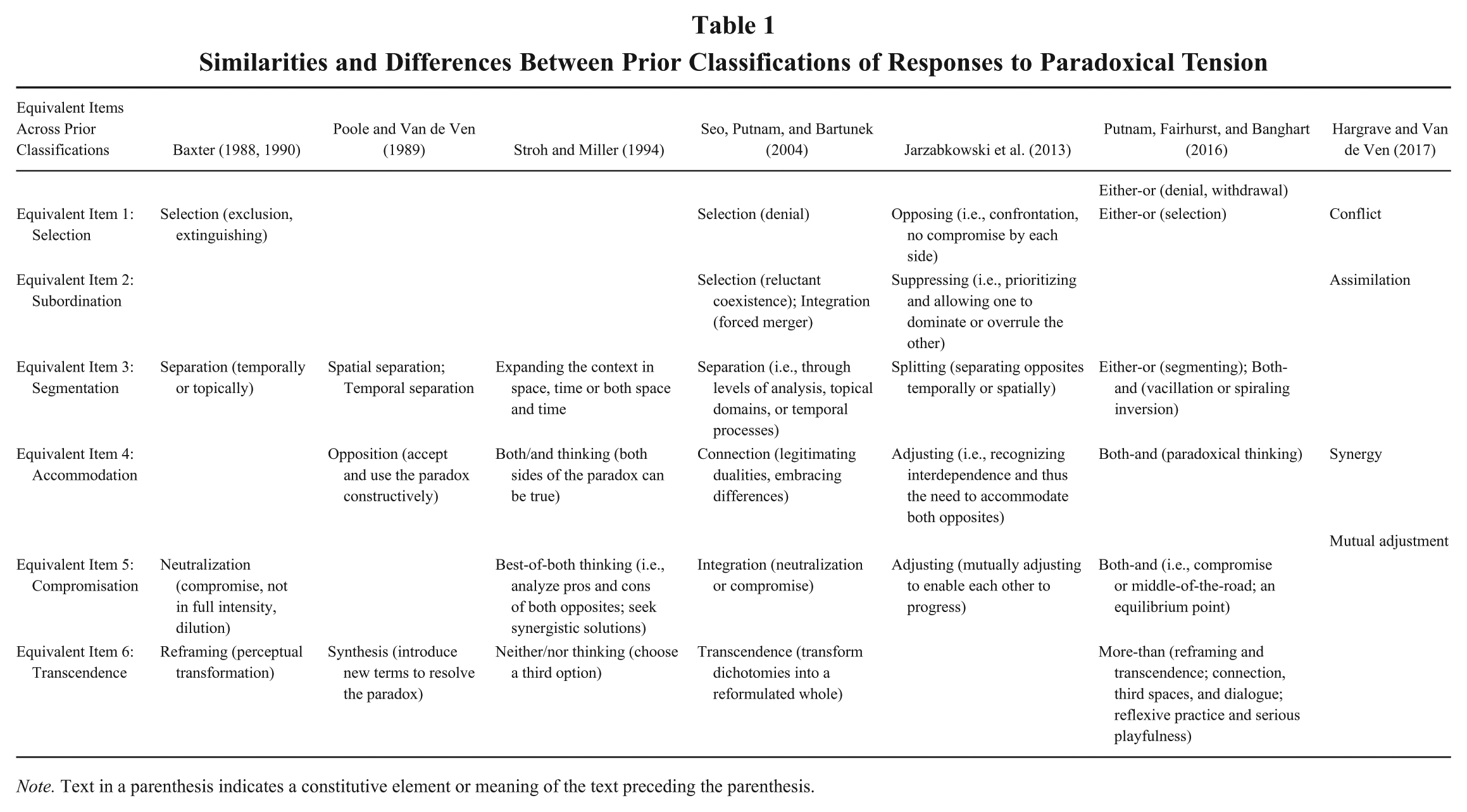
Note. Text in a parenthesis indicates a constitutive element or meaning of the text preceding the parenthesis.
Methodology of Typology Building
Substruction-Based Typology Building
There are three approaches to building typology: intensional classification, extensional classification, and substruction of a property space (Marradi, 1990).
Intensional classification is an intellectual operation of subdividing a concept at a given level of generality into two or more lower-level concepts, based on the criterion that an aspect of the intension of each lower-level concept is a partial articulation of the corresponding aspect of the intension of the higher-level concept. Extensional classification is an operation of grouping the objects or events of a given set into two or more subsets of wider extension based on the perceived similarities of their states on one or more properties. Substruction, as Lazarsfeld (1937: 132) defined it, is “the procedure of finding, for a given system of types, the attribute space in which it belongs and the reduction which has been implicitly used.” Lazarsfeld demonstrated how a complete property space and typology can be substructed from “an impressionist classification” (p. 133) that is often incomplete and casually derived from empirical observations without rigorous logical or theoretical reasoning.
As Marradi (1990: 143) points out, Substruction is a useful intellectual tool because many students propose lists of types without explicating the fundamenta divisionis: such fundamenta have to be inferred by other students who, so to say, extract them from the intensions of the types as described.
Given that the current state of the organizational paradox literature resembles the situation described by Marradi, the substruction approach stands out to be an effective and suitable approach to typology building in the present study.
The Latin phrase fundamenta divisionis means criteria for division of a higher-order concept (e.g., type of business organization) into lower-order elements (e.g., nonprofit, not-for-profit, and for-profit). While the common practice of substruction is to infer or extract fundamenta from the intensions of the existing types, I have slightly adapted this approach by inferring fundamenta from the modes of thinking or thinking patterns underlying the identified equivalent items as distinct responses to paradoxical tensions. This is inspired by Smith and Berg’s (1987b: 649) viewpoint that “experiences of conflict [may be] an expression of our thinking patterns and the process of transforming conflict demands therefore a shift in our modes of thinking.”
Clearly, from the above literature review, we can see that the ambidexterity approach is neither purely both/and nor purely either/or, but is a mixture of the two; the same is true for the Zhong-Yong approach that prescribes middle way as being a mixture of both/and and neither/nor. Furthermore, while the mainstream prescribes both/and strategies, Putnam et al. (2016: 128) endorse “more-than responses” that are neither either/or nor both/and. However, Putnam et al. fall short of explaining the underlying thinking of such more-than responses. I argue that explicating the distinctions and commonalities between ambidexterity, Yin-Yang balancing, Zhong-Yong, transcendence and others necessitates a typology that can reveal the underlying thinking patterns of existing and potential strategies for simultaneously engaging paradoxical opposites.
Such a typology can be developed by combining three basic or elementary (non-composite) modes of thinking—either/or, both/and, and neither/nor—in a two-dimensional matrix. 2 In fact, one of the dimensions of Hargrave and Van de Ven’s (2017) typology, that is, “the sensemaking approach to contradiction” (either/or resistance vs. both/and acceptance), can be interpreted as the mode of thinking. Likewise, one of the dimensions of Berti, Simpson, Cunha, and Clegg’s (2021) typology or coordinate system, that is, “strategy to deal with paradox” (split/either-or vs. integrate/both-and vs. reframe/more-than), can also be associated with the mode of thinking. In Figure 1, the three basic modes of thinking are placed on both vertical and horizontal axes to form a 3 × 3 matrix, 3 resulting in nine combinative modes of thinking or thinking patterns.
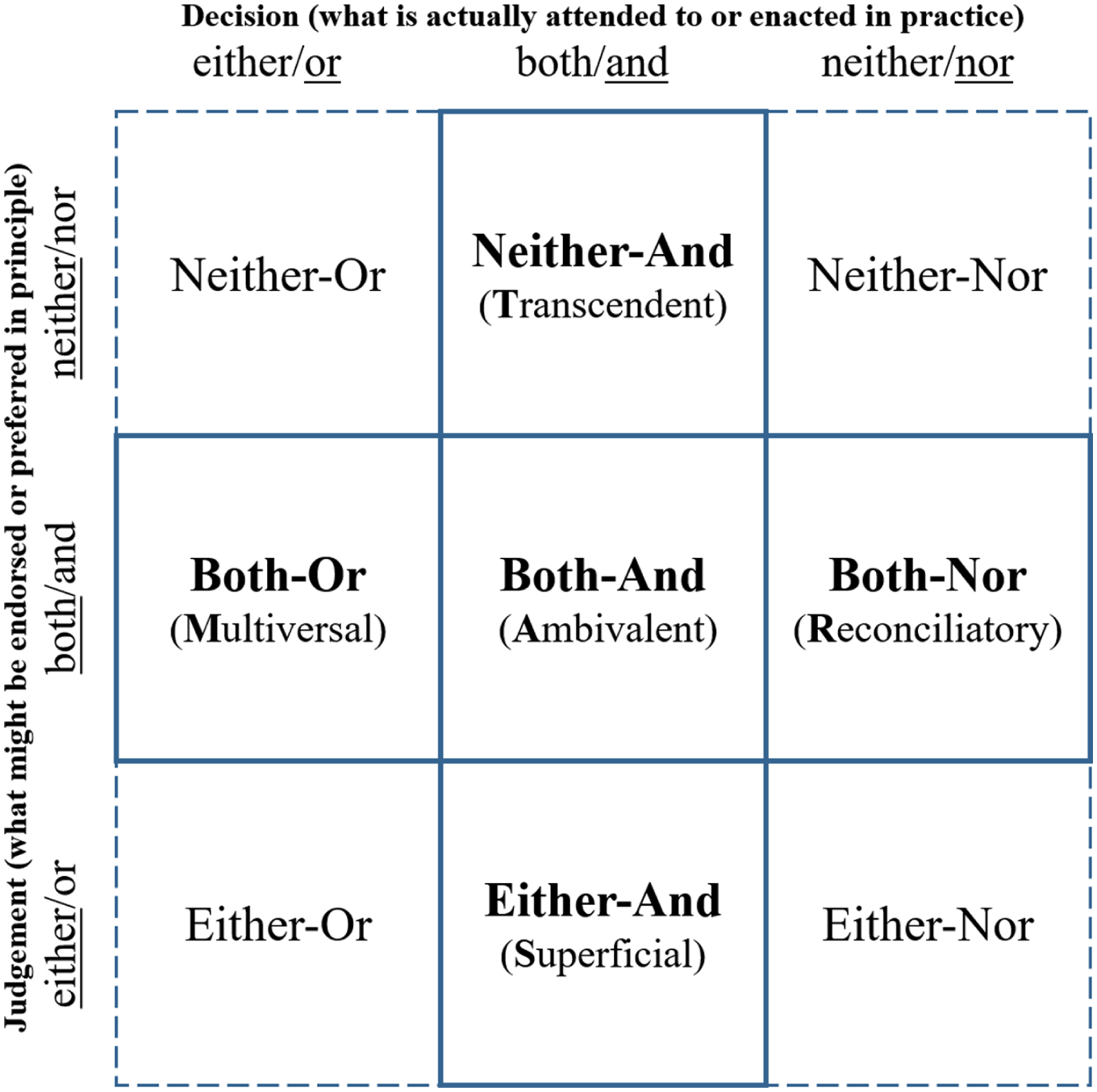
Nine Combinative Modes of Thinking, Including Five Variants of Both/And Thinking
Contrasting Judgment and Decision as Dimensions
A central methodological concern in typology construction is the selection of dimensions that are conceptually distinct, theoretically grounded, and empirically meaningful (Doty & Glick, 1994). To understand how individuals and organizations cognitively and behaviorally cope with paradoxical tensions, this study adopts judgment and decision as the two structuring dimensions. Together, they offer a nuanced framework for examining the interplay between internal orientation and external action in paradox navigation.
The distinction between judgment and decision is foundational in cognitive and behavioral sciences. Judgment refers to the evaluative process through which individuals form beliefs, preferences, or endorsements—often under conditions of uncertainty (Baron, 2024; Kahneman & Tversky, 1979). It is internal, reflective, and normative. Decision, by contrast, involves selecting a course of action, typically in response to contextual demands or strategic considerations (Gigerenzer & Gaissmaier, 2011; Simon, 1955). It is external, behavioral, enacted, and situated.
It is widely recognized that while judgment informs decision-making, it does not always determine it (Evans & Stanovich, 2013; Festiger, 1957); individuals may act contrary to their stated beliefs due to contextual pressures, interpersonal dynamics, emotional influences, or strategic constraints. This is reflected in Hargrave and Van de Ven’s (2017: 329) idea of “decoupling sensemaking from action and treating them as independent” and Gaim, Clegg, and Cunha’s (2019: 16) notion of the thinking-practicing gap, or “the gap between thinking about paradox and practicing paradox.” This typology captures such divergence by defining judgment as what might be endorsed or preferred in principle, and decision as what is actually attended to or enacted in practice.
These definitions allow for divergence between belief and behavior, accommodating the diversity of paradox navigation across individuals and organizations and reflecting the hybridity, ambivalence, and pragmatism often presented in coping strategies. For example, in managing the paradox of global integration versus local responsiveness, a multinational corporation may endorse both principles (judgment) yet attend primarily to global integration due to resource constraints (decision); and, alternatively, it may prefer local responsiveness but engage with both demands for pragmatic reasons.
From a typological perspective, the judgment–decision pair offers several advantages. First, conceptual clarity: the dimensions are orthogonal and non-redundant, reducing classification ambiguity. Second, analytical depth: the framework captures both belief systems and behavioral strategies, enabling richer interpretation. Third, contextual flexibility: it accommodates variation across individuals, organizations, and cultural settings. Fourth, empirical nuance: it identifies cases of inconsistency, such as when actors act contrary to their preferences due to external constraints or evolving priorities.
The judgment–decision distinction is particularly valuable in paradoxical contexts, where actors may simultaneously hold conflicting values and enact complex strategies. It enables the typology to capture not only what actors value, but also how they navigate tensions in practice—whether through segmentation, accommodation, transcendence, or other coping strategies. By distinguishing internal orientation from external execution, this framework offers a dynamic and psychologically resonant lens for understanding paradox navigation.
Naming the Types Distinctly and Making the Abstract Tangible
The combinative modes of thinking associated with the three cells on the diagonal line from bottom left to top right in Figure 1 should correspond to the three basic modes of thinking since they are combinations of identical basic modes of thinking. To differentiate these combinative modes from the basic ones, slashes are used for the basic modes (e.g., both/and) and hyphens for the combinative modes (e.g., Both-And). Mirror-image combinations lie on both sides of the diagonal, such as the combination of {either/or, both/and} and that of {both/and, either/or}. To distinguish these potentially identical combinations, I label the combinative thinking patterns in a particular way. First, I choose to name the combinative thinking patterns by combining the first word (underlined) of the corresponding basic mode of thinking on the vertical axis and the second word (underlined) of the corresponding basic mode of thinking on the horizontal axis. Second, the two chosen (underlined) words are connected by a hyphen. Third, I capitalize the first letter of each of the two chosen words.
As a result, nine distinct types of combinative thinking patterns are named as Either-Or, Either-And, Either-Nor, Both-Or, Both-And, Both-Nor, Neither-Or, Neither-And, and Neither-Nor. To render the abstract matrix of thinking patterns more tangible, I associate a familiar or known idea with each of the nine cells in the matrix. As this paper focuses on strategies for simultaneously engaging both paradoxical opposites, I am primarily concerned with the five cells located between the four corner ones, since only these contain both/and as a constituent element. Wherever feasible, I attempt to link each of the five cells with an existing response to paradoxical tension. Interestingly, the five non-either/or equivalent responses shared across prior classifications align neatly with these five cells, which helped me identify the defining features of the five non-corner cells. These are indicated by the five adjective words in parentheses in Figure 1.
A Typology of Both/And Thinking and Strategies for Paradox
The five non-cornered cells in Figure 1 can be viewed as five nuanced variants of the basic both/and thinking. In the past, these variants have often been treated uniformly as a single, unitary concept of both/and. Here, I explain the features of each of these variants and those strategies underpinned by each variant. I also use the profitability-responsibility tension as a running example to demonstrate how each of the five variants enables one to simultaneously engage paradoxical opposites.
Either-And
The Either-And thinking combines either/or in its judgment aspect and both/and in its decision aspect. Either/or thinking may arise from a lack of awareness of the dialectic nature of the relationship between two paradoxical opposites—that is, one might only perceive conflict between the opposites or focus on the conflict to the exclusion of the synergy between them. Since the relationship between the opposites is judged as either/or in this case, the decision to attend to or enact both/and is likely to be reluctant, motivated primarily by external expectations or pressure. As a result, the balance between the paradoxical opposites attempted tends to be superficial, achieved by satisficient arrangement or spurious compliance.
The word “satisficient” is derived from the term “satisficing,” coined by Nobel-winning economist Herbert Simon (1956) to describe a behavioral pattern where decision-makers often stop searching for optimal or maximizing solutions once they have found a sufficiently satisfactory option. When facing paradoxical tension between two opposites, a decision-maker operating within an either/or cognitive framework, yet wishing to meet external expectations or pressure, is likely to prioritize the preferred pole while ensuring a minimal level of attention to the other. This approach aligns with the previously discussed equivalent item of the “subordination” response, allowing the undesired pole to be subordinated to the preferred one. This satisficient arrangement strategy is reflected in Buckley and Casson’s (2019: 1433) idea about how to cope with multiple objectives, namely, “the decision-maker maximises the value of one target [e.g., growth] subject to a constraint that some other target [e.g., paying workers a minimum wage] must be met.”
Spurious compliance is enacted when action is taken to satisfy or comply with the undesired pole in an inauthentic or even fraudulent manner. There are two key differences between spurious compliance and satisficient arrangement. First, in satisficient arrangement, the lesser opposite is unprivileged but not necessarily undesired, while in spurious compliance, the lesser opposite is actively undesired. Second, while satisficient arrangement involves reluctant attention to or satisfaction of the unprivileged pole, this attention remains genuine; in contrast, in spurious compliance, the attention is not genuine but rather inauthentic or even fraudulent. An example of inauthentic compliance is when some organizations treat equality, diversity, and inclusion (EDI) merely as a checkbox exercise—something they can report as being done without any actual, concrete changes or outcomes being required (Bryant, 2023). An example of fraudulent compliance is the 2015 Volkswagen emissions scandal, where the carmaker was found to have installed software in their diesel cars that allowed them to deceive and pass U.S. Environmental Protection Agency’s emissions tests, despite their actual Nitrogen Oxide emissions being about 40 times higher than the permitted level in the United States (Hotten, 2015).
Both-Or
The Both-Or thinking combines both/and in its judgment aspect and either/or in its decision aspect. The inconsistency between one’s cognitive mindset and behavioral choice in this case may be caused by a lack of motivation and/or capability to resolve the conflict between the two paradoxical opposites. As such, the balance between opposites is likely to be achieved by arranging both opposites as if they exist in multiple parallel universes. “Multiversal” is derived from the concept of the multiverse (i.e., multiple universes), a quantum physics idea suggesting that some counter-intuitive or paradoxical phenomena can be understood as existing in multiple parallel universes. I use the term “multiversal” to describe the feature of Both-Or thinking and strategies, which corresponds to the previously mentioned equivalent item of “segmentation.”
The ambidexterity response reflects the multiversal Both-Or thinking and strategy. The literature distinguishes two types of organizational ambidexterity: structural and contextual (Gibson & Birkinshaw, 2004; Tushman & O’Reilly, 1996). As X. Li (2019) argues, although contextual and structural ambidexterity approaches differ in terms of the level at which ambidexterity is executed—with the former occurring at the individual level and the latter at the organizational level—they are similar in how ambidexterity is implemented, that is, by separating the two opposites into either spatial or temporal segments. X. Li characterizes the thinking pattern of the ambidexterity response as a blend of both/and at the macro level and either/or at the micro level.
Likewise, contingency theory also manifests the multiversal Both-Or thinking, legitimizing one opposite or the other under different conditions or contingencies. As such, contingency theory is also both/and at the macro level but either/or at the micro level. As discussed earlier, while Smith and Lewis (2011) initially downplayed the contingency approach, they later acknowledged that the complexity and dynamics of paradoxical issues “may require both paradox theory and contingency theory approaches” (Schad et al., 2016: 47), without specifying the interrelationship between contingency theory and paradox theory. Here, by unveiling the multiversal Both-Or thinking within contingency theory, I clarify the subtle difference between contingency theory that legitimizes segmentation and Smith and Lewis’s (2011) “paradox lens” that emphasizes engaging paradox by separating and integrating.
Both-And
The Both-And thinking is characterized by the adoption of both/and in both its judgment and decision aspects. While Both-And and both/and may seem and sound identical, they should not be treated the same for two reasons. First, as explained earlier, Both-And is just one of five lower-order variants of both/and. Second, engaging both paradoxical opposites is challenging, so the Both-And approach should be seen as a desire and/or attempt to achieve the ideal of both/and, rather than an actual achievement of it. As such, the Both-And approach to engaging paradoxical opposites is likely to be ambivalent rather than genuinely ambidextrous. By “genuinely ambidextrous,” I mean fully integrating both opposites in the same space and at the same time, which is not required by the notion of ambidexterity in the management and organizational studies literature (Gibson & Birkinshaw, 2004; Tushman & O’Reilly, 1996). Unlike Either-And and Both-Or, the ambivalent Both-And approach treats both opposites equally, without a priori preference for either, and does not segment them. The aforementioned equivalent item of the “accommodation” response can be associated with the Both-And thinking, as it seeks to accommodate both opposites on equal footing.
Chinese Yin-Yang thinking is often associated with the notion of both/and. For instance, Smith and Lewis (2011) use Yin-Yang imagery to symbolize their “paradox lens.” With an emphasis on engaging paradox by both separating and integrating, Smith and Lewis’s approach of “dynamic equilibrium” combines distinct individual responses, and therefore, it is not considered a generic strategy. P. Li’s (2016) “Yin-Yang balancing” is essentially a ratio-based compromise or middle way response (X. Li, 2018) rather than a Both-And strategy. Figuratively speaking, the Yin-Yang symbol has two visible features (cf. Fang, 2012). One is that the yin and yang elements are mutually embedded (indicated by a yin element in the yang part and vice versa), making their boundaries blurred and generating a sense of ambiguity. The other is that the yin and yang opposites are depicted as dark and bright parts, implying that the yang part is visible/explicit, while the yin part is invisible/implicit. Therefore, an ambivalent Both-And thinking and strategy may embrace ambiguity or amalgamation.
In the face of paradoxical tensions between opposing forces, some individuals may deliberately employ ambiguous language to invite flexible interpretations that accommodate both sides. The essence of Gümüsay and colleagues’ (2020) notion of organizational polysemy entails using ambiguous words to allow flexible interpretations to be made by an organization’s stakeholders. Ambiguity may also arise from engaging both opposites equally by alternating between them, suggesting uncertainty or indecision about how to address the tension between opposites.
Some people may show less ambiguity when they attempt to amalgamate the opposites, either by affirming both as legitimate and valuable without taking concrete action, or by arranging or allowing them to coexist in an antithetical relationship, sometimes in a manner where one is yang/explicit and the other yin/implicit. A case in point is Huawei. Long before the U.S. government placed Huawei on its “Entity List” in May 2019—which banned the company from purchasing products and services from American companies such as Qualcomm and Google—Huawei had anticipated an inevitable clash with the United States. Accordingly, it proactively implemented a Plan B strategy by covertly developing its own operating system and mobile phone chips. Notably, despite executing Plan B, Huawei’s top leadership was still willing to rely on U.S. suppliers. Ren Zhengfei, Huawei’s founder and CEO, stated, “Despite the much lower costs of our own chips, I would still buy higher-priced chips from the US” (Huawei, 2019).
Both-Nor
The Both-Nor thinking combines both/and in its judgment aspect and neither/nor in its decision aspect. The inconsistency between one’s cognitive mindset and behavioral choice here may stem from a desire for integration, rather than segmentation as seen in Both-Or thinking, alongside a spirit of pragmatism. Such pragmatism would lead a decision maker to support both opposites only partially, rather than fully, yet without a priori preference for either. As a result, the balance attempted and achieved between paradoxical opposites is likely to be neutralized, compromised, or reconciled. The aforementioned equivalent item of the “compromisation” response and the Zhong-Yong middle way strategy align with the reconciliatory Both-Nor thinking, because both involve a compromise or reconciliation between two opposites. In other words, a reconciliatory Both-Nor strategy seeks to embrace both opposites, but neither is fulfilled in its entirety.
To pursue reconciliation between paradoxical opposites, one can retain components from each opposite to form a neutralized or compromised solution that partially satisfies both poles. The paradox literature presents two alternative approaches to such reconciliation: “Yin-Yang balancing” (P. Li, 2016) and “Zhong-Yong” (X. Li, 2018), or so called “middle ground” (Leung et al., 2018), respectively. In Yin-Yang balancing, the two opposites are combined as components of a compromised solution according to a negotiated ratio (Lin et al., 2015). In contrast, in Zhong-Yong middle way, operationalized as “analysis plus synthesis” (X. Li, 2018), the compromise is achieved through reasoning, meaning that only those components of both opposites deemed relevant will be selected and mixed (Li et al., 2019).
The ratio-based “Yin-Yang balancing” is similar to Seo and colleagues’ (2004: 76) “compromised and diluted” solution. The relevance- or reason-based Zhong-Yong resembles Stroh and Miller’s (1994) “best-of-both thinking,” which involves “inquiring into both the positive and negative qualities of opposites to develop a synergistic solution” (Belasen, 2000: 315-316). With regard to balancing legitimacy and distinctiveness, both Brewer’s (1991) and Deephouse’s (1999: 147) solutions align with the ratio-based approach to reconciliation, that is, “intermediate levels of strategic similarity,” while Zhao and colleagues’ (2017: 102) optimal distinctiveness solution follows the relevance- or reason-based approach—namely, analyzing firm strategy on multiple dimension and configuring different dimensions to achieve legitimacy and differentiation simultaneously, the mechanism being “deviation on one dimension can be compensated by a legitimacy gain on a different dimension.”
Many companies adopt a ratio-based compromise strategy for managing their innovation portfolios to balance exploitation and exploration (March, 1991). According to Nagji and Tuff (2012), firms pursue innovation across three domains: their core businesses, adjacent business areas, and entirely new territories. High-performing firms tend to allocate innovation resources following a specific pattern: approximately 70% to enhancements of their core businesses, 20% to exploring adjacent opportunities, and 10% to high-risk, transformational ventures in new territories.
An example of relevance- or reason-based compromise can be found in Gulati and Garino’s (2000) discussion on how to achieve the right mix of bricks (traditional business) and clicks (e-commerce). They suggest that by “carefully considering which aspects of a business to integrate and which to keep distinct, companies can tailor their clicks-and-mortar strategy to their unique market and competitive circumstances, significantly improving the likelihood of e-business success” (2000: 113). Specifically, they recommend evaluating four business dimensions—brand, management, operations, and equity—when deciding the degree of integration. They illustrate this strategy with three case studies, each demonstrating different levels of integration across the four dimensions.
Neither-And
The Neither-And thinking is characterized by neither/nor in its judgment aspect and both/and in its decision aspect. This type of thinking allows one to break free from the limitations imposed by the two opposites, embracing a broader conceptual or cognitive space within which the paradoxical opposites coexist. As a result, the balance attempted and achieved between these opposites is likely to be transcendent, introducing a third element that, while not aligning with either of the opposites, has the potential to unite both. The aforementioned equivalent item of the “transcendence” response clearly exemplifies the Neither-And thinking, as it transcends the opposites by introducing a third element that underlies or unifies both.
Examples of Neither-And solutions to paradox are rare in the management and organization studies literature, with Song (2025) providing a notable exception. Song examines how Korean Buddhist monks cope with the paradoxical tension between the need to engage in business activities to finance their temples and the spiritual values that renounce money. He identifies two key cognitive mechanisms through which the monks dissolve this tension. First, they engage in a daily routine of silence that serves as a mental buffer, enabling them to switch between their religious and business roles and redirect attention away from the external world and toward the inner mind. Second, the sustained practice of deep silence cultivates a skepticism toward language, prompting doubt about preexisting linguistic categories (such as “business” and “religion”), boundaries, and contradiction. As this skepticism leads the monks to relinquish these contradictory concepts, they begin to experience a state of emptiness in the mind in which the paradox and its associated tension no longer appear. In Song’s Buddhist mindfulness view of paradox, this skepticism toward preexisting concepts exemplifies the neither/and element of the Neither-And strategy, while the notion of emptiness can be linked to the both/and element. In Buddhist thought, emptiness and dependent co-arising are two sides of the same coin, which holds that phenomena, devoid of intrinsic essence (i.e., emptiness), emerge only in dependence upon multiple causes and conditions, rather than as isolated or independent entities.
To understand transcendence in a more intuitive way, one can think of observing objects by zooming in or out. If we continuously zoom out, the distinction between two objects (e.g., the opposite hemispheres of the Earth) will gradually become blurred and eventually disappear, as the two objects combine and become too small to be clearly seen. Even the entire Earth would appear as just a pale blue dot in an image taken from 4 billion miles away 4 —and all the distinct (or opposite) objects around us would merge into a unified whole on a higher level or larger scale. Conversely, if we continuously zoom in, the distinction between all objects would gradually vanish, as they are all composed of the same fundamental elements such as atoms, quarks, or strings.
To transcend or go beyond paradoxical opposites, one can introduce a thirdness that underlies or unifies both. Taking the rigor versus relevance tension in management and organization studies as an example, someone with transcendent or transformative Neither-And thinking might argue that what is most important to scientific research is neither rigor nor relevance, but beauty. For instance, Murray Gell-Mann, a Nobel laureate in physics who introduced the concept of quarks, believed that beauty or elegance was a key criterion in choosing a correct theory in fundamental physics. 5 The Neither-And thinking is also reflected in the study of the wave-particle paradox of light. Light was once considered to be both a wave and a particle—two mutually exclusive opposites. However, many physicists later realized that light “is like neither [wave nor particle]” (Feynman, Leighton, & Sands, 1963: 37-1, italics in original). Scientists have yet to agree on what light truly is (Ananthaswamy, 2023). It is likely that a new theory, which could be accepted by most scientists, would propose that light is something (a thirdness) that transcends and unites both wave and particle.
Applying the SMARTTypology: A Focused Illustration
As a way to summarize this section, I use the profitability versus responsibility tension as a running example to illustrate how each of the five variants can enable an actor to simultaneously engage paradoxical opposites.
First, a decision maker with superficial Either-And thinking would likely prioritize profitability as the organization’s main goal, treating corporate social responsibility (CSR) as a secondary objective. As such, they would aim to maximize profitability once a minimal or sufficiently satisfactory level of CSR has been achieved. Valente (2017: 95) refers to this as a defensive strategy for CSR, where the “overarching objective is to continue business as usual but with minor adjustments to respond to upcoming regulations or consumer pressure.” Valente identifies two common responses in this defensive strategy. One is conducting philanthropic activities to defend their current operations, allowing companies to claim that they are at least redistributing some of their profits to causes that mitigate the negative effects of their businesses. The other is targeting the “low-hanging fruit,” that is, making relatively easy changes that provide a business case for CSR efforts.
Second, a decision maker with multiversal Both-Or thinking would likely divide the organization into two distinct parts: one focused on pursuing profit and the other dedicated to CSR. In Scandinavian countries, many large corporations establish independent foundations to manage CSR activities. For example, the Danish Carlsberg Foundation, the principal shareholder of the brewer Carlsberg, is an enterprise foundation that annually grants more than 800 million Danish Kroner to support basic research and other philanthropic initiatives. 6
Third, many social enterprises are created and driven by ambivalent Both-And thinking, where profitability and CSR are integrated. A prime example is OpenAI’s unique organizational structure, which combines its original nonprofit entity, established in 2015, with a for-profit subsidiary created in 2019. According to OpenAI’s official website, 7 “The for-profit would be legally bound to pursue the Nonprofit’s mission, and carry out that mission by engaging in research, development, commercialization and other core operations.”
Fourth, a decision maker with reconciliatory Both-Nor thinking may set a profit level that is neither too high nor too low, ensuring that their company can survive and thrive in a socially responsible manner. An example of such reconciliatory Both-Nor thinking is the design of OpenAI’s capped-profit model, which places limits on returns on investments, allowing the organization to reconcile and balance its purpose with profit.
Lastly, a decision maker with transcendent Neither-And thinking may argue that the purpose of doing business is neither solely making profit nor fulfilling social responsibilities, but rather pursuing self-perfection. For some, self-perfection is the meaning of life, and it can be pursued through various activities, including running a business (X. Li, 2025). To perfect oneself, a person—whether a business owner or an employee—must refine their job skills, as one’s self or identity is partly defined and shaped by what they do at work. If everyone in an organization strives for (self-)perfection in their roles, they will undoubtedly produce products or services responsibly, which, in turn, will help the business generate profits. These profits could then enable the business to hire more people and/or invest in further research and development (R&D) activities, ultimately benefiting society as a whole. The rise of Pangdonglai, a provincial Chinese supermarket chain, serves as a vivid illustration of this (The Economist, 2024).
Discussion and Conclusion
This paper makes three contributions to the literature. First, it clarifies the complex thinking patterns that underlie various approaches and responses to paradoxical tensions. These patterns are conceptualized as distinct combinations of three basic modes of thinking: either/or, both/and, and neither/nor. While prior literature has extensively examined either/or and both/and logics in the context of paradox, the integration of neither/nor thinking—often associated with negation, suspension, or transcendence—adds a novel dimension to the cognitive repertoire available to individuals who are navigating paradox.
By analytically distinguishing between the judgment dimension (what might be endorsed or preferred in principle) and the decision dimension (what is actually attended to or enacted in practice), and by treating these as orthogonal rather than conflated, this paper identifies nine distinct patterns of complex thinking. This typology reveals a previously underexplored microstructure of human cognition, offering a more granular and dynamic account of how individuals engage with paradoxical tensions in both thought and action.
Understanding this microstructure yields several theoretical benefits: (a) it enables scholars to move beyond binary or dialectical models of paradox resolution, toward a more nuanced framework that accommodates diverse patterns of thinking; (b) it provides a cognitive basis for explaining behavioral variability in paradox navigation—why individuals may endorse integrative thinking yet act in exclusionary ways, or vice versa; and (c) it opens new avenues for empirical research by offering a structured lens through which to observe and code cognitive responses to paradox in interviews, surveys, and experimental designs.
Moreover, this microstructure aligns with emerging interest in meta-cognition and cognitive complexity in organizational behavior (Lord & Hall, 2005; Tetlock, 1983). It suggests that paradox navigation is not merely a matter of strategic choice or emotional regulation, but also of cognitive architecture—how individuals mentally configure and reconcile competing logics. By illuminating these configurations, the paper contributes to a richer understanding of paradox as a lived cognitive experience, not just a theoretical abstraction.
Second, this paper develops a typology of generic strategies for simultaneously engaging paradoxical opposites. It decomposes the widely revered concept of both/and thinking, which has traditionally been treated as a unitary construct in paradox literature. By unpacking the “black box” of the term both/and into a set of distinct strategic orientations, the paper introduces the SMART framework—a parsimonious yet comprehensive typology that captures the diversity of approaches individuals and organizations use to engage paradoxical tensions.
Building on and extending prior classifications of paradox responses, the typology developed here categorizes strategies into five generic modes: superficial Either-And, multiversal Both-Or, ambivalent Both-And, reconciliatory Both-Nor, and transcendent Neither-And. The SMART framework’s theoretical innovation lies in its ability to clarify the underlying logic of paradox engagement. Rather than viewing both/and as a singular cognitive stance, the framework reveals it as a repertoire of strategic responses, each with its own assumptions, mechanisms, and implications.
Practically, the SMART framework equips individuals and decision-makers with a diagnostic tool for selecting and combining strategies that best fit the specific paradoxical tensions they face. It acknowledges that paradox navigation is rarely static or singular; individuals often employ multiple strategies in tandem or in sequence, depending on contextual demands and cognitive preferences. This insight aligns with recent calls for more nuanced, process-oriented approaches to paradox management (Putnam et al., 2016), and supports the development of paradoxical competence as a dynamic capability (Teece, 2007). Hence, the SMART framework enhances our understanding of how paradoxes are navigated in practice, especially in complex organizational settings where multiple tensions coexist and evolve over time (Fairhurst & Putnam, 2024).
Third, this paper applies and enriches the method of substruction-based typology building. While Rich (1992: 758) argues that classification provides “a basis for [midrange] theory development and hypothesis testing,” typology developers have faced criticism for creating simplistic classification systems rather than advancing theories. In response to these criticisms, Doty and Glick (1994: 230) argue that “typologies meet the criteria of a theory. When typologies are properly developed and fully specified, they are complex theories that can be subjected to rigorous empirical testing using the quantitative models we develop.” Echoing Doty and Glick, Delbridge and Fiss (2013: 329) highlight that typology building is “a special form of theorizing that offers a number of advantages” and that “some of the most memorable contributions in management are typologies.”
In my view, a typology in itself may not be treated as a theory, but it may be very valuable and needed in many research contexts, and typology-driven theorizing (cf. Cornelissen, 2017; Sandberg & Alvesson, 2021; Snow and Ketchen, 2014) can indeed generate theories. While “the decline of typological theorizing” over time in elite journals is “quite evident” (Delbridge & Fiss, 2013: 329), there has recently been a resurgence of interest in typology-based theory building (e.g., Feldman & Hernandez, 2021; Hirschi, Shockley, & Zacher, 2019; Lau & Shaffer, 2021; Leslie, 2019). However, while these works have produced excellent outputs, they do not provide sufficient guidance on the methodology of typology building. In response to the call for more typological theorizing (Delbridge & Fiss, 2013; Snow & Ketchen, 2014), I apply and demonstrate the effectiveness of the methodology of “substruction of a property space,” which was developed long ago by Lazarsfeld (1937) but has seldom been applied in management and organizational scholarship. In terms of procedure, I have slightly adapted the substruction methodology by inferring fundamenta divisionis from the thinking patterns rather than from the intensions of existing approaches to paradoxical tensions. Additionally, my procedure differs slightly from Lazarsfeld’s original method in that I did not base my theorizing on a single impressionist typology. Instead, I collected several loose classifications, compared and contrasted them against one another, and induced a list of equivalent items of distinct responses (types) from which I built my own typology. In this way, my work has enriched the substruction methodology of typology building.
In conclusion, I identify four avenues for future research. First, a key limitation of the present study lies in its descriptive orientation: while it identifies a typology of generic strategies for engaging paradoxical opposites simultaneously, it does not explicate the decision-making processes that guide the selection, combination, or transition between these strategies. Future research should investigate the antecedents and contingencies that influence strategic choice—such as cognitive framing, emotional regulation, organizational context, and temporal urgency (Hahn, Preuss, Pinkse, & Figge, 2014).
Moreover, future studies could explore the dynamic sequencing of strategies—how individuals or organizations shift from one mode to another over time, and what triggers such transitions. This line of inquiry aligns with recent calls for processual approaches to paradox navigation (Putnam et al., 2016) and could benefit from longitudinal designs or experimental methods that capture real-time decision-making under paradoxical conditions.
Importantly, this research agenda should also examine the “dark side” of simpler strategies. While strategies such as spurious compliance or segmentation or alternation may offer short-term relief by postponing the need for addressing the paradoxical tensions, they risk becoming routinized and inertial over time. Once institutionalized, these strategies may inhibit deeper integration or transformation, leading to strategic rigidity and cognitive lock-in (Audia, Locke, & Smith, 2000; Miller, 1993). For example, a manager who habitually alternates between competing demands may become resistant to synthesis, even when integration becomes feasible or necessary. This inertia can be exacerbated by organizational norms, incentive structures, or psychological comfort with familiar routines.
Furthermore, the persistence of suboptimal strategies may generate pathologies of paradox, such as disempowerment, confusion, or burnout—especially when individuals feel trapped in contradictory expectations without legitimate avenues for resolution (Berti & Simpson, 2021; Julmi, 2021). These dynamics underscore the need for future research to examine not only the efficacy but also the long-term consequences of paradox strategies, including their potential to entrench dysfunction or suppress innovation.
Second, while the SMART framework is grounded in organizational paradox literature, its logical structure lends itself to wide application, as the logical structure of the generic strategies for managing tensions is the same across different levels. Essentially, they all boil down to how decision makers—whether at the level of a country, an organization, a family, or as individuals—approach paradoxical tensions that come to their attention.
At the individual level, paradoxes such as work versus family and passion versus money reflect deeply personal dilemmas that require strategic navigation. Research on identity conflict and role strain (Ramarajan, 2014) suggests that individuals often oscillate between competing commitments, and the SMART framework could offer a structured lens to examine how people cognitively and behaviorally manage these tensions over time.
At the organizational level, classic paradoxes such as exploitation versus exploration (March, 1991), control versus collaboration (Sundaramurthy & Lewis, 2003), competition versus cooperation (Chen, 2008), and stability versus change (Farjoun, 2010) have been extensively theorized but often treated in isolation. The SMART framework enables a comparative analysis of how different organizations engage these tensions using similar strategic logics, potentially revealing patterns of paradoxical competence or dysfunction across industries and sectors.
At the national level, tensions such as plan versus market and efficiency versus equality reflect macro-level paradoxes that shape policy debates and institutional design. Scholars in political economy and public administration could apply the SMART framework to analyze how governments reconcile competing imperatives, such as fostering innovation while ensuring social protection, or promoting competition while maintaining regulatory oversight (Rodrik, 2007).
Future research could explore how the same strategic repertoire manifests differently across levels—for example, how multiversal segmentation at the individual level (e.g., time-sharing between roles) compares to multiversal segmentation at the national level (e.g., phased policy implementation). Such inquiry would contribute to a more unified theory of paradox management, bridging micro and macro perspectives and enriching our understanding of paradox as a universal feature of decision-making.
Third, future research can delve deeper into the internal compositions of the SMART strategies by decomposing each component into more granular sub-components. Analogous to the way physicists explore the subatomic structure of particles to uncover fundamental forces, scholars of paradox can investigate the microstructure of SMART strategies to reveal the nuanced logics and mechanisms that underlie each variant.
In the literature review and typology sections of this paper, multiple empirical and conceptual examples were associated with each variant. These examples suggest that each strategy is not monolithic but rather comprises a constellation of sub-strategies and tactics. For instance, multiversal Both-Or may include temporal, spatial, domain, and condition segmentations, while transcendent Neither-And may involve metaphorical reframing, humor, or perspective shifting. Future research could systematically sort these examples and identify recurring patterns, thereby constructing a second-order typology within each SMART category.
Such decomposition offers several theoretical benefits. First, it enhances conceptual precision, allowing scholars to distinguish between superficially similar responses that may operate through fundamentally different mechanisms. Second, it facilitates comparative analysis across contexts, enabling researchers to examine which sub-strategies are more effective under specific conditions or in particular domains. Third, it opens the door to formal modeling of paradox navigation, where logical interrelationships among sub-components can be mapped, tested, and simulated.
Lastly, an important avenue for future research concerns the theoretical and practical relevance of the four corner cells in Figure 1 that were not addressed in the preceding discussion. While paradox theory has largely centered on both/and thinking as the ideal response to persistent tensions, recent scholarship has begun to challenge this equilibrium-preservation assumption. Berti and Cunha (2023: 866) argue that “adoption of ‘both-and’ solutions in face of paradoxes is not always possible, nor desirable,” highlighting the limitations of assuming that integration is universally feasible or normatively superior. Their critique opens space for reconsidering either/or and neither/nor logics as legitimate—if contextually constrained—responses to paradox (X. Li, 2021b). For example, Krautzberger and Tuckermann (2024) propose a “meta-both/and” approach that integrates both/and and either/or as viable alternatives.
Similarly, X. Li (2021a) proposes that paradoxical tension can be resolved by reducing one’s expectations. This approach reframes paradox resolution as a psychological and existential adjustment, where the desire to reconcile opposites is relinquished in favor of pragmatic disengagement. In this view, neither/nor thinking represents a form of cognitive detachment, where individuals cease to desire either pole of the paradox, thereby taming or neutralizing the tension through expectation recalibration.
These perspectives suggest that the four corner cells—particularly those representing either/or and neither/nor judgments and decisions—may be more relevant than previously acknowledged. For instance, the Either-Or cell may manifest as a sarcastic rhetorical strategy, wherein apparent endorsement of one pole subtly serves to undermine it—thereby reinforcing the opposite. Future research could examine the conditions under which these alternative logics are activated, and the psychological, organizational, or societal factors that facilitate or hinder the reduction of expectations. This includes exploring how power asymmetries, emotional exhaustion, or cultural norms shape the feasibility and desirability of non-integrative responses. Moreover, scholars might investigate the long-term consequences of these responses—whether they lead to adaptive recalibration or reinforce passivity and inertia.
Footnotes
Acknowledgements
I am deeply grateful to the action editor Mike Pfarrer and two anonymous reviewers for their insightful comments and constructive suggestions throughout the review process. I appreciate the specific comments on earlier drafts of my paper provided by Marco Berti, Irene Chu, Miguel Pina Cunha, Tobias Hahn, Timothy Hargrave, Charles Harvey, Zilin He, Josh Keller, Eric Knight, Tom McGovern, Dean Pierides, Wendy Smith, Andrea Whittle, and Yan Zhang. This research, conducted over an extended period (2009–2025), has benefited from partial support from the Carlsberg Foundation’s Postdoctoral Fellowship in Denmark (CF15-0270) and the National Natural Science Foundation of China (Key Program Projects Grant No. 72532008, No. 72332001; and Projects Grant No. 72272038, No. 72172031).
