




Abstract
While those transitioning into a new work role often rely on others to assist them, over time they are likely to also provide assistance to others. Accordingly, we examine the trajectories that the provision of such help by those transitioning take over time, as well as key trajectory determinants and socialization-related outcomes. Extending the Temporal Theory of Organizational Citizenship Behavior (TTOCB), we argue and find that such trajectories vary as a function of both the nature of the transition (i.e., transitioning as an organizational incumbent versus as an organizational newcomer), as well as the leadership and normative characteristics of the unit joined. Specifically, we propose and find that both newcomers and transitioning incumbents exhibit an inverted U-shaped helping trajectory, with the trajectory being significantly flatter for transitioning incumbents. Moreover, unit-level supportive leadership and peer descriptive helping norms moderate these trajectories. For both newcomers and transitioning incumbents, the helping trajectory is flatter in units with higher levels of supportive leadership or peer descriptive helping norms. Consistent with these dynamics, we hypothesize and find that variations in helping trajectories are associated with different levels of task performance, social integration, and turnover intentions one year after role entry. Specifically, individuals exhibiting higher and flatter helping trajectories demonstrate higher task performance, greater social integration, and lower turnover intentions. Theoretical and practical implications are discussed.
Keywords
With more than half of the workforce leaving or changing jobs within the first two years of employment and more individuals transitioning into new positions more often than ever (Castrillon, 2023; U.S. Bureau of Labor Statistics, 2024), organizations are increasingly interested in understanding what drives the successful social integration, performance, and retention of newly acquired human capital (Bauer, Erdogan, Caughlin, Ellis, & Kurkoski, 2021). Recognizing this, researchers have developed and tested numerous models of newcomer socialization aimed at identifying those individual and organizational factors most impactful in meeting these key socialization outcomes (for reviews, see Bauer, Erdogan, Ellis, Truxillo, Brady, & Bodner, 2025; Wanberg, 2012). Among the factors receiving the most attention has been newcomer proactivity (Ashford & Black, 1996; Cooper-Thomas & Burke, 2012), with meta-analytic evidence indicating that proactive behaviors such as feedback and information seeking, job crafting, and relationship building collectively explain between 19% and 37% of the variance in such outcomes (Zhao, Liu, Zawacki, Michel, & Li, 2023: 18). However, with the provision of assistance to others increasingly being recognized as a key proactive behavior (Spitzmuller & Van Dyne, 2013), an important question concerns the degree to which the provision of such assistance (i.e., helping) by those transitioning into a new work role may also facilitate such important socialization outcomes. Although several scholars have suggested that this may indeed be the case (e.g., Grant, Parker, & Collins, 2009; Jia, Zhong, & Xie, 2021; Kammeyer-Mueller, Wanberg, Rubenstein, & Song, 2013; Sluss & Thompson, 2012), to date the organizations literature offers little theorizing and even less empirical evidence regarding the strength or nature of this potentially critical relationship (Bauer et al., 2025; Wanberg, 2012; Zhao et al., 2023).
On the one hand, this neglect of helping by those transitioning into a new role is understandable in that, given their relative lack of familiarity with the job and/or organization, such individuals are typically more in a position of soliciting resources (e.g., feedback, information, and advice) than providing them (Lim, Tai, Bamberger, & Morrison, 2020). On the other hand, the relative absence of research on helping among those transitioning into a new work role is surprising in that, as noted by Hurst, Kammeyer-Mueller, and Livingston (2012: 131), aside from seeking resources, such individuals can also be proactive by “providing information and assistance to their coworkers,” with both those transitioning into new roles and the organizations employing them potentially benefiting. For instance, beyond the instrumental benefits potentially gleaned by having transitioners with unique knowledge and skills more immediately identify with and contribute toward team endeavors (Hurst et al., 2012), research indicates that newcomer task mastery and social integration is enhanced as coworkers reciprocate the assistance received from those in transition (Jia et al., 2021). Studies also indicate that newcomer helping mitigates some of the stress experienced during socialization (Bamberger, Geller, & Doveh, 2017), as well as enhances the team processes and emergent states ultimately contributing to their performance and retention (Li & van Knippenberg, 2021).
Prioritizing their own task mastery, many of those in transition may not, at least initially, be in a position to assist others. But the fact that this may change over the course of their onboarding suggests the need for an alternative, dynamic approach to examining helping by those in transition and its consequences. Such an approach has been sorely lacking in the literature on organizational citizenship and helping which, until recently, has largely relied upon a static, between-persons approach (Methot, Lepak, Shipp, & Boswell, 2017). Indeed, Bauer et al. (2025: 376) advocate such a dynamic approach, concluding from their meta-analysis that “focusing on trajectories and change over time is important for understanding the newcomer socialization process.” Accordingly, we draw upon recent theorizing on the dynamic nature of helping to propose that helping among those transitioning into a new role varies over time, with this variance reflecting the rate and consistency with which those transitioning leverage their human and social capital to assist others. Extending this approach to the domain of organizational socialization, we then theorize and test how these trajectories may systematically vary as a function of both transition type and the nature of the units into which individuals transition, as well as how the variance in such trajectories may have meaningful implications for a variety of socialization outcomes.
In contrast to prior research on the within-person variance in organizational citizenship behavior (OCB) suggesting that the dynamics of helping are limited to small, short-term fluctuations (e.g., Ilies, Scott, & Judge, 2006; Koopman, Lanaj, & Scott, 2016), recent theorizing argues that, particularly during role transitions, people experience longer-term and larger shifts in their OCBs such as helping (Methot et al., 2017). One theory in particular, the Temporal Theory of OCB (TTOCB; Methot et al., 2017), argues that these longer-term shifts can best be understood by adopting an identity-based, sensemaking perspective. More specifically, individuals engage in sensemaking as a basis for determining the level of helping appropriate for themselves as a function of shifts in work-based roles and situations that occur over the course of a role transition. Based on this logic, the TTOCB proposes that helping (and other OCBs) can fundamentally and significantly change over time following a largely curvilinear trajectory.
Although the TTOCB focuses specifically on “good citizens,” given that benevolence values (emphasizing the promotion of others’ interests and well-being, and thus serving as the basis for a self-identity grounded on helping) are, according to Grant and Dutton (2012: 1034), “the most strongly held and widely shared values across the majority of the world’s cultures,” this model offers a solid foundation for grounding a model of the dynamics of newcomers’ helping more generally. Nevertheless, while grounding our model on the idea that those in transition will largely follow the baseline, curvilinear trajectory of helping predicted by the TTOCB, we extend this model by (a) positing that different types of transitions and transition contexts may elicit variation in the precise nature of such helping trajectories, and (b) proposing how such variation in helping trajectories may be linked to key transition outcomes.
In terms of types of transitions, we argue that, largely due to differences in the magnitude of the identity shift demanded by the transition, the nature of helping trajectories is likely to differ for those transitioning into a new organization versus those transitioning within an organization. Understanding how helping trajectories differ for different types of role transitions is important not only because our understanding of the differential adjustment experiences of those in these two groups remains limited (Zhu, Tatachari, & Chattopadhyay, 2017), but also because such insights can help organizations better manage OCB expectations for those transitioning, as well as facilitate the development of more tailored on-boarding strategies.
In terms of how the nature of such a baseline, curvilinear trajectory may vary as a function of the transition context, building on the notion of sense-giving (i.e., the process of strategically directing sensemaking [Gioia & Chittipeddi, 1991: 442]), we argue that two key sense-givers, namely leaders and veteran peers, influence the emergent helping trajectory of those in transition. Thus, while sensemaking may elicit a trajectory consistent with the baseline, curvilinear trajectory proposed by Methot et al. (2017), the precise nature of this trajectory may vary as a function of the degree to which those in transition are exposed to work unit leadership and/or peer norms more promotive of helping. Understanding how such contextual factors influence the helping patterns of those transitioning and ultimately their socialization outcomes is important in that, as noted by Bauer et al. (2025: 366), “there remains much to learn about the role of organizational insiders, how their support is solicited and utilized in the socialization process.” Furthermore, such insights may guide the adoption of leadership practices and cultural norms facilitating newcomer adjustment and the meeting of socialization objectives. And finally, to the extent that understanding the dynamics of helping over the course of onboarding becomes practically meaningful only to the extent that varying helping trajectories link with key socialization outcomes, we theorize how varying helping trajectories link to three key transition outcomes, namely task performance, social integration, and turnover intentions.
We test the hypotheses emergent from our theorizing using five waves of multi-source data collected over the course of a year-long onboarding period from two groups of employees transitioning to new roles within a large IT firm, namely, (a) newcomers, and (b) transitioning incumbents. Beyond offering some of the first empirical support for the idea that helping trajectories are indeed curvilinear as proposed by the TTOCB, our findings offer several important contributions to the newcomer socialization literature. First, they identify transitioner helping, and in particular helping trajectories, as a meaningful determinant of three key socialization outcomes, namely task performance, social integration, and retention intentions. Second, finding significant differences between the helping trajectories of newcomers and transitioning incumbents, they suggest that in studying organizational socialization, it may be important to differentiate between these two alternative transition pathways. Finally, consistent with Bauer et al.’s (2025) call to better understand how organizational insiders shape socialization outcomes, our model and findings highlight one avenue by which such unit leaders and peers may impact transitioner adjustment, namely by influencing the dynamics of their helping or, in other words, their helping trajectories.
Theory Development
Aside from its beneficial implications on job satisfaction and performance (Podsakoff, Whiting, Podsakoff, & Blume, 2009), helping (an affiliative, prosocial behavior, promoting the welfare of others; Bolino & Grant, 2016) sets the stage for reciprocity (Blau, 1964), providing a means for those transitioning to signal their competencies in a non-threatening way (Bolino & Grant, 2016) and thus strengthen their reputation and develop relationships needed for job success (Bolino, Turnley, & Bloodgood, 2002). However, research has also identified a “dark side” to helping (Bolino & Grant, 2016), suggesting that it can deplete individual resources (Koopman et al., 2016), impede one’s ability to balance work and family (Bolino, Flores, Kelemen, & Bisel, 2022), and even threaten career success (Bergeron, Shipp, Rosen, & Furst, 2013). Hence, while helping may facilitate role transitions, it may be detrimental to task mastery. The TTOCB suggests that how these tensions are balanced over time depends on the stage of the transition (i.e., early, middle, or late), thus eliciting a baseline, inverted U-shaped curvilinear helping trajectory.
Sensemaking and the Baseline Curve of Helping During Role Transition
The TTOCB proposes sensemaking and identity-crafting as key frameworks for understanding how the helping behavior of those transitioning shifts over the course of their onboarding into a new role. Role transitions, recognized as significant events triggering sensemaking and identity work (Ibarra & Barbulescu, 2010), follow three stages as individuals evolve from “outsiders” to “insiders.” Methot et al. (2017) suggest that as they advance through these stages, individuals exhibit a curvilinear pattern of helping. Upon role entry, employees are often highly motivated to help others as a means of asserting benevolent values and identity, and managing others’ impressions of them as a good citizen (Bolino, 1999). However, in this initial transition stage, aside from prioritizing their own mastery of task-related skills and knowledge, they often lack the requisite skills and knowledge to effectively assist others, and may not even grasp how to discern the types of assistance needed (Methot et al., 2017). Additionally, given nascent social networks (Park & Nawakitphaitoon, 2018), opportunities to engage in helping may be limited, thus constraining their engagement in helping at entry. However, as those in transition familiarize themselves with the rules, norms, and networks of their workplace, helping rises. Motivated to project their best selves, as they master job-related tasks, integrate into their roles, and interact with a broader range of colleagues, transitioning employees gradually intensify the level of assistance provided to others (Methot et al., 2017). However, as they become more acquainted with their new role, they also become more attuned to the potential unintended, negative consequences of their actions and more cognizant of cues and signals deviating from their initial expectations (Boswell, Boudreau, & Tichy, 2005). Additionally, they may sense that their assistance is being taken for granted, resulting in an expansion of the job itself and in-role demands (Bolino & Grant, 2016). Hence, they may avoid any further intensification of their helping, resulting in its stabilization. Moreover, Methot et al. (2017: 15) suggest that in response to certain cues (e.g., the intensification of task responsibilities accompanying the end of onboarding), one option may even be to “reevaluate” or even “discontinue” helping. Accordingly, we propose:
Hypothesis 1: The baseline pattern of helping among those transitioning into a new work role exhibits a curvilinear pattern, initially increasing and then reaching an inflection point where it stabilizes (or may even begin to decrease).
How Trajectories May Differ for Newcomers vs. Transitioning Incumbents
Just as the baseline curvilinear helping trajectory should not be taken to mean that those transitioning necessarily return to the level of helping with which they entered, the TTOCB also suggests that not all those transitioning into a new role will exhibit the same trajectory. Rather it suggests that the degree of identity discrepancy (how discrepant one’s experience is with one’s identity) and the significance of discrete and continuous experiences may predict varying helping trajectories over time. Given likely differences in identity discrepancies and the cues experienced by those transitioning from within the same organization (i.e., transitioning incumbents) versus those entering the organization for the first time (i.e., newcomers), we propose that the former manifest a trajectory markedly different than that of the latter, namely one that is higher but flatter.
In contrast to newcomers, transitioning incumbents tend to have some understanding of the cultural norms surrounding how help is offered and provided within the organization (Feldman & Brett, 1983). Moreover, because they are often recruited into their new role precisely because of their firm-specific human and/or social capital (Zhu, Wanberg, Harrison, & Diehn, 2016), relative to newcomers, they are likely to be afforded a substantially greater number of helping opportunities. That is, with a deeper understanding of the organization’s relational norms, greater experience in applying their human capital to firm-specific problems, and familiarity with securing firm-specific resources to solve such problems, transitioning incumbents are likely to be better positioned at entry than newcomers to identify how their competencies can assist others, match these competencies to others’ needs, and frame (and time) their offers of assistance to maximize impact (Ashforth, 2001). Additionally, given their familiarity with the organization and higher levels of firm-specific human and social capital, relative to newcomers, allocating time and effort to helping others is likely to pose less risk to their mastering of new tasks (Ashforth, 2001). To the extent that the perceived costs of helping are lower when entering their new role, relative to newcomers, transitioning incumbents likely experience a smaller discrepancy in their helping identity and are thus likely to engage in a higher level of helping upon entering their new role. Accordingly, we posit:
Hypothesis 2a: While both transitioning incumbents and newcomers manifest a curvilinear trajectory of helping, transitioning incumbents’ initial level of helping (i.e., the level of helping at entry) is greater than that of newcomers.
Beyond this difference in starting levels of helping upon entry, for three reasons the overall helping trajectories of these two groups are likely to differ significantly, with the trajectory of transitioning incumbents tending to be flatter than that of newcomers over the course of their first year on the job. First, although both groups of transitioning employees are likely to be motivated to close any helping-based identity discrepancy before the end of their period of intensive on-boarding (in most organizations, between 3 to 6 months following job entry; Ellis, Bauer, & Erdogan, 2014), because their initial level of helping is lower than that of transitioning incumbents, newcomers are likely to have to engage in a steeper upward slope of helping to approach what they perceive to be normative or expected levels of helping in a timely manner. Second, given their superior understanding of helping related needs, norms, and expectations in the organization, transitioning incumbents are likely to be better able to calibrate their helping initiatives to those opportunities allowing for optimal impact (Feldman & Brett, 1983). Accordingly, while all those transitioning attempt to adjust their helping to meet concurrent role expectations and thus reduce helping-based identity discrepancies, relative to newcomers transitioning incumbents are likely to do so in a more strategic, regulated manner, manifesting in a relatively slower increase in helping over the initial transition period. In contrast, newcomers are likely to be less adept at calibrating and targeting their helping (Methot et al., 2017), leading them to “fire in all directions,” seeking out and exploiting as many opportunities as possible to assist others so as to more rapidly meet normative helping expectations and align harmoniously with their identity (Martin, 2016; Rubenstein, 2014). Hence, while Methot et al. (2017) propose that this initial upward slope in helping among new employees peaks and stabilizes at the point at which environmental signals suggest they have gone too far in addressing identity discrepancies, and/or when limited resources preclude any further increase in helping, this inflection point may occur at a higher level for newcomers due to their disadvantage in reading environmental signals and accurately calibrating their helping to environmental needs.
Finally, Methot et al. (2017) propose that helping trajectories are influenced by the kinds of cues individuals experience along the way. The TTOCB differentiates between event-based cues (disjointed experiences, serving as markers that “have the potential to radically affect the trajectory of one’s development and propensity to identify with a role” [Ashforth, 2001: 174]) and process cues, which they define (p. 18) as “arcs of continuous experience.” It also (p. 20) distinguishes between cues by level of significance, with more major cues being those “of critical importance” and having the potential to “elicit intense reactions.”
After engaging in increasingly high levels of helping during the initial on-boarding period, both newcomers and transitioning incumbents may experience a process cue in the form of “citizenship fatigue,” which can be defined as a state in which employees experience exhaustion, weariness, or heightened tension as a result of engaging in OCB (Bolino, Hsiung, Harvey, & LePine, 2015), resulting in a gradual diminishing of engagement in helping to conserve resources and/or facilitate the allocation of these resources to other work or non-work priorities (Methot et al., 2017). However, beyond any such process cue, newcomers may also experience a highly significant event cue at the point in the on-boarding process in which the intensity of socialization declines (i.e., at 6 months according to Ellis et al., 2014), and/or when they are no longer formally or informally considered “on probation,” and are recognized as “regular” employees. To the extent that this event cue often serves as an indicator of acceptance, a marker of identity fulfillment, and the removal of a significant source of uncertainty for those transitioning into a new role (i.e., precariousness of employment), it likely diminishes some of the pressure on newcomers to try to accede to every help request received, thus potentially resulting in a sharper inflection point, characterized by a more immediate and sharper stabilization in helping relative to that which would be expected in the case of a process cue such as citizenship fatigue. Moreover, to the extent that probationary terms are less severe for transitioning incumbents than for newcomers (i.e., they are more likely to be reassigned rather than fired if the probationary terms are not met), completing one’s probation is likely to be a more salient milestone or “major” event cue for newcomers, with the potential to elicit behavioral shifts that are sharper and of greater magnitude.
Taken in combination, these factors suggest that although both newcomers and transitioning incumbents manifest a curvilinear helping trajectory, this trajectory will be flatter for transitioning incumbents than newcomers. Hence:
Hypothesis 2b: While both transitioning incumbents and newcomers manifest a curvilinear trajectory of helping over the initial transition period, relative to the trajectory of helping over time for newcomers, this trajectory is significantly flatter for transitioning incumbents.
Supportive Leadership and Peer Descriptive Helping Norms
As noted, a foundational proposition of the TTOCB is that over time OCB varies as a function of sensemaking cues. Extending this idea, we propose that key transition stakeholders, namely the leaders and peers that individuals encounter when moving into a new work role, serve as key cue senders, guiding the sensemaking of those in transition by engaging in sense-giving (Maitlis & Lawrence, 2007: 57). Consistent with Attraction-Selection-Attrition (ASA) theory (Schneider, Smith, & Goldstein, 2000), leader and peer sense-giving during the hiring process can influence candidate self-selection. For example, for transitioning incumbents and newcomers self-identifying as more helping-oriented, opportunities to join work units led by supportive leaders and/or characterized by higher peer helping norms may be deemed preferential. To the extent that this occurs, it would be expected to reduce the magnitude of identity discrepancy experienced by those transitioning into a new role and, as a result, manifest in a higher initial level of helping manifested upon role entry. Furthermore, as leaders and peers engage in helping-related sense-giving during the transition, the signals they transmit may serve as process cues, altering the overall arc of the helping trajectory.
Supportive leadership is defined as “behavior directed toward the satisfaction of subordinates’ needs and preferences, such as displaying concern for subordinates’ welfare and creating a friendly and psychologically supportive work environment” (House, 1996: 327). It places a premium on encouraging “other-oriented help” (Rubenstein, Kammeyer-Mueller, & Thundiyil, 2020: 1480), taking account of followers’ individual needs and preferences when making decisions (Rafferty & Griffin, 2006), the modeling of respect and concern for both individual well-being and development, and the development of supportive relationships among unit members as a basis for enhancing the collective good (Kim, Atwater, Jolly, Ugwuanyi, Baik, & Yu, 2021). A key relational element of various leadership theories (e.g., the individualized consideration dimension of Transformational Leadership; Rafferty & Griffin, 2006), supportive leaders explicitly highlight the value of helping as aligned with organizational goals and implicitly reinforce this through their own prosocial modeling (Grant, 2012; Kim et al., 2021). Research indicates that by modeling such behavior themselves, supportive leaders create a supportive climate among those they supervise, manifesting in terms of higher levels of team collaboration and a collective mindset oriented towards assisting one another as a basis for collective progress and long-term success (Kim et al., 2021).
From an ASA perspective, those self-selecting to work under more supportive leaders are likely to self-identify with the leader’s prosocial expectations and consequently exhibit a higher level of helping already upon entering the new role than those opting to serve under less supportive leaders (Lorinkova & Perry, 2019). Moreover, supportive leadership is, over time, likely to stabilize this higher level of helping, resulting in a “flatter” or more linear trajectory, for two reasons. First, such leaders are likely to continuously signal—in part, through their own modeling of such behavior—the value they place on prosocial behavior, thus reducing the concerns of those in transition that there may be a personal penalty to pay by allocated time and effort to assisting others rather than focusing on their own assigned tasks (Effelsberg, Solga, & Gurt, 2014). Second, given their focus on supporting their subordinates, such leaders are likely to facilitate helping by providing new entrants with greater helping opportunities (Zhu & Akhtar, 2014). With those transitioning into units with more supportive leaders tending to manifest higher levels of helping already upon entry, and experiencing leadership consistently signaling the value of helping, and providing the kind of individualized support allowing them to maintain steady engagement in helping even in the face of specific challenges, we propose:
Hypothesis 3a: Supportive leadership is positively associated with the level of helping of both newcomers and transitioning incumbents upon their entry into their new role.
Hypothesis 3b: Supportive leadership moderates the trajectory of helping for both newcomers and transitioning incumbents, such that for both, the trajectory will be flatter (vs. steeper) for those entering positions in which the level of supportive leadership is higher (vs. lower).
Like leaders, veteran peers may, through their helping norms, influence the initial level of helping that those in transition engage in upon entering their new position (Hurst et al., 2012). First, veteran peer descriptive helping norms (herein referred to as helping norms) may influence the self-selection of candidates for an open position by signaling normative helping expectations and giving an impression of the unit “helping culture” (Amabile, Fisher, & Pillemer, 2014). Candidates inferring that their helping-related values are incongruent with those of the veterans with whom they would be working may thus self-select out of consideration (Schneider, 1987). Second, upon entering a new position, consistent with sensemaking theory, those in transition are likely to glean understandings and draw meaning based on the easily observable helping behaviors of their veteran peers (i.e., helping norms; Liu et al., 2015; Louis, 1980). In units in which helping norms are higher, those transitioning are likely to have to aim higher to reduce any identity discrepancy than they would were they to enter a unit with lower helping norms. Similarly, in such units, veteran helping norms are likely to serve as a continuing flow of process cues that, over time, stabilize these higher levels of helping among those transitioning into new work roles. For instance, helping norms may cue the stabilization of higher levels of helping by signaling that even when facing increased task demands, there are benefits to retaining high levels of helping, as well as costs to reducing it (Gonzalez-Mulé, DeGeest, McCormick, Seong, & Brown, 2014). Based on this logic, we posit:
Hypothesis 4a: Peer norms are positively associated with the level of helping of both newcomers and transitioning incumbents upon their entry into a new role.
Hypothesis 4b: Peer norms moderate the trajectory of helping for both newcomers and transitioning incumbents, such that for both, the trajectory will be flatter (steeper) for those entering positions in which peer norms are higher (vs. lower).
The Impact of Helping Trajectories on Transition Outcomes
Research on transition-related adjustment has emphasized three outcomes, namely task performance, social integration, and retention (Bauer & Erdogan, 2012). Given that socialization is a process involving learning and assimilation, task performance and social integration emerge as pivotal outcomes for those transitioning (Bauer & Erdogan, 2012). Furthermore, with up to a third of employees quitting their job within six months (Maurer, 2015), and that failure in building relationships with others accounts for such early turnover (Zhou, Park, Kammeyer-Mueller, Shah, & Campbell, 2022), the turnover intentions of those transitioning serve as an additional criterion for transition adjustment. Thus, we next theorize how variations in helping trajectories are connected to these outcomes.
Moreover, to the extent that a heightened level of helping may endow those in a new role with greater social capital resources (facilitating access to information and support [Ashford & Black, 1996]), such individuals may be better positioned to jump-start the kind of reciprocity-based social exchange central to establishing and developing interpersonal relationships (Grant, 2013; Jia et al., 2021). Studies indicate that cycles of reciprocated helping not only elicit and strengthen instrumental relationships (Bolino et al., 2002), but that over time these instrumental relationships morph into more intimate relationships (Colbert, Bono, & Purvanova, 2016), thus cementing social integration—the degree to which individuals experience a sense of social acceptance and belonging. By providing higher levels of assistance to others, transitioners may quicken the pace of trust- and relationship-building with insiders (De Jong, Van der Vegt, & Molleman, 2007), thus enhancing their social integration at work.
With the tendency of others to reciprocate prosocial acts by those transitioning, research suggests that helping by those transitioning into a new role is instrumental in the transitioners’ ability to develop strong and positive interpersonal relationships in the new work unit (Grant, 2013; Jia et al., 2021). Studies indicate that the presence of such relationships are among the key determinants of employee retention (Dutton & Ragins, 2017). Indeed, embeddedness theory (Mitchell, Holtom, Lee, Sablynski, & Erez, 2001) suggests that intimate relationships with other employees (i.e., “links”) combine with other attachment factors to elicit a sense among employees that they are “stuck” in a web of attachments making it difficult to imagine leaving (Mitchell et al., 2001: 1104). Accordingly, a heightened level of helping among new entrants is also likely to be inversely associated with their intention to quit.
Taken together, the logic above suggests that:
Hypothesis 5a: A higher helping trajectory is associated with greater task performance and social integration, as well as lower intention to quit among newcomers and transitioning incumbents.
Studies indicate that leaders’ attributions of subordinates helping explain a substantial portion of the variance in leader-assessed performance (Podsakoff et al., 2000). However, in the face of subordinate behavioral inconsistency, leaders may be less able to generate such attributions (Crittenden, 1983), assuming any high level to be temporary and/or basing their impression more on the downward trend than on the level of helping at any particular point in time (particularly if performance is assessed after one year on the job, with new entrant helping peaking at six months) (Alessandri et al., 2021; Chen et al., 2011). In contrast, as a sustained level of helping by an individual transitioning into a new role is rather distinctive behavior, it is likely to be more easily recognized and recalled by leaders, on the basis of attribute substitution, generalizing from it to their overall ratings of subordinate task performance (Mackenzie, Podsakoff, & Fetter, 1991).
Furthermore while, as noted above, higher levels of helping may grease the wheels of reciprocation and facilitate the development of more intimate interpersonal relationships at work and hence the social integration of the newcomer, research suggests that such relationships may suffer if insiders deem those in transition to be inconsistent or unreliable sources of assistance (sometimes delivering, sometimes not) (Halbesleben & Wheeler, 2015). Moreover, to the extent that peers may over-weigh the downward slope in helping relative to the actual level of helping at any point in time (Alessandri et al., 2021; Chen et al., 2011), their relationship with the new entrant is likely to suffer, thus putting the new entrant’s social integration at risk.
In the same way, a heightened degree of curvature in the helping trajectory may pose a risk to the new entrant’s job embeddedness and thus heighten their intention to quit. While “links” are logically likely to strengthen as insiders become reliant on the assistance transitioners provide, to the extent that others question the reliability of a new entrant to provide assistance when needed, social links between new entrants and their peers are likely to erode over time. That is, the strength of these relationships may decline over time if those in transition fail to deliver or maintain the level of assistance others have learned to expect, or are otherwise deemed to be unreliable sources of assistance. Although Mitchell et al. (2001) theorize that such a decline in embeddedness likely only serves to increase the risks that some other event may drive turnover, Jiang, Liu, McKay, Lee, and Mitchell (2012) conclude from their meta-analytic results that lower job-based embeddedness is directly associated with increased turnover intentions.
Taken together, the logic above suggests that:
Hypothesis 5b: A flatter (i.e., more stable) helping trajectory is associated with greater task performance and social integration, as well as lower intention to quit among newcomers and transitioning incumbents.
Methods
Participants and Procedures
Data were collected from new and veteran employees in a large Chinese IT company (total workforce of approximately 20,000). Those employed in this company (largely engineers) worked interdependently in the context of project-focused teams. Initial data collection occurred as newcomers entered their new roles in the fall of 2017 in the context of the company’s annual recruitment program. All internal transitions occurred at the end of the fiscal year (i.e., December), allowing us to similarly sample transitioning incumbents at the end of the fiscal year in 2017 and starting in their new roles by February 2018. As a reference group, we also randomly selected organizational veterans (having at least one year of job tenure as of February 2018) from the same team as those to which the newcomers and/or transitioning incumbents entered.
Data were collected in the same manner across all three groups. At T0 (newcomers or transitioning incumbent’s started working within a week), we sent invitations and an initial survey focusing on demographics. New entrants and veterans also reported on their unit leaders’ supportive leadership at T0. Eight hundred and forty three invitations were sent to newcomers, with 685 responding. Three hundred transitioning incumbents were randomly invited, with 253 responding. Of the 840 randomly sampled veterans invited to participate, 716 responded to the initial survey. Two hundred and twenty one invitations were also sent to team leaders at T0, with 166 responding. Within a week of completing the T0 instrument, participants across the three groups received a second T1 survey containing items regarding their helping. Subsequent questionnaires containing these same helping items were sent to participants every three months over the next year (i.e., T2-T5) with links to each quarterly survey sent to participants through their personal email. At T5, participants were requested to assess their social integration and express their intention to quit. Simultaneously, team leaders were asked to evaluate their subordinates’ task performance. Participants received a small gift each time they completed a survey. Wave-specific response rates ranged from 61% to 85% depending upon the participant group (details available from the authors). Per convention for the assessment of time-based trajectories (Bollen & Curran, 2006), we retained in our final sample all individuals with at least four data points. Accordingly, the final sample included 356 newcomers, 135 transitioning incumbents, 407 veterans, and 102 leaders drawn from 102 teams, with the final response rates for newcomers, transitioning incumbents, and veterans being 52.0%, 53.4%, and 56.8%, respectively. Using t-tests to compare participants completing at least four surveys with those who missed two or more follow-up measurements subsequent to T0 data, attrition analyses indicated no significant differences in participants’ demographic characteristics. In the final analyzed sample, 58.7%, 60.7%, 58.0%, and 84.3% of newcomer, transitioning incumbents, veterans, and team leaders (respectively) were men, with an average age of 23.9 (SD = 2.21), 34.1 (SD = 6.47), 36.6 (SD = 4.17) and 38.2 (SD = 5.78) years, respectively, and with 64.6%, 43.0%, 60.7% and 43.1% of them having a college degree.
Measures
Responses to all instruments were assessed on the basis of a 7-point Likert-like scale with anchors ranging from 1 = strongly disagree to 7 = strongly agree. Given that our study was conducted in China, we followed Brislin’s (1970) recommendations by employing translation and back-translation procedures from English to Chinese to ensure the accuracy and cultural appropriateness of all translated measures 1
Helping
We measured helping using the seven items loading on the helping subscale developed by Podsakoff, Ahearne, and MacKenzie (1997). Participants noted their level of agreement with statements regarding their engagement in specific helping behaviors. (e.g., “I help others out if they fall behind in their work”). To validate participant-rated levels of helping, we correlated these levels with those provided at each point in time by participants’ team leaders. The correlations ranged from 0.10 to 0.48 (p < .01 in all cases) with an average correlation of 0.33 (mode of 0.39), suggesting a moderate correlation between participants’ self-assessed helping and leaders’ assessments of participants’ helping. The reliability (Cronbach alpha) values for newcomers’ self-assessments of their helping across waves were as follows: 0.873, 0.865, 0.836, 0.824, and 0.868. Omega values were 0.873, 0.866, 0.837, 0.828, and 0.870. For transitioning incumbents, Cronbach’s alpha values were 0.901, 0.852, 0.794, 0.820, and 0.815, while omega values were 0.903, 0.854, 0.799, 0.825, and 0.816. For veterans, Cronbach’s alpha values were 0.850, 0.860, 0.860, 0.876, and 0.869. Omega values were 0.850, 0.860, 0.861, 0.876, and 0.870.
Supportive leadership
We measured team leaders’ supportive leadership using the four items of the individualized consideration dimension of the transformational leadership scale (Avolio & Bass, 1995). A sample item was “My supervisor helps me develop my strengths.” Team leaders’ supportive leadership was calculated as the average mean level of perceived leaders’ supportiveness reported at T0 by veteran members of each team joined by those in transition. The average rwg(j) was 0.714, with a median of 0.767, indicating an acceptable level of within-group agreement (James, Demaree, & Wolf, 1984). With ICC(1) and ICC(2) at 0.295 and 0.786, and both exceeding conventional thresholds (Bliese, 2000), there is sufficient justification for capturing supportive leadership as a unit-level construct. Cronbach’s alpha was 0.927, while omega value was 0.927.
Peer helping norms
Using individual responses to the helping measure noted above, peer descriptive helping norms (helping norms) was calculated as the average mean level of helping reported at T1 by veteran members of each team joined by those in transition. The average rwg(j) was 0.880, with a median of 0.921. ICC(1) and ICC(2) was 0.305 and 0.794, respectively, indicating sufficient justification for capturing helping norms as a unit-level construct.
Task performance
Team leaders provided subordinate performance assessments using 5 items adopted from Bachrach, Wang, Bendoly, and Zhang (2007; sample item = “this subordinate adequately completes assigned duties”). Cronbach’s alphas were 0.874, 0.946, and 0.864 while omega values were 0.874, 0.945, and 0.864 for newcomers, transitioning incumbents, and veterans, respectively.
Social integration
We measured social integration with 7 items from Kammeyer-Mueller and Wanberg (2003; sample item = “I feel comfortable around my co-workers”). Cronbach alphas were 0.926, 0.932, and 0.866, while omega values were 0.926, 0.933, and 0.866 for newcomers, transitioning incumbents, and veterans, respectively.
Intention to quit
We measured intention to quit with 3 self-report items from Michaels and Spector (1982; sample item = “I intend to quit my current job”). Cronbach’s alphas were 0.942, 0.870, and 0.823 while omega values were 0.942, 0.872, and 0.824 for newcomers, transitioning incumbents, and veterans respectively.
Control variables
Following convention and because individual differences may account for variance in discretionary behavior (Gabriel, Koopman, Rosen, & Johnson, 2018; He, Li, Feng, Zhang, & Sturman, 2021), in our analysis we controlled for gender (0 = male, 1 = female), age, and education (ranging from “1 = high school or technical school” to “5 = post-graduate/professional degree”).
Analytical Strategy
Given the multilevel and longitudinal structure of our data—with repeated measures nested within individuals who are nested within teams—we employed Bayesian random coefficient modeling in Mplus 8.4 to test our hypotheses. To address the curvilinear pattern of helping behavior during role transitions (H1) and differences between transitioning incumbents and newcomers (H2a-b), we specified a three-level Bayesian growth model (Model 1). At the within-person level (Level 1), helping behavior was modeled as a quadratic function of time, with random linear (β1ij) and quadratic (β2ij) slopes capturing individual-specific trajectories. At the between-person level (Level 2), we incorporated control variables (gender, age, education) to predict the helping intercept and random slopes. Here, transition status variables (dummies for newcomers and transitioning incumbents) were key predictors, allowing us to quantify baseline differences in entry helping levels (H2a) and trajectory shapes (H2b). Finally, at the between-team level (Level 3), random intercepts for the helping trajectory parameters and transition effects were estimated, providing a team-level lens on helping behavior. To facilitate interpretation, time was centered at the study midpoint (time at T3 = 0), while age and education were group-mean centered within teams.
Building on this foundation, we tested Hypotheses 3a-b (supportive leadership as a moderator) and 4a-b (peer helping norms as a moderator) in two distinct three-level models. For Hypothesis 3, we extended Model 1 by adding team-level supportive leadership (grand-mean centered) at Level 3 (Model 2a), specifying paths where supportive leadership directly influenced the helping intercept and moderated the linear (β1ij) and quadratic (β2ij) slopes. Similarly, for Hypothesis 4, we created a parallel model (Model 2b) with peer helping norms (grand-mean centered) at Level 3, examining its effects on the intercept and slope parameters. Importantly, in both models, we incorporated the team-level moderators to alter the magnitude of transition status effects on the helping intercept and slopes. This allowed us to assess the degree to which supportive leadership or peer norms influence newcomers’ and transitioning incumbents’ initial helping levels and their trajectory dynamics. Conditional estimates at ±1 SD of moderators were derived for hypothesis testing (e.g., helping level differences at entry under high/low moderators), with significance determined by 95% credible intervals. All other specifications—including control variables, centering approaches, and Bayesian estimation procedures—remained consistent with Model 1.
To examine the consequences of helping trajectories (H5a-b), we fitted a separate, two-level Bayesian model (Model 3). At Level 1 (within-person), helping behavior was again modeled as a quadratic trajectory with random linear and quadratic slopes. At Level 2 (between-person), the random intercept (β0ij), linear slope (β1ij), and quadratic slope (β2ij) from the helping trajectory served as predictors of three distal outcomes: task performance, social integration, and turnover intentions. Control variables (gender, age, education, transition status) were included as predictors of both the helping parameters and the distal outcomes. For consistency, age and education were grand-mean centered.
Across all models, we employed Bayesian estimation with non-informative priors, enhancing stability in the context of complex variance structures. We verified convergence rigorously using the potential scale reduction (PSR) statistic (<1.01), autocorrelation plots and trace plots. Missing data were addressed through Bayesian full-information estimation under missing-at-random assumptions. Since Bayesian estimation in Mplus naturally accommodates outliers via non-normal, heavy-tailed distributions (Kruschke, 2013, 2015; Muthén & Muthén, 1998-2017), we did not screen for or remove outliers to avoid selective bias and artificially reduced variance in the data from alteration. Finally, effect estimates are reported as posterior medians with 95% credible intervals (CIs), with significance inferred when CIs excluded zero. For hypotheses 3-5, we estimated a pseudo R2 based on the proportion reduction in residual variance (Singer, 1998). 2
Results
Descriptive Statistics and Preliminary Tests
Means, standard deviations, and correlations among the study variables are presented in Table 1 (with correlation tables for each role transition group reported in Supplemental Appendix 1). As shown, positive correlations were consistently observed at the team level over time between both supportive leadership and helping (.584 < r < .670 over 5 time points; all at p < 0.01), and between helping norms and helping (.720 < r < .831 over 5 time points; all at p < 0.01). Furthermore, at the individual level, in all five waves helping positively correlated with task performance (.209 < r < .404) and social integration (.287 < r < .411), and was negatively correlated with the intention to quit (−.325 < r < −.171) (p < 0.01 for all outcomes at all time points).
Mean, Standard Deviation, and Correlation Coefficient of Each Variable
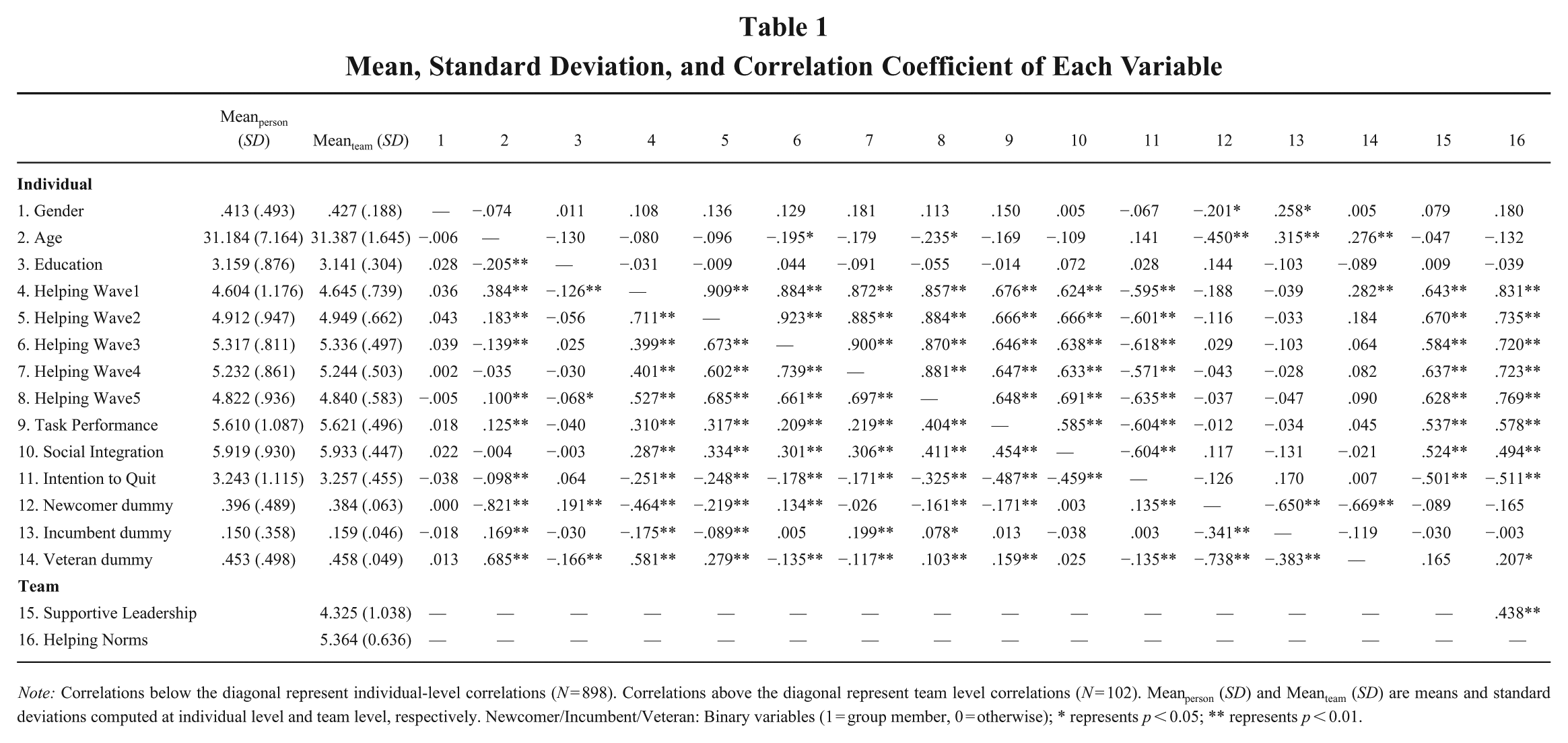
Note: Correlations below the diagonal represent individual-level correlations (N = 898). Correlations above the diagonal represent team level correlations (N = 102). Meanperson (SD) and Meanteam (SD) are means and standard deviations computed at individual level and team level, respectively. Newcomer/Incumbent/Veteran: Binary variables (1 = group member, 0 = otherwise); * represents p < 0.05; ** represents p < 0.01.
Before testing our hypotheses, we established the fundamental comparability of our measures across time and employee categories by assessing measurement invariance. The results confirmed sufficient measurement equivalence (detailed findings are provided in Supplemental Appendix 2). To rigorously evaluate the construct validity of our measures within the multilevel structure of the data, we conducted multilevel confirmatory factor analysis (multilevel CFA). This model specified distinct latent factors at each level: a single factor for helping behaviors at the within-person level (Level 1), four factors (helping behaviors, task performance, intention to quit, and social integration) at the between-person level (Level 2), and three factors (helping behaviors, supportive leadership, and peer helping norms) at the between-team level (Level 3). The results indicated a good fit to the data (χ2 = 439.443, DF = 389, CFI = .997, TLI = .996, RMSEA = .005, SRMR for within Level 1 = .010, SRMR for between Level 2 = .044, SRMR for between Level 3 = .041). To further examine the discriminant validity of our constructs, we tested three alternative models, with the findings supporting the discriminant validity of the measures (see Supplemental Appendix 3). Finally, a variance partitioning analysis for helping behaviors revealed significant variance components distributed across all three levels: a large portion resided at the within-person level (variance = .382, accounting for approximately 44.2% of the total variance), followed by the between-person level (variance = .205, approximately 23.7%), and the between-team level (variance = .278, approximately 32.1%). This substantial and statistically significant variance at each hierarchical level provides strong empirical justification for employing a three-level analytical approach in subsequent hypothesis testing.
Hypothesis Testing
All models demonstrated robust convergence, as indicated by a PSR factor close to 1 for each parameter, small Bayesian autocorrelation, and trace plots from the MCMC simulation showing good mixing (Jebb & Woo, 2015; Kaplan, 2014; Zyphur & Oswald, 2015).
Baseline Curvilinear Pattern and Group Differences (Hypotheses 1–2b)
Model 1 (Table 2) examined the baseline helping trajectories and differences between transitioning incumbents and newcomers (Hypotheses 1, 2a, and 2b). Hypothesis 1 predicted that helping behavior during role transitions would follow a curvilinear trajectory, initially increasing before stabilizing or declining. Supporting this, results revealed significant negative quadratic slopes for both newcomers (β2ij = −.258, 95% CI [−.285, −.231]; Table 3) and transitioning incumbents (β2ij) = −.194, 95% CI [−.221, −.166]; Table 3), confirming an inverted U-shaped pattern. The trajectory peaked at Time 3 for newcomers (M = 5.345, 95% CI [5.175, 5.512]; Table 4) and Time 4 for transitioning incumbents (M = 5.439, 95% CI [5.270, 5.612]; Table 4), followed by declines. Veterans (non-transitioning members) showed no significant curvature (β2ij = −.005, 95% CI [−.026, .016]; Table 3), highlighting the uniqueness of transition dynamics. Figure 1 displays the plotted helping trajectories for newcomers, transitioning incumbents and veterans, demonstrating a pattern consistent with the curvilinear trajectory proposed in Hypothesis 1. These findings provide robust support for Hypothesis 1.
Multilevel Analysis of Helping Behavior Trajectories
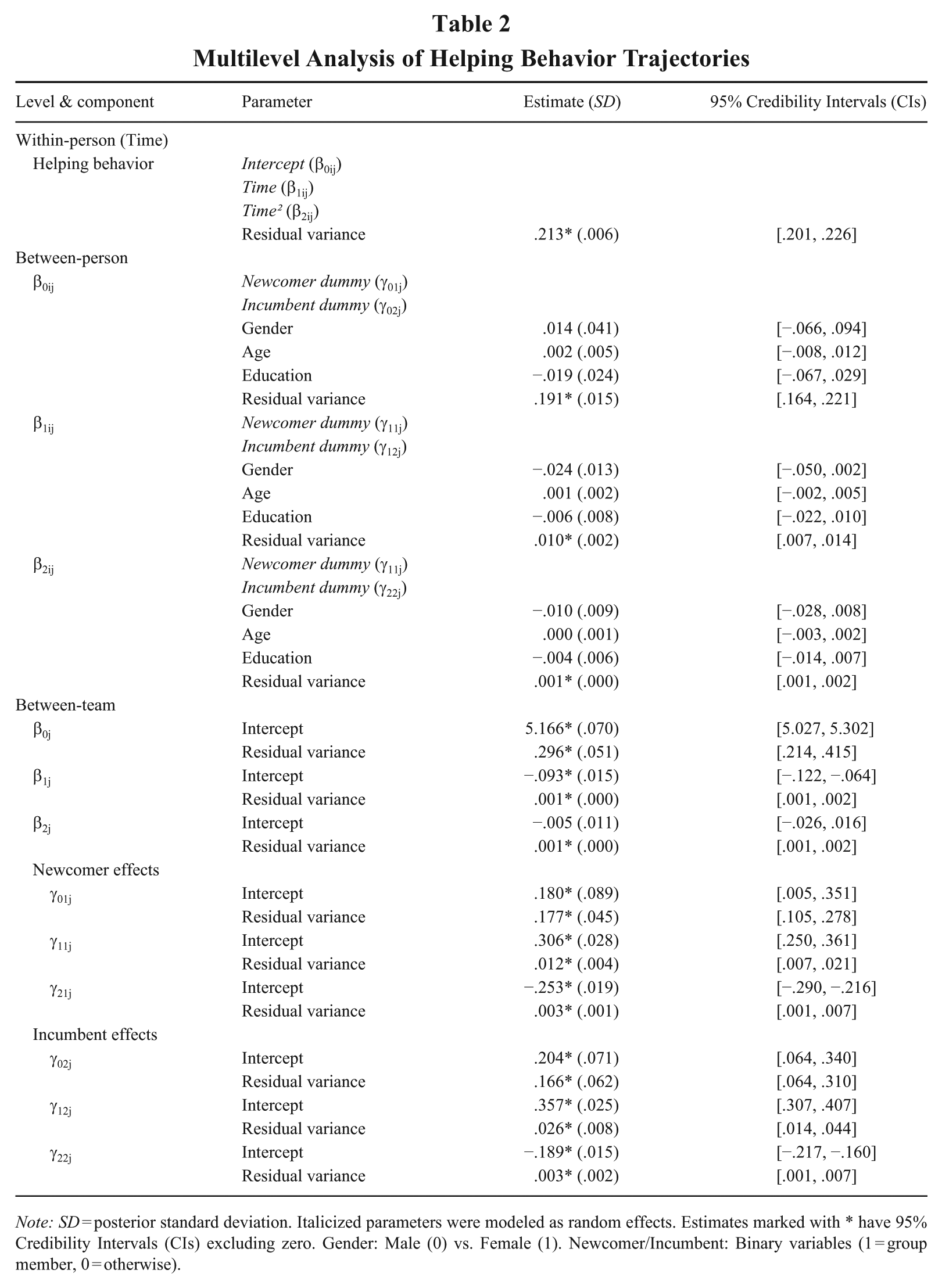
Note: SD = posterior standard deviation. Italicized parameters were modeled as random effects. Estimates marked with * have 95% Credibility Intervals (CIs) excluding zero. Gender: Male (0) vs. Female (1). Newcomer/Incumbent: Binary variables (1 = group member, 0 = otherwise).
Conditional Trajectory Parameters for Role Transition Groups
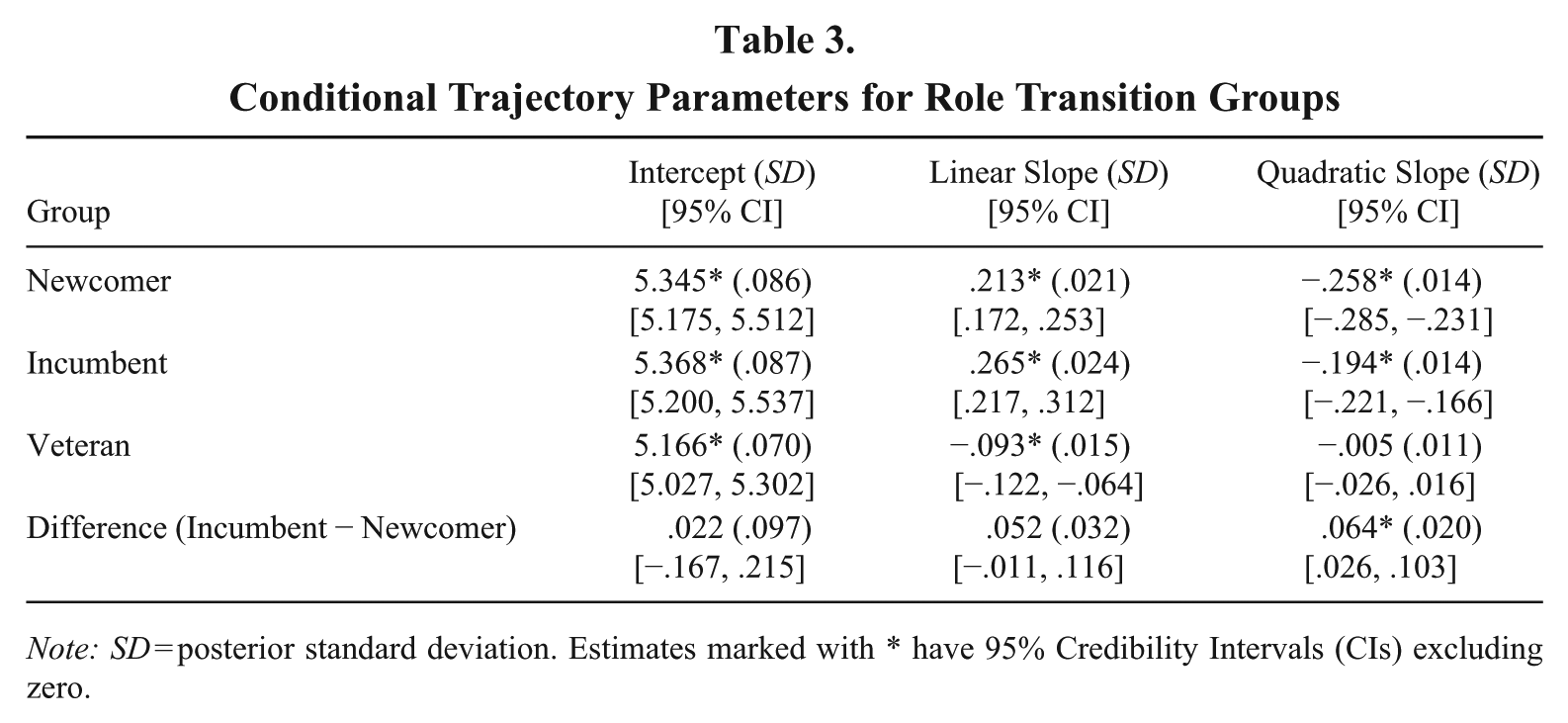
Note: SD = posterior standard deviation. Estimates marked with * have 95% Credibility Intervals (CIs) excluding zero.
Predicted Helping Behavior Over Time by Role Transition Group
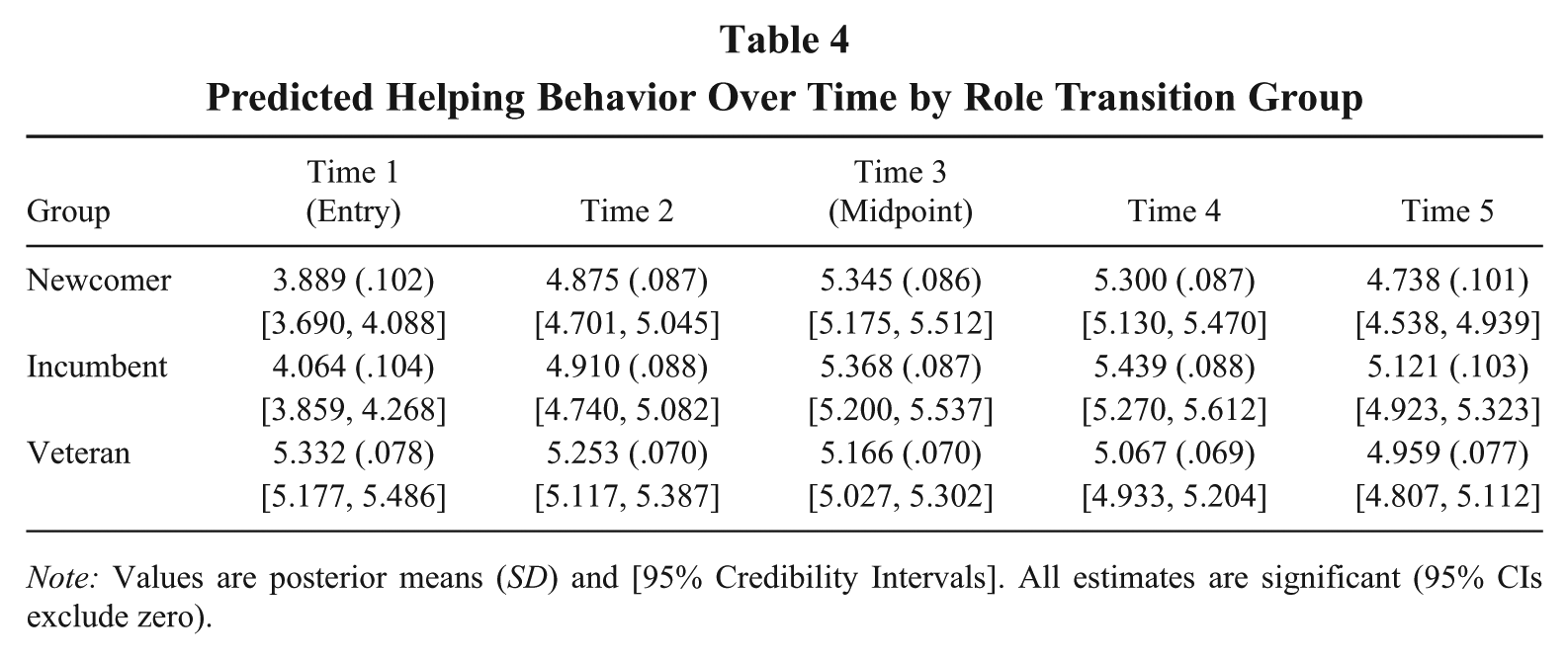
Note: Values are posterior means (SD) and [95% Credibility Intervals]. All estimates are significant (95% CIs exclude zero).
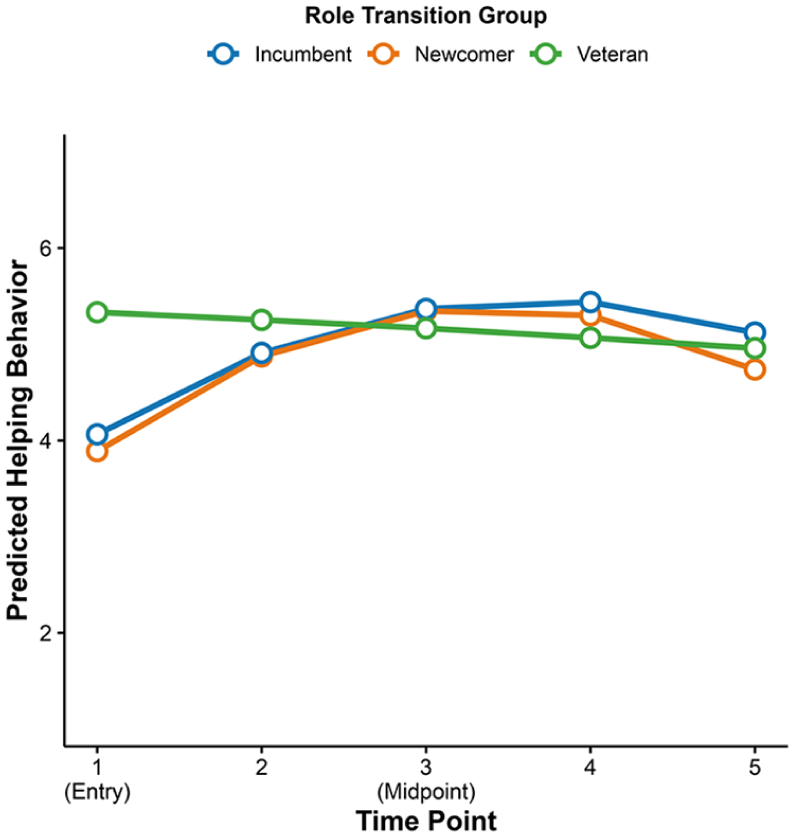
Helping Behavior Trajectories by Role Transition Group
Hypothesis 2a posited that transitioning incumbents would exhibit higher initial helping levels at entry (Time 1) than newcomers. To test this, we compared predicted helping levels at Time 1 between groups. As Table 4 shows, transitioning incumbents exhibited higher helping levels at entry (M = 4.064, 95% CI [3.859, 4.268]) compared to newcomers (M = 3.889, 95% CI [3.690, 4.088]). However, the model-constrained difference between groups was non-significant (difference = .174, 95% CI [−.067, .421]), and thus Hypothesis 2a was not supported.
Hypothesis 2b proposed that transitioning incumbents’ trajectories would be flatter than newcomers’. We tested this through differences in quadratic slopes. The significant quadratic difference (difference = .064, 95% CI [.026, .103]; Table 3) confirmed transitioning incumbents’ trajectories were flatter (less steep decline), supporting Hypothesis 2b. This pattern is further evident in Table 4: newcomers declined sharply from Time 3 to Time 5 (Δ = −.607), while incumbents declined more gradually (Δ = −.247).
Moderating Effects (Hypotheses 3a-b and 4a-b)
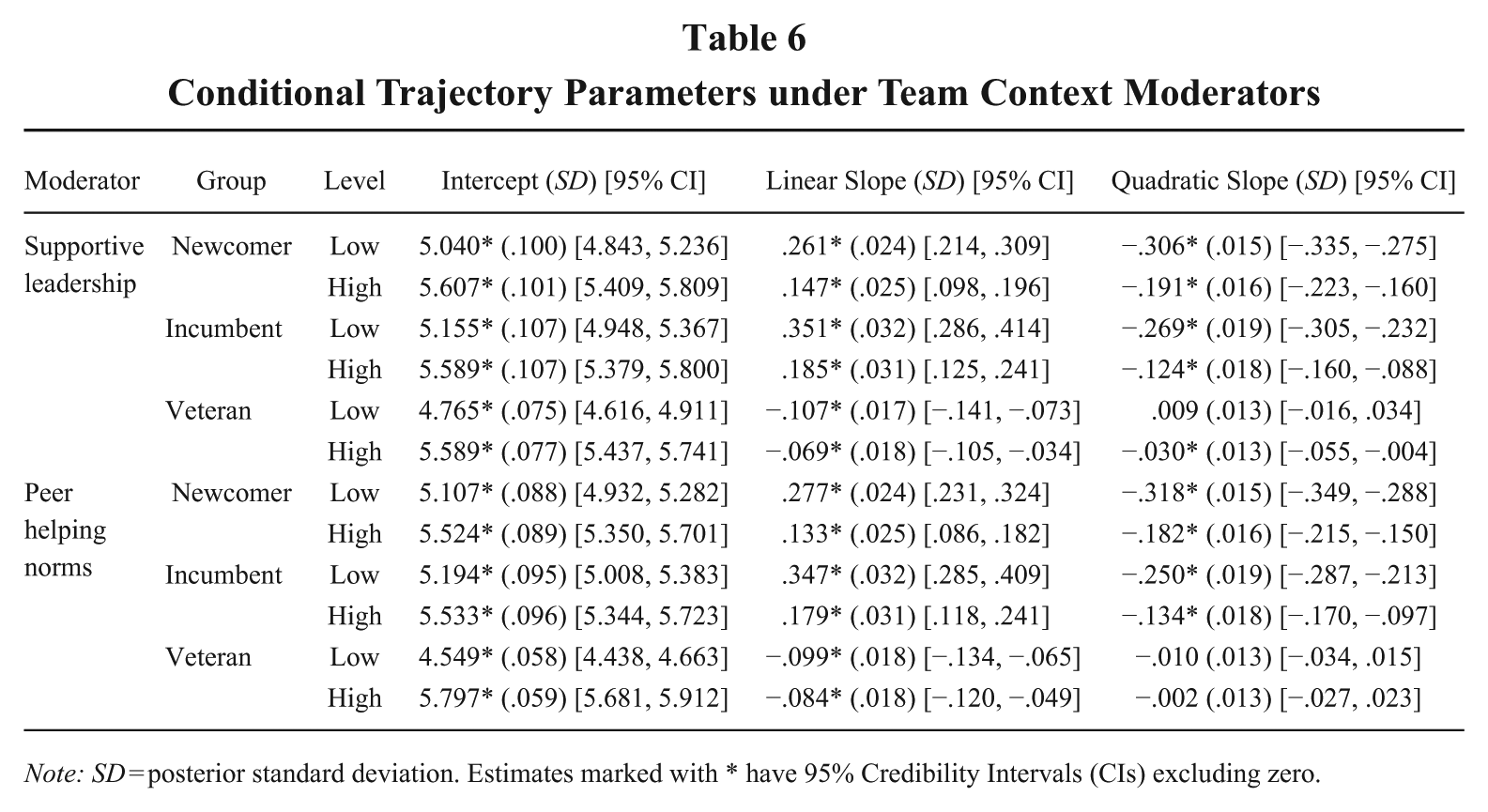
Next, Model 2a and 2b (Table 5) tested how team contexts—supportive leadership (Hypotheses 3a-b) and peer helping norms (Hypotheses 4a-b)—shaped helping trajectories. Hypothesis 3a posited that supportive leadership would boost initial helping at role entry (Time 1) for both newcomers and transitioning incumbents. Results strongly supported this: under high supportive leadership (1 SD above mean), newcomers exhibited significantly higher helping at entry (Mhigh = 4.549, 95% CI [4.318, 4.783]) than under low supportive leadership (Mlow = 3.296, 95% CI [3.073, 3.526]; Table 6), with a difference of 1.252 (95% CI [.965, 1.538]). Similarly, transitioning incumbents showed higher entry helping under high supportive leadership (Mhigh = 4.721, 95% CI [4.463, 4.974]) versus low (Mlow = 3.375, 95% CI [3.125, 3.636]; difference = 1.344, 95% CI [.985, 1.699]).
Moderating Effects on Helping Behavior Trajectories
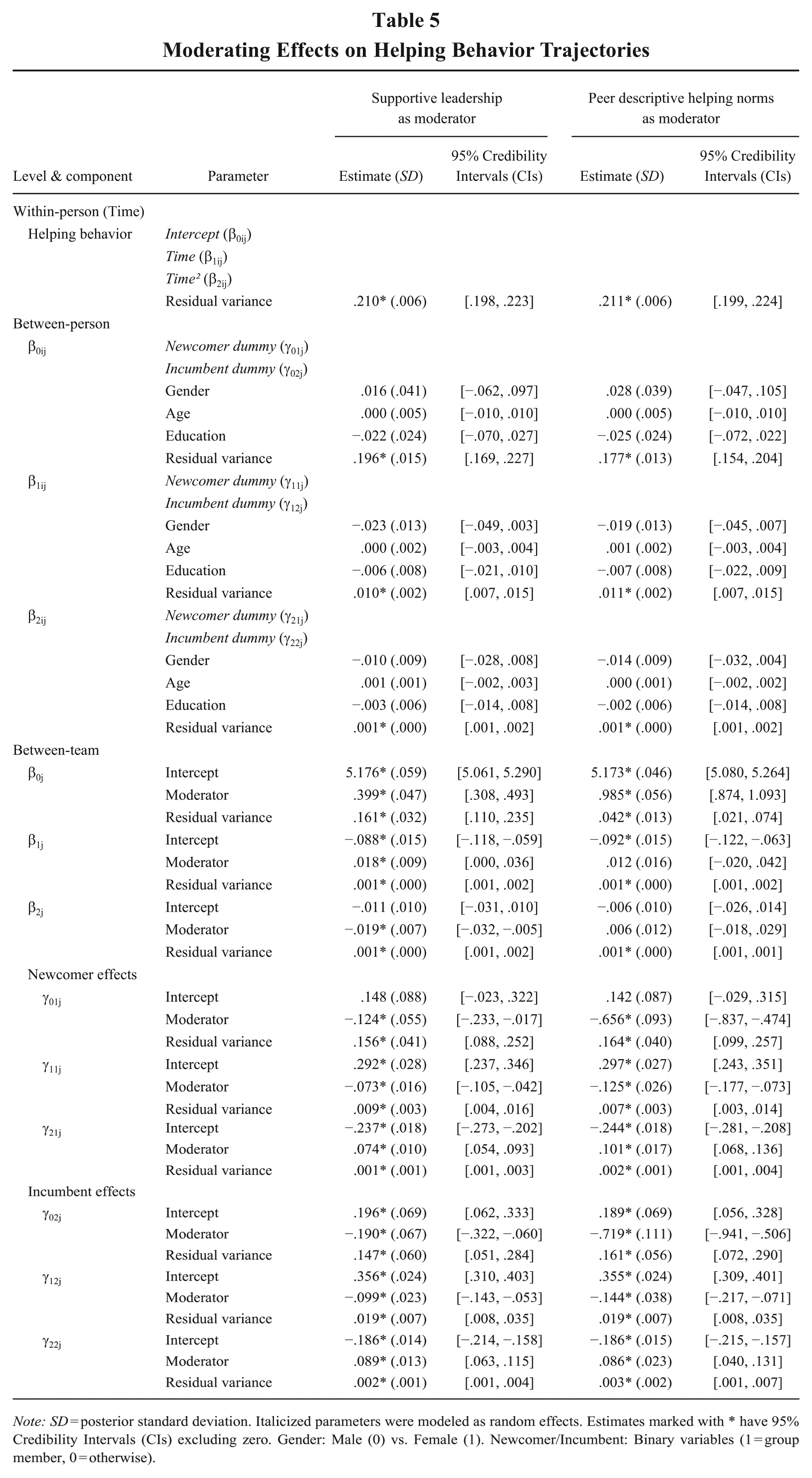
Note: SD = posterior standard deviation. Italicized parameters were modeled as random effects. Estimates marked with * have 95% Credibility Intervals (CIs) excluding zero. Gender: Male (0) vs. Female (1). Newcomer/Incumbent: Binary variables (1 = group member, 0 = otherwise).
Conditional Trajectory Parameters under Team Context Moderators
Note: SD = posterior standard deviation. Estimates marked with * have 95% Credibility Intervals (CIs) excluding zero.
Hypothesis 3b predicted that supportive leadership would flatten trajectories (i.e., weaken curvilinearity) for both groups. This was tested through differences in quadratic slopes between high/low leadership conditions. For newcomers, the quadratic slope was significantly less negative under high supportive leadership (β2ij = −.191, 95% CI [−.223, −.160]) than under low supportive leadership (β2ij = −.306, 95% CI [−.335, −.275]; Table 6), with a difference of .114 (95% CI [.080, .149]). Transitioning incumbents mirrored this pattern (high: β2ij = −.124, 95% CI [−.160, −.088]; low: β2ij = −.269, 95% CI [−.305, −.232]; difference = .145, 95% CI [.097, .195]), confirming flatter trajectories under supportive leadership. Supportive leadership explained 11.9% (pseudo R2 of 0.119) of between-team variance in newcomers’ intercept effects (γ01j) and 11.4% for transitioning incumbents’ (γ02j), indicating modest moderation of the overall level of helping. More substantially, it accounted for 66.7% of between-team variance in newcomers’ quadratic slope effects (γ21j) and 33.3% for transitioning incumbents’ (γ22j), underscoring its strong role in sustaining helping behavior. It also explained 25.0% (newcomers, γ11j) and 26.9% (transitioning incumbents, γ12j) of linear slope variance, highlighting broad influence on trajectory dynamics.
Hypotheses 4a-b replicated these tests for peer helping norms. Hypothesis 4a (peer norms → initial helping) was fully supported: newcomers (Mhigh = 4.527, 95% CI [4.317, 4.745]; Mlow = 3.282, 95% CI [3.078, 3.492]; difference = 1.246, 95% CI [.985, 1.508]) and transitioning incumbents (Mhigh = 4.635, 95% CI [4.391, 4.878]; Mlow = 3.500, 95% CI [3.262, 3.739]; difference = 1.135, 95% CI [.797, 1.468]) showed stronger entry helping under high norms (Table 6). Hypothesis 4b (peer norms → flatter trajectories) was also supported: quadratic slopes were less negative for newcomers (high: β2ij = −.182, 95% CI [−.215, −.150]; low: β2ij = −.318, 95% CI [−.349, −.288]; difference = .136, 95% CI [.100, .172]) and transitioning incumbents (high: β2ij = −.134, 95% CI [−.172, −.097]; low: β2ij = −.250, 95% CI [−.287, −.213]; difference = .115, 95% CI [.064, .168]) under high norms. Figure 2 illustrates the moderating effects of supportive leadership and peer helping norms on the plotted helping trajectories for newcomers, transitioning incumbents, and veterans, and Table 7 provides the corresponding predicted levels of helping behaviors over time. Peer helping norms explained less between-team variance in the overall level of helping than leadership (newcomers γ01j: pseudo R² = 7.3%; transitioning incumbents γ02j: pseudo R² = 3.0%). However, they accounted for 41.7% of newcomers’ linear slope variance (γ11j) and 26.9% for transitioning incumbents’ (γ12j), reflecting strong acceleration of early helping growth. Their association with quadratic slopes was more limited (newcomers γ21j: pseudo R² = 33.3%; transitioning incumbents γ22j: pseudo R² = 0%), suggesting weaker influence on long-term sustainability.
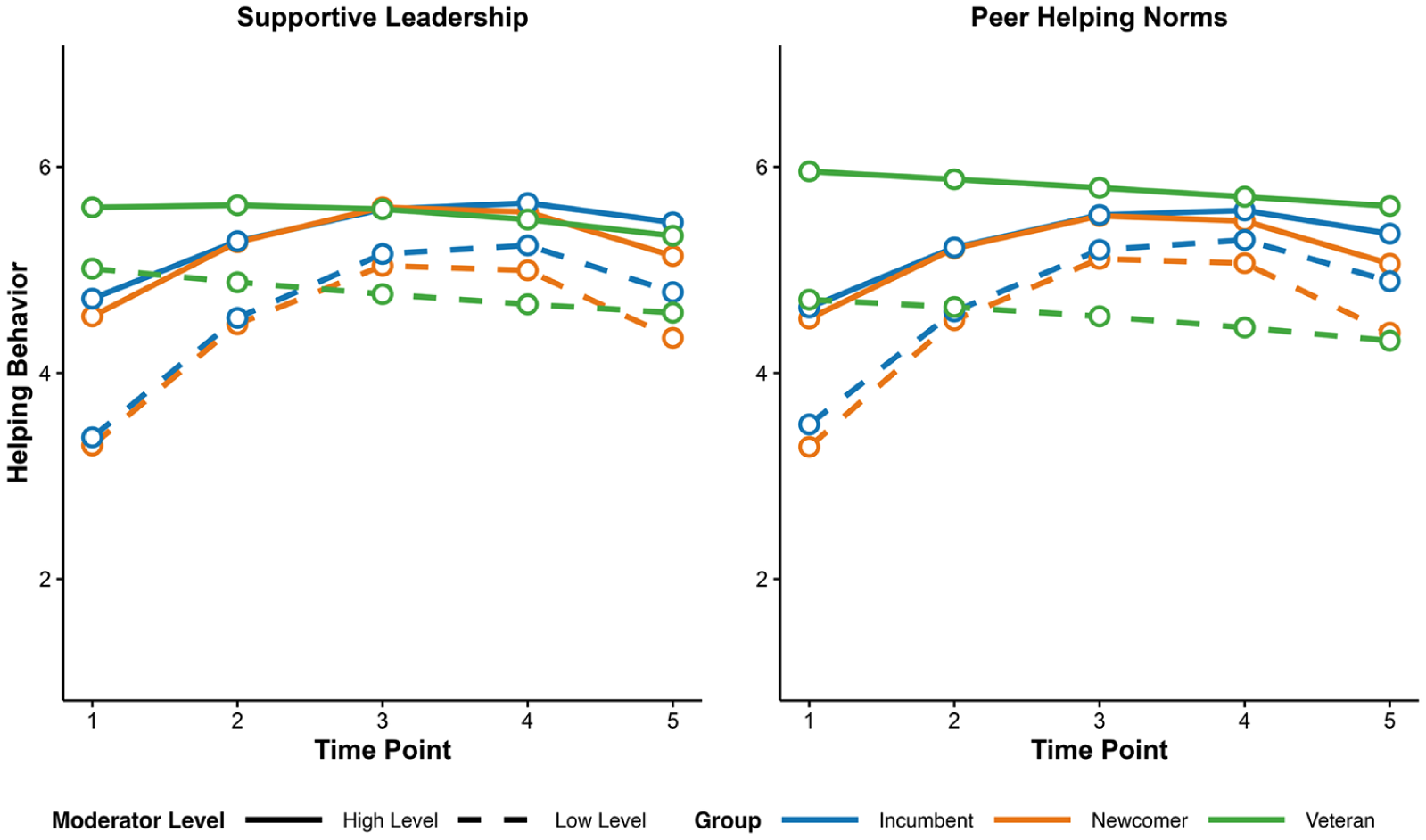
Moderating Effects on Helping Behavior Trajectories
Predicted Helping Behavior Over Time by Role Transition Group under Team Context Moderators
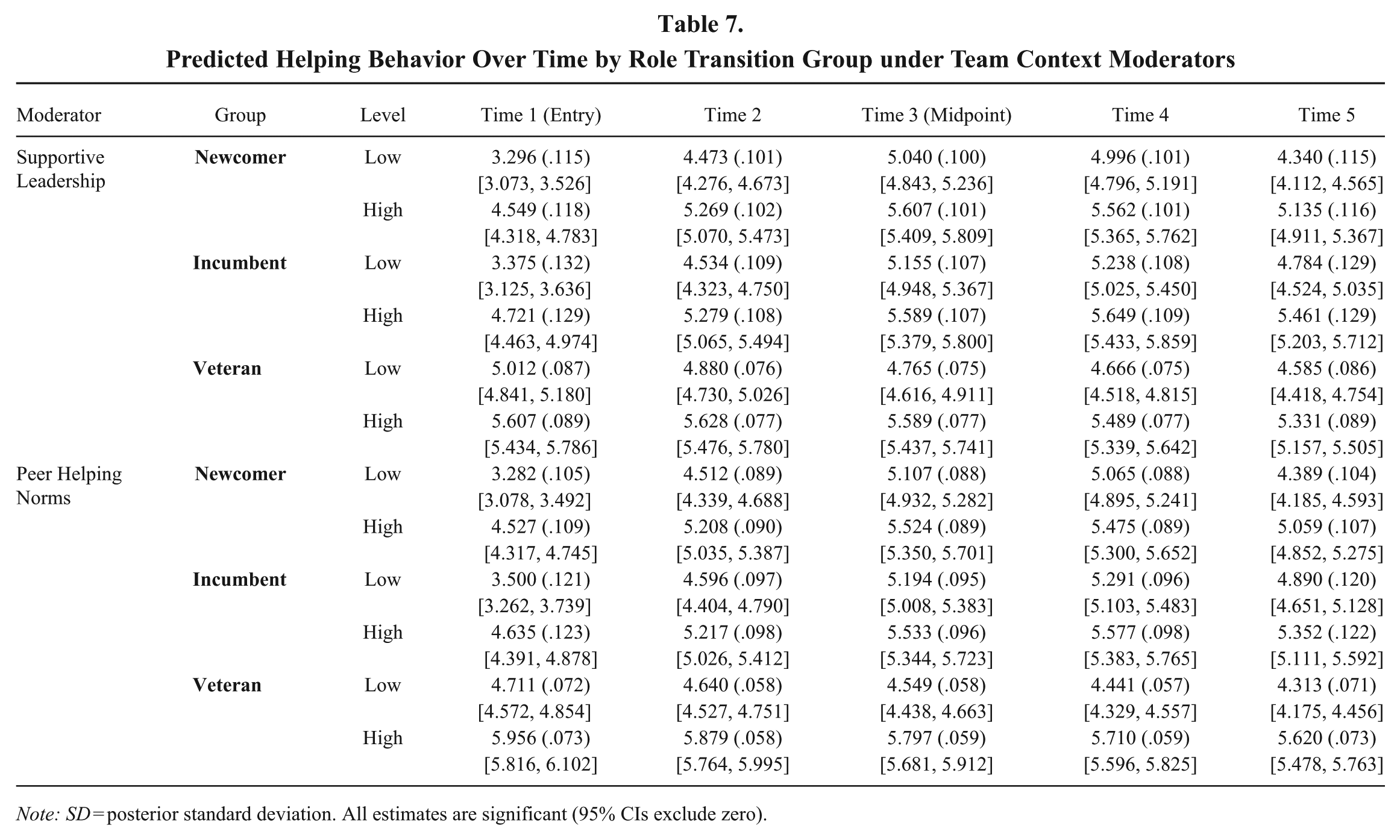
Note: SD = posterior standard deviation. All estimates are significant (95% CIs exclude zero).
Outcomes of Helping Trajectories
Model 3 (Table 8) evaluated how helping trajectories predicted three critical socialization outcomes: task performance, social integration, and intention to quit. Hypothesis 5a predicted that higher levels of helping are positively associated with higher task performance and social integration, and inversely associated with intention to quit. This hypothesis received significant support: Individuals who exhibited higher levels of helping received significantly higher task performance ratings from their team leader (intercept: β0ij = .383, 95% CI [.281, .486]) and reported greater social integration (β0ij = .454, 95% CI [.366, .543]). Additionally, higher helping levels were associated with lower intention to quit (β0ij = −.317, 95% CI [−.426, −.207]). These findings suggest that displaying a high level of helping behavior during the transition period enhances both instrumental and relational outcomes, while also reducing withdrawal intentions.
Effects of Helping Trajectories on Socialization Outcomes
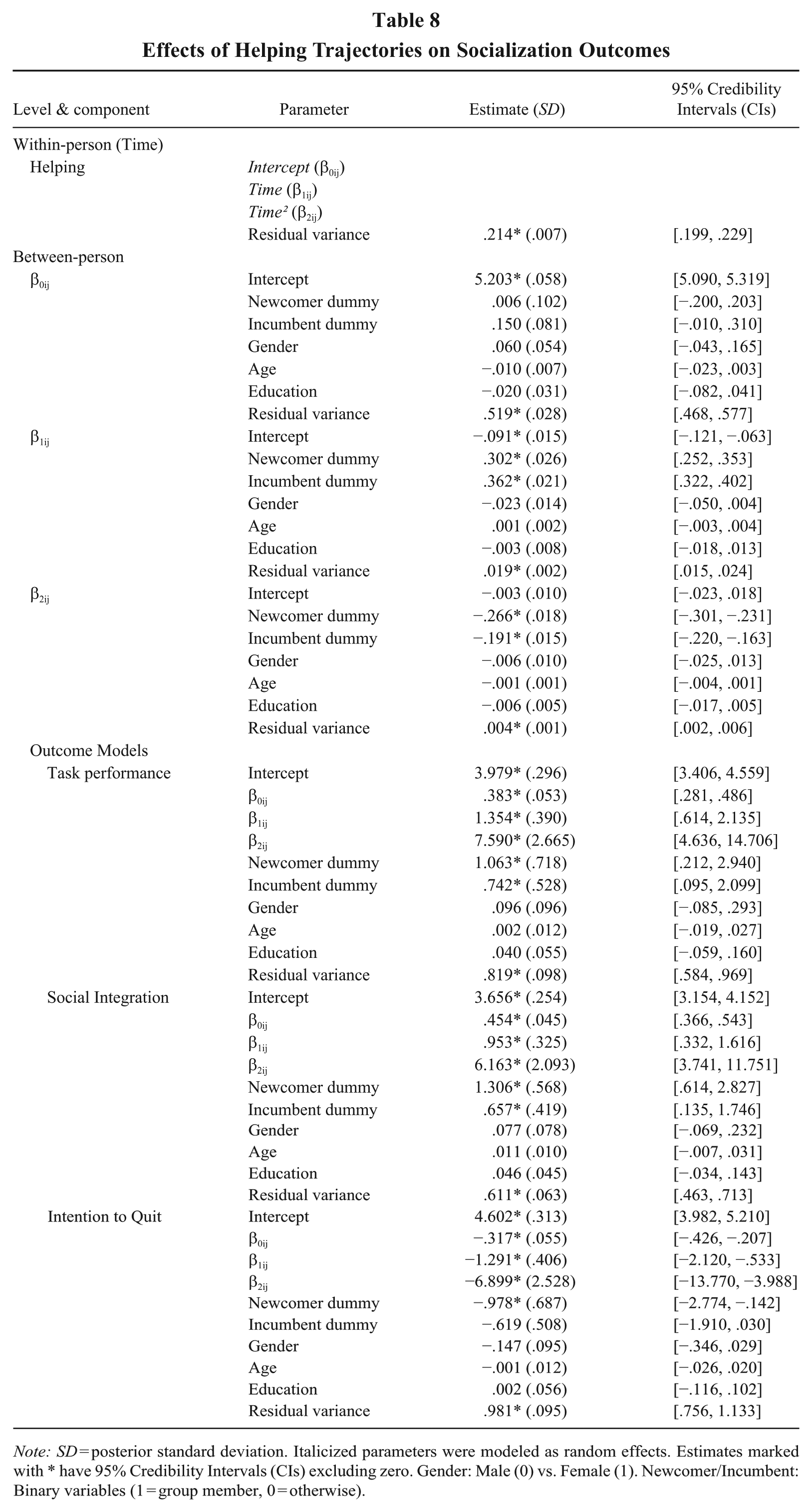
Note: SD = posterior standard deviation. Italicized parameters were modeled as random effects. Estimates marked with * have 95% Credibility Intervals (CIs) excluding zero. Gender: Male (0) vs. Female (1). Newcomer/Incumbent: Binary variables (1 = group member, 0 = otherwise).
Hypothesis 5b posited that flatter helping trajectories—i.e., those characterized by lower curvature and thus greater behavioral consistency—would be linked to more positive socialization outcomes. Again, the results were consistent with this expectation. Individuals with a trajectory characterized by a flatter curvature demonstrated significantly better leader-rated task performance (quadratic slope: β2ij = 7.590, 95% CI [4.636, 14.706]). A similar pattern emerged for social integration, which was greater when the trajectory was characterized by a flatter curvature (β2ij = 6.163, 95% CI [3.741, 11.751]). Finally, intention to quit was lower as a function of diminished curvature (i.e., when helping was maintained more consistently over time; β1ij = −1.291, 95% CI [−2.120, −.533]; β2ij = −6.899, 95% CI [−13.770, −3.988]). These findings suggest that inconsistency in helping—especially when it declines sharply after an initial peak—may signal unreliability to others and thus undermine perceptions of competence, connectedness, and embeddedness.
Overall, the models explained 29.0% of the variance in task performance (pseudo R² = .290), 31.0% in social integration (pseudo R² = .310), and 21.6% in intention to quit (pseudo R² = .216). Among the trajectory components, quadratic slope (curvature) consistently showed the strongest effects across outcomes, underscoring the importance of helping stability in shaping how newcomers and transitioners are perceived and integrated.
Supplementary Analysis
We conducted several robustness tests to rule out alternative explanations. First, we reestimated the models testing Hypotheses 3a-b, and 4a-b taking into account (a) gender, age and education as alternative demography-based explanations, as well as (b) two personality factors, namely proactive personality (Parker, 1998) and relationship interdependent self-construal (Cross, Bacon, & Morris, 2000), and (c) team task interdependence (Bishop & Scott, 2000) as additional individual difference and contextual confounds. The inclusion of these variables in the newcomer and transitioning incumbent models did not result in any meaningful differences in the magnitude or significance of the estimates for either supportive leadership or helping norms (results available from the authors). Additionally, we ran an exploratory analysis comparing the effect sizes (variance explained) of supportive leadership and helping norms. Supportive leadership demonstrates a stronger moderating effect on the non-linear aspects (quadratic slopes) of helping behavior trajectories, particularly for newcomers, where it explains 66.7% of the variance 3 in curvature (γ21j). In contrast, peer helping norms exert a stronger influence on the linear rates of change (linear slopes), especially for newcomers (41.7% variance explained in γ11j), suggesting that norms more directly shape the consistent pace of behavioral adaptation over time. While both contextual factors significantly moderate key trajectory parameters (e.g., linear slopes for transitioning incumbents similarly affected by both), leadership uniquely buffers early volatility in newcomer behavior, whereas peer norms provide sustained guidance for ongoing behavioral change.
Discussion
We conducted a five-wave study among those transitioning into a new work role to examine the nature of helping trajectories among those transitioning into a new work role and how these trajectories may be influenced by transition type (i.e., newcomer versus transitioning incumbent) and context (i.e., team leadership and peer-based normative context), and ultimately to better understand whether and how helping trajectories impact key adjustment outcomes such as performance, social integration, and turnover intentions. Our findings indicate that among those transitioning into a new work role, over the initial onboarding period, helping generally manifests the curvilinear trajectory suggested by the overarching theory on which we grounded our model and investigation, namely the TTOCB (Methot et al., 2017). The fact that the inflection point occurs at six months into onboarding is likely not by chance as this is precisely the point in time at which, in the organization studied, those transitioning concluded their probation or trial period, a highly significant event cue, particularly to newcomers. It may be that once no longer on probation, these individuals felt less of an obligation to engage in helping or that, having completed probation, they were asked to take on additional task-based obligations, thus making it more difficult for them to continue allocate personal resources toward such activities (Hui, Lam, & Law, 2000). The fact that for veterans the quadratic effect of time on helping was not significant suggests that their helping may change more slowly, making it impossible to capture change in a one year window.
The findings also indicate a significant difference in the helping trajectories between newcomers and transitioning incumbents. As expected, transitioning incumbents manifested a significantly flatter trajectory of helping relative to that of newcomers. However, in contrast to our theorizing, no difference between these two groups was found with respect to the entry level of helping. This may have something to do with the large size of the enterprise studied, such that those transitioning internally still experienced a high degree of uncertainty with respect to the helping expectations of their supervisor and peers in their new team. Findings regarding the moderating effects of leadership and helping norms on the helping trajectories of those in transition indicated that, as posited, among those transitioning into units characterized by higher levels of supportive leadership and more prosocial helping norms, the level of helping behaviors was higher (relative to units with lower levels of supportive leadership or prosocial helping norms), and the inverted U-shaped pattern of helping over time was less pronounced for both newcomers and transitioning incumbents. Finally, our data indicated support for our theorizing regarding how alternative helping trajectories impact key socialization outcomes. Among both newcomers and transitioning incumbents, those manifesting a high-flat trajectory had significantly higher levels of performance and social integration and lower levels of intention to quit.
Theoretical Implications
Our study offers several important contributions to research and theory on helping and newcomer socialization. First, we demonstrate that already early in the transition process, those entering a new work role engage in helping behavior, with their level of engagement increasing over the course of their initial onboarding. From the perspective of organizational socialization, this is important in that it extends our understanding of the implications of the identity shifts often accompanying role transitions, suggesting that they have rather immediate implications for newcomer helping behavior (Ashforth, 2001). Moreover, it suggests the need to extend current conceptualizations of helping in socialization from a focus on newcomers as help-seekers and as the targets of helping to a more agentic conceptualization in which those in transition increasingly contribute from their own human and social capital to the units they join. From an OCB perspective, this important in that in contrast to much of the helping literature, which assumes helping to be relatively static over the longer-term (Grant, 2013), at least among those transitioning into a new work role, rather than just exhibiting small, short-term fluctuations, our findings indicate that helping is likely to manifest meaningful, longer-wave shifts. In that sense, our findings offer some of the first empirical support to the self-regulation model of OCB (Bolino, Harvey, & Bachrach, 2012) and TTOCB (Methot et al., 2017) which suggest that employee citizenship varies over time (e.g., minute by minute, over the course of a day, a year, or a career).
Second, our theorizing proposed (and findings confirmed) that although this shift among those transitioning generally mirrors the baseline, curvilinear trajectory proposed by the TTOCB, there are predictable variations in this baseline pattern, with these variations in trajectory having meaningful implications for three key adjustment-related outcomes. More specifically, higher and flatter helping trajectories are associated with heightened levels of task performance and social integration and lower intention to quit, explaining a substantial proportion of their variance. From a theoretical perspective, this is important in that it suggests that helping (and not just help-seeking) serves as an additional factor influencing the adjustment of those transitioning into a new role. Moreover it suggests the need to consider the overall trajectory of helping over the course of onboarding rather than just discrete or mean levels of helping at one point or another, with these patterns potentially offering important insights into how quickly those in transition socially integrate and develop the kind of supportive exchange relationships critical to task mastery and performance, not to mention the stability of these relationships.
Third, in the context of such long-wave effects, we proposed and demonstrated two key factors potentially influencing helping trajectories for those transitioning into a new work role. While these are certainly not the only work-based contextual factors influencing the helping trajectories of those in transition, the finding that both supportive leadership and helping norms impact not only starting levels of helping but also the stability of such behavior over time offers an important extension to our understanding of how insider (i.e., leader and peer) behavior, by shaping the helping trajectories of those in transition, can influence key socialization outcomes. Additionally, our post-hoc finding that peer norms influence helping trajectories differently than leadership style among newcomers also has important theoretical implications, suggesting that in understanding how helping emerges, changes over time, and ultimately shapes newcomer adjustment, we need to pay no less attention to the sense-giving role of veteran peer norms than to that of team leaders.
Finally, we offer an important contribution to both the TTOCB and research on work-related transitions in that we proposed and demonstrated that the helping trajectories of those entering a role from outside an organization (i.e., newcomers) differ from those of individuals transitioning from within (i.e., transitioning incumbents). Although researchers have speculated that the adjustment experiences of newcomers and transitioning incumbents differ, and that newcomers apply different socialization strategies than transitioning incumbents (Zhu et al., 2017), empirical research has to date largely focused on the former. Consequently, we know little about the experience of organizational incumbents transitioning into new roles and the role that collaborative behavior may play in affecting their transition success. Our findings confirm that while transitioning incumbents also manifest the baseline, inversed U-shaped helping trajectory predicted by TTOCB, this trajectory is flatter than that of newcomers, suggesting that collaborative behavior among these transitioning individuals tends to be more stable over time than among organizational newcomers. Moreover, our findings suggest that supportive leadership and peer norms are more influential in shaping these trajectories for newcomers than for transitioning incumbents.
Practical Implications
Our findings also have important practitioner implications. First, they suggest that the helping trajectories of those transitioning have meaningful implications not only on the task performance of the transitioning individual, but on their social integration and retention intentions as well. Accordingly, leaders should probably take a more proactive role in motivating positive helping patterns among new entrants. For example, during regular check-ins or performance reviews, leaders might discuss not only the help that transitioning employees receive but also the help they provide. By explicitly recognizing and valuing helping behavior, especially when sustained over time, leaders can signal its importance and embed it more firmly into team norms. Furthermore, leaders might consider developing more nuanced strategies by actively monitoring and identifying different helping trajectory patterns over time. Rather than applying a one-size-fits-all approach, managers could segment employees based on their helping patterns (e.g., consistently high, declining, or increasing) and tailor interventions accordingly. For instance, individuals showing early signs of declining helping might benefit from targeted developmental conversations, while those with rising helping patterns could be supported with opportunities for informal leadership or mentoring roles. By adopting a differentiated approach to motivating helping behaviors, organizations might more effectively foster and sustain high-functioning, supportive work environments during critical transition periods.
Second, beyond providing new entrants with the motivation to provide assistance, our findings suggest that higher and flatter helping trajectories may be elicited by providing new entrants with greater helping opportunities. To do this, onboarding programs might be redesigned to foster bi-directional helping from the start. For instance, leaders might strategically assign newcomers and transitioning incumbents to teams in which their experience and background may be of particular value. Highlighting this to both the new entrants and their teammates may make the latter more open to the assistance of the new entrants, thus encouraging them to not only seek help but provide it as well. Additionally, providing newcomers with early opportunities to share their prior knowledge, skills, or external perspectives can empower them as contributors, rather than passive recipients of guidance. In doing so, organizations may not only improve newcomer outcomes, but also cultivate stronger helping norms throughout the unit or team.
Indeed, organizational leaders may want to make a concerted effort to shift and strengthen peer helping norms so as to maximize the odds of eliciting higher and flatter helping trajectories. For example, leaders may want to be sure that organizational reward strategies and incentive structures are aligned to encourage prosocial behavior rather than discouraging it. Additionally, leaders may try to celebrate the successes of highly respected peers that consistently model high levels of helping, highlighting how their behavior not only enhanced their own individual outcomes, but furthered the interest of the team or work unit as a whole.
Finally, particularly for newcomers, leaders may consider taking steps to “flatten the curve” at the six-month inflection point such that peak levels of helping are stabilized rather than reduced. For instance, they might conduct a review of in-role expectations to ensure that those in transitioning have sufficient “slack” to maintain their high level of helping (Lin, Koopmann, & Wang, 2020).
Limitations and Future Research Directions
Despite these important contributions, several study limitations may limit the generalizability of our findings as well as present opportunities for future research. First, while newcomers and transitioning incumbents in Chinese firms typically enter their new positions as a cohort at set times of the year, and thus go through their on-boarding contemporaneously, this may be less typical for enterprises elsewhere. To the extent that the effects demonstrated may stem from such cohort-based on-boarding experiences, they may be less generalizable to organizations outside of China. Second, lacking data on changes in team leadership during the on-boarding period, we cannot rule out the possibility that team leadership may have changed midstream. While the impact of such changes should be examined in future research, to the extent that such changes occurred in the current sample they logically would have only increased the probability of Type II error, thus suggesting that, if anything, our results err on the conservative. Third, helping behavior is inherently a reciprocal process (Jia et al., 2021), yet this study focuses solely on the trajectories of helping given rather than helping seeking. While this does not undermine our conclusions, future research should consider how different forms of helping (e.g., proactive vs. reactive) influence socialization and explore the underlying mechanisms through which helping trajectories shape socialization outcomes. A more comprehensive approach to studying both helping given and helping sought would provide a deeper understanding of the reciprocal nature of helping behaviors.
Future research may also benefit by examining newcomer helping from the perspective of others. Although our data suggests a moderate correlation between self-assessments of helping and leader assessments of the help given by those transitioning, studies applying a more sociometric approach would be helpful. Additionally, studies are needed to examine other potential moderators of the helping trajectories of those in transition. For instance, future studies could investigate how pay structures and incentives (e.g., team-based pay; Bamberger & Levi, 2009) and the intensity of work pace might serve as additional cues moderating helping trajectories. Similarly, individual differences might also be investigated as moderators of helping trajectories. For example, individuals’ prosocial values (Grant & Rothbard, 2013) and helping identity (Farmer & Van Dyne, 2010) influence their ability to recognize and respond to others’ needs for assistance, thereby accounting for additional variance in helping trajectories.
Conclusion
Consistent with the theorizing of Methot et al., our findings indicate that among those transitioning into new work roles, helping manifests the predicted curvilinear trajectory. Aside from having meaningful, practical implications on performance and other socialization outcomes, the nature of these trajectories is subject to the influence of leaders and peers in a manner consistent with theory. We encourage future research extending our understanding of the factors influencing these trajectories, and the likely broader set of outcomes that they impact.
Supplemental Material
sj-docx-1-jom-10.1177_01492063251377402 – Supplemental material for Helping Trajectories During Role Transitions: How They Vary and Why It Matters
Supplemental material, sj-docx-1-jom-10.1177_01492063251377402 for Helping Trajectories During Role Transitions: How They Vary and Why It Matters by Liangting Zhang, Peter Bamberger, Man-Nok Wong and Ningyu Tang in Journal of Management
Footnotes
Acknowledgements
We thank David Collings and our three anonymous reviewers for their very helpful comments and suggestions. This research was funded by the National Natural Science Foundation of China (Grant No. 72002060 and 72462014, awarded to the first author) and the Hainan Provincial Natural Science Foundation of China (Grant No. 724RC494 and 722RC641, awarded to the first author). Peter Bamberger’s involvement in this study was supported by the 111 Project (D21023), the Jeremy Coller Foundation, and the Henry Crown Institute for Business Research at Tel Aviv University.
Supplemental material for this article is available with the manuscript on the JOM website.

Notes
References
Supplementary Material
Please find the following supplemental material available below.
For Open Access articles published under a Creative Commons License, all supplemental material carries the same license as the article it is associated with.
For non-Open Access articles published, all supplemental material carries a non-exclusive license, and permission requests for re-use of supplemental material or any part of supplemental material shall be sent directly to the copyright owner as specified in the copyright notice associated with the article.
