




Abstract
Studies of organizational learning show that experience enables firms to utilize specific governance structures effectively. Nevertheless, little attention has been given to comparing the effects of learning-by-doing across different structures. In this paper we investigate whether the duration of operation influences performance differently in two structures utilized in public services: in-house provision and external contracting. An analysis of water supply data in France from 1998 to 2008 suggests that the learning advantages are greater in external contracting due to its high-powered incentives, but these benefits decrease as the technological complexity and environmental uncertainty of public services increase. We contribute to organizational learning theory, extend research on governance structures, and provide critical insights into the sustainable management of natural resources.
Introduction
Building on foundational works by Argote (2013), Lieberman (1984), and Wright (1936), organizational learning scholars posit that firms may infer valuable lessons from their experience (Maula, Heimeriks, & Keil, 2023). Researchers who draw on this view claim that firms may increase the performance of an ongoing activity during action (e.g., Blagoev, Hernes, Kunisch, & Schultz, 2024; Desai & Madsen, 2022). Support for this idea has been found in various operational activities undertaken within firm boundaries (for a recent review, see Argote, Lee, & Park, 2021). Additionally, numerous scholars have shown that firms frequently adjust the structural specifics of strategic alliances (Reuer & Arino, 2002; Ryan-Charleton, Gnyawali, & Oliveira, 2022; Sampson, 2005) and long-term outsourcing agreements over time (Mayer & Argyres, 2004; Vanneste & Puranam, 2010; Xing, Mayer, Xie, Reuer, & Klijn, 2021). However, researchers are largely silent on whether the potential for improved performance through learning-by-doing differs across different governance structures. Specifically, there is a significant lack of understanding of how the actions and behaviors of economic agents that are characteristic of each structure influence learning-by-doing processes and subsequent performance outcomes. Thus, our overarching research question is as follows: For what reasons and under what specific conditions does the impact of learning-by-doing differ across governance structures?
We address this question by specifically considering the differences between two prevalent governance structures in public services: in-house provision and external contracting (Brown & Potoski, 2003; Williamson, 1999). In-house provision involves municipalities delivering public services via city employees, whereas external contracting involves a private sector firm providing public services, which reflects a common form of contractual governance (Bajari & Tadelis, 2001; Masten, 2011; Levin & Tadelis, 2010). To our knowledge, research has not yet addressed whether the effects of learning-by-doing are greatest in in-house provision or in external contracting. This question is pivotal because existing governance studies indicate that performance is not affected by the choice of structure when it is driven by contractual hazards and resource considerations (Masten, 2011; Williamson, 1991). Therefore, exploring how learning-by-doing varies across these structures can provide critical insights into performance variations in public services, a field of high relevance given that public procurement spending, excluding concessions, accounts for 13% of the GDP in OECD countries (OECD, 2023).
First, we draw on extant research and consider that in both in-house provision and external contracting, the relationship between the duration of operations and performance is positive but exhibits decreasing marginal returns. Next, we build on the idea that economic agents are more likely to engage in an efficiency search when they are offered high-powered incentives. We thus predict that learning-by-doing will be generally greater in external contracting than in in-house provision since the power of incentives is greater in external contracting (Jensen & Stonecash, 2005; Williamson, 1999). We then extend our analysis to consider how technological complexity and environmental uncertainty can mitigate the effectiveness of high-powered incentives. We predict that as technological complexity or environmental uncertainty increases within a public service, the advantages of external contracting in facilitating learning-by-doing decrease compared with in-house provision.
We test our hypotheses using data on the water supply in France from 1998 to 2008. This setting is germane to our study for several reasons. First, French municipalities can distribute water via in-house provision or external contracting, in alignment with this study’s focus. Second, the similarity in the scope of activities between the two governance structures facilitates comparative analysis. Third, in France, contracts used for water supply are akin to fixed-price contracts, which are high-powered incentive schemes. Fourth, the governance structures chosen for water supply remain unchanged over extended periods, which allows us to capture learning effects. Finally, the characteristics of water networks vary, especially in terms of technological complexity and political uncertainty, a form of environmental uncertainty that is relevant to the context of our analysis, which adds depth to our analysis.
To avoid potential bias in our regression estimates resulting from left-censoring, we restrict our analysis to municipalities that switched their governance structure for the water supply during the study period. Our dependent variable is the yearly operating performance of the water network and is computed as the ratio of billed water to water supply. Our dependent variable thus measures leakages in the pipe network, which are a major source of operational inefficiency that public and private water suppliers aim to minimize for economic and political reasons. Our independent variable is the number of years since the water supply governance structure was chosen. Our results are robust to the use of IV models that account for the potential endogeneity of the choice of governance structure and to the use of panel regressions with fixed effects. The findings are broadly consistent with our expectations. We observe that the operational performance of the water network improves over time in both external contracting and in-house provision, albeit with diminishing marginal returns. However, the performance impact of learning-by-doing tends to be greater for external contracting than for in-house provision. The results also suggest that compared to in-house provision, the benefits of external contracting in facilitating learning-by-doing tend to decrease as the technological complexity of the water supply and political uncertainty increase.
This research makes two primary contributions. First, it extends organizational learning theory by comparing the effects of learning-by-doing across two different governance structures used in public services. We suggest that external contracting is more effective for maximizing learning-by-doing in simpler, less uncertain scenarios, whereas in-house provision is superior in more complex and uncertain contexts. This insight provides a key addition to organizational learning theory, supporting the idea that the development of sophisticated organizational capabilities is more efficient within firm boundaries than through market transactions (Kogut & Zanger, 1996). Second, our research contributes to the governance literature by highlighting the differing impacts of learning-by-doing across broader governance contexts—specifically, between contractual governance and internal organization. Contractual governance offers more pronounced learning advantages due to its high-powered incentives, but these benefits decrease as technological complexity and environmental uncertainty increase. We thus underscore the importance of aligning governance structures with the technological complexity of the task and the level of uncertainty in the environment to maximize learning benefits. We also offer crucial insights into how learning-by-doing influences firms’ decisions to maintain their existing governance structures or adopt new ones (Argyres, Mahoney, & Nickerson, 2019).
Our study offers insights into achieving the United Nations’ sixth Sustainable Development Goal, which emphasizes water and sanitation, through our focused analysis of water supply systems. For practitioners, our research provides valuable guidance for improving public service performance. Additionally, it can help policymakers make informed decisions about whether to outsource public services to private entities considering the technological complexity and environmental uncertainty of these services.
Learning-by-Doing Within Different Governance Structures
One of the main ideas of organizational learning theory is that as an organization gains experience with a given activity, it can assess what has gone well and what has gone poorly to extract accurate inferences about the drivers of the activity’s performance; it can then use this inferred learning to alter or replace underperforming processes (Argote, 2013). Building on this idea of learning-by-doing, researchers have shown that the duration of operation improves performance in a wide range of operational activities, including oil refining (Hirschmann, 1964), chemical processing (Lieberman, 1984), shipbuilding (Argote, Beckman, & Epple, 1990), aircraft manufacturing (Benkard, 2000), chip manufacturing (Hatch & Mowery, 1998), and service delivery (Ingram & Baum, 1997). 1 Although previous works have focused on activities undertaken within firm boundaries (see Argote et al., 2021), several studies have applied the idea of learning-by-doing to interfirm alliances (Lee, Hoetker, & Qualls, 2015; Sampson, 2005) and interactions within markets, including outsourcing contracts (Faems, Janssens, Madhok, & Van Looy, 2008; Gulati & Sytch, 2008; Mayer & Argyres, 2004; Novak & Stern, 2008; Reuer & Ariño, 2002; Vanneste & Puranam, 2010; Xing et al., 2021). Overall, the findings of past research suggest that experience significantly boosts the performance of an activity regardless of the governance structure.
A subset of research has examined the link between governance structures and learning-by-doing. One notable study by Mulotte (2014) suggests that firms that develop new products internally gain more from learning-by-doing than firms that engage in strategic alliances and in-licensing agreements. This is because in collaborative modes, partners are limited to learning from the specific tasks that they handle. Mulotte (2014) showed that although the technological complexity of new products increases the impact of experience in the context of internal development, this benefit does not extend to other modes. This implies that hands-on experience is particularly valuable for technologically complex tasks conducted within the firm itself.
Other scholars have focused on the implications of vertical integration for learning-by-doing. Sorenson (2003) analyzed the production of computer workstation components and reported that under stable conditions, vertically integrated firms derive less benefit from their production experience than nonintegrated firms do. This occurs because the interdependencies created by vertical integration can obscure the cause-effect relationships that are essential for learning-by-doing. However, in volatile environments where learning-by-doing is generally impeded, vertical integration can actually enhance it by shielding the firm from external disturbances and reducing the adverse effects of environmental volatility. Novak and Stern (2008) investigated vertical integration within the automobile industry and found that initially, car models with more outsourced components perform better due to access to cutting-edge technology and the use of high-powered performance contracts; however, over time, models from vertically integrated processes tend to outperform other models due to the development of superior firm-specific capabilities. This suggests that vertical integration may provide advantages in facilitating learning-by-doing compared with outsourcing, although these authors’ focus was not directly on organizational learning. Finally, Sorenson and Sørensen (2001) observed different learning styles in the franchising sector and found that corporate-owned outlets displayed exploitative learning, whereas franchised outlets engaged in exploratory learning. This variance stems from the differing incentives faced by franchisees and corporate managers: The former are more likely to experiment, while the latter are more focused on refining company-wide standards. While their study underscores the influence of incentives in learning-by-doing, it does not specifically explore how governance structures impact learning-by-doing and subsequent performance.
We contribute to the existing body of knowledge by examining the effects of learning-by-doing across two prevalent governance structures in public services: in-house provision, a standard form of internal organization, and external contracting, a typical model of contractual governance. To our knowledge, no previous study has explored how learning-by-doing in the performance of comparable tasks varies between these governance structures. Our approach leverages the fact that, despite undertaking the same tasks, the economic agents in each structure are motivated by different incentives (Williamson, 1999). This allows us to isolate and compare the effects of the governance structure on the magnitude of learning-by-doing. Following previous research, we also examine how technological complexity and environmental uncertainty influence the impact of incentives on learning-by-doing.
Hypothesis Development
Learning-by-Doing in In-House Provision and External Contracting
We begin by examining the potential for increased efficiency over time within a public service provider. Organizational learning scholars posit that as an organization spends time engaged in an activity, it may extract valid inferences from its experience and draw on this inferred learning to increase activity performance (Argote, 2013; Levitt & March, 1988). However, regardless of the governance structure used, the effects of marginal experience are likely to decrease over time since what has already been learned cannot be learned again (Levinthal & March, 1993). This view leads to our initial hypothesis, which is directly derived from the extant research on organizational learning. Specifically, we posit that in both in-house provision and external contracting, economic agents can derive valuable lessons from their experience despite the decreasing marginal returns. In particular, under both governance structures, the public service provider can improve task efficiency by increasing speed, minimizing errors, and streamlining processes. Initially, gains in efficiency are readily achievable, but as the organization refines its operations, further improvements become progressively more challenging, which leads to diminishing returns from accumulated experience over time. Hence, we have the following baseline hypothesis:
Learning-by-Doing Across In-House Provision and External Contracting
We next pivot to the central objective of our study: comparing the impact of learning-by-doing between in-house provision and external contracting. Governance researchers suggest that whether economic agents are motivated to pursue efficiency gains largely depends on the power of the incentives that they are offered (Baumann & Stieglitz, 2014; Gibbons, 1998; Lazear, 2000). Agents’ incentives are said to be high-powered when their pecuniary rewards are based on the activity’s performance and low-powered when they receive no financial rewards from the value created. Scholars in this field posit that high-powered incentives motivate agents to pursue efficiency gains since they will appropriate a portion of the performance increase obtained (Gerhart & Rynes, 2003; Nickerson & Zenger, 2004). Summarizing this viewpoint, Zenger and Hesterly (1997: 213) emphasize that “high-powered incentives . . . strongly motivate the development and leveraging of valuable capabilities, routines, and knowledge.” Conversely, when incentives are low-powered and agents receive no financial rewards that correspond to the value created, the motivation for seeking efficiency diminishes. Frant (1996: 367) captures this perspective by stating, “Someone who stands to benefit personally from every dollar of, say, cost savings has far more incentive to find such savings than does someone who stands merely to increase her chance of promotion.” This view helps us elucidate the differences in learning-by-doing in in-house provision and external contracting. Our rationale unfolds as follows.
Governance scholars claim that the power of incentives is lower for in-house provision than for external contracting (e.g., Williamson, 1991): In the former, agents’ compensation is not directly tied to the value created, whereas in the latter, any increases in cost efficiency translate into pecuniary gains for the agents. Thus, learning-by-doing is likely to have a greater effect in external contracting than in in-house provision. Specifically, in external contracting, a private sector firm has a strong interest in improving how things are done since it will benefit directly from any efficiency gains and other cost economies. In contrast, in in-house provision, both individual agents and the organization as a whole may lack strong motivation to pursue efficiency gains “because their compensation is the same whether they ‘do this’ or ‘do that’” (Williamson, 1991: 275). Levin and Tadelis (2010: 508) highlight a similar view in their analysis of whether public services should be governed by in-house provision or external contracting and claim that “inhouse provision suffers from productive inefficiency due to the weak incentives of employees.” Hence, our first hypothesis is as follows:
Moving forward, we consider factors that moderate performance improvements from increased operation duration by focusing on two key activity characteristics that are drawn directly from the governance literature that shapes our perspective: complexity and uncertainty (Eisenhardt, 1988; Williamson, 1991). This literature suggests that complexity and uncertainty increase the need for coordination and the need to align individual actions while also increasing the risk of opportunistic behaviors and the likelihood that structural renegotiations will be necessary. We build upon this foundation by exploring how complexity and uncertainty influence agents’ responses to high-powered incentives. Governance scholars also attach great importance to an activity’s asset specificity, i.e., the transferability of assets to alternative uses. However, in the context of water supply, the city retains ownership of all infrastructure in both in-house provision and external contracting. Masten (2011) notes that asset specificity might not be as critical in this particular context. Overall, we posit that by reducing the comparative efficiency of high-powered incentives, the technological complexity and political uncertainty inherent in public services attenuate the effect of learning-by-doing more in external contracting than in in-house provision.
How Complexity Influences Learning-by-Doing
We begin by examining how complexity influences learning-by-doing with regard to its technological dimension (March & Simon, 1958). Technological complexity refers to the number of subtasks in an activity and the degree of interdependence between them (Singh, 1997). Our argument posits that technological complexity decreases agents’ motivation to pursue efficiency gains, especially when their incentives are high-powered. We thus claim that technological complexity decreases the effect of learning-by-doing more in external contracting than in in-house provision.
First, we argue that the technological complexity of public service decreases agents’ propensity to pursue efficiency gains. March and Simon (1958) identify several task characteristics that contribute to complexity (see also Campbell, 1988). These authors claim that complex tasks consist of numerous subtasks that may not be easily factored into nearly independent parts and may have inexact or unknown cause-effect linkages and unknown or uncertain approaches. This implies that agents in technologically complex public services are unlikely to be motivated to pursue efficiency gains since any alterations to their practices may not yield the expected results. In particular, agents face significant difficulty pinpointing discrete subtasks that may eventually be a source of efficiency gains as well as improve these subtasks. Thus, we hypothesize that compared with simpler public service operations, those with greater technological complexity will exhibit a diminished impact of learning-by-doing. We expect this reduction irrespective of whether the service is managed through in-house provision or external contracting. Hence, we propose the following hypothesis:
Next, we argue that the detrimental effect of technological complexity on learning-by-doing intensifies with the strength of economic agents’ incentives. Therefore, we assert that the technological complexity of a public service reduces the effect of learning-by-doing more significantly in external contracting than in in-house provision.
Previous studies posit that high-powered incentives are efficient when economic agents know precisely how to improve things, a condition that is typically met in activities characterized by low complexity (Eisenhardt, 1989; Jensen & Stonecash, 2005). In situations of low complexity, agents are clear about the actions required to maximize their performance (Bajari & Tadelis, 2001). When these agents are provided with high-powered incentives, they are motivated to develop routines and implement practices that increase efficiency. As complexity increases, it becomes progressively more difficult for agents to improve ways of doing things. In this instance, high-powered incentives are likely to be inefficient (Girth & Lopez, 2019). Using parallel reasoning, Lewis and Bajari (2014) suggest that moral hazard is more easily addressed by high-powered incentives in simple activities than in complex activities. Notably, when incentives are low-powered, an escalation in complexity is unlikely to significantly impact agents’ willingness to pursue efficiency gains given their already limited motivation.
As we discuss below, the negative impact of complexity on the efficiency of high-powered incentives provides insights into how the technological complexity of a public service influences the effect of learning-by-doing within in-house provision and external contracting. We note that the power of incentives is greater in external contracting than in in-house provision. This means that in external contracting, an increase in the technological complexity of public service is likely to substantially decrease agents’ motivation to seek efficiency gains. This decline occurs because complexity presents greater challenges and diminishes the effectiveness of incentives in driving efficiency-seeking behavior. In contrast, in in-house provision, where incentives are inherently low-powered, an increase in technological complexity is unlikely to have much additional impact on agents’ propensity to pursue efficiency gains. We draw on this view and predict that an increase in the technological complexity of public services is likely to have a more pronounced effect on reducing the effect of learning-by-doing in external contracting than in in-house provision. Hence, the following hypothesis is proposed:
How Uncertainty Influences Learning-by-Doing
We next examine how the effect of learning-by-doing is influenced by surrounding levels of uncertainty with a specific focus on environmental uncertainty. Environmental uncertainty pertains to situations where “changes in the environment are difficult to predict” (Krishnan, Geyskens, & Steenkamp, 2016: 2523). We argue that environmental uncertainty decreases economic agents’ propensity to seek efficiency gains, particularly when their incentives are high-powered. Therefore, we claim that the environmental uncertainty of public service, evaluated with regard to its political aspect, diminishes the effect of learning-by-doing more in external contracting than in in-house provision.
We mentioned above that both public and private providers of public services are motivated to increase efficiency. However, researchers of incentives indicate that when uncertainty is high, economic agents’ pursuit of efficiency gains may not yield the expected rewards (O’Donnell, 2000; Zajac & Westphal, 1994). This is because novel conditions may not only nullify the benefits of any changes to the activity at hand but also potentially render these changes detrimental to performance (Argyres, Mayer, & Bercovitz, 2007; Mayer & Argyres, 2004). This means that agents tend to invest less efficiency-seeking effort in the context of greater uncertainty (Eisenhardt, 1989; O’Donnell, 2000).
In this study, we address political uncertainty in public services, which is characterized by unpredictability in policy making, regulatory changes, and funding allocations along with risks associated with political shifts, which may reorient priorities (Spiller, 2013; Williamson, 1975). This type of uncertainty may also stem from administrative actions that indirectly impede efficiency improvements. Political uncertainty impacts not only private sector firms that are involved in external outsourcing but also public organizations that manage services in house. Additionally, government efforts to extract benefits from service providers may lead these entities to adopt protective strategies that compromise efficiency. Building upon this premise, we assert that public services that are surrounded by greater political uncertainty are likely to be associated with a smaller effect of learning-by-doing irrespective of the chosen governance structure. In contexts that involve high political uncertainty, both public and private providers of public services are likely to adopt a more risk-averse stance that leads them to hesitate in seeking efficiency improvements, thereby decreasing the effect of learning-by-doing. Hence, we propose the following hypothesis:
We argue that the negative impact of political uncertainty related to a public service on the effect of learning-by-doing is greater in external contracting than in in-house provision. Scholars suggest that when agents’ incentives are high-powered, even a slight increase in surrounding uncertainty can significantly reduce their motivation to invest effort in seeking efficiency gains (e.g., Zajac & Westphal, 1994). We mentioned above that uncertainty can make any changes to current practices detrimental to performance, even if they are expected to improve performance. Agents with high-powered incentives are thus likely to favor the status quo, echoing the proverb that “a bird in the hand is worth two in the bush.” In contrast, when incentives are low-powered, agents may already have limited motivation to pursue efficiency gains. Hence, the additional detrimental impact of uncertainty on their effort is likely to be relatively modest. Empirical evidence supports this viewpoint. Eisenhardt (1988), for instance, finds that uncertainty is negatively related to the use of high-powered incentives and positively related to the use of low-powered incentives.
This view helps us better understand how the surrounding political uncertainty of a public service affects learning-by-doing in in-house provision and external contracting. In external contracting, where incentives are high-powered, any changes in performance have a direct effect on the compensation of the private sector provider. However, when uncertainty is high, agents face significant challenges in foreseeing the performance implications of the changes made, which may be negative. They may therefore refrain from altering established ways of doing things. It follows that when the political uncertainty surrounding a public service is high, a private sector provider is likely to be disinclined to increase efficiency due to significant losses if performance-altering changes prove detrimental. In contrast, in in-house provision, where incentives are inherently low-powered, agents are unlikely to pursue efficiency gains regardless of the level of political uncertainty. Overall, we predict that political uncertainty surrounding a public service has a greater negative effect on learning-by-doing in external contracting than in in-house provision. Hence, our last hypothesis is as follows:
The Supply of Water in France
The empirical setting of our study is the supply of water in France. French municipalities can supply water through two governance structures: in-house provision, a typical form of internal organization, or external contracting, a typical form of contractual governance (Masten, 2011). Under in-house provision, the municipality undertakes all operations required for the supply of water, including water production, treatment, distribution, network extension and maintenance, customer service, and billing. Under external contracting, the municipality delegates water supply operations to a private sector firm. Scholars who study “hierarchy vs. market” decisions have investigated the governance structures used for public services (e.g., Brown & Potoski, 2003; Levin & Tadelis, 2010; Masten, 2011; Williamson, 1999). We extend this line of inquiry by comparing learning-by-doing in in-house provision and external contracting, which, to our knowledge, has not previously been done.
French water contracts with private sector firms typically include specific targets for a variety of performance metrics, such as leaks, coverage, or customer service. These contracts also specify the price that customers must pay to obtain access to drinkable water. Water contracts are thus akin to fixed-price contracts since water-selling prices to customers are established ex ante for all years of the contract and adjusted for inflation on a yearly basis. Nevertheless, the contractor bears operational risks (Girth & Lopez, 2019), such as the costs incurred by sudden bursts on the water distribution network or any potential costs incurred by demand variations. Water-selling prices cannot be renegotiated in these cases unless the financial equilibrium of the contract is at stake. External contracts involve high-powered incentives since the contractor is the residual claimant (Tadelis, 2002). Thus, any reduction in operational costs increases the contractor’s margins and does not lead to a decrease in selling prices.
In France, municipalities are free to choose to supply water through in-house provision or external contracting. Since the 19th century, public authorities have encouraged the use of external contracting, viewing it as a means to increase the accessibility of potable water. This has resulted in the presence of numerous private water suppliers. Several intense consolidation waves during the 20th century resulted in the creation of three large private water suppliers, namely, Veolia, Suez, and Saur. In the early 2000s, the combined market share of these three firms totaled approximately 60%. Smaller contractors had a 5% market share, and 35% of municipalities used in-house provision. In both governance structures, ownership of the infrastructure (wells, pipes, pumps, reservoirs, treatment plants, etc.) remains public. Interestingly, in the United States, the water supply is predominantly managed through in-house provision, Masten (2011) noted that in 1995, 86% of systems with more than 3,000 customers were publicly owned.
French municipalities have the freedom to switch from external contracting to in-house provision at the end of the contract or to initiate a competitive bidding process to move from in-house provision to external contracting. When a municipality switches from external contracting to in-house provision, it sets up a new administrative department and staffs it with dedicated city employees (who typically lack experience in water supply management). The private sector firm usually terminates the employment of workers who are unwilling or unable to relocate to other municipalities. In contrast, when a municipality switches from in-house provision to external contracting, the private water supplier hires employees (who lack experience with the local water supply) and assigns them to the new account. City employees who previously worked on the water supply are typically reassigned to other municipal services.
In France, the price of drinkable water is set locally by the municipality under in-house provision and is negotiated with the contractor under external contracting. The cost of producing water is driven primarily by the expenses involved in pumping and purifying the water and increases following the inflation of costs. As a result, the water supplier, whether it is public or private, may increase profitability by increasing operational efficiency, particularly by reducing water leaks in the network. Water leakage, which occurs in all water supply networks, is defined as the amount of water that unintentionally escapes from the pipe network. This leakage can be caused by various factors, including ground movements near pipes, corrosion of metal components, and obstructions in pipes and joints. Typically, between 20% and 30% of the water transmitted to water supply networks is lost via leaks, with this figure climbing to over 50% in older systems plagued by poor maintenance and underinvestment in infrastructure. A decrease in water loss amplifies the water provider’s profitability since the cost of repairing leaks is generally lower than the increased revenue gained from conserving water.
Contemporary French water supply networks are the result of years of history during which municipalities have tried to provide adequate responses to continually rising demands. Thus, the layout of water supply networks often lack a clear structure from a topological point of view, which means that they are very difficult to operate and maintain. As a result, following a change in the governance structure, the water supplier must develop a deep understanding of the network of reservoirs and pipes, which are often made of diverse materials (cupper, iron, clay, PVC, etc.). It must also learn how to operate pumps and valves that were often installed decades earlier. Maintaining quality and safety while reducing leakage demands a deep knowledge of infrastructures. This knowledge, which is location-specific in nature, cannot be redeployed from other public services (for in-house provision) or from other municipalities (for external contracting), it is gained through hands-on experience because it is tacit and obtained by dedicated employees, which makes learning-by-doing especially relevant in this context. An illustrative example of these challenges is the difficulty of outsourcing water services in developing countries (Marin, 2009). Private sector suppliers from Western countries often struggle to transfer their expertise locally because of the need to familiarize themselves with the local infrastructure and find suitable personnel to manage services effectively. Leaks can be minimized by maintenance measures, such as unclogging pipes or reducing water pressure, for which experience is highly valuable. Experience is also valuable for more severe repairs, such as identifying leaks, replacing pipes, changing the material of pipes, and increasing their diameter.
Beyond the efficiency gains derived from experience, infrastructure investments can also contribute to minimizing water leakage. The influence of these investments complements the advantages gained through learning-by-doing. It is crucial to distinguish between two types of infrastructure investments: maintenance investments, such as the replacement of pumps and valves throughout the duration of a contract, and major capital expenditures on public infrastructure, such as constructing reservoirs and replacing major segments of network pipes. Significant capital projects are typically concentrated in the initial years following a change in governance structure. These large-scale investments are often strategically timed to align with the early stages of a new governance arrangement (Iossa & Rey, 2014). This timing enables both public and private water suppliers to quickly realize performance enhancements and meet the commitments made during the bidding or negotiation phase.
Empirical Analysis
Sample and Sources
In our study, we use a dataset on water supply from a sample of 5,000 French cities created by the Institut Français de l’Environnement, the statistics unit of the Ministry of Environment. By construction, the sample, which covers 75% of the French population, is representative of all municipalities. Data were collected through a mandatory survey issued in 1998, 2001, 2004, and 2008 that achieved a 100% completion rate. However, the survey was discontinued after 2008 following legislative changes that restructured public water services. The data include information on water supply, billed volumes, the governance structure, and the starting and ending dates of outsourcing contracts. We also used a dataset collected by the Ministry of Health to obtain data on the supplied water, including its origin (surface water or groundwater) and the types of chemical treatments used for water purification. These confidential datasets, which are restricted to research use, have supported a limited number of academic studies that focus on the cost variations between external contracting and in-house provision (Chong, Huet, Saussier, & Steiner, 2006; Chong, Saussier, & Silverman, 2015).
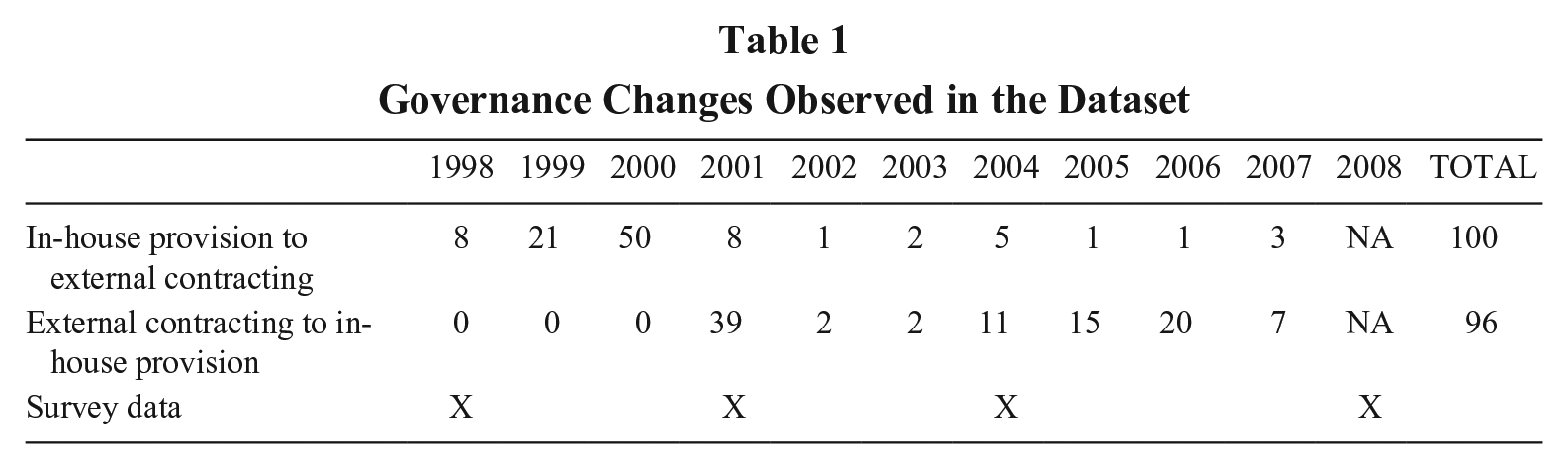
Notably, we limited our analysis to municipalities that switched from in-house provision to external contracting or from external contracting to in-house provision during the study period. Focusing on these municipalities has two advantages. First, we ensured that none of the sampled municipalities had recent in-house provision experience before switching to in-house provision and that none of the private firms involved in external contracting had recent local experience before the city switched to external contracting. This means that the firms and municipalities had no “localized pre-entry experience” that could influence the performance of the water supply. Second, eliminating left-censored observations prevents the generation of learning curves on the basis of inconsistent regression estimates. Our analyses focused on the 252 cities whose water supply mode changed between 1998 and 2008. We eliminated 54 cities that switched modes in 2008 (the last year of the dataset) because we could not compute performance improvements for them. Missing or unreliable data caused us to discard two more cities. This resulted in a final sample of 196 cities whose water supply modes changed during the study period. Of these, 100 cities switched from in-house provision to external contracting, whereas 96 cities switched from external contracting to in-house provision.
The structure of our sample allowed us to observe the evolution of water supply performance after the switch for all of the sampled municipalities. Our dataset consisted of data collected in 1998, 2001, 2004, and 2008. Had all cities switched modes in 1998 and kept the same mode until at least 2008, our dataset would have had 784 year-city observations. However, many cities changed modes after 1998. Depending on the year of the switch, we can observe postswitch supply performance over different periods, from immediately after the switch to 10 years later. Furthermore, we discarded six years of city observations because of missing or unusable data. This left us with 473 year-city observations in the full sample: 288 year-city observations in the external contracting subsample (i.e., the 100 cities that switched from in-house provision to external contracting) and 185 year-city observations in the in-house provision subsample (i.e., the 96 cities that switched from external contracting to in-house provision).
Table 1 summarizes, for each year, switches from external contracting to in-house provision and vice versa. Many switches occurred in 2000 and 2001 due to the 2001 municipal elections. Contracts are often designed to end in an election year. It is also common for cities to change their water supply structure immediately before or immediately after elections, either to attract potential electors or to fulfill electoral promises.
Governance Changes Observed in the Dataset
Dependent and Independent Variables
The dependent variable was operating performance, which we measured by dividing, for the year considered, the billed volumes by the total water supply. Our measure was thus based on leakages in the network. This is the traditional metric used by scholars and practitioners to assess water supply performance (for a review, see Porcher & Saussier, 2019). A low value for operating performance implies that the provider is losing money since it has produced and purified water but cannot sell it because of leaks in the network. This measure is appropriate for the purposes of our study because it measures good maintenance and varies over time.
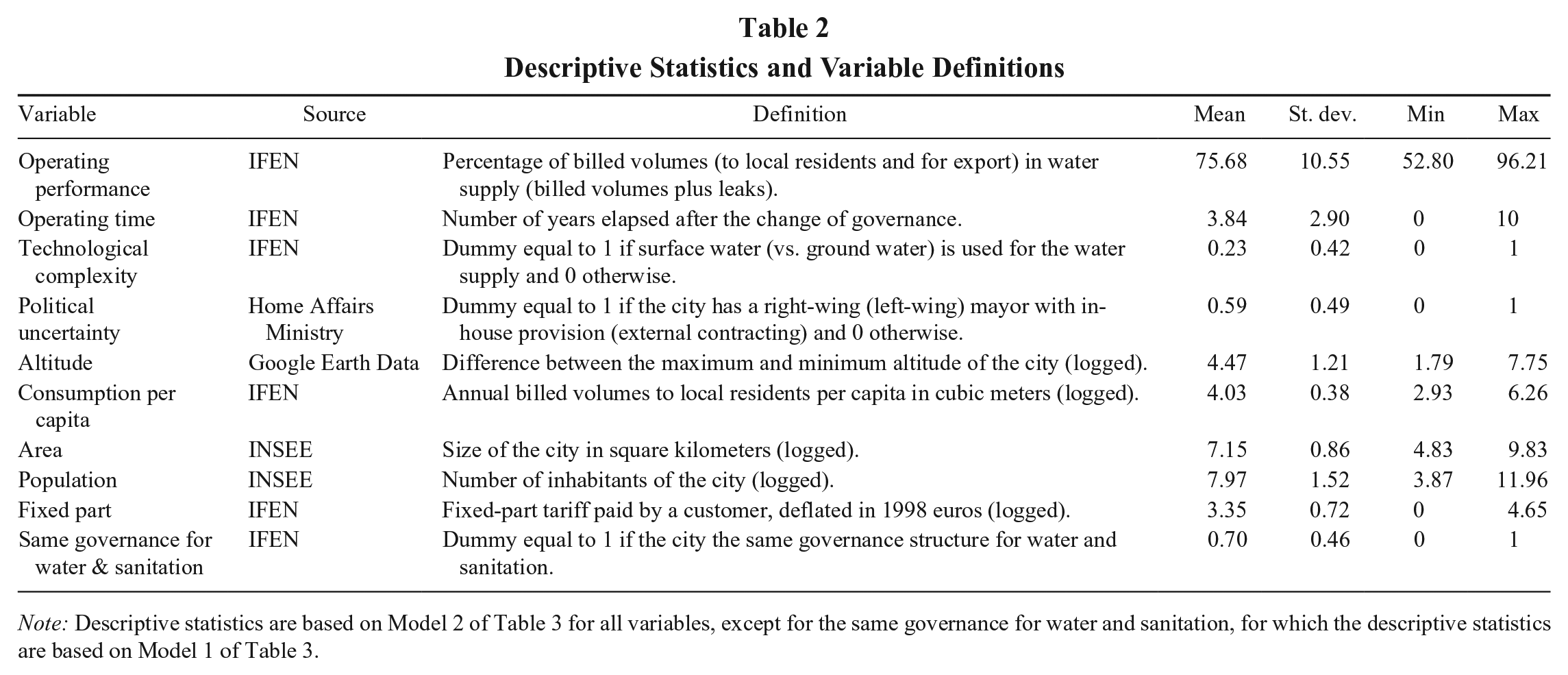
We acknowledge that the leakage ratio is an engineering performance indicator, not an economic indicator. Furthermore, the learning curve typically applies to costs (Lieberman, 1984) that are not disclosed in either external contracting or in-house provision. However, we believe that reliable estimates of experiential benefits can be obtained from data on water leakage. In both in-house provision and external contracting, reducing leakage is highly beneficial for the water supplier. A reduction in leakage increases revenues and profits since the cumulative increase in revenues is generally greater than one-off repair costs. Additionally, a reduction in leakage yields significant nonfinancial benefits, such as signaling a city’s commitment to ecological issues. Furthermore, it is mandatory for cities to publish the leakage ratio on a yearly basis. As a result, this ratio is commonly used by politicians competing for local electoral positions to justify good (or bad) use of public money. Third, the leakage ratio is a major criterion used by cities to renew water supply outsourcing contracts; thus, it is highly beneficial for a private contractor to show that it has reduced leaks in the network. For these reasons, we believe that the yearly leakage ratio is an appropriate variable for building learning curves since it captures the level of performance of the water supplier and impacts its wealth (as with any operating cost measures). We winsorized the variable at the 5% and 95% levels for each year of the sample to reduce the impact of outliers, although maintaining the original data yielded virtually identical results. Overall, operating performance ranges from 52.80% to 96.21%, with a mean of 75.68% and a standard deviation of 10.55.
Our independent variable, operating time, records the number of years elapsed since the change in the water supply mode. For example, if a city changed the mode in 2000, then operating time is coded 1 in 2001, 4 in 2004, and 8 in 2008, if a city switched the mode in 2003, then operating time is coded 1 in 2004 and 5 in 2008. By construction, operating time cannot exceed 10 years (which was reached when the switch occurred in 1998). Operating time thus ranges from 0 to 10, with an average of 3.84 and a standard deviation of 2.90.
Moderating Variables
Our analysis uses two moderators: technological complexity and political uncertainty. Technological complexity encompasses the origin of water and distinguishes between surface water (obtained from rivers and lakes or via surface pumping) and groundwater (obtained through underground drilling). The water source is a widely used variable in the specialized literature to signify a network’s technological complexity (see Porcher & Saussier, 2019). First, groundwater is acquired through wells dug at various locations, which ensures proximity to consumption centers. Conversely, surface water is often procured from production plants near lakes or rivers, which may be distant from consumption centers. Networks that rely on surface water tend to be more extensive and require additional infrastructure such as pipes, pumps, valves, and reservoirs, which ultimately increases network complexity. Moreover, surface water often contains relatively high contaminant levels and requires extensive treatment before it can be used by the community, including additional pipes and reservoirs. Groundwater typically contains fewer contaminants because sediment layers naturally filter the water. Additionally, surface water sources are less stable due to potential droughts whereas groundwater sources are more reliable over time, which poses challenges to network infrastructure. Some cities use a combination of both water sources. Technological complexity is a binary variable with a value of 1 indicating the use of surface water or a combination of surface water and groundwater and a value of 0 representing the use of groundwater alone. We assume that greater technological complexity, especially in external contracting, reduces the incentive for the water supplier to address leakages. This is because networks that rely on surface water are typically more extensive and technologically advanced, which makes it more challenging for suppliers to pinpoint the sources and locations of leaks and find suitable remedies.
Our second moderator, political uncertainty, captures the unpredictability associated with changes in governance structures. The choice of water supply mode is politically sensitive. Water contracts are therefore often renewed or terminated shortly before or shortly after local elections. Gagnepain, Ivaldi, and Martimort (2013) note that right-wing mayors are prone to use external contracting and that left-wing mayors are prone to use in-house provision. Our political uncertainty variable assesses whether a city’s governance structure aligns with the political orientation of its mayor. We expect that a misalignment between the governance mode and the mayor’s political orientation will create political uncertainty. For example, a left-wing mayor may create an unfavorable environment for a private contractor by signaling a potential shift to in-house provision. Conversely, a right-wing mayor operating under in-house provision may threaten to switch to external contracting during his or her term. In both scenarios, we posit that political uncertainty diminishes the water supplier’s motivation to pursue efficiency gains.
In particular, when a city is governed by a right-wing mayor, public sector employees within the in-house provision framework might harbor the belief that the public service is poised for privatization regardless of their efforts. Consequently, their motivation to pursue efficiency improvements is likely to be low because they anticipate potential reassignment to other municipal services in the near future. A comparable attitude can be expected from private sector employees working for a city under the leadership of a left-wing mayor. Anecdotal evidence underscores the flexibility of mayors in changing the governance structure in accordance with their political interests. For example, in 1985, Jacques Chirac, a right-wing mayor of Paris, transitioned from in-house provision to external contracting under a 25-year contract. In 2001, Bertrand Delanoë, the newly elected left-wing mayor of Paris, initiated the process of shifting from external contracting to in-house provision, which was eventually implemented at the end of the contract in 2009. Overall, we expect political uncertainty to reduce the water supplier’s motivation to address leakages, particularly in the context of external contracting.
The study period encompasses three municipal elections (1995, 2001, and 2008). For each year from 1998 to 2008, we recorded the political affiliation of the municipal leadership in the sampled cities using data from public records on French elections. We assigned a value of 1 to political uncertainty in cases where a city with right-wing leadership opted for in-house provision or a city under left-wing or independent leadership chose external contracting. In all other cases, political uncertainty was coded as 0.
Control Variables
We include several control variables (see Table 2). We expect the size of the city (area) and the difference in altitude (altitude) to reduce operating performance. This is because maintaining efficient networks becomes more challenging as the size of the area increases or in the context of steeper terrains in cities. We also expect population and consumption per capita to increase operating performance due to potential scale economies in the water supply. In addition, we anticipate that the fixed-part tariff will improve operating performance. In utility sectors, the fixed-part tariff typically covers capital expenditures per customer and is commonly used as an indicator of infrastructure investments. For analytical consistency, we log-transform all control variables. Furthermore, we utilize three types of dummies. First, regional dummies control for unobserved differences at the regional level, including differences in weather and water basins. Our regional dummies use the 15 régions françaises administrative units in France. Second, we use dummies for four types of chemical treatments applied to water for purification. Water treatments are straightforward to administer (Levin & Tadelis, 2010) and reflect operational methods rather than differences in technological sophistication. Finally, we include three dummies that correspond to the political mandates—1995–2000, 2001–2007, and 2008–2014—covered by the study period to control for time-specific contemporaneous shocks (Certo & Semadeni, 2006). Table 2 presents the variable definitions, sources, and descriptive statistics. Table 3 reports the Pearson pairwise correlations and variance inflation factors (VIFs). With the exception of the quadratic term, none of the correlations exceed 0.38, and the average VIF is 2.76. Thus, multicollinearity does not bias our analyses.
Descriptive Statistics and Variable Definitions
Correlation Matrix and Variance Inflation Factors
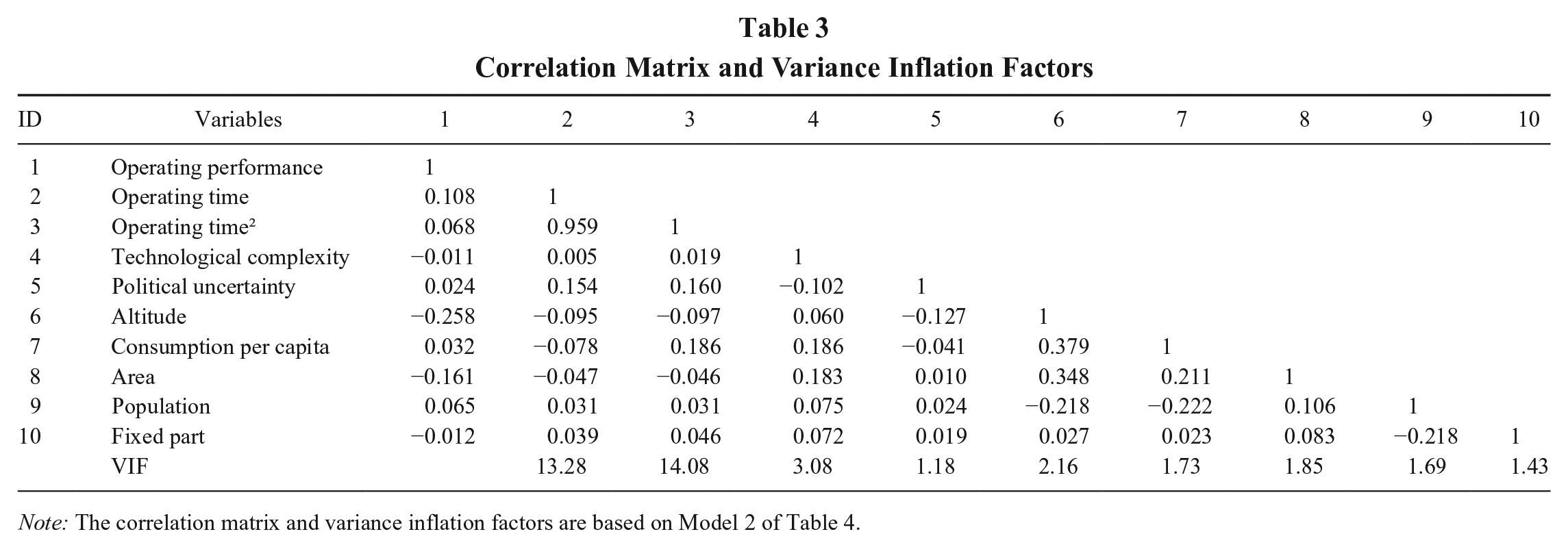
Note: The correlation matrix and variance inflation factors are based on Model 2 of Table 4.
Model Specification
We control for potential endogeneity-based biases using two methods. First, we use a Heckman two-stage approach. Our first stage analyzes cities’ likelihood of switching governance structure, whereas our second stage examines the impact of operating time on operating performance. Second, we control for all unobserved but time-invariant confounders between municipalities via a panel fixed effects approach, which allows us to study the causes of changes within a city.
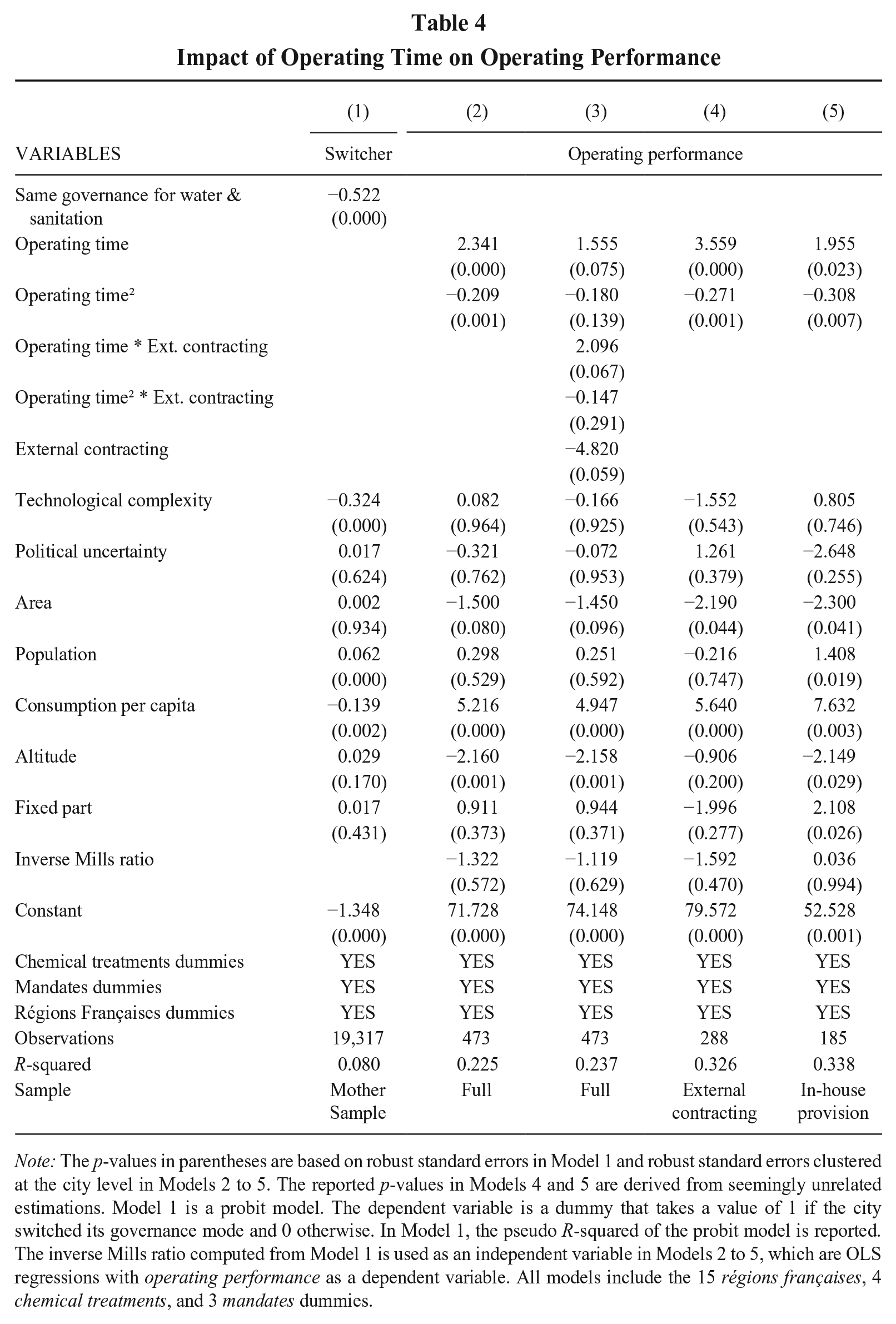
The first stage of our Heckman model is a probit model that examines the likelihood of a city switching its governance structure for water supply (Model 1, Table 4). We then introduce the first-stage inverse Mills ratio into the performance equation. The first-stage equation requires at least one covariate that does not appear in the performance equation. This variable should adhere to the exclusion restriction: it should affect the first-stage result but not the outcome of the second stage (Certo, Busenbark, Woo, & Semadeni, 2016). We selected the same governance for water and sanitation variable, which indicates whether a city uses the same governance structure for both its water supply and its sanitation services. Water sanitation is a separate service from the water supply with its own accounting, personnel, and decisions about the governance structure, as specified by law 64–125 from 1964. This separation allows for scenarios where a city may outsource its water supply while maintaining water sanitation in house. Technologically, the two services are independent and require different piping systems, water collection and treatment methods, and specialized skills. Hence, although the same governance for water and sanitation variable is likely to influence a city’s reluctance to switch water supply governance (indicating a preference for a consistent governance approach), it should not affect the performance of the water supply itself. We verify that this instrument meets the exclusion restriction: in the main performance model, it does not impact operating performance (β = −23.276, p = 0.386). 2 However, it significantly influences the likelihood of a governance switch in water supply (β = −0.522, p = 0.000) (Model 1, Table 4).
Impact of Operating Time on Operating Performance
Note: The p-values in parentheses are based on robust standard errors in Model 1 and robust standard errors clustered at the city level in Models 2 to 5. The reported p-values in Models 4 and 5 are derived from seemingly unrelated estimations. Model 1 is a probit model. The dependent variable is a dummy that takes a value of 1 if the city switched its governance mode and 0 otherwise. In Model 1, the pseudo R-squared of the probit model is reported. The inverse Mills ratio computed from Model 1 is used as an independent variable in Models 2 to 5, which are OLS regressions with operating performance as a dependent variable. All models include the 15 régions françaises, 4 chemical treatments, and 3 mandates dummies.
In the second-stage equations, we adopt the design that scholars typically use to compare learning curves across governance structures (Mulotte, 2014; Sampson, 2005). We divide our sample into an external contracting subsample (i.e., firms that switched from in-house provision to external contracting) and an in-house provision subsample (i.e., firms that switched from external contracting to in-house provision). We then use OLS regressions to examine the impact of operating time on operating performance in each subsample, apply seemingly unrelated estimations to account for potential correlations in error terms across the subsamples, and employ Wald tests to compare the regression estimates. Because we expect the learning curve to be curvilinear, we enter operating time and operating time2. Next, we add the interactions between operating time and operating time2 and our moderators, technological complexity and political uncertainty.
Results
Results for H1
Table 4 presents the results. Model 2 is estimated on the full sample. Model 3, which we explored in the post hoc analyses section, also incorporates the external contracting dummy variable and its interactions with operating time and operating time2. Model 4 is estimated on the external contracting subsample, and Model 5 is estimated on the in-house provision subsample. In terms of the effects of the control variables, we find that operating performance is increased by consumption per capita, whereas it is decreased by area and altitude.
In Models 2, 4 and 5, operating time is significant and positive (β = 2.341, p = 0.000, Model 2, β = 1.555, p = 0.075, Model 4, β = 1.955, p = 0.023, Model 5), whereas operating time2 is significant and negative (β = −0.209, p = 0.001, Model 2, β = −0.271, p = 0.001, Model 4, β = −0.308, p = 0.007, Model 5). The turning points are 5.59 years for the full sample in Model 2 (Min: 0, Max: 10), 6.56 years for the external contracting subsample in Model 4 (Min: 0, Max: 10), and 3.17 years for the in-house provision subsample in Model 5 (Min: 0, Max: 7). The Sasabuchi test (Lind & Mehlum, 2010) confirms the curvilinear relationship between operating time and operating performance in all samples (t = 2.39, p = 0.009, Model 2, t = 1.75, p = 0.041, Model 4, t = 1.88, p = 0.031, Model 5). Thus, the learning curves not only exhibit decreasing marginal returns but also have an inverted-U shape. We examine this result in the Discussion section.
Second, we analyze the effects of learning-by-doing in external contracting vs. in-house provision (H1). We compare the marginal effects of operating time across the subsamples with the suest command in Stata 18. The command combines the estimation results of different models into one parameter vector and allows testing for cross-model hypotheses. We combine Models 4 and 5 to test the equality of the marginal effects of operating time on operating performance at the average value of operating time in the full sample. The Wald test significantly rejects the equality of the marginal effect of operating time in external contracting and in-house provision at the mean of operating time ( F = 10.05, p = 0.002). We also compute Wald tests for each year of operating time for which we have observations for both external contracting and in-house provision (Table 5). The Wald tests of the equality of marginal effects are rejected for most values of operating time. Finally, we plot the predicted operating performance in external contracting and in-house provision for different values of operating time using estimates from Models 4 and 5 (Figure 1). Graphically, the learning curve appears steeper in external contracting than in in-house provision. Overall, our findings suggest a greater presence of learning-by-doing in external contracting than in in-house provision, as predicted in H1.
Wald Tests for H1
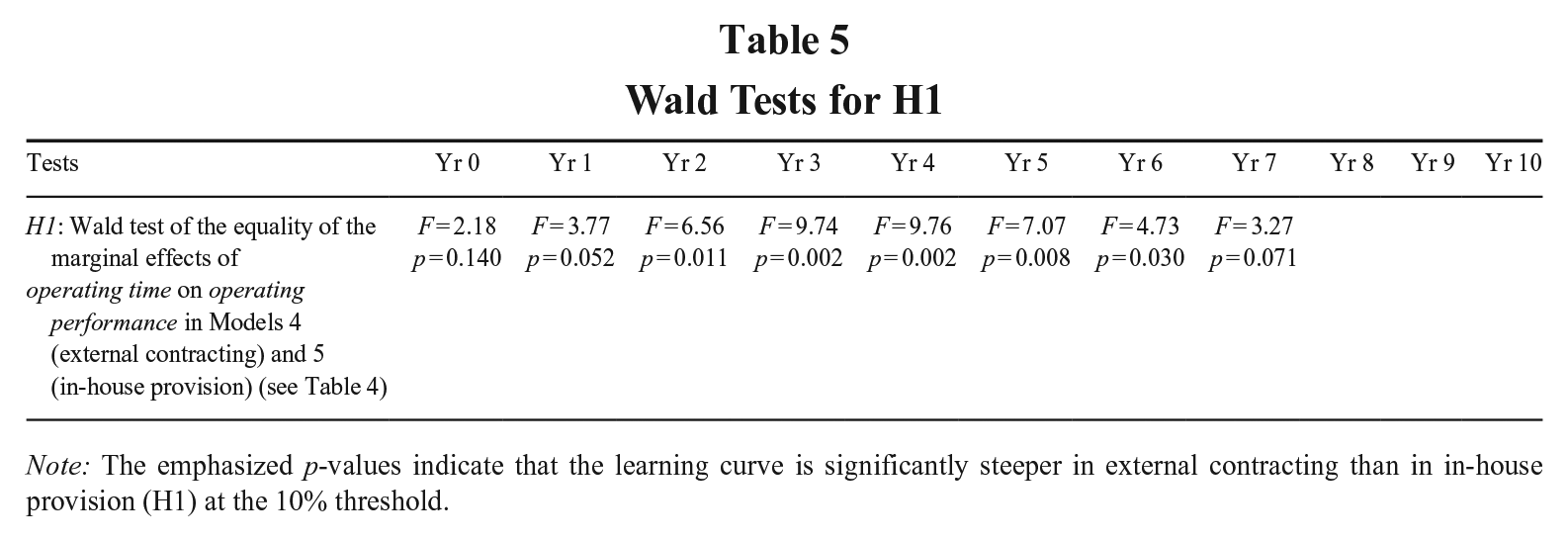
Note: The emphasized p-values indicate that the learning curve is significantly steeper in external contracting than in in-house provision (H1) at the 10% threshold.
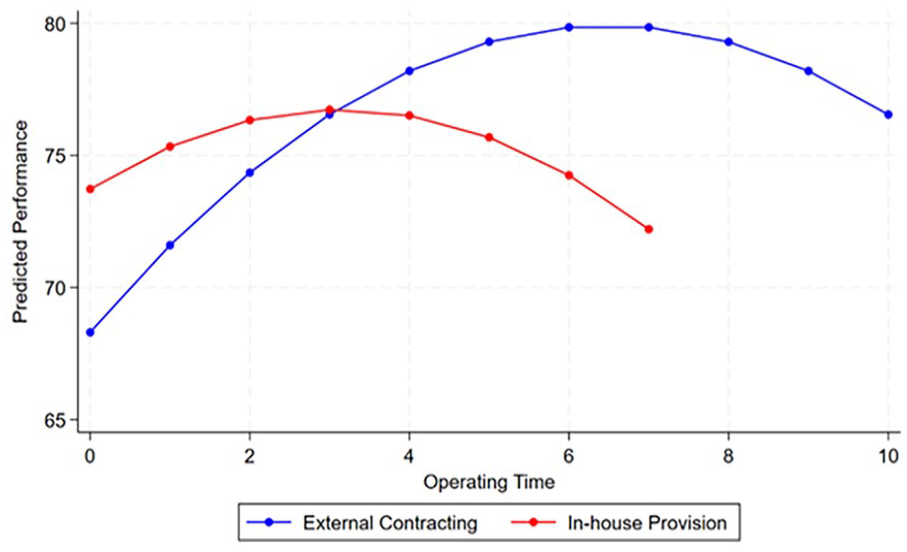
Impact of Operating Time on Predicted Operating Performance in External Contracting and In-House Provision
The computation of economic significance is complex given the curvilinear shape of the learning curves. However, the average marginal effects obtained from Models 2, 4, and 5 using the margins command in Stata 18 provide initial insights. On average, an increase of one year in operating time increases operating performance by 0.73 percentage points in the full sample (p = 0.008), 1.17 percentage points in the external contracting sample (p = 0.007) and 0.13 percentage points in the in-house provision sample (p = 0.784). For an average production of 680,215 cubic meters per year, an increase of 0.73 percentage points in operating performance represents a decrease in water losses of 4,966 cubic meters every year.
Results for H2 (Technological Complexity) and H3 (Political Uncertainty)
We examine the impact of our moderators (Table 7). First, we consider the impact of technological complexity (H2a and H2b). In the full sample (Model 6), the interaction of operating time * technological complexity is negative, and the interaction of operating time2 * technological complexity is positive, however, none of the coefficients is significant. In the external contracting sample (Model 7), the interaction of operating time * technological complexity is negative, whereas the interaction of operating time2 * technological complexity is positive, but both are nonsignificant. In the in-house provision sample (Model 8), the interaction of operating time * technological complexity is significant and positive (β = 3.685, p = 0.069), and the interaction of operating time2 * technological complexity is significant and negative (β = −0.559, p = 0.033). Thus, technological complexity seems to increase learning-by-doing in in-house provision. This finding aligns with Mulotte’s (2014) observation that technological complexity increases the impact of learning-by-doing in internal development but not in other product development modes.
Wald Tests for H2 and H3
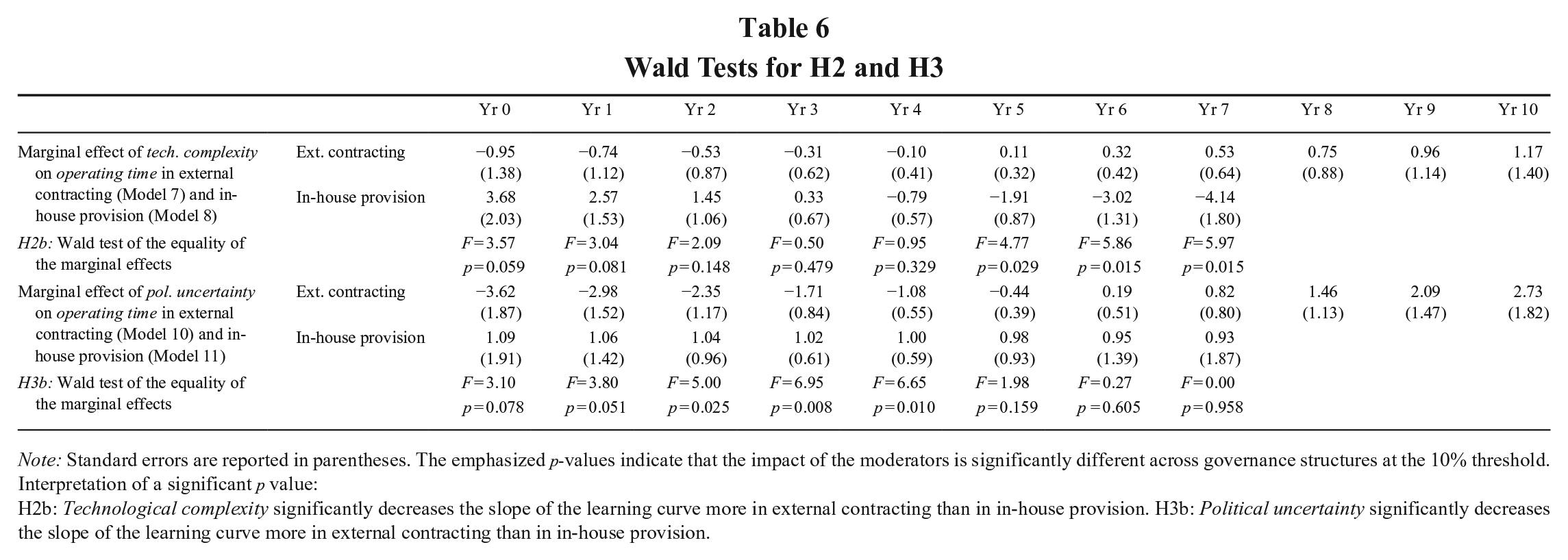
Note: Standard errors are reported in parentheses. The emphasized p-values indicate that the impact of the moderators is significantly different across governance structures at the 10% threshold.
Interpretation of a significant p value:
H2b: Technological complexity significantly decreases the slope of the learning curve more in external contracting than in in-house provision. H3b: Political uncertainty significantly decreases the slope of the learning curve more in external contracting than in in-house provision.
Moderating Effects of Technological Complexity and Political Uncertainty
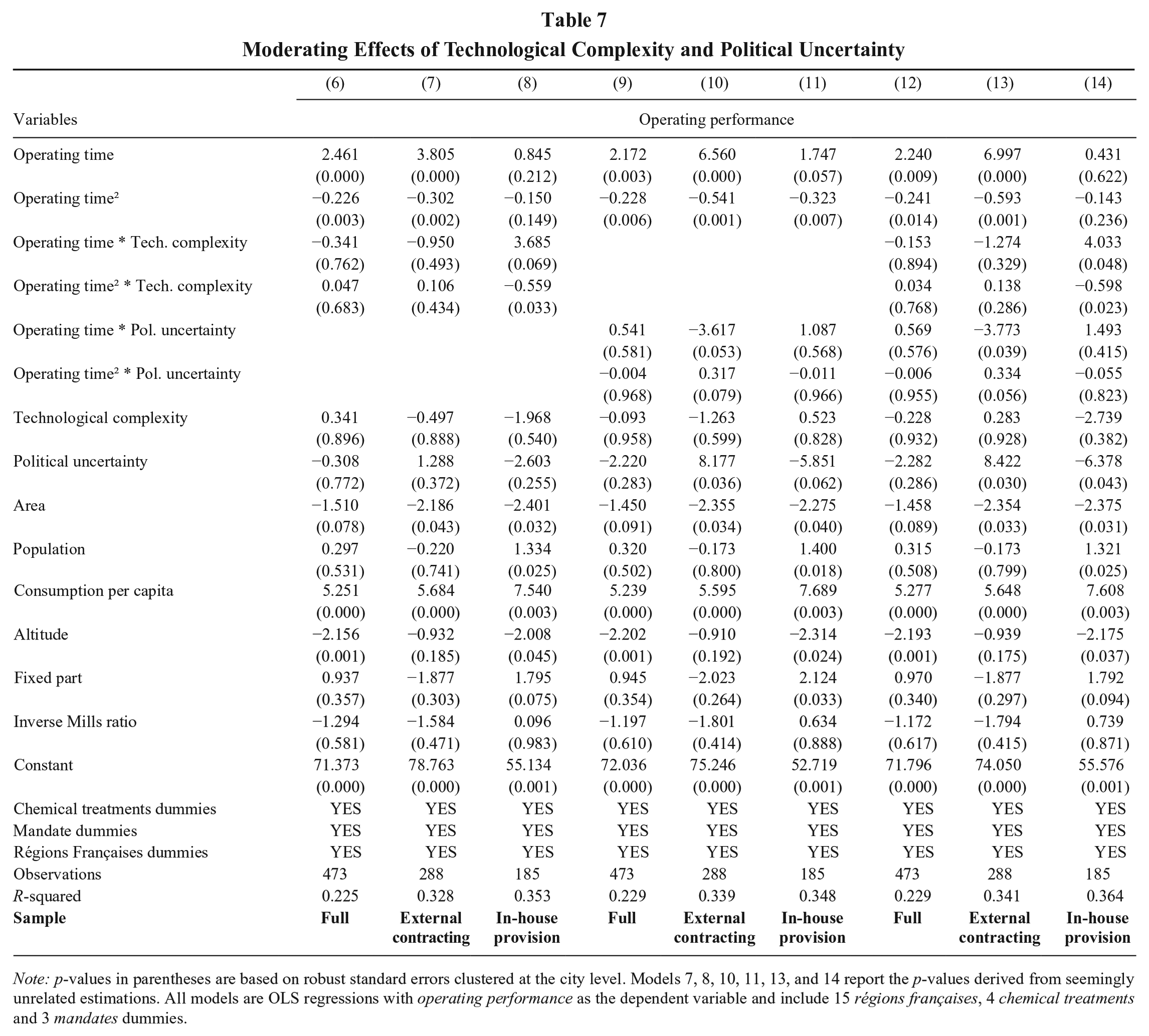
Note: p-values in parentheses are based on robust standard errors clustered at the city level. Models 7, 8, 10, 11, 13, and 14 report the p-values derived from seemingly unrelated estimations. All models are OLS regressions with operating performance as the dependent variable and include 15 régions françaises, 4 chemical treatments and 3 mandates dummies.
Following Haans, Pieters, and He (2016), we plot the learning curve for different levels of technological complexity using the estimates of Models 7 (external contracting subsample) and 8 (in-house provision subsample; Figures 2 and 3). As technological complexity increases, the curve becomes flatter in external contracting and steeper in in-house provision. We also compare the coefficients across governance structures using Wald tests (Table 6). The tests show that technological complexity has a negative moderating effect in the first years of external contracting and a significant positive moderating effect in the first years of in-house provision. To further test the validity of H2b, we compare the moderating effect of technological complexity in external contracting versus in-house provision. For most years, the Wald test significantly rejects the equality of the moderating effect of technological complexity on learning-by-doing in external contracting and in-house provision. Overall, the findings suggest that as the technological complexity of the water supply increases, the benefits of external contracting in facilitating learning-by-doing decrease relative to in-house provision.
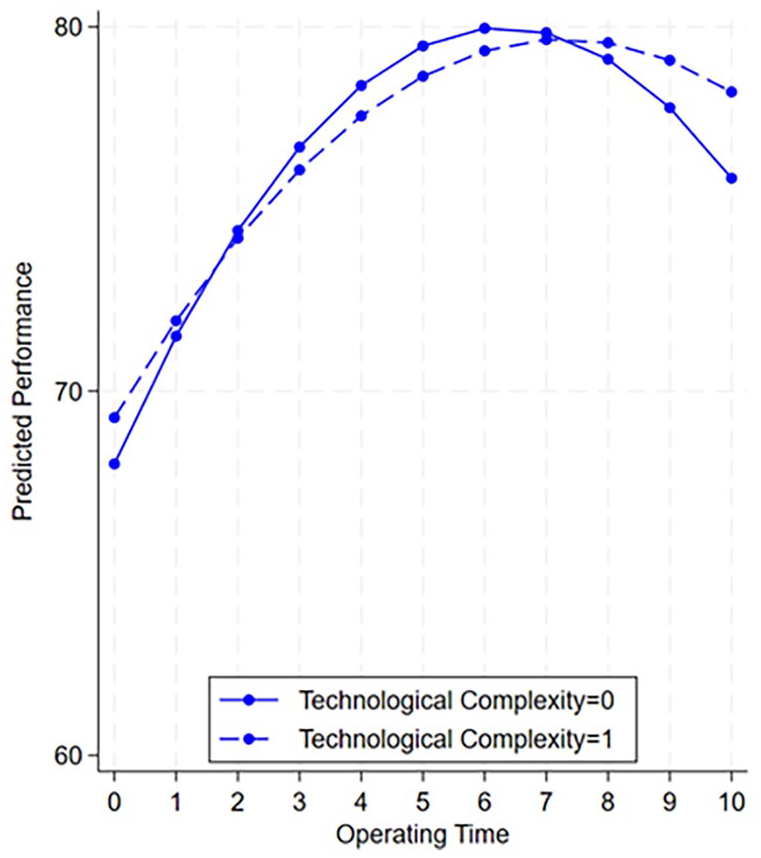
The Moderating Effect of Technological Complexity on Operating Time: External Contracting. (b) Inhouse Provision
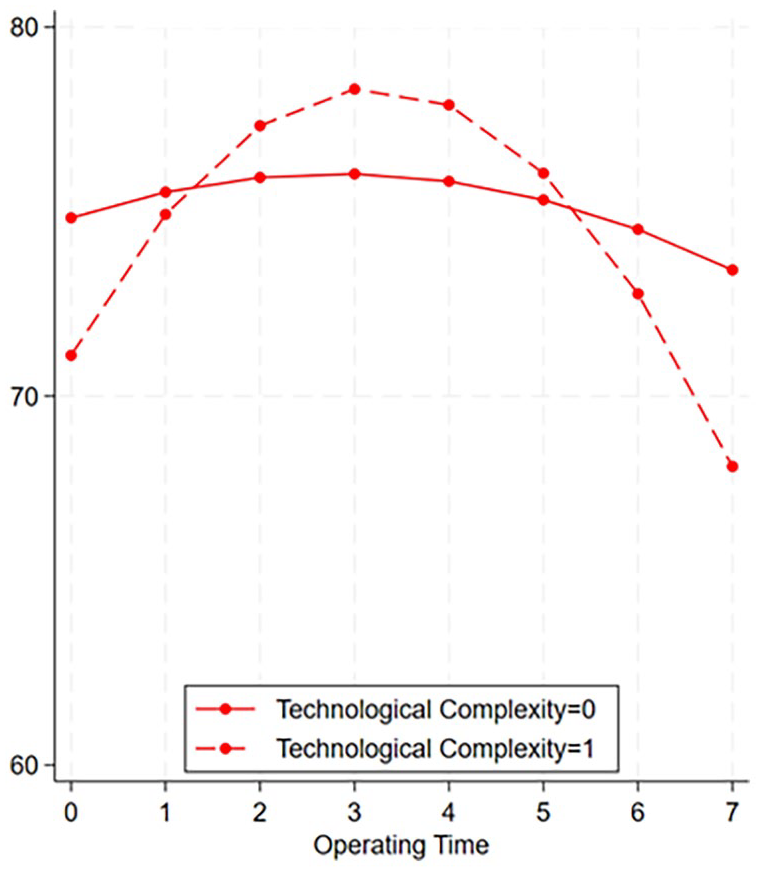
The Moderating Effect of Technological Complexity on Operating Time: Inhouse Provision
We next consider the impact of political uncertainty on the effects of learning-by-doing (H3a and H3b). In Models 9 (full sample) and 11 (in-house provision subsample), the interactions of operating time * political uncertainty and operating time2 * political uncertainty are not significant. More strikingly, in Model 10 (external contracting sample), operating time * political uncertainty is significant and negative (β = −3.617, p = 0.053), and operating time2 * political uncertainty is significant and positive (β = 0.317, p = 0.079). The computation of the marginal effects for different values of operating time shows that political uncertainty negatively moderates the impact of operating time on operating performance in external contracting for most years of the study period (Table 6) but has no significant effect on in-house provision. The impact of political uncertainty on the learning curve is plotted in Figure 4 (for external contracting, using Model 10) and Figure 5 (for in-house provision, using Model 11). In external contracting, the curve becomes flatter as political uncertainty increases, while in in-house provision, political uncertainty does not seem to graphically alter the slope of the curve. Moreover, Wald tests of the equality of the marginal effects of political uncertainty on operating time (Table 6) across governance structures are rejected for most years of operation. Overall, the findings suggest that political uncertainty decreases learning-by-doing more in external contracting than in in-house provision.
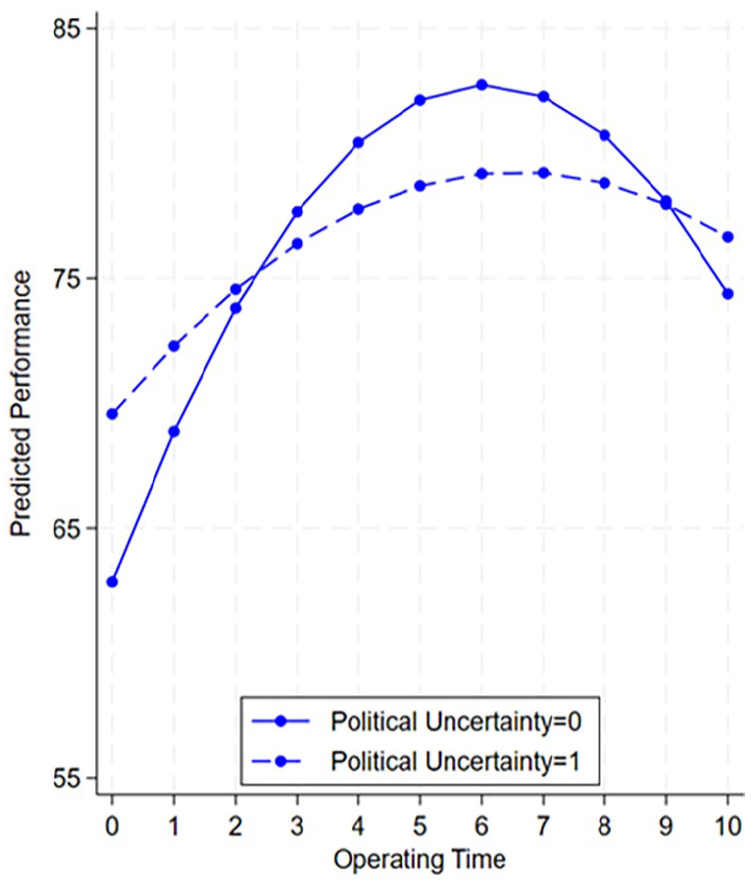
The Moderating Effect of Political Uncertainty on Operating Time: External Contracting
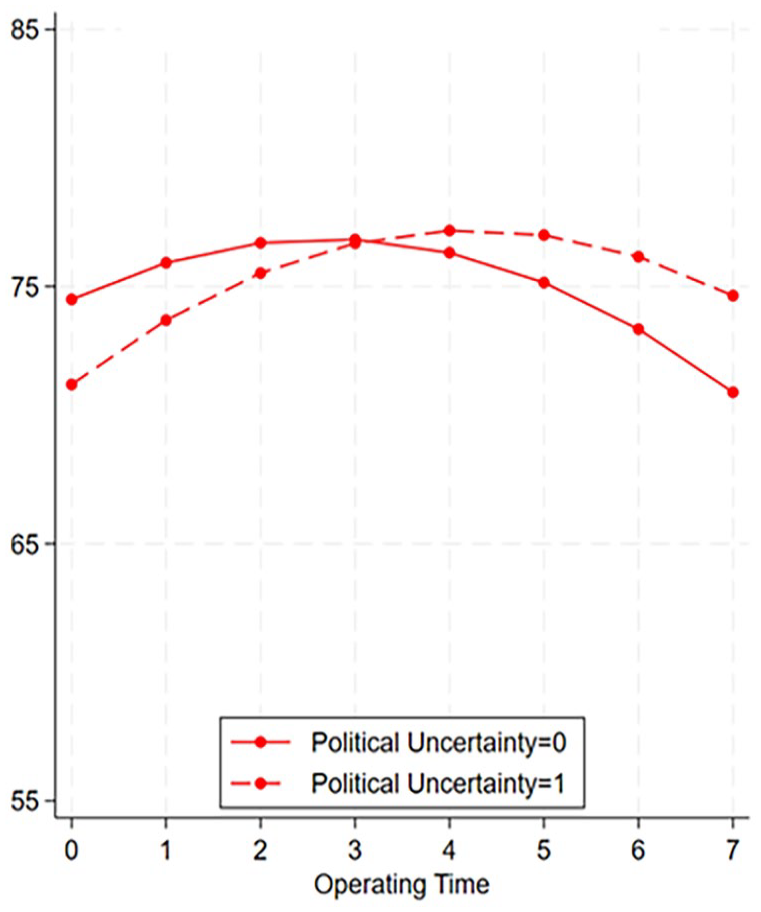
The Moderating Effect of Political Uncertainty on Operating Time: Inhouse Provision
We report the results when both moderators are added to the equations in Models 12 (full sample), 13 (external contracting), and 14 (in-house provision). In Model 12, as in our earlier Models 6 and 9, the interactions with technological complexity and political uncertainty are not significant. The moderating effects of technological complexity and political uncertainty observed in Models 7, 8, 10, and 11 are consistent across the subsamples (Models 13 and 14).
Panel Fixed Effects Analyses
Our second approach uses panel regressions with fixed effects for cities (Table 8). These models control for all time-invariant differences between observations, assuming that the time-invariant differences are perfectly collinear with the entity dummies. Overall, the results are similar to those observed in our main models. We observe an inverted U-shaped time‒performance relationship in the full sample (Model 15) and in the external contracting subsample (Model 16). The marginal impacts of operating time at the mean are 2.39 (p = 0.000) for external contracting (Model 16) and 0.81 (p = 0.363) for in-house provision (Model 17) and are different from one another at the 5% threshold (F = 8.63, p = 0.003). Models 18 to 20 report the results for the interactions of operating time with technological complexity and political uncertainty in the full sample (Model 18), in the external contracting subsample (Model 19), and in the in-house provision subsample (Model 20). The results are similar to those obtained with OLS regressions.
Fixed Effects Panel Regressions
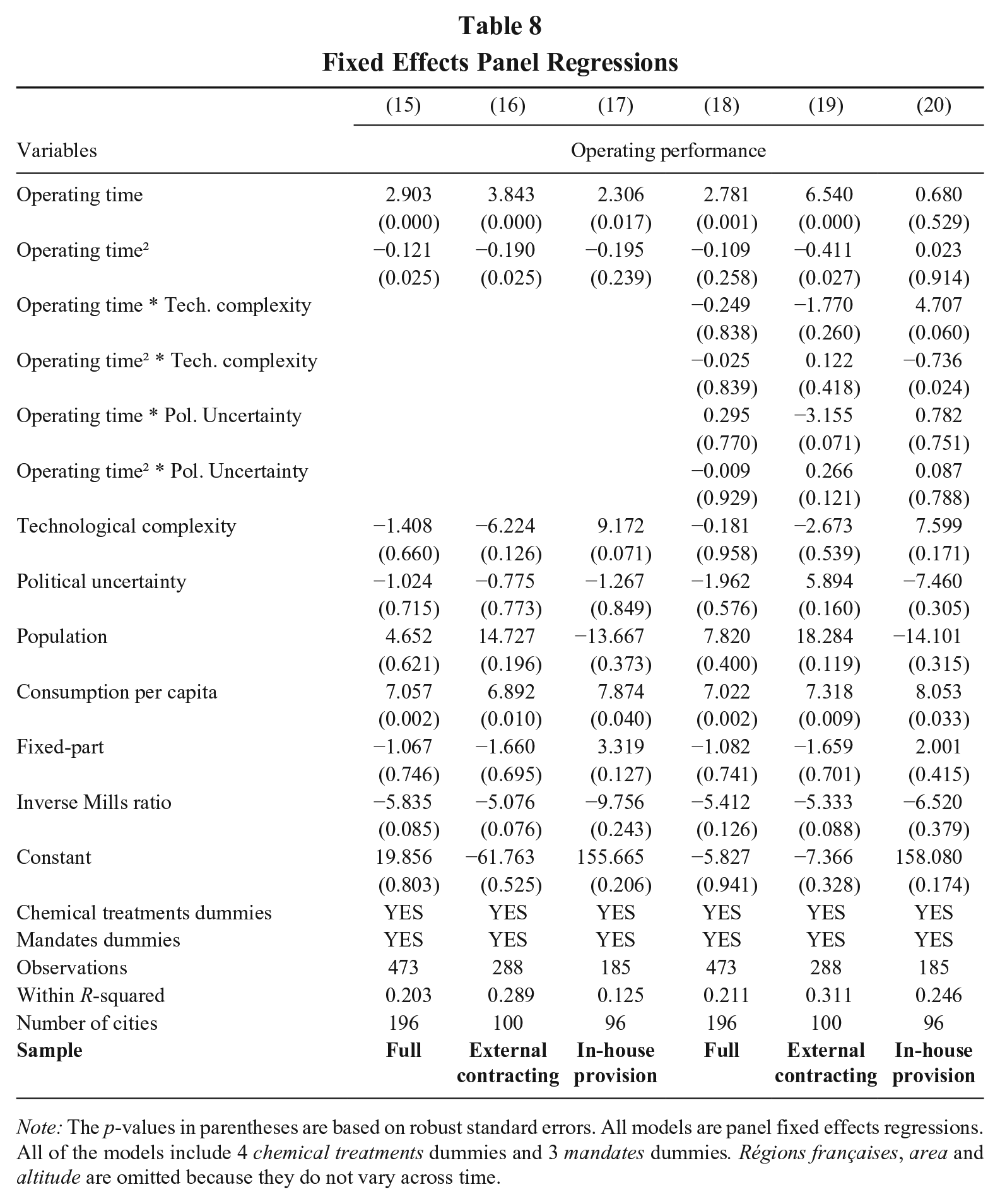
Note: The p-values in parentheses are based on robust standard errors. All models are panel fixed effects regressions. All of the models include 4 chemical treatments dummies and 3 mandates dummies. Régions françaises, area and altitude are omitted because they do not vary across time.
Post Hoc Analyses
To verify the robustness of our findings, we conduct several post hoc analyses (see the online appendix). We first perform a regression analysis in which we interact operating time and operating time2 with external contracting (Model 3 of Table 4). The coefficient for operating time is positive and significant (β = 1.56, p = 0.075), whereas the coefficient for operating time2 is negative and not significant. Furthermore, the interaction effect between operating time and external contracting is positive and significant (β = 2.10, p = 0.067). Second, we consider the possibility of unobserved variables influencing both the independent and dependent variables. We apply the impact threshold of a confounding variable (ITCV) approach to assess the stability of our causal relationships (Busenbark, Yoon, Gamache, & Withers, 2022). The comparison between the ITCV and the impact of observed confounders suggests that our results are stable. Third, we implement a two-stage instrumental variable model with a heteroskedasticity-identified instrument procedure (Lewbel, 2012). Similar to our earlier analyses, this approach confirms a significant positive effect of operating time (β = 2.34, p = 0.000) and a negative impact of operating time2 (β = −0.21, p = 0.000). Fourth, following Certo, Busenbark, Kalm, and Lepine (2020), we reassess our models by integrating the numerator and denominator of the dependent ratio variable as separate controls, which reaffirms our initial results.
Discussion
Main Results
Our aim in this study was to examine whether learning-by-doing in public service provision is the same in in-house provision as it is in external contracting. Building on extant theorizing, we first posited that performance improves with the duration of operation at a decreasing rate. Expanding on this notion and drawing on the idea that learning-by-doing increases with the power of agents’ incentives, we predicted a greater degree of learning-by-doing in external contracting than in in-house provision. Additionally, we asserted that complexity and uncertainty dampen agents’ responses to high-powered incentives. We thus hypothesized that learning-by-doing decreases more in external contracting than in in-house provision as the technological complexity or political uncertainty of the public service increases. Data on the water supply in France confirmed our hypotheses to a respectable degree.
Although we predicted that learning-by-doing would be characterized by decreasing marginal returns, our results suggest that prolonged operation duration is detrimental to performance in both in-house provision and external contracting. This outcome underscores a unique aspect of our empirical context where, as mentioned above, the benefits of learning-by-doing can be supplemented by maintenance investments, such as replacing pumps and valves, which persist throughout a contract and can be estimated by the fixed part of the tariff, and major capital expenditures in public infrastructure, such as constructing reservoirs and overhauling extensive segments of network pipes. Iossa and Rey (2014) indicate that the majority of large-scale investments in public infrastructure occur in the years following a change in governance structure, allowing the water supplier to benefit more directly from cost reductions over the entire period while demonstrating the supplier’s ability to fulfill selection process commitments. These major capital expenditures can aid firms in achieving better performance independent of learning-by-doing, but they decrease over time at an increasing rate (Iossa & Rey, 2014; Laffont & Tirole, 1993). This dynamic creates a scenario where the capital expenditure curve exerts an increasingly negative effect on the right side of the learning curve, leading to the observed inverted U-shaped time-performance curve. Had such capital expenditures been constant, the relationship would have followed the predicted shape with a positive slope and decreasing marginal returns (for a formal explanation, see Haans et al., 2016).
The effect described above is notably absent in the manufacturing-type operational processes studied in organizational learning research (e.g., Argote, 2013). In these settings, capital expenditures usually remain constant over time or occur only once, which limits the potential for the inverted-U shaped learning curve. In the field of corporate strategy, researchers suggest that corporate acquisitions often follow an inverted-U shaped experience curve (e.g., Hayward, 2002). The declining portion of the curve is attributed to the emergence of overconfidence at high levels of experience. This phenomenon is unlikely to impact the water supply sector because individuals with extensive experience in this field are less likely to make inappropriate generalizations. This contrasts with corporate scope decisions, where experience is dissimilar, infrequent, and causally ambiguous (Anand, Mulotte, & Ren, 2016).
Theoretical Contributions
We contribute to two streams of research. First, we extend the organizational learning literature (Argote, 2013) by showing that in the provision of public services, operational performance improves over time, particularly in external contracting, compared with in-house provision. This idea contributes significantly to research on learning-by-doing, which traditionally focuses on experience within a single governance structure. More critically, our results suggest that external contracting is optimal for maximizing learning-by-doing in simpler, less uncertain scenarios, whereas in-house provision proves more effective in more complex and uncertain contexts. Thus, our second contribution to organizational learning theory is identifying when learning-by-doing is most effective and distinguishing between in-house provision and external contracting on the basis of the complexity and uncertainty of the service environment. This contribution significantly extends the existing organizational learning literature, which has not fully addressed how the characteristics of activities influence the effectiveness of learning-by-doing across different governance structures.
Our results echo Kogut and Zander’s (1996) seminal view that developing sophisticated organizational capabilities is achieved more effectively within firm boundaries than through market transactions because of improved information flow and shared identity. Our findings extend this view by suggesting that learning-by-doing is most effective within organizations when they undertake complex activities or activities that are subject to high environmental uncertainty. In contrast, learning-by-doing tends to be more effective in contractual governance when firms undertake simple activities and activities involving low levels of uncertainty. Our findings also align with those of Mulotte (2014), who noted that the technological complexity of new products increases the potential for learning-driven improvements in internal development settings, a benefit that is not mirrored in development alliances and in-licensing agreements. Overall, we extend the organizational learning literature by underscoring the unique benefits of experiential learning in handling complex tasks and navigating uncertain environments internally, whereas simpler tasks and tasks in more certain environments tend to benefit more from experience under market transactions.
Our second contribution is to the governance literature. Much of this literature has focused on the impact of governance structures on performance without analyzing performance dynamics (Williamson, 1991). Our results show that although the governance structure itself does not directly impact performance, the fit between the structure and the transaction’s levels of complexity and uncertainty influences experience-based efficiency gains. Our findings thus suggest that the discriminating alignment hypothesis of transaction cost economics applies not only to costs (as traditionally argued) but also to learning-by-doing. To some extent, the governance literature has alluded to this idea when claiming that coordinated adaptation is the best adaptation mechanism for complex or uncertain transactions. Williamson (1991) distinguishes coordinated adaptation from autonomous adaptation. Coordinated adaptation, which characterizes internal organization, relies on the hierarchy’s common language, efficient administrative monitoring, and the fiat-based resolution of conflicts. In contrast, autonomous adaptation refers to the spontaneous adaptation realized through the market. Williamson suggests that coordinated adaptation is the most efficient adaptation mechanism when transactions are uncertain or complex. We complement this view by showing that internal organization is the mode that maximizes adaptation—as assessed by learning-by-doing—when a transaction is complex or uncertain. Overall, our findings support Williamson’s view that “low-powered incentives have well-known adaptability advantages” (Williamson, 1985: 140), whereas “high-powered incentives impair the ease with which adaptive, sequential adjustments to disturbances are accomplished” (Williamson, 1985: 91). Accordingly, our perspective reinforces the notion that “internal organization often has attractive properties in that it permits the parties to deal with uncertainty or complexity in an adaptive, sequential fashion” (Williamson, 1975: 25).
Furthermore, we elucidate the determinants that influence firms’ choices to retain their current governance structures or switch to alternative ones. Williamson (1991) indicates that firms may contemplate such shifts when the conditions of a transaction change. Nevertheless, empirical evidence highlights that not all firms alter their governance structures in response to these transformations (Nickerson & Silverman, 2003). This reluctance to change has been attributed to sunk investments, contractual obligations, entrenched routines, superior technological capabilities, or adjustment costs (Argyres & Zenger, 2012, Argyres et al., 2019). We contribute to this research by proposing that nonchanging firms may prioritize learning-by-doing over the potential benefits of switching to a governance structure that better monitors transactional hazards. Overall, we suggest that efficiency gains may decrease the value of switching from contractual governance to internal organization (or vice versa), even when changes in exchange conditions justify such a change. We thus show the value of accounting for experience when examining changes in governance structures (Argyres & Liebeskind, 1999).
Managerial Implications
Our study has significant implications for the provision of public services. First, we highlight the critical role of learning-by-doing in enhancing the performance of water supply networks. We show that following a change in the supply mode, the new water supplier, whether it is the city or a private sector firm, initially spends considerable energy learning how it can improve processes. This effort, which complements infrastructure investments, may involve developing superior processes for designing and maintaining the distribution system. For example, innovative pipe inspection techniques, appropriate pipe materials, the ideal placement of valves and pumps to regulate water flow, or the optimization of storage tanks can be implemented to improve network performance. Our findings suggest that such learning-by-doing compensates, at least initially, for the steady decline (at an increasing rate) in large-scale infrastructure investments that is often observed after a few years in the water supply mode.
Second, we reveal variations in learning-by-doing between in-house provision and external contracting. The findings suggest that when the water supply system is technologically complex or politically uncertain, in-house provision is more effective for maximizing learning-by-doing. In contrast, when the water supply is technologically straightforward and the ideology of the mayor is aligned with the governance structure, external contracting is more conducive to maximizing learning-by-doing. These findings indicate that public decision-makers and operators should carefully assess the complexity and uncertainty of their water supply system and consider the potential benefits of learning-by-doing when making decisions regarding the governance structure.
Limitations and Avenues for Future Research
As with any study, our study has limitations that suggest new research directions. First, we assumed that learning-by-doing was driven by the power of incentives, and we did not directly measure these incentives, which is common practice in the governance literature. Specifically, drawing on Williamson’s work, this literature assumes that incentives are driven by the selected governance structure and that they are low-powered in in-house provision and high-powered in external contracting (Sorenson & Sørensen, 2001). We encourage future research to more directly measure incentives in varying governance modes and how they influence learning-by-doing in each mode. Second, we argued that learning-by-doing is influenced by a transaction’s complexity and uncertainty. However, governance scholars give great importance to the level of asset specificity of transactions, which may also influence learning-by-doing. The supply of water, as with most municipal services, requires all required tasks to be performed locally, including production, purification, and distribution. Furthermore, the city retains ownership of all infrastructures in both in-house provision and external contracting. Masten (2011) posits that asset specificity may be a less relevant dimension in our setting. More research on other settings is necessary to study how the level of asset specificity affects learning-by-doing. Third, we showed that water suppliers may learn how to operate and maintain water systems. We thus emphasized that water suppliers may supplement infrastructure investments with learning-by-doing. Following the extant research, we assumed that major investments in public infrastructure decrease at an increasing rate in the years that follow changes in the governance structure (Iossa & Rey, 2014; Laffont & Tirole, 1993). We acknowledge that the lack of granular data on infrastructure investments is a limitation of our study that calls for further work. Fourth, we focused on one industry and one country, which raises generalizability concerns. Although we have no reason to believe that our results are driven by the specificities of our empirical setting, we urge scholars to consider other empirical settings. Finally, our analysis primarily explored the motivations to learn, the role of incentives in shaping these motivations, and the way technological complexity and environmental uncertainty affect responses to incentives. However, individuals and organizations might vary in their capacity to learn, whether internally or through contractual governance (Kogut & Zanger, 1996). While our study focused on motivational aspects, future research could also examine learning capacity as a separate but equally significant factor.
Conclusion
Our aim in this study was to compare learning-by-doing across two prevalent governance structures in public services: in-house provision and external contracting. We showed that in public services with low levels of complexity or uncertainty, learning-by-doing tends to be most effective in external contracting, whereas in complex or uncertain public services, in-house provision tends to be more conducive to learning-by-doing. This key insight contributes to organizational learning theory and extends the governance literature. We hope that our study inspires further research on the performance of different governance structures.
Supplemental Material
sj-docx-1-jom-10.1177_01492063251342807 – Supplemental material for Comparing Learning-by-Doing Between In-House Provision and External Contracting in Public Service Provision
Supplemental material, sj-docx-1-jom-10.1177_01492063251342807 for Comparing Learning-by-Doing Between In-House Provision and External Contracting in Public Service Provision by Louis Mulotte and Simon Porcher in Journal of Management
Footnotes

References
Supplementary Material
Please find the following supplemental material available below.
For Open Access articles published under a Creative Commons License, all supplemental material carries the same license as the article it is associated with.
For non-Open Access articles published, all supplemental material carries a non-exclusive license, and permission requests for re-use of supplemental material or any part of supplemental material shall be sent directly to the copyright owner as specified in the copyright notice associated with the article.
