




Abstract
The well-established disruptive effects of employee turnover on firms have typically been attributed to post-exit dynamics, such as losses of human and social capital. Little is known, however, about leavers’ pre-exit job performance, which, if declining in sufficient magnitude as separation nears, may drive some of this disruption. Drawing on career concerns research, we argue that impending exit weakens incentives to improve future career prospects at the firm, thereby resulting in reduced performance. Our analysis reveals strikingly large negative relationships, as job performance during the impending-exit period declines by 53.9% and 79.8% across two performance measures. Additionally, we predict and find that these performance decrements are more pronounced for junior-level employees and partially mitigated for those anticipating a continuing relationship with the organization after exit. We test our predictions using longitudinal data on 4,104 patent examiners who left the United States Patent and Trademark Office from 2001 to 2018.
Research summaries consistently document the detrimental effects of voluntary turnover on work unit and firm effectiveness (e.g., Hancock, Allen, Bosco, McDaniel, & Pierce, 2013; Hausknecht & Trevor, 2011; Heavey, Holwerda, & Hausknecht, 2013; Park & Shaw, 2013). In examining this negative relationship, scholars have found that employee departures result in human and social capital losses, operational disruptions, the high cost of replacing leavers, and the need to rebuild knowledge and routines (Campbell, Coff, & Kryscynski, 2012; Hausknecht & Trevor, 2011; Reilly, Nyberg, Maltarich, & Weller, 2014). As is evident in the post-exit nature of these explanations, research has, in terms of timing, almost exclusively focused on costs related to managing the turnover aftermath.
Typically, however, employees are aware of the approaching quit date before they actually leave. This notion is evident in the pre-quit planning periods recognized by researchers (Hom & Griffeth, 1995; Klotz & Zimmerman, 2015) and lay business sources (e.g., De Smet, Dowling, Hancock, & Schaninger, 2022). Importantly, such awareness of impending departure may have implications for motivation, consistent with discussions of shirking before contract expiration in economics (Holmstrom, 1999), “short-timer’s fever” in the military (Moskos, 1975), and political science’s “lame-duck” sessions (Lott, 1990). Recognition of the time lapse between planning to leave and exit, and of potential incentive ramifications, leads us to explore possible job performance dynamics associated with this unique pre-exit period. Given that strategic perspectives on voluntary turnover consequences for the firm are dominated by consideration of post-exit explanations, we contend that this pre-exit period warrants investigation if we are to fully comprehend the role of human-capital-exit disruption in firm performance.
In this study, we investigate the “impending-exit period” as the relatively short time window just prior to an employee’s voluntary separation from the workplace. We first predict that the impending-exit period is characterized by reduced employee performance. This prediction, consistent with “lame duck” characterizations from political science, economics, and the popular press, is grounded in expectations of weakened explicit and implicit work incentives that link the employee’s current effort to future rewards and opportunities at the firm. In exploring these pre-exit performance declines, we also examine important aspects of performance trends, including their shape, timing, and variation by exit type (i.e., quits and retirements). We further posit that the fundamental relationship between the impending-exit period and job performance will depend on two contextual factors that may inform organizational strategies for buffering against the diminishing performance: (1) whether employees are at junior or senior levels, and (2) whether employees will continue a relationship with the workplace after leaving (i.e., joining a firm closely connected to the previous employer, such as those within the same community). In deriving these hypotheses for moderated impending-exit relationships, we theorize as to how the incentive structure associated with that timeframe may change according to the employees’ previous and future career concerns. We test our predictions with a unique data set comprised of 133,424 individual-month observations from 4,104 patent examiners who left the United States Patent and Trademark Office (USPTO) during an 18-year period, from 2001 to 2018. Finally, we acquire additional survey data to explore the possibility that job performance may vary according to distinct phases within the impending-exit period (e.g., upon deciding to leave, setting an exit date, and informing the firm).
This paper contributes to various streams of employee turnover research in management by identifying a time period largely ignored in prior research. First, given that no empirical work to our reading directly addresses the job performance consequences of the impending-exit period, 1 we investigate that relationship, paying particular attention to the shape of employee job performance profiles over time, presumably in the wake of changing performance incentives. By doing so, we aim to expand our understanding of the fundamental job performance dynamics associated with turnover. While not our focus, our findings suggest an alternative causal perspective to the substantial body of research characterizing low job performance as a key driver of quitting (e.g., see Bycio, Hackett, & Alvares, 1990; McEvoy & Cascio, 1987; Williams & Livingstone, 1994, for meta-analyses). Additionally, considerable human resource management research (Hausknecht & Trevor, 2011; Hausknecht, Trevor, & Howard, 2009; Heavey et al., 2013) and strategic human capital studies (Campbell et al., 2012; Coff, 1997; Hatch & Dyer, 2004) have established that turnover undermines firms, presumably due to the post-exit operational disruption and loss of valued resources. We find here, however, that the impending-exit period is associated with considerably reduced employee performance prior to the separation date, suggesting additional perspective on turnover’s detrimental effects. Further, from an applied perspective, our findings suggest that management practices that are solely focused on combating post-turnover disruption or simply delaying employee turnover may not be optimal. Finally, in response to calls to expand the turnover discussion (Hom, Mitchell, Lee, & Griffeth, 2012; Kirschenbaum & Weisberg, 2002), we provide a new avenue for incorporating both pre-exit (i.e., job level) and post-exit (i.e., re-employment destination) employment characteristics into the exit conversation.
Conceptual Development and Hypotheses
The Impending-Exit Period
We define the impending-exit period as the time in which an employee is approaching voluntary separation from the organization. Just as the literature on newcomers (i.e., new hires) examines key relationships for those who have recently entered the organization (e.g., Bauer, Bodner, Erdogan, Truxillo, & Tucker, 2007), we examine such relationships for those who are about to (voluntarily) leave it. Our particular interest is in job performance level and trajectory as one enters and proceeds through the impending-exit period, which we explore via various length-of-period operationalizations and performance metrics.
Broadly, we construct hypotheses about job performance during the impending-exit period based upon the notion that, at some point in that timeframe, reward system incentives will lose most or all of their power to motivate. For example, an employee expecting to quit a professional job upon graduation from a part-time MBA program in 2 years might or might not be described as “approaching voluntary separation.” Under either description, however, the 2 years would very likely allow time for job performance to affect the employee’s pay and promotion outcomes from the firm. In contrast, this same employee, 4 weeks from quitting to take a new job upon graduation, would be quite unlikely to be subject to performance-based changes to compensation. Thus, while it may be difficult to identify exactly when the employee’s impending-exit period begins (just as it is difficult to specify when an employee leaves newcomer status), we can reasonably consider whether and when, within that period, the reward system could be losing motivational relevance. Our position is that the degree of such lost relevance, and the subsequent potential decline in employee effort and job performance, heightens as time until exit becomes a matter of weeks or months rather than years. Essentially, in our conceptualizing, the impending-exit period becomes much more impactful and interesting when accompanied by rewards no longer influenced by job performance.
This fundamental perspective in our work yields two noteworthy implications. First, in the presence of a management system capable of adequately assessing employee performance on a daily or even hourly basis, and immediately compensating such performance with economic, social, and psychological rewards, meaningful reductions in motivation and performance during the impending-exit period likely would not be expected. However, outside of commission-based jobs, such a comprehensive management system is generally infeasible in practice. Consequently, for most organizations, performance incentives and job performance could substantially weaken during the impending-exit period. Second, because the responsiveness of compensation structures to job performance changes varies across jobs and firms, impending-exit period operationalizations should also vary. In general, we envision measures of impending-exit periods being longer in duration for professions in which pay level changes and promotions occur relatively infrequently (e.g., yearly pay increases are common for accountants, physicians, and lawyers) than for more fluid rewards environments, such as those affecting fast-food employees who may see multiple hourly pay raises over a few months. Hence, when investigating possible incentive implications for the job performance of late-stage employees, the time-based operationalization of the impending-exit period should be based on the specific job, organization, and industry context.
The “voluntary” aspect of the “approaching voluntary separation” description is meaningful for two reasons. Critically, it implies the awareness of approaching separation that is necessary for the incentive dynamics central to our rationale to unfold. Further, it identifies employee-initiated (i.e., voluntary) separation as the exit type in question, excluding employer-initiated exits such as layoffs or terminations for cause.
The Voluntary Turnover Literature
Several literature streams provide relevant insights into impending exits, although without specific tests of the relationship between the impending-exit period and job performance. Recent papers in the voluntary turnover literature have begun to underscore the significance of the period between deciding to leave and the actual departure (e.g., Klotz & Bolino, 2016; Klotz & Zimmerman, 2015; Mai, Ellis, Christian, & Porter, 2016). Klotz and Bolino (2016) drew attention to the resignation processes, emphasizing that all employees who voluntarily leave undergo the process of resigning. Additionally, they argue that resignations grant employees unusual leverage over the organization due to their reduced dependency. This shift in dependency dynamics as employees approach their departures parallels both our incentive-based rationales and conceptualizing in other fields, such as with “short-timer’s fever” in the military (Moskos, 1975), “lame-duck” periods in political science (Lott, 1990), and chief executive officers’ “career horizon” problems in corporate governance (Dechow & Sloan, 1991).
In related work, turnover decision research explores the vast array of factors that contribute to leaving or the decision to leave (for a review, see Hom, Lee, Shaw, & Hausknecht, 2017), with two broad frameworks of particular interest here. First, research contends that low performance leads to turnover (e.g., Jackofsky, 1984; Trevor, Gerhart, & Boudreau, 1997; Williams & Livingstone, 1994), operating from an alternative causal direction than what we explore here. At least two such studies (McEvoy & Cascio, 1987; Sturman & Trevor, 2001), however, also include speculation, while discussing patterns in their data, that turnover decisions or intent to leave might lead to reduced job performance. To the extent that we find clear evidence of this alternative causal dynamic, our work may shed intriguing new conceptual and methodological light on the well-established negative performance impact on turnover. Second, several studies posit the presence of a third causal factor that affects both pre-exit behaviors and exit. For instance, previous research suggests that a negative job attitude initiates a process that both includes withdrawal-relevant behaviors (e.g., lateness, absenteeism) and leads to turnover (Hulin, 1991). Hence, pre-turnover behaviors are seen as “symptoms” of underlying issues that may also lead to turnover (Burke & Wilcox, 1972: 646). Similarly, Gardner, Van Iddekinge, and Hom (2018) compiled a comprehensive list of behaviors that were common in people contemplating quitting and, in another sample, predictive of actual turnover 13 months later. The authors describe how observing these behaviors could then allow managers to proactively intervene before employees decide to leave. In contrast to that study’s, and the turnover decision research stream’s, goal of identifying potential leavers, we focus on the impending-exit period faced by the vast majority of leavers and its relationship over time with the job performance of those who have already made the quit decision. Hence, we offer a fundamentally different (although not necessarily mutually exclusive) causal framework.
One potentially confusing aspect of our focus on pre-exit disruption is the relevance of the “turnover intention” construct, which has been defined as a “willfulness to leave the organization” (Tett & Meyer, 1993: 263). Turnover intention, however, differs from the impending-exit period in fundamental ways. First, our consideration of the impending-exit period as “approaching voluntary separation” requires both that a quit decision has been made and the belief that separation will in fact occur. The decision itself and the upcoming actual exit convey a distinctly different status and substantially more certainty than a reporting of perceived willfulness or likelihood of quitting. Indeed, meta-analysis reveals that turnover intention does not necessarily lead to actual separation, as it explains only about 20% of the variation in turnover (Tett & Meyer, 1993). Second, while “approaching” departure is core to our impending-exit period (e.g., we will operationalize the impending-exit period as beginning 2, 4, or 6 months before exit), this timing perspective is not necessarily central to turnover intention, which is sometimes measured in reference to a longer time window (e.g., 2 years; Wolpin & Burke, 1985) or with no reference to timing (e.g., Weisberg & Kirschenbaum, 1993). In sum, the impending-exit period requires an exit decision, an approaching actual exit, and a near-term focus, which is a far cry from how willing one is to leave at some point in the future.
Employee Performance During the Impending-Exit Period
Perhaps the most telling literature for explaining exactly why we might see performance decrements in late-stage employment is the career concerns research. Here, economics, political science, and management studies address career concerns as crucial incentives. A key prediction from this literature is that a large component of motivation is tied to one’s prospective career (Gibbons & Murphy, 1992; Holmstrom, 1999). The expectation for better reputations, promotions, pay raises, and future job opportunities provides strong motivation to exert effort in the current job. This perspective, in turn, suggests that when the end date of the career in the organization is known, agents become more short-term oriented and self-serving during the last period of work time (Hirschey, Bentzen, & Scheibye, 2016; Hong & Kubik, 2003). Prior research largely leveraged such insights to predict dysfunctional managerial behaviors (although not formal job performance, per se) as managers neared retirement (e.g., Dechow & Sloan, 1991; Ferraz & Finan, 2011). However, given the outcomes studied (e.g., research and development investment) and the differences between these managerial samples and the general workforce in terms of the employment contract, reward structure, responsibility, and visibility, the question remains open as to whether and how the impending-exit period has implications for typical employees, particularly for the prediction of job performance.
We apply the same career concerns rationale when considering the motivation of the base employee population during the impending-exit window. At some point, as employees are “approaching voluntary separation,” their rewards profile ceases to be affected by their job performance, which should fundamentally undercut the implicit incentives that are linked to career concerns at the firm. That is, because employees are aware that time in the organization is dwindling, the motivational effectiveness of organizational rewards based on job performance should be weakened. Simply put, the employee has progressed to a stage in which there are few career concerns in play to incent job performance. Several studies from the management literature are indirectly supportive of this perspective. Mai et al. (2016) found that turnover intention (i.e., self-reported likelihood of quitting in the next 12 months) contributed to a less long-term relational focus that, in turn, yielded reduced organizational citizenship behaviors and more dysfunctional behaviors. Although we have described above how turnover intention and the impending-exit period are quite distinct concepts—as are the discretionary behaviors studied and job performance—the Mai et al. (2016) study and others (e.g., Chambel & Castanheira, 2007; Millward & Hopkins, 1998) are broadly consistent with our career concerns logic. That is, employees with more of a leaving mindset should focus less on long-term relationships with the firm. Thus, during the impending-exit period, the motivation to extend effort into job performance should wane, as career concerns are unlikely to result, thereby leading to diminished job performance.
Hypothesis 1: Employee performance will decline during the impending-exit period.
Contextual Factors Related to Career Concerns Before and After Separations
The rationale behind our main hypothesis is that when employees approach separation, poor performance no longer poses significant threats to future career prospects. This prediction focuses on the average effect during this near-exit timeframe. We next explore how context can qualify the general relationship, focusing on two key leaver characteristics that may moderate employee performance declines during the impending-exit period. Such contextual factors may also inform possible organizational strategies for buffering against these declines. Specifically, we predict that the impending-exit period relationship with performance will change as a function of the employee’s prior-career concerns, as indicated by their junior or senior level at the firm, and post-career concerns, as reflected by their post-exit destination. Hence, our moderators span employment characteristics both before and after actual separation from the firm.
Junior- or senior-level employees
The impact of the impending-exit period on employee performance should depend on how closely the baseline incentives of employees were tied to their future career prospects within the firm. In this study, we particularly contrast junior- and senior-level employees. Juniors typically face longer career horizons and have more at stake in terms of future opportunities at the firm, as compared to seniors (Li, Low, & Makhija, 2017). Before the impending-exit period, poor performance can lead to diminished pay/raises, damaged professional reputation, poor impression management of supervisors, and reduced opportunity for promotion (Alessandri, Cortina, Sheng, & Borgogni, 2021; Lyness & Heilman, 2006). These will tend to be more consequential for juniors than for seniors, who have already achieved a degree of desirable status within the firm. Further, with less of a solid track record that affirms ability, juniors are more likely to be motivated to perform well to gain trust and advance to senior positions (Hong, Kubik, & Solomon, 2000; Kipnis & Schmidt, 1988). However, once exit nears, the drive stemming from these incentives will likely diminish to a larger degree for juniors, leaving the firm with little leverage for inducing their effort. As such, we suggest here that the net change in performance consequences associated with the impending-exit timeframe will be greater for juniors than for seniors, who had fewer career prospects at stake before this period.
It could be argued that juniors would similarly tend to have greater external career concerns, which might then mitigate impending-exit performance declines due to perceived mobility and reputational ramifications. However, any such external career prospects concerns assume that juniors are visible in the market. According to the star employee literature, being visible and having a reputation outside the firm necessitates specific conditions where performance and reputation data are accessible, such as through personal networks, formal rankings, or public recognition (Call, Nyberg, & Thatcher, 2015). Without such conditions, we argue that an average junior employee remains relatively unseen in the broader job market. Therefore, without factors that enhance the market’s insights into leaver performance, we argue that external career concerns are generally not significant during the impending-exit period (we explore important exceptions in Hypothesis 3 and Appendix A, which can be found in the online supplemental material).
While internal career concerns are more salient at the junior level, senior-level employees tend to have more positive associations with the firm, which may mitigate incentive reduction as the exit approaches. Specifically, senior employees are more likely to have greater organizational commitment (Cohen, 1993), identification with the firm (Riketta, 2005), and interest in their jobs (Kanter, 1977). Unlike the career concerns for junior employees, these factors should be relatively robust to the impending-exit period’s effects on motivation.
In sum, while the impending-exit period should be associated with reduced incentives for all employees, junior employees should see greater loss of motivation, and subsequently greater performance decrements, than their senior colleagues.
Hypothesis 2: The decline in employee performance during the impending-exit period will be stronger for junior-level employees than for senior-level employees.
Continuing relationship
The second moderator of interest here concerns where an employee might work after leaving. The underlying assumption for our position—that the impending-exit period is associated with reduced incentives to perform—is that the employer–employee relationship ends upon the employee’s separation. That said, we also expect to observe varying degrees of “severing” of the relationship between employer and leaver as a function of the employee’s post-separation employment destination (Campbell, Ganco, Franco, & Agarwal, 2012; Somaya, Williamson, & Lorinkova, 2008). Turnover scholars have also increasingly attended to the role of post-turnover destination in understanding the turnover process (Hom et al., 2012; Kirschenbaum & Weisberg, 2002).
We contend that an employee leaving for a firm that is well-connected to the focal employer will likely perceive the relationship with the focal employer as continuing, at least to some degree. Examples of inter-connected organizations where this dynamic can emerge include supplier–buyer organizations, organizations in the same industry, and geographically proximate organizations. Such organizations belong to the same community, where information can be transferred relatively easily (Alcácer & Chung, 2007; Song, Almeida, & Wu, 2003). One readily available aspect of such information is an employee’s prior job history, which allows other organizations to infer the employee’s underlying work qualities (Morris, Alvarez, Barney, & Molloy, 2017). Therefore, employees that move across closely connected organizations are less likely to perceive that they are building mutually exclusive relationships with multiple organizations. Rather, employees consider and manage their reputations in view of their long-term career development (Arthur, 1994; Bidwell, Won, Barbulescu, & Mollick, 2015).
Therefore, when leavers will be joining a new firm within the same community, the career-concern incentives to perform during the final pre-exit periods may be partially retained. These employees may view final-stage performance as possibly affecting their post-exit career outcomes. While the focal employer may not be able to sanction an employee for poor performance during the impending-exit window, an impaired reputation can damage the former employee’s credentials in the labor market, reducing the probability of succeeding in the new organization. Further, employees sometimes need to lean on their former networks in the prior firm after leaving (Hoffman, Casnocha, & Yeh, 2014; Raghuram, Gajendran, Liu, & Somaya, 2017). For example, employees who move to client firms sometimes, in their new jobs, are required to contact and work with their prior co-workers and supervisors (Carnahan & Somaya, 2013; Hoffman et al., 2014). Therefore, the degree to which performance incentives are reduced during the impending-exit period should depend on whether there is an expectation of post-exit continuation of the relationship with the prior employer, with such continuation buffering against the motivation to shirk. In short, even though all employees in the impending-exit period should experience reduced motivation to perform, this tendency should be mitigated when the post-exit destination suggests potential consequences for poor pre-exit performance.
Hypothesis 3: The decline in employee performance during the impending-exit period will be weaker when the post-exit employer shares a community with the pre-exit firm (thereby suggesting some degree of a continuing relationship between the leaver and the pre-exit firm).
Method
Empirical Context
Our empirical context is the United States Patent and Trademark Office (hereafter USPTO). The USPTO is a federal agency that grants patents and registers trademarks in the United States, standing at the frontier of innovation and scientific development. The USPTO workforce is composed of roughly 13,100 federal employees, including about 8,500 patent examiners, 720 trademark examining attorneys, and other staff performing supporting functions (U.S. Patent and Trademark Office, 2022). We study patent examiners because these core employees account for the largest proportion of the organizational workforce and their individual work performance is consistently measured and publicly available.
Patent examiners evaluate the patentability of incoming patent applications. A patent application is a document containing a specification of an invention and a set of claims stipulating the applicant’s rights around the invention. When a patent application enters the USPTO examination system, the file is first transmitted by the internal portal system to the relevant “art unit,” which is an administrative group of patent examiners working on similar technologies. At this point, supervisory patent examiners randomly assign patent applications to patent examiners, 2 who then take over and examine the application.
The main tasks of patent examiners are to thoroughly investigate available prior literature—which the USPTO calls “prior art”—and to evaluate the subject matter of the claimed invention. During the examination process, patent examiners file multiple office actions, which are formal letters to the patent applicant describing the examiner’s work and conclusions (Lu, Myers, & Beliveau, 2017). Examiners are encouraged to allow claims as narrowly as possible to grant only meaningful and unique inventions and to avoid unnecessary barriers for future inventors. Each patent application assigned to a patent examiner initially is either approved (i.e., an “allowance”)—which is uncommon at this first office action step—or receives a “non-final rejection” in which feedback and guidance are provided to the applicant. The applicant’s revised application in response to the non-final rejection then yields the examiner’s final office action (i.e., allowance or rejection of the application). The regular examination ends when examiners file the office action that contains their final decision on the patentability of the invention (see Figure 1 for a summary of the process).
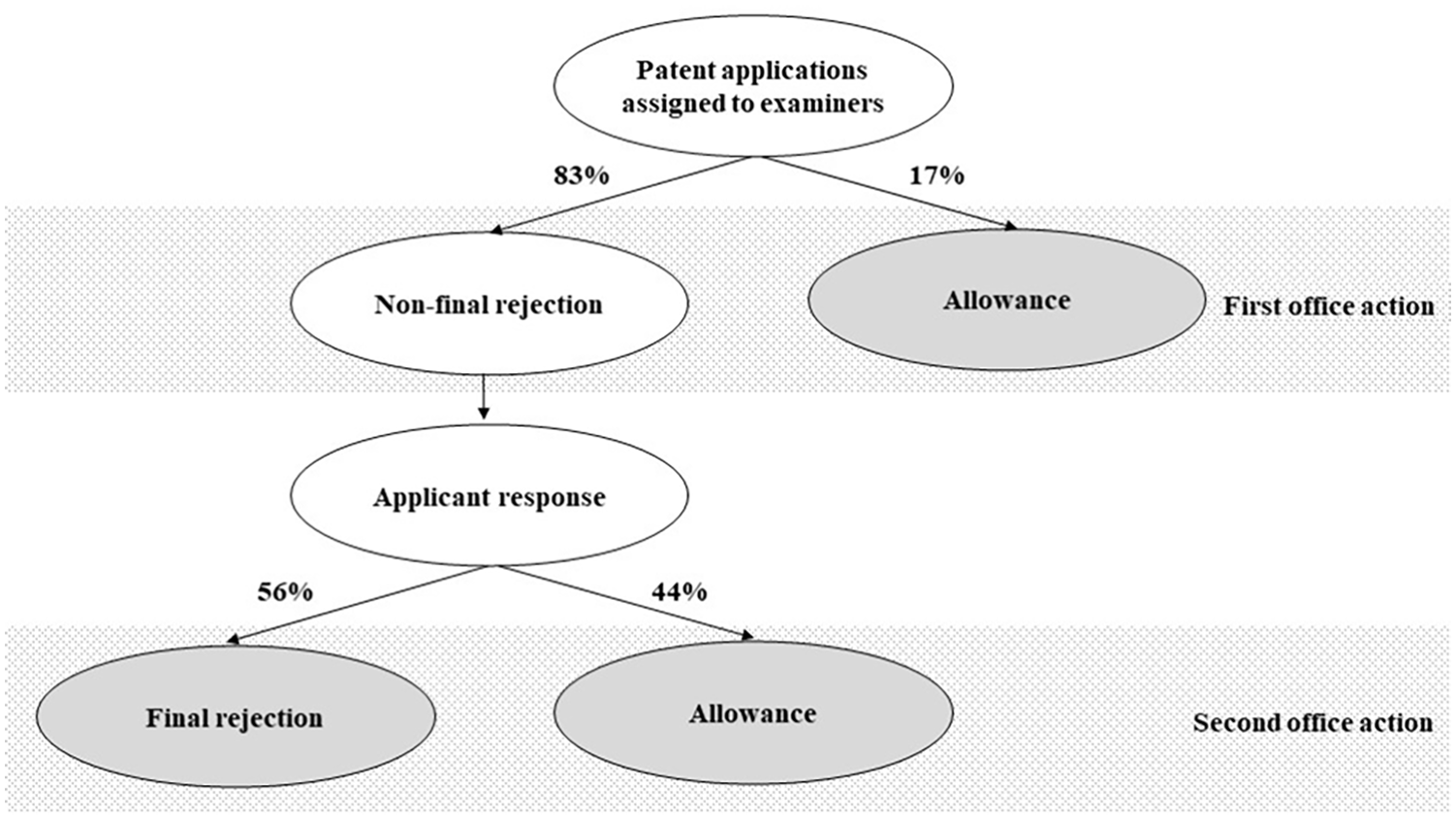
A Flowchart of the Patent Examination Process
The USPTO provides a rich research setting for our study. Given the unionized federal employment, our conversations with examiners, and anecdotal reporting of the USPTO’s hesitancy to involuntarily terminate (U.S. Department of Commerce, 2014), we are able to focus on voluntary turnover, which is often challenging to distinguish from involuntary turnover in field settings. Additionally, access to fine-grained individual performance data over time allows us to investigate both performance changes close to turnover, and longer-term performance trends. Further, objective performance metrics and relatively consistent workloads mitigate the influence of supervisor treatment toward potential leavers. Finally, two features strengthen our ability to attribute the final-term performance to individual employees themselves rather than to organizational adjustments after the upcoming exit becomes public: (1) our impending-exit timeframe extends back beyond the conventional two-week separation notice (a norm confirmed via our informal conversations with examiners); and (2) our performance indicators are relatively robust to specific work assignments (details provided in the measures section).
Data Sources and Sample
Our empirical data came from three primary sources. First, the USPTO’s Patent Examination Research Dataset (PatEx) of roughly 5.6 million utility patent 3 applications filed with the USPTO since 2001 provides information on patent examiners, patent applications, office actions filed by the patent examiners, and any other interactions between the patent examiners and patent applicants. Using this information, we documented the work of patent examiners throughout their employment in the USPTO. Second, we received from the USPTO, via three requests under the Freedom of Information Act, detailed personnel information (e.g., hire date, separation date) on all patent examiners associated with the USPTO between 2001 and 2018. Using these data, we constructed a sample of examiners who left the USPTO during our sample period. We matched this leaver sample to the PatEx using the examiner’s full name and employment period.
Third, to identify exits whose post-exit job suggested a continuing relationship with the USPTO, we accessed the USPTO’s annual roster of patent practitioners in the United States. Patent practitioners are patent attorneys and agents who can represent patent applicants before the USPTO. We matched, by name, individuals from our data set with employees from the USPTO’s patent practitioner roster and required that examiners who left the USPTO appear in the practitioner roster within 18 months of exit (to account for the annual patent practitioner roster’s availability). We then randomly drew 10% of the entire matched sample and used online resources (e.g., LinkedIn, personal webpages, law firm webpages) to verify that we had correctly matched all individuals.
Merging the data from these three sources, we constructed a monthly panel of 4,936 patent examiners who left the USPTO from March 1, 2001 to June 1, 2018. Missing data limited the sample to 4,104 examiners. Our two dependent variables—grant rate and the number of citations by examiners—were available for different timeframes, with the citation data only available between May 2008 and June 2017. Thus, the final sample consists of 133,424 person–month observations from 4,104 examiners for grant rate analyses, and 91,257 person–month observations from 1,849 examiners for the prediction of citations by examiners. 4 At the time of leaving, 3,349 (82%) of our examiner sample were at the junior job level, with 626 (15%) of the post-exit examiners becoming patent practitioners and 562 (14%) of the examiners leaving as retirees.
Measures
Employee performance
We measure employee performance in two ways. First, we calculate grant rate by dividing the number of patents an examiner has granted to applications (i.e., allowances) by the number of final decisions (i.e., allowances and final rejections) an examiner files for each month. Several USPTO studies in the fields of law and economics have used this measure to capture potential low-quality work (Frakes & Wasserman, 2017, 2020; Lemley & Sampat, 2008). This usage is based on the unique policies and regulations of the patent examination, where allowances do not require justification and only rejections must be based on specific legal claims (Lemley & Sampat, 2008). In the patent examination system, inventions underlying patent applications are initially presumed patentable upon filing. It is the examiner’s responsibility to prove their unpatentability. Examiners who fail “to explicitly set forth reasons as to why the application fails to meet the patentability standards must grant the patent” (Frakes & Wasserman, 2017: 550). Therefore, considering the random assignment of patent applications, a higher grant rate on average indicates that examiners conducted a less thorough review of applications (Frakes & Wasserman, 2017, 2020). This leads to allowing unmerited patents, thereby reflecting poor performance (Frakes & Wasserman, 2017). In our empirical analysis, we further address this perspective on grant rates by investigating the quality of the patents granted during the impending-exit period.
A second performance indicator is citations by examiners, a measure also utilized in prior research (e.g., Frakes & Wasserman, 2017). One of the key tasks of patent examiners is to thoroughly review prior art to ensure the patent application at hand is novel and non-obvious. Identifying, reviewing, and documenting relevant prior work can be challenging and effort intensive. Our conversations with patent examiners confirmed that searching prior art is a crucial and difficult job for examiners. We measure citations by examiners using the number of citations added by the examiner to support their decisions in the given month.
A key advantage to using grant rate (a higher score indicates lower performance) and citations by examiners (a higher score indicates higher performance) is that the measures are insensitive to an organization’s responses to foreseeable exits. While examiners generally have a consistent workload, it is still possible that, as employees publicly announce their exit plans, the organization allocates fewer applications to potential leavers for examination or assigns examiner time to train new hires. Such potential shifts in workload are accounted for here in the grant-rate operationalization (via final decisions in the denominator) and in the citations-by-examiners models (with applicant citations and rejections as controls).
The impending-exit period
Our key independent variable is binary and takes a value of 1 in the last 6 full calendar months of the individual’s employment prior to the exit month. We chose this timeframe because the impending-exit period signifies limited time remaining within the organization, and the potential impact of this limitation is determined by the organization’s performance appraisals and compensation structure.
In our empirical setting, the primary performance evaluation, merit increase, and promotion cycle are conducted on an annual basis, suggesting relatively little substantive change in career concerns based on final-term performance. Additionally, examiners must demonstrate high performance for at least 6 consecutive months in a rolling window to be eligible for promotion to the next job level (GS grade), which will entail a higher pay rate and enhanced status. Therefore, the 6 months preceding exit should be relatively exempt from the consequences of performance assessment. New rolling 6-month windows started during the impending-exit period will not result in promotion before separation; and even rolling 6-month windows that end during that timeframe and do result in promotion will be subject to a short payoff period, thereby constraining the career concerns impact of sustained job performance. Further, the literature indicates that employees contemplate quitting or decide to quit somewhere between several weeks and 12 months before actually leaving (e.g., De Smet et al., 2022; Hom & Griffeth, 1995; Klotz & Zimmerman, 2015). Given these factors, we believe that our impending-exit period timing is short enough to reasonably expect that examiners within this window have decided to leave the organization and have concluded that their performance until exit will bring relatively few financial consequences.
Importantly, we also conduct sensitivity analyses under three alternative approaches to the impending-exit period. Initially, we address the limitation of not being able to accurately determine the timing of the employee’s decision to quit. We do so by isolating a subset of our sample for whom we have more precise data on quit-decision timing. We then utilize 2-month and 4-month specifications to complement our 6-month operationalization.
Junior- or senior-level employees
Job and pay levels for most white-collar federal employees are identified by the General Schedule (GS) classification system. The General Schedule at the USPTO covers grades GS-5 (the lowest) through GS-15 (the highest). The junior-level (vs. senior-level) moderator for testing Hypothesis 2 is a time-variant variable, which takes a value of 1 for examiners during months when their GS grades are GS-13 or below (i.e., GS-5, 7, 9, 11, 12, 13), and 0 when their GS grades are 14 or 15. The progression through GS grades reflects incremental expertise, experience, and compensation. However, a pivotal shift in an examiner’s status and career concerns occurs at the transition from junior to senior level. Junior examiners, or “secondary examiners,” are in a phase of developing portfolios and learning the examination under the mentorship and supervision of senior examiners. In contrast, senior examiners, also known as “primary examiners,” enjoy the autonomy to oversee their patent work independently, reflecting the USPTO’s trust in their expertise and ability.
Prior work found that junior examiners are more likely to reject applications than to prematurely grant patents, possibly to avoid repercussions from incorrect allowances discovered later (Tu, 2018). Such errors, if caught by senior examiners or quality control, could negatively affect juniors’ career progression at the USPTO (Tu, 2018). Achieving a senior status, which comes with autonomy, requires a record of continued, positive performance and subsequent promotion. This distinction between junior and senior positions, coupled with the USPTO’s secondary/primary designations, underscores a substantive break between GS-13 and GS-14. This break indicates a shift in career concerns and status beyond mere incremental advancements at the USPTO. Thus, a dichotomous junior-versus-senior-level moderator is more consistent with our theoretical argument than using GS grades as a continuous moderator.
Continuing relationship with the employer
A patent application typically involves registered patent practitioners who meet the USPTO’s qualifications and can legally represent patent applicants. These patent practitioners include patent attorneys and agents who will interact with patent examiners on behalf of inventors during the patent examination process. Being a patent practitioner is the most popular post-exit career for patent examiners because the legal knowledge acquired from the USPTO is readily applicable to the patent application process. Through our conversation with a patent attorney, who was previously a patent examiner, we confirmed that becoming a patent practitioner is indeed regarded as “the natural next step” after working as an examiner. Further, because patent practitioners will work on patent applications that examiners review, examiners who exit to become practitioners are likely to expect their relationship with the USPTO to continue even after leaving. As detailed above (see the Data Sources and Sample section), we matched individuals from our data set with the USPTO’s patent practitioner roster to identify those leavers who subsequently became patent practitioners. We operationalize whether the relationship with the employer continues by assigning a value of 1 to patent examiners who left and became patent practitioners within 18 months, and 0 to the remaining examiner exits. The 18-month window allows sufficient time for an examiner’s name to appear on the published roster, while also capturing employment soon after exit, excluding roles taken on many years later that may not have been foreseeable at the time of departure. As robustness checks, we also used alternative time windows of 12 months and 24 months, finding similar results.
Control variables
We control for important factors that can affect both the impending-exit period and employee performance. First, we include individual fixed effects to partial out stable individual differences, such as baseline performance (Hoffman & Woehr, 2006; McEvoy & Cascio, 1987), individual fit with the organization (Hoffman & Woehr, 2006), and different recruiting sources (Weller, Holtom, Matiaske, & Mellewigt, 2009), all found to be associated with turnover likelihood in prior literature. We also include year–month fixed effects to control for time-specific impacts on turnover and performance.
Second, we include other important, time-variant factors that are not captured by the individual and year–month fixed effects. GS grade represents an employee’s experience in the patent examining job, which is shaped by their work experience in the USPTO and their educational or industrial background in technology and patent law. GS grade for patent examiners has eight levels: GS-5, GS-7, GS-9, GS-11, GS-12, GS-13, GS-14, and GS-15. Controlling for GS grade—rather than just junior versus senior level—allows our model to capture nuanced differences in examiners’ knowledge, responsibilities, and pay across job levels. This granular control allows a more precise estimation of the interaction between junior level (vs. senior level) and the impending-exit period, although controlling solely for junior level did not qualitatively alter our results. We further control for examiner’s tenure, measured as the number of months working at the USPTO, to capture additional variation in examiner’s job experiences. We also control for the art unit size, using the number of active examiners in the art unit (i.e., work group) during a given month.
In the investigation of citations by examiners, we include two additional workload control variables: citations by applicants and rejections. The number of prior inventions cited by patent applicants may reflect the amount of research required of the examiner for reviewing the patent application. A similar approach appears in earlier work (Frakes & Wasserman, 2017). Also, given that examiners primarily use citations to support their reasons for rejecting a particular claim, we also control for workload by including the number of rejections in the person–month observation, including both non-final and final rejections.
Analysis
Because we are interested in the effect of the impending-exit period on examiner job performance, we use within-individual estimation among leavers to test our hypothesized effects. It is possible that leavers are different from stayers on average, but our purpose here is not to find what predicts exit. Rather, we are investigating how the impending-exit period (relative to prior non-impending-exit periods) shapes individual performance, conditional on exit. In order to capture this potential change in pre-exit work behavior, we limit our sample to employees who actually left the organization, and track their job performance patterns leading up to separation from the USPTO.
Leveraging the strength of our longitudinal data, we use fixed-effects models to estimate the effects of the impending-exit period on employee performance. Such models partial out time-invariant between-unit differences, yielding estimates of purely within-unit effects (Wooldridge, 2010). Because the “unit” in our case is the individual employee, our fixed-effects analyses produce within-individual effects of the impending-exit period on performance, controlling any stable between-individual differences that might affect both exit decision and job performance.
We use linear fixed effects regression when predicting grant rate and Poisson fixed effects regression when modeling citations by examiners. Citations are count data that deviate from a normal distribution. While negative binomial regression is often preferred over Poisson regression when the count data distribution reveals overdispersion (as with our data), negative binomial regression with multiple fixed effects produces inconsistent estimators due to the incidental parameter problem (Angrist & Pischke, 2008). In contrast, the fixed effects Poisson regression model is robust to over- and under-dispersion of the panel data (Angrist & Pischke, 2008; Wooldridge, 2010). Further, we use White-Huber standard errors to address heteroskedasticity. Although not reported, we also examined clustering standard errors at the art unit level to account for autocorrelation within art units. Our results remained consistent across these different specifications.
Results
Table 1 reports descriptive statistics and Pearson correlations for the variables used in this study. From the correlation matrix, we see initial indications that the impending-exit period may be negatively associated with employee performance. The timeframe is positively correlated with the grant rate (
Means, Standard Deviations, and Correlations for Studied Variables

Note. Pearson correlation coefficients based on examiner × year-month observations are reported. Correlation coefficients whose absolute values are greater than .02 are significant at p < .05.
The Impending-Exit Period and Employee Performance (Hypothesis 1)
In Hypothesis 1, we predicted that employee performance would decline in the impending-exit period. We examine this relationship using two performance indicators. First, in Table 2’s Model 1, we report the relationship between the impending-exit period and grant rate (higher grant rate is lower performance) and find that grant rate increases by a statistically significant 0.28 (p < .001) in the impending-exit period, when compared to the prior work periods (i.e., all prior months during the study window). This effect is 70% of the grant rate standard deviation. Further, it represents a 53.9% increase in the predicted grant rate. With all control variables at their mean values, the mean grant rate rises from 0.52 prior to the impending-exit period to 0.80 during the period. This is an extensive increase in grant rate, revealing that examiners become considerably more lenient in patent approvals, which require far less effort than rejection, during the 6 months before leaving. This finding supports Hypothesis 1.
Regression of Employee Performance on the Impending-Exit Period, Junior Level, and Continuing Relationship

Note. Coefficients are reported with standard errors in parentheses and p-values in square brackets. For readability, the coefficients and standard errors of tenure and art unit size are multiplied by 100 and 1,000, respectively. All models include individual, year-month, and GS-grade fixed effects.
p < .05, ** p < .01, *** p < .001.
Second, in Model 2’s Poisson regression in Table 2, we investigate the change in the number of citations entered by examiners (more citations is higher performance). In this model, we also include the number of citations by patent applicants (i.e., citations by applicants) and the number of non-final and final rejections made by the examiner (i.e., rejections) to control for potentially different workloads. We find a negative association (
Mitigating the Reverse Causality Concern
The within-person changes via individual fixed-effects analyses, along with the detailed performance trajectories we describe below, support the inference that declining performance is a function of impending exit from the firm. We recognize, however, that they may not entirely allay a reverse causality concern. Focusing on a subset of our voluntary leavers provides more direct insight into the issue of causal direction. Because leavers meeting certain age and service thresholds are eligible for federal annuity and health benefits, the U.S. Office of Personnel Management requires them to give at least a 60-day notice before the intended retirement date. Thus, the last 60 days of retiree performance occur after the quit decision and cannot represent a performance trend precipitating the exit. Although retirement decisions typically involve longer-term planning than non-retiree voluntary turnover (Friedberg & Webb, 2005), the rationale of reduced incentives during the impending-exit period remains the same. Consequently, for our retiree subsample (N = 562), we created an alternative impending-exit period measure based on the 2 full months prior to the exit month. We then re-estimated our regressions from Table 2’s Models 1 and 2 (see Table 3). Re-characterizing the impending-exit period as the period after the formal notice date produced similar results to our primary analyses (where the impending-exit period is 6 months long). Following the formal notice period, examiners grant 37% more patents (increasing from 63.7% to 87.2%) and cite prior art 96% less (decreasing from 5.2 to 0.2). In other words, redefining the impending-exit period such that it, by definition, followed the quit decision provided additional support for Hypothesis 1, as the operationalization was associated with substantial performance decrements for retirees.
Regression of Employee Performance on the Impending-Exit Period for Retirees with a 60-Day Advance Notice Requirement

Note. Coefficients are reported with sttandard errors in parentheses and p-values in square brackets. Post-advance notice period refers to the last 2 months before retirement. For readability, the coefficients and standard errors of tenure and art unit size are multiplied by 1,000. Tenure in Model 2 is subsumed by individual and year–month fixed effects due to the insufficient number of retirees in that model with nonconsecutive service periods.
p < .05, ** p < .01, *** p < .001.
Patent Quality Results Consistent With Main Effect
We stipulated that allowing patents requires less effort than rejecting them because allowance does not need to be substantiated and, therefore, represents lower performance, all else being equal. One important implication of the increased grant rate during the impending-exit period that supported Hypothesis 1 is that, on average, patents granted during this timeframe should be of lower quality (i.e., examiners’ heightened leniency yields grants for applications that would otherwise have been rejected). To directly investigate this implication, we compare the quality of patents granted during the impending-exit period to those granted at other times. To measure patent quality, we use forward citations—the number of times subsequent patents cite the focal patent—which indicates how impactful the patent is for follow-up inventions. This is one of the most widely used indicators for patent quality (Hall, Jaffe, & Trajtenberg, 2005; Kehoe & Tzabbar, 2015; Oettl, 2012). Forward citation data came from the Harvard Dataverse (Bhaven, 2011). Due to the limited citation data available, we limited our sample to utility patents granted by leavers from 2001 to 2010. Our selection of a 3-year window to capture forward citations further reduced our observations to patents granted between 2001 and 2007.
We constructed a patent–year panel dataset and used Poisson regression to estimate the effect of the impending-exit period on forward citations within 3 years of patent issuance. We controlled for key characteristics of patents and examiners, including art unit size, GS grade, tenure, examiner fixed effects, the technology underlying the patent, and whether patents were filed by public companies. The technology class of patents indicates one of 475 underlying technologies. We clustered standard errors at the technology class level to correct for autocorrelation between patents under the same technology group. Findings indicate that patents granted during the impending-exit period received 13.1% fewer forward citations (after converting the raw Poisson coefficient of −0.14) than patents granted by the same examiner during the prior, non-impending-exit period (see Table 4). That is, not only do patent examiners grant more patents during the impending-exit period, which we argued represented declining job performance, but they also grant patents of lower quality. These findings strengthen the evidence for our primary hypothesis and mitigate concerns that the increased grant rate was due to improved quality of the applications as exit approached.
Quality of Patents Granted in the Impending-Exit Period

Note. Coefficients are reported with standard errors in parentheses and p-values in square brackets. Standard errors are clustered at the United States Patent Classification (USPC) technology class levels to correct autocorrelation among patents in the same technology. For readability, the coefficient and standard errors of art unit size are multiplied by 10. The sample comes from utility patents granted by leavers from 2001 to 2007. The unit of analysis is the patent year, with the year indicating the year that the patent is issued. The dependent variable is the number of forward citations during a 3-year moving window, from 2001 to 2007. The impending-exit period is a binary indicator that takes a value of 1 for patents that are granted during the examiner’s 6-month impending-exit period.
p < .05, ** p < .01, *** p < .001.
Employee Performance Trajectories Over Time
To provide a detailed portrayal of job performance patterns over time for both the overall exit group and the retiree subsample, we replaced the binary impending-exit period variable with a dummy variable for each month and plotted the month-effect coefficients during the last 12-month period (see Figure 2). We included the same control variables used in the primary analyses. The omitted comparison period in each of the graphs includes all person-months during the study period up until 13 months prior to exit. While slight differences emerge across the four analyses, the grant rate graphs indicate that examiner grant rate jumps, and thus performance drops substantially, beginning at around 6 to 7 months before exit. The performance declines associated with citations by examiners also begin at around 6 to 7 months pre-exit, but then become somewhat more precipitous around 2 to 4 months before leaving.
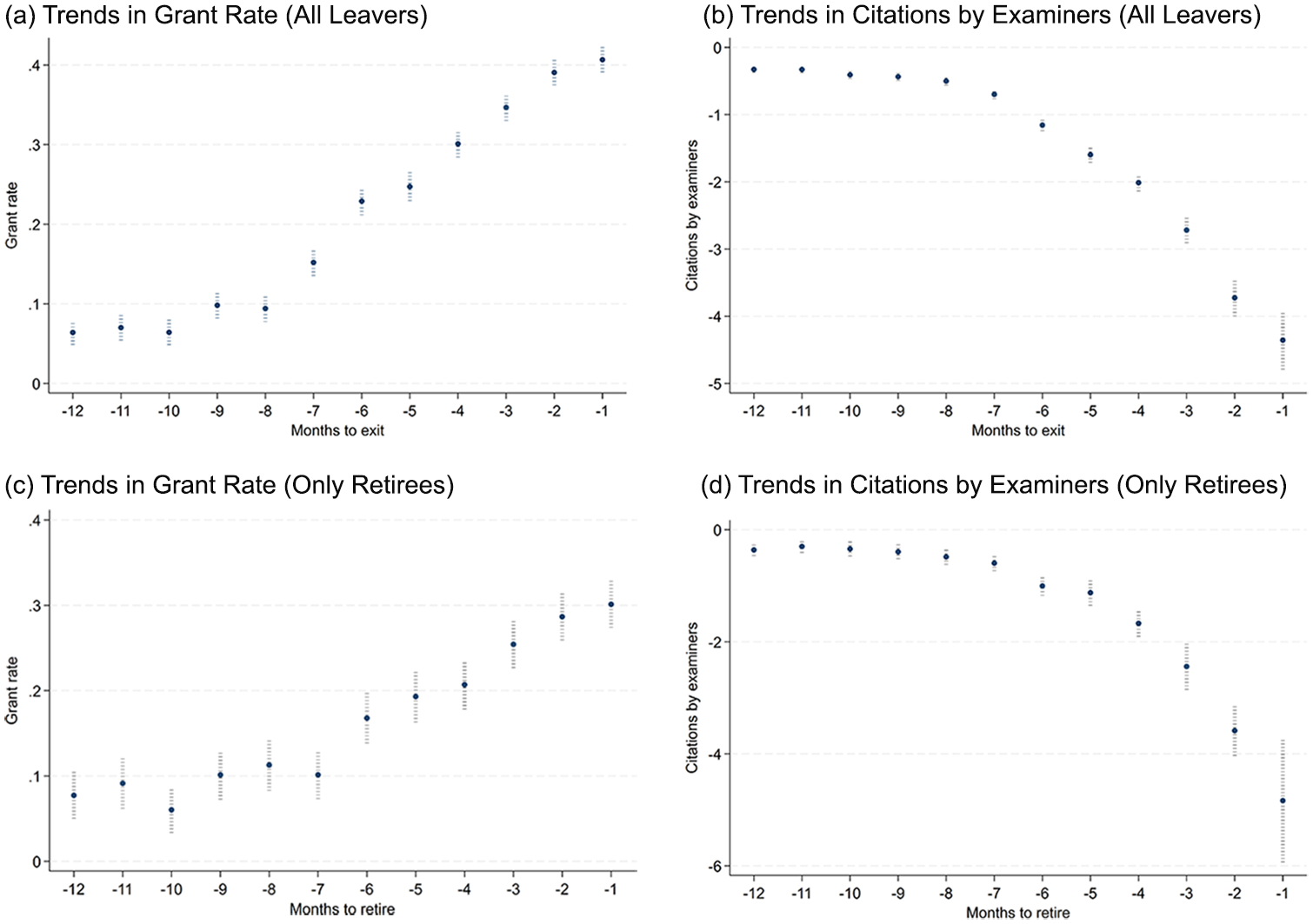
Trends in Grant Rate and Citations by Examiners: All Leavers and Retirees Over the Last 12 Months
Overall, these findings align with the promotion policy of the USPTO, which requires a minimum of 6 months of high performance for promotion eligibility. Consequently, potential leavers likely anticipate limited long-term benefits from maintaining their performance in their final 6 months. Thus, the significant decline in within-person performance that begins roughly around the 6-month mark provides additional evidence of the impact of the impending-exit period.
Junior Level and Continuing Relationship as Moderators (Hypotheses 2 and 3)
In Hypothesis 2, we predicted that the decline in employee performance during the impending-exit period would be more pronounced for junior-level employees than for senior-level employees. In Table 2, Models 3 and 7 (full model) reveal a positive interaction between the impending-exit period and junior level on the grant rate (
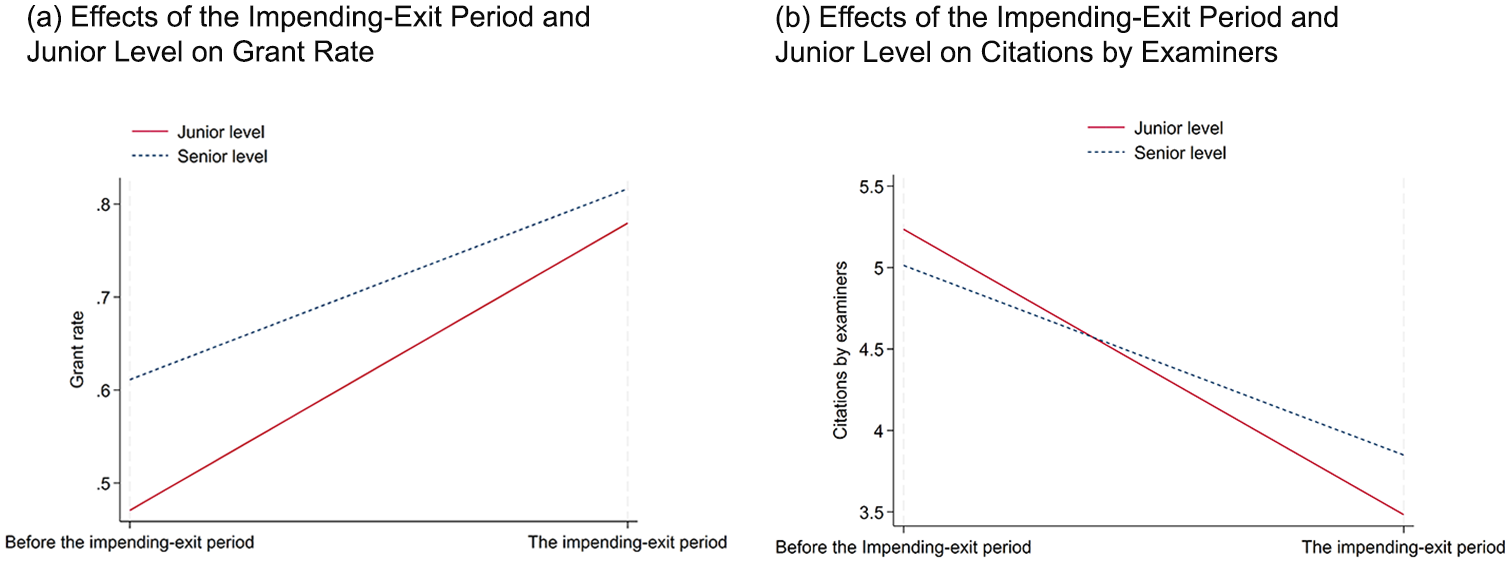
Interactions Between the Impending-Exit Period and Junior Level (H2)
Finally, we predicted, in Hypothesis 3, that the decrement in employee performance as exit approached would be less pronounced for leavers who continue their relationship with the organization after exit (i.e., leavers who became patent practitioners) than for those who do not. In Table 2, Models 5 and 7 (full model) report no statistically significant interaction between continuing relationship and the impending-exit period in the prediction of grant rate (e.g., in Model 5,
Supplementary Analyses
Stayers versus leavers
Comparing the performance trajectories of stayers and leavers addresses the concern that our results could merely reflect dynamic performance patterns that emerge for all employees. That is, one could argue that it is time in the USPTO—rather than the approaching separation—that drives the performance declines we observed in our leaver sample. To examine this, we constructed a matched sample of leavers and stayers using a 1:1 matching based on hire year and month. The leaver and stayer in each matched pair share the same time periods of interest during which we can compare performance. To ensure that differences in performance outcomes were not driven by other observable characteristics, we controlled for art unit size, GS grade, and individual and year–month fixed effects as in the main analysis. Figure 4 includes graphs plotting the performance trends during the final 12 months of employment for leavers and the corresponding tenure period for matched stayers.
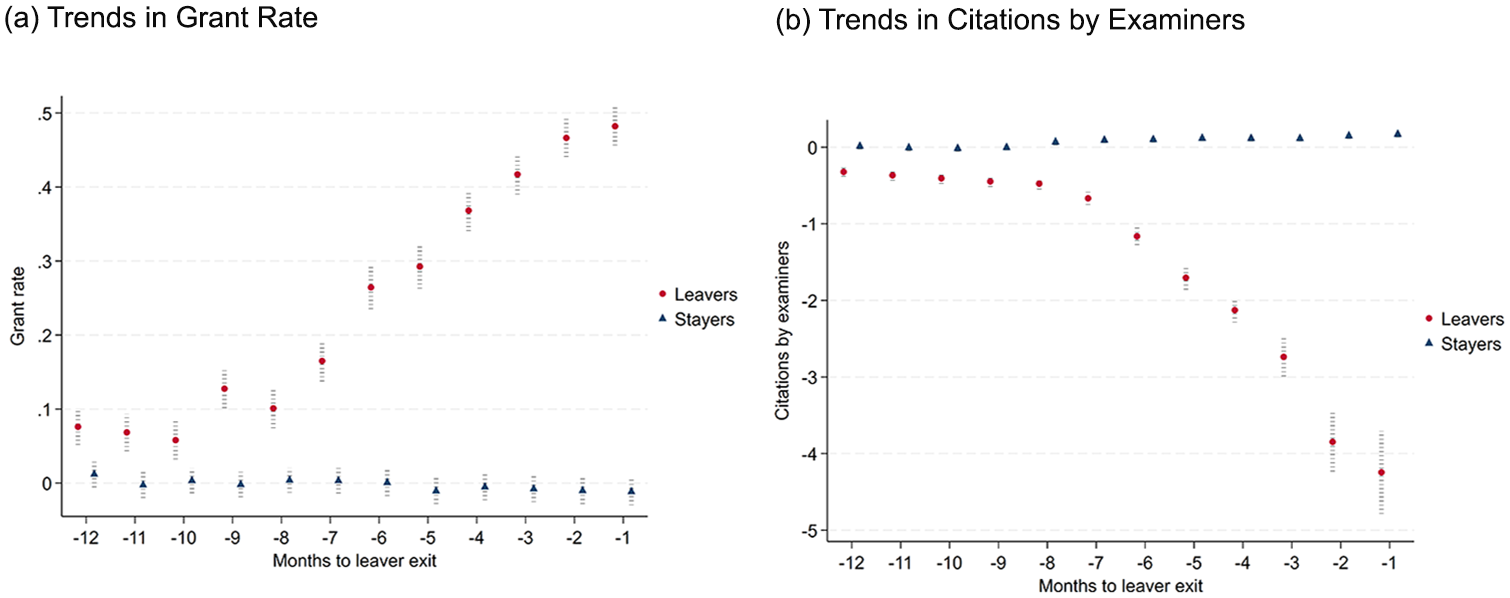
Trends in Grant Rate and Citations by Examiners: Tenure-Matched Stayers Versus Leavers Over Leavers’ Last 12 Months
Stayers exhibit stable performance in both grant rate and citations by examiners throughout the comparison period. Leavers, however, perform slightly worse than stayers at the beginning of the final year of employment. This is unsurprising considering the prior turnover literature that reports baseline performance differences between stayers and leavers (Becker & Cropanzano, 2011; Sturman & Trevor, 2001). These differences, however, become substantially larger around 6 to 7 months before exit, and continue to sharply increase as leavers approach the exit month. Ultimately, all else being equal, the performance levels and trajectories of leavers and stayers diverge notably during the final 6 months of leaver tenure. This analysis indicates that our impending-exit period findings with leavers do not simply reflect time-based performance trends common to all employees. Stayers perform consistently during the same timeframe in which leavers with similar tenure experience a sharp decline in performance.
Alternative specifications and operationalizations
As robustness checks, we employed several alternative specifications and operationalizations. First, we measured the impending-exit period over shorter time windows to address concerns that some turnover events might not be planned well in advance. Specifically, we recalculated the period in two ways: as the last 2 months before the exit month and as the last 4 months before the exit month. These alternative measures yielded similar results to those in Table 2 in terms of coefficient direction and statistical significance. The only exception was that, under the 2-month measure, the impending-exit period by junior level interaction did not predict grant rate in Model 4 and Model 8 (the interaction from the 4-month measure did predict grant rate, just as in Table 2). Second, to ensure that our results using the entire sample of exits were not driven by the retirees, we conducted separate analyses on the non-retiree leavers. These findings did not change in terms of coefficient direction and statistical significance across Hypotheses 1, 2, and 3. Third, we tested the robustness of our operationalized comparison period for Figure 2, which included all prior months during the study window. Reconfiguring the comparison period as the prior 12 or 24 months of performance before the final year of employment had no material impact on our results. Similarly, altering the fixed-effects specifications (e.g., replacing month-year fixed effects with separate month and year fixed effects) did not meaningfully alter the study findings. Fourth, for robustness against the influence of new hires, we limited our sample to employees with at least 3 or 6 months of tenure before the impending-exit period. Neither restriction affected the statistical support of our findings. Fifth, in measuring continuing relationship, we used alternative time windows of 12 months and 24 months (instead of the 18-month window) to identify employees who transitioned into patent practitioners after departure. These changes did not impact the results of our statistical tests. Finally, we used the number of allowances as a dependent variable instead of grant rate, while controlling for the number of total decisions made. This substitution did not qualitatively change our findings.
Exploratory Analyses
Three-way interactions among the impending-exit period, junior level, and continuing relationship
In our main analyses, we examined how the impending-exit period’s associations with job performance were moderated by junior/senior employment status (due to differences in internal career concerns) and by post-exit continuing relationship status (due to differences in external career concerns). However, it also may be that, during the impending-exit period, external career concerns associated with a continuing relationship could be stronger for juniors than for seniors, suggesting a possible three-way interaction. Specifically, in the continuing relationship condition, job performance during the impending-exit period may become visible to the external market due to ties within a shared employer community. Thus, for the same reasons that juniors have greater internal career concerns than seniors before the impending-exit period (e.g., longer career horizon and more career opportunities at stake), juniors expecting a continuing relationship may also experience greater external career concerns during the impending-exit period. These heightened external career concerns of juniors, relative to seniors, should mitigate the incentive reduction differences between the two groups during the impending-exit period. We found support for this possibility, as the tendency for the impending-exit period to be more detrimental to the performance of juniors than seniors diminished for employees with a continuing relationship with the focal employer (see Appendix A in the online supplemental materials for details).
Additional data and impending-exit phases
While we thus far have treated the impending-exit period as binary (i.e., in or out), employee experience during this period may be more nuanced. We collected data from a new online sample to explore whether the impending-exit period is comprised of distinct phases, and whether such phases are linked to varying degrees of job performance change. Our results suggest a progressive deterioration in performance as the departure nears, with key phases, such as those initiated by exit decision and exit announcement to the organization, potentially associated with greater declines (see Appendix B in the online supplemental material for details). This finding is consistent with our primary study argument that performance decrements during the impending-exit period are largely due to late-stage employment’s increasingly diminished career concerns relevance.
Discussion
Human capital loss disrupts the pursuit of competitive advantage. Although it is well-understood that human assets are different from physical assets (Coff, 1997), prior work has essentially equated turnover with the physical loss of employees in focusing on post-turnover disruption of human capital. Despite various literatures’ recognition of agency problems in late-stage executive contracts, short-timer’s fever in the military, and lame ducks in the political realm, we are the first to test whether disruptive human capital loss in the general workforce might occur as a function of impending separation. Our findings, which demonstrate plunging job performance as the time remaining in the organization becomes limited, support our theorizing that approaching exit reduces employees’ incentives tied to future career prospects at the firm, consequently undermining effort and performance. Specifically, we found that, during the impending-exit period and relative to their own baseline job performance, employees granted 53.9% more patents and cited 79.8% less prior art in evaluating applications. These potent effect sizes, coupled with the impending-exit period’s impact on multiple performance measures and the fact that vast majority of employees ultimately experience the impending-exit timeframe, highlight the importance of understanding pre-exit disruption to human capital.
We further hypothesized that the impending-exit period relationships would vary based on the leaver’s pre- and post-exit career concerns. The performance declines as exit approached were stronger for junior-level employees, who may have been more focused on career concerns (e.g., promotion) than senior-level employees. We note that this finding also may have emerged as a function of the tendency for seniors to hold greater attachment to the firm (Cohen, 1993; Riketta, 2005), which likely buffers them from the performance declines during the impending-exit period. Additionally, pre-exit performance declines were weaker for employees with a continuing relationship to the USPTO after their exit, although only when we measured performance using citations by examiners. The lack of continuing-relationship moderation with grant rate as a performance measure potentially has intriguing theoretical implications. Scholars in political science, law, and economics have documented incentive conflicts arising from employees transitioning between regulatory agencies and the private sectors they once regulated—a phenomenon often referred to as the “revolving door problem” (Shepherd & You, 2020; Shive & Forster, 2017; Tabakovic & Wollmann, 2018). Such conflicting incentives may have influenced our findings. Specifically, although employees anticipating a continuing relationship with the USPTO may have been motivated to maintain high performance during the impending-exit period, this motivation could have been offset by a desire to provide favorable patent outcomes to future employers (i.e., investors and their representatives). This could be accomplished via grant rate and would thus explain why a continuing relationship would mitigate pre-exit performance declines only for citations by examiners as the performance measure.
Theoretical Implications
Our findings have several implications for the turnover literature. First, we add to the recent work that jointly explores pre-turnover and post-turnover periods to understand the consequences of turnover. For example, context emergent turnover (CET) theory posits that both human capital inflows and outflows are important in the relationship between turnover and organizational performance (Nyberg & Ployhart, 2013; Reilly et al., 2014). Extending this view, our theory suggests that post-turnover disruption may not be independent from pre-turnover disruption. Any training of new employees that is provided by outgoing employees, or that includes the use of these leavers’ work produced during the impending-exit period, is likely to be suboptimal given the observed decline in work quality during this period. Future research on the interplay of pre-exit and post-exit disruptions—as well as their relative costs—would be valuable for both researchers and practitioners. Utility analysis (e.g., Sturman, Trevor, Boudreau, & Gerhart, 2003), in particular, may provide a useful lens for estimating such impacts.
Second, the existence of the impending-exit period’s effect—particularly of such striking magnitude—highlights the need for further investigation into the competing causal explanations for the relationship between job performance and turnover. Three meta-analyses (Bycio et al., 1990; McEvoy & Cascio, 1987; Williams & Livingstone, 1994) document the negative relationship between the two constructs under the assumption that it is low performance leading the employee to quit. At the same time, the popular press, research from political science and economics (although typically without a formal job performance dependent variable), and our study operate from the perspective that lame duck periods are very real. Given that turnover and job performance are two fundamental constructs in management research and are central concerns of the firm, attempts to decompose the relationship variance with regard to the two causal directions would be welcome.
Practical Implications
Our findings have important ramifications for practice. First, the substantial effect sizes of the impending-exit period (53.9% higher grant rate and 79.8% fewer citations) demonstrate the necessity of attending to impending exits when considering separation costs and disruption. In some contexts, it is possible that organizations suffer more from their inability to stave off steep performance declines during the impending-exit period than from the loss of human capital itself.
Second, our findings suggest that organizations should consider their performance evaluation and reward cycles when anticipating disruptions leading up to turnover. In our study, we used the last 6 months before departure, as it aligns with the time required for employees to demonstrate high performance for promotion eligibility. This notion is relevant across various sectors. For example, in investment banking, bonuses—a major component of compensation—are often distributed annually between January and March, based on the previous year’s performance. Consequently, employees may plan their exits after receiving these payouts, with performance declines beginning after the bonus is received (typically from January to March) and continuing until their departure.
Third, our study suggests possible organizational strategies for mitigating the impending-exit dynamic. For example, our results suggest that the expectation for a continuing relationship with the employer after departure reduces performance declines as employees approach exit. Encouraging a culture where departing employees are seen as alumni or potential boomerang employees rather than simply ex-employees can help maintain post-exit connections. Companies like McKinsey and Microsoft are leading this trend through their corporate alumni programs, 5 which make it easier for employees to return to the firm. This return possibility encourages employees to sustain their performance and avoid “burning bridges” (Klotz & Bolino, 2016) as they approach departure, by fostering the perception that their connection with the firm lasts beyond their initial tenure. Also, with average employee tenure continuing to decline, and our finding of larger effects at the junior level, organizations may need to particularly rethink their relationships with junior employees. These employees appear to be not only greater flight risks, but also more disruptive occupants of the impending-exit period.
Limitations and Future Research
Generalizability
The work of USPTO patent examiners is characterized by limited task interdependence. It is unclear if employees under more interdependent work will also change their performance as exit approaches. On the one hand, the difficulty of assessing individual contribution in teamwork settings may exacerbate performance declines during the impending-exit period. On the other hand, the pressure to conform within a team could limit such performance declines. Because task interdependence is an important context in studying turnover consequences (e.g., Hausknecht et al., 2009), we call for future research that explores the impending-exit period’s effects in varying task environments.
Second, while the USPTO’s low rate of involuntary turnover helps us identify effects of the impending-exit period, it also calls into question the generalizability of our findings to contexts where performance-related dismissals are more common. At the USPTO, the lack of immediate accountability for declining performance and the challenges in promptly assessing work quality could partly explain the substantial performance changes observed during the impending-exit period. In settings with a higher risk of immediate accountability implications, such as dismissal, the extent of performance declines might not be as pronounced.
Last, as one of the largest federal agencies, the USPTO draws its workforce from a broad labor market comprising numerous employers and employees. The general labor market for patent examiners is marked by anonymity. This is echoed during our conversations with a former patent examiner, who noted the rarity of encounters with former colleagues and doubted the availability of his USPTO reputation to his new employer. While this anonymity is prevalent in many fields, sectors like academia, law firms, and high-tech industries present a contrast. In these settings, visibility and reputation are more pronounced, with higher expectations for ongoing post-exit relationships. Moreover, in these sectors, employees often are less likely to switch professions, given professional licensing, painstakingly developed industry-specific skill sets, and often enviable working conditions. Thus, employees in these contexts might strategically focus on externally visible tasks that benefit their careers (e.g., academic research) while neglecting tasks more closely tied to their current employer (e.g., university service). Whether and how such tendencies shift during the impending-exit period, particularly in comparison to less visible work contexts such as the USPTO, presents an intriguing avenue for future research.
Measures and data restrictions
Our study also faces a few limitations stemming from data constraints. First, due to the nature of archival data, we could not measure whether and when most employees planned to leave. We attempted to reduce this concern by providing robustness checks that varied the size of the impending-exit window; these analyses yielded findings quite similar to our primary results. Further, we limited our sample to retirees required to give 60 days of advance notice to the organization. The analyses of these employees who clearly did plan to leave at least 60 days before exit produced confirmatory findings.
Second, in terms of our two moderators, we distinguish between juniors and seniors, as well as between those who maintain a relationship with the USPTO by transitioning into patent practitioners and those who depart to join other roles. Yet, this binary approach might not fully reflect the nuanced differences associated with the levels of each moderator. For example, we presume that juniors, given their organizational status, are more concerned about their career prospects at the firm prior to the impending-exit period, compared to seniors. This dichotomy, however, likely oversimplifies the variation in individual career concerns within each group. Furthermore, our measure of continuing relationships does not specify whether employees’ sense of connection is to their former colleagues, supervisors, or the organization at large. We emphasize, instead, the overall importance of maintaining any formal relationships with the firm after departure. Yet, exploring the specific types of these relationships might provide further insights. For instance, the expectation for maintaining a relationship with supervisors, possibly for recommendation letters, could be more influential than the desire to leave a positive impression on colleagues in mitigating performance decline. Similarly, given our limited information on examiners’ post-exit destinations, we were unable to discern whether continuing relationships with the USPTO were at all probable for leavers who did not become patent practitioners.
Conclusion
In conclusion, we emphasize that we have only scratched the surface of what studying the impending-exit period may tell us. Our results indicate that the performance-decline is strikingly large, robust to model specification, and subject to moderation. Further research into individual differences, organizational practices, and firm contexts that influence the effects of the impending-exit period would be of immediate value. Perhaps the clearest takeaway here is that the magnitude of pre-exit performance declines, and the prevalence of the impending-exit periods at any one time (as we all eventually leave), have important ramifications for theory and practice regarding turnover, as scholars and professionals look to better understand the effects of human capital movement on firms.
Supplemental Material
sj-docx-1-jom-10.1177_01492063251316464 – Supplemental material for Impending-Exit Period and Employee Performance: Rethinking Human Capital Disruption
Supplemental material, sj-docx-1-jom-10.1177_01492063251316464 for Impending-Exit Period and Employee Performance: Rethinking Human Capital Disruption by Yea Hee Ko and Charlie O. Trevor in Journal of Management
Supplemental Material
sj-docx-2-jom-10.1177_01492063251316464 – Supplemental material for Impending-Exit Period and Employee Performance: Rethinking Human Capital Disruption
Supplemental material, sj-docx-2-jom-10.1177_01492063251316464 for Impending-Exit Period and Employee Performance: Rethinking Human Capital Disruption by Yea Hee Ko and Charlie O. Trevor in Journal of Management
Footnotes
Acknowledgements
We appreciate the insightful comments and suggestions from our action editor, Jason Huang, and two anonymous reviewers. We also thank Matthew Bidwell, Rory Eckardt, and Julie Hancock, as well as seminar participants at the University of Wisconsin-Madison, Singapore Management University, Nanyang Technological University, the 80th Academy of Management Conference, the 40th Strategic Management Conference, and the 13th People and Organizations Conference, for their valuable feedback on earlier versions of this paper. Finally, we extend our appreciation to the patent examiners who generously shared their experiences and insights on the operations of the U.S. Patent and Trademark Office (USPTO).

Supplemental material for this article is available with the manuscript on the JOM website.
Notes
References
Supplementary Material
Please find the following supplemental material available below.
For Open Access articles published under a Creative Commons License, all supplemental material carries the same license as the article it is associated with.
For non-Open Access articles published, all supplemental material carries a non-exclusive license, and permission requests for re-use of supplemental material or any part of supplemental material shall be sent directly to the copyright owner as specified in the copyright notice associated with the article.
