




Abstract
While most of the socialization literature has focused on factors that allow newcomers to adjust to their new job tasks successfully, less attention has been given to examining whether temporary newcomers’ task adjustment influences the likelihood of receiving a permanent position. Drawing on the identity perspective and the socialization literature, this study proposes and tests a new framework that examines the probability of task-adjusted newcomers receiving a permanent job offer contingent on two conditions: a) there is a low level of peer divestiture socialization, which enables the task-adjusted newcomer to achieve higher levels of task performance, and b) the newcomer displays low rule-following behavior, which allows the high-performing newcomer to be cognitively trusted by the supervisor. Consistent with our predictions, the results of a four-wave, multisource study featuring 194 newcomer-supervisor dyads revealed that newcomer task adjustment was positively related to the newcomer receiving a permanent job offer by way of newcomer task performance and supervisor trust in newcomers but only when peer divestiture socialization and newcomer rule-following behavior were low. We discuss the theoretical and managerial implications of these findings.
Keywords
Introduction
The socialization literature has traditionally considered newcomers’ adjustment to their new positions as the main objective of the socialization process (e.g., Jones, 1986; Kammeyer-Mueller & Wanberg, 2003). This body of research suggests that reaching task adjustment—defined as the acquisition of the knowledge and skills required to perform prescribed job tasks (Haueter, Macan, & Winter, 2003)—leads to numerous positive outcomes, such as increased performance, job satisfaction, organizational commitment, and decreased turnover intentions (Bauer, Bodner, Erdogan, Truxillo, & Tucker, 2007; Saks, Uggerslev, & Fassina, 2007).
However, an alternative stream of socialization research suggests that organizations expect newcomers not only to learn and master their core duties but also perform a wide range of unstructured and challenging tasks outside their formal job descriptions (e.g., Feldman, 1981; Katz, 1964), challenging the status quo and approaching their roles innovatively (Dufour, Maoret, & Montani, 2020; Kim, Hon, & Crant, 2009; Montani, Maoret, & Dufour, 2019). According to Dufour, Escribano, and Maoret (2021), these expectations are particularly acute for newcomers in temporary white-collar positions. Temporary white-collar newcomers have limited time to convince their supervisors of their ability to adapt to new organizations; nevertheless, they must also demonstrate qualities beyond their current job descriptions to enhance their prospects of securing a permanent position in the future.
Little is known about how temporary newcomers navigate the organizational expectations of adjusting to their jobs while also standing out to maximize their chances of receiving a permanent contract from their host organizations. Filling this research gap is important to assist task-adjusted temporary newcomers in identifying the most effective strategies for converting their temporary contracts into permanent ones. Additionally, investigating this research area can help organizations identify how they can create favorable conditions to retain temporary newcomers who are able to adjust to their tasks (Griffitts, 2016).
Like task adjustment, social forms of adjustment have also been identified as key indicators of socialization effectiveness (e.g., Ellis, Nifadkar, Bauer, & Erdogan, 2017; Nasr, El Akremi, & Coyle-Shapiro, 2019). However, the short-term nature of temporary newcomers’ positions implies that these new hires might be primarily concerned with meeting task-related demands rather than with developing positive social relationships with their new colleagues (Kalleberg, Reynolds, & Marsden, 2003; Rink & Ellemers, 2009). Also, the newcomers surveyed in our study were enrolled in an apprenticeship program specifically designed to integrate academic knowledge with learning derived from professional experience, aiming at developing a transferable set of professional knowledge, competences, and skills (Hahn, 2012; Lene & Cart, 2018; Ryan, Backes-Gellner, Teuber, & Wagner, 2013). Accordingly, the present study focuses on task-related forms of adjustment to ensure that our theoretical model fits with the reality of the context in which it is applied (von Krogh, Rossi-Lamastra, & Haefliger, 2012).
We contend that the apprenticeship context is particularly relevant for understanding how task-adjusted temporary newcomers can secure permanent positions in their host organizations. Indeed, according to the literature, task-related training and learning represent the building blocks of the apprentice-tutor relationship within apprenticeship programs (Hahn, 2012). These programs facilitate natural social adjustment to work environments, making the primary challenge for apprentices in new organizations less about social adjustment and more about task adjustment. However, apart from the work by Perrot, Bauer, Abonneau, Campoy, Erdogan, and Liden (2014), there is limited empirical research on fostering task adjustment among apprentices. Furthermore, to our knowledge, no studies have explored how task adjustment influences the conversion of temporary apprenticeships into permanent positions. This gap is critical, as apprenticeship workers represent a growing segment of the workforce in many OECD countries, including the United States, France, and Germany (Sources: US Labor Department; French Ministry of Labor and Employment, 2022; Cedefop, 2021) 1 . Given the increasing prevalence of this employment model, examining the impact of task adjustment on apprentices’ transition to permanent roles is essential. Addressing this issue would not only advance socialization theory and practice but also help organizations optimize apprenticeship-based practices to support the career development of young talents.
Drawing on the identity perspective (Ashforth & Schinoff, 2016; Haslam et al., 2001; Stets & Burke, 2000; Swann, 1983) and insights from the socialization literature (Van Maanen & Schein, 1979), we argue that the optimal combination of high levels of task adjustment and low levels of peer divestiture socialization—defined as the process of assimilating newcomers into the organization’s ways of thinking and behaving (Van Maanen & Schein, 1979)—is likely to provide newcomers with the opportunity to fulfill their needs for control and self-consistency, enhancing their performance. Consistent with the identity perspective (Haslam & Platow, 2001; van Knippenberg & Hogg, 2003), we further argue that to maximize their chances of obtaining permanent positions, newcomers must demonstrate to their supervisors that they can be cognitively trusted—that is, they should be considered reliable and competent for the job they were hired to perform (Klotz, Veiga, Buckley, & Gavin, 2013; McAllister, 1995). To achieve this, newcomers must showcase their competence and their ability to adjust while also positively differentiating themselves from others. This differentiation is achieved by deviating from rule-following behavior, defined as conformity to and compliance with the organization’s rules and policies (Tyler & Blader, 2005).
Based on the conceptual model depicted in Figure 1, this study contributes to the literature in three important ways. First, our research advances the socialization literature by moving beyond the opposition between the traditional socialization perspective, which stresses the importance of newcomers adjusting to organizational rules to secure successful integration into new roles (Bauer et al., 2007; Saks et al., 2007), and the more recent socialization approach, which encourages newcomers’ deviations from established practices to foster creativity and innovation (Harris, Li, Boswell, Zhang, & Xie, 2014; Montani et al., 2019). Our proposed framework integrates and extends these two socialization streams by revealing a pathway that enables young apprentices to gain their supervisors’ trust while preserving a coherent image of the self.
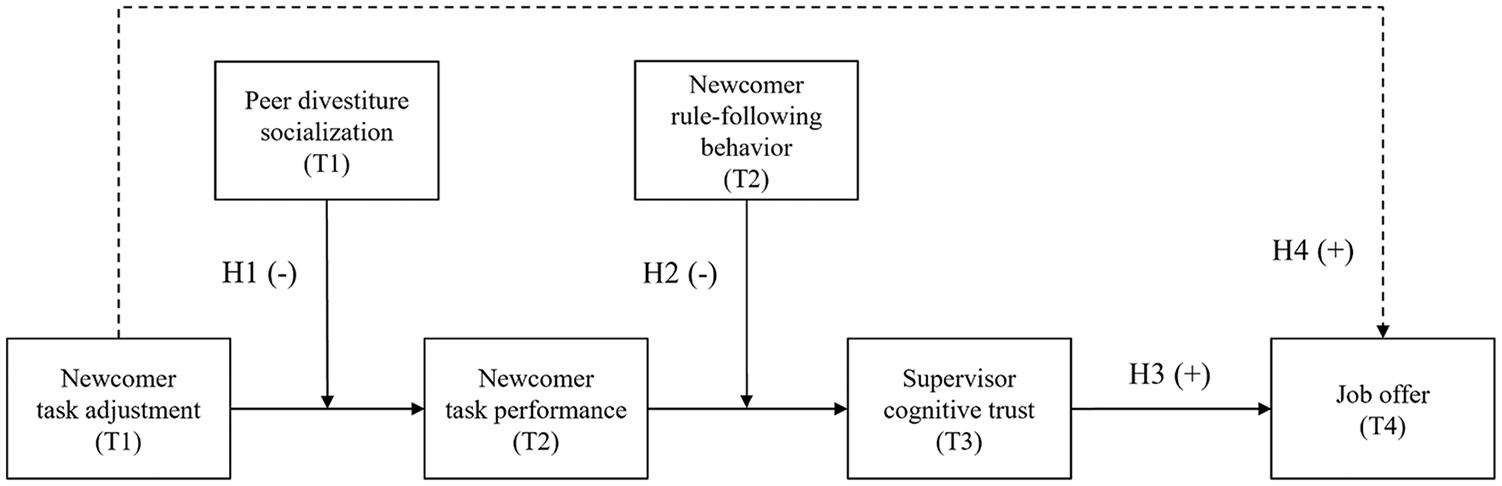
Conceptual Model
Second, our research addresses a poorly understood area in the socialization and temporary work literature: how supervisor trust in newcomers is linked to their adjustment and chances of receiving a job offer. Perceived newcomer trustworthiness has been theorized to be a key factor explaining why supervisors strive to ensure favorable socialization outcomes in response to newcomers’ behavior (Gross, Debus, Liu, Wang, & Kleinmann, 2021). Our study contributes to this line of theorizing by exploring the role of supervisor cognitive trust and the impact of newcomer task adjustment and performance on the likelihood of receiving a permanent job offer.
Finally, prior research has highlighted how newcomers’ expression of their personal identities can be beneficial for the organization in terms of enhanced performance and reduced turnover (Cable, Gino, & Staats, 2013; Gino, 2018; Montani et al., 2019; Warren, 2003). However, since self-expression and rule-breaking attitudes are not always viewed as beneficial for the organization (e.g., Bennett & Robinson, 2003; Cha et al., 2019), it is essential to identify under which circumstances a newcomer who engages in rule-breaking behavior can be cognitively trusted, as this trust influences the manager’s decision to offer a permanent job position. Our study contributes to this line of inquiry by illustrating that once temporary newcomers have proven their ability to perform the job satisfactorily, their self-expression and ability to act in a nonconformist manner increase their chances of earning the cognitive trust of their supervisors.
Theory and Hypotheses
An Identity Perspective on Task Adjustment and the Transition to Permanent Employment
The socialization literature has shown that supervisors play a critical role in responding to newcomers’ expectations, helping them adapt their behavior to align with supervisors’ expectations (Ellis et al., 2017; Jokisaari & Nurmi, 2009). Ultimately, supervisors often decide whether newcomers will move from temporary to more permanent job positions (Dufour et al., 2021; Zhao & Liden, 2011). To understand the strategies that newcomers can employ to maximize their chances of transitioning from temporary to permanent positions, it is necessary to identify the main criteria that supervisors consider when deciding whether to offer a permanent job. Dufour et al. (2021) showed that, before offering newcomers a job, supervisors look for signs suggesting that newcomers are not only committed to the group’s collective goals but are also able to positively differentiate themselves from the others, setting the basis for being viewed as credible and trustworthy.
To understand how these outcomes can be mutually achieved, we draw upon the identity perspective (Ashforth, 2001; Ashforth & Schinoff, 2016; Haslam et al., 2001; Stryker & Burke, 2000; Swann, 1983). This overarching framework relies on the symbolic interactionist notion of the self as contextually based and multifaceted (Hewitt, 1994; Manis & Meltzer, 1978), which implies that one’s identity is not a static property of the individual (i.e., the newcomer) but is constantly negotiated through social interactions. The identity perspective posits that during a role transition, a newcomer who has just joined an organization is unlikely to fully internalize the new role identity unless two core identity-related needs are met: the need for control and the need for self-consistency (Ashforth, 2001; Swann, 1987). The need for control refers to the feelings of agency and mastery that a newcomer can experience in their new role when they obtain enough information regarding their tasks and develop relevant knowledge and skills to execute their jobs proficiently (Ashforth, 2001; Ibarra, 1999). We argue that when newcomers experience task adjustment, which reflects the acquisition of the knowledge, abilities, and skills required for mastering the prescribed tasks (Haueter et al., 2003), their need for control is fulfilled. The need for self-consistency, differently, refers to the individual’s need to confirm and stabilize their personal self—i.e., the qualities that make them unique (Stets & Burke, 2000; Stryker & Burke, 2000; Swann, 1983)—by enacting behaviors that reflect their valued identity (Stets & Burke, 2000). This need is fulfilled when individuals experience authenticity in their new roles, meaning they feel that they can self-express (Kernis & Goldman, 2006; Kraus, Chen, & Keltner, 2011; Ostermeier, Cooper, & Caldas, 2022; Sheldon, Ryan, Rawsthorne, & Ilardi, 1997). Based on prior socialization research, low divestiture socialization provides a work environment that promotes authentic self-expression (Cable et al., 2013; Montani et al., 2019), enabling newcomers to fulfill their need for self-consistency (Cross, Gore, & Morris, 2003).
According to the identity perspective, fulfilling both the need for control and the need for self-consistency is essential for increasing newcomers’ engagement in performant behaviors. This fulfillment fosters a sense of responsibility and involvement, along with enhanced psychological coherence across contexts and time, which allows newcomers to more fully internalize their new role identities (Ashforth, 2001; Montani et al., 2019). As a result of this internalization, newcomers are more willing to increase their efforts for the benefit of the organization and toward its goals, improving their performance on job tasks (Ashforth, Harrison, & Corley, 2008; Ashforth & Schinoff, 2016; Cooper & Thatcher, 2010; Kahn, 1990; Swann & Buhrmester, 2003; Swann, Johnson, & Bosson, 2009; Vignoles, Regalia, Manzi, Golledge, & Scabini, 2006). Building on the identity perspective, we thus contend that the combination of high task adjustment and low divestiture socialization represents the optimal blend for fulfilling newcomers’ needs for control and self-consistency. This fulfillment, in turn, promotes the internalization of newcomers’ role identities, which is necessary to increase their commitment to improving their task performance.
However, consistent with the identity perspective (Haslam et al., 2001) and drawing on empirical research in the socialization context, we also argue that displaying a high level of task performance might not be sufficient for newcomers to secure permanent job positions in their new workplaces. Indeed, empirical evidence suggests that newcomers’ ability to be perceived as “professional” and effective in their job strongly depends on the fact that they are perceived as credible—a quality that is integral to the concept of trust (Manning, 2000)—by their clients and supervisors (Bourgoin & Harvey, 2018). For this reason, newly hired employees are strongly motivated to learn and acquire new information to perform better in their jobs and to develop a credible image of themselves in the eyes of their clients and supervisors, earning their trust.
In this respect, according to identity theory and related research, individuals in a group context are more likely to be trusted by other group members when they signal that they are not only adjusting to the group’s norms and standards by merely “following the party line” but they are also engaging in actions for the sake of the group rather than solely for their own gain (Haslam et al., 2001; van Knippenberg & Hogg, 2003). In other words, to be trusted, newcomers must convince their group members that they are not only adjusting to the group’s expectations but have truly taken the group’s best interests to heart by adopting a group-oriented approach. This requires the newcomers to demonstrate their willingness and capacity to go the extra mile by taking risks for the group’s sake (Haslam & Platow, 2001; Meindl, 1993). Research has consistently shown that risk-taking is a central component of low rule-following behavior, defined as actions that imply a relative departure from established rules or practices (Jones, 1998; Kim & Choi, 2018; Morrison, 2006). Accordingly, we contend that high-performing newcomers who display low rule-following behavior are more likely to be perceived as credible members who behave differently from the crowd while focusing on the organization’s best interests. Consistent with this perspective, socialization research indicates that supervisors, especially in white-collar jobs, not only expect in-role performance competence from their newcomers but also value their ability to enact extra-role behaviors, which involve deviating from established rules to provide new, feasible ideas. These behaviors ultimately increase newcomers’ chances of being offered permanent positions by their supervisors (Dufour et al., 2021). Based on these premises, we argue that high-performing newcomers who exhibit nonconformity through low rule-following behaviors are more likely to be cognitively trusted by their supervisors who, consequently, offer them permanent positions. In the following sections, we provide the rationale underlying our propositions.
Interaction Effect of Task Adjustment and Peer Divestiture Socialization on Task Performance
The socialization literature has consistently highlighted that mastering core job-related skills and knowledge—i.e., exhibiting task adjustment—is essential for newcomers to perform their job duties proficiently (e.g., Fisher, 1986; Molleman & Van der Vegt, 2007; Saks & Ashforth, 1997). While not contesting the importance of adjustment, socialization scholars have suggested that organizations should engage in low-intensity divestiture socialization that avoids stripping newcomers of their personal characteristics, refraining from coercing them into assimilation (Cable et al., 2013). According to Ashforth, Sluss, and Harrison (2007), socialization is more of a tribal phenomenon than an organizational one. Peers, therefore, play a key role in this process, strongly influencing the ability of a newcomer to adjust to and perform the job during the socialization phase. For this reason, we decided to focus specifically on the role of peers in the divestiture process instead of that of supervisors.
Socialization scholars have emphasized the major influence of the peer group on the socialization process (Van Maanen, 1978). Coworkers provide greater intimacy (Burns, 1955) and serve as normative referents for identifying appropriate types of goal-oriented behaviors (Feldman, 1981). Therefore, coworkers are expected to provide particularly salient cues regarding the extent to which newcomers can preserve and apply (rather than suppress) their unique sets of attributes and skills in the execution of their prescribed tasks. Consistent with the identity perspective, when newcomers perceive signals from their socializing group indicating that they do not have to repress their personal identities, they are more likely to demonstrate their unique skills, values, and characteristics (Cable et al., 2013; Montani et al., 2019). By receiving social validation of their personal identities, newcomers feel a greater sense of coherence (Swann, Polzer, Seyle, & Ko, 2004) and are more likely to identify with and care for the organization where they experience self-consistency and self-verification (Ashforth & Schinoff, 2016; Ashforth et al., 2008; Polzer, Milton, & Swarm, 2002). By linking their work with their identities, newcomers who are exposed to low-intensity peer divestiture socialization are also prone to view their work-related goals as self-concordant (Sheldon & Elliot, 1998). As a result, they are more likely to feel ownership of such goals and exhibit a strong sense of care and commitment to achieving them (Ilies, Morgeson, & Nahrgang, 2005; Kahn, 1990; Shamir, House, & Arthur, 1993), increasing their task-related efforts. Specifically, newcomers whose self-views are verified are more inclined to focus on their “true” roles, making them more likely to show greater enthusiasm and identification with their work and organizations, allocate more energy to solving work-related problems, and perform physical and cognitive tasks more effectively (Cable & Kay, 2012; Chen & Wei, 2023). Conversely, when newcomers perceive that their work environments expect new entrants to suppress their unique perspectives and values to assimilate into the dominant firm culture, they may develop a role identity that is not in accordance with their personal identity (Kernis & Goldman, 2006; Soenens & Vansteenkiste, 2011). In this case, despite having the necessary skills to achieve organizational goals, task-adjusted newcomers may experience a misalignment between such goals and their personal interests and values (Cable et al., 2013; Montani et al., 2019), as well as reduced self-consistency (Ashforth & Schinoff, 2016; Ashforth et al., 2008). This situation can stifle their motivation to contribute to the team’s goals, impairing their task performance.
Collectively, these arguments lead us to predict that newcomers who have successfully adjusted to their tasks are more likely to exhibit higher levels of task performance when they are exposed to low levels of peer divestiture socialization. Therefore, we hypothesize the following:
Hypothesis 1: Peer divestiture socialization moderates the relationship between newcomer task adjustment and newcomer task performance such that newcomer task adjustment is positively related to newcomer task performance when peer divestiture socialization is low (vs. high).
Interaction Effect of Task Performance and Rule Following on Supervisor Trust in the Newcomer
Following the identity perspective, to be fully trusted by their supervisors, high-performing newcomers must actively engage in behaviors that challenge certain rules or regulations, demonstrating their potential (Morrison, 2006; van Knippenberg & Hogg, 2003). We argue that the combination of high task performance and a lenient approach to prescribed rules, indicated by low rule-following behavior, is expected to create favorable conditions for newcomers to be perceived as trustworthy by their supervisors.
When high-performing newcomers voluntarily engage in low rule-following behaviors that challenge the status quo, they demonstrate the ability to flexibly search for alternative ways of approaching their tasks (Aston-Jones & Cohen, 2005). This flexibility enables them to generate new and potentially profitable ideas and opportunities (Cohen, McClure, & Yu, 2007) and acquire and share knowledge with colleagues that helps them accomplish their work (Schnellbächer, Heidenreich, & Wald, 2019; Subramaniam & Youndt, 2005). Under these conditions, high-performing newcomers who do not strictly adhere to the rules can efficiently put their new and potentially relevant ideas, opportunities, and alternative perspectives into practice (Crossan, Lane, & White, 1999; Good & Michel, 2013). As such, high task performance and low rule-following behavior operate as complementary forces, allowing newcomers to prove their flexibility to undertake actions beyond their formal duties to their supervisors, which benefits the organization. This results in increased cognitive trust from supervisors.
Differently, when newcomers rely solely on task performance and strictly conform to existing rules and regulations, they may find themselves caught in a “routine trap,” limiting the flexibility required to take risks and generate new ideas (Rosing & Zacher, 2017). Rigorous adherence to existing norms inherently guides newcomers toward a conventional approach to their roles. Despite their ability to put ideas into action, high-task-performing and high-rule-following newcomers lack the capacity to switch flexibly between different mindsets and are less likely to seize new opportunities, conceive creative solutions, and absorb and share knowledge to help colleagues (Good & Michel, 2013; Rosing & Zacher, 2017). Moreover, the combination of high task performance and high rule-following behavior may indicate an imbalanced focus on exploitative activities at the expense of explorative ones (Auh & Menguc, 2005). This imbalance hinders newcomers’ ability to learn, discover, and pursue novel and potentially valuable opportunities that are essential for enhancing the competitive advantage of firms facing complex environments (March, 2006). As a result, supervisors may perceive high-performing and high rule-following newcomers as effective “good soldiers” who lack the transformative potential needed to earn trust. Consequently, supervisors may be less inclined to trust these newcomers to offer added value to the company’s mission and strategic goals (Han, Harold, & Cheong, 2019). Therefore, we propose the following:
Hypothesis 2: Newcomer rule-following behavior moderates the relationship between newcomer task performance and supervisor cognitive trust such that newcomer task performance is positively related to supervisor cognitive trust when newcomer rule-following behavior is low (vs. high).
The Conditional Indirect Effect of Newcomer Task Adjustment on Receiving a Job Offer Leading to a Permanent Contract
Trust theory and related research have consistently indicated that trust operates as a social exchange mechanism, whereby supervisors who trust their employees are more likely to be trusted in return (Breevaart & Zacher, 2019; Lewicki, Tomlinson, & Gillespie, 2006). Supervisors are therefore more willing to invest resources in their trusted employees (Colquitt, Scott, & LePine, 2007; Halbesleben & Wheeler, 2012) and make supportive decisions that serve these employees’ best interests (Schyns & Schilling, 2011). In the socialization context, the development of a trust-based relationship with a temporary newcomer produces feelings of reciprocity, commitment, and support for the newcomer’s transition from temporary to permanent employment (Rose, Teo, & Connell, 2014). Furthermore, when supervisors cognitively trust their newcomers, they are more likely to develop an affective attachment to them (Maslyn & Uhl-Bien, 2001), increasing their willingness to support and sponsor the newcomers’ transformation into permanent employees (Rosenbaum, 1984). A supervisor’s supportive actions can manifest as enhanced practical support for innovation, facilitating the transformation of newcomer’s novel and useful ideas into concrete applications (Škerlavaj, Černe, & Dysvik, 2014). Trusted newcomers have a greater chance of having their innovative contributions recognized by the company, which can eventually lead to higher evaluations and career success (Aime, Dyne, & Petrenko, 2011). By cognitively trusting their newcomers, supervisors create a psychologically safe environment where new hires can openly share their opinions, ideas, and perspectives with a greater chance of their voices being heard rather than reprimanded (Schlosser & Zolin, 2012). Trusting supervisors increase the chances of newcomers’ innovative, improvement-oriented contributions being endorsed, successfully implemented (He, Han, Hu, Liu, Yang, & Chen, 2020), and then rewarded through career advancement (Aime et al., 2011).
Also, as supervisors trust the intentions and actions of newcomers, they are more likely to assign important and challenging tasks to them and share task-relevant information (Schuh, Kim, Wang, & Liu, 2024; Seppälä, Lipponen, Pirttilä-Backman, & Lipsanen, 2012). These behaviors inherently support newcomers’ odds of succeeding in their roles, receiving better evaluations and obtaining career-related benefits (Spreitzer, Kizilos, & Nason, 1997). Similarly, when supervisors have confidence in newcomers’ capacity to fulfill challenging job responsibilities, they are more inclined to grant them visibility in the work environment (Allen, Eby, Chao, & Bauer, 2017; Shi, Johnson, Liu, & Wang, 2013), improving their chances of achieving permanent positions. Ultimately, when newcomers are treated as trusted employees, they continue to benefit from the flexibility needed to both perform and innovate in their roles (Omilion-Hodges & Ptacek, 2021). Thus, they are likely to achieve more challenging work results, further increasing their prospects of securing a permanent job position. With that said, we propose the following:
Hypothesis 3: Supervisor cognitive trust in a newcomer is positively related to the likelihood of the newcomer receiving an offer of a permanent position.
Our arguments suggest that when newcomers who have successfully adjusted to their tasks are exposed to a working environment that does not strip away their unique attributes, they invest greater effort in performing task-related activities, earning the credibility necessary to deviate from norms. We also argue that when high-task-performing newcomers challenge the rules, they are better positioned to demonstrate their potential to depart from established managerial practices and contribute to innovative—yet reliable—ways of achieving organizational goals, resulting in enhanced supervisor cognitive trust. Finally, we contend that the development of such a cognition-based newcomer/supervisor trusting relationship can facilitate the newcomer’s transition from a temporary to a permanent position. Thus, we hypothesize the following three-stage moderated mediation model:
Hypothesis 4: Peer divestiture socialization and newcomer rule-following behavior jointly moderate the relationship between newcomer task adjustment and receiving a job offer via newcomer task performance and supervisor cognitive trust in newcomers such that the indirect relationship is positive when peer divestiture socialization and newcomer rule-following behavior are low (vs. high).
Method
Participants and Procedure
To test our hypotheses, we conducted a four-wave, multiple-source study on 627 newcomers and their immediate supervisors from 245 different firms operating in various sectors (e.g., banking, retail, high-tech, transport, and aerospace) and of various sizes (10–100,000+ employees). Among these organizations, 59.3% employed fewer than 100 employees, 17.5% employed between 100 and 500 employees, and the remaining 23.2% employed more than 500 employees. The 627 newcomers we surveyed were participating in a year-long apprenticeship program at a French business school. Newcomers in this apprenticeship program alternated between working full-time for three weeks and taking classes for one week. Before being hired as apprentices, all newcomers applied to a job posting, participated in an interview, signed a work contract, and received a monthly salary from the hiring company (net salary M = 1.198 €/month, SD 193 €/month). These newcomers received the salary, job description, and responsibilities of first-time hires and were essentially viewed as new colleagues in their workplaces. This was confirmed by several members of the apprenticeship program staff and supervisors with whom we communicated. Moreover, in our discussions with the apprenticeship program staff and supervisors, it became evident that the co-op students who received job offers were primarily hired based on the decisions of their supervisors. Even in cases where other actors, such as the HR department, were involved in the decision-making process, the supervisor’s opinion carried the most weight in the final decision.
Newcomers were asked to answer survey questions pertaining to task adjustment, peer divestiture socialization, and control variables at Time 1; questions regarding task performance at Time 2; and at Time 3, each newcomer’s immediate supervisor was surveyed on cognitive trust in the newcomer. During the final data collection period (Time 4), which took place 6 months after the end of Survey l, data were obtained from the business school. At this time, students who had participated in the co-op program and had just graduated were asked whether they had received a job offer from the company that had employed them as co-op students.
At Time 1, we received completed surveys from 569 newcomers (response rate = 90.7%); at Time 2, 457 completed surveys were returned (response rate = 72.9%); and at Time 3, 374 newcomers completed the full survey (response rate = 59.6%). At the same time, 294 supervisors sent completed questionnaires at Time 1 and Time 3, resulting in the exclusion of 180 newcomers for whom the supervisor rating of cognitive trust was missing. At Time 4, data regarding the effective job offers received by newcomers were collected from 194 individuals (78 received a job offer, for a rate of 40.2%). The final study sample comprised 194 newcomer-supervisor dyads (for a response rate of 31%). This response rate is fairly similar to those reported by previous multiwave and multisource studies (e.g., 37% in Ellis et al. 2017, which featured only 3 waves).
Among the 194 newcomers, 56.2% were female. A total of 58.2% of the newcomers were employed in manufacturing-intensive sectors, and the remainder worked in knowledge-intensive sectors. Of these 194 newcomers, 19.1% occupied positions in management/HR, 60.3% in marketing/sales, and 20.6% in finance/accounting. Finally, 13.9% occupied managerial positions, and the remaining 86.1% occupied nonmanagerial positions. Notably, all newcomers were uniform in terms of age (M = 23.11, SD = 1.48). Among the 194 supervisors, 46.8% were female, more than 90% were at least 30 years old (M = 41.48, SD = 8.19), and the average organizational tenure was 11.5 years (SD = 8.29).
Measures
Newcomer task adjustment (T1)
Newcomer task adjustment (α = .71) was measured via the scale developed by Haueter et al. (2003) by selecting the five items that had the highest loading. One item included the following statement: “At this stage of my co-op, I clearly understand how to operate the tools I use in my job (e.g., voicemail, software programs, machinery).” Responses were rated on a scale ranging from 1 (totally disagree) to 5 (totally agree).
Peer divestiture socialization (T1)
Peer divestiture socialization (α = .72) was measured via Montani et al.’s (2019) four-item scale, adapted from Cable et al. (2013). This scale measured and assessed newcomers’ perceived intensity of divestiture socialization from coworkers (e.g., “I felt my coworkers wanted to change the way I act and solve problems”). Responses were rated on a scale ranging from 1 (totally disagree) to 5 (totally agree).
Newcomer task performance (T2)
Newcomer task performance (α = 0.90) was measured via the 3 items with the highest loadings from the scale developed by Williams and Anderson (1991). One item included the following statement: “The newcomer adequately completed his or her assigned duties.” Responses were rated on a scale ranging from 1 (totally disagree) to 5 (totally agree).
Newcomer rule-following behavior (T2)
We could not find an appropriate scale in the literature to measure supervisors’ perceptions of newcomer rule-following behavior. Therefore, we developed our own scale to assess newcomer rule-following behavior within the socialization context (α = .83). We created three items based on those initially developed by Gordon (1970) to measure bureaucratic orientation—that is, an individual’s willingness to accept the authority of their superior or organization. We also referred to the construct of compliance (Kelman, 1958)—that is, an individual’s willingness to accept the influence of other people or groups. The psychometric properties of this scale were tested on a sample of 665 supervisors from different organizations in France. Supervisors were asked to rate their newcomers’ rule-following behaviors. To ensure that the three items fit into one latent factor, we conducted a confirmatory factor analysis (CFA) using Mplus 7.11 (Muthén & Muthén, 1998-2017). The CFA was just identified, and the factor loadings were 0.83 (“In this past month, the newcomer consistently followed the rules implemented by the organization”), 0.74 (“In this past month, the newcomer never questioned my authority”), and 0.71 (“In this past month, the newcomer never questioned the rules that are implemented by the organization”), suggesting convergent validity (Anderson & Gerbing, 1988). Next, we calculated the average variance extracted (AVE), which captures the amount of variance in the items accounted for by the latent construct (Bagozzi, Yi, & Phillips, 1991). The AVE estimate (0.58) was higher than the 0.50 threshold, indicating appropriate convergence of the three items to their latent factor (Fornell & Larcker, 1981). Moreover, Cronbach’s alpha was 0.79, suggesting good internal consistency.
Finally, we evaluated the discriminant validity of our rule-following scale in relation to measures of two theoretically adjacent constructs—deference to rules (Tyler & Blader, 2005) and compliance with organizational ethical standards (Fritz, O’Neil, Popp, Williams, & Arnett, 2012)—with reference to an online panel study on 151 U.S. employees (87.4% male, average age 18 [SD = 0.16] years, 91.2% high school degree, average organizational tenure 1.50 years [SD = 1.09]). For this purpose, we calculated the heterotrait-monotrait (HTMT) ratio of correlations (Henseler, Ringle, & Sarstedt, 2015), which estimates the ratio between the average correlations of the items across constructs and the average correlations of the items used to measure the same construct. The results indicated that the HTMT values were below the threshold of .90, supporting the discriminant validity of the rule-following scale.
Supervisor cognitive trust in newcomers (T3) (α = 095)
Cognitive trust was measured via five items developed by Yang and Mossholder (2010). A sample item is “Given the newcomer’s track record, I see no reason to doubt his or her competence.” Responses were rated on a scale ranging from 1 (totally disagree) to 5 (totally agree).
Job offer (T4)
This information relied on data collected by the business school, which surveyed all students included in the co-op program following their graduation. They were asked, “Did you receive a job offer from the organization that hired you as a co-op student?”
Control variables
We controlled for several variables that have the potential to influence our results. First, to account for organizational heterogeneity, we included organization size (1 = fewer than 100 employees, 2 = between 100 and 500 employees, 3 = between 500 and 1000 employees, 4 = between 1,000 and 10,000 employees, and 5 = more than 10,000 employees) and industry sector (manufacturing-intensive vs. knowledge-intensive) as control variables. Second, we controlled for newcomers’ age, gender, and job function (administration and human resources, trade and marketing, or finance) to account for heterogeneity. In addition, we controlled for newcomers’ managerial roles (managerial vs. nonmanagerial), which could be linked with their approach to organizational rules (Tyler & Blader, 2005). Third, we controlled for newcomers’ human capital (newcomers’ university GPA), which has been shown to be associated with newcomer outcomes (Saks et al., 2007). Given the high sample homogeneity in terms of age, we did not explicitly control for newcomers’ organizational tenure or previous career experience. The overall model also included the supervisor’s perception of cognitive trust in newcomers; therefore, we controlled for supervisor heterogeneity by including age, gender, education, and tenure as control variables. Finally, given that previous research has shown that individuals who demonstrate leadership potential are more likely to be hired (Garcia, Huang, & Kwok, 2023; Player, de Moura, Leite, Abrams, & Tresh, 2019), we controlled for this variable by including a dummy variable measuring whether supervisors believed the newcomer had the potential to become a leader. Following best practices for control variable analyses and reporting (Bernerth & Aguinis, 2016), we report the full correlation table with the corresponding significance levels in Table 1, considering all the control variables.
Descriptive Statistics and Correlations
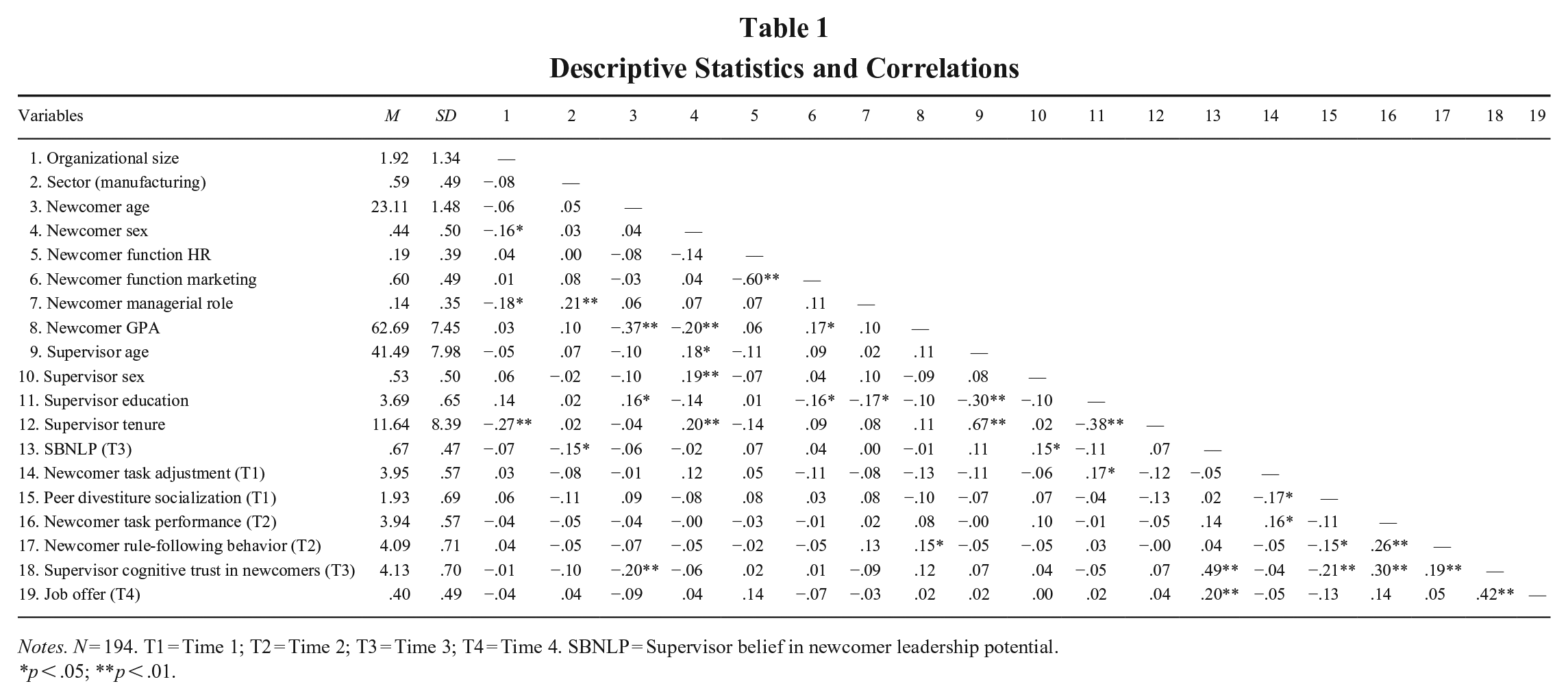
Notes. N = 194. T1 = Time 1; T2 = Time 2; T3 = Time 3; T4 = Time 4. SBNLP = Supervisor belief in newcomer leadership potential.
p < .05; **p < .01.
Analytical Strategy
Our first step was to conduct a series of CFAs to evaluate the measurement validity of our hypothesized model by employing the package Lavaan in R. We compared this baseline model with various alternative models, employing widespread fit indices such as the comparative fit index (CFI), Tucker-Lewis index (TLI), root mean square error of approximation (RMSEA), and standardized root mean square residual (SRMR). The goodness of fit was then analyzed with the widespread Hair, Black, Babin, and Anderson’s (2014) thresholds applied. In the second step, we tested our proposed moderated mediation model by employing Mplus 7.11 (Muthén & Muthén, 1998–2017). Given the number of observations and the complexity of the model, we used logistic path analyses in Mplus on the observed variables to test our moderation and moderated mediation hypotheses. Note that using the bootstrap function to calculate the confidence intervals associated with the moderated mediation effects (Hypothesis 4) is disallowed in Mplus because of concerns about computational time. Therefore, we relied on p-values to estimate the significance of the conditional indirect effects (Hypothesis 4). The variance inflation factors (1.02 to 1.21) were all safely below the rule-of-thumb cutoff of 10, suggesting that multicollinearity was not an issue in our model (Hair et al., 2014).
Results
Test of the Measurement Model
Prior to testing the hypotheses, we conducted eight CFAs to verify the distinctiveness of our five main constructs and the fit of the measurement model (see Table 2). The results suggested an adequate model fit of the hypothesized model with five factors, with χ2 (179) = 262.25, p < 0.001, CFI = .96, Tucker-Lewis index = 0.95, root mean square error of approximation = 0.048, and standardized root mean square residual = 0.052. Additionally, we tested a one-factor model in which all the items were loaded on a single factor and six other models in which items were loaded onto different combinations of four factors. All the CFAs of the models that differed from the five hypothesized factors indicated significantly worse fit indices, suggesting that the hypothesized model exhibited the best fit with the empirical data. The means, standard deviations, and bivariate correlations of the model, as well as the control variables, are reported in Table 2.
Confirmatory Factor Analysis Results: Fit Indices
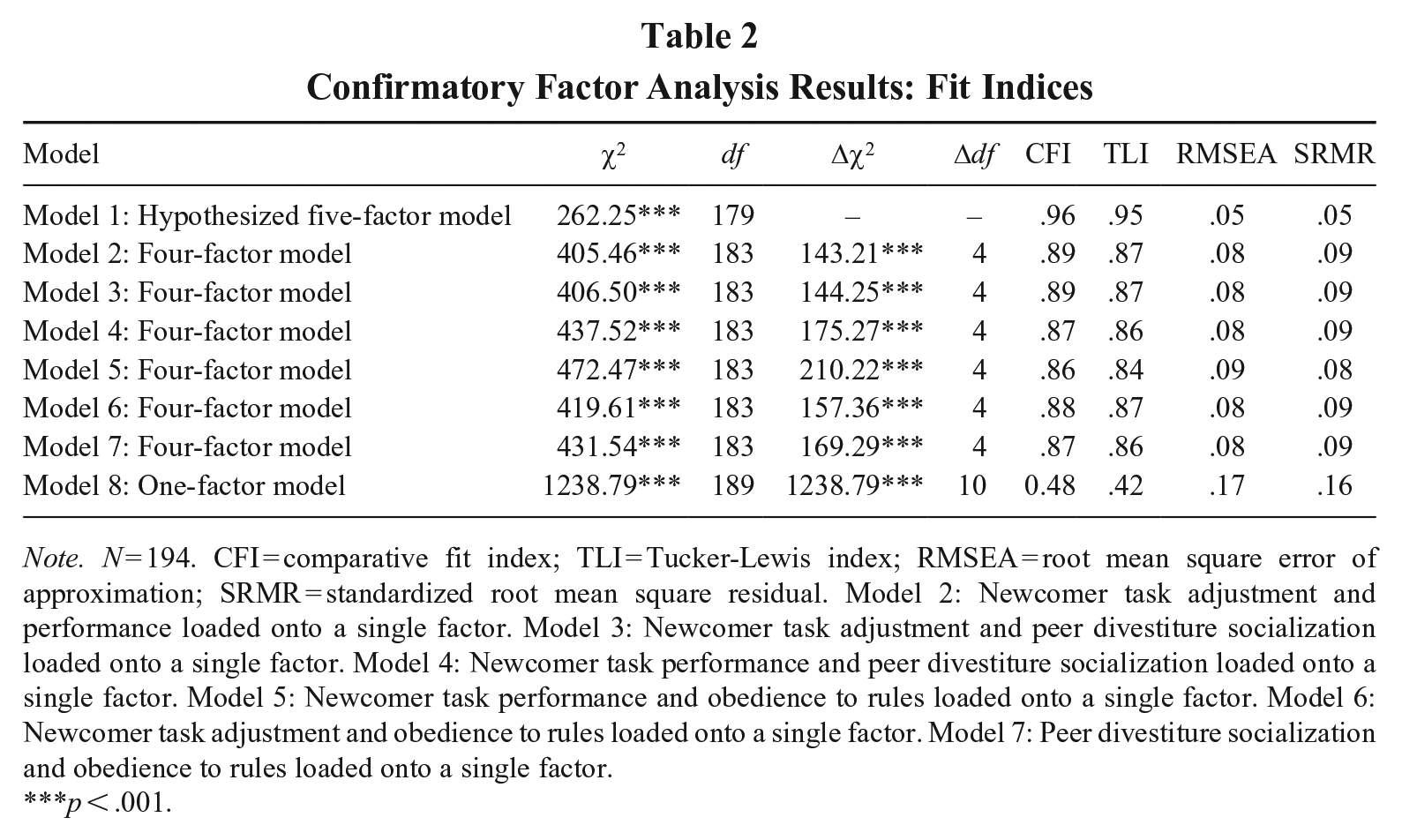
Note. N = 194. CFI = comparative fit index; TLI = Tucker-Lewis index; RMSEA = root mean square error of approximation; SRMR = standardized root mean square residual. Model 2: Newcomer task adjustment and performance loaded onto a single factor. Model 3: Newcomer task adjustment and peer divestiture socialization loaded onto a single factor. Model 4: Newcomer task performance and peer divestiture socialization loaded onto a single factor. Model 5: Newcomer task performance and obedience to rules loaded onto a single factor. Model 6: Newcomer task adjustment and obedience to rules loaded onto a single factor. Model 7: Peer divestiture socialization and obedience to rules loaded onto a single factor.
***p < .001.
Test of the Hypothesized Model
Unstandardized coefficient estimates for the hypothesized model are presented in Table 3. We found that the effect of newcomer task adjustment (NTA) at T1 on newcomer task performance (NTP) at T2 was positive and significant (B = 0.69, SE = 0.22, p < 0.01). In addition, this effect was moderated by peer divestiture socialization (B = −0.27, SE = 0.11, p < 0.05), such that when peer divestiture socialization was low (−1 SD), the effect of NTA on NTP was stronger (B = 0.36, SE = 0.10, p < 0.01) than when peer divestiture socialization was high (+1 SD) (B = −0.02, SE = 0.11, p > 0.05). This moderating effect is also shown in Figure 2. Therefore, Hypothesis 1 is supported.
Unstandardized Estimates of the Path Model
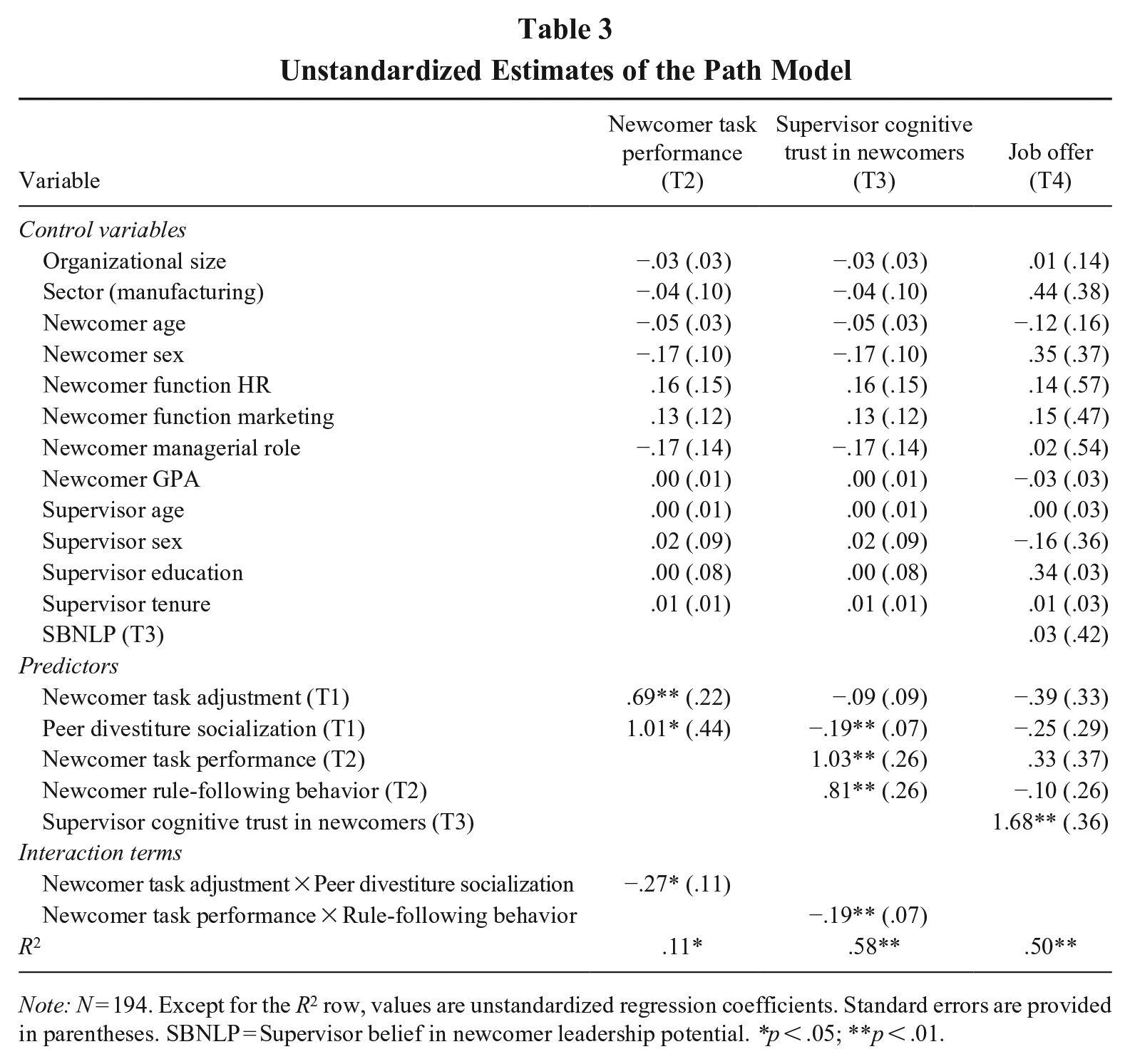
Note: N = 194. Except for the R2 row, values are unstandardized regression coefficients. Standard errors are provided in parentheses. SBNLP = Supervisor belief in newcomer leadership potential. *p < .05; **p < .01.
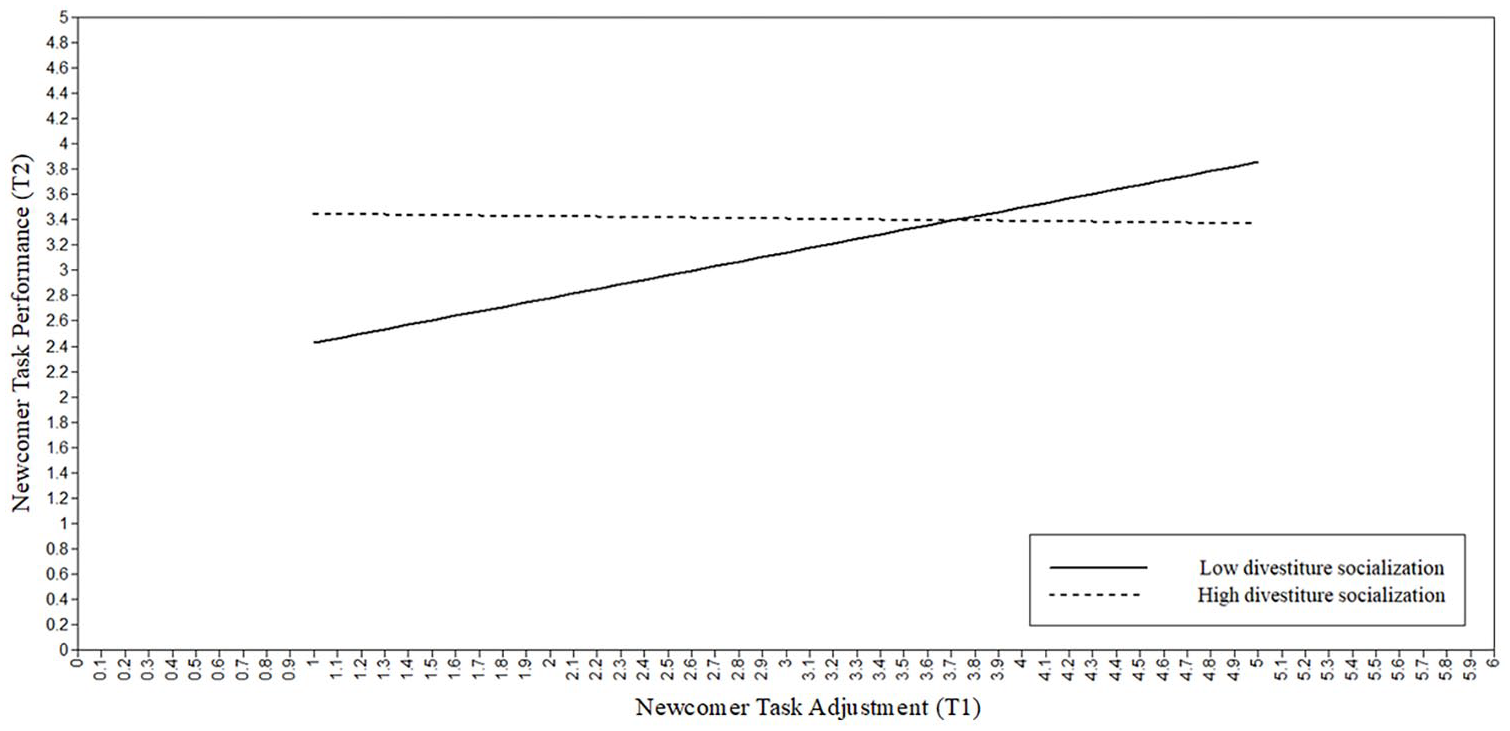
Moderating Effect of Peer Divestiture Socialization on the Relationship between Newcomer Task Adjustment and Newcomer Task Performance
Newcomer task performance (NTP) at T2 was positively associated with supervisor cognitive trust (SCT) in the newcomer at T3 (B = 1.03, SE = 0.26, p < 0.01). Moreover, newcomer rule-following behavior (NRFB) moderated the relationship between NTP and SCT (B = −0.19, SE = 0.07, p < 0.01). The results confirmed that when NRFB was low (−1 SD), the effect of NTP on SCT was significant and greater (B = 0.38, SE = 0.09, p < 0.01) than when NRFB was high (+1 SD) (B = 0.11, SE = 0.11, p > 0.05). The moderating effect of NRFB is shown in Figure 3. These results support Hypothesis 2. In Hypothesis 3, we propose that supervisor cognitive trust in a newcomer results in a job offer (JO). The results showed that SCT was positively and significantly related to JO (B = 1.68, SE = 0.36, p < 0.01), thereby supporting Hypothesis 3.
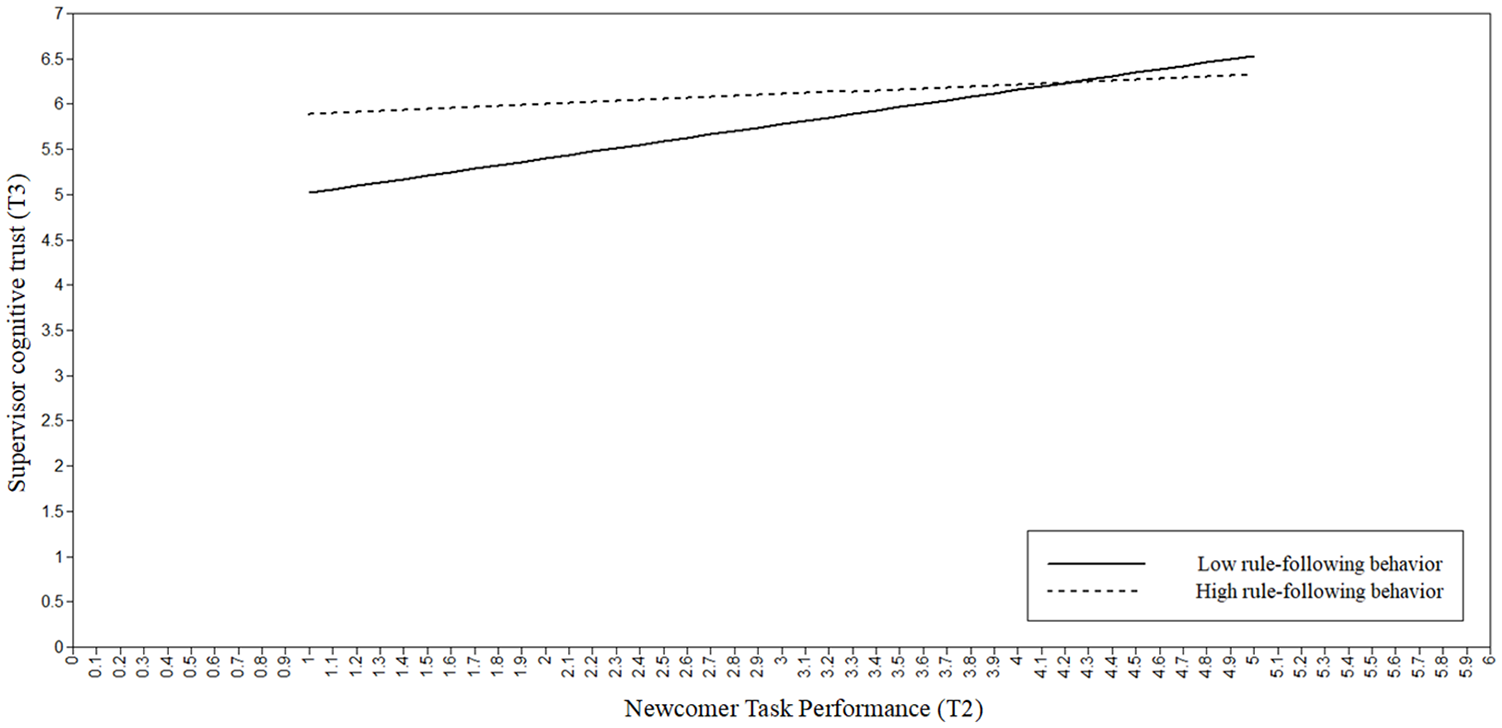
Moderating Effect of Newcomer Rule-Following Behavior on the Relationship between Newcomer Task Performance and Supervisor Cognitive Trust in Newcomers
Hypothesis 4 posited a double moderated mediation model whereby the indirect effect of newcomer task adjustment at T1 on the JO at T4 via newcomer task performance at T2 and supervisor cognitive trust in newcomers at T3 is moderated by both peer divestiture socialization and newcomer rule-following behavior. We argue that this indirect relationship is positive when peer divestiture socialization and newcomer rule-following behavior are low. To test this prediction empirically, we employed logistic path analyses in Mplus 7.11. The results suggested that when both peer divestiture socialization and newcomer rule-following behavior were low (−1 SD), the indirect effect of newcomer task adjustment at T1 on a job offer at T4 was positive and significant (B = 0.23, SE = 0.10, p < 0.05). The other effects at different moderator values were nonsignificant (see Table 4). Hypothesis 4 is therefore supported.
Indirect Effect (in Log-Odds) of Newcomer Task Adjustment on Receiving a Job Offer via Newcomer Task Performance and Supervisor Cognitive Trust in Newcomers as Moderated by Peer Divestiture Socialization and Newcomer Rule-following Behavior
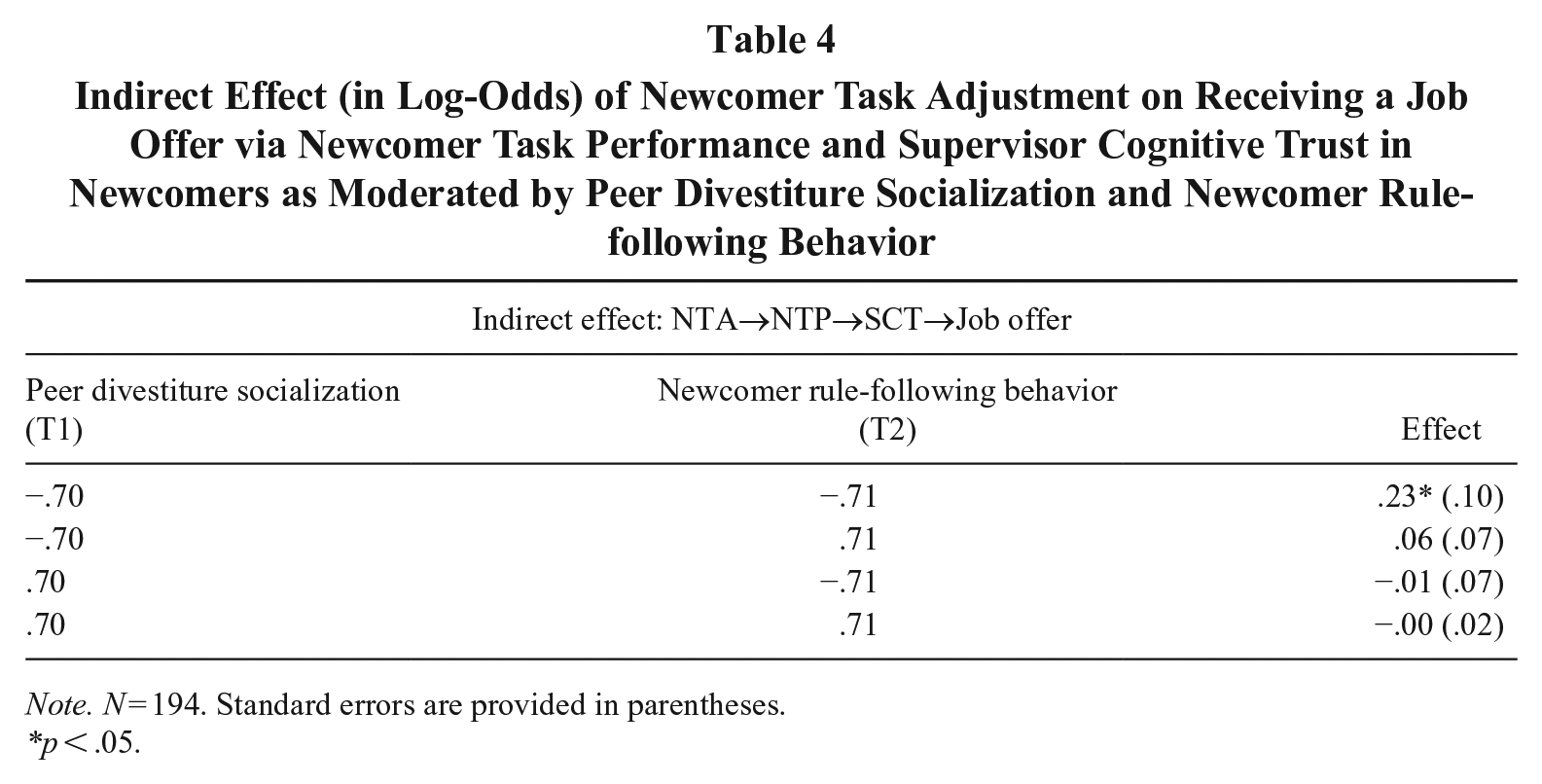
Note. N = 194. Standard errors are provided in parentheses.
*p < .05.
Discussion
Previous studies have often associated newcomer adjustment with positive outcomes, such as job performance, satisfaction, and retention (e.g., Bauer & Green, 1994; Bauer et al., 2007; Bauer, Maertz, Dolen, & Campion, 1998; Saks et al., 2007). However, an increasing number of studies have downplayed the importance of newcomer adjustment in the socialization process, suggesting that organizations expect more from newcomers than mere adjustment (e.g., Feldman, 1981; Katz, 1964; T. Y. Kim et al., 2009; Montani et al., 2019). In this paper, drawing on the identity perspective (Ashforth & Schinoff, 2016; Haslam et al., 2001; Stets & Burke, 2000; Swann, 1983), we investigated how temporary newcomers who have adjusted to their jobs can attain permanent positions. Our findings allow us to make three important contributions to the literature on socialization and temporary work and to the theoretical research stream on “rebel talent” (e.g., Gino, 2018; Warren, 2003).
Theoretical Contributions
Employment-related consequences of newcomer adjustment
Our primary theoretical contribution lies at the junction of the literature on socialization and temporary work by explaining how and when newcomer adjustment can lead to a permanent position. Few studies have investigated the mechanisms that allow a temporary newcomer to obtain a permanent position (Dufour et al., 2021; Zhao & Liden, 2011). In this paper, we highlight two boundary conditions that increase the newcomer’s likelihood of receiving an offer, thus facilitating temp-to-permanent job conversion. First, after acquiring the knowledge and skills necessary to perform the prescribed tasks, performance is optimized when newcomers are socialized by their peers in a way that preserves their unique abilities, strengths, and identities. This condition echoes prior findings, suggesting that weak peer divestiture socialization positively impacts newcomers’ performance by fostering authentic self-expression (Cable et al., 2013; Montani et al., 2019).
Second, when newcomers perform and develop an unstructured approach to their roles, they are more likely to be cognitively trusted and offered permanent job positions. Previous studies have shown that when temporary newcomers are viewed as competent and capable of going above and beyond for the organization (cf. Feldman, 1981; Hu, Luo, Chen, & Zhong, 2020), they tend to be rewarded on the way to employment. By exploring this path and considering adjustment as a starting point instead of an outcome of the socialization process (Ashforth, Saks, & Lee, 1998; Ellis et al., 2017), we contribute to the socialization literature by showing how newcomers’ adjustment and performance remain key elements of the socialization process. The newcomer’s ability to challenge the rules and stand out is yet a decisive element for securing a permanent contract.
The role of supervisor reactions to newcomer behaviors
This study helps explain the role of supervisors’ reactions to newcomers’ behaviors following adjustment. Prior research has suggested that supervisors play an important role in explaining why and how newcomers’ behaviors are ultimately converted into favorable outcomes. For instance, Zhao and Liden (2011) reported that interns who employ self-promotion and ingratiation with supervisors are more likely to receive job offers. Ellis et al. (2017) found that the way in which managers perceive and respond to newcomers’ proactive behaviors influences the development of the socialization process and related outcomes. Our findings complement these studies by highlighting the conditions under which newcomers’ flexible role approach can stimulate their supervisors to react in support of their temp-to-permanent transition.
By doing so, our results shed new light on an area of the socialization and temporary work literature that is still poorly understood: the ability of supervisor trust to explain favorable employment outcomes for newcomers. Most of the work that has been conducted in the socialization literature has concentrated thus far on the trust that newcomers develop toward their supervisors (Lapointe & Vandenberghe, 2018; Lapointe, Vandenberghe, & Boudrias, 2014; Schaubroeck, Peng, & Hannah, 2013). Recently, scholars have reported that the perceived trustworthiness of a newcomer plays a crucial role in explaining cases where supervisors increase their socialization efforts to enhance the promotability of newcomers (Gross et al., 2021). Moreover, Dufour et al. (2021) revealed how supervisor’s trust in a newcomer leads to numerous positive outcomes, such as increased task performance, increased job satisfaction, and diminished stress. Despite the numerous positive outcomes linked to supervisor’s trust, the question of how newcomers can gain such trust remains unexplored. In this study, we identify the antecedents of supervisor cognitive trust in adjusted newcomers, highlighting the combination of high task performance and low rule-following.
The role of authentic and nonconformist self-expression
Finally, our research reveals how and when the expression of personal identity benefits employment-related outcomes. Cable et al. (2013) discovered that newcomers are more likely to exhibit positive attitudes and perform high-quality work when their initial socialization emphasizes the cultivation of their personal identity rather than the enhancement of their organizational identity. Their result challenged the perspective that had previously dominated the socialization literature for almost three decades, which suggested that the main goal of the socialization process is to reduce ambiguity, helping newcomers adapt to the new organizational culture (e.g., Ashforth & Saks, 1996; Bauer et al., 1998; Van Maanen & Schein, 1979). Conversely, Cable et al. (2013) reported that when newcomers are socialized in a context where they have greater freedom to express themselves, coupled with increased ambiguity regarding their employment responsibilities, the situation fosters various positive outcomes, such as engagement, satisfaction, and good performance.
In our study, we found support for this argument regarding temporary newcomers, irrespective of their precarious work conditions, which might have encouraged them to favor approaches that minimize ambiguity and employment-related risks. We found that adjusted newcomers optimize their performance when they perceive that they can express their unique values and identities, as revealed by the case of weak peer divestiture socialization. Adjusted newcomers who use their task-related knowledge and skills proactively are more likely to gain the cognitive trust of their supervisors if they have developed some degree of flexible role orientation. Therefore, we found that temporary newcomers who express their personal identities in nonconformist ways have a greater chance of gaining the cognitive trust of their supervisors and thereby receiving job offers. By providing new evidence to support the adoption of rule-breaking attitudes in organizations (Gino, 2018; Warren, 2003), our results highlight the conditions that should be established to unleash positive socialization outcomes. Of course, adjusted newcomers who have already exhibited high performance can receive more benefits from the flexibility to challenge the status quo and identify unexploited opportunities to exceed expectations for the organization’s sake (Aston-Jones & Cohen, 2005; Cohen et al., 2007).
These insights add to the identity perspective, as they explain how and when temporary newcomers can earn trust to obtain access to more permanent opportunities while preserving self-consistency. Our research empirically demonstrates that in the initial phases of the path leading from a temporary position to a permanent one, if task-adjusted newcomers maximize their engagement in task-performing behaviors, they should be enabled to maintain a consistent image of the self, as evidenced in instances of low-intensity peer divestiture socialization. Furthermore, to earn the trust necessary to obtain a permanent job offer, high-performing newcomers should signal their capacity and willingness to go the extra mile by deviating from prescribed rules on behalf of the organization.
Practical Implications
In this work, we identify the conditions that should be established to promote the transition of adjusted newcomers from temporary to permanent positions. These conditions have important implications for socialization agents, temporary newcomers, managers, and organizations. The literature has highlighted the crucial role of peers in the socialization process (e.g., Feldman, 1981; Van Maanen, 1978). Our findings suggest that these socialization agents must be aware of the opportunities offered by weak peer divestiture, as they should encourage newcomers who are capable of doing their jobs to express their authentic selves as well as their unique perspectives and values. Simultaneously, newcomers should be aware that mastering prescribed core tasks might not be enough to ensure that they are retained. Newcomers who are good performers and wish to remain with the host organization must exceed expectations and deviate from prescribed rules for constructive and beneficial purposes. This approach can allow them to gain the trust of their supervisors and increase their chances of securing permanent positions. Therefore, managers can work with adjusted newcomers in unstructured situations. They should encourage individuals who have already proven to be proficient at their prescribed jobs to use their unique perspectives and strengths to exhibit their adaptability and solve organizational problems. Additionally, when making decisions related to the transition of temporary newcomers to permanent positions, managers should ask themselves whether they trust the newcomer’s future capacity to fulfill both structured and unstructured responsibilities and thereby contribute reliably and dependably to the company. At the organizational level, the expression of the newcomer’s personal identity can be fostered by implementing policies that value creativity and divergent points of view. Thus, organizations can establish an environment where temporary newcomers who are also good performers can thrive, thereby improving the retention and development of potential future leaders.
Limitations and Directions for Future Research
Our research focused on four waves of data collected from newcomer-supervisor pairs, which allowed us to analyze the interconnections between newcomers’ behaviors and supervisors’ reactions. These survey data were complemented by archival data on actual job offers received by newcomers from their host organizations. To our knowledge, this study is one of the few to use information on actual job offers rather than perceptual data to examine the employment-related outcomes of socialization processes—for another exception, see Dufour et al. (2021). Naturally, this design involves several limitations that should be acknowledged. First, this study featured a time-lagged design and measured different constructs related to either newcomers’ behaviors or supervisors’ reactions at different times. Future studies should attempt to test the model by conducting a fully longitudinal analysis to provide more robust tests for causality. Second, given the complexity of collecting four waves of time-lagged data and the resulting final sample size, we employed observed variables instead of latent variables. A full latent approach would have been potentially less affected by measurement errors, but it would have required a considerably larger sample size owing to the number of estimated parameters. Future research could address this issue by collecting a larger sample capable of supporting full latent analyses.
Third, we theorized that the combination of high task performance and low rule-following behavior facilitates supervisor cognitive trust in newcomers by way of the newcomers’ ability to switch from a structured to a more flexible approach to their role, allowing them to perform a wide range of unstructured tasks. However, we did not empirically measure these unstructured behaviors, such as innovation, proactivity, taking charge, and organizational citizenship behaviors. Accordingly, future research should attempt to capture and measure the types of unstructured behaviors that are the main drivers of the effects we observed more accurately. Moreover, this paper concentrated on the main actor of the decision-making process: the supervisor. However, other actors, such as peers and the HR department, can be involved in the decision to hire a temporary newcomer. That said, we encourage future research to include these additional actors, who could play a role in the final decision to offer permanent positions to temporary workers.
A fourth issue relates to the measures of newcomer task adjustment and peer divestiture socialization, which had marginally acceptable reliability (α = .71 and .72, respectively). This low reliability may be partly explained by the small number of items or the homogeneous nature of the sample—that is, temporary newcomers of a similar age who enrolled in the same business school’s apprenticeship program (Streiner, 2003). However, the factor loadings of the items on their latent factors were significant, and the items had sizeable correlations with the overall constructs in both studies. Moreover, these scales have shown highly satisfactory reliability in previous studies (e.g., Haueter et al., 2003; Montani et al., 2019). Notably, reliability values of .70 and above are generally considered acceptable by psychometricians (DeVillis, 1991; Jaccard & Wan, 1995; Kline, 1986; Streiner, 2003). Finally, we conducted a post hoc analysis of reliability via McDonald’s omega coefficient, which has been shown to make more realistic assumptions than Cronbach’s alpha and to reduce problems related to inflation and attenuation of internal consistency (Dunn, Baguley, & Brunsden, 2014). The results revealed that McDonald’s omegas of task adjustment and peer divestiture socialization were .76 and .77, respectively, suggesting that the two scales displayed good internal consistency.
Another limitation is the limited number of newcomer-supervisor dyads in the present study, which might prevent us from drawing robust and generalizable conclusions from our sample. Additional research is thus warranted to replicate the current analyses on a larger sample of newcomer-supervisor dyads to increase the validity of our findings. However, we conducted a post hoc power analysis with G*Power software (Faul, Erdfelder, Lang, & Buchner, 2007) to determine whether it was appropriate to test our hypotheses on a sample of 194 dyads. The results revealed a power of .95 for the interaction effect of task adjustment and peer divestiture socialization on task performance on the basis of an explained variance of .11, a power of .95 for the interaction effect of task performance and rule following on supervisor trust in the newcomer on the basis of an explained variance of .58 and a power of .95 for the effect of supervisor trust in the newcomer on the job offer on the basis of an explained variance of .50. These results suggest that our sample has acceptable observed power to detect the effects of interest (Lattin, Carroll, & Green, 2003).
Furthermore, in this study, we viewed task adjustment as a proxy for the effect of the socialization process on newcomers’ work-related behaviors. This choice is consistent with the evidence from the temporary work literature as well as with the context of our study, suggesting that mastering job-related skills and knowledge is the primary concern of temporary newcomers (e.g., Fisher, 1986; Molleman & Van der Vegt, 2007; Saks & Ashforth, 1997). However, future studies could consider alternative adjustment forms and components. Among these, social adjustment deserves particular attention since organizational socialization involves not only newcomers mastering the task-related aspects of their jobs but also developing social bonds with other organizational members (Bauer & Erdogan, 2011; Bauer et al., 2007). Although temporary newcomers are expected to be less concerned than permanent newcomers with developing social relationships at work (Kalleberg et al., 2003), identity theory and research suggest that gaining social acceptance within a group and the broader organization is still important for earning the trust of others, as such acceptance signals that the member is perceived by others as “one of us” (van Knippenberg & Hogg, 2003). Trust is a key determinant of the career benefits granted to temporary newcomers; additional research is thus warranted to understand how temporary newcomers who have successfully mastered their job tasks can also be enabled to gain the social acceptance of their group or organization. Moreover, the social acceptance of newcomers depends on the extent to which these are perceived as similar to other members of the group or the broader organization (Crane, Thomas-Hunt, & Kesebir, 2019), which contrasts with newcomers’ need to maintain their unique identities in their new work environments (Cable et al., 2013). Thus, another relevant question in future research is how temporary newcomers can reconcile self-consistency with social adjustment to their group and the broader organization.
Relatedly, our theorizing suggested that the supervisor (via cognitive trust) and the group of peers (via low divestiture socialization) are both central to the social identification processes driving adjusted newcomers’ temporary-to-permanent conversion. However, since the specific social identification processes were not empirically measured in our study, assessing the joint impact of supervisor and group identification on temporary newcomers’ career outcomes would be a fruitful research avenue. Research has shown that newcomers’ relational identification with the supervisor enhances their general identification with the organization (Sluss, Ployhart, Cobb, & Ashforth, 2012). Yet, as Sluss et al. (2012) have argued, relationships with group members might involve contradictory or competing goals and values (cf. also Collinson, 1992), suggesting that the impact of newcomers’ relational identification with the supervisor on socialization and career outcomes might be contingent on the development of consistent identification with the group. Addressing this issue in the apprenticeship context would be particularly relevant because developing a relational identification with the organization is regarded as a key goal of apprenticeship training programs, determining apprentices’ future career success (Maué, Findeisen, & Schumann, 2023). Hence, future research is warranted to examine and clarify how, in the context of apprenticeship programs, newcomers’ identification with the supervisor and the work group jointly interact to influence newcomers’ broader identification with the organization and career outcomes.
Conclusion
Newcomer adjustment to tasks has long been viewed as the main objective of socialization practices, leading scholars to focus mainly on its determinants and proximal outcomes (e.g., Bauer et al., 2007; Saks et al., 2007). Despite an increasing consensus in the socialization literature regarding the need for newcomers to both adjust to and adopt a role that ranges beyond their formal job descriptions (e.g., Cable et al., 2013; Montani et al., 2019), the process that leads supervisors to decide to transform newcomers’ temporary contracts into permanent contracts remains largely unknown. This study addresses this research gap by showing that temporary newcomers who can express their personal identities in a nonconformist way have greater opportunities to gain the cognitive trust of supervisors and thereby receive job offers. Our results provide managers and organizations with important insights into ways in which they can identify newcomer behaviors that signal a reliable “star candidate” and recognize a rebel talent who can offer added value to their organization.
