




Abstract
Insufficient recovery from work stress is a pernicious issue for many workers. This study aims to understand the important role that supervisors play in employees’ recovery experiences. Specifically, we (1) proposed an expanded conceptualization of supervisor support for recovery (SSR), and (2) developed and validated a measure consistent with this expanded conceptualization. We refined the conceptualization of SSR with four dimensions: refraining from communicating about work during nonwork time, refraining from requiring work during nonwork time, modeling recovery, and encouraging recovery. These dimensions align with the recovery literature, which highlights the necessity of refraining from recovery-hindering behaviors to reduce energy exertion and engaging in recovery-promoting behaviors to provide recovery opportunities. The recovery-promoting dimensions also align with key themes of role modeling and encouragement emphasized in social cognitive theory. Based on the conceptualization, we further developed and validated an SSR scale using three different designs (cross-sectional, supervisor-subordinate dyadic, time-separated) in six studies. Results showed that SSR was distinct from related supervisor constructs (e.g., leader-member exchange and family supportive supervisor behaviors), was positively associated with recovery experiences, and provided further insight into recovery experiences, over and above the other supervisor constructs. This study provides a foundation for future research to better understand how supervisors can support employee recovery from work stress.
Keywords
Recovery from work stress—defined as the unwinding process of reducing or eliminating strain caused by work-related stressors (Meijman & Mulder, 1998)—is important for helping employees maintain well-being, health, and performance (Steed, Swider, Keem, & Liu, 2021). However, high job demands and blurred boundaries between work and nonwork roles have made it increasingly difficult for many employees to experience sufficient recovery from work stress (Sonnentag, Cheng, & Parker, 2021). Given that the lack of recovery after work is a concerning and pressing issue, it is critical to find ways to promote recovery from work stress.
Popular media articles have emphasized the important role that supervisors play in employee well-being and mental health (Hafner, 2023; Threlkeld, 2021; Vincent, 2021). Over 70% of executive respondents from a recent survey viewed employee well-being as an essential part of leadership performance (Hafner, 2023). However, a substantial 70% of supervisors feel incapable of supporting employee well-being (Hafner, 2023). Recovery research has affirmed these sentiments, recently noting that “recovery processes often do not happen by themselves . . . and need to be facilitated” (Sonnentag, Stephan, Wendsche, de Bloom, Syrek, & Vahle-Hinz, 2021: 4) and emphasizing that future research should examine “what supervisors can do to support recovery” (Sonnentag, Venz, & Casper, 2017: 374). Taken together, these findings highlight the importance of enhancing managerial practices to foster employee well-being by supporting employee recovery from work stress.
Indeed, supervisors play an important role in daily management (e.g., assigning work tasks, managing work progress, and communicating with employees) and can convey work expectations and norms in their interactions with employees (Cialdini & Trost, 1998; Fishbein & Ajzen, 2010), which further impacts their employees’ well-being and recovery from work stress. Supervisors can enhance their managerial practices by adopting an optimal set of behaviors—engaging in supportive supervisor behaviors and refraining from unsupportive supervisor behaviors—in their daily management to achieve work goals without hindering their employees’ recovery from work stress. For example, when a supervisor assigns a work task to an employee, the timing of the assignment matters. When a task is not urgent, instead of assigning the task at the end of the work day, which may make it harder for some employees to detach from work in the evening, the supervisor may consider waiting until the next morning to assign the task.
A few studies in the recovery literature have highlighted the role supervisors play in employee recovery experiences (Bennett, Gabriel, Calderwood, Dahling, & Trougakos, 2016; Kinnunen & Feldt, 2013; Sonnentag & Schiffner, 2019; Xu, Zhang, Zhang, Qing, & Jin, 2020). However, this work has yet to be integrated into a conceptualization of the most important recovery-supportive behaviors—knowledge that is essential for enhancing supervisors’ managerial competencies to promote employee recovery.
Further, while an initial conceptualization of recovery-supportive supervision has been introduced (Bennett et al., 2016), the SSR construct is substantially underdeveloped. Bennett et al. (2016) initially defined SSR as “the extent to which supervisors supported recovery experiences at home” (p. 1646). This study showed that SSR predicted employees’ belonging to a “leaving work behind” recovery profile in which employees disconnect from work, compared with other profiles where employees ponder work during nonwork time (Bennett et al., 2016). Yet, although this initial conceptualization is a useful starting point, the brief development of the construct focused primarily on the extent to which supervisors expect subordinates to work during nonwork time—a narrow conceptualization that primarily reflects an emphasis on the supervisor’s role in imposing job demands. This narrow focus on reducing job demands omits other important dimensions that are implied by the recovery literature (Meijman & Mulder, 1998; Steed et al., 2021). The recovery literature emphasizes the dual importance of reducing work demands that require employees to exert energy during nonwork time while also offering nonwork support that provides opportunities for employees to engage in recovery, suggesting that supervisors’ support for employee recovery not only entails limiting expectations or pressure to work during nonwork time but also actively providing support for recovery.
To capture a broad array of prevention- and promotion-based behaviors, we conducted a qualitative study and identified four types of supportive supervisor behaviors for employee recovery: (1) refraining from communicating about work during nonwork time, (2) refraining from requiring work during nonwork time, (3) modeling recovery, and (4) encouraging recovery. In the next section, we describe the four dimensions of SSR and how they align with the recovery literature and social cognitive theory (SCT; Bandura, 1986). These dimensions can be categorized into two directions of support: refraining from recovery-hindering behaviors (prevention-based behaviors) and engaging in recovery-promoting behaviors (promotion-based behaviors), as emphasized in the recovery literature. Additionally, the two recovery-promoting behaviors can be classified into two supportive behaviors: modeling and encouraging, as highlighted in SCT.
The present study makes several contributions. First, this research contributes to the recovery literature by presenting a refined and multidimensional conceptualization of SSR. This framework broadens the scope of supervisor support for recovery beyond the traditional focus on supervisor behaviors that hinder employee recovery, as identified by Bennett et al. (2016), to also highlight behaviors that proactively facilitate recovery from work stress. This comprehensive approach aligns with the emphasis in the recovery literature that employees’ recovery experiences are shaped not only by stressors encountered during nonwork hours but also by opportunities for engaging in activities that promote recovery (e.g., Steed et al., 2021). By delineating the key dimensions of SSR, we offer valuable insights into how supervisors can play an active role in supporting employee recovery.
Second, this research integrates SCT, which has been underutilized in explaining the social contextual influences of work stress on recovery. To identify recovery-promoting supervisor behaviors, we draw on insights from SCT, which emphasizes the important role modeling and encouraging behaviors play in promoting healthy behaviors (Wood & Bandura, 1989). Leveraging insights from the recovery literature and SCT, we propose a multidimensional construct that captures engaging in modeling and encouraging recovery behaviors. In doing so, we respond to the call to “develop a broader conceptualization of what supervisors can do to support recovery—above and beyond not expecting that subordinates work during nonwork time” (Sonnentag et al., 2017: 374), as well as to calls for increased integration of insights from SCT into recovery research (Kuykendall, Craig, Stiksma, & Guarino, 2021).
Third, our behavioral conceptualization of SSR helps extend supervisor support research in the broader work-nonwork literature, which to date has focused extensively on support for the family role (e.g., Hammer, Kossek, Yragui, Bodner, & Hanson, 2009; L. T. Thomas & Ganster, 1995). Our emphasis on SSR as a distinct construct from family supportive behaviors enables work-nonwork researchers to emphasize supportive supervisor behaviors that are essential for other nonwork experiences—namely, recovery experiences.
Practically, by specifying SSR’s key behavioral dimensions, our work has the potential to facilitate the design of behavior-based supportive supervisor training interventions to foster recovery-supportive supervision (Dimoff & Kelloway, 2019). This is a sorely needed contribution, given the disproportionate emphasis in the recovery literature on individual-directed rather than context-directed interventions (Barber, Kuykendall, & Santuzzi, 2023; Karabinski, Haun, Nübold, Wendsche, & Wegge, 2021).
Conceptualizing SSR in the Recovery Literature
Recovery is the opposite of the strain process. The effort-recovery model (ERM) has been widely used to explain the recovery process. According to ERM, individuals experience short-term physiological and psychological load reactions (also known as strain reactions) as a result of the effort expenditure required to meet job demands (Meijman & Mulder, 1998). This model posits that recovery occurs when short-term strain reactions are reduced by a cessation of energy exertion (Meijman & Mulder, 1998). In other words, recovery is achieved when employees spend time away from work and engage in restorative recovery experiences (Sonnentag & Fritz, 2007). Applying ERM to the impact of supervisors on employee recovery experiences, supervisor behaviors that cause employees to exert energy may impede employee recovery experiences, while supervisor behaviors that provide recovery opportunities may promote employee recovery experiences.
According to the above two directions specified by the recovery literature, we define SSR as supervisors’ tendencies to refrain from behaviors that hinder recovery and to engage in behaviors that facilitate employee recovery. This definition is different from Bennett et al.’s (2016) definition in that (1) it expands the focus beyond not expecting employees to work during nonwork time, and (2) it focuses on supervisor behaviors that reflect the supervisor’s expectations.
Overview
We followed three phases to develop and validate the multidimensional conceptualization and scale of SSR. In phase 1, we derived the SSR dimensions via a qualitative study (Study 1) using open-ended questions that were designed based on the definition of SSR. Based on this multidimensional conceptualization from Study 1, we developed items to capture SSR, revised the items based on feedback from subject matter experts, and conducted a content validation study to examine the distinctiveness of the items (Study 2). In phase 2, we tested the basic psychometric properties of the SSR scale, including item properties, reliability, and structure of the SSR scale (Study 3). In phase 3, we validated the SSR scale and examined the effects of SSR on employee recovery experiences with three samples and different designs (Study 4: cross-sectional design among U.S. full-time employees; Study 5: multi-source design among Chinese full-time employees; Study 6: time-separated design among U.S. PhD students). See Table 1 for an overview of all studies.
Overview of Study Phases, Samples, Methods, and Major Findings
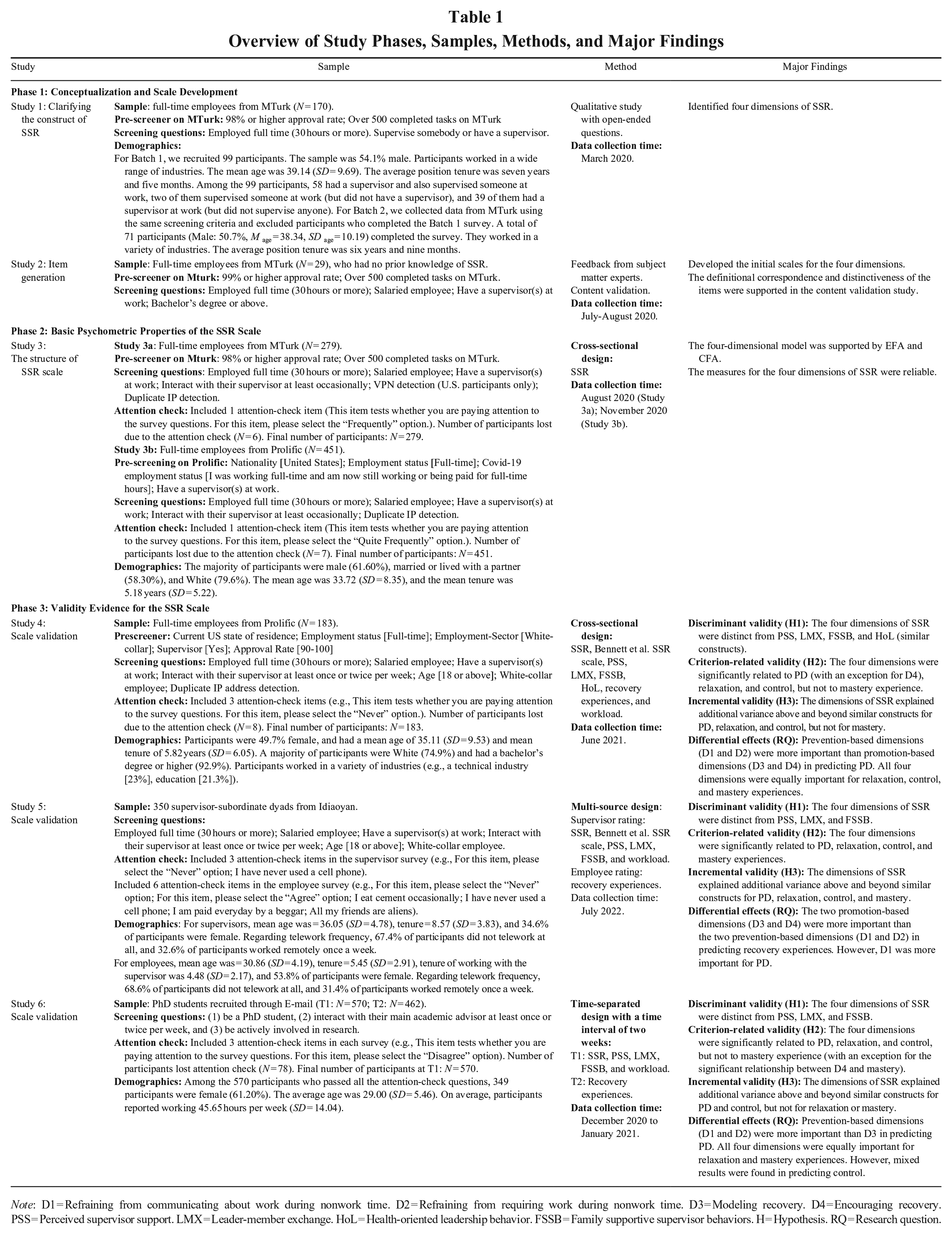
Note: D1 = Refraining from communicating about work during nonwork time. D2 = Refraining from requiring work during nonwork time. D3 = Modeling recovery. D4 = Encouraging recovery. PSS = Perceived supervisor support. LMX = Leader-member exchange. HoL = Health-oriented leadership behavior. FSSB = Family supportive supervisor behaviors. H = Hypothesis. RQ = Research question.
Phase 1: Conceptualization and Scale Development
Study 1: Clarifying the Construct of Supervisor Support for Recovery
Based on the definition of SSR, our goal for Study 1 was to explore supervisor behaviors that hinder and facilitate employee recovery experiences. Accordingly, we conducted a qualitative study where we asked employees to report supervisor behaviors that make it harder or easier for them to relax and recuperate from work stress during nonwork time.
Samples and procedure
In Study 1, we collected two batches of qualitative data on Amazon Mechanical Turk (MTurk) (Batch 1: N = 99; Batch 2: N = 71). Sample information is presented in Table 1. Due to a lack of sufficient details from the first batch of data, we modified the questions by applying critical incident techniques to elicit more details in the second batch. In Batch 1, eligible participants were asked to list three supervisor behaviors that make it harder or easier for employees to relax and recuperate from work during nonwork time (six behaviors in total). In Batch 2, using the same questions as in Batch 1, eligible participants were first asked to list two supervisor behaviors that make it harder for employees to relax and recuperate from work during nonwork time. Then, we included two additional follow-up questions to elicit more details about the reported behaviors. First, participants were asked to think about a recent occasion when the supervisor engaged in the behavior they reported earlier and were asked to describe the situation and the supervisor’s behavior(s). Second, they were asked to list the reason(s) why this supervisor’s behavior made it hard for them or their coworkers to relax and recuperate from work during nonwork time. We coded responses to both the initial behavior question and the two follow-up questions. The same procedure was repeated for the supportive supervisor behaviors that made it easier for employees to relax and recuperate from work during nonwork time. All questions from both batches are available in the online supplement (Appendix 1).
Coding procedure
Following best-practice recommendations (Locke, Feldman, & Golden-Biddle, 2022; Terry & Hayfield, 2021), we employed an iterative analytic process to code the responses. Specifically, we applied a mixture of an inductive approach to engage the data and a deductive approach to engage relevant literature and theory to understand the broader themes and categories.
The coding began with an inductive approach, where we generated and organized initial codes based on participant responses. In this step, the goals were to (1) interpret and add meaning to text segments and (2) condense the text into a list of codes, as described by Terry and Hayfield (2021). The first and second authors conducted open coding after thoroughly reviewing the raw responses to familiarize themselves with the data. Consistent with D. R. Thomas’s (2006) description of qualitative coding, a considerable amount of the text could not be assigned to any category because it was irrelevant. Text was considered irrelevant if it focused on (1) general supervisor support or leader behaviors, including comments about rewards, feedback, coaching, trust, knowledge on work-related tasks, teamwork, fairness, integrity and respect, openness to suggestions, participation, empowerment, display of hostile verbal and nonverbal behaviors, and structure initiation—unless those behaviors were specifically linked to recovery, or (2) work-family support. Based on these exclusion criteria, the first and the third authors selected a random set of 100 responses from the set of 1,440 responses and coded them for inclusion or exclusion. The inter-rater consistency was 93%, showing that the two raters reached a consensual understanding of the inclusion and exclusion criteria. The third author then coded all remaining responses for inclusion or exclusion, resulting in 481 included responses from 108 participants.
Next, we generated codes from responses that pertained to recovery-specific supervisor behaviors. These codes were after-hour work-related communication (e.g., e-mailing employees after hours), suboptimal work scheduling (e.g., setting Monday morning meetings that require preparation), poor task assignment timing (e.g., assigning big projects right before closing), boundary management (e.g., having clear boundaries of when work time ends), role modeling (e.g., talking about nonwork activities), and encouraging and allowing time off (e.g., telling employees to take the evening off). Table 2 presents illustrative quotes for each theme.
Illustrative Quotes for Each Dimension from Study 1
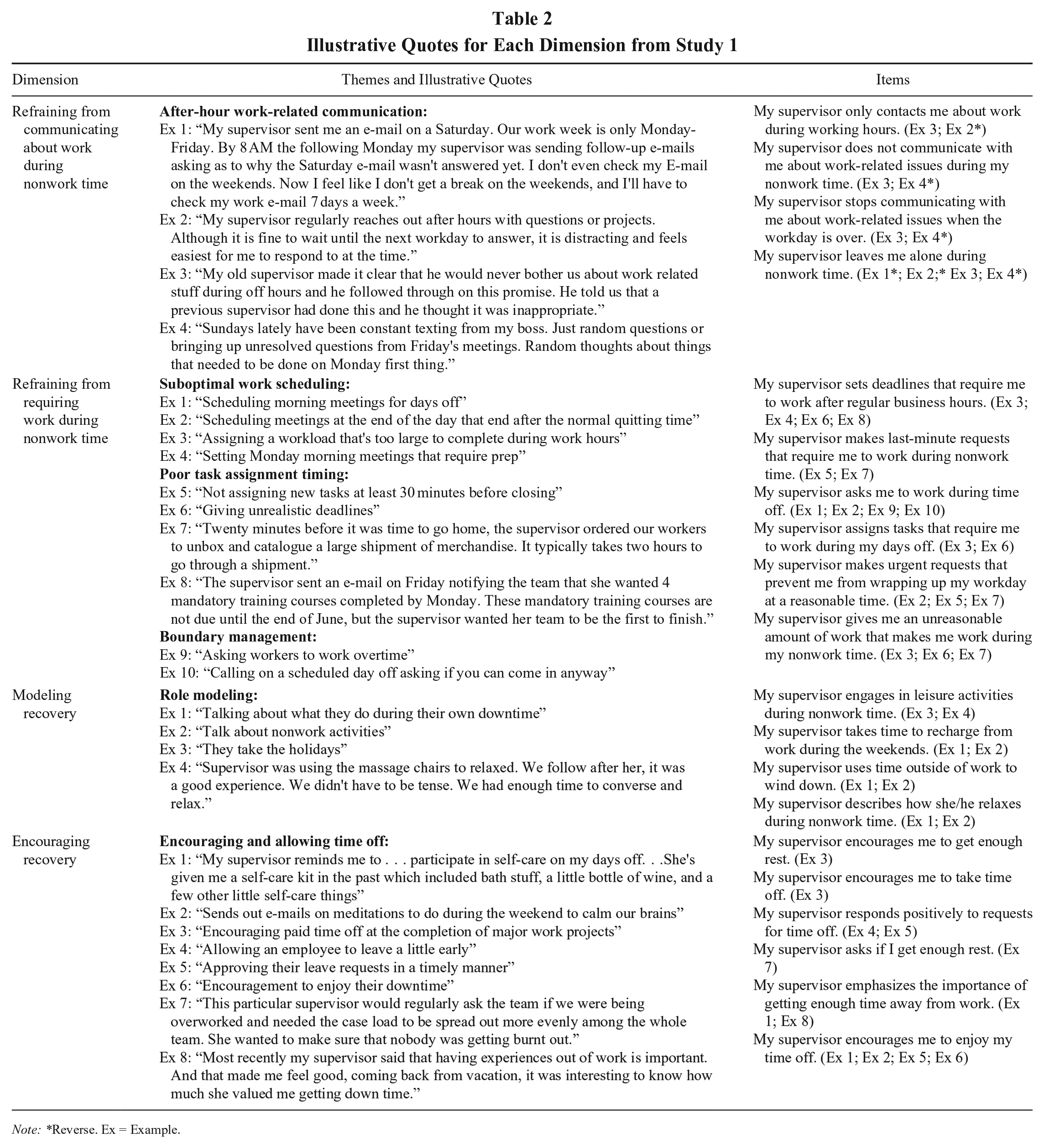
Note: *Reverse. Ex = Example.
To understand the broader themes and categories, we switched to a deductive approach and engaged the recovery literature and SCT. Based on the recovery literature, we identified two broad directions of support: (1) refraining from recovery-hindering behaviors (prevention-based behaviors), and (2) engaging in recovery-promoting behaviors (promotion-based behaviors), as described in the “Conceptualizing SSR in the Recovery Literature” section.
Drawing on SCT, we identified two important types of behaviors: (1) role modeling and (2) encouraging. Specifically, SCT emphasizes the importance of observational learning, imitation, and modeling in understanding human behavior (Bandura, 1986). In this observational learning process, supervisors who hold power and high positions in one’s work domain will likely emerge as role models (Tu, Lu, & Yu, 2017). SCT emphasizes two social cognition processes—modeling (also called vicarious learning, which refers to the process of observing others complete a task) and encouraging (also called verbal persuasion, which refers to the process of receiving positive feedback, encouragement, and support from others for engaging in behaviors) in impacting one’s behaviors (Wood & Bandura, 1989). In the context of SSR, we suggest that supervisors’ modeling and encouraging recovery behaviors have the potential to impact employees’ experiences.
In the role modeling process, employees learn recovery-related norms and expectations during nonwork time by interpreting information conveyed by their supervisors (Afota, Ollier-Malaterre, & Vandenberghe, 2019; McCartney et al., 2023). By observing their supervisor’s recovery-related behaviors, employees may perceive their supervisor’s endorsement of prioritizing recovery during nonwork time, which, in turn, influences their engagement in recovery behaviors (Bandura, 1986; Lent & Brown, 2006). Previous studies have shown that supervisors act as role models of work-nonwork balance for subordinates (Koch & Binnewies, 2015).
Similarly, encouragement from supervisors is an essential form of social support at work (Wood & Bandura, 1989). Encouraging recovery fits into verbal persuasion emphasized by SCT because it involves providing encouragement to an individual to attain a specific behavior (Bandura, 1997). By receiving their supervisor’s encouragement to engage in recovery behaviors, employees may perceive their supervisor’s approval of prioritizing recovery during nonwork time, which further increases the likelihood of successfully participating in recovery opportunities.
Having engaged the literature and theories, we once again engaged the data by examining how the initial codes reflected and fell into these identified reflexive themes. We grouped the initial codes to determine the dimensions of SSR and labeled and defined each dimension. Specifically, we found two dimensions for prevention-based behaviors from the initial codes. Given that the initial code of “after-hour work-related communication” was mentioned by participants repeatedly, we labeled the first dimension as “refraining from communicating about work during nonwork time.” Moreover, we grouped three initial codes: “suboptimal work scheduling,” “poor task assignment timing,” and “boundary management” into a single dimension and labeled it as “refraining from requiring work during nonwork time.”
We also found two dimensions for promotion-based behaviors based on SCT: “modeling recovery” and “encouraging recovery.” One initial code: “role modeling,” fell into the “modeling recovery” dimension, and one initial code: “encouraging and allowing time off,” fell into the “encouraging recovery” dimension. These two recovery-promoting dimensions align with the two social cognition processes—modeling and encouraging—emphasized by SCT.
Next, the first and third authors sorted each response by dimension using a coding manual developed by the first author. The two coders selected a random set of 100 responses from the 481 included responses and coded them independently, yielding an inter-rater consistency of 91%. Overall, the inter-rater consistency was high (Stemler, 2004). Discrepancies were resolved through discussions. The coding manual is available in the online supplement (Appendix 1). The third author coded the remaining responses. Based on the qualitative data, we defined the four dimensions below.
Refraining from communicating about work during nonwork time
This dimension involves refraining from texting, e-mailing, and/or calling employees about work-related tasks or issues during nonwork time. In our sample, 57.40% (62 out of 108) of participants mentioned that supervisors’ work-related communication through e-mail, phone calls, or other communication applications after work hinders their recovery from work stress during nonwork time. Communicating about work during nonwork time perpetuates employees’ continued connection with job demands and thus obstructs the essential recovery process of reversing the physiological activation caused by job demands highlighted by ERM (Geurts & Sonnentag, 2006). Based on our qualitative data, we note that reports of communication during nonwork time can be a barrier to recovery even when they are not accompanied by requests to respond quickly, consistent with the definition of an important recovery experience—psychological detachment, which emphasizes the importance of not thinking about work during nonwork time. The emergence of this dimension also aligns with research on communication technology and telepressure (Barber & Santuzzi, 2015; Day, Paquet, Scott, & Hambley, 2012; Park & Jex, 2011), which has shown that work-related communication during nonwork time negatively impacts employees’ recovery processes (Park, Fritz, & Jex, 2011). Thus, refraining from such communication behaviors represents an important type of recovery support.
Refraining from requiring work during nonwork time
This dimension refers to refraining from assigning tasks or scheduling work that requires or compels employees to engage in or think about work-related activities during nonwork hours. 70.37% (76 out of 108) of participants reported supervisory behaviors related to this dimension. This dimension encompasses direct instruction and encouragement to work during nonwork time (e.g., telling employees to bring work home at night) and indirect behaviors that inevitably encourage working outside of regular hours (e.g., assigning a large task on a Friday afternoon that is due on Monday morning). These behaviors are counterproductive to recovery, as recuperating from work stress necessitates a temporary detachment from work-related demands, as suggested by the recovery literature (e.g., Sonnentag et al., 2017) and theory (ERM, Meijman & Mulder, 1998). This detachment becomes unattainable if supervisors expect ongoing work efforts during nonwork periods (Bennett et al., 2016). Even if supervisors do not explicitly request employees to continue working after hours, suboptimal work scheduling and poor task assignment timing can impede employee recovery experiences by preventing them from psychologically detaching from work. Thus, refraining from such behaviors is considered supportive of recovery.
Modeling recovery
Modeling recovery refers to setting an example of engaging in recovery-related processes for employees. 11.11% (12 out of 108) of participants mentioned modeling recovery as a relevant supervisor behavior. This is consistent with the emphasis on positive role modeling in SCT (Bandura, 1997). In line with this notion, numerous studies have underscored the role-modeling influence of supervisors on their employees (e.g., Lian, Huai, Farh, Huang, Lee, & Chao, 2022; Sonnentag & Schiffner, 2019). While it is not necessarily possible for employees to observe their supervisors engaging in recovery-related processes directly, they may learn about their supervisors’ recovery-related behaviors by, for instance, hearing their supervisors talk about their daily routines, hobbies, or vacation plans, which can signal that they value engagement in recovery-related behaviors. These behaviors also signal that supervisors detach from work during nonwork time, which has been shown to relate to employee recovery outcomes (Sonnentag & Schiffner, 2019).
Encouraging recovery
The fourth dimension is defined as encouraging employees to engage in recovery during nonwork time. This occurs when supervisors actively encourage employees to make sure they get sufficient time to recover from work stress. 47.22% (51 of 108) of participants reported supervisory behaviors related to encouraging recovery. For instance, supervisors may encourage employees to take extra time off after finishing a big project or to engage in self-care activities. The emphasis on encouragement in the qualitative data aligns well with the verbal persuasion component of SCT (Bandura, 1986), which involves providing encouragement to an individual to engage in a specific behavior. Receiving this type of encouragement appears to motivate employees to recover from work stress (Kinnunen, Feldt, Siltaloppi, & Sonnentag, 2011).
Discussion
In summary, our qualitative study identified the above four dimensions of SSR, which capture the two directions of support (refraining from recovery-hindering behavior vs. engaging in recovery-promoting behavior) and two types of recovery-promoting behaviors (modeling vs. encouraging). It is worth noting that most responses mentioned behaviors that impede recovery (72.56%, 349 of 481 responses), while only 132 responses (27.44%) referred to behaviors that facilitate recovery in the qualitative study. This could suggest a difference in the frequency of these supervisory behaviors, such that supervisors may engage more often in recovery-hindering than in recovery-promoting behaviors. Alternatively, recovery-hindering behaviors may be more salient to employees due to negativity bias (Rozin & Royzman, 2001; Vaish, Grossmann, & Woodward, 2008), making them more likely to recall and report these behaviors. Therefore, it is important to develop a behavioral scale that solely captures the supervisor’s behaviors, rather than the perception of the behaviors, to gain a clearer and more precise understanding of the behaviors themselves. Based on the conceptualization, we developed the SSR scale and examined its content validity in Study 2.
Study 2: Item Development and Content Validity
In Study 2, we first generated the initial item pool and invited subject matter experts to review and evaluate the items. Second, we conducted a content validity study with naïve participants to confirm the extent to which the items reflected their intended dimension and the degree to which they could be distinguished from other dimensions.
Initial item pool
We followed Hinkin’s (1998) guidelines to develop the initial items, drawing on the expanded conceptualization of SSR. The item development was informed by qualitative data and, where applicable, by Bennett et al.’s (2016) scale. Notably, we first designed the scale to assess SSR from the employee’s perspective. Later, we adapted the scale to assess SSR from the supervisor’s perspective.
Before writing the items, a training session was held to provide background knowledge on item writing and to explain the concept of supervisor support for recovery, including the definitions of the four dimensions. The first author, third author, and a research assistant wrote the initial items independently. The second author reviewed the initial items and added more items if necessary. Then, the group met to review each question, revise the wording of the items, and determine the final items for review by the subject matter experts. We retained 33 items (seven items for refraining from communicating about work during nonwork time, 11 items for refraining from requiring work during nonwork time, eight items for modeling recovery, and seven items for encouraging recovery).
To accurately capture supportive behaviors and avoid confounding them with perceptions, we used a frequency scale ranging from “Never” to “Very Frequent” to measure SSR behaviors. We conceptualized SSR as a unipolar behavioral construct. For prevention-based behaviors, the bottom of the scale can be understood as engaging in recovery-hindering behaviors very frequently. For example, when supervisors score low on the two prevention-based dimensions, they communicate about work or require employees to work during nonwork time all the time. For promotion-based behaviors, the bottom of the scale is the absence of recovery-promoting behaviors. When supervisors score low on the two promotion-based dimensions, they never engage in recovery activities, share their recovery experiences with the employees, or encourage employees to engage in recovery activities.
Subject matter experts were nine doctoral students and professors with expertise in recovery research. First, they were presented with the definitions of the four dimensions of SSR. Next, they were asked to review the items and indicate the extent to which each item was representative of the corresponding dimension as defined above on a five-point scale, ranging from 1(Completely unrepresentative of the dimension) to 5(Completely representative of the dimension). After rating each item for each dimension, subject matter experts were asked to provide feedback about how to improve any of the definitions and/or items regarding clarity and relevance. Items and dimension definitions were revised based on the suggestions from the subject matter experts. The initial item pool consisted of 28 items. See Table S1 of the online supplement for the initial item pool.
Content validation
To assess the distinctiveness of the items, we conducted a content validation study in which we asked participants to sort the 28 items from the initial item pool into the appropriate dimension (Anderson & Gerbing, 1991; Carpenter, Son, Harris, Alexander, & Horner, 2016).
Sample and procedure
We recruited 29 participants from MTurk who had no prior knowledge of supervisor support for recovery, consistent with the recommendations from Anderson and Gerbing (1991) on using naïve participants for content validation. Sample information is presented in Table 1. Participants were presented with the definition for each dimension and asked to sort the randomized items into the appropriate dimension or to indicate that the item fit none of the above dimensions.
Analysis plan
Following the guideline from Colquitt, Sabey, Rodell, and Hill (2019), we calculated two indices: the proportion of substantive agreement (psa) and the substantive validity coefficient (csv). Psa is an indicator of definitional correspondence, whereas csv is used as an indicator of definitional distinctiveness. A higher value in both coefficients means better item quality.
Results
psa ranged from 0.66 to 0.97 with a mean of 0.82 and a standard deviation of 0.08 and csv ranged from 0.31 to 0.93, with a mean of 0.63 and a standard deviation of 0.17. Compared with the overall guideline from Colquitt et al. (2019), most psa and csv values were acceptable (i.e., range from moderate to very strong) except for two items with low values for both psa and csv. We excluded the two items for future steps, resulting in 26 items. Results on each item’s psa and csv are in Table S1.
Item coverage
To show that all of the important manifestations of the SSR construct were represented in the scale, we (1) selected a representative set of quotes for each dimension from the qualitative data and (2) mapped each scale item to relevant illustrative quotes. For example, the item “My supervisor makes last-minute requests that require me to work during nonwork time” covered two illustrative quotes, including: “not assigning new tasks at least 30 minutes before closing” and “Twenty minutes before it was time to go home, the supervisor ordered our workers to unbox and catalogue a large shipment of merchandise.” See Table 2 for more examples. In summary, we found that these items captured all representative illustrative quotes from the qualitative study, supporting the content coverage of the SSR scale.
Discussion
In summary, these findings suggest that the item pool demonstrates adequate content validity. Specifically, the items measure the intended dimensions of SSR and adequately cover the behaviors reported in the qualitative study. In the next phase, we examined the basic psychometric properties of the SSR scale and finalized its structure using two samples in Study 3.
Phase 2: Basic Psychometric Properties of the SSR Scale
Study 3a: Item Analysis and Exploratory Factor Analysis
In Study 3a, we conducted item analysis and exploratory factor analysis (EFA) to (1) examine the structure of the initial item pool and (2) reduce the item pool.
Sample and procedure
We recruited 285 full-time employees from MTurk. The final sample included 279 participants who passed the attention-check question. Sample information is presented in Table 1. Participants were asked to rate the 26 items from Study 2.
Results
First, we conducted item analysis (e.g., item mean, item standard deviation, item-total correlation, Cronbach’s alpha if item deleted; see Allen & Yen, 2002 for a description of item analysis) in SPSS 19.0. All items performed well. Second, we conducted an EFA using maximum likelihood extraction with an oblique rotation using the “psych” (version 2.1.9; Revelle, 2020), “GPArotation” (version 2024.31; Bernaards & Jennrich, 2005), and “nFactors” (version 2.4.1.1; Raiche & Magis, 2020) packages in R 3.6.1. Parallel analysis, scree plot, eigenvalues, and percentage of variance explained by the factors all suggested a four-factor solution. The factor loadings mirrored the proposed four-dimensional structure. We removed three items because of low factor loadings (i.e., <.30) or high cross-loadings. To further reduce the item pool, we removed another three items because of semantic redundancy, leaving four to six items per dimension. As shown in Table S2 of the online supplement, the EFA factor loadings for the remaining 20 items on the proposed dimensions ranged from 0.36 to 0.91.
Study 3b: Confirmatory Factor Analysis and Reliability
The goal of Study 3b was to (1) confirm the four-dimensional structure and (2) examine the reliability of the newly developed SSR scale.
Sample and procedure
We recruited 466 full-time workers from Prolific (www.prolific.co). We included one attention-check item, and the seven participants who failed this check were excluded from the analysis. A final sample of 451 qualified participants were asked to complete the SSR scale from Study 3a on a five-point scale from 1(Never) to 5(Very frequently). Sample information is presented in Table 1 of the main manuscript.
Results
Confirmatory factor analysis
To validate the four-factor structure of SSR and the quality of corresponding items, we performed item-level confirmatory factor analysis (CFA) in R 3.6.1, using the “lavaan” package (version 0.6-12; Rosseel, 2012) with the maximum likelihood estimator. Results of the CFA analysis indicated that the proposed four-factor model showed an acceptable fit to the data (Hu & Bentler, 1999; Kline, 2005), χ2 (164) = 483.01, CFI = 0.94, TLI = 0.93, RMSEA = 0.06, SRMR = 0.06. Table 3 shows the items and their standardized factor loadings. The four-factor model (Model 1) was compared to four alternative models. The first alternative model was a three-factor model that combined refraining from communicating about work during nonwork time and refraining from requiring work during nonwork time factors (Model 2). The combination of these two factors reflects Bennett et al.’s (2016) one-factor scale that includes items on expecting employees to work during nonwork time. We also tested two alternative two-factor models: (1) a model with a prevention-based factor (a combined factor of refraining from communicating about work during nonwork time and refraining from requiring work during nonwork time factors) and a promotion-based factor (a combined factor of modeling recovery and encouraging recovery) (Model 3) and (2) a model with a modeling factor (a combined factor of modeling recovery and refraining from communicating about work during nonwork time) and an encouraging factor (a combined factor of encouraging recovery and refraining from requiring work during nonwork time) (Model 4). Last, we allowed all items to load onto one latent factor (Model 5). The four-factor model fit the data better than all the alternative models (see Table 4 for details), supporting the proposed four-factor structure of SSR.
Final Items and the Factor Loadings in the Proposed Four-Dimensional CFA in Study 3b
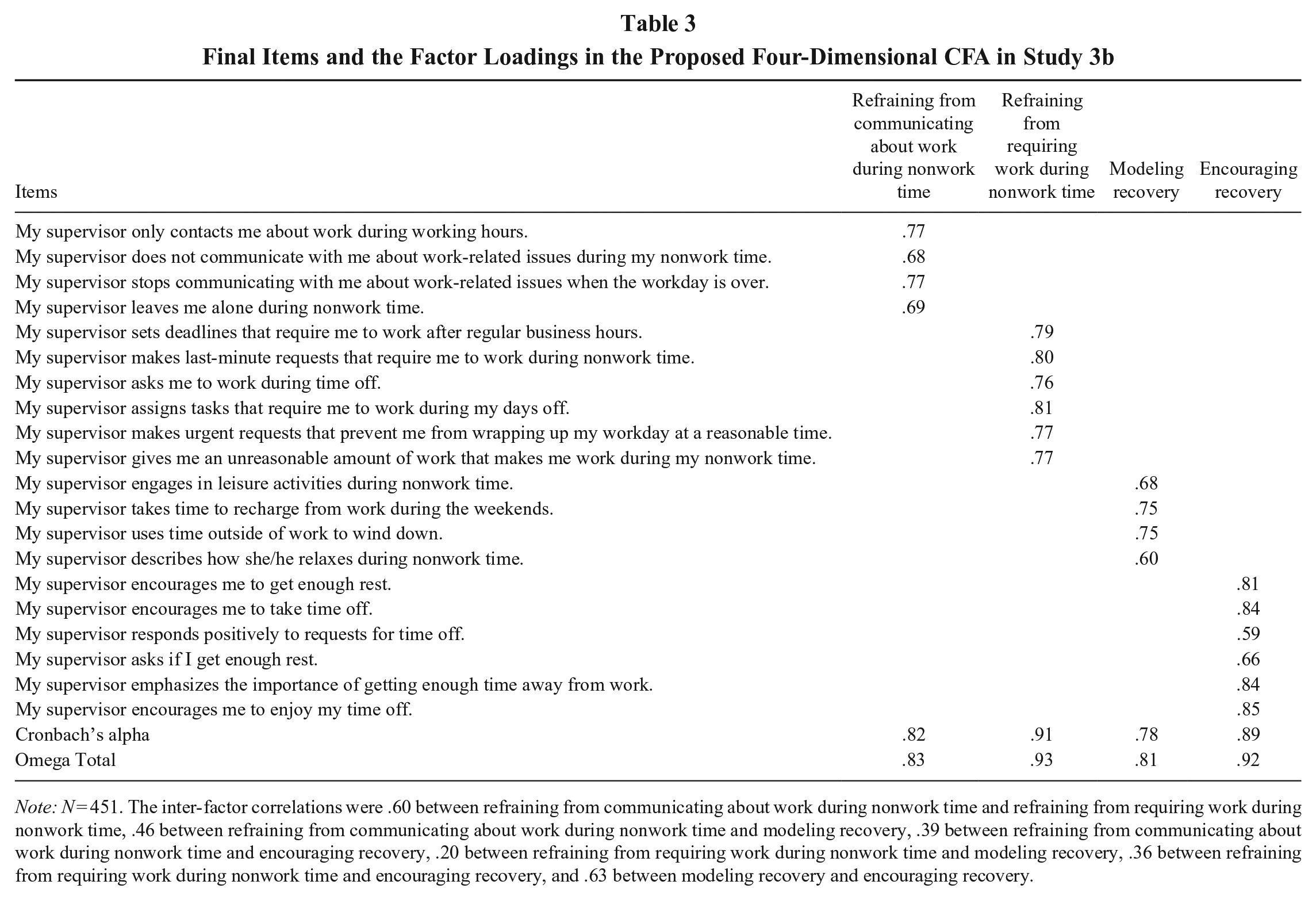
Note: N = 451. The inter-factor correlations were .60 between refraining from communicating about work during nonwork time and refraining from requiring work during nonwork time, .46 between refraining from communicating about work during nonwork time and modeling recovery, .39 between refraining from communicating about work during nonwork time and encouraging recovery, .20 between refraining from requiring work during nonwork time and modeling recovery, .36 between refraining from requiring work during nonwork time and encouraging recovery, and .63 between modeling recovery and encouraging recovery.
Model Comparisons for the CFA Models in Study 3b
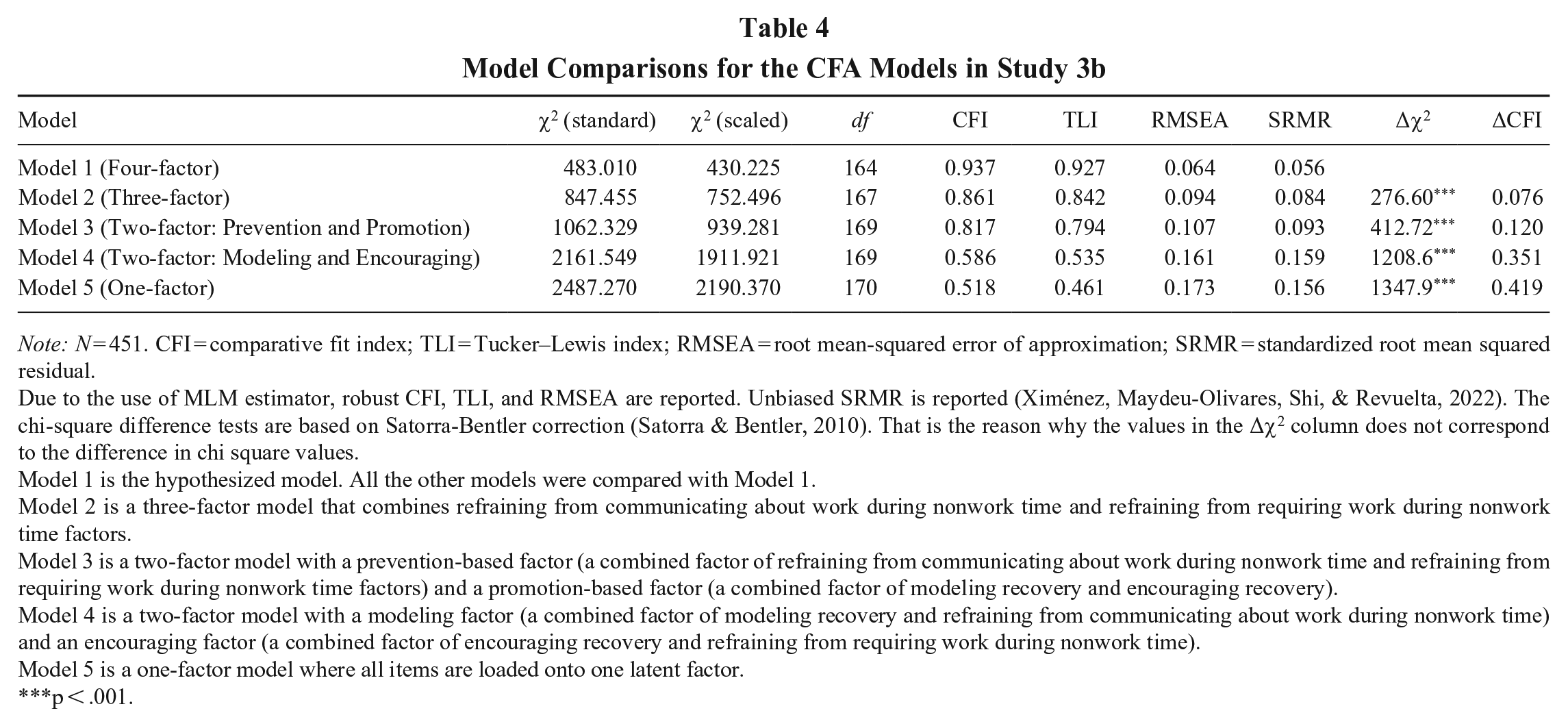
Note: N = 451. CFI = comparative fit index; TLI = Tucker–Lewis index; RMSEA = root mean-squared error of approximation; SRMR = standardized root mean squared residual.
Due to the use of MLM estimator, robust CFI, TLI, and RMSEA are reported. Unbiased SRMR is reported (Ximénez, Maydeu-Olivares, Shi, & Revuelta, 2022). The chi-square difference tests are based on Satorra-Bentler correction (Satorra & Bentler, 2010). That is the reason why the values in the ∆χ2 column does not correspond to the difference in chi square values.
Model 1 is the hypothesized model. All the other models were compared with Model 1.
Model 2 is a three-factor model that combines refraining from communicating about work during nonwork time and refraining from requiring work during nonwork time factors.
Model 3 is a two-factor model with a prevention-based factor (a combined factor of refraining from communicating about work during nonwork time and refraining from requiring work during nonwork time factors) and a promotion-based factor (a combined factor of modeling recovery and encouraging recovery).
Model 4 is a two-factor model with a modeling factor (a combined factor of modeling recovery and refraining from communicating about work during nonwork time) and an encouraging factor (a combined factor of encouraging recovery and refraining from requiring work during nonwork time).
Model 5 is a one-factor model where all items are loaded onto one latent factor.
p < .001.
Reliability
We reported both Cronbach’s alpha and Omega Total coefficients using the “psych” package (version 2.1.9; Revelle, 2020) in R 3.6.1 to quantify the reliability of the new scale. The Omega coefficient is an alternative to Cronbach’s alpha for measuring internal consistency reliability, requiring fewer assumptions than Cronbach’s alpha (e.g., Revelle & Zinbarg, 2009). Therefore, we reported Omega Total (.81- .93), in addition to Cronbach’s alpha (.78- .91). See Table 3 for the reliability estimates for each dimension. Overall, our scale can reliably measure the four aspects of SSR.
Discussion
In summary, findings from both studies provided robust support for the basic psychometric properties of the SSR scale. Specifically, item analysis indicated that all items performed well. EFA supported the hypothesized factor structure, while CFA further confirmed this four-factor model with acceptable fit indices. Additionally, the reliability estimates across the dimensions indicated acceptable to excellent internal consistency reliability of the scale (Nunnally & Bernstein, 1994).
Phase 3: Validity Evidence for the SSR Scale
In this phase, we focus on the discriminant, criterion-related, and incremental validity of the SSR scale. Additionally, we explore the differential effects of the four dimensions on recovery experiences in the online supplement (Appendix 3).
Distinctions between Supervisor Support for Recovery and Similar Constructs
To clarify how SSR is conceptually distinct from other potentially similar supervisor-related constructs, we compare SSR with several putatively similar constructs, ranging from general supervisor support and leadership constructs (perceived supervisor support and leader-member exchange [LMX]) to domain-specific constructs (health-oriented leadership behavior [HoL] and family supportive supervisor behaviors [FSSB]).
We deem perceived supervisor support and LMX to be two similar constructs because generally supportive supervisors or supervisors who have a good relationship with their subordinates may be more likely to be recovery-supportive, as doing so would be consistent with caring about specific aspects of employees’ well-being or maintaining good relationships with subordinates. Perceived supervisor support refers to the degree to which supervisors value employees’ contributions and care about their well-being (Eisenberger, Stinglhamber, Vandenberghe, Sucharski, & Rhoades, 2002). LMX is defined by mutual support, attention, and loyalty (Schriesheim, Castro, & Cogliser, 1999). Perceived supervisor support and LMX are conceptually distinct from SSR. A supervisor who provides general support or engages in interactions that contribute to the quality of the supervisor-subordinate relationship (Dansereau, Graen, & Haga, 1975) may not necessarily engage in behaviors that facilitate employee recovery. For example, sending e-mails late at night is not supportive of employee recovery; however, this behavior may provide instrumental support on work tasks resulting from a high level of perceived supervisor support (Kottke & Sharafinski, 1988) or show a greater reliance on the in-group individuals on important work tasks resulting from a high level of LMX (Graen & Scandura, 1987). Given the above reasons, we believe that SSR is distinct from perceived supervisor support and LMX.
We choose HoL and FSSB as similar constructs of SSR because they capture supervisors’ supportive behaviors in health-promoting or nonwork domains. HoL behavior refers to leaders’ health-promoting behaviors, such as effective health-related communication and the design of health-promoting working conditions (Franke, Felfe, & Pundt, 2014; Rudolph, Murphy, & Zacher, 2020). FSSB refers to “behaviors exhibited by supervisors that are supportive of families” (Hammer et al., 2009: 837). HoL and FSSB have different emphases compared to SSR. For example, HoL behavior covers leadership behaviors, such as providing healthy working conditions and information about health and safety issues; FSSB focuses on support for family responsibilities that involve obligatory role demands. While employees generally do not endorse the idea of regularly sacrificing their health or family responsibilities to accomplish work goals (Super, Savickas, & Super, 1996), employees often do sacrifice recovery experiences—which are more voluntary (Mannell & Kleiber, 1997; Kuykendall et al., 2017)—to prioritize work responsibilities (e.g., Barnes, Wagner, & Ghumman, 2012). Thus, supervisors may have different attitudes toward health or family responsibilities versus recovery and may be less inclined to support balancing work and recovery even when they support health and family priorities.
To summarize the distinctions between SSR and similar constructs, we hypothesize:
Hypothesis 1: SSR is distinct from perceived supervisor support, LMX, health-oriented leadership behavior, and FSSB.
Effects of Supervisor Support for Recovery on Recovery Experiences
This study focuses on recovery as a process (i.e., “the activities and experiences that bring about change in strain indicators”; Sonnentag et al., 2017: 366) rather than an outcome (i.e., “a person’s psychological or physiological state that is reached after a recovery period”; Sonnentag et al., 2017: 366) in order to emphasize the recovery constructs that are likely most proximally impacted by SSR. Between the two operationalizations of recovery as a process—namely, recovery experiences and recovery activities—researchers have suggested that focusing on the underlying experiences employees have during nonwork activities (e.g., detachment, relaxation) will more strongly predict well-being than focusing on the activities that facilitate those experiences (Sonnentag & Fritz, 2007) because individuals do not experience specific activities in exactly the same way (Sonnentag et al., 2017). This rationale is supported by recent meta-analytic findings that recovery experiences have stronger effects than recovery activities on well-being outcomes (Steed et al., 2021). Therefore, we chose to focus on recovery experiences over recovery activities.
Sonnentag and Fritz (2007) proposed four recovery experiences—psychological detachment, relaxation, control, and mastery experiences, which capture different discernable elements of the recovery process. Specifically, psychological detachment is defined as the subjective experience of mentally switching off and being away from work during nonwork time. Relaxation describes the experience of low activation of body and mind. Control is characterized as the degree to which an individual can decide on what off-job activities to engage in and when and how to pursue them. Mastery experience refers to challenging situations and learning opportunities in nonwork domains that distract someone from the job (Sonnentag & Fritz, 2007).
We propose that the four SSR dimensions impact all four recovery experiences. We draw on ERM to elaborate on how the two prevention-based behaviors, refraining from communicating about work or requiring work during nonwork time, facilitate the four recovery experiences. ERM suggests that an important condition for achieving recovery is to stop effort expenditure from job demands (Geurts & Sonnentag, 2006). However, communicating about work and requiring work during nonwork time compel employees to continue to be involved in demanding work situations after work hours, which deplete an individual’s overall energy and cause prolonged activation (Kinnunen & Feldt, 2013). Reduced energy and prolonged physiological activation may further impact recovery experiences (Geurts & Sonnentag, 2006). Specifically, effective recovery during nonwork time requires employees to regulate their behaviors (Zijlstra, Cropley, & Rydstedt, 2014). For example, to achieve psychological detachment and relaxation, individuals must down-regulate their activation and engage in self-regulatory behaviors to ignore work-related thoughts and communications. To achieve mastery experience, employees need to engage in challenging behaviors (e.g., learning a new skill), which requires an investment of energy. Furthermore, when supervisors impose job demands during nonwork time (i.e., through communicating about work or requiring work during nonwork time), employees are less able to decide on what off-job activities to engage in because they have to prioritize work activities during nonwork time. Control over nonwork time is crucial for recovery, given that control is constrained in many workplaces (Parker, 2014). Thus, when supervisors refrain from behaviors such as communicating about work or requiring employees to work during nonwork time, they enhance employees’ recovery experiences by not impeding their self-regulation process to achieve recovery experiences.
Moreover, frequent contact by one’s supervisor outside of regular business hours interrupts one’s recovery processes during nonwork time, even when a supervisor does not request an immediate response to a work e-mail or message sent late at night or over the weekend. Research has shown that employees feel a sense of urgency to check and answer their e-mails received during nonwork time (Barber & Santuzzi, 2015; Giurge & Bohns, 2021), leading to a lower level of psychological detachment and a higher level of physiological activation. Indeed, Barber and Santuzzi found that workplace telepressure was negatively related to psychological detachment.
Additionally, when supervisors require employees to work during nonwork time, they impede employee recovery processes by directly imposing demands competing for employees’ time for recovery activities. Time is a finite, valuable personal resource. When time is dedicated to the work domain, it cannot be dedicated to other nonwork domains. The work-family literature has shown that domain-specific time demands are positively related to work-family conflict (Byron, 2005). Thus, when supervisors impose job demands during nonwork time, employees have to invest more time in the work domain during nonwork time to cope with the high job demands (e.g., requiring work during nonwork time), leaving them less time for recovery from work stress.
In contrast, promotion-based behaviors, including modeling and encouraging recovery, provide restorative opportunities for employees to counteract job-related strain during nonwork time (Sonnentag et al., 2017). We draw on SCT (Bandura, 1977) and ERM (Meijman & Mulder, 1998) to explain the effects of modeling and encouraging recovery on recovery experiences. According to SCT, a vast amount of knowledge, norms, and practices of social systems can be gained through observational learning (Bandura, 2005). In the work context, supervisors act as significant others who can model and encourage getting enough time away from work to rest and recuperate from work stress (Bandura, 1986; Sonnentag & Schiffner, 2019).
When employees observe that their supervisors successfully engage in recovery activities and experience recovery, they are more likely to imitate their supervisors’ behaviors and take advantage of recovery opportunities during nonwork time, resulting in better recovery experiences (de Bloom, Rantanen, Tement, & Kinnunen, 2018). This vicarious learning can also enhance employees’ confidence in their ability to recover (Stajkovic & Luthans, 2003). Additionally, SCT suggests that encouragement from important others increases the likelihood of successfully engaging in a behavior (Bandura, 1997; Stajkovic & Luthans, 2003; Wood & Bandura, 1989). Extending these findings to the context of recovery, when supervisors encourage employees to take time off and engage in behaviors that facilitate their recovery experiences, employees are more likely to feel comfortable stopping work and prioritizing recovery needs during nonwork time. In other words, such encouragement may function as a form of social persuasion that increases employees’ likelihood of engaging in recovery activities and experiences. Through these modeling and encouraging processes, employees learn to incorporate these recovery behaviors into their nonwork time, which, as suggested by ERM, helps reduce the energy depletion and mitigates strain reactions associated with work stress. Consequently, this social learning process not only facilitates employees’ adoption of recovery practices but also enhances their recovery experiences.
Specifically, when supervisors model and encourage recovery, employees can observe and learn the strategies supervisors use to prioritize recovery over work activities during nonwork time, such as how their supervisors create a boundary between work and nonwork domains (Koch & Binnewies, 2015). These promotion-based behaviors also normalize the decision to detach from work to rest and recuperate from work stress during nonwork time. Thus, this social learning process from their supervisor’s modeling and encouraging recovery behaviors makes employees more likely to leave work at work (Bandura, 1977), which further facilitates their psychological detachment during nonwork time (Sonnentag & Fritz, 2007). Indeed, a recent study has found that leader psychological detachment is positively related to employee psychological detachment (Sonnentag & Schiffner, 2019). When supervisors take time to wind down, describe how they relax during nonwork time, or encourage their employees to get enough rest, employees tend to observe and mimic their supervisors’ behaviors and perceive these behaviors as a cue that their supervisors approve of employees prioritizing recovery during nonwork time (Sims & Manz, 1982). Thus, these observations and perceptions resulting from modeling and encouraging recovery provide an opportunity for employees to enjoy their time off and down-regulate their physiological activation from work stress, which is important for achieving the relaxation experience (Sonnentag & Fritz, 2007).
Furthermore, modeling and encouraging recovery behaviors demonstrate that supervisors value engaging in recovery practices, thereby reducing any perceived stigma associated with prioritizing recovery over work during nonwork time or a deviation from the ideal worker norm (Acker, 1990; Coron & Garbe, 2023). The ideal worker norm suggests that employees should prioritize work above all other aspects of life, and those who do not conform to this standard—such as those who prioritize recovery—may face negative perceptions and career outcomes (Coron & Garbe, 2023; Kossek, Perrigino, & Rock, 2021). By modeling and encouraging recovery, supervisors help reduce the stigma associated with prioritizing recovery and create an environment that empowers employees to make autonomous decisions about their nonwork time, as opposed to conforming to the norm of prioritizing work all the time. Thus, the two promotion-based behaviors are positively associated with control experience. Last, modeling and encouraging recovery provides an opportunity for employees to prioritize recovery over work activities during nonwork time, which further replenishes energy and gives employees free time after work. The energy and time resulting from the two promotion-based behaviors create the conditions for employees to pursue challenging and fulfilling recovery activities outside of work, which contribute to mastery experience (Sonnentag & Fritz, 2007). Therefore, employees likely feel more able to engage in recovery experiences when they are encouraged to prioritize those experiences by supervisors who themselves serve as role models of prioritizing recovery.
Hypothesis 2: SSR is positively related to employees’ recovery experiences (e.g., psychological detachment, relaxation, control, and mastery experiences).
Incremental Validity of Supervisor Support for Recovery
In addition to ensuring that SSR is not redundant with similar constructs and is related to recovery experiences, we further propose that SSR explains unique variance in recovery experiences above and beyond similar constructs. As illustrated in the section distinguishing SSR from putatively similar constructs, none of the similar constructs specifically focus on recovery-specific supportive behaviors from supervisors. Thus, we predict that SSR can predict recovery experiences above and beyond these similar constructs.
Hypothesis 3: SSR predicts employees’ recovery experiences (i.e., psychological detachment, relaxation, control, and mastery experiences) above and beyond perceived supervisor support, LMX, health-oriented leadership behavior, and FSSB.
Studies 4–6: Validity Evidence
The primary goals of Studies 4–6 were to examine (1) whether SSR is distinct from similar constructs (Hypothesis 1: discriminant validity), (2) the effect of SSR on employee recovery experiences (Hypothesis 2: criterion-related validity), and (3) its effect on recovery experiences above and beyond similar constructs (Hypothesis 3: incremental validity). We also investigated whether the four SSR dimensions have differential effects on different recovery experience as Research Question 1. Due to space limitations, we provide details on the development of this research question in the online supplement (Appendix 3).
Samples and Procedures
Study 4
We recruited full-time employees from Prolific. Eight participants missed one of three attention checks and were excluded from the study. The final sample consisted of 183 full-time employees. Sample information is presented in Table 1. Participants were asked to answer a cross-sectional survey involving SSR, similar leadership constructs, workload, and recovery experiences.
Study 5
We recruited supervisor-subordinate dyads from Idiaoyan (idiaoyan.com), one of the largest Chinese data collection services (for recent examples of data collection using Idiaoyan, see Gao & Zhao, 2018; Huang & Wang, 2021). The panel service company sent the study advertisement to their registered members in a supervisor position. In the advertisement, supervisors were told that they needed to invite a direct subordinate to complete an employee survey to be eligible for this study. To ensure that the employee and supervisor rated each other, the employee had to complete the employee survey first. If the first employee declined to answer the employee survey, the supervisor could refer another employee to complete the employee survey. After the completion of the employee survey, the supervisor received the supervisor survey with instructions to rate the items regarding their interaction with the employee they invited.
The panel service company sent out 2,010 employee surveys. 1,369 employees started the employee survey, and 762 participants completed the employee survey (548 did not pass all the screening questions, 35 participants failed one of the six attention-check questions, 1 14 participants dropped out, and 10 participants were removed because of straightlining responses). Among 762 supervisors who were eligible for the supervisor survey, 740 of them started the survey. 382 supervisors completed the supervisor survey (271 did not pass all the screening questions, 27 participants failed one of the three attention-check questions, 53 participants dropped out, and 7 participants were removed because of straightlining responses). The panel company further removed 32 responses because of response time (e.g., outside of work hours [8:00 am to 6:00 pm] or duration over 2 hours). The final sample consisted of 350 paired supervisor-subordinate dyads working in China. Sample information is presented in Table 1.
Supervisors were asked to report SSR, other similar leadership constructs (e.g., supervisor support, LMX, FSSB), and workload, while subordinates were asked to report recovery experiences.
Study 6
We recruited a PhD student sample versus a full-time employee sample to generalize the results to a new population. PhD students are a relevant population for examining the effects of SSR because (1) PhD students generally work closely with their faculty advisors on research projects and thus are likely highly impacted by their supportive or unsupportive behaviors, and (2) PhD students often work long hours and thus are particularly vulnerable to insufficient recovery. We sent an invitation E-mail to 19,281 publicly available E-mail addresses scraped from university websites. 1,518 participants completed the screening survey, resulting in a response rate of 7.85%. 648 participants were qualified and completed the Time 1 survey, and 462 participants completed the Time 2 survey (retention rate = 71.30 %), respectively. Each survey included three attention-check questions. 570 out of 648 participants at Time 1 did not fail any attention-check questions in both surveys and were included in the final analysis. There was no significant difference in work hours per week, SSR, and its dimensions between those who completed the surveys and those who did not. Sample information is presented in Table 1.
The Time 1 survey assessed workload, SSR, and similar leadership or supervisor support constructs (e.g., perceived supervisor support, LMX, FSSB), and the Time 2 survey assessed recovery experiences. The time interval was two weeks.
Measures
SSR
Employees were asked to rate their supervisor’s recovery-supportive behaviors (Study 4 and Study 6), and supervisors were asked to rate their recovery-supportive behaviors (Study 5) using the 20 SSR items from Study 3 on a five-point frequency scale, ranging from 1(Never) to 5(Very frequently).
Additionally, we included the initial 6-item SSR scale by Bennet et al. (2016) in Studies 4 and 5 to test the convergent validity of our multidimensional measure of SSR. Participants were asked to rate on a five-point scale ranging from 1(Strongly disagree) to 5(Strongly agree). A sample item is “My supervisor believes that the ideal employee is someone who is available 24 hours a day.”
Perceived supervisor support
We measured perceived supervisor support with 16 items from the Survey of Perceived Supervisory Support (Kottke & Sharafinski, 1988) on a five-point scale ranging from 1(Strongly disagree) to 5(Strongly agree). A sample item is “Help is available from my supervisor when I have a problem.”
LMX
LMX was measured with the seven-item leader-member exchange measure (Graen & Uhl-Bien, 1995) on a five-point scale. A sample item is “How would you characterize your working relationship with your supervisor?”
Health-oriented leadership behavior
Health-oriented leadership behavior was measured with the behavior dimension of the follower-rated StaffCare scale (Franke et al., 2014). This measure has 18 items. Participants in Study 4 were asked to rate on a five-point scale ranging from 1(Not at all true) to 5(Completely true). An example item is “My supervisor regularly keeps us informed about safety rules and worksite health promotion activities.”
Family supportive supervisor behaviors
FSSB was measured with the 14-item multidimensional FSSB scale (Hammer et al., 2009) in Studies 4 and 5, and the four-item FSSB- short-form scale (Hammer, Kossek, Bodner, & Crain, 2013) in Study 6. Participants were asked to rate on a five-point scale ranging from 1(Strongly disagree) to 5(Strongly agree). A sample item is “My supervisor is willing to listen to my problems in juggling work and nonwork life.”
Recovery experiences
Recovery experiences were measured with the Recovery Experience Questionnaire (Sonnentag & Fritz, 2007) with four items per recovery experience. Participants were asked to evaluate the degree to which each statement describes their experience during nonwork time using a five-point scale ranging from 1(Strongly disagree) to 5(Strongly agree). Sample items are “I forget about work” (psychological detachment), “I kick back and relax” (relaxation), “I feel like I can decide for myself what to do” (control), and “I do things that challenge me” (mastery).
Workload
Workload, as a control variable, was measured with the five-item Quantitative Workload Inventory (Spector & Jex, 1998) on a five-point scale, ranging from 1(Less than once per month or never) to 5(Several times per day). A sample item is “How often does your job require you to work very fast?”
All items in Study 5 were translated into Chinese following Brislin’s (1980) translation-back translation procedure. The first author translated the SSR items from English to Chinese, and the fourth author translated the Chinese items back to English. Both the first and fourth authors compared and revised the items. For the rest of the scales, a Chinese professor who specializes in psychological assessment and their undergraduate student translated and back-translated the Chinese items. Discrepancies between the back-translated and original versions were reviewed and resolved to ensure accuracy. All translators were proficient in Chinese and English.
Results
Means, standard deviations, bivariate correlations, and internal consistency reliability estimates are shown in Tables 5 to 7. The four-factor model for SSR yielded a good fit with the data for all three studies. Study 4: χ2(164) = 371.22, CFI = .93, TLI = .92, RMSEA = .08, SRMR = .07. Study 5: χ2(164) = 377.51, CFI = .92, TLI = .90, RMSEA = .06, SRMR = .05. Study 6: χ2(164) = 622.21, CFI = .93, TLI = .92, RMSEA = .07, SRMR = .06.
Means, Standard Deviations, Bivariate Correlations, and Internal Consistency Reliability Estimates in Study 4 (Cross-sectional Design)
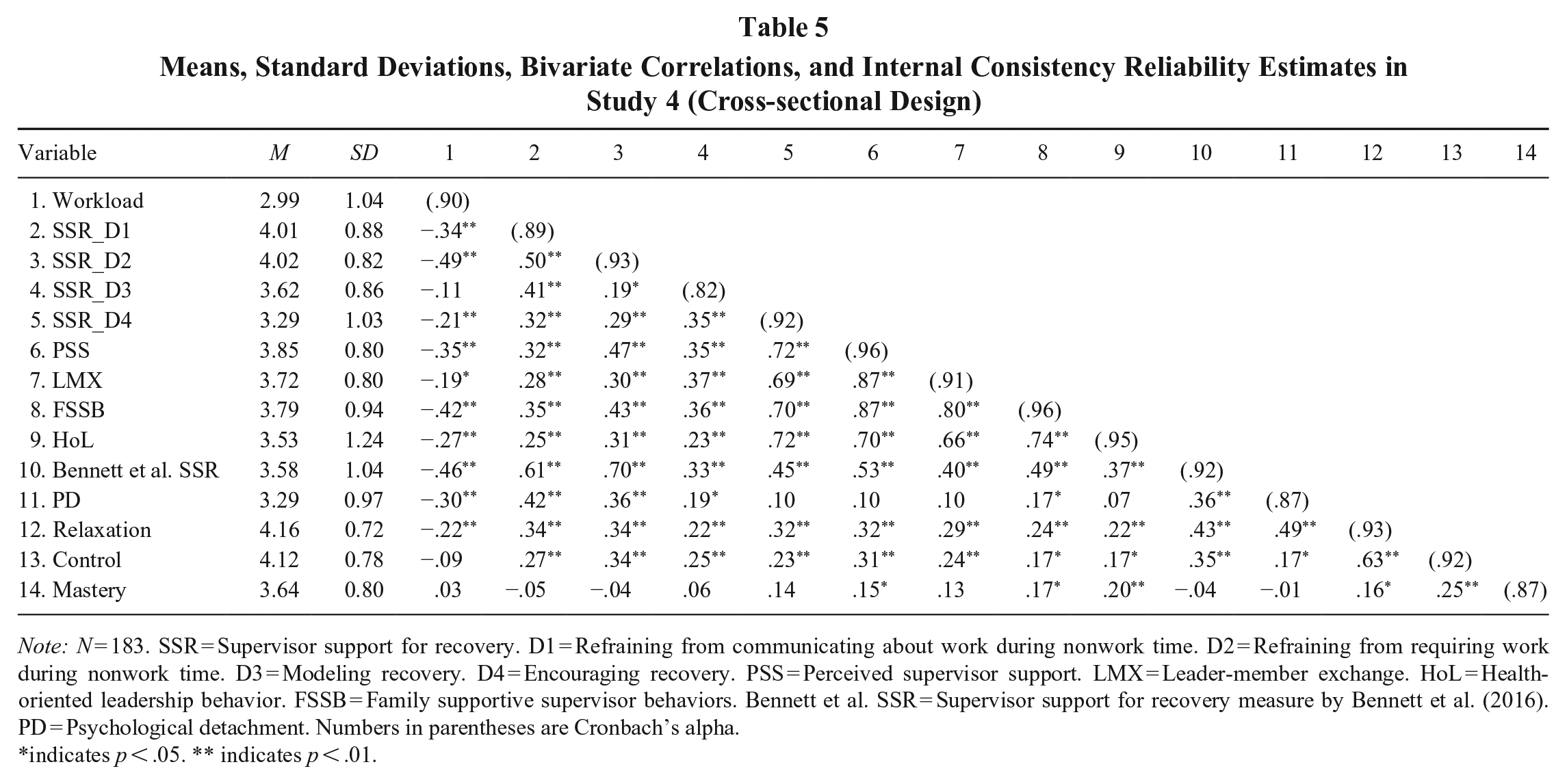
Note: N = 183. SSR = Supervisor support for recovery. D1 = Refraining from communicating about work during nonwork time. D2 = Refraining from requiring work during nonwork time. D3 = Modeling recovery. D4 = Encouraging recovery. PSS = Perceived supervisor support. LMX = Leader-member exchange. HoL = Health-oriented leadership behavior. FSSB = Family supportive supervisor behaviors. Bennett et al. SSR = Supervisor support for recovery measure by Bennett et al. (2016). PD = Psychological detachment. Numbers in parentheses are Cronbach’s alpha.
indicates p < .05. ** indicates p < .01.
Means, Standard Deviations, Bivariate Correlations, and Internal Consistency Reliability Estimates in Study 5 (Dyadic Design)
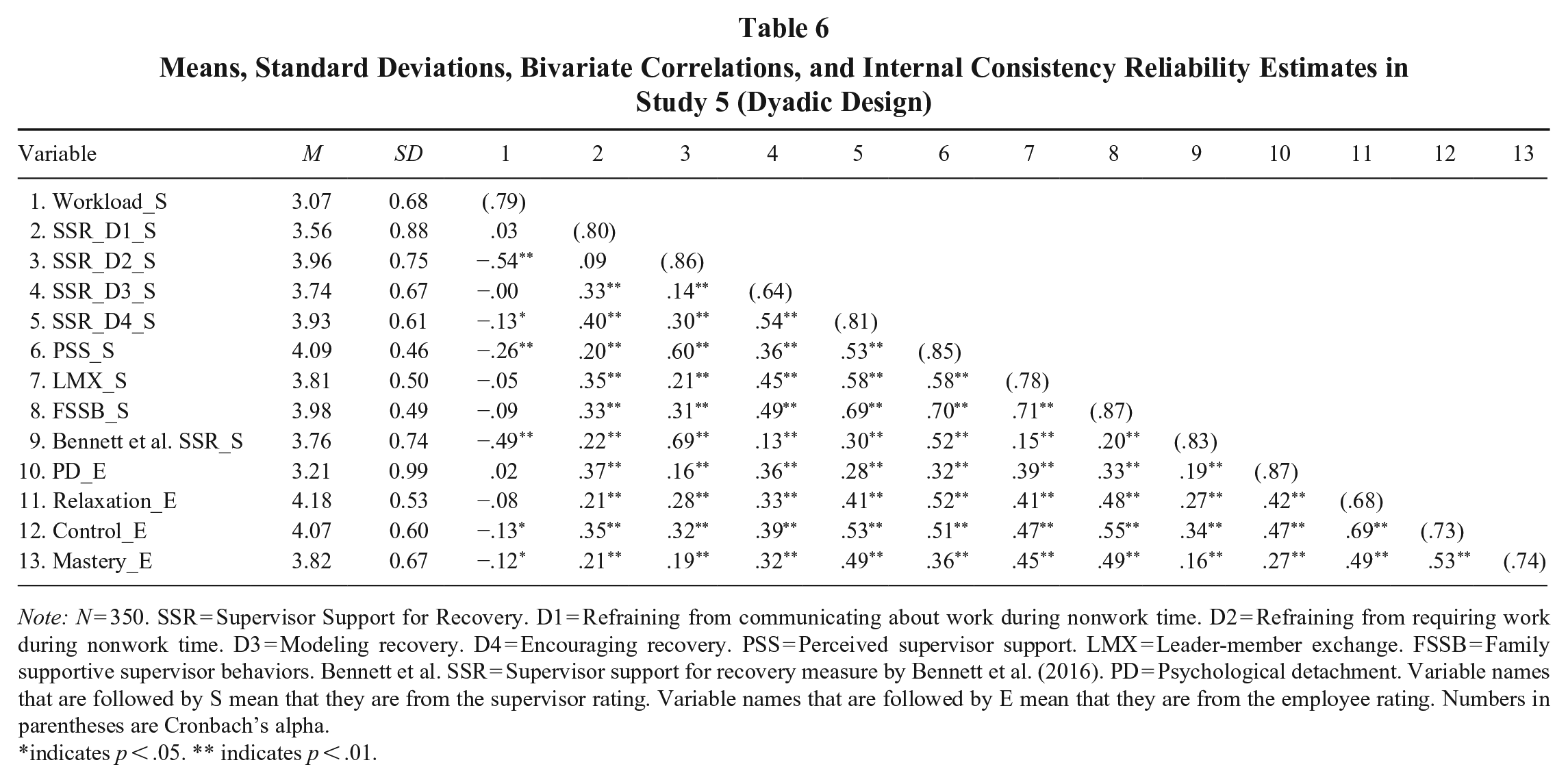
Note: N = 350. SSR = Supervisor Support for Recovery. D1 = Refraining from communicating about work during nonwork time. D2 = Refraining from requiring work during nonwork time. D3 = Modeling recovery. D4 = Encouraging recovery. PSS = Perceived supervisor support. LMX = Leader-member exchange. FSSB = Family supportive supervisor behaviors. Bennett et al. SSR = Supervisor support for recovery measure by Bennett et al. (2016). PD = Psychological detachment. Variable names that are followed by S mean that they are from the supervisor rating. Variable names that are followed by E mean that they are from the employee rating. Numbers in parentheses are Cronbach’s alpha.
indicates p < .05. ** indicates p < .01.
Means, Standard Deviations, Bivariate Correlations, and Internal Consistency Reliability Estimates in Study 6 (Time-separated Design)
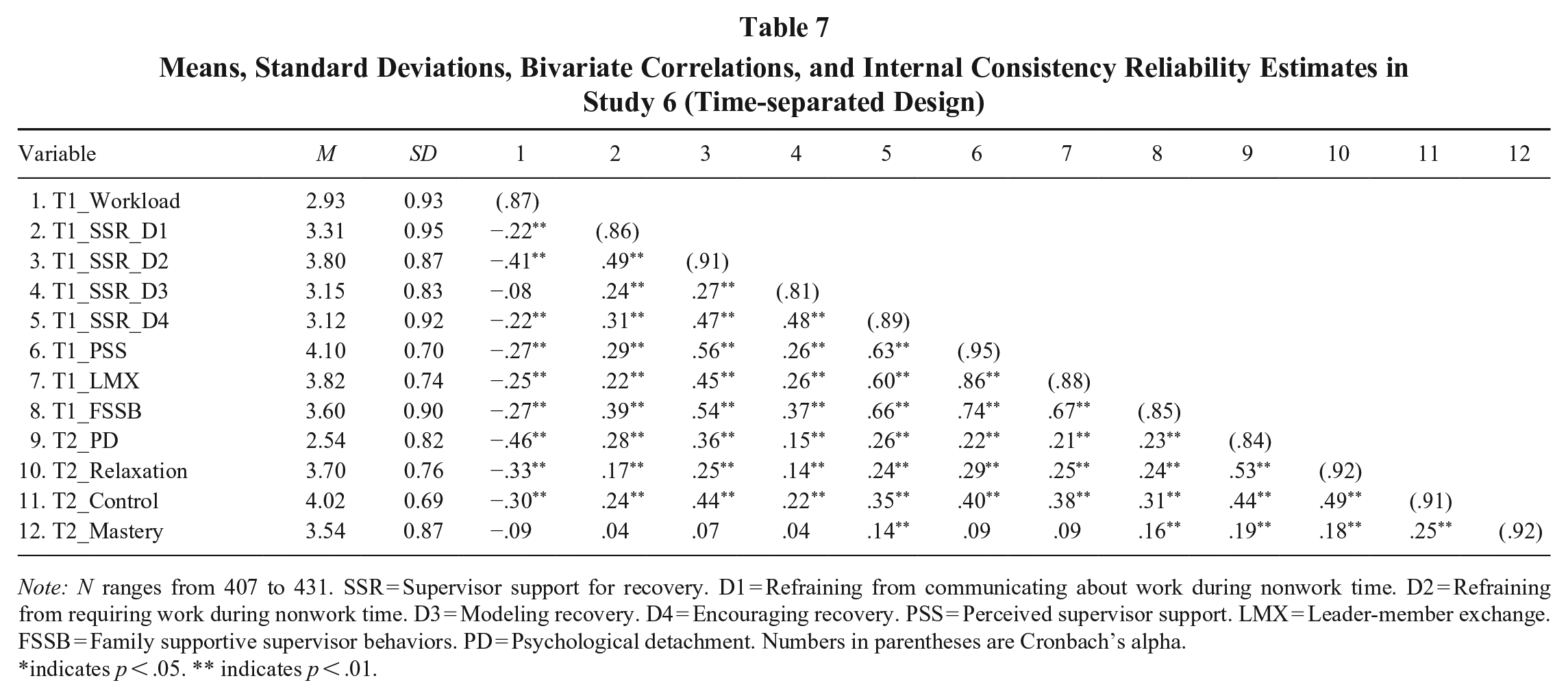
Note: N ranges from 407 to 431. SSR = Supervisor support for recovery. D1 = Refraining from communicating about work during nonwork time. D2 = Refraining from requiring work during nonwork time. D3 = Modeling recovery. D4 = Encouraging recovery. PSS = Perceived supervisor support. LMX = Leader-member exchange. FSSB = Family supportive supervisor behaviors. PD = Psychological detachment. Numbers in parentheses are Cronbach’s alpha.
indicates p < .05. ** indicates p < .01.
Discriminant validity
It was anticipated that SSR was related to yet distinct from the orbiting constructs described earlier. To test discriminant validity (Hypothesis 1), we conducted a series of CFAs to compare the hypothesized model in which two different constructs are represented as two factors with a model that merges two factors into one. If the chi-square difference between the hypothesized model and the constrained model where the two factors are merged into one is statistically significant, discriminant validity will be supported for the pair (in this case, SSR is distinct from one of the similar constructs) (Clark, Smith, & Haynes, 2020). First, we compared SSR and perceived supervisor support. The hypothesized model was a five-factor model representing the four dimensions of SSR and perceived supervisor support. We also ran four alternative models where each dimension of SSR was combined with perceived supervisor support. The chi-square difference test showed that all four alternative four-factor models were significantly worse than the proposed five-factor model across all three studies. Tables 8 to 10 show the model fit for each model. The same pattern was replicated in the comparisons between SSR and LMX, between SSR and health-oriented leadership behavior, and between SSR and FSSB. Therefore, Hypothesis 1 was supported in all studies. SSR is distinct from perceived supervisor support, LMX, health-oriented leadership behaviors, and FSSB. Table 5 depicts correlation coefficients between SSR and similar constructs.
Model Comparison Results for Discriminant Validity in Study 4 (Cross-Sectional Design)
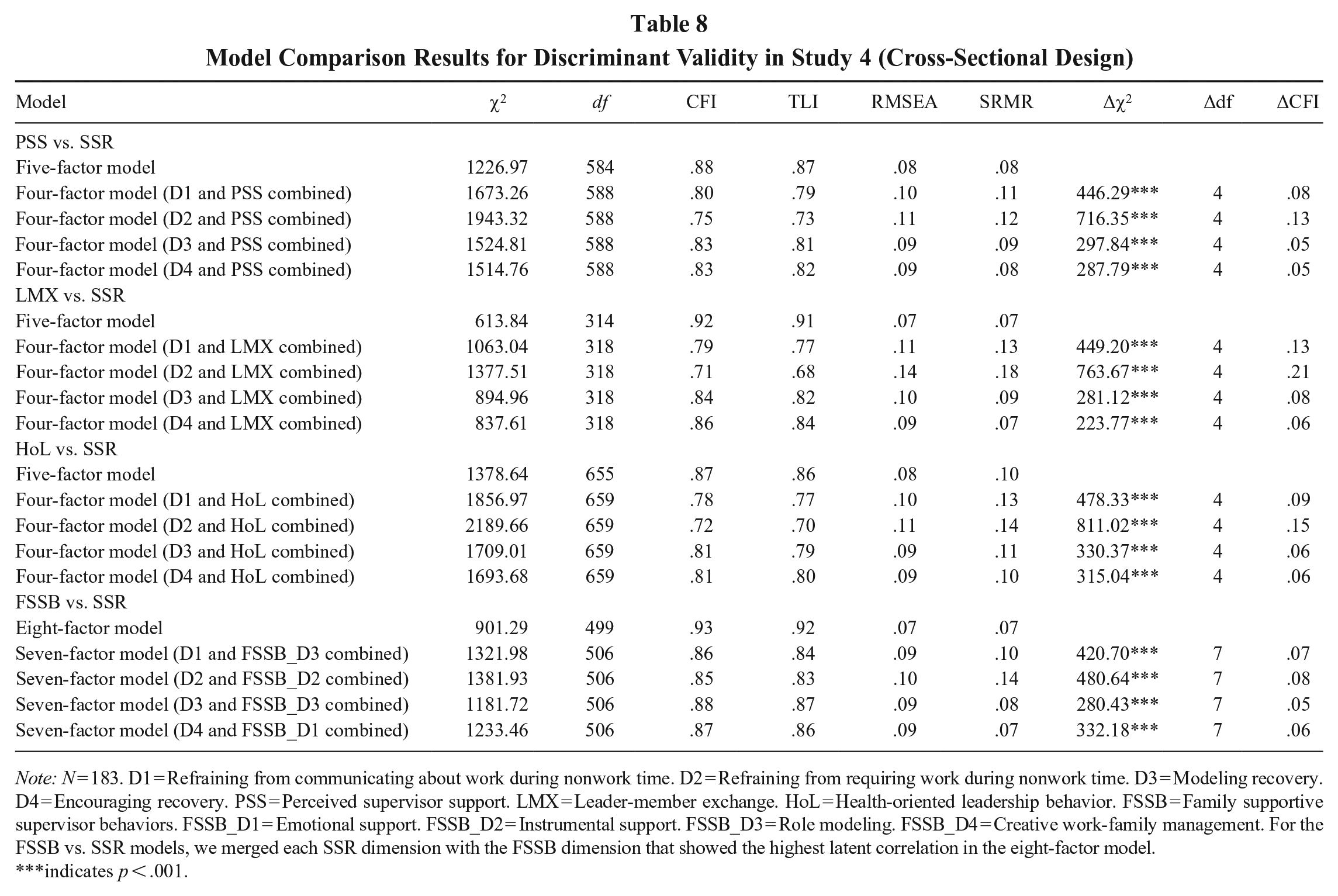
Note: N = 183. D1 = Refraining from communicating about work during nonwork time. D2 = Refraining from requiring work during nonwork time. D3 = Modeling recovery. D4 = Encouraging recovery. PSS = Perceived supervisor support. LMX = Leader-member exchange. HoL = Health-oriented leadership behavior. FSSB = Family supportive supervisor behaviors. FSSB_D1 = Emotional support. FSSB_D2 = Instrumental support. FSSB_D3 = Role modeling. FSSB_D4 = Creative work-family management. For the FSSB vs. SSR models, we merged each SSR dimension with the FSSB dimension that showed the highest latent correlation in the eight-factor model.
indicates p < .001.
Model Comparison Results for Discriminant Validity in Study 5 (Dyadic Design)
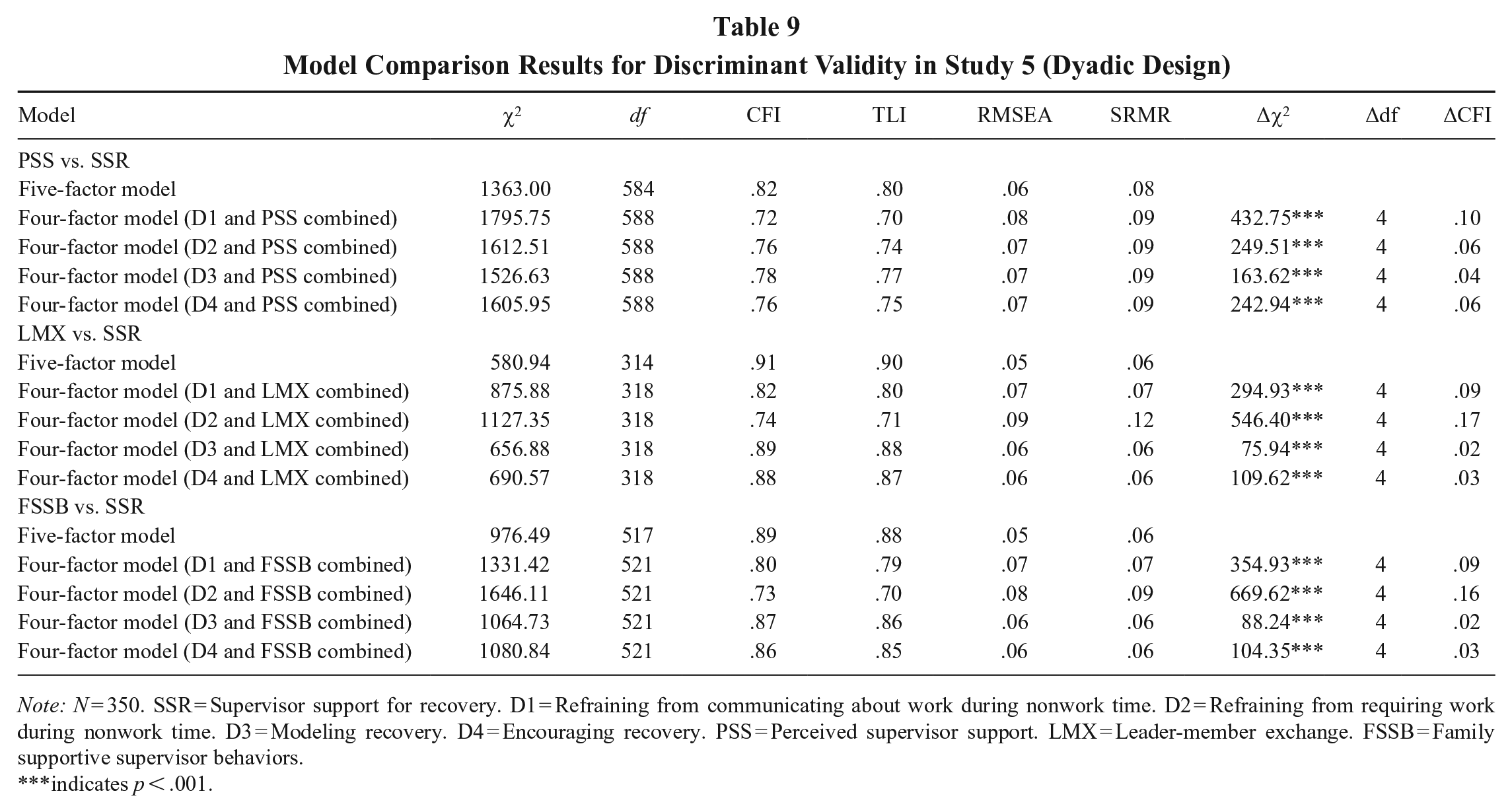
Note: N = 350. SSR = Supervisor support for recovery. D1 = Refraining from communicating about work during nonwork time. D2 = Refraining from requiring work during nonwork time. D3 = Modeling recovery. D4 = Encouraging recovery. PSS = Perceived supervisor support. LMX = Leader-member exchange. FSSB = Family supportive supervisor behaviors.
indicates p < .001.
Model Comparison Results for Discriminant Validity in Study 6 (Time-separated Design)
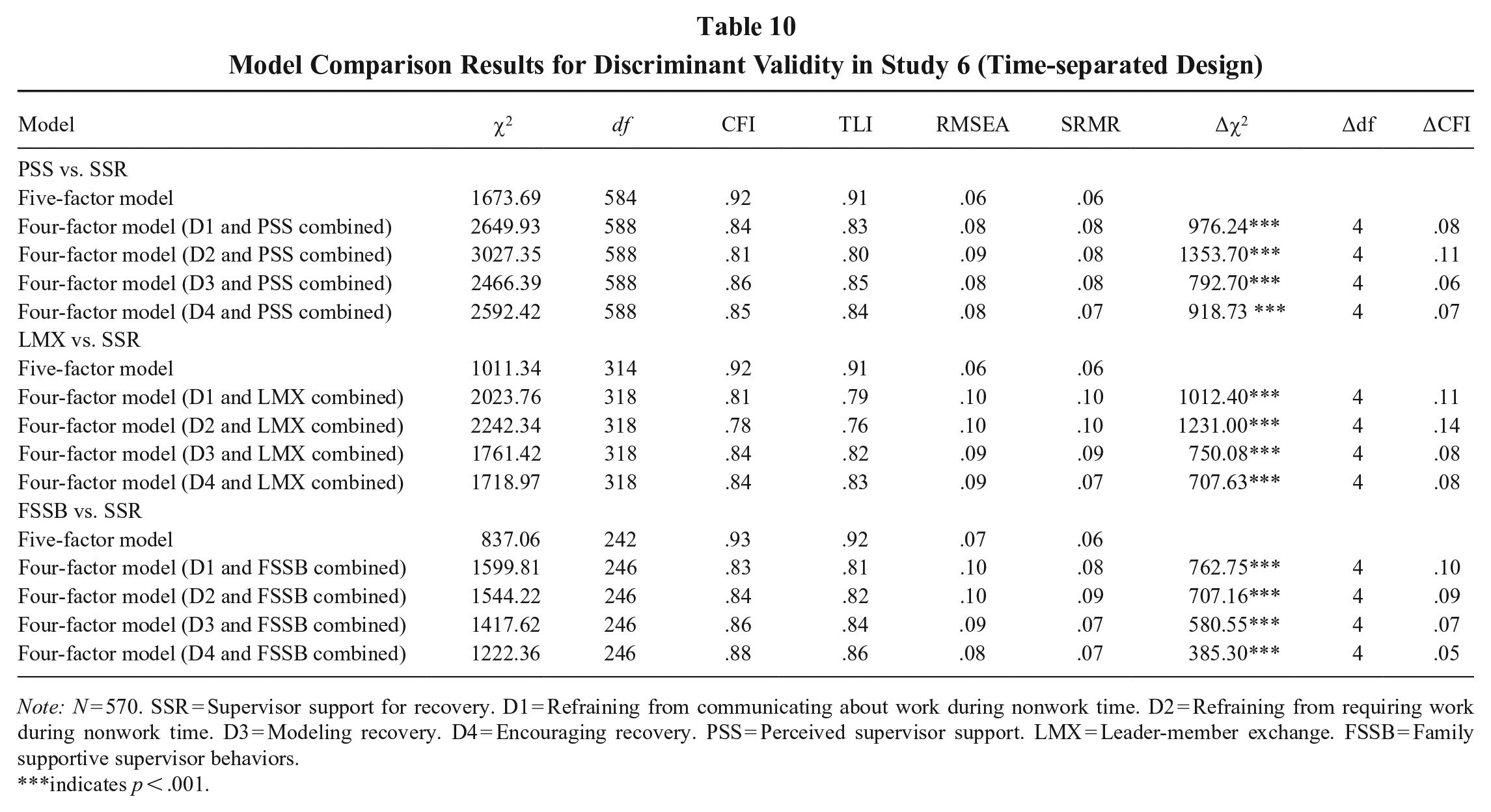
Note: N = 570. SSR = Supervisor support for recovery. D1 = Refraining from communicating about work during nonwork time. D2 = Refraining from requiring work during nonwork time. D3 = Modeling recovery. D4 = Encouraging recovery. PSS = Perceived supervisor support. LMX = Leader-member exchange. FSSB = Family supportive supervisor behaviors.
indicates p < .001.
Criterion-related validity
To test criterion-related validity (Hypothesis 2), we calculated the correlations between SSR and psychological detachment, relaxation, control, and mastery. See Tables 5 to 7 for the correlation coefficients. In Study 4, all four SSR dimensions were significantly related to psychological detachment, relaxation, and control, with the exception that encouraging recovery was not significantly associated with psychological detachment. However, none of the SSR dimensions showed a significant relationship with mastery experience. In Study 5, all four SSR dimensions were significantly related to all four recovery experiences. In Study 6, all four SSR dimensions were significantly related to psychological detachment, relaxation, and control. However, only encouraging recovery was significantly related to mastery experience.
To summarize the findings across the three studies, we performed an internal meta-analysis using a fixed effects approach (Borenstein, Hedges, Higgins, & Rothstein, 2010). Results showed that the four SSR dimensions were significantly related to all four recovery experiences, as demonstrated by the 95% confidence intervals around the sample-weighted average correlation not including zero. We reported mean r values alongside their corresponding 95% confidence intervals in Table 11. Thus, Hypothesis 2 was fully supported.
Meta-analytic Results between Supervisor Support for Recovery and Recovery Experiences
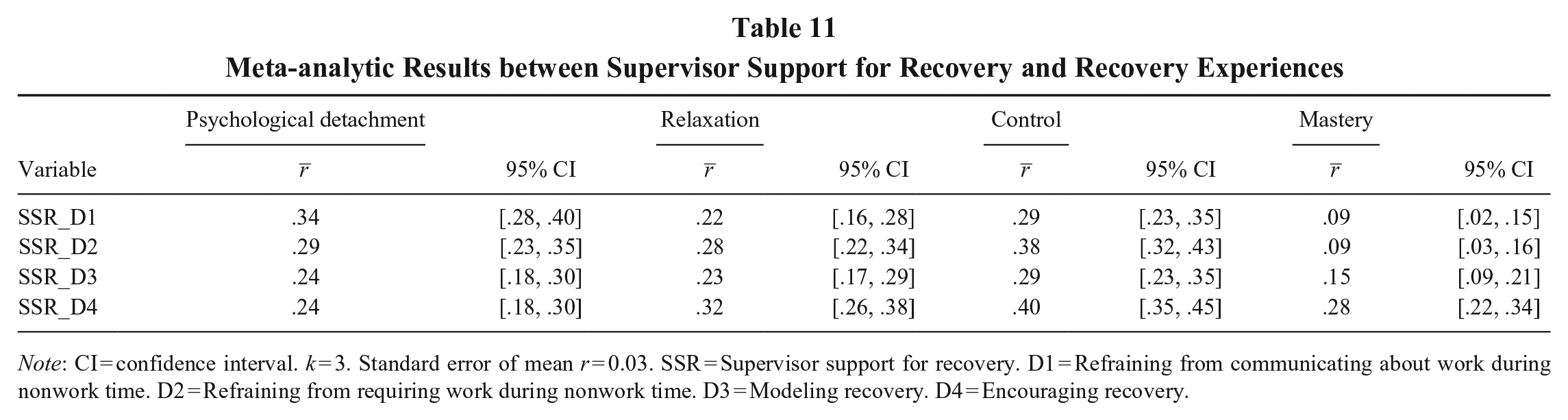
Note: CI = confidence interval. k = 3. Standard error of mean r = 0.03. SSR = Supervisor support for recovery. D1 = Refraining from communicating about work during nonwork time. D2 = Refraining from requiring work during nonwork time. D3 = Modeling recovery. D4 = Encouraging recovery.
Incremental validity
To test incremental validity (Hypothesis 3), we conducted hierarchical regression analyses in SPSS 29 where workload was controlled in Step 1, perceived supervisor support, LMX, FSSB, and health-oriented leadership behavior (only for Study 4) were entered in Step 2, and each dimension of SSR was entered at a time in Step 3 to predict employee recovery experiences. When one or more SSR dimensions explained additional variance in a recovery experience above and beyond similar constructs, we concluded that incremental validity was supported for that recovery experience. Regression results are shown in Table 12.
Incremental Validity in All Studies
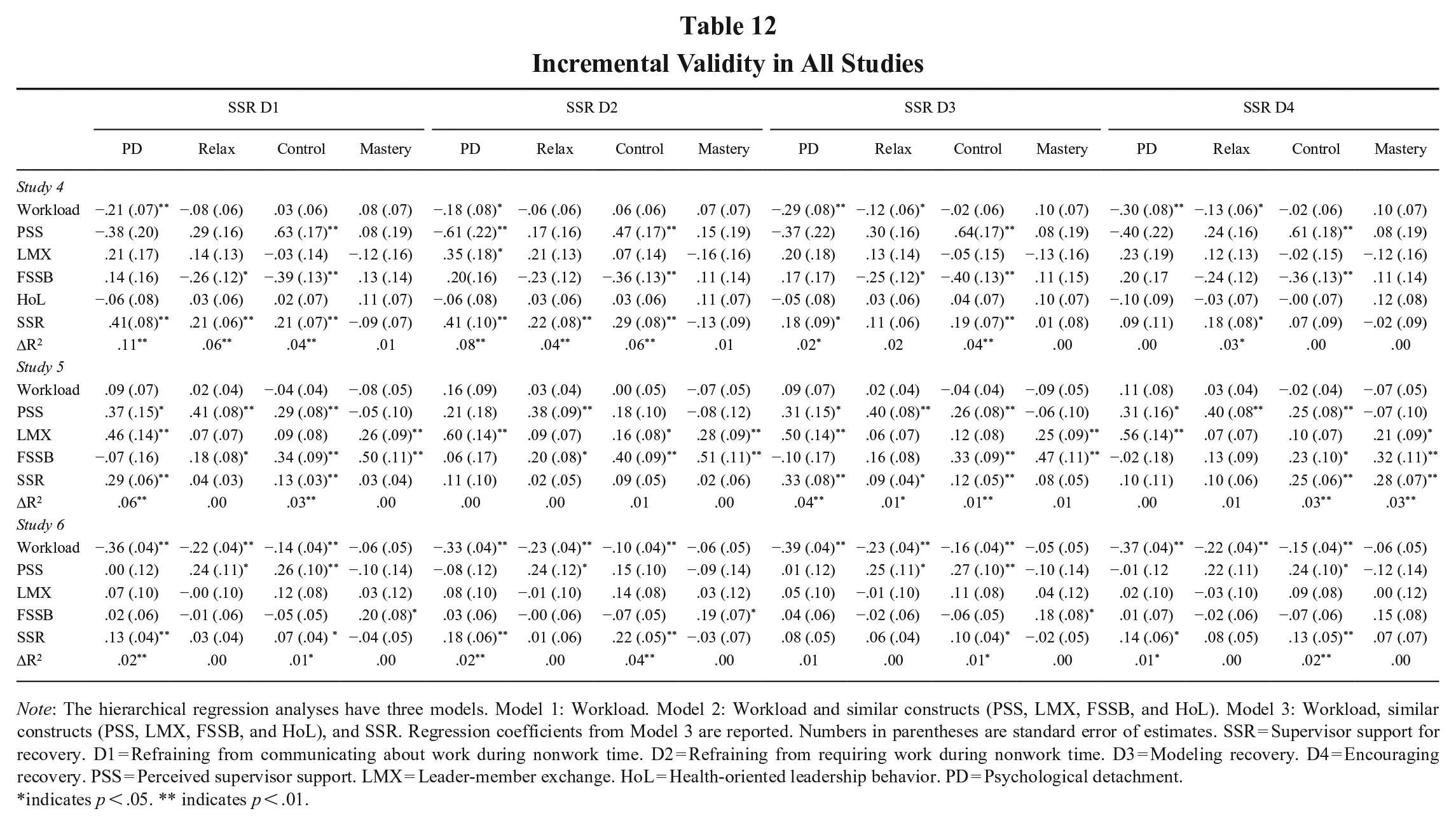
Note: The hierarchical regression analyses have three models. Model 1: Workload. Model 2: Workload and similar constructs (PSS, LMX, FSSB, and HoL). Model 3: Workload, similar constructs (PSS, LMX, FSSB, and HoL), and SSR. Regression coefficients from Model 3 are reported. Numbers in parentheses are standard error of estimates. SSR = Supervisor support for recovery. D1 = Refraining from communicating about work during nonwork time. D2 = Refraining from requiring work during nonwork time. D3 = Modeling recovery. D4 = Encouraging recovery. PSS = Perceived supervisor support. LMX = Leader-member exchange. HoL = Health-oriented leadership behavior. PD = Psychological detachment.
indicates p < .05. ** indicates p < .01.
In Study 4, incremental validity was supported for psychological detachment, relaxation, and control, but not for mastery. In Study 5, incremental validity was supported for all recovery experiences. In Study 6, incremental validity was supported for psychological detachment and control, but not for relaxation or mastery experiences. Thus, Hypothesis 3 was partially supported.
Discussion
We examined the discriminant, criterion-related, and incremental validity of the SSR dimensions with three different samples and designs. Study 4 was a cross-sectional study with a full-time U.S. employee sample. To replicate the findings with more rigorous designs, we adopted a multi-source design with a supervisor-subordinate dyadic sample in Study 5 and a time-separated design in Study 6. These designs allow the separation of predictors and outcomes to address concerns about common method variance (Podsakoff, MacKenzie, Lee, & Podsakoff, 2003). Moreover, Study 5 extended the findings from the Western context to the Eastern culture with a Chinese employee sample, while Study 6 tested the generalizability of SSR beyond the full-time employee population to an important yet often overlooked group—PhD students.
Results from the three validation studies utilizing different designs and samples mostly supported the discriminant, criterion-related, and incremental validity of the SSR dimensions. Specifically, the discriminant validity analysis demonstrated that the four SSR dimensions were distinct from other related leadership constructs (e.g., perceived supervisor support, LMX, FSSB, and health-oriented leadership behavior) across the three studies. Regarding criterion-related validity, the studies consistently found that all four SSR dimensions were related to psychological detachment, relaxation, and control, although the results for mastery experience were mixed, with 5 out of 12 correlations being significant. An internal meta-analysis of these studies indicated that all four SSR dimensions were significantly related to all four recovery experiences. Additionally, incremental validity was mostly supported for psychological detachment, relaxation, and control but not for mastery experiences across the three studies.
General Discussion
Echoing recent calls to better understand the nature and impact of recovery-supportive supervisory behaviors (Sonnentag et al., 2017), this study proposed a refined multidimensional conceptualization of SSR with four dimensions including (1) refraining from communicating about work during nonwork time, (2) refraining from requiring work during nonwork time, (3) modeling recovery, and (4) encouraging recovery. Thus, this multidimensional conceptualization of SSR covers a wide range of supervisor support beyond the extent to which supervisors expect employees to work during nonwork time, which was the focus of Bennett et al.’s (2016) unidimensional SSR construct. Based on the multidimensional conceptualization, we developed and validated a scale to measure the four dimensions of SSR with six samples (U.S. employees, Chinese employees, and U.S. Ph.D. students) and different study designs (cross-sectional, multi-source, and time-separated designs). Overall, discriminant, criterion-related, and incremental validity for SSR (except for the incremental validity for mastery experiences) was supported.
Theoretical and Practical Implications
This study contributes to the recovery literature by refining the conceptualization of SSR that aligns with the recovery literature and developing a psychometrically sound scale to measure the construct. Specifically, the two directions of supervisory support emphasized in this study, refraining from recovery-hindering behavior and engaging in recovery-promoting behavior, align with the recovery literature, which underscores the necessity of reducing job demands and energy exertion and providing opportunities to achieve recovery experiences. Moreover, by including the two key social behaviors, modeling and encouraging, in developing the two recovery-promoting dimensions, this study expands the application of SCT within the recovery literature and underscores the importance of the two types of social behaviors in impacting employee recovery experiences.
Furthermore, this research expands supervisor support research in the broader work-nonwork literature, which to date has focused mainly on supporting employees in their efforts to manage work and family demands (Hammer et al., 2009; Kossek, Perrigino, Russo, & Morandin, 2023). The emphasis of the two directions of supervisor support aligns with the role sender literature (e.g., Greenhaus & Powell, 2003), which emphasizes the effect pressure and support exerted by work role senders (e.g., supervisors) has on how employees navigate the work-nonwork interface (Greenhaus & Powell, 2003; Kahn, Wolfe, Quinn, Snoek, & Rosenthal, 1964; Shockley & Allen, 2015). Specifically, the two prevention-based dimensions capture refraining from role sender pressure from supervisors that impedes recovery from work stress during nonwork time, and the two promotion-based dimensions capture engaging in role sender support from supervisors that provides opportunities for employees to prioritize recovery during nonwork time. Our findings support and extend the role sender literature to the recovery domain (Greenhaus & Powell, 2003), showing that a supervisor can act as a significant other at work that conveys pressure to prioritize work role over recovery (i.e., role sender pressure), as well as supportiveness for participation in recovery experiences (i.e., role sender support).
As for practical implications, a better understanding of SSR positions researchers to design interventions that align with The National Institute for Occupational Safety and Health (NIOSH, 2016)’s emphasis on targeting work context factors, especially supervisor-related factors. To date, interventions targeting employees’ recovery have focused primarily on training employees to use cognitive-behavioral techniques and coping strategies that enhance their recovery from work stress (e.g., Karabinski et al., 2021; Verbeek et al., 2019). In a recent meta-analysis, 29 of 34 interventions to promote psychological detachment targeted the individual employee (Karabinski et al., 2021). This disproportionate emphasis on the individual employee overlooks important contextual targets for enhancing recovery. The findings from this study pave the way for future SSR interventions.
Limitations and Future Directions
We found mixed results for criterion-related and incremental validity for SSR on mastery experience across the three validation studies. Specifically, while criterion-related validity analysis showed that SSR was significantly related to mastery experience in two of three studies, the incremental validity of SSR for mastery experience was only supported in one of three studies. Although the mixed results on mastery are unexpected, one post-hoc explanation is that mastery experience is more likely to be impacted by personal factors (e.g., preferred leisure activities) versus contextual factors (e.g., SSR). While contextual factors may be antecedents of mastery experience (e.g., Steed et al., 2021), given that availability of time and energy is required if employees want to invest the effort to engage in mastery experience (Sonnentag, Mojza, Binnewies, & Scholl, 2008), personal factors may play a more important role in employees’ mastery experiences. Many people primarily engage in passive leisure activities that do not afford opportunities for mastery (Kuykendall, Lei, Zhu, & Hu, 2020). They will likely not engage in activities conducive to mastery regardless of their supervisors’ behaviors. Thus, personal factors may moderate the relationship between SSR and mastery. Specifically, there may not necessarily be a strong direct correlation between SSR and mastery experiences for people who lack interests in challenging leisure activities (e.g., playing sports, playing an instrument, learning a new language). Future research may benefit from examining individual factors as antecedents of mastery or moderators in the relationship between SSR and mastery experiences.
For relaxation, the incremental hypothesis was not supported in Study 6. Study 6 used a different design (a time-separated design) compared to the other two studies. One reason for this discrepancy may be that the effect of SSR on relaxation is more immediate than we expected and dissipates quickly as time goes by. It is possible that a time interval of two weeks was not fine-grained enough to capture its effect. Future studies can benefit from longitudinal designs with more fine-grained time intervals.
Moreover, there are some limitations associated with recruitment methods and samples. First, the majority of our samples were paid participants from online panels, with the exception of one sample—PhD students—recruited through E-mails. While data collected from online platforms can produce valid and reliable results comparable to traditional data collection methods (Lovett, Bajaba, Lovett, & Simmering, 2018), future research should aim to replicate this study using other samples, such as full-time employees recruited directly from organizations. Second, another limitation is the use of a PhD student sample to test the lagged effects of SSR on recovery experiences. While PhD students provided valuable insights, the unique nature of their work environment may not fully capture the dynamics present in full-time employees’ experiences. Future studies should investigate the lagged relationships between SSR and recovery experiences in a sample of full-time employees to understand how SSR influences recovery processes in more traditional work settings. A third limitation is the potential impact of the COVID-19 lockdown on the studies (Study 1, Study 2, and Study 3a) that collected data during this period (March 2020 to July 2020; Yakusheva, van den Broek-Altenburg, Brekke, & Atherly, 2022). Although we did not find evidence of the lockdown’s impact in these studies (e.g., only 0.004% [2 of 481 responses] of our coded qualitative responses in Study 1 mentioned the COVID-19 pandemic), future research could further assess generalizability by collecting post-pandemic data.
Furthermore, given the nature of modeling recovery, some items in this dimension ask employees to report the frequency of their supervisor’s recovery-related behaviors during nonwork time (Study 4 and Study 6). However, employees may be unable to observe all of their supervisor’s recovery-related activities. In creating the scale, we assumed that employees sometimes learn about their supervisors’ recovery activities from what their supervisors say (e.g., in informal conversations), and sometimes infer this information indirectly, from sources such as conversations with coworkers or artifacts (e.g., photographs) in the office or on social media. In this case, it is possible that the employees answered these items based on assumptions. We note that even if the employees’ assumptions about a supervisor’s recovery-related behaviors are inaccurate, they will likely impact the employees’ recovery experiences, as inaccurate perceptions of others’ behaviors are often still influential on one’s own behaviors (Duong & Parker, 2018; Giurge & Bohns, 2021; Mandeville, Halbesleben, & Whitman, 2016). Future research should consider the possibility that participants are uncertain about their supervisor’s recovery behaviors and give participants the option of not responding—either by not using forced responses or by having a “not sure” option—in case they do not know about certain aspects of their supervisors’ recovery-related behavior.
We focused on recovery experiences rather than recovery activities and recovery states because (1) individuals do not experience specific activities in exactly the same way, and (2) recovery experiences can shed more light on how supervisors impact the recovery process (what recovery experiences can capture), not just that they impact recovery ends states (the state of being recovered) (Steed et al., 2021). Future research should extend this research by looking at other recovery outcomes (recovery activities, state of being recovered) to generalize the findings to a broader criterion space. Furthermore, this study only captured four recovery experiences proposed by Sonnentag and Fritz (2007). Future research should also capture other recovery experiences such as meaning and affiliation (Kujanpää, Syrek, Lehr, Kinnunen, Reins, & de Bloom, 2021). Moreover, this research focused on recovery experiences during nonwork time in general. Future research may benefit from examining the differential effects of SSR in specific recovery settings, such as micro-breaks, workday evenings, and weekends (Zhu, Kuykendall, & Zhang, 2019).
Because this is one of the first studies on this topic, this study did not examine the mechanisms through which SSR impacts employee recovery experiences. The two theories (i.e., ERM and SCT) we used to develop the multidimensional conceptualization of SSR and its impact on recovery experiences provide insights into two potential underlying mechanisms—energy-depleting and social cognitive processes. Specifically, ERM (Meijman & Mulder, 1998) highlights that when supervisors engage employees with work-related communication or tasks during nonwork time, these behaviors significantly drain the employees’ energy and limit their time for recovery activities. Furthermore, according to SCT (Bandura, 1986), supervisor behaviors that influence employees’ perceptions of barriers to be able to recover from work stress (i.e., recovery-related self-efficacy) and the consequences of prioritizing recovery over work (i.e., recovery-related outcome expectations) may impact their recovery experiences. Future studies should explore the mediators that align with ERM and SCT using appropriate designs (e.g., a cross-lagged design).
Conclusion
In this article, we proposed a multidimensional construct of SSR with four dimensions. Based on the conceptualization of SSR, we developed and validated a measure to capture the four dimensions using different designs (cross-sectional, multi-source, and time-separated designs) and samples (U.S. full-time employees, Chinese full-time employees, and U.S. PhD students). Results across six studies supported the four-dimensional structure, reliability, discriminant, criterion, and incremental validity with employee- and supervisor-rating SSR and contemporaneous and lagged measures of recovery experiences. Together, this study paves the way for future research on SSR.
Final Items for the SSR Scale
Refraining from Communicating about Work During Nonwork Time
1. My supervisor only contacts me about work during working hours.
2. My supervisor does not communicate with me about work-related issues during my nonwork time.
3. My supervisor stops communicating with me about work-related issues when the workday is over.
4. My supervisor leaves me alone during nonwork time.
Refraining from Requiring Work During Nonwork Time
5. My supervisor sets deadlines that require me to work after regular business hours. (R)
6. My supervisor makes last-minute requests that require me to work during nonwork time. (R)
7. My supervisor asks me to work during time off. (R)
8. My supervisor assigns tasks that require me to work during my days off. (R)
9. My supervisor makes urgent requests that prevent me from wrapping up my workday at a reasonable time. (R)
10. My supervisor gives me an unreasonable amount of work that makes me work during my nonwork time. (R)
Modeling Recovery
11. My supervisor engages in leisure activities during nonwork time.
12. My supervisor takes time to recharge from work during the weekends.
13. My supervisor uses time outside of work to wind down.
14. My supervisor describes how she/he relaxes during nonwork time.
Encouraging Recovery
15. My supervisor encourages me to get enough rest.
16. My supervisor encourages me to take time off.
17. My supervisor responds positively to requests for time off.
18. My supervisor asks if I get enough rest.
19. My supervisor emphasizes the importance of getting enough time away from work.
20. My supervisor encourages me to enjoy my time off.
Note: (R) represents reverse coding.
Supplemental Material
sj-docx-1-jom-10.1177_01492063241311228 – Supplemental material for Clarifying the Construct of Supervisor Support for Recovery and Its Impact on Employee Recovery Experiences
Supplemental material, sj-docx-1-jom-10.1177_01492063241311228 for Clarifying the Construct of Supervisor Support for Recovery and Its Impact on Employee Recovery Experiences by Ze Zhu, Lauren Kuykendall, Julia I. Baines and Bo Zhang in Journal of Management
Footnotes
Acknowledgements
The authors are grateful to Drs. Jose Cortina, Reeshad Dalal, and Seth Kaplan for their valuable feedback on earlier versions of this manuscript. The authors would also like to thank Zach Stueve for his assistance with item writing.

Supplemental material for this article is available with the manuscript on the JOM website.
Notes
References
Supplementary Material
Please find the following supplemental material available below.
For Open Access articles published under a Creative Commons License, all supplemental material carries the same license as the article it is associated with.
For non-Open Access articles published, all supplemental material carries a non-exclusive license, and permission requests for re-use of supplemental material or any part of supplemental material shall be sent directly to the copyright owner as specified in the copyright notice associated with the article.
