



Abstract
Extant empirical research on ecosystem alignment has offered little insight into how mature ecosystems align their members with a new value proposition. Our longitudinal empirical study of a seven-year hub-driven alignment initiative within the SOK led retail ecosystem in Finland explores how a mature ecosystem hub attempted to enroll its members in a value-proposition updating, ecosystem-wide initiative and the members’ reaction. We find that the mature ecosystem alignment process unfolds through four distinct sets of practices: (1) Courtship, (2) Mutual Adaptation, (3) Peer Emulation, and (4) Coercion. We describe these practices and associated mechanisms and develop a process model indicating how they unfold and interrelate. Our study provides a nuanced, empirically grounded account of mature ecosystem alignment as an iterative process of multilateral interorganizational influence that leads to, on the one hand, a convergence of actions among an expanding set of ecosystem members and, on the other hand, a divergence of views between the newly aligned members and a subset of members who become increasingly entrenched in their perception of irreconcilable differences and ultimately leave the ecosystem. Our discussion suggests that the tension between the hub’s temptation to control and the ecosystem members’ concern about preserving their autonomy propels the alignment process to its conclusion. We conclude with methodological contributions, managerial implications and avenues for future research.
Introduction
Ecosystems are meta-organizational structures that coordinate economic activity and shape sectoral innovation trajectories (Hannah & Eisenhardt, 2018; Jacobides, Cennamo & Gawer, 2018; Shipilov & Gawer, 2020; Snihur, Thomas, & Burgelman, 2018). They are composed of interacting organizations that collectively create and capture value by combining resources. Ecosystems are becoming increasingly common, especially in sectors undergoing digital transformation, such as retail with e-commerce, connected health (Frow, McColl-Kennedy, & Payne, 2016), smart mobility (Uzunca, Rigtering, & Ozcan, 2018), and gaming (Shi, Li, & Chumnumpan, 2021).
Every ecosystem must align its members around its value proposition. Alignment allows coordinated action and enables innovation while reducing risk, uncertainty, variability, and transaction costs (Hsieh, Lazzarini, Nickerson, & Laurini, 2010). Misalignment, in contrast, is likely to lead to ecosystem failure, either due to the development of incompatible components (Ranganathan & Rosenkopf, 2014) or because members under-invest in ecosystem-wide initiatives (Kapoor & Lee, 2013).
However, alignment does not come easily, because ecosystems—unlike traditional buyer-seller contracts—do not operate under centralized, hierarchical control (Adner, 2017; Jacobides et al., 2018). Hence, the ecosystem alignment process is an increasingly important topic in the ecosystem literature, which has begun to identify the challenges involved and how they might be overcome. Scholars have identified points in an ecosystem’s lifecycle when alignment is essential, such as when bottlenecks shift (Hannah & Eisenhardt, 2018), and practices that help to align incentives, such as when an ecosystem hub invests in new technologies that allow complementors to create value (Masucci, Brusoni, & Cennamo, 2020).
However, empirical research has so far focused mainly on emergent (or “nascent”) ecosystems, offering little specific insight into how mature ecosystems align their members. This gap is worth addressing, because alignment challenges are unlikely to end once an ecosystem is established. Indeed, as ecosystems evolve, they will likely encounter new challenges due to technological change, external competition, or internal competitive dynamics. While an ecosystem can adapt by updating its value proposition, this is likely to test the alignment achieved in its early days, making alignment an ongoing process.
Recently, scholars have called for more empirical work on alignment in mature ecosystems (e.g., Lingens, Seeholzer, & Gassmann, 2023). We answer this call by analyzing the processes that unfold when a mature ecosystem hub attempts to align its members with an ecosystem-wide initiative that updates the ecosystem’s value proposition. More specifically, we present the results of an in-depth case study of SOK (Suomen Osuuskauppojen Keskuskunta, or “Central Finnish Cooperative Society”), hub of a mature Finnish ecosystem of retailers and service providers. During our seven-year study period (1988–1994), SOK aimed to align diverse ecosystem members around a new B2C (business-to-consumer) loyalty scheme, the “S Bonus Card,” which ultimately became the largest of its type in Finland.
We found that SOK’s alignment developed through an iterative process of multilateral interorganizational influence. We identify four sets of practices and associated mechanisms, which we label (1) Courtship, (2) Mutual Adaptation, (3) Peer Emulation, and (4) Coercion, and develop a model of how they unfold and interrelate.
We make three contributions to the literature on ecosystem alignment and evolution. First, we show how the alignment process in mature ecosystems differs from that in nascent ecosystems. Second, we discuss how the practices in the mature alignment process characterize an iterative process of multilateral interorganizational influence. Third, we explore the fundamental drivers of actors’ behavior during alignment—specifically, the underlying tension between the hub’s temptation to control and the ecosystem members’ desire for autonomy. We conclude by offering methodological contributions based on our study, elaborating on some managerial implications of our findings and avenues for future research.
Theoretical Background
Ecosystems enable interdependent firms to coordinate so that a focal value proposition can materialize (Adner, 2017). Ecosystems structure and facilitate the coordination of interdependencies among multiple members. They are “interacting organizations, enabled by modularity, not hierarchically managed, bound together by the non-redeployability of their collective investment elsewhere. Ecosystems add value as they allow managers to coordinate their multilateral dependence through sets of roles that face similar rules, thus obviating the need to enter into customized contractual agreements with each partner” (Jacobides et al., 2018: 2255).
All Ecosystems Face Alignment Challenges
Alignment is a critical task in managing all ecosystems, as members have some autonomy and are not “hierarchically controlled” (Jacobides et al., 2018). Indeed, Adner (2017) goes as far as defining ecosystems as “the alignment structure of the multilateral set of partners that need to interact for a focal value proposition to materialize” (Adner, 2017: 42), with alignment being “the extent to which there is mutual agreement among the members regarding positions and flows” (Adner, 2017: 42). The structured alignment of autonomous actors, when aimed at collectively creating a value proposition, allows coordinated action, facilitates value creation, and enables the joint exploration of systemic innovation trajectories (Adner, 2017).
Of course, aligning members is a significant strategic problem for all organizations (March & Simon, 1958). For example, Middleton and Harper (2007) highlight the importance of alignment when attempting to implement new information systems technologies, while Kathuria, Joshi, and Porth (2007) emphasize vertical and horizontal alignment within and across businesses. However, alignment is an existential problem for ecosystems, because they cannot rely on formal organizational structures to hold the architecture of coordination together. Hence, without alignment mechanisms, the ecosystem cannot sustain itself (Shipilov & Gawer, 2020).
Since ecosystem structures differ, alignment processes differ too. Ecosystems can operate around one central actor (or “hub”) or more than one, such as when the hub position is contested (Adner, 2017), while others may have no hub at all. Ecosystems also differ in the degree of hierarchy in their governance: some are led by a strong hub, while others have more distributed governance. However, the single-hub structure is fairly widespread, especially in platform-based ecosystems, where the hub provides a core technological asset on top of which others innovate (Cusumano, Gawer, & Yoffie, 2019). Amazon, Google, and Apple are notable exemplars of this structure, and platform-based ecosystems are becoming a prevalent organizational form in the digital economy (Gawer, 2022). The single-hub ecosystem is, therefore, highly relevant.
The ecosystem literature has identified practices that hubs employ to drive collective action and alignment, such as rules, standards, and codified interfaces (Jacobides et al., 2018; Teece, 2018). Some hubs impose fairly standardized “rules and roles” that define members’ rights and responsibilities (Jacobides et al., 2018; Tiwana, Konsynski, & Bush, 2010; Wareham, Fox, & Cano Giner, 2014). Provided members perceive that the ecosystem is adding value, the hub can coordinate their multilateral dependence through sets of roles bound by similar rules, thus obviating the need to enter into customized contractual agreements with each partner, as in supply chains (Jacobides et al., 2018). The logic of ecosystemic value creation rests on the fact that the standardized arrangements between members, set separately for each role (Wareham et al., 2014), allow members to benefit from collective action, while the consequent amortization of partially shared fixed costs leads to economies of scale and scope.
Alignment of Platform-Based Ecosystems
Many ecosystems operate around technological platforms (Gawer, 2014; Gawer & Cusumano, 2014; Jacobides, Cennamo, & Gawer, 2024; Parker et al., 2016), with platform firms adopting the anchoring role of ecosystem leader or platform leader (Gawer & Cusumano, 2002). The central technology functions as a nexus of exchange and connection among members on various sides of the platform (Cusumano et al., 2019; Rochet & Tirole, 2003). Alignment in platform ecosystems often depends on a combination of economic incentives and technological capability-sharing, with interface design playing a crucial role (Gawer, 2021; Gawer & Cusumano, 2002).
The platform leader plays a very similar role to an ecosystem hub or keystone firm (Iansiti & Levien, 2004). In platform-based ecosystems, hubs aim to mobilize and align third parties (often called “complementors”), encouraging them to affiliate with the platform in order to stimulate third-party complementary innovation (Gawer, 2014; Gawer & Cusumano, 2002, 2014; Parker et al., 2016; Parker et al., 2017), which in turn will increase the attractiveness of the platform. Cross-side “network effects” (Caillaud & Jullien, 2003; Evans & Schmalensee, 2016, 2018; Rochet & Tirole, 2003, 2006) mean that the more users there are on one side of a platform, the more attractive it becomes to members on the other side. Thus, the term “orchestration” tends to be preferred over “alignment” (see, for example, Nambisan & Sawhney, 2011) within the platform literature. However, similar mechanisms operate for both platforms and ecosystems, in that they share a goal to mobilize external actors to commit investments and efforts toward developing complementary offerings specifically designed to be compatible with the offering of the hub or platform leader.
Alignment takes a specific meaning in the case of “innovation platforms” (Cusumano et al., 2019), where the hub’s objective is to stimulate third parties to develop complementary innovations for its platform. These actors’ innovative capabilities generate platform-guided innovation trajectories, enriching the portfolio of complementary offerings accessible via the platform and driving end-user demand. Mobilization is achieved by the platform leader offering complementors a combination of economic incentives (by, say, presenting a business case that convinces potential complementors that their innovations will be profitable) and technological capabilities (e.g., by providing access to data, algorithms, or technological assets via open interfaces) (Gawer, 2014, 2021; Gawer & Cusumano, 2008; Parker et al., 2017).
In the platform literature, interfaces play a crucial role as a means of guiding complementors’ innovative efforts and aligning their outputs with the platform. Gawer and Cusumano (2002) document how Intel, Microsoft, and Cisco aimed to establish their respective technologies as platforms on which an ecosystem of third parties could develop complementary innovations. Similarly, Wareham et al. (2014) show how the leader of a business software ecosystem provided members with tools, templates, certifications, and training facilities, along with community platforms that enabled the reuse of code.
Challenges and Practices of Ecosystem Alignment
The most obvious challenge of ecosystem alignment is ecosystem members’ autonomy (Shipilov & Gawer, 2020; Wareham et al., 2014;). Others include competitive tensions among ecosystem members (Oborn, Barrett, Orlowski, & Kim, 2019; Tiwana et al., 2010; Wareham et al., 2014) and the inherent uncertainties, complexities, and ambiguities of the ecosystem itself (Brusoni & Prencipe, 2013).
In platform-based ecosystems composed of actors with potentially divergent incentives, a critical trade-off concerns the platform leader’s maintenance of legitimacy. Sometimes, the leader must respond to external competition by redrawing the functional boundaries of the platform technology so it can compete with its own complementors (Gawer, 2021). At the same time, the leader must preserve complementors’ goodwill and all-important incentives to innovate while assuaging their fears of being trampled on or taken advantage of (Gawer & Henderson, 2007).
Another set of challenges concerns the establishment of rules and standards, which must allow members to earn enough of a return on their investments to make their participation worthwhile (Foss, Schmidt, & Teece, 2023). Rules must be sufficiently robust to ensure coordination among ecosystem participants (for example, maintaining interoperability) but also allow participants sufficient flexibility to respond to new opportunities and challenges (Tilson, Lyytinen, & Sørensen, 2010; Wareham et al., 2014). Tiwana et al. (2010) describe the platform leader striving for a “just-right” level of governance by balancing stability and variability (Tiwana et al., 2010: 679).
Nascent and Mature Ecosystems Face Some Distinct Alignment Challenges
Scholars describe the lifecycle of an ecosystem as consisting of four phases: birth, expansion, leadership, and self-renewal (Moore, 1993). As an ecosystem evolves, it will likely encounter new opportunities and challenges due to technological change, external competition, or even internal competitive dynamics (Daymond, Knight, Rumyantseva, & Maguire, 2023; Schmidt & Foss, 2023). Thus, the process of alignment is likely to continue throughout its lifecycle.
The literature has begun to identify the distinct challenges faced by ecosystems as they evolve. Jacobides et al. (2018) focus on the prerequisites of alignment in emerging ecosystems, arguing that the lack of technological modularity and coordination are interdependent dynamics that may hinder ecosystem emergence. Another distinct challenge for nascent ecosystems is the lack of evidence for their own viability, which Thomas and Ritala (2022) term “liability of newness.” Hannah and Eisenhardt (2018) identify strategies through which hubs can rally new members to nascent ecosystems; in the “bottleneck strategy,” firms enter emerging bottleneck components, innovate within them, and orchestrate complementors for the remaining components. Conversely, removing bottlenecks can also help the hub align its ecosystem members, as Masucci et al. (2020) identify in their study of an oil and gas ecosystem hub.
While nascent ecosystems face the challenge of creating a new value proposition and convincing partners to commit to it, mature ecosystems face challenges of their own. Faced with changing circumstances, a mature ecosystem may need to reevaluate and potentially update its original core value proposition—and such an update will likely test the internal alignment achieved during its early days. As Asplund, Björk, Magnusson, and Patrick (2021) discuss, some members may leave, impacting the roles and dynamics among those who remain and even threatening the stability and prospects of the mature ecosystem. To keep the ecosystem competitive, new members may have to be found. Mature ecosystems must, therefore, attract and align both new and existing members over time.
We define a mature ecosystem as one in which the identity of the core partners has long been known to ecosystem participants, relationships have evolved to encompass a repertoire of stable social-interaction routines, and the core value proposition has crystallized into a stable understanding that all participants share. Updating the value proposition, however, has the potential to destabilize both partners’ identities and social-interaction routines. If the hub cannot find a way to align the ecosystem’s members, it may collapse (Iansiti & Levien, 2004).
Recent literature has offered some significant conceptual advances in this area. For example, Foss et al. (2023) conceive ecosystem leadership as a “dynamic capability” comprising activities of “sensing,” “seizing,” and “reconfiguring,” thus building on Teece’s (2007) account of dynamic capabilities. During ecosystem emergence, the main task of ecosystem leadership relates to “sensing” and “helping the potential ecosystem participants to arrive at a shared and aligned understanding of the integrated value proposition” (Foss et al., 2023: 6). In earlier work, Dattee et al. (2018) and Witt (2007) establish that the process by which a vision becomes shared over time could be highly iterative.
As ecosystems mature, the alignment challenge becomes that of “seizing” (Foss et al., 2023), where leadership means “making investment commitments to the ecosystem” that signal to other participants that the leader “is serious about the ecosystem effort and thus makes it more likely that others will follow suit.” The challenges associated with “reconfiguring,” meanwhile, relate to keeping the ecosystem robust amid an evolving environment.
The literature has also explored how the trade-offs of ecosystem alignment may evolve over time. As noted, Tiwana et al. (2010) portray alignment as a balancing act between stability and variability. Wareham et al. (2014) elaborate further, highlighting the temporal dimension of variability within and between an ecosystem’s tensions and constituents. They suggest that the ideal balance involves, on the one hand, stability combined with homogeneity of actors (to leverage joint investments), and on the other hand, variability combined with heterogeneity of actors (to meet evolving market demand and enable the evolution of the ecosystem over time).
The platforms literature has shown how relationships between a hub (or platform leader) and its ecosystem members evolve over time and the associated challenges. For example, in her conceptual study of digital platform boundaries, Gawer (2021) considers the evolution of platform leaders’ incentives vis-à-vis their complementors and their ability to coerce them. She suggests that if platform owners survive the early phases of competition and reach maturity by the time the market tips, they will have garnered such overwhelming bargaining power that their incentive to maintain complementors’ goodwill diminishes, and they can then get away with closing platform interfaces. Of course, consistent abuse of bargaining power tends to draw the attention of regulators (see, e.g., Cusumano, Gawer, & Yoffie, 2021; Gawer, 2022). It can also motivate disgruntled complementors to evade platform dependency (see Cutolo & Kenney, 2021) and incentivize investors to generate competing platforms.
While these conceptual advances are beneficial, there is still very little empirical research on the alignment process in mature ecosystems. Gaining an empirically grounded understanding is essential to validate some of the conceptually derived hypotheses and will also provide an opportunity for conceptual and methodological development. One methodological limitation of previous studies is that, in nascent ecosystems, rallying new members and aligning them to a brand-new value proposition are bound to happen simultaneously, making these two alignment processes observationally indistinguishable. In contrast, as ecosystems mature, aligning existing members to an updated value proposition becomes observably distinct from rallying new members. This phenomenological unbundling enables empirical exploration of the under-researched topic of alignment in mature ecosystems.
Seizing this opportunity, we have designed this study to better understand the alignment process in a mature ecosystem. More specifically, our study asks: what are the processes by which a hub enrolls the existing members of a mature ecosystem to an updated ecosystem value proposition?
Methods and Data
We explore the alignment process in mature ecosystems by investigating a single case study in depth. We chose this research method due to the exploratory, theory-building nature of our research (Eisenhardt, 1989), given that the alignment process driven by a central hub within an existing ecosystem is not yet well understood (Adner, 2017). The single case study design enables us to analyze the subunits within a larger entity in more detail (Yin, 2003) to gain a deeper understanding of the case setting (Dyer & Wilkins, 1991). Furthermore, as we focus on an entire process of alignment, we can examine how and why the process emerges, develops, grows, or terminates over time. As Langley, Smallman, Tsoukas, and Van de Ven (2013) indicate, this broad temporal approach allows us to reveal tensions and contradictions in the driving patterns of change. Although there is little prior research on alignment in corresponding settings, the results from past research (e.g., Gawer & Phillips, 2013; Hannah & Eisenhardt, 2018; Wareham et al., 2014) suggest that our approach is well suited to generating novel insights into the inductive, contextual, and process-based nature of alignment.
Empirical Setting
We draw on data from a longitudinal study on the introduction of an ecosystem-wide customer loyalty program (the S Bonus Card) by a mature ecosystem hub (SOK) over seven years between 1988 and 1994. The characteristics of the ecosystem under study fit the well-accepted defining characteristics of ecosystems listed by Shipilov and Gawer (2020), namely: (1) a “multilateral set of partners that need to interact in order for a focal value proposition to materialize” (Adner, 2017: 40); (2) in which membership is “open” and based on “self-selection” (Gulati, Puranam, & Tushman, 2012: 16); (3) where activities are orchestrated “by the hub” (Dhanaraj & Parkhe, 2006: 662); and (4) where the members “are not hierarchically managed” (Jacobides et al., 2018: 2259). The ecosystem we study comprises an ensemble of member companies from the service sector, including a large cooperative retailer and its independent cooperatives, as well as other companies providing services such as travel, hospitality, medical, and insurance. By operating jointly, the companies can fulfil a wider variety of customer needs, reach more customers, and engage in more efficient marketing at lower cost. Members are free to join or leave the ecosystem, and the number of members has varied significantly during its 30-year history. As hub, SOK provides value-adding services to ecosystem members by, for example, coordinating the development of new value propositions. Finally, while members have multilateral relationships with one another, the ecosystem is nonhierarchical; each member is free to engage in ecosystem-wide activities.
The new value proposition was a joint loyalty program intended to develop members’ businesses by helping them attract and retain new customers. We focus on identifying the practices associated with the process through which the ecosystem’s existing members joined (i.e., aligned with) the initiative. The initiative was a so-called “coalition loyalty program,” which—unlike single-operator programs—allowed customers to accrue benefits across multiple companies and sectors by using a single loyalty card. In our case, customers could sign up for the S Bonus Card to accumulate points by making purchases with any ecosystem member, and could also receive exclusive offers. Points could be converted into vouchers to pay for subsequent purchases. Higher spending earned more points, encouraging customers to concentrate all their purchases on ecosystem member firms. Today, customers can swipe their S Bonus Cards for points and discounts at, for example, Lähitapiola (insurance), Eckerö Line (ferry operator), Elisa (mobile and broadband), Oral Hammaslääkärit (dental health), Silmäasema (optician), Hertz Finland (car rental), and the member cooperatives of S-Group (nationwide grocery chain). Before S Bonus, the primary purpose of the ecosystem had been to run joint marketing efforts, but the scheme shifted the focus towards cultivating customer loyalty, thus improving the competitive advantage of the entire ecosystem.
SOK’s first goal was to get all of S-Group’s geographically scattered cooperatives to join the scheme, to build up the program’s customer base and attract more card users. A benefit for both members and end users was that frequent travelers could use their cards in locations across Finland. This positive feedback loop eventually attracted not only existing ecosystem members but also new recruits. As a former CEO of SOK commented, “We wanted to have all cooperatives on board before other partners were invited to join the program.”
In order to join S Bonus, all cooperatives were required to invest in a new point-of-sale (POS) system and a more sophisticated, ecosystem-wide information platform (S Net) to automatically record customer purchases, calculate bonus point accruals, and share information.
Data Collection
As we focus on alignment practices, SOK and S-Group’s autonomous cooperatives are at the heart of our study. The practices targeted at the cooperatives enabled the initiative to attract the required customer base so that SOK could then bring the remaining and new ecosystem members on board. Our data collection relied on four primary qualitative data sources: interviews with elite informants, biographical accounts, archival documents, and public records. The data covers the period from the early 1980s to the late 1990s, beginning before the alignment process commenced and ending some years after most ecosystem members had aligned to the scheme.
Semi-Structured Interviews With Elite Informants
We conducted a total of 33 interviews with 25 elite informants. Elite informants are “key decision makers who have extensive and exclusive information and the ability to influence important firm outcomes” (Aguinis & Solarino, 2019: 1293). The interviews enabled us to better understand the organizational setting and history and included specific questions about the ecosystem’s evolution and alignment process. The sample of interviewees included all former CEOs of SOK and individuals from across the organizational hierarchies of the ecosystem members. Each interview lasted between 60 and 250 minutes and was transcribed verbatim, yielding 870 pages of material.
Biographical Accounts
We collected biographical accounts from the archives of the S-Group Management Veterans Club, members of which were past directors of SOK and individual cooperatives. Each member of the club must write a biographical account of their time at S-Group within two years of joining. These accounts include insights into the work projects in which individuals were involved during their time at S-Group. After an initial review, we selected every account that focused on the years between 1980 and 1999 for closer analysis. These accounts provided detailed and virtually contemporaneous descriptions of the evolution of the ecosystem and the relationships between key actors during the alignment process. The biographical accounts form 2,249 pages of material.
Archival Documents
We collected archival documents from two principal sources. First, we examined documents from SOK’s archives between 1985 and 1995, including management meeting minutes, quantitative graphs, numerical figures describing strategic plans, documents, memoranda, transcripts of meetings, copies of old contracts, photographs, and other notes intended for internal use. In total, the SOK archives form 1,671 pages of material. Second, we were provided with handwritten documents by two former CEOs of SOK, newspaper clippings about the ecosystem’s coverage in the Finnish media between 1988 and 2003, and various strategy documents. These provided background information on the ecosystem’s evolution and helped corroborate findings from other data sources.
Public records
We collected public records about the ecosystem from two sources. First, we examined the annual reports of SOK and all ecosystem members from 1970 to today. These provided descriptions of key decision-makers, strategies, and underlying changes in the ecosystem over time. Second, we analyzed published works on the history of the S Bonus Card. These enabled us to understand the evolution of the empirical setting as well as who joined the ecosystem, when, and why.
Data Analysis
Following established methods for qualitative data analysis (Gawer & Phillips, 2013), we began our analysis with open coding, seeking to identify relevant concepts in the data for grouping into categories to find evidence of both hub practices and corresponding member practices during the alignment process. Thus, we conducted the analysis from the hub and member perspectives simultaneously.
First, we identified first-order codes—that is, terms and language at our informants’ level of meaning (Van Maanen, 1979). Examples of our first-order codes include specific hub practices, such as “Hub agrees pre-contracts with the platform technology providers” and “Hub identifies and engages a subset of members with whom it has the best working relationship,” and the corresponding members’ practices, such as “Other members criticized SOK and expressed concern over their own liability due to SOK financial exposure caused by its commitment to the initiative” and “Pioneering participants start to hold regular personal meetings with non-adopters to convince them to adopt.”
Second, we used axial coding (Strauss & Corbin, 1990) to identify relationships between and within the first-order codes and to group them into higher-order themes. Examples of second-order themes from a hub perspective include “Hub encourages experience-sharing among members” and “Hub implements coercive measures to enforce enrolment.” Examples from a member perspective include “Pioneering participants attempt to rally other members by sharing their positive experience” and “Vacillators are pressured to enroll.”
Third, following the Gioia methodology (Gioia, Corley, & Hamilton, 2013) and the general conventions of longitudinal case analysis, we identified relationships between various categories and themes, from which we rigorously developed aggregate dimensions. We allowed categories, themes, and relationships to emerge until we had developed a clear sense of the relationships among the categories and their related themes. We repeated this process until the analysis no longer generated fresh insights into the relationships across the categories. We report only those relationships that were corroborated and confirmed by multiple informants and were consistent with our primary and secondary data observations. Figure 1 presents our data structure, highlighting the categories and themes from which we developed our model.
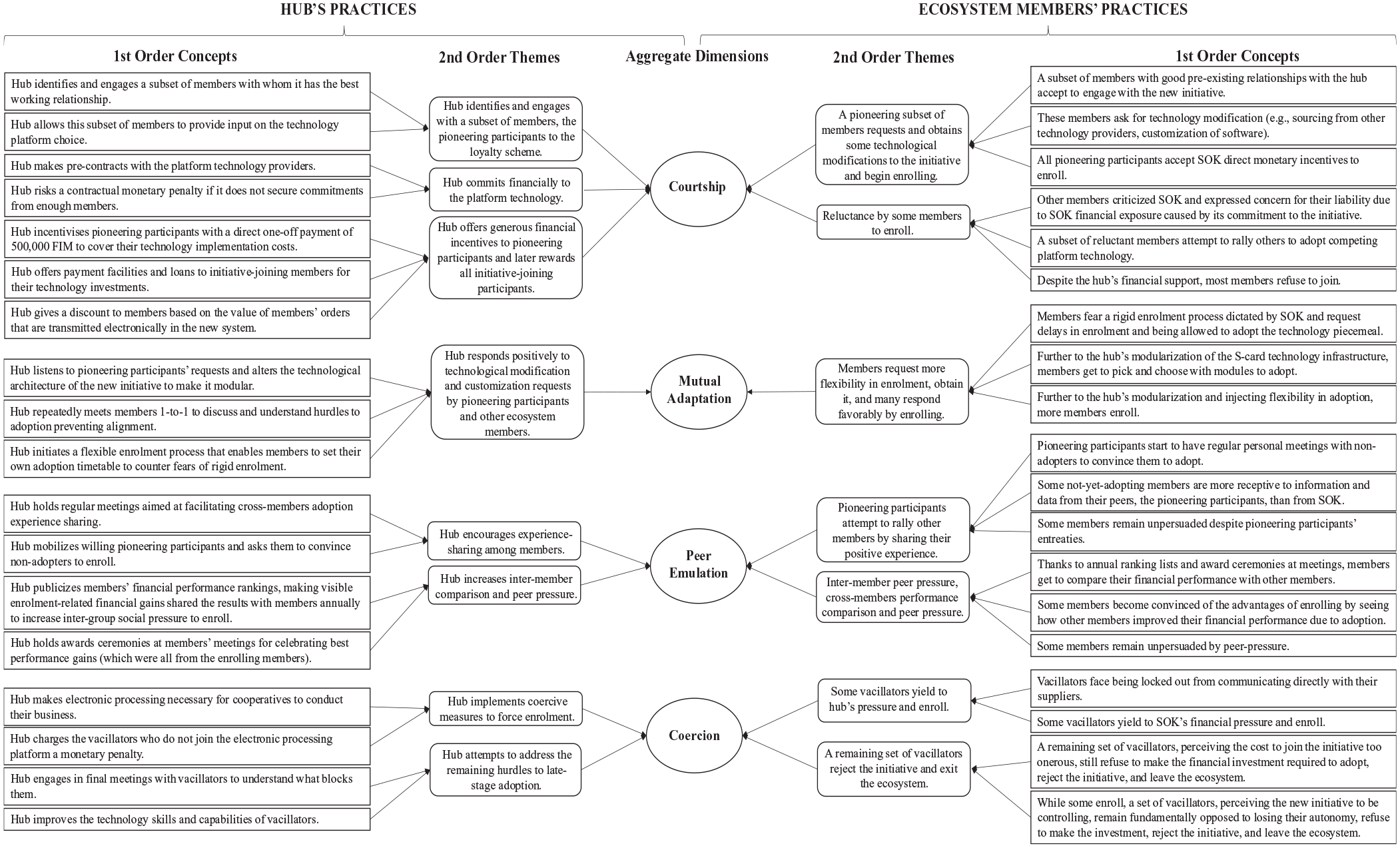
Data Structure
Findings
Our study explored alignment mechanisms in mature ecosystems. For our research question, we asked what the processes are through which an ecosystem hub enrolls existing ecosystem members to align with an ecosystem-wide initiative that updates the ecosystem’s value proposition. We found that four kinds of alignment practices and mechanisms were central to the process: (1)
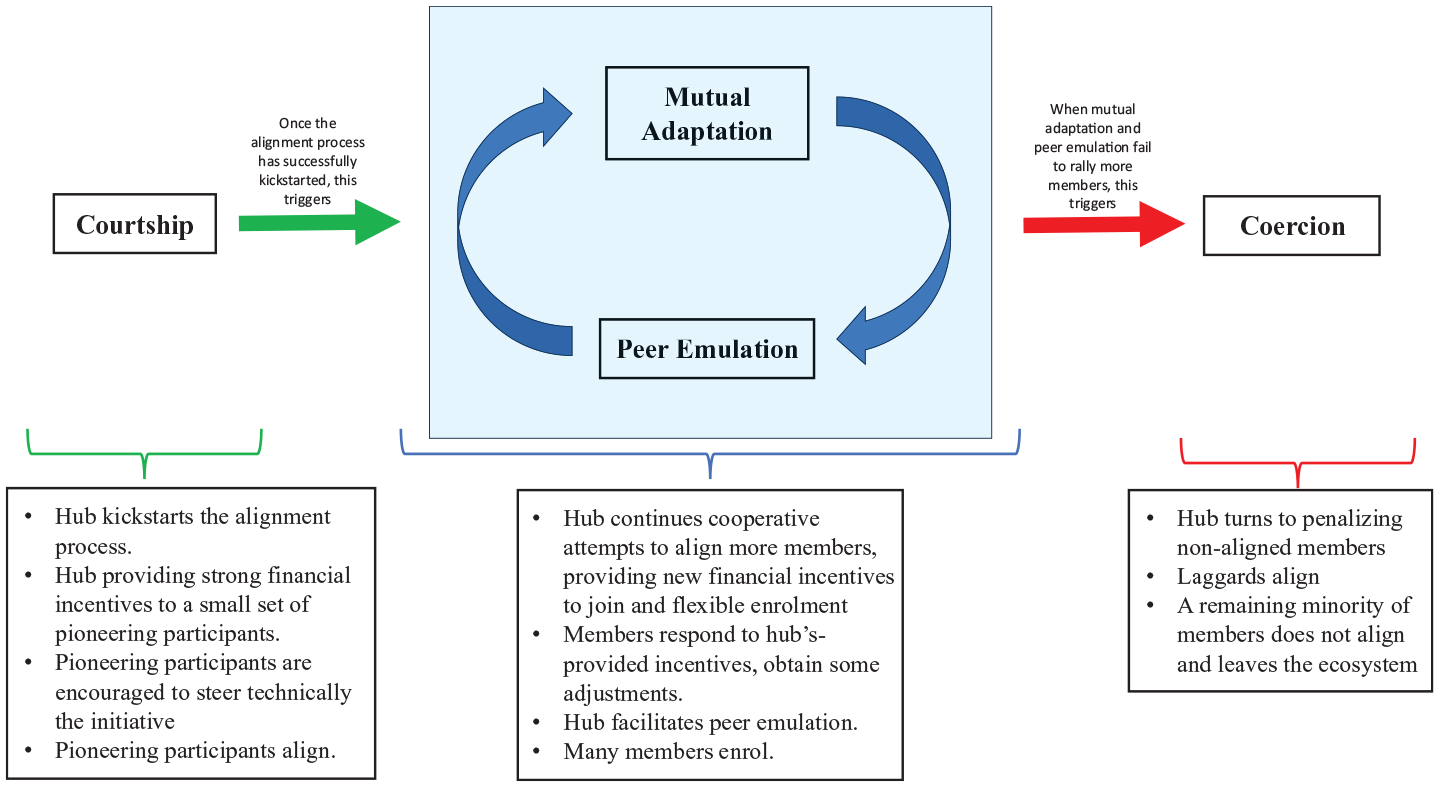
A Process Model of Mature Ecosystem Alignment
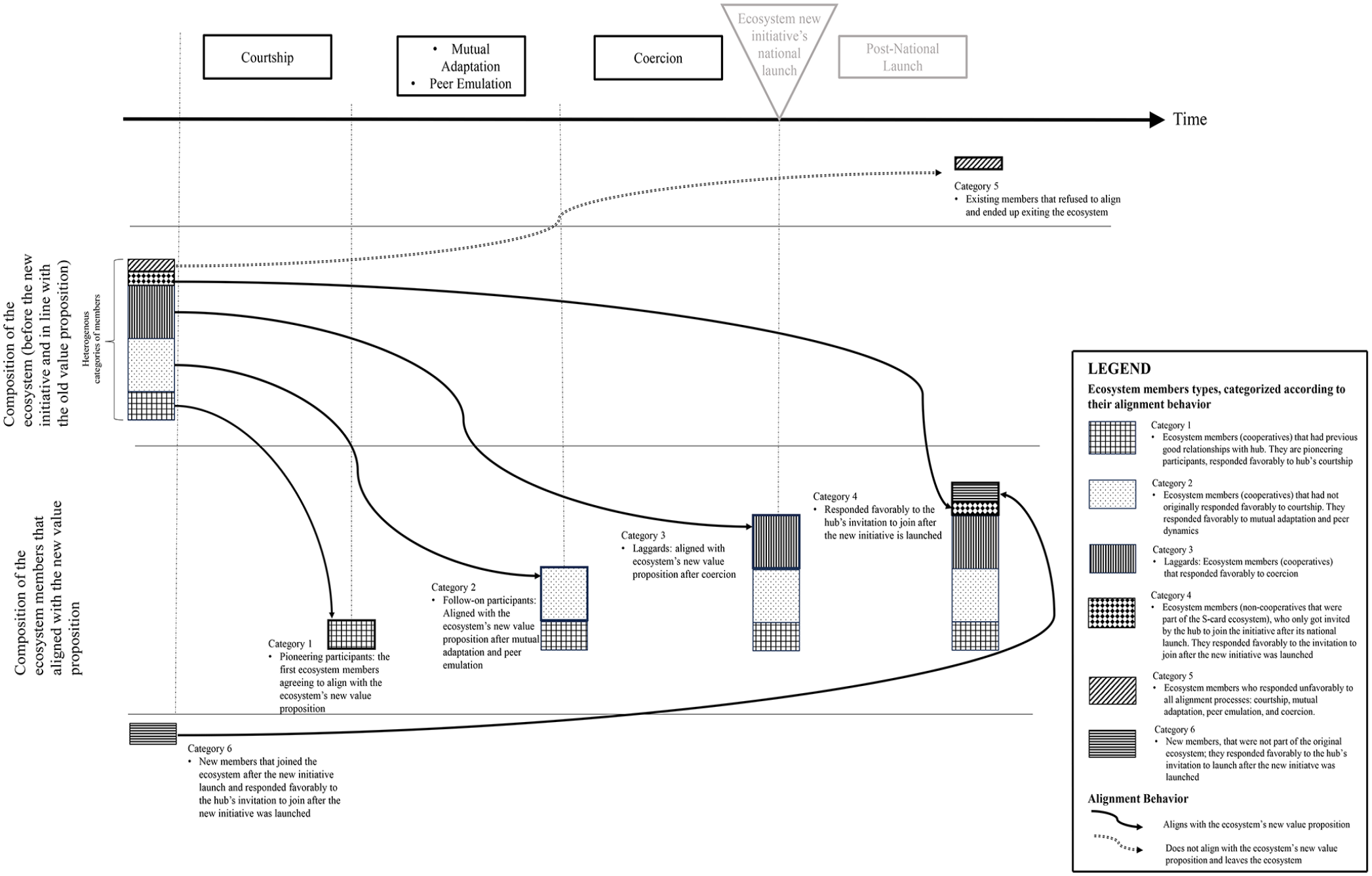
Timeline for the SOK Ecosystem Alignment
During Courtship, the hub begins the alignment process by devising specific, compelling incentives that support members’ alignment with the updated value proposition. It focuses its early efforts on a small group of willing participants with whom it has previously enjoyed strong positive relationships. Once these measures have convinced a core group of pioneering members, more members begin to join, while others remain unconvinced. Once this phase has successfully kickstarted alignment, the second phase begins, comprising Mutual Adaption and Peer Emulation in parallel. In Mutual Adaptation, the hub responds to feedback from pioneering members by adapting its proposed offering, altering the architecture of the technological infrastructure underpinning the new initiative, and making enrolment modalities more flexible. Additional members respond favorably to the hub’s accommodation and decide to join. In parallel, Peer Emulation occurs when ecosystem members begin engaging in peer comparison (in situations facilitated by the hub), thus becoming incentivized to join by observing their already-joined peers’ enhanced performance and comparing it with their own. While these practices drive further members’ adoption and alignment, some holdouts are still unconvinced. Once the first three sets of practices no longer provide any further alignment, the final practice, Coercion, kicks in. Here, the hub takes a more aggressive approach to push the remaining vacillators to enroll, including introducing a financial penalty for not joining. While this converts some more members, it still fails to convince a handful of die-hards, who remain entrenched in their refusal to align and end up leaving the ecosystem altogether.
We find that each set of practices has a differentiated effect on the population of ecosystem members, aligning some members but leaving others unconvinced. Nevertheless, the overall effect is cumulative, and the number of aligned members grows at each stage. Moreover, the alignment practices were not pre-planned; SOK discovered and experimented with them as the process went along. For example, the hub only resorted to Coercion when previous practices had run their course and were no longer inducing further enrolment. As a senior SOK director explained, “At SOK, there was no prior experience of a similarly extensive and multifaceted [alignment process] [. . .]. Strong incentives were used to kickstart the process. From then on, there were only rough guidelines [. . .]. New practices were introduced when onboarding new members had become more difficult and slower with the existing practices.”
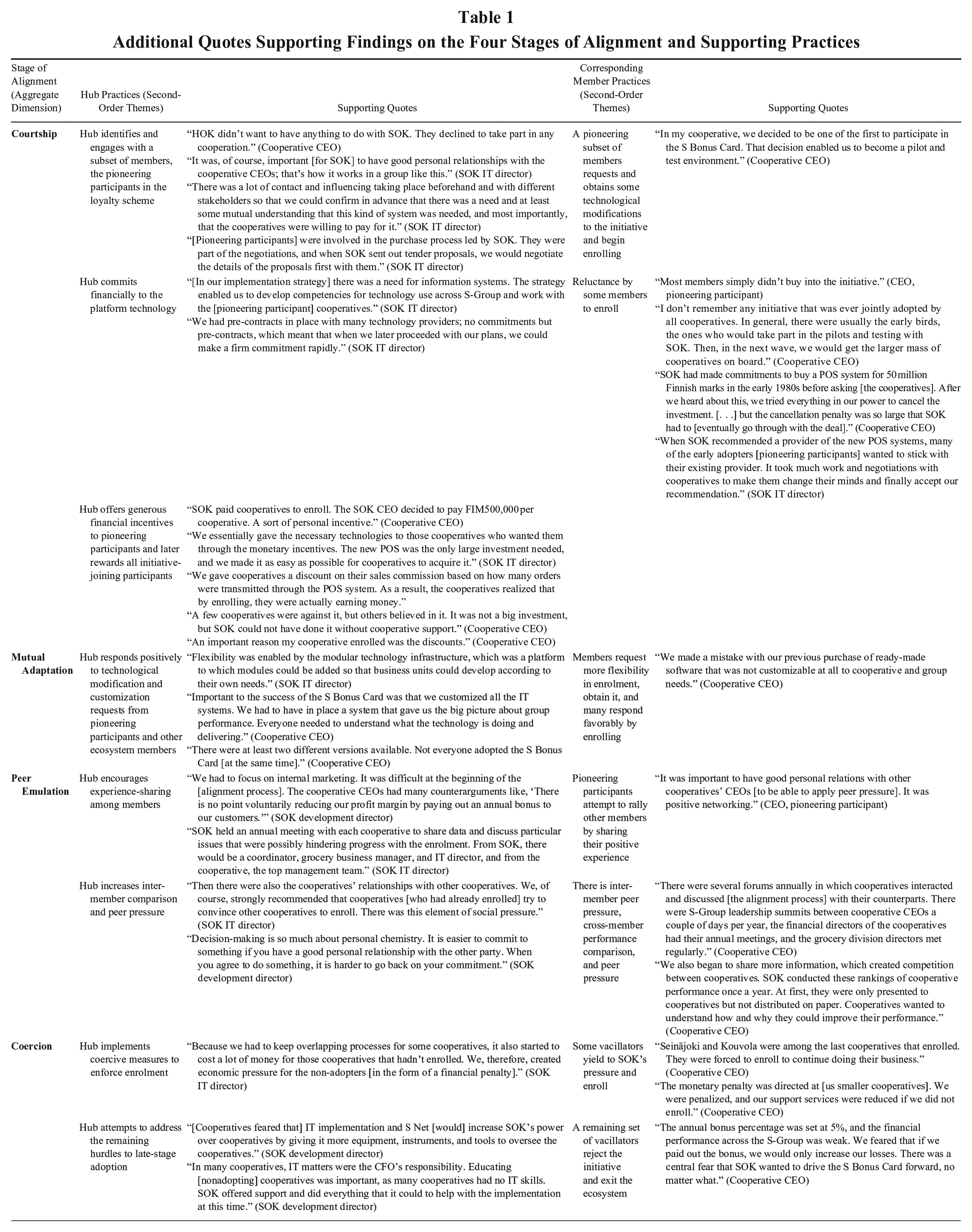
We now describe the central practices involved in the ecosystem alignment process, outlining the hub practices and the corresponding ecosystem members’ practices. We illustrate our narrative with selected quotations from our semi-structured interviews and reference the biographical accounts, archival documents, and public records. Additional interview quotations supporting and triangulating our findings are presented in Table 1.
Additional Quotes Supporting Findings on the Four Stages of Alignment and Supporting Practices
Courtship
Courtship takes place at the onset of the alignment process, when the hub starts by focusing on a small group of more willing, pioneering participants. The hub devises incentives that support members’ alignment to the updated value proposition, which persuade some members to join while leaving others unconvinced.
We identified three categories of practices for the hub and two for the members. The hub practices were: (1) Hub identifies and engages with a subset of members, the pioneering participants to the loyalty scheme; (2) Hub commits financially to the platform technology; and (3) Hub offers generous financial incentives to pioneering participants and later rewards all initiative-joining participants. The corresponding members’ practices were: (1) A pioneering subset of members requests and obtains some technological modifications to the initiative and begin enrolling; and (2) Reluctance of some members to enroll. We now describe these practices in more detail.
Hub Identifies and Engages with a Subset of Members, the Pioneering Participants of the Loyalty Scheme
Hub practices
We group the hub practices of this stage into two categories: (1) Hub identifies and engages a subset of members with whom it has the best working relationship; and (2) Hub allows this subset of members to provide input on the choice of technology platform.
SOK decided to kickstart the enrolment process by inviting a subset of eight cooperatives with whom it had excellent interorganizational relationships based on personal relationships (internal company document, 1990) to enroll in the initiatives (SOK annual report, 1988). All eight of these cooperatives agreed to become pioneering participants. The hub hoped that these “pioneers” would help SOK appeal to the larger group, because its relationships with many ecosystem members were relatively poor at the time (biographical accounts). For example, many major cooperatives, such as HOK from Helsinki, had virtually no relationship with SOK and did not participate in any SOK-led initiatives. As an SOK IT director admitted, “We had a fairly good relationship with around one-third of the cooperatives. The others did whatever they wanted to do. We had no tools available to influence them at the time.”
SOK was confident that by selecting the largest and most influential cooperatives as pioneering participants, it was more likely to succeed in its alignment efforts (biographical accounts). For example, one cooperative CEO, who dubbed himself as belonging to a group of three to four very large and influential cooperatives, stated that “everyone knew that if we were on board with an initiative, they should talk to us about how to convince other cooperatives to get on board as well.”
Therefore, selecting the pioneers was reasonably straightforward. That subset also acted as a signal to other cooperatives that SOK was making progress with its alignment efforts, which added credibility to the initiative. Furthermore, the pioneers could be mobilized to convince the CEOs of other cooperatives that there was a need for the S Bonus Card and that it would be a good fit with members’ individual business activities (Tammitie, 2007). SOK also motivated the pioneers by allowing them to influence and steer the development of the initiative. As an SOK director remarked, all progress in the alignment process was intended to be “driven forward by the pioneering participants.” In practice, a few of the largest cooperatives recruited by SOK as pioneers ended up having a significant say on technology issues related to enrolment.
Ecosystem members’ corresponding practices
We identified the following sets of corresponding member practices: (1) A subset of members with good preexisting relationships with the hub accept to engage with the new initiative; and (2) these members request technology modifications (e.g., sourcing from other technology providers, customization of software).
In the late 1980s, the eight pioneering participant cooperatives formed the pilot environment for the S Bonus Card (SOK annual report, 1988). Their managers had frequently participated in SOK-led development projects and had good personal relationships with SOK, and once enrolled, they began to co-develop the initiative with SOK by getting involved in planning and piloting (biographical account).
Furthermore, feedback from some pioneering participants led to some measurable modifications to the initiative. For example, the pioneers asked SOK to clarify the roles and responsibilities of both SOK and the cooperatives in running the S Bonus Card and discussed the associated technology infrastructure (biographical accounts). SOK agreed to many of the suggested modifications.
Overall, joining the initiative was seen as a considerable investment of resources; this simultaneously motivated the pioneering participants both to co-develop the initiative and to suggest changes to it. Also, pioneers immediately began trying to convince the remaining cooperatives to enroll, and helped modify the original SOK-led plans to make them more appealing to the broader group dynamics.
Hub Commits Financially to the Platform Technology
The second form of Courtship refers to practices in which the hub made an upfront financial commitment before any corresponding commitments from members had been secured.
Hub practices
We can group the kinds of practices we found into two categories: (1) Hub agrees pre-contracts with platform technology providers, and (2) Hub risks a contractual monetary penalty if it does not secure commitments from enough members.
The decision to implement the S Bonus Card prompted SOK to begin investing in the technologies needed to facilitate the adoption of the initiative. For example, SOK’s initial analysis showed that a new IT infrastructure was a core requirement for sharing shopping transaction data with SOK and the automated calculation of customer points and bonus accruals (internal archival document, 1990). As the cooperatives mainly operated grocery retail chains, the quantity and frequency of transactions made it impossible to calculate the accrued bonus manually. Therefore, SOK had to draft a more specific implementation strategy for the S Bonus Card, centering on IT investments. This strategy laid the foundation for driving the alignment of ecosystem members.
After discussions with some pioneering participants, SOK began visiting most cooperatives to understand their current IT needs and usage. SOK needed a record of the technology investments that the cooperatives had made over time, as well as the expected lifecycles of each technology (internal archival document, 1982). With so many members in the ecosystem, there were marked differences in the types of technology used by, say, each finance division: “Because there were, at the time, 200 cooperatives, there were also 180 different types of information systems in place” (SOK IT director).
SOK also gathered information about available and upcoming technologies and attended trade shows and seminars hosted by global IT providers such as Nokia and IBM (biographical accounts). SOK recommended technologies to members and then negotiated and agreed pre-contracts with IT providers that would enable a quick decision to purchase later on once enough members were aligned and deployment was ready to start (internal archival document, 1990).
One critical technology was a new point-of-sale (POS) system that would transmit transaction data to a central database managed by SOK (internal archival document, 1991). SOK chose Nokia to provide this system. However, as Nokia required a firm commitment before it would modify the technologies in line with the group’s needs, SOK decided to make initial out-of-pocket investments in the system even before any commitment or financing from members had been secured (biographical accounts). The contract with Nokia carried a hefty financial penalty clause that would be triggered if the contract were to be cancelled later (which would be inevitable if SOK failed to recruit enough members to the scheme). As an SOK CEO explained, “SOK had to commit to making the initial investment on behalf of the cooperatives.”
Ecosystem members’ corresponding practices
We identified the following sets of member practices: (1) Other members criticize SOK and express concern for their own liability due to SOK’s financial exposure caused by its commitment to the initiative; and (2) a subset of reluctant members attempts to rally others to adopt competing platform technology.
Although SOK proposed to spearhead the adoption of the S Bonus Card by pre-contracting with technology vendors, in practice, it had neither the internal resources nor the external financing to make the necessary investments. Effectively, SOK was taking a gamble that cooperatives would eventually align and invest in the initiative. “I remember well one instance when SOK had to make a technology investment, but they did not have the budget,” recalled one cooperative CEO. “They asked for commitments from cooperatives.”
Although SOK’s financial commitments induced a subset of members to join out of a sense of responsibility, the financial penalties enshrined in the pre-contracts also provoked some resistance. Moreover, although many of the technical modifications proposed by the members were implemented, some disagreements remained. For example, some competing groups of members tried to undermine the hub’s alignment efforts by attempting to rally members around rival technologies to Nokia’s (biographical accounts). This obliged SOK to spend time and effort in meetings, seminars, and negotiations to convince members to support their recommendations.
Hub Offers Generous Financial Incentives to Pioneering Participants and Later Rewards All Initiative-Joining Participants
The third form of Courtship refers to practices through which the hub creates various monetary incentives for members.
Hub practices
We can group the practices we found into three categories: (1) Hub incentivizes pioneering participants with a direct one-off payment of 500,000 FIM to cover their technology implementation costs; (2) Hub offers payment facilities and loans to initiative-joining members for their technology investments; and (3) Hub gives a discount to members based on the aggregate value of orders transmitted electronically using the new system.
To kickstart enrolment, SOK offered direct payments to pioneering participants as a financial incentive—essentially, rewards for deciding to enroll. These payments were critical, as there was still no evidence of how members would benefit from the S Bonus Card.
Furthermore, once the eight pioneers were aligned and the initiative was underway, SOK offered loans with open-ended repayment conditions to court other members. These generous loans were designed to facilitate members’ enrolment in that they enabled cooperatives to obtain the new POS systems they needed without bearing the financial risk (internal archival document, 1990). Crucially, members did not have to repay the loans until they were fully using the systems and had realized their benefits. These open-ended conditions were crucial for smaller cooperatives, which otherwise could not afford the substantial investment necessary for immediate enrolment in the S Bonus Card.
Finally, SOK discounted its sales commission for enrolled cooperatives based on the value of the wholesale orders they transmitted to SOK electronically through the new systems (internal archival document, 1990). The idea was that as more members used the POS system to process orders electronically, more individual transactions would be transmitted to SOK, triggering increased monetary gains for the members from the reduced commissions. As each member agreed to enroll, they entered into a formal agreement with SOK that bound them to the technologies necessary to accommodate the S Bonus Card within a set timeframe.
Ecosystem members’ corresponding practices
We identified the following corresponding member practices: (1) All pioneering participants accept SOK direct monetary incentives to enroll; and (2) despite the hub’s financial support, most members refuse to join.
While a subset of members targeted as pioneering participants decided to enroll in the initiative immediately after being mobilized by SOK, few of the other cooperatives did so, partially because of a lack of financial resources. One CEO of a pioneering participant was candid about why the direct payments encouraged alignment: “The financial situation of many cooperatives was poor. That was a barrier to enrolment.” Hence, the direct payments incentivized members who had some initial doubts although they had been targeted as pioneering participants, enabling them to enroll. As an SOK development director explained, although many of those members were sympathetic to SOK’s appeals, “they had no money actually to commit to them.”
SOK hoped that the loans and discounts it offered later on would have similar effects in driving alignment among nonenrolled members. As one cooperative CEO noted, the enabler here was “psychological” because some members did not fully appreciate the (long-term) economic impact of the proposed information technologies on the cooperatives’ bottom line. Beyond customer-centric initiatives, once cooperatives committed to the S Bonus Card and its associated information systems, their productivity would improve because the manual work of processing orders and sharing POS data with SOK would no longer be required. This would have a positive effect on the group’s overall productivity (internal archival document, 1991).
Despite the offer of financial support, however, most members still refused to enroll in the initiative, discouraged by the major financial and resource-intensive commitment required. This reluctance prompted the hub to devise further practices to induce enrollment.
Mutual Adaptation
This set of practices concerns the process of mutual adaption between the hub and ecosystem members. Here, we identified one category of practices for the hub and one for the members. The hub responded positively to requests for technological modification and customization from pioneering participants and other ecosystem members, while the members requested and obtained more flexibility in enrolment, which led many to respond favorably by enrolling.
Hub Responds Positively to Technological Modification and Customization Requests from Pioneering Participants and Other Ecosystem Members
Hub practices
We can group the kinds of practices we found into three categories: (1) Hub listens to pioneering participants’ requests and alters the technological architecture of the new initiative to make it modular; (2) Hub repeatedly meets members one-to-one to discuss and understand hurdles to adoption preventing alignment; and (3) Hub initiates a flexible enrolment process that enables members to set their own adoption timetable to counter fears of rigid enrolment.
To further advance the alignment process, SOK invited the already-enrolled pioneering participants to take part in codeveloping the initiative and held frequent meetings with them. Heaving heard their feedback, SOK looked to assuage fears and tensions surrounding the S Bonus Card. An SOK IT director stated that a motivation for codevelopment was that “throughout the early 1990s, cooperatives were wary of everything we suggested at SOK.”
Furthermore, SOK organized several meetings with various nonenrolled members to understand the obstacles to alignment. A development director described these meetings as “member-specific,” meaning that SOK met individual cooperatives on a one-to-one basis to try and understand the distinct hurdles they faced. Listening carefully to pioneering participants’ feedback, SOK discovered that a major impediment for several members was the rigid enrolment process initially enforced by SOK. SOK changed its strategy by redesigning the S Bonus Card’s technological infrastructure to make it more flexible and modular. SOK also addressed a significant concern from nonenrolled members about SOK’s ability to dictate how members enrolled in the initiative (biographical accounts).
The newly modular technological infrastructure meant that new members could now enroll in one module at a time, or pick and choose which modules to adopt, and did not have to make a costly one-off investment in the technologies. Flexibility in adoption thus became a fundamental principle of the enrolment process (internal archival document, 1991).
In the words of an SOK IT director, modularity meant that “the architecture had to be both flexible and cost-efficient” and had to function as a “joint platform incorporating modules that business units could develop according to their own needs.” For example, separate modules were introduced for (1) chain and service management; (2) purchasing and logistics; (3) CRM; (4) finance; and (5) HR (internal archival document, 1991). Modularity also meant that the information system functioned as a “shared platform,” which an SOK IT director described as a “frontrunner” at the time.
Ecosystem members’ corresponding practices
We can group the kinds of practices we found into three categories: (1) Members fear a rigid enrolment process dictated by SOK and request delays in enrolment and being allowed to adopt the technology piecemeal; (2) further to the hub’s modularization of the S Bonus Card technology infrastructure, members can pick and choose which modules to adopt; and (3) further to the hub’s modularization and injecting flexibility into adoption, more members enroll.
Disagreements over the enrolment process were major impediments to enrolment. Members who had not yet enrolled feared that SOK would dictate the enrolment process and that cooperatives would have no leeway over which initiatives to implement or how they could do so (biographical accounts). This issue was further aggravated by the considerable variation in the size of cooperatives, depending on whether they were located in the high-density south of Finland or the more sparsely populated north (Tammitie, 2007).
To counter these fears, members pressed SOK for increased flexibility in enrolment. This led to the adoption of a modular design that, among other things, allowed members to ask SOK to design customized modules for their individual needs (internal archival document, 1991). In addition, although SOK had initially envisioned a relatively straightforward enrolment process, it responded to members’ concerns by building in more flexibility, allowing each member to enroll at their own pace. As an SOK IT director explained: “Most took around four to five years to enroll, but we allowed some to take up to 10 years.”
In addition to these fears over the rigidity of the enrolment process, another critical issue preventing alignment was concern about the centralized control that the S Bonus Card would introduce (Tammitie, 2007). Many members still saw the initiatives as a way for SOK to tighten its grip on cooperatives. For example, in the initial plans proposed during the late 1980s, SOK would oversee all customer data for the group and have complete control over the technological infrastructure (internal archival document, 1988). Cooperatives pushed back, calling for more flexibility. As one cooperative CEO explained: “The initiatives [proposed by SOK] did not support the cooperatives’ [core grocery retailing business]; the aim was quite the reverse, actually.”
The added flexibility in the adoption timetable countered members’ fears of rigid enrolment and this, in turn, encouraged several members to join.
Peer Emulation
Peer Emulation describes a set of practices in which ecosystem members engage in peer comparisons (in situations facilitated by the hub). Their observation of participatory peers’ enhanced performance incentivizes them to join the initiative. Earlier, SOK had made financial investments in the courtship phase; now the focus was on leveraging the momentum it had gained. Peer Emulation practices inspired another wave of members to adopt and align, but still left a significant proportion of members unwilling to join in.
We identified two categories of practices for the hub and two categories of corresponding practices for the members. The hub practices were: (1) Hub encourages experience-sharing among members; and (2) Hub increases inter-member comparison and peer pressure. The corresponding members’ practices were: (1) Pioneering participants attempt to rally other members by sharing their positive experience; and (2) there is inter member peer pressure, cross-member performance comparison, and peer pressure.
Hub Encourages Experience-Sharing Among Members
In this practice, the hub encouraged or engineered the active sharing of experiences across the group.
Hub practices
We can group the kinds of practices we found into two categories: (1) Hub holds regular meetings aimed at facilitating aligned members to share their experiences of the initiative; and (2) Hub mobilizes willing pioneering participants and asks them to convince nonadopters to enroll.
SOK actively aimed to induce mimetic adoption behaviors by encouraging data-sharing between members. As an SOK IT director emphasized, SOK needed to “show that the chosen path was working well and that the initiatives were piece by piece working better and better.” Also, by visiting cooperatives and sharing data, SOK was able to nurture personal relationships with the CEOs of many cooperatives (biographical accounts).
These practices were carried out primarily through annual workshops with the cooperatives’ CEOs, which began in the early 1990s and were held for several years until the end of the alignment process. An SOK development director described these events as effectively ecosystem-wide sales workshops, in which several SOK senior managers gave a series of speeches designed to pitch the system and persuade nonenrollers to commit to the program (internal company document, 1994). In practice, these workshops were targeted primarily at the recalcitrant members. Although one cooperative CEO described how “SOK often visited our cooperative at this time, and we always welcomed them with open arms,” other cooperatives were less positive (biographical accounts). For example, an SOK IT director described how “in some cooperatives, the whole top management team and the CEO were present, around 10 people, and in others, we didn’t meet the CEO at all, or only the CFO was present, and we had to come back again to meet with the right people.”
SOK also actively applied social pressure and cross-member dynamics to encourage enrolment in the S Bonus Card. Inter-member recommendations were made in various meetings, seminars, and workshops led by the pioneering participants and later by other enrolled members.
Ecosystem members’ corresponding practices
We identified the following sets of corresponding member practices: (1) Pioneering participants start to have regular personal meetings with nonadopters to convince them to adopt; (2) some not-yet-adopting members are more receptive to information and data from their peers, the pioneering participants, than from SOK; and (3) some members remain unpersuaded despite pioneering participants’ entreaties.
During the workshops, the pioneering participants shared their experiences and the positive financial impact of joining the initiative with other members. They provided evidence that the initiative was working well, which encouraged other members to enroll. For example, members quickly recognized that the S Bonus Card enhanced customer loyalty. However, data sharing helped to confirm that there was more to the initiatives than the card: They would also help cooperatives optimize efficiency across all their business activities (biographical accounts). Early on, SOK estimated that cooperatives could increase their productivity by up to 2.5% by enrolling (internal archival document, 1991). One cooperative CEO recalled how impressed his management team was with how quickly the concrete benefits of enrolling appeared. Another explained that once his cooperative had received the new POS system and implemented the S Bonus Card, he immediately “realized that the initiatives [were] working as promised.”
In addition to the workshops, pioneering participants tried to encourage enrolment through talks with other cooperative managers with whom they had good personal relationships, attempting to rally them to adopt the initiatives. An SOK development director described these as “seminars in which pioneering participants discussed the benefits of aligning with their counterparts in other cooperatives.”
Hub Increases Inter member Comparison and Peer Pressure
Here, we refer to the practices through which pressure was applied on members who remained steadfastly nonaligned.
Hub practices
We can group the kinds of practices we found into two categories: (1) Hub publicizes members’ financial performance rankings, increasing intergroup social pressure to enroll by showcasing the financial gains obtained from the initiative; and (2) Hub holds awards ceremonies to celebrate the best performance gains (all from enrolling members).
In the early 1990s, as more data on member performance became available, SOK began comparing and ranking cooperatives, creating a league table based on financial performance (biographical accounts). The data shared by SOK also prompted cooperative CEOs to share best practices for enhancing employee productivity (internal archival document, 1994) and gave nonadopters concrete evidence of the productivity gains some members had achieved.
Later, this ranking of cooperatives became a comprehensive performance evaluation—a balanced scorecard—that relied on a wide range of performance metrics. SOK regularly communicated the rankings to the regional cooperatives’ senior managers and administrative council members. An annual award was established for the best-performing cooperative. As an SOK regional director explained, “We needed a more widespread analysis [. . .] and we developed a strategic situation analysis of the cooperatives. We had more metrics, and we included market performance, market share, amount of investments with regard to turnover, and strategic ability.”
Ecosystem members’ corresponding practices
We identified the following sets of corresponding member practices: (1) Thanks to the annual rankings and award ceremonies, members get to compare their financial performance with other members; (2) some members become convinced of the advantages of enrolling by seeing how other members’ improved financial performance was linked to adoption; and (3) some members remain unpersuaded by the peer pressure.
Besides inter member peer pressure, early adopters indirectly influenced nonadopters by sharing financial data, primarily in the various SOK-organized forums and seminars (internal archival document, 1994). Crucially, these events brought the CEOs together, enabling them to openly discuss their fears and concerns and share information (biographical accounts).
Ranking cooperatives and recognizing their achievements also instituted a new practice of actively sharing data across S-Group. Slowly, data and performance measurement began to confer a competitive advantage on the group, distinguishing it from its main competitors, whose investments in IT were years behind SOK’s (internal archival document, 1994).
The increase in data sharing sparked cooperative CEOs’ interest in data and data analytics (Tammitie, 2007). Now that cooperatives could benchmark their performance against their peers’, an element of competition emerged as they vied to outperform others in key financial metrics. As one cooperative CEO recalled, “We, as CEOs, were interested in how well we performed in different metrics—efficiency, gross margin, net income, everything. Of course, we wanted to be higher and higher [up the league table]. It created healthy competition.”
The increasing leveraging of peer dynamics led to what an SOK development director called a “majority of members” enrolling at this stage. For these members, the improved financial performance linked to adoption clinched the deal. Other members, however, remained unpersuaded and still refused to enroll—often due to their continued distrust of the hub.
Coercion
In the Coercion set of practices, the hub switched to a more aggressive approach, pushing the remaining vacillators to enroll through measures such as a monetary penalty for not joining. These practices introduced a fundamentally new way to manage relationships within the ecosystem, breaking the prevalent tradition of collaborative relationships and establishing new practices in what had previously been a repertoire of stable, mostly collaborative social interaction routines. One cooperative CEO described this as a “new situation” for the cooperative that was seen “as a big challenge” because of its divisive effects on the ecosystem. While coercion did lead some more members to align by joining the initiative, a few remained unconvinced—and furthermore, their sense of belonging and loyalty to the ecosystem was weakened by these new developments. We observed that these members ended up exiting the ecosystem altogether.
In this final stage, SOK changed the rules of engagement and demanded that cooperative members make a decision on their enrolment. SOK perceived this change of tone as necessary, as nonadopters were now slowing down the efficiency gains that enrolled members could capture from the initiative. SOK, therefore, exerted pressure on the holdouts so that the alignment process could be extended across the entire country. We identified two categories of practices for the hub and two categories of member practices during the Coercion phase. The hub practices were: (1) Hub implements coercive measures to force enrolment; and (2) Hub attempts to address the remaining hurdles to late-stage adoption. The corresponding members’ practices were: (1) Some vacillators yield to SOK’s pressure and enroll; and (2) a remaining set of vacillators reject the initiative and exit the ecosystem.
Hub Implements Coercive Measures to Enforce Enrollment
The first set of coercive practices relates to the hub compelling members to make a final decision about alignment.
Hub practices
We can group the practices we found into two categories: (1) Hub makes electronic order processing mandatory for cooperatives to do business; and (2) Hub imposes a financial penalty on those vacillators who have not yet joined the electronic processing platform.
Specifically targeting late adopters, SOK introduced compulsory electronic order processing. This meant that all orders between members and suppliers could only be processed via the S Net platform (biographical accounts). Before the introduction of S Net, both SOK and the cooperatives could order directly from suppliers—but since the beginning of the S Card initiative, S Net had gradually become the primary channel for order processing, with SOK acting as intermediary. While most cooperatives had joined S Net by the end of the Peer-Emulation phase, a few had still not invested in the POS system they needed in order to use S Net.
Making S Net compulsory had a direct influence on S Bonus Card enrollment, because once cooperatives were linked to S Net, joining the card was practically free. As an SOK development director explained, “Automating our billing and order flow was a critical step. It helped to attract more cooperatives on board the S Bonus Card.”
SOK also introduced a financial penalty for late adoption of the S Bonus card, imposing a new rule that members who had not yet enrolled would have to start paying for any additional manual processes required. Up until then, nonadopters had continued processing orders in the old way: cooperatives ordered products via telephone from SOK, with SOK billing cooperatives for the products, and each part of the value chain took a commission from the transaction (biographical accounts). Now, the costs of maintaining the old processes in parallel with the new ones were mounting up, and SOK was no longer willing to cover them.
Ecosystem members’ corresponding practices
We identified the following sets of member practices: (1) Vacillators face being locked out from communicating directly with their suppliers; and (2) vacillators yield to SOK’s financial pressure and enroll.
An SOK IT director described the tension between SOK and the vacillators during the mid-1990s as “coercive,” as SOK aimed to convince the remaining holdouts by any means necessary. By this stage, SOK’s implementation of compulsory electronic ordering meant that those cooperatives that had still not invested in the new POS and the S Bonus Card were locked out from communicating directly with suppliers. Faced with the loss of ecosystem membership, which they regarded as essential, some vacillators now yielded to pressure and joined the initiative.
As described above, SOK had also begun to charge nonenrollers for the costs of running overlapping IT processes. As the number of nonadopters dwindled, so the cost per individual nonadopter increased. Members’ perception of this monetary penalty was polarized: while nonadopters naturally resented it, those who had already enrolled saw it as a positive development, because it meant that nonenrolment costs would be borne by the nonadopters themselves rather than shared across the group. Smaller and poorer cooperatives felt the financial penalty most acutely, but overall, most members understood that these changes were necessary to unleash the initiative’s full potential (biographical accounts).
Hub Attempts to Address the Remaining Hurdles to Late-Stage Adoption
At the same time, the hub continued to pressurize late adopters by attempting to enhance their technological skills while accommodating any remaining concerns about alignment.
Hub practices
We can group the kinds of practices we found into two categories: (1) Hub engages in final meetings with vacillators to understand what is blocking them from enrolling; and (2) Hub improves the technology skills and capabilities of vacillators.
In 1995, SOK decided to focus specifically on late adopters and make it clear to them that adopting the S Bonus Card was a priority for the group’s future (annual report, 1995). An SOK development director, for example, stated that “it was critical by now that all members would have enrolled in the initiatives as a unified front.” But many nonadopters could not shake the fear that the S Bonus Card would strengthen SOK’s centralized control, giving it a larger role in the cooperatives’ decision-making and making it more likely to ignore members’ local interests (biographical accounts). Overall, late adopters feared the so-called “one cooperative model”—a term that had appeared in several internal SOK presentations and documents as part of a plan for launching national retail activities. Although the group’s customer-facing businesses in Finland were all operated by fully independent cooperatives, the situation differed in Russia and the Baltics, where SOK itself ran customer-facing businesses (Tammitie, 2007). In addition, cooperatives knew that SOK managers were discussing the possibility of SOK being listed on the Helsinki Stock Exchange, which would have implications for the group’s future (biographical accounts).
Towards the end of the alignment process, SOK also put effort into reinforcing late adopters’ technological skills. The schedule for enrolling in the S Bonus Card demanded significant technological expertise, and a lack of technical knowledge would likely cause significant delay. For example, few of the late adopters had a dedicated IT director, so IT matters fell to the CFO instead. Moreover, senior managers rarely had a full understanding of what the initiatives were all about or how they would affect members’ operational performance.
Ecosystem members’ corresponding practices
We identified the following sets of member practices: (1) A remaining group of vacillators, perceiving the cost of joining the initiative as too onerous, still refuse to make the financial investment required to adopt, reject the initiative, and leave the ecosystem; and (2) Another group of vacillators, perceiving SOK as over-controlling and remaining fundamentally opposed to losing their autonomy, refuse to make the investment, reject the initiative, and leave the ecosystem.
Despite the hub’s best efforts, a few remaining cooperatives decided to give up their membership of the ecosystem (SOK annual report, 1995), forgoing all its procurement services, chain concepts, and joint marketing efforts, and operate as independent businesses instead. There were two main reasons why members chose to exit.
First, the financial commitment remained a barrier that smaller cooperatives could not overcome, financial incentives and encouragement notwithstanding. Many cooperatives were loss-making and could not envisage paying customer bonuses from their nonexistent profits. In the mid-1990s, many cooperatives had yet to fully recover from the economic difficulties caused by Finland’s financial crisis at the turn of the decade. SOK realized that there was little it could do to convince these remaining nonadopters.
Second, remaining vacillators perceived the S Bonus Card as symptomatic of a change of management style that fundamentally affected the tenor of the relationships between SOK and the cooperatives, and for some members this became a deal-breaker. By creating a national ecosystem-wide initiative with the S Bonus Card, SOK stoked nonadopters’ fears that it was treading on their toes (biographical accounts). As one cooperative CEO explained: “A continued problem was the perceived shift in power from the cooperatives to SOK. SOK tried to teach the late adopters to see the benefits, [but it was hard].”
The remaining nonadopters’ rationale for nonenrollment primarily related to their distrust of SOK and their unwillingness to commit to the bonus system. Not only would enrolling require an investment that outweighed the financial incentives offered by SOK, but also these members perceived the initiative as representing an unacceptable loss of autonomy, since they would become part of an information network under SOK’s control.
Launch of the Initiative and Alignment of Further Members
Although the S Bonus Card had been used by customers of S-Group’s regional cooperatives since the first individual cooperatives had joined the scheme, the loyalty program was only officially launched nationwide in 1994, once enough members were aligned. After the launch, the initiative was also opened to noncooperative members. As the CEO of SOK at the time explained: “We did not want to invite members outside S-Group to join the initiative before S-Group was adequately on board and before the program had a solid customer base.”
Once every cooperative was either aligned or had exited the ecosystem, the scheme was fully operational. The updated value proposition also attracted new members. For example, a director of Hertz Finland, a car rental service provider, explained: “We hope the customer base of S Bonus Card will provide us with the competitive advantage we need now that new entrants are joining the market.”
We stopped our analysis in 1994 because, by then, the ecosystem’s new value proposition was self-sustaining and running successfully, and the alignment process had attained its goal.
Discussion and Conclusions
This section discusses our theoretical contributions, methodological contributions, and managerial implications before concluding with limitations and avenues for further research.
Theoretical Contributions
The precise characterization of the practices involved in the alignment process in mature ecosystems allows us to make three important contributions to ecosystem theory.
Clarifying the Characteristics and Process of Mature Ecosystem Alignment
The process of ecosystem alignment has hitherto been recognized as essential for ecosystem survival and stability (Shipilov & Gawer, 2020), yet also challenging and risky (Adner, 2017). Ecosystems evolve over time, and their evolution is bound to generate challenges, as their original value proposition will require periodical updating, if only to sustain or regain competitive advantage. Because alignment is so central to ecosystem survival, and because all ecosystems that survive their initial lifecycle stages ultimately mature, the question of understanding how alignment happens in mature ecosystems is vital. Our study contributes to the ecosystem literature by providing novel insights into the process of alignment in mature ecosystems based on an in-depth case study of SOK and its ecosystem.
We have provided what we believe is the first detailed, empirically grounded account of the alignment process in a mature ecosystem. We have identified four sets of practices and associated mechanisms (Courtship, Mutual Adaptation, Peer Emulation, and Coercion) and developed a simple process model of how they unfold and interrelate.
Our process model contributes to the literature on ecosystem evolution and alignment by extending it to include the specificities of mature ecosystem alignment. We show that a main difference between mature and nascent ecosystem alignment processes is that mature ecosystem alignment must deal with the potentially divisive effect of a novel value proposition on existing members’ loyalties and economic incentives.
In nascent ecosystems, the alignment challenge lies in rallying previously unlinked organizations to a new value proposition. In mature ecosystems, meanwhile, alignment becomes an iterative process where each step has a differentiated effect on the population of existing members. At each stage, the process reveals the underlying heterogeneity of members in terms of their preferences for adapting to a new value proposition. While the various practices aimed at aligning existing members do succeed in rallying many of them, each stage sees another group of members refuse to be mobilized or align with the new value proposition. The alignment process is cumulative, with each stage resulting in more members being aligned, so the group of “refuseniks” gradually shrinks—although without ever disappearing entirely. The last subgroup of members who refuse to align ends up leaving the ecosystem.
Mature Ecosystem Alignment as an Iterative Process of Multilateral Interorganizational Influence
Delving deeper into the practices and mechanisms of mature ecosystem alignment, we have shown how the process contains variations in the sequentiality, nature, and origin of each constitutive practice. In terms of variation in sequentiality, we observe that some of the sets of practices occur in sequence, such as when (1) Courtship is followed by a combination of (2) Mutual Adaptation and (3) Peer Emulation, and finally (4) Coercion. However, we also find that (2) Mutual Adaptation and (3) Peer Emulation occur in parallel and reinforce each other.
As for variation in origin, we show that two of these practices (Courtship and Coercion) refer to the hub’s attempts to influence ecosystem members’ behavior directly, while another (Mutual Adaptation) captures the influence of members on SOK and yet another (Peer Emulation) captures members’ influence on each other. We therefore characterize the process of mature ecosystem alignment as an iterative process of multilateral interorganizational influence—one that taps into the abilities of various ecosystem members, including but not limited to the hub, to influence each other. Thus, the process of alignment is far from being unilaterally directed from the hub to ecosystem members, and we highlight the power of members to alter the direction of the evolution of the ecosystem.
Of course, the power of members to influence the hub will depend on a variety of factors, not all of which can be made evident in a single case study. We shall elaborate more on this issue in the subsection on limitations below.
We also contribute to the stream examining the use of formal and relational contracts in ecosystems (Cassou, Cliquet, & Perrigot, 2017; Radziwon, Bogers, & Bilberg, 2017; Williamson & DeMeyer, 2012) by identifying the specific sequence in which the hub applies different incentives throughout the alignment process. Our study emphasizes that applying a series of practices allows the hub to respond to the differing underlying preferences of heterogeneous ecosystem members. We identify several categories of ecosystem members through their responses to the different types of alignment processes instigated by the hub. These heterogeneous categories of ecosystem members react differently to various alignment practices. While some members of S-Group were immediately sensitive to the hub’s financial commitments, others carefully watched their peers’ adaptive behavior before deciding whether to follow the movement. We thus enrich our understanding of the consequences of heterogeneity in ecosystems and its effects on the success of alignment processes (Qin, Wright, & Gao, 2019). Similarly, we provide a more in-depth understanding of the roles and contexts of individual ecosystem members (Khavul & Bruton, 2013). Our findings also identify a holistic, mutually reinforcing set of practices that the hub applies across the three alignment phases; this adds to the incentives (e.g., technical standards and quality) that Wareham et al. (2014) identified. While it is true that the hub designs the incentives used to align members, our findings show that ecosystem members have more say over the progress of the alignment process than has been asserted by previous studies.
Our findings are consistent with well-known examples of how platform hubs alter their behavior toward their members over time. For example, in the early stages of ecosystem alignment, Alphabet and Apple relied on early adopters to generate complementary technologies, products, and services that had to be specifically compatible with the hub firm’s technologies. For Alphabet, this meant attempting to rally Android-compatible device manufacturers as well as Android-compatible software developers (e.g., Koch & Kerschbaum, 2014). Apple, meanwhile, rallied developers of software applications that were compatible with Apple iOS (e.g., Eaton, Elaluf-Calderwood, Sorensen, & Yoo, 2015; Yoo, Boland, Lyytinen, & Majchrzak, 2012). Our findings also show that in the subsequent phases of alignment, hub firms not only adapt to members but also stimulate peer dynamics; this is in line with existing research showing that hubs tend to encourage the members of their developer communities to share knowledge through practices such as annual developer conferences (Foerderer, 2020). We extend and qualify such research in that we suggest that these behaviors are most likely to happen during the second phase.
We also find that once an ecosystem hub has aligned a critical mass of ecosystem members, it becomes more likely to coerce the holdouts who remain. This finding, too, is consistent with recent research on platform leaders’ actions in platform-based ecosystems, such as Gawer (2021), who indicates that platform hub firms’ behavior toward their complementors takes a radical turn (becoming far less cooperative) once the hub attains dominance. Whereas platform leaders tend to prioritize rallying their complementors in the initial phase, when they attempt to build their following (or “side members”) and kick off network effects, they frequently find themselves at odds with their complementors in the second phase, at which point they often resort to coercion. Similarly, in their recent study of mobile apps, crowdfunding, micro-financing, and gaming platform ecosystems, Rietveld, Ploog, and Nieborg (2020) find that as platform firms evolve and become more dominant over time, their ecosystem governance strategies shift to make complementors worse off. Zhu and Liu (2018) find evidence of similar behavior in their study of Amazon’s recent patterns of entry into the product spaces of its third-party sellers: Amazon appears to exploit the data obtained from its Marketplace sellers to identify particularly lucrative product categories, which it then enters itself (as a private label) in direct competition against its third-party sellers (Mattioli, 2020). In November 2020, the European Commission informed the public of its preliminary view that Amazon is in breach of antitrust rules with its treatment of Amazon Marketplace sellers. Similarly, Apple is now in open battle with one of its important complementors, Epic Games, the producers of Fortnite (Statt, 2020). Our study suggests that such an adversarial stance would be unlikely in the early days of the ecosystem.
A Process Propelled by the Tension between the Hub’s Desire for Control and Members’ Desire for Autonomy
Finally, stepping back from individual practices and considering them as a whole, we detect an interesting holistic pattern that leads to our final contribution. We suggest that alignment in mature ecosystems is propelled by the ongoing tension between the hub’s impulse to control and members’ concern about preserving their autonomy. The hub may attempt to align ecosystem members around a new value proposition, but members have agency and can choose not to align. Some tension between hub control and member autonomy is inevitable. However, for the ecosystem to evolve, which is sometimes necessary for its survival, both hub and members must accept and collaborate on a new direction of alignment. Table 2 summarizes the impact of alignment practices on the hub’s control and members’ autonomy.
Impact of Alignment Practices on the Hub’s Control and Members’ Autonomy.
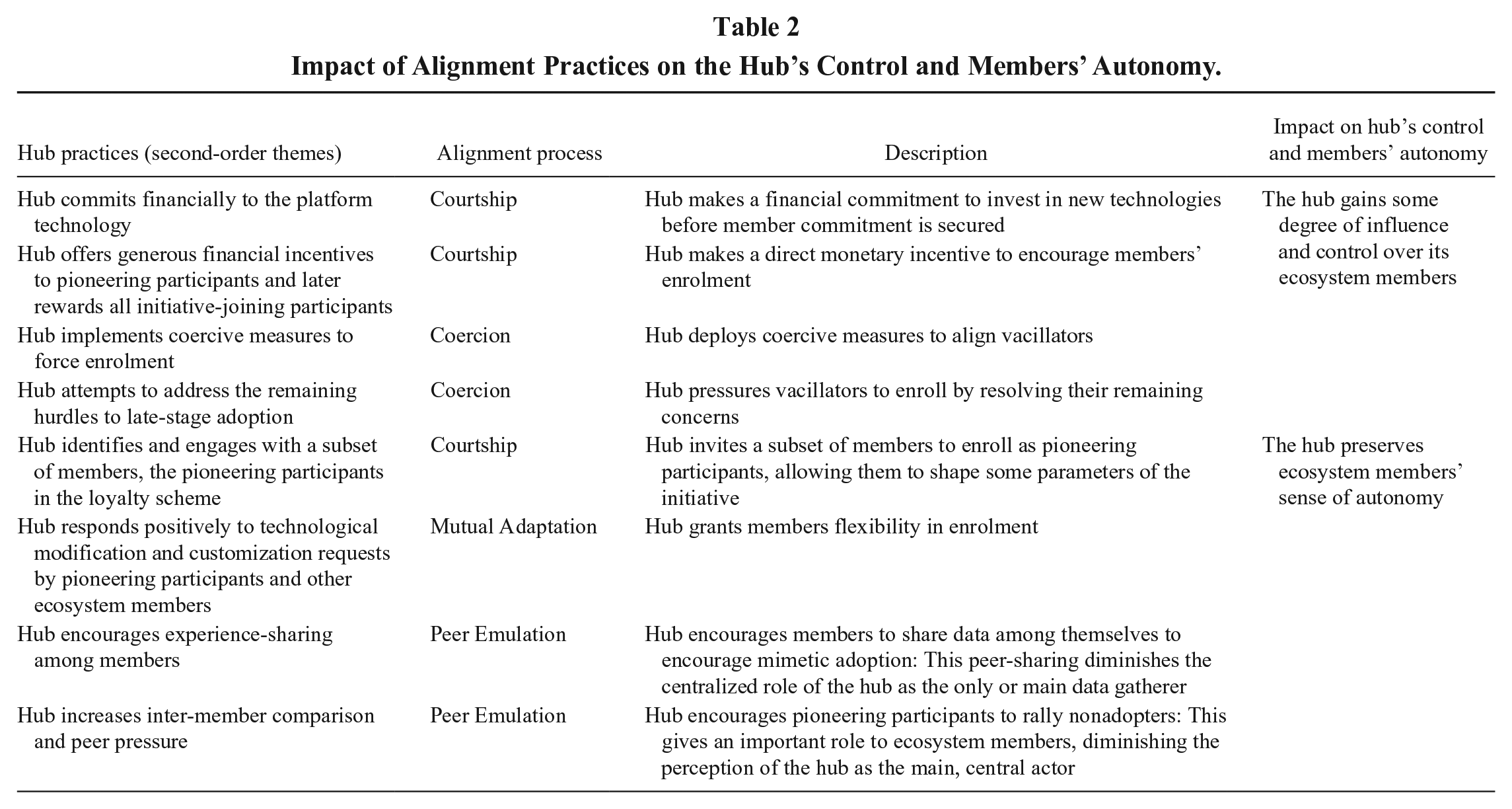
The mature alignment process we describe echoes Hirschmann’s (1970) theory of how agents can react to a decrease in quality offered by an organization to its members (or clients). This theory has also been influential in the development of collective action. In his seminal book, combining insights from economics and political science, Hirschmann (1970) identifies three main options that he calls “exit,” “voice,” and “loyalty.” Our study indicates that all three options are considered and acted upon by various ecosystem members in response to the hub’s attempts to align them to a new, updated value proposition. Some ecosystem members are “loyal”—in our case, these were the early pioneering participants, who expressed their “loyalty” by aligning quickly to the new updated value proposition, agreeing to make program-specific investments (in other words, to have some “skin in the game”), and later even going as far as attempting to rally their peers to align too. This “loyalty” may have been reinforced by the good relationships the pioneers had previously enjoyed with the hub and further enhanced by the generous financial incentives that the hub gave them. Then there are the ecosystem members whose actions echo what Hirschmann calls “voice”: voicing feedback to the hub and negotiating changes to make the alignment more compatible with ecosystem members’ constraints. In our case, the hub consented to alter the technical architecture of the new offering and allow for more flexible enrolment. Finally, Hirschmann’s “exit” expresses the behavior of leaving an organization when it no longer provides enough value. Traditionally, “exit” is associated with market-based actions, since in a well-functioning market, customers can always take their business elsewhere. As mentioned earlier, ecosystem members’ actual scope to exit is probably related to the availability of other options. This, in turn, is associated with whether the hub is a (quasi-)monopolist and whether ecosystem members would incur high costs for exiting or switching—for example, if they have made ecosystem-specific investments that are not redeployable elsewhere. These factors will undoubtedly affect the intensity and duration of the various practices we identified and how they interact. A fuller elaboration of these hypotheses would require further research.
In conclusion, our study has provided a rich and nuanced account of the mature ecosystem alignment process, composed of a set of practices that we identify and describe. The alignment process is cumulative, gradually increasing convergence around the hub, yet also divisive, revealing divergence between the hub and certain members over time. While most members are eventually aligned, others are not, and ultimately exit the ecosystem. Alignment in mature ecosystems, therefore, is best understood as an iterative process of multilateral, multi-agent interorganizational influence.
Methodological Contributions
Our study offers two methodological contributions. First, our study’s design allowed us to observe not only actors who decide to align, but also those who decide not to, and to understand why they do not. These observations are empirically possible because, unlike in nascent ecosystems, where alignment is empirically indistinguishable from previously unidentified actors joining a new community (Hannah & Eisenhardt, 2018), achieving alignment within a mature ecosystem is as much about retaining existing members and encouraging them to adopt the ecosystem’s new value proposition as it is about enrolling new members. Hence, our study of a mature ecosystem reveals not only the members who decide to align to the ecosystem’s updated value proposition but also those who decide that they will no longer align. This yields a novel and richly interesting set of observations that would have been practically impossible to capture in the case of nascent ecosystems.
A second methodological innovation consists in how we recorded and developed our data structure. The practices of alignment we observed are, by essence, relational, in that they not only allowed the hub to influence its ecosystem members but also allowed the ecosystem members to influence the hub, and the ecosystem members to influence each other. Hence, for each practice, we recorded what the hub did and how the ecosystem members responded. We then created a unique data structure that represented all our data side by side. We constructed it in a novel way, with a symmetric aspect that presents not one but two sets of first-order concepts (one for the hub’s practices and one for the ecosystem members’ practices) and two sets of second-order themes. These then join together in the center column of the data structure to reveal the aggregate dimensions that are, in effect, composed of input and data themes that emerge from both sets of practices. We believe that this representation of our data allowed a structure to emerge that was congruent with the reality of the process, without shoe-horning the concepts into a unidirectional structure. Our structure reflects a process that proved to be, essentially, iterative, with multiple influences across various actors—in other words, an iterative process of multilateral, multi-agent interorganizational influence.
Managerial Implications
Our research offers several managerial implications. Our three-phase model forewarns managers that the process of ecosystem alignment is likely to be lengthy and will require careful management over time, as each stage is characterized by unique challenges. Alignment will, therefore, involve a significant resource commitment. In addition, our study suggests that the hub’s practices must be designed to respond to various categories of members’ needs and fears, which will evolve as the stages of alignment unfold. Unlike central authorities in hierarchical systems, ecosystem hubs crucially depend on willing adoption by autonomous members for ecosystem-wide alignment. Hubs must, therefore, devise incentives to achieve this.
Our results also suggest that ecosystem hubs must be careful to recognize and acknowledge members’ desire to maintain a degree of autonomy and invent or adopt practices that protect, sustain, and promote the autonomy of their ecosystem members. Furthermore, our results emphasize the need to identify the bottlenecks and to be highly strategic when targeting alignment practices. In our case, SOK targeted the alignment process solely toward its cooperative members, first because it had a degree of power over them, and second because having them on board guaranteed the customer base necessary for attracting other ecosystem members. Overall, the process of alignment must start with identifying and targeting a subset of willing members in order to get a critical mass on board.
Ecosystem hub managers must acknowledge the inevitable tension and trade-offs between their own desire to control the evolution of the ecosystem and ecosystem members’ desire for autonomy. If hub managers are to align ecosystem members successfully, they must harness this tension for their own ends, navigating a middle way between hierarchical and nonhierarchical governance. Our study suggests that the hub can use different practices that tap into a variety of incentives to encourage ecosystem members to align, either in sequence or in parallel, as the phases of alignment unfold.
Hub managers also need to appreciate that some existing ecosystem members may never align with a new value proposition, and beyond a certain point there are diminishing returns from attempting to rally the “refuseniks.” The managerial challenge is to refrain from bringing in coercive measures too early, as the resulting hardening of the relationship is likely to erode ecosystem members’ loyalty and their willingness to remain members.
Digitally connected ecosystems are becoming more pervasive as the global economy grows more digitalized and interconnected. Many organizations and industries are adopting decentralized and independent organizational forms that coalesce around new technological platforms (Cusumano et al., 2019), such as the mobility and the Internet-of-Things ecosystems. The managerial implications of our study can be readily applied to these digital ecosystems.
Limitations and Avenues for Further Research
Our study is not without limitations, which call for further research. Like all process studies that rely on a single case study, further research is needed to test and validate the process model in other empirical settings, including but not limited to other ecosystems. In particular, one limitation of our single-case study design is that it does not allow us to compare the alignment process we observe with that of another mature ecosystem. One parameter that is likely to affect our results is the degree of competition that the ecosystem hub is subject to and the availability of exit options for ecosystem members or, in the case of platform-based ecosystem, the possibility for complementors to multi-home—that is, to join multiple competing platform-based ecosystems at the same time.
In our study, the hub took into account a great deal of feedback and pushback from ecosystem members. However, basic economics tells us that this may reflect the fact that the hub was not a monopolist in its market and had little bargaining power over its ecosystem members. Such bargaining power should be a scope condition of the validity of our model and is likely to affect the extent to which the hub might be amenable to feedback or pushback by its members. The degree of external competition, which affects the hub’s bargaining power, is also likely to impact the level of financial incentives that the hub must put in place to induce ecosystem members to align. In contrast, in the case of platform-based ecosystems—such as Apple’s app store and its complementors, app developers—ecosystem members have minimal bargaining power. This is likely to impact the process of alignment in mature ecosystems when the hub is a monopolist or a quasi-monopolist and, relatedly, when its ecosystem members have very few outside options. Further research could test these hypotheses.
In addition, future research could explore alignment with initiatives aimed at goals other than ecosystem-wide technology adoption. Furthermore, while all ecosystems share a nonhierarchical nature, the degree to which hubs exert influence and authority over their members varies. For example, Alphabet, Amazon, and Apple are all notoriously heavy-handed with their ecosystem members (Khan, 2017), creating many strategic consequences for firms (Hänninen & Smedlund, 2021). Research could compare how the alignment process differs between ecosystems with more vs. less powerful hubs. Future research could also tease out the extent to which our findings apply in purely digital ecosystems, where the relationships between hubs and ecosystem members are mediated through digital interfaces (Gawer, 2021). In particular, the malleability of reprogrammable software interfaces may make it easier for hubs to manipulate ecosystem members’ perceptions of collaboration or coercion, as open interfaces signal and facilitate collaboration, and closed interfaces can mean the exclusion of complementors. The Peer Emulation phase could also be facilitated by the enhanced sharing of data among ecosystem members facilitated by digital technologies.
In conclusion, our study has provided an empirically grounded, nuanced account of mature ecosystem alignment as an iterative process of multilateral, multi-agent interorganizational influence. This process leads to, on the one hand, a convergence of actions among an expanding set of ecosystem members, and on the other, a divergence of views between the newly aligned members and a subset of members who refuse to align and may ultimately exit. Our discussion suggests that the tension between the hub’s impulse to control and ecosystem members’ concern for autonomy propels the alignment process through to its conclusion. We hope this study will stimulate further research on the important topic of alignment in mature ecosystems.
