



Abstract
The growing literature on family-supportive organizations (FSOs) examines work–family supports that organizations provide to employees—informal (e.g., perceptions of supervisor and coworker support, climate) and formal (e.g., policies, including those mandated in national contexts). Yet FSO research remains underintegrated with the diversity, equity, and inclusion (DEI) literature, limiting understanding of how to enhance FSO-related effects. We draw on a DEI perspective to analyze the extent and quality to which core DEI-related constructs are integrated into FSO scholarship. Results from 192 reviewed studies show that diversity (39%) and equality (35%) are the most studied constructs, although there were limitations with their conceptualization by work–family researchers. Other constructs are frequently omitted from studies and, when included, are poorly applied. These include intersectionality (15%), which is often used with a lack of attention to intersecting and multilevel influences; equity (5%), which is confounded with equality; and inclusion (12.5%) and belonging (5%), which are vaguely operationalized. Our thematic review-driven insights emphasize how improved integration of DEI constructs into the FSO literature will drive research that (1) broadens the conceptualization of who needs family support to better reflect an increasingly diverse workforce with intersecting work and family identities; (2) gives greater attention to power, stigma, and marginalization in the context of work–family dynamics; and (3) unpacks causality involving multilevel relationships across DEI and FSO constructs and links these to work–family–supportive leadership. Future research is needed to ensure that all employees experience FSO that neither intentionally nor unintentionally privileges higher-power employee groups over others.
The status quo work culture no longer works for most families particularly those with young families. —Gitlin, Gummadi, Krivkovich, and Modi (2022) There is no longer one predominant family form, and Americans are experiencing family life in increasingly diverse ways.
Management research on family-supportive organizations (FSOs) examines organizational support for the family roles of employees—informal (e.g., perceptions of work–family support from supervisors and coworkers) and formal (e.g., work–family policies, including those mandated in national contexts). Although FSO scholarship highlights that these supports hold the potential to enhance health, productivity, gender equality, and economic sustainability around the globe (National Academies of Sciences, Engineering, and Medicine, 2024; United Nations, 2024), these promises remain unfulfilled. Evidence across reviews suggests that, in practice, these supports fall far short of improving employees’ lives (Allen, Cho, & Meier, 2014; Butts, Casper, & Yang, 2013; Casper, Vaziri, Wayne, DeHauw, & Greenhaus, 2018; De Menezes & Kelliher, 2011; Kelly et al., 2008; Kossek et al., 2023b). Some reviews paint a negative picture of employees who prioritize family roles, as they face bias, backlash, and discrimination due to stagnant employer narratives about “ideal workers” and overwork cultures (Arena, Volpone, & Jones, 2023; Dumas & Sanchez-Burks, 2015; Grandey, Gabriel, & King, 2020; Jones & King, 2014; Kossek, Perrigino, & Rock, 2021; Perrigino, Dunford, & Wilson, 2018).
We suggest that a key factor holding back FSO research is its limited consideration of the lived experiences of employees with increasingly diverse family-related needs and identities. We propose that integrating a diversity, equity, and inclusion (DEI) perspective 1 will address this gap, strengthening FSO scholarship and contributing to the management literature in several ways. First, our systematic review identifies how well core DEI constructs are applied in the FSO literature. Our analysis reveals a growing workplace–workforce mismatch: Understanding of FSOs often differs between employees and organizations—an issue that work–family research has yet to address effectively (Bianchi & Milkie, 2010; Kossek, Baltes, et al., 2011). Second, we uncover how power- and stigma-related mechanisms create a bifurcation between how members of majority and marginalized groups in organizations and society access, use, and benefit from family-related supports. Third, our proposed research agenda outlines a path for improved integration of DEI constructs into FSO research, enabling FSO studies to better capture the nuanced experiences of a transforming workforce with complex family role identities and needs.
We begin by reviewing trends around the increased diversity of family life, underscoring the need for the FSO literature to better acknowledge the growing disconnect between what organizations offer and what employees need. We then provide an overview of the FSO and DEI literatures to define the scope of our review. Next, we describe our methodology used to obtain 192 studies, as well as our analysis and results addressing how well FSO scholarship integrates core DEI constructs. Finally, on the basis of our results, we offer three cross-cutting themes and propose an aspirational review-driven framework for future research. We contend that the well-intended deployment of family supports remains overly mechanistic (i.e., oversimplifying and treating family support needs as uniform and predictable), failing to capture how unique and complex family needs are reflected in organizational cultures, structures, and societal contexts. Thus, we broaden the conversation to highlight DEI-related dynamics, processes, and outcomes.
Family Diversity in FSOs
There is a critical disconnect between the growing complexity of family life in social contexts and how FSO is studied and applied. Historically, management research emphasized organizational support for family as being essential for enabling employees to allocate time, energy, and resources across work and family roles (Greenhaus & Beutell, 1985). This was considered a benefit designed to help employees manage family-related needs while limiting time off and absences from work. As family-related needs became increasingly diverse, organizations responded symbolically by rebranding work–family to work–life support, adopting a “big tent” approach to encompass all aspects of nonwork support (Kossek, 2006). Yet, this further isolated family-specific supports from core organizational strategies and cultures (Kossek et al., 2010).
While the symbolic broadening of family to work–life and nonwork was a crucial first step acknowledging the importance of comprehensive support, management scholars and practitioners continued to prioritize support that enhanced work role productivity. This often came at the expense of family role involvement and, importantly, diminished attention to DEI-related family nuances. Ironically and concurrently, the family studies discipline emphasized diverse family roles in ways that neither privileged the work role as being dominant nor overlooked how employees are embedded in complex family systems and social environments. Employees were understood to identify with multiple role-related identities neither limited to nor dichotomized as “breadwinner” and “caregiver” (Bronfenbrenner, 1977; Cox & Paley, 1997). Despite the growing recognition that all employees—whether married or single, with dependents or not—perceive themselves as holding family roles (Dumas & Stanko, 2017), management scholarship views the symbolic rebranding of work–family support as largely being semantic and ineffective, still intended primarily for those with child caregiving responsibilities (Kelliher, Richardson, & Boiarintseva, 2019). Even though these concerns are not new (Eby, Casper, Lockwood, Bordeaux, & Brinley, 2005), a critical ongoing blind spot is the limited sample diversity—that is, continued oversampling of professional workers in heterosexual two-parent families with traditional gender and domestic roles.
Yet evidence abounds that family life is experienced in increasingly diverse ways, related to factors such as age, class, gender, religion, sexuality, life stage, personal health, living arrangements, family care needs, and multicultural backgrounds (Bear, 2019; Biddle, 2013). One in seven U.S. children lives in a multicultural family (Seider et al., 2023). Thirty percent of working families are single-person households with “family” encompassing parents, siblings, grandparents, and unmarried partners who may live at a distance (Aragao et al., 2023). Seventy percent of families have members needing mental or physical care support for child/adult dependents or themselves (Goldstein, 2022). Seven percent of employees are LGBTQ (lesbian, gay, bisexual, transgender, or queer; J. M. Jones, 2023). Twelve percent of unemployed households are disproportionately women, Blacks, and Latinos living in or near poverty, without sufficient health and dependent care support (Brady, 2023). One in six employees takes family leave to care for a relative excluded in family leave policies (e.g., in-laws), resulting in absences without job protections (Brown, Herr, Roy, & Klerman, 2020).
These statistics underscore our concern that work is needed to ensure that FSO addresses all employees’ overlapping family identities and needs. This diversity leads to differing expectations around what family-related supports organizations should provide, especially since the family role is rarely examined as an identity that intersects with the essence of who employees are as “whole people.” Furthermore, FSO research remains limited in its ability to influence change to management cultures and practices that perpetuate the marginalization of and implicit/explicit discrimination against employees whose needs go beyond traditional notions of family support. Examples include but are by no means limited to those who provide daily care for individuals with disabilities (Ezerins, Simon, Vogus, Gabriel, Calderwood, & Rosen, 2024) or LGBTQ and sexual minority employees who often lack access to parental leave (Dhanani, Totton, Hall, & Pham, 2024; Roberson, Ruggs, Pichler, & Holmes, 2024). With this in mind, we turn to an overview of key FSO concepts to establish the foundational scope of our review.
FSO Literature: Overview and Conceptualization
FSO research examines the informal and formal organizational practices relevant to the support of family-related needs. These phenomena are considered across three levels of analysis: (1) individual experiences, perceptions, and needs for family support, which (2) occur within organizational contexts and (3) are embedded in national contexts (Allen, 2001; Kossek, 2006).
Individual level: Family support perceptions
Grounded in perceived organizational support (Eisenberger, Stinglhamber, Vandenberghe, Sucharski, & Rhoades, 2002), management research addressing FSO from an individual psychological perspective centers on employee perceptions of social support from supervisors, coworkers, and organizational climate (Allen, 2001; Kossek et al., 2011). Studies examine positive perceptions (regarding the extent to which supervisors, coworkers, and employers are viewed as supporting employees’ work–family needs; Thompson, Beauvais, & Lyness, 1999) and negative perceptions (e.g., work–family sacrifice climates, where the family role is expected to be sacrificed at the expense of work; Kossek, Colquitt, & Noe, 2001). This tradition encompasses the broadest definitions of family (e.g., how family-supportive supervisor behaviors address family and more general “nonwork” needs; Hammer, Kossek, Yragui, Bodner, & Hanson, 2009).
Organization level: Work–family policies, practices, and culture
Management research addressing FSO from an organizational level focuses on formal policies and organizational culture. Various policies and practices are categorized as being family supportive, such as on-site childcare (Kossek & Nichol, 1992), employer support for eldercare (Goodstein, 1995), information and referral programs for childcare support (Butts et al., 2013), and flexible work arrangements (Allen et al., 2014; Kossek et al., 2023b). Organizational culture incorporates the top management team’s views (Peters & Heusinkveld, 2010), reflecting different ideologies (Leslie, King, & Clair, 2019) that embrace or reject ideas such as a “culture of overwork” (Padavic, Ely, & Reid, 2020) and the “ideal worker” (Reid, 2015). This tradition includes narrow and broad definitions of family. Parental leave policies and on-site childcare pertain specifically to the parental role (i.e., fathers and mothers), whereas flexible work arrangements—once thought to benefit mainly women with children (Aryee, Chu, Kim, & Ryu, 2013)—can support the family roles of all employees.
National level: Regulations and societal norms
Management research addressing FSO considers macrolevel national contexts, including legal, social, and economic forces that regulate policies and practices and shape cultural beliefs about the role of employers in supporting family-related roles. The United States takes a market minimalist approach in mandating employer support (Block, Malin, Kossek, & Holt, 2005). Yet most industrialized countries have stronger regulatory requirements for organizations to provide and extend support of paid family leave and childcare, the right to request a flexible schedule, and the right to disconnect after work hours (Kossek & Kelliher, 2023; Ollier-Malaterre & Foucreault, 2017; Pellerin et al., 2022; Piszczek & Berg, 2014). Such variation in national contexts reinforces divergent definitions of family and different employer-employee expectations. While laws in some countries establish narrow definitions (e.g., spouses cannot take protected leave under the U.S. Family and Medical Leave Act to provide care to in-laws), global and national social movements increasingly advocate for regulations to encompass more diverse forms of family (Chuang, Church, & Hu, 2018).
We include national context to highlight how FSO experiences of diverse groups and individuals are influenced by national policies and cultural norms. For example, scholars cannot fully appreciate (1) the experiences of gay working fathers without considering how these experiences unfold in Sweden, “one of the most family-friendly and egalitarian countries in the world” (Evertsson & Malmquist, 2023: 242), or (2) the experiences of breadwinner mothers without understanding the context of the ultraorthodox Jewish (i.e., Haredi) culture in Israel, where the traditional expectation is that women are “both mothers and breadwinners so as to allow their husbands to immerse themselves in religious studies” (Raz & Tzruya, 2018: 361).
Summary
Family support within organizations is multilevel, where (1) individual perceptions of supervisor and coworker support and organizational climate are shaped by (2) the organization’s work–family policies, practices, and culture, all of which are contextualized within (3) broader national contexts (e.g., regulations, societal cultural values). Whereas the DEI literature (discussed next) focuses on a heterogeneous workforce, FSO research, while intended to help employees balance work and family roles, was largely designed around a homogenous workforce of “ideal workers” expected to prioritize work as a dominant identity. Therefore, while the definition provided here aligns with the existing FSO literature, we argue that only by examining family support through a DEI perspective can scholars effectively address ongoing visible and invisible inequalities in organizations (Bapuji, Ertug, Soundararajan, & Shaw, 2024).
Diversity, Equity, and Inclusion
Spurred by U.S. Census projections that Americans of color would outnumber White Americans by the year 2050, Cox (1991) wrote an influential article titled “The Multicultural Organization.” The overarching premise was that organizations are and will continue to be composed of people from diverse backgrounds, cultures, and identities and that organizations can and should address these differences. In the following decades, scholars and practitioners focused on three central concepts foundational to and now reflected as a research domain in the Academy of Management’s DEI Division: diversity, equity, and inclusion. While the specific labels have evolved and definitions remain contested, each concept not only addresses Cox’s fundamental questions on meaningful differences in organizations but also offers to provide depth and guidance for the continued study of FSO.
Diversity
Diversity can be defined as an attribute of groups and organizations, reflecting the degree to which these collectives include members with varied visible and invisible differences, including sociodemographic backgrounds and cultural values (Milliken & Martins, 1996; Roberson, 2006). Variabilities in individual-level characteristics such as race, gender, age, ethnicity, class, religion, sexuality, ability, nationality, and family caregiving contribute to diversity in groups or organizations. Since each person holds these characteristics, emerging research from an intersectionality perspective explores how multiple intersecting social identities shape inequalities in experiences and outcomes (Crenshaw, 1989). Intersectionality not only focuses on individuals’ lived experiences but also is sensitive to the multilevel power structure (interpersonal, group, organizational, societal) shaping these experiences (Thatcher, Hymer, & Arwine, 2023).
Equity
Grounded in justice theory (Deutsch, 1985), equity refers to instances where outcomes (e.g., pay, job conditions) received across individuals are in proportion to their inputs (e.g., time, effort; Morand & Merriman, 2012). Scholars have been deeply concerned with the possibility that individual characteristics may systematically affect equity—stated differently, whether, why, and when people from certain backgrounds have different input-outcome ratios relative to others (i.e., greater inputs or effort relative to fewer outputs or rewards). Justice theory and, to some extent, diversity-related research also examine equality, defined as instances where individuals receive the same outcomes regardless of their inputs (Goldin, 1990).
Inclusion
An initial narrow focus on numerical representation in the early 1990s expanded to encompass psychological concerns wherein scholars recognized the critical importance of feelings of inclusion. Such feelings include perceptions of influence in decision making, access to job-related resources and information, and anticipated job security (Mor Barak, Cherin, & Berkman, 1998; Pelled, Eisenhardt, & Xin, 1999). Inclusion has been defined as the extent to which one’s belonging and uniqueness needs are met at work, and it can be conceptualized and measured as an individual-level perception or as a unit-level phenomenon (Shore, Randel, Chung, Dean, Holcombe Ehrhart, & Singh, 2011). Relatedly, scholars debate whether belonging—a core motivation understood as the need to have strong, established interpersonal relationships—is a subset of inclusion or a distinct but related concept (Chung, Ehrhart, Shore, Randel, Dean, & Kedharnath, 2020). Feelings of belonging are linked to how social environments support interpersonal relatedness (e.g., via supportive leadership; Randel et al., 2018). Core dynamics identified in studies on inclusion and belonging indicate that workplace members with diverse identities are more likely to experience recurring perceptions of lower social value (i.e., stigma; Goffman, 1963), being viewed as less capable of contributing to the organization (Roberson & Scott, 2024), and lacking power to influence work processes (DiTomaso, Post, & Parks-Yancy, 2007).
Summary
Using these definitions, we organize our review according to Figure 1. Multilevel family support captures individual perceptions of experiences in organizations nested in national contexts. Given our critique of the FSO literature’s limited ability to address an increasingly heterogeneous workforce with diverse family identities, we argue that integrating a DEI perspective will enhance understanding and conceptualization of FSO. We organize our results into three sections: diversity, addressing diversity and intersectionality; equity, addressing equity and equality; and inclusion, addressing inclusion and belonging.
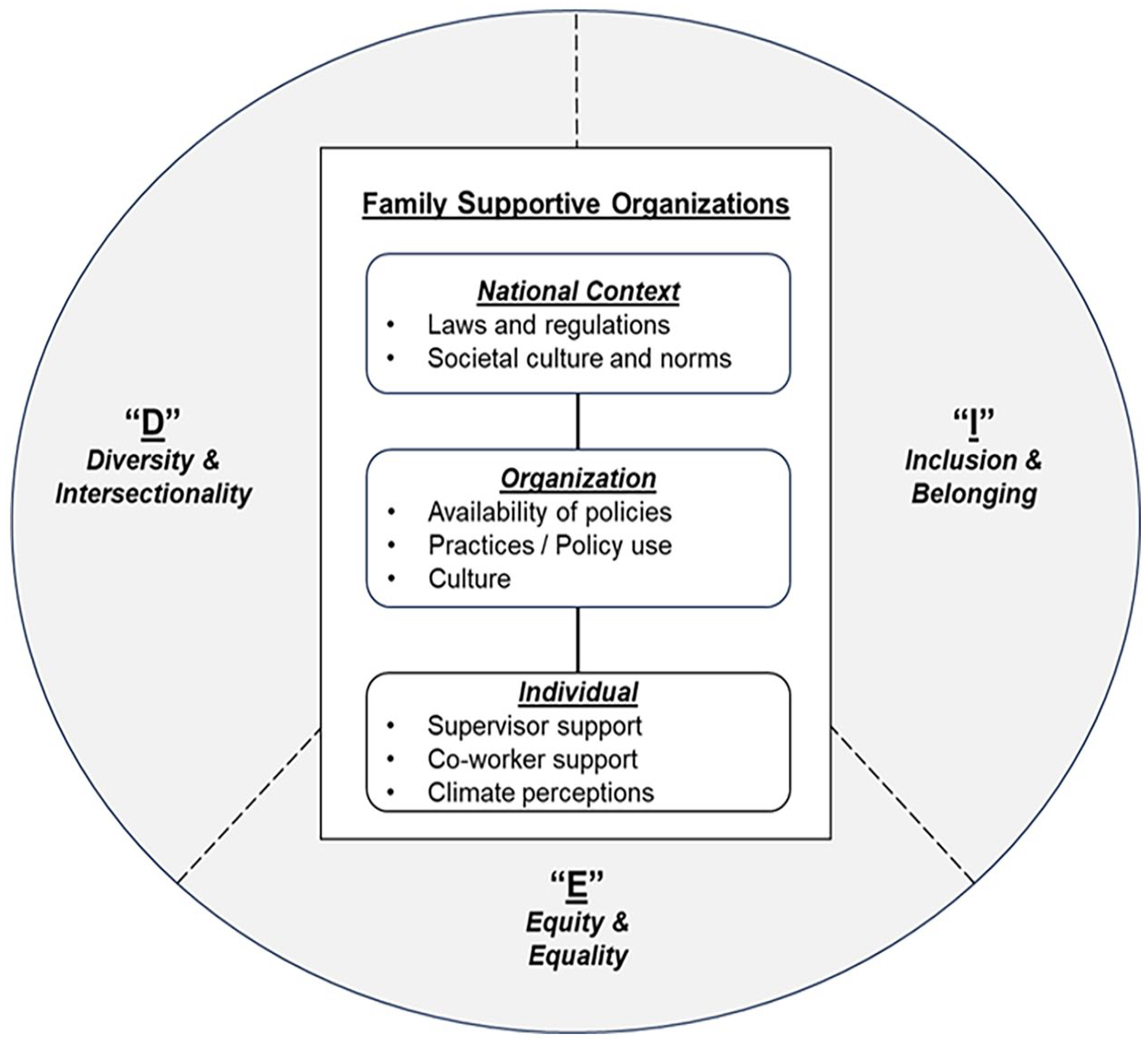
Organization of Review
Methodology
We followed Daniels’s (2019) approach to systematic reviews, beginning with an expansive search across three databases: PsycINFO, PsycARTICLES, and Business Source Complete. In Step 1, we combined DEI-related search terms with FSO-related search terms, yielding a total of 2,524 unique studies. In Step 2, we screened titles and abstracts, eliminating 493 nonempirical studies and 1,787 articles that failed to capture the intersection of FSO and DEI. In Step 3, after reading 244 studies in detail, we eliminated 52 based on the relevance criteria in Step 2, leaving a final sample of 192 studies (Supplements 1 and 2).
Coding and Organization
Figure 1 reflects our organized coding of FSO- and DEI-related constructs. For each study, we coded FSO-related constructs at the individual, organization, and national levels. The individual level included perceptions of work–family supervisor support, coworker support, and psychological climate. The organizational level included work–family policy availability and access, practices and policy use, and organizational culture. The national level included work–family support policies codified as laws or regulations and sociocultural norms around work–family roles. We organize the results into three sections, each examining two DEI constructs: diversity and intersectionality (“D”), equity and equality (“E”), and inclusion and belonging (“I”). Our goal was to examine the integration of these DEI constructs in the FSO literature. The team met iteratively to discuss coding, resolve disagreements for consistency, and add coding categories that emerged (e.g., power, stigma). Supplement 3 presents our final coding rubric.
Results
In each section, we examine (1) the use and conceptualization of each DEI construct in the FSO literature; (2) correlates of each DEI construct with FSO variables and other organizational outcomes; and (3) key trends, including multilevel results and relevant shortcomings. After a summary, we present our review-driven agenda for future research.
Given the multilevel structure of FSO, we introduce Table 1 as a cross-tabulation of how DEI constructs are studied across different FSO levels of analysis, referring to this in discussing multilevel findings throughout the results. As a preview of an important summary finding, an outsized portion of studies focused on the link between DEI and family support policy availability at the organization level (n = 103, 54%) but underemphasized individual policy use and cultural experiences. Our analysis of the statistics in Table 1 indicates that even though employee experiences of support for the family role are nested in organizational and national contexts, only 24 studies (13%) incorporated all three levels of analysis (individual, organization, and national), whereas most studies (n = 95, 49%) focused on one level of analysis.
Multilevel Cross-Tabulation for the DEI and FSO Literature (192 Studies)
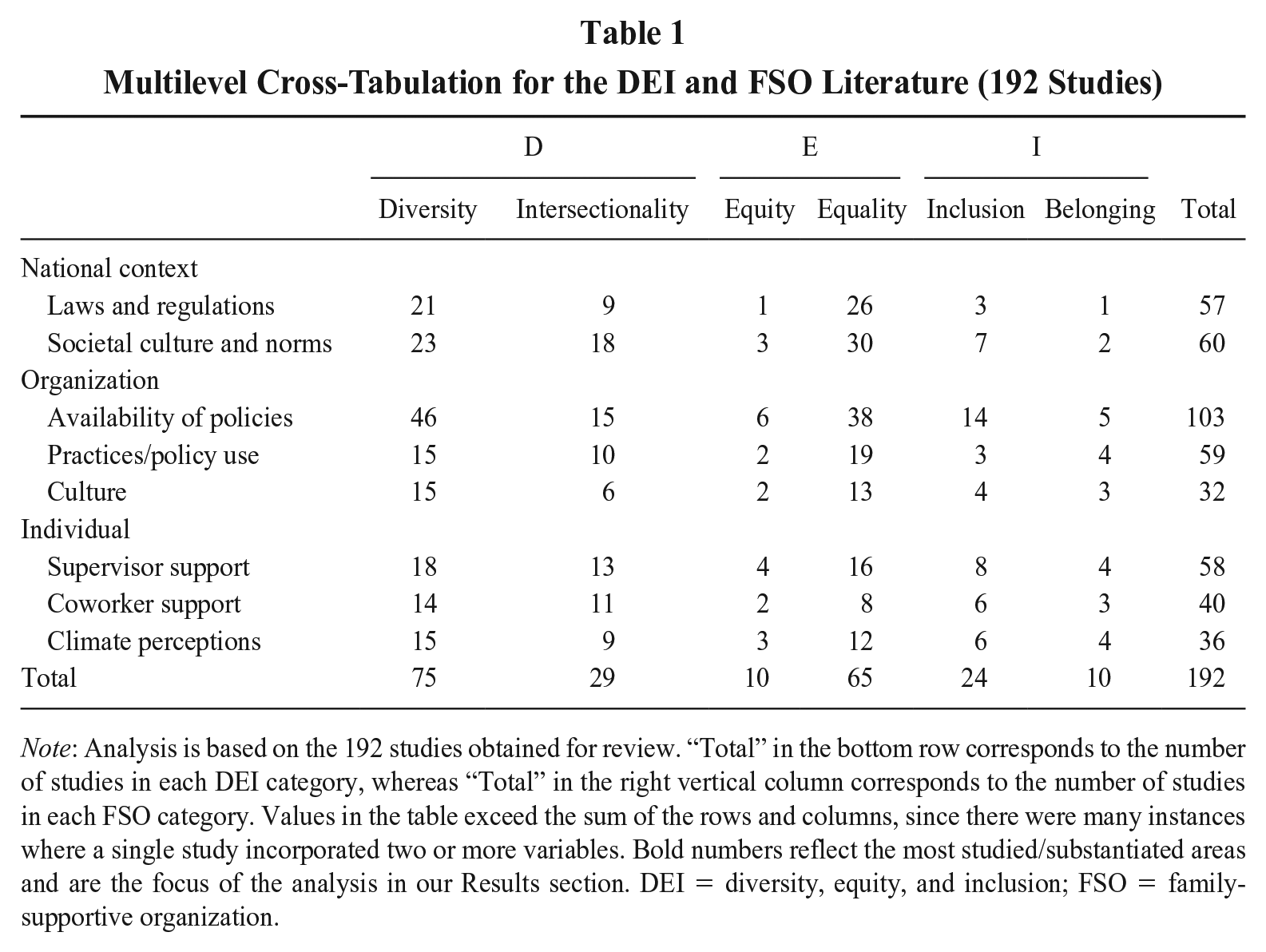
Note: Analysis is based on the 192 studies obtained for review. “Total” in the bottom row corresponds to the number of studies in each DEI category, whereas “Total” in the right vertical column corresponds to the number of studies in each FSO category. Values in the table exceed the sum of the rows and columns, since there were many instances where a single study incorporated two or more variables. Bold numbers reflect the most studied/substantiated areas and are the focus of the analysis in our Results section. DEI = diversity, equity, and inclusion; FSO = family-supportive organization.
“D”: Diversity and Intersectionality in the FSO Literature
Thirty-nine percent (n = 75) of studies assessed diversity in terms of representation (e.g., gender composition), diversity policies/practices (e.g., diversity management policies), or diversity culture. Over half of the 192 studies (n = 104) considered some influence of multiple demographic characteristics (e.g., an interaction of gender and caregiving status in a quantitative study), yet comparatively few (15%, n = 29) applied intersectional analysis.
Conceptualization
FSO studies assessing diversity often focus on the degree to which different sociodemographic categories are represented across collectives in organizations. A common representation focus was the percentage of women in the organization and/or at different levels of the organization (e.g., midmanager, executives; Chung, 2018). Beyond gender, studies considered job type (e.g., percentage of part-time workers; ratio of blue- to white-collar workers; Heywood & Jirjahn, 2009) and the percentage of employees with dependent children (Bardoel, Moss, Smyrnios, & Tharenou, 1999). While family-related variables such as marital or parental status were sometimes considered an individual-level control (Shi & Shi, 2022), they were rarely considered an aspect of group- or organization-level diversity (cf. Bardoel et al., 1999). FSO studies with diversity policies examined affirmative action (Jaga, Arabandi, Bagraim, & Mdlongwa, 2018), gender diversity initiatives (Frenkel & Wasserman, 2020), and antidiscrimination measures (Budig, Kraus, & Levanon, 2023). Studies also captured perceptions of diversity cultures (Casper, Wayne, & Manegold, 2013).
Most studies (n = 104) assessed intersectionality at the individual level of analysis, interpreted as a demographic property combining two or more individual characteristics. FSO studies examined interactions involving gender and age (Chordiya, 2019), as well as gender, marital status, and parental status (Drago, 2011). Yet even when “intersectionality” language was used, this approach failed to incorporate the more complex understanding of intersectionality in terms of how multiple intersecting social identities of individuals are experienced in social contexts (Crenshaw, 1989; Thatcher et al., 2023). Only 29 (15%) studies adopted an explicit intersectional approach, often leveraging qualitative designs to address experiences of, for example, Black mothers in postapartheid South Africa (Jaga et al., 2018), childfree dual-earner couples (Boiarintseva, Ezzedeen, & Wilkin, 2022), sexual and gender minorities with disabilities (Dispenza, Brennaman, Harper, Harrigan, Chastain, & Procter, 2019), and Indian women repatriates in the information technology sector (Shah & Barker, 2022).
Correlates
A greater percentage of women in the workforce is associated with greater workplace power, including the ability to foster the adoption of family supportive policies (Dancaster & Baird, 2016; Seyler, Monroe, & Garand, 1995). Greater female representation is associated with access to remote work (Ha, 2022), while higher gender diversity of union members is associated with the adoption of more family-friendly policies across organizations (Cigna, 2024). DEI policies also have strong positive relationships with family support. Organizations strategically pursuing diversity are more likely to instill support for managing family-related responsibilities (Su & Bozeman, 2016). Effective diversity management policies facilitate supervisor support for work–life balance, which increases the use of family-friendly policies (Kim & Mullins, 2016).
Studies suggest that employees with intersectional identities often lack equal access to such policies, experience stigma, or have trouble “navigating and utilizing such resources, especially childcare, because of concerns over how their racial/ethnic, class and gender social status might be perceived in that context” (Castañeda, Zambrana, Marsh, Vega, Beceera, & Perez, 2015: 718; Weigt & Solomon, 2008). Yet intersectional identities do not uniformly complicate or worsen outcomes. Haredi women are simultaneously disadvantaged (e.g., through reduced pay) and empowered (e.g., through exerting agency to attain preferable family-supportive work hours; Frenkel & Wasserman, 2020). Support for diversity and family is associated with positive work-related attitudes and behaviors, including job satisfaction (Dabdoub, Cross, & Snyder, 2021), retention (Pink-Harper & Rauhaus, 2017), productivity (Ali, Metz, & Kulik, 2015), and reduced absenteeism (Heywood & Miller, 2015). The reverse pattern also emerges: a lack of support for diversity is associated with “isolation, stress, strained collegial relationships, and work–family conflict” (Foster, McMurray, Linzer, Leavitt, Rosenberg, & Carnes, 2000: 657).
FSO trends for diversity and intersectionality
As Table 1 shows, 46 of the 75 studies examining diversity focused on the organizational level, specifically the availability of family support policies. There was relatively limited research focusing on expanding definitions of who needs family support and little research on linkages between diversity measures and FSO policy use, support experiences (e.g., consequences of use), and climate perceptions at the individual level. Rather, FSO studies often operationalized diversity in terms of organizational demographic representation (e.g., proportion of women), followed by job group composition (e.g., women senior managers). Although useful, many other employee groups remain neglected in FSO research, such as singles, those who are LGBTQ, and women of color, as well as family-related identities, such as individuals caring for older adults. This gap not only affects reporting and measurement of underrepresented groups in FSO studies but also illustrates how sample selection leads to limited definitions of who needs family support and what types of support are needed.
Many studies mentioned or alluded to intersectionality, but few addressed the complexity of how intersectionality captures individuals’ social identities that are experienced as being marginalized in a multilevel context or how power influences those experiences (Thatcher et al., 2023). One encouraging finding is that, among the 29 studies that incorporated this deeper recognition of intersectional identities as being experienced in social contexts, 18 primarily focused on FSO at the national level in terms of societal culture and norms (Table 1). Yet even studies that offered deeper insight often aggregated their findings to the group level of analysis. For example, Budig et al. (2023) conclude that stricter enforcement of antidiscrimination and work–family policies in the public sector supported positive employment and earnings outcomes for Israeli-Palestinian mothers. Dixon and Dougherty (2014) address how experiences of “othering” led members of LGBTQ families to perceive prejudice and discrimination in their organizations.
Finally, causality between diversity and FSO remains ambiguous. It is unclear whether increased diversity (e.g., gender representation, diversity policies) begets greater family support or vice versa (Kato & Kodama, 2018; Schoen & Rost, 2021) and whether the combined positive effects of the two are additive or synergistic. To this point, implications are unclear when positive and negative factors coexist, as in where cultures with “racialized notions of parenting and caregiving responsibilities” lead to marginalization even when work–family resources are available (Castañeda et al., 2015: 717) or when supervisor support for the family role can reduce prejudice amid traditional family norms (Cho et al., 2017). The complexity of intersectional experiences and the multilevel nature of these interactions (involving others; occurring within specific organizational and societal contexts) limit our ability to pinpoint causal relationships.
“E”: Equity and Equality in the FSO Literature
Our search terminology captured equity and equality, although we found that far more FSO studies assessed equality (35%, n = 68) rather than equity (5%, n = 10).
Conceptualization
As we noted in the literature review, equity and equality emanate from distributive justice theory. Equity is defined as instances where outcomes received across individuals are in proportion to their inputs. Equality is defined as instances where individuals receive the same outcomes regardless of their inputs (Deutsch, 1985; Morand & Merriman, 2012). In the reviewed studies, equality conceptualizations aligned well with these broader definitions, with notions of equality often embedded in the understanding and definitions of work–family policies. For instance, Shin and Kim (2022) describe work–family programs including menstrual leave, childcare leave, and family assistance as “gender-equality practices” designed to help female managers develop positive relationships with supervisors and peers, thereby overcoming feelings of isolation at work. Casper, Weltman, and Kwesiga’s (2007) conceptualization of a “singles-friendly” workplace included dimensions related to equal work opportunities and access to benefits. Yet critical evaluation suggests that the few studies addressing equity often captured equality instead (e.g., differential access to flexible work arrangements across gender groups).
Correlates
(In)Equality in work–family policy availability is positively associated with other metrics of (in)equality—specifically, wages and earnings (Begall, Grunow, & Buchler, 2023; Budig, Misra, & Boeckmann, 2016). Nieuwenhuis, Need, and van der Kolk (2019) found a negative relationship between family-supportive policies and gender-based wage disparities, with generous paid leave and public childcare linked to higher earnings for women and economic equality among coupled households. Van der Lippe, Van Breeschoten, and Van Hek (2019) observed a similar pattern across nine European countries where organizations offering work–family policies have smaller within-firm gender wage gaps.
The same pattern emerged in studies examining how (in)equality is embedded in organizational work–family culture. Japanese organizational cultures emphasizing long working hours and reinforcing gender stereotypes tend to have fewer promotion opportunities for women (Nemoto, 2013), whereas organizational cultures accepting diverse boundary management tactics promote gender equality for male lawyers in Canada and Finland (Choroszewicz & Kay, 2020). Unequal power dynamics and the stigmatization of individuals who use work–family policies tend to perpetuate inequality. Employees in lower-power positions may fear career repercussions or ostracism if they use family-supportive policies (Rainey & Melzer, 2021). This fear can deter these individuals from utilizing available support, thereby preserving existing inequalities.
FSO trends for equality and equity
Over half of the 65 FSO studies (n = 38) that addressed equality did so in terms of analyzing family support policy availability at the organization level. Studies also addressed equality in terms of FSO societal culture and norms (n = 30) and laws and regulations (n = 26; Table 1). Fewer studies linked the informal support aspects of FSO to equality (e.g., when family-supportive women managers in New Zealand and Australian universities enhance gender equality; Neale & White, 2014). Other studies linked the use of work–family practices to equality, such as when interventions reduce gender inequality at home by fostering equitable household work distribution, thereby reducing work–family conflict (Noroozi, Bagherzadeh, Cousins, Nazari, & Ghahremani, 2023). While we suspect that all levels of FSO (per Figure 1) relate to equality in similar ways, the findings in terms of individual policy use, support experiences, and climate perceptions were less substantiated.
Aside from the surprising lack of focus on equity in our reviewed articles—particularly given that a substantial portion of the FSO literature addresses equity, albeit not from a DEI standpoint (e.g., Grover, 1991; Judge & Colquitt, 2004; Rothausen, Gonzalez, Clarke, & O’Dell, 1998)—significant ambiguity remains regarding whether available family support policies inherently represent a form of (in)equality per se or, instead, interact with or drive other forms of equality. For example, Houkamau and Boxall (2011) positioned family-friendly practices and proactive equal employment opportunity policies as separate but related correlates.
“I”: Inclusion and Belonging in the FSO Literature
Despite growing attention to issues of inclusion (n = 24, 12.5%) and belonging (n = 10, 5%), these were the least studied DEI constructs in the FSO literature.
Conceptualization
Inclusion is defined as an experience of involvement at work, where individuals actively influence decision making (Pelled et al., 1999). The closely related concept of belonging reflects interpersonal relatedness (Randel et al., 2018). The few studies addressing inclusion and belonging typically applied cursory conceptualization and assessment of these ideas. That is, studies assessing inclusion often omitted voice, decision making, and ability to access job-relevant information and resources, although many seminal construct definitions include these elements (Mor Barak et al., 1998). For example, Kunda, Jordaan, and Mennega (2022) considered “non-inclusive company culture” without defining inclusion. Some studies that assessed belonging used Meyer, Allen, and Smith’s (1993: 544) widely cited affective commitment scale (and a reverse-coded item reading “I do not feel a strong sense of ‘belonging’ to my organization”), failing to capture discrete aspects of interpersonal relatedness.
Correlates
Overall, the reviewed studies show a clear pattern of positive relationships among inclusion/belonging, perceived family support, and a range of individual attitudes and organizational performance variables. Inclusive cultures can lessen work–family conflict via family support from others (Shi & Shi, 2022), and inclusion-focused leadership behaviors and policies can augment traditional understandings of how organizations provide work–family support (Mabaso, Jaga, & Doherty, 2023).
Several studies contextualize experiences of inclusion and belonging as the result of trickle-down effects from national policies, culture, industrial/occupational norms (Kunda et al., 2022), and immigration (Akobo & Stewart, 2020). Sarwar and Imran’s (2019) study of Pakistani women’s career experiences notes how governmental gender inclusion initiatives including maternity leave policies enhance feelings of inclusion and belonging. From an organizational standpoint, various work–family initiatives (e.g., childcare programs; Foster et al., 2000) foster more inclusive workplaces. Beauregard and King (2020) studied an “employer-sponsored family-friendly event” intervention where employees brought their parents to work for a day, aimed at increasing parents’ sense of belonging and enhancing employees’ own feelings of inclusion. Dilmaghani (2021) documented increases in belonging associated with availability and use of flexplace and flextime work–family policies, particularly for male employees. Studies in our review identified positive associations among inclusion and belonging, FSO contexts, and various individual attitudes (e.g., reduced burnout and work–family conflict, increased organizational commitment; Ho, Stenhouse, & Snowden, 2021; Tripathi, Srivastava, & Tripathi, 2020). Pal, Galinsky, and Kim (2022) identified support for family and nonwork domains as crucial elements of workplace inclusion, acting as a resource that buffers the negative impacts of adverse life events on employee health. Some evidence indicates that work–life initiatives have a stronger positive relationship with organizational financial performance in environments characterized by highly inclusive cultures (Baker, Ali, & French, 2021). While inclusivity may unite employees, improve social relations (Bhattacharya & Gandhi, 2020), and reduce xenophobic workplace incidents (Zaman, Nawaz, Anjam, Anwar, & Siddique, 2021), power and stigma dynamics may undermine such results. For example, men who take paternity leaves and employees who need flexible work arrangements for family needs face stigma and questions about commitment to their jobs (Choroszewicz & Kay, 2020). This stigma may reduce willingness to use family-supportive policies and decrease feelings of inclusion.
FSO trends for inclusion and belonging
Although inclusion and belonging are typically considered individual-level constructs, we observe (1) an emergent top-down pattern where societal and organizational family support–related factors shape experiences of inclusion and belonging (e.g., masculine-feminine culture; Turesky & Warner, 2020) and (2) an emergent bottom-up pattern suggesting that inclusion and belonging influence group dynamics and organization-level outcomes (Cigna, 2024). Yet the reviewed studies lacked precision in aligning inclusion and belonging with their specific conceptualizations in the DEI literature. Thus, without assessing the decision making and interpersonal relatedness aspects of inclusion and belonging, respectively, it is difficult to pinpoint how such links unfold within the FSO context. Combined with the small study counts, their multilevel dynamics also remain understudied.
Summary
Diversity and equality are the most studied and most integrated constructs in the FSO literature, albeit with some shortcomings. We observed strong positive connections across demographic representation in organizations (e.g., gender composition), work–family policy availability (at national and organizational levels), and forms of equality (e.g., reduced wage gap). However, beyond gender, the representation of many other family-related identity groups was largely underexamined.
Significant shortcomings remain in how the FSO literature integrates and understands intersectionality, equity, inclusion, and belonging. Intersectionality was applied rudimentarily, while power dynamics in shaping individuals’ and groups’ experiences were overlooked. This lack of depth reinforced aggregate, group-level inferences, overlooking important subtleties related to intersectional identities. As a result, the FSO literature lacks insight into how power imbalances affect individuals with intersecting identities, leaving gaps in understanding how these dynamics affect access to and utilization of family support resources. The few studies considering equity often confounded its definition and operationalization with equality. Studies addressing inclusion and belonging consistently showed positive correlations with FSO-related variables and favorable outcomes for employees and organizations. Yet, in both cases, inclusion and belonging were vaguely defined, and the measures used in FSO studies often excluded core dimensions of inclusion or attention to multilevel group dynamics frequently noted in DEI studies, such as participation in group decision making (Nishii, 2013).
Broadly, our application of a DEI perspective to the study of FSO suggests that significant gaps remain between the areas of study. We show this in Table 1, with the bold numbers reflecting prominent patterns concentrated at higher levels of analysis. Stated differently, our results discussed so far suggest that the connections between DEI and FSO are stronger at macrolevels (i.e., laws and regulations, societal culture and norms, and family support policy availability at the organization level) relative to microlevels (i.e., practices/policy use, culture, supervisor support, coworker support, and climate perceptions). Still, across all levels, FSO studies continue to draw on samples that lack diversity in their family support needs, which limits how scholars conceptualize and identify those who have family roles.
Discussion
Our review reveals that FSO research often fails to integrate constructs that address DEI. Consequently, failure to consider work–family support in relation to these core DEI concepts may (1) inadvertently exclude or disadvantage those who fall outside “traditional” family structures and (2) perpetuate shortcomings in the FSO literature’s ability to effectively support diverse employees in organizations. Yet incorporating a comprehensive DEI perspective can advance FSO research by enhancing the understanding of the complexities involved in offering and utilizing work–family supports, with recognition that providing support for “family” is necessary but insufficient to foster true inclusion, belonging, and equity. Research should consider how individuals experience harm (e.g., stigma or bias) from disclosing or making visible their need for family support. To promote a more thorough integration of DEI into FSO research, we advocate for the adoption of a multilevel contextual approach—one that specifically examines how organizational family support interacts with how employees’ enact work and family social identities in employment systems rewarding individuals who diminish family roles relative to work. The field must better address the reality that FSO practices are implemented in ways that perpetuate organizational inequality by their misalignment with work systems rooted in outdated conceptualizations of ”meritocracy” and “ideal workers” (Amis, Mair, & Munir, 2020). In what follows, we introduce an aspirational review-driven framework to integrate DEI more robustly into FSO research.
A Review-Driven Aspirational Framework for Future Research
Across the three DEI concepts, our analysis reveals three cross-cutting themes for a future research agenda (Figure 2). We emphasize that our agenda is aspirational: The themes are based on inferences gleaned from limited evidence reflecting common shortcomings across 192 studies rather than a substantial number of studies showing consistent patterns.
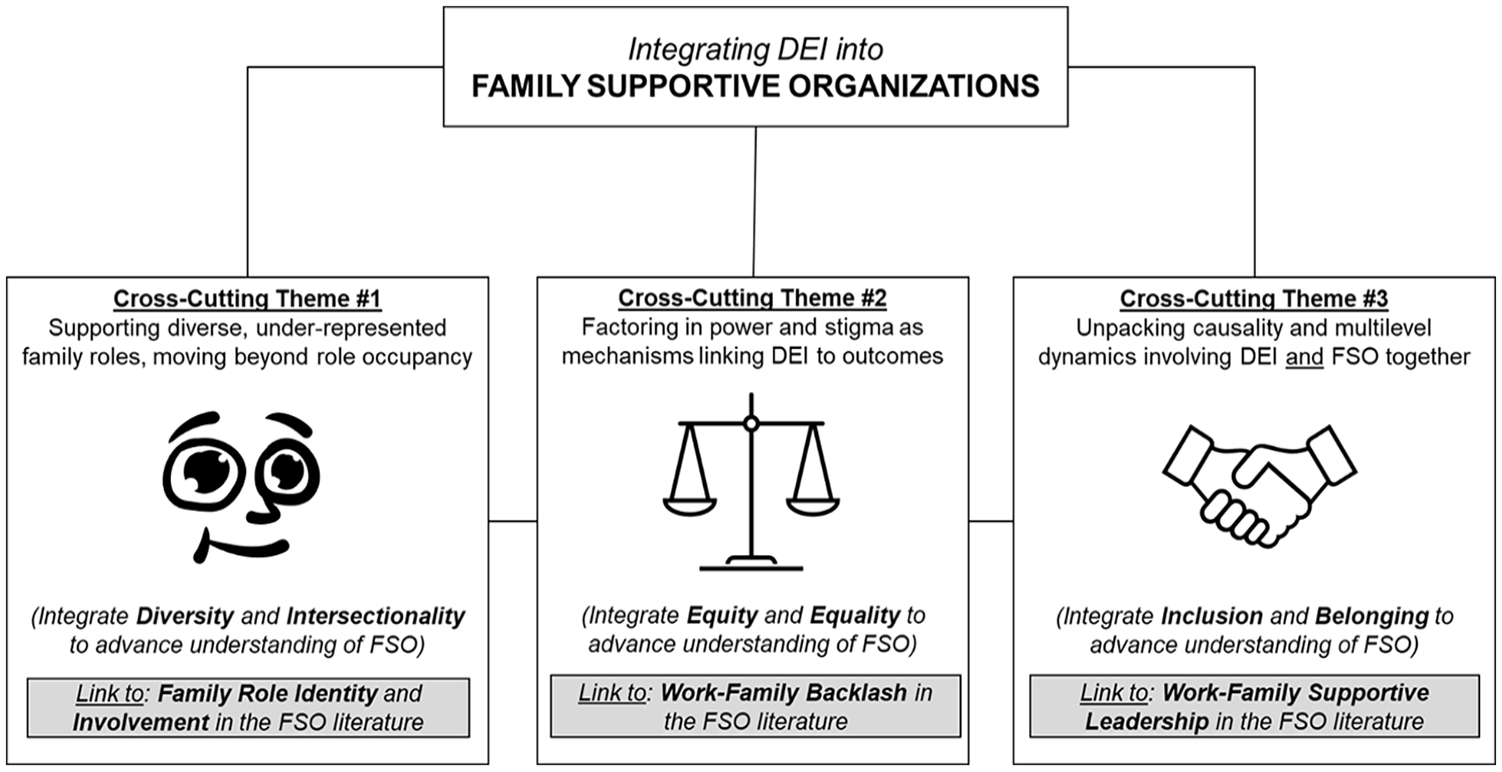
An Aspirational Framework for Future Research
First, we find that samples across the 192 studies are often unrepresentative of actual populations. We emphasize the need for considering more than categorical role occupancy, linking this to family identity and role involvement. In Figure 2 (left), the face imagery illustrates how future research can advance this theme by better integrating diversity and intersectionality to enrich understanding of FSO. Second, we find that power and stigma emerge as central themes across DEI concepts. We emphasize the need to consider these as mechanisms connecting the three DEI concepts with outcomes, linking this to work–family backlash. In Figure 2 (middle), the scale imagery illustrates how future research can advance this theme by better integrating equity and equality to enrich understanding of FSO. Third, we find that most evidence across the 192 studies is correlational and cross-sectional, creating ambiguity around how DEI and FSO constructs relate. We emphasize the need to better unpack causal relationships and interactive effects when the two separately coexist or operate in tandem in a multilevel context, linking this to work–family–supportive leadership. In Figure 2 (right), the handshake imagery illustrates how future research can advance understanding of this theme by better integrating inclusion and belonging to enrich understanding of FSO. Table 2 offers specific questions for future research that address the three cross-cutting themes discussed next.
Future Research Agenda
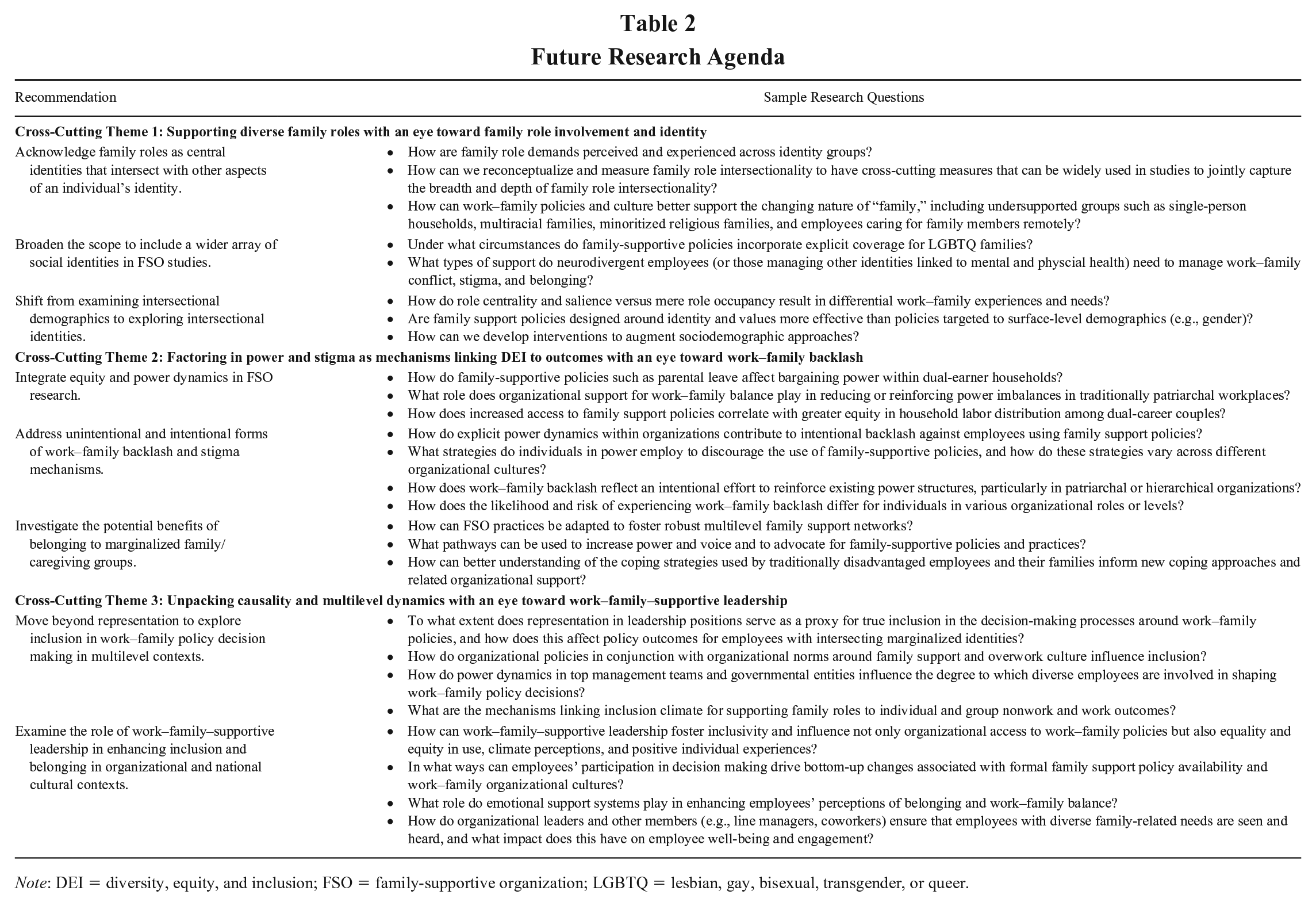
Note: DEI = diversity, equity, and inclusion; FSO = family-supportive organization; LGBTQ = lesbian, gay, bisexual, transgender, or queer.
Cross-Cutting Theme 1
Supporting diverse family roles with an eye toward family role involvement and identity
Across the 192 studies, we find that FSO research still tends to focus on White middle-class professionals, failing to adequately address the diverse and evolving nature of modern families. Thus, current research is narrow and starkly disconnected from the changing realities of family life. Thirty percent of working U.S. families are single-person households but were represented in 8% of studies (e.g., Drago, 2011); multicultural (e.g., immigrant) families constitute 14% of the population but appear in 3% of studies (Blumen, 2015).
While we observe some improvement as compared with study sample statistics reported in previous reviews of work–family research (Eby et al., 2005), we echo that future research must better recognize the variety of modern family configurations and roles. As society evolves, so too must the concept of “family” in organizational settings. Organizations must view nontraditional family structures as valid family units before they can appropriately adapt their support systems.
Integrating diversity and intersectionality
FSO research can better parse apart diversity and intersectionality, shifting away from a focus on role occupancy to a focus on family role identity and involvement. Whereas 70% of families are involved in caregiving, 8% of studies considered the extent of role involvement (e.g., demands and meaning of providing disability-related care to a family member; Stewart, 2013). We call for capturing within-group variation—that is, individuals’ and groups’ lived experiences. While representation (e.g., percentage of women) is a meaningful correlate of work–family policy availability, FSO research must consider more complex, intersecting demographic categories (Kossek et al., 2023a). Researchers must also recognize that individuals will place varying importance on roles associated with given identities (Lobel, 1991) and will devote different amounts of time and effort in fulfilling role obligations (Rothbard, 2001).
Future FSO research should examine a wider range of social identities, such as considering how race, religion, neurodivergence, sexual orientation, and political affiliation factors shape employee needs and values concerning family support. Parents of children with special needs often require more flexible working arrangements due to frequent medical appointments (Matthews, Booth, Taylor, & Martin, 2011). Families facing mental health challenges encounter barriers in maintaining full-time employment and may need extended leave. The intersection of race and caregiving responsibilities becomes apparent in research showing that Black and Latina women often face greater caregiving demands earlier in life (Ice, 2023). Similarly, women from non-Western cultures often face community and religious obligations that intersect with their family responsibilities, creating unique challenges in balancing work and family life (Kamenou, 2008). Furthermore, employees with autism often encounter blurred boundaries between work and home, with overlapping support networks amplifying these challenges (Ezerins et al., 2024).
Future FSO research must prioritize the design of policies that meaningfully support individuals with intersecting identities, fostering truly inclusive and equitable work environments. The implications here are two-fold. First, this builds on the 75 reviewed studies assessing diversity, adding granularity to better understand which representation characteristics link to work–family policy availability. Second, this will allow FSO research to overcome the intersectionality limitations noted previously: rather than risk overgeneralizing the experiences of intersectional groups (per the representation approaches), our findings show the need to capture complexities of how individuals with overlapping social group identities navigate work–family experiences, including their use of available policies and/or distinct forms of informal support.
Cross-Cutting Theme 2
Factoring in power and stigma as mechanisms linking DEI to outcomes with an eye toward work–family backlash
Power and stigma emerged as a cross-cutting theme, present in approximately 20% of our sampled studies across the concepts of diversity (n = 16), equity (n = 15), and inclusion (n = 6). Power at the individual level involves the degree to which individuals attain higher positions of influence, gaining concomitant rewards and status (DiTomaso et al., 2007: 476; McGuire & Reskin, 1993). As an organizational and societal phenomenon, power is defined as instances where individuals or groups have greater representation in senior positions higher in status, social class, or networks (enabling greater influence; Ridgeway, 2001). Power dynamics shape the implementation, perception, and use of work–family policies, with power imbalances causing unequal access across groups (Gerstel & Clawson, 2014). Stigma exists when a characteristic is perceived to be “reduced, tainted, or discounted in a particular context” (Goffman, 1963: preface). It affects access to family support, inhibits propensities to use work–family policies (Thébaud & Pedulla, 2022), and hinders a sense of inclusion and belonging (Gatrell, Burnett, Cooper, & Sparrow, 2014). It is only when underlying power and stigma barriers are addressed as major hindrances to individuals’ accessing, receiving, and benefiting from family support without experiencing bias or backlash can organizations adapt their support systems effectively.
Integrating equity and equality
FSO research may consider the implications of power and stigma from the standpoint of equity and equality. Maternity leave policies can increase household bargaining power for women by increasing their relative contributions to household income (Stier & Mandel, 2009). Such increases in women’s employment and earnings carry power that improves equity in the division of household labor (Bittman, England, Sayer, Folbre, & Matheson, 2003). Yet disempowered individuals risk stigmatization when they utilize family-supportive policies. FSO research can integrate these ideas with work–family backlash, which involves “punitive behaviors . . . characterized by extrinsic and social penalties, including the threat of repercussions as a deterrent to [family support] policy use” (Perrigino et al., 2018: 607).
Two related considerations are essential. First, work–family backlash is positioned in the form of unintended consequences. Paradoxically, those most in need of family support are often the least able to access it (Kalev & Dobbin, 2022). Future research and practice must recognize that limited conceptualizations of family support unintentionally exclude or discriminate against certain groups or individuals. Indeed, the unintentional perpetuation of inequality and stigma in FSO may reflect the actions of organizational decision makers who (1) are in positions of power, (2) have access to personal resources (e.g., wealth) that minimize their needs for family supports via organizational policies, and (3) fit the “traditional” family mold (e.g., a breadwinner and a nonworking spouse), all of which combine to inhibit their ability to comprehend the need for more expansive policies (cf. Kossek et al., 2023; Peters & Heusinkveld, 2010).
Second, our integration of DEI extends the possibility that more intentional forms of work–family backlash exist. Across the 192 studies, we uncovered evidence that those in positions of power may engage in practices to reinforce and maintain hierarchical structures (e.g., patriarchal cultures; Kalem, 2020; Straut-Eppsteiner, 2021). While this maintenance is likely implicit and unintended, the problem remains: FSO research must provide compelling evidence explaining why and how equitable and equal access to family support is worth disrupting the status quo, such as connecting family support to improved organizational outcomes, rather than solely to the personal outcomes of marginalized individuals. Disempowered individuals and groups may be hindered, not so much by family role responsibilities, but a lack of opportunity to contribute to key tasks in the workplace (i.e., contributive justice; Roberson & Scott, 2024).
A promising direction is to examine the implications of benefits associated with marginalized family or caregiving group membership. These individuals may develop resilience, strong support networks, and identity centrality that enhances workplace experiences. Linking to the first cross-cutting theme, investigating intersecting identities (e.g., high-status professional roles combined with low-status family identities such as caring for a child with mental health issues) can reveal how individuals experience privilege and disadvantage, evolving understanding of challenges and opportunities that arise from navigating work–family roles.
Cross-Cutting Theme 3
Unpacking causality and multilevel dynamics with an eye toward work–family–supportive leadership
Across the 192 studies, we observe an ambiguity: whether DEI predicts FSO, whether FSO predicts DEI, and whether the two combine to create additive (i.e., separate) or synergistic effects. This ambiguity is most prominent in studies considering diversity (n = 75) and equality (n = 68) since the larger study counts allowed for a clearer unfolding of conflicting patterns. Our analysis suggests that the lack of specification across levels of analysis compounds this issue: the question for future research is not simply whether DEI predicts FSO and/or vice versa but how this unfolds as top-down and bottom-up causal relationships across levels that are nested in specific organizational and national contexts (often shaped by employer and country leadership actions).
Consider the following idea based on combined findings across the reviewed studies: diversity in an organization’s workforce appears to lead to increased work–family policy availability (Dancaster & Baird, 2016; Ha, 2022; Seyler et al., 1995), which begets additional diversity in the organization (Schoen & Rost, 2021). This occurs through top-down effects, including work–family policy use (Kato & Kodama, 2018) and greater informal support from supervisors and coworkers (Kim & Mullins, 2016). It also yields bottom-up effects in terms of enhanced organizational reputation and recruitment. While such multilevel recursive dynamics between DEI and FSO seem evident, most studies relied on cross-sectional evidence and focused on a single level of analysis. Furthermore, our illustrative compilation of findings here—based on organizations in the United States, Korea, South Africa, and Japan—obscures the importance of national context. More research is needed to examine these complex multilevel interactions and explore how FSO varies across organizational, national, and global (e.g., Global North/South) contexts.
Integrating inclusion and belonging
FSO research can unpack these dynamics by better integrating inclusion and belonging. Our results hint that inclusion and belonging may have top-down and bottom-up influences across levels and function as antecedents or outcomes of FSO. Yet given vague definitions and few studies, we focus on the importance of enhancing definitional clarity as a critical first step to better understanding these dynamics.
While decision making is central to the definition of inclusion (Nishii, 2013), most studies point to the representation of employee populations (i.e., diversity) as a predictor or correlate of work–family policy availability. Connecting to the two cross-cutting themes, this suggests that available work–family policies are decided for disempowered individuals with unique intersectional identities (Masood & Nisar, 2020). Exceptions suggest that “inclusion” in work–family policy decision making occurs via representation in governmental entities for national policies and top management teams for organizational policies. Still, this is discouraging since representation is used as a proxy for inclusion. We call for investigation into the extent to which certain individuals are involved in driving such initiatives and subsequent decision making (cf. Baker et al., 2021; Morgan & Milliken, 1992). Future research should examine how top-down influences shape inclusive decision-making processes and how bottom-up feedback from employees—and feelings of belonging, for that matter—in turn influences the maintenance/change of organizational cultures and policies. This offers a promising avenue to explore how inclusion and belonging are developed and sustained across organizational levels.
FSO research can address this through the expanded study of work–family–supportive leadership (see Kossek et al., 2023c). We view this as a fruitful avenue for three reasons. First, whereas family-supportive supervision focuses on top-down support from line managers (Hammer et al., 2009), work–family–supportive leadership involves all levels of management and factors in different leadership styles that explicitly encourage participative decision making. We anticipate work–family–supportive leadership functions as a critical antecedent of inclusion. Second, unlike idiosyncratic deals for flexibility (which historically benefit individuals with existing power or privilege, potentially exacerbating inequities; Kossek & Kelliher, 2023) where subordinates negotiate for access to their own flexibility arrangements, work–family leadership can initiate organizational policies and champion changes to expand inclusion and belonging into an organization’s culture. Third, mindful that the need for interpersonal relatedness is central to belonging, work–family leadership is contingent on subordinates’ experiencing family-related support. We suggest that work–family–supportive leadership is critical not only to employees’ cognitions and their experiences of inclusivity (i.e., involvement in decision making) but also to employees’ emotions and their experiences of belonging (i.e., feeling seen and heard).
Theoretical and Practical Contributions of Applying DEI to FSO Research
By integrating a DEI perspective, we make significant contributions to the FSO literature. First, we broaden the conceptualization of family support to better reflect the realities of the modern workplace by including diverse and intersecting identities. Much FSO research continues to focus on traditional family structures and professional workers, overlooking the diverse needs of a rapidly changing workforce. Instead, FSO research should incorporate a DEI perspective to better address the complexities of work–family experiences, particularly for marginalized groups (Arena et al., 2023; Ezerins et al., 2024). We show an important distinction in studies considering the characteristics of the group and individual FSO-related interactive experiences.
Second, we advance the FSO literature by challenging the prevailing notion that “big tent” approaches sufficiently capture DEI-related considerations in the FSO context. Merely offering work–family policies may reinforce, rather than reduce, inequalities because policies are implemented inequitably or are inaccessible to employees with stigmatized identities. Here, we highlighted the need to consider how power and stigma dynamics shape the effectiveness of family support across groups, positing that this can be considered through work–family backlash.
Third, we provide a framework to investigate multilevel dynamics between DEI and FSO variables. Beyond exposing that few studies establish causality even at one level of analysis, we shift FSO research from an individually focused tradition to a more complex approach that considers employee behaviors and experiences relative to organizational policies and national context. To encapsulate individual-level experiences and causal effects, research must factor in how DEI shapes the multilevel context of FSO experiences. Such experiences need to be linked to work–family leadership and participative cultures that disrupt traditional FSO approaches.
Finally, our work has important practical implications for organizations. The integration of DEI into the FSO literature provides a roadmap for designing more inclusive work–family policies that cater to the needs of a diverse workforce. This includes recognizing the unique challenges faced by employees with intersectional identities and the design of policies that are not only available but also accessible and equitable. Organizational decision makers and national policy makers in positions of power must engage in careful deliberation to ensure that their decision making regarding which family-related supports to offer is not solely informed by their own family-related needs and experiences but also encompasses their employees’ diverse family-related needs that likely extend beyond their own personal circumstances. This can counter resistance to DEI-related initiatives, promoting family support initiatives that implicitly capture and address DEI-related goals discreetly without formal or explicit branding.
Conclusion
Despite meaningful research across disciplines, FSO studies focus too narrowly on a privileged subset of workers, neglecting many whose lived experiences are beyond the scope of these core considerations. This has led to a mismatch between understanding of “family support” in the FSO literature and how it is understood in contemporary workplaces and among contemporary workforces. To address this, we relied on insights from the DEI literature to show how the study of FSO can be vastly broadened by improving integration of DEI constructs empirically and theoretically. We hope that the three cross-cutting themes within our aspirational framework for future research provide a significant first step in bridging the gap between the FSO literature and the lived experiences of all employees. Such research innovation is needed to advance scholarship and organizational initiatives, ensuring that employees experience FSO contexts that do not necessarily advantage higher-power employee groups over others.
Supplemental Material
sj-docx-1-jom-10.1177_01492063241310149 – Supplemental material for Reenvisioning Family-Supportive Organizations Through a Diversity, Equity, and Inclusion Perspective: A Review and Research Agenda
Supplemental material, sj-docx-1-jom-10.1177_01492063241310149 for Reenvisioning Family-Supportive Organizations Through a Diversity, Equity, and Inclusion Perspective: A Review and Research Agenda by Ellen Ernst Kossek, Hoda Vaziri, Matthew B. Perrigino, Brenda A. Lautsch, Benjamin R. Pratt and Eden B. King in Journal of Management
Footnotes
Acknowledgements
We are grateful for the developmental feedback provided by Action Editor Samantha Paustian-Underdahl and two anonymous reviewers. We also thank the Mitch Daniels School of Business Administration at Purdue University for administrative research support.
ORCID iDs

Supplemental material for this article is available with the manuscript on the JOM website.
Notes
References
Supplementary Material
Please find the following supplemental material available below.
For Open Access articles published under a Creative Commons License, all supplemental material carries the same license as the article it is associated with.
For non-Open Access articles published, all supplemental material carries a non-exclusive license, and permission requests for re-use of supplemental material or any part of supplemental material shall be sent directly to the copyright owner as specified in the copyright notice associated with the article.
