




Abstract
Work experiences and political participation outside work are intrinsically linked. Management scholars have acknowledged the role that organizations play in shaping political behavior from a firm-level perspective, but the specific working conditions and how they translate into employee political participation and attitudes outside work remain poorly understood. This paper offers an interdisciplinary review of the empirical literature from the past 25 years across the management and political science disciplines. It examines how individual work-related experiences (broadly categorized into job content, working environment, employment characteristics, and social relations at work) relate to political engagement outside of work: political participation, political attitudes, political trust, and political values. The results show that enabling work experiences (e.g., more skill use, autonomy, higher income, more social interactions) and experiences that caused grievances (e.g., more job or financial insecurity) were both related to more political participation but differed in their effect on political trust and regarding political attitudes on economic and cultural issues. We also review the main theoretical explanations and consolidate contradictions. Finally, we propose a future research agenda, calling for the expansion of theoretical lenses, a focus on individual-level explanatory mechanisms, and more multilevel research.
Keywords
The Political Consequences of Work: An Integrative Review
Employees’ work experiences are inherently connected to their political attitudes and participation outside the workplace. Early philosophers, including Mill, Rousseau, and Tocqueville (Sobel, 1993), already noted that activities in the workplace can be connected to political participation outside the workplace. Later, workplace democracy theorists (e.g., Greenberg, Grunberg, & Daniel, 1996; Pateman, 1970) developed this proposition further, emphasizing that participation in workplace decision-making spills over into political efficacy, which in turn leads to political participation. This was supported by work psychological research (e.g., Karasek, 1989), which showed that active jobs, characterized by a combination of high demands and decision latitude, relate to a more active lifestyle that may translate into higher political participation outside the work context.
Management scholars have acknowledged the role that organizations play in shaping political behavior mainly from a firm-level perspective (e.g., in the areas of corporate social responsibility, Matten & Crane, 2005, and corporate political activity, Hillman, Keim, & Schuler, 2004; Katic & Hillman, 2023; Lux, Crook, & Woehr, 2011; Oliver & Holzinger, 2008). However, how job experiences, including job characteristics and employment conditions, translate into employee political participation, trust, and attitudes outside of work remains poorly understood. In recent years, only a handful of studies (e.g., Shoss, Van Hootegem, Selenko, & De Witte, 2023; Van Hootegem, Van Hootegem, Selenko & De Witte, 2022) have investigated specific working conditions and the processes that affect political participation and attitudes outside work from an individual-level perspective. More evidence comes from other disciplines (e.g., sociology, political science, economics), which can enrich our understanding of the role of work for employee political attitudes and participation outside work (e.g., Langsæther & Evans, 2020; Mencken, Smith, & Tolbert, 2020; Róbert, Oross, & Szabó, 2017).
Overall, the cross-disciplinary interest in the intersection of work and politics has resulted in a rich body of empirical evidence. However, it has also led to a fragmentation of findings across research fields and a lack of integration and comprehensive understanding of exactly how work affects political outcomes at the individual level. A review of the political consequences of work at the individual level is therefore urgently needed. We argue that taking an organizational behavior and work psychology perspective is particularly relevant in this context, as these disciplines are uniquely equipped to understand the conditions and individual experiences of work, as well as the cognitions, emotions, and attitudes that work elicits, which in turn impact political attitudes and participation (Jost, Glaser, Kruglanski, & Sulloway, 2003). This approach can bridge two rarely connected disciplines (organizational behavior and political studies) and open new avenues for research into the individual-level transmission processes between working conditions on the one side and political participation, attitudes, and trust on the other.
Furthermore, by systematically establishing an evidence base on the work-to-politics nexus and developing a compelling research agenda, the present review hopes to encourage management scholars and policymakers to consider the political implications of working conditions. Citizens’ political participation can collectively shape societal values and norms but also (through political voting) inform corporate law, governance, and regulatory frameworks, which form the boundary conditions within which organizations operate. The review thereby also responds to historical calls for industrial and organizational psychology to acknowledge its responsibility as a true social science discipline and to consider consequences beyond the workplace (Kornhauser, 1947).
By offering a systematic review of the available empirical evidence, this review aims to address and expand upon currently contradictory positions. Most theoretical models that explain the relationship between work and political outcomes follow one of two separate explanatory traditions: a spillover tradition (“can do”) and a motivational tradition (“want to do”). The first posits that employees become politically engaged because work gives them the abilities and resources to do so (Greenberg et al., 1996; Pateman, 1970). The second tradition suggests that certain work experiences either deprive people, generate a grievance and a sense of urgency for employees to become politically involved and change their situation, or alert people of their privilege, motivating them to protect it. This leads to contradictory predictions—for example, spillover models predict that people in jobs that do not offer skill variety and resources would be hindered from participating politically (Verba, Schlozman, & Brady, 1995), while motivational models would predict the opposite: People in depriving working conditions would be motivated to participate politically to improve their own situation (Gurney & Tierney, 1982). The present review will scrutinize the empirical evidence for these fundamentally different explanations and offer a way to consolidate them.
Finally, the need for a better understanding of the work-to-politics relationship is amplified by recent developments, where democracies have witnessed the emergence of populist parties worldwide (e.g., Boxell Gentzkow, & Shapiro, 2024; Moss & O’Connor, 2020; Müller, 2017), posing a potential risk to democratic beliefs and stability (e.g., Norris & Inglehart, 2019). With the predicted rise of automation, the accompanying change to job functions, and the restructuring of organizations, there is concern that processes of technological change in the workplace might spill over into a political radicalization or alienation of workers (Gallego & Kurer, 2022).
It is, therefore, high time to better understand the work-to-politics relationship and the mechanisms through which work experiences drive changes in political values, attitudes, trust, and participation. As we propose in this review, understanding the relevance of work in this context plays a crucial role.
The Purpose of the Review
This review has three main objectives: First, to integrate different strands of literature to exploit interdisciplinary synergies and to provide a comprehensive overview of the work characteristics identified to influence various political outcomes on the individual level. To organize the results of the systematic review, we distinguish between four facets of work—namely, job content, working conditions, employment characteristics, and social relations at work (a structure proposed in Le Blanc, de Jonge, & Schaufeli, 2000, but also in Bakker, Demerouti, De Boer, & Schaufeli, 2003, to better understand job resources)—and four key political dimensions: political participation (including the intention to act as well as actual behavior), political attitudes (comprising of [a] attitudes toward specific political topics and [b] political orientation), political trust, and political values (e.g., van Deth, 2014). We see these political outcomes as staggered upon each other: At the most fundamental level, political values shape attitudes and trust, which form an intermediate level, while political participation, as the outer observable layer, is to some extent informed by attitudes, trust, and values.
Second, we scrutinize the empirical evidence through the lenses of existing theoretical frameworks (spillover and motivational) to determine their validity and relevance. Additionally, we aim to identify psychological variables that may serve as transmission processes for connecting work experiences and political outcomes. This dual approach allows us to critically assess existing theories while also being receptive to new evidence that may emerge. By integrating these findings, we aim to expand the current frameworks and uncover underlying mechanisms, ultimately fitting our insights into a cohesive framework.
Finally, we conclude with a future research agenda to inspire theoretical and methodological development when investigating the relationship between working conditions and political participation. By bringing together different strands of literature and overlaying their findings and explanations, we hope to gain a better understanding of which work experiences inform political participation as well as political attitudes, trust, and values, and if they do so, in what ways. Based on this, we hope this review will allow for informed recommendations for management as well as policymakers, trade unions, and professional organizations interested in this area.
Methodology Used for the Systematic Review
To our knowledge, no systematic review exists to date on the relationship between individuals’ work-related experiences and their political outcomes beyond the workplace. The relevant literature, instead, is scattered across various academic disciplines. Hence, our literature review aimed to cast a wide net to capture a panorama of the available approaches and research findings across different disciplines.
We conducted an extensive search of the literature in October 2023 using the search engines EBSCO (using the Business Source Complete, APA PsychArticles, APA PsycInfo, and Econlit databases), Proquest (Social Science Premium Collection), and Scopus. These databases were selected for their extensive coverage of peer-reviewed literature across the social sciences. We restricted the search to English-language publications on the adult population and to the period from 1998 to 2023, covering 25 years of research. We excluded websites, wire feeds, newspapers, books, and book chapters as these did not include empirical evidence, but we included dissertations. We focused our search on studies that explicitly linked aspects of work to political engagement (participation, values, attitudes, trust) in private life (and vice versa). Rather than searching for specific work characteristics or employment conditions, we deliberately used broader, more general terms (e.g., occupation) to ensure that the search was not limited by our own work and organizational psychology-based focus (see Figure 1). These terms were then combined with keywords reflecting political participation, based on Sobel’s (1993) classic study, and expanded with keywords that are standard in political sciences and were missing (e.g., “political attitudes,” “political values,” “political opinion,” “political orientation”; see Figure 1 for a complete list of our search terms). The initial database consisted of 16,318 sources, which was eventually reduced to a set of 87 after a multistep process that included multiple calibration steps, informing a title and abstract scan, followed by a full-text scan (Figure 1 offers an illustration of the stepwise process and exclusion criteria). This final set of 87 sources was read by the first author of this paper and one additional coauthor, with sources divided among the author team members to ensure each was reviewed by two people. The following pieces of information were extracted to generate a database: the nature and type of the work-related variable and political outcome investigated, methodological aspects of the studies, and findings, as well as main theoretical frameworks and explanations offered.
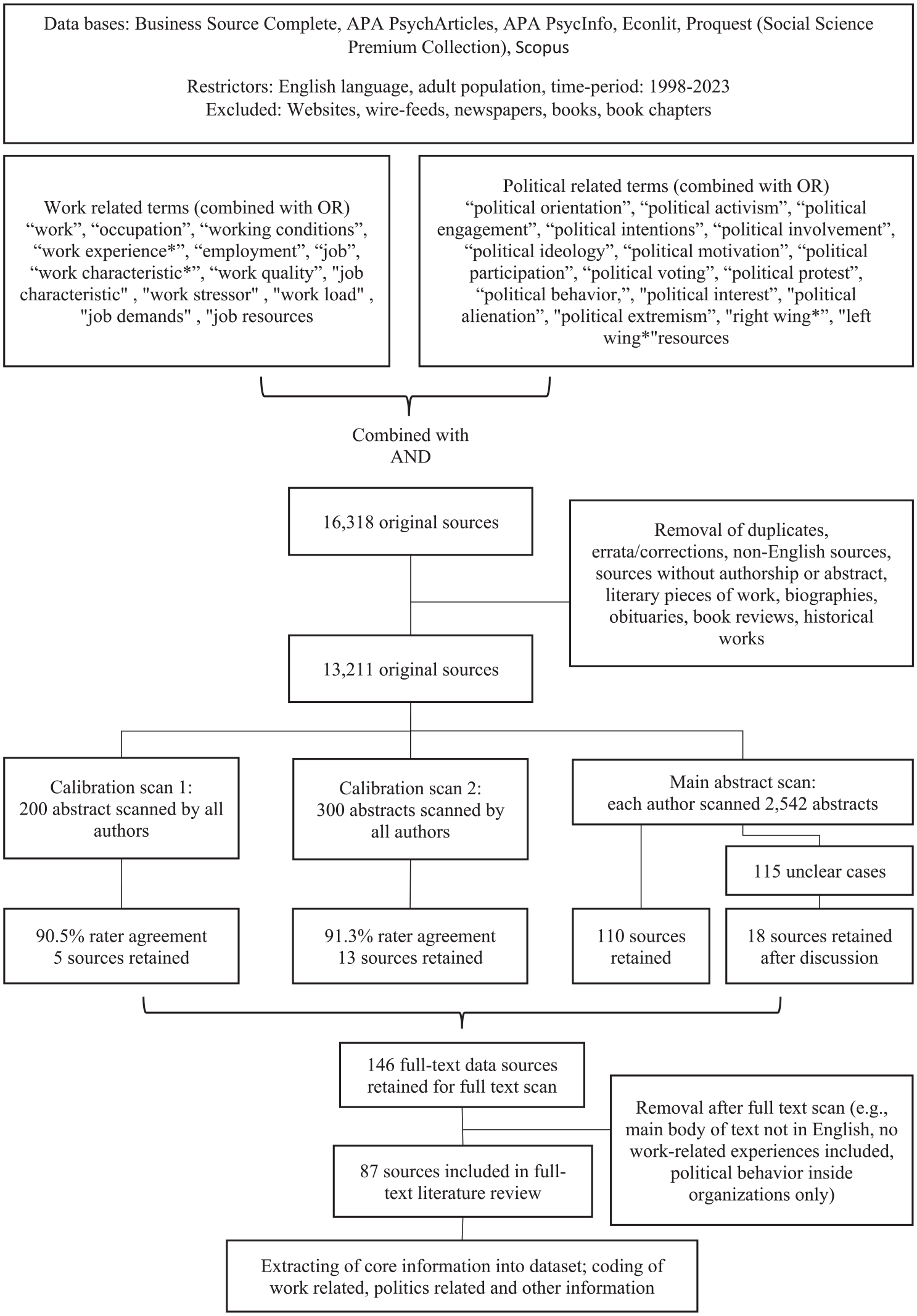
Literature Extraction Flow Chart
Current Status of Research
Descriptives, Disciplines, and Study Designs
The literature database reflects that the link between work and political engagement outside of work has attracted the attention of researchers from a wide range of disciplines, including political science, economics, sociology, psychology, communication studies, and technology, to name a few. While it is perhaps unsurprising that political science was the discipline that drew the largest group of papers (36%), at least 23.2% were from management sciences, economics, and industrial relations journals, indicating the topic’s relevance to organizational scholars as well. As for other disciplines, 15.2% of all papers were published in sociology journals, three were from psychology, and three were dissertations or published in general social science outlets. It is also striking that the study of working conditions and politics, despite stimulating the interest of researchers from various backgrounds, still seems to be a niche topic (including in political science): Only 87 papers provided empirical evidence and met our criteria for inclusion.
In terms of study design, most studies were survey-based, with a slight majority (52.8%) relying on secondary, often large-scale panel datasets (such as the World Values Survey or the European Social Survey); 21% of the studies offered a longitudinal design (e.g., Van Hootegem et al., 2022). Many studies had a multicountry design (34.5%; e.g., Allen & Goodman, 2021), 35.6% were conducted in liberal market economies (including the United Kingdom, United States, Canada, and Australia), 13.8% were conducted in coordinated market economies (e.g., France, Germany), and 16.1% of studies were difficult to categorize as coordinated or liberal market economies (e.g., Hungary, Argentina). There were only four qualitative studies (e.g., Cross & Turner, 2006) in our sample and one meta-analysis (Stockemer, Lentz, & Mayer, 2018).
Categorization of the Findings
After extracting core information from each of the sources into a database, the first author, along with a coauthor of this paper, then coded each of the 87 sources’ work-related information and information regarding political outcomes. To categorize work-related variables, we lean on models of job quality, as described by Le Blanc et al. (2000) and reflected in the structure of job resources (see Bakker et al., 2003). These models differentiate between four different dimensions to describe an employee’s work situation (or job resources): (1) job content (the characteristics of the tasks performed at work, encompassing aspects such as work complexity, autonomy, and role clarity), (2) working conditions (the environment in which the job is performed and the demands placed on it, including physical conditions such as temperature, noise, and the lack of protective equipment, as well as mental, physical, and emotional demands), (3) employment characteristics (general terms and arrangements that govern the relationship between an employer and an employee), and (4) social relations at work, including formal structures (e.g., opportunities to voice and representation in formal structures such as unions and councils) and informal (e.g., interactions at work with colleagues or supervisors, and the sense—or lack—of support or community associated with these social relationships) social aspects at the workplace (McEvily, Soda, & Tortoriello, 2014). These four dimensions are widely used in policymaking and echo job quality frameworks by Eurofound (2021) and the global job quality framework by the OECD (Cazes, Hijzen, & Saint-Martin, 2016) (particularly its Quality of the Working Environment dimension). We discuss findings in those categories in relation to the three political dimensions mentioned earlier: (1) political participation (which includes the willingness to vote but also political activism like signing petitions, participating in strikes, etc., and political advocacy) and (2) political attitudes, which we divided up in (a) political attitudes on specific issues (e.g., income or wealth redistribution, welfare state reform) and (b) political orientation, which describe individual’s or group’s overall ideological or philosophical stance on political issues and their position within the broader political spectrum (e.g., voting left or right wing, affinity to certain political schools, etc.). The third category is (3) political trust, which consists of trust in parliament, politicians, and political parties, as well as political cynicism and disillusionment with the government. Originally, we were expecting to find evidence for the effects of work experiences on (4) political values. However, values are rather unobservable constructs that have rarely been directly assessed in relation to work experiences (one exception is Bengtsson, Berglund, & Oskarson, 2013).
In what follows, we first discuss the theoretical frameworks that have been used in the literature thus far to explain the link between working conditions and individual political outcomes outside the work context. Next, we review the empirical evidence for the link between the work-related categories and the political variables of political participation, political attitudes, political trust, and political values (see, for example, De Witte, 2004 and van Deth, 2014 for a similar classification of political outcomes). Many of the studies included several of these work-related dimensions and several aspects of individual political outcomes.
Theoretical Frameworks Linking Work and Politics
The bridge between work and politics has drawn the interest of a broad range of theorists over the years, and explanatory frameworks reflect the historical trends as well as disciplinary views on humans and their motivations (Weiner, 1991). Many theorists in sociology, industrial relations, and political sciences argue that it is the structure and conditions of work, the social class of occupations, and the resources provided or deprived by work—in conjunction with broader societal trends—that influence the nature of political attitudes and participation of workers (e.g., Crouch, 2004; Putnam, 2000; Sobel, 1993). Empirically, as our review shows, these aspects are often examined in isolation. There are studies that use class-based explanations to predict the voting tendencies of people in different occupations (e.g., Bengtsson et al., 2013; DeWitt, 2021; Jansen, 2017; Oesch, 2008; Tanner & Cockerill, 2002; Wodtke, 2017). Other studies predominantly employ either a spillover logic to account for high-quality (or low-quality) work situations that enable (or undermine) political outcomes or a motivational logic to explain how working conditions could be related to specific forms of political outcomes to protect individual interests.
Spillover models, most prominently Pateman’s (1970) model of political participation, suggest that certain experiences in the workplace (e.g., autonomy) engender a sense of confidence and effectiveness, which would, in turn, enable participation in political activities. Indeed, empirical support exists for the relationship between autonomy at work and political participation and trust outside work (e.g., Jansen, 2017; Jian & Jeffres, 2008; Róbert et al., 2017; Ryan & Turner, 2021). There was also some support for the proposition of resource models (Brady, Verba, & Schlozman, 1995; Schlozman, Burns, & Verba, 1999; Verba et al., 1995), which state that work allows for the accumulation of resources, in specific money and skills, which would be essential for political participation. While there was a robust and positive relationship between income (e.g., Schur, 2003; Staeheli & Clarke, 2003) as well as skill use (e.g., Friesen, Burge, & Britzman, 2021; Godard, 2007) and political participation, there was no evidence for a link between time spent at work and political participation (e.g., Mencken et al., 2020, Newman, Johnson, & Lown, 2014; Schur, 2003). Notably, most evidence (except Schur, 2003) stems from cross-sectional studies, preventing any inferences regarding the causal direction of effects.
Motivational models were mostly employed to explain low-quality work conditions, including job insecurity and low income, which would create a sense of urgency and grievance, resulting in a desire for political participation. Grievance models (e.g., Gamson, 1968), Runciman’s (1966) theory of double deprivation, status inconsistency theory (Lenski, 1956), prospect theory (Kahneman & Tversky, 1979), or insider–outsider theory (Rueda, 2005) fall into this category. These models can account for the positive relationship between job insecurity and political participation (e.g., Azedi, 2013; Bassoli & Monticelli, 2018), job insecurity and political voting (Abou-Chadi & Kurer, 2021; Mughan, Bean, & McAllister, 2003; Zagórski, Rama, & Cordero, 2021), and job insecurity and specific attitudes such as left-wing voting (e.g., Dekker, 2010; Jansen, 2019; Singer, 2013). Also, while there appears to be evidence for the motivating effect of grievance in some studies, in other studies precarious work aspects, such as involuntary flexible work arrangements or earning very low incomes, did not relate to more political participation (e.g., Staeheli & Clarke, 2003; Wolanski, 2019). Taken together, this suggests that both traditions of explaining the work-to-political relationships are valid: someone would need to be able (e.g., by having enough resources) and motivated (e.g., by having a grievance) to participate politically. Looking at the evidence for voice structures, indeed both play a role: When people had access to voice structures, it was argued to create the resources, skills, and knowledge of how to speak up also in wider society (e.g., Jirjahn & Le, 2024), but when people were suppressed in using voice, this created a grievance and made people speak up as well (Stanojevic, Akkerman, & Manevska, 2020).
What remains obscure in current explanatory frameworks are the transmission mechanisms through which class-based, spillover, or motivational mechanisms work. Only very few papers move beyond a description of external drivers or conditions of political outcomes toward a focus on the intra-individual processes, cognitions, emotions, and attitudes triggered by working conditions. This is curious, as individual-level processes, such as a sense of generalized responsibility and self-competence, have been proposed as core mechanisms in classic writings on the work-to-politics relationship (Pateman, 1970). Some studies identified psychological concepts, such as the role of political efficacy (Andrews, 1998; Breuer & Asiedu, 2017; Kim, 2021; Schur, 2003), a sense of belonging (He, Costa, Walker, Miner, & Wooderson 2019), a sense of injustice (Van Hootegem et al., 2022), or identity threat (Selenko & De Witte, 2021) as bridging mechanisms. This is where we see the potential for further theoretical development and the integration of more psychological theories.
Main Findings
In the following, we provide an overview of the relationships between work-related variables (job content, working environment, employment characteristics, social relations at work) and political outcomes. The core questions we seek to answer are: Do work experiences affect political participation, attitudes, trust, and values? Our main conclusions are summarized in Table 1.
Overview of the Work Variable to Political Outcome Relationships
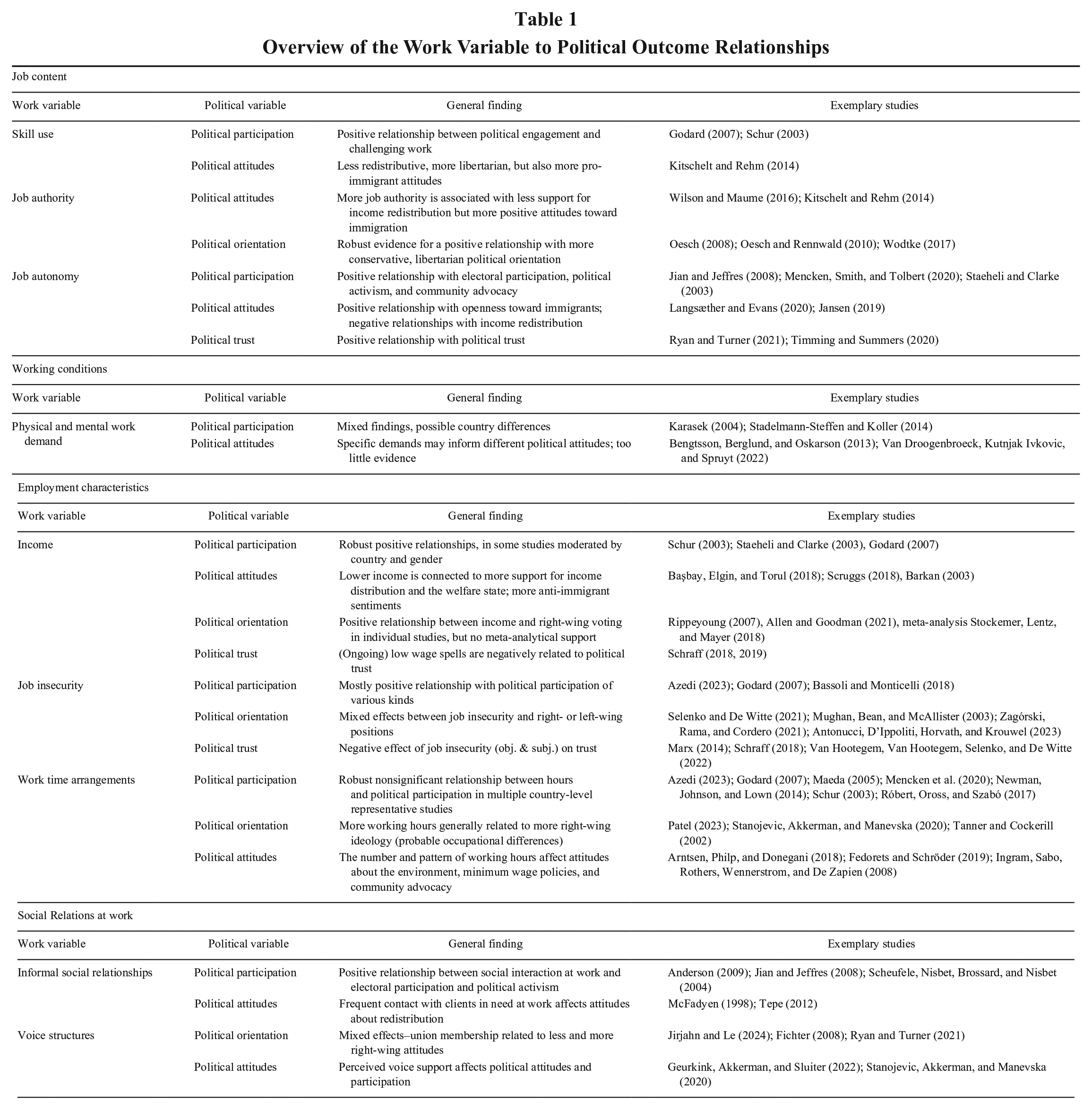
Job Content Characteristics
In total, 26 studies analyzed types of job characteristics (Hackman & Oldham, 1976) or aspects related to “skills and discretion” (e.g., Eurofound, 2021). The three job characteristics that have attracted the most research interest are skill use (especially the extent to which skills can be used in a job), job authority, and job autonomy. Across the literature, their relationships with political outcomes were quite similar: Overall, skill use and autonomy positively related to political participation (e.g., Ryan & Turner, 2021; Schur, 2003; job authority was not examined in this regard), and all three related to greater support for immigration and less support for income redistribution (Kitschelt & Rehm, 2014; Langsæther & Evans, 2020). A more nuanced picture emerges when each work experience is considered separately.
Skill Use
Using more skills in one’s job was generally positively related to political participation, but the specific nature of the task as well as the challenge level of tasks and required skill level mattered. For example, having a challenging job combined with exposure to “alternative work practices” (e.g., workplace redesign, quality improvement program, self-directed teams) was positively related to political voting and donating time to a political or social cause (Godard, 2007).
Skill use was also related to specific political attitudes: Using objective measures, people in jobs that demand higher skill levels were found to have less redistributive, more libertarian, but also more pro-immigrant attitudes (Kitschelt & Rehm, 2014), as well as less Euroscepticism, particularly in wealthier countries (Hooghe, Huo, & Marks, 2007). These may be due to the different economic contexts to which people in different occupations are exposed (Hellwig, 2001). Also, the match between skill level and job matters: People who were over-qualified were generally less satisfied with the political system (although there were no effects on trust, voting tendencies, or the general importance of politics, Wiedner, 2022). Anecdotally, persons who did not “fit in’ with their organization (in a sample of student support workers) were more likely to identify as liberals (Sneeden, 2021). In addition, research also found that individuals in a high-skilled occupation vote more likely for the incumbent (already in office) party, coalition, or candidate (Hellwig, 2001).
Taken together, while skill use appears to be most broadly related to political participation and specific political attitudes, this effect needs to be understood in the context of a person’s education (Wiedner, 2022), as well as the wider economic context (Hellwig, 2001). There were no studies in our sample that related skill use to political trust.
Job Authority
Only five studies investigated the effect of having job authority, in the form of a supervisory role (Wilson & Maume, 2016) or workplace authority (Wodtke, 2017), and they did so only in relation to political attitudes and voting: People at the higher end of workplace authority tend to be less supportive of income distribution in European and US representative studies (Kitschelt & Rehm, 2014; Wilson & Maume, 2016). People in managerial and ownership positions are also more likely to vote for conservative candidates in the US presidential election and to report conservative political ideologies across Europe (Wodtke, 2017), lean toward libertarian views (Kitschelt & Rehm, 2014), or support parties leaning to the right in Britain, Germany, and Switzerland (Oesch, 2008; Oesch & Rennwald, 2010). However, in some studies, they are also more favorable toward immigration, according to data from the European Social Survey (Kitschelt & Rehm, 2014), which runs against the anti-immigration agenda of many right-wing populist parties. Political trust was not investigated in relation to job authority in the studies of our sample.
Job Autonomy
Job autonomy was the job content that attracted the most research attention in our sample (14 studies in total), perhaps also because of Pateman’s (1970) highly influential spillover model, which formally proposed a connection between job autonomy and political participation. In most studies in our review, job autonomy was understood as a combination of (1) control over one’s daily work and (2) participation in decision-making of organizational relevance, although sometimes it was not referred to as autonomy (e.g., but as “workplace participation”; Kim, 2021) and occasionally these two aspects were investigated separately (e.g., Jian & Jeffres, 2008) Across all different conceptualizations and study designs, job autonomy was generally related to more openness toward immigrants and negative attitudes toward income redistribution (see also Table 1). Simply having more control over one’s own work, whether measured in a wider sense or as control over specific aspects (e.g., the ability to start new projects, Ingram, Sabo, Rothers, Wennerstrom, & De Zapien, 2008), was related to more participation in elections and political activism in smaller cross-sectional studies (Jian & Jeffres, 2008; Ingram et al., 2008) as well as large-scale panel studies (Róbert et al., 2017). The same was found in studies that looked at objective autonomy, using self-employment as a proxy, which also found a positive relationship with political participation (Mencken et al., 2020; Staeheli & Clarke, 2003). Also, “classic” job autonomy (control over one’s job in combination with participation in organizational decision-making) was positively related to greater electoral participation and more general political participation in representative, large-scale studies across Europe (Budd, Lamare, & Timming, 2018; Kim, 2021) and Israel (Cohen & Vigoda, 1998, 2000; cross-sectional results).
Greater (classic) job autonomy also relates to certain political attitudes but not necessarily alongside the right-left spectrum. Generally, higher job autonomy relates to more trust in parliament, politicians, and political parties, satisfaction with democracy, trust in people, and openness toward immigrants (Ryan & Turner, 2021; Timming & Summers, 2020). Welfare state support is stronger among those with greater job autonomy, independent of job contract and economic insecurity (Jansen, 2019), but at the same time, opposition to income inequality is lower (Langsæther & Evans, 2020), reflecting two different underlying political values.
The relationship between job autonomy and political orientation was also mixed: When looking at subjective objective autonomy (self-employment), self-employed were generally more right-wing leaning (Langsæther & Evans, 2020; Patel, 2023) and showed lower levels of support for socialist parties (in former post-communist Eastern European countries; Duke, 1999). Perhaps this is also the result of a preference formation: voters on the far left appeared to value job autonomy less (Abrassart & Wolter, 2023). However, the type of self-employment plays a role: Solo self-employed tend to show fewer authoritarian values than others (Stanojevic et al., 2020), and within a group of precarious solo self-employed people, greater job control was related to more left-wing voting over time (Jansen, 2017).
This shows that while job autonomy does seem to have some relevance for (some aspects of) right or left-wing political orientation, the effects are nuanced and very much also depend on the nature of job autonomy and specific employment characteristics (e.g., whether someone is solo self-employed).
Working Conditions
Few studies (six in total) examined specific work demands, finding mixed evidence for the relationship between specific demands and political participation and the type of political attitudes.
Physical and Mental Demands
The relationship between demands and political participation is mixed: In some studies, more demanding jobs (if combined with more decision latitude, “active” jobs) were found to show increased engagement in political activities outside work (Karasek, 2004, in a Swedish study), but in others demanding jobs tended to dampen participation rates (if demand was measured through professional position, for women) (Stadelmann-Steffen & Koller, 2014, using a Swiss electoral panel).
While adverse working conditions were not necessarily related to more political participation per se, they were related to more support for political action. In a study on austerity protests across nine different European countries, participants who perceived their jobs as worsening were more favorable toward different types of anti-austerity protests (Cristancho, Uba, & Zamponi, 2019). Actual protest itself depended on the structures and support groups available to organize protest, as anthropological studies show (Wolanski, 2019).
There may be a link between the specific demands of a job and political attitudes. In a large Swedish study, physically demanding jobs were more associated with political left orientations (based on opinions on income inequality, the rigidity of employment protection laws, etc.), but also with a tendency toward authoritarianism (e.g., attitudes about abortion, gay marriage, the death penalty, the preservation of traditions and values, etc.), while mentally demanding jobs showed opposite patterns (Bengtsson et al., 2013). This indicates that working conditions might not fall neatly with left–right wing preferences in the classic sense. What also appears to be the case is that certain dangerous jobs that entail significant social-physical or mental threat components were associated with higher levels of ethnic prejudice, authoritarianism, and social dominance orientation (as found in a large study among Belgian police, Van Droogenbroeck, Kutnjak Ivkovic, & Spruyt, 2022). These studies are too few to allow for firm conclusions, but they suggest that certain working environments might resemble so-called “strong situations,” almost forcing people to react in certain ways (Cooper & Withey, 2009; Mischel, 1977).
Employment Characteristics
Most papers reviewed (57 in total) explicitly discussed one or more employment characteristics, which comprise all those aspects that govern the relationship between an employer and an employee (Le Blanc et al., 2000). The three most prominently reviewed employment characteristics were income, job (in)security, and work time arrangements, and a couple of studies investigated two or more of these. There were also two papers that discussed career development, which we also discuss in this section. The relationships between these three and political participation, political attitudes, and trust are slightly different, hence we discuss them separately. Higher income and higher job insecurity could be related to more political participation outside work (e.g., Azedi, 2023; Schur, 2003), while lower income and higher job insecurity were also related to decreased political trust (e.g., Schraff, 2018). All three employment characteristics played a role for political attitudes but in different ways (see Table 1 for a summary of the main conclusions).
Income
Of all reviewed studies, 21 studies explicitly investigated the effects of financial aspects of the employment situation on political outcomes. Studies investigated the effect of employees’ income (e.g., Barkan, 2003; Park & Einwohner, 2019; Schlozman et al., 1999) or broader insecurities, including income-related ones (Hacker, Rehm, & Schlesinger, 2013; Jansen, 2019; Schraff, 2018) as well as occupational background as an indicator of employees’ economic risks (Alaimo & Solivetti, 2019; Cross & Turner, 2006; Rippeyoung, 2007; Scruggs, 2018; Stockemer et al., 2018).
There was robust evidence for a positive relationship between income and political participation across various large-scale secondary survey studies. Income is positively related to factual political knowledge (Scheufele, Nisbet, Brossard, & Nisbet, 2004) and political participation of US employees (Schur, 2003; Staeheli & Clarke, 2003). This effect was moderated by gender (Schlozman et al., 1999) and is not always visible in primary studies conducted in specific industry sectors (e.g., in a study among people who work in child and family service in the United States, Andrews, 1998) or in specific countries (e.g., in a survey conducted among UK and Canadian workers, Godard, 2007).
Financial insecurity generally seems to undermine political trust; particularly if low-wage spells were ongoing and longer lasting (Schraff, 2018, 2019; using representative longitudinal Dutch data), although people still had more trust in governmental institutions than in free market institutions to improve their living conditions (Başbay, Elgin, & Torul, 2018; using data from the World Values Surveys). This is also reflected in political attitudes: across the globe, individuals with lower incomes (Başbay et al., 2018; Langsæther & Evans, 2020; Tanner & Cockerill, 2002), lower economic status (Scruggs, 2018), or greater income insecurities (Jansen, 2019) were more in favor of a redistribution of income and wealth, of government involvement in the economy, more critical about the current wealth distribution practices of their country, and more accepting of nationwide strikes (Park & Einwohner, 2019). In the United Kingdom, people in occupations with higher economic risks were more likely to vote “leave” in the 2016 Brexit referendum (Alaimo & Solivetti, 2019); in Ireland and the United States, they were more likely to harbor anti-immigrant sentiments (Barkan, 2003; Cross & Turner, 2006).
However, the relationship between financial aspects and left-right wing political orientation is not robust: While individual studies find a relationship between being exposed to financial insecurities (being a blue-collar worker) and far-right party support (for men, Allen & Goodman, 2021; Barkan, 2003; Cross & Turner, 2006; Rippeyoung, 2007), as well as income and right-wing political orientation (Bengtsson et al., 2013), in a variety of countries, meta-analytic reviews do not support this relationship (Stockemer et al., 2018).
Job (In)Security
A total of 22 studies investigated the role of job security, but mostly in the form of job insecurity, with studies differing in their operationalization of insecurity as an objective or subjective construct, which is why we differentiate the discussion of findings accordingly.
Perceived job insecurity has a positive relationship with political participation in protest (more so than any other individual economic indicator) in large multicountry studies (e.g., Azedi, 2023), but the relationship with other forms of participation (e.g., voting or donating time) is less consistent (Godard, 2007). The impact of job insecurity becomes more pronounced when coupled with contextual elements that intensify insecurity, such as being employed in precarious service and private sector positions or residing in countries with inadequate social safety nets (Azedi, 2023).
In terms of political orientation, findings are mixed: Subjective job insecurity was not significantly related to self-positioning on a left–right spectrum in some studies (Selenko & De Witte, 2017, 2021), but it was in others (less right-wing voting in Sweden, Bengtsson et al., 2013; more right-wing voting in Australia, Mughan et al., 2003). It was, however, related to more support for welfare spending on unemployment (although not on health care or pensions) (Dekker, 2010) and more protectionist measures, but not more racism (Mughan et al., 2003).
Job insecurity is more consistently related to governmental evaluations and trust, with those concerned about job loss more likely to penalize or reward the government based on economic performance and less likely to trust political institutions (in a secondary, cross-sectional multi-country study, Singer, 2013; a secondary longitudinal single-country study, Schraff, 2018; and a primary longitudinal single country study, Van Hootegem et al., 2022). It also correlates with a reduced sense of belonging to the working population and decreased tolerance toward others (Selenko & De Witte, 2021).
Objective measures of job insecurity show that temporarily employed youth are more politically active due to perceived disadvantages (Monticelli & Bassoli, 2016, 2019), while adults tend to withdraw from political participation (Kweon, 2018). The results are mixed concerning political attitudes and orientation. Unemployment risk is associated with right-wing voting (Abou-Chadi & Kurer, 2021; Allen & Goodman, 2021), and the more temporal employment in a country, the more young people vote right-wing in Europe (Zagórski et al., 2021). Also, Antonucci, D’Ippoliti, Horvath, and Krouwel (2023) found that people with temporary contracts were likelier to vote for radical populist parties and less likely to vote for established parties. In contrast, Marx (2014) found that temporary workers do not appear to be more disenchanted from politics nor support deregulatory parties more, as temporary workers exhibited higher demand for redistribution and stronger support for the “new left” (= green, left-libertarian) parties. Lastly, some studies found no effect: temporary workers show no less or more political participation or different political orientation (Corbetta & Colloca, 2013), or no less or more inclination toward left-wing or against right-wing parties (Jansen, 2017). Perhaps country and governance contexts can explain such divergent findings: In a study including surveys from 18 different European countries, increased national unemployment insurance generated more left-wing votes among temporarily employed, whereas reduced spending resulted in no voting or voting against traditionally left-wing parties (Kweon, 2018). Another form of precarious work pertains to those in informal jobs (often lacking secure contracts, social protection, and legal worker benefits), who reported more confidence in political institutions in developing economies but were less likely to vote and were less likely to be politically involved or be engaged (Başbay et al., 2018; Breuer & Asiedu, 2017).
Taken together, across all possible conceptualizations, measurements, and study designs, a rather mixed picture emerges: Job insecurity tends to have a positive association with political participation, but effects on political attitudes and orientations were mixed and depended heavily on the conceptualization of job insecurity as well as contextual variables (e.g., amount of welfare support, Kweon, 2018). At least the mixture of findings puts a question mark behind the proposals of insider-outsider theory (Rueda, 2005): This theory distinguishes between “insiders,” who are workers with secure, often permanent employment contracts and strong job protection, and “outsiders,” who are workers on temporary contracts, the unemployed, or those marginalized in the labor market with weaker job security and fewer rights. Outsiders would be more motivated to vote for welfare system reforms, whereas insiders would favor voting for legislations that would protect their employment status. Our study results show that the situation is not as straightforward as that. See Table 1 for a summary of the results on job insecurity.
Work Time Arrangements
Working hours have been argued to be related to political outcomes in several ways: For one, working more would increase civic interest (Pateman, 1970); for the other, it has been suggested that working longer hours would leave less time for other activities outside work, thereby decreasing participation (Schur, 2003). Across the 13 studies in our sample that discussed working hours, there seems to be some evidence for the first assumption (longer working hours correlate with better self-rated political skills in the US household panel, Schur, 2003), the second did not garner any support. Evidence across several large-scale survey studies (using nationally representative panels or multi-country panels) generally shows no support for a relationship between worked hours and political participation (Mencken et al., 2020; Newman et al., 2014; Schur, 2003), worked hours and participation in voting or donating time (Godard, 2007; Róbert et al., 2017), or worked hours and participation in protests (Azedi, 2023). This disconfirms peoples’ reasoning in interviews that suggests that working longer hours would leave them with less room for activities outside work (Sen, 2009). It also shows that while working longer hours might increase political interest, this does not necessarily translate into more participation. Notably, there were some country-specific exceptions (e.g., in Spain; Voces & Caínzos, 2022) and evidence of moderators (e.g., gender, Schlozman et al., 1999).
The number of worked hours, however, has a relationship with specific political orientations and values: In representative European data, people who worked longer hours reported more right-wing voting (Patel, 2023) and more authoritarianism (in a large-scale Dutch panel study, Stanojevic et al., 2020). There might be a profession or sector-specific component to these attitudes: in specific professions, more working hours were related to positive attitudes toward the redistribution of wealth (among middle-class health-care professionals, Tanner & Cockerill, 2002). Also, working hours seemed to relate to very specific attitudes. People who worked longer hours cared most about the environment (according to representative European data, Arntsen, Philp, & Donegani, 2018), but also the pattern of worked hours made a difference: Unstable or decreasing working hours were related to less support for minimum wages in German representative data (SOEP data, Fedorets & Schröder, 2019), and among a small sample of US community health-care workers, flexible working hours were related to more community advocacy (Ingram et al., 2008).
Taken together, working hours, while not associated with political participation per se, do relate to specific political attitudes, which do not always fall along a traditional left–right wing spectrum.
Career Development and Advancement
There is an assumption that perceived career prospects and perceived job competition (e.g., by immigration) would influence political preferences (e.g., Kitschelt & Rehm, 2014; Margalit, 2011). Also, if advancement opportunities within the organization equal the development of civic skills, or the accumulation of more job autonomy, job authority, or income, one would predict a subsequent effect on political participation and attitudes.
Unfortunately, career prospects or advancement opportunities were hardly investigated in the studies in our sample. In a Swedish study, Bengtsson et al. (2013) found that career prospects were unrelated to political attitudes (economic left/right wing and libertarian/authoritarian views) once they started controlling for other work-related variables (e.g., job insecurity, working in a team, working in a mentally demanding job). Participating in leadership training appeared to relate to specific political outcomes outside work, as anecdotal evidence from a small cross-sectional study among community health workers in the US shows (Ingram et al., 2008). There, the political outcomes consisted of community advocacy, something that concerns community health workers. In sum, our review has too little direct evidence to conclude whether career advancement opportunities would impact political outcomes outside of the workplace.
Social Relations at Work
The fourth category of work aspects we found in this study was the type of social relationships at work. The workplace offers the possibility of social interaction with strangers outside the private family and friendship circles (Jahoda, 1982). In the best case, this can enable a “cross cutting dialogue” (Mutz & Mondak, 2006) across different political lines and expose a person to heterogeneity in different opinions (Scheufele et al., 2004), but it can also generate subcultures with shared world views through shared processes of socialization (Weeden & Grusky, 2012). In the following, we differentiate between informal social relationships (interactions with colleagues and clients at work) and formal social relationships (voice structures, representation in unions and councils). Evidence from 16 studies shows that good social relationships with colleagues and the availability and support of voice in organizations relate to more political participation. In relation to specific political attitudes and orientations, the picture is more nuanced (see Table 1 for a summary).
Informal Relationships
Eleven studies considered informal relationships at work, many of which drew on the notion of workplaces as social networks that help maintain an active citizenry, partly because they expose employees to different viewpoints. Several studies found that quantity and quality of social interaction with colleagues at work (e.g., participating in work-related social events, sense of workplace community) were related to more participation in politics (e.g., political discussion, participation in political voting, participation in political party and campaign activities, community politics participation) (Anderson, 2009; Breuer & Asiedu, 2017; Jian & Jeffres, 2008; Scheufele et al., 2004). Interview studies show that people report an increased sense of connectedness through their professional networks and a social recognition of their job skills by the community (Breuer & Asiedu, 2017). One study showed that working in a team itself contributed to having left-wing-oriented attitudes (Bengtsson et al., 2013).
Encounters with clients play a role: Regularly encountering people in need at work (e.g., when working in health care or education) has been argued to lead to more left-leaning political attitudes (Tepe, 2012), and it appears that workers in certain public sector occupations (in health care, social care, or education) consistently vote more left (Rattsø & Sørensen, 2016) and are in favor for state ownership (Duke, 1999), although the difference to private sector employees becomes less stark with rising occupational status (Tepe, 2012). There is evidence that workers who are in frequent professional contact with unemployed people tend to have more sympathetic attitudes toward them (McFadyen, 1998), whereas those who regularly experience threat and danger from others (e.g., in the police service) are more likely to harbor more politically right-wing attitudes (Van Droogenbroeck et al., 2022).
Whether those values are shaped by experience or whether occupations attract people with certain orientations is not clear: Some argue that workers reflect the values of the clients they serve; in the case of cultural workers, for instance, they may share similar values as cultural consumers. For example, arts workers have been shown to be more liberal, left-leaning, pro-welfare, less supportive of Brexit, and exhibit higher levels of political participation (McAndrew, O’Brien, & Taylor, 2020).
The results on divergent political opinions at one’s workplace were mixed: some showed that discrepancy between one’s own political orientation and that of co-workers can lead to uncivil behaviors (He et al., 2019), others found that discrepancy can lead to more political tolerance and a greater understanding of colleagues’ rationales for divergent political perspectives (Mutz & Mondak, 2006).
Voice and Voice Structures
There is a relationship between formal voice structures and specific political attitudes and ideologies. On its own, union membership was often related to greater trust in politics, greater trust in people, and favorable attitudes toward immigrants across Europe (using ESS data, Ryan & Turner, 2021). This is confirmed by US household panel data, showing a positive relationship between union membership and political participation (Schur, 2003). Looking at more coordinated market economies, the effect was more varied: In Germany, the presence of a works council enhanced workers’ interest in politics, but only for male employees (Jirjahn & Le, 2024), and union membership in combination with being a skilled worker or middle manager was related to having extreme right attitudes (Fichter, 2008, both studies using representative German data).
Not only the availability of voice structures but also the support from the supervisor for voicing matters: in a Dutch study, if workers felt their supervisor suppressed their voice, this led to a higher endorsement of authoritarianism (independent of union membership; Stanojevic et al., 2020), whereas if they were receiving support from their supervisor for voice, this was related to greater political participation and political efficacy (Geurkink et al., 2022).
Future Outlook
The strength of this review is its interdisciplinary nature, as it provides a synthesis of research across 16 different disciplines (according to journal titles), compiled by an interdisciplinary author team. Our review shows that the work-politics nexus is a multilevel phenomenon, with factors of influence ranging from subjective job perception to objective characteristics of the employment situation and even to aspects of corporate governance (e.g., the availability of unions or voice structures) or the wider institutional context (e.g., the availability of welfare support).
Work Experiences as Transformers of Democracy?
Interestingly, despite the complexity of the evidence base, a rather clear picture emerges across the reviewed studies: What happens at work and how people engage politically outside work is related: Competence-enabling and grievance-related work experiences both motivate political participation but (a) have opposing effects on political trust and (b) lead to opposing political attitudes on economic and cultural issues.
Jobs that are enabling and of better quality (according to the Le Blanc et al., 2000 framework)—for example, by allowing for more skill use, having more autonomy, being better paid, or offering good social relationships—are associated with (1) more political participation, (2) higher levels of political trust, 2 and (3) specific political attitudes 3 characterized by openness to immigration (a culturally progressive political stance, De Witte, 1999) and opposition to economic redistribution (an economically conservative political stance).
In contrast, jobs that create a grievance (e.g., because they are insecure) were also related to more political participation, but people tended to have lower political trust 4 and, in some cases, were less supportive of immigration 5 (culturally conservative political stance) while being more supportive of economic redistribution (economically progressive political stance) (see also Table 1).
These findings were consistent across the study year, location, and type of data collection method, suggesting a universal pattern in how the psychological experience of work translates into broader political engagement. They also show that individuals can simultaneously hold politically conservative views on some issues and politically progressive views on others rather than holding consistent conservative or progressive views across all issues (see also De Witte, 1999).
Populist political parties often appeal to such mixed views by offering a combination of culturally conservative and economically protectionist programs. At their heart, populist movements claim to protect the values and lifestyle of an oppressed, “pure” majority against a detached, corrupt elite (Mudde, 2004; Müller, 2017). Right-wing populist parties often stand against migration and open borders, against multicultural relativism, and for traditional authority (Oesch & Rennwald, 2010). It has been repeatedly argued that people in more insecure, badly paid jobs would be more attracted by a populist political program (Antonucci et al., 2023). Evidence for this claim in our review is mixed: in some studies, job insecurity was related to less openness toward migration (Cross & Turner, 2006) and more populist voting (Antonucci et al., 2023), but in others, there was no such evidence for job insecurity (Jansen, 2017; only involuntariness of self-employment was associated positively with populist voting). Also, financial position itself does not necessarily relate to anti-immigrant sentiments per se but rather the type of anti-immigrant sentiment: richer people seem to worry more about legal migration while poorer people worry more about illegal migration (Barkan, 2003). Financial decline, however, clearly undermines political trust (Schraff, 2018, 2019), which offers fertile ground for populist political movements that thrive on a “we vs them (‘the elite’)” rhetoric and advocate a change from established politics. Several studies related occupational profiles to populist voting: people with more technical task structures in their occupations were found to harbor more populist (authoritarian and anti-immigration) attitudes (Kitschelt & Rehm, 2014); small business owners and production and service workers tended to vote more populist (Oesch & Rennwald, 2010), whereas people employed in the cultural sector were less likely to favor populist votes (e.g., for Brexit; McAndrew et al., 2020).
It is important to note that even if job insecurity, financial decline, and occupational profiles can be related to favoring a populist agenda in some cases, it cannot be concluded that political populist movements are the “natural” consequence of these lived work experiences. Rather, the attraction of populism to voters is also the consequence of many different forces, such as voter characteristics (e.g., age), but also the availability of a populist leader and sensationalist media (see Mudde, 2004).
Advocating a Multilevel Perspective
Competence-enabling jobs do not just “occur” but are embedded in and fostered by an economic, institutional, and even cultural context. The present review does not sufficiently address the legislative, economic, and sociocultural contexts of work, which offer the support structures, allies, and norms that promote (or discourage) various forms of political participation and influence working conditions (e.g., see Godard, 2002). For example, worker voice behaviors are not just a matter of individual or collective motivations but also depend on the availability of supporting allies outside work (e.g., in the form of unions, activists, or NGOs), the socio-historical context, and whether the political system permits the right to protest (e.g., see Blofield & Jokela, 2018; Bayat, 2015; Constable, 2009, for political activism in Latin America, Egypt, Tunisia, and Hong Kong). Industrial relations scholars have long recognized the interplay between the political system in a country (which constitutes the environment in which employers act) and employment relations. For example, in European countries with a more inclusive, representative political system, trade union membership is more likely, and trade union influence is stronger (Budd & Lamare, 2021), which—as our results show—can then motivate greater political participation outside of work. Also, whether a country has a liberal market economy or a more coordinated market economy will play a role in employment relations and the conditions that might foster worker political outcomes (Hall & Soskice, 2001). 1
The nature of what is considered “political” can be dependent on country contexts: In authoritarian regimes, the lobbying for fairer work practices can already be seen as politicizing (e.g., see Alkhaled, 2021, on female entrepreneurship in Saudi Arabia). Enabling work environments may not foster democratic attitudes or political activism in regimes where civic engagement is suppressed. In countries with limited freedom of expression and restricted access to information due to controlled media, individuals are demotivated from participating in politics, leading them to retreat into private life (Norris, 2022). Furthermore, political science literature suggests that societies need to develop values that foster political involvement and demand more democracy (Welzel, 2013). Even cultural values may play a role: Some cultures might prefer hierarchical structures and rather emphasize in-group cohesion and control (House, Hanges, Javidan, Dorfman, & Gupta, 2004). In societies where individuals place less value on autonomy and involvement in decision-making, both in work and political contexts, a workplace that offers greater autonomy to workers may not necessarily yield political participation (Hofstede, Hofstede, & Minkov, 2010).
Contexts of work also concern organizational contexts, industry sector contexts, and occupational contexts, all of which influence people’s political outcomes. Research we reviewed showed that the effect of certain employment aspects (e.g., job insecurity) on the willingness to be involved in political participation depends on the industry sector and country welfare provision (see Azedi, 2023; Probst, Lee, & Bazzoli, 2020). Also, organizational size seems to play a role for political participation (Ryan & Turner, 2021). In order to better understand when individual-level working conditions encourage political participation, we need to understand them against enabling or disabling contextual conditions.
Adding to the complexity, sociopolitical contexts and working conditions are continuously changing and influencing each other. According to theoretical work by Inglehart on modernization and cultural change (Inglehart, 2018, 2020; Inglehart & Welzel, 2005), as individuals achieve greater economic security through stable employment, they shift from more materialist values to prioritizing post-modernist values of self-expression and quality of life. This cultural transformation underscores the link between economic conditions, the nature of work, and the evolution and stabilization of democracy. Crouch (2004), for example, argues that the decline of trade unions weakened the collective political engagement of workers, creating disenfranchisement and apathy. Simultaneously, conditions of precarious work and a shifting of societal norms toward individualism would have made political engagement more difficult. Still, as our research shows, experiences of grievance do motivate political participation—even in countries that saw a decline in unionization. Research is needed to better understand the interaction between contextual constraints and individual capacities.
This speaks to a multilevel approach when investigating individual political outcomes in relation to work, which includes a consideration of social and economic dimensions (as called for by Feldman & Johnston, 2014). We call for multilevel research programs that acknowledge the interconnectedness of job content, employment conditions, and contextual societal factors (Hitt, Beamish, Jackson, & Mathieu, 2007). Multilevel research designs enable the investigation of how job-related, employment-related, and other characteristics of the wider socio-political context interact to influence political outcomes at the individual level.
While it will be difficult to integrate all levels of influence into one study, we would at least like to encourage future researchers to reflect on what levels are represented in their research question and consider this in their study design and interpretation of their results. If, for example, the interplay between individual and organization-level characteristics is the focus of the study, researchers should aim at recruiting a variety of organizations, which will result in a data structure where individuals are nested in organizations. Is the interest in comparing the contextual influence of different types of economic regimes? Then, large-scale panel data sets such as the European Social Survey or World Values Survey may be of interest. Panel data commonly employs large time lags, which prevents insights on how different levels may interact in the short term, which may cause changes in attitudes and participation over time.
Expanding the Work and Politics Conceptual Field
Our review of the theoretical frameworks and their evidence identifies three main lenses through which this connection has been analyzed: a class-based lens, which sees political attitudes and behavior as being shaped by social class; a spillover lens, where workplace experience would either benefit or undermine political outcomes, depending on whether the workplace experience was positive or negative; and a self-interested motivational lens, where political outcomes would be motivated by the desire to change ones’ position (in the case of depriving workplace situations) or the desire to protect it (in the case of economically secure work).
Our findings indicate that both the spillover and motivational lenses effectively explain political participation. However, political participation itself is never neutral; it is always goal-directed. Whether individuals engage because they feel enabled (spillover lens) or driven by grievance (motivational lens) will differ in their political attitudes and levels of trust. These two theoretical perspectives can be well consolidated, as they describe distinct motivations for political participation, accompanied by different political attitudes, varying levels of political trust, and, to some degree, even divergent political values. Political participation can be similarly motivated by different job experiences, but the nature of that political participation will vary, depending on job quality.
Relatively few studies investigate the individual-level transmission mechanisms—such as the cognitions, attitudes, or emotions shaped by work experiences—to explain various forms of political outcomes. Notable exceptions include studies suggesting that certain job situations may enhance self-efficacy, thereby influencing political participation outside of work (in the United States, Andrews, 1998; in Togo, Breuer & Asiedu, 2017). Some researchers also argued that working in certain jobs might inform workers’ identities and, through that, guide their political views, values, and sense of belonging (He et al., 2019). Others have proposed that precarious working conditions may threaten broader societal identities, influencing political attitudes as a result (Selenko & De Witte, 2017; Selenko, Mäkikangas, & Stride, 2017).
This resonates with the findings of a previous review by Swigart, Anantharaman, Williamson, and Grandey (2020) on the (reverse) relationship between private political ideologies and work behavior. In their review, political ideology was understood as informing identities, which would affect the social norms of interacting and expectations in workplaces. It appears that people’s identities—either political or work-related—might constitute a two-way bridge between the work and political spheres.
Suggesting an Individual-Level Perspective
The purpose of this review is to inspire theoretical development by advocating for an individual-level perspective. Based on our observations, we propose that adopting an identity lens could guide future exploration of individual-level transmission mechanisms in the relationship between work and political outcomes and serve as an overarching theoretical framework. People’s identity, their political ideology, and their work experiences are closely interlinked. Swigart et al. (2020) propose that political ideologies are part of people’s social identities, which inform cognition and the judgment of others, clarify allies, and set expectations and norms. These social identities can affect social interactions and behaviors at work, thereby bridging private political ideologies with work outcomes.
People’s social identities, however, are not just informed outside work but also through the experience of work (Ashforth & Schinoff, 2016; Ashforth, Harrison, & Corley, 2008). Research on identity formation in organizations observes that performing certain work tasks regularly, belonging to a work context, and having the ability to exert control over important domains are key elements of work-related identity formation (Ashforth & Schinoff, 2016). These work-related identities can also affect preferences, norms, and entitlement expectations in private life, potentially informing political behavior outside the work context (e.g., Capitano, DiRenzo, Aten, & Greenhaus, 2017). The evidence presented in this review shows that working conditions that are generally considered to be conducive to identity formation, in that they allow for skill use (e.g., Godard, 2007; Schur, 2003); provide job autonomy (Ingram et al., 2008; Staeheli & Clarke, 2003); or involve a leadership component (e.g., Oesch & Rennwald, 2010) are also associated with more general political and electoral participation. This suggests that political participation and work-related identity formation are at least informed by the same factors, if not dependent on each other: Research has shown that people with central work identities prefer to enact those also outside work contexts, seeking, for example, for opportunities to exert authority (e.g., Capitano et al., 2017). Furthermore, there are overarching work-related identities that also include an element of wider societal citizenship, such as the identity of being “one of the employed” or “a member of the working population of a country,” which in turn can inform societally relevant attitudes (Selenko & De Witte, 2021).
In other words, social identity might be the bridge between work-related experiences and political beliefs and participation outside work. As an overarching framework, the identity approach can explain the mechanisms behind the spillover lens of work to political engagement (Pateman, 1970) through processes of identity formation at work and enactment in private life. Work-related identities may also account for the dynamics underlying self-interested motivational or class-based political preference formation (e.g., Kitschelt & Rehm, 2014; Scruggs, 2018), as identities create a strong sense of “us,” inform social judgment, and create a preference for furthering ingroup over outgroup interests (e.g., see Haslam, 2004). Entitlement violations and perceptions of identity threat might inform grievance-related political action. Hence, identity promises to be a plausible link between individual work experiences and political outcomes in private life, which also expands the process suggested by Swigart et al. (2020). Furthermore, an identity lens acknowledges that people’s self-understandings are formed in a wider societal context, thereby allowing for a multilevel understanding of the work-to-politics nexus.
While we propose an overarching identity framework, there are also other micro-level theories to predict individual-level processes that can link work experiences and political outcomes. For instance, self-determination theory (SDT, Deci, Olafsen,& Ryan, 2017; Gagné & Deci, 2005) suggests that human action is influenced by both extrinsic (e.g., pursuing job security and higher income) and intrinsic motivations (engaging in activities that satisfy basic needs for competence, autonomy, and belonging). Applied to the findings of our review, political participation could also be explained as being extrinsically as well as intrinsically motivated, although the specific nature of political participation would differ significantly depending on the type of motivation. Similarly, classic models of stress and activation (e.g., the job demand-control model, Karasek, 1979) propose that high demands alone do not necessarily lead to action; individuals must also have the necessary resources to cope with these demands effectively. Accordingly, job insecurity and financial insecurity may be seen as high demands, while autonomy, job authority, and skill variety function as key resources. Research already highlighted some psychological variables as connectors of work experiences and political attitudes and participation (e.g., control beliefs, De Witte, 1999; self-efficacy, Andrews, 1998; Breuer & Asiedu, 2017). Drawing from this literature could enable researchers of other disciplines to integrate established psychological mechanisms and explore curious relationships (e.g., between working hours and greater care for the environment, Arntsen et al., 2018). Please see Figure 2 for an illustration.
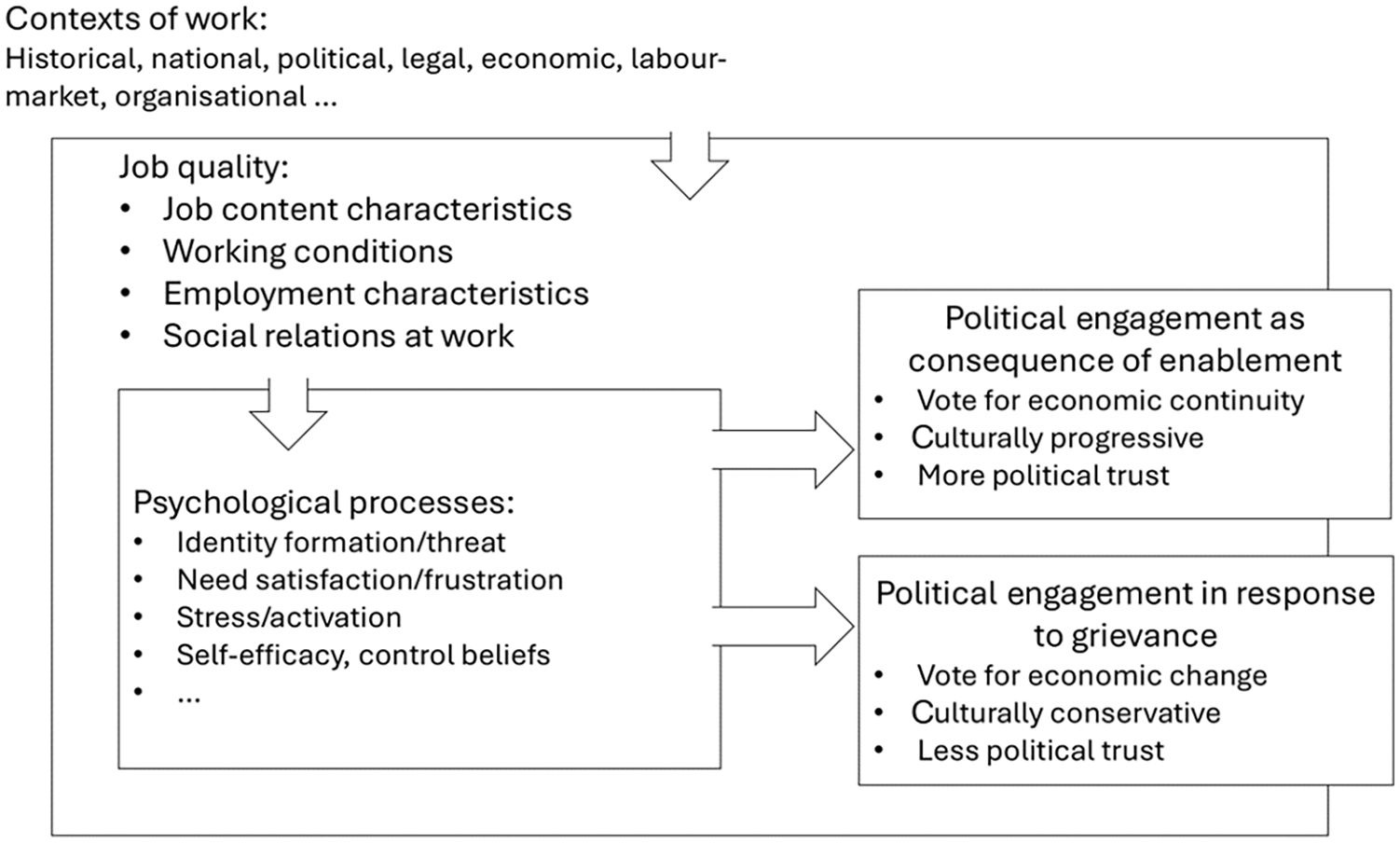
Simplified Model of the Work-to-Political Nexus, Highlighting the Embeddedness of Job Quality and Political Engagement in the Wider Contexts of Work
A Future Research Agenda
The key challenge for future research is to determine why, and under what work-related and employment-contextual conditions, employees develop specific political attitudes and engage in political participation. As illustrated, identity theory offers a plausible framework for guiding this research. Individuals may act politically outside work because of their identities formed at work, while political identities formed through external experiences may influence politically motivated behavior in the workplace (Swigart et al., 2020). This approach recognizes that identities are multifaceted in nature and contain multiple different social identity categories and roles (e.g., Ramarajan, 2014).
This raises compelling questions about how work-related and politically relevant identities are shaped in the workplace. As highlighted in our review, existing studies linking work experiences to individual political outcomes outside the workplace tend to focus on a narrow set of factors. However, work design and stress research has identified a much broader range of working conditions that can impact workers’ attitudes, behavior, and well-being both at work and beyond (e.g., Parker, Morgeson, & Johns, 2017; Schaufeli & Taris, 2014). How do changes in work affect the political self-understanding of workers? According to Crouch (2004), for working conditions to inspire political participation, they must first be recognized as political issues. Future research could investigate when and how working conditions become politically salient for individuals: normative expectations, associated with strong occupational, identities could play a role here (e.g., a sense of “this is not right” or “we don’t deserve this”). This appears to be particularly pressing to explore nowadays, as many professions witness changes associated with the implementation of generative AI tools and occupational boundaries being renegotiated. Machine learning and generative AI are impacting job quality by altering the tasks workers perform, enabling less-skilled employees to undertake high-skilled tasks (e.g., Brynjolfsson, Li, & Raymond, 2023), influencing autonomy in decision-making (e.g., Strich, Mayer, & Fiedler 2021), and raising concerns about job and financial security. These changes are likely to impact the ability for and motivation toward political action.
There is extensive evidence that political ideologies in private life can affect work behavior, and identity is understood as a potential bridging mechanism (see Swigart et al., 2020, for a review). Most prominently, political ideologies have been found to influence the type of jobs, organizations, and industries to which individuals are attracted (Roth, Arnold, Walker, Zhang, & Van Iddekinge, 2022) and to which they are hired (Roth, Bobko, Shan, Roth, Ferrise, & Thatcher, 2024), and their career trajectories within them. Political values also influence the attitudes people hold about and at their work (including their intention to quit, Bermiss & McDonald, 2018) and the social interactions that people seek out and have at work (He et al., 2019). People do witness differential treatment based on political affiliation in their workplace and experience active discrimination for it (Rice, Young, Taylor, & Leonard, 2024). Harboring divisive political opinions on evocative political matters outside work is associated with more workplace incivility (Beck & Shen, 2019; He et al., 2019) and less-positive social relationships at work (Schilbach, Selenko, Baethge, & Rigotti, 2022). Even just overhearing political conversations at work can lead to negative affect and hinder goal progress (Rosen, Koopman, Gabriel, Lee, Ezerins, & Roth, 2024). These findings not only complement the present review very well but also raise intriguing new questions: It seems plausible that there might exist a reciprocal relationship between work contexts (including work settings, relationships, tasks, and behaviors) and people’s work-related and political self-understandings. Future research will shed more light on this.
A better integration of psychological research into the work and politics research area would also benefit the measurement of proposed individual-level processes. For example, while it has been argued that enacting certain tasks in the community of others at work would establish a preference formation (which would then translate into political outcomes outside work, e.g., Kitschelt & Rehm, 2014), the specific work-related aspects or preferences are hardly ever directly assessed. Moreover, a single variable, such as occupation, is often used as a proxy for very different work-related factors (e.g., economic risk, Rippeyoung, 2007; skill level in a job, Kitschelt & Rehm, 2014; social class, Oesch & Rennwald, 2010). While there is some evidence for a bunching of political preferences in occupations (e.g., van de Werfhorst, 2020), in our view, occupational profiles are too general to allow for a meaningful inference about individual work experiences. Even one and the same occupation can come with widely different employment characteristics (job security, income, working hours) and job content (level of job authority, job autonomy) between organizations, leading to different psychological processes.
Finally, a psychological perspective offers substantial value when integrated into the cross-level interactions between individual work experiences and broader macro-level conditions—whether economic, political, or cultural. Existing socio-economic perspectives offer macro-level explanations for engagement. For example, Sen (1999) proposes that it is economic opportunities, often granted by work, that enable people to participate politically. Piketty (2014) argues that capitalism inevitably creates wealth inequalities that undermine democratic values. Crouch (2004) discusses that it is the decline of trade unions and the movement toward a consumer-driven society that changes political engagement. Understanding how these macro-level conditions translate into workers’ psychological processes (e.g., of identity, need satisfaction, or stress) will allow a refined prediction of how, why, and when aspects of job quality are related to specific forms of individual political participation.
Limitations in Current Research
Before we allow for practical conclusions, it is important to point out blind spots in current research. One of the most serious limitations of our evidence base was the cross-sectional nature of most studies (54%). Even of the longitudinal studies available, none tested for causality direction and only very few accounted for endogeneity effects. Cross-sectional studies provide a snapshot of peoples’ experience at one point in time and can provide a valuable first insight into correlational relationships between work-related and political variables. It is essential to now conduct more repeated-measurement, longitudinal studies to advance our understanding of causality. In addition, by using longitudinal study designs, a more dynamic perspective on the relationships of interest can be taken. This provides the opportunity to answer new research questions, such as whether it is political variables that mainly drive change in work-related experiences or the other way around (see Klopack & Wickrama, 2020, for a description of how to model such [bivariate] latent change score models).
A second limitation concerns the focus of our review, which was exclusively on the individual experience of work, and workers’ individual political outcomes outside organizational boundaries. We acknowledge that there are many other ways how work and political behavior can intersect—for example, sometimes workers and organizations share similar political interests and use each other’s channels of participation to have political influence (e.g., Skoglund & Böhm, 2020). Worker groups can also persuade organizations to become politically active in support of societal issues (e.g., in the context of LGBTQ rights, see Maks-Solomon & Drewry, 2021), and organizational policy can impact individual behavior (e.g., in encouraging employee green behaviors, Norton, Zacher, & Ashkanasy, 2014). Our study did not include these forms of corporate political activism.
Eventually, it is important to recognize that the primary interest of this review was to establish a review of the relationship between (non-discretionary) working conditions and political outcomes outside work. Naturally, our review does not identify studies on the reverse, as working conditions are rarely under an individual’s influence. When broadening the analytic lens from working conditions to (discretionary) workplace behaviors and work preferences, extensive evidence of a reverse influence of political ideologies on the workplace can be found. We refer the reader to existing reviews (e.g., Swigart et al., 2020) for a more rounded understanding of the work–politics nexus.
Implications for Practice
We believe our study brings important lessons for organizations, policymakers, and individual workers. From an organizational perspective, it appears that organizations play an important role when it comes to employees’ trust in politics and their political participation through the working conditions that they provide. Or, put negatively, insufficient working conditions can potentially create a climate of insecurity that risks populist extremism (see also Cumming, Wood, & Zahra, 2020). This also highlights the risk of the work-to-political engagement relationship: working conditions could potentially be willfully manipulated by organizations or by state actors to influence employees’ political participation (see Hertel-Fernandez, 2018, for a discussion). To prevent this from happening, from a policy perspective, robust labor legislation that promotes employment stability, good incomes, and equitable work schedules—and minimizes grievances—needs to be put in place. Implementing policies aimed at reducing job insecurity and precarious employment has the potential to increase trust in political institutions. Moreover, given the impact of work experiences on the formation of political views, policymakers need to speak to the lived experience of workers to ensure that workers still feel well enough represented (Mudde, 2004). From an individual perspective, employees working under more beneficial working conditions could leverage this to become more politically active in their free time—for example, by advocating for better working conditions for those in less beneficial positions. Employees can also use their knowledge of the link between beneficial work characteristics and political outcomes and seek employment consistent with their desired level of political participation and trust.
All in all, this study aims to contribute to a better understanding of how the structure and experience of work play a crucial role in democratic citizenship. Political attitudes, beliefs, values, and participation of citizens are at the heart of democratic systems; without public engagement, democracy loses both its legitimacy and guiding force (Dalton, 2008: 76; Verba & Nie, 1972).
