




Abstract
We draw upon organizational learning theory to argue that industry offshoring intensity provides knowledge reservoirs for firms to learn about foreign markets. However, learning about foreign markets from other firms’ cross-border input activities is challenging, and a knowledge reservoir embedded in an industry may not be immediately utilizable by all firms. We posit that realizing such external learning opportunities hinges on complementarities facilitated by internationalization-specific experience and general absorptive capacities. Industry offshoring intensity has no effect on the internationalization likelihood of firms lacking foreign market experience. Their absence of internationalization-specific knowledge erects barriers to realizing external learning opportunities unless they possess a general absorptive capacity that supports assimilating insights from new domains, enabling complementarities with the knowledge reservoir. By comparison, firms with foreign market experience can more readily leverage the knowledge reservoirs, increasing the extent of their internationalization. Complementarities between experiential and external knowledge enable this effect. Data from 5,745 United States firms in 56 industries (1997 to 2019) support these arguments. This study offers industry offshoring as a novel internationalization determinant underpinned by a knowledge reservoir stemming from peers’ activities. It also highlights the complementarities between experiential and non-experiential learning forms and absorptive capacity’s role in demarcating potential and realized opportunities.
Keywords
Introduction
Why do firms differ in their likelihood and extent of expansion into foreign markets? Whereas the likelihood reflects firms’ initial entry abroad, the extent of internationalization entails the scope of foreign market expansion. 1 Understanding these internationalization activities is fundamental to the international strategy field (Hitt, Tihanyi, Miller, & Connelly, 2006), and prior research points to numerous firm or country-level determinants (e.g., Arregle, Miller, Hitt, & Beamish, 2013; Cassiman & Golovko, 2011). Some studies have examined how a firm’s industry influences its internationalization activities, but extant theory and research are limited to a few local aspects (e.g., concentration) or output-related cross-border indicators such as inward foreign direct investment and imports (e.g., Fernhaber, McDougall, & Oviatt, 2007; Meyer & Sinani, 2009; Wiersema & Bowen, 2008). This is surprising given the prevailing notion that firm behavior is shaped by the industry in which it competes.
We argue that cross-border input activities in an industry, such as input offshoring, are an important but overlooked driver of firm internationalization. Offshoring, or the extent to which firms produce intermediate inputs overseas or source them from overseas suppliers, helps lower cost structures and improve operational flexibility. Prior research shows that a firm’s offshoring may facilitate expansion into foreign markets (Bertrand, 2011; Di Gregorio, Musteen, & Thomas, 2009), consistent with learning-based explanations of internationalization (Maskell, Pedersen, Petersen, & Dick-Nielsen, 2007; Ryu, McCann, & Wan, 2022). At the same time, the offshoring activities of industry peers may also provide learning benefits. While some studies acknowledge that firms can internalize knowledge generated by others (Haunschild & Miner, 1997; Levinthal & March, 1993), the learning afforded by peers’ input offshoring is absent from theory of internationalization. This omission is important because the accumulation of insights among firms’ peers occurs in addition to what a firm might experientially amass on its own, suggesting distinct learning mechanisms at play.
This study draws upon organizational learning theory and the notion of external learning to explain differences in the likelihood and extent of firm internationalization (Bu, Tang, Luo, & Li, 2023; Huang, Ding, Lin, & Zhu, 2023; Zhao, Liu, Andersson, & Shenkar, 2022). Offshoring activity in an industry indicates the presence of a knowledge reservoir and, thus, learning opportunities about foreign markets. However, firms are heterogeneous in their ability to capitalize on these external learning opportunities. Because learning about foreign markets from other firms’ cross-border input activities is indirect and distal, a knowledge reservoir embedded in an industry may not be immediately utilizable by all firms (Kang, Zhao, & Battisti, 2022). Hence, realizing such learning opportunities hinges on complementarities facilitated by internationalization-specific experiences and general absorptive capacities, whereby learning is connected to existing knowledge and most efficient when new insights are combined with the former (Cohen & Levinthal, 1990; Zahra & George, 2002).
We propose that industry offshoring intensity has no effect on the internationalization likelihood of firms lacking foreign market experience as their absence of internationalization-specific experiences erects barriers to realizing external learning opportunities within the industry knowledge reservoir unless they possess a higher absorptive capacity that can support learning in new domains. This general capacity enables a firm to venture and realize some complementarities with the knowledge reservoir. By comparison, firms with foreign market experience can more readily leverage such reservoirs, increasing the extent of their internationalization. This effect is enabled by complementarities between internationalization-specific experiences and external knowledge, especially for firms with a higher absorptive capacity that bolsters learning efficiencies. Hence, absorptive capacity can substitute for and complement foreign market experience: It makes it easier to explore new domains when firms lack experience but also acts to elevate learning efficiency or the speed of recombination when firms have experience in a domain (Laursen & Salter, 2006; Rothaermel & Alexandre, 2009). We find support for our arguments using a longitudinal dataset of 5,745 United States (U.S.) firms in 56 industries from 1997 to 2019.
Our study advances the theory of firm internationalization by offering industry offshoring as a novel determinant underpinned by a knowledge reservoir stemming from peers’ activities. Although much attention has been devoted to identifying how firms can acquire knowledge from foreign market experience and output competition from foreign firms, we demonstrate the salience of learning opportunities embedded in industry input conditions. We show that these opportunities can arise not only through direct interactions or relationships (Bruneel, Yli-Renko, & Clarysse, 2010) but also through peers’ offshoring activities. The notion of a knowledge reservoir from which firms can learn indirectly is new to research seeking to pinpoint the mechanisms driving foreign market expansion. Yet, learning from such a reservoir is particularly challenging for many firms (cf. Buckley, Munjal, Enderwick, & Forsans, 2016). We highlight heterogeneity in the degree to which industry knowledge reservoirs are utilized, according to complementariness stemming from firms’ abilities to integrate industry insights. Hence, we also contribute to organizational learning theory by highlighting the complementarities between experiential and non-experiential forms of learning (e.g., Lichtenthaler, 2009) and the role of absorptive capacity in delineating potential and realized learning opportunities.
Theory and Hypotheses
Offshoring represents a significant share of inputs in the global economy. Figure 1 depicts the recent upward trend of offshoring activity by U.S. firms. Given the increasing offshoring activity, its implications have been a subject of scholarly and policy debate. The intensity of offshoring is especially relevant amid the reconsideration of global value chains due to geopolitical dynamics, post-COVID-19 realities, and armed conflicts.
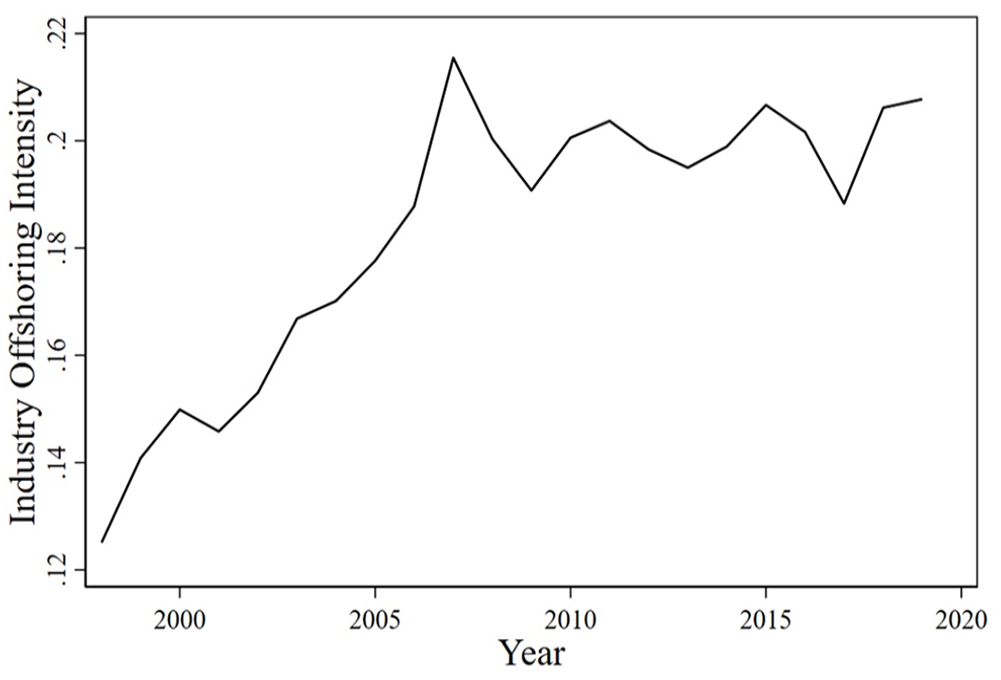
Average Industry Offshoring Intensity in the U.S. (1997–2019)
Learning from Industry Offshoring for Internationalization
Offshoring is a core facet of firms’ international experience and centers on the input market (Doh, Bunyaratavej, & Hahn, 2009; Lewin, Massini, & Peeters, 2009). This is distinct from the internationalization of sales in the output market. Prior research suggests that a firm often offshores to capitalize on arbitrage opportunities, foster flexibility, promote specialization, and leverage global learning advantages (Contractor, Kumar, Kundu, & Pedersen, 2010). Hence, as firms offshore, they accumulate insights that lead to knowledge about dealing with different markets, managing foreign suppliers and partners, overcoming cultural and lingual barriers, and minimizing transaction costs across borders (Fiol & Lyles, 1985; Schmeisser, 2013). These cumulative experiences shape firm behavior, such as internationalization patterns and, by extension, firm performance (Asmussen, Larsen, & Pedersen, 2016).
Some studies also suggest that offshoring activities within an industry may drive industry-wide outcomes. As industry members offshore, incumbents are exposed to best practices and a wealth of market knowledge. For instance, industry offshoring may improve productivity or total employment among all firms in an industry (Hijzen & Swaim, 2007; Olsen, 2006). In this way, the extent of offshoring within an industry may shape a firm’s behavior, regardless of its own offshoring. It provides a generalizable basis of internationalization-facilitating knowledge accessible to even those who have not established relationships with suppliers, customers, and industry peers from whom a firm can directly obtain relevant knowledge (Bruneel et al., 2010). This notion is absent from theory of firm internationalization.
Nevertheless, such internalization of insights generated by others—in our setting, industry peers—is consistent with organizational learning theory and the notion of external learning (He & Wong, 2004; Surdu, Greve, & Benito, 2021). More specifically, an external lens emphasizes vicarious forms of learning that occur due to the observing or interpretation of the experiences of others (Duysters, Lavie, Sabidussi, & Stettner, 2020), as well as grafted forms resulting from human capital mobility or interactions with partners and industry peers (Guo, Jasovska, Rammal, & Rose, 2020). The differences among industries and the learning opportunities they afford (Belitski, Martin, Stettler, & Wales, 2023), such as those reflected in the extent of input offshoring activity, may lead to heterogeneity in what firms can integrate from their environment (Weerawardena, O’Cass, & Julian, 2006).
We build on organizational learning theory to suggest that as industry members engage in more input offshoring, a knowledge reservoir is created with appreciable learning opportunities for incumbents (Iurkov & Benito, 2018). The reservoir contains internationalization-specific insights regarding foreign operations and markets, which are at least partly fungible and can facilitate the identification of opportunities not strictly tied to the markets in which or the products for which the offshoring is done (Mihalache, Jansen, Van Den Bosch, & Volberda, 2012). It also contains the presence of intermediaries or people and firms specializing in facilitating offshoring activities within the industry (Terjesen & Elam, 2009). Once these apparatuses are in place, the reservoir is ripe with insights about foreign market expansion. Further, an organizational learning perspective suggests that managers may change firms, extending the reservoir to include country-specific and process-related insights (Minbaeva, Pedersen, Björkman, Fey, & Park, 2003). We expect that firms may integrate these insights into their operations, shaping the likelihood and extent of internationalization.
Importantly, we acknowledge that the insights embedded in the industry knowledge reservoir can result from foreign direct investment (FDI) through firms’ production of intermediate inputs overseas as well as from sourcing overseas suppliers (Koval, Iurkov, & Benito, 2024; Un & Rodríguez, 2018). Intuitively, the former is more appreciable in explaining internationalization, as it entails establishing direct ownership and control over foreign input production, streamlining the accumulation of external knowledge (Subramaniam, 2006). Yet, as firms outsource by contracting foreign suppliers for goods or services, they similarly learn by dealing with various actors abroad, becoming familiar with international standards, and so on (Takeishi, 2002). Hence, although these two forms of offshoring are distinct in structure and governance, we expect their impact on firm internationalization to be similar regarding the mechanism enabling learning from peers. Both deliberately expose firms to foreign markets, accumulating appreciable knowledge within an industry that an incumbent can observe.
Similarly, the nature of the knowledge reservoir might also vary between industries as it results from peers’ various learning processes and, thus, the collection of information and expertise over time. For instance, the reservoir can reflect diverse experiential insights from within the firm (e.g., establishing greenfield subsidiaries) and those outside, such as outsourcing production and services to low-cost countries. Thus, the specific channels through which knowledge enters the reservoir may differ, and the knowledge accumulated will exhibit different characteristics. However, these differences might be a matter of degree rather than presenting a conceptually distinct learning mechanism. That is, they might influence the magnitude but not the presence of the effect. For these reasons, we focus on the extent to which a reservoir is present rather than where or how the industry knowledge was obtained.
Industry Offshoring Intensity and Initial Internationalization
Offshoring intensity has been linked to learning-based outcomes (Cha, Pingry, & Thatcher, 2008; Coucke & Sleuwaegen, 2008; Kedia & Mukherjee, 2009). While the bulk of insights emerge from internal (i.e., firm-specific) routines and activities, external learning is also critical (Bruneel et al., 2010; Buckley et al., 2016). External learning stems from internalizing insights generated by others, which is particularly relevant when industry peers engage in offshoring activities. As firms observe their peers’ offshoring activities, such exposure can stimulate a learning process within the firm, acquiring knowledge relevant to foreign market expansion.
We contend that when peers in an industry are less engaged in offshoring, the focal firm is less exposed to foreign market knowledge (Wormald, Agarwal, Braguinsky, & Shah, 2021). By comparison, as offshoring becomes more intense in an industry, knowledge reservoirs about foreign markets emerge and become more prominent. Importantly, these knowledge reservoirs do not necessarily hinge on forming direct relationships with industry peers; instead, they constitute insights that are “freely” available to all industry incumbents, accessed through vicarious and grafted forms of learning. Still, to capitalize on the knowledge reservoir, the focal firm must possess the internal capability to integrate and act on these insights. We suggest that foreign market experiences reflected in the presence of foreign market revenues are theoretically pertinent, as these distinguish those firms best suited to recombine internationalization-specific knowledge and drive new competitive advantages abroad. 2
Our position is that firms without foreign market experience likely lack the foundation and contextual understanding to make sense of peers’ activities and their implications (Melitz, 2003; Yiu, Xu, & Wan, 2014). The absence of experiential knowledge can hinder their ability to recognize the opportunities embedded within the insights offered by industry peers. Because learning from others is often distal and indirect, prior research suggests it requires “extensive effort and time to build up an understanding of the norms, habits, and routines of different external knowledge channels,” and it “is subject to considerable uncertainty” compared to proximal and direct learning (Laursen & Salter, 2006: 135). Deriving product market opportunities from input-based knowledge generated by industry peers is more clearly in line with the former. Therefore, absent a knowledge infrastructure rooted in foreign market experience, firms may be less likely to consistently integrate distal insights into existing operations (Crossan & Berdrow, 2003).
Encountering novel information that is difficult to assimilate into a directly relevant knowledge base can also bring about inertia and low perceived viability of change, making such firms averse to pursuing new foreign markets (Oehme & Bort, 2015). Even if these firms observe (or hear of) the activities of industry peers, the absence of a knowledge infrastructure to integrate insights reduces the general tendency to act on these opportunities. Similarly, human capital mobility may more directly expose the firm to knowledge of foreign markets, but such experience may not shape firm behavior when the insights are difficult to interpret and integrate (Zollo & Singh, 2004). These efforts will be perceived as formidable because of the potential opportunity costs, such as losing ground in the home market. Indeed, the absence of experiential knowledge decreases managerial confidence to act on novel opportunities (Putzhammer, Fainshmidt, Puck, & Slangen, 2018); these firms may perceive themselves as “too far behind” competitors engaged in foreign product markets (Ingram & Baum, 1997), making internationalization less likely.
For these reasons, we expect that the lack of foreign market experience poses obstacles to firms attempting to benefit from the knowledge generated by industry offshoring activities. Our prediction, though, does not imply that industry offshoring intensity has no effect on the likelihood of internationalization for every firm without foreign market experience. Instead, we suggest that, on average, there will be no general tendency for these firms to internationalize as industry offshoring intensity increases. However, some firms may still act on the insights embedded in the reservoir and enter foreign markets despite their lack of experiential knowledge, even though this is not the predominant response. This is because some firms may exhibit a general ability to recognize the value, assimilating external knowledge beyond their own experience and applying it to commercial ends. This ability to venture into new knowledge domains is provided by absorptive capacity (Ahuja & Katila, 2004; Laursen & Salter, 2006; Rothaermel & Alexandre, 2009). While learning is cumulative and assimilation is a function of a preexisting knowledge infrastructure (Schweisfurth & Raasch, 2018)—hence, assimilation of external knowledge is likely greater for those familiar with venturing into new domains (Zahra & George, 2002)—absorptive capacity can somewhat ameliorate the implications of lacking the internationalization-specific knowledge infrastructure, serving as a partial substitute for foreign market experience.
A more general absorptive capacity enables firms to link different types of knowledge and assimilate it into the current knowledge base (Schildt, Keil, & Maula, 2012); it reduces the inertia and opportunity cost that otherwise hinder “inexperienced” firms from internationalizing. Prior research suggests that absorptive capacity is directly related to successfully building advanced competencies and new competitive advantages (Lewin, Massini, & Peeters, 2011), and this literature identifies research and development (R&D) as a primary organizational function that builds absorptive capacity (Cohen & Levinthal, 1990). When firms engage in R&D, they often invest in knowledge-related practices that enable them to integrate novel insights continuously and more efficiently (Schildt et al., 2012). 3 While such investments may sometimes entail aspects of international operations, they are unlikely to provide substantial knowledge directly related to foreign markets, especially for firms with no international experience. Nevertheless, the investments foster an infrastructure for seizing opportunities, including in domains where the firm might not have yet accumulated experience (Zahra & George, 2002).
We argue that while absorptive capacity cannot fully replace the benefits of direct experiential knowledge, it is a critical facilitator for firms without foreign market experience (Lane & Lubatkin, 1998; Zahra & George, 2002). Unlike those firms with foreign market experience who may more easily understand and utilize the external knowledge reservoir, firms without such experience must rely more heavily on their general capacity to identify, assimilate, and exploit knowledge in a new domain generated by industry peers’ offshoring activities. This absorptive capacity enables firms to recognize valuable information within the industry knowledge reservoir and apply it to their internationalization efforts. In essence, it enables firms to overcome some of the barriers to learning that stem from the lack of foreign market experience (Fiol & Lyles, 1985; Minbaeva et al., 2003), making it more palatable to enter entirely new foreign markets. Absorptive capacity does not substitute for the depth of understanding and contextual knowledge from direct experience, but firms with high capacities but no foreign market experience may be more likely to internationalize, albeit not to the same magnitude as firms with prior experience. Therefore, we conjecture that absorptive capacity partially substitutes the more proximal knowledge created by existing foreign market experiences. It delineates a unique subset of firms without prior foreign market experiences that can capitalize on the external knowledge reservoir, acting as a bridge to pursuing opportunities in new domains. In sum, we predict the following:
Hypothesis 1a (null): The likelihood that firms without foreign market experience internationalize will not increase as industry offshoring intensity increases.
Hypothesis 1b: For firms with no foreign market experience, a higher absorptive capacity will render positive the relationship between industry offshoring intensity and the likelihood of internationalization.
Industry Offshoring Intensity and the Extent of Internationalization
By comparison, firms with experience in foreign markets possess a knowledge infrastructure that may complement the knowledge derived from an industry-based knowledge reservoir. Here lies a complementary effect of internal experiential knowledge and external industry-based insights, which facilitates the extent of internationalization (cf. Bruneel et al., 2010). The complementarity between the internationalization-specific experiences and the industry knowledge reservoir facilitates within-domain learning—including recombining internal and external knowledge that deepens commitments and sets the stage for pursuing new ones (Buckley et al., 2016)—and exploring related domains. This dual benefit arises from the interaction between domain-specific knowledge and the general ability to absorb and integrate new information.
More specifically, prior research suggests that the amalgamation of prior experience and industry insights enables these firms to adapt and apply insights from peers’ activities to their operations (Qian & Delios, 2008). For instance, firms with foreign market experience can better understand and interpret how their competitors select locations, manage supply chains, and handle cross-border regulations (Hutzschenreuter & Voll, 2008). Grafted forms of learning are also possible. Employees can move between firms and even foreign market locations, increasing the pools of knowledge about pursuing and managing foreign market activities. When such novel incoming knowledge is more easily grasped and interpretable, firms are more likely to identify and seize new foreign market opportunities rather than shun them. Hence, offshoring intensity provides complementary knowledge that reinforces the firm’s own experiences.
We acknowledge that firms likely exhibit variability regarding the nature of their existing knowledge base, including the ability to integrate knowledge throughout the firm. Different units may conduct firms’ foreign activities, or foreign experience may be concentrated in a few locations. Still, we argue that those firms with experience in dealing with foreign markets have the capabilities to extrapolate industry-based insights to pursue further internationalization opportunities (Delios & Henisz, 2003). These firms are more likely to exhibit a knowledge infrastructure that complements the more freely available industry-based insights regarding foreign market expansion, driving knowledge recombination with greater efficiency (i.e., less waste, cost, and misapplication) and, thus propelling entry into new markets or deepening commitments to existing ones.
In essence, having internationalization-specific experience obviates the need for absorptive capacity, but such a general capacity is a learning efficiency “booster” for firms with foreign market experience (Minbaeva et al., 2003). It enhances their ability to reduce costly barriers and quickly recognize valuable new knowledge within the industry reservoir, even in adjacent or slightly unfamiliar domains. The complementarity between internationalization-specific knowledge and the ability to absorb external knowledge facilitates exploiting within-domain learning and exploring related domains. Tilton (1971: 71), for example, argues that it keeps firms “abreast of the latest . . . developments and facilitates the assimilation of new [opportunities] developed elsewhere.” As a result, the interplay between internationalization-specific experience and a general absorptive capacity better positions firms to drive knowledge recombination, propelling entry into new markets or deepening commitments to existing ones more efficiently. Firms armed with experiential insights and a penchant for absorbing external knowledge are poised to capitalize on opportunities that might be harder to identify and act on for others. Consequently, we predict:
Hypothesis 2a: Industry offshoring intensity increases the extent of internationalization by firms with foreign market experience.
Hypothesis 2b: Absorptive capacity strengthens the positive relationship between industry offshoring intensity and the extent of internationalization by firms with foreign market experience.
Methods
Data
Our sample consists of U.S. firms. The data are derived from Compustat, a comprehensive database compiled by Standard & Poor’s (S&P). Compustat captures firms across a variety of industries. We focus on U.S. firms primarily due to data availability and the prevalence of offshoring activity in many sectors of the U.S. economy.
We construct an unbalanced panel dataset covering 23 years (1997 to 2019), sampling all firms with available data and those that discontinued reporting for various reasons. Hence, selection bias is unlikely (Drori, Alessandri, Bart, Herstein, 2024). After removing missing data and combining it with industry-level offshoring data, as described below, our sample comprises 5,745 firms with 43,856 firm-year observations. We then use the North American Industry Classification System (NAICS) to match firms and industries. The NAICS is the most updated system and allows us to link offshoring data from the Bureau of Economic Analysis to each firm’s industry environment. Firms in our data operate in 56 three-digit industries.
Measures
Dependent variables
Our hypotheses require that we analyze two different dependent variables for two sets of firm-years. The dependent variable in Hypotheses 1a (H1a) and 1b (H1b) indicates whether a firm with no foreign market experience—namely, no revenues (time t–1)—internationalizes in the subsequent year (time t). In Hypotheses 2a (H2a) and 2b (H2b), the dependent variable captures the extent of internationalization (time t) among firms with foreign market experience, which we capture with the presence of prior foreign market revenues (time t–1). Hence, we distinguish between firms with and without experiential, internationalization-specific knowledge by splitting our sample rather than operationalizing it with a variable. Doing so allows us to properly analyze our hypotheses’ two inherently distinct outcomes.
For the former subset (H1a, H1b), we operationalize the likelihood of internationalization through a binary variable that identifies whether a firm with entropy
4
of zero at time
Independent variable
We measure industry offshoring intensity as each industry’s share of imported inputs. We follow prior research (Amiti & Wei, 2009; Feenstra & Hanson, 1999) and capture the extent of offshoring for each industry “
Moderator
We measure absorptive capacity as a firm’s R&D expenditures relative to its total sales (Schildt et al., 2012). Cohen and Levinthal (1990) argue that absorptive capacity is predominantly determined by R&D investments. Our measure reflects these investments and is a valid proxy in line with extant organizational learning research.
Control variables
We include twelve control variables at the firm and industry levels that have been shown to affect the extent and likelihood of internationalization. At the firm level, we capture firm age as the number of years since the firm’s initial public offering, size as the natural logarithm of a firm’s market value, leverage as total debt divided by equity, financial performance as return on assets (ROA), risk as the standard deviation of the firm’s ROA for the three previous years, business diversification through an entropy measure of a firm’s business segments, and firm productivity as the ratio of total sales to employees (e.g., Gaur, Kumar, & Singh, 2014; Mayer, Stadler, & Hautz, 2015). In addition, we capture a firm’s foreign exchange gains or losses as a plausible proxy for firm-level offshoring. Because data on offshoring at the firm level is unavailable for all inputs and a broad panel of firms such as ours, this measure generally enables us to gauge whether a particular firm that does not have foreign market revenues is engaged in offshoring. 6 We create a binary variable that takes the value of “1” if the firm has any foreign exchange gains or losses, and “0” otherwise in a given year.
At the industry level, we control for munificence and dynamism by regressing the log of all firms’ total sales in each three-digit NAICS code during a five-year window on an index variable of years (time) (Patel, Criaco, & Naldi, 2018). The antilog of the coefficient represents industry munificence, and the antilog of the standard error represents industry dynamism. We capture industry concentration or the opposite of competitiveness as a share of the four largest firms in total industry sales each year (Xu & Drori, 2023) as well as industry export intensity measured as the percentage of exports from the industry total output. Finally, we include industry and year fixed effects.
Estimation approach
We analyze two sets of models. In both sets, we lag the right-hand side by one year because firms might not act on industry conditions immediately.
To test H1a and H1b, we implement generalized estimating equations (GEE) panel models. GEE is suitable for the binary dependent variable and is consistent with recent studies taking a similar approach to ours (e.g., Koch-Bayram & Wernicke, 2018). Further, GEE handles multilevel panel data well and uses both within- and between-firm variance. These features improve model efficiency and statistical power (Ballinger, 2004). Our GEE models are specified with a binomial distribution and logit link function. We also chose the independence correlation matrix, the most efficient correlation structure per the quasi-likelihood under the independence model criterion (Taeuscher, Zhao, & Lounsbury, 2022).
We complement the GEE models by leveraging an instrumental variable (IV) technique to account for endogeneity. We use average industry labor compensation levels as an instrument for industry offshoring intensity gathered from the Bureau of Labor Statistics (BLS). We assume that industries with high levels of labor compensation drive firms to offshore inputs to alleviate cost pressures. However, industry labor compensation itself should not be directly related to the likelihood of internationalization. Prior research suggests that labor compensation is rooted in cost-of-living heterogeneity, the skill set required, and the overall economic conditions of the industry (Philippon & Reshef, 2012). In contrast, the decision to internationalize is influenced by a myriad of factors, such as market demand, competitive landscape, regulatory considerations, and firms’ internal capabilities (Hitt et al., 2006). Hence, we fit industry labor compensation within the panel probit model designed for a binary dependent variable with an endogenous regressor. 7
The data for both GEE and the panel IV probit analyses are structured following the possibility principle (Mahoney & Goertz, 2004), whereby “comparisons between subjects that experienced a particular outcome and subjects that did not experience the outcome can only be made if the subjects that did not experience the outcome of interest could possibly have done so” (Krause & Semadeni, 2013: 813). Therefore, firms in time
Next, we assess H2a and H2b using a firm fixed-effect (FE) panel data model to account for firm-specific heterogeneity and time-invariant unobserved characteristics (Miller, Minichilli, & Corbetta, 2013). The Hausman test indicates that a fixed-effect model is preferred over a random-effect model (Chi-square = 1,699, p ≤ 0.001). Further, because industry offshoring intensity and the extent of internationalization could have an endogenous relationship due to reverse causality and unobserved heterogeneity, we complement the fixed-effect model with the Arellano and Bond (AB) panel data system generalized method of moments (GMM). This method uses internal instruments based on lags of the instrumented variables (Arellano & Bond, 1991; Roodman, 2009). We particularly use a static model. We account for more than one endogenous variable at a time, and we estimate the model with robust standard errors that are consistent in the presence of heteroskedasticity and autocorrelation.
8
The sample for these models includes 29,578 firm-year observations with foreign revenue in time
Results
Tables 1A and 1B present descriptive statistics and a correlation matrix for our two samples. Because the models for H1a and H1b include binary and continuous variables, Table 1A reports three different correlation methods. More specifically, correlations between two continuous variables are calculated using the Pearson correlation; correlations between continuous and binary variables are calculated with the point biserial correlation, which shares the same assumptions as a Pearson product-moment correlation; and correlations between binary variables use the Phi coefficient. The variance inflation factor (VIF) value for each variable is well below the recommended threshold of 10, indicating multicollinearity is not a concern.
Descriptive Statistics and Correlation Matrix (H1a, H1b)
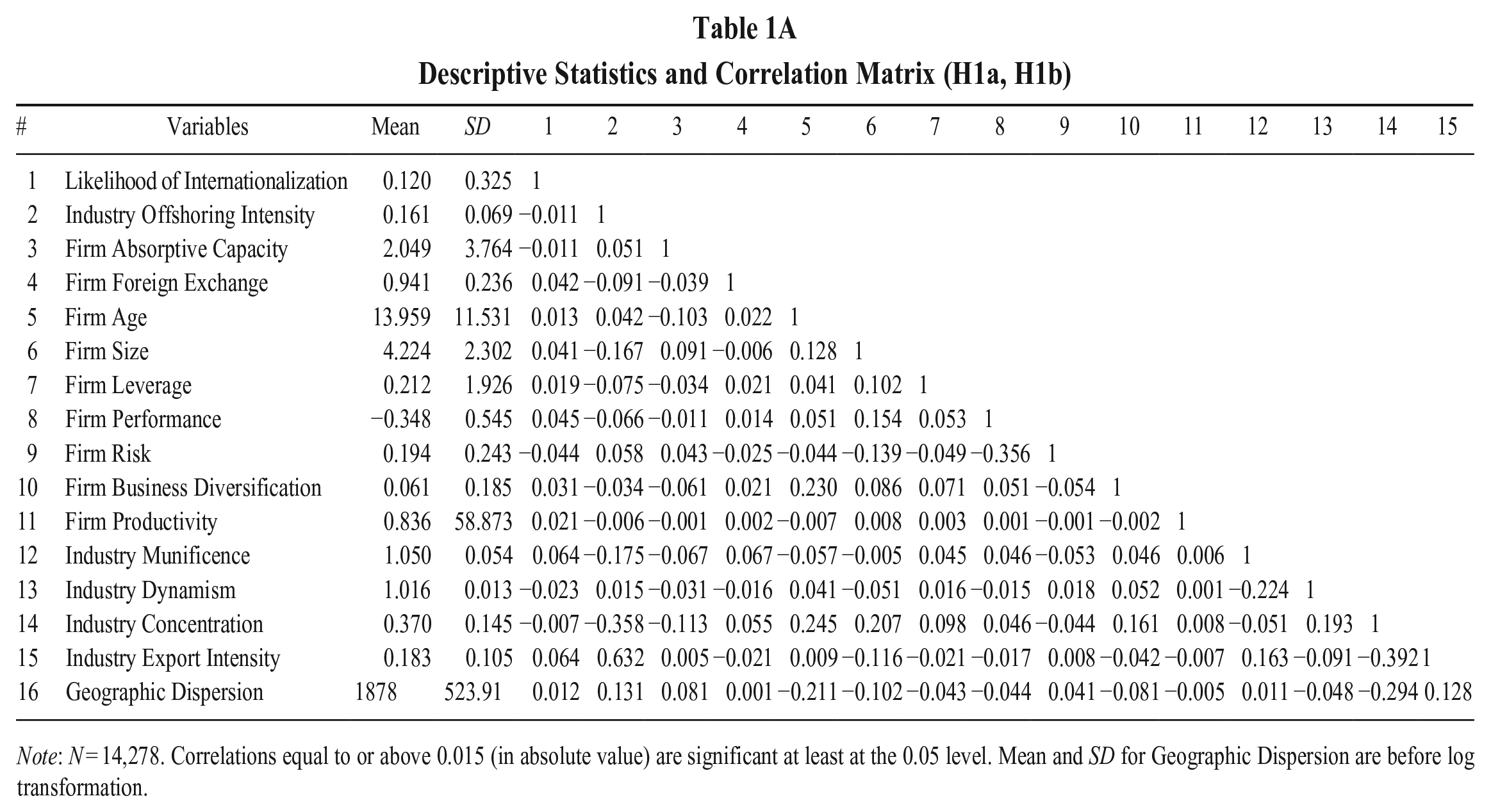
Note: N = 14,278. Correlations equal to or above 0.015 (in absolute value) are significant at least at the 0.05 level. Mean and SD for Geographic Dispersion are before log transformation.
Descriptive Statistics and Correlation Matrix (H2a, H2b)
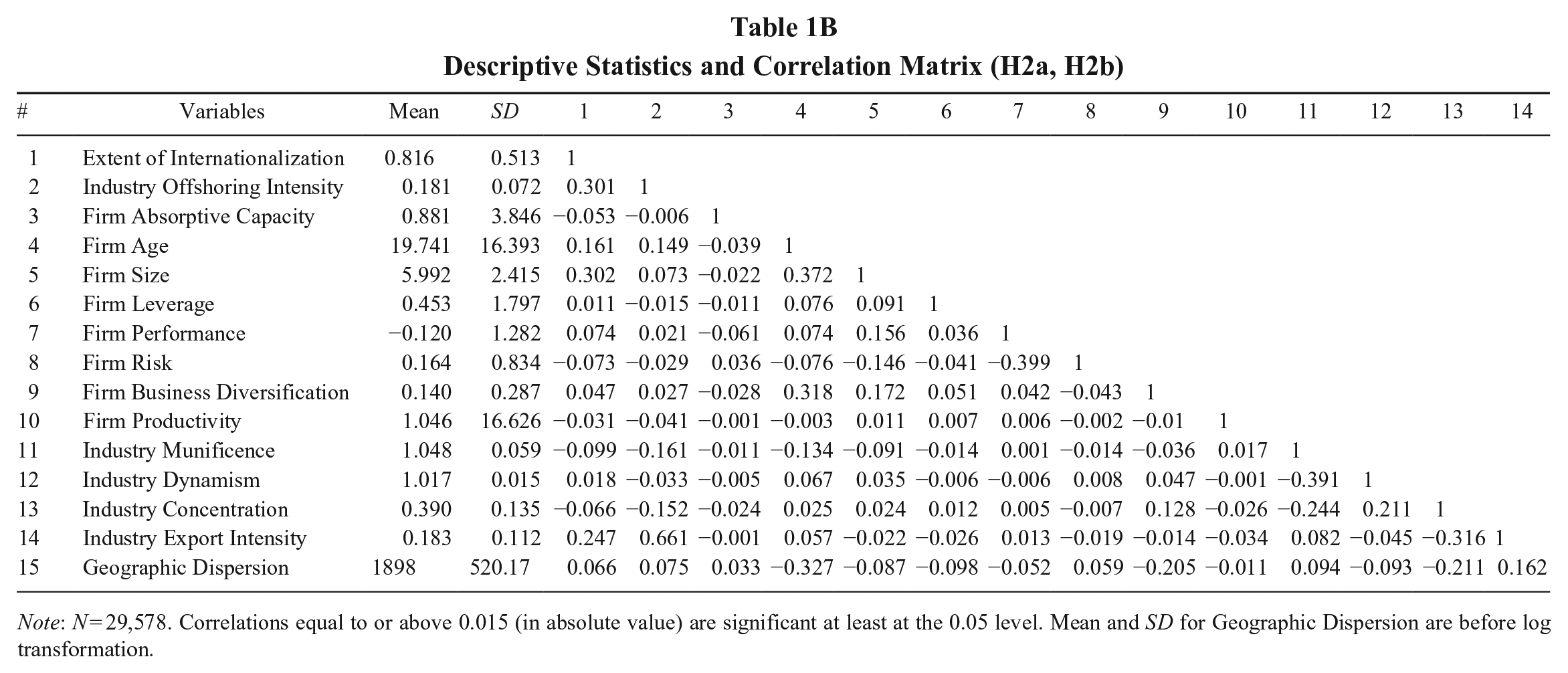
Note: N = 29,578. Correlations equal to or above 0.015 (in absolute value) are significant at least at the 0.05 level. Mean and SD for Geographic Dispersion are before log transformation.
Table 2 reports the results for H1a and H1b. Models 1 and 2 use GEE, and Models 3 and 4 use IV probit. These models estimate the likelihood of internationalization. H1a argues that firms without foreign market experience will not exhibit a general tendency to internationalize despite increasing industry offshoring intensity. Otherwise, we expect no statistical relationship between industry offshoring intensity and the likelihood of internationalization. The results indicate that industry offshoring intensity is negatively and significantly related to the likelihood of internationalization across the four models (p ≤ 0.009). Because coefficients are not easily interpreted with a binary outcome, we provide a more straightforward assessment of the effect size: When industry offshoring intensity increases by one standard deviation from the mean, the likelihood (probability) that firms expand internationally drops by 22%. These results do not support H1a. Instead, lacking an infrastructure to integrate foreign market knowledge hinders the likelihood of expanding into foreign markets as the industry knowledge reservoir grows.
Industry Offshoring Intensity and Likelihood of Internationalization (H1a, H1b)
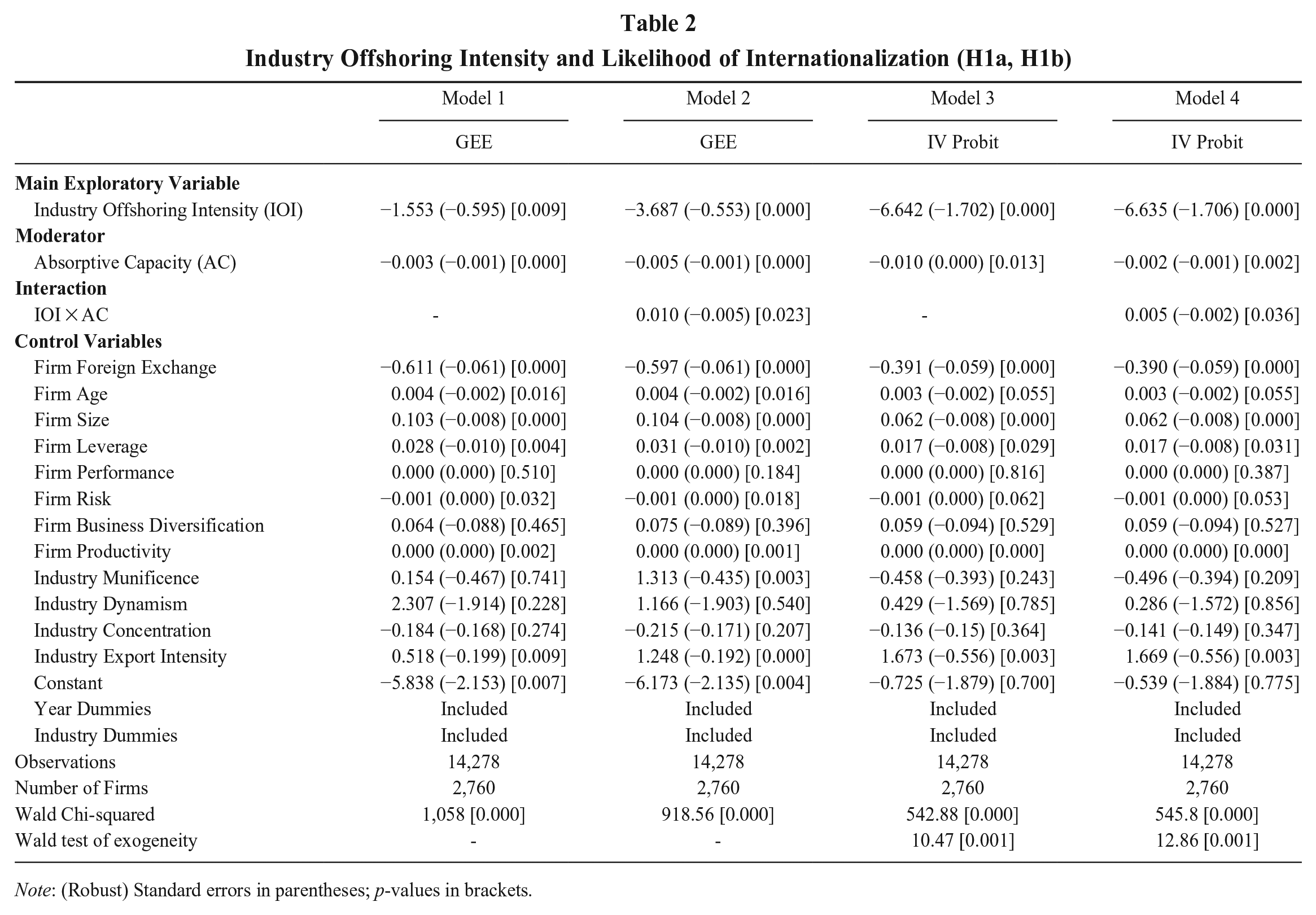
Note: (Robust) Standard errors in parentheses; p-values in brackets.
In H1b, we argue that absorptive capacity will render the (null) relationship in H1a positive. The interaction term is positive in Model 2 (GEE) (β = 0.010, p = 0.023) and Model 4 (AB-GMM) (β = 0.005, p = 0.036). Thus, we find support for H1b.
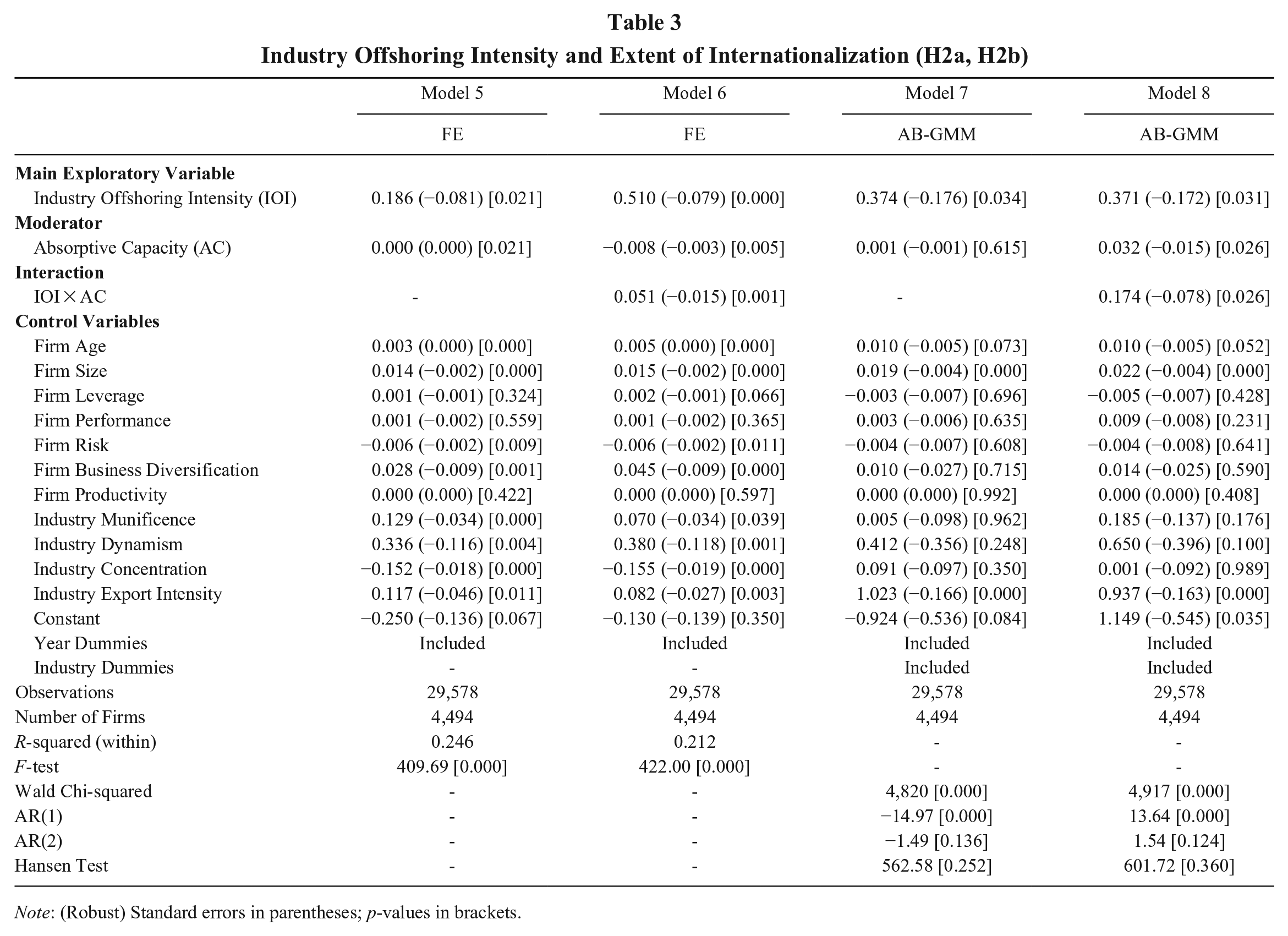
Table 3 reports the results for H2a and H2b. Models 5 and 6 use FE, while Models 7 and 8 use AB-GMM. The outcome variable is the extent of internationalization. In H2a, we argue that industry offshoring intensity will increase the extent of internationalization for firms with foreign market experience. Our results suggest a positive and significant coefficient of industry offshoring intensity across the four models (p ≤ 0.034). Hence, we find support for H2a. These findings suggest that firms with prior experience can act on the appreciable learning opportunities embedded in an industry knowledge reservoir from offshoring. Further, the interaction term of industry offshoring intensity and absorptive capacity is positive and significant in Model 6 (β = 0.051, p = 0.001) and Model 8 (β = 0.174, p = 0.026). Thus, we also find support for H2b.
Industry Offshoring Intensity and Extent of Internationalization (H2a, H2b)
Note: (Robust) Standard errors in parentheses; p-values in brackets.
Evidence of Learning Mechanism
The analyses above provide initial evidence that industry offshoring intensity influences firm internationalization. Here, we attempt to substantiate our theoretical mechanisms further.
Prior research suggests that geographic proximity can increase the visibility of peers’ foreign market activities (Giroud, 2013). Especially when a firm has foreign market experience that they can build on, the proximity to peers can foster flows of knowledge and more easily enable grafted and vicarious forms of learning (Gray, Siemsen, & Vasudeva, 2015). This can further reduce the challenges in identifying, integrating, and coordinating insights from the industry-based knowledge reservoir. These arguments are consistent with agglomeration effects and the influence of connectedness on firm behavior. Those firms without foreign market experience may be able to identify novel opportunities as well. However, these firms may also more easily observe how far behind they are relative to industry peers, as well as the many challenges wrought with such market expansion, heightening the adverse effects.
We argue that analyzing the role of geographic proximity is important because if the effect of industry offshoring intensity on firm internationalization was solely attributable to firms’ own offshoring experiences, then geographic proximity to industry peers should not matter. That is, if we observe an effect of proximity, it indicates that the reservoir resulting from peers’ offshoring activities plays a significant role in shaping firm behavior. This is especially the case for firms without foreign market revenues, as an effect would indicate that the negative implications of industry offshoring activities are prominent. These firms, lacking experiential knowledge, are more susceptible to the challenges and uncertainties associated with foreign market expansion, which can be amplified by the visibility of industry peers’ activities.
Accordingly, we draw on insights from the network and economic geography literatures (e.g., Lavoratori, Mariotti, & Piscitello, 2020; Marcon & Puech, 2010) and generate a variable to capture the extent of geographic dispersion among industry members. We measure geographic dispersion 9 by calculating the great circle distance as the length of the arc that links the centroid based on the U.S. zip code between a firm and all its industry peers for each industry-year. We take the unweighted average of the distances for each firm to identify its general proximity to industry peers each year. A higher value indicates peer dispersion, and a lower value suggests increased agglomeration. We log transform the variable because the data are skewed (p ≤ 0.001).
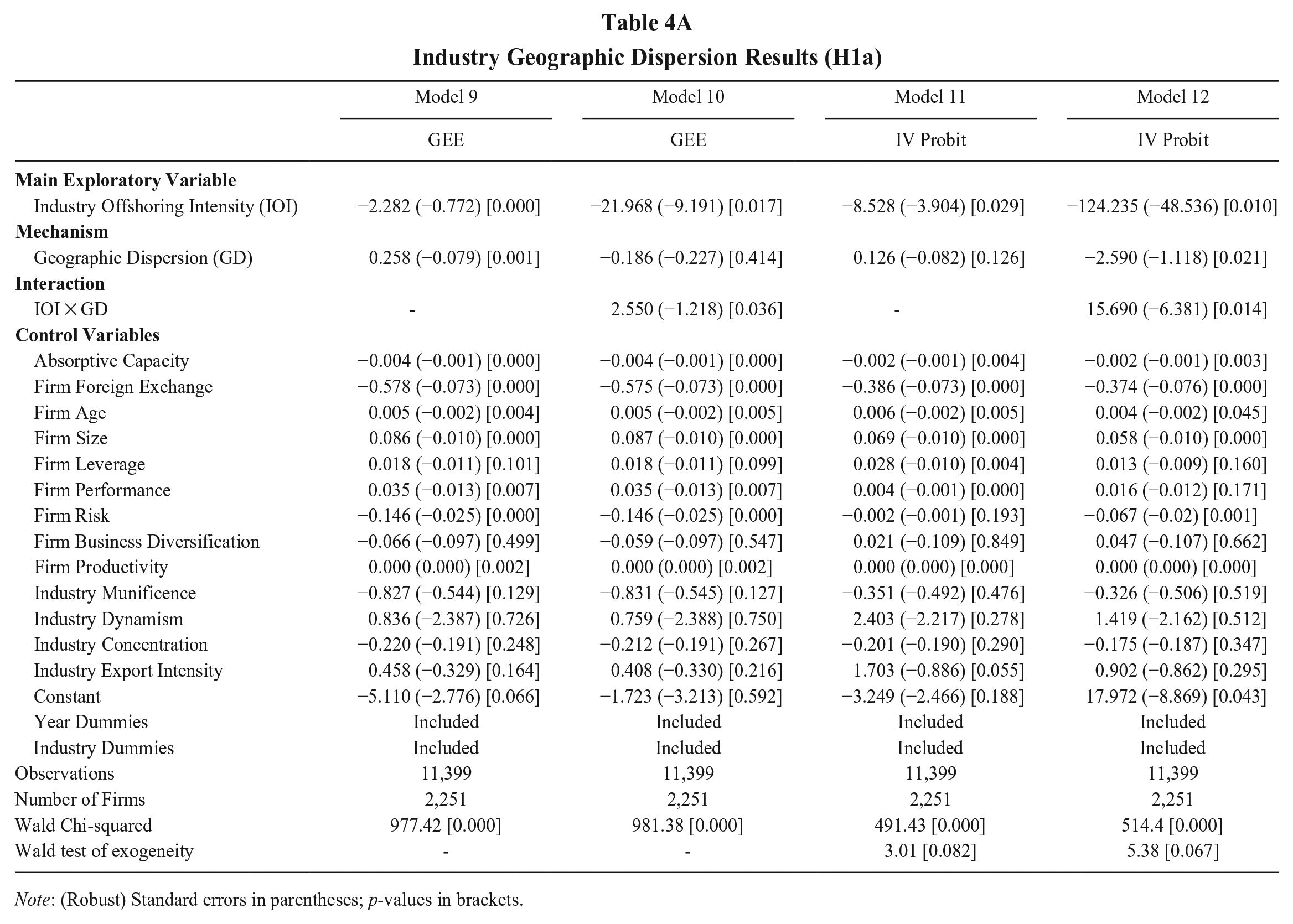
Table 4A reports the results for H1a. Consistent with the main results, the industry offshoring intensity coefficients across the four models exhibit a significant negative relationship with the likelihood of internationalization (p ≤ 0.029). Models 10 and 12 incorporate the interaction term. The coefficients are positive and significant (p ≤ 0.036), suggesting that as firms with no foreign experience are more geographically dispersed from their industry peers, they are less likely to be negatively influenced by industry offshoring conditions. That is, the negative effect of industry offshoring intensity weakens as distance from peers grows, possibly because these firms are less likely to perceive themselves as too far behind internationalized peers. 10
Industry Geographic Dispersion Results (H1a)
Note: (Robust) Standard errors in parentheses; p-values in brackets.
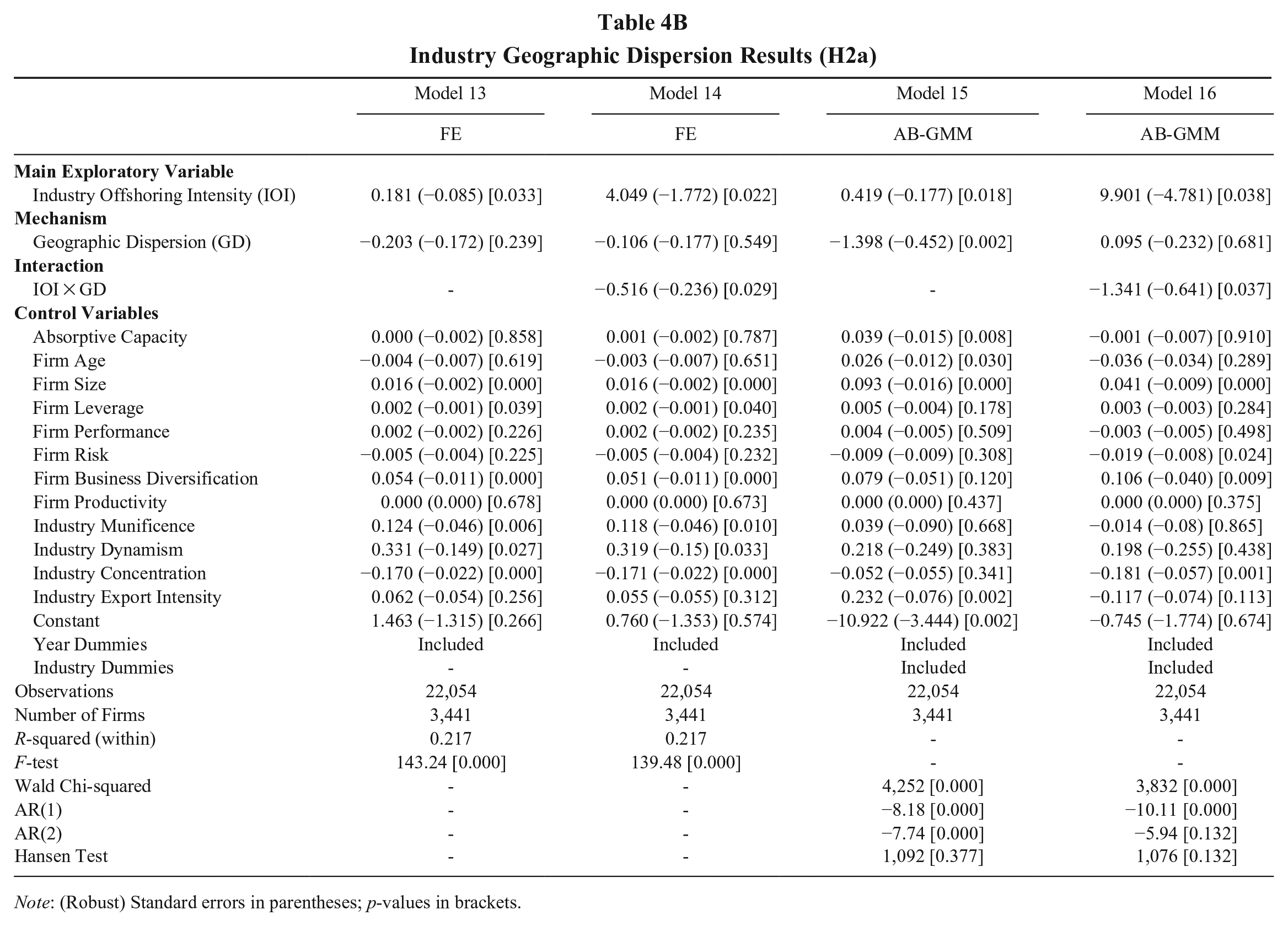
Table 4B reports the results for H2a. The coefficients of the industry offshoring intensity across all four models are positive and significant (p ≤ 0.038), reinforcing our main results regarding H2a. In addition, we find negative and significant coefficients of the interaction terms in Model 14 (β = −0.516, p = 0.029) and Model 16 (β = −1.341, p = 0.037). These results indicate that firms with foreign market experience who operate further from their industry peers may learn less from the knowledge reservoir, decreasing the extent of internationalization. As distance grows, the complementarities are diminished.
Industry Geographic Dispersion Results (H2a)
Note: (Robust) Standard errors in parentheses; p-values in brackets.
Robustness Tests
We conduct several sets of robustness tests to assess the stability of our main findings. The tables are available in the Online Appendix. First, our analyses focus on the amount of knowledge within the reservoir, not where or how it was obtained. We probe this distinction empirically in several ways. We include a measure of vertical integration by assessing an industry’s value added to sales (Hutzschenreuter & Gröne, 2009), assuming that high vertical integration correlates with an industry’s proclivity to internalize offshoring activities. We run two subsets of models: In the first, we include a control for industry-level vertical integration, and the results for all hypotheses are consistent (Online Appendix, Tables 2a and b). In the second subset, we include a control for firm-level vertical integration, and the results hold (Online Appendix, Tables 3a and b). Next, we include an interaction term of industry offshoring intensity and vertical integration for H2a. These results demonstrate that industries gain more from industry offshoring intensity when such activity is more likely to be organized within firms rather than through suppliers (Online Appendix, Table 4). Hence, industry offshoring represents a distinct knowledge reservoir that firms can learn from vicariously or through grafted forms.
Like the test for proximity detailed above, we also probe the number of firms in the industry. Here, we argue that more firms mean more opportunities to glean external insights, identifying whether the underlying mechanism of the effect is what the focal firm can observe or assimilate from peers. We find that the main effect of industry offshoring intensity is stronger as the number of firms in the industry increases. Hence, the results are consistent (Online Appendix, Table 5).
Further, an argument can be made that offshoring reduces costs and increases the quality of the products, making them more competitive globally. This may provide an alternative explanation to the learning effect on which we theorize. We analyze our models while controlling for industry-adjusted cost of goods sold (% of sales), assuming that firms with a lower score may have taken advantage of the cost reduction that often comes with offshoring (Online Appendix, Table 6). Our consistent results suggest that the firm’s potential cost reduction from offshoring does not drive the results. Similar patterns are obtained from examining the industry-level (average) cost of goods sold.
In addition, we assess our models by categorizing our firms as operating in either manufacturing or services sectors. The offshoring activities of service firms are more likely to entail tacit knowledge that is difficult to learn vicariously (Contractor & Kundu, 1998), as well as through grafted forms (Guo et al., 2020), while manufacturing firms can more easily observe peers’ foreign market activities. We find that industry offshoring intensity significantly decreases (increases) the likelihood (extent) of internationalization in manufacturing industries (Online Appendix, Tables 7a and b). However, the coefficients of industry offshoring intensity in service industries are positive but insignificant. The smaller subsample size of the service industries compared to the subsample of manufacturing industries may be at least partly conducive to different results, but it might also mean that our arguments are more relevant to industries with physical products.
We also reexamine all models using two alternative dependent variables: Foreign sales to total sales (FSTS) ratio (Mayer et al., 2015) and the number of foreign subsidiaries (i.e., unidimensional measure). Although we conceptualize the extent of internationalization as the general scope of foreign market expansion, these measures help, to some degree, identify the intensity of foreign market expansion (Marshall, Brouthers, & Keig, 2020). This allows us to capture somewhat related yet distinct measures of internationalization, testing the boundaries of our theory. For consistency, we also employ the ratio between non-core and total sales in our measure of business diversification. Because FSTS is a proportion, we estimate our GEE models with a binomial distribution, logit link function, exchangeable within-group correlation structure, and robust standard errors that account for misspecification in the correlation structure (Papke & Wooldridge, 2008). Further, we include time averages of the covariates and the number of time periods available for each industry as additional control variables. The results are consistent.
Next, we replicate the full models using a two-year lag for all variables on the right-hand side of the models. As expected, the results hold but with a lower level of statistical significance (p ≤ 0.100). These results reduce the likelihood that our findings reflect reverse causality between our focal variables. We also winsorize the extent of internationalization, industry offshoring intensity, and absorptive capacity at the 1st and 99th percentiles to prevent potential biases from outliers. Results are consistent across all models.
Finally, we run an AB-GMM dynamic model (i.e., lagged DV is a regressor), an FE model, and an AB-GMM static model to complement H2a. While doing so, we also use the focal firm’s number of foreign subsidiaries as an additional firm-level control. The results are consistent. We similarly run AB-GMM static models for H1a and H1b and find consistent results.
Discussion and Conclusions
This study argues that industry offshoring intensity shapes the likelihood and extent of firm internationalization. We explicate that for firms with no foreign market experience, industry offshoring intensity has no general effect on the likelihood of internationalization. However, absorptive capacity can partly ameliorate the lack of internationalization-specific experiences, enabling some firms to benefit more easily from the industry knowledge reservoir. For those with foreign market experience, industry offshoring intensity provides a complementary knowledge reservoir regarding foreign market opportunities, increasing the extent of internationalization. This effect is underpinned by the facilitative combination of internalized industry-based insights with the firm’s existing knowledge base. Having internationalization-specific experience obviates the need for absorptive capacity, but such general capacity can help assimilate knowledge from the reservoir more efficiently. Our findings from longitudinal data on U.S. firms support these arguments and have several implications for research.
Implications for Research
Theories of firm internationalization primarily focus on experiential drivers at the firm level or contextual influences at the national level (e.g., Bowman, Foulser-Piggott, & Beamish, 2023; Fourné, Zschoche, Schwens, & Kotha, 2023), while our study identifies a novel driver at the industry level. Although firms often pursue strategies due to industry conditions, extant research tends to focus primarily on output conditions, such as the role of foreign direct investment and import competition (Wiersema & Bowen, 2008). Whereas output conditions mostly pull firms into new markets, input conditions are more subtle, focusing on production factors and efficiency considerations under firms’ control. Our findings show that firms can acquire internationalization-fostering knowledge from a knowledge reservoir rooted in peers’ distal and indirect input activities in addition to that which often results from one’s experience, home country conditions, and output competition from foreign firms. We explain how this reservoir contains the sort of “collective wisdom” and best practices of industry peers, which are “freely” accessible regardless of direct relationships and interactions. For some firms, tapping into this external knowledge pool can be challenging, but those able to do so can accelerate learning and reduce the costs and risks associated with internationalization. Hence, we add to recent studies (e.g., Amdam, Lunnan, Bjarnar, & Halse, 2020) seeking to extend scholarly understanding of firms’ internationalization drivers by probing the complementary role of industry input conditions as non-experiential drivers.
Equally important, we show that what drives initial internationalization will differ from what drives subsequent increases in the extent of internationalization. While initial internationalization represents a significant shift in firm strategy as they venture into unfamiliar territory, requiring significant learning capacities and the development of new capabilities, subsequent increases hinge on exploiting earlier experiences and learning. In this way, the “right” way to learn from industry offshoring intensity is not the same for all firms, and what enables firms to go abroad or keeps them at home can have different effects once the firm has accumulated internationalization-specific experience. Our disentangling of the phases of internationalization allows for a more nuanced understanding of how industry conditions, especially the distal and indirect influences of peers’ offshoring activities, inform firm internationalization (Plakoyiannaki, Paavilainen-Mäntymäki, Hassett, Liesch, Andersson, & Rose, 2024). Future research can build upon these insights to examine how industry conditions can distinctly drive further distinctions, such as internationalization depth, scale, and speed.
Revitalizing the role of industry conditions is especially important given the speculation that their relative importance has systematically declined in recent decades (Wang, 2023). Extant research has primarily emphasized the proliferation of globalization, advancements in managerial education, and rapid institutional changes in shaping competitive landscapes and firm behavior. Though we do not suggest that these changes are less critical, we provide evidence that industry-level differences remain a key determinant in explaining heterogeneity in firms’ international strategy. The activity of industry peers drives firm internationalization, so we encourage future research to explore further how the industry environment will shape the range of strategies deployed in increasingly global markets. There is a distinct possibility that such industry conditions will become even more salient amid rising geopolitical tensions (Witt, Lewin, Li, & Gaur, 2023).
Further, our study shows that firms vary in their relative capacities to identify, assimilate, and capitalize on relevant knowledge pools, thereby differentially benefiting from industry input conditions. We find that such absorptive capacity generally makes venturing into new domains easier, partly substituting for prior experience explaining the likelihood of internationalization. This indicates that such organizational capacities make expanding in entirely new ways palatable. The same capacity to learn is not necessary to drive further internationalization. However, it can enhance learning efficiency (with less waste and cost) about foreign market opportunities, complementing an industry-based knowledge reservoir for firms with prior foreign market experience. These findings highlight the need to study how firms oscillate between building general and specific knowledge bases for expansion. The domain-specific capacity reduces the “ex-ante uncertainty” of absorbing and acting on external knowledge (cf. Laursen & Salter, 2006).
Moreover, our findings may also help explain the negative effect of certain types of firm experience on internationalization (e.g., Delios & Beamish, 2001; Gaur & Lu, 2007), as well as highlight the need to relax the assumption that all learning opportunities will be realized. Namely, our study enables non-experiential learning through the complementarities with prior experience. We believe future research can explore the combinations of knowledge and domain-specific and general learning sources that foster opportunity capture, explicating firm and industry-specific heterogeneity in the market opportunities that firms pursue versus forego. An opportunity we did not touch upon but is nonetheless relevant is industries’ level of absorptive capacity, which could shape the nature of the knowledge reservoir or make grafted learning easier by making job-changing managers richer in human capital.
Finally, our study extends the nomological network of industry offshoring. While decades of literature have examined numerous drivers and outcomes of offshoring, typically at the firm level, we highlight that offshoring at the aggregate industry level is also consequential. When firms in an industry engage in offshoring more intensely, it may affect all firms’ decision-making, even those that do not engage in offshoring. These implications go beyond the intuitive influences due to increased cost-competitiveness pressures because the aggregate activities result in reservoirs that shape firm behavior in various ways. We offer promising new ways to think about offshoring and its effects on incumbent firms or potential entrants, particularly in how it creates learning opportunities that can be accessed through domain-specific and more general learning capacities.
Implications for Practice
Offshoring is a timely and debated topic, considering its impact on job losses, wage reduction, and intellectual property theft. It is especially pertinent in light of increasing geopolitical tensions, economic inequality, and supply chain shortages. Our study adds to these conversations by illustrating how industry offshoring can affect firm internationalization. For example, the knowledge reservoir created by industry offshoring can contribute to employment and higher global competitiveness by some firms in an industry. However, there is a tradeoff between the positive and negative aspects of offshoring: If foreign market expansion by firms is desired, considering how industry offshoring affects foreign expansion by non-internationally active firms can help policymakers allocate public resources and design policy more efficiently.
Limitations and Future Research
This study is not without limitations. First, we measured industry offshoring intensity regardless of the geographical source of the inputs. While data constraints pose significant obstacles (and we have made efforts to probe heterogeneity in knowledge reservoirs), future research can break new ground in understanding the effects of industry offshoring by differentiating knowledge reservoirs according to the various combinations of input source locations. Depending on the geographic proximity or concentration of offshored inputs, firms may act on learning opportunities differently, shaping the extent or likelihood of internationalization.
Relatedly, our measure of offshoring intensity does not disentangle the extent of offshoring through overseas production by foreign subsidiaries versus that derived from foreign suppliers. Although the knowledge obtained from these sources may be quite different and, thus, more or less “useful” or actionable for firm internationalization, it nonetheless culminates in a knowledge reservoir through which peer firms can learn. An interesting area of future research would be identifying how the two different offshoring activities help peer firms learn about foreign markets.
Finally, industry offshoring captures all foreign intermediate goods and services, but there is potential heterogeneity in the effects on firm learning. For instance, some goods are easily offshorable (e.g., producing raw materials) while others require more effort to keep close contact with international suppliers. It might also be that the offshoring of services is distinct from the offshoring of raw materials, and firms may integrate such insights differently. These distinctions offer potentially novel opportunities for future research on which types of offshoring activities are more likely to result in learning opportunities for firms in an industry.
Conclusion
Firm internationalization is a core facet of international strategy research. However, although recognizing that characteristics of the task environment inform firm behavior, theory of how industry conditions affect internationalization is limited. This study builds on organizational learning theory to offer a novel argumentation for how firms can internalize knowledge generated by others. We theorize on differences in how firms learn, as well as delineate the role of absorptive capacity in distinguishing between experiential and non-experiential drivers in firm internationalization. We hope our study propels future scholarly work on offshoring, its role in the global economy, and how firms learn about foreign markets.
Supplemental Material
sj-docx-1-jom-10.1177_01492063241296838 – Supplemental material for Industry Offshoring and Firm Internationalization: Complementarities in External Learning
Supplemental material, sj-docx-1-jom-10.1177_01492063241296838 for Industry Offshoring and Firm Internationalization: Complementarities in External Learning by Netanel Drori, Daniel S. Andrews, Stav Fainshmidt and Ajai Gaur in Journal of Management
Footnotes
Acknowledgements
We thank Editor Sali Li, anonymous reviewers, and participants at the Academy of International Business (AIB) Annual Meeting (Seoul) for useful suggestions for improvement. An earlier version of the paper benefited from feedback from seminars at the Ivey Business School, HEC Montréal, Florida International University, University of San Diego, and the University of Manchester.

Supplemental material for this article is available with the manuscript on the JOM website.
Notes
References
Supplementary Material
Please find the following supplemental material available below.
For Open Access articles published under a Creative Commons License, all supplemental material carries the same license as the article it is associated with.
For non-Open Access articles published, all supplemental material carries a non-exclusive license, and permission requests for re-use of supplemental material or any part of supplemental material shall be sent directly to the copyright owner as specified in the copyright notice associated with the article.
