




Abstract
Managerial human capital is a valuable organizational resource comprising individual-level capacities that draw upon and leverage the knowledge, skills, abilities, and other characteristics (KSAOs) gained by employees both before and after promotion to managerial positions. While all organizations need strategically valuable managerial human capital, asymmetrical information in external labor markets creates uncertainty when firms look to hire individuals who can develop and/or provide these capacities. In contrast, internal labor markets, with the unique insights they have on current employees, are better equipped to assess workers’ managerial potential and competencies. As a result, an individual’s career outcomes in their current organization signal important information about their managerial human capital to hiring firms. In this paper we explore how signals sent by an individual’s time to first managerial promotion and time in managerial roles relate to their external mobility. We argue that there are nuanced and sometimes countervailing demand- and supply-side theoretical mechanisms that result in inverted U-shaped associations between these signals of managerial human capital and external mobility. We test our theory using complete career histories from a unique longitudinal and population-level dataset of 2,079 professionals employed in the scouting operations of Major League Baseball franchisees from 1988 to 2010. In addition to contributing to our understanding of signals and external mobility, the results of our logistic discrete-time event history analysis inform broader discussions concerning firm-specific human capital resources and provide new insights on the unique challenges associated with managerial human capital selection.
Introduction
Managerial human capital comprises individual-level capacities that leverage the knowledge, skills, abilities, and other characteristics (KSAOs; Ployhart, Nyberg, Reilly, & Maltarich, 2014) developed by employees before and after being promoted to managerial positions (Adner & Helfat, 2003; Castanias & Helfat, 1991, 2001; Helfat & Martin, 2015). As such, managerial human capital enables individuals to provide strategically important “services” (Penrose, 1959) and “performance behaviors” (Ployhart, 2021) that associate with organizational performance outcomes (Chadwick, 2017). To be effective in providing these services and behaviors, managers draw upon a deep understanding of the organization’s employees, culture, and operational intricacies (Bailey & Helfat, 2003; Bass, 2008) and use this firm-specific knowledge when allocating the organization’s resources (Allen, Schepker, & Chadwick, 2022; Chadwick, Super & Kwon, 2015; Kor & Sundaramurthy, 2009). Organizations appoint employees to managerial roles when they demonstrate the potential to develop managerial human capital, and tenure in managerial roles provides the opportunity for the worker to develop and enhance these firm-specific capacities (Eckardt et al., 2021b; Gallagher, Wolfson, Reilly, & Mathieu, 2023).
While workers cultivate managerial human capital within an organization, not all employees are willing and able to develop these firm-specific KSAO-based capacities (Morris, Alvarez, Barney, & Molloy, 2017; Weller, 2019). Consequently, organizations in the external labor market seek individuals who have, or can develop, managerial capacities (Black, Hasan, & Koning, 2024; Gardner, 2002). Given the strategic importance of managerial human capital, it is surprising that the labor market mechanisms and processes involved in its selection and mobility have not been widely explored in the management literature (Belal, 2023; Mawdsley & Somaya, 2016). 1 Navigating the labor market for managerial human capital is challenging due to asymmetric information regarding a candidate’s potential to provide KSAO-based managerial capacities (Akerlof, 1970; Raffiee & Coff, 2016; Stiglitz, 2000, 2002). First, it is difficult to predict whether a candidate possesses the willingness and ability to develop managerial human capital at a different organization (Morris et al., 2017). Second, when hiring someone currently in a managerial role at another organization, external firms have little information to assess when the firm-specificity of the candidate’s managerial human capital embeds them in their existing organization to the extent that it limits their ability to generate value in another organization (Groysberg, 2011; Groysberg, Lee, & Nanda, 2008).
In contrast, internal labor markets, with the unique insights they have on current employees, are better equipped to assess worker abilities and other characteristics (Belzil, Bognanno, & Poinas, 2018) and identify whom to promote to managerial positions (Campion, Cheraskin, & Stevens, 1994; Ortega, 2001). As a result, an individual’s career outcomes in their current organization signal (Spence, 1974) important information about their managerial human capital that can reduce information asymmetries in the external labor market (Morris et al., 2017). The content, timing, and theoretical mechanisms of these signals make hiring for managerial human capital a special—and uniquely complicated—case of human capital selection (Ployhart, Schmitt, & Tippins, 2017; Weller, Hymer, Nyberg, & Ebert, 2019).
In this paper we explore how an individual’s prior career experiences signal their KSAO-based managerial capacities and how these signals relate to external mobility. We first consider how the earlier a worker is first promoted to manager, the stronger the signal of their willingness and ability to develop managerial human capital. This signal should associate with external mobility over the course of an individual’s career; however, this association should decrease over time as the signal becomes less clear. However, the earlier that promotion occurs, the signal it sends may be less likely to result in them leaving, due to countervailing supply-side mechanisms. This is because an early-career promotion may provide the individual with greater confidence and clarity about growth and development in their current organization (Krausert, 2017), making them less inclined to leave even if external opportunities are present.
We then explore how tenure in managerial roles signals the development of firm-specific managerial human capital. Since developing this human capital takes time, we expect a positive relationship between tenure and external mobility. However, we also propose that countervailing factors may weaken this association. Prolonged tenure in managerial roles might signal that an individual’s managerial human capital has become highly tailored to their current organization (Eckardt et al., 2021b), limiting their ability to add value in a new organization (B. A. Campbell, Coff, & Kryscynski, 2012). There may also be a supply-side dimension as personal factors may reduce an individual’s willingness and ability to move after a long tenure, adding a supply-side constraint on mobility. In sum, we argue that both demand- and supply-side mechanisms—often working in opposition—lead to an inverted U-shaped relationship between signals of managerial human capital and external mobility.
We test these ideas in an empirical study of mobility in Major League Baseball (MLB) scouting. Scouting professionals are strategically important knowledge workers for MLB franchises as they are their organization’s “eyes and ears” when identifying and recruiting players. Using a longitudinal and population-level dataset, we examine the career histories and internal and external mobility of all 2,079 scouts employed in MLB from 1988 to 2010, including their appointment to, and tenure in, managerial roles. We define “managerial roles” as positions where job responsibilities require in-depth understanding of the franchise’s strategic priorities, employees, relationships, resource configurations, and social contexts.
The empirical results we report contribute to our understanding of how firms can more effectively identify managerial candidates who possess the optimal balance of firm-specific and general human capital to drive organizational success (Morris et al., 2017). By exploring important signals sent to the external labor market by aspects of an individual’s career history—namely, their first promotion to a managerial role and tenure in managerial roles—we reveal how the timing of such signals relates to a manager’s external mobility. Our findings suggest that the consideration of temporal factors associated with signals of managerial human capital is critical to understanding the demand- and supply-side mechanisms in the labor market for managerial human capital. This helps advance a signal-based theoretical framework for managerial external mobility, emphasizing that successful talent selection is far more intricate than previously acknowledged. By uncovering these complexities, our work adds nuance to our understanding of the relationship between human capital and external mobility and offers actionable insights for firms seeking to balance the benefits of firm-specific human capital with the adaptability afforded by general human capital.
Theory and Hypotheses
Managerial Human Capital and Labor Market Information Asymmetries
Ployhart et al. (2014) define human capital resources as the “individual or unit-level capacities based on individual KSAOs that are accessible for unit-relevant purposes” (p. 374). Managerial human capital is a specific kind of human capital resource and is integral to the emergent unit-level human capital resource (Eckardt, Crocker, & Tsai, 2021a; Gallagher et al., 2023; Ployhart & Moliterno, 2011). The strategic value and importance of managerial human capital is also central to much of the scholarship on resource orchestration (Holcomb, Holmes, & Connelly, 2009; Sirmon, Gove, & Hitt, 2008; Sirmon, Hitt, Ireland, & Gilbert, 2011), dynamic managerial capabilities (Adner & Helfat, 2003; Helfat & Martin, 2015), and managerial resources more broadly (Castanias & Helfat, 2001).
Managerial human capital capacities are developed largely through “learning-by-doing” in the context of a specific organization (Holcomb et al., 2009). These KSAO-based capacities are a sine qua non of a manager’s capacity to generate value and require an understanding of the organization’s differentiating strengths, weaknesses, and fit with the external environment (Helfat & Martin, 2015; Kor & Mahoney, 2000; Kor & Sundaramurthy, 2009). Indeed, Penrose’s (1959) early insights argued that the “services” managers provide produce economic value by enabling organizations to deploy resources effectively. To successfully manage the workers that make up a unit-level human capital resource (Ployhart & Moliterno, 2011), an individual must understand both general management principles and a host of organization-specific intricacies: culture, strategic initiatives, operational processes, resource allocation priorities, and departmental interdependencies (Mintzberg, 1973). Taken together, this combination of general and firm-specific knowledge provides the capacity to synchronize employee actions and other resources consistent with organization-specific values (Galpin, Whitttington, & Bell, 2015) and changing task environments (Martin & Eisenhardt, 2010).
Managerial capacities also have a relational component (Bass, 2008; Helfat & Martin, 2015) and are a function of the manager’s embeddedness in the organization’s social context (Crocker, 2019; Ray, Nyberg, & Maltarich, 2023). These relational capacities are instrumental in understanding employees’ idiosyncratic skills, strengths, weaknesses, personalities, and inclinations (Hillman & Dalziel, 2003) and allow managers to customize their leadership skills and management practices to navigate their current organization’s social environment (Eckardt et al., 2021b; Luthans & Peterson, 2002). Since managerial human capital is interdependent with other human capital in the organization, individual managers can also impact value creation through the indirect impact they have on other employees (Allen et al., 2022). In total, the KSAO-based capacities comprised in managerial human capital enable a common shared language, effective communication of expectations, and efficient integration and leveraging of the organization’s human capital resources at large (Grant, 1996; Nahapiet & Ghoshal, 1998).
Since managerial human capital capacities provide valuable firm-specific performance behaviors (Ployhart, 2021) and services (Penrose, 1959), organizations necessarily look to hire individuals who have, or can develop, these capacities (Morris, et al., 2017). However, this presents a challenge, since an individual’s willingness and ability to develop managerial capacities is not readily apparent to those outside the organization where they currently work, making it difficult for the external labor market to determine whether, and the degree to which, an individual possesses managerial capacities that would be effective in a new organization (Mackey, Molloy, & Morris, 2014). Asymmetric information around a job applicant’s KSAOs in general can create uncertainty for hiring organizations (Akerlof, 1970; Raffiee & Coff, 2016; Spence, 1974, 2002; Stiglitz, 2000, 2002) and this uncertainty is particularly pronounced in knowledge-intensive settings where accurately measuring an individual’s skills is difficult (Bidwell, 2011; Starbuck, 1992). This challenge is compounded by the need to avoid hiring individuals whose managerial human capital is too specific to the organization where it was developed and as such may not add value in a different organization (B. Campbell & Kryscynski, 2019; B. A. Campbell et al., 2012; R. W. Coff, 1997; Weller, 2019).
Hiring organizations may attempt ex ante to decrease information asymmetries through interviews, references, personality assessments, and other measures (Arthur, Day, McNelly, & Edens, 2003; Ployhart, Schmitt, & Tippins, 2017). However, obtaining reliable information through these practices is difficult as job candidates can “game” preemployment assessments (Rosse, Stecher, Miller, & Levin, 1998) or provide misleading information (R. Coff & Kryscynski, 2011). Of course, there are fewer information asymmetries ex post the hiring decision when the employee starts to work, and uncertainty continues to decrease as a function of a worker’s tenure in the organization (Pennings, Lee, & van Witteloostuijn, 1998; Weller et al., 2019). In this way, internal labor markets have an information advantage over external labor markets with respect to assessing an employee’s firm-specific capacities (Costa, 1988; Ferreira & Nikolowa, 2023; Lazear & Oyer, 2004; Waldman, 1990; Weller, 2019). As a result, a worker’s employment record with their current employer may provide signals that can reduce uncertainty in the external labor market (Cassidy, DeVaro, & Kauhanen, 2016; Dokko, Wilk, & Rothbard, 2009) about their managerial human capital capacities.
Signals of Willingness and Ability to Develop Managerial Human Capital
Economists argue that one of the most salient signals to reduce uncertainty in the external labor market is when a worker is promoted, as promotions suggest that a worker’s ability is greater than that of their peers (DeVaro & Waldman, 2012). Bognanno and Melero (2016) describe the mechanism at work in this signal: “because of the assumption that the employer has private information regarding worker ability that is unknown in the external labor market, promotions cause an upward revision in the external labor market’s perception of worker ability” (p. 112). Since employers have an asymmetric advantage in uncovering information about their employees (Waldman, 2013) in general, and their potential for success in managerial roles in particular, managerial promotions reduce asymmetries in the external labor market by signaling that the worker has demonstrated a willingness and ability to develop firm-specific managerial human capital. Moreover, promotion to a managerial role tends to create the opportunity and motivation for the employee to develop their firm-specific capacities (Cappelli & Keller, 2014; Gibbons & Waldman, 2006; Weller et al., 2019). As a result, a worker’s promotion to a managerial role helps external organizations identify employees that could be a good match for their managerial human capital needs (Weller, 2019). Therefore, we expect that this signal will associate with an individual’s external mobility.
However, and building on the observation that the timing of organizational events provides insight to their significance (George & Jones, 2000; Mitchell & James, 2001), we propose that there is a temporal dimension to when and how this signal associates with external mobility (Aguinis & Bakker, 2021). Indeed, the labor economics literature has long recognized that the information asymmetries surrounding an individual’s human capital are greatest in the early stages of their careers (Kahn, 2013; Schönberg, 2007) since assessment of human capital can be challenging when short career histories provide little relevant information (Pallais, 2014). Moreover, Weller et al. (2019) note that when considering the matching process between organization and employee, there is not only the selection or hiring period but also the adaptation period of the match. The first managerial promotion therefore sends a particularly important signal because the external labor market receives its first piece of information that helps reduce uncertainty with respect to the worker’s managerial human capital capacities (Waldman, 1984). 2 This suggests that the earlier an individual is promoted to a managerial role, the more mobile they become by virtue of the signal this promotion sends to the external labor market.
Correspondingly, we propose that likelihood of external mobility may be reduced when a person’s first promotion to a managerial role occurs later in their career. This is likely to be a result of two factors. First, the longer it takes for an employee to be made a manager, the greater the likelihood that the external labor market will interpret this event as signaling that the employee did not have a high level of ability to develop the capacities needed for a managerial role, or that the requisite KSAOs were acquired slowly (Riggio, Riggio, Salinas, & Cole, 2003; Subramony & Chadwick, 2021). Organizations in the external labor market may therefore infer that a similar length of time would be needed for the employee to develop the managerial capacities in a new organizational context. Alternatively, it is possible that the employee possessed the necessary competencies earlier in their career but was unwilling or unable to take on a managerial role, possibly due to external factors such as family obligations or lifestyle preferences. In sum, we posit an overall and generally negative association between an employee’s first promotion to a managerial role and their external labor market mobility (Figure 1, Panel A).
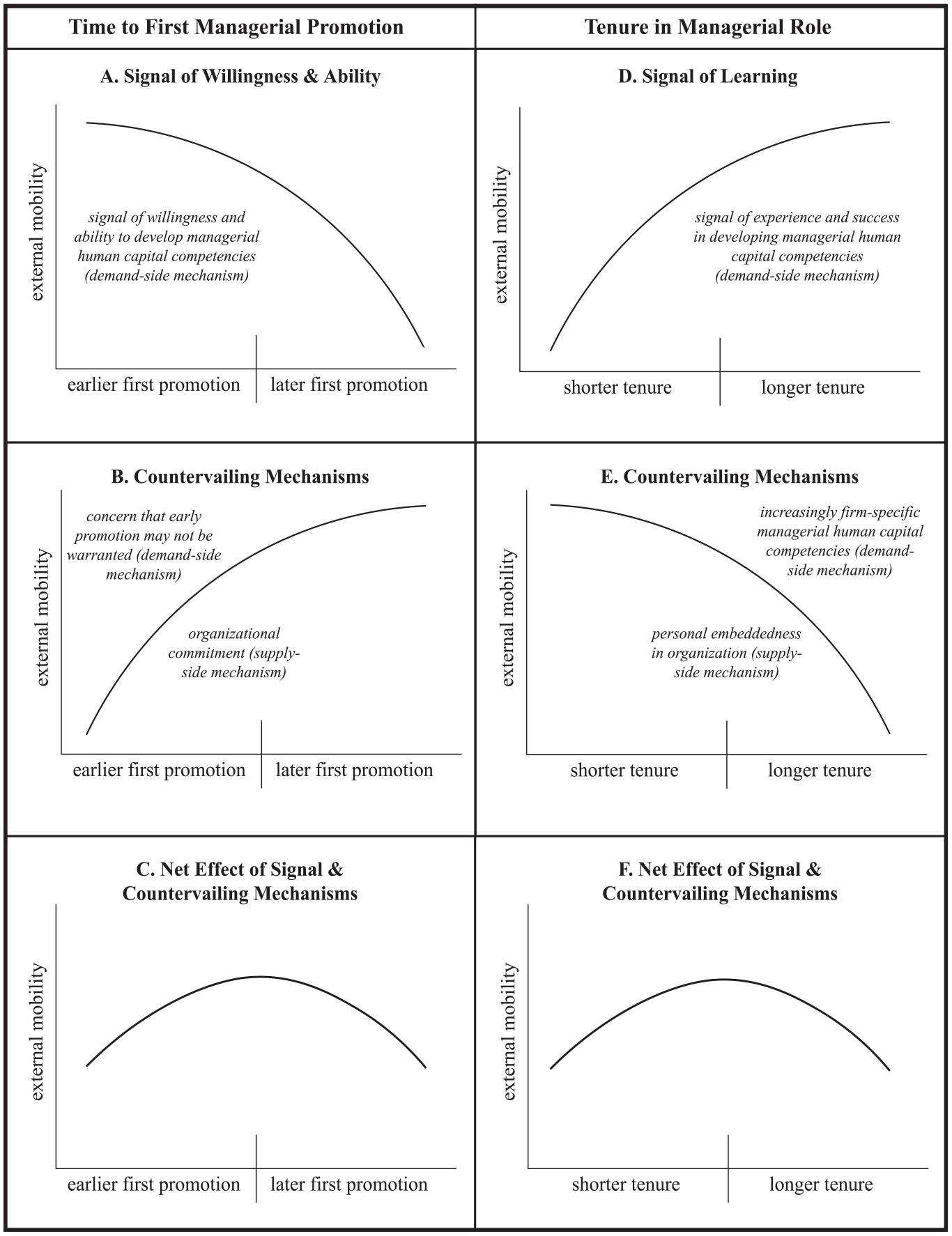
Theorized Functional Forms & Mechanisms
Countervailing Effects of Very Early Promotion and Embeddedness
While an early-career promotion might send a favorable signal to hiring organizations, research has also shown that employees who rise too quickly in their careers may not have developed the emotional and social capacities that come with time and experience (Bunker, Kram, & Ting, 2002). Indeed, organizations often promote people who lack the capacities needed to develop the complex, multifaceted, and tacit skills required to manage effectively, hoping that such individuals will rise to the occasion and that these necessary components of managerial human capital will develop over time (Aguinis & Kraiger, 2009; Day, 2000; Day, Fleenor, Sturm, & McKee, 2014). Thus, a very early career promotion may send a countervailing signal that causes hiring organizations to discount the otherwise positive signal of willingness and ability to develop managerial human capital. This suggests that very early career promotions may trigger a demand-side mechanism that results in a lower likelihood of subsequent mobility than those that happen after the candidate has spent some time in nonmanagerial roles. That is, the external labor market may interpret the signal sent by some early career experience in nonmanagerial roles as providing sufficient time for the individual to demonstrate their competencies in the internal labor market, thereby “earning” the managerial promotion (Figure 1, Panel B).
Moreover, there may be supply-side factors that result in a lower likelihood of mobility after a very early career promotion. Research on employee and organizational matching notes socialization and employee development make matching a dynamic process that changes over time rather than remaining static based in the recruitment stage (Weller et al., 2019). For example, early upward mobility may increase the worker’s affective commitment to their current employer and make them less willing to change jobs (Krausert, 2017). Indeed, job embeddedness theory suggests that very early promotions may help individuals feel more strongly connected to the organization and see greater career path clarity than if they been promoted later in their careers (K. Jiang, Liu, McKay, Lee, & Mitchell, 2012). A key dimension of job embeddedness research is related to what an employee would sacrifice or give up if they left their current employer. In the case of individuals promoted very early in their careers, this represents giving up special recognition as a “rising star” in the organization (Kehoe, Lepak, & Bentley, 2018); that is, someone on whom the organization took an early bet to help them rise to higher status in the organization. Such a loss may be perceived by the individual as more of a sacrifice than had they been promoted in a more conventional time frame (Shaw, Delery, Jenkins, & Gupta, 1998).
Moreover, employees promoted to managerial roles early in their careers receive specialized training and accelerated career advancement opportunities (Rosenbaum, 1979). They also develop relationships with fellow leaders and decision-makers, broadening their socialization within the organization (Burt, 2007). Not surprisingly, then, research shows that people promoted early in their careers are much more likely to receive further promotions and rise higher in the firm than those who take longer to be promoted (Rosenbaum, 1984). Therefore, while first promotions signal a person’s willingness and ability to develop firm-specific capabilities, there are countervailing supply-side mechanisms that may cause a worker promoted early in their career to feel connected to their current employer and see greater potential for career-building opportunities there than at another organization (Figure 1, Panel B).
In sum, when an organization promotes an employee to a managerial role, this sends a signal to hiring organizations interested in finding the best possible managerial talent, and we expect that this signal will create mobility opportunities for those individuals interested in changing organizations. However, the content of this signal has a nuanced temporal component. Integrating the arguments above, we expect that the signal sent by an individual’s first managerial promotion will have a curvilinear association with their next external mobility event (Figure 1, Panel C). The signal of their willingness and ability to develop managerial capacities is a mechanism that might be expected to have an overall negative association between the timing of an individual’s first managerial promotion and their external mobility over the course of their career (Morris et al., 2017). However, if the first managerial promotion occurs too early in their career, there may be countervailing demand-side questions about the accuracy of the signal and supply-side factors that make the employees themselves less likely to leave their current employer.
Hypothesis 1: The length of time to an individual’s first managerial promotion has an inverted U-shaped association with the odds of their external mobility from the promoting organization.
Signaling the Amount of Managerial Human Capital Developed
The second signal we consider addresses information asymmetries in the external labor market regarding the extent to which a potential employee has developed firm-specific managerial human capital at their current organization. Accordingly, we now consider an individual’s tenure in managerial roles at their current organization. This shifts our focus from the relationship between a worker’s first managerial promotion and their external mobility to the association between tenure in any managerial role and external mobility. That is, managerial tenure sends a separate signal and is distinct from the timing of a worker’s first managerial promotion (Hypothesis 1). This is an important theoretical distinction. Whereas we have argued the former reduces information asymmetries in the external labor market around an individual’s willingness and ability to develop the KSAO-based capacities needed for managerial human capital, the latter communicates information regarding the extent of the employee’s managerial human capital per se. 3
The promotion to a managerial role that we explored in our motivation for Hypothesis 1 is a discrete event that communicates information about an individual’s willingness and ability to develop managerial human capital. However, willingness and ability alone doesn’t necessarily make for effective management: there is a temporal dimension to the actual development of managerial human capital. Faria (2000) notes that people who are good at being individual contributors are not necessarily good at managing others, and research has argued that this is a prominent occurrence in organizations (Peter & Hull, 1969). Indeed, Lazear (2004) found that people can demonstrate poor work performance after being promoted to a new managerial role. However, for many of these managers, performance increases after they have had a chance to learn and develop some of the requisite managerial capacities.
This is due in large part to the nature of the social skills that are component to managerial human capital. While these skills have stable underpinnings (e.g., social sensitivity, emotional awareness, and insight), they are developed through repeated experiences over time (Bass, 2008). By engaging closely with co-workers on a day-to-day basis, there is a learning mechanism through which managers develop individualized consideration for their colleagues (Kim et al., 2020), transactive memory (Wegner, 1987), and mutual dependency (Carpenter, Li, & Jiang, 2012). Time spent working in an organization also develops the manager’s understanding of organizational processes and the needs of relational partners, and these relationships reciprocally shape the individual’s managerial human capital and result in behaviors that are progressively more firm-specific (H. Jiang, Cannella, Xia, & Semadeni, 2017; Ployhart, 2021).
This learning process is a necessary component of managerial human capital development, and other employees in a manager’s current organization, and particularly those in the human resource function (Krausert, 2017), can observe directly how an individual adapts to the role over time. Recent research provides insight to this temporal effect, arguing that “because firms initially observe managerial talent imperfectly, managers commonly enjoy a ‘honeymoon period’ when evaluators refrain from making final judgments of managerial potential” (Allen et al., 2022: 1356-1357). Moreover, it is through post-recruitment activities such as socialization or training and development that organizations may adapt their view of how well-matched an employee is to the work (Weller et al., 2019). Since organizations in the external labor market lack this ability for direct observation, they are likely to have even greater uncertainty about the development of an individual’s managerial competencies early in their managerial tenure. This external uncertainty should decrease over time as tenure suggests that the manager is learning and developing greater managerial human capital (Waldman, 2012), thereby signaling that the individual is effectively navigating the idiosyncratic managerial dynamics of the organization. As a result, external mobility should, in general, increase as a function of an individual’s tenure in managerial role signals the acquisition of requisite managerial capacities (Figure 1, Panel D).
Countervailing Effect of Embeddedness
While tenure in a managerial role allows an individual to develop the KSAO-based capabilities needed to be successful in that role, it also increases the degree to which they are embedded in the organization’s social structure, routines, environment, and norms of their current employer (Crocker, 2019; Nahapiet & Ghoshal, 1998; Ray et al., 2023). This means that the longer an employee’s tenure in a managerial role, the clearer the signal that their managerial human capital has developed in ways that are truly specific to the current organizational context (Pennings, et al., 1998). This firm-specificity could create a lack of a match (Weller, 2019) between the capacities the individual has developed and those needed to be successful in a new organization. Moreover, hiring individuals deeply embedded in the social landscape of their current organization necessarily involves more transaction costs (B. A. Campbell et al., 2012; Ployhart, Schepker, Wright, & Strizver, 2023). In this way, long tenure in a managerial role may signal aspects about the development of the manager’s firm-specific managerial human capital that makes it less attractive to organizations in the external labor market.
In addition to these demand-side signals that might make long-tenured managers less mobile, there may also be supply-side mechanisms that arise from personal circumstances, socio-economic contexts, and environmental factors (Figure 1, Panel E). For instance, individuals are likely to develop closer ties to an organization and their colleagues the longer they are with that organization. Employees who are strongly embedded in social ties within the organization are less likely to move (Bendig, Strese, Flatten, Da Costa, & Brettel, 2018) since they view their current prospects to be more desirable than outside options (Apascaritei & Elvira, 2022) and fear severance of valuable ties and internal mobility opportunities. Generous rewards tied to performance have also been shown to enhance perceptions of long-term embeddedness and employer attractiveness (Boxall, Huo, Macky, & Winterton, 2019). Over time, employees’ professional identities can also become intertwined with the organization’s culture and image (Ashforth, Rogers, & Corley, 2011), and thus may be less inclined to modify this aspect of their identity by moving to a different organization.
We expect, therefore, that an individual’s extended tenure in managerial roles will trigger countervailing mechanism on both the demand- and supply-sides that result in increased external mobility constraints after long tenure in managerial roles. Taking together the signal of managerial learning and the countervailing mechanisms on both the demand- and supply-side, we posit there is a temporal and inverted U-shaped association between external mobility and tenure in managerial roles (Figure 1, Panel F). We predict that early in a manager’s tenure they will be more mobile as the external labor market interprets the tenure as a signal of an individual’s development of, and ability to successfully draw upon, managerial human capital capacities. Longer tenure will have a negative impact on external mobility, as it signals that the individual’s managerial human capital may be too specific to their current organization to be effectively leveraged elsewhere and/or that the individual may be less interested in moving to a new organization.
Hypothesis 2: The length of time an individual spends in managerial roles at their current organization has an inverted U-shaped association with the odds of their external mobility.
Methods
Context and Data
We test these hypotheses in the context of Major League Baseball (MLB), using a unique dataset of external mobility events among scouting professionals (“scouts”) working for MLB franchises (i.e., teams). While prior organizational research in general has leveraged the empirical benefits of data from sport contexts (Fonti, Ross, & Aversa, 2023), and from MLB in particular (Eckardt et al., 2021a; Hill, Aime, & Ridge, 2017; Shamsie & Mannor, 2013), our approach is unique in that our units of analysis are not the players (Crocker & Eckardt, 2014; Moliterno & Wiersema, 2007) or competitive outcomes (Humphrey, Morgeson, & Mannor, 2009) associated with the sport. Rather, we consider employees who make complex and important contributions in the administration of this multibillion-dollar industry. As a result, the empirical setting of our study is like other organizational contexts with specific hierarchies, career pathways, and inter-organizational variability (Glassey, 2018).
MLB franchises rely on their scouting operations to identify player “prospects”—generally university/college or secondary school athletes—who potentially possess the skills needed for the franchise’s future competitive success (Shanks, 2005). Scouting is “knowledge work” (Pyöriä, 2005), not dissimilar from work in professional service firms (Kor & Leblebici, 2005; Von Nordenflycht, 2010). This process involves many geographically dispersed scouting professionals tasked with the multi-dimensional and multi-source assessment of thousands of players per year (Jedlovec, 2011). To do so, scouts use their own judgment to integrate objective and subjective data on the players’ motor and psychological skills (Nowlin, 2011). A player identified as a good prospect (i.e., a player with the current or potential skills and characteristics needed by the franchise) may ultimately be selected through the annual draft and signed to a contract to continue their development in the team’s minor league system (Gitter & Rhoads, 2010). 4 All MLB franchises competitively recruit prospective players in advance of the annual draft. This process involves the synthesis of large amounts of quantitative and qualitative player data; substantial discussions and debate among scouts, managers, and advisors; and consideration of other franchises’ player rosters.
Each MLB franchise annually publishes a media guide which identifies all individuals involved in the team’s scouting operations, and we compiled our dataset by coding the information reported in these guides. Focusing on the 23-year period of 1988 to 2010, 5 we collected population-level data (14,072 individual-year observations) and constructed career histories for the 2,079 scouts active during this period and observed 820 external mobility events. To reduce potential issues related to data censoring, we included only those individuals who started their MLB careers in or after 1988. Our population-level data eliminates common sample selection issues such as incorrect estimations of population parameters, inaccurate estimations of relationships, reduced generalizability results, and reduced statistical power (Berk, 1983; Heckman, 1979; Short, Ketchen, & Palmer, 2002; Winship & Mare, 1992).
In addition, to ground our understanding of the context and confirm the face validity of the variables we operationalize and the mechanisms we propose in our models, we conducted in-depth semi-structured interviews with five industry experts who had significant and relevant professional experience at all hierarchical levels of different MLB scouting operations: a retired General Manager who had been promoted through various scouting roles over the course of his career, two current Scouting Directors, a line scout, and a mid-level manager. Collectively, these industry experts had 88 years of MLB scouting experience. Importantly, over the courses of their careers they all held various positions of responsibility in the scouting profession, giving both breadth and depth to their expertise and perspective. Insights from these interviews can be found in the Online Supplement. We also consulted with these industry experts to better understand the requisite amount of franchise-specific KSAOs required to be successful in the various job titles used in coding our manager variable discussed below.
An additional benefit of this empirical context is that the administrative hierarchy for scouting operations is largely the same across MLB franchises. This enables external mobility opportunities for professionals working in this field. This was confirmed in our interviews with the industry experts, one of whom noted that scouts can change franchises without physically relocating. Since scouting is done across the United States, scouts moving to a new franchise can be assigned a territory proximal to where they live. Obviously, this reduces supply-side barriers to external mobility. The consistency among franchises in the structure of scouting operations allowed us to construct an occupational hierarchy of positions in the profession and categorize each job title as comprising either “line” or “managerial” responsibilities. We categorized as line-level positions those jobs that focus primarily on the direct identification and assessment of player prospects. These line-level scouts report to individuals working in managerial roles within the scouting administrative hierarchy. 6
In this study we adopt the theoretical perspective that managerial capacities allow an individual to provide behaviors and services that are more firm-specific than those provided by nonmanagerial human capital resources (Castanias & Helfat 1991, 2001; Penrose, 1959; Ployhart, 2021). Perhaps most significant for our study, then, is the franchise-specific and strategically important decision-making and leadership role that managers in scouting operations are expected to play (Nowlin, 2011). Of course, the individuals filling managerial roles need to have an understanding and knowledge of the unique skills, as well as the personalities and working styles, of the scouting professionals they supervise. It is also important for the managers to understand the idiosyncratic player assessment and selection routines at their current franchise (Gorman, 2008; Lewis, 2004; Shanks, 2005). Managers in MLB scouting operations winnow the pool of prospects generated by line scouts to only those prospects who have the potential to meet the organization’s needs (Jedlovec, 2011; Shanks, 2005). Such insight is critical as new players must integrate with and complement the franchise’s existing portfolio/roster of players: This kind of nuanced, and often tacit, knowledge is truly franchise-specific.
Variables
Dependent variable
The dependent variable external mobility measures whether a scout moved from one franchise to another between seasons (i.e., started the season with a team different than the one they worked for in the prior year). We determined that an external mobility event had occurred when we observed the scout appearing in the media guide for a different franchise in year t + 1 than they did in year t. Since the media guides are published for the start of the MLB season in April, we assume that the external mobility event occurred between the end of the year t season (i.e., October/November) and the start of the year t + 1 season (i.e., March/April). 7 Accordingly, we code the dichotomous variable external mobility with values of 1 in year t, indicating that the individual changed organizations after the end of the season and before the start of the next. This sequencing allows us to measure all our independent variables and controls in year t as well: any career outcomes experienced by the focal scout that occurred between time t-n and t are part of their employment record between the end of year t when the external mobility event occurs.
Independent variables
Hypothesis 1 concerns when an individual first attains a managerial role in a franchise’s scouting operations during their career. We test this hypothesis with the variable career years to first promotion, which was constructed through a two-step process. We first constructed a dichotomous variable manager that takes values of 1 when the job title reported for the scout in the media guide indicates a managerial role (e.g., “Regional/National Supervisor,” “Coordinator,” “Scouting Director,” etc.) and 0 when the scout holds a nonmanagerial role (e.g., “Area Scout,” “Special Assistant Scout,” “Advance Scout,” etc.). As some scouts may also work in nonmanagerial player development roles (e.g., “Hitting Instructor,” “Bullpen Coach,” “Analyst”) during the early stages of their careers, we also classified such roles as nonmanagerial. The important distinction between managerial and nonmanagerial roles is whether the role focused on direct player assessment or development tasks (i.e., nonmanagerial) or involved the supervision/leadership of other employees and/or decisions associated with allocation of unit resources, budgets, technology, etc. (i.e., managerial roles). To ground this coding in our context, we asked our industry experts to evaluate the degree to which an individual holding a given job title would need franchise-specific knowledge to be successful in the role. We also asked them to share the instrument we provided for this purpose with their industry peers (e.g., other Scouting Directors). The responses from the industry experts were unanimous in evaluating the positions we coded as “managerial” as requiring substantial franchise-specific knowledge and those we coded as “nonmanagerial” as requiring little if any such knowledge.
We then constructed the ordinal variable career years to first promotion, which takes a value equal to the year in their career when the scout first attains a managerial position (the first year in their career that the manager variable described above equals 1). All values before the promotion year were treated as missing for this variable. For example, if a scout started their career in 1990 (i.e., career year = 1) and was first promoted to a managerial role in 1995, career years to first promotion is set to equal 6 for the 1995 observation and all subsequent years in the scout’s career. In this case, we also coded the career years to first promotion variable as missing for years 1990 to 1994 since the scout had not been promoted to manager in those years of observation. Likewise, if an individual is never promoted to managerial position, this variable is coded missing for all years in their career. 8 To test our hypothesized inverted U-shaped association, we model both the linear and quadratic terms of the career years to first promotion.
Our second hypothesis concerns an individual’s tenure in managerial roles. We test this hypothesis with the count variable tenure years as manager, measured as the number of years a scout occupies one or more managerial positions at the franchise where they were employed prior to the external mobility event. Following prior research (Bliese & Lang, 2016; Li, Hausknecht, & Dragoni, 2020), this variable is coded 0 until the scout is promoted to a managerial role and takes the value of 1 for the first year in their tenure as manager, 2 for the second year, and so on. If a scout never holds a managerial position at a franchise, this variable is coded 0 for the entirety of their tenure with that franchise. To test our hypothesized inverted U-shaped association, we model both the linear and quadratic terms of tenure years as manager.
Control variables
We control for contextual and theoretical factors that may associate with external mobility. The first set of these controls focuses on the scout. While our hypotheses are concerned with the timing of the signal sent by promotion to, and tenure in, a managerial role, it is possible that simply holding a managerial role per se at the time of the external mobility event sends its own signal. We control for this with the dummy variable manager, described above, which takes values of 1 every year an individual holds a managerial role.
While franchise-specific KSAO-based capacities are particularly relevant for managerial roles, such capacities may also be important, albeit to a lesser extent, for nonmanagerial jobs within a franchise. As discussed above, our industry experts evaluated the degree to which the roles represented by the job titles in our data required the incumbent to have franchise-specific knowledge. In addition to indicating that all the positions we coded as “managerial” required such franchise-specific KSAOs, the experts also rated four nonmanagerial titles (Coach, Instructor, Analyst, and Special Assistant) as requiring higher levels of franchise-specific KSAOs. Importantly for our analysis, except for the Special Assistant, these are positions that are not directly involved in the work of scouting. Coaches and Instructors work with current players and Analysts provide assessment tools (typically based on statistical analysis of a prospective player’s amateur performance) that are complementary to the “on the ground” work of the scouting professionals we study here. Since our theoretical predictions build from the proposition that managerial human capital requires firm-specific KSAO-based capacities, we control for the association that the franchise-specific KSAOs of these nonmanagerial roles may have with an employee’s external mobility and include the dummy variable nonmanagerial FSHC (i.e., firm-specific human capital) that takes a value of 1 for scouts with one of these titles.
Although many scouting professionals may work at single occupational hierarchy their entire career, it is also possible that a scout may incrementally move up the occupational hierarchy while working at a given franchise, signaling that they possess KSAO-based capacities to grow and develop professionally. The variable hierarchy, measured as the total number of hierarchical levels the individual has occupied at a franchise, controls for this association. Finally, some individuals are simply “more mobile”: they are more willing to change jobs and manage their career by moving between organizations. Accordingly, a scout’s career history may contain indicators that signal openness to mobility, and we expect this will positively associate with their external mobility. Therefore, we include the variable number of teams, measured as the count of an individual’s prior team affiliations prior to the external mobility event.
Other control variables focus on the franchises from/to which the scout moves at the time of the external mobility event. The variable sabermetrics accounts for data-driven statistics-based player selection techniques that emerged during the years of our study (i.e., “sabermetrics”; James, 1982; Lewis, 2004). Since the use of sabermetrics influences the impact scouts have on player selection, their use in a franchise might reduce opportunities for scouts. The dummy variable sabermetrics measures whether the franchise where the scout worked the year before the external mobility event has experience using sabermetrics. This was determined by coding the job titles in each franchise’s annual media guide. Symmetrically, a scout’s external mobility might also depend on whether the franchise that hires them uses, or has experience with, sabermetric technology. We constructed the variable difference in sabermetrics by subtracting the value of the sabermetrics variable for the scout’s prior employer from that of the new employer, both measured at the end of the year t.
In our theoretical development we explore the role of countervailing supply-side mechanisms and their relationship to the demand-side signals we consider. In addition to these important individual-level factors there may be organization-level supply-side factors that impact external mobility. For instance, as has been demonstrated in other organizational contexts (Mackey et al., 2014), it is possible that MLB franchises with greater financial resources are able to offer greater pay and thus represent more attractive employment opportunities for scouts. Since the availability of MLB financial data is inconsistent during the years of our analysis, we rely on attendance at the franchise’s home stadium as the best proxy for the organization’s financial resources (Markham & Teplitz, 1981). We include the variable attendance in our models, measured as the logged average number of attendees at the home games of the scout’s employer. It is also reasonable to assume that through a pattern of positive assortative matching, early-promoted scouts would prefer to work for a franchise that has greater financial resources than their current employer (B. A. Campbell et al., 2012). We constructed the variable difference in attendance by subtracting the logged value of the attendance variable for the scout’s prior employer from that of their new employer, measuring both values at the end of the year t season. Scouts might also reasonably prefer working for a well-performing team. The variable games won measures the number of games won by the team that employed the scout the season before the external mobility event. Finally, we include a difference in games won variable by subtracting the value of the games won variable for the scout’s prior employer from that of their new employer, both measured at the end of the year t season.
Analysis
We tested our predictions using logistic discrete-time maximum likelihood event history analysis (Allison, 1982). This methodology has been used in other research on mobility in professional sports (Allen et al., 2022) and is appropriate for our study since the scouts’ careers comprise discrete years of data. In addition, some of the career histories of scouts are right-censored in our sample, which makes discrete-time event history models well-suited for our data and research question (Petersen & Kaput, 1992). As described above, since mobility events are determined by a scout’s identification in different franchises’ media guides for the t and t + 1 seasons, each scout’s career record is divided into scout-team-year units, with each unit entering the models as a unique observation. In our event history models, the discrete event of interest is captured with the dependent variable external mobility, which indicates that a scout moved from one franchise to another. We report all models with clustered robust standard errors to reduce the potential for residual heteroscedasticity and non-independence biasing the results. All models include firm- (i.e., franchise-) and year-level fixed effects. This controls for any potential time invariant differences among franchises in general and partly accounts for non-pecuniary incentive differences among the franchises.
Results
While the test of Hypothesis 2 utilizes our full population-level dataset, Hypothesis 1 focuses only on the external mobility event that occurs after a scout is promoted to manager for the first time in their career. To test this hypothesis, we created a subsample that includes only scouts who became managers and only the mobility event away from the promoting organization. Observations of managers’ subsequent mobility events, and all observations of non-managers, are excluded from this subsample. We therefore report separate descriptive statistics and correlation matrices for the data used to test each hypothesis: Table 1 includes the variables in the subsample used for Hypothesis 1, and Table 2 includes the full sample and variables for Hypothesis 2. Since we observe some high correlations, variance inflation factors (VIFs) were computed to assess any multicollinearity concerns. All VIF values were found to be less than the threshold of 10 as suggested by Neter, Wasserman, and Kutner (1985). 9 Multicollinearity therefore does not appear to be a concern in our analyses.
Descriptive Statistics & Correlations for Variables Models Testing Hypothesis 1 a
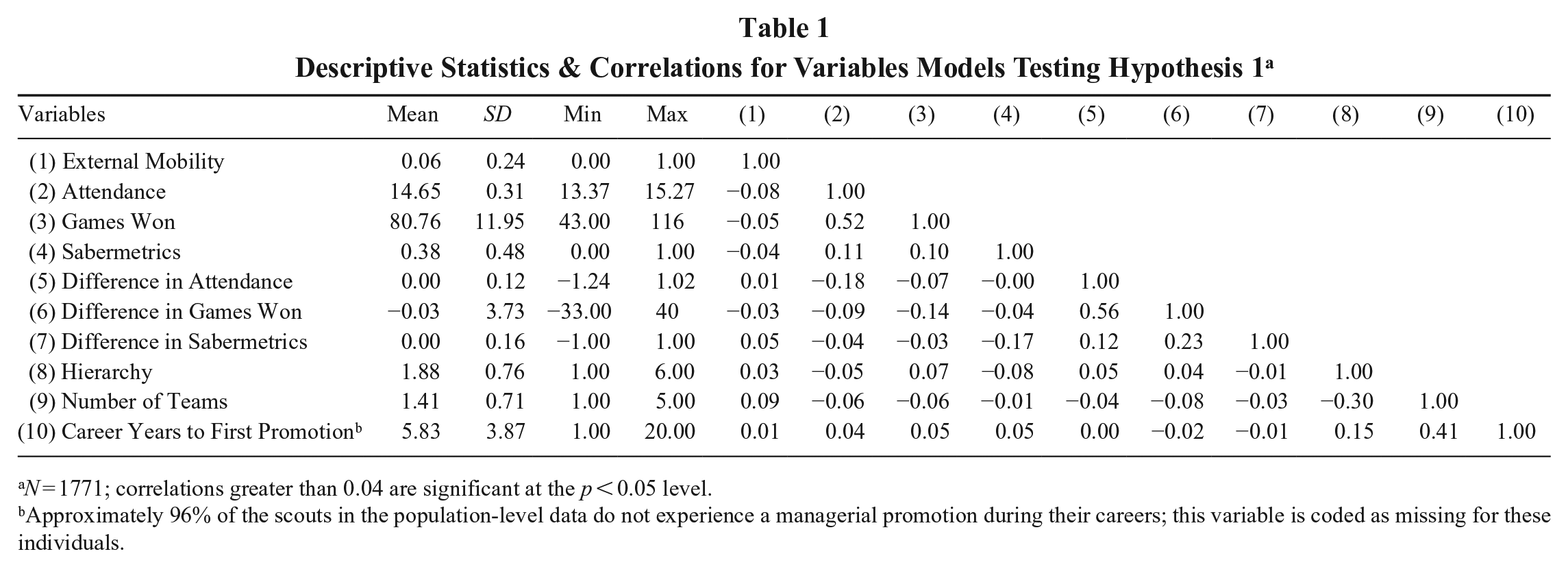
N = 1771; correlations greater than 0.04 are significant at the p < 0.05 level.
Approximately 96% of the scouts in the population-level data do not experience a managerial promotion during their careers; this variable is coded as missing for these individuals.
Descriptive Statistics & Correlations for Variables Models Testing Hypothesis 2 a
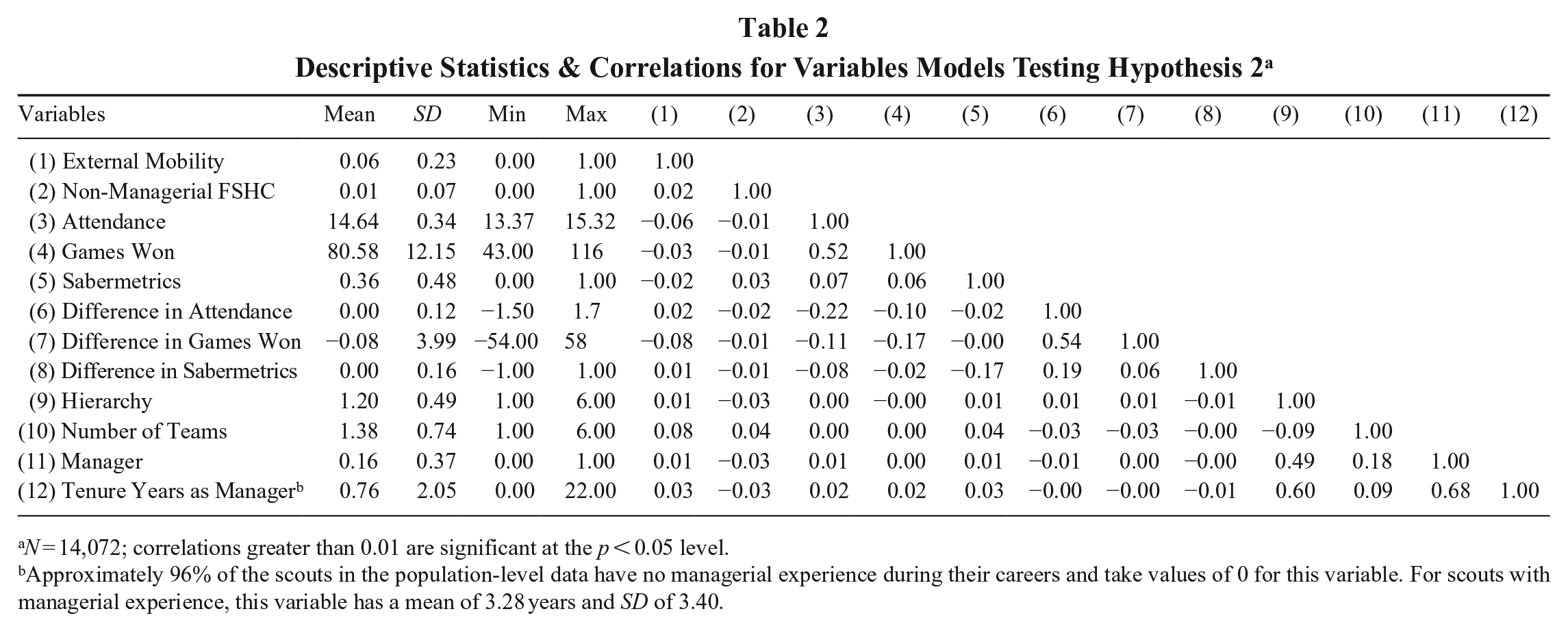
N = 14,072; correlations greater than 0.01 are significant at the p < 0.05 level.
Approximately 96% of the scouts in the population-level data have no managerial experience during their careers and take values of 0 for this variable. For scouts with managerial experience, this variable has a mean of 3.28 years and SD of 3.40.
Table 3 reports the coefficients from the logistic discrete-time event history analysis, with positive values indicating an increase in the log odds of a scout’s mobility. To facilitate interpretation, we standardized our data: an observed positive coefficient therefore indicates that an increase in the variable associates with an increase in the odds of a scout’s external mobility. In the control-only Model 1, the log odds of attendance, which proxies for the franchise’s financial resources is −0.58 (p = 0.001). When we transform this coefficient into an estimated magnitude by exponentiating the value, we find that a scout working for a franchise with attendance one standard deviation above the mean has odds of mobility 0.56 lower than a scout working for a franchise with average attendance. This is a 2.55% decrease in the probability of external mobility, or a 42.49% change in the observed probability of mobility in our data (i.e., 6%), suggesting that managers may be disinclined to move away from relatively wealthier organizations. The negative association we see for attendance may also be an artifact of an organization-level geographic effect: franchises playing in larger cities are likely to have greater attendance, and this geographic aspect may suggest a relevant organization-level supply-side mechanism (we explore other such organization-level factors in our Supplemental Analysis).
Logistic Discrete-time Event History Analysis of External Mobility (Hypothesis 1) a
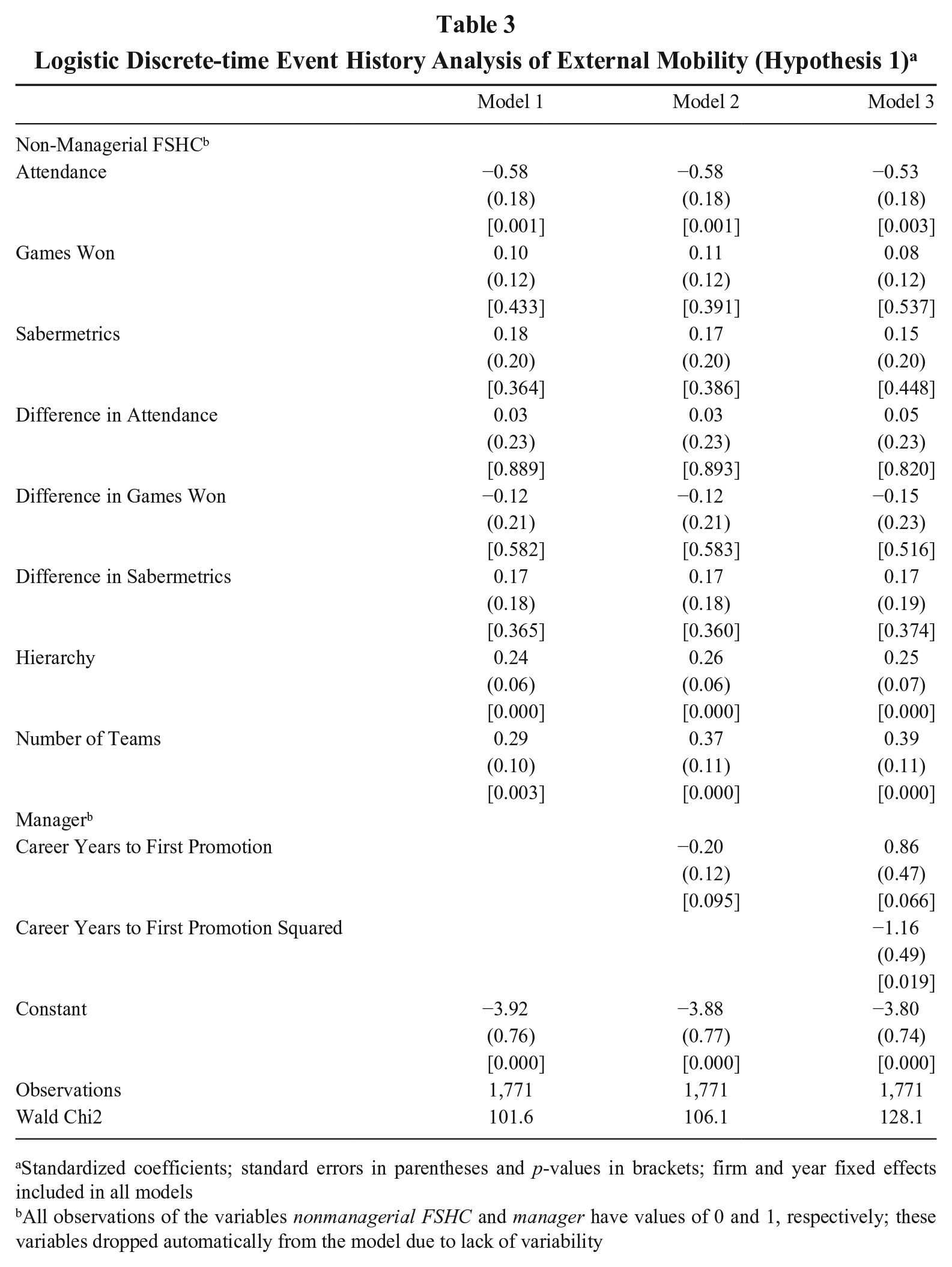
Standardized coefficients; standard errors in parentheses and p-values in brackets; firm and year fixed effects included in all models
All observations of the variables nonmanagerial FSHC and manager have values of 0 and 1, respectively; these variables dropped automatically from the model due to lack of variability
Also in the control-only Model 1, the log odds of hierarchy are 0.24 (p = 0.000), indicating that the total number of hierarchical levels a manager occupies during their tenure with a franchise may send a signal that associates with external mobility in and of itself; namely, that they possess the KSAO-based capacities to grow and develop professionally. Compared to a scout who has held the average number of hierarchal levels at their current employer, an individual who has held one standard deviation (i.e., 0.76) more hierarchical levels has 1.27 greater odds of external mobility, representing a 3.44% increase in the likelihood of their mobility or an absolute change of more than 57%. Finally, number of teams is associated with higher odds of mobility (β = 0.29, p = 0.003): the odds of a manager’s external mobility are higher as a function of the number of teams they have worked for over their career. This may be signaling of their ability and willingness to move or may be an additional individual-level supply-side factor: some people are simply more inclined to change organizations. A one standard deviation increase in number of organizational affiliation results in 1.34 greater odds of subsequent external mobility (i.e., a 1.86% increase or 31% absolute change).
We introduce the linear term for career years to first promotion in Model 2, and both the linear and quadratic terms in Model 3. In Model 3, the log odds of career years to first promotion and career years to first promotion squared are 0.86 (p = 0.066) and −1.16 (p = 0.019), respectively. Comparing the χ2 statistics for Models 2 (106.1) and 3 (128.1), we find that Model 3 better fits the data. Translating these coefficients, we find that a scout whose time to first managerial promotion is one standard deviation above the population average initially has odds of external mobility 2.36 times greater than the scout who was promoted in an average number of years: this is a 7.11% greater probability, or an increase of over 118%. However, the odds of external mobility decrease for the scout whose promotion comes later in their career when the odds of external mobility equal 0.31 of the population average (i.e., a 4.04% decrease, or −67.30% absolute change, in likelihood). These results provide support for Hypothesis 1, which predicts an inverted U-shape association between the point in an employee’s career when they first become a manager and the odds of their external mobility.
Figure 2 graphs the associations reported in Model 3 and depicts the predicted probability of a scout’s external mobility as a function of when they first attain a managerial role. Interestingly, early career promotions to a managerial role result in a relatively high probability of external mobility (e.g., intercept of around 5%) which increases until around five career years (5.42 years). Beyond this point the probability of external mobility monotonically decreases. To statistically verify this inverted U-shaped relationship, we follow the guidance found in Haans, Pieters, & He 2016. As already noted, the β coefficient of the quadratic term is statistically significant. The slopes at both ends of the inverted U-shaped association are also statistically significant (lower bound slope = 0.18, p = 0.042; upper bound slope = −0.60, p = 0.006), and the inflection point of the curvilinear association is well within the observed data range (1 to 20). Taken together, these tests lend further support for Hypothesis 1.
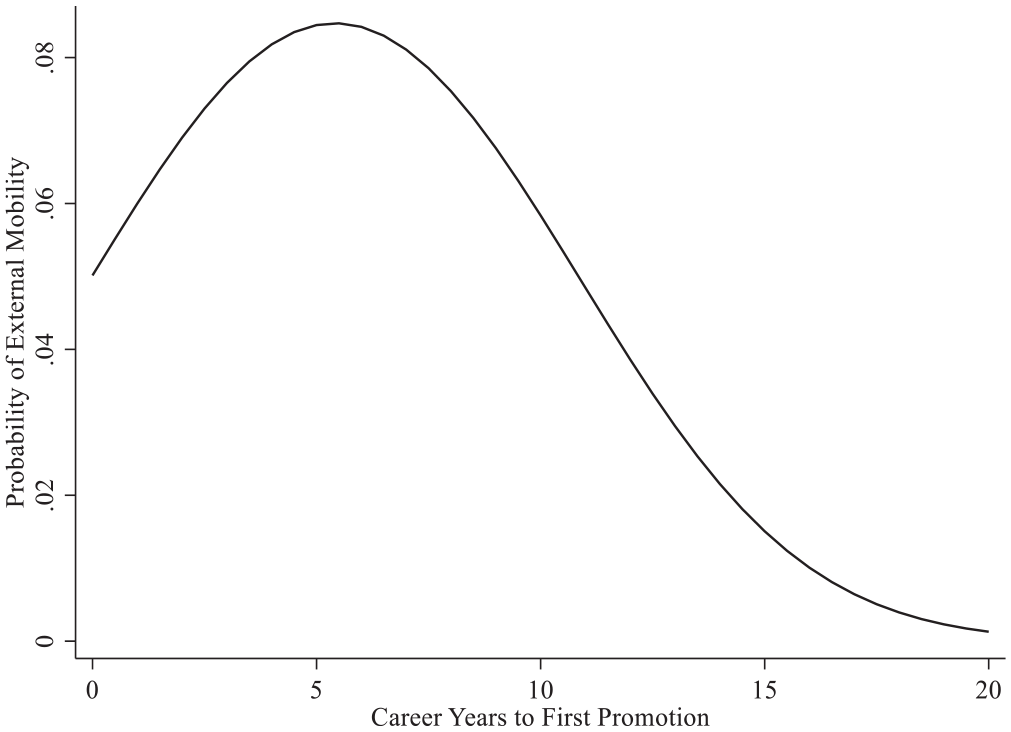
Probability of External Mobility as a Function of Career Years to First Promotion
The models in Table 4 include all 14,072 observations in the data and report the results of the test of Hypothesis 2 using the logistic discrete-time event history analysis of external mobility. Model 1 reports the control-only model. The log odds for attendance are −0.28 (p = 0.000), indicating that the association we discuss above is present in the context of the full sample. In addition, we observe an association between the dummy variable non-managerial FSHC and external mobility (β = 0.07, p = 0.007), indicating that scouts have greater external mobility if they previously held nonmanagerial roles that required firm-specific capacities. Scouts who hold positions that require the incumbent to have non-managerial—but still firm-specific—KSAO-based capacities have odds of mobility 1.07 times that of scouts who don’t, representing a 0.41% increase, or 6.79% absolute increase, in the probability of their external mobility. This is an interesting result, which is consistent with arguments in Morris et al. (2017): FSHC, in general, may not necessarily be a mobility constraint.
Logistic Discrete-time Event History Analysis of External Mobility (Hypothesis 2) a
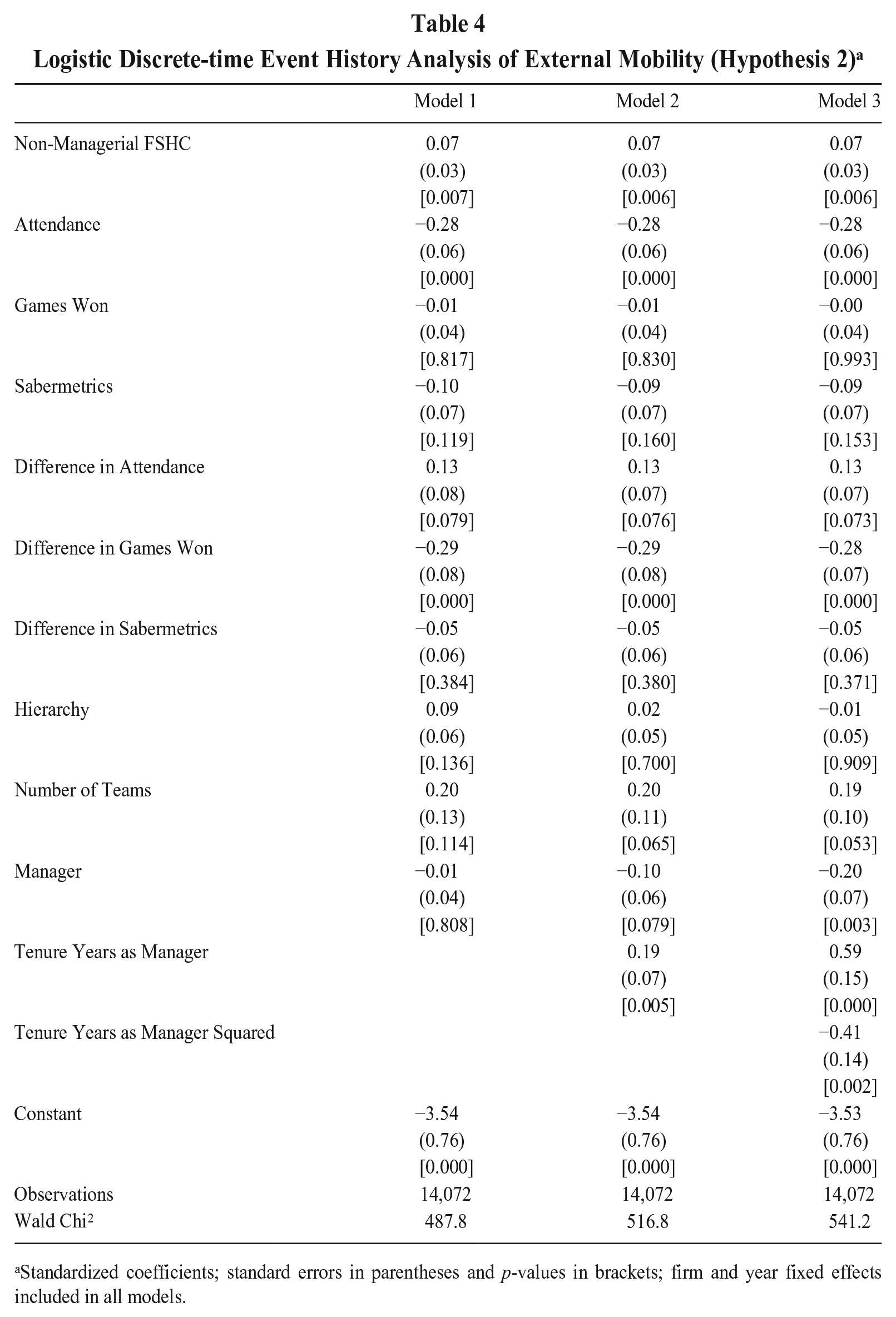
aStandardized coefficients; standard errors in parentheses and p-values in brackets; firm and year fixed effects included in all models.
The log odds for difference in attendance (β = 0.13, p = 0.079) and difference in games won (β = −0.29, p = 0.000) seem to tell a complicated story. Recalling that these variables have negative values when the old employer is performing better on these metrics than the new (i.e., performance of the old employer is subtracted from performance of the new employer), a negative coefficient for these difference variables indicates increased probability of mobility to an arguably “worse” franchise. While one of these associations is only marginally significant, it is interesting that we observe them in the full dataset (Table 4), but not in the manager-only subset (Table 3). This suggests that, on average across the population of MLB scouts, external mobility seems to be to teams that in the prior season performed worse on the field but better financially. This is perhaps understandable. Since scouts select the players responsible for winning games, poor performing teams may want to see some turnover in their scouting ranks and look to poach scouts from better performing franchises. And recalling that attendance may also pick up a geographic effect, it is possible that these “hiring sprees” by underperforming teams are enabled by the economic resources available to franchises in larger cities. These conjectures aside, these results demonstrate the presence of organization-level factors (on both the demand- and supply-side) at work in external mobility. As noted above, we explore other such organization-level factors in our Supplemental Analysis.
Model 2 introduces the variable tenure years as manager and both the linear and quadratic terms of this variable are added in Model 3. In Model 3, the log odds for tenure years as manager and tenure years as manager squared are 0.59 (p = 0.000) and −0.41 (p = 0.002), respectively. Comparing the χ2 statistics for Models 2 (516.8) and 3 (541.2), we find that Model 3 better fits the data. Translating these coefficients, we find that a one standard deviation increase of time in a managerial role initially results in odds of external mobility 1.80 times greater than the industry average. However, after this initial increase, the odds of external mobility decreases the longer an individual stays in their managerial role and fall to 0.66 of the industry average (i.e., a 1.94% decrease, or a −32.27% absolute change, in likelihood). These results support Hypothesis 2 which predicted that the length of time an employee spends in managerial roles at their current organization has an inverted U-shaped association with the odds of their external mobility. It is important to note too that the log odds for manager is non-significant in the control only Model 1 but becomes negative and marginally significant in Model 2 (β = −0.10, p = 0.079), and negative and significant in Model 3 (β = −0.20, p = 0.003), which include the tenure years as manager variables. The odds of external mobility for a scout who is currently holding a managerial role are 0.82 times those of one who is not a manager. Taken together, this pattern of findings suggests that being a manager reduces the likelihood of an individual’s mobility, but being a long-tenured manager reduces that likelihood even more.
Figure 3 graphs the associations reported in Model 3 and depicts the predicted probability of an individual’s external mobility as a function of the number of years they spend in an organization’s managerial ranks. Consistent with the results reported above, we see that any experience in a managerial role results in a relatively high probability of external mobility (i.e., intercept of approximately 5%), which increases until tenure of just over eight years. Beyond this point the probability of external mobility decreases monotonically. To verify this inverted U-shaped relationship, we note the significant β coefficient of the quadratic term, the statistically significant slopes at both ends of the inverted U-shaped (lower bound slope = 0.29, p = 0.000; upper bound slope = −0.54, p = 0.005), and an inflection point well within the observed data range (0 to 23). Thus, we find further support for Hypothesis 2.
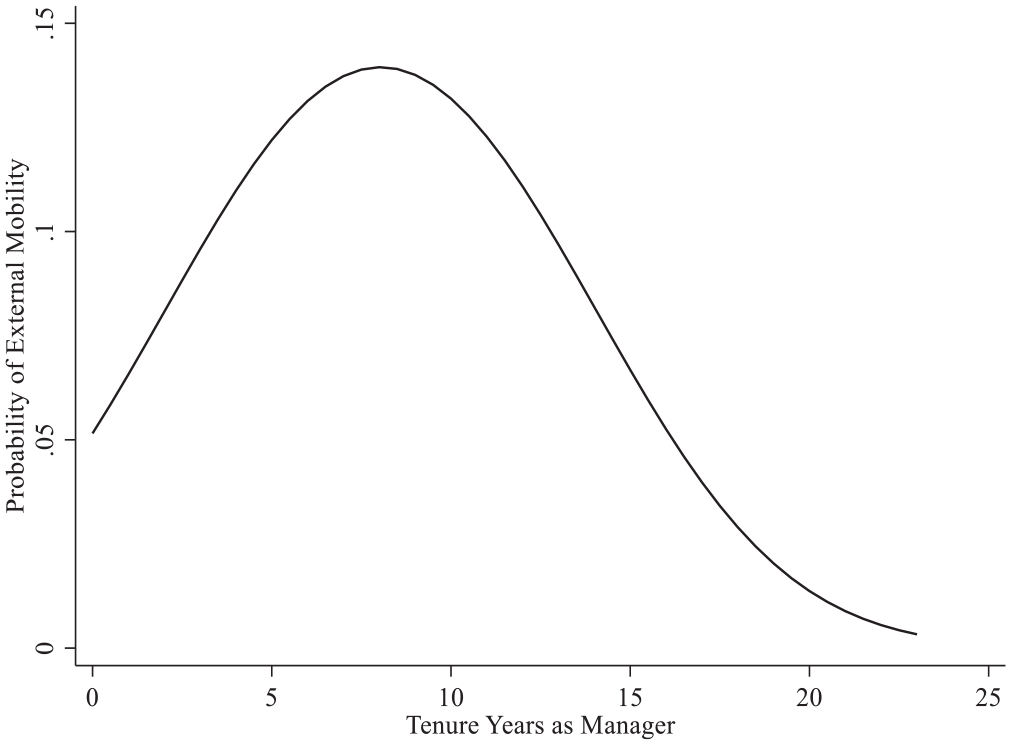
Probability of External Mobility as a Function of Tenure Years as Manager
Supplemental Analyses
We carried out several supplemental analyses to further explore the associations we tested and assess the robustness of our findings. Additional details and tables for all supplemental analyses can be found in the Online Supplement.
Post hoc analysis
While our results support the proposition that time to first managerial promotion and tenure in managerial roles are distinct signals, we note that there is an important relationship between these two signals. For an individual to accrue tenure in managerial positions they must, at some point in their career, be promoted to a managerial role. That is, the former signal cannot be sent if the latter is not also sent. This raises the question of whether and how these two signals together associate with managerial mobility. While these career outcomes send different signals to the external labor market, it is reasonable to presume that the firms receiving these signals attend to both. How, then, does the presence of both signals associate with a manager’s mobility?
To explore this question, we employed the same logistic discrete-time event analysis to test a model that includes the linear and quadratic terms of both career years to first promotion and tenure years as manager. However, as a subsample of our population-level data was used for modeling career years to first promotion (Hypothesis 1) and the full population-level dataset was used for modeling tenure years as manager (Hypothesis 2), this creates challenges when including both variables in the same model. The crux of the issue with this combined model relates to the coding of career years to first promotion. This variable has missing values for individuals who are never promoted to manager during their careers. Importantly, the variable also has missing values for the observations of managers before they are first promoted. That is, the records of individuals who become managers (and therefore have non-zero values for tenure years as manager at some point in their career) are truncated because we drop their pre-manager observations that have missing values for career years to first promotion. This results in a subsample that drops over 10,000 observations from our population-level dataset. When used to estimate a model that has both career years to first promotion and tenure years as manager, this subsample could bias the results by introducing a potential selection issue (Certo, Busenbark, Woo, & Semadeni, 2016).
Nonetheless, we report a full model with these missing values for career years to first promotion in the Online Supplement (Table S.1): the results for this model are consistent with those in each of the separate analyses for Hypothesis 1 and Hypothesis 2. Both have a pattern of results for the linear and squared terms that are consistent with an inverted U-shaped association with external mobility. The log odds of career years to first promotion squared are statistically significant (p = 0.031), while the log odds of the tenure years as manager squared term are slightly above the accepted level of statistical significance (p = 0.077). Thus, while there is a slight change in the statistical significance level for tenure years as manager squared, we observe that when included in the same model both signals appear to have the same associations with external mobility as when modeled alone.
As a robustness check on this finding and those presented in our main analysis, we used an alternative estimation technique, discontinuous growth modeling, that allowed us to test both hypotheses in one model, while retaining the pre-promotion observations for individuals that are promoted to manager during their career. Discontinuous growth models are an extension of traditional growth models—which are an alternative way to model time by explicitly including a variable for time in the specification (Bliese & Ployhart, 2002)—to account for how an “event” can change a temporal association (Bliese & Lang, 2016). When applied to our hypotheses and sample, a scout’s first promotion to manager can be used as the focal event, and the discontinuous growth model allows us to model simultaneously the associations between external mobility and both career years to first promotion and tenure years as manager. We provide additional details about how we coded the data and specified the models for this alternative approach and report the results in the Online Supplement (Table S.2). Using this alternative modeling technique, we found significant inverted U-shaped associations like those reported for our main analyses. The consistency of results using a fundamentally different modeling approach suggests additional support for both the robustness of the empirical findings reported in this study, and the observation of consistent associations when both signals are included in the same model.
Zero-inflated dependent variable
The dependent variable external mobility is zero-inflated and thus represents a relatively rare event. Following Sorenson and Stuart (2001), we used a rare events logistic regression to generate reliable estimates and correct the coefficients for any potential biases. This alternative model specification yielded inverted U-shaped associations similar to the findings reported above (Table S.3). Furthermore, while rare events regression analysis is popularly used for bias correction, some researchers (Leitgöb, 2013) suggest Firth’s (1993) penalized likelihood procedure as an alternative—and arguably more effective—method for modeling a zero-inflated dependent variable. Firth logit regression also yielded consistent results, confirming the robustness of our models (Table S.4).
Alternative control variables
In the reported models we use attendance as a proxy measure for the financial health of MLB franchises. An alternative operationalization for this construct is annual revenue of franchises. While Markham and Teplitz (1981) provide persuasive support for attendance as a proxy for an MLB franchise’s financial health, annual revenue is arguably a more proximal measure. We followed Ethiraj and Garg (2012) and used Forbes’s financial estimates for professional sports teams as a measure of the franchises’ annual revenue and conducted separate analyses using this measure. Specifying our models using annual revenue yielded inverted U-shaped associations comparable to the models using the attendance variable (Table S.5). However, in regressions using annual revenue values instead of attendance, the VIF for the annual revenue variable was significantly greater than the recommended cut-off value of 10, suggesting multicollinearity problems. While multicollinearity can potentially be ignored if the variable in question is a control (Allison, 2012), we favor reporting the attendance variable for two reasons. First, all variables had VIF values less than 10 in the reported models that included attendance. Second, values for the annual revenue operationalization can include broadcast media revenue, and franchises located in smaller cities did not report these data.
Continuing our focus on the attendance variable, we note its correlation with games won (r = 0.52 in Table 1 and Table 2). While this makes intuitive sense (i.e., more people will go to games if their home team is having a “winning” season), we did not want to misspecify the models by including both variables. Hence, we ran alternative models without the games won variable, including only attendance (Table S.6). Symmetrically, we dropped attendance and entered only games won (Table S.7). In both cases we found inverted U-shaped associations consistent with the reported models. Given this, we opted to report both variables in our models since these variables control for different, although clearly related, phenomena.
Supply-side considerations
Our theoretical development explores how an individual’s embeddedness and/or affective response to promotion may trigger supply-side mechanisms that are countervailing to the demand-side effect of the signals sent by time to first promotion and time in managerial roles. In addition to these individual-level supply-side mechanisms, it is possible that there are organization-level aspects that make an individual less likely to leave their current employer. We therefore conducted a supplemental analysis that controlled for organization-level supply-side factors that might be confounding our results. Following Delery and Roumpi (2017) and drawing on insights from Heavey, Holwerda, and Hausknecht (2013), we focused on several organization-level influences not associated with the promotion and tenure-specific effects we explore in our theoretical development: employer attractiveness, (non)pecuniary incentives, and high-performance work practices. Specifically, we operationalized 14 variables measuring different dimensions of these factors and modeled their association with the mobility events we study (Table S.8). Importantly, inclusion of these additional controls did not alter the observed results for our hypothesized associations. This suggests these additional supply-side factors do not confound our focal variables and supports the robustness of our models. The Online Supplement contains details of this analysis, including description of variables and regression models.
Discussion
Although managerial human capital plays a central strategic role in organizations, there is limited scholarly understanding of the factors that influence the mobility of such critical human capital between organizations (Belal, 2023). In this study, we seek to advance a signal-based perspective on managerial external mobility. Specifically, we focus on a manager’s prior career outcomes—namely, time to first managerial promotion and time in managerial roles—as sources of two important signals that associate with external mobility. Our findings are consistent with the proposition that signals of managerial human capital in external labor markets have complex temporal considerations and require consideration of demand- and supply-side mechanisms. This adds important theoretical and empirical attention to research related to the mobility of managerial human capital. Our findings also contribute to the broader scholarly discussions linking firm-specific KSAO-based capacities to mobility in the external labor market and refine previous theories that view firm-specific human capital as either constraining (e.g., Groysberg & Lee, 2008; Hatch & Dyer, 2004; Kor & Leblebici, 2005) or enabling (Morris et al., 2017) external mobility. This study also has broader implications for research on human capital resources, signaling, and adjacent scholarship on careers and selection.
Theoretical Contributions
Scholars have long argued that managers, and their capacities that create firm-specific value, play a critical role in the near- and long-term competitive success of organizations. Resource-based theory in particular views the manager’s role in organization-level capabilities and competencies as a central mechanism by which firms create value (Barney, 1991; Castanias & Helfat, 1991, 2001; Maritan & Peteraf, 2011; Penrose, 1959; Sirmon et al., 2011). This manager-centric perspective necessarily hinges on the ability of organizations to identify, hire, promote, and retain workers who are willing and able to develop the managerial capacities that generate firm-specific value.
The long-held view in the strategic human capital literature is that firm-specificity acts as an isolating mechanism that constrains a worker’s mobility (Becker, 1962; Groysberg & Lee, 2008; Hatch & Dyer, 2004; Kor & Leblebici, 2005; Weller, 2019). This perspective partly reduces the issue of managerial human capital to the question of how to identify and retain individuals who are willing and able to develop the managerial capacities that provide firm-specific value, with the logic being that such firm-specificity will inherently limit these individuals’ external mobility (B. A. Campbell et al., 2012). However, more recent scholarship has decoupled the firm-specificity of an individual’s contributions from their external mobility and suggested that signals of a worker’s willingness and ability to develop firm-specific capacities could enable external mobility (Morris et al., 2017). The findings from this paper provide support for the latter perspective, and in so doing illustrate the value of considering the signaling argument alongside the traditional view of firm-specific human capital as a barrier to mobility. Specifically, while a signal of willingness and ability to develop firm-specific managerial human capital positively influences the probability of external mobility, signals of its actual development seem to reduce the probability of a manager moving to a different organization.
However, the theory developed in this paper also highlights how attention only on the relative demand-side value of firm-specific human capital is perhaps overly simplistic. There are also important countervailing supply-side considerations, such as commitment to an organization or personal embeddedness, that impact managers’ external mobility. Indeed, the empirical support for the curvilinear associations we theorize demonstrates the importance of integrating demand- and supply-side mechanism when considering the role of firm-specific human capital in managers’ external mobility. Given the potential for this integration to fundamentally alter our understanding of external mobility (i.e., shifting from a simple linear association to a complex non-linear association), we encourage future research to further consider the interconnected and temporally complex way these demand- and supply-side factors influence movement of managers—and other employees who have developed firm-specific human capital—between organizations.
This expanded perspective on the role of signaling in the association between KSAO-based capacities and external mobility has other significant implications for future research. While our work focuses on the information content of signals sent by time to first managerial promotion and tenure in managerial roles, researchers should drill down deeper to explore the content dimensions of other career experiences that may signal specific managerial capacities (e.g., social versus task-oriented managerial capacities, tacit versus explicit KSAOs, etc.), as well as the related consideration of the amount of time and effort involved in developing these capacities. For example, it is possible that managerial capacities are more difficult for employees to develop in knowledge-intensive organizations. Research in this domain may be a way to incorporate considerations of signal costs, and the associated question of signal clarity (Connelly, Certo, Ireland, & Reutzel, 2011). Additionally, the role of countervailing supply-side mechanisms may vary between industry contexts and norms. For instance, while in the empirical context of this study individuals can switch organizations without needing to move to a new geographic location, external mobility often necessitates relocation to a new location, and this could strengthen the influence of supply-side aspects connected with the mobility of individuals with managerial capacities.
A core insight from our study is that signals of willingness and ability to develop managerial human capital play a role in resolving information asymmetries depending on when an organization promotes an individual to their first managerial position and the duration of their tenure in the managerial role. In this way, our study complements research on the temporal aspect of turnover (Peltokorpi, Allen, & Shipp, 2023) and labor market signals (Aguinis & Bakker, 2021; Connelly et al., 2011; Mitchell & James, 2001). By adding this temporal dimension to the question of how signals of willingness and ability to develop managerial capacities constrain or enable mobility, we believe we have suggested a new and potentially fruitful area for future research on the managerial capacities that enable firm-specific value creation more generally. For example, the external labor market for specific occupations may have different expectations for how long a worker needs to develop certain capacities before the signal communicates their willingness and ability to develop similar capacities elsewhere.
In this way our study can also contribute to the adjacent debate in the employability literature on agency versus structure (Delva, Forrier, & Cuyper, 2021; Forrier, Sels, & Stynen, 2009). The agency perspective focuses on how personal agency drives mobility decisions and suggests that employees determine career trajectories based on their aspirations, personal choices, and development of KSAO-based capacities (McArdle, Waters, Briscoe, & Hall, 2007). On the other hand, the structural viewpoint posits that structural influences such as market demand for specific skills, organizational policies, and industry trends dictate the feasibility and direction of mobility (Moore, Gunz, & Hall, 2007). In this study, we explore both supply-side (agency) and demand-side (structure) factors in the association between external mobility and prior experiences. Thus, our insights into the timing of signals and mobility contribute to existing employability literature that incorporates both agency and structure (Kovalenko & Mortelmans, 2016), but more nuanced work is needed to further tease out the complex interdependence between agency and structural constraints in shaping managerial human capital mobility.
Finally, the current study will be of interest to scholars working in the area of human capital selection. As described by Ployhart et al. (2017) the fundamental process of selection has remained largely unchanged for over a century. The widely accepted five-step selection process (Guion, 1965; Schmitt, Chan, & Chan, 1998) centers on identifying the relevant tasks and subtasks associated with a job, identifying the KSAOs needed to successfully complete each task, and searching for and selecting an individual whose KSAOs align with those deemed critical for the position. While this oversimplification does not do justice to the voluminous literature in this domain, it serves to highlight the challenges associated with the selection of managerial human capital. It may be relatively straightforward to parameterize the tasks associated with a managerial role and identify the KSAOs-based capacities needed to complete those tasks: this paper began with an overview of those capacities. The challenge, however, comes in assessing the degree to which a candidate possesses those KSAO-based managerial capacities since, as we have argued, they are fundamentally embedded in the context of another organization. In other words, how can a potential employer learn about a candidate’s KSAOs in the context of asymmetric labor market information (Weller et al., 2019). For example, an organization might identify the ability to motivate low-wage workers as a core managerial task, but the task of motivating the specific workers in the target organization may be fundamentally different than in the organization where the manager has developed their managerial human capital. This makes it very difficult to assess accurately the degree to which a candidate’s KSAO-based competencies will be successful at the target organization.
It is this very information asymmetry that motivated the current research. Our findings suggest that when administering a selection process for managerial human capital, an additional step may be necessary to identify and recruit an individual who will be successful in the managerial role; namely, attending to the informational content of signals sent by the candidate’s prior career outcomes. Our preceding comments on signal content are relevant here, as the selection process for managers needs to be more nuanced than determining whether someone has relevant experience. Instead, hiring managers should consider temporal and supply-side mechanisms that may render a candidate’s experience well-suited for the tasks associated with the position as situated in the target organization.
Alternative Explanations & Limitations
Of course, there are possible alternative explanations for the results we report here. Our theory focuses on how promotions to managerial ranks are motivated by more complete information in the internal labor market, making these events valuable as external labor market signals. However, other possible reasons for such appointments may include the employee’s educational pedigree or career background outside the industry (Pierce, Aguinis, & Adams, 2000). Individuals also may be promoted not because of their managerial capacities per se, but due to biased decision-making. For example, promotion decisions may be motivated by factors such as a worker’s close personal relationships with supervisors and other high-ranking employees within the organization (Prendergast & Topel, 1993). In our theoretical development we noted this in discussing why the labor market may discount the signal of an early career promotion; it might be that the market is entirely correct in applying that discount.
More broadly, it is possible that our findings are influenced by additional supply-side mobility considerations than those considered in our theory section. While we propose theoretical justification for the supply-side effects in the functional forms we predict and find, it is a limitation of this study that we are not able to make direct measurement of these mechanisms. Future research might look to fill this gap. That said, in our Supplemental Analysis we operationalized several organization-level supply-side factors. However, the variables used in those analyses are proxies for constructs that are traditionally difficult to measure (particularly in an archival study that spans 23 years). We acknowledge the imperfect nature of these proxies and encourage future research in this domain.
An additional limitation of this study is that our data did not allow us to determine whether an individual voluntarily or involuntarily left the organization. Although prior scholarship on turnover has suggested that quit rates (voluntary turnover) are often substantially larger than discharge rates (involuntary turnover; Shaw et al., 1998), it is possible this tendency may be different in this empirical context. Similarly, our data did not allow us to rule out the role that factors such as an individual’s age or position in career may have on the associations we observed. Thus, we encourage future research to validate our results using a sample that allows the researcher to model some of these and other individual-level differences with greater precision.
Finally, while we argue that our independent variables communicate information about an individual’s managerial human capital, we do not have direct measures of how these signals are received by hiring organizations in the external labor market. Moreover, we are unable to measure the relative salience of any of these signals to a particular hiring organization. It could be that an organization is very eager to “poach” an individual from another organization for reasons unrelated to the career experiences we consider here. Similarly, a study using archival data such as ours cannot know the degree to which the supply-side factors are salient for the individuals who have the demand-side opportunity to change organizations. For example, we have suggested that the variable tenure years as manager measures the extent of an individual’s developed managerial human capital; of course, this measure does not directly capture the full scope of the managerial capacities the individual has developed over time, how they are valued by different hiring organizations, and the degree to which they embed the individual in the social fabric of their current employer. We encourage future research to extend our study to develop nuanced understanding of how organizations attend to and interpret various signals associated with an individual’s capacities and the theorized supply-side mechanisms.
Managerial Implications
Our study has important implications for managers and employees, since the underlying tasks and roles of the scouting professionals examined in our study mirror those of knowledge-intensive professional service firms (Von Nordenflycht, 2010). Morris et al. (2017) discuss the importance of demand-side considerations in deciding who to hire from competing organizations, and our findings help organizations make educated initial decisions regarding which managers to hire from the external labor market. Our research suggests that early promotions may reduce uncertainty when firms look to hire individuals who possess sufficient willingness and ability to develop managerial human capital. However, our findings lead us to suspect that hiring organizations may be less likely to convince managers who were promoted very early in their careers to part from their current employer, as the candidate may perceive this as walking away from additional promotion or career development opportunities at the current organizational context.
Alternatively, our findings also have important implications for employees making career decisions, particularly with respect to their career progression, success, and opportunities for external mobility (Dokko, Tosti-Kharas, & Barbulescu, 2019). Practitioners who spend extended time in managerial positions are likely to signal the development of value-generating capacities that are truly firm-specific and that cannot be put to productive use elsewhere. Therefore, individuals who contemplate changing employers are likely to find it easier to do so early in their managerial tenure, and thus it might be in their best interest to move sooner rather than later. Relatedly, while our findings suggest that early promotion to managerial ranks increases external mobility, individuals may not want to change employers for career development reasons if they receive an early promotion. Employees should be mindful of these circumstances and balance the timing of promotions with their career goals.
Conclusion
All organizations need managerial human capital and look to hire individuals to provide this valuable resource. However, identifying candidates who have, or are willing and able to develop, managerial capacities can be challenging due to the uncertainty that information asymmetries create in labor markets. This is because the KSAO-based capacities that managerial human capital comprises are developed in the context of a particular organization and are difficult to assess in the external labor market. This study explores whether and how an individual’s career experiences, which occur in internal labor markets operating with fewer information asymmetries, signal information that might reduce this uncertainty. Our findings demonstrate that the signals sent by prior career experiences are complex with temporal considerations that require consideration of both demand- and supply-mechanisms. In total, our findings suggest that when considering how firm-specific career experiences associate with mobility, the best answer is “It depends.”
Supplemental Material
sj-docx-1-jom-10.1177_01492063241296833 – Supplemental material for Managerial Human Capital and External Mobility: A Signaling Perspective
Supplemental material, sj-docx-1-jom-10.1177_01492063241296833 for Managerial Human Capital and External Mobility: A Signaling Perspective by Muntakim M. Choudhury, Thomas P. Moliterno, Rory Eckardt, Shad S. Morris and Alia Crocker in Journal of Management
Footnotes
Acknowledgements
The authors gratefully acknowledge Bryan Acton, Jos Akkermans, Rob Ployhart, D. J. Schepker, Sid Sharma, Seth Spain, Joey Tsai, Fran Yammarino, Zhen Zhang, and seminar participants at the Vrije Universiteit Amsterdam for their helpful input. Associate Editor David Collings and three anonymous reviewers provided exceptionally constructive and helpful comments and guidance. We also express our gratitude to the five senior MLB scouting professionals who generously shared their time and insights on the context, and the research librarians at the Baseball Hall of Fame who provided access to the archive of media guides used for this study. Earlier versions of this paper were presented at annual conferences of the Academy of Management and the Strategic Management Society.

Supplemental material for this article is available with the manuscript on the JOM website.
Notes
References
Supplementary Material
Please find the following supplemental material available below.
For Open Access articles published under a Creative Commons License, all supplemental material carries the same license as the article it is associated with.
For non-Open Access articles published, all supplemental material carries a non-exclusive license, and permission requests for re-use of supplemental material or any part of supplemental material shall be sent directly to the copyright owner as specified in the copyright notice associated with the article.
