



Abstract
Although time is an essential component of the relationships between human resource (HR) systems and their antecedents and consequences, strategic human resource management (SHRM) research has been long criticized for not paying enough attention to the role of time in theory development and research design. To evaluate how the time issue has been addressed in this research field, we reviewed 237 empirical studies on HR systems that incorporated time, using temporal features. We found that while the number of studies incorporating time has increased substantially over time, there is a lack of progress regarding testing and theorizing temporal effects, thus we lack understanding of change or relationships over time. Based on our findings, we offer specific guidance on hypothesizing and theorizing the role of time in SHRM, and we offer suggestions for research design and statistical analyses in temporal research of SHRM. By integrating temporal models, temporal features, and methodologies for testing temporal relationships with SHRM research, this review aims to advance SHRM research to adopt more truly dynamic views to examine HR systems and their antecedents and effects.
Keywords
Strategic human resource management (SHRM) research focuses on the relationships between systems of human resource (HR) practices and their antecedents and outcomes (Jackson, Schuler, & Jiang, 2014; Wright & Boswell, 2002). While theory implicitly assumes that time plays a role in the relationships between HR systems and their antecedents and outcomes, temporal effects have historically received limited consideration in SHRM research (Ployhart & Hale, 2014; Wright & Haggerty, 2005). This has resulted in a number of calls by human resource management (HRM) researchers to pay more attention to the role of time in SHRM research (e.g., Boon, Den Hartog, & Lepak, 2019; Lepak, Jiang, Kehoe, & Bentley, 2018; Ployhart & Hale, 2014).
Considering the role of time in empirical studies of HR systems is important for two primary reasons. First, measuring HR systems and outcomes at only one point in time is likely to give an inaccurate view of how an HR system operates, which can result in under- or overestimation of the HR system’s effects, misspecification of potential nonlinear or discontinuous temporal effects (Ployhart & Vandenberg, 2010), and inability to draw causal inferences (Antonakis, Bendahan, Jacquart, & Lalive, 2010). Careful consideration of the temporal features underlying HR systems is necessary in order to understand why, when, how, how soon, and for how long HR systems influence outcomes (Ployhart & Hale, 2014). Such insights have important implications for methodological decisions on when and how frequently to measure HR systems and their antecedents and outcomes (cf. Mitchell & James, 2001) and application of findings by HR practitioners. Second, considering time and temporal features can help to advance theory (Cronin & Vancouver, 2019; Lepak et al., 2018). Specifically, considering time can potentially alter the meaning and assumptions of theoretical constructs (e.g., stable vs. varying), provide alternative understanding of the nature and direction(s) of relationships between constructs, and improve understanding of theoretical mechanisms (George & Jones, 2000). Incorporating temporal effects and features therefore improves theoretical precision, expands the scope of factors that play a role in SHRM research, and provides an opportunity to develop and integrate new theories.
Although empirical studies on HR systems are increasingly including measurements at multiple time points (Jiang & Messersmith, 2018), the constructs and variables are often viewed as static, and most only consider linear relationships and relatively simplistic associations among critical HR system elements. At the same time, a growing number of studies consider multiple levels of analysis (Boon et al., 2019), which increases the complexity and variety of mechanisms that explain how HR systems unfold over time. This leaves an important gap in understanding the inherently complex dynamics and change patterns that can be involved with HR systems (Ployhart & Hale, 2014). Thus, to move temporal research in SHRM forward and advance theory, we believe it is important to systematically take stock of existing research that has included time and provide a pathway for greater consideration of temporal effects in SHRM research.
Accordingly, the aim of this review is to integrate research on time and temporal effects with SHRM to guide future research and theory advancement on the role of time in SHRM. First, we review empirical studies on HR systems that incorporate time using four temporal features (Mitchell & James, 2001; Pitariu & Ployhart, 2010; Roe, 2008): onset, duration, dynamics, and temporal context. Second, combining the themes that emerge from our review with theoretical work on time and SHRM, we develop an agenda for future research aimed at advancing temporal research and theory on SHRM. Third, we use recent methodological developments to propose methods and statistical techniques that can be used to test temporal effects and study specific temporal features. Applying temporal models and temporal features combined with methodologies for testing temporal effects opens up new questions and models and encourages theory development for temporal HR systems research. In doing so, we aim to move SHRM research past static approaches or simple incorporation of time to more truly temporal and dynamic views of HR systems and their relationships with antecedents and consequences.
Theoretical Background
Underpinning SHRM research is the belief that adaptable HR systems, internally and externally aligned, can drive organizations towards sustainable competitive advantage by influencing employee outcomes such as enhanced human capital, motivation, and performance opportunities (Delery & Shaw, 2001; Guest, 1997; Wright & McMahan, 1992). Building on insights from SHRM scholars (e.g., Jackson et al., 2014; Jiang & Messersmith, 2018; Lepak et al., 2018; Ployhart & Hale, 2014; Wright & Haggerty, 2005), we assert that a temporal perspective, highlighting particular temporal features, can provide a nuanced understanding of HR systems’ relationships with their various antecedents and outcomes. This perspective also empowers practitioners to discern when to modify HR systems, anticipate their impact, and understand how this impact evolves over time. Given the growing integration of time in SHRM studies, our aim is to review these studies, consolidate our current understanding of temporal effects and features in SHRM, and identify promising areas for future research.
The literature on time and temporal effects offers a set of features that can be used to describe phenomena over time (e.g., Aguinis & Bakker, 2021; Mitchell & James, 2001; Pitariu & Ployhart, 2010; Roe, 2008). For example, Roe (2008) proposed temporal features of a single attribute phenomenon, including onset, offset, duration, and dynamics. Onset and offset refer to the time points at which a phenomenon occurs and ends, respectively. Duration refers to the time period between onset and offset points, indicating the degree to which an effect continues over time (Roe, 2008). Dynamics exists through the duration period and refers to the pattern of change in the phenomenon (Roe, 2008), which is likely to be nonlinear (Pitariu & Ployhart, 2010).
Ployhart and Hale (2014) drew from the frameworks of Roe (2008) and others (e.g., Mitchell & James, 2001) to provide a general temporal framework of HRM research. Ployhart and Hale’s framework includes onset, offset, and duration of a single HR practice and presents a unique dynamic pattern in which the HR practice’s effect first increases gradually to reach a peak level and then begins to decline. They mentioned that the general temporal framework can be applied to macro-level HRM research (e.g., SHRM). For example, when applying temporal features to SHRM research, the onset could represent the implementation of a new HR system, marking the beginning of a strategic shift within the organization. Duration, in this context, refers to the time span between the system’s implementation and its assimilation into standard practices, highlighting the persistence and extent of the impact. Dynamics detail the pattern of change throughout this period, encapsulating how the organization adapts to and integrates the new system. Ployhart and Hale also mentioned that other dynamic patterns may also exist through the duration period. For example, effects can be stable versus unstable, recurrent versus ongoing, show growth versus decline (Roe, 2008), and they can occur in linear, nonlinear, and discontinuous forms (George & Jones, 2000; Mitchell & James, 2001).
Another temporal feature that is not explicitly presented in the onset-duration-offset frameworks (e.g., Ployhart & Hale, 2014; Roe, 2008), but has important implications for SHRM research is the temporal context, which refers to the timing and sequence of external events and trends that influence an organization’s HR strategies and practices. This may encompass economic cycles, technological advancements, regulatory changes, and societal shifts that can dramatically affect the implementation and effectiveness of HR systems and influence other temporal features, such as the onset, the length of duration, and the patterns of dynamics. For example, the positive effects of HR systems may be more critical during an economic downturn than during economic growth (Kim & Ployhart, 2014). Employees’ reactions to the same HR system may also vary when they enter different career stages (Lepak et al., 2018) or when the external environment changes (Jiang, Zhang, Hu, & Liu, 2022). Given the dynamic and ongoing changes in internal and external environments faced by organizations, such as economic recession, pandemic, wars, deglobalization, and technological disruption (Harney & Collings, 2021), understanding the temporal context allows researchers and practitioners to better anticipate how these external factors might alter the optimal timing for introducing new HR initiatives, the expected duration of their impact, and the nature of their dynamics.
Taken together, to leverage these insights from the extant literatures on time and temporal features, we use onset, duration, dynamics, and temporal context to review studies on HR systems. We do not include offset as a separate feature because it might not be as relevant or informative as the other temporal features mentioned by Roe (2008) in the context of SHRM research. The strategic nature of HRM implies long-term, ongoing strategies and practices aimed at enhancing organizational effectiveness and employee performance. Unlike discrete events or short-term interventions, which have a clear onset and offset, HR practices and their effects are typically continuous and evolving. Consequently, the exact point at which an HR system ceases to have an impact (the offset) might be less meaningful or more difficult to define and measure. Moreover, even though the offset feature often implies a certain finality or termination of an effect or phenomenon, the effects of this feature are effectively considered with the duration feature inasmuch as it captures when there is a lasting (i.e., no offset) or limited duration effect. For instance, the effects of a change to a firm’s HR system could linger and continue to influence employee behavior and organizational performance long after it concludes, or it could only have a short-term impact that disappears quickly.
Considering and more fully integrating these temporal features and perspectives introduces a range of new research questions, theoretical frameworks, methods, and future research directions on temporal effects and features in and of HR systems. Below, we outline the methods used for our review and discuss the empirical studies on SHRM incorporating time, and summarize the themes that emerge from our review. Then we develop an agenda for future research to advance temporal research and theory on SHRM and discuss additional methodological approaches that can be used to test temporal relationships in SHRM in the future.
Method
Literature Search
We focused our search for empirical SHRM studies on the Scopus, OVID PsycINFO, and EBSCO databases. First, we performed an extensive search for all SHRM articles that empirically examined HR systems or multiple HR practices. We searched the title and abstract of peer-reviewed papers published before May 2023 for the following keywords: “HR(M) system,” “HR(M) bundle,” “HR(M) configuration,” “set of HR(M) practices,” “high performance work system” (or high performance work practices/HR/HRM), “high commitment work system” (or high commitment work practices/HR/HRM), or “high involvement work system” (or high involvement work practices/HR/HRM). In line with earlier reviews (e.g., Boon et al., 2019), we focused on journals with an impact factor higher than 1.00. Our search resulted in 2,078 articles. In addition, we screened the reference lists of previous SHRM reviews (e.g., Boon et al., 2019; Posthuma, Campion, Masimova, & Campion, 2013) and added relevant papers to our set of articles. Then, we screened to check whether they matched our inclusion criteria: (1) the study had to be empirical, and (2) in line with earlier reviews on SHRM (e.g., Boon et al., 2019; Posthuma et al., 2013) the study had to focus on HR systems or at least two HR practices rather than a single HR practice. This resulted in 1,019 papers that matched our inclusion criteria.
Next, to get more specific insight in the role of time in empirical SHRM studies, we first excluded papers that focused on scale development, as temporal effects were not the primary focus of such studies. Then, we excluded all papers that used cross-sectional designs, by adding the keywords “dynamics,” “temporal,” “change,” or “time” to the search above. This resulted in 237 papers; 219 quantitative and 18 qualitative papers that incorporated temporal issues as part of the research design (the list of papers is included in the Appendix). Thus, almost a quarter (237 articles) of the total number of empirical papers (1,019) published on SHRM have considered time as part of the study design. We focus our review on this set of 237 papers to describe trends and themes in empirical SHRM studies that incorporate time in their design, and then we focus more specifically on the small set of papers (25) that actually examines temporal features, as we explain below. An overview of the search is depicted in Figure 1.
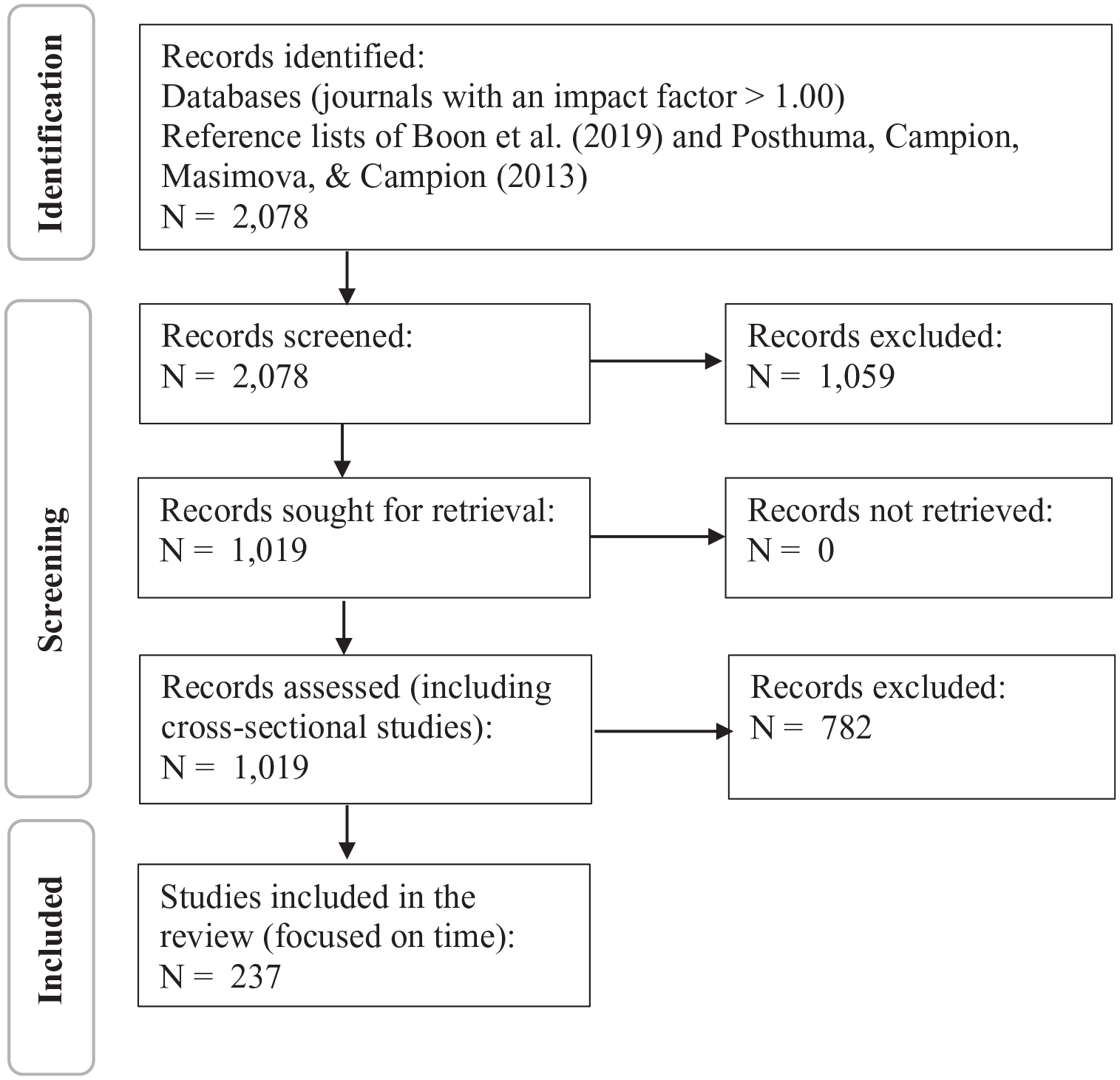
Flow Diagram for the Systematic Review
Coding Criteria Quantitative Studies
We used the following coding scheme 1 to code the 219 quantitative papers. First, we coded the type of conceptual model based on (1) the antecedents of the HR system, (2) the mediator(s) of the HR system - outcomes relationship, (3) the moderators of the HR system - outcomes relationship, (4) the outcomes that were examined, and (5) other variables, if relevant. For each of the categories, we used an open text field to list which variables were examined. We also coded which theories were used to underpin the proposed model using an open text field.
We also coded several time-related characteristics. First, we coded whether time was explicitly integrated in theorizing to enrich the understanding of the relationships between HR systems and other variables. Second, we coded whether the following temporal features were covered: onset (when a study examines how long it takes for an effect to occur), duration (when the degree to which an effect—of, for example, the HR system—continues over time is examined), dynamics (when dynamic patterns such as nonlinear or discontinuous relationships are examined), and temporal context (when a study examines how context affects the relationship between, for example, HR systems and outcomes over time). Third, we coded the timing of the data collection by using the following categories: separating measurement (time lags between study variables), everything at two time points (all variables were measured twice), independent variables measured once and dependent variables measured multiple times, and longitudinal data (all variables were measured at least three times). We also coded the time lag between measurement points using an open text field and created categories based on the time lags that were used often (1 day, 1–4 weeks, 1–2 months, 3–6 months, 7–11 months, 1 year, 1.5–2 years, and more than 2 years). Fourth, we coded the study design. Categories were experimental, quasi-experimental, and non-experimental. For studies that used non-experimental designs, we used the categories survey (including archival survey datasets), archival data (data stored by the organization, e.g., performance data), and others (e.g., interviews).
In addition to the time-related characteristics, we coded levels of analyses and analysis techniques. We coded on which levels of analyses were conducted: industry, organization, unit/team, and individual levels. We also coded whether studies include multiple levels. Finally, we coded the analysis techniques that were used in each of the papers, using an open text field. We then leveraged the broad keyword categories used by the leading management methods journal, Organizational Research Methods, and those used in Aguinis, Pierce, Bosco, and Muslin (2009) to arrive at a list of seven analysis categories (see Table 1) that were used to classify the analysis techniques used by papers in the review.
Coding Criteria for Analysis Techniques*
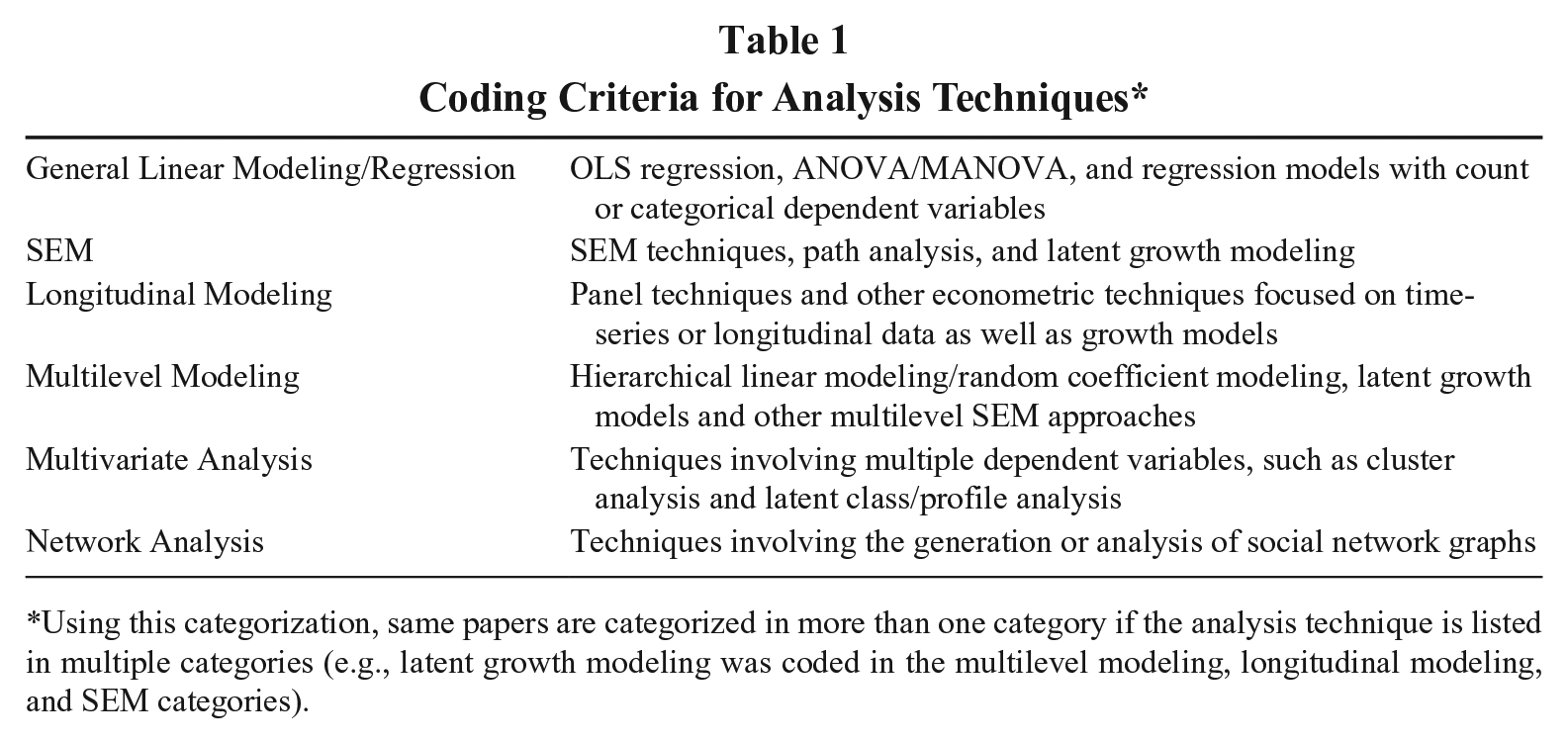
Using this categorization, same papers are categorized in more than one category if the analysis technique is listed in multiple categories (e.g., latent growth modeling was coded in the multilevel modeling, longitudinal modeling, and SEM categories).
Coding Criteria Qualitative Studies
We coded the 18 qualitative studies on the research question (open text field), theory used, the study design (case study, interview study, etc.), timing of the data collection, type of data that were collected (e.g., interviews, observation, documents), and analysis approach (e.g., content analysis, narrative strategy, grounded theory).
Results
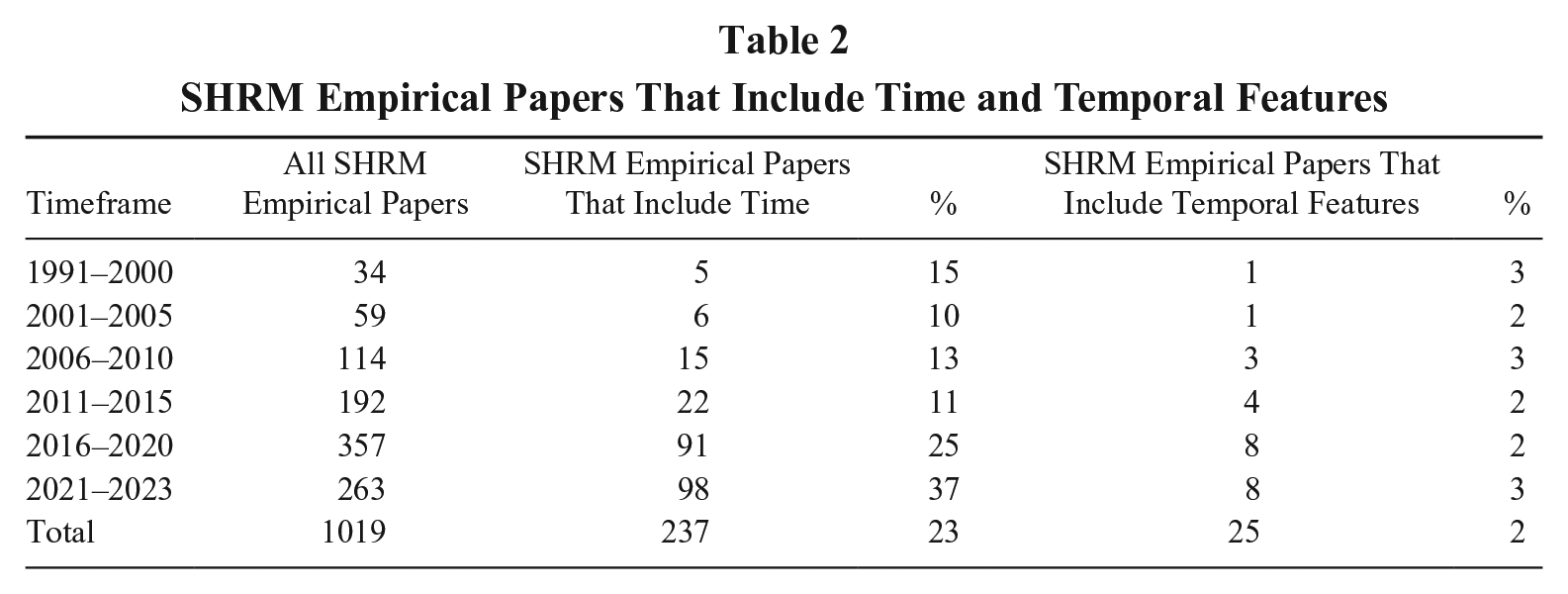
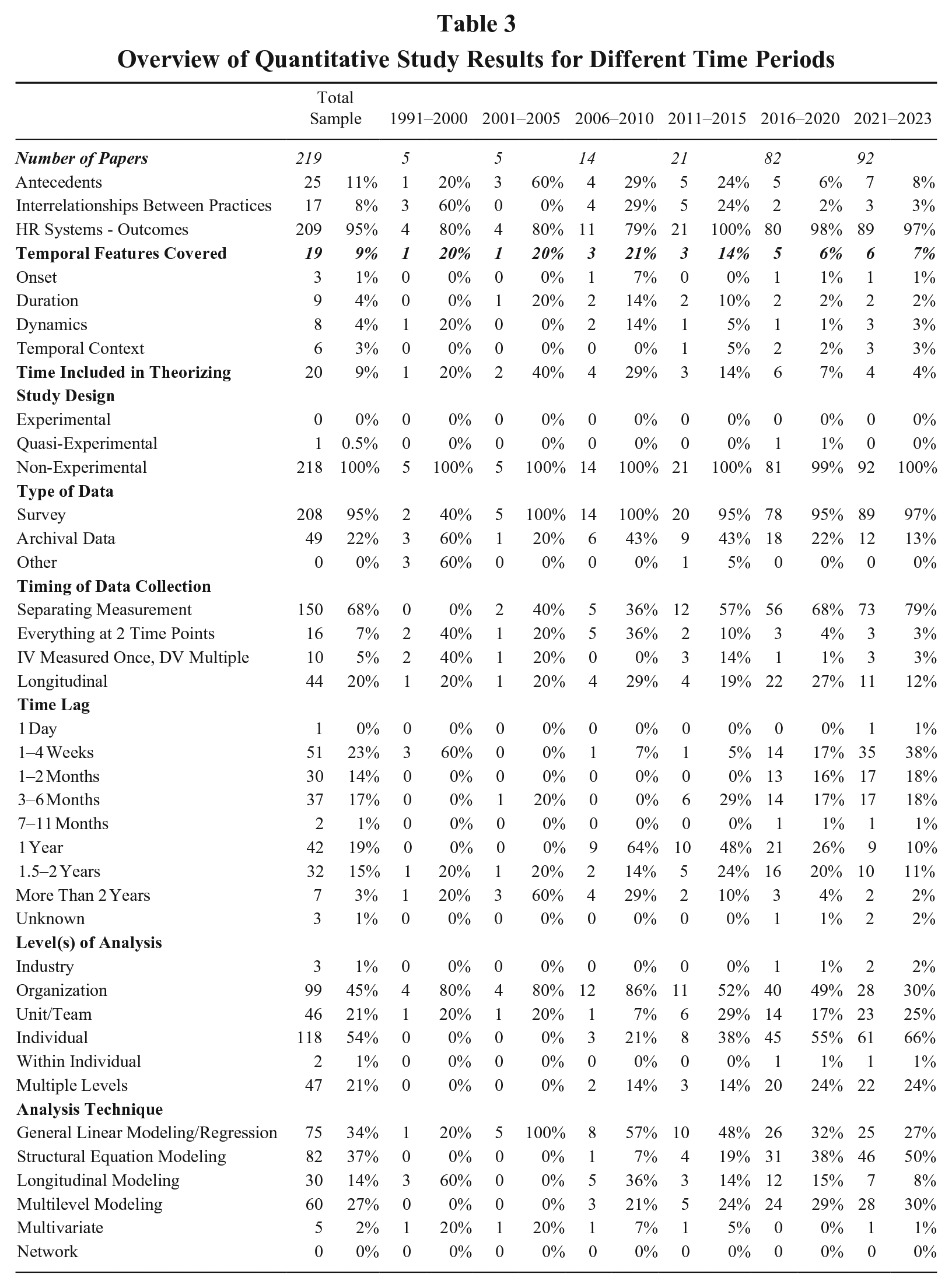
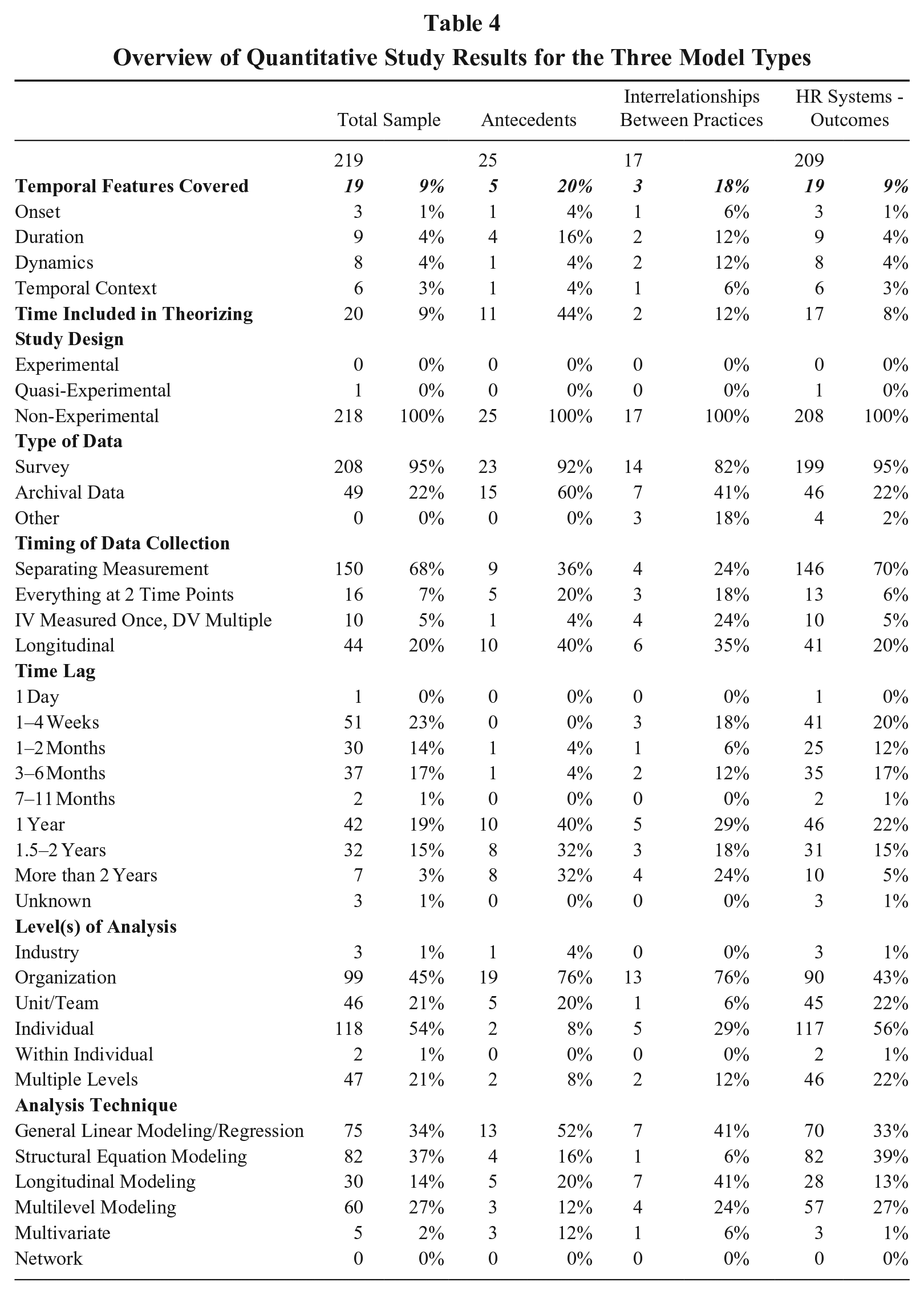
Our review of the extant literature suggests that three types of temporal models have been examined: (1) antecedents of (changes in) HR systems, (2) dynamic interrelationships between HR practices within HR systems, and (3) dynamic HR systems–outcomes relationships at different levels. To examine developments in the field over time, Table 2 shows the number of papers that consider time or temporal features relative to the total number of SHRM papers per time period. Table 3 summarizes the coded data for the 219 quantitative papers in the review per time period, and Table 4 summarizes the coded data for the quantitative papers across the three model types we identified. Below, we first describe general developments in temporal SHRM research over time, and next, we cover each of the three temporal models.
SHRM Empirical Papers That Include Time and Temporal Features
Overview of Quantitative Study Results for Different Time Periods
Overview of Quantitative Study Results for the Three Model Types
General Overview of SHRM Studies Involving Time or Dynamics
Table 2 shows that 237 of the 1,019 SHRM papers included time in the study design, but the number of papers that incorporate temporal features (e.g., onset, duration, dynamics, and temporal context) is very small (25 of 1,019 papers). The number of studies that incorporated time in the study design increased over time (from five of 34 in 1991–2000 to 98 of 263 in 2021–2023). However, the number of papers that incorporate temporal features did not increase over time, suggesting that although the interest in time in study designs has grown, only few studies actually examine temporal features. The lack of progress is also visible in the fact that, over time, the number of papers that uses time in theory and hypothesis development decreased (from one of five in 1991–2000 to only four of 92 in 2021–2023; see Table 3). Below we report numbers and trends for the 219 quantitative empirical papers that incorporate time in the study design.
The role of time in study design
Almost all studies that incorporated time in the study design used a non-experimental design, and one study (Devaraj & Jiang, 2019) used a quasi-experimental design. Survey data was used in 208 of the 219 studies, and 49 of 219 of studies used archival data, 2 which decreased from three of five in 1991–2000 to 21 of 92 in 2021–2023. Looking at the timing of the data collection, there has been a large increase over time in studies that separate the timing of measurements—for example, measuring the independent variable at Time 1 (T1), and the mediator(s) and outcome(s) at (a) later time point(s)—from zero of five in 1991–2000 to 73 of 92 in 2021–2023. Such designs are recommended to remedy common method bias concerns (Podsakoff, MacKenzie, Lee, & Podsakoff, 2003) and also can be helpful for attempting to discern causality (Antonakis et al., 2010), but they are not ideal for examining temporal effects. As we will explain below, these designs were used most when mediators and/or moderators of the HR systems–outcomes relationship were examined. Table 3 shows that 44 of 219 overall used longitudinal data (with at least three measurements; Ployhart & Vandenberg, 2010), and this remained relatively stable over time, with a slight decrease in the 2021–2023 period (when only 11 of 92 of the papers used longitudinal data). Moreover, the number of studies that measured the HR system once, and the dependent variables multiple times, and that measured all variables at two time points both decreased over time (for both designs from two of five to three of 92). Overall, the time lags that were used vary widely, from 1 day to 8 years, and the range of time lags has increased over time. At the same time, the time lags that were used have become shorter on average, with more than half of the studies using a time lag of up to 6 months in the 2016–2020 and 2021–2023 periods.
Levels of analysis and analysis techniques
Of the studies that incorporate time in the study design, over time, the number of studies at the organizational level of analysis has decreased (from four of five in 1991–2000 to 28 of 92 in 2021–2023), and individual level and multilevel studies have become more popular (from zero of five to 61 of 92, and from zero of five to 22 of 92, respectively). Looking at the analysis techniques, over time, longitudinal data analysis techniques such as fixed or random effects (panel) regression analysis and latent growth curve modeling have decreased (from three of five to seven of 92), again suggesting decreased attention for temporal features. The use of SEM (from zero of five to 46 of 92) and multilevel modeling (from zero of five to 28 of 92) have both increased over time, and regression analyses is used less in recent years (25 of 92 in 2021–2023), which is likely related to the increasing interest in examining mediating mechanisms at the individual level or cross-level. Multivariate analysis was only used in five studies of the 219 overall, and none of the papers used network analysis.
Overall, despite the increase in number of papers that incorporate time in their study design, our review suggests a lack of progress in the SHRM field in terms of the role of time and temporal features. The role of time in theorizing has decreased over time, and most studies do not adopt study designs that allow testing the temporal features involved in such models. Although 44 of the 219 studies used a longitudinal dataset, only a few addressed temporal features in the data analysis.
Temporal Models of Strategic HRM Research
As mentioned above, our analyses suggest that three types of temporal models have been studied. These models each have unique characteristics and address different research questions within the SHRM domain. Across the different models, the temporal features have been covered in a limited number of studies: onset has been examined in three of the 219 papers, temporal context in six of the 219 papers, dynamics in eight of the 219 papers, and duration in nine of the 219 papers. Below we discuss the results for each of the three model types.
Antecedents of (changes in) HR systems
Studies in this category (25 of 219 studies; with a decrease over time from one of five to seven of 92) examine models that include predictors of HR systems. Two types of studies can be distinguished: (1) studies that focused on reversed causality and examined performance as an antecedent of HR systems, and (2) studies that examined antecedents of HR systems at different levels, such as company ownership (e.g., Mullins, Brandes, & Dharwadkar, 2016), organizational slack (e.g., Roca-Puig, Bou-Llusar, Beltrán-Martín, & García-Juan, 2019), management capabilities (e.g., Kim, Messersmith, et al., 2021), peer company use of HR systems (Jiang, Takeuchi, & Jia, 2021), HR implementation climate and manager’s implementation behavior (Pak, 2022), and individuals’ work history (Böckerman, Bryson, & Ilmakunnas, 2013). Table 4 shows that almost half (11 of 25) of the papers include time in their theorizing or hypotheses. Longitudinal data is used in 10 of the 25 papers, and the time lags are generally longer than in the other categories. Looking at the temporal features, four studies of the 25 in this category examine duration, and onset, dynamics and temporal context were each examined in one study of the 25.
For example, Jiang et al. (2021) examined onset, duration, and dynamics of the relationship between antecedents and the HR system in a study on the relationship between peer company use of high investment HR systems on a focal company’s use of such HR systems. They built on institutional theory to explain how and why peer company use of HR systems affect adoption of HR systems at a later time point, although institutional theory does not give specific insights in the onset, duration, and dynamics of this relationship. Performing continuous time SEM on a longitudinal dataset over a period of 10 years, they explored the onset, duration, and dynamics of this relationship as supplementary analyses. Results showed that, over time, the strength of the relationship between peer high investment HR systems and focal high investment HR systems first increases strongly, and then it decreases slowly after reaching a maximum.
Studies that examine duration typically compare models using different time lags. Theories such as resource-based view, general systems theory, and social exchange theory, are used to generate hypotheses about the causal direction of the HR systems – outcomes relationship, but not to theorize how long the proposed effects occur. Testing the duration of the proposed relationships is mainly explorative and often lacks a priori theorizing pertaining to specific duration expectations. For example, building on general systems theory, Ogbonnaya, Daniels, Messersmith, and Rofcanin (2023) expected that in highly regulated sectors a dynamic equilibrium will occur, leading to institutional inertia. In line with this they proposed null causal (reversed) relationships between HR practices, job satisfaction, and patient satisfaction. More specifically, in general, evidence of past success (e.g., job and patient satisfaction) can be transmitted back into the systems by investing in HRM, thus creating feedback loops. However, in line with general systems theory, in a steady state it was expected that such feedback loops do not exist. Ogbonnaya et al. (2023) examined the proposed model using 2-year, 4-year, and 6-year time lags to test duration. SEM results revealed that job satisfaction was not significantly related to HR practices with 2-year lag, but it was with HR practices with 4-year and 6-year lags.
Roca-Puig et al. (2019) examined temporal context. They addressed reversed causality by proposing a dynamic model linking HR investments to profitability via labor productivity and, in turn, profitability increases HR investments via organizational slack, building on the resource-based view. Temporal context was assessed by examining whether the proposed relationships differed in strength pre- and post-economic crisis. Roca-Puig et al. (2019) used yearly organizational data over 7 years and tested a cross-lagged panel model with 1-year time lags. They split the sample in two—the precrisis (2005–2007) and postcrisis period (2008–2011)—and found that the positive feedback cycle connecting profitability to HR investments via organizational slack was weaker post-crisis.
Taken together, studies have mostly focused on reversed causality in the relationship between HR systems and outcomes, and on whether and how organizational level antecedents affect changes in HR systems over time. Only few studies examined how long it takes for an antecedent to start affecting the HR system, how long the effects last, and the dynamics of the effect over time, and even fewer theorize specific temporal effects.
Dynamic interrelationships between HR practices within HR systems
Studies in this category (17 of 219 studies) examined dynamic relationships between HR practices in a system, and how certain combinations of HR practices affect outcomes, in line with the idea that synergies can occur between HR practices in a system (Delery, 1998). Interestingly, the number of papers in this category has decreased over time (from three of five in 1991–2000 to three in 92 in 2021–2023). The papers vary in their approach: some examine interrelationships between HR practices and some between HR bundles. For example, Yoon and Sengupta (2019) studied how three-way interactions between employee share ownership, training, and early promotion policy relate to labor productivity over time, and Pil and MacDuffie (1996) found that firms using complementary HR practices are more likely to adopt high-involvement work practices 4 to 5 years later. Chung and Pak (2021) studied additive versus interactive relationships between employee perceptions of ability‑, motivation‑, and opportunity‑enhancing HR bundles and their relationship with individual performance over time. Table 4 shows that most studies did not use theory to underpin temporal relationships (two of 17 included time in theorizing). Longitudinal data was used in six of the 17 papers, and the time lags vary between 3 to 4 weeks and more than 2 years, with the majority of the papers using time lags of 1 year or longer.
A few (three of 17) studies in this area (Birdi et al., 2008; Frick, Goetzen, & Simmons, 2013; Kim & Ployhart, 2014) covered one or more temporal features: onset and temporal context were each covered in one paper of the 17, and duration and dynamics in two papers each. All three studies focus on two or three HR practices and examined how these practices in combination relate to the onset, duration, and dynamics of performance. Birdi et al. (2008) examined the relationship of three HR practices and their interactions—empowerment, extensive training, and teamwork—with productivity as a function of years since introduction of each of the practices, using data over 22 years. Using random coefficient modeling with time nested in organizations, they showed when a combination of HR practices started showing an effect (onset), how long the effect lasted (duration), and whether and how the effect fluctuated over time (dynamics). They found that empowerment was most effective in enhancing productivity between 1 and 7 years after adoption, teamwork only started to enhance productivity 6 years after introduction, and the pattern for extensive training was unclear. Also, the adoption of teamwork enhanced the performance benefits from empowerment and extensive training, but it remains unclear how the complementarity affects the duration of the relationship with performance.
Frick et al. (2013) examined duration. They used monthly data for 96 months from units in a steel plant to test how a combination of teamwork and performance-related pay relate to the duration of the effects on production line performance, accidents, and absence rates. They used fixed effects conditional logit regression and used dummy variables to indicate when a plant used performance pay, teamwork, or both. They found that a combination of performance pay and teamwork increases the focus on quantity over quality, enhancing both output and absenteeism over time. Although their methodological approach did not provide specific estimates of the duration of these effects, results suggest that these practices provided a longer term and lasting change on the focal outcomes.
While both Birdi et al. (2008) and Frick et al. (2013) examined various aspects of temporal effects involved with the combinations of practices, these studies did not develop theory as to why these temporal relationships of combinations of practices would occur. In contrast, Kim and Ployhart (2014) used theory on HR systems and resource complementarities to theorize how interactions between practices focused on generic human capital (staffing) and specific human capital (training) and performance change during a recession, explaining why, after a recession, no interaction between staffing and training was expected. They performed longitudinal growth modeling on a 12-year firm-level dataset to examine how staffing and training—separately and in combination—relate to profit over time via enhancing productivity. Thus, the researchers tested for dynamics by exploring the possibility of discontinuities in the interactive effects among HR practices. In so doing, they also captured the impact of temporal context by testing how the recession changes the profit growth trajectory. They found that training drives the effect on profitability pre-recession, whereas selection does so post-recession.
In sum, this model type mostly focuses on examining interactions between a small set of HR practices or bundles and their effects on outcomes over time. Few studies develop specific theoretical predictions on temporal features. Also, the time lags that are used vary widely, so much is still unknown about appropriate time lags.
Dynamic HR systems–outcomes relationships at different levels
The majority of the studies (209 of 219 studies) fall in this category. Research on relationships between HR systems and outcomes at different levels is growing rapidly over time, from four of five in 1991–2000 to 89 of 92 in 2021–2023 (see Table 3). Papers in this category focused on relationships between (different types of) HR systems and a range of outcomes at the organizational (e.g., organizational performance, innovation), unit (e.g., unit performance), and individual level (e.g., satisfaction, individual performance, well-being), and are often mediated and/or moderated by organizational, or individual level processes. For example, using data collected in three phases, Liao, Toya, Lepak, and Hong (2009) linked management- and employee-rated high performance work systems to individual service performance over time, mediated by employee human capital, psychological empowerment, and perceived organizational support. As another example, Kim, Ok, Kang, Bae, and Kwon (2021) focused on the moderating role of industry stability and unabsorbed slack in the relationship between high performance work systems and firm performance over time.
Only 17 of the 209 papers in this category used theory to underpin temporal relationships. Of these papers, most theorized about the direction of the relationship or the strength of the relationship over time, rather than specifically about the onset, duration or the shape of the temporal relationship. For example, building on the evolutionary resource-based view, Sheehan and Garavan (2022) argued that the performance effects of investment in HR systems will take time to emerge. In line with this, they proposed a positive relationship between high performance work systems and labor productivity over time, and they identified moderators that strengthen this relationship, such as organizational size and age, and HR strategic orientation. They tested their hypotheses using a random intercept cross-lagged panel model on a six-wave dataset with 2-year time lags, and found support for their hypotheses.
Of the 209 studies in this category, although 41 used longitudinal data, Table 4 shows that only 19 examined a temporal feature. Duration was examined in nine of the 209 studies, most of which compared different time lags in their analyses to assess how long the effect of the HR system lasts. All studies examining duration focused on organizational or unit level relationships, and most used datasets with yearly data. Three studies used theory to underpin proposed effects over time, and they focused mostly on the direction of the relationship or relative differences in duration between different types of outcomes. For example, in line with the service-profit chain framework, Piening, Baluch, and Salge (2013) used a four-wave yearly dataset, and tested autoregressive Granger causality models to compare different time lags in the relationship between aggregated HR system perceptions and organizational performance via (aggregated) job satisfaction. Their findings showed that the relationship between the HR system and outcomes become weaker over time. In contrast, Rothenberg et al. (2017) also examined duration, and their results suggested that effects persisted over time. They used the resource-based view to argue that HRM helps to build resources that enhance corporate social performance, but no specific temporal relationships were proposed. Using yearly firm-level data for 11 years, they used a generalized least squares random-effects model to test the moderating role of innovation and slack in the relationship between high-performance HRM and corporate social performance strengths and concerns, and found that relationships held both for a 1- and a 2-year time lag.
Onset was examined in three of the 209 studies, and dynamics in eight of the 209 studies. To test onset, studies coded presence and absence of practices over time, and were able to track when these practices started having an effect (e.g., Birdi et al., 2008), and one study used a quasi-experiment design (Devaraj & Jiang, 2019; see more detailed information below). To examine dynamics, studies used techniques such as latent growth modeling or piecewise growth modeling, or used alternative ways to operationalize change such as creating variables representing change (e.g., Huang, Zhang, Feng, & Seal, 2021). Devaraj and Jiang (2019) used team development and adaptation theories and the organizational change literature to propose two phases in the performance of teams, after introducing high-performance work teams: first, a decline in performance due to uncertainty and disruption of routines, and second, performance is expected to increase due to reduced uncertainty, development of effective work routines, and enhanced personal relationships. They examined onset by using a quasi-experiment, in which high-performance work teams were implemented, and they examined dynamics by testing the growth trajectories before and after implementation. Using piecewise growth modeling to test a two-stage adaptation model on monthly data for 48 months, they found support for their model. Wang and Shyu (2009) also used latent growth modeling to test dynamics. They proposed that HRM is positively related to both the level and change rate of organizational performance. Using yearly firm-level panel data over a 4-year period, they found support for their hypotheses. In another study that assessed dynamics, Huang et al. (2021) built on organizational entrainment theory to examine the interaction between the mean level and the pace of change in high involvement work practices (operationalized as how often the number of high involvement work practices changed over a period of 8 years) and innovation. They tested fixed effects models and long-run average models using an eight-wave firm-level dataset and found that the optimal level of change pace occurred when the high involvement work practices were changing at a pace that aligned with the organizational rhythm of strategic changes. That is, entrainment among strategic change and HR system change was beneficial for innovation.
The temporal context was examined in six of the 209 studies and all of these focused on how an economic crisis/ recession affects the HR system–outcomes relationship. For example, Katou (2022) studied how economic crises affect the relationship between high-performance work systems and organizational performance, mediated by HR flexibility. They used the resource-based view and the ability, motivation, and opportunity (AMO) model to argue that when an economic crisis wanes, the HR system finds more space to develop capabilities, implying a stronger relationship between HRM and outcomes. Using a three-wave dataset (with a 2-year time lag), Katou leveraged multilevel SEM analyses and found that the relationship of high-performance work systems with HR flexibility became stronger with the weakening of the economic crisis. Lastly, in the only individual level study that tests a temporal feature, Jiang et al. (2022) examined the role of the temporal context by considering the impact of the economic environment. Building on person–environment fit theory, they expected that after a recession, high involvement work systems are needed more by older workers, such that the negative relationship between high involvement work systems and older workers’ retirement intention becomes stronger. Using a seven-wave individual-level dataset, Jiang et al. ran mixed effect logit regressions and cross-classified modeling to show that older workers’ perceptions of high involvement work practices were negatively related to their retirement intention. Testing the moderating effect of time showed that this relationship became more negative as the economic recession endured over time.
Taken together, although there is a considerable increase in studies considering time in HR systems – outcomes models, these studies have become increasingly similar: Most separated measurements as a remedy for common method bias, and did not address temporal features. In particular, most individual level and multilevel studies have not considered temporal features. As a result, we lack knowledge about the temporal nature of the relationships between HR systems and outcomes at different levels of analyses.
Results of the Qualitative Studies
Table 5 summarizes the results of the qualitative papers. The majority of the 18 qualitative studies we identified that incorporate time have been published in the last 5 years. Most studies used a longitudinal single or multiple case study design, combining interview data with documentation, and in some cases other data sources such as observation, focus groups, and surveys. Similar to the quantitative studies, studies differed in the timing of the data collection: some studies collected interview data in different waves (in line with separating measurement), some did one round of interviews but collected (quantitative) data over a longer period of time, and others collected different types of data over a longer period of time. The majority of the qualitative studies identified in the review used content analysis, narrative strategies, and processual approaches to analyze the collected data.
Overview of Qualitative Study Results
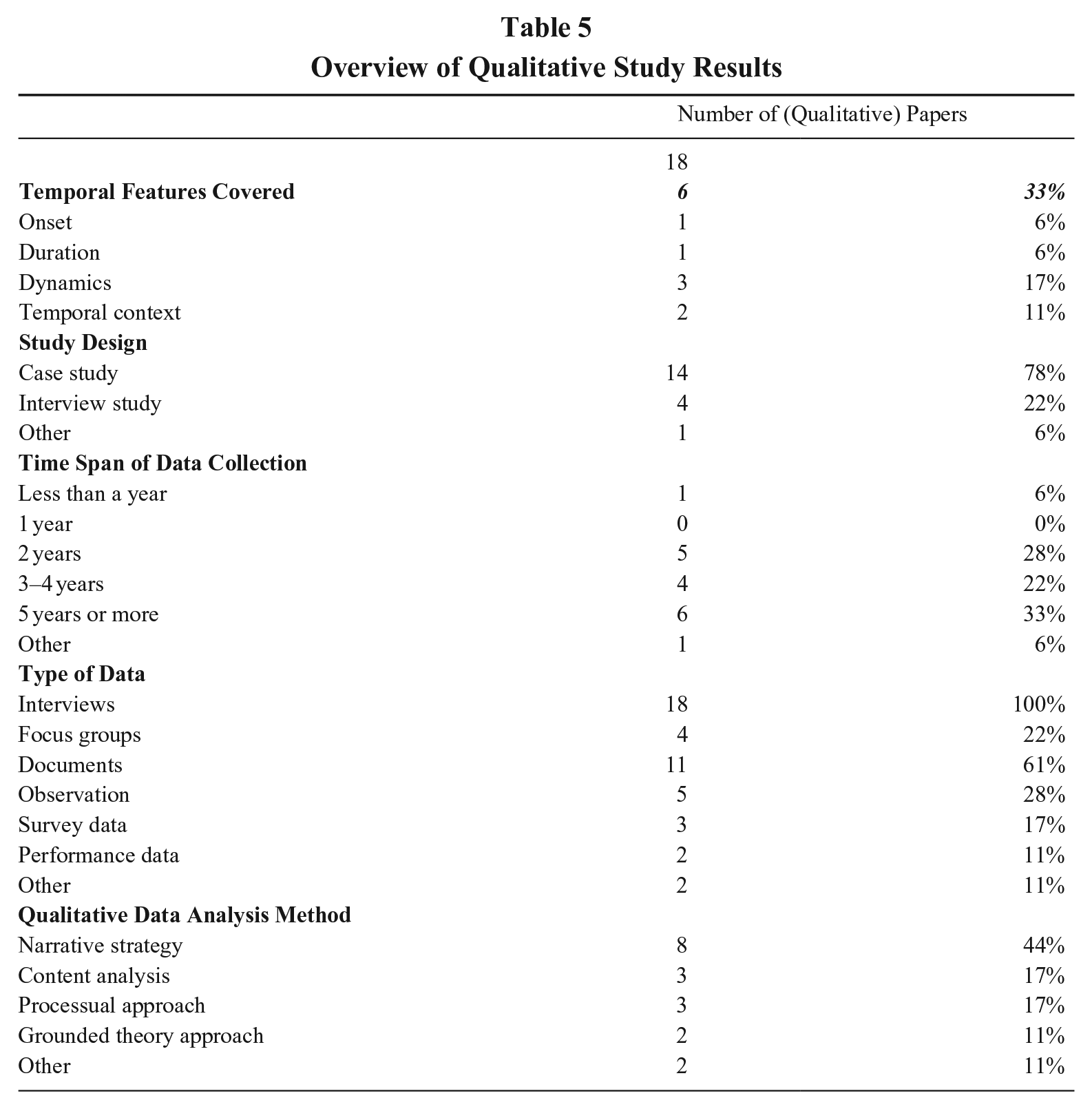
Temporal features were included in six qualitative studies. These studies broadly focused on three themes: the HR system – outcomes relationship, contextual factors that affect or interact with HR systems, and the role of the temporal context in the relationship between HRM and outcomes. For example, Tregaskis, Daniels, Glover, Butler, and Meyer (2013) focused on onset and duration by conducting an intervention study of the implementation and outcomes of high-performance work practices (HPWPs), collecting longitudinal interviews and surveys alongside time series data on performance 3 years before and 2 years after the intervention. They showed positive relationships between HPWPs and safety and productivity over time and, amongst others, they showed that effects of HPWPs occurred after two quarters and after that remained stable. The qualitative data was leveraged to provide a richer description of the implementation of the practices and the experiences and perspectives of the individuals involved with the intervention. This study is a good example of how qualitative and quantitative data and analyses can be used in complementary ways when studying temporal features.
Contextual factors that were explored include ambidexterity and business strategy. For example, Xie and Cooke (2019) explored dynamics by studying the coevolution of business strategy and HR strategy and practices at Walmart in China over a period of 12 years. Using interviews at different levels, documentation, and on-site observations, they distinguished three stages of strategy development (cautious development, rapid expansion, and regulation/consolidation) and the associated HR strategy and practices for each stage, as well as external and internal contextual factors that are related to HR strategy. By adopting a longitudinal and qualitative approach, this study identified new insights about the coevolution of business strategy and HR practices and counterintuitive aspects about the notion of alignment between these. Specifically, the authors helped to identify stages and interdependencies among these changes and noted that greater emphasis on low-cost strategies do not always align with cost cutting HR approaches, but rather may require more supportive HR practices and policies. Buisson, Gastaldi, Geffroy, Lonceint, and Krohmer (2021) also explored dynamics by focusing on the development of HRM in ambidextrous organizations. Based on two longitudinal case studies conducted in innovative SMEs, they identified key turning points in the innovation trajectories of these organizations, and showed the development trajectory of HR practices.
The studies that explored temporal context focused on recession and financial crises, in line with the quantitative studies on temporal context. For example, Cook, MacKenzie, and Forde (2016) explored how changes in HRM affect performance during a recession, using a multi-method case study in a large retailer. They showed that during a recession, HR practices focused more on intensifying work. This was associated with an increase in profit per employee in the short run. Pereira et al. (2021) also explored temporal context by using a longitudinal single firm case study to examine the role of HPWSs in facilitating strategic flexibility. They found a shift to a humanistic HR approach (one that involves greater focus on employee well-being and satisfaction) in a high uncertainty environment stemming from a global financial crisis.
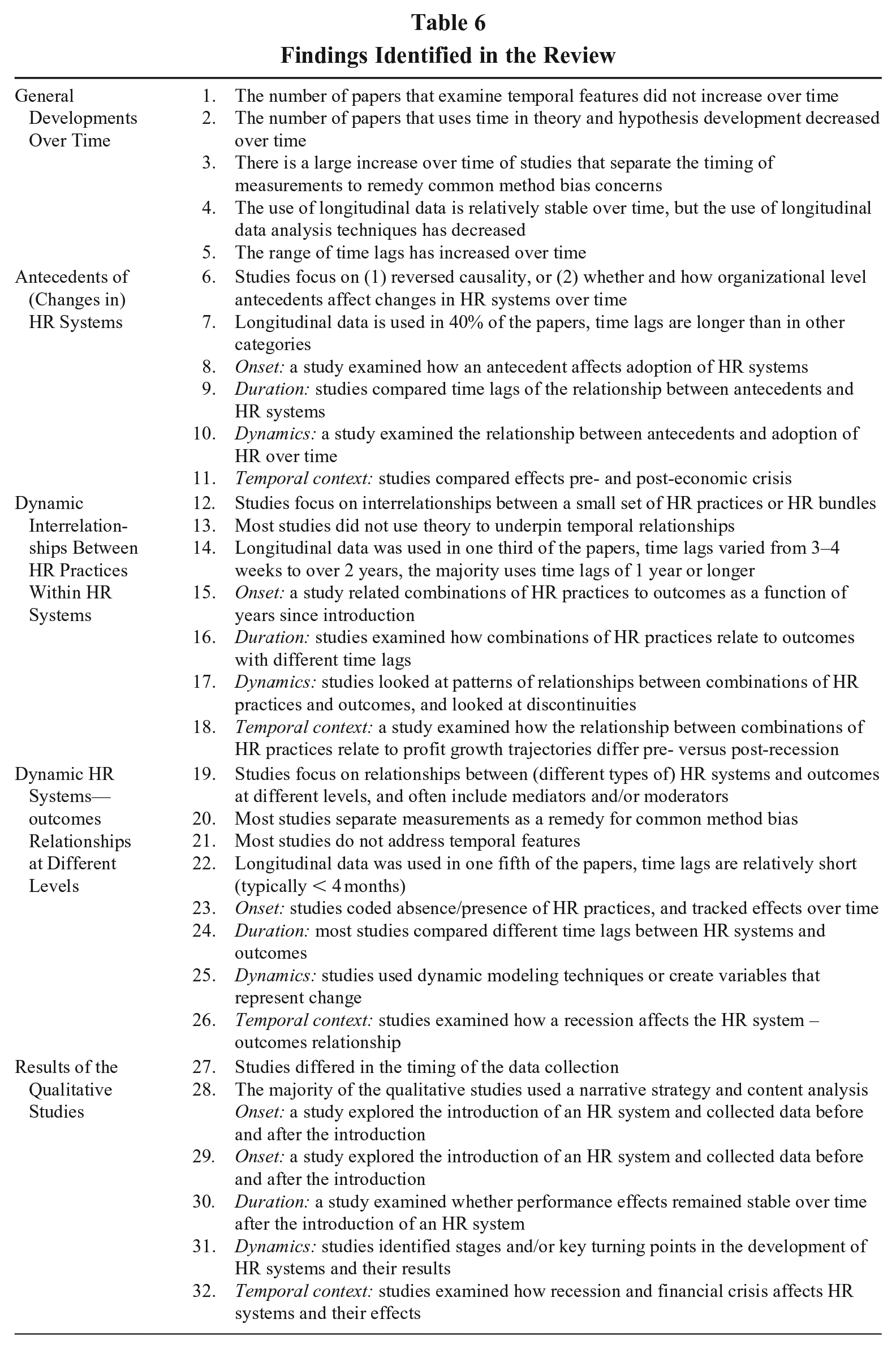
Taken together, the qualitative studies focused on similar topics as the quantitative studies, with a somewhat stronger focus on context and how contextual factors affect the adoption and effects of HRM over time. These studies make important contributions by exploring more complex temporal relationships over time and providing an alternative approach to developing more detailed and contextualized views of temporal factors related to HR systems. Table 6 summarizes the main quantitative and qualitative findings of the review.
Findings Identified in the Review
Discussion
The purpose of this review is to take stock of the extant research incorporating time and temporal features in empirical studies in SHRM. We systematically reviewed 237 empirical studies. In considering the results of our review, a few general patterns were observed. First, overall there are only few studies that (a) examined temporal features; (b) incorporated time in their theoretical development; (c) used longitudinal data; and (d) used analysis techniques that account for dynamics. The vast majority of research used time as a way to temporally separate the measurement of variables. While temporal separation of measurements can help to reduce common-source bias (Podsakoff et al., 2003) and, in theory, can aid the examination of causal relationships, such designs, by themselves, do not allow for the examination of temporal features. The use of longitudinal modeling approaches, which are necessary for examining temporal features, received limited use in the reviewed studies. As we note below, the pursuit of a research agenda related to temporal features will require longitudinal designs and modeling. Second, attention for using theory to underpin temporal research in SHRM has decreased over time, and the theories that are used lack specificity regarding the onset, duration, and dynamics of the proposed relationships. In the papers that use theory to underpin temporal effects, they are mostly used to propose relative differences, such as a shorter versus longer duration, a faster versus slower onset, or stronger versus weaker relationships depending on the temporal context. Interestingly, several articles explored temporal features (e.g., as supplemental analyses) rather than tested the features as part of their hypotheses. In order to move SHRM research on time and temporal features forward, there is a greater need for theory (building) to help underpin temporal relationships in SHRM, and to help guide choices around study designs and analyses.
Advancing Temporal Research In SHRM
To increase our understanding of the role of time and temporal features in SHRM research and to help guide future temporal research in this area, we draw on and leverage the results of review to provide four directions associated with the development of hypotheses, theory, study designs, and statistical methods.
Exploring the Role of Temporal Features in SHRM Research Hypotheses
Our review shows that few studies incorporate temporal features, and even fewer have specific predictions around temporal effects. To help guide this process, we encourage future SHRM research to integrate temporal features when formulating their hypotheses. This helps to build a more complete perspective that acknowledges the nature of HR systems and their unfolding impact over time. We also encourage descriptive and exploratory research as foundational steps towards incorporating temporal dimensions into SHRM theories. Such methodologies enrich our understanding by revealing patterns and insights that hypothesis-driven research might overlook. This approach not only grounds our empirical knowledge but also sets the stage for more complex theoretical explorations of time-related phenomena in SHRM, facilitating a deeper, more nuanced comprehension of these dynamics over time.
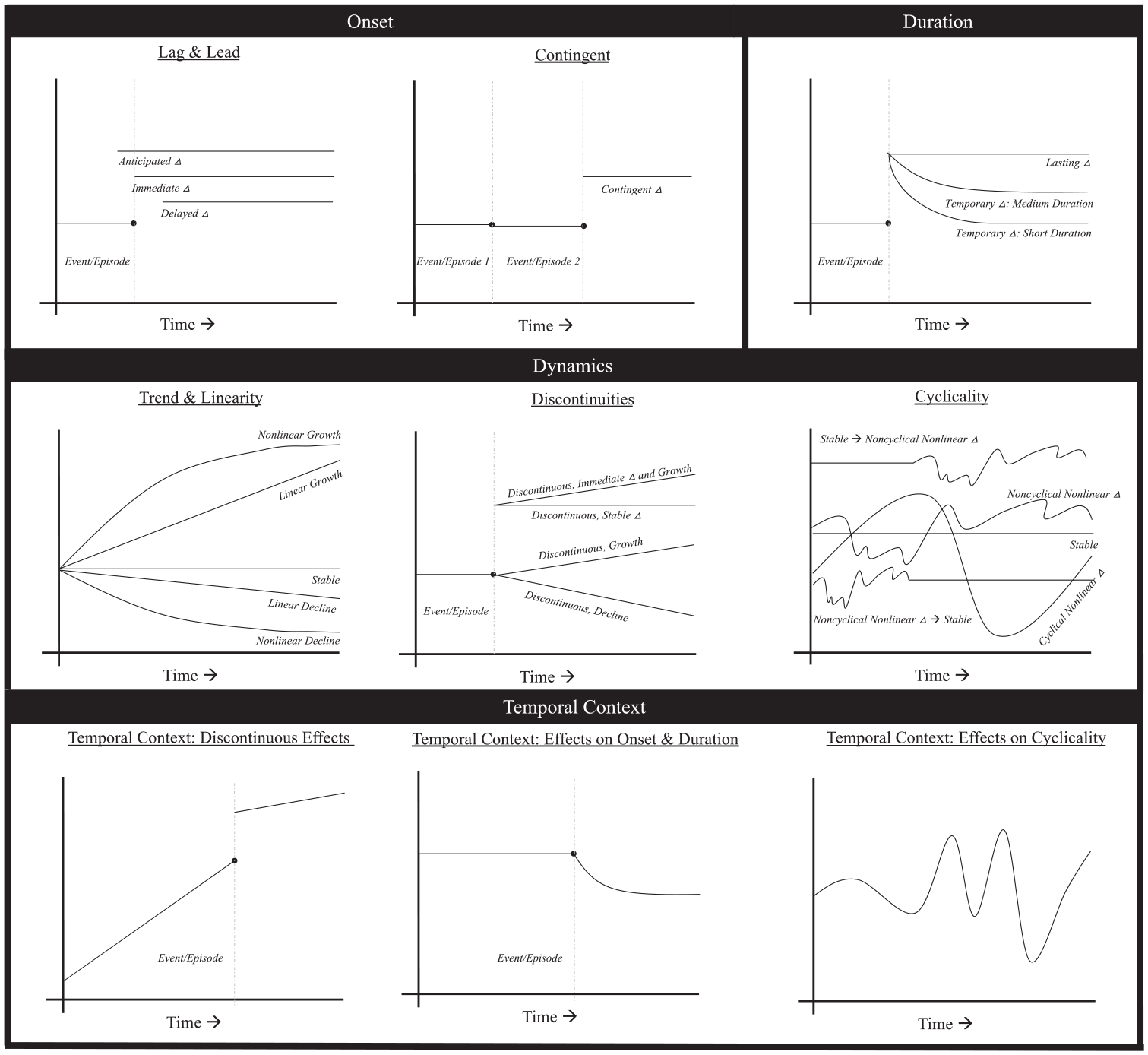
To provide further insight into the array of temporal features that future research could consider, we leverage the work of McClean, Barnes, Courtright, and Johnson (2019) to categorize temporal effects in HR systems into onset, duration, dynamics, and context, as outlined by Roe (2008) in Figure 2. This figure uses the y-axis to represent an HR system or its outcomes/mediators, with lines indicating the temporal effects associated with the changes to the HR system or to its antecedents over time (the x-axis). For example, one could conceptualize the HR system on the y-axis and consider antecedents as events or episodes that can impact the HR system characteristics over time. In a similar way, for exploring how changes to HR systems impact outcomes and/or mediators, the outcomes (e.g., productivity) or mediators (e.g., employee commitment, or collective turnover) can be conceptualized on the y-axis and the events or episodes could be used to indicate when the HR system was modified. Moderators for the HR system-outcome associations over time could be examined by looking for differing temporal effects depending on the moderator condition (e.g., high/low). Lastly, the consideration of interrelations between HR practices and HR systems could be various combinations of when a HR practice/bundle or HR system are represented on the y-axis and/or as events and episodes. Below we cover each of the temporal features and give suggestions on how they can be used to generate more specific hypotheses on temporal effects. See also Appendix Tables 1A–3A for future research suggestions on temporal features for the three model types.
Visual Depiction of HR System Temporal Effects Forms
Onset
Several studies in our review suggest that HR practices within a system may differ in terms of their onset (Birdi et al., 2008; Devaraj & Jiang, 2019; Jiang et al., 2021). However, so far, studies have not offered specific predictions around onset. We suggest three options, as depicted in the “lag and lead” figure in Figure 2: An event (e.g., a change in the HR system or in an antecedent) or episode (e.g., implementation of cyclical performance reviews and bonus determinations) can be associated with an anticipated (before the event), immediate (at the same time as the event), or delayed (after the event) change in the outcome. We suggest that future studies specify whether (and why—see the discussion on theorizing below) the onset effect is expected to be anticipated, immediate, or delayed, and, if possible, include the timing of the onset effect more specifically (e.g., in weeks, months, or years after the event/episode).
For example, Wright and Haggerty (2005) discussed a study by Wright, Dyer, and Takla (1999) that delved into time lags associated with the implementation of HR systems. Based on the feedback from 70 HR vice presidents, the findings indicated that a significant overhaul of a firm’s HR system, in response to a major strategic change, takes an estimated average of 19 to 22 months: 9 to 10 months for system design and 10 to 12 months for its implementation. Future research could integrate the onset feature to hypothesize and further explore the time required and the reasons behind such timeframes in new HR system implementation. Moreover, it would be interesting to explore aspects that could accelerate this onset aspect, including components related to industry, firm, managerial, and employee characteristics. It is possible, for instance, that industries with greater dynamism and managers with greater adaptability and flexibility may be able to modify HR systems in a more rapid manner. As another example, SHRM research has suggested that the effects of implemented HR systems depend on employees’ perceptions and interpretations of and reactions to these systems (e.g., Nishii & Wright, 2008). Future research may explore how long it takes for employees to perceive the changes in HR systems, and how long it takes for shifts in employee behaviors to result in observable changes in performance outcomes.
There may also be multiple events at the same time (e.g., changes in more than one HR practice). Although studies show that some HR practices have a relatively short onset and others have a delayed effect (e.g., Birdi et al., 2008), studies that cover onset have not explicitly taken into account interrelationships between HR practices and how they affect the onset of the effect of the HR system as a whole. We suggest that it is important for studies on interrelationships between HR practices to specify how many and what kind of events or episodes occur (e.g., changes in teamwork and empowerment), and what the onset of the effect of the combined changes is expected to be.
It might also be that events and/or episodes do not occur at the same time. For example, Huang et al. (2021) examined how often the number of HR practices changed, which represents multiple events over a certain period of time. We propose the “contingent” model to address this question (see Figure 2), which shows that multiple events/episodes are associated with the onset of the outcome. Sequential changes might influence the onset effect of a single event or episode’s influence. For example, the onset may be shortened when two practices complement each other and help employees perform better (Pil & MacDuffie, 1996). Conversely, it might extend if multiple changes take more time to become embedded in organizational routines.
Duration
The review shows that most studies examining duration failed to specify the expected duration of an effect. They often compared relationships, for instance, between the HR system and outcomes across varied time lags. Among the studies that did explore duration, disparate effects across outcomes emerged (Piening et al., 2013; Rothenberg et al., 2017). Building on those studies, we distinguish between a lasting effect, medium duration, and short duration (see Figure 2). We encourage researchers to be more specific about the duration of the proposed effect for different outcomes. This precision not only enhances understanding of the duration, but also informs choices around study design, such as selecting appropriate time lags between data collection waves.
For example, researchers could examine the duration of the effect of an external event (e.g., legal regulation change) on a firm’s HR system. Some firms might rapidly adjust their HR practices for immediate compliance and reduced liabilities, while others might take a medium- to long-term approach due to institutional routines or resistance to change. For another example, studies may investigate how long changes in HR systems may affect employee outcomes and how frequently these systems need updating to maintain positive effects. It might be that some HR system changes (e.g., compensation change) have immediate but short-lived effects, requiring frequent updates, whereas changes in organizational culture or training programs might have longer-lasting impacts (Lepak et al., 2018). Distinguishing between these durations allows for a more nuanced understanding of how HR practices might interact and how HR systems influence employee outcomes over time and aids organizations in strategically timing their HR initiatives for maximum sustained benefit. Moreover, researchers might also consider how HR system effects differ during periods of environmental change versus stability, potentially showing quicker impacts in changing conditions and more gradual effects in stable times (Chung, 2022). By explicitly hypothesizing such varied duration effects, researchers can design their studies with appropriate frequencies and timeframes to capture these nuances. Lastly, similar to onset, multiple events at the same time could shape the duration of effects. For example, results suggest that a combination of teamwork and performance-related pay produced a lasting effect on production performance (Frick et al., 2013).
Dynamics
Our review identified three main dynamic patterns in HR systems research, illustrated in Figure 2: trend and linearity (e.g., Jiang et al., 2021; Wang & Shyu, 2009), discontinuities (e.g., Devaraj & Jiang, 2019), and cyclicality (e.g., Huang et al., 2021). Trend and linearity involve observing whether HR systems exhibit a consistent upward or downward trajectory or remain stable over time, and determining if these relationships are linear or nonlinear. Discontinuities focus on sudden changes in HR systems, either from specific events or episodes, affecting the immediate level (i.e., intercept modification) or growth rate (i.e., slope modification) of a variable (Bliese & Lang, 2016). Cyclicality involves considering the degree to which changes over time in the HR system characteristics and/or mediators and outcomes are occurring in a cyclical or non-cyclical manner, as well as whether the phenomenon is moving from situations of unpredictable change (e.g., non-cyclical nonlinear change) to situations of equilibrium (e.g., stability) and vice versa (e.g., stability to non-cyclical nonlinear change). We encourage researchers to consider and specify the trend and linearity of the expected relationship, as well as whether discontinuities or cyclicality are expected.
For instance, when examining how HR systems evolve over time due to specific antecedents, researchers might propose the dynamic patterns through which organizational characteristics (e.g., financial resources in Bentley & Kehoe, 2020) and external environments (e.g., peer companies in Jiang et al., 2021) shape these systems. Related, the results for the qualitative studies in our review also show the importance of exploring discontinuities by identifying stages in strategy development (Xie & Cooke, 2019) or “key turning points” in innovation trajectories (Buisson et al., 2021) that relate to the adoption of HR practices. Building on this, researchers could hypothesize which key events they expect to impact the shape and trajectory of the effect on HR systems, as well as what the shape and trajectory of the effect might look like. For cyclicality, one could hypothesize whether the temporal effect shows a certain rhythm and whether or not equilibrium is expected to occur. For example, in a highly regulated industry and/or in older and larger organizations, inertia is more likely to occur, which means that HR practices will be adopted less quickly (Wright & McMahan, 1992; Wright & Snell, 1998). Thus, in such organizations, cycles of HR practice adoption might move towards an equilibrium, where the changes in HR practices as a result of changes in strategy or the external environment decrease substantially over time.
Theorizing dynamic patterns can also offer a nuanced understanding of how HR practices within an HR system interrelate and evolve over time. A compelling illustration of this can be seen in the work of Han, Kang, Oh, Kehoe, and Lepak (2019), who revealed that high-performance work systems, when characterized by high internal alignment, were more effective in bolstering product sales for firms that entered the market as fast-followers as opposed to first-movers or fence-sitters. This finding underscores the point that the influence of a specific configuration of HR practices on performance outcomes is not always straightforward or linear. Over time, as a firm undergoes specific events, transitions, or developmental phases, the composition or interplay among HR practices might undergo alterations. These could manifest as abrupt shifts in response to instantaneous changes, or they might reflect more gradual transformations indicative of cyclical or non-cyclical developmental trajectories.
Finally, hypothesizing temporal patterns can enrich our understanding of HR systems –outcomes relationships. For instance, at certain phases of organizational growth, a particular HR system might have a pronounced influence on employee productivity, but as the organization matures, the same system might have reduced impact on employee productivity. Additionally, external factors like market shifts, technological advancements, or socioeconomic changes can lead to temporal modifications in how HR systems influence outcomes. Moreover, it is possible that HR systems might exert divergent longitudinal effects on mediators such as collective human capital, motivation, and social interactions over time. For example, initial implementation of an HR system might bolster human capital quickly, but its influence on social interactions might only be prominent after a more extended period. By taking into account these temporal patterns, researchers can develop more refined and context-sensitive HR systems that cater to evolving organizational landscapes.
Temporal context
All studies in our review that considered temporal context focused on the (moderating) effect of an economic crisis or recession and typically hypothesized whether the proposed relationships between HR systems and their antecedents or outcomes become stronger or weaker during or after an economic crisis. We suggest going beyond only considering differences in the strength of the relationship, to also include more specific predictions on the temporal features in a certain temporal context. For instance, researchers could explore whether the duration of an effect differs pre- and post-recession, if trends in HR system effectiveness shift, or if there are expected cyclical deviations from equilibrium during a crisis that stabilize afterward. In addition, economic conditions are just one factor to consider with temporal context, and we encourage future research to expand the array of factors to consider.
Figure 2 shows examples of three possible effects of the temporal context. In case of an event (such as a recession, pandemic, merger, initial public offering (IPO), significant event in the growth/decline of a firm or industry, or political shocks), one could hypothesize this as a discontinuity, or in terms of its impact on onset and duration. Other temporal context related factors, such as the regulatory environment associated with HR practices or (continuous) growth of a company are likely to occur in a more regular basis and might be cyclical or may induce uncertainty which could result in nonlinear noncyclical changes.
Incorporating temporal context into the study of HR systems can provide a nuanced understanding of the conditions under which certain antecedents facilitate or hinder the adoption of these systems. For example, in fast-evolving technological landscapes, firms may prioritize HR systems that support continuous learning and upskilling. Conversely, during economic downturns, organizations might limit new HR initiatives, focusing on cost efficiency. Similarly, new labor laws or diversity policies can drive the adoption of compliant HR systems. Meanwhile, stable markets may see a more measured, incremental adoption approach. Thus, temporal context not only affects the speed but also the direction of HR system adoption, as firms adjust to both external pressures and internal needs.
Moreover, recent studies have explored the role of economic recessions or pandemics in shaping the impact of HR practices on organizational outcomes (e.g., Chung, 2022; Kim & Ployhart, 2014). As we advance in this line of inquiry, it becomes important for future research to delve deeper into how varied external events might influence the effectiveness of HR systems across different time frames. For instance, understanding the effects of events like a CEO succession, national disasters, or political upheavals on HR systems can provide valuable insights into the effects of HR systems before, during, and after the events. Beyond just identifying these events, comprehending the mechanisms driving these changes is equally important. One possible explanation could be that shifts in the external temporal context might alter employees’ priorities and needs (Jiang et al., 2022). In turn, this could reshape their perceptions and responses to existing HR systems.
Drawing Upon and Building New Theories to Develop Time-Related SHRM Hypotheses
As mentioned above, the review shows that, over time, attention for theorizing of temporal effects has declined. This decline is unfortunate as robust theorizing serves as the backbone of rigorous empirical investigation (Mitchell & James, 2001). In the absence of well-structured theoretical frameworks, empirical studies risk becoming fragmented or disconnected, making it challenging to synthesize findings or draw meaningful conclusions. Moreover, with the increasing complexity and dynamism of organizational environments, understanding the underlying theoretical reasons for temporal effects in SHRM becomes even more critical.
We suggest three ways to make theoretical advancements to enhance our understanding of the temporal features involved with HR systems and its antecedents and outcomes. First, existing theories can be adapted to hypothesize the relationships between HR systems and other variables. For example, institutional theory, as developed by Meyer and Rowan (1977) and further elucidated by DiMaggio and Powell (1983), posits that organizations evolve and adapt to their environment over time. Applying this lens to SHRM, researchers might investigate how shifts in regulatory environments or societal values over time influence the adoption, adaptation, or phasing out of certain HR practices. Institutional theory further postulates that early adopters of a novel practice benefit more (Westphal, Gulati, & Shortell, 1997). This perspective can shed light on the timing, context, magnitude, and durability of benefits a firm might reap from investing in a new HR system (e.g., artificial intelligence-enabled HR systems).
Another theoretical perspective that has not been fully adopted by SHRM researchers but could potentially guide the hypothesis development of temporal effects in SHRM research is the theory of competitive dynamics (Chen, 1996; Chen & Miller, 2012, 2015). This theory suggests that companies continuously adapt their strategies in response to the changing actions of their competitors, which leads to a chain of actions and reactions. The core of competitive dynamics lies in understanding the drivers of competitive actions, the timing of these actions, and their subsequent strategic consequences. Researchers may draw upon this theory to hypothesize the dynamic changes in HR systems due to the changes in competitive strategies. Researchers could also explore how leading innovators in HRM set the pace for new HR practices, how other organizations respond over time, and the strategic nuances of these reactions. For instance, when an organization pioneers a revolutionary HR system and realizes success, competitors might not just mimic but innovate counterstrategies to regain a competitive edge. Investigating the duration, evolution, and strategic underpinnings of these responses (and subsequent firm and competitor action and reaction dynamics) could provide a more nuanced understanding of HRM’s role in achieving sustained competitive advantage.
Researchers may identify other theoretical perspectives to guide their hypothesis development surrounding the temporal effects in SHRM research. For instance, Devaraj and Jiang (2019) turned to team development and adaptation theories to shed light on the effects of newly implemented high-performance work teams over time. Similarly, Huang et al. (2021) leveraged organizational entrainment theory and examined how the mean level and pace of change in high involvement work practices influenced innovative performance. Such integrations of diverse theoretical foundations offer novel ways to approach time-sensitive questions in SHRM and underscore the importance of multi-disciplinary insights in unraveling the complex temporal features of HR systems.
Second, future research may incorporate time into theories that have not explicitly considered temporal effects. For instance, the papers we reviewed often used the ability, motivation, opportunity (AMO) model. While this model proposes that HR systems influence organizational outcomes by amplifying employees’ collective knowledge, skills, ability, and other characteristics (KSAOs), motivation, and opportunity to contribute, it does not specifically theorize whether the effects of HR systems or the components on these three crucial mechanisms manifest concurrently or endure for consistent durations. Therefore, by integrating a temporal dimension into this AMO framework, one can provide a nuanced understanding of the sequential impacts of HR practices, and how these influences evolve, intensify, or wane.
For another example, theory on social climate and social capital has been employed to shed light on the mediating role of social relationships in translating the effects of HR systems into organizational performance (e.g., Collins & Clark, 2003; Collins & Smith, 2006; Kehoe & Collins, 2017). A recent advancement in this theory posits that social relationships or networks evolve over time as a response to changes in HR practices (Mitsuhashi & Nakamura, 2022). By infusing a temporal dimension into social capital and social network theories, we can further elucidate how the formation and development of these social ties might be influenced by the pacing, sequence, or longevity of specific HR interventions. Moreover, this will enable us to capture the dynamic interplay between HR practices and evolving social networks, offering richer insights into how HR systems indirectly shape organizational outcomes through their impact on interpersonal connections within the firm.
Third, we encourage future research to learn from other time-related theories to build new theories to guide hypothesis development in SHRM research surrounding temporal effects. Current theories may not sufficiently account for the evolving nature of workplaces, the swift changes in technology, or the shifting priorities of the modern workforce (Minbaeva, 2021). Therefore, there is an urgent need to either adapt existing theories or construct new ones that integrate temporal elements more explicitly.
As researchers develop new temporal theories for SHRM research, we advocate for process theorizing to explain why and how effects manifest over time (Langley, Smallman, Tsoukas, & Van de Ven, 2013). Cloutier and Langley (2020) outline four primary styles of process theorizing. Linear process theories detail sequential stages and transitions, allowing exploration of contingent factors and micro-dynamics. Parallel process theories examine two simultaneous sequences, assessing their coevolution or divergence. Recursive process theories focus on feedback loops within and across different levels, aiding in understanding systemic interactions, rhythms, and cycles. Conjunctive process theories analyze how seemingly distinct system elements integrate over time. These theoretical approaches correspond well with temporal features like onset, duration, dynamics, and temporal context, and can be adapted to study various SHRM models, including antecedents, dynamic interrelations among practices, and HR system-outcome links. We also encourage future research to leverage qualitative research approaches for building new theory related temporal SHRM research. Our review identified limited use (18 studies) of qualitative methods focusing on temporal features or theory development. Future research can utilize methods like grounded theory (Strauss & Corbin, 1989) and multi-case techniques (Eisenhardt, 1989), along with other approaches that support process-oriented theory development (Gehman, Glaser, Eisenhardt, Gioia, Langley, & Corley, 2018; Langley, 1999).
Using Appropriate Designs and Methods to Test for Temporal Effects
Our review noted that most SHRM studies which incorporated time used non-experimental approaches. Although these are valuable, we encourage researchers to also consider experimental and quasi-experimental designs for more precise control and understanding of temporal dynamics (Cook, Campbell, & Shadish, 2002). Experimental designs, both in lab and field settings, allow for rigorous control over variables and the timing of measurements, which is essential for dissecting the onset, duration, and dynamics of effects. Lab experiments, in particular, enable direct observation of manipulated effects, facilitating detailed examination of specific temporal features and the impact of isolated contextual elements. These can complement field studies by providing robust tests of causality, thereby strengthening SHRM’s evidence base. Additionally, researchers could consider natural experiments, which leverage discontinuities and variations in HR practices arising from regulatory changes, cultural shifts, or external shocks. Such opportunities can offer valuable insights into the real-world application of temporal theories in SHRM.
In terms of data collection, it is critical that future studies obtain longitudinal data as this allows for consideration of key temporal features (onset, duration, dynamics). Prior research suggests that a minimum of three time points in longitudinal studies allows for the examination of nonlinear effects (Ployhart & Vandenberg, 2010). However, to improve ability to detect and investigate other temporal features and more complex nonlinear aspects and patterns, we recommend collecting data over more than three time periods. Decisions on the frequency and overall duration of data collection should be guided by the theoretical framework, which informs the rate and nature of the change being studied. This includes understanding validity intervals, which concern the time it takes for the focal phenomena to manifest and the duration that the temporal theory addresses (Zaheer, Albert, & Zaheer, 1999). Additionally, for theories involving repeated patterns/cycles or reciprocal dynamics/feedback loops, it is important to allow sufficient time for these patterns to emerge and reoccur within the study period (Jebb & Tay, 2017; Zaheer et al., 1999). When discontinuities are examined, it is important to collect data for a sufficient amount of time before and after the discontinuity to account for pre- and post-event/episode dynamics (Devaraj & Jiang, 2019). Determining what constitutes an “adequate” time frame can be challenging but should be closely aligned with the theoretical underpinnings and the specific context of the study (Zaheer et al., 1999). Conducting pilot studies and consulting with HR professionals and executives can also provide valuable insights into appropriate timelines based on their experiences and expectations (e.g., Wright & Haggerty, 2005; Wright et al., 1999).
Collecting longitudinal data is often challenging and costly, and simpler time frequencies are sometimes used in initial designs to reduce complexity (Jebb & Tay, 2017). However, doing so runs the risk of masking potentially important variability in temporal aspects, and thus it may be advantageous to consider the fastest pace in which the focal phenomena could unfold and collect data at a consistent frequency (Beal & Gabriel, 2019). An important consideration with such an approach, however, is to have an analytical technique (e.g., random coefficient modeling) that can accommodate unequal spaced time data points. Collecting data at more fine-grained levels naturally raises questions about aggregation across time frames (Eckardt, Yammarino, Dionne, & Spain, 2021). Although the aggregation of time should be driven by validity intervals (Zaheer et al., 1999), there are also aggregation statistics that can guide these decisions (Bliese, 2000). Visualization of data (e.g., Tay et al., 2018) can also be helpful for these decisions, particularly by systematically moving between higher and lower levels of aggregation and seeing how patterns and temporal properties change.
The vast diversity in study designs, time lags, and temporal windows used across different studies may pose significant challenges for the comparison and synthesis of temporal effects related to HR systems. We encourage future efforts intended to synthesize or summarize research findings via meta-analytical or narrative reviews to be cognizant of these issues. Scholars should consider carefully coding information related to these design characteristics and incorporating them into analyses to draw more robust and rigorous conclusions.
Using Appropriate Statistical Methods to Examine Temporal Effects in SHRM Research
In choosing statistical analysis techniques, we encourage researchers to include approaches that are specifically oriented toward the investigation of temporal features noted in the review (see Table 7 for an overview of techniques and considerations). Although 20% of the studies in our review used longitudinal data, much less used these data to examine temporal features. Growth models, such as random coefficient modeling and latent growth models, were used by papers in our review and can be appropriate techniques for examining temporal features related to trends and linearity. With these models, time is explicitly modeled as an independent variable, and the coefficient on this variable represents the general linear rate of change for the outcome variable over time (Bliese & Ployhart, 2002). Quadratic and cubic terms can be added to the model for the time variable to explore nonlinear trends, and time-varying or time-invariant variables can be interacted with the time variables to investigate the influence of contextual factors on these trends. Such models can be helpful for research questions related to trend and linearity aspects of dynamic features and examining these with respect to antecedents and/or interrelations between practices within an HR system.
Overview of Analytical Techniques and Tools for Temporal Features
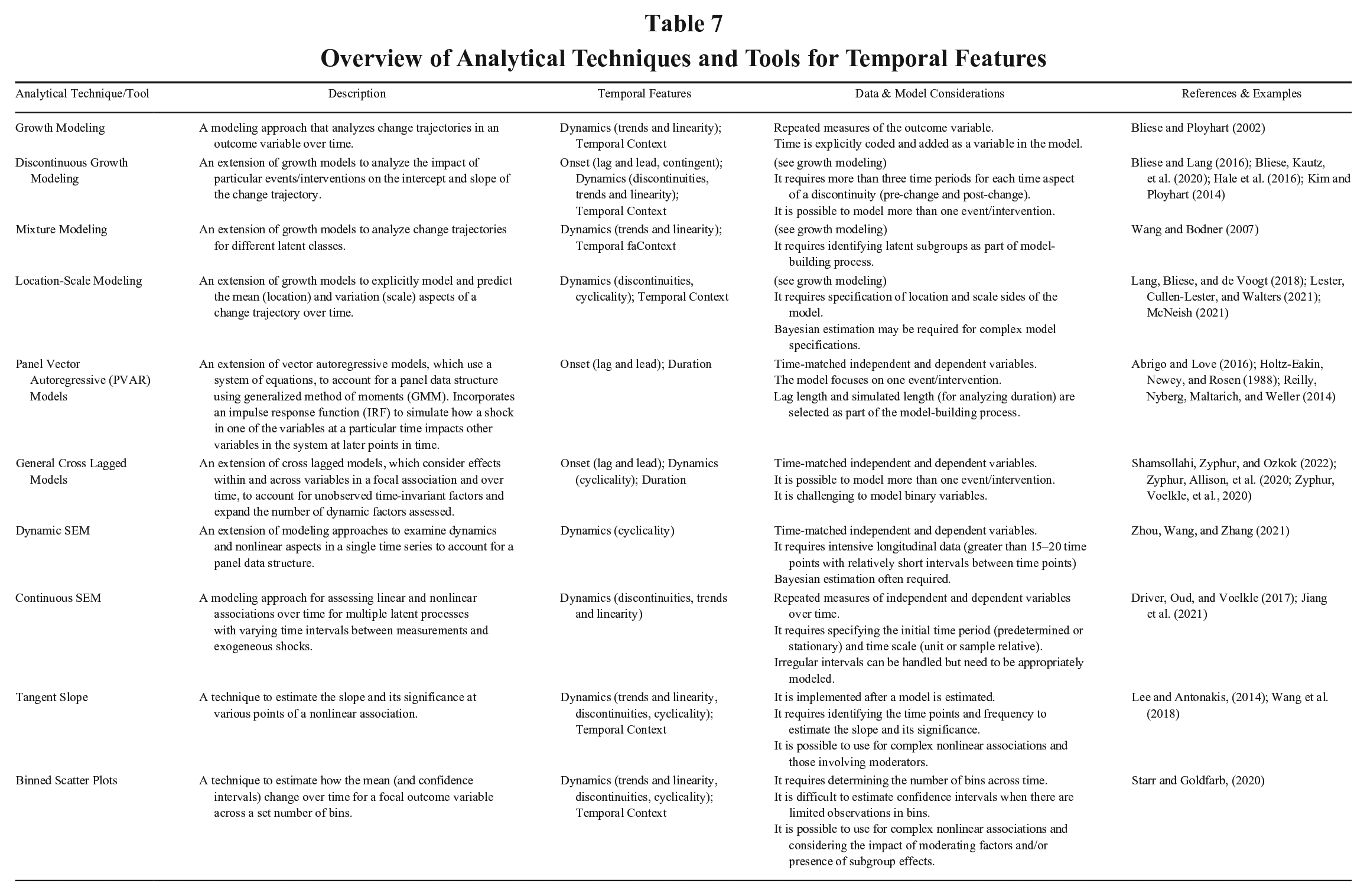
Discontinuous growth models—an extension of traditional growth models—were also used in temporal SHRM research and are an appropriate technique for assessing the instantaneous and longer-term temporal features involved with events/episodes connected with the HR system. These models include a general time variable, a variable accounting for when an event occurs, and a post-event time variable, thereby allowing one to look at: (a) the trend before an event; (b) the immediate impact when an event occurs; and (c) the trend after the event (Singer & Willett, 2003). As Bliese and Lang (2016) note, depending on how the general time variable is coded, it is possible for a researchers to examine relative (e.g., slope pre-event vs. slope post-event) and absolute (e.g., pre- or post-event slopes are different from zero) changes related to an event. Discontinuous growth models can also be further augmented to assess potential nonlinear effects, lead or lag effects, the impact of multiple events, and temporal contextual factors (Bliese, Kautz, & Lang, 2020; Bliese & Lang, 2016; Singer & Willett, 2003). These models can be used for investigating discontinuities and associated trend and linearity dynamics, as well as onset aspects such as lag and lead and contingent impacts (e.g., two or more change events) involved with antecedents of HR systems, their interrelationships, and links with outcomes. Kim and Ployhart (2014) and Hale, Ployhart, and Sheppard (2016) are good examples of papers that used discontinuous growth models to explore such temporal features.
In addition to continuing to leverage growth and discontinuous modeling approaches to investigate aspects related to onset and dynamic temporal elements, we also suggest consideration of several growth modeling extensions. For example, growth mixture modeling, a growth modeling approach that allows for subgroups and latent classes (Wang & Bodner, 2007), could be helpful to model the rate and nature of changes to HR systems over time. In particular, this extension for growth modeling uses latent class detection approaches to identify subgroups and model different intercepts, slopes, and potential nonlinear change patterns. Such models could be helpful for exploring the impact of temporal contexts on trend and linearity aspects of dynamic features involved with the antecedents of—and interrelationships among practices in—an HR system. For example, one could explore how firms with different characteristics (e.g., latent classes) may (a) modify their HR system as they grow over time; (b) vary in how the addition of a particular practice impacts other HR practices in the system; and (c) change their HR system in response to an economic downturn.
There are also opportunities for future research to leverage location-scale models (Lang et al., 2018; Lester et al., 2021; McNeish, 2021), which are an extension of growth modeling techniques to explicitly investigate variance over time (Eckardt et al., 2021). Whereas traditional growth model techniques only specify equations for the location (mean) side of the models, location-scale extensions allow for the scale (variation) sides of the models to also be specified. These models could be helpful for studying cyclicality. Additionally, these models can be integrated with discontinuous growth model techniques (Lang, Bliese, & Runge, 2021) to explore transitions between points of stability and instability in an HR system and its impact on outcomes.
Panel-oriented models, which involve repeated observations but typically do not include an explicit variable for time (Bliese, Schepker, Essman, & Ployhart, 2020), are an additional set of techniques that were used in temporal SHRM research. These can be helpful for discerning a variety of onset temporal features related to HR systems. In particular, researchers can modify the lag and/or lead structure of the data such that the time periods of the dependent and independent variables are different. For example, a variable reflecting change in an HR system in time t could be used to predict changes in outcomes in time t, t + 1, t + 2, or t + 3 to investigate if there is an immediate versus delayed onset of effects. Future research could also consider extensions for panel-oriented models that are explicitly designed to investigate temporal features. For example, impulse response functions of panel vector autoregressive (PVAR) models (Holtz-Eakin et al., 1988)—which use a system of equations to model a group of variables as interrelated and co-evolving and simulations of the effects of a shock in one of the variables (Reilly et al., 2014)—can be used to assess effect duration from HR system changes. In particular, PVAR could be used to assess how a certain magnitude of change (e.g., one standard deviation) in an HR system impacts outcomes in the near term and also model if and how this effect reduces over time.
General cross lagged model (Zyphur et al., 2020) is another example of a panel-oriented statistical analytical technique that could be used to investigate a variety of temporal elements, such as duration (e.g., short- vs. long-term effects) and dynamics. These models involve repeated measures of an independent (x) and dependent (y) variable and a model specification approach where effects within (xt-1 → xt → xt+1; yt-1 → yt → yt+1) and across (e.g., xt-1 → yt-1, xt-1 → yt, yt → xt+1) each variable and time period are included. This is a powerful analysis approach to explore temporal dynamics as it allows a researcher to assess how changes in the HR system imparts effects that pulse through the system. For example, changes to an HR system could impact the HR system in the next time period, as well as impact outcomes in the current and next time periods, and these impacts could persist or change (increase or decrease) in their magnitude over time. General cross lagged models are also beneficial to consider as they can protect against potential endogeneity issues (Zyphur, Allison, et al., 2020). Shin and Konrad (2017) provide a good example of a cross-lagged approach to examine HR systems.
A number of studies identified in our review also leveraged SEM for statistical analyses. Although several were associated with latent growth modeling (and are discussed above), there are also opportunities for SHRM researchers to leverage additional extensions and applications of SEM that are specifically focused on additional temporal elements. For example dynamic SEM—used to examine dynamics and nonlinear aspects with single time series to allow for a panel-data structure and multiple levels of analyses (Zhou et al., 2021)—is well suited for investigating cyclicality temporal dynamics with intensive longitudinal data (e.g., data with > 15 time periods). In particular, dynamic SEM can be used to examine complex cyclicality patterns related to antecedents of changes to HR systems, as well as interrelationships among HR practices and outcomes. As another example, continuous time SEM (Driver et al., 2017) can be used to estimate linear and nonlinear relationships over time for multiple latent processes with varying time intervals between measurements, and it can model exogeneous shocks with different shapes and how these shocks influence dynamic relationships. As a result, this approach could aid SHRM researchers interested in exploring temporal dynamics related to trends and linearity and discontinuities. The study by Jiang et al. (2021) is an example of how continuous time SEM can be leveraged to explore multiple temporal features in a SHRM study.
Lastly, we suggest researchers use tools to better probe the nonlinear temporal effects identified in their statistical analyses. For example, the tangent slope tool (Lee & Antonakis, 2014; Wang et al., 2018) allows the researcher to probe nonlinear associations generated from a statistical analysis to estimate the slope at particular points along the curve and test their significance levels. This could be particularly helpful for determining inflection points for nonlinear relationships involving HR systems (e.g., the point of diminishing marginal returns from changing HR practices over time) to determine if they are consistent with the hypothesized form of cyclicality. Additionally, the binned scatterplots approach (Starr & Goldfarb, 2020) is a helpful tool to visualize various forms of nonlinearities and understand variation along those nonlinearities. Such tools could assist with investigating temporal dynamics that involve nonlinear aspects (e.g., trends and linearity and cyclicality).
Practical Implications
Our review holds significant implications for practitioners by shedding light on the nuanced ways HR practices and systems impact organizational outcomes over time, and how shifts in the organizational context affect the adoption and effectiveness of these HR systems. We delineate four key temporal features—onset, duration, dynamics, and temporal context—that are crucial for understanding the dynamic influence of HR systems. First, it is vital for organizations to recognize that the effects of changes in HR systems may not be immediate and tend to be nonlinear over time. This understanding underscores the importance of monitoring the implementation and outcomes of any HR intervention or new HR system over an extended period to accurately assess its effectiveness.
Second, although the existing body of research provides a foundation, it suggests that implementing two or more complementary practices is expected to lead to a quicker onset, and a longer duration of the effects. Although more work is needed in this area before definitive conclusions and recommendations can be made, these results are consistent with the idea of thinking about the HR system as a bundle of potentially synergistic practices, and implies that it is important to think carefully about how different HR practices amplify each other’s effect. The timing of implementing these practices and ensuring their mutual support is critical for maximizing their collective impact.
Third, our review suggests that changes related to HR systems can be discontinuous or cyclical. For example, the introduction of a new HR system might lead to a decline in performance due to uncertainty and disruption of routines, and then to an increase in performance when new effective work routines have been developed (Devaraj & Jiang, 2019). Organizations can acknowledge this change pattern and prepare for it by implementing a comprehensive management plan, including clearly communicating the new system to employees, anticipating initial resistance, engaging employees early in the process through feedback mechanisms, and providing training and support. Organizations may also monitor performance closely during the transition to quickly identify and address any issues that arise.
Expanding on the practical implications, our review also shows that the economic situation and other contextual factors such as industry characteristics can influence the evolution and impact of HR systems over time. For example, our results show that during a recession, less “soft” and more “hard” HR practices are adopted by organizations that intensify work (Cook et al., 2016), and that when the economic situation is better, a set of high performance work systems (containing selective staffing, comprehensive training, developmental performance appraisal, and equitable rewards) is more effective than when the economic situation is worse (Katou, 2022). These insights suggest that HR practitioners should adopt a dynamic approach to the design and implementation of HR systems, tailoring them to the prevailing economic context and industry trends. Additionally, the strategic integration of HR practices that align with organizational goals and external conditions can serve as a lever for achieving sustained performance improvements. Practitioners are encouraged to consider these temporal contextual factors when designing and adopting HR systems, ensuring that HR initiatives are not only responsive to current needs but are also adaptable to future changes in the organizational and environmental landscape.
Conclusion
The aim of this review was to integrate time and temporal features into examinations of HR systems and the associated antecedents and outcomes. We reviewed empirical studies in SHRM research involving time, and found that although there is an increase in the number of studies that incorporate time in their study design, most studies separate measurements as a remedy for common method bias. The share of SHRM studies that actually incorporates temporal features in theory, research design, or methods is small and decreasing over time. We presented a research agenda related to temporal features, focused on theory (building), study designs, and statistical methods to examine temporal relationships in SHRM. We hope this review will open fruitful research avenues that will not only address the limitations of previous studies based on static research designs or simple uses of time, but also enrich the understanding of the ways in which temporal elements can play a role in research on HR systems.
Supplemental Material
sj-xlsx-1-jom-10.1177_01492063241264250 – Supplemental material for The Role of Time in Strategic Human Resource Management Research: A Review and Research Agenda
Supplemental material, sj-xlsx-1-jom-10.1177_01492063241264250 for The Role of Time in Strategic Human Resource Management Research: A Review and Research Agenda by Corine Boon, Kaifeng Jiang and Rory Eckardt in Journal of Management
Supplemental Material
sj-xlsx-2-jom-10.1177_01492063241264250 – Supplemental material for The Role of Time in Strategic Human Resource Management Research: A Review and Research Agenda
Supplemental material, sj-xlsx-2-jom-10.1177_01492063241264250 for The Role of Time in Strategic Human Resource Management Research: A Review and Research Agenda by Corine Boon, Kaifeng Jiang and Rory Eckardt in Journal of Management
Footnotes
Appendix
Future Research Suggestions for Dynamic HR Systems–Outcomes Relationships
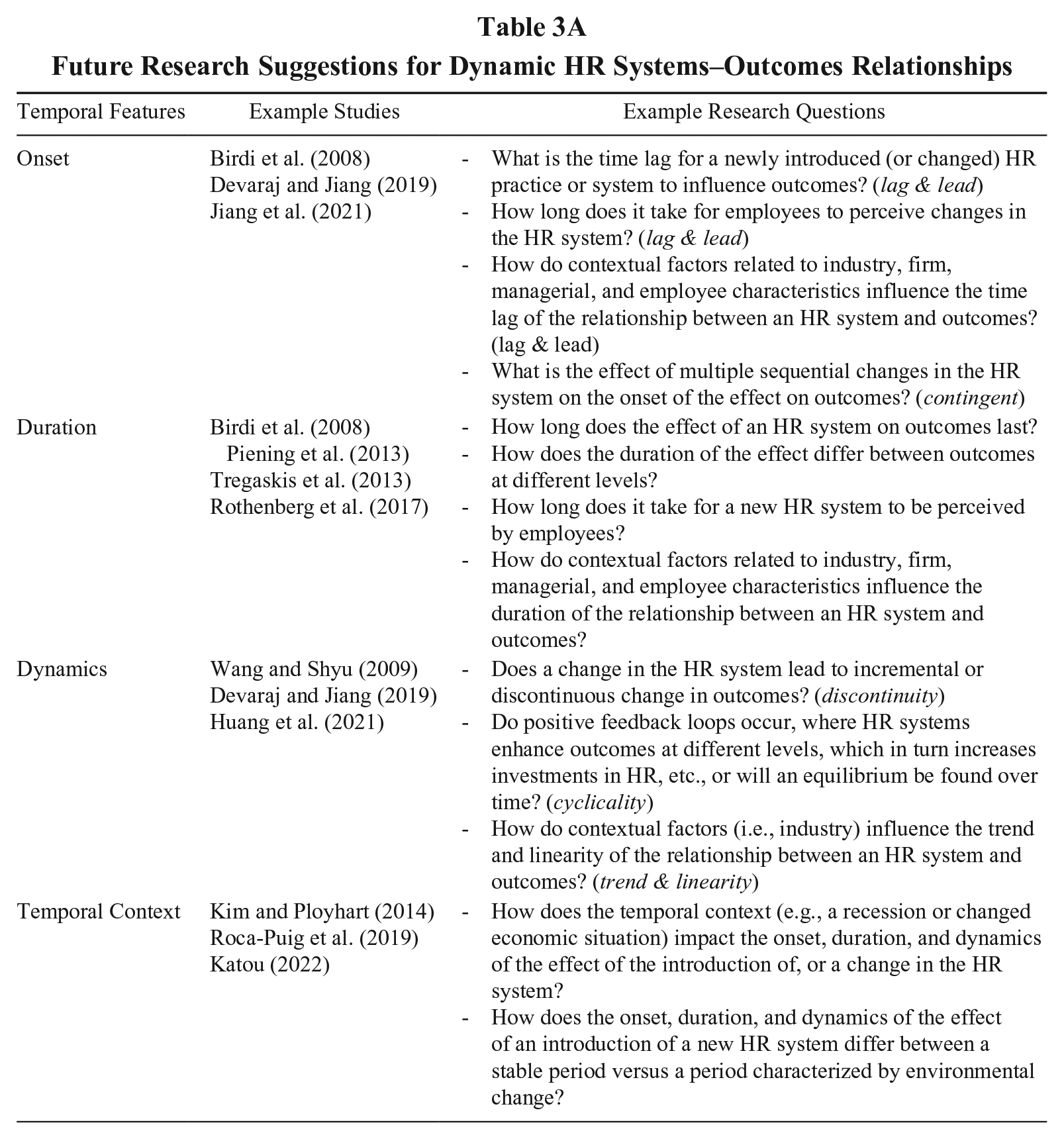
| Temporal Features | Example Studies | Example Research Questions |
|---|---|---|
| Onset |
Birdi et al. (2008)
Devaraj and Jiang (2019) Jiang et al. (2021) |
- What is the time lag for a newly introduced (or changed) HR practice or system to influence outcomes? (lag & lead) - How long does it take for employees to perceive changes in the HR system? (lag & lead) - How do contextual factors related to industry, firm, managerial, and employee characteristics influence the time lag of the relationship between an HR system and outcomes? (lag & lead) - What is the effect of multiple sequential changes in the HR system on the onset of the effect on outcomes? (contingent) |
| Duration |
Birdi et al. (2008)
Piening et al. (2013)
Tregaskis et al. (2013) Rothenberg et al. (2017) |
- How long does the effect of an HR system on outcomes last? - How does the duration of the effect differ between outcomes at different levels? - How long does it take for a new HR system to be perceived by employees? - How do contextual factors related to industry, firm, managerial, and employee characteristics influence the duration of the relationship between an HR system and outcomes? |
| Dynamics |
Wang and Shyu (2009)
Devaraj and Jiang (2019) Huang et al. (2021) |
- Does a change in the HR system lead to incremental or discontinuous change in outcomes? (discontinuity) - Do positive feedback loops occur, where HR systems enhance outcomes at different levels, which in turn increases investments in HR, etc., or will an equilibrium be found over time? (cyclicality) - How do contextual factors (i.e., industry) influence the trend and linearity of the relationship between an HR system and outcomes? (trend & linearity) |
| Temporal Context |
Kim and Ployhart (2014)
Roca-Puig et al. (2019) Katou (2022) |
- How does the temporal context (e.g., a recession or changed economic situation) impact the onset, duration, and dynamics of the effect of the introduction of, or a change in the HR system? - How does the onset, duration, and dynamics of the effect of an introduction of a new HR system differ between a stable period versus a period characterized by environmental change? |

Supplemental material for this article is available with the manuscript on the JOM website.
Notes
References
Supplementary Material
Please find the following supplemental material available below.
For Open Access articles published under a Creative Commons License, all supplemental material carries the same license as the article it is associated with.
For non-Open Access articles published, all supplemental material carries a non-exclusive license, and permission requests for re-use of supplemental material or any part of supplemental material shall be sent directly to the copyright owner as specified in the copyright notice associated with the article.
