



Abstract
Scholars have examined the role of customer preferences, and demand-side characteristics more generally, in varied core strategy areas like market entry and timing, diversification, positioning, resource reallocation, and firm adaptation, among many others. We review this diverse demand-side literature and develop an empirical classification that identifies five archetypical customer value-creation logics seen in the literature to date. To apply each of these logics, a firm must look downstream with the intent of matching, leveraging, adapting, learning, or shaping customer preferences or market characteristics to create value for customers. For each value-creation logic, we detail the logic itself, how the demand side is characterized, how specific strategic decisions allow for value creation following the logic, literature gaps in the logic, and opportunities for future research. Opportunities include extending the work on existing logics, examining the combined effects of multiple logics, identifying understudied demand-side characteristics, and studying strategy applications for which demand-side attributes have received comparatively little attention to date. These include business models, corporate social responsibility (CSR), corporate governance, and demand-side shocks. Finally, we address implications for managerial practice.
Introduction
Customers are the ultimate arbiters of value; their choices determine firms’ revenues and affect who wins competitive battles (Lippman & Rumelt, 2003; Priem, 2007). Although early research in strategic management paid attention to customers as one of the five competitive forces (Porter, 1979), the rise of the resource-based view (RBV) shifted the field’s focus to internal firm factors, such as resources and dynamic capabilities, as sources of inter-firm heterogeneity and, thus, competitive advantage (Hoskisson, Hitt, Wan, & Yiu, 1999). In the early 2000s, however, two research programs renewed strategy scholars’ interest in customers and the characteristics of demand. First, dissatisfied with the near-exclusive focus on resource heterogeneity for explaining (sustainable) competitive advantage, Priem and colleagues (Priem, 2007; Priem & Butler, 2001a, 2001b) proposed to complement the RBV with a demand-side approach that looks downstream, toward customers and consumers, 1 for primary determinants of value-creation possibilities. Second, Adner & colleagues (Adner, 2002; Adner & Levinthal, 2001; Adner & Zemsky, 2006) sought to provide formal foundations for how customer choice and demand heterogeneity act as drivers of firms’ investment decisions and, therefore, competitive heterogeneity among firms.
Since these early contributions, many more strategy scholars have examined the roles of customers and demand-side characteristics in core strategy areas. These include: entry timing (Eggers, Grajek, & Kretschmer, 2020), diversification (Ye, Priem, & Alshwer, 2012), positioning (Wang & Shaver, 2014), resource reallocation (Wu, 2013), and adaptation (Aggarwal & Wu, 2015). More recently, demand-side characteristics have also begun to be examined in the context of ecosystem and platform strategies (Kretschmer, Leiponen, Schilling, & Vasudeva, 2022). While the literature has grown quite large, and demand-side strategy has become an established research stream, it has not been systematically reviewed recently. 2 Furthermore, since demand-side research in strategic management addresses an ever-wider range of strategy applications, using multiple theoretical approaches, this literature may be perceived as fragmented, or even disjointed. This situation is like the parable of the blind men and the elephant: different scholars may be “seeing” different parts of the overall demand-side strategy literature, thereby delaying knowledge development. Thus, there is a need for a comprehensive review that brings this literature together. Such a review is necessary for providing a foundation to more effectively build new knowledge for the strategic management community about demand-side characteristics and how firms attending to customers in new ways can increase value creation. This is what we set out to do in this article.
One issue that has been in the way of tying together the demand-side strategy literature is that currently there are no established criteria concerning what should count as demand-side strategy research, and what should not. Priem, Butler, and Li (2013) argue that “demand-side strategy research . . . looks downstream from the focal firm towards product markets and customers, to explain and predict those managerial decisions that increase value creation within a value system.” We define demand-side strategy research as research that: (1) conceptualizes characteristics of the demand side (i.e., customers and/or markets); (2) examines strategic decisions in light of demand-side characteristics; and (3) evaluates the predicted or achieved value creation or performance outcomes that result from a strategic decision. Applying these criteria to the strategy literature, we identified 125 demand-side strategy articles that appeared in leading management journals from 2002 to 2023. Attending to how value is created for customers is a core aspect of demand-side strategy research (Priem et al., 2013), and is explicit in our definition. At the same time, however, our definition lends itself to relatively straightforward operationalizations, because strategic decisions and demand-side or customer characteristics can often be gleaned directly from published articles, whereas value creation is not always explicitly addressed.
Our analysis of the literature reveals five value-creation logics through which firms can create value by looking downstream to customers and markets. Each value-creation logic describes a way in which firms can take into account, take advantage of, respond to, interact with, or influence demand-side characteristics at the level of specific customers, consumers, or users, or at the level of market aggregates of these. The value creation logics we identified are: (1) a matching logic, wherein the firm strives to align its strategic decisions with demand-side characteristics; (2) a leveraging logic, wherein the firm strives to exploit customer relationships and lock-in; (3) an adapting logic, wherein the firm strives to adjust to its customers through, for example, developing customer-specific capabilities; (4) a learning logic, wherein the firm strives to gain information on demand-side characteristics, including customer preferences; and (5) a shaping logic, wherein the firm strives to strategically shape customer and market characteristics to its advantage. These logics are analytically separate, but not necessarily mutually exclusive in practice. That is, an article included in our review may incorporate several of these logics. We describe the five value-creation logics in detail and, for each one, explain how strategic decisions focusing on the demand side allow value creation for customers and, ultimately, for the firm.
Our article makes four key contributions to the strategic management literature. The first is the identification of five conceptually distinct value-creation logics that organize the literature to date. These logics provide a framework that will help strategy researchers to position their studies within the demand-side literature, relate new findings about the relationship of demand-side characteristics and strategic decisions to existing research, and contribute to the systematic accumulation of knowledge about how demand-side characteristics matter for strategic management. Second, we provide an overview of how the demand side has been conceptualized in strategy research. Many studies emphasize structural characteristics and, in particular, consider some form of demand heterogeneity. A smaller set of studies conceives of customers as active agents who themselves learn and make decisions. Studies also differ with regards to their assumptions concerning whether demand-side and customer attributes are givens that must be understood to make decisions, or whether they can be influenced strategically by firms. Third, our study has implications for practitioners by suggesting specific activities strategists may use to create value and increase the performance of their firms. Our review also uncovers several caveats which imply that a simple pursuit of customer value may sometimes be counter-productive. Fourth, and finally, we identify four types of opportunities for further demand-side research. These include extending work on the existing value-creation logics, examining combinations of value-creation logics, examining understudied demand-side characteristics, and studying strategy applications for which demand-side attributes have received comparatively little attention to date—which include business models, corporate social responsibility (CSR), corporate governance, and demand-side shocks.
The Review Process
To begin our review, we compiled an initial list of articles by searching key strategy-related journals. Our goal was to identify all articles published between 2002 and 2022 that fulfill the above criteria for demand-side strategy research. We chose 2002 as the starting point because demand-side strategy research began as an active field of study starting with the above-mentioned publications by Priem and Butler (2001a) and Adner and Levinthal (2001). Data were collected from the Web of Science Core Collection (WoS) database of the Institute for Scientific Information during January 2023, with specific reference to the business and management categories. When it came to the document type, we selected only research articles, thus excluding editorials or reviews.
We used multiple approaches for identifying potentially relevant articles. First, we used the FT50 list, which prior reviews published in this journal often take as a starting point for creating their review sample (Baumann, Schmidt, & Stieglitz, 2019; McGrath & Nerkar, 2023; Mithani & O’Brien, 2021). There, we looked for demand-side strategy articles that had appeared in the most prestigious general management journals (Academy of Management Journal, Academy of Management Review, Organization Science, Journal of Management, and Administrative Science Quarterly) as well as in the two FT50-listed strategy-focused journals (Strategic Management Journal and Strategic Entrepreneurship Journal) and entrepreneurship journals with an interest in strategy (Entrepreneurship Theory and Practice and Journal of Business Venturing). The initial selection included all articles with title, abstract, or keywords that included the words: “demand,” “market,” “consumer,” “customer,” “buyer,” “client,” or “user.” This search gave us an initial sample of 2,035 articles. All three authors then individually went through all articles, reading the title and abstract and, if needed, the full article, and proposed each article for inclusion or exclusion. To be included in our sample, an article had to conform to our definition of demand-side strategy research stated above. Specifically, it (1) had to include a characterization of demand-side attributes, which can be as diverse as demand heterogeneity in a formal model (Adner, Ruiz-Aliseda, & Zemsky, 2016), or demand maturity in a quantitative study (Wu, 2013), or the meanings customers attribute to a technology in a qualitative study (Raffaelli, 2019); and (2) must link these attributes to firms’ strategic decisions and/or value creation or performance outcomes. Articles not directly related to demand-side strategy research were suggested for elimination from the sample. Subsequently, all disagreements regarding inclusion or exclusion were resolved through discussion among the co-authors. This process yielded an initial list of 102 articles.
We next looked in Web of Science for all articles citing either Adner and Zemsky (2006) or Priem (2007), which are the two articles that catalyzed the demand-side strategy literature. This second search gave us an initial sample of 464 articles, of which 34 cited both Adner and Zemsky (2006) and Priem (2007). Many of the second-list articles we identified were already present in the first list. For the remainder, we followed the same procedures we had applied to the first list. This resulted in adding another 11 articles. Next, we read all articles from both lists in detail. During these readings we identified a further 12 articles, cited by these second-list articles, that clearly fit our criteria for inclusion. Some of the 23 articles that were not on the first list were from journals other than the seven journals from which our initial list was built. These journals included: Management Science, Strategy Science, Journal of International Business Studies, Long Range Planning, Strategic Organization, Industrial and Corporate Change, Journal of Evolutionary Economics, and Journal of International Management. As we proceeded with our analysis (which we describe below), we further updated our list of articles with several new articles that were recently accepted or published. This work extended our time cutoff to mid-2023.
The final sample of our review contains 125 articles altogether. 3 These articles use both quantitative and qualitative methods, as well as conceptual works and formal models. The largest portion (91 articles) are quantitative studies. Demand-side strategy research has been conducted in a variety of industry types, although some industries (e.g., video games, services, and law firms) have been examined more often than others. Finally, just under half of the articles (48) appeared in the Strategic Management Journal, 15 in Organization Science, 11 in the Journal of Business Venturing, and nine in the Journal of Management.
In analyzing the articles, we drew on our definition of demand-side strategy research and sought to identify, for each article, (1) the article’s characterization of the demand side, (2) the strategic decision and/or the firm characteristic under study, and (3) value creation and performance outcomes as described in the article. We listed these in a table and proceeded by analyzing similarities and differences among the articles. In particular, we aggregated similar articles into categories. From this process five different value creation logics emerged, which are five conceptually distinct ways in which firms relate to customers and demand-side factors: matching, leveraging, adapting, learning, and shaping. We discussed the logics within the author team until we had sufficient confidence that they are conceptually distinct. We also examined and identified the theoretical perspective(s) each article takes. During our review of these articles, it became clear that the logics we found should be the primary factor used for classifying the articles. When further examining the logics in detail, we realized that there are different application areas to which the logic has been applied (such as particular types of strategic decisions made, or problems faced, by companies). Table 1 provides an overview of the five value creation logics, including the number of articles for each of the value-creation logics, as well as their respective application areas. Supplementary Table A1 provides an overview of the 125 articles, including the method employed, the way in which the demand side is characterized, and the strategic decision. The following section explains the logics and application areas in detail. A small subset of the articles is categorized under two logics; we will address these combinations in the final section.
The Five Value Creation Logics
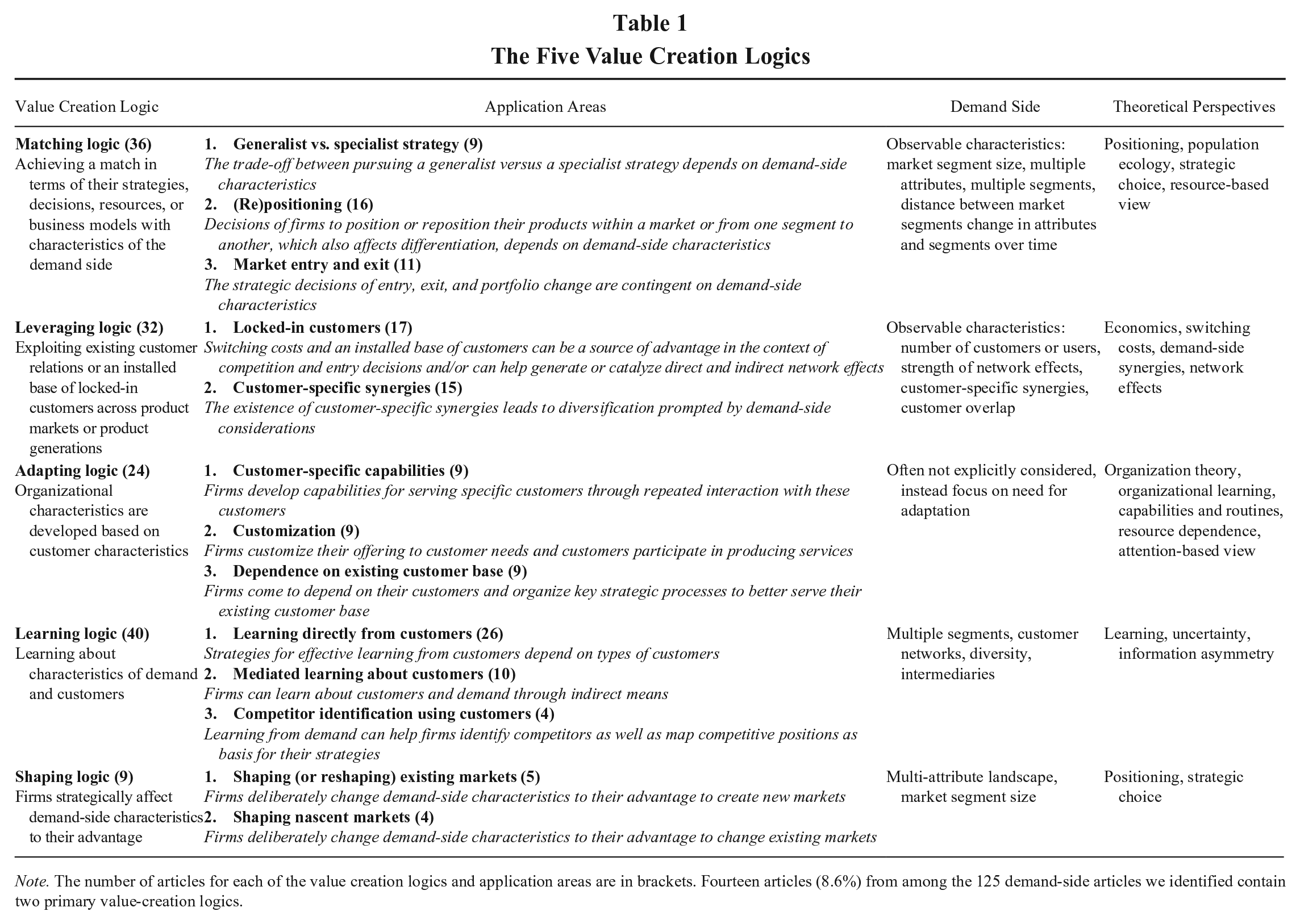
Note. The number of articles for each of the value creation logics and application areas are in brackets. Fourteen articles (8.6%) from among the 125 demand-side articles we identified contain two primary value-creation logics.
The Five Value Creation Logics
Matching Logic: Description
Overview
Thirty-six of the 125 demand-side papers we found examine how firms’ managers make strategic decisions based on structural characteristics of demand and the expected decision outcomes. The matching logic is based on firms achieving a “fit” (Venkatraman, 1989) of their strategies, decisions, or business models with demand-side characteristics. Therefore, the strategic outcomes examined in these papers, such as the effectiveness of a strategy (like market entry), or the value of a resource, depend on the characteristics of customers or markets. Most of the demand-side work based on matching logic has its theoretical roots in economics, while a few papers build on organization theory and, in particular, population ecology (Hsu, 2006). Generally, matching logic is a form of contingency theory (Donaldson, 2001; Venkatraman, 1989), which is in the tradition of either the positioning view of strategy, where viable positions are contingent on the structure of demand (Wang & Shaver, 2014), or the RBV, where the value of a resource or its ability to generate performance outcomes depends on demand-side factors (Adner & Snow, 2010; Schmidt & Keil, 2013). The demand side is conceptualized as a heterogeneous space, while firms are modeled as relatively simple unitary actors that are implicitly assumed to have knowledge about the structure of demand through observation.
Demand-side conceptualization
In the matching view, the demand side is conceptualized as a heterogenous opportunity space that can be analyzed because its structural characteristics can be measured or, at least, estimated. At its simplest, the demand side consists of a single market segment and a single product attribute (Makadok & Ross, 2013). Complexity increases when there are multiple attributes (Hsu, 2006). The matching perspective can be extended even further, to multiple segments or product categories across which customers differ in their preferences. For example, there may be a high-end and a low-end segment (Adner et al., 2016), or a mainstream market with a “long tail” of customers who have more idiosyncratic preferences and, potentially, a “middle tail” in-between (Benner & Waldfogel, 2023). Different customer segments may vary along multiple attributes (de Figueiredo & Silverman, 2007) which may also differ in the degrees to which customer preferences for attributes differ or overlap (Adner, 2002). Segments also may differ in terms of their “distance” from the segments in which a firm is already present, such as the difference between a firm’s home market and foreign markets (Verbeke, Van Tulder, & Puck, 2017).
Another way the demand side is characterized in articles following a matching logic is according to the change in market opportunities over time. Two types of change have been conceptualized in the literature. First, change that stems from, for example, new technologies may lead to the emergence of new customer segments (Benner & Waldfogel, 2023) or to changes in preferences across existing segments (Aggarwal & Wu, 2015). Second, it can stem from regularities such as demand-side change encapsulated in the industry lifecycle. For example, there is heterogeneity in the kinds of customers who enter or are active at different times or levels of industry maturity (Eggers et al., 2020; Rietveld & Eggers, 2018).
Matching Logic: Application Areas
The matching logic has been applied to the following strategy topics: generalist versus specialist strategies; strategic (re)positioning; and market entry and exit, as we discuss next.
Generalist versus specialist strategies
A generalist strategy occurs when a firm pursues product diversification, geographical expansion, or both. Well-known examples include Amazon and Walmart in consumer products. A specialist strategy would be pursued by firms addressing a single market, such as McDonald’s in fast food. Generalist firms may roughly be equated to Porter’s (1980) broad diversifiers, and specialist firms to his focusers. As also argued by Porter (1980), there is a generic trade-off between generalists and specialists, with those firms not choosing one or the other strategy being “stuck in the middle” and therefore suffering from lower performance.
One topic area has examined how demand-side factors can affect the generalist-specialist trade-off. Hsu’s (2006) article is among the first to empirically test what organization ecology scholars call the “allocation principle” of niche dynamics; that is, a firm’s overall fitness declines as its niche width increases. Examining U.S. feature film releases from 2000-2003 at the project level, Hsu (2006) found that audiences—both consumers and critics—see multi-genre films as less appealing than single-genre films. This occurs because multi-genre films are difficult for audiences to make sense of, and audience expectations show less within-group consensus about multi-genre films. As such, Hsu’s (2006) work supports the allocation principle. This finding is further corroborated by Paolella and Durand (2016), who examine law firms. They show that a category-spanning legal generalists’ products will be more appealing to its legal clients if those clients are more demanding, because of the clients’ own category-spanning needs. Therefore, what matters in the evaluation of a generalist or specialist offer are the preferences of their customers. Things become less clear in more complex settings, however. Van Witteloostuijn and Boone’s (2006) conceptual paper explains how specific demand-side factors, such as demand-side economies of scale and scope and customer heterogeneity, determine firm behavior and market structure, thereby predicting the number of generalists or specialists in an industry.
Several demand-side articles also show how generalists can be successful in overcoming the generalist-specialist trade-off. Conti, Gambardella, and Novelli (2019), for example, found that when buyers are spread relatively equally across markets, generalist suppliers can be successful by serving multiple markets. Using a formal model, Adner et al. (2016) show that when demand heterogeneity is low (and technology scalability is high) a generalist can outcompete specialists. Similarly, demand-side uncertainty and transaction costs can provide generalists with repositioning opportunities (Giarratana & Santaló, 2020). Also, focusing on demand-driven dynamics helps to understand how social-business hybrids can overcome their “two-goal” disadvantages relative to for-profit firms. In particular, social-business hybrid generalists serve two customer segments, with customers in one segment subsidizing customers in the other. In these cases, demand-side externalities across the two customer segments give social hybrids advantages by generating growth while avoiding negative demand-side externalities (Fosfuri, Giarratana, & Roca, 2016).
In sum, demand-side factors, like segment size or customer heterogeneity, are important contingency factors that affect the generalist-specialist trade-off. They also affect when companies will find it optimal to specialize in catering to individual segments or types of customers or to become a generalist serving multiple segments.
(Re)positioning
The question of how firms position themselves relative to competitors is among the oldest in the strategy field (Porter, 1980). The core idea is that firms must maintain a distance from competitors along some dimensions in order to be sufficiently differentiated. Consequently, competitor behavior (such as new entry) may prompt other firms to reposition, like auto manufacturers did after the launch of the Ford Model T in 1908 (Argyres, Bigelow, & Nickerson, 2015), or newspaper firms did in response to the entry of Craigslist (Seamans & Zhu, 2014).
Adner and Snow (2010) illustrate repositioning based on attending to newly revealed demand-side information following a new technology introduction. They examine the situation where a new, clearly improved, and more valuable technology enters a marketplace in the semi-conductor lithography industry. The dominant explanation had been that market participants must adopt, or at least match the quality of, the new technology to survive. But Adner and Snow (2010) develop the argument that in situations in which a new, dominant technology emerges, incumbents may be able to reposition their products and emphasize features that are appealing to a lower-quality customer niche. This is because the introduction of the new technology can expose demand heterogeneity within the industry, where some participants use industry processes that do not require the close tolerances of the new technology. Building on this insight, Raffaelli (2019) shows how incumbent Swiss mechanical watchmakers repositioned their old technologies to face a new dominant technology by leveraging demand, creating new meanings and values, and mobilizing enthusiast consumers who value the old technology. In the energy industry, Delmas, Russo, and Montes-Sancho (2007) show that deregulation also can prompt incumbents to reposition so they can better align with customer preferences.
Several studies have shed light on the specific demand-side characteristics that prompt firms to reposition. Seamans and Zhu (2014) study how incumbent newspaper firms responded to the entry of Craigslist. They found that incumbents repositioned in those markets with heterogeneous reader preferences, but incumbents in markets with homogeneous reader preferences reacted by focusing on cost cutting. In a similar vein, Wang and Shaver (2014) found that when China’s national TV broadcaster positions a new program close to a regional TV station program, if the regional station’s program is less appealing to a wide variety of viewers, it will be repositioned to distance itself from the new entrant. Park, Seamans, and Zhu (2021) evaluated newspaper incumbents’ responses to entry by TV stations from 1945 to 1963. Their responses were contingent on whether their customers were single- or multi-homing (i.e., either only read newspapers or watch TV, or engage in both activities). Papers with many single-homing customers were more likely to reposition by lowering subscription and advertising rates, while those with many multi-homing customers instead competed on quality. Also examining quality, Wang, Wu, Pechmann, and Wang (2023) show that entry by a low-quality firm can help a high-quality incumbent, because the high-quality incumbent’s offering looks better to consumers when compared to the low-quality new entrant’s product.
Finally, several articles study how the choice of business model and sourcing decisions affect positioning and performance. Rietveld (2018) shows that paid and freemium models differ in how they engage users and generate revenues. Freemium engages more users but produces less revenue, while paid models engage users more intensely and generate more revenue per user. On a similar line, van Angeren, Vroom, McCann, Podoynitsyna, and Langerak (2022) found for mobile apps that customer privacy concerns affect optimal app positioning. The optimal distinctiveness-performance relationship is inverted-U for paid apps, but U-shaped for freemium business models due to consumers’ heightened privacy concerns. A related study on the implications for differentiation in the video game industry product (Benischke, Rietveld, & Slangen, 2023) contributes to the literature on the liability of foreignness. They show that sourcing inputs from product developers based in the same subnational region as consumers positively affects consumers’ willingness to pay for a foreign product and, further, that foreign firms benefit more by sourcing from local suppliers in a given market than do local firms.
Overall, studies in this area illustrate how firms can reposition their products by capitalizing on demand heterogeneity, and how specific demand-side characteristics influence firm strategies and performance outcomes. Moreover, demand also affects business model choices and sourcing decisions on firms’ positioning and differentiation in the market.
Market entry and exit
Market entry and withdrawal are also among the most studied strategic decisions in the strategy literature. Key questions studied are, among others, how the capabilities of various types of entrants (Klepper & Simons, 2000) or entry timing (Lieberman & Montgomery, 1988) affect entry performance. While studies have traditionally focused on supply-side factors, recently an increasing number of articles are examining how demand-side factors affect strategic decisions associated with entry and exit.
One example is Uzunca (2018), whose study is representative of empirical work that contributes to the entry/exit literature; specifically, he examines the effects of supply-side and demand-side factors, together. Uzunca’s (2018) setting is the submarkets within the global semiconductor manufacturing industry. A submarket is defined as having relative homogeneity in incumbents’ technology (supply-side) and customer-facing (demand-side) competencies; that is, within-submarket competency homogeneity is greater than that across submarkets. Uzunca (2018) hypothesizes and finds that new entrants are likely to be unsuccessful in submarkets where incumbents’ technological and customer-facing competencies converge with those in other submarkets. In submarkets with convergence in only one competence, however, entrants are likely to find a niche and succeed. Other studies take a dynamic perspective, examining how entry at different stages of the industry lifecycle depends on differences in demand-side characteristics across those different stages. Rietveld and Eggers (2018) demonstrate that video game developers face different users for early- versus late-stage platforms, which affects the success of games they launch on a platform. Eggers et al. (2020) expand on this theme and show that firms having prior market experience attract more customers. Firms with prior technology experience attract more customers that use the products intensely, however, especially if they are early entrants.
Multiple studies have analyzed how demand-side factors affect the decision to enter a market in the first place. Claussen, Essling, and Peukert (2018) show that higher variation in air travel demand is associated with less entry, but also that more flexible firms will enter such markets. In the medical device industry, Wu (2013) demonstrates that the maturity of current markets relative to new markets prompts firms to enter these new markets. For the U.S. telecommunications industry, Manral (2015) shows that differences in demand conditions explain differences between early and late entrants in their scopes and products offered. Benner and Waldfogel (2023) show that digitalization affects how products are created, leading especially new entrants in the movie industry to target a new “middle tail” segmen. Few studies examine how demand-side characteristics affect exit. One exception is Argyres et al. (2015), who found that an innovation shock (i.e., a new entrant with surprising appeal to customers) can prompt incumbents to exit the industry way before a dominant design has emerged in an industry.
Scholars have thus increasingly focused on the impact of demand-side factors on firms’ entry and exit decisions. Studies emphasize the significance of competency convergence in submarkets, the role of entry timing and prior experience, and how variables like demand variation, resource allocation, and digitalization influence market entry and exit.
Matching Logic: Summary of Findings
In sum, articles that follow a matching logic have examined how three types of strategic decisions depend on structural characteristics of demand, such as the distribution of customers across segments. Most generally, these studies show that demand-side characteristics are a key contingency that affects both the kinds of decisions firms make (e.g., which segments to enter, the scope of their business, or the parameters of their decisions, such as business model choice) and the performance outcomes of such decisions (those firms that better match their decisions with demand-side characteristics will have higher performance).
Leveraging Logic: Description
Overview
Thirty-two out of the 125 articles examine how established firms utilize and leverage long-standing customer relationships. Examples include: video game firms exploiting an installed base of locked-in customers, which can serve as a source of advantage (Shankar & Bayus, 2003); banks or professional service companies exploiting customer relationships for market entry, or as advantage in a complementary market (Brush, Dangol, & O’Brien, 2012; Mawdsley & Somaya, 2018); or a multi-product strategy that exploits customer-specific synergies by bundling self-service laundry and tanning services (Ye et al., 2012). The theoretical basis for most of the articles in the leveraging logic is economics. The core concepts are switching costs (Klemperer, 1987), direct or indirect network effects, multi-sided platforms (Katz & Shapiro, 1985; Rochet & Tirole, 2003), and customer-specific synergies (Schmidt, Makadok, & Keil, 2016).
Demand-side conceptualization
In the leveraging logic, the demand side is conceptualized in two main ways. First, customers can be subject to switching costs when they have committed to use the products or services of a specific firm or platform (Zhu & Iansiti, 2012), or if they have developed a relationship with a supplier, which may involve having developed supplier-specific capabilities (Brush et al., 2012). This can lead to customers having limited switching options, so the firm to which they have committed will have an advantage over rivals. Second, customers often have a need for multiple, complementary products and, critically, there may be customer-specific synergies (Chatain & Zemsky, 2007; Schmidt et al., 2016). The fact that multiple products are bought and used by the same customers can create synergies that can, in turn, be exploited by firms.
Leveraging Logic: Application Areas
The leveraging logic has been applied to two topics: customer lock-in and customer-specific synergies, as we discuss next.
Locked-in customers
In many industries, customers become committed to particular suppliers, which creates switching costs and lock-in (Klemperer, 1987). Reasons for lock-in include, for example, the investments customers have already made while learning how to use a product, such as online banking software, or the effort involved in adapting the product to their idiosyncratic needs, such as when a Spotify user creates personalized playlists. The switching costs that result from such supplier-specific investments by customers can then be exploited by the supplier firm. In platform industries, a set of locked-in customers can be leveraged to generate and exploit indirect network effects. This was the case, for example, when Microsoft ensured backward compatibility as the firm transitioned to a new version of its office software, which provided a safeguard against new entrants into the industry.
Researchers have examined the role of customer switching costs in the context of competition and entry decisions in traditional industries not subject to network effects. Gomez and Maicas (2011), for example, empirically corroborate the long-standing proposition that switching costs allow early entrants to outperform late entrants. Specifically, their study of performance consequences of entry timing in the mobile telecommunications industry empirically demonstrates that switching costs mediate the relationship between entry timing and performance. This means that switching costs are one of the isolating mechanisms used by first-movers in order to preserve their competitive advantage. In the same industry, Abolfathi, Santamaria, and Williams (2022) show that multiproduct firms benefit from customer switching costs more than single product firms, because multiproduct firms’ customers can switch products without the need to switch suppliers. Shamsie (2003) shows that reputation also can serve as a source of switching costs. He argues that demand-side characteristics, such as convergence in tastes among consumers, affect the extent to which firms can leverage a positive reputation to establish a sustainable dominant position in their markets.
Several studies shed light on how firms exploit switching costs. For example, Chatain (2011) shows that when a supplier has customer-specific knowledge through previously supplying services to customers, then these customers will likely select that supplier for additional services. At a more fine-grained level, Mawdsley, Meyer-Doyle, and Chatain (2022) show that three demand-side factors—relationship strength, client attributes, and the resource constraint—affect the propensity of lawyers to repeatedly collaborate; in their study, they show that collaboration decisions are often taken considering whether a client will become a repeat customer instead of switching to another supplier. Other studies analyze the capabilities that enable firms to exploit lock-in. Brush et al. (2012) demonstrate in the banking industry that benefiting from switching costs to exploit locked-in customers requires “cross-selling” capabilities. In a similar vein, Mawdsley and Somaya (2021) found that tight relationships with customers enable firms to grow, but this growth is contingent on the presence of “cross-serving” capabilities in the firm.
Researchers also have studied switching costs in platform industries, which are subject to network effects. In such industries, an installed base of customers or users is an asset that helps firms compete by leveraging network effects. When there are direct network effects between users in the customer base, Lee, Song, and Yang (2016) show that characteristics of the network, in particular the average distance between network members, can strengthen or weaken the relationship between the size of the installed base and network effects. Similarly, Subramanian, Mitra, and Ransbotham (2021) show that for platforms which rely on user-generated content, the benefits realized from switching costs depend on the type of content generated by users. In particular, they found that firms can increase switching costs by enabling interaction between users, by incorporating social and interest groups, and by providing functionality not easily replicated by alternative platforms. They also show that these actions to strengthen lock-in are necessary to appropriate value from increased user engagement.
Another set of studies examines how an installed customer base attracts complementors, and therefore facilitates indirect network effects (Zhu & Iansiti, 2012). As Cennamo and Santaló (2019) show, diversity in complementors can have both positive (system reputation) and negative (free-riding) effects on the utility users derive from a platform. Kretschmer and Claussen (2016) demonstrate that backward compatibility allows platform firms to leverage their installed bases and complementors when transitioning to a new platform generation, and this effect is strongest when the technological leap from the parent generation to the new generation is moderate and when the new generation has just been released. Using a formal model, Panico and Cennamo (2022) show that demand-side economies of scale are the driving force of complementors’ incentives, and hence the key success factor for platform strategies. The strength of user preferences ultimately determines whether a larger ecosystem can also be more innovative, or if, instead, there is a trade-off between size and innovativeness.
Finally, several studies point out that having a large installed customer base is not per se an advantage in a platform industry. In fact, Shankar and Bayus (2003) found that a video game platform can overcome the potential disadvantage of having a smaller installed base if it has a stronger network, defined as the marginal impact of a unit increase in network size on demand. Further, Eisenmann, Parker, and Van Alstyne (2011) developed a conceptual argument for how a platform entrant can exploit a rival’s installed base through “envelopment.” Envelopment is an entry path where a provider in one platform market can enter another platform market and combine its own functionality with that of the target in a multi-platform bundle that leverages shared user relationships. In doing so, envelopers capture market share by foreclosing an incumbent’s access to users; thus, they harness the network effects that had previously protected the incumbent. Furthermore, Rietveld and Ploog (2022) show that whether a firm can benefit from an installed base of users depends on the business model it chooses. Specifically, they demonstrate that incorporating social features into a product can capitalize on an installed base only when the firm uses a freemium model (see also Boudreau, Jeppesen, & Miric, 2022).
Overall, scholars in this area have examined the intricate role of customer switching costs and lock-in mechanisms within traditional sectors and platform industries subject to network effects. In traditional industries, scholars have linked switching costs to first mover advantage, competition, and entry decision. In platform industries, the installed base of users becomes a crucial asset, although studies caution that a large user base alone may not guarantee success.
Customer-specific synergies
In addition to switching costs producing lock-in, a second way in which firms can leverage customers is when there are customer-specific synergies among products or services that are purchased and consumed by the same customers. Customer-specific synergies arise from, for example, customers’ familiarity with and knowledge about products (Cottrell & Nault, 2004) or superior interoperability between products (Reisinger, Schmidt, & Stieglitz, 2021). Classical examples are the combination of a gas station and convenience store, or the bundling of multiple productivity software applications in one “office suite.” Customer-specific synergies can justify expanding scope to become a multiproduct firm; this is a form of diversification prompted by demand-side considerations (Priem, 2007; Ye et al., 2012).
Scholars have begun to examine how the exploitation of customer-specific synergies affects firms’ product diversification decisions. Sohl, McCann, and Vroom (2022), for example, found that firms are more likely to add a new business model to an existing one if the new business model exploits demand-side synergies. Hitt, Bierman, Uhlenbruck, and Shimizu (2006) show that firms can also leverage their client relationships when entering new geographical markets. Multinational clients, however, are interested in having firms provide services to them in foreign markets only when the firms have strong human capital. In other words, these clients likely rely only on those firms with the strongest capabilities to help them in international markets. Schmidt et al. (2016) show that the profitability of a customer-specific synergy depends upon the cross-market correlation of customer preferences, differs when the synergy is cost-based versus differentiation-based, and can be negative when the synergy is not kept proprietary to a single firm.
Other scholars have examined the performance consequences of product diversification to exploit customer-specific synergies. Another article by Sohl, Vroom, and McCann (2020) found that retail firms benefit more from adding a new business model that exploits demand-side synergies (i.e., an online channel) than from adding a business model that does not exploit such synergies (i.e., a discount business model). Aversa, Haefliger, Hueller, and Reza (2021) performed a qualitative analysis of Amazon’s business models and demonstrate how the interplay of customer-specific synergies and network effects leads to sustainable advantage at Amazon. This happens thanks to what they refer to as an “integrative business model,” namely, a specific type of business model which, by exhibiting the most customer complementarities with other business models, enhances the development of a firm’s business model portfolio.
As Ye et al. (2012) argue, the benefits of exploiting customer-specific synergies in platform firms like Amazon are amplified when externalities and network effects exist across distinct consumer or user types. Several papers have examined the role of customer-specific synergies in platform industries. One key characteristic of platform industries is that, in addition to customers buying multiple products (e.g., multiple office software applications), customers may differ in the platform they use (e.g., the operating system). In this vein, Cottrell and Nault (2004) found evidence for the existence of customer-specific synergies in the PC software industry, but they failed to find evidence for (supply-side) synergies of addressing multiple platforms. Tanriverdi and Lee (2008) demonstrated, in the pre-packaged software industry, that the strategies of expanding scope across application areas to exploit customer-specific synergies and expanding scope across operating systems together are synergistic, whereas pursuing only one of them has a negative effect on performance.
In sum, firms can obtain strategic leverage by exploiting customer-specific synergies beyond switching costs through diversification, for example, by adding new business models. Interestingly, the benefits of customer-specific synergies are amplified in platform settings when there are indirect network effects.
Leveraging Logic: Summary of Findings
Overall, studies following a leveraging logic show that firms’ existing customers can be a key strategic asset that they can exploit with their strategies. Exploiting locked-in customers can increase performance and establish long-term barriers to competition. In platform industries, network effects, complementors, and the chosen business model play crucial roles in facilitating the advantage deriving from locked-in customers. Customer-specific synergies are tools for leveraging multi-product bundles that increase customer willingness-to-pay. Platform firms can leverage customers via harnessing network effects and through complementors.
Adapting Logic: Description
Overview
Another set of studies (25 out of 125 articles) analyzes how firms adapt to their customers by changing firm-level characteristics like capabilities. The value-creation logic of adapting conceptualizes firms as organizations that can change their characteristics by attending to customers’ attributes. Adapting logic differs from the matching logic discussed earlier along several dimensions. Matching logic most often involves aligning intentionally with industry-wide environmental or competitive patterns, generally within a generic strategy or market segment. Adapting logic, on the other hand, has firms looking inside specific customers’ organizations and often working together with them, and then considering, for example, the capabilities they must develop to address customers’ needs. For example, client-specific knowledge allows service firms to build client-specific capabilities that create more customer value (Abdurakhmonov, Ridge, & Hill, 2021; Christensen & Bower, 1996; Ethiraj, Kale, Krishnan, & Singh, 2005; Skaggs & Huffman, 2003). The articles that apply an adapting value-creation logic draw from different strands of organization theory and are thus somewhat eclectic in their theoretical grounding. These theoretical orientations include a focus on customer-specific capabilities built through organizational learning (Ethiraj et al., 2005), resource dependence (Abdurakhmonov et al., 2021), or the attention-based view (Zhong, Ma, Tong, Zhang, & Xie, 2021).
Demand-side conceptualization
Articles in the adapting logic are based on the idea that firms look downstream, inside their customers’ organizations, for ways they can better serve their customers. Adapting logic articles often depict customer needs as idiosyncratic, which requires the supplying firms to respond by customizing their offerings. This is particularly the case in service businesses, and hence many articles using the adapting logic focus on such industries. However, while emphasizing the need to adapt to customer characteristics, they are not always as explicit as articles following the matching and leveraging logics described above are, about what these customer characteristics are.
Adapting Logic: Application Areas
The adapting logic has been applied to the following strategy topics: customer-specific capabilities; customization; and dependence on existing customers, as we discuss next.
Customer-specific capabilities
Customer-specific capabilities allow firms to better serve particular customer types, or even individual customers. These capabilities matter most often in service industries, and they are developed through repeated interactions with customers (Clark, Huckman, & Staats, 2013). Moreover, the existence of customer-specific capabilities, which has been corroborated in various settings, is positively associated with performance across contexts. Ethiraj et al. (2005), for example, found positive customer-specific capability relationships with the performance of Indian software service firms.
Mawdsley and Somaya’s (2018) study of law firms’ client-led diversification is an exemplar, because it examines a central strategy construct—diversification—that is prompted from the demand side of a service industry. They combine the demand-side perspective and relational capital theory to theorize and show how a client’s new diversification move can spur a law firm’s diversification into the same area, so the lawyers can continue as a “full-service shop” for their client firm. Moreover, they also show that the likelihood of a customer-following diversification increases when more relational capital exists from prior, ongoing interactions between the law firm and its client. Customer-specific capabilities also have other effects, however. Customer-specific capabilities can contribute to learning and renewal, and they also may include joint activities with customers, such as joint problem-solving, which may lead to new innovations (Zander & Zander, 2005). Customer-specific capabilities are also a source of competitive advantage when they lead customers to prefer buying from a firm with whom they already have a relationship (Chatain, 2011; Chatain & Zemsky, 2011).
To summarize, this area highlights firms accumulating knowledge that is specific to individual customers or customer types, which they can then apply to better serve those customers, for example through diversification. Customer-specific capabilities can also be a source of competitive advantage.
Customization
One key challenge service- and project-based firms face is how to adjust to the variability and idiosyncrasy of customer needs (Schmidt & Foss, 2024). Heterogenous customer needs are often addressed by firms customizing their offerings to each customer’s requirements. Such customization often involves providing tailored “solutions” that are delivered through project structures (Davies & Brady, 2000; Davies, Brady, & Hobday, 2006). Typical industries with idiosyncratic customer needs include construction (Eccles, 1981), the outsourcing of manufacturing and related activities (Sturgeon, 2002), oilfield exploration (Stabell & Fjeldstad, 1998), and defense (Aggarwal & Wu, 2015).
Aggarwal and Wu (2015) provide an exemplar study showing how adaptation through customization can be established, reorganized, and then reestablished following an external shock. They used 9/11 as an exogenous shock that increased overall demand in the U.S. defense industry. More important, they examined how a firm’s “locus of coordination” affects its ability to adapt to the exogeneous shock by changing its customization patterns. Pre-9/11, U.S. defense firms customized their products either across or within product groups. Post-9/11, Aggarwal and Wu (2015: 218) found that “coordination across product areas creates greater adaptation challenges compared with coordination within product areas” as firms seek to reestablish new customization patterns.
Skaggs and Huffman (2003) also show how service firms can adapt to the customer heterogeneity challenge. They examine three strategies—service adaptability, service focus, and customer co-production—for 234 service firms sampled across 96 industries. They found that the complexity of production processes must be adjusted according to the service firms’ strategies if they are to address demand variability successfully. Building on this work, Skaggs and Youndt (2004) found that when service firms exhibit higher degrees of customization, more customer contact, and involve customers more in co-production, they are also likely to hire more experienced workers or to invest in employee training to aid customization. Directly addressing the performance outcomes of customization, Bhaskarabhatla (2016) shows that the degree of customization firms offer is positively related to their survival, and that the strength of this relationship varies across industries.
Overall, these studies underscore the challenge that firms encounter in meeting heterogeneous customer needs through customization, shedding light on the importance of adaptation strategies, coordination structures, and the alignment of production processes with customization.
Dependence on the existing customer base
While the themes of customer-specific capabilities and customization we summarized above are unanimous in highlighting the benefits of attending to an existing customer base, there is also a long-standing debate in the strategy literature about the perils of becoming too dependent on a set of customers (Connor, 1999; Slater & Narver, 1998). For example, using incumbents in the disk drive industry as a prime example, Christensen (1997) famously argued that firms tend to prioritize powerful existing customers instead of pursuing emergent opportunities, which may lead to “disruption” from new entrants. In general, this literature tends to portray dependence on an existing customer base as having negative consequences for the firm (Slater & Narver, 1998).
Most demand-side studies of factors that lead firms to excessive dependence on an existing customer base focus on either the characteristics of a firm’s resource allocation process, or on the individual managers who make decisions about resource allocation, or both (Christensen & Bower, 1996). Danneels (2003, 2007) uses exemplary quantitative and qualitative studies in examining this issue. He first shows in his 2003 quantitative study in the retail clothing industry that tight linkages with customers can lead to an overly narrow focus on, and excessive commitment to, current customers. Further, he found that increases in commitment to existing customers must be complemented by managerial methods through which firms can retain flexibility in their customer relationships. Thus, he highlights a necessary balance between tight and loose coupling with customers that brings success in the retail clothing industry. Extending this line of thinking, Danneels (2007) shows, through an in-depth, longitudinal case study, how a firm that is highly competent serving its existing customer base can struggle in leveraging its technological competences to attract new sets of customers. This outcome is due primarily to a lack of capabilities in developing new, complementary customer competences. Other studies in this lineage include Denoo, Yli-Renko, and Clarysse (2022), who found that the higher the level of dependence by a young firm on its key customer, the higher the risk of firm failure. Abdurakhmonov et al. (2021) similarly found that firms relying more extensively on the government as a customer reduce investment and have lower performance.
Another group of demand-side studies use an attention-based lens. Vuori and Huy’s (2016) qualitative study, for example, found that the decline in Nokia’s cell phone business was accelerated by its top managers’ near-total attention focus on their wireless carrier customers’ needs to continually introduce new phone models to drive sales. This narrow attention focus was driven by top managers’ fear of increased competition with other phone manufacturers. This fear led Nokia’s top managers to increase pressure on middle managers to develop new phone models for wireless carriers, a focus which prevented Nokia’s top managers from seeing changing end-user preferences further downstream. In another demand-side study using an attention-based lens, Zhong et al. (2021) found evidence that a firm’s existing customers may channel executives’ attention to the existing competitive environment while they neglect exploration for new alternatives.
In sum, this area addresses the long-standing debate in strategy literature regarding the drawbacks of excessive dependence on established customers, underscoring the delicate balance firms must strike between nurturing existing customer relationships and maintaining agility to explore new opportunities.
Adapting Logic: Summary of Findings
Articles in the adapting value creation logic show that attending to customers’ needs, and the development of idiosyncratic ways to address these needs, is a double-edged sword, reminiscent of the exploration-exploitation trade-off (March, 1991). On the one hand, firms can benefit from developing customer-specific capabilities and leveraging these across product categories as well as from engaging in customization to address idiosyncratic customer needs. On the other hand, while having an established set of reliable customers is a goal of most firms, relying too much on tight coupling with established customers can limit executives’ attention and reduce exploration for new opportunities, which could harm the firm in the long run.
Learning Logic: Description
Overview
The papers reviewed so far examine the role of demand-side characteristics in affecting the strategic decisions firms make, and the outcomes of these decisions. This work has assumed—at least implicitly—that firms can identify the relevant characteristics of demand. There is another stream of the literature that focuses on identifying such characteristics based on a learning value-creation logic (40 of the 125 articles). This logic explicitly addresses the question of how firms can learn—or at least develop valuable knowledge about—demand-side characteristics. This learning may be based on directly observing customers, for example, as a consequence of explicit learning strategies such as experimentation (Cozzolino & Verona, 2022), or based on indirect learning through mediators (Zanella, Cillo, & Verona, 2022). In addition to being a source of learning, customers can also be a means to learn about competitors by, for example, using consumer choice sets to map competitive market structures (DeSarbo, Grewal, & Wind, 2006). Alternatively, firms may identify new opportunities, for example when knowledge about customer problems affects the number and innovativeness of identified opportunities (Shepherd & DeTienne, 2005).
Articles belonging to this logic differ in their adopted theoretical perspectives; they build on organizational learning in different ways. Some focus, for example, on specific types of customers who might facilitate adaptation more than others (Hsu, Kovács, & Koçak, 2019), while others see learning from demand as a possible mechanism for adapting to complementary-asset discontinuities (Cozzolino & Verona, 2022). The articles explore different ways through which learning from demand helps to reduce uncertainty and information asymmetry as, for example, in the creation of a radically new value proposition (Cillo, Priem, Verona, & Zanella, 2021), or when demand preferences changed after the advent of music streaming (Zanella et al., 2022).
Demand-side conceptualization
The demand-side strategy articles that follow a learning logic differ substantially from each other in terms of how they conceptualize customers. Some articles consider structural demand-side characteristics, such as diversity of the customer base (Denoo et al., 2022), the characteristics of customer networks (Fjeldstad & Sasson, 2010), or consumer choice sets (DeSarbo et al., 2006), whereas others focus on individual types of customers with which the firm interacts (Cillo et al., 2021). Other articles also examine intermediaries that provide information about customers, such as the Billboard charts in the music industry (Zanella et al., 2022).
Learning Logic: Application Areas
Learning logic has been applied to learning directly from customers, mediated learning about customers, and competitor identification using customers, as we discuss next.
Learning directly from customers
Several articles examine the conditions under which firms or individual managers may learn about demand from their current or prospective customers. This approach addresses the types of customers a firm (or individuals within the firm) interact with, and the specific practices, such as experimentation, used for learning. In general, knowledge of customer problems leads to the identification of more opportunities that are more innovative (Shepherd & DeTienne, 2005). Learning from customers is also a key topic of the lean startup method (Shepherd & Gruber, 2021). In some cases, an individual (such as the CEO) may acquire strategic insights from interacting with customers. An example of this is Ferrero’s former CEO, Michele Ferrero, who was able to imagine successful innovative products like Nutella, Kinder Surprise, and Ferrero Rocher chocolates, by constantly interacting with consumers in stores. In other cases, learning from customers happens at the level of the organization.
One exemplary study that examines how firms may learn from customers is by Denoo et al. (2022). With the mobile health industry as their empirical context, they found that exposure to a diverse set of customers is pivotal for young firms when it comes to learning about demand and how best to serve customers. They show that the effect of learning from diverse customers is particularly important in emerging industries due to the high degree of uncertainty. In particular, a more diverse customer base is associated with a higher likelihood of changing business models, as well as more drastic changes in the business model. Being exposed to a diverse set of customers also has other benefits. Shermon and Moeen (2022) examine a similar situation in the drone industry. They show that new entrants whose executives have experience in a particular customer segment tend to focus their offering on a single segment, whereas those without such experience will begin with an offering that spans multiple segments. Similarly, Xie and Li (2015) show that in the auto industry firms serving two customer segments rather than only one are more innovative, but only when the two segments are not too different from one another. Also, the heterogeneity of demand (across as well as within markets) is positively associated with the development of dynamic capabilities in multinational firms (Zhang, Xie, Li, & Cheng, 2022), while both customer-specific experience and variety across customers have positive effects on individual performance in organizations (Clark et al., 2013). Also, customers’ heterogeneous experiences can facilitate learning. Hsu et al. (2019) found that firms learn particularly well from customers who have experience with multiple suppliers. Moreover, this effect is strengthened when customer preferences change more frequently, allowing firms to adapt quickly to changing demand landscapes.
A small set of studies sheds light on the specific practices that are conducive to effectively learning from customers. Cillo et al. (2021) developed a theoretical argument about the factors that help CEOs to generate novel value propositions from engaging with customers. These include the types of customers the CEOs interact with and the way the interactions are designed to produce novel ideas that are effective. In an inductive study of newspapers adapting to the internet, Cozzolino and Verona (2022) show that firms which experiment with customers are more likely to update their beliefs about value creation, while experimenting with other ecosystem actors leads to updating beliefs about value capture. Another practice, suggested by Prandelli, Pasquini, and Verona (2016), is to take the user’s perspective to identify opportunities. Doing so enhances entrepreneurs’ creativity by allowing them to better identify latent user needs and to address user needs by recombining and integrating their previous knowledge. Finally, Roy and Sarkar (2016) show that for products designed with a radical new technology, firms that have in-house users can develop more innovative products than competitors without in-house users (Roy & Sarkar, 2016).
To sum up, customers can provide insights that affect strategic decisions, like business model change or entry into a segment. Exposure to a diverse set of customers is conducive to effective learning, and practices like experimentation or taking the user’s perspective can facilitate learning from customers.
Mediated learning about customers
Beyond learning directly from customers, firms can also learn about customers and demand through indirect means. One aspect of mediated learning is common in industries like publishing and music, where firms rely upon official sales rankings to make sense of changing demand patterns. In those industries, the established “information regime” is a mediator that provides a clearer picture through understandable information about demand and customer preferences. Such data make it possible for firms to better adjust their strategies. As Zanella et al. (2022) show in the context of the music industry, for example, firms do not react to changes in demand and customer preferences per se; instead, their learning is mediated by the information regime itself. For the music industry, that regime is the Billboard charts.
Another method of mediated learning is through direct observation of how customers react to actions by competitors or complementors, which can reveal information about customer preferences. Both Adner and Snow (2010) and Argyres et al. (2015) argue that the introduction of a new technology or a new product by competitors can reveal aspects of customer preferences that have been hitherto unknown. Adner and Snow (2010) show that the introduction of a new technology can expose demand heterogeneity within an industry. Eckhardt (2016) puts forth a similar argument, namely that, in a context when there are both free and priced technologies, the existence of free technologies allows rivals to learn about customers. Kim and Jensen (2014) show that firms can effectively transfer what they have learned about customers from one market to another market, while Fjeldstad and Sasson (2010) show how banks can learn about customers by participating in their customers’ networks. They find that being structurally embedded in the customers’ network can help banks overcome information asymmetries, which in turn makes it possible for a bank to offer more favorable credit terms. Toh and Agarwal (2023) argue that firms also learn about demand through complementors. For example, Amazon observes its complementors’ products and, once it is obvious that demand for them is high, starts selling its own, similar products (see also Zhu and Liu [2018]).
In sum, firms learn about demand indirectly in multiple ways: through intermediaries like the providers of rankings, and from other actors like competitors or complementors.
Competitor identification using customers
The issue of competitor identification and analysis is an old theme in the strategy literature (Porter, 1980). Understanding and mapping competitors is an antecedent to strategic decision-making (Chen, 1996) and to identifying differentiated positions, such as “blue oceans” (Kim & Mauborgne, 2005). Some articles take a demand-side angle in identifying competitors, and mapping competitive positions, as bases for firms to develop and implement their strategies. Peteraf and Bergen (2003) developed a conceptual framework for competitor identification that complements classical resource-based arguments that define competition in terms of resource similarity. They used a demand-based approach by identifying competitors as those firms that possess resources addressing the same customer needs. They further argue that attention to customer needs facilitates the ideation of strategies to influence customer need perceptions and choice sets, which in turn influence the structure of the competitive field. Ultimately, this view helps to better explain how to achieve and sustain competitive advantage. DeSarbo et al. (2006) propose a similar empirical approach. They use a demand-side perspective that relies on customer choice sets to identify who competes against whom in an industry.
To sum up, this area emphasizes understanding competition through the eyes of customers as a basis for identifying who competitors are and how to differentiate from them.
Learning Logic: Summary of Findings
These studies show that customers are an important source of learning for firms. Firms can learn about demand-side characteristics directly, and here individuals (such as CEOs) may play a key role. They may also learn about demand indirectly from observing others or through market information regimes in which they are dependent on mediators. Furthermore, looking through the eyes of customers allows firms to better understand competition.
Shaping Logic: Description
Overview
The notion that firms shape markets to their advantage is relatively recent (Rindova & Martins, 2021). It is based on the idea that firms do not just take demand-side characteristics as given. This is counter to the matching logic discussed earlier, wherein firms consider factors like whether repositioning leads to increased differentiation, or whether entry into an industry is attractive given the types of customers therein. Those are examples of what a matching logic would guide firms to do. A shaping logic instead assumes that firms can actively work to mold demand-side characteristics to their advantage or, at least, can take into account that their actions will affect the demand side. Given the relative recency of this research stream, many of the papers involve qualitative case studies in a single industry.
A relatively small number of the studies we reviewed (only nine) examine how firms influence customer preferences to shape markets, or even re-create markets entirely. Consistent with our demand-side lens, we only include papers that focus on shaping actions targeted downstream towards customers, while noting that market shaping entails more than shaping demand-side characteristics—for example, shaping supply or influencing institutions and rules (Helfat, 2021). According to shaping logic, strategists act to change customer preferences with the expectation that their firms will benefit from such actions. However, given that strategic success is based on performance relative to competitors, it is important to also consider the effect of shaping efforts on collective outcomes such as the nature of competition. For studies to be included under a demand-side strategy shaping logic, they thus must also speak to collective outcomes.
The articles following a shaping logic typically study nascent markets or market transitions, to evaluate how a firm’s actions contribute to market formation or transition. Theoretically, they focus mostly on how firms can endogenously affect customer or consumer preferences, while tying these effects more broadly to economic issues like positioning, strategic choice or competitive advantage.
Demand-side conceptualization
Most of the studies following a shaping logic conceptualize the demand side as malleable customer or consumer preferences in industries or industry niches (Barroso, Giarratana, Reis, & Sorenson, 2016; Danneels, 2003; Godley, 2013; Verhaal, Khessina, & Dobrev, 2015). Vinokurova (2019) conceives of demand as a multi-attribute landscape, while McCann and Folta (2009) use aggregate demand.
Shaping Logic: Application Areas
The shaping logic has been applied to two topics: shaping/reshaping existing markets and shaping nascent markets, as we discuss next.
Shaping (or reshaping) existing markets
One exemplary study on how firms may shape demand is by Vinokurova (2019), who shows how firms can change the distribution of customer preferences to accommodate their products. She uses the notion of a demand landscape (Levinthal, 1997). By analyzing the historical case study of the U.S. market for mortgage-backed securities between 1968 and 1987, she shows that firms can shape customer preferences by adding or removing relevant product performance dimensions, thereby increasing customers’ willingness-to-pay for their offering by shaping customer preferences closer to one’s own product. Importantly, one firm’s effort to change customer preferences can affect all firms in the market. Hence, market shaping can become a collective effort by firms, as also seen in the study of Swiss watchmakers by Raffaelli (2019). That paper examines how firms in a legacy industry can reshape the industry following a technology shock, to become a new industry that addresses different consumer preferences. Following an extreme downturn, Swiss watchmakers engaged in a “cognitive process of redefining both the meanings and values associated with the(ir) legacy technology and the boundaries of the market for that technology” (Raffaelli, 2019: 576). Emphasizing the long history of Swiss mechanical watches, watchmakers moved upmarket by stressing precision and luxury. This effort created a new marketplace wherein customers value Swiss craftsmanship. By 2008, the reemergence of Swiss mechanical watchmakers “culminated in competitive and consumer differentiation that ushered in reinvestment in innovation and substantive and sustained demand growth for the legacy technology” (Raffaelli, 2019: 576).
Other studies have examined action by individual firms that shape customer preferences and collective outcomes for firms in the industry. For example, McCann and Folta (2009) argue that firms entering into a geographical cluster—as in car dealerships that locate in the same area—can reduce customers’ search costs and thereby increase demand for all co-located firms. On the other hand, Barroso et al. (2016) found evidence for saturation effects in market niches for TV series. They studied primetime nonfiction television series aired in the United States from 1946 to 2003 and found that the entry of too many TV series perceived as similar leads consumers to become satiated and to abandon that segment.
Together, the few studies that examine shaping in existing markets found that firms can act strategically to influence customer characteristics to their advantage. In addition, firms must be mindful of the fact that their actions collectively shape market outcomes.
Shaping nascent markets
Hiatt and Carlos (2019) examined shaping strategies in the emergent U.S. biodiesel market. In line with the findings from the studies in the previous section, they found that shaping efforts by pioneers may have unintended consequences, as they may foster market entry by other firms and lead to a shift in demand away from pioneers towards later entrants. Godley’s (2013) historical case study of the Singer Sewing Machine Company examined how that firm established dominance in a new—and at the time high-technology—industry in which consumers were presented with an expensive, complex, and novel product that had no prior history of success. He shows that success for Singer required establishing market-making institutions in the form of implicit contracts, backed by an extensive sales and service organization, to signal their credible commitment in addition to offering a higher-quality product. Verhaal et al. (2015) also examined the birth of a (much more recent) nascent industry: the U.S. market for craft beers. They argue that because the physical attributes of craft beers are similar to those of established, broad-market breweries, the more niche craft breweries must emphasize their differences from the large incumbents’ beers. This was done through their craft beer labels and, more specifically, through their products’ names. They examined consumer acceptance of craft beers in the United States from 1996 to 2012 and found that craft beer product names which expressed the most oppositional distance to the names of large incumbent brewers’ beers performed better than did less oppositional craft beer names.
In sum, these studies have started to highlight the importance of addressing demand in the effort to shape new markets.
Shaping Logic: Summary of Findings
We found only nine strategy studies examining firms’ efforts to shape marketplaces using demand-side levers, so this value creation logic seems understudied. The studies show that shaping customer preferences and markets can be both an action by an individual firm and a collective effort, but even the actions of a single firm to shape customer preferences may have an effect on all competing firms in the industry. This is true for both shaping nascent and reshaping existing markets. Ultimately, while shaping may help firms create favorable market conditions for their offering, firms may also face trade-offs in their shaping efforts because a focal firm’s shaping strategies may lay the ground for its competitors’ success.
Summary and Future Research
Contributions
A key contribution of our review is the identification of five, conceptually distinct value creation logics that are seen in the literature to date. Together, these five logics provide a framework through which strategy researchers can position their studies, compare their findings to existing research, and systematically contribute to demand-side knowledge. Because each of the five logics was developed from data existing in the articles we reviewed, they represent an empirical classification of demand-side value-creation logics. Such data-driven classifications are neither mutually exclusive nor exhaustive (Hambrick, 1984). Therefore, new demand-side value creation logics will likely be discovered by future scholars.
A second contribution of our review is to provide an overview of how the demand side has been conceptualized in strategy research. Foss and Hallberg (2014) argued that theoretical progress in the strategy field requires making symmetrical assumptions. Firms are typically characterized as follows: (a) as heterogeneous entities with organizational structures; (b) with agents that make decisions according to some objective function; and (c) as entities that learn, evolve, and change over time. The demand-side had previously been characterized in simpler terms. Priem (2007) noted, however, that the demand side also exhibits heterogeneity and structure, agents with objectives, and development and change over time. Our review of the demand-side strategy literature shows the progress that has been made to date in characterizing the demand side with respect to these features.
A third contribution of our review—beyond providing a comprehensive synthesis of the demand-side strategy literature to date—is to reveal gaps and opportunities for future research in the demand-side strategy literature. Therefore, we next briefly summarize our findings and point to fruitful areas for further research on four key demand-side topics covered in our review. These are the individual value-creation logics, combinations of value-creation logics, strategic applications of the logics, and demand-side characteristics.
The Individual Value Creation Logics
Summary
We summarized the findings from each of the value creation logics earlier, so here we focus on a brief, integrative summary of the demand-side logics to date. In general, the number of articles that fall into each of the five logics is relatively balanced. The fact that the learning logic (40 articles) and matching logic (36) are the largest classes is not surprising, given that each represents a classical approach to strategic management, namely, organizational learning and strategic decision-making. The 24 articles in the adapting logic are also related to learning, because knowledge is necessary if adaptation is to be effective. Further, the 32 articles in the leveraging logic are often related to matching through diversification, because many of the articles in the leveraging logic concern leverage achieved by diversification. The shaping logic, with only nine articles, is an exception to the relative balance among article numbers for the other four logics. This imbalance occurs because shaping logic articles started appearing much more recently than did articles on other demand-side value creation logics. Joint relationships among value-creation logics represent opportunities for future research. We address these later.
Future research
There are ample opportunities for future research in each of the value-creation logics. Given the richness and complexity of each logic, we cannot be comprehensive; much remains to be done in each logic’s research stream. Nevertheless, we now provide some additional suggestions for extending the current research in each logic. In the matching logic, for example, one area of interest could be to consider how decisions about organizational factors, such as the type of CEO (Krause, Filatotchev, & Bruton, 2016), are based on considerations of matching with demand-side characteristics. Many other organizational characteristics, such as structure and governance, could also be examined. For the adaptation logic, a promising study path is the co-evolution and co-specialization of firms’ capabilities with the capabilities of their customers. While most of the literature we reviewed under the adapting logic focuses on how firms adapt to their customers, research has paid less attention to the possibility that customers will often adapt to their suppliers. Concerning leveraging, given the increasing importance of platform ecosystems, where customer-specific synergies are central, there are many opportunities to examine how existing customers may be leveraged by platform firms. In fact, locking-in and exploiting customers is at the heart of platform firms’ strategies for exercising power and limiting competition (Jacobides, Cennamo, & Gawer, 2024). When it comes to learning logic, the role of customers as providers of input to the strategy process is an area that has received relatively little attention. In particular, the emerging literature on open strategy has focused on employees (Hautz, Seidl, & Whittington, 2017), but as yet has given little attention to customers as a key stakeholder for involvement in the strategy process (Cillo et al., 2021, is an exception). Finally, given the dearth of demand-side strategy studies that apply a shaping logic, it seems there are ample opportunities to examine how firms may influence customers and demand to their advantage. One way forward could be to examine the use of indirect means, such as influencing rules and laws, to create and shape demand.
Combinations of Value Creation Logics
Summary
Most individual demand-side studies we reviewed focus predominantly on one of the five value-creation logics. Nevertheless, we did find some studies that use two logics together. 4 The dominance of one-logic studies is understandable: research must consider specific phenomena in specific settings, and underlying assumptions about the demand side may differ across value-creation logics. As an example, one article that addresses two logics is by Adner and Snow (2010). They examine incumbents’ responses to a new, superior technology entering a marketplace. While most incumbent supplier firms adopt and invest in the new technology, other incumbents instead invest in continuous, incremental improvements to the old technology in order to serve those niche customer firms that remain satisfied with the old technology. This article focuses sequentially on first the learning logic and then the matching logic. That is, the argument brought forth by Adner and Snow (2010) is about how heterogeneity in demand for a new technology, once revealed by a customer segment that still values the old technology, must first be learned and understood before the decision to position a supplier firm toward the new or the old technology can be made. In this case, the sequencing of the two logics is clear: demand characteristics must first be learned and understood before a firm can decide on how to adapt. This example points to systematic ways in which logics may combine in practice.
Future research
Given that only few articles in our sample jointly examine multiple logics, one needs to be careful about drawing firm conclusions from the logic combinations in these articles. Yet, if future research considers the value-creation logics not in isolation but in how they combine, we may make progress toward a more holistic picture of how the demand side matters to strategy. As in the Adner and Snow (2010) example of sequential learning then adapting, there may be distinct ways in which value creation logics may interact in practice. Beyond sequences of logics, logics may combine simultaneously as either substitutes or complements (Siggelkow, 2002). If they are substitutes, each logic represents an alternative way to achieve the same end. If they are complements, the addition of one logic to the other will increase value created. In some special instances, both logics may be necessary to achieve any positive effect; that is, the presence of either logic alone will not achieve the desired outcomes.
Future research may clarify how different logics combine conceptually, but there are also opportunities for examining combinations of logics empirically (e.g., through multiple case studies), or by measuring the use of value-creation logics by firms or entrepreneurs and correlating them with key outcomes. In addition to simple combinations (e.g., a sequence), one can also imagine an alternating temporal process—that is, an ongoing rhythm (Zhang, Priem, Wang, & Li, 2023)—through which managers alternate logics when creating customer value. This is something that empirical research also can shed light on.
Application Areas
Summary
One result from our review is that demand-side strategy has been applied to a variety of strategic issues. These include some of the most fundamental strategic decisions firms can make, like market entry or repositioning (e.g., Seamans & Zhu, 2014; Wu, 2013). Customers have been found to be key assets in extending competitive advantages (Mawdsley & Somaya, 2018). Moreover, market shaping can affect the nature of industry competition (Hiatt & Carlos, 2019). In recent years, an increasing number of strategy articles has explicitly examined those strategic contexts characterized by network effects, such as platforms and ecosystems (Rietveld & Eggers, 2018; Seamans & Zhu, 2014). In sum, demand-side factors are critically important for firms, and demand-side research addresses core questions in strategy.
Future research
While demand-side strategy research has examined important application areas, there are also areas that remain understudied. One example is business model research, which shares with demand-side strategy a common focus on consumers and value creation that can “generate a more holistic understanding of strategy-making” (Priem, Wenzel & Koch, 2018: 28). Most current definitions of business models indeed take “customers and consumers explicitly into account, for example, by referring to the customer value proposition” (Demil, Lecocq, Ricart, & Zott, 2015, p. 4). Still, despite this clear emphasis on demand, the business model literature has focused more on technological architectures (Gambardella & McGahan, 2010) or the design and management of interdependencies (Casadesus-Masanell & Ricart, 2011).
A further opportunity lies in connecting demand-side research to, for example, CSR research, by examining the value-creation opportunities from attending to customers’ social concerns (Fosfuri et al., 2016). Social concerns are a key aspect of customer value creation and are arguably becoming increasingly important, while there is also substantial heterogeneity among customers in this respect. Furthermore, only one article examines demand-side influence on corporate governance in international firms (Krause et al., 2016). Thus, there are opportunities to examine how other attributes of corporate governance are affected by demand-side characteristics.
A final high potential area for future demand-side research is further examination of demand-side shocks (also called customer preference discontinuities; Tripsas [2008]. For example, Argyres et al. (2015) examined how a demand-side shock from the popularity of the Model-T Ford shifted competition in the automotive industry. Lim, Kim, and Agarwal (2023) examined how Medicare reform resulted in a demand shock in the medical diagnostic imaging industry. Interestingly, in the former case the demand shock was endogenous to the industry because Ford’s introduction of the Model T shaped demand for the whole industry, whereas in the latter case the demand shock was exogenous. More studies that examine demand-side discontinuities such as these will improve our understanding of the interplay between different types of information or technological shocks, demand changes, and firms’ strategies. The list of application areas we just described is not comprehensive; there remain ample opportunities to contribute to demand-side strategy research in a variety of contexts.
Demand-Side Characteristics
Summary
Demand-side conceptualizations in the articles we reviewed follow differing theoretical traditions. Most articles emphasize a market’s structural characteristics, such as the size and maturity of customer segments or sub-markets (Uzunca, 2018; Wu, 2013). Many studies focus on some form of demand heterogeneity, either within aggregate demand or in customer preferences (Adner & Zemsky, 2006). Scholars who conceptualize the demand side solely as structural features, however, assume that (a) customers are passive, and (b) firms therefore take demand-side characteristics as givens. In fact, much of the work we have characterized as exhibiting the matching, adapting, or learning logics makes these assumptions. Customers are active agents, however, who themselves learn and make decisions. These decisions are affected by, for example, customers’ accumulated learning (Priem, 2007), their prior supplier-specific investments (Brush et al., 2012), and customers’ economies of scope (Ye et al., 2012). These demand-side attributes are particularly important in platform industries that exhibit network effects (Kretschmer & Claussen, 2016), and in professional service industries where firms work together with customers on projects (Mawdsley & Somaya, 2018).
Another important distinction in the literature concerns firms’ perceptions of the demand side; namely, whether demand-side and customer attributes are givens that must be understood to make decisions (e.g., Denoo et al., 2022), or whether they are, in some cases, malleable such that demand-side characteristics can be influenced strategically by firms (e.g., Vinokurova, 2019). This distinction is visible in the learning and shaping value-creation logics: learning about given attributes in the former versus seeking to change attributes in the latter. This distinction echoes a debate in the entrepreneurship literature about opportunities being discovered versus created (Alvarez & Barney, 2007). Both learning and shaping are valid perspectives for value creation. What is clear from our review is that the notion of learning is far more established in the literature than is the notion of shaping.
Future research
One reason demand-side structural features have been prominent in demand-side strategy research is that they lend themselves to being operationalized with relative ease. This makes structural features relatively easy to measure and study empirically (e.g., Wu, 2013), and to include in formal modeling work (e.g., Schmidt et al., 2016). Despite this emphasis, ample opportunities remain for examining how structural demand-side features affect firms’ decisions and their outcomes. Research opportunities arise, for example, by revisiting “old truths,” like the conditions for being “stuck in the middle” (Adner et al., 2016), or by examining the demand side’s role in new contexts like platform markets (Rietveld & Eggers, 2018). Temporal dynamics, like the co-evolution of structural demand-side features and firms’ structures, are also currently understudied in the literature.
There are also opportunities for further research when it comes to customers as active agents who themselves learn and make decisions. For example, few studies have examined customers’ capabilities and learning processes explicitly or have measured customers’ human capital. In particular, many of the customer attributes identified by Priem (2007), which firms can influence to build competitive advantage, remain unstudied. There are also opportunities for studying how firms’ capabilities interact with their customers’ capabilities. Specifically, they may be seen as both substitutes and complements. Both qualitative and quantitative work can shed light on this relationship.
Implications for Practitioners
Our review also contributes through its implications for managerial practice. Each of the value-creation logics we identified suggests specific, often underused strategies for creating new customer value, and thereby increasing firm performance. Our review also uncovers caveats implying that an oversimplified pursuit of customer value creation can be counter-productive. While locked-in customers are a leverageable asset for sustaining competitive advantage, such lock-in may risk an overly narrow focus on specific customer needs (Danneels, 2003), or becoming overly dependent on particular customers (Denoo et al., 2022). Attention to customer needs often increases value creation. It can also intensify competition and lower an industry’s entrance threshold (Hiatt & Carlos, 2019). Managers must balance these considerations when deciding how they attend to customers.
Conclusion
Our review of the demand-side strategy literature identifies five distinct value-creation logics. This empirical classification contributes to the systematic accumulation of knowledge about how demand-side characteristics matter to firms’ strategic decisions. We also provide an overview of the demand-side characteristics studied in the literature. That advance, together with the future research opportunities we have identified, may catalyse additional research that examines demand-side strategies for value creation. We look forward to seeing how that research proceeds, and the discoveries it makes.
Supplemental Material
sj-docx-1-jom-10.1177_01492063241227157 – Supplemental material for Customers, Markets, and Five Archetypical Value Creation Logics: A Review of Demand-Side Research in Strategic Management
Supplemental material, sj-docx-1-jom-10.1177_01492063241227157 for Customers, Markets, and Five Archetypical Value Creation Logics: A Review of Demand-Side Research in Strategic Management by Jens Schmidt, Richard Priem and Paola Zanella in Journal of Management
Footnotes

References
Supplementary Material
Please find the following supplemental material available below.
For Open Access articles published under a Creative Commons License, all supplemental material carries the same license as the article it is associated with.
For non-Open Access articles published, all supplemental material carries a non-exclusive license, and permission requests for re-use of supplemental material or any part of supplemental material shall be sent directly to the copyright owner as specified in the copyright notice associated with the article.
