



Abstract
This research investigates how entrepreneurs in an early-stage market economy decide their level of compliance with formal rules and finds the manner in which they interact with government officials to operate on a continuum of formality. Focusing on the nonmarket strategy approaches entrepreneurs employ to establish relationships with government officials, we build a model that shows how entrepreneurs adopt strategies aligned with their firm’s level of formality, spanning low to high formality practices. We draw on qualitative interview data from entrepreneurs who exhibit varying levels of compliance with state-provided rules and guidelines. We inductively theorize that deciding the firms’ level of formality involves strategic interaction approaches with government officials responsible for rule enforcement. Our findings highlight that the interaction strategies entrepreneurs use hinge on the political capital they possess, eliciting the desired response from government officials, and dissuading the officials from enforcing formal rules or imposing sanctions for informality. We offer theoretical and policy implications for future work on the nuances of firm formality and the interaction between entrepreneurs and government officials.
Keywords
Introduction
Entrepreneurs’ strategic interactions with nonmarket actors are critical to firm survival and operational strategies (Hamann, 2019; Mellahi, Frynas, Sun, & Siegel, 2016; Shaffer & Hillman, 2000). This is especially true in early-stage market economies, where institutional frameworks are still developing and are often unable to support efficient market transactions (Rodgers, Vershinina, Khan, & Stokes, 2021; Williams & Shahid, 2016). Government officials in these settings hold substantial power in enforcing formal regulations and allocating most resources necessary for business operations (Hamann, 2019; Wang, Wijen, & Heugens, 2018; Wright, Filatotchev, Hoskisson, & Peng, 2005). As such, entrepreneurs are obliged to work with powerful government officials to leverage market opportunities (Johnston & Girth, 2012; Williams & Shahid, 2016) and navigate the obligation to comply with formal rules (Dau & Cuervo-Cazurra, 2014; Levie & Autio, 2011; Malesky & Taussig, 2017). As governments routinely set formalization as a requirement to access lucrative state markets and preferential capital (Bhandari, 2023), entrepreneurs face a crucial strategic decision when deciding the extent to formalize their firms and how to engage with government officials (De Giorgi, Ploenzke, & Rahman, 2018; Ram, Edwards, Meardi, Jones, & Doldor, 2020; Rand & Torm, 2012). However, our understanding of business-government interaction in early-stage market economies remains incomplete because research to date is heavily concentrated on formal large firms and mature economy contexts (Bruton, Zahra, Van de Ven, & Hitt, 2022; Malesky & Taussig, 2017).
Firm formalization concerns the decision to comply with formal rules, regulations, norms, and professional and ethical standards in a given institutional environment (Dau & Cuervo-Cazurra, 2014; De Giorgi et al., 2018; Godfrey, 2011; Salvi, Belz, & Bacq, 2023). This decision is often framed in the literature as a binary rational economic choice based on the costs of firm formalization versus the costs of not formalizing and the consequential risk of prosecution (Dau & Cuervo-Cazurra, 2014; Siqueira, Webb, & Bruton, 2016; Webb, Tihanyi, Ireland, & Sirmon, 2009). However, viewing firm formalization as a straightforward decision based on a cost-benefit analysis of legal compliance may not accurately represent how entrepreneurs make decisions around firm formality (De Castro, Khavul, & Bruton, 2014; Shahid, Williams, & Martinez, 2020; Sutter, Webb, Kistruck, Ketchen, & Ireland, 2017). Although we have learned about firm formalization as a dynamic, context-specific continuum phenomenon in which entrepreneurs show variation in the level of compliance with formal rules (e.g., De Castro et al., 2014; Kistruck, Beamish, Qureshi, & Sutter, 2013; Salvi et al., 2023; Sutter et al., 2017; Uzo & Mair, 2014), we lack adequate knowledge of entrepreneurs’ strategic decisions to operate along the continuum of formality and the exact nature of their engagement or disengagement with government officials who enforce the formal rules (Martinez, Smith, & Malone, 2021; Verreynne, Meyer, & Liesch, 2016).
So far, studies have taken the view that government officials, on whom entrepreneurs rely for resources and legitimacy, hold the decision-making power (see, e.g., Hamann, 2019; Johnston & Girth, 2012; Oliver, 1991; Wang et al., 2018); thus, entrepreneurs often conform to government-prescribed demands and seek out as much government support as they can secure (Armanios, Eesley, Li, & Eisenhardt, 2017; Oliver, 1991; Williams & Nadin, 2012). However, entrepreneurs in early-stage market economies contend with the additional dynamic behavior of enforcement officials, which may require them to adopt strategies to “convince” government officials to allow them to operate their firms in ways that may not be considered fully formal, a choice that does not exist to the same extent in mature economies (Abebe, Getachew, & Kimakwa, 2022; Salvi et al., 2023; Verreynne et al., 2016). Extant studies on firm formalization do not adequately address the agency entrepreneurs in early-stage market economies exercise, both in determining compliance with formal rules and in shaping their interactions with government. Therefore, we address the following research questions: How do entrepreneurs decide their firm’s level of formality, and what strategic approaches do they use to engage with government officials responsible for regulatory enforcement?
To address these research questions, we built on firm formalization literature (Dau & Cuervo-Cazurra, 2014; De Castro et al., 2014; De Giorgi et al., 2018; Godfrey, 2011; Shahid et al., 2020; Sutter et al., 2017); and nonmarket strategy literature (Baron & Diermeier, 2007; Johnson, Melin, & Whittington, 2003; Mellahi et al., 2016; Rodgers et al., 2021; Voinea & van Kranenburg, 2018). We employ an inductive qualitative research design in an early-stage market economy setting in Ethiopia, to examine the strategic approaches entrepreneurs take when interacting with government officials in deciding their firm’s level of formality. This design is appropriate for our research setting, which is underexplored and underserved by the current literature, and highlights how firm formality is better represented as a continuum, where the level of compliance with regulations by entrepreneurs reflects a set of ongoing strategic choices (De Castro et al., 2014; Kistruck et al., 2013; Roitman, 2005). The Ethiopian context allows us to study various entrepreneurial strategies enacted within nascent institutional structures, and to capture the richness of the strategic interactions of entrepreneurs with government officials. Further, our research is consistent with recent calls for strategic and contextual studies of entrepreneurial agency to determine issues around firm formality and the entrepreneur’s interaction with nonmarket actors in early-stage market economies (Martinez et al., 2021; Salvi et al., 2023; Sutter et al., 2017).
Our study provides three key contributions to the literature. First, we contribute to the growing study area of firm formalization (see, e.g., Assenova & Sorenson, 2017; Benhassine, McKenzie, Pouliquen, & Santini, 2018; De Castro et al., 2014; Sutter et al., 2017; Uzo & Mair, 2014) by offering a well-grounded theoretical model explaining how entrepreneurs in an early-stage market economy position their firms on the continuum of formality. This study provides an important insight into the practical decisions that entrepreneurs make regarding their level of compliance with formal rules, spanning from complete informality to total formalization. Second, we contribute to research on firms’ nonmarket strategies (Boddewyn, 2003; Mambula, 2004; Mellahi et al., 2016; Rodgers et al., 2021; Verreynne et al., 2016) by explaining the connection between the choice of a firm’s formality level and entrepreneurs’ strategies when engaging with government officials. While scholars in nonmarket research have emphasized the dominant role of government officials in regulating business activity and firm behavior (Johnston & Girth, 2012; Malesky & Taussig, 2017; Murtinu, 2021), our research highlights that entrepreneurs, despite their dependencies on government support, exercise agency in determining the firm’s level of formality along a continuum. Finally, we expand the understanding of the least-examined geographic domain of entrepreneurship, Africa (Abebe et al., 2022; George, Corbishley, Khayesi, Haas, & Tihanyi, 2016; Zoogah, Peng, & Woldu, 2015). There is a need to expand the understanding of theory and practice for entrepreneurship beyond North America and Europe (George et al., 2016). The research presented here demonstrates that the understanding of entrepreneurship in early-stage market economies differs considerably from assumptions often held by scholars from mature economies in North America and Europe and, as a result, lays a better foundation for future research in this important domain.
Theoretical Background
The Continuum of Firm Formality in Early-stage Market Economies
Research suggests that formalization provides entrepreneurs with legal protections and access to formal market opportunities, allowing them to grow and expand their ventures (De Giorgi et al., 2018; Sutter et al., 2017). Yet, the nature of the regulatory environment in most early-stage market economies makes it infeasible for all entrepreneurs to conform to all government demands and expectations (Ge, Carney, & Kellermanns, 2019; Roitman, 2005; Webb, Ireland, & Ketchen, 2014; Williams, Martinez–Perez, & Kedir, 2016). The result is that the vast majority of firms in early-stage market economies are, to some extent, informal.
Entrepreneurs in early-stage market economies face unique challenges due to their smaller scale and the ambiguity of the formal market, requiring entrepreneurs to adopt different approaches in dealing with regulatory demands for formality (Salvi et al., 2023). Thus, entrepreneurs’ decisions on firm formalization have implications for their ventures and how they interact with authorities regulating the market (Malesky & Taussig, 2017; Williams & Nadin, 2012). Scholars (see, e.g., De Castro et al., 2014; Ram et al., 2020; Shahid et al., 2020; Sutter et al., 2017; Uzo & Mair, 2014; Weber, Okraku, Mair, & Maurer, 2021) have pointed out that firms in early-stage market economies operate on a more fluid spectrum of formality, and viewing formalization decisions as a dichotomous choice between formality and informality, based on a straightforward economic calculation, may not capture the nuanced practical realities of the interaction between firms and their regulatory environment. As we argue subsequently, the focus on formalization as a one-off legal requirement—registration—provides only a partial understanding of entrepreneurs’ approaches to firm formality.
Narrowly conceptualizing firm formality as full registration and complete compliance with all regulatory requirements would mean fully formal firms are a distinct rarity in early-stage market economies. Studies have shown that firms operating in the formal market economy evade taxes (Uzo & Mair, 2014), employ unregistered workers (Meghir, Narita, & Robin, 2015), under-declare revenue, and evade customs fees (Welter & Smallbone, 2011). Similarly, it is common to find a vast number of informal entrepreneurs interacting with local government officials and paying some fees despite lacking formal registration (see, e.g., Anjaria, 2011; De Castro et al., 2014; Roitman, 2005). For example, Anjaria (2011) delineates that even in the absence of the necessary licenses, street vendors in Mumbai frequently interact with local authorities, emphasizing the importance of adhering to legal regulations. By considering firm formality as a continuum phenomenon, with entrepreneurs exhibiting varying degrees of compliance with regulations (De Castro et al., 2014; Thapa Karki, Xheneti, & Madden, 2021; Williams et al., 2016), it can be understood that entrepreneurs strategically position their firms within the regulatory framework to balance compliance with formalization demands and the need to collaborate with the government to access resources and support. In doing so, entrepreneurs in early-stage market economies may prioritize their relationship with government officials over strict regulatory compliance, as officials’ interpretation and their level of enforcement of rules significantly impacts decisions regarding firm formality (Abebe et al., 2022; Cook, 1996; Dau & Cuervo-Cazurra, 2014; Ge et al., 2019). The nuanced interaction between entrepreneurs and government officials underscores the need for a more comprehensive understanding of how this interaction unfolds in early-stage market settings.
Enforcement of Formalization Rules in Early-Stage Market Economies
Although, in principle, authorities could enforce formal regulations and penalize entrepreneurs for noncompliance at any time, they often refrain from doing so for social, political, and economic reasons, resulting in inconsistent and weak enforcement of formal market regulations (Abebe et al., 2022; Abid, Bothello, Ul-Haq, & Ahmadsimab, 2023; Ram et al., 2020). Scholars note that governments in most early-stage market economies view entrepreneurship as a tool for social and economic growth (Batjargal, Hitt, Tsui, Arregle, Webb, & Miller, 2013; Bruton, Ketchen, & Ireland, 2013), and are largely dependent on the success of new ventures to create jobs, reduce poverty, and ensure social and political stability (Biru, Gilbert, & Arenius, 2021). When governments position new ventures as important tools in achieving these policy goals, entrepreneurs gain a substantial role when it comes to formalizing their firms. A business providing limited employment, even if unregistered or not fully registered, helps reduce unemployment, which is a government goal (Boddewyn, 2003).
There is evidence of greater government flexibility in dealing with entrepreneurs in early-stage market economies. For example, Djankov, Georgieva, and Ramalho (2018) describe how authorities often refrain from strict enforcement of regulations or severely sanctioning noncompliance because it benefits their efforts to develop collaborative relationships with policy-relevant ventures and promotes entrepreneurial activities. Similarly, Ang (2020) highlights the way government officials are incentivized to exhibit flexibility when enforcing formal regulations and how this approach contributes to a market environment in which entrepreneurs conduct overlapping formal and informal business practices. These imperfect enforcement situations create greater flexibility for entrepreneurs to navigate the regulatory landscape and position their firms along the formality continuum—providing practical opportunities for them to choose which requirements they need to conform to and which they can avoid—to better advance their goals (Dau & Cuervo-Cazurra, 2014; De Castro et al., 2014; Saka-Helmhout, Chappin, & Vermeulen, 2020).
Additionally, law enforcement officials may empathize with the plight of disadvantaged entrepreneurs, leading these officials to consider that enforcing more restrictive formal regulations is not worthwhile or necessary (Ram et al., 2020; Thoto, Jayne, Yeboah, Honfoga, & Adegbidi, 2021) and implicitly tolerate both unintended and intended regulatory noncompliance by entrepreneurs (Salvi et al., 2023). Studies have also highlighted that political ties (Abebe et al., 2022; Lux, Crook, & Woehr, 2011), corruption (Baron, Tang, Tang, & Zhang, 2018), social values, and personal relationships (Abid et al., 2023; Batjargal et al., 2013; Ge et al., 2019) can explain why government officials vary in their enforcement of formal market regulations. Thus, entrepreneurs may adopt nonmarket strategies by leveraging their social and political interdependence with government officials to affect the enforcement of formal rules, leading to variation in the level of compliance with prescribed formality requirements (Rodgers et al., 2021; Weber et al., 2021).
Employing Nonmarket Strategies to Firm Formalization
Nonmarket strategy (Baron & Diermeier, 2007; Boddewyn, 2003; Cook, 1996; Mellahi et al., 2016) is a theory of agency that focuses on a firm’s concerted pattern of activities that shape its relationship with government officials, NGOs, interest groups, and the public, to achieve its goals (Brown, Goll, Rasheed, & Crawford, 2020; Cook, 1996). Entrepreneurs’ determination of the firm’s level of compliance with formal rules implies making strategic decisions regarding their engagement with officials tasked to enforce the rules. Entrepreneurs may decide to comply with state-imposed regulatory demands to secure resources (Johnston & Girth, 2012), address social expectations (Thapa Karki et al., 2021), or forge preferential relationships with authorities (Brown et al., 2020; Williams & Nadin, 2012). Entrepreneurs may also decide to informalize some of their activities because of unfair government demands (Webb et al., 2009), to dissuade scrutiny from government officials (Armanios et al., 2017; Rodgers et al., 2021), or to reduce attention from criminals (Sutter et al., 2013). Thus, the assumption that government officials alone determine the nature of the business–government relationship is not accurate, since entrepreneurs in early-stage market economies often seek to determine the extent to which they will comply with government regulations. Leveraging the perspectives of nonmarket strategies, we identify how entrepreneurs strategically interact with government officials to operate on a continuum of compliance between complete informality and total formalization.
Scholars have also examined how nonmarket intermediaries, such as NGOs and other support organizations, create “scaffolds” to facilitate the legal transition of entrepreneurs from informal to formal markets, addressing the lack of proper factor markets and institutional gaps, while supporting entrepreneurs to meet the necessary standards (see, e.g., Armanios et al., 2017; Mair, Wolf, & Seelos, 2016; Sutter et al., 2017). This stream of work emphasizes the proactive role of nonmarket actors in supporting entrepreneurs and reshaping formal market structures, while maintaining the implicit assumption that entrepreneurs are passive beneficiaries of support and have limited capacity to respond to regulatory pressures. While we acknowledge the important role of nonmarket intermediaries in helping entrepreneurs to formalize their firms, there is a need to acknowledge and better understand how entrepreneurs, despite their reliance on government support, demonstrate a level of control in determining the regulatory arrangements in which they operate (see, e.g., Abebe et al., 2022; Brown et al., 2020; Sutter et al., 2013). We argue that the decision to interact with government officials reflects adaptable strategic choices that entrepreneurs make, based on the level of formality they choose for their firms, the resources they need from government, and the regulatory pressures they can reduce through interaction.
Research Methods
In this study, the strategic approaches through which entrepreneurs interact with government officials to position their firms in varying degrees of formality are examined using exploratory qualitative data from Ethiopia, employing an inductive research approach (Eisenhardt, Graebner, & Sonenshein, 2016; Glaser & Strauss, 1967). We aim to construct insights that advance the theory and understanding of the firm formalization phenomena in early-stage market economies by employing the principles of the Gioia Methodology (Gioia, Corley, & Hamilton, 2013).
General Context: Business Environment in an Early-stage Market Economy
When examining the approaches entrepreneurs adopt in their interactions with government officials, we sought an appropriate context. We wanted to observe tensions where small firms cannot buffer themselves from the government because of their dependency for resources and other support, while at the same time, they cannot conform to the prescribed formal market requirements as they are too costly (Zoogah et al., 2015). We therefore focused on the context of Ethiopia, where the government and policymakers have recognized new and growing ventures as one of the forces that ignite economic growth in the country (Brixiova & Asaminew, 2010). Despite that priority, the Ethiopian business environment and regulatory systems are widely seen as unfavorable to business. In 2016, the World Bank ranked Ethiopia 146 out of 189 countries on the ease of doing business (Canare, Ang, & Mendoza, 2016). Ethiopia’s government has a large and active bureaucracy that regulates business (Di Nunzio, 2015). Further, the government’s substantial support for entrepreneurs in certain sectors, such as manufacturing, indicates a strong belief in economic intervention (Biru et al., 2021; Oqubay, 2018). In general, despite those resourced areas, Ethiopia has unfavorable economic conditions, inconsistent policies, a high cost of doing business, corruption, and poor social and political attitudes toward starting a business (Brixiova & Asaminew, 2010).
Sampling and Data Collection
To address our research questions, we required rich data that provided a representative cross-section of Ethiopian entrepreneurs to capture the variety of ways firms interact with government officials in their region. We collaborated with local branches of the Trade Bureau to access their databases that list small businesses in their area. From these lists, we created a target sample consisting of firms that have been operating for less than 10 years. We then worked with Kebele 1 officials to identify informal entrepreneurs who are not formally registered with the central government’s Trade Bureau (as is required), but typically have a rudimentary business permit from their neighborhood Kebele. The Kebele is a local council for a small area, and it is to their local Kebele that the local police typically report. Unlike entrepreneurs registered 2 with the Trade Bureau, those entrepreneurs who only work with the local Kebele do not have a formal business license or pay business taxes. However, they pay small fees to their Kebele to obtain a permit and secure a space in local markets to conduct their business without facing harassment or confiscation of their property by the police who patrol those markets. The fees paid to the neighborhood Kebele often go directly to the police to support their salaries. Including these entrepreneurs in our sample was important because a considerable number of entrepreneurs in Ethiopia are in a similar situation and have some level of interaction with local authorities and police. We did not include completely informal entrepreneurs, who are often itinerant mobile vendors with no registration or involvement with the government at any level, and who typically flee when they encounter police or local authorities. To account for regional variation, we selected informants from five cities in the four major regional states: Oromia, Amhara, Tigray, and the Southern Nations, Nationalities and Peoples’ Region (SNNPR). Table 1 details the data sources in our analysis.
Details of Data Sources
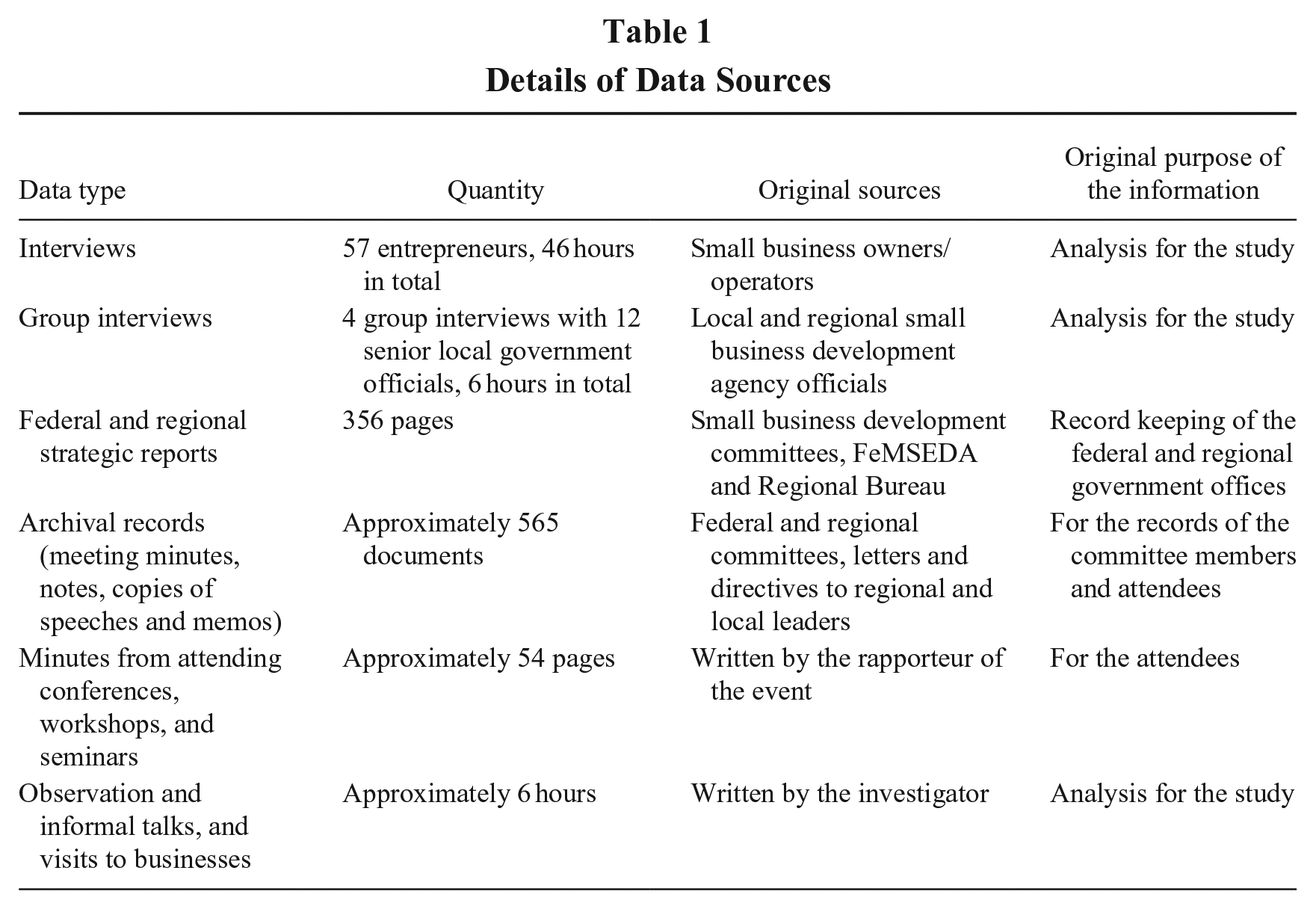
Interviews with entrepreneurs
To understand the lived experience of entrepreneurs operating a venture in an early-stage market economy, we used semi-structured interviews as our primary data source (Eisenhardt et al., 2016). We drew a stratified random sample of firms from the database of local Trade Bureau agencies and Kebeles’ roster books, covering manufacturing, trade, service, and urban agriculture ventures. We oversampled the manufacturing sector and young firms, as manufacturing is the government’s priority sector. We contacted entrepreneurs with no more than 10 years of operating experience. We identified 342 firms as of February 2019, contacting 183 entrepreneurs representing diverse firm sizes: micro, small, and medium enterprises. Initially, we received a positive response from 103 entrepreneurs to participate in our research. Many of these entrepreneurs, however, declined to openly discuss questions about the nature of their interactions with government officials, despite our assurance of anonymity and were excluded from the analysis. Ultimately, we conducted a total of 57 interviews with entrepreneurs who operate firms ranging from micro to medium size.
Data collection was conducted over the period between March 2019 and September 2020. In addition, we conducted follow-up interviews with some of our informants by phone in March and May 2021. Our first author is fluent in several local languages and conducted the interviews in Amharic and Tigrinya. All interviews were translated into English for analysis. As noted, the research covered the four major regional states, ensuring representative data from across Ethiopia. Each interview began with questions about the informants’ demographics and characteristics of their venture, such as firm size, number of years in business, and sector. We followed by asking questions about the understanding and nature of entrepreneurs’ regulatory compliance activities and their relationships with government officials. This provided a detailed understanding of the firms’ varying degrees of regulatory compliance and the way they interact with government officials. As our interviews progressed, we identified the core ideas and concepts to examine in the next round of interviews. These core ideas and concepts included the entrepreneurs’ perceptions about operating a firm, their regulatory environment, their compliance or noncompliance with institutional requirements, their methods of accessing resources, and their business goals. Building on each interview, we continued to explore the themes identified in the initial interviews in more detail. Specifically, we sought to better understand entrepreneurs’ choice for the formality of their firm and the nature of their relationship with government officials in order to maintain that chosen level of formality. We promised anonymity to entrepreneurs and encouraged them to engage in a conversation with us and share their stories freely. Each interview ranged from 30 to 90 minutes, and with the consent of the participants, most were recorded. Where consent was declined, we took extensive handwritten notes, generally during the interview, although in some instances immediately after. We capped our sample when “theoretical saturation” was reached and we could no longer make substantial new inferences from the growing sample (Gioia et al., 2013). Detailed information on the characteristics of all sample participants is provided in the Online Supplemental Material 1 .
Interviews with government officials
We corroborated our data from entrepreneurs through interviews with 12 government enforcement officials, from different business development agencies, in four group interview settings (with three officials from each regional agency). These interviews focused on specific topics: (1) regulatory requirements for businesses and what the officials think about current regulations; (2) how strictly they enforce the regulations in the market; (3) the nature of their relationships with firms in the market; and (4) the measures they take when firms fail to comply with regulatory requirements.
Archival materials
We captured archival data from the Federal Micro and Small Enterprise Development Agency (FeMSEDA) and regional offices, including annual and committee reports, as well as workshop, conference, and seminar minutes, to enrich and validate our data. The extensive review of secondary documentation on the Ethiopian economy helped us build a systematic understanding of the institutional fabric of Ethiopia and informed our theorizing on the interaction of entrepreneurs and government officials.
Analytical Process
To better understand the manner in which early-stage market economy entrepreneurs operate their firms, we used an interpretive inductive approach (Gioia et al., 2013). We maximized the potential generation of new insights and causal mechanisms associated with inductive research by carefully selecting the context and sample as described in the previous section. Our data analysis involved a process of simultaneously collecting and analyzing the data, reassessing our findings, and returning to the field to collect more data on issues raised as important during the early interviews (Gioia et al., 2013). As we began our data collection, we attempted to identify concepts and patterns in the data by adopting the lens of firm formality and business-government relations. We coded various entrepreneurs’ actions, compared them, and gradually identified the formal market requirements that they reportedly complied with or defied, and the approaches that entrepreneurs used to achieve their business goals in an incomplete institutional environment. As new themes emerged, we followed up and continuously adjusted and validated our categorization with additional information from interviews.
We identified concepts and patterns in the data throughout the data collection period that we later developed into core ideas, themes, and aggregate dimensions, reflecting how and why entrepreneurs maintain a particular level of formality along a continuum, and adopt corresponding approaches when interacting with government officials. We identified relevant statements from the interviews and then grouped them into categories as first-order coding. We allowed statements and ideas to continue to emerge until we had a clear sense of the data and the developing relationships in the early-stage market economy. The resulting codes formed our “first-order concepts” (Gioia et al., 2013). Each first-order concept is supported by quotes from a minimum of three different informants and reflects the points of view of the informants. The next stage of the analysis involved combining these first-order concepts into meaningful second-order themes, which reflect the researchers’ interpretations of how the first-order concepts are connected. We then combined second-order themes into overarching aggregate dimensions (Gioia et al., 2013). This process was undertaken through discussion and consensus among all the co-authors with frequent iterations between raw data and emerging codes that explain how entrepreneurs operate on a continuum of formality and the strategic approaches they use for interacting with government officials. First-order concepts, second-order themes, and aggregate dimensions comprise the overall data structure. Figure 1 details the analytical process and data structure.
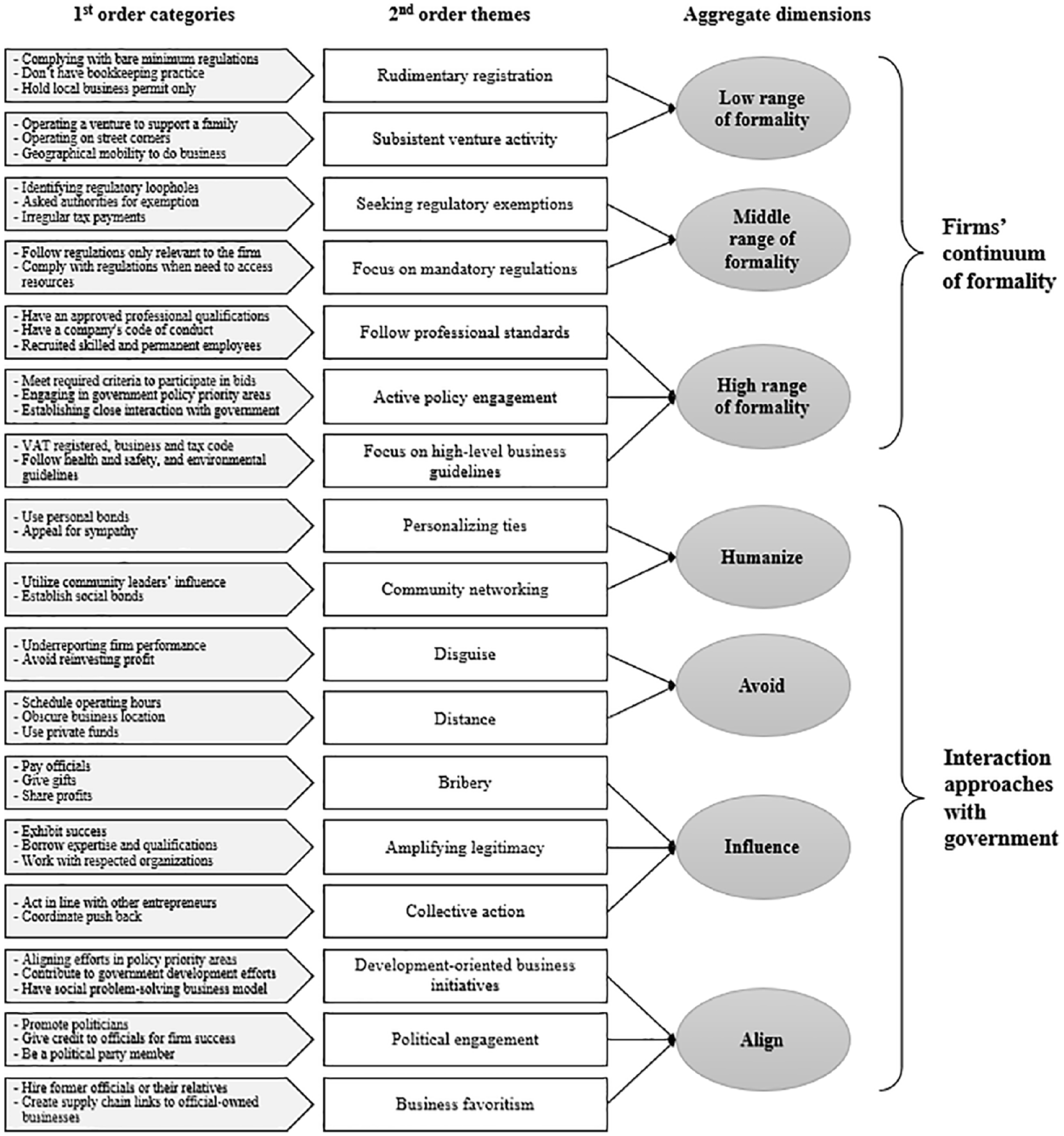
Data Structure
Findings
Our findings indicate that many entrepreneurs in an early-stage market economy make a conscious decision about their degree of regulatory compliance for formalization, essentially placing their firms on a continuum of formality. We found that entrepreneurs’ decisions on the level of compliance with formality requirements lead them to adopt various interaction strategies to persuade government officials to allow them to maintain their chosen level of formality. The interaction patterns between entrepreneurs and government officials were deeply embedded in social, political, and economic relationships. In the following section, we establish the Ethiopian context of firm formality, outlining why entrepreneurs manage their businesses with different levels of formalization. We then present the various strategic approaches used by these entrepreneurs when interacting with government officials.
Facilitating Firm Formalization in Early-stage Market Economy
The formalization expectations of the local authorities in Ethiopia are consistent with the government’s strategic effort to accelerate the economy and create jobs through venture activities (Oqubay, 2018). Our government informants also confirmed that the government’s priority is to promote more venture activities in the country. For example, a government official in Addis Ababa explained: “All our focus at the moment is to encourage anyone who is interested in starting a business and creating self-employment.” The government sees the promotion of entrepreneurship as a major part of the Ethiopian strategic plan for economic growth, and there have been government efforts to incentivize and, at times, pressure entrepreneurs to formalize their firm activities. A government official in the Ministry of Industry—a leading government department in Ethiopia for Micro, Small and Medium Enterprises (MSME) development—told us the following: “The government is dedicated to shifting our culture from job-seeking to a job-creating mindset. With concerted efforts nationwide, we aim to promote a vibrant MSME sector, accelerating economic development for our country.” During implementation of the government’s Growth and Transformation Plans—GTP I (2010-2015) and GTP II (2015-2020)—a significant focus was on developing the private sector so it would contribute to regional economic expansion and job creation, and gradually replace less productive ventures in the informal sector (UNDP Ethiopia, 2018). As a result, there has been a steady increase in the number of firms formally registered with the appropriate authorities over the past several years, evidenced by the documents we reviewed from federal and regional Industry and Trade Bureau agencies.
However, we also found that there are entrepreneurs who do not formally register with the appropriate government agencies but are known to local government officials and possess a rudimentary business permit issued by the Kebele. A Kebele official from the Tigray region explained the Kebele’s roster book, containing the list of local businesses: “The businesses you see on this list have permits to operate within the Kebele. But they do not have the official license or tax registration.” The Kebele permit gives entrepreneurs the ability to engage in formal market activities at the local level without facing any police sanctions. Entrepreneurs pay nominal fees to the Kebele to obtain the permit and access other related services.
Unlike other informal entrepreneurs, those with a Kebele permit maintain a certain level of interaction with local government officials. The Trade Bureau agencies do not officially recognize a permit issued by a Kebele as a valid license to conduct business activities. However, they do not actively intervene to prevent Kebeles from issuing such permits. The government officials we interviewed noted that this is partly due to the absence of an organized structure and effective communication among the various levels of government, which hinders the establishment of a unified and standardized formalization process. A government official in the Oromia Trade Bureau agency told us: “[We] let the Kebele do their things, and there isn’t much organized collaboration with them in terms of formalizing businesses.” Thus, the Ethiopian market environment encompasses entrepreneurs with various types of permits and registrations, indicating different levels of engagement with the regulatory requirements for business formality. Illustrative quotes from our interviews with government officials on the enforcement of business regulations are provided in Table 2.
Government Officials on Enforcing the Business Regulations
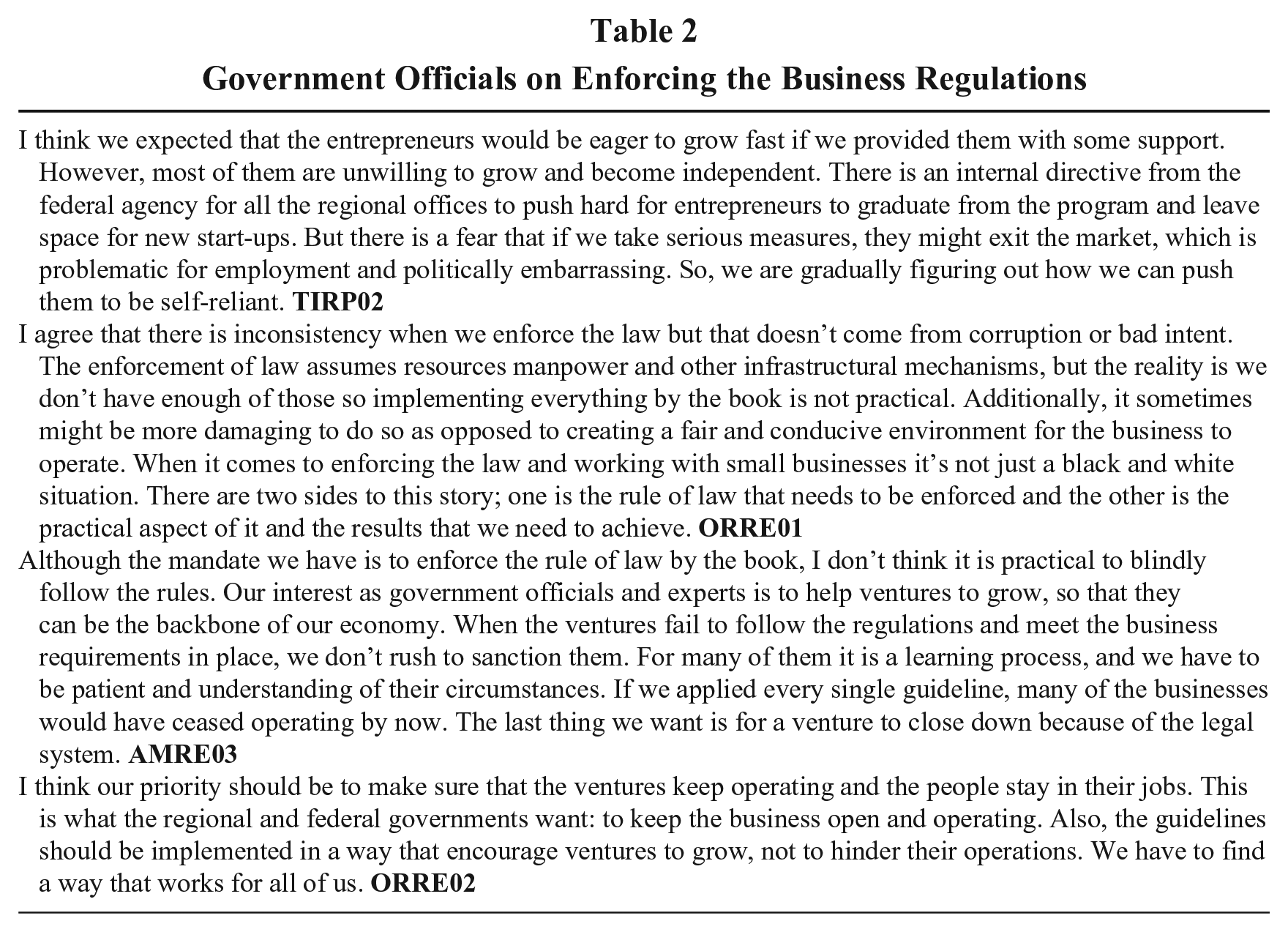
When we asked government officials how they interacted with firms to formalize venture activities, they suggested that they use any workable methods to get firms registered formally. These officials also have a high level of discretionary power when enforcing regulatory prescriptions consistent with the federal government’s outcome-driven approach to the market economy. “Yetim fichiw, duqetu bitcha amchiw” is a popular Ethiopian proverb that local officials regularly used to characterize the attitude of the federal government: “It does not matter where and how you do it, just bring the desirable result.” The federal government uses ad hoc analyses of entrepreneurship activities in each local administration to assess whether local officials are addressing unemployment and advancing national political and economic agendas. Despite the presence of objective and clear regulatory guidelines, local officials in Ethiopia customarily enforce (or elect not to enforce) market rules as a means to an end. For example, a government official from the Oromia region explained: “The government entrusted me with the power to enforce the regulations to ensure firms operate in the market appropriately. But it is up to me to use my judgment of how I can practically use the legal power.” Our data reveal that regulatory agents have pursued a “carrot and stick” approach to firm formalization. Officials give access to resources to those who register their firms and send enforcement agents to fine or confiscate the goods of those who refuse to register. An informant from a local government agency in the Oromia region stated on the drive to formalize businesses: Obviously, we want every firm to operate in the market formally. So, our initial strategy was to send a strong message to anyone who operates in the market that the least they can do is register. We use the media, public meetings and even gatherings for religious celebrations to convey the government’s directives. We have even involved the local police to register nano or micro entrepreneurs and to serve them a ticket if they are found doing business without a Kebele’s permit.
Choosing the Firm’s Level of Formality
The first key aspect of firm formality that we observed was the varying degree of compliance with regulatory institutions within the formal market economy. While government efforts to register firms have led many firms to take steps toward formalization, the pursuit of full formalization (that is, compliance with all of the prescribed business requirements), remains undesirable for firms. As our informants explained, the regulations are “bureaucratic,” “inconsistent from one government agency to another,” and “too costly to conform to.” Further, government officials have unchecked discretionary regulatory power, which leaves many entrepreneurs thinking that they do not necessarily need to conform to all regulatory prescriptions, as long as they have the right level of connection with the government official. For example, an entrepreneur explained: I formally registered my venture with the Trade Bureau office and have obtained a business license. But there are some laws that I know I’m required to follow, such as employee contracts and environmental regulations, but these are the regulations I don’t comply with. I have some connections with some of the authorities that look after me.
Similarly, an informant from the Trade Bureau agency in the Oromia region explained the varying degrees of firm formality: If you ask me, it is difficult to point to an ideal formal firm. We have firms that try to avoid even the basic business requirements. Others comply with some of the regulations and resist complying with other requirements depending on the perceived impact on their firms. We also have very formal firms that comply with almost all the regulations.
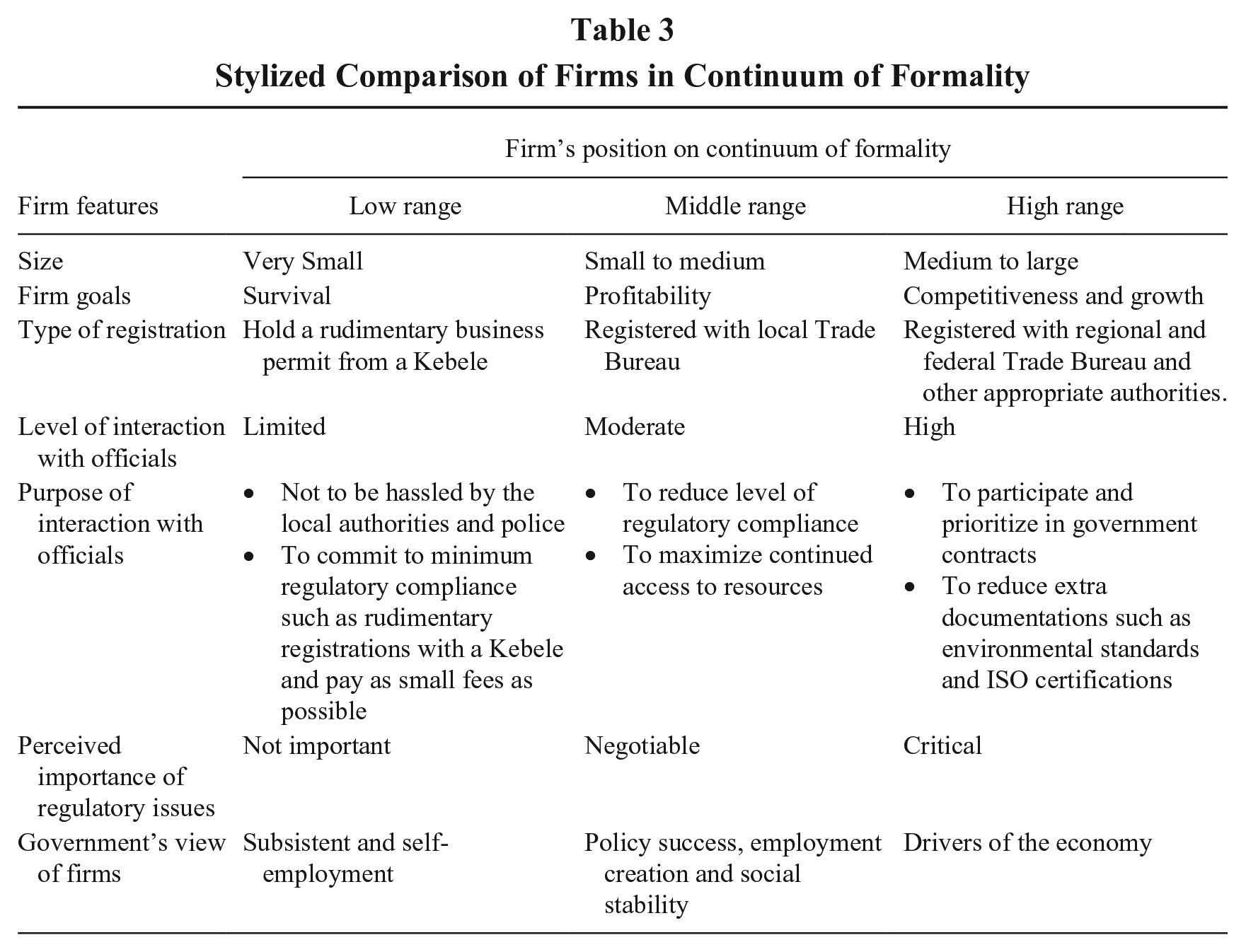
Our data revealed that there are specific characteristics associated with the level of firm formality on the continuum. Our key observations of the firms operating in each of the ranges of the continuum (low, middle, and high ranges of formality) are summarized in Table 3.
Stylized Comparison of Firms in Continuum of Formality
We found clear evidence that entrepreneurs do not consider formality as a discrete choice between formality or informality; rather, they position themselves on a continuum of regulatory compliance with corresponding degrees of formality. We asked entrepreneurs to assess their firm’s level of formality using the characteristics of firm formality identified in the Ethiopian Commercial Code and in the wider literature, including having a rudimentary business permit from the Kebele, a Trade Bureau license or other form of registration, paying tax, securing a fixed work address, registering for VAT, and entering into labor contracts. The informants in our sample openly shared the business regulations with which they comply and those they do not. A detailed table illustrating how each venture in our sample engaged or disengaged with regulatory compliance on the continuum of formality is provided in Online Supplemental Material 2. Many entrepreneurs do not see the formal regulations as strictly binding, and they proactively choose what rules they will comply with and what requirements they will abandon. For example, an entrepreneur from Addis Ababa noted: From what I see, the rules in the book and the rules in the market are two different things. In business, some of us break a few rules, others break many rules. It depends on the authorities you deal with and how you deal with them. Everything is negotiable. If you want to win, you need to know how you play the game and who you play it with.
For clarity of analysis, we segmented our sample firms into firms at the low, middle, and high ranges of the continuum of formality. For example, firms at the low end of the formality continuum often hold the rudimentary business permit issued by a Kebele but adhere to no other regulatory requirements in the market. Whereas firms sitting at the middle range of formality are those operating formally, with complete registration with the local or state level Trade Bureau agencies and exhibiting key behaviors such as paying regular taxes, securing a fixed working address, and often registering for VAT. We applied the high-range formality label to businesses that meet almost all state and federal regulatory requirements and often reinforce their formality by obtaining professional accreditation and licensing. From our sample firms, 16 were categorized as low-range formality, 21 were categorized as middle-range formality, and the remaining 20 firms were categorized as high-range formality. We next discuss these three levels of formality in detail in turn.
Low-Range Formality
Entrepreneurs in the low range of the formality continuum are subsistent in nature and turn to self-employment to meet the needs of their families. The ventures they operate are often small and focus on handicrafts, mobile street food vending, and the sale of agricultural products. In our sample, entrepreneurs within the category of low-range formality often do not have a permanent working address and typically operate on street corners or in low-cost fixed rental areas in local markets. For example, a vendor who runs his business explained: “I move from place to place to sell goods. This way, I can sell quickly. Although [local officials] have told me to get a permanent place, I’m not planning to run my business at a fixed location like other businesses.” Although the formal regulatory prescriptions of such ventures can include registration with the Trade Bureau, the payment of tax, and other basic-level business requirements, many of the entrepreneurs at the low end of the formality continuum typically do not want to extend their compliance beyond the rudimentary registration with the Kebele and adherence to the most basic requirements, such as maintaining sanitary standards. For example, a micro business owner said: I am frustrated with the [officials from the Trade Bureau], who keep visiting to check if I am compliant with business guidelines that I am not even familiar with. I already have a permit from the Kebele, and I am not willing to do more at the moment. My business is running smoothly without these additional regulations.
Kebele registration ensures that firms can operate in the market and avoid trouble with the police, who depend on the registration fees for part of their salaries. Entrepreneurs who choose to operate at the low range of the formality continuum often do not draw on government support or resources, nor do they consider regulatory issues as important to the operation of their ventures; thus, they do not see the benefits of abiding by any greater regulatory expectations. As one entrepreneur commented: “To be honest with you. I don’t see the point of the government asking us to meet this requirement and to follow that rule.” As a result, there is no desire to further formalize their venture. This is consistent with prior research findings (e.g., De Castro et al., 2014), indicating that informal entrepreneurs often attribute their lack of formalization to the limited benefits of complying with formal regulations. For its part, the government does not see ventures operating at the low range of the formality continuum as productive economic players. So, while there is interest in further formalizing all ventures, the government tends to worry least about the small informal ventures. As a local government official explained: There are firms that only come here to renew their permit certificate. We know they are operating in the market because they are in our roster book, but we don’t know their capital, annual revenue, or daily business activities. If we choose to disengage or deny them permits for retail activities, they may opt to close down their businesses, resulting in increased unemployment. It will also encourage lawlessness and can have adverse effects on local security.
Although local officials may be familiar with these entrepreneurs and interact with them at a certain level, for the most part, these entrepreneurs seek to “fly under the radar” and avoid close engagement with government entities.
Middle-Range Formality
Our data reveal that the majority of ventures in our sample were situated in the middle range of the formality continuum. Although these entrepreneurs consider codified business regulations relevant for their operations and to leverage market opportunities, they see compliance with these regulations as negotiable. Although these entrepreneurs comply with many government regulations, they fail (either by circumstance or design) to fully adhere to all regulatory requirements applicable to their business. Entrepreneurs positioning their firms in the middle range of formality make a deliberate choice to adhere to certain regulations, such as registration and tax payment, while actively resisting compliance with other more demanding regulatory requirements. For example, an entrepreneur who operates a construction business told us: I am careful how I operate my business. I am compliant with the main requirements such as tax or workplace safety protocols. But there are regulations that I find unnecessary for our business, like environmental regulations or contract laws. So, I try to sidestep the regulations that I believe are not good for the business.
These ventures are more profit-oriented, operate at a small to medium scale, and are more outwardly professional. They project credibility and competence in their business activities through their appearance, branding, communications, and overall conduct within the business environment; all of which aim to create a positive impression and build trust with external stakeholders. Rather than running their ventures unhindered by government regulation, these entrepreneurs interact with government officials to minimize regulatory pressures and obtain government funds and support, where possible. Illustrating this desire to interact with the government, an entrepreneur said: I think the rules and regulations are in place for a reason. But you need to figure out which rules are a must to comply with and which ones you can ignore and get away with. Otherwise, it will be tough to compete in the market and make a profit.
The high level of discretionary power of local officials in providing resources to entrepreneurs, combined with intense pressure on local officials from those more senior in the government—to promote ventures that have evidence of business formality—has created an environment where many entrepreneurs knowingly position themselves to their own advantage. They choose a level of formality that facilitates obtaining financial support from the government while allowing government officials to say the firms they support are “formal.” One entrepreneur told us, “I have learned that I can be strategic and selective in compliance based on how the government feels about certain requirements.” This pattern of middle-range formality entrepreneurs leveraging regulatory enforcement variations to their advantage is a major characteristic of doing business in Ethiopia.
High-Range Formality
Although firms at the high range of the formality continuum are still smaller than big corporations, they are typically larger than ventures operating in the middle range of the formality continuum. Although compliance with more of the regulatory requirements incurs higher costs, entrepreneurs operating at the higher end of the formality continuum see compliance as critical to building competitive advantage and gaining direct access to lucrative government business deals. For example, an entrepreneur stated: I don’t distance myself from the government. I work closely with the officials and that helps to build competitive advantage in the market. I don’t undermine my business by dodging the regulatory system. If I did, no one would take me seriously. I can compensate for the cost of compliance through the benefits I get from government contracts and facilitations.
In addition to meeting the regulations for formal ventures, high-formality firms proactively engage in government policy priority areas and position themselves as key allies in driving the success of national economic agendas. These entrepreneurs realize the opportunities presented by the continued economic growth of Ethiopia and aim to be major players in the growing formal market economy. An entrepreneur in Oromia explained the importance of policy awareness for a successful business: I believe that one of the smart things an entrepreneur should do is to pay attention to what the government is desperately trying to achieve. I created two separate businesses one in construction and another one in fertilizer production four years ago because I was aware of what the government would do to support businesses in these sectors. The government is generous in resources and regulations for businesses in these industry areas.
Rather than focus on the government as a source of support to drive a strong profit line, high-formality firms look to local and federal officials to legitimize and champion their ventures on a wider stage, and they recognize that the only way that they can receive these benefits is if they operate as more formal ventures.
Firms’ Strategic Approaches to Interaction with Government Officials
Interviews with entrepreneurs operating firms at various formality levels revealed that entrepreneurs proactively strategize their interactions with government officials in pursuit of their chosen level of formality. We identified four main proactive strategic approaches that they use: humanize, avoid, influence, and align strategies. These approaches are not mutually exclusive, and entrepreneurs often employ them in combination, based on their circumstances or specific goals. Further, entrepreneurs may shift their chosen strategy over time, highlighting the dynamic and temporal nature of these approaches that will align with evolving business interests. In our sample, 21 of the firms used humanize strategies, 15 used avoid strategies, 36 used influence strategies, and 23 used align strategies. A detailed table illustrating each sampled firm and participation in various formal or informal approaches to government interactions is provided in the Online Supplemental Material 3 . We present our grounded theoretical model of entrepreneurs’ strategic interaction approaches with government officials based on their level of formality in Figure 2.
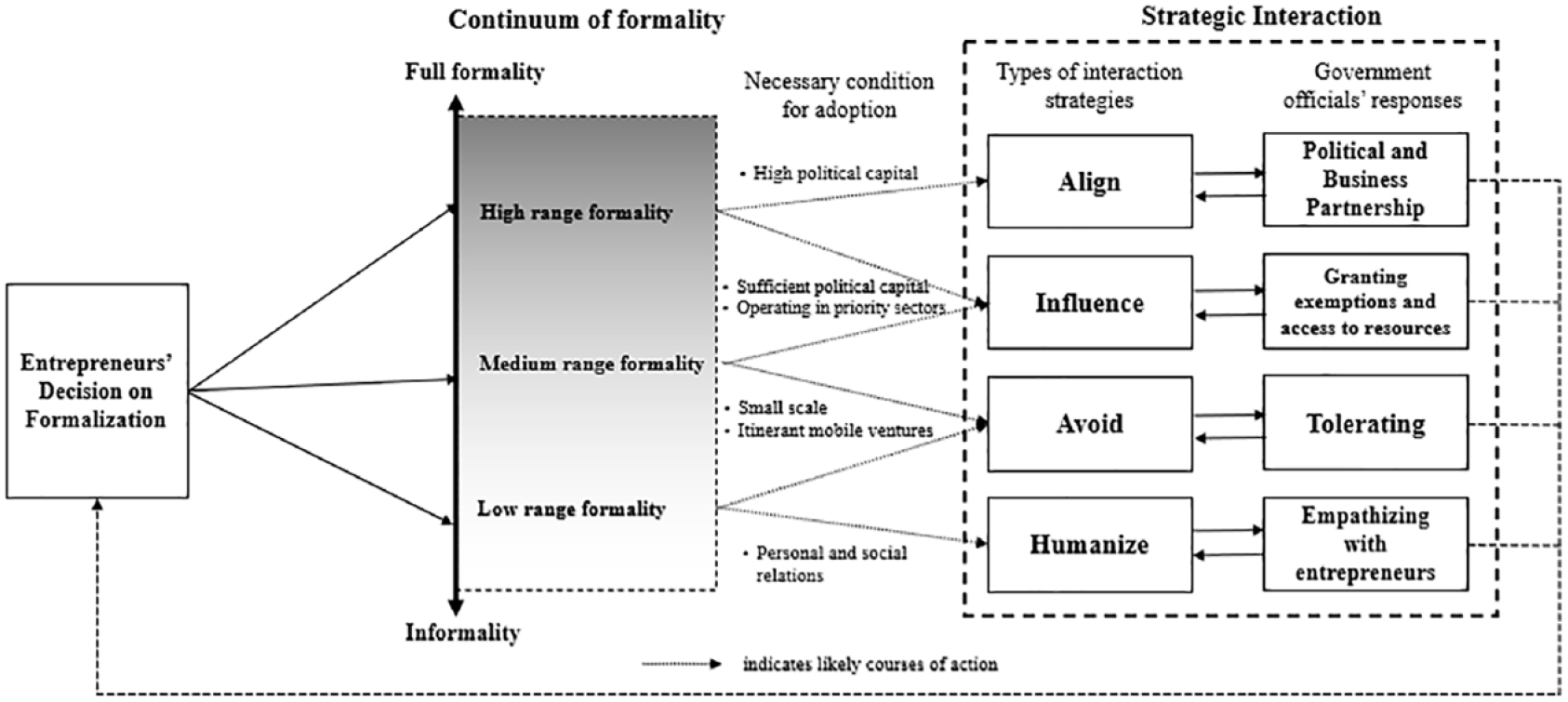
Entrepreneur–Government Interactions in Firm Formalization
Humanize
We found that in their interaction with government officials, entrepreneurs deliberately attempt to humanize their ventures to avoid repercussions for noncompliance. An entrepreneur who runs a small textile handicraft business told us humanizing the business results in enforcement officials being more tolerant of informality: “I share my stories and the struggles I face to provide for my family with the enforcement officials. Usually, they do not fine me for anything related to the rules, as they are sympathetic to my situation.” By humanizing their ventures, entrepreneurs seek to divert the attention of officials to the social and economic plight of entrepreneurs rather than focus on their noncompliance. Our data reveal that entrepreneurs use personal and social bonds, appeal for sympathy, and enlist community leaders to influence officials. We present additional representative data in Table 4. We found that the humanizing approach is adopted mainly by entrepreneurs who are at the low range of the continuum of formality. These entrepreneurs build personal bonds and social familiarity with local government officials and seek to operate their ventures by complying with the bare minimum regulatory requirements. They do not have the power—political or financial—to influence or resist enforcement officials who seek to impose penalties for regulatory noncompliance.
Approaches to Humanize Venture Activities
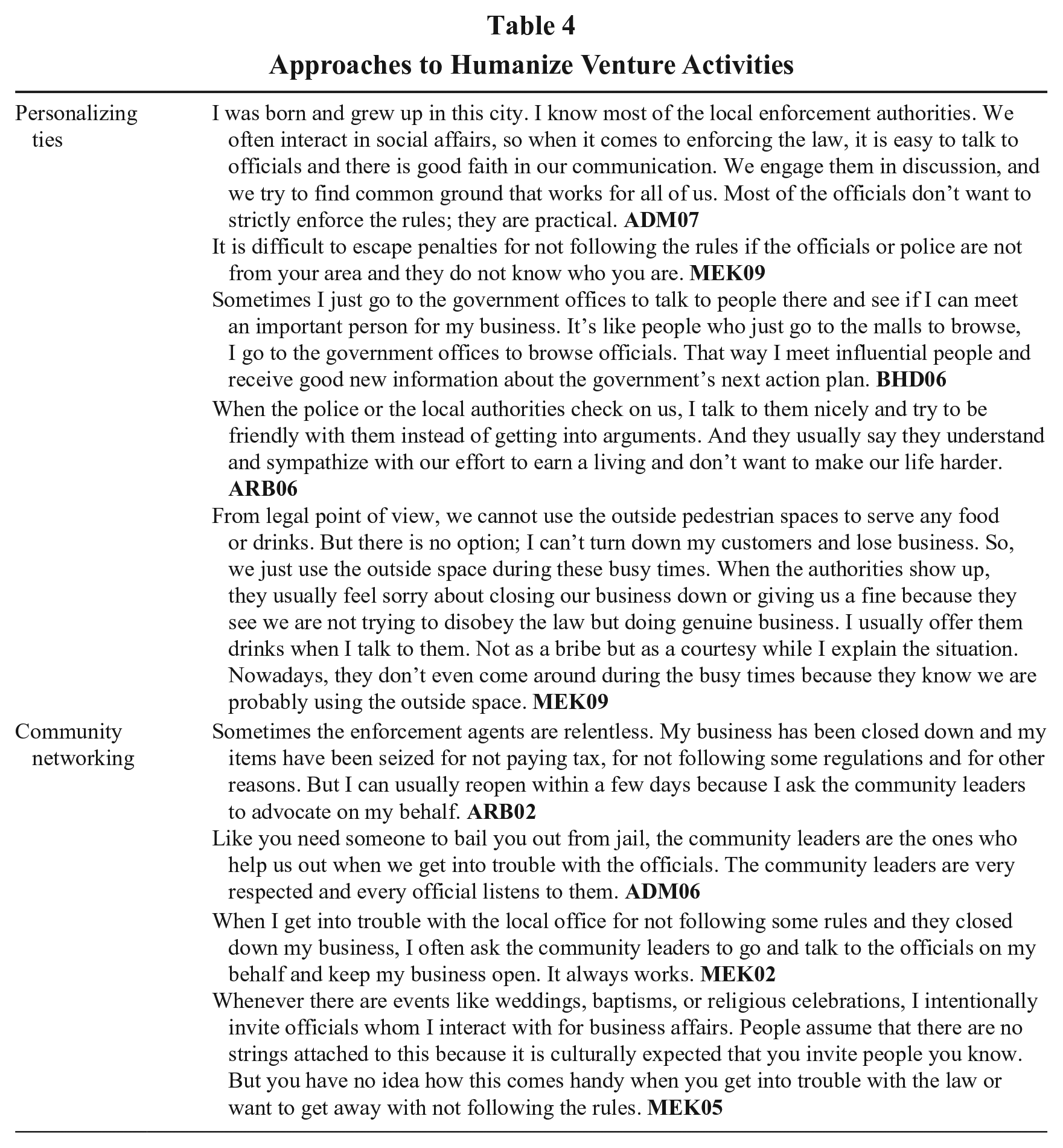
Using the humanize approach, entrepreneurs seek to reduce harassment and convince officials to refrain from strict enforcement of regulations, or from sanctioning the entrepreneur for noncompliance. For example, an entrepreneur noted: I know many of the officials personally and that helps to talk them out of their decisions. I have not been fined as often as others for not following all the business rules.
Our findings suggest that entrepreneurs’ efforts to humanize their venture activities are deliberate in nature and focused on reducing the negative consequences of regulatory noncompliance. Officials are less inclined to enforce regulatory prescriptions when they have personal and social familiarity with the plights of entrepreneurs. As entrepreneurs who use the humanize strategy are often subsistent in nature, government officials are reluctant to impose measures that might exacerbate poverty, which would occur if those business owners were unable to sustain their livelihoods. For example, one enforcement official told us why he doesn’t issue fines to entrepreneurs who do not comply with formal regulations: “I know it is not fair to those who follow the rules, but I just cannot penalize [subsistent entrepreneurs] in good conscience, knowing it will adversely affect their livelihood. Sometimes it is better to turn a blind eye.” Additionally, forcing these low-formality entrepreneurs to cease operations would go against the spirit of the government’s entrepreneurship policy, which aims to foster business creation and self-employment opportunities for individuals. The entrepreneurs in our sample who adopted the humanize strategy pointed to the fact that law enforcement officials are generally members of the community. These ventures operate primarily within local-level markets characterized by close social and personal connections between entrepreneurs and local government officials. This intermixing effectively lessens the authorities’ motivation to strictly enforce formal regulatory requirements, creating a more lenient environment in which they readily empathize with entrepreneurs. An entrepreneur explained this well: The police and other enforcement officials know who we are, and they understand our living situation. They live in the neighborhood, and we are socially connected. So, I have to make the officials understand my situation so that they don’t penalize me for not following the rules.
To further persuade officials to refrain from taking measures against noncompliance, entrepreneurs often engage community leaders to emphasize their living situation, which promotes empathy and minimizes the motivation of officials to enforce formal regulations.
Avoid
For firms that exceed a subsistent level of assets and achieve a strong capital base, the humanizing strategy becomes less effective, prompting entrepreneurs to seek alternative approaches to minimize their regulatory burden. For example, an entrepreneur from Addis Ababa told us, “I cannot ask for leniency when my business transactions appear to be far greater than the micro businesses around here.” In such cases, our findings indicate that entrepreneurs deliberately avoid direct engagement with government officials to minimize regulatory pressures for further formalization. Avoiding interaction with authorities involves disguising venture performance and making business operations less interesting to officials or physically distancing the venture from officials through restructuring business operations (i.e., changing opening times, location, and sources of resources). Avoidance is used principally by entrepreneurs in the lower range of formality and, to some extent, by middle-range formality ventures. Representative data for avoidance is in Table 5.
Approaches to Avoid Interaction with Government Officials
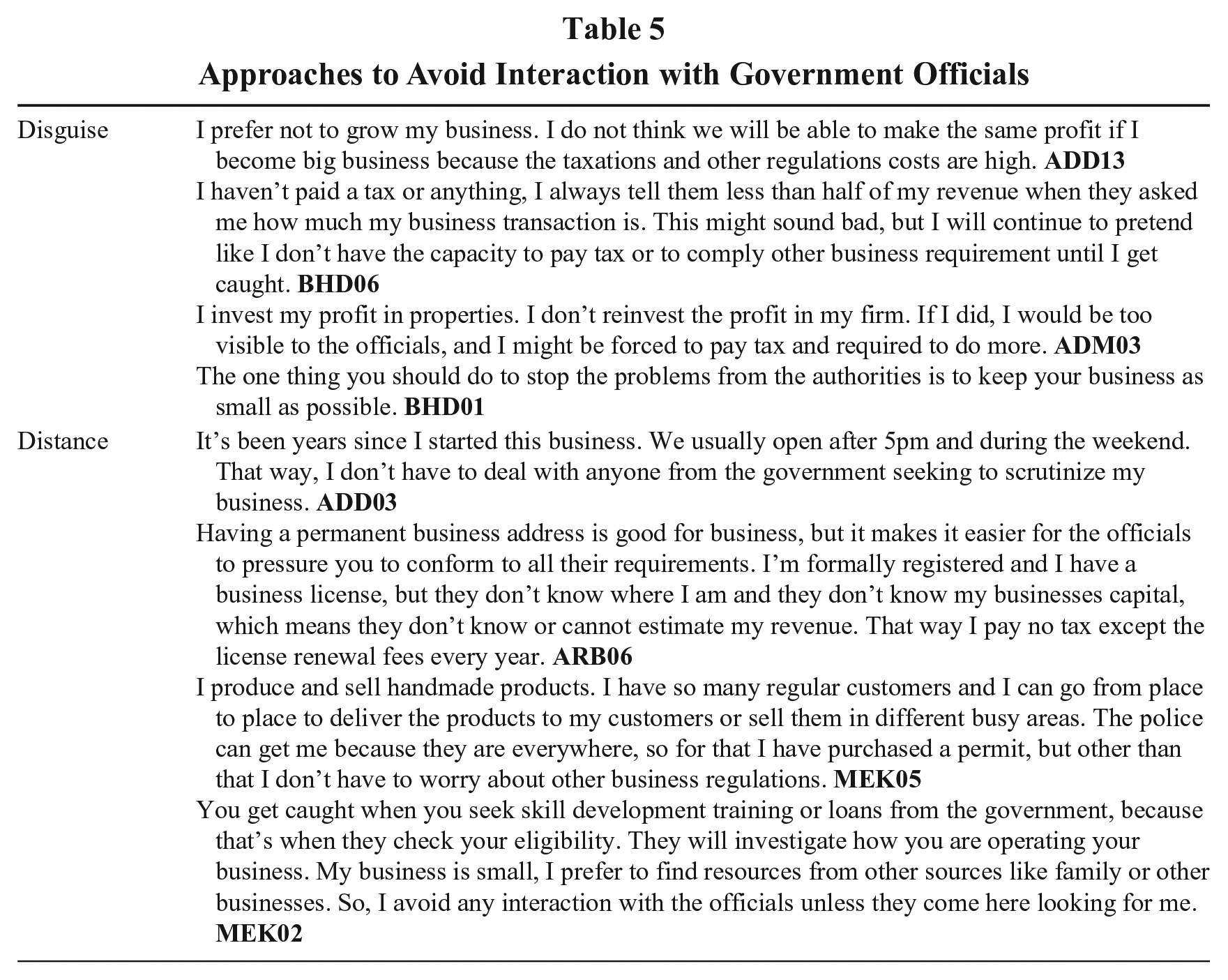
Entrepreneurs who avoid interaction with government officials often do not seek resources or other support from the government to operate their firms, as this would require close interaction with authorities. Several informants described altering their business activities in ways that made them less conspicuous to government officials, who are generally focused on higher-grossing firms. An artisan entrepreneur who produces jewelry and leather bags explained why she is reluctant to meet all of the formality requirements: I understand why some individuals want to schmooze with government officials to access resources or contract jobs for their businesses. But that is not my approach. I don’t need anything from the government to do my business. My customers are individuals, not government agencies. So, I try to avoid [enforcement officials] as much as I can. To be frank, I don’t even need to rent a shop, obtain a license, or even pay taxes. I can run the business from my home, hidden from the government, without losing much in the business.
By avoiding enforcement authorities, entrepreneurs can reduce scrutiny and are likely to evade the abiding imperatives of formal regulatory requirements, such as paying tax. This finding is consistent with the scholarly evidence on disguising practices (e.g., Oliver, 1991; Sutter et al., 2013), where entrepreneurs disguise the true nature of their business activity to reduce the pressure of conforming to prescribed regulations. As small ventures in early-stage market economies often do not keep detailed books, and as agencies tasked with monitoring and enforcement are understaffed, the risks of detection of underreporting are low. An entrepreneur explained how this happens in practice: Whenever the officials ask about my venture’s revenue, I usually tell them the same amount of sales revenue and it’s unlikely they’d know how much I make every year. I don’t want to attract any attention from them.
We found that when entrepreneurs are operating in non-priority sectors and not seeking any resources from the government, they appear to actively use an avoidance strategy to distance themselves from government officials by disguising venture performance or physically distancing the venture from officials through restructuring business operations. Our informants noted that they avoid enforcement authorities by rescheduling the operating times of their business to when the authorities were off duty or would work from obscure locations to ensure that they would not encounter officials.
Influence
We found that entrepreneurs act to influence government officials to minimize the pressure to comply with regulations. The influence strategy is mainly adopted by entrepreneurs in the middle and high ranges of formality. Many of these entrepreneurs possess substantial political capital, as they are considered to embody the government’s strategic plans to achieve the goal of becoming a major manufacturing hub in Africa and being a low- to middle-income country by 2025 (Oqubay, 2018). Influencing includes bribery, promoting success of the venture, and mobilizing collective actions. Entrepreneurs employ influence strategy activities when their interest in how to formalize their firms is incongruent with the authorities’ demands. We present representative data in Table 6. We found that these entrepreneurs do not seek to humanize their venture or avoid interaction with officials; rather, they seek to proactively influence officials to go easy on their compliance measures or to grant them exemptions and to allow them to continue accessing government support. An entrepreneur from the Amhara region explained the importance of influencing government officials for flexibility in firm formalization:
Approaches to Influence Government Officials
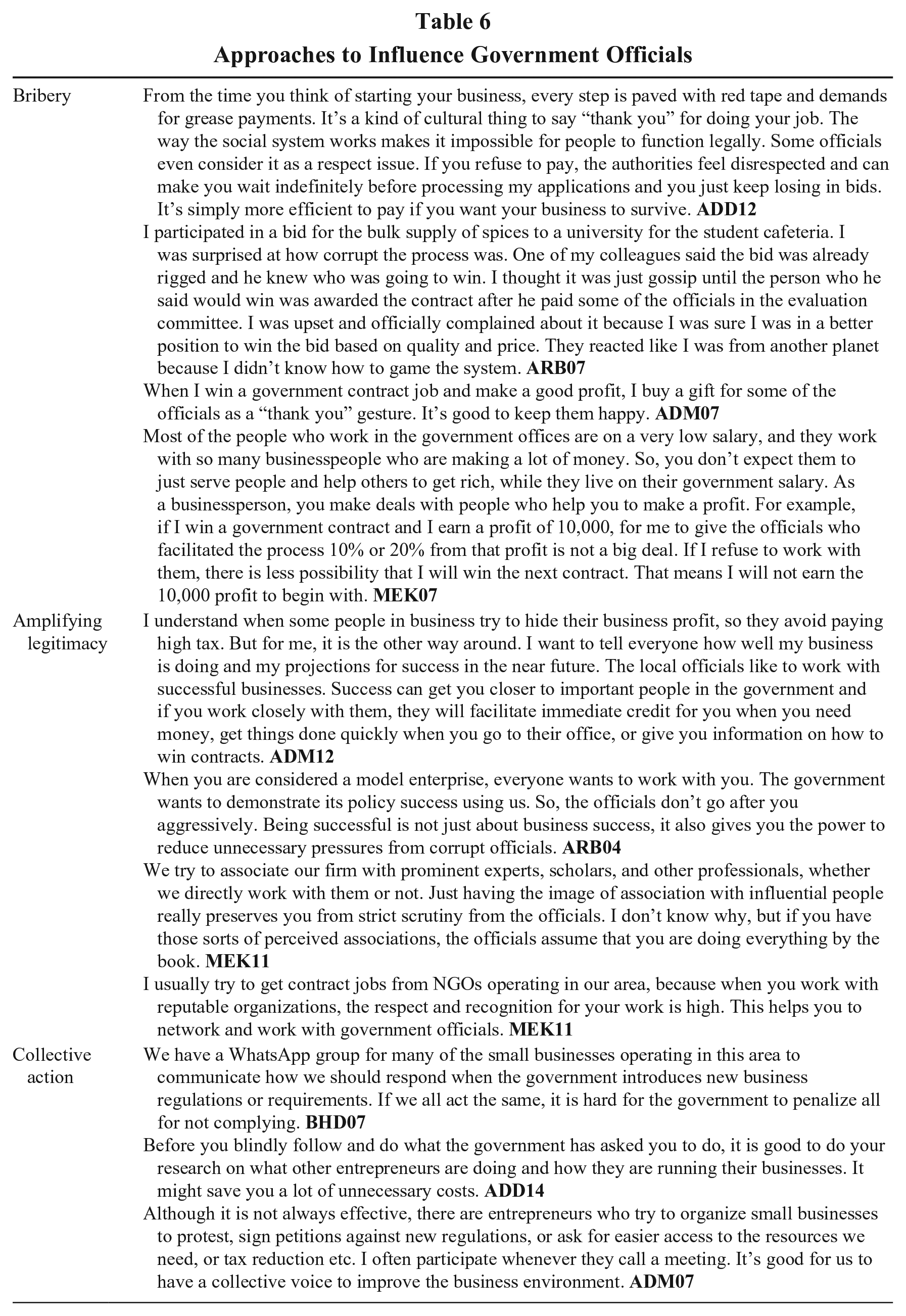
No matter how you do it, you need to have some sort of influence on the officials if you want things to go the way you want. It’s about give and take. I have to know how to keep the authorities away from scrutinizing my business or getting what I want from the government without fulfilling all the expected requirements.
Entrepreneurs use bribery, in the form of gifts and by sharing a portion of their venture’s profits directly with officials, in exchange for leniency in enforcement or to secure strategic resources from the government. Interestingly, many of the entrepreneurs we interviewed do not see bribing officials as a challenge to their venture. For example, an entrepreneur in the manufacturing sector told us: “That’s how business works [bribing]. I do a lot of work with government agencies, and I need to keep the [government officials] happy to achieve my business goals.” Entrepreneurs see bribery as a strategic business action and an effective means to gain access to resources and government contracts, and to lobby and influence government officials to make favorable decisions for their ventures. As one of the entrepreneurs told us: To be honest with you, most firms use bribes to reduce scrutiny and other regulatory pressures. We don’t just bribe because the officials ask for it, we identify officials we can fairly transact with. So, I am not going to say I’m a victim of corruption. I see it as a fair business deal.
Other entrepreneurs seek to impress and influence government officials by promoting or inflating the success of their ventures. An entrepreneur told us: “I became a role model entrepreneur last year because of my business performance. Since then, I use it to get some priority to access loans from the government. The role model status gives some level of power to get things done quickly.” As a venture grows and becomes more visible to government officials, its importance to the government also grows because of the increased impact (or potential impact) on the success of prominent politicized economic programs. This recognition helps firms build some political capital to influence the enforcement process and creates an environment where such firms have greater flexibility concerning their regulatory compliance. An entrepreneur from the Tigray region told us, “The government officials tend to take people at face value. If I tell them my business is growing and I have accumulated a huge capital, they will include my business in their report to the federal government as a model enterprise without double-checking whether it’s true.” As the government has launched various projects to promote entrepreneurship that support those who show potential for growth and innovation, it is vital that entrepreneurs are unabashed and vocal about their achievements. Several of our informants reported that they frequently profile their business activities and success in the media and in government reports to alert government officials and draw attention to their venture’s success. For example, an entrepreneur explained: If you want to build a strong relationship with government officials and attract more support instead of scrutiny, you need to demonstrate success or pretend to be successful. That way the government sees you as one of their showcases to demonstrate how their support and investment is working. When you show how your firm is succeeding, the officials’ focus will be on what you have achieved instead of how you have achieved it.
Similarly, our data reveal that entrepreneurs often join together to influence officials and obtain concessions as a group. The entrepreneurs take coordinated collective action by pushing back against the strict enforcement of government directives. In doing so, the entrepreneurs put pressure on the authorities to accept certain activities deemed to be rule-breaking, or at least to refrain from sanctioning them. An entrepreneur from the SNNPR explained how entrepreneurs encourage each other to stick together and take similar action to influence government decisions: “We use WhatsApp or Telegram apps to communicate what we all should do to have favorable regulations for us.” Many informants reiterated the approach that they are clearly aware of their ability to resist the government if all similar ventures cooperate, as government officials cannot close down the firms or enforce regulations on these ventures en masse. For example, an entrepreneur from the Oromia region told us: “I know the power to regulate is with the government, and businesses should follow guidelines. But if [entrepreneurs] come together and act collectively, we are the ones who decide what needs to happen.” Expansive networks strengthen relationships among entrepreneurs and “raise the stakes” for any government reaction to noncompliance. For example, an entrepreneur who sometimes acts as a mobilizer and representative of new venture small businesses recounted one of the collective actions in which he has participated: Last year, the local administration informed us we needed to have at least a one-year lease agreement with landlords to renew our business license. I was one of the organizers to protest against this requirement. We had many discussions with the officials and finally, they dropped it.
Similarly, a government official from the Tigray region noted: “Not everything we regulate is going to be enforced. When the noise from the firms gets louder, the local administrations back off.”
Align
We found evidence that by aligning with government officials in mutual political and economic interests, entrepreneurs can build stronger relationships and ultimately advance their firm’s competitive advantage, increasing market size, and gaining access to strategic capital and government contracts. Unlike the influence strategy that entrepreneurs used to address incongruency in interests or regulations, the align strategy is employed by entrepreneurs who tend to work closely with government by proactively creating formal businesses in sectors considered critical for the government’s national economic growth agenda. As one informant explained, “the nature of my business has to match with what the government envisions for businesses that benefit the nation.” This approach provides entrepreneurs with access to government-related benefits such as contracts, tariff-free imports, and access to large capital assets including land, foreign currency, and other infrastructure needed for venture operations. By adopting the align approach, entrepreneurs engage in development-oriented business initiatives, political membership, and business favoritism. We provide representative data in Table 7.
Approaches to Align with Government Officials
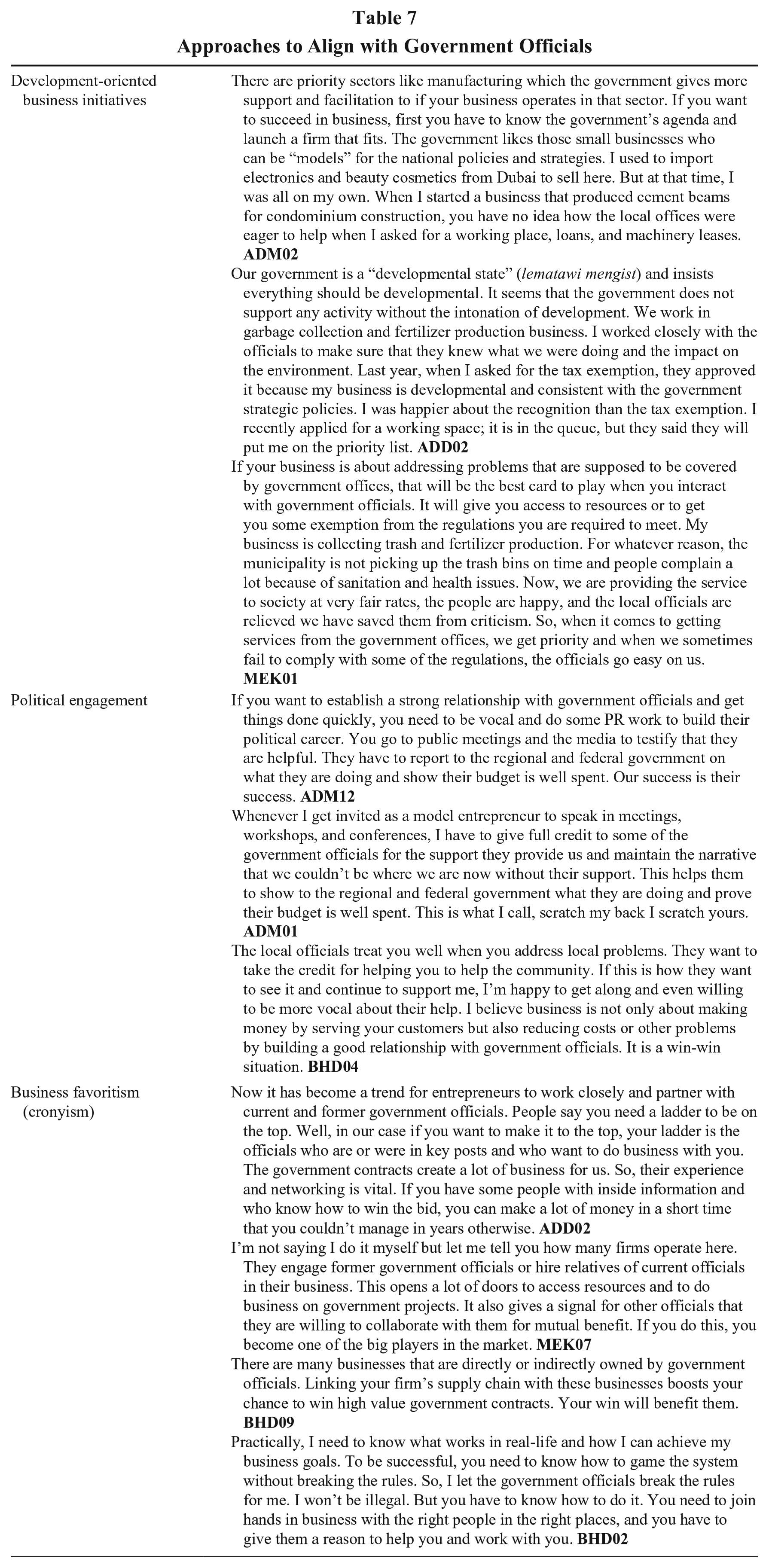
One of the Ethiopian government’s ambitious strategic plans is to become Africa’s manufacturing hub (Oqubay, 2018). Entrepreneurs see this plan as an opportunity to develop strong connections with local and federal officials by engaging in business activities that the government deems essential for economic growth. In their own words, these entrepreneurs worked to fry the big fish (tiliku asa le matimed), implying that they are trying to be at the center of the government’s strategic economic development plans. For example, an entrepreneur from Addis Ababa who runs a leather manufacturing firm told us: “Although the official message from the government is ‘all businesses are important,’ there are sectors that the government prioritizes and provides special support. It’s important I operate in these sectors.” Development-oriented business activities that align with the government’s economic development narrative are typically strategized to attract government attention and rewards, often in the form of subsidies, for their contribution to national policy goals. Several sampled entrepreneurs reported that they strategically chose to enter sectors considered priority areas by government. For example, one told us: I used to run a business that imported consumer goods from China and Dubai. I shifted to the manufacturing sector because government money and attention is focused in this sector. If your business is in manufacturing, it is easier to create connections with people in power and win lucrative government contracts.
Other entrepreneurs, operating at higher levels of formality, pursue an align strategy by becoming members of major political parties. Our data reveal that entrepreneurs’ political membership reduces the pressure of regulatory compliance. For example, an entrepreneur from the Oromia region explained why he is a member of a political party: I am not a political person at all. But I registered as a member of a major political party because I want to show that I am pro-government. I don’t want my business to be targeted and overly scrutinized by government officials.
Government-controlled media regularly cover successful ventures as evidence of government policy achievements. Officials often assert that their support for entrepreneurs has contributed to the surge in the number of new enterprises, leading to job creation and economic growth. The entrepreneurs we interviewed were well aware of how vocally praising local officials and attributing their success to the officials’ work can facilitate closer interaction with government officials focused on advancement. An entrepreneur explained: Whenever I get invited to speak in meetings, workshops, and conferences as a model entrepreneur, I have to give full credit to the government officials in our local agency for the support they provide us and maintain the narrative that we couldn’t be where we are without their support. It is good PR for their political careers.
Another align approach adopted by several entrepreneurs is cultivating business favoritism by hiring former officials, or their relatives, into their businesses or creating supply chain links to businesses owned by officials. Entrepreneurs view the pursuit of government tenders as a necessary practice that gives their ventures a “leg-up” to compete with large domestic and foreign corporations. For example, an entrepreneur from Addis Ababa explained that hiring people “who have close personal relationships” with government officials, provides her with “the opportunity to conduct contract business” with government agencies. The entrepreneurs described forming partnerships with ventures related to government officials to encourage officials to award them lucrative government projects without submitting the required documentation. Our informants noted that such business deals differ from bribery—which is often associated with entrepreneurs in early-stage market economies—where kickbacks are given directly to government officials (Baron et al., 2018). Instead, government officials offer procurement deals to partnered ventures in the name of “encouraging domestic businesses.”
Our findings emphasize that government officials prefer to associate with high-formality firms that offer mutual benefits, contributing to their political profile and personal interests. It is less likely that a high-ranking government official will interact with an entrepreneur who cannot provide any reciprocal benefit. Therefore, the align strategy underscores the importance of mutual advantage in shaping interactions between entrepreneurs and government officials in early-stage market economies.
Discussion
As scholars (De Castro et al., 2014; Shahid et al., 2020; Williams et al., 2016) have noted, theorizing firm formalization on a continuum is still a growing scholarly interest. Building on the firm formalization and nonmarket strategy literature, we argue that entrepreneurs’ decisions regarding the extent to which they formalize their firms reflects an evolving strategic positioning that has implications for both their business operations and their interactions with nonmarket actors (Williams & Nadin, 2012). We raised two important questions at the beginning of this article that we now discuss in turn. First, we asked how entrepreneurs in an early-stage market economy decide to position their firms on a continuum of formality. We found that entrepreneurs in this setting have agency in determining the formality requirements they engage with, thereby positioning their firms’ level of formality. We noted that determining a firm’s level of formality is not a one-off decision. Rather, determining and maintaining a firm’s level of formality requires entrepreneurs to continuously interact with the officials responsible for enforcement. Second, we asked what nonmarket interaction strategies entrepreneurs employ to maintain their desired level of firm formality. Our findings identified specific interaction strategies—humanize, avoid, influence, and align—and we noted that their accessibility and effectiveness hinge on the personal and social connections they maintain with government officials, as well as the political capital entrepreneurs accrue by operating in government priority sectors.
Our study has implications for several issues that are important for theory building and research on firm formalization and nonmarket strategy. First, in the process of enhancing understanding of business-government relationships, we advance the literature on firm formalization by offering a grounded theoretical model, provided in Figure 2, detailing how entrepreneurs’ decision on the firms’ level of formality is associated with the strategies they adopt to interact with government officials. Theoretical arguments in entrepreneurship and management research have cast firm formalization in early-stage market economies as a process that is scaffolded by key nonmarket actors, such as government, NGOs, and other intermediaries, who help entrepreneurs formalize their firms in order to leverage formal market opportunities (e.g., Armanios et al., 2017; Mair et al., 2016; Sutter et al., 2017). However, we find evidence that government officials also play a role in the persistence of firm informality. In our study context, the government relies on private sector businesses as mechanisms for poverty reduction and to help deliver economic and social policy initiatives. This strategic interaction forms the basis of firms’ political capital, allowing entrepreneurs to sustain their preferred formality level. Our findings show how government activities encourage formalization but may, at the same time, facilitate continual engagement of entrepreneurs in informality. This duality creates an environment in which both entrepreneurs and enforcement officials see compliance with formal rules as negotiable and may explain why eradicating informality is difficult.
Second, several studies (e.g., Perry, 2007; Siqueira et al., 2016; Webb et al., 2014) have argued that entrepreneurs make rational decisions on formalization based on an economic calculation of the costs and benefits. This stream of research holds the assumption that entrepreneurs interpret formality rules as binding constraints and face a dichotomous “compliance-noncompliance” choice where entrepreneurs choose whether or not to obey prescribed regulations. While our findings acknowledge entrepreneurs’ consideration of compliance costs, our research shows that entrepreneurs’ decisions regarding the level of firm formality is intricately tied to their interactions with enforcement officials. By providing evidence of the strategic manner in which entrepreneurs choose their firms’ level of formality, our research redirects attention to the mechanisms through which those decisions are made—as a continuous process—and proposes a potentially critical theoretical lens to study firm formalization decisions in early-stage market economies.
Third, we contribute to the ongoing scholarly discussion surrounding the complex relationship between entrepreneurs’ strategic actions and the formal regulatory environment in the fields of entrepreneurship and management research (e.g., Dau & Cuervo-Cazurra, 2014; De Castro et al., 2014; Levie & Autio, 2011; Malesky & Taussig, 2017; Ram et al., 2020; Roitman, 2005; Shahid et al., 2020). Scholars have argued that entrepreneurs could leverage regulatory imperfections and political ties in their formalization decisions (Abid et al., 2023; De Castro et al., 2014; Nason & Bothello, 2022; Ram et al., 2020). Our study adds to this growing literature. We find that, despite their dependence on government for regulatory facilitation and resources, many firms in an early-stage market economy have more political capital than most scholars commonly recognize. By leveraging their political capital, entrepreneurs shape an environment that allows for selective enforcement, resulting in the diverse levels of expectation and compliance that constitute the continuum of formality. Therefore, we highlight that an important role for research on firm formalization is to examine how key actors in that process influence each other through political, social, and personal relationships.
Finally, our finding that entrepreneurs adopt specific interaction strategies that fit with their chosen level of firm formality indicates potential temporal and geographical dimensions to these strategies. For example, subsistent entrepreneurs employing a humanize strategy may find it advantageous to transition toward influence or align strategies in response to changes in firm growth. The evidence also indicates that entrepreneurs in particular geographical locations manage multiple firms simultaneously, strategically allocating resources between their firms to attract government attention and rewards or, conversely, to maintain a lower profile. These temporal and geographical dimensions suggest that the effectiveness of the interaction strategies may vary based on the evolving needs and circumstances of the business. We argue that formalization is a process consisting of regular and reoccurring strategic choices, requiring entrepreneurs to interact with relevant government officials on an ongoing basis.
Limitations and Future Research
Our study has a number of limitations that encourage future research. First, this research has focused only on strategies that entrepreneurs adopt in their interactions with government officials. Business-government interaction strategies may vary significantly, not only between developed and developing market economies, but also internally within the highly-impoverished markets of early-stage market economies (Cook, 1996; Oliver, 1991; Webb et al., 2014). Future research should extend the framework developed here to study how entrepreneurs in various early-stage market economies engage with government officials around the issue of formality. Second, further research could explore the temporal and geographic dimensions of the entrepreneurs’ interaction strategies highlighted above, in terms of how the application of these strategies varies depending on the growth stage of the venture in the entrepreneurial life cycle and the nuanced nature of localized government practices. We suggest future studies focus on the collection of longitudinal data to explore when and where such interaction strategies are deployed. Further, recognizing formality as a continuum requires researchers to build an intimate knowledge of the context they intend to study (Cavotta & Dalpiaz, 2022; Sutter et al., 2017). We identified the dimensions of formality with which the firms chose to comply from our empirical data. This set of dimensions includes elements, such as the rudimentary business permit, which are specific to our study context. Other contexts are likely to have their own particularities. Therefore, when considering measures of firm formality from the existing studies, future research must adopt measures that capture the specific dimensions of formality of the context.
Conclusion
In conclusion, our study provides empirical evidence to broaden the understanding of entrepreneurs’ decisions on firm formality as well as how they interact with government. We found that while registration and regulatory compliance costs contribute to how entrepreneurs formalize their firms, the decision on the firm’s level of formality is primarily influenced by the entrepreneurs’ interactions with government officials and the political capital entrepreneurs possess. To support this, we identified varying degrees of formality on a continuum and proposed a range of strategies utilized by entrepreneurs when interacting with government officials in an early-stage market economy. We hope that future research builds on the current study to investigate firm formalization decisions from the multi-faceted perspectives of business–government interactions.
Supplemental Material
sj-docx-1-jom-10.1177_01492063231224332 – Supplemental material for Firm Formalization Strategy: The Interaction of Entrepreneurs and Government Officials in the Enforcement of Regulation
Supplemental material, sj-docx-1-jom-10.1177_01492063231224332 for Firm Formalization Strategy: The Interaction of Entrepreneurs and Government Officials in the Enforcement of Regulation by Ashenafi Biru, Pia Arenius, Garry Bruton and David Gilbert in Journal of Management
Footnotes

References
Supplementary Material
Please find the following supplemental material available below.
For Open Access articles published under a Creative Commons License, all supplemental material carries the same license as the article it is associated with.
For non-Open Access articles published, all supplemental material carries a non-exclusive license, and permission requests for re-use of supplemental material or any part of supplemental material shall be sent directly to the copyright owner as specified in the copyright notice associated with the article.
