




Abstract
Time is gaining recognition as an important research perspective, yet the assumptions, concepts, and boundaries of this perspective vary greatly across different fields. This diversity suggests that time offers both significant depth and relevance as a lens for research. However, the diversity of approaches also harbors ambiguity and a lack of coherence, hindering scholars’ ability to integrate insights and harness the full potential of time as a research lens. To address this issue, we review the diverse time-based assumptions, domains, and concepts in extant research. Our review reveals three dominant manifestations of the temporal lens: time as resource, time as structure, and time as process. We analyze and synthesize insights of the three lenses to offer an integrative framework to support future research. The framework informs and reveals opportunities for time-based research by foregrounding connections and contrasts among the lenses. Building on this framework, we discuss two principal pathways for future research: connecting the three lenses through the study of tensions at their interfaces, and enhancing the three lenses through the study of more complex conceptions of time.
Introduction
Time has become an influential research lens in management and organization studies (Ancona, Goodman, Lawrence, & Tushman, 2001a; Bluedorn & Denhardt, 1988; George & Jones, 2000). A temporal lens invites scholars to use time-related concepts—such as pacing, timing, or rhythm—to generate innovative insights about managerial and organizational phenomena. Such insights matter because “seeing management without temporal dimensions creates blind spots and distortions similar to those experienced when seeing the earth as a two-dimensional map” (Bansal, Crilly, Jansen, Langley, Okhuysen, & Shipp, 2020). Thus, scholars increasingly use a temporal lens to advance research in various areas, including strategy (e.g., Kunisch, Bartunek, Müller, & Huy, 2017; Shi, Sun, & Prescott, 2012), entrepreneurship (e.g., Johnsen & Holt, 2023), organizational behavior (e.g., Shipp & Jansen, 2021; Tang, Richter, & Nadkarni, 2020), organization theory (e.g., Feldman, Reid, & Mazmanian, 2020; Hernes, 2022), and human resource management (e.g., Aguinis & Bakker, 2021).
Despite its growing influence, the temporal lens has often been applied “haphazardly rather than systematically to organizational topics” (Shipp & Cole, 2015: 238). Different research communities gravitate toward distinct, implicit, and often narrow use of what a temporal lens entails, where it is relevant, and how it matters for management and organizations. Thereby, they have built on and perpetuated divergent temporal approaches with conceptual legacies and assumptions of their own. For example, strategy scholars have conceptualized time as a measure of speed (Hawk, Reuer, & Garofolo, in press; Pacheco-de-Almeida, Hawk, & Yeung, 2015), whereas some organizational scholars view time as a symbolic expression of cultural values and attitudes toward work (Feldman et al., 2020). A diversity of approaches and assumptions implies richness. But when approaches and assumptions remain implicit, such diversity can hinder scholars’ ability to build on each other's work in an integrative way, ultimately preventing them from realizing the full potential and richness of the temporal lens.
Thus, a review is timely, necessary, and valuable to foster clarity about time as a research lens, identify its dominant manifestations, and synthesize insights across different research communities. We undertake this review guided by three questions. First, what are the dominant manifestations of the temporal lens in management? Second, how are these manifestations informed by distinct conceptions and assumptions about time? Third, what are the connections and contrasts among the different manifestations of the temporal lens?
To address these questions, we first clarify the notion of time as a research lens and offer a definition as a foundation for our review. We define a temporal lens as a conceptual mechanism that assumes time as a central dimension of management, highlights specific management domains in which time matters, and focuses research on the use of time-based concepts that explain how time matters. Building on this definition, we then analyze how scholars have deployed time as a research lens in a sample of 259 articles.
Our review reveals three dominant manifestations of the temporal lens: time as resource, time as structure, and time as process. We offer a synthesis of the prevailing assumptions, domains, and concepts in each of the three lenses and discuss each one's prevalence across different research areas. We then leverage this synthesis to propose an integrative framework as an organizing heuristic and foundation for future research. The framework invites scholars to bridge disparate research areas and reveals gaps in existing research. These gaps, in turn, point to two principal pathways for future research: connecting lenses and enhancing lenses. We offer specific directions for future research along these pathways.
Conceptual Background and Review Approach
The Temporal Lens in Management
Scholars from different research communities agree that a temporal lens holds great potential for advancing research conversations about a wide range of phenomena. For example, strategy scholars argue that “the adoption of a temporal lens promises to enrich our understanding of strategic change” (Kunisch et al., 2017: 1007). In entrepreneurship, recent work contends that “temporal considerations are an essential lens entrepreneurs use to construct the future” (Wood, Bakker, & Fisher, 2021: 150). Organizational scholars also argue that “the adoption of a temporal lens is essential for the advancement of organizational science” (Shipp & Cole, 2015: 238). Even more pointedly, human resource management scholars have recently warned that “not considering time explicitly both conceptually and operationally is an obstacle to building and testing theory because it prevents understanding the processes, sequences, and mechanisms by which events unfold and constructs relate to one another” (Aguinis & Bakker, 2021: 2). What is more, the temporal lens is particularly suited to advancing understandings of grand challenges, such as climate change (Bansal & DesJardine, 2014; Schultz, 2022).
Although scholars agree that the temporal lens holds considerable potential, a shared understanding of its characteristics, manifestations, and boundaries has yet to develop. Often, the temporal lens remains ill- or undefined. For example, Ancona and colleagues (2001a: 646), who coined the notion of “time as a research lens,” conceptualized it by listing “variables of interest … [which] include timing, pace, cycles, rhythms, flow, temporal orientation, and the cultural meanings of time.” A list of variables or concepts is a helpful foundation; still, it says little about how said variables and concepts relate to one another or, even more importantly, what the implied assumptions about time are (Mosakowski & Earley, 2000). For example, timing (i.e., the positioning of activities and events in time) and pace (i.e., the rate of occurrence of activities or events per unit of time) refer to visible, explicit, and measurable patterns that assume time as a concrete physical reality. Conversely, temporal orientations, that is, “shared manners of valuing and attending to time” (Rowell, Gustafsson, & Clemente, 2017: 314), and cultural meanings of time, that is, “widely shared cultural beliefs about what time-use means, symbolically as well as practically” (Feldman et al., 2020: 602), reflect an assumption of time as a social construct. Without articulating the assumptions that inform the various variables and concepts that fall under a temporal lens, the lens risks becoming blurred, misused, and ultimately unable to “stand on its own” (Ancona et al., 2001a: 645).
As a first step toward addressing the ambiguities of the temporal lens, we develop a working definition synthesizing its central features. To do so, we build on a general description of a research lens as a “conceptual mechanism through which phenomena ‘come into focus,’… designed to highlight a particular aspect of the viewed terrain or to produce a desired effect” (Niederman & Salvatore, 2019: 3). Specifically, we define the temporal lens as a meta-theoretical perspective that (i) assumes time as a central dimension of management, (ii) highlights specific domains in which time matters for management, and (iii) encompasses time-based concepts and approaches that explain how time matters for management.
First, the temporal lens “makes issues of time central and explicit” (Feldman & Greenway, 2021: 71) in management. It does so by examining various features of time as a fundamental dimension that shapes and is shaped by management and organization (Bluedorn, 2002; Hernes, 2022). For example, viewing sustainability through a temporal lens enables scholars to examine not only how sustainability policies develop over time, but also how distinct temporal challenges—such as striking a balance between the short term and the long term—shape companies’ (non-)adoption of sustainable policies and practices (Slawinski & Bansal, 2015).
Second, the temporal lens highlights domains that indicate where time matters for management and organization, such as work coordination (Oborn & Barrett, 2021) or competitive dynamics (Nadkarni, Pan, & Chen, 2019). By highlighting domains, a temporal lens enables scholars to uncover new, time-related managerial and organizational challenges or shed new light on already known ones. For example, in the domain of distributed innovation, a temporal lens enables scholars to study “asynchronies in the emergence of different elements of the innovation and the infrastructure required for its development and implementation” (Garud, Tuertscher, & Van de Ven, 2013: 795).
Third, the temporal lens encompasses concepts and approaches to explain how time matters for management (see Appendix 1 for definitions of key temporal concepts). 1 The concepts and approaches enable scholars to gain a new perspective on established research conversations, such as mergers and acquisitions (Gamache & McNamara, 2019; Shi et al., 2012) or institutional theory (Buhr, 2012; Lawrence, Winn, & Jennings, 2001). However, they can also create ambiguities and incoherence, as the extant research includes a large number of seemingly similar but poorly delineated concepts (see Appendix 1). The resulting temporal “terminology jungle” underscores the need for an integrative review that identifies the dominant approaches and the concepts they illuminate, explicates their implicit assumptions about time, and organizes them into a coherent framework.
Building on the above working definition, we reviewed the scattered body of research that uses a temporal lens, focusing on its dominant assumptions, domains, and concepts. This focus distinguishes our review's contribution from previous reviews (see Appendix 2). Previous reviews have focused either on individual temporal concepts, such as subjective time (Shipp & Jansen, 2021; Tang et al., 2020), time use (Feldman et al., 2020), strategic rhythms (Zhang, Priem, Wang, & Li, 2022), and time perspectives (Kooij, Kanfer, Betts, & Rudolph, 2018; Levasseur, Shipp, Fried, Rousseau, & Zimbardo, 2020), or on single domains, such as human resource management (Aguinis & Bakker, 2021), international business (Hoorani, Plakoyiannaki, & Gibbert, 2023), leadership (Castillo & Trinh, 2018), organizational learning (Berends & Antonacopoulou, 2014), storytelling and sensemaking (Dawson & Sykes, 2019), or strategic change (Kunisch et al., 2017). By zooming-in on individual concepts and domains, these reviews have provided detailed insights into particular aspects of the temporal lens. However, a more “panoramic” view, such as the one taken here, allows us to zoom-out from single concepts and domains to capture the breadth of different temporal assumptions and approaches across research areas.
Review Approach
To conduct our review, we followed established guidelines for systematic reviews (Kunisch, Denyer, Bartunek, Menz, & Cardinal, 2023; Simsek, Fox, & Heavey, 2023; Tranfield, Denyer, & Smart, 2003). Our approach entailed multiple steps (see Appendix 3). As a first step, we set out to locate existing works. An initial search using the keyword “temporal*” in the categories “Business” and “Management” in the Web of Science database revealed 47,000 hits. We thus decided to focus on a sample of leading management journals (Hiebl, 2023; Parmigiani & King, 2019). After conducting a preliminary iteration with 10 leading journals (see Appendix 3), we expanded our sample to account for the dispersion of temporal research. In the main iteration, we included the research areas covered by the Journal of Management (business strategy and policy, organizational behavior, human resource management, organization theory, and entrepreneurship), similar to the central Academy of Management communities (Parmigiani & King, 2019). We used the Association of Business Schools (ABS) journal categories to identify the leading journals in each subfield and considered other rankings and factors to corroborate our selection of journals. Eventually, we considered 29 journals (the details are provided in Appendix 4) and searched the titles and keywords of all articles in these journals for the terms “time” and “temporality” (using the word stems “time*” and “temporal*”). We observed a steady increase in publications over time (see Appendices 5a and 5b). Following other reviews (Wolf & Floyd, 2017), we used these broad terms rather than imposing a predefined set of keywords. This step yielded 2,066 articles.
In the second step, we read the titles, keywords, and abstracts of these 2,066 articles using two criteria. First, papers had to use time as a research lens, that is, draw on time-based theorizing or time-related concepts as a vantage point on phenomena. If a paper examined phenomena over time, treated time as a boundary condition, or used it colloquially, we counted it as irrelevant (e.g., “time to revisit XYZ”). Second, papers had to show how time matters for collective managerial and organizational dynamics and phenomena. Thus, we excluded articles that focused on purely individual-level, psychological outcomes, or individual-level time management (Aeon & Aguinis, 2017) without relevance to collective managerial and organizational phenomena. We did, however, include papers that had something to say about how individuals’ engagement with time affects collective outcomes. For example, Raaijmakers, Vermeulen, Meeus and Zietsma (2015) deal with delays (a time-based concept) in organizational responses to institutional complexity (a collective phenomenon), but focus on decision-makers (individual level) to examine these empirically. We included this paper because it focuses on how the responses of individual decision-makers shape collective organizational outcomes. Similarly, we included papers that treat time as an individual-level managerial disposition but link this individual disposition to collective phenomena such as competitive behavior or strategic decision-making. Based on the two criteria, we included articles that all coauthors rated as relevant, excluded all articles rated as irrelevant, and discussed the remaining articles until we reached an agreement. Our final sample for the review includes 259 papers (see Appendix 7). 2 Overall, we observed a significant increase in publications over time (see Appendices 4a and 4b).
In the third step, we conducted an in-depth analysis of the articles with several rounds of interpretive coding (Grodal, Anteby, & Holm, 2021). The coding effort focused on three questions: what is time (assumptions), where does it matter (domains), and how does it matter (concepts)?
First, we read each paper and developed inductive codes for its time-related assumptions. For example, when papers used expressions such as “the length of time” (Desai & Madsen, 2022), “time period[s]” (Barbero, Martínez, & Moreno, 2020), or “elapsed time” (Langerak, Hultink, & Griffin, 2008), we assigned the code “time as measurable.” Similarly, when papers mentioned “the inseparability of instants” (Mohammed, 2019), “the flow of time” (Comi & Whyte, 2018), or “the flux of lived time” (Wood, 2002), we assigned the code “time as indivisible flow.” We then merged related first-order codes into more abstract second-order categories. For example, our initial coding yielded several related codes, such as “time as narrative projection” or “time as projected future.” In that case, we merged the two first-level codes into the more abstract second-order category “time as a projection.” This analytical step enabled us to identify three clusters of papers: time as measurable, chronological, scarce, and instrumental to organizational goals; time as a cultural orientation, a social structure, and a pattern; and time as an indivisible flow, a projection, and an interrelation of present, past, and future.
Second, we coded the papers’ domains and time-related concepts. We coded each paper's domain by categorizing the primary phenomenon under consideration (e.g., innovation, decision-making, mergers and acquisitions, identity, etc.). We tried to adhere as closely as possible to the keywords provided by the authors of each paper and the target literature of the paper. In addition, we assigned each paper to one of the areas covered by the Journal of Management: Business Strategy and Policy (strategy), Organizational Behavior and Human Resource Management (OB and HRM), Organization Theory (OT), and Entrepreneurship. 3
Third, we coded time-related concepts by extracting the temporal vocabulary and then identifying each paper's core temporal concept(s). For example, a paper might mention multiple time-related concepts, such as time norms, time-utilization strategies, timing preferences, and strategic timing (Mannak, Meeus, Raab, & Smit, 2019). In this case, we recognized time norms and time-utilization strategies as core temporal concepts because they were the paper's main focus, whereas the remaining concepts were mentioned only in passing. Coding the papers’ core temporal concepts allowed us to refine and elaborate on the three clusters we had previously identified. Specifically, we realized that papers with similar assumptions tended to gravitate toward shared concepts. For example, papers in the first cluster often addressed concepts such as speed, pacing, timing, or time horizons.
After several iterations of refining our codes, we agreed that the three clusters amount to distinct manifestations of the temporal lens, each delineated by relative consistency in its assumptions and concepts: time as resource, time as structure, and time as process.
We organize the findings from our review into three sections, one for each lens (see Table 1). We begin with the resource lens as the most dominant, followed by the structure lens, and then the process lens. We then supply an overall synthesis and discuss future research.
Three Temporal Lenses in Management Research
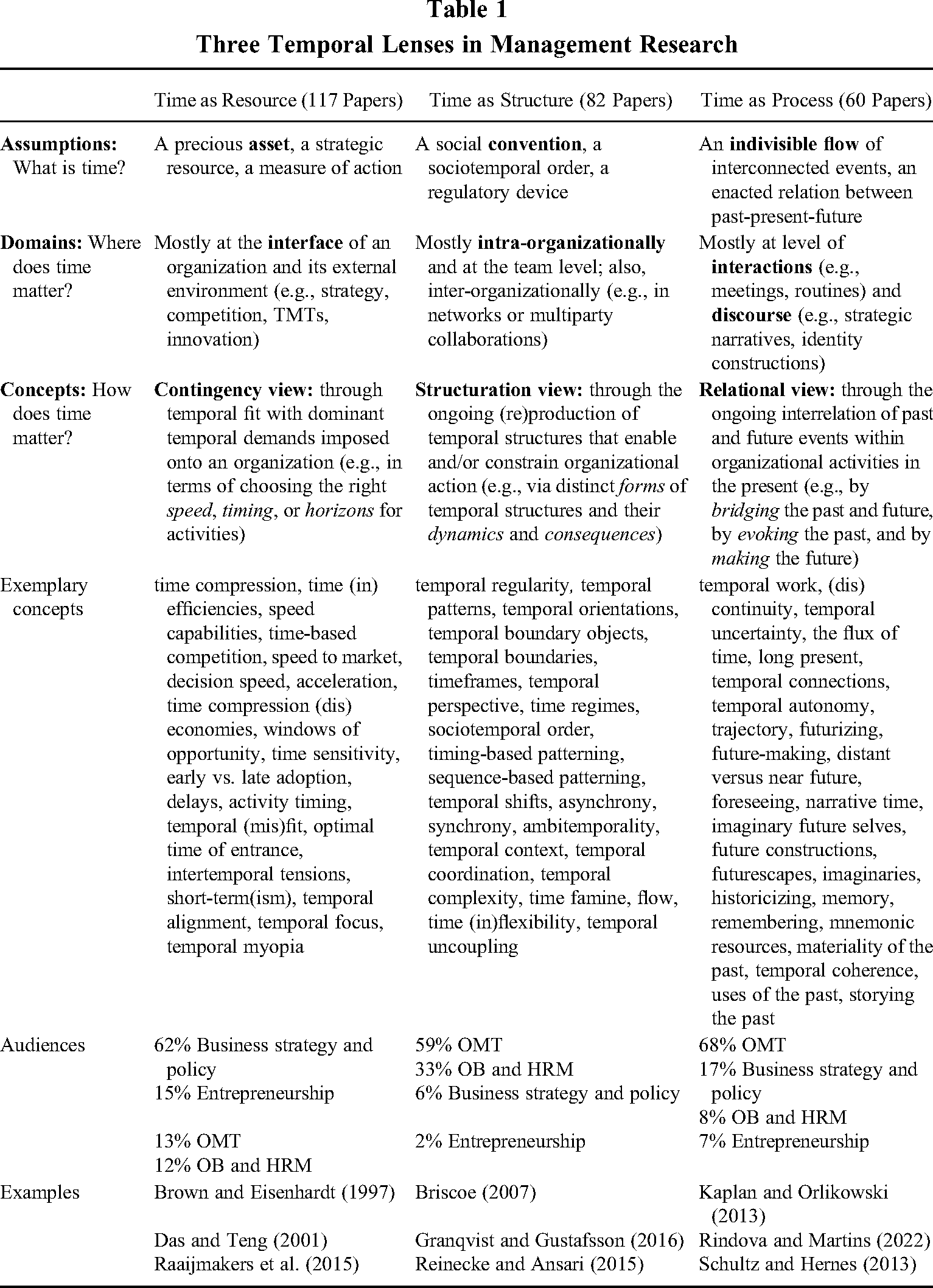
Time as Resource
The first dominant manifestation of the temporal lens—time as resource—foregrounds how organizations, managers, and entrepreneurs use time instrumentally, for example, by regulating the speed, timing, and horizons of their activities and decisions. Its theoretical roots can be traced to early work in political economy and management. For example, Taylor's (1911) “scientific management” explicitly targeted time as a resource, emphasizing the need to optimize the speed of bodily movements to maximize productivity. Time as resource is arguably the most dominant lens in management and our sample (117 papers; for a detailed analysis, see Appendix 6a). It is most frequently used in business strategy and policy (62%), followed by entrepreneurship (13%), organization theory (13%), and organizational behavior and human resource management (12%).
Assumptions—What is Time?
Time-as-resource studies build on the assumption of time as a valuable resource that managers can and should leverage to accrue economic benefits. For example, studies that adopt this lens talk of time “as a resource for buffering uncertainty” (Raaijmakers et al., 2015: 86) or “time as a precious resource” (Branzei & Fathallah, 2023: 4). Seen as a resource, time appears as an asset that managers can “analyze and optimize” (Kessler & Chakrabarti, 1996: 1145) and “allocate” (Bertolotti, Mattarelli, & Dukerich, 2019: 1597) to various activities.
We discovered two versions of the time-as-resource assumption. The first one, visible in most studies within this lens, treats time as a chronological measure of activity and strategic decision-making. Time is represented as an arrow on which different points in time can be marked, distances between points measured, and an overall direction discerned (past→present→future). For example, studies that adopt this lens examine how groups calculate the amount of time remaining until a deadline (Labianca, Moon, & Watt, 2005) or measure the speed or timing of competitive actions (e.g., Garcia-Sanchez, Mesquita, & Vassolo, 2014).
The second version treats time as a managerial disposition of executives and top-management teams. The focus here is on individual differences in, for example, managers’ temporal focus (past, present, or future) or time horizons (short vs. long) and the impact thereof on managerial decisions as well as strategic and entrepreneurial action. Although such dispositions might be purely psychological, research from economics and economic history highlights that they have coevolved with distinct forms of economic activity (Galor & Özak, 2016; Thompson, 1967). In our sample, some studies discussed how managerial dispositions might serve as “temporal filters” (Nadkarni & Chen, 2014: 1810), which “shape how managers recognize opportunities in the market as well as how they allocate resources to seize opportunities” (Chen, Miller, & Chen, 2021: 2). As above, an instrumental outlook on time is evident here, with studies foregrounding the impact of managerial dispositions on outcomes, such as “efficient time allocation” (Chen & Nadkarni, 2017: 39) or “team performance in the face of ‘perceived time pressure’” (Maruping, Venkatesh, Thatcher, & Patel, 2015: 1313).
In both cases, the assumptions of the time-as-resource lens have led to a focus on issues of efficiency and optimization. Closely tied to economics, this lens has established time as “a value that could be translated into economic terms” (Hassard, 2001: 135) and thus as “a medium in which human activities, especially economic activities, could be stepped up to a previously unimagined rate of growth” (Nowotny, 1976: 330). This instrumental focus on efficiency and optimization is evident in recent research that builds on this lens, for example, in concepts such as time-to-market (Brown & Eisenhardt, 1997; Lint & Pennings, 1999), speed-to-market (Stanko, Molina-Castillo, & Munuera-Aleman, 2012), speed capabilities (Hawk, Pacheco-De-Almeida, & Yeung, 2013; Hawk et al., in press; Pacheco-de-Almeida et al., 2015), and time compression (dis)economies (Hawk & Pacheco-de-Almeida, 2018).
Domains—Where Does Time Matter?
The time-as-resource lens primarily highlights the impact of time at the interface of firms and their external environments. Studies using this lens typically focus on the (dis)advantages, boundary conditions, and performance implications of different strategies for optimizing, leveraging, and capitalizing on time in relation to a specific goal. For example, studies have examined how hospitals optimize the performance of time-sensitive routines (Gardner, Boyer, & Ward, 2017), why declining firms leverage early retrenchment actions to improve the likelihood of turnaround success (Tangpong, Abebe, & Li, 2015), or how incumbents capitalize on synchronization with new entrants in responding to disruptive shocks (Pérez-Nordtvedt, Khavul, Harrison, & McGee, 2014). Such studies typically seek to explain how firms can strategically use time to improve performance (Santos, Passos, Uitdewilligen, & Nübold, 2016), seize market opportunities (Tumasjan, Welpe, & Spörrle, 2013), or respond to emerging crises (Branzei & Fathallah, 2023).
This lens appears to be most prevalent in research areas that focus on the organization-environment interface, such as strategy and entrepreneurship. Scholars have employed the time-as-resource lens in studies of performance market adjustment (Greve, 2002), strategic planning (Das, 1991), resource allocation (Reilly, Souder, & Ranucci, 2016), strategic change (Brown & Eisenhardt, 1997; Klarner & Raisch, 2013), corporate entrepreneurship (Chen & Nadkarni, 2017), and competitive dynamics (Chen & Hambrick, 1995; Nadkarni, Chen, & Chen, 2016). The lens also features in studies of technological change (Staudenmayer, Tyre, & Perlow, 2002; Tyre & Orlikowski, 1994), social networks (e.g., Brennecke, Ertug, & Elfring, in press), entrepreneurship (Bird & West, 1998; Branzei & Fathallah, 2023), and, to a limited extent, organizational behavior (Harrison, Mohammed, McGrath, Florey, & Vanderstoep, 2003) and leadership (Maruping et al., 2015; Mohammed & Nadkarni, 2011).
Concepts—How Does Time Matter?
Consistent with its focus on the interface between organizations and their external (competitive) environments, time as resource takes a contingency view to explain how time matters for organizational, managerial, and entrepreneurial action. This view implies a focus on temporal fit, that is, how organizations adapt to the temporal demands that their external (competitive) environments impose on them (e.g., Pérez-Nordtvedt, Payne, Short, & Kedia, 2008). Closely related to classical contingency theory (e.g., Drazin & Van de Ven, 1985), temporal fit designates an optimal state of entrainment between a firm's activities and the dominant temporal demands of the environment, such as the pace of competition, industry-specific cycles and events, or rhythms of institutional change (Ancona & Chong, 1996; McGrath & Rotchford, 1983). The basic idea is that firms must adapt to temporal demands, or they might suffer negative consequences, such as being “selected out” (Pérez-Nordtvedt et al., 2008: 797) from their industry. Temporal demands are thus seen as quasi-objective constraints on organizational, managerial, and entrepreneurial action and its autonomy. Extant research has generally examined how organizations respond to temporal demands by choosing the right (i) speed, (ii) timing, and (iii) time horizons for their activities.
Speed
Speed denotes the “capacity of an organization to quickly identify, assemble, reconfigure, modify, and deploy its organizational processes and activities” (Dykes, Hughes-Morgan, Kolev, & Ferrier, 2019: 270). Overall, existing studies suggest that speed can be a valuable resource, a source of “fast-mover advantages” (Hawk et al., 2013), or even a dynamic capability that is especially beneficial for organizations in high-velocity environments (Brown & Eisenhardt, 1997). For example, Schoonhoven, Eisenhardt and Lyman (1990: 177) argued that “the more quickly a new venture develops its first product and ships it to the first customer, the more quickly it will embark on the path to greater financial independence.”
However, other work suggests that a singular focus on speed has downsides and can become “too much of a good thing” (Chen, Reilly, & Lynn, 2012). For example, speed can create time compression diseconomies that reduce a firm's competitive advantage (Hawk & Pacheco-de-Almeida, 2018). Moreover, a singular focus on speed can lead to a “speed trap” (Perlow, Okhuysen, & Repenning, 2002). In such a trap, decision content and quality become neglected as organizations perceive a pressing temporal demand “to make ever faster decisions to survive” (Perlow, Okhuysen, & Repenning, 2002: 932). Furthermore, focusing on speed will likely result in time pressure (Maruping et al., 2015: 1315), which, in turn, requires skillful temporal leadership (Mohammed & Nadkarni, 2011: 492).
Overall, prior work has provided a rich picture of the relative (dis)advantages of a speed strategy, the boundary conditions that define when such a strategy is appropriate, and the possible consequences of such a strategy. By contrast, very few studies in our sample have addressed whether and under what conditions a strategy of slowness might also be advantageous (Pacheco-de-Almeida & Zemsky, 2012). This is surprising given the large number of successful firms that adopt principles of slowness, including, for example, slow food or slow innovation.
Timing
Timing refers to the positioning of activities and events in chronological time (the “when” of performing a particular action). It implies an awareness of the “right” time to act (Albert, 2013; Bartunek & Necochea, 2000) or the “right” rhythm of activity (Chen, 2022; Klarner & Raisch, 2013). Regarding the choice of the “right” time to act, a critical debate in the literature concerns whether firms should try to act early or late relative to competitors. On the one hand, many studies in our sample emphasize the importance of acting early and taking advantage of windows of opportunity before they close (e.g., DiBenigno, 2020; Huy, 2001; Tyre & Orlikowski, 1994). Acting early may be beneficial for outcomes such as turnaround success (Barbero, Di Pietro, & Chiang, 2017), entrepreneurial career success (Merida & Rocha, 2021), or business exit success (Elfenbein & Knott, 2015). On the other hand, several studies suggest that a delay strategy may also be beneficial (e.g., Boyd & Bresser, 2008). For example, Rhee and Kim (2015: 180) show that “early initial success can be more detrimental to an organization's performance and survivability.” In a different context, Raaijmakers and colleagues (2015) show that, in the face of institutional complexity, decision-makers may benefit from delaying their compliance with new coercive institutional demands.
Timing also forms a part of rhythm. For example, firms may time certain events to fit with the rhythms of competitors. Studies generally agree that temporal fit is associated with positive performance outcomes at different levels of analysis (e.g., Hopp & Greene, 2018; Klarner & Raisch, 2013; Mannak et al., 2019; Shi & Prescott, 2012; Vermeulen & Barkema, 2002). For example, Shi and Prescott (2012) show how pharmaceutical firms benefit from entraining the timing of their alliance activities to those of their competitors. Beyond entrainment, scholars have also examined the consequences of rhythm (ir)regularity (e.g., Barbero et al., 2017; Hashai, Kafouros, & Buckley, 2018). For example, in a 9-year study of insurance companies, Klarner and Raisch (2013: 160) found that “companies that change regularly outperform those that change irregularly.” This effect was even more pronounced in high-velocity environments, underscoring the notion that time matters at the interface of organizations and their environments.
In sum, research on timing has provided rich insights into organizations’ strategies for choosing the right moments to act or the proper pacing of their activities. While earlier work suggested that such choices are imposed on the organization by external temporal demands, more recent work suggests organizations confront these decisions with more agency, for example, by choosing among several alternative forms of timing (e.g., acting early or delaying) with unique (dis)advantages. This shift in emphasis is welcome and, in the future, may serve as an essential bridge to the other two lenses.
Time horizons
Time horizons define the temporal depth of future projection (Das, 1987), that is, the “temporal distance into the future (e.g., short-term versus long-term)” (Chen et al., 2021: 3) considered in organizational, managerial, or entrepreneurial actions and decisions. Time as resource typically treats time horizons as a measurable distance into the future that is closed in terms of a clear cut-off point (e.g., 5 or 15 years from now). Many studies in our sample associate short-term horizons with adverse outcomes (e.g., DesJardine & Bansal, 2019; Souder, Reilly, Bromiley, & Mitchell, 2016) and emphasize the benefits of a long-term horizon (Flammer & Bansal, 2017). The studies suggest that short-term horizons can result in strategic myopia, which manifests in “the neglect of long-run planning and investments, avoidance of long-run research and development (R&D) strategies, and underprovision of training programs, each with potentially negative consequences for corporate value creation and business survival over time” (Opper & Burt, 2021: 2). As a result of such myopia, managers, organizations, and entrepreneurs “may fail to foresee and prepare for potential future environmental opportunities and threats in advance” (Nadkarni et al., 2016: 1136).
Several studies in our sample suggest that the relative benefits of short-term versus long-term horizons depend on contingency factors, such as industry velocity (Nadkarni et al., 2016) or investor patience (Souder et al., 2016). These studies show that long-term horizons are generally associated with positive outcomes and value creation (Flammer & Bansal, 2017), but can also become a “double-edged sword … [that] can make executives overcommitted to long-term goals and undermine their ability to adjust to critical short-term changes” (Nadkarni et al., 2016: 1136). That could be particularly dangerous when firms are facing poor performance (DesJardine & Bansal, 2019) or when firms are experiencing other resource constraints (Kim, Bansal, & Haugh, 2019).
Overall, a central insight from research on time horizons is that firms benefit from exploiting the complementarities between long-term and short-term horizons instead of prioritizing one at the expense of the other (Chen et al., 2021). This insight is also reflected in emerging concepts such as “temporal ambidexterity” (Slawinski & Bansal, 2015), which describes the capability to embrace both short- and long-term horizons. Temporal ambidexterity, however, implies tensions and conflicts which deserve more attention in future research.
Connections among key temporal concepts
Several papers in our sample examine connections among some of the key temporal concepts of the resource lens. For example, Hashai and colleagues (2018) examine the interplay of speed, rhythm regularity, and duration in the expansion of firms’ strategic alliance portfolios. They show that the pace of portfolio expansion generally reduces profitability, but this negative effect is at least partially offset by specific forms of timing, for example, “a more regular rhythm of expansion and a longer duration of existing alliances” (Hashai et al., 2018: 707). In a different vein, Hopp and Greene (2018) find that entrepreneurs benefit from writing a business plan early on (timing) in the new-venture creation process, but this effect is contingent on the duration of planning (e.g., the amount of time spent) and whether planning is synchronized or not with other entrepreneurial activities. In a classic study of temporality in product innovation, Brown and Eisenhardt (1997) found that timing, in the shape of predictable and regular transitions between present and future products, had a positive effect on the internal synchronization of teams and created a “relentless sense of urgency that keeps people driven to maintain the pace” (Brown & Eisenhardt, 1997: 24). However, some studies also hint that pace, particularly the pace of technological change, might make firms and mangers more impatient and hence shorten their time horizons (Sampson & Shi, 2023).
Summary and Appraisal
A time-as-resource lens provides an instrumental view of time that has illuminated the temporal consequences of organizational, managerial, and entrepreneurial action and decisions. Our review also reveals two promising opportunities for future research to develop this lens further (see also Appendix 6a).
The first opportunity stems from the assumption of time as a measure of strategic action. While this assumption is compatible with the focal questions addressed by this lens (e.g., determining the optimal speed or timing of a competitive move), it also limits its potential to elucidate other and more complex time-related questions and problems. For example, the time-as-resource lens underscores the advantages of temporal fit with external demands. Paradoxically, such an instrumental view on time puts managers and organizations in a relatively passive role: Their agency is reduced to identifying the critical temporal demands and adjusting their speed, timing, and horizons to match those demands. More transformative forms of agency, such as attempting to block, change, or redefine the temporal demands of a given market or environment, have received relatively little attention. This is surprising, given the prominence of this lens in strategy and entrepreneurship research, where strong agency is assumed. In a recent study, for example, Branzei and Fathallah (2023: 6f) show how entrepreneurs “almost never took objective time as fixed. Instead, they actively modified it, repeatedly shortening and lengthening the time at their discretion to match the most critical survival needs of their ventures.” Against this backdrop, future research needs to examine how organizations, managers, and entrepreneurs can actively resist, influence, and occasionally transform the temporal characteristics of their environments.
The second opportunity for future research relates to the interplay of multiple temporal strategies and resources. In our sample, two papers examined the interplay of speed, timing, and rhythm (Barbero et al., 2017), one paper examined speed, regularity, and duration (Hashai et al., 2018), one focused on pacing and sequencing (Amis, Slack, & Hinings, 2004), and two focused on pace and rhythm (Brown & Eisenhardt, 1997; Vermeulen & Barkema, 2002). This suggests considerable potential for future research to examine how the usefulness of time as a resource lies in its multiplicity: a repertory of multiple temporal resources enhances the managerial agency. Future research could link the assumption of time as a measure of action and time as a managerial disposition. For example, how do leaders’ perceptions of time influence the speed and timing of competitive action? Elucidating the interplay of multiple temporal resources and strategies will likely offer revelatory insights into the strategic use of time in management.
Time as Structure
The second manifestation of the temporal lens—time as structure—highlights how shared, collective temporal structures facilitate social order, control, and coordination in and among teams, organizations, and networks of organizations. Its theoretical roots can be traced back to the sociology of time (Nowotny, 1992; Rosa, 2013; Zerubavel, 1976). Whereas other disciplines, such as economics, conceived of time as a physical reality, early contributions in sociology stressed the culturally specific (Sorokin & Merton, 1937), socially regulated (Durkheim, 1912), and socially constructed nature of time (e.g., Berger & Luckman, 1966; Schütz, 1967). This lens is the second largest in our sample (82 papers; see Appendix 6b for a detailed analysis). Most papers using a time-as-structure lens originate from organization theory (59%), followed by organizational behavior and human resource management (33%), business strategy and policy (6%), and entrepreneurship (2%).
Assumptions—What Is Time?
In line with its sociological origins, this lens conceives of time as a social convention; a shared, collectively negotiated template for the ordering of social life. Within the sociological literature, “time is an inherent constituent of any social act” (Zerubavel, 1976: 87) and “a regulatory device with a very strong compelling force” (Elias, 1992: 45). For example, collective schedules, calendars, and timelines impose regularity and coordination on organizational activities (Yakura, 2002), while deadlines can regulate team performance (Gersick, 1989).
Studies adopting this lens commonly assume that time is a “sociotemporal order, which regulates the structure and dynamics of social life” (Zerubavel, 1981: 2). The concept of sociotemporal order underlines that most time units and “rhythms that govern social life are entirely conventional” (ibid.: 11, emphasis added), that is, they are socially negotiated and constructed rather than determined by natural forces (Sorokin & Merton, 1937). Such negotiation is often informed by actors’ cultural values (Perlow, 1999) or their roles within a particular setting (Oborn & Barrett, 2021). For example, in an ethnographic study of freelance technical contractors, Evans, Kunda and Barley (2004) detail how this well-paid occupational group equated time with money and constructed periods between projects as problematic “downtime” (time without pay) that they sought to minimize rather than use for non-work activities.
The assumption of time as a sociotemporal order directs researchers’ attention to how various “cycles, rhythms, beginning, endings, and transition points … aid us in defining our roles, our obligations, and the tenor of our relationships” (Barley, 1988: 125; Barley, 1986). It also means examining the dynamics of temporal conventions, which entails attention to fundamental problems of management, such as coordination, conflict, sensemaking, and change. For example, in a study of a consulting team, Kremser and Blagoev (2021) show how the collective dynamics of prioritizing conflicting deadlines reinforced the asymmetric power relations within the team.
Domains—Where Does Time Matter?
The time-as-structure lens typically highlights the constitution of temporal order and regularity in organizational life, focusing on intraorganizational and team-level dynamics (e.g., Briscoe, 2007; Gonsalves, 2020; Heiland, 2021; Katila, Kuismin, & Valtonen, 2020). As elaborated by Zerubavel (1981: 1), “temporal regularity … is probably one of the fundamental parameters of any social order.” It can manifest itself in the temporal anchoring of organizational activities in relation to time, that is, why certain things seem to happen at specific times but not others, why certain tasks take a specific (expectable) amount of time to complete, whereas others do not, or why certain events occur at regular intervals whereas others do not (Bluedorn & Denhardt, 1988). For example, in a quantitative study of garbage collection in San Diego, Turner and Rindova (2018) demonstrate how shared temporal conventions (in their case, typical collection times expected by customers) regulate the temporal order and facilitate the effective performance of garbage collection routines.
The time-as-structure lens is particularly prevalent in research areas that foreground questions of coordination and control, such as organization theory, human resource management, and organizational behavior (especially in research on teams). For example, scholars have used a time-as-structure lens to illuminate coordination challenges in inter-organizational projects (Dille, Hernes, & Vaagaasar, 2022) and cross-sector collaborations that incorporate conflicting temporal orientations (Hilbolling, Deken, Berends, & Tuertscher, 2022). Others have used this lens to explain how organizations can become entrapped in counterproductive patterns of extreme work hours (Blagoev & Schreyögg, 2019) or excessive busyness (Lupu & Rokka, 2022). In addition, this lens has elucidated how temporal structures shape organizational responses to unexpected events (Patriotta & Gruber, 2015) and climate change (Slawinski & Bansal, 2012).
Concepts—How Does Time Matter?
Most studies that use a time-as-structure lens adopt a structuration view (Giddens, 1984) that foregrounds how temporal structures not only constrain but also enable managerial, organizational, and entrepreneurial action. A structuration view emphasizes the autonomy of actors to change and transform the temporal structures they enact. This view is closely tied to the concept of temporal structuring (Bluedorn & Denhardt, 1988; Orlikowski & Yates, 2002). From a structuration perspective, “time is realized through people's recurrent practices that (re)produce temporal structures that are both the medium and outcome of those practices” (Orlikowski & Yates, 2002: 689). Organizational actors rely on temporal structures—such as academic calendars, schedules, timelines, or roadmaps—to regulate and coordinate practices and enact a degree of temporal regularity, that is, continuity in existing temporal structures. In so doing, they primarily reproduce—but also change—the temporal structures they enact. Studies have emphasized three core questions of temporal structuring: (i) forms (ii) dynamics, and (iii) consequences.
Forms of Temporal Structures
Despite its centrality to the time-as-structure lens, the concept of temporal structures has yet to be clearly defined. Some studies use it to refer to “the social structures that shape people's temporal practices” (Oborn & Barrett, 2021: 379, emphasis added), whereas others define it as the “organizing elements and norms that define the temporal properties of organizational systems” (Shipp & Richardson, 2021: 301), implying different levels of analysis and theoretical standpoints (practice vs. system). In addition, studies continue to introduce the concept by providing a list of examples such as “project deadlines, logs, schedules, and other time-calibrated devices” (Reinecke & Ansari, 2015: 622).
Our review revealed that temporal structures vary in their (in)visibility and (in)formality. Formal temporal structures, such as deadlines (Gersick, 1989; Seers & Woodruff, 1997), schedules (Gherardi & Strati, 1988), or timelines (Yakura, 2002), are visible and tangible. As such, they are often subject to intense negotiations among occupational and organizational groups (McGivern et al., 2018; Yakura, 2002). However, scholars have also examined more tacit and informal types of temporal structures, sometimes referred to as “timing norms” (Granqvist & Gustafsson, 2016), “expectancy frameworks” (Patriotta & Gruber, 2015), or “temporal orientations” (Reinecke & Ansari, 2015). These are seen as expressions of deeply held cultural attitudes and “shared manners of valuing and attending to time” (Rowell et al., 2017: 314), often described in terms of dichotomies such as clock time and event time (Cuganesan, 2021). They can also represent emergent, collective expectations about the occurrence, timing, sequence, duration, or synchronicity of activities. Such expectations arise from collective participation and experience in a shared context (Granqvist & Gustafsson, 2016; Patriotta & Gruber, 2015).
To recap, although recent work seems to converge around temporal patterns and orientations as core forms of temporal structures (Hernes & Schultz, 2020; Rowell et al., 2017), the literature still lacks a common understanding of the basic characteristics and central empirical manifestations of temporal structures. Such an understanding would be helpful for future research to operationalize the concept and distinguish temporal structures from other types of social structures.
Dynamics of temporal structures
The time-as-structure lens argues that time matters in organizations through different temporal structures and their dynamics of change, emergence, and persistence. Consistent with a structuration view, studies assume that temporal structures are “always potentially malleable” (Reinecke & Ansari, 2015: 640). Malleability implies that temporal structures are mostly stable but occasionally change, for example, when actors articulate new temporal structures (Granqvist & Gustafsson, 2016) or when two conflicting temporal structures collide (e.g., Cuganesan, 2021). Change in temporal structures can occur incrementally, as an inevitable byproduct of action (Gersick, 1988, 1989; Okhuysen & Waller, 2002), as a result of exogenous shocks and events, and intentionally, because of “well-considered managerial decisions” (Staudenmayer et al., 2002: 584). Change can make organizational actors reflexive about hidden and tacit temporal structures and facilitate more substantial organizational transformation (Reinecke & Ansari, 2015).
In addition to the dynamics of change, scholars have also started to examine the dynamics of the emergence and persistence of temporal structures. To explain emergence, several studies have drawn on the concept of temporal patterning (Kremser & Blagoev, 2021; Turner & Rindova, 2018). Temporal patterning implies that temporal structures can emerge from relatively small, local negotiations of temporal conflicts that coalesce into repetitive and recognizable patterns in “how actions are arranged in time” (Turner & Rindova, 2018: 1253). To explain persistence, studies have drawn on the notion of positive feedback (e.g., Blagoev & Schreyögg, 2019; Perlow, 1999). For example, in a single case study of an elite management consulting firm, Blagoev and Schreyögg (2019) show how a shift from a weekly to a daily rhythm of client interaction generated positive feedback (an increase in client demand for daily interaction) that ultimately consolidated a persistent regime of extreme work hours. These studies suggest that positive feedback can engender vicious circles (Perlow, 1999) or even path dependence, thereby constraining actors’ agency in relation to time.
In sum, temporal structures can exhibit various dynamics. Whereas some studies suggest that temporal structures are always malleable, others point to the limits of actors’ agency in changing deeply entrenched temporal structures. In addition, relatively little is known about how temporal structures emerge in the first place. Although research on temporal patterning provides some initial ideas, more work is necessary.
Consequences of temporal structures
Scholars have generally used a time-as-structure lens to study the consequences of temporal structuring for three important organizational and managerial outcomes. First, multiple studies have examined how temporal structures affect coordination (e.g., Bechky & Okhuysen, 2011; Montoya-Weiss, Massey, & Song, 2001; Oborn & Barrett, 2021). For example, temporal structures can facilitate collaboration in interorganizational networks (Jarvenpaa & Valikangas, 2022) and enable dynamic teams with unstable membership to coordinate complex work (Mayo, 2022). In addition, studies have revealed that multiple heterogeneous temporal structures can sometimes “collide” and create conflicts and tensions that may be difficult to overcome (Hilbolling et al., 2022; Reinecke & Ansari, 2015). Such conflicts and tensions typically arise when organizing unfolds across occupational (Oborn & Barrett, 2021), organizational (Hilbolling et al., 2022; Kremser & Blagoev, 2021), or field boundaries (Reinecke & Ansari, 2015).
Second, several studies have shown that temporal structures influence the temporal experiences of organizational actors (e.g., Bailey & Suddaby, 2023; Briscoe, 2007; Dorow & Jean, 2022; Katila et al., 2020). Whereas some temporal structures can trigger experiences of flow and timelessness (Mainemelis, 2001), others can result in boredom (Noury, Ahuja, Parker, Sturdy, & Tyler, 2022) or even stress and burnout (e.g., Blagoev & Schreyögg, 2019; Lupu & Rokka, 2022; Perlow, 1999). Some temporal experiences—such as serving time in prison—might point “to a more fundamental and negative dimension of time, where the processual construction of meaningful time is substituted for a radical experience of finitude” (Johnsen, Berg Johansen, & Toyoki, 2019: 15).
Finally, scholars have examined how temporal structures influence larger organizational outcomes, such as innovation (e.g., Crossan, Cunha, Vera, & Cunha, 2005; Fayard, in press; Lifshitz-Assaf, Lebovitz, & Zalmanson, 2021; Lindkvist, Soderlund, & Tell, 1998; Vuori & Huy, 2016; Zietsma, Ruebottom, & Slade Shantz, 2018) and sustainability (e.g., Bansal & DesJardine, 2014; Sarasini & Jacob, 2014; Slawinski & Bansal, 2012, 2015). For example, Slawinski and Bansal (2012: 1554) show how firms that make use of cyclical rather than linear temporal structures develop “a broad range of responses [to climate change], including investments in alternative energies, multi-stakeholder dialogue, and energy efficiency.” Similarly, Reinecke and Ansari (2015) show how a dual orientation to two conflicting temporal structures (process time and clock time) can promote sustainable development. Finally, Schultz and Hernes (2020) demonstrate how the different temporal structures of strategy and identity influence each other through different forms of temporal interplay.
In sum, research on the consequences of temporal structuring shows that organizations generally benefit from combining heterogeneous temporal structures (e.g., those that go beyond dominant linear clock-time orientations). Doing so, however, requires more advanced forms of temporal coordination to navigate the ensuing tensions and conflicts successfully. We see plenty of opportunities for future research to study how temporal structuring influences further outcomes, such as dynamic capabilities, entrepreneurship, or leadership.
Connections among key temporal concepts
Several papers in our sample suggest that surface-level temporal structures, such as temporal patterns, deadlines, or formal planning horizons, might reflect and be strongly influenced by deep-level temporal structures, such as temporal orientations or time perspectives. An often-cited distinction is that between clock-time and process-time orientations. According to Reinecke and Ansari (2015), clock time represents a temporal orientation that values predictability, speed, efficiency, and punctuality. By contrast, a process-time orientation privileges the innate temporality of processes, tolerates delays and deviations from formal schedules, and pays less attention to speed and efficiency. In a similar vein, Hilbolling and colleagues (2022) argue that a clock-time orientation might result in a synchronization-based approach to temporal coordination, which assumes that full temporal alignment among collaborating actors is a desirable state. They show that such an orientation might be inadequate for complex collaboration settings that depend on contributions by a diverse set of actors and argue in favor of a process-time orientation, which assumes temporal coordination as “inherently partial and transient” (Hilbolling et al., 2022:135). Whereas most studies in our sample tend to favor process-time orientations, some papers also point to the potential negative consequences thereof. For example, Blagoev and Schreyögg (2019) find that a process-time orientation to the temporal structuring of consulting projects can result in temporal patterns of excessive work hours, which harm employees’ wellbeing. Overall, our review suggests that future research might benefit from exploring connections among temporal concepts that go beyond the established dichotomy between clock-time and process-time orientations.
Summary and Appraisal
Time-as-structure research has provided valuable insights into the various forms and dynamics of temporal structures and the consequences of temporal structuring. Whereas early work focused on the forms and dynamics of temporal structures, more recent work has focused on the consequences of temporal structures. This shift indicates that scholars have found the time-as-structure lens increasingly valuable in explaining diverse organizational outcomes.
Our review also reveals two opportunities for future research to develop the time-as-structure lens (see Appendix 6b). The first one derives from the conceptual ambiguities surrounding temporal structures. Although scholars have examined various forms of temporal structures, a common, widely accepted definition of this central concept has yet to emerge. For example, to what extent are findings about timing norms commensurate with findings about deadlines and timelines? The lack of a common definition limits scholars’ ability to integrate findings from different studies and hampers future research on the consequences of temporal structures. Without a clear delineation of the conceptual core underlying temporal structures, scholars are hindered in their effort to identify and distinguish these structures from other phenomena empirically.
A second opportunity for future research is to elaborate on current understandings of how temporal structures emerge, change, and persist. Most studies examine a preexisting sociotemporal order rather than its origination, for example, through deliberate design efforts, temporal work, entrepreneurship, or chance. For example, how do entrepreneurs invent and legitimate new sociotemporal orders? Similarly, although many studies have examined either the persistence or change of temporal structures, we still need integrated frameworks and theories that specify the core mechanisms and conditions that are likely to lead to either change or persistence of temporal structures. As we discuss later, one way to address this issue may lie in the interplay between time as structure and time as process, which could help scholars connect the dynamics of temporal structuring to questions about how actors continuously (re)negotiate and enact the relations among the present, past, and future.
Time as Process
The third temporal lens—time as process—foregrounds how actors collectively negotiate, enact, and interconnect the present, past, and future. The time-as-process lens can be traced to foundational works in process philosophy (Rescher, 1996), the philosophy of time (Mead, 1932), and phenomenology (Schütz, 1967). These philosophical origins render the lens more abstract but no less useful to management scholars. In our sample, we identified 60 papers that adopted this lens (for a detailed analysis, see Appendix 6c). Most of these papers originate from organization theory (68%), followed by business strategy and policy (17%), organizational behavior and human resource management (8%), and entrepreneurship (7%).
Assumptions—What Is Time?
Time as process assumes that time is an indivisible flow of interconnected events. This assumption can be traced back to the philosophy of time (e.g., Bergson, 1912), which rejects the idea of time as a linear succession of discrete instants and suggests that “real universal time is indivisible and has its origin in our consciousness of duration” (Chia, 2002: 864). To illustrate this assumption, Mohammed (2019: 209) uses the metaphor of a waltz dance: “Each moment of the waltz interpenetrates each other, intersects each and every other in an unimpeded flow.” Seeing time as indivisible implies that all common distinctions used by managers, organizations, and entrepreneurs to make sense of time—before and after, past and future, 5 or 10 years, and so forth—are, in principle, artificial and therefore always potentially malleable, that is, subject to change and open for (re)negotiation.
The assumption of time as indivisible implies a performative outlook on time: Rather than taking preexisting temporal realities for granted, studies that adopt this lens seek to explain how temporal relations and distinctions—such as present, past, and future—are collectively conceived, negotiated, and enacted, that is, performed, in practice (Hernes, 2022). For example, Miller, Gomes and Lehman (2019: 4) adopt a time-as-process lens to develop the concept of strategy restoration, defined as “the intentional reinterpretation and reenactment of attributes and activities from an organization's historical strategy for the sake of future performance.” As this definition makes clear, strategy restoration is a process that enacts relations between the past (historical strategy) and the future (future performance). Past and future exist only insofar as actors bring them into the present, for example, as evoked memories of past events (Blagoev, Felten, & Kahn, 2018) or projected future events (Augustine, Soderstrom, Milner, & Weber, 2019).
Hence, the time-as-process lens takes an interest in the enactment of events and relations among events in the ongoing present (Hernes, 2022; Schultz & Hernes, 2013). Managers, organizations, and entrepreneurs perform time in an ongoing process of interrelating (past and future) events. In doing so, they face various and changing challenges in the present, such as an unexpected crisis, which may lead them to reimagine the future (e.g., their strategy), rethink the past (e.g., their identity), and thus reconsider the focus of their present activity (Kaplan & Orlikowski, 2013). Time as process implies that events are not objective occurrences, as assumed in the other two lenses, but take on their particular meaning through the way that they are interrelated into a meaningful narrative trajectory that links past, present, and future (Hussenot & Missonier, 2016). In this view, time exists in the (relations among) events rather than events existing in time (Bluedorn, 2002; Clark, 1985; Hernes, 2014). 4
Domains—Where Does Time Matter?
The time-as-process lens highlights ongoing activity, that is, situated action, in the present. As such, this lens tends to favor a focus on micro-interactional dynamics and on discourse and language. Often, studies focus on meetings (Hussenot & Missonier, 2016), narratives (Bartel & Garud, 2009), identity work (Costas & Grey, 2014), and communication (Plotnikof & Mumby, in press). Such studies emphasize how temporal relations among the present, past, and future are enacted through situated and recurrent activities.
Thus, the time-as-process lens sensitizes scholars to the enacted and projected nature of time. The enacted nature of time directs scholars to situated action as the locus of reality. The projected nature of time refers to how actors narrate or imagine future or past events in the present. For example, actors may imagine a particular future as desirable or undesirable with distinct consequences for their present activity (Alimadadi, Davies, & Tell, 2021). Thus, this lens enables scholars to generate novel insights into how various phenomena, such as strategy, identity, or innovation, are expressed in different modes of interrelating past, present, and future events (Schultz & Hernes, 2020) or temporal trajectories (Hernes, 2022; Oborn, Barrett, Orlikowski, & Kim, 2019). For example, scholars have applied a time-as-process lens to study how actors negotiate tensions among multiple interpretations of past, present, and future in strategy-making (Kaplan & Orlikowski, 2013). In organization theory, scholars have used a time-as-process lens to study identity work (Costas & Grey, 2014; Ybema, 2010), sensemaking (Hernes & Obstfeld, 2022; Shipp & Jansen, 2011), routine dynamics (Geiger, Danner-Schröder, & Kremser, 2021), and institutional stabilization (Reinecke & Lawrence, in press). Entrepreneurship scholars have adopted this lens to illuminate “how entrepreneurs act based on past experiences, attention to current conditions, and images of the future” (Johnsen & Holt, 2023: 1). And organizational-behavior scholars have examined the impact of desired future identities on career behaviors (Strauss, Griffin, & Parker, 2012).
Concepts—How Does Time Matter?
Most studies that use a time-as-process lens adopt a relational view that foregrounds how time is implicated in actors’ agency. This view is grounded in the idea of agency “as a temporally embedded process of social engagement, informed by the past … but also oriented toward the future … and toward the present” (Emirbayer & Mische, 1998: 963). There are two significant consequences of this view. First, a relational view implies that the past and the future are not closed, measurable distances in time. Instead, they constitute projections that are made in the present and remain, in principle, open for interpretation and (re)negotiation. Second, because the past and the future are conceived as open, disruptive relations among multiple pasts, presents, and futures are likely to emerge as new events are experienced or brought into focus. Hence, time as process departs from the focus on temporal regularity, which prevails in time as structure, and additionally highlights disruption, that is, sudden, discontinuous, and “fundamental changes that disturb or re-order the ways in which firms and their ecosystems operate” (Kumaraswamy, Garud, & Ansari, 2018: 1025).
In line with a relational view, studies that adopt a time-as-process lens have focused on three themes: (i) Bridging the past and future in the present, (ii) imagining the future in the present, and (iii) evoking the past in the present.
Bridging the past and future in the present
Bridging foregrounds the projection and connection of futures and pasts in the ongoing present (Schatzki, 2006). Whereas projection in time can be assumed to take place from the present toward the future only, it also inevitably carries an element of “pastness” (Schütz, 1967: 67). For example, Stjerne and Svejenova (2016: 1772) show how actors carry “shadows of the past” as they project activities into the future. In a similar vein, Kaplan and Orlikowski (2013) introduced the concept of temporal work to capture “how actors resolved differences and linked their interpretations of the past, present, and future to construct a strategic account that enabled concrete strategic choice and action” (Kaplan & Orlikowski, 2013: 965). Accounts and narratives (Cunliffe, Luhman, & Boje, 2004) can serve as a temporal bridge between the past and the future. They function as means to carry on the past while revisiting it in anticipation of a potentially different future (e.g., Johnsen & Holt, 2023).
Several studies in our sample examine how managers, organizations, and entrepreneurs enact continuity by bridging the near past and future (e.g., Bednar, Galvin, Ashforth, & Hafermalz, 2020; Cunliffe et al., 2004; Danner-Schröder, 2020; Hernes & Schultz, 2020). Bridging helps actors enact continuity across time, especially when faced with crises or disruptive events (Feldman, Worline, Baker, & Bredow, 2022). For example, Danner-Schröder (2020) shows how, in the aftermath of the Great Japan Earthquake in 2011, actors bridged past and future by simultaneously focusing on past events (e.g., to learn from them) and backgrounding them (e.g., to provide hope and look ahead into the future).
Other studies foreground the enactment of discontinuity through disengagement from past, present, or future events (Berends, van Burg, & Garud, 2021; Geiger et al., 2021; Ybema, 2010). For example, in a study of identity work in a newspaper company, Ybema (2010) shows that managers persistently defined the newspaper's identity in terms of a discontinuity between past and future. He suggests that this form of “postalgic” identity work enables organizations to “cut loose and move away from the past and is thus aimed, not at preserving or restoring, but at disavowing so-called ‘old’ identities” (Ybema 2010: 495). In addition to disengaging from the past, actors and teams might also temporally uncouple from the ongoing present, especially when dealing with emergencies and crises (Geiger et al., 2021). Moreover, enacting a break with the past and present is also useful for entrepreneurs who seek to pivot from their original ideas “when faced with unexpected events” (Berends et al., 2021: 2).
Overall, existing studies have highlighted the importance of narratives, discourse, and strategic accounts as bridges between past and future. Future work might focus on other mechanisms that enact (dis)continuity in an ongoing present, such as technological artifacts or temporal boundary objects.
Imagining the future in the present
The time-as-process lens also considers situated activities such as future-making, defined as “the specific ways in which actors produce and enact the future” (Wenzel, Krämer, Koch, & Reckwitz, 2020: 1443). Research on future-making takes a performative view by focusing on the situated practices through which actors construct the future in the present. Future-making typically entails engagement with distant futures beyond current organizational time horizons (Hernes & Schultz, 2020). Distant futures are qualitatively—and not just quantitatively—different from near futures (Augustine et al., 2019). Near futures are typically construed in terms of continuity and extrapolation based on present and past experiences. They are evaluated based on criteria such as probability and feasibility. By contrast, distant futures are constructed in terms of discontinuity and imagination, often based on criteria such as possibility and desirability. For example, in a study of geoengineering, Augustine and colleagues (2019) show how imaginaries of a distant and uncertain technological solution to climate change became treated as an “as-if reality” and mobilized collective action despite fundamental doubts about their feasibility.
Actors may enact futures in multiple ways. For example, they can set forth narratives that “blend the real—what they are currently doing and investing in—and the imaginary—what they would like audiences to imagine and believe to be possible” (Rindova & Martins, 2022:18). Other studies have examined how organizations can bring distant futures into the present through visual artifacts (Comi & Whyte, 2018). Actors can also craft imaginary future selves liberated from the tensions of the present (Costas & Grey, 2014). Furthermore, they engage in framing contests surrounding possible future trajectories (Nyberg, Wright, & Kirk, 2020). In addition, creating time slots designated to future-making—for example, encouraging employees to pursue unconventional activities during 15% of their work time—could stimulate novelty and creativity (Kumaraswamy et al., 2018).
Overall, research on future-making makes a solid conceptual case for seeing the future as open to multiple interpretations (Wenzel et al., 2020) and entailing multiple potentialities (Lord, Dinh, & Hoffman, 2015). However, empirical work also shows that managers’ constructions of the future are ideologically biased towards an extrapolation of the present and its dominant institutions (Berg Johansen & De Cock, 2018). Hence, future research might examine the interplay of existing, possibly dominant, constructions of the future, and imaginative future-making practices (Alimadadi et al., 2021; Gümüsay & Reinecke, 2021).
Evoking the past in the present
The time-as-process lens also foregrounds how organizations, managers, and entrepreneurs evoke distant pasts in the present. Bringing the past into the present—especially forgotten or lost pasts—can serve as a means to revive previously abandoned promising strategies (Miller et al., 2019), to reimagine and reconstitute organizational identities (Hampel & Dalpiaz, in press; Ravasi, Rindova, & Stigliani, 2019; Schultz & Hernes, 2013), to make sense of emerging technologies (Blagoev et al., 2018), or even to imagine alternative and sustainable futures (De Cock, Nyberg, & Wright, 2021).
Evoking the past in the present draws attention to organizational remembering and forgetting (Anteby & Molnar, 2012; Mariconda, Zamparini, & Lurati, in press). For example, in a study of identity reconstruction at LEGO, Schultz and Hernes (2013) show how the past is accessible in the present through oral, textual, and material forms of memory, each offering distinct modalities and affordances for remembering. In a similar vein, Crawford, Coraiola and Dacin (2020) reveal that environmental activists made use of sensory, discursive, and material-discursive “mnemonic resources” to bring distant pasts into the present (see also Eisenman & Frenkel, 2021). Such studies show that organizational memory constitutes not merely storage of past experience (like a hard drive), but rather involves collective and effortful processes of rediscovery with uncertain outcomes (Hernes, Feddersen, & Schultz, 2021).
Recent studies particularly highlight the role of material resources and traces inherited from the past (Hernes & Schultz, 2020). Material memory “enables interpretive processes through which knowledge about the organizational past is periodically reconstructed to inspire novel action, reflecting a mix of concerns, both retrospective (e.g., preserving continuity) and prospective (e.g., inspiring innovation)” (Ravasi et al., 2019: 1550). Taking materiality seriously requires scholars to move beyond a view of artifacts as “containers for stories” (Blagoev et al., 2018: 1761) and examine how materials inherited from the past actively influence organizational remembering in the present. Due to its persistence over large periods, materiality enables actors to (re)discover distant past realities that, although forgotten, might prove surprisingly helpful in inspiring new courses of action in the present (Hatch & Schultz, 2017; Hernes et al., 2021).
Connections among key temporal concepts
Multiple works have examined connections among some of the key temporal concepts of time as process. For example, organizations that develop the capacity to remember and engage with their more distant past are more likely to approach the future with greater temporal depth, that is, be more imaginative and creative about possible future scenarios (e.g., Ravasi et al., 2019; Schultz & Hernes, 2013). Conversely, organizations that proactively engage with or even try to strategically shape the distant future might be better able to cope with large-scale technological or societal transformations (Rindova & Martins, 2022), especially if they manage to live up to the promises they make about possible futures (Logue & Grimes, 2022). Several studies in our sample also underline the connection of bridging the past, present, and future, on the one hand, and organizations’ capacity to handle disruptive future events, on the other (e.g., Feldman et al., 2022; Geiger et al., 2021; Danner-Schröder, 2020). After experiencing disruptive events, bridging can enable actors to reinstantiate a sense of continuity between past, present, and future, for example, by selectively foregrounding and backgrounding past events (Danner-Schröder, 2020) or recreating action patterns adapted to an entirely novel situation (Feldman et al., 2022). Overall, the time-as-process lens offers a coherent picture of how key temporal concepts, such as bridging, remembering, or future-making, interconnect. Future research could build on these insights to deepen current knowledge about connections to further concepts, such as trajectories (Oborn et al., 2019) or temporal autonomy (Geiger et al., 2021).
Summary and Appraisal
The time-as-process lens has gained significant traction over the past decade, particularly within organization theory. Our review reveals several opportunities for future research within this lens (see Appendix 6c). First, the focus on the situated enactment of time has led scholars to rely on qualitative, theory-building methodologies that generate rich, contextualized data, but must be developed to translate findings to other contexts. Thus, although the time-as-process lens has produced valuable insights, there is a need for a more comprehensive theorizing with clearly elaborated concepts that build bridges to other research communities.
A second opportunity for future research lies in combining ongoing activity with temporal regularity. It would be important to study more systematically the conditions under which organizations balance the need to reassess past or future events with the need to maintain the status quo. For example, many companies undergoing a sustainable transformation must maintain continuity with their past business practices (e.g., to ensure near-term liquidity) while at the same time committing to fundamentally disrupt those practices in the future (e.g., to ensure long-term survival). How do organizations navigate the implied tension between maintaining a sense of continuity with the status quo while pursuing discontinuity from this status quo? If temporal relations are constantly renegotiated, why do we empirically observe temporal patterns and continuities like the ones uncovered by the time-as-structure lens? More research is needed to try to explain phenomena such as path dependence or imprinting from a time-as-process lens.
Finally, more work is needed on the dynamic interplay between ongoing managerial, organizational, or entrepreneurial activity, on the one hand, and practices of future-making and remembering, on the other. For example, managers may successfully (re)imagine a novel vision of the distant future that breaks with the status quo, but how do they ensure that this vision also becomes actionable in the near future and can be translated into ongoing activity? As we discuss later, one way to address such questions might be to explore the connection between time as process and the other two temporal lenses.
A Synthesizing Framework
We have so far surveyed extant research along three basic questions: What is time, where does it matter, and how does it matter? In answering these questions we organized and provided an integrative summary along three manifestations of the temporal lens—time as resource, time as structure, and time as process—each based on a distinct set of assumptions, domains, and concepts (for an overview see Table 1 and Appendix 1). The three manifestations inform our inductive framework that serves as an “organizing heuristic” (Simsek, Heavey, & Fox, 2018: 287) for synthesizing the existing literature (see Figure 1). Zooming out of the individual lenses, we now offer a synthesis of insights that emerge from our framework.
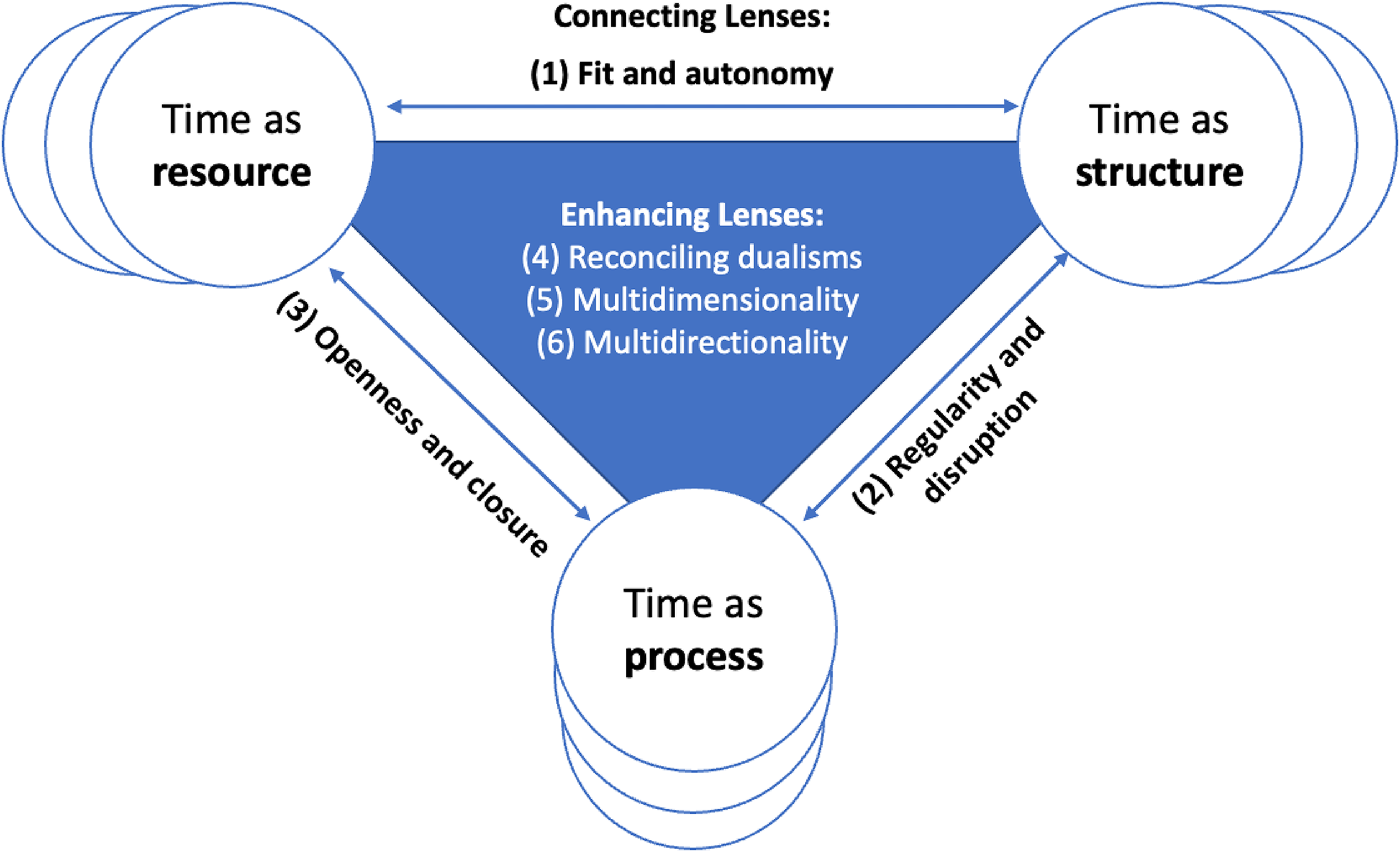
First, our review reveals that scholars in various research areas have prioritized some temporal lenses while paying limited attention to others. As shown in Figure 2, strategy and entrepreneurship scholarship is dominated by the time-as-resource lens with a limited but emerging interest in the process lens (e.g., Kaplan & Orlikowski, 2013; Miller et al., 2019). Similarly, organizational behavior and human resource management are dominated by time as structure and resource. Organization theory appears to be the only subfield that is not dominated by a single lens, although time as resource remains underutilized. The insight that different research areas prioritize distinct lenses offers many opportunities for future research. Scholars could use our framework to problematize the prevailing temporal assumptions for generating novel research questions (Alvesson & Sandberg, 2011, 2020; Kunisch et al., 2023). For example, scholars of business strategy and policy may relax assumptions about time as a measure of action to examine so far neglected phenomena—such as slowness—through a time-as-process lens: If we take processual temporality seriously, what kinds of business strategies emerge from reconnecting with the rhythms of nature instead of optimizing the rhythms of industrial production?
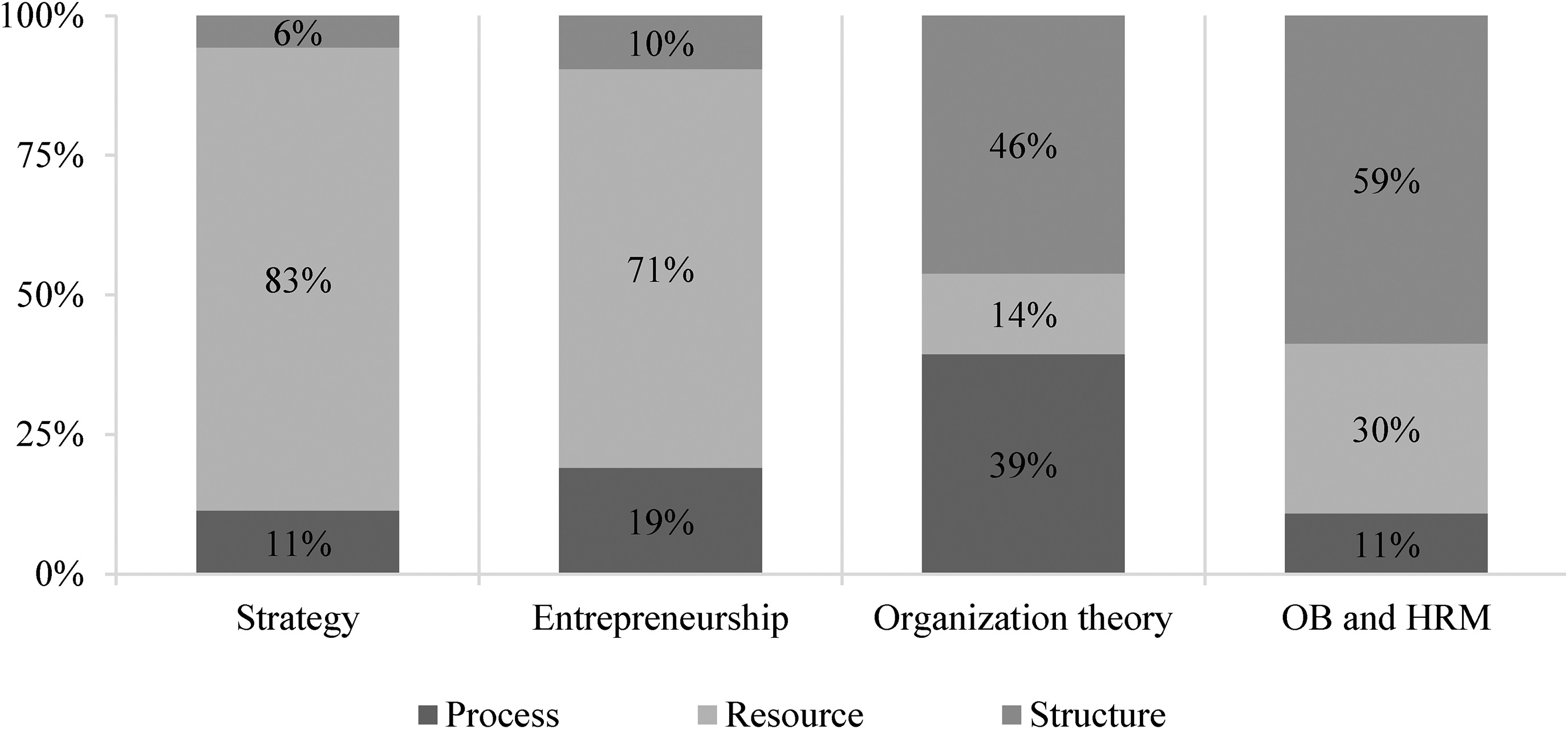
Second, our framework helps to reveal connections and contrasts at the interfaces of the lenses (the connecting arrows in Figure 1). Connections and contrasts between lenses point to underexplored tensions in how time matters in various domains of management (see Table 2). For example, the time-as-structure and the time-as-process lenses share an interest in change (connection), whether driven by temporal structures, which imply temporal regularity, or by actors’ engagement with present, past, and future events, which implies disruption or surprise (contrast). This contrast suggests ongoing tensions between temporal regularity, as foregrounded by time as structure, and disruption or surprise, as foregrounded by time as process. Similarly, time as structure and time as resource share an interest in temporal patterns (connection), whether seen as the result of entrainment to the external environment or as autonomous temporal structuring (contrast). This contrast suggests ongoing tensions between temporal fit with dominant temporal demands (entrainment), as foregrounded by time as resource, and the autonomy to enact deviant, misfitting patterns (temporal structuring), as foregrounded by time as structure. Finally, time as resource and time as process share an interest in temporal horizons (connection), whether seen as closed or open to multiple interpretations (contrast). This contrast suggests ongoing tensions between the closure of time horizons in terms of specific timelines or roadmaps and their openness for re-imagination and redefinition.
Exemplary Tensions at the Interfaces Among the Three Temporal Lenses
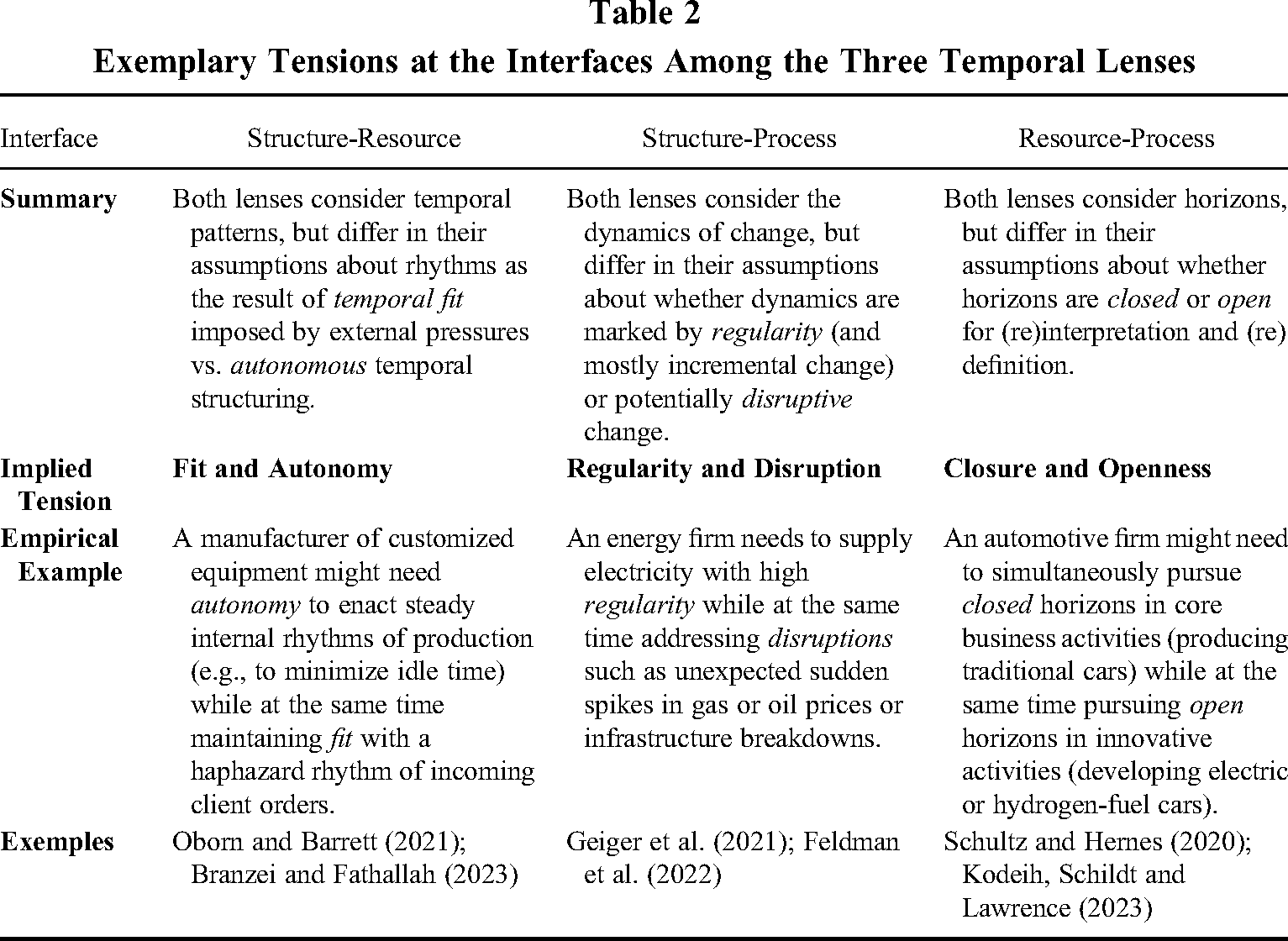
Third, the framework reveals that research across all three lenses is sometimes hampered by coarse conceptions of time, including assumptions of time as unidirectional rather than multidirectional, singular rather than multiple, and marked by dualistic oppositions between temporal concepts. For example, several studies try to capture time by relying on dualistic pairs, such as clock-time and process-time orientations (e.g., Reinecke & Ansari, 2015), subjective and objective time (e.g., Shipp & Jansen, 2021), short-term and long-term time horizons (e.g., Ramus, Vaccaro, & Berrone, 2021; Slawinski & Bansal, 2015), or distant and near futures (e.g., Augustine et al., 2019). Such dualisms act like magnets that attract phenomena from either side of the magnetic field (Hernes, 2022) and serve to simplify complex phenomena. As a result, they may also make scholars blind to the complex and multidimensional nature of time (Kunisch, Blagoev, & Bartunek, 2021). As demonstrated by our review, time is complex to the extent that it is “characterized by multiple temporal rhythms and experiences rather than by a single linear conception of time” (Garud et al., 2013: 795, emphasis added). When scholars reduce multiplicity to dualisms, they risk overemphasizing some temporal dimensions at the expense of other, perhaps less visible, or yet-to-be-conceptualized, dimensions.
New Directions for Future Research
Based on our review, we propose new directions for future research along two pathways: connecting lenses and enhancing lenses (see Tables 3a and 3b). The first pathway—connecting lenses—points to research opportunities at the interface of temporal lenses. Such research is warranted because of the relative dominance of single lenses in specific research areas. Specifically, we suggest future research could explore central themes at the interfaces of temporal lenses, such as (1) tensions between temporal fit and autonomy, (2) tensions between temporal regularity and disruption, and (3) tensions between temporal openness and closure. By introducing these suggestions, we show how lenses can be brought into interplay despite their seemingly incommensurable assumptions. 5
Future Research Directions for Connecting the Three Temporal Lenses
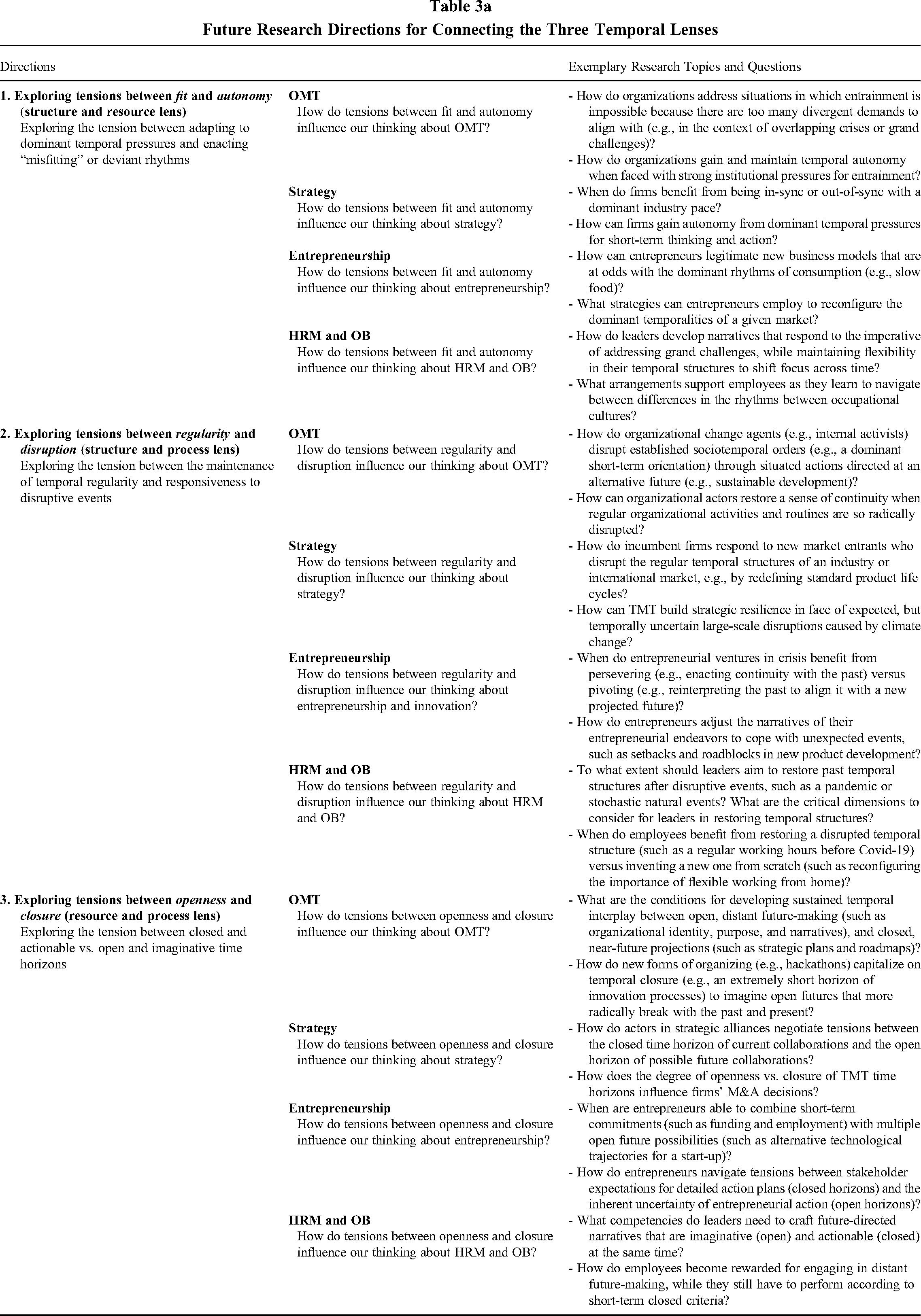
Future Research Directions for Enhancing the Three Temporal Lenses
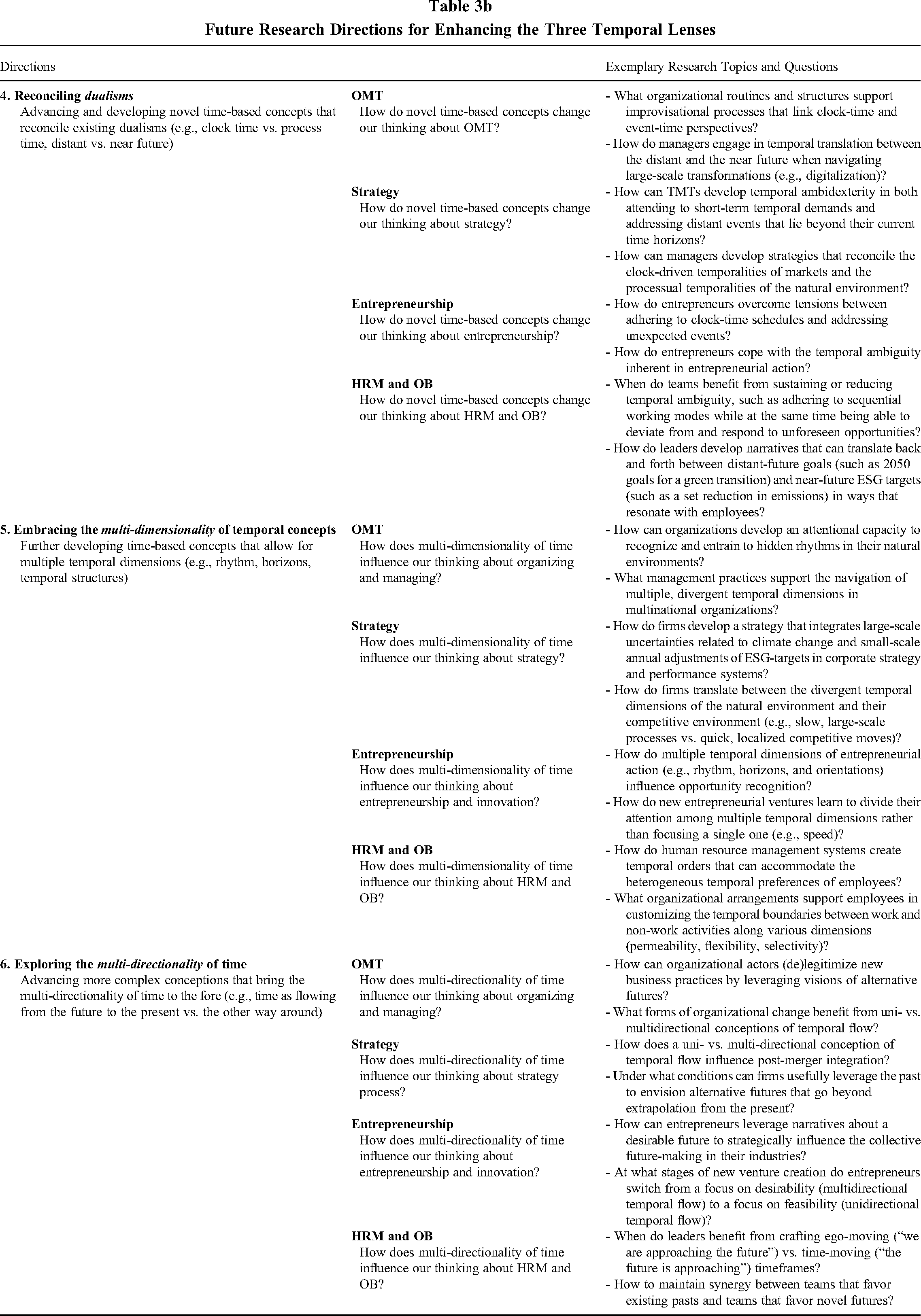
The second pathway—enhancing lenses—points to research questions that enable scholars to enrich and expand current time-based theorizing in management. By enhancing lenses, scholars could contribute to sharpening time as a research lens in management and broaden its scope to address complex management phenomena, such as grand challenges, crises, or business ecosystems. Here, future research could focus on (4) reconciling temporal dualisms, (5) embracing the multidimensionality of time-based concepts, and (6) exploring the multi-directionality of time.
Connecting Lenses
The first pathway builds on the general idea of interrelating multiple, seemingly incommensurable research paradigms to derive a richer and more complete understanding of phenomena (see Table 3a). Research that connects multiple temporal lenses is urgently needed to adequately capture the temporal complexities of various phenomena of central interest to management scholars, such as sustainable innovation (Hernes et al., 2021), multi-sector collaboration for grand challenges (Hilbolling et al., 2022), and organizing in times of crisis (Feldman et al., 2022; Geiger et al., 2021). Below, we elaborate on how new and more complex research questions can be posed and addressed at the interfaces between lenses.
Tensions between temporal fit and autonomy (structure-resource)
We see ample opportunities for future research on the tensions between temporal fit and autonomy. Such tensions come into view at the interface between time as resource and time as structure. As developed above, time as resource advances a contingency view of time that highlights the need to establish temporal fit with externally imposed temporal demands, such as matching the dominant pace of innovation in an industry. By contrast, time as structure advances a structuration view that emphasizes the autonomy of actors to enact temporal structures at odds with dominant demands, for example, by approaching innovation more slowly than the dominant pace of the industry.
Exploring such tensions holds considerable potential for advancing our understanding of phenomena in various research areas. For example, strategy scholars have primarily approached questions of speed, for example, in relation to competitive dynamics or innovation, through a temporal fit logic (time as resource). A temporal fit logic naturally suggests questions about matching the dominant temporal features of an industry. Approaching the phenomenon of speed in innovation at the interface of time as resource and time as structure brings different research questions into focus. For example, scholars could examine when and at what stages of the innovation journey it is beneficial to enact temporal fit with customers or competitors (e.g., matching their speed) versus maintaining autonomy from such demands (e.g., deviating from their speed by slowing down or speeding up): How could firms transform the dominant temporal features of an industry rather than passively adapting to them? Similarly, entrepreneurship scholars could benefit from exploring the tensions between temporal fit and autonomy in relation to the temporality of business planning. Rather than trying to determine an optimal timing or duration for entrepreneurial planning (temporal fit), scholars could examine, for example, how entrepreneurs synchronize planning with the demands of investors and stakeholders while also building temporal buffers that enable them to remain autonomous in light of unexpected crises that require pivoting. Overall, addressing the tension between temporal fit and autonomy would deepen current understandings of time as both a constraint (e.g., a limited resource) and an enabler of managerial, organizational, and entrepreneurial action.
Tensions between temporal regularity and disruption (structure-process)
We also see ample opportunities for future research on the tensions between temporal regularity and disruption. Such tensions manifest at the interface between time as structure and time as process. As developed above, time as structure advances a structuration view of time that highlights regularity through the ongoing reproduction of temporal structures in teams and organizations, such as maintaining reliability in the performance of routines (e.g., Turner & Rindova, 2012). By contrast, time as process advances a relational view that emphasizes how temporal regularity is constantly undermined by potentially disruptive events, such as unanticipated technological advances or fundamental shifts in business ecosystems.
Tensions between regularity and disruption are crucial for understanding many relevant phenomena in various research areas. For example, HRM and OB scholars could examine how employees and teams can maintain temporal regularity in extreme or chaotic situations, such as following a corporate crisis that has disrupted established routines. HRM scholars could also examine how human resource managers can develop their employees’ capacity to remain temporally resilient (i.e., maintain temporal regularity) in the face of large-scale disruptions, such as pandemics or armed conflicts. Similarly, OB researchers could investigate when teams and multi-team systems benefit from restoring a disrupted temporal order versus inventing an entirely new one. Tensions between temporal regularity and disruption also arise in strategy and entrepreneurship. For example, strategy scholars could examine how memories of previous successful turnarounds enable or constrain firms’ capacity to anticipate an impending disruption and seize the right moment for strategic action.
Tensions between openness and closure (process-resource)
We also see opportunities for research on the tensions between the closure of measurable time horizons (as emphasized by time as resource) and their potential openness to multiple interpretations (as emphasized by time as process; Schultz & Hernes, 2020). Such tensions arise because, on the one hand, both the past and the future are open to renegotiation (time as process), for example, by rediscovering a forgotten memory of the past or envisioning an alternative future. On the other hand, time horizons require a certain degree of closure to become actionable (time as resource), for example, deadlines for project milestones or strategic goals.
Examining such tensions can enrich our understanding of various phenomena within and across different research areas. For example, strategy scholars have begun to explore how seeing the past as open to (re)interpretation can inspire new approaches to strategic change, such as strategy restoration (Miller et al., 2019). However, such strategies must also be translated into actionable plans with clear horizons for specific steps. Such dilemmas invite questions such as: How can strategists navigate the tensions between imaginatively approaching the past and the future as open and being rigorous in strategic goals with closed time horizons? In organization theory, scholars could examine how tensions between openness and closure shape the use of memories as a resource for organizational learning. For instance, open engagement with the organizational past might increase the chances of (re)discovering a forgotten idea or strategy and thus benefit learning, but such an engagement can be costly and slow (e.g., Hernes et al., 2021). When do the benefits of openness outweigh the costs and vice versa? How can organizations navigate the implied tensions between approaching learning with an open horizon and having to deliver specific results by a closed deadline? Conversely, what are the drawbacks of closed horizons that set clear boundaries for open-ended processes, such as learning or innovation?
Enhancing Lenses
The second overarching pathway for future research derives from our observation that much of the extant research in all three lenses would benefit from embracing more complex conceptions and assumptions about time (see Table 3b). In so doing, scholars can develop a richer temporal understanding of complex and relevant phenomena, such as digitalization, climate change, or managing crises. We call this pathway “enhancing” lenses because it entails recommendations for future research focused on temporal phenomena that require richer and more advanced temporal concepts.
Reconciling dualisms
Binary oppositions feature prominently in all three temporal lenses despite the tendency of such dualisms to oversimplify temporal phenomena. For example, when scholars examine time on the spectrum of subjectivity and objectivity, they create artificial boundaries between the human experience of time (subjective) and collective temporal structures (objective), even though the latter are a product of human action and interaction and, hence, inseparable from human experience (Hernes, 2022). Such boundaries tend to reify the two sides of the opposition and subsume additional temporal dimensions under one of the two poles. Our review suggests that dualisms such as subjective versus objective time can be misleading because so-called subjective time—such as managers’ time horizons—may well be expressed in “objective” numbers, while so-called objective time can be more malleable than the term suggests (Branzei & Fathallah, 2023).
To address such conceptual shortcomings, future research could explore concepts that reconcile existing dualisms. Consider, for example, how, in the context of new product development, a “synthesis between event-time and clock-time management is achieved through improvisational processes that enable individuals to creatively coordinate their actions in order to simultaneously adapt to unexpected events and manage calendar deadlines” (Crossan et al., 2005: 137). Lifshitz-Assaf and colleagues (2021) have discussed the concept of “temporal ambiguity,” which combines event-time dimensions, such as responsiveness to unpredictable events, as well as clock-time dimensions, such as duration and sequence, to explain why some hackathons succeed at accelerating innovation processes while others do not. Furthermore, Hernes and Schultz (2020) have proposed the concept of “temporal translation” to examine how actors reconcile the near (short-term) and the distant (long-term) future through displacement and transformation. We encourage future empirical and conceptual work to draw on such concepts or to develop new ones with the explicit aim of reconciling existing dualisms.
Embracing multidimensional concepts
Another promising research direction entails exploring multidimensional concepts that adequately capture the complexity of time. Scholars across all three lenses tend to reduce specific temporal concepts, such as timing, to a single dimension, such as a continuum from early to late (e.g., Boyd & Bresser, 2008). While focusing on a single temporal dimension is an essential first step, it also risks obscuring other relevant dimensions. For example, an entrepreneur may pivot early and still be too slow. A team might deliver results very quickly but do so erratically. In short, future research could benefit from incorporating concepts that highlight multiple dimensions simultaneously and capture paradoxes among various temporal dimensions.
For example, in strategy research, rhythms of strategic change have been analyzed primarily in terms of their (ir)regularity (Klarner & Raisch, 2013) and frequency (Zhang et al., 2022). Future research could explore and theorize several other dimensions of rhythms, such as visibility or scale. For example, how does the visibility of rhythms impact managers’ capacity to recognize rhythms to entrain? We would expect that less visible or hidden rhythms, such as those of ecological processes, pose important challenges to managerial attention, that is, they are likely to be more difficult to recognize (Bansal, Kim, & Wood, 2018). Conversely, rhythms that are more transparently visible might be easy to recognize and entrain, even though they might be counterproductive. For instance, as climate goals expand to include biodiversity loss, organizations will need to understand and adapt to the rhythms of the ecosystems in which they operate. Here, the push for visibility suggests a research agenda of how the temporality of nature (e.g., in regenerative agriculture) can be codified in ways that speak to the rhythm of localized ESG standards while scaling up biodiversity.
Exploring the multi-directionality of time
Scholars could also enhance temporal lenses by paying more attention to time's nonlinear and multidirectional nature. Most studies assume that time flows in only one direction: from the past through the present toward the future. Such assumptions are appealing because they tend to correspond to our everyday experience. However, they also reinforce the common bias of viewing the future as an extrapolation of the present rather than imagining alternative futures that depart more radically from the status quo (Gümüsay & Reinecke, 2021). Hence, future research might benefit from relaxing such assumptions and exploring alternatives that better capture the multidirectional nature of time.
For example, in research on organizational change, Lord and colleagues (2015) have drawn on quantum mechanics to theorize how time flows from the future to the present in the sense that multiple future potentialities approach the present. Although counterintuitive, this alternative assumption points to numerous research opportunities. For example, are entrepreneurs who assume a past→present→future direction less likely to envision and enact more radical departures from the status quo than entrepreneurs who assume that time flows from the future to the present? Similarly, embracing the multi-directionality of time might enable strategy scholars to explain better when and why speed might be beneficial or counterproductive to strategic action. For example, how can speed-focused firms operating in high-velocity environments maintain momentum on their paths into the future while taking sufficient time to consider and evaluate alternative futures?
Conclusion
More than 20 years ago, Ancona, Okhuysen and Perlow (2001b: 647) argued that “the temporal lens brings new functionality to research,” yet also asked: “Why do researchers resist using a temporal lens?” Our review reveals a somewhat different picture. As more and more researchers have indeed embraced the “new functionality” of the temporal lens, the temporal lens has become increasingly ambiguous. We set out to remedy this problem by revealing and synthesizing the assumptions, domains, and concepts of three distinct temporal lenses. Overall, we see considerable potential for developing new knowledge in various research areas by focusing on the interplay among multiple lenses and by enhancing these lenses. A richer temporal lens would benefit our understanding of managerial and organizational phenomena and, more generally, deepen our knowledge of the complex nature of time.
Supplemental Material
sj-docx-1-jom-10.1177_01492063231215032 - Supplemental material for Time as a Research Lens: A Conceptual Review and Research Agenda
Supplemental material, sj-docx-1-jom-10.1177_01492063231215032 for Time as a Research Lens: A Conceptual Review and Research Agenda by Blagoy Blagoev, Tor Hernes, Sven Kunisch, and Majken Schultz in Journal of Management
Footnotes
Acknowledgments
We are indebted to Zeki Simsek and two anonymous reviewers for their invaluable feedback and guidance throughout the review process. We also thank Herman Aguinis, Pratima (Tima) Bansal, Jean M. Bartunek, Daniel Geiger, and Waldemar Kremser, as well as the members of the Organization and Management Group at TU Dresden for their helpful comments and suggestions on earlier drafts of the manuscripts. Tor Hernes and Majken Schultz acknowledge funding from Novo Nordisk Foundation, grant no. NNF20SA0067182.

Notes
References
Supplementary Material
Please find the following supplemental material available below.
For Open Access articles published under a Creative Commons License, all supplemental material carries the same license as the article it is associated with.
For non-Open Access articles published, all supplemental material carries a non-exclusive license, and permission requests for re-use of supplemental material or any part of supplemental material shall be sent directly to the copyright owner as specified in the copyright notice associated with the article.
