



Abstract
On March 11, 2020, the World Health Organization declared COVID-19 a global pandemic, and organizational life around the world changed dramatically overnight. In response, there has been a flurry of management research that seeks to understand the wide-ranging implications of this crisis. In this article, we summarize a scoping review of 69 articles that focused on management issues during the pandemic to understand how it affected individuals, teams, leaders, organizations, and society at large. We also identify and discuss the theoretical perspectives that were prominent in these investigations. We conclude by identifying directions for future inquiry with a mind toward research questions that are likely to be relevant in a postpandemic workplace and note some implications for management scholarship as well.
In January 2020, the World Health Organization (WHO) discussed a mysterious coronavirus-related illness in Wuhan, China, raising concerns about the emergence of a new highly infectious and dangerous virus. That same month, on January 21, the Centers for Disease Control and Prevention confirmed the first coronavirus case in the United States. Weeks later, on March 11, the WHO declared COVID-19 a global pandemic, and organizations around the world—including businesses, government operations, churches, and schools—were shut down (American Journal of Managed Care, 2021). Organizational life changed seemingly overnight. Many employees were afraid to be around others, fearful of becoming seriously ill, and increasingly aware of their own mortality (Takeuchi, Guo, Teschner, & Kautz, 2021). As companies switched to remote work, daily commutes came to an end for many employees, and Zoom meetings became the norm. Working parents, especially women, suddenly became teachers as their children shifted to online education (Harris, 2020). Frontline workers at grocery stores dealt with product shortages, empty shelves, frustrated customers, and frightened individuals as supply chains were challenged (Bomey & Tyko, 2020; Repko, 2020). At the same time, hospitals were quickly filling up, putting tremendous pressure on the health care system, doctors, and nurses (Abelson, 2020).
As of July 2023, there have been nearly seven million deaths due to COVID-19, but the situation has gradually improved, due in part to the development of vaccines and therapeutics. Furthermore, in May 2023, the WHO announced that COVID-19 was no longer a global public health emergency. Although the virus continues to spread, cases of infections, hospitalizations, and fatalities are all significantly lower than they were at the height of the pandemic. The business world has transitioned to a new normal as well, as organizations are no longer adapting to pandemic disruptions but readjusting to life in a postpandemic world.
Over the past 3 years, management researchers have sought to understand the dramatic and sudden organizational changes brought about by the pandemic. This endeavor prompted top journals to publish not only commentaries and thought pieces about the potential managerial implications of the first global pandemic in over a century (e.g., Malhotra, 2021) but also empirical work regarding organizations during this pandemic. Most notably, the Journal of Applied Psychology issued a call for papers on the pandemic, which received >800 submissions that resulted in 55 articles1 published on this topic (Eby, 2022). Some of these studies complement prior findings from the management literature, such as the positive influence of female leadership in times of uncertainty (Bruckmüller & Branscombe, 2010; Sergent & Stajkovic, 2020); however, other studies provide new insights. For example, although variable work schedules are typically thought to increase firm performance through efficiency gains (Bhattacharya & Wright, 2005), Chung (2022) found such practices to have detrimental effects for organizations during the pandemic. Such findings provide a basis for new avenues for future scholarship, as they challenge what we thought we understood prepandemic.
Just as organizations have begun to adjust to a new normal, the surge of publications regarding the pandemic's management implications has waned. Nevertheless, the pandemic's imprint on organizations remains. Indeed, imprinting occurs when an entity is shaped by the conditions and constraints of a sensitive period in its history, and the adaptation that occurs persists even after this critical period ends (Simsek, Fox, & Heavey, 2015). Thus, some changes that were intended to be temporary (e.g., remote work) have now become permanent. Relatedly, experts maintain that the COVID-19 pandemic will not be the last of its kind (Gill, 2020). Thus, a review of this work is critical to our understanding of not only what happened to organizations during the pandemic but also what is happening at present and what may happen in the future. Roulet and Bothello (in press) propose that historical disruptions such as the COVID-19 pandemic follow an event chain that can be applied to future tumultuous events. In a similar vein, the findings presented in this review provide insights that should allow organizations to better prepare for, respond to, and recover from potential pandemics, as well as other “black swan” events, that may occur in the future.
Method and Scope of Review
We focused our review on articles published in top-tier management journals. Our search included articles published between March 2020 and July 2023. Consistent with Kepes, Keener, McDaniel, and Hartman (2022), we started with the eight journals used by Texas A&M University and the University of Georgia to rank management departments (http://www.tamugarankings.com): Academy of Management Journal, Academy of Management Review, Administrative Science Quarterly, Journal of Applied Psychology, Organizational Behavior and Human Decision Processes, Organization Science, Personnel Psychology, and Strategic Management Journal. We also included management articles published in four journals that are considered elite by leading management departments around the world according to Oh and Van Iddekinge (2020): Journal of Business Venturing, Journal of International Business Studies, Journal of Management, and Management Science.
Notably, the 55 articles published in the Journal of Applied Psychology represented the majority (80%) of the articles that we reviewed. Searching the other 11 journals yielded an additional 14 articles; thus, 69 are included in our review. Table 1 provides details about this process. These articles covered a variety of topics, which we first sorted to create a word cloud using the keywords provided (Bliese, Edwards, & Sonnentag, 2017). We excluded the term COVID-19 from this figure, as it was included in every article that we reviewed. As shown in Figure 1, prominent keywords were technology, stress, remote work, emotion, crisis, anxiety, death awareness, and leadership.
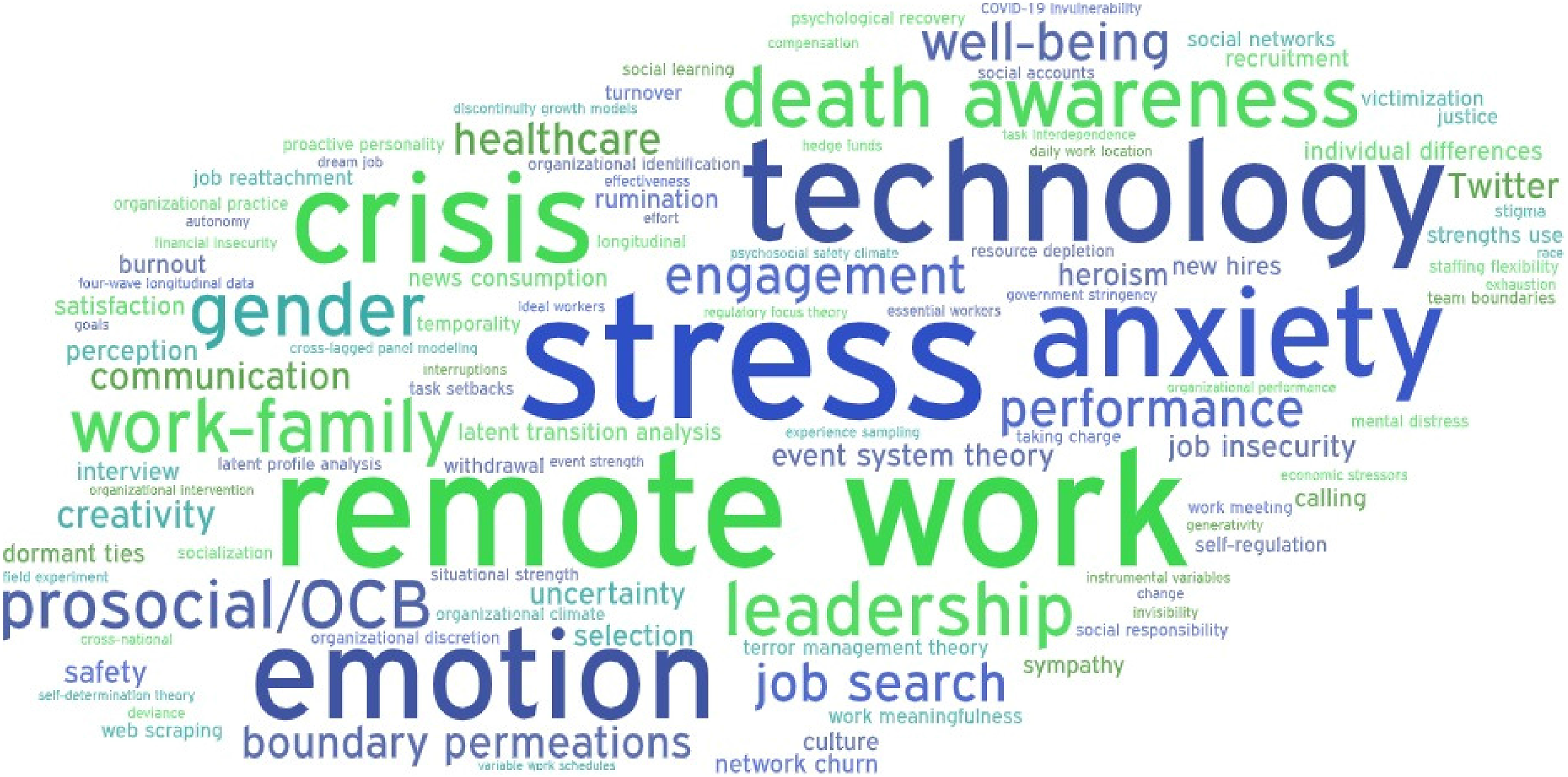
Common Themes in This Review
Review Procedures
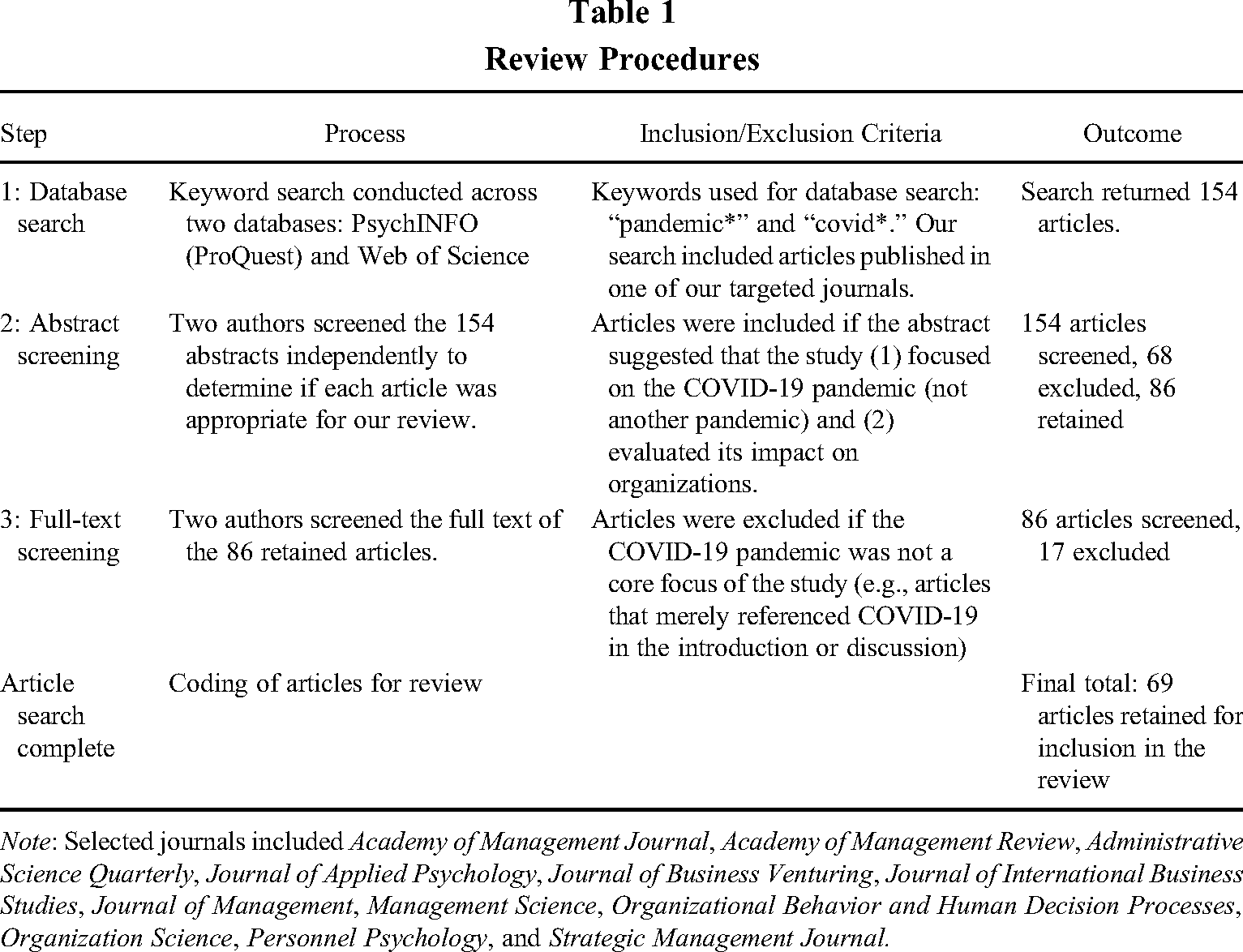
Note: Selected journals included Academy of Management Journal, Academy of Management Review, Administrative Science Quarterly, Journal of Applied Psychology, Journal of Business Venturing, Journal of International Business Studies, Journal of Management, Management Science, Organizational Behavior and Human Decision Processes, Organization Science, Personnel Psychology, and Strategic Management Journal.
Given that management research during the pandemic covered a range of topics, used a variety of research designs, and has not been previously reviewed, we conducted a scoping review, whereby we provide an overview of this work and identify the key concepts and evidence that emerged from this line of inquiry (Levac, Colquhoun, & O’Brien, 2010). Consistent with this approach, we focus on a general research question—namely, how were individuals, teams, leaders, organizations, and society at large affected by the pandemic? We were also interested in understanding what theories were used in this work, and we found that a variety of frameworks were employed. However, only a handful of theories were utilized in multiple instances (i.e., event system theory, conservation of resources theory, transactional theory of stress, control theory, terror management theory [TMT]). Thus, the breadth of knowledge generated during this time was vast; scholars examined several content areas through unique theoretical lenses. Furthermore, the articles in our review predominantly addressed a single level of analysis, with the exception being studies that examined the effect of factors such as organizational support or leader behaviors on individual outcomes or those that relied on nested data.
Review Framework
To understand the ways that the pandemic affected organizations, we developed a conceptual framework to guide our review (Figure 2). Although every article in our review treated COVID-19 as a disruption to organizational life and sought to understand the consequences of its impact, the theoretical lens applied in each study offered a different perspective regarding the role of the pandemic. For example, whereas some scholars used social information processing theory (Salancik & Pfeffer, 1978) to argue that COVID-19 provided a cue for behavior or adaption, others argued that, according to TMT (Becker, 1973; Greenberg, Solomon, & Pyszczynski, 1997), COVID-19 served as a reminder to individuals of their own mortality. To assess the overall findings regarding the impact of the pandemic highlighted by each theoretical lens, we reviewed each article in terms of content, paying special attention to the proposed relationships, mechanisms, and influencing factors. In doing so, we found that research focused primarily on identifying the unique ways that individuals, teams, leaders, organizations, and society responded to and coped with the shock of the pandemic. These studies also identified the positive and/or negative outcomes of these responses and the factors that influenced the strength of these relationships. As such, the research conducted during this time advanced theory by identifying how and for whom these responses were successful in dealing with the COVID-19 pandemic (Whetten, 1989). In the following sections, we review these findings by level of analysis—individuals, teams, leaders, organizations, and society.
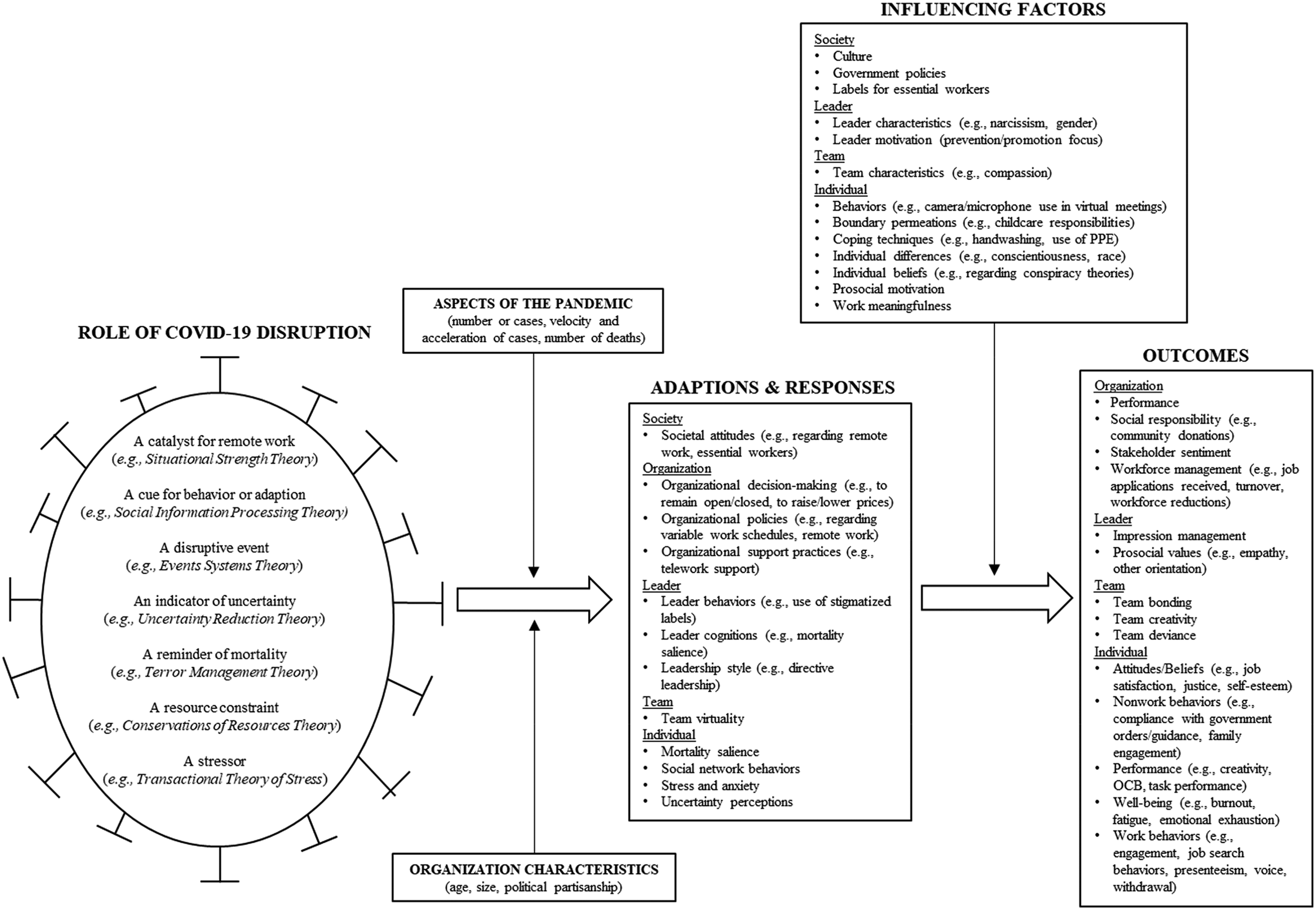
A Conceptual Framework of COVID-19 Research in Management Journals
Individuals and the Pandemic
Research on individuals revealed a range of findings. Specifically, studies on the effects of the pandemic covered four main areas: well-being, the flexibility and burden of remote work, work-nonwork boundaries, and prosocial motivation and the search for meaning at work.
Well-Being
By far, the dominant theme that emerged involved the myriad ways that the pandemic influenced individual well-being. Theories of stress and strain provided useful lenses for understanding well-being during the pandemic, and four themes emerged in this line of work: stressors and strain, death awareness and anxiety, job search anxiety, and coping strategies.
Stressors and strain
Unsurprising, the pandemic was a potent stressor that led to negative individual outcomes, such as higher exhaustion, higher turnover intention, and lower family engagement (e.g., Chong, Huang, & Chang, 2020; Trougakos, Chawla, & McCarthy, 2020). The pandemic created various perceptions of uncertainty (e.g., job security, health, vaccine availability, connecting with friends and family). Prior research typically suggests that uncertainty leads to poor performance due to increased anxiety (e.g., Beal, Weiss, Barros, & MacDermid, 2005; Lazarus & Folkman, 1984). Lian et al. (2022), however, identified a more nuanced relationship. They found that types of uncertainty had differential effects on organizational identification and, in turn, influenced work effort, job performance, and citizenship behavior. In particular, increased job insecurity was associated with decreased organizational identification, yet increased environmental uncertainty was associated with increased organizational identification. These findings identify a potential bright side of uncertainty; that is, certain types of perceived uncertainty may have positive effects on individual well-being and subsequent work behaviors via organizational identification.
Scholars investigated the nuanced ways that the pandemic acted as a stressor. Using experience sampling methodology (ESM), Fu, Greco, Lennard, and Dimotakis (2021) examined the differing impact that various aspects of the pandemic had on employee anxiety over time. As the pandemic persisted, the prevalence of COVID-19 (i.e., the number of cases) had a decreased impact on anxiety, but the velocity (i.e., rate of change) and acceleration (i.e., change in velocity) of cases had an increased impact on anxiety. Furthermore, McCarthy et al. (2021) found that the number of cases per capita did not significantly predict reports of anxiety, but the duration of the pandemic and the cumulative number of deaths per capita did influence COVID-19 exhaustion and interview anxiety. Together, these findings indicate that a stressor itself (i.e., COVID-19) may not solely determine well-being outcomes; rather, the type of stressor and the dynamic aspects of that stressor are the most relevant determinants of well-being. These findings add to our theoretical understanding of stressors and strain by demonstrating that key aspects of stressors change over time and that their effects on anxiety and work outcomes also change over time.
Death awareness and anxiety
COVID-19 fatalities contributed to heightened death awareness (Takeuchi et al., 2021). Such awareness is associated with death anxiety (i.e., affective responses promoting self-protective behavior) and death reflection (i.e., cognitive responses promoting generative behavior). Many scholars utilized theories such as TMT (Becker, 1973; Greenberg et al., 1997) to investigate the relationship between death awareness and work outcomes. TMT suggests that exposure to death may prompt individuals to withdraw but may also prompt them to be more prosocial. Regarding these divergent responses, Hu, He, and Zhou (2020) found evidence of both effects: pandemic-induced mortality salience increased anxiety, which resulted in reduced job engagement and increased prosocial behavior toward the community. Interestingly, the presence of servant leadership reduced the negative implications for job engagement and enhanced the positive implications for prosocial behavior. Similarly, Xu, Dust, and Liu (2023) used TMT to highlight the role that death anxiety played in the “great resignation.” They noted that when individuals perceived low task significance, feelings of COVID-19 death anxiety fueled a need for meaningful work, which ultimately led to higher turnover intentions.
Shao, He, et al. (2021) used TMT but integrated it with generativity theory (Erikson, 1963, 1982). These authors demonstrated that exposure to COVID-19 information was associated not only with increased death reflection (which contributed to helping behavior) but also with increased death anxiety (which contributed to work withdrawal). However, the relationship between COVID-19 information exposure and work withdrawal was weaker when organizations instituted internally focused corporate social responsibility programs, indicating that organizational practices may provide crucial resources to help employees cope with the pandemic. Although some of these studies relied on TMT to understand the influence of death awareness on withdrawal and prosocial behaviors, Takeuchi et al. (2021) found that increased death reflection prompted individuals to adopt an other-orientation, which fueled creative behaviors at work (e.g., coming up with creative solutions, finding new ways to perform tasks). Death anxiety, however, did not have a significant relationship with creativity. Thus, although death anxiety can be detrimental to individual well-being, death reflection can prompt positive task and extra-role behaviors.
Zhong, Paluch, Shum, Zatzick, and Robinson (2021) provided a unique perspective by demonstrating how people experience death anxiety and death reflection simultaneously. The authors empirically identified three profiles of death awareness: the disengaged (low reflection and low anxiety), anxious reflectors (high reflection and high anxiety), and calm reflectors (high reflection and low anxiety). They found that anxious reflectors experienced more depression and emotional exhaustion than those in other profiles. They also reported that employees were more likely to be anxious reflectors if they perceived a greater risk of contracting COVID-19, worked in a job requiring human contact, or lived in a state with high case rates or infection-fatality rates. These findings present important implications for TMT: death anxiety and death reflection should not always be considered mutually exclusive responses to death awareness, and the combination of anxiety and reflection may be an important determinant of work outcomes.
Finally, Yoon et al. (2021) found that death anxiety played an important role in the relationship between the daily consumption of COVID-19 news and feelings of uncertainty. Contrary to the typical prediction that information consumption should decrease perceptions of uncertainty, the authors indicated that news consumption about COVID-19 actually increased perceptions of uncertainty, thereby hindering creativity and goal progress. In an exploratory analysis, they presented evidence suggesting that consuming news through social media (e.g., Facebook, Twitter) was more likely to increase uncertainty than consuming news through more traditional media channels (e.g., newspapers) or instant messaging platforms (e.g., texting, WhatsApp). However, individuals with higher death anxiety were less reactive to new information about the crisis, perhaps due to an existing preoccupation with death.
Job search anxiety
The stress of the pandemic extended beyond current employees to people looking for jobs. Scholars contributed to this line of work by investigating how COVID-19 influenced job search and selection processes. For example, Feng, Wang, Huang, and Zhang (2023) found that, during the pandemic, recruiters were more open-minded to entrepreneur applicants than they were before the pandemic. The authors indicated that recruiters possibly believed that a candidate's ability to identify and act on entrepreneurial opportunities might benefit the organization by helping it develop resilience during a time of crisis.
Researchers demonstrated that COVID-19 anxiety influenced an applicant’s interview performance, as well as cognitive and behavioral outcomes, such as fairness perceptions and intentions to recommend the company to other applicants (McCarthy et al., 2021). COVID-19 anxiety also influenced the types of jobs that applicants targeted in their job searches. Using a weekly ESM study, Gabriel, MacGowan, Ganster, and Slaughter (2021) found that job search anxiety induced by COVID-19 influenced problem-solving pondering and affect-focused rumination. Job applicants who engaged in problem-solving pondering tended to expend targeted efforts toward a search for one's dream job, a focused search of carefully screened jobs, or an exploratory search of an array of jobs. Affect-focused rumination, however, hindered a dream job search effort. These findings extend our conceptualization of how people search for jobs by revealing that stressors affect a person's efforts.
These investigations highlighted some interesting moderating effects regarding applicants’ beliefs about the legitimacy of the pandemic and their personal risk. Specifically, Gabriel et al. (2021) found that the relationship between COVID-19 job search anxiety and affect-focused effort was higher for individuals who believe in conspiracy theories. Furthermore, Koopman, Liu, Liang, and Liu (2021) reported that the relationship between COVID-19 job search constraints and job search distress was mitigated by perceptions of COVID-19 invulnerability due to personal health factors and family/friend exposures.
Coping strategies
Because the pandemic was characterized by the immediate onset of stress, as well as the ongoing presence of chronic stress, it provided a unique opportunity to analyze the temporal nature of the coping and recovery process. Using growth curve modeling, Anicich, Foulk, Osborne, Gale, and Schaerer (2020) found that employees reported reduced feelings of powerlessness and increased feelings of authenticity, even though their stress levels did not decrease during the pandemic. Although prior work suggests that recovery begins after stressors subside (e.g., Norris, 2006), these researchers considered that individuals could cope and recover from the stress of the pandemic even while experiencing the stress that it was causing.
Researchers reported that people relied on a variety of resources and techniques to cope with pandemic stress. Some of this research identified behavioral tactics used to manage COVID-19 stress, such as frequent handwashing (Trougakos et al., 2020), social distancing (Probst, Lee, & Bazzoli, 2020), or wearing personal protective equipment (e.g., masks, gloves) to lower the risk of infecting others (Cameron, Thomason, & Conzon, 2021). However, other scholars observed that individuals, especially essential workers, drew from internal resources to cope. Chen et al. (2021) stated that a proactive personality served as a personal resource that helped fuel increased performance, resilience, and thriving. These findings suggest that employees in high-stress occupations may have unique traits that facilitate their ability to manage job stress; this presents an opportunity to investigate whether traits such as resilience are dispositional or are learned through exposure to high-stress situations or resilient coworkers.
Social networks were resources for coping with the stress of the pandemic. Although some research indicates that COVID-19 distress caused employees to drop social network ties (Jo, Harrison, & Gray, 2021), Yang, Soltis, Ross, and Labianca (2021) found that people who experienced job insecurity and/or stressful social ties with family members were more likely to seek out and reactivate dormant social network ties (i.e., connections not contacted in at least 3 years). This finding moves our theorizing beyond the typical focus on existing social relationships and suggests that some employees may cope by reactivating dormant ties.
Flexibility and Burden of Remote Work
Because so many workers were forced to work remotely during the pandemic, researchers sought to better understand the implications of this new work arrangement (Chong et al., 2020). First, they explored whether remote work was beneficial or harmful for employees’ personal well-being and performance. Although working remotely offers flexibility for employees, two studies reported that remote work and certain aspects of it (e.g., videoconferencing) were taxing. In a study combining qualitative and ESM data, Bennett, Campion, Keeler, and Keener (2021) found that some employees experienced fatigue due to videoconferences. However, videoconference fatigue was reduced for those who had a greater sense of group belongingness and/or muted their microphone during meetings. Shockley, Gabriel, et al. (2021) obtained similar findings in a 4-week ESM study of health care employees, finding that camera use during virtual meetings was tiring beyond the duration or number of meetings, especially for women and newer employees. They suggest that camera use triggered a need to engage in self-presentation, which led to more fatigue.
Because so many people experienced burnout during this time (e.g., Chong et al., 2020), these findings on videoconferences provide one explanation of why the pandemic undermined well-being at work. However, other studies suggest that this relationship is not so straightforward. In a 4-week study of employees who transitioned to remote work, Shockley, Allen, Dodd, and Waiwood (2021) found that daily communication quality was positively associated with performance and negatively associated with burnout. Furthermore, employee performance increased when leader expectations for communication were established early on (e.g., expected time for an email reply), suggesting that leader support could help employees adjust to this change. Curiously, this relationship was weaker when team task interdependence was relatively high. The authors speculated that supervisor expectations became superfluous in this context given that interdependent teams already communicated frequently.
Conscientiousness, a personality trait typically associated with positive organizational outcomes (e.g., Judge & Ilies, 2002; Zhao, Seibert, & Lumpkin, 2010), was of particular interest in one study on remote work during the pandemic. Specifically, Venkatesh, Ganster, Schuetz, and Sykes (2021) were interested in how the pandemic-induced situational strength of virtual work influenced the importance of employee conscientiousness. Because the virtual environment is characterized by less supervision and clarity, these scholars used the situational strength literature (Mischel, 1977) to argue that remote work occurs in a weaker situational context. In a two-wave study of employees who had transitioned to remote work, they found support for their argument: remote work created a weaker situational environment that made conscientious employees prone to higher strain and lower satisfaction, which is contrary to previous work showing conscientiousness associated with lower strain and higher satisfaction. This reversal is likely because conscientious employees struggled with ambiguous expectations regarding what and how much work needed to be done. As such, the remote work environment flipped the script regarding conscientiousness—that is, a trait that is typically considered an asset in the workplace became a liability for employees working virtually.
In addition to understanding the impact of remote work on individual performance and well-being, researchers sought to understand how interacting through a screen might influence one's perception of authenticity. Brodsky (2021) investigated perceptions of authenticity as influenced by the richness of the communication medium: from low (e.g., email) to medium (e.g., telephone) to high (e.g., video/face-to-face). Based on the emotional labor and surface acting literatures (e.g., Grandey, Fisk, Mattila, Jansen, & Sideman, 2005), Brodsky's study showed that those engaging in surface acting should utilize a midrich medium of communication (e.g., telephone) to minimize perceived emotional inauthenticity. However, those who wish to convey authentic emotions (through deep acting)—and are not concerned about emotional cue leakage (i.e., underlying emotions leaking through; Grandey, 2000)—should choose a richer medium of communication (e.g., video). Thus, they concluded that perceived emotional authenticity is based on message content and communication means.
Although many organizations allowed their employees to work from home during the pandemic, some organizations provided options for working at the office, from home, or in a hybrid of both. Using daily diaries of information technology employees, Shao, Fang, Wang, Chang, and Wang (2021) found that employees tended to migrate away from their stressors. In other words, they were more likely to work in the office the day after experiencing stressors based on work-family boundaries and work coordination; conversely, employees were more likely to work at home the day after experiencing workload stressors. In sum, the transition to remote work provided a way for organizations to continue operating through the pandemic, but the findings from this review indicate benefits and costs of remote work that warrant more attention given that employees are likely to be working remotely more often in the future.
Work-Nonwork Boundaries
As employees shifted to remote work during worldwide lockdowns, the lines between work and nonwork domains were blurred, which affected experiences at work and at home (e.g., Gabriel et al., 2021). Several articles in our review revealed that boundary permeations were associated with negative outcomes, including higher family-to-work interference, work-to-family interference, emotional exhaustion, and lower performance (e.g., Leroy, Schmidt, & Madjar, 2021). Indeed, Alekseev et al. (2022) found that individuals’ abilities to focus on work and manage responsibilities at home were hindered by increased household responsibilities and work responsibilities, respectively, and this was especially true for women and parents of school-age children. Similarly, Hu, Chiang, Liu, Wang, and Gao (2023) stated that husbands and wives experienced an increase in work-family conflict when working at home, which increased psychological withdrawal from their families.
To cope with these boundary permeations, employees responded with distinct strategies. In a qualitative study investigating pandemic-related burnout, healthcare workers reported experiencing physical, temporal, and knowledge-based boundary permeations, which were associated with increased emotional exhaustion, detachment (e.g., cynicism), and feelings of inefficacy (Rapp, Hughey, & Kreiner, 2021). Participants described unique strategies used to manage each type of boundary permeation. For example, when faced with temporal boundary permeations, employees took steps to maintain their work and personal time by declining requests to take on extra work shifts. When faced with knowledge boundary permeations (e.g., frustration regarding work-related misinformation), employees coped by venting to coworkers or deciding whether to accept or ignore others’ opinions. Thus, different intrusions warranted different responses.
Given that work-nonwork interruptions affected women more often than men (Alekseev et al., 2022; Leroy et al., 2021), it is understandable that scholars sought to understand how women coped with this increase in boundary permeations. To address this issue, Kossek, Dumas, Piszczek, and Allen (2021) identified strategies that allowed highly career-invested women to remain in the workforce, and they found that these women strategically concealed and/or revealed nonwork roles to maintain their professional images in an effort to advocate for support and change. They also engaged in role sacrifice by abandoning certain role duties, detaching psychologically from roles, or sacrificing nonwork roles completely. One of the most critical factors in their decision to remain in the workforce was organizational support. Specifically, the negative effects of boundary permeations were reduced for women if their organizations provided structural support (e.g., flexibility) and social support (e.g., empathy).
Other research revealed that dual-career couples negotiated work and nonwork roles to manage boundary permeations. Using content analysis, Shockley, Clark, Dodd, and King (2021) identified seven strategies that couples used to manage childcare when daycares were closed. They found that women who worked remotely and handled all the childcare responsibilities suffered the greatest decline in well-being and work performance. In contrast, couples who alternated entire workdays without reducing their hours had the greatest well-being and performance outcomes. Interestingly, among those using some type of egalitarian strategy, couples who physically left the home for work reported better results than those who worked at home, suggesting that maintaining physical boundaries between work and home might be more important than separating responsibilities.
Although several studies presented evidence of increased work-life conflict during the pandemic, one study indicated that people experienced roughly the same amount of work-life conflict as prior to the pandemic. In a study that began before the pandemic, Vaziri, Casper, Wayne, and Matthews (2020) found that individuals belonged to one of three profiles of work-family conflict and enrichment: beneficial (i.e., low conflict and high enrichment), active (i.e., medium conflict and enrichment), or passive (i.e., low conflict and enrichment). The authors stated that many of these individuals remained in their prepandemic profiles. However, people were more likely to shift to a more negative profile if they had high segmentation preferences, engaged in emotion-focused coping, experienced higher technostress, or had less compassionate supervisors. Importantly, these negative profile shifts were associated with reduced job satisfaction, lower performance ratings, and higher turnover intentions.
A final type of boundary permeation involved employees working while they were sick. The decision to work—rather than use sick leave—negatively affected individuals in terms of intrapersonal well-being and interpersonal interactions with coworkers. In an investigation of presenteeism (i.e., when an individual attends work while ill), Taylor, Butts, Cole, and Pounds (2021) found that under conditions of high workloads, presenteeism was associated with more coworker mistreatment due to a heightened self-concern. When individuals reported low workloads, presenteeism was associated with concern for the sick individual and less coworker mistreatment. Because presenteeism research typically focuses on the consequences for the sick individual and the organization (Luksyte, Avery, & Yeo, 2015), this study extends prior research by highlighting the impact of presenteeism on coworkers. In sum, these articles build on prior research on boundary permeations in many ways, such as identifying the ways that women were disproportionately affected by them and highlighting unique strategies that individuals used to cope with boundary permeations during the pandemic.
Prosocial Motivation and the Search for Meaning at Work
Many people sought to find purpose and meaning during the pandemic or contemplated how to make a positive difference in the lives of others through their work. As previously discussed, increased death awareness was associated with increased prosocial behavior (e.g., Hu et al., 2020; Shao, He, et al., 2021). However, pandemic research indicates that the relationship between anxiety and prosocial motivation was complex. In an ESM study, Andel, Arvan, and Shen (2021) examined how consuming news about COVID-19 each week led to increased anxiety, which undermined employee engagement. Yet, whereas the negative relationship between anxiety and engagement was weaker when employees were called to their work because it gave them a sense of joy or purpose, it was stronger when employees’ work effort was driven by a desire to help others. The researchers speculated that when employees feel a calling to help others, they may feel overwhelmed and distraught by their inability to make a difference—but when their anxiety is low, those who are prosocially motivated are more engaged.
In a study of doctors and nurses, Caldas, Ostermeier, and Cooper (2021) found that the intensity of their involvement with the COVID-19 pandemic was related to emotional exhaustion, suggesting that those who are motivated to help others tend to have a greater risk of exhaustion. Prosocial motivation strengthened this relationship. In an ESM study of nurses working in intensive care units of a Wuhan hospital treating patients with COVID-19, Zhu et al. (2021) reported that prosocial motivation positively predicted job performance through the average level and variability of occupational calling, which is often conceptualized as stable but demonstrated daily variation here. Together, these studies show that prosocial motives can exacerbate the negative effects of certain stressors, thereby corroborating prior work showing that other-oriented motives can have a bright side and a dark side (Bolino & Grant, 2016).
Our review included similar findings on the impact of work meaningfulness. As previously mentioned, essential employees typically managed COVID-19 stress differently than nonessential employees. Liu, Chen, and Li (2021) identified stronger negative relationships between perceived crisis strength and both engagement and taking charge at work, when health care workers reported low work meaningfulness. This demonstrates that health care workers have varying levels of work meaningfulness, which may affect work behaviors such as engagement and proactivity in response to COVID-19 stress.
In sum, the articles in our review highlighted various implications that the COVID-19 pandemic had for individuals. The most prominent theories used in these studies were stress theories, including the transactional theory of stress (Lazarus & Folkman, 1987), conservation of resources theory (Hobfoll, 1989), and autonomy restoration theory (Radel, Pelletier, Sarrazin, & Milyavskaya, 2011). Other scholars utilized event system theory (Morgeson, Mitchell, & Liu, 2015) to examine how the perceived strength of the pandemic influenced individual outcomes. Multiple studies relied on TMT (Becker, 1973; Greenberg et al., 1997) to investigate the impact that death awareness had on individual well-being and prosocial behavior. Notably, this research area tended to use intrapersonal theories to highlight the influence of the pandemic on individual well-being and work behaviors. Moving forward, theories of interpersonal exchange (e.g., social exchange theory; see Cropanzano & Mitchell, 2005, for a review) may yield further insight into how crises such as the COVID-19 pandemic influence individual outcomes.
Teams and the Pandemic
Because team-based work is prevalent in organizations (Salas, Reyes, & McDaniel, 2018), it is not surprising that our review included studies focused on how teams were affected by the pandemic. Some research in this area considered the impact of a team's culture during the pandemic. For instance, Wee and Fehr (2021) found that being part of a compassionate team buffered the negative effect of supervisory dependence on team member voice such that employees were less hesitant to speak up in more compassionate teams. This role of team compassion is noteworthy because constructive voice often leads to beneficial outcomes in teams, such as enhanced team performance (e.g., Li, Liao, Tangirala, & Firth, 2017). Qin, Yam, Chen, Li, and Dong (2021) proposed that discussing a crisis together can create a need for the team to band for survival. They reported that teams had higher cultural tightness (Gelfand, Nishii, & Raver, 2006) when members had shared discussions about the pandemic. However, this increased tightness was a double-edged sword, as tighter teams were less deviant and less creative. This “mixed blessing” (Qin et al., 2021: 536) of cultural tightness may stem from the reluctance of team members to stray in either direction from the norms of a culturally tight team. The authors also noted that team virtuality weakened the positive effects of team tightness; in other words, the more that a team worked remotely, the less it experienced the bonding associated with pandemic discussions. These studies reveal how aspects of a team's culture influence the extent to which the team serves as a source of support for its members during a time of limited face-to-face interactions.
Echoing the aforementioned importance of social networks for those facing the challenges of COVID-19 (Yang et al., 2021), one study illustrated the role of social networks in virtual teams. In a study of 18 teams in a multinational manufacturing firm, Wu, Srinivas, Antone, DeChurch, and Contractor (2021) explored employees’ use of network churn, or the changing of one's social network through actions such as creating or dissolving network ties (Sasovova, Mehra, Borgatti, & Schippers, 2010). In the context of remote work, higher-performing team members were more strategic in their networking than lower-performing peers. High and low performers respectively engaged in more and less interteam tie creation and reactivation (i.e., creating/reactivating network ties with members of other teams); however, high performers did not engage in more intrateam tie creation or reactivation (i.e., creating/reactivating ties with members of their same team to complete work). Using the perspective of resource allocation (Kanfer & Ackerman, 1989), the authors concluded that higher-performing team members have more mastery over their jobs and more discretionary resources as compared with low performers, thus allowing for greater cognitive capacity to engage in this advantageous behavior.
During the pandemic, teams were forced to navigate a changing landscape, which was primarily characterized by a switch to the virtual environment. Using theoretical perspectives such as conservation of resources theory (Hobfoll, 1989) and concepts of cultural tightness-looseness (Gelfand et al., 2006), the articles in our review reported that a team's culture could help team members become more cohesive, speak up in constructive ways, and strategically manage their social networks. These findings provide a foundation for other theoretical perspectives to advance our understanding of teams in this context. Socioanalytic theory posits that team members desire to get along and get ahead within teams (Hogan & Holland, 2003). It may be fruitful, then, to examine how the bonding experienced by team members during the pandemic interacts with innate desires of getting along and getting ahead. For instance, the desire to get ahead of one's teammates may be inhibited by the stronger team bonding associated with COVID-19. Social categorization, or the tendency of people to categorize others as similar or dissimilar to themselves (Turner, Hogg, Oakes, Reicher, & Wetherell, 1987), may also have an impact on teams affected by the pandemic, as the transition to remote work may result in team members working at varied times and locations (e.g., in the office, at home, within a hybrid). Members, then, may perceive in- and out-groups based on team members’ work schedules, which could create team conflict (e.g., Shah, Peterson, Jones, & Ferguson, 2021).
Leaders and the Pandemic
Several studies in our review focused on the influence that the pandemic had on leaders and the role that leaders played in mitigating or exacerbating the pandemic's influence on their followers. Two articles in our review paint contrasting pictures of how leader behavior could be a benefit or detriment for employees in the pandemic. Yuan, Ye, and Zhong (2021) found that leaders who supported health and safety in the workplace strengthened the influence of employees’ job reattachment—the process of mentally preparing for upcoming work transitions—on job engagement. In other words, for those transitioning back to work after stay-at-home orders were lifted, supportive leadership increased their job engagement. In contrast, Jun and Wu (2021) highlighted how some leaders used racially stigmatizing labels in reference to COVID-19, which created a burden for their employees. This use of stigmatizing COVID-19 labels was negatively related to their subordinates’ justice perceptions, which in turn increased emotional exhaustion and decreased work engagement, especially among Asian employees. In a second study, the authors determined that Asian and non-Asian employees felt moral anger due to the use of these labels, but only Asian employees experienced lower collective self-esteem. Although this behavior was detrimental for all employees, this study highlights one way that minority groups may have been more adversely affected by the pandemic. In sum, leader behavior could be a tool to protect employees during a crisis, but unfortunately, some leaders caused harm to their employees during this time, particularly by using stigmatizing labels.
Other studies examined when followers looked to leaders for guidance through the uncertainty of the pandemic. Wee and Fehr (2021) used event system theory (Morgeson et al., 2015) to investigate supervisory dependence and found that employees increased their supervisory dependence when the perceived impact of COVID-19 on their work increased. Unfortunately, this increased dependence actually reduced employees’ voice behaviors. That is, employees who felt that they were suffering more at work due to the pandemic became more reliant on their supervisor and were ultimately less willing to speak up. Similar results were obtained in a study that examined the effects of CEO narcissism on middle managers’ uncertainty-based responses. Kim, Lee, Gao, and Johnson (2021) integrated theories based on social information processing (Salancik & Pfeffer, 1978) and implicit leadership (Epitropaki & Martin, 2004) to find that CEO narcissism was associated with more uncertainty among middle managers. These managers, then, engaged in more impression management and more laissez-faire leadership toward their subordinates. The researchers concluded that middle managers may have looked to their CEOs “as psychological anchors during such crises” (Kim et al., 2021: 1292). Instead, their lack of confidence in their CEOs' ability resulted in negative behaviors from these managers. By focusing on narcissism, this study reinforces the importance of leader traits identified in the broader literature (e.g., DeRue, Nahrgang, Wellman, & Humphrey, 2011). Whereas one may expect leaders to be a source of stability and direction during the pandemic, these studies revealed detrimental outcomes when followers leaned more heavily on their leaders.
Some studies that we reviewed focused on leader effectiveness during the pandemic. Krause, Withers, and Waller (2022) used archival firm data and a survey of public firm directors to examine the influence of a board chair's directive leadership, or provision of clear instructions and expectations to subordinates (Lorinkova, Pearsall, & Sims, 2013). They found that directive leadership at the onset of the COVID-19 pandemic enhanced firm performance during the crisis via competitive simplification, or a reduction in complexity of the organization's portfolio of actions to pursue a competitive advantage. However, this effect was positive and significant only if the board chair was not also CEO. These findings highlight the roles that different types of leaders (e.g., board chairs, CEO) may have in guiding an organization through a crisis.
Two studies in our review addressed the role of gender in leader effectiveness during the pandemic. First, using a sample of hedge fund managers, Ain Tommar, Kolokolova, and Mura (2022) found that the exogenous shock of school closures during the pandemic inhibited female managers’ abilities to generate returns. Specifically, female managers with children (especially young children) generated a monthly average of 9% lower returns in the shock month of school closures. Although many studies have suggested that COVID-19 had a disproportionate effect on women's well-being due to increased work-family boundary permeations and work-family conflict (e.g., Alekseev et al., 2022; Leroy et al., 2021; Shockley, Gabriel, et al., 2021), this finding is significant because it quantifies the cost of lost childcare.
Sergent and Stajkovic (2020) found that gender influenced how effectively state leaders (i.e., governors) in the United States managed their states' responses to the pandemic. Using archival data, they determined that states with female governors had fewer COVID-19 deaths than states with male governors, which was consistent even when male and female governors enacted early stay-at-home orders. These researchers stated that female governors exuded more empathy and confidence than male governors, which may have led a state's residents to respond more positively to messages delivered by them. These findings corroborate prior leadership studies showing that women are preferred leaders in times of uncertainty (e.g., Bruckmüller & Branscombe, 2010) and firm performance increases when there are females in upper leadership (e.g., Hoobler, Masterson, Nkomo, & Michel, 2018).
Finally, Li, Chiu, Kong, Cropanzano, and Ho (2021) highlighted how organizational leaders were the influenced rather than the influencers during the pandemic. Specifically, increased exposure to death in the workplace due to the pandemic made death more salient for CEOs. Using coded text from the S&P 500 firms’ quarterly earnings reports during the pandemic, the authors found that a CEO's mortality salience was associated with an enhanced other-orientation and a diminished self-orientation. Both these outcomes were strengthened by the CEO's prevention focus and promotion focus, respectively. Ultimately, CEOs who were less focused on themselves due to a heightened sense of mortality donated more money to their communities. In other words, the plight of COVID-19 was a catalyst for some leaders to use their prominent positions to benefit those in need via donations.
In sum, leadership studies during the pandemic yielded unique insights for the broader leadership literature. For example, though leaders often provide positive outcomes for their followers (Lemoine, Hartnell, & Leroy, 2019), our review suggests that negative outcomes occur when followers depend more on their leaders in a time of Crisis. Moreover, these studies on leaders utilized various theoretical perspectives, such as social information processing theory (Salancik & Pfeffer, 1978), event system theory (Morgeson et al., 2015), and implicit leadership theories (Epitropaki & Martin, 2004). Moving forward, different frameworks, such as a social learning perspective (Bandura, 1986), might yield additional insights. Social learning posits that leaders rely on past experiences and sociocontextual factors to learn appropriate behaviors in certain situations (Kiewitz et al., 2012). Although leaders may not endure another global pandemic in their careers, they gained experience that can be leveraged if they face a similar black swan event (e.g., a shock to their organization). Our understanding of leadership may also be enhanced by using a justice perspective (Greenberg & Colquitt, 2013). For instance, given that they were thrust into an uncertain context, more heavily leaned on by their subordinates, and forced to make quick decisions, leaders may perceive an imbalance and feel as though they have given more to their followers or the organization than they have received. As a result, they may believe that their actions and work during the pandemic should be reciprocated in one way or another. Overall, these perspectives illustrate how an alternative lens could yield new insights about leadership during a crisis.
Organizations and the Pandemic
It is not surprising that studies focused on understanding the organizational implications of the pandemic. While this work covered many areas, two key themes emerged: (1) organizational decision making and adaptation and (2) organizational support for employees.
Organizational Decision Making and Adaptions
For many organizations, even practices such as communication with investors were affected by the pandemic. For instance, Benton, Cobb, and Werner (2022) examined how political partisanship affected how organizations communicated with investors, a key consideration given that the pandemic was politicized in the United States. In an analysis of political giving by S&P 500 firms, the authors found that political partisanship influenced communication with investors such that firms that contributed to Democrats were more likely to disclose COVID-19 risks. More broadly, this suggests that risk disclosure on politically polarizing issues may depend on the political leanings of the firm.
Beyond risk disclosure, firms faced other key decisions during this time. Previously guided by federal holidays or routine scheduling, many organizations now had to decide when to remain open or closed during the pandemic. In a unique study utilizing cell phone tracking data, the findings of de Vaan, Mumtaz, Nagaraj, and Srivastava (2021) indicate that independently owned businesses tended to follow the lead of chain establishments in deciding whether to stay open or close during the pandemic. In other words, when chain establishments were open or closed, their locally owned and operated counterparts also tended to be open or closed, respectively. The researchers suggest that when government orders and health guidance are unclear, companies tend to engage in social learning by observing other companies to make their own decisions. As such, their findings corroborate the broader literature regarding organizations’ social learning (e.g., Yiu, Xu, & Wan, 2014), whereby organizations look to other organizations for cues about how to behave.
Yet, looking to other businesses was not the sole criterion used for organizational decisions. In a survey of US small business owners, managers, and employees, Alekseev et al. (2022) identified other criteria that factored into critical organizational decisions, such as staying open, raising or lowering prices, and obtaining financing during the pandemic (e.g., bank loans, government assistance). They found that larger, older, and male-owned businesses were more likely to stay open when the pandemic began, and business owners were more concerned about demand shocks than about supply shocks (although their supply concerns grew as the pandemic continued). Their findings also suggest that many firms reduced their prices during the pandemic, especially those facing financial constraints, but very few firms reported raising prices during this difficult period. The researchers noted that larger, older, and capital-intensive firms had more access to formal financing, which suggests the decisions regarding financing sources for smaller businesses were limited and more dependent on informal sources, such as funds from owners.
The pandemic forced organizations to reconsider their decisions regarding intraorganizational processes. McFarland, Reeves, Porr, and Ployhart (2020) illuminated the pandemic's disruption of an organization's selection and recruitment process, as job seekers adjusted to the broader implications of the pandemic (e.g., school closures, health concerns). In an analysis of applications from 14 organizations in various industries over a 16-week period (i.e., “pre-onset” before COVID, “onset” when COVID was officially recognized as a global pandemic, and “post-onset” following the recognition of the pandemic), they determined that job applications dramatically increased at the onset of COVID-19, which accounted for most of the change in job applications. This increase was attributed primarily to work-from-home applications. As such, organizations that were mainly face-to-face (the majority of the sample in this study) were forced to adapt to meet their staffing needs.
Relatedly, some organizations implemented variable work schedule policies to meet staffing demands, whereby they changed how much or when employees worked on a daily or weekly basis. It is often assumed that the use of variable work schedules will increase firm performance as it matches the supply and demand of labor, especially in times of crisis (Chung, 2022); however, the unpredictability of such precarious work schedules can create hardship for employees in terms of work-family conflict, economic insecurity, and well-being. In an investigation of the relationship between variable work schedules and turnover in a quick-service restaurant chain, Chung (2022) concluded that the use of variable work schedules contributed to higher turnover rates and lower firm performance. Moreover, this effect was even greater during the COVID-19 pandemic. Because firm performance is such a critical outcome and turnover can be very costly (e.g., Kacmar, Andrews, Van Rooy, Chris Steilberg, & Cerrone, 2006), organizations must be aware of the potential costs of variable work schedules.
It was not only organizational decisions made during the pandemic that influenced key organizational outcomes but also decisions made before the pandemic. Using a sample of 1,364 US banks, Bentley, Kehoe, and Chung (2021) found a positive relationship between the financial pressures of the pandemic and a firm's decision to engage in workforce reductions. Importantly, prepandemic investment in human capital weakened this positive relationship. When facing pandemic financial pressures, organizations with a history of investing in their employees were more likely to find ways to reduce costs—because they did not want to lose their investment in valuable skills and abilities if cuts occurred. The moderating effect of human capital investment was even stronger if an organization had also made large investments in physical capital.
In this same line of work, Dollard and Bailey (2021) found support for the benefits of established training practices. Relying on event system theory (Morgeson et al., 2015), they sought to understand how two events—one planned (i.e., management training) and one unplanned (i.e., COVID-19)—could protect an organization's psychosocial safety climate: a commitment to protect employees’ psychological health (Dollard & Bakker, 2010). When middle managers were trained to support these values (i.e., the psychological health of employees), there was a positive influence on an organization's psychosocial safety climate, which was sustained even after the onset of COVID-19. Interestingly, the control group (i.e., no management training) also saw an increase in psychosocial safety climate after the pandemic began; however, the levels of this climate remained lower than those in the group that had the initial intervention and training. Like Bentley et al. (2021), Dollard and Bailey (2021) reinforce the idea that established policies and proactive measures should be in place before an unforeseen shock occurs (e.g., a pandemic).
Organizational Support for Employees
The studies in our review suggest that employees are keenly aware of the decisions that organizations make during a crisis. For instance, Slaughter, Gabriel, Ganster, Vaziri, and MacGowan (2021) examined pandemic management (i.e., how well the pandemic was handled by the organization) as a determinant of employees’ emotional profile transitions during the pandemic. They noted that higher and lower ratings of pandemic management led to employees remaining in or transitioning to positive and negative profiles, respectively, based on hope, gratitude, fear, and resentment. Lin, Shao, Li, Guo, and Zhan (2021) also examined the organization's pandemic response and reported that employees perceived less job insecurity due to the pandemic when their organization enacted adaptive practices, such as offering pandemic prevention support, flexible work hours, telework, paid leave, and so forth. Thus, organizational responses were critical for organizations and their employees.
Organizations often provided support for employees transitioning to remote work, as many had not been in remote positions prior to the pandemic. In a study of organizational telework-related task support (e.g., technology support), Chong et al. (2020) found that higher telework support attenuated the link between an employee's exhaustion and next-day withdrawal—that is, those with more telework support had lower withdrawal the next day. They posit that withdrawal was reduced because the support gave employees more confidence to replenish their resources and a stronger sense of control over their environment. Thus, telework support had more than technological benefits; these practices were crucial for employee well-being.
Organizations needed to decide how to prioritize employees’ physical health during the pandemic. Given the importance of getting people tested and vaccinated, Serra-Garcia and Szech (2022) conducted an experiment to determine how compensation affected testing and vaccination intentions. They found that vaccine intentions increased only when compensation of at least $100 was given and that small incentives ($10-$20) tended to backfire by reducing vaccine intentions. Furthermore, people reacted differently to incentives depending on their gender, political views (e.g., support of President Donald Trump vs. Dr. Anthony Fauci), trust in vaccines, and beliefs about whether they had previously been infected. If organizations required employees to proactively opt out of the COVID-19 policy, employees were more likely to follow through with testing and vaccination guidelines. Altogether, these findings have important implications for understanding how organizations can encourage people to take part in public health recommendations, such as testing and getting vaccinated.
Beyond their immediate impact on employees, organizational support practices affected how the organization was seen by other stakeholders. For instance, analyzing news articles, letters to firm shareholders, and Twitter posts, Steinbach, Kautz, and Korsgaard (2021) found that firms’ actions to protect their employees’ compensation and financial well-being during COVID-19 increased stakeholders’ positive sentiment toward the firm and even more so for firms with a benevolent CEO. Organizations, then, had two reasons to support their employees: positive outcomes for employees and an enhanced reputation with key stakeholders.
In sum, several studies focused on the organizational implications of COVID-19. During the pandemic, organizations faced challenging decisions during the pandemic, including decisions regarding how to best support their employees. Perhaps one of the most interesting findings here is that variable work schedules, often thought to enhance organizational performance, actually led to higher turnover and lower firm performance (Chung, 2022). Multiple theoretical frameworks were used to guide research in this area of our review. Three studies (Dollard & Bailey, 2021; Lin et al., 2021; McFarland et al., 2020) utilized event system theory (Morgeson et al., 2015), while Steinbach et al. (2021) relied on attribution theory (Kelley, 1972). However, further use of macrolevel theories could be implemented to better understand this area. For instance, from a resource-based view of the firm (Barney, 1991), the resources and capabilities that organizations developed while coping with the changes imposed by the pandemic may serve as the basis for competitive advantage in the future. Furthermore, from a resource dependence perspective (Pfeffer & Salancik, 1978), we might seek to understand how firms managed their interdependence with key stakeholders in the face of uncertainty. In short, there are theoretical perspectives commonly employed in macrolevel research that could be applied to help broaden our understanding of the pandemic's influence on organizations.
Society and the Pandemic
Because a global pandemic is, by definition, a worldwide event, it is natural that some studies explored societal factors (e.g., government policies, societal labels, and public sentiment) and their relevance for managers and organizations. Although this was the first time that many had experienced a pandemic, some areas of the world had unfortunately dealt with one in the recent past. One study in our review suggested that a society's previous experiences shaped its reactions to the COVID-19 pandemic. Specifically, Ru, Yang, and Zou (2021) found that people and governments in countries that had been severely affected in 2003 by SARS (severe acute respiratory syndrome) responded differently to COVID-19. For instance, in countries that had SARS infections, people sought more information about COVID-19 around the time of the first outbreak; governments implemented social distancing policies more rapidly; and people were more compliant with social distancing rules. As such, the findings suggest that previous exposure to a pandemic can shape how societies respond to future health emergencies.
Two other studies focused on government implementations by examining the implications of statewide regulations and government policies enacted during the pandemic. In their study of firms from 73 countries, for example, Guedhami, Knill, Megginson, and Senbet (2022) found that the pandemic-induced stock market crisis had more severe detrimental effects on multinational companies as compared with domestic companies, and stringent government responses to the pandemic exacerbated these multinational corporations’ underperformance. In the aforementioned article on governors, Sergent and Stajkovic (2020) reported that female governors (vs. male ones) were able to foster more volitional compliance with early stay-at-home orders, which ultimately led to fewer COVID-19 deaths in their states.
Two studies focused on the ways that government regulations affected organizational staffing and employee engagement. In a study of elder care homes, Girma and Paton (2023) revealed that government vaccine orders resulted in a higher percentage of vaccinated employees but lower overall staffing levels. Relatedly, Ployhart, Shepherd, and Strizver (2021: 520) found that the pandemic had an impact on new hire engagement when employees lived in a state with stronger COVID-19 policies. The authors argued that stronger state measures provided new hires with “less uncertainty and strain relating to health and economic activity,” which allowed for higher engagement. Taken together, management studies suggest that government policies often had societal and organizational implications during the pandemic.
One unique aspect of the pandemic involved how society labeled workers (i.e., essential or nonessential). Three studies in our review highlighted the effects of essential workers being ascribed a “hero” status due to the selfless nature of their work. Although, on the surface, a hero designation appears to be desirable, this work suggests that being labeled in this way could in fact have negative consequences for employees. For instance, in a qualitative study of health care workers in France, Hennekam, Ladge, and Shymko (2020) found that nonphysician health care workers considered their sudden hero status temporary and viewed it with skepticism. In another qualitative study on this topic, Cameron, Chan, and Anteby (2022) reported that gig workers who accepted the hero label felt morally credentialed and did not put forth extra work effort, while those who wrestled with the label felt the need to earn that status through extra effort at work. Furthermore, Yuan, Cockburn, Astrove, and Buis (2021) conducted a series of surveys intended to measure the general population's attitude toward essential workers. They determined that when people associated essential workers with heroism, they tended to feel only sympathy for these employees; however, when people associated essential workers with victimization, they felt sympathy and anger toward essential workers’ situations, perceived that essential workers are subject to injustice, and even reported intentions to take political action in support of these employees. These findings suggest that labeling essential workers as heroes may cause people to minimize or dismiss the suffering of essential workers and could explain why some of these workers eschew labels of heroism.
Other studies focused on how the public reacted to the transition to remote work. Zhang, Yu, and Marin (2021) scraped >1 million remote work tweets made by 672,931 individuals. They found that public sentiment regarding the change to remote work was generally positive, with the most positive sentiment on Fridays and a slight decrease in such sentiment on weekends. They also identified common topics that highlighted the benefits associated with remote work (e.g., flexible work, increased productivity) and the challenges (e.g., cybersecurity, work-family boundaries). Relatedly, Min, Peng, Shoss, and Yang (2021) utilized event system theory (Morgeson et al., 2015) and discontinuous growth modeling to examine how stay-at-home orders influenced the public's emotions toward work-from-home. Using a novel methodological approach (i.e., BERT algorithm: bidirectional encoder representations from transformers), the authors analyzed 1.56 million tweets from 706,142 Twitter accounts and concluded that stay-at-home orders had immediate and long-lasting influences on public sentiment. The public's anger, disgust, fear, and sadness toward work-from-home sharply declined at the beginning of stay-at-home orders, but its anger and disgust increased when the order ended. Interestingly, the authors also found that these effects decreased over time as the novelty and disruption of the stay-at-home orders wore off. These findings, with the sheer number of tweets analyzed, illustrate the broader societal implications of the transition to remote work.
Finally, one study in our review focused on the influence of culture on COVID-19 growth rates, to highlight the ways that individuals, organizations, and policy makers might “effectively mitigate the threats of this pandemic and prepare for similar crises in the future” (Dheer, Egri, & Treviño, 2021: 1872). In their study of 107 nations, Dheer et al. (2021) found that individualism and high uncertainty avoidance increased the growth rate of COVID-19 cases, while power distance and masculinity decreased the growth rate. Furthermore, they noted that early government stringency reduced the growth of cases over time, and this effect was stronger for collectivistic and high power distance nations. Overall, their study shows how the pandemic's societal impact was influenced by national culture. The importance of culture and societal values are also central to the findings of Alfaro, Faia, Lamersdorf, and Saidi (2022), who indicated that people in regions with different social preferences tended to respond differently to lockdowns. Specifically, using Apple mobility data from >250 cities, they showed that mobility was reduced during lockdowns. Moreover, in places where people are more altruistic, more patient, and less vengeful, they reduced their mobility before and after a lockdown, suggesting that individuals in those areas were trying to avoid infecting others.
Altogether, these studies highlight the influence of broader societal factors as well as the societal reaction to many pandemic-related outcomes. Notably, this group of articles provided several impressive methodological techniques, including web scraping, using a BERT algorithm, and gathering data from public data sources, which led to the creation of impressive data sets in comparison with the other sections of our review. One interesting context that may be beneficial for expanding our view on the societal implications of the pandemic for organizations is evaluating the impact of crises on global employees (e.g., Kraimer, Bolino, & Mead, 2016; Shaffer, Harrison, & Gilley, 1999). Although expatriates already have a number of factors to consider when taking a global assignment, the societal factors that vary from place to place may present yet another challenge. For instance, recruiting expatriates to locations that had lengthy lockdowns, quarantines, and other strict protocols could be more difficult in the future even though these more stringent requirements might contribute to a safer working environment.
Discussion
The WHO declared COVID-19 a global pandemic >3 years ago and recently concluded that it is no longer a public health emergency. Nevertheless, the pandemic continues to have far-reaching implications, including a significant impact on individuals, teams, leaders, organizations, and society at large. To understand the effects of COVID-19 more fully, management scholars examined a variety of research questions related to these implications. In this article, we reviewed 69 articles published since the WHO declaration to take stock of what we have learned about the managerial implications of the pandemic and how they may continue to affect organizations in the future. Given that our field lacks what has been referred to as “nimble scholarship” (Dykes, 2021), this is an impressive body of work that used a variety of methodologies to investigate the challenges and opportunities of the pandemic.
Implications and Directions for Future Research
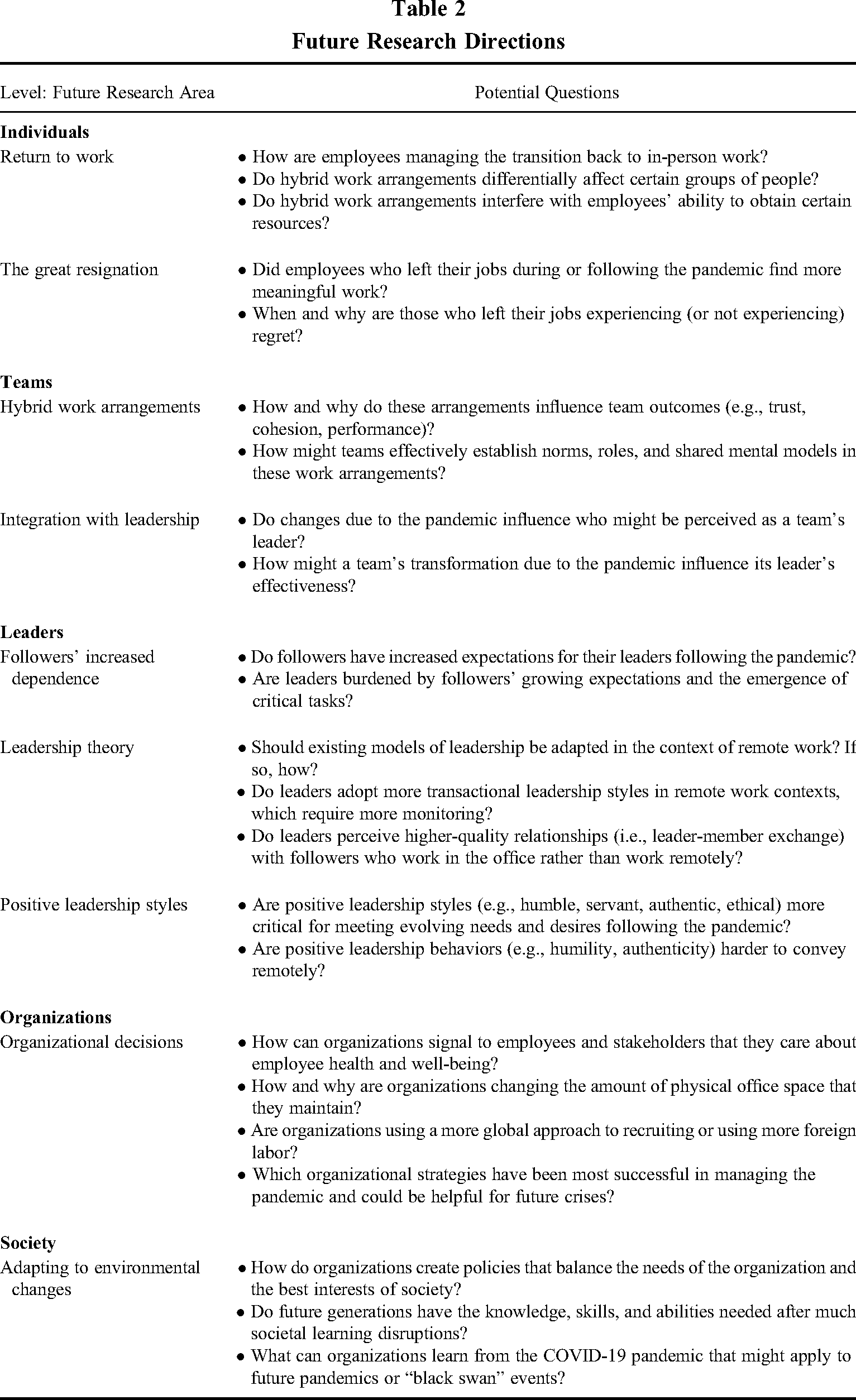
As the workplace has largely begun a transition to a new normal, there are now opportunities to understand this new normal and its implications for entities ranging from individuals to society. These future research directions are summarized in Table 2.
Future Research Directions
Individuals
Our review indicated that, understandably, there was significant scholarly attention paid to the effects of the pandemic on individuals, and much of this work focused on their well-being. Echoing the challenge-hindrance framework (Cavanaugh, Boswell, Roehling, & Boudreau, 2000), this line of work showed that COVID-19 was a source of stress and strain for employees that could not only negatively affect them at work (e.g., by making them anxious) but also have positive implications in terms of their in- and extra-role performance (e.g., Lian et al., 2022). Researchers additionally evaluated the effects of death awareness, finding that it was important to consider whether employees were reflective or anxious about death (e.g., Zhong et al., 2021). Of course, given the changes at work and at home owing to the pandemic, organizational scholars examined the implications of remote work in terms of its benefits (e.g., flexibility) and costs (e.g., Zoom fatigue); similarly, studies focused on the breakdown of work-nonwork boundaries during this time. The pandemic was also a time for reflection, and many people wanted to find ways to help others during this difficult time. This effort spurred studies of how prosocial motivation and work meaningfulness influenced engagement as well as other attitudes and behaviors.
As individuals transition back to old routines or develop new ones, it would be useful to understand these transitions. The vast literature on newcomer sense making and adjustment (e.g., Louis, 1980) suggests that work transitions can be challenging and have a significant effect on employee attachment, turnover, and other important job attitudes and behaviors (e.g., Vandenberghe et al., 2021). Thus, leveraging the job transition literature to understand how employees are successfully navigating the return to work would be useful. Likewise, our review revealed that certain employees (e.g., women, parents, Asian; Alekseev et al., 2022; Jun & Wu, 2021; Leroy et al., 2021) may be differentially affected by the pandemic. Such disparate outcomes may continue after the pandemic. For instance, in a working paper, Emanuel, Harrington, and Pallais (2023) found that employees receive less feedback when working in remote contexts than when working in close physical proximity to colleagues; furthermore, younger employees and female employees were most adversely affected and more likely to quit. This raises important questions. For example, do hybrid work arrangements present a disadvantage for younger employees or minority groups, who may need greater access to mentors to develop social capital and keep their careers on track? It is also possible that hybrid work could interfere with employees’ ability to obtain task assistance, emotional support, friendship, and other types of support that are important for employees to flourish at work (Colbert, Bono, & Purvanova, 2016). Altogether, certain employees may be at greater risk for missing out on benefits associated with working in person.
Regarding turnover, more research is needed on the aftermath of the “great resignation,” a term coined by Professor Anthony Klotz regarding the vast number of employees who decided to quit during the pandemic (Beilfuss, 2022). As noted earlier, Xu et al. (2023) found that a desire for more meaningful work explained, in part, why employees pursued new jobs; however, it is important to know if the employees who were part of this trend have found their jobs and lives to be more meaningful and satisfying. In fact, recent surveys suggest that many employees now regret the decision to leave their jobs (Jackson, 2023). Regret is a cognitive and affective state where people feel sorry about decisions or outcomes that they attribute to their own action or inaction (Landman, 1987), and researchers have recently started investigating the implications of regret in the workplace (e.g., Anderson & Bolino, 2023). Given that so many people changed jobs since the start of the pandemic, it would be useful to understand those decisions and when they are successful or lead to regret.
Teams
Our review highlighted the challenges that teams confronted while moving to a virtual context (Wu et al., 2021). This research indicated that team characteristics such as culture and compassion were relevant in understanding how teams managed these transitions (Qin et al., 2021; Wee & Fehr, 2021). Given that hybrid arrangements are expected to become more prevalent, it would be worthwhile to more deeply understand how this work context will affect teams. For instance, using the input-mediator-output-input model (Ilgen, Hollenbeck, Johnson, & Jundt, 2005), it is possible that hybrid arrangements may make it more difficult to establish a sense of trust and group efficacy among teammates. Likewise, gathering information from teammates and developing norms, roles, and shared mental models—factors that influence the effective functioning of teams (Ilgen et al., 2005)—may change and/or become more difficult. For example, when a team's environment changes, it tends to affect team members’ perceptions of their ability to meet the needs of the team and their team's ability to fulfill their own needs, both of which may influence team performance (DeRue & Morgeson, 2007). As noted earlier, it is possible that teams with more hybrid members may experience less cohesion and greater relationship and task conflict. Likewise, when employees are not co-located, the dynamics of intrateam helping and learning may be altered, which is likely to influence the team's ability to adapt and perform.
There is an opportunity to consider the integration of leadership and teams in light of changes due to COVID-19. For instance, the social identity theory of leadership emphasizes the importance of group prototypicality in leadership, as “leaders and followers are interdependent roles embedded within a social system bounded by common group or category membership” (Hogg, 2001: 186). Thus, leaders’ effectiveness depends on their prototypicality of group membership. As the characteristics and features of teams are transformed in the aftermath of the pandemic, who is perceived as a leader of the group and the leader's effectiveness may be influenced by these changes. Thus, future studies should examine how teams are affected by the changes at work that were brought about by the pandemic.
Leaders
Several studies focused on understanding leaders during the pandemic. Not surprising, our review revealed evidence that leaders could be an instrument of help or harm during the pandemic. For instance, whereas supportive leaders enabled their followers to transition more easily back to work and stay engaged, leaders who engaged in racist behavior undermined the engagement and well-being of their followers (Jun & Wu, 2021). Furthermore, we found that certain leader characteristics (e.g., gender, personality) influenced leader behavior and effectiveness (Kim et al., 2021; Sergent & Stajkovic, 2020). Of course, leaders were affected by the pandemic themselves. The research that we reviewed suggests that even those at the very top of the organization contemplated their own mortality and considered what kind of leaders they wanted to be in their organizations and communities (e.g., Li et al., 2021).
Leaders will continue to play an important role as their followers return to work. In the popular press, there have been conversations about what kind of leadership skills are needed to be effective in the postpandemic workplace, especially considering the lack of trust that many followers have in those who are leading the return to work. Given these uncertain times and the evidence from our review that followers tend to rely on leaders for stability during times of turbulence (Wee & Fehr, 2021), employees may have increased expectations of their leaders. The combination of employees’ growing expectations and the emergence of new and critical tasks (e.g., creating flexible work arrangements, scheduling hybrid employees) may burden leaders in ways that undermine their ability to fulfill other important responsibilities, such as being supportive and acting fairly (e.g., Sherf, Venkataramani, & Gajendran, 2019).
Relatedly, it is unclear if existing models of leadership (e.g., leader-member exchange, transformational leadership, servant leadership) must be adapted when a subset of followers is working remotely, and it may be necessary to investigate how these new work arrangements influence leader-follower relations. For instance, if employees are working remotely, are leaders more likely to adopt a transactional leadership style and engage in more monitoring, or will they become more trusting of their followers? Although one study in our review (Kim et al., 2021) highlighted how followers subjectively view leaders through their own expectations (i.e., implicit leadership theory), it follows that the reverse may be true as leaders evaluate followers during the return to in-person work. For example, regarding leader-member exchange, it seems that leaders who are in the office might be more likely to develop and perceive higher-quality relationships with followers who work face-to-face than with remote workers—who may then feel relatively deprived and dissatisfied as a result (Bolino & Turnley, 2009).
Finally, there has been increasing attention paid in recent years to ethical leadership, humble leadership, servant leadership, and authentic leadership. Although these positive leadership styles are related, the mechanisms and dynamics that drive them are often distinct (Kleshinski, Wilson, Stevenson-Street, & Scott, 2021), so there may be opportunities to more fully understand the factors that exacerbate or attenuate positive leadership as the workplace returns to its new normal. For instance, it is possible that these leadership styles will become even more critical given the evolving needs and desires of the latest generation of workers. At the same time, it may be even more difficult to enact and convey these leadership behaviors (e.g., humility, authenticity) when key employees are working remotely; as a result, new forms of leadership may emerge during this period. In short, it will be important moving forward to not only revisit and reconsider existing leadership theories but also identify and evaluate potential new types of leadership.
Organizations
Few studies in our review focused on the organizational level of analysis, which is not surprising given that most of them were published in the Journal of Applied Psychology. Those that we did review demonstrated that the pandemic influenced firm behavior, such as decisions to stay open or raise prices, political giving, communication with investors, and the use of variable work schedules (Alekseev et al., 2022; Benton et al., 2022; Chung, 2022). This research also suggests that local organizations often followed the lead of national organizations (de Vaan et al., 2021). Furthermore, we learned that how organizations supported their employees, before and during the pandemic, had important implications for their ability to respond to the pandemic. Their supportiveness not only affected their employees but also influenced how they were seen by their stakeholders (Steinbach et al., 2021).
Moving forward, organizations have a number of important decisions ahead of them. To begin, we are already seeing that organizations are handling the return to work in different ways, including a full return back to the office, a permanent work-from-home arrangement, or a hybrid model. Other organizations are experimenting with 4-day workweeks to respond to employees’ postpandemic demands for better work-life balance. One potential research opportunity is to examine these organizational decisions from a signaling perspective (e.g., Connelly, Certo, Ireland, & Reutzel, 2011); specifically, this lens could be used to understand how organizations signal to employees and other stakeholders that they prioritize the health and well-being of employees. In addition to changes in scheduling, some organizations are debating whether they need the amount of office space that they had prior to the pandemic. For example, in August 2020, outdoor retailer REI sold its new corporate campus headquarters because it opted for more remote work (Wahba, 2020). Of course, if workers can reside anywhere, it raises the possibility that companies may adopt a more global approach to recruiting and become more open to the use of foreign labor and outsourcing (Thier, 2022). It would be interesting to understand what organizations learned from the pandemic and which strategies were most successful. For example, our review revealed that firm performance in a crisis may be contingent on whether the board chair is also the CEO (Krause et al., 2022), suggesting that some firms may reconsider their approach to corporate governance in the event of future calamities such as COVID-19. Indeed, although some companies, such as Peloton, thrived during the pandemic, as the pandemic ends, it is proving difficult to sustain that success. Given that experts are predicting more pandemics in the future, it would be useful to understand which organizations might be best prepared for such an event and why.
Society
Research identified societal implications of the pandemic. Cultural, social, and institutional factors played a role in determining the spread of the disease (Dheer et al., 2021) and the extent to which individuals were compliant with government guidelines (e.g., Alfaro et al., 2022). The public sought to make sense of this unprecedented event (Zhang et al., 2021) and the changes that it brought to their personal and professional lives (e.g., Min et al., 2021). Roulet and Bothello (in press) argued that disruptions such as the COVID-19 pandemic not only produce organizational change but also trigger changes in economic, political, and cultural norms. In the wake of the pandemic, there have been trends such as “quiet quitting,” where employees psychologically detach from work and reject the idea of going beyond the call of duty. Such trends suggest that many employees, especially younger ones, are seeking to gain balance between their professional and personal lives. While Yuan, Cockburn, et al. (2021) examined the ways that certain employees were labeled essential or nonessential, the pandemic has raised philosophical and practical questions about what is essential. For instance, is it necessary for stores to be open 24 hours? Is the 5-day workweek in the best interest of society? Furthermore, because so many students—from grade school to college—experienced diminished learning opportunities during this time, it raises questions about whether the future generation of workers will have the knowledge, skills, and abilities necessary for organizations to function effectively or whether education deficits will create challenges down the road. Relatedly, because the pandemic was politicized in many parts of the world, it has undermined trust in governments, science, medicine, and nongovernmental organizations such as the WHO (Nickel et al., 2022). It is important, then, for researchers to understand how changes to the institutional environment are likely to affect organizations in the coming years.
Finally, the insights gleaned by our review may be extended to contexts beyond COVID-19, such as future pandemics or black swan events (e.g., Roulet & Bothello, in press). Although the COVID-19 pandemic is often referred to as “unprecedented,” there have been prior pandemics, particularly in non-Western societies (e.g., Ebola, H1N1). Unfortunately, we found few articles regarding the impact of these incidences on organizations, possibly signaling a lack of priority around this type of research because they are so rare. However, a more thorough understanding of how these events influenced organizations could have been useful to those navigating the COVID-19 pandemic, particularly as our review demonstrated that societies with previous experience with pandemics seemed to respond more quickly and effectively than societies without such experience (Ru et al., 2021). Similarly, management scholars may be able to extend the insights from this review to similar events. For example, our review indicated that various perceptions of insecurity had differential effects on organizational commitment and job performance (e.g., Lian et al., 2022). Thus, in the event of another pandemic or similar black swan event, management researchers may wish to investigate these relationships in more depth.
Implications for Management Scholarship
As noted earlier, the process of conducting and publishing management research is not “nimble” (Dykes, 2021), and this posed a practical challenge for researchers interested in studying the implications of the pandemic. It is not surprising, then, that the majority of the research that we reviewed was published in the Journal of Applied Psychology, which made a call for papers on the COVID-19 pandemic that included a “rapid review process” (Eby, 2022). It was required that papers submitted as part of this process be short (≤17 pages), and editorial decisions and requested revisions were expedited. Overall, our evaluation of this literature is that it is quite rigorous despite the rapid reviews that were used. Indeed, Eby (2022) reported that the acceptance rate for COVID-19 papers at the Journal of Applied Psychology was only 6%, and the articles that we reviewed employed a variety of theoretical perspectives and utilized research designs that were typically methodologically strong, including the use of multiwave/source survey data, archival data, laboratory experiments, field studies, qualitative data, and so on. In some, these methods were combined through the use of multiple studies. The samples used in these studies varied as well. Although many studies included participants from North America, researchers also collected data from respondents in Asia, Europe, South America, and other parts of the world, which is wholly appropriate given the scope of this global pandemic. As more data about firm performance during the pandemic becomes available, we anticipate the publication of additional articles focusing on the decisions and strategies of organizations and how internal and external factors influenced the success of these strategies.
Finally, one distinct characteristic that stood out in this review was the broad scope of topics covered by management scholars. For instance, researchers investigated the ways that societal factors influenced organizational decisions to raise prices, how leadership influenced employees’ perceptions of justice, and how childcare responsibilities influenced the performance of dual-career couples. The disparate nature of the phenomena resulted in an understanding of the COVID-19 pandemic that is more broad than deep. Thus, in the case of future pandemics or black swan events, we encourage journal editors to craft opportunities for deeper, more specialized knowledge generation. For example, journal editors could develop special issues that further our understanding of black swan events through the lens of specified research questions or theoretical perspectives. This would allow researchers to narrow their focus and ideally gain a more nuanced and complete understanding of the phenomena.
Conclusion
Over 3 years ago, COVID-19 was declared a global pandemic, and it not only inflicted terrible sickness and death around the world but also transformed societies and organizations. Management scholars responded to this tragic event by publishing work investigating various aspects of the COVID-19 pandemic. In this work, we reviewed 69 articles on this topic, highlighting studies that focused on the implications of the pandemic for individuals, teams, leaders, organizations, and society. We also discussed the theories and methods used in this work and offered ideas for examining how these entities may move forward in a postpandemic world. Finally, given that scientists predict that this pandemic, unfortunately, is unlikely to be the last calamity of its kind, we hope that management scholars will find ways to rapidly respond to similar black swan events to gain insights that may increase our basic knowledge and ability to respond more effectively.
