



Abstract
Employees interact with animals in a myriad of ways in the context of work. Herein, we seek to catalog this multiplex phenomenon in order to gain theoretical insights. Our article unfolds in four parts. First, we conduct an interdisciplinary review from which we develop a typology of four employee-animal interactions: working for, with, around, and on animals. Second, we outline the current research for each discrete category. Third, we consider key divergent experiences (e.g., the uniquely gendered nature of each) and convergent themes (e.g., all animal work is emotional and hierarchical) across the typology. Fourth, we supplement our review with two metasyntheses of other workplace team interactions—employee-employee and employee-machine/artificial intelligence interactions—to highlight how the study of human-animal interactions can address current conundrums in the organizational domain. We do so to demonstrate that considerations of employee-animal interactions can offer theoretical value to scholars, including those who may not have an inherent interest in the phenomenon. We complement theoretical extensions with suggestions for future research on core management topics, including humanizing workplaces, the future of work, and team collaboration.
On a crisp evening in 2019, dignitaries gathered on Capitol Hill to award the inaugural Animals in War and Peace Medal of Bravery to five dogs, two pigeons, and one horse. The recipients had served in the U.S. Army, Marine Corps, Navy, and Signal Corps and the New York Fire Department (FDNY; Brulliard, 2019) and were praised by attendees as “a lot more courageous than I” (Senator Warner). Pigeon Cher Amy had been critically injured while delivering messages to end friendly shelling; Staff Sergeant Reckless, the mare, had evacuated countless wounded. Of course, the recipients themselves would have little sense of what all the fuss was about; Bucca, the FDNY arson-detection K9, spent the ceremony happily chewing on treats.
The same year we began to recognize the service of thousands of animals in various military and civilian forces, we also saw a number of other milestones for U.S. fauna.1 The “America's Most Pet-Friendly Companies” survey, appropriately released on National Take Your Dog to Work Day, revealed that a majority of employees now considered the presence of animals a boon to wellness and official culture (Food, 2019). Conversely, 2019 also saw the commercial slaughter of millions of cattle (33.6 million), hogs (129.9 million), and sheep (2.32 million; U.S. Department of Agriculture, 2020). Together, these examples illustrate the many ways in which today's employees encounter and work with animals (U.S. Bureau of Labor Statistics, 2021). More organizations are enacting pet-friendly policies (Hall & Mills, 2019), and more professions are integrating animals in novel arrangements, such as therapy assistance (Brazier, 2014) and medical detection (Holland, 2022).
Organizational scholarship has already drawn key insights from work arrangements that center animals: Research on zookeepers revealed the power of calling (Bunderson & Thompson, 2009), studies of animal-control employees informed the concept of dirty work (Ashforth, Kreiner, Clark, & Fugate, 2017), and investigations of animal rights and veterinary employees provided unique insights on emotional labor and suppression (Hannah & Robertson, 2021; Pradies, 2023). In response, two recent research notes have explicitly called for integrative consideration of the broader phenomenon (Hannah & Robertson, 2017; Kelemen, Matthews, Wan, & Zhang, 2020). Our goal is just that—to move beyond a piecemeal approach.
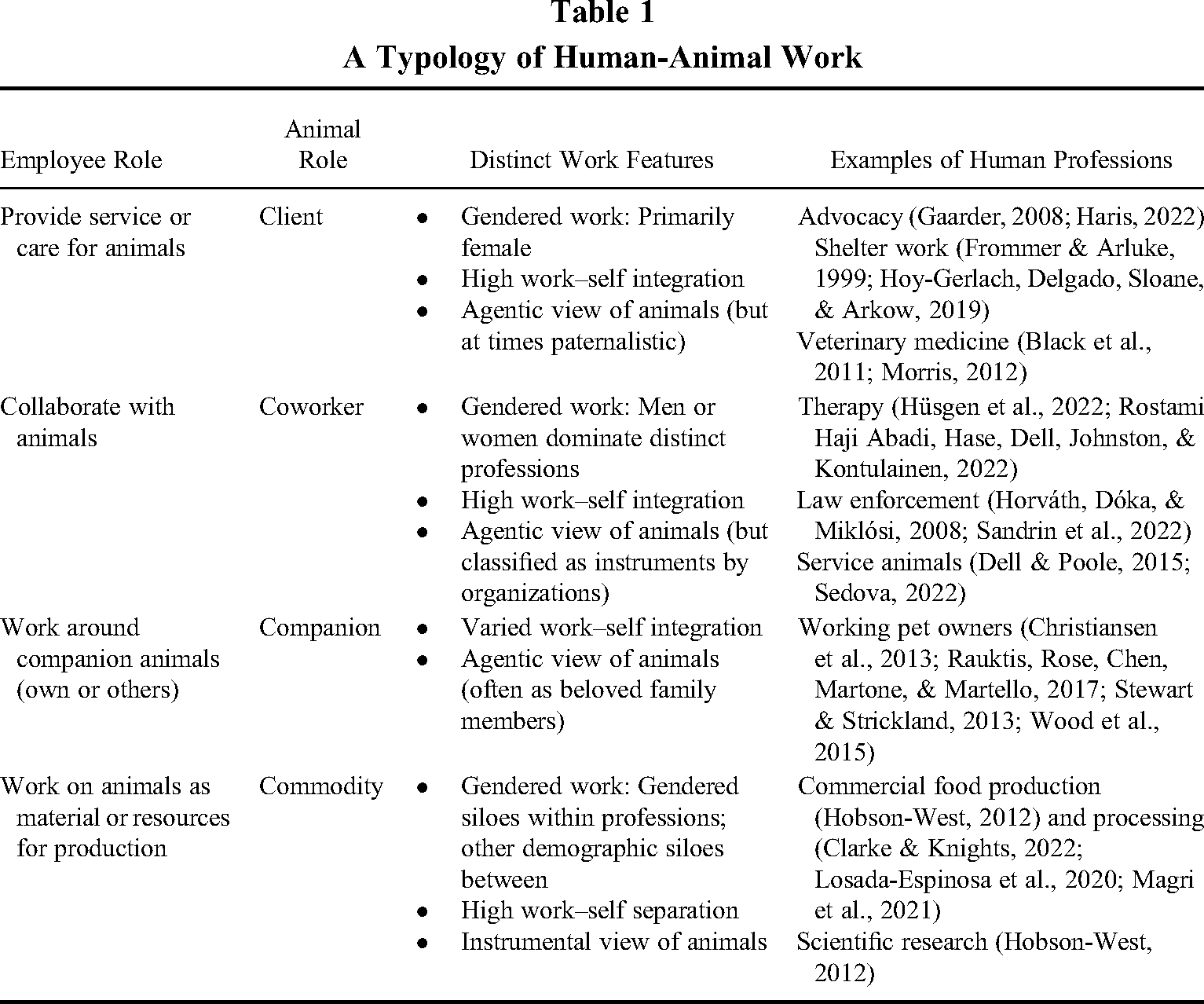
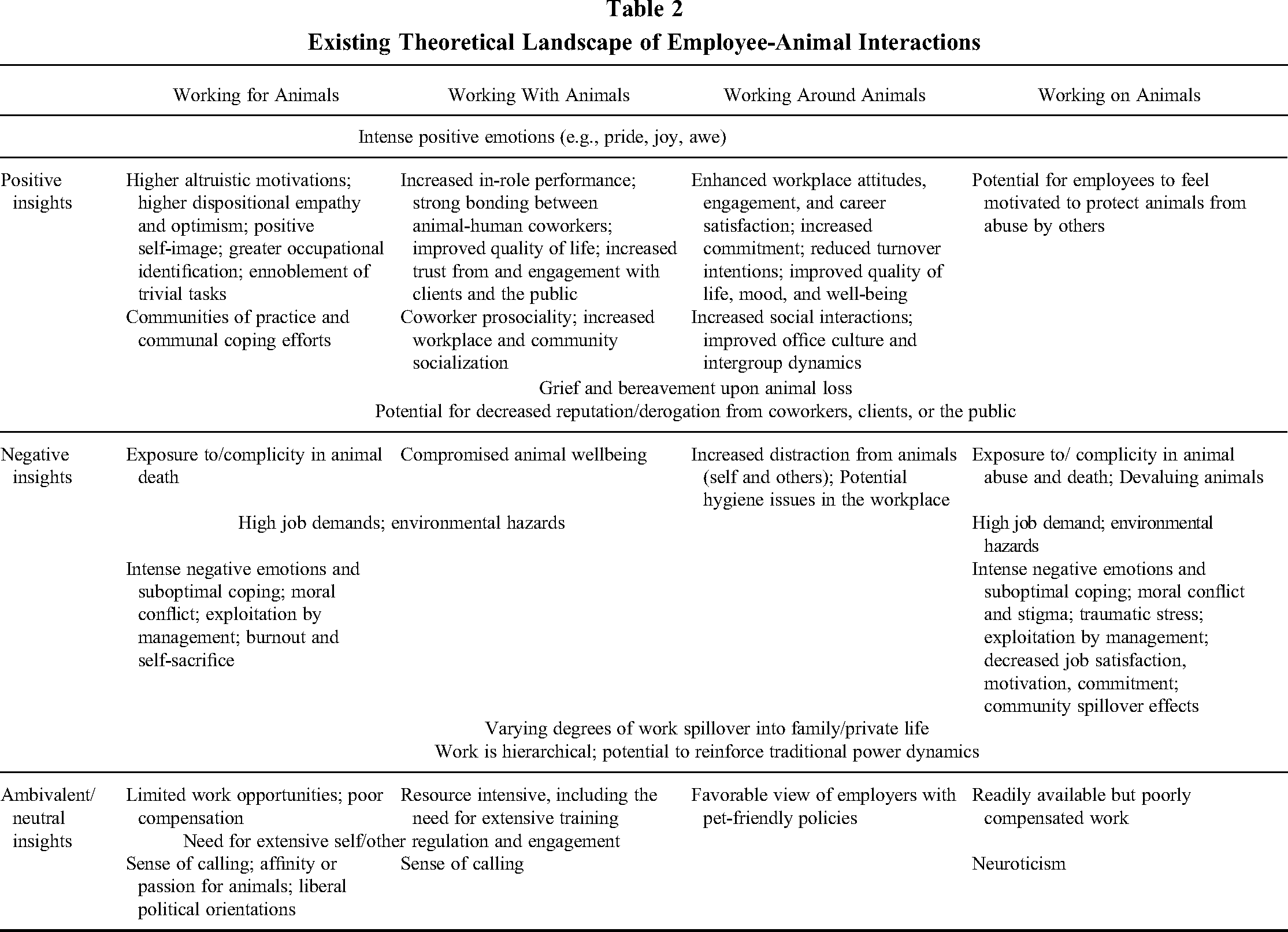
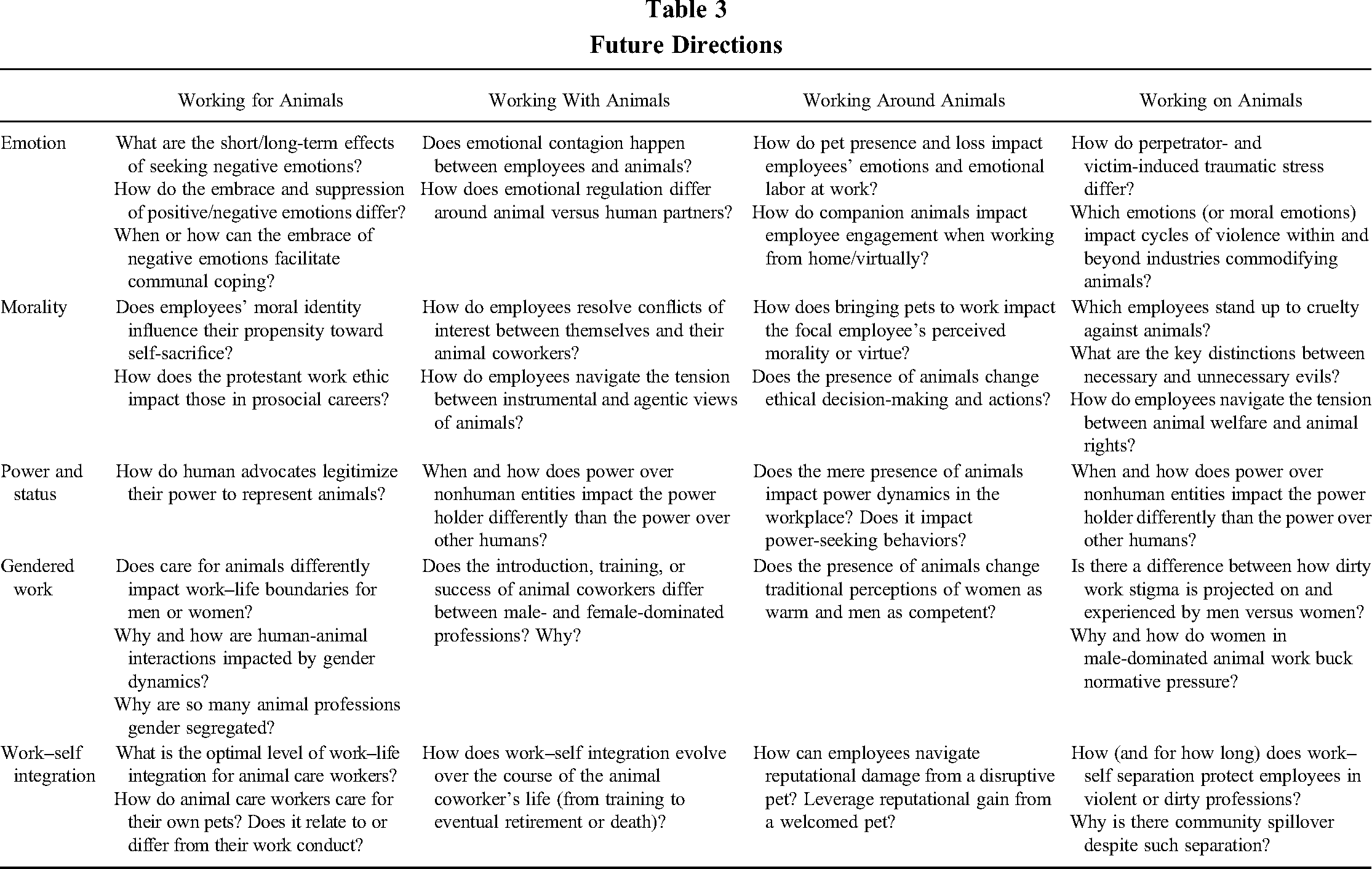
Herein, we seek to systematically catalog and explore the diverse literature on human-animal dynamics in the context of work to derive novel insights. Our article unfolds in four parts. First, we describe our multidisciplinary literature review, which culminated in the development of a four-category typology of employee-animal interactions: working for, with, around, and on animals (see Table 1). Second, we outline available scholarship in each discrete category (see Table 2). Third, we consider the categories together, spotlighting key divergent experiences and convergent themes across the typology (see Table 3 for future directions derived from this effort). Finally, we draw on insights from this review to address conundrums in the broader study of workplace interactions (specifically, in the context of employee-employee and employee-machine interactions). We do so to demonstrate that considerations of animal-employee interactions can offer value to scholars, including those who may not have an inherent interest in the phenomenon. We complement these theoretical extensions with suggestions for future research.
A Typology of Human-Animal Work
Existing Theoretical Landscape of Employee-Animal Interactions
Future Directions
Literature Review Scope and Process
Outside the organizational literature, readers can readily find reviews of various specific human-animal interactions—for instance, between stock people and livestock (Losada-Espinosa, Miranda-De la Lama, & Estévez-Moreno, 2020), between mental health patients and pets (Brooks et al., 2018), or between youth and service animals (Lindsay & Thiyagarajah, 2021)—as well as reviews considering the broader psychology of human-animal relations (Amiot & Bastian, 2015). To date, however, there exist only two road maps for, but no comprehensive review of, animals in the domain of work (see Hannah & Robertson, 2017; Kelemen et al., 2020). Our approach to conduct such a review was necessarily broad and multidisciplinary and sought to incorporate insights into any interactions between employees and animals. To bound our searches, we focused on paid employees (i.e., papers could include volunteers, but those with an exclusive focus on volunteers were excluded) and required interactions to be live (i.e., a study of employees watching prerecordings of animals would not count). A summary PRISMA flow chart (Page et al., 2021) can be found in the appendix.
Central Review
Database searches are ideal for sourcing literature in its infancy as they avoid missing cutting-edge articles published in specialty and niche journals. Thus, we began with a keyword search of animal-related terminology ([animal OR pet OR dog] AND work) in organizational databases (PsycINFO, PsycArticles, and Business Source Complete) as well as interdisciplinary databases likely to contain research on employees (e.g., Humanities International Complete, Social Science Abstracts, Anthropology Plus). We supplemented this via a keyword search of employee-related terminology (staff OR employee) in two journals specializing in human-animal interactions: Anthrozoös and Society & Animals. A manual review of all retrieved abstracts revealed high overlap and confirmed the comprehensiveness of our approach.
After applying screening criteria pertaining to rigor (i.e., including only peer-reviewed journals) and topic (i.e., papers must have a central focus on animals and employees) but not scope (i.e., no date, geographical, cultural, or population restrictions), we retained 166 articles of which 38 were published in organizational journals. All articles were coded by the first two authors for the nature of employee-animal interaction and insights to organizational scholarship.
Supplemental Reviews
In our theoretical extensions section, we will consider how an understanding of employee-animal interaction can inform established theory on employee workplace interactions as well as burgeoning work on employee-machine interactions. To do so, we conducted two supplemental metasyntheses (see Barnes, Wagner, Schabram & Boncoeur, 2023; Parmigiani & King, 2019) that are outlined in the PRISM flowchart (see appendix). These retrieved 40 relevant employee-employee and 25 employee-machine reviews that were iteratively coded by the first two authors to identify pressing contemporary questions for which our review might offer novel insights.
A Typology of Employee-Animal Interactions
Employees interact with animals in a myriad of ways. Recent work has sought various definitions to synthesize this multiplex phenomenon (Hannah & Robertson, 2017; Kelemen et al., 2020; Nelsen & Barley, 1997). Abstract parsimony is not our goal. Instead, we seek to catalog the complexity in the hopes of learning via comparison and contrast across categories. From our review, we identified four ways by which animals make their presence felt in the workplace—as client, coworker, companion, and commodity—mapping onto four employee roles, respectively: working for, with, around, and on animals (for an overview, see Table 1). Next, we summarize the implications of each type, including profiling what draws employees into such interactions and their experiences. In the subsequent section, we will build on this typology to highlight thematic commonalities and differences.
Before doing so, we stress two qualifiers. First, most, but not all studies, fell into only one category (e.g., in entertainment, animals function as both commodity and coworker; livestock veterinarians may treat animals both as commodity and client; social media influencers may work around and with their pets for content; Zhang, Wei, Rathjens, & Zheng, 2023). Second, while different species appear to dominate each category (e.g., dogs as coworkers, chickens as commodities), we do not probe these distinctions as the literature's, and our, emphasis is on the human experience.
Working for Animals as Clients
Among the four ways that employees interact with animals, one category dominates scholarship: working for animals in provider-client relationships. Such service may entail the direct care for animals’ health and well-being (e.g., veterinarians; Pradies, 2023), usually with specialization in either domesticated animals (e.g., animal shelter workers; Levitt & Gezinski, 2020) or wildlife (e.g., zookeepers; Bunderson & Thompson, 2009). This category also includes the protection and enforcement of animal welfare and/or rights (e.g., animal cruelty officers; Coulter & Fitzgerald, 2019) and advocacy on their behalf (Jarvis, Goodrick, & Hudson, 2019).2
Much of the literature has been concerned with profiling the type of employee drawn to such work. Perhaps not surprisingly, persistent predictors include a dispositional affinity for animals (Amiot & Bastian, 2015; Levitt & Gezinski, 2020), a desire to improve the lives of animals (Black, Winefield, & Chur-Hansen, 2011; Jarvis et al., 2019; Wu, 2022), intrinsic personal investment and passion for animals (Jarvis et al., 2019), and feelings of love, respect, and empathy for animals (Levitt & Gezinski, 2020).
Of interest is that these pro-animal attitudes appear rooted from an early age—by role models, such as parents, or memorable experiences during one's formative years (Amiot, Sukhanova, & Bastian, 2020; Fifield & Forsyth, 1999). Many explicitly describe animal care as a calling, as a meaningful beckoning toward activities that are morally, socially, and personally significant, involving work that is an end in itself (Wrzesniewski, Dekas & Rosso, 2009). Employees report always feeling “a common love of animals and a desire to make a difference in animals’ lives” (Schabram & Maitlis, 2017, p. 592). Their “special connection” constitutes a core facet of their identity: “Whatever my genetic makeup is, I’m geared towards animals” (Bunderson & Thompson, 2009, p. 5). One path by which employees first dip their toes into the field of animal care is through volunteering, especially at core life junctures, such as in early adulthood (Schabram & Maitlis, 2017) and during midcareer transitions (Schabram, Bloom, & Didonna, 2022).
Though animal-care employees come from all walks of life, one demographic predictor stands out: gender. Animal-care roles are overwhelmingly held by women across positions and industries: in shelter and rescue work (Jacobs & Reese, 2021), animal rights activism (Jacobsson & Lindblom, 2013), and animal cruelty investigations (Coulter & Fitzgerald, 2019). Even veterinary services, a profession historically dominated by men (in parallel to other medical professions) has seen a “rapid feminization” (Clarke & Knights, 2019, p. 3) in recent years, with women now occupying the majority of positions at every level from technicians to doctors (Wallace & Buchanan, 2020). Two potential explanations for this imbalance have been proposed. First, it may be that women are more receptive to the stress-reducing benefits of interacting with animals and might therefore be more drawn to and well suited for such work. For instance, when women interact with animals, they appear to release more oxytocin, a hormone that increases cooperation and prosociality (Miller et al., 2009). Alternatively, women generally report higher empathy and concern for animals (Ellingsen, Zanella, Bjerkås, & Indrebø, 2010) and may therefore self-select into such work.
Animal-care employees consistently report a number of core attitudes and traits: higher dispositional empathy (Ellingsen et al., 2010; McClellan, 2019), dispositional optimism (Amiot & Bastian, 2015), and greater affiliation with liberal political orientations (McClellan, 2019). They also tend to hold low beliefs in speciesism—the belief that animals are inherently inferior to humans (Knight & Sang, 2020; Leach, Kitchin, Sutton, & Dhont, 2023). Instead, they profess agentic views of animals as autonomous and sentient beings with unique personalities, desires, and capacities (Holland, 2022; Oehler, 2021; Schuurman, 2021; Yam, Tang, & Lam, 2023). In short, though the work takes diverse forms, all champion the animals’ needs.
The work experience of animal care work has been described as a “double-edged sword” (Bunderson & Thompson, 2009, p. 32). On the one hand, employees report feeling intense positive emotions, including pride, fulfillment, compassion, and awe (Levitt & Gezinski, 2020; Yam et al., 2023b), whether directly interacting with animals or succeeding in improving their lives. Interacting with animals also drives positive work attitudes and a powerful sense of occupational identification (Jarvis et al., 2019), ennobling even seemingly unpleasant or trivial tasks (Schabram & Maitlis, 2017). Moreover, performing work that aligns with their core values and perception as animal lovers reinforces this identity and promotes positive self-perceptions (Gaarder, 2008; Hannah & Robertson, 2021).
Paradoxically, animal-care work demands a steep cost. Employees admit that they entered the work with overly “rosy expectations”(Schabram & Maitlis, 2017, p. 585) and find themselves surprised by the intense job demands (Frommer & Arluke, 1999), long working hours, and relatively low salaries (Levitt & Gezinski, 2020) as well as exposure to environmental hazards (Rossi et al., 2022) and diseases (Soest & Fritschi, 2004). Moreover, since animals are legally classified as property, many employees have to navigate the tension between the animals’ needs and their human owners’ preferences (Pradies, 2023). Veterinarians, for instance, frequently find themselves compromising between pleasing pet owners, financial considerations, and the welfare of the animal (Morris, 2012). In essence, animal-care workers are responsible for two clients (animal and owner); they entered the work to serve the former but are obligated to comply with the latter when interests are in conflict.
An additional strain is the routine exposure to animal death due to the nature of the care professions (Morris, 2012). Care workers are not simply passive bystanders, but many feel complicit in the routinization of animal death (Black et al., 2011; Frommer & Arluke, 1999). Animal shelter researchers have coined the concept of the “caring–killing paradox” (Jacobs & Reese, 2021), wherein employees are tasked with ending the lives of the very animals they wish to care for. Veterinarians across industries report clashes between their ethical codes and the exploitative production goals of the owners (Clarke & Knights, 2022).
As a consequence of difficult working conditions and unmet expectations, the work can manifest in guilt, grief, and anger (Anderson, Brandt, Lord, & Miles, 2013; Andrukonis & Protopopova, 2020; Whipple, 2021). Animal shelter workers (Anderson et al., 2013) veterinarians (White, Yeung, Chilvers, & O’Donoghue, 2021), and animal protection administrators (Wu, 2022) report emotional distress when caring for sick, injured, and dying animals. The aforementioned caring–killing paradox tends to take an emotional toll and create a sense of moral conflict (Hannah & Robertson, 2021; McLoughlin, 2019). Similarly, animal rights activists and investigators must contend with the moral shock and intense emotions of witnessing animal abuse (Coulter & Fitzgerald, 2019; Jarvis et al., 2019) and the chronic urge to do more for animals in need (Jacobsson & Lindblom, 2013). These experiences are especially common among those who see their work as a calling and infuse it with a moral obligation to the animals (Bunderson & Thompson, 2009).
To manage these demanding working conditions, ethical conundrums, and intense emotionality, employees engage in emotional regulation strategies. Undercover investigators, for example, calibrate and suppress any emotional displays that would reveal their true identity (Jarvis et al., 2019). Two approaches identified by the literature entail blame displacement (Frommer & Arluke, 1999) or developing “emotional comfort zones” (Hannah & Robertson, 2021). Some shelter workers aim to identify individuals to blame and alleviate their guilt in conducting euthanasia, while others try to develop a comfort zone via proactive or reactive distancing from emotional experiences, protecting themselves from routinely negative emotions, and remaining in a preferred level of emotion immersion (Hannah & Robertson, 2021).
Animal-care work also appears to entail a significant amount of other-focused emotional regulation. The client-facing nature of many roles requires gestures such as acknowledging, comforting, and empathizing (Baum & Wallace, 2022; Pradies, 2023). For instance, veterinarians are often entrusted with the taxing responsibility of providing comfort to grieving pet owners, acknowledging their pain and sorrow, or assuaging their guilt around euthanasia. Throughout the workday, they are expected to demonstrate compassion (Matte, Khosa, Meehan, Coe & Niel, 2021; Morris, 2012). Consequently, employees may become embroiled in cycles of personal emotional suppression and deprioritize their own feelings to match workplace display rules and affective norms (Jarvis et al., 2019; Pradies, 2023). Conversely, in animal rights enforcement and advocacy, we see this manifest in one unique strategy: Employees, recognizing that emotions can be a powerful tool to gain compliance or support for their cause, may strategically elicit guilt, anger, and shame in others by sharing visual evidence of animal maltreatment. In essence, they seek to drive audiences into action via moral shock (Jarvis et al., 2019).
In the short run, these tolls appear to increase commitment. Feelings of sorrow or moral shocks may drive employees to rededicate themselves to a career of righting the wrongs conducted by other humans (Jacobsson & Lindblom, 2013). Scholars have highlighted the self-sacrificial impulses in terms of time, money, and well-being in general, leaving employees vulnerable to exploitation by management (Bunderson & Thompson, 2009) and pursuit of the most difficult tasks (Schabram & Maitlis, 2017). At some point, however, a final straw (Schabram & Maitlis, 2017) seems to occur that outstrips individuals’ depth of connection (Levitt & Gezinski, 2020). In the long run, psychological distress (Black et al., 2011), compassion fatigue (White et al., 2021), burnout, and occupational exits appear inevitable for most. When this happens, those who describe animal-care work as central to their identity will generally seek out other animal-centric employment, such as leaving shelter work for pet training. The exception appears to be employees who built a community of practice and set boundaries between work and other important life activities (Schabram & Maitlis, 2017).
To sum, the profile of the average employee working for animals is one who loves, respects, and sees animals as individuals with unique needs and rights. Most are women, report a higher level of general empathy, and lean liberal. The work they enter is an ambivalent experience, evoking intense discrete emotions—both positive and negative—and identification and fulfillment but also distress and exhaustion. Many of the work demands and moral dilemmas encountered are unexpected and require both self- and other-oriented emotional regulation. While employees may be motivated to redouble their efforts in the face of these challenges, burnout and turnover are pervasive. Communities of practice (Jacobsson & Lindblom, 2013; Schabram & Maitlis, 2017) provided by a positive network of coworkers and personal “emotional comfort zones” (Hannah & Robertson, 2021) have been identified as two ways to mitigate this downward spiral.
Working With Animals as Coworkers
The second form of employee-animal interaction is the coworker relationship, wherein animals work with humans. This may entail either collaboration on the same task, such as conducting arrests in law enforcement (Hart, Zasloff, Bryson, & Christensen, 2000; Schuurman, 2021), or supporting patients in therapy (Cavalli, Carballo, Dzik, & Bentosela, 2019; Hüsgen, Peters-Scheffer, & Didden, 2022; Prothmann, Bienert, & Ettrich, 2006). Alternatively, animals support and supplement human work via their unique skills and capabilities. In drug or explosives detection (Schoon, Heiman, Bach, Berntsen, & Fast, 2022), for instance, dogs complete tasks too challenging, unsafe, or simply impossible for humans to carry out alone.
Little is known about which employees are drawn to collaborate with animals. Existing research does suggest that this work, too, is gendered: Most animal handlers in law enforcement (Hart et al., 2000) the military (Haverbeke, Diederich, Depiereux, & Giffroy, 2008), or dogsledding (Rossi et al., 2022) are men, presumably explained by hegemonically masculinized ideals and elements of practice in the industries. In contrast, most therapists and social workers are women, but we do not know whether they also disproportionately integrate animals. We also know that at least some view this work as a calling. Beadle (2013) describes lion tamers’ steadfast calling in the face of increasingly limited work opportunities: When public pressure pushed zoos to phase out animal training, they moved to circuses. When circuses evolved to human-only spectacles, (e.g., Cirque de Soleil), they opened their own big-cat shows.
More research has been conducted on their experience of engaging in such work. Whereas working for animals requires specialization only for the human employee (e.g., veterinary training), working with animals generally requires extensive training for both, often together, and uniquely tailored to each partner's needs and skills (Holland, 2022). For instance, drug- and medical-detection dogs must be trained to use their superior olfactory abilities to detect specific scents to extend the abilities of teams in law enforcement (Adams & Johnson, 1994). Service dogs often go through multiyear training from puppyhood to perform specialized tasks, such as guiding individuals with visual impairments; detecting medical emergencies, such as seizures; or providing support to veterans who struggle with post-traumatic stress disorder (PTSD) (Abraham et al., 2022; Craigon et al., 2017). The humans they serve must then learn to “operate” the animals that are technically classified as “medical equipment” (Holland, 2022).
Collaborative partnership necessitates not only extensive preparation but active emotional and cognitive engagement to make decisions and execute tasks (Knight & Sang, 2020). For instance, in educational facilities, animal trainers must become attuned to “ambassador” animals to collaboratively promote conservation and animal welfare (Yam et al., 2023b). As in animal-care work, individuals in these professions tend to recognize their animal coworkers as agentic individuals with unique personalities, strengths, and weaknesses. Human employees work hard to learn and interpret their behaviors and intentions (Jalongo & Guth, 2022) and take into account their past experiences, feelings, and actions (Schuurman, 2021). Medical-detection trainers, for instance, “build an understanding of the nuances of that dog's body language in order to deduce further information” (Holland, 2022, p. 266). Despite their instrumental classification, animals are generally seen not as “possessions or tools for humans to use” (Taylor, Fraser, Signal, & Prentice, 2016, p. 136) but as individuals deserving of consideration and respect.
The literature has identified several performance improvements derived from human-animal collaboration. These are perhaps most apparent for employees who rely on service animals to navigate the world and thus receive drastic improvements in quality of life (Gravrok, Howell, Bendrups, & Bennett, 2021; Lane, McNicholas, & Collis, 1998; Mudge, Rewi, & Channon, 2017). However, performance appears enhanced across most jobs studied thus far (Yam et al., 2023b). For instance, research laboratories that employ medical-detection dogs report high rates of accuracy in rapidly detecting diseases such as cancer and COVID-19 (Juge, Foster, & Daigle, 2022). In nongovernmental organizations and the military, mine-detection dogs provide effective means to locate the presence of explosives (Schoon et al., 2022). Therapists who employ therapy animals report stronger connection, trust, and engagement with their clients and thus garner better therapeutic outcomes (Brazier, 2014; Dell & Poole, 2015; Flynn, Zoller, Gandenberger, & Morris, 2022; Mercer, Williams Davies, Cook, & Bowes, 2022); elderly dementia patients report improved physical health and reduced neuropsychiatric symptoms (Tournier, Vives, & Postal, 2017); clinically depressed patients, a reduction in anxiety and depressive symptoms (Pedersen, Nordaunet, Martinsen, Berget, & Braastad, 2011); veterans, a decline in PTSD symptoms (Nieforth, Rodriguez, & O’Haire, 2022); and children on the autism spectrum, greater behavioral benefits (Sams, Fortney, & Willenbring, 2006). As a result of such successes, animal-assisted therapy is rapidly gaining in popularity, functioning either as supplementary or as an “effective alternative to pharmacological interventions” (Tournier et al., 2017, p. 51).
Animal collaboration appears to provide benefits beyond direct improvements in in-role performance. The presence of animals facilitates a safer and more positive work atmosphere (Dell & Poole, 2015; Jensen, Bibbo, Rodriguez, & O’Haire, 2021). Therapists who work collaboratively with therapy dogs report being better able to objectively assess their own emotional responses throughout the course of therapy sessions and to make better decisions (Policay & Falconier, 2019). Workers act more prosocial with colleagues when working with animals (Yam et al., 2023b), and disabled individuals working with service dogs report positive socialization effects with their community at large (Hart et al., 2000; Lane et al., 1998).
Interacting with animals as coworkers also influences public perceptions toward human employees and their organizations. Law enforcement agencies report that “public confidence in the mounted police and their horses is even greater than in the police force in general” (Schuurman, 2021, p. 1) because the presence of animals shifts public perceptions of power dynamics and creates a sense of approachability between citizens and police officers. Similarly, visitors to national parks evaluate rangers who work collaboratively with dogs for rescue and law enforcement tasks as friendlier and more approachable than those who do not (Hart et al., 2000). Of note, select studies have found the opposite: Sandrin, Simpson, and Gaub (2022) report that law enforcement officers can be perceived as more aggressive and intimidating in the presence of a police dog than when viewed alone. To date, it is unclear whether these differences can be explained by breed or species differences or the nature of the tasks.
Returning to the aforementioned acknowledgment of animal agency, this not only appears important for successful collaboration but also drives strong interpersonal bonding (Knight & Sang, 2020; Oehler, 2021). While employees working for animals occasionally cross the work–family boundary (e.g., when shelter employees foster kittens), work–family integration appears more routinized for those who collaborate with animals. Service animals live with their owners (Lindsay & Thiyagarajah, 2021), and most police dogs, live with their handlers (Haverbeke et al., 2008). While intimate bonds can benefit human workers both personally and professionally (Hart et al., 2000), they also intensify the loss when that relationship is severed (Whipple, 2021). Individuals who collaborate with service animals report severe and long-lasting bereavement when their service animals retire or pass away (Schneider, 2005).
Finally, our literature review identified one fascinating area of inquiry in this domain not yet considered in other animal-centric professions: A handful of studies of human-animal collaboration have explicitly explored the experience of the animal. We have already noted the study of their specialized training. However, research has also focused on the various ways in which organizations compromise the well-being of animal collaborators. Dogs who work in animal-assisted therapy work long hours and are exposed to potentially overwhelming situations, which can result in elevated stress and fatigue (Fine & Griffin, 2022; King, Watters, & Mungre, 2011; Sarrafchi, David-Steel, Pearce, de Zwaan, & Merkies, 2022). Law enforcement dogs responsible for the apprehension of suspects face the threat of being stabbed and killed (Schiavone, 2019). Additionally, working animals (e.g., military dogs) are often euthanized at the end of their careers or subject to untimely death post-retirement (Knight & Sang, 2020).
To sum, we know little about why or which employees are drawn to working with animals other than that their jobs benefit from the supplemental or unique skills such animals can offer. Most tend to view their animal partner as an agentic individual, and the two parties tend to form intense bonds over years of collaborating and living together. Successful collaboration requires extensive training, engagement, and accommodation from both parties. The benefits for the focal employee, workplace culture, and clients are substantial. However, they may come at the expense of the animals’ well-being and safety as well as the employee's public perception and experienced bereavement when the relationship is severed.
Working Around Animals as Companions
Recent societal trends have pushed more employees than ever to work around animals (i.e., in their company), even if their work is not directly animal related or they do not personally own a pet. A surge in pet ownership (McConnell, Brown, Shoda, Stayton, & Martin, 2011; Volsche, 2018) has pushed many workplaces to respond to the demand for greater pet-friendly benefits, such as “take your dog to work” initiatives (Hall, Wright, McCune, Zulch, & Mills, 2017). The surge in work-from-home and hybrid work arrangements has also meant that many now work from home in proximity to their own pets (Hall & Mills, 2019). In addition, increased adoption of service animals (already cataloged in the preceding section) has the knock-on effect of exposing more employees (Hughes & Rozovsky, 2016; Kizziar & Dodds, 2014; Von Bergen & Bressler, 2017), even in workplaces where animals are otherwise banned. Finally, many facilities, including universities (Charles & Wolkowitz, 2019), prisons (Dell & Poole, 2015), hospitals (Jensen et al., 2021), and courthouses (Howell, Hodgkin, Modderman, & Bennett, 2021), have welcomed visitation animals for therapeutic purposes.
Working around animals is unique in that it often entails no direct interaction. Rather than as involved participants in the workplace, these animals largely exert influence through their mere presence. The belief that companion animals contribute to a more pleasant and social work environment is widespread among employees (Norling & Keeling, 2010). Extant research supports this notion, suggesting that the presence of animals provides comfort (Allen, Blascovich, Tomaka, & Kelsey, 1991; Crossman, 2017), promotes career satisfaction (Hall & Mills, 2019), enhances work engagement (Norling & Keeling, 2010), and improves the overall quality of work life and well-being (Hall et al., 2017). Animals also reduce stress (Wells & Perrine, 2001) and turnover intentions (Hall & Mills, 2019). For instance, Jensen et al. (2021) reported that the presence of facility dogs in hospitals was associated with employees’ increased sense of accomplishment, positive job attitudes, and mental health and lower intentions to quit.
Companion animals in the workplace improve broader office culture (Howell et al., 2021; Wells & Perrine, 2001). This appears to be the case because their presence functions as a social lubricant by increasing social interactions (Wells & Perrine, 2001) and as a conduit to establish social support networks (Wood et al., 2015). Workplaces with companion animals benefit from increased work-based friendship acuity and improved intergroup dynamics (Hall & Mills, 2019; Wagner & Pina E Cunha, 2021). In a series of lab experiments by Colarelli, McDonald, Christensen, and Honts (2017), participants rated teams as more cooperative, friendly, and attentive when a dog was present, which increased their cooperation and interpersonal trust during decision-making.
The positive influence of companion animals often functions in subtle ways. Brooks et al. (2013) highlighted that employees experience these positive effects even if they do not actively interact with animals at work. Sousa, Esperança, and Gonçalves (2022) showed that pet-friendly policies alone increase employee commitment. Indeed, the benefits extend even to nonemployee stakeholders. The presence of companion animals improves the mood of customers (Perrine & Wells, 2006) and increases job seekers’ motivation to apply (Cornish, 2023). Even non-pet-owning employees favor such policies as they view them as evidence that employers prioritize employee well-being (Hall & Mills, 2019).
Research has also identified some downsides. Not surprisingly, animals’ presence can create a negative working environment for employees who are averse to them. Individuals who fear or dislike these animals (Norling & Keeling, 2010), consider them as a distraction (Howell et al., 2021), or have hygiene, allergy, or religious concerns (Hall et al., 2017) find it challenging to work in such settings. Customers may evaluate workplaces with an office cat as less professional, clean, and safe compared with animal-free offices (Perrine & Wells, 2006).
Finally, as with working for or with animals, working around animals blurs the barrier between work and personal life, which can pose some challenges. To date, studies have considered this particularly in the context of crises. Employees must manage conflicting responsibilities and juggle their schedules when pets experience medical emergencies. They might choose to work from home or experience stress in trying to manage a full-time job while caring for their pet (Lima, Mateus, & Silva, 2022), causing time- and strain-based work–family conflicts (Black et al., 2011; Christiansen, Kristensen, Sandøe, & Lassen, 2013). Pet owners unavoidably experience intense grief and bereavement upon animal loss (Schneider, 2005; Whipple, 2021). However, while companion animals are widely considered to be cherished family members (Fifield & Forsyth, 1999; Volsche, 2018), most workplaces provide no accommodations such as paid leave and may thereby exacerbate stress and distress.
To sum, a diverse and increasing number of workplaces now welcome companion and service animals. The majority of employees, whether pet owners or not, favor such policies and benefit from enhanced social relations, workplace culture, and increased quality of life. In contrast, a minority who view animals as dirty, scary, or distracting must grin and bear their presence. That last cost, that is, distraction, is not limited to unwilling bystanders but also includes the pet's owners, particularly in times of crisis.
Working on Animals as Commodities
The final category of interaction involves employees working on animals as commodities, where animals serve as integrated components of the supply chain in the process of production or experimentation (Clarke & Knights, 2022; Koch & Ulver, 2022; Magri et al., 2021). The category is dominated by farmers (Ceccato, Lundqvist, Abraham, Göransson, & Svennefelt, 2022; Medaas et al., 2021), stock people (Losada-Espinosa et al., 2020), and abattoir workers (McLoughlin, 2019) but also includes scientists in research laboratories that conduct animal testing (Ferrara et al., 2022; Hobson-West, 2012; Wigham, Grist, Mullan, Wotton, & Butterworth, 2020). Of note, this work constitutes an exponentially greater portion of employee-animal interactions and the economy than the other three combined. As an illustration, in the United States, there are approximately 8.91 billion broiler chickens (U.S. Department of Agriculture, 2018) compared with 89.7 million pet dogs (American Pet Products Association, 2022). Despite this dominance, research is limited and has been conducted almost exclusively outside the organizational literature, making employees’ experience working on animals as commodities the least understood domain.
Whereas employees seek to work for and with animals, and working around animals is either a preference or random, working on animals is transactional. Those employed in the commodification of animals cite instrumental reasons, such as the availability of work (Medaas et al., 2021), even though it tends to be poorly compensated (Broadway, 2000). Much of the work is difficult, featuring physical hazards (Magri et al., 2021), stigma (Ashforth et al., 2017), and emotional strain (McLoughlin, 2019). Additionally, workers may encounter conflict with animal rights activists, one of the few examples of a clash between two categories in our typology. For instance, farmers have been threatened with physical violence by activists (Ceccato et al., 2022).
Whereas the population working for and with animals is decidedly homogeneous, and the population working around animals is heterogeneous because it is incidental, industries that commodify animals appear segregated into distinct demographic siloes, likely the result of availability rather than preference. First, the work is highly gendered, with women and men sorting into distinct positions in the division of labor (McLoughlin, 2019). For example, in industrial fishing, men occupy at-sea and shore-based work, while women take on roles farther along the value chain (Barclay, Satapornvanit, Syddall, & Williams, 2022). Although women are central to the industry, they have not achieved equality, and their roles are concentrated in operational positions with little influence. Second, production and processing are largely conducted by marginalized employees with few other options, such as immigrants and, more recently, children (Grubbström & Joosse, 2021), a trend that shockingly harkens back to Upton Sinclair's undercover reportage (Barham, Melo, & Hertz, 2020). In contrast, a select few sectors, such as those utilizing animals in research, are dominated by those with advanced degrees and skills and of higher socioeconomic status (Hobson-West, 2012).
What we know about the experience of such work comes almost exclusively from employees in the first category: those in slaughter and processing. Prior research points to overwhelming work demands, such as the pressure of production, time constraints, or poor facilities, as factors that lead to high rates of animal abuse in these industries (Grandin, 1988). How these employees treat the animals has also been linked to several attitudes and personality traits (Grandin, 1988; Wigham et al., 2020). Stock people who hold negative beliefs toward animals, possess less concern for animal welfare, or rate high in neuroticism tend to assert more force and abuse when handling animals (Losada-Espinosa et al., 2020). These aversive handling techniques can set in motion a chain of events in which animals behave fearfully and are hence more challenging to work with, which has been found to decrease job satisfaction, motivation, commitment, and self-esteem (Losada-Espinosa et al., 2020). This routinized killing can trigger perpetrator-induced traumatic stress (MacNair, 2002). Not all workers react thus, and some demonstrate genuine concern for the animals. They promote humane treatment of animals within their work environments (such as by enforcing a strict code of employee conduct) because they feel compelled to do the work to “prevent sadistic people from doing it” (Grandin, 1988, p. 209).
The suffering and death of these animals are considered an inevitable component of most of this work. Workers often cope by cognitively devaluing animal lives and detaching from their own emotions (McLoughlin, 2019). Unhealthy habits, such as alcohol and drug use, are common means to deal with the level of psychological distress (Baran, Rogelberg, & Clausen, 2016). The costs incurred from commodifying animals reverberate beyond the walls of the abattoir. Communities located near slaughterhouses report increased rates of alcohol and drug addiction, domestic violence, and child abuse (Artz, Orazem, & Otto, 2007; Broadway, 2000). A. J. Fitzgerald, Kalof, and Dietz (2009) linked slaughterhouse employment to increased crime and argued that the job demands of routinized violence toward animals can spill over into the employees’ family lives. Paradoxically, others have scapegoated the immigrants forced into such jobs, leading to instances of subsequent racial violence (A. J. Fitzgerald et al., 2009).
To sum, although the category constitutes the vast majority of employee-animal interactions, working on animals is poorly understood. Work is divided into siloed domains occupied by distinct demographics. Most research has focused on the marginalized populations employed in animal slaughter and processing and work conducted out of necessity rather than preference. How such employees conduct their work, and whether they fall into the common spiral of cruelty toward animals, has been linked to a handful of distinct traits and attitudes toward animals. Though some express genuine care and concern, abuse is rampant. For many, the work takes a socioemotional toll on employees and their communities.
An Integrative Overview Across Types
Our typology underscores the complex nature of employee-animal interactions. Thus far, we have outlined each category in isolation. We now turn to the insights that may be gleaned by considering all together: Five convergent themes stand out, within which experiences diverge in varying ways. A sample of future research directions derived from this integration can be found in Table 3.
Emotionality
Across the categories, employee-animal dynamics are frequently and intensely emotional. The work can involve salient moments of joy, compassion, and pride. But caring for or working around animals who are sick, are hurt, or will die triggers strong feelings of grief, guilt (Matte et al., 2021), or frustration (Christiansen et al., 2013); killing or hurting animals as commodities or in the line of duty creates fear and aggression (McLoughlin, 2019). Moreover, other humans who distally factor into these dynamics can evoke intense feelings: annoyance at the coworker bringing their pet to work (Hall et al., 2017), compassion or disdain for the owner of an animal patient (Wallace & Buchanan, 2020), or anger and disgust felt by the activist for the abattoir worker perceived to be complicit in animal cruelty (Coulter & Fitzgerald, 2019).
Throughout our review, we found that these various emotions necessitate emotional labor and coping as well as self- and other-regulation. Functional efforts include physical separation and cognitive detachment from emotionally taxing work (Hannah & Robertson, 2021), building supportive communities of practice (Schabram & Maitlis, 2017), and mindfulness practices (Wu, 2022). Unhealthy approaches are also common and may include alcohol and drug consumption (Baran et al., 2016) and self-sacrificial impulses (Jacobs & Reese, 2021). While employees can adapt to emotional demands, the constant need for emotional regulation can take a toll on their health and impact their work productivity and well-being.
Morality
Across our review, employee-animal relations tend to be moralized. This should not be surprising, given that animals are living creatures who can experience pain and suffering but are at the mercy of their human owners and handlers. From prior ethics research, we know that the moral intensity of issues depends on both the perceived magnitude of and social consensus about their consequence (Jones, 1991; Rest, 1986). In animal work, the magnitude of consequences is immense, often life-and-death—caring for a sick pet, processing animals on their way to slaughter, or going into a literal or metaphorical battlefield with one's animal partner. In contrast, there is little consensus about how much these animals’ lives matter: Those designated as companions are treated as beloved family members, while those deemed tools or commodities are used and abused. Further complicating matters is the fact that animals’ lives tend to be accounted for explicitly in comparison to human life and to organizational profit. Conflicting considerations play out between organizations who seek to utilize animals as instruments and employees who bond with them as colleagues as well as between employees who devalue animals to protect themselves and their coworkers or outside activists who wish to save them.
We note that studies in each category indicate common ethical dilemmas, paradoxes (Pradies, 2023), and “necessary evils” (Molinsky & Margolis, 2005). Employees in each expressed ambivalent pulls of care and concern that need to be balanced against task requirements, organizational responsibilities, and societal norms. Employees in each also attempted to resolve such tension, often suboptimally, such as via other-denigration (Wigham et al., 2020), moral justification (Hobson-West, 2012), and self-sacrifice (Bunderson & Thompson, 2009).
Power and Status
Related to the previous theme is the notion that employee-animal interactions in all four categories are fundamentally hierarchical in nature and infused with power dynamics. In a prior footnote, we alluded to the tension between animal rights and animal welfare (Garner, 1993): philosophical debates about whether human's responsibility is to protect animals’ inherent agency and rights to self-determination or simply to care for them, the latter a position somewhat analogous to paternalistic sexism in the organizational literature (Clarke & Knights, 2019) as it posits that humans know best and must protect other species from a position of noblesse oblige. A related question concerns cases in which human and animal welfare or rights clash: May theirs be overridden for ours? Far from a strictly esoteric consideration limited to the ivory tower, our review reveals that human employees must contend with these decisions.
Individuals in all but the working-on-animals category (because of self-protective impulses) tend to categorize the animals with whom they routinely interact as agentic individuals to be loved and respected. In contrast, as already touched on, the organizational default is a human-first ideology (Ahuvia, 2008; Leach et al., 2023), wherein animals are subservient to humans and their goals. Animal coworkers are introduced to support human tasks or perform those too difficult or dangerous to humans, often at a direct risk to their own health and well-being (Schiavone, 2019). Pets and service animals have no say in serving the companionship and/or instrumental needs of their owners (Normando, Bertomoro, & Bonetti, 2022). Commodified animals have few legal rights and are treated as a resource for human consumption (Johnston, Weiler, & Baumann, 2022). Power dynamics play out even in animal-care work. Though employees frequently sacrifice themselves for animals in their care, they are still entirely in control of the relationship (Clarke & Knights, 2019). They decide when or how to care for an animal and when to end care. Moreover, human owners have the final say in treatment, even when their choice is subpar, such as when they opt for euthanasia against the veterinarian's expert advice (Hendricks, Weary, & von Keyserlingk, 2022).
Awareness of these power dynamics is a key motivator behind certain positions such as the advocacy movement as well as the driver behind one of the only conflicts we noticed between categories: the perceived standoff between animal lovers (those who interact with animals as coworkers, clients, and companions) and animal abusers (those who mistreat animals as coworkers and commodities). After all, it is animal advocates who have been shifting the Overton window toward consideration of animal rights (Jarvis et al., 2019).
Our review reveals one final important insight into the power dynamics that dictate human-animal relations at work: They seem to exert powerful spillover effects. A consuming pressure to self-sacrifice for animals among veterinarians can result in burnout and spill over into the home domain (Andrukonis & Protopopova, 2020). Killing animals among slaughterhouse employees has community spillover effects, including domestic violence and sexual abuse (A. J. Fitzgerald et al., 2009). It remains unclear whether employees’ subordinate treatment of animals also drives the dehumanization and subjugation of other humans or whether both treatments are the consequence of other underlying factors. We do know that those who treat animals as inferiors are more likely to abuse other humans, while those who exhibit empathy for animals show the same care for humans (McClellan, 2019).
Gendered Work
Most articles reviewed, either explicitly or implicitly, noted the gendered nature of animal work, specifying whether such work is primarily staffed by one gender and/or described in gendered terms. The specifics across categories, however, varied drastically. Women overwhelmingly care for animals as clients (Coulter & Fitzgerald, 2019). Employees who work with animals have sorted into distinct gendered professions: women in social work and men in law enforcement and the military. Work on animals, which still employs more men than women, has sorted into positional silos within industries (e.g., men fish, women process). Only working around animals, by virtue of its serendipitous nature, is not inherently gendered. Even here, however, evidence suggests animals may play a more crucial role in female owners’ lives, shaping decisions such as help seeking (Barrett, Fitzgerald, Peirone, Stevenson, & Cheung, 2018; Finkel & Danby, 2019).
We suspect from our reading of the literature that the gendered nature has an impact on how such work is experienced. Throughout our review, we continue to see the enforcement of gender norms and perpetuation of the gender gap: Even when women hold the majority of jobs, they see fewer opportunities and remain underpaid (Barclay et al., 2022; Davies & Riach, 2019). Positions in line with masculine hegemony (e.g., dog handling) not only tend to reinforce gendered inequalities but also are more likely to promote an anthropocentric view of animals outlined in the previous theme (Clarke & Knights, 2019; Davies & Riach, 2019). In contrast, animal-care work appears subject to prejudices against traditionally feminine tasks and dirty work (Coulter & Fitzgerald, 2019). Such animal-care workers may be praised as honorable while also remaining poorly compensated. Moreover, the expectation of warmth and care also imposes a burden, enforcing display rules to be compassionate at work at all times and demanding emotional regulation of the self and others (Andrukonis & Protopopova, 2020). We do note with interest that the female minority in animal commodification seems to push against institutionalized norms. For instance, female slaughterhouse employees report more positive attitudes toward the animal than their counterparts (Wigham et al., 2020).
Work–Self Integration
A final theme, and point of divergence across categories, is the way employees integrate their relation to animals into their core selves.
We consistently found that those who work with or for animals tended to integrate animals deeply into their lives and core identities. They spent their days working with animals and nights at home with them. Such integration was reflected in the narrative they shared of their careers (Levitt & Gezinski, 2020), their choice to spend nonwork time with coworkers (Jacobsson & Lindblom, 2013), and their strong occupational identifications (Bunderson & Thompson, 2009). The identity as someone who has always cared for animals or who has an intense bond with the animals they encounter seemed to sustain their commitment (at least in the short run) and remained steadfast in the face of challenges such as workplace demands.
Employees who work around animals indicated more idiosyncratic approaches, but a vocal minority did suggest intense work–self integration (Volsche, 2018). Those who view their animal companion not just as a pet but as a family member conducted themselves and their work in ways that prioritized their responsibility as “pet parents.” For instance, they would accept pay cuts or less-than-ideal positions to work in a pet-friendly environment or for companies with policies that allowed them to stay home with their pet. These insights are supported by recent surveys in which 5% to 8% of pet owners express similar levels of integration (Brower, 2022). In contrast, individuals who work on animals as commodities adopted the opposing strategy to reach the same aim: Many actively distanced themselves from the act of killing animals (Baran et al., 2016) in order to sustain themselves and their work. Separation shielded them from the stigma, conflict, and stress that come with the role.
Integration versus separation has important downstream consequences. These choices influence not only how individuals conduct their work and spend their free time but influence their quality of life and well-being. In the short term, the effects seem largely positive. Whether identifying with preferred work or separating from that which is tainted, employees in our review crafted work that allowed them to maintain a positive sense of self and endure the challenges of their chosen profession (Baum & Wallace, 2022). Over the long term, however, these same impulses were associated with an inclination to override one's own needs, leading to self-sacrificial impulses or unsustainable practices (Ferrara et al., 2022). Unhealthy coping strategies were pervasive though they varied across categories (e.g., moral disengagement, abuse when working on animals; Broadway, 2000; Wu, 2022). Turnover was surprisingly high across several categories in our review, especially working for and on animals (White et al., 2021), and particularly painful for the former.
Theoretical Extensions and Future Directions
Having reviewed the scholarship on employee-animal interactions within and across categories, in this final section, we seek to outline opportunities beyond this research domain, including for scholars who may not have an inherent interest in the topic of animals.
First, via our synopses, we hope to have highlighted that the idiosyncratic nature of each category makes it an interesting, thus far underutilized, context in which to explore empirical questions. For instance, professions that center on animals ideally lend themselves to considering various questions about gender dynamics or power hierarchies. These contexts might also constitute suitable field sites to inform theory on morality, emotions, their social effects, and effective coping strategies. Moreover, rapid evolution in some of these categories lends itself to possible field experiments. For instance, technological advancements in lab-grown meat stand to make commercial slaughter a thing of the past (Post, 2012) and to eliminate half a million jobs (U.S. Department of Agriculture, 2020). This presents a timely opportunity for field experiments into how radical technological advancements shape organizations, their practices, and their members, both human and nonhuman—insights that could soon be more broadly generalizable as other technological advancements like artificial intelligence threaten large swaths of industry.
More than just a potential sandbox for future research questions, however, research on human-animal interactions can already provide answers to poignant organizational questions. To make this point, we conducted two supplementary metasyntheses (of employee-employee and employee-machine interactions at work), scouring the literature for conundrums that our review might address or assumptions that we might challenge. Rather than providing a comprehensive overview, herein, we highlight four standout examples to make our case.
When and Why Do Employees Pursue Pain Over Pleasure?
The current organizational scholarship on emotions and their expression (Greenbaum, Bonner, Gray, & Mawritz, 2020) assumes that individuals actively avoid or suppress painful emotions, particularly those of a moral or self-condemning nature. For instance, to mitigate guilt, people will refrain from competitive behaviors (Haran, 2019), engage in prosocial helping (Troester & Van Quaquebeke, 2020), or continue to work despite being ill (Brosi & Gerpott, 2022). Among those who care for animals, however, our review reveals the routine pursuit of negative emotions. Animal advocates, for example, “encourage their own guilty feelings” (Jacobsson & Lindblom, 2013, p. 64) or actively seek out horrifying visuals of animal mistreatment that provoke moral rage. Scholars suggest they do so to sustain their commitment and drive to the cause of the career (Jacobsson & Lindblom, 2013). This suggests that pain, emotional or otherwise, may be not always an unavoidable cost but an aspect of the work embraced by employees. Challenging the foundational assumption that all employees seek to pursue pleasure and avoid pain opens several questions about the conditions that make this likely. When and why would employees take such counterintuitive paths?
One answer from our review may lie in their uniquely strong devotion to a cause (Guenther, 2017; Levitt & Gezinski, 2020), which suggests this would generalize to cause devotees beyond those who serve animals. After all, religious scholarship has long highlighted that ecstasy and agony go hand in hand (Jackson, Yam, Tang, Liu, & Shariff, in press; Koenig, 2009). Conversely, the pursuit of pain may be driven specifically by the unique bond between human employees and animals. When such animals experience pain or exploitation, their human caretakers may feel compelled to partake (Ellingsen et al., 2010). It may be that emotional pain is a means by which to align oneself more with one's preferred in-group (animals) and against the out-group causing that pain (other humans). Finally, from the study of dirty work (Ashforth & Kreiner, 2014), we know that employees in norm-violating occupations take counterintuitive, defensive actions to strengthen their sense of identification. It may be that employees willingly experience emotional pain in the short term (i.e., sacrifice hedonia) to prove their commitment to the work in the long term (i.e., prioritize eudaimonia). Social psychologists have identified other such instances of consciously trading a happy life for a meaningful one, such as the “parenting paradox” (Baumeister, Vohs, Aaker, & Garbinsky, 2013).
As important as understanding the underlying motivation will be considering the consequences of such choices. For instance, are burnout and turnover inevitable, as documented by the literature (Schabram & Maitlis, 2017)? In comparing guilt and shame seeking with other coping mechanisms, such as self-compassion (Schabram & Heng, 2022), is the former always suboptimal? Or can the pursuit of negative emotions be sustained when it is done consciously and mindfully (Wu, 2022)? Finally, given that our review highlighted the benefits of communal coping, might the pursuit of negative emotions entail such a strategy (i.e., misery loves company) and shared pain allow for such coping mechanisms as gallows humor (Rowe & Regehr, 2010)? In short, challenging the assumption that employees prioritize pleasure over pain opens a myriad of interesting research venues.
What Can We Learn From or About Workplace Physical Violence?
Research on workplace violence has proliferated over the past two decades (Hershcovis, 2011). The literature, however, has primarily focused on psychological violence (e.g., ostracism; Robinson, O’Reilly & Wang, 2013) while largely ignoring physical aggression. This myopic focus may be explained both by our field's overrepresentation of “WEIRD” populations (Western, educated, industrialized, rich, and democratic; Henrich, Heine, & Norenzayan, 2010) and by the assumption that the latter constitutes a less civilized form of aggression not found in the modern workplace. This, however, ignores the reality that physical violence not only is common at work but has increased substantially since 2020 (U.S. Bureau of Labor Statistics, 2020).
Research from working on animals as commodities can provide crucial insight into employees’ experiences and consequences of engaging in violent acts at work. Whereas the organizational literature assumes that aggression hurts victims more than perpetrators (Zhong, Lian, Hershcovis, & Robinson, 2023), the experience of slaughterhouse employees showed that they suffer deeply from perpetrator-induced traumatic stress (Baran et al., 2016). Whereas the organizational literature would argue that such harm can be rationalized away as “necessary evils” (Margolis & Molinsky, 2008), these employees report trauma despite their, and their employers’, constant efforts to justify harm to animals as necessary and distinct from harm to humans (Hobson-West, 2012). Indeed, their trauma has been reported as more severe since they are active participants, caught in the dilemma between their job demand and their morality. Relatedly, when organizational studies have considered violence, they have focused on nonwork aggression spilling over into work (Deen, He, Gregg, Restubog, & O’Leary-Kelly, 2022). Instead, our review highlights how workplace violence, specifically directed toward animals, might spill over into the community (Broadway, 2000).
Taken together, we propose that work on animals constitutes an as-of-yet unexplored phenomenon we term “unnecessary evils,” that is, evils that should be explained away as “necessary” but cannot because of their sheer scope or impact. We suggest that this is an experience likely to generalize beyond animal commodification to other professions, such as debt collectors and soldiers. These individuals, too, are often pushed by economic pressures and limited opportunities (Baran et al., 2016), a double bind as they may also lack the resources to cope. Understanding their experience and the systems that push such unnecessary evils falls under one of the grand challenges to give voice to the marginalized in management scholarship.
How to Humanize the Workplace?
Insights from working around animals as companions can greatly inform our efforts toward building a humane workplace, pun intended. Studies of our nonhuman counterparts already offer important insights into solutions in the era of the loneliness epidemic, quiet quitting, and the great resignation (Amanor-Boadu, 2022). Our review highlights that the presence of animals in the workplace improves individual morale and workplace culture. What else can we learn from it to promote human thriving (Barnes et al., 2023)?
For one, animals have been documented to benefit human employees via physical touch (Colarelli et al., 2017) and interactive play (Charles & Wolkowitz, 2019). This insight support predictions by organizational scholars that “skin hunger” and the lack of touch in the formal workplace (Baldessarelli, Stigliani, & Elsbach, 2022) contribute to workplace loneliness and isolation (Buecker, Mund, Chwastek, Sostmann, & Luhmann, 2021). In a world where physical touch between humans can be perceived as an inappropriate crossing of bodily boundaries (L. F. Fitzgerald, Drasgow, Hulin, Gelfand, & Magley, 1997), this question remains largely untested. Insights into the touch from animals, however, provide preliminary evidence and allow us to consider the boundary conditions (i.e., when or why is petting the office dog acceptable).
Studies of companion animals suggest that their benefit also comes from their unconditional affection and acceptance, which in turn facilitates people's self-acceptance functioning (Stålnacke, 2011). For instance, experiments demonstrate that the presence of animals mitigates the fear of negative evaluations and thereby improves brainstorming outcomes in groups (Mullen, Johnson, & Salas, 1991). Scholars and practitioners could learn from these interactions to understand the conditions that promote unconditional esteem between coworkers.
Finally, companion animals are ambassadors of the natural environment. Recent insights on biophilic work design suggest that exposure to nature (Klotz & Bolino, 2020) can fuel cognitive resources. Yet, research has been limited to passive proxies for nature, such as sunlight, plants, or architectural mimicry. In contrast, animals are active relational partners. Not only is their presence a means to passively bring the outdoors inside, but they may also actively bring employees outside (e.g., a dog needs to be taken on a lunchtime walk, which has been linked to workplace recovery; Lima et al., 2022). Comparing and contrasting the impact of passive means to introduce nature (e.g., plants) versus such active means (e.g., pets) can identify whether the consequences of these biophilic enhancements are quantitative or qualitative.
How to Navigate Dynamics With Nonhuman Entities?
Finally, combining our review of employee-animal interactions with our metasynthesis of employee-machine interactions suggests that we may be on the cusp of an entirely new domain of nonhuman-human interactions that warrants theoretical and empirical attention.
Spillover effects
In both literatures, we see considerations of whether interacting with nonhuman entities might spill over and affect how we interact with other humans at work. Research on mindset shifting provides some clues to this interesting question (Xu & Schwarz, 2018). In essence, any goal-directed behavior may influence people's behaviors in unrelated domains. For example, after affirming to highly normative statements (e.g., reading is good for people), participants become more agreeable to unrelated and more controversial statements presented later (Xu & Wyer, 2012). We suggest that working with animals and machines might create similar spillover effects. Whereas working with, for, and around animals is more likely to induce communal sharing mindsets, working on animals as commodities is likely to induce market-pricing or instrumental mindsets (Fiske, 1991). Accordingly, these induced mindsets would affect how we treat and see other humans. In the former case, this might lead to positive spillover effects in terms of prosociality (Yam et al., 2023b). In the latter case, this might lead to not only domestic violence at home (Barrett, Fitzgerald, Stevenson & Cheung, 2020) but generally more self-interested behavior when one interacts with others.
Conversely, many have argued that machines (and animals at work) are mere instruments. This hints that working with either nonhuman entity might only create negative spillover effects because we are more likely to see other humans as mere instruments. That said, research has also suggested that simple humanizing interventions can confer machines with some levels of feelings and emotions (Yam et al., 2021; Yam, Goh, Fehr, Lee, Soh, & Gray 2022). Doing so might prevent the negative spillover effects similarly observed in the (negative) employee-animal interactions discussed earlier.
Finally, some cultures, such as Japan, are high on animism, which may promote a complementary and harmonic relationship between humans and nonhuman entities (i.e., animals and machines) by highlighting a commonality that we all have a soul and a place in the world (Yam, Tan, Jackson, Shariff, & Gray, in press). This is in sharp contrast to anthropocentrism, an ideology that has dominated Western thoughts. We have long-established cross-cultural studies of human-human interactions, and exploring cultural factors in how people perceive and react to animals and machines might be key to understanding their resultant spillover effects.
Rights and responsibilities
Throughout our review, we raised many ethical issues pertaining to the treatment of animals at work. This discussion raises interesting parallels and contrasts with the ongoing discussion of ethics, rights, and responsibility in employee-machine interactions. For instance, while there is a universal consensus that we should improve treatment of animals in each of the four categories reviewed, research in employee-machine interaction is more nuanced. Some have advocated that robots should be treated as mere slaves (much like work on animals as commodities) for ethical rather than instrumental reasons (Bryson, 2010). This is because conferring nonhuman entities with rights might mask organizations’ and creators’ moral responsibility should they fail. Conferring animals with increased rights might inadvertently increase their perceived responsibility for organizational failures. Should militarized animals be held responsible? Or should their trainers and human operators be?
Social inequalities
As machines become more advanced and capable of performing tasks traditionally done by humans, and animal-friendly policies become more widespread, it is possible that such integration of non-human entities in the workplace could exacerbate existing social inequalities. For example, robots are often used to perform low-skill, repetitive jobs (e.g., manufacturing). Lab-grown meat may make the raising and slaughter of animals for food obsolete. What will happen to the humans who previously held those jobs (Yam, Tang, Jackson, Su, & Gray, 2023a)? Adding one further complication, unlike robots or machines, employee-animal interaction seems to have a more bimodal distribution. Employees either work in high-end jobs with perks to pet animals, animal-assisted well-being programs, and so on or work in low-skilled jobs using animals as a commodity. The positive versus negative dynamics of animals at work might be a further dividing force between the haves and have-nots, further widening social inequalities.
Conclusion
The domestication of dogs, horses, and livestock has been credited as foundational to the emergence of civilization (Diamond, 2005), and animals have remained an integral part of human labor ever since. In the modern organization, employee-animal interactions manifest in increasingly frequent and diverse ways. Moreover, changing standards and ideals on animal rights and welfare as well as corporate social responsibility make this phenomenon increasingly relevant for management scholarship seeking to address grand challenges. Our review and categorization sought to shed light on existing employees’ experiences with animals as well as provide an overarching view of the challenges and rewards of their interactions. We also hoped to aid practitioners in optimizing resources, customizing support for human and animal stakeholders, and engaging in ethical conduct in this important field.
Footnotes
Acknowledgments
We would like to thank action editor Kris Byron and two anonymous reviewers for their expert guidance, support, and enthusiasm. Thank you also to Anthony Klotz for his advice during the process. Finally, we are grateful to our four-legged “coauthors” for their inspiration and companionship: our pets Friday, Harley, and the two Popcorns.
