



Abstract
This paper presents a comprehensive review and meta-analysis of the literature on the influence of cultural dimensions on work design characteristics. With our proposed work design universals typology as a framework, we provide a narrative review and analyze the influence of six cultural dimensions (power distance, individualism–collectivism, masculinity–femininity, uncertainty avoidance, long-term orientation, and indulgence–restraint) on work design characteristics’ effects on job satisfaction and performance. In addition to running meta-analytic regressions examining the role of cultural characteristics as individual moderators of the relationship between work design characteristics’ and job satisfaction and performance, we further utilize qualitative comparative analysis to move beyond treating each cultural dimension as an independent predictor and, instead, investigate configurations of cultural dimensions as moderating variables of the relationships between work design characteristics and workplace outcomes. The present effort, therefore, serves as a test of a complex universal approach when examining the influence of culture on the relationship between work design characteristics and outcomes. Collectively, this study provides a systematic narrative and quantitative review of the work design literature to assess how cultural dimensions (both individually and through complex configurations) may affect the impact of work design characteristics on job satisfaction and performance. Based on our review, we offer recommendations for future research and continued calls for more systematic and integrative cross-cultural work design research.
Work design research highlights how the characteristics of work impact the motivational and behavioral outcomes of those performing the work. Specifically, “work design describes how jobs, tasks, and roles are structured, enacted, and modified, as well as the impact of these structures, enactments, and modifications on individual, group, and organizational outcomes” (Grant & Parker, 2009: 319). Beginning with Hackman and Oldham's (1976) seminal work design theory, past research has consistently substantiated the impact of work design characteristics on employees’ day-to-day lives (Parker, Morgeson, & Johns, 2017a). The vast majority of this research has been based on Hackman and Oldham's original work and, thus, has at least implicitly assumed that work design characteristics have a universally positive impact across different cultures. However, there is a theoretical disconnect to this assumption that is vital to address, as culture is purported to radically alter how humans perceive their environment (Thompson, Ellis, & Wildavsky, 2018).
Given the ubiquity of multinational organizations and globalization, cross cultural issues remain at the forefront of researcher and practitioner interest. Lonner (1980) provides a useful theoretical framework for examining the impact of cross-cultural dynamics by drawing from sociological theory to provide a taxonomy of seven different psychological universal dimensions. The preponderance of psychological research has focused on whether a relationship between two variables is the same across cultures (Dickson, Hanges, & Lord, 2001)—that is, whether the relationship demonstrates a functional universal relationship (does not change across cultures) or a variform universal relationship (changes across cultures). Indeed, past meta-analyses (Oyserman, Coon, & Kemmelmeier, 2002; Rattrie, Kittler, & Paul, 2020; Taras, Kirkman, & Steel, 2010; Yong, Mannucci, & Lander, 2020) and reviews (Gelfand, Aycan, Erez, & Leung, 2017; Tsui, Nifadkar, & Ou, 2007) have underscored the effect that culture can have, yet they have done so by examining a cross-section of management constructs and, thus, it is difficult to establish whether the relationships are functional universal or variform universal in nature. An understanding of a construct's universality provides insight into whether organizational best practices can be standardized across national cultures (Liu, 2004), or whether strategies should be localized to a given culture to ensure a “fit” between organizational strategy and cultural values (Hofstede, 2001).
Work design theory that situates across-the-board changes in jobs as beneficial fails to consider potential nuances across different cultures. As such, researchers continue to argue for the need to investigate national culture as a moderator. 1 For example, Oldham and Fried (2016: 30) highlight that the majority of work design research has a Western focus and that “research is now needed that investigates whether the effects of job characteristics vary by culture or nation.” Furthermore, Parker and colleagues (2017a) propose the investigation of national culture as an important next step in work design research.
In addition, some of these studies have even urged organizations to redesign work depending on the cultural context. For instance, So, West, and Dawson's (2011: 322) comparison of healthcare teams in the United Kingdom and Hong Kong found that job design outcomes “would not be the same across cultures,” and Erez (2010: 393) suggested that “when designing jobs in different geographical zones, the national cultures, as well as the economic conditions, should be taken into consideration.” Parker and Zhang (2016: 45) extend this by saying that “existing work design theories and constructs that have been developed in Western cultural contexts cannot be automatically assumed to apply to different cultural environments.”
Despite these repeated calls for the integration of culture with work design—and even recommendations that organizations redesign jobs depending on national culture—an understanding of the influence of work design characteristics on outcomes across different cultures has remained sparse and underdeveloped. Several recent studies have specifically focused on the impact of cultural context (e.g., Gu, Li Tan, Amin, Mostafiz, & Yeoh, 2022; Hauff, Richter, & Tressin, 2015; Naseer, Donia, Syed, & Bashir, 2019); however, research has produced conflicting results. In addition, existing reviews, including work design variables and culture, have focused on a limited number of work design characteristics with a limited number of cultural dimensions. For instance, Erez (2010) focused on autonomy and feedback across power distance and collectivism. Furthermore, Rattrie and colleagues' (2020) meta-analysis focused on burnout and work engagement over an 8-year time period. In short, the current literature offers little insight as to what—if any—impact national culture has on various work design characteristics.
To understand whether work design is invariant across cultures, we present both a narrative and a quantitative review of the potential moderating effect of culture on the relationship between work design characteristics and job performance and job satisfaction. We focus on these particular outcomes because job satisfaction and performance are among the most commonly examined criterion variables across research domains, and increasing them has been identified as fundamental goals of management research (e.g., Carpini, Parker, & Griffin, 2017; Judge, Weiss, Kammeyer-Mueller, & Hulin, 2017).
Our narrative review summarizes the current state of the science regarding the moderating effect of culture on work design. The quantitative review then empirically tests the degree to which six different cultural dimensions (power distance, individualism–collectivism, masculinity–femininity, uncertainty avoidance, long-term orientation, and indulgence–restraint) moderate the influence of work design characteristics on satisfaction and performance in two ways. First, and consistent with past cross-cultural research in other areas, we use a series of meta-regressions to examine the moderating role of the six individual dimensions of culture on the relationships of 17 work design characteristics with satisfaction and performance. Although meta-regression is useful for examining the effect of individual moderators separately, it is very difficult to interpret multiple moderators using a meta-regression framework (i.e., in our case, the simultaneous study of six cultural dimensions would require six-way interactions). Yet, recent cross-cultural research has begun to emphasize that cultures and countries are not just independent dimensions, but are instead made up of a specific combination of dimensions (Yong et al., 2020). Accordingly, to fully understand the influence of culture, it is critical that research move beyond the examination of individual cultural dimensions toward more complex, multi-faceted conceptualizations of culture. Thus, the second portion of the quantitative review supplements the more traditional meta-regression moderation approach with a novel method: Qualitative Comparative Analysis (QCA), a method whose key strength rests in its ability to model configurations of predictors (Gabriel, Campbell, Djurdjevic, Johnson, & Rosen, 2018). Specifically, we use QCA to investigate how the relationships between work design characteristics and outcomes are influenced by configurations of culture dimensions.
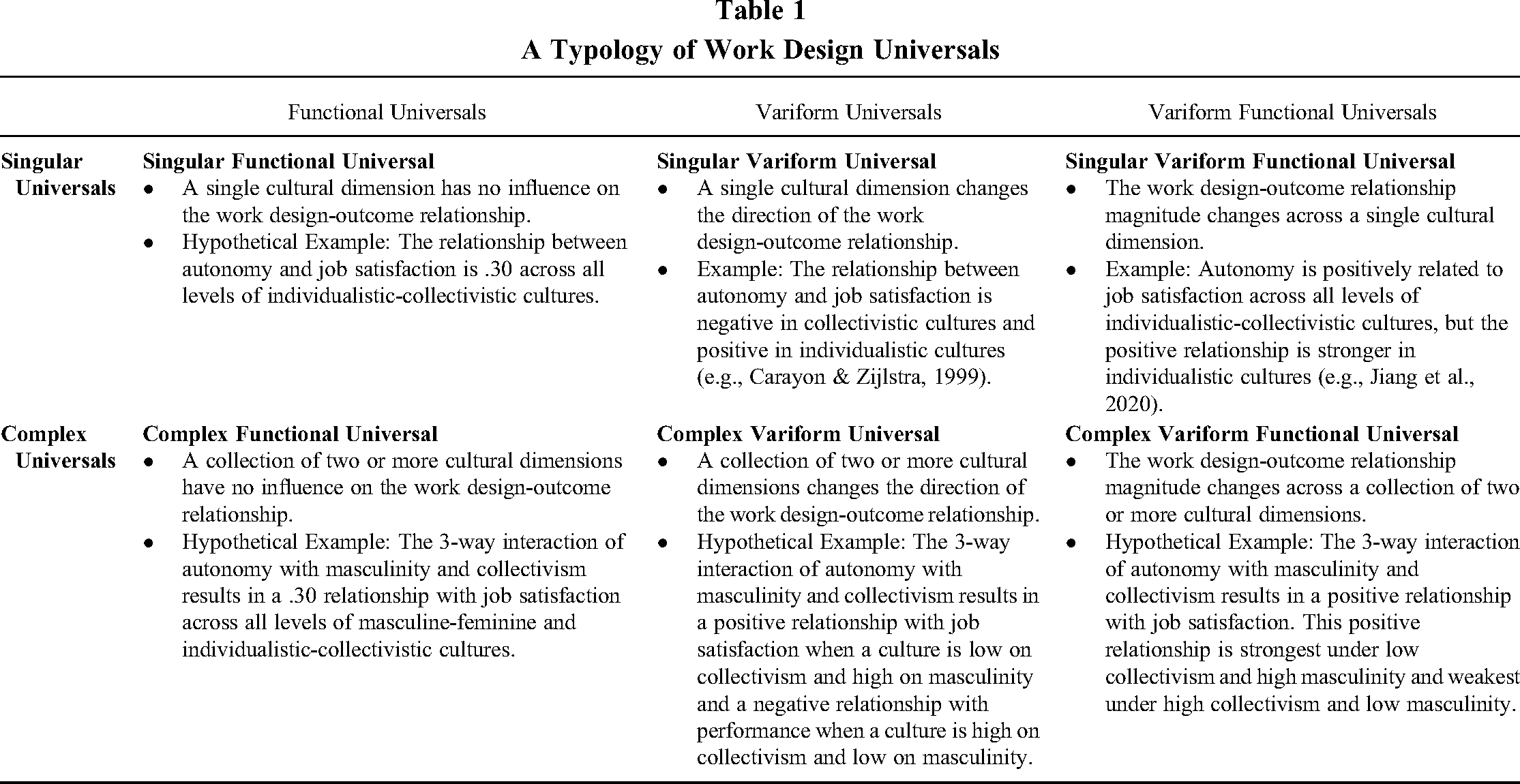
This allows us to move beyond the traditional focus on individual cultural dimensions (i.e., a singular universal approach; Lonner, 1980) to an approach representing culture as a configuration of cultural dimensions (i.e., a complex universal approach). Table 1, “A Typology of Work Design Universals,” presents these differences of singular versus complex cultural investigations across variform and variform functional universals, and provides hypothetical examples of each universality. This approach is necessary and insightful because a singular universal approach, where cultural characteristics are considered individually, may assume and analytically suggest that, for example, autonomy may be less satisfying to employees in Japan—because the country is characterized by low individualism, high uncertainty avoidance, and low indulgence—than employees in Switzerland, which can be characterized by high individualism, low uncertainty avoidance, and high indulgence. However, a complex universal approach in which these characteristics are considered together, and are also investigated in configuration with the culturally similar characteristics between Japan and Switzerland (e.g., low power distance, high masculinity, and high long-term orientation), may find that autonomy may be equally fulfilling for workers in both nations.
A Typology of Work Design Universals
Together, this study reviews the influence of culture on work design and assesses how cultural dimensions (both individually and in complex configurations) affect the impact of work design characteristics on job satisfaction and performance. In doing so, the study makes several contributions to the literature. Specifically, the narrative review allows us to summarize the state of the literature in terms of relationships examined, conclusions reached, and proposed theoretical rationales. However, very few studies have examined the universality of work design characteristics. Consequently, work design research on this topic, including the current review, is, by nature, more exploratory relative to more developed literatures (e.g., leadership as exemplified by the GLOBE research).
In other words, in terms of theoretical contribution, it is necessary and important to first explore whether there is evidence for the cultural universality of work design before bold and specific claims can be made. As such, the meta-analyses will provide an examination of whether specific job characteristics have a differential relationship with outcomes across different cultures, (i.e., a singular universal approach that asks “do singular cultural dimensions moderate a work design characteristic-outcome relationship?”) and whether clusters of cultural dimensions evidence a differential relationship with outcomes across different cultures (i.e., a complex universal approach that asks “do clusters of cultural dimensions moderate a work design characteristic-outcome relationship?”). In doing so, we extend the investigation of work design's universality by providing an examination using clusters of cultural dimensions. However, it is important to note, given the exploratory nature of the present effort, that future research must be done to solidify and replicate our results before generalizable claims can be made regarding the more fine-grained and specific role of cultural characteristics and configurations in moderating the influence of work design characteristics on satisfaction and performance.
The Importance of Context in Work Design
From an initial emphasis on division of labor focused on specialization and simplification (Taylor, 1911), to more enriched and motivationally-based approaches (Herzberg, Mausner, & Snyderman, 1959), the design of work has garnered much interest from practitioners and researchers alike (Parker et al., 2017a). This interest is due, in part, to the significant impact different work design characteristics have on the motivational, behavioral, and attitudinal outcomes of those performing the work. Past work design theory (Morgeson & Humphrey, 2008) has identified four overarching domains of work that impact employee outcomes: (a) task characteristics (i.e., autonomy, task variety, task significance, task identity, and feedback from the job); (b) knowledge characteristics (i.e., job complexity, information processing, problem solving, skill variety, and specialization); (c) social characteristics (i.e., social support, interdependence, interaction outside the organization, and feedback from others); and (d) contextual characteristics (i.e., physical demands, equipment use, and work conditions).
This dominant view of work design that underlies research examining these characteristics, however, fails to account for the broader context as an influence on the work design–employee effectiveness relationship. Johns (2006: 391) defined context across two levels, with omnibus context reflecting “an entity that comprises many features or particulars” (e.g., an occupational context) and discrete context reflecting “the particular contextual variables or levers that shape behavior or attitudes” (e.g., specific task, social, or physical elements; see Dierdorff, Rubin, & Morgeson, 2009). As research has increased around discrete contextual elements that might moderate work design's impact on employees (Parker et al., 2017a), research has failed to account for more omnibus contextual moderators. National culture is one of the more salient omnibus contexts through which to evaluate the influence of work design (Erez, 2010), as cultural dimensions encompass the “shared motives, values, beliefs, identities, and interpretations or meanings of significant events that result from common experiences of members of collectives that are transmitted across generations” (House, Hanges, Javidan, Dorfman, & Gupta, 2004: 15). Thus, the expectation is that cultural dimensions will likely alter how effective work design's elements are in different contexts.
Cross-cultural research has identified a core set of cultural dimensions that includes: power distance as the degree to which the community accepts and approves of authority, power differences, and status privileges (House et al., 2004); uncertainty avoidance as “the extent to which a society feels threatened by uncertain and ambiguous situations and tries to avoid these situations” (Hofstede, 1980: 45); individualism–collectivism as “the degree to which people in a country prefer to act as individuals rather than members of groups” (Hofstede, 1994: 6); masculinity–femininity which focuses on a culture's acceptance of masculine values such as “assertiveness, performance, success and competition” (Hofstede, 1994: 6) compared to acceptance of feminine values such as “friendly atmosphere, position security, physical conditions, [and] cooperation” (Hofstede, 2001: 281); future orientation which reflects the extent to which emphasis is placed on a long-term orientation that is future-oriented with a focus on planning, investing in the future, and delaying gratification, versus a short-term orientation that is past- and present-oriented with a focus on tradition and social obligations; and indulgence–restraint which explains the extent to which people try to meet their desires and impulses versus the extent to which they try to control them (Hofstede, 2011). To theoretically guide our examination of the role of these six cultural dimensions in influencing the effects of the four overarching domains of work design characteristics on job satisfaction and job performance, we turn to Lonner's (1980) theoretical conceptualization of singular and complex universals.
Theoretical Overview: The Universality of Work Design
Theoretically, the intersection of work design and cross-cultural research focuses on work design's universality. As such, the present effort asks: Do work design characteristics influence performance and satisfaction the same way across different cultures or do the values of the individuals that make up the national culture fundamentally alter the effectiveness of work design? For example, autonomy—the extent to which a job allows freedom, independence, and discretion over work scheduling, decision making, and work methods—is one of the most investigated work design characteristics (Humphrey, Nahrgang, & Morgeson, 2007). Without taking the cultural context into account, work design theory would suggest that increases in autonomy are beneficial across all cultures. However, autonomy is likely to be appreciated and wanted in individualistic cultures and less appreciated in collectivistic cultures. Another example is interdependence—the extent to which jobs depend on others to complete the work—where masculine cultures that value competition and assertiveness are unlikely to thrive in interdependent situations; however, feminine cultures where cooperation is more important are likely to appreciate interdependent work.
Building from these expectations surrounding cultural influences on work design, we extend upon Lonner's (1980) work to develop a novel framework to understand work design's universality across cultures. Lonner (1980) used sociological theory to define multiple approaches through which to conceptualize the universality of constructs across cultures. When culture does not affect a relationship, then variables follow the functional universal form, where the relationship between two variables is the same across cultures (Dickson et al., 2001). Alternatively, the variform universal form suggests culture as a moderator whereby the relationship will change in sign due to different cultural influences. Furthermore, Bass (1997) extended Lonner's (1980) functional and variform universal concepts with the introduction of variform functional universal forms whereby the relationship is stable in direction between two variables but the magnitude of the relationship changes across cultures.
In line with Bass's (1997) expansion of Lonner's (1980) discussion of variform universals, which applied Lonner's (1980) work to theoretically develop the nascent state of knowledge regarding culture's impact on leadership, we offer the distinction between singular and complex variform and variform functional universal forms. The vast majority of past research has examined the moderating role of culture using a single dimension of culture, which we label as a singular universal approach. However, cross-cultural research has argued that the examination of single isolated cultural values is reductive and not reflective of the complex interplay of values that define national culture (Kirkman, Lowe, & Gibson, 2006; Yong et al., 2020). The present study therefore proposes an alternative to this more traditional singular universal approach: the complex universal. Complex universals move beyond a single cultural dimension to investigations of the moderating patterns of two or more cultural dimensions. Therefore, singular variform functional universal forms involve the changing of magnitude of a work design-outcome relationship across a single cultural dimension, whereas complex variform functional universal forms are characterized by the changing of magnitude of a work design-outcome relationship across a configuration of two or more cultural dimensions.
Through this distinction between variform and variform functional forms across singular or complex universals, we provide an initial framework, as outlined in Table 1, for understanding cross-cultural work design research. Work design characteristics that operate under variform forms are potentially detrimental in some cultures but beneficial in others. When work design characteristics take the form of singular variform, the cultural dimensions will operate to change the direction of these relationships individually, whereas in complex variform, culture will change the direction of these relationships configurally. If work design characteristics assume variform functional forms, positive (negative) relationships with job satisfaction or performance are likely no matter the culture, yet the strength of the positive (negative) influence is likely to change based on the culture's values. Thus, the first question we address is whether the relationship between work design characteristics and outcomes follows a variform or variform functional universal form. The second question we investigate is if culture acts as a singular or complex universal across work design-outcome relationships. Providing an understanding of which characteristics operate under singular or complex and variform or variform functional forms could allow researchers and practitioners to more appropriately design work that is suited for employee effectiveness in a particular cultural context while extending existing work design theory.
Narrative Review
Our narrative review provides insight regarding whether the impact of culture on work design relationships is likely to be characterized as variform universal or variform functional universal and as singular universal or complex universal. Our narrative review focuses on empirical studies that have directly compared the association between work design characteristics and job satisfaction or performance across two or more cultures. To identify these studies, we conducted a literature search in PsycINFO. We searched for English studies through August 2021 with combinations of work or job with keywords of “design,” “content,” “redesign,” “complexity,” “characteristics,” “conditions,” “dimensions,” “scope,” “demands,” “social support,” “enrichment,” and “interdependence.” We also included keywords of characteristics identified in Humphrey and colleagues' (2007) expanded work design model including “autonomy,” “task variety,” “task significance,” “task identity,” “feedback from the job,” “information processing,” “problem solving,” “skill variety,” “specialization,” “interaction outside the organization,” “feedback from others,” “ergonomics,” “physical demands,” and “equipment use.” Our initial search resulted in a pool of 17,842 articles. As summarized in Table 2, only five of these articles have explicitly examined the moderating role of culture on the association between work design characteristics and outcomes, with 10 additional articles not explicitly investigating moderating influences but comparing results across cultures.
Empirical Studies on Work Design Characteristics That Explicitly Investigate Across Multiple Cultures
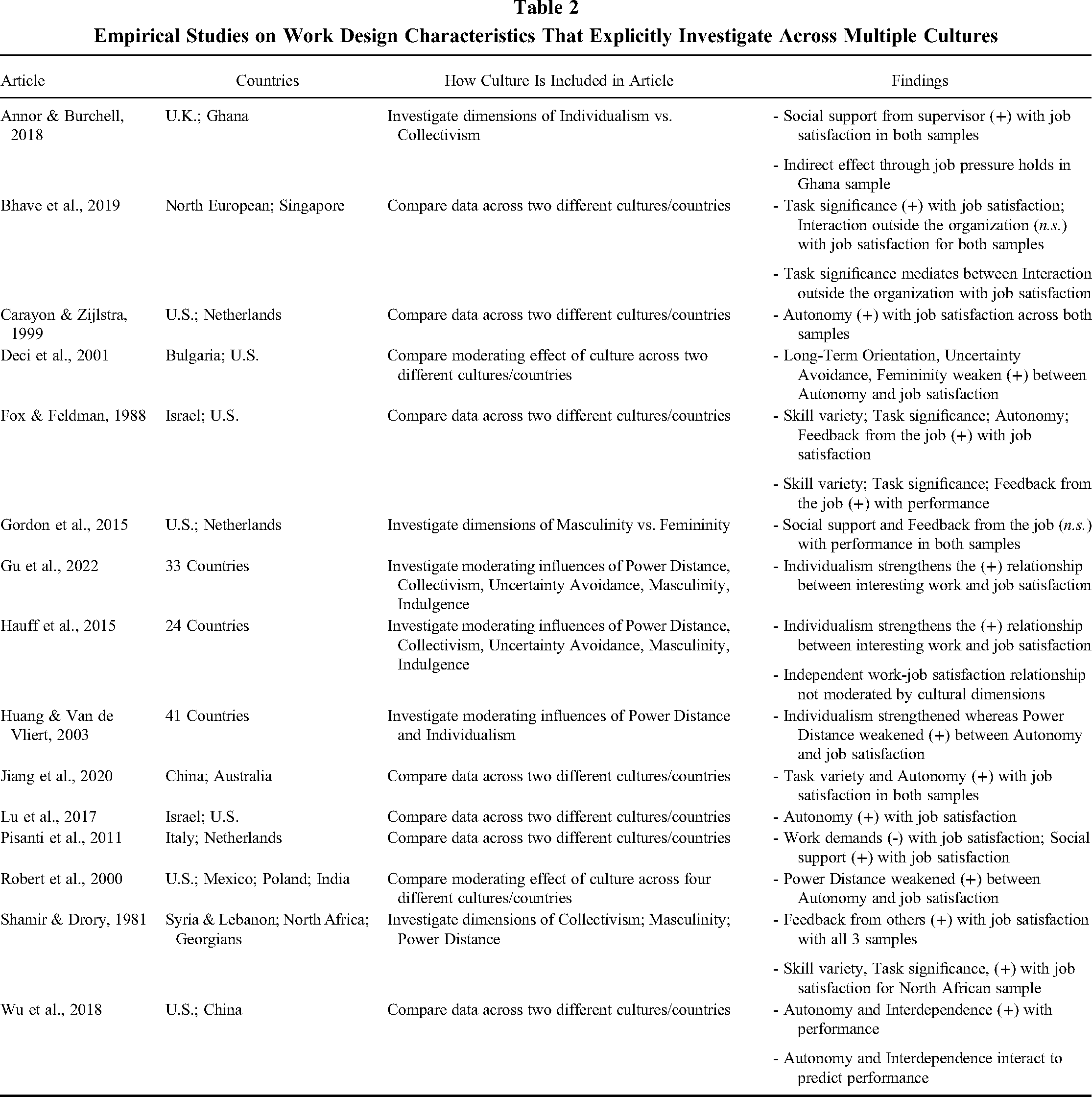
This limited number of studies is not surprising, given the challenges of making cross-cultural comparisons in primary studies. In these studies, individualism and power distance were the most commonly hypothesized cultural moderators (e.g., Huang & Van de Vliert, 2003; Robert, Probst, Martocchio, Drasgow, & Lawler, 2000), and no single study compared all of the cultural dimensions with all of the work design characteristics. Furthermore, studies focused on relatively few work design characteristics, with task and social characteristics being the most commonly examined. Finally, every study tested cultural dimensions independent of one another as moderators on work design, thus it was impossible for these studies to empirically uncover evidence for complex universal forms.
Using our narrative review, we propose initial categorizations of work design characteristics as either variform or variform functional universals. For example, Carayon and Zijlstra (1999), Deci and colleagues (2001), Fox and Feldman (1988), Huang and Van de Vliert (2003), Jiang, Di Milia, Jiang, and Jiang (2020), Lu, Brockner, Vardi, and Weitz (2017), Robert and colleagues (2000), and Wu, Parker, Wu, and Lee (2018) all found positive relationships between autonomy and satisfaction or performance. Furthermore, these studies found power distance (Robert et al., 2000), long term orientation, uncertainty avoidance, and femininity (Deci et al., 2001) to weaken autonomy's positive effect whereas individualism strengthened the positive relationship (Robert et al., 2000), suggesting that the positive relationship of autonomy with outcomes changes in magnitude based on culture, and thus autonomy as a variform functional universal variable. In addition, feedback from others can also potentially be categorized as variform functional universal, as Shamir and Drory (1981) found it to be positively related to job satisfaction across their Syrian, Lebanese, North African, and Georgian samples.
In contrast, task significance is potentially a variform universal characteristic: Bhave, Halldórsson, Kim, and Lefter (2019) and Fox and Feldman (1988) found task significance to positively influence job satisfaction across samples from Northern Europe and Singapore, and Israel and the United States, respectively, whereas Shamir and Drory (1981) found task significance to be positively related to job satisfaction for their North African sample but not for their Syrian, Lebanese, and Georgian samples. These differences suggest task significance is not a valued work design characteristic across all cultures. Similar results were found with skill variety as Fox and Feldman (1988) found positive relationships with job satisfaction and performance across both Israeli and U.S. samples, whereas Shamir and Drory (1981) only found skill variety to be positively related to job satisfaction for their North African sample, suggesting skill variety as a variform universal characteristic. Social support also potentially operates as a variform universal, with Annor and Burchell (2018) and Pisanti, van der Doef, Maes, Lazzari, and Bertini (2011) finding positive relationships with job satisfaction across samples from the United Kingdom and Ghana, and Italy and the Netherlands, respectively, whereas Gordon, Demerouti, Le Blanc, and Bipp (2015) found a non-significant relationship between social support and performance across samples from both the United States and the Netherlands.
Other work design characteristics were also examined across multiple cultures (e.g., interaction outside the organization, Bhave et al., 2019; feedback from the job, Fox and Feldman, 1988; task variety, Jiang et al., 2020; work demands, Pisanti et al., 2011; interdependence, Wu et al., 2018); however, with few studies investigating the same characteristics we are unable to provide initial categorizations of these variables as operating as variform or variform functional universals.
With these initial categorizations of a subset of work design variables, our narrative review highlights that past research has exclusively investigated singular universal forms whereby a single cultural dimension is proposed to moderate a work design-outcome relationship. Unfortunately, this is a limited set of studies that precludes the full investigation of the relationship between culture and work design. These limitations are highlighted by recent cross-cultural research that emphasizes the fact that cultures and countries are not just independent dimensions, but, instead, are made up of a specific combination of characteristics (Yong et al., 2020). Accordingly, to begin to better understand the influence of culture, it is critical that research move beyond the examination of individual cultural dimensions toward more complex, multi-faceted conceptualizations of culture.
Fortunately, meta-analysis is ideally suited to examine the moderating role of culture (Ones et al., 2012). Using meta-analytic techniques, studies can be coded by the country in which data was collected. Then, culture can be examined as a moderator across the entire literature base, allowing for a more powerful test than is available in primary studies that have directly compared work design characteristics across cultures. Meta-analysis will thus enable a more in-depth analysis of the moderating role of culture, complementing and extending upon primary empirical research. Specifically, we use meta-regression to provide investigations of cross-cultural work design's singular variform or variform functional universality. We then extend our findings by utilizing QCA to probe and test for the possibility of cross-cultural work design's complex universal form.
Quantitative Methods
Literature Search and Inclusion Criteria
To further investigate work design's universality, we conducted a quantitative review utilizing meta-analysis. Using the same search criteria from the narrative review, we adopted several criteria to further select articles. First, we excluded articles that did not have data, such as review articles. Second, we excluded group- and firm-level samples, thus including only individual-level studies. Third, we excluded articles that were experiments or simulations or that fell outside the domain of work. Fourth, we excluded articles that did not provide correlations or sufficient information to compute effect sizes with job satisfaction and/or performance. Fifth, we excluded articles that did not provide explicit information about the country of origin of the data, as these did not allow us to code cultural dimensions. Finally, we excluded duplicate articles that used a data set more than once and kept only one of these articles. These selection criteria led to a final study population of 341 articles that provided 389 studies examining work design characteristics’ influence on job satisfaction and/or performance across 39 countries. This dataset is substantially larger than that of our narrative review, as we included any articles with our relationships of interest (i.e., work design-outcomes) instead of focusing on articles that have highlighted culture as a moderator in the work design-outcome relationship. The plurality of the included studies were conducted in the United States (45.24%), with the Netherlands (7.71%), Australia (7.46%), the United Kingdom (6.68%), and Canada (4.37%) as the next four highest represented countries. Supplemental material Table 1 provides a breakdown of included studies by country.
Coding
We coded 17 work design characteristics by referring to Humphrey and colleagues' (2007) list. In building the codebook, two of the authors with their research assistants coded a random 10% of the included articles (N = 34), the agreement rate was high (Cohen's kappa = .94). The remaining articles were coded individually, and issues were resolved through discussion.
Job satisfaction
For job satisfaction we included evaluations of job satisfaction (e.g., Bhave et al., 2019) and dissatisfaction (e.g., Costa & Ferreira, 2014). Measures of job dissatisfaction were reverse coded when aggregating with job satisfaction measures.
Job performance
For job performance we included subjective (e.g., Gordon et al., 2015) and objective (e.g., Grant & Sumanth, 2009) performance evaluations.
Culture
For each study that provided information about the country or geographic area where the data were collected, we used Hofstede and Minkov's (2010) coding to assign scores ranging from 0 to 100 to the culture dimensions of power distance, individualism, masculinity, uncertainty avoidance, future orientation, and indulgence for the 39 countries in our data. 2
Meta-Analytic Procedures
Schmidt and Hunter's (2015) random-effects meta-analysis was used to synthesize correlation coefficients across the studies. To maintain independence among effect sizes where multiple measures of a construct were provided (e.g., self- and supervisor-reported task performance), we computed a linear composite such that each sample only contributed one effect size for each meta-analytic calculation. We also report sample-weighted coefficients corrected for unreliability (ρ). We used individual correction methods where correlations reported in primary studies were corrected for measurement error using local reliability (i.e., coefficient alpha). Following suggestions by Kepes, McDaniel, Brannick, and Banks (2013), for the small portion of studies that did not report a reliability estimate, we used the average of available reliabilities for these variables (e.g., satisfaction = .71; performance = .73).
The primary analyses involved examining whether cultural dimensions moderate the relationship between the focal work design characteristics and job satisfaction or performance. We used an adapted version of Arthur, Bennett, and Huffcutt's (2001) SAS Version 9.1 PROC MEANS program to examine the moderating effects of culture. In doing so, we used weighted least squares regression to regress the magnitude of the predictor-criterion relationship onto culture. Weighted least squares is beneficial to use because it is unaffected by multicollinearity and provides a minimally biased estimation, even at small sample sizes (Steel & Kammeyer-Mueller, 2002).
Qualitative Comparison Analysis to Test Complex Universality
QCA is fitting for identifying the joint influence of multiple independent variables on an outcome of interest (see Fiss, 2011; Greckhamer, Misangyi, Elms, & Lacey, 2008; Joshi, Son, & Roh, 2015; Ong & Johnson, 2023). This analysis is derived from principles of Boolean algebra and employs binary data and combinatorial reasoning to determine the causally relevant conditions that explain an outcome of interest (Joshi et al., 2015). It does not rely on significance testing or determine the explained variance of an outcome but instead detects specific sets of causal common attributes across all cases of an outcome. We used the corrected effect sizes from our meta-analysis and employed QCA as an approach to determine whether several cultural characteristics are associated with cases of strong levels of the relationship between work design characteristics and job satisfaction, and work design characteristics and job performance.
We employ a fuzzy set form of QCA (Ragin, 1999), which involves forming a multipoint scale wherein each point is denoted by a number representing a range of data values. The variables for each case are then assigned a point on the scale based on which range the value falls within. Then, the analysis determines which combination of scale points is related to a specific outcome—in our case, whether it results in the presence of a strong correlation between the work design characteristic and either job satisfaction or job performance. Fuzzy set analysis has traditionally been used for primary studies in the organizational sciences (e.g., Ong & Johnson, 2023) and provides more nuance than crisp set approaches.
We calibrated our cutoffs for dichotomizing correlations between work design characteristics and outcomes as strong or not strong based on Bosco, Aguinis, Singh, Field, and Pierce's (2015) benchmark determinations for large effect sizes in applied psychology. Bosco and colleagues found that for relationships between attitudes and attitudes (i.e., work design characteristic perceptions and job satisfaction) that an effect size of .39 represented the 66th percentile, while for attitudes and behaviors (i.e., work design characteristic perceptions and performance) an effect size of .24 represented the 66th percentile. Therefore, corrected correlations greater than .39 for work design characteristics and job satisfaction and corrected correlations greater than .24 for work design characteristics and performance were coded as large, whereas correlations equal to or less than .39 or .24, respectively, were coded as not large. Our calibrations of the cultural characteristics were based on the average score value of the cultural characteristics and the range of our data, as follows: 0 if it was below 55; .25 if it was equal to or greater than 55 but less than 60; .50 if it was equal to 60; .75 if it was greater than 60 but less than 65; 1 if it was greater than or equal to 65 (Hofstede & Minkov, 2010). As an illustrative example, the United States was coded as low on power distance at 0, high on individualism at 1, moderately high on masculinity at .75, low on uncertainty avoidance at 0, low on long-term orientation at 0, and high on indulgence at 1. In contrast, Greece was coded as midrange on power distance at .5, moderately low on masculinity at .25, high on uncertainty avoidance at 1, low on long-term orientation at 0, and low on indulgence at 0.
When considering how to interpret our configural results, we compared the emergent configuration from our results to countries in our dataset. For example, consider QCA results that suggest that there would be strong relationships between autonomy and job satisfaction when there was a specific cultural configuration present: If the QCA results suggested that the configuration was low power distance (0), high individualism (1), high masculinity (1), moderately low uncertainty avoidance (.25), high long term orientation (1), and high indulgence (1), we would note that Switzerland was a country that reflected that configuration (given our aforementioned calibration decisions). In a number of instances, however, there were no countries that fit the resulting configural patterns. This is because fuzzy set coding allows for moderate gradations, whereas the analysis only can result in high or low labels for the cultural characteristics within the determined configurations. The coded data were then examined to see if the six cultural characteristics sufficiently explained strong relationships between work design characteristics and our outcomes. We specified configurations for both outcomes based on the truth table results provided by the Fuzzy-Set/Qualitative Comparative Analysis Version 3.0 software (Ragin & Davey, 2016), which utilizes listwise deletion. We included configurations with at least one case and set the consistency cutoff as .8 for the cases represented by a specific configuration. Consistency conveys how sufficient a specific configuration of an attribute is regarding how closely it is associated with an outcome. If consistency is equal to 1, it means that every time a configuration is present, the outcome is also present. These cutoffs have been commonly used in the organizational sciences (Fiss, 2011; Greckhamer et al., 2008; Ong & Johnson, 2023). In the case of our study, for example, the cultural configurations representing the countries for Finland and Norway was related to a large correlation 100% of the time (i.e., whenever the configuration of an absence of power distance, masculinity, uncertainty avoidance, long-term orientation, and indulgence, coupled with the presence of individualism, existed in our dataset, there was a high correlation between feedback and job satisfaction).
For our results, the presence or absence of specific cultural attributes are represented by O if present and X if absent as part of a parsimonious solution; they are represented by a o if present and x if absent as part of a complex, non-parsimonious solution. Parsimonious solutions are part of both the parsimonious and complex solutions, whereas complex solutions do not appear in the parsimonious solution. In other words, conditions that are part of the parsimonious solution can be considered “core” to a configuration whereas those that are complex can be considered as part of a peripheral or contributing role. As such, the pieces of the complex configurations should be considered more tentative than the core configural components (see Gabriel et al., 2018; Misangyi et al., 2017). In our study, Finland and Norway had cultural configurations where the complex solution was fully parsimonious, in that for all of the cultural characteristics, whether they were present or absent was considered essential to the configuration that led to a large correlation between feedback and job satisfaction. In contrast, Argentina and Malta represent configurations where the absence of power distance, masculinity, and long-term orientation and the presence of indulgence were considered peripheral or contributing cultural characteristics, whereas the absence of individualism and the presence of uncertainty avoidance were considered essential to the configuration that led to a large correlation between skill variety and job performance.
Solutions may have multiple configurations, and each configuration is given a coverage value, which represents the proportion of consistent cases that display that particular configuration of attributes. Unique coverage represents the proportion of cases that display that sole specific configuration. For example, the configuration indicative of the Netherlands represented 20% of the cases in predicting a large outcome for social support and job satisfaction. We attempted to run QCA for all of the work design characteristic variables that were included in our meta-analysis; however, the QCA did not run when insufficient numbers of cases were present (Marx & Dusa, 2011).
Results
Table 3 shows the bivariate relationships for the work design characteristic-job satisfaction and work design characteristic-performance meta-analyses. 3 , 4 Our results parallel Humphrey and colleagues' (2007) meta-analysis findings with one difference (i.e., we found a negative relationship between work conditions and job satisfaction). Furthermore, we extend their work by providing meta-analytic relationships for problem solving (ρ = .49), information processing (ρ = .37), specialization (ρ = .46), interaction outside the organization (ρ = .04), physical demands (ρ = −.06), work conditions (ρ = .00), and equipment use (ρ = .75) with performance, and problem solving (ρ = .29), specialization (ρ = .22), and equipment use (ρ = .07) with job satisfaction. Although these bivariate relationships represent low sample sizes (k < 10), they indicate that researchers are expanding their investigations of work design characteristics, highlighting the continued growth of the work design literature.
Meta-Analytic Results of the Relationships Between Work Design Characteristics and Outcomes
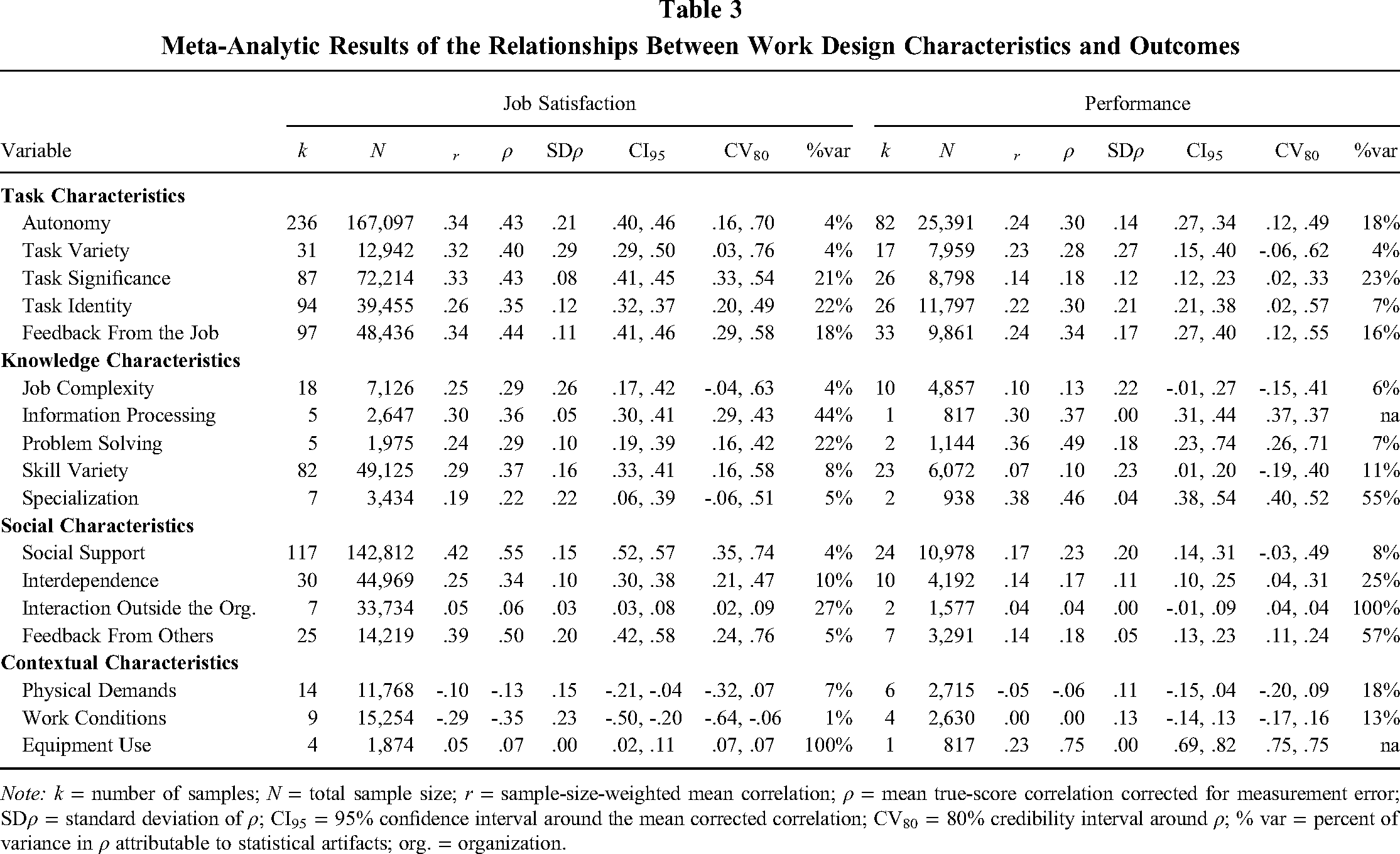
Note: k = number of samples; N = total sample size; r = sample-size-weighted mean correlation; ρ = mean true-score correlation corrected for measurement error; SDρ = standard deviation of ρ; CI95 = 95% confidence interval around the mean corrected correlation; CV80 = 80% credibility interval around ρ; % var = percent of variance in ρ attributable to statistical artifacts; org. = organization.
Variform Versus Variform Functional Universality of Work Design
Table 3 also provides initial information around the universality of work design characteristics. Specifically, focusing on the 95% confidence intervals (CI95s), we can suggest variables as variform (i.e., the relationship direction changes across cultures) or variform functional (i.e., the relationship is consistent in direction across cultures, but the magnitude of the relationship changes based on cultural differences). Broadly, it seems that most work design characteristics fall within the variform functional universal form, as their CI95 do not cross zero for relationships with job satisfaction or performance. Showing positive relationships with both outcomes, these variform functional universal characteristics include: autonomy, task variety, task significance, task identity, feedback from the job, information processing, problem solving, skill variety, specialization, social support, interdependence, feedback from others, and equipment use. By contrast, job complexity, interaction outside the organization, physical demands, and work conditions are likely to be variform universal as their CI95 include zero. Using this distinction, below we investigate whether singular cultural dimensions or complex configurations of cultural dimensions moderate these relationships. We start by using weighted least squares regression to examine whether there is evidence for singular universal forms.
Singular Cultural Dimensions as Moderators
Tables 4 to 7 show the regression results independently investigating the six cultural dimensions as moderators of the work design characteristic-outcomes relationships. When countries had missing values for cultural dimensions (e.g., indulgence for Israel), we used listwise deletion such that those countries were not included in that specific regression analysis.
Weighted Least Squares Regression Models Examining Cultural Dimensions as Moderators on Task Characteristics
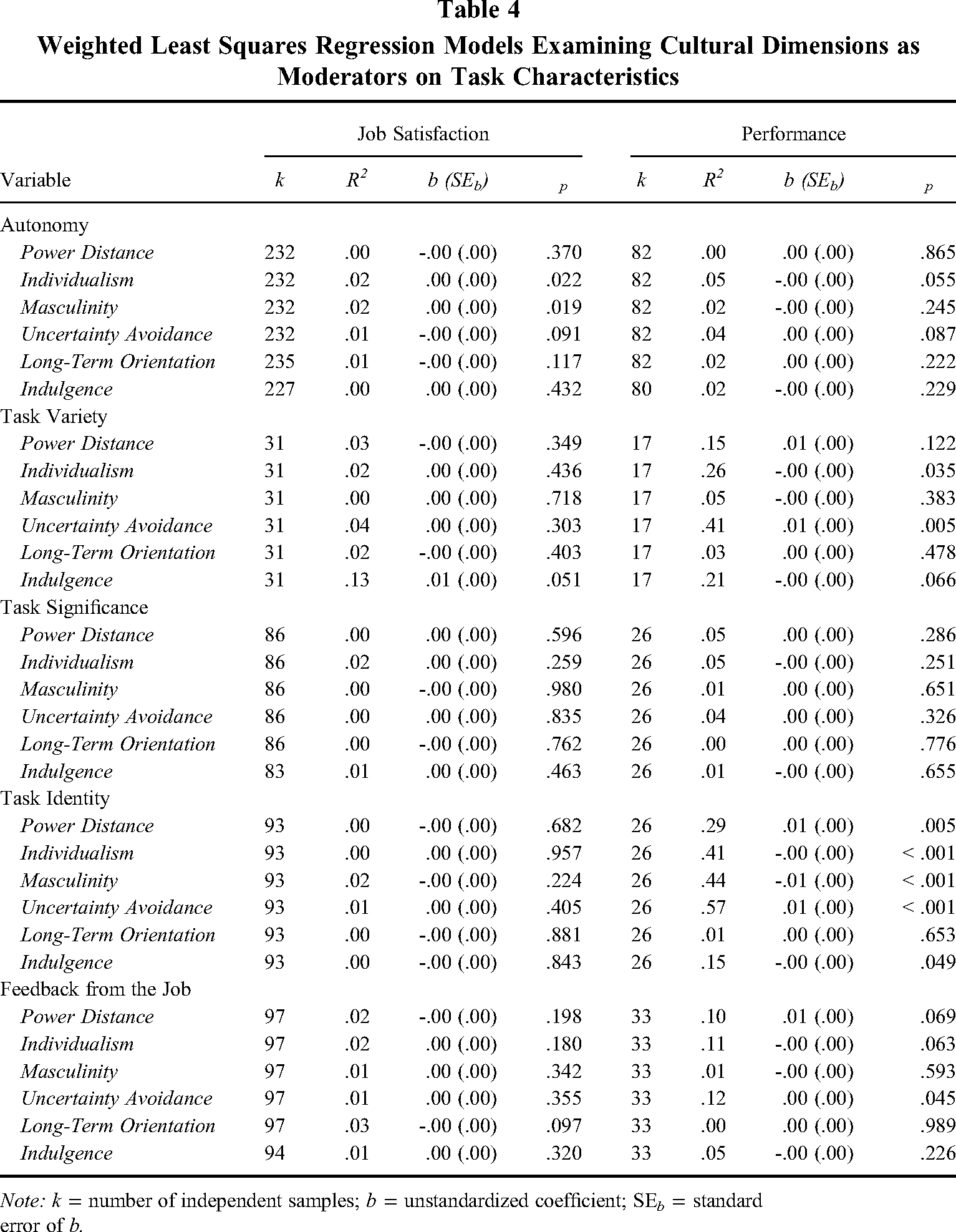
Note: k = number of independent samples; b = unstandardized coefficient; SE b = standard
error of b.
Weighted Least Squares Regression Models Examining Cultural Dimensions as Moderators on Knowledge Characteristics
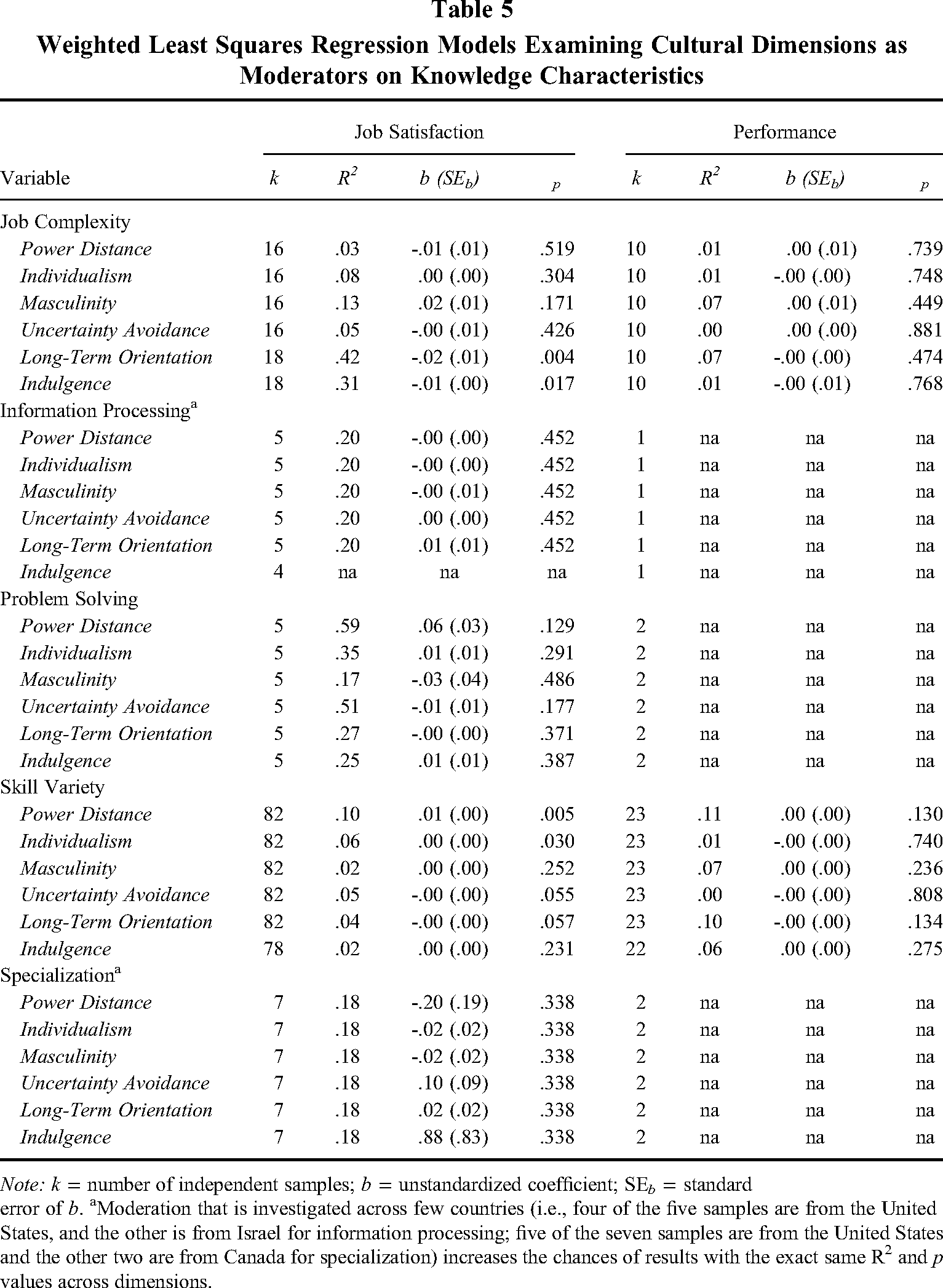
Note: k = number of independent samples; b = unstandardized coefficient; SE b = standard
error of b. aModeration that is investigated across few countries (i.e., four of the five samples are from the United States, and the other is from Israel for information processing; five of the seven samples are from the United States and the other two are from Canada for specialization) increases the chances of results with the exact same R2 and p values across dimensions.
Weighted Least Squares Regression Models Examining Cultural Dimensions as Moderators on Social Characteristics
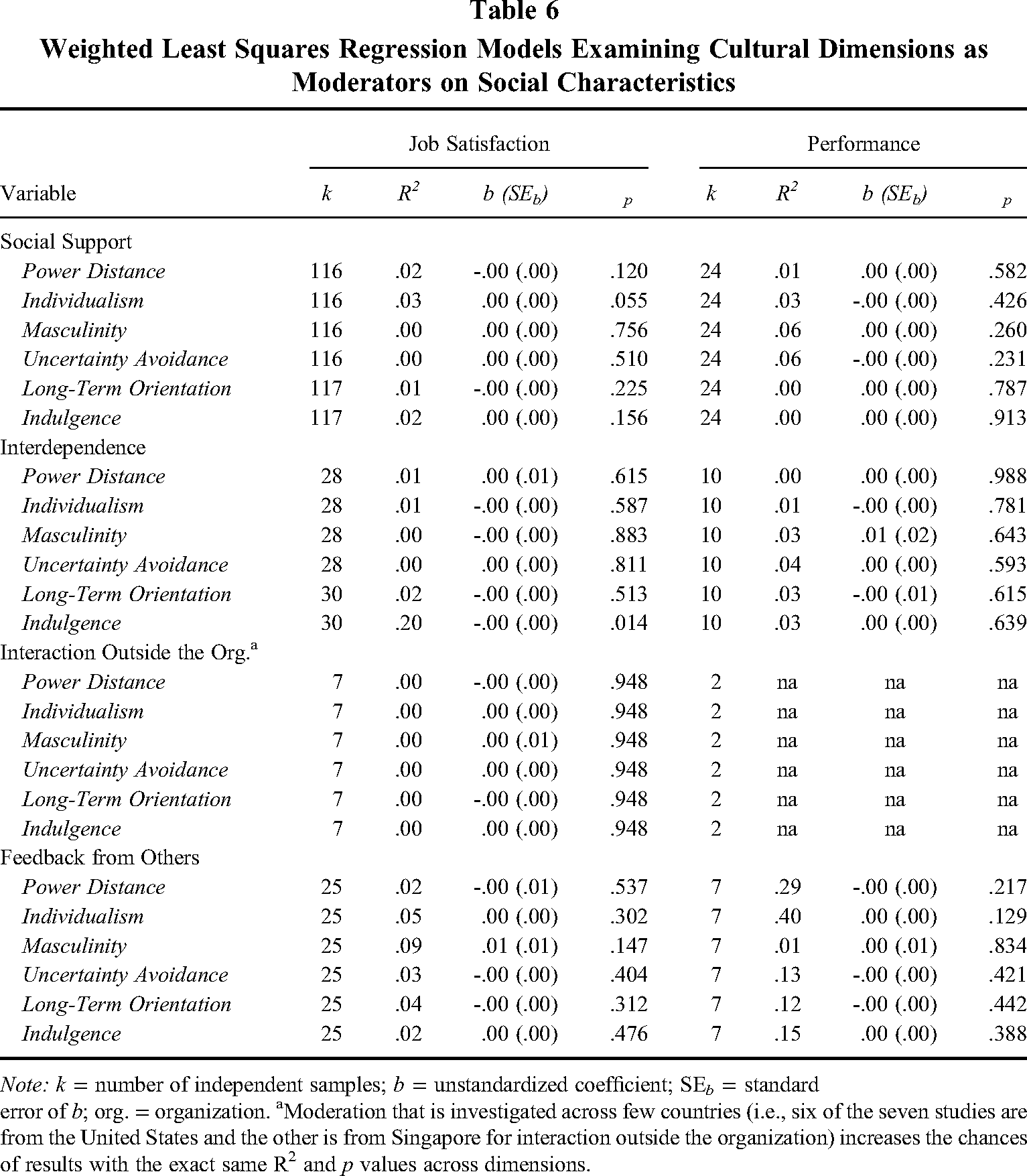
Note: k = number of independent samples; b = unstandardized coefficient; SE b = standard
error of b; org. = organization. aModeration that is investigated across few countries (i.e., six of the seven studies are from the United States and the other is from Singapore for interaction outside the organization) increases the chances of results with the exact same R2 and p values across dimensions.
Weighted Least Squares Regression Models Examining Cultural Dimensions as Moderators on Contextual Characteristics
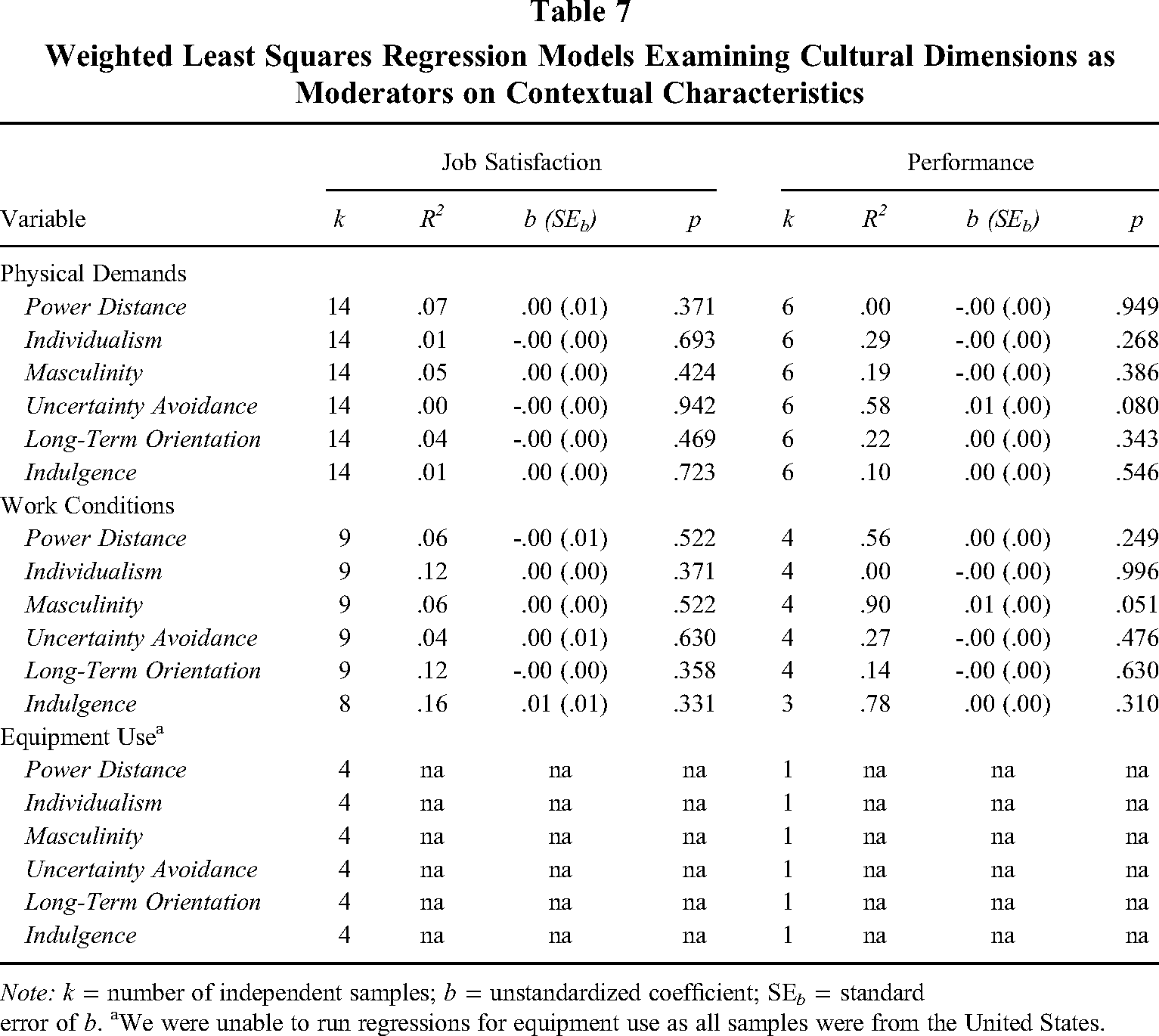
Note: k = number of independent samples; b = unstandardized coefficient; SE b = standard
error of b. aWe were unable to run regressions for equipment use as all samples were from the United States.
As shown in Table 4, cultural dimensions provide a significant moderating influence on task characteristics’ effects on job satisfaction and performance in 10 of the 60 investigated relationships. The moderation results suggest that the positive relationship between autonomy and job satisfaction is stronger in more individualistic (b < .00; R2 = .02; p = .022) and more masculine cultures (b < .00; R2 = .02; p = .019). The positive relationship between task variety and performance is stronger in cultures with higher uncertainty avoidance (b = .01; R2 = .41; p = .005) and weaker in more individualistic cultures (b < −.00; R2 = .26; p = .035). The positive relationship between task identity and performance is stronger in high power distance cultures (b = .01; R2 = .29; p = .005) and cultures high on uncertainty avoidance (b = .01; R2 = .57; p < .001) whereas the relationship is weaker in cultures higher on individualism (b < −.00; R2 = .41; p < .001), masculinity (b = −.01; R2 = .44; p < .001), and indulgence (b < −.00; R2 = .15; p = .049). Furthermore, the positive relationship between feedback from the job and job performance is stronger in cultures higher on uncertainty avoidance (b < .00; R2 = .12; p = .045).
For knowledge characteristics, as shown in Table 5, cultural dimensions provide moderating influence on knowledge characteristics’ effects on job satisfaction and performance in four out of 41 relationships. The positive relationship between skill variety and job satisfaction is stronger in higher power distance (b = .01; R2 = .10; p = .005) and more individualistic (b < .00; R2 = .06; p = .030) cultures. Additionally, the positive relationship between job complexity and job satisfaction is weaker under more long-term orientated (b = −.02; R2 = .42; p = .004) and more indulgent cultures (b = −.01; R2 = .31; p = .017). Finally, as seen in Table 6, the only relationship for social characteristics where culture provides moderating effects is that the positive relationship between interdependence and job satisfaction is weaker under more indulgent cultures (b < −.00; R2 = .20; p = .014). Contextual characteristics were not moderated by cultural dimensions, as seen in Table 7.
Collectively, these meta-regression results indicate that single cultural dimensions act as moderators on a limited number of work design characteristic-job satisfaction or -performance relationships. In the few cases where there was significant moderation (e.g., between task identity and performance), the cultural dimensions often explained substantial variance. However, a weakness associated with this singular universal approach of testing each cultural dimension separately is that it does not account for patterns of cultural dimensions. Cultures and countries are not just one dimension but instead represent a specific configuration of dimensions. Therefore, we turn to our QCA results to explore the possibility for the complex universality of the joint influence of cultural dimensions on the work design characteristic-outcome relationships.
QCA and Complex Universality Results
Results of the fuzzy set QCA are shown in Tables 8 and 9. 5 Each result presented in the tables identifies a configuration of cultural attributes that differentiates between large and not large relationships connecting the specified work design characteristic and job satisfaction (Table 8) or job performance (Table 9). Cultural attributes are represented by O (o) if present and X (x) if absent. That is, a configuration associated with a large relationship between a work design characteristic and job satisfaction may specifically include (O or o) the presence of a high level of a cultural attribute, may exclude (X or x) the presence of a high level of a cultural attribute, or the level of the cultural attribute may not be critical (blank cell) in specifying the relationship. After examining the cultural configurations, we used Hofstede and Minkov's (2010) data to identify countries that fit each pattern of attributes, including this in both our results section and in notes for both Tables 8 and 9. Our coverage values are consistent with coverage values that have been demonstrated in organizational sciences meta-analyses (e.g., Joshi et al., 2015).
Qualitative Comparative Analysis Results for Large Effect Sizes Between Satisfaction and Cultural Dimensions
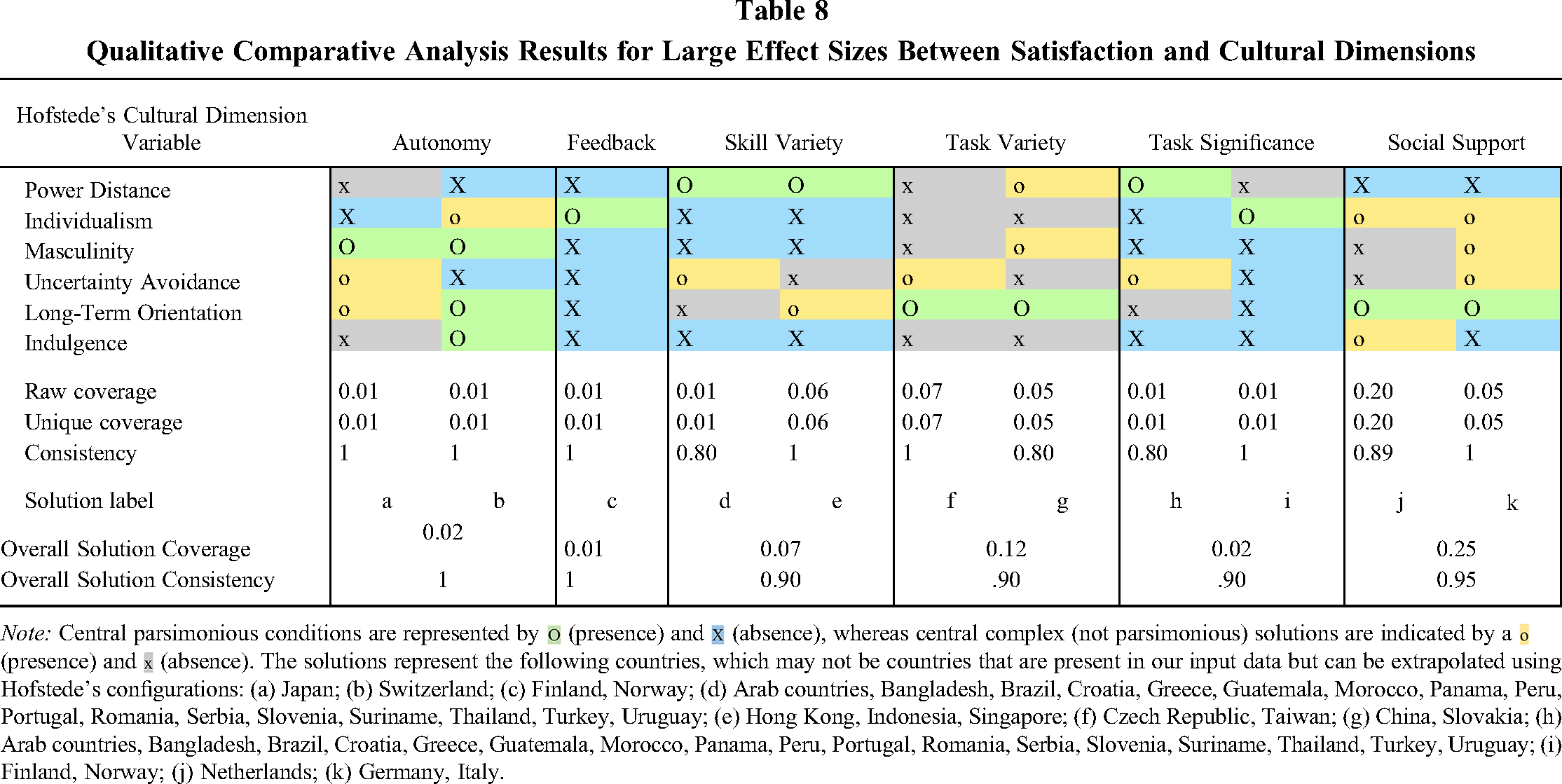
Note: Central parsimonious conditions are represented by  (presence) and
  (absence), whereas central complex (not parsimonious) solutions are indicated by a
  (presence) and
  (absence). The solutions represent the following countries, which may not be countries that are present in our input data but can be extrapolated using Hofstede's configurations: (a) Japan; (b) Switzerland; (c) Finland, Norway; (d) Arab countries, Bangladesh, Brazil, Croatia, Greece, Guatemala, Morocco, Panama, Peru, Portugal, Romania, Serbia, Slovenia, Suriname, Thailand, Turkey, Uruguay; (e) Hong Kong, Indonesia, Singapore; (f) Czech Republic, Taiwan; (g) China, Slovakia; (h) Arab countries, Bangladesh, Brazil, Croatia, Greece, Guatemala, Morocco, Panama, Peru, Portugal, Romania, Serbia, Slovenia, Suriname, Thailand, Turkey, Uruguay; (i) Finland, Norway; (j) Netherlands; (k) Germany, Italy.
Qualitative Comparative Analysis Results for Large Effect Sizes Between Performance and Cultural Dimensions
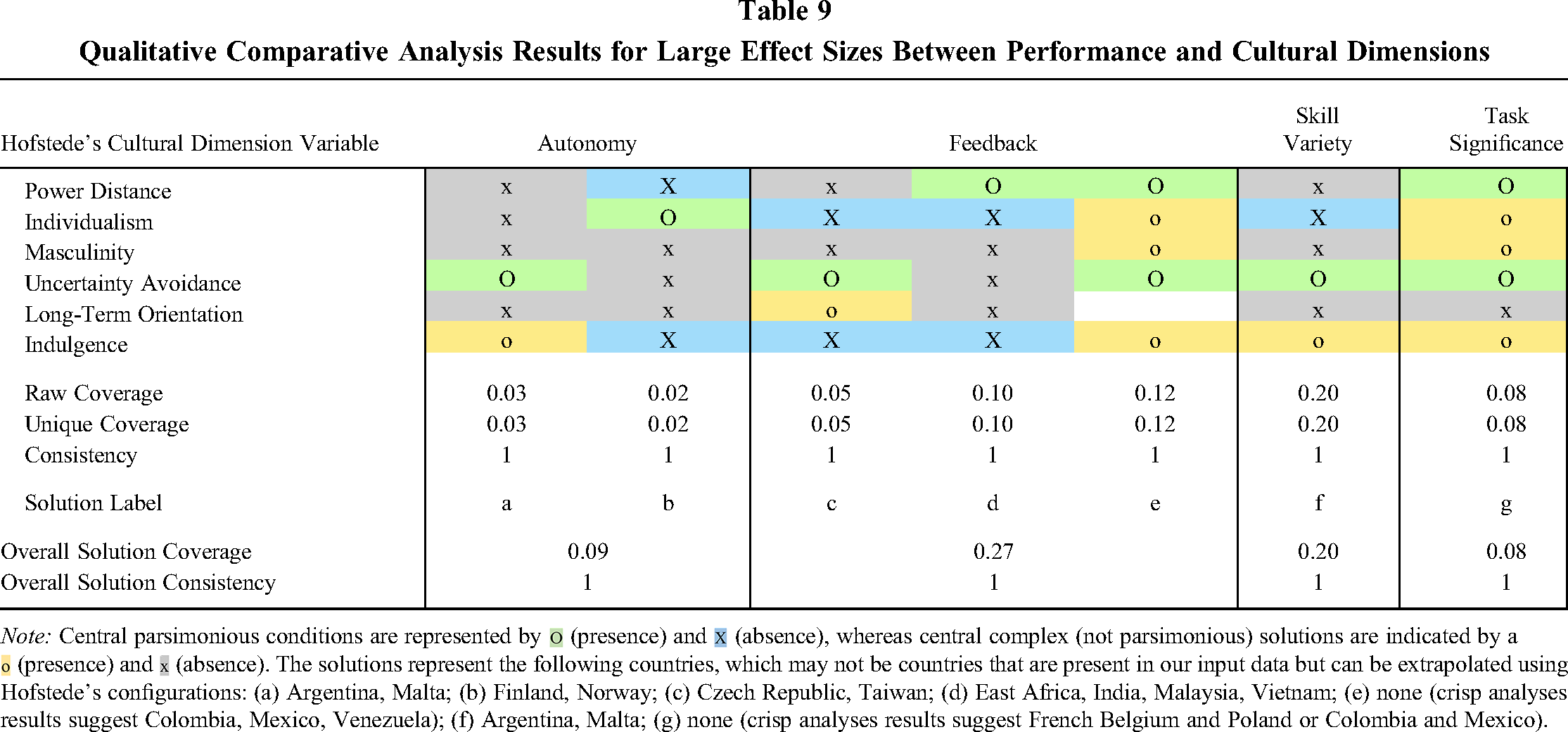
Note: Central parsimonious conditions are represented by (presence) and (absence), whereas central complex (not parsimonious) solutions are indicated by a (presence) and (absence). The solutions represent the following countries, which may not be countries that are present in our input data but can be extrapolated using Hofstede's configurations: (a) Argentina, Malta; (b) Finland, Norway; (c) Czech Republic, Taiwan; (d) East Africa, India, Malaysia, Vietnam; (e) none (crisp analyses results suggest Colombia, Mexico, Venezuela); (f) Argentina, Malta; (g) none (crisp analyses results suggest French Belgium and Poland or Colombia and Mexico).
Job satisfaction
For task characteristics, and as shown in Table 8 solutions a and b, the strongest solutions associated with large correlations between autonomy and job satisfaction contained low power distance, low individualism, high masculinity, high uncertainty avoidance, high long-term orientation, and low indulgence; low power distance, high individualism, high masculinity, low uncertainty avoidance, high long-term orientation, and high indulgence also were associated with large correlations between job satisfaction and autonomy. Japan fit the pattern of cultural attributes for solution a, and Switzerland fit this pattern of attributes for solution b. For feedback from the job and job satisfaction, there was one solution (c) associated with large correlations. This solution was characterized by low power distance, high individualism, low masculinity, low uncertainty avoidance, low long-term orientation, and low indulgence. Finland and Norway fit this pattern of attributes.
For skill variety and job satisfaction, the strongest solution (d) contained high power distance, low individualism, low masculinity, low uncertainty avoidance, high long-term orientation, and low indulgence. Hong Kong, Indonesia, and Singapore fit this pattern of cultural attributes. For task variety and job satisfaction, the strongest solution (e) contained low power distance, low individualism, low masculinity, high uncertainty avoidance, high long-term orientation, and low indulgence. The Czech Republic and Taiwan fit this pattern of cultural attributes. For task significance with job satisfaction, one of the solutions (h) included high power distance, low individualism, low masculinity, high uncertainty avoidance, low long-term orientation, and low indulgence. Arab countries, Bangladesh, Brazil, Croatia, Guatemala, Morocco, Panama, Peru, Portugal, Romania, Serbia, Slovenia, Suriname, Thailand, Turkey, and Uruguay fit this pattern of cultural attributes. The other solution for task significance with job satisfaction (i) was low power distance, high individualism, low masculinity, low uncertainty avoidance, low long-term orientation, and low indulgence; Finland and Norway fit this set of attributes.
For social characteristics, and as shown in solution j, the strongest solution associated with large correlations between satisfaction and social support contained low power distance, high individualism, low masculinity, low uncertainty avoidance, high long-term orientation, and high indulgence. The Netherlands fit this pattern of cultural attributes.
For skill variety and performance, there was one (f) solution associated with large correlations. The solution was characterized by low power distance, low individualism, low masculinity, high uncertainty avoidance, low long-term orientation, and high indulgence. Argentina and Malta fit this pattern of cultural attributes. For task significance and performance, there was one solution (g) associated with large correlations. This solution is characterized by high power distance, high individualism, high masculinity, high uncertainty avoidance, low long-term orientation, and high indulgence. No countries fit this pattern of cultural attributes, although our crisp set analyses suggest French Belgium and Poland or Colombia and Mexico could fit this configuration.
Discussion
Research Implications
This research provides a narrative and quantitative review of work design's universality by investigating culture as an important influence across work design-job satisfaction and work design-performance relationships. Although there have been calls to bring the cultural context into work design (Oldham & Fried, 2016; Parker et al., 2017a), our review suggests that only five studies have specifically theorized and analyzed the moderating role of cultural dimensions on work design characteristics-outcome relationships. Furthermore, those that have explored these issues have often investigated one or two cultural dimensions through a simple functional universal approach on a small set of work design characteristics. This produces an incomplete picture of the role of culture, as it can be difficult to interpret the effects of one cultural dimension independent of the full cultural context. To address these limitations, we proposed a framework to understand how singular or complex configurations of culture influence work design characteristics operating as variform or variform functional universals.
In doing so, we extend work design theory by investigating a feature of the omnibus context (i.e., culture) and suggesting that work design is not invariant across culture, as has often been assumed. Although our review and meta-analyses are relatively exploratory in nature due to limitations in existing empirical research, our findings allow us to provide initial classifications of the more-often-studied work design characteristics. This provides a theoretical and empirical foundation for future research to continue to investigate the universality of work design. For example, our initial classifications suggest most work design characteristics operate as variform functional universals in that increases provide positive influences on job satisfaction or performance no matter the culture; however, there were four characteristics (job complexity, interaction outside the organization, physical demands, and work conditions) that likely operate as variform universals whereby their signs change in different cultures, suggesting that increases in them might be a detriment to job satisfaction or performance in some cultures.
Furthermore, we utilized QCA to investigate an alternative to the more traditional singular universal approach in which a single cultural dimension is used as a moderator. This view of complex universals provides investigations of the moderating patterns of two or more cultural dimensions, in our case six cultural dimensions. Although we were unable to test all 17 work design characteristics across complex cultural configurations, our findings suggest that each tested characteristic is influenced by the complex configurations. For example, although the effects of the ability to have agency over one's work (i.e., autonomy) looked universally positive across countries when individual cultural characteristics were considered—as was the case in our singular variform functional universal results—our complex variform functional universal results from our configural analysis approach suggest that autonomy was especially satisfying within the cultural makeup in Japan and Switzerland and more impactful on performance in the cultural settings of Argentina, Malta, Finland, and Norway. For the rest of the tested work design characteristics, the same pattern emerged suggesting that our universal positive results (i.e., regression results) did not hold when more comprehensive analyses (i.e., QCA results) were conducted—instead, our results suggested a complex variform functional view was perhaps more accurate. For example, receiving performance feedback was suggested to be more satisfying for the constellations representing Finland and Norway and more important for performance in the configurations depicting Czech Republic, Taiwan, East Africa, India, Malaysia, and Vietnam (and possibly Colombia, Mexico, and Venezuela, as suggested by our crisp set analyses).
Further, having a job requiring a range of abilities (i.e., skill variety) was suggested as more satisfying in the cultural patterns found in several countries (i.e., Arab countries, Bangladesh, Brazil, Croatia, Greece, Guatemala, Morocco, Panama, Peru, Portugal, Romania, Serbia, Slovenia, Suriname, Thailand, Turkey, Uruguay, Hong Kong, Indonesia, and Singapore), whereas it was suggested as more integral to performance in the cultural environments of Argentina and Malta. Similarly, our results suggested that requirements to perform diverse tasks within a job (i.e., task variety) led to higher levels of satisfaction for the cultural constellations of Czech Republic, Taiwan, China, and Slovakia. Perceiving an impact of one's job on others (i.e., task significance) was suggested to be especially satisfying to the cultural makeup of Arab countries, Bangladesh, Brazil, Croatia, Greece, Guatemala, Morocco, Panama, Peru, Portugal, Romania, Serbia, Slovenia, Suriname, Thailand, Turkey, Uruguay, Finland, and Norway and, as suggested by our QCA crisp set analyses, more determinant of performance in French Belgium and Poland or Colombia and Mexico. Finally, perceived social support was related to higher levels of satisfaction in the Netherlands, Germany, and Italy in our findings. Overall, our findings suggest that the positive influence of these work design characteristics are appreciated across all cultures; however, these positive relationships with job satisfaction and/or job performance are strongest in those countries that fit the solutions from our QCA results. Together, these findings suggest that work design theory and research that is only theorizing or investigating a single cultural dimension independent of other cultural dimensions may fail to understand culture's full effects.
As such, a key contribution of this study was the distinction between two approaches of examining cultural differences: the singular universal and the complex universal. Although this study applied this distinction to the work design literature, the analysis of singular versus complex universals can have implications for nearly any substantive relationship in which culture is expected to moderate substantive relationships. However, it is important to recognize the strengths and weaknesses/challenges associated with each approach.
Tests of singular universality have been the dominant approach to examining cross cultural differences. This approach can lend itself to relatively straightforward theorizing. For instance, a researcher can choose a single cultural dimension that is expected to be especially relevant to some relationship (e.g., individualism and the relationship between autonomy and job satisfaction) and build theory. A key reason for the popularity and a strength of this approach is that it is relatively simple conceptually and analytically. Such analyses are typically conducted using a multiple regression framework with a single cultural value as the moderator. Related to this strength, the results of this type of analysis are easy to interpret. Alternatively, tests of singular universality can also be associated with a few key weaknesses. Specifically, focusing only on a single cultural dimension can overlook the reality that countries are actually characterized by a unique constellation of cultural dimensions. Related to this weakness, analyses focusing on a single cultural dimension can mask potentially meaningful differences across cultures. For instance, in the present study, analyses focusing on individual cultural dimensions generally yielded non-significant results, as we only found moderation in 15 out of 167 relationships. Had we stopped there, it would have been tempting to conclude that culture has little impact on the association of work design characteristics and outcomes. However, as we discussed above, analyses that allowed for the discovery of complex universal patterns suggested a different conclusion.
A key contribution of the present research is pointing to some of the strengths and challenges of the complex universal approach to examining culture and work design. A key strength of the analysis of complex universality is that this approach may better reflect the complex reality of national culture. Next, complex universality can be used as a complement to the analysis of universality. In other words, we are not advocating for the replacement of singular universality, as this perspective has proven valuable. However, when used in conjunction with singular universality, the analysis of complex universality can provide unique insights. For instance, in the present context, our results indicated that individual cultural dimensions rarely moderated work design characteristic-outcome relationships; however, these relationships did differ based on patterns of cultural values.
Despite these strengths, the analysis of complex universality also comes with a host of challenges. First is its conceptual and analytical complexity. In utilizing QCA, we had to make several decisions about the analysis. For example, calibration of the substantive variables is a complex process akin to the operationalization of a construct. Although we believe that we made justifiable decisions regarding calibrating the variables, future researchers may argue that different calibration decisions (which may include different crossover points or how many levels there are) are more appropriate. Even the decision about whether to utilize a crisp set (where variables are dichotomously coded) or a fuzzy set (where there are multiple levels) is one without a single “correct” answer. Second, despite calibration decisions being independent, the combination of each decision has implications for the interpretation of QCA output. Because QCA is focused so heavily on the configuration, a single differently calibrated construct may influence the interpretation of many potential configurations. Future research is needed to better understand calibration decisions for the cultural dimensions, and, in doing so, provide standardization for the literature.
Practical Implications
In addition to these research implications, our findings have important practical implications. First, global organizations might consult these results to better understand how different configurations of work might have differing results across cultural contexts. For example, it seems some work design characteristics (i.e., those operating as variform functional universals) are beneficial for job satisfaction and performance across all cultures. However, care should be taken if organizations want to enhance jobs through changes in singular variform universal characteristics (e.g., job complexity, interaction outside the organization, physical demands, or work conditions), as our results suggest that these characteristics are unlikely to be beneficial in all contexts. For example, the positive relationship between job complexity and job satisfaction has the potential to weaken or even become negative in cultures high on indulgence or in cultures high on long-term orientation.
Furthermore, as more organizations continue to expand and move toward multinational operations, the results of this review signal that work structures that make sense for an organization in one country may not work as designed if there is a global rollout. That is, an optimizing design for a single country may be suboptimal for a multinational organization. For example, our QCA results indicate that the greatest benefit on performance of increased skill variety is likely in Argentina and Malta, but that increasing skill variety is less likely to enhance performance in other countries. As companies continue to expand into cross-cultural endeavors, care should be taken to understand the needs of workers in different cultures and adapt work design to best suit those needs (i.e., localization).
Future Research
As we consider the path forward for cross-cultural work design, we highlight several opportunities for future research. First, our research provides initial evidence that work design is not invariant across cultures, although our results suggest that many of the work design variables operate as functional variform universals whereby they maintain a positive influence that might be stronger or weaker depending on specific cultural dimension configurations. As such, future research that explores work design across countries should theorize around how the cultural differences of workers in different countries will influence the effectiveness of work design. Furthermore, as our QCA results were able to uncover some work design variables that operate as complex functional variform universals, it could be fruitful for future cross-cultural work design research to continue to examine cultural configurations as moderators. Thus, future research may consider continuing to move past theorizing or investigating a single cultural dimension independent of other cultural dimensions to continue to answer: “How do cultural configurations influence work design's effectiveness?”
Second, although our research provides an initial framework to understand cross-cultural work design, more precise theorizing and alternative models could benefit future research. For example, Parker, Van den Broeck, and Holman (2017b) suggest culture as an antecedent to work design characteristics. As the investigation of culture as a contextual antecedent was outside the scope of our universality framework, we suggest continued refinement of culture's influence on work design. Furthermore, other higher-level contextual factors such as national institutions (i.e., trade unions, employment policies, training systems), or organizational factors such as the strategic context or organizational design, could also be taken into account when theorizing around cross-cultural work design. Thus, future research could continue to expand upon our initial framework to investigate: “What other global, national, and organizational contextual factors interact with culture in influencing work design's effectiveness?”
Third, from a practical perspective, a broader set of work outcomes could be studied across cultures. Due to constraints in available research, we focused exclusively on job satisfaction and job performance as the outcomes of interest. Yet, other behavioral, well-being, and attitudinal outcomes are relevant for work design research (Humphrey et al., 2007), as well as cross-cultural research (e.g., Rockstuhl, Dulebohn, Ang, & Shore, 2012). Moreover, as some of these other outcomes are more proximal to workers, there is a chance that culture will have a stronger influence on different work design-outcome relationships. Efforts that tie cultural configurations and work design characteristics to these other outcomes could have value for organizations and organizational scholars that are looking to redesign work, as this approach could increase our knowledge regarding the variety of potentially disparate outcomes and tradeoffs associated with cross-cultural work design. Thus, future research could explore: “How does culture moderate the relationship between work design characteristics and other behavioral, well-being, and attitudinal outcomes?”
Fourth, in our pursuit of providing a preliminary answer to the effect of culture on the work design-outcome relationship, we focused on how the configuration of cultural characteristics impact one work design characteristic at a time. Yet, recent research by Ong and Johnson (2023) suggests that the configuration of work design characteristics has added value for understanding work outcomes. As we propose culture to be investigated at a complex, configural level, we can also suggest that a job cannot be defined by a single work design characteristic. Finding that specific configurations of work design characteristics are more or less valuable in different cultures could have implications for practitioners. Thus, future research may explore: “How does culture moderate the relationship between work design configurations and work outcomes?”
Fifth, as we contend that work is a universal function within which work design changes across culture, there is the potential for construct inequivalence across cultures. That is, countries may differ on their variation of a work design characteristic. Although our findings suggest that individual cultural dimensions rarely change the magnitude of work design-outcome relationships, future research can expand upon our efforts by collecting the mean values of the work design variables across each study to investigate construct equivalence. On the one hand, this may be purely a statistical question, which can be addressed through analytic techniques. On the other hand, it may turn out that the experienced level of work design characteristics differs between cultures (e.g., the maximum level of autonomy is lower in certain cultures), which could lead to different questions and potential answers about why this occurs (e.g., certain cultures are unwilling to extend high levels of autonomy to their employees), opening new streams of research. As of now, there is scant evidence in relation to either of these paths, thus, future research can seek to understand: “How does culture influence the variation of work design characteristics?”
Sixth, in line with the dominant paradigm of work design research (Parker et al., 2017a), we examined work design from an individualistic perspective, focusing on how an individual worker reacts to their work design characteristics. Yet, scholars have acknowledged that, given that work most often takes place in teams, work design is ultimately team design (Harrison & Humphrey, 2010), making the study of team design broadly critical (Morgeson & Campion, 2021). It is perhaps more important to consider culture when evaluating team design, as modern teams will likely be composed of individuals from different cultures and, increasingly, the team members will be distributed globally. Cross-cultural research has long acknowledged that team members from different cultures can construe teamwork differently (leading to different expectations), impacting teamwork and effectiveness (Gibson & McDaniel, 2010). Extending this analysis to work and team design could therefore be a logical expansion. This thus raises a question: “How does multicultural composition affect the relationship between team design and work outcomes?”
Finally, a question for work design research relates to the mechanism(s) through which work design impacts work outcomes (see Barrick, Mount, & Li, 2013; Hackman & Oldham, 1980). Thus it makes sense to wonder in what way culture impacts the relationship between work design characteristics and outcomes. Are previously invariant mechanisms activated in different cultures? Do different cultures assign different value to experienced meaning, knowledge of results, and/or responsibility (i.e., the mechanisms proposed by Hackman & Oldham, 1980)? Alternately, Barrick and colleagues’ theory of purposeful work behavior highlights that autonomy striving motivation is enhanced by jobs with more autonomy and task variety. Is it possible that this relationship is exacerbated in cultures with a need for autonomy, exhibited by high power distance, high individualism, high masculinity, low uncertainty avoidance, high long-term orientation, and high indulgence? Thus, future research could explore: “What mechanism(s) between work design characteristics and outcomes are impacted by culture?”
Limitations
First, as with all meta-analyses, many of our limitations are inherited from the underlying literature. Although 341 articles represent a sufficient number for a meta-analytic investigation, not all studies reported effect sizes between each work design characteristic and our outcomes. Where primary studies were less available, the specificity of our results is limited. For example, we were unable to test comparisons in subjective versus objective job performance as only 12 out of 108 studies included objective job performance measures. 6 More importantly, this lack of studies hindered our ability to understand how complex configurations influenced all work design-outcome relationships and could result in unstable meta-regression effects where any significant findings were by random chance. For example, significant findings for uncertainty avoidance on task variety-performance were based on only 17 studies. Aside from autonomy, task significance, task identity, feedback from the job, skill variety, and social support, many of our findings were based on less than 20 studies.
Second, our operationalization of culture was broadly tied to the country in which the data was collected. Although Hofstede (1980, 2001) suggested that his conceptualization and operationalization of cultural values is intended for the country level—as was used in this research—this operationalization fails to take into account variability in individual perceptions of culture within countries (Taras et al., 2010). More specifically, our data assumes homogeneous cultural perceptions within each included study; however, it is likely that culture is heterogenous across individuals within samples, and this variation is lost in aggregation. For example, although the United States is often seen as a highly individualistic culture, there are likely many employees who desire collectivism. This could explain the invariant effect of cultural moderation on social characteristics, such as social support. Furthermore, past research (Gelfand et al., 2017: 519) has highlighted that cross-cultural variability might be captured in differences “at the state, ethnic/racial, religious, or socioeconomic status (SES) levels within countries.” As our research was focused on individual-level studies, we also fail to account for culture as a perception within groups or organizations. Thus, there may be unintended consequences when conclusions are drawn from the effects of national culture without considering individual- and organizational-level cultural differences. Not only is future research needed that works to investigate cultural heterogeneity across groups, but research is also needed that better understands the differences in cultural perceptions of individuals within and across different countries.
Finally, almost half of our data were U.S. samples, 7 which limits the cross-cultural implications of our review. Specifically, we were only able to include information associated with 39 countries, representing 36.1% of the countries for which Hofstede and Minkov (2010) provide cultural dimension data, and 20% of the current countries in the world. Some countries did not have any samples that were included in our meta-analysis, such as Argentina, Croatia, Malta, Morocco, Panama, Peru, Romania, Serbia, Slovenia, Thailand, and Uruguay. However, our QCA's focus on configurations paired with the Hofstede framework allowed us to make inferences about work design variable relationships in these countries. As we are limited by the research available, we acknowledge that our conclusions are tentative at best until more research is conducted across a broader array of countries. In addition, more direct comparisons across different cultures and countries are also needed. In our review, we found 15 studies that included multiple samples from different countries or cultures, with few providing direct comparisons across the differing samples (e.g., Annor & Burchell, 2018; Gordon et al., 2015; Shamir & Drory, 1981). As calls for more cross-cultural research continue to expand (e.g., Gelfand et al., 2017; Tsui et al., 2007), future research is needed to continue to discern how the design of work can be leveraged to enhance satisfaction and performance across different cultures—future research with additional meta-analytic investigations of cross-cultural work design will be needed once more non-U.S. samples are available.
Conclusion
This narrative review and meta-analysis examined the moderating role of cultural dimensions within the work design characteristic-job satisfaction and -performance relationships. This review builds from culture as one of an employee's more salient omnibus contexts with work design characteristics providing a strong motivational foundation for employee effectiveness. As the past “evidence base is rather small, case-study dominated, or inconsistent for global/international factors, national economy and culture” (Parker et al., 2017b: 218) for the examination of the role of culture in the influence of work design characteristics, we leveraged meta-analysis and QCA to show evidence of national culture as an important influence on work design characteristics. Collectively, this review provides an initial step in better understanding the overarching trends across work design characteristics and culture while providing directions for future research. Most importantly, the present efforts provide initial evidence regarding the importance for future cross-cultural work design research to take a complex universal approach as opposed to the traditional singular universal approach.
Supplemental Material
sj-docx-1-jom-10.1177_01492063231179405 - Supplemental material for How Culture Shapes the Influence of Work Design Characteristics: A Narrative and Meta-Analytic Review
Supplemental material, sj-docx-1-jom-10.1177_01492063231179405 for How Culture Shapes the Influence of Work Design Characteristics: A Narrative and Meta-Analytic Review by Kameron M. Carter, Andrea L. Hetrick, Meng Chen, Stephen E. Humphrey, Frederick P. Morgeson, and Brian J. Hoffman in Journal of Management
Footnotes

References
Supplementary Material
Please find the following supplemental material available below.
For Open Access articles published under a Creative Commons License, all supplemental material carries the same license as the article it is associated with.
For non-Open Access articles published, all supplemental material carries a non-exclusive license, and permission requests for re-use of supplemental material or any part of supplemental material shall be sent directly to the copyright owner as specified in the copyright notice associated with the article.
