




Abstract
Integrating a social identity approach with Cortina's (2008) theorizing about selective incivility as modern discrimination, we examine how identification—with an organization, with one's gender, and as a feminist—shapes bystanders’ interpretations and responses to witnessed incivility (i.e., interpersonal acts of disrespect) and selective incivility (i.e., incivility motivated by targets’ social group membership) toward women at work. We propose that bystanders with stronger organizational identification are less likely to perceive incivility toward female colleagues as discrimination and intervene, but female bystanders with stronger gender identification are more likely to do so. Results from two-wave field data in a cross-lagged panel design (Study 1, N = 336) showed that organizational identification negatively predicted observed selective incivility 1 year later but revealed no evidence of an effect of female bystanders’ gender identification. We replicated and extended these results with a vignette experiment (Study 2, N = 410) and an experimental recall study (Study 3, N = 504). Findings revealed a “dark side” of organizational identification: strongly identified bystanders were less likely to perceive incivility as discrimination, but there were again no effects of women's gender identification. Study 3 also showed that bystander feminist identification increased intervention via perceived discrimination. These results raise doubts that female bystanders are more sensitive to recognizing other women's mistreatment as discrimination, but more strongly identified feminists (male or female) were more likely to intervene. Although strongly organizationally identified bystanders were more likely to overlook women's mistreatment, they were also more likely to intervene once discrimination was apparent.
Keywords
We don’t see things as they are; we see them as we are.
Virtually all employees have experienced or witnessed incivility at work (Porath, 2016; Porath & Pearson, 2013), a prevalent form of mistreatment that triggers negative consequences for targets, observers, and organizations (e.g., reduced well-being and productivity, increased turnover; see Han, Harold, Oh, Kim, & Agolli, 2022; Schilpzand, de Pater, & Erez, 2016a; and Yao, Lim, Guo, Ou, & Ng, 2022, for reviews). Put simply, incivility refers to “rude, condescending, and ostracizing acts that violate workplace norms of respect, but otherwise [may] appear mundane” (Cortina, Kabat-Farr, Magley, & Nelson, 2017, p. 299). Although neutral on its surface and initially introduced as a generic form of workplace mistreatment, incivility can also represent a veiled manifestation of modern discrimination when certain groups (e.g., women) are selectively targeted (Cortina, 2008; Cortina, Kabat-Farr, Leskinen, Huerta, & Magley, 2013). Although blatant discrimination is sanctioned by laws or social norms, workplace discrimination remains pervasive—but underground, evolved into subtler, ostensibly neutral forms (see Hebl, Cheng, & Ng, 2020, for a review) such as workplace incivility (Cortina, 2008). Consistent with the concept of selective incivility (Cortina, 2008), multiple meta-analyses confirm that women and racioethnic minorities (e.g., people who identify as Black, Hispanic, or Asians compared to White) experience more incivility at work (see Han et al., 2022; McCord, Joseph, Dhanani, & Beus, 2018; Yao et al., 2022).
Because of its ambiguous nature, selective incivility poses challenges for organizational practices related to equity, diversity, and inclusion, as for other forms of modern discrimination (e.g., microaggressions, Sue, 2010, or interpersonal discrimination, Hebl, Foster, Mannix, & Dovidio, 2002) but distinct from less ambiguous forms of mistreatment (e.g., bullying, abusive supervision; Miner et al., 2018). The ambiguity inherent in uncivil acts makes it difficult to make attributions and determine if they are indeed discriminatory, allowing perpetrators to rationalize their conduct as unbiased and maintain an egalitarian image (Cortina, 2008; Cortina et al., 2013, 2022; Miner et al., 2018). But, curtailing this disguised form of discrimination often relies on identifying it and time-sensitive intervention, a duty typically conferred on individual employees (e.g., bystanders).
Bystanders, those who see or know about—but are not directly involved in—the incident of interest, play a key role in shaping relational dynamics and containing discrimination more broadly (Bowes-Sperry & O’Leary-Kelly, 2005; Dhanani & LaPalme, 2019; Jones, Arena, Nittrouer, Alonso, & Lindsey, 2017; Li, McAllister, Ilies, & Gloor, 2019). That is, their diverse reactions range from instigator support, to indifference, to allyship—reactions that determine discrimination's persistence in organizations (Li et al., 2019; O’Reilly & Aquino, 2011). More specific to incivility, we know increasingly more about the targets (see McCord et al., 2018; Yao et al., 2022, for reviews) and the perpetrators (e.g., Chui & Dietz, 2014; see Dalal & Sheng, 2018, and Han et al., 2022, for reviews) but bystanders’ perspectives still require further attention. Indeed, it is common to witness workplace incivility (Lim, Cortina, & Magley, 2008; Miner & Cortina, 2016; Porath, Macinnis, & Folkes, 2010), and compared with targets, bystanders can also be affected by mistreatment (see Dhanani, Beus, & Joseph, 2018, and Dhanani & LaPalme, 2019, for reviews) and are more effective intervention agents (Ashburn-Nardo, Morris, & Goodwin, 2008; Czopp, Monteith, & Mark, 2006; Good, Moss-Racusin, & Sanchez, 2012). 1 More specifically, bystanders’ recognition of incivility as discrimination—a critical tension of selective incivility and a practical challenge for curbing discrimination in organizations—determine their perceived severity of the events and ultimate intervention.
Although it is vital to know which bystanders will identify selective incivility and intervene, neither selective incivility research nor bystander research has directly examined this question. Research on selective incivility has predominantly focused on identifying who is targeted (e.g., Cortina et al., 2013; Gabriel, Buts, Yuan, Rosen, & Sliter, 2018; Gloor, Li, Lim, & Feierabend, 2018; Kern & Grandey, 2009; Krings, Johnston, Binggeli, & Maggiori, 2014; Miner, Pesonen, Smittick, Seigel, & Clark, 2014; Zurbrugg & Miner, 2016). Although a growing body of research on bystanders offers insights related to their responses to incivility, this work tends to focus on bystanders’ vicarious victimization (e.g., Miner & Cortina, 2016; Miner & Eischeid, 2012; Miner-Rubino & Cortina, 2004, 2007; Porath & Pearson, 2012; Schilpzand, Leavitt, & Lim, 2016b; see Dhanani & LaPalme, 2019, for a review) or behavioral responses (e.g., retribution; Chui & Dietz, 2014; Hershcovis et al., 2017; Reich & Hershcovis, 2015) rather than bystanders’ sensemaking of the acts as potential discrimination. This is a notable omission because the concept of selective incivility helps to bridge the conceptual overlap between mistreatment and discrimination—two theoretically connected but often isolated streams of research. While Cortina (2008) hinted at different paths to selective incivility (i.e., subconscious bias, disguised explicit bias, and compromise to fit in a discriminatory climate), we assess bystanders’ perceptions of the acts as discriminatory—a higher order variable containing all of these paths—explicitly integrating selective incivility with discrimination research and better predicting intervention.
In particular, we aim to enrich current understanding of how bystanders perceive and respond to (selective) incivility and subtle discrimination toward women at work with an identity-based approach. Because one's self-concept is partly derived from their social group memberships (Tajfel, 1978; Tajfel & Turner, 1979), we test if group identification (i.e., one's awareness and value of one's group membership; Tajfel, 1982) affects bystanders’ perceptions of incivility as discrimination. Critically, group memberships also have motivational implications, because people derive self-esteem from their association with positive identities (Ashforth, 2001; Haslam & Ellemers, 2005; Turner, Oakes, Haslam, & McGarty, 1994). In this way, identification also acts as a source of motivation to shape bystanders’ perceptions, forming a lens through which they interpret information—particularly among bystanders with strong group identification (Turner et al., 1994), determining bystanders’ responses to (selective) incivility and potential discrimination.
Here, we examine how three relevant facets of identification—organizational, gender, and feminist identification—may make bystanders more or less likely to attribute (selective) incivility to discrimination and act in response to it. Examining multiple forms of identification allows us to test for both potential directions of motivated, identity-based cognition. Specifically, we theorize that women's identification with their gender as well as both men's and women's feminist identification (i.e., the degree to which being a feminist, an identity dimension reflecting attitudes toward the social position of the group; is an important part of their self-image) increase bystander perceptions of incivility as discrimination by increasing their sensitivity to potential threats toward women or toward women's standing as a group (respectively) (Van Breen, Spears, Kuppens, & de Lemus, 2017, p. 1). In contrast, organizational identification decreases such perceptions because it motivates bystanders to see the organization and its members as fair, leading them to overlook the potentially poor behavior and not perceive it as discrimination. In addition to instances of overt discrimination, we also consider the alternative possibility that modern gender discrimination might simply be underrecognized because of its ambiguous, subtle, and interpersonal nature (see Cortina, 2008, for a review), regardless of bystanders’ identification.
With a mixed-methods program of research, we aim to advance the current understanding of how bystanders interpret and respond to (selective) incivility and subtle discrimination 2 toward women at work. By integrating the theoretical traditions of the social identity approach (Ashforth & Mael, 1989; Haslam & Ellemers, 2005) with Cortina's (2008) concept of selective incivility, we add to workplace mistreatment and modern discrimination research by illustrating how bystanders’ social identities shape their recognition of potential subtle gender discrimination at work. This extends existing incivility research grounded in affective events, resource, or justice theories, which has largely focused on bystanders’ vicarious victimization (e.g., Miner & Cortina, 2016; Miner & Eischeid, 2012; Miner-Rubino & Cortina, 2004, 2007; Porath & Pearson, 2012; Schilpzand et al., 2016b). But beyond how bystanders are affected by the uncivil acts, target identity is precisely what motivates selective incivility (Cortina, 2008)—while (we propose that) identity also determines bystanders’ foundational recognition of and responses to such acts. We also provide a more comprehensive picture of bystanders’ responses to incivility by examining which bystanders are more or less likely to label the incivility as selective and discriminatory and respond to it in work contexts. By recognizing the identity-based drivers of discrimination attributions, we show that selective incivility is in the eye of the beholder and reveal for whom such unethical behavior might go unnoticed or ignored. In the process, we highlight a dark side to strong organizational identification—prodigiously hailed as a positive phenomenon (e.g., see Caprar, Walker, & Ashforth, 2022; Dutton, Roberts, & Bednar, 2010; Riketta, 2005, for reviews)—while also clarifying the mixed effects of bystander gender on responses to women's mistreatment at work (e.g., null effects: Bowes-Sperry & Powell, 1999; Chui & Dietz, 2014; positive effects: Miner & Cortina, 2016; mixed effects: Miner & Eischeid, 2012) by integrating gender and feminist identities: women's gender identity goes beyond dichotomous conceptions of gender (i.e., biological sex), thereby providing a more precise and nuanced approach, whereas feminism may also more readily include men (Van Breen et al., 2017), facilitating a more inclusive source of identification for women's potential workplace allies (see Knowlton, Carton, & Grant, 2022).
Theory & Hypothesis Development
First, we define and distinguish our key concepts. Although incivility is facially neutral (Cortina, Magley, Williams, & Langhout, 2001), uncivil behaviors can manifest as obscured discrimination—or selective incivility—if certain groups of people (e.g., women and racial minorities) experience more incivility at work (see Han et al., 2022; McCord et al., 2018; Yao et al., 2022) or if the uncivil acts relate to targets’ social group(s) (Cortina, 2008). Initially positioned as a form of modern/covert/aversive discrimination (i.e., subtle acts that ambiguously relate to a target's social group such as excluding an employee from an event because she is a woman while the instigator rationalizes it as a mere oversight; Cortina, 2008)—selective incivility is a specific form of discrimination (i.e., persons from a social group are unfairly disadvantaged relative to persons from other groups who have similar potential or history of success; Dipboye & Halverson, 2004). Finally, selective incivility tends to be interpersonal and informal (i.e., less job-related), whereas discrimination can manifest as subtle or overt, informal or formal behaviors (Jones et al., 2017).
Identification as a Source of Motivated Cognition
According to the social identity approach, individuals strive to see the groups that they identify with in a good light because it reflects positively on themselves (Tajfel & Turner, 1979). The groups to which we belong and the contexts in which we are embedded also shape and constrain our social perceptions and cognition (Turner et al., 1994). As such, self-definitions serve as motivated cognitions, such that “motivation may cause people to make self-serving attributions and permit them to believe what they want to believe because they want to believe it” (Kunda, 1990, p. 480). Hence, motivation and cognition are intimately related: people's cognitions shape their motivations and vice versa (Kruglanski, 1996), because an individual's self-definition—or the way they think about themselves—can act as a lens for interpreting the social world (Swann & Bosson, 2010; Turner et al., 1994).
In the current research, we explore three types of identification as sources of motivation: organizational, gender, and feminist identification. To review, these types of identification reflect how central or important being an organizational member, a man or a woman, or a feminist are to one's self-definition (respectively; Leach et al., 2008; Tropp & Wright, 2001; Van Breen et al., 2017). And importantly, we focus on these three types of identities because all three of these identities are also relevant to workplace gender discrimination: gender and feminist identification pertain to the target (i.e., a woman) and why she was targeted (i.e., because she is woman), whereas organizational identification is relevant to both the target and perpetrator (i.e., employees of the organization) and the context where the discrimination occurs (i.e., within the organization). Thus, we propose that women's gender identification—as well as men's and women's feminist and organizational identification—may affect when negative treatment toward women is attributed to gender discrimination. The more central one's group identification, the more motivated individuals are to interpret behaviors and events in ways that portray those groups as positive (see Leach et al., 2008; Turner, Hogg, Oakes, Reicher, & Wetherell, 1987, for reviews). In this way, employee identification shapes how employees make sense of social situations at work (Weick, Sutcliffe, & Obstfeld, 2005), including observations of potential gender discrimination toward female colleagues.
Importantly, the presence of workplace gender discrimination threatens these gender- and organization-based groups in different ways (e.g., Ellemers, Spears, & Doosje, 1999; Leach et al., 2008). For women, gender discrimination is a direct threat to them as a group, subjecting them to unfair treatment, unequal pay, and unequal outcomes. For feminists, gender discrimination—including, but not limited to, selective incivility—directly threatens their broader values and ideology by further contributing to the disadvantage, social and economic inequality, and lower status of female victims and women more broadly (see Cortina, 2008; Van Breen et al., 2017). Thus, there are clear reasons why it would be important to identify potential discrimination as well as to try and reduce its harm (responses that may include, but are not limited to, intervention; Jones et al., 2017). However, for employees who identify highly with their organization, accusations of discrimination run the risk of devaluing the status of their workplace. Thus, these persons may be motivated to overlook potential discrimination to protect their organization's reputation and, by extension, their own reputations. In the following, we explore each of these identities. Because we only test feminist identification in Study 3, our theory and hypotheses pertaining to feminist identification come later in the paper after Studies 1 and 2.
Gender Identification and Perceptions of Incivility as Gender Discrimination
Greater identification with a social group means that the group membership is more important to one's self-definition (Tropp & Wright, 2001). As such, one's level of gender identification can serve as a lens, shaping interpretations of events to serve that gender identity and its standing in society (Crocker & Major, 1989; Leach et al., 2008; Major, Quinton, & Schmader, 2003; Wang & Dovidio, 2016). That is, the more central one's gender group, the more they should defend said gender group in the face of a threat (Turner et al., 1987). This may be particularly salient in ambiguous situations such as subtle interpersonal mistreatment typical of (selective) incivility (Basford, Offermann, & Behrend, 2014; Crocker & Major, 1989; Kaiser, Vick, & Major, 2006; Major et al., 2003), because its inherent ambiguity allows leeway in the attribution processes for explanations to be formed at the person or the group level (i.e., as individual- or group-based discrimination; Gurin, 1985; Major et al., 2003). Indeed, highly identified women are more likely to (a) experience threat in response to sexism (Eliezer, Major, & Mendes, 2010) and (b) support confronting sexism (Becker & Barreto, 2014). In this way, women with stronger gender identification may be more likely to interpret incivility directed toward women as discrimination, because women with greater gender identification are motivated to be more vigilant toward potential harm directed at women. There are also gender differences in the degree to which men and women recognize sexism and label it as such (e.g., Swim, Mallett, Russo-Devosa, & Stangor, 2005), such that women (who are, by definition, more likely to identify more highly with the female gender vs. men) are more likely to judge events as sexist.
Much research in this area has focused on women's attributions of their own treatment as targets of incivility and potential discrimination (e.g., Crocker & Major, 1989; Dion, 1975; Gloor et al., 2018; Miner et al., 2014; Napier, Suppes, & Bettinsoli, 2020). However, because it is common to witness uncivil and potentially biased encounters at work (Li et al., 2019; Miner & Cortina, 2016; Miner-Rubino & Cortina, 2007; Porath et al., 2010), how bystander identity impacts their interpretation of such events represents a notable gap in our current understanding. Like targets, bystanders are affected by the presence of interpersonal discrimination (see Dhanani et al., 2018, for a review). In contrast to the idea that it may require a cognitive leap to extend from one's own identity to that of a colleague in the process of interpreting incivility as discrimination (e.g., Krings et al., 2014), other research shows that women are more likely to recognize sexism and discrimination toward others—even while simultaneously minimizing or denying their own experiences with sexism and discrimination (e.g., Lindsey et al., 2015; Taylor, Wright, Moghaddam, & Lalonde, 1990). Multiple explanations have been proffered to explain this effect, including identification processes that favor the group over the self, thereby exaggerating the perception of group members’ discrimination experiences (Taylor et al., 1990). There is also research that suggests that failure to recognize one's experiences of sexism may have a self-protective basis (see Barreto & Ellemers, 2005).
Hence, we focus on bystanders to extend existing research linking gender identification with personal experiences of discrimination. In this way, we predict that when bystanders observe incivility toward women, their gender identification will shape their interpretation of that behavior to discrimination, given the shared social reality of the female bystander and the female target. Specifically, we test if female bystanders’ gender identification increases the likelihood that they perceive observed incivility toward women as selective incivility and attribute it to gender discrimination. Formally:
Hypothesis 1: Female bystander gender identification positively predicts perceived (a) selective incivility and (b) gender discrimination toward female colleagues.
Although ample evidence supports the idea that gender-based identification affects subsequent observations of, and behavioral responses to, gender discrimination (as previously reviewed), research in related areas suggests the reverse causal pathway is also possible (i.e., observing gender discrimination may affect subsequent gender-based group identification). For example, Chaudoir and Quinn (2010) found some evidence that witnessing sexual harassment may make gender-based identity more salient. Similarly, the willingness to make attributions to discrimination has been positively linked to subsequent identification in minority-group members (e.g., Branscombe, Schmitt, & Harvey, 1999). Therefore, we also allow for this alternative hypothesis by examining both predictions in a cross-lagged study. Considering both causal directions can also help to disentangle the lingering questions of causality that follow from cross-sectional research. Of note, most of the existing research on incivility, subtle discrimination, and identification—as well as bystander studies—have been cross-sectional survey studies (see Dhanani & LaPalme, 2019; Han et al., 2022; Jones, Peddie, Gilrane, King, & Gray, 2016; Yao et al., 2022), limiting causal inferences to date.
Organizational Identification and Perceptions of Incivility as Gender Discrimination
Apart from the relevance of gender identification in the subjective interpretation of subtle mistreatment as discrimination, it is also critical to consider the broader range of groups with which an individual employee might identify. An employee's identity often encompasses multiple important social groups, with organizational identification being one of the prevalent and powerful sources of social identity within work contexts (Haslam, 2004; Hogg & Terry, 2000). Indeed, individuals have multiple social identities that may be activated by various cues and situations (e.g., see Bentley, Peters, Haslam, & Greenaway, 2019). This idea is often referred to as the working self-concept (Lord, Brown, & Freiberg, 1999) or situated identities (Ashforth & Schinoff, 2016; Lord & Brown, 2004). Because specific social identities may be activated by situational cues, prioritizing one identity over another (Ellemers, De Gilder, & Haslam, 2004), organizational identification may be particularly salient when one observes discrimination in the workplace or among colleagues.
As echoed in the opening quote, identification can provide a lens through which employees view and interpret their social experiences at work. One's motivation to maintain a positive self-image through identification with particular social groups may lead people to make attributions that are more favorable to those valued social groups because those groups reflect upon the self (Ellemers et al., 2004; Hogg, 2000). In other words, employees with higher organizational identification may be more motivated to overlook discrimination or reject the ideas that their fellow group members engage in discrimination or that their organizations tolerate discrimination (Epley & Gilovich, 2016; Kunda, 1990). This bias in cognition may be more pronounced when discrimination is more subtle or more ambiguous, including—but not limited to—incivility (Cortina, 2008; Sue, 2010). Because highly identified individuals want to maintain a positive image of their organization, we propose that they will be less likely to identify ambiguous acts of observed (selective) incivility as discrimination compared to employees with weaker organizational identification. Notably, bias in justice judgments has already been shown to follow stronger interpersonal connections, where more positive connections with an individual coworker predicts justice judgments favoring that coworker (e.g., Blader, Wiesenfeld, Rothman, & Wheeler-Smith, 2010, 2013); the current research further elaborates on this pattern to show that group-level connection (i.e., organizational identification) can also bias subjective justice judgments so that the organization is seen in a more favorable light.
This prediction implies a potential paradox when fostering organizational identification. Organizational identification is generally viewed as a predictor of many positive attitudinal and behavioral outcomes (see Conroy, Henle, Shore, & Stelman, 2017; Lee, Park, & Koo, 2015, for reviews), however, organizational identification also has a “dark side” (Caprar et al., 2022; Conroy et al., 2017; Dukerich, Kramer, & Parks, 1998; Haslam & Reicher, 2006, 2012; Kreiner & Ashforth, 2004; Reicher, Haslam, & Smith, 2012; Umphress, Bingham, & Mitchell, 2010). In the wake of organizational scandals and ethical breaches—even with clear evidence of guilt—more highly identified employees sometimes appeal to higher group loyalty (Ashforth & Anand, 2003; Martin, Kish-Gephart, & Detert, 2014) and use more defensive terms and mechanisms to make sense of the events (e.g., denial and minimizing wrongdoing; Ploeger & Bisel, 2013). Through these disengagement processes, highly identified employees attempt to maintain a positive image of themselves and their organizations. In a similar vein, we predict that highly identified employees may resist attributing incivility to selective incivility and gender discrimination to avoid negative reflections on themselves and their organization. Formally:
Hypothesis 2: Bystander organizational identification negatively predicts perceived (a) selective incivility and (b) gender discrimination toward female colleagues.
Notably, although we predict that organizational identification prompts subsequently fewer reports of perceived discrimination, the reverse pathway is also a possibility (i.e., observed gender discrimination may negatively affect attitudes about the organization; e.g., see Allen & Meyer, 1990; Dhanani et al., 2018; Jones et al., 2016). But again, most research on organizational identification, incivility, subtle discrimination, and identification—and bystander studies—have been cross-sectional survey designs (see Ashforth, Harrison, & Corley, 2008; Han et al., 2022; Jones et al., 2016; Schilpzand et al., 2016a; Yao et al., 2022). Hence, we also investigated the alternative pattern of potential effects in a cross-lagged design (see Figures 1–2). With the stability effects controlled for, the cross-lagged effects can provide evidence about the direction of causality between variables, representing an exploratory approach for causal hypotheses; it is one indicator of temporal precedence but not undeniable proof of causation (Kenny & Harackiewicz, 1979).
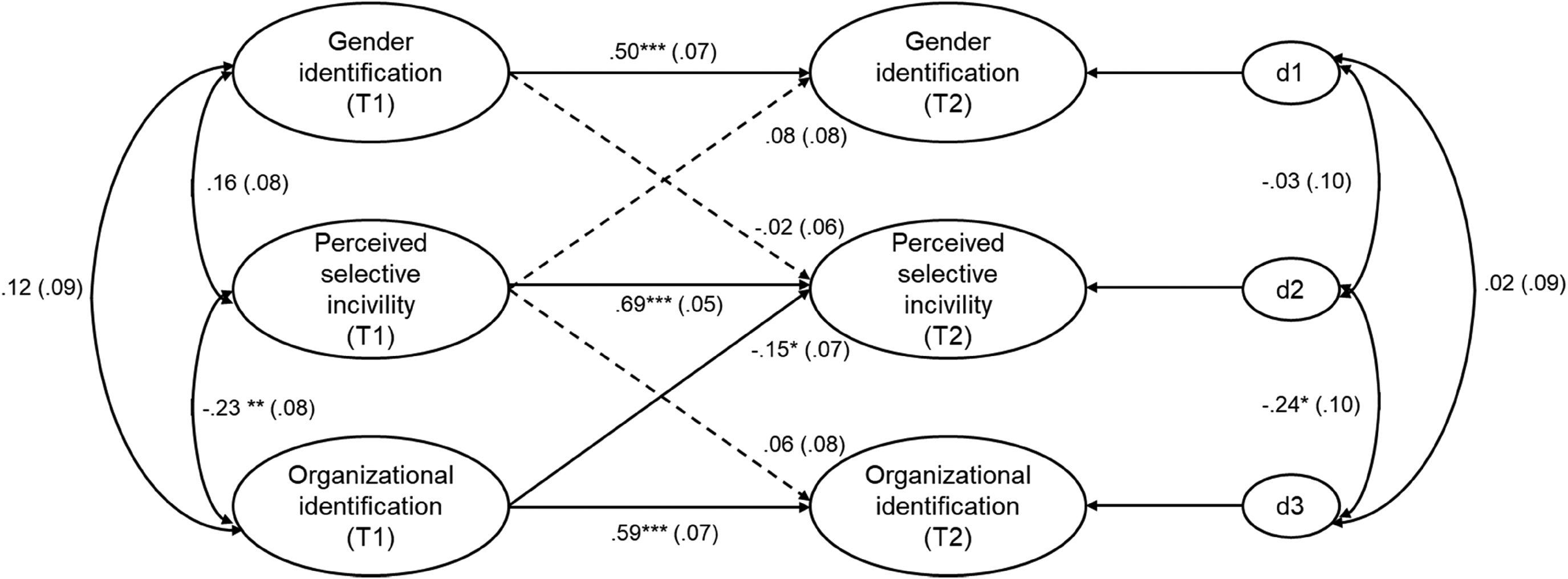
Estimates of the Full Structural Model for Female Participants (Study 1)
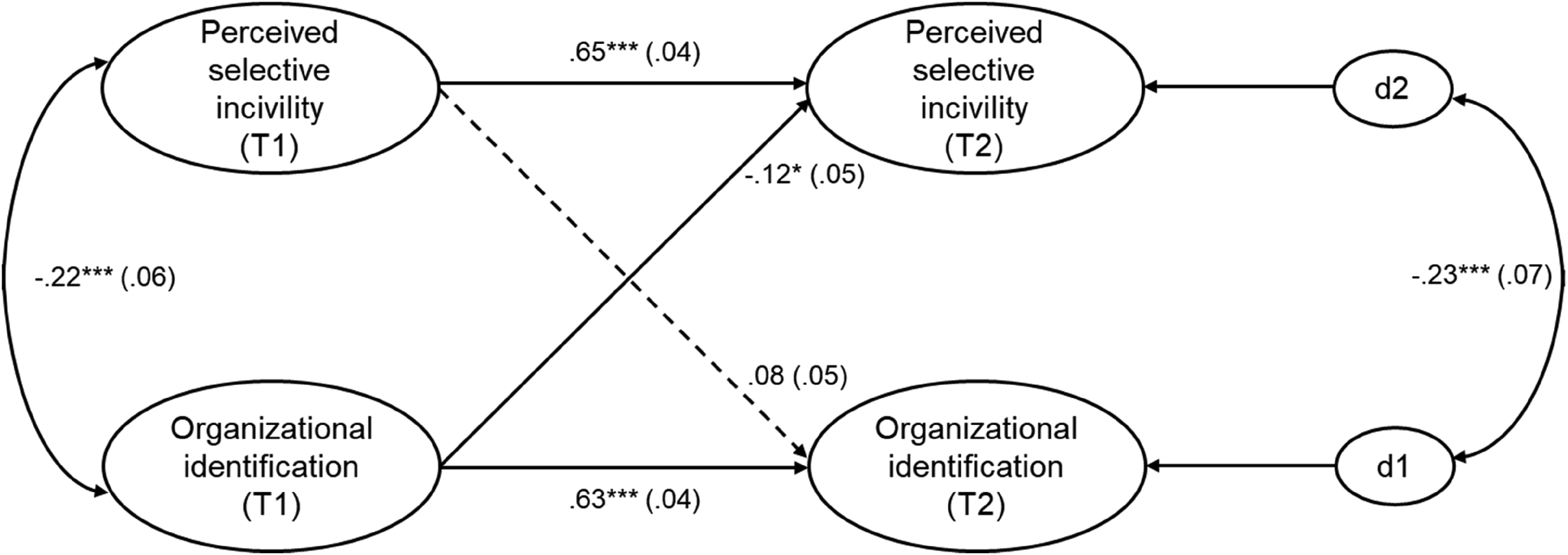
Estimates of the Full Structural Model for All Participants (Study 1)
Overview of Studies
We first use a time-lagged, fully crossed field study (Study 1) to establish the temporal precedence for the relations we theorized, after which we aim to replicate and extend these findings via mixed-methods vignette and recall experiments (Studies 2–3). This mixed-methods approach and replication enhances our faith in the results’ validity and generalizability (Kohler & Cortina, 2021; Schmidt, 2019; Turner, Cardinal, & Burton, 2017; Wright & Sweeney, 2016). We include bystander organizational identification in Studies 1–3 and female bystanders’ gender identification in Studies 1–2, and add (male and female) bystander feminist identification as well as intervention in Study 3.
Study 1: Method
Sample and Procedure
Participants were early career academics (i.e., research assistants and associates, senior research associates, lecturers, and assistant professors). This is an appropriate sample, because subtle (as well as overt) discrimination toward women is prevalent in academia (Cortina & Magley, 2007; Gloor, 2014; Gloor et al., 2018; Han et al., 2022). Participants were recruited from twelve universities from three language regions in Western Europe (i.e., French, German, and Italian). Participants completed a time-lagged study over 1 year, incentivized with a lottery.
An initial sample of 1,896 scholars agreed to participate in the study, although only 561 participants provided complete responses on our key survey measures at Time 1 (T1) and 431 at Time 2 (T2). We then excluded 95 participants who changed organizations between T1 and T2, because the organizational identification they reported did not refer to the same organization, invalidating the test of Hypothesis 2. MCAR (i.e., Missing Completely at Random; Little, 1988) and response-nonresponse analyses revealed no evidence of systematic bias due to attrition.
The final sample included 336 participants (17.7% completion rate), with an average age of 30.85 years (SD = 4.59, range = 21 to 47 years); 158 (47.0%) participants were women. Most (72.3%) participants were from Western Europe (e.g., Germany, Switzerland, and France but all were recruited through their employment in Swiss higher education). Most participants were early career researchers (e.g., doctoral/medical students; 63.4%), research associates/senior researchers (26.2%), or assistant professors (10.4%). In this context, all of these persons are considered employees—not just research assistants/PhD students—underlining the appropriateness of this sample for this study. Average job tenure was 1.76 years (SD = 1.62).
Measures
Data waves were collected with a 1-year time lag to align with our perceived selective incivility scale (from Miner-Rubino & Cortina, 2007) which refers to a 1-year time window. 3 All of our measures were collected at both waves for a completely cross-lagged design; we matched the waves of data with anonymous codes. Items were measured 1 “strongly disagree” to 7 “strongly agree” (unless indicated) and presented in a random order within the scales among filler scales to reduce potential demand and/or priming effects.
Organizational identification
We measured organizational identification with three items (Miller, Allen, Casey, & Johnson, 2000): “I am proud to be an employee of my organization,” “I find it easy to identify myself with my organization,” and “I am glad I chose to work for my organization rather than another,” to assess membership, similarity, and loyalty (respectively; α T1 = .87, T2 = .90).
Gender identification
We measured female participants’ gender identification with three items from Major and colleagues (2003). Items included, “Being a woman is an important reflection of who I am,” “Overall, being a woman has a lot to do with how I feel about myself,” and “In general, being a woman is an important part of my self-image” (α T1 = .91, T2 = .94).
Perceived selective incivility
We measured the frequency of uncivil acts toward female colleagues because of their gender. The three items 4 from Miner-Rubino and Cortina (2007) were: did “any university faculty, staff, or administrator . . . ignore, fail to listen to, or interrupt a coworker because of her gender?”, “speak in a condescending or patronizing manner to a coworker because of her gender?”, and “. . . treat a coworker in a disrespectful or discourteous manner because of her gender?” in the last 12 months, measured on a five-point scale (0 = “never,” 1 = “once or twice,” 2 = “sometimes,” 3 = “often,” 4 = “many times”; α T1 = .92, T2 = .90).
Gender
Finally, we also measured participant gender with “male,” “female,” and “other.” Because none of the participants selected “other,” this was a binary variable (male = 0, female = 1).
Analytic strategy
We followed prior recommendations (Little, Preacher, Selig, & Card, 2007; Williams & Podsakoff, 1989) and used structural equation modeling (SEM) with Mplus 7.11 (Muthén & Muthén, 2013) to analyze our cross-lagged data. Before testing the hypotheses, we examined measurement invariance across time for the focal variables, which is a precondition to test cross-lagged effects (Little et al., 2007). After measurement equivalence was confirmed, we tested the cross-lagged model using all items for each variable as indicators of the corresponding latent variable. We allowed the items’ residuals to covary over time (Little, 2013; Ployhart & Vandenberg, 2010). We also allowed the latent variables at Time 1 to be correlated and allowed the disturbance terms of the latent variables at Time 2 to be correlated. The effect of each Time 1 latent variable on its Time 2 counterpart represents a stability effect. Time 1 gender identification and organizational identification had cross-lagged effects on perceived selective incivility and vice versa. With stability effects controlled for, the cross-lagged effects can provide evidence about the directions of causality between variables; cross-lagged analysis is an exploratory approach for potential causal hypotheses and should be viewed as an indicator of temporal precedence but not as undeniable proof of causation (Kenny & Harackiewicz, 1979).
Study 1: Results & Discussion
For evidence of the discriminant validity, measurement, and metric invariance of gender identification, organizational identity, and perceptions of selective incivility, see the online supplement. We report standardized coefficients here for ease of comparison across measures and studies.
Cross-Lagged Models
See Table S1 for descriptive statistics, correlations, and scale reliabilities. Because only women reported their gender identification, we first simultaneously tested the effects of gender identification and organizational identification on perceived selective incivility with the female subsample. The structural model shown in Figure 1 provided a good fit to the data, χ
2
(113) = 103.90, p = .72, CFI = 1.00, RMSEA = .00, SRMR = 0.042. After controlling for the stability of gender identification (
We also tested the potential reciprocal relationship between organizational identification and perceived selective incivility with the full sample. The structural model shown in Figure 2 provided a good fit to the data, χ
2
(42) = 46.54, p = .291, CFI = .998, RMSEA = .018, SRMR = .024. The results showed similar patterns as with the female subsample. After controlling for the stability of organizational identification (
In summary, we found no evidence that female bystanders’ gender identification (T1) predicts their subsequent perceptions of selective incivility (T2). However, as predicted, we found a negative, time-lagged effect of bystander organizational identification (T1) on perceived selective incivility (T2). There was no evidence that perceptions of selective incivility (T1) affected bystanders’ subsequently reported organizational identification (T2); bystanders’ organizational identification predicted perceptions of selective incivility—not the reverse. These findings consistently support the motivating power of bystanders’ organizational identification—but not women's gender identification—in recognizing incivility at work as selective incivility.
Study 2
In this study, we aim to replicate and extend findings from Study 1 using an experimental method and more clearly differentiating perceived incivility and selective incivility. Because previous research is largely cross-sectional, our cross-lagged model represented a methodological strength of Study 1; but, we cannot yet make causal claims. Indeed, it could be that a third variable explains our effects; for example, a high procedural justice climate could raise identification in the short-term while also having longer-term effects on standards of appropriate behavior (i.e., selective incivility). To preclude alternative causal processes, we adopt an experimental method in Study 2; we experimentally manipulate participants’ feelings of organizational identification by having them recall and write about specific instances of high or low identification with their organizations, thereby causally demonstrating that employees whose high identification with their organizations is more salient are less likely to attribute incivility to gender discrimination. Finally, we also retest our previously null finding that participants’ gender identification does not predict attributions of subtle, interpersonal incivility as discriminatory.
Furthermore, as alluded to in the introduction, we also explore a more nuanced view of subtle, interpersonal discrimination to assess the possibility that subtle gender discrimination may simply be missed or underrecognized. We manipulate the gendered nature of the situation to examine how these attribution processes apply when the perpetrator's motivation is ambiguous or not clearly motivated by the target's gender versus explicit and more clearly based on the target's gender. Employees with higher organizational identification may overlook incivility when the perpetrator's intentions are subtle or ambiguous, allowing more ambiguous forms of mistreatment to persist (see Cortina, 2008; Sue, 2010), but would better recognize clearer acts of interpersonal mistreatment (e.g., selective incivility) or overtly biased acts of discrimination. However, it is also possible that highly identified organizational members may still be motivated to overlook even obvious and explicit discriminatory mistreatment to protect their organizational identity—the ambiguity is absent, but the motivation to see things in a favorable light persists.
To disentangle these two potential effects, we explore the moderating effect of gendered motive (i.e., the act is less or more clearly motivated by the target's gender, for example, “he had heard enough” vs. “he had heard enough from the Queen Bee,” representing incivility and selective incivility, respectively) on the link between bystander organizational identification and attributions to discrimination as an open research question (RQ). In doing so, we explore the possibility that gender discrimination may be missed. Specifically, we examine how these theorized attribution processes—which were not directly tested in Study 1—apply when the perpetrator's motivation is ambiguous (i.e., incivility) compared with when the perpetrator's motive is explicit and more overtly gendered (i.e., selective incivility and subtle discrimination).
Study 2: Method
Sample and Procedure
We collected data from an online sample of employed American adults who were recruited via Amazon's Mechanical Turk (MTurk) for a study about “person perception.” To ensure quality responses from our target sample, participation parameters were restricted to currently employed persons 18+ years old, living in the United States, with native and/or fluent English and with a HIT approval rate (indicator of good performance on previous tasks) of 99% or greater. We also excluded self-employed persons, because single-employee arrangements alter the meaning of organizational identification while also precluding having coworkers and/or witnessing discrimination among them.
Although 470 eligible participants completed the study, 54 did not follow instructions (e.g., copy-pasting our text or writing gibberish), and 6 did not provide complete data on our key variables. Thus, the final sample included 410 participants (87.2% completion rate). About half (50.7%) of the final sample identified as women (and 49.3% as men). The average age was 35.82 years (SD = 10.76, range = 18–70 years). Participants were paid $1.00 USD.
We used a 2 (organizational identification: high, low) × 2 (gendered motive: overt vs. ambiguous) between-subjects design. As in Study 1, we tested the relation between women's gender identification and perceived incivility, but the former was measured as in Study 1 with a Likert-type self-report scale—not manipulated. Participants were randomly assigned to one of the four conditions and rated three scenarios with ambiguous or clear gendered motive (described later). We presented participants with a commonly used essay procedure (e.g., see Haslam, Oakes, Reynolds, & Turner, 1999) to manipulate organizational identification. This type of manipulation is often used in (social) identity research because it effectively activates specific aspects of one's identity (e.g., Gloor, 2021; Leavitt, Reynolds, Barnes, Schilpzand, & Hannah, 2012; Yam et al., 2019). In the high-organizational identification condition, participants wrote a paragraph about the factors in their organization that make them feel strong attachment, allegiance, meaning, belonging, and fit. In the low-organizational identification condition, participants wrote about the factors that make them feel a weak sense of attachment and allegiance, see work as a means to an end, and have unique and distinct qualities/values compared with other organizational members (see the online supplement). To enhance the manipulation, we programmed the scenarios to include the names of participants’ organizations. 5
Next, participants were presented with a series of three short, written scenarios, provided in a random order. Participants were instructed to imagine that these events happened at their organization and to consider how they would react. Participants were presented with scenarios ostensibly reported by female colleagues about interactions when they were interrupted, yelled at, or undermined at work. In the ambiguous scenarios, it was unclear why the male colleague had behaved in this manner. In contrast, in the overt scenarios, the gendered motive was made explicit (e.g., the perpetrator had heard enough from the “Queen Bee,” stated that only men can provide helpful information, or dismissed a legitimate request as “girl talk”; see the supplement). Finally, we asked participants questions about their own organizations (detailed later).
Measures
Women's gender identification. We used the same three items as in Study 1 (α = .90).
Attributions to gender discrimination in vignettes. We used four items from Lindsey et al. (2015): “To what extent would you consider this evidence of . . . ‘gender discrimination,’ ‘. . . unfair treatment,’ ‘injustice,’ and ‘inequity’ . . . at [organization]?” measured on a five-point scale (1 = “Definitely not” to 5 = “Definitely yes”; αs across scenarios = .91–.92). Given the sensitive nature of gender bias and discrimination, we also included several filler items to mask the true study focus and reduce potential demand effects (e.g., “. . . pressures of the job”).
Perceptions of selective incivility in one's organization. We used three items as in Study 1 (Miner-Rubino & Cortina, 2007; α = .93).
Gender. We measured participant gender as in Study 1.
Control variables. We used participant gender as a control variable in analyses that included the whole sample, because men and women may view or interpret gender discrimination at work differently (see Iyer & Ryan, 2009); we also tested it as a moderator.
Study 2: Results & Discussion
For descriptives and correlations, see Table S2. We first analyzed the effects of our experimental manipulation—organizational identification (high/low)—and self-reported female gender identification on attributions to discrimination across the three scenarios with multilevel mixed-effects regression; we also tested if these effects differed by our manipulation in the vignettes: gendered motive (ambiguous vs. overt). Our manipulation was successful. And results calculated with or without covariates did not change the conclusions drawn from the results (see the supplement).
Perceived Discrimination in the Vignettes
As predicted, higher organizational identification predicted lower attributions of incivility to discrimination in the vignettes (
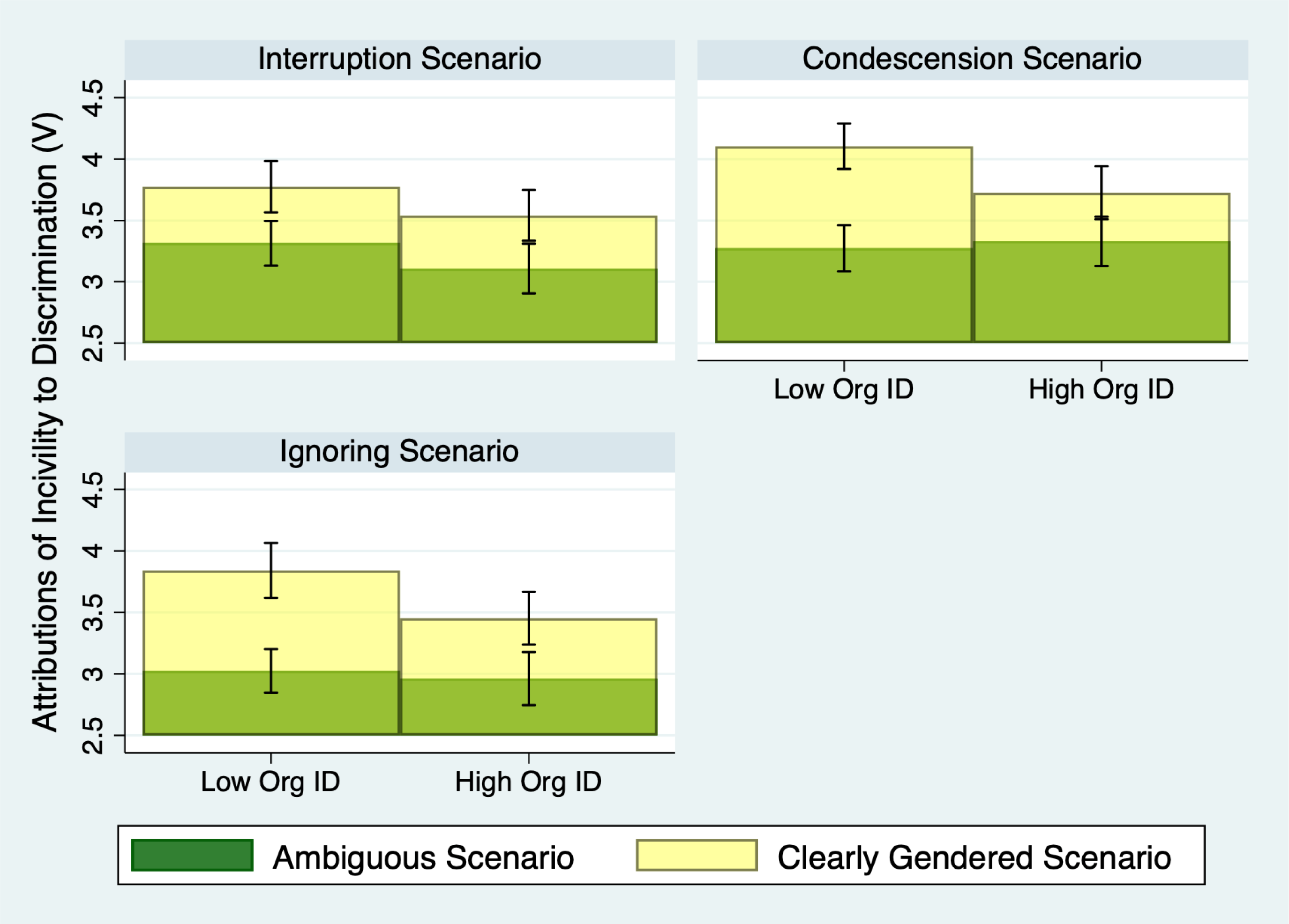
Perceptions of Gender Discrimination in the Vignettes by Experimentally Manipulated Bystander Organizational Identification (org ID) and Situational Ambiguity (Study 2)
Path Analysis Results for Perceptions of Selective Incivility and Gender Discrimination (Study 2)
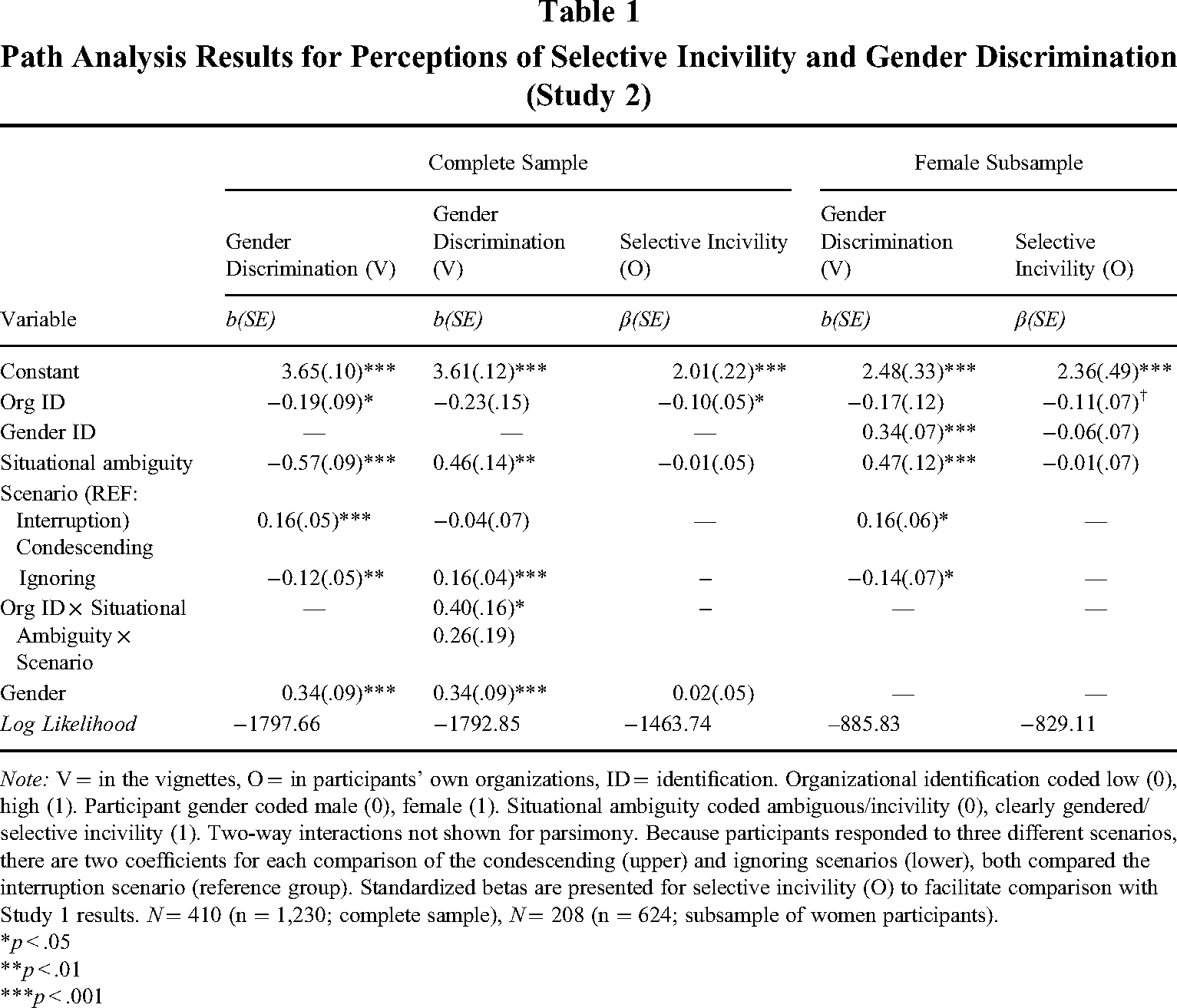
Note: V = in the vignettes, O = in participants’ own organizations, ID = identification. Organizational identification coded low (0), high (1). Participant gender coded male (0), female (1). Situational ambiguity coded ambiguous/incivility (0), clearly gendered/selective incivility (1). Two-way interactions not shown for parsimony. Because participants responded to three different scenarios, there are two coefficients for each comparison of the condescending (upper) and ignoring scenarios (lower), both compared the interruption scenario (reference group). Standardized betas are presented for selective incivility (O) to facilitate comparison with Study 1 results. N = 410 (n = 1,230; complete sample), N = 208 (n = 624; subsample of women participants).
*p < .05
**p < .01
***p < .001
We then tested the model for gender identification with women (n = 208). As predicted, women with stronger gender identification perceived more attributions of incivility to discrimination in the vignettes (
Perceived Selective Incivility in Participants’ Organizations
We calculated SEM models to assess the effects of our experimental manipulation (i.e., organizational identification) on our outcome (i.e., perceptions of selective incivility in participants’ organizations) for the full sample. Coefficients are standardized as in Study 1.
Organizational identification predicted less perceived selective incivility (
We then tested the model with women (n = 208), integrating gender identification as a predictor and a potential moderator. Gender identification did not predict perceived selective incivility (
In sum, the core findings were as expected: replicating Study 1, results showed a lack of consistent support for Hypothesis 1a (i.e., higher female gender identification increases women's perceptions of selective incivility) but consistent support for Hypotheses 2a and 2b (i.e., higher organizational identification decreases perceived discrimination in the vignettes and perceived selective incivility in organizations, respectively). Our results also showed some support for Hypothesis 1b, but women's gender identification was only associated with more perceived discrimination in the vignettes but not in their own organizations.
Study 3
Results thus far show that bystanders who more strongly identified with their organizations were less likely to recognize (selective) incivility as discrimination. Although these results inform the psychological processes underlying bystander responses to subtle workplace gender discrimination, key questions remain related to feminist identity (which we previously mentioned but have not yet tested) and regarding the downstream implications—namely: how do bystanders’ social identities and perceptions of discrimination shape their responses to such acts?
Empirical evidence offers mixed support for women's gender identity as a direct predictor of bystander intervention (e.g., Good et al., 2012; Levine & Crowther, 2008; Wang & Dovidio, 2016). Our results from Studies 1–2 also question the idea that women's gender identity predicts attributions to discrimination, also casting doubt on gender identity's potential indirect role on intervention via perceived discrimination. Therefore, in Study 3, we substitute gender identification for the concept of feminist identity, which we argue may be stronger and more consistent in predicting attributions to discrimination and potential intervention in response to it.
Feminist identity reflects attitudes toward the social position of women as a group relative to other groups—regardless of one's own gender (i.e., men's and women's concern about how women are treated; Van Breen et al., 2017). Although some women may strongly identify with both their gender and as feminists, these two distinct dimensions of identity are only weakly correlated with each other—if at all (Roy, Weibust, & Miller, 2007; Van Breen et al., 2017). Thus, in contrast to women's gender identification, male and female bystanders with higher feminist identification may be more aware of and attuned to how women are treated but also more action-oriented, thus enhancing both perceived gender discrimination and intervention in response to it (Kobrynowicz & Branscombe, 1997; Van Breen et al., 2017; Weis, Redford, Zucker, & Ratliff, 2018). Because male and female feminists share a social reality with the treatment and state of women—which includes their potential mistreatment at work—we also predict that highly identified male and female feminists are more likely to experience threat in response to sexism and support intervention (Becker & Barreto, 2014; Eliezer et al., 2010; Van Breen et al., 2017). In this way, men and women with stronger feminist identification may be more likely to interpret incivility toward women as discrimination, because they are motivated to be vigilant toward potential harm directed at women. We therefore expand the test of our core prediction to feminist identification. Formally:
Hypothesis 3: Bystander feminist identification positively predicts perceived gender discrimination toward female colleagues. Hypothesis 4: Bystander perceptions of discrimination positively predict intervention. Hypotheses 5a–b: Stronger bystander (a) feminist identification and (b) organizational identification predict more bystander intervention indirectly via perceived discrimination.
Second, we seek to identify evidence of downstream consequences, specifically exploring bystander intervention. Bystander intervention is more likely for acts that are deemed more serious and discriminatory (Ashburn-Nardo et al., 2008; Bowes-Sperry & O’Leary-Kelly, 2005; Jensen & Raver, 2021; Lindsey et al., 2015) and thus should follow from perceptions of discrimination. Indeed, perceptions of discrimination are positioned as a critical first step in bystanders’ decisions to confront prejudice at work (Ashburn-Nardo et al., 2008). Formally:
In the case of incivility, bystanders must first make an attribution about the discriminatory nature of an observed action (Cortina, 2008; Ellemers & Barreto, 2015; Hebl et al., 2020; Sue, 2010; Walker, Corrington, Hebl, & King, 2022), a judgment that we argue is partly shaped by one's social identities. In other words, sources of identity attachment (e.g., organizational or feminist) that affect attributions to discrimination should also translate into willingness to act in response to the perceived offense, indirectly via perceptions of discrimination. Formally:
However, bystanders’ decisions to intervene in response to mistreatment and discrimination are complex (Ashburn-Nardo et al., 2008; Dhanani & LaPalme, 2019). Although the ambiguity of selective incivility necessitates an attribution that may be influenced by one's identities (as argued previously), those same identities may manifest differently in the face of more overt discrimination. Here we distinguish between acts that are “overtly discriminatory” as being clearer in its discriminatory nature, contrasted with acts of selective incivility that are more ambiguously discriminatory and open to interpretation (and thus also more vulnerable to the influence of bystander identification). This distinction becomes particularly critical when considering the potential effect of bystander organizational identification on intervention.
Bystanders higher in organizational identification may be less likely to perceive discrimination when viewing incivility (as shown in Studies 1 and 2) and, thus, less likely to intervene (Hypothesis 5b). But, when faced with overt discrimination, higher organizational identification may increase the likelihood of intervention. When faced with overt discrimination, these bystanders could be motivated to repair their positive organizational image (e.g., to help a fellow organizational member and/or facilitate positive organizational norms); indeed, individuals strive to see their own social groups in a good light to reflect positively on themselves (Epley & Gilovich, 2016; Kunda, 1990; Tajfel & Turner, 1979). This aligns with findings in social identity research illustrating more altruism and helping toward those with whom individuals more strongly identify (Ashforth & Mael, 1989; Tajfel & Turner, 1979).
In sum, the effects of organizational identification on responses to selective incivility are somewhat paradoxical: although higher identifiers are less likely to attribute incivility to discrimination given their motivation to see the organization in a positive light, higher identifiers are also more likely to intervene once discrimination becomes apparent. Formally:
Hypothesis 5c: In response to overt discrimination, bystanders with stronger organizational identity are more likely to intervene.
Study 3: Method
Sample and Procedure
We recruited participants via Prolific Academic for a study of “employee relations” 6 using the same criteria as Study 2. We recruited 530 participants; 17 did not follow instructions (e.g., copy-pasting our text). Outlier analyses identified 9 to be excluded based on having both high Cooks and high leverage scores. Thus, the final sample included 504 participants (95.1% completion rate). Most participants identified as women (83.5%), 14.5% as men, and 2.0% as other. Average age was 28.0 years (SD = 7.85, range = 18–59 years). We paid $1.66 USD each.
First, female participants reported their gender identification, and all participants reported their feminist and organizational identification; these items were presented in a random order. Then, in a two-condition (i.e., observed incivility vs. subtle discrimination toward a female colleague at work), between-subjects design, participants were randomly assigned to one of the two experimental conditions and wrote a short description of the event. The essay procedure was modelled after Study 2, which we further optimized to facilitate recall of a specific event (rather than activating an aspect of one's identity as in Study 2) and to reduce recall bias (see Grube, Schroer, Hentzschel, & Hertel, 2008). In the incivility condition, participants were asked to write two to four sentences about “a time when you saw a male colleague treat a female colleague with disrespect. While his motivation may have been ambiguous, the act could be considered disrespectful compared to the norms of how people treat each other in your organization.” In the discrimination condition, participants wrote about “a time when you saw a male colleague subtly discriminate against a female colleague at work. While his motivation may have been generally clear, the act could also be considered biased.” Thus, both were subtle and interpersonal, but one was incivility with an ambiguous motive and one was subtle discrimination with a clearer, more overt motive (see the supplement for the materials). By manipulating ambiguous and overt treatment here in a similar way as in the Study 2 vignettes, we can test our RQ again but with a slightly different method. Finally, we also asked about participants’ perceived discrimination in the recalled situation and specific intervention behaviors in response to the recalled situation (details following).
Measures
We measured organizational identification (α = .83), women's gender identity (α = .85), and perceived discrimination (α = .90) as in Study 2. We also included a three-item measure of feminist identification (adapted from the gender identification measure by replacing “woman” with “feminist”; α = .95) and a new four-item intervention scale: “In this situation, to what extent did you . . . confront the man [the perpetrator was always male in the situations participants were asked to recall]; speak up; take action; file a complaint” (Lindsey et al., 2015; α = .85).
Study 3: Results & Discussion
For descriptives, correlations, and CFAs, see Table S3 in the supplement. Data were analyzed as in Study 2, with the addition of employment type as a covariate (i.e., student, part-/full-time employee) because it may theoretically affect organizational identification; we had more variability on this dimension in this sample than in Studies 1–2. Results from a nonoverlapping sample (N = 187) showed our manipulation was effective (see the supplement).
In contrast to Hypothesis 1b, women's gender identity was not associated with perceived discrimination (
As predicted in Hypothesis 2b, organizational identification was associated with less perceived discrimination (
As predicted in Hypothesis 3, feminist identification was associated with more perceived discrimination, albeit only with marginal significance (
As predicted in Hypothesis 4, bystanders’ perceptions of discrimination were associated with more intervention (
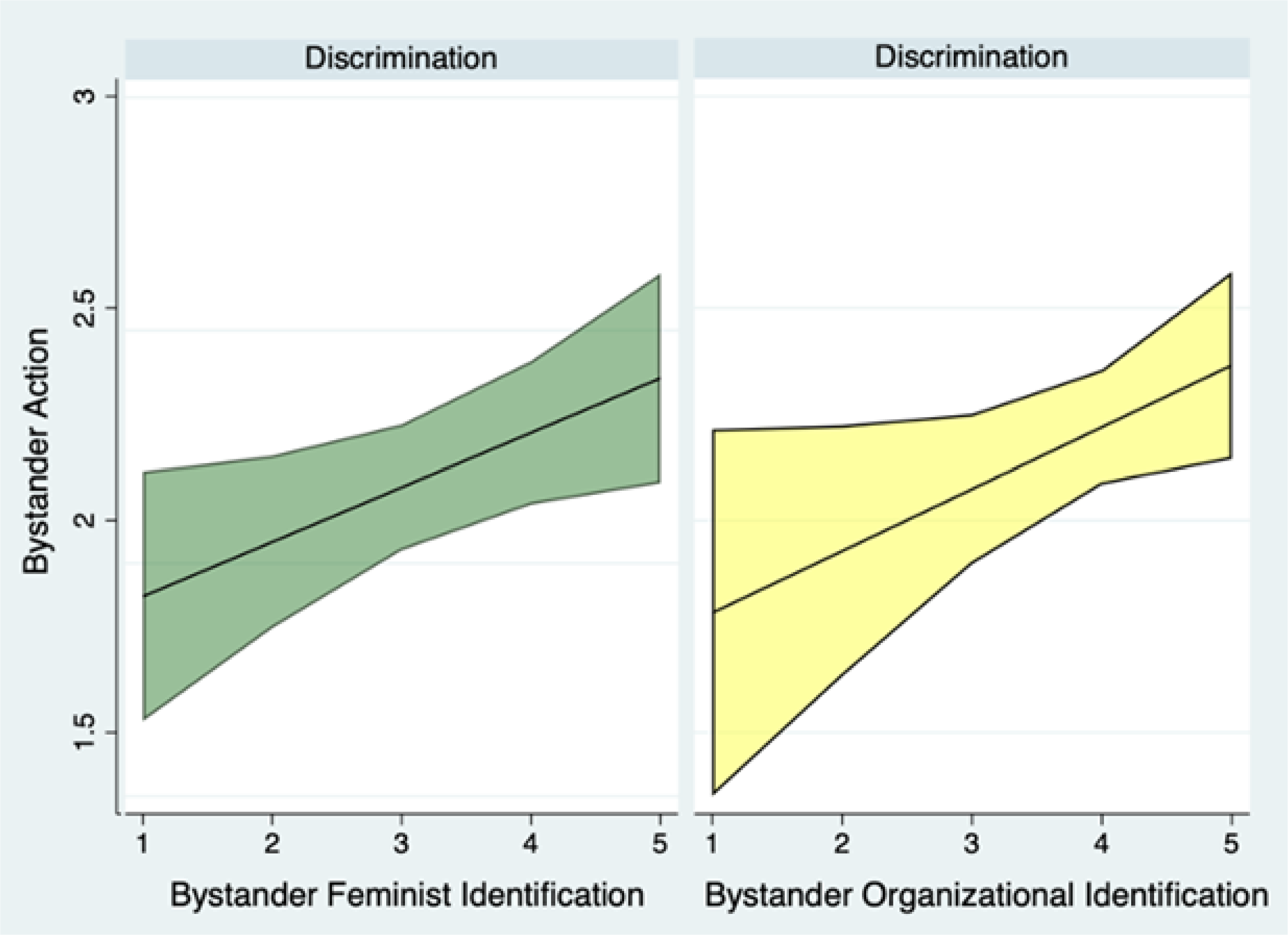
Bystander Action in Response to Witnessed Discrimination Toward a Female Colleague by Organizational Identification and Feminist Identification (Study 3)
As predicted in Hypothesis 5a–b, we examined the links between (a) feminist identification and (b) organizational identification with intervention via perceived discrimination. Calculating the indirect effect with 20,000 bias-corrected and bootstrapped resamples, feminist identification was positively associated with intervention via perceived discrimination (indirect effect = .018, SEboot = .011, 95% CIbc [.00001, .043]), 7 and organizational identification was negatively associated with more intervention via perceived discrimination (indirect effect = −.046, SEboot = .017, 95% CIbc [−.086, −.018]). These results support Hypothesis 5a and 5b, because (a) stronger bystander feminist identification predicted more and (b) stronger organizational identification predicted less bystander intervention via perceived discrimination.
Finally, as predicted in Hypothesis 5c, organizational identification was positively associated with more action in response to overt discrimination (
In summary, our results replicated the effects of organizational identification and women's gender identification on perceived discrimination from Studies 1–2; Study 3 also extends these results to include action, showing that once attributed to discrimination, stronger organizational identification and feminist identification predict more intervention. Findings also revealed a positive effect of feminist identification on intervention via perceived discrimination but less clear evidence of feminist identification's direct effect on perceived discrimination. Finally, these results also inform our RQ, because organizational identity's negative effect on perceived discrimination was stronger for ambiguous (vs. overt or clearly discriminatory) acts.
General Discussion
Are employees’ organizational, gender, and feminist identity lenses through which employees interpret women's experiences of (selective) incivility and discrimination at work? Results from three, mixed methods studies support the idea that employees who identify more strongly with their organization perceive less (selective) incivility (Studies 1–3) and gender discrimination (Studies 2–3) in their organizations. Study 3 also showed that employees who identify more strongly with their organizations or as feminists are also more likely to intervene in response to acts they perceive as being discriminatory. In contrast, women who identified more strongly with their gender did not report more perceived gender discrimination toward female colleagues (Studies 1–3). We now discuss these findings’ implications for theory and practice.
Theoretical Implications
Results from the current research contribute to the (selective) incivility, workplace mistreatment, and discrimination literature. First, we extend selective incivility research by examining what factors shape bystanders’ perceptions of workplace incivility as discrimination. The core tenet of selective incivility is that incivility could be instigated based on group membership and, thus, is a manifestation of subtle discrimination (Cortina, 2008). However, different parties may have diverse perceptions and attributions of incivility because of its ambiguity. Cortina's (2008) theorization is largely rooted in the perpetrator perspective such that perpetrators may conduct uncivil acts intentionally or subconsciously toward others who they implicitly or explicitly discriminate against. Empirical research applying selective incivility theory has vastly adopted the target perspective to examine how stigmatized identities affect experiences and outcomes of workplace incivility (e.g., Cortina et al., 2013; Gabriel et al., 2018; Miner et al., 2014). Thus, it remains underexplored whether and when bystanders recognize the existence of selective incivility. This oversight is notable, because bystanders’ attributions determine their perceived severity of the events, their intervention motivation, their relations with the focal parties, and even the group climate (Ashburn-Nardo et al., 2008; Czopp et al., 2006; Good et al., 2012; Jensen & Raver, 2021). For example, bystanders who have shared attributions with victims may offer validation and support. Bystanders who do not attribute incivility to discrimination may regard the victims who do so as “overly sensitive” and may even question the victims’ motives in making hostile attribution, whereas the latter may consider the former insensitive or even supporting discrimination. In the long run, the group climate could become toxic if bystanders tend to be apathetic. As such, by taking a bystander perspective, we add to a complete understanding of perceptions of incivility from different parties and deepen our knowledge about the complexity of addressing (selective) incivility caused by its subtlety.
Second, our findings underline the importance of organizational and feminist identity—but not women's female gender identity—as key factors shaping bystanders’ responses to (selective) incivility. Identity is an essential factor for the phenomenon of selective incivility, because uncivil acts are ostensibly motivated by targets’ social group membership (Cortina, 2008; Cortina et al., 2013, 2002; Miner, Diaz, & Rinn, 2017). But (social) identity has been understudied in personally experienced and witnessed incivility and mistreatment research. Although social identity theory was briefly mentioned in previous theoretical research (e.g., bystander responses to abusive supervision or sexual harassment; Bowes-Sperry & O’Leary-Kelly, 2005; Coulombe, Liang, & Brown, 2021), it was only sporadically tested in empirical research—and tested in ways that precluded definitive conclusions (i.e., inconclusive or nonsignificant results, operationalized with self-constructed measures; e.g., Bowes-Sperry & Powell, 1999). Thus, our replicated findings for organizational and gender identity across three samples and studies using validated measures lend confidence to the idea that bystanders’ organizational identity predicts fewer attributions of (selective) incivility as discrimination, but female bystanders’ gender identity has no effect. By showing how identification shapes the (selective) incivility and subtle discrimination bystanders perceived toward female colleagues, we also answer calls to disentangle the psychological mechanisms related to self and identity that determine interpretations of incivility (e.g., Schilpzand et al., 2016a; Schilpzand & Huang, 2018).
Third, we advance research on bystanders’ reactions to (general) workplace mistreatment (see Dhanani & LaPalme, 2019, for a review) by adopting a social identity and discrimination lens. Scholars have taken multiple theoretical perspectives to study bystander responses, which Dhanani and LaPalme (2019) synthesized into a dual-process model of vicarious mistreatment. One stream explores bystander reactions that are automatic, are emotionally laden, and rely on heuristic judgments (i.e., System I processing); examples include the deontic justice and the morally motivated response models, through which scholars examine bystanders’ retributive and restorative behaviors (e.g., O’Reilly & Aquino, 2011; Reich & Hershcovis, 2015), whereas others adopt stress or resource theories to study well-being, attitudinal, and performance outcomes (e.g., Miner-Rubino & Cortina, 2004, 2007). The second stream explores bystander reactions that are more controlled and deliberate (i.e., System II processing); examples include the relational third-party response model to study relational outcomes (e.g., organizational identification; Dunford, Jackson, Boss, Tay, & Boss, 2015) or revealing the deliberate decision-making process of intervention (e.g., Bowes-Sperry & O’Leary-Kelly, 2005). Adopting a social identity lens, we expand research on bystander reactions following System I processing. Specifically, we move beyond the stress and deontic justice perspectives, which suggest that bystanders are negatively affected by vicarious mistreatment and experience reactions similar to the victims. We propose that social identity could drive motivated cognition, thereby shaping bystanders’ perceptions of group-based mistreatment, with various forms of identification increasing (or decreasing) their sensitivity to the existence of discrimination. Although extant research has considered factors that affect bystanders’ automatic and deliberate judgments of justice and deservingness (e.g., Chui & Dietz, 2014; Li et al., 2019; Miner & Cortina, 2016; Miner & Eischeid, 2012; Skarlicki & Kulik, 2004), it has not directly examined their perceptions of mistreatment as discrimination—a specific form of injustice. Thus, our research complements this line of work by showing that social identity is key for viewing subtle mistreatment as group based; given that mistreatment and discrimination are often closely connected in practice but separately considered in research, we believe that integrating them from the bystander perspective has practical relevance and theoretical merit.
Furthermore, these results show that one's organizational identity is a powerful lens for interpreting ambiguous interpersonal events at work. That is, organizational identification can drive group-serving attributions, motivating employees to view their organizations and other organizational members—and by extension, themselves—in a positive light. This finding echoes Dhanani and LaPalme's (2019) argument that bystanders’ entity appraisals may create perceptual biases in event appraisals. In other words, if entities are viewed as favorable or fair, this may boost beliefs in the benevolence or fairness of their actions, reducing recognition of mistreatment and discrimination perpetrated by such entities (or their members). Our finding also presents a potential paradox of organizational identification: although scholars and leaders tend to encourage fostering employees’ organizational identification to reap its numerous positive outcomes for individuals and organizations (see reviews by Lee et al., 2015; Riketta, 2005), high organizational identification comes at a cost if these employees overlook coworkers’ experiences of discrimination. By showing empirical support for this proposition, we extend existing research examining other forms of unethical behavior (as well as interpersonal conflict, well-being, and performance, see Conroy et al., 2017, for a review) by providing a more complete picture of the interrelations between organizational identification and subtle gender discrimination.
Finally, this research also offers more insight about the role (or rather lack thereof) of female bystanders’ gender and gender identification in shaping interpretations of women's workplace mistreatment. Findings consistently showed that female bystanders’ gender identification did not affect their perceptions of discrimination in their own organizations (Studies 1–3). These results conflict with much of the psychology literature, which typically examines these relations via lab experiments (e.g., Basford et al., 2014; Major et al., 2003). Consistent with the latter, our findings from the hypothetical vignettes (Study 2) did support this idea. Because these results seem to conflict, we offer three potential explanations. First, this inconsistency could be an artifact of the research method—namely, a difference between imagined/hypothetical “paper persons” (i.e., experimental vignettes as in Study 2) compared with the richer, more realistic interactions involving colleagues with whom employees have more information and a history of interaction (i.e., field surveys as in Studies 1 and 3; see Aguinis & Bradley, 2014). Alternatively, it may be that strong gender identification does not consistently drive higher perceptions of discriminatory motivation because of the psychological cost associated with a stigmatized identity. Unlike organizational membership, gender category membership is not as easily discounted in the face of identity threats, and thus recognition of that stigmatized identity can damage one's collective self-evaluations (Major et al., 2003). So, although high gender identifiers may be more vigilant against in-group threats as hypothesized, they may also be motivated to maintain the view that their gender group is valued, generating an ambivalent link between gender identification and attributions of discrimination. Finally, specifying a male perpetrator in the vignettes could have enhanced perceptions of discrimination in Study 2's hypothetical scenarios (Avery, McKay, & Wilson, 2008; Dion, 1975), because women may be more likely to be mistreated by other women at work (Gabriel et al., 2018), but perceivers better recognize acts perpetrated by men as discriminatory (Dion, 1975); we addressed this possibility by allowing for male and female perpetrators in the survey in Study 1. Although the questions reflecting perceived incivility in participants’ organizations in Study 2 could have included male and female perpetrators, obscuring this relation, Study 2's vignettes only included male perpetrators.
Practical Implications
Meta-analyses show that contextual factors have stronger effects on incivility (vs. individual differences; Han et al., 2022; Yao et al., 2022); yet research tends to focus on group-level factors (e.g., civility norms, incivility climates) rather than the people comprising the context and shaping these norms (e.g., bystanders). Our findings point to bystander identity as a key piece to understanding when bystanders recognize (selective) incivility as discrimination, which our results consistently show is determined by their organizational identity. Thus, although some firms may wish to increase organizational identification and related constructs (e.g., affective commitment; Dessler, 1999) to reap its positive effects (e.g., reducing withdrawal and turnover), we recommend caution: to reduce the potential costs of highly identified employees overlooking negative aspects of the organization (e.g., mistreatment and discrimination), vigilance may be needed to maintain socially healthy and inclusive workplaces. If employees’ motivated perceptions cause them to overlook their colleagues’ social mistreatment, it may also be possible that highly identified employees also overlook other similarly innocuous, ambiguous, or minor slights (Conroy et al., 2017). Without intervention from leaders, attributing away such acts may slowly deteriorate the social and ethical climates in organizations (Bowes-Sperry & O’Leary-Kelly, 2005; Dhanani & LaPalme, 2019; Jones et al., 2017; Li et al., 2019) with devastating implications for diversity and inclusion (see Caprar et al., 2022; Shea et al., 2023).
Given leaders’ roles in fostering respectful treatment among employees, valuing diversity and inclusion in their organizations, leaders should clearly condone civility and condemn discrimination—particularly in its subtle and interpersonal forms to increase awareness about these pernicious modern forms of discrimination (Chawla, Gabriel, O’Leary Kelly, & Rosen, 2020; Hebl et al., 2020)—working to ensure that employees from marginalized groups (also) benefit from team and organizational norms and policies (Cortina et al., 2013; Porath, 2016). Leaders can foster high organizational identification while ensuring that gender discrimination remains clearly and explicitly antinormative, making vigilance against discrimination an inclusive aspect of that identity.
Finally, although we studied individual reactions to distinct events, the reduced recognition of subtle discrimination by high organizational identifiers could also create resistance to collective action (e.g., #MeToo and #TimesUp), rendering it less effective in organizations and beyond (van Zomeren, Postmes, & Spears, 2008). Thus, engaging highly identified employees as allies for a common, prosocial, and organizationally relevant cause could increase recognition of these acts and actions in response to them, ultimately reducing gender discrimination more broadly.
Strengths, Limitations, and Directions for Future Research
This research included a combination of a survey study in the field conducted at two time points over 1 year (Study 1) and two types of experiments (Studies 2–3). With these designs, our results established the causal and temporal precedence for the relations tested while also supplementing the largely cross-sectional literatures on workplace incivility and discrimination (see Dhanani et al., 2018; Han et al., 2022; Jones et al., 2016; Schilpzand et al., 2016a; Yao et al., 2022, for reviews). However, we admittedly did not examine the full attribution process in Study 1. Furthermore, we did not measure men's male gender identification. But it is possible that stronger male gender identification predicts less perceived discrimination toward women (Berdahl, 2007) or vice versa (Maass, Cadinu, Guarnieri, & Grasselli, 2003). Future research could explore these ideas.
We focused on organizational—but not team—identification, because mistreatment can be perpetrated and experienced by employees beyond one's team (see Cortina et al., 2002; Gloor, 2014; Miner et al., 2018). Although one's team (vs. organizational) identification may be stronger due to the more frequent cues and interactions with team (vs. organizational) members, predicting even stronger effects of the former on bystanders’ responses to mistreatment, bystanders may also have more individuating information about their more proximal team members (vs. more distal organizational members), complicating bystanders’ responses. Thus, we encourage future research to explore how team identity shapes bystanders’ perceptions of (selective) incivility. Recent research highlighting the bystanders’ cognitive reactions (e.g., perspective-taking) toward targets and perpetrators (Reich et al., 2021) suggests identity-based sensemaking may be relevant to understand both parties involved in (selective) incivility.
Related research has shown positive associations between feminist identity and collective action (e.g., joining a protest; Moore & Stathi, 2020; Nelson et al., 2008). Thus, future research can also compare the individual actions we tested in Study 3 with collective actions to test if feminist identification more strongly predicts planned, group activities to support women (vs. spontaneous action to help an individual woman).
Regarding potential boundary conditions, our theorization about the effects of social identity on bystanders’ perceptions of (selective) incivility and gender discrimination is rooted in a theory of motivated cognition (Kunda, 1990), which may involve a large amount of automatic, System I cognition. Thus, future research could explore the individual and contextual factors that influence bystanders’ reliance on fast cognitive processing when interpreting subtle mistreatment (e.g., bystanders with higher workloads may be more affected by motivated cognition due to high task priority and a lack of available resources to address justice; Sherf, Venkataramani, & Gajendran, 2019).
Although not studied here, selective incivility can mask discrimination related to gender and race (Cortina, 2008). Thus, we encourage scholars to examine bystander racial/ethnic identification as a predictor of attributions of incivility toward minoritized and marginalized people and intervention. Finally, we only examined active interventions. While these are only a subset of behaviors that bystanders could enact—and they are not always effective (e.g., because they may draw additional, unwanted attention to the target and the mistreatment; Hershcovis et al., 2017)—they are visible behaviors that can be further witnessed and/or modelled by other bystanders. We encourage scholars to broaden the scope of inquiry to also study other types of potential interventions (e.g., silence, target, and perpetrator support).
Conclusions
Employees with stronger organization identification perceive fewer acts of incivility toward women as discrimination; once recognizing the treatment as discriminatory, though, they are also more likely to intervene. Similarly, employees with stronger feminist identification are more likely to intervene in the wake of incivility toward female colleagues. But highly gender-identified women do not seem to be more sensitive to the acts and are not more likely to recognize incivility toward other women as discrimination. So, as echoed in the opening quote, organizational and feminist identification—but not women's gender identification—are lenses through which bystanders view and respond to their female colleagues’ mistreatment at work.
Supplemental Material
sj-pdf-1-jom-10.1177_01492063231177976 - Supplemental material for How Identity Impacts Bystander Responses to Workplace Mistreatment
Supplemental material, sj-pdf-1-jom-10.1177_01492063231177976 for How Identity Impacts Bystander Responses to Workplace Mistreatment by Jamie L. Gloor, Tyler G. Okimoto, Xinxin Li, Brooke A. Gazdag, and Michelle K. Ryan in Journal of Management
Footnotes
Acknowledgements
This paper was presented at the 79th annual meeting of the Academy of Management in Boston. The authors would like to thank our editor and three reviewers for their valuable input throughout the review process; we also thank Anja Feierabend for her assistance with Study 1 data collection, Lauren Howe, Jochen Menges, and the University of Exeter Psychology Brownbag participants for their helpful feedback on previous versions of this work. Jamie Gloor’s work on this research was supported by the Swiss National Science Foundation (PR00P1_193128). Xinxin Li’s work on this research was supported by the National Natural Science Foundation of China (No. 72102143) and “Chenguang Program” supported by the Shanghai Education Development Foundation and Shanghai Municipal Education Commission (No. 18CG13). A European Research Council Consolidator Grant (ERC-CoG 725128) awarded to the fifth author also supported her time on this work. Finally, data collection for Study 1 was supported by a University of Zurich Gender Equality Grant from the Federal Programme for Equal Opportunities (Action Plan 2013-2016). However, the funders had no role in study design, data collection/analysis, decision to publish, or preparation of the paper.
Notes

References
Supplementary Material
Please find the following supplemental material available below.
For Open Access articles published under a Creative Commons License, all supplemental material carries the same license as the article it is associated with.
For non-Open Access articles published, all supplemental material carries a non-exclusive license, and permission requests for re-use of supplemental material or any part of supplemental material shall be sent directly to the copyright owner as specified in the copyright notice associated with the article.
