



Abstract
We examine how nationalism influences governance choice in cross-border collaborations. While nationalism has historically been within the purview of political scientists, we demonstrate its relevance to management scholars by theorizing how nationalist attitudes and behaviors among decision-makers might shape strategic decisions about collaborations with foreign partners. Drawing on insights from the social psychology literature, we theorize how two attitudes commonly associated with nationalism, that is, lower levels of trust and an unwillingness to work with foreigners, may increase decision-makers’ concerns about opportunistic behavior and invasiveness in cross-border collaborations. Integrating these insights into two key theories of governance choice—transaction cost economics (TCE) and resource dependence theory (RDT)—we derive two competing effects of nationalism: TCE suggests that a heightened concern about opportunistic behavior will make equity alliances preferable, whereas RDT predicts that a greater sensitivity to invasiveness would prioritize non-equity alliances. Examining 11,469 cross-border collaborations over a 25-year period, we find, in line with the RDT-based prediction, that firms from countries with stronger nationalist sentiments prefer non-equity alliances. We also find that cross-country dissimilarities and prior conflict between the firms’ home countries strengthen this negative association. Our findings advance research on cross-border collaborations by demonstrating why and when nationalism may influence governance mode choice. We also contribute to efforts to establish nationalism, specifically in the form of nationalist sentiments, as an important theoretical concept within the management literature.
Introduction
Management researchers have become increasingly interested in understanding how socio-political contexts influence cross-border collaborations (e.g., Arikan, Arikan, & Shenkar, 2022; Nippa & Reuer, 2019). We contribute to this area of inquiry by examining the effect of nationalism on governance choices in such collaborations. With nationalism becoming increasingly salient, scholars have called for examining its impact on strategic decisions (Alvarez & Rangan, 2019). Insights from social psychology and political science suggest that the effect of nationalism may be particularly pervasive in cross-border collaborations, in which firms interact with foreign partners on a regular basis. Popular accounts lend credence to this idea: for example, in 2019, the CEO of Japanese automaker Nissan, Hiroto Saikawa, blamed “nationalist forces” for contributing to worsening relations with its French alliance partner Renault (Nikkei Asia, 2019). Yet, studies that investigate the effects of nationalism are largely absent in the literature on cross-border collaborations.
We theorize and test the effect of nationalism on the choice between equity and non-equity forms of governance, a critical decision in cross-border collaborations that can impact performance (Cuypers, Hennart, Silverman, & Ertug, 2021; Sampson, 2004). To do so, we conceptualize nationalism as a societal-level sentiment that is embodied in individual-level “perceptions of national superiority and downward comparisons of other nations” (Kosterman & Feshbach, 1989: 271). This conceptualization allows us to build on work in social psychology and political science to identify two individual-level behaviors and attitudes associated with nationalism—a lack of trust and an unwillingness to work with foreigners—that are pertinent for governance choice.
We incorporate these behaviors and attitudes stemming from nationalism into two central theories on alliance governance, that is, transaction cost economics (TCE) and resource dependence theory (RDT), which yields competing predictions. Specifically, a TCE logic implies that low levels of trust and the unwillingness to work with foreigners would increase firms’ concerns about the potential for opportunistic behavior by their partners. Such concerns then lead to a preference for equity alliances, which offer more control than non-equity alliances. In contrast, an RDT logic suggests that lower levels of trust and an unwillingness to interact with foreigners increase the likelihood that firms choose non-equity alliances, which are less invasive than equity alliances (Drees & Heugens, 2013). In addition to theorizing these contrasting effects, we also examine the boundary conditions of nationalism's influence on governance choices by hypothesizing the moderating effects of cross-country dissimilarities in culture, religion, and language, as well as prior conflict. These contingency factors affect the sharpness of the distinction between ingroups (i.e., people from the same nation) and outgroups (i.e., foreigners), which we argue will accentuate the effect of nationalism.
We test our hypotheses on 11,469 cross-border collaborations completed between 1992 and 2017, involving firms from 39 countries. Our findings provide support for RDT's prediction, whereby the attitudes and behaviors that are associated with nationalism lead to greater emphasis on the invasive aspects (Drees & Heugens, 2013) of cross-border collaborations, thus resulting in a lower likelihood of choosing equity alliances. We also find that cross-country dissimilarities and prior conflict between firms’ home countries strengthen this negative association.
Our study offers two contributions. First, we add to the literature on cross-border collaborations by demonstrating the importance of incorporating nationalism in theorizing governance choices. Specifically, we show how nationalism decreases preference for equity alliances in favor of non-equity alliances, as suggested by RDT. Second, we discuss the mechanisms and boundary conditions that underlie the effect of nationalism on governance choice. Because nationalism has often been conceptualized at the level of government policy, that is, economic nationalism (e.g., Bucheli & Aguilera, 2010; Click & Weiner, 2010), its impact on firm-level decisions has frequently been “black-boxed” and under-theorized. By conceptualizing how nationalist attitudes manifest in reduced trust and a greater unwillingness to collaborate, we point to the mechanisms by which nationalism can shape governance choices. In examining the moderating effects of country-level dissimilarity and prior conflict, we also start to demarcate the boundary conditions of nationalism's influence on these decisions.
Theoretical Background
Governance in Cross-Border Collaborations
As cross-border collaborative strategies have become increasingly important for the competitiveness of firms (e.g., Ariño & Reuer, 2006; Contractor & Lorange, 2002), they have also become more common. In response, scholars have devoted considerable effort to studying various aspects of these cross-border collaborations (for a review, see Nippa & Reuer, 2019), including classifying and theorizing the different modes that are used to govern alliances forms. The most commonly used classification distinguishes between collaborations that involve equity investments by the partners, and those that do not (e.g., Gulati, 1995; Hennart, 1988; Pisano, 1991). Equity alliances (i.e., equity joint ventures) are collaborations wherein two or more firms contribute equity to set up a new legal entity (e.g., Killing, 1983; Martin & Salomon, 2003), whereas non-equity alliances (i.e., contractual alliances) 1 are agreements in which the partners contribute resources other than equity, without forming a separate legal entity (e.g., Osborn & Baughn, 1990).
Equity alliances and non-equity alliances differ on a number of important characteristics. First, equity alliances provide more control, as they offer mechanisms and processes (e.g., a board of directors) that are unavailable in non-equity alliances (e.g., Cuypers, Ertug, Reuer, & Bensaou, 2017; Kale & Puranam, 2004; Osborn & Baughn, 1990; Oxley & Sampson, 2004). Second, because equity alliances involve setting up a new legal entity, they require substantial financial, physical and personnel resources and commitments (e.g., Choi & Contractor, 2016; Tallman & Shenkar, 1994). Third, as equity alliances extend firm boundaries, they tend to involve closer interactions between the partners as well as more extensive resource sharing, which create stronger mutual interdependencies. Specifically, in equity alliances, managers and employees of the partners are typically sent to the new unit on a frequent basis (e.g., Contractor & Ra, 2002; Contractor, Woodley, & Piepenbrink, 2011), resulting in more intensive collaboration. In contrast, non-equity alliances are less invasive collaborations, as they typically do not create large mutual dependencies between partners (e.g., Casciaro & Piskorski, 2005; Drees & Heugens, 2013). Fourth, equity and non-equity alliances vary in the flexibility they provide partners. Non-equity alliances are considered more flexible than equity alliances because they do not extend the firm's legal boundaries (Santos & Eisenhardt, 2009), thus lowering the threshold to terminate the collaboration (e.g., Powell, 1990).
Given that suboptimal governance choices can reduce performance (e.g., Cuypers et al., 2021; Sampson, 2004), an extensive body of work has examined how partner-specific factors impact their cross-border governance choices. For example, Teng and Das (2008) found that a partner's prior alliance experience affects the likelihood that it will opt for a non-equity alliance. Similarly, Niesten and Jolink (2018) found that a partner's experience with a particular alliance form increases the likelihood of selecting the same form in subsequent collaborations.
A second body of research has considered how relational factors, that is, aspects that refer to all the partners or the collaboration itself, impact governance choices. For example, Oxley (1997) identified a positive association between collaboration scope and the likelihood that firms opt for an equity alliance. Li, Eden, Hitt, Ireland, and Garrett (2011) found that the number of partners in an alliance is positively associated with the likelihood that firms choose equity as opposed to non-equity alliances, and Gulati (1995) showed that partners’ familiarity with each other is negatively associated with equity-based alliance choices.
Finally, a few studies have explored how environmental factors—that is, contextual factors that are external to the partners and the collaboration—influence governance choices. For example, Oxley (1999) found that the likelihood that firms opt for an equity alliance is negatively associated with the strength of host country intellectual property protection. Pan and Tse (2000) showed that host country risk increases the likelihood of equity alliances, while Arikan and Shenkar (2013) explored how historical animosity affects the proportion of equity alliances between countries. As Nippa and Reuer (2019) note in their review, this last stream remains underdeveloped, with the effects of geopolitical trends in particular requiring further attention. We answer this call by examining the effect of nationalist sentiments on the choice between equity and non-equity alliances.
Conceptualizing Nationalism
While nationalism has been conceptualized in different ways (e.g., Allport, 1927; Mead, 1929), we follow Kosterman and Feshbach (1989: 271) to define nationalism as “a perception of national superiority and an orientation toward national dominance. It consistently implie(s) downward comparisons of other nations.” Kosterman and Feshbach's (1989) definition has been applied to multiple settings and is a widely accepted conceptualization of nationalism (e.g., Coenders, Lubbers, & Scheepers, 2021; de Figueiredo & Elkins, 2003; Huddy & Khatib, 2007). In line with the majority of the social science literature, the definition recognizes “nationalism as an individual's attitude” (Dekker, Malova, & Hoogendoorn, 2003: 346). As we theorize below, it is these individual-level attitudes and behaviors that shape governance mode choice.
By using Kosterman and Feshbach's definition, we also acknowledge how individual attitudes are informed by societal-level sentiments (Yiu, Wan, Chen, & Tian, 2022), that is, widely shared values and beliefs. Societal-level nationalist sentiments provide the narratives and rationales by which individuals build their perceptions of “superiority” over other countries (e.g., Hjerm & Schnabel, 2010). Such sentiments can also legitimize individuals’ nationalistic behaviors and actions. While nationalistic individuals presumably exist in any country, they may be more numerous—and more willing to act on their personal convictions—in societies with strong nationalist sentiments. Likewise, if the number of nationalist individuals increases, nationalist sentiments become more widespread. In this way, the definition we use recognizes that nationalism is constructed through both individual-level attitudes and behaviors, and societal-level sentiments.
As a societal-level sentiment embodied in individual-level attitudes and behaviors, the definition of nationalism we use is conceptually distinct from both “economic nationalism,” that is, “discrimination in favor of one's own nation, carried on as a matter of policy” (Baughn & Yaprak, 1996: 760), and “resource nationalism,” that is, a country's “policies to maximize the political and economic benefits from their mining and energy sectors” (Wilson, 2015: 399). As we elaborate in Appendix 1, this definition also allows us to distinguish nationalism from related constructs, including patriotism, animosity, populism, and national culture.
Behavioral and Attitudinal Manifestations of Nationalist Sentiments
Social psychology research on ingroup–outgroup interactions (e.g., de Figueiredo & Elkins, 2003; Huddy & Khatib, 2007; Mummendey, Klink, & Brown, 2001) has identified four behavioral and attitudinal manifestations of nationalism that may influence firm-level decisions: a superiority bias, favoritism, lower levels of trust, and an unwillingness to interact with those from other countries. Of these four, superiority bias and favoritism have been linked to consumers’ purchase intentions (Balabanis, Diamantopoulos, Mueller, & Melewar, 2001; Shoham, Davidow, Klein, & Ruvio, 2006) and policy makers’ discrimination (Click & Weiner, 2010), respectively. While we recognize that consumer and policy maker actions matter for governance mode choices, our interest lies in examining how nationalism impacts firm-level decision-making more directly. As we detail below, we see lower levels of trust and an unwillingness to interact with foreigners as the most relevant manifestations of nationalism for governance mode choice.
Trust
The tendency to view members of one's own ingroup as more trustworthy and cooperative is a well-established attitude arising from nationalism (Yzerbyt & Demoulin, 2010). This tendency was also a concern of much of the early ingroup–outgroup research (e.g., Brewer & Silver, 1978; Dion, 1973): Brewer (1999: 433) characterizes ingroups as “bounded communities of mutual cooperation and trust” while Brewer and Silver (1978) found that perceptions of trustworthiness and cooperativeness are two of the three strongest effects relating to outgroup bias. Thus, higher levels of nationalism tend to be associated with a lower level of trust in people and organizations from a foreign country (e.g., Davidov, 2009; Druckman, 1994). This emphasis is particularly important for our purposes, given the role that trust, and lack of it, plays in cross-border collaborations (e.g., Zaheer & Zaheer, 2006).
Reluctance to Interact With Foreigners
Another manifestation of nationalism is reluctance to work and interact with foreigners. Building on Ibarra (1995), Ayub and Jehn (2006: 189) note that “strongly nationalistic people are inclined to maintain distance and to avoid contact with people from other nations.” Studies have observed that people are less likely to interact and associate with others who are more dissimilar to themselves (Thomas & Ravlin, 1995), with comparable findings also documented with respect to the frequency of communication (e.g., Lincoln & Miller, 1978; Zenger & Lawrence, 1989) and social integration (O'Reilly , Caldwell, & Barnett, 1989). The ingroup–outgroup literature (e.g., Paladino & Castelli, 2008) in turn notes that “group members … have a tendency to avoid other groups, and to approach members of the ingroup” (Yzerbyt & Demoulin, 2010: 1052). Speaking to this general point, Dion (1973) found that outgroup members tend to be perceived as less attractive, less pleasant, less desirable as a friend, less likeable, and less friendly. Such perceptions lower the propensity to interact and work with outgroup members, which is consistent with our conceptualization of nationalism.
The Impact of Nationalism on Decision-Making
We expect that reduced trust levels and a reluctance to work with foreigners will impact decision-makers’ preferences and thereby their governance choices. We also expect nationalism to impact decision-makers through normative pressures (e.g., Durand, Hawn, & Ioannou, 2019). As discussed previously, individual-level attitudes and behaviors can be informed and legitimized by societal-level sentiments. When societal-level nationalist sentiments are widespread, they establish norms and expectations for appropriate behavior. Decisions that are not in line with these norms may be seen as illegitimate by suppliers, customers, and other external stakeholders, resulting in boycotts or other adverse reactions. There may also be negative reactions from within the organization, including from colleagues, employees, and managers.
In the context of our study, the implication is that decision-makers do not strictly need to exhibit nationalistic attitudes and beliefs themselves in order to make governance mode decisions that align with the hypotheses we will develop. In countries with pervasive societal-level nationalist sentiments, decision-makers will presumably also calibrate their actions based on the potential reactions of external stakeholders and internal organizational members. Consequently, while we do expect decision-makers in nationalistic countries to be less trusting of and more reluctant to interact with foreigners on average, this is not a necessary condition for our subsequent arguments to hold. Even if individual decision-makers are less nationalistic, widespread nationalist sentiments, including those among the organization's employees and stakeholders, would influence their governance choices.
Hypotheses
While various theories have been applied to explain governance choice, our emphasis on reduced trust and an unwillingness to work with foreigners points us in the direction of transaction cost economics (TCE) and resource dependency theory (RDT) as the two most promising lenses for understanding the implications of nationalism. Lowered levels of trust and an unwillingness to work with foreigners are directly related to expectations of opportunistic behavior and power-dependencies, the two mechanisms that underlie TCE and RDT, respectively. Applying TCE and RDT lenses to explore the implications of these behaviors and attitudes that are linked to nationalism, we derive competing predictions about how lower trust levels and a reluctance to interact with foreigners will influence governance choices in cross-border collaborations. In addition, to examine the boundary conditions of nationalism's influence on governance choices, we also hypothesize that the degree of dissimilarity and prior conflict between the home countries of collaborating firms will amplify the influence of nationalism.
A Transaction Cost Economics Perspective on Nationalism’s Effect on Governance Choice
TCE is one of the most well-established perspectives for explaining governance choices in cross-border collaborations (e.g., Brouthers & Hennart, 2007; Cuypers et al., 2021; Phene & Tallman, 2012). TCE scholars propose that economic transactions can be arrayed on a continuum between two governance modes—markets and hierarchies—with the optimal position being determined by the trade-offs between the costs and benefits of each mode (Hennart, 1993; Williamson, 1975; for a recent overview of the basic premise of the theory, see Cuypers et al., 2021).
While equity and non-equity alliances are both considered “hybrid” governance modes that are located between the two extremes of the market-hierarchy continuum (Hennart, 1993; Oxley & Sampson, 2004; Williamson, 1979), they differ in their governance attributes (Oxley, 1997). In particular, equity alliances are more hierarchical than non-equity alliances, due to traits such as having a board of directors, which grants greater control (Kale & Puranam, 2004). TCE predicts that when firms prefer hierarchical control, equity alliances will be the favored governance mode. The preference for more hierarchical governance modes is closely related to the (perceived) likelihood that an exchange partner will behave opportunistically, and the level of behavioral uncertainty, since more hierarchical governance modes provide greater control (Brouthers & Hennart, 2007; Sutcliffe & Zaheer, 1998; Williamson, 1985).
Concerns about opportunistic behavior increase when organizational members—including decision-makers and employees—trust their partner less. TCE proposes that, in response to greater concerns about potential opportunistic behavior, decision-makers generally prefer hierarchical governance modes that offer greater control (e.g., Chiles & McMackin, 1996). In line with this, Gulati (1995) found that firms that do not have prior interactions with each other are less likely to rely on trust and therefore opt for equity alliances over non-equity alliances in governing their collaboration. Similarly, Kwon, Haleblian, and Hagedoorn (2016) found that firms with less trust in the home country of a partner organization are more likely to opt for equity alliances.
As discussed above, one manifestation of nationalism is a tendency to view outgroups as less trustworthy and less cooperative than one's own ingroup (Yzerbyt & Demoulin, 2010). From a TCE perspective, the lowered levels of trust arising from nationalism will increase decision-makers’ concerns about opportunistic behavior. Consequently, decision-makers in nationalistic countries would be expected to prefer equity alliances which offer more hierarchical control over foreign alliance partners. By comparison, decision-makers from a less nationalistic country may be less concerned about opportunistic behavior and thus have a lower preference for equity alliances when collaborating with a foreign firm.
As specified previously, nationalism also reduces the willingness to interact with foreigners. One consequence of this may be that managers and employees from nationalistic countries have less experience interacting with foreigners. This lack of exposure to foreigners might not necessarily be limited to professional settings but could also refer to social and educational settings (e.g., Cheng, Wong, & Prideaux, 2017). The overall result is that these decision-makers and employees find it harder to anticipate the behavior of their foreign partners. From a TCE perspective, this limitation in anticipating foreign partners’ actions is an inherent part of behavioral uncertainty, which increases transaction costs (e.g., Cuypers et al., 2021).
TCE proposes that behavioral uncertainty is associated with a preference for more hierarchical governance modes, such as equity alliances. Indeed, several factors that have been linked to greater behavioral uncertainty have been shown to be associated with more hierarchical governance choices in cross-national collaborations. For example, the cultural distance that arises in cross-national collaborations (e.g., Contractor & Kundu, 1998; Globerman & Nielsen, 2007; Sampson, 2004) has been characterized as a source of behavioral uncertainty because it can impede communication and the ability to understand and monitor partner actions.
In sum, a TCE perspective suggests that low levels of trust and the unwillingness to work with foreigners that arise due to nationalism would increase firms’ concerns about potential opportunistic behavior by their partners and lead to higher behavioral uncertainty. According to TCE, both of these factors increase preferences for equity alliances, which leads us to predict:
Hypothesis 1: The likelihood that firms opt for an equity alliance, as opposed to a non-equity alliance, is positively associated with the level of nationalism in the firms’ home countries.
A Resource Dependence Perspective on Nationalism’s Effect on Governance Choice
While a TCE perspective suggests that nationalism will increase preference for equity alliances, a resource dependence perspective, emphasizing the importance of power and interdependencies in collaborations, predicts that nationalism would instead increase the likelihood that firms choose non-equity over equity alliances. Resource dependency theory (RDT; Pfeffer & Salancik, 1978) has emphasized how firm survival depends on gaining access to—and power over—critical resources in the external environment. The RDT literature has shown how governance modes vary both in terms of access to external resources and dependence on external partners (e.g., Inkpen & Beamish, 1997; Pfeffer & Nowak, 1976; Yan & Gray, 1994). From this perspective, decision-makers will opt for governance modes that increase their control over critical resources located in the external environment, while simultaneously minimizing their dependence on partners (e.g., Hillman, Withers, & Collins, 2009).
RDT highlights that governance modes vary in their level of “invasiveness” (a label proposed by Drees & Heugens, 2013). Non-equity alliances are seen as a less invasive type of collaboration because they mitigate resource dependencies without creating large and excessive mutual dependencies between partners (e.g., Casciaro & Piskorski, 2005; Drees & Heugens, 2013). Non-equity alliances often entail less frequent interactions between the partners, as the lack of a shared physical entity reduces interdependence (e.g., Inkpen & Beamish, 1997). As noted previously, non-equity alliances are also considered to be more flexible (e.g., Cuypers & Martin, 2010) because they do not extend the firm's legal boundaries, thus lowering the threshold to terminate the collaboration and providing more autonomy. Equity alliances, on the other hand, are considered to be a more invasive type of collaboration (Drees & Heugens, 2013) because they are characterized by greater interaction between managers and employees of both partners, as well as greater resource commitment and inter-dependency.
In the above manner, RDT suggests that there are systematic differences between non-equity alliances and equity alliances. These differences are consistent with the general idea in the RDT literature that higher levels of integration between firms are generally linked to higher levels of dependence (e.g., Casciaro & Piskorski, 2005; Pfeffer & Salancik, 1978).
From an RDT perspective, we expect the reluctance to interact with foreigners (e.g., Ayub & Jehn, 2006) to result in a tendency to avoid equity alliances. Specifically, for decision-makers in more nationalistic countries, a less invasive form of collaboration (i.e., non-equity alliances) that offers more flexibility and creates less interdependence with partners is likely to be a preferred choice. This is both because of the decision-makers’ own reluctance to interact with foreigners, but also because of the nationalistic preferences of employees and other individuals who will be involved in implementing the collaboration. In contrast, decision-makers in less nationalistic countries, where employees are less reluctant to work with foreigners, would be relatively less concerned by the lack of flexibility and higher levels of interdependencies that characterize equity alliances.
Applying an RDT perspective to the implications of nationalism for trust also leads us to expect that decision-makers in more nationalistic countries will have a higher preference for non-equity alliances. A lack of trust typically raises concerns that partners will take advantage of dependencies (e.g., Nooteboom, Berger, & Noorderhaven, 1997), thus making firms less willing to enter interdependent partnerships (Malhotra & Lumineau, 2011; Zand, 1972). Similarly, scholars have proposed that firms with lower levels of trust are less willing to commit to a relationship, since commitment brings greater vulnerability (e.g., Cullen, Johnson, & Sakano, 2000; Griffith, Hu, & Ryans, 2000; Leonidou, Palihawadana, Chari, & Leonidou, 2011; Styles, Patterson, & Ahmed, 2008). Accordingly, we expect that decision-makers in more nationalistic countries, who tend to view foreigners as less trustworthy, will prefer less invasive forms of collaboration (i.e., non-equity alliances) that come with less interdependence and require fewer resource commitments.
In sum, we expect that, from an RDT perspective, the lower levels of trust and the reluctance to interact with foreigners that are associated with nationalism will increase the likelihood that decision-makers will choose a non-equity alliance as opposed to an equity alliance:
Hypothesis 1-Alt: The likelihood that firms opt for an equity alliance, as opposed to a non-equity alliance, is negatively associated with the level of nationalism in the firms’ home countries.
The predictions in Hypotheses 1 and 1-Alt, and implications of nationalism more broadly, hinge on the assumption that there is a sharp distinction between ingroup (i.e., people from the same nation) and outgroup members (i.e., foreigners). When this distinction is less salient, comparisons of oneself with outgroup members become more tenuous, which is likely to reduce the effects of nationalism. Ingroup–outgroup distinctions vary across country-pairs, that is, in some cases, the distinction between members of the national ingroup and the foreign outgroup is more salient. In the following, we develop this contingency by focusing on two factors that have been linked to ingroup–outgroup distinction: cross-national dissimilarities and past conflict between the partners’ countries.
Cross-National Dissimilarities as Moderators of Nationalism Effects
While ingroup–outgroup distinctiveness may be influenced by various factors, cross-national dissimilarity is particularly important in relation to nationalism. As Ayub and Jehn (2006: 189) note in discussing conflict in multinational workgroups, “nationalism is context-specific as are other attitudes; and thus, has the potential to become more manifest in a multinational environment where the workgroups are diverse.” One extension of this reasoning is that attitudes and behaviors linked to nationalism, such as a lack of trust and a reluctance to interact with foreigners, are likely to be amplified in encounters with national groups that are distinctly dissimilar to one's own ingroup.
In the context of nationalism, we propose that cross-national dissimilarity will increase the distinctiveness of the individual's own nationality (the ingroup) vis-à-vis the foreign nationality (outgroup). Among the numerous cross-national dissimilarities that might exist, our emphasis is on those dimensions that tend to be salient at the individual-level. In particular, we suggest that greater cross-national dissimilarities in culture, language, and religious affiliation are likely to induce an “intergroup comparison orientation,” that reinforces the distinction between one's ingroup and the foreign outgroup. While this more salient distinction might not trigger new attitudes or beliefs as such, it would amplify the implications of already existing manifestations of nationalism, that is, low levels of trust and a reluctance to interact with foreigners. Therefore, we propose:
Hypothesis 2: Cross-national dissimilarity between two partners in a collaboration will amplify the positive/negative relationship between their degree of nationalism and the likelihood that firms opt for an equity alliance, as opposed to a non-equity alliance.
Past Conflict as a Moderator of Nationalism Effects
Past conflict between the home countries of firms influences various aspects of cross-border inter-firm relationships and activities (e.g., Arikan & Shenkar, 2013; Li, Arikan, Shenkar, & Arikan, 2020). Research in social psychology has also considered the issue of past conflict (e.g., Voci, Hewstone, Swart, & Veneziani, 2015), finding that it generates greater prejudice toward the outgroup. These results are consistent with research showing that past conflicts often become part of a country's collective memory, passed down across generations even after the political and military relationships between the countries have been normalized (e.g., Halbwachs, 1992).
As Brewer has discussed (2001, 2011), and studies have shown (e.g., Cairns, Kenworthy, Campbell, & Hewstone, 2006; Goeke-Morey et al., 2015), conflict increases identification with one's ingroup, thereby generating a greater degree of separation between the in- and out-group, and reducing affect, or positive feelings, toward the latter. Testing these ideas in a laboratory setting, Jackson (2002) found that perceived conflict increases positive evaluations of the ingroup and leads to negative evaluations of the outgroup, which together amplify intergroup bias.
Based on the insights of these studies, we expect that past conflict between the home countries of the partners would amplify ingroup–outgroup distinctiveness, such that for a given level of nationalism, partners from countries with a history of conflict would be even more averse to trusting and interacting with each other. Thereby, past conflict would increase the effect of nationalism on governance choice, as we formalize below:
Hypothesis 3: Past conflict between the home countries of the two partners in a collaboration will amplify the positive/negative relationship between their degree of nationalism and the likelihood that firms opt for an equity alliance, as opposed to a non-equity alliance.
Research Design
Sample
To test our hypotheses, we needed a sample of cross-border collaborations between partners from different home countries. We obtained such a sample from Refinitiv's (formerly Thomson Financial) SDC Platinum database using the following filters. First, we filtered out domestic deals, keeping only cross-border collaborations. Second, we excluded simple unilateral contracts, such as licensing contracts (“technology for cash”). Such deals are inherently different from—and serve different purposes than—other forms of collaborations and are therefore typically not considered in the same choice set as bilateral non-equity and equity alliances (Mowery, Oxley, & Silverman, 1996). As a result, the bilateral non-equity and equity alliances that remain in our sample involve a substantial amount of joint activities such as marketing, manufacturing, and/or research and development (R&D). Next, for practical reasons, and in line with common practice (e.g., Li & Hambrick, 2005), we excluded collaborations that involved more than two partners, since complications arise from calculating similarity measures between the home countries of partners and the nationalism measure for more than two partners. Fourth, we removed rumored deals (that did not materialize). Finally, we excluded deals that involved partners from home countries for which we were not able to calculate our nationalism and similarity measures. Applying these filters yielded a sample of 11,469 cross-border collaborations completed between 1992 and 2017. The partners in this sample originated from 39 different countries or territories and there were 330 unique country-pairs.
Dependent Variable
To capture whether the collaboration between two partners is an equity or a non-equity alliance, we used a dummy variable that is coded as one when the collaboration is an equity alliance (i.e., EJV), and as zero when it is a non-equity alliance (i.e., a bilateral contractual alliance; e.g., Li, Brodbeck, Shenkar, Ponzi, & Fisch, 2017; Phene & Tallman, 2012; Sampson, 2004).
Nationalism Measure
To measure nationalism, we use the National Identity module that is part of the International Social Survey Programme (ISSP). ISSP is a collaborative social science research program that encompasses more than 50 countries. The ISSP conducts surveys in most years; however, individual modules are repeated less often. The module with items that relate to nationalism (the “national identity” module) has been used in recent work on nationalism (e.g., Coenders et al., 2021) and is available in three waves: 1995, 2003, and 2013. We use these data to cover the years in our estimation sample. Specifically, the data from the 1995 wave are used for years 1992 to 1998, the data from the 2003 wave are used for years 1999 to 2007, and the data from the 2013 wave are used for years 2008 to 2017. 2 The data include more than 100,000 respondents across 39 countries, with an average of more than 1,250 respondents per country-wave combination for the items in the nationalism measure.
Following previous work in social science and political science (e.g., Ariely, 2012; Davidov, 2009, 2011; Huddy & Khatib, 2007), we measure nationalism for a country as the sum of two items: “The world would be a better place if people from other countries were more like the [country nationality]” and “Generally speaking, [country] is a better country than most other countries.” These items were measured on a 5-point scale ranging from 1 (strongly agree) to 5 (strongly disagree). The Cronbach's alpha for these two items is 0.69. 3 The nationalism score for a country for a year is the average response of the respondents from that country. To facilitate interpretation, we reverse-coded the data, so that a higher score indicates a higher level of nationalism.
Because governance choice is a joint decision of both partners, we constructed a combined nationalism measure for a particular collaboration by summing the nationalism scores of the home countries of the two firms in that collaboration. Given the reasoning behind our hypotheses, we expect the relationships to hold regardless of which of the two partners has a high level of nationalism. In other words, we expect the predicted relationship to be stronger for a pair of partners whose home countries in total are more nationalistic, compared to a pair of partners whose home countries are less nationalistic. Later, we demonstrate the robustness of our results by using the level of nationalism in each partner's home country separately and by accounting for differences in the levels of nationalism in the partners’ home countries.
Our measure of nationalism comes from data at the country-level. Most cross-border collaborations require substantial investments from both partners. Given the importance and complex nature of such investments, the strategic decision-making that pertain to them, the pre-deal negotiations, and post-deal implementation and management of cross-border collaborations involve a considerable number of people on each side of the relationship. As the interactions and behaviors of these individuals and stakeholders would influence the operations of the alliance—as well as its success or failure—decision-makers would be likely to take them into account. Given these circumstances, the relevant measure of nationalism is not that of any one key decision maker, but rather that of a larger set of managers and employees. Therefore, the national average is an acceptable proxy, even as it has shortcomings, which we reflect on in the limitations section.
Cross-National Dissimilarity Measures
Most of the literature on cross-border collaborations that has investigated dissimilarities between the home countries of partners has focused on cultural dissimilarities, typically measured using Kogut and Singh's (1988) national cultural distance index. However, home countries of partners in cross-border settings differ on more dimensions than is captured in that metric (Maseland, Dow, & Steel, 2018) and managers might consider multiple factors that characterize the in- and out-group. In particular, as Dow, Cuypers, and Ertug (2016) elucidate, dissimilarities in language and religion are often salient in a cross-border context. Cultural, linguistic, and religious dissimilarities are typically seen as distinct in the international business literature (e.g., Piekkari & Zander, 2005; Tenzer, Pudelko, & Harzing, 2014; Welch & Welch, 2008), and as having both direct and moderating effects on governance modes (e.g., Dow et al., 2016; Håkanson & Ambos, 2010). Hence, we use these three types of distance to assess the degree to which an outgroup (i.e., a group of foreign nationals) would be perceived to be different from an ingroup (i.e., members of one's own nationality). 4
Cultural Distance
We measure cultural dissimilarity between partners’ home countries using Kogut and Singh's (1988) cultural distance index, which is based on Hofstede's (2001) initial four cultural dimensions: uncertainty avoidance, power distance, masculinity versus femininity, and individualism versus collectivism.
Linguistic Distance and Religious Distance
We measure linguistic and religious dissimilarity between the partners’ home countries using Dow and Karunaratna's (2006) composite three-item linguistic distance and religious distance scales. A detailed explanation of these scales is in Appendix A in Dow and Karunaratna (2006: 597–598).
Past Conflict Measure
We collected data from the International Crisis Behavior Project (ICB) to capture past conflict between the partners’ countries. This database covers conflicts between countries from 1918 onward and has been used in past research (e.g., Arikan & Shenkar, 2013; Huang, Wu, Yu, & Zhang, 2015; Li et al., 2020). In line with Li and Vashchilko (2010), we use an indicator variable, “Past Conflict,” which is 1 if there has been any crisis or conflict between the home countries of the partners, as indicated by ICB, and zero otherwise. Following other studies (e.g., Arikan & Shenkar, 2013; Gao, Wang, & Che, 2018) we use 1918 as a starting point. As detailed below, we checked the robustness of our findings using alternative specifications, including measures that are based on a different data source, an alternative starting point, and a measure of the number of conflicts between countries.
Control Variables
In our estimations, we account for other factors that may influence the choice between equity and non-equity alliances. We account for the geodesic Physical Distance, in kilometers, between the capitals of the partners’ countries. We also include a dummy variable to capture whether the partners’ home countries have a Contiguous Border. To control for Economic Distance, we used the absolute value of the difference in GDP/capita between the partners’ home countries. To further capture differences in the formal institutions between the partners’ countries, we follow Dow and Karunaratna (2006) to include a composite index that captures Socio-Political Distance between the partners’ home countries (i.e., differences in the levels of education and political systems).
We control for Economic Nationalism in the partners’ home countries. In line with the international trade literature, where economic nationalism is linked to protectionist or restrictive trade policy (e.g., Pryke, 2012), we operationalize economic nationalism as the count of non-tariff measures (NTM) that are imposed by the partners’ countries on imports in a given year. NTMs are “policy measures other than tariffs that can potentially have an economic effect on international trade in goods” (UNCTD, 2022), which is aligned with the idea of economic nationalism as a matter of discriminatory economic policy (e.g., Baughn & Yaprak, 1996). 5 We collected this data from the United Nations Conference on Trade and Development's (UNCTD) TRAINS data portal. Consistent with our nationalist sentiments measure, we construct a combined economic nationalism measure for a collaborative venture by summing the count of NTMs imposed by the home countries of the two firms that are involved in that venture.
To control for the level of Linguistic Diversity and Religious Diversity in the partners’ home countries, we followed Dow et al. (2016) to calculate a measure where 1 represents a perfectly heterogeneous country and 0 represents a perfectly homogeneous country. Alliances often engage in different activities and studies have shown that the activities that an alliance engages in affects partners’ governance choice (e.g., Oxley, 1997; Sampson, 2004). We used three dummy variables— Alliance Activity: R&D; Alliance Activity: Marketing; and Alliance Activity: Manufacturing— to capture whether the alliance engaged in R&D, marketing, or manufacturing activities, respectively.
Researchers have suggested that the potential for opportunistic behavior increases if the partners operate in closely related industries or if the partners have greater competitive overlap (e.g., Cuypers et al., 2017; Oxley & Sampson, 2004). Accordingly, we account for Partner Relatedness using the proportion of the number of industries in which both partners operate to the total number of distinct industries in which they operate. Studies have also argued that the scope of an alliance affects the potential for opportunistic behavior and thus affects partners’ governance choices (e.g., Oxley & Sampson, 2004). We control for Alliance Scope by counting the number of industries (at the 4-digit SIC) in which the alliance is active.
We control for the partners’ prior alliance experience using count measures for each partner's prior Non-equity Alliance Experience and Equity Alliance Experience. Specifically, we counted each partner's previously completed equity and non-equity alliances during a 4-year moving window, up to the year preceding the focal alliance. 6 These variables control for learning or experience effects, and for unobserved factors that might contribute to a partner's propensity to form a particular type of alliance. We furthermore account for partner-specific experience using two count variables (e.g., Gulati, 1995; Gulati, Lavie, & Singh, 2009). The first variable, Prior Non-equity Alliances Between Partners, captures the number of prior non-equity alliances between the two partners during a 4-year moving window, up to the year before the focal alliance. The second variable, Prior Equity Alliances Between Partners, equals the number of equity alliances between the two partners in a 4-year moving window, up to the year before the focal alliance. We control for the partners’ Country-Specific Experience using a count measure of the cross-border collaborations and acquisitions they have undertaken that involve firms from the same country as the partner in the focal alliance. As with the other experience measures, we use a 4-year moving window up to the year before the focal deal. To control for heterogeneity across different industries or across years, we include fixed effects for the alliance's primary industry and for the year in which the alliance was announced.
Estimation
We use logistic regression and linear probability models (LPMs) to estimate the effects of the independent variables on the dependent variable, which is binary (i.e., equity vs. non-equity alliance). This allows us to show that the direction of the coefficients of the interaction effects and their significance are consistent, while the LPM also allow for a more intuitive interpretation of effect magnitudes and interaction effects than the non-linear logistic regression model (e.g., Ganco, Ziedonis, & Agarwal, 2015; Silverman & Ingram, 2017).
Results
Table 1 reports the descriptive statistics and the correlation matrix. The correlations among the independent variables do not point to serious problems with collinearity. 7 We add the interaction terms in separate models because adding all four interaction terms with the same independent variable (i.e., nationalism) together generates very high multicollinearity (i.e., individual VIFs above 150, and the average VIF for the model above 19).
Descriptive Statistics and Correlations
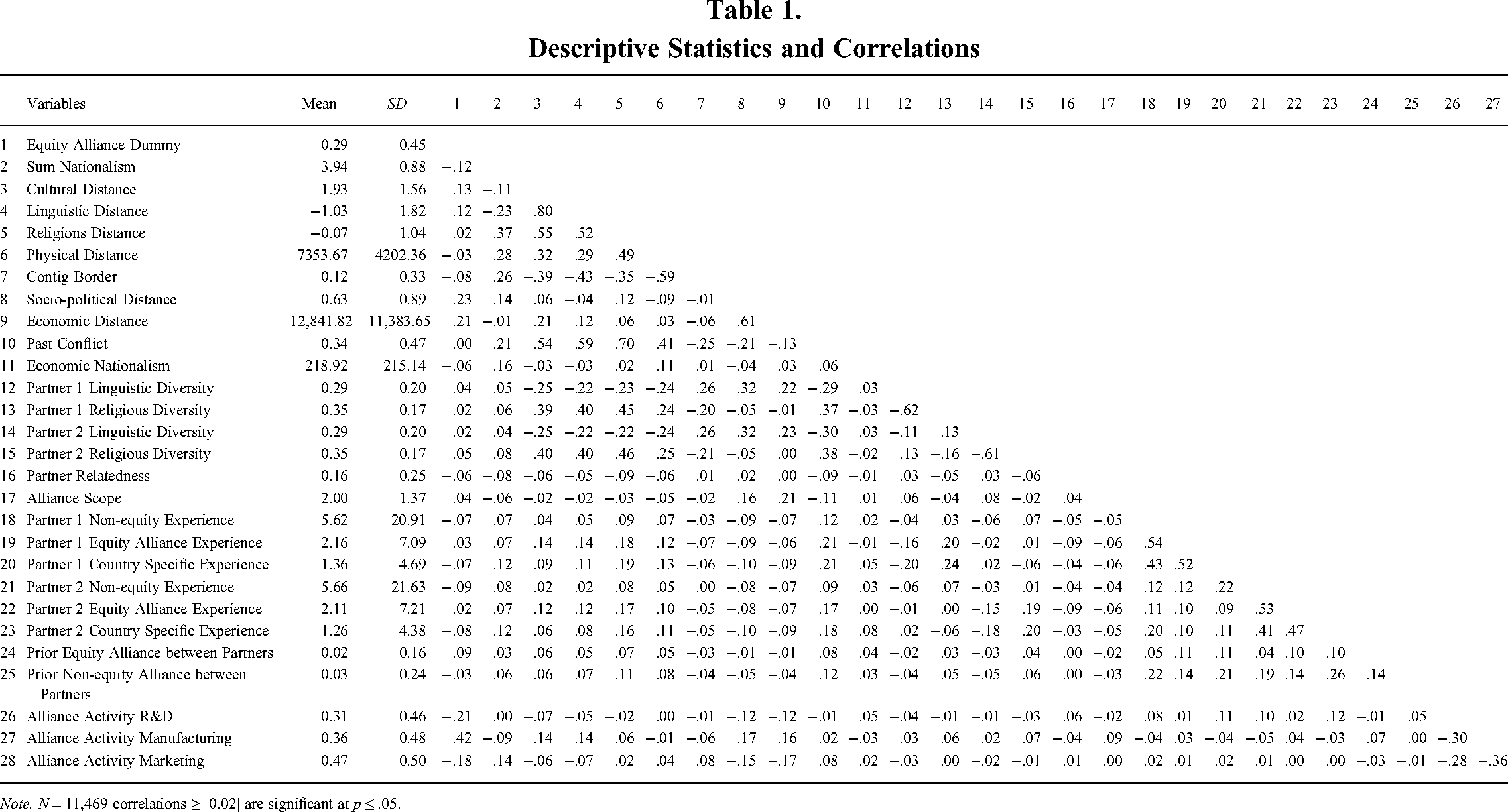
Note. N = 11,469 correlations ≥ |0.02| are significant at p ≤ .05.
Results of Logistic Regression and Linear Probability Models Predicting the Choice Between EJVs and Non-Equity Alliances
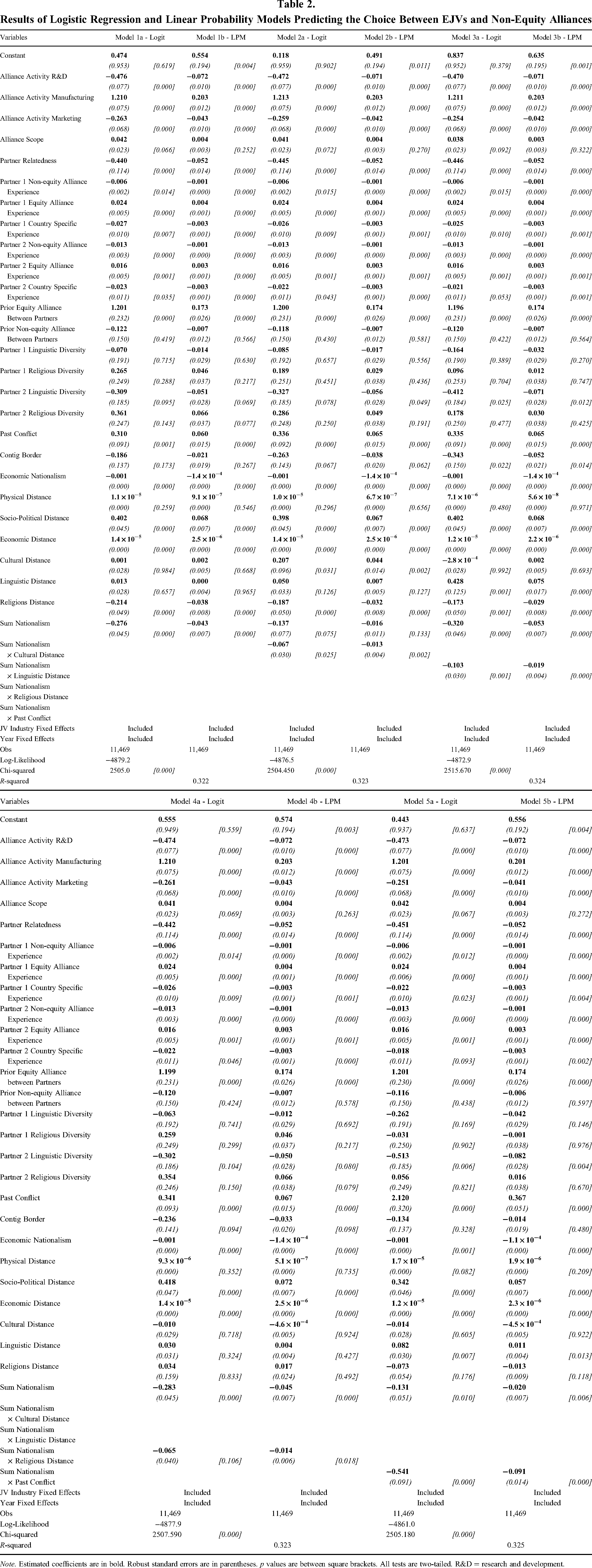
Note. Estimated coefficients are in bold. Robust standard errors are in parentheses. p values are between square brackets. All tests are two-tailed. R&D = research and development.
Table 2 presents the results of the logistic regression and linear probability models. In Models 1a and 1b we include the control variables and our nationalism measure. Adding the nationalism measure to the models with only the control variables improves the fit of the model (p < .001). Nationalism has a negative and significant relationship with the choice for equity alliances (p = .001 in both models; the z value is −6.11 in Model 1a and the t value is −6.45 in Model 1b). These results are consistent with Hypothesis 1-Alt, but not with Hypothesis 1.
A large sample approach like ours allows the estimation of coefficients with greater precision and reduces the likelihood of incorrect statistical inference. However, these statistically significant effects might have small practical magnitudes. Therefore, it is informative to consider the magnitude of the predicted relationships. A nationalism score that is one standard deviation higher is associated with a 3.8% increase in the probability of choosing a non-equity alliance (Model 1b). We compared this with the effect size of partner relatedness, which is an important factor for governance choices (e.g., Cuypers et al., 2017; Oxley & Sampson, 2004). The effect of a one standard deviation change in nationalism is approximately three times larger than that of a one standard deviation change in partner relatedness. We also compared the magnitude of the effect of nationalism with that of country-specific experience. The effect of a one standard deviation change in nationalism is approximately 2.5 times larger than that of a one standard deviation change in country-specific experience. Hence, the effect of nationalism is both statistically and practically significant.
Our prediction in Hypothesis 2 is about interactions between nationalism and cultural, linguistic, and religious distance. As the evidence for the main relationship between nationalism and governance choice is consistent with Hypothesis 1-Alt (and not with Hypothesis 1), we accordingly expect these interaction effects to be negative. In line with this expectation, we find negative and significant interaction terms between nationalism and cultural distance (p = 0.025 in Model 2a and p = .002 in Model 2b) and linguistic distance (p = .001 in Models 3a and 3b).
For religious distance the results are not as clear, as we found a negative and significant interaction term between nationalism and religions distance in the LPM (p = .018 in Model 4b), and a negative but non-significant interaction term in the logit model (p = .106 in Model 4a). Overall, with five out of six interaction terms being significant, these findings are largely in line with Hypothesis 2. In Hypothesis 3, we predict that prior conflict between the home countries of the partners will amplify the effect of nationalism, which again—given the support for Hypothesis 1-Alt—means that we expect this interaction effect to be negative. In line with this, there is a negative and significant interaction effect between nationalism and prior conflict in Models 5a and 5b (p = .001 in Models 5a and 5b).
Our inference regarding the direction and significance of the interaction effects is supported by Figures 1 through 4. These figures are produced using the estimates from Models 2b, 3b, 4b and 5b. In each figure, the y-axis is the probability that the firms will opt for an equity alliance (rather than a non-equity alliance). Nationalism is plotted on the x-axis, with endpoints marked by the range of this variable in our estimation sample (we mark the mean, 3.94, for reference). The lines that depict the moderation effects are plotted by setting the moderator at a high (mean + 1 SD) and low (mean – 1 SD) level. For linguistic distance, we use the maximum value in our sample, since mean plus one standard deviation there exceeds this value.
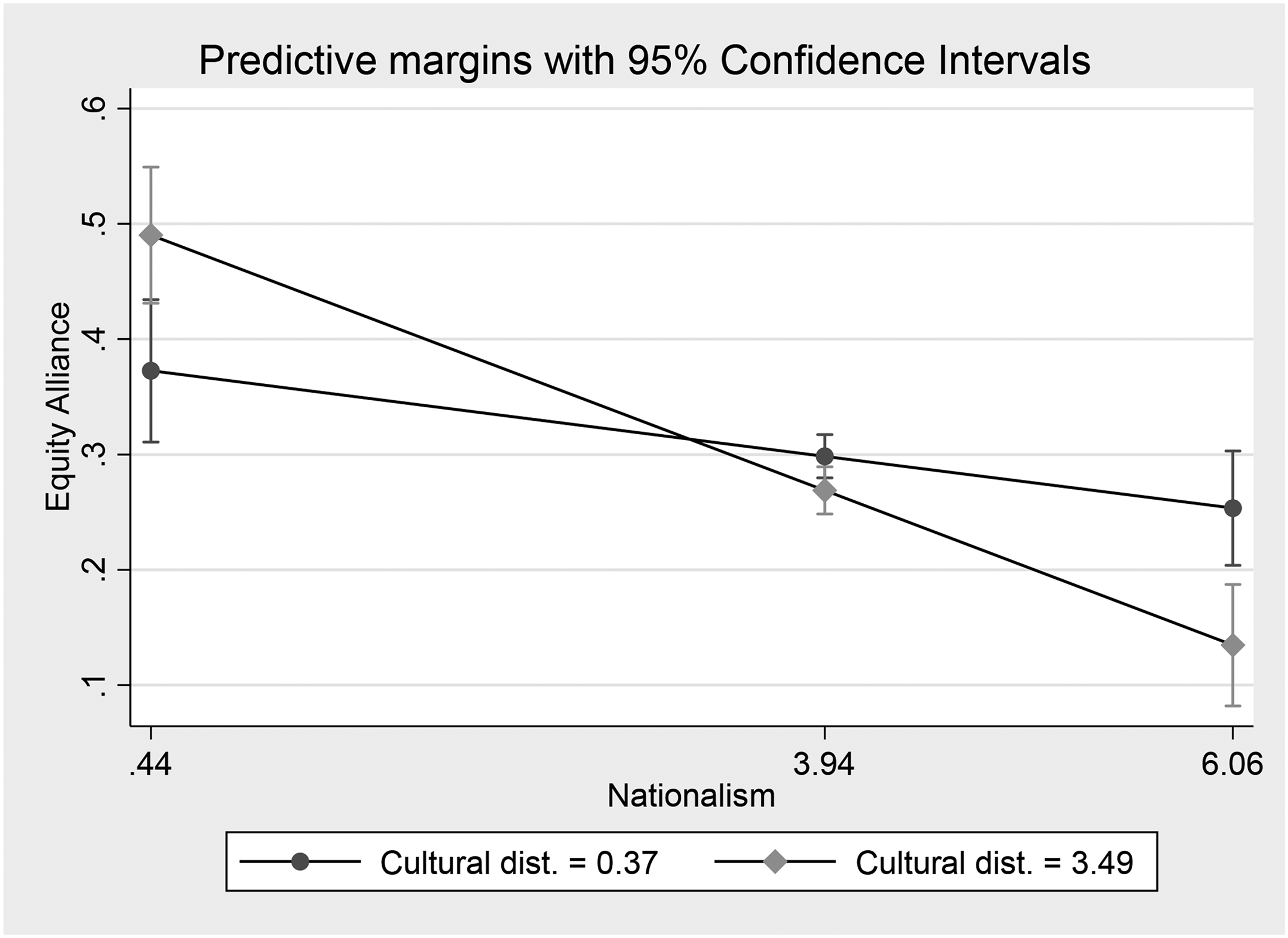
Plot of the Interaction Between Nationalism and Cultural Distance
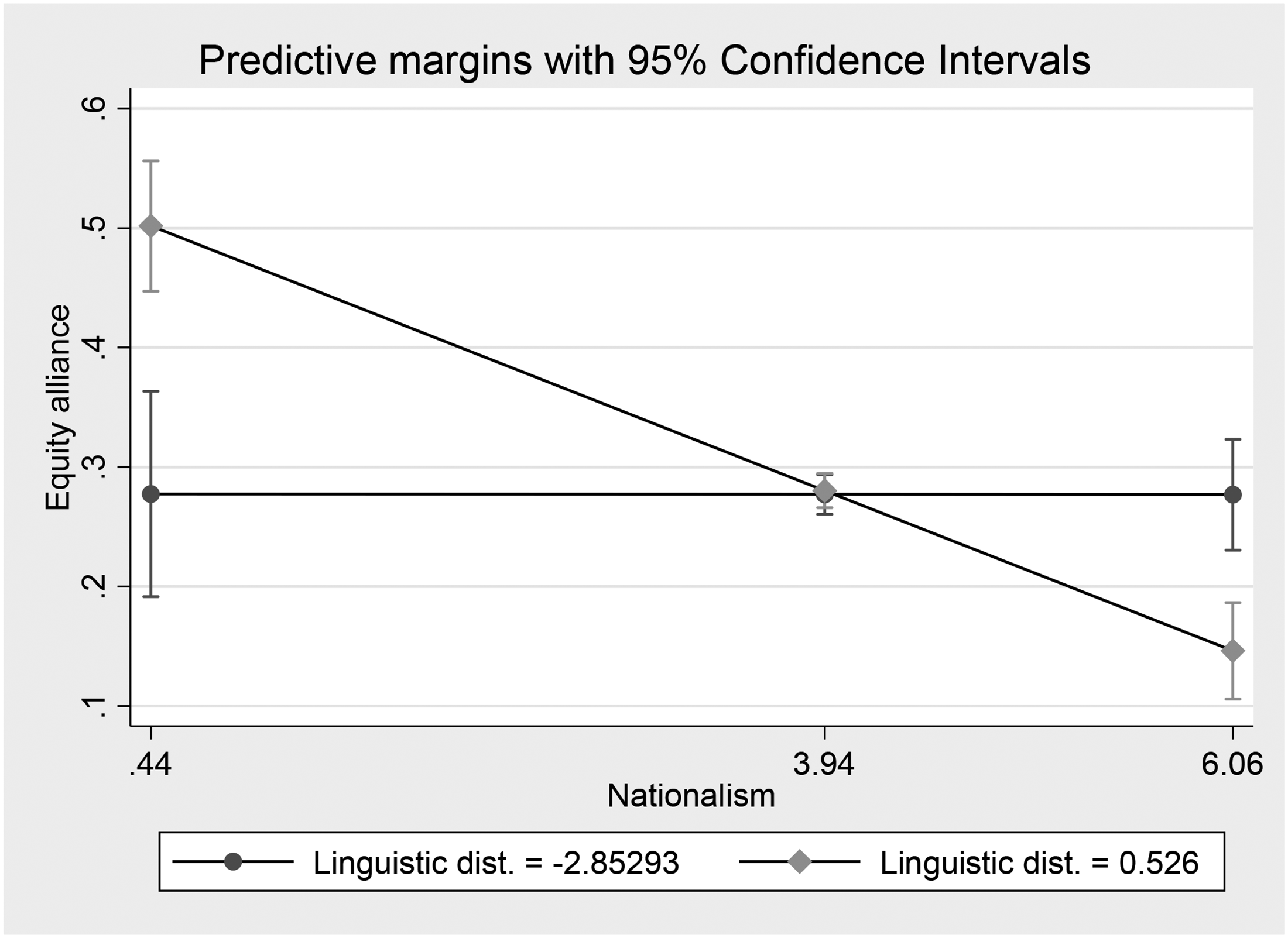
Plot of the Interaction Between Nationalism and Linguistic Distance
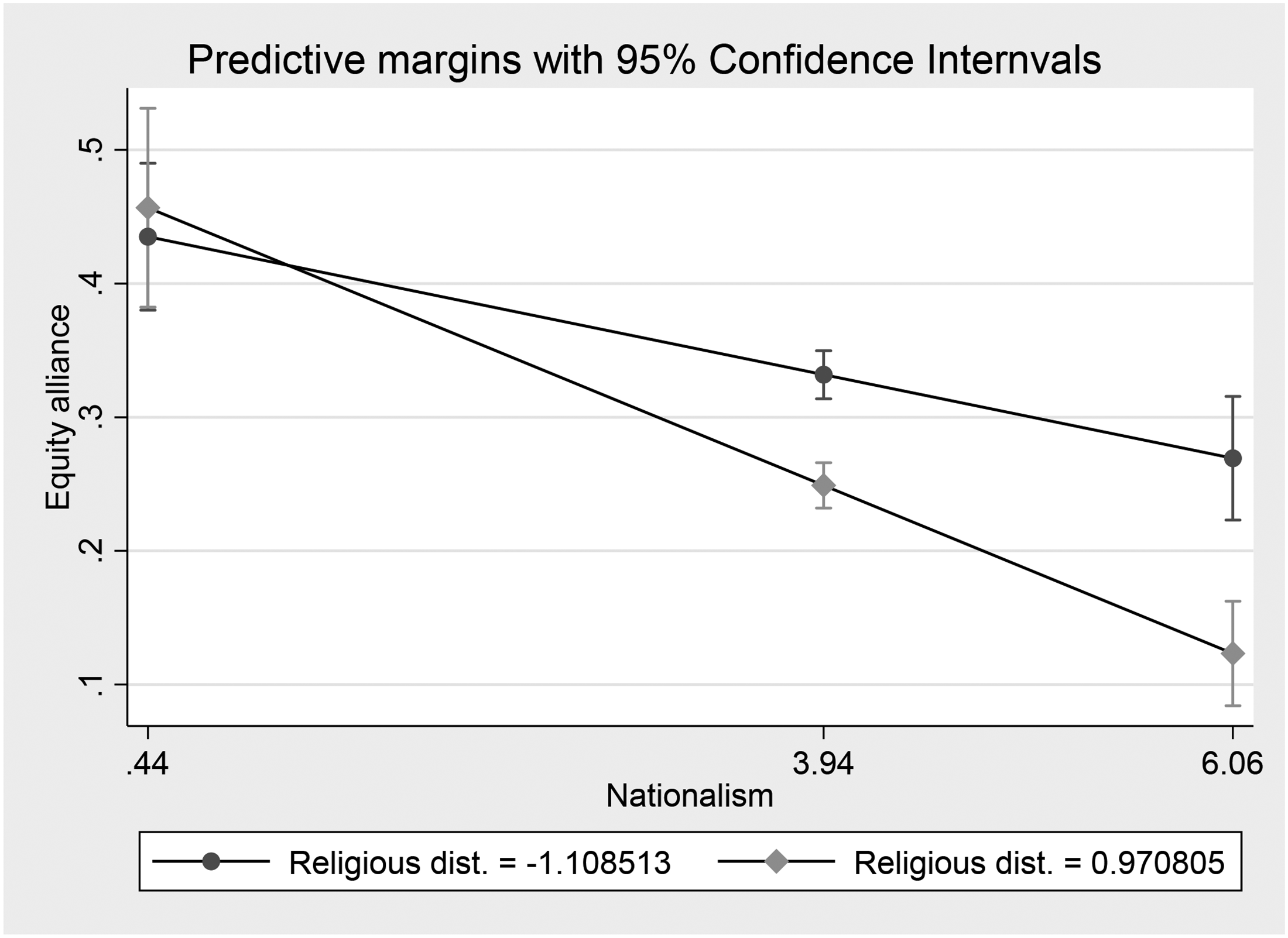
Plot of the Interaction Between Nationalism and Religious Distance
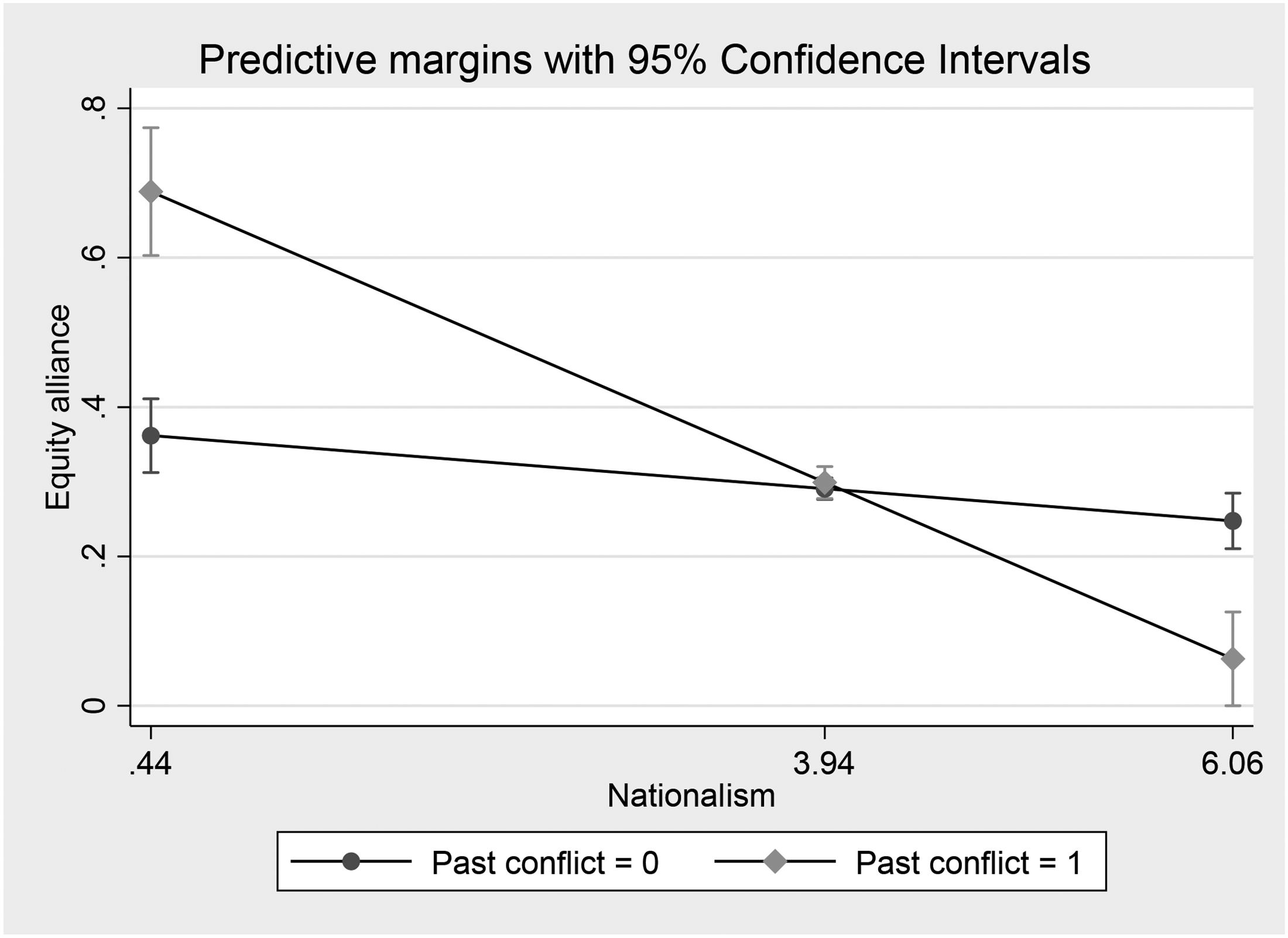
Plot of the Interaction Between Nationalism and Past Conflict
To gain further insights into the effects of nationalism on firm level outcomes, we also explored how it might affect the propensity to collaborate domestically or across borders. Because the governance choice we investigate is conditional on the partners collaborating across borders in the first place, it could be argued that there is a decision (i.e., a first stage) that precedes the choice of governance. A strong candidate for this would be the decision to enter a cross-border collaboration in the first place. If nationalism influences a focal firm's decision to collaborate across borders, not modeling this first stage might bias our findings in the main estimations. We looked into whether our findings are robust to incorporating the implications of this decision. This investigation yielded robust findings and results which indicate that nationalism in firms’ home countries reduces their propensity to engage in cross-border collaborations and increases their propensity to collaborate domestically. We detail these analyses in Appendix 2.
Robustness Checks
We conducted a battery of tests to assess the robustness of our findings. Due to space constraints, full results are omitted here but they are available upon request from the authors. To illustrate that our findings remain consistent, we summarize the effects of nationalism in Figure 5, which provides the coefficient of the nationalism variable with 95% confidence intervals (CI) across different models and variable specifications. Below, we highlight a few of these checks.
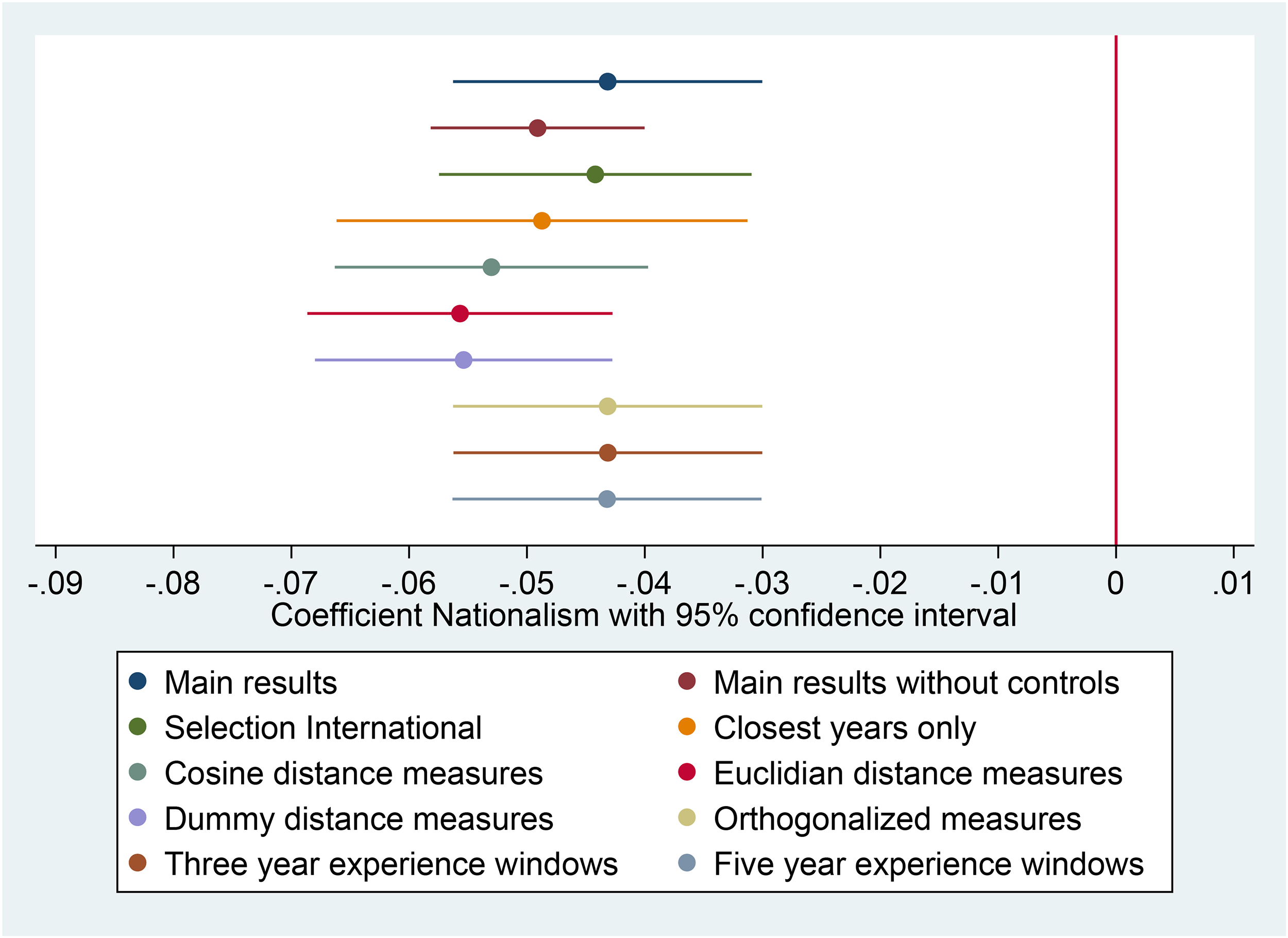
Summary of the Robustness of Our Results
Different Estimation Approach and Model Specifications
As we detail in Appendix 2, we explored potential selection issues. This yielded results that are consistent with our main findings. We also ran our models without control variables to rule out the possibility of “collider bias,” which yielded robust findings.
Alternative Specification of the Nationalism Measure
We ran models in which the nationalism in each partner's home country was entered separately, instead of one measure that sums them. In addition, we ran models that added a variable that captured the absolute differences between the levels of nationalism of the two partners’ home countries. The effect of this variable was not significant (p = .69 in the logit model and p = .79 in the LPM), with our main results remaining robust.
Alternative Specification of Other Explanatory Variables
First, we used alternative specifications for the distance measures. To calculate cultural distance, we used the nine-dimensions from the GLOBE project (House, Hanges, Javidan, Dorfman, & Gupta, 2004) instead of Hofstede's (2001) cultural framework. This yielded results consistent with our main findings. In particular, the interaction between nationalism and the GLOBE-based cultural distance measure remained significant (p = .001 in both the logit model and the LPM). We also used Cosine and Euclidian distance measures, as well as two dichotomous measures, as alternative ways to operationalize Linguistic Distance and Religious Distance, which yielded robust results.
Second, as there is no consensus in the literature on how to operationalize prior conflict, we explored several alternative specifications. Instead of using a dichotomous measure, we used the data from the International Crisis Behavior Project (ICB) to calculate a count measure, capturing the number of prior conflicts between two countries. Even though there are several outliers (e.g., a high number of conflicts between the United States and Russia during the cold war), the interaction between this alternative conflict measure and nationalism remains negative and significant (p = .001 in both the logit model and the LPM). Instead of using 1918 as a starting point to calculate our dichotomous measure, we used 1939, which again yielded robust findings. We also checked the robustness of our results using the Directed Dyadic Interstate War Database (Maoz, Johnson, Kaplan, Ogunkoya, & Shreve, 2019), which provides improvements to the Militarized Interstate Dispute (MID) database that has been used in previous studies (e.g., Li et al., 2020), which also yields a negative and significant (p < .001) interaction effect between nationalism and prior conflict.
Discussion
Researchers have called for more attention to how socio-political factors impact cross-border collaborations (Nippa & Reuer, 2019). We make a contribution in this direction by examining the effect of nationalism on governance choices in cross-border collaborations. Integrating individual attitudes and behaviors arising from nationalist sentiments with mechanisms in TCE and RDT explanations, we derive contrasting predictions for how nationalism affects governance choices.
Our empirical findings support the RDT-based explanation: in collaborations with foreign partners, nationalism influences decision-makers to prefer non-equity alliances, as opposed to more integrated and invasive equity alliances (Drees & Heugens, 2013). We show that the effects of nationalism are conceptually and empirically distinct from related constructs—including cross-country linguistic, cultural, and religious dissimilarity and past conflict between the partners’ home countries—but also that these constructs are important contingency factors that amplify the effect of nationalism.
Our study makes two contributions: First, we add to the literature on cross-border collaborations by demonstrating the importance of incorporating nationalism, and its implications, in better understanding governance choices. Second, we improve our theoretical understanding of the specific mechanisms by which nationalism might impact firm-level decision-making, and cross-border governance choices in particular.
Extending Theories of Cross-Border Governance Modes
Our results indicate that nationalism may result in decisions that prioritize curbing invasiveness and interdependence over trying to minimize opportunistic behavior through additional control in cross-border collaborations. From a TCE perspective, low trust and an unwillingness to interact with foreigners would increase concerns about opportunistic behavior and behavioral uncertainty, thus increasing the propensity to use governance modes that offer greater control, such as equity alliances. However, our findings support an RDT perspective, which, in contrast, implies that the lack of trust and unwillingness to interact with foreigners that are characteristic of nationalism instead reduce the propensity for equity alliances, in favor of non-equity alliances.
We do not believe that our findings repudiate TCE arguments. Rather, our results demonstrate how the combined manifestations of nationalism, that is, the overall or joint implications of the various nationalism-related attitudes and behaviors, may impact decision-making to generate outcomes that deviate from what TCE logic alone would prescribe. When nationalist attitudes are strong, firms may be willing to accept the additional transaction costs that arise from having less trust in foreigners and interacting less regularly with them, if doing so means that these firms can reap the “benefits” of reducing interdependence and task integration with foreigners. This may also imply that firms operating in nationalistic countries are less committed to cross-border collaborations and prefer to have greater flexibility to terminate collaborations on short notice. The findings we report in Appendix 2 speak to this point to some degree: Nationalism in firms’ home countries reduces their propensity to engage in cross-border collaborations while increasing their propensity to collaborate domestically.
As we have noted, even those managers who do not themselves harbor nationalistic beliefs may still adhere to societal-level nationalistic sentiments, based on normative pressures and the expected attitudes of peers, co-workers, and collaborators. If other members of the organization, as well as external stakeholders, react negatively to decisions that do not align with widely-held nationalist sentiments, this may incur additional costs for the firm (Durand et al., 2019). Consequently, it may be economically rational for firms to align their decisions with nationalistic sentiments, even if these decisions result in what might be considered suboptimal governance choices from the exclusive viewpoint of some theoretical perspectives.
Theorizing the Mechanisms and Boundary Conditions of Nationalism
A second area of contribution is to theorize how nationalism influences governance choices in particular, and to provide a basis for thinking about such influences on firm strategies more broadly. Because extant work has tended to conceptualize nationalism at the level of government policy, individual and firm-level causal mechanisms have been left largely black-boxed and under-theorized. The few works that do address nationalism in management research have tended to focus on how multinational enterprises manage their external identities in response to nationalist pressures in the home and host country environment (Donzé & Kurosawa, 2013; Kostova & Zaheer, 1999; Pant & Ramachandran, 2017).
In contrast, we draw on the social psychology literature to theorize the direct effect of nationalist attitudes among decision-makers within organizations. By deriving manifestations of nationalism directly from Kosterman and Feshbach's (1989) definition, and subsequently theorizing their impact, we contribute to developing an understanding of the firm-level mechanisms by which nationalism can shape strategic decisions. Our empirical analysis supports the distinctiveness of our conceptualization of nationalism, while also highlighting its statistical and practical significance for governance mode choice.
Limitations
The limitations of our study can yield suggestions for further research on how nationalism impacts firm-level decisions. First, our study is limited by the coverage of the data we use to measure nationalism. The ISSP indicators of nationalism allow us to measure the average level of nationalism in a firm's home country, rather than directly measuring the level of nationalism of a precisely identified set of individuals. For our specific context and predictions, we suggest that this is not a severe constraint, as it is the nationalism of a broad group of employees, and also possibly external stakeholders, rather than a clearly delineated small group of decision-makers, that is most pertinent. Second, we discussed possible mechanisms in developing our hypotheses, but are unable to directly measure these mechanisms. Experimental or scenario-based approaches can provide measurement of both the actual level of nationalism of individual decision makers and the mediating role of mechanisms that link that nationalism to their choices.
Avenues for Future Research
Based on our findings and their implications, we suggest several avenues for future research. First, while we deemed TCE and RDT to be the most appropriate theoretical lenses for theorizing the implications of the two attributes of nationalism we focus on (e.g., a lack of trust and unwillingness to work with foreigners), other attributes of nationalism may be more fruitfully analyzed through other lenses, such as behavioral theory or status theories.
Second, the mechanisms we identify can be used to examine how nationalism affects other aspects of cross-border collaborations. For example, while we examine governance choices, we do not test the performance implications of these choices. Consequently, while we know that firms on average make decisions in line with an RDT logic, we do not know if firms whose governance choices are aligned with that logic perform better or worse as compared to those whose decisions are aligned by a TCE logic, or other logics. An additional path for future research would be to study how nationalism shifts the economic costs of foreign operations relative to domestic operations. This would be useful in informing investigations of the performance implications of nationalism for cross-border and domestic collaborations relative to each other.
Third, by theorizing the mechanisms of nationalism, we provide a theoretical basis for future research designs, including surveys and experiments. For example, experimental designs could employ nationalist narratives as a treatment effect to study the implications of societal-level nationalism on choices or perceptions, including environmental scanning, competitor evaluation, and return expectations. Such studies could also provide evidence of the domains in which nationalism matters more, compared to those where its effects are less salient.
Lastly, future research can also apply the conceptualization of nationalism we offer to other domains and firm-level decisions. These may include political strategies, responses to CSR, interactions with macro-level institutional environments, and market divestment decisions. We also encourage future work to expand our focus to explore the implications of other manifestations of nationalism, for example superiority bias and favoritism. Superiority bias might be leveraged in studies of cognitive myopia and competitive blind-spots and might be relevant for the literature on competitive dynamics. Favoritism may be applied to research on the liabilities of foreignness.
Practical Implications
For managers and decision-makers, our findings highlight how nationalist sentiments might result in alliance governance decisions that are driven more by distrust of foreigners and an unwillingness to interact with them, than the goal of minimizing transaction costs. Our theorizing suggests that such decisions may be driven not only by the decision-maker's personal nationalist sentiments, but also by the beliefs and attitudes of their employees and other parties and stakeholders that embody broader societal norms and expectations. When making decisions in the context of strong nationalist sentiments, managers should thus be aware of these tendencies and consider what costs and benefits the organization might accrue in heeding them.
For policy makers, the findings highlight how societal-level nationalist sentiments can have a significant impact on the form and degree of foreign direct investment. The vast majority of countries—even those with explicitly nationalist economic policies—tend to view FDI as a positive for economic growth and development. Our findings suggest that nationalist sentiments—for example, in the form of narratives that discriminate towards foreigners—may lead to fewer equity-alliances and fewer cross-border collaborations, which, in turn, would reduce resource commitments to the host country, even if the government's economic policy is welcoming to FDI. In order to manage and promote more and deeper alliances, policy makers should consider the extent to which they can try to mitigate nationalist sentiments among their population.
Conclusion
Cross-border collaborations rely on firms’ willingness and ability to cooperate effectively. The resurgence in nationalist sentiment poses challenges to such collaborations. Therefore, acknowledging nationalist sentiment as an important factor and understanding the effects of nationalism on cross-border interactions and collaborations is important to make well-informed decisions. Accordingly, by conceptualizing how nationalism can manifest at the level of decision-makers, and subsequently theorizing its effects on decision-making, we provide a basis for empirical and conceptual work to build that knowledge base.
Footnotes
Acknowledgments
We would like to thank the Senior Associate Editor, Zeki Simsek, for his clear and much-appreciated support and guidance during the review process. We also thank the two anonymous reviewers for their careful reading and deep engagement with our study. Standard disclaimers apply. We gratefully acknowledge support from Singapore Management University's Lee Kong Chian Fellowship.

Notes
Appendix 1: Brief Overview of Nationalism and Related Constructs
The concept of nationalism has been the subject of research for decades in social and political science (e.g., Allport, 1927; Mead, 1929), resulting in a variety of approaches and conceptualizations. In this appendix we discuss how our conceptualization of nationalist sentiments is distinct from other types of nationalism, e.g., economic nationalism, as well as from related constructs, including animosity, geopolitical rivalry, patriotism, and populism. In Table A1-1 we list the various constructs, their definitions, and representative works. 8
To begin with, the conceptualization of nationalist sentiments we use, i.e., “a perception of national superiority and an orientation toward national dominance [that] consistently implie(s) downward comparisons of other nations” (Kosterman & Feshbach, 1989: 271), follows the majority of the social psychology literature to “consider nationalism as an individual's attitude” (Dekker et al., 2003: 346). This definition allows us to distinguish nationalist sentiments from similar constructs. For example, as a societal-level sentiment embodied in individual-level attitudes and beliefs, this definition of nationalism is conceptually distinct from “economic nationalism” and “resource nationalism,” which have received attention in the management literature (e.g., Bucheli & Aguilera, 2010; Click & Weiner, 2010; Zhang & He, 2014). Specifically, economic nationalism is typically conceptualized as “discrimination in favor of one's own nation, carried on as a matter of policy” (Baughn & Yaprak, 1996: 760), while resource nationalism can be seen as a specific form of economic nationalism, as it refers to a country's “policies to maximize the political and economic benefits from their mining and energy sectors” (Wilson, 2015: 399). As policy-oriented manifestations, economic and resource nationalisms are naturally not wholly unrelated to nationalist sentiments, in that a broad-based increase in nationalist sentiment among the voting population and government leaders will presumably result in greater economic and resource nationalism. Nevertheless, economic and resource nationalism are distinct from nationalist sentiment both in terms of the level of decision-making (governmental decision-making bodies vs. individuals), as well as the implications (policies vs. individual action). For similar reasons, nationalist sentiments are distinct from geopolitical rivalry, that is, state-led efforts to increase for regional economic, political, and military influence through various forms of statecraft (Flint & Zhu, 2019).
Our conceptualization of nationalism also allows us to distinguish between nationalism (which is externally oriented) and patriotism (which is internally oriented). In an exploratory factor analysis of nationalistic attitudes, Kosterman and Feshbach (1989: 271) labeled a validated factor representing an “affective component of one's feelings toward one's country…the degree of love for and pride in one's nation” as patriotism. They identified and labeled nationalism, as “a perception of national superiority and an orientation toward national dominance. It consistently implie(s) downward comparisons of other nations.” The distinction between patriotism (affective feelings towards one's own country) and nationalism (feelings of superiority vis-à-vis external countries) has been broadly applied in the literature (Armagan & Ferreira, 2005; Balabanis et al., 2001; de Figueiredo & Elkins, 2003; Mummendey et al., 2001). Given that our analysis focuses on decisions to engage in collaboration with firms from other countries, we use Kosterman and Feshbach's (1989) interpretation of nationalism as an externally-focused attitude characterized by perceptions of national superiority and a downward comparison to other nations.
Our definition also establishes a distinction between nationalism and national culture. Culture is a cognitive template that defines the shared values and norms among group members (e.g., Hofstede, 1980). Cultural values and norms manifest and shape behavior without necessarily referencing outgroups or the “other.” In contrast, nationalism explicitly assumes that one's own values and norms are “superior” to and “dominant” over those of the outgroup or the foreign “other.” Nationalism is thus inherently relative, requires comparison, and implies a normative rank-ordering, whereas culture does not. Moreover, nationalism is not a culturally-specific dimension, unlike, for example, “collectivism” or “uncertainty avoidance” (Hofstede, 1980; House et al., 2004). Thus, a given culture can be high or low on nationalism, in a way that is not necessarily tied to its underlying values and norms.
Our conceptualization of nationalism is also distinct from concepts that represent dissimilarities between cultures, including for example cultural friction (Luo & Shenkar, 2011), cultural distance (Kogut & Singh, 1988), and cultural attractiveness (Li et al., 2017). While representing different assumptions and effects, these concepts share an emphasis on the relative difference between two focal cultures, and thus vary depending on which particular two cultures are being compared. In addition, these concepts focus on dissimilarity or (in)compatibility, rather than on normative differences between cultures, that is, they do not necessarily assume that one culture is better than others. Nationalism contrasts the home nation, that is, the ingroup, with all other nations (the outgroup), and—in this sense—does not invoke a dyadic-, relational-, distance-, or dissimilarity-based conceptualization. More importantly, the assumptions of superiority and dominance that accompany nationalism imply a normative comparison of people from different countries.
Our conceptualization also distinguishes nationalism from historical animosity between countries (Arikan & Shenkar, 2013; Liou, Brown, & Hasija, 2021). Similar to cultural distance, animosity is primarily a relational construct and is thus invoked with respect to foreigners from a particular country (more precisely, as it is typically conceptualized in the literature, towards foreigners from a country with which your home country has an ongoing or past conflict). In contrast, nationalist assumptions and beliefs are applied to foreigners in general, rather than to foreigners from a particular country. Historical animosities can feature in nationalist narratives (He, 2007; Shoham et al., 2006), yet the former is not a requisite for the latter. As noted previously, nationalistic attitudes are typically directed at foreign entities in general, regardless of whether there is a history of conflict. Thus, historical animosity and nationalism are related, but distinct, concepts.
Finally, while nationalism is a closely related construct to populism, the two are nonetheless distinct (e.g., De Cleen, 2017). While populism is a broad concept, Rodrik recently defined it as “an antiestablishment orientation, a claim to speak for the people against the elites, opposition to liberal economics and globalization” (Rodrik, 2018: 12). Populism is similar to nationalism in that it focuses on the distinction between ingroup and outgroup members. In the case of nationalism this discourse is centered around the “nation,” where the distinction lies between the domestic ingroup and foreign outgroup. In the case of populism, the discourse is centered around the “people” and a distinction is made between the “people” as a large powerless group with the “the elite” as a small and illegitimately powerful group (e.g., Laclau, 2005a, 2005b; Muller, 2017; Stavrakakis, 2004; Stavrakakis & Katsambekis, 2014). Although populism is generally critical of globalization, it does not necessarily refer to national identity or belonging, nor does it specifically target foreign countries as such; instead, its focus is on class-differences and unequal wealth redistribution.
Appendix 2: Selection Model and Additional Insights
The governance choice we investigate is conditional on the partners collaborating across borders in the first place. Because nationalism might influence a company's decision to collaborate with foreign companies in general, not modeling this might raise a concern when assessing the results from our main estimations. Previous studies that have investigated phenomena that are similar to the outcome in our main estimations also faced similar considerations. Most of these studies do not model the first-stage we refer to above (e.g., Lee, Shenkar, & Li, 2008; Mowery et al., 1996). We speculate that this is likely due to the multiple ways in which one can consider modeling one or more of such earlier, “first,” stages, where it is not clear whether some of these options are superior to others, and it is not obvious what their implication would be for the main analysis. Having made this acknowledgment, we investigate whether our findings are robust to considering a selection stage, that is, the decision to collaborate with foreign companies at all. Subsequently, we use this analysis to gain further insights into how nationalism might affect the propensity to collaborate domestically or across borders.
We designed our two-stage approach to test for selection issues in the following way:
The results this approach yielded are presented in Table A2-1. In Model A2-1 we provide the rest of the first-stage model and the second-stage models which include the inverse Mill's ratio from the first-stage model are presented in Models A2-2 to A2-6. We found that the coefficient of nationalism is still negative (p = .001 in Model A2-2), supporting Hypothesis 1-Alt and not Hypothesis 1. The interaction terms between nationalism and cultural distance (p = .005 in Model A2-3), linguistic distance (p = .001 in Model A2-4), and religious distance (p = .020 in Model A2-5) have negative and significant coefficients, in support of Hypothesis 2. As consistent with Hypothesis 3, we also found that the interaction between prior conflict and nationalism is negative and significant (p = .001 in Model A2-6). These findings show that adding the selection stage does not materially change our results.
9
The results of the first stage also offer insights into how nationalism might affect firms’ decision to collaborate internationally and domestically. As Waldman and Javidan (2020) highlight, it is not a given that nationalism automatically leads to less internationalization or globalization. However, an extension of our theoretical arguments would suggest that nationalism might decrease the likelihood that firms engage in cross-border collaborations and increase the likelihood that they engage in domestic ones. We expanded on the results of the first stage model (reported in Model A2-1 in Table A2-1) to investigate this. In the two-stage selection models we use a Probit specification in the first-stage, as is standard. This has implications for the number and types of fixed-effects that can be accommodated in the estimation. These constraints are fewer in linear probability models (LPMs), which enable us to assess the inference we make from the Probit models in the presence of, for example, firm-fixed effects as well. Accordingly, we ran LPMs that include firm-fixed effects. The results from this specification are in Table A2-2. As consistent with the results from the Probit model, in Models A2-7 and A2-8 we see that firms from countries with higher levels of nationalism are significantly less likely to collaborate internationally (p = .001 in both models). We also looked at the number of international collaborations. Specifically, in Model A2-9 we ran a negative binomial model and in Model A2-10 we ran a LPM with the count of international collaborations in a given year as the dependent variable. As expected, firms from countries with higher levels of nationalism have significantly (p = .001 in both models) fewer international collaborations.
We also collected data on domestic collaborations by firms in our sample to explore how nationalism might affect the propensity to engage in domestic collaborations and the number of such collaborations. We found that firms from countries with higher levels of nationalism are significantly more likely to collaborate domestically in both the logit (Model A2-11) and the LPM (Model A2-12) specifications (p = .001 in both models). To complete the picture, we also explored how nationalism affects the number of domestic collaborations. In both the negative binomial models (Model A2-13) and LPM (Model A2-14), we found that nationalism is positively associated with the number of domestic collaborations per year (p = .001 in both models).
Taken together, our additional analysis suggests that firms from more nationalistic countries might be substituting cross-border collaborations with domestic collaborations. We see this as consistent with our reasoning for Hypothesis 1-Alt. Namely, nationalism can manifest in terms of lower trust in foreigners and a general inclination to reduce contact with people from other countries (e.g., Ayub & Jehn, 2006). These findings are also consistent with two other attitudes that have been linked to nationalism, beyond the two that we use in building our predictions. First, nationalism can manifest in a superiority bias, which creates a more favorable perception of one's country relative to other countries (Armagan & Ferreira, 2005). Second, high levels of nationalism have been linked to favoritism towards local firms, local economic activities, and local control (e.g., Shi & Wright, 2003). Hence, even though the lower propensity to engage in cross-border collaborations, and the higher propensity to collaborate domestically, might be the result of lower trust in foreign firms and a greater reluctance to interact with actors from another country, it can also be due to superiority bias or favoritism. While we cannot isolate the precise mechanism(s) at play with our research design, the general finding we discuss in this additional analysis section further highlights the importance of considering nationalism as a factor that influences firm level outcomes.