




Abstract
We conduct a theory-guided review of the literatures on public–private partnerships and grand challenges (GCs). We adopt an organization design approach to review and identify constructs in public–private collaborations (PPCs) that address societal challenges. Our review identifies the complexities of organizing to tackle GCs, highlights the plurality of organizational forms in PPCs, and explores organizational design considerations in these partnerships. Given the elevated role of private actors in these collaborations, our review provides a new understanding of how they can shape a private-public interface that is robust to the scale and scope of global problems. This leads to a rich research agenda on when, why, and how public and private collaborations matter, and their implications for addressing societal challenges.
Keywords
Accelerating climate change, widening income inequality, and depleting natural habitats prompted 193 member countries of the United Nations (UN) to adopt 17 sustainable development goals (SDGs) in 2015. UN secretary-general Antonio Guterres’s address in 2021 reiterated global solidarity and a commitment by governments, cities, businesses, and industries to a more sustainable world. Governments see large shortfalls in what public actors alone can accomplish and have called for more active engagement of businesses and the communities they serve in addressing the grand challenges (GCs) reflected in the SDGs. Indeed, the focus is shifting toward SDG-17 “Partnership for the Goals,” which aims to strengthen the means of implementing and revitalizing partnerships to achieve 2030 targets. There is a renewed sense of optimism in how private actors can contribute to the common good in partnership with public actors (Gitterman & Britto, 2021; Gray & Purdy, 2018; Klein & McGahan, 2021; Lazzarini, 2021).
Since the 1980s, partnerships between public and private actors have commanded attention in the management and public administration literatures, with a substantive focus on the structure, processes, and effectiveness of hybrid organizational forms such as public-private partnerships (PPPs) to deliver government functions and public service. Given the wide range of such services, the governance architectures of these public–private engagements vary significantly in scope, complexity, and structure (cf. Lazzarini, 2022; Roehrich, Lewis, & George, 2014). We refer to these arrangements collectively as public–private collaborations (PPCs). Under most conceptualizations, the government is often the driver of the scope of each partnership and dictates the terms of arrangements and the specificity of outcomes, although the range of possibilities for public action often rests on the capabilities of the private sector actors (Baum & McGahan, 2013; Cavalli & McGahan, forthcoming; Kivleniece & Quelin, 2012; Saussier, 2000).
PPCs vary in form and function across organizations, industries, and nation-states; they are inherently tied to the diversity of societal problems and institutional contexts. A typical PPC, for example, is the Cargill Corporation's collaboration with the World Food Program's Homegrown School Meals Program in Honduras, Indonesia, and Kenya. Working with local governments, Cargill is trying to improve school meal nutrition and is stimulating the local economy by better connecting local farmers to the supply chain. Another example is the Ferrero Group's support of sustainability in cocoa farming through agreements to end deforestation and protect natural ecosystems (Kennedy, 2019). The call for partnerships embedded within SDG-17 reflects the economic, social, and organizational complexity of the problems underlying societal GCs and the SDGs.
Partnerships are increasingly hybridized not only through their mixed public–private engagement, but also in the combined economic, social, and environmental goals they pursue (Quélin, Cabral, Lazzarini, & Kivleniece, 2019; Quélin, Kivleniece, & Lazzarini, 2017). This occurs because addressing these challenges necessitates commensurate levels of commitment from private actors in the fulfillment of the public interest. Accomplishing goal alignment requires a recalibration and a new understanding of what roles public and private actors play in their collaboration, and specifically how actors from each sector organize to deliver outcomes (George, Haas, Joshi, McGahan, & Tracey, 2022; Lazzarini, 2022). Their effectiveness may hinge upon embracing an expansive view of the partnership as genuine, evolving, and consummate (Mazzucato, 2021).
This partnership-based approach stands in contrast to earlier and narrower approaches to private-public governance that focused on specific transactional deals, such as when the government crafted long-term contractual arrangements to outsource public services, or when the government invited infrastructure investment in projects executed by private firms. The expanded model of public–private collaborations, however, reaches beyond this narrow approach to consider arrangements that might involve, for instance, public units partnering with private firms specialized in complementary activities as well as governments subsidizing low-income populations to purchase the services of private firms. In other words, we conceive of PPCs as organizational arrangements where relevant services or investments result from the joint action of public and private actors with varied degrees and types of engagement and responsibility.
Diversity of collaborative forms carries implications for the underlying organizational design principles necessary to effectively address the joint value creation and collective action problems that underlie the GCs (Bridoux & Stoelhorst, 2022). With this review, we seek to (1) identify the complexities of organizing to address GCs; (2) highlight the plurality of organizational forms in PPCs; and (3) explore organizational design considerations to improve and innovate on these PPCs. In so doing, we highlight organizational design considerations that shape how PPCs are structured, governed, and organized to address societal challenges effectively.
Review Methodology
There have been recent systematic reviews, books, and conceptual studies on GCs, organizational purpose, and value creation in public–private partnerships (e.g., George, Haas, McGahan, Schillebeeckx, & Tracey, 2021a; Gitterman & Britto, 2021; Gümüsay, Marti, Trittin-Ulbrich, & Wickert, 2022; Klein & McGahan, 2021; Lazzarini, 2021). We conducted a theory-guided review of the literature to leverage these existing works and integrate them with theoretical frameworks in the organizational design literature. To identify the articles for review, we searched backward citations in recent works on grand challenges in management subsequent to a seminal article published in the Academy of Management Journal to accelerate management research on GCs (George, Howard-Grenville, Joshi, & Tihanyi, 2016). In so doing, we follow the approach established by Howard-Grenville and Spengler (2022). For each article in this set, we reviewed the GC covered in the study, the defined problem in addressing the GC, the nature of the organizational problem, and the design solutions advanced to address the GC. A summary of exemplar works appears in online Appendix A.
The main features of GCs, including the managerial problems associated with addressing them, are summarized and explained in George, Merrill, and Schillebeeckx (2021b). We rely on this article as a starting point for our review of the design considerations in organizing for GCs. Specifically, we employ the framework in George et al. (2021b) on managerial problems to guide our review of the range of relevant organizational design considerations in GC-focused collaborations. Expanding upon the set of articles included in online Appendix A, we identified further grand challenge exemplars, as well as the empirical, theoretical, and conceptual lenses that are relevant to organizing for GCs.
We replicated this theory-guided review approach for the literature on PPCs. This analysis was done in two parts. First, we highlight the motivations for PPCs and then identify design challenges and solutions. This includes considering the scope of PPC, specifically drawing from the typology put forth by Roehrich et al. (2014) as a starting point. This highly-cited and interdisciplinary paper presents a framework to organize these arrangements by varying degrees of public and private responsibility. Second, we searched backward citations on subsequent studies of public–private arrangements for relevant articles. We considered an article to be relevant if it (1) discussed the motivations for engaging a public–private arrangement or (2) presented illustrative cases of these arrangements, through a GC lens. In analyzing these articles, we mapped the different forms of PPCs to the motivations for these arrangements and to example projects. In the next step, we searched the set of articles for design considerations, first focusing on the challenges identified and then considering potential solutions. Exemplars of the studies in the management literature appear in online Appendix B.
Managerial Problems in Organizing for Grand Challenges
Grand challenges are “specific critical barrier(s) that, if removed, would help solve an important societal problem with a high likelihood of global impact through widespread implementation” (e.g., George et al., 2016: 1881; Grand Challenges Canada, 2011: iv). This includes a broad scope of problems, “ranging from global warming, aging populations, inequality, and poverty to health, resource scarcity, and the elusiveness of sustainable livelihoods” (George et al., 2021b: 1001). To fully distinguish GCs from other social or economic problems, scholars point to a number of features (Czakon, 2019). First, GCs are global, meaning their consequences extend beyond single organizations and communities (George et al., 2016). Second, GCs are highly complex, often involving many actors with interactions that are path-dependent, nonlinear, and deeply intertwined (Ferraro, Etzion, & Gehman, 2015). Third, GCs are characterized by significant uncertainty, which makes it difficult to identify the specific forces that shape outcomes (Kwakkel & Pruyt, 2015). Fourth, GCs often consist of diverging and paradoxical interests, needs, and goals of different societal groups (Jarzabkowski, Bednarek, Chalkias, & Cacciatori, 2019). Fifth, GCs take many years to emerge, and their impact extends beyond the present to affect future generations (Czakon, 2019). In turn, these five features make GCs unique from other phenomena and managerial issues.
Increasingly, management scholars have recognized the role of business in addressing these challenges by investigating an array of contextual (e.g., Doh, Tashman, & Benischke, 2019; George et al., 2021a) and theoretical perspectives (e.g., Howard-Grenville et al., 2019; Howard-Grenville & Spengler, 2022; Vedula et al., 2022). These studies build on an increasing recognition that “business is a part of society and not apart from society, and, therefore, acceptable standards of behavior are drawn from society and practiced in business, rather than having opposing standards within each sphere” (Hollensbe, Wookey, Hickey, George, & Nichols, 2014: 1228).
Management scholarship on organizational design is critically relevant to GCs given these five features. Scholars have argued that innovation in organizational forms may be required to address GCs (e.g., Ferraro et al., 2015) and have proposed novel organizing forms and relational mechanisms (e.g., Bridoux & Stoelhorst, 2022; Luo, Zhang, & Marquis, 2016). Researchers have proposed that established organizations can recalibrate their operational focus to align with and confront GCs (Wright, Nyberg, & Grant, 2012) and agree that contributions to GCs can only occur when the focus of the organization is directed toward them (Kaufmann & Danner-Schröder, 2022). Difficulty emerges in how problems and conflicts arise in the design of the organization, which leads to tensions and inadequacy in the ability of the organization to make meaningful societal impact (Gümüsay et al., 2022).
The difficulties in addressing GCs may be significant. Managerial problems exist that undercut attempts to drive positive change toward remediating GCs (George et al., 2021b). These problems appear to have commonalities across organizational forms or functions, occurring in communities and bureaucracies (Berrone, Gelabert, Massa-Saluzzo, & Rousseau, 2016; Heese, Krishnan, & Moers, 2016), NGOs and disaster relief ventures (Venkataraman, Vermeulen, Raaijmakers, & Mair, 2016; Williams & Shepherd, 2016), and businesses and business partnerships (Cobb, Wry, & Zhao, 2016; Doh et al., 2019). These regularities suggest the importance of considering the problems associated with organizing for GCs as a defining feature of GCs themselves rather than tethered to a focal organization. Table 1 describes the complexities in organizing to address GCs by associating them with a broad class of managerial problems.
Complexities in Organizing for Grand Challenges
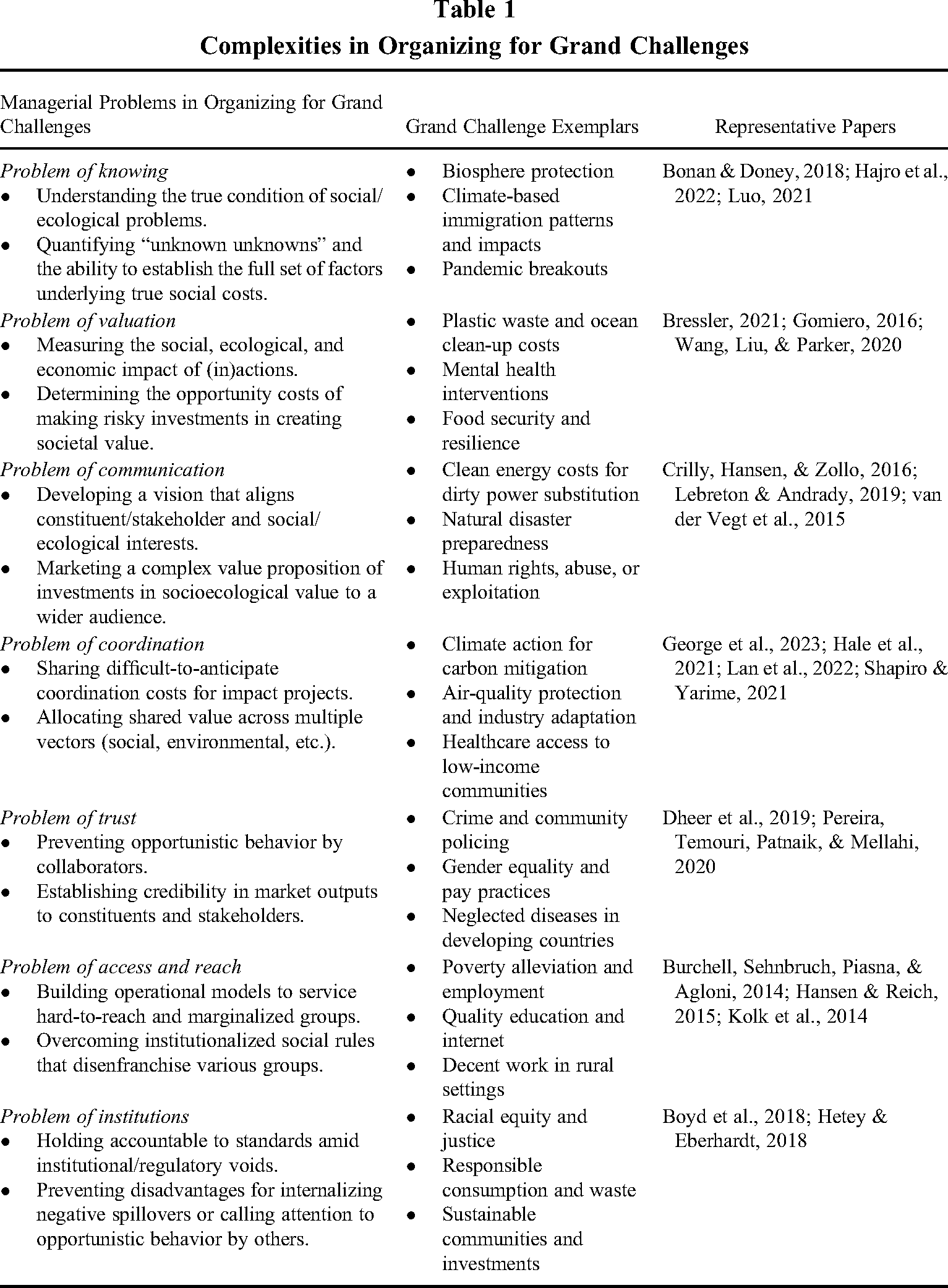
Four sets of problems are identified in Table 1. The first set reflect “what we know and how we value” GC problems (George et al., 2021b: 1004). The problem of knowing relates to information gaps in understanding social and ecological problems, including blind spots in the identification and assessment of the relative importance of elements of the system of factors that give rise to GCs. GCs are defined by the ambiguity of the system of underlying problems from which they emerge, and consequently they evoke bounded rationality (Simon, 1947). For example, it is difficult to assess the material impact of human behavior on natural ecosystems because of the complex interactions between physical and biological aspects of the terrestrial and marine biospheres (Bonan & Doney, 2018). A problem of valuation arises from the complexity in measuring the social, ecological, and economic impact of organizational action and inaction, which in part arises from the difficulty of quantifying the opportunity costs of investments in problem-solving initiatives. For example, policies and regulations are limited in their ability to reflect the true social cost associated with organizational actions such as carbon dioxide emissions or plastic use in packaging, which allows organizations to avoid internalizing negative externalities.
The second set of managerial problems represented in Table 1 consists of the structural difficulties of communicating and coordinating action within organizations to address GCs. The problem of communication includes difficulties in developing a vision that aligns stakeholder and constituency interests with social and ecological interests. For example, organizations may struggle to communicate the impact of an investment in biodegradable packaging as an alternative to plastic waste if broader constituency groups do not similarly make this investment (Lebreton & Andrady, 2019). A problem of coordination arises due to the complexity of socioecological systems surrounding “impact projects,” where partnering groups and organizations must share difficult-to-anticipate coordination costs and allocate the shared value of the project across multiple social and ecological vectors (Bacq & Aguilera, 2022; Hale et al., 2021). The coordination problem arises from failure to ensure mutual predictability of actions because of diversity in information and gaps in communication among actors—a frequent consequence of organizational differentiation (Gulati, Lawrence, & Puranam, 2005). For example, George, Chaturvedi, Corbishley, and Atun (2023) point to fragmentation in healthcare as a cause of poor quality-of-care outcomes. Even accountable-care organizations, which assume collective responsibility for quality and cost of care, face coordination challenges such as the allocation of costs and reimbursements across healthcare providers. The coordination problem also exists within individual organizations. For instance, in discussing natural disaster preparedness, van der Vegt, Essens, Wahlström, and George (2015) highlight the difficulty of coordinating operational and task-related issues across stakeholders.
A third set of problems also appears in Table 1. The problem of trust occurs because behaviors that address GCs “must credibly forgo the capture of the full value-add of work whose positive spillovers flow to third parties of the world at large” (George et al., 2021b: 1006). Trust is the willingness to be vulnerable. Its absence means collaboration will not be attempted and that adaptation within an existing collaboration will be impeded. Lack of trust makes it difficult to prevent opportunistic behavior by market participants and to establish credible commitment to outcomes such as drug development for tropical diseases and poverty reduction. Particularly, social development is hindered by low generalized trust in minority and underrepresented social groups (Dheer, Li, & Treviño, 2019).
The fourth and final set of managerial challenges relates to access and governance. The problem of access and reach includes difficulties in reaching disenfranchised populations such as those at the bottom of the pyramid and those in vulnerable groups. Operational models for organizing services to reach marginalized groups are inherently costly and beset by idiosyncratic roadblocks. The challenges are compounded by institutionalized resistance to change in the very structures that give rise to the disenfranchisement in the first place (Dheer et al., 2019; Kolk, Rivera-Santos, & Rufín, 2014). For example, even massive open online courses meant to level the playing field in education do not often reach students from low-status socioeconomic backgrounds (Hansen & Reich, 2015). The problem of institutions arises from structures constructed in ways that amplify disadvantage and create uncertainty. Weak institutions amplify externalities rather than internalizing them. Similarly, they enable opportunistic behavior by market participants rather than preventing opportunism. They solidify aversion to accountability rather than promote effective regulation (e.g., Boyd et al., 2018). For example, Hetey and Eberhardt (2018) find that exposure to extreme disparities in the criminal justice system can reinforce and reproduce policies that enable criminality. Weak legal institutions encourage businesses to shirk commitments to society. Institutions may also be weakened by the self-serving actions of powerful actors within or outside them, as Gray, Purdy, and Ansari (2022) note in their discussion of how multi-stakeholder partnerships can be derailed.
The managerial problems described in Table 1 are overcome by systemic changes that can only occur through collaborations between public and private actors. Next, we discuss organizational forms that can be employed to overcome these problems and to address GCs.
Forms of Organizing for Grand Challenges
Increasingly, management scholars have attended to the modes of collaboration across the boundaries of the public and private sectors to tackle society's most pressing challenges (Cabral, Mahoney, McGahan, & Potoski, 2019; Klein & McGahan, 2021; Quélin et al., 2019). Recent reviews of organizing for GCs describe intersectoral partnerships as a key mechanism (e.g., Kaufmann & Danner-Schröder, 2022). However, existing studies are only beginning to identify organizing principles behind these collaborations that resolve the managerial problems described in Table 1. For example, research has examined the comparative performance of public, private, and hybrid public–private forms without comprehensively identifying the specific mechanisms that link collaboration across sectors with system change (Lazzarini, 2020; Luo & Kaul, 2019; McGahan, Zelner, & Barney, 2013; Rangan, Samii, & van Wassenhove, 2006). In particular, cross-sectoral, public–private arrangements have been touted as a possibility for adapting and responding to GCs (Doh et al., 2019) via joint coordination and articulation of complementary resources toward common goals (Lawther, 2002; Rufín & Rivera-Santos, 2012).
There is little question about whether PPCs are important. By capitalizing on the capabilities of private enterprise while leveraging public resources, PPPs are becoming widely employed by governments and municipalities to create and appropriate social value (Cabral et al., 2019; Quélin et al., 2019). In this regard, private actors are assuming roles in activities across the value chain of public products and services, characterized by varying degrees of involvement and engagement (Kwak, Chih, & Ibbs, 2009). In sectors where public interests and private capabilities intersect (Mahoney, McGahan, & Pitelis, 2009; McGahan et al., 2013), we have seen how these novel forms of organizing have led to advancement on a range of societal goals, including healthcare (Lan, Chandrasekaran, Goradia, & Walker, 2022), education (Baum, 2018), and poverty alleviation (Rangan et al., 2006). As a result, these partnerships of intersectional governance have increasingly been integrated into conversations about the most pressing societal challenges, such as climate change, immigration, and pandemic relief (Gitterman & Britto, 2021; Klein & McGahan, 2021). How exactly do PPCs organize to overcome the managerial problems to address GCs?
In Table 2, we display a summary of various forms of PPCs, their motivations, and illustrative cases. In Figure 1, those forms are arranged to reflect the relative public and private responsibilities involved in each (as adapted from Roehrich et al., 2014). The polar cases in the figure are public bureaucracies (with full public ownership and control) as well as autonomous private firms that might result from full-fledged divestures of public activities. In between, there is a broad range of PPCs that vary by type and extent of private engagement. At the “public” end of the spectrum, state-owned organizations can be structured like corporations and even attract (minority) private investors via public listing (Christiansen, 2011). The attraction of private capital under some circumstances allows state-owned firms to enhance their capacity to invest and improves the monitoring of managerial performance (Gupta, 2005; Musacchio & Lazzarini, 2014). Public services can also be “aggregated” via complex interactions within and outside the public bureaucracy. Internally, governments have stimulated collaborations across distinct state units, such as between federal and municipal bureaus, as well as collaborations between units or departments of the same government, some of which may have private ties (Andrews & Entwistle, 2010). Those public units can also forge collaboration and service arrangements with external private operators focusing on complementary activities and contributing with distinct knowledge unavailable within the public bureaucracy (Brown & Potoski, 2003; Bryson, Sancino, Benington, & Sørensen, 2017; Klein, Mahoney, McGahan, & Pitelis, 2013; Lazzarini, Pongeluppe, Ito, Oliveira, & Ovanessoff, 2020).
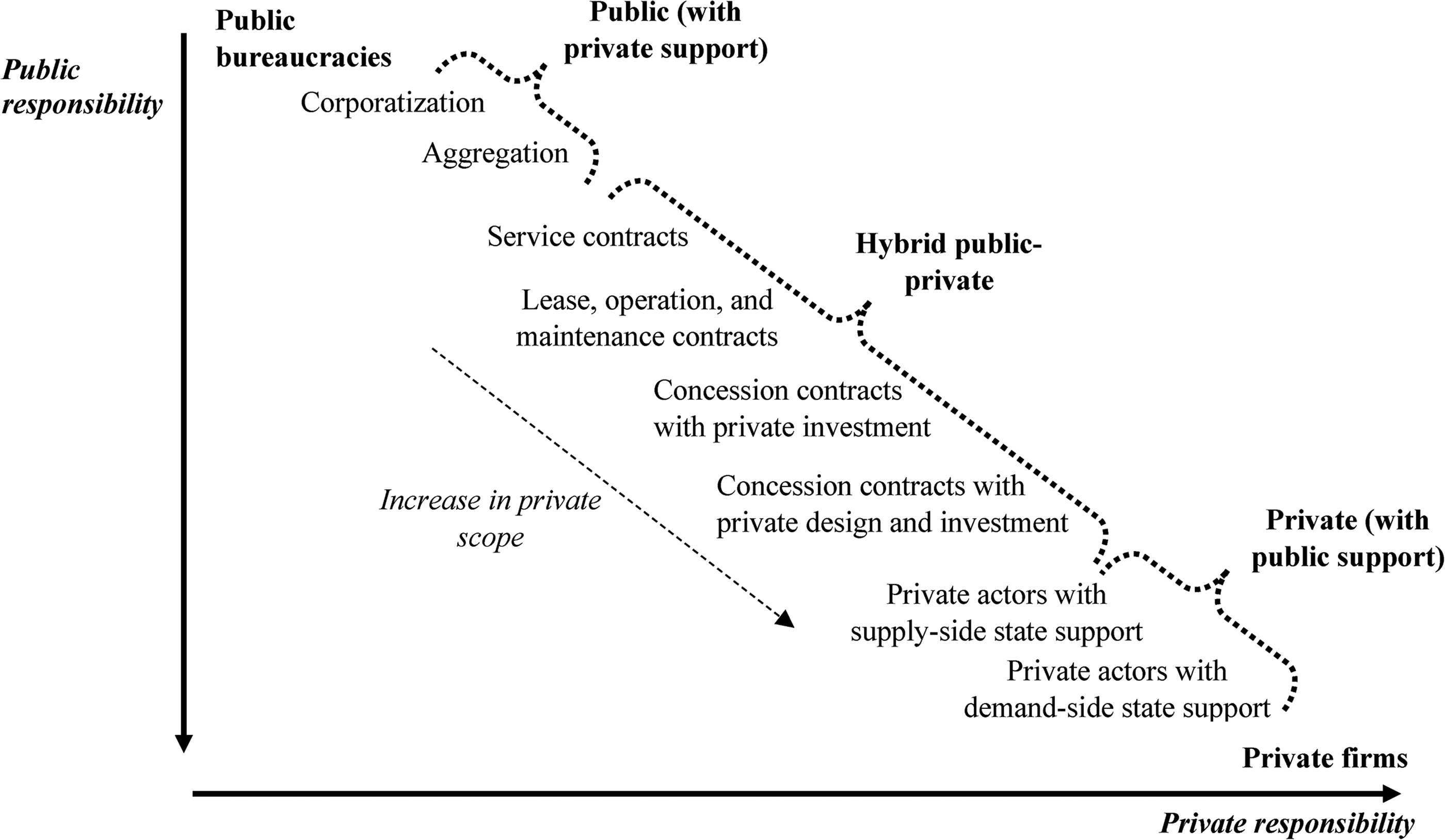
The Spectrum of Public–Private Collaborations.
Public–Private Collaboration Forms for Delivery of Grand Challenge Outcomes
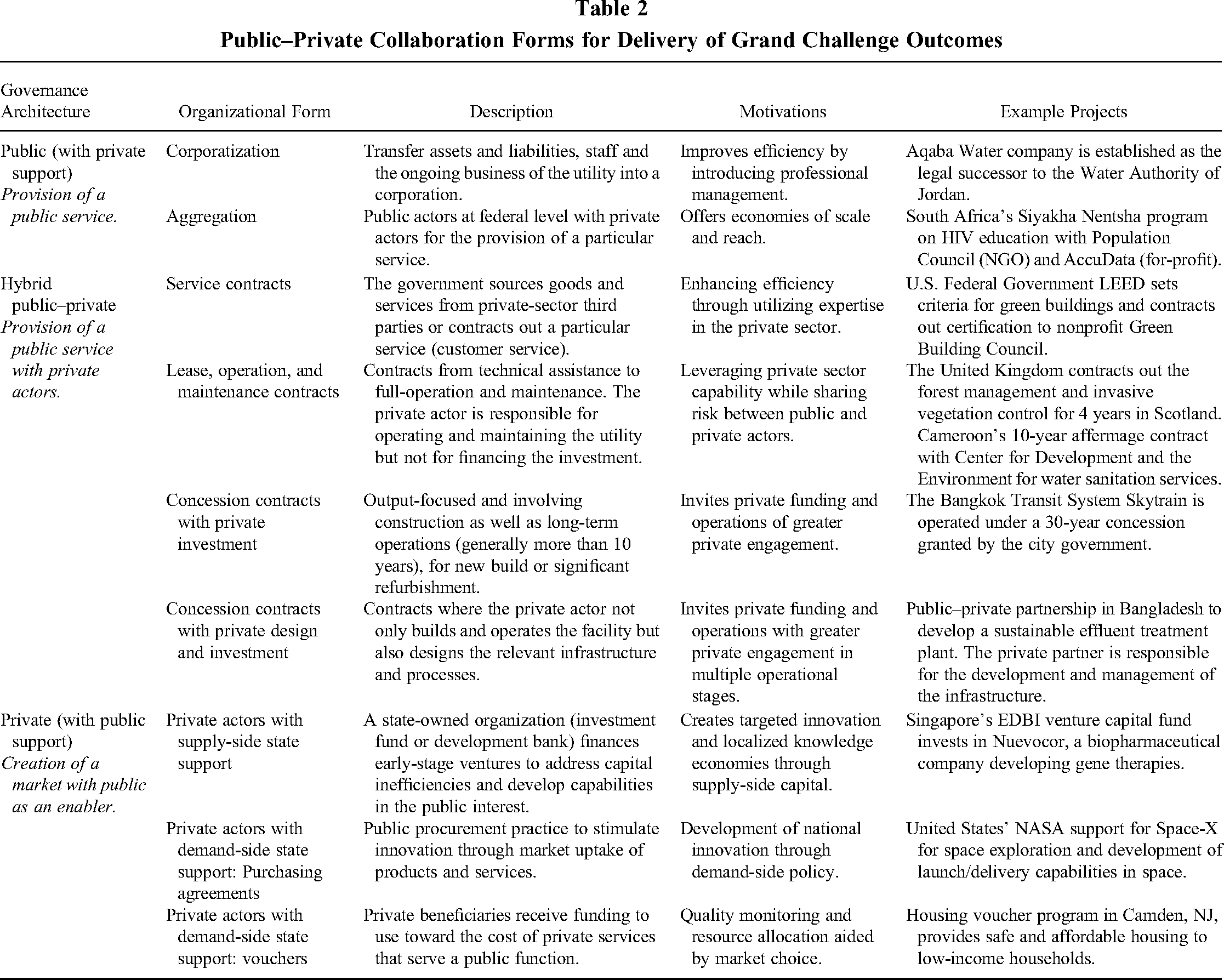
Arrangements at intermediate positions on the public–private spectrum, in turn, involve a multiplicity of hybrid configurations that vary in terms of the scope of private actors’ engagement as well as forms of public sponsorship. Research has conceptualized private scope as the degree to which private actors assume sequential tasks in the public–private collaboration, ranging from the simple management and maintenance of existing public assets to more complex arrangements where private actors help finance and even design the processes and infrastructure involved in the focal activity (Iossa & Martimort, 2012; Quélin et al., 2019). Greater private scope potentially enhances synergies in the operation and design of public services. For instance, the maintenance of highways can be facilitated when private operators design the overall infrastructure to facilitate daily operations (Bennett & Iossa, 2006). Greater private investment entails substantial risk when governments are prone to renegotiate contractual terms and fail to commit to prespecified clauses (Beuve & Saussier, 2021; Levy & Spiller, 1994). Because of these risks and the sunken nature of co-specialized private investments (Henisz & Zelner, 2001; Spiller, 2013; Williamson, 1976), governments may also help sponsor those investments via a range of funding mechanisms. For instance, loans or equity from development financial institutions, state-owned funds, public pension funds, and other vehicles have been used to reduce the cost of private capital and stimulate investment when funding for risky projects is scarce (George & Prabhu, 2000; Inoue, Lazzarini, & Musacchio, 2013).
At the “private” end of the spectrum, organizations are relatively more autonomous. Public actors seek to stimulate private engagement while creating appropriate constraints for private action in the public interest. We differentiate between types of state support on the supply-and-demand sides. Supply-side state support involves policies that seek to stimulate novel private investment and different types of resource allocations that would not normally occur in autonomous markets (Hausmann & Rodrik, 2003). Thus, governments have also regularly subsidized R&D expenses and the development of entrepreneurial ventures, whose funding might be difficult in private markets (Bloom, van Reenen, & Williams, 2019; Mazzucato, 2011). For instance, state-owned funds have supported novel R&D projects of biotechnology firms; in Singapore, EDBI has invested in Nuevocor, a biopharmaceutical company developing gene therapies, whereas Temasek has stakes in BioNTech, which contributed COVID-19 vaccines.
On the demand side, governments might stimulate innovation via public procurement initiatives that engage private actors in the solution of pressing problems. In this case, governments act as clients, creating a new channel through which inventions can be commercialized (Edler & Georghiou, 2007). Still another possibility is to support the customers or beneficiaries of services offered by private firms. For instance, given that private firms might neglect vulnerable communities that cannot afford the prices of high-quality services, a potential solution is to transfer monetary resources to those communities so that they can purchase directly—as in the case of vouchers to enroll low-income students in private schools (Hsieh & Urquiola, 2006) or payments to reduce the cost of housing loans or rents (Alvayay & Schwartz, 1997). Yet, governments have also monitored the use of those vouchers to avoid that the private operators will charge higher prices and exclude the most vulnerable families—an outcome that was observed, for instance, in the early implementation of school vouchers in Chile (Murnane, Waldman, Willett, Bos, & Vegas, 2017).
When they are designed well, these various forms mitigate the problems summarized in Table 1. For example, public sponsorship of entrepreneurship or innovation aimed at addressing the problem of knowing may be effective in cases where private or public actors have latent capabilities that can be further developed with the support of “patient” state capital (Hausmann & Rodrik, 2003). Joint public and private resource allocation can also support complex projects whose results are largely unknown and whose efforts are not contractable ex ante (Hart, Shleifer, & Vishny, 1997), therefore helping address the problem of valuation. Problems of communication and coordination can be addressed by public actors who orchestrate multiple government units in tandem with private actors to improve public services (Osborne, 2006). Well-crafted partnerships with clear private scope and public commitment to rules can also in principle mitigate opportunism and enhance trust at the public–private boundary (Rangan et al., 2006). Monitoring and contractual provisions to avoid the exclusion of vulnerable groups can increase access, especially considering situations where catering to disenfranchised families is associated with higher marginal costs and requires developing novel capabilities to reach those populations “at the last mile” (Lazzarini, 2022; Wong & Skead, 2019).
At an even broader level, PPCs are embedded in national or subnational institutions (North, 1990). On the one hand, they depend on well-functioning legal provisions and norms that reduce the risk of private investment, especially when co-specialized assets are required. Thus, research has found that private investment in infrastructure positively responds to improved regulations and transparent government procedures (Albalate, Bel, & Geddes, 2020; Banerjee, Oetzel, & Ranganathan, 2006; Henisz, 2002). On the other hand, the impetus to develop value-creating collaborations can help improve local institutions. In fact, even if subject to weak national institutions, specialized government units can be created to identify activities that can possibly involve joint public–private action and provide a “micro-level” institutional environment to monitor and deal with recurring adjustments in ongoing partnerships (Engel, Fischer, & Galetovic, 2014; Quélin et al., 2019). In other words, PPCs can, at least in principle, help address the problem of institutions discussed in the previous section by promoting the creation of “pockets of competence” in the public bureaucracy (Evans, 1995). Despite the uniformity of intention, whether PPCs in fact effectively mitigate the set of managerial problems we identified seems to feature considerable variation in outcomes. To reduce that variation, we argue, requires a design perspective—which anticipates and puts in place relevant design features.
Design Considerations in Organizing for Grand Challenges
Having identified the complexities of organizing to tackle GCs (Table 1) and highlighted the plurality of organizational forms in collaborations (Table 2), we now explore the organizational design considerations between public and private actors that distinguish effective GC-focused collaborations. A public–private collaboration, conceived as a multiactor system with one or multiple objectives (Lawther, 2002: 33; Rufín & Rivera-Santos, 2012), can be treated as an organization in and of itself (Fjeldstad, Snow, Miles, & Lettl, 2012; Gulati, Wohlgezogen, & Zhelyazkov, 2012). This perspective gives us access to a menu of concepts and tools for understanding their organizational design—that is, the ways in which the collaboration is constructed to address fundamental problems in the division of responsibilities and in the cultivation of coordinated action aligned with critical goals (Burton & Obel, 1984; Mintzberg, 1980; Puranam, Alexy, & Reitzig, 2014).
It is important to acknowledge that organizations have designs even when no designer explicitly formulates and implements them. Emergent designs are common, both in systems without significant differences in power as well as in those with significant power differentials. In the former, patterns of mutual adaptation among actors (as well as selection out of organizations with poor solutions) can give rise to designs without a designer (Eisenman, Paruchuri, & Puranam, 2020; Levinthal & Warglien, 1999). In the latter, powerful actors may enact a different de facto design from what is intended de jure (Gray et al., 2022). Further, structure (i.e., a designed or emergent pattern of interaction) is not the only component of a design; sorting of actors into and out of the system (for instance, through partner-selection and retention) as well as the collective sensemaking created through leadership, culture, and networks of interaction are also now recognized as crucial elements of an organization's design, as each contributes to how the organization works (Puranam, 2018).
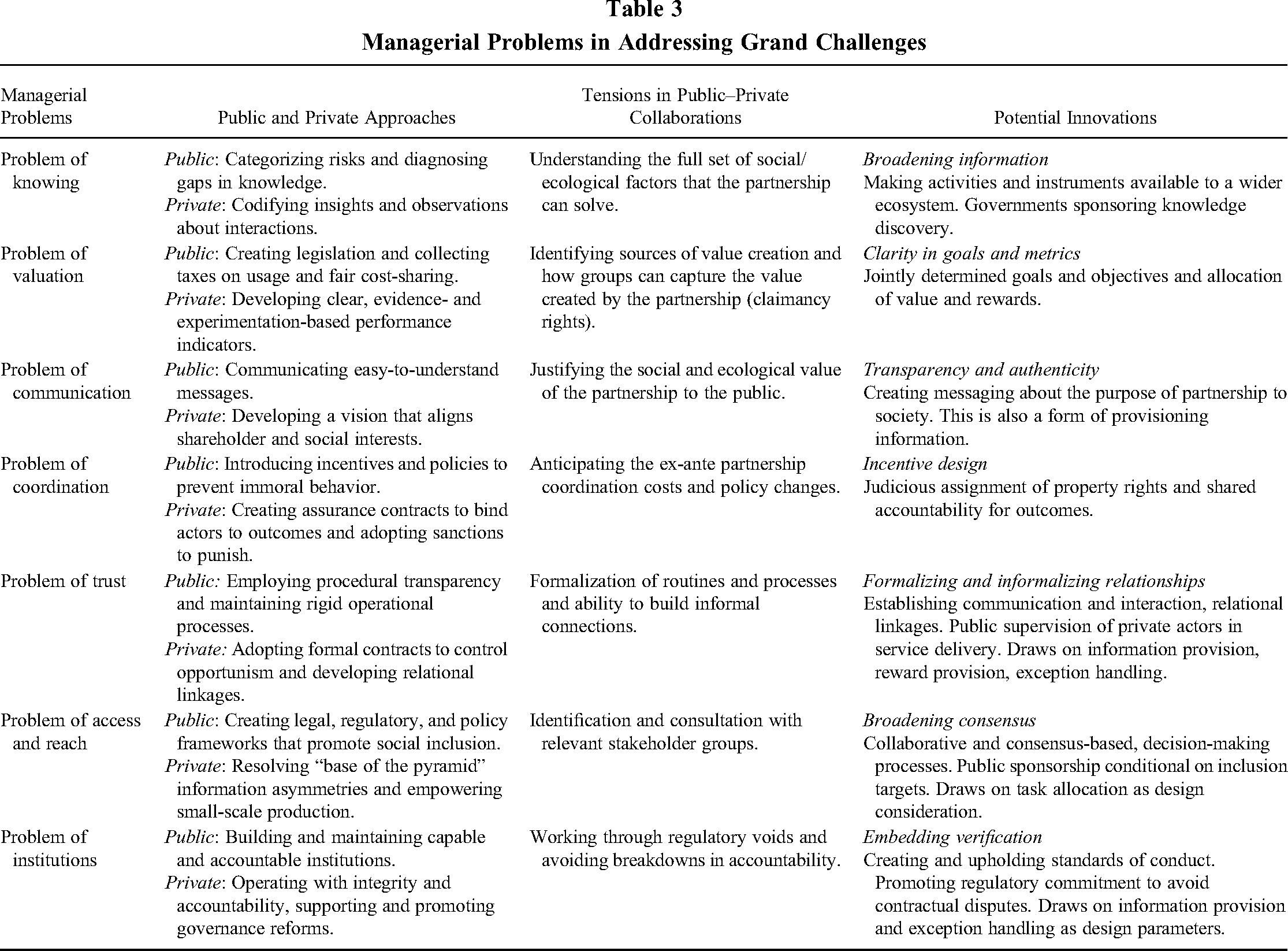
Building on a taxonomy of managerial problems that can impede the efforts of corporations to address GCs (George et al., 2021b), we offer an analysis of these problems as they affect public–private partnerships aimed at tackling GCs from an organization design perspective (Table 3). This allows us to recognize generalized tradeoffs as well as point to the possibility of importing solutions from other contexts (with appropriate care and customization). Critically, such an exercise also helps pinpoint gaps in our current understanding and opportunities for research.
Managerial Problems in Addressing Grand Challenges
The first aspect of an organization’s design is its division of labor. Division of labor involves the twin challenges of task division (what needs to be done) and task allocation (who does what) (Mintzberg, 1980). When forming a new organization, both task division and task allocation must be negotiated and agreed among the organization's members (i.e., the public and private partners in a PPC). In consortia, division of labor is frequently based on the principle of specialization in which different firms take on tasks for which they have a comparative or absolute advantage to generate gains from working together (Gulati et al., 2012; Inkpen & Tsang, 2007). This is not trivial in the context of GCs, given that their intractability stems in part from the complexity of the problems from which they emerge. Information gaps in understanding the root causes of the GC—problems of knowing—can thus impede both task division and task allocations that appropriately leverage the distinct skills of the members in the partnership based on the criterion of specialization. This complexity rules out full knowledge ex ante and implies that a good design for PPCs is one that allows for both offline learning (such as vicarious learning from other PPCs and simulation of possible outcomes based on scenarios) and online learning through trial, error, iteration, and adaptation over time (Puranam & Maciejovsky, 2018).
Other criteria besides the gains from specialization exist for division of labor in organizations. For instance, the selected division of labor might seek to minimize the need for extensive coordination, as in the case of modular systems (Baldwin & Clark, 2000) in which the clusters of self-contained tasks are distributed across partners, without necessarily checking the relative effectiveness of each partner against each task. It is also possible that there are hidden agendas, such that partners seek to copy each other's capabilities and make the other redundant (Hamel, 1991) or subvert the goals of the partner to achieve their own ends. In PPCs, these considerations take the form of restricting certain tasks to remain in public organizations rather than private firms, or an explicit goal for the public entity to acquire the skills of the private entity. Such goals may be particularly salient when tackling GCs, given both their importance for public welfare as well as the large scale and scope of their incidence (George et al., 2016).
The second fundamental aspect of an organization's design is the integration of effort within it. Integration of effort requires mechanisms for solving both coordination and cooperation problems (which can exist independently of each other). In addition, approaches must be developed to resolve exceptions arising from the imperfections in such mechanisms often through some form of dispute resolution, such as consensus or appeal to authority. Cooperation problems are typically solved through some combination of formal and relational contracting (including trust), but in the case of PPCs for GCs, establishing such contracts may be particularly difficult given the problems of valuation that arise in quantifying the opportunity costs of investments (e.g., Bressler, 2021). Trust may also be hard to establish given the scale of the potential spillovers that any successful solution might generate and the temptation to engage in opportunistic behavior to capture them (Keller, Lumineau, Mellewigt, & Ariño, 2021). It might also create a “paradox of trust,” where in some PPCs, governments are required to assume a more arm's length approach with private actors—say, competitive bidding or standardized contracts—even if relational governance often emerges due to the repeated nature of some contracts, and might help self-enforce desirable outcomes (Gil & Marion, 2013).
Coordination can also be challenging in PPCs that address GCs for a compounding reason. Even when information flows freely, its interpretation, and therefore alignment in terms of shared understanding, may be difficult to achieve given the diversity of stakeholders (including those formally outside the PPC—such as the general public) and their interests. The resolution of exceptions and conflicts, often through appeal to legal institutions, may face unique challenges because the foci of action for tackling GCs may be located in environments with weak institutions (i.e., in the economically disadvantaged and poorly governed parts of the world). Furthermore, in PPCs, the state is not only a partner but also an enforcer and regulator, which creates the risk of contractual conflict if there are no independent public agencies setting and monitoring the terms of the exchange apart from the pressure of the government unit commissioning or structuring the collaboration (Quélin et al., 2019).
The preceding discussion suggests that the division of labor (i.e., task division and task allocation) and integration of effort in PPCs addressing GCs may prove to be significantly more complex than that in alliances among the private sector or even PPCs in general. This has several implications. First, some degree of iterative learning by doing within a project seems inescapable, as one cannot typically start with a clear understanding of the problem. Further, there may be benefit from developing a knowledge base of how division of labor and integration of effort among public and private actors was undertaken in PPCs around the world tackling the same GCs. To the extent there are enough structural similarities across these attempts, opportunities for vicarious learning may also exist to complement learning by doing within the project.
Second, it may be useful to introduce a structured process for conducting collaborative self-design among PPCs, in which participants collectively converge on a task division and allocation as well as integration mechanisms in a manner that pools all available information and insight effectively. Participation is useful to pool relevant information. Further, the commitment to implementing the resulting design may be significantly higher because of the participatory process that produced it. Thus, the participatory nature of the PPC becomes an important design consideration, which also defines who are focal and nonfocal actors in a PPC. To be sure, there are predictable errors that groups make when conducting such self-design exercises (Mesmer-Magnus & DeChurch, 2009; Raveendran, Puranam, & Warglien, 2016), but it may be possible to anticipate and mitigate them.
Third, the design of PPCs for GCs may share something in common with how agile development teams work—with significant iterative collaborative discovery of effective patterns of cooperation and coordination among group members (Ghosh & Wu, forthcoming). Recent theoretical work suggests that even in such systems, modest forms of asymmetry and hierarchy can in fact be adaptive (Koçak, Levinthal, & Puranam, forthcoming), implying an important ongoing role for the architects of PPCs tackling GCs. This reinforces what has been learned about how focal actors (sometimes called organizational “architects”) solve the fundamental problems of division of labor and integration of effort in ecosystems, platforms, mega-projects, and opensource communities, all of which are forms of meta-organizations. A unifying idea is that in each of these situations, the system of legally autonomous actors overcomes barriers to collaboration to pursue a recognizable system-level goal (Gulati et al., 2012). Thus, orchestration of effort by the architects becomes an important design feature.
Often, organizational architects leverage their formal or informal power over the system to set in place design solutions to the problems of division of labor and integration of effort. For instance, transparent task architectures allow for effective self-selection of members into a PPC, and a well-designed set of protocols and interfaces can resolve coordination and cooperation challenges among members (and reduce the need for active exception handling as well). A system architect who can design an effective set of modular contracts among the members of a meta-organization has succeeded in creating a low-maintenance design for the system. While this may be an aspirational goal, the nature of GCs makes it inherently difficult to attain—implying the task of the orchestrator is ongoing.
In sum, a PPC in conceptual terms is a meta-organization where the central architect may be the state as a public actor (e.g., Bridoux & Stoelhorst, 2022). A PPC pursuing a GC is a meta-organization that needs to build in more flexibility and the opportunity for revision relative to PPCs in general given the greater possibilities of discovery of new complications as well as insights over time, as is often found to be the case in dealing with complex systems. A key problem for the orchestrator (often the public actor) is to recognize the power asymmetries among participants and how they may use those to subvert the PPC to their own ends (Gray et al., 2022). The orchestrator has the task of safeguarding interests of weaker actors such as citizens or smaller organizations. However, the orchestrator can also lean too heavily; a strongly dictated design is unlikely to be effective at least in part because all information needed to organize is not present ex ante and certainly not present in one actor such as the state. Further, enforcement and monitoring itself can be challenging. This makes the participation of other actors crucial, to obtain not only their information but also their commitment. The architect of PPCs therefore balances orchestration and participation by other key actors to shape the learning through iteration that is essential because of the complexity underlying the GC that the PPC seeks to address.
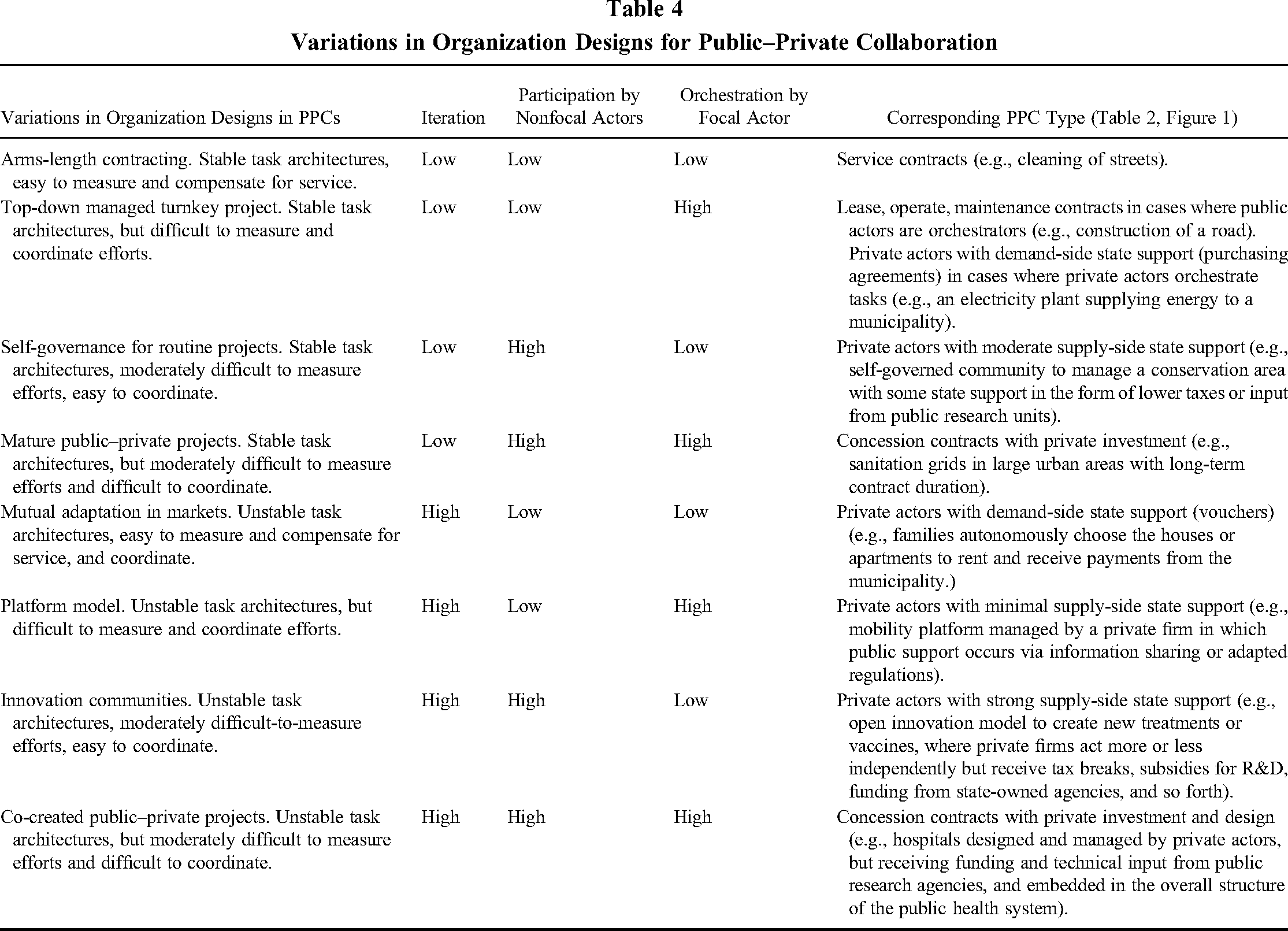
Recent conceptual work has created classifications of organization design frameworks for GCs (e.g., Kaufmann & Danner-Schröder, 2022). In Table 4, we explain that these variations in organization design can be based on the three design considerations described previously based on participation (which stakeholder is included or excluded), iteration (to facilitate learning through interaction and execution), and orchestration (coordination by public actor of private actors). These three design meta-considerations produce eight potential “conceptual” design combinations. In Table 4, we map these potential conceptual designs to current practice-based nomenclature of PPCs (described in Table 2). Other scholars (e.g., Bridoux & Stoelhorst, 2022; Kaufmann & Danner-Schröder, 2022) also provide conceptually similar architectures that can be subsumed within these eight designs. Given our focus to review current literature and enable practice, we highlight eight theoretical design logics underlying PPCs and map them to practice-based definitions of PPCs to enable adoption and managerial relevance.
Variations in Organization Designs for Public–Private Collaboration
Potential Design Innovations in PPCs and GCs
Design considerations call for potential innovations in how PPCs can be enhanced to address grand challenges. Earlier, we highlighted potential innovations to address the tensions between public and private actors using organizational design principles (Table 3). These innovations stem from matching a review of managerial problems in GCs to the organization design principles discussed earlier. We highlight the managerial problem and potential design solutions and illustrate them with an example of a successful PPC that pursued this approach.
First, innovations in provisioning information can help address the problem of knowing by making activities and instruments available to a wider ecosystem where governments sponsor knowledge discovery and sharing across PPC partners. The creation of learning and evaluation units could involve policymakers aggregating information and evidence of potential policies and engaging public and private actors in discussions on how to address potential execution challenges. For example, the government of Chile, via a public agency to assess the quality of education, has implemented the program “Se Puede” (loosely translated, “It Is Possible”) to share experiences in inclusion and innovative pedagogy. Transparency and authenticity of the information provision can also be a useful design feature. Messaging about the purpose of the partnership to society, which may include communication and consultation forums with societal members, improves fairness perceptions through voice and solidarity with stakeholders. For example, in the Hyderabad Water Supply and Sewerage Board project in India, public leaders created forums involving horizonal interactions among members of public bureaucracy as well as consultation mechanisms with citizens to foster awareness and get useful input (Accenture, 2017).
Second, innovation in provisioning of rewards can help address the problem of valuation across jointly determined goals and objectives by clarifying the allocation of value and rewards ex ante. Economic, social, and environment sources of value are identified and influence the return to each stakeholder. For example, the Conservation Impact Bond (CIB) launched in Ontario, Canada, in 2021 to attract new investment into sustainable practices and for reconciliation in regions that are home to indigenous populations. The project was supported by the Canadian government and developed via a network of actors including indigenous communities, farmers, nonprofits, and impact investors—with clear outcome metrics identified to guide performance-based payments (Arjaliès & Gibassier, 2022).
Third, innovation in task division and allocation can help mitigate coordination problems in GCs, including judicious assignment of property rights and shared accountability for outcomes. Project funding and implementation conditional on metrics and compensation mechanisms defined ex ante helps PPC members improve division of labor and integration of effort. For example, in 2007, the World Bank established the Health Results Innovation Trust Fund with capital from multiple donors, designed to fund projects in various social areas. Service providers had clear goals in terms of tasks to be done, and payments were based on regular assessments based on predefined metrics of quality.
Finally, innovations in the exception management infrastructure of PPCs can also play an important role. Formalizing and informalizing relationships can improve trust in PPCs through establishing clear relational linkages between actors. Public supervision of private actors in service delivery also draws on information provision, reward provision, and exception handling. Service or concession contracts managed by private actors but with close (possibly on-site) supervision by public managers can lead to better outcomes than traditional regulation, because the local presence of public managers with partial control rights reduces information asymmetry and facilitates ex post adjustments. For example, the state of Parana in Brazil outsourced the operation of prisons to private firms in the period 1999–2005 but kept public supervisors on site with veto rights to avoid the neglect of essential services within the prison (Cabral, Lazzarini, & de Azevedo, 2013).
Broadening consensus can help address problems of access and reach by improving stakeholder inclusion in collaborative and consensus-based decision-making processes with public sponsorship conditional on meeting inclusion targets. Such a model also draws on task allocation as a design consideration with community-based governance mechanisms that interact with local private firms, nonprofits, and governments to promote inclusion and sustainable production. For example, Natura, a multinational in the cosmetics industry, has created discussion and negotiation forums with small suppliers in the Amazon rainforest in Latin America and has provided input to the creation of new regulatory frameworks to guarantee that communities are able to capture part of the rents coming from sustainable production processes (Gatignon & Capron, 2021; McGahan & Pongeluppe, 2020).
Embedding verification can help address the problem of weak institutional infrastructure by creating and upholding standards of conduct. Verification helps promote regulatory commitment to avoid contractual disputes and also draws on information provision and exception handling as organizational design parameters. Technical personnel with knowledge of public bureaucracy and the ability to interact with private firms can help avoid conflict through ongoing verification of compliance. For example, in Colombia, a national agency associated with the Ministry of Transport is responsible for the planning, management, contracting, and evaluation of PPC. This unit ensures ongoing verification and transparency that reduces potential for PPC members to shirk responsibilities.
In sum, innovations to address societal challenges are possible in solving each of the five fundamental problems of organization design that a PPC tackling GCs necessarily faces (namely, information provision, reward distribution, task division, task allocation, and exception handling). Our review highlights the managerial problems underlying organizing for grand challenges (Table 1), the complex organizational forms of PPCs (Table 2, Figure 1), potential organizational design innovations for PPCs (Table 3), and theoretically distinct organizational forms (Table 4). When managerial problems are mapped to complex collaborative structures, they exacerbate the tensions of goal alignment and resource commitment problems articulated in SDG-17 (Partnership for the Goals). Taken together, this review helps integrate organizational design solutions to the managerial problems in GCs and suggests potential innovations in addressing these societal challenges.
A Research Agenda on Organizing for Grand Challenges
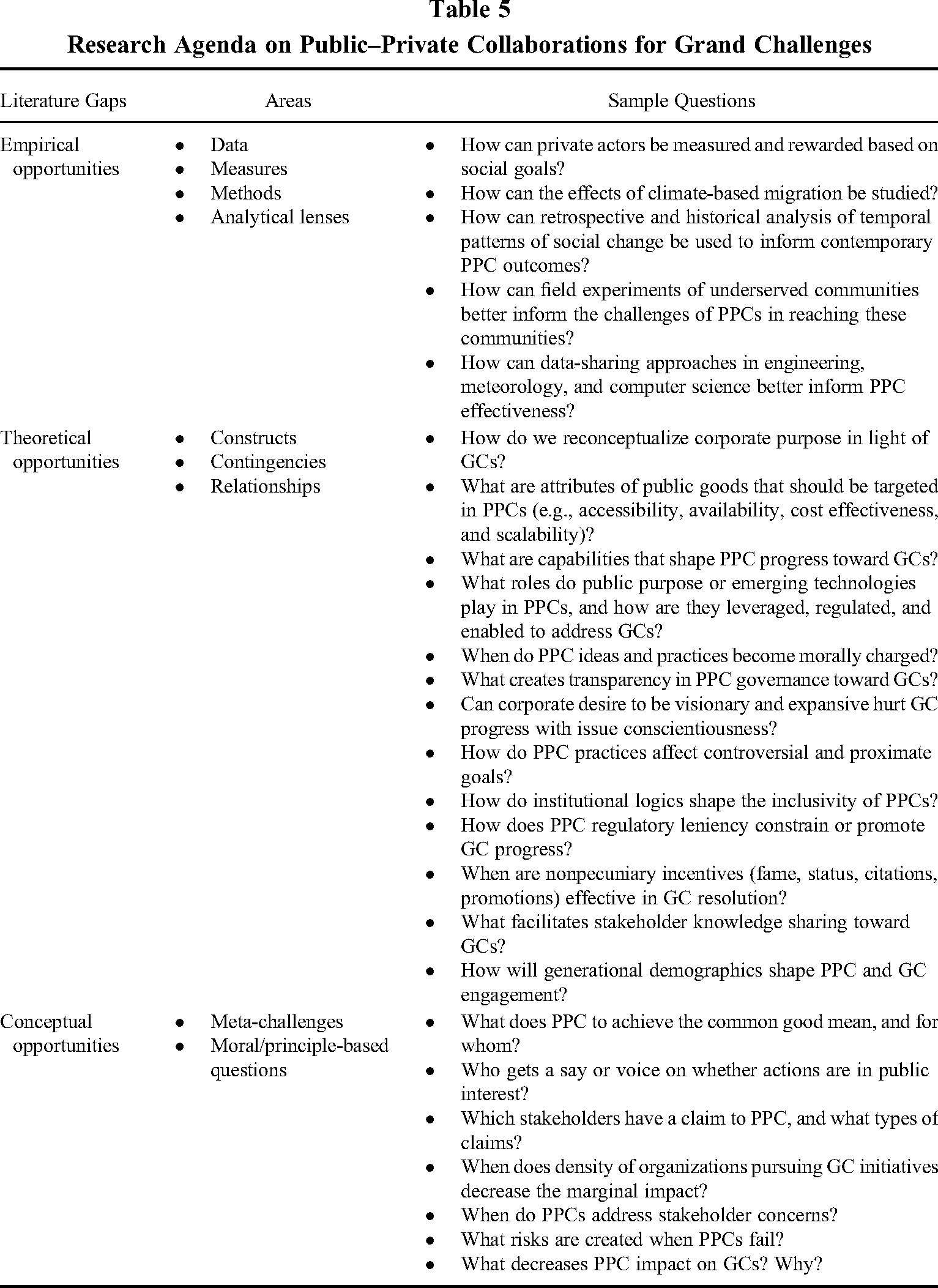
To conclude this review, we present a preliminary and non-exhaustive list of empirical, theoretical, and conceptual opportunities as well as applied problems (summarized in Table 5). Grand challenges arise from complex phenomena with roots within and across all types of human activity. As members of an interdisciplinary field concerned with the deployment of resources in pursuit of prosperity, management scholars are well-positioned to identify missing constructs, contingencies, relationships, causal connections, and interdependencies across fields of action that are complicit in the emergence of GCs and that are critical to their resolution. We must achieve a deeper understanding of how PPCs achieve goal alignment. Inquiry into the effectiveness of various forms of collaboration requires qualitative and quantitative understanding of the ways in which collaborating partners exchange information, implement rewards, act transparently, exercise authority, formalize relationships, informalize relationships, broaden consensus, and embed verification. New databases, methods, and analytical lenses will be required to create knowledge about what works and does not work.
Research Agenda on Public–Private Collaborations for Grand Challenges
A detailed review of the literature on private-public collaboration points to the brittleness in historical dichotomies, such as our conceptualization of what constitutes private versus public organization. PPCs are rich, complicated, evolving, difficult, and yet critical to addressing GCs. A wide range of scholarly opportunities exist for deepening understanding of them. The collaboration itself is an important organizational entity. As such, classical mechanisms of organizational design arise as PPCs form and operate in addressing GCs. The PPC literature in the field of management offers a strong foundation but has only scratched the surface of the body of knowledge needed to accomplish coordinated action on a scale commensurate with GCs.
Empirical Opportunities
The first set of opportunities facing scholars interested in GCs is to develop new databases, measures, methods, and analytical lenses into the mechanisms listed in Table 3 through which private and public actors work together to address GCs. There may be benefits from developing a knowledge base, for example, of how PPCs divide and allocate tasks in different countries as they address the same GCs. To the extent there are enough structural similarities across these attempts, opportunities for cross-learning may exist. Table 5 describes sample questions for this effort. Critically, measures are needed to guide, align, and reward private-sector organizations for acting in the public interest. The challenge of effective measurement and payment according to socially oriented goals is redoubled for organizations that seek to take action in PPCs (Lazzarini, Cabral, Firpo, & Teodorovicz, 2021). Consider, for example, a pharmaceutical firm collaborating with governments, license manufacturers, distributors, and pharmacists to distribute COVID vaccines. How does the PPC broaden consensus about how vaccines should be allocated across governmental partners given variability in the abilities of the governments to pay for and even to distribute the vaccines? What is an appropriate set of rewards as the pharmaceutical firm formalizes its relationships by licensing its intellectual property on the vaccine to third party manufacturers? Should the pharmaceutical firm be compelled to provide information to governmental partners on the quality of strategically important medicines? Each of these questions requires a detailed qualitative and quantitative understanding of the organizational design mechanisms described in this paper. Much more research is required to cultivate this understanding and to interrogate the implications for effective measurement.
A second sample question in this domain of opportunity is to understand intersections between the SDGs (Klein & McGahan, 2021), such as how climate change (SDG-13) affects human migration (SDG-10) (Hajro, Žilinskaitė, & Baldassari, 2022), and the roles of PPCs in addressing these intersections. Although there is a large amount of literature examining tensions when organizations jointly pursue profit-based and socially oriented objectives (e.g., Battilana & Dorado, 2010; Pache & Santos, 2013; Saebi, Foss, & Linder, 2019), there is relatively less research on the organizational design implications of them. Consider, for example, a private-sector firm that works in collaboration with a city government to build secure housing in low-lying, flood-vulnerable city slums in which a large population of low-income citizens live in long-standing but insecure housing. How does the PPC act transparently and with authority under emergency conditions when human life is at stake? How is verification of the effectiveness of each collaborator's engagement managed? A well-intentioned effort to build better homes and develop the urban area may lead to a massive outward migration of the slum's population for a range of complex reasons ranging from the lack of affordability of the upgraded housing to the absence of familiarity and trust in formalized rental contracts. Should the PPC be held accountable for this if the effort to intervene was championed by the local government? How should the success of the effort be measured and assessed? What are appropriate formal and informal relationships for assuring that the city government that issues permits and incentives to encourage the project does not assign responsibility for problems to the partnering private firm that builds the housing? Studies of large infrastructure projects would yield important insights about answers to these questions.
A third sample question in this domain reflects the opportunity for interdisciplinary empirical analysis. For example, Cirac-Claveras (2019) asks how data-sharing approaches in engineering, meteorology, and computer science can inform PPCs regarding their effectiveness even as they do their work. Data-sharing is one of many tools in the field of data science that PPCs deploy to improve their performance. It is also an important feature of the organizational design of PPCs. How can insights across fields be integrated to identify ways in which performance is improved? Similar questions arise regarding transparency and authority as shared analytics, modeling, data stewardship, citizen observational analysis, and surveillance are deployed by private companies in PPCs. Who owns and controls responsibility for these deployments? Significant empirical analysis is needed to accomplish this sharing effectively. Models from different disciplines must be integrated. Datasets must be merged. Different scholarly norms and objectives must be reconciled. Perhaps most difficult, however, is the challenge of conveying insights developed through interdisciplinary analysis to PPCs in ways that are compelling and timely.
The first section of Table 5 offers sample questions that can be asked to promote empirical insights about PPCs in the face of GCs. Many others arise as well. Responding to these opportunities will require substantial creativity and commitment from scholars inspired by the significance of GCs to overcome barriers to specialization and the sheer complexity that arises from the systemic nature of these problems.
Theoretical Opportunities
The second set of opportunities facing scholars is to refine constructs, identify contingencies, and find relationships that lead PPCs to better performance in the face of GCs. The second section of Table 5 describes sample questions in this area. Bhattacharyya et al. (2017), for example, identifies critical components of public goods that should be targeted in PPCs, particularly in health. What are the organizational design features for promoting their development? The researchers in this effort identify accessibility, availability, cost-effectiveness, and scalability as critical components of the effective health-care systems that PPCs seek to develop based on empirical analysis of what works in practice. But are these criteria comprehensive as organizational designers seek to build PPCs with effective mechanisms for coordination (e.g., George et al., 2023)? What is needed is a theoretical breakthrough for identifying and balancing organizational mechanisms to optimize PPC performance in complex situations such as health crises so that organizations are not stalled by conflicts and problems.
A second sample question is asked by researchers seeking to identify the capabilities that shape PPC progress toward GCs (Williams & Shepherd, 2016). We need to know more about how to provide rewards to actors in PPCs. Prior studies have established that firms vary in their capabilities for partnering with downstream distributors and upstream suppliers (Helfat & Raubitschek, 2000). The challenge of developing capabilities within firms of working with governments is likely an order of magnitude more complex than even developing firm-to-firm partnership expertise. This is because public-sector organizations operate in entirely different ways than most private-sector organizations—in their cultures, practices, routines, decision-making processes, and timetables. The politics of reelection, for example, make some public-sector decision-makers less willing to commit to a PPC when the commitment may expose the decision-maker to criticism in a campaign, referred to as third-party opportunism (Spiller, 2013). Hierarchical public agencies may be constrained by budgetary processes that reflect an historical division of responsibilities that is not aligned with the current demands of GCs. A full-scale effort is needed to identify the constructs that constitute capabilities for working in PPCs for both private- and public-sector organizations, as well as the contingencies and relationships that define how those capabilities can be enacted successfully.
A third sample question is the last on the list in section 2 of Table 5: Ciampi, Marzi, Demi, and Faraoni (2020) ask what facilitates stakeholder provision of information within and between organizations toward GCs? This question reflects a broad range of issues in the conveyance of relevant information across and among organizations, stakeholders, and those entitled to be considered in the framing of solutions to problems such as climate change, health inequity, city redesign, migration, and other GCs. Indeed, the theoretical issues raised by this question include developing criteria for even identifying enfranchised stakeholders to an intervention; characterizing relevant information that stakeholders may have; and considering how information is conveyed between stakeholders that may not be equipped, organized, or receptive for the task. These problems are particularly salient and important as organizations seek to work together in PPCs to tackle truly difficult, complex problems for which collective action is essential to make progress.
Conceptual Opportunities
The third set of opportunities is conceptual and focuses on questions of morality or principle in how PPCs are conceived, organized, and structured and the underlying meta-challenges. The third section of Table 4 includes sample questions in this category. One of these questions is posed by George et al. (2021a), who ask how we conceptualize corporate purpose in light of GCs. This question engages with an ongoing debate in the literature regarding the purpose of the firm in society in a broad sense, as well as the legitimacy of the individual purposes of firms in a narrow sense. The broad question reflects that firms in most countries are awarded a range of special privileges, such as limitations on liability for investors and rights to continuity of identity under prespecified governance arrangements. Some firms have exploited these privileges in ways that made them complicit in creating the GCs in the first place. At the same time, the risks that are implicit in the kinds of scaled responses necessary to address GCs makes these privileges appropriate in many instances. The conceptual opportunity is to identify and navigate how a governance form such as the privately owned corporation enables the success of PPCs in addressing GCs.
A second question listed in the third section of Table 5 is posed by Berrone et al. (2016) who ask whether there is a density by which the number of organizations pursuing GC initiatives at a local level decreases the marginal impact. This question evokes consideration of the optimal size of PPCs—and the optimal level of competition between them—in pursuing solutions to important problems such as GCs. We need a deeper conceptual understanding of whether competition, particularly between private-sector corporations, advances the aims of the PPCs to which they are parties. If a particular organization is committed to a PPC and then fails to achieve leadership among its competitors in advancing an important technology or market-based intervention, then should the PPC be disbanded? If so, how should failure be ascertained? These and other conceptual problems are critical to the success of PPCs in addressing GCs.
Perhaps one of the most compelling conceptual opportunities associated with the deployment of PPCs in addressing GCs is to deconstruct the sources of these challenges and the roles of public actors, private actors, and public–private interaction in their emergence. The 17 SDGs are clearly interrelated. Organizational design concerns are pervasive. Conceptual work is required to discern the dimensions of their interrelationships. Further study is needed to identify how these challenges are systematically related to PPCs and to the character of public and private action. Only when we confront the challenges of public and private collaboration can we make true breakthroughs in solving societal issues.
Conclusion
The world is beset by social, environment, political, and economic challenges that show no signs of abatement. It is fast becoming apparent that public sector and multilateral actors will be unable to address them without the help of private enterprise. These societal challenges, ranging from biodiversity to poverty, that were once seen as falling solely under the purview of governments are now being seen as a shared responsibility with the private sector. SDG-17, which highlights the importance of partnerships, is fast becoming the focal point for managerial and organizational innovations to tackle what are seemingly intractable societal problems. SDG-17 calls for goal alignment, coordinated action, and resource mobilization across public and private organizations.
With SDG-17 as a launch point, we review the literature on PPCs to highlight classes of managerial challenges that organizations need to address when tackling grand challenges. The management literature is relatively underinvested in examining the plurality of public–private structures and how these collaborations could be useful tools to address common-good problems. Drawing from an organization design perspective, we showcase the tensions in these PPCs and provide potential solutions for these managerial problems with examples of innovative organizational designs that have been implemented worldwide. Our review brings a much-needed organization design perspective to how we create, structure, and manage these partnerships. Thus, this article provides a new lens and research agenda to study these large, complex, multi-actor collaborations. We call on management scholars to pay heed to how their research expertise and collective efforts can be targeted toward a better understanding of why, when, and how PPCs succeed—and in so doing, find ways to create and sustain innovative collaboration structures that have a lasting impact on the world.
Footnotes

References
Supplementary Material
Please find the following supplemental material available below.
For Open Access articles published under a Creative Commons License, all supplemental material carries the same license as the article it is associated with.
For non-Open Access articles published, all supplemental material carries a non-exclusive license, and permission requests for re-use of supplemental material or any part of supplemental material shall be sent directly to the copyright owner as specified in the copyright notice associated with the article.
