



Abstract
Research on the antecedents of organizational identification (OI), individuals’ sense of oneness with the organization, has developed over time with four major categories: organizational characteristics, managerial policies and practices, interpersonal interactions, and personal attributes. OI research has flourished due to the exploration of antecedents under these four research categories, but it is not well integrated across them. The current lack of integration hinders understanding of the factors that can contribute to OI and how these might jointly shape OI development. To address this important unresolved issue, we seek to provide a comprehensive review of research on the antecedents of OI. In our review, we first summarize the existing research that reflects each of the four major research categories. We then suggest several avenues for future research, including exploration of the longitudinal dynamics between the antecedents and how the antecedents will operate in the context of key emerging work trends: remote work and digital transformation.
Keywords
Organizational identification (OI), defined as “the perception of oneness with or belongingness to an organization” (Mael & Ashforth, 1992: 104), is a historically important variable in management research. The study of OI, and identification more generally, first gained traction in management research three decades ago (Ashforth & Mael, 1989; Mael & Ashforth, 1992). It has since been associated with many positive employee outcomes (Greco, Porck, Walter, Scrimpshire, & Zabinski, 2022; Lee, Park, & Koo, 2015). For example, employees who have stronger OI tend to engage in more organizational citizenship behaviors (e.g., Cho & Treadway, 2011; Wu, Liu, Kwan, & Lee, 2016), show fewer counterproductive work behaviors (e.g., Al-Atwi & Bakir, 2014), and exhibit stronger job performance and work effort (e.g., Bartel, 2001; Chughtai & Buckley, 2010; Finch, Abeza, O’Reilly, & Hillenbrand, 2018; Lu & Sun, 2017). Given the important implications of OI for organizations, a key question for scholars in the literature concerns antecedents that can facilitate (or impede) the development of OI.
Scholars have tended to explore this question by identifying antecedents of OI from different angles, reflecting the literature's “wide variety of micro and macro theoretical perspectives” (Greco et al., 2022: 795). In general, research on antecedents of OI can be differentiated into four research categories. The first research category concerns organizational characteristics that attract individuals to see themselves as members of the organization and promote the development of OI, such as the organization's reputation and prestige (e.g., Baer, Bundy, Garud, & Kim, 2018; De Roeck, El Akremi, & Swaen, 2016; Kreiner & Ashforth, 2004). The second research category considers managerial policies and practices as the bridge to building relationships between employees and the organization. Studies in this category examine practices that can develop employees’ OI, such as high-commitment management (e.g., providing opportunities to participate in decision-making; Fuller, Marler, Hester, Frey, & Relyea, 2006a) and socially responsible human resource management (e.g., providing CSR training; Shen & Benson, 2016). Viewing the organization as the people within it, the third research category explores how interpersonal interactions shape OI and examines specific factors, such as leadership (e.g., Epitropaki & Martin, 2005; Loi, Chan, & Lam, 2014), respect from colleagues (e.g., Bartel, Wrzesniewski, & Wiesenfeld, 2012; Hameed, Roques, & Arain, 2013), trust (Schaubroeck, Peng, & Hannah, 2013), and interpersonal attraction (Edwards & Cable, 2009). Finally, the fourth research category concerns personal attributes that can affect how people link themselves to the organization and use the organization to develop a social identity. This research relaxes the “assumption of universality” that “individuals truly have a general and universal propensity to identify,” and acknowledges personal attributes render some employees more or less likely to define themselves at least partially in terms of their organizational memberships (Glynn, 1998: 238). This research category reflects the view that “organizational identification can occur in the absence of direct interpersonal experiences” and examines predictors of OI, such as individuals’ needs (e.g., need for relatedness, need for affiliation; Rockmann & Ballinger, 2017; Wiesenfeld, Raghuram, & Garud, 2001). OI research has flourished due to the exploration of antecedents under each of these four categories.
Despite the benefits of the literature's proliferation across the four research categories, integration bringing together antecedents from different categories is scant. On the one hand, each category helps deepen the understanding of OI's antecedents from a different angle. On the other hand, their existence creates barriers to gaining a holistic understanding of the factors that can contribute to OI and how these factors might jointly shape the development of OI. Prior research and reviews (e.g., Ashforth & Schinoff, 2016) have acknowledged the different mechanisms underlying identification but have yet to review the empirical antecedents to OI, the different categories of research in this area, and the implications of these different categories for the study of OI. To address this concern, we contend that scholars and practitioners alike would benefit from a comprehensive review of research on the antecedents of OI, based on the four research categories, to understand the different ways OI develops. Such a comprehensive review can help identify avenues for future research, including investigating longitudinal dynamics between the antecedents and understanding how the antecedents will operate in future work contexts. The goal of this review therefore is to first summarize findings from studies in each research category and then offer fruitful avenues for future research.
A Review of OI Antecedents From Four Research Categories
Research on the antecedents of OI can be divided into four research categories, each of which has a distinct conceptualization of the “organization” and considers distinct antecedents of OI. Figure 1 depicts a framework differentiating between the four research categories.
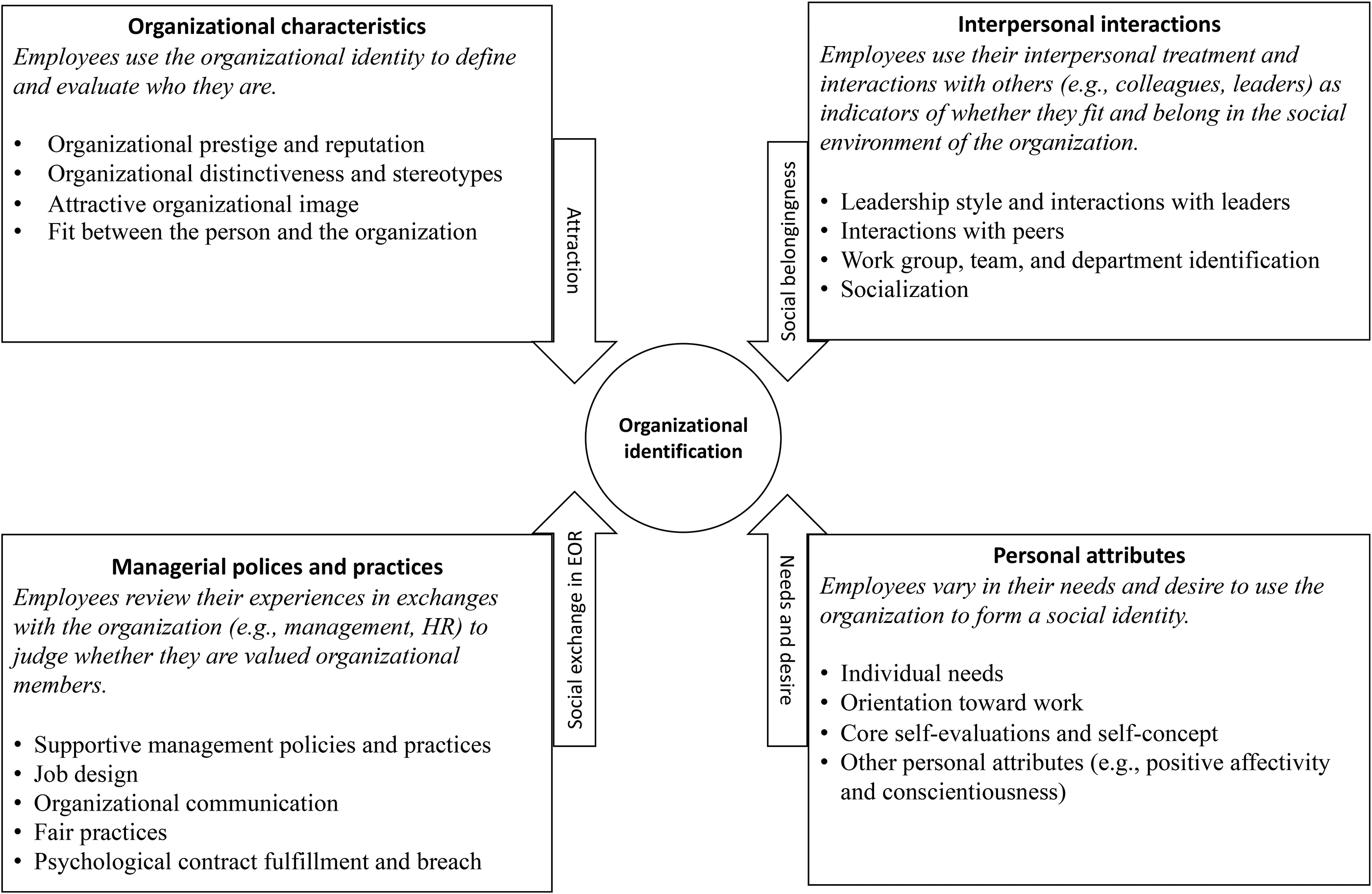
Integrative Framework of OI Antecedents from Four Research Categories
Method
To review the findings of research on OI antecedents, we conducted a literature search to identify all published studies on OI. In early May 2020, we used EBSCOhost to search the Business Source Complete database for articles published in scholarly, peer-reviewed journals between January 1989 and April 2020 that mentioned “organizational identification” in their abstracts and were in English. We selected January 1989 to coincide with Ashforth and Mael's (1989) introduction of social identity theory to the organizational literature. This search yielded 564 results. To be comprehensive, we conducted a similar search using the APA PsycInfo database, yielding 548 results. We further screened these results to remove duplicates and articles that were not in English (or had no translation available) and to identify articles that met four inclusion criteria: (1) published in an empirical study, (2) studied OI, (3) investigated the antecedents of OI, and (4) examined the OI of organizational members (e.g., employees), as opposed to customers or other external stakeholders. Following this procedure resulted in a sample of 394 articles to review, 167 of which (i.e., 42% of the total sample) were published since the last, broad-based conceptual review of OI (Ashforth & Schinoff, 2016). Some articles (i.e., those using quantitative methodologies) were included in a recent meta-analysis that examined the relative contribution of team, organizational, and professional identification to employees’ job attitudes, behaviors, and well-being (Greco et al., 2022). In brief, the articles covered in this review differ from those of previous reviews. In the following section, we present an overview of findings based on the four research categories.
Antecedents Concerning Organizational Characteristics
The first research category concerns organizational characteristics. Studies in this category tend to see organizations as having identities with unique, defining characteristics that are more or less consistent over time (Albert & Whetten, 1985). In other words, organizational identities have a set of central, distinctive, enduring attributes, and these attributes distinguish the organizational identity from that of other organizations, guide action within the organization, and influence how people external to the organization relate to it (Albert & Whetten, 1985). Research in this category suggests OI develops when organizational characteristics attract employees to form a cognitive connection with the organization, thereby facilitating their self-enhancement, differentiating them from others, showing their positive values (e.g., morality, virtue), or maintaining a coherent sense of self.
Organizational prestige and reputation
The status of one's social group can play a role in shaping one's identification, because the social group identity can enhance the individual's self-worth (Ashforth & Mael, 1989; Tajfel & Turner, 1986). Accordingly, external views of the organization, such as its prestige and reputation, that signal an organization's status have been identified as key factors shaping employees’ OI.
Beginning with organizational prestige, numerous studies have found more prestigious organizations tend to foster higher levels of identification (Al-Atwi & Bakir, 2014; Bartels, Pruyn, De Jong, & Joustra, 2007; Bergami & Bagozzi, 2000; Fuller et al., 2006b; Hameed et al., 2013; Mael & Ashforth, 1992; Tsui & Ngo, 2015). For example, one study of lower-, middle-, and top-level management from organizations in the banking, telecommunications, and research and development industries found the perceived external prestige of the organization was positively related to OI, although this relationship weakened once employees had been with the organization for more than 10 years (Hameed et al., 2013). Additionally, changes in perceptions of organizational prestige have been shown to influence changes in OI over time among organizational newcomers (Zhu, Tatachari, & Chattopadhyay, 2017). These findings suggest employees may identify more strongly with the organization when they perceive it is respected, admired, and well regarded (Bergami & Bagozzi, 2000), because when employees identify with such organizations, they can fulfill their need for self-enhancement and create a positive self-concept (Lipponen, Helkama, Olkkonen, & Juslin, 2005; Tajfel & Turner, 1986). Should the organization become involved in a negative incident (e.g., an environmental disaster) or an incongruent horizontal partnership (e.g., with a celebrity), employees may be spurred to reassess their identification (Cornwell, Howard-Grenville, & Hampel, 2018; Petriglieri, 2015). Similarly, if the organization merges with an organization with a poorer image (Bommaraju, Ahearne, Hall, Tirunillai, & Lam, 2018) or has poor performance (Lange, Boivie, & Westphal, 2015), members of the organization, including the CEO, may reduce their OI.
The reputation of the organization—and its leaders—is also important for employees’ identification (Baer et al., 2018; Raghuram, 2011; Zhang, Guo, & Newman, 2017). For example, in a longitudinal study of workers in India, Baer et al. (2018) found employees’ positive perceptions of the organization's reputation at an initial time point were positively associated with employees’ OI one month later (Baer et al., 2018). Additionally, in research examining the role of the organizational leader's reputation, Raghuram (2011) found that when leaders have a reputation for being highly competent and employees trust top management's competence, they are more likely to identify with the organization. A possible reason is that top-management competence legitimizes employees’ formation of an attachment to the organization. Competent senior managers—for example, those who have a past reputation in leading similar businesses or in driving successful organizational performance—may also enhance the prestige and visibility of the organization, which is attractive to employees and further encourages them to identify (Raghuram, 2011). In brief, the reputation of the organization (or its leaders) can prime individuals to identify, because through closely associating with organizations that are reputable, employees can satisfy their self-enhancement need.
Organizational distinctiveness and stereotypes
People identify with social groups not only because of their need for self-enhancement, but also because they are motivated to differentiate themselves from others (Ashforth & Mael, 1989; Tajfel & Turner, 1986). In the organizational context, the organization's distinctiveness (Mael & Ashforth, 1992) and stereotypes (Bergami & Bagozzi, 2000) can therefore be reasons for employees to identify.
Organizational distinctiveness refers to the degree to which the organization has values and practices that differentiate it from other comparable organizations (Mael & Ashforth, 1992). When the organization is more distinct, it provides “a sharper and more salient definition for organizational members” and allows individuals to differentiate themselves more easily from others outside the organization (Mael & Ashforth, 1992: 107). For example, Jones and Volpe (2011) conducted a study of undergraduate students at a Jesuit college in the northeastern United States, asking them to rate aspects of the college, such as the uniqueness of the college's program offerings and service to others, in comparison with other schools. They found students’ perceptions of organizational distinctiveness are positively related to the strength of their OI. Other studies also indicate the distinctiveness of the organization is positively associated with OI (George & Chattopadhyay, 2005; Mael & Ashforth, 1992; Swanson & Kent, 2015; Tsui & Ngo, 2015), because in organizations that have more distinctive characteristics, individuals can better satisfy their need to feel differentiated from other people. In brief, organizational distinctiveness “taps into individuals’ need to be unique and to do so through memberships in distinct categories” (Jones & Volpe, 2011: 415).
The unique stereotypes of an organization can also differentiate it from comparable organizations and play a role in shaping employees’ OI. For example, in a mixed-methods study, Bergami and Bagozzi (2000) used interviews to identify two types of stereotypes that employees had about their organization (i.e., the organization was caring/participative and powerful). The researchers then used quantitative methods to examine the effect of stereotypes on identification, and they found stereotypes affect OI, such that stronger stereotype perceptions are associated with stronger OI (Bergami & Bagozzi, 2000). A strong organizational identity—defined as one that is “widely shared and deeply held by organizational members”—can promote employees’ OI because employees can readily understand the central, enduring, distinctive characteristics of the organization (“This is who we are”) and determine whether the organizational identity aligns with their own values or who they want to become (Kreiner & Ashforth, 2004: 8).
Attractive organizational image
The attractiveness of the organizational identity and external image (Dukerich, Golden, & Shortell, 2002; Elstak, Bhatt, Van Riel, Pratt, & Berens, 2015; George & Chattopadhyay, 2005; Sarrica, Michleon, Bobbio, & Ligorio, 2014) is also important to the formation of employees’ OI for several reasons. First, forming a cognitive connection with an organization that has a desirable image can fulfill self-enhancement needs (Dukerich et al., 2002). Second, through affiliating with an organization that outsiders view positively, employees can enhance their social status (Dukerich et al., 2002). Finally, identifying with an organization that has a specific and strong perceived identity (Cohen-Meitar, Carmeli, & Waldman, 2009) may allow employees to express important values (Lepisto, Crosina, & Pratt, 2015).
Studies have highlighted several specific organizational images that can attract employees to identify with the organization. For instance, because individuals have a desire to demonstrate moral and virtuous values (Lepisto et al., 2015), employees tend to identify more strongly with organizations they perceive to have higher levels of integrity (Lin & Leung, 2014) and those in which leaders demonstrate integrity (Erkutlu & Chafra, 2016). Additionally, employees tend to identify more strongly with organizations that have a socially responsible image, because corporate social responsibility signals the organization's ethical values (De Roeck & Delobbe, 2012), and employees have an opportunity to demonstrate their own ethical values through strengthening their connection to the organization.
Corporate social responsibility may also foster OI because it confers a positive external image to the organization, which employees find attractive and beneficial to their self-esteem. Highlighting this notion, numerous scholars have theorized that employees identify with socially responsible organizations because doing so helps fulfill a need for self-enhancement (e.g., Carmeli, Gilat, & Waldman, 2007b; De Roeck & Farooq, 2018; Edwards, 2009; El Akremi, Gond, Swaen, De Roeck, & Igalens, 2018; Farooq, Payaud, Merunka, & Valette-Florence, 2014; Hameed, Riaz, Arain, & Farooq, 2016; Shen & Benson, 2016; Shen, Dumont, & Deng, 2018a; Shen, Kang, & Dowling, 2018b). Membership in a socially responsible organization may also increase employees’ OI because it increases their sense of pride in being an organizational member. El Akremi et al. (2018), for instance, found organizational pride mediates the positive relationship between corporate stakeholder responsibility (i.e., corporate social responsibility oriented toward the community, natural environment, employees, suppliers, customers, and shareholders) and OI. Scholars have also proposed socially responsible organizations can enhance feelings of inclusion among their members and increase OI through fostering members’ sense of belongingness (e.g., Brammer, He, & Mellahi, 2015; De Roeck & Delobbe, 2012; Lin & Liu, 2019). Empirically, perceptions of the organization's corporate social responsibility have been shown to be positively related to OI (Brammer et al., 2015; De Roeck & Delobbe, 2012; Goswami, O’Brien, Dawson, & Hardiman, 2018; Ko, Moon, & Hur, 2018), including perceptions of the organization's external CSR (i.e., efforts directed toward external stakeholders or the community) as well as the organization's internal CSR (e.g., directed toward employees; Ahmed & Khan, 2019; Hameed et al., 2016).
Preliminary research findings suggest an organization's corporate social responsibility may be even more important than its economic achievements in terms of developing employees’ identification. Namely, Carmeli et al. (2007b) examined employees’ perceptions of the organization's market and financial performance (e.g., sales growth and profitability), as well as the organization's perceived social responsibility and development (e.g., relations between management and employees; development of new products, services, and programs). They found the organization's social responsibility and development have positive implications for employees’ OI, but they found no significant association between perceived market and financial performance and employees’ OI. Nevertheless, although such performance may be less critical to the development of employees’ OI, it may be important to the development of OI in CEOs, whose fate is more closely aligned with the performance of the organization than the traditional employee's. Lange et al. (2015) found a positive association between firm performance (e.g., return on assets, total stock returns) and OI in a study of CEOs (Lange et al., 2015).
Fit between the person and the organization
When employees believe their own values match the values of the organization, they are likely to feel integrated with the organization and define themselves in terms of their organizational membership (Cable & DeRue, 2002). In addition, when the organization has the same values as the individual, the individual can behave in ways that align with their own self-definition, maintain a coherent sense of self, and validate their self-image. Because people prefer to maintain a stable social identity across time and situations, as well as a coherent, integrated sense of self (Amiot, De la Sablonniere, Terry, & Smith, 2007; Ashforth & Schinoff, 2016; Ibarra & Barbulescu, 2010), the organization becomes a relevant social group for the purposes of self-categorization when a fit exists between the person and the organization (George & Chattopadhyay, 2005). In brief, fit with the organization taps into employees’ “desire for cognitive coherence” and motivates employees to affirm their OI (Greco et al., 2022: 809).
Supporting the notion that fit is important to developing OI, research has found person-organization fit—the congruence between an individual's values and the organizational culture (Cable & DeRue, 2002), or the degree to which the values of an individual are similar to the values of the organization (Saks & Ashforth, 1997)—is positively related to OI (Anaza, 2015; Bouraoui, Bensemmane, Ohana, & Russo, 2018; Cable & DeRue, 2002; Demir, Demir, & Nield, 2015; Saks & Ashforth, 1997; Saraç, Meydan, & Efil, 2017). For example, in a study of contract workers, George and Chattopadhyay (2005) found the greater the congruence between the values of contract workers and their employing organization, the greater the contract workers’ identification with the organization. Similarly, in a qualitative study focusing on employees’ fit with the organizational ideology (i.e., the degree to which employees view their goals, identities, and values as similar to those of their organization), Vough (2012) found the more employees share and agree with the abstract beliefs embodied by the organization, the more likely they are to identify with the organization. She argued such a fit provides “self-continuity to the individual, and individuals can more easily process and comprehend groups that are similar to themselves” (Vough, 2012: 786).
In contrast to those studies focusing on a broad sense of person-organization fit, several studies have examined the role of fit based on specific organizational values. For example, in a study of Korean hospital employees, Cha, Chang, and Kim (2014) examined employee–organization prosocial identity fit—that is, the degree to which employees perceived both themselves and the hospital as caring and generous. They found employees tend to identify with the organization when the fit between the prosocial attributes of the organization and their own prosocial values is greater. Research has further highlighted other aspects of fit as being important to employees’ formation of OI, including employees’ perceptions of fit with the organization's brand (Löhndorf & Diamantopoulos, 2014), as well as their perceptions of fit with the environment, such as whether their respective positions offer them what they are looking for in a job (Travaglianti, Babic, Pepermans, & Hansez, 2017).
Antecedents Concerning Policies and Practices
The second research category concerns managerial policies and practices. Studies in this category tend to see the organization as an interaction partner to employees. As an interaction partner, the organization develops a relationship with employees that is premised on the exchange of employees’ effort and loyalty for recognition and rewards from the organization (Blau, 1964). This employee–organization relationship is sustained over time based on norms of reciprocity (Gouldner, 1960). As such, these studies have tended to focus on management practices as key to enhancing employees’ OI. Such practices are positively associated with OI, due to the nature of the employee–organization relationship: when the organization engages in practices that contribute to employees’ welfare, employees are inclined to reciprocate by increasing their psychological investment in the organization. This category thus emphasizes reciprocity norms and the social exchange between employees and the organization (Blau, 1964; Gouldner, 1960). When the organization engages in practices and institutes policies that make employees feel valued, employees reciprocate by increasing their psychological bond with the organization. Specifically, employees identify with the organization when it maintains HR policies and practices that show concern for employees’ welfare, when the organization communicates well with its employees, and when it treats employees fairly and fulfills its promises to them.
Supportive management policies and practices
Supportive HR policies and practices demonstrate management's concern for employees’ well-being, leading employees to return the treatment with enhanced psychological attachment to the organization (Frenkel, Restubog, & Bednall, 2012). Research has explored a wide range of HR policies and practices as playing a role in shaping employees’ OI. For example, Frenkel et al. (2012) examined the role of HR practices that make employees feel more confident in their ability to carry out their jobs well and that help them develop their knowledge and skills, as well as HR policies that are clearly communicated to employees and that managers are in clear agreement on how to implement. They found such practices and policies contribute to the development of OI because they foster employees’ perceptions of fairness in the organization, and “feeling valued, they are likely to identify with the organization” (Frenkel et al., 2012: 4204). Similarly, Fuller et al. (2006b) examined high-commitment management practices, such as providing employees with visibility within the organization, growth opportunities, participation in decision-making, and performance-based pay. They found such practices are positively related to OI because they signal the organization's concern for employees’ welfare, thus encouraging employees to increase their bond with the organization. For a similar reason, organizational benevolence, or the organization's care for employees (Lin & Leung, 2014), and perceived organizational support—the perception that the organization appreciates employees’ contributions and shows regard for their well-being (Eisenberger, Huntington, Hutchison, & Sowa, 1986)—are also positively related to OI (Demoulin, Teixeira, Gillis, Goldoni, & Stinglhamber, 2016; Edwards & Peccei, 2010; Gillet, Colombat, Michinov, Pronost, & Fouquereau, 2013; Jiang & Wang, 2018; Mishra, 2014; Sluss, Ployhart, Cobb, & Ashforth, 2012; Shen & Benson, 2016).
Management may also foster the development of employees’ OI through implementing practices and policies that enhance the meaningfulness of employees’ work and provide employees with opportunities for career advancement. For instance, in an ethnographic study of distributors for the company Amway, Pratt (2000) found sense-breaking and sense-giving practices promote the development of OI. Sense-breaking practices, such as helping distributors develop personal goals, encouraged them to search for meaning, whereas sense-giving practices, such as surrounding employees with supportive organizational members, helped employees find meaning in their work (Pratt, 2000). When sense-breaking and sense-giving practices were successful, distributors positively identified with the organization because their work provided meaning that employees reciprocated with enhanced identification. Regarding career advancement, when employees are enabled to fulfill their career potential and advance in the organization through promotions, they are likely to enhance their OI because they appreciate that management has made them feel like a valued organizational member (Reade, 2001a). Similarly, when management provides jobs that allow employees to grow and advance in their careers, such as challenging jobs (Carmeli, Cohen-Meitar, & Elizur, 2007a; Cohen-Meitar et al., 2009) and jobs that have a high degree of autonomy (Bamber & Iyer, 2002; Cohen-Meitar et al., 2009), employees are more likely to identify with the organization.
Job design
Employees’ job design can also play a role in shaping their OI, because the informational and relational structure of the job has implications for employees’ sense of belongingness. For instance, when employees are unclear what is expected of them at work, either due to insufficient information about their role requirements or conflicting messages (Showail, McLean Parks, & Smith, 2013), they can feel lost in the organization and be hesitant to identify. Role ambiguity can also impede OI, because when employees are unclear about their job functions, they may feel unclear about their place within the organization and “wonder whether they belong” (Showail et al., 2013: 3962). Additionally, the extent to which the job is designed to be physically isolated or distant from the organization may influence OI. In a study of virtual employees, for example, Bartel et al. (2012) found physical isolation is negatively associated with employees’ perceptions of respect in the organization and thus with their OI. Similarly, a study by Wieseke, Kraus, Ahearne, and Mikolon (2012) revealed physical distance from the company's corporate headquarters reduced OI in a sample of salespeople.
Whether the job is designed to be a fixed-term or permanent role may also predict employees’ OI. For instance, a study of workers from a large international service organization found having a limited-term work contract, as opposed to a more open-ended, permanent contract, was negatively associated with OI (Johnson & Ashforth, 2008). A study of contingent versus regular workers in the hotel industry found a similar negative effect of contingent work status on OI (Buonocore, 2010). Nevertheless, OI is possible for contract workers (George & Chattopadhyay, 2005), and recent research has sought to understand the mechanism by which specific types of contract workers come to identify with their firms (Rockmann & Ballinger, 2017).
Organizational communication
How organizations set up and utilize communication channels to interact with employees is also a factor that can affect employees’ OI. For example, a study by Chen and Wen (2016), involving management-sponsored mentoring dyads, found formal mentoring is positively associated with OI. Formal mentoring can help promote OI for two reasons (Chen & Wen, 2016). One, mentoring is a way to provide support within the organization and can make employees feel appreciated and respected within the workplace. Thus, mentoring may enhance employees’ perception of belongingness. Two, through mentoring relationships, mentors pass along organizational values and norms to employees, which can make employees feel internally consistent with the organization and, in turn, increase their sense of identification. Regarding the role of communication tools in developing OI, a study by Wiesenfeld, Raghuram, and Garud (1999) found e-mail communication is positively associated with OI among virtual workers, whereas phone communication is positively associated with OI among workers who spend a greater proportion of their time in the office. These findings suggest that when management builds the appropriate forms of communication into jobs, they may enhance employees’ OI.
The quality of the organization's communication, or communication climate, can also importantly shape employees’ OI. In brief, when management fosters supportive, open, and honest communication, employees are likely to show their loyalty to the organization by increasing their identification (Bartels et al., 2007). Research has shown the perceived adequacy of the organization's downward communication (e.g., adequate two-way communication between management and employees, timely and useful communication about organizational policies) and empowering communication practices are positively associated with OI (Atouba, Carlson, & Lammers, 2019; Bartels, Peters, De Jong, Pruyn, & van der Molen, 2010). Further, a healthy communication climate in which employees can provide input into the organization fosters employees’ OI, because when employees have control, influence, and authority in the organization, they feel like valued members of the organization (Vough, 2012). Based on a similar reasoning, when employees have limited ability to participate in decision-making, they tend to have lower OI (Gossett, 2002).
Fair practices
Fair practices within the organization can also serve to promote employees’ OI. When employees receive fair treatment in the organization, such as fair pay and rewards, and respect in their interactions with organizational representatives, they are likely to feel as though the organization values them as members. In turn, due to norms of reciprocity (Gouldner, 1960), employees exchange the fair treatment for their enhanced effort, loyalty, and psychological attachment to the organization. Across various studies, all three types of organizational justice (i.e., procedural, distributive, and interactional—composed of informational and interpersonal justice) have been shown to be positively related to OI (Asadullah, Akram, Imran, & Arain, 2017; Cheung & Law, 2008; Cho & Treadway, 2011; Choi, Moon, Ko, & Kim, 2014; De Cremer, 2006; Dunford, Jackson, Boss, Tay, & Boss, 2015; Frenkel et al., 2012; Hassan, 2013; He, Zhu, & Zheng, 2014). Fair practices may be particularly important for OI during a merger process. A longitudinal study of students from a recently merged university, for instance, revealed the perceived fairness of the merger process positively predicted students’ post-merger identification, and the positive effect of fairness increased over time (Gleibs, Mummendey, & Noack, 2008). Another study of employees from organizations that had undergone recent mergers and acquisitions (M&A) revealed a similar importance of justice, with perceptions of interactional justice (e.g., being treated by managers with kindness, respect, and dignity regarding job decisions) having a positive effect on employees’ OI following the M&A (Ismail & Baki, 2017).
Psychological contract fulfillment and breach
Management can also shape employees’ OI by engaging in fair practices and upholding their end of the psychological contract (i.e., employees’ beliefs regarding the terms and conditions of a reciprocal exchange agreement with their employers; Robinson & Rousseau, 1994; Rousseau, 1989). Central to the concept of psychological contracts is reciprocity: when management shows concern for the welfare of employees, employees’ expectations about what they ought to provide the organization in return tends to increase. Thus, when management shows concern for employees, employees increase their OI, and this implicit contract is fulfilled. Indeed, research supports the notion that psychological contract fulfillment is positively related to OI (Arain, Bukhari, Hameed, Lacaze, & Bukhari, 2018; Rodwell, Ellershaw, & Flower, 2015).
By contrast, when management breaches the psychological contract with employees, the employee–organization relationship is damaged and employees tend to reduce their identification with the organization (Epitropaki, 2013; Kreiner & Ashforth, 2004; Li, Wong, & Kim, 2016; Rodwell et al., 2015; Wei & Si, 2013; Zagenczyk, Gibney, Few, & Scott, 2011; Zagenczyk et al., 2013). Common examples of psychological contract breach in organizations include performance bonuses that fail to meet employees’ expectations, promotions that are denied or not provided in employees’ expected time frame, and employees’ perceptions of insufficient training relative to what they were promised (Robinson & Rousseau, 1994). Breach of the psychological contract overall creates a sense of betrayal that has negative implications for the employee–organization relationship (Rousseau, 1989) and, in turn, employees’ OI.
Antecedents Concerning Interpersonal Interactions
The third research category emphasizes interpersonal interactions. This category follows Schneider's (1987: 437) idea that “organizations are functions of the kinds of people they contain” and that interpersonal experiences, such as the social exchange between employee and supervisor and receiving respect from colleagues, can shape OI in a socialization process. This category recognizes that employees look at how other organizational members (e.g., leaders and colleagues) treat them to make judgments about whether they fit and belong in the social environment of the organization. When employees feel they are valued, respected, and accepted by others in the organization, they identify more strongly, due to the sense of belongingness that organizational membership brings (e.g., Baumeister & Leary, 1995; Tyler & Blader, 2003). In brief, a dominant perspective underlying this category is social belongingness—the notion that individuals increase their psychological attachment to organizations in which they feel accepted and a sense of belonging (Ashforth & Schinoff, 2016; Baumeister & Leary, 1995; Cooper & Thatcher, 2010; Tyler & Blader, 2003; Vignoles, Regalia, Manzi, Golledge, & Scabini, 2006). Most studies in this category have investigated environmental factors that can contribute to employees’ OI, such as positive leadership and supervision; interactions with peers; identification with local work groups, teams, or departments; and socialization. Below, we elaborate on key antecedents in this category.
Leadership style and interactions with leaders
Several leadership styles tend to foster employees’ OI, including servant leadership (Chughtai, 2016; De Sousa & Van Dierendonck, 2014; Otero-Neira, Varela-Neira, & Bande, 2016; Zhang, Kwong Kwan, Everett, & Jian, 2012; Zhao, Liu, & Gao, 2016) and self-sacrificial leadership (Li et al., 2016). Additionally, leaders who are high in humility tend to evoke employees’ identification (Li, Liang, Zhang, & Wang, 2018). These findings suggest organizational members may be more likely to develop a sense of belongingness to the organization when the organizational leader highlights employees’ strengths (Li et al., 2018) and demonstrates concern for employees’ well-being and growth (Zhang et al., 2012; Zhao et al., 2016), such that they are even willing to forgo their own self-interest for the benefit of employees (Li et al., 2016). Similarly, support and appreciation from an immediate supervisor can foster employees’ OI (Atzori, Lombardi, Fraccaroli, Battistelli, & Zaniboni, 2008; Reade, 2001a).
Research also shows transformational and transactional leaderships are positively associated with employees’ OI (Effelsberg, Solga, & Gurt, 2014; Epitropaki & Martin, 2005), with transformational leadership having the stronger positive relationship (Epitropaki & Martin, 2005). These findings suggest employees more readily identify with the organization when the leader goes beyond simply clarifying performance expectations and role responsibilities and instead acts as a role model who inspires, stimulates, and considers employees’ individual needs (Epitropaki & Martin, 2005). In addition, developmental leadership, which involves “developing subordinates’ work-related knowledge and skills and facilitating their personal and vocational development” (Zhang & Chen, 2013: 536), can make employees feel they fit and belong in the organization and increase their OI. In contrast to those leadership styles that enhance employees’ identification, notably little research has examined leadership styles that hinder the formation of OI, although some studies indicate harmful effects of abusive supervision (e.g., Liu, Zhang, Liao, Hao, & Mao, 2016; Lyu et al., 2016).
Beyond leadership styles, exchanges with leaders are also instrumental to the formation of employees’ OI. For instance, numerous studies highlight that the quality of leader-member exchange (LMX) is positively associated with the employee's OI (Hussain & Shahzad, 2019; Jungbauer, Loewenbrück, Reichmann, Wendsche, & Wegge, 2018; Katrinli, Atabay, Gunay, & Guneri, 2008; Loi et al., 2014; Lu & Sun, 2017). Because employees often perceive supervisors as representatives who symbolize the organization and its values, employees who have higher LMX quality with their supervisors tend to see themselves as ingroup members of the organization and thus develop stronger OI than employees with lower LMX quality. Organizations seeking to strengthen their employees’ OI may therefore start by building relationships between employees and supervisors that are characterized by mutual respect and trust; such high-quality relationships may be especially important to developing OI when employees experience low levels of job security (Loi et al., 2014).
Interactions with leaders may also be important to the formation of OI. Research has found constructive interactions with senior leaders and supervisors (e.g., in which they provide encouragement to employees) are positively related to employees’ OI (Campbell & Im, 2015). Beyond real interactions with leaders, even positive, imagined contact with a leader (i.e., the CEO) is believed to potentially enhance employees’ OI (Meleady & Crisp, 2017).
Interactions with peers
Employees regularly interact, not only with leaders but also with other members of the organization, such as peers and coworkers, and these “interactions with others provide a microcosm through which members experience the organization” (Schaubroeck et al., 2013: 1152). Interactions with peers can shape OI because employees use these experiences to judge whether they belong in the organization, and when employees develop a sense of belongingness, they tend to at least partially self-define in terms of their organizational membership.
Research has examined employees’ interactions with peers from various angles. For example, Smith, Amiot, Smith, Callan, and Terry (2013) examined the development of OI among new employees and found that when newcomers received positive social feedback about their behaviors from peers, they tended to use more positive “engagement coping strategies” to adapt to their new roles, such as seeking emotional and social support and positively reframing the situation. Consequently, because of engaging in these positive coping strategies, employees developed stronger OI (Smith et al., 2013). Interactions with peers can also enhance OI, because experiencing positive affect toward one target (i.e., peers) can transfer to another target (i.e., the organization; Schaubroeck et al., 2013). Further, “peers can provide emotional support and a sense of belonging to a group” (Schaubroeck et al., 2013: 1153). Providing additional evidence that peers importantly shape OI, Wiesenfeld et al. (2001: 218) examined the role of perceived work-based social support, or the extent to which employees perceive they have good relations with their colleagues. Their findings suggest perceived work-based social support may serve as a contextual cue to employees about their place within the organization (i.e., whether or not they belong) and thus influence the formation of employees’ OI (Wiesenfeld et al., 2001).
In contrast to positive interactions, negative interactions with peers (and leaders) tend to discourage employees from forming OI. For instance, because such situations threaten employees’ sense of belongingness, employees tend to withhold their identification from organizations in which they lack internal respect (Bartel et al., 2012; Schaubroeck, Peng, & Hannah, 2016) and are socially ostracized (Gkorezis, Panagiotou, & Theodorou, 2016; Wu et al., 2016). Beyond interactions with peers and leaders, interactions with other individuals (e.g., people with whom employees meet during community outreach efforts) can also influence the extent to which employees identify (Bartel, 2001).
Work group, team, and department identification
Below the level of the organization, identification at the level of the work group, team, or department can also positively influence OI. In brief, experiencing a sense of belongingness at the group, team, or department level serves as the basis for employees to form a more general sense of belongingness to the organization, and thus to develop OI. Numerous studies have established the existence of a significant positive relationship between group or team identification and OI (e.g., Bartels et al., 2007; Christ, Van Dick, Wagner, & Stellmacher, 2003; Van Dick, Van Knippenberg, Kerschreiter, Hertel, & Wieseke, 2008). A cross-sectional study of regional police force employees in the Netherlands, for example, revealed that work group identification, department identification, and business unit identification were each positively related to OI (Bartels et al., 2007). However, business unit identification was a stronger predictor of OI than department and work group identification, suggesting belongingness to a broad subgroup in the organization can provide a particularly strong basis for OI to form. Nevertheless, localized subgroups can provide a strong basis for identification (e.g., because these subgroups may attract very strong identification and better fulfill individuals’ needs for optimal distinctiveness) (Ashforth, Harrison, & Corley, 2008).
Support for the positive link between work group identification and OI has also been found in other studies. For example, a study by Bartels, Douwes, De Jong, and Pruyn (2006) found premerger work group identification was associated with higher expectations regarding postmerger OI, although this finding only held true for employees who were indirectly involved in the merger (i.e., employees for whom the merger would not bring substantive changes to the work group). For employees who were directly involved in the merger, and for whom the merger would directly affect their work group, work-group identification was not associated with expectations regarding postmerger OI, potentially because imminent changes to the work group prevented employees from using their premerger work-group identification to form expectations around postmerger OI. Other research suggests the link between work-group identification and OI may be stronger when employees perceive more similarities between the two identification targets (i.e., the work group and the organization; Marique, Stinglhamber, Desmette, & Goldoni, 2014).
Although numerous studies have investigated group-level identification as an antecedent of OI, relatively little research has examined other group-level antecedents of OI, likely because group-level variables may be more readily viewed as antecedents of more proximal, group-level identification. Nevertheless, research indicates potentially interesting cross-level effects. Swanson and Kent (2015), for example, conducted a study of business-operations employees from five U.S. professional sports league organizations (i.e., Major League Baseball, Major League Soccer, the National Basketball Association, the National Football League, and the National Hockey League) and found that the employees’ perceived fit with their teams had a positive effect on their OI.
Socialization
Studies in this category regard the organization's socialization practices as critical to developing employees’ sense of belonginess and thus their OI (Ashforth & Saks, 1996; Raghuram, 2011). Socialization is the process through which organizations disseminate their values and behavioral expectations for new employees, and when socialization is effective, employees internalize the organization's values and develop a deeper sense of belongingness to it (Raghuram, 2011). Numerous studies have shown socialization tactics are positively related to OI. For instance, a longitudinal study involving newly working business school graduates found socialization tactics (e.g., grouping newcomers together to go through a common set of experiences, having a defined socialization period during which newcomers are held separate from other organizational members, following a sequence of steps that pave the way for seamless entry into new job roles) were positively associated with the graduates’ OI 4 months and 10 months into their new jobs (Ashforth & Saks, 1996). Indeed, OI has been called “a key socialization outcome, in that it represents a favorable psychological bonding of a newcomer to an organization” (Schaubroeck et al., 2013: 1152). Socialization can further build employees’ OI through fostering their relational identification with supervisors, which employees subsequently generalize to the organization (Sluss et al., 2012).
Antecedents Concerning Personal Attributes
The fourth research category concentrates on personal attributes. This category recognizes that individuals can use the organization to form a social identity, fulfilling their personal needs and goals (Ashforth & Mael, 1989), but further emphasizes people can vary in these needs and goals. Below, we elaborate on antecedents in this category, although we note research on personal attributes has been less extensive than other categories. As Kreiner and Ashforth (2004: 8) noted nearly two decades ago, “Previous research has had little to say about individual-level antecedents of organizational identification and disidentification.” Although some research has emerged to address this gap, their conclusion largely remains true today.
Individual needs
Employees differ in their individual needs, making some more likely than others to identify with the organization. Most directly linked to OI, scholars have proposed that although all individuals likely have some tendency to identify with social groups, some employees may have a stronger need than others to identify with their work organizations, reflecting variation in their “need for organizational identification” (Glynn, 1998: 238). By need for OI, we refer to an individual's “generalized desire to derive at least a partial self-definition from a work organization of which he or she is a member” (Kreiner & Ashforth, 2004: 13)—in other words, “an individual's need to maintain a social identity derived from membership in a larger, more impersonal general social category of a particular collective” (Glynn, 1998: 238–239). Employees’ need for OI is measured by their responses to items such as “Without an organization to work for, I would feel incomplete,” and “An important part of who I am would be missing if I didn’t belong to a work organization” (Kreiner & Ashforth, 2004: 26). According to Glynn (1998: 240), employees who have a stronger need for OI are more receptive to the organization's socialization and imprinting, and thus, these employees are more likely to identify with the organization. Indeed, research finds individuals’ need for OI is positively associated with their OI (Boroş, Curşeu, & Miclea, 2011; Guo et al., 2018; Kreiner & Ashforth, 2004).
Other individual needs have also been examined as antecedents of OI. One such need is the need for affiliation, or individuals’ “desire for social contact or belongingness” (Wiesenfeld et al., 2001: 216). Wiesenfeld et al. (2001) suggest individuals who have a stronger need for affiliation more strongly value group memberships and relationships with others, and thus, these individuals are more likely to identify with organizations. Other individual needs that have been investigated as possible antecedents of OI include those innate psychological needs outlined by self-determination theory (Deci & Ryan, 2000): the needs for competence (i.e., felt efficacy), relatedness (i.e., connection), and autonomy (i.e., control; Rockmann & Ballinger, 2017). Specifically, in a study of on-demand workers—workers who perform tasks for clients on short-term contracts, facilitated by third-party firms—Rockmann and Ballinger (2017) examined whether the fulfillment of personal needs for competence, relatedness, and autonomy is positively related to OI; they hypothesized that personal-needs fulfillment is positively associated with OI, because when individuals’ needs are met by their work, they feel intrinsically motivated to stay engaged in the work and further strengthen their relationship with the firm. However, the researchers found only the fulfillment of needs for relatedness and autonomy predict variance in intrinsic motivation and thus OI, suggesting that if the fulfillment of competence promotes OI, it may do so through an alternative mechanism.
Orientation toward work
Individuals vary in how they experience their work, and these differing orientations may affect their OI. For instance, some individuals possess a strong “calling” orientation or “view toward work in which one expects work to be both purposeful and inherently meaningful” (Cardador, Dane, & Pratt, 2011: 367). Employees who possess a strong calling orientation may have a higher propensity to identify with the organization because they may view it as a social environment in which they are pursuing highly valued goals (e.g., pursuing meaningful work, making a difference in the world), and thus invest in this environment by strengthening their attachment to it (Cardador et al., 2011: 367). For a similar reason, employees with a strong promotion focus (Schuh et al., 2016) are also more prone to identifying with the organization. Additionally, employees who feel a strong passion for their work (Astakhova & Porter, 2015; Kong, 2016) or professional identification (Bamber & Iyer, 2002) may develop strong OI due to having a strong attachment to their work and profession, which generalizes to another target (i.e., the organization; Sluss & Ashforth, 2008).
Core self-evaluations and self-concept
Research suggests employees may be more likely to develop OI when they have higher core self-evaluations and specific self-concepts. First, concerning their core self-evaluations (Judge, Locke, Durham, & Kluger, 1998), research finds employees’ internal locus of control and personal control—that is, “employees’ belief that they have autonomy on the job as well as an impact on important work outcomes”—are both positively related to their OI (Lee, 2013; Tangirala & Ramanujam, 2008: 1189). This positive relationship may be observed because when employees believe they have greater control over their work and in the organizational environment, they may feel a greater sense of shared fate with the organization and develop a stronger sense of cognitive overlap. Additionally, and also concerning individuals’ core self-evaluations, research suggests employees who have greater emotional stability (Echchakoui, 2016) and higher self-esteem (Saks & Ashforth, 1997) may be more inclined to identify with the organization. Individuals with high levels of emotional stability tend to develop OI because they are good at social adjustment (Costa & McCrae, 1992), which enables them to build positive relationships and fit within the organization. On the other hand, individuals with high levels of self-esteem may be more inclined to identify because they tend to choose organizations that are more congruent with their self-image (Keon, Latack, & Wanous, 1982), thus enhancing their person-organization fit perceptions (Saks & Ashforth, 1997). These findings are in line with the central proposition of social identity theory that self-enhancement motivates individuals to identify with social entities.
Individuals who hold specific self-concepts may also be more likely to develop OI. For example, research has examined the role of individualist versus collectivist self-concept orientations, or self-construals, in which individuals see themselves as unique and separate from others (e.g., “Being a unique individual is important to me” in Guo et al., 2018: 364) or, importantly, as members of a group (e.g., “It is important to me to maintain harmony within my group” in Guo et al., 2018: 364), respectively. Individualists tend to prioritize personal over social interests and are not particularly likely to form identification with the organization, because their worldview is self-focused (Cooper & Thatcher, 2010). By contrast, collectivists tend to prioritize group over personal goals and define themselves in terms of their group memberships, and thus, they are well suited to develop strong OI (Cooper & Thatcher, 2010). Indeed, research finds the collectivist self-concept orientation is positively associated with OI (Guo et al., 2018).
Other personal attributes
In addition to the above antecedents, studies have reported on an array of other personal attributes that may help predict OI. Namely, research has found positive affectivity, or individuals’ propensity to experience pleasant affective states, is positively associated with OI, possibly because individuals who tend to experience pleasant states are more likely to perceive positive aspects of the organization and thus see the organization as an attractive entity from which to derive their self-definition (Kreiner & Ashforth, 2004). Additionally, research has found conscientiousness—a trait characterizing individuals who are hardworking and prefer order—is positively associated with OI (Echchakoui, 2016). This association may exist because conscientious individuals tend to function as part of a collective (Hogan & Ones, 1997), and thus may be more prone to incorporating the organization into their identity.
Avenues For Future Research
Longitudinal Dynamics Between Antecedents and OI
Although scholars have devoted substantial effort toward identifying antecedents of OI, scant research has investigated longitudinal dynamics between antecedents and OI. Longitudinal dynamics concern “the continuous and reciprocal interaction between the person and the situations they encounter” (Reynolds et al., 2010: 477). Considering longitudinal dynamics raises numerous important questions. First, will different antecedents vary in their importance in the development of OI at different stages? When individuals initially join or are considering joining an organization, they often are aware of the organization's attributes, such as its prestige (e.g., Mael & Ashforth, 1992), corporate social performance (Jones, Willness, & Madey, 2014), or external image (Zhu et al., 2017). However, at this early temporal stage, such organizational newcomers have also typically had limited prior experiences with management and organizational members outside of recruitment efforts. Thus, as Ashforth, Harrison, and Sluss (2014: 23) explain, newcomers have only an “intellectual” understanding of the organization, which is “inherently a somewhat pale reflection of the visceral nature of the specific context and role.” Because of this limited understanding, positive organizational attributes such as organizational prestige may be the most salient antecedents initially for newcomers to form an identification.
However, as newcomers become more tenured employees, their interactions with colleagues and supervisors, as well as the organizational policies and practices, increasingly become more significant in shaping OI. In line with this idea, Rousseau (1998: 221), for example, argued a strong OI is consolidated via interactions between the employee and the organizational setting over time, which includes social exchanges between the employee and organization, and socialization processes involving the employee and other people in the organization. Whereas social exchanges between the employee and organization (e.g., care, recognition) motivate employees to act on the organization's behalf due to the norm of reciprocity, intensive socialization helps build bonds between employees and the organization and people within it, making them willing to transfer control over their actions to the collective and redefine themselves in terms of their organizational membership (Rousseau, 1998). Because employees need time to go through two processes (i.e., social exchange and socialization), we argue antecedents such as perceived organizational support (representing the category of managerial policies and practices) and LMX quality with the supervisor (representing the category of interpersonal experiences) may come into focus as employees’ experiences accumulate.
Our reasoning suggests different situational antecedents vary in their importance for OI development at different stages, such that positive organizational attributes may be more crucial early on when people enter an organization, whereas interaction experiences with the organization and people within it may be more important for OI development at a later stage. To date, studies have not investigated the temporal importance of different antecedents. We believe exploring antecedents over time is a key step to understanding what drives employees’ OI at different stages and thus to understanding the development process of OI. Empirically, the temporal importance of different antecedents in shaping OI can be examined through longitudinal studies that repeatedly measure different antecedents and OI over time, beginning when participants enter an organization. The longitudinal data can then be used to examine whether the coefficient of organizational prestige on OI will be stronger than that of perceived organizational support and LMX quality with a supervisor at the early stage, and whether such a pattern will be reversed at a later stage (e.g., Firth, Chen, Kirkman, & Kim, 2014).
Because of the difference in temporal importance, we also expect that different personal needs may play different roles at different stages. For example, at the early stage, positive organizational attributes may be more influential in developing OI for employees lower in self-esteem, because they can use the organization's prestige, reputation, and attractive image for self-enhancement (Ashforth & Mael, 1989; Tajfel & Turner, 1986). Indeed, the construed external image of an organization has been found to have a stronger association with OI among those higher in the need for self-esteem than among those lower in the need (Fuller et al., 2006a). At a later stage where relational experiences become more salient in shaping OI, need for affiliation could become more relevant. Wiesenfeld et al. (2001: 213) report that “when work-based social support is high, even workers with lower need for affiliation may strongly identify with the organization.” Although the finding reveals interpersonal experiences offer strong situational cues that can promote OI regardless of employees’ differences in need for affiliation, it also indicates that a higher need for affiliation is crucial for employees to develop higher OI when they only receive low work-based social support. We note findings by Fuller et al. (2006a) and Wiesenfeld et al. (2001) suggest a different moderating effect of the role of needs, demanding further examination of how needs (e.g., need for self-esteem and need for affiliation) shape employees’ reactions to relevant situational cues.
A further step toward understanding dynamic interactions among antecedents of OI over time is to investigate how changes in different antecedents can lead to changes in OI. Although OI is conventionally perceived as relatively stable over time (Ashforth et al., 2008), it is changeable. Recent work by Bednar, Galvin, Ashforth, and Hafermalz (2020) explored the changeability of OI and offered a theoretical model for understanding change in OI as a sensemaking process. Empirically, several studies have sought to examine the changeability of OI in different contexts, using longitudinal designs. For example, in the context of newcomer socialization, a stage where employees are getting to know their organizations, Zhu et al. (2017) examined changes in newcomers’ OI during their first year; they found these changes were associated with newcomers’ perceptions of organizational prestige and subsequently with changes in their perceptions of psychological contract fulfillment. In the context of mergers, where employees experience a fundamental change in their organizational membership, Van Knippenberg, Van Knippenberg, Monden, and de Lima (2002) reported employees reduced their identification with their former organization after it had merged with another organization. A study by Sung et al. (2017) using pre- and postmerger data from employees further revealed an increase in perceived organizational valence (i.e., perceived change in the organization's status and appropriateness of the merger), and an increase in personal status within the organization (i.e., informal influence and formal authority over decisions) predicted increased OI between the premerger and postmerger period.
Research could explore whether antecedents from different categories play different roles in shaping changes in OI. For example, although organizational characteristics are unlikely to fluctuate on a daily basis or in the shorter term, changes in organizational attributes may elicit a fundamental change in individuals’ perceptions of their link with the organization (e.g., if the cues that initially triggered their sense of “us” cease to exist). In addition, although managerial policies and practices may help consolidate OI in a social-exchange process between employees and the organization, changes in policies and practices may weaken OI if they affect the organizational identity. As Rousseau (1998: 221) remarked, “Organizational changes altering the firm's mission, goals and reward systems, or mergers and acquisition altering the legal status and formal identity of the firm itself can undermine deep structure identification as well as prevent its occurrence in the first place.” Changes in interpersonal interactions, which take place on a daily basis, can also cause changes in OI. For instance, employees’ encounters in everyday interactions with their supervisors and coworkers may lead to constant reevaluations and revisions of their OI. As such, changes in employees’ interpersonal experiences can trigger daily reassessments of their belonging to the organization. Finally, personal attributes may strengthen or weaken the impact of other antecedents in changing OI, and thus the magnitude of change in OI. For example, following the findings reported by Fuller et al. (2006a), examining whether those high in the need for self-esteem will be more sensitive and responsive to changes in the external image of an organization and increase (or decrease) their levels of OI to a greater extent than those low in such need would be interesting. Similarly, we can also extend Wiesenfeld et al.'s (2001) work to investigate whether people who differ in their need for affiliation react differently to changes in interpersonal treatment at work (e.g., increased or decreased social support) by changing their OI.
Understanding longitudinal reciprocal relationships among different antecedents would advance knowledge about how OI is developed and maintained over time. These relationships could be explored through future research in several ways. First, research in this domain could examine how the presence of initial situational cues leads to OI that is maintained or intensified over time, as OI motivates employees to engage in activities that maintain or strengthen those cues. For example, employees who identify with their organizations due to the attraction of organizational prestige are likely to engage in organization-oriented citizenship behaviors (e.g., Schuh et al., 2016) or participate in activities that promote favorable organizational images. Additionally, employees who develop OI due to having organizational support are likely to deliver better performance and engage in extra-role behaviors (e.g., Lee et al., 2015), making them more likely to receive further organizational support and thus form even stronger identification. At the interpersonal level, employees who have more positive interpersonal experiences in the organization, such as high-quality LMX with the supervisor, are also likely to develop higher OI, which in turn motivates them to help people in the organization (e.g., Van Dick, Grojean, Christ, & Wieseke, 2006), thus maintaining and reinforcing positive interpersonal experiences in the organization. Of course, employees who develop strong OI due to a given situational cue (e.g., organizational prestige) are also likely to engage in different behavior and activities, such as citizenship behaviors, that eventually promote the presence of other situational cues (e.g., interpersonal liking or acceptance). As such, initially, the presence of one situational cue can increase OI and subsequently promote the presence of the same or other situational cues. We encourage future research to explore such a virtuous cycle, whereby an antecedent from one category enhances the antecedents from a different category via increasing OI.
Antecedents of OI in Future Work Contexts
Another important avenue for future research concerns examining how these antecedents will operate in future work contexts. Although various trends in the future of work may be worth exploring, we focus here on two key trends that have been recognized widely as defining future work contexts (e.g., Iansiti & Lakhani, 2020; Leonardi, 2021; Neeley, 2021): remote work and digital transformation. Indeed, the four categories of research on OI antecedents provide the basis for thinking about future OI research that would tap into key, ongoing debates about these two broad trends of future work. Below, we elaborate on how remote work and digital transformation could shape OI through the lens of the four categories. Although we consider each category individually here, we also emphasize the importance of bridging the four categories to study OI development in future work contexts.
Remote Work and OI
Remote work has been on the rise for some time, but its prevalence has rapidly increased in recent years, owing to the COVID-19 pandemic (Leonardi, 2021). As COVID-19 cases dissipate and organizations begin to reimagine the post-pandemic workplace, many are considering and testing a variety of policies around face-to-face work in physical offices versus (or in addition to) remote work arrangements. Our review framework offers a different lens through which to understand how remote work policies may affect OI. From the category on organizational characteristics, organizations that are willing and able to support remote work by adopting cutting-edge technologies (e.g., a virtual office “metaverse,” sophisticated teleconferencing tools) may foster prestigious and distinctive images, which could strengthen employees’ OI.
From the perspective of the category of policies and practices, remote work policies may be expected to have double-edged effects on OI. On the one hand, remote work policies that allow employees to choose where and how they work could strengthen OI if employees perceive them as a form of organizational support and as signaling the employer's trust in and concern about employees’ well-being. The positive effects of remote work policies may be especially likely to be observed if the organization ensures all employees have adequate financial resources to create a home working space (Neeley, 2021: 9) because this gesture shows the organization cares about ensuring the fair treatment of all employees. On the other hand, such policies may trigger a sense of unfairness among employees who engage in tasks that require them to be physically present at company facilities (e.g., production) and harm OI among this segment of employees. In addition, compared with an office setting, the remote work setting can reduce supervisors’ line of sight into employees’ daily activities, making knowing which resources subordinates require challenging and rendering accurately evaluating subordinates’ performance difficult (Mortensen & Haas, 2021). As a result, subordinates may question whether they are being adequately cared for by their employers and whether they are being subject to fair evaluation processes, both of which could negatively influence their OI.
Drawing from research on interpersonal interactions, remote work policies are also relevant to OI because these policies shape with whom and how frequently employees interact and, in turn, employees’ sense of belongingness to the organization. As indicated by Ashforth (2020), the absence of spontaneous, in-person interactions with fellow organizational members may complicate an employee's ability to maintain a salient connection to the organization. As such, remote work could threaten the development of OI. Nevertheless, being physically distanced from the office for remote work is not necessarily detrimental to employees’ sense of belonginess and therefore OI. As Neeley (2021: 57) explains, isolation is an internal experience, as opposed to a physical location, and where an employee is located need not determine how they feel. If management can find ways to facilitate cognitive and emotional connections between employees, the negative impact of remote work on employees’ sense of belongingness can be mitigated. For example, management might encourage the use of a broad range of digital tools (e.g., Zoom, Microsoft Teams, Slack) to enable daily interactions between coworkers (Neeley, 2021: xi). In addition, whereas the aforementioned suggestions place the onus on management to help employees maintain their sense of belongingness, we suggest employees are also likely to find ways to retain their sense of belongingness proactively. For instance, relevant to the category of research concerning interpersonal interactions, employees may increase engagement in “work-related imagined interactions” (i.e., mental simulations of interactions with work-related others; Schinoff & Byron, in press).
Of course, we must also consider the role of individual differences in shaping OI in remote work environments. For instance, when employees have a strong need for OI, or desire to define themselves at least partially in terms of an organizational membership (Glynn, 1998), fewer concerns may arise regarding the negative consequences of remote work for OI. For example, because these individuals are strongly motivated to maintain their bond with the organization, they may find creative ways to sustain connections with their colleagues and the organization as an entity (e.g., organize Zoom happy hours, virtual lunches, off-sites).
The implications of remote work on OI can be further investigated in a multinational corporation (MNC) context. Many MNCs have intensively adopted online meetings and other remote working tools to substitute for business trips (McKinsey & Company, 2021) and international assignments (Mercer, 2021), due to disruptions caused by the COVID-19 pandemic. This trend may continue for various reasons, including cost efficiency and reduced environmental impact. The future work environment at MNCs is likely to provide employees more opportunities to interact closely and intensively (while virtually) with colleagues beyond physical distances. From the perspective of the research category concerning interpersonal interactions, close interactions with international colleagues may stimulate them to build a sense of belongingness to the entire MNC beyond the local subsidiary (Reade, 2001a). In addition, from the perspective of the research category concerning policies and practices, employees may perceive management practices, such as the active use of virtual teams, promotion of cross-border collaboration, and provision of effective technological platforms for such activities, as supportive and enhancing their career opportunities and thus strengthen identification with the MNC. On the other hand, individual characteristics, such as having an international career orientation (Mäkelä, Kinnunen, & Suutari, 2015), may affect the magnitude of such effects. To date, studies on employees’ identification with the MNC has mainly adopted a dual-identification angle (identification with MNC vs. identification with the local subsidiary [see Reade, 2001a, b; Vora, Kostova, & Roth, 2007]; identification with the multinational entity vs. identification with the nation [see Lee, Kim, & You, in press]) to investigate how employees develop OI with the entire MNC based on their experiences in the local subsidiary. The use of remote work in MNCs provides an avenue to study employees’ identification with MNC beyond their experiences in the local subsidiary. For example, future studies can investigate whether and how employees’ virtual interactions with colleagues from subsidiaries serve as a channel through which employees come to understand the MNC's image, reputation, or values and, in turn, shape their identification with MNC.
Digital Transformation and OI
Digital transformation is another important trend that has implications for employees’ OI and can be explored from the perspective of different categories. Organizations increasingly utilize digital technologies, including AI, machine learning, workflow management applications, and robots, to operate a wide range of work, such as work-process automation (e.g., Iansiti & Lakhani, 2020) and personnel selection (e.g., Cappelli, 2020; Köchling & Wehner, 2020). For example, in a highly digitized work environment, the organization may use AI to seek out and advertise jobs to new applicant pools (i.e., making recruitment consultants redundant, recruiting at a fraction of the cost), use chatbot technologies that harness natural language processing to interact with job candidates and answer application questions, and subsequently use other digital tools to automate early selection processes (e.g., algorithms to conduct analyses of candidate resumes; platforms to administer skills-based assessments; and robots to conduct virtual, video-recorded interviews) (Charlwood & Guenole, 2022). Beyond the recruitment and selection process, employees may be further exposed to algorithm-driven work processes, such as receiving instructions from and being monitored by algorithms rather than human supervisors. Such use of algorithms is already prevalent in gig work but is spreading into more standard work settings (Jarrahi et al., in press). As such, digitalization is likely to significantly reshape human interactions and work processes and thus have complex consequences for OI formation. Through considering each category, however, we can develop a comprehensive agenda for future research.
In the category of organizational characteristics, we can conceive of digitalization as potentially conferring a positive image (e.g., the organization as an innovative leader of digital transformation, at the cutting edge) and/or a negative one (e.g., the organization as a dehumanized, depersonalized machine) to a given organization. These images could have opposing implications for employees’ OI or, when both are present, evoke employees’ ambivalence toward OI.
In the category of policies and practices, the use of digital technologies may have the benefit of mitigating human biases in decision-making (e.g., removing interviewer homophily biases in early selection processes), thereby promoting fairness, improving employee–organization relationships, and supporting employees’ OI. However, research also suggests algorithm-based work decisions can be opaque and difficult to understand and explain (Cappelli, Tambe, & Yakubovich, 2020; Köchling & Wehner, 2020). Thus, employees may be skeptical about the benefits of these digital tools for their welfare, and these tools may damage OI. Alternatively, in the case of algorithm-based feedback systems (Kellogg, Valentine, & Christin, 2019), employees may be favorable toward the use of these digital tools, because they are supportive mechanisms that help employees improve their performance. In turn, such digitalization may help strengthen the exchange relationship between employees and the organization, thus enhancing employees’ OI.
If we consider the role of interpersonal interactions in shaping OI, the use of digital technologies could diminish the relational basis for OI development, especially when technologies reduce interactions and coordination between employees. For example, a hallmark of digital workplaces is the rise of digital tools, such as Zoom, Microsoft Teams, Slack, shared folder systems (e.g., Dropbox, Box, Google Drive), and, of course, e-mail and conference calls. Each of these tools varies along different dimensions, such as the number of people the tool can simultaneously reach, the variety of informational cues that the tool can express (e.g., physical, visual and/verbal), and the extent to which the information communicated via the tool can be permanently stored for later processing and reexamination (Neeley, 2021: 72). Without an understanding of the characteristics of different digital tools, including when each tool is most appropriately used, the adoption of these tools in the workplace can easily transform positive interpersonal experiences into negative ones (e.g., “Zoom fatigue,” Ratan, Miller, & Bailenson, 2022), thereby hindering employees’ sense of belongingness and, as a result, their OI.
Finally, the category concerning individual differences offers another lens for considering the impact of digital transformation on OI development. For instance, individuals who are higher in positive affectivity (Kreiner & Ashforth, 2004) may be more likely to recognize positive aspects of digital tools (e.g., virtual meetings are easier to schedule than in-person meetings and can reduce business travel costs and the firm's environmental footprint). Further, people who are higher in their openness to experience may appreciate the opportunity to gain new experiences in digital work environments. As a result, these individuals may strengthen their OI.
As we hope we have demonstrated, our review is generative for directing future research on the antecedents of OI in future work contexts.
Conclusion
Research on the antecedents of OI has proliferated in four different categories, each adopting a different meaning of the organization and bringing a different lens to understanding the development of OI. Through conducting a review of research across these categories, we seek to stimulate future studies that advance knowledge of how individuals come to form this special attachment to their organizations. Research avenues that are especially worthy of future investigation include exploring longitudinal dynamics between antecedents and OI and examining how antecedents will operate against the backdrop of emerging work trends—that is, in the context of remote work and digital transformation.
