




Abstract
The role of social class in organizations is a fledgling area of research that is revealing important insights into the causes of organizational behavior and workplace outcomes. To extend pioneering studies of social class and organizational behavior, I first highlight the importance of considering multiple dimensions in theorizing about the effects of social class on organizational behavior. I then develop a framework to guide theorizing on how multiple dimensions of social class influence organizational behavior. The framework describes how dimensions of social class may have unique linear effects as well as interactive effects on behavior and identifies candidate mechanisms underlying each type of effect. I end by identifying important areas for future inquiry—the visibility of social class dimensions and intersectionality with other demographic characteristics—to achieve a more precise understanding of how social class influences employee attitudes, performance, and outcomes.
Keywords
A large amount of literature in the social sciences investigates relationships between social class dimensions such as income and education and important life outcomes such as health (Adler, Epel, Castellazzo, & Ickovics, 2000; Gallo & Matthews, 2003), satisfaction with life (Tan, Kraus, Carpenter, & Adler, 2020), and prosociality (Piff, Kraus, Côté, Cheng, & Keltner, 2010). By contrast, social class has received less attention in management research (Côté, 2011), but interest in how social class shapes the thoughts and behaviors of organization members is increasing, as evidenced for example by a recent review (Kish-Gephart, Moergen, Tilton, & Gray, 2023). Evidence that social class relates to job search success (Fang & Saks, 2021), leadership effectiveness (Martin, Côté, & Woodruff, 2016), and group performance (Dittmann, Stephens, & Townsend, 2020), for example, suggests that this interest is warranted.
The insights that could be gained from research on social class in organizations are important. Research on social class has the potential to identify new explanations for the production and perpetuation of inequality. Research on how employees from privileged backgrounds experience a better fit between their values and those of many large organizations (Stephens, Markus, & Phillips, 2014), act more assertively in interviews (Sharps & Anderson, 2021), and implement job search strategies more effectively (Fang & Saks, 2021) reveals subtle ways in which people from privileged backgrounds remain at the top of the socioeconomic hierarchy. Research on social class could suggest ways to rectify inequality through interventions that reduce the unfair advantages that some people hold. In addition, research on social class could provide a more complete understanding of the factors that drive attitudes and behavior in organizations. To the extent that social class dimensions (such as income and the income of parents or guardians) influence the capabilities and confidence of employees (Martin & Côté, 2019; Pitesa & Pillutla, 2019), this research helps us better understand why some organization members obtain more benefits and achieve better outcomes than others.
In this article, I aim to advance management research on social class in two ways. First, I argue that it is important to simultaneously consider multiple dimensions of social class in theorizing about its effects on organizational behavior. I posit that although studying social class dimensions in piecemeal fashion (as is often done) can produce important insights, this approach ultimately falls short of providing a complete understanding of the effects of social class. Second, I provide a framework that lists approaches to studying multiple dimensions of social class. Research has identified some ways in which different dimensions of social class might jointly influence behavior. In particular, researchers have theorized that transitions between employees’ social class background to their current class standing might help explain their attitudes and performance (Martin & Côté, 2019; Phillips, Martin, & Belmi, 2020). Here, I integrate theorizing on social class transitions with additional perspectives that consider multiple dimensions of social class.
This article is divided into three parts. In the first part of the article, I argue that it is important to examine multiple dimensions of social class. To do so, I describe the dimensions of social class, identify the features on which the dimensions differ, and summarize past findings on the correlations between the dimensions. In the second part, I present a framework for theorizing about multiple dimensions of social class. The framework identifies ways in which dimensions of social class can have unique effects on behavior and also how they can influence behavior jointly with other dimensions of class. The framework also identifies mechanisms by which these effects may operate. In the third and final part, I identify potential extensions of the framework, focusing on the visibility of social class dimensions and intersectionality with other demographic characteristics such as gender and ethnicity.
The Multidimensionality of Social Class
Social class is defined as “a dimension of the self that is rooted in objective material resources (income, education, and occupational prestige) and corresponding subjective perceptions of rank vis-à-vis others” (Côté, 2011, p. 47). This definition—as well as others (see Côté, 2011, Table 1)—treat social class as a multidimensional construct.
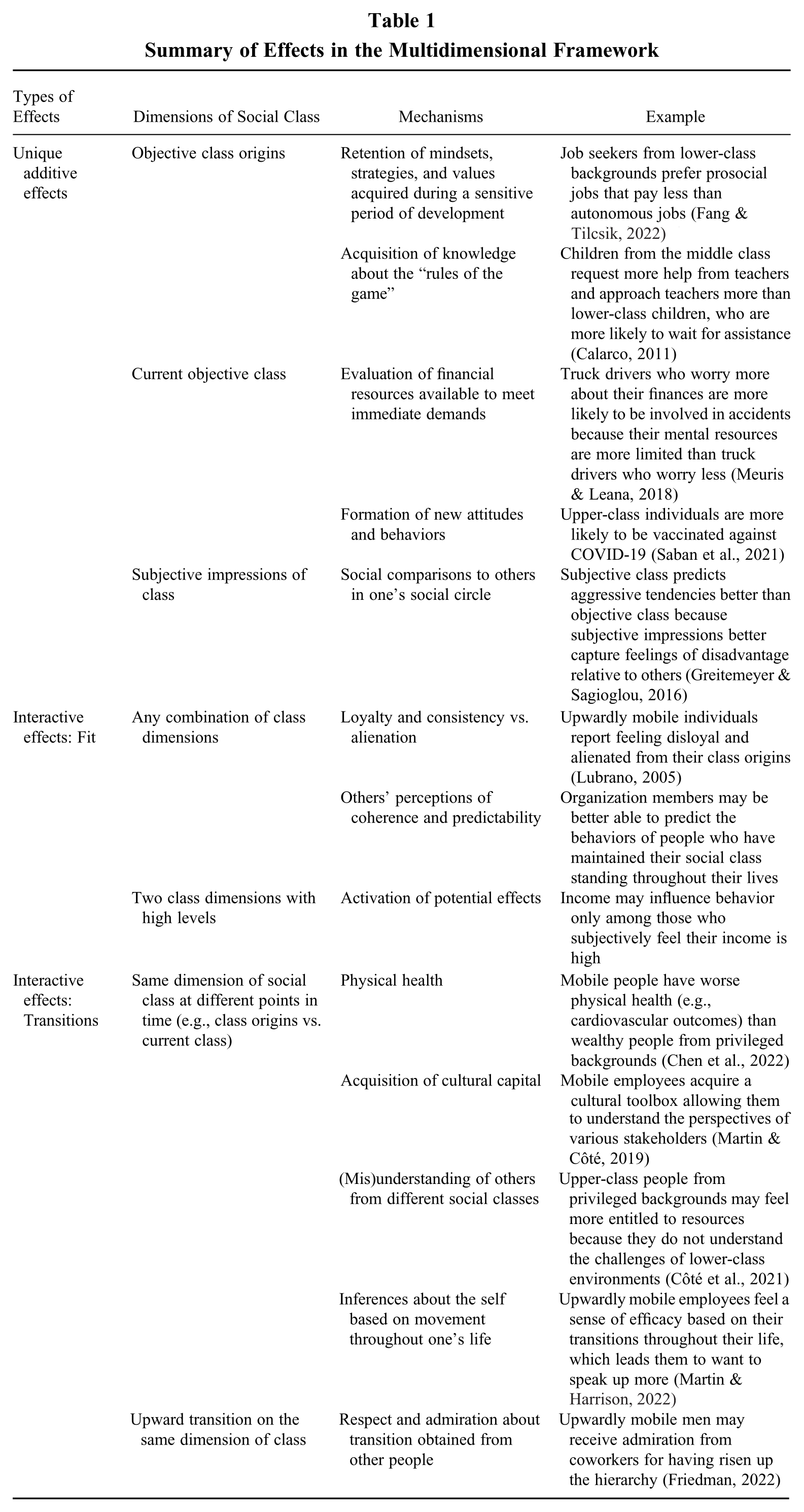
Summary of Effects in the Multidimensional Framework
Dimensions of Social Class
The dimensions of social class vary on several features. One of these features concerns whether social class reflects one's current situation or past situation (i.e., class origins; Martin & Côté, 2019). Another important feature concerns whether social class reflects objective dimensions or subjective impressions of where one stands on these dimensions (Adler et al., 2000; Loignon & Woehr, 2018). Following these distinctions, I organize the dimensions of social class by first describing the objective and subjective features of current class and then describing the objective and subjective features of class origins.
Current Social Class
Current social class refers to class at the time that participants are being studied (Martin & Côté, 2019). The term “destinations” has been used to refer to someone's current social class. The term “destinations” implies that one's social class can change over one's lifetime (even if it might be difficult to do so). The term “destinations” can be confusing, however, because there is always the possibility of further changes in social class in the future. Thus, someone's current social class might not actually reflect their final destinations. For this reason, in this article I refer to current social class.
Current objective social class. Researchers have treated both personal income (income that an individual receives from all sources, including wages, social assistance programs, interest, dividends, bonuses, etc., usually tallied on a yearly basis) and household income (income that an individual and the other people living in their household receive from all sources) as objective indicators of current social class. Wealth is another objective indicator that denotes the value of all the resources that a person possesses at a current point in time. Education level is another frequently examined objective indicator. Education is often operationalized as a continuous variable ranging from, for example, less than high school, high school, some college/university, college/university degree, and graduate degree. Some researchers have focused on the fundamental distinction between holding a university degree versus not having graduated from university, because there is an important cultural divide between university-educated people and people who do not have a university education (Stephens et al., 2014). Finally, occupation prestige refers to the amount of respect and admiration that is generally given to one's job in society (Hodge, Siegel, & Rossi, 1964).
Current subjective social class. People form reliable subjective impressions of their current social class standing in a group (Jackman & Jackman, 1973; Rosenberg, 1953). Subjective impressions of class are often based on objective socioeconomic information, but these impressions are also informed by comparisons with others in social groups (Brown-Iannuzzi, Lundberg, Kay, & Payne, 2015; Tully & Sharma, 2022) and potentially other factors such as self-esteem. People can form subjective impressions of where they rank in social groups that are relatively large (e.g., one's country) or small (e.g., one's neighborhood).
Social Class Origins
The term “origins” has been used to refer to someone's social class background (Martin & Côté, 2019). It usually concerns the social class of one's parents or guardians when one was a child, although there is no consensus on the exact period that defines class origins. For instance, in one study, class origins referred to the period between ages of 0 and 18 (Côté et al., 2021), and in another study, class background referred to the last occupation that individuals held before becoming politicians (Carnes & Lupu, 2015). Parents’ or guardians’ socioeconomic standing might have changed during the time period captured by origins (even if this period is relatively short). For example, one's parents may have increased their income if they were students when they had a child and then started working full-time when their child was still young. Or, one's parents may have lost their employment while one was young. Strategies to address this challenge include treating class origins as the standing one had for the longest period during childhood (cf. Côté et al., 2021) or aggregating across all of the standings one held during childhood. Research is needed to better understand how to construe social class origins when one's parents’ or guardians’ standing changed early in life.
Objective social class origins. The dimensions of objective class origins mirror the dimensions of current objective class. Researchers have examined the income, wealth, education, and occupational prestige of one's parents or guardians, often among organization members with comparable current positions (Carnes & Lupu, 2015; Fang & Tilcsik, 2022; Martin et al., 2016). For example, Martin et al. (2016) focused on how the parental income of active-duty soldiers at the same hierarchical level in the army predicted their leadership behaviors and effectiveness. The sample did not vary on current socioeconomic dimensions, ensuring that these dimensions did not explain any relationships between childhood income and leadership outcomes (Martin et al., 2016). Research on objective social class origins has highlighted how inequalities persist even when people from lower-class backgrounds achieve the same positions as their counterparts from upper-class backgrounds, because class origins continue to influence how employees perform their jobs (Stephens et al., 2014).
Subjective social class origins. People form reliable subjective impressions of the social class standing of their parents or guardians when they were growing up. Notably, people's impressions of their backgrounds differ from their impressions of their current situation. As such, subjective impressions of class origins correlate more strongly with indicators of objective class backgrounds than current objective class indicators (Côté et al., 2021). Similarly, current subjective impressions of class correlate more strongly with current objective class indicators than with indicators of objective class backgrounds (Côté et al., 2021).
Correlations Among Dimensions of Social Class
The dimensions of social class do not correlate perfectly with each other. Meta-analytic correlations among measures of the objective dimensions of current social class (income, wealth, education, and occupational prestige) are moderate-sized, ranging from .29 (between wealth and education) to .47 (between occupational prestige and education; Loignon & Woehr, 2018).
Social class origins and current social class are not perfectly correlated with each other because even though a person is likely to retain their social class standing due to the limited social mobility in the population, some mobility occurs (Chetty, Hendren, Kline, & Saez, 2014). In one analysis, almost half of employed US residents moved up or down by at least one income quintile over a 23-year period (Auten, Gee, & Turner, 2013). This mobility is reflected in small correlations between current and childhood income (r = .19) and moderate correlations between one's own and parents’ or guardians’ education levels (r = .30; Côté et al., 2021).
Objective indicators and subjective impressions of social class are also not perfectly correlated because subjective impressions are informed by both objective socioeconomic information and comparisons with others in groups of people who are similar to themselves (Anderson, Kraus, Galinsky, & Keltner, 2012; Brown-Iannuzzi et al., 2015). Correlations between objective indicators and subjective impressions of social class are moderate (Jackman & Jackman, 1973). For instance, in one investigation, meta-analytic correlations between subjective impressions of class and income and education level were small to moderate (r = .39 and r = .26, respectively; Côté et al., 2021).
Importance of Theorizing About Multiple Dimensions of Social Class
The dimensions of social class are loosely related because they represent distinct features of a person's socioeconomic conditions. Social class dimensions have unique features that might lead them to have different causal influences on organizational behavior. As such, dimensions of social class could influence behavior in organizations differently through unique mechanisms. Most analyses of social class examine the distinct dimensions of social class separately. A meta-analysis of associations between social class dimensions and job criteria listed separate dimensions of social class and empirically summarized their separate relationships with job attitudes (Loignon & Woehr, 2018). So far, this approach has been useful to determine whether the dimensions of social class exhibit robust associations with job criteria. Yet recent research has shown that there is value in examining more than one dimension of social class at a time. For instance, one investigation revealed that income is more strongly related to selfishness than education, likely because having a high income more directly causes feelings of independence from others than holding an advanced degree (Dubois, Rucker, & Galinsky, 2015). Related, income is more strongly correlated with feelings of entitlement to resources and rewards than education (Côté et al., 2021).
The distinction between dimensions of social class has important theoretical and empirical implications. Considering different dimensions of social class will likely create more precise theories that describe the unique roles of specific dimensions of class. This approach stands in contrast to theories that treat the dimensions interchangeably and assume that the dimensions of social class influence behavior the same way.
Distinguishing between the dimensions accommodates more possible patterns of association between social class and behavior. For instance, the different dimensions of class may have unique additive effects that cannot be understood when theorists focus on a single dimension of social class or refer to social class generally. It is possible that a dimension of class such as personal income influences tendencies to engage in ethical behavior through one process, and that a separate dimension such as parental education influences the same behavior through a separate process (possibly in the opposite direction). Another possibility is that dimensions of social class interact to influence behavior. For example, evidence suggests that current class interact with class origins to shape feelings of entitlement to resources and rewards, so that individuals with high-class origins and current class feel more entitled than both upwardly mobile individuals (with low-class origins and high current class) and individuals who experienced poverty at some point during their lives (Côté et al., 2021).
An important implication is that researchers should refer explicitly to the dimensions of social class of interest when developing theory. Descriptions that refer generally to social class are ambiguous about both the individual variation that is involved and the processes that shape behavior.
Theorizing that does not distinguish between the dimensions of social class is likely to miss some causal effects, as the dimensions are not interchangeable. Currently missing, however, is a conceptual framework for theorizing about multiple dimensions of social class. Equipped with such a framework, researchers could consider the various ways in which social class dimensions might shape the behavior of interest and propose hypotheses based on the relationship(s) that seem most plausible. In the next section, I develop such a framework.
Summary
Social class is a multidimensional construct. I described how social class can change over time, focusing on the distinction between social class origins and current social class. I also described how social class has both objective and subjective components. The dimensions of social class are nonoverlapping, and some dimensions only correlate with each other to a moderate extent. As such, theories of social class benefit from considering multiple dimensions.
A Multidimensional Framework for Theorizing About Social Class
I propose a framework to extend foundational research that established the role of social class in organizations by isolating specific dimensions of social class and testing their relationship with important criteria. The framework can assist researchers with developing more complex—and likely more accurate—theories of social class and organizational behavior. The framework specifies the types of effects that social class may exert on organizational attitudes and behaviors and potential mechanisms through which these effects might occur. Table 1 lists the types of effects, potential mechanisms underlying these effects, and examples of these effects. The first set of effects concerns additive effects of social class dimensions, and the second set of effects concerns two types of interactive effects: fit and transitions.
Additive Models: Social Class Dimensions Influencing Outcomes Separately
One set of models of social class and behavior concerns additive effects—influences on behavior that are unique and hold when controlling for other dimensions of class. Additive effects are reflected in unique contributions of dimensions of social class when other dimensions are statistically controlled. These influences do not depend on other dimensions of social class, because interactions would mean that those dimensions operate jointly rather than independently. For example, a higher income could be associated with more of a certain behavior irrespective of the person's class origins, and class origins may have a different effect on the same behavior irrespective of current income.
In what follows, I describe unique effects that current objective class, objective class origins, and subjective impressions of class might have on behavior, and articulate mechanisms through which these effects might operate.
Unique Effects of Current Objective Social Class
Current objective social class may uniquely influence organizational behaviors through evaluations of whether current resources are sufficient to meet immediate financial needs or through the formation of novel attitudes and behaviors.
Current objective social class—and particularly income—may uniquely predict behaviors that are affected by feelings of financial scarcity or dependency (Meuris & Leana, 2015). People might evaluate whether they have adequate resources to meet immediate financial demands such as housing costs, food, and schooling for their children. When financial demands exceed resources, worries about lacking resources could be distracting and consume mental resources, which might in turn influence how people act at work. For instance, in one study, truck drivers who worried more about their finances were more likely to be involved in accidents because their mental resources were more limited than truck drivers who worried about money less (Meuris & Leana, 2018).
Current objective social class are also likely to impact work outcomes through the formation of new attitudes and behaviors. Models of attitude formation posit that salient or readily available information can be highly potent in shaping people's beliefs (Salancik & Conway, 1975). Individuals may consider the prestige of their current occupation or their current income when forming an attitude about a new idea. If prestige or income differed, the time separation may limit the relevance of class origins for informing new attitudes and behaviors. For instance, current social class has been positively associated with the likelihood of getting vaccinated against COVID-19 (Saban, Myers, Ben-Shetrit, & Wilf-Miron, 2021).
Unique Effects of Objective Social Class Origins
Organizational behaviors may be uniquely influenced by objective social class origins via mindsets, strategies, and values that were acquired during a sensitive period of development or via knowledge that is gained gradually over time.
Social class origins might have disproportionate effects on attitudes and behaviors that are imprinted at an early age (Duncan, Ziol-Guest, & Kalil, 2010). This possibility is consistent with findings that some attitudes are acquired during specific periods of development and are largely resistant to future influences during later periods (Lesthaeghe & Meekers, 1986). For instance, life history theory posits that attention to threats and reactions to unpredictability are imprinted early and have long-term consequences for how people respond to events (Mittal & Griskevicius, 2014). Those consequences include sense of control; people growing up in lower-class environments, which can be more challenging, maintain a lower sense of control over their environments than people with upper-class backgrounds (Mittal & Griskevicius, 2014).
Objective class origins might also have led people to develop strategies to address their early life situations that they retain and continue to deploy over time (Amir, Jordan, & Rand, 2018; Guinote, Cotzia, Sandhu, & Siwa, 2015). One example of such a strategy is uncertainty management, whereby individuals with lower-class origins retain strategies developed to cope with uncertainty in the environments in which they grew up. Uncertainty management strategies can include aversion to risk and prosocial tendencies that help build supportive networks (Kraus, Piff, Mendoza-Denton, Rheinschmidt, & Keltner, 2012). In one investigation, adults with lower objective class origins were more cautious on various risk tasks and made more prosocial decisions in economic games than adults from upper-class backgrounds (Amir et al., 2018). These relationships held when controlling for current objective class, suggesting that adults deploy strategies that they developed early in life even if their circumstances have changed. Social class origins can also imprint self-control strategies, whereby individuals with lower-class origins wait longer for rewards and feel less negatively about waiting than individuals with higher-class origins (Thompson, Hamilton, & Banerji, 2020). These strategies might influence how people currently behave such as how long they wait to apply for a promotion.
Social class origins also influence values, with certain values facilitating performance because they fit with the culture of most organizations and other values impeding performance because they do not fit the culture of most organizations (Stephens et al., 2014). Upper-class origins are more strongly associated with independent values that permeate many organizations, providing an advantage that can persist throughout one's career (Stephens et al., 2014).
Objective class origins may also shape behavior through knowledge that is gained gradually over time. Research suggests that employees from privileged backgrounds acquire critically important knowledge about the “rules of the game” that govern procedures such as job applications and interviews (Lareau, 2015; Rivera, 2012). Employees with lower-class origins may have missed out on many years of learning about the “rules of the game” and may never catch up, or catch up much later in their lives, influencing their entire life and career trajectory. Knowledge of the “rules of the game” in turn relates to workplace performance and career success. For instance, employees with upper-class origins have better knowledge of influence strategies and implement these strategies better to achieve positions on corporate boards (Stern & Westphal, 2010).
Unique Effects of Subjective Impressions of Social Class
Organizational behaviors may be uniquely influenced by subjective impressions of social class via comparisons that people make with others in their social circles.
Subjective impressions of social class are likely to influence outcomes that depend on comparative judgments of standing relative to others. These comparative judgments could be more frequent when objective information is missing or unclear. Researchers have argued that subjective impressions of social class may influence outcomes, because people might not be aware of how their objective dimensions compare to others (Brown-Iannuzzi et al., 2015). This suggests that subjective impressions may have a particularly important unique impact on behavior when objective dimensions are unknown or unclear in social settings, such as a networking events where attendees’ occupations and incomes could be difficult to discern. In these situations, people's subjective sense of where they stand on socioeconomic dimensions relative to those they interact with might influence behavior separately from objective class dimensions. For example, at a business event where attendees wear comparable clothing but do not readily reveal their occupation or income, people are unlikely to know how their objective dimensions compare to those of people with which they interact, which could facilitate effects of subjective impressions.
In one investigation, lower subjective social class was associated with more support for redistribution even when controlling for objective social class, presumably because attitudes about redistribution depend on where people think they rank relative to the people they interact with in their social circles rather than where they rank in society as a whole (Brown-Iannuzzi et al., 2015). In another investigation, subjective social class was more robustly associated with aggressive tendencies than objective social class, because subjective impressions were especially related to feelings of relative (dis)advantage compared to others (Greitemeyer & Sagioglou, 2016). Subjective impressions of class background also uniquely predict indicators of adolescent health and well-being such as anxiety, optimism, and criminality after controlling for objective social class indicators (Rivenbark et al., 2020).
Interaction Models: Social Class Dimensions Influencing Outcomes Jointly
The value in examining multiple dimensions of social class also stems from the capacity to study how they interact to predict organizational behavior—how the effects of specific dimensions of social class depend on other dimensions. In what follows, I describe different potential forms of interactions between dimensions of social class.
Fit Models
Fit is a form of interaction whereby outcomes are optimized when the dimensions of social class are the same or match (Edwards & Parry, 1993). In several conceptualizations of fit, outcomes gradually worsen as the dimensions become increasingly discrepant from each other (Edwards & Parry, 1993). The more a person's social class dimensions differ from each other, the less internally coherent they might feel, whereas a person might feel more coherent if their social class dimensions match. For instance, people who do not have a prestigious occupation and do not have an advanced education yet earn a high salary may experience a lack of coherence between these self-defining dimensions. In another version of fit, outcomes worsen only after the discrepancy between the dimensions achieves a certain level (Edwards & Parry, 2018). For example, organization members may only feel incoherent if their income exceeds by what might be expected based on their education level at least a specific amount.
Fit between dimensions of social class. The fit between separate dimensions of social class might have important consequences. A large literature documents the benefits of consistency between different features of the self, such as traits of personality and behaviors across time and situations (Block, 1961; Côté, Moskowitz, & Zuroff, 2012). Consistency might increase subjective feelings of familiarity, authenticity, loyalty, and comfort. In this conceptualization, an outcome is optimized when someone's social class dimensions correspond to each other—such as when they earn an income that matches their education level. Outcomes are optimal when social class dimensions are all high, or all moderate, or all low, because internal coherence is achieved in all these circumstances.
Another type of fit concerns consistency between the objective and subjective dimensions of class. Organization members who subjectively feel that their standing on a dimension matches their objective standing may experience stronger feelings of internal consistency and belongingness to their objective social class. Executives who subjectively “feel rich” may feel that they belong to their social class more than counterparts who do not feel that way, perhaps due to comparisons with other executives who earn more or lingering effects of a low social class background. Feelings of internal consistency and belongingness may, in turn, facilitate psychological adjustment and performance.
Fit among social class dimensions may also provide benefits through interpersonal processes, including others’ perceptions of a person's stability, authenticity, and loyalty to their group. An interpersonal perspective on social class posits that the effects of social class dimensions depend on how others respond to social class information (Fiske, Cuddy, Glick, & Xu, 2002; Kraus & Keltner, 2009; Rivera & Tilcsik, 2016). People attempt to build accurate mental representations of others so that they can accurately predict their future behavior (Devine, Sedikides, & Fuhrman, 1989). Individuals with high fit between dimensions of class may facilitate others’ attempts to build accurate mental models of them, whereas those with mismatched dimensions may thwart these attempts. Employees avoid social interactions with coworkers whose behavior changes from one interaction to the next (Côté et al., 2012). Similarly, employees may avoid coworkers who exhibit differences between class dimensions because they have difficulty understanding them and predicting how they will behave. For instance, it may be difficult to form a solid impression of someone who has a high income but acts as if their social standing is low, or vice versa.
Effects of fit at only certain levels. Some outcomes may only be achieved when dimensions of social class match at specific levels. For instance, behavior may occur only when the matched dimensions are high but not when they are moderate or low. These patterns are reflected in multiplicative forms of interaction. This kind of fit is especially likely to matter when a dimension of social class has potential effects that can be switched on or off depending on another dimension. For instance, people may best leverage a high social class standing when this standing is accompanied by comparably high subjective impressions of class standing. In their interactions with others, those with prestigious occupations may only generate positive reactions from others if they also subjectively believe that their occupation is prestigious. High performance fueled by confidence is only optimized when a person with a high objective social class standing also subjectively believes that their social class standing is high.
Effects of certain kinds of misfit. Other models might posit that a dimension of class is harmful in some way, but another dimension mitigates these effects and prevents negative outcomes. Compensatory models could suggest, for example, that only higher or lower social class individuals are prone to obtaining an unpleasant outcome, but subjective impressions can compensate by preventing that outcome from occurring. For instance, upper-class individuals’ tendencies to act unethically (Piff, Stancato, Côté, Mendoza-Denton, & Keltner, 2012) could be countervailed by subjective impressions of lower social class.
Transition Models
Social class transitions refer to changes in someone's standing on at least one of the dimensions of class during one's lifetime (Martin & Côté, 2019; Phillips et al., 2020). By contrasting class standings throughout someone's life, transitions inherently involve multiple dimensions of class that are differentiated in time. At the aggregate level in the population, transitions are reflected in levels of class mobility (Chetty et al., 2014). Researchers usually focus on changes in objective class dimensions, but there might also be important outcomes when people's subjective impressions of their social class change over time. A focus on transitions is based on the premise that attitudes and behaviors arise in part from people's experiences and reflections about their movement in the hierarchy (Blau, 1956; Hollingshead, Ellis, & Kirby, 1954).
There are different ways in which researchers can theorize about social class transitions and organizational outcomes (Phillips et al., 2020). Some outcomes may occur after any kind of transition, whereas other outcomes might only emerge after organization members have experienced a specific kind of transition.
Effects of any social class transitions. There are different kinds of transitions that organization members may experience over their careers, including upward and downward transitions, which contrast start and end points, and “all-around” mobility that captures various movements up and down the hierarchy (Phillips et al., 2020). People may experience these transitions as a result of various decisions they make and risks they take over the course of their careers.
People who experience any transition may feel alienation and disloyalty (Lubrano, 2005; Stephens et al., 2014). For instance, people who retain their blue-collar roots throughout their lives might feel authentic and loyal to their families by attending the same schools, enrolling in the same programs, working the same jobs, and earning similar incomes as other members of their families. By contrast, the upwardly mobile might feel disloyal to their families because they feel that they abandoned their family roots—feelings that might, in turn, cause stress (Lubrano, 2005). The upwardly mobile may also feel fatigue from exerting continuous efforts to adapt to changes over time (Chen, Brody, & Miller, 2022). Alienation and fatigue may explain why upwardly mobile individuals have worse health outcomes than upper-class individuals from wealthy backgrounds and, in some studies, lower-class individuals from under-privileged backgrounds (Chen et al., 2022). Social class transitions may, in turn, relate to organizational behavior and outcomes through changes in physical health.
Social class mobility may influence organizational behavior via the acquisition of certain types of knowledge associated with different class contexts. Organization members who change their social class may accumulate cultural capital—or knowledge about how members of different social classes think and act (Martin & Côté, 2019). This knowledge may be useful to attain and leverage advantageous positions in social networks and, in turn, gain status in groups and organizations (Martin & Côté, 2019).
Mobility could also influence behavior through (mis)understanding of the values, habits, and circumstances linked to social classes to which they do not currently belong. People who have been mobile throughout their lives might have a basic understanding of what it means to have more or less resources than they currently have and develop attitudes and behave based on this understanding. As an example, people who have maintained a high social standing throughout their lives feel more entitled to resources and rewards than others, including those who have been upwardly mobile (Côté et al., 2021). One potential explanation of this pattern is that individuals with high-class origins and current class have little understanding of the challenges that people have to confront when they have a lower-class standing. If upper-class individuals from wealthy families underestimate how much effort others invest to achieve and maintain their standing, they might be more likely to feel special and entitled to resources and rewards (Côté et al., 2021).
Social class transitions may also shape inferences that people draw about themselves, which may have implications for what they think and how they act in organizations. One such inference concerns feelings of self-efficacy. In a recent set of studies, upwardly mobile professionals felt a higher sense of efficacy than professionals from wealthy backgrounds, which stemmed from their difficult climb up the hierarchy (Martin & Harrison, 2022). These feelings of self-efficacy, in turn, were associated with more motivation to speak up in organizations (Martin & Harrison, 2022).
Effects of upward social class transitions. Some models specify that certain outcomes may be achieved only among those who improve their social class standing. Upward mobility may relate to certain outcomes through others’ perception of increases in social standing. These effects might be more potent in certain cultures. For instance, the American Dream captures the notion that people can rise from rags to riches (Chetty et al., 2017). System justification theory suggests that Americans are particularly motivated to believe in that notion and admire those who exemplify it by increasing their status over their lifetime (Jost & Hunyady, 2005). In this cultural context, a person who struggles to get out of poverty and who increases their standing while encountering setbacks might be perceived as persistent and resilient, thereby eliciting positive reactions from others.
Upward mobility might be less favorably perceived in some cultural contexts, however. For instance, the caste system in India poses constraints on mobility, and punishments can be administered to those who violate the hierarchy by transitioning from one class to another (Chrispal, Bapuji, & Zietsma, 2021).
Moreover, upward mobility may be more admired and, in turn, rewarded in societies characterized by high levels of economic inequality. Perceptions of higher economic inequality are associated with beliefs that a society is un-meritocratic and limits social mobility (Shariff, Wiwad, & Aknin, 2016). When there are large gaps between the “haves” and the “have-nots,” changing one's standing in society seems particularly difficult. Thus, upward mobility could be interpreted differently by residents of highly unequal areas compared to their counterparts in less unequal areas. It is possible that upward mobility is perceived as especially impressive and associated with higher rewards in highly unequal societies.
Summary
A multidimension approach to social class allows for specifying different models that I described previously. There are additive models whereby the dimensions make separate, simultaneous contributions that are independent of each other. Some interactive models focus on fit between dimensions: certain outcomes are achieved when two dimensions have the same level compared to different levels. Finally, some interactive models focus on transitions: certain outcomes are achieved when social class has a specific level earlier in time and a specific level currently. It is likely that researchers will develop useful models that consider multiple dimensions of social class that have not appeared in the literature so far.
Toward a Full Understanding of the Role of Social Class in Organizational Behavior
The framework that I developed in this paper has several implications for how to study social class in organizations. The framework suggests that it is theoretically valuable to consider multiple dimensions of social class, rather than examine social class dimensions in isolation, to predict organizational behavior. Initial studies on social class in organizational contexts provided confidence that it is worth studying. Researchers can now extend theories to study the dimensions of social class in combination to achieve a better understanding of how, when, and why it explains organizational behavior.
The framework that I present in this article has several implications for the development of novel theories of social class and organizational behavior. Novel theories could explain why social class might sometimes predict a criterion and sometimes not. To the extent that social class is multidimensional, distinct dimensions of class might show different associations with criteria. If researchers select a dimension of social class that is not theoretically relevant, then it might not predict the criterion, leading to erroneous inferences that social class does not matter when a more theoretically relevant dimension of social class could relate to the criterion. For example, research has identified that the subjective dimensions of class are more relevant for health outcomes (Adler et al., 2000). Researchers examining only the objective dimensions of class might underestimate its effects on health.
Novel theories developed from the current framework could explain why studies might have different findings. If different dimensions of social class are examined, results might differ. For instance, research suggests that income might be a stronger predictor of self-serving tendencies than education (Côté et al., 2021; Dubois et al., 2015), partially because income more strongly creates independence from others and, in turn, self-serving tendencies. Researchers who select education may obtain weaker effects because they do not evaluate the dimension of social class that is most relevant to self-serving behavior.
Theories that are developed based on the framework—and especially the possibility that social class dimensions interact—could reveal more complex patterns than previously thought. These patterns could have different implications for theory and policy. The framework has potential implications for personnel selection and promotions. For instance, upwardly mobile individuals who have acquired cultural knowledge may be positioned to lead socioeconomically diverse teams (Martin & Côté, 2019).
The evolution of research findings concerning entitlement also reveals the policy importance of considering multiple dimensions. The initial findings revealed that higher social class individuals have stronger feelings of entitlement than their lower-class counterparts (Piff, 2014). Later research that examined both social class origins and current social class suggested that this pattern is specific to upper-class individuals from wealthy backgrounds (Côté et al., 2021). Considering class origins and current class is important to draw conclusions about who feels entitled. Given low rates of social mobility, there are more stationary high individuals than upwardly mobile individuals in samples of upper-class individuals. Thus, any analysis of current social class reflects the experience of upper-class individuals from wealthy backgrounds more accurately than upwardly mobile individuals. It is unclear in analyses of only current social class whether the upwardly mobile show the same pattern or a different pattern, making policy decisions difficult.
The framework facilitates the development of competing theories that make different or opposite predictions about social class and organizational behavior. In many cases, compelling theoretical arguments can be developed for more than one way in which social class could predict behavior. For instance, researchers can pit additive effect models of the effects of social class origins stating that one's class background is the driving force shaping outcomes against interaction models stating that these effects vary. There is value in doing direct tests of these ideas against each other, rather than “selling” a single theoretical formulation. It is important to do exploratory research to identify whether any untheorized pattern may explain observations better than formally described theory. Any pattern detected in exploratory analyses could then be formally tested in follow-up confirmatory research (Wagenmakers, Wetzels, Borsboom, van der Maas, & Kievit, 2012). More broadly, researchers should remain open at all stages of investigations to new ways in which social class could shape behavior.
Extending the Multidimensional Framework
In the next sections, I discuss two ways in which the framework can be extended. The framework can be extended by considering the visibility of dimensions of social class and also by considering intersectionality with other demographic characteristics.
Visibility of Social Class Dimensions
The framework could be extended by formally considering the visibility of social class dimensions—how easily a dimension of social class can be accurately detected by other people. Evidence suggests that several mechanisms through which social class operates manifest during social interactions (Kraus, Torrez, Park, & Ghayebi, 2019; Rivera, 2012). Thus, the visibility of social class might represent a broad organizing construct to understand how social class dimensions influence behavior in organizations. As such, research should examine whether the more visible dimensions of social class could influence behavior through different—and more interpersonal—mechanisms than the less visible dimensions.
Dimensions of social class that are more visible may have especially strong effects via the perceptions and reactions of others who observe signs of social class such as the location of one's office, the car one drives, and the clothes one wears. Perceptions of others’ social class informs several judgments people make, including warmth and competence (Fiske et al., 2002), and fit with an organization's norms and hireability (Rivera, 2012). The effects of these dimensions might be especially strong when organizational factors augment or reduce the effects of stereotypes in organizations, such as the degree of face-to-face contact between people from different social class standings (Paluck, Porat, Clark, & Green, 2021).
Moreover, visible social class dimensions might have potent effects when employees work on interdependent tasks. Stereotypes about different social class groups might shape a larger number of consequential actions for the targets of these perceptions. There is a stereotype that upper-class individuals are more competent than lower social class people (Baron, Albright, & Malloy, 1995; Darley & Gross, 1983) that could, in turn, influence helping behavior (Pitesa & Pillutla, 2019; Whitely, Dougherty, & Dreher, 1991). By contrast, the effects of less visible social class dimensions might be smaller when tasks are interdependent because people are less likely to identify these dimensions of class. Others might rely on their own perceptions of social class in deciding how to respond, but because these perceptions are not always accurate, the effects of social class are likely to be smaller.
The visibility of social class dimensions could be empirically assessed. These assessments could allow researchers to predict how likely social class dimensions could influence behavior through interpersonal processes. Candidate dimensions of social class that are likely to be most often visible to other organization members include current job title and position in an organization. Occupational prestige is likely visible because people's roles are defined, and titles are communicated through personal introductions, messages, and office location and size. It should be expected that people usually correctly identify the prestige of the occupations of those with whom they interact in organizations.
Current income is likely also often visible in organizations. A general range for income can be often determined by inferring that more prestigious occupations are usually more financially rewarded than less prestigious ones. Even when employees cannot determine exact income amounts, being aware of someone's income bracket is likely sufficient to influence behavior.
Education level is visible when it is listed in signatures included in communications such as e-mail messages, or when it is known that a certain education level is needed to obtain a position in an organization. For example, some executive level positions require a master’s degree, even for employees with a long record of excellence within the organization. In many cases, however, it might be unclear which degrees an employee holds.
Dimensions of social class that are likely to be less visible concern people's childhood (or origins) and subjective impressions of rank on the dimensions that compose social class. The occupational prestige, income, and educational level of parents or guardians are social class dimensions that can be difficult to discern because they do not have clear signals. These social class dimensions cannot be directly inferred from the position that one holds. Many markers—such as somebody's current formal position and office location—denote a person's current situation and conceal a past situation that could be different. Observers could infer that a person retained their social class origins because of the limited social mobility in the population (Chetty et al., 2014). Using this heuristic allows perceivers to make some accurate judgments, because social class origins are correlated with current class (Chetty et al., 2014; Côté et al., 2021; Loignon & Woehr, 2018). The correlations are far from perfect, however, so this heuristic has limitations. Mistaken perceptions of social class are particularly consequential. Ignoring that an organization member may come from a poor background discounts the challenges that this person has faced to attain their current position, such as misfit between their childhood values and the values of the organization (Stephens et al., 2014). When someone's class origins differ from their current class, perceivers might rarely know, rendering class origins usually invisible.
Observers could try to infer subjective impressions of social class by deducing that it matches objective indicators. Subjective impressions only have small to moderate correlations with objective dimensions, however (Côté et al., 2021; Jackman & Jackman, 1973). Thus, some wealthy people might feel relatively poor, and some less well-off people might feel relatively wealthy. As a result, raters might have difficulty identifying targets’ subjective feelings about their social class. It is difficult to identify if a particular target underrates, overrates, or correctly rates their social class relative to objective criteria.
It is also important in future research to compare visibility inside organizations versus outside organizations. Dimensions of social class that are visible inside of organizations might be less visible outside of organizations. Signs of social class are not necessarily discussed outside of organizations. People can take steps to appear to have a larger income (through conspicuous consumption) to impress others, or appear to have a lower income (by “dressing down”) to reduce solicitations for donations or advice. For example, people might not identify the occupation of an executive working at a coffee shop wearing a sweater and jeans. In the absence of an organizational context, observers could infer a target's social class by observing subtle cues that are transmitted in social interactions, such as the use of language and pronunciation in speech (Kraus et al., 2019), level of engagement during interpersonal interactions (Kraus & Keltner, 2009), and degree of attractiveness (Bjornsdottir & Rule, 2017). These cues help observers identify social class above chance levels, but they are far from perfect. In one investigation, relying on brief speech allowed perceivers to accurately identify class above chance levels, yet their guesses were incorrect 45% of the time (Kraus et al., 2019). Research should examine whether the processes that operate inside organizations might not operate—or be much weaker—outside of organizations.
Intersectionality. The framework could be extended by formally considering intersectionality with other demographic characteristics. The current framework that focused uniquely on dimensions of social class is consistent with theories of intersectionality stating that relationships between demographic characteristics and outcomes might depend on other characteristics (Rosette, de Leon, Koval, & Harrison, 2018; Smith, Watkins, Ladge, & Carlton, 2019). Theories of intersectionality suggest, for instance, the effects of gender on organizational outcomes may vary depending on ethnicity. The framework makes the similar argument that the effects of one dimension of social class may vary depending on other dimensions of social class.
The framework can be extended to combine social class with other demographic characteristics, which could interact with one or more dimensions of class. People of different ethnicity and gender may experience the dimensions of social class differently (Cole & Omari, 2003; Rivera & Tilcsik, 2016). There is evidence of intersectionality for individual dimensions of social class. The association between social class mobility and relatively poor health is more pronounced among members of under-represented minorities (Chen et al., 2022). In addition, upward mobility may be seen differently in different contexts—it may be admired because it reflects the “American Dream” in the United States (Chetty et al., 2017) but be seen as violating existing hierarchies in India (Chrispal et al., 2021).
There is also evidence that relationship between social class and interpersonal orientations found in Western cultures differ in East Asian countries (Miyamoto et al., 2018). Higher social class is associated with more independence and less interdependence in Western countries, whereas higher social class is associated with both higher independence and higher interdependence in East Asian countries because interdependence is more heavily sanctioned in these countries (Miyamoto et al., 2018). This investigation focused on current objective social class, but ethnicity may interact with each of the different kinds of effects that is included in the framework. Ethnicity may shape the effects of class origins, so that one's social class background influences behaviors differently depending on one's ethnicity. Ethnicity could also change the effects of fit between social class dimensions. Social class transitions might have different impacts on behavior for people from different groups.
Regarding gender, there is evidence that upwardly mobile men discuss their transition from humble origins more than upwardly mobile women, possibly because society perceives upward mobility by men more favorably than mobility by women (Friedman, 2022). An audit study suggested that recruiters value high social class origins but only for male applicants, because women were seen as being committed to starting a family and caring for their children and, thus, be less focused on their career (Rivera & Tilcsik, 2016). Many of the effects described in the framework could vary depending on gender in similar ways.
Conclusion
In this article, I argued that researchers will obtain a better understanding of how social class shapes organizational behavior by considering the complete array of social class dimensions rather than focusing on one or a few dimensions. To propel this research, I presented a framework describing the various ways in which dimensions of social class may shape behavior either independently or simultaneously. The framework calls for considering a broad set of patterns that could link social class to attitudes and behaviors in organizations. Tests of competing models will provide the most complete understanding of how and why people with different social class standings behave differently in organizations.
Footnotes
Declaration of Conflicting Interests
The author(s) declared no potential conflicts of interest with respect to the research, authorship, and/or publication of this article.
Funding
The author(s) received no financial support for the research, authorship, and/or publication of this article.
