




Abstract
The literature on the liability of foreignness focuses on explaining why foreign firms operating in a given country underperform relative to their domestic rivals. We provide a complementary perspective that allows for within-firm variation in the liability of foreignness, at the level of a firm's products. Specifically, we explore how consumers’ willingness-to-pay for foreign products is affected by a firm's sourcing strategy for product inputs and by heterogeneity in demand characteristics across the markets where the product is sold. We hypothesize that sourcing inputs from a regional product developer as well as cultural diversity in regional consumer markets will have a stronger positive impact on the regional sales performance of products sold by foreign firms than on those by domestic firms. Our hypotheses are supported in a product-level analysis of 2,144 console video games sold in the 11 subnational regions of the United Kingdom over the period 2005–2008. Our findings suggest that firm-level explanations of the liability of foreignness need to be supplemented by a product-level perspective that considers heterogeneity in both supply- and demand-side factors as important determinants of consumers’ willingness-to-pay for foreign products.
Introduction
Many studies have examined the performance of foreign versus domestic firms within a country (for a review, see Lu, Ma, & Xie, 2021). These studies typically draw on the concept of the liability of foreignness (LOF), which suggests that foreign firms incur additional costs and thus tend to underperform compared to domestic rivals in their host country (Hymer, 1976). The LOF can have several sources, including foreign firms’ geographic separation from host markets, their lack of embeddedness in such markets, and outright discrimination against foreign firms (Zaheer, 1995). Over time, the literature has started to consider additional sources of the LOF, including—most notably—local consumer preferences (e.g., Chen, Shaheer, Yi, & Li, 2019; Kim & Jensen, 2014). Specifically, it has been argued that foreign firms may experience greater difficulties in producing goods and services that meet local consumers’ tastes and preferences (Shaheer & Li, 2020; Xie & Li, 2015).1
To investigate this issue, scholars have begun to integrate the concept of willingness-to-pay (WTP) into the literature on the LOF (Siqueira, Priem, & Parente, 2015). WTP refers to the maximum price a consumer is willing to pay for a product. Drivers of WTP include not only the product and its composite features but also consumer-centric aspects that can be highly subjective and idiosyncratic (Boatwright, Kaira, & Zhang, 2008; Zeithaml, 1988). Thus, a focus on the firm and its products is insufficient. Instead, it is the intersection of a product's value proposition (supply side) and consumers’ tastes and preferences (demand side) that must be examined (Payne, Frow, & Eggert, 2017). WTP will be higher for products whose value propositions closely match consumers’ tastes and preferences. Given the embeddedness of domestic firms in their local context, they will likely be better capable than foreign firms of producing and selling products that match local consumers’ tastes (Kim & Jensen, 2014; Xie & Li, 2015). Therefore, the LOF manifests itself in consumers’ lower WTP for foreign than domestic products.
Extant theory is well equipped to explain between-firm variation in performance, describing how foreign firms can improve their overall competitiveness relative to domestic ones (e.g., Nachum, 2003; Zaheer & Mosakowski, 1997) or other foreign rivals (e.g., Miller & Eden, 2006; Rangan & Drummond, 2004; Shaheer & Li, 2020). For example, prior research suggests that, to overcome the LOF, foreign firms can collaborate with domestic partners to learn about consumers’ tastes and preferences (e.g., Gaur & Lu, 2007) or target host countries that exhibit greater demand heterogeneity (e.g., Shaheer, Li, & Priem, 2020; Zhang, Xie, Li, & Cheng, 2019). In so doing, foreign firms increase their likelihood of introducing products that will appeal to local consumers, which should result in higher WTP for these products. Scholars have assumed that the benefits of pursuing such strategies accrue uniformly across the products in a firm's portfolio (Rugman & Verbeke, 2007), as reflected in higher WTP for all products sold by the firm.
However, variation in the magnitude of the LOF may exist not only between firms but also within them. Specifically, since firms recombine resources and capabilities in novel ways to develop new products (Prahalad & Hamel, 1990)—a strategy that often entails sourcing product inputs from geographically dispersed product development partners (Mawdsley & Somaya, 2018)—different products sold by the same foreign firm will likely have different value propositions. Hence, given that (1) consumers judge the benefits of a product based on its value proposition and not the firm as a whole (Priem, 2007; Priem, Li, & Carr, 2012) and (2) evaluations of the same product will differ between consumers depending on their tastes and preferences, there is a need for an expanded demand-based perspective that considers within-firm variation, at the product level.
In this study, we examine two drivers of within-firm variation in the LOF. The first one is firms’ sourcing strategy for product inputs. Here we argue that sourcing inputs from product developers based in the same subnational region as consumers will positively affect those consumers’ WTP. Thus, products within a firm's portfolio that were sourced in this fashion should achieve higher sales performance than those that were not. The benefits of sourcing inputs from regional product developers, we further propose, will be greater for foreign firms than domestic ones. Second, we argue that the same product will be evaluated differently across a host country's subnational regions. Building on the established notion that consumers in culturally more diverse regions are more variety-seeking (Riefler, Diamantopoulos, & Siguaw, 2012), we argue that regional cultural diversity will have a stronger positive effect on the sales performance of foreign products than on that of domestic products. We test these arguments on a unique sample of 2,144 console video games released in the United Kingdom over the period 2005–2008.
Our study contributes to the field by demonstrating the promise and importance of applying a demand-based perspective to explaining foreign firms’ sales performance. While some recent studies have adopted such a perspective (e.g., Chen et al., 2019; Shaheer & Li, 2020; Shaheer et al., 2020), our study goes one step further by explicitly comparing the performance implications of strategies designed to overcome the LOF for products sold by the same firm within the same country. By exploiting subnational variation in our data, we can control for unobserved heterogeneity at the firm and country levels. In so doing, our study also contributes to the emerging international business literature on within-country heterogeneity (e.g., Dheer, Lenartowicz, & Peterson, 2015; Slangen, 2016; Stallkamp, Pinkham, Schotter, & Buchel, 2018). Specifically, our finding that cultural diversity at the subnational level boosts the product sales of foreign firms more strongly than those of domestic firms shows that demand heterogeneity may increase not just foreign firms’ sales performance in absolute terms but also their performance vis-à-vis local rivals. This suggests that internationalizing firms should not merely target those markets where demand is more heterogeneous rather than less; they should also carefully examine the sources of demand heterogeneity and give priority to those markets where such heterogeneity takes the form of strong consumer preferences for foreign products.
Understanding the drivers of variation in products’ sales performance will also be highly salient for managers. Choosing a product-market entry strategy, for example, typically involves a comparison of a firm's own products with each other rather than comparisons with rival firms’ products. Our study thus provides important insights for managers concerned with the design of their product-market entry strategies.
Theoretical Background
It is well established that foreign firms in a country suffer a competitive disadvantage relative to domestic rivals. The stream of research pursuing this idea can be traced back to Hymer (1976), who argued that foreign firms’ competitive disadvantage manifests in an informational disadvantage relative to domestic firms and that foreign firms often receive discriminatory treatment from various local actors such as governments and customers (Buckley & Casson, 1976; Hennart, 1982). Combined, these factors result in “additional costs a firm operating in a market overseas incurs that a local firm would not incur” (Zaheer, 1995: 342–343)—costs that have been labelled the LOF. The LOF has several sources such as the distance between home and host countries (e.g., Ang, Benischke, & Doh, 2015; Berry, Guillen, & Zhou, 2010) and market and nonmarket actors discriminating against foreign firms (Zaheer, 1995).
Research on the LOF has begun to focus on the role of local consumers (e.g., Chen et al., 2019; Jiang, Jung, & Makino, 2020; Kim & Jensen, 2014). Building on the established insight that consumers tend to discriminate against foreign products (Shimp & Sharma, 1987), this research develops a finer grained perspective, arguing that consumers will be willing to purchase foreign products if their value proposition is superior to those of equivalent domestic products (e.g., Maruyama & Wu, 2015; Shaheer & Li, 2020; Shaheer et al., 2020; Singh & Kundu, 2002). In other words, this line of work suggests that the focus should not be on the origin of a product but rather on the intersection between a product's value proposition and consumers’ tastes and preferences. It is this fit that will determine a consumer's WTP for a product.
Given that foreign firms are often less well embedded in local networks and therefore tend to lack intricate knowledge about local consumer tastes and preferences (Johanson & Vahlne, 2009), their products are less likely to appeal to these consumers. As a result, local consumers tend to have a lower WTP for foreign products, meaning that they are more likely to buy similar products offered by domestic firms (Maruyama & Wu, 2015). The demand-based view on the LOF thus suggests that foreign firms suffer a competitive disadvantage because their products are less likely to be evaluated favorably by local consumers.
The demand-based view also offers some prescriptions for improving the fit between foreign products and local consumer preferences. For example, Shaheer et al. (2020) suggest foreign firms use coproduction strategies whereby producers and consumers co-create a product (see also Chen et al., 2019). By doing so, local consumers can help shape a product's value proposition, increasing its appeal. Similarly, Kim and Jensen (2014) suggest firms use signaling strategies to convince local consumers that a product meets their expectations.
Although these studies have already shifted the unit of analysis from the firm to the product level, they continue to assume that the LOF uniformly applies across all of a firm's products. Consequently, whereas they are well equipped to explain how foreign firms can overcome their competitive disadvantage relative to domestic ones (e.g., Nachum, 2003; Zaheer & Mosakowski, 1997) or to other foreign rivals (e.g., Mallon, Guldiken, Benischke, Dong, & Nguyen, 2022; Miller & Eden, 2006; Rangan & Drummond, 2004), they do not accommodate the possibility that a foreign firm's performance may differ across the products within its portfolio. This omission is problematic for two reasons.
First, products sold by a firm will likely vary in their value propositions. This variation results from the fact that firms increasingly orchestrate their product development activities around multiple geographically dispersed value chains (Aguilera, Henisz, Oxley, & Shaver, 2019), where a product's overall appeal to consumers will vary as a function of all the firms whose inputs are bundled and transformed into the final offering (Siqueira et al., 2015).
Second, firms typically sell their products in multiple markets, which are usually characterized by demand heterogeneity and hence variation in consumers’ tastes and preferences. Although some studies have explored how such heterogeneity affects foreign firms’ performance, most of these studies focused on between-country variation (e.g., Kim & Jensen, 2014; Shaheer et al., 2020; Zhang et al., 2019), thus neglecting within-country differences in consumers’ WTP. This is unfortunate as subnational demand heterogeneity is likely to be an important source of variation in consumers’ WTP, given the qualitative differences in consumers’ tastes and preferences across regions, which may be associated with consumers’ evaluations of foreign products (Beugelsdijk, Slangen, Maseland, & Onrust, 2014).
Consequently, we propose that there is a need to consider within-firm variation in the LOF at the product level. More specifically, our discussion points toward two particularly salient drivers of such variation: (1) a firm's sourcing strategy for a given product and (2) subnational demand heterogeneity. Below we explore the role of these drivers in shaping the sales performance of foreign and domestic products in the context of the U.K. market for console video games. We first introduce this context and then develop a series of hypotheses that reflect our core arguments.
Empirical Context and Hypothesis Development
Console video games are cultural products, which have been defined as “nonmaterial goods directed at a public of consumers, for whom they generally serve an esthetic or expressive, rather than clearly utilitarian function” (Hirsch, 1972: 641–642). Global value chains for console video games consist of publishers, developers, retailers, and platform sponsors (Johns, 2006). Here, we are primarily interested in the relationship between publishers and developers. There is a clear division of labor in the video game industry with publishers and developers working as partners on a project basis. Video game publishers such as Electronic Arts and Ubisoft source creative content from developers, orchestrate marketing efforts, and physically manufacture, warehouse, and distribute product inventory.
Although publishers and developers often jointly develop the blueprint for a video game by exchanging and merging their views about what a game should look like, developers leave a substantial creative imprint on the final product by supplying the game's main contents (Carson, 2007). Indeed, they are mainly responsible for the creative and technical design of video games (Aoyama & Izushi, 2003; Tschang, 2007). Publishers typically use different developers for different games. Thus, a publisher's portfolio of video games reflects many different publisher-developer dyads. Once a game has been developed, publishers commercialize their games on dedicated technology platforms such as Sony's PlayStation and Microsoft's Xbox.
Video game consoles are organized around three economic supranational geographic markets: North America, Europe, and Asia Pacific (Johns, 2006). Publishers must submit their games for approval to the platform sponsor's supranational headquarters before they can release their products in each of these markets. Nearly all video games are released at the same time within the entire supranational market. As noted by one of our industry informants: “99 percent of the games release across Europe in the same week.” Thus, while video game publishers can strategically time the launch of their games at the supranational level, release timing at the national and subnational levels is typically fixed.
Geographic Sourcing Strategies and Regional Sales Performance
Publishers can source product inputs from either a regional product developer, defined as a developer located in the focal subnational sales region; a domestic nonregional developer, which is based in a different subnational region of the same country; or a foreign developer, which is located abroad. We propose that, compared to products sourced from the latter two types of developers, products sourced from a regional product developer tend to meet regional consumers’ tastes and preferences better. The reason is that a regional product developer's creative contribution to a game is shaped, at least in part, by the same cultural context that shapes the tastes and preferences of consumers (Wang, Gu, Von Glinow, & Hirsch, 2020). Hence games sourced from regional developers will generally be more appealing to consumers than games sourced from nonregional developers, whether domestic or foreign.
To illustrate, video game development in Japan has traditionally drawn creative influences from the country's thriving cartoon and animated film, or manga, industries, as reflected by the fact that many Japanese video games heavily rely on detailed character development and storytelling elements (Aoyama & Izushi, 2003). U.S. video game developers, on the other hand, were often trained as programmers and engineers in the country's defense system, and their games are typically set in battle or war-like arenas and tend to focus on offering tight gameplay mechanics. Game development in the United Kingdom originated from the country's 1980s “bedroom coder” computing community. Given the smaller size and scope of software in this era, self-trained enthusiasts singlehandedly developed and sold video games through informal social networks and specialist trade journals (Izushi & Aoyama, 2006). This cultural heritage is still noticeable in the type of video games that developers create today.
Moreover, prior research has shown that cultural contexts differ not only across but also within countries (Dheer et al., 2015; Lenartowicz & Roth, 2001; Slangen, 2016). This is reflected in the U.K. video game industry, for example, where game developers in some subnational regions (i.e., London and South of England) are located closer to other cultural industries such as the music, film, and TV industries than game developers in other subnational regions (i.e., North of England and the Midlands). This proximity results in different creative foci in terms of the type of video games these developers create, the underlying development tools used, and the distribution platforms in which developers specialize (Mateos-Garcia, Bakhshi, & Lenel, 2014). In fact, developers often receive government support—for example, in the form of tax relief—aimed at maintaining their distinct regional cultural identity (Mateos-Garcia et al., 2014). In addition to reflecting their national cultural contexts, video games therefore also reflect a developer's subnational cultural context. This suggests that a product's characteristics and therefore its value proposition will reflect not only the national but also the subnational cultural context in which a game developer is embedded.
Consumers’ tastes and preferences are similarly shaped by the cultural context in which they are embedded (Bloch, 1995; Cleveland, Laroche, & Hallab, 2013; Craig, Greene, & Douglas, 2005). This suggests that the fit between consumers’ tastes and preferences and a product's value proposition will be stronger when the product is developed in the same cultural context in which the consumer is embedded.2 This argument is consistent with the notion that creating a value proposition that matches local consumers’ tastes and preferences is a “culture-specific process which needs expertise in local contexts” (Shaheer et al., 2020: 4). Thus, we expect that consumers will evaluate products by foreign firms more favorably when these products contain inputs from a product developer located in their subnational region:
Hypothesis 1a: Sourcing from a regional product developer (rather than a domestic no-regional or foreign product developer) has a positive effect on the regional sales performance of products released by foreign firms.
Extending this logic, we propose that sourcing from a regional product developer will be more beneficial to the sales performance of foreign products than that of domestic products. Cultural differences between countries tend to be larger than those within countries (Belderbos, Du, & Slangen, 2020; Beugelsdijk & Mudambi, 2013), meaning that, compared to domestic firms, foreign firms face an additional disadvantage when it comes to commercializing products that will appeal to consumers (Kim & Jensen, 2014). Indeed, consumers’ tastes and preferences are formed through both subnational and national cultural contexts (Belderbos et al., 2020). By sourcing inputs from a regional product developer and thereby releasing products that meet these two dimensions of consumers’ tastes and preferences, foreign firms will therefore benefit more strongly than domestic firms in releasing products that appeal to consumers. In short, we contend that the marginal benefit of sourcing from a regional product developer will be greater for foreign firms than for domestic ones:
Hypothesis 1b: Sourcing from a regional product developer has a stronger positive effect on the regional sales performance of products released by foreign firms than on those released by domestic firms.
Subnational Cultural Diversity and Regional Sales Performance
Foreign products’ appeal to consumers will also vary as a function of consumers themselves (Bloch, 1995; Hoyer & Stokburger-Sauer, 2012). Notably, consumers in culturally diverse regions, defined as regions whose population consists of a greater variety of subgroups with distinct values (Slangen, 2016), have been found to be more variety-seeking than consumers in culturally homogenous regions (Ratner, Kahn, & Kahneman, 1999). This suggests that consumers in culturally diverse regions, on average, will assign greater value to being exposed to and consuming culturally diverse products and services—such as cultural products including video games—than consumers in culturally homogenous regions.
Moreover, we contend that foreign products’ appeal to consumers will be comparatively stronger in culturally diverse regions. Consumers in culturally diverse regions tend to observe and experience foreign cultures more frequently in their day-to-day lives. These exposures will shape consumers’ tastes and preferences such that they will be more open to consider diverse cultural products and services, including those of foreign origin (Hannerz, 1990; Riefler et al., 2012). We thus argue that products by foreign firms will enjoy greater marginal sales increases as a function of a region's level of cultural diversity than will products by domestic firms:
Hypothesis 2: Regional cultural diversity has a stronger positive effect on the regional sales performance of products released by foreign firms than on those released by domestic firms.
Methodology
To test the above hypotheses, we collected and analyzed data on the subnational (i.e., regional) sales performance of console video games released within the United Kingdom by foreign and domestic publishers over the period 2005–2008. During this timeframe, the United Kingdom was the third largest market for console video games, accounting for 10% of the $24 billion global consumer market (IDG, 2011). Due to its strong tradition of “bedroom coders” (as discussed earlier, and documented by Izushi & Aoyama, 2006), the United Kingdom also was the third largest country in terms of game development, accounting for 15% of the global supply of console video games (DTI, 2002). However, the United Kingdom played a less significant role at the publisher level, given that most video game publishers were based in the United States or Japan, at close geographical proximity to the console manufacturers’ supranational headquarters (Aoyama & Izushi, 2003; Johns, 2006). These features of the U.K. video game industry provide valuable variation in our data; we observe sufficient market entry by foreign and domestic publishers who source content from a mix of foreign and local video game developers for their products.
One of the platform sponsors provided data on video games’ regional sales performance within the United Kingdom, covering over 90% of all retail transactions for all console video games released in the country. We analyze the 2005–2008 period because this is the only period for which subnational sales data were available. The subnational regions in the dataset are predefined and largely reflect the classification maintained by the U.K. Office for National Statistics (ONS): London, South East England, South West England, Wales, Midlands, East Anglia (i.e., East of England), Yorkshire, North East England, North West England, Scotland, and Northern Ireland.3 The data further identify video games’ publishers and developers and include information on games’ genres and release dates. Information on the location of publishers’ and developers’ headquarters was hand-collected from various online sources including Mobygames and GameFaqs. We obtained data on corporate ownership structures from SDC Platinum, supplemented with data from Mobygames and GameFaqs to include coverage for some of the smaller firms in our data. We hand-collected data on video game quality from the review aggregation website Metacritic.com. Metacritic tracks expert review scores published by more than 300 trade publications and aggregates and transforms these scores into a weighted “Metascore” ranging from 0 to 100, with a higher score indicating better quality. Data on the characteristics of the United Kingdom's subnational regions were obtained from multiple sources, notably the ONS, the Migration Observatory, and the OECD's Regional Database.
To allow video games to accumulate sales for at least 1 year, we excluded all games released after 2007. Moreover, we excluded compilations of multiple previously released video games that have more than one credited developer. We further excluded four video games from one publisher, as well as 10 video games from nine developers, because the locations of these companies’ headquarters could not be identified.
Our sample consists of 2,144 video games. These games are commercialized by 58 publishers, 37 of which are foreign to the United Kingdom. These foreign publishers released 1,723 video games. The games in our sample are developed by 500 developers, 87 of these are based in the United Kingdom. These domestic video game developers created 519 video games, 320 of which are commercialized by foreign publishers. We observe sales data for all 2,144 games across 11 subnational regions; thus, our estimation sample comprises 23,584 game-region observations.
Table 1 documents that foreign publishers on average sell 6,627 units per game per region, whereas domestic publishers sell 2,370 units per game per region, indicating that foreign publishers realize substantially higher unit sales than their domestic counterparts. At first sight, this does not point to a disadvantage for foreign firms but rather to a “benefit of foreignness” (Insch & Miller, 2005; Tupper, Guldiken, & Benischke, 2018). Nevertheless, foreign video game publishers differ from their domestic counterparts along several important dimensions that likely explain the former's higher average unit sales.
Summary Statistics for Games by Foreign and Domestic Publishers
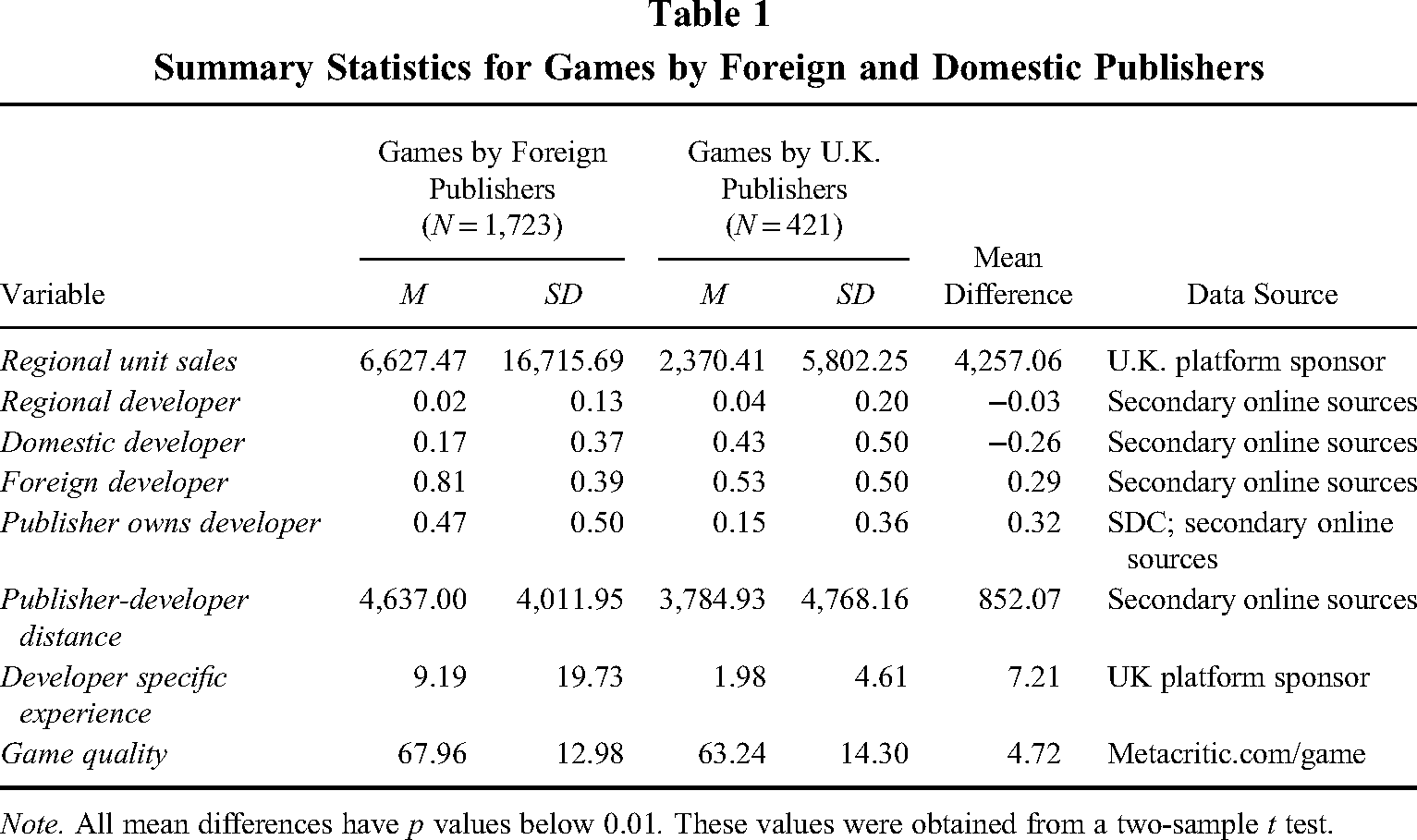
Note. All mean differences have p values below 0.01. These values were obtained from a two-sample t test.
For instance, foreign publishers more often own the developers they work with: 47% of the games by foreign publishers are developed by in-house studios, while only 15% of the games by U.K. publishers are (see Table 1). This higher rate of in-house game development among foreign publishers reflects the larger scale and scope of their operations. We also note that the average distance between publisher and partnering developer is significantly greater for foreign publishers (4,637 km versus 3,784 km for domestic publishers). This may be explained by the observation that domestic publishers are more likely to partner with developers in their home country. Furthermore, foreign publishers have more developer-specific experience, as they have an average of 9.19 prior partnerships with the same developer, while U.K. publishers only have 1.98 prior partnerships. This statistic is positively skewed toward foreign publishers because they are larger and release more games—which they do by repeatedly sourcing from the same developers. Last, games by foreign publishers have higher quality scores as assessed by expert reviewers. Games by foreign publishers received an average quality score of 67.96 out of 100 on Metacritic, while games by domestic publishers have an average score of 63.24.
We thus need to control for these important firm-level characteristics. By estimating econometric models that include publisher fixed effects, we can identify the impact of partnering with a regional developer as well as the effect of variation in regional cultural diversity while keeping constant any differences at the publisher level that will likely affect a game's sales performance. In supplementary analyses reported in the Appendix, we provide robust empirical evidence that foreign publishers do indeed face a LOF in the U.K. market.
Dependent Variable: Regional Sales Performance
Our dependent variable is a video game's regional penetration rate. We calculate the penetration rate by dividing a game's cumulative regional unit sales by the region's population aged 15–34 (measured in the year of a game's release). By dividing a game's unit sales by the region's population, we can control for the size of a game's market—its demand potential (Lilien & Yoon, 1990)—which facilitates comparison across the subnational regions in our sample.
Unit sales within the video game industry are often reported as a key indicator of a game's sales performance because this metric is less sensitive to biases from endogenous pricing policies than revenues (Nair, 2007). Data on games’ regional unit sales were collected on the last day of 2008, at least 1 year after the most recent release in our sample. Given that video games have exponentially downward sloping sales curves and generate most of their sales in the year following their release (Rietveld & Eggers, 2018), right-truncation biases should not be of concern. We use a region's population aged 15–34 years old as the denominator given that these consumers were the most likely target audience for video games during our study period.
Independent Variables
We created two dummy variables to denote a developer's location. Regional developer takes the value of 1 for game-region observations where the developer is based in the focal region, while domestic developer takes the value of 1 for game-region observations where the developer is based in the United Kingdom, outside of the focal region. Observations with foreign developers are the base category. Five-hundred and nineteen observations involved a regional developer, 5,190 observations a domestic developer, and 17,875 observations a foreign one.
We measure a region's cultural diversity by calculating a Blau index using data on the ethnic composition of a region's population. We obtained from the ONS mid-2006 data on the subpopulation sizes of 16 ethnic groups for nine of the U.K. subnational regions. (Ethnic diversity data are missing for Northern Ireland and Scotland, which are therefore dropped from our estimation sample, reducing the number of observations in our models to 19,296.) We calculated the share of each ethnic group in a region's population by dividing the group's size by the region's total population.4 We then used these shares to calculate a Blau index (Blau, 1977), which reflects a region's ethnic diversity (Slangen, 2016). Like people from different countries, those with different ethnicities have been shown to have diverse cultural values, thus rendering ethnic diversity a meaningful indicator of a region's cultural diversity (e.g., Cox, Lobel, & McLeod, 1991). Our reported results are fully robust to using the share of a region's foreign-born population as an alternative measure for its cultural diversity.
Figure 1 documents that the culturally most diverse regions are London, the Midlands, and South East England. Video games generated most of their U.K. sales in London, where a typical game sold 14,485 units. Other regions where games sold particularly well include the Midlands and Northwest England. That said, average penetration rates are highest in North East England and Wales, suggesting that consumers in these regions have a greater demand for video games than those in other regions. The Midlands is the region that hosts the most video game developers (i.e., 16 out of 87 developers), followed by London (14 developers) and South East England (13 developers). As reported in the robustness checks section below, we conducted several robustness checks to rule out that our results are caused by a “London effect.”
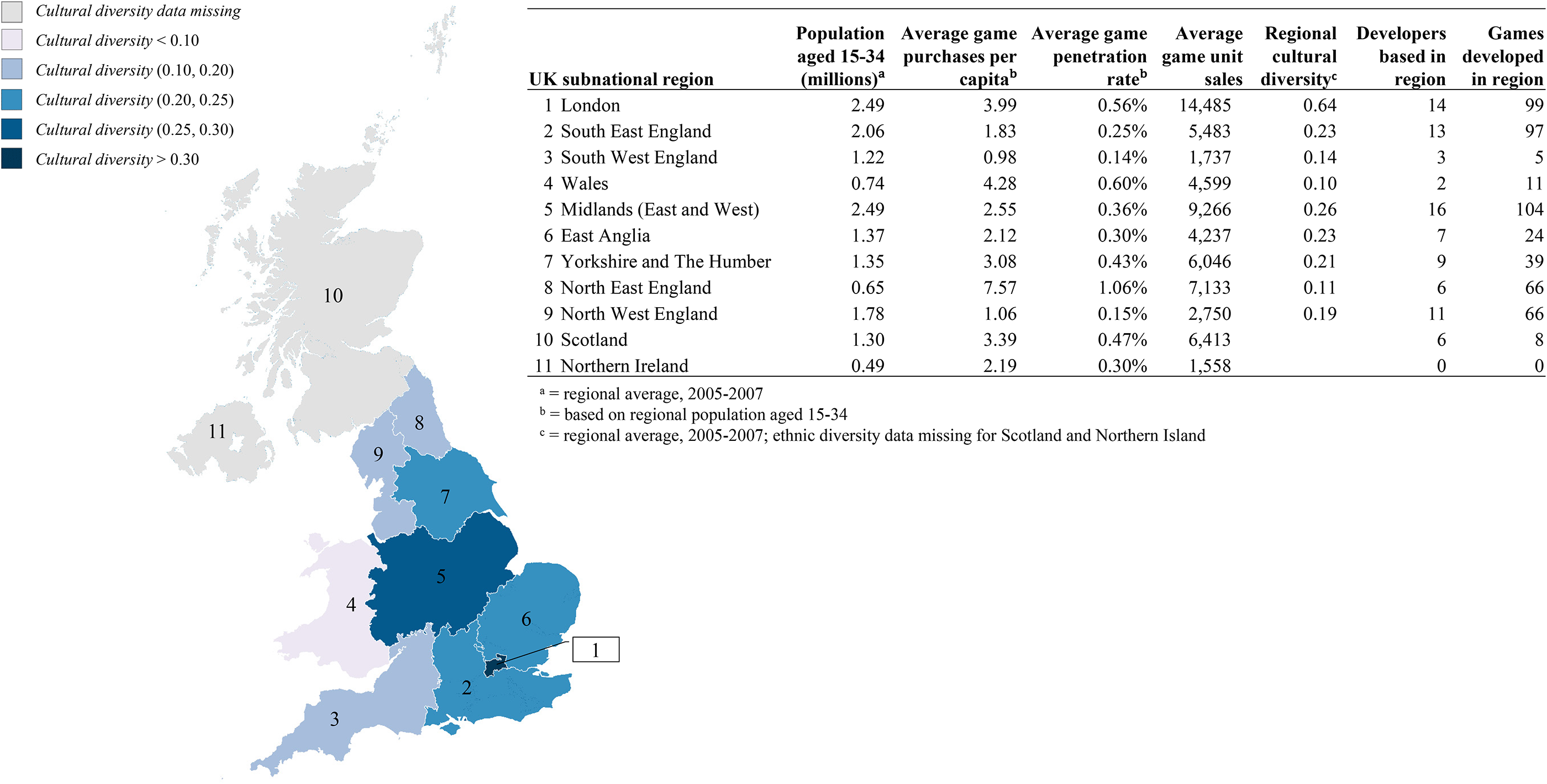
Map of the United Kingdom with summary statistics by region
Control Variables
We control for heterogeneity at the firm level by including fixed effects for all publishers in our sample. In earlier sections we documented qualitative differences between the subsamples of foreign and domestic publishers as well as within these subsamples. The inclusion of publisher dummies controls for these and other unobserved differences, such as publishers’ cultural and geographical distances from the focal U.K. region, their U.K. operating experience, their upstream and downstream capabilities, their financial resources, and their bargaining power vis-a-vis developers. Our results should thus be interpreted as the within-publisher variation in regional game sales performance stemming from differences in developer location and regional cultural diversity.
At the developer level, we control for several factors that past research has found to affect the performance of interfirm collaborations. First, we control for the governance structure of the collaboration between a game's publisher and developer, given that vertically integrated firms typically attain higher performance through efficiency gains and enhanced coordination (e.g., Cassiman, Colombo, Garrone, & Veugelers, 2005). Publisher owns developer is a dummy variable that takes the value of 1 if a developer was a wholly owned subsidiary of the publisher at the time of a game's release and 0 if the developer operated independently. Second, we control for the geographical distance between the publisher and developer of a game, given that distance may entail coordination challenges that negatively affect a partnership's performance and thus a game's regional sales performance. Distance to developer measures the geographical distance (in km) between the headquarters of the publisher and the developer of a focal game. (Note that even wholly owned developers often operate from separate locations.) We log-transformed this measure to account for its skewness. Third, we control for the partner-specific experience between a game's publisher and developer, as prior experience between partnering firms has been shown to positively affect their performance (e.g., Zollo, Reuer, & Singh, 2002). Developer-specific experience measures the number of times a publisher has worked with a focal game's developer over a 5-year rolling window preceding the game's release.5 To account for its skewness, we log-transformed this measure as well.
We also include several game-level control variables. We control for a game's quality by including the Metascore as reported by Metacritic. Metacritic produces a numerical score ranging from 0 to 100, which is then coded into colored bins where scores of 75 and higher receive a green “high quality” label. Games with scores between 75 and 49 receive an orange “medium quality” label, and games with scores below 50 receive a red “low quality” label.6 In accordance with industry practices and consistent with this colored grading schema, past research found strong threshold effects, with variance in scores within the same color code having minimal impact on sales (e.g., Rietveld & Eggers, 2018). We therefore control for game quality by including three dummy variables indicating whether a game was classified as being of high quality (n = 493), medium quality (n = 906), or low quality (n = 147). The base category includes games with missing Metacritic scores (n = 598). We further control for consumer preferences for different product categories by including genre fixed effects.7 Since the market for video games is affected by strong seasonal supply and demand patterns, we also include calendar month of release fixed effects. Last, to control for any time-varying differences between and within gaming consoles, we include platform-year fixed effects.8
Finally, we include two region-level control variables. First, we calculate the average number of game purchases per capita each year. There can exist demand heterogeneity beyond cultural diversity that may impact a game's sales. To control for this, regional game sales per capita divides the sum of the regional unit sales for all games released in a year—excluding the focal game—by the region's population aged 15 to 34 years old. This gives us an indication of consumers’ demand for video games in each region (also see Figure 1). Second, we control for a region's population aged 15 to 34 years old. Including regional population allows us to focus on variation in our dependent variable's numerator. Moreover, we expect it will be harder for any product to attain a high penetration rate when a market is more populous rather than less.
Statistical Methods
We estimate our results using ordinary least squares regression analysis.9 We control for serial correlation between video games (across regions) by estimating heteroscedasticity-robust standard errors clustered at the game level. To assess the differential effects of our independent variables on foreign and domestic products, we jointly estimate split-sample regressions on the subsamples of video games released by foreign publishers and those released by domestic publishers. We then test whether developer location and subnational cultural diversity differentially impact the regional penetration rates of games by foreign versus domestic publishers by performing a series of Chow tests on the coefficients (Chow, 1960).
Results
Table 2 reports descriptive statistics and pairwise correlations for our estimation sample. Although the correlations between some of the independent variables are moderate to high, the variance inflation factors (VIFs) were all below the conventional threshold of 10. Omitting these variables from our models did not change the level of support for our hypotheses. Our main results are reported in Table 3. Models 1a through 4a report regression coefficients for the subsample of games released by foreign publishers, whereas Models 1b through 4b report coefficients for the subsample of games released by domestic publishers. The error terms in the two sets of models are jointly estimated to facilitate cross-model hypothesis tests. Model 1 contains control variables only (including the various fixed effects), Model 2 includes the indicator variables for developer location, Model 3 includes regional cultural diversity, and Model 4 contains all covariates. The far-right column in Table 3 reports Chi-square (χ2) test statistics assessing the difference between the coefficients across the two subsamples.
Descriptive Statistics and Pairwise Correlations for Estimation Sample.
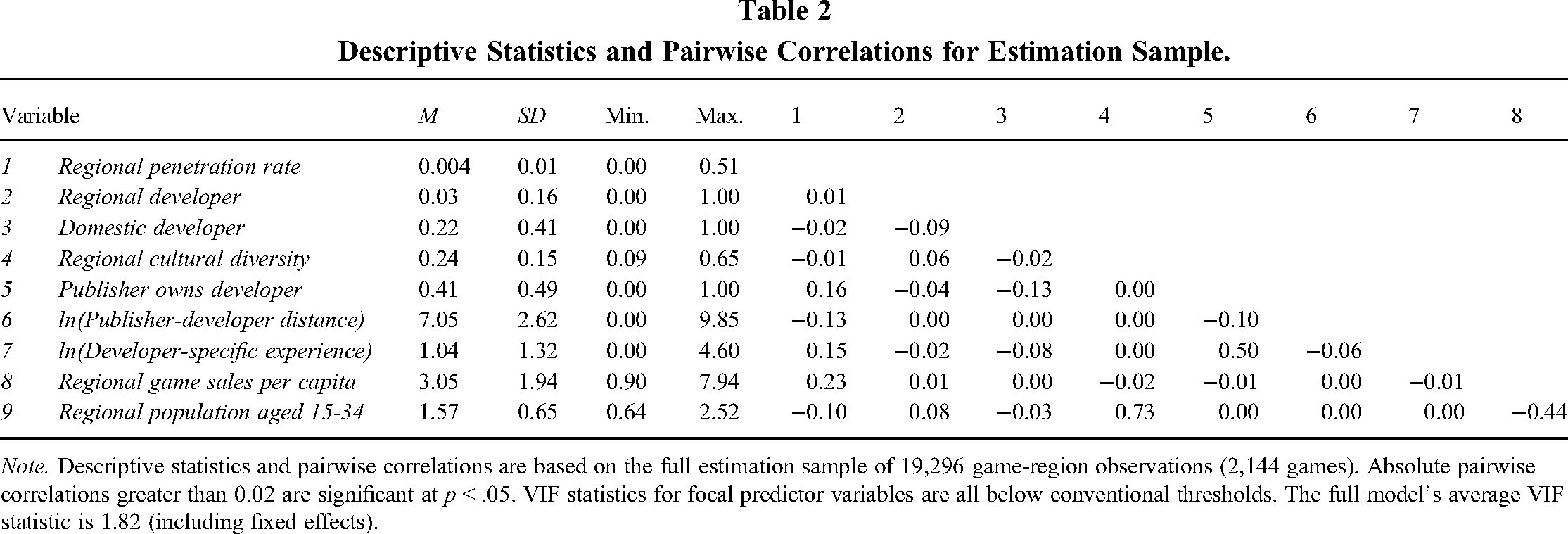
Note. Descriptive statistics and pairwise correlations are based on the full estimation sample of 19,296 game-region observations (2,144 games). Absolute pairwise correlations greater than 0.02 are significant at p < .05. VIF statistics for focal predictor variables are all below conventional thresholds. The full model's average VIF statistic is 1.82 (including fixed effects).
The Effects of Developer Location and Cultural Diversity on Games’ Regional Penetration Rates.
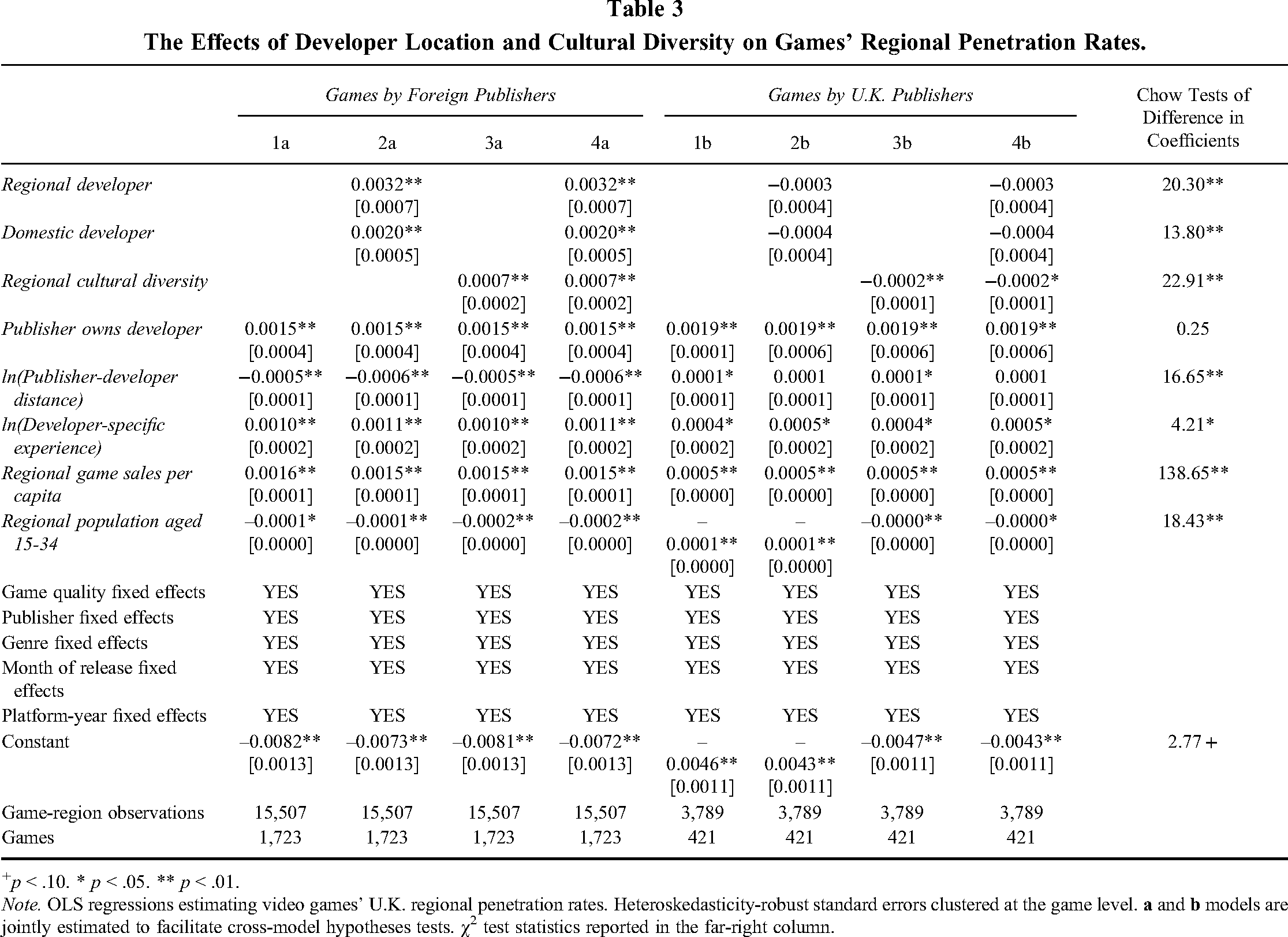
p < .10. * p < .05. ** p < .01.
Note. OLS regressions estimating video games’ U.K. regional penetration rates. Heteroskedasticity-robust standard errors clustered at the game level.
We focus on Models 4a and 4b for the interpretation of our results. To test Hypothesis 1a, which predicts that foreign publishers realize higher regional sales performance if they partner with a regional rather than domestic nonregional or foreign video game developer, we assess the coefficients on regional developer and domestic developer within the subsample of video games by foreign publishers. Consistent with the hypothesis, these coefficients indicate that, compared to foreign publishers sourcing content from foreign developers (the base category), those sourcing content from a regional developer increase their regional penetration rates on average by 66.17% (β = 0.0032, p < .001), whereas those sourcing from a developer based in other U.K. regions increase their regional penetration rates by 41.13% (β = 0.0020, p < .001). Lending further support to Hypothesis 1a, video games’ regional penetration rates are 25.05 percentage points higher when foreign publishers source from a regional developer instead of a domestic nonregional developer (χ2 = 10.99, p = .001).
Hypothesis 1b predicts that partnering with a regional developer is more beneficial to the subnational sales performance of foreign video games than to that of domestic ones. To test this hypothesis, we compare the coefficient on regional developer in the subsample of games by foreign publishers with that in the subsample of games by domestic publishers. We find that the former coefficient is significant (as noted above), whereas the latter is not (β = −0.0003, p = .424). The Chow test statistic further indicates that the difference between the coefficients is statistically significant (χ2 = 20.30, p < .001). Consistent with Hypothesis 1b, these results suggest that foreign video game publishers enjoy significant increases in regional penetration rates by sourcing from a regional developer, whereas domestic publishers do not enjoy such performance gains from doing so.
Hypothesis 2 predicts that cultural diversity has a stronger positive impact on the regional sales performance of foreign video games than on that of domestic ones. Consistent with this hypothesis, we find that regional cultural diversity has a positive effect on the penetration rate of video games by foreign publishers (β = 0.0007, p < .001) and a negative effect on that of games by domestic publishers (β = −0.0002, p = .027). More specifically, an increase of 1 SD in regional cultural diversity is associated with a 2.02% increase in regional penetration rates for games by foreign publishers and a 1.73% decrease in regional penetration rates for games by domestic publishers. Moreover, the Chow test statistic indicates that the difference between these coefficients is statistically significant (χ2 = 22.91, p < .001), such that an increase of 1 SD in regional cultural diversity is associated with a 3.75 percentage points greater increase in the regional penetration rate of video games by foreign publishers. These findings lend strong support to Hypothesis 2.
Our control variables mostly load as expected. First, we find that publishers using in-house developers realize higher regional penetration rates than those partnering with independent developers. Specifically, the use of in-house video game developers is associated with a 33.72% increase in regional penetration rates for games by foreign publishers (β = 0.0015, p < .001) and a 111.21% increase for games by domestic publishers (β = 0.0019, p = .001). We further find that the geographical distance between a game's publisher and developer negatively affects games’ regional penetration rates for foreign publishers (β = −0.0006, p < .001). An increase of 1 SD in geographical distance is associated with a 32.16% decrease in regional penetration rates. However, we find no such effect in the subsample of games by domestic publishers (β = 0.0001, p = .482). We further find that developer-specific experience has a positive effect on a game's regional penetration rate. Notably, an increase of 1 SD in developer-specific experience is associated with a 30.42% increase in regional penetration rates for games by foreign publishers (β = 0.0011, p < .001) and a 23.09% increase in regional penetration rates for games by U.K. publishers (β = 0.0005, p = .011). At the region level, we find that the number of games purchased per capita positively impacts a game's regional penetration rate. One additional game purchased per capita is associated with a 31.35% increase in the regional penetration rate for games by foreign publishers (β = 0.0015, p < .001) and a 30.95% increase for games by domestic publishers (β = 0.0005, p < .001). Finally, we find that regional population size negatively affects a game's penetration rate. Increasing a region's population (aged 15 to 34 years old) by one million people is associated with a 4.53% decrease in the regional penetration rate for games by foreign publishers (β = −0.0002, p < .001) and a 2.13% decrease for games by domestic publishers (β = −0.00004, p = .039).
Mechanism Check
Extending the logic underlying our arguments, one could conjecture that the benefits of sourcing from a regional developer will be weaker in regions characterized by higher cultural diversity. Consumers in culturally diverse regions have various ethnic backgrounds and, through their interactions with other people that are themselves culturally diverse, will be more open to experiencing heterogeneous cultural products and services. This should render a developer's regional embeddedness and the cultural specificity of its products less able to increase consumers’ WTP. That is, sourcing from a regional developer may not increase the fit between a publisher's products and consumers’ tastes and preferences as much when a subnational region is culturally more diverse.
To test for this possibility, we split our sample into culturally diverse regions and culturally homogenous ones, using the median cultural diversity value as the cutoff. We then re-estimate our models and assess whether the coefficient on regional developer is weaker for the subsample of games released in culturally diverse regions (see Table 4). The coefficient on regional developer is positive and significant in both subsamples (as expected). However, we find that sourcing content from a regional video game developer (compared to sourcing from a foreign developer) is associated with a 61.93% increase in regional penetration rates for games released in culturally homogenous regions (β = 0.0030, p = .002) and a 32.27% increase for games released in culturally diverse regions (β = 0.0012, p = .006). This difference of 29.66 percentage points in the benefit of sourcing from a regional developer across subsamples is statistically significant (χ2 = 3.43, p = .064). Moreover, whereas the benefit of partnering with a regional developer is statistically significant compared to partnering with a domestic nonregional developer in the subsample of culturally homogenous regions (χ2 = 5.45, p = .019), this is not the case for games in the subsample of culturally diverse regions (χ2 = 2.14, p = .144). These results suggest that the benefits of sourcing from a regional developer are weaker in culturally diverse regions.
The Effects of Developer Location in Culturally Homogenous and Culturally Diverse Regions
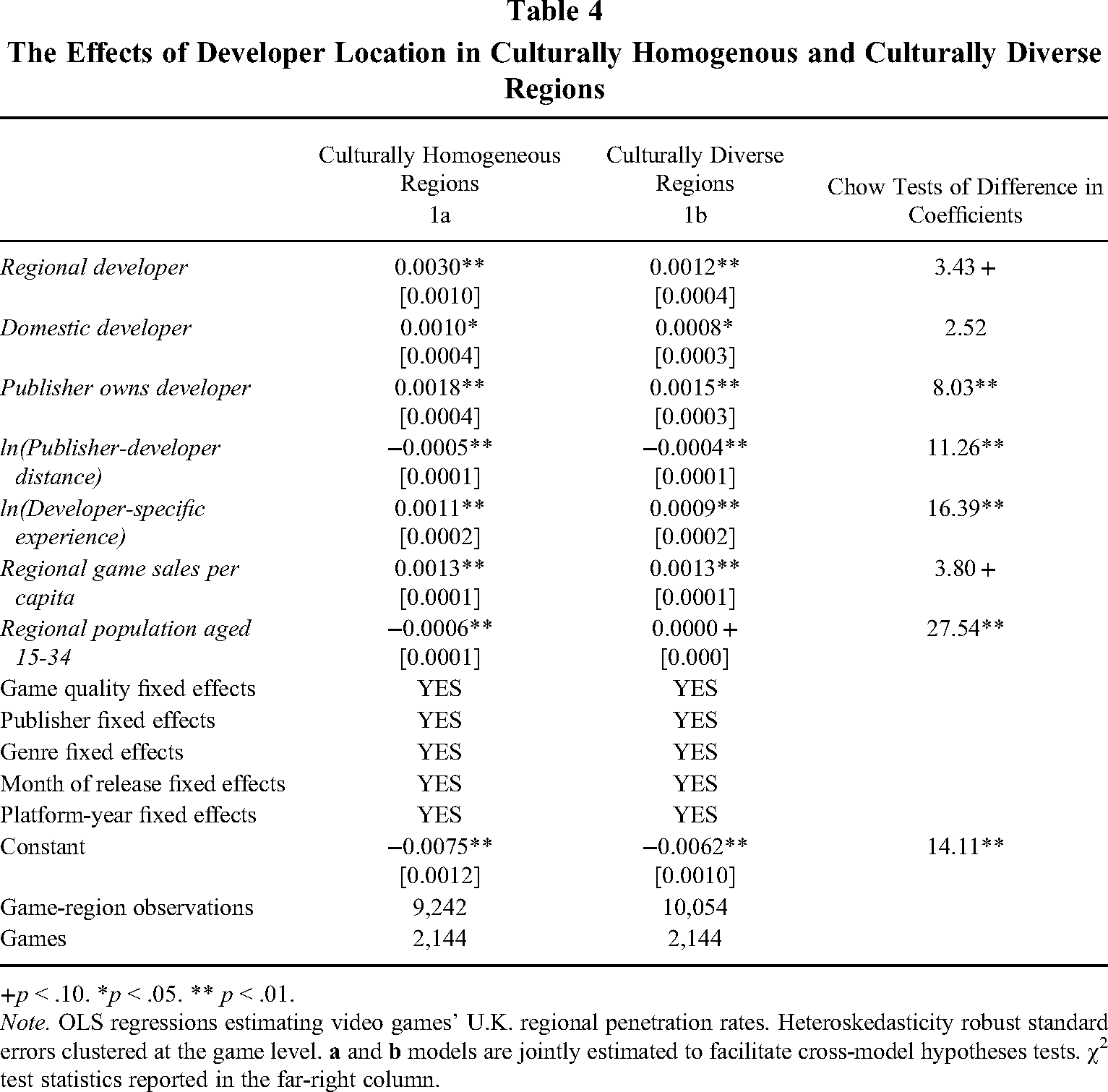
+p < .10. *p < .05. ** p < .01.
Note. OLS regressions estimating video games’ U.K. regional penetration rates. Heteroskedasticity robust standard errors clustered at the game level.
Robustness Checks
We assess the robustness of our findings to several alternate sample and model specifications. First, we account for unobserved heterogeneity at the region level that may be correlated with developer location and could therefore bias our results. For instance, if foreign publishers consistently source more content from London-based game developers than domestic publishers do, then this could partly explain why foreign firms enjoy greater benefits from sourcing from regional development studios, given that video games generally attain higher sales in London. We address this alternative explanation by re-estimating our models with the inclusion of region fixed effects. Alternatively, we include a dummy variable that indicates whether a game-region observation falls in London. Our findings are consistent across both models.
Second, we ran an alternative specification that includes a dummy variable indicating whether a domestic publisher is based in the focal subnational region or elsewhere in the United Kingdom. Extending our arguments about cultural embeddedness and the fit with consumers’ tastes and preferences, one might expect that domestic publishers based in the focal region will attain higher regional penetration rates than publishers based elsewhere. We find support for this conjecture as the dummy variable is positive and significant. Otherwise, however, our results remained unchanged. Tabulated results from these and other robustness checks (e.g., alternate model specifications, excluding certain control variables) are reported in the Online Supplement.
Discussion
The objective of this study has been to document within-firm variation in the LOF at the product level. We obtained evidence for the existence of such variation in an analysis of a sample of 2,144 console video games released between 2005 and 2007 by foreign and domestic publishers across the 11 subnational regions of the United Kingdom. Specifically, we found that the regional penetration rate of individual games within publishers’ product portfolios systematically differs across foreign and domestic publishers, depending on (1) whether the game was sourced from a regional developer and (2) a sales region's cultural diversity. These findings indicate that a foreign product's relative appeal to consumers can differ across subnational regions within the same host country depending on the characteristics of both the product and the consumers in these regions. Our findings have important implications, which we elaborate on below.
First, our study further specifies how the interplay between supply- and demand-side factors can explain a foreign product's relative appeal to consumers. Specifically, the supply-side view on the LOF has argued that firm-specific advantages (FSAs) derived from such assets as technology, patents, or knowledge are sufficient to overcome the LOF (Buckley & Casson, 1976; Hymer, 1976). The demand-based view on the LOF, however, argues that a focus on these supply-side factors is insufficient. Rather, emphasis should be placed on the intersection of a product's value proposition and host country consumers’ tastes and preferences. This interplay between supply-side factors (i.e., a product's value proposition) and demand-side ones (i.e., consumer preferences) manifests itself at the product level. Building on prior work that considers the product as the relevant unit of analysis, we draw attention to within-firm variation in the LOF by considering how important dimensions of the supply-side—in our case, the inputs provided by product development partners—may vary across a firm's product portfolio.
We believe this is an important contribution because it suggests that the role of FSAs may be more complex than previously assumed. In fact, FSAs may have to be understood from a multilevel perspective, whereby FSAs at different levels (e.g., firm, business unit, or product-line) and the interplay between these advantages collectively impact a product's value proposition. This may explain not only the within-firm variation in the LOF that we observe in our context but also, more broadly, the difficulties that foreign firms experience in sustaining their competitive standing across multiple product categories in a given host country. Our study therefore adds texture to prior research that has suggested that foreign firms should adopt sequential entry strategies such that a firm first enters a foreign country in its core business—where its capabilities are strongest—followed by areas in which its competitive standing is weaker (Chang, 1995). Complementing these insights, our findings indicate that it is not only the focal product's value proposition that should guide these decisions but also the important question of whether a product's value proposition meets local consumers’ tastes and preferences.
Our study therefore echoes recent work in strategy suggesting that there is a need to better understand the very notion of competitive advantage (Lieberman, 2021). One way to approach this question is to consider the counterfactual more carefully in our theorizing (Cirik & Makadok, 2021). By comparing a firm's performance to that of domestic firms or foreign rivals, most studies have focused on performance differences between firms. While this approach yields valuable insights into a firm's competitiveness, such a comparison is not always the most relevant from a managerial perspective. For instance, for any firm to choose its optimal product market entry strategy, the relevant decision normally would be a comparison among its own products rather than one that is based on rivals’ products. In a similar vein, our study raises questions about the role of organizational learning in an international context. While it is widely assumed that foreign firms can learn from their partners through sourcing (e.g., Monteiro & Birkinshaw, 2017), our findings suggest that learning may be more nuanced. While some benefits of partnering may be transferable across a firm's products, there seem to exist partner-related benefits that are product-specific and thus cannot be transferred within the firm.
Second, our study identifies within-country demand heterogeneity as another important driver of foreign firms’ relative sales performance. In our case, differences in subnational cultural diversity differentially affected the sales performance of video games, with those by foreign publishers enjoying comparatively higher regional penetration rates (compared to games by domestic publishers) in those regions where the consumer base was culturally more diverse. Moreover, in contrast to prior studies that have considered demand heterogeneity at the country level (e.g., Kim & Jensen, 2014; Shaheer & Li, 2020), our focus on demand heterogeneity within a single host country allows us to better separate consumer-specific drivers of performance from country-level drivers of performance. To the best of our knowledge, our study is also among the first to empirically measure and test any specific dimension of demand heterogeneity—in our case, cultural diversity. Practically, our findings suggest that foreign firms should not only consider entering those markets where demand is more heterogeneous rather than less (e.g., Shaheer et al., 2020; Zhang et al., 2019) but also that they should carefully examine the dimensions along which consumers differ—and target those markets where consumers’ evaluations will be tilted in favor of foreign products.
Limitations and Future Research
Our study has several limitations that may affect the generalizability of our findings. First, the publishers in our sample operate on a supranational scale and, as such, deploy a global perspective on determining their product-market strategies (Johns, 2006; Tschang, 2007). Put differently, by default, video games are released simultaneously across the subnational regions and countries within the wider supranational region. We took advantage of this industry feature because it provided us with exogenous product release patterns at the country and subnational level. However, this raises the question of whether our findings also hold for industries where internationally oriented firms actively strategize about their subnational entry and product release decisions, as could be the case for restaurant and hotel chains, among others.
Second, although video games may be representative of other cultural products such as motion pictures and mobile apps, our focus on a single industry is a potentially restraining factor, limiting the generalizability of our findings. That said, similar dynamics were reported by Kübler, Pauwels, Yildirim, and Fandrich (2018), who found that mobile apps perform differently across countries as a function of the match between apps’ business models and the degree of uncertainty avoidance and masculinity in a country's consumer base. Moreover, given that cultural industries have been acknowledged to represent an “important, exciting, and complex context” that provide “opportunities to broaden international business theories” (Wang et al., 2020: 665), we believe that our findings offer valuable insights. For instance, it is well-known that U.S. movie studios looking to enter the Chinese market often source inputs from Chinese actors or animation studios and/or target culturally diverse markets such as Beijing and Shanghai.
Nevertheless, future research may want to replicate our study in other industries, including both cultural and noncultural ones (for an example of how cultural diversity affects performance in the beer industry, see Wang, Zeng, & Shenkar, 2021). In noncultural industries, consumers’ WTP for foreign vis-à-vis domestic products may depend less on the cultural characteristics of partners’ inputs and consumers’ tastes and preferences and may be affected more strongly by other characteristics of such regions and their consumers, such as their political orientation and economic development level.
Last, we believe that a promising avenue for future research is to understand when “foreignness” turns into an advantage in cultural industries (Insch & Miller, 2005; Tupper et al., 2018). For example, it may be possible that in subnational markets with high levels of cultural diversity foreign products not only experience a relatively lower LOF but, in fact, enjoy an absolute advantage vis-à-vis comparable domestic products or competing foreign products. Given our focus on within-firm variation, exploring this question was beyond the scope of our study. However, we encourage future research to explore this possibility further.
Supplemental Material
sj-docx-1-jom-10.1177_01492063221094261 - Supplemental material for Within-Firm Variation in the Liability of Foreignness: A Demand-Based Perspective
Supplemental material, sj-docx-1-jom-10.1177_01492063221094261 for Within-Firm Variation in the Liability of Foreignness: A Demand-Based Perspective by Mirko H. Benischke, Joost Rietveld, and Arjen Slangen in Journal of Management
Footnotes
Authors are listed in alphabetical order. The paper benefited from feedback received during seminar presentations at the Rotterdam School of Management, Erasmus University, and the University of Leeds; a conference presentation at the 2018 Academy of International Business in Minneapolis, Minnesota; and a roundtable discussion at the 2019 Annual Meeting of the Academy of Management in Boston, Massachusetts. The authors thank Jay Annand and Susan Mudambi for their comments on an earlier version of the paper. The authors further thank the Associate Editor, Sali Li, and two anonymous reviewers for their very helpful feedback.
Declaration of Conflicting Interests
The author(s) declared no potential conflicts of interest with respect to the research, authorship, and/or publication of this article.
Funding
The author(s) received no financial support for the research, authorship, and/or publication of this article.

Notes
Appendix
References
Supplementary Material
Please find the following supplemental material available below.
For Open Access articles published under a Creative Commons License, all supplemental material carries the same license as the article it is associated with.
For non-Open Access articles published, all supplemental material carries a non-exclusive license, and permission requests for re-use of supplemental material or any part of supplemental material shall be sent directly to the copyright owner as specified in the copyright notice associated with the article.
