




Abstract
In knowledge networks, such as best-practice networks, industry forums, and professional communities, members of different organizations exchange knowledge for mutual and individual benefit. When properly managed, knowledge networks enable time- and resource-constrained individuals to engage across organizational and industry boundaries. Such networks often involve deliberate orchestration by a hub actor (individual, team, or organization), often referred to as the orchestrator. Orchestration in a network of individuals is essentially a form of brokering behavior. While most previous studies of orchestration and brokerage have adopted a broker-centric perspective, the present study advances an alter-oriented account of how brokering behavior influences relationships to create knowledge-related benefits for individual network members. Drawing on interviews with 51 members of a Belgian knowledge network focusing on best practices in research and development, this study explores the orchestrator's brokering behavior and ensuing benefits for network members. Based on these findings, the study describes an integrative model of alter-oriented brokering processes that modify, intermediate, and maintain relationships among alters in orchestrated knowledge networks. The study contributes by conceptualizing alter-orientation as a distinct brokering behavior, by unpacking the microfoundations of brokering in knowledge network orchestration, and by demonstrating the dynamics between knowledge and social dimensions of knowledge network orchestration.
There is increasing academic and practitioner interest in knowledge networks—social networks that exist to acquire, transfer, and create knowledge among different actors (Phelps, Heidl, & Wadhwa, 2012). Individuals form and reshape knowledge networks naturally and continuously in various professional and social contexts (Borgatti & Halgin, 2011; Borgatti, Mehra, Brass, & Labianca, 2009; Chua, Ingram, & Morris, 2008; Lincoln & Miller, 1979; Lorentzen, 2008). 1 When properly managed, knowledge networks enable time- and resource-constrained individuals to engage across organizational and industry boundaries (McFadyen & Cannella, 2004; Yli-Renko, Autio, & Sapienza, 2001). However, transferring complex knowledge involves major challenges and opportunity costs (R. Grant, 1996), and sharing and adopting ambiguous, tacit, or complex knowledge requires significant levels of interaction (Easterby-Smith, Lyles, & Tsang, 2008; Janowicz-Panjaitan & Noorderhaven, 2009; Phelps et al., 2012). The ability to share and adopt knowledge is also affected by the quality and strength of network relationships (Hansen, 1999). Furthermore, as loosely coupled systems in which actors are both simultaneously distinctive and responsive (Orton & Weick, 1990), knowledge networks involve individual aspirations, mutual interaction, and dependency.
Different coordination models have sought to tackle these challenges, including best-practice networks (Hayter, 2016; Jarvenpaa & Majchrzak, 2008), communities and networks of practice (Kalafatis, Lemos, Lo, & Frank, 2015), trade associations (Pinnington, Lyons, & Meehan, 2020), and industry forums and professional associations (Seibert, Kacmar, Kraimer, Downes, & Noble, 2017). An increasingly recognized approach to network coordination emphasizes orchestration, where a hub actor facilitates activities within a loosely coupled network or ecosystem (Dhanaraj & Parkhe, 2006; Gardet & Fraiha, 2012; Giudici, Reinmoeller, & Ravasi, 2018; Hurmelinna-Laukkanen & Nätti, 2018; Pinnington et al., 2020; Thomas & Ritala, 2021). This approach offers significant benefits because network orchestrators “may play an indispensable role in supporting the ongoing recombination of members’ knowledge to explore new opportunities” (Giudici et al., 2018: 1396) and address the complexities of coordinating multiple diverse stakeholders (Reypens, Lievens, & Blazevic, 2021).
From a social network perspective, orchestration can be understood as a form of brokerage (Paquin & Howard-Grenville, 2013; Pinnington et al., 2020), in which one actor (the broker) occupies a particular structural position between other network actors (alters) (Kwon, Rondi, Levin, De Massis, & Brass, 2020). Most studies of orchestration (Dagnino, Levanti, & Mocciaro Li Destri, 2016) and brokerage have focused on the benefits of this central position for the broker (see, e.g., Burt & Soda, 2021; Burt, Kilduff, & Tasselli, 2013). However, this broker-centric perspective neglects the social complexity of knowledge networks and the diverse aspirations of multiple alters. As Clement and colleagues (2018: 251) observed, “Although much is known about how brokerage positions in social networks help individuals improve their own performance, we know little about the impact of brokers on those around them.”
While the benefits accruing to orchestrators and brokers in various social and knowledge networks are well understood (Burt & Soda, 2021; Dagnino et al., 2016; Kwon et al., 2020; Phelps et al., 2012), less is known about how brokering facilitates alters’ knowledge sharing and adoption. Actors join knowledge networks to learn and exchange knowledge, but this may incur significant opportunity and transaction costs; for that reason, it is important to understand how orchestration can help networks and individual members to achieve those goals. In line with Kwon et al. (2020), we argue the need to address qualitative aspects of brokering behaviors and how these can enhance knowledge sharing and adoption. Following Halevy, Halali, and Zlatev (2019: 216), we distinguish brokerage (as a position that bridges structural holes in the network) from brokering (as the individual behaviors of brokers that shape relationships among alters).
To address these gaps in the literature, we characterize alter-oriented brokering as a distinct behavior attuned to orchestrated knowledge networks. By engaging in this prosocial behavior, an orchestrator can influence a network in ways that accommodate alters’ aspirations. For instance, a dedicated third-party orchestrator can help actors in venture associations (Giudici et al., 2018) and trade associations (Pinnington et al., 2020) to achieve their business and networking goals. Similarly, the “facilitator-orchestrator” (Hurmelinna-Laukkanen & Nätti, 2018) and “consensus-based orchestration” (Reypens et al., 2021) have proved especially effective in knowledge- and innovation-focused networks. More broadly, some recent studies of brokering have highlighted a range of performance and creativity benefits for alters (Clement, Shipilov, & Galunic, 2018; Li, Li, Guo, Li, & Harris, 2018), but the microfoundations of alter-oriented brokering behavior and related outcomes remain ambiguous in this emerging literature.
Our empirical study is driven by two questions: (a) What key activities and behaviors characterize knowledge network orchestration? (b) How do those activities and behaviors influence alters’ social and knowledge exchange? To address these questions, we conducted an in-depth qualitative study of an orchestrated knowledge network that offered rich access to relevant data. On the basis of interviews with 51 network members, we identified a number of distinct orchestration roles and perceived benefits for alters, enabling us to develop an integrative model of alter-oriented brokering in knowledge networks. Our findings make three contributions to the literature. First, we conceptualize alter-oriented brokering in knowledge networks as a social process in which an orchestrator (broker) influences alters’ relationships in pursuit of benefits that reflect their aspirations. Second, we unpack the microfoundations of brokering in knowledge networks, showing how brokering processes moderate and mediate alter interactions in open and closed triads. Third, we expose the dynamic relationship between the knowledge and social dimensions of network orchestration and show how these two dimensions inform alter-to-alter synergies beyond initial brokering interventions and actions.
Conceptual Background
Knowledge Networks and Orchestration
Phelps et al. (2012: 1117) defined a knowledge network as “a set of nodes—individuals or higher-level collectives that serve as heterogeneously distributed repositories of knowledge and agents that search for, transmit, and create knowledge—interconnected by social relationships that enable and constrain nodes’ efforts to acquire, transfer and create knowledge.” We share this view of knowledge networks as social networks, in contrast to studies that emphasize knowledge elements and connections (see Wang, Rodan, Fruin, & Xu, 2014). 2 Social features are of central concern because knowledge sharing and adoption depend on the embeddedness of actors in a social structure (Amesse & Cohendet, 2001; Berger & Luckmann, 1966; Phelps et al., 2012; Uzzi & Lancaster, 2003).
As network members interact, knowledge elements are shared and reshaped (Mizruchi & Fein, 1999), potentially creating valuable new combinations (Savino, Messeni Petruzzelli, & Albino, 2017). Network members pursue learning opportunities through new relationships, sometimes with the help of intermediaries (Soda, Mannucci, & Burt, 2021), simultaneously mitigating the opportunity costs of knowledge heterogeneity and ambiguity (Hansen, 2002; Wang et al., 2014). While we are all necessarily embedded in knowledge networks of some kind, our focus here is on knowledge networks that are deliberately orchestrated and on how an orchestrator's brokering behavior influences, mediates, or modifies alters’ relationships (Halevy et al., 2019).
Network orchestration can be characterized as a set of activities and roles performed by a hub actor (individual, team, or organization) to coordinate independent network members’ interactions within a loosely coupled context (Dagnino et al., 2016; Dhanaraj & Parkhe, 2006; Ritala, Armila, & Blomqvist, 2009). In knowledge network contexts, loose coupling (Orton & Weick, 1990) has two dimensions: distinctiveness in terms of actors’ knowledge, motivations, and ability to participate (Phelps et al., 2012; Porter & Woo, 2015) and responsiveness in terms of how social relationships both constrain and enable efforts to share and adopt knowledge (Phelps et al., 2012: 1117). As a style of coordination, orchestration taps into both distinctiveness and responsiveness while preserving the possibility of goal-oriented activity (Dhanaraj & Parkhe, 2006). Orchestration fits particularly well with knowledge-sharing and innovation-focused contexts, as demonstrated by the range of empirical studies, which have identified different orchestration activities such as facilitating knowledge sharing, maintaining network stability, ensuring innovation appropriability, visioning, and motivating members’ pursuit of particular goals (Hurmelinna-Laukkanen & Nätti, 2018; Metcalfe, 2010; Nätti, Hurmelinna-Laukkanen, & Johnston, 2014; Pinnington et al., 2020; Ritala et al., 2009). Importantly, orchestration can simultaneously address and accommodate multiple goals and aspirations (for reviews, see Dagnino et al., 2016; Hurmelinna-Laukkanen & Nätti, 2018), including the orchestrator's own and those of network members (Giudici et al., 2018; Reypens et al., 2021).
Alter-Oriented Brokering
In (social) knowledge network contexts, orchestration can be understood as a form of brokering (see also Paquin & Howard-Grenville, 2013; Pinnington et al., 2020). Here, we characterize brokering as a behavioral process of third-party influence, in which the broker's actions both mediate between disconnected alters (individual network members, pairs, or groups) and modify any existing relationships (Halevy et al., 2019). In this view, brokering activities can influence the number, strength, quality, focus, and nature of knowledge network relationships. A brokering-as-influence approach responds to recent calls for further research addressing brokerage behaviors and processes rather than positional or structural benefits (Halevy et al., 2019; Kwon et al., 2020; Tasselli & Kilduff, 2021). Given the socially embedded, sticky, and tacit nature of knowledge (Grant, 1996; Spender, 1996), the knowledge network literature stands to gain from this approach as it enables to tap into the behavioral microfoundations of brokering processes.
In orchestrated knowledge networks, two types of brokering can be considered essential. Tertius gaudens (in English, “one that separates”) refers to a broker who mediates between disconnected alters in an open triad. To date, the network literature has focused predominantly on this form of brokering and the broker's role in bridging structural gaps between disconnected alters (Halevy et al., 2019). Recently, however, there has been increasing research interest in tertius iungens (in English, “one that joins”)—a form of brokering within closed triads between actors that are already connected. In contrast to the organizational or individual broker's structural role in open triads (Burt, 1992, 2004; Ozer & Zhang, 2019), this latter approach addresses how a broker influences existing relationships (Halevy et al., 2019). Knowledge networks typically include both types of triads and brokering; in practice, a large network of individual members involves a diverse range of connected and disconnected alters as well as weak and strong ties.
Alter-orientation is central to our conceptualization of brokering. While the structural social network perspective typically focuses on the advantages of the brokerage position for the actor in question (e.g., Burt et al., 2013; Burt & Soda, 2021; Grosser, Obstfeld, Labianca, & Borgatti, 2019; Obstfeld, Borgatti, & Davis, 2014), some recent research highlights the benefits for alters. Clement et al. (2018) provided empirical support for their argument that brokerage can be viewed as a public good, as one actor can generate opportunities (and constraints) for others. Li et al. (2018) showed how brokerage can boost the creativity of alters as well as of the broker. The management literature confirms that prosocial behavior or other-orientation can benefit both individuals who help others and the organizations and networks in which they are embedded (e.g., Grant, Dutton, & Rosso, 2008). Applying this prosocial thinking to social network contexts, the alter-oriented broker's main role is to influence others in order to help them to achieve their goals. In short, while the dominant broker-centric perspective focuses on the benefits for the broker (see, e.g., Burt & Soda, 2021), alter-orientation emphasizes the benefits for alters. 3
Several recent studies in different contexts have identified features of alter-orientation in network orchestration. In their study of a venture association, Giudici et al. (2018) coined the term “open-system orchestration” to describe cases in which the orchestrator's principal aim is not to steer the direction of value appropriation but to facilitate and sustain value creation by network members. They showed that the orchestrator can help network members to develop new business relationships and identify entrepreneurial opportunities by encouraging and facilitating collaboration and exploring complementarities. Pinnington et al. (2020) investigated “value-independent third-party orchestrators” who employ delicate facilitation to manage collaboration in trade associations rather than steer value creation interactions among network members. More broadly, “facilitation-oriented” or “consensus-based” network orchestrators are known to adopt a neutral and noncompetitive orientation focusing on collective rather than individual goals (Fleming & Waguespack, 2007; Hurmelinna-Laukkanen & Nätti, 2018; Metcalfe, 2010; Reypens et al., 2021). Building on these emerging insights, we conceptualize alter-oriented brokering as a social process, in which an orchestrator (broker) influences relationships and relationship-driven benefits in both open and closed triads of network members (alters). 4
Method
To gain an empirical understanding of alter-oriented brokerage processes, we conducted a qualitative study of an orchestrated knowledge network, focusing on the behaviors of an individual orchestrator and their perceived influence on network members as an instance of alter-oriented brokering. This empirical work augments the brokering and network orchestration literatures by (a) looking beyond hub actor–driven outcomes and hub actor–centric benefits and (b) going beyond a structural into a more behavioral approach, examining the microfoundations of orchestration in a diverse knowledge network structure.
We employed a qualitative single-case-study approach, which is appropriate when exploring a new or unfamiliar phenomenon (Dyer & Wilkins, 1991; Siggelkow, 2007). Our chosen approach can further be characterized as an instrumental case study, as we sought to develop theoretical insights into an underexplored phenomenon (Stake, 1994). The single case study is a useful way of generating rich descriptions and explanations of complex social processes in their real-world context. In contrast to case studies that pursue broader empirical generalization from multiple cases, we focused explicitly on the immediate context for theory development (for discussion, see Welch, Piekkari, Plakoyiannaki, & Paavilainen-Mäntymäki, 2011). This context-aware approach pursues theoretical explanation and generalization (Tsang, 2014) within a particular context. In analyzing the empirical data, we followed the interpretive tradition, which views reality as socially constructed and the researcher as interpreter of that reality (Gioia, Corley, & Hamilton, 2013; Piekkari, Welch, & Paavilainen, 2009; Stake, 1994).
Case Context: The GRD Network
The empirical setting was Groupe Recherche-Développement (GRD), a Belgium-based network of managers and experts from organizations with a strong R&D focus, including private-sector firms and cluster organizations and public-sector actors, such as universities and research institutes. Given its focus on knowledge sharing and adoption and its governance model, GRD can be characterized as an orchestrated knowledge network, in which a designated individual plays the role of orchestrator. As of September 2020, GRD had 63 individual members, each representing a different organization. We considered this case context especially suitable for four reasons: 5 (a) The GRD network can be characterized as relatively stable by virtue of its low annual dropout rate (less than 10%) and high participation rate (33%–50% at each monthly meeting). This enabled us to specify clear case boundaries, which is important when investigating whole networks (Provan, Fish, & Sydow, 2007). (b) GRD's low dropout rate and long history (more than 55 years) is evidence of its utility, making it meaningful to explore the perceived benefits of orchestration. (c) GRD is cross-sectoral, with diverse organizational and individual members from the private and public sectors. This diversity and the relatively large number of informants were considered likely to yield qualitatively rich data patterns and to ensure that the analysis would achieve saturation. (d) GRD can be characterized as a knowledge network because it exists to meet its members’ knowledge-related aspirations and needs.
Funded by annual membership fees, the network's main activities are organized around monthly meetings, which are scheduled for the full year (10 per year) and hosted by members in rotation. Meetings typically last about 5 hours and include three types of activity: (a) Free networking (including welcome coffee, other coffee breaks, and a standing lunch) generally accounts for about 90 minutes of each meeting. (b) Presentations are given (by the host and guest speakers) on best practice or experience sharing. Three or four presentations (depending on length) offer members opportunities to discuss and ask questions about the content. This activity typically accounts for about 150 minutes in total and aims to stimulate further discussion during free networking. (c) A site visit to one of the host's operations (related to the theme of the meeting) typically lasts about 45 minutes.
Membership of the network is open to representatives of any organization engaged in significant R&D in Belgium but is by invitation only. Membership is held by individuals (typically, heads of R&D or equivalent) rather than their organizations, although members can be represented by a nominated colleague as needed. In practice, the GRD network is overseen by an orchestrator (and assistant), who attends all meetings and reports once a year to the GRD board (comprising selected network members) on the network's evolving agenda, membership, and financial matters. As the network's first orchestrator, the founder formulated the core orchestration principles: an annual program of monthly workshops hosted by members, with a standardized schedule of presentations, networking, and visits. After almost 50 years, the current orchestrator (a member for 10 years) took over in 2015 and continued to develop those principles—for example, switching the network's official language from French and Dutch to English and introducing digital rather than paper-based communication. Our findings relate to this post-2015 period.
Data Collection
Our main data source was a series of semistructured interviews with GRD members; to capture the network's essence and diversity, we sought access to all 63 members. On the basis of their availability, we were able to interview 51 of those members over a period of 4 months (April to June 2018). To ensure that each informant's recollection of orchestration was reliable and to reduce any risk of retrospective bias, the interviews were conducted between or directly after meetings during that period. The informants were broadly representative of members’ diverse profiles and sectors, including private companies (n = 36), universities (n = 6), cluster organizations (n = 4), and research centers (n = 5) and typically occupied a senior position, such as managing director, R&D director/manager, or chief technology officer. All interviews were recorded and transcribed. Of these, seven were conducted in Dutch and translated into English; the rest were conducted in English. In total, the interviews yielded 379 pages of written content from over 43 hours of recorded material. To ensure anonymity when discussing the findings, we used sector-related aliases (e.g., Aerospace & Defense Firm A; University B).
The interview guide was developed in an iterative process grounded in both theory and the empirical context, involving several rounds of modifications as more qualitative insights emerged. Following two preliminary test interviews, the guide was modified and further amended (twice) during the next nine interviews to arrive at the final format for the remaining 40 interviews. This final interview guide comprised four sets of questions (see Appendix Table A1). As previous studies offered only limited insights into actual orchestration processes in knowledge networks, each interview opened with two sets of questions that were sufficiently general to elicit the informant's perspective in their own words and without imposing our analytical lens too early in the research process (Gioia et al., 2013).
First, we asked broad open questions about the informant's background, why they chose to participate in the GRD network, and what benefits they gained from their involvement. These questions were designed to gain an unbiased, open-ended account of the perceived benefits of network membership without explicit reference to orchestration or the orchestrator. The second set of questions related to orchestration activities and practices. To begin, we asked about how the network is managed and who manages it. Throughout the interviews, we avoided any use of the term orchestrator, relying instead on the more general notions of manager and managing to ensure that no preconceived ideas about coordination style or type were transmitted to the informant. Further questions inquired about the network tasks performed by that person (henceforth orchestrator). On the basis of these open-ended accounts, we asked follow-up questions about the orchestrator's concrete actions in accomplishing these tasks and dealing with task-related challenges. A third set of more specific questions drew on the existing literature on orchestration in loosely coupled networks (Dhanaraj & Parkhe, 2006; Hurmelinna-Laukkanen & Nätti, 2018; Ritala et al., 2009); using semistructured how questions, we sought to establish whether the orchestrator influenced knowledge sharing, adoption, and learning; achievement of actor-specific goals; extra-network innovation collaboration; and network stability, change, and coherence. This enabled us to explore the orchestrator's influence on outcomes identified in previous studies and to examine the “how” issue of specific influencing behaviors. Finally, a fourth set of questions asked about the limitations of orchestration and whether there was too much or too little orchestration.
To elucidate the role of the orchestrator and how their activities influenced network actors, the interview process was supplemented by archival data and participant observations (Spradley, 2016). The archival data included yearly programs since 2011; communications materials since 2013 (brochure, website, and LinkedIn group content); financial statements, meeting invitations, and agendas since 2014; governance reports since 2015; and member attendance and turnover records since 2016. These materials provided a general understanding of the network and its artifacts (e.g., meeting invitations).
Participant observations augmented the data and subsequent analysis by deepening the context for the semistructured interviews (Musante & DeWalt, 2010). These observations were conducted across 60 preparation meetings and network workshops between September 2015 and September 2018. As the main objective was to enrich our understanding of the empirical setting, no systematic field notes were collected, and the observations were not used as a primary data source. Nevertheless, this further engagement with the empirical context contributed to our understanding of the orchestration process and network interactions and grounded the analysis of interview data.
Following Gioia and colleagues (e.g., Gioia et al., 1994, 2010; see also Langley & Abdallah, 2011), we sought to enhance the richness and credibility of our findings by exploring the case context from both insider and outsider perspectives. The second and third authors’ direct involvement in managing the network facilitated the participant observations and provided rich access to the network and its actors. To exploit the benefits of this insider-outsider analysis, we took deliberate steps to minimize researcher bias. The second author (assistant to the orchestrator) conducted the interviews and participant observations, ensuring rich data access that a purely outsider perspective would scarcely allow. Conscious that this insider role might introduce social desirability bias to the interview responses, we sought to mitigate this issue by ensuring that the interview material would be treated as anonymous (also to the orchestrator) and also by asking questions about any downsides and difficulties of orchestration (see final part of interview guide, Table A1). The first author (who had no links to the empirical context) analyzed the data in collaboration with the second author. The third author (the network orchestrator) provided access and insider insights into operational aspects of the network but did not participate in qualitative coding or analysis of the interviews, so ensuring an appropriate analytical distance from orchestration practice. The first and third authors informally discussed orchestration practice and the network on several occasions, documenting their conversations in brief research notes to aid interpretation of the data. In short, the third author's role in the analysis did not extend to questioning or shaping the findings (Figures 1 and 2) but was confined to matters of face validity and modeling (i.e., the integrative model).
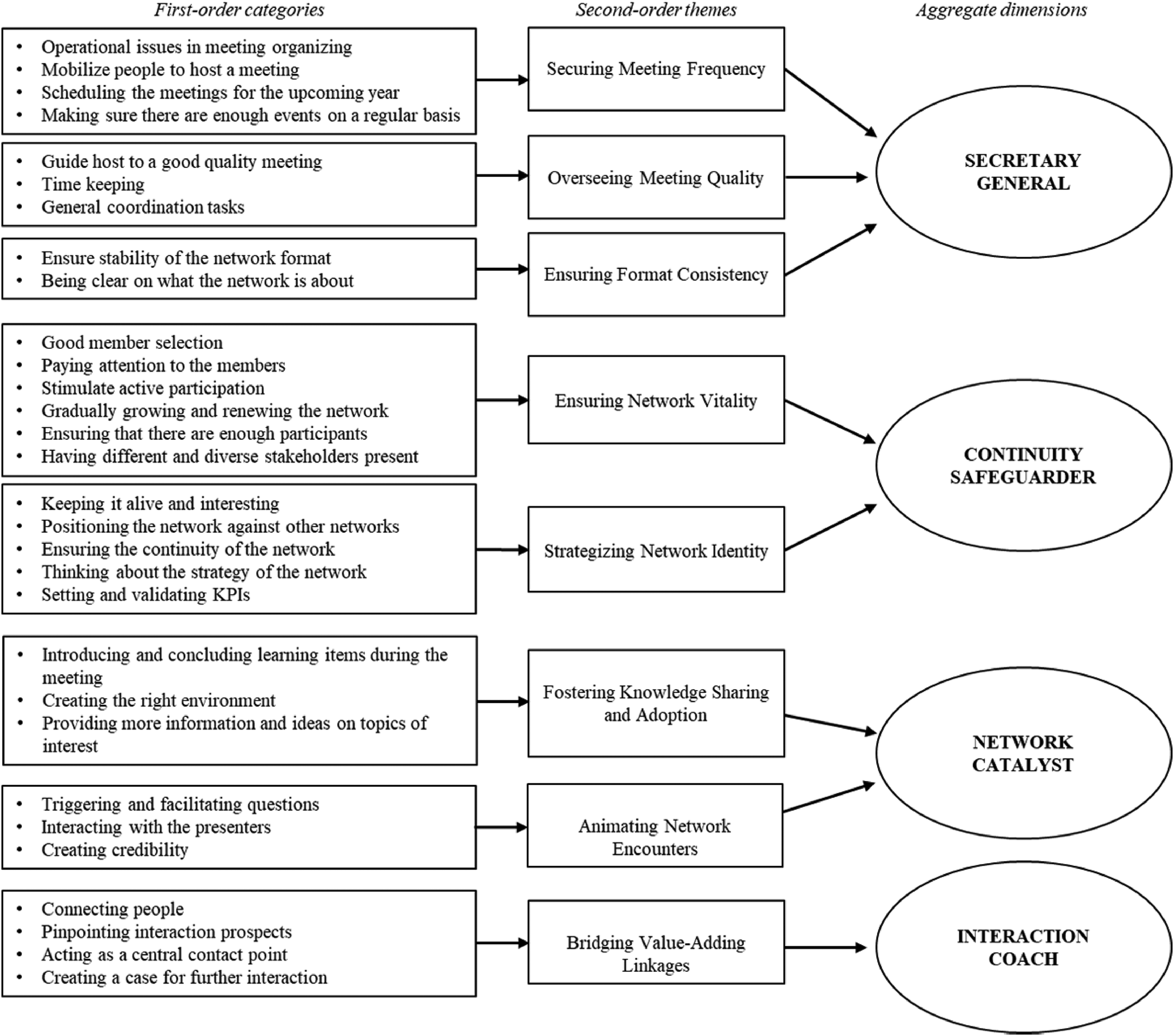
Data Structure: Orchestrator Roles
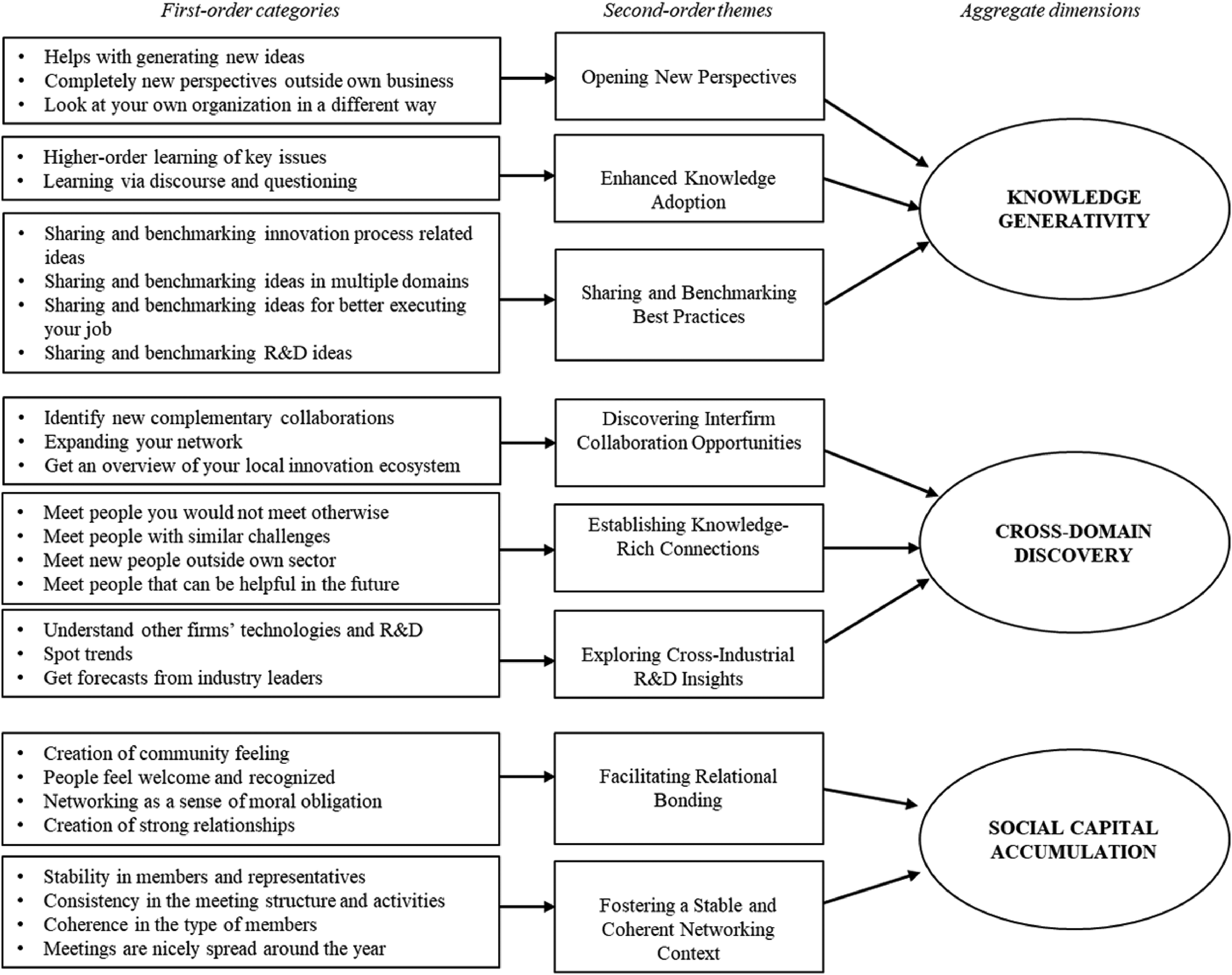
Data Structure: Orchestration Outcomes
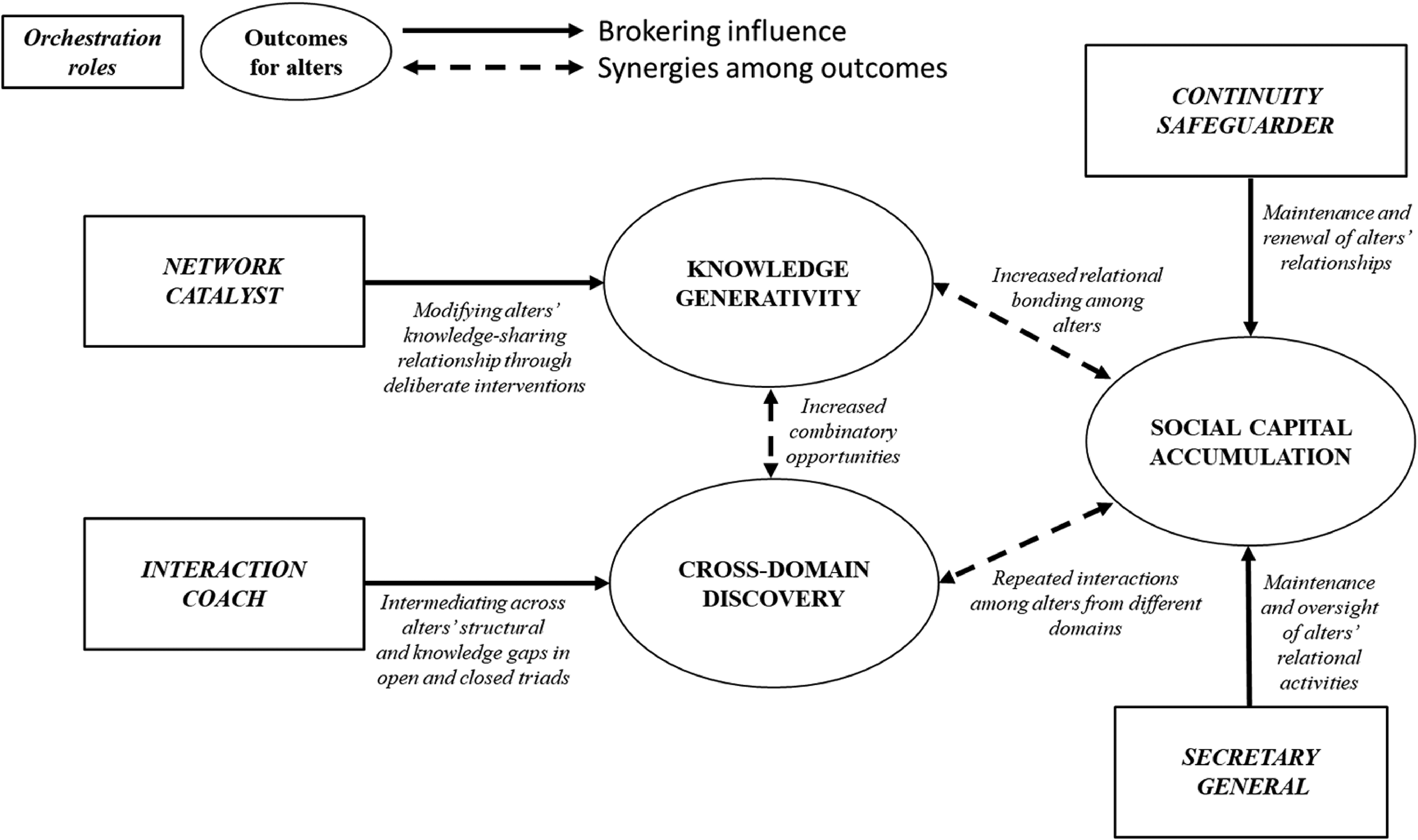
An Integrative Model of Alter-Oriented Brokering in Knowledge Network Orchestration
Data Analysis
The interview transcripts were analyzed first using inductive open coding (Miles & Huberman, 1994; Strauss & Corbin, 1998) and NVivo software. Following the structure proposed by Gioia et al. (2013), empirically grounded first-order codes were aggregated into more abstract second-order themes and conceptual dimensions that were also informed by theoretical insights. This inductive coding process involved researcher triangulation (first and second authors) and multiple iterative coding rounds over several months. To begin, the second author open-coded the transcripts to identify instances of orchestration activities and perceived network benefits. These initial first-order categories of orchestrator roles and member benefits and associated second-order concepts served as a draft data structure. The first author then reviewed this initial data structure and revisited the interview data to critically question the codes. This in turn prompted the removal of some existing codes, code recombination, and the creation of new codes. The process continued in multiple iterative rounds and coding meetings until (theoretical) saturation was reached—that is, until no new empirical or conceptual insights emerged—yielding a final data structure.
The coding process was not straightforward, and we had to make several important judgment calls. A first requirement was to determine what constitutes orchestration and what it accomplishes. To that end, the first and second authors undertook a detailed review of the codes to ensure that the scheme would include only activities unambiguously portrayed as part of the orchestrator's role. This prompted the removal of some quotes initially coded as what the orchestrator should or could do, along with some general network events that could not be clearly linked to the orchestrator's behavior.
Second, in labeling and categorizing the codes, we had to make multiple judgment calls regarding the assignment of first-order codes to second-order themes and the selection and labeling of second-order themes and aggregate dimensions. For instance, after the first version of the aggregate dimensions emerged from the analysis, it was important to distinguish carefully between perceived benefits for knowledge generativity and for cross-domain discovery. 6 Additionally, some initial insights did not align with the eventual coding scheme—for example, drivers of member commitment to the network and individual characteristics of the orchestrator that played no direct role in orchestration.
A third complication was that informants expressed diverging views; for example, one interviewee linked useful orchestrator activities to formal network-level goals and key performance indicators (KPIs). Although the rest failed to see the relevance of these matters, we included them as a first-order category because they relate to strategizing network identity. (This divergence is further discussed in the Results section.)
Finally, we had to decide “cutoff points” for the richness of codes in categories to be included. As a general principle, we sought to have our first-order categories accommodate the views of several informants from different firms. For the most part, we favored categories based on multiple quotes, with only a few exceptions based on one or two quotes (for quote counts, see Tables A2 and A3). Those exceptional first-order categories were included because they aligned closely with a second-order category and so added detail without altering the intuitive sense of the data structure.
The results of coding were repeatedly fine-tuned, drawing on insights from the participant observations and archival data to cross-validate the emerging categories and to provide concrete empirical examples for the coding meetings. The final coding scheme was inductively supported by the data and was based on the researchers’ triangulated judgments, with between 13 and 163 first-order codes for each second-order category. Figures 1 and 2 visualize the final data structure for orchestration roles and outcomes; the most frequently referenced second-order themes always appear first. The appendix (Tables A2 and A3) includes illustrative quotes for all first-order codes.
In a final stage, the first and third authors developed a grounded model (Gioia et al., 2013) of alter-oriented brokering in knowledge networks based on insights from the inductive coding process and insider and outsider perspectives. To build this model, the first author revisited the data on orchestrator roles (Figure 1) and perceived network benefits (Figure 2) to identify explicit references to how the former influenced the latter and to the links between perceived network benefits. In particular, quotes were searched that referred explicitly to a deliberate orchestration activity and its influence on a specific outcome or relationship or to links between different outcomes. This additional analytical memo provided further evidence of linkages and interdependencies across key constructs, supporting development of the grounded model.
This round of analysis enabled us to develop an explanatory logic that relates particular orchestration roles to alters’ outcomes and to reveal synergies between different outcomes—for example, how social capital accumulation facilitates knowledge-related outcomes (and vice versa). In total, 91 individual passages were identified that enabled us to infer relationships between orchestration roles, outcomes for alters, and outcome synergies. In this phase, we adopted an abductive approach (see Dubois & Gadde, 2002) to link empirical insights from the interviews and participant observations to the relevant literatures on social networks, knowledge search, brokering, and orchestration. The resulting model of alter-oriented brokering in orchestrated knowledge networks (discussed at length later) reflects this integrative interpretation of empirical data and theoretical accounts.
Orchestrator Roles
We identified four roles played by the network orchestrator: secretary general, continuity safeguarder, network catalyst, and interaction coach (see Figure 1). The first two of these relate to the social fabric of the network, regulating the conditions for social exchange among alters. The third and fourth roles relate directly to knowledge elements, influencing alter relationships to facilitate knowledge sharing and adoption.
Secretary General
The role of secretary general involves operational activities for network coordination, including the yearly programs, meeting agendas, and checklists referred to in the interviews and captured as archival data.
Securing meeting frequency
To ensure that members continuously receive useful and varied content, the secretary general must organize regular meetings and mobilize network members to host these meetings, and ongoing negotiation is required to secure the necessary commitment of time, effort, and resources. Meeting programs are published up to 1 year in advance to publicize the schedule and content, and the secretary general also handles associated operational tasks, like sending invitations and reminders.
Overseeing meeting quality
To ensure meeting quality, the secretary general oversees both preparatory and in-meeting activities. In dedicated pre-sessions, orchestrator and host work through a checklist detailing the meeting's substance and practicalities, ensuring that the host adheres to the preferred format and confirming that the proposed content aligns with the theme. For instance, an R&D manager from Metals & Mining Firm D noted that the pre-session helps to “guarantee the quality . . . to make sure that the topics, the way the agenda is set up, is following or meeting the GRD guidelines.”
During network meetings, the orchestrator oversees presentations and questions, ensuring sufficient networking time before, after, and between sessions. This is important because while some members are interested mainly in the presentation—perhaps because it relates to their own function or business—others are more focused on networking to establish new relationships, develop existing connections, or find potential partners for collaboration.
Ensuring format consistency
To ensure the consistency of network encounters, the secretary general must be clear about the network's purpose and must preserve the standard format: The scheme is always more or less the same, but when you come it is clear you know what you will get. . . . For the new participants it is the task of [the orchestrator] to give them the frame but then it is up to the firm to find the topics and to see what they want to share. But the coherence has to be made by [the orchestrator]. (Metals & Mining Firm E)
Continuity Safeguarder
The continuity safeguarder role relates to higher-order and longer-term issues that include ensuring the network's continued existence by maintaining sufficient levels of engagement and participation over time.
Ensuring network vitality
The continuity safeguarder protects the network's core purpose by managing memberships and gradually renewing the network to ensure its vitality. Informants were especially concerned about recruitment of an adequate mix of members from different industries with similar R&D-related interests and responsibilities to stimulate cross-industry knowledge fertilization: “There are some rules regarding who can join—which kind of companies—and I think the selection is quite good. So, this is what makes the quality of the network: the quality of the members” (Engineering & Manufacturing Firm A).
In identifying and recruiting new members, the orchestrator must understand why people join the network and how they can contribute; this involves monitoring attendance at meetings, listening to members, and understanding their organizations. Stimulating active participation was also mentioned as an important aspect of network vitality. To that end, the orchestrator rotates hosting; one requirement for admission to the network is that members must be able to host a meeting about once every 4 years, and new members must host a meeting in their first year by way of introduction to other network members. The community safeguarder must also ensure sufficient levels of participation and engagement: “Another task is to reassure that there are enough participants to the meetings because when the participation rate declines for a longer period of time it should be a warning, and [the orchestrator] should think about the reasons why it happened and ask questions” (Engineering & Manufacturing Firm E).
Gradual renewal of the network was also seen as a core element of orchestration: constantly reviewing existing members’ knowledge needs and identifying relevant content from complementary industries to ensure the requisite variety. That means finding the right balance by recruiting new members from appropriate regions and sectors, including industries, universities, cluster organizations, and public research institutes.
Strategizing network identity
The continuity safeguarder role involves ongoing reflection on the network's purpose, current state, future direction, and scope (as formally stated in network communications). Preserving the network's collective identity was considered crucial; several informants reported experiences of how a network can be reduced to a mere formality or “empty box” when neglected. In contrast, a network remains “alive” if members’ participation in the meetings reflects perceived value rather than routine or obligation. To ensure active participation, the continuity safeguarder must consult regularly with members about their interests, monitoring ongoing network activities and making necessary adjustments. To realize this goal at network level, the GRD orchestrator introduced KPIs to be reviewed and discussed at annual board meetings. However, only one network member acknowledged the relevance of these KPIs and network-level goals: “I would say it is important for the management to have an indication (I would not say to measure) but to have an indication of the impact of the network” (University E).
The continuity safeguarder is also expected to make concrete strategic decisions about future themes (e.g., digitalization, sustainability, competition for talent, new ways of working). However, the loosely coupled nature of the network and orchestration means that this strategy cannot be too rigid, and this is apparent in the diverse themes addressed at monthly meetings. Instead, network identity and scope were viewed as a collective process, in which the orchestrator and network members jointly envisage the network's future and higher goals. Finally, the continuity safeguarder role also involves positioning the network to clarify its identity in relation to other similar forums (for GRD, this was important as there were other overlapping networks in Belgium, with partially the same members).
Network Catalyst
In contrast to the two roles described already, which relate to managing and operating the network, the network catalyst role involves direct intervention in members’ interactions for knowledge sharing and adoption.
Fostering knowledge sharing and adoption
The network catalyst influences knowledge sharing and adoption in a number of ways. One important activity is summarizing key concepts from the different presentations at the end of each monthly meeting and linking these to broader industry trends: “I find it always very helpful that at the end of each session [the orchestrator] makes a summary or synthesis. They are not always the same points that I would put in the summary, but that is interesting” (Research Institute B). To support dynamic and diverse knowledge sharing, the network catalyst must also listen closely to members’ concerns and interests in order to create and maintain an environment that supports open sharing and learning and fosters a sense of community. Informants also noted the importance of encouraging members to speak openly by assuring confidentiality within the network: “The [orchestrator] clearly stipulates in a lot of cases prior to the meeting such as: we can speak up, this is confidential, you are not representing or talking official positions here. This definitely helps to loosen up the atmosphere a little bit” (University A). However, many informants also noted that the orchestrator must be careful not to push members too hard, as some information is necessarily confidential, and the network's members include direct competitors and suppliers. Informants also valued the orchestrator's role in providing further information on topics of interest (e.g., books, articles, training sessions).
Animating network encounters
As network members play a vital role in promoting mutual learning, the orchestrator must strive continuously to motivate knowledge sharing by “animating” network encounters and interacting with presenters to ensure that meetings are successful. The network catalyst role also involves triggering and facilitating questions as well as reframing difficult or inappropriate questions to support knowledge sharing: “[The orchestrator] rarely cuts back on the question time so that it is also part of the knowledge sharing because half of the answer might be given and someone looking at a certain problem might have a question that can be easily clarified” (Aerospace & Defense Firm C). Finally, to legitimize the network catalyst role, the orchestrator must ensure the network's credibility: “[The orchestrator] in back office is really key because he is the one that can mobilize people, motivate people . . . the first link, to get the credibility, to push people to take time” (Metals & Mining Firm B).
Interaction Coach
The role of the interaction coach is to facilitate value-adding linkages. In this regard, the most frequently mentioned activity was connecting people, which is especially important for new network members who may find the experience overwhelming or find it difficult to enter conversations among existing members. Informants indicated that initial onboarding by the orchestrator helps new members to build links by facilitating socialization and knowledge sharing: “When [the orchestrator] welcomes me and introduces me to three or four people, it becomes easier for me to move forward” (Conglomerate A).
The interaction coach also acts as a central contact point, bringing previously unconnected members together to generate added value. Through ongoing contact with individual network members, the orchestrator is well positioned as a broker who understands their interests and needs. Informants acknowledged that this bridging position facilitates identification of knowledge combinations and complementarities: If I am looking for somebody or a company to solve a problem and I am not sure who in the GRD might help me, I would go to [the orchestrator] and ask him to guide me in the network identifying the two or three people who might be part of the solution of my problem. (Metals & Mining Firm D)
Finally, the interaction coach offers advice and new ideas, encouraging new initiatives and prompting future meetings and encounters with other network members.
Perceived Network Benefits
Informants referred to three benefits of network membership: knowledge generativity, cross-domain discovery, and accumulation of social capital. In this initial analysis, we considered all perceived benefits, regardless of whether they were attributed directly to orchestration roles or activities.
Knowledge Generativity
The GRD network promotes knowledge generativity by helping members to access others’ knowledge and to integrate this with what they already know.
Opening new perspectives
The network helps members to acquire new perspectives in three interrelated ways: by looking at their organization in a different way, by gaining a new external perspective on their business, and by generating new ideas. These perceived benefits extend beyond best-practice benchmarking to outside-the-box inspiration and breakthrough “aha” moments based on exposure to novel approaches. For instance, several informants explained how they generate new ideas and gain new perspectives by discussing operational issues and challenges with others. The shared R&D context helps members to find common ground because they “talk the same language.”
Sharing and benchmarking best practices
Informants generally valued the network as a venue for sharing and benchmarking best practices, and easy access to new insights from different industries was seen as a core reason for the network's existence. Informants welcomed the opportunity to meet others operating in a similar role or context as a way of gaining new insights into their own innovation processes, R&D management, and everyday practices and tools: “The experience of some other company can also be related to something you are doing. . . . All of those insights you gain in those meetings can eventually be interesting for promoting eventually the innovations in your company” (Conglomerate B).
Enhanced knowledge adoption
Various GRD practices were seen to influence knowledge adoption, including orchestrated facilitation of questioning and synthesis of key takeaways. These systematic provisions help informants to gain a better understanding of the topic in question: “It is really a good summary and a good way for me to have another view and listing the key points and points of attention that you could have and raising questions in your head to go back home” (Engineering & Manufacturing Firm F).
Cross-Domain Discovery
Network members generally acknowledged that the GRD network aids cross-domain discovery by connecting actors and knowledge from unfamiliar domains.
Discovering interfirm collaboration opportunities
As a place for discovering new firms that expand existing networks or improve knowledge of the local innovation ecosystems, GRD was seen to contribute to the identification of new collaboration opportunities. While GRD does not broker formal business collaborations directly, new linkages between members often lead to extranetwork activities. When we joined the GRD network, we launched the first contact with [Engineering & Manufacturing Firm A]. It was an occasion to meet people and to increase the number of collaborations. For example, last time in [University E], I think that we might have some interest to work with them, but in the beginning we had a poor view about the scope. But part of the GRD was the roadmap in terms of innovation. (Engineering & Manufacturing Firm I)
However, some network members suggested that the absence of start-ups limits the network's potential for making valuable new connections and that this is related to the orchestrator's decision to confine the network to organizations that are ready and able to host a monthly meeting.
Establishing knowledge-rich connections
In general, informants stressed the importance of meeting people with relevant and diverse insights from different social or technical backgrounds. These new connections can prove helpful in the future or in solving an immediate problem, as other members are likely to face similar challenges, and those working in a different sector can enrich one's existing perspective: “From our point of view, we are too often looking for companies… within the same type of industry, and with the GRD, that is different” (Engineering & Manufacturing Firm H).
Exploring cross-industrial R&D insights
The network was considered useful as a means of acquiring information about R&D in other industries, which assists trend-spotting (e.g., digital transformation, sustainability), access to industry leaders’ foresight, and understanding of other firms’ technologies. These cross-industry R&D insights were valued for their novelty even when not directly linked to current activities: “There is also exchanges about the way of working, or the way of organizing R&D. I remember a very nice discussion with the guys of [another firm from different sector], who has nothing to do with our business but has a nice way of approaching R&D” (Aerospace & Defense Firm E).
Social Capital Accumulation
Finally, many interviewees referred to social capital accumulation—the social and relational benefits of network membership.
Facilitating relational bonding
One commonly perceived benefit of network membership was the sense of social bonding: the strong relationships built by interacting with the same people at every meeting. This was also seen to promote a sense of community, as network membership fosters engagement and recognition. Repeated interactions were seen to create a sense of moral obligation, prompting hosts to organize high-quality meetings and encouraging regular attendance to see others again and engage in ongoing discussion. The sense of community was emphasized:“The more you see the same people again, the more you feel integrated and part of the network”(Engineering & Manufacturing Firm E).
However, relational bonding outside the meeting context was not considered entirely successful. For example, despite repeated attempts, the orchestrator failed to promote discussion within a dedicated virtual (LinkedIn) group, possibly because members could not spare the time (as some interviewees indicated).
Fostering stable and coherent network context
Informants appreciated the stability provided by a consistent meeting structure and limited membership churn (linked mainly to job change or retirement). This relatively stable membership was seen to enhance the personal and social dimensions of networking by affording more time to develop strong ties. The network orchestrator's presence at each meeting further enhanced this perceived stability, and the standardized meeting format was highly valued, especially for the continuous networking opportunities it affords. Informants also noted the network's coherence in terms of its scope (all members are peers working or interested in R&D) and a program of meetings distributed across the year. In general, it was considered important that network meetings remained consistent in terms of quality and structure. When you attend a GRD meeting, you know in advance how it will be built and set up and what information you will have. That's quite important, too. It prevents the members to bypass a meeting because they don't know what it will speak about and will discuss and so on. There is a template or there is a program that you will be bound along. You know in advance that you will not waste your time and get some things that are interesting and useful. (University D)
An Integrative Model of Alter-Oriented Brokering in Knowledge Network Orchestration
Having identified four orchestration roles representing distinct approaches to alter-oriented brokering and the perceived benefits of membership in an orchestrated knowledge network, this section discusses in greater depth how the orchestrator's brokering behavior influences alters’ outcomes and how those outcomes are interconnected. The resulting model (Figure 3) incorporates orchestrator roles, outcomes for alters, the influence of brokering (solid arrows connecting roles to outcomes), and the synergies between outcomes (dotted arrows).
The proposed model makes several important assumptions. First, alter-oriented brokering is a continuous process pursuing diverse alter-oriented outcomes rather than specific orchestrator-defined goals. These outcomes (knowledge generativity, cross-domain discovery, and social capital accumulation) encapsulate the perceived benefits of network membership and are likely to vary from member to member. Second, these outcomes can be deliberately influenced (but not tightly managed) by a distinct entity—in this case, an individual assigned to the role of orchestrator. In describing those deliberate acts of influencing, the model specifies the role of the orchestrator in achieving outcomes for alters (this influence is characterized with italicized text next to arrows in Figure 3). Finally, we assume that brokering is a social process of modifying, mediating, and maintaining relationships between alters. According to the proposed model, outcomes are not ultimate or absolute; instead, they are shaped within a social context, either through direct interaction between broker and alter (or alters) or by indirect influence, where the broker modifies the conditions for alter interaction and knowledge sharing.
Orchestrating Knowledge Generativity
Knowledge generativity refers to how knowledge network relationships increase members’ ability to share and adopt valuable knowledge (Phelps et al., 2012) and to apply that knowledge beyond the network. This loosely coupled (Orton & Weick, 1990) aspect of knowledge sharing and adoption was explicitly noted by the head of R&D at Metals & Mining Firm E: “More often, we take the idea and we continue internally. I take the information in the meeting, and I give my contact details so that we can continue to share afterwards, but usually, we can continue to develop it inside the company.”
We found that the network catalyst role was especially relevant in facilitating knowledge generativity; in the present empirical context, this involves modifying alters’ knowledge-sharing relationship through deliberate interventions. This form of brokering differs from the classic “bridging structural holes” approach; instead, the broker intervenes as a third-party actor in the knowledge-sharing relationship between alters, regardless of whether or not they are previously (or externally) connected (Halevy et al., 2019). Furthermore, this form of brokering affects relationships and interactions between multiple actors rather than only between two alters (as brokerage is typically defined). Since the brokering was found often to influence the context in which many alters share knowledge, network catalyst type of behavior exhibits a higher-order, “public good” feature of brokering (see Clement et al., 2018).
Brokering interventions that exerted a broad influence on knowledge generativity typically occurred when the orchestrator interacted with one or more alters during a knowledge-sharing session (e.g., a site visit). We found that the orchestrator induced alters to share more knowledge through carefully timed interventions during such interactions—for instance, by triggering further discussion of uncomfortable or difficult topics, as described by the representative from Food Products Firm A. “A number of us were a bit uncomfortable asking questions about that because those are really difficult things and [the orchestrator] did a great job . . . asking questions so that people could ask questions and build on his questions.” This kind of third-party brokering is especially important in a network of alters who are hesitant, for various reasons, to raise difficult questions. “He would not let the presenter go his own way as easy as that. He will ask sometimes some questions that are maybe a little bit more confidential or maybe more practical: How does that work; you’ve presented that but what about this?” (Aerospace & Defense Firm B).
We also found that the orchestrator can play an active third-party role in the process of knowledge sharing and adoption by providing instant summaries of peer presentations: “This very short synthesis . . . [the orchestrator] is helping the people to structure what they just learned and to link this new learning with some previous learnings” (University B). These and other interventions by the orchestrator boost members’ energy and motivation (or, as one of our interviewees described it, “animation”) for network-based knowledge sharing, initiating the generative process in which emergent alter-to-alter interactions complement orchestrator-led knowledge sharing.
Orchestrating Cross-Domain Discovery
In cross-domain discovery, two features—connections and knowledge—were seen to be tightly coupled; that is, new connections (beyond one's own domain) afford access to new knowledge, and new connections are created as knowledge is accessed. “There are new technologies coming, it can also be additive manufacturing, new materials. . . . So technologies are moving, and you go to some companies who are at a good level” (Chemicals Firm C). Cross-domain discovery can be understood as the outcome of a brokering process that bridges both structural and knowledge gaps. The key question is how an orchestrator might facilitate or influence this process beyond naturally occurring emergent networking.
While the previously discussed network catalyst modifies relationships among alters, the interaction coach performs a more classical brokering role by intermediating across structural and knowledge gaps in open and closed triads. In open triads, that means linking previously unconnected actors from different social groups (Burt, 1992, 2004) by reducing the cognitive distance that commonly hinders cross-industry innovation (Enkel & Heil, 2014; Li et al., 2018). In this way, cross-domain discovery can generate new knowledge combinations by increasing access to other domains (see Garud, Gehman, & Giuliani, 2018; Savino et al., 2017) for radical and discontinuous innovation that crosses industry boundaries (Gassmann, Zeschky, Wolff, & Stahl, 2010; Li et al., 2018).
Interestingly, this is also true of relationships between actors who already know each other (i.e., in a closed triad). As Kwon et al. (2020) noted, brokering in closed triads can potentially identify valuable knowledge-sharing opportunities that even actors who are already acquainted would otherwise have missed (see also Halevy et al., 2019). This is central to alter-oriented brokering: “[The orchestrator] knows what we are doing at [Engineering & Manufacturing Firm F], and he contacted me regularly to say, ‘OK look, I had a discussion with someone of [Engineering & Manufacturing Firm B]; maybe you should contact them directly because that could be a common point of interest” (Engineering & Manufacturing Firm F).
As a knowledge combination's value cannot be predicted ex ante, orchestrators should aim to provide multiple viable opportunities for cross-domain discovery. The processual nature of brokering is demonstrated here by the orchestrator's ongoing efforts to help alters to combine previously distinct ideas. [The orchestrator] can guide us in finding the right people. The next step is to facilitate if the people do not know each other the first contact between those people. I think he has a good grip on what are the different personalities so he can guide not only in terms of the technical expertise of the person but also the affinity of the person. (Pharmaceuticals Firm B)
This quote captures the qualitative and social aspects of brokering as intermediation; as well as bridging a structural gap, brokering can help alters to conveniently establish interaction opportunities.
Orchestrating Social Capital Accumulation
Social capital accumulation refers to the creation and development of social relationships among network members and the resulting tendency to share more knowledge as these relationships strengthen (Inkpen & Tsang, 2005; Li et al., 2018; Nahapiet & Ghoshal, 1998; Szulanski, 1996). These mutually constitutive processes clearly include socializing. “You end up with a number of people who start to know each other and for whom it is pleasant to meet each other from time to time. It is the pleasure of meeting the GRD colleagues; it is also a bit of a trigger to go to those meetings” (Metals & Mining Firm F). This social reinforcement often promotes further knowledge sharing in a mutually reinforcing loop (as discussed in the next section; see also Figure 3).
Our account of alter-oriented brokering extends the third-party influence model of modification and intermediation (Halevy et al., 2019) to include brokering that maintains alters’ social capital. The orchestrator plays a key role in creating the conditions for introducing and integrating new actors while maintaining network continuity and stability, so enabling actors to accumulate and harness social capital through interaction over time. The roles of continuity safeguarder and secretary general seem especially important in this regard.
By focusing on maintenance and renewal of alters’ relationships and ensuring continuity of network membership, the continuity safeguarder facilitates repeated interaction between actors and increases interpersonal and interorganizational trust over time—both of which are essential features of social capital (Nahapiet & Ghoshal, 1998; Sobel, 2002). At the same time, gradual renewal of the network structure induces “positive shocks” that help to prevent cognitive and social rigidity (Soda et al., 2021). Orchestrating network maintenance and renewal ensures quality oversight of the network and its members; as one member put it, “There are some rules for who can join, which kind of companies and I think the selection is quite good so this is what makes the quality of the network, the quality of the members” (Engineering & Manufacturing Firm A). Comments like this one reflect the importance of orchestration for the coherence and continuity that enables the network to function (Dhanaraj & Parkhe, 2006). Moreover, gradual renewal is achievable when the network is perceived as stable and coherent: “[The orchestrator] is playing a very important role because he knows the network, he is emblematic of the GRD somehow so he is the one to attract people to join the network, to attract people and convince them that they should host a meeting, and so on” (Pharmaceuticals Firm B).
The secretary general focuses on maintenance and oversight of alters’ relational activities. By facilitating social interaction, the secretary general becomes the “backbone” of network activities: “We know what we will get. We will get something that is very structured and we know the agenda. We know the people that we will meet, we know the people who will be there” (Aerospace & Defense Firm B). Without deliberate orchestration, the network is likely to degenerate into ad hoc meetings, with varying levels and quality of actor input and participation. Orchestration augments the emergent features of network interaction, and our findings confirm the importance of this active maintenance in providing the necessary stability for recurring socialization activities that underpin the accumulation of longer-term social capital.
Synergies Between Orchestration Outcomes
We also found evidence of second-order outcomes of alter-oriented brokering in the form of synergies between outcomes (see Figure 3). These synergies involve complementarities in alter-to-alter interactions, drawing on behavioral aspects of social and knowledge processes in network contexts. The first synergy occurs between knowledge generativity and cross-domain discovery, affording increased combinatory opportunities across different knowledge elements (Ahuja, Lampert, & Tandon, 2008; Fleming & Sorenson, 2004; Laursen & Salter, 2006; Li et al., 2018), which knowledge sharing is known to promote (Fleming, 2001; Savino et al., 2017). Our findings point to a virtuous cycle, in which knowledge sharing increases the likelihood of cross-domain knowledge combinations, and more cross-domain knowledge combinations drive further knowledge generativity. For instance, reflecting on one such combinatory opportunity, a representative of Conglomerate A observed that meeting new people through the network helped to overcome ongoing challenges by introducing new solutions or perspectives. Conversely, valuable exploratory inputs from cross-domain discovery can trigger knowledge generativity. Among instances referred to by multiple informants, University A spoke of accessing valuable new knowledge that could be applied in their own organization and in new collaborations or exploratory activities.
As mentioned earlier, social and knowledge-related aspects of orchestrated knowledge networks can be characterized as coupled. Our analysis supports this view; we found that the network's social structure is crucial for achieving knowledge-related aspirations, which in turn drive socialization. This implies two second-order outcomes involving synergies between knowledge and social processes.
The synergy between knowledge generativity and social capital accumulation drives increased relational bonding, as the social context influences the strengthening of existing ties, and less arduous relationships can be expected to facilitate knowledge transfer (Hansen, 1999; Szulanski, 1996). Embedding in a network increases tie density (Tichy, Tushman, & Fombrun, 1979), which in turn enhances knowledge-sharing opportunities (Granovetter, 1985). Many of our informants reflected on this synergy; according to Engineering & Manufacturing Firm E, the more you see the same people again, the more you feel integrated and part of the network. If it would be different people each time than you would have a network but it would have another value. The personal contact between the member is what makes it easier to phone them next time because they know who you are. I think it is [the orchestrator's] task to offer some form of stability.
This quote highlights how relational bonding cumulatively increases peer knowledge sharing but also confirms that the orchestrator is expected to ensure that the relational context will support this kind of synergy.
Instances of knowledge sharing also contribute to the gradual accumulation of social capital; as people tend to socialize with others facing similar (though not identical) challenges, “similarity breeds connection” (McPherson, Smith-Lovin, & Cook, 2001). In this regard, one interviewee reflected on the development of a sense of community. The structure of a session is very helpful to create a real community because there is some opportunity to have a talk with the others, then we have the official presentations and so on and then we have also the possibility of talking during the lunch and all these elements of the meetings can be very helpful to build up a real community. (Chemicals Firm C)
Cross-domain discovery benefits from a third synergy, repeated interactions among alters from different domains, as members are simultaneously embedded in social and knowledge networks (Brass, Galaskiewicz, Greve, & Tsai, 2004) that can cross-fertilize. In the present case, alters clearly made good use of the network's social structure; for instance, a representative from Research Institute B sought to “operationalize” connections in the network by exploring opportunities for research partnerships with new collaborators. This dynamic works both ways, as new connections become familiar, creating new ties and contributing to social capital accumulation: If you have two or three people coming from a company you learn from them and you learn to get to know them also. . . . I see new people sometimes and I wonder who is that new guy but we all try to meet and to discuss and [the orchestrator] helps also to put people together. (Aerospace & Defense Firm D)
Discussion and Contributions
In this study, we started with an empirical question about the key activities and behaviors involved in knowledge network orchestration and how those activities and behaviors influence network members' social and knowledge exchange. Our qualitative findings open the “black box” of knowledge network orchestration by unbundling the microfoundations of alter-oriented brokering—a social process of modifying, mediating, and maintaining relationships between alters. In so doing, we diverge from the existing literature, which largely adopts a broker- or orchestrator-centric structural approach (Burt et al., 2013; Burt & Soda, 2021; Dagnino et al., 2016; Dhanaraj & Parkhe, 2006). Instead, we join the emerging stream of studies addressing the potential of brokering as a public good (Clement et al., 2018) that also generates benefits for alters (Li et al., 2018). The findings make three contributions to network orchestration and brokering literature.
First, we theorize alter-oriented brokering as a process of network orchestration, in which a dedicated actor facilitates members’ diverse goals rather than seeking to lead the network to a particular direction or to maximize the benefits of their brokerage position. This form of brokering resonates with emerging insights about open-system orchestration (Giudici et al., 2018), consensus-based orchestration (Reypens et al., 2021), value-independent third-party orchestration (Pinnington et al., 2020), and facilitator-orchestrators (Hurmelinna-Laukkanen & Nätti, 2018). Building on this emerging literature, we theorize the prosocial aspects of orchestration (Clement et al., 2018; Li et al., 2018) within a behavioral brokering framework. Brokering processes have major impact by changing social structures (Halevy et al., 2019); in this regard, alter-oriented brokering explains the ways in which social structures can be modified, altered, and renewed to better serve the goals of the network as a whole.
While the mainstream literature has focused on how brokers modify network structures for a specific purpose (often set by the broker; see, e.g., Kwon et al., 2020), the alter-oriented conceptualization explains how a broker can accommodate the diverse needs of multiple alters. Importantly, this accommodates both the distinctive and responsive features of loosely coupled networks (Orton & Weick, 1990), such as knowledge networks. The original conceptualization of orchestration by Dhanaraj and Parkhe (2006) recognized these features and demonstrated the benefits of orchestration to facilitate goal-directed action among a loosely coupled network. Complementing these insights, our findings demonstrate how alter-oriented brokering can influence a network by generating value creation opportunities that resemble a public good (Clement et al., 2018) and are distributed rather than goal directed. This form of value creation is less constrained by the orchestrator's aims and is more distributed, unbounded, and “generative,” aligning with the diverse and changing needs of network members.
Alter-oriented brokering in knowledge networks simultaneously addresses alters’ distinctiveness (in terms of aspirations and background knowledge) and their mutual responsiveness (in terms of potential benefits and interactions), affording distributed and generative value creation opportunities for network members.
Our second contribution is to unbundle the microfoundations of brokering processes in knowledge networks, augmenting the dominant view of brokerage as an act of structural intermediation (Kwon et al., 2020). Our empirical insights provide a view of brokering as a process that simultaneously accommodates mediating and moderating roles in open and closed triads. In open triads, the classic account of mediation brokering describes how the broker mediates between previously disconnected alters, so bridging structural holes (Burt, 1992, 2004). Our findings demonstrate that mediation brokering also occurs in closed triads if the broker can advance a rationale for new collaboration or other knowledge-related activities among alters who are already connected (see also Halevy et al., 2019). In practice, if network membership is sufficiently stable (as in our case context), many alters already know each other, and ties range from weak (“the face is familiar but no real contact”) to very strong (“old friends”). As our findings show, an orchestrator can pinpoint opportunities for collaboration and knowledge sharing in such networks (where tie strength and triad “openness” varies) and can offer qualitatively different forms of mediation brokerage. In contrast, moderation brokering seeks to modify and configure the environment in which alters interact. Our findings identify the network catalyst's role in brokering alters’ knowledge-sharing relationships through deliberate intervention, while the continuity safeguarder and the secretary general prioritize maintenance, oversight, and renewal of alter relationships. While these roles fall outside the classic account of mediation brokering to address structural holes, they contribute to the process by moderating the interaction context. When brokering is viewed as a social and behavioral process (Halevy et al., 2019; Kwon et al., 2020), both mediating and moderating activities make an important contribution to brokering outcomes.
Alter-oriented brokering in knowledge networks involves broker-originated influence on alters’ relationships, in which a broker both mediates and moderates alters’ interactions in both open and closed triads.
Our third contribution is to demonstrate the dynamic interrelationship between the knowledge and social dimensions of knowledge network orchestration. In a knowledge network, the second-order outcomes of alter-oriented brokering include synergies between knowledge-related and social processes. These findings align with early social capital theory (Nahapiet & Ghoshal, 1998), which links social and intellectual capital, noting that social and knowledge networks are complementary and overlapping. While many existing studies of knowledge networks adopt a social network perspective (Phelps et al., 2012), the literature provides an incomplete picture of how deliberate processes of brokering and orchestration interact with the social and knowledge dimensions of such networks. Our integrative model (Figure 3) captures these interactions.
The two knowledge-related brokering outcomes (knowledge generativity and cross-domain discovery) echo the classical distinction between bonding and bridging forms of social capital (Eklinder-Frick, Eriksson, & Hallén, 2011; Putnam, 2000; Soda, Stea, & Pedersen, 2019). As actors engage in these processes, they contribute simultaneously to the accumulation of social capital; alters begin to internalize new ties and increase their network density, which is known to improve knowledge transfer among actors from different organizations (Hansen, Mors, & Løvås, 2005). Brokering interventions initiated by an orchestrator can facilitate virtuous cycles of socialization and knowledge exchange, including modification and intermediation as well as maintenance of alters’ relational structures (see also Proposition 2). While Wang et al. (2014) have argued that the social and knowledge dimensions of a knowledge network should be decoupled, our analysis of alter-oriented brokering identifies several ways in which orchestration is dynamically coupled across these dimensions, which should be considered jointly for the purposes of theoretical and empirical inquiry.
Alter-oriented brokering in knowledge networks involves a dynamic coupling of knowledge and social processes between alters. Brokering of knowledge-related interactions between alters contributes indirectly to social interaction, and vice versa.
Limitations, Boundary Conditions, and Future Research
Future research on knowledge network orchestration can build on the contributions and limitations of the present study. While our results likely have relevance for many types of knowledge networks, certain unique characteristics of the GRD network limit generalization (e.g., longevity, intensity, scope, member organization size, external ties, cultural background, local context).
While our study focused on physical interactions between network members, other orchestrator roles and network dynamics may emerge from the shift to online, also prompted by the COVID-19 pandemic. For instance, our model identifies a synergy between accumulation of social capital and knowledge-related benefits for network members. As virtual encounters are likely to differ from social interactions involving repeated close engagement and face-to-face communication, it will be important to explore how orchestrator roles and outcomes differ in offline, online, and hybrid contexts.
As a second boundary condition, we found that orchestration broadly follows an alter-oriented logic. However, as Kleinbaum, Jordan, and Audia (2015) noted, this “alter-centric” perspective means that other actors’ (positive) perceptions of the broker will eventually increase the broker's benefits. Future studies should therefore look more closely at the dynamics of broker and alter benefits in knowledge networks and other social networks. For instance, in many professional networks, the role of orchestrator often rotates among former or current network members who may introduce a personal or organizational agenda that undermines alter-orientation. In formal R&D and innovation networks (e.g., Dyer & Nobeoka, 2000; Reypens et al., 2021; Ritala, Huizingh, Almpanopoulou, & Wijbenga, 2017), open-source communities (Shaikh & Henfridsson, 2017), and innovation ecosystems (Dattée, Alexy, & Autio, 2018; Lingens, Miehé, & Gassmann, 2020), orchestrators or other powerful hub actors are often committed to a particular value proposition or goal. In such goal-directed settings, orchestration skills and processes are likely to differ (e.g., envisioning and implementing a shared direction; see Dhanaraj & Parkhe, 2006; Reypens et al., 2021; Ritala et al., 2009). Finally, as innovation- and knowledge-related networks may also be commercial ventures, and network members are de facto customers of the network orchestrator, future studies should explore in greater depth how alter-orientation emerges in network orchestration, what drives this, and whether other orientations are also in play.
Although we explored orchestration practices that influence alters’ outcomes, our methodology precluded any assessment of orchestration efficiency or the costs incurred by network membership as compared with other brokering approaches or over time. While we asked about inefficient practices, we found no conclusive evidence in this regard, and future studies should delve deeper into inefficient practices and processes. This is likely to require a combined qualitative, longitudinal, and/or participatory approach, including objective and quantitative measures of orchestration effectiveness (e.g., projects initiated, collaborations pursued). In summary, future research should investigate the antecedents and conditions of effectiveness of alter-oriented orchestration vis-à-vis other network coordination styles.
To examine brokering as a deliberate behavior initiated by a dedicated actor, we deliberately confined the scope of this study to the actions of an individual orchestrator and alters’ perceptions. While this approach yielded some tentative evidence regarding the role of alters in the brokering process, it overlooked the potential role of other network members. Future research should therefore examine how other network members participate in brokering processes and how this affects orchestration dynamics and outcomes. 7
Finally, it would be useful to assess the extent to which our results can be generalized to other contexts. It is important to note that we were involved here with theoretical rather than empirical generalization or falsification. Theoretical generalization is a particular strength of case studies (Tsang, 2014) and informs theory building by identifying various causalities and mechanisms within empirical phenomena (Gerring, 2007; Tsoukas, 1989). To that extent, our study contributes to theoretical understanding of alter-oriented brokering as a social influence process in closed and open triads. However, the four boundary conditions just outlined invite further research to clarify the applicability of our findings across other organizational, network, and ecosystem contexts.
Conclusion
Knowledge networks bring individuals from different backgrounds together to share and adopt relevant knowledge for best practice, foresight exchange, industry networking, professional development, and other purposes. To explore how such networks might best be orchestrated and to find out the associated roles, processes, and outcomes, we framed knowledge network orchestration as an act of brokering and advanced an alter-oriented perspective to explore how brokering-specific behavioral processes facilitate members’ goals and shape social relationships (Halevy et al., 2019).
On the basis of interviews with 51 members of the Belgian GRD network, we developed an integrative model of knowledge network orchestration that identifies four distinct and complementary orchestrator roles (network catalyst, interaction coach, secretary general, and continuity safeguarder) and three interconnected member benefits (knowledge generativity, cross-domain discovery, and social capital accumulation). The model captures how a network orchestrator can engage in alter-oriented brokering to influence knowledge sharing and adoption in networks involving diverse participants and aspirations. The alter-oriented perspective makes a novel contribution to the existing network literature, which has focused mainly on broker-centric and structural accounts (Burt et al., 2013; Burt & Soda, 2021) while neglecting the behaviors of brokers and alters (Kwon et al., 2020) and alter outcomes (Clement et al., 2018). We hope this study will pave the way for further research on brokering behaviors in a range of social, knowledge, and innovation networks.
Footnotes
Acknowledgments
Our paper has received a lot of useful feedback during different stages of its development. First and foremost, we would like to thank the action editor Jorge Walter and the three anonymous reviewers for their constructive and insightful comments to different versions of the paper. We would also like to thank the participants at AOM 2019 and Berkeley Open Innovation Seminar in August 2020 who provided a lot of useful comments based on our presentations. Special thanks go to our colleagues who have provided friendly reviews to early versions of the paper, including Argyro Almpanopoulou, Pia Hurmelinna-Laukkanen, Samuli Patala, and Joona Keränen.
Declaration of Conflicting Interests
The author(s) declared the following potential conflicts of interest with respect to the research, authorship, and/or publication of this article: In this article we have combined insider and outsider views to the analysis to secure rich data access. Author team includes two individuals (second and third author) who have worked with the organization that has been under inquiry, and second author received a compensation for running operational procedures in the network. There are no formal or informal obligations for author team to report particular results, and the research process is fully disclosed in the article.
