



Abstract
The manager is often neglected in management scholarship. Although we are not the first to call for renewed attention to managers, given the rapidly evolving state of the environment in which firms operate, it seems an apropos moment to reflect on the importance of managers and remind ourselves to incorporate them into our ideas, relationships, and theories. We provide reasons for the current state of affairs and offer four actionable recommendations for making the manager a more central character in our research planning, execution, and dissemination: (1) listen to managers, (2) develop and test theories that include the manager explicitly, (3) conduct research at multiple levels of analysis and using multiple methods, and (4) find synergies across seemingly competing academic engagements.
For a field named “management,” it is odd how little of our focus is on “managers,” whether at the frontline, middle, or executive level, or at the organizational, geographic, or global level. (Meeting Theme, 2021 Academy of Management Conference)
As noted in the call for submissions for the 2021 Academy of Management conference, “today, more than ever, our research and teaching are called on to shape what managers do on a day-to-day basis. We are the Academy of Management and yet it isn’t always clear how our research addresses issues confronting practicing managers” (Hillman, 2021). It seems that a significant number of scholars, in their pursuit of academic excellence within their disciplines, have not paid sufficient attention to managers. This is troubling—as if the Prince of Denmark went missing in Shakespeare's Hamlet. How did we arrive at the perplexing paradox that the manager has somehow managed to elude management scholarship? What can we do to bring the manager back into management scholarship?
We can understand the current situation by considering a historical perspective on how we engage in knowledge creation and in knowledge dissemination. More than a century ago, in The Principles of Scientific Management, Frederick Taylor (1911) revolutionized the practice of management, turning it into an esteemed professional role whose very essence emanated from scientific methods. However, by replacing managers with structure, organization, hierarchy, and control, the ensuing gains in efficiency and productivity came with a commodification and standardization of the managerial tasks. It seems that what mattered most were the overall managerial processes and tasks. What mattered less was the actual manager.
Consequently, the ultimate achievement of scientific management was to take the manager out of management. With the advent of formalization and systematic quantification throughout the social sciences during the post-World War II period, which coincided with the growth and expansion of the field of management, the analytical lens shifted to formalization while the actual manager faded. This formalization left little room for the human nuances and idiosyncrasies of flesh-and-blood managers who engage in a wide variety of vaguely defined activities, spending most of their time implementing decisions and managing processes and people. How they do this depends on their personality, abilities, values, and other individual characteristics. Overall, in terms of knowledge creation, management systems were in, and the individual manager was out.
This frame of mind affects how research is conducted to this date. For example, when the focus of research is the multinational enterprise (MNE)—one of the most geographically and organizationally complex business organizations that we study—theoretical frameworks often focus on firms and their subsidiaries and, for parsimony's sake, treat managers as background. For the development of consistent and parsimonious theoretical arguments, such abstraction is desirable, but its limitations become evident when trying to translate such research for management practice. Actual decision making is influenced by parameters at a much more micro level—as highlighted recently in the call for microfoundations of strategy and international business (IB) (Foss & Pedersen, 2019). While the primary focus of academic research in management—particularly in strategy, entrepreneurship, and IB—is at the firm level, bringing in the manager allows the researcher to consider managerial actions and hence the practical side of management. We see this as a great opportunity. Bringing back the manager also allows researchers to better understand (and test) underlying mechanisms. In the end, it is not firms that make decisions. Humans do (Flammer, Hong, & Minor, 2019; Peng, 2022; Teece, 2016).
This managerless approach to theorizing and conducting empirical management research is less surprising in macro-oriented domains such as strategy, entrepreneurship, and IB. But it is also pervasive in micro-oriented domains such as organizational behavior and human resource management (OB/HRM), which have more emphasis on the individual level of analysis. Here, the managerless approach to research manifests itself in a different form: the science–practice gap. Specifically, there is a disconnect between the knowledge that scholars produce and the knowledge that managers use. In other words, from the perspective of knowledge dissemination, scholars often fail to take the extra step of engaging with and communicating the insights of their research to managers. Doing so is especially important as we tend to increasingly use complicated language in our research. This stems from the practice of writing scholarly articles to be reviewed by scholars and eventually to be read primarily by scholars (Rynes, Colbert, & Brown, 2002).
Why Should Management Researchers Engage With Managers?
The linear model of innovation posits that basic research precedes applied research and, ultimately, implementation by managers (Stokes, 1997). This model suggests that it is the domain of academic research to prescribe salient theories and strategies and that of managers to obediently adhere to them. It seems that the academic does the talking and the manager does the listening. Yet, in our view, scholars of management would be well advised to reverse the sequence and do less talking and more listening. Indeed, to gain a better understanding of management—and conduct research that is relevant for the real world—engaging with managers from the outset is crucial. While this may sound obvious, many management scholars tend to dismiss the importance of interacting with practitioners. Indeed, reward structures and career paths for professors have pushed them to focus on abstract development of knowledge as opposed to trying to incorporate practitioners into their ideas, discussions, and theorizing (Aguinis, Cummings, Ramani, & Cummings, 2020).
In the following recommendations, we offer our perspectives and suggestions on how to bring the manager back into management scholarship with the goal that the field remains organizationally and societally relevant. These recommendations focus on issues regarding how research is generated and how research is disseminated and are informed by our diverse disciplinary backgrounds given our combined membership in disciplines representing 13 Academy of Management Divisions. To ensure that the recommendations are actionable, and not just wishful thinking, we also offer examples of how they can be implemented in different contexts. As a preview and summary, Table 1 lists the recommendations as well as specific suggestions on how to implement each.
How to Bring the Manager Back Into Management Scholarship
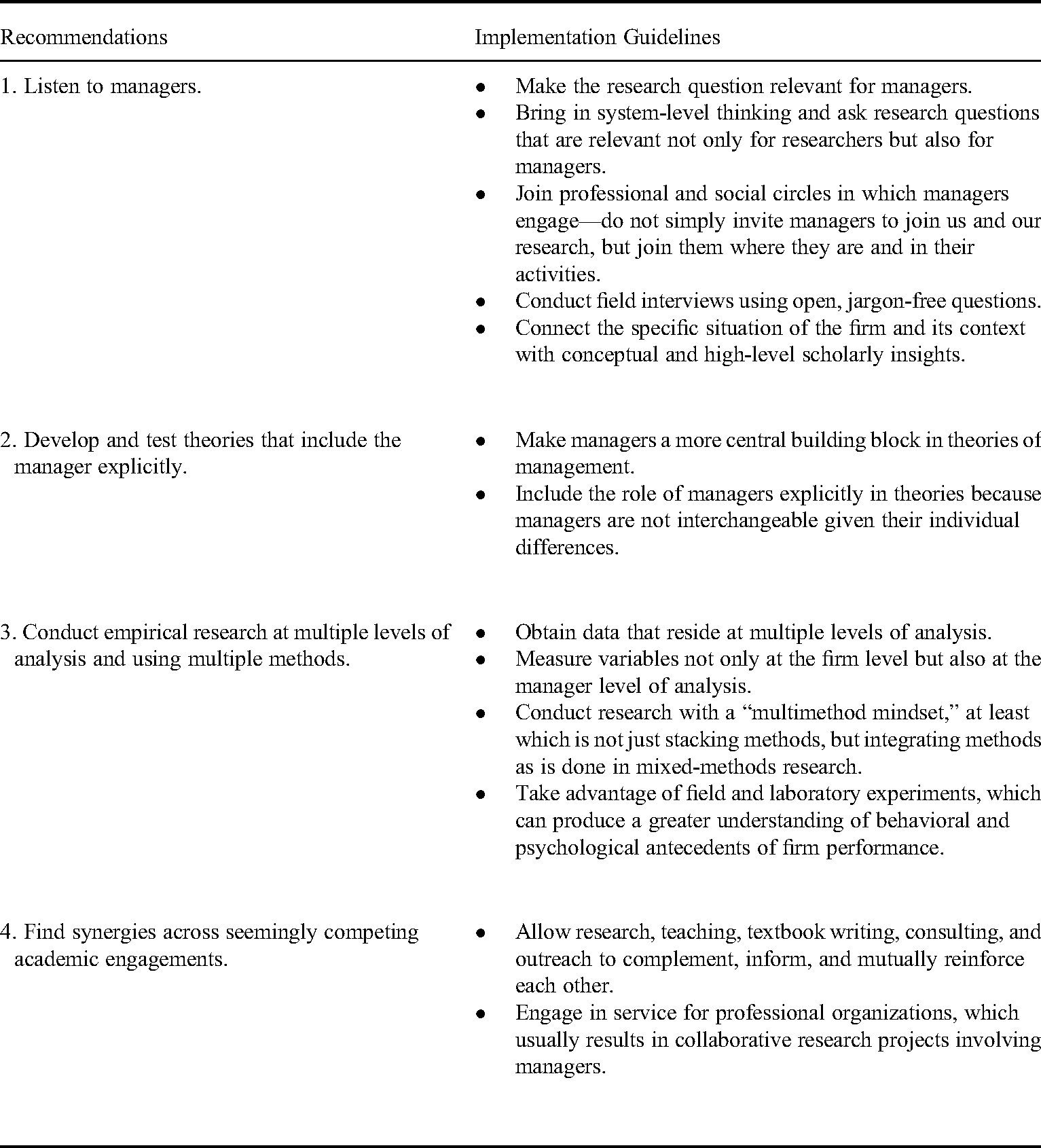
Recommendation 1: Listen to Managers
As a first step, to bring back the manager into our scholarship, the research question needs to be relevant for managers. In their Journal of Management commentary, Simsek, Heavey, Fox, and Yu (in press) provided insights into structuring the process of formulating research questions. Extending their perspective, we believe the manager plays a role in each stage of their proposed process for “knowledge weaving.” For example, much of our research ends at the firm level, considering the firm as a stand-alone entity without considering the firm's relationship to the broader system. Yet firms do not act in a vacuum—although that is often implicitly assumed by management scholarship—but are part of a broader social, environmental, and economic system (Flammer & Ioannou, 2021; Peng, 2022). Accordingly, to bring back the manager into management scholarship, we recommend that we bring in system-level thinking and ask research questions that are relevant not only for researchers but also for managers.
Understanding their empirical field is essential for social scientists, yet it presents a particular challenge for management scholars because senior managers are not easy for outsiders to access and observe (Solarino & Aguinis, 2021). Direct interaction with managers can be facilitated by joining professional and social circles in which managers engage. Our suggestion is to not simply invite managers to join us and our research but for us to join them where they are and in their activities. If this is not a viable option, then conducting field interviews using open, jargon-free questions is a good practice. The key for engaging with managers is to connect the specific situation of the firm and its context with conceptual and high-level scholarly insights. Asking managers to describe how they do what they do can be a useful step before a research program begins. Overall, a combination of interactions with managers can start a virtuous circle, in which the research output is more relevant to business, making managers more interested in working with us.
For example, one of us, after moving to Shanghai, regularly joined alumni events of his own alma mater (London Business School) and events of various Chambers of Commerce that brought together executives and other expatriates from different countries of origin. These networks proved valuable for gathering qualitative data on contemporary challenges of doing business in China and influenced a stream of research on doing business in China and on Chinese multinationals (Li, Meyer, Zhang, & Ding, 2018).
Another example is an interview that one of us conducted with Jack Harding, President and CEO of Cadence Design Systems in Silicon Valley, which today has 9,000 employees. At first, his innovative strategy seemed congruent with the models and theories of innovation prevalent in the literature. The firm was assumed to exist exogenously and then deploy its resources through strategies to generate innovation. However, when Harding revealed that to realize his vision for innovation he was leaving Cadence to start a new firm, e-Silicon, it seemed to contradict the extant models of innovation based on resources and strategies. Acting on his frustration and inability to implement his innovative ideas in the context of the incumbent firm, Harding created a new startup where he could actualize his vision. How could we reconcile Harding's departure from Cadence Design Systems and founding a new startup, e-Silicon? Working directly with Harding served as the catalyst for positing the knowledge spillover theory of entrepreneurship, where the startup of a new firm is the endogenous response to knowledge created in the context of an incumbent firm but actually commercialized through innovative activity in the new firm startup (Audretsch, 1995).
Recommendation 2: Develop and Test Theories That Include the Manager Explicitly
Managers ought to be central building blocks in theories of management. In this vein, our second recommendation is to develop and test theories that include the manager explicitly. Consider the research stream on how dynamic capabilities enable a firm to find promising new opportunities, devise effective business models, implement investment plans, and maintain internal and external organizational fitness in an environment of rapid change and deep uncertainty (Teece, 2007). Managerial decisions were recognized early on as central to dynamic capabilities. The type of management that matters most is entrepreneurial management (Teece, 2016). The entrepreneurial manager is focused on value creation and value capture, ideally combining aspects of the startup entrepreneur with the communication skills of a strong leader. These attributes also need to be in the whole top management team and can be divided across multiple individuals. Dynamic capabilities teach us that the entrepreneurial style must come to the fore whenever a new strategic initiative is required because the best way forward is typically with bold, smart bets. The “smart” comes from a combination of intuition and the results of judicious hypothesis development and the testing of new technological and business ideas. Failure is always a distinct possibility. Procedures must be in place to quickly analyze what went wrong, devise a viable pivot, and adopt the new direction. Leadership skills are most needed when new initiatives are being rolled out and organizational change is required. The promulgation of a vision around which employees and organizational partners can unite is critical.
Strong dynamic capabilities require the idiosyncratic insights of top management to navigate through unique situations. Top management must figure out what the future of the company is, bring others on board, and mobilize the required investments. Top managers are not interchangeable given their individual differences, so theories must include the role of managers explicitly. The replacement of a particular CEO or other executive will alter the strength or nature of the organization's dynamic capabilities. Transforming the new firm's culture and/or rebuilding a well-integrated top management team may be necessary (Karaevli, 2007). Given the rapidly evolving state of the environment in which firms operate, it seems an apropos moment to remind ourselves to incorporate them into our ideas, relationships, and theories.
Recommendation 3: Conduct Empirical Research at Multiple Levels of Analysis and Using Multiple Methods
To conduct research that is relevant for managers, it is important to obtain data that reside at multiple levels of analysis. In other words, variables should ideally be measured not only at the firm level but also at the manager level. Traditional management research at the micro level (e.g., OB and HRM) focuses on the individual and team levels, whereas traditional management research at the macro level (e.g., strategy, entrepreneurship, and IB) focuses on the firm and industry levels. But collecting and analyzing data from multiple levels of analysis allows us to understand variation across and within organizational units and contexts such as differences between managers within firms as well as differences across firms. Fortunately, there are numerous databases that can be used separately or in combination to achieve the goal of combining different levels. For example, Hill, Aguinis, Drewry, Patnaik, and Griffin (2021) described how to use 31 macro archival databases that include data at different levels of analysis. Specifically, they combined data from Thomson Reuters ESG, Datastream, Worldscope, and ILOSTAT and ascertained the positive effects of manager gender diversity and manager industry diversity on firm performance (i.e., ROA and ROE). Moreover, such use of multilevel data has additional methodological benefits. Specifically, these benefits relate to data collection (e.g., research design and measurement, control variables, and missing data management) and data preparation (e.g., outlier management), which are often difficult to achieve using single-level data.
In addition to conducting research at multiple levels, we recommend to use multiple methods. This is not only multimethod research as prescribed in statistical textbooks but what we characterize as a “multimethod mindset” (Aguinis & Molina-Azorín, 2015). Specifically, the objective is not to stack up methods but to integrate methods as is done in mixed-methods research. Combining qualitative and quantitative methods can happen within the same project, or in formally separate projects within a scholarly career. For example, while being trained primarily in quantitative methods, one of us conducted occasional projects using qualitative methods, generating theoretical insights on topics such as brownfield acquisitions, serendipity in international entry, global focus strategies, and low-profile strategies under sanctions. In two externally funded projects, this co-author led research teams that prepared country background reports, case studies, and survey data in seven emerging economies. The country reports and case studies have been published in edited books (Meyer & Estrin, 2007).
Finally, another suggestion regarding the use of multiple methods is to take advantage of field and laboratory experiments (for a review, see Bolinger, Josefy, Stevenson, & Hitt, 2022). Although this type of research design is used in OB/HRM, and more frequently than macro research, participants in such research are rarely managers. Rather, participants in OB/HRM experimental research usually include convenience samples of North America undergraduate students. As is now well recognized in psychology, these participants from Western, educated, industrialized, rich, and democratic (WEIRD) societies are not representative (Henrich, Heine, & Norenzayan, 2010). This is not just an issue of external validity but one of internal validity because it is hard to argue that they reflect the behavior of managers, which is the focus of management research. We readily acknowledge that experimental research is not feasible in many situations. But experimental approaches have potential to bring the manager back into management scholarship and bridge micro and macro domains by producing a greater understanding of behavioral and psychological antecedents of firm performance (Bolinger et al., 2022).
Recommendation 4: Find Synergies Across Seemingly Competing Academic Engagements
Research, teaching, textbook writing, consulting, and outreach complement, inform, and mutually reinforce each other. For example, one of us serves as the Chair of the Academic Advisory Committee of the United Nations’ Principles for Responsible Investment (PRI), the largest network of responsible investors to date. Also, many of us often present research at practitioner conferences and participate and serve as panelists in industry roundtables. In addition, most of us have also engaged in professional service activities at the Academy of International Business, Academy of Management, Asia Academy of Management, Society for Industrial and Organizational Psychology, and Strategic Management Society. Other colleagues of ours serve on corporate boards, on political campaigns, or on panels created by supranational organizations. The industry experts we meet in many of these engagements are a source of research ideas. Moreover, service for professional organizations often results in collaborative research projects involving managers.
We see these engagements and multiple roles as highly rewarding at both professional and personal levels—and they offer multiple ways to bring the manager back into management scholarship. For example, given the diverse backgrounds of individuals with whom we interact through these engagements, we have been able to conceptualize management challenges and the role of managers from both micro and macro perspectives. Similarly, these engagements have improved our professional networks and enhanced our awareness of theories as well as methodological innovations outside of our own domains. The challenge of course is to strike the right balance in terms of time spent on each one of these activities and avoid overcommitment.
Concluding Remarks
On the whole, scholarship in the field of management seems to be neglecting the manager. In the long run, devoting insufficient attention to managers may render our field societally and organizationally irrelevant. To help bring back the manager into management scholarship, our contribution in this commentary centers around four sets of recommendations: Listen to managers, develop and test theories that include the manager explicitly, conduct empirical research at multiple levels and using multiple methods, and find synergies across seemingly competing academic engagements. The time is now to put the manager back into management scholarship by making the manager a main character in our research planning, execution, and dissemination.
Footnotes
Acknowledgments
Authorship order is alphabetical. We thank Julie Battilana for preliminary discussions and M. W. Peng acknowledges support from the Jindal Chair at the University of Texas at Dallas.
Declaration of Conflicting Interests
The author(s) declared no potential conflicts of interest with respect to the research, authorship, and/or publication of this article.
Funding
This work was supported in part by the Jindal Chair at the University of Texas at Dallas (M. W. Peng).
