




Abstract
This research contributes to theory on self-control at work through applying and extending the limited-capacity model of self-control to examine the extent to which daily self-control work demands predict self-control failure and driving behavior during the commute after work. We develop a dual-pathway model in which resisting-distractions demands and impulse-control demands at work have unique relationships with speeding behavior via two separate pathways of self-control failure: one reflecting a failure to regulate attention and the other reflecting a failure to suppress impulses, which is moderated by negative affect. In two studies of daily work experiences and driving behavior, we find support for our model, over and above the effects of cognitive and affective work demands, postwork fatigue, and motivation. We discuss the implications of our findings in relation to the concept of self-control work demands and self-control depletion theory. Our findings also contribute to research on the links between work and commuting, and driving commuting most specifically, which is important because work-to-driving spillover represents a substantive safety issue for organizations.
It is widely understood that demanding days at work can leave people depleted in resources that they need to function effectively later in the day (Rothbard, 2001). Self-control is one resource that has received considerable theoretical and empirical attention. Research has examined how self-control might be depleted by different types of work demands (e.g., Schmidt & Diestel, 2015) and the extent to which self-control depletion and its effects can be carried from the work domain into the nonwork domain (e.g., Clinton, Conway, Sturges, & Hewett, 2020), and vice versa (e.g., Zhou, Wang, Chang, Liu, Zhan, & Shi, 2017). However, despite the potential importance of self-control processes in affecting employee behavior, there remain unresolved issues regarding how self-control work demands should best be conceptualized, the extent to which self-control work demands influence subsequent nonwork behavior (particularly beyond other related work demands), and the mechanisms that underlie these relationships.
We build on research on daily self-control work demands (e.g., Diestel & Schmidt, 2011; Sonnentag, Pundt, & Venz, 2017) and propositions from the limited-capacity model of self-control (Baumeister, Heatherton, & Tice, 1994; Muraven & Baumeister, 2000) to examine the extent to which daily self-control work demands reduce behavioral performance in the domain immediately following work: driving on the commute home. Driving safely and legally requires a continued ability to regulate both attention and impulse restraint (Salmon, Stanton, & Young, 2012), yet individuals are more likely to fail in these forms of self-control regulation if they have experienced self-control demands in a prior domain. This is due to the depleting effect of these demands on people’s self-control resources (Baumeister et al., 1994). Beyond being an important outcome in its own right, commuter driving offers a highly relevant context within which to examine how self-control at work influences subsequent behavior. The temporal adjacency of the commuting and work domains allows for proximal effects immediately following work to be examined. This is important because activities need to be temporally serial in order to fully test the implications of self-control failure (Muraven & Baumeister, 2000). This is not the case for studies that examine spillover to the home domain, which often occurs after the commute (unless the worker is home based). Furthermore, driving behaviors can, with the aid of modern technology, be objectively quantified, providing an unobtrusive means of measuring self-control behavior that does not require interrupting individuals during the activity.
This research contributes to the literature on self-control at work in two ways. First, self-control work demands have been shown to be negatively associated with outcomes during the workday, such as well-being, work engagement, and snacking behavior (e.g., Rivkin, Diestel, & Schmidt, 2015; Sonnentag et al., 2017), and outcomes in the nonwork domain, such as evening well-being (Rivkin, Diestel, & Schmidt, 2018), but important conceptual ambiguities and empirical gaps remain. For example, self-control work demands are theorized to be multidimensional (including demands to resist distractions, suppress responses to impulses, and overcome inner motivational resistances; Schmidt & Neubach, 2007), but they are most often operationalized as unidimensional, so differences in the implications of the subdimensions have been neglected. Theory would also suggest that self-control work demands relate to behavioral deficits in subsequent domains (Schmidt & Diestel, 2015), but this has not been clearly established. Furthermore, while self-control work demands have been shown to be distinct from some other job demands, like workload, role stress, and role ambiguity in predicting job strain (Schmidt & Neubach, 2007, 2009), major concerns exist about the unique contribution of self-control work demands in explaining performance deficits, over and above other cognitive, affective, and energetic work demands (Lian, Yam, Ferris, & Brown, 2017). Accordingly, our research examines the distinctive relationships between two forms of self-control work demands—resisting-distractions demands and impulse-control demands—and subsequent nonwork self-control failures and performance deficits. In addition, we test these relationships while partialing out the effects of concurrent cognitive and affective job demands and work-related fatigue. As such, we offer one of the most comprehensive and robust tests to date of a multidimensional model of self-control work demands.
Second, we seek to extend theory regarding the mechanisms that explain the relationship between self-control work demands and subsequent behavior. The limited-capacity model of self-control (Baumeister et al., 1994) proposes that self-control demands deplete a unitary self-control resource, capacity, or reservoir. Proponents of this model suggest that this unitary resource can be taxed through engaging in any act of self-control, and this can lead to observable self-control failures across a variety of subsequent tasks (Baumeister et al., 1994). However, concerns have been raised in the wider literature about whether self-control is a unitary resource and whether the depletion of that resource fully explains the effects observed in many experimental studies (e.g., Baumeister, Tice, & Vohs, 2018; Converse & DeShon, 2009; Hagger et al., 2016). We offer an alternative perspective; that two parallel pathways account for the associations between self-control work demands and the driving outcomes. These pathways are represented by distinct forms of self-control failure: one relating to the failure to regulate attention and the other relating to the failure to regulate impulse response. We operationalize these two pathways through the mediators attention-control failure and sensation seeking, respectively. Evidence of dual pathways from self-control work demands to behavioral outcomes would therefore signal distinct self-control depletion processes and contest the unitary self-control resource perspective.
Further, we contribute to literature on commuting and particularly research linking daily work experiences with commuter driving behavior (e.g., Calderwood & Ackerman, 2019). How people drive after work is potentially a significant safety issue for organizations, managers, and their employees. Driving is the main commuting mode for the majority of the population in most developed countries (e.g., 86% of Americans; McKenzie, 2015; 67% of Britons; Department for Transport, 2017). The number of people injured in road traffic crashes (RTCs) in the United States exceeds 2.4 million a year, with an estimated economic cost of $242 billion (National Highway Traffic Safety Administration, 2018), and RTCs are the eighth leading cause of death globally (approximately 1.35 million fatalities in 2016; World Health Organization, 2018). Work-related RTCs resulting in death or injury are substantially more likely when commuting to or from work as opposed to driving during work (e.g., Boufous & Williamson, 2006). Better understanding the work-related factors that foster risky driving behavior after work will help organizations protect employees from potentially life-threatening situations on the roads.
To date, studies on commuting have focused mainly on the implications of experiences during the commute, such as commuter stress (e.g., Novaco & Gonzalez, 2009) and the spillover of prework commuting experiences into behavior during the workday (e.g., Zhou et al., 2017). However, the increased likelihood of RTCs during the postwork commute seems to implicate a role for prior work-related experiences (Burch & Barnes-Farrell, 2019; Calderwood & Ackerman, 2019), but compelling theoretical and empirical explanations are lacking in terms of how negative spillover between work experiences and driving performance may occur and how a person can become a less safe driver than usual following a day at work. We develop and test a theory-based explanation for this spillover, which allows for a more systematic identification of risk factors and basis for developing interventions. We focus on driving speed as an indicator of risky driving and contributor to RTCs (Aarts & van Schagen, 2006) and speeds that exceed national legal limits, which operate as behavioral standards from a self-regulation perspective (Carver & Scheier, 1998). Our theoretical model is summarized in Figure 1 and tested across two field studies of daily work experiences and commuter driving.
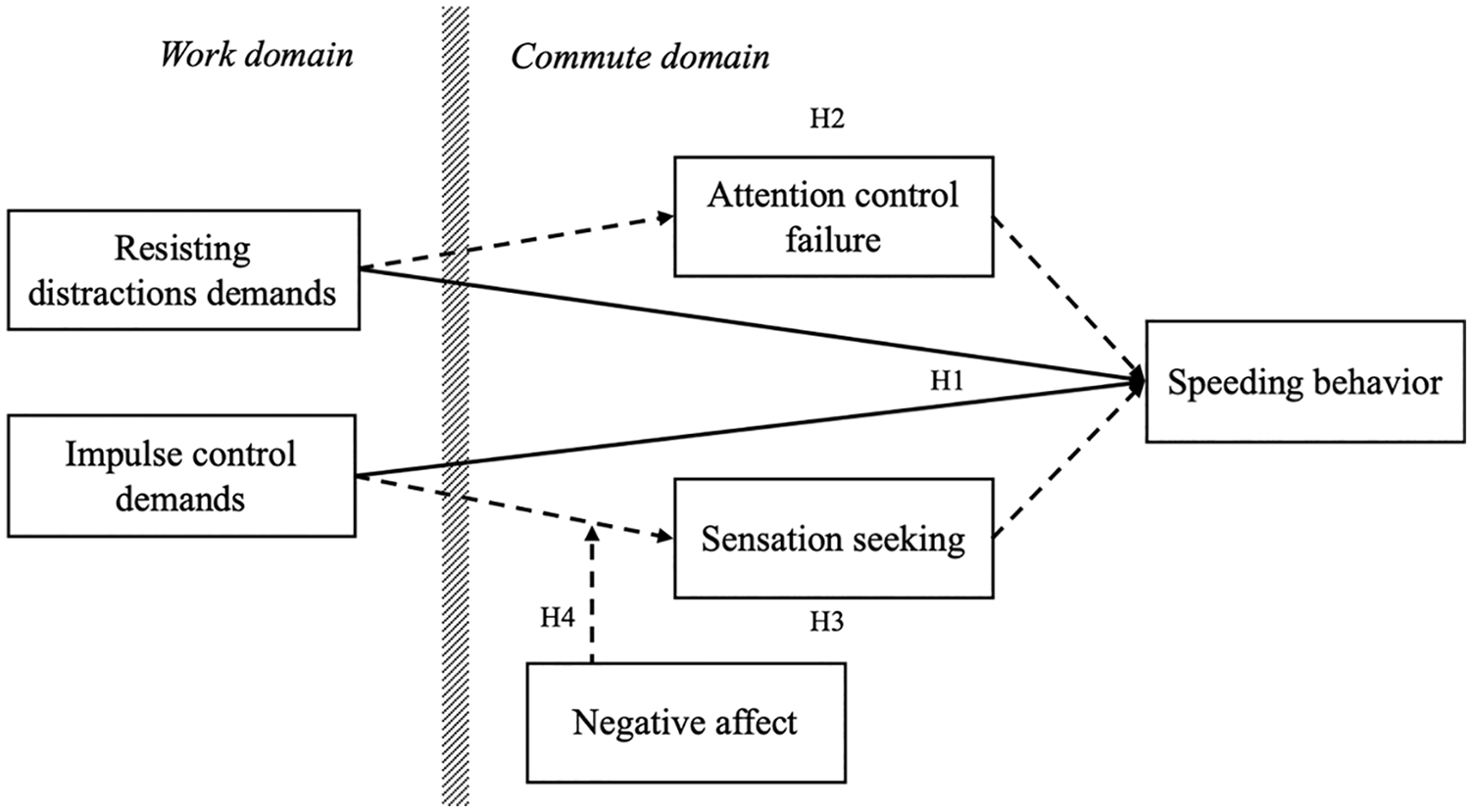
Visual Representation of the Research Model Proposed
Theoretical Framework
Self-Control Work Demands and Self-Control Failure
Self-control occurs when a person attempts to change the way he or she would spontaneously think, feel, or behave (Muraven & Baumeister, 2000). Self-control demands therefore require top-down, purposeful, and controlled action rather than spontaneous, automatic, or stimulus-driven responses (Shiffrin & Schneider, 1977). According to self-control theory (Baumeister et al., 1994; Baumeister & Heatherton, 1996), the experience of cognitive, emotional, physical, and, particularly, self-control demands on one task depletes a person’s self-regulatory resources (a process sometimes referred to as ego depletion) and contributes to self-control failure on a subsequent task (Muraven & Baumeister, 2000). Theoretically, this is because self-control is a limited resource and operates like the strength of a muscle; it depletes as it is used and remains weakened until recovered, during which time a person will be less able to exert self-control on tasks that require it (Baumeister & Heatherton, 1996). Perhaps given the difficulty of operationalizing the self-control resource in field studies (e.g., Lian et al., 2017), much of the organizational research in this domain has focused instead on self-control work demands, defined as “the extent to which a given job requires employees to suppress . . . response tendencies and affect states to display a controlled purposive behavior” (Schmidt & Neubach, 2007, p. 401). Scholars therefore argue that self-control work demands make self-control failures more likely as they deplete individuals’ limited self-control resource at work (Schmidt & Neubach, 2007).
Schmidt and Neubach (2007) identified three forms of self-control demands at work: resisting distractions (the demand to ignore task-irrelevant distractions), impulse control (the demand to inhibit spontaneous impulses and related affect), and overcoming inner resistances (the demand to summon the motivation to complete unattractive tasks). All three dimensions are designed to capture discrete situational work demands that cause employees to engage in forms of self-control that are relevant for goal achievement, and commonly found within contemporary work environments (Schmidt & Diestel, 2015). The three forms, which are not assumed to be exhaustive, are derived from theories of volition (Goschke, 1997; Kehr, 2004; Muraven & Baumeister, 2000; Sokolowski, 1997). The characteristics of these self-control work demands evolved from laboratory research (e.g., Oaten & Cheng, 2006) that tested the implications of, for example, regulating emotions and affective states, resisting interfering distractions, suppressing spontaneous and habitual impulses, overcoming inner motivational resistances, and updating working memory. The dimensions of self-control work demands tend to be treated empirically as multidimensional, converging on a single factor (e.g., Diestel & Schmidt, 2011; Schmidt et al., 2016), or are individually and selectively used to represent self-control work demands in a general sense (Sonnentag et al., 2017). When the three dimensions have been used separately, each has contributed portions of unique variance in the prediction of various measures of psychological strain and well-being (Schmidt & Diestel, 2015).
We focus on the self-control work demands of resisting distractions and impulse control and extend the multidimensional perspective of self-control work demands by modeling them as antecedents to distinct forms of self-control failure. 1 We do this because there are important conceptual differences between these two self-control work demands. Resisting distractions is primarily a cognitive activity relating to the maintenance of appropriate attention in the face of distracting stimuli (Schmidt & Diestel, 2015). Distracting stimuli are perhaps obviously located in the external environment (e.g., background noise), but internal distractions (e.g., mind wandering) are also common. From a self-regulation perspective, the source of the distraction is believed to be relatively unimportant because all nontask distractions divert attention away from the task itself (Beal, Weiss, Barros, & MacDermid, 2005). Distractions are widely understood to divide cognitive resources and reduce performance on focal tasks (Schneider & Fisk, 1982). So, it is the effort required to ignore the attentional pull of distracting stimuli and sustain one’s attentional resources on task performance that represents the self-control demand.
Impulse control is primarily a behavioral activity (Schmidt & Diestel, 2015). Impulses are incipient, short-term behavioral urges reflecting largely automatic and spontaneous responses to activating stimuli or temptations, often based on global hedonic motivations, such as needs and desires (Hofmann, Friese, & Strack, 2009). Examples of impulses could be the urge to express affect in response to others’ behavior, experience a thrill when bored, or avoid unpleasant sensations in favor of positive sensations. Importantly, impulse control does not imply that people control the production of impulses; rather, they regulate their natural behavioral response to impulses when the behavior is inappropriate in some way (Baumeister & Heatherton, 1996). Impulse-control demands therefore relate to events or situations that require people to regulate their natural behavioral responses to impulses.
Given the conceptual differences, it then seems plausible that these two self-control work demands involve different sets of regulatory processes. Our dual-pathway model suggests that different forms of self-control work demands are most closely linked to subsequent failures within the same self-control form. Within the context of driving, driving performance is susceptible to two particular forms of self-control failure that correspond to these two self-control work demands: failure to regulate attention while driving (e.g., attend to meaningful information and monitor behavior; Matthews, 2001) and the failure to suppress impulse response while driving (e.g., avoid sensation seeking, restrain affective expression; Dahlen, Martin, Ragan, & Kuhlman, 2005). Submitting to distractions and impulses is each known to contribute to risky driving and RTCs (Regan, Lee, & Young, 2008). We discuss these mechanisms further in later sections but first examine links between work-related experiences and driving behavior.
Spillover of Self-Control Work Demands to Commuter Driving Performance
Scholars have already suggested that work events have a substantial influence on subsequent driving behavior (e.g., Novaco & Gonzalez, 2009). The majority of research examining spillover between work experiences and driving behavior supports this view but has mainly focused on links between general work-related experiences and typical driving behavior (e.g., Turgeman-Lupo & Biron, 2017). Recently, evidence has emerged of associations between daily work-related factors and subsequent driving behaviors. For example, Calderwood and Ackerman (2019) found that postwork negative affect was related to unsafe driving behaviors, but hindrance stressors were not, while challenge stressors were linked to safer driving. Burch and Barnes-Farrell (2020) likewise found that job strain was positively related to self-reports of daily driving violations, partly mediated via affective rumination. However, the independent or dependent variables examined in existing studies often involve composites of either job demands or driving behaviors, meaning that it is difficult to draw theoretical conclusions about specific connections between different dimensions of either construct. So, while there is growing evidence that work experiences are associated with driving safety at both general and daily levels, this literature would benefit from a coherent theoretical and empirical explanation for how daily variation in work experiences may negatively spill over into driving behavior.
Research evidence supports the view that self-control processes could account for the link between work experiences and driving behavior. Studies show that day-level self-control work demands relate to psychological states indicative of being less able to effectively self-regulate, such as emotional exhaustion, low engagement, and anxiety (Rivkin et al., 2018; Schmidt & Diestel, 2015). Sonnentag et al. (2017) furthermore found that daily self-control work demands are correlated with reports of eating sweet snacks during the day, suggesting that self-control work demands may also account for degradation in subsequent behavioral outcomes at work. Like these studies, we argue that self-control demands at work deplete a person’s self-control resources, making self-control failure more likely. We extend these studies by examining distinct dimensions of self-control work demands and propose that resisting distractions and controlling impulses while at work will each contribute uniquely to degraded subsequent behavior in a nonwork domain. On the basis of the limited-capacity model of self-control (Baumeister et al., 1994), we propose that when people need to exert greater self-control to resist distractions and suppress their natural impulses during their working day, they will be more likely to experience self-control failure in regulating driving speed and so engage in more speeding events later that day. We argue that resisting distractions at work depletes people’s ability to regulate attention during the commuting drive and that impulse control at work depletes people’s ability to regulate the urge to drive fast during the commuting drive. Because both the regulation of attention and the suppression of impulses to drive fast are required to regulate legal driving speeds, self-control failures in these areas make it more likely that people will drive above the speed limit.
An important aspect of the present study, given the debate surrounding the role of self-control relative to other resources within self-regulation processes (e.g., Hagger, Wood, Stiff, & Chatzisarantis, 2010), is our inclusion of specific additional variables to account for competing explanations for observed self-control failure. Lian et al. (2017) have critiqued existing studies for focusing on proxies, such as physical fatigue, cognitive load, or emotional exhaustion, rather than strictly focusing on self-regulatory resources and demands. As a result, many of the findings produced to date could simply reflect reduced affective, cognitive, or energetic resources that may each justifiably influence subsequent self-regulation but do not necessarily draw on self-regulatory resources. Ruling out plausible alternative explanations for effects is fundamental for supporting causal claims (Shadish, Cook, & Campbell, 2002). Therefore, the unique contribution of self-control work demands relative to other work demands or other personal resources remains a crucial unresolved issue for the validity of self-control work demands.
We therefore include work-related cognitive demands, affective demands, and postwork fatigue as substantive variables in our research. Existing work would support a role of cognitive load (Hockey, 1997), negative affect (Calderwood & Ackerman, 2019), and fatigue (Robb, Sultana, Ameratunga, & Jackson, 2008) in negatively affecting driving performance. However, we would argue that these work demands do not necessarily contribute to self-control failures, as work tasks that require cognitive, affective, or energetic resources may (e.g., resisting distractions) or may not (e.g., solving a difficult problem at work) require the need for self-control. Accordingly, we argue that self-control work demands have a unique and important relationship with subsequent behavior and propose that self-control work demands will continue to associate with speeding behavior over and above these other variables.
Hypothesis 1: The daily self-control work demands of (a) resisting distractions and (b) impulse control are positively related to speeding behavior during the postwork driving commute, over and above cognitive and affective work demands and postwork fatigue.
Study 1
In Study 1, we test this hypothesis using a measure of driving speed captured by telematics data. This allows us to examine our core expectation that self-control work demands positively relate to risky commuter driving using an objective behavioral measure. We further test this hypothesis while including within the analyses variables that reflect alternative theoretical explanations of cognitive and affective job demands and work-related fatigue. Together these two features of Study 1 overcome some of the key criticisms of prior research on self-control demands at work (Lian et al., 2017).
Method
An online advertisement invited open participation in a study on commuting in the United Kingdom. Respondents to this advertisement, if they drove a car to work at least three times a week, were invited to complete an online background survey and then online diaries immediately after work and again after their commute home for a minimum of 10 working days. Participants were asked whether they would be willing to insert a telematics device into their car that recorded GPS data if found to be technically compatible. Participants were entered into a prize draw for online shopping vouchers as an incentive; they received one “entry” for each survey or diary completed.
During July to September in 2017, 80 people completed a background survey and then postwork and/or postcommute diaries for 933 days. Of those, 55 individuals could be matched with telematic data. Postwork diaries completed after the drive and postcommute responses recorded more than 2 hours after the drive ended were removed, as were days that involved irregular commutes (as denoted by deviation from either reported home or work locations indicated by the GPS data for the location of the drive). Where the commute included a stop of more than 5 minutes, the drive before the stop was included only if more than half of the regular commute had been completed, and the drive after the stop was excluded. If the prebreak drive was less than half of the commute, the whole commute was excluded. This resulted in 499 days for which we could match telematics with both postwork and postcommute diary (per person mean = 9.1 days; min. = 2 days; max. = 16 days). Some participants (n = 7; 12.7%) preferred to participate using paper diaries rather than online diaries, and the dates and times of the responses were self-reported. We compared responses between electronic and paper diaries, and no bias was indicated by choice of completion method. We also compared gender and mean differences on diary variables between people who were able to provide telematics data or not, and no bias was found.
Respondents were mostly women (76%), had a mean age of 45 years (SD = 9.7 years), and were diverse in terms of occupation, job level, job tenure, and weekly working hours. On average, respondents drove 209 miles during a normal week, and in the previous 3 years, eight had been issued with a fixed penalty notice for a motoring offense and 13 had been involved in a crash when driving, with seven admitting some responsibility. Average commute distance was 15.7 miles (derived from the telematics data), 83% had driven their commuting route for at least a year, and 76% reported that they typically commuted between 4 p.m. and 6 p.m.
Measures
Postwork diary measures
Shortened scales are commonly used in diary research to avoid overloading participants and are often also adapted to orient item content to daily rather than general experiences (Ohly, Sonnentag, Niessen, & Zapf, 2010). Items were selected from existing scales by the research team based on a joint assessment of face validity, ease of comprehension, and if available, published factor loadings. Self-control work demands were measured using items from Schmidt and Diestel’s (2015) scale, with the wording adapted to daily experiences, with three items for resisting-distractions demands (e.g., “To get my work done today . . . I had to resist distractions”) and three items for impulse-control demands (e.g., “Things happened today at work today which meant that . . . I had to try hard not to lose my self-control”).
Speeding behavior
Speeding behavior was identified from event data produced by an onboard telematics device, which recorded the position of the car using GPS data every second. These data, which produced the raw ground speed of the car, could also be used to identify the speed limit for the road traveled. A speeding event was recorded each second the car exceeded the speed limit by more than 10% + 2 miles per hour (mph) to align with guidelines for speeding in the United Kingdom (Association of Chief Police Officers, 2013) and the tolerance level for devices that measure car speeds. Speeding behavior is therefore operationalized by the length of events during a trip (in seconds) spent above this level.
Controls
We included cognitive and affective work demands and postwork fatigue as additional predictors in our analyses. Functioning as a set of measured statistical controls (Becker, 2005), their inclusion allowed us to examine the unique associations between self-control work demands and speeding behavior, over and above the influence of these variables, which provides a stronger test of the role of self-control depletion in subsequent self-control failure. Cognitive demands at work were measured using three items from Van Veldhoven, De Jonge, Broersen, Kompier, and Meijman (2002) modified to the day level, for example, “Today at work . . . my work demanded a lot of concentration.” Affective demands at work were also measured using three items from Van Veldhoven et al. (2002) modified to the day level, for example, “Today at work . . . my work demanded a lot from me emotionally.” Postwork fatigue was measured by three items from Zohar, Tzischinski, and Epstein (2003), for example, “How do you feel right now? . . . Tired.” All scales were rated from 1 (not at all) to 5 (a great deal), and all alpha reliabilities are reported in Table 1.
Means, Standard Deviations, Intraclass Correlations (ICC1), Reliabilities, and Zero-Order Correlations for Study 1

Note: Correlations below the diagonal are person-level correlations (n = 55) with correlations r|.27| being significant at p < .05. Correlations above the diagonal are within-person, day-level correlations (n = 499) with correlations r|.08| being significant at p < .05. ICC1 = percentage of variance between persons (ICC1 = variance between persons / [variance between persons + variance within]). Mean daily alpha reliability coefficients presented in parentheses.
We also included two other contextual variables as statistical controls in our models: As longer commutes give greater opportunities for more speeding events, and may also generate additional demands on the driver, we included trip distance (in miles) provided by the telematic data. Passengers can contribute to driver distraction (McEvoy, Stevenson, & Woodward, 2006), so the presence of passengers (reported in the postcommute survey; 1 = no passengers, 2 = passengers) was also included. Because driving conditions vary day to day and influence driving behavior (Novaco & Gonzalez, 2009), we finally included travel impedance, which is the blocking or thwarting of movement and goal attainment during travel. This was reported in the postcommute survey using three items from Novaco, Stokols, and Milanesi (1990) in response to the stem, “How would you rate your commute home from work today, on the following 10-point scales? . . . Fast–Slow . . . Uncongested–Congested . . . Pleasant–Unpleasant.”
Data Analysis
We tested our hypotheses using multilevel structural equation models (MSEMs) using Mplus 7.4 (Muthén & Muthén, 1998-2012), which partitions the variance of the daily variables into within-person and between-person latent components. Multi-item variables were included as manifest variables. All variables were grand mean centered prior to analysis. Mplus centers within-person components of variables to the person mean. Unless stated otherwise, we used robust maximum likelihood estimation, producing parameter estimates robust to non-normality. Alpha of .05 was used for significance testing. Hypothesis tests were based on within-person associations as our predictions are based on within-person variation, but between-person associations are also reported for completeness.
Results
Measurement models
Multilevel confirmatory factor analyses (CFAs) tested several measurement models. A two-factor model involving the items for resisting distractions demands and impulse control demands at both within-person and between-person levels fitted the data well (N person = 55; N days = 499; χ2 = 14.28, df = 16; comparative fit index [CFI] = 1.00; Tucker-Lewis index [TLI] = 1.00; root mean square error of approximation [RMSEA] < .001; standardized root mean square residual [SRMR] = .027 [within] and .017 [between]; all standardized factor loadings > .83) and better than a model in which items were loaded onto a single factor at each level (χ2 = 979.22, df = 18; CFI = .12; TLI < .01; RMSEA = .327; SRMR = .285 [within] and .162 [between]). The discriminant validity of the two self-control work demands was then assessed against each of cognitive demands, affective demands, fatigue, and travel impedance (i.e., the measured control variables) in turn, via a series of three-, two- and one-factor CFA models. The fit of three-factor models involving the two self-control work demands and one of the measured control variables was compared against two-factor models in which the measured control variable was loaded onto either resisting-distractions demands or impulse-control demands and one-factor models where the three variables were loaded together. In each case, the three-factor model fitted the data best (see Online Appendix A).
A final, six-factor model was tested involving resisting-distractions demands, impulse-control demands, cognitive demands, affective demands, fatigue, and travel impedance, and though the number of parameters exceeded the number of clusters, thereby reducing the trustworthiness of estimates, it fitted the data well (χ2 = 384.25, df = 240; CFI = .97; TLI = .96; RMSEA = .038; SRMR = .038 [within] and .065 [between]; all standardized factor loadings > 0.63). It also fitted better than a model in which items were loaded onto a single factor at each level (χ2 = 979.22, df = 18; CFI = .12; TLI < .01; RMSEA = .327; SRMR = .285 [within] and .162 [between]) and a series of five-factor models in which each measured control variable was loaded with one of the self-control work demands (see Online Appendix A). The robustness of the six-factor model was further assessed and supported by running the model with a Bayesian estimator that better tolerates complex models with small samples (Zyphur & Oswald, 2015), following guidance from Asparouhov, Muthén, and Morin (2015) and Gucciardi and Zyphur (2016). All items were standardized as a first step, and following several runs, where systematic adjustments to variance priors were monitored in terms of rate of convergence and model fit, we settled on a model. This model allowed for 10,000 iterations (CHAINS = 4; THIN = 10), converging after 5,900 iterations when the potential scale reduction factor (PSR) remained below 1.05 (Gelman & Rubin, 1992). PSR is an indicator of convergence for which low values reflect a small ratio of variance between the different iterative chains when compared to within-chain variance. Estimation is halted at low values of PSR (e.g., <1.05) because the chains yield equivalent results (Zyphur & Oswald, 2015). The model included small uninformative priors set for cross-loadings, with a normal distribution (mean = 0.0 and variance = 0.02), and for residual variances and covariances, with an inverse Wishart distribution (d = 34; which reflects the degrees of freedom of the distribution; Asparouhov et al., 2015). Acceptable model fit was indicated by a posterior predictive p value of .374 and a 95% confidence interval (CI) of the difference between observed and generated data χ2 between −69.30 and 114.99 (credibility intervals for standardized residual covariances cover zero; all standardized within-person factor loadings > 0.52; see Online Appendix B). A Bayesian one-factor model fitted the data less well (95% CI of difference; 3194.47 to 4462.27; posterior predictive p value < .001) with a substantially higher TERM deviance information criterion (DIC) than the six-factor model (DICone-factor = 19856.48; DICsix-factor = 16355.41); all five-factor variants failed to converge after 10,000 iterations.
These analyses support the construct validity of the measurement model. Means, standard deviations, intraclass correlations, mean daily alpha reliabilities, and within-person and between-person level intercorrelations are presented in Table 1.
Hypothesis test
Speeding events were regressed onto resisting-distractions demands, impulse-control demands, cognitive demands, affective demands, fatigue, travel impedance, presence of passengers, and trip distance at both within-person and between-person levels, creating a saturated model where the fit to the covariance matrix is perfect and degrees of freedom are zero. A significant positive estimate was recorded for the within-person level relationship between resisting-distractions demands and speeding events (unstandardized estimate = 5.95; SE = 2.04; z = 2.91; p = .004) but not for impulse-control demands (unstandardized estimate = −.6.97; SE = 4.53; z = 1.54; p = .124). This supports Hypothesis 1a but not Hypothesis 1b. All other estimates from this first model are reported in Table 2. For completeness, an alternate model was run without job demands and fatigue to examine the effects of the two self-control work demands on speeding without their influence. The results were substantively unchanged.
Unstandardized Coefficients From Multilevel Model Predicting Speeding Events for Study 1

Note: Nbetween = 55; Nwithin = 499. Model fit is saturated.
Discussion of Study 1
We found that when people had to resist distractions during the workday to a greater degree than usual, they subsequently exhibited greater self-control failure in relation to their driving speed, exceeding speed limits more often than usual during their commute. This relationship was recorded over and above any influence of affective and cognitive work demands and postwork fatigue, each of which have been argued to offer alternative explanations for self-control failure. However, we did not find the same effect for impulse-control demands. Despite demonstrating an association between daily resisting-distractions demands and driving behavior using intensive diary methods and objective driving data, Study 1 is limited in several ways. First, while we have inferred theoretical explanations for the expected spillover effects, we have not formally tested these. Second, we are unable to explain why impulse-control demands did not relate to subsequent driving behavior as we did not consider more proximal intervening mechanisms or boundary conditions.
Study 2
In Study 2, we aim to provide further evidence of the linkages between daily self-control work demands and subsequent commuter behavior, with an emphasis on testing the theoretical mechanisms proposed in Figure 1. We build on Study 1 by testing an extended model that incorporates two theoretically guided mediators and a moderator to explain why and when self-control work demands relate to the speed that people drive home after work. This model is based on a multidimensional perspective of self-control resources, in which self-control of attention resources results in attention-based self-control failures and self-control of impulse responses relates to more impulse-based self-control failures. We elaborate these arguments next.
Resisting-Distractions Demands and Attention-Control Failure
We argue that resisting distractions depletes a limited reservoir of attention-control resources, thereby increasing the likelihood of attention-control failure in the form of speeding. Attention control is a form of self-control defined as the ability to focus attention on a given task, to control and regulate external and internal distractions, and to work toward a desired goal or outcome (Schmeichel & Baumeister, 2010). Attention control is argued to be the most important form of self-control as it contributes to all other forms of self-control (Baumeister et al., 1994) and is a core contributor to self-regulation outcomes at work (Beal et al., 2005).
We suggest that attention-control failure explains why resisting distractions at work is associated with speeding behavior during the commute home for several reasons. First, attention control has been found to operate as a limited resource (Schmeichel, 2007), implying that it is something that can be depleted by self-control work demands. Some of the strongest evidence yet for this theory comes from a recent set of preregistered laboratory studies (Garrison, Finley, & Schmeichel, 2019). Researchers found that performance in subsequent attention tests was degraded for subjects who took part in a controlled writing manipulation, which taxed subjects’ attention control, relative to control groups. Furthermore, the role of attention regulation in regulating driving speed is also supported by experimental evidence that driver distraction and inattention are positively associated with both driving speed and exceeding speed limits (Yanko & Spalek, 2014; Young, Salmon, & Cornelissen, 2013). Distractions, such as mobile phones, are also a major contributing factor to RTCs (Redelmeier & Tibshirani, 1997). Linking these findings together, we suggest the following:
Hypothesis 2: There is a positive indirect relationship between daily resisting-distractions demands at work and speeding behavior via attention-control failure during the commuter drive.
Impulse-Control Demands and Sensation Seeking
We proposed that impulse-control influences driving behavior because it makes subsequent failures in suppressing urges and impulses more likely. To examine this mechanism empirically, we draw upon sensation-seeking behavior, defined as the preference for intense, novel, or risky experiences (Whiteside & Lynam, 2001), as a form of self-control failure that can influence driving behavior. Sensation seeking is understood to be a means of experiencing heightened physiological arousal (Zuckerman, 1994), and driving provides an opportunity for people to experience the sensations of intensity and risk through driving fast (Jonah, 1997). Drawing on theory regarding self-control failure (Baumeister & Heatherton, 1996), we argue that impulse-control demands at work reduce peoples’ ability to subsequently curb the impulse to experience positive sensations. Such thinking would be supported by Sonnentag et al.’s (2017) study on self-control in snacking, which found that an affect-regulation motive rather than a more rational health motive explained the link between snacking behavior and self-control work demands measured through impulse-control items.
Research evidence supports a depletion process in sequential tasks requiring impulse control and the role of sensation seeking in the regulation of driving speed. For example, in a series of laboratory studies, Fischer, Kastenmüller, and Asal (2012) found that thought- and emotion-suppression exercises were linked to increases in risk inclination and sensation seeking, including within a study of driving-related risk. This contrasts with other studies that have sought to manipulate self-control failure via attention-control tasks and have found more mixed links with risk taking (e.g., Koppel, Andersson, Västfjäll, & Tinghög, 2019). In addition, sensation seeking is known to be an antecedent to risky driving behavior (e.g., Dahlen et al., 2005) and predictor of high reported driving speed (e.g., Jonah, 1997). On this basis, we suggest the following:
Hypothesis 3: There is a positive indirect relationship between daily impulse-control demands at work and speeding behavior via sensation-seeking behavior during the commuter drive.
To further examine the impulse-control demands pathway to driving behavior, we explore a boundary condition of this association in order to understand the contexts under which the strength of this relationship may vary. We propose that impulse-control demands at work will more likely lead to self-regulation failure after work when people experience additional impulse-control demands during subsequent tasks, because the further impulse-control demands compete for self-control resources. We focus on negative affect during the commute drive as an additional impulse-control demand and moderator because negative affect both elicits behavioral urges and impulses and draws on self-control resources needed to override the negative mood and inhibit unwanted behavioral responses (Beal et al., 2005; Muraven & Baumeister, 2000; Tice, Bratslavsky, & Baumeister, 2001). Additional self-control demands further deplete self-control resources and make people faced with already depleted self-control resources even more likely to fail in subsequent self-control tasks (Baumeister & Heatherton, 1996). In the work domain, this is supported by findings showing that the effects of self-control work demands were more strongly associated with negative well-being outcomes and absence behavior when combined with emotional dissonance (Diestel & Schmidt, 2011).
Applied to the commuter driving context and our dual-pathway model, we propose that negative affect during the commute drive will demand additional impulse control from the driver, making it more likely that residual depletion from impulse-control demands at work earlier in the day will lead to sensation-seeking behavior (indicating impulse-control failure). Sensation seeking is a functional strategy here because it is both a result of impulse-control demands, as discussed earlier, and a means of addressing negative affect through pursuit of positive sensations (Taylor & Hamilton, 1997). While the experience of affect can influence the regulation of attention (Beal et al., 2005), we argue that negative affect plays a particularly salient role for aspects of impulse control, given that impulse control is particularly susceptible to deterioration during emotional distress (Tice et al., 2001) and that negative affect is commonly linked to risky behavior and impulsivity (Kemp, Sadeh, & Baskin-Sommers, 2019; Whiteside & Lynam, 2001). On this basis, we suggest the following:
Hypothesis 4: Negative affect moderates the positive relationship between daily impulse-control demands at work and sensation-seeking behavior, such that the relationship is stronger when negative affect is higher.
Building on these arguments, we propose that because negative affect strengthens the relationship between impulse-control demands at work and sensation-seeking behavior, that interaction will also relate indirectly to faster driving speeds. In other words, we expect a moderated mediation, where negative affect moderates the indirect relationship between impulse-control demands and speeding behavior via sensation-seeking behavior.
Hypothesis 5: Negative affect moderates the positive indirect relationship between daily impulse-control demands at work and speeding behavior via sensation-seeking behavior, such that the relationship is stronger when negative affect is higher.
Method
In Study 2, we utilize online panel data provided by a diverse sample of 133 working adults in the United Kingdom via two time-lagged surveys in a single day in March 2019: one at the end of the working day and one following their postwork commute. There is considerable disagreement regarding best practices for online panel designs, so we follow the recommendations of Porter, Outlaw, Gale, and Cho (2019) with respect to transparency so that practices can be systematically examined in subsequent research. The sample was recruited via Prolific Academic Limited, and respondents were paid in total £3.88 (equivalent to US$4.77) for completing three short surveys that together took the average respondent just over 17 minutes to complete (M = 1043.6 s, SD = 298.5 s; min. = 459 s, max = 1,935 s). The average compensation was therefore equivalent to £13.70/$16.83 per hour, which was greater than the United Kingdom’s national living wage level of £8.21 at the time.
To be eligible for the study, participants needed to work a minimum of 15 hours a week and commute by car at least twice a week between 3 p.m. and 9 p.m. After completing an initial background survey at the start of the week to confirm eligibility and collect demographics, participants were sent the postwork and postcommute surveys via email on a day they had preinformed us would include their normal work and commute. They were instructed to complete the two surveys either side of their commute that day. Participants who did not complete both surveys (n = 98) were removed. Inattentive or incorrectly timed survey responses were also removed (n = 68), as indicated by failed responses to at least one of three attention checks, incorrectly time-ordered or concurrently completed surveys, or insufficient time lags in responses to allow for the distance of the reported commute as indicated by the survey time stamps. Participants were mostly women (70.7%), had a mean age of 39.7 years (SD = 11.0 years), and were diverse in terms of occupation, job level, job tenure, and weekly working hours. On average, the reported commute distance was 10.0 miles (SD = 11.5 miles), 79.5% regularly commuted on four or more days of the week, and 57.4% had driven their commuting route for at least a year. In the previous 3 years, 11.2% had been issued with a fixed penalty notice for a motoring offense, and 17.3% had been involved in a crash when driving.
Measures
Postwork survey measures
The self-control work demands of resisting-distractions demands and impulse-control demands as well as cognitive demands, affective demands, and postwork fatigue were measured with the same scales as Study 1.
Postcommute survey measures
Speeding behavior was measured by adapting a single item from Warner and Åberg (2006). Our multi-item measure examined speeding behavior at three different speed ranges above the speed limit, which we combined into a single scale to be analogous to the telematics speeding measure in Study 1, for example, “During your drive after work today, how often did you drive above the posted speed limit? . . . I drove a small amount above the posted speed limit (e.g., 31–34 mph on a 30 mph road/71–78 mph on a 70 mph road).” These were rated from 1 (not at all) to 6 (very often). Attention-control failure was measured with four negatively worded items from the attention-control scale of Derryberry and Reed (2002), modified from the trait level to the day level in relation to driving, for example, “Please indicate how much you agree with the following statements about your experiences during your drive after work today. . . . I had trouble focusing my attention,” rated from 1 (strongly disagree) to 5 (strongly agree). Sensation seeking was measured using four items from the sensation-seeking dimension of the UPPS Impulsivity Scale (Whiteside & Lynam, 2001), adapted from the trait to the day level and oriented to driving, for example, “To what extent do you agree with the following statements regarding how you felt during your drive? . . . I enjoyed taking risks,” rated from 1 (strongly disagree) to 5 (strongly agree). Negative affect was measured using four items from Warr’s (1990) measure of work-related affect, but oriented toward driving, for example, “How did you feel during your drive after work? . . . Anxious,” rated from 1 (not at all) to 5 (a great deal). Items were selected from longer scales using the same rationale as in Study 1. All alpha reliabilities are reported in Table 3.
Means, Standard Deviations, Reliabilities, and Zero-Order Correlations for Study 2

Note: N = 133. Correlations r|.18| are significant at p < .05. Alpha reliability coefficients presented in parentheses.
Controls
As in Study 1, in the analyses we included the presence of passengers and travel impedance, reported in the postcommute survey using identical measures, self-reported trip distance, cognitive demands, affective demands, and postwork fatigue as statistical controls. Some scholars have also suggested that motivation, rather than a reduction in capability (Inzlicht & Schmeichel, 2012), might be an alternative interpretation of the effects of self-control demands. To account for participant motivation in relation to driving speed, we included driving speed intentions as a further statistical control using the following single item derived from a measure by Elliot, Armitage, and Baughan (2007): “How do you intend to drive during your commute after work today?” followed by “I intend to drive below the posted speed limit” (this was adapted from the original item to reduce complexity as “Do you intend to avoid exceeding the speed limit while driving in the next week?”), rated from 1 (not at all) to 5 (all of the time).
Data Analysis
The hypotheses were tested using path analysis with manifest variables using maximum likelihood estimation in Mplus 7.4 (Muthén & Muthén, 1998-2012); robust maximum likelihood was used for measurement models due to the ordinal level of indicators. Alpha of .05 was used for significance testing. Indirect effects and conditional indirect effects were tested using estimated bias-corrected bootstrapped 95% CIs based on 10,000 samples, and significant conditional effects were probed at 16th and 84th percentiles of the moderator (following recommendations of Hayes, 2017).
Results
Measurement models
A two-factor CFA model including the items for resisting-distractions demands and impulse-control demands fitted the data well (χ2 = 14.86, df = 8; CFI = .98; TLI = .97; RMSEA = .080; SRMR = .052; all standardized factor loadings > 0.81) and better than a model in which items were loaded onto a single factor (χ2 = 224.20, df = 9; CFI = .45; TLI = .09; RMSEA = .424; SRMR = .229). Next, a five-factor CFA model involving all five variables from the postwork survey (resisting distractions, impulse control, cognitive demands, affective demands, and fatigue) was tested, which fitted the data adequately (χ2 = 164.42, df = 80; CFI = .93; TLI = .91; RMSEA = .089; SRMR = .059; all standardized factor loadings > 0.76) and better than a model in which items were loaded onto a single factor (χ2 = 1359.96, df = 105; CFI = .33; TLI = .22; RMSEA = .264; SRMR = .161). Then resisting-distractions demands and impulse-control demands and all of the variables from the postcommute survey (speeding behavior, attention-control failure, sensation seeking, negative affect, travel impedance) were included in a seven-factor CFA model, which fitted the data adequately (χ2 = 391.66, df = 232; CFI = .91; TLI = .89; RMSEA = .072; SRMR = .063; all standardized factor loadings > 0.60) and better than a model in which items were loaded onto a single factor (χ2 = 1457.52, df = 252; CFI = .30; TLI = .23; RMSEA = .190; SRMR = .150). To avoid a negative residual variance on one of the speed items, its variance was fixed at 0.05. Further models in which, first, speeding behavior was allowed to load with attention-control failure and sensation seeking and, second, speeding behavior was allowed to load with attention-control failure, sensation seeking, and negative affect also fitted less well than the original seven-factor model (respectively, χ2 = 993.635, df = 243; CFI = .57; TLI = .51; RMSEA = .152; SRMR = .180; and χ2 = 1230.935, df = 247; CFI = .43; TLI = .36; RMSEA = .173; SRMR = .203). Means, standard deviations, alpha reliabilities, and intercorrelations are presented in Table 3.
Hypothesis tests
To replicate our test of Hypotheses 1a and 1b, we regressed speeding behavior onto resisting-distractions demands, impulse-control demands, cognitive demands, affective demands, fatigue, travel impedance, presence of passengers, trip distance, and driving speed intentions. In support of Hypothesis 1b, a significant positive estimate was recorded for the relationship between impulse-control demands and speeding behavior (unstandardized estimate = .25, SE = 1.04; z = 2.42; p = .015). However, this was not the case for resisting-distractions demands (unstandardized estimate = .08, SE = .07; z = 1.11; p = .266), thereby failing to support Hypothesis 1a, though we note that resisting-distractions demands did have a significant zero-order correlation with speeding behavior (r = .19; p = .030).
To test Hypotheses 2 and 3, speeding behavior was regressed onto the two mediating variables, and both speeding and the two mediators were regressed onto resisting-distractions demands, impulse-control demands, cognitive demands, affective demands, fatigue, travel impedance, presence of passengers, trip distance, and driving speed intentions. This created a saturated model, and all parameter estimates of direct effects are presented as Model 1 in Table 4 and of indirect effects in Table 5. In Hypothesis 2, we predicted an indirect relationship between resisting-distractions demands and speeding behavior via attention-control failure, which was supported in this model (unstandardized estimate = .05, SE = .03; CI [.02, .11]). Hypothesis 3, in which we predicted an indirect relationship between impulse-control demands and speeding behavior via sensation seeking during the commute, was also supported (unstandardized estimate = .06, SE = .03; CI [.01, .18]). Neither of the alternative indirect effects from resisting-distractions demands to speeding behavior via sensation seeking or from impulse-control demands to speeding behavior via attention-control failure was significant.
Unstandardized Coefficients From Path Models Predicting Speeding Behavior for Study 2

Note: N = 133. The fit of Model 1 is saturated. In Model 2, trip distance, passenger(s), trip impedance, driving speed intentions, affective demands, cognitive demands, postwork fatigue, and resisting-distractions demands are included but not presented. Model 2 fits the data well (χ2 = .746, df = 2; comparative fit index = 1.00; root mean square error of approximation < .001).
Indirect and Conditional Indirect Effects for Study 2

Note: N = 133. Conditional indirect effects probed at 16th and 84th percentiles of moderator. bcbootCI = 95% bias-corrected confidence interval.
To test our expected moderation and moderated mediation stated in Hypotheses 4 and 5, we then added negative affect and its interaction term with impulse-control demands to our model as an antecedent of each mediator. Findings for this model are presented as Model 2 in Tables 4 and 5. This model fitted well (χ2 = .746, df = 2; CFI = 1.00; TLI = 1.00; RMSEA < .001; SRMR = .005) and had a lower Akaike information criterion (AIC) index than the previous model, indicating superior fit (AICModel1 = 965.552; AICModel2 = 933.424). As expected, the interaction term was found to significantly associate with sensation seeking (unstandardized estimate = .24, SE = .09; z = 2.62; p = .009). As shown in Figure 2, the relationship between impulse-control demands and sensation seeking is stronger when negative affect is high, supporting Hypothesis 4. Supporting Hypothesis 5, we found that the index of moderated mediation was significant (unstandardized estimate = .08, SE = .04; CI [.01, .19]). At high levels of negative affect, the indirect effect was positive and significant (unstandardized estimate = .10, SE = .04; CI [.02, .24]), while at low levels of negative affect, the indirect effect was nonsignificant (unstandardized estimate =.02, SE = .03; CI [−.07, .13]). The moderation on the alternative pathway through attention-control failure was not significant (unstandardized estimate = .05, SE = .09; z = .57; p = .571). For completeness, alternate models were also run without including affective and cognitive demands, fatigue, and driving speed intentions, and the direction and strength of the relationships remained consistent.
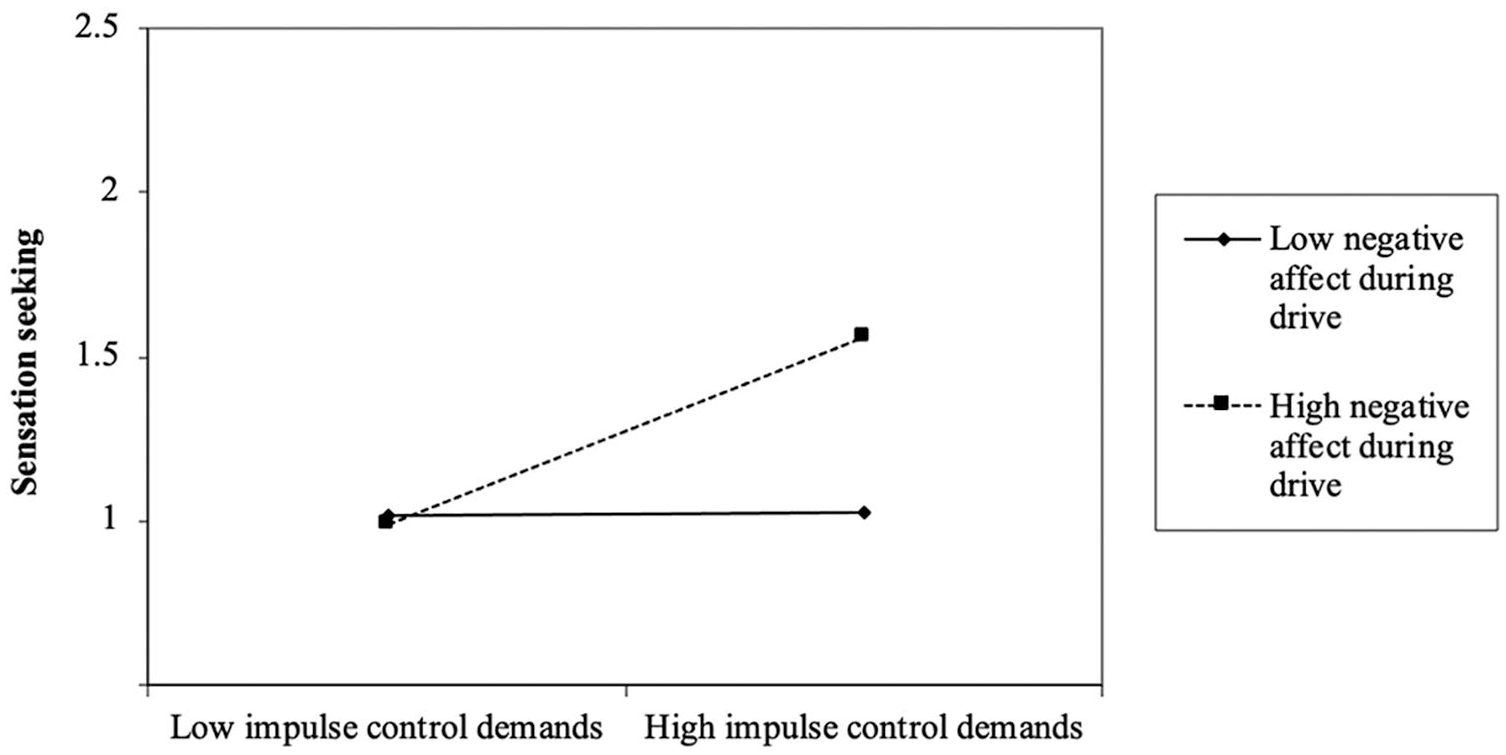
Moderation Effect of Negative Affect (at ±1 Standard Deviations) for Study 2
Discussion of Study 2
The results of Study 2 support the two indirect effects and conditional indirect effect that we hypothesized. We find that the relationship between resisting-distractions demands at work and speeding behavior is mediated by attention-control failure and the relationship between impulse-control demands at work and speeding behavior is mediated by sensation seeking. Together, these mediated relationships suggest a dual-pathway model for these forms of self-control work demands. Our finding that negative affect elicits a stronger relationship between impulse-control demands and sensation seeking and a stronger indirect effect from impulse-control demands to speeding behavior via sensation seeking suggests a boundary condition for the impact of impulse-control demands on subsequent behavior. As in Study 1, these relationships were consistent when accounting for the influence of other work demands and fatigue, and we also accounted for driving speed intentions to rule out interpretations of the findings based on reduced motivation following self-control work demands.
General Discussion
This research was guided by two symbiotic aims. First, we used postwork commuter driving as a context within which to resolve current debates relating to the effects of self-control work demands on subsequent employee behavior and the mechanisms of those effects. In doing so, we next examined the importance of self-control processes in the spillover of work experiences into the commuting domain, particularly, employee safety when driving home. The findings from the two studies supported the relationship between self-control work demands on subsequent driving behavior with time-separated data and both self-report and objective indicators of self-control failure. The studies further supported the multidimensional nature of self-control work demands through the identification of unique relations between the different dimensions and the behavioral outcome via different mechanisms. The relationships were found to occur above and beyond several other related work-related demands and psychological states. We now discuss the implications of the findings for the literature on self-control at work and the literature on work-to-commute spillover.
Theoretical Implications for Self-Control at Work
The design of our studies allows us to contribute to the ongoing conceptual and theoretical debates about self-control demands at work. First, Study 1 is one of the few field studies to find support for a core tenet of the limited self-control capacity model: that self-control work demands in one domain relate to impaired behavioral performance in a subsequent and very different domain. Previous studies supporting the limited-capacity model have mainly been based on laboratory experiments, involving rather trivial tasks of relatively short duration (Hagger et al., 2010). The field setting of our studies is important because it demonstrates the implications of self-control work demands in a vital area of road safety and shows the relationship to hold across adjacent tasks of significant time duration. Second, we find support for the effects of self-control work demands while also ruling out competing explanations (namely, cognitive or affective demands, fatigue, and motivation) and include an objective measure of performance on Study 1, both of which overcome some of the criticisms of the approaches which dominate field research on this topic (e.g., Lian et al., 2017). As a result of this study, we can therefore be more confident about the relative worth of self-control resources at work in accounting for meaningful employee outcomes (Baumeister et al., 1994) and of the distinct and important value of self-control work demands (Schmidt & Diestel, 2015). As many simple work-related behaviors require self-control, such as task self-management, meeting deadlines, managing multiple goals, and interpersonal behavior (Lord, Diefendorff, Schmidt, & Hall, 2010), the relationship between self-control work demands and successful functioning across work, commute, and home domains merits further attention.
Furthermore, we offer an important extension to research on self-control at work by demonstrating the multidimensional nature of self-control work demands. Prior research either has mainly treated different self-control work demands as analogous (e.g., Diestel & Schmidt, 2011) or has selected types of self-control work demands specific to the context (e.g., Sonnentag et al., 2017). Our dual-pathway model suggests that different forms of self-control work demands are linked most closely to subsequent failures within that same self-control form. We find that daily resisting-distractions demands at work are most strongly linked to subsequent failures in regulating attention, while daily impulse-control demands are linked to failures in suppressing impulses to sensation seek. While each seems to play a role in subsequent driving speed, we find little evidence of crossover of effects between the two self-control domains.
Our findings therefore challenge current thinking about self-control resources. Theoretically, Baumeister et al. (1994, 2007) have suggested that different types of self-control demands drain a common self-control reservoir that is then less available on subsequent tasks. While both paths in our dual-pathway model follow a common process of demands relating to subsequent self-control failure and performance, the paths are distinct and independent of each another and differ in content. The claim of the limited-capacity model that all self-control tasks, regardless of type, draws on a common resource was therefore not supported. Instead, our studies suggest multiple self-control reservoirs and depletion effects that are channeled through different pathways, which are alternatively more related to attention regulation or more related to impulse suppression. Our findings in this regard extend ideas that had already been hinted at in Sonnentag et al.’s (2017) finding that the relationship between impulse control and snacking behavior was explained by affect regulation rather than a more rational health motive. Our moderation explains this relationship further to suggest that impulse-control demands relate to subsequently lower impulse restraint (sensation seeking) and performance deficits (speeding behavior), to the extent that concurrent affect further taxes this regulatory subsystem. Put another way, when a person is able to remain calm and positive, the need for impulse control is less.
A dual-pathway model of self-control has a range of implications. First it encourages us to think about the qualitatively different ways that self-control can be used by work tasks, because not all forms of self-control work demands will relate as strongly to all forms of self-control failure. We have argued that the strongest links will be within the same regulatory domain, so on this basis, future research could expect greater self-control spillover within each pathway than crossover between pathways. Second, it requires the need to consider strategies that may influence each pathway, as one strategy may not be equally effective on both pathways (as indicated by our moderation finding). Third, it allows for the possibility that a behavior that requires both attention and impulse self-control, such as driving or work performance, can be sustained for longer by switching between forms of self-control resources, and therefore resting and recovering each alternately, thereby helping to reduce the accumulation of that demand and likelihood of self-control failure. It may be that giving in to distractions from social media at work, for example, may allow a person to better resist displaying annoyance with a teammate and thereby allow the continuation of a shared work task.
Theoretical Implications for Impact of Work on Commuting Behavior
While studies have drawn on the process of self-control depletion as a theoretical explanation for the daily spillover of general cognitive and affective demands into behavior in the nonwork domain (e.g., into interpersonal behavior with partners; Barber, Taylor, Burton, & Bailey, 2017), few direct tests of the spillover of self-control work demands outside of work have been conducted. The studies that do exist have focused on well-being and have neglected behavioral outcomes (e.g., Rivkin et al., 2018). These studies have also overlooked the crucial bridging domain of the commute, one of the most common microtransitions in each day (Ashforth, Kreiner, & Fugate, 2000), where one may expect to observe the most acute spillover effects of self-control depletion due to temporal proximity of the work and commute domains.
Our studies add to the growing literature on driving commuting as an outcome of daily work (Burch & Barnes-Farrell, 2020; Calderwood & Ackerman, 2019) by offering a coherent theoretical explanation for how experiences during the day at work affect driver performance. In Study 1, we found that over 55% of the variation in speeding behavior occurred at the day level, suggesting that to fully understand this behavior, temporally dynamic antecedents beyond natural tendencies are essential. Our support for the limited-self-control-capacity model is important because the nascent body of research examining spillover from work to driving has largely lacked strong theoretical and empirical alignment. Our model also integrates insights from the literature on driving safety regarding the roles of attention and impulse control during safe driving (e.g., Dahlen et al., 2005; Matthews, 2001) and identifies these as important areas of potential self-control failure linked to driving speed, thereby linking self-control work demands experienced during the day to subsequent driving behavior. Self-regulation theory therefore offers an integrative framework for generating further insights about work-to-commute spillover and for designing future interventions to enhance postwork driving safety more generally.
Limitations and Directions for Future Research
Our research has limitations. First, our model remains incomplete in several ways. For example, we did not examine boundary conditions on the path from resisting-distractions demands to driving behavior in Study 2. The driving task is understood to be continually demanding of the driver’s attention; however, cognitive demands are likely to be higher during certain driving conditions (e.g., at night, during bad weather) and for more inexperienced drivers (Konstantopoulos, Chapman, & Crundall, 2010). Theoretically, one would expect that attention demands during the concurrent task operate as a moderator, such that the effects of resisting-distractions demands on task performance increase as the need to regulate attention during the subsequent task becomes greater. Also, due to arguably greater conceptual overlap between overcoming-resistances demands and the two self-control work demands we studied, and also because commuter driving does not require internal resistances to be overcome, as may be the case for unpleasant work tasks, we did not focus on this form of self-control work demands in our research. It is further suggested the three forms of self-control work demands are not exhaustive (Schmidt & Diestel, 2015), as may also be the case with our dual-pathway model, so future research may look to extend our model by examining additional forms of self-control work demands and additional pathways.
Second, there are limitations in the way the dependent variable was measured in each study. In Study 1, GPS sensors can struggle to find satellites in tunnels and high-rise areas (Carsten, Kircher, & Jamson, 2013). Given the frequency of measurement of the positioning data (every second) as the basis of our speeding variable, the risk to data quality is relatively limited but may nevertheless introduce noise into measurement. In Study 2, the self-report measure of driving speed was more exposed to recall error and social desirability, and the mediators were measured in the same survey, which introduces a greater potential for common-method bias (Podsakoff, MacKenzie, Lee, & Podsakoff, 1990). The use of different data collection tools to some degree compensates for their respective limitations, and the CFA findings and low-to-moderate intercorrelations between measures in the postcommute survey would suggest the mediation effects are unlikely to be a product of common-method bias. It is also important to note that driving speed is influenced by a number of environmental factors, such as weight of traffic and weather. Our inclusion of self-reported travel impedance, which has been found to be a good general indicator of these environmental factors, accounts for this to some extent (Novaco et al., 1990). Nevertheless, our methodology could be extended by drawing from naturalistic driving studies, in which cars are instrumented using additional technology. Video data, in particular, can capture a wider range of external driving behaviors (e.g., lane control, reaction times to external stimuli) and internal driving behaviors associated with inattention (e.g., mobile phone use; Redelmeier & Tibshirani, 1997) as well as affective behavior (Hancock, Hancock, & Janelle, 2012), which would be indicators of self-control lapses.
Third, the research design of Study 2 is weaker than that of Study 1 because it involves only self-report data collected on a single day. As Study 2 provides the main test of our theoretical mechanism, this is a limitation of our work. Future research is needed to confirm these mechanisms using diary and multisource data, as was the design in Study 1.
Practical Implications
It would be naive to suggest that organizations can remove self-control demands entirely from the working day. Indeed, the distractions within open office environments (Ashkanasy, Ayoko, & Jehn, 2014), exposure to contemporary information technology (IT) notifications or “pop-ups” (Stich, Tarafdar, Cooper, & Stacey, 2017), and the emotional labor required in many types of work (Yam, Fehr, Keng-Highberger, Klotz, & Reynolds, 2016) are to some degree inevitable. Yet the work environment may be designed to reduce distractions, for example, by providing more quiet spaces and software to regulate IT distractions. Others also suggest that organizations should actively discourage surface acting behavior and policies related to a “service with a smile” ethos, given the documented ineffectiveness of surface acting (Hülsheger & Schewe, 2011) and the potential negative effects of this form of impulse control on worker behavior (Yam et al., 2016).
Second, organizations may seek to offer additional help to their employees experiencing high self-regulatory resources to avoid negative outcomes. Research suggests that the effects of self-control work demands can be mitigated, for example, by the experience of flow at work (Rivkin et al., 2018) and job control (Schmidt & Diestel, 2015). Psychological detachment has further been found to moderate the impact of self-control work demands (Rivkin et al., 2015), and so providing employees with breaks and other recovery opportunities before the end of the day, particularly on demanding days, may also be effective (Trougakos, Beal, Green, & Weiss, 2008). Our research suggests that this particularly applies to detaching from tasks that drain attention-control and impulse-control resources. We have also speculated that switching between tasks that differentially deplete these two self-control resources would allow for the recovery of the unused resource and for more sustained performance over time. However, it is important to recognize that taking preemptive action to mitigate future lapses in self-control paradoxically requires self-control at that moment, which is the very thing that is suggested to be lacking. So, we argue that these interventions may be most effective if promoted by organizations rather than left to the responsibility of employees.
Importantly, the results of our research suggest that experiences at work not only spill over into psychological experiences in nonwork time (which is well established in prior research) but actually have implications for personal safety in the important transition between work and home. Safety considerations at work tend to focus on time in work locations, or driving for work, rather than transitions before or after work. Indeed, health and safety legislation that applies to driving for work typically does not extend to commuting. Nevertheless, our research underlines the ethical responsibility that policy makers and employers have to try to reduce the adverse effects of the working day on driving safety. Certainly, broad interventions could involve raising public awareness of this issue or modifying the design of the in-car environment of commuters as well as the organizational interventions discussed. In regard to the future of the commute, the need for self-regulation of attention is not going to be removed by autonomous vehicles, but it may be that the monitoring of these vehicles requires greater, or different forms of, self-regulation than the more immersive task of driving (Pugeault & Bowden, 2015).
Footnotes
Acknowledgements
We would like to thank the associate editor, Christopher Porter, and the two anonymous reviewers for their constructive and supportive comments. We would like to record our thanks to Dana Unger, George Michaelides, Frederick Anseel, and Inga Hoever for their feedback on earlier drafts of the manuscript. We also would like to acknowledge the work of Savannah Parkinson and Maya Welford in data collection and the team at MyDrive (Nada Al-Musawi, Zoulficar Younes, and Derrick Gray) for their telematics expertise.

Supplemental material for this article is available with the manuscript on the JOM website.