




Abstract
The resource-based view (RBV) has evolved into a preeminent theory of strategic management. It is widely used by international business (IB) scholars since there is considerable synergy in core research questions pursued by IB and strategy researchers. However, in research on multinational enterprise (MNE) behavior, the use of RBV remains limited relative to other influential perspectives, such as the eclectic paradigm, the Uppsala model, and institutional theory. This is not surprising since the RBV was developed to explain performance differentials between country-centric firms with dominant product businesses rather than large MNEs with an expansive product-geographic scope. We describe how these limitations arise from the wider range of outcomes and explanatory variables, multiple levels of analysis, and the spatial, economic, and institutional barriers that are relevant to MNEs. We discuss the application of RBV to MNE research by the first author and other IB scholars. We then provide directions on how future research could use RBV more fruitfully to examine MNE performance and sources of competitive advantage in several areas. These include diversified corporations, subsidiary agglomeration, emerging market MNE internationalization, subsidiary autonomy, international joint ventures and alliances, and corporate social responsibility. Drawing upon teaching case examples from the first author’s work, we also point to the effectiveness of RBV in teaching with business cases, given its focus on firm performance (strategy).
Keywords
The resource-based view (RBV; Barney, 1991) seeks to understand the sources of firm-level sustained competitive advantage (SCA) and builds upon the earlier contributions of Penrose (1959), Wernerfelt (1984), Dierickx and Cool (1989), and Prahalad and Hamel (1990). It explains how heterogeneity (i.e., value, rarity) and immobility (i.e., inimitability), or VRI, in firm-specific resources and capabilities lead to SCA. A critical additional theoretical development recognized that besides VRI, a firm also needed to be well organized (e.g., structure, control systems, incentives) to exploit the full potential of such resources and capabilities for competitive advantage (Barney, 1997; Barney & Mackey, 2005). Consequently, RBV’s widespread use (primarily in strategic management research but also in connected disciplines), prominent spinoff perspectives, and meta-analyses of the empirical evidence suggest that it has evolved into a preeminent theory of strategic management (Barney, Ketchen, & Wright, 2011).
As noted by Peng (2001), there is considerable synergy in core research questions pursued by international business (IB) and strategy researchers. Understanding the sources of competitive advantage is integral to IB decisions and outcomes. Multinational enterprise (MNE) resource and capability advantages are critical to foreign direct investment (FDI; Dunning, 1995), and according to Rumelt, Schendel, and Teece (1994: 564), “what determines the international success and failure of firms” is a fundamental strategy question. Nevertheless, in research on MNE behavior, which is my focus, the use of RBV is more limited relative to the use of other influential perspectives, such as the eclectic paradigm, the Uppsala model, and institutional theory. 1 From an IB research standpoint, while 14% of articles published since 1991 in the Journal of International Business Studies (JIBS) cite Jay Barney (for comparison, 21% cite Michael Porter), the absolute numbers are trending down in the most recent decade (78) versus the previous decade (92).
In the remainder of this article, we explain limitations in applying RBV to MNE research, discuss where I have used RBV, where it has been used effectively by other IB scholars, and provide directions on how RBV could be used more fruitfully in MNE research.
Limitations to the Use of RBV in MNE Research
IB scholars have long recognized that MNEs possess distinctive capabilities. These are commonly understood as firm-specific (ownership) advantages (FSAs)—for example, differentiated products, management skills, and reputed brands—that give them a relative competitive advantage over domestic firms (e.g., Hymer, 1976; Rugman, 1981). While ownership advantages are necessary, they are insufficient to explain MNE strategic decisions and outcomes related to FDI. Competing in overseas markets requires MNEs to consider foreign location-specific constraints (and benefits) that may help or hinder the transferability of ownership advantages. Internalizing operations via wholly owned foreign subsidiaries must be weighed against the efficiency, profitability, and risks of other options, such as exporting, licensing, or joint ventures with local partners (Beamish & Lupton, 2009; Hennart, 2009). For instance, consider a host location with favorable demand conditions that has a weak regulatory environment and is culturally distant from an MNE’s home location. To successfully operate there, an MNE may need to consider marketing/distribution joint ventures with local firms to overcome cultural barriers and better access the consumer market while exercising sufficient control to protect its intellectual property.
Thus, explaining FDI rationale, location choice, and performance outcomes requires an interdependent consideration of firm-specific (ownership) advantages, location-specific advantages/challenges, and entry mode (internalization). Given the need for this comprehensive explanatory perspective, Dunning’s (1988) OLI (i.e., ownership, location, and internalization theory of the MNE 2 ), a.k.a. the “eclectic paradigm,” transcends all others by integrating multiple theoretical streams across firm and location levels to explain FDI (Eden & Dai, 2010; Rugman, Verbeke, & Nguyen, 2011). Most theories are developed with a particular type of business in mind, and the eclectic paradigm was conceived for MNEs. Its evolution into a broad tent is consistent with the diverse nature of MNE operations and decision-making considerations, for example, international production, location-specific advantages, and institutional quality (Dunning, 1988, 1998; Dunning & Lundan, 2008). In contrast, the RBV was developed for product-focused country-centric organizations. Its evolution has involved understanding resource/capability inimitability/nonsubstitutability (e.g., Dierickx & Cool, 1989; Peteraf & Barney, 1983), the knowledge-based view (Grant, 1996), and dynamic capabilities (Teece, Pisano, & Shuen, 1997), which, while important, are not as frequently studied within the MNE context.
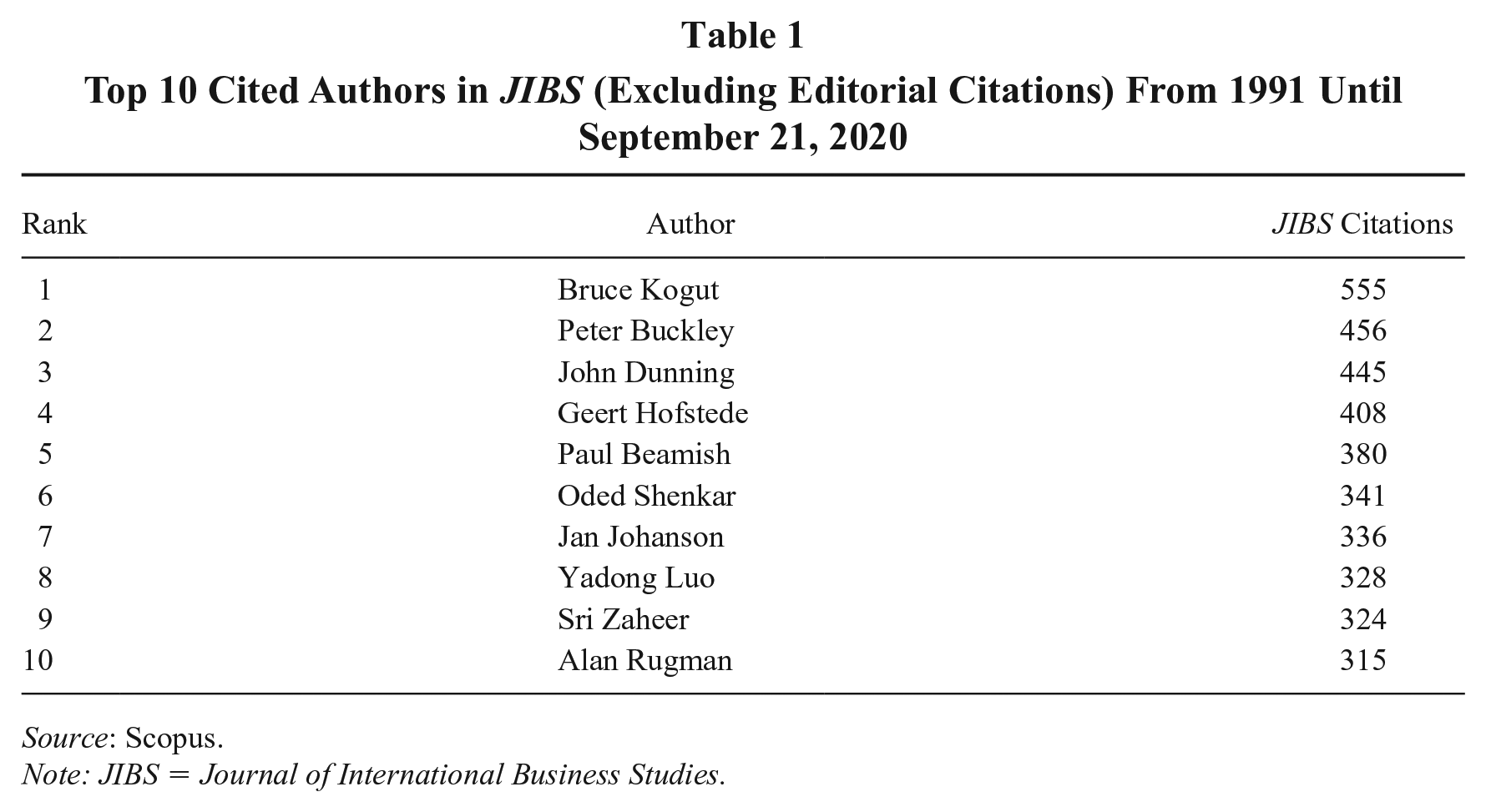
Given the preceding discussion, it is not surprising that while a Scopus search for JIBS articles citing Jay Barney since 1991 retrieved an impressive 188 articles (14% out of a total of 1,385 JIBS publications 3 ), a corresponding search for articles citing John Dunning located 2.4 times that number, that is, 445 articles (32% of total). For perspective, Table 1 lists the 10 most cited authors in JIBS since 1991 (Dunning is number 3). Over the same time frame, seven of my JIBS publications have cited Dunning, while only one has cited Barney (Dai, Eden, & Beamish, 2013).
Top 10 Cited Authors in JIBS (Excluding Editorial Citations) From 1991 Until September 21, 2020
Source: Scopus.
Note: JIBS = Journal of International Business Studies.
Phenomena and Explanatory Variables
RBV is a theory of sustained competitive advantage; hence empirical studies that use RBV to frame their theoretical arguments and/or test RBV (see Newbert, 2007, for a review) attempt to explain differences in interfirm performance over time (dependent variable [DV]) based on differences in resource/capability endowments (independent variable). MNE and foreign subsidiary performance/survival is an important DV in IB research (especially my research). However, much IB research entails explaining foreign location choices and entry modes that best position an MNE to exploit its ownership advantages rather than focusing solely on the relationship between ownership advantages and performance. Hence, RBV as a theoretical lens is less appropriate for these studies. Relatedly, considerable IB research also involves the empirical relationship between location choice/entry mode and foreign affiliate (subsidiary) performance, wherein firm-level resource/capability endowments (e.g., technological capability, MNE size) are used as control variables. Here again, the use of RBV becomes less pertinent.
Our thinking here is depicted in Figure 1, which refers to antecedents and performance consequences of MNE location choice. The majority of IB empirical research examines the relationships between foreign location-specific attributes (A), MNE (firm-level) characteristics (B1), subsidiary (affiliate-level) characteristics (B2), and foreign location choice decision (C) (J. U. Kim & Aguilera, 2016; Nielsen, Asmussen, & Weatherall, 2017). This is where and why theories/perspectives such as the eclectic paradigm, internalization, transaction cost economics, institutional theory, and the Uppsala model are widely used in IB research. Of course a considerable body of IB research also examines MNE and foreign subsidiary performance (D) (based on A, B1, B2, and C). In our opinion, RBV is mostly useful in IB in examining the relationship between B1 (and to a lesser extent, B2) and performance (D).
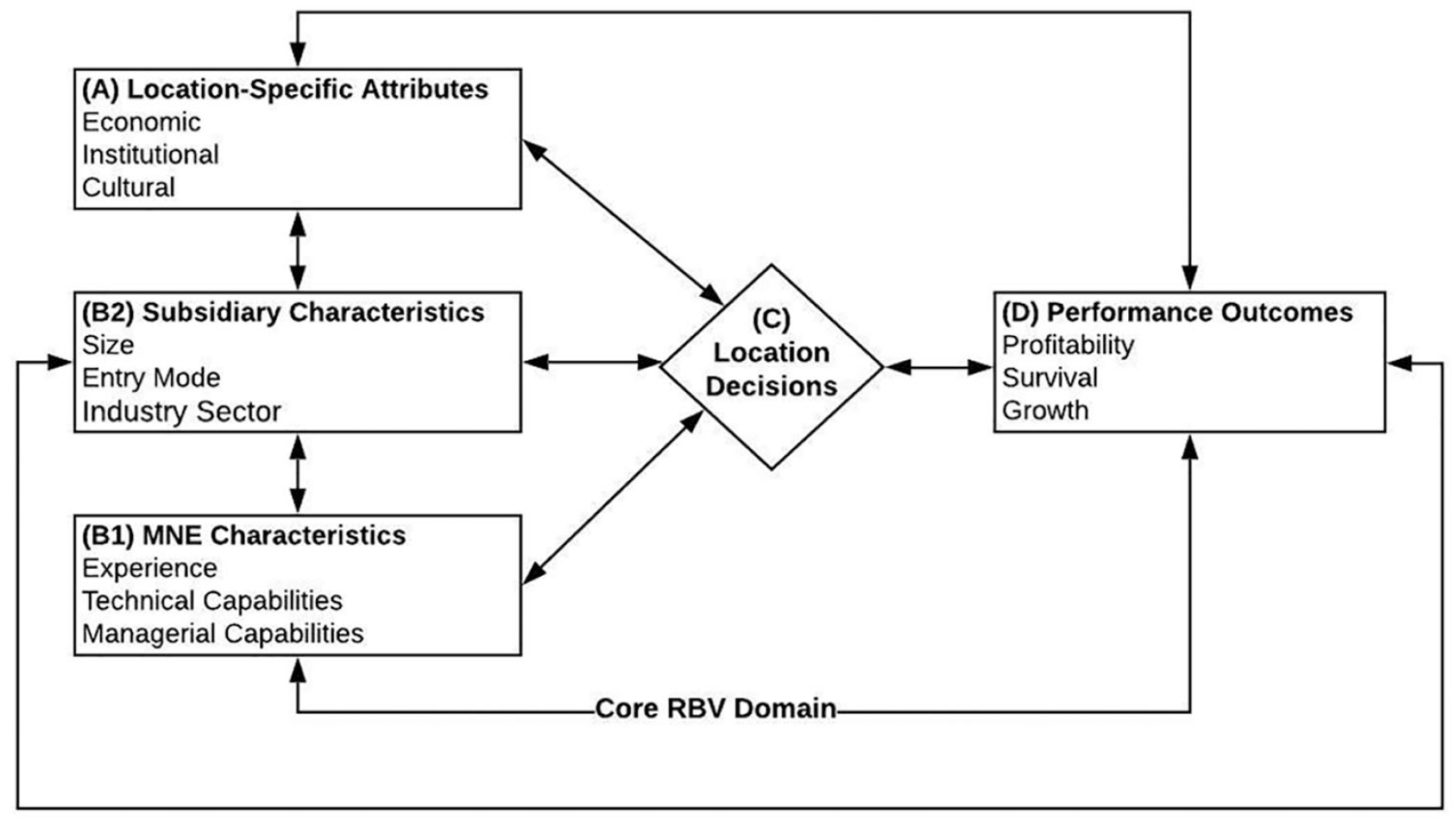
MNE Location Choice Antecedents, Performance Consequences, and RBV’s Core Domain
My eight journal publications that explicitly use RBV (and its core propositions) as a central theoretical lens serve to illustrate the aforementioned points. (For perspective, these are eight papers based on RBV/resource-based theory out of a total of 110-plus journal publications during this period. 4 ) Of these eight, three assess the effect of firm-level capabilities on firm-level performance. S. Lee, Beamish, Lee, and Park (2009) and Dhanaraj and Beamish (2003) account for the effect of capabilities such as R&D, firm size, and domestic market position on the export performance of North American small and medium firms and Korean manufacturers, respectively. Fang, Wade, Delios, and Beamish (2007) investigate the impact of MNE-level knowledge resources (international and host country experience; technology and marketing know-how) on foreign subsidiary profitability. Three others examine the impact of firm-level capabilities on international joint venture (IJV) performance. Ainuddin, Beamish, Hulland, and Rouse (2007) and Choi and Beamish (2013) focus on complementary capabilities between foreign partners (e.g., technical expertise, product reputation) and local partners (e.g., local knowledge, marketing networks). Lu and Beamish (2006) explore how host country knowledge and size-based partner resources can help small and medium enterprises overcome liabilities of foreignness, newness, and smallness. The remaining two focus on the relationship between foreign subsidiary resources and corresponding performance. Jiang, Beamish, and Makino (2014) suggest that rapid host country subsidiary expansion may negatively impact the process of accumulating valuable intangible assets; and Dai, Eden, and Beamish (2017) suggest that superior resources, which normally form the basis for value creation, can expose firms and their subsidiaries to risks in conflict zones. Thus six of these eight papers consider the relationship between firm-level (MNE) capabilities (B1) and performance (D), and two study the link between subsidiary-level resources (B2) and performance (D).
Use of RBV in my work often requires integrating additional theoretical perspectives to account for multiple levels of analysis and/or foreign location context. For instance, Lu and Beamish (2006) combine RBV with institutional theory to explain economic and social drivers that affect longevity and profitability of small and medium-sized enterprise IJVs, Jiang et al. (2014) supplement RBV with the Uppsala model to explain why MNE subsidiaries require time to develop knowledge of and experience in unfamiliar markets, and Dai et al. (2017) integrate RBV with real-options theory to explain why some MNEs stay while others exit conflict zones. I will explain why RBV has limited relevance when multiple levels of analysis (parent MNE and foreign subsidiary) and location attributes, such as economic and institutional environments, need to be considered as is most often the case with (my) IB empirical research. Over the years, and especially in the past decade, the focus of my research has shifted from the MNE (parent) level to the affiliate (foreign subsidiary) level. Correspondingly, I have relied less on RBV and more on the eclectic paradigm. Figure 2 shows the contrast over time in my cumulative journal publications that have cited Barney versus Dunning, indicating relative divergence in numbers since the year 2012. Given research development and publication time frames, I believe a critical inflection point entailed Dunning and Lundan’s (2008) article, which recognized the importance of institutional factors in shaping antecedents and outcomes of MNE activity and incorporated them into the OLI paradigm.
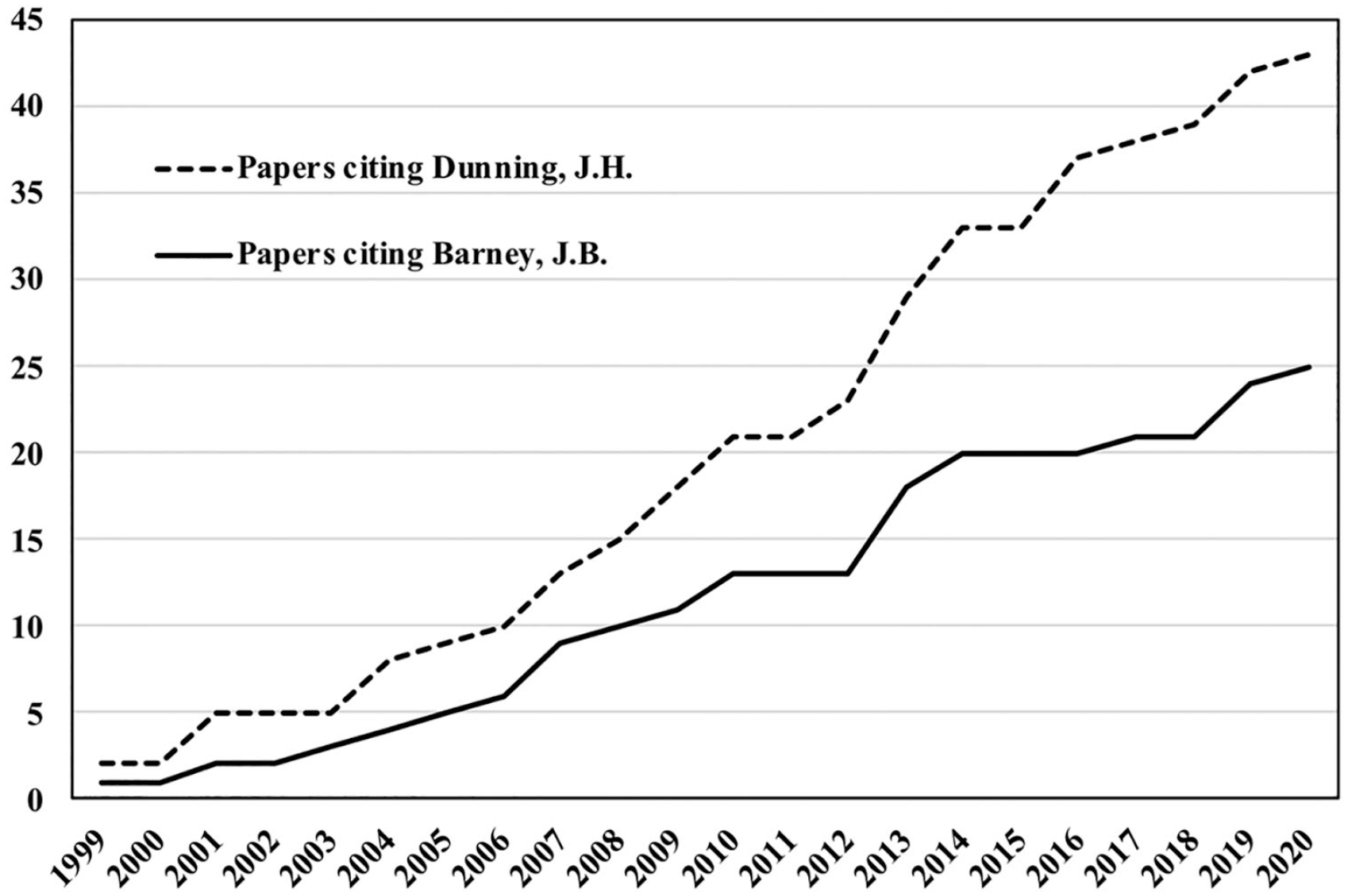
Beamish Articles Citing J. H. Dunning and J. B. Barney (All Journals, Cumulative, 1999–2020)
Level of Analysis
It is very difficult to get specific about corporate strategy for large, diversified MNEs (e.g., Sony, Tata, Samsung). Even for arguably less diversified MNEs, such as Toyota, it is important to understand that it has 17 major-group companies (across a range of industry sectors, e.g., automobiles, construction, textiles) with 717 subsidiaries. For such firms, there is a need to disaggregate to identify meaningful cause-and-effect relationships (e.g., business units explain the greatest amount of variance in corporate profitability, whereas corporate effects are negligible; Rumelt, 1991). Hence most other IB scholars, including myself, have increasingly shifted their unit of analysis and measurement from the corporate level to the foreign subsidiary (Rugman et al., 2011). Since RBV is oriented toward the firm level, rather than the subsidiary, it is most relevant for an undiversified firm. The “valuable, rare, inimitable, and well-organized” (VRIO) framework applies largely to single-product or dominant business firms where, for instance, innovation capability can be linked with corporate-level R&D spending and competitive advantage outcomes, for example, number of patents.
Relatedly, developing capabilities for SCA requires integration and fit across the value chain. For instance, managerial skills, recruitment and retention processes, R&D strengths, supplier partnerships, marketing knowledge, and production technology must be closely integrated for successful innovation. This again suggests that the appropriate organizational level for RBV is a focused-product firm or a specific product division within a diversified firm. The point is that since an MNE’s value chain is typically disaggregated across its geographical network, often with significant reliance on external firms (Mudambi & Puck, 2016), it is rare for any foreign subsidiary to encompass a value chain that can be assessed in terms of VRIO and competitive advantage. Hence, as I have increasingly focused on foreign subsidiary–level research over the past two decades, my use of RBV has diminished. For perspective, I have published 54 papers on subsidiary level phenomena, and only the aforementioned two (Dai et al., 2017; Jiang et al., 2014) explicitly utilize RBV in examining the performance impact of subsidiary-level resources and capabilities.
Liabilities of Foreignness and Incremental Learning
IB scholars have long recognized the influence of formal and informal institutions, such as laws, regulations, and rules and norms, ethics, and cultures (North, 1991; Scott, 2008) on MNE FDI decisions. Reducing “liabilities of foreignness” arising from geographical distance and/or unfamiliar economic, institutional, and cultural environments relative to an MNE’s home country is critical to foreign subsidiary location choice and entry mode (Gaur, Delios, & Singh, 2007; Hymer, 1976; Zaheer, 1995). On a related note, MNE experience and learning, adaptation, and (increased) commitment to foreign environments are a central theme of IB literature that seeks to explain how firms internationalize (Johanson & Vahlne, 1977, 2009, Vahlne & Johanson, 2017). RBV has little to say about such spatial transaction costs, institutional or cultural barriers to doing business in foreign locations, or experiential learning, which again limits its applicability to IB research. Figure 3 summarizes our understanding of the domain of applicability of RBV relative to other major theoretical perspectives across levels of analysis (MNE, division, foreign subsidiary, transactions) and key IB research areas (location choices, investment characteristics, competitive capabilities, and performance consequences). In the context of large MNEs, which are very often multidivisional, we believe RBV is best suited for capabilities and performance research mainly at the division (product/business unit) level and to a lesser extent at the foreign subsidiary level.
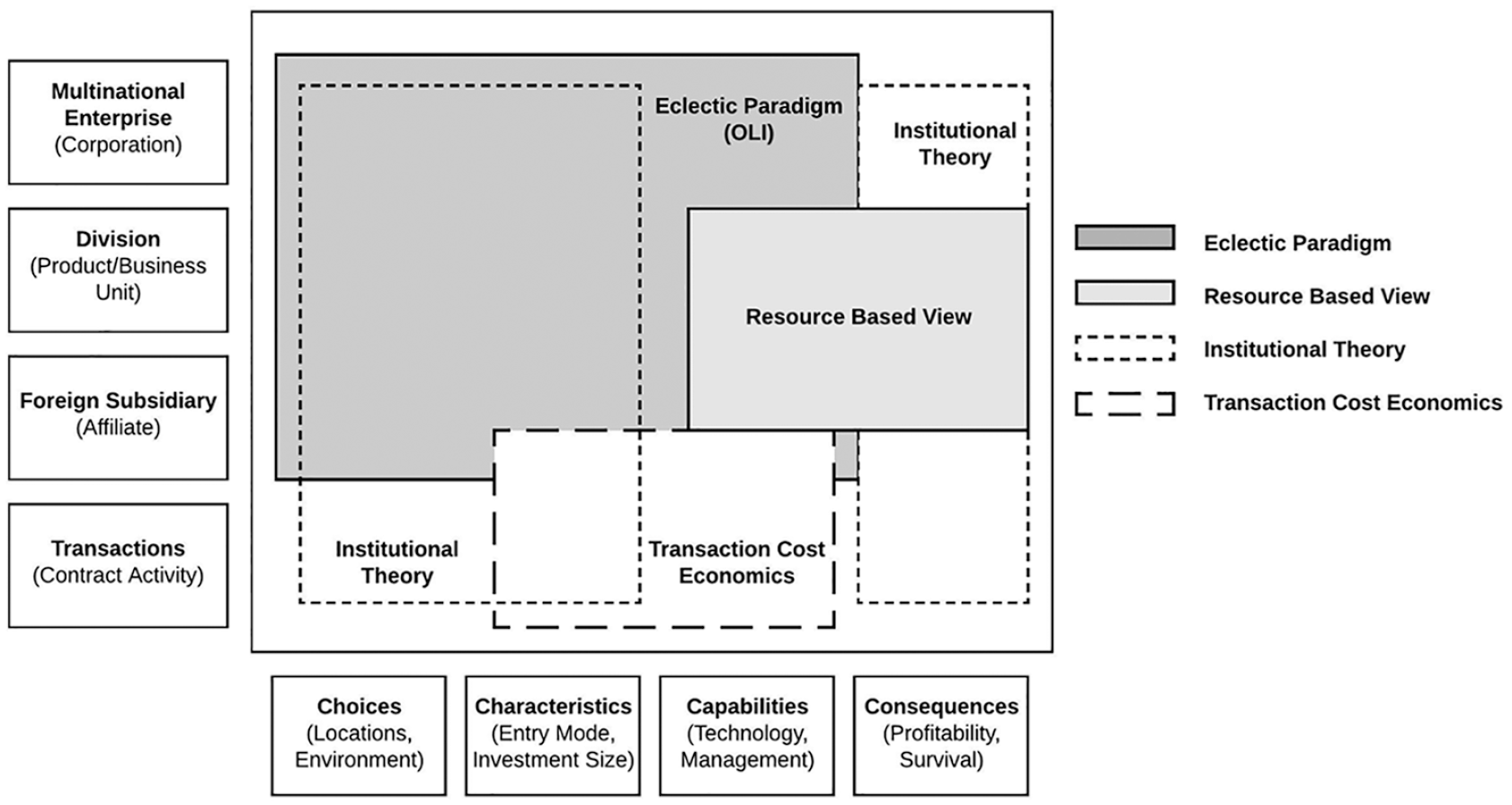
Levels of Analysis, Research Areas, and Theoretical Domains
Directions for Additional Use of RBV in MNE Research
Diversified Corporations
Many of the large MNEs, including Japanese MNEs, which occupy much of my research, are diversified conglomerates. Rather than applying RBV to examine a (diversified) corporation as a whole, we believe (as noted in our Level of Analysis section) that a finer-grained, business-unit- or product-division-level perspective is appropriate. The importance of doing so is emphasized in Villasalero’s (2017) use of focused product divisions for understanding development and orchestration of resource bases and corresponding performance. His study analyzes the provider–receiver patterns of knowledge flows among (related) product divisions of large Spanish corporations. Results indicate that product divisions that are strong in knowledge outflow outperform divisions that are weak, thereby signaling valuable and unique resource endowments that knowledge-providing divisions possess.
However, RBV may also be applied to diversified conglomerates, which have numerous unrelated business divisions. J. Lee, Park, Ghauri, and Park (2014) examine the effect of innovative knowledge and its transfer between manufacturing divisions (group companies), such as textiles, petrochemicals, and electronics within large Korean business groups (chaebols), on performance of group company subsidiaries. Results revealed that moderate to high levels of explorative and exploitative knowledge exchanges between group companies and focal subsidiary dependence on knowledge transfer from its group headquarters (HQ) led to improved subsidiary performance.
The aforementioned studies used pooled cross-sectional data and single-level regression analysis. We call for similar studies that disaggregate large corporations into meaningful units for RBV analysis, combined with the rigor of multilevel, longitudinal modeling approaches (see Hitt, Beamish, Jackson, & Mathieu, 2007). Pertinent research questions include the following: What resources and capabilities from higher organizational levels do foreign subsidiaries draw upon to improve competitive advantage? What knowledge-transfer mechanisms between corporate, division, and foreign subsidiary levels lead to superior performance?
Subsidiary Agglomeration
MNE foreign subsidiaries are often established in close proximity to their home country, business group, and industry-sector (and related) businesses. Such coethnic and co-industry clusters provide a common ground to address host location challenges, efficiently collaborate, and share knowledge (Chakravarty & Beamish, 2019; Chung & Song, 2004; Stallkamp, Pinkham, Schotter, & Buchel, 2018). Scholars have applied RBV logic to explain cluster-based competitive advantages. Enright (2000) suggested that clusters as a group may be considered VRIO due to unique historical conditions, tacit knowledge, social interaction complexity, and long-term evolution. Extending this logic, Tallman, Jenkins, Henry, and Pinch (2004) explained why firms in clusters may as a group outperform nonclustered firms, even while there is performance variation within the cluster. They suggested that some types of knowledge can flow easily between cluster firms, enhancing their joint competitiveness, while other types remain firm specific and preserve intracluster performance differentials.
Research also notes that such agglomeration can have negative consequences. Increased density of firms within a cluster may lead to hypercompetition among firms for resources, insular competitive practices, and reduced innovation (Beaudry & Swann, 2009; Pouder & St. John, 1996). Shaver and Flyer (2000) pointed out the risk of negative knowledge spillovers for MNE subsidiaries with the best technologies and human capital. In fact, IB literature has long suggested that these risks make it unlikely for larger, more technically capable and differentiated MNEs to cluster with their industry/value-chain peers (Alcácer, 2006; Nachum & Wymbs, 2005; Shaver & Flyer, 2000).
However, there is also evidence to suggest that the gains from clustering may outweigh the risks for large MNEs. Stallkamp et al.’s (2018) study of coethnic agglomerations of Japanese subsidiaries in China indicated that larger MNEs are more likely to be part of coethnic clusters in advanced urban areas. Owen-Smith and Powell (2004) found that larger MNEs are well organized to exploit dual advantages of spatial proximity and global innovation networks. Additionally, there is growing consensus in the strategic management/RBV literature that capability advantages result from combining sets of unique and complementary resources, activities, and assets (Argyres & Zenger, 2012) that are hard for competitors to replicate. Alvarez and Barney (2001) explain why it is especially difficult for smaller firms to learn about and imitate a larger firm’s capabilities, which are diffused across the value chain, while it is much easier for larger firms to understand a smaller firm’s technology, which is often embedded in discrete products or processes.
Hence an area for fruitful RBV-based research involves clarification of the importance of proximity-based advantages (and disadvantages) relative to MNE ownership advantages. Related research questions include the following: What kinds of MNEs gain from locating their foreign subsidiaries in clusters of other MNE subsidiaries and domestic firms? How can they improve their competitive position in the cluster while minimizing the risk of negative knowledge spillovers? What kinds of capabilities are hard for competitors located in close proximity to replicate?
Emerging-Market MNE Internationalization
Over the past two decades, the international expansion of emerging-market MNEs (EMNEs) has altered the IB landscape, attracting increased scholarly attention (Luo & Zhang, 2016). Evidence suggests that EMNEs are expanding their international commitment through FDI at a much faster pace than their advanced-market MNE (AMNE) counterparts have done, despite often lacking traditional advantages of technology, brand, and managerial experience (Guillen & Garcia-Canal, 2012; Mathews, 2006). Of particular interest is that EMNE expansion into advanced economies is often at odds with the Uppsala model’s thesis (Johanson & Vahlne, 1977, 2009) of entering proximate (low geographical and psychic distance) countries first and gradually expanding investment commitment over time.
The springboard perspective (Luo & Tung, 2007) suggests that EMNEs use international expansion as a launchpad to acquire critical technology and strategic assets in advanced economies. Such acquisitions help overcome resource/capability disadvantages and boost global EMNE competitiveness (Gammeltoft & Hobdari, 2017; Makino, Lau, & Yeh, 2002). However, creating value and competitive advantage from these assets requires capabilities to sense acquisition opportunities in the (global) environment, (global) orchestration skills to reconfigure processes and effectively deploy these assets, and learning mechanisms to upgrade these assets (Rumelt, 2011; Teece, 2014; Teece, Pisano, & Shuen, 1997). Gammeltoft and Hobdari (2017) argue that (dynamic) capabilities may be perceived not only as a consequence but also as a key antecedent of EMNE strategic asset-seeking investments.
We believe RBV-based research can contribute to a better explanation of the rapid internationalization process of EMNEs. A pertinent area for further research entails better understanding EMNE motivations and capabilities for successful acquisition and integration of advanced economy strategic assets. Illustrative research questions include the following: How does learning, cognition, and managerial experience affect EMNE resource-seeking motivations? How do EMNEs determine the viability and cost/benefit of such acquisitions? (How) do they possess, obtain, or develop capabilities to integrate acquisitions and realize synergies? How does postacquisition performance of EMNEs compare to AMNEs?
Subsidiary Autonomy
We suggest that foreign subsidiary autonomy lends itself well to the application of RBV. A reasonable degree of autonomy (from corporate or divisional MNE HQ) can enable subsidiary managers to better respond to external threats and opportunities and address internal resource and capability gaps (Birkinshaw, Hood, & Young, 2005). Given the disaggregation and complexity of MNE activity across geographies and competitive environments, empowering subsidiary managers to make strategic decisions can help improve alignment with local contexts (Birkinshaw, 1997; Young & Tavares, 2004). Autonomy facilitates a more meaningful examination of the relationship between subsidiary-level capabilities (and their orchestration) with subsidiary performance.
Much research has studied the antecedents and outcomes of foreign subsidiary autonomy. In terms of antecedents, scholars have examined the effect of subsidiary size (e.g., Johnston & Menguc, 2007), institutional differences between home and host countries (e.g., Luo, 2003), entry mode (e.g., Slangen & Hennart, 2008), industry context (e.g., Mudambi & Navarra, 2004), and human resources slack (Verbeke & Yuan, 2013). Regarding performance outcomes, such as innovation, sales growth, and return on assets, a recent meta-analysis of 94 studies across over 23,000 foreign subsidiaries finds an overall positive relationship between autonomy and performance (Geleilate, Andrews, & Fainshmidt, 2019).
While this is a relatively well-researched area, we expect RBV research can contribute further to its development based on two avenues suggested by Geleilate et al. (2019). The first involves equifinal performance configurations. For instance, within the same MNE and industry sector, a small advanced-economy subsidiary with a strong marketing capability and an expatriate manager who is afforded considerable autonomy could achieve the same level of profitability as a large emerging-economy subsidiary with strong customer service capability and a local manager who is subject to greater HQ control. Even if numerous interaction effects are captured using multiple regressions and/or structural equation models, the principle of equifinality is lost in the process (J. U. Kim & Aguilera, 2016). Hence, this requires using a set theoretic or fuzzy approach (Fiss, 2011) to identify several necessary and sufficient explanatory variable combinations that result in the same outcome. Second, the degree of subsidiary autonomy can coevolve over time along with its capabilities and performance. For instance, following establishment, if a subsidiary’s performance is strong, HQ may loosen its control and provide the manager with greater decision-making autonomy. As the subsidiary grows, its increasing importance to the MNE, greater scope of operations, and interdependence with other subsidiaries may lead to the HQ exerting more control. Related research questions are as follows: What combination of subsidiary autonomy, capabilities, and characteristics results in equifinal outcomes? What is the relationship over time between subsidiary autonomy, capabilities, and performance?
IJVs and Alliances
RBV literature explains that alliances and joint ventures are motivated by differential and complementary resources between partner firms (Beamish & Lupton, 2016), wherein resource heterogeneity is sustained over time (Peteraf, 1993). Such collaborations are a useful vehicle for enhancing critical knowledge that firms lack and that cannot be developed within an acceptable time frame or cost (Madhok, 1997). For instance, the combination of technology from an advanced-country MNE and host country knowledge from a developing-country local partner has been a consistent motivation for IJV formation (Beamish & Kachra, 2004). Further, such cooperative arrangements between firms are usually based on mutually aligned product-market objectives, which confers a degree of operating autonomy. Joint ventures in fact involve the creation of a separate, legally distinct organization jointly owned by its parent firms. Hence, some alliances and joint ventures are reasonably disaggregated from the operations of their parent firms and work toward realizing a more focused set of objectives that lends itself well to the use of RBV.
There is very limited research on IJVs and alliances in underserved markets, such as sub-Saharan Africa, a region that, despite receiving foreign aid and possessing valuable natural resources, remains economically underdeveloped and home to many of the poorest people in the world (Chrysostome & Lupton, 2011; Hearn, 2015). A notable exception is Acquaah’s (2009) use of an RBV lens to examine the performance of IJVs in Ghana based on generic strategy (i.e., low cost or differentiation) and MNE country of origin (i.e., advanced or emerging). Given severe institutional voids in such markets—for example, corruption, weak intellectual property protection, and short-sighted FDI policies—innovative thinking on business models and partnerships is required (Beamish & Lupton, 2016). For instance, J. Kim and Kim (2018) suggest that local partners’ relationship-specific assets, such as status and business connectivity in the local market, can improve the odds of IJV survival especially in weaker institutional environments. Webb, Kistruck, Ireland, and Ketchen (2010) propose that in overcoming institutional voids in base-of-the-pyramid markets, nongovernmental organizations (NGOs) that are embedded in these markets through decades of social effort may serve as effective partners to MNEs—by providing social relationships, knowledge, and legitimacy. According to these authors, in such markets, NGOs that understand local institutions, legitimate modes of operation, and norms and beliefs regarding the utility of products/services can help MNEs commercialize product-market ideas.
We call for more RBV-based research into IJVs and alliances that can enable MNEs to overcome challenges and develop and realize opportunities in underserved markets (countries as well as specific subnational regions within). Suggested research questions include the following: What have we learned from the successes and failures of IJVs and alliances in the emerging economies of Asia, Africa, and Latin America that is applicable to such markets? What resources and capabilities are critical to success (e.g., local leadership, social legitimacy, low-cost innovation, technology adaptation)? What kinds of partnerships and governance mechanisms can address capability gaps, reduce risk, and improve the odds of success? What can we learn from the experience of outliers?
Corporate Social Responsibility
Finally, we draw attention to MNE corporate social responsibility (CSR), that is, the role of MNEs in the well-being of communities they operate in (and affect) and in balancing stakeholder interests. The contribution or lack thereof of MNEs to socioeconomic development is an area that has been quite underinvestigated in IB literature (see Kolk, 2016, for a detailed discussion). We note that RBV has been extended and applied to business sustainability, that is, conducting business operations in a manner that enables firms to meet their current natural resource requirements without compromising the resource needs of future generations (Hart, 1995; Hart & Dowell, 2011). Recent work has also used the lens of RBV to examine the relationship between firm-level resource heterogeneity (across governance, information management, systems, and technology) and response to climate change impacts (Backman, Verbeke, & Schulz, 2017). These scholars used a large sample of Financial Times 500 (FT500) and non-FT500 firms across North America and Europe and a large-scale Carbon Disclosure Project database. Along these lines, we call for IB research to theoretically frame and empirically examine the resources and capabilities that drive effective MNE CSR outcomes. Suggested research questions include the following: Since CSR is implemented at the local (country) level, what is the contribution of MNE-level heterogeneity (e.g., corporate priorities, resources, partnerships) relative to subsidiary-level capabilities (e.g., local leadership, autonomy, partnerships) in successful CSR? Relatedly, what constitutes an effective governance and delegation mechanism/framework (e.g., CSR conceptualization, design, and funding at the MNE level and development of specific goals, projects, and partnerships at the subsidiary level)? Given that accomplishing results through CSR (e.g., improving community health and education) takes time, what long-term capabilities (e.g., leadership continuity, enduring cross-sector partnerships, sustaining stakeholder relationships) are critical to success?
Use of RBV in My Cases and Teaching Notes
An important aspect of RBV is its simplicity and focus on firm performance (strategy). Understanding how firm-level (sustained) competitive advantage arises from VRIO resources and capabilities is broadly applicable to teaching strategy courses across undergraduate and graduate levels. Further, case analysis often requires close attention to the idiosyncratic aspects of a company, which aligns well with the RBV’s conceptual focus. Use of RBV and the VRIO framework enables students to more critically evaluate and obtain a far greater understanding of a firm’s strengths and weaknesses than conventional SWOT (strengths, weaknesses, opportunities, and threats) analysis does. Hence, I draw upon RBV to a much greater extent in my teaching cases and corresponding instruction materials (teaching notes). Table 2 lists a selection of seven of my teaching cases whose teaching notes utilize RBV and also provides a summary of the application and relevance of RBV for each of them. Each of these cases describe strategic decision dilemmas facing single-product or dominant-product firms/divisions making the use of RBV extremely relevant.
Selected Beamish Teaching Cases That Utilize RBV in Their Teaching Notes
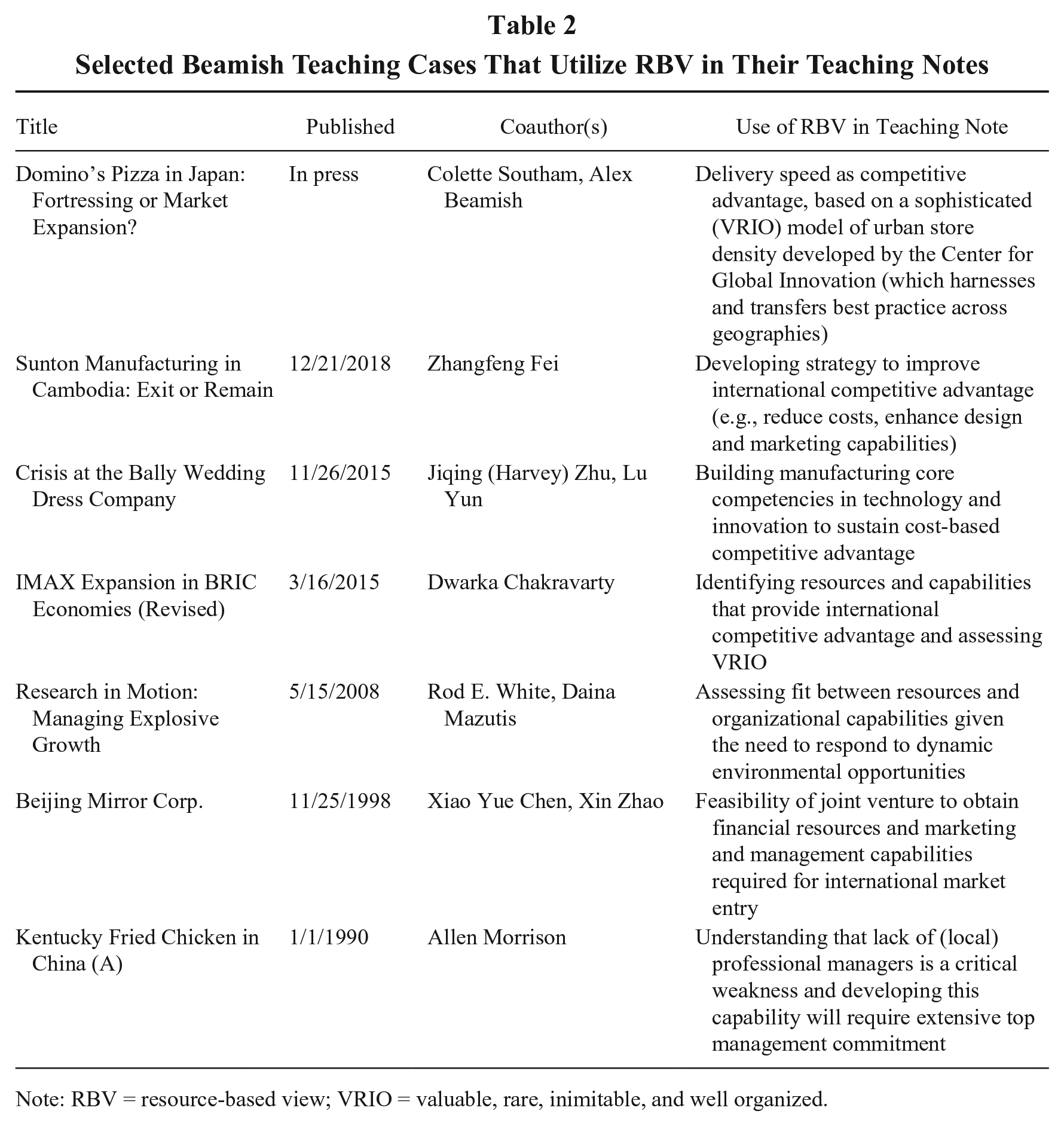
Note: RBV = resource-based view; VRIO = valuable, rare, inimitable, and well organized.
Conclusion
As a preeminent theory of strategic management, RBV has been very influential in IB. However, its application to large MNEs remains somewhat limited relative to other theories, such as the eclectic paradigm. This is not surprising, since RBV was conceived to explain performance of country-centric firms with dominant product businesses rather than to address the broader product-market scope of diversified MNEs. To facilitate increased and more effective use of RBV in IB, we provide research directions in six areas that are of direct and critical relevance to such MNEs. Within each, we point to relevant literature and methods and provide illustrative research questions. It is our hope that this article will stimulate IB scholars to substantially advance the use of RBV in MNE research and inform/extend resource-based literature accordingly.
