




Abstract
This study provides a new perspective on servant leadership research by examining the social influence of the servant leadership of individuals who are not in a supervisory position. Drawing on servant leadership and social learning theories, we examine how the servant leadership of managers in support roles can initiate a social learning process that shapes the leadership style of line managers and thereby influences employee outcomes throughout the organization. To facilitate the integration between servant leadership and social learning theories, we also examine the role of efficacy beliefs in enhancing the effectiveness of the social learning process. Using nested, time-lagged data from 667 store managers, 121 line managers, and 23 human resource managers (i.e., support managers), we find that support managers’ servant leadership positively influences organizational members’ perceptions of overall justice and leader-member exchange through line manager servant leadership. In turn, employees’ favorable perceptions stemming from line manager servant leadership enhance the employees’ organizational commitment and job satisfaction. The results also indicate that high leadership self-efficacy augments line managers’ effectiveness in emulating servant leadership behaviors from support managers and reinforces the indirect effects on organizational members’ favorable perceptions.
Keywords
Leadership researchers and practitioners have become increasingly aware of the virtues of positive leadership styles that emphasize ethical and moral leader behaviors (Dinh, Lord, Gardner, Meuser, Liden, & Hu, 2014; Lemoine, Hartnell, & Leroy, 2019). In their meta-analysis of positive leadership forms, Hoch, Bommer, Dulebohn, and Wu (2018) found that servant leadership offers a particularly powerful explanation for employee outcomes. As defined, servant leadership “places the good of those led over the self-interest of the leader, emphasizing leader behaviors that focus on follower development, and de-emphasizing glorification of the leader” (Hale & Fields, 2007: 397). According to servant leadership theory, serving followers makes leaders better role models and contributes to follower growth in attitudinal and behavioral outcomes (Greenleaf, 1977; Hunter, Neubert, Perry, Witt, Penney, & Weinberger, 2013). Indeed, studies have demonstrated that servant leadership predicts various favorable employee outcomes, such as positive attitudes and perceptions (Liden, Wayne, Liao, & Meuser, 2014; van Dierendonck, 2011), task performance (Chen, Zhu, & Zhou, 2015; Chiniara & Bentein, 2016), helping behaviors, and creativity (Liden, Wayne, Meuser, Hu, Wu, & Liao, 2015; Neubert, Kacmar, Carlson, Chonko, & Roberts, 2008).
Deriving from social learning theory (Bandura, 1977), a central premise of servant leadership is that the effectiveness of a servant leader is based on followers emulating their leaders’ positive attitudes and behaviors (Lemoine et al., 2019). Studies have suggested that servant leadership trickles down in the organizational hierarchy and, by doing so, promotes positive employee outcomes at lower organizational levels (e.g., Hunter et al., 2013; Liden et al., 2014). However, the current hierarchical view contrasts with today’s organizational reality, where work processes are often joint efforts supported by various managers and professionals who are not subordinate to one another (Sherman & Keller, 2011; Sytch, Wohlgezogen, & Zajac, 2018). Examining servant leadership only in hierarchical relationships is also theoretically problematic because the key tenet of servant leadership theory is that servant leaders are “servant first,” such that authority is never based on the hierarchical position of the leader but rather on the moral authority granted by the voluntary follower (Eva, Robin, Sendjaya, van Dierendonck, & Liden, 2019; Greenleaf, 1977). Indeed, servant leadership theory submits that followers view servant leaders as attractive role models not because of their position but because of their integrity and concern for others (Graham, 1991; Liden et al., 2014). This begs the question of what if the leader is actually “a servant”; that is, what if the leader does not occupy a higher hierarchical position?
The possibility of servant leadership being generally contagious in one’s social environment leads to another question: What does it require from an individual to emulate servant leadership in these nonhierarchical contexts? Servant leadership research has only started to consider the contextual factors regulating these processes (Wang, Xu, & Liu, 2018), and to date, no study has considered what individuals might need to effectively emulate the servant leadership behaviors of actors in their social environment. This is a focal theoretical oversight because social learning theory posits that the extent to which individuals can assume behaviors is contingent on their efficacy expectations, which enable the effective functioning of social learning processes (Bandura, 1977; Ng, Ang, & Chan, 2008). According to Bandura (1991), self-efficacy is the most central and pervasive mechanism of individual agency since it regulates individuals’ attention, effort, aspirations, and persistence. Despite being a key construct in social learning theory, we know little about how efficacy beliefs might regulate social learning processes in servant leadership.
This study addresses these theoretical shortcomings by examining servant leadership processes in nonsupervisory relationships. Our model, which draws on social learning (Bandura, 1977) and servant leadership theories (Chen et al., 2015; Graham, 1991; Hunter et al., 2013; van Dierendonck, 2011), examines whether and when the servant leadership of managers in support roles can inspire line managers to emulate servant leadership behaviors, thereby indirectly promoting favorable employee outcomes at lower organizational levels. With regard to support managers, our empirical study focuses on human resource (HR) managers who serve a supporting role without supervisory relationships with other managers (Aldrich, Dietz, Clark, & Hamilton, 2015; Sheehan, De Cieri, Greenwood, & Van Buren, 2014). We then extend our theorizing by integrating research on self-efficacy and social learning with the process of emulating servant leadership. To consider the self-regulatory role of efficacy beliefs in these processes, our model examines how line managers’ leadership self-efficacy (LSE) regulates their emulation of a support manager’s servant leadership style. We focus on LSE because earlier research has demonstrated that it is a focal efficacy belief that regulates how individuals assume different leadership styles (Courtright, Colbert, & Choi, 2014).
Our research contributes to the servant leadership literature in two primary ways. First, by shedding light on servant leadership in nonsupervisory support relationships, our results make an important empirical contribution to servant leadership research, which—despite building on the ideas of moral authority and voluntary followership (Eva et al., 2019; Graham, 1991; Liden et al., 2014)—has focused only on supervisory relationships. Studying its effects beyond formal supervisory relationships also improves our understanding of servant leadership as something that not only trickles down in the hierarchy but also drives change horizontally through “trickle-around” effects (Wo, Schminke, & Ambrose, 2019). Second, our research makes a noteworthy theoretical contribution to servant leadership theory by advancing our understanding of the boundary conditions in the processes of emulating servant leadership (Graham, 1991; Hunter et al., 2013). Specifically, we integrate insights from social learning theory to examine whether the extent to which one emulates servant leadership is contingent on one’s LSE.
Theory and Hypotheses
Theoretical Background
Leadership studies have frequently used social learning theory to argue that leadership has trickle-down effects, such that followers emulate their leader’s behaviors (Aryee, Chen, Sun, & Debrah, 2007; Lord, Day, Zaccaro, Avolio, & Eagly, 2017). In organizational contexts, followers regard leaders as credible role models whose leadership styles and other behaviors set an example of effective and desirable behaviors in the organization (Owens & Hekman, 2016; Yaffe & Kark, 2011). According to the social learning literature, individuals are particularly likely to emulate the behaviors of those who are higher in the organizational hierarchy because supervisory role backs up one’s credibility as a role model (Anderson & Thompson, 2004; Mayer, Kuenzi, Greenbaum, Bardes, & Salvador, 2009). However, there is a clear consensus in leadership theories that to exert influence, one does not have to occupy a supervisory role (DeRue & Ashford, 2010; Yaffe & Kark, 2011; Yukl & Falbe, 1990). In fact, any organizational member can demonstrate leadership behaviors toward other organizational members, including peers and supervisors (Hunter et al., 2013; Liden et al., 2015; Uhl-Bien, Marion, & McKelvey, 2007). Nevertheless, it remains uncertain whether and how leadership trickles in directions other than down (Wo et al., 2019).
On a different note, recent theorizing in leadership research has increasingly emphasized the benefits of other-orientation and communal qualities in effective leadership (Dinh et al., 2014). The old stereotypes of leaders being self-centered, individualistic, and controlling have largely been replaced with calls for leaders to prioritize follower growth, helping others, common goals, and high morality (Avolio, Walumbwa, & Weber, 2009; Graham, 1991). The emerging research has thus focused on ethical and prosocial leadership styles, such as authentic, ethical, and servant leadership (see Lemoine et al., 2019 for a review). Of these styles, servant leadership has emerged as particularly relevant because of its superior discriminant validity and stronger effects on various employee outcomes (Hoch et al., 2018). According to Greenleaf (1977), servant leaders prioritize the growth of their followers and the fulfillment of their followers’ needs. While servant leadership is similar to other ethical and prosocial leadership styles in emphasizing a leader’s morality and the transcendence of self-interest (Graham, 1991; Walumbwa, Hartnell, & Oke, 2010), its distinctive qualities include an emphasis on stakeholder outcomes (Lemoine et al., 2019) and concern with serving followers (Hoch et al., 2018; van Dierendonck, 2011). Humility is another distinctive quality of servant leadership, such that instead of pursuing their self-interest, servant leaders draw attention to the strengths and contributions of others (Liden et al., 2014; Owens & Hekman, 2016). Overall, servant leaders are other-oriented, forward-looking, and focused on multiple stakeholders and collective goals (Lemoine et al., 2019; van Dierendonck, Stam, Boersma, de Windt, & Alkema, 2014).
Perhaps more prominently than any other leadership theory, servant leadership theory draws on social learning theory to suggest that servant leaders inspire others to emulate their servant-oriented attitudes and behaviors (Eva et al., 2019; Graham, 1991; Greenleaf, 1977). Chen et al. (2015) argued that servant leadership is particularly contagious and strongly associated with changes in follower behavior because it has a substantial influence on others’ self-identity. Servant leaders are typically viewed as attractive, respected, and credible role models, increasing the likelihood that others will emulate their behaviors and become servant leaders themselves (Hunter et al., 2013; Liden et al., 2014; Walumbwa et al., 2010). As such, servant leadership is an exemplary leadership style that can be effective and contagious regardless of one’s hierarchical position and power. However, the current research on servant leadership has focused on emulation processes as top-down effects within an organizational hierarchy, thereby making it difficult to determine whether servant leadership is effective when the leader is not one’s superior (Liden et al., 2014). Superiors’ organizational positions are intimately intertwined with their leadership, giving them credibility as role models and thus driving the emulation of leader behaviors (Mayer et al., 2009; Wang et al., 2018).
The Trickle Effects Emanating from the Servant Leadership of Managers in Support Roles
Whereas only a limited group of organizational actors can leverage supervisory position to reinforce the effectiveness of their leadership, all organizational actors are expected to facilitate positive organizational outcomes. We suggest that regardless of their supervisory control, managers can play an important role in facilitating positive experiences and relationships that extend beyond their direct sphere of influence. For example, managers working in support functions, such as accounting, communications, customer service, finance, HR, information technology, legal affairs, or marketing, serve important roles in which they work with and through their colleagues without having supervisory authority over them. Building on servant leadership theory, we predict that by exhibiting servant leadership, actors in supporting roles can become the primus inter pares—that is, first among the equals (see Greenleaf, 1977)—who serve as role models and facilitate positive work outcomes throughout the organization.
In many cases, support managers serve an entire unit or an organization, which gives them a wide potential sphere of interpersonal influence but also limits their direct interaction with individual employees. While support managers contribute to the work of others broadly across the organization, line managers serve an important mediating role in the leadership emulation process (Mayer et al., 2009). Compared to support managers, line managers tend to have significantly more direct interaction with the lower level employees whom they supervise. Line managers also play a central role in how various practices are implemented and perceived by employees. On these bases, we suggest that support managers who exhibit servant leadership initiate what Hunter et al. (2013) referred to as a “cycle of service.” That is, as line managers observe and are exposed to support managers’ servant behaviors, they are motivated to emulate these respected behaviors and to become more altruistic, fair, and focused on their own followers’ needs and development. Accordingly, we propose that employees are likely to perceive the effects of support manager servant leadership as transmitted through line managers’ leadership behaviors.
When support managers act as servant leaders, they do not attempt to exercise coercive power or vie for authority to compete with line managers but rather make serving the line managers’ and other organizational members’ needs their highest priority. As a result of their service behaviors, support managers are viewed as trusted, dependable, and respected; therefore, others are willing to listen to and follow them (Greenleaf, 1977). This is important because others are more likely to accept the influence of a person who is humble and genuinely concerned for others and who downplays his or her own ego rather than that of someone who is assertive, controlling, and status seeking (Graham, 1991; Ou, Tsui, Kinicki, Waldman, Xiao, & Song, 2014). Support managers’ service can be particularly useful to line managers because support managers’ work typically focuses on dealing with administrative, relational, or technical issues that could significantly burden the line managers, whose main focus is on business operations. In this regard, Sun, Liden, and Ouyang (2019) showed that servant leadership leads to positive outcomes by increasing gratitude in followers. Support managers’ servant leadership might also enhance line managers’ ability to exhibit servant leadership. When support managers exhibit servant leadership, they focus on improving the line managers’ growth in work-relevant activities, encouraging them to be creative in developing new ways to pursue their work, and providing resources that enable them to better serve their followers and communities (Chiniara & Bentein, 2016; Liden, Wayne, Zhao, & Henderson, 2008; Neubert et al., 2008).
To the extent that line managers emulate servant leadership, such behaviors should consequently influence these managers’ relationships with the employees who report to them. Based on van Dierendonck’s (2011) servant leadership model, increases in line manager servant leadership should specifically improve their followers’ perceptions of justice and social exchange quality with the leader. As servant leadership is used to describe a broad, general approach to leadership (Lemoine et al., 2019), it is a more appropriate predictor of broad rather than specific dimensions of employee perceptions (Judge & Kammeyer-Mueller, 2012). The overall justice perception reflects a global evaluation of fairness, which is based on one’s personal experiences, as well as knowledge about others’ experiences (Soenen, Melkonian, & Ambrose, 2017). In addition to matching the specificity of a general leadership style, perceived overall justice matches the specificity of broad work outcomes associated with servant leadership. That is, organizational justice research suggests that overall justice is a proximate and phenomenologically accurate predictor of global work outcomes, such as job satisfaction and organizational commitment (Ambrose & Schminke, 2009; Barclay & Kiefer, 2014; Zhang, LePine, Buckman, & Wei, 2014).
Chen et al. (2015) explained that because servant leaders show respect and approval toward their followers, their followers are more likely to trust them and to reciprocate the leader’s beneficial, caring, and developmental behaviors with positive attitudes, loyalty, reciprocal exchange, and the pursuit of collective goals (Chiniara & Bentein, 2016; Hunter et al., 2013; Peterson, Galvin, & Lange, 2012). As servant leaders act altruistically, emphasize high ethical standards, prioritize organizational stewardship, and promote inclusiveness and fairness in their organizational contexts (Neubert et al., 2008; Walumbwa et al., 2010), their followers are likely to perceive higher levels of justice in their organization. Provided that the organizational members use the support and fairness of their supervisors as important cues regarding the overall justice of the organization (Eisenberger, Huntington, Hutchison, & Sowa, 1986), a support manager’s servant leadership, via its positive influence on line manager servant leadership, is likely to contribute to the perceptions of overall justice among employees.
Second, van Dierendonck’s (2011) framework suggests that servant leadership contributes to followers’ perceived leader-member exchange (LMX) quality. LMX is defined as the quality of the dyadic relationship between a leader and a member—in this case, as perceived by the member (Gerstner & Day, 1997). As line managers become more focused on their followers’ interests, development, and well-being, their relationships with subordinates are likely to be increasingly based on sharing, trust, understanding, and mutual obligation, all of which are characteristics of high-quality LMX (Gerstner & Day, 1997). In line with this reasoning, Ehrhart (2004) claimed that servant leaders serve their followers by forming high-quality relationships with them. Chen et al. (2015) explained that followers are more likely to regard servant leaders as their in-group members—that is, trusted partners with whom they have a high-quality LMX (Sparrowe & Liden, 2005). This is largely because servant leadership causes followers to feel obligated and become willing to reciprocate their leader’s beneficial, caring, and developmental behaviors with higher commitment, loyalty, and reciprocal exchange (Chiniara & Bentein, 2016; Hunter et al., 2013; Peterson et al., 2012). Consistently, servant leadership creates a positive social exchange between the follower and the leader (Walumbwa et al., 2010). High-quality LMX between line managers and their subordinates is further enabled by the increased liking of the leader, as servant leaders are generally admired and respected by their followers (Liden et al., 2014). Taken together, these arguments suggest that the process of supporting others that starts with the support manager’s servant leadership leads to an increase in servant leadership behaviors among the line managers, causing their subordinates to perceive higher levels of overall justice and LMX quality. Thus:
Hypothesis 1. Support manager servant leadership is positively related to (a) the perceived overall justice and (b) the LMX quality of the line managers’ subordinates, and these relationships are mediated by line manager servant leadership.
We further suggest that, via favorable overall justice and LMX perceptions, servant leadership positively contributes to employee attitudes. Whereas supervisors’ leadership tends to influence their followers’ work attitudes, trickle effects in general and trickle-around effects in particular might be overly distal predictors of attitudes (Hunter et al., 2013; Ou et al., 2014). Thus, rather than suggesting that a support manager’s servant leadership on its own would be a major cause of attitudes of line managers’ subordinates, we predict that a support manager’s servant leadership plays an instrumental role by improving line managers’ servant leadership behaviors and the perceptions of line managers’ subordinates, which in turn contribute to employee attitudes. Work attitudes are important in that they strongly influence a broad range of in-role and extra-role behaviors relevant to performance (Harrison, Newman, & Roth, 2006; Liden et al., 2014; Walumbwa et al., 2010). Indeed, servant leadership theory predicts that servant leadership leads to various positive work outcomes largely because of its positive influence on work attitudes (van Dierendonck, 2011). In this study, we focus on employees’ job satisfaction and affective organizational commitment, which are inarguably the two most important aspects of work attitudes (Harrison et al., 2006; Judge, Weiss, Kammeyer-Mueller, & Hulin, 2017).
Whereas extant research has offered evidence of the positive association between servant leadership and employee attitudes (Hoch et al., 2018; Liden et al., 2008), the mechanisms through which servant leadership improves employee attitudes and other distal outcomes have remained unclear. Building on van Dierendonck’s (2011) model, we expect that by enhancing their subordinates’ justice perceptions and LMX, line manager servant leadership facilitates employees’ affection and commitment toward their work and organization. Indeed, job satisfaction and organizational commitment are focal, proximal outcomes of both organizational justice and LMX (Ambrose & Schminke, 2009; Colquitt, Conlon, Wesson, Porter, & Ng, 2001; Gerstner & Day, 1997). Combined with our first hypothesis, we suggest that a support manager’s servant leadership initiates a positive social learning process in the organization by inspiring line managers to emulate their servant behaviors. As employees are exposed to their line manager’s servant leadership, their positive perceptions of overall justice and high LMX quality will eventually contribute to their job satisfaction and commitment to the organization. Therefore, we propose the following:
Hypothesis 2. Line manager servant leadership is positively related to subordinates’ (a) job satisfaction and (b) organizational commitment, and these relationships are partially mediated by subordinates’ increased perceptions of overall justice.
Hypothesis 3. Line manager servant leadership is positively related to subordinates’ (a) job satisfaction and (b) organizational commitment, and these relationships are partially mediated by subordinates’ increased perceptions of LMX quality.
The Moderating Role of LSE
According to social learning theory, self-efficacy regulates the extent to which behavioral expectations lead to behavioral change (Bandura, 1977; Wood & Bandura, 1989). Individuals with higher levels of self-efficacy believe they possess the capability to mobilize their motivation, cognitive resources, and effort to meet situational demands (Gist & Mitchell, 1992). Consequently, these individuals will be motivated to accept new challenges and developmental opportunities, expend considerable effort to perform and develop, and remain persistent in their activities when facing setbacks (Bandura, 1977). Individuals’ cognitive processes that underpin different types of behaviors are regulated by task-specific forms of self-efficacy (Chen, Gully, Whiteman, & Kilcullen, 2000; Gist & Mitchell, 1992). With regard to leadership behavior, LSE is a leadership-specific form of self-efficacy that captures the extent to which an individual believes that he or she is able to set goals and accept challenges related to leadership, put effort into leadership activities, and persist in the face of difficulties (Ng et al., 2008).
On the basis of social learning theory (Bandura, 1977; Gist & Mitchell, 1992) and earlier findings on the enabling effects of self-efficacy (Chen, Li, & Leung, 2016; Shin, Kim, Lee, & Bian, 2012), we suggest that LSE is a key motivational factor that moderates line managers’ behavioral responses to their contexts. Whereas the availability of relevant role models plays a central role in influencing whether one desires to become a servant (Greenleaf, 1977; van Dierendonck, 2011), self-efficacy is a key motivational factor determining whether a behavioral impetus evokes behavior (Bandura, 1977). While servant leadership represents a particular style of leadership, it is important that LSE captures one’s confidence in pursuing activities associated with a leadership role in general. This is important for two reasons. First, one’s willingness to serve lies at the heart of servant leadership, whereas leadership is simply a context for serving (Greenleaf, 1977). Thus, without motivational factors to lead, followers might not fully assimilate this context in their serving behaviors. Second, servant leadership is a broad leadership style that is not limited to certain specific behaviors but rather all leader behaviors serving the needs of others (van Dierendonck, 2011). Servant leaders, like all leaders, are expected to take responsibility and perform various activities within the leadership domain, such as analyzing problems, motivating others, creating team spirit, and coordinating tasks (Courtright et al., 2014; Ng et al., 2008).
Social learning theory holds that observing and modeling behaviors in one’s environment plays a key role in guiding behaviors that are considered appropriate and desirable in a given context (Wood & Bandura, 1989). As we discussed earlier, servant leaders are considered attractive role models by other members of the organization (Graham, 1991; Liden et al., 2014). However, we further propose that having these models is not always sufficient because to acquire and retain behavioral patterns, line managers must also believe that they have the capacity to perform these activities effectively (Bandura, 1977). Therefore, even when line managers observe servant leadership in their social environment and find this behavior attractive, they might not emulate these behaviors effectively if their capacity to invest in leadership development is limited by low LSE. When line managers believe they lack the capacity to demonstrate leadership effectively, they are more likely to react passively to the leadership behaviors they observe in their environment than to take them as opportunities to learn and develop their own leadership competence (Wood & Bandura, 1989). Conversely, when line managers have high levels of LSE, they are more likely to regard others’ servant leadership as an inspirational example of effective leadership, which they can imitate in their own leadership.
Overall, being exposed to servant leadership behavior poses a developmental challenge for line managers (Liden et al., 2014). Similar to other developmental challenges in a work context, exposure to servant leadership invites line managers to learn and demonstrate personal growth and competence (Cavanaugh, Boswell, Roehling, & Boudreau, 2000). Whereas high LSE is a motivational factor that encourages line managers to undertake challenges and to capitalize on the opportunity to emulate servant leadership behaviors, leaders with low levels of LSE are more likely to respond to new situations and developmental challenges with inaction, avoiding leadership responsibilities (Courtright et al., 2014). Taken together, we hypothesize the following:
Hypothesis 4. A line manager’s LSE moderates the relationship between a support manager’s servant leadership and line manager servant leadership such that this association is more positive when the line manager’s LSE is high.
Hypothesis 5. A line manager’s LSE moderates the indirect effect of a support manager’s servant leadership on subordinates’ (a) perceived overall justice and (b) LMX quality via line manager servant leadership such that these indirect effects are more positive when the line manager’s LSE is high.
Figure 1 presents an overview of our hypothesized model.
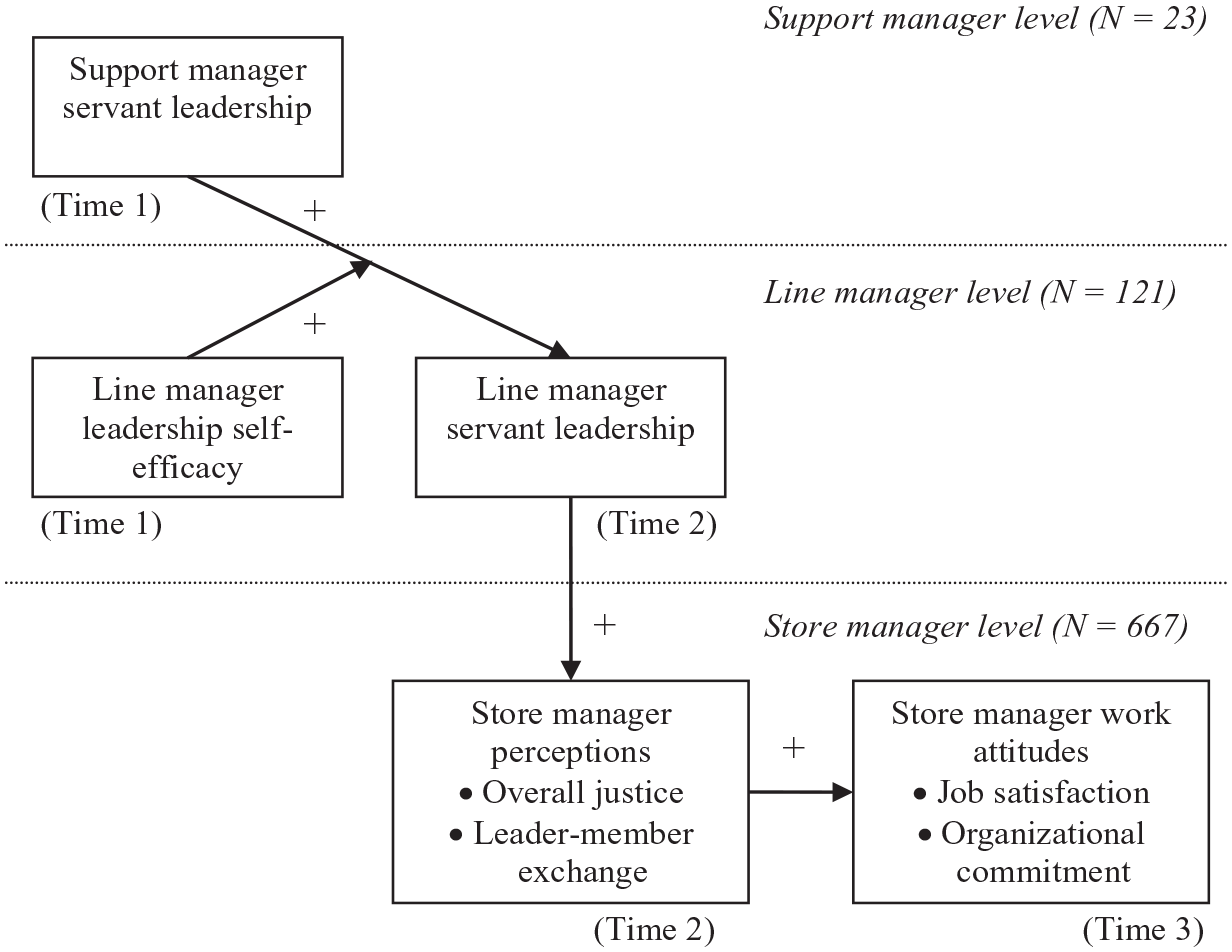
Theoretical Modela
Methods
Sample and Procedure
We tested our hypotheses using data collected from 19 companies that belong to the same cooperative group, with each company operating retailing businesses in different regions in Finland. In our data collection, we focused on these companies’ grocery store chains, and each of the companies operated a number of grocery stores, supermarkets, and hypermarkets. To examine the effects of a support manager, we studied the role of HR managers in initiating social learning processes that eventually influence organizational members. Focusing on HR managers is particularly appropriate because HR is a support function, and HR managers are not in supervisory relationships with line managers or organizational members nested under line management.
Working with HR professionals from each company, we depicted the hierarchical structures in the company and identified the relevant respondents. We first identified the line managers responsible for several small- to medium-sized stores (i.e., groceries or supermarkets) or a hypermarket with several departments. Line managers have no supervisory relationships with HR managers. Rather, they are typically part of the top management in their companies, residing at the same hierarchical level as the HR managers. As retail is a very labor-intensive service sector, line managers work in close collaboration with an HR manager, who provides help and expertise regarding HR-related issues across businesses. Indeed, a substantial number of line managers’ work-related challenges relate to issues, such as the recruitment and training of employees, contracts, labor relations, and compensation policies, which they need to address in collaboration with HR. Our preliminary interviews with the HR managers confirmed close and frequent interactions, such that the business-owning line managers and the HR managers know each other personally, work together and in close proximity with each other, and participate frequently in the same team meetings and other operational meetings several times a week. The total number of identified line managers was 143, with an average of 7.53 per company (5 in the lowest quartile and 8 in the highest quartile).
We then identified the line managers’ subordinates—store managers of the grocery stores and supermarkets and the department heads of the hypermarkets—and analyzed them as “followers” (Level 1) nested under the supervision of the line managers (Level 2). Each line manager supervised a group of store managers, and interactions between these managers resembled typical exchanges between supervisors and their direct reports. Our study included 1,191 store managers and hypermarket department heads, which is an average of 8.33 followers per line manager (4.83 in the lowest quartile and 9.00 in the highest quartile) and 62.68 followers per company (29 in the lowest quartile and 63 in the highest quartile). Finally, we identified the person responsible for HR in each company. Similar to the line managers who were invited to participate, the HR managers were typically at the vice-president level in the organization’s formal hierarchy. One of the 19 companies was substantially larger than the others, and in that company, we identified 313 followers at Level 1, 23 line managers at Level 2, and five HR managers at Level 3, with each HR manager appointed to work with an allocated group of line managers. Therefore, the total number of support (HR) managers (Level 3) examined in this research was 23. This sample size provides sufficient power for detecting medium-to-large effect sizes (Scherbaum & Ferreter, 2009), and it is comparable to the sample sizes of previous studies with similar designs (e.g., Gong et al., 2013; Liu, Liao, & Loi, 2012; Luciano, Mathieu, & Ruddy, 2014).
The data for hypothesis testing were collected in three waves, such that the first set of surveys was targeted at the line managers, and the second and third sets of surveys were targeted at their followers (i.e., the store managers and department heads). In the first phase (Time 1), we sent invitations to the line managers asking them to complete an online questionnaire to collect data on support managers’ servant leadership and line managers’ LSE. Both the invitation and the questionnaire specified the name of the HR manager whom the line managers were requested to assess. After two rounds of reminders, 125 line managers (87.41%) responded. Approximately 3 months after the line manager surveys, we sent invitations to the followers following the same procedures as those used previously (Time 2). We used a 3-month time lag, which is commonly applied in leadership research, as it allows the cross-level effects of leadership on employee perceptions to emerge without being so long that leadership styles would change substantially during that time (Arnold, Connelly, Gellatly, Walsh, & Withey, 2017; Johnson, King, Lin, Scott, Jackson Walker, & Wang, 2017). We also deemed that a shorter time lag might not have allowed line managers enough time to observe, become inspired by, and emulate leadership behaviors from their social environment. In the second survey, we collected data on line manager servant leadership and followers’ perceived overall justice and LMX. To ensure that the respondents assessed the leadership of the correct line manager, we specified the line manager’s name in the invitation and the questionnaire. Of the followers, 934 store managers and hypermarket department heads (78.42%) responded. We disregarded five responses due to many missing values and four responses due to uncertainty with regard to the identity of the respondent or the possibility of incorrect supervisor information. This left us with 925 responses and an effective response rate of 77.67%.
The matching of responses from the line managers and their followers resulted in additional reductions in the data. Specifically, we removed data on three line managers because none of their followers participated in the survey, and we removed 117 followers because the matching line manager’s response was missing. Thus, after matching the responses of the first survey to the followers, we were left with 122 responses from the line managers and 808 responses from their followers. Finally, after a second time lag of approximately 2 months (Time 3), we sent another survey to the followers to collect data on their work attitudes. In addition to establishing temporal separation and order between the predictor and outcome variables, this time lag was deemed appropriate based on how long it has been considered to take for employee relationship and justice perceptions to influence work attitudes (Walker, Bauer, Cole, Bernerth, Feild, & Short, 2013). A longer time lag could have risked various contextual changes overshadowing the hypothesized effects on attitudes. This survey yielded 667 usable responses (i.e., 17.45% attrition rate) from the followers of 121 line managers. All respondents were nested under 23 HR managers, resulting in an average of 5.26 line managers and 29.00 store managers (i.e., followers) per HR manager.
Measures
The surveys were conducted in Finnish, with items translated and back-translated from English originals following the procedures outlined by Brislin (1990). The translations and back-translations were each conducted by experts proficient in both Finnish and English, who were not members of the research team. All items were measured on 7-point Likert-type scales ranging from 1 = strongly disagree to 7 = strongly agree.
Servant leadership
A 14-item scale developed by Ehrhart (2004) was used to measure support managers’ and line managers’ servant leadership behaviors. This scale has often been used in research (e.g., Hunter et al., 2013; Neubert et al., 2008; Walumbwa et al., 2010), and it consists of the following seven dimensions, each of which is measured with two items: forming relationships with followers, empowering followers, helping followers grow and succeed, behaving ethically, having conceptual skills, putting followers first, and creating value for those outside of the organization. Consistent with Liden et al.’s (2015) recommendation, this scale represents servant leadership in the aggregate model that comprises the sum of its dimensions. Servant leadership research suggests that while followers might vary in their responses to servant leadership, they provide consistent assessments of one’s servant leadership behavior (e.g., Chen et al., 2015; Hu & Liden, 2011; Hunter et al., 2013). This is the case because servant leadership is an observable behavior that does not pertain to any individual relationship but rather characterizes one’s approach to leadership in general (Ehrhart, 2004; Lemoine et al., 2019; Liden et al., 2008). As different raters are expected to display a high degree of agreement in their assessments, we used a direct consensus model as described by Chan (1998) to aggregate servant leadership assessments.
First, the line managers assessed the servant leadership of support managers with whom they were assigned to work. Sample items are “My HR manager works hard at finding ways to help others be the best they can be” and “My HR manager does what she or he promises to do.” The coefficient alpha was .92. The values justifying aggregation and assessing the reliability of the group means are as follows: ICC1 = .10, ICC2 = .38, and average r wg(j) = .95 [range: .78–1.00] based on a uniform null distribution. Whereas the ICC values are smaller than ideal, they are similar to those typically observed in leadership research (e.g., Courtright et al., 2014; Liden et al., 2014; Ou et al., 2014; Owens & Hekman, 2016) and sufficiently high to justify aggregation to the line manager level (Bliese, 2000; LeBreton & Senter, 2008). Second, to capture line manager servant leadership, the store managers and hypermarket department heads (i.e., employees at Level 1) assessed their supervisors’ servant leadership. We used the same scale from Ehrhart (2004), with the difference that the items began with “My supervisor . . .” (α = .95). The aggregation of the followers’ assessments to the line manager level was supported by high intraclass correlations (ICC1 = .21, ICC2 = .64) and interrater agreement (average r wg(j) = .91 [range: .51–.99]).
LSE
The line managers reported their LSE using an 11-item scale developed by Ng et al. (2008). The scale asks the line managers about their confidence (1 = not at all confident to 7 = extremely confident) in performing different tasks associated with the leadership role—that is, “How confident do you feel in the following tasks and activities . . .” such as “. . .proposing changes and initiatives” and “. . .making decisions.” The coefficient alpha was .83.
Perceived overall justice
The scale used to capture the employees’ perceived overall justice was obtained from Ambrose and Schminke (2009). This scale consists of six items, three of which assess the individuals’ personal experiences with overall justice (e.g., “In general, the treatment I receive around here is fair”), while the other three items assess the fairness of the organization in general (e.g., “Usually, the way things work in this organization are not fair,” reverse-coded). The alpha coefficient for this scale was .90.
LMX
Employees reported their LMX quality using the seven-item scale developed by Scandura and Graen (1984). Sample items are “I usually know where I stand with my line manager” and “My line manager understands my problems and needs.” Cronbach’s alpha for this scale was .93.
Work attitudes
Job satisfaction was measured by four items from the Brayfield-Rothe overall job satisfaction scale (Brayfield & Rothe, 1951). The alpha coefficient for the scale (sample items: “Most days I am enthusiastic about my job” and “I consider my job rather unpleasant” [reverse-coded]) was .89. One of five commonly used items (“Each day at work seems like it will never end” [reverse-coded]; Judge, Bono, & Locke, 2000) was removed because the length of the store managers’ work shifts varies substantially. Organizational commitment was captured by Meyer, Allen, and Smith’s (1993) six-item affective organizational commitment scale. The scale reliability was .88, and the following are sample items: “I really feel as if this organization’s problems are my own,” and “I do not feel a strong sense of ‘belonging’ to my organization” (reverse-coded).
Control variables
To rule out alternative explanations and rigorously test our model, we controlled for several variables. First, following studies on servant leadership (Chiniara & Bentein, 2016; Liden et al., 2015), we controlled for both the line managers’ and their followers’ age, gender, and organizational tenure in years. At the follower level, we also controlled for educational level (1 = primary education, 2 = secondary education, 3 = undergraduate education, and 4 = graduate education), as high education can help positive work outcomes (Zhang, Kwan, Everett, & Jian, 2012). The follower’s estimation of his or her interaction with the supervisor (the average monthly hours) was controlled for because abundant interaction can be an important driver of LMX and other work outcomes (e.g., Kacmar, Witt, Zivnuska, & Gully, 2003). In addition, we controlled for employees’ perceptions of HR practices related to training and internal mobility because these practices are intended to advance the internal development of employees (Mom, Chang, Chalakova, & Jansen, 2019; Sun, Aryee, & Law, 2007) and may thus offer alternative explanations for servant leadership. Using scales from Sun et al. (2007), two items captured extensive training HR practices (“Many opportunities for training are offered to me,” and “I participate in training on a regular basis”) and two reverse-scored items captured internal mobility HR practices (“I have few opportunities for upward mobility,” and “My career opportunities seem challenging in [organization’s name]”). The coefficient alphas for these scales were .83 and .74, respectively.
At the level of the support managers, it was necessary to control for the HR managers’ firm membership (e.g., Hu & Liden, 2011) because the sample included more than one HR manager from one of the participating firms. To control for this dependency, we included a dummy variable to capture the HR managers employed by the firm with multiple HR managers (1 = Firm A, 0 = others). According to earlier research (Hunter et al., 2013), group size may influence HR managers’ ability to provide individualized support to line managers. Thus, we controlled for the HR managers’ span of service, operationalized as the number of line managers who fall under their area of responsibility. We also measured the line managers’ social exchange quality with the HR managers to account for this variable’s effects on LMX (Zhou, Wang, Chen, & Shi, 2012). This variable was measured with an eight-item scale based on the scales proposed by Bernerth, Armenakis, Feild, Giles, and Walker (2007) and Colquitt, Baer, Long, and Halvorsen-Ganepola (2014); sample items include “My HR manager and I have a two-way exchange relationship” and “My working relationship with my HR manager is effective” (α = .91).
Finally, we included CEO servant leadership to account for the possibility that this variable would be a common cause of both the support manager and line manager servant leadership (Peterson et al., 2012). To do so, we conducted a separate survey in which we used the abovementioned Ehrhart’s (2004) 14-item scale and asked the HR managers to evaluate the extent to which their firm’s CEO exhibits servant leadership (α = .89). As one of the firms was represented by five HR managers, we aggregated their assessments of CEO servant leadership and assigned the aggregated score to each of the HR managers. This aggregation was analogous to the composition of the indicators for support manager and line manager servant leadership. Although some HR managers’ embeddedness in the same firm does not satisfy the independence of observation assumption, this was not considered a serious concern because we control for firm membership, there are multiple HR managers in only one of 19 firms, and the results remained similar when we reran the analyses after removing the firm and its members from the dataset.
Analytical Techniques
The variables in our hypothesized model reside at three analytical levels, such that the observations at the lower levels are nested under the higher level observations. In particular, the store managers and hypermarket department heads (Level 1) are followers nested under the leadership of the line managers (Level 2) who are responsible for overseeing multiple grocery stores or a hypermarket with multiple departments. In turn, the line managers analyzed at Level 2 are nested under the support managers (Level 3), each of whom works with a number of line managers. The null model shows that the contextual effects account for 10.3% (p = .000) of perceived overall justice, 16.4% (p = .000) of LMX, 6.6% (p = .014) of job satisfaction, and 12.6% (p = .000) of organizational commitment. The support manager level alone accounts for 7.2% (p = .000) of perceived overall justice, 2.7% (p = .025) of LMX, 1.8% (p = .051) of job satisfaction, and 2.6% (p = .015) of organizational commitment. As these results suggest that hierarchical linear modeling (HLM) with three analytical levels is an appropriate statistical technique to conduct the analyses, we used HLM 7 software to test the hypotheses (Raudenbush & Bryk, 2002).
Results
Table 1 presents the means, standard deviations, and correlations. To test for the discriminant validity of study variables collected from employees at Level 1, we analyzed a five-factor (perceived servant leadership, perceived overall justice, LMX, job satisfaction, and organizational commitment) measurement model through a confirmatory factor analysis. This measurement model provided a good fit with the data (χ2619 = 2,572.67; RMSEA = .069; CFI = .90; SRMR = .045) that was better than that of any of the alternative models (results available from the authors). Overall, these analyses indicated support for discriminant validity. Tables 2 and 3 show the results of our HLM analyses. We used Snijders and Bosker’s (1999) overall pseudo-R2 for the models we report in the tables. The results reported in Table 2 indicate that of the control variables, line manager servant leadership is positively predicted by the line manager’s organizational tenure and negatively predicted by the line manager’s age. Moreover, interaction with the supervisor was positively associated with LMX, while perceived training practices and perceived mobility practices positively influenced both LMX and overall justice perceptions. Table 3 further shows that perceived training and mobility practices were positively related to both types of employee attitudes. Other control variables influenced employee attitudes in such a way that job satisfaction was higher for female employees and it was positively predicted by the HR manager’s span of service. In turn, organizational tenure was associated with higher organizational commitment.
Descriptive Statistics and Correlations
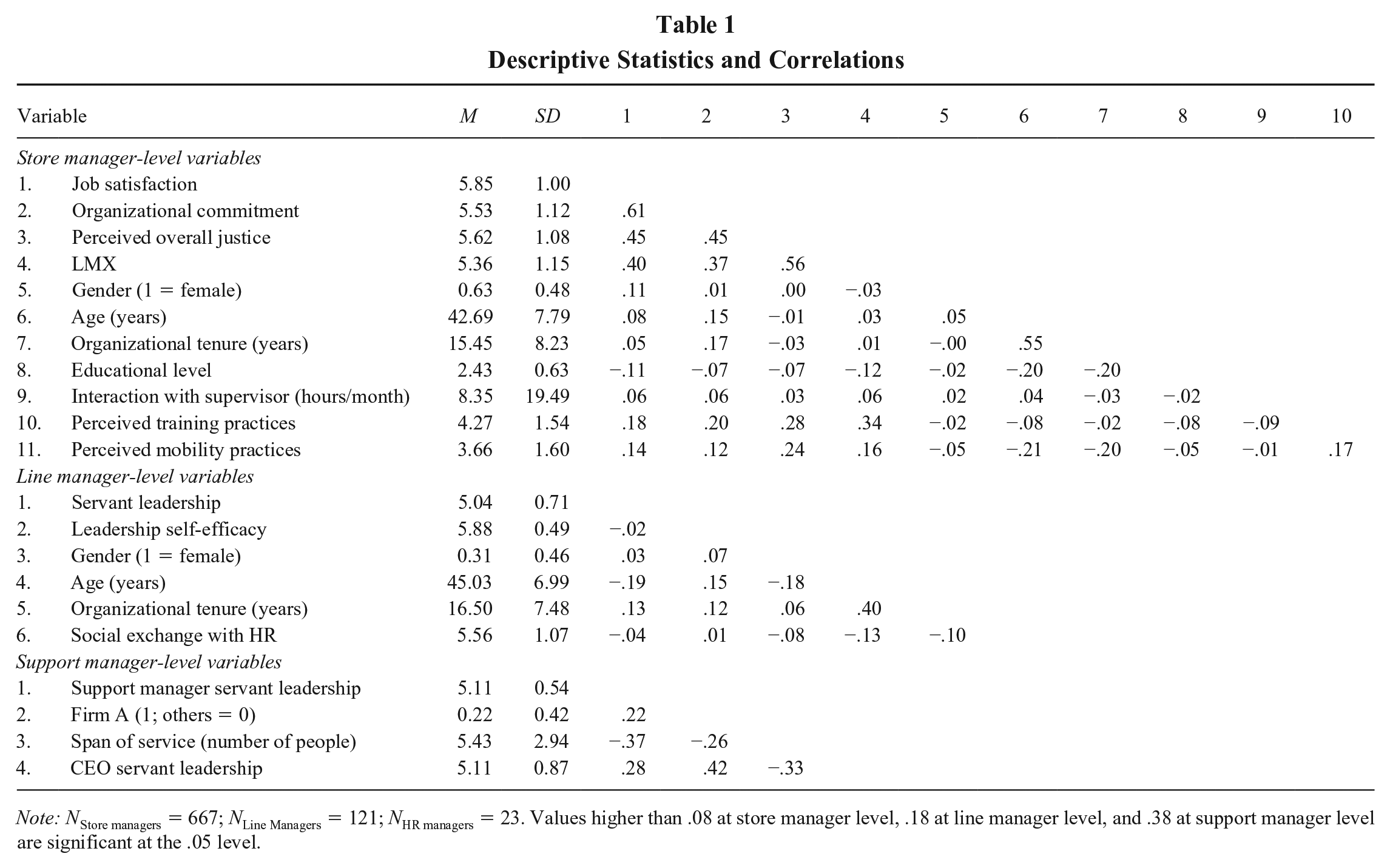
Note: NStore managers = 667; NLine Managers = 121; NHR managers = 23. Values higher than .08 at store manager level, .18 at line manager level, and .38 at support manager level are significant at the .05 level.
Results of Hierarchical Linear Modeling for Mediating Variables
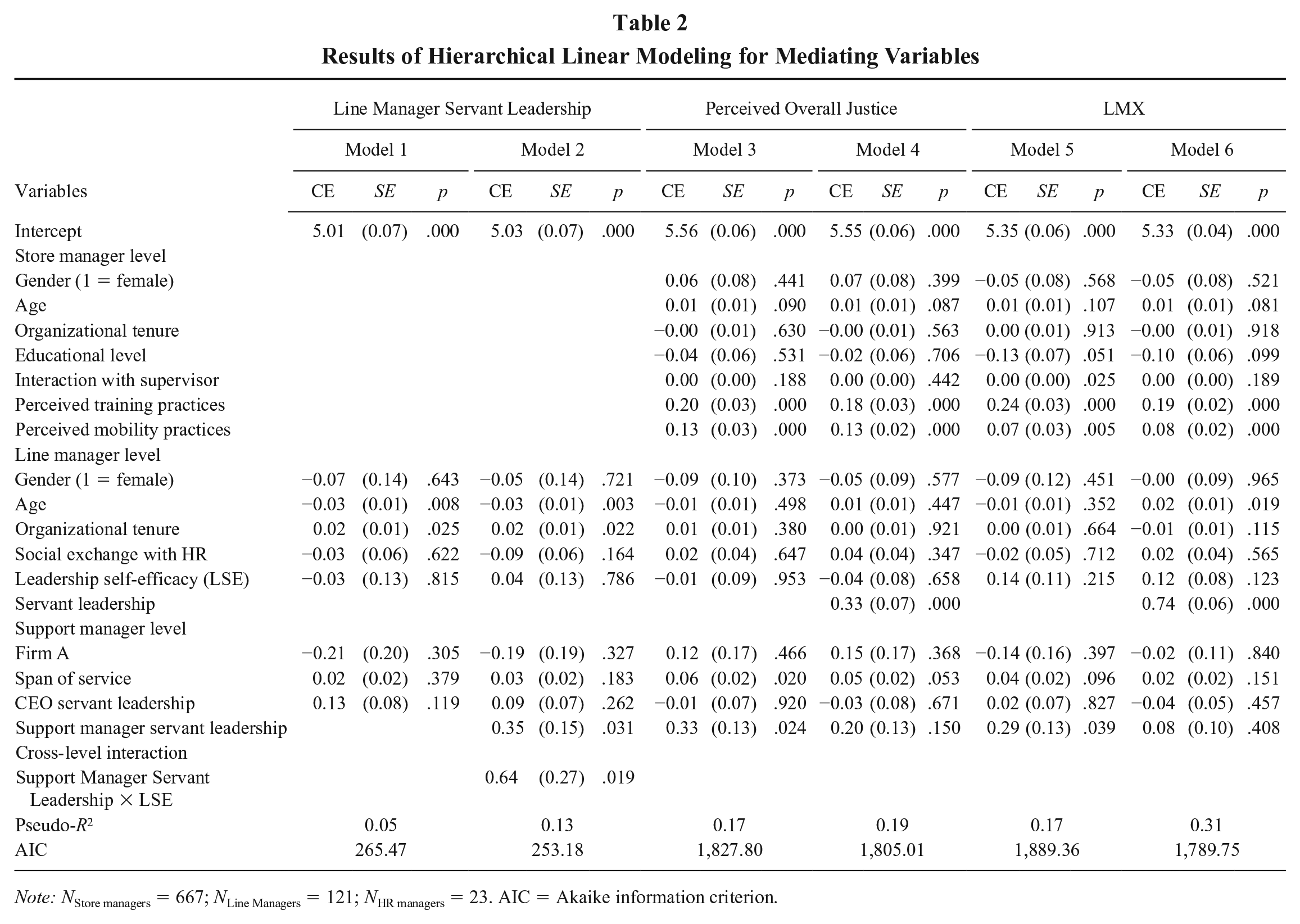
Note: NStore managers = 667; NLine Managers = 121; NHR managers = 23. AIC = Akaike information criterion.
Results of Hierarchical Linear Modeling for Employee Attitudes
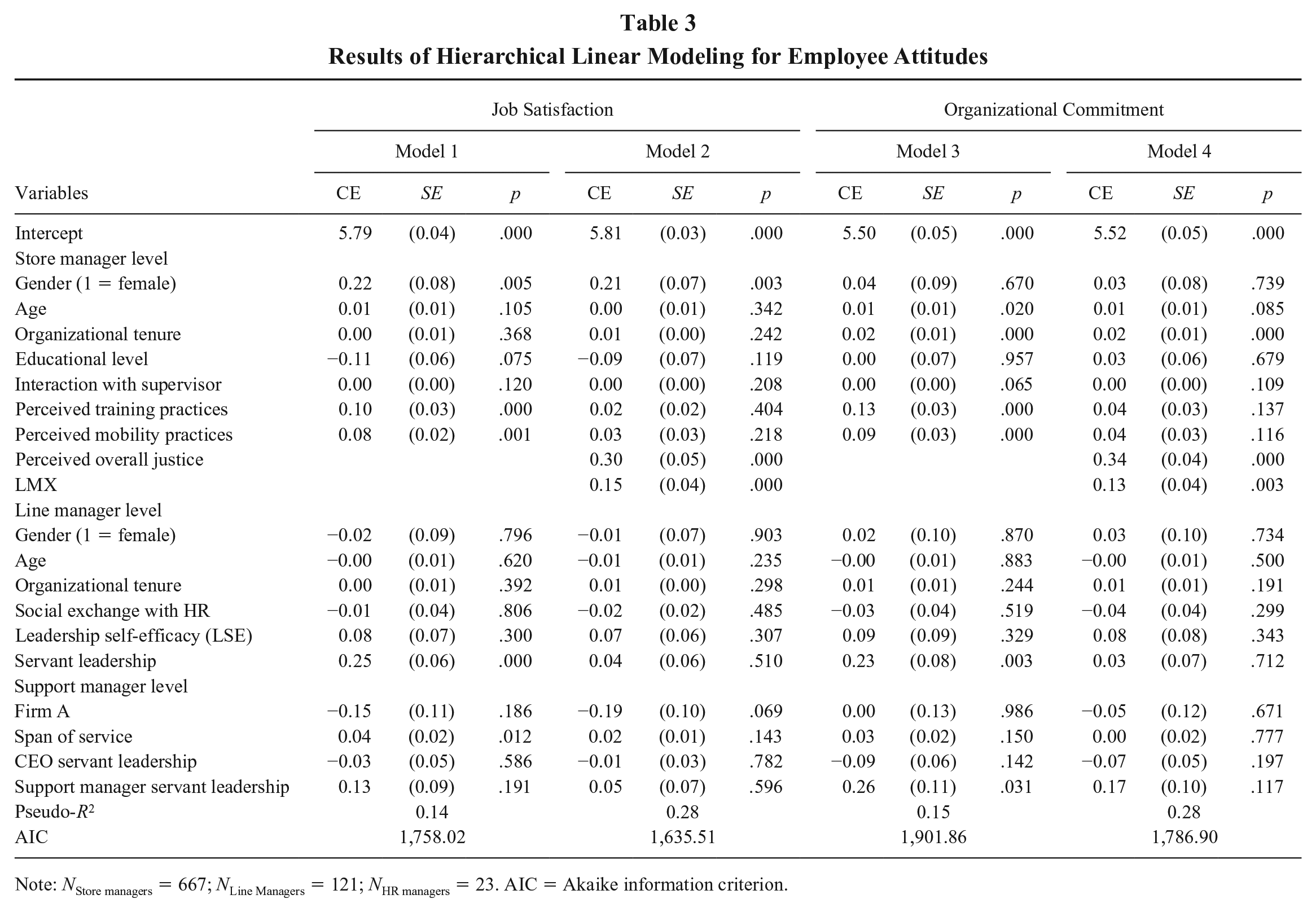
Note: NStore managers = 667; NLine Managers = 121; NHR managers = 23. AIC = Akaike information criterion.
Testing Hypothesis 1 involved studying mediation among the variables that span across the three hierarchical levels. Consistent with the recent management literature on mediation in three-level models (Eddy, Tannenbaum, & Mathieu, 2013; Luciano et al., 2014), we followed the procedure outlined by Pituch, Murphy, and Tate (2010) for mediated models with the 3 → 2 → 1 design. According to the literature on multilevel mediation (Preacher, 2011; Preacher, Zyphur, & Zhang, 2010), this procedure successfully accommodates multilevel mediation to three-level designs. Thus, to test the cross-level mediation predicted in Hypothesis 1, we specified a series of fixed effects models to accommodate the analyses of the criteria at two levels. Moreover, in line with current recommendations (MacKinnon, Lockwood, & Williams, 2004), we used the bootstrap approach to test the significance of the mediation. While conventional bootstrapping methods are not available for multilevel designs, the Monte Carlo method is an approach that is recommended for testing mediation in multilevel designs (Bauer, Preacher, & Gil, 2006; Zhang et al., 2014). Similar to Eddy et al. (2013) and Luciano et al. (2014), we used Selig and Preacher’s (2008) interactive tool and the R program to construct the Monte Carlo confidence intervals.
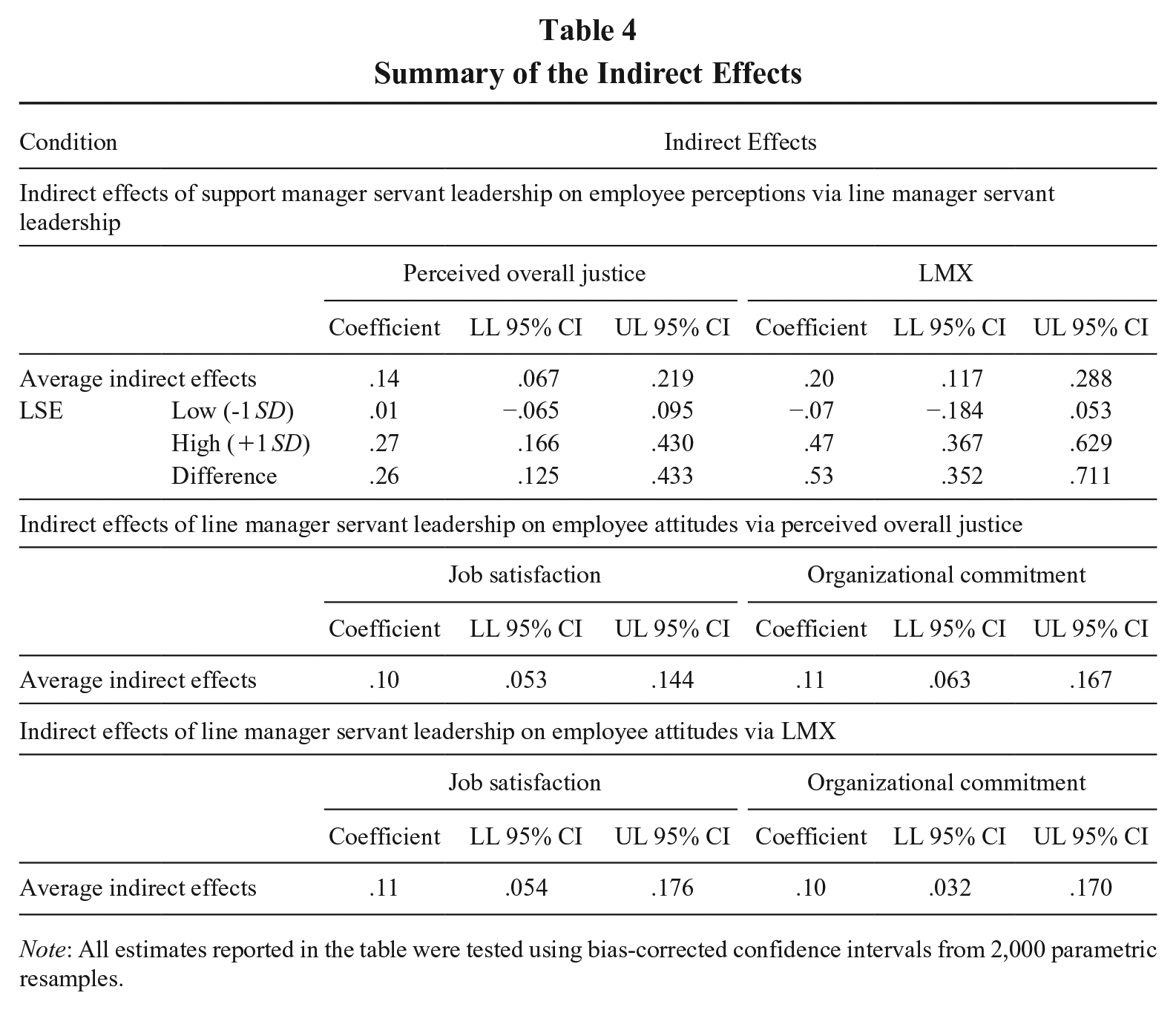
Hypothesis 1 predicted that support manager servant leadership is positively associated with (a) employees’ perceived overall justice and (b) LMX via line manager servant leadership. Model 2 in Table 2 shows that support manager servant leadership is a significant predictor of line manager servant leadership (β = .35, p = .031). The results reported in Table 2 further indicate that support manager servant leadership is positively associated with both perceived overall justice (Model 3) and LMX (Model 5), indicating that the total effect is significant. To examine the indirect effects via line manager servant leadership, we constructed bias-corrected 95% confidence intervals based on 2,000 repetitions in a Monte Carlo simulation and estimated them using R. As reported in Table 4, the indirect effect of support manager servant leadership through line manager servant leadership was significant for perceived organizational justice (estimate = .14, 95% confidence interval [CI] = .067, .219) and for LMX (estimate = .20, CI = .117, .288). These findings provide support for Hypotheses 1a and 1b, respectively.
Summary of the Indirect Effects
Note: All estimates reported in the table were tested using bias-corrected confidence intervals from 2,000 parametric resamples.
The results reported in Table 3 show that line manager servant leadership is positively associated with both job satisfaction (β = .25, p = .000) and organizational commitment (β = .23, p = .003). To examine the significance of the indirect effects via perceived overall justice (Hypothesis 2) and LMX (Hypothesis 3), we followed the procedure of Bauer et al. (2006) that Pituch et al. (2010) adapted for analyzing the 2 → 1 → 1 design with data that span three hierarchical levels. This procedure is widely applied in the management literature (e.g., Hu & Liden, 2011; Leroy, Anseel, Gardner, & Sels, 2015). As the predictor variable and the mediating variable covary in this design, the indirect effects on each outcome were estimated using an integrated model. The Monte Carlo bootstrapped 95% confidence intervals indicate that the indirect effect of line manager servant leadership on job satisfaction is significantly mediated by both perceived overall justice (estimate = .10, CI = .053, .144) and LMX (estimate = .11, CI = .054, .176). This result provides support for Hypotheses 2a and 3a. Similarly, the 95% confidence intervals not including zero indicate that line manager servant leadership has an indirect relationship with organizational commitment through perceived overall justice (estimate = .11, CI = .063, .167), as predicted by Hypothesis 2b, and through LMX (estimate = .10, CI = .032, .170), as predicted by Hypothesis 3b.
We then tested whether LSE moderates the relationships in the processes emanating from support manager servant leadership. Hypothesis 4 predicted that the positive association between support manager servant leadership and line manager servant leadership strengthens with the line manager’s LSE. Supporting Hypothesis 4, the results of Model 2 in Table 2 show that the cross-level moderation between support manager servant leadership and LSE is positively and significantly related to line manager servant leadership (β = .64, p = .019). We present the plotted interactions in Figure 2. The figure indicates that when line managers have higher levels of LSE (1 SD above the mean), there is a positive relationship between a support manager’s servant leadership and line manager servant leadership. However, when a line manager’s LSE is lower (1 SD below the mean), the positive relationship between these variables attenuates.
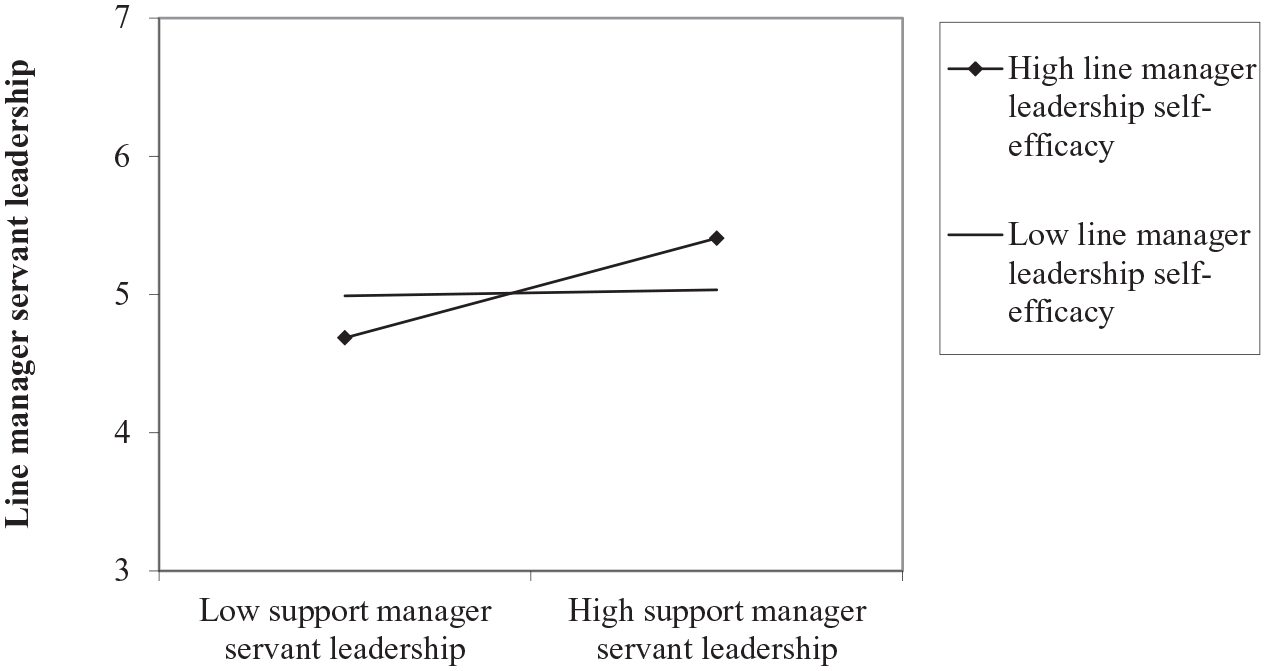
Interactive Effects of Support Manager Servant Leadership and Line Manager’s Leadership Self-Efficacy on Line Manager Servant Leadershipa
To examine the moderation of the indirect relationships, we followed the procedure recommended by Edwards and Lambert (2007), which has often been applied in multilevel management research (e.g., Chen, Kirkman, Kim, Farh, & Tangirala, 2010; Liu et al., 2012; Zhang et al., 2014). Accordingly, we began by constructing the confidence intervals for the indirect effects of HR servant leadership on perceived overall justice and LMX via line manager servant leadership at both higher and lower levels of LSE. Table 4 summarizes the indirect effects at the different levels of LSE, the differences between the conditional indirect effects, and the significance of these relationships. As predicted by Hypothesis 5a, the indirect effect of HR servant leadership on perceived overall justice via line manager servant leadership is substantially stronger when the line manager’s LSE is higher rather than lower (difference: .26, p = .004). Similarly, the indirect effect of support manager servant leadership on LMX transmitted through line manager servant leadership is stronger when the line manager’s LSE is higher (difference: .53, p = .000). Therefore, Hypothesis 5b is supported. The estimates in Table 4 further indicate that the indirect positive effects of a support manager’s servant leadership on perceived overall justice and LMX through line manager servant leadership are significant when LSE is at average and higher levels but not when LSE is at a lower level.
Discussion and Conclusion
The primary goal of this study was to advance servant leadership research by studying whether and under which conditions the servant leadership of organizational actors, who are not backed up by supervisory position, initiates social learning processes that contribute to positive employee outcomes. Our research shows that servant leadership is effective not only when leaders are the superiors of followers but also when the individual exhibiting leadership does not have a supervisory or otherwise higher organizational position relative to their work associates. In terms of our theoretical contribution to servant leadership theory, our more elaborate integration between servant leadership and social learning theories leads us to consider self-efficacy as a focal boundary condition regulating the trickle effects of servant leadership. These analyses add to the existing research by providing a more complete and theoretically coherent model of social learning in servant leadership processes.
The primary theoretical contribution of our findings is improving our understanding of the boundary conditions that regulate the social learning processes in servant leadership. In this order, our findings suggest that LSE is an essential enabling factor in the process of emulating servant leadership behaviors. Specifically, previous studies have suggested that emulation and social learning are the key mechanisms through which the benefits of servant leadership can be disseminated broadly in an organization (Liden et al., 2014). We add to these findings by showing that the process of emulation is context dependent and can easily be interrupted. Our results indicate that servant leadership might not inspire modeling behaviors, initiate the cycle of service, or “fuel the service fire” (see Chen et al., 2015) if individuals lack sufficient LSE. This finding implies that lower levels of LSE can have serious consequences in organizations because even one leader with a lower LSE in a hierarchy can cut off the beneficial social learning effects of servant leadership. Due to the importance of higher levels of LSE for the social learning of servant leadership, our results imply that organizations willing to promote servant leadership should also invest in supporting the development of their members’ efficacy beliefs in leadership activities. Another novel aspect of our study is recognizing the role of one’s motivational factors in emulating leadership behaviors. Earlier studies have examined the boundary conditions that increase the effectiveness of one’s servant leadership (Wang et al., 2018), and we add to this research by shedding light on a key psychological variable that regulates whether an individual learns and emulates servant leader behavior from his or her social environment.
From a more empirical standpoint, our study contributes to the servant leadership literature by providing early evidence on the emulation of servant leadership behaviors. Although several studies have theorized that social learning is particularly prominent in breeding servant leadership behaviors (Chen et al., 2015; Hunter et al., 2013; Liden et al., 2014), evidence linking one individual’s servant leadership to another individual’s servant leadership behavior is in its infancy (Eva et al., 2019; Wang et al., 2018). We add to this emerging literature by showing how individuals exhibiting servant leader behaviors can encourage others who are exposed to their leadership to emulate these behaviors and become servant leaders themselves. By doing so, this research provides empirical support for one of the key tenets of servant leadership theory. In studying how servant leadership affects the servant leadership of other individuals, we also respond to recent calls to advance the understanding of the antecedents of servant leadership (Hoch et al., 2018).
A related contribution is disentangling the effectiveness of servant leadership from the supervisory position of the leader. Earlier research on servant leadership has focused on analyzing the leadership of actors with supervisory roles in the organization, such as CEOs (Peterson et al., 2012), line managers (Chen et al., 2015; Wang et al., 2018), and other supervisors (Chiniara & Bentein, 2016). Although servant leadership research has predicted that servant leaders do not leverage their supervisory authority, it has tended to assume that leaders nevertheless have this type of power, which they then choose not to activate. In this spirit, Greenleaf (1977: 56) described servant leaders—referring to a sonnet of Shakespeare—as those “that have power to hurt and will do none.” Our finding that servant leadership is effective even when one does not occupy a supervisory position is important for servant leadership theory. As Greenleaf’s quote implies, the tension between occupying a powerful supervisory position and not using it to exert control could have been a powerful explanation for servant leaders earning their followers’ respect and admiration. Our findings show that the inspirational effects of a supervisor forgoing positional power are not necessary for servant leadership to be effective. Rather, it appears that servant behaviors themselves inspire emulation by followers.
Our findings on exerting influence beyond supervisory relationships also help to integrate servant leadership theory with a broader theoretical development in leadership research, which argues that virtually anyone in the organization can be effective in demonstrating leadership (DeRue & Ashford, 2010; Yukl & Falbe, 1990). Our results imply that servant leadership might be particularly useful in contributing to our understanding of how actors in support functions such as HR, finance, accounting, marketing, R&D, or communications can exert positive influence beyond supervisory relationships. In this regard, our results advance research by showing that servant leadership not only has trickle-down (Liden et al., 2014; Wang et al., 2018) but also trickle-around effects that spread horizontally throughout the organization. A broader approach on trickle effects suggests that the total effects of servant leadership might be more extensive than previously considered. When horizontal trickle-around effects are combined with indirect vertical trickle-down effects, even one servant leader, with or without formal authority, can have a positive influence on potentially hundreds of organizational members. While trickle-around effects remain—despite their prominence in organizational life—poorly understood in leadership studies (Wo et al., 2019), our study helps shed light on their role in servant leadership. By studying trickle effects more comprehensively, our research also answers calls in the servant leadership literature to shed light on servant leadership involving multiple stakeholders (van Dierendonck, 2011).
In addition to contributing to leadership studies, the empirical context of our research might offer some insights to the HRM literature. Because leadership is an “often-neglected facet of a firm’s HR system” (McDermott, Conway, Rousseau, & Flood, 2013: 293), our results respond to calls to integrate leadership theory into research on strategic HRM (Purcell & Hutchinson, 2007). Much of the existing debate has focused on how HR can increase its influence by working to increase its own power, status, and formal authority to be “strategic” and add value (Aldrich et al., 2015). Our findings suggest a different perspective such that HR could promote positive employee outcomes by putting other people first, supporting the work of other organizational members, and contributing to a broader community (Lemoine et al., 2019). Rather than considering the traditional “soft” supportive HR role as a liability (Sheehan et al., 2014), HR managers could be well advised to embrace this service role. Servant leadership might also help HR managers meet the expectation that “HR leaders must be the guardians of our ethical and moral integrity” (Wright & Snell, 2005: 181) in their organizations. Instead of being “people-using,” servant leadership places its emphasis on being “people-building” and creating a context in which people feel better, develop, and work more autonomously (Greenleaf, 1977).
Despite these contributions, our study has limitations that should be addressed by future studies. First, our data were collected from firms belonging to the same group located in a single country. To evaluate the generalizability of our findings, future studies are needed to test these relationships in other industries and cultural contexts. Future research should also examine the servant leadership of nonsupervisory actors other than HR managers. Second, although we collected our data from several informants and at different time points, the correlational nature of the data precludes definitive causality inferences. Common method variance is also a potential risk when analyzing the relationships between employee perceptions and employee attitudes because these variables were collected from the same individuals. However, the use of a time lag between the assessments helped to alleviate the risk that the respondent’s mood or other situational factors caused common method variance. Third, our somewhat small sample size at Level 3 increased the risk of incorrectly rejecting hypotheses. While we found support for the hypothesized effects, future research should employ larger sample sizes to uncover effects that are smaller yet important. Fourth, it is possible that the research model omits certain mediating or moderating variables and that the process emanating from a nonsupervisory employee’s servant leadership is more complex than that depicted by our model. Therefore, we encourage future studies to continue exploring the outcomes of servant leadership in nonsupervisory settings and to provide a more comprehensive understanding of how this leadership style contributes to various organizational objectives. Fifth, although we focused on servant leadership, we acknowledge that nonsupervisory employees may also successfully apply other leadership styles. Future studies are needed to examine the interpersonal influence of members who are not backed up by supervisory power in general.
In summary, our results provide a new perspective on how organizational actors might exhibit servant leadership to provide a role model for their work associates and facilitate positive employee outcomes in their organizations. Importantly, our study advances the understanding of the broad but situationally bounded processes that emanate from servant leadership and influence other organizational members through their trickle effects. We show that serving and helping others at work can help nonsupervisory members promote positive change in their organizations. However, these processes can be at risk if the positive chain of social contagion is impeded by managers without sufficiently high levels of LSE. We hope that our study inspires future research investigating how servant leadership can facilitate the pursuit of positive organizational objectives and how various members of the organization can participate in these activities.
Footnotes
Acknowledgements
We would like to thank Action Editor Christopher Porter and the anonymous reviewers for their constructive feedback and insightful suggestions that significantly contributed to this article. We are also grateful to Ingmar Björkman, Jari Hakanen, and Jason D. Shaw for their valuable comments, which helped us improve earlier versions of the manuscript.
This research was supported by funding from the Academy of Finland (Decision Number 266787).
