



Abstract
Employee volunteering has become a common phenomenon in many organizations. However, it is unclear how sustained volunteering spreads between colleagues. Drawing on an empirical study set in the English legal profession, this study examines the processes through which existing employee volunteers influence their coworkers to internalize a volunteer identity. The study yields a theoretical model that specifies how coworkers may identify existing volunteers as moral exemplars. Five forms of social influence emanate, often unknowingly, from these exemplars: encouraging, evoking, edifying, enacting, and exemplifying. These forms of social influence inform coworkers’ microprocess of moral identity work through which they claim a volunteer identity. This study thereby shifts attention from the well-theorized outcomes of moral identities to the largely unexamined social influences on moral identities in the workplace, enriching our understanding of the development of the moral self that is foundational to theories of volunteering and identity.
Keywords
Employee volunteering is a planned activity in which a firm’s employees elect to give some of their time to a volunteer group (Rodell, 2013; Wilson, 2000). One concept that has proven to be central in understanding employees’ decisions to volunteer regularly is identity (Grant, 2012). Extant scholarship indicates that it is “a person’s volunteer role identity that is the direct and proximal cause of sustained volunteerism” (Penner, 2002: 463). A range of studies evidence that internalizing a volunteering role, such that it becomes part of one's identity, drives volunteering (e.g., Charng, Piliavin, & Callero, 1988; Lee, Piliavin, & Call, 1999).
A well-documented motive for internalizing a volunteer identity is to verify one’s salient moral identity—a self-conception organized around a set of moral traits that guides what a moral person is likely to think, feel, and do (Aquino & Reed, 2002; Hitlin, 2007). Existing scholarship speculates that moral identities are inherently social and likely to be shaped by workplace interactions (Jennings, Mitchell, & Hannah, 2015; Shao, Aquino, & Freeman, 2008). Similarly, research theorizes that volunteers influence their coworkers to form volunteer identities (Grant, 2012). However, existing empirical research demonstrates that attempts to influence people to volunteer—through advocacy, pressure, or mandatory requirements—inhibit the formation of a volunteer identity (Grant, 2012; Rodell & Lynch, 2016; Stukas, Snyder, & Clary, 1999). Thus, while it is expected that an intertwined moral and volunteer identity develops through social interactions, it is unclear how this occurs. As such, this study focuses on interactions between volunteers and their coworkers, a topic that has received limited attention in volunteering scholarship thus far (Harrison, 1995; Rodell, Breitsohl, Schröder, & Keating, 2016).
Empirically investigating how existing employee volunteers influence their coworkers’ identities illuminates an observed phenomenon that currently lacks theoretical explanation: how sustained volunteering spreads between coworkers within an organization (Caligiuri, Mencin, & Jiang, 2013). Deeper insights into this phenomenon would be valuable to multiple stakeholders as the spread of volunteering within organizations can enhance corporate reputation (Rodell, Sabey, & Rogers, Forthcoming) while providing societal benefits such as supporting vulnerable people (Bruch, 2005). Therefore, this study seeks to understand the microlevel process, or microprocess (Kouamé & Langley, 2018; Reay, Golden-Biddle, & Germann, 2006), through which existing volunteers influence their coworkers’ formation of a volunteer identity.1
Specifically, this study examines the influence of existing volunteers on their coworkers within the English legal profession. The empirical case study explores lawyers who volunteered to support a legal charity to provide advice to those who could not otherwise afford it. Since its launch in the late 1990s, this charity has attracted thousands of volunteer lawyers. This study examines the experiences of lawyers who volunteered to support this charity for the first time, which provides the opportunity to identify how they were influenced and thus how sustained volunteering spreads.
Through a grounded theory methodology (Strauss & Corbin, 1990), this study develops a theoretical model that specifies the interacting experiences through which a moral identity develops in the workplace and how this moral identity is verified through the internalization of a volunteering identity. This model identifies how existing volunteers can act, often unknowingly, as moral exemplars who prompt their coworkers’ experiences of moral identity work through five forms of subtle influence: encouraging moral reflection, evoking moral emotions, enacting moral resources, edifying moral identities, and exemplifying moral action.
These findings support two theoretical contributions. The first contribution is advancing the integration of the employee volunteering and moral identity literatures. Existing studies identify a relationship between moral identities and volunteering, albeit rarely in terms of employee volunteering. However, these existing studies typically view individuals’ moral identities as already constructed (Boezeman & Ellemers, 2007; Winterich, Aquino, Mittal, & Swartz, 2013), whereby volunteering is seen as an expression of individuals’ long-held values that are typically shaped by their religious convictions or upbringings (Allahyari, 2000; Aquino & Reed, 2002; Grönlund, 2011). In contrast, this study explains how volunteers prompt coworkers’ moral experiences through subtle social interactions in the workplace. Volunteers influence the meanings of these experiences, guiding the development of coworkers’ moral identity such that it becomes intertwined with a volunteering identity. These findings are important because they reconcile the contradictory findings that identities are shaped by social forces but that attempts to persuade people to volunteer inhibit the formation of a volunteer identity. This study thereby explains how employee volunteering can spread between coworkers through moral identity work.
Relatedly, a key finding is the mixed—positive and negative—moral emotions that accompany employee volunteers’ moral identity work. These mixed emotions diverge from the “overwhelmingly positive” individual-level benefits of employee volunteering identified in existing studies (Jones, 2010; Rodell et al., 2016: 78). Moral scholarship suggests that moral emotions are conditioned by context (Tangney, Stuewig, & Mashek, 2007), but research is only beginning to theorize the role of traditions in influencing emotions. Studies suggest that mixed moral emotions can be driven by conflicts over values and traditions between professionals (Wright, Meyer, Reay, & Staggs, 2020; Wright, Zammuto, & Liesch, 2017). In contrast, this study shows how mixed moral emotions can stem from edifying interactions between colleagues as volunteers guide their coworkers’ understanding of traditions that become moral obligations and shape how they construe events as moral emotion elicitors.
The second contribution of this research is illuminating the antecedents of moral identities that underpin social and role theories of identity.2 By addressing the limited empirical studies on adult moral identity development in the workplace (Jennings et al., 2015; Shao et al., 2008), this study reveals how subtle social interactions influence individuals’ moral sense of self and traces how this moral identity informs the roles they claim. This finding is valuable because dominant theories of identity—namely, social identity theory and identity theory—posit that an individual’s selection of a group or role identity is informed by their attempts to be consistent with the moral identity that resides in their personal identity (e.g., Aquino & Reed, 2002; Hitlin, 2007; Reed & Aquino, 2003; Stets & Carter, 2006, 2011). However, these theories do not account for the continued development of a moral identity (Stets & Burke, 2000). This study thereby shifts attention from the well-theorized outcomes of activated moral identities to the largely unexamined workplace influences on moral identities, illuminating the microprocess through which the moral antecedents of social and role identities can develop. The study draws on these insights to provide practical recommendations for managers seeking to cultivate employee volunteering.
Theoretical Background
Identity is a central concept in theoretical explanations of sustained volunteering. While a range of factors can explain episodes of volunteering (Brockner, Senior, & Welch, 2014; Pajo & Lee, 2011; Peloza & Hassay, 2006), there is consensus in the literature that a volunteer identity is a direct cause of sustained volunteering (Grant, 2012; Penner, 2002). A volunteer identity describes the extent to which a volunteer role and the relationships associated with it become part of a person’s self-concept (Piliavin, Grube, & Callero, 2002). The centrality of identity in explaining ongoing volunteering is borne out in volunteering studies (Penner & Finkelstein, 1998). The strength of individuals’ volunteer identities has been shown to correlate with donations of blood, money, and time (Finkelstein & Brannick, 2007; Lee et al., 1999) and to predict the number of hours individuals will work and their intentions to remain a volunteer (Grube & Piliavin, 2000).
Two prominent theories of identity help explain why individuals categorize themselves into particular social identities or identify with certain role identities, such as that of a volunteer: social identity theory (Tajfel & Turner, 1979), and identity theory (Stryker & Burke, 2000). These theories posit that individuals’ selection of a social group or role identity is largely shaped by their need for self-consistency (Cadinu & Cerchioni, 2001; Hogg & Abrams, 1990) or self-verification (Burke & Stets, 1999) in terms of their personal goals, meanings, or values. As Hitlin (2007: 249) explains in reference to volunteers, “values form a cross-situationally stable core of the self that serves as a primary referent for the self-verification process.” When Hitlin (2007) refers to values, he means a person’s sense of where they stand on various moral questions, arguing that a volunteer identity is an expression of an other-oriented moral identity. This reasoning echoes Blasi's (1984) contention that people seek to be consistent with their moral self-construal. A moral identity is therefore attached to an individual's personal identity—the experiences and values that characterize them as distinct—and informs their selection of group and role identities.
Both social identity theory and identity theory scholarship consider the outcomes of a moral identity. For instance, studies drawing on social identity theory show that when internalized and activated, a moral identity positively influenced giving and volunteering behavior (Aquino & Reed, 2002) irrespective of recognition (Winterich et al., 2013). Aquino and colleagues’ notion of moral identity stresses how individuals strive for self-consistency with their moral identities and moral goals (Shao et al., 2008). As Stets and Burke (2000: 230) noted of social identity theory, however, “the source of these goals and purposes has not generally been considered.” In a brief exception, Aquino and Reed (2002: 1424, emphasis added) speculate that social identities inform moral identities as “a person’s moral identity may have a social referent” and social identities can gradually become central for the individual, along with the moral characteristics of this referent. At the same time, Aquino and Reed (2002: 1425) posit that while a moral identity can be activated or suppressed, it tends to be “relatively stable over time.” As such, social identity theory largely overlooks the social interactions through which a moral identity and notions of what constitutes moral behavior develop, particularly beyond adolescence and in the workplace (Shao et al., 2008).
Identity theory posits that individuals claim and perform roles that align with their identity standard—the set of meanings attached to the self (Burke, 1991). Identity theorists hold that there is a hierarchy of identity standards, with higher standards influencing those below them. A moral identity is “a person identity” that operates at a higher level than social and role identities (Stets & Carter, 2006). However, how a moral identity is informed by role identities and how the meanings of a moral identity standard develop have been left “to future theoretical and empirical research” (Stets & Carter, 2006: 298). While it could be inferred that individuals adopt the moral meanings and expectations that accompany the roles they claim, identity theorists stress that individuals balance the demands of role identities with the demands of personal identities (Stets & Burke, 2000). Identity theorists acknowledge they have not attended to personal identities (Stets & Burke, 2000) and typically adopt a psychological and experimental approach that overlooks the interactions of daily life (Riley & Burke, 1995). As such, identity theory has also not considered how moral identities develop nor how they are socially influenced (see also Hitlin, 2007), particularly between work colleagues.
Studies on moral identity, while not always connected to the aforementioned theories of identity, corroborate the idea that individuals become regular volunteers to live up to the moral values that anchor their personal identities (Boezeman & Ellemers, 2007). However, like social identity theory and identity theory, these studies provide limited insights into how moral identities are influenced in the workplace and how moral identities become connected to volunteer identities. Even in the limited qualitative and exploratory research on this topic, the development of a moral identity within a particular context receives little attention. For instance, Allahyari's (2000: 111) ethnographic study of volunteers’ work reports that in “most volunteer accounts an orientation to volunteering […] dated back to childhood or their young adult years” and does not delve further into their motives. Rogers (2017) showed how volunteers’ moral beliefs and identities can be reinforced through the organization and boundaries of volunteering work, again indicating the stability of moral identities. In these studies and others (Grönlund, 2011), the construction of a moral identity that motivates volunteering is seen as an expression of individuals’ long-held values, which are rooted in religion or shaped through affective bonding during adolescence. How volunteers’ moral identities may develop through social interactions and in the workplace is unclear. These limited insights reflect the consistent calls for empirical studies on moral identity development through workplace interactions (see Jennings et al., 2015; Shao et al., 2008), as little is known about “the processes by which moral identity develops” (Hardy & Carlo, 2011: 510).
In parallel to identity theories and moral identity scholarship, theories of volunteering acknowledge the importance of social motives and rewards in volunteering but also pay scant attention to how social interactions develop the moral identities that are assumed to underpin volunteer identities. Penner's (2002) theoretical framework of sustained volunteering and Grant's (2012) elaboration offer the fullest accounts of how volunteer identities emerge. However, they only obliquely acknowledge the social development of identity. Specifically, Penner (2002) states that individuals’ experiences during initial acts of volunteering shape their volunteer identities, such as their level of involvement in volunteer activity (Piliavin et al., 2002). Grant (2012) also emphasizes the importance of repeated participation to support a volunteer identity. Grant goes further, theorizing that when managers pressure employees to volunteer, this pressure provides an external justification to which employees can attribute their volunteering, preventing them from internalizing it as a self-determined, intrinsically motivated choice. This premise is borne out in studies showing that regular volunteers “perceive their donations as voluntary rather than as the result of social pressure” (Charng et al., 1988: 315) and that mandatory volunteer programs inhibit the formation of a volunteer identity (Stukas et al., 1999). Further, explicit attempts to evangelize volunteering are likely to be unsuccessful as evangelists are often deemed self-righteous by coworkers (Rodell & Lynch, 2016).
As such, while previous research provides insights into how social interactions can inhibit the formation of a volunteer identity, the processes through which social interactions in the workplace can inspire the development of a volunteer or underlying moral identity have received much less theoretical and empirical attention (see Rodell et al., 2016). The limited focus on social interactions reflects the fact that the majority of employee volunteering studies focus on volunteers themselves (e.g., Brockner et al., 2014; Caligiuri et al., 2013). Despite the recognition that long-term volunteers become “champions of the cause, persuading coworkers, supervisors, and subordinates to join volunteering efforts” (Grant, 2012: 590), precisely how they persuade their coworkers is unknown. As such, research is required to build theory to understand how volunteers influence coworkers’ identity work.
Identity work describes the “processes whereby people strive to shape a relatively coherent and distinctive notion of personal self-identity” (Brown, 2015). An identity work perspective therefore draws attention to how individuals construct and develop personal identities and values. The extant literature indicates that distinctive forms of identity work are involved in the development of different identities, ranging from prisoners to religious ministers (Brown & Toyoki, 2013; Creed, DeJordy, & Lok, 2010). Nonetheless, there is “an emergent consensus that identity refers to the meanings that individuals attach reflexively to themselves, [which are] developed and sustained through processes of social interaction as they seek to address the question ‘who am I?’” (Brown, 2015: 23). As such, this perspective encourages a focus on social interactions as a key input into individuals’ development of their distinctive personal identities, such as their moral identities. Related work has demonstrated the importance of social interaction in the identity work of different roles, such as leaders and followers (DeRue & Ashford, 2010). However, how the distinctive processes of identity work involved in the construction of a moral or volunteer identity unfold through interactions between volunteers and coworkers is unknown.
Drawing together the insights of this theoretical background section, we know little about how the moral identities that are foundational to social identity theory and identity theory develop through social interactions. Nor do we understand how volunteering identities develop through social interactions in the workplace. Social interactions—an exchange between two or more individuals—are key mechanisms through which individuals construct their identities by internalizing feedback from significant others (DeRue & Ashford, 2010; Mead, 1934; Stryker, 2008). Nonetheless, while it is assumed that all identities are social and negotiated, there is a paucity of empirical identity research that considers interactions and “the role specific others play in identity work” (Caza, Vough, & Puranik, 2018: 902). Given that proximal individuals tend to be more salient (Ashforth, Schinoff, & Rogers, 2016), the novel approach of this study is therefore to examine volunteers and coworkers’ interactions, through which coworkers come to understand and perform types of volunteering as an expression of their moral identity.
Such an approach can illuminate how moral and volunteering identities become connected through social interactions, probing the long-held assumption that volunteering work is moral work (Harrison, 1995). This approach can shed light on the on the well-documented spread of sustained volunteering between colleagues (Caligiuri et al., 2013; CECP, 2019), which currently lacks theoretical explanation (Rodell et al., 2016). Understanding how such social interaction may influence identity work is also important because it would illuminate the undertheorized social antecedents of moral and volunteering identities, in contrast to their well-theorized outcomes. Thus, the research question motivating this study is, how can interactions between existing volunteers and their coworkers inform coworkers’ identity work such that they come to internalize and symbolize a volunteer identity?
Method
To answer this research question, this study adopts a grounded theory methodology. Grounded theory is a “bottom up” research methodology concerned with the inductive generation of theory that is grounded in the experiences of those involved in the phenomenon being studied. This systematic approach includes several key principles: theoretical sampling, theoretical saturation, coding (open, axial, and selective), and constant comparison (Strauss & Corbin, 1990). Each of these principles is explained in relation to this study in the following methodology subsections. By applying these principles, researchers can identify conceptual recurrences in data. Researchers can then group related concepts together that pertain to a category—a more abstract, higher level concept. These categories become the basis for new theory, as only by “comparing incidents and naming like phenomena with the same conceptual term can a theorist accumulate the basic units for a theory” (Strauss & Corbin, 1990: 420).
The grounded theory methodology has become increasingly common in management research (see Suddaby, 2006). Grounded theory is appropriate for this study's research question as it is designed to generate theories that explain the processes by which actors construct meaning out of intersubjective experience, when existing theory is inadequate to explain the focal phenomena (Goulding, 2002). As Langley (1999) points out, grounded theory is most powerful when focused on a “micro-level” to explore individuals’ social experiences, as in this study. Researchers have employed forms of grounded theory to explore identity work (Gill, 2020) and, more recently, microlevel experiences of volunteering (Rodell et al., Forthcoming) thereby setting a precedent for this study.
Study Context, Sampling Approach, and Data Collection
A core principle of grounded theory that guided the sampling approach in this study is theoretical sampling. Theoretical sampling refers to “sampling on the basis of concepts that have proven theoretical relevance to the evolving theory” (Strauss & Corbin, 1990: 176). Therefore, sampling changes and develops along the lines of inquiry stemming from emergent concepts and cannot be predetermined. In this study, this meant the concepts that emerged from interviews with, and observations of, lawyers shaped subsequent sampling. The study concluded sampling at the point of theoretical saturation: when no additional data or insights with which to develop new or existing categories could be found.
From 2011 to 2015, this study examined English lawyers who had become volunteers by working pro bono. Shortened from the Latin term pro bono publico, or “for the public good,” pro bono describes professionals providing their specific skills to those who are unable to afford them. Initial sampling focused on professional lawyers in a single law firm—Law Firm A—who performed some pro bono work. Law Firm A is an English, “Top 20” corporate law firm based on revenues and is based in a large English city. Following email requests, Law Firm A was the first law firm to grant permission to interview lawyers who elected to participate in this study. The initial interviewees encouraged speaking to a legal charity and associated key contacts—with whom the author was already familiar. Many lawyers performed pro bono through this charity, called the Pro Bono Group (PBG) to preserve anonymity, which was launched in 1997 and run by volunteer lawyers. Following separate meetings with the CEO and one trustee of the PBG, formal access to the PBG's staff and meetings was granted.
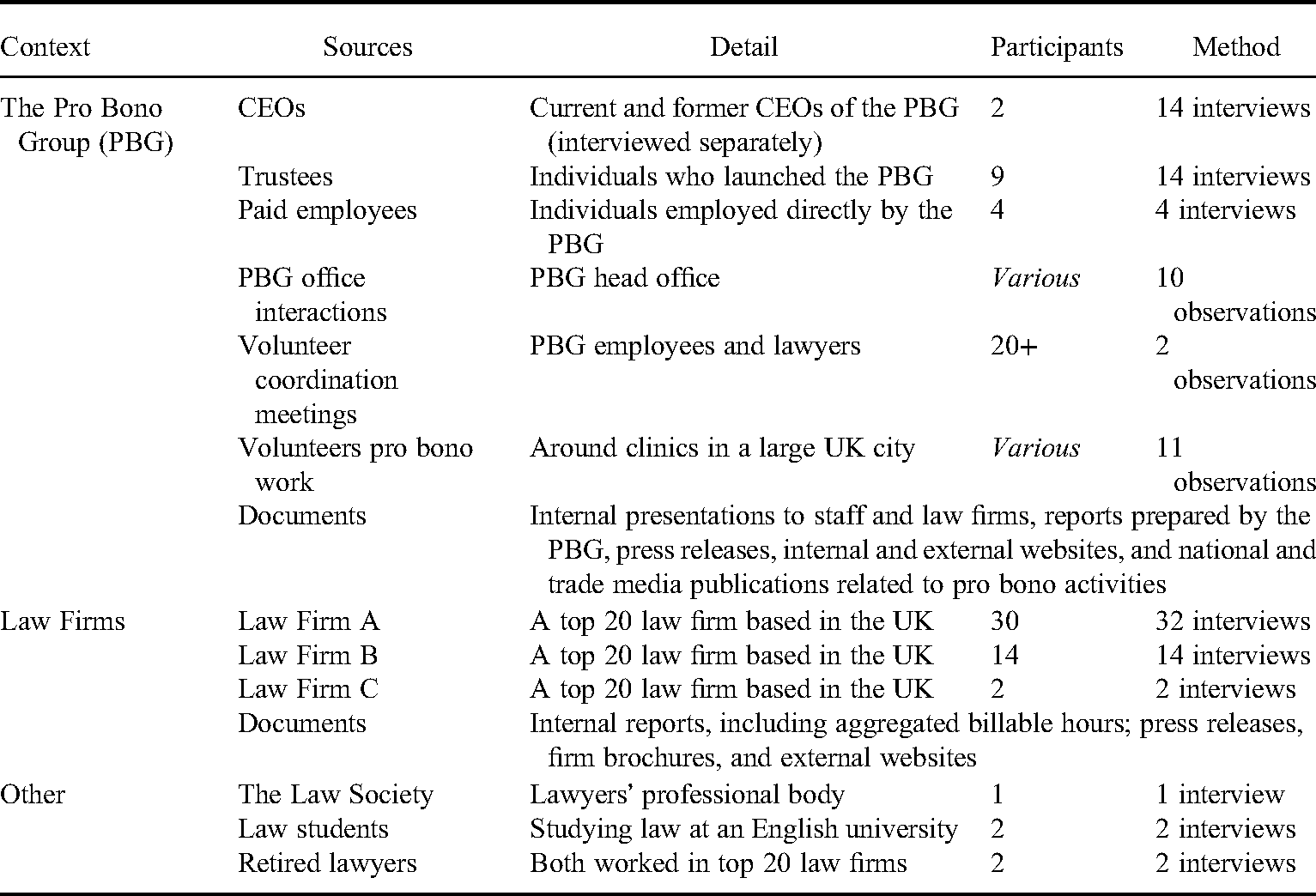
Though the PBG organization was not the focus of this study, it served as a hub for lawyers working pro bono since its launch in 1997 and thus provided access to long-term volunteers who could discuss their experiences of pro bono work. This was a novel source of volunteers because participation in the PBG was effectively penalized, particularly in the group's early years before it became established, as it did not count toward lawyers’ billable hours, nor was it often encouraged or even recognized by many law firm partners who viewed it as being at the expense of a law firm's own pro bono activities. Despite these challenges, growing numbers of lawyers had volunteered for the charity. Participants recommended colleagues to take part in the study, which ultimately led to interviews with volunteer lawyers across three corporate law firms (labelled Law Firms A, B, and C in Table 1). Data were collected from interviews, observations, and documents as outlined in Table 1.
Overview of Data Sources
Interviews
In addition to informal conversations and email exchanges, 66 individuals participated in formal interviews, mostly in private meeting rooms in law offices. The interview schedule was designed to elicit data on how and why individuals became volunteers, as well their subjective experiences of volunteering. Interviews were semistructured to provide the flexibility to explore rich avenues of discussion. While focusing on the volunteers themselves, the study included interviews with the PBG's trustees, its present and former CEOs, and its working staff to gain additional insights.
While the participants in the study were open and supportive of the research project, the majority were professional lawyers, which often meant that interviews were less than an hour (average length of 40 min) as the participants had billable-hour commitments. Fortunately, many of the participants were amenable to supplementary interviews and/or email communication and were willing to revisit earlier interviews.
Observations and documents
Observational data were also collected to provide context for and triangulate the findings. Observations totaled approximately 60 h and were recorded in field notes. Between 2012 and 2014, observations included formal coordination meetings organized by the PBG, in which lawyers from across multiple law firms would meet to discuss their plans. These discussions entailed explanations for the group's work (i.e., “why we are doing this”) and provided insights into how lawyers influenced one another in terms of their volunteering. Other observations included before or after lawyers delivered pro bono work to a variety of clients, in walk-in clinics within a large English city. These observations were invaluable as they provided privileged access to less guarded personal reflections and emotional expressions in real time. Such access was possible because lawyers tended to share their motivations more openly after they had dispensed legal advice, which often appeared to have a material impact on the lives of citizens in need. A range of documents supplemented interview and observational data. These included law firm and charity annual reports, PBG meeting minutes, newspaper and trade publication articles, and press releases.
These interviews and observations of interactions between individuals involved with the charity provided rich opportunities to identify insights into the social development of a moral and volunteering identity. While documents and observations were important, many insights into the understanding of coworkers’ moral and volunteer identity development occurred in interviews where participants reflected on their interactions. This was because volunteers’ influence on coworkers was unobtrusive and subtle, and the meaning of their social interactions could often only become apparent when explained by a coworker. During the collection of data, the study's sampling became increasingly theoretical, exploring salient themes of such subtle influence.
Analysis
The study utilized three different forms of analytical coding: open, axial, and selective. Underlying this standard analytical coding process was the principle of constant comparison—the iterative process whereby existing data codes are compared with emerging codes. As Dey (1999) notes, this type of analysis is systematic and begins when data are available, with data collection and analysis occurring concurrently. This analysis required moving between interview transcripts and notes to ensure interpretations remained grounded in the data.
The analysis began with open coding, which requires researchers to develop initial concepts. These initial concepts are conceptual rather than just descriptive codes. The constant comparison method used in this study required coding each interview or observation before moving on to the next to incorporate any new concepts that emerged into subsequent stages of data collection. In practical terms, this meant initially reading the transcribed interviews line by line and assigning codes or labels to pieces of text that highlighted a significant conceptual aspect of legal volunteers’ identity work.
As the next step, axial coding involves identifying patterns and relationships between the concepts found in open coding and examining how they relate to one another. Strauss and Corbin (1998: 123) refer to this process as “axial” because coding occurs around the axis of a category to establish how concepts are connected within a category. This step called for the open codes from the first step to be grouped into categories and subcategories.
Finally, the analysis moved to selective coding, which entails identifying the core category or a small number of core categories in the data (Dey, 1999; Strauss & Corbin, 1998). Selective coding thus formalizes the relationships between all of the theoretical concepts into a coherent whole, or theoretical framework (Langley, 1999). This requires rejecting ideas that data do not support and to understand the relationships between multiple concepts. In this study, the overarching core category is moral identity work.
This moral identity work connects the six aggregate categories that account for the initial array of codes. Each of the six categories represents a key experience of moral identity work, as detailed in the Results section. The results emphasize how each of these experiences were tied to interactions with a moral exemplar, for instance that coworkers internalized moral rumination when encouraged to do so by an existing volunteer. In this way, each experience was closely bound up with the influence of an exemplar. Figure 1 illustrates the analytical process of progressing from raw data to categories (Gioia, Corley, & Hamilton, 2013).
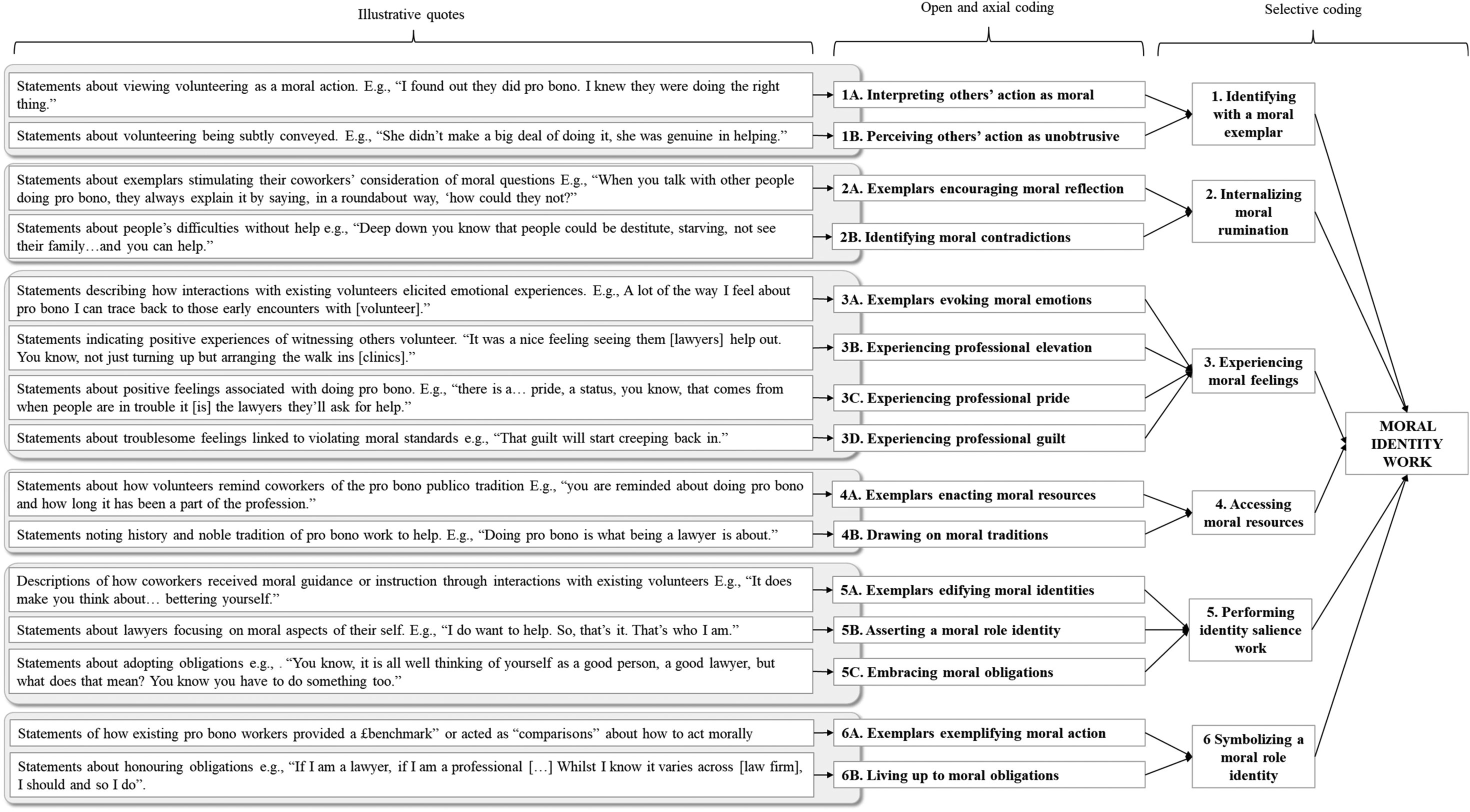
Data Structure of Analytical Codes
Quality and Rigor of Interpretation
The criteria of quality and rigor are a function of underlying methodological assumptions (Suddaby, 2006). In adopting an interpretivist approach through grounded theory, this study adheres to Lincoln and Guba's (1985) notion of trustworthiness and the associated criteria of credibility, dependability, and confirmability. Research is credible when individuals who experienced the subject at hand recognize the description. To ensure credibility, this study's findings were presented to a variety of participants for feedback.
Dependability, based on the notion of consistency, was achieved through a rigorous coding process. The data that were originally collected were recoded, in multiple iterations over several years, by the author with support from a second coder—who was not involved in other aspects of the project to provide some critical distance (Hayward & Cassell, 2018)—and through discussions with colleagues. For the initial open coding, uncoded data, such as interview transcripts, were coded independently. As the names of codes were expected to vary by coder, each coder recorded their interpretation of these codes with supporting data—memoing (Corbin & Strauss, 2008)—to engender discussion about concepts rather than raw data and thereby facilitate comparisons and check consistency. Axial and selective coding began by applying Corbin and Strauss’s (2008) coding paradigm, which provides questions that can be applied to data to draw out the contextual relationships. A qualitative form of intercoder reliability known as a “solidification” strategy (Marques & McCall, 2005) was adopted, which required the coders’ agreement on the relationships between concepts and categories.
Confirmability, or the extent research findings derived from the data, was achieved by making the data and analytical process transparent to allow others to assess claims. For instance, the Results section provides a range of quotes from across participants, to support theoretical categories. The process of abstracting and classifying data into categories and, ultimately, into a theoretical framework was also explicated (see Figure 1).
Results
Through grounded theory building, this study developed a process model of moral identity work to explain how existing volunteers can inform the moral identities of their coworkers. Presented in Figure 2, the model is organized around six aggregate theoretical categories. Each of these six categories represents a key theme of coworkers’ experiences of moral identity work. This section considers how these interconnected experiences collectively operate as a microprocess of moral identity through which a volunteering identity is internalized.
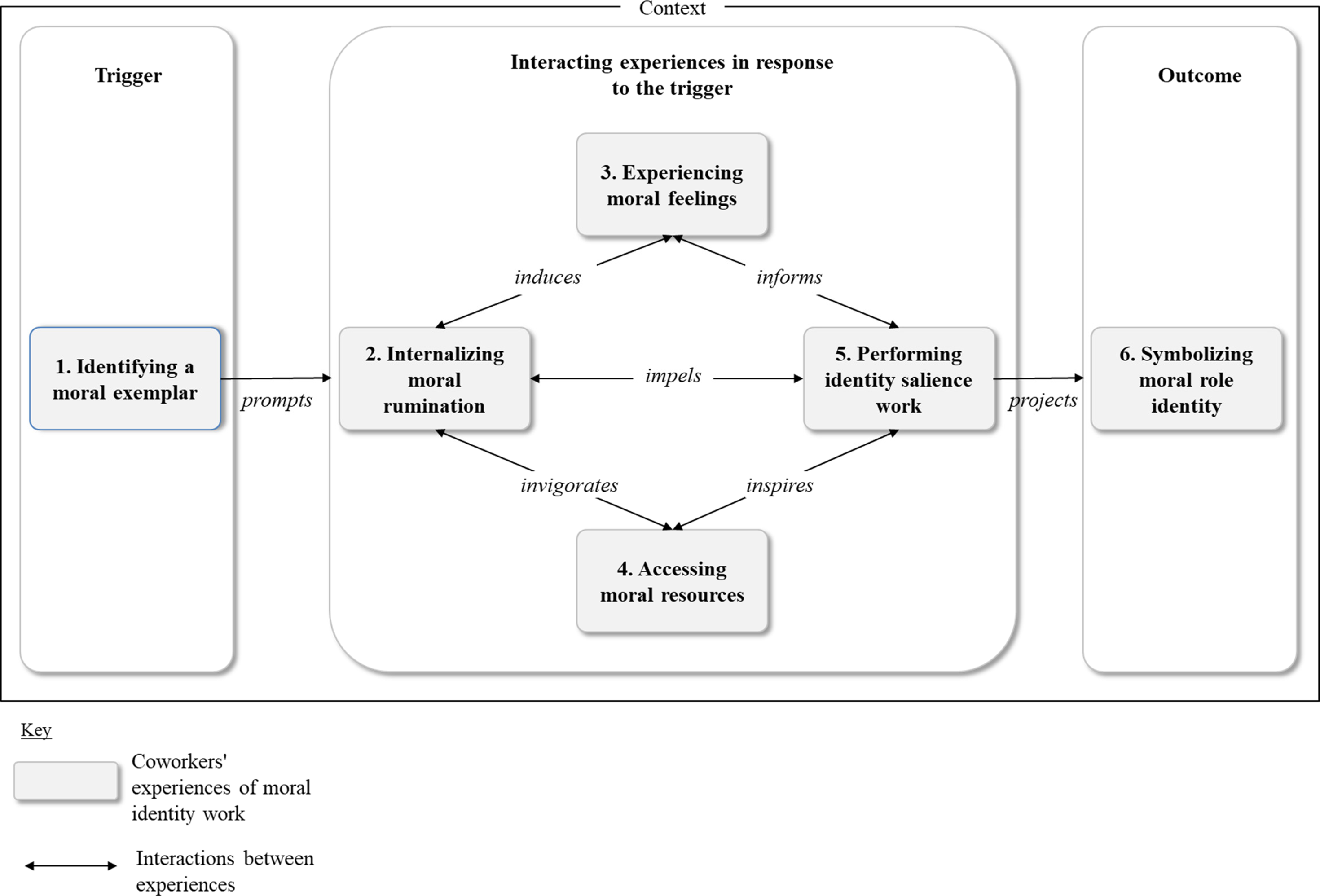
The Microprocess of Moral Identity Work as an Enabler of a Volunteering Identity
The model begins when (1) coworkers identify an existing volunteer as a moral exemplar. To reflect the idea that these moral exemplars are a core influence on the moral identity work of their coworkers, they are positioned as a distinct trigger of the moral identity work process in the model. Coworkers’ subsequent interactions with these exemplars can prompt a series of interacting experiences of moral identity work and thus their formation of a volunteer identity. The model shows how coworkers’ (2) internalizing of moral rumination is encouraged by moral exemplars and how coworkers’ (3) experiencing of moral feelings are evoked by moral exemplars. Coworkers are guided through these thoughts and feelings by (4) accessing moral resources that have been enacted by exemplars. Coworkers manage these thoughts and feelings by (5) performing identity salience work as edified by moral exemplars, to emphasize their moral identity as a professional lawyer. This identity salience work is projected through coworkers’ (6) symbolizing of a moral identity, as exemplified by exemplars.
In the analysis that follows, attention is paid to the interaction between each of the experiences of moral identity work. These interactions are illustrated in Figure 2 through a series of arrows and associated words that connect each experience (i.e., prompts, induces, invigorates, impels, informs, inspires, and projects). Each of these words also appears in the Results section, italicized and underlined (e.g.,
Additional Evidence by Theoretical Category
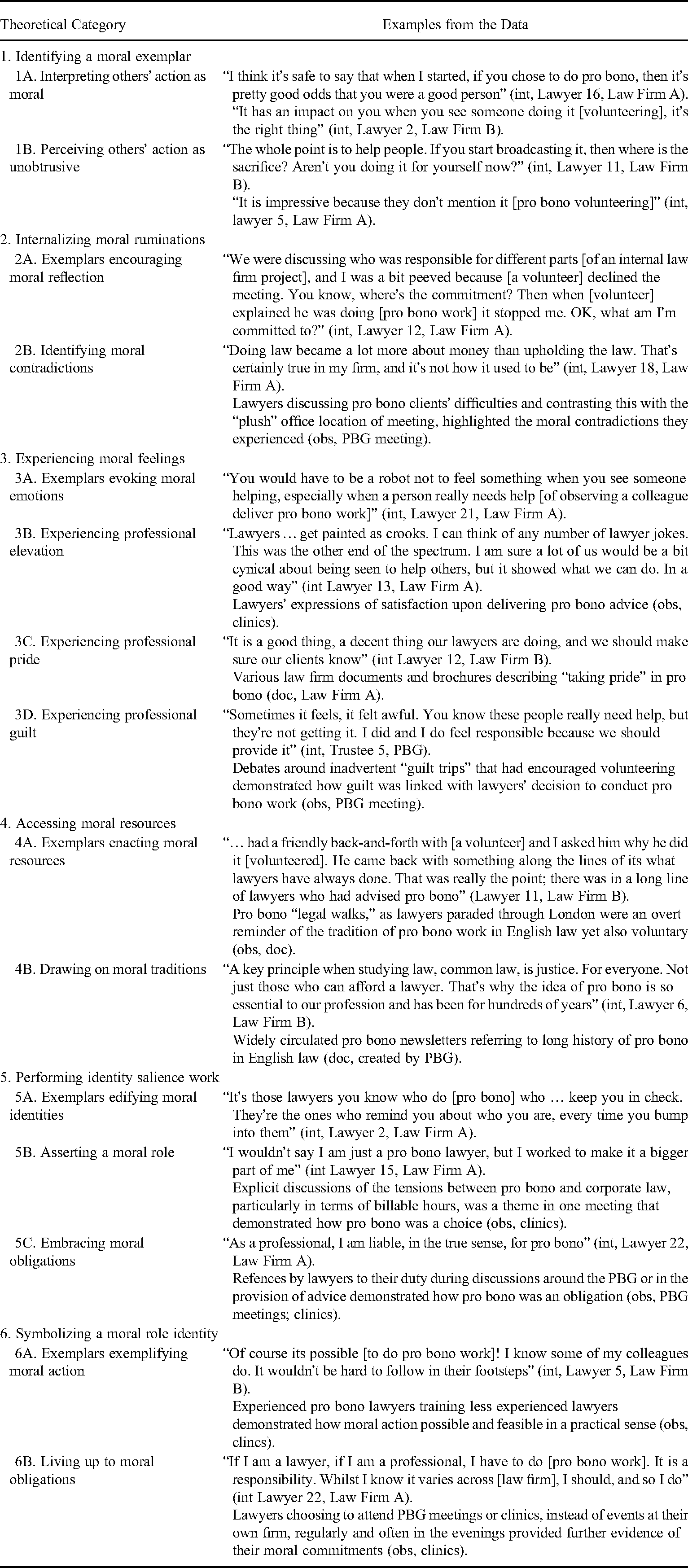
Identifying a Moral Exemplar (Trigger of Moral Identity Work)
An essential and precipitating factor of the coworkers’ moral identity work was identifying an existing lawyer who they viewed as a moral exemplar—an example of how to act virtuously. The exemplars identified by the coworkers in this study varied by seniority and gender, ranging from law firm partners to lawyers with only a few years of legal experience. For initial interactions to prove influential, the coworkers had to perceive existing volunteers’ action as both moral and unobtrusive.
Interpreting others’ action as moral
All the coworkers in this study who became volunteers noted the influence of other existing volunteers in shaping their own volunteer work. For example, one lawyer (Lawyer 8, Firm A) explained, “When I heard about [another lawyer] volunteering, then that was the start of me thinking about [volunteering]. … I had thought about it before but not seriously, and that got my attention.” In recalling these early interactions, the lawyers consistently noted the morality—a concern with the principles of right and wrong behavior—of the volunteers who impressed them. As one lawyer (Lawyer 24, Firm A) noted,
If I go right back, it was when I spoke to [another lawyer] who worked on the floor above me. I found out they did pro bono. I knew they were doing the right thing, if you will. That‘s probably when I first thought, OK, what am I doing?
Another lawyer (Lawyer 19, Firm A) commented similarly: I think I heard about [the PBG] when [a colleague] made a comment about doing something else that night. He mentioned he was doing some pro bono, so I asked him about it, and when I found out, it—I don't know—restored my faith a bit.
These coworkers of volunteers noted how support for the PBG in its early stages was rarely publicized as it was typically “looked down on” by law firm partners, who supported pro bono work for their own firms and, even then, as secondary to commercial work. That some lawyers volunteered regardless emphasized the morality of these existing volunteers to their coworkers.
Perceiving others’ action as unobtrusive
Another important facet of the coworkers’ decision to volunteer themselves was how they became aware of other lawyers’ volunteer work. Many recalled being impressed by learning of other lawyers’ volunteering in subtle ways. For example, one lawyer (Lawyer 22, Firm A) disclosed, “I don't know of anyone who shouts about [PBG]; you do it because you want to.” Another lawyer (Lawyer 6, Law Firm A) explained, “Most of the [pro bono volunteers] I know and respect never really bring up pro bono or only mention it in passing.”
This indirect communication served to enhance the perception of volunteering as a moral endeavor as many coworkers noted their aversion to overzealous volunteers. For instance, one lawyer (Lawyer 25, Firm A) noted the following: I don't like it when other people go on about their volunteering or try and get you to do it. I am all for people doing as they choose, but don't stick it down my throat. It feels a bit hollow and more like you’re doing it for yourself than for someone else.
As explored in each of the subsequent subsections, the coworkers’ identification of moral exemplars
Internalizing Moral Ruminations
Observing other lawyers’ moral action in the form of volunteering encouraged the coworkers in this study to question their own morality or that of their profession, highlighting contradictions. These ruminations related strongly to the coworkers’ recognition of others’ unnecessary suffering—in this case, clients who desperately needed but could not afford legal advice.
Exemplars encouraging moral reflection
In discussing or observing others’ volunteering, the lawyers described how they queried their own morality. For instance, one lawyer (Lawyer 8, Firm B) explained,
When you talk with other people doing pro bono, they always explain it by saying, in a roundabout way, “How could they not? [do pro bono]” They never asked me directly but by implication I find myself asking the same question. You know, why am I not helping? Is that who I am?
As illustrated in this quote, moral exemplars rarely encouraged moral reflection directly yet still influenced coworkers’ moral thoughts and
I remember tagging along when [an existing volunteer] was helping out [performing pro bono in a clinic] … You could see how much [existing volunteer] had helped that person out. They would have been homeless. Probably. I mean that sticks with you, and it makes you want to go and help.
In these ways, exemplars introduced lawyers to moral questions and action that encouraged reflection.
Identifying moral contradictions
Moral reflection became prominent and meaningful ruminations for the coworkers due to their interactions with volunteers and their increased awareness that volunteering could ameliorate others’ suffering. While many of the lawyers raised moral questions, others went further and identified contradictions: If we are honest with ourselves, then you cannot resolve it. [Law Firm B] is there to make money. That doesn't mean there cannot be a fair legal system, but they can and do conflict, sometimes. We can all pretend that isn't a problem, but it is not right. (Lawyer 14, Firm B)
Such contradictions
This is the analogy I always use. Imagine you have a rope and you see someone drowning. Would you throw them the rope? That's what we have as lawyers, our rope is our professional knowledge and training. The problem is that there is plenty of rope but too many people are drowning. (Trustee 2, PBG)
These difficult moral contradictions
Experiencing Moral Feelings
Interacting with exemplars evoked a mix of moral feelings in many of the coworkers, and these feelings continued to be
Exemplars evoking moral emotions
The lawyers who were coworkers of the volunteers described how their interactions with and observations of volunteers evoked emotional experiences. For instance, Lawyer 10 (Firm B) described,
A lot of the way I think about pro bono I can trace back to those early encounters with [volunteer] because it really makes you feel something. You know, I felt that [pro bono] was important when [volunteer] first showed me work at the clinic.
This quote illustrates how moral feelings
Experiencing professional elevation
A recurring theme in the data was the lawyers’ description that “it felt good seeing one of us [a lawyer] help” (Lawyer 18, Law Firm A). This theme corresponds to the emotion of elevation, or a positive emotion experienced upon witnessing another person perform a virtuous act, principally one that improves the welfare of other people. Observations of lawyers immediately following doing pro bono work suggested that providing pro bono also provided lawyers with a sense of satisfaction. This was borne out in interviews. For instance, one lawyer (Lawyer 12, Firm A) recounted, “They were doing a good thing, the right thing. It, uh, stirred up admiration.” These feelings of elevation further evidenced that the coworkers viewed some existing volunteers as moral exemplars.
The positive experience of elevation also
I’m really blown away. I saw how meaningful the [advice] was for the [client]. I’m so impressed by [volunteer]. [Volunteer] never made a big deal of it, which makes it even more impressive. And I’m happy I could see it as I think this is a bit of work we should be discussing.
Such elevation was important because it helped the coworkers recall, even after years had passed, their encounters with such exemplars, whom they went on to emulate. According to one lawyer (Lawyer 5, Firm A), “It sticks with you when you see someone doing something genuinely selfless. I don't think you can help but want to be a better you.” In this way, elevation provided the coworkers with long-term exemplars to emulate and
Experiencing professional pride
Many of the lawyers described a sense of pride, the emotion of feeling positively evaluated by oneself or others, when they thought of themselves as volunteers. Pride appeared to reward the performance of volunteering, once again driving action. For example, one lawyer (Lawyer 17, Firm A) reported, “I liked that I could tell my friends and people I met about this sort of stuff [pro bono work]. It might impress them and it … reflects well of the profession.” Similarly, another (Lawyer 22, Firm A) recounted their feelings of pride more directly, detailing how this feeling
You get well paid, but there is a … pride, a status, you know, that comes from when people are in trouble, it [is] the lawyers they’ll ask for help. There's a long history of law in our country, and I like the fact that I am a part of it.
Experiencing professional guilt
Many of the coworkers noted how their moral ruminations involved feelings of guilt. Guilt describes the violation of a moral standard. Indeed, this study observed discussions between lawyers who mentioned how they had experienced “guilt trips” when they learned colleagues were performing pro bono and they were not. As one lawyer (Lawyer 3, Firm A) put it, “It does make you feel bad when you’re not doing what you think you should be doing.” Many coworkers, such as Lawyer 16 (Law Firm A), noted how their guilt became more pronounced when they were exposed to a moral exemplar: It is good to see someone you know, a colleague that you see all the time, doing something good like pro bono. But then again, that made me feel guilty because I know that I should be helping too. And even when I am, I am still doing a lot less than some people. Guilt is a big part of it for me.
These feelings of guilt were an important driver of many lawyers’ volunteering,
Although transient, multiple moral emotions recurred and were invariably related to a professional expectation of how a lawyer should feel and act in terms of pro bono work and thus what it means to be a lawyer and
Accessing Moral Resources
A key role of moral exemplars in shaping the identity work of their coworkers was to enact and thereby draw attention to contextual resources, such as the tradition of pro bono work in English law. These traditions were resources to be accessed because the coworkers appropriated them as a key source of meaning to make sense of their moral rumination and revise their moral identities. In this way, the tradition of pro bono work provided templates for self-understanding and action.
Exemplars enacting moral resources
A theme running across the lawyers’ accounts related to the role of existing volunteers in reminding coworkers of the tradition of pro bono work in English law. As Lawyer 14 (Firm A) explained,
I imagine everyone [in the English legal profession] knows about pro bono. What I found interesting was how quickly it gets forgotten in the day-to-day. But then when you speak to those who [volunteer] you are reminded about doing pro bono and how long it has been a part of the profession. So, it has not been forgotten, it is still there, a reminder about who we are … who we should be.
This tradition was illuminated by moral exemplars who enacted it, which reminded and
Drawing on moral traditions
When asked how they knew what it means to be a volunteer, the lawyers frequently referenced the moral tradition of pro bono work in the English legal profession. For instance, several of the coworkers described how volunteering as a lawyer equated to pro bono work, as that was “how it's always been.”
The tradition of pro bono work also appeared to play an important function in helping the lawyers understand what it means to be a volunteer in the legal profession and how to act accordingly and
The analysis of historical texts further substantiated the notion that there is a strong tradition of pro bono work within the English legal profession (Miller & Hard, 1993; Rhode, 2005). Nonetheless, pro bono is a resource few lawyers access. As McLeay (2008: 264) argues,
The empirical reality is that throughout (at least) the common law histories of the U.S. and England, pro bono has been an ideal that some, many or most lawyers have failed to live up to. However, this does not diminish its value and potential as a motivating force—a beautiful myth—of the profession.
For the volunteers in this study, the pro bono tradition was instructive in their development of a moral identity, allowing them to make sense of their moral ruminations concerning what a lawyer should do. By emphasizing volunteering in the form of pro bono as to being a lawyer, the pro bono tradition
Performing Identity Salience Work
Moral exemplars served as role models to edify their coworkers’ process of identity salience work. Identity salience work describes how the coworkers managed their moral ruminations and moral feelings by emphasizing their professional role identities in relation to their commercial role identities. The coworkers in this study perceived their professional identities as more moral and noble than their commercial identities. A crucial point here is that none of the lawyers in this study described themselves as immoral prior to volunteering but instead described how they chose to assert a sometimes-obscured moral aspect of their sense of self. This process was ongoing and involved embracing a set of associated moral obligations.
Exemplars edifying moral identities
The lawyers in this study often described how their interactions with existing volunteers were instructive in understanding who they were and who they wanted to be. Existing volunteers edified their coworkers by demonstrating the possibility of emphasizing a moral sense of self through their work. One lawyer's (Lawyer 12, Firm B) account of their interaction with a volunteer clarifies this edification well: He was explaining to some of us why he [volunteered for the PBG] and it was all about his principles, who he was as a solicitor. It did not seem to matter that this might affect his billables [hours]. It does make you think about … bettering yourself.
Other lawyers described, similarly, how existing volunteers served as a reference point in their moral sense of self. For instance, Lawyer 19 (Firm B) described how they had noticed a colleague finding time during the week to support the PBG and explained how this unobtrusive act had affected them: I would bet money that all of us who volunteered for the PBG, especially in the early days, did it as a sort of answer. Am I a good person? Am I a good lawyer? When you know other people are working pro bono, those questions become a lot more imposing.
Asserting a moral identity
The lawyers in this study frequently mentioned their desire to do the right thing and understood this as a core component of their self, especially in relation to existing volunteers. As one lawyer (Lawyer 15, Firm A) disclosed, “When you know other people are working pro bono, you can't help but think, ‘Well, why am I not?’ I do care, and I do want to help. So, that's it. That's who I am.” Such care points to how salience work
This emphasis on taking up a moral role identity was described as an ongoing effort. In emphasizing the salience of a moral identity, the lawyers in this study who went on to become volunteers described how they rendered this identity an explicit part of their sense of self. For instance, one lawyer (Lawyer 11, Firm A) put it this way: You have to work hard to remind yourself to be the sort of lawyer you want to be. I want to be a good one, not just … how I work but who I do it for.
As this quote also illustrates, performing identity salience work
At a practical level, before I decided to do pro bono, you know that you need to weigh up the costs. There's the opportunity cost of doing it; plus, not everyone [in the law firm] was supportive as they thought it could get in the way even if you only did a little bit. So, when you do pro bono, especially when I decided to, you’re making a choice about how much of a [law firm] lawyer you are.
Notions of balance were prominent during observations of PBG meetings, where the tension between pro bono and corporate law was voiced as an issue, particularly in terms of meeting billable-hours targets.
Embracing moral obligations
A key aspect of emphasizing a moral identity was the coworkers’ acceptance of new moral obligations. This acceptance progressed beyond ruminations to a decision to be accountable for one's moral action. This study's observations of lawyers recorded their informal discussions of duty in terms of the provision of advice and demonstrated how pro bono was an obligation. As the term obligation implies, for many of the participants, being a volunteer was a duty that was bound up in their sense of self. As one lawyer (Lawyer 3, Firm B) recounted, “Everyone is busy with their work, but some people still manage to get out there and help. You see that, and you realize it's part of being a lawyer. I think it is a duty, something you have to do.” This notion of an obligation was also observed during discussions in PBG meetings when lawyers described this obligation as part of being a lawyer and that they “should feel bad” if they are not helping. In these ways, it is possible to see how identity salience work
Symbolizing a Moral Role Identity (Outcome of Interacting Moral Experiences)
Lawyers’ identity salience work was
Exemplars exemplifying moral action
For many of the participants, performing pro bono work was an expression of their choices. For example, one lawyer (Lawyer 16, Firm A) noted, “It is a choice; not everyone chooses pro bono cases. That's just me.” The possibility of such moral choices was often made apparent through interactions with existing volunteers. As one lawyer (13, Firm B) explained,
[A volunteer] was a bit of a benchmark, we had spoken so I knew that [pro bono] might have not been the best career decision, but he did it anyway. So, it showed me that it could be done.
A key expression of this moral action was the lawyers’ choice to support a charity—the PBG—rather than engage in in-house pro bono work. The fact that many volunteers visibly support the PBG demonstrated the possibility of moral action. A former CEO of the PBG (CEO 2) clarified this as moral action in the following way: But remember, the lawyers volunteering to help chose to be there. No one in their firm was forcing them to do it. In fact, you were effectively penalized by helping in the early stages as it didn't count toward billable hours or progression or anything like that. It was more than just adding a line to the CV. They felt it was a good thing to do. That's why they kept coming back.
Observations of pro bono meetings illuminated how existing volunteers could do more than demonstrate the possibility of volunteering. They revealed existing volunteers’ practical assistance such as explaining how and where to volunteer, as well as training new volunteers.
Living up to moral obligations
This study's observations demonstrated how many lawyers lived up to the moral obligations bound up in a moral identity by volunteering, such as by working in clinics or attending pro bono meetings. Symbolizing a moral identity through moral action did not always manifest as active volunteering but also took more indirect forms, such as supporting those who did volunteer. For example, one lawyer (Lawyer 21, Firm A) recounted the following anecdote about how volunteer work was supported in their firm: I remember a colleague of mine arguing the case for the [PBG]. Despite the caricature, we [lawyers] do have feelings. Learning about the [PBG] was an uplifting point on the agenda, if you will … There was a touch of back and forth between partners. There was discussion about why we can do all this in-house and why we should not share our people with competitors. If there are PR benefits, then how can they be beneficial if everyone [other law firms] get them too? That line of argument fell on deaf ears. It was just the right thing to do.
Many of the interviewees mentioned the importance of integrity and noted their need to honor the morals bound up in their sense of self. Moreover, these moral obligations were not fulfilled by a single act of volunteering but required sustained cognitive and emotional effort: The thing is, when you do [pro bono] sometimes you feel good, proud, pleased, for a bit. But then you start thinking about it again and realize it's not about you and it's about helping people who desperately need it. You know lots of people don't have what you have. Then you feel a bit guilty about feeling pleased, if that makes sense. So, I suppose I am always … pondering, am I doing the right thing? (Lawyer 3, Law Firm B) Why do I keep doing [pro bono]? Because if it really matters to you and you’re not interested in the patina of pro bono, then a moment's thought will remind you that there are many more people needing help than receiving it. (Lawyer 18, Law Firm A)
In this way, symbolizing a moral identity promoted moral ruminations and moral feelings for many of the coworkers, thereby perpetuating the process of role identity salience work to manage these thoughts and feelings. Moral identity work is therefore an ongoing process.
Sequencing of the Experiences of Moral Identity Work
Prior subsections have detailed the experiences of moral identity work and their interactions—also illustrated through a series of arrows and associated words in the model (Figure 2). Social interaction between volunteers and coworkers is the mechanism through which coworkers come to have these experiences, and it is this social interaction that also fosters connections between each experience. This is because volunteers do not just prompt transitory experiences in their coworkers but also educate and clarify underlying moral obligations concerning what it means to be moral within their profession. Such moral obligations guide how coworkers should think, feel, and act, if they wish to become pro bono workers (volunteers). Social interactions convey these obligations, which when internalized encourage multiple moral experiences that reinforce one another to sustain the broader notion of a moral identity.
The model developed in this study avers that the interacting experiences of moral identity work unfold as a process or in a sequence of interactions over time (Kouamé & Langley, 2018; Langley, Smallman, Tsoukas, & Van de Ven, 2013). In this study, many participants described the initiation of their moral identity work in terms of identifying a moral exemplar. As such, this represented a distinctive trigger of the moral identity work:
I can't see how I would be doing pro bono cases now if I hadn‘t seen [coworkers] doing it first. They get you thinking about what you should do and what's possible. (Lawyer 24, Law Firm A)
Some participants had previously accessed moral resources and already supported the tradition of pro bono. Nonetheless, their moral identity work only appeared to yield a volunteer identity when they identified an exemplar who demonstrated the possibilities of performing pro bono.
The model holds that a range of interacting experiences stems from the identification of a moral exemplar: internalizing moral ruminations, experiencing moral feelings, accessing moral resources, and performing identity salience work. There was no consistent order of these experiences, yet these experiences were common responses to the trigger across participants.
Given that this study sought to understand how coworkers come to internalize and symbolize a volunteer identity, such that they perform pro bono on a sustained basis, the symbolizing of a moral identity represents the focal outcome of the model. The symbolization of this identity was only possible via the preceding categories of experience. Participants described moral ruminations, moral feelings, and reflections on their identities as precursors:
There are all sorts of reasons you do [pro bono]. Doing it repeatedly is different. Deciding to do it is an act of contemplation. I thought about it and felt like I had to, especially in our profession. (Lawyer 16, Law Firm A)
Discussion
This study set out to understand how existing employee volunteers inform their coworkers’ identity work by examining the experiences of English lawyers who volunteered to support a pro bono charity. The study's grounded theory building yielded a theoretical model of the experiences of moral identity work through which the coworkers of volunteers come to symbolize a moral identity by volunteering (see Figure 2). This study's findings contribute to theories of volunteering and identity.
This study provides a novel theoretical explanation of how moral and volunteering identities become connected through subtle social interactions in the workplace. Extending the rich literature demonstrating the strong link between a moral identity and volunteering (Allahyari, 2000; Aquino & Reed, 2002; Boezeman & Ellemers, 2007; Hitlin, 2007; Loi, Kuhn, Sahaym, Butterfield, & Tripp, 2020), this study examines this link to show how coworkers’ identification of volunteers as moral exemplars triggered a series of moral experiences. Collectively, over time, these interacting experiences developed coworkers’ moral self-conception—a microprocess described here as moral identity work—that manifested in their own volunteering and internalization of a volunteering identity.
Prior studies have provided limited insight into how moral identity develops and becomes intertwined with a volunteer identity in the workplace (Allahyari, 2000; Keller et al., 2004). Social influence has been theorized to shape the development of volunteer identities but has lacked empirical examination, specifically in terms of how such influence can unfold (Farmer & Fedor, 2001) given that processes of influence can play out in different ways in different social groups (Kraut, Rice, Cool, & Fish, 1998). Indeed, extant scholarship has suggested that individuals’ explicit attempts to influence their coworkers to become volunteers are often stigmatized (Charng et al., 1988; Rodell & Lynch, 2016) and inhibit the formation of a volunteer identity (Grant, 2012; Stukas et al., 1999). This study suggests that moral exemplars can play a unique role in influencing their coworkers’ understanding of injunctive norms—expectations about what one is morally obligated to do. Such moral obligations are a key source of identity development (Spears, 2020). In this study, interactions with exemplars clarified that an obligation of a professional lawyer is pro bono (volunteer) work, through a range of subtle influences—that is, encouraging, evoking, enacting, edifying, and exemplifying. These subtle influences help explain why coworkers did not experience their interactions with exemplars as an external expectation or pressure to be moral. Instead, these interactions prompt coworkers’ moral experiences and clarify moral obligations. Moral exemplars thereby serve to spread employee volunteering as subtle sources of their coworkers’ moral identity work, guiding the development of a moral identity and connecting it to a volunteer identity.
This study's explication of how moral identities develop also speaks to broader debates in identity work scholarship by highlighting how different forms of social interaction and influence are involved in the construction of different identities. A unique feature of this study is that experiences of moral identity work did not appear to be reciprocal. In many instances, moral exemplars were unaware that they were informing the moral identity work of their coworkers. This is distinct from how DeRue and Ashford (2010), for instance, demonstrated social interactions between leaders and followers yielded leader identities through “deviation-amplifying loops,” which described the reciprocal and iterative process of actors claiming and granting such identities to each other. In contrast, this study suggests that some identities can be constructed through social interaction that is not directly reciprocal.
A further theoretical avenue that emerges from this study's focus on the interface between moral identity and volunteering concerns moral emotions. The coworkers who became volunteers in this study appeared to be driven by the moral obligations that were bound up in their moral identities. As implied by the term obligation, many coworkers experienced volunteering as a mix of positive and negative emotions. These mixed emotions are distinct from the largely positive individual-level benefits of employee volunteering identified elsewhere (Jones, 2010; Rodell et al., 2016). This distinction can be understood, in part, as a reflection of the distinctive occupational and historical contexts that guide interpretations of volunteering within organizations. In contrast to moral identity scholars’ assertion that moral education “has limited relevance to organizational contexts” (Shao et al., 2008: 524), this study shows that moral education is embedded in professional traditions. In the context of English law, this tradition identified in this study was part of a professional culture that people can “see and feel” (Schein, 2017: 3) that designates appropriate feelings (Hochschild, 1979).
Existing scholarship has noted how moral emotions are shaped by culture and context (Tangney et al., 2007), but only recently has scholarship begun to theorize the role of professional values or traditions in driving moral emotions. For instance, Wright et al. (2017) examined how professional traditions and values become refracted as they are translated into action, and how interactions between professionals with different translations came to be sources of conflict. Such conflict (Wright et al., 2017) or tension (Wright et al., 2020) can elicit moral emotions. In contrast, this study shows how moral emotions can be evoked through edifying and instructive rather than conflictual interactions between coworkers. Volunteers subtly influenced their coworkers on how to enact and experience professional traditions—in this study, as a moral obligation to provide legal advice rather than other forms of voluntary activity. This focus on workplace social interactions provides a novel theoretical insight by showing how such interactions influence coworkers to draw on moral resources to make sense of their moral experiences and to guide the expression of their moral identities.
A second contribution of this study is to theories of identity by demonstrating how underlying moral identities are not fixed but dynamic constructs. Social identity theory and identity theory both posit that individuals’ selection of a social group or role identity is informed by their attempts to be consistent with or verify their moral identities (Hitlin, 2007; Reed & Aquino, 2003; Stets & Carter, 2006; Stets & Carter, 2011). Despite this importance, existing identity theories have focused on the outcomes of an activated or salient moral identity and only briefly touched on how moral identities and their associated goals or standards develop, particularly in the workplace. For instance, Aquino and Reed (2002) draw on social identity theory to speculate that individuals could draw on social referents to construct their moral identity, though they do not specify how and emphasized the stable nature of a moral identity. This study shows how coworkers can influence their coworkers’ moral identities through subtle forms of influence, which can not only expose individuals to roles but also guide their understanding of morality at a more fundamental and personal level.
Moreover, by tracing how the development of a moral identity guides the selection of volunteer identity, this article fosters connections between social identity theory and identity theory. More than showing how a moral identity becomes a salient feature of a personal identity, this study considers how the meanings of what constitutes a moral self are shaped in a workplace context. This study thereby shifts attention from the well-theorized outcomes of activated moral identities (Aquino & Reed, 2002; Stets & Carter, 2011) to the largely unexamined influences on and development of the moral identities that are foundational to both social identity theory and identity theory. Just as social and role identities are dynamic and negotiated, so too are the moral identities on which they rest.
Boundary Conditions and Future Research Directions
The microprocess of moral identity work through which coworkers claim a volunteer identity derives from an inductive examination of the influence of employee volunteers on their coworkers. This study offers one explanation of volunteer identity formation, rooted in the specific context of the English legal profession. This profession possesses a rich tradition of working for the public good. Thus, the process model presented herein is likely to be more transferable (Lincoln & Guba, 1985) to settings in which actors can draw from long-established traditions of altruism or public service, in the presence of suffering (Gill, 2019). For instance, there is evidence of some of the moral ruminations and emotions identified in this study in the medical profession (see McKnight, Nzinga, Jepkosgei, & English, 2020; Pratt, Rockmann, & Kaufmann, 2006; Wright et al., 2017) and the clergy (Creed et al., 2010). Future research could examine the model's applicability across different (non)professional settings.
One promising avenue for future research is to examine the relationship between volunteerism and organizational or professional cultures. Rodell, Booth, Lynch, and Zipay (2017) pointed out that the company-level practices and policies that are part of corporate volunteering programs are resources, which can be viewed as artifacts of the company's underlying culture. Rodell et al. (2017) showed how these resources have implications for employees’ intentions to engage in volunteering. Similarly, many lawyers in this study understood their volunteering as an obligation rooted in their professional culture. Therefore, there is an opportunity to look beneath observable artifacts and traditions, to understand the role of the values and assumptions of cultures (Schein, 2017). Ethnographic studies would be effective in revealing the processes through which moral values that endorse volunteering are created, sustained, or rejected in different settings. Understanding resistance to prescribed moral values, despite being situated within an avowedly moral culture, could illuminate why and how the spread of volunteering can be impeded. A related possibility is to explore settings in which volunteer work is not moral work. In this study, some volunteers doubted that volunteering for their own firms constituted moral action, creating moral holding environments outside of the office (Petriglieri, Ashford, & Wrzesniewski, 2019). A further, related direction is to consider the broader influence of institutions on moral and volunteer identities, given that institutions prescribe kinds of ideals, values, and moral judgments (Besharov & Smith, 2014; Fan & Zietsma, 2017; Roulet & Pichler, 2020; Voronov & Weber, 2015).
A further direction for future research is to understand how moral identities lose salience or are reshaped such that individuals reduce or relinquish their obligation to volunteering. Existing studies on volunteering have shown how volunteer withdrawal is driven by changes in priorities such as employment or caregiving, declining health notably for older volunteers, or problems with volunteer administration (Tang, Morrow-Howell, & Choi, 2010). How, then, might these or other factors affect how individuals internalize or express aspects of their intertwined moral and volunteer identities? Research could analyze the life stories of volunteers, to understand the evolution of their moral and volunteering identities. Longitudinal insights could explore threats to or the loss of volunteer identities (Obodaru, 2012; Petriglieri, 2011) to understand how commitment to volunteering waxes and wanes (Mathieu & Zajac, 1990). If patterns emerge, this could help to conceptualize volunteering lifecycles or pathways.
There are also opportunities to refine conceptualizations of volunteering. Existing studies have conceptualized types of employee volunteering along the dimension of initiative: employees can engage in either corporate volunteering (conducted through a company initiative) or personal volunteering (conducted on their own personal time; Rodell et al., 2016). This distinction is important because these two types are associated with different volunteer motivations and volunteering intensity (Peloza, Hudson, & Hassay, 2009). This study presents pro bono work as a distinctive form of employee volunteering—professionals using their personal time to contribute their specialized skills to professional initiatives and traditions—that does not fit neatly into either existing type. This lack of fit suggests an opportunity to establish other dimensions of employee volunteering—for instance, the content (specialized or unspecialized), the organization (interorganizational or intraorganizational), and the practices (traditional or novel) of volunteering. Examining these or other dimensions could yield new typologies to help account for volunteers’ varying motivations, intensity, and persistence, as well as more specific practical insights for supporting workplace volunteers.
Practical Implications
While managers may seek to cultivate sustained employee volunteering, whether to support society or to reap the reputational rewards (Rodell et al., Forthcoming), they are unlikely to be able to do so directly. If managerial attempts to initiate volunteering are perceived as evangelical, then they risk being stigmatized (Rodell & Lynch, 2016). Moreover, mandatory volunteering is likely to inhibit the formation of a volunteer identity and prevent sustained volunteering (Stukas et al., 1999). This study suggests, therefore, that managers should provide indirect encouragement and foster the necessary conditions for employee volunteering to spread. For example, managers could act as volunteers themselves, doing so unobtrusively and without expectations of others doing so, thereby serving as moral exemplars. Further, to increase coworkers’ exposure to volunteers, managers could seek to create more opportunities for social interactions. These interactions could be informal through social gatherings or more formal through mentoring or job rotations.
A further implication of the findings from this study is that while employee volunteering may benefit employees and a variety of stakeholders, employees may experience volunteering as a moral obligation. Thus, there is a risk that employee volunteers may come to see volunteering as an additional demand on their time or even as an interruption to their work, which can yield stress and strain (Ganster & Rosen, 2013) especially when a source of guilt or rumination as in this study (Burrow, Williams, & Thomas, 2020; Rosen & Hochwarter, 2014). In addition, there is ample evidence that employee behaviors and emotions outside of the workplace spill over into organizations (Loi et al., 2020). Employee volunteering may also therefore be a cost to organizations. If managers wish to encourage volunteering, then they should allow employees to volunteer without penalizing reduced workplace contributions.
Managers would also need to understand the impact of volunteering on the coworkers of employee volunteers, who may bear the brunt of volunteers’ reduced contributions. Managers may preempt or counter coworkers’ perception of unfair treatment, rooted in moral notions of fairness (Priesemuth & Schminke, 2019), by drawing attention to the moral and prosocial basis of volunteering when explaining and justifying changes to workloads. Such efforts could appeal to coworkers’ prosocial motives to maintain positive workplace relationships (Gabriel, Koopman, Rosen, Arnold, & Hochwarter, 2020). Managers should therefore regularly assess the impact of volunteering on both volunteers and their coworkers.
Conclusion
This study contributes to the growing interest in employee volunteering (Rodell et al., 2016) by revealing how coworkers’ exposure to volunteers who they perceived as moral exemplars initiated and influenced a process of moral identity work. Through this process, the coworkers developed their own volunteering identities, which they symbolized in volunteering behavior. This study reconciles the tension in identity and volunteering literatures that while all identities are shaped by social forces, most attempts to explicitly encourage volunteering inhibit the formation of employees’ volunteer identities. The results herein explain how moral exemplars can serve as subtle spreaders of volunteering, often unknowingly, through various forms of social influence. Specifying these largely overlooked workplace influences enriches our understanding of the development of the moral identities that are foundational to theories of volunteering and identity.
Footnotes
Acknowledgments
Thank you to Robert, David, and Joanna Gill for all their encouragement with this research study. Thank you to the participants in this study alongside the many colleagues who have commented on earlier versions. I am grateful for the guidance of Chris Rosen and the three anonymous reviewers who provided constructive and thoughtful comments to develop this article.
Declaration of Conflicting Interests
The author(s) declared no potential conflicts of interest with respect to the research, authorship, and/or publication of this article.
Funding
The author(s) received no financial support for the research, authorship, and/or publication of this article.
