



Abstract
Although impasses are frequently experienced by negotiators, are featured in newspaper articles, and are reflected in online searches and can be costly, negotiation scholarship does not appear to consider them seriously as phenomena worth explaining. A review of negotiation tasks to study impasses reveals that they bias negotiators toward agreement. We systematically organize past findings on impasses and integrate them in the impasse type, cause, and resolution model (ITCR model). Our fundamental assumption is that a positive bargaining zone does not imply symmetric preferences for an agreement. One or both negotiators may prefer an impasse over an agreement despite a positive bargaining zone. We argue that it is beneficial for management research to distinguish between three impasse types: If both negotiators perceive benefit from an impasse, they are wanted; if one negotiator perceives benefits from an impasse, they are forced; and if both do not perceive benefits from the impasse, they are unwanted. We review structural (e.g., bargaining zone, communication channels), interpersonal (e.g., tough tactics, emotions), and intrapersonal (e.g., biases, available information, and framing) factors as the likely antecedents of the three impasse types. We also examine evidence that suggests that wanted impasses can be resolved by changing the negotiation structure for both parties, forced impasses can be resolved through persuasion, and unwanted impasses can be overcome by debiasing both parties. Finally, we review current methodological guidance and provide updated recommendations on how scholars should deal with impasses in both study designs and data analyses.
Many managerial activities entail negotiations—discussing who works on which project for how long, defining a deadline, convincing a stakeholder to support a new strategy, deciding on a business acquisition—whereby the parties attempt to transform their individual preferences into a joint agreement. According to time-tracking studies, managers devote 15% to 26% of their working hours to negotiations (Files, 1981; Gentry, Harris, Baker, & Brittain Leslie, 2008; Haas, Porat, & Vaughan, 1969; Steinitz, 2017; Thomas & Schmidt, 1976). Think tanks have ranked negotiations in the top 10 skills required for jobs in the future (World Economic Forum, 2016, 2018).
The extensive literature on negotiations tends to study the quality of the agreement reached and to ignore the possibility of an impasse, defined here as a negotiation in which one or two parties discontinue the interaction, either because one or both parties prefer no agreement, or because they could not reach an agreement despite them benefitting from doing so. Our definition acknowledges the individual preferences of the negotiators, recognizes that an impasse is possible even when an agreement is in the parties’ interests, and describes the outcome. Unlike earlier definitions that focus on the end result of stalled negotiations, “when negotiators do not reach an agreement” (Tripp & Sondak, 1992), and situations in which “parties are unable to create deals that satisfy their aspirations and expectations” (Ross & Stillinger, 1991), ours expands and clarifies the nature of impasses.
Although reaching an impasse can be beneficial to one or both parties, it can also be damaging. The opportunity cost of a recent U.S. government shutdown was estimated at $11 billion (Rappeport & Appelbaum, 2019). The cost of an impasse in the Brexit negotiations was estimated at 8% of Britain’s GDP and to be two to three times higher than costs caused by COVID-19 (Sampson, 2020). An impasse can damage relationships, reputations, and future value-creation opportunities (O’Connor & Arnold, 2001; O’Connor, Arnold, & Burris, 2005), as indicated in a survey by O’Connor and Adams (1999) where respondents considered “avoiding an impasse” as the second most important indicator of a successful negotiation after “attempting to compromise.”
The relevance of this issue for individuals is reflected in press coverage and internet search trends. A search of the 10 most widely circulated U.S. newspapers (Lawlor, 2018) for the keywords “impasse” and “negotiation” yielded 541,815 articles, of which 11% covered impasses (see https://osf.io/gx2tk). Our analysis of “Google Trends” data revealed that interest in impasses has steadily increased and is on par with Google searches on negotiations overall (dataset and figure are available on OSF: https://osf.io/gx2tk).
Curiously, academic attention to the phenomena is not commensurate with either the cost of or interest in impasses. Much of the available research-based evidence (see, for reviews, Malhotra & Bazerman, 2008; Thompson, Wang, & Gunia, 2010) as well as books and articles in the press (Cardone, 2011; Nierenberg & Calero, 2008) focus on how much value the negotiating parties claim or create conditional upon an agreement. Situations in which no agreement is reached are largely ignored. This is problematic because negotiations frequently reach an impasse. Respondents to a survey we conducted indicated that 29% of their most recent negotiations ended without agreement (see https://osf.io/gx2tk). Other sources suggest an even greater prevalence in real-world negotiations. Among 25 million negotiations on eBay analyzed by Backus, Blake, Larsen, and Tadelis (2020), 55% ended in an impasse. Ashenfelter and Currie (1990) estimated that between 11% and 49% of negotiations (of various sources) ended in an impasse.
So why have impasses received so little attention in management research? We offer two possible explanations. First, the instruction materials that management students receive in negotiation exercises compel them to reach agreement. These exercises are also used as experimental tasks by management scholars and influence researcher inferences about the prevalence and importance of an impasse. We text-analyzed the contents of more than 175 negotiation tasks from the Dispute Resolution Research Center (DRRC) and searched the full text of all exercises for keywords indicative of negotiation agreements (“agree,” “deal”) or impasses (“no agree,” “impasse,” “breakdown,” “deadlock,” “stalemate,” “standoff,” “standstill,” “no deal,” “not be a deal,” “won’t be a deal”; see R-script and raw data: https://osf.io/gx2tk). Each search term also identified words that included only parts of the search term, so “agree” also identified “agreement” and “agreements.” When we chose more search words indicative of an impasse than of agreement as a more conservative search strategy, we still identified 3,055 hits for words indicative of negotiation agreements and only 232 hits for words indicative of impasses.
Participants in negotiation exercises are steered toward agreement either by being asked to record deal terms in logs that assume agreement (Brett & Okumura, 2006) or by having an impasse interfere with the negotiator’s strategic objectives (Gladwin, 2010). Even when explicitly informed that they are not required to reach agreement (Brett, Pinkley, & Jackofsky, 1996), negotiators come under social pressure in mass testing situations since they know the “winners” are those who make a deal that creates the most value. Add the presence of an experimenter or professor who either directly instructs them to “make a great deal” or indirectly encourages them to be a “good participant,” and a crucial difference with real-world negotiations emerges: an authority figure who influences them to reach agreement.
Another difference is that the bargaining zone is wider in many of the tasks used in negotiation research exercises [e.g., 72%-100% in Biopharm Seltek; (Greenhalgh, 1993)] or New Recruit (Neale, 1997) than in real-world negotiations such as car purchases [around 5% (Chandra, Gulati, & Sallee, 2017) or real estate transactions (Halstead, 2018; Merlo & Ortalo-Magné, 2004)]. Many negotiations are on multiple issues, and bargaining zones are not always easy to quantify. More research in real-life bargaining zones across negotiation settings is clearly needed, albeit we believe wide bargaining zones in negotiation tasks are unrepresentative of organizational situations that end in an impasse.
Negotiation tasks in research settings are also often structured in ways that penalize an impasse through the pay-off structure. In a commonly used case, “Biopharm-Seltek” (Greenhalgh, 1993), the parties are informed that they get to share $18 million of value if they reach a deal but will lose 6 months and $12.5 million for the seller and buyer, respectively, if not. It is conceivable that this incentivizes people to reach an agreement that they otherwise would not. For another case, “Albion Basin” (Rees & Sondak, 2018), participants are told that an impasse is “not sustainable,” “exacerbates issues,” and “leads to more conflict,” which again pushes them to come to an agreement.
Conversely, negotiators may sometimes reach an agreement despite having better alternatives and although the agreement may hurt their interests (Leonardelli & Thompson, 2004), that is, they exhibit what is known as “agreement bias”: They inherently value agreement (Tuncel, Mislin, Kesebir, & Pinkley, 2016) or fail to properly process all relevant information (Cohen, Leonardelli, & Thompson, 2014). This may partially (but not completely) explain low impasse rates observed in negotiation tasks.
A second reason for the lack of academic attention is the conceptualization of an impasse as a negotiation failure if the bargaining zone is positive: “Impasses are usually failed negotiations” (Farmer, Pecorino, & Stango, 2004; O’Connor & Arnold, 2001). The bargaining zone is a dyadic concept that describes the range of overlapping preferences on a given issue (e.g., if a seller would accept $200 for an item before an impasse and a buyer would pay $230 for the same item, the bargaining zone is $230-$200 = $30). The bargaining zone is fundamentally symmetric—it applies to both parties equally—with the implicit assumption that the individual negotiators’ preferences to reach an agreement must also be symmetric: Both will strive for a deal if the bargaining zone is positive, just as both will accept an impasse if the bargaining zone is negative (Thompson, 2014: Chapter 4). This conceptualization ignores that aggregate outcomes (e.g., impasses) result from individual preferences that do not need to be symmetric (Coleman, 1990; Fisher & Ury, 1981; Schelling, 1978). Indeed, individuals may transform the features of interdependent situations (such as alternatives and bargaining zones) in response to strategic concerns, long-term goals, and the partner’s actions and to influence the outcome (Kelley & Thibaut, 1978). Individual negotiator preferences, as we argue below, are transformed by structural, interpersonal, and intrapersonal factors in the negotiation. These factors may affect both negotiators equally but not necessarily. Depending on the negotiation, they aggregate to different types of impasse, reflecting different preference configurations.
Considering individual preferences as a precursor to a dyadic outcome, our review presents the Impasse Cause Type and Resolution (ICTR) model (Figure 1). We focus on dyadic negotiation situations (between two individuals or teams) because these are representative of most settings in the existing negotiation literature. Our model could be extended to multiparty situations in the future. Previous models identified barriers to agreement (Malhotra, 2016; Mnookin & Ross, 1995; Ury, 1991), which partially overlap with the structural, interpersonal, and intrapersonal causes identified through our bottom-up review. The ICTR model goes beyond this conceptualization to demonstrate that these can occur in isolation or in combination and before or during the negotiation, yielding three distinct impasse types, where both negotiators desire an impasse (wanted impasse), one of the negotiators seeks an impasse (forced impasse), or neither want an impasse (unwanted impasse). In a survey for this review, when asked to reflect on their most recent negotiation that ended without agreement, participants reported that 17% were a wanted impasse, 39% a forced impasse, and 44% were unwanted (see data file: https://osf.io/gx2tk).
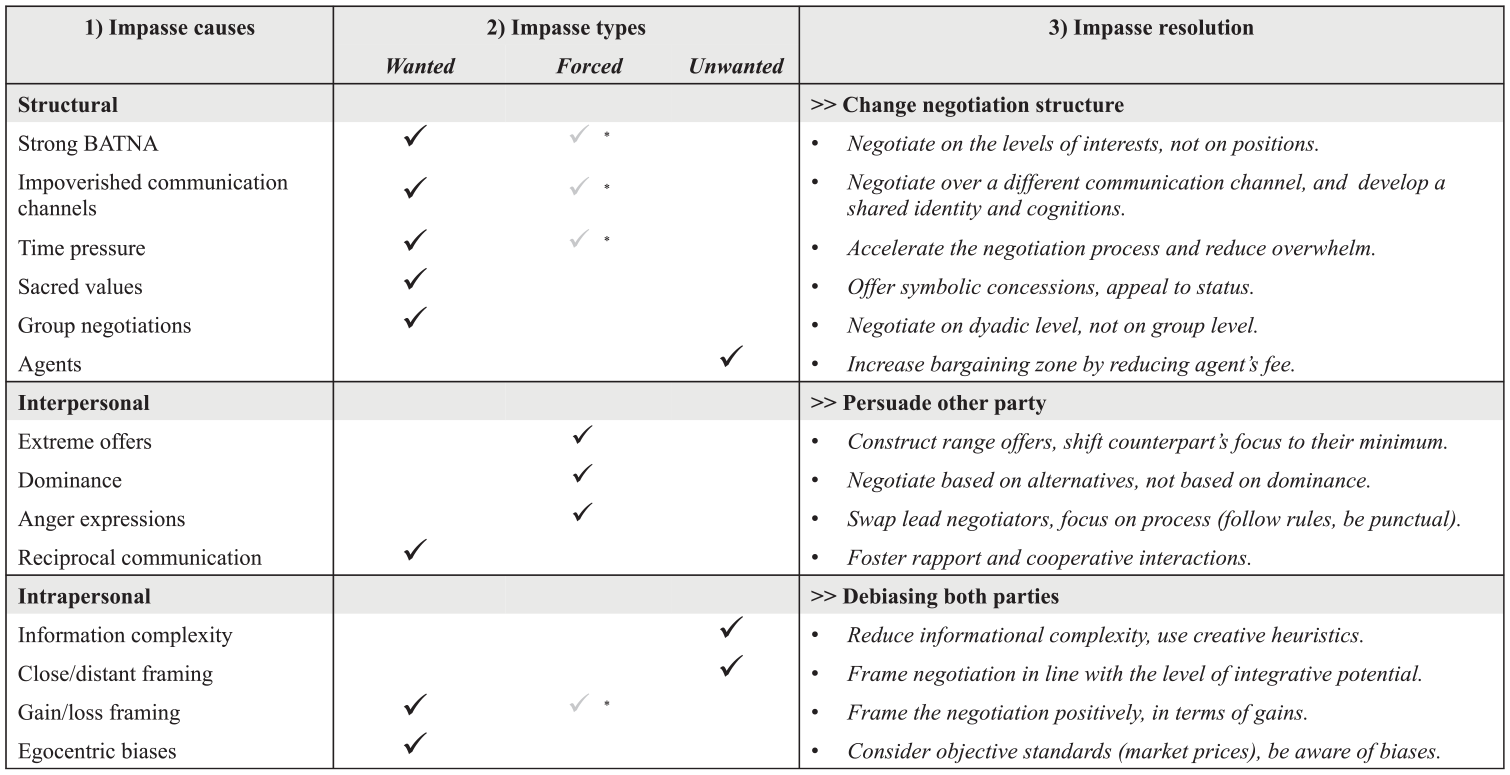
The Impasse Cause, Type, and Resolution Model (ICTR Model)
Our model highlights that an impasse is not necessarily a negative outcome of failed negotiations (see also Kesner & Shapiro, 1991) but—in the case of wanted and forced impasses—can reflect a strategic outcome that is desired (Coursey, 1982; Kang, Anand, Feldman, & Schweitzer, 2020). Negotiators may see an impasse to communicate toughness to the broader market in order to extract greater concessions. The bargaining zone may be a positive one, but reputation concerns of one party may lead to them seeing it as negative. Considering the wider context in which negotiations occur can turn a seemingly irrational failure into a reasonable success (Axelrod, 1984).
In other situations, both parties can benefit from an impasse, for example if they suspect their constituency is not ready for a deal now but will be at some point. Moreover, the assumption that an agreement is more desirable than an impasse is problematic: A poor agreement could have worse long-term outcomes than no deal (Hart & Schweitzer, 2020), ranging from instability of the contract to sabotage of the deal’s implementation to the potential cost of litigation—all of which could exceed the cost of a no deal.
Previous Reviews on Impasses
To the best of our knowledge, this is the first review of the impasse phenomenon targeted at management scholars beyond a textbook chapter (Lewicki, Saunders, & Barry, 2015) and a short section on impasses in Tripp and Sondak (1992), the latter devoted mainly to methodology and the findings of just four papers. The textbook chapter, albeit excellent, targets a student audience with practical advice on how to handle impasses. Of the 82 citations we found, 48% were practitioner-related and 28% were theoretical and review articles. Thus, not only is our review timely but can inspire further research on when and why impasses occur and how they can be resolved.
Literature Reviewed and Review Process
We hand-counted the number of total references across 13 recent literature reviews on negotiations (Bazerman, Curhan, Moore, & Valley, 2000; Bowles & McGinn, 2008; Carnevale & Pruitt, 1992; De Dreu, Beersma, Steinel, & Van Kleef, 2007; Druckman & Wagner, 2016; Jang, Elfenbein, & Bottom, 2018; Kelleher, 2000; Lewicki, Weiss, & Lewin, 1992; Malhotra & Bazerman, 2008; Thompson et al., 2010; Tsay & Bazerman, 2009; Tsay, Shu, & Bazerman, 2011; Wade-Benzoni, Plunkett Tost, & Li, 2007). We found a total of 2,207 references, 27 of them related directly to impasses (1.22%)—confirming that there is a gap in the literature on what is a fairly common experience.
We then reviewed 19 journals from management, psychology, and marketing in the Web of Science with relevant search terms (“*negotiation*” OR “*negotiations*” OR “*ultimatum game*” OR “*ultimatum games*” OR “*delta game*” OR “*delta games*”) and papers from other sources, for a total of 1,098 papers as of January 15, 2021, irrespective of whether they focused specifically on impasses. Studies that listed impasses as a variable (dependent/independent/mediator/moderator or control variables) are included in the main review below; those that merely listed impasses in the results but are not described as variables by the authors are reviewed in the methodological section.
Finally, we coded each individual study that listed impasses in any way in all 1,098 papers according to 10 categories related to causes. If the paper was empirical and contained multiple studies, we coded each study separately on whether (1) impasses were listed as dependent/independent/mediator/moderator or control variables. If not, we coded whether (2) the impasse cause could be classified as structural/interpersonal/intrapersonal and (3) the specific cause identified. We also coded (4) sample size, (5) whether the negotiation reported in the study occurred face to face/via email/audio only/via video, (6) whether the counterpart was another human participant/computer-simulated, (7) how impasses were treated in the data analysis: excluded/replaced with other value/other, and (8) whether specific negotiation exercises were used (to capture exercise-specific idiosyncrasies). Coding these features may yield insights into whether certain study features are over- or underused and whether they have sufficient realism. We also coded (9) whether the paper was an empirical study, a review, a practitioner- or modeling paper, and (10) whether situated in a specific literature.
Page constraints make it impossible to synthesize all articles found, so we selected the papers through a bottom-up process (reviewing all papers found) and a top-down process (selecting papers based on prior knowledge). To stimulate further research and for transparency, a database of all impasse articles found and coding steps appears here on https://negotiationimpasses.com and on OSF: https://osf.io/gx2tk.
Contributions
Our review increases current understanding of impasses in four distinct ways. First, it is the first to provide a comprehensive review of the empirical research on impasses. Sharing our literature search dataset should spur future research. Second, it conceptually integrates various findings into a new model of impasses, refines theory, and builds bridges to related management literatures. Third, our review summarizes three causes and three types of impasses and ways of resolving them. Finally, we provide a methodology for scholars on how to integrate impasses in study designs and data analyses.
Structural Impasse Causes
We define structural factors as pre-existing patterns that shape the negotiation independent of the individual negotiators or their relationship with one another (Neale & Bazerman, 1985). We differentiate between structural factors related to the negotiation situation (e.g., BATNA, communication channels, negotiations about sacred value issues) and those related to the negotiators (e.g., group and individual negotiations, representation by agents). As indicated, structural factors can lead to a wanted impasse when both parties are adversely affected by, for example, negotiating through certain communication channels, external time pressures, negotiating in groups, sacred values, and a narrow bargaining zone—and hence benefit from discontinuing the negotiation and either negotiating elsewhere or resuming once the constraints are removed. Structural factors lead to a forced impasse when one party is disproportionately affected—and thus seeks an impasse.
BATNA, Reservation Prices, and the Bargaining Zone
The key structural constraint on reaching a negotiated agreement is the best alternative to a negotiated agreement or BATNA (Fisher & Ury, 1981). Attractive alternatives make an impasse appealing (Raiffa, 1982) by prompting the negotiators to leave the current negotiation (Pinkley, Neale, & Bennett, 1994). They increase the likelihood of a negative bargaining zone where an impasse is the logical outcome. Yet even when there is a positive zone, an impasse can occur when strong alternatives motivate both parties to pursue value elsewhere and neither is worried about damaging the relationship (Arunachalam, Dilla, Shelley, & Chan, 1998; Morris, Larrick, & Su, 1999). Conversely, an impasse is less frequent when negotiators’ alternatives are weak (Babcock & Pogarsky, 1999). In sum, the alternatives available create an impasse (Pinkley et al., 1994; Raiffa, 1982)—a wanted impasse if both have strong alternatives; a forced impasse if only one party has.
However, the relationship between alternatives and impasses is not straightforward. Hüffmeier, Freund, Zerres, Backhaus, and Hertel (2014) find meta-analytical evidence that negotiators do not resort more to soft tactics (e.g., concessions) than hard tactics (e.g., extreme offers) when the risk of a costly impasse is high, suggesting that a forced impasse can be caused by factors other than alternatives (e.g., expressions of anger or dominance).
Communication Channels
The physical location, another structural factor, imposes the communication channels through which the negotiation occurs. When physically close, negotiators are more likely to negotiate via rich communication channels (high on sight/sound and synchronicity). When physically remote (and potentially in different time zones), communication channels are impoverished—low on sight/sound and synchronicity such as email or chat (Geiger, 2020)—which can lead to misunderstanding (Byron, 2008) and frustration. Unless the parties are engaged in a time-sensitive deal, both parties will benefit from an impasse until other channels offer improved information exchange.
Several studies suggest that an impasse is more likely when communication channels are poor. Parlamis and Ames (2010) found that email negotiations resulted in more impasses (50%) than face-to-face communications (30%). Johnson and Cooper (2009) found more impasses in instant messaging negotiations than in those conducted over the phone. Valley, Moag, and Bazerman (1998) found more impasses in written negotiations than in either face-to-face or over-the-phone negotiations. Swaab, Kern, Diermeier, and Medvec (2009) documented more impasses in three-party negotiations conducted over a chat system than face-to-face. While not all studies concur (Mahenthiran, Greenberg, & Greenberg, 1993; McGinn & Keros, 2002), the literature points to a link between impoverished communication channels, limitations on accurate exchange between negotiation parties, and a sense of frustration (Geiger, 2020). The associated costs create an incentive for a wanted impasse.
Swaab, Galinsky, Medvec, and Diermeier (2012) suggest that the effect of impoverished communication channels on impasses is moderated by the negotiators’ willingness to cooperate. Rich communication channels help cooperative negotiators avoid impasses but may increase the likelihood of an impasse if the intent of hostile negotiators is more easily detected. Building on this, we posit that cooperative negotiators using impoverished communication channels will experience wanted impasses as they are limited in their communications, hence frustrated, whereas hostile negotiators with rich communication channels will be subjected to a forced impasse as a form of punishment, that is, the other party abandons the negotiation (Yip & Schweinsberg, 2017).
Integrating the communication orientation model (Swaab et al. (2012) with ours sheds light on previously unexplained findings. Lewis and Fry (1977) conducted a 2 (Orientation Individualistic/Problem-Solving) × 2 (Visual Access: Yes/No) experimental study and found most impasses when individualistically motivated negotiators also had visual access, describing a situation that resembles our conceptualization of forced impasses. Similarly, Es, French, and Stellmaszek (2004) found lower impasse rates in ethically challenging negotiations when uncooperative negotiators communicated online than face-to-face. Wolfe and Murthy (2005) reported more impasses in face-to-face than electronic negotiations when negotiators were uncooperative due to divergent prenegotiation expectations but not when they had similar expectations. In sum, we posit that impoverished communication channels cause wanted impasses for cooperative negotiators but reduce impasses between hostile negotiators. Rich communication channels reduce wanted impasses for cooperative negotiators and forced impasses for hostile negotiators.
Time Pressure
Externally imposed time pressure is another structural factor that can fatigue negotiators, providing an incentive for a wanted impasse so as to negotiate under better conditions later or with another party under more favorable conditions. According to Moore (2004), increasing time pressure causes more impasses. A study by Ghosh (1996) found that procedural and logistic problems delayed counteroffers, accentuating time pressure and impasses. Negotiators submitted offers through a computer-interface, receiving an offer either immediately after the counterparts or after a 45-second delay. In the delayed offer condition, 46% of negotiations ended in an impasse; only 14% did in the no-delay condition.
In some contexts, time pressure is manufactured by a negotiator. For example, Glozman, Barak-Corren, and Yaniv (2014) found that negotiators used or initiated delays strategically until a new alternative appears or existing alternatives become more attractive. The deliberate use of time pressure is likely to cause a forced impasse and seems specific to delaying counteroffers as the number of breaks in a negotiation has no effect on the number of impasses (Harinck & De Dreu, 2008).
Sacred Values
Issues that can be defined as enshrining “sacred values” include negotiations over territory construed as “holy land.” We posit that such negotiations primarily cause a wanted impasse, particularly when negotiators identify with sacred values or belong to a group whose purpose is defined by them. In such cases, the issue is such a strong barrier to agreement that an impasse is preferred over resolving the conflict, since agreement would mean giving up a central aspect of one’s identity. If that identity is defined by hate of an out-group, for example, conceding to that outgroup would call into question a central aspect of the self and the purpose of the group (Ellemers, Spears, & Doosje, 2002).
Support for this argument comes from findings that negotiators are unlikely to concede when a counterpart’s goals directly threaten core aspects of the self (Wade-Benzoni, Hoffman, Thompson, Moore, Gillespie, & Bazerman, 2002) and are amplified in intergroup contexts in which competition increases the importance of what is at stake (Böhm, Rothermund, & Kirchkamp, 2013). Value negotiations therefore often result in more impasses (Schuster, Majer, & Trötschel, 2020; Tenbrunsel, Wade-Benzoni, Tost, Medvec, Thompson, & Bazerman, 2009) than structurally equivalent negotiations over other resources. For example, when Ginges, Atran, Medin, and Shikaki (2007) asked people involved in a conflict over sacred values (e.g., Israeli settlers and Palestinian refugees) to evaluate different offers—from exchanging land for peace, to sovereignty over Jerusalem, to accepting the validity of others’ sacred values—they found that the very same negotiation strategies that helped in typical negotiations (such as offering economic compensation) backfired in the presence of sacred values because recipients felt insulted by the assumption that they would abandon their sacred values for money.
Group and Individual Negotiations
Another structural factor is whether negotiators negotiate as a team or alone. Although teams are often better at maximizing joint value (Thompson, Peterson, & Brodt, 1996), they more often reach an impasse. Being part of a group makes individuals more competitive (Winquist & Larson, 2004). Teams reward members who act tough (Wildschut & Insko, 2007) and are more competitive than individual members. This, combined with group polarization (Myers & Lamm, 1975), may translate into heightened aspirations, more ambitious goals, and extreme first offers—the latter conducive to reaching an impasse (Schweinsberg, Ku, Wang, & Pillutla, 2012).The effect is so strong that the mere perception of a negotiation as an intergroup situation is enough to cause an impasse (Trötschel, Hüffmeier, & Loschelder, 2010). Since the perception is shared, the team context increases the likelihood that both teams want an impasse rather than a deal that does not satisfy their (polarized) aspirations.
Negotiations With Agents
In negotiations where the parties pay an agent to negotiate on their behalf, an impasse is more likely than direct negotiation without representatives or negotiations facilitated by a mediator (Bazerman, Neale, Valley, Zajac, & Kim, 1992). One reason is that the agent’s compensation shrinks the bargaining zone, which may already be tight. This can be conceptualized as an unwanted impasse, as people are likely to incur the cost of an agent if they are keen to reach agreement.
Interpersonal Impasse Causes
Interpersonal causes emerge as a result of interactions between negotiators. The studies reviewed below suggest that when such interactions threaten the relationship, negotiators are more likely to force an impasse on their counterpart. We consider two manifestations—tough negotiation tactics and expressions of anger—as interpersonal factors in forced impasses and two preventive factors—a long-term relationship between negotiators and communication patterns that promote long-term relationships.
Tough Negotiation Tactics
Tough negotiation tactics are used to claim value by extracting concessions from the counterpart, whereas soft tactics encourage cooperation by offering concessions or by trying to understand and accommodate the counterpart. Interviews conducted with negotiation specialists reveal that both tough tactics and inadequate social behavior can lead to an impasse (Mertes & Hüffmeier, 2017). For example, extreme first offers may help to claim more value (Galinsky & Mussweiler, 2001) but can also threaten the relationship between negotiators. Using ultimatum games, Pillutla and Murnighan (1996) showed that extreme offers can prompt a spiteful reaction and ultimately the rejection of the offer. They may lead to an impasse if the negotiating partner is offended (Schweinsberg et al., 2012). Other work has identified the psychological mechanisms that determine when recipients consider offers extreme. Supporting the view that offers are understood as extreme relative to other values, Kristensen and Gärling (1997) found that first offers led to more impasses when perceived as a loss than a gain. Sinaceur, Maddux, Vasiljevic, Nueckel, and Galinsky (2013) found that the timing as well as the extremity of the first offer mattered: When made later in the negotiation (as opposed to earlier on), it facilitated information exchange, which reduced the likelihood of an impasse. A similar effect occurred when range offers were made (e.g., “I expect to sell the car for $5,000 to $7,000”; Ames & Mason, 2015) and when an extreme offer highlighted the structural limits (Lee & Ames, 2017). In related work in economics on commitment tactics, Schelling (1956) argued that committing to extreme positions in distributive negotiations could help negotiators claim more value but at the increased risk of an impasse. Mathematical models formalize these claims (Brams & Doherty, 1993), showing that commitment tactics are beneficial when uncertainty is high (Crawford, 1982) but also highlight the risk of impasses even for public commitments (Ellingsen & Miettinen, 2008).
Another aspect of the conversation that causes impasses is paltering or the deliberate use of truthful statements to mislead one’s counterparts (Rogers, Zeckhauser, Gino, Norton, & Schweitzer, 2017). Commitment tactics, disparaging remarks, and paltering are likely to be perceived as tough tactics, triggering mostly forced impasses that are motivated by the desire to punish negotiators who use them.
Finally, forced impasses are used by negotiators to punish counterparts who threaten the relationship by seeking to dominate yet lack the structural alternatives to make them truly powerful. Manipulating both power and dominance, Wiltermuth, Raj, and Wood (2018) found that low-power negotiators who acted dominantly had more impasses, especially if their counterpart had an attractive alternative and could force an impasse.
Expressions of Emotion
Emotions expressed in a negotiation communicate relevant information to others (Van Kleef, 2009), as documented for expressions of anger that cause an impasse. Friedman, Anderson, Brett, Olekalns, Goates, and Lisco (2004) quantified the texts that users submitted on ebay.com’s conflict-resolution platform. Coding words such as hate or pissed as indicative of anger, they found that a complaint’s level of anger was positively related to impasses, whereas the level of solution-orientation was negatively related to impasses. Yip and Schweinsberg (2017) provide experimental evidence that anger expressions cause impasses; negotiators in their study gave up financial rewards to punish angry counterparts whom they perceived as selfish by forcing an impasse on them (see also Pillutla & Murnighan, 1996). In multiparty negotiations, expressions of anger have been found to cause impasses and the exclusion of angry negotiators from lucrative deals (Van Beest, Van Kleef, & Van Dijk, 2008). Timing also seems to matter: Early compared to later expressions (Yip & Schweinsberg, 2017) and constant compared to negotiations where negotiators “became angry” over time (Filipowicz, Barsade, & Melwani, 2011) led to more impasses.
Although emotions send social signals to others (Van Kleef, 2009), they are also internally experienced and as such can cause an impasse. Brooks and Schweitzer (2011) found that experiencing anxiety could cause negotiators (with low levels of self-efficacy) to exit a bargaining context and to exit it earlier than if they were in a neutral emotional state. The effects of experiencing emotions on impasses are complex as they interact with cognitive and social mechanisms. For example, a state of fear (versus being tranquil) reduces the likelihood of an impasse if there is a “chance” of winning a court case rather than it being “doubtful or probable” (Tuncel & Bottom, 2019), and high-power negotiator’s affect is more predictive of an impasse than low-power negotiator’s affect (Anderson & Thompson 2004). Thus, a negotiator’s emotional state seems to interact with cognitive and social factors in ways that seem counterintuitive. In sum, the emotions negotiators perceive in their counterparts or experience themselves can prompt them to force an impasse on their counterparts.
Quality of Relationships and Relational Needs
We now review two interpersonal factors that tend to act as buffers against impasses. The first is that people who like each other tend to care more about the outcome for the other party. Negotiators who care about the counterpart (Pruitt & Rubin, 1986) experience fewer impasses than those who care more about their own needs (Beersma & De Dreu, 1999; Carnevale & Lawler, 1986; Weingart, Bennett, & Brett, 1993). Relationships that form over time can buffer against destructive behavior and subsequent impasses because the parties know each other and are willing to forgive various transgressions. Accordingly, research shows that the very same behavior that leads to a forced impasse when it occurs early in a negotiation does not do so after negotiators have built a relationship (see, e.g., Yip & Schweinsberg, 2017, on early versus late expressions of anger). Other studies show a similar pattern, with impasses occurring predominantly in the early stage of multiperiod negotiations before a relationship exists (Fisher, Frederickson, & Peffer, 2006).
The relationship thus formed prevents an impasse because the negotiators understand their counterpart’s preferences—rather than only relying on perspective-taking, defined as “imagining the world from another’s vantage point or imagining oneself in another’s shoes” (Ku, Wang, & Galinsky, 2015). Perspective-taking can improve negotiations by providing insights into the counterpart’s preferences—particularly an unknown counterpart’s preferences—making impasses less likely (Kolodziej, Hesse, & Engelmann, 2016). Since a direct knowledge of the counterpart’s preferences is rare, the negotiator relies on indirect methods. Galinsky, Maddux, Gilin, and White (2008) showed that perspective-taking reduced impasses by helping negotiators focus on their counterpart’s interests, not just their own position. Taken together, these studies suggest that an existing relationship acts as a buffer against a costly impasse.
Communication Patterns
Communication patterns, like the findings on relationships, are indicative of an existing relationship and facilitate the development of a relationship. Not all studies identify discrete impasse causes (Olekalns, Smith, & Walsh, 1996), but many identify the rapport between negotiators as decisive for reaching agreement vs. an impasse. Jap, Robertson, and Hamilton (2011) found that rapport or interpersonal communications marked by positive affect, mutual attentiveness, and a high degree of synchronization (Tickle-Degnen & Rosenthal, 1990) prevented impasses in negotiations. Rapport often develops as negotiators synchronize their behavior and reciprocate the other’s actions (Maddux, Mullen, & Galinsky, 2008). In one study, negotiators who focused on building rapport by opening up about themselves and their thoughts on the negotiation process had fewer impasses than negotiators who discussed logics of exchange such as discussion on “deciding to work together” or haggling about positions (McGinn & Keros, 2002). Rapport can even allow negotiators to reach an agreement that goes against their interests (Jap et al., 2011).
However, reciprocal communication patterns can also cause an impasse, notably in a context of competitive interactions. For example, negotiators who reciprocated each other’s attacks had more impasses than negotiators who reciprocated less (Kiser, Asher, & McShane, 2008). Olekalns and Smith (2000) explicitly coded the strategies negotiators used and found that impasses were characterized by contention and reciprocal sequences of both cooperative and competitive strategies. The same pattern can be observed for the language patterns negotiators use. Ireland and Henderson (2014) report that “linguistic matching” positively predicts impasses for negotiators focused on personal gain. Taylor and Thomas (2008) found that linguistic mimicry positively predicted agreements in hostage negotiations. Maddux et al. (2008) manipulated mirroring experimentally and found that 67% of dyads achieved an agreement when buyers mimicked the seller’s body-language; 12.5% did so if they were not instructed to mimic the counterpart.
Collectively, these studies suggest that reciprocal communication fosters rapport and facilitates agreement when the nature of the interaction is cooperative but that reciprocity can cause wanted impasses when the interaction is competitive.
Intrapersonal Impasse Causes
An impasse may result from a distortion of individual preferences as a result of cognitive mechanisms that create bias in the way the negotiation situation is perceived. We characterize such instances as unwanted impasses.
Information and Framing
An impasse can be caused by too much or too little negotiation-relevant information. An impasse is more likely when negotiators do not know enough about their counterparts’ goals and preferences (Babcock & Olson, 1992; Myerson, 1986). Conversely, Wiltermuth and Neale (2011) show that an excess of nondiagnostic information can also reduce information-exchange and thereby prevent negotiators from making the tradeoffs required to come to an agreement, resulting in impasses. This finding is consistent with both empirical research (Thompson & Loewenstein, 1992) and formal models (Moon, Yao, & Park, 2011) showing that informational complexity can cause impasses.
Another subtle influence stems from whether negotiations are framed as either psychologically distant or psychologically close (Giacomantonio, De Dreu, & Mannetti, 2010). When framed as psychologically close (happening soon or close-by), an impasse is more likely when the integrative potential resides at the level of interests. When framed as psychologically distant (in the future or far away), an impasse is more likely when the integrative potential resides at the level of positions. More impasses occur when negotiators’ preferences are represented numerically than displayed affectively with happy/unhappy smiley faces (Conlon & Shelton Hunt, 2002). Negotiators are unlikely to be aware of these intricate interdependencies and may still walk away from a negotiation impasse despite overlapping interests, thus our belief that these intrapersonal factors predominantly result in unwanted impasses.
Information can cause wanted or forced impasses depending on whether the negotiation is framed as a loss or gain situation. People are generally more motivated to avoid losses than to seek gains (Baumeister, Bratslavsky, Finkenauer, & Vohs, 2001; Kahneman & Tversky, 1979). If framed negatively (as a loss to avoid), an impasse is more likely than if framed positively (as a gain to make), whether in free market negotiations (Neale & Bazerman, 1985) or in a simple dyadic negotiation (Bottom & Studt, 1993; Moran & Ritov, 2009). Importantly, some resources are intrinsically perceived as losses to be avoided (waste, debt) and are therefore more likely to end in an impasse than those intrinsically perceived as gains (gold, energy) (Trötschel, Höhne, Peifer, Majer, & Loschelder, 2015). Depending on whether the frame of loss is the same for both parties or different, the impasse that follows could be wanted or forced.
Egocentric Biases
Negotiators tend to have an egocentric perception of fairness and conflate what is objectively fair with what is beneficial to the self (Babcock & Olson, 1992). This tends to increase the negotiator’s reservation price so that the bargaining zone is minimized or eliminated, causing objectively fair proposals by the counterpart to be seen as aggressive or unfair (Babcock & Loewenstein, 1997) and creating an impasse (Babcock, Loewenstein, Issacharoff, & Camerer, 1995; Babcock, Wang, & Loewenstein, 1996; Loewenstein, Issacharoff, Camerer, & Babcock, 1993). Egocentric perceptions are a result of negotiators weighing objectively ambiguous information in a self-serving manner (Hippel & Hoeppner, 2019). Egocentric perceptions increase with negotiation complexity and motivate a negotiator to incur higher impasse-related costs for both parties (Thompson & Loewenstein, 1992).
Negotiators not only compare the negotiation situation in a self-serving manner with an internal standard but also engage in self-serving social comparisons with others. Babcock et al. (1996) found that teacher unions compared their salary demands to those in the highest paid districts, whereas school boards compared their salary offers to those in lower paid districts. Self-serving social comparisons created an impasse by maximizing the difference between themselves and their counterparts. Negotiators may even compare themselves with imagined comparison targets who do not actually exist (Schaerer, Schweinsberg, & Swaab, 2018). Imagining attractive alternatives to the current negotiations raises aspirations for their current negotiation, causing divergent expectations that likely lead to wanted impasses.
To sum up, egocentric perceptions of fairness (Babcock & Olson, 1992) and making biased social comparisons with real (Babcock et al., 1996) and imagined others (Schaerer et al., 2018) prompt wanted impasses as they transform the preferences of the negotiators.
Review of Impasse Consequences and How to Resolve Them
We now review empirical findings on how the three impasse types can be resolved, with suggestions based on experience and best practice (Susskind, Cruikshank, & Amy, 1987).
Resolving Wanted Impasses
Not all wanted impasses need resolving. Some, however, can be transformed into an agreement by changing the negotiation structure or process for both parties. Structural impasses due to narrow bargaining zones can be resolved by negotiating at the level of interests rather than positions (Fisher & Ury, 1981) and adding issues to the negotiation (Raiffa, 1982). These strategies also help negotiators reach an integrative solution.
To illustrate advice that has demonstrably resolved impasses in empirical studies—such as solutions to impasses that occur because of impoverished channels—Morris, Nadler, Kurtzberg, and Thompson (2002) found impasses in virtual negotiations were reduced from 60% to 40% when negotiators had a simple “schmoozing” phone conversation to get to know each other (see also Nadler, 2004). Impasses may also be avoided in virtual negotiations when negotiators develop a shared identity and shared cognition, for example by providing access to the same kind of information (Swaab, Postmes, & Neijens, 2004).
Externally imposed time pressure can reduce impasses (Stuhlmacher, Gillespie, & Champagne, 1998) but may also cause wanted impasses when it makes negotiators feel overwhelmed, especially in complex negotiations (Moberly, 1970). Negotiators can overcome this by reducing informational complexity (Wiltermuth & Neale, 2011) and interpersonal complexity, for example by replacing group-level with individual-level negotiations (Wright, 2014). Alternatively, they can leverage additional resources to reduce time pressure and avoid wanted impasses.
Negotiations over sacred values result in wanted impasses because negotiators prefer an impasse over an agreement that could potentially threaten their identity. Symbolic concessions that are meaningful to the counterpart are therefore highly effective (Ginges et al., 2007), whereas economic offers are not. In their absence, negotiators can also resolve value negotiations by reframing, repositioning, and reprioritizing the negotiation (Argo & Ginges, 2015). Bendersky (2014) found that affirming the counterpart’s status improved the relationship, helped save face, affirmed their self-identity, and thus spurred concessions and a willingness to sacrifice their own outcomes.
Group negotiations amplify competitive tendencies between negotiators, which can result in wanted impasses. Insights from academic studies (Böhm et al., 2013; Loschelder & Trötschel, 2010) and practitioners suggest that moving from group to dyadic negotiations between group leaders can weaken the competitive effect and facilitate agreement (Reynolds, 2007; Wright, 2014), as illustrated in international politics where various routines, guidelines, scripts, and formal rules result in an integrated protocol that fosters the relationship between negotiators and thereby avoids wanted impasses (Marshall, 2020).
Wanted impasses caused by intrapersonal bias can be resolved by debiasing the parties’ perceptions. Egocentric perceptions of fairness may be attenuated by considering objective standards such as market prices or increasing awareness of the self (Greenberg, 1983). Similarly, the reactive devaluation bias is attenuated with simple self-affirmation interventions (Ward, Atkins, Lepper, & Ross, 2011). Finally, some issues are inherently construed as losses (e.g., debt, waste), and so negotiators can avoid wanted impasses resulting from these by reframing them as gains (Trötschel et al., 2015).
Resolving Forced Impasses
Interpersonal factors can result in a forced impasse where one party imposes an impasse on the other. Tough tactics such as extreme first offers can offend recipients, resulting in forced impasses (Schweinsberg et al., 2012). Negotiators can minimize this risk by understanding that offers are extreme only in relation to other values. Range offers (“I can sell the apartment for $300,000 to $350,000”) can be used to anchor the negotiation in their favor, reducing the risk of an impasse (Ames & Mason, 2015).
When faced with hard bargaining strategies (Hüffmeier et al., 2014), some practitioners (Shell, 2018) urge negotiators to “split the difference” in the context of a purely distributive issue in which no more value-generation is possible, although some advise against this (Voss & Raz, 2016). Splitting the difference can help negotiators avoid a forced impasse if a win can help secure more negotiation and value creation on other issues.
When a counterpart continues to bargain hard despite what they are offered, it could be that they are not being offered what is important to them—only what their counterpart mistakenly believes to be important to them. Here, perspective-taking allows negotiators to understand what the counterpart values most and can help avoid an impasse (Galinsky et al., 2008; Neale & Bazerman, 1983). It can also motivate selfish negotiators to become prosocial, presumably preventing them from forcing an impasse on their counterparts (Trötschel, Hüffmeier, Loschelder, Schwartz, & Gollwitzer, 2011).
Negotiators can overcome forced impasses by improving the relationship and the way their counterpart feels about it. A soured relationship between negotiating parties can make a fresh start by swapping lead negotiators (Shell, 2018). Negotiators who have to deal with counterparts they deeply dislike, or even hate, are advised to build a relationship by focusing on good processes, such as sticking to “process rules” and being punctual (Powell, 2014).
Finally, when a negotiator’s relational needs are threatened and trigger forced impasses, third-party interventions in the form of mediation or arbitration may help, especially when the level of conflict is high (Bigoness, 1976). Farmer et al. (2004) show that aggressive offers cause impasses and that subsequent arbitration attenuates such demands in the future. Negotiating parties who know that an impasse will be ruled upon by an independent arbitrator in a legally binding manner may make more concessions and refrain from forcing an impasse on their counterpart (Mentschikoff, 1961). Arbitration helps negotiators overcome the potential effects of impasses (Staudohar, 1975). They resort to arbitration when the costs are low (Ashenfelter, Currie, Farber, & Spiegel, 1992; Neale, 1984).
Resolving Unwanted Impasses
Unwanted impasses caused by either too little information (Babcock & Olson, 1992; Myerson, 1986) or by too much information (Wiltermuth & Neale, 2011) can be resolved by making information accessible or by thorough preparation to distinguish irrelevant from relevant information. Negotiators can also avoid unwanted impasses by processing and recombining information more creatively. Spector (1995) experimentally induced “creativity heuristics,” which helped negotiators resolve impasses through creative insights. Negotiators with multicultural experience (Maddux, Lu, Affinito, & Galinsky, 2021) who had lived abroad avoided unwanted impasses by negotiating more creatively (Maddux & Galinsky, 2009). Unwanted impasses can also be resolved by addressing the negotiator’s mindsets: Kray and Haselhuhn (2007) show that a “growth” mindset—the belief that negotiations can be learnt—reduces impasses. Ma, Yang, and Savani (2019) show that a “choice” mindset—the belief that a negotiator has freedom to choose—reduces impasses.
Methodological Recommendations
Negotiation Exercise Recommendations
In classroom and laboratory situations, impasses are rare. Their prevalence in the real world (29% of negotiations, according to our survey) is not mirrored in the negotiation literature. Fifty-nine percent of the studies coded for our literature review did not mention impasses at all in the Results section. The choice of research design or choice of data analytics may suppress impasses. This lowers the external validity of negotiation tasks and of the inferences drawn from using them in research. Consider a cross-cultural study with American and Taiwanese negotiators (Gelfand et al., 2013) in which 29% of negotiations in Study 1 ended with an impasse (15 impasses in the Taiwanese sample, 2 in the American), but because agreements were of theoretical interest, these 29% were not informative for the specific research question asked.
The instructions for the second study in this paper therefore included an additional sentence “Your goal is to negotiate an agreement worth as many points as possible. To reach an agreement with Martin [Sands], you must gain at least 100 points” and a few additional questions after the negotiation ended. This seemingly minor change was a dramatically successful “attempt to reduce the impasse rate” (p. 508). In the otherwise identical Study 2, only 1.15% of negotiations ended in an impasse (1 impasse in the Taiwanese sample out of 87 negotiations across conditions). The simple change in instructions suppressed the impasse rate from 29% in Study 1 to 1.15% in Study 2.
This is just one illustration of how sensitive participants and impasse rates are to instructions. Scholars should consider how seemingly minor psychological, instructional, and structural artefacts combine to suppress impasses and result in an unrealistic absence of impasses in empirical studies (see Table 1). On the psychological level, they should reconsider how the demands made by experiments in laboratories, by professors, and by peer pressure in classrooms push participants to reach agreement.
Three Methodological Factors Associated With Suppressing Impasse Rates and Proposed Alternatives
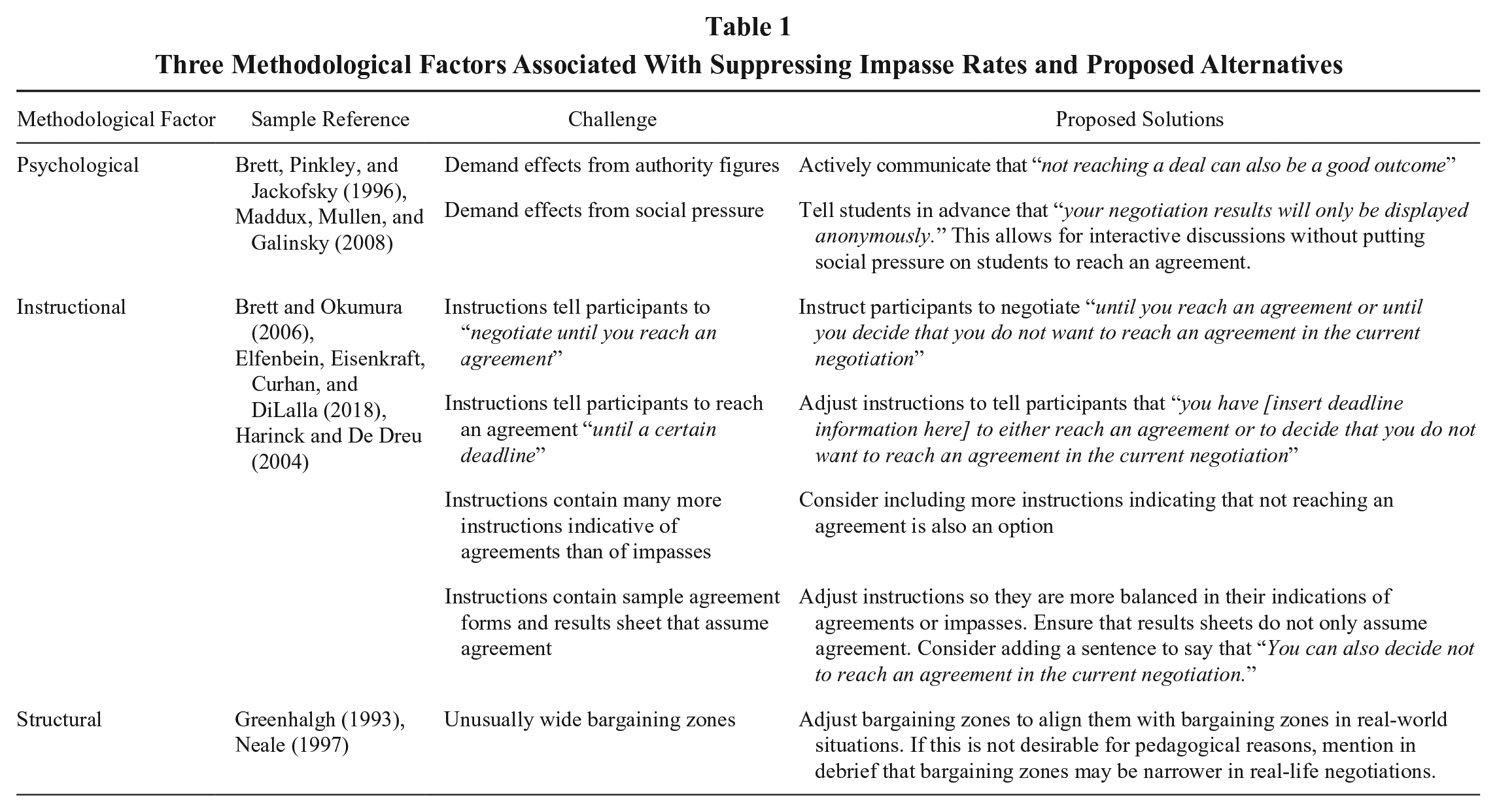
Negotiation case instructions include both subtle and direct appeals to reach agreement. Participants may be told explicitly to “negotiate until you have come to an agreement” (Brett, Shapiro, & Lytle, 1998; Sharma, Elfenbein, Foster, & Bottom, 2018). Making participant compensation contingent on reaching agreement virtually guarantees the absence of impasses and is very common. Hüffmeier et al. (2014: 878) found that 63.7% (86) of the effect sizes in their meta-analysis made rewards contingent on reaching agreement. Instructions can nudge participants towards agreement in more subtle ways; for example, the forms and results sheets assume agreement (see https://osf.io/gx2tk).
On the structural level, agreement in negotiation studies is facilitated by unusually large bargaining zones that virtually guarantee agreement. Ghosh (1996: 316) explicitly mentions that “to encourage agreements, the profit schedules have a large range of satisfactory agreements that the negotiators should consider preferable to impasse.” The discrepancy between wide bargaining zones in exercises and narrow ones in many real-world negotiations (Chandra et al., 2017; Halstead, 2018; Merlo & Ortalo-Magné, 2004) suggests that more realistic sampling would increase both mundane and psychological realism for such tasks and lead to more valid inferences about the prevalence and causes of impasses.
Data Analysis Recommendations
No uniform approach to analyzing impasses in negotiations data exists (Traavik, 2011). The existing advice (Tripp & Sondak, 1992) offers scholars limited guidance, resulting in fragmented approaches to analyzing impasses. De Dreu, Weingart, and Kwon (2000) coded a sample of 34 studies and found that 20 studies replaced impasses with some other value (midpoint value: k = 15; reservation value: k = 5) and 14 studies reported no impasses. For this review, we coded k = 1,015 studies across 1,098 papers on a more detailed coding scheme and found considerable variance in how impasses are analyzed. Although they likely overrepresent studies on impasses, 58%, or more than half (k = 585), ignore impasses and do not mention them in the results section. Less than a third mention impasses in the results in some way (k = 166), suggesting that some of the methodological features discussed previously prevented impasses emerging, so that “no impasses occurred” (k = 62) or suppressed them to negligible levels, such that scholars in many other studies (k = 98) excluded impasses from their analysis or treated them as missing data (k = 10). Few studies replaced impasses with another value (k = 61). Most (19/61) replaced impasses with the negotiator’s BATNA, 16/61 replaced impasse with “0,” or some treated it as missing data (12/61). Other studies (12/61) replaced impasses with a minimum value (Van Kleef, Steinel, & Homan, 2013), the lowest score obtained by any negotiating dyad (Beersma & De Dreu, 2005; Giacomantonio et al., 2010), or the lowest joint score theoretically possible (Van Kleef et al., 2013). Finally, 2/61 replaced impasses with scores representing the midpoint across different issues.
Other approaches have emerged (k = 33): Brett et al. (1996: 132) code impasses as “0” for outcome variables in the table of study variables, excluding them for hypothesis-testing analyses. Bowles, Babcock, and McGinn (2005) apply a statistical technique (Heckman, 1979) to analyze deals even when impasses are distributed unequally across conditions. This fragmentation arises as little guidance on how to analyze impasses exists (Traavik, 2011). Even the most cited paper on analyzing impasses (Tripp & Sondak, 1992: 276-277) provides limited guidance and mostly discusses how to analyze joint agreements. Tripp & Sondak (1992) describe problems with four ways of analyzing impasses and make two recommendations. First, if negotiators have no alternative value in case of an impasse, treat impasses as missing data for negotiation outcomes. Yet since scholars are unsure how to analyze missing data (Graham, 2009; Peugh & Enders, 2004), this replaces one uncertainty with another. Second, if a BATNA or reservation price is provided to negotiators, replace impasses with that value. All other nonoutcome measures (e.g., negotiation satisfaction, affect) should include data from dyads who reached an impasse. However, this advice (Tripp & Sondak, 1992) has been largely ignored. None of the studies reviewed by De Dreu et al. (2000) followed their recommendation. In our bigger sample of 1,015 empirical studies, we only coded 10 studies across 4 papers that follow it. The second guideline was followed by 20 of the studies reviewed by De Dreu et al. (2000), and 19 of the 1,015 studies we coded.
It therefore seems timely to provide practical, transparent, and comprehensive advice to help scholars analyze negotiation impasses. We base our recommendation on two insights. First, only replacing an impasse with a predefined value analytically constrains the range of negotiated outcomes and does not capture conceptually what it means to reach an impasse. A data-analytic strategy should recognize the full range of the phenomena of negotiated outcomes and acknowledge that a negotiated agreement is conceptually distinct from an impasse. Second, impasses are conceptually multifaceted so negotiators can realize value outside the focal negotiation through their alternatives. This value can even be higher than the potential value to be realized in the negotiation, especially for forced and wanted impasses. It is crucial to acknowledge both aspects when analyzing impasses. Recent advances in statistical methods (Liu, Kale, Althoff, & Heer, 2021; Steegen, Tuerlinckx, Gelman, & Vanpaemel, 2016) suggest that such phenomena are best understood by reporting more than one analysis. Although different operationalizations have been reported (Elfenbein, 2015; Traavik, 2011; Van Kleef et al., 2013), they do so in different ways, potentially fragmenting the field’s approach to analyzing impasses even further.
We therefore recommend scholars to analyze impasses as follows:
Report the frequencies of how impasses and agreements are distributed across experimental conditions. This captures the distribution of outcomes in the clearest possible way, indicating the number of agreements and impasses per condition.
If the theory allows for a prediction of whether variation in the independent variable predicts impasse versus no impasse, then use data-analytic strategies that allow for a binary prediction/inference (e.g., logistic regression).
Report descriptive statistics (means, standard deviation, range) of all agreements, excluding impasses. This captures the average amount of value created as a direct result of the focal negotiation. If the theory is only interested in predicting the quality of agreements and has no scope to predict impasses, use data-analytical strategies that allow for continuous prediction/inference (e.g., linear models). To maximize informational value for future research on impasses, report whether the independent variable(s) predict impasses as in (2).
Report descriptive statistics (means, standard deviation, range), including impasses. Impasses can be replaced with the BATNA or reservation price if the instructions contained these values. This captures the total amount of value created directly through the focal negotiation and indirectly through the negotiator’s alternatives. If the instructions contain no BATNA or reservation price, there is no clear basis on which to determine the value of an impasse and they should not be replaced.
Discussion and Future Research
This conceptual integration aims to guide future research in three ways. First, it can motivate new research into impasses given that impasses are no longer misconstrued as dyadic negotiation failures. We build on an emerging perspective that calls for negotiations to be studied in the wider organizational context (Jang et al., 2018), suggesting practical solutions so scholars can also consider negotiations that do not end in agreement. Furthermore, we suggest that the impasse type in one negotiation will have a crucial influence on subsequent negotiations. A negotiator may be likely to accept a relatively weak deal in Negotiation 2 if an impasse was forced upon her in Negotiation 1. Conversely, she may only accept a relatively strong deal in Negotiation 2 if she forced an impasse upon her counterpart in Negotiation 1. These spillover effects may help to understand how organizational actors contain the spillover from an impasse on one topic (e.g., failure to agree on a task assignment) to other aspects of the relationship (e.g., willingness to provide help).
Second, this conceptual integration may help management scholars understand the mechanism underlying challenges across domains and organizational levels. Scholars of global virtual teams can disentangle the structural impasse causes specific to these teams such as physical distance (Hinds & Mortensen, 2005) and email communication (Byron, 2008) from interpersonal and intrapersonal impasse causes common to all teams. This more nuanced understanding can also help practitioners work more effectively in global virtual teams. The ICTR model can advance the work relationships literature (Ferris, Liden, Munyon, Summers, Basik, & Buckley, 2009) by identifying which impasse types negatively influence future interactions and help leadership scholars understand which individual-level motivation and associated impasse type lead to individuals exiting the organization rather than staying on and voicing discontent (c.f., Withey & Cooper, 1989). On the organizational level, interorganizational formal agreements (Powell, Koput, & Smith-Doerr, 1996) depend on individual agreements (or impasses) and intraorganizational constraints can be a source of impasses (Mintzberg, 1983). The ICTR model could help scholars of organizational networks and alliances (Gulati, Nohria, & Zaheer, 2000) understand when impasses between organizational representatives can still result in formal interorganizational ties.
Footnotes
Acknowledgements
The authors would like to thank Zainab Mohammed, Ziauddin Nasrullah, and Katherine L. Mclain for their help as research assistants and Hazel Hamelin for helpful comments.

Supplemental material for this article is available with the manuscript on the JOM website.