




Abstract

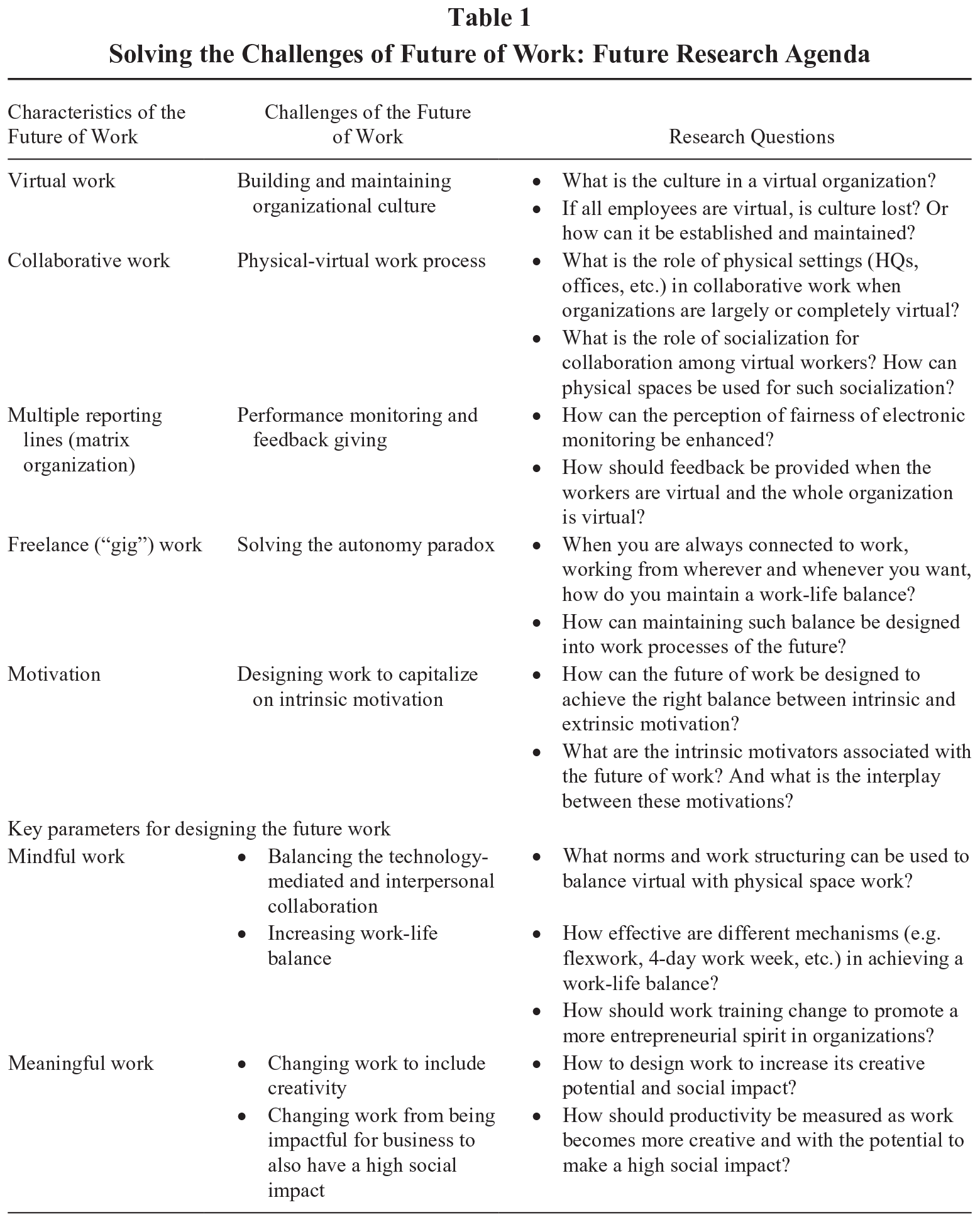
Much of the attention on the future of work has been on the relationship between artificial intelligence (AI), robotics, and humans. A limited focus has been on what will be desired in the work itself. The COVID-19 pandemic has accelerated the pace of change in organizations toward the future of work. Individuals are now more than ever better equipped for global collaboration. They have realized new ways of accomplishing their tasks using technology. As individuals adapt to these new ways of working, organizations have to rethink how they structure themselves for the future of work. The Editorial team at the Journal of Management has commissioned this guest editorial to consider the challenges (Figure 1) that the postpandemic future of work poses to individuals and organizations. This editorial also highlights future research opportunities to address the questions (Table 1) related to the future of work in the postpandemic era.
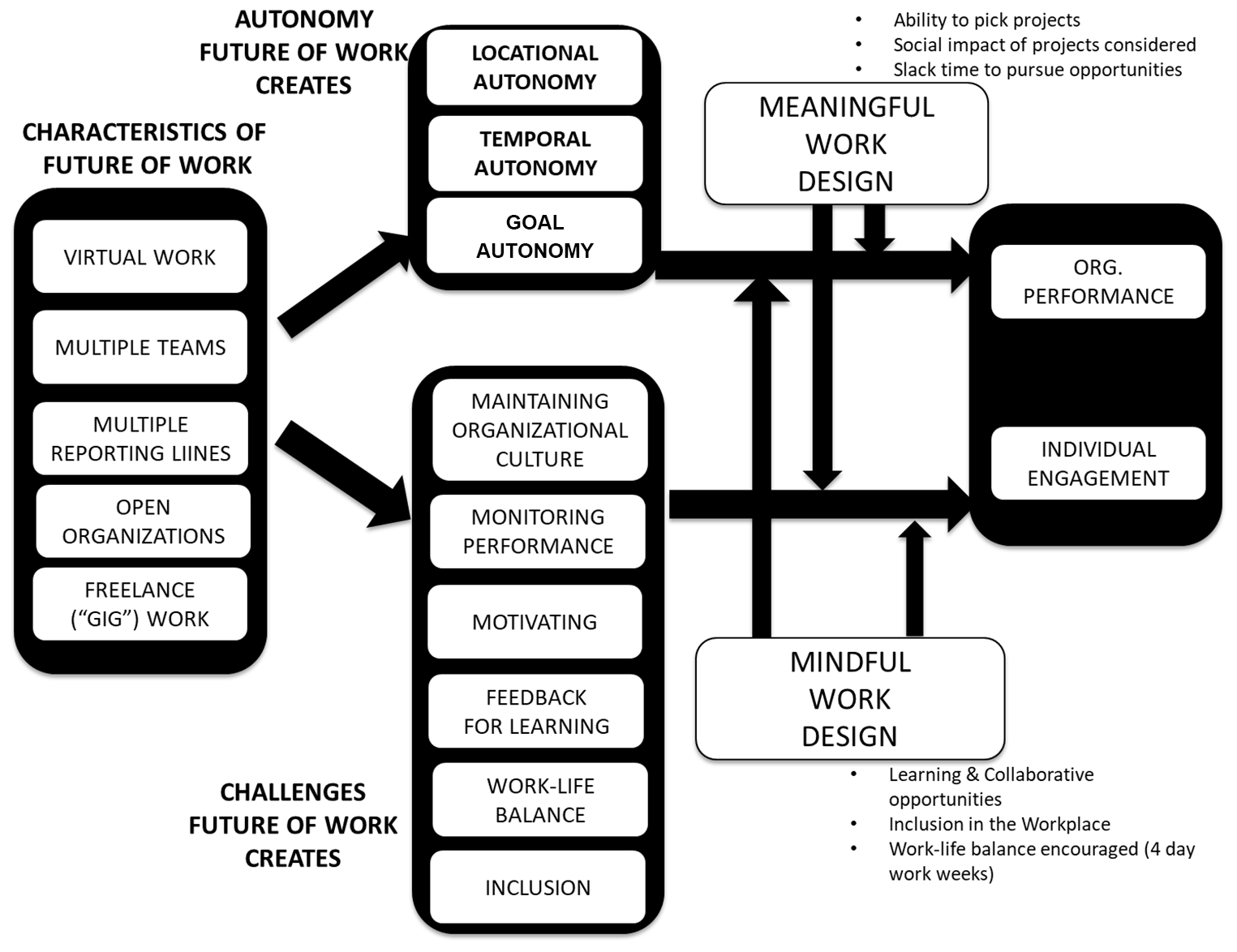
Characteristics, Challenges, and Design of the Future of Work
Solving the Challenges of Future of Work: Future Research Agenda
Characteristics of the Future of Work
Knowledge work will increasingly be performed virtually, continuing the trend accelerated by the COVID-19 pandemic. Either due to real estate costs or locational preferences, individuals are going to prefer working remotely. One of the foremost organizational challenges of the future of work is how to maintain a culture when most, if not all, the employees are virtually distributed and may not even be employed by the organization in traditional ways. Organizational identification is a key challenge in virtual work (Wiesenfeld, Raghuram, & Garud, 2001), making it imperative to establish a virtual but perceptible culture. On a fundamental level, one has to ask the question—What does organizational culture even mean in a virtual and distributed setting when many of the workers are independent agents? How is an organizational culture created, maintained, and sustained in virtual and globally distributed settings?
Research is needed to understand how a combination of physical and virtual settings can be used to create and maintain a culture built around the acceptance of ambiguity. What is the role of physical settings in helping create such a culture? Going beyond social interactions, are physical spaces also about serendipitous knowledge interactions? What is the role of virtual meetings in creating and maintaining culture? Will social trust wane in importance in virtual settings? Will organizational culture be based on expertise-based trust? Or will social trust be even more important than ever? If so, then what type of social interactions will be needed through digital means to build and maintain organizational culture? The experiences with intensive virtual work during the pandemic can help us understand what we learned best to do in virtual settings and the aspects of “physical location” work that were missed the most.
New organizations that emerge as the harbinger of the future of work—for example, Uber—will increasingly rely on algorithms to efficiently match workers with work, monitor work performance, and decide on compensation for work. However, there is a great deal of dysfunction, often acting to erode any culture, which results from algorithms being so central to work. Employees may increasingly harbor a sense of injustice toward algorithmic work allocation and compensation. This would then make their engagement with future work organizations purely transactional and may engender dysfunctional behavior from employees (Malhotra, 2020). Research is needed to understand the relationship between the extent of the use of algorithms by organizations and employees’ sense of procedural and distributive justice.
Organizations are also increasingly realizing that the knowledge required to create new and innovative value may largely reside outside the traditional boundaries of the firm. Therefore, organizations will have more open, engaging external independent agents (“gig workers”) outside the organization to get work done. Customer communities, open-source development, and crowdwork are all early manifestations of the future of work. Work teams may comprise individuals from inside and outside the organization who come together on an ad hoc basis. Work itself may be of short duration, with teams forming and disbanding and reforming as needed.
At any given time, an organization may be managing several such work teams with individual agents working together on multiple projects. In turn, individuals can and will have multiple reporting lines. Consequently, organizations will be more matrixed than ever before (Ford & Randolph, 1992). Managing in the matrix can be very challenging, requiring juggling of multiple reporting lines and multiple performance reviewers. This may require heavier reliance on the use of algorithms to manage work.
Central to the culture of organizations is work motivation. We need to rethink the theories of motivation for the future of work (Steers, Mowday, & Shapiro, 2004). While initial theories of worker motivation tended to focus on extrinsic motivation, future of work theories will need to focus on intrinsic motivation. Beyond extrinsic motivation, such as fair compensation for work, intrinsic motivation may drive what an individual chooses to work on and with whom. Attracting the right “intrinsically motivated” workers through the right intrinsic motivators is going to be essential for organizations in the future. Dual incentive schemes to appeal to both the intrinsic and extrinsic motivations of individuals will need to be leveraged. Research is needed on the right intrinsic motivators and their combinations, depending on the context, that are effective in attracting independent agents from within and outside the organization.
Collaborative opportunities and learning have been two of the most salient intrinsic motivators, which will only increase in intensity in the future of work. The challenge facing organizations is presenting work as a collaborative opportunity whereby the output is dependent not just on an amalgamation of individual knowledge but more importantly on the integration of knowledge so that the combination yields innovative outputs (Majchrzak & Malhotra, 2020). The first wave of such organizations is represented by Wikipedia and Open Source Software Development. In the future, the entire work output will be collaboratively created through large-scale collaborations that openly engage all interested agents inside and outside the organization and across organizations. Research is needed on how technology can support large-scale collaborations. How can the technology allow collaborators to stay connected and alert them in real time to each other’s knowledge and the need for integration of emerging knowledge?
As machines and AI perform routine work in the future, human agents will need to learn to perform nonroutine and creative tasks that are not the domain of machines. Learning to perform such tasks will require feedback—both negative as well as positive. The challenge for organizations of the future will be how to provide such feedback through algorithms. However, automatic feedback, often in the form of ratings, may be negatively perceived and impair learning. Research is needed on how to design algorithm-based feedback to be perceived positively? What will be the role of human managers in feedback provision? Will human feedback be more for exception handling and creative work? There is very little research on human-machine synergies in feedback provision, especially as it relates to the future of work—which itself may be performed through human-machine synergies.
Inclusion in the workplace is becoming critical for the success and functioning of organizations (Shore, Randel, Chung, Dean, Holcombe, & Singh, 2010). In future work environments, the need for inclusion is going to become even more crucial. As our societies become more neurodiverse, 1 organizations of the future will have to focus on the design of work to include, leverage, and thrive on neurodiversity. At the same time, organizations will also have to focus on demographic diversity, especially racial diversity, when designing inclusive work. Algorithm-driven organizations should be more inclusive by reducing human biases in hiring for, assigning, and rewarding work. However, human biases have been shown to plague the development of algorithms. Research is needed on the governance of algorithms to avoid the biases that act against inclusion. Research should also focus on what we learned about inclusivity in performing intensive virtual work during the pandemic and the implications for the future of work.
Designing Future Work
There are two key design parameters related to the future of work that also help solve several of the challenges related to the future of work raised in the previous section. These two key design aspects are mindful and meaningful work (Figure 1). These two aspects of work design were already gaining attention before the pandemic and will be more critical as we think of work in a postpandemic world.
Mindfulness at work has drawn great interest in research as a way to design the future of work and increase work performance. Drawing from varied and broad disciplines of psychology, neuroscience, and medicine, the notion of mindfulness is seen as central to the design of future work that increases the cognitive engagement with work and elicits positive work behavior (Good et al., 2016). Mindful work of the future will need to be designed in a way to balance the use of technology and interpersonal collaboration. Issues like how to promote focused (nontechnology) thinking, periods of recovery (from technology use), and non-technology-mediated collaboration will need to be designed into the work and drive the design of the future workplace. Mindful work design will need judicious use of human proximal interactions. More research is needed on the balancing act between technology-mediated and non-technology-mediated parts of future work design. The Zoom fatigue facing organizations during the COVID-19 period is an indicator for the need to think of the future of work in terms of technology use–human needs balance from a mindfulness perspective. Research is needed to explore how to develop organizational norms around ensuring such balance. Will organizations need to build technology detoxification into work schedules? Will periods of technology use be interspersed with physical collocation? And what would such a rhythm look like? What will proximal interactions be used for? Will those be the sessions for culture building? Or will those interactions be reserved for creative collaboration? In a nutshell, due consideration will need to be given to the mental health of workers as part of designing mindful work in the future (Dane, 2011).
Flex work has been popular as a way of managing work-life balance in work. However, flex work can also lead to work-life imbalance (Mazmanian, Orlikowski, & Yates, 2013). Research is needed on how to solve this paradox. Four-day workweeks have been suggested as a cure for work-life imbalance, whereby measuring productivity in terms of outcomes is more important than measuring hours worked. Research on the efficacy of such arrangements in different contexts in promoting work-life balance over the long term is needed. It may be too premature to assume that “superconnected” humans will use the three off days to focus on their life and ignore the work to which they are always digitally connected.
Another design aspect of the future of work is meaningful work. Traditional organizations, as they migrate toward the future of work, are utilizing mechanisms such as slack time to let employees pursue learning endeavors that may not be directly related to their “assigned” work. Several companies like Google, LinkedIn, Apple, and Microsoft have programs that give slack time (“time away”) to either focus on new ideas or pursue passion-inspired activities. Freed from pressing demands of core work, employees can use slack time to pursue learning and innovation by contemplating and experimenting with new ideas. More research is needed on how the slack time provision impacts individuals’ perception of the meaningfulness of their work. With the rule of thumb that 10% to 20% of the work time be considered as the boundary of slack time, what if such time was increased to 50%? What will the organizational design look like under such extreme circumstances? How will workers’ slack time productivity be measured?
The next generation of workers will also want their work to have a social impact to consider it as meaningful. Therefore, organizations will have to build into individuals’ core work the potential to make a social impact. Even when their core work may not be related to making a social impact, individuals can use their slack time to pursue socially impactful endeavors. There is a long and rich history of pro bono work in the legal and financial professions. In the future, pro bono work to make a greater social and societal impact may have to be designed into work to make it more meaningful. More research is needed on pro bono and slack time work’s impact on individuals’ perceptions of their work and their commitment to organizations. Some key questions need to be answered through research. How can one design work to include creative work and social impact work? How can creative work be promoted through mechanisms such as slack time? How should productivity be measured for creative and social impact work?
Extreme Autonomy
The key underlying driver of the future of work is a high degree of work autonomy. Having experienced a fairly high degree of autonomy during the pandemic, employees are very likely to desire even more job autonomy in a postpandemic world. Job autonomy pertains to the level of freedom an individual has to make decisions related to work. Beyond just discretion in procedures to execute an assigned job, one may also seek autonomy in selecting tasks they want to perform. Therefore, the choice of tasks should also be considered as part of task autonomy. Research should contemplate and ascertain the importance of this more expansive notion of task autonomy, especially as individuals work in more matrixed organizations as part of multiple projects at the same time. Further, such task choice autonomy may come to the forefront as one can choose to be fully employed by one organization or work for several organizations at the same time. An example of this is that one can work on his or her “employers” tasks while also working on open source projects such as Linux development.
Most perspectives on autonomy assume that it is in the context of independent work. However, increasingly, new generations will seek to be part of more collaborative ventures at work. Therefore, they may also want to choose with whom they want to work. A part of task autonomy, then, is whether one chooses to perform the work independently for one or more organizations simultaneously or work with several teams within or across organizations. Inherently, task autonomy is related to seeking challenges in the work that one wants to perform.
Increasingly, workers also expect locational autonomy in their work. By choosing the location of their own, they can also enhance their productivity. Locational autonomy is also associated with work-life balance. Future workers will choose where they want to work depending on what is best for their family. Worker’s own extracurricular interests may also drive their need for locational autonomy. She may want to be in Colorado for hiking and biking, even though the organizational “headquarters” is in the plains of Kansas. To satisfy the locational autonomy needs of future workers, organizations may have to become more geographically distributed (i.e., “headquarters” or “satellite offices” in multiple physical locations). The notion of what a “headquarters” or “campus” signifies and does for an organization will need to be rethought.
Temporal autonomy—that is, performing one’s work at a time or pace of one’s choosing—is another key facet of job autonomy (Mazmanian et al., 2013). As organizations become more geographically distributed, temporal autonomy becomes even more important. Instead of a 9 to 5 work hour structure, work may be accomplished in blocks of time convenient for the worker. Further, the notion of 9 to 5 work hours itself will need to be reconsidered. Such a notion is process-driven rather than outcome-driven. Organizations may want to focus on what is accomplished by the worker rather than how many hours the worker worked.
Research is needed on how goal autonomy can be designed into work and how the work performance should be measured in the contexts of utmost autonomy. Beyond just choice in methods to perform an assigned task, task autonomy also must include evaluative autonomy—how a worker desires his or her performance to be measured. Research is needed on how work choice autonomy or evaluative autonomy should be operationalized. Researchers also need to explore which profiles of individuals are most suited for goal and evaluative autonomy and extreme autonomy in general.
Research is needed on whether there exists a hierarchy among the different types of autonomies desired. Are there tradeoffs that individuals make between different types of autonomy and other needs on Maslow’s hierarchy of needs? While working virtually during the pandemic, individuals may have experienced many such tradeoffs. Research should explore what these tradeoffs were and how individuals and organizations managed these tradeoffs. The findings from such research can be used by organizations to better design work in the postpandemic world.
Mostly it has been assumed that these different forms of autonomy are somewhat interdependent and mutually reinforcing. However, different types of autonomy may also have a negative impact on each other as it relates to the future of work. If one chooses to work from anywhere, it may lead to being excluded from a certain type of work—for example, work requiring close proximity to the client—decreasing one’s task autonomy. To exercise one’s temporal autonomy, one may not be given the choice to work on projects that require collocation, decreasing their locational autonomy. Exercising one’s temporal autonomy may lead one to be precluded from working on tasks that require being collocated to be executed, thereby decreasing locational as well as task autonomy. Research is needed to explore the negative interactions between different types of autonomy. How do workers perceive different aspects of autonomy, especially if there are tradeoffs involved? How should organizations and work be designed so that different aspects of autonomy reinforce rather than constrain each other?
Future organizations increasingly utilizing “Gig Workers” or “Freelancers,” especially for knowledge work, will have to attract talent that seeks extreme autonomy. However, in such future work arrangements, individuals and organizations will increasingly face the challenge of overcoming the autonomy paradox—the situation in which an individual while exercising their autonomy of working from anywhere and anytime ends up working everywhere and all the time (Mazmanian et al., 2013). Freelance workers faced acute financial and work performance struggles during the pandemic. Research is needed to understand how future work should be designed by organizations to prevent such struggles in the postpandemic world.
In the future, autonomous workers may end up constantly searching for new projects that match their financial and work needs. Further, unpredictability in work timing may lead to work-life conflict. Autonomy may become an illusion, especially when work time starts to intrude on work-family boundaries (Hunter, Clark, & Carlson, 2019). Thus, the technologies that held the promise of liberating an individual in performing their work may end up capturing them in perpetual work. While many have pointed to this downside in the future of work, research is sorely needed on how to overcome the autonomy paradox and unleash the promise of autonomy in future work.
Algocratic Orchestration
To create value in the future, capitalizing on the key driver of the future of work—that is, work autonomy—organizations may have to organize as algocratic orchestrators. The workers of the future will be distributed across the globe, working virtually on the projects of their choice. Governance will not occur through traditional hierarchical authority-based mechanisms. Further, freelance workers may not be betrothed to any single firm. In such environments, a new form of work organization has been suggested—labeled as algocratic governance. “The algocratic system of governance consists of programming schemes embedded in global software platforms that structure possible forms of work performance” (Aneesh, 2009: 349). Algocratic governance occurs through authority being embedded in software code. In essence, algocratic organizations depend on software algorithms for work allocation, decision-making, motivation, and rewards for work (Kellogg, Valentine, & Christin, 2020).
The rise of the freelance economy (“gig work”) is a forbearer of how algocratic orchestrator organizations are creating value for the market while satisfying the autonomy needs of the value-producing agents. The early manifestation of algocratic organizations are platforms that match routine work with individual workers, such as Uber, TaskRabbit, Mechanical Turk, etc.
The conventional view of a firm was that of “permanent ‘core’ of full-time employees, and a ‘periphery’ of part-time, temporary, subcontract and ‘outsourced’ workers” (Pollert, 1988: 281). The core of permanent employees used the periphery workers as a means of “numerical flexibility”—that is, to expand the workforce when the demand expanded (Pollert, 1988). However, the advent of algocratic organizations like Uber has shown us that the periphery is substantially larger than the core, such that the periphery may itself be the core. To adapt during the pandemic, many organizations relied on an on-demand workforce. This trend is here to stay and will possibly accelerate in the postpandemic business world such that the core and periphery may increasingly become indistinguishable.
Working for algocratic organizations attracts individuals by promising autonomy. However, it also brings a set of challenges—that is, dysfunctional structures and unstable work conditions in algocratic organizations. Algocratic organizations may use algorithmic rule structures that impose intended or unintended time and work choice restrictions. Algocratic organizations, even though they may be purportedly efficient due to the use of algorithms, may impose “efficient” methods and software-based monitoring to dictate the pace of work that undermines basic tenets of autonomy. This is quite a paradox because the very nature of the attraction to the future of work is increased autonomy. The algorithm-based organizations that promise the future of work may therefore fail to meet the promise of autonomy!
Research is needed on the transparency of algorithms that assign work to ensure that individuals working for the organization can trust the organization. Should “workers” be engaged in overseeing the design of algorithms? Should there be a “core human council” that oversees and overrules algorithms when exceptions are discovered and raised? Moving beyond big brother is watching, organizations may have to use electronic monitoring to increase the learning of individuals working for the algocratic organizations of the future. How this should be accomplished is still an open question as it relates to the future of work.
Algorithms that drive work design and allocation in algocratic organizations can match individuals to work through the power of big data. By learning about individuals’ work preferences and work performance, such algorithms can potentially match individuals with the right jobs and tasks. This should lead to a more fair work allocation from individuals’ perspectives and consequently engage more in the organization. Researchers should study the emergent algocratic organizations to see if this indeed is the case.
Research is needed on designing algorithms that optimally match desired work by individuals and work to be performed in future organizations. How can algorithms successfully highlight interdependencies between virtual future workers and whether it engenders a feeling of “virtually being together” leading to higher work and organizational commitments? More research is needed on how emotional connections and interdependency on others’ work can be engendered by algocratic orchestrators.
In the postpandemic business world, competition between algocratic organizations will be based on attracting the right talent through the provision of meaningful work. And then just like the battle on the demand side is to increase repurchase intent, the battle for algocratic organizations will be to engage and reengage freelance experts through the description of work. As part of the training, algocratic organizations may have to constantly provide workers with future learning and development opportunities. Governmental institutions (e.g., community colleges) may also have to provide training for new skills as and when they emerge on demand from algocratic orchestrator organizations. Research is needed on how public-private collaboration may be structured and leveraged to ensure that awareness of new skills and training for the new skills is available on a widespread basis for the needs of the postpandemic business world.
When algocratic organizations draw talent from anywhere in the world, regardless of geographical boundaries, then what are the labor regulations they will face? Will they have to account for every country they “draw from” (rather than “operate in”), or will new intermediaries emerge that act as platforms that provide the service of managing labor issues related to drawing workers from a global pool of talent? Or should algocratic organizations proactively engage world bodies like International Labor Organization into drafting “global labor regulations”?
Early manifestations of algocratic organizations have focused on the performance of routine work. In emergent orchestrators, such as Fiverr and eYeka, more creative work, such as the design of logos, packaging, and marketing materials, is matched with creative freelancers. Increasingly innovation work (e.g., new products and service idea generations) will also be sourced to freelancers through algocratic platforms such as Brigthidea, Spigit, QMarkets, etc.
Algocratic orchestrators will enable and require an entrepreneurial orientation in their workers to produce innovative value. Algocratic orchestrators, to leverage networks of value creators, will have to provide autonomy for workers to choose their goals not just for work outside the routine work but as the routine work itself. Early manifestations of such autonomy are already manifest in crowd work platforms like eYeka, whereby the most creative problems of companies are posed to a network of freelancers who can then choose to solve or not to solve the problem and to interpret the problem in their way and use the means or method of creative work that they prefer. Such autonomy will allow individuals in an organization to make decisions and take actions that do not follow the traditional organizational chain of command and approval to think of new ways of value creation and to take risks to actualize the value.
For more complex and strategic innovation, algocratic organizations will have to tap into the network of innovative individuals, allowing them to collaborate on projects based on their autonomous choices. Algocratic organizations will use the power of software to enable interactions between individual agents. Further, such organizations will be characterized by a culture that leads to more committed and effective individual agents working in a fluid and flexible form of work. It is only through satisfying the autonomy of independent actors, and making work attractive, that algocratic orchestrators will attract free-agent value creators. One can get an early glimpse of algocratic orchestrators in open-source software development communities and digital platforms that orchestrate the co-creation of value among members of the network to meet the needs of the demand side (Parker, Van Alstyne, & Choudary, 2016).
Algocratic orchestrators will enable their members to dynamically form collaborative relationships and partner with others of similar interests. Algocratic orchestrators, therefore, will through their platform allow the formation of collaborative relationships among actors for the collective production of innovation, whichever innovation they choose to pursue. The role of the algocratic orchestrator type of organizations will be to match a set of independent (“knowledge worker”) actors who can collaboratively work together to create new value often by accomplishing nonroutine tasks (Majchrzak & Malhotra, 2020). Research is needed on whether such ad hoc collaboration instills a deeper sense of autonomy in workers. Or does it lead to the perception of erosion of autonomy? To manage such a situation, an algocratic orchestrator may have to provide a list of potential projects individuals can work on and a list of potential collaborators they can work with on each of the potential projects. Whether such an organic work organization will work in its extreme form is not yet known.
A glimpse of such work organizing with extreme autonomy is the internal crowdsourcing by companies. The employees are first asked to suggest innovative strategic directions that the company should pursue; then, based on interest expressed during the ideation process, ad hoc collaborators are allowed to form groups. Then, they are provided seed resources to experiment and develop prototypes that the company may develop fully at a later stage. It is yet to be examined whether such nontraditional R&D becomes a financially viable established way of doing all business. However, for algocratic orchestrators, often starting from scratch, such organic “R&D as everyone’s business” may be the most critical organizational process. Research should examine how other similar processes can be designed for extreme autonomy in postpandemic organizations.
While it may be appealing that algocratic organizations provide utmost autonomy, however, more may not be better. It needs to be explored whether extreme autonomy and innovativeness of the organization are linearly related; that is, more autonomy results in more innovativeness. Does the innovation performance of individual agents and the algocratic orchestrator deteriorate beyond an optimal level of autonomy, perhaps due to negative interaction with other types of autonomy or due to chaotic pursuit of innovation for the sake of innovation? How do innovative products and services devised by individual agents in an algocratic orchestrator organization get produced? Are the development, testing, and production also then done by an interested group of autonomous agents? Is the development and production of innovation a second core activity, besides orchestrating ideation, of the algocratic orchestrators?
Several macrolevel questions regarding algocratic organizations deserve research attention. What are the performance implications for organizations acting as algocratic orchestrators? What other ways of organizing are equally if not more effective? How is collaboration tactically managed by algocratic orchestrators? How will the algocratic orchestrators allocate and reward the intellectual property of ad hoc collaborators? How will the commercial gains from the innovation of ad hoc collaborators be shared between them and the organization?
Conclusion
The COVID-19 pandemic has accelerated the pace with which we are headed into the future of work. Now is the time to systematically think about designing work and organizations in the postpandemic world. This commentary seeks to stimulate research on future work and organizations. Such research will require an integrative multidisciplinary perspective to focus on the design of the future work, how individuals will respond to such work, and how organizations can be designed to leverage future work. There are many unexplored paths; this commentary is the first step to understand future work in postpandemic organizations.
