




Abstract
Despite assumptions that counterproductive work behavior (CWB) leads to detrimental outcomes for organizations, most of the existing CWB research focuses on outcomes for the individual employee. In the present study, we clarify fundamental issues regarding unit-level CWB, including its definition and how it is distinct from individual-level CWB. We then use social information-processing (SIP) theory as a lens to articulate our hypotheses regarding the factors associated with unit-level CWB’s emergence (e.g., collective attitudes, human resources practices, leadership) as well as its relationship with unit-level performance (e.g., profit, customer satisfaction). We use meta-analysis (representing 7,110 units and over 391,000 employees) to test our hypotheses. Our results show that unit-level CWB is significantly related to antecedents such as collective job attitudes, the use of strategic human resource management practices (e.g., staffing, training, rewards), and collective perceptions of the work environment (e.g., unit-level fairness perceptions). Moreover, we demonstrate that unit-level CWB is empirically linked to unit-level productivity (ρ = −.23), turnover (ρ = .22), customer satisfaction (ρ = −.26), and profit (ρ = −.31), which verifies the detrimental consequences of CWB at the strategic level. We conclude with a detailed discussion of the theoretical and practical implications of this study as well as a clear plan for future research.
Keywords
Very few human resource (HR) or organizational behavior issues affect a company’s bottom line the way that counterproductive work behaviors (CWBs) do, with estimates across the globe suggesting that CWBs (e.g., abuse, stealing, sabotage) cost organizations billions of dollars (Bennett, Marasi, & Locklear, 2019). In line with the nature of these practical effects, organizational researchers have conducted thousands of examinations of CWBs (over 9,000 citations per Google Scholar) over the past two decades, and a number of advances in understanding have been made regarding the varied forms of CWB (Mackey, McAllister, Ellen, & Carson, 2019), its situational and personal antecedents (e.g., personality, attitudes, stressors; Berry, Ones, & Sackett, 2007; Dalal, 2005; Fox, Spector, & Miles, 2001; Greenberg, 1990), and its expected consequences (e.g., individual performance and health outcomes; Lim, Cortina, & Magley, 2008; Mackey et al., 2019; Penney & Spector, 2005).
Despite these noteworthy advances, one criticism of CWB research is that scholars have often failed to adequately consider the social context surrounding CWBs (Götz, Bollmann, & O’Boyle, 2019; O’Boyle, Forsyth, & O’Boyle, 2011; Robinson & O’Leary-Kelly, 1998). Specifically, there has been a bias toward understanding CWB from a psychologized, individual level of analysis (i.e., employee X’s level of CWB) at the expense of understanding CWB at higher levels of analysis (i.e., organization X’s level of CWB; O’Boyle et al., 2011). This research gap is particularly surprising considering that much of the theory explaining CWB is implicitly multilevel in nature. For example, many of the factors expected to influence CWB (e.g., HR systems, leadership, norms) and many of the theorized consequences of CWB (e.g., productivity and profitability) are unit-level constructs (O’Boyle et al., 2011). Thus, examining CWB only through an individual-level lens has likely resulted in a misalignment between the level of theory and level of measurement (e.g., Kozlowski & Klein, 2000). Moreover, as organizations continue to shift toward more group- and team-based structures (Mathieu, Tannenbaum, Donsbach, & Alliger, 2014), we believe there are pressing practical and theoretical needs for extending what is known about unit-level CWB.
Accordingly, the aim of this article is to review (a) CWB (b) occurring at levels of analysis higher than the individual. We adopt the label unit-level CWB to describe this phenomena as it identifies both the focal unit of analysis (unit level) as well the nature of the construct (CWB). Drawing from the foundational work of Robinson and Bennett (1995) and existing unit-level CWB research, we define unit-level CWB as a unit-level variable capturing the existence of unintentionally and intentionally harmful behaviors perpetrated by the unit (e.g., team, department, organization). These unit-level behaviors threaten the well-being of the unit, the organization, or both.
Our review answers three critical questions regarding unit-level CWB. First, what factors are associated with the emergence of unit-level CWB? Scholars have used different theories (e.g., social learning theory, social information processing, attraction-selection-attrition, human capital theory) to argue that a variety of antecedents (e.g., leadership, shared attitudes and perceptions, strategic HR practices) likely affect how the CWB of individual employees interacts, aggregates, and emerges as a wholly different and distinct construct at the unit level. Our first contribution is that we synthesize and integrate these theoretical explanations and respective antecedents and investigate their empirical relationships with unit-level CWB. We use social information-processing theory (SIP; Salancik & Pfeffer, 1978) as our overarching theoretical lens for understanding unit-level CWB because it captures the pivotal role the unit’s social environment plays in the emergence of unit-level CWB.
Second, to what extent does unit-level CWB relate to unit-level performance? The CWB label conveys the assumption that CWB actions are “counter to productivity,” yet the relationships between CWB and performance/productivity have not been borne out at all at the individual level (ρ = .09; Carpenter & Berry, 2017). Indeed, the unit-level lens remains essential for testing a critical assumption that underlies the popularity and impact of CWB research—that there is a significant (negative) relationship between CWB and performance. To answer this important question, we again draw from SIP to contribute a much-needed theoretical justification of the unit-level CWB–performance relationship, arguing that unit-level CWB becomes an important part of the unit environment that shapes the unit’s performance-related norms and behaviors. Importantly, our theoretical arguments and empirical evaluation are comprehensive as we consider unit-level CWB’s relationship not only with unit-level productivity but also with other critical dimensions of unit-level performance—unit-level profit, organizational citizenship behavior (OCB), customer satisfaction, and turnover—and we evaluate these relationships for units such as teams, departments, and organizations.
Finally, we investigate a third question: To what extent is unit-level CWB’s place in the nomological network influenced by methodological moderators? In our review, we observed variability in the choices scholars made regarding unit-level CWB’s (a) composition model, (b) level of analysis (e.g., team, department, organizational unit), (c) use of a subjective versus objective measure, and (d) use of an individual (“I”) versus unit referent (“we”). We also found that scholars measured unit-level CWB that was interpersonally targeted (i.e., CWB-interpersonal [CWB-I]; e.g., unit-level interpersonal aggression or unit-level bullying) or organizationally targeted (i.e., CWB-organizational [CWB-O]; e.g., unit-level theft or unit-level absenteeism). We determine whether these measurement choices influence unit-level CWB’s relationships and discuss them in greater detail in the Method and Results sections. Altogether, this article aims to motivate future research by reviewing, synthesizing, and clarifying many of the fundamental issues that have inhibited our understanding of the unit-level CWB construct.
What Is Unit-Level CWB?
Our initial review of the literature revealed that researchers have referred to unit-level CWB using over 25 different terms (see Online Appendix A). 1 As it is difficult to advance knowledge about a construct without an agreed-upon name (Götz et al., 2019), we chose to adopt the term unit-level CWB for two reasons. First, as noted earlier, the label identifies both the focal level of analysis (unit level) and focal construct (CWB). Second, the label is consistent with the names of other multilevel behavioral constructs, such as unit-level OCB (e.g., Ehrhart, 2004) and unit-level turnover (e.g., Hauscknecht, Trevor, & Howard, 2009).
This label is also connected to the essence of what unit-level CWB represents: harmful behaviors perpetrated by a work unit (e.g., team, department, organization). Several definitions we reviewed touched on these two aspects of the construct, for example, “the extent to which a team engages in behaviors that impede [italics added] team functioning and performance” (Pearce & Giacalone, 2003: 58), “observable, motivated . . . behavior by an employee or group [italics added] of employees that is intended to impair team functioning” (Cole, Walter, & Bruch, 2008: 945), “voluntary behavior by members of a workgroup [italics added] in the aggregate that violates the norms of the workgroup and threatens the wellbeing of the workgroup” (Mayer, Kuenzi, Greenbaum, Bardes, & Salvador, 2009: 3), and “deviance that is engaged by team [italics added] members, directed towards team members” (Hohenstein, 2007: 28).
Although the definitions touch on various conceptual elements of unit-level CWB (e.g., unit as perpetrator), they differ meaningfully in their respective scope and focus. Thus, it is important that we offer a concise and explicit construct definition in order to move the literature toward consensus. Our solution was to connect the multilevel element of unit-level CWB with the content described in one of the earliest and most cited definitions in the literature (i.e., Robinson & Bennett, 1995). Accordingly, we restate our more fully articulated definition of unit-level CWB as a unit-level variable capturing the existence of unintentionally and intentionally harmful behaviors perpetrated by the unit (e.g., team, department, organization). These unit-level behaviors threaten the well-being of the unit, the organization, or both. We note that this integrative definition of unit-level CWB does not equivocate between the unit level and individual level of analysis. Indeed, a clear conceptual distinction between a unit-level variable and its individual-level analogue is the key first step in validating the higher-level construct (e.g., Kozlowski & Klein, 2000; Morgeson & Hofmann, 1999), and this definition of unit-level CWB goes the furthest toward that end. Of course, validating the unit-level construct requires more than simply providing a unit-level definition. Unit-level CWB contains shared elements of individual-level CWB, making it necessary to explicate the nature of the unit-level variable and distinguish it from the individual level. To this end, we identified in our literature review key features of unit-level CWB that provide more clarity around what it is and further illustrate the conceptual and operational differences between unit-level CWB and individual-level CWB.
First, unit-level CWB emerges as a shared property of the unit. This means that a unit may develop consistency in the way CWB is exhibited within the unit and that a unit can be distinguished from other units and characterized by its level of CWB. For example, Cole et al. (2008: 947) describe unit-level CWB as originating “from individual disruptive acts but it becomes a shared team property through team members’ mutual interactions.” Lam, Van der Vegt, Walter, and Huang (2011: 591) noted that this shared team property is one that ultimately “characterizes the team as a whole.” These examples suggest that unit-level CWB operates similar to a sport team’s uniform in that it helps to identify and distinguish one team from another team. In contrast, individual-level CWB functions more like a player’s jersey number and distinguishes one individual player from another. To further illustrate, whereas individual-level bullying captures one employee’s experience as a perpetrator or target of bullying behavior (e.g., Bowling & Beehr, 2006; Hauge, Skogstad, & Einarsen 2009), unit-level bullying reflects the unit’s collective experience with bullying—this reveals the unit’s (e.g., department’s) bullying environment, or the extent to which bullying behaviors are displayed throughout the unit. This logic is very similar to analogous conceptualizations in the absence literature, where individual-level absence represents the absence behavior of a single employee and unit-level absenteeism represents the absence environment and norms of the entire unit (Hausknecht, Hiller, & Vance, 2008). This first feature of unit-level CWB ultimately indicates that the extent of CWB throughout the unit contributes to how the unit is characterized and defined, and it provides a meaningful way to distinguish one unit from the next.
The second feature is that unit-level CWB may emerge as more than the sum of its individual-level parts. This means that although unit-level CWB certainly comprises individual CWB actions (Cole et al., 2008), we may not always be able to isolate and identify all of the individual behaviors that contribute to unit-level CWB. For example, Mayer et al. (2009: 2) argued that “because of the interactions that take place within the social context of a work group, we expect deviance to operate as a distinct construct at the group level.” One classic example that illustrates this feature of unit-level CWB is the “soldiering” phenomenon described by Taylor (1911). Soldiering occurs when workers in a unit all make a pact to “loaf on the job” and simultaneously exert less effort. Taylor estimated that overall productivity was cut in half when work units decided to take such collective action. Moreover, if an individual employee chose to opt out of this pact (i.e., a “rate buster”), Dalton (1948) noted unit colleagues would further coordinate and collude (e.g., via bullying, violence, stealing their lunch) in order to get the rate buster back in line. These examples of collective action illustrate that unit-level CWB cannot be easily traced to an individual culprit.
Given this difficulty of connecting unit-level CWB to the specific individuals responsible, it follows that unit-level CWB cannot be easily linked to an individual motive or intention. Whereas understanding an individual employee’s motives and intentions has been a key feature of individual-level CWB scholarship (Robinson & Bennett, 1995), the distinction between intentional versus unintentional behavior matters very little for the conceptualization or measurement of unit-level CWB (Detert, Treviño, Burris, & Andiappan, 2007). For example, unit-level CWB includes inventory loss, or the loss of the unit’s goods and merchandise that are intended to be sold; unit-level measures of inventory loss combine both intentional theft of and unintentional damage to merchandise (Detert et al., 2007). Given that unit-level CWB can refer to both unintentional and intentional behaviors, this indicates that unit-level CWB’s nomological network of correlates is likely distinct from individual-level CWB’s. Furthermore, Detert et al. argued that many unit-level CWB measures (e.g., unit-level inventory loss, unit-level accidents) exist only at the unit level and have no individual-level analogues. A focus on unit-level CWB allows us to paint a more complete picture of not only CWB’s construct space but also CWB’s unit-level connections to important outcome variables, such as unit-level productivity and profitability, that simply cannot be captured at the individual level.
What Factors Relate to the Emergence of Unit-Level CWB?
Much of the early (individual-level) work focused on CWB as a dependent variable (e.g., Berry et al., 2007; Dalal, 2005), so it is not surprising that many previous reviews were synthesized around individual-level antecedents, such as personality characteristics (e.g., O’Boyle, Forsyth, Banks, & McDaniel, 2012; Salgado, 2002) Unfortunately, this focus on individual differences had the unintended consequence of spurring initial research in ways that suggest CWB operates in a vacuum (Götz et al., 2019). Previous research from other areas (e.g., climate research) has shown that the larger social context of organizations can have a tremendous influence on behaviors, shaping and facilitating interaction patterns in such a way that behaviors emerge as shared properties of the unit (Kozlowski & Klein, 2000). As a result, it was natural for researchers to start considering CWB within unit dynamics (e.g., Robinson, Wang, & Kiewitz, 2014) and testing theorized antecedents of unit-level CWB (e.g., HR systems and leadership) that are inherently multilevel (Götz et al., 2019; O’Boyle et al., 2011).
We found that unit-level CWB scholars relied on a number of different theoretical arguments (e.g., SIP, social learning theory, human capital theory, ASA model) to explain how unit environmental factors—such as HR practices and leadership—and unit-level attitudes, perceptions, and characteristics relate to unit-level CWB. These separate perspectives have certainly been useful, but a unified theoretical guide of unit-level CWB’s nomological network is necessary to advance a cohesive understanding of unit-level CWB. Accordingly, because it is a common theme among the many different theoretical rationales, we focused on the idea that unit behavior is shaped and influenced by the environment.
Although many of the previously mentioned theories focus on how units adapt to their work environment, most of them are narrow in scope relative to SIP theory’s comprehensive account of how units adapt to the context and environment surrounding the workplace (Salancik & Pfeffer, 1978). Therefore in the following sections, rather than reviewing each of the separate theories and their corresponding predictions and correlates, we use SIP theory to articulate an integrated process of how unit-level CWB relates to theorized antecedents (i.e., emergence of unit-level CWB) and how unit-level CWB relates to performance. We note that although we use the terms antecedents and consequences to categorize and discuss unit-level CWB’s correlates, these terms are used in a theoretical sense only and are not meant to connote causation (as our empirical analysis is based on bivariate correlations).
Hypotheses
SIP theory (Salancik & Pfeffer, 1978) maintains that work units are inseparable from the influence of their work environment and that the unit’s specific social context plays a particularly strong role in how units construct, understand, and behave in the environment. According to SIP, units actively strive to better understand and make sense of their work environment by seeking out information, perceptions, and evaluations from those within the unit. Because the unit (e.g., team, department, organization) generally consists of the same environment—via the same practices, rules, and policies; the same coworkers; the same technologies; and the same direct leaders—these similarities serve to filter employees’ social interactions and lead them to think about and evaluate workplace events in a unified way (e.g., Morgeson & Hofmann, 1999). For example, in attempting to make sense of HR policy and practices, the unit will actively engage in conversations about the policies and also vicariously incorporate and filter unit members’ comments and opinions about such policies. What results from these direct and indirect social interactions is the unit’s shared understanding of and attitude toward the policies. In sum, SIP expects units to engage in interactive sensemaking processes to understand varied factors of the unit environment, spanning issues such as corporate decision making, pay, and attitudes about the leader, job, or unit. Unit-level CWB is theorized to result as a culmination of these interactive processes and from the (presumably negative) shared beliefs and perceptions that develop within the unit. Our goal in the remainder of this section is to bring clarity by presenting a unified theoretical argument via SIP on the emergence of unit-level CWB.
Leadership
One of the core features of SIP is that it explains workplace behavior via a sensemaking process—and in this specific case, that units look for behavioral cues in the environment to help them make sense of the workplace. The behaviors of leaders and other authority figures are some of the strongest providers of such cues, particularly concerning harmful, inappropriate, or abusive behaviors. Since units observe the leader’s actions for guidance on acceptable versus unacceptable behaviors (Bandura, 1977), three distinct leader behaviors appear especially relevant: abusive supervision (Mawritz, Mayer, Hoobler, Wayne, & Marinova, 2012), ethical leadership (Mayer et al., 2009), and transformational leadership (Brown & Treviño, 2006). These leadership behaviors represent different moral, fair, and ethical tendencies of leaders (Bass & Steidlmeier, 1999; Brown, Treviño, & Harrison, 2005) or, in the case of abusive supervision, the lack thereof (Tepper, 2007). This indicates that these leader behaviors likely influence whether unit environments have high virtuous standards for behavior or a relatively low bar for such behavior.
If leaders intimidate or verbally abuse unit members (e.g., abusive supervision), then this signals to units the appropriateness of engaging in CWBs, perhaps as a form of direct retaliation toward the leader (e.g., Ambrose, Schminke, & Mayer, 2013; Skarlicki & Folger, 1997) or, alternatively, displaced aggression toward different targets, such as the organization itself or other unit members (Mitchell & Ambrose, 2007). We expect the opposite for ethical leaders, whose demonstration of honest behavior and fair treatment of their units (Brown & Treviño, 2006) provides important cues that such behavior is expected in the unit (Brown et al., 2005). As a result, ethical leaders should see trickle-down effects in the form of unit behaviors reflecting a more moral work unit (Mayer et al., 2009, 2010, 2012). Moreover, ethical leaders tend to reward appropriate behaviors that support the ethical standards and punish inappropriate behaviors (e.g., CWB; Götz et al., 2019; Mayer et al., 2009), so we expect ethical leaders play a critical role in creating strong behavioral norms in the work unit against CWBs (Robinson & O’Leary-Kelly, 1998). Finally, transformational leaders not only demonstrate to units the importance of ethical behaviors (Carlson & Perrewe, 1995), but they also more broadly influence and inspire their units to go beyond their self-interests to advance and support the collective. Indeed, these leaders should set goals for the collective, help and encourage the unit to achieve the goals, and generate within the unit a shared sense of inspiration toward the collective mission (Schaubroeck, Lam, & Cha, 2007). Transformational leaders convey the importance and value of not only the unit but also the unit’s work and behavior (Bass, Avolio, Jung, & Berson, 2003), which means they likely encourage units to engage in behaviors that not only support the unit itself but also support the long-term objectives of the unit, organization, and broader entities (Resick, Whitman, Weingarden, & Hiller, 2009). As such, we expect that abusive supervision is positively related and ethical leadership and transformational leadership are negatively related to unit-level CWB.
Hypothesis 1: Abusive supervision is positively related to unit-level CWB.
Hypothesis 2: Ethical leadership is negatively related to unit-level CWB.
Hypothesis 3: Transformational leadership is negatively related to unit-level CWB.
Strategic HR management (HRM) practices
Strategic HRM practices (e.g., high-performance or high-involvement work systems) as a whole are a critical mechanism for shaping unit behaviors to align with strategic objectives (e.g., Arthur, 2011). From a SIP perspective, strategic HRM practices can be seen as a structural component of the unit environment in that they communicate the desired unit behaviors (e.g., selection and training) and the rewards for engaging in such desired behaviors (e.g., compensation, performance evaluation). Indeed, strategic HRM practices serve as an important source of environmental information that helps the unit determine what it should be doing (i.e., expected competencies and behaviors) and who is valued within the firm (e.g., hiring, firing). Additionally, strategic HRM practices (such as validated staffing procedures and formal training programs) produce the desired competencies (i.e., knowledge, skills, and abilities) and the motivation and opportunity to perform productive behaviors (Arthur, 2011). This is relevant to unit-level CWB because strategic HRM practices provide clear pathways for units to avoid deviation from company standards as well as other collective frustrations (Götz et al., 2019). Strategic HRM practices also establish and help units identify behaviors that are undesired (i.e., CWBs) and to subsequently design valid talent acquisition processes (e.g., interview questions, tests) to screen out potential members who are more likely to engage in CWB (MacLane & Walmsley, 2010). Additionally, practices and policies (e.g., performance evaluation, probation, dismissal) that communicate to units the consequences of engaging in undesired behaviors should further curb unit-level CWB. Thus, we expect that strategic HRM practices (e.g., valid and selective selection systems, training and development initiatives, performance evaluation, pay for performance) are negatively associated with unit-level CWB.
Hypothesis 4: Strategic HRM practices are negatively related to unit-level CWB.
Unit-level attitudes and perceptions
The SIP lens has been used to show that the shared work environment produces social cues, information, and interactions (for sensemaking) that relate to both (a) shared job attitudes, such as unit-level job satisfaction and commitment, as well as (b) shared evaluations/perceptions, such as unit-level organizational justice (Whitman, Caleo, Carpenter, Horner, & Bernerth, 2012; Whitman, Van Rooy, & Viswesvaran, 2010). As these shared attitudes and perceptions emerge within a unit, they should guide the unit’s subsequent actions and behaviors in a collective way. For example, Whitman et al. (2010) showed that when members come to share negative attitudes (i.e., unit-level job dissatisfaction) about a work unit, their response is often to “act out” these negative feelings with negative collective action (i.e., harm the unit)—and one of the most proximal ways that a unit can cause collective harm is with unit-level CWBs. In the same vein, if—via the sensemaking process—the work unit comes to share the perception that it is being treated unfairly (i.e., low levels of unit-level justice) by various authority figures in the organization, then the unit should be more likely to respond with behaviors (such as unit-level CWBs) that directly harm management and the organization as a whole (Thornton & Rupp, 2016; Whitman et al., 2012). Therefore, we expect unit-level job attitudes and unit-level justice perceptions to have negative relationships with unit-level CWB.
Hypothesis 5: Unit-level attitudes are negatively related to unit-level CWB.
Hypothesis 6: Unit-level justice perceptions are negatively related to unit-level CWB.
Unit-level negative affect
Finally, we expect that the shared unit environment plays a role in the emergence of unit-level CWB by influencing similarities in unit characteristics and traits (e.g., Glomb & Liao, 2003; Mayer et al., 2009). As noted by Robinson and O’Leary-Kelly (1998: 659), “individuals with antisocial tendencies are more likely to be attracted to, and selected into, the group environments that fit well with those tendencies.” SIP specifically describes that social influence may also lead unit members to seek ways to “fit in” (Salancik & Pfeffer, 1978: 229)—this suggests that units may adapt their tendencies and characteristics (as well as behaviors and attitudes) to the work environment, and those who successfully fit are more likely to remain in the unit (Mayer et al., 2009). One characteristic we expect to be particularly relevant in this process is unit-level negative affect. The unit’s appraisals and interpretations of the unit environment are a critical part of SIP because they correspond with shared unit-level attitudes, perceptions, and behaviors (Salancik & Pfeffer, 1978). Unit-level negative affect is likely important for unit-level CWB because it represents the unit’s tendency to experience negative emotion (e.g., anger, disgust), and it also serves as a negative lens for how units experience, interpret, and evaluate their work environments (Levin & Stokes, 1989). When units are high in this negativity bias, they should be more likely to hold negative interpretations and evaluations of the unit (and, subsequently, negative unit-level attitudes, for example), which should also be associated with unit-level CWB.
Hypothesis 7: Unit-level negative affectivity is positively related to unit-level CWB.
To What Extent Is Unit-Level CWB Related to Unit-Level Performance?
One of the advantages of conceptualizing CWB at the unit level is that we can investigate an untested fundamental assumption of the construct: that CWBs are bad for business. Specifically, we aim to reveal unit-level CWB’s relationships with theorized unit-level consequences, particularly, those performance variables that do not exist at the individual level (e.g., profitability). In this respect, SIP’s theoretical framework remains important for understanding these unit-level linkages. As we argued earlier, specific theorized antecedents (e.g., leadership, HR systems) are likely to correspond with the emergence of unit-level CWB such that CWB itself becomes an important component of the unit environment. Indeed, Jensen, Cole, and Rubin (2019: 726) recently described that as unit-level CWB becomes part of the unit environment, “norms of civil engagement are likely to be changed.” This means that as units seek information about performance standards and expectations, and look for cues in the unit environment about the behaviors that are valued and important, unit-level CWB communicates to them that behaviors involving antagonism, aggression, sabotage, abuse of unit resources, and misuse of company time are actually valued by the group (Dalton, 1948; Taylor, 1911). Thus, SIP is an explanatory mechanism for why the rate buster is disliked and bullied by their soldiering colleagues—the rate buster values something (hard work) quite different from what the unit values (loafing). Beyond a group’s explicitly conspiring to lower productivity, an environment with high levels of unit-level CWB implicitly conveys to the group that accomplishing goals and objectives is less important, which serves to also diminish the unit’s motivation to perform (Salancik & Pfeffer, 1978). Accordingly, we expect that unit-level CWB is negatively associated with unit-level performance behaviors. Although the previous logic focuses on the relationship between unit-level CWB and collective action, we expect more distal unit-level metrics, such as customer satisfaction, turnover, and financial performance, to be negatively affected, as well.
To appropriately align the theory, measurement, and level of analysis of unit-level CWB and unit-level performance variables (e.g., Kozlowski & Klein, 2000), we draw not only from SIP but also from the work of strategic HRM scholars who have advanced a typology of unit-level performance outcomes. Specifically, we break down unit-level performance into three distinct aspects: (a) HR outcomes, (b) operational outcomes, and (c) financial outcomes (Dyer & Reeves, 1995; Wright, Gardner, Moynihan, & Allen, 2005). HR outcomes pertain to employee actions and include unit-level turnover and unit-level work behaviors (e.g., OCB). Operational outcomes are tied to the unit’s business and/or process objectives and standards and include measures of productivity (e.g., products completed per week or quarter, widgets assembled per week, new products launched per year) and customer satisfaction (e.g., customer loyalty ratings, customer satisfaction with previous store visit). Finally, financial outcomes are linked to the unit’s economic goals and are operationalized as unit-level profit, revenue, and other measures of financial performance (e.g., Wright, Gardner, & Moynihan, 2003). Thus, unit-level performance is a multidimensional construct representing distinct yet congruent unit objectives (e.g., Venkatraman & Ramanujam, 1986). Next, we articulate the specific associations unit-level CWB is expected to have with each of these performance outcomes.
Unit-Level CWB and HR Outcomes
Unit-level CWB indicates a work environment where negative and antagonistic behaviors are pervasive (Götz et al., 2019) and unit members may be verbally, physically, or psychologically harmed. As we have noted, not all unit members will be able to successfully adapt to or fit into this type of dysfunctional environment; those who are unable to adapt will mostly desire to leave the unit (O’Neill, Vandenberg, DeJoy, & Wilson, 2009). Over time, the aggregated decisions of employees to leave represent unit-level turnover (see Hausknecht & Trevor, 2011; Nyberg & Ployhart, 2013). In fact, the workers who are likely to stay long-term are those who are antagonistic and pro-CWB themselves (Schneider, 1987), ultimately exacerbating the nature of this relationship. In short, unit-level CWB should be positively related to unit-level turnover.
We also expect unit-level CWB to relate to other unit-level behaviors, specifically, unit-level OCB. Unit-level OCB is unit behavior that “supports the social and psychological environment in which task performance takes place” (Organ, 1997: 95; see also Podsakoff, Whiting, Podsakoff, & Blume, 2009). SIP describes “rationalizing” as a process that units go through to understand existing behavioral patterns (Salancik & Pfeffer, 1978). Thus, unit-level CWB filters how units make sense of behaviors exhibited in the unit and will result in units looking for further information that supports the existence of such behaviors. Rationalization suggests that a work unit with prevalent unit-level CWB is likely to prioritize and internalize the importance of negative dysfunctional behavior over collaborative and supportive behaviors. Indeed, due to norms of reciprocity (Gouldner, 1960), work units filled with mistreatment and harm (e.g., high levels of unit-level CWB) are unlikely to be helpful and supportive (e.g., low levels of unit-level OCB; Ehrhart & Naumann, 2004; Rispens et al., 2011). Thus, a norm of unhelpfulness is established, and it will become increasingly unlikely that the unit witnesses the rare act of an OCB being returned with another OCB (e.g., Ehrhart, Bliese, & Thomas, 2006).
Hypothesis 8: Unit-level CWB is positively related to unit-level turnover.
Hypothesis 9: Unit-level CWB is negatively related to unit-level OCB.
Unit-Level CWB and Operational Outcomes
Operational outcomes focus on whether the unit produces the quantity or quality of goods and services in such a way that accomplishes strategic goals and objectives. Since operational outcomes (as well as financial outcomes) do not exist at lower levels of analysis, it is important to explain in more detail the link between CWB and these types of variables. As we noted already, SIP suggests that a unit with high levels of CWB will perceive its work environment as one where unmet performance standards and expectations are the norm. Indeed, Ambrose, Seabright and Schminke (2002) argued that unit-level CWB places an artificial “ceiling” on what a work unit can accomplish. For example, even a very talented group can do only so much if sabotage (e.g., broken equipment) is rampant within a unit. Similarly, ubiquitous theft and absenteeism within a unit relate to work delays as well as lower safety levels for all employees involved (Detert et al., 2007; Dunlop & Lee, 2004; Wright et al., 2003, 2005). In line with what Taylor (1911) discovered long ago regarding the consequences of the soldiering phenomenon, we expect unit-level CWB to be negatively related to productivity.
Unit-level CWB should similarly have a negative relationship with customer satisfaction metrics. For example, customers themselves interact with the dysfunctional unit environment and may indirectly experience multiple acts of buck passing, blaming, and gossip. In more extreme contexts, units may engage in CWBs (e.g., harassment, violence) aimed directly at customers (E. Hunter & Penney, 2014), which, unsurprisingly, would negatively relate to customer loyalty and satisfaction. Moreover, a unit with high levels of CWB is one where sabotaging and impeding workflow is commonplace, and these behaviors should correspond with increases in the time it takes for customer transactions to be completed or for customer concerns or queries to be solved (Detert et al., 2007).
Hypothesis 10: Unit-level CWB is negatively related to unit-level productivity.
Hypothesis 11: Unit-level CWB is negatively related to unit-level customer satisfaction.
Unit-Level CWB and Financial Outcomes
We expect that unit-level CWBs create costs and losses that are negatively related to profit. First, unit-level theft and sabotage of organizational property create monetary losses for the unit that are directly associated with the bottom line (Dunlop & Lee, 2004). Second, prevalent aggressive and bullying behaviors within a unit should correspond to an increased likelihood of costly lawsuits and litigation for the unit or organization (Elkins & Velez-Castrillon, 2008). Finally, unit-level CWBs such as work slowdowns and work avoidance should connect to reduced performance behaviors, which should also be linked to organizational-level financial costs (Mason & Griffin, 2003). In sum, the varied forms of unit-level CWB should create more combined expenses for the unit and, therefore, negatively relate to the profitability of the unit.
Hypothesis 12: Unit-level CWB is negatively related to unit-level profit.
Method
Literature Search
We conducted an extensive literature search for unit-level CWB studies in order to obtain a meta-analytic database representing the existing literature. We sought empirical studies that were written in English and included a correlation involving unit-level CWB. We used the ABI/Inform, PsycINFO, Web of Science, and ProQuest Dissertations and Theses scholarly databases to search for studies using the complete literature search terms listed in Online Appendix A. Specifically, we searched these databases (searching full-text and initially reviewing abstracts) for journal articles, dissertations, theses, and conference papers that included a measure of unit-level CWB. We also searched for conference papers by using the same literature terms to search the conference program websites for the Academy of Management and the Society for Industrial and Organizational Psychology. Since this is the first meta-analysis of the unit-level CWB literature, there were no reference sections to search for additional studies. However, we consulted O’Boyle et al.’s (2011), Götz et al.’s (2019), and Robinson et al.’s (2014) respective narrative reviews for additional literature search terms to include in our search. We conducted the literature search such that terms (included using quotations) had to be located in the full-text (as opposed to abstract, for example).
Inclusion Criteria
Overall, our literature search processes initially resulted in approximately 8,200 “hits.” We then applied our inclusion criteria to identify studies for our meta-analytic database. In order to be included in the meta-analysis, primary studies were required to meet certain criteria. Next, we detail these specific criteria for purposes of transparency and replication (Aytug, Rothstein, Zhou, & Kern, 2012). The first criterion for inclusion was that each study had to measure CWB at the unit level of analysis. This means that although we included studies that used labels other than “unit-level CWB” (see literature search terms in Online Appendix B), we ensured that the content of those variables matched with the content of our definition of unit-level CWB. Along with this, we verified that the focal CWB variable was conceptualized and reported at the unit level of analysis (and not the individual level). Indeed, we identified studies that suggested that CWB was measured at the unit level when the correlations reported were actually at the individual level of analysis—these studies were excluded from our study. We also verified that each correlate included was reported at the unit level (i.e., cross-level studies were excluded). It is important that we note here that the vast majority of studies we initially identified through our initial literature searchers were excluded because the study did not report variables at the unit level or it did not report usable correlations. We then ensured that each sample’s data were included in our meta-analysis only once so as to ensure we did not violate the assumption of sample independence (see Schmidt & Hunter, 2015). If we identified studies from similar authors, we ensured that samples did not overlap and included only nonoverlapping correlations in our meta-analysis. We evaluated all studies for inclusion by first inspecting the study abstract to determine if unit-level CWB (or another synonym) was measured. However, we typically needed to further review the methods, results, and tables of each study to confirm whether it included measures and correlations for unit-level CWB. We located 61 studies (54 published and 7 unpublished) that met our inclusion criteria (representing 7,110 units and 391,659 employees working in those units), and our meta-analytic database comprises 66 independent samples. The references of these studies are located in Online Appendix C.
Coding
We created a coding system consisting of a coding sheet (i.e., Microsoft Excel) and a coding reference document (i.e., Microsoft Word). We used the coding sheet to enter line-by-line sample information of all variables used in the meta-analysis. The coding reference defined and provided detailed explanation of all coding sheet variables. Coding consisted of recording general features of the study as well as specific information regarding data to be used as input for the analyses. For example, we coded the sample citation (e.g., authors and year), the specific study or sample that contained the relevant correlation (if applicable), whether the sample was published or unpublished, and the location of the sample. We also coded the specific labels of the unit-level CWB variable and correlate(s) variables as well as the correlation between unit-level CWB and the correlate (r). For unit-level CWB and each correlate, we also recorded (a) the level of analysis at which it was assessed, (b) reliability and agreement information (if provided; e.g., ICC[1], ICC[2], rwg, alpha), (c) and descriptive statistics, such as mean and standard deviation. For each correlation, we also recorded the number of units (N) measured as well as the total number of individual employees in those units.
If a sample reported multiple effect sizes for narrower dimensions of unit-level CWB (e.g., Dunlop & Lee, 2004, and Ambrose et al., 2013 both included correlations for unit-level CWB-I and unit-level CWB-O but not overall unit-level CWB), then we calculated the average effect size for the narrow dimensions and used this average as an estimate of the overall relationship for unit-level CWB (Schmidt & Hunter, 2015). We used this same procedure for the unit-level correlates (e.g., Mayer et al., 2012, included correlations for unit-level interpersonal and informational justice climate; we calculated the average correlation to measure overall unit-level justice climate). Overall, we meta-analyzed a total of 519 correlations. We emphasize that all correlations included in this meta-analysis were at the unit level of analysis, they represented variables at the same level of analysis (e.g., team level for CWB and correlate), and all of the independent samples in this meta-analysis used correlational designs.
Methodological moderator coding
As noted earlier, we identified that researchers made several choices in measuring and conceptualizing unit-level CWB; we captured this in our coding procedures. We first coded the type of composition model that each study used to conceptualize unit-level CWB. Composition models refer to how the higher-level construct is related to its lower-level analogue (Chan, 1998), and we identified four models (i.e., additive, referent-shift consensus, direct consensus, and global). Additive refers to a study in which individual-level CWB scores were simply aggregated to the unit level (i.e., an average) and degree of unit agreement was not measured. Direct consensus refers to a model in which an individual referent is used to measure CWB (e.g., “I steal from the company”) and then this measure is aggregated to the unit level only after an agreement statistic is used to substantiate within-group agreement (e.g., rwg). Referent-shift consensus is similar to direct consensus but differs in the use of a group referent to measure CWB (e.g., “My unit steals from the company”). Finally, if unit-level data were collected from an expert source (e.g., a manager rated the extent to which the unit as a whole engaged in CWB), then we coded this as a global model.
Next, we coded the specific level of analysis at which CWB was measured. Specifically, we coded (a) team level, where members shared the same position within the hierarchy; (b) department level, which was typically a larger unit and comprised several teams as well as other personnel; (c) branch level, which is a yet-larger unit made up of departments but is separated from other branches by location; and (d) organization level, which denotes the largest possible hierarchical unit (Miller, 1982). We coded whether the unit-level CWB measure used an individual referent (e.g., “I have stolen from the company”) or unit referent (e.g., “Employees in the department steal from the company”). We also coded whether collective CWB was a subjective measure (e.g., assessing perceived CWB throughout the unit) versus an objective measure (e.g., unit records or archival data) of unit behavior. Finally, we coded whether the measure of unit-level CWB represented behavior targeting other individuals (i.e., unit-level CWB-I; bullying, physical, and/or verbal aggression) or the organization (i.e., unit-level CWB-O; property destruction, theft).
All coding was initially completed by the first author of this study. To ensure the accuracy and reliability of the coding, the second author coded 32 (47%) of the total samples. With the exception of minor transcription errors (e.g., typos), the overall agreement between coders on the subset of coding for all coded information was 100%.
Meta-analyses
We used Schmidt and Hunter’s (2015) random effects meta-analytic models for our analyses. Specifically, we used artifact distribution meta-analytic procedures specified by (Hunter & Schmidt, 2004; Schmidt & Hunter, 2015) to estimate corrected mean correlations and the variability of relationships between unit-level CWB and correlates. This was important because not all studies reported reliability information—we calculated the average reliability in the 31 samples that reported alphas (21 samples reported ICC[1], 14 reported ICC[2], and 17 reported rwg), and this average (α = .85) was inputted as the artifact distribution for unit-level CWB to correct observed correlations for unreliability in our meta-analysis. Full artifact information is located in Online Appendix D. As a result of these procedures, for each meta-analyzed relationship, we report the number of units (N), number of independent samples (k), mean uncorrected correlation (rm), standard deviation of the uncorrected correlations (SDr), mean corrected correlation (ρ), standard deviation of the corrected correlations (SDρ), percentage of variance explained by artifacts (% var), and 80% credibility intervals (CV10 to CV90) and 95% confidence intervals (CIL to CIU) around the average observed correlation and estimated population correlation, respectively (Schmidt & Hunter, 2015).
We conducted meta-analyses (and meta-analyses of moderator subgroups, where applicable) when there were at least three independent samples. We also determined whether differences between correlations were statistically significant by using the z test formulas from Raju and Brand (2003; see Formulas 9 and 14). Here, z scores larger than ±1.96 represent significantly different correlations (p < .05).
Results
What Factors Relate to the Emergence of Unit-Level CWB?
The meta-analytic results for unit-level CWB’s relationships with theorized antecedents are presented in Table 1. First, Hypotheses 1 to 3 predicted the unit leader’s behavior would relate to unit-level CWB. This was supported as abusive supervision (ρ = .24, Hypothesis 1), ethical leadership (ρ = −.23, Hypothesis 2), and transformational/charismatic leadership (ρ = −.22, Hypothesis 3) were significantly related to unit-level CWB.
Meta-Analytic Results: Relationships Between Unit-Level CWB and Its Theorized Antecedents and Consequences
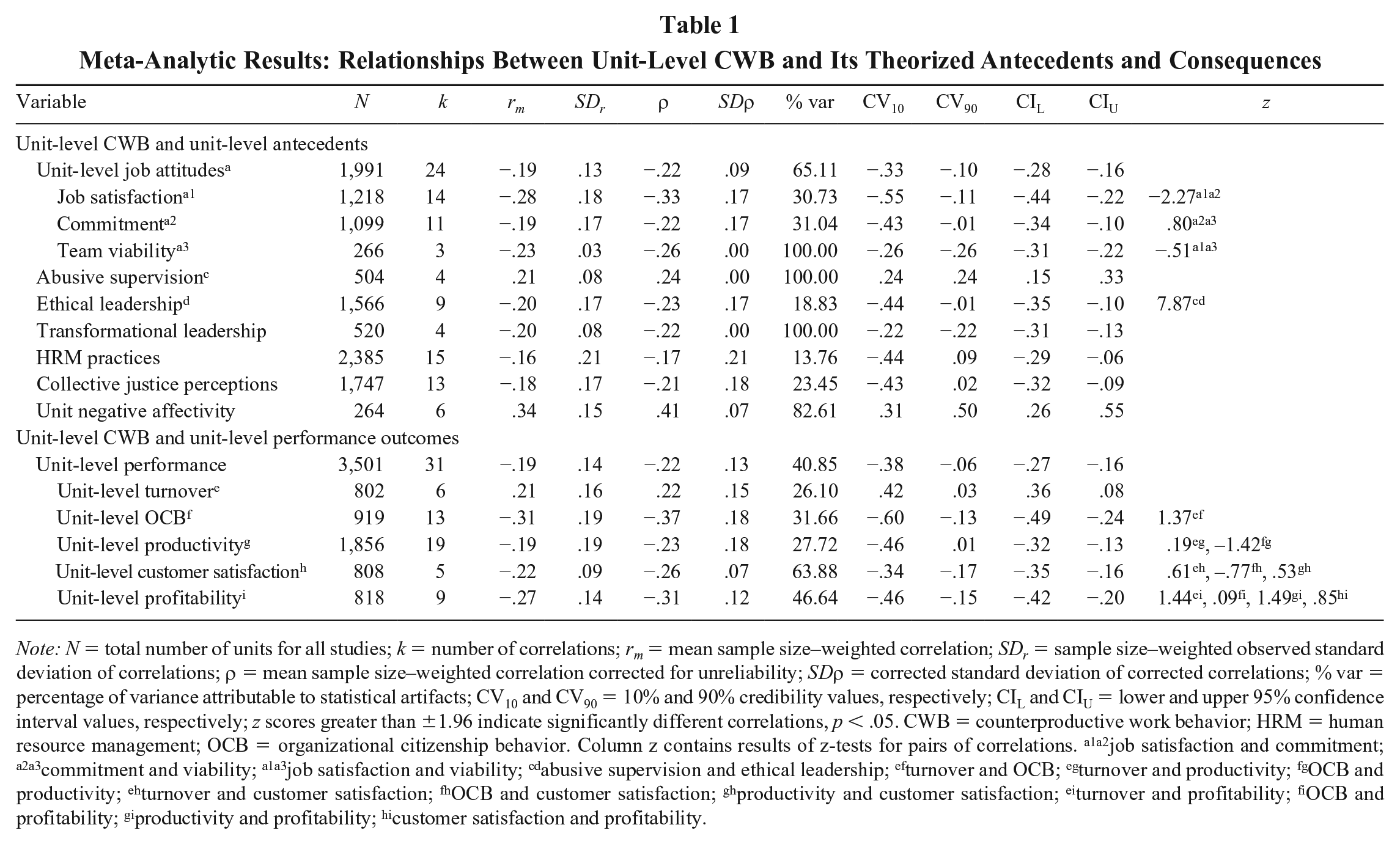
Note: N = total number of units for all studies; k = number of correlations; rm = mean sample size–weighted correlation; SDr = sample size–weighted observed standard deviation of correlations; ρ = mean sample size–weighted correlation corrected for unreliability; SDρ = corrected standard deviation of corrected correlations; % var = percentage of variance attributable to statistical artifacts; CV10 and CV90 = 10% and 90% credibility values, respectively; CIL and CIU = lower and upper 95% confidence interval values, respectively; z scores greater than ±1.96 indicate significantly different correlations, p < .05. CWB = counterproductive work behavior; HRM = human resource management; OCB = organizational citizenship behavior. Column z contains results of z-tests for pairs of correlations. a1a2job satisfaction and commitment; a2a3commitment and viability; a1a3job satisfaction and viability; cdabusive supervision and ethical leadership; efturnover and OCB; egturnover and productivity; fgOCB and productivity; ehturnover and customer satisfaction; fhOCB and customer satisfaction; ghproductivity and customer satisfaction; eiturnover and profitability; fiOCB and profitability; giproductivity and profitability; hicustomer satisfaction and profitability.
Next, we found that the use of strategic HRM practices (e.g., using validated staffing procedures, providing training and development to employees) was negatively correlated with unit-level CWB (–.17), thus supporting Hypothesis 4. Importantly, the 95% confidence interval (–.29 to –.06) did not overlap with zero, indicating that unit-level CWB was significantly and negatively related to the use of strategic HRM practices. The next hypotheses focused on the theorized roles shared attitudes and fairness perceptions play in shaping unit-level CWB. We found that the meta-analytic correlation between unit-level attitudes and unit-level CWB was –.22, which supported Hypothesis 5. The specific dimensions of job attitudes—collective job satisfaction (ρ = −.33), collective organizational commitment (ρ = −.22), and team viability (ρ = −.26)—were each significantly related to unit-level CWB. Our results also supported Hypothesis 6, as we found that unit-level justice perceptions (ρ = −.21) were significantly related to unit-level CWB. Hypothesis 7 was supported as unit-level negative affectivity (ρ = .41) was significantly related to unit-level CWB.
In addition to describing the point estimates of relationships, we must also consider how variability (i.e., SDρ) affects the way we interpret our results (e.g., O’Boyle, 2017). We found that relative to the leadership correlates, ethical leadership had a relatively large SDρ (.17) and wide CV interval (–.44 to –.01). Thus, from a population standpoint, we generally expect the leadership–unit-level CWB relationship to be negative and have an effect size that is small to medium in strength. We expect a similar range of relationships for unit-level job satisfaction (SDρ = .17; CV: –.55 to –.11) and commitment (SDρ = .17; CV: –.43 to –.01). However, there is more concern in our interpretation of unit-level CWB’s relationships with both unit-level justice perceptions (SDρ = .18; CV: –.43 to .02) and strategic HR practices (SDρ = .21; CV: –.44 to .09) as both estimates of variability show higher levels of fluctuation.
To What Extent Is Unit-Level CWB Related to Unit-Level Performance?
Our next step was to evaluate the empirical evidence regarding unit-level CWB’s relationships with unit-level performance. We first evaluated the relationships unit-level CWB had with unit-level HR outcomes. In support of Hypothesis 8, we found that unit-level CWB and unit-level turnover were significantly correlated (ρ = .22). Hypothesis 9 was also supported, as unit-level CWB and unit-level OCB were significantly correlated (ρ = −.37).
Next, we focused on operational performance outcomes. Our results support Hypothesis 10, as unit-level CWB’s corrected correlation with unit-level productivity was –.23. Unit-level CWB was correlated, ρ = −.26, with customer satisfaction, which supported Hypothesis 11. Finally, we examined the extent to which unit-level CWB was related to unit-level financial outcomes. We found that unit-level CWB and unit-level profit were correlated, ρ = −.31, which supported Hypothesis 12.
As earlier, we evaluated our results in line with the variability (i.e., SDρ) of the estimates. Given the variability around the point estimates of unit-level CWB’s relationship with profitability (SDρ = .12; CV: –.46 to –.15) and turnover (SDρ = .15; CV: .42 to .03), we acknowledge that it is more appropriate to generally expect relationships in the hypothesized direction. For productivity, however (SDρ = .18; CV: –.46 to .01), at least a small portion of the studies we meta-analyzed suggest a null (or even positive) relationship.
Comparison of Unit-Level and Individual-Level CWB’s Respective Relationships
Our quantitative review to this point demonstrates that unit-level CWB has consistent relationships of moderate strength with a host of theoretically derived antecedents and strategic-level outcomes. However, our aim is to make a more molar contribution to the understanding of CWB by distinguishing between relationships at the unit level and analogous relationships at the individual level. In service of this goal, we draw from previous meta-analyses to directly compare the magnitude of the relationships (unit vs. individual level) in Table 2. For completeness, we provide estimates of both rm and ρ, but we focus this comparison on the uncorrected point estimates (rm). The table illustrates that unit-level CWB and individual-level CWB have relationships with some correlates that are of the same magnitude and direction—unit-level and individual-level transformational leadership, satisfaction, organizational justice, and OCB, for example (these relationships differ by .01 to .05). However, it is also clear that unit-level CWB and individual-level CWB have relationships with correlates that are of different magnitudes and directions (e.g., commitment, abusive supervision, ethical leadership). For example, whereas the average correlation between individual-level CWB and individual-level performance/productivity was actually positive (rm = .08), the relationship for unit-level CWB and unit-level productivity was –.19 (rm). Importantly, this table shows that CWB is not isomorphic across levels as it documents that unit-level CWB is related (and in some cases strongly related) to correlates (e.g., customer satisfaction and profitability) that, by their nature, cannot be a part of individual-level CWB’s nomological network.
Comparison of Unit-Level CWB and Individual-Level CWB Relationships
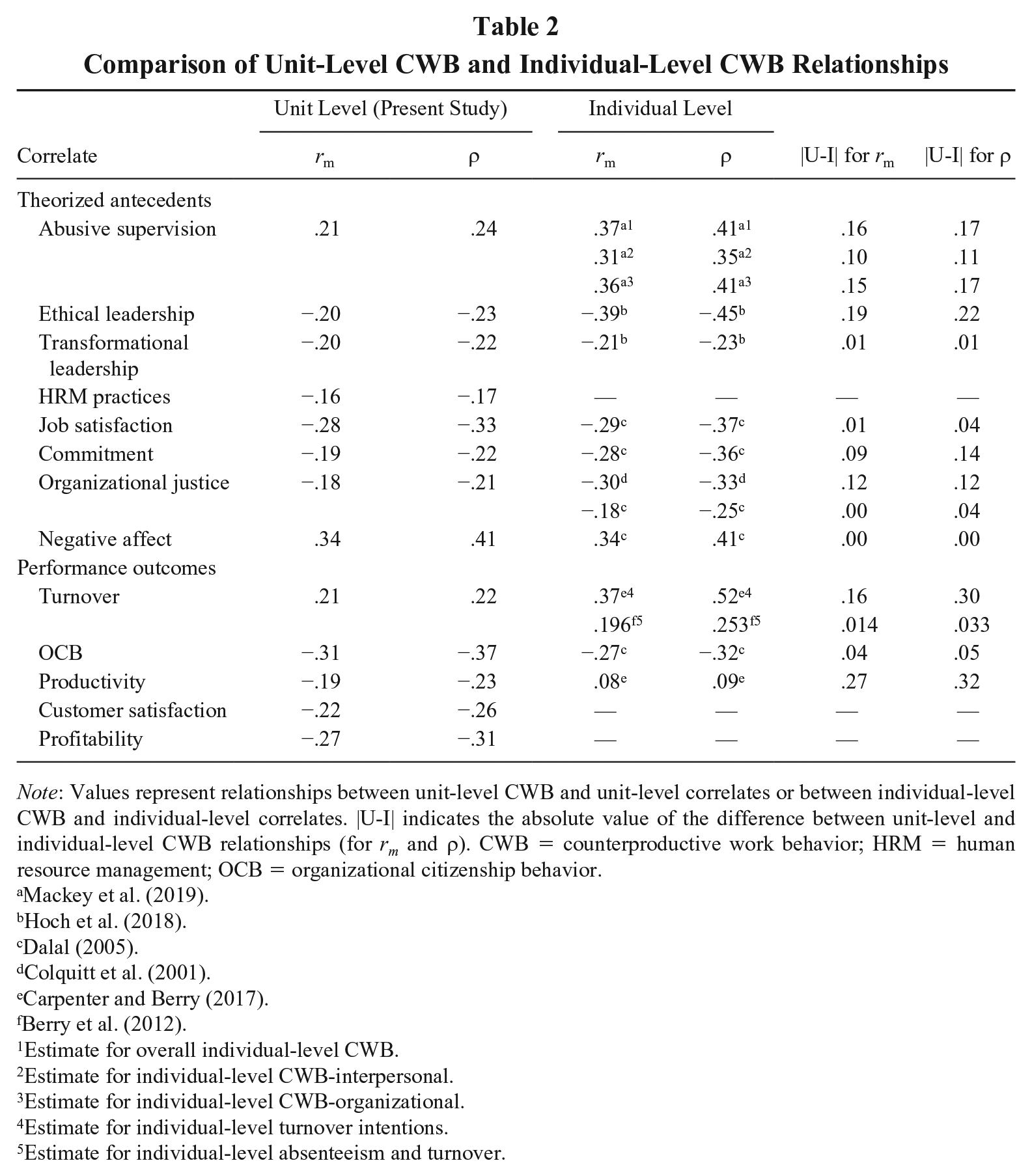
Note: Values represent relationships between unit-level CWB and unit-level correlates or between individual-level CWB and individual-level correlates. |U-I| indicates the absolute value of the difference between unit-level and individual-level CWB relationships (for rm and ρ). CWB = counterproductive work behavior; HRM = human resource management; OCB = organizational citizenship behavior.
Estimate for overall individual-level CWB.
Estimate for individual-level CWB-interpersonal.
Estimate for individual-level CWB-organizational.
Estimate for individual-level turnover intentions.
Estimate for individual-level absenteeism and turnover.
How Do Methodological Choices Influence the Understanding of Unit-Level CWB?
As noted in our introduction, a third major research question we aimed to answer was the extent to which researchers’ methodological choices influenced the relationship between unit-level CWB and correlates. We provide these results in Table 3 (measurement moderators) and Table 4 (CWB dimensions). Due to the number of studies available to us, we could not conduct methodological moderator analyses for all of the different antecedents and outcomes. Accordingly, we chose to investigate moderators for specific theorized antecedents and outcomes only when we found a minimum of three studies for each condition.
Meta-Analytic Results: Measurement Moderators
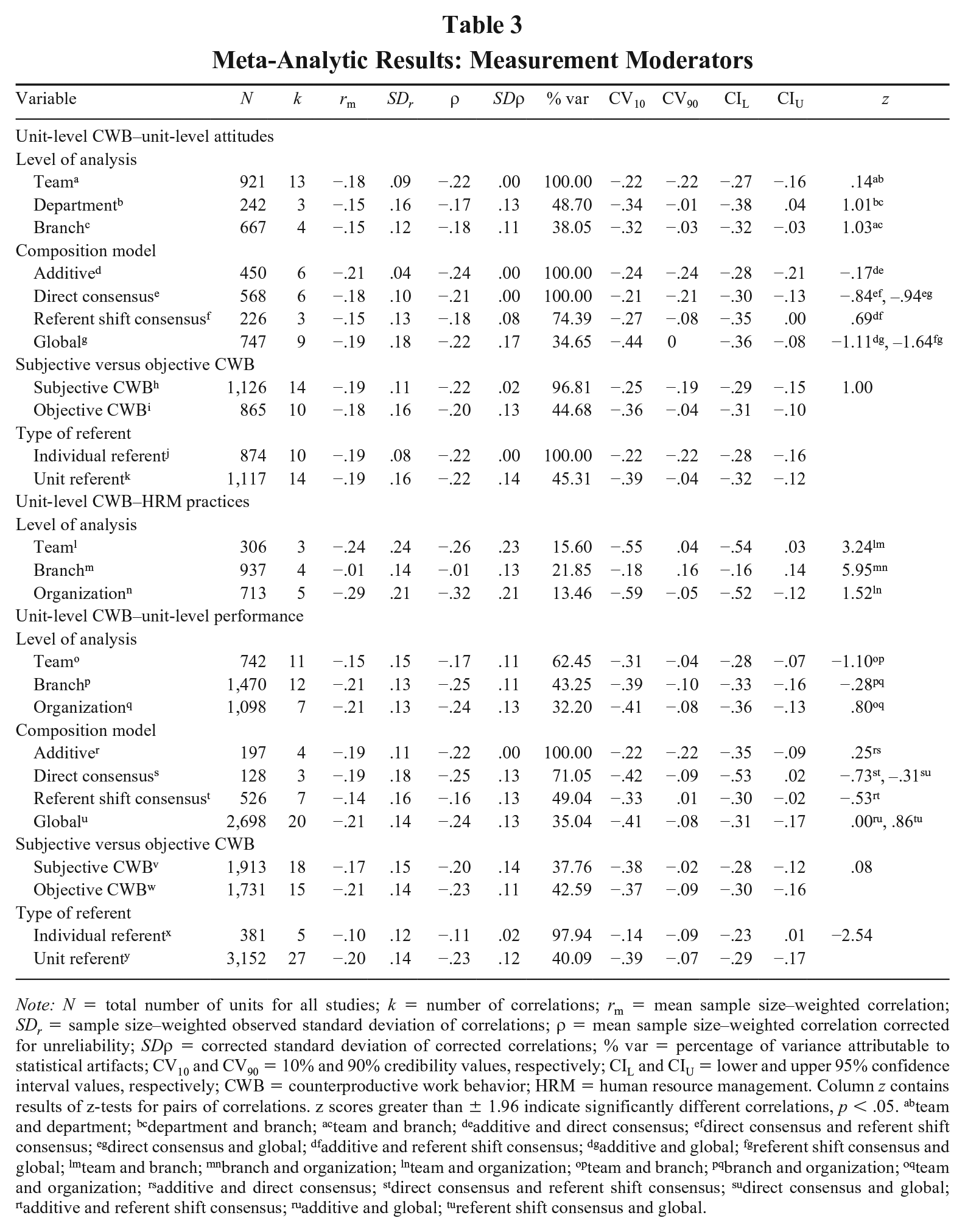
Note: N = total number of units for all studies; k = number of correlations; rm = mean sample size–weighted correlation; SDr = sample size–weighted observed standard deviation of correlations; ρ = mean sample size–weighted correlation corrected for unreliability; SDρ = corrected standard deviation of corrected correlations; % var = percentage of variance attributable to statistical artifacts; CV10 and CV90 = 10% and 90% credibility values, respectively; CIL and CIU = lower and upper 95% confidence interval values, respectively; CWB = counterproductive work behavior; HRM = human resource management. Column z contains results of z-tests for pairs of correlations. z scores greater than ± 1.96 indicate significantly different correlations, p < .05. abteam and department; bcdepartment and branch; acteam and branch; deadditive and direct consensus; efdirect consensus and referent shift consensus; egdirect consensus and global; dfadditive and referent shift consensus; dgadditive and global; fgreferent shift consensus and global; lmteam and branch; mnbranch and organization; lnteam and organization; opteam and branch; pqbranch and organization; oqteam and organization; rsadditive and direct consensus; stdirect consensus and referent shift consensus; sudirect consensus and global; rtadditive and referent shift consensus; ruadditive and global; tureferent shift consensus and global.
Meta-Analytic Results: Unit-Level CWB-I and Unit-Level CWB-O Relationships
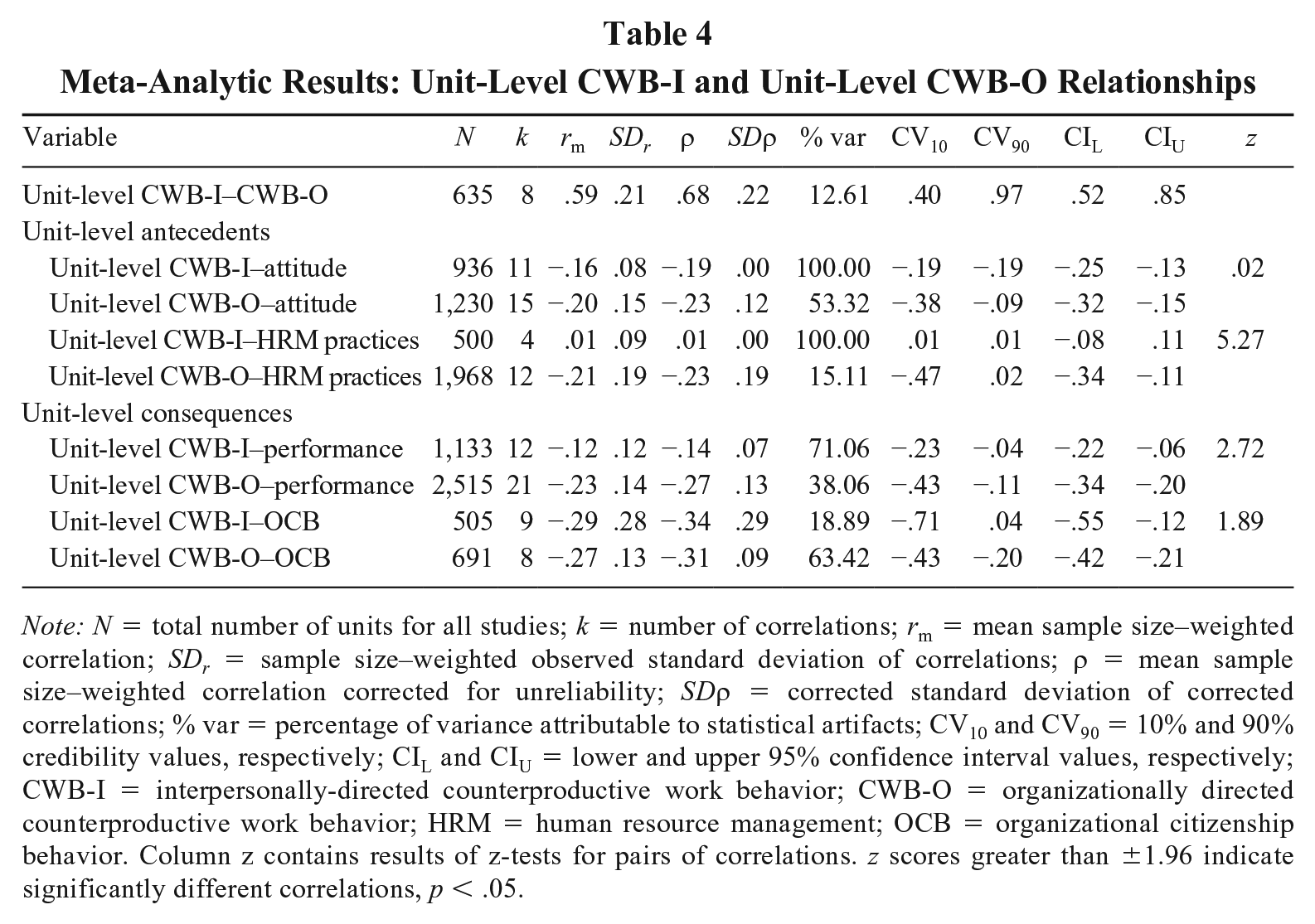
Note: N = total number of units for all studies; k = number of correlations; rm = mean sample size–weighted correlation; SDr = sample size–weighted observed standard deviation of correlations; ρ = mean sample size–weighted correlation corrected for unreliability; SDρ = corrected standard deviation of corrected correlations; % var = percentage of variance attributable to statistical artifacts; CV10 and CV90 = 10% and 90% credibility values, respectively; CIL and CIU = lower and upper 95% confidence interval values, respectively; CWB-I = interpersonally-directed counterproductive work behavior; CWB-O = organizationally directed counterproductive work behavior; HRM = human resource management; OCB = organizational citizenship behavior. Column z contains results of z-tests for pairs of correlations. z scores greater than ±1.96 indicate significantly different correlations, p < .05.
Composition Model
First, we found that unit-level CWB’s correlations with unit-level performance showed no significant differences when direct-consensus (–.25), additive (–.22), global (–.24), or referent-shift composition models (–.16, all zs < ±1.96, p > .05) were used. We also found that unit-level CWB’s relationships with job attitudes were not significantly different for referent-shift (–.18), additive (–.24), direct-consensus (–.21), or global composition models (–.22; zs < ±1.96, p > .05).
Levels of Analysis
We found that unit-level CWB’s relationships with job attitudes were not significantly different at the department (ρ = −.17), team (ρ = −.22, z = .14, p > .05), or branch level (ρ = −.18, both zs < ±1.96, p > .05). However, we found that unit-level CWB’s correlations with strategic HRM practices were strongest at the organization level (ρ = −.28), followed by the team level (ρ = −.26), then the branch level (ρ = −.01). Interestingly, both organization- and team-level correlations were significantly stronger than branch-level correlations (p < .05). It makes sense that organization-level relationships are strongest, given that this is the level at which strategic HRM policies are set (e.g., there should be less variability in HRM practices at the team and branch levels). The team-level correlation is surprising, but since it comprises relatively few samples, this may indicate second-order sampling error. Finally, unit-level CWB’s correlations with unit-level performance at the branch (–.25), organization (–.24), and team levels of analysis (–.17) were not significantly different.
Subjective Versus Objective CWB
Correlations between unit-level CWB and unit-level attitudes using subjective measures of CWB (–.22) were not significantly different from those using objective measures (–.20, z = 1.00, p > .05). Unit-level CWB’s correlations with unit-level performance for subjective (–.20) and objective measures (–.23) of CWB were not significantly different (z = .08, p > .05). As a supplemental analysis, we also investigated the difference between subjective (–.26) and objective performance (–.21) measures, but these correlations were not significantly different.
Individual Versus Unit Referent
We found that correlations between unit-level CWB and unit-level attitudes using individual-referent measures (ρ = −.22) were not significantly different from those based on unit-referent measures (ρ = −.22, p > .05). However, correlations between unit-level CWB and unit-level performance were significantly stronger for unit-referent measures (ρ = −.23) than for individual-referent measures (ρ = −.11, z = −2.54, p < .05).
CWB-I Versus CWB-O
We also investigated whether the target of the behavior—CWB-I (bullying, interpersonal aggression) versus CWB-O (absenteeism, theft)—mattered. Although we found that the two dimensions of CWB were strongly correlated (ρ = .68), their respective patterns of relationships with correlates revealed a number of differences. For example, the strategic HRM–unit-level CWB-O relationship (ρ = −.23) was significantly stronger than the strategic HRM–unit-level CWB-I relationship (ρ = .01, z = 5.27, p < .05). We also found that the unit-level CWB-O–performance relationship (ρ = −.27) was significantly stronger than the unit-level CWB-I–performance relationship (ρ = −.14, z = 2.72, p < .05). Little difference was found, however, between the unit-level CWB-I and CWB-O dimensions and other correlates, such as unit-level job attitudes (ρ = −.19 vs. ρ = −.23, respectively; z = .02, p > .05) and unit-level OCB (ρ = −.34 vs. ρ = −.30, respectively; z = 1.89, p > .05).
Discussion
Study Implications
Although management scholars have studied CWB for almost three decades, there was still a lack of a comprehensive understanding of what CWB means when it is conceptualized and measured at higher levels of analysis—that is, when units like teams, departments, and organizations engage in collective negative behaviors. Indeed, as O’Boyle et al. (2011: 44) noted, “It has become increasingly evident that the individual level is insufficient to explain CWB fully.” This review of unit-level CWB provides a necessary understanding of CWB’s strategic importance, specifically, by investigating the factors contributing to unit-level CWB’s emergence as well as how unit-level CWB relates to unit-level outcomes, such as profit and customer satisfaction.
Our review makes an important theoretical contribution to the understanding of unit-level CWB by grounding and integrating our hypotheses within SIP, and indeed, our findings support SIP’s propositions. An overarching theme in SIP is the importance of the unit’s environment, as it provides the necessary information and space for social interaction, which is where unit-level behavior can emerge. Our study provided an important first look at the specific elements of this multifaceted environment and determined which ones are linked to unit-level CWB (e.g., leadership behaviors, strategic HRM systems and practices, unit-level job attitudes and justice perceptions). SIP also proposes that unit behaviors actually become part of the unit’s environment and therefore provide signals about behavioral norms and expectations for the unit. Our study sheds light on this proposition as well, with unit-level CWB being negatively related to not only behaviors that are collaborative and task related (e.g., unit-level OCB and productivity) but also key strategic financial and operational outcomes (e.g., profitability, turnover, and customer satisfaction). These findings are particularly important considering the relationship between CWB and performance has failed to materialize at the individual level (Carpenter & Berry, 2017). By expanding the conceptualization of CWB to the unit level, we not only provide empirical support for this long-held hypothesis; we also advance the theoretical understanding of unit-level CWB’s nomological network, particularly for strategic-level variables that often do not exist at the individual level.
Overall, our findings support SIP’s propositions and suggest that the unit environment is an important factor related to the emergence of unit-level CWB and its negative link to unit-level performance. From a scholarly perspective, support for the SIP perspective should nudge researchers toward exploring even more of the contextual factors that may shape CWB. Our results clearly show that the entire environment of the work unit must be considered and incorporated into theory if our aim is to continue advancing the knowledge of CWB. Although there are a number of ways to advance this understanding, we found SIP to be the most relevant foundation for theorizing, as its framework allows for the incorporation of unit characteristics, attitudes, cognitions, and behaviors. What we believe is most exciting about the SIP lens is that it broadens our understanding of unit-level CWB’s function within units. For example, SIP certainly allows for unit-level CWB to be theorized and studied as it has been in the past—as an outcome of environmental characteristics. However, SIP argues that unit-level CWB itself becomes an environmental feature and, therefore, an antecedent, which is quite different from how we traditionally view CWB at the individual level or unit level. We expect this expansion contributed by SIP to yield many new insights into the role of CWB within units. From a practitioner perspective, the SIP lens suggests that managers can miss quite a bit when they focus only on individual employees’ CWB. Rather, surveys and other data should be administered and considered at the collective level (and individual level) as much as possible. Moreover, our findings suggest that decreasing CWB is a difficult task and requires much more than simply firing one or two problematic employees.
We also investigated the impact of potential measurement-related moderators on unit-level CWB’s relationships and, in general, did not find unequivocal support for the moderating effect of different measurement choices (e.g., type of referent, subjective vs. objective measure, composition model). For example, although our results suggest that using a unit referent and an objective measure of unit-level CWB may result in unit-level CWB’s strongest relationships with unit-level performance, we make these recommendations with caution. This is because many of the moderator variables were correlated with each other (e.g., studies with an individual-referent measure were likely to use subjective measures, and global composition models used unit-referent measures) and more studies are needed for cumulation before we can say choices are definitive.
However, one moderator that appears to clearly matter is the distinction between unit-level CWB-I and unit-level CWB-O. In general, of the studies reporting correlations for unit-level CWB’s dimensions, we found that unit-level CWB-O was more strongly related to unit-level performance and HRM practices correlates than unit-level CWB-I. These are intriguing insights that make intuitive sense from a multilevel perspective, as CWBO variables (absenteeism, theft/shrinkage) appear to be more aligned with strategic-level variables, such as profit and strategic HRM practices. Thus, if scholars and practitioners must make a choice, we advise focusing on unit-level CWB-O if strategic-level antecedents and outcomes are of interest. However, given the important role that CWB targets have had in our understanding of individual-level CWB (e.g., Berry et al., 2007; Mackey et al., 2019), we caution that our review only begins to scratch the surface of unit-level CWB dimensionality. In fact, less than one-third of the studies included in our meta-analysis examined unit-level CWB-I or CWB-O. At the minimum, however, our findings provide an important call to researchers to more thoroughly theorize and examine the similarities and differences between unit-level CWB-I and CWB-O.
Study Limitations and Future Research Directions
We see this study as a first attempt to review what is known about unit-level CWB and recognize that there are limits of our review and some issues remain unresolved. To this end, Figure 1 describes the current nomological network we examined in this review as well as additional correlates and research questions that we believe are theoretically and practically necessary for future research. Next, we address the most pressing of these issues in turn.
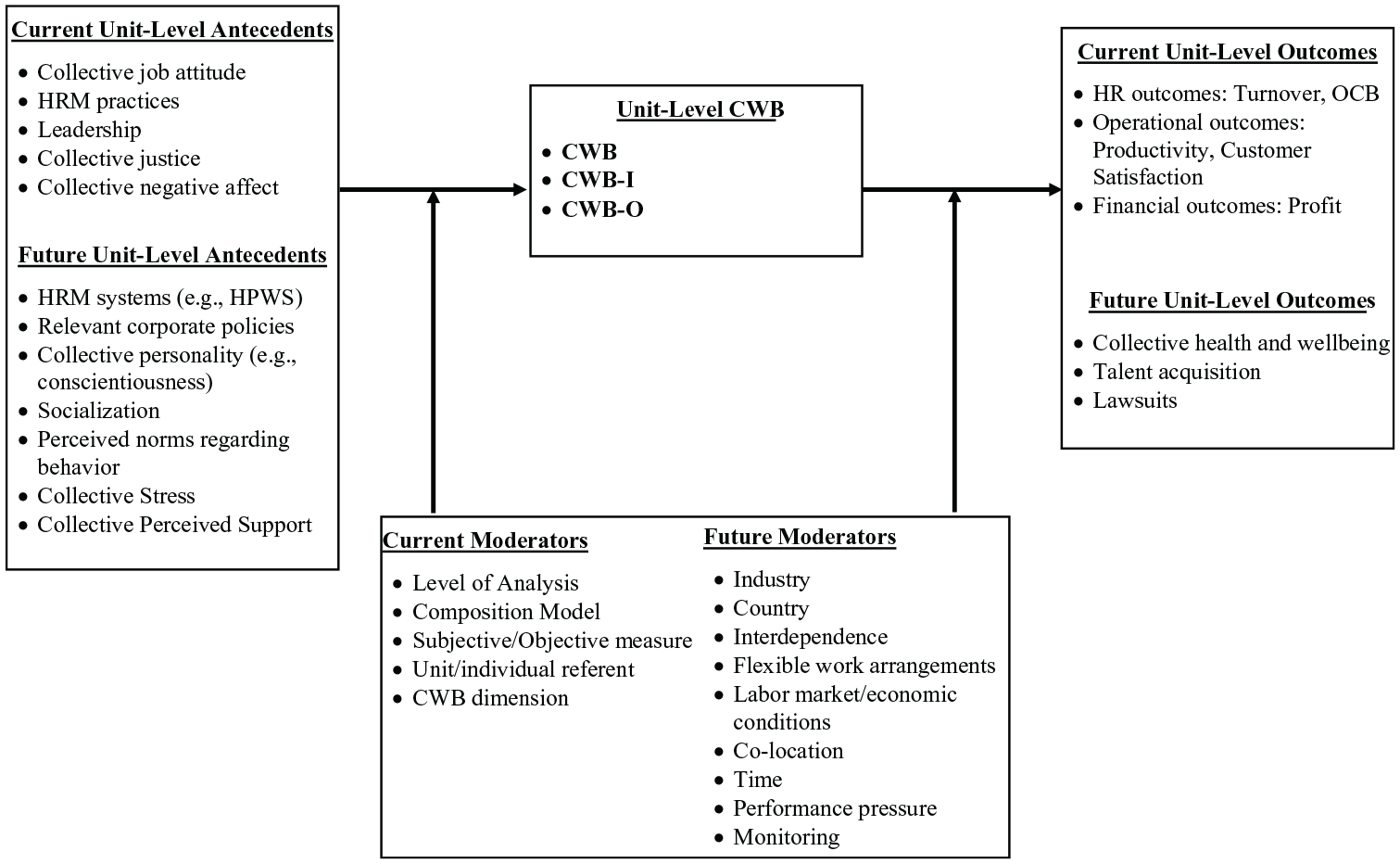
Summary of Unit-Level Counterproductive Work Behavior’s Current Nomological Network and Example Future Research Directions
Unit-level CWB emergence
One limitation is that we did not directly test the interactive and sensemaking processes involved in unit-level CWB’s emergence. As one example, Salancik and Pfeffer (1978) described the importance of unit communication for developing shared interpretations and evaluations. Units communicate in various direct and indirect ways, indicating that a step toward a thorough understanding of unit-level CWB within SIP is to extend theory that unpacks how the quantity (i.e., frequency) and quality (i.e., type) of communication impact the shared evaluations that relate to unit-level CWB’s emergence. Another important step that will deepen our understanding of SIP as it relates to unit-level CWB is to focus on shared unit perceptions of (a) socialization processes (e.g., mentoring, training; Bauer, Bodner, Erdogan, Truxillo, & Tucker, 2007), (b) behavioral norms and rules (and how they are communicated to the unit), and (c) rewards and consequences for engaging in CWB. Each area captures how units adapt to environmental features that may relate to unit-level CWB.
Our review reinforced the strategic relevance of unit-level CWB by theorizing and empirically demonstrating its relationship to strategic HRM practices. We found that HRM practices—such as valid staffing, training (e.g., number of days of training provided), compensation (e.g., above market), and indices representing HRM practices as a whole—were positively related to the emergence of unit-level CWB. However, we were unable to provide a more precise look at specific practices and their relative contribution to unit-level CWB. Since the variability of the meta-analytic correlation is relatively large (e.g., SDρ = .21), some practices are likely more strongly related to unit-level CWB than others. Indeed, in line with SIP, strategic HRM practices are expected to provide necessary structure to the unit environment but in very different ways: in signaling relevant competencies and behaviors (training), setting hiring standards, and punishing or rewarding behaviors (termination, performance evaluation, compensation). Although we suspect that punishments and rewards may be more visible to the unit and, therefore, perhaps a relatively stronger deterrent of unit-level CWB, future research examining the relative influence of separate HRM practices is needed. This includes pinpointing the specific HRM practices or the specific combination of HRM practices that are connected to unit-level CWB or whether some HRM practices are related to specific types of unit-level CWB (e.g., theft). Furthermore, recent findings demonstrate that incorporating employees’ perceptions of HR policies regarding CWB are likely to also relate to subsequent unit-level behavior (Kuenzi, Mayer, & Greenbaum, 2020).
Our meta-analysis also demonstrated a positive relationship between collective negative affectivity and unit-level CWB. This supports our theorizing that collective negative affect serves as a negative filter that likely facilitates units’ arrival at negative appraisals and evaluations of the work environment. We expect that future examinations of collective-level traits, such as conscientiousness (Hofmann & Jones, 2005), integrity, or moral identity (Kuenzi et al., 2020), will provide additional insights into the factors that are associated with unit-level CWB. Unit-level similarity in these characteristics may influence how unit members interact and communicate with each other as well as the shared evaluations and perceptions that result. These different unit-level characteristics may also have different relationships with unit-level CWB, so we expect that investigations of interactive effects of collective antecedents will be valuable (O’Boyle et al., 2011).
Unit-level CWB and unit-level performance
Although we provided important evidence of unit-level CWB’s relationship with unit-level performance, we acknowledge that the extent of unit-level CWB’s theorized consequences remains unknown. In particular, much more work is needed to understand how unit-level CWB relates to the general health of the unit. We believe investigations of unit-level well-being (e.g., mental health, physical health) would go a long way in this regard, as there is some initial evidence that negative workplace environments can make the entire workplace physically sick (e.g., Torok, Clark, & Jensen, 2019). There is also a need to understand the extent to which unit-level CWB impacts talent acquisition, as we suspect high levels of unit-level CWB are likely to stifle talent growth in an organization. Moreover, this would provide a greater understanding of the longer-term consequences of pervasive unit-level CWB, as units may have trouble attracting and subsequently hiring members who do not fit with existing unit-level norms (Schneider, 1987).
Methodological and additional considerations
Although we interpreted our findings on the basis of the point estimates (i.e., correlations), we found that the variability in some of these estimates was rather large. For example, we noted earlier that ethical leadership’s relationship with unit-level CWB should be tempered given the credibility interval and SDρ. It is also important to note that the generalizability of our interpretations are bounded by the conditions and environments contained in our particular meta-analytic estimates (O’Boyle, 2017). In the case of the relationship between ethical leadership and unit-level CWB, our expectation of negative small-to-medium effect sizes in the population is based primarily on operationalizations of unit-level CWB (as opposed to dimensions) using mostly team samples (67%) that are located in the United States representing a variety of industries in the economy—this interpretation of the relationship (see Results) is likely in 90% of these conditions (Tett, Hundley, & Christiansen, 2017). In general, the point estimates we report in our study should be evaluated alongside their respective variability.
Along with further consideration of the emergence and consequences of unit-level CWB, more understanding is needed of the broader environmental factors that influence these relationships. In this study, we were unable to examine whether factors like the unit’s geographic location or industry influenced unit-level CWB’s relationships, yet these are certainly likely to impact the patterns of arriving at shared evaluations of the unit (e.g., Whitman et al., 2012) or the extent to which unit-level CWB relates to performance. As one example, although we found a negative relationship between unit-level CWB and customer satisfaction (ρ = −.26), future studies are needed to probe whether this relationship changes depending on if the unit is situated in the service industry versus industries like health care or technology. We also believe that factors related to the use of flexible work arrangements that allow members to work remotely, as well as labor market and economic conditions, may influence the emergence and function of unit-level CWB.
Additionally, we need to understand more about the temporal assumptions of unit-level CWB’s nomological network. In other words, our theoretical perspective suggests that unit-level antecedents contribute to the emergence of unit-level CWB, which then leads to unit-level performance. However, we cannot rule out the plausible alternative explanation that poor unit-level performance contributes to unit-level CWB, which then triggers unit-level attitudes and organizational perceptions. We expect that a longitudinal lens on unit-level CWB will provide many new insights into the patterns of how unit-level CWB emerges, its nomological network, and how relationships with unit-level outcomes develop over time. More work is needed in this area—similar in vein to the work that has been done with unit-level absenteeism (e.g., Hausknecht et al., 2008)—if we are to truly understand the dynamic nature of unit-level CWB.
Finally, we encourage more consideration of the measurement issues in our understanding of unit-level CWB. Given that the measurement choices were somewhat related to each other, we recommend that future studies on unit-level CWB include different measurement combinations (e.g., use both subjective and objective measures) so that it is possible to more cleanly disentangle the impact of measurement decisions. In line with Kuenzi et al.’s (2020) recent recommendations, greater distinction between unit-level CWBs (the focus of this review) versus CWB climate (i.e., perceptions of policies and procedures regarding CWB) is important, as the two may have different relationships with both antecedents and unit performance outcomes. We also recommend the use of more qualitative methods to advance a more detailed and richer account of how unit members make sense of CWB within their unit and come to share their perceptions of unit-level CWB.
In conclusion, despite the scholarly popularity of CWB, understanding of the construct has mostly occurred from a rather narrow, individualized perspective. The goal of our article was to pay greater attention to the broader social environment by providing a much-needed review of the unit-level CWB literature. We contribute clarity to the definition and label of unit-level CWB, including how it is distinct from individual-level CWB. We also used meta-analysis to test our hypotheses about unit-level CWB’s emergence and its relationships with unit-level performance. Our findings show that unit-level CWB emergence is associated with leadership, HRM practices, unit-level job attitudes, justice perceptions, and negative affect. We also found unit-level CWB to be negatively related to unit-level performance (e.g., productivity, OCB, customer satisfaction, profit), which supports a core assumption of CWBs: that they are bad for business.
Supplemental Material
sj-docx-1-jom-10.1177_0149206320978812 – Supplemental material for Unit-Level Counterproductive Work Behavior (CWB): A Conceptual Review and Quantitative Summary
Supplemental material, sj-docx-1-jom-10.1177_0149206320978812 for Unit-Level Counterproductive Work Behavior (CWB): A Conceptual Review and Quantitative Summary by Nichelle C. Carpenter, Daniel S. Whitman and Rachel Amrhein in Journal of Management
Supplemental Material
sj-docx-2-jom-10.1177_0149206320978812 – Supplemental material for Unit-Level Counterproductive Work Behavior (CWB): A Conceptual Review and Quantitative Summary
Supplemental material, sj-docx-2-jom-10.1177_0149206320978812 for Unit-Level Counterproductive Work Behavior (CWB): A Conceptual Review and Quantitative Summary by Nichelle C. Carpenter, Daniel S. Whitman and Rachel Amrhein in Journal of Management
Footnotes
Acknowledgements
The authors would like to thank Jeremy Beus, Rebecca Greenbaum, Kisha Jones, Maria Kraimer, Anthony Nyberg, and Michael Sturman for comments on previous drafts. An earlier version of this paper was presented at the 2016 Annual Meeting of the Academy of Management.

Supplemental material for this article is available with the manuscript on the JOM website.
Notes
References
Supplementary Material
Please find the following supplemental material available below.
For Open Access articles published under a Creative Commons License, all supplemental material carries the same license as the article it is associated with.
For non-Open Access articles published, all supplemental material carries a non-exclusive license, and permission requests for re-use of supplemental material or any part of supplemental material shall be sent directly to the copyright owner as specified in the copyright notice associated with the article.
