




Abstract
In proposing two evolutionary trajectories, we demonstrate some paradoxical aspects of strategic resources that contrast with current theorizing. First, we discuss how an abundance of resources can subject an organization to vulnerabilities, taking a firm from competitive strength to potential weakness. Second, we describe an opposite trajectory in which a lack of resources can lead to reactions engendering significant strengths. In both cases, the effects of resource abundance and poverty on executive perceptions and conduct, organizational arrangements, and strategic behavior can play important roles in trajectories of value creation and erosion.
Introduction
The resource-based view (RBV) has been extraordinarily influential as a primary perspective for scholars of strategy and competition (Barney, 1991; Barney, Wright, & Ketchen, 2001; Newbert, 2007; Wernerfelt, 1984; 1995). Thus far, resource-based scholars have focused mostly on the nature of strategic resources and their “valuable, rare, inimitable, original” (VRIO) qualities. They have identified the kinds of resources that confer competitive advantage (Barney, 1991), their microfoundations (Foss, 2011), their configurations (Black & Boal, 1994; Borch, Huse, & Senneseth, 1999), and the contexts in which different types of resources thrive (Barney, 2018; Miller & Shamsie, 1996; Sirmon, Hitt, & Ireland, 2007). Dynamic capabilities scholars have built on these insights to explore how resources can be bundled and launched onto evolutionary paths that sustain advantage in ever-changing environments (Helfat & Peteraf, 2003; Teece, Pisano, & Shuen, 1997). All these important streams of literature have emphasized the positive aspects of resources for competitive advantage and performance.
Notwithstanding these advances, what remains underexplored are the negatives sometimes associated with resource abundance (RA)—the dysfunctional attitudes such abundance can engender in some managers and the resulting consequences for organizational arrangements and strategies. The putative advantages of resource poverty (RP) have also been ignored—particularly its potentially positive effects on managerial motivation, alertness, organizational collaboration, and strategic innovation. We believe there are opportunities to explore these counterintuitive and paradoxical aspects of resources and their contexts, which we hope will cause reflection about alternative conceptual and empirical possibilities (Davis, 1971).
Examples abound of how resource-rich companies have failed to reexamine their resource-based strategies to heed competitive threats calling for reorientation. Christensen (2016) provides vivid illustrations from the U.S. disk drive industry where firms like Memorex, Ampex, and Control Data, companies with treasured patents, superb engineers, fine reputations, and state-of-the-art technologies, were blindsided and then destroyed by far poorer, less sophisticated upstarts embracing simpler but increasingly relevant technology. Conversely, the early histories of e-businesses like Amazon, Tencent, and Airbnb demonstrate how young companies with little in the way of proprietary resources, depth of talent, or reputation thrived by exploring novel product market domains.
In putting forth our contrarian ideas, we are, in effect, proposing two trajectories: The first suggests that RA, and some of the very same factors that contribute to advantages, may in fact open firms to vulnerabilities (King, 2007). Our second trajectory, by contrast, has RP bringing forth reactions that may ultimately yield competitive strengths. For both trajectories, the configurational aspects of resources—their combination, interaction, and embeddedness within a context of leadership, organization, and strategy—come into play as catalytic factors (Black & Boal, 1994; Miller, 2003; Sirmon & Hitt, 2003). Both trajectories are characterized by dimensions of executive attitude and motivation, social and relational behavior in an organization, and ultimately strategic adaptiveness and creativity. In that sense, they involve both individual and macro-organizational factors, and indeed their interplay and configuration over time (Barney & Felin, 2013).
However, we must condition our analysis. First, it represents counterintuitive outcomes under particular circumstances, not inevitable courses of events nor a general model or theory of firm evolution (Bacharach, 1989). Second, the elements of the trajectories are frequently mutually reinforcing, which helps to propel them. Third, inevitably, firm resource inventories for better or worse are conditioned by human capacities and reactions—characteristics that generally cannot themselves be counted as RBV resources due to their common nature. After presenting each trajectory, we briefly outline the contexts and moderating conditions that make it more likely.
Paradox I—Traps of RA: The Strength to Weakness Trajectory
The RBV advocates the importance of resources as sources of economic rents—returns in excess of normal returns in a competitive market (Barney, 2001; Wernerfelt, 1984). We believe that resources can also sow seeds of vulnerability and ultimately of competitive weakness and failure under what we call an RA trajectory. Specifically, they may occasion problematic managerial attitudes and motivations, skewed organizational and relational processes, and unproductive orientations toward strategy and adaptation. These drawbacks encompass personal characteristics such as overconfidence, organizational tendencies including lopsided corporate cultures and processes, and inertial—or reckless—strategies (see Table 1).
Paradoxical Trajectories: Resource Abundance and Poverty
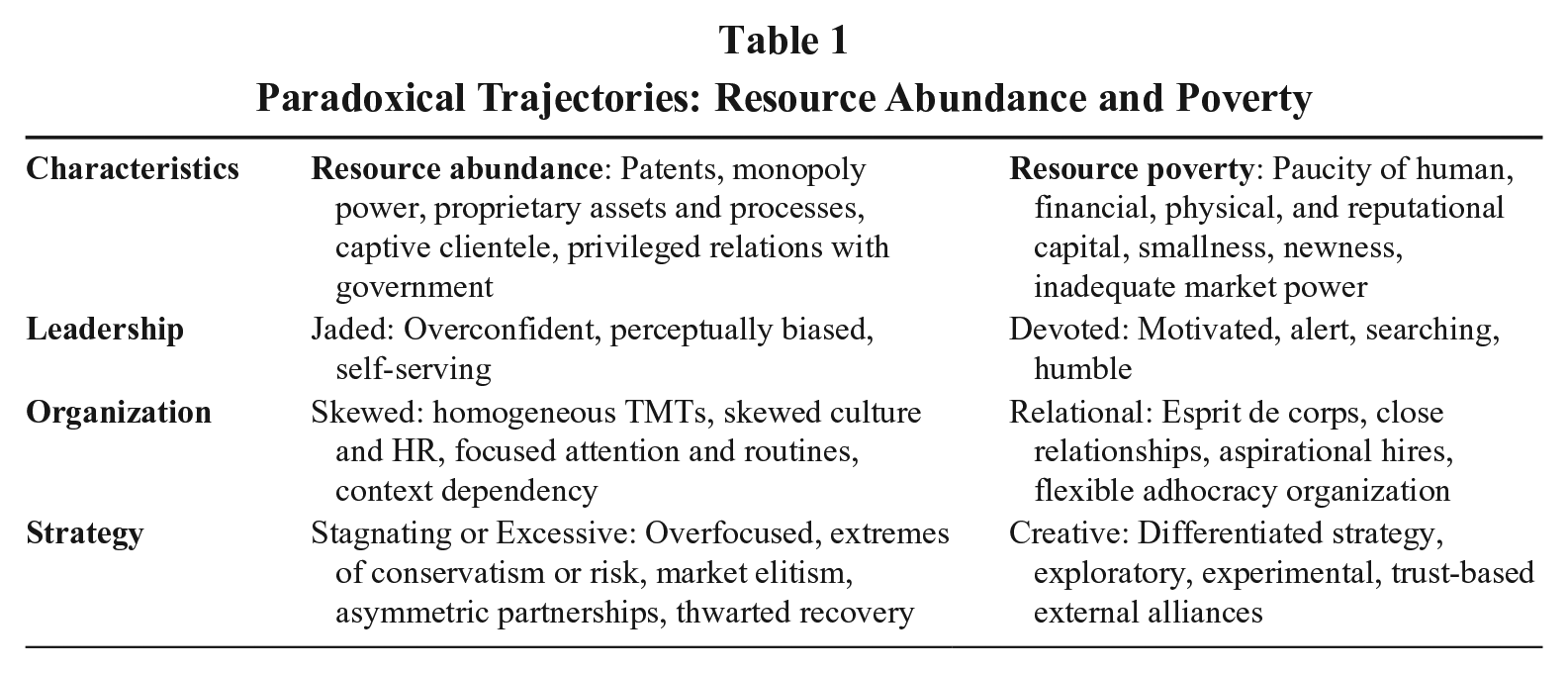
We characterize a resource-rich company as having the following kinds of resources: protective patents, monopoly power over an attractive segment of the market, and privileged access to rare inputs such as raw materials, territory, talent, and systems of operation, including those relating to corporate culture. In many cases, these resources are protected from competitive imitation by causal ambiguity (Lippman & Rumelt, 1982), tacitness (Nonaka & von Krogh, 2009), and path-dependent development (Scarbrough, 1998).
Jaded Leadership
Protective resources can influence managerial attitudes, perceptions, and motivations. Potential reactions include overconfidence in resource effectiveness and durability, tunnel vision regarding sources of rents, hubris, and rent appropriation, all of which can erode long-run performance.
Resources can lead to overconfidence, even hubris
Where firms have benefitted for some time from valuable resources and the protection and rents those resources provide, executives can become overly confident that this advantage will endure with little need to adapt strategy. Some leaders come to believe that their firms are sheltered from market forces and the need to be vigilant and responsive—even when that is no longer true (Hedberg, Nystrom, & Starbuck, 1976; Lovelace, Bundy, Hambrick, & Pollock, 2018; Miller, 1990). Such confidence breeds overreliance on the tried and true (Burgelman, 2002), especially when resources have been enduringly protective and embedded in firm culture and routines.
A very different reaction is also possible. When resources have endowed firms with extraordinary success, their celebrated leaders may develop hubris (Chatterjee & Hambrick, 2007, 2011; Hayward & Hambrick, 1997), leading to excess—behavior that is overly risky, sharply focused, or bold.
Resources may foster superstitious learning
A core feature of some resources is causal ambiguity, whereby rivals are unable to parse exact sources of advantage (Lippman & Rumelt, 1982). Unfortunately, this same ignorance may come to confound resource possessors—especially for complex resources such as teams or cultures whose sources of advantage are subtle and multifaceted (King, 2007; King & Zeithaml, 2001). In such cases, managers may misinterpret exact sources of rent due to post hoc rationalization (Le Breton-Miller & Miller, 2015; Levinthal & March, 1993; Levitt & March, 1988; Zollo, 2009). Polaroid’s CEO, for example, viewed its stellar research department and superior patents as primary sources of rent while according scant credit to essential marketing and operations functions; market share collapsed (Miller, 1990). Such “superstitious learning” narrows and misdirects strategic focus and funding (Ocasio & Joseph, 2018).
Resources tempt rent appropriation
One of the potential challenges arising from valuable human resources such as star CEOs, executives, or teams credited with success is that they begin to appropriate rents in the form of exorbitant compensation and bonuses, lavish perquisites, and inflated budgets. Star employees also may leave for more pay or engage in auxiliary, distracting activities outside the firm that hurt their performance on the job (Malmendier & Tate, 2009; Morris, Alvarez, & Barney, 2018; Wade, Porac, Pollock, & Graffin, 2008).
Skewed Organizations
An abundance of beneficial resources can shape the human interactions occurring within an organization, influencing the composition of the top management team, firm culture, hierarchy, routines, and subunit resource allotments.
Resources promote tmt homogeneity
Where firms prize particular executives as resource stewards or focal sources of rents, those individuals may be accorded disproportionate power on the top management team (TMT) and even come to lead it (Lovelace et al., 2018; Miller, 1993). This skewness of status and influence, and accompanying top team homogeneity (Knight et al., 1999), invites groupthink and dysfunctional biases in resource allocation and strategic focus (Hambrick, Cho, & Chen, 1996). Ford, an operations leader in the U.S. automobile industry, was dominated in the 1960s by cost-obsessed Whiz Kids who neglected product design and quality, opening the way for Japanese rivals with smaller, fuel efficient vehicles (Halberstam, 2012).
Resources skew corporate culture and hr practices
Corporate culture at its best serves as an important resource (Fiol, 1991). However, where resource-rich departments accrue too much power, they have the potential to jeopardize culture—converting energized, participative organizations with clear values into monolithic ones. For example, in companies with superior brands, marketing departments may come to monopolize culture at the expense of operations and control functions. Where proprietary processes are core sources of value, operations engineers may arrogate preemptive influence (Dearborn & Simon, 1958; Wright, Dunford, & Snell, 2001). This can distort goals and values, skew criteria for status and prestige, still dissenting voices, and thereby suppress the variety of talent required for resilience. The result is a self-perpetuating spiral of narrowing skills and a loss of competency in less celebrated functions (Burgelman, 2002; Miller, 1990, 1993).
Resources focus attention
These resource-related biases are often reflected in organizational information processing systems (Ocasio & Joseph, 2018). Scanning, control, and information systems come to focus too much on activities and units that exploit or capitalize on core resources and on the market segments that most value offerings based on those resources (Christensen, 2016; Ingrassia, 2020). The resulting myopia compromises organizational learning and adaptation and discourages entry into promising new areas requiring different assets and capabilities. Kodak executives ignored threats from the newer digital cameras, concentrating instead on their unique photochemical expertise and Kodak’s patents in film technologies (Munir, 2005).
Resources shape routines
Although routines leverage focal resources, they sometimes blind managers to internal concerns and market developments (March & Simon, 1958). Routines grow up around resources to exploit and develop them, structuring accountability mechanisms, job and task designs, and client interfaces (Nelson & Winter, 1982). They reify resource-centric policies and processes. In resource-rich contexts, routines can become too inertial or narrow, constraining spontaneous questioning and reevaluation (Levinthal & March, 1993).
Resources are context dependent
Many focal resources rely on a robust system of support from a team or infrastructure (Blindenbach-Driessen & Van Den Ende, 2006). Their worth, therefore, is contingent on systems, routines, colleagues, and HR processes (Helfat & Peteraf, 2003; Sirmon & Hitt, 2003; Teece et al., 1997). When such supports are compromised, so is the value of the resource. 1 For example, star teams may be productive because of members’ complementary skills and ability to get along. A vibrant organizational culture might rely on rituals, history, and HR practices (Fiol, 1991). These resources are thus only as valuable as the context that supports them and that is a source of vulnerability. Additional threats to such resources, of course, are changes in the challenges and requirements of the external environment (Miller & Shamsie, 1996).
Strategic Stagnation—or Excess
The executive attitudes and organizational tendencies described above can have important effects on strategy, inducing meticulous and excessive exploitation of favored resources and capabilities while eschewing meaningful exploration of new options and strategic renewal (Leonard-Barton, 1992). Should firms falter as a result of these practices, they could have a hard time recovering due to resource isolating mechanisms (see below) (King, 2007; Le Breton-Miller & Miller, 2015).
Resources bias strategy
Superstitious learning by top executives, skewed information systems and controls, and monolithic corporate cultures encourage overly focused strategies. Initially, these strategies may be effective, as resources are developed, honed, and exploited. But as time passes, firm success and its attribution to specific resources encourages further exploitation but little exploration (Burgelman, 2002; Christensen, 2016; Hunt & Ortiz-Hunt, 2017; March, 1991). Strategic postures begin to ossify, becoming less relevant, more narrowly focused, and skewed (Miller & Chen, 1996).
Resources may promote too much conservatism or too much risk
Resource-based overconfidence, complacency, or boldness compounds rigidity (Leonard-Barton, 1992), or alternatively gives rise to excessive risk taking as firms take a good idea too far. For example, firms with outstanding innovative teams, and a fine record of pioneering, may come to rely too much on risky high-tech projects. Apple and Polaroid, for example, got into trouble exploiting their superiority by innovating Utopian hi-tech hyperexpensive products no one wanted.
Resources can promote market elitism
A combined effect of superstitious learning, success, and rationalization is an overvaluation of resources, their stewards, and their relevance, and a devaluation of rivals, their offerings, or their customers. As a result, firms ignore the new products of competitors and emerging sectors of the market, especially when those do not yet yield the profit margins of established offerings (Hunt & Ortiz-Hunt, 2017). Thus, IBM neglected the emerging mini-computer market; DEC, Wang, and HP in turn ignored the potential of desktop computers, then seized on by Apple and Commodore, which then neglected evolving opportunities in work stations and servers pioneered by firms like Apollo and Sun (Christensen, 2016).
Resources tempt asymmetric partnerships
Resource-rich firms are frequently in a powerful bargaining position vis-à-vis potential partners, leading some to seek relationships in which they are dominant beneficiaries. Such arrangements are less attractive to partners and discourage reciprocity (Das & Teng, 2000; Luhmann, 1988). Resources also render some firms protective and secretive, having them insist on alliance arrangements that fail to evoke trust from partners (Huxham, 1996). Finally, resource-rich firms, due to their power and confidence, may be less willing to adapt to stakeholder demands—those of suppliers and clients, for example—in the long run compromising fit with the environment.
Resources may thwart recovery
When firms falter due to these excesses, several resource-isolating mechanisms may make recovery especially difficult (Le Breton-Miller & Miller, 2015). For example, when causally ambiguous resources lapse, managers may have too little knowledge to restore them (King & Zeithaml, 2001). Tacitness poses a similar problem. An unexcelled group of craftsmen may possess tacit and interpersonal knowledge they cannot articulate. Although members are valuable, they thrive as a particular unit, are hard to transfer and parse, and are a challenge to replace. Finally, some resources follow a path-dependent trajectory of development. When these lapse, prohibitive lags retard their renewal.
Aggravating Contingencies
Whereas the above challenges are not inevitable, some circumstances make firms more vulnerable to them. These include lengthy periods of success and ample slack resources, which induce complacency and overconfidence. Also, powerful, entrenched CEOs can resist adapting, while homogenous top teams may be especially blind to the needs for change (Carpenter, 2002). Finally, stable, munificent environments allow resources to remain valuable for longer, producing increasingly ossified strategies (Koberg, 1987).
Configurational Vulnerability and Inertia
These resource challenges are not independent—they are mutually reinforcing. Multiple interconnections exist among managerial attitudes and cognitions, organization arrangements, and strategic behavior. For example, CEO hubris or overconfidence give rise to organizational dysfunctions—skewed policies and hierarchies, which produce strategic myopia or excess (Burgelman, 1991; Miller, 1993, 1996). And because many resources are context dependent, they are vulnerable to internal and market changes, while their causal ambiguity, tacitness, or path dependency make them difficult to resurrect. As we shall see, our next trajectory leading from weakness to strength also will show these configurational qualities, which can sometimes take on a positive aspect. 2
Research Questions
The following research questions may be of interest in further exploring trajectories of RA:
Which types of resources are most likely to lead to problematic trajectories of RA? Why? Are fixed proprietary resources, for example, more or less likely than flexible knowledge resources to launch these trajectories?
To what degree, when, and how are RA trajectories propelled by leader attitudes such as hubris, inflexible or overly specialized organizational designs, or skewed business strategies?
What is the role played by interdependencies among leadership, organizational, and strategic factors in driving the RA trajectory? Are some sequences of influence especially common—for example, from top team mindsets to organizational cultures or structures to strategic orientations?
How do demographic conditions such as organizational size, age, ownership, industry, region, or country affect RA trajectories? Which ones accelerate or attenuate these trajectories?
Which theoretical lenses are most helpful in explaining RA trajectories? For example, those of upper echelon hubris and narcissism (Chatterjee & Hambrick, 2007, 2011; Hayward, Rindova, & Pollock, 2004), agency theory (Fama, 1980), selective attention and perception (Dearborn & Simon, 1958; Ocasio & Joseph, 2018), and bureaucratic dysfunction, inertia, and bounded rationality (March & Simon, 1958; Miller, 1990, 1993)?
Paradox II—Leveraging RP: The Weakness to Strength Trajectory
The weakness to strength trajectory begins with firms experiencing significant RP. This may be due to lack of capital, proprietary knowledge, or unusual talent; also, inferior scale or an atrophying market. Many of these weaknesses apply to smaller enterprises, newly launched businesses, and firms confronting turnaround situations, which lack the proprietary, reputational, and talent resources available to their competitors.
We believe that resource-poor situations frequently impose demands for energetic response, collaboration, and fresh thinking, which foster attitudes that launch successful initiatives. 3 The challenge of a lack of resources may have profound impact. It can (a) evoke motivation and commitment on a leadership team; (b) energize cultures, structures, and systems promoting initiative and collaboration; and (c) drive a quest for strategic creativity and exploration. Some resource-poor firms have little choice but to strive for such qualities.
In short, sometimes, RP and hardship launch a trajectory in which motivational, collaborative, and imaginative energies are liberated to shape leadership, organizational, and strategic orientations. Whereas some resource-rich firms become complacent and overconfident, adverse circumstances can produce devoted and alert executives; esprit de corps, collaboration, and flexibility; and creative strategic differentiation.
This trajectory does require one type of asset: namely, motivated open-minded owners and managers (Kraaijenbrink, Spender, & Groen, 2010). Such managers, however, are not resources in the RBV sense in that their human qualities do not possess VRIO attributes. In fact, they may constitute unexceptional responses to resource-poor situations.
Devoted, Alert Leadership
RP encourages efforts to overcome—to do better—to help a firm survive. Frequently, a lot is at stake and there is little alternative but to show dedication, stay alert, be receptive to new ideas, and act as stewards.
RP can promote healthy struggle
RP forces some leaders to address weakness, develop capabilities, and seek helpful relationships. The need to survive motivates those running a threatened organization (Whitney, 1998). Persistent, even heroic, effort is mandated among ventures facing severe resource disadvantages—especially those having to struggle for material survival (Alter, 2012; Miller & Le Breton-Miller, 2017; Slatter & Lovett, 1999). To raise cash, the founders of Airbnb sold customized cereal boxes printed with the candidates’ names at the 2008 Denver Democratic convention. Having quit his job and invested his and his parents’ savings, Jeff Bezos launched Amazon on a shoestring budget; an urgent quest for ingenuity ensued. Bezos even found a way to delay paying a key distributor by including in his order a book that was never in stock (Stone, 2013).
RP provokes alertness and search
Whereas executives of resource-rich firms are subject to superstitious learning and overconfidence, leaders of RP companies cannot afford complacency. As the inadequacies of their situation are apparent, they are induced to search assiduously inside their boundaries to find assets they can build on, however meager (Sarasvathy, 2001). A small, cash-strapped Canadian software firm was forced to find a way to bridge its operating systems when a few clients shifted from DOS to OS. Unexpectedly, the fix led to new applications, vastly broadening sales potential. Resource shortages also can stimulate search outside the firm, enhancing peripheral alertness to new perspectives and solutions (Aguilar, 1967; Whitney, 1998). 4
RP may favor relational openness
RP encourages humility in relationships and respect for others. Situations of need make it useful for leaders to respect and honor their employees—participants in the struggle, to motivate them to responsively serve much-needed customers and stakeholders. That creates a climate for productive relationships of reciprocity (Hunt & Ortiz-Hunt, 2017). Thus, at Amazon, Google, Tencent (see below), and Airbnb, initial staff were former roommates, classmates, or family members who could work together in a climate of mutual respect and trust.
RP evokes resource stewardship
RP pushes leaders to prioritize stewardship of financial and human capital by persistently seeking economies, hiring sparingly, favoring incentive pay over salaries, and partnering with those who enhance efficiency (Miller & Le Breton-Miller, 2017). Founders Bill Gates, Steve Jobs, and Jeff Bezos saved money by working from home or tiny spaces, using rented equipment, and having family or part-timers helping; Bezos even held meetings at rival Barnes & Noble (Stone, 2013)! Stewardship also involves solicitous but parsimonious management of human capital—for example, by accommodating employee limitations or providing outstanding opportunities for advancement to get the most out of people.
Relational Organizations
RP may elicit esprit de corps
Whereas conditions of hardship motivate dedication and sacrifice by those owning and running an organization, that spirit can transfer to employees whose futures are at stake (Hunt & Hayward, 2018). A sense of esprit de corps develops when individual effort has a critical impact in needful, urgent situations. (We see inspiring examples from health workers during the recent pandemic.) Actors working closely together under conditions of vulnerability often form strong bonds of trust that serve an organization well (Fukuyama, 1996; Montgomery, Jordens, & Little, 2008).
RP favors relational over transactional conduct
Trust and team spirit in turn facilitate close collaboration (Hattori & Lapidus, 2004). RP organizations encourage collaborative cultures because of their economy and flexibility. Where there are few resources, people must pitch in to help where needed (Huxham, 1996; Snavely & Tracy, 2002). Thus, Chinese tech giant Tencent was managed by five close classmates working together to develop their first product—a very cheap pager system (Greeven & Wei, 2018). Trust-based relationships are also favored in dealings with external stakeholders like suppliers and long-term clients who supply complementary resources in times of need.
RP firms may attract aspirational employees
Financially weak firms must hire frugally and selectively, seeking not those prioritizing salary but impactful jobs and chances for advancement. Sometimes, even friends and family members are called upon when times are tough because they serve as motivated and trustworthy partners (Miller & Le Breton-Miller, 2005). Such energized recruits contribute much in times of need (Barber, Wesson, Roberson, & Taylor, 1999; Schneider, 1987).
RP favors a flexible informal organization
RP firms frequently lack the resources to establish elaborate formal structures and routines. They must resort to more economical, informal, “adhocracy” modes of organizing, where roles are broad and flexible, reporting less hierarchical, and authority skill- and situation-based rather than linked to formal position (Galbraith, 2005). The fewer status gradations and barriers in these environments encourage participation (Beer, 2009), facilitating spry adaptation to uncertain environments.
Creative, Experimental Strategies
RP makes “necessity the mother of invention,” inducing more creative, innovative, and partner-friendly organizations.
RP calls for creativity
RP firms must devise new ways of doing things. 5 Their lack of resources pushes them towards novelty as they cannot afford to behave like their rich rivals. For example, as fledgling start-ups, Warby Parker, Dollar Shave Club, Uber, and Airbnb created original business models that cost little to launch but had enormous potential. Similarly, the firms that came to lead the disk drive industry via disruptive technologies were poor entrants, not incumbents, building capabilities superior to those of resource-rich competitors mired in approaches of the past (Christensen, 2016; Ingrassia, 2020).
RP favors strategic differentiation
As noted, firms lacking resources must learn to do more with less, do different things their limitations permit, or figure out novel ways of doing things that others do (Sarasvathy, 2001). Their limitations may spawn alternative fabrication methods, delivery systems, types of products, and kinds of customers (Ingrassia, 2020). Such differentiation comes, at times, when resource deprivation makes it the only feasible alternative. Weaker, less technologically advanced firms in China’s mobile handset business, for example, outcompeted stronger rivals by allying with partners to build modular solutions catering more closely to emerging customer preferences (Zhu, Zhang, & Lin, 2017).
RP favors market exploration over exploitation
Resource shortages force some companies to explore different niches of the market for opportunities. Instead of exploiting popular industry segments, an attractive option for these firms is to hunt for underserved customers and untapped markets. This forced exploration can lead to superior opportunity discovery and a willingness to broach markets ignored by stronger rivals. According to Christensen (2016: 15), such weaker firms thrived by making “generally disruptive innovations (which) offered a different package of attributes valued only in emerging markets remote from, and unimportant to, the mainstream.” Tencent was able to overtake far stronger rivals in internet messaging by catering to poorer customers with simpler products (Greeven & Wei, 2018).
RP favors cautious experimentation
Whereas RP favors firms looking beyond conventional products and methods, their pursuit of such opportunities must be sparing of resources and allow for recovery from error. These restrictions encourage firms to be experimental in approaches, offerings, and partnerships, while also limiting themselves to modest ventures that will not destroy their weak company. Therefore, incremental, piecemeal, and emergent modes of strategy making are common (Mintzberg & Waters, 1985; Sarasvathy, 2001). Unlike resource-rich firms subject to extremes of inertia or excessive boldness, resource-deprived firms pursue a more modest “best of both worlds” approach: continual proactive experimentation while avoiding fatal risks.
RP favors trust-based alliances
The need for help and resources forces some firms to seek relationships with external parties—outsourcing partners, distributors, contract clients, governments, and universities. Early in their histories, Chinese technology firms such as Alibaba, Tencent, and Baidu were forced to partner extensively to build their value chains and eventually their business ecosystems (Greeven & Wei, 2018). Because firms initially lack resources and need help, they behave as amenable trustworthy partners. There is simply too much to lose by alienating those they depend on (Hayward, Hunt, & Miller, 2019; Luhmann, 1988). As within the organization, the resulting dependency transforms relationships from transactional to relational, ultimately making for win-win, enduring associations.
RP Configurations
Similar to our strength to weakness trajectory, the present one is most likely to take place and succeed when its components are complementary; that is, where attitudes of leadership create the organizational environments we have described, which in turn facilitate innovative strategies that allow firms to outcompete rivals with superior resources. Individually, however, RP trajectory elements will be far less likely to transform a firm into a competitive powerhouse.
Facilitating Conditions
We caution that the RP trajectory is more apt to occur within certain contexts. Specifically, it will be more likely to develop in younger and smaller firms and those with little market share, and in industries low in capital intensity, scale requirements, and other entry barriers. Motivated, resourceful leaders will be important to make such trajectories successful.
Research Questions
The following research questions may be of interest in further exploring trajectories launched from RP:
Which types of leaders and governance contexts are most likely to propel successful RP trajectories? What are the roles played by leader personalities, formal training and experiences, and sources of finance?
RP trajectories often are based on a good idea—on imagination, creativity, and ingenuity. The impact of personal insight on competitive advantage remains an underexplored asset worthy of further study.
When do RP trajectories originate: upon founding, during early years of development, or in turnaround situations? How do trajectories differ based on these origins?
Which business strategies are most apt to launch RP trajectories in specific industry sectors? Are these associated with incremental or discontinuous innovations?
How important are internal teams and external alliances in overcoming resource shortages? What is the nature of the complementarities achieved?
Which current theories or perspectives are most useful in explaining RP trajectories? For example, can insights be derived from lenses of stewardship (Davis, Schoorman, & Donaldson, 1997), effectuation (Sarasvathy, 2001), creativity (Khandwalla, 2003), entrepreneurial orientation (Miller, 2011), necessity and underdog entrepreneurship (Block, Kohn, Miller, & Ullrich, 2015; Miller & Le Breton-Miller, 2017), and the behavioral theory of the firm (Cyert & March, 1963)?
Implications for Subsequent RBV Studies
Our analysis calls attention to some counterintuitive aspects of RA and RP. As the advantages of resources are well known, these less explored avenues warrant further study. The RA and RP trajectories provide insight into the potential dynamics occasioned by different levels of resources as well as their associations with company leadership, organization, strategy, and economic rents. They also shed light on the longer term microdeterminants of resource erosion and creation. Subsequent research may explore these influences and their associations with human, intellectual, and relational resources. Of interest too are the contextual characteristics that facilitate or suppress these trajectories—top team attributes, ownership structure, market share, firm age and size, and prior performance.
Of course, the trajectories we described are subtle and complex. It would be difficult to study them at a distance. We therefore recommend more fine-grained qualitative case studies of firms as they move through both types of trajectories. These may lead to insights for flagging early warning signs in resource-rich firms and potential opportunities for firms lacking in resources. There is much left to explore.
Conclusion
In advancing these trajectories, we are not suggesting predominant occurrences but rather evolutionary possibilities that may be worth researching to better understand the challenges and opportunities associated with resources. Our trajectories suggest that resources may influence and be shaped by configurations of leadership attitudes, organizational arrangements, and strategic behavior. They are important elements of trajectories leading towards competitive strength and weakness (Miller, 1986, 1996). Such dynamics warrant further study.
