




Abstract
Negative workplace behavior has received substantial research attention over the past several decades. Although we have learned a lot about the consequences of negative behavior for its victims and third-party observers, a less understood but equally important research question pertains to the consequences for bad actors: How does engaging in negative behavior impact one’s thoughts, feelings, and subsequent behaviors? Moreover, do organizational members experience costs or benefits from engaging in negative acts? We address these questions with an integrative review of empirical findings on various actor-centric consequences of a wide range of negative behaviors. We organize these findings into five dominant theoretical perspectives: affective, psychological-needs, relational, psychological-resources, and cognitive-dissonance perspectives. For each perspective, we provide an overview of the theoretical arguments, summarize findings of relevant studies underlying it, and discuss observed patterns and contradictory findings. By doing so, we provide a very tentative answer to our initial questions, contending that engaging in negative acts is a two-edged sword for actors and its costs seem to slightly prevail over its benefits. Nevertheless, we make this preliminary conclusion based upon an incomplete knowledge base. In order to further our understanding of actor-centric outcomes of negative behavior, we also identify several important research gaps and needed future research directions.
Keywords
Negative work behavior, or behavior in the work context that is widely deemed harmful, is pervasive and costly to the organization and its members. Accordingly, it has been important for us to study its implications, and it has been one of the hottest areas of organizational research in the last few decades (Schilpzand, Pater, & Erez, 2016). Although extant studies have addressed a wide range of different manifestations of negative behavior 1 —abusive supervision, ostracism, gossip, cheating, and the like—they have collectively identified the expected harmful consequences of such behavior for individual targets, the organization, and third-party observers (Dhanani & LaPalme, 2019; Robinson, Wang, & Kiewitz, 2014; Schyns & Schilling, 2013). A less well-understood question, however, pertains to the consequences for the bad actor: How does negative behavior impact the actor’s emotions, needs, thoughts, and organizational successes? Moreover, do actors end up benefiting from their negative behavior, as captured by expressions such as “crime pays” or “nice guys finish last”? Or does engaging in negative behavior hurt the actor, as captured by expressions such as “what goes around, comes around” or “cheaters never prosper”?
The purpose of this article is to conduct an integrative review of the empirical research investigating actor-centric consequences of negative behavior so as to address these questions. We cannot provide a definitive answer to whether engaging in negative behavior benefits or hurts the actor because, as we will demonstrate, bad actors face a mix of outcomes. Nevertheless, we believe we can shed some light on this issue by identifying and organizing the relevant empirical findings on actor-centric effects thus far and the theoretical explanations for them.
This integrative review will be valuable in a number of ways. First, such a review of actor outcomes of negative behavior may enable us to more fully understand the reasons why negative behavior occurs and persists in the organization. While any given act may or may not involve a target or third party, every act does involve at least an actor. So it is curious that much attention has been paid to targets and third parties but the role of the actor is less understood. Focusing on the actor is important because we cannot theoretically understand the causes and barriers to negative behavior in the workplace if we do not understand outcomes it brings for actors, which will be either incentivizing or discouraging. It has long been assumed that actors benefit from their negative behavior—why else would they do so if not for personal benefit? In contrast, those with a strong “belief in a just world” typically harbor assumptions that “what goes around comes around” and bad actors will get their comeuppance. Yet to date, this fundamental question about bad behavior in organizations has been largely overlooked. From a practical perspective, this question matters because to the extent we can understand the implications for bad actors in organizations, the more likely we will develop managerial methods that leverage those implications and thus reduce the occurrence of negative work behavior.
Second, a review on this issue is especially needed now. Although we have review papers on the consequences of bad behavior for targets and third parties, such a comprehensive review for actor-centric effects has not been conducted in over 40 years (see Klass, 1978, for the last review on this topic). Yet there are enough studies since that time to suggest the value of an update. Indeed, we managed to find 110 articles addressing this question since that review. We believe an integrative review is especially important because the nature of this issue makes it very difficult for scholars to find one another for two reasons. First, scholars addressing this question tend to work in isolation, focused on the literature for a particular kind of negative behavior, such as ostracism or cheating. Second, there is no existing term in titles or abstracts to readily identify a paper as focused on actor-centric effects. By integrating these papers in a review, we bring attention to the considerable overlap in theoretical perspectives and findings across a wide range of negative behaviors. Enabling researchers across different silos to see the work as a whole can reduce future research redundancy, provide theoretical or empirical insights from studies on one type of negative behavior to inform studies on other types, and identify gaps in our research knowledge that can spur future research. We believe this review can be a solid starting point for those seeking to understand the current knowledge base as well as a guide for future research.
Our article is structured as follows. We begin by clarifying the focus of our article, including our definition of negative workplace behavior, our search strategy, and our inclusion criteria. In the main body of our article, we review and discuss the relevant empirical findings on actor-centric effects, organized around a set of five broad theoretical perspectives based on the specific theories used in the studies reviewed. The final section of our review is a general discussion, which provides an overarching summary of and insights from our review, an identification of gaps in our current knowledge base, and a set of future research directions.
Focus of Our Review
Our review addresses actor-centric consequences of engaging in negative work behavior, defined as behavior in organizations that is widely considered harmful. We chose this neutral umbrella term and definition because it subsumes or captures diverse manifestations of organizational members’ harmful behaviors that go by many terms. In this review, we identified 91 such terms from the literature and we found studies examining actor-centric effects on the following 14: workplace deviance, unethical behavior, counterproductive work behavior (CWB), aggression, ostracism, gossip, abusive supervision, social undermining, incivility, revenge, withdrawal, cheating, lying, and unethical pro-organizational behavior. See Appendix A for these 91 terms, along with the 14 core constructs and their definitions that we included in this review.
These various behaviors have been both theorized and empirically demonstrated over the years to be interrelated manifestations of a larger underlying construct that has taken on several different labels. The first was Robinson and Bennett’s (1995) definition, typology, and measure of workplace deviance (Bennett & Robinson, 2000), followed by Vardi and Wiener’s (1996) misbehavior, Fox and colleagues’ CWB (Fox, Spector, & Miles, 2001; Spector, Fox, Penney, Bruursema, Goh, & Kessler, 2006), and Kaptein’s (2008) unethical workplace behavior. Although subsequent to these integrative efforts many scholars branched out to create new constructs so as to delve into more specific forms of these encompassing constructs, such as abusive supervision, social undermining, and incivility, numerous other scholars have then sought to integrate many subsets of these more specific forms (e.g., Aquino & Thau, 2009; Bowling & Beehr, 2006; Griffin & Lopez, 2005; Hershcovis, 2011; Hershcovis & Reich, 2013; Neall & Tuckey, 2014).
While some scholars have sought to highlight the definitional difference among different negative behaviors by, for example, arguing that these behaviors violate different norms or rules (e.g., Treviño, Weaver, & Reynolds, 2006) or they are driven by different intentions or motivations (e.g., Kaptein, 2008), the measures themselves do not tend to reflect these definitional differences, and most measures tend to share many of the same specific behaviors as others (Hershcovis, 2011). Indeed, studies in this area as a whole have demonstrated that they share substantial covariation and many of the same set of correlates despite different labels and definitions. Most importantly, what they share in common is that they are commonly viewed as potentially harmful, and this aligns well with the purpose of our review, which is to examine what happens to actors who engage in negative, harmful behavior at work.
We sought to conduct a comprehensive review. Our search strategy consisted of two phases. In the first phase, using EBSCO and Web of Science databases, we searched for peer-reviewed quantitative empirical journal articles that were published after 1978 in 21 top management and psychology journals (see Appendix A for the list of journals). Specifically, we searched titles, abstracts, and keywords for 91 terms of negative behaviors and then manually scanned each article’s title and abstract to identify those that examined consequences of committing negative behavior for adult participants (for a similar search approach, see Park, Grosser, Roebuck, & Mathieu, 2020). This was an iterative process in that the search invariably yielded new terms that we then had to go back and seek papers on. This first phase yielded 74 articles.
In the second phase, we conducted an iterative backward-and-forward reference searching. That is, for each article, we manually scanned titles and abstracts of all articles that either were cited in the focal article or cited the focal article (for a similar approach, see Puranik, Koopman, & Vough, 2020). We also consulted articles that cited Klass (1978), a notable review in this area. We used the same inclusion criterion in the first phase to identify relevant published journal articles. In total, we obtained 110 articles.
Actor-Centric Outcomes of Negative Behavior
We organize our review of papers into five dominant theoretical perspectives or themes: affective, psychological-needs, relational, psychological-resources, and cognitive-dissonance perspectives (see Figure 1 and Table 1). As we will demonstrate, each perspective captures a range of similar theories that have been used by scholars to explain the specific consequences of engaging in particular forms of misdeeds for the actor. We used the authors’ own theory to determine under which theoretical perspective to place the paper. However, in cases where a paper did not draw on a clear theory or relied on multiple ones, we used our judgment to situate it. It is also important to note that although outcomes in the studies often appear to align with the theoretical perspective under which it is situated, that is not always the case. Thus, for example, studies under the affective perspective may utilize appraisal theories of emotions and examine emotions as the proximal outcome or mediator, but they may also report on behaviors, such as citizenship behavior, as outcomes in response to these emotions.
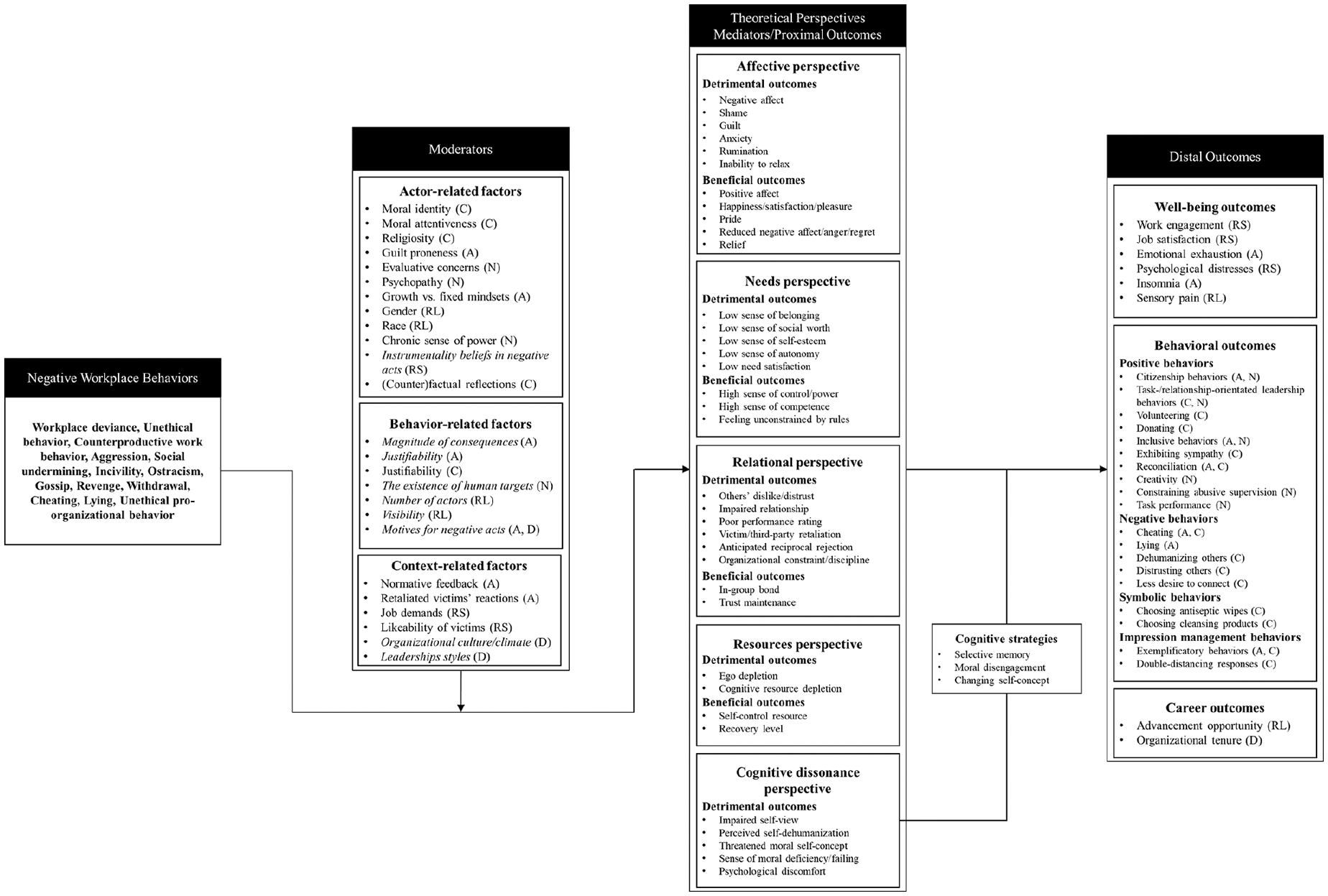
Integrated Model
Actor-Centric Outcomes of Negative Work Behavior
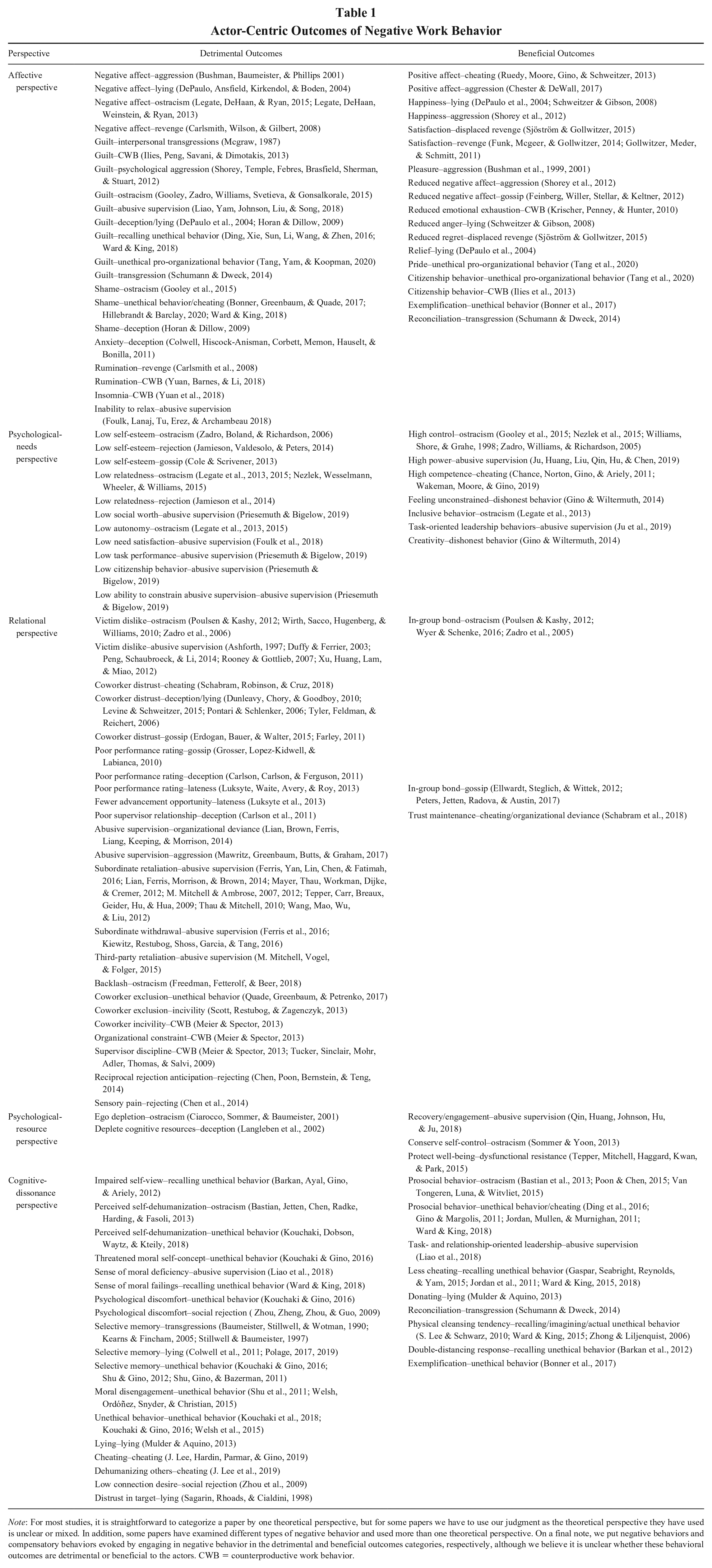
Note: For most studies, it is straightforward to categorize a paper by one theoretical perspective, but for some papers we have to use our judgment as the theoretical perspective they have used is unclear or mixed. In addition, some papers have examined different types of negative behavior and used more than one theoretical perspective. On a final note, we put negative behaviors and compensatory behaviors evoked by engaging in negative behavior in the detrimental and beneficial outcomes categories, respectively, although we believe it is unclear whether these behavioral outcomes are detrimental or beneficial to the actors. CWB = counterproductive work behavior.
Next, we separately address each of these perspectives. For each, we begin with an overview of its application to actor-centric outcomes of negative behavior, followed by the various theories that fit under the perspective and a summary of the relevant findings as they pertain to costs and benefits for actors. We conclude each section with a broader discussion that integrates these findings.
Affective Perspective
Studies employing affect-based theories, not surprisingly, are interested in the affective outcomes for actors who engage in negative behavior as well as additional consequences that emerge from those emotions. We know that emotions can influence antisocial behavior (Baumeister & Lobbestael, 2011), unethical decision making (Haidt, 2001), and CWB (Bauer & Spector, 2015), but studies under the affective perspective seek to answer how these behaviors impact emotions: To what extent do bad actors feel guilt or shame, or to what extent do they experience a thrill from getting away with something?
Empirical studies have found that misbehaving can result in a range of emotions. One set of studies, drawing on theories on self-conscious emotions, especially with regard to their appraisal patterns and functions (e.g., Tracy & Robins, 2004), have argued that after engaging in negative acts, actors become aware of their failure to live up to the standards set by themselves or others and the possibility of an undesirable self- and/or social image, which in turn lead them to experience negative self-conscious emotions, including guilt and shame (Tangney, Miller, Flicker, & Barlow, 1996). Notably, these theories have also argued that, although aversive, these negative self-conscious emotions serve important regulatory functions that motivate actors’ engagement of compensatory behaviors so as to reduce these feelings (Leary, 2007).
Another set of studies has focused on the emotional-regulation function of the negative behaviors themselves, such as revenge and aggression, arguing that these behaviors, when done in response to others’ injustice or norm violations, can restore one’s sense of equity or right the wrong. As such, these negative acts serve to regulate actors’ emotions by shifting feelings from anger and injustice to satisfaction and relief. In addition, some minor negative acts, such as cheating, may also beget an uptick in positive emotions as actors may find the engagement of these acts enjoyable. We elaborate on these findings next.
Detrimental outcomes
It should come as no surprise that a substantial body of research has documented the emotional toll paid by transgressors. Indeed, the mere anticipation of negative emotions, such as shame and guilt, dissuades many from partaking in misbehavior (Baumeister, Vohs, DeWall, & Zhang, 2007). Previous studies have supported the positive relationships between negative affect and a wide range of negative behaviors, from telling lies (DePaulo, Ansfield, Kirkendol, & Boden, 2004) to being induced to ostracize others (Legate, DeHaan, & Ryan, 2015; Legate, DeHaan, Weinstein, & Ryan, 2013).
The prominent emotional consequences of negative behavior are the self-conscious emotions of guilt and shame. These are painful emotions that individuals experience when they perceive their actions have violated a standard, prompting a negative evaluation of their behavior in the case of guilt or a negative evaluation of their global self in the case of shame (Daniels & Robinson, 2019). Prior studies have revealed that many forms of wrongdoing can beget guilt and/or shame, including transgressions (Mcgraw, 1987), cheating (Hillebrandt & Barclay, 2020), psychological aggression (Shorey, Temple, Febres, Brasfield, Sherman, & Stuart, 2012), ostracism (Gooley, Zadro, Williams, Svetieva, & Gonsalkorale, 2015), lying and deception (DePaulo et al., 2004; Horan & Dillow, 2009), and unethical behavior (Bonner, Greenbaum, & Quade, 2017).
While being aversive, these negative self-conscious emotions elicited from the engagement of misbehaviors can be put to good use as they often motivate reparative actions to alleviate them (Daniels & Robinson, 2019). Thus, they can lead misbehaving actors to try to make amends for the harm they have caused and restore their self- and/or social image through more good deeds. Studies have shown that through feelings of guilt and/or shame, actors are more likely to engage in prosocial behaviors, such as giving targets a preferable snack after ostracizing them (Gooley et al., 2015) and displaying exemplification behaviors after engaging in unethical behavior (Bonner et al., 2017).
Some studies have shown that the impact of misbehaving on guilt and subsequent compensatory actions depends in part on the actors’ awareness and judgment of their negative acts. As Ilies, Peng, Savani, and Dimotakis (2013) showed, actors experienced more guilt and in turn engaged in more organizational citizenship behavior following CWB when they received normative feedback compared with when they did not. As explained by authors, such feedback made actors aware that their behaviors violated organizational norms and were harmful, thereby strengthening guilty feelings. Likewise, as Tang, Yam, and Koopman (2020) showed, engaging in unethical pro-organizational behavior was more likely to elicit guilt and subsequent helping behavior among actors with a high guilt proneness as they were more aware of the harmful effect of such acts for the victims. Finally, Schumann and Dweck (2014) found that actors with a fixed mindset, who viewed their traits as unchangeable, in contrast to those with a growth mindset, who viewed their traits as malleable, experienced more guilt and were also more likely to accept responsibility after the transgression. They argued that this occurred because actors with a growth mindset were more likely to view the past mistake, such as their transgressive behavior, as an opportunity for growth rather than as a threat to their self-concept.
Some other studies have followed an anxiety-based logic and found that committing misconduct can increase anxiety and its related states, such as rumination, because bad actors will be concerned about the potential negative consequences of their negative acts, such as being judged, punished, or retaliated against. Colwell, Hiscock-Anisman, Corbett, Memon, Hauselt, and Bonilla (2011) found that being instructed to deceive others led actors to report more anxious feelings associated with a past experience. Likewise, Foulk, Lanaj, Tu, Erez, and Archambeau (2018) revealed that abusive supervisors were unable to relax at home after work, and this may be because, as they argued, these supervisors ruminated about their misbehaviors and worried about the potential backlash. Finally, Yuan, Barnes, and Li (2018) showed that perpetrating CWB led to rumination, whereby actors mentally replayed their negative actions, which ultimately resulted in insomnia.
If perpetrating misbehavior can elicit negative emotions, such as guilt, shame, and anxiety, it raises the question as to why actors do it in the first place. One explanation is that actors may be poor at affective forecasting (Wilson & Gilbert, 2003); that is, they inaccurately predict how they will feel after misbehaving. Several studies have demonstrated that actors often believe that committing particular misdeeds will make them feel better, but in reality, they end up feeling worse. Bushman, Baumeister, and Phillips (2001), across five experiments, showed that to the extent actors believed that venting would help them relieve anger, they tended to engage in aggression in response to anger (see also Bushman, Baumeister, & Stack, 1999). However, they further found, as did some others, that aggression did not reduce subsequent hostility but instead increased negative affect (see Geen & Quanty, 1977, for a review on the catharsis hypothesis). Likewise, Carlsmith, Wilson, and Gilbert (2008) found that although actors expected to attain emotional benefits from punishing perpetrators’ free-riding behavior, doing so actually resulted in more rumination over the perpetrator and an increase in negative affect.
Another explanation for why people conduct misbehavior despite the risks of bad feelings is that sometimes doing so actually produces affective benefits to actors. We discuss these findings next.
Beneficial outcomes
We found a collection of studies showing beneficial consequences after specific types of harmful behavior. More specifically, when actors experience or witness injustice, mistreatment, or wrongdoing by others, such as after witnessing others’ transgressions, responding to it with negative acts can lead to emotional benefits. This benefit may not necessarily come from conducting behavior that is negative per se but may emerge from any behavior that regulates the emotion via righting a wrong or restoring a sense of equity (Liang, Brown, Lian, Hanig, Ferris, & Keeping, 2018). Schweitzer and Gibson (2008) found that when actors engaged in unethical behavior in response to others’ violation of fairness, they felt more satisfaction and happiness as well as less anger and guilt. They argued that such behavior helped to punish others’ unfair actions and restore feelings of equity. Krischer, Penney, and Hunter (2010) viewed two forms of CWB—production deviance and withdrawal—as emotion-focused coping strategies and found that these behaviors alleviated the impact of low organizational justice on emotional exhaustion. Feinberg, Willer, Stellar, and Keltner (2012) similarly found that gossiping behavior, when triggered by observing others’ antisocial behavior, lowered the negative affect felt by the actors. Gollwitzer, Meder, and Schmitt (2011) reported that aggressive acts in response to others’ norm-violating actions led to feelings of satisfaction. However, they also found that this emotional benefit occurred only when the revenger believed that the targets understood they were being aggressed upon in revenge for their prior norm violations. This finding was further extended by Funk, Mcgeer, and Gollwitzer (2014), who showed that revengers experienced more satisfaction when the target signaled a positive change as the result of the revenge. Similarly, Chester and DeWall (2017) found that engaging in retaliatory aggression in response to social rejection served an emotion-regulation function and repaired actors’ mood by elevating positive affect. Interestingly, as found by Sjöström and Gollwitzer (2015), revenging upon a different target than the original party that mistreated them also led to less regret and more satisfaction as long as the target and the original transgressor belonged to a high-entitativity group. This finding suggests that even displaced revenge can also restore revengers’ sense of justice after being mistreated.
Finally, actors may experience pleasure and enjoyment from engaging in some minor negative acts. As shown in Ruedy, Moore, Gino, and Schweitzer’s (2013) study, after cheating, actors may experience the so-called cheater’s high. Across six experiments, they found that although subjects anticipated feeling guilty for cheating, those who voluntarily cheated actually experienced a boost in positive affect in comparison to those who did not. They found this effect was not due to moral rationalizing, relief at not getting caught, or financial gain but rather was due to cheaters feeling thrilled for circumventing the rules and getting away with it.
Discussion
The studies situated under the affective perspective thus far have shown that perpetrating harmful behavior can elicit negative emotions, positive emotions, or a decrease in negative emotions. We have several possible ways to reconcile these mixed findings. For the most part, it appears that engaging in misdeeds often results in emotional costs for the actors, such as guilt, shame, anxiety, and anxiety’s relatives, including rumination, insomnia, and inability to relax. However, several factors may dampen emotional costs or facilitate the emergence of positive emotional outcomes. First, the emotional consequence of misbehaving may depend on the type of misbehavior in terms of the magnitude of consequences, or the misbehavior’s total harms to victims, which is a critical component of moral intensity (Jones, 1991). These more harmful and severe behaviors will force actors to experience more negative emotions and less positive emotions. For example, Ruedy et al.’s (2013) study found the “cheater’s high” was for relatively minor negative acts that did not involve harm to salient targets. With more substantial transgressions and/or harm to salient others, which is the case for negative behaviors examined in many studies, a boost in positive emotions may be drowned out by negative emotions.
Second, it may be that the justifiability of one’s misdeeds influences the emotional consequences. Justifiability would explain the positive emotional consequences of misbehaving when it is in response to perceived injustice, transgressions, or mistreatment by others. As Schweitzer and Gibson (2008) demonstrated, negative behavior was seen as more justified when it was in response to others’ norm violations. Such negative responses are likely to be viewed as positive actions because they aim to restore justice, fix inequity, or right a wrong. Consistent with this argument, studies have alluded to justifiability as a potential moderator of the emotional consequences of misdeeds. Gooley et al. (2015) found that engaging in ostracism that was driven by motives to punish another or defend oneself produced less shame and guilt among actors than ostracism that was induced by experimenters. Relatedly, conducting unethical behavior for the sake of one’s organization evokes not only guilt but also pride, the latter of which, in turn, leads to organizational citizenship behavior (Tang et al., 2020).
Finally, it is important to note that a number of studies have found that although one valence of emotion predominates, at least some subjects have also experienced another valence of emotion or a mixture of both. For example, DePaulo et al. (2004) found those who lied reported different discrete emotions, such as happiness, relief, and guilt. Shorey et al.’s (2012) study of interpersonal aggression found subjects reported guilt as well as happiness and relief. Likewise, experiments on the catharsis of aggression have found that aggression results in pleasant emotions but does not reduce anger (Bushman et al., 2001). Even Ruedy et al.’s (2013) study on the “cheater’s high” found some evidence of negative affect, as well. These studies suggest that the emotional consequences of wrongdoing are more complex than portrayed thus far and may depend upon which emotions are measured in a given study, when the subjects’ emotions are assessed, and attributes of the subjects themselves.
Psychological-Needs Perspective
A smaller collection of empirical studies on the actor-centric outcomes of negative behavior have built on needs-related theories, including the temporal-need threat (TNT) model of ostracism (Williams, 1997), self-determination theory (Ryan & Deci, 2000), and need-to-belong theory (Baumeister & Leary, 1995). Psychological needs refers to the psychological nutrients that are essential for individuals’ well-being and functioning (Ryan, 1995). These theories have emphasized different, yet overlapping, sets of needs, but they share a common underlying logic. That is, people have particular fundamental needs, and the satisfaction or frustration of these needs has a range of important implications for the actor. Given the importance of need satisfaction, needs direct and motivate people toward certain actions and situations in order to fulfill them.
Studies using a need-based perspective have examined how engaging in wrongdoings leads to the frustration or satisfaction of actors’ needs, such as self-esteem, relatedness, control, competence, and autonomy. In addition, they also consider subsequent behavioral outcomes from thwarted or strengthened needs. These studies have predominantly focused on negative behaviors, such as ostracism, rejection, and social exclusion, partly due to the fact that the foundational research on these behaviors has adopted a needs-based perspective to understand how these actions impact targets’ needs (e.g., Baumeister & Leary, 1995; Williams, 1997). In very general terms, these studies have argued that on the one hand, misbehavior tends to frustrate actors’ needs for relatedness because it will likely undermine social connections with targets and evoke negative reactions from others. On the other hand, misbehavior is likely to satisfy actors’ needs for control or power as it allows actors to have dominance over the focal target(s).
Detrimental outcomes
A handful of studies has examined how engaging in negative behavior can result in need frustration in general, such as Foulk et al. (2018), who found that leaders who abused subordinates experienced a full range of need frustration because of subordinates’ negative reactions to such behavior. Most other studies address the frustration of particular needs, including self-esteem and relatedness. With regard to self-esteem needs, studies have reported that self-esteem is reduced after perpetrating various transgressions, including ostracism (Zadro, Williams, & Richardson, 2005), rejection (Jamieson, Valdesolo, & Peters, 2014), and gossip (Cole & Scrivener, 2013), partly because these acts run counter to one’s positive self-view and can lead actors to feel bad about themselves.
Another collection of studies has found that conducting misdeeds can hurt actors’ relatedness needs or their fundamental need to belong, as doing so can hurt one’s social image and/or undermine relationships with others. One study reported that leaders who engaged in abusive supervision felt a lack of social worth, a widely used indicator of sense of relatedness, because they knew doing so would beget negative social reactions and thus undermine their perceived value to others (Priesemuth & Bigelow, 2019). This lack of social worth elicited by abusive supervision was found to in turn obstruct leaders’ job performance, citizenship behavior, and ability to constrain future abusive behaviors. Interestingly, they found that these effects did not hold for leaders who scored high on psychopathic tendencies, since such leaders were indifferent to others’ feelings and thus tended to disregard negative social responses.
The majority of studies addressing relatedness needs focuses on negative behavior that reflects acts of social exclusion or ostracism, whether experimentally induced or internally motivated. Legate et al. (2013, 2015) found that needs for relatedness, as well as needs for autonomy, were threatened by engaging in ostracism because doing so misaligned with the actors’ needs to affiliate with others. Interestingly, they found that although these thwarted needs elicited negative affect, they also subsequently motivated actors to restore them by showing more inclusive behaviors toward targets. Moreover, as two other studies reported, even when the ostracism was self-motivated, when it was directed at strangers, or when it took a slightly minor form, such as providing rejecting feedback, doing so still threatened actors’ needs for relatedness (Jamieson et al., 2014; Nezlek, Wesselmann, Wheeler, & Williams, 2015).
Beneficial outcomes
Although the studies just discussed demonstrate that perpetrating misdeeds negatively impacts actors’ esteem and relatedness needs, other studies have demonstrated that doing so can enhance actors’ needs for control/power, competence, and autonomy. Multiple studies have pointed to the boosted sense of power and control that comes from engaging in ostracism and social exclusion (Gooley et al., 2015; Nezlek et al., 2015; Williams, Shore, & Grahe, 1998; Zadro et al., 2005). These studies have found that ostracizing others raises the actors’ sense of dominance over the social exchange and/or targets. A similar effect on needs for power and control may also hold true for other forms of negative behavior that are social in nature, such as abusive supervision. Ju et al. (2019) showed that in the short term, abusing subordinates increased supervisors’ sense of power over their subordinates, especially among leaders with a low chronic sense of power, as they were more likely to perceive enacting abusive behaviors as signals of control over subordinates. They further found that the sense of power gained from abuse led to greater managerial self-efficacy and more task-oriented leadership behaviors. Several other studies have focused on the strengthened sense of competence as a result of misbehaving. Wakeman, Moore, and Gino (2019) showed that misrepresenting one’s own performance can boost one’s sense of competence. In their study, when actors encountered threats to their fundamental need for competence, such as when being challenged to answer extremely difficult questions, they tended to misrepresent their own performance to protect the sense of competence. Indeed, doing so served a self-protection purpose and led actors to perceive their competence as higher than it actually was. Similar results are reported by Chance, Norton, Gino, and Ariely (2011), who found that actors who obtained improved performance by cheating developed an inflated belief about their ability. Last, one study showed across a set of experiments that when actors were dishonest, whether by choice or by random assignment, they felt a heightened sense of being unconstrained by rules, a feeling similar to sense of autonomy, which in turn improved their creativity (Gino & Wiltermuth, 2014).
Discussion
How do we create meaning from this variety of findings regarding the satisfaction and frustration of different needs following different negative actions? One approach is to consider a theory put forth by Shnabel and Nadler (2008), which provides a potential overarching explanation for these findings as a whole. They categorize psychological needs into two major groups: agency needs, such as control, power, competence, and autonomy, and communion needs, as relatedness, self-esteem, and moral self-regard. They argue that following a transgression, the perpetrators’ agency needs are satisfied because in carrying out their misdeeds, they are exercising power, control, and autonomy. Simultaneously, however, their communion needs are threatened because their behavior is deemed harmful, and thus they risk negative social evaluation or even exclusion from the community to which they belong. This argument largely, although not perfectly, aligns with the empirical studies we have reviewed so far, which show that misbehaving mostly satisfies needs related to competence, control, and autonomy but harms those needs related to self-esteem and relatedness.
It is important to note that most studies that take a psychological-needs perspective, including the theory of Shnabel and Nadler (2008), have focused on misdeeds that are social in nature, such as ostracism, aggression, and abusive supervision. Whether the findings and this framework would hold true for other forms of misdeeds that are less social in nature, such as cheating, stealing, or vandalism, remains to be determined by future empirical studies. Although all types of negative acts have a social component, in that the behavior is known to violate widely endorsed organizational and/or societal norms, which are shared social constructs, not all forms have a salient human target. Thus, while an actor may satisfy power and control needs with interpersonal transgression through controlling the social dynamic or other people, it is unclear if such needs are fulfilled when one engages in nonsocial acts, such as sabotage. Similarly, while an actor experiences threats to needs for relatedness by conducting misbehaviors of a social nature, such as ostracism, it is unclear if the threats will be as strong when the act does not involve others, such as might be the case with theft or fraud.
Relational Perspective
The third collection of studies has considered actor-centric consequences through relational mechanisms. Theories under this perspective primarily include social exchange theory (for a review, see Cropanzano, Anthony, Daniels, & Hall, 2017) and social identification theories (e.g., Tajfel & Turner, 1979) as well as more specific theories subsumed by these two overarching theories, such as network generation theory, backlash theory, evolutionary theory of gossip, and theories on trust. Studies using a relational perspective have typically taken two forms. The first form focuses on others’ negative attitudinal and behavioral responses. Specifically, according to social exchange theory, other people, including victims and third-party observers, will view bad actors as poor social exchange targets, develop a negative attitude toward them, and following the norm of reciprocity, retaliate against their negative acts.
The second form highlights relational benefits to bad actors when they conduct misdeeds collectively. That is, misbehaving in a group often entails reciprocal exchanges, such as information sharing and cooperation, which can facilitate a higher-quality social exchange relationship among bad actors. In addition, misbehaving demonstrates actors’ conformity to the group norms and similarity with other bad actors, which helps to delineate the in-group-versus-out-group boundary and thus strengthens actors’ identification with the group. We address each of these in detail next.
Detrimental outcomes
A number of studies have found that actors can face negative consequences because their transgressions elicit negative attitudinal and behavioral reactions from others. Engaging in harmful behavior at work is likely to incur negative evaluations from others and thus lead to a potential loss of social capital or hurt actors’ personal relationships that are instrumental to their performance and career advancement (Seibert, Kraimer, & Liden, 2001). Several studies have found that those who ostracize or reject others are perceived to be less attractive and to possess fewer desirable traits (Poulsen & Kashy, 2012; Wirth, Sacco, Hugenberg, & Williams, 2010; Zadro, Boland, & Richardson, 2006). Likewise, spreading negative gossip also hurts how one is viewed by others. Farley (2011) found that actors who frequently gossiped about others were disliked and perceived to be less powerful. Moreover, Erdogan, Bauer, and Walter (2015) showed that those who passed around negative gossip benefited less from their close relationship with leaders; that is, they did not increase their advice network centrality as one would predict. The authors argued that coworkers perceived gossipers as lacking discretion, so they were less willing to seek out their advice.
Parallel findings have considered the implications of cheating, deception, and lying. When employees engage in cheating behavior, they are less trusted by their coworkers who eschew cheating (Schabram, Robinson, & Cruz, 2018). Likewise, actors who engage in deception and lying are perceived by others as less competent, powerful, and trustworthy (Dunleavy, Chory, & Goodboy, 2010) and also less likable (Tyler, Feldman, & Reichert, 2006). Even when actors lie to help others, while they are seen as friendly and benevolent, others perceive them to have less integrity (Levine & Schweitzer, 2015) and show less respect for them (Pontari & Schlenker, 2006).
These attitudinal and evaluative relational outcomes are especially salient in supervisor–subordinate relations. With regard to subordinates, as Ashforth (1997) reported, they were less likely to endorse and identify with leaders who oppressively used power. Relatedly, leaders are less likely to be trusted by, and develop a good relationship with, subordinates whom they have undermined or abused (Duffy & Ferrier, 2003; Peng, Schaubroeck, & Li, 2014; Rooney & Gottlieb, 2007; Xu, Huang, Lam, & Miao, 2012). Along similar lines from the perspective of supervisors, Grosser, Lopez-Kidwell, and Labianca (2010) found that they gave more negative evaluations to their employees who engaged in gossiping activities. Carlson, Carlson, and Ferguson (2011) found that when employees engaged in deception to make themselves look good, their supervisors tended to evaluate them as less promotable and to report having a lower-quality relationship with them. Relatedly, via a national survey and an experimental study, Luksyte, Waite, Avery, and Roy (2013) found that when actors displayed lateness behavior, supervisors viewed them as less capable and skilled and thus less qualified for promotion. Importantly, they also found that this effect held for only Black but not White employees because, as they explained, managers tended to ascribe the lateness of Black employees to stereotypical attributes of being unconscientious, irresponsible, and unpunctual while attributing that of White employees to external reasons, such as heavy traffic.
Besides negative attitudinal responses, negative actors may also incur detrimental consequences because of the unfavorable behavioral responses they elicit. As studies have shown, bad actors are subject to coworkers’ exclusion when they engage in unethical behavior (Quade, Greenbaum, & Petrenko, 2017) or exhibit incivility (Scott, Restubog, & Zagenczyk, 2013). Others have found that bad actors face others’ punishment and retaliation, including coworkers’ uncivil and unsupportive behaviors (Meier & Spector, 2013) and supervisors’ disciplinary responses (Tucker et al., 2009) and abusive behaviors (Lian, Ferris, Morrison, & Brown, 2014; Mawritz, Greenbaum, Butts, & Graham, 2017). Likewise, leaders who violate norms by exhibiting abusive, hostile, or unfair supervisory behaviors are also found to attract negative reactions, such as retaliation, avoidance, and moral outrage from targets (Ferris, Yan, Lin, Chen, & Fatimah, 2016; Kiewitz, Restubog, Shoss, Garcia, & Tang, 2016; Lian, Brown, Ferris, Liang, Keeping, & Morrison, 2014; Mayer, Thau, Workman, Dijke, & Cremer, 2012; M. Mitchell & Ambrose, 2007, 2012; Tepper et al., 2009; Thau & Mitchell, 2010; Wang, Mao, Wu, & Liu, 2012) and third-party observers (M. Mitchell, Vogel, & Folger, 2015). Importantly, across four experimental studies, Freedman, Fetterolf, and Beer (2018) found that women, compared with men, faced more backlash and punishment for engaging in ostracism. They argued that this was because women were violating gender stereotypes when conducting ostracism, a behavior that was both high in agency and low in communion.
Finally, we found one study showing that bad actors can anticipate others’ negative responses based on the norm of reciprocity even without observing others’ actual responses (Chen, Poon, Bernstein, & Teng, 2014). Specifically, they found that after rejecting others, actors anticipated that they would be reciprocally rejected by others in the future and thus experienced sensory pain. This effect was especially present for those who were more concerned about negative evaluation, as they were more sensitive and vigilant to potential backlash after their rejecting acts.
Beneficial outcomes
Although the studies just discussed point to detrimental relational outcomes for negative actors, there is one specific domain where misbehaving may incur relational benefits. Specifically, several studies have shown that actors who conduct negative acts together may strengthen their relational ties among themselves. Zadro et al. (2005) found that when two actors excluded a target from their conversation, they experienced a stronger sense of belongingness to one another. This finding is further validated by two follow-up studies that have found that actors who ostracize a common target tend to build an in-group bond and like each other (Poulsen & Kashy, 2012) and to perceive themselves as closer and more similar to one another (Wyer & Schenke, 2016). Similar relational benefits have been found with gossip, whereby actors build stronger positive relationships by gossiping about a common target. Using a longitudinal social network design, Ellwardt, Steglich, and Wittek (2012) found that the gossip network tie between two individuals promoted the formation of their friendship tie over time. Likewise, Peters, Jetten, Radova, and Austin (2017) found that when gossiping about a third person’s deviant behavior, actors developed a stronger social bond between themselves. Finally, Schabram et al. (2018) found that actors who engaged in deviance or cheating behavior maintained their trust in one another when compared with those who did not share in the behavior.
Discussion
Taken as a whole, we conclude that only in some cases do negative actors gain relational benefits. That occurs in the situations where actors share in the misbehavior together and strengthen the relational bond between them. This effect is greater when the act is committed in a coordinated fashion compared with an independent one (Schabram et al., 2018). When shared, besides sustaining relational bonds to one another, bad actors are also less likely to perceive themselves as solely responsible for the potential undesirable consequences and thus will be less sensitive to negative reactions from victims and observers (Zadro et al., 2005).
But aside from this benefit, it appears that negative actors face harm from a relational perspective. If one engages in lying, deception, gossiping, ostracism, or abusive supervision, one is likely to incur negative evaluations and reactions from coworkers and supervisors, which may result in a loss of social capital and, in some cases, result in lower performance ratings and potentially undesirable career outcomes. It is important to note, however, that from the relational perspective, these detrimental consequences to misbehaving actors are contingent on others, such as coworkers and supervisors, observing their negative actions. Although that is to be expected with regard to visible social behaviors, such as abusive supervision or social undermining, it may be less likely in cases of cheating, theft, or other acts that can go unwitnessed in organizations. Indeed, Carpenter, Rangel, Jeon, and Cottrell (2017) empirically demonstrated that many forms of negative, deviant, or counterproductive behavior in organizations went unobserved by coworkers and supervisors. As such, the visibility of negative acts may be an important behavior-related moderator that future studies need to address.
Psychological-Resources Perspective
Resource-related theories, including ego depletion theory (Baumeister, Bratslavsky, Muraven, & Tice, 1998) and conservation-of-resource theory (Hobfoll, 1989, 2001), have also been used to address the actor-centric outcomes of negative behavior. Ego depletion theory focuses on self-control resources, or a finite amount of resources utilized to control one’s responses based on standards such as norms, goals, and plans. In contrast, conservation-of-resource theory addresses a broader range of resources, which are defined in very general terms as anything that is perceived by an individual to facilitate his or her goal attainment (Halbesleben, Neveu, Paustian-Underdahl, & Westman, 2014). Examples of such resources include objects, personal characteristics, conditions, and energies (Hobfoll, 1989). Despite their different resource foci, both theories share a recognition that individuals’ resources are limited and crucial to their self-regulation and goal pursuits, and thus, any resource gain or loss has a significant impact on them (for respective reviews, see Baumeister & Vohs, 2018, and Hobfoll, Halbesleben, Neveu, & Westman, 2018).
Existing studies using a resource perspective examine how engaging in negative behavior influences actors’ resource gains and losses and how these resource changes then impact actors’ distal well-being outcomes. In so doing, two competing arguments have emerged: (a) Misbehaving constitutes a stressor and consumes resources, thus resulting in resource losses and negative distal well-being outcomes, and (b) misbehaving helps actors cope with potential stressors and threats and hence leads to resource gains and positive distal well-being outcomes. We explore each of these next.
Detrimental outcomes
Engaging in negative behavior can potentially deplete resources in various ways, from overpowering normative behavioral scripts and moral constraints to ruminating about or rationalizing ones’ harmful behavior to protecting oneself from potential backlash. Despite these possibilities, we find only a very few studies that have examined how engaging in negative behavior leads to actors’ resource loss. This is in sharp contrast to the large volume of research that has addressed how victims’ resources are depleted by perpetrators’ transgressions (e.g., Baumeister, Nathan Dewall, Ciarocco, & Twenge, 2005; Rosen, Gabriel, Koopman, & Johnson, 2016; Thau & Mitchell, 2010).
The strongest support we have found for the resource-depleting effects of negative behavior comes from Ciarocco, Sommer, and Baumeister (2001), who hypothesized that ostracizing others would deplete actors’ limited self-control resources because it required them to inhibit their natural tendency to interact with others. They found support for their hypothesis through two experimental studies, showing that after following instructions to ignore a confederate, subjects experienced ego depletion as indicated by their faster tendency to give up on two unachievable tasks. Another study demonstrated that it was cognitively taxing to tell lies (Langleben et al., 2002), suggesting that various other negative actions that may require the actor to lie, be dishonest, or break rules may result in a similar cognitive repletion.
Beneficial outcomes
In contrast to the studies on resource losses, a few other studies provide evidence for the notion that negative behavior functions to protect actors from resource-depleting stressors and thus results in resource gains. For example, some have argued that ostracism can help actors avoid aversive interactions or conflicts that would otherwise deplete resources (Robinson & Schabram, 2019; Sommer, Williams, Ciarocco, & Baumeister Roy, 2001) and that engaging in gossip with coworkers can help to cope with resource-depleting stressors (Grosser, Lopez-Kidwell, Labianca, & Ellwardt, 2012).
Qin, Huang, Johnson, Hu, and Ju (2018) provided a piece of empirical evidence for negative acts’ role in increasing resources. Building on the assumption that resisting the impulsive tendency to abuse subordinates required self-control and that abusing subordinates gave rise to a sense of power over subordinates, they hypothesized that abusing subordinates can help supervisors shore up resources and thus help them recover from daily stressful demands. Through two experiments and one experience-sampling study, they found that in the short run, abusing subordinates enabled supervisors to recover, or be brought back to their prestress level of functioning, which in turn enabled them to be more engaged in their work. Importantly, they also found that those beneficial outcomes derived from abusive supervision were strengthened when supervisors had a low empathic concern, as they tended to view such harmful acts as more justifiable, and when they had high job demands, as they had a stronger need for resource replenishment. On a related note, Tepper, Mitchell, Haggard, Kwan, and Park (2015) found that engaging in dysfunctional resistance, such as ignoring the supervisor, could help employees maintain a positive self-image and avoid being stressed out after experiencing the supervisor’s abusive behavior, which was a resource-depleting stressor.
Discussion
Taken together, it appears that misbehaving has the potential to incur resource gains, resource losses, or both for actors. Notably, however, only a small number of studies have addressed this issue. Much more research is needed before we can adequately understand actor-centric effects through a resource perspective. We speculate, however, on several factors that may affect whether misbehaving leads to resource gains or losses.
One challenge in corralling the evidence on resource-based theories is that it seems almost limitless as to what can be considered resources and, therefore, what counts in the final tally of resource gains and losses. With regard to resources for conducting negative behavior, it may help the analysis to consider a distinction between gains and losses from the initiation of the act and gains and losses from the result of the act. With respect to initiating a negative behavior, it may or may not require the use of resources. If initiating an act involves self-control, thereby suppressing natural tendencies or one’s authentic self, it should be taxing, whereas if initiating an act allows one to be relieved of self-control, it should be resource beneficial. One relevant factor here is the likeability of the victims. Sommer and Yoon (2013) demonstrated this in their study of induced ostracism toward likable and unlikable confederates. They found that ignoring likable confederates required suppressing their natural affiliative tendencies and thus led actors to experience ego depletion, whereas ignoring unlikable confederates relieved actors of exercising self-control and thus yielded resource gains. Based on this, we contend that negative behaviors that are more emotionally driven, impulsive, and financially tempting, such as incivility, abusive supervision, and cheating, may relieve one of self-control, and thus initiating these acts is not depleting but replenishing resources. In contrast, less emotional and impulsive negative behaviors, such as ones involving being socially pressured to exclude a likable person or unwillingly overselling customers at the request of the authority, may not relieve one of self-control but instead deplete resources in the initiation process, as one will be more naturally inclined to not do so.
When it comes to the gains and losses to the actor from the results of their negative action, there are many possibilities. Negative behavior can produce positive results, such as solving the conflict, expressing authentic feelings, or gaining control over others, which implies resource gains. In contrast, negative results, such as causing harm to others, incurring backlash, and threatening one’s moral self-concept, may lead to resource losses. Many unexamined factors may determine the final calculus. One potential factor refers to employees’ beliefs regarding the function of negative behavior because such beliefs may shape employees’ reactions after misbehaving (Shoss, Jundt, Kobler, & Reynolds, 2016). That is, employees who believe in the instrumentality of negative behavior to cope with workplace stressors may derive more resources from it compared with those who do not have such a belief. Relatedly, as we will discuss in the next section, the extent to which the consequences of one’s actions—such as how much harm they cause—are discrepant with one’s moral self-concept, actors may experience more resource losses.
Cognitive-Dissonance Perspective
The last theoretical lens we cover here is the cognitive-dissonance perspective. This perspective is rooted in cognitive-dissonance theory, which proposes that cognitive dissonance causes psychological discomfort and motivates individuals to avoid or reduce it (Festinger, 1957). Cognitive dissonance refers to the inconsistency or contradiction between two cognitive elements, such as between knowledge, opinion, or belief about oneself, one’s behavior, or the environment (Festinger, 1957). Applying this perspective to negative behavior, scholars largely agree that such behavior evokes dissonance because it is discrepant with things actors know about themselves, especially their desire for a positive moral self- and/or social image (Barkan, Ayal, & Ariely, 2015; Klass, 1978). Notably, many studies under this perspective have not measured cognitive dissonance per se, but rather, they have treated it as a hypothetical construct or relied on a variety of proxy indicators, including impaired self-view (Barkan, Ayal, Gino, & Ariely, 2012), perceived self-dehumanization (Bastian, Jetten, Chen, Radke, Harding, & Fasoli, 2013), threatened moral self-concept (Kouchaki & Gino, 2016), sense of moral deficiency (Liao, Yam, Johnson, Liu, & Song, 2018), sense of moral failings (Ward & King, 2018), and psychological discomfort (Kouchaki & Gino, 2016; Zhou, Zheng, Zhou, & Guo, 2009). As the experience of dissonance is psychologically distressful, this perspective points to a common undesirable consequence for bad actors.
Within this domain, one set of studies has built on theories on moral compensation (Zhong, Liljenquist, & Cain, 2009) and self-completion (Wicklund & Gollwitzer, 1981), which suggest that when any aspects of actors’ moral self-concepts are lacking or inadequate, they can initiate compensatory acts to reaffirm their self-concept. As such, this set of studies has viewed cognitive dissonance as a self-sanctioning mechanism, which signals the discrepancy between actors’ current actions and their desired self-concept and in turn motivates them to engage in compensatory behaviors to close it. Another set has drawn insights from theories and literature on moral disengagement (e.g., Bandura, 1999) and selective memory (e.g., Anderson & Levy, 2009) and highlights how actors use cognitive strategies to alleviate potential dissonance, which in turn can liberate them to engage in additional negative actions without threatening their self-concepts (Moore & Gino, 2015; Wiltermuth, Newman, & Raj, 2015).
The issue of whether actors engage in compensatory behaviors or additional negative behaviors after misbehaving belongs to a larger debate regarding behavioral balancing and consistency in which scholars examine actors’ responses subsequent to their ethical and unethical behavior. As studies on behavioral balancing and consistency have been reviewed in depth elsewhere (see, for example, Mullen & Monin, 2016), here we provide a general overview focused on those studies that address dissonance and action after unethical behavior only.
Compensation strategies to reduce dissonance
The dissonance generated by misbehaving can motivate actors to engage in compensatory behaviors to restore their threatened self-concept. Compensatory behaviors are typically measured as an increase in positive behaviors or a decrease in negative behaviors. Studies have found that in comparison to control groups, those who engage in or recall engaging in unethical behavior are more likely to offer help to experimenters (Ding, Xie, Sun, Li, Wang, & Zhen, 2016), report prosocial intentions, resist the temptation to cheat (Jordan, Mullen, & Murnighan, 2011; Ward & King, 2015), and make a bigger donation (Gino & Margolis, 2011). Along similar lines, it has been found that abusive supervisors tend to display subsequent task- and relationship-oriented leadership (Liao et al., 2018), and actors who exclude others are more likely to volunteer to participate in a new experiment (Bastian et al., 2013) and demonstrate more sympathy for innocent victims’ suffering (Poon & Chen, 2015).
Some studies suggest compensatory behavior can be purely metaphorical or symbolic (West & Zhong, 2015). Zhong and Liljenquist (2006) were the first to show that after recalling or imagining behaving unethically, actors were motivated to “cleanse” themselves of the taint of their transgression, as indicated by a stronger willingness to use antiseptic wipes and buy cleansing products. However, subsequent studies on this effect have had mixed results (e.g., Earp, Everett, Madva, & Hamlin, 2014; S. Lee & Schwarz, 2010; Ward & King, 2015), and a meta-analysis found only a small-to-nonsignificant effect (Siev, Zuckerman, & Siev, 2018).
A final approach to compensation may come in the form of impression management to restore one’s moral social image. Barkan et al. (2012) found that when actors engaged in negative behavior that was unjustifiable and invisible, they activated a “double-distancing mechanism” to their misdeeds by judging others’ morally questionable behaviors more harshly and presenting themselves as excessively righteous and virtuous. They argued that although such responses cannot satisfy actors’ desire to be truly moral, they did fulfill the actors’ desire to appear moral to others. Along similar lines, Bonner et al. (2017) found actors who engaged in unethical behavior were more likely to subsequently engage in exemplificatory behaviors, such as coming to the office on weekends or staying at work late. As they explained, these behaviors, which signaled actors’ diligence and work ethic to others, were aimed at repairing an injured social image caused by prior moral transgressions.
Past studies show that dissonance, and therefore the degree of subsequent compensatory actions, is impacted by the nature of one’s moral self-concept as well as one’s awareness of and judgment regarding one’s own negative actions. Regarding the nature of one’s moral self-concept, bad actors with high moral values are more likely to experience a greater sense of dissonance and threat to their moral self-concept, and therefore they have a higher motivation to engage in compensatory actions following negative behavior. Indeed, studies have found that after misbehaving or recalling doing so, those with a higher moral identity have a stronger tendency to donate (Mulder & Aquino, 2013) and volunteer (Ding et al., 2016), and those with strong religiosity tend to engage in more prosocial tasks and less cheating (Ward & King, 2018).
Regarding awareness of one’s own behavior, Gaspar, Seabright, Reynolds, and Yam (2015) found that when bad actors counterfactually reflected on what should have happened differently, in contrast to thinking about what actually happened, it made more salient the discrepancy between their misbehavior and their moral self-concept, thereby resulting in more resistance to the subsequent temptation to cheat for financial gain. Likewise, Liao et al. (2018) found that to the extent that leaders were high on moral attentiveness, they were more likely to recognize a discrepancy between their own behavior and the moral self-concept and hence were more motivated to exhibit prosocial leadership behavior after being abusive.
The perceived justifiability of the negative act by the actor may also influence how much dissonance one experiences. When negative behavior is perceived by the actor as less justifiable, the transgression may generate more threat to actors’ moral self-concept and thus engender a stronger motivation for actors to compensate for their misbehavior. As found by Van Tongeren, Luna, and Witvliet (2015), when actors lacked enough time to gather social information that could justify their acts of social exclusion, they were more inclined to compensate excluded targets by assigning less boring work to them.
Cognitive strategies to reduce dissonance
Just as one can reduce dissonance by seeking justification for one’s actions, one can further engage in a broad host of additional cognitive strategies to bridge the gap between their negative behavior and their positive self-view. In this regard, a series of studies has focused on the power of moral disengagement, which involves various ways through which actors dissociate internalized moral standards from their actions, including cognitively restructuring their view of their negative behavior, mentally altering their responsibility or the harm caused, and changing their views of their victims and their roles (Bandura, 1999; Bandura, Barbaranelli, Caprara, & Pastorelli, 1996). Shu, Gino, and Bazerman (2011) showed cheating behavior caused actors to morally disengage from their behavior by, for example, justifying means with ends, distorting the consequence of cheating, and diffusing their responsibility. Similarly, Sagarin, Rhoads, and Cialdini (1998) found that actors who told a lie were likely to justify their lying behavior via creating a “false consensus” wherein they believed that lying was ubiquitous and everyone else, including whom they lied to, was also dishonest.
Moral disengagement triggered by prior immoral acts can enable subsequent additional immoral acts. Welsh, Ordóñez, Snyder, and Christian (2015) found that committing small unethical behaviors over time, with gradually increasing unethicality, led actors to morally disengage, which in turn enticed them to commit a larger-sized unethical behavior. Relatedly, J. Lee, Hardin, Parmar, and Gino (2019) found that moral disengagement triggered by prior cheating behavior can decrease actors’ ability to understand others’ feelings and emotions, which in turn increased actors’ cheating behavior and tendency to dehumanize others.
Another group of studies has addressed another set of cognitive techniques that involve selective memory, or biased recall that enables actors to avoid perceiving an inconsistency between their action and their self-concept. For example, actors tend to omit facts when recalling a past transgression that highlights the severity of the transgression and their responsibility (Baumeister, Stillwell, & Wotman, 1990; Kearns & Fincham, 2005; Stillwell & Baumeister, 1997). They also tend to selectively recall facts so that prior lies seem closer to the truth (Colwell et al., 2011; Polage, 2017, 2019) and forget moral rules after engaging in acts that violate them (Shu & Gino, 2012; Shu et al., 2011). Of note, Kouchaki and Gino (2016) found that “unethical amnesia” triggered by earlier unethical action led actors to repeat such action subsequently.
Last, actors can also directly alter their self-concept to address cognitive dissonance resulting from negative actions. Kouchaki, Dobson, Waytz, and Kteily (2018) found that recalling or engaging in unethical behavior led actors to perceive themselves as less than human and incapable of resisting temptations to behave unethically, which in turn led to more unethical behavior. Relatedly, Zhou et al. (2009) found the act of rejecting others, because it is in conflict with the self-view as a social being, led actors to alter this self-view and thus reduced their desire to forge new social connections.
Taken together, studies under the cognitive-dissonance perspective have illustrated that after misbehaving, actors tend to experience the aversive consequence of cognitive dissonance. This dissonance, in some cases, may motivate actors to engage in compensatory behavior to restore their positive self-concept. In other cases, actors may rely on cognitive strategies to remove or avoid the dissonance, which in turn may liberate them to conduct further negative acts.
General Discussion
As our review demonstrates, previous studies on actor-centric consequences of negative acts have relied on a diverse set of theoretical lenses and generated a mixed set of findings. Such a broad range of perspectives and consequences echoes Klass’s (1978: 768) reflection that “it is evident that no single theoretical viewpoint sufficiently explains the observed effects” regarding the actor-centric effects of negative acts.
Despite the variety of theories and findings, if we take a bird’s-eye view of the findings as a whole, we can draw some general conclusions by combining the findings across different theoretical perspectives. Actors who engage in negative behavior in the workplace may face detrimental consequences, from either internal or external sources. As misdeeds are discrepant with actors’ desire for a positive self-concept, especially among those actors with high moral traits, engaging in such acts can engender both negative self-conscious emotions, such as guilt and shame, and lowered self-esteem and cognitive dissonance. These aversive feelings and cognitions, in turn, can motivate actors to remove them through engaging in subsequent compensatory behaviors. Yet, in some cases, actors will avoid or overcome feelings of guilt, shame, or dissonance. That happens when bad behavior is relatively minor or perceived by the actor to be justified, such as when it is in response to unfairness, conflict, or mistreatment. It can also happen if actors employ various other cognitive strategies that bridge the gap between their actions and their self-concept, which could lead to additional misdeeds.
Even if actors overcome internally imposed negative consequences, they can still face costs in other ways because their behaviors are known to be harmful, and thus actors could face serious social consequences. This makes engaging in harmful behaviors cognitively taxing for actors. Moreover, observed misdeeds often lead to negative evaluations from others at work, including coworkers, subordinates, and supervisors such that bad actors are less liked, respected, and trusted. In addition, these negative social evaluations have costly consequences for actors in terms of social exclusion, lower performance evaluations, and thwarted career progression. Not surprisingly, then, engaging in misbehavior tends to thwart fundamental needs to belong.
With respect to beneficial outcomes, one study finds positive affect emerges from “breaking the rules” when the act in question is relatively minor, and numerous other studies point to how negative acts help to regulate actors’ emotions via enhancing positive affect, relieving negative affect, and shoring up their psychological resources when such acts are done in response to unfair treatment, norm violations, and workplace stressors. In addition, when negative acts provide actors with dominance over targets, it can satisfy actors’ agency-oriented needs, especially needs for control or power, and when done in concert with others, it can strengthen bonds between misbehaving actors.
Despite the myriad empirical studies, we cannot provide a clear-cut answer to our initial question of whether actors are helped or hurt by engaging in negative behavior. Instead, at best we can offer only a tentative one: Engaging in negative behavior is a double-edged sword that has both costs and benefits to actors. If forced to take a side, these findings in aggregate seem to tip toward suggesting that negative actors are bestowed with more harm than good. This is because the benefits seem to emerge only under certain circumstances, such as when actors engage in negative behaviors to cope with workplace stressors, in response to injustice, together with other bad actors, or to exert control over victims. These benefits seem not worth the costs, especially when considering those benefits can often be readily obtained by enacting positive or neutral behaviors, such as problem-focused coping behaviors.
Nevertheless, this conclusion may be too strong, because the results of this collection of studies are clearly a mixed bag and, at least for a given actor, would require us to consider an interplay of many known and unknown factors. Also, as we can observe in Table 1, most studies in this area have focused on detrimental outcomes rather than beneficial outcomes, a fact that may render the aforementioned conclusion biased. Thus, we cannot conclude decidedly whether “crime pays” or “cheaters never prosper” is the more accurate phrase. Instead, perhaps the most appropriate expression to use at this point in time is “the jury is still out.” Interestingly, despite the tremendous theoretical and empirical progress on this question since 1978, our conclusion seems to align with the outcome of Klass’s (1978) review, which noted that, based on extant research at that time, it was unclear whether misbehaving had inherent costs or benefits for bad actors.
The uncertain answer to this question in both old and new reviews reflects the challenge of answering it as well as the fact that we still need more research. With that in mind, we identify and organize research gaps we observed in this collection of studies and offer needed avenues for future research. These gaps and future directions are organized around five Ws—who, what, where, when, and why—and we elaborate on each next.
Who: Levels of Analysis
With few exceptions, almost all the studies in our review have focused on the implications of negative actions by individuals on individual actors. Relatively little research thus far has examined misconduct of teams and the resulting team consequences, even though we know teams are increasingly popular in modern organizations (Marks, Mathieu, & Zaccaro, 2001) and misbehavior in organizations is often committed along with the help or coordinated efforts of others (Schabram et al., 2018). The potential impact of team misbehavior on team consequences are demonstrated by several studies we have found. For example, Detert, Treviño, Burris, and Andiappan (2007) and Aubé and Rousseau (2011) found that team deviance, including aggression and counterproductivity, impeded team effectiveness. Nevertheless, we believe this line of work is still in its infancy, and many important questions remain unanswered. We thus encourage future research to further explore how team-level negative actions, in various configurations, influence a variety of team consequences, such as team motivation, cognition, emotion, and effectiveness.
What: Outcomes
Many studies on actor-centric consequences of negative behavior have stopped at mediating mechanisms or proximal outcomes, such as emotions, need (un)fulfillment, and ego depletion, and failed to link them to more distal, organizationally relevant outcomes, such as actors’ well-being at work, work-related behaviors, and career advancement. For example, studies under the cognitive-dissonance perspective have been mostly conducted by social psychologists, and as such, they have examined behavioral outcomes that are less relevant to work contexts. Likewise, although the fulfillment of psychological needs is essential to actors’ well-being, prior studies involving need theories have failed to build such connection from misbehavior to distal well-being outcomes via the mediating role of need satisfaction and frustration. A similar observation emerges among studies under the relational perspective in that they have largely missed the more distal career outcomes as a result of others’ negative attitudinal and behavioral responses to bad actors. Last, studies under the resource perspective have primarily examined well-being outcomes while overlooking the link between misbehaving and work-related behavioral outcomes through resource depletion and replenishment.
While some studies in this review have linked negative acts with work-related outcomes, such as work performance and engagement, each has been focused on a specific kind of negative behavior. Although we have found common patterns across different behaviors, to draw confident conclusions about organizationally relevant implications for the bad actor and the factors that explain them, we need a much larger and more diverse set of studies. We hope more organizational research will explore what happens to bad actors in terms of their performance, well-being, work attitudes, motivation, work–family balance, actual promotions, and the like.
Where: Context
With organizationally relevant outcomes in mind, future studies need to give far more attention to the role of organizational context. Most of the research in our review examines the misbehaving actor’s subsequent thoughts, feelings, and behaviors that emerge from internal processes. Much less attention has been devoted to organizational factors that play a role in creating consequences for the actor, such as others’ behavioral responses to the misdeeds, outcomes from reward systems, or other organizational forces that create consequences for the bad actors. A good example of the type of study we need here is that by Foulk et al. (2018), who theorized how actors’ abusive supervision would create negative reactions from subordinates which in turn, over time, would undermine actors’ need fulfillment.
Many organizational contextual moderators may shape whether bad actors face positive or negative outcomes, such as factors related to organizational culture, climate, and leadership. For example, ethical culture and climate shape organizational members’ perceptions and beliefs of ethical versus unethical behaviors (Trevino, 1986; Victor & Cullen, 1988) and thus may alter the extent to which wrongdoers face condemnation from themselves, peers, and supervisors. Furthermore, whether actors face negative professional repercussions or how much may depend upon their supervisor, such as their geographical or relational closeness to their supervisor, their supervisor’s ethical orientation, or the extent to which the supervisor is laissez-faire. These and many other organizational moderators can be explored in future studies on the actor-centric consequences of misbehavior.
When: Time
Noticeably absent in this set of reviewed studies is the element of time. Time has been and continues to be a critical but underexplored factor in management research (e.g., George & Jones, 2000; T. Mitchell & James, 2001; Zaheer, Albert, & Zaheer, 1999), and that is true for this domain, as well. The effects of negative behavior may occur more immediately or into the future. Most studies in our review focus on relatively short-term consequences of negative actions, likely because it is easier to examine them in experimental settings. Unfortunately, it means we know little about long-term consequences, namely, what may happen in the future for those who engage in negative actions, whether based upon a particular action or the accumulation of them. Nevertheless, we have found a few notable exceptions to the short-time focus on actor-centric outcomes (e.g., Hudson & Roberts, 2016; Meier & Spector, 2013; Tucker et al., 2009).
Several recent studies have found that the consequence of negative behavior for actors varies in different time windows. For example, Qin et al. (2018) and Ju et al. (2019) conducted diary studies and found that although abusive supervision appeared to provide positive outcomes to leaders on the same day, these leaders experienced negative outcomes after a week or so. Likewise, Schulte-Braucks, Baethge, Dormann, and Vahle-Hinz (2019) found that CWB buffered on a daily basis, but reinforced on a weekly basis, the deleterious effects of illegitimate tasks on self-esteem. Similar results were reported by Rahwan, Hauser, Kochanowska, and Fasolo (2018), who showed that actors felt more unethical about themselves a day after cheating compared with immediately after the act. In addition, a handful of studies have examined the long-term consequences of negative behavior. For example, Pierce and Snyder (2015) used archival data over a 4-year stretch from the motor vehicle industry and found that complying with customers’ unethical demands led employees of fraudulent companies to obtain a longer tenure. These example studies highlight the importance of capturing actor-centric outcomes of negative behavior over time. Echoing Klass’s (1978) advocacy of greater attention on the long-term effects of misbehaving, we believe future research on this issue needs to use more longitudinal designs, such as those with repeated measurements or the use of archival data, and examine more distal consequences, such as health, personality, career outcomes, and the like.
Why: Motives for Negative Behavior
As previously noted, the consequences facing bad actors seem to depend in part on why actors are engaging in negative behavior. Although we have made the argument that negative behavior will likely lead to more positive consequences and less negative consequences when it has a justified reason, such as to right a wrong, this possibility needs more empirical evidence. It appears from findings across different studies that when bad behavior occurs because of attempts to resolve, respond to, or cope with adversity in the workplace, it results in more immediate beneficial outcomes in terms of emotions, cognitions, and resources. This is because it addresses the immediate threat and may be perceived as justifiable, thereby regulating the emotion, relieving the stress, and lessening the accompanying cognitive dissonance.
Future studies may need to dive deeper into this issue by addressing different types of motives from the perspective of different stakeholders. For example, future studies may consider the two-by-two framework: self- and other-ascribed prosocial and antisocial motives. Self-ascribed prosocial and antisocial motives may influence the degree of shame, guilt, and cognitive dissonance that actors experience after misbehaving, while other-ascribed prosocial and antisocial motives may alter the magnitude of others’ negative responses to the actors. Taken together, the moderating effects of the motives behind the negative act have been largely overlooked in the extant studies, and we thus recommend future studies to take them into account when examining the actor-centric consequences of negative actions.
Conclusion
Negative behavior has been long recognized as a ubiquitous and costly problem in organizations. Previous studies have made numerous efforts to understand its consequences for targets and third-party observers. In this review, we shift the focus to answer some less understood questions pertaining to the implications of negative behavior: What are its consequences for bad actors, and more specifically, do they get ahead or get hurt by their negative acts? By organizing extant empirical studies into five major theoretical perspectives or themes, and discussing the respective findings under each, we contend that negative acts seem to be a double-edged sword for actors and the outcomes for actors may depend on an interplay of many factors. Hopefully, our review can help organizational scholars and practitioners to better understand negative work behavior and inspire more future studies to explore its actor-centric consequences.
Footnotes
Appendix A
Search terms (from general to specific): deviance, interpersonal deviance, organizational deviance, production deviance, property deviance, deviant behavior, counterproductive work behavior, antisocial behavior, misbehavior, illegal behavior, employee vice, rule breaking, norm violations, offenses, bad behavior, immoral behavior, unethical behavior, unethical pro-organizational behavior, dishonesty, dishonest behavior, transgression, cheating, lying, deception, victimization, aggression, mistreatment, hostility, hostile behavior, violence, mobbing, theft, stealing, sabotage, ostracism, rejection, gossip, social exclusion, abusive supervision, petty tyranny, supervisor undermining, social undermining, harassment, sexual harassment, bullying, incivility, rudeness, discriminatory behavior, withdrawal, absenteeism, lateness, social loafing, negligence, withholding effort, corruption, bribe, abuse, alcohol use, drug use, noncompliant behavior, revenge, and retaliation.
Journals in alphabetic order: Academy of Management Journal, Administrative Science Quarterly, Journal of Applied Psychology, Journal of Business Ethics, Journal of Experimental Psychology: General, Journal of Experimental Social Psychology, Journal of Management, Journal of Occupational and Organizational Psychology, Journal of Occupational Health Psychology, Journal of Organizational Behavior, Journal of Personality and Social Psychology, Journal of Personality and Social Psychology, Journal of Vocational Behavior, Leadership Quarterly, Organization Science, Organizational Behavior and Human Decision Processes, Personality and Social Psychology Bulletin, Personnel Psychology, Psychological Science, Social Psychological and Personality Science, and Work and Stress.
Acknowledgements
The authors are grateful for the feedback and guidance of the associate editor, Rebecca Greenbaum, and two anonymous reviewers.
